At least six people were detained in Phoenixville by U.S. Immigration and Customs Enforcement Thursday, according to a nonprofit that works with undocumented people in the Greater Philadelphia area.
Rachel Rutter, executive director of Project Libertad, said the tips regarding ICE sightings started pouring in at around 7 a.m. Agents were reportedly at an Acme, a Wawa on the other side of the borough, and a car stop at an intersection.
“It really was just kind of a feeling of the town crawling with ICE because it was just kind of coming from everywhere and they’re moving around quickly,” said Rutter, whose organization confirmed the arrests and was still pinning down the locations of where they took place.
ICE did not immediately respond to questions regarding the alleged flurry of activity and arrests.
One Phoenixville resident, who declined to give her name out of privacy concerns, said she was walking her dog when she saw four SUVs with tinted windows and siren lights on their back dashboards in the middle of a car stop just blocks from the borough’s main commercial corridor. About eight plainclothes officers, some in face masks and wearing vests with “police” emblazoned on them, were at the scene, she said.
After dropping her dog off, the woman returned to Washington Avenue, near Star Street, where she saw the officers arrest two of the car’s passengers.
“From the time I saw them until the time I left, I’d say the total time was probably about 10 minutes,” she said, adding the driver of the car would later tell her the group was heading to work.
As of Thursday afternoon, Project Libertad, which has been connecting families of people detained by ICE to legal help, food, and financial assistance, was still in the process of reaching those affected by the arrests.
Some Phoenixville immigration advocates say the timing of the sudden arrests, after what felt like a lull in ICE activity, comes two days after a unanimous Phoenixville Council vote to pass an ordinance amendment that would limit immigration enforcement on borough property.
The mayor’s office and members of the Borough Council could not be reached for comment by publication.
“We’ve seen this in other areas across the country where when a city or a town, especially around sanctuary cities, takes a stand, ICE responds in force,” said Parker Studebaker, director of the Phoenixville Liberation Center, which has been hosting “know your rights” immigration trainings.
Studebaker also expressed concern over how the arrests took place a day after President Donald Trump signed a bill funding ICE and Border Patrol through the end of his term. Many immigration advocates worry that the roughly $70 billion going to the agencies comes with little oversight.
For now, immigration advocates in Phoenixville vowed to continue organizing and educational efforts.
“We really want to make it heard and make it known that the community is coming together and is willing to defend our neighbors, and that will not change, and so that’s the best we can do is show up and meet this where it’s at,” he said.
Correction: This story has been updated to reflect that six people were detained.
Philadelphia School District officials and public education advocates were relieved Wednesday when Mayor Cherelle L. Parker announced she had reached a deal with City Council that will prevent 340 classroom positions from being eliminated amid the district’s funding woes.
But as limited details about the agreement began to emerge Thursday, it became clear that the deal was less of a schools-funding program than a plan to figure one out over the next year — with the prospect of $216 million in city budget cuts taking effect if Parker and Council cannot eventually agree to adopt a new revenue stream.
“Council President Kenyatta Johnson and I publicly committed to working together to find local, recurring, predictable, and dependable revenue sources for the School District of Philadelphia over the next year to ensure that we keep these critical positions,” Parker said Thursday during a city budget bill-signing ceremony. “That is our shared goal and our commitment.”
But if Parker and Johnson do not make good on that commitment by July 1, 2027, the city will be on the hook for additional funding it has promised the school district between 2028 and 2031, including roughly $50 million in the first year of that time frame.
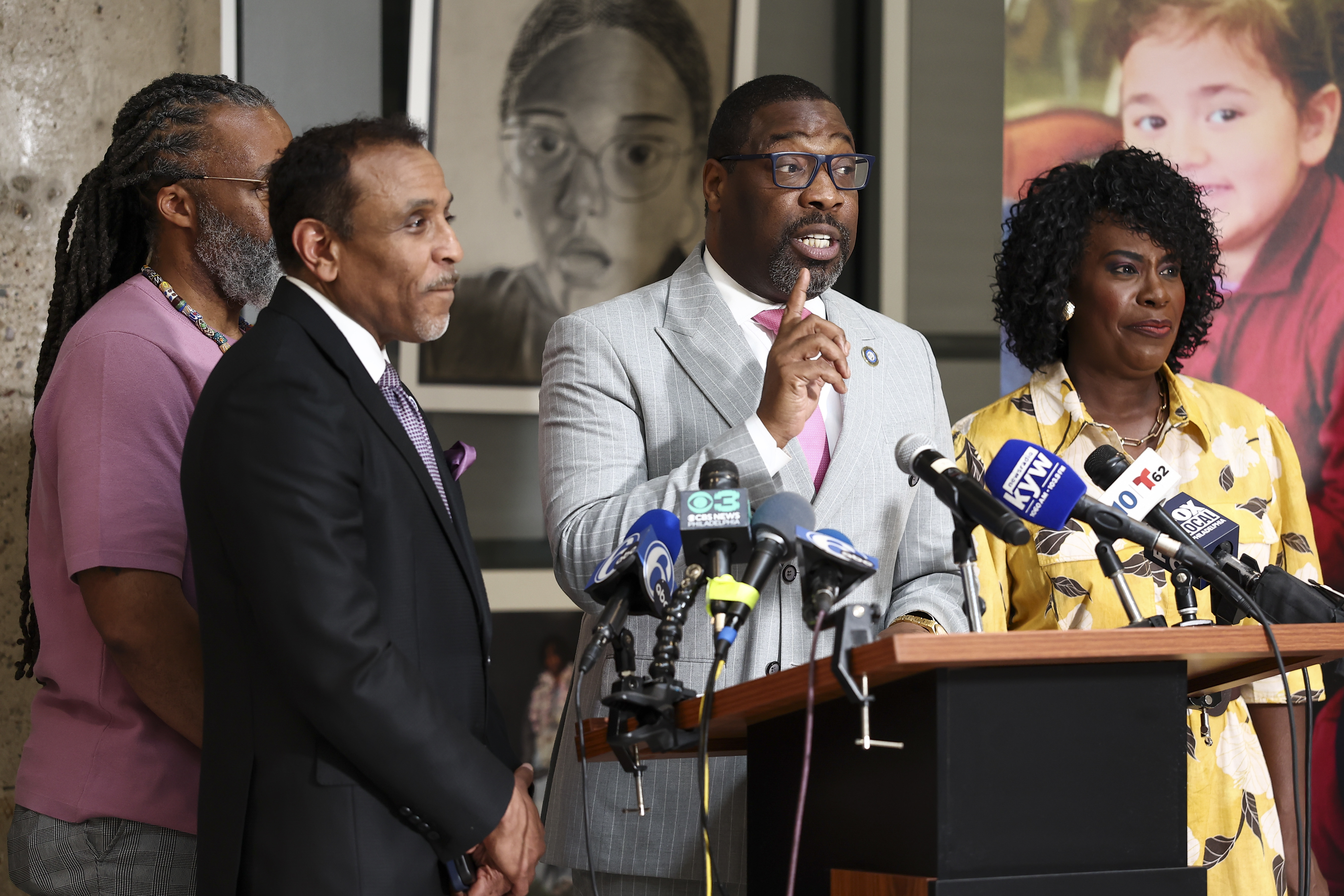
Council President Kenyatta Johnson speaks during an announcement at the School District of Philadelphia Headquarters on Wednesday, June 10, 2026 in Philadelphia. Philadelphia School District officials will move to restore 340 classroom-based jobs that were slated to be cut, despite top district leaders saying last week that they did not have the recurring funding needed to keep the positions.Monica Herndon / Staff Photographer
Parker, Johnson, Superintendent Tony B. Watlington Sr., and school board president Reginald Streater triumphantly unveiled the agreement to stave off the planned job cuts Wednesday. That announcement followed days of suspense after Council last week refused to pass the mayor’s proposed $1-per-trip rideshare tax, which would have funded schools, and instead advanced a city budget with about $50 million from one-time cuts that would be sent to the district as a Band-Aid for its $300 million budget gap.
Council’s move prompted Watlington, with Parker’s backing, to say the positions would still be eliminated without an explicit promise that the money would be recurring, rather than a one-time allocation.
Officials said they worked “around the clock” between Council’s rejection of the rideshare tax and Wednesday’s announcement, which Johnson jubilantly hailed as “Christmas in June.”
On Thursday, education advocates and labor leaders heaped praise on the administration for the deal.
Several district principals said Thursday they do not yet have details about exactly how much they will get back in their budgets, or how the dominoes will fall once positions are restored.
Watlington had school leaders build their 2026-27 budgets as if the cuts were happening, and many of the affected teachers, counselors, and climate staff secured new positions, some in the district and some outside the system. The restoration will undoubtedly cause vacancies elsewhere, months after other districts filled jobs for the fall.
“The win is making sure that those 340 jobs, with teachers, will not be laid off, and they will not have to second-guess if next year they’re going to come back to work,” Johnson told reporters Thursday. “And I think ultimately we can talk about sometime the ‘how’ we get to a particular end. But it’s always the ‘why.’ … At the end of the day, all of our young people still can have a chance to get a quality education.”
‘Budget sequestration’ comes to Philly?
The agreement between Parker and Johnson in some ways hearkens back to Congress’ 2011 “budget sequestration” debacle, when President Barack Obama, a Democrat, and House Speaker John Boehner (R., Ohio) agreed to severe across-the-board spending reductions that would take effect automatically if lawmakers and the White House failed to reach a “grand bargain” to restructure the federal budget.
They never reached an agreement — and the sequestration cuts, once thought of as too painful to countenance, eventually became reality.
Parker and Johnson are optimistic their arrangement for the school district and the city budget will not suffer a similar fate.
The future city budget cuts will be reflected in the city’s five-year plan, which must be approved by a state oversight board each year but is not binding legislation like annual taxing and spending measures. That gives City Hall more wiggle room to figure out how to find the money officials have now promised the district than Obama and Boehner had.
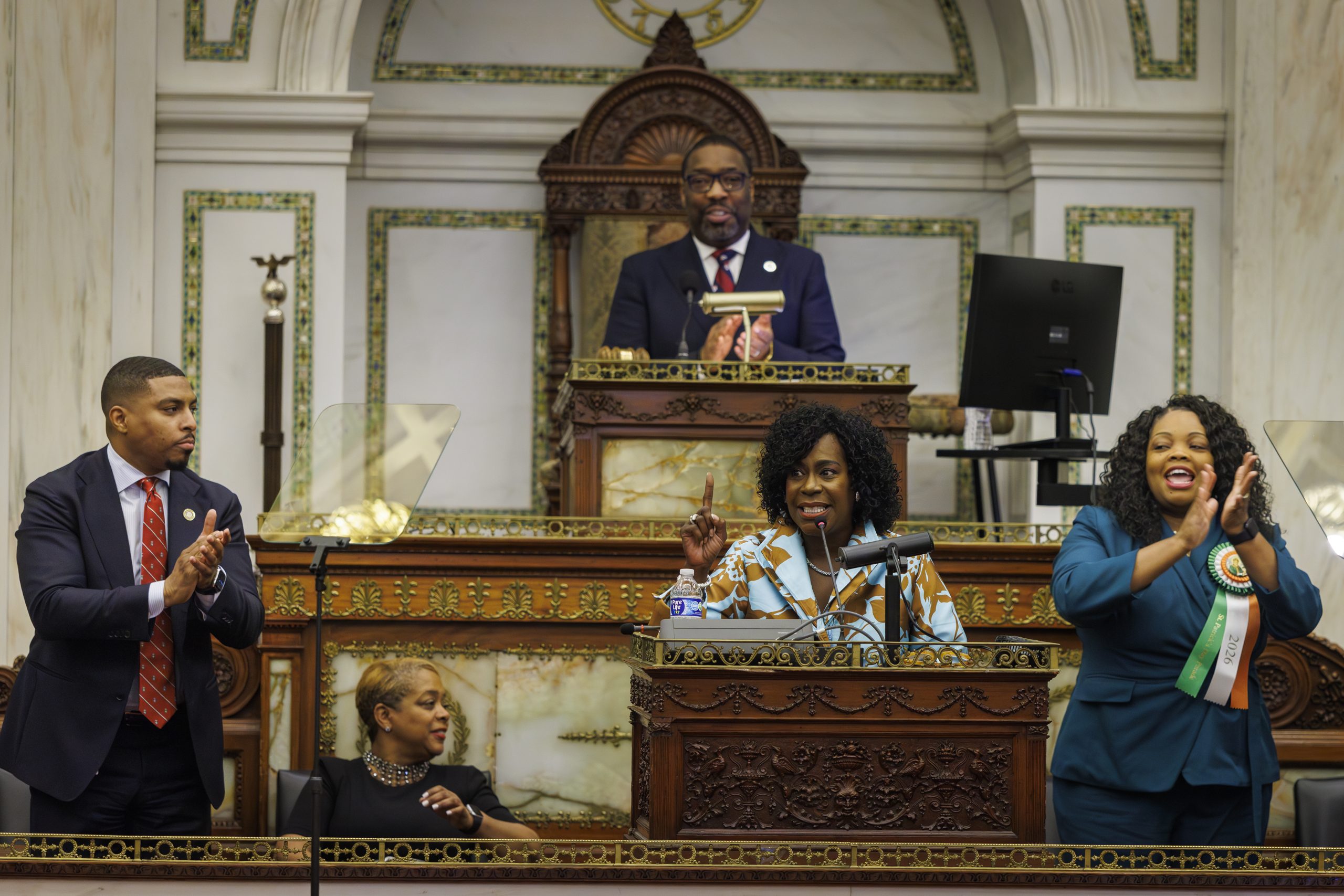
Philadelphia Mayor Cherelle L. Parker is cheered by members of Philadelphia City Council at conclusion of the budget address, Thursday, March 12, 2026. From left are council members Nicholas O’Rourke, Cindy Bass and Katherine Gilmore Richardson. In background is council President Kenyatta Johnson. .Alejandro A. Alvarez / Staff Photographer
Parker said her administration has already identified the cuts that will be reflected in the five-year plan when it is up for approval next month at the Pennsylvania Intergovernmental Cooperation Authority. But she has offered few specifics on what those potential cuts would entail.
Parker said Thursday that the city could make up part of the difference by reducing future debt repayment obligations by reducing the size of planned city bond sales. She mentioned the city’s capital budget, which funds projects like repaving roads and renovating recreation centers, but did not say how much would be cut.
And she said the city could halve its next borrowing related to her signature housing program, Housing Opportunities Made Easy. The city plans to take out a second tranche of $400 million in city bonds next year for H.O.M.E.; the potential cuts to free up money for schools could include taking only $200 million at that time, she said.
“Where did we get the money from in future years?” Parker said Thursday. “In our five-year plan, we made cuts to very important programs associated with our capital budget and even our H.O.M.E. plan — but cuts that will never have to be realized once we all make good on that commitment to generate that approximately $50 million in new, predictable recurring revenue.”
One complication in the negotiations to come is that Parker and all 17 Council members are up for reelection next year, and lawmakers are not eager to approve new taxes before voters head to the ballot box.
The Democratic primary, which effectively decides almost all elections in Philadelphia due to the city’s deep-blue electorate, will be in May 2027. The next city budget, including all tax measures for the following fiscal year, must be enacted by the end of June 2027, leaving several weeks after the election for Council to potentially approve a new tax to provide money for the district next year.
Philadelphia City Council members at City Hall in Philadelphia, Pa. on Thursday, June 11, 2026.Aidan T. Gallo / Staff Photographer
Some possibilities do not involve new or increased taxes for residents. The city, for instance, could speed up its plans to increase the share of property tax revenue that is dedicated to the district. Currently, the district receives 56% of property tax revenue, while the city takes 44%.
Parker said the agreement will allow Philadelphia to present a united front in Harrisburg as officials prepare to ask for more state funding for the city’s school district. State lawmakers in the past have pointed to disagreements among city leaders when rejecting requests for additional support.
“This is the first time … in my lifetime that the city of Philadelphia, the administration, and the legislative branch, along with the superintendent of the School District of Philadelphia and the school board, will all travel [to Harrisburg] in unity, along with all of our union partners and all of our education advocates,” Parker said. “We can stand up when we arrive in Harrisburg and say … ‘Philadelphia’s homework is done.’”
School advocates relieved
Arthur Steinberg, president of the 14,000-member Philadelphia Federation of Teachers, said the news of Parker and Johnson’s agreement came just in time. Thursday was the last day of school for 114,000 district students; staff finish the school year Friday.
“It was a very difficult year, and I’m glad that we’re able to tell them now that the positions that were cut due to this will be restored,” Steinberg said at a news conference Thursday morning outside Council chambers. “This means a lot to them. There’s stability over the summer. The communities will know who their teachers will be, and they’ll know where they’re going.”
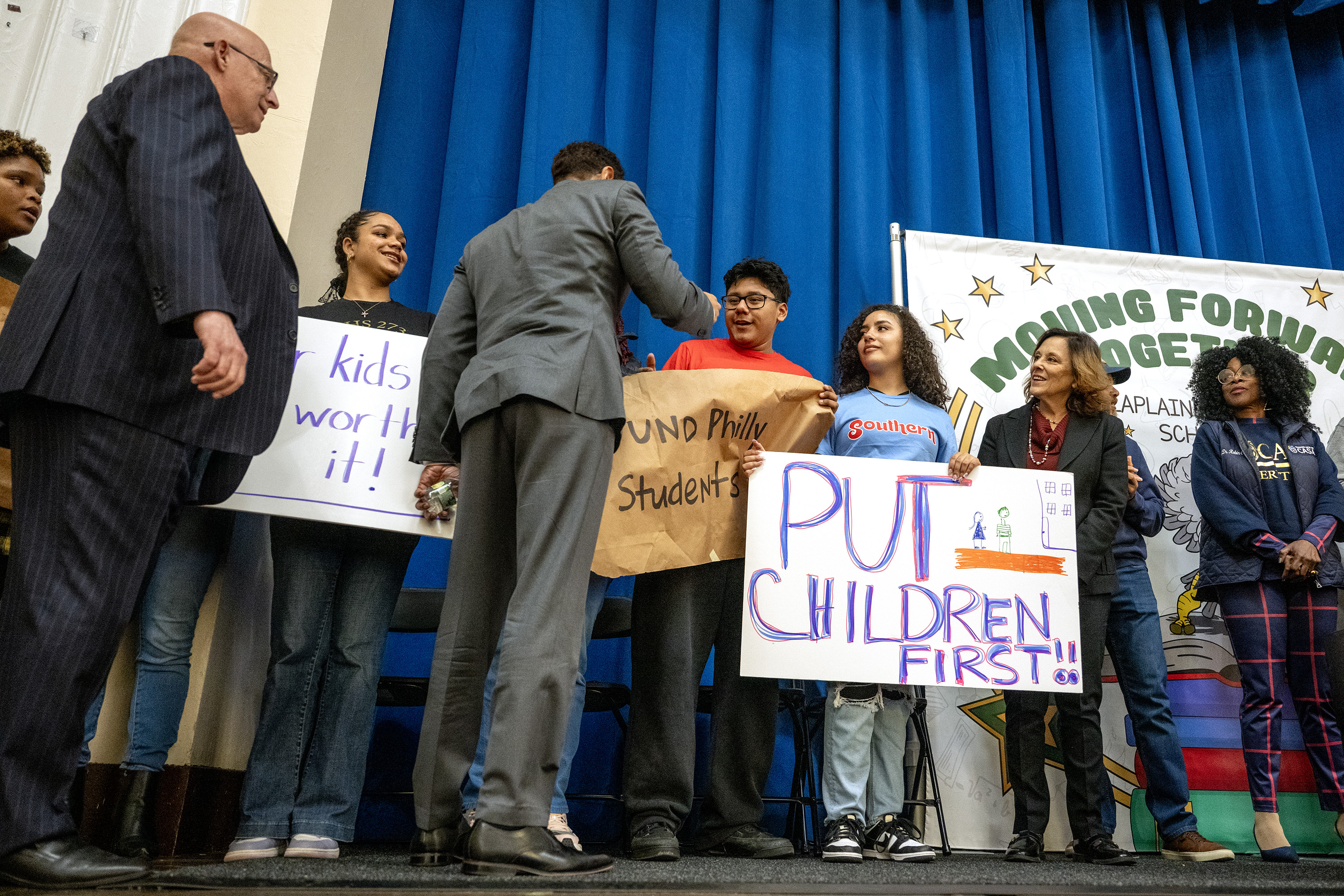
Arthur G. Steinberg (left), president of the Philadelphia Association of Teachers, and school superintendent Tony B. Watlington, Sr. (right) greet students as they arrive onstage for Mayor Parker’s announcement March 23, 2026, of $1 rideshare tax proposal to fund city schools.Tom Gralish / Staff Photographer
Tiffany Johnson Williams said she was thrilled that cuts at her child’s school — Nebinger Elementary in South Philadelphia — and others would be rolled back.
“I am equally grateful to Mayor Parker, Superintendent Watlington, and the school board for coming back to the table and working collaboratively to reach the solution that restored our critical positions,” Williams said at the news conference. “As a parent and educator and a youth advocate, I know that stability matters.”
Councilmember Isaiah Thomas, who has had a testy relationship with the district and school board over the last several months, suggested it was time to move forward cohesively to push for more funding elsewhere.
“I think where we are at this moment is recognizing that as we come together as Philadelphians, our job now is to use our advocacy initiatives and our leverage to try to get even more resources from Harrisburg,” Thomas said.
Staff writers Anna Orso and Jake Blumgart contributed to this article.
It won’t bring back the lost apples or peaches, but New Jersey has secured a federal disaster declaration for the crops damaged in April’s rare heat-freeze sequence.
The declaration, which covers all 21 counties, makes the state’s farmers eligible for emergency federal loans, Gov. Mikie Sherrill announced.
As much as $300 million in crop losses were reported by both states as the result of record heat on April 15 and 16 that induced the tree-flowering process to pick up the pace, setting them up for the kill that came with the freezes of April 20 and 21.
Growers have been warning that apple crops were destroyed and that any peaches would be as scarce as they were pricey.
Gov. Josh Shapiro has described the Pennsylvania damages as “unparalleled.”
It is unusual for temperatures to hit 90 in April, said Bob Oravec, a lead forecaster at the Weather Prediction Center in College Park, Md.
Rarely, however, have they been followed by such devastating freezes.
Some of the fruit crops, including the strawberries that are now in season, have managed to survive, Ben Casella, national policy director at the New Jersey Farm Bureau, said last month.
He added that Jersey growers are “fully promoting that they’ll have a strong crop of blueberries.”
Cherries and grapes didn’t fare so well, but was too soon to determine the exact extent of the losses.
The disaster designation makes farmers eligible for low-interest loans from the Farm Service Agency, what Sherrill called “a critical first step toward recovering from their crop losses.”
A stampede of tiny Croc shoes displaying ice cream and hamburger Jibbitz raced through an interactive structure at Sister Cities Park in Center City on a sunny Thursday morning.
“Philadelphia changed the world,” read an etching at the front of the play structure. “Ready to see how?”
Little red and blue gingham skirts fluttered in and out of wooden doorframes as 75 preschoolers explored a brand-new play arena that featured a series of colorful, translucent posters highlighting inventions from Philadelphians, including the Slinky, the revolving door, and the public library.
Panels inside the structure showcased inventions spurred by the imaginations of children, such as Popsicles, earmuffs, and trampolines.
The Sister Cities Park installation is one of 11 educational structures geared toward children placedat landmarks around the city. The series is an effort to further the city’s commitment to children’s engagement in public places and solidify its status as a great city for kids, as well as to celebrate the nation’s Semiquincentennial. Itwas unveiled June 11, a day the United Nations designated in 2024 as International Day of Play.
The bundle of installations includes colorful wheels at the Philadelphia Zoo teaching kids about animal species, a set of tabletops at Reading Terminal Market featuring displays about colors and tastes, and arton fencing at the Franklin Institute instructing children how to find different constellations in the night sky.
The final three installations — at Franklin Square, the National Constitution Center, and Elfreth’s Alley — have yet to be installed and are coming soon, according to the project website.
The goal is to keep Philadelphia a city on the forefront of children’s enrichment and one that makes it publicly available for all kids in the city to benefit from, Philadelphia Mayor Cherelle L. Parker said at the unveiling of the Sister Cities Park installation.
“This idea that our children can have places and spaces where they can feel safe, supported, and seen, and free to just be children, is extremely important to me,” Parker said. “Truly great cities invest in their children.”
Philadelphia Mayor Cherelle L. Parker, right, hugs Raechel O’Neal Coats, director of the Friends Childcare Center, left, at the unveiling of a new playful learning hub at Sister Cities Park in Center City, Philadelphia, June 11, 2026.Jessica Griffin / Staff Photographer
Sarah Lytle, executive director of Playful Learning Landscapes, a nonprofit that helps U.S. cities convert ordinary spaces into learning hubs, presented Parker with documentation of a new designation for the city — World’s First Playful Learning City.
Moments later, Parker ripped a red, white, and blue paper-link chain and a procession of kids tore through the new installation, quickly getting to work weaving in and out of its pillars and standing on tippy-toes to doodle on chalkboards affixed to the structure’s middle section.
The Sister Cities event was finished off with words from whom else but the city’s most renowned tinkerer and inventor, Ben Franklin (or, technically, James Longacre, who specializes in lectures, TV commercials, and ribbon-cuttings performing as Ben Franklin).
He thanked Parker for securing Philadelphia’s latest special designation and “for reminding our city that a spark of curiosity is brightest when struck with a bit of play.”
As quickly as the kids barreled toward the structure to inaugurate its first playtime, they returned to teachers and aides — ice pops, toy boats, and bottles of bubbles in hand, ready to be entertained anew. Dozens of tiny hands grasped a rainbow-colored rope and teachers ushered the students back up the Benjamin Franklin Parkway and onto their next adventure.
DUBAI, United Arab Emirates — President Donald Trump said Thursday he had called off new military strikes on Iran, claiming a breakthrough in negotiations to end the war just hours after the American leader threatened to escalate the conflict by seizing control of Iran’s oil industry.
Trump has said multiple times in recent weeks that the warring parties have been on the cusp of a deal without anything coming to fruition. A spokesperson for Iran’s Foreign Ministry said in a live phone call on state television that mediators were active and nothing had been finalized to end the conflict that began Feb. 28 when the U.S. and Israel jointly attacked Iran.
Trump opened an Oval Office event Thursday afternoon saying: “We just made a great settlement of the war with Iran.” He offered scant details, other than to say he expects an agreement to extend a fragile ceasefire that started in April to be finalized “over the next few days.”
Extending the terms of the ceasefire gives U.S. leaders more time to negotiate over Iran’s nuclear program, the main reason Trump and Israeli Prime Minister Benjamin Netanyahu used to justify launching the war. Netanyahu’s office said Thursday that Israel is not a party to the emerging agreement between the U.S. and Iran.
The announcement came after two days of back-and-forth attacks between the U.S. and Iran had pushed the Middle East closer to the resumption of a full-scale war.
Trump had threatened further escalation earlier Thursday, posting on social media that the U.S. would hit Iran “VERY HARD TONIGHT” and take “total control” of its oil and gas industries. A few hours later, Trump posted on social media that significant points in the negotiations “have been brought to the highest level of Iranian leadership and approved.”
Esmail Baghaei, the spokesperson for Iran’s Foreign Ministry, said in his phone call on state television that text of a deal is “mostly finalized.”
“The problem is that the contradictions in America’s position has caused turbulence to this process,” he said Thursday night.
A major sticking point in negotiations has been Iran’s nuclear program, which the U.S. and Israel fear could lead to an atomic weapon, but which Tehran says is for peaceful purposes. Another key issue is Iran’s stranglehold on the Strait of Hormuz, a critical shipping lane for transporting oil and natural gas.
Trump again moves quickly from threats to negotiating
Trump’s rapid shift Thursday from dire threats to promoting peace negotiations again underscored his whipsaw approach to the war. He suggested on Monday that a deal to end the conflict could be reached in a matter of days.
Then back-and-forth strikes rattled the Middle East this week. The first involved attacks between Iran and Israel, followed by the two rounds of fire between the U.S. and Iran, which targeted countries where U.S. troops are based. The U.S. strikes began after Trump blamed Iran for downing an American attack helicopter near the Strait of Hormuz. Both pilots were rescued safely.
Iran’s Foreign Ministry said the U.S. attacks had “effectively rendered the ceasefire … meaningless,” without saying it was abandoning it.
After Trump threatened more attacks were to come on Thursday, Iran’s parliamentary speaker, Mohammad Bagher Qalibaf, responded on social media that “wrong strategies and impulsive decisions” would wreak havoc on energy markets and “create an endless quagmire that you will be stuck in for years.”
It wasn’t the first time Trump threatened escalation before giving negotiations another chance. In April, he warned Iran that “a whole civilization will die tonight, never to be brought back again” if it didn’t agree to his terms, before extending a ceasefire.
Trump threatened to seize Iran’s main oil terminal
Iran’s monthslong disruption of shipping through the Strait of Hormuz has crimped global energy supplies, driven up fuel prices and made food and other basics more expensive well beyond the region.
Trump had threatened Thursday to seize Kharg Island, the heart of Iran’s oil industry, through which 90% of its exports pass.
But Trump himself soon voiced doubts about taking over the oil terminal, saying in an interview with Fox News: “I don’t know that America has the stomach for it, to be honest.”
“I don’t want to have boots on the ground,” Trump said. ”But if I wanted to, we could put a small group of soldiers and take over the place.”
Tensions persist over Iran’s nuclear program, Strait of Hormuz
U.S. Treasury Secretary Scott Bessent said in a social media post that the U.S. would extract funds from frozen Iranian accounts to offset the costs of damage to American allies and any tolls Iran imposes for ships to transit the Strait of Hormuz.
Beyond the deadlock over the strait, the two sides also remain at odds over Iran’s nuclear program. Tehran insists its nuclear efforts are peaceful. The U.S. and Israel fear Tehran’s stockpile of highly enriched uranium could be used to build an atomic weapon.
Iran has insisted that any deal to end the war must also end fighting in Lebanon between its ally militia Hezbollah and Israel. But Israeli Prime Minister Benjamin Netanyahu appears intent on pursuing his goal of destroying the militant group.
Iranian student says hope dwindles as attacks escalate
A 25-year-old student in northern Iran says Iranians are fearing “chaos” amid the war with the U.S. and Israel and multiplying crises at home.
The student, who lives in the city of Babol, said many Iranians are struggling to afford groceries in the face of mass job losses and triple-digit food inflation. He spoke on the condition of anonymity out of security fears.
“Everything is going wrong and there is no hope among the people,” the student added.
The student first spoke to The Associated Press before the war when he participated in widespread anti-government protests. He now says his chief concern is that Iran “maintain territorial integrity and deterrence” in the face of attacks by the U.S. and Israel.
U.S. fires on another merchant ship to enforce blockade
The U.S. military’s Central Command said Thursday that it struck a Guinea-Bissau-flagged tanker attempting to evade the American blockade on Iranian ports. It said the M/T Jalveer was transporting Iranian oil when it was disabled late Wednesday after its crew failed to obey U.S. orders.
It’s the ninth merchant vessel the U.S. military says it disabled to enforce the blockade.
Three Indian sailors were killed when American forces struck the Palau-flagged M/T Settebello on Tuesday, India’s minister overseeing ports and shipping said Thursday on X.
U.S. Central Command said American forces issued warnings before firing on the ship, which it accused of trying to evade the blockade.
The leader of the International Maritime Organization, a United Nations agency, condemned the attack.
The heat and humidity have transformed the atmosphere into an obnoxious broth — just in time for the World Cup FIFA Fan Festival — and we can do without the fireworks, thank you.
The official temperature at Philadelphia International Airport had reached 97, setting a record for the date, with a heat index of 103 at 4 p.m. It beat the high of 95, reached in 1985, and an encore was expected Friday, when the record also is 95.
In addition, the steaminess has added volatility to a vapor-swollen atmosphere that is even making the windows sweat. The city’s heat emergency remains in effect until 8 p.m. Friday, and the National Weather Service is advising people to stay hydrated and in air-conditioning if possible.
With a front approaching, strong thunderstorms with potent winds are likely at some point during the FIFA fan festivities in Fairmount Park on Friday.
It will still be hot during the weekend, forecasters say, but as the World Cup activities heat up, the humidity will be so comfortable you might think you had moved.
As for game-time conditions Sunday for the Ecuador vs. Ivory Coast match in South Philly, spectators might want to pack an umbrella.
When the storms are expected to arrive in Philly
The government’s Storm Prediction Center warned that the region could be affected by “multiple disturbances,” and the atmosphere is well-juiced with moisture.
Rich Thompson, chief of forecast operations at the storm center, in Norman, Okla., said the center might have to issue a severe watch for the Philly region Friday, when he happens to be on duty.
Those attending the FIFA Fan Festival on Lemon Hill in Fairmount Park will be well-warned in case of severe weather, said Philadelphia Soccer 2026 spokesperson Melissa Ferdinand, via screens, announcements, and text messages.
In short, if you didn’t like the weather Thursday, you won’t like Friday’s, either.
The weather service warned of the “risk of heat-related illnesses for much of the population — especially those without effective cooling or hydration.”
The outlook for the weekend
Temperatures on both Saturday and Sunday are expected to reach 90 or better, but the air is going to be refreshingly drier. All thermal comfort being relative, the differences will be as noticeable as they are welcome.
At game time Sunday — 7 p.m. — it should be quite comfortable in South Philly. However, another system may touch off more showers during the game in advance of what will be a refreshing air mass to start the workweek.
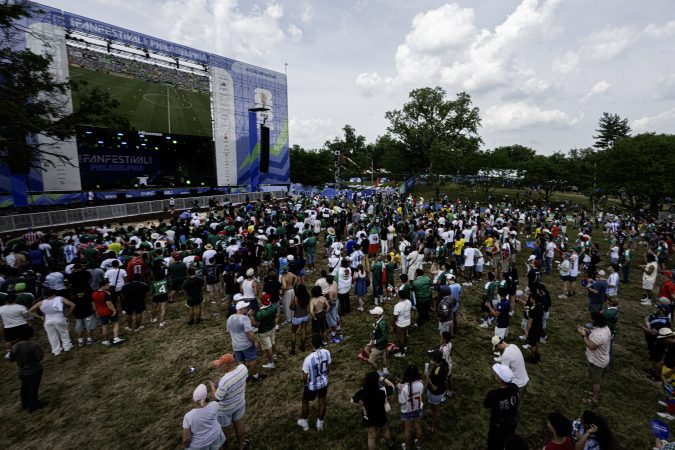
Philadelphia’s scorching, soupy weather could not stop soccer fans from making the trek to East Fairmount Park, where World Cup revelers filed in Thursday afternoon to celebrate the tournament’s kickoff at the FIFA Fan Festival.
Thousands of soccer lovers were present, arriving at Lemon Hill for the festival’s 2 p.m. start time — an hour before Mexico started its clash against South Africa in the World Cup’s first match, in Mexico City. Philly’s FIFA Fan Festival, which is slated to run for 39 days through the end of the tournament next month, arrived amid a heat advisory that saw temperatures push into the mid-90s with heat indexes surpassing 100 degrees, thanks to high humidity levels.
And that did not go unnoticed by festival attendees.
“This is far too warm for us,” said Rhys Gray, who traveled to Philadelphia from Scotland. Gray arrived in town Tuesday and plans to make the city his home base as he and his father follow Scotland’s games throughout the World Cup. Gray, who donned a matching plaid bucket hat and shirt for the occasion, said the city had been welcoming so far.
“I never felt so popular,” he added.
The FIFA Fan Festival serves as the city’s official World Cup watch party, and sprawls across a million square feet of lush, green space at Lemon Hill. It is capable of holding 15,000 attendees, many of whom are expected to take in matches on the festival’s 60-foot-wide screen on the main stage. The family-friendly event also features more than 80 food trucks, a massive shopping area, and a beer garden, among other amenities.
And while it attracted World Cup watchers from around the world Thursday, Philadelphia-area locals also made the trip. Many attendees seemed to be rooting for Mexico, judging by the sea of green-and-red soccer jerseys that dominated the space.
Among Mexico’s supporters was Bianca Vetta, who traveled to Philly from Easton with her mother. On Thursday, Vetta’s face was painted like the flag of Mexico, with red, white, and green marking her cheeks to show her support for the country’s team. Her father, she said, is from Mexico.
Bernard Dagenais, president and CEO of the Main Line Chamber of Commerce, also supported Mexico over South Africa. Dagenais, who parked at the nearby Philadelphia Museum of Art and walked to Lemon Hill, said his support for the country only made sense.
“Why not?” he asked. “They’re our neighbors to the south.”
Dagenais’ walk is likely not to be unique during the festival’s run, as extensive road closures and parking restrictions arrived with the event. Organizers have encouraged attendees to take rideshares or public transportation, which some Philadelphia residents, like West Philly’s Eric Abreu, heeded.
Despite the travel restrictions, Abreu said, getting to the festival was convenient and trouble-free, thanks to a $10 Uber ride that dropped him off nearby. And while he plans to head back to the festival grounds in the coming days, he did note Thursday was a little on the warm side.
“Hopefully we just get a nice tan,” Abreu said.
Philadelphia itself, meanwhile, is slated to host its first World Cup game Sunday, when Ivory Coast faces off against Ecuador at Lincoln Financial Field. FIFA has temporarily renamed the arena “Philadelphia Stadium” for the World Cup, which will include six games in town through July 4.
Philadelphia’s role as a host city, however, seemed to be secondary to the match at hand Thursday afternoon. As the match started, attendees flocked to the festival’s largest screen, set out picnic blankets, and danced to music reverberating through the grounds. Cheers and applause in Philadelphia erupted as the teams took the field in Mexico City.
On Thursday afternoon, said attendee Patrick Aruta, a registered nurse at Penn Presbyterian Medical Center, the experience transcended any difficulties or controversies that may be associated with the World Cup. In that fleeting moment, he said, this was all there was — just enjoying the match, with thousands of other fans from far and wide.
“No matter what people say about the heat [or] the political climate, there is nothing like this. I forget who I am for a moment,” he said. “You can’t get this at any other sports game. Just the World Cup.”
In the middle of mundane City Council procedures on Thursday, cheers erupted inside Council chambers.
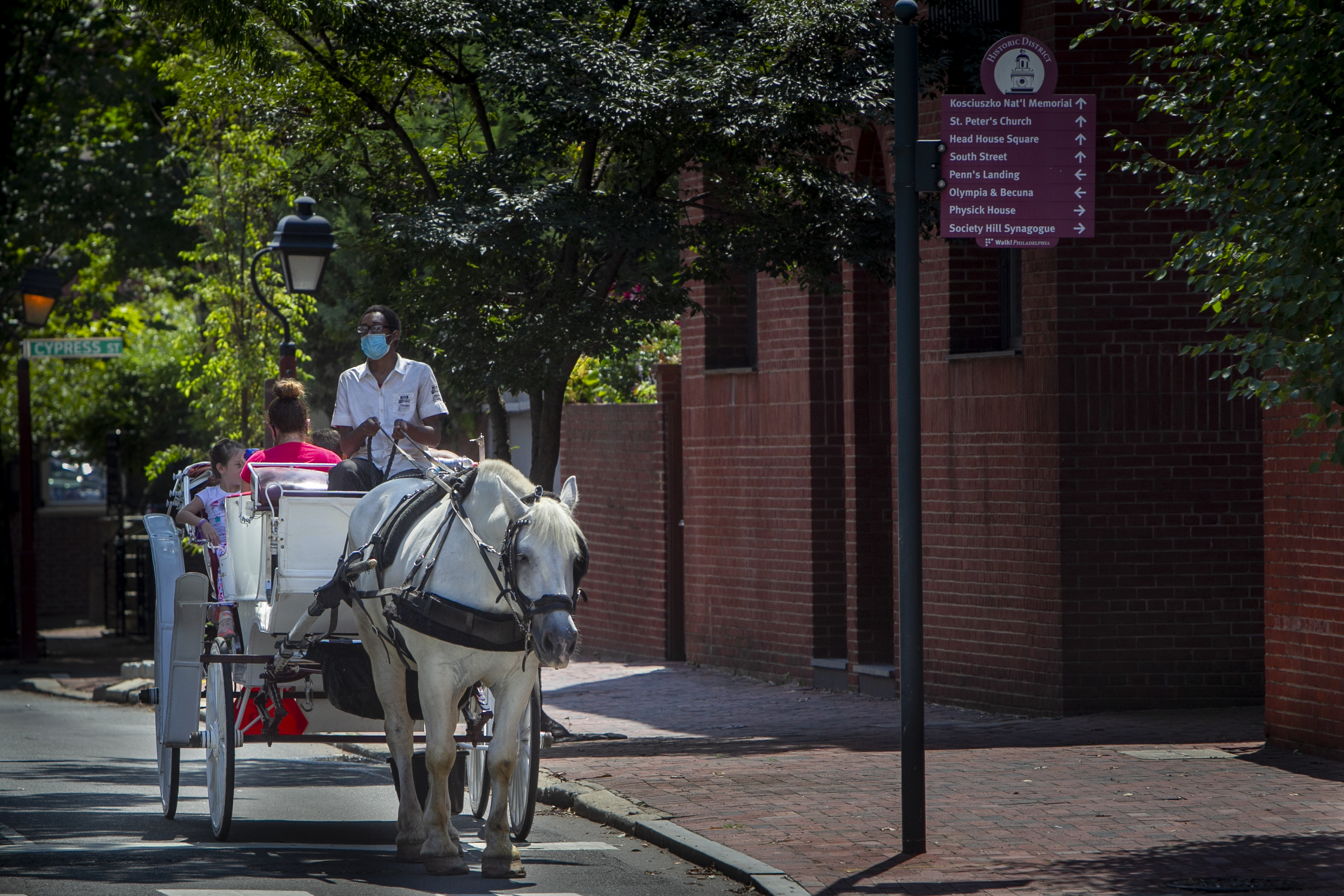
Supporters were celebrating the passage of a bill that will outlaw horse-drawn carriages in Philadelphia. The ban would take effect after Mayor Cherelle L. Parker signs it into law.
The city’s last operating horse-carriage business, 76 Carriage Co., ceased operations in 2023, but people have taken noncommercial horse carriages to South Street in recent weeks.
Councilmember Mark Squilla, who introduced the bill, and animal-welfare advocates have been working to ban the practice for several years. The advocates have argued that horse-drawn carriages are cruel and onerous to the animals, and dangerous for surrounding traffic and pedestrians.
Philadelphia City Council was slated to vote on the bill last week, but that version would have banned only commercial horse-carriage use. Advocates like Janet White, executive director and founder of Carriage Horse Freedom, successfully pushed for the bill to be amended to include a ban for both commercial and noncommercial uses.
The new proposal allows for some exceptions, which would be regulated and monitored by animal control and the Philadelphia Department of Licenses and Inspections. Violations of the ban could result in fines of $1,000 per day for someone operating a horse carriage.
Council voted nearly unanimously for the amended bill’s passage in its last session before summer recess, with Councilmember Nicolas O’Rourke casting the lone vote in opposition.
O’Rourke said his nay vote was “benign,” because he has deep respect and connection with horses since his mother taught him how to ride and care for them. His objection came from concern about how the language of the legislation potentially could make it difficult for movies filming in the city to use horse carriages, he said, and he would like to continue talking about the issue over the summer.
White said the bill’s passage made her hopeful, and she believes it will help Philadelphia move into a better future for animal welfare.
“It is a moral and civic milestone — one that reflects who we are today and the humane, forward-looking city we aspire to be,” she said in a statement.
Staff writer Andrea Padilla contributed to this article.
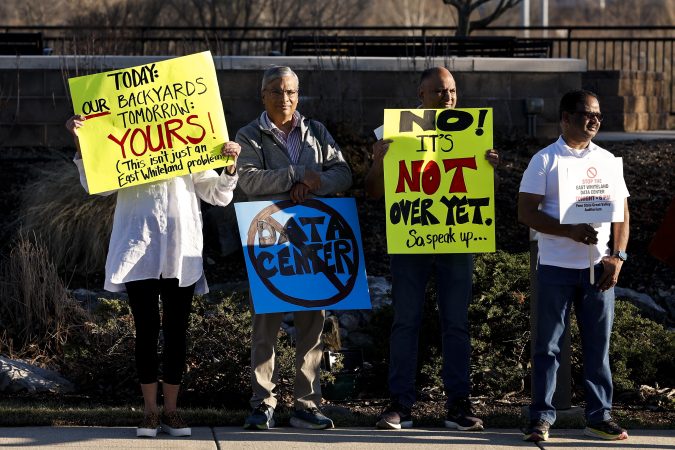
Calling it “frivolous,” a Chester County judge on Thursday quashed a land use appeal seeking to halt the construction of a 1.5 million-square-foot data center proposed for East Whiteland Township.
It’s the second time this week Court of Common Pleas Judge Anthony Verwey has denied appeals challenging approvals of the controversial data center project, proposed for a Superfund site near a residential development and the popular Chester Valley Trail.
“None of the four ‘errors’ complained of by the Appellants constitutes a decision subject to review by this Court,” Verwey wrote in his order denying the challenge to East Whiteland elected officials’ approval of the development plans. “… Appellants are attempting to collaterally attack an approval, that had ‘no deficiencies.’ The appeal, filed well out of time, is frivolous.”
The appeals challenged the zoning hearing board’s 2018 decision to permit for a data center at 13 S. Bacton Hill Rd., and the board of supervisors’ 2024 approval of the development plans.
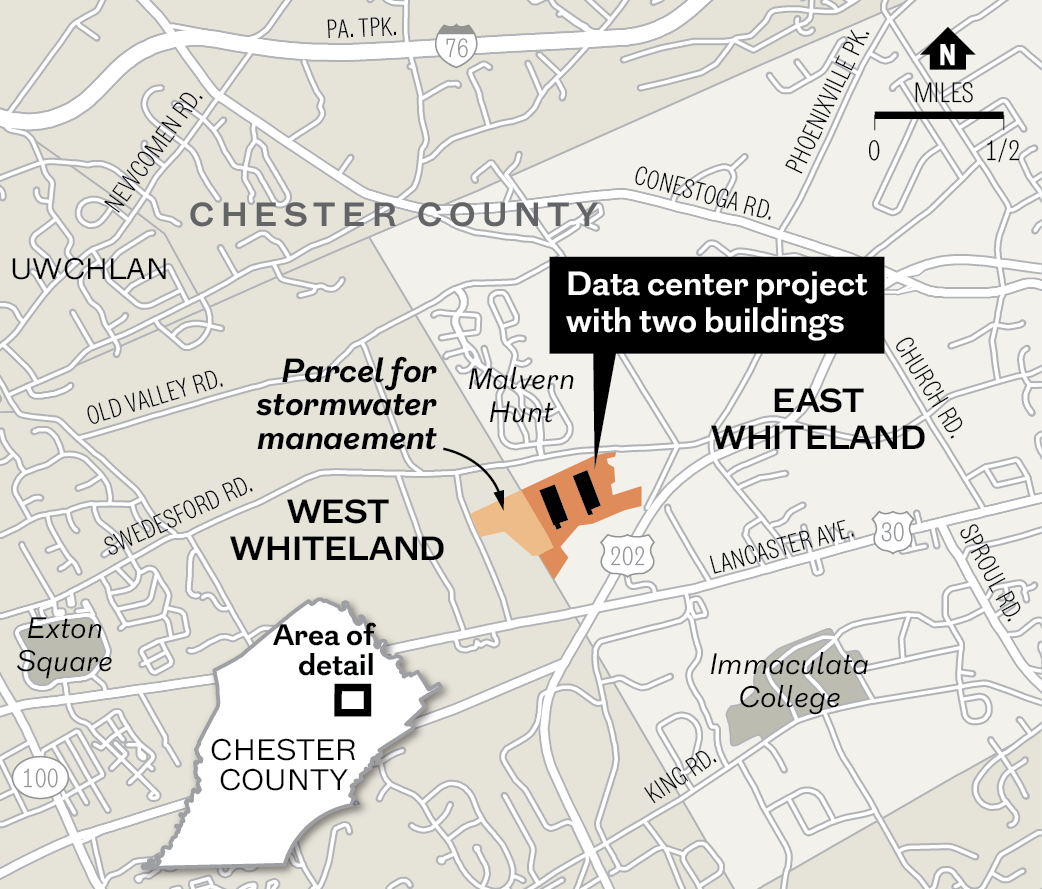
Lou Colagreco, an attorney representing the developers Green Fig LLC and Sentinel Data Centers, said they “are pleased that the court acted quickly and decisively in dismissing” both appeals. Colagreco said work is underway for the project’s stormwater management facilities in adjacent West Whiteland, and that the developers are securing the perimeter of the East Whiteland site in advance of construction.
The location of the two-building data center project in East Whiteland, Chester County.John Duchneskie
The judge’s denial is a hit for residents who have for months shown up adamantly against the data center.
Attorney Andrew Schneider, a resident of the nearby development Malvern Hunt who argued on behalf of other neighbors, said he “respectfully disagree[d] with the Court’s decisions.” Schneider has another case filed in opposition to the data center project.
The data center project has been through a winding saga, after it secured initial approvals years ago with little community fanfare. But when it approached the township to amend its original plans — at first requesting to scale up the project by 600,000 square feet — it kicked off a slew of contentious public meetings. When too many people showed up to one planning commission meeting in February, officials had to postpone it.
Developers Green Fig LLC and Sentinel Data Centers abandoned attempts to amend the plans when “it became apparent to us … that it was simply data center vs. no data center,” Colagreco said previously.
During a hearing last week challenging the board’s approval of the project, Schneider argued that the township had erred in its decision to approve the plans, saying that the final plan was deficient and didn’t meet conditions the municipality initially laid out. Allowing the construction would cause irreparable damage to the health of the community, he said.
Colagreco dismissed those arguments, saying the residents hadn’t produced enough evidence to support their allegations. But delaying the project was a threat to the developers being able to complete the data center on time and risked them losing approvals, he said.
Colagreco and an attorney representing the township argued that the appeal came too late, and the township’s decision shouldn’t come before the court.
Verwey ultimately agreed.
“Appellants cite not a single case to support the proposition that any of the four ‘errors’ are appealable,” he wrote in Thursday’s order.“This is likely because no such citations exist.”
Verwey wrote in his order regarding the 2018 zoning decision that the appeal, “filed 8 years after issuance, is out of time and must be quashed.”
As data centers are beginning to populate Pennsylvania and surrounding states, residents have become stauncher opponents. In nearby East Vincent, the community saw an early victory when supervisors denied a proposed data center at the historic Pennhurst State Hospital and School site last month. It will also likely end up before a judge, as the developer there plans to appeal the decision.
This suburban content is produced with support from the Leslie Miller and Richard Worley Foundation and The Lenfest Institute for Journalism. Editorial content is created independently of the project donors. Gifts to support The Inquirer’s high-impact journalism can be made at inquirer.com/donate. A list of Lenfest Institute donors can be found at lenfestinstitute.org/supporters.
DETROIT — Former Associated Press reporter Marlene Louise Johnson, whose lawsuit against the wire service for race and gender discrimination led to affirmative action plans to spur hiring of female, Black, and Hispanic journalists, has died at 89.
Ms. Johnson died May 9 in a Los Angeles-area care facility after being released from a hospital. She had been suffering from dementia, according to her daughter, Morenike Joela Evans.
Born in Rochester, N.Y., Ms. Johnson earned an associate degree from the University of Buffalo and a bachelor’s degree at Wayne State University in Detroit. At the age of 75, she graduated from Howard University’s School of Divinity with a master’s degree in religious studies.
While working in the Detroit office of the late-Rep. John Conyers in the early 1970s, Ms. Johnson met and befriended late civil rights icon Rosa Parks. In 1955, Parks helped spark a bus boycott in Montgomery, Ala., when she was arrested for refusing to give up her seat to a white man, ultimately leading to the desegregation of the city’s public buses. Parks died in 2005.
Ms. Johnson was hired in 1972 as a general assignment reporter in the AP’s Detroit bureau. She covered stories on Black capitalism, court-ordered busing in Detroit’s public schools, tensions between the predominately white police department and the city’s Black residents, breast cancer screening, and women empowerment in business and culture.
Minority hiring program brings Johnson to AP
Ms. Johnson, who was Black, sued the global news organization for race and gender discrimination the year after she joined. She had been hired as part of a minority hiring program meant to bring in diverse talent to the AP — but after several months on the job, Ms. Johnson claimed she had received no training. She also believed she was being held to a performance standard different from her white, male counterparts.
“What the suit was about originally was racism,” Ms. Johnson said in a 2013 interview with History Makers, a nonprofit research and educational institution that keeps an online oral history of both well-known and unsung Black Americans.
“I was filing a copy, and there was nothing wrong with the copy,” Ms. Johnson said. “And so, like nine months in, the boss decides that he’s going to retire, and he’s going to dump me. And I said ‘oh, my gosh.’ And so, I was very upset.”
Ms. Johnson said the Newspaper Guild helped her file the suit, which later became a class-action claim involving several other female minority journalists. Ms. Johnson then took a leave of absence in June 1975, according to AP records. Newspaper archives show her AP byline appearing on a Detroit-datelined story in 1975.
“It was a scary thing for her to do,” Evans said about her mother’s discrimination claim against the AP. Much later, “she ended up getting like $700. I remember her being very upset over that — it kind of got taken away from her getting justice.”
Class-action lawsuit nets bonuses, training for women and minorities
The Newspaper Guild’s sex and race discrimination class-action lawsuit against the AP was settled about decade later in 1983 for more than $1 million. Ms. Johnson was not listed as one of the plaintiffs. Under the agreement, which involved the U.S. Equal Employment Opportunity Commission, the AP was required to establish affirmative action plans for female journalists, as well as Black and Hispanic journalists.
“The suit turned from all Black and one white [plaintiff], to all white and one Black [plaintiff],” Ms. Johnson recalled in the interview with History Makers. “And the one Black — the one that went to the civil suit — they took my name off and put another woman’s name on it. A Black woman who I had never heard of before.”
The seven women listed as plaintiffs shared $83,120, according to a 2019 NewsGuild International article. Part of the settlement agreement included provisions for training and bonuses for AP’s minority and female journalists.
“I wasn’t in it for the money,” Ms. Johnson said, also noting that she couldn’t find jobs in the journalism industry for some time after filing her lawsuit.
“We should be grateful that someone like Marlene, a Black woman in the 1970s at a major news organization who had the courage,” said veteran journalist Vincent McCraw, who also is Black and worked with Ms. Johnson later in her career at the Washington Times. “Whether she, willingly or not, knew there would be a sacrifice, she took it.”
Johnson returned to journalism, ventured into public relations
Ms. Johnson later moved to Washington where she worked for the Newspaper Guild, the National Urban League, and the National 4-H Council. She also worked with the White House Council On Aging and was part of the press office for President Jimmy Carter’s inauguration committee, according to her obituary.
McCraw, a regional manager for Report for America, said he learned of Ms. Johnson’s death from Evans. He met Ms. Johnson in the early 1990s in Washington when she was working in communications and he was covering city government for the Washington Times.
“We struck up a conversation and I learned she’d been in journalism,” McCraw said. “What I did not know then was the suit she had against AP. After a year or so she mentioned how she wanted to get back into journalism.”
It was through McCraw that Ms. Johnson would come to work at the Washington Times in 1994, where she was an assistant features editor, he said. Ms. Johnson retired from there in 2004.
She held memberships in the National Association of Black Journalists, the Capital Press Club, and the Public Relations Society of America.
‘Somebody you could count on’
For about a decade prior to her death, Ms. Johnson lived in the Los Angeles area where she was cared for by Evans.
“She loved being a reporter, a journalist,” her daughter said. “She was really an advocate for people and telling the truth.”
In the interview with History Makers, Ms. Johnson said she would like to be remembered “as a friend, as somebody you could count on, as a good Christian woman, as a strong woman, as a loving person, as a good mom, as a wonderful grandmom.”
Ms. Johnson also is survived by two grandchildren, a son-in-law, and two siblings.