Law enforcement officials arrested 25 people and rescued more than 50 birds after breaking up a cockfight in Delaware County over the weekend.
The Pennsylvania SPCA Animal Law Enforcement Team, along with local authorities including the Pennsylvania State Police and Central Delaware County Organized Crime Unit, interrupted the cockfight Saturday night at a home on the 500 block of Franklin Street in Chester, officials said. There, investigators removed 52 live birds and discovered three dead roosters while serving a search warrant on the property.
“Cockfighting is one of the most brutal forms of animal cruelty; these birds are forced to fight to near death one cut at a time, suffering devastating injuries in the process,” Nicole Wilson, director of animal law enforcement and shelter operations at the PSPCA, said in a statement.
PSPCA officials received a tip about the cockfight on Thursday, the organization said. Investigators went on to surveil the property, and noted a number of people entering and exiting it — some of whom were carrying “animal transport carriers,” the PSPCA said.
After securing a warrant, PSPCA investigators received support in serving it from the Central Delaware County Organized Crime Unit because of the number of people involved in the cockfight.
The animals rescued from the property were taken to the PSPCA’s Philadelphia headquarters, where they were to receive exams and medical care. The birds will remain in PSPCA custody until their owners surrender them, or a court case related to the incident is adjudicated, the organization said.
Officials did not identify the people arrested.
Cockfighting, the PSPCA said in its statement, is a felony in Pennsylvania. The investigation is continuing.
The PSPCA asked that anyone with information contact its animal cruelty hotline at 866-601-SPCA (7722) or email cruelty@pspca.org. Tips may be left anonymously.
Two fatal shooting marked a particularly violent Tuesday in Chester, roughly a year after the city celebrated a steep decline in homicides involving firearms in the first half of 2025.
The fatalities were from separate shootings, one of which left a third person in critical condition, according to the city’s mayor. No arrests were made and officials did not have descriptions of any suspects.
“These acts of violence are heartbreaking and serve as another painful reminder of the ongoing challenges facing our community and the devastating consequences violence continues to ave on individuals, families, and neighborhoods,” said Chester Mayor Stefan Roots in a statement Wednesday.
Roots lamented a third incident, in which a police officer was assaulted Tuesday and suffered lacerations during a domestic dispute call. The officer was treated at a hospital and released as the incident remains under investigation.
While year-to-date nonfatal and fatal shooting statistics were not immediately available, Tuesday’s deaths mark the latest in a spate of shootings.
Though zero shootings were reported in March, The Delaware County Daily Times reports there have been 10 since April.
Last summer, the Chester police reported 15 nonfatal shootings just over the midway mark of the year. That translated to a 16% decrease in nonfatal shootings compared to 2024. Homicides in the first half of 2025 had also dropped 41% compared to the same time in the year prior, according to the Chester police midyear report.
The summer would go on to be one of the safest the Chester ever had, largely credited to national trends in declining violence and the yearslong collaboration among community advocates, police, and the Delaware County District Attorney’s Office.
Though Tuesday’s violence was alarming enough to warrant a news conference with both Roots and Chester Police Commissioner Katrina Blackwell, the mayor emphasized the continued violence prevention work across stakeholders and law enforcement.
Chester’s Safe Summer Initiative will continue to provide resources to youth and families, as well as positive opportunities in the city, said Roots.
“But public safety cannot rest solely on the shoulders of law enforcement,” he said in a statement, adding that people who “know something” should “say something.”
Under Pennsylvania’s Post Conviction Relief Act (PCRA), people in prison who have lost their appeals can challenge their convictions by introducing newly discovered evidence or arguing their defense lawyer at trial was ineffective.
If they can’t afford an attorney, the court will appoint one.
But there’s a catch: If the court-appointed attorney considers the challenge meritless, they can submit a letter asking the court to shut it down and allow them to withdraw from the case.
story continues after advertisement
Page1/28
Select pages
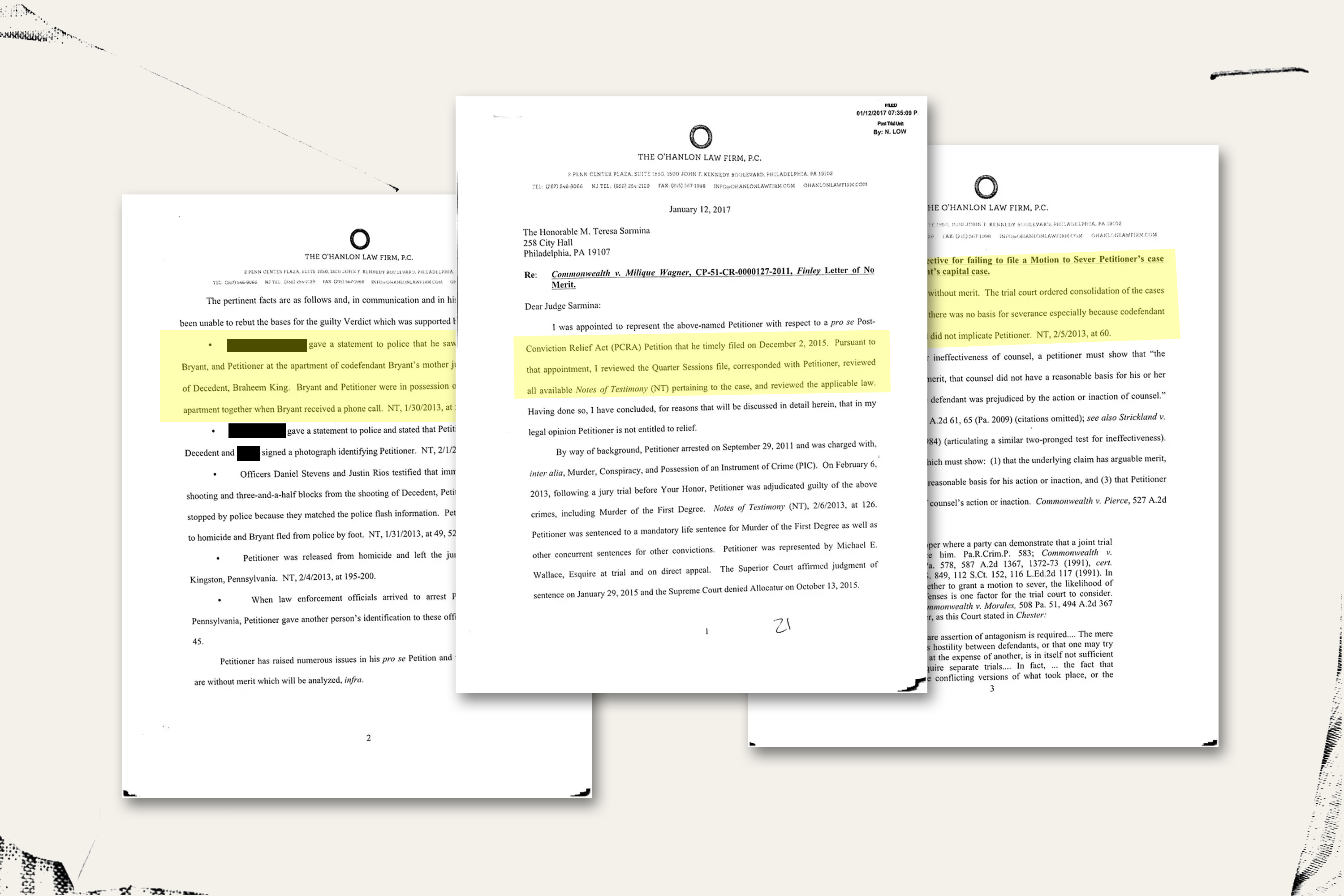
That type of letter is called a no-merit or Finley letter. An Inquirer and ProPublica examination of overturned convictions and sentences in Philadelphia since 2018 found that the letters had been filed in about one in five cases that would be overturned. The news organizations found that attorneys have written Finley letters without pursuing claims that courts later found were grounds for relief.
We’ve annotated a Finley letter that attorney Stephen T. O'Hanlon wrote after he was appointed to represent Milique Wagner, who was convicted of murder. Names of witnesses have been redacted. Use the view buttons to see each annotated section in the context of the original document.
The Finley Standard
Despite the stakes involved for the clients, the requirements for lawyers who decide to write a Finley letter are minimal. The lawyer must state the extent of their review of the case, identify the issues their client wished to raise, and explain why the issues have no merit. There is no requirement that the lawyer needs to meet with their client, contact prior attorneys, or get the trial discovery.
In this letter to Wagner, O'Hanlon mentions only corresponding with his client in writing. In an interview, O'Hanlon said they also spoke by phone.
Arguing Against His Client
O'Hanlon's Finley letter draws on evidence from Wagner's trial, but argues that it definitively proves his client’s guilt. He highlights damaging statements police collected from two witnesses but fails to mention until much later in the letter that both recanted — and that one of them testified that he had committed the murder, and that police and prosecutors knew the truth.
In an interview, O’Hanlon said he diligently investigated the case and came away convinced that Wagner was guilty. He said any concern about the Finley letter “comes from a misunderstanding of the whole process and the obligations that I have to clients and also to the court.”
Alleging Ineffective Lawyering
Under Pennsylvania law, the PCRA was Wagner’s first opportunity to argue that his trial lawyer was so ineffective that it resulted in an unfair trial. Wagner pointed out that his lawyer met with him only once, for 10 or 15 minutes, before trial, and argued that his lawyer should have investigated the star witness' history of false testimony. But O’Hanlon concludes in his Finley letter: “There is no evidence that trial counsel was not prepared for trial.”
A Prosecutorial Tone
The letter undermines Wagner's case by noting his failure to turn himself in, his decision to leave the area, and his attempt to give police a false name. It’s the type of language that most defendants would not expect to see from their own attorney.
"The reality of the case"
O’Hanlon’s letter emphasizes his belief that his client is guilty and that the prosecution presented "the reality of the case." He calls the evidence of Wagner's guilt "extensive."
The Witnesses Recant
It isn’t until page 19 of the Finley letter that O’Hanlon notes the two prosecution witnesses recanted their statements accusing Wagner.
O’Hanlon, in an interview, said the evidence against Wagner showed he was “factually guilty.”
“There were multiple people that gave statements identifying him,” he said.
A Second Finley Letter
After Wagner filed an additional PCRA raising more issues with his case, O'Hanlon filed a second Finley letter in June 2017. By then, the homicide detective who built the case against Wagner, Philip Nordo, had been benched, and a murder case he had built was called into question over evidence that he was secretly paying an informant. It was an emerging scandal that was covered in The Inquirer, and Wagner claims he asked O'Hanlon to look into Nordo, who took the statement from the star witness in Wagner’s case.
O'Hanlon said that Wagner’s court filings and letters did not mention Nordo, and he had no reason to look into the detective at the time.
“Having looked through all of my letters with Mr. Wagner,” O’Hanlon said, “it is my position that he never mentioned Detective Nordo to me.”
Nordo would later be convicted of sexually assaulting informants, prompting the district attorney’s office to review his cases. In 2023, the district attorney agreed to throw out Wagner’s conviction, citing hidden evidence about Nordo and the informant, whom police had suspected of committing the murder all along.
The decision allowed Wagner to plead to reduced charges and leave prison. He was released in January 2026, nine years after his attorney had declared there was no basis to challenge his conviction.
Read the full Inquirer/ProPublica investigation
With a chance at freedom, they faced an unexpected obstacle: Their own lawyers
Pennsylvania courts allow attorneys to argue against their convicted clients’ bid for justice. It has resulted in people spending years or decades in prison before being freed based on issues lawyers.
story continues after advertisement
Staff Contributors
Reporting: Samantha Melamed
Design and Development: Jasen Lo
Editing: Sam Morris and Matthew Doig
Copy Editing: Addam Schwartz
Subscribe to The Philadelphia Inquirer
Our reporting is directly supported by reader subscriptions. If you want more journalism like this story, please subscribe today
Delaware County’s new emergency services director wants to build something sustainable.
Gary Vinnacombe is a Delco native who has spent the last two decades overseeing EMS teams across Delaware and Chester Counties. Last month, he took the helm of Delaware County’s emergency services department, a homecoming of sorts for the longtime first responder, who got his start at Haverford’s Manoa Fire Company.
Vinnacombe, 43, replaces interim director Ed Beebe, who oversaw Delaware County’s emergency services for 18 months after former director Timothy Boyce was charged with indecent assault, among other offenses, related to his alleged groping of a female coworker.
Vinnacombe is taking over Delco’s emergency services apparatus at a pivotal time. The county is continuing to navigate the fallout from Crozer-Chester Medical Center’s closure, and some of its municipalities are considering emergency service mergers and cooperative authorities to fill gaps in service. Now, Vinnacombe says he’s eager to work with emergency responders across the county to build a lasting system that can serve Delco’s residents.
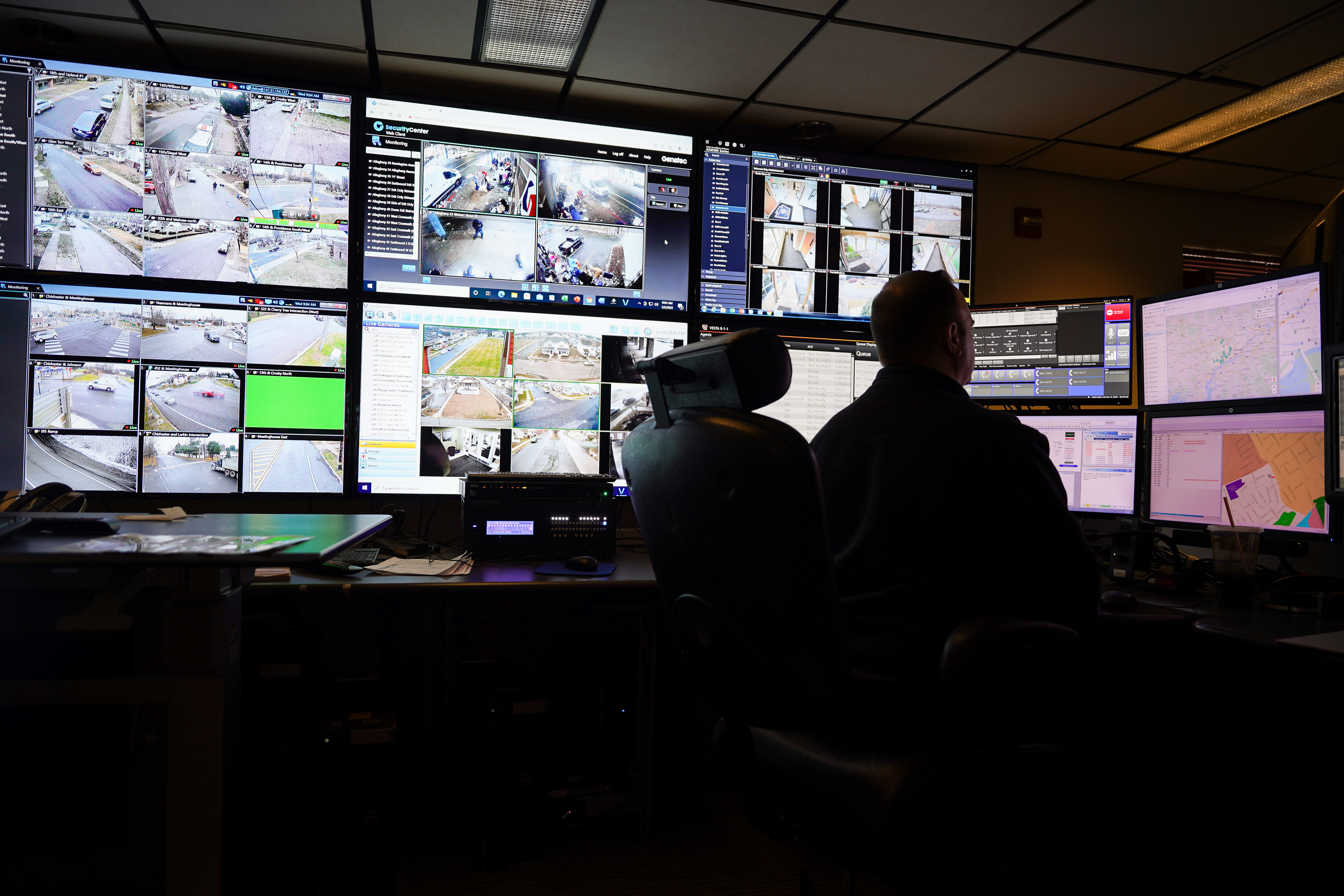
A 911 dispatcher working at the Delaware County Emergency Services Center on Jan. 5, 2022. Delco native Gary Vinnacombe recently stepped up to lead the department. Thomas Hengge / Staff Photographer
Vinnacombe grew up in Delaware County and is a 2001 graduate of Haverford High School. He holds an associate’s degree in nursing science from Delaware County Community College, a bachelor’s degree in emergency and disaster management from American Military University, and a master’s of public administration from Anna Maria College.
Vinnacombe has worn many hats over his two-plus decades in emergency management. He joined the Manoa Fire Company as a teenager, where he rose up to become the company’s EMS captain. He spent over a decade as the deputy chief of EMS at Darby’s Mercy Fitzgerald Hospital and is a longtime adjunct faculty member at Delaware County Community College, where he teaches EMT classes, municipal police academy emergency responder training, and CPR. Most recently, Vinnacombe spent 14 years with the West Grove Fire Company in Chester County, where he was assistant chief and oversaw day-to-day operations and employee recruitment and retention. He currently lives in Chester County.
Vinnacombe said the Crozer fallout is an “ongoing evaluation” for his department. He’s optimistic about ChristianaCare’s soon-to-open Aston and Springfield micro hospitals (the Aston facility is set to open this summer, and the Springfield facility next summer). The region’s existing hospitals have “done a fantastic job of absorbing that volume,” Vinnacombe said, and local municipalities have made a strong effort in “coming together to ensure that service continues to get delivered.”
As the county rebuilds its emergency services, Vinnacombe said, sustainability is top of mind.
“We can build all these great things all day long,” he said. “If we don’t have a plan or a mechanism to sustain them, it doesn’t matter what we build.”
However, he added, it’s important to take a close look at the funding mechanisms for different regional service models, as “every one of them has pros and cons.”
“I would certainly say, obviously anything that we can do to help people collaborate, or bring the right people to the table, we certainly want to,” he said.
The difference is night and day for Vinnacombe’s first responders, he said. Now, police, fire, and EMS officials can get real-time notes from 911 calls, fortifying them with a detailed report before they even get on the scene.
“The residents of Delaware County are in such a better space because of it,” Vinnacombe said.
Vinnacombe’s department is preparing for a busy summer. The PGA Tour Championship, FIFA World Cup, MLB All-Star Game, and Semiquincentennial are all descending on the Philly area in the coming months, and Delaware County officials are expecting a wave of tourists — and with them, an increased need for emergency responders.
Delco’s emergency services department is planning to support the upcoming PGA Tour at Aronimink Golf Club in Newtown Square with extra first responders, and Vinnacombe’s team has been busy filling requests for backup from municipalities.
As he settles in, Vinnacombe is confident that Delco is “only going up.”
“The services are only going to get better. Technology’s only going to continue to evolve,” he said. “The investments that the county has made into technology and public safety have improved the services that get delivered.”
This suburban content is produced with support from the Leslie Miller and Richard Worley Foundation and The Lenfest Institute for Journalism. Editorial content is created independently of the project donors. Gifts to support The Inquirer’s high-impact journalism can be made at inquirer.com/donate. A list of Lenfest Institute donors can be found at lenfestinstitute.org/supporters.
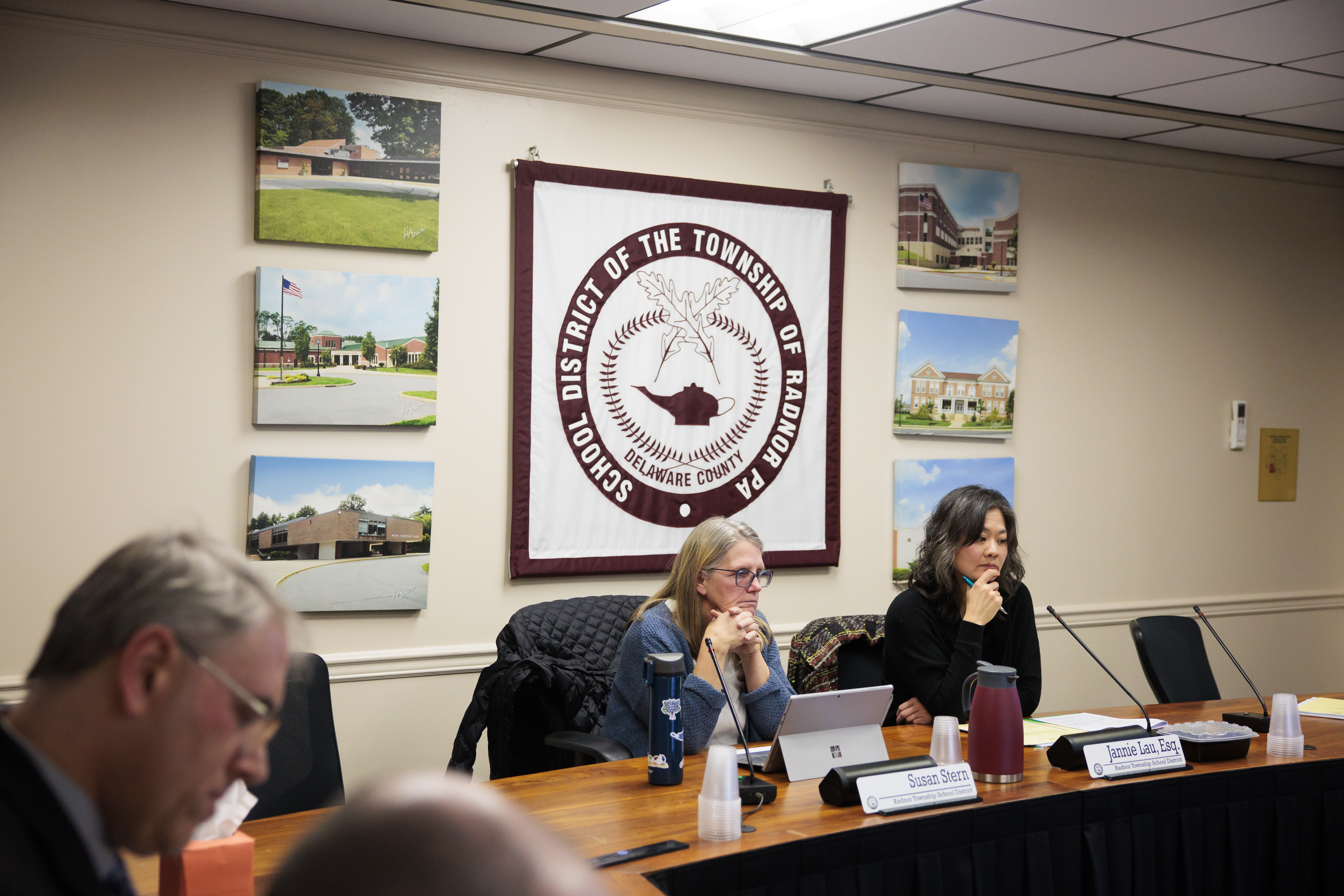
At a school board policy committee meeting Tuesday, administrators presented updated regulations around bullying and harassment, including that using artificial intelligence to create or share “sexualized, indecent, demeaning or intimate content involving another person” was prohibited.
But more changes are possible, administrators said Tuesday. Scott Hand, the district’s director of technology innovation and instructional design, said Radnor “will be engaging outside professionals beginning this summer into fall” to review its policies and practices.
Some board members also suggested the district retain outside help to be ready for another incident.
“The statistics say, something like this will happen again,” said Susan Stern, who asked administrators to consider hiring “a resource we could have on hand.”
“We’re going to work really hard to educate our kids that it doesn’t happen here in Radnor, but our best response is to be prepared,” Stern said.
Schools have increasingly been forced to grapple with deepfakes as students use generative AI to manipulate photos of their peers — sometimes with tools that can convert clothed photos into naked ones. Pennsylvania has criminalized explicit AI-generated images as child sexual abuse material, and another measure advancing in Harrisburg would require schools to immediately notify law enforcement about AI incidents.
Radnor drew intense criticism from some victims’ parents for its handling of the deepfakes, which came to light in December and resulted in a student being charged with harassment.
District officials said no images were ever discovered. But parents said the district had failed to adequately investigate boys’ reports of pornographic videos and downplayed the incident in community messages, further harming victims.
Parents also accused the district of failing to initiate a Title IX harassment investigation, arguing it was wrong to characterize the incident as “off-campus.”
Radnor parents are organizing a panel discussion Thursday in King of Prussia, with deepfake victims from Radnor and Lancaster Country Day School, advocates, and state officials, including Attorney General Dave Sunday, describing risks and how schools can better respond.
The rules presented to Radnor’s policy committee Tuesday specify that the district has authority over off-campus behavior when it “materially and substantially disrupts the operations of the school” — a common legal standard.
Jannie Lau, the committee’s chair, said that given how online kids are, any online harassment would seem to meet that threshold.
“That’s my takeaway — it would be extremely rare for this conduct to happen, and for us to come to the conclusion it doesn’t impact our operations,” Lau said.
Lau said the district should consider hiring an outside law firm to conduct future Title IX investigations, to ensure more impartiality.
“It’s just human nature — you don’t want to bite the hand that feeds you,” Lau said, noting that a district solicitor might have an interest in siding with the district, to avoid jeopardizing that relationship.
In comments Tuesday, Audrey Greenberg, a parent of one of the victims, said she appreciated the rule changes, but that they didn’t go far enough. If a student reports AI-generated sexual content, she said, the district’s Title IX coordinator and central administrators should be notified immediately.
She also said the description of “off-campus” behavior was too vague — saying deepfakes harm students’ attendance, friendships, and mental health — and argued that the rules wouldn’t prevent a poor administrative response.
“It was so painful to get those emails calling the event rumors and speculation, when a crime occurred,” Greenberg said, referring to messages from Superintendent Ken Batchelor, including one that described the deepfakes as images made “to move and dance.”
“For crying out loud, this is pornographic material,” Greenberg said.
Stern, the board member, said earlier in the meeting that Radnor would be dealing with the fallout for a long time.
“I don’t think that there’s anyone in this district who will ever hear the words ‘generative AI’ again, and not feel a little tug,” she said. “We had children who were harmed.”
Following months of fiery opposition from residents that saw protests and halted municipal meetings, the developers of an East Whiteland data center called their own bluff, telling the township that they will scrap their revised plans and instead build a previously approved 1.5 million-square-foot version.
The decision takes a smaller plan, proposed last month, off the table — but it also eliminates a much bigger version that residents vehemently opposed.
Limited plans were submitted and were sent to consultants for review, officials said. The developers told the board that it was a concession they’d make only if the township’s three elected officials moved quickly on an approval.
In an email, Lou Colagreco, an attorney representing the developers, said that the decision to withdraw the project was partly due to the timeframe from the board, but “the larger factor was that it became obvious that no accommodation which our client offered would be acceptable.”
“We thought that our offer to pivot to a much smaller data center together with enhanced landscaping, sound attenuation, diminished water usage and other modifications would be well received,” he said. “It became apparent to us, however, that the real issue had little to do with these factors. It was simply data center vs. no data center.
Colagreco described the current proposal “a good plan” that developers “are anxious to build.”
Residents considered the downsized project — smaller than one of the amended plans that would have increased square footage by roughly 60% — a win. They’re still pursuing legal action, arguing that the initial approvals have now expired.
The project will sit on about 100 acres at 13 S. Bacton Hill Rd., on a Superfund site near a residential development and the popular Chester Valley Trail.
It has been a winding saga for the project, which saw its first approvals back in 2018 by the zoning hearing board before receiving a final greenlight from the supervisors in 2024.
The developer has maintained that the project would be built in some capacity but argued that the newer plans would have a lower impact on the community.
Under the original 2024 plans they said they’ll move forward with, the project — which is 1.5 million square feet across two buildings — would include antenna yards, microwave towers, and cooling towers that rely on evaporating 3 million gallons of water a day.
“We’ve been accused of bluffing. This is not bluffing,” Sentinel Data Centers CEO Josh Rabina told the supervisors and residents in Aprilwhen presenting plans to shrink the facility. “The approved plan is less desirable for us and for our customers, is less elegant and less efficient of a design, but it’s functional, it’s profitable, it’s vested, and it gives us certainty.”
A man who shot his girlfriend twice in the back on a quiet Chester street on Wednesday night later turned his gun on responding police officers, prompting them to shoot him, authorities said.
The man and the woman — whom authorities did not identify — were in critical condition at an area hospital, Delaware County District Attorney Tanner Rouse said.
Authorities said the man shot the woman shortly before 9 p.m. near the intersection of East Ninth and Walnut Streets. Then, Rouse said, the man opened fire on passing vehicles.
No drivers were struck.
When officers arrived at the scene, the man turned his weapon toward them, authorities said, and at least one officer shot him.
Helicopter footage of the scene shows more than two dozen bullet casings littering the streets and what appears to be a parked power-washing truck riddled with bullet holes.
A Chester Police Department spokesperson did not return a request for additional information on Thursday.
Rouse said his office was reviewing camera footage of the incident and would “make sure we have every angle that depicts the events that transpired.” When its investigation is complete, he said, charges will be filed against the man.
Meanwhile, he praised law enforcement for its response to the shooting.
“I can tell you with confidence that the actions of the Chester Police Department were nothing short of lifesaving and the defendant in this case had every intention to kill anyone he could,” Rouse said.
The Delco 10 Miler race is back for what organizers hope will be a bigger and better second lap. Changes for 2026 include a revised course, more than twice the number of runners, and a faster pace requirement.
The race will take place on Oct. 4. Registration is open. This year’s race will be capped at 2,500 runners, up from 1,200 last year. About 700 runners registered in the first 24 hours, race director Kevin Nolan said.
Some residents and drivers passing through the area were unhappy with road closures, which cut a long swath across the county. The course‘s adjustments should mean fewer closures along main roads.
“Logistically with all this traffic, it’s a tough race to manage,” Nolan said. “It’s tougher than the Philadelphia ones … because I’ve talked to all the race directors and they don’t have the issues that we have to deal with, with all this traffic.”
Course changes
The race will again start at Rose Tree Park in Upper Providence and end at Subaru Park in Chester. Last year, the race shut down parts of Route 252 and Route 320, as well as portions of Third, Fourth, and Fifth Streets in Chester, including a loop that took runners past Subaru Park before returning.
(function() {
var l2 = function() {
new pym.Parent(‘delco_10_miler_2026’,
‘https://media.inquirer.com/storage/inquirer/projects/innovation/arcgis_iframe/delco_10_miler_2026.html’);
};
if (typeof(pym) === ‘undefined’) {
var h = document.getElementsByTagName(‘head’)[0],
s = document.createElement(‘script’);
s.type = ‘text/javascript’;
s.src = ‘https://pym.nprapps.org/pym.v1.min.js’;
s.onload = l2;
h.appendChild(s);
} else {
l2();
}
})();
This year, runners will turn west on Rose Valley Road in Nether Providence and travel through residential streets before crossing Route 320 and heading into Chester and Widener University’s campus. The course crosses I-95 on the Melrose Avenue bridge again before heading south toward Subaru Park. The loop at the end has been eliminated.
The new course:
Starts at Rose Tree Park South on Providence Road/Route 252
Right on West Rose Valley Road
Left on Bickmore Drive
Left on Sheffield Drive
Left on Georgetown Road (becomes Media Parkway)
Left on Chestnut Parkway (becomes Chestnut Street)
Right on East 18th Street
Left on Walnut Street
Left on East 14th Street
Right on Melrose Avenue
Right on Morton Avenue
Right on East Fifth Street
Left on Penn Street
Right on West Third Street
Right on Tillman Street
Left on West Fourth Street
Left on Rainey Street
Ends at Union Yards at Subaru Park
Getting the word out
Some residents complained to race organizers that they weren’t told ahead of time that their streets were being closed.
“As much as you try to get the word out, there are people that don’t know,” Nolan said. “So you have to do more.”
This year, volunteers will walk some sections of the route ahead of time to let residents know about the race and road closures, Nolan said.
St. John Chrysostom Catholic Church in Nether Providence told the Delco Times last year that the parish was not consulted about the race, which took place on a Sunday and impacted their Mass schedule. This year’s route avoids St. John’s, as well as St. Katharine Drexel Catholic Church in Chester and some fire departments.
Faster pace
In another change this year, the race will have a faster pace requirement. Runners will have to maintain a minimum pace of 13 minutes, 30 seconds per mile. Last year’s minimum pace was 15 minutes per mile.
“Police are after us to open the course up. They were pretty aggravated last year with all the walkers,” Nolan said. “You hate to kick someone off the course.”
A few more quality-of-life improvements include more bathrooms at the start and at water stops. There will also be four staggered starts based on runner speeds.
This suburban content is produced with support from the Leslie Miller and Richard Worley Foundation and The Lenfest Institute for Journalism. Editorial content is created independently of the project donors. Gifts to support The Inquirer’s high-impact journalism can be made at inquirer.com/donate. A list of Lenfest Institute donors can be found at lenfestinstitute.org/supporters.
Philadelphia, Bucks, Delaware, and eastern Montgomery Counties, and all of New Jersey and Delaware, are currently under blizzard warnings through 6 p.m. Monday. That’s prompted by forecast wind gusts of up to 45 mph, combined with the heavy snow. The western suburbs are covered by a winter storm warming, with slightly lower wind speeds forecast.
The storm is expected to begin as rain before shifting to snow by midday Sunday. It’s forecast to strengthen overnight, possibly at a rate of more than 2 inches an hour, which would make driving dangerous and nearly impossible.
The last time the city experienced more than two feet of snow was 2010, when nearly 29 inches fell in early February 2010. Over a five-day period, the city was buried under 44 inches of snow, which thankfully isn’t expected this time due to a warm-up in the middle of next week.
This time around, the Jersey Shore is expected to be hit hardest, with snowfall totals in and around Toms River forecast to reach as high as 30 inches.
The National Weather Service puts out forecasts for every few square miles of land in the United States four times a day through a system called the National Digital Forecast Database.
The maps below display that data. Use it to find how much snow is expected anywhere in the eastern United States. It will show the most recent forecast over the next few days.
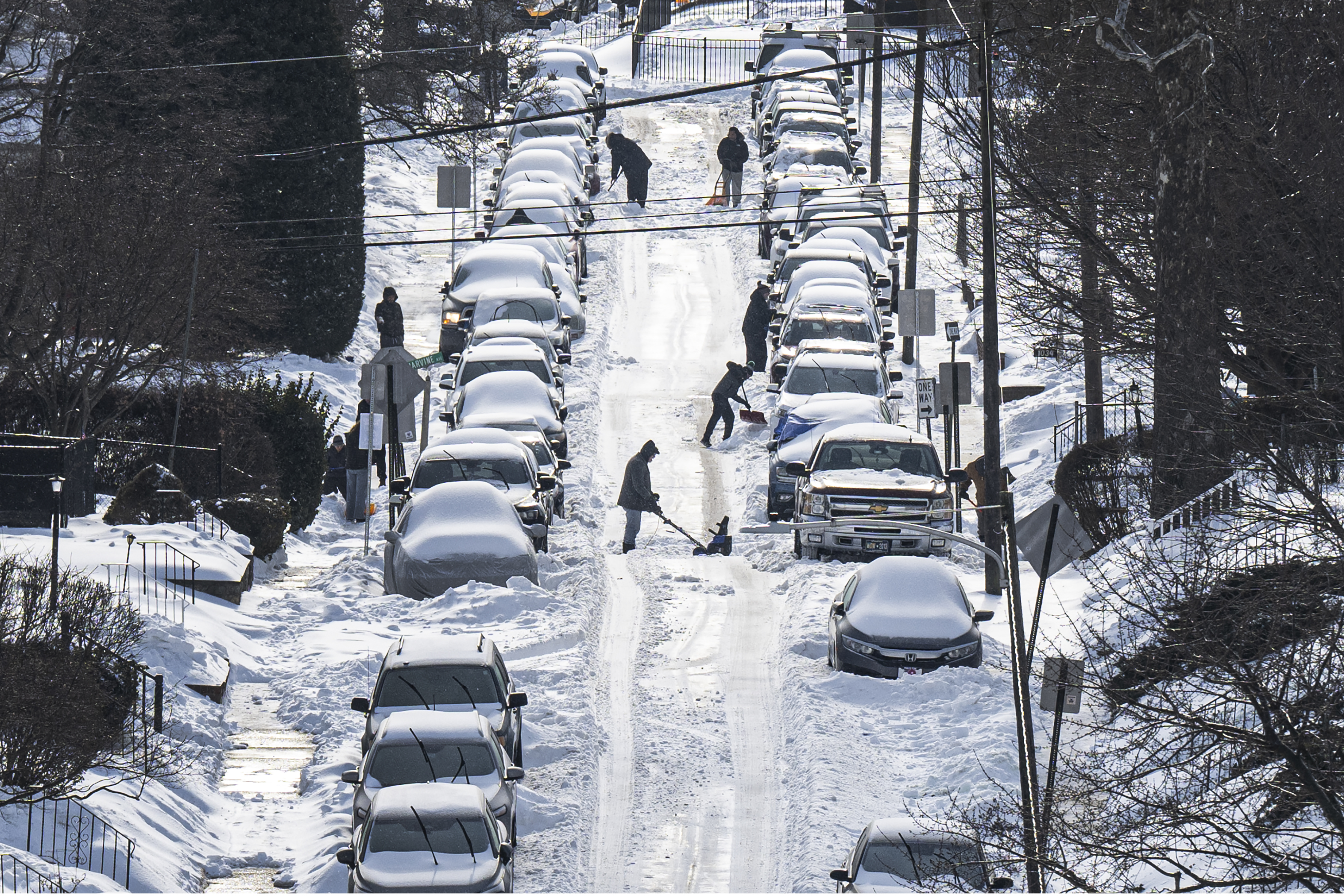
A far-reaching winter storm blanketed the Mid-Atlantic in an icy brew of snow and sleet Sunday, with preliminary totals exceeding two feet in parts of Pennsylvania.
Philadelphia International Airport received its biggest snow of the season, and in 10 years, with 9.3 inches of snow and ice recorded by 12 a.m., after precipitation ended, according to the National Weather Service.
Philadelphia ranked near the middle of the pack of regional totals. A survey of five regional National Weather Service offices showed PHL’s total ranked 228th of 768 storm total reports made by Monday morning.
The Philadelphia metropolitan region generally received between six and 12 inches of snow by Sunday evening, according to National Weather Service reports.
Among the highest totals outside of the city:
East Nantmeal- 12.8 inches
Malvern- 12.5 inches
East Rockhill – 12.3
Skippack – 12.2 inches
Gardenville – 12.0 inches
Farther north, as much as 24 inches was reported in Laurel Summit in Somerset County, Pa. Dulles International Airport in Washington, D.C., reported 7.8 inches of snow and ice as of the morning. New York City’s Central Park piled up 11.4 inches.
Use the map and chart below to find preliminary snow totals in your area. Hover over dots on the map to reveal more information, or search for Philadelphia-area totals below.