Category: News

  • Gov. Josh Shapiro’s administration will rescind Pa. disease-tracking proposal that reignited pandemic-era outrage

    Gov. Josh Shapiro’s administration will rescind Pa. disease-tracking proposal that reignited pandemic-era outrage

    Gov. Josh Shapiro’s administration will rescind a series of proposed vaccination and disease-tracking regulations that reignited public outrage toward restrictive pandemic-era policies in Pennsylvania — a decision made after receiving more than 10,000 comments opposing the changes, the Pennsylvania Department of Health said Friday.

    The department will withdraw the regulations, incorporate feedback, and resubmit the public health rules “once Pennsylvanians’ feedback has been adequately incorporated,” Neil Ruhland, a spokesperson for the department, said in a statement.

    Shapiro’s administration earlier this year submitted the proposed regulations aimed at combating infectious diseases to the Independent Regulatory Review Commission, a little-known board that assesses and approves new state regulations, requiring public input before they can be implemented. These regulations had been in progress for years, but were not introduced to the public until June 4.

    The public comment period coincided with a high-profile clash between Shapiro and U.S. Secretary of Health and Human Services Robert F. Kennedy Jr. over two infant deaths that Pennsylvania attributed to measles — the first deaths from the highly contagious and preventable disease in the state in 35 years. And it quickly refueled public disapproval of government mandates enacted during the COVID-19 pandemic.

    The 502-page proposed regulations would have expanded the state health department’s investigatory powers deemed necessary to track, prevent, contain, or mitigate a contagious disease. Republican state lawmakers and thousands of enraged constituents were especially concerned by a provision that would allow the state health department or local health authorities to enter schools or private properties to investigate alleged outbreaks or review vaccination records. They also criticized the health department’s effort to change references to a “pregnant woman” to a “pregnant individual” throughout the policy, claiming it was an effort to remove women from the state’s public health rules.

    The pushback comes at a time when federal health officials, under Kennedy, who has a history of anti-vaccine activism, have worked to reduce the number of childhood vaccination recommendations — and as childhood vaccination rates hit new lows in Pennsylvania. The effort has prompted Shapiro and other Democratic governors to sign executive orders to protect vaccine access. Setting vaccination mandates for schoolchildren falls to the states, not the federal government.

    The proposals rescinded Friday will not affect federal or state executive orders related to vaccination access.
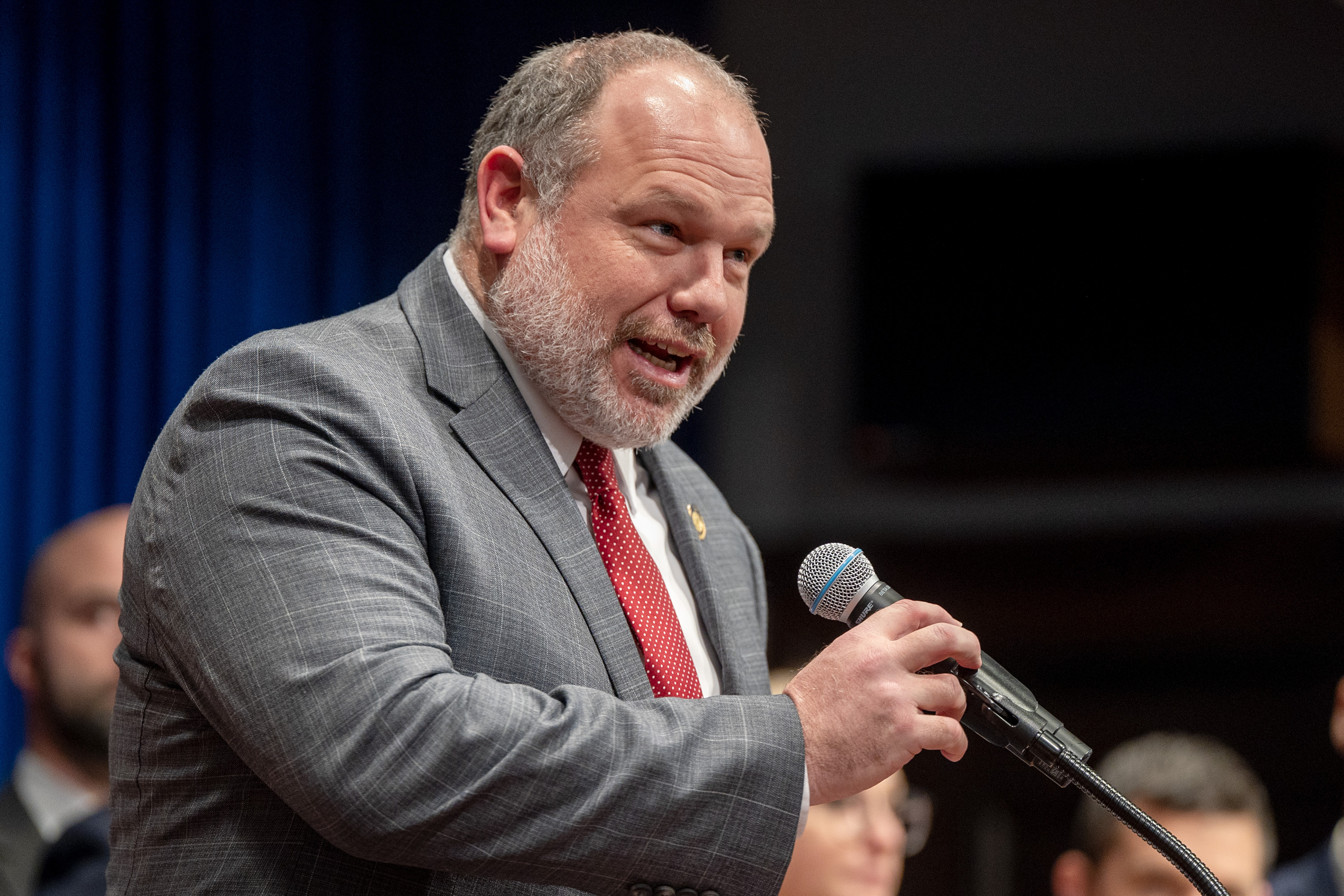
    State House Minority Leader Jesse Topper (R., Bedford) during a news conference at the Capitol in Harrisburg Feb. 3, 2026.Tom Gralish / Staff Photographer

    House Minority Leader Jesse Topper (R., Bedford) was among the first officials last month to raise alarm about the proposed regulations. In a statement Friday, he said it was the “correct and logical conclusion” for the health department, following the outpouring of public opposition.

    Senate Majority Leader Joe Pittman (R., Indiana) called Friday’s announcement “a tremendous victory for the grassroots efforts of Pennsylvanians.”

    ”This is a stark reminder that we must continue to be vigilant when the Executive Branch attempts overreach,” Pittman said in a statement. “We cannot and will not allow actions like we saw taken by the Executive Branch during the height of the COVID-19 pandemic to be put in place again.”

    Nearly all of the members of the Republican caucuses in Pennsylvania’s Senate and House submitted letters in opposition to the proposed regulations, arguing they were more restrictive than the ones enacted during the COVID-19 public health emergency and would infringe on Pennsylvanians’ constitutional rights.

    “The proposed regulations represent executive-branch overreach reminiscent of what we experienced during the COVID-19 pandemic — but this time, the rules would be permanent,” Senate President Pro Tempore Kim Ward (R., Westmoreland) said in a statement last week. “Every Pennsylvanian should understand these regulations and how they could impact their lives.”

    At least one Democrat — State Rep. Dan Frankel (D., Allegheny), who chairs the House Health Committee — submitted his support during the public comment period for updating the state’s existing communicable disease rules. Even so, his remarks recommended several changes to the proposed regulations, including to how the state would evaluate some vaccination exemptions to consider how children will be affected if their parent forgoes the preventive measures.

    Senate Minority Leader Jay Costa (D., Allegheny) said in a statement Friday he was looking forward to continuing the conversation about the regulations, adding that “public trust and buy-in is crucial to effective governance.”

    Beth Rementer, a spokesperson for House Democrats, said Friday that Shapiro’s administration was “acting responsibly” by considering public opinion.

    “After all, that’s how government is supposed to work,” Rementer said.

    Shapiro’s administration has rescinded at least 11 other regulation proposals since taking office in 2023, according to administration officials. But a deluge of feedback is rare, and most proposed regulations receive around five public comment submissions, a Shapiro administration official said.

    Monday was the final day for public comment submissions. As part of their opposition campaign, Republican lawmakers encouraged their constituents to voice their opinion as part of public comment. By the end of the day, the review commission had received more than 10,000 comments opposing the regulations.

    “The Department of Health received a historically high volume of feedback during the public commentary period, and it is clear additional stakeholder input is needed,” Ruhland said in the statement.

    Shapiro, a Democrat, is seeking reelection in November. His GOP challenger, State Treasurer Stacy Garrity, has criticized Shapiro over the proposed regulations, calling them “mandates that would make draconian COVID-era restrictions blush.”

    On Friday, Garrity celebrated the regulation withdrawal, and in a statement called Shapiro “the least transparent governor in America” who “got caught trying to sneak a 502 page invasion of privacy and parental rights through.”

    A spokesperson for Shapiro declined to comment Friday, deferring to the state health department.

  • The Jersey Shore is bracing for a big September storm — but it’s a nor’easter, not a hurricane

    The Jersey Shore is bracing for a big September storm — but it’s a nor’easter, not a hurricane

    It isn’t a hurricane, or a storm with a name (at least not yet), but the early-season nor’easter that was brewing off the Mid-Atlantic coast Friday may end up focusing its ferocity on the Jersey Shore and pester the Philly area with one memorably miserable weekend.

    With the storm’s projected path changing dramatically, forecasters warned Friday that heavy rains were possible throughout the weekend along with tropical-storm-force gusts that could go as high as 70 mph at the Shore. Flood warnings and advisories have been extended well into the weekend.

    “Major” flooding was expected Saturday morning and possibly Saturday evening on the beachfronts and bay areas, with the National Weather Service warning “some locations may become isolated by the floodwaters.”

    Up to 5 inches of rain are possible at the Shore, and as much as 4 inches in Philly.

    Gov. Mikie Sherrill declared a state of emergency for the eight Shore counties, effective 5 p.m. Friday.

    It is possible that the storm, which was centered about 200 miles east of Norfolk, Va., on Friday, may make a sharp left sometime during the weekend and cross the New Jersey coast a la Superstorm Sandy in 2012, said Bob Oravec, senior branch forecaster with the federal Weather Prediction Center. (No, this won’t be in a league with Sandy, he assured.)

    With storm waves pounding the oceanfront, and the back bays congested with water, multiple rounds of at least moderate flooding were expected at the Shore, and at least minor flooding along the Delaware River in Philadelphia, where winds could gust to 45 mph.

    “And the full moon doesn’t help,” said Jason Franklin, the meteorologist in charge of the National Weather Service’s Mount Holly office. The monthly astronomical tug is going to exacerbate any flooding.

    The timing of the storm’s impacts

    A flood warning for the Shore is in effect until 2 a.m. Sunday, and minor flooding occurred with high tides Friday morning.

    Significant flooding was expected for at least three consecutive high tides, which occur at roughly 12-hour intervals, on the oceanfront and the back bay abutting Ocean City starting at 7 p.m. Friday, with the major flooding Saturday morning.

    On Friday, Franklin noted that the onshore winds from the Northeast — why they call them nor’easters — had taken on a more northerly direction. That would be problematic for north-facing beaches, such as the ones in North Wildwood and the north end of Avalon.

    And given that the wind and gust festival was in its third day, drainage was becoming a challenge, said Franklin, particularly for the bays.

    “They’re swollen,” said Franklin.

    A flood advisory was up for Philly and areas along the Delaware River for minor flooding during four straight high tides beginning 1 a.m. Saturday.

    The Shore was under a wind advisory until 6 a.m. Sunday, and it was possible that gusts to 70 mph could be measured along the Jersey Coast to Long Island, said Peyton Simmers, meteorologist at AccuWeather Inc.

    The advisory for Philly, also in effect to 6 a.m. Sunday, called for gusts to 45 mph.

    The nor’easter was have impacts all the way to Cape Cod, but in the end the highly unusual — and very early — coastal storm could save its worst for the Jersey coast, said Oravec.

    The nor’easter is early, and extraordinary

    Coastal storms form along the boundaries of chilly and warm air and usually hold off until later in the fall or winter when the temperature contrasts between the cold air from the north and remnants of summer to the south ripen.

    In this instance the cold air was being supplied by a powerful area of high pressure, or heavier air, over eastern Canada, whose clockwise winds from the northeast made Philly feel October-like this week.

    The high’s cold winds have been interacting with the very warm waters of the Gulf Stream to generate the nor’easter and add a kick to the onshore winds, part of a cyclone’s counterclockwise circulation.

    Pressure differences incite winds: A common image is that of air from a punctured tire rushing into air that is half as light.

    One subplot to watch is that the nor’easter may take on tropical characteristics, drawing moisture and warmth from spending so much time over the Gulf Stream, said Simmers. That could bump up the rain amounts.

    It could even become a “subtropical storm,” he said, although he wouldn’t expect the National Hurricane Center to name it. Not that the distinction would make much difference.

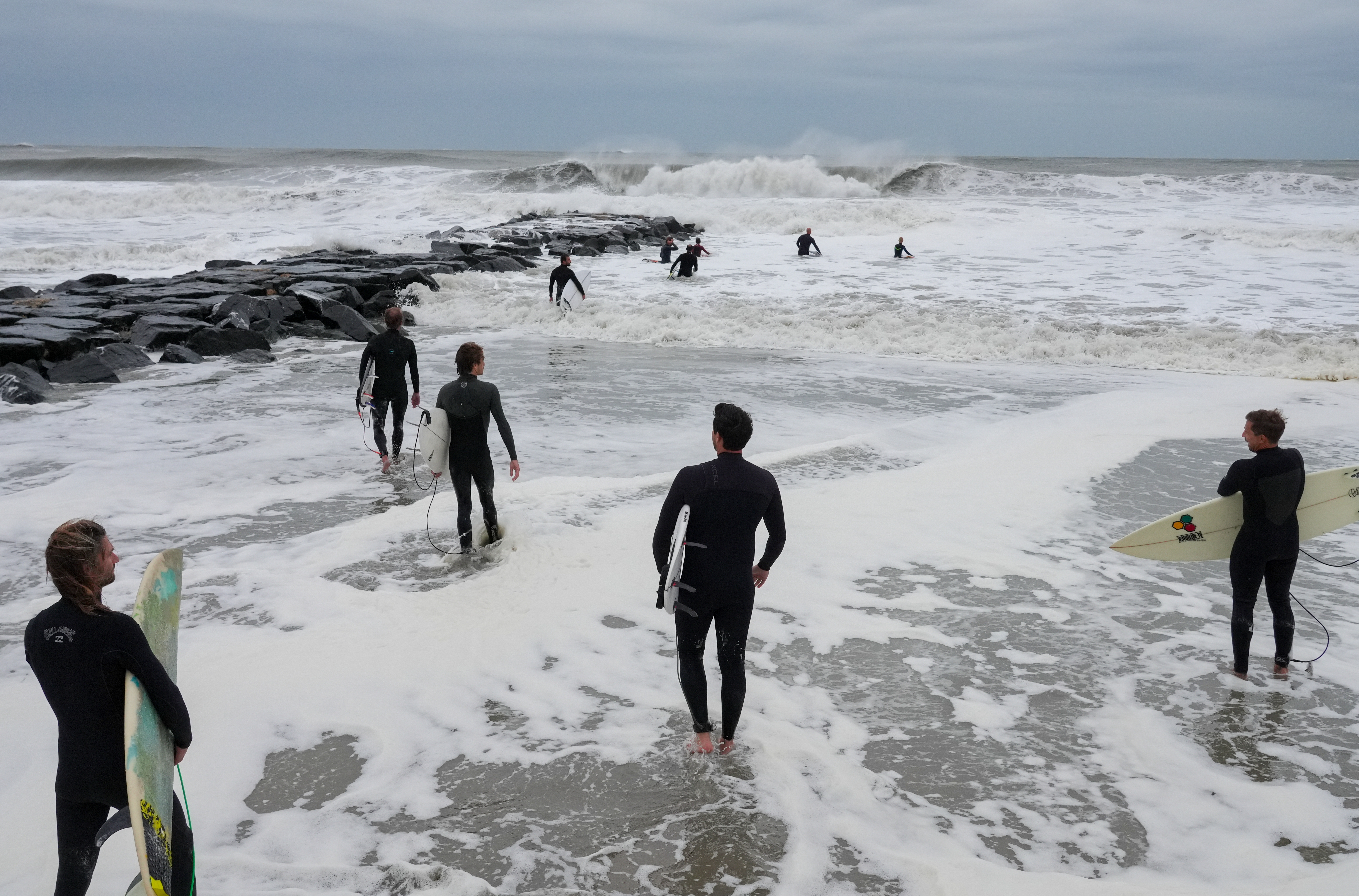
    Surfers check out the nor’easter incited waves in Ocean City, where back-bay flooding could be significant. Tim Hawk / For The Inquirer

    Nor’easters vs. Hurricanes

    The U.S. East Coast happens to be one of the world’s favored spawning grounds for cyclones, notes John Gyakum, an atmospheric scientist at McGill University in Montreal who is an expert in coastal storms.

    Unlike hurricanes, which form in the tropics, nor’easters develop in the cooler midlatitudes.

    Hurricanes tend to be more destructive and have more celebrity power, but their influence is relatively small compared with nor’easters, whose circulation can cover thousands of miles. Also, nor’easter winds can persist for days, eroding beaches and causing significant property damage. Hurricanes tend to be quick hitters.

    A coastal storm that coincided with a full moon and five consecutive high tides in March 1962 caused mass devastation and forever changed the New Jersey Shore. One of the most destructive nor’easters in the period of record was the Blizzard of March 1993, which affected areas from Florida to Maine and as far west as Illinois.

    Sandy technically was a hybrid storm, losing its tropical characteristics after it made landfall in October 2012 near Atlantic City and buzz-sawed west, knocking out power to more than a million electric customers.

    This nor’easter will be no Sandy, but for celebrity power, it won’t be competing with any hurricanes. Not a single one has formed this season, an unprecedented wait for a first hurricane.

    No complaints have been registered among residents or property owners along the Gulf or Atlantic coasts.

  • Hannah Gann’s deceit makes the work of Black and brown justice activists harder

    Hannah Gann’s deceit makes the work of Black and brown justice activists harder

    A few months ago, I attended a Black history workshop in the city with educator-activists from around the country. That’s where I met Hannah Gann. At the workshop, she shared with some and reiterated to others that she was Palestinian. She also claimed to be Black.

    No one questioned her. Even if one had doubts — and I did — it never crossed my mind that someone would lie about that.

    We’ve since learned she did, and has been telling falsehoods about her identity to her friends, family, fellow activists, and — worst of all — the students and families she taught at the Workshop School, a project-based Philadelphia School District high school.

    There will be some who’ll say Black and Palestinian activists should have known better. That they should have done their “research” on Gann to confirm who she said she was.

    It’s natural to wonder and ask why this happened, and where we, as a community of Black people, Palestinian people, and justice activists, go from here. It’s undeniable that the social justice issue of our day is the genocide taking place in occupied Palestine. That it is a genocide has been confirmed by numerous scholars of genocide as well as Israeli human rights organizations.

    Likewise, it is one of the most divisive issues of our day in this country. Not because calling it out is a lie. Rather, because naming it a genocide can be perilous, especially for the people Gann pretended to be a part of: Black and Palestinian communities.

    People have rallied around Macklemore after he was cut from musician Ed Sheeran’s tour for expressing his support for Palestinians in Gaza, but the numerous members of Black, Palestinian, and Muslim communities who have lost jobs or had their reputations ruined haven’t experienced the same kind of support.

    Gann’s deceit makes the work of Black and brown activists and truth-tellers even harder. She should have known that.

    If Gann had truly been committed to the justice movement, she would have known the troubling history of white infiltrators in Black organizations who attempted to sabotage the struggle for freedom. The most famous of these efforts was COINTELPRO. The response of the Racial Justice Organizing Committee and Philly Educators for Palestine, in their joint statement, is to consider her just such an infiltrator, and they’ve cut ties with her.

    Gann’s actions going forward will determine whether she can redeem herself. But it is not our responsibility to do that work for her. We shouldn’t even put her at the center of our discussions about this going forward. The individuals, the activist groups, and the students she’s betrayed belong at the center.

    We should ask how to support social justice activists and the work they do on behalf of oppressed and marginalized communities.

    We should ask how we can support the many students who’ve come through the doors of Gann’s classroom.

    We should ask how it is wrong to call for an end to the murdering of innocent people in the name of retribution.

    We should ask whether there is room for redemption in America for those who boldly declare that injustice anywhere is a threat to justice everywhere — just as there is for the perpetrators of injustice.

    As for white allies who wish to fight for justice, be like Ms. Rachel, not like Ms. Gann.

    Then maybe there’ll be enough room for redemption for the rest of us, persecuted simply for being true to ourselves, our people, and our native land.

    Rann Miller is an educator and freelance writer based in South Jersey. His “Urban Education Mixtape” blog supports urban educators and parents of children attending urban schools. urbanedmixtape.com @UrbanEdDJ

  • Kitty Lunn, who expanded the boundaries of dance, dies at 76

    Kitty Lunn, who expanded the boundaries of dance, dies at 76

    In 1987, months before she was to perform in her first Broadway production, Kitty Lunn, an actor and former ballet dancer, was on her way to a date when she slipped on a patch of ice and tumbled down a flight of marble steps.

    The fall shattered vertebrae and damaged her spinal cord. She spent the next three years in acute care, undergoing a series of major surgeries. Dancing again seemed impossible.

    “I couldn’t point my toes. I couldn’t hold my stomach in,” Ms. Lunn recalled in a 2020 interview. “Never mind that I couldn’t stand up.”

    Yet when Andrew Macmillan, her date that fateful night, asked what was stopping her from dancing again, Ms. Lunn said something that surprised even her: “The answer to that question was fear.”

    In 1995, Ms. Lunn went on to serve as a founder and artistic director of Infinity Dance Theater, devoted to breaking down barriers in dance by training and mounting performances featuring dancers both with and without disabilities. She died on Aug. 18 at her home in Manhattan. She was 76.

    The cause was cardiovascular disease, a representative from Infinity Dance said.

    Ms. Lunn performed in hundreds of productions with the company, translating principles of ballet and modern dance into movements designed for dancers with a variety of physical disabilities, and using a lightweight, nimble wheelchair modified by Macmillan, whom she married after her long hospital stay. (She signed her name Kitty Lunn-Macmillan, but maintained Kitty Lunn as her professional name.)

    She performed around the world, including at the first Cultural Paralympiad, a showcase of the talents and experiences of people with disabilities held at the 1996 Paralympic Games in Atlanta. She also performed at the Kennedy Center in Washington in 2000 and 2004. Among the notables who trained with Infinity was Alice Sheppard, the dancer, choreographer, and founder of the disability arts ensemble Kinetic Light.

    “Without my chair, I’m really an invalid,” Ms. Lunn once said. “I never refer to myself as wheelchair-bound — that sounds like I’m in chains. I’d rather describe myself as a dancer who sits down a lot.”

    Kitty Morrison was born on Aug. 5, 1950, in New Orleans, the youngest of three children of Hugh Morrison Jr., who owned an insurance agency with his brother, and Beatrice (McClung) Morrison, a real estate agent and interior decorator.

    Her fascination with dance started at 8, when her grandmother took her to see The Red Shoes — the heralded 1948 British ballet film starring Moira Shearer.

    “I looked up at that beautiful redheaded ballerina, and I wanted to be her,” she told the website Stance on Dance in 2019.

    By her midteens she was dancing principal roles with a regional New Orleans ballet company, which led to a scholarship to the Washington School of Ballet, where she studied with renowned teacher Mary Day and ballet master Edward Caton. Along the way, she also performed in classics like Swan Lake and Giselle.

    She was drawn to ballet roles that required a degree of acting, and eventually decided to pursue a career as an actor. At 20, she moved to New York and studied at the Neighborhood Playhouse School of the Theater, where Diane Keaton and Eli Wallach had trained.

    In 1984, Ms. Lunn took a job as a radio producer at WABC while waiting for her big break in acting; she finally earned a role with Frank Langella’s Sherlock Holmes in Sherlock’s Last Case on Broadway. Then came her accident. “Two seconds and one piece of ice,” she recalled in a 2018 video interview with National Geographic, “and my whole world changed.”

    During her years in the hospital, Macmillan’s suggestion that she might dance again initially seemed absurd. “I was a noodle,” she recalled in a 2009 interview with the Brooklyn Rail. “I couldn’t sit up by myself, wash myself, feed myself or anything.”

    But after seeing an American Ballet Theater production of Pyotr Ilyich Tchaikovsky’s The Sleeping Beauty, the “movie in my mind led me to believe it would be possible,” she told the New York Times in 1997.

    Ms. Lunn worked with Shaw Bronner, a physical therapist and former dancer, five days a week, five hours a day for five years, she told the Brooklyn Rail. By the early 1990s, she felt ready to embark on her reimagined dance career.

    Even so, “no one would let me take a class,” she recalled in a 2020 interview with John Jay College of Criminal Justice in Manhattan, where she had earned a degree in legal studies in 1995. She went to one studio armed with a copy of the Americans with Disabilities Act, and insisted that it was against the law to bar her admittance.

    “I was told that if anyone complained, I would have to leave,” she said. “My response was simple. I said, ‘I can promise you that I will not run into anyone, but I cannot promise you that they will not run into me.’”

    She appeared as a guest artist in a performance featuring dancers in wheelchairs in Cleveland, and eventually started Infinity with dance veterans Robert Koval, Christopher Nelson, and Spider Duncan Christopher.

    In doing so, she adapted traditional ballet movements, as well as those pioneered by dance luminaries like Martha Graham, to be executed from a seated position, using the arms, head, and core to perform actions typically involving the legs.

    “I started transposing the technique of classical ballet,” she said. “When you transpose music into a different key,” she added, “you’re not losing any of the notes.”

    A review of a 2001 performance in Manhattan by the magazine New York Dance Fax noted that she “sensitively and dynamically danced with her wheelchair spins and gorgeous torso extensions,” praising her “rolling movements on the floor around the chair, reflecting her feelings about her disability and changed life.”

    In a review of the same show in the Times, critic Jack Anderson described Ms. Lunn’s artful gyrations to the music of jazz trumpeter Don Cherry: “While Burke J. Wilmore’s lighting created the illusion of a snowfall, Ms. Lunn slipped on and off the chair, tilting it, tipping it over and responding to its presence as if it had a personality all its own.”

    She is survived by a brother, Randy Morrison, and a stepson, Ross Macmillan. Her husband, an actor and television and radio news anchor, died in 2016.

    This article originally appeared in the New York Times.

  • Tasia Fortune’s hanging was ‘staged’ after her death in a drug dispute, Mississippi police say

    Tasia Fortune’s hanging was ‘staged’ after her death in a drug dispute, Mississippi police say

    JACKSON, Miss. — Tasia Fortune was apparently killed in a drug dispute before her body was hung in a tree in a “staged” lynching behind an abandoned home in the Mississippi capital this summer, a detective testified Friday.

    Fortune was killed in a disagreement about drugs, and she fought hard with her attackers before she was killed, Jackson police Detective Samuel Dukes told the court. Citing the medical examiner’s opinion, he also said the hanging was “staged.”

    Fortune was Black, and the Aug. 3 discovery of her hanging body stoked fear and drew widespread attention because the scene recalled actual lynchings in the Southern state, which has a long and troubled history of racial violence.

    Authorities haven’t disclosed the exact cause of Fortune’s death or said why they think her body was hanged afterward, but they ruled it a homicide and arrested two men, both of them also Black, on murder charges. They also issued an arrest warrant for an unnamed third person.

    Outside court, Fortune’s mother, Christy Spivey, told reporters that she had been aware that her daughter died before her body was hanged.

    “What bothered me was they said Tasia fought for her life. I know she did. I know my daughter,” Spivey said.

    The hearing was meant to determine whether there is sufficient evidence to send the case against the first man arrested, Jarques Ratliff, to a grand jury for a possible indictment. It will resume Sept. 30.

    Ratliff, 51, was arrested in mid-September and has pleaded not guilty. He remains jailed without bond. Police arrested a second defendant, 25-year-old Earnest Lloyd Jr., this week.

    During Friday’s hearing, Ratliff blurted out in court that he and Fortune were friends.

    “It sounded sincere. Tasia had a lot of friends,” Spivey said later. ”I hope if he is innocent that he can prove he’s innocent. We don’t want any innocent people going to jail.”

    Ratliff’s stepdaughter, Lashuna Jones, was among her father’s supporters at court.

    “He didn’t do it, and I’m behind him,” she said.

    Spivey has said her daughter, who had four children, struggled with homelessness in recent years, and that she wasn’t sure where Fortune was living at the time of her death. She said Fortune had talked about starting a cleaning business and was trying to get her life in order.

  • For Trump and Xi, a warm farewell and unfinished business

    For Trump and Xi, a warm farewell and unfinished business

    President Donald Trump showed off the Constitution, the Bill of Rights, and the Declaration of Independence to Chinese President Xi Jinping on Friday, as the two leaders wrapped up a state visit to Washington with friendly gestures but few apparent breakthroughs other than a promise to see each other twice more this year.

    “We’ve made great strides, very positive for both countries,” Trump said over tea Friday before setting out for the National Archives, embracing what he said was a warm personal relationship with Xi.

    He later said that “everything” had been discussed, including the war in Iran, and that the outcome of the summit would be “great for the farmers.”

    Xi focused more on the relationship between the two countries than on his personal chemistry with Trump, continuing a difference that was evident on the meeting’s first day.

    “The president and I are like two people that are charting the course for the great ship of China-U. S. relations,” Xi said. He said that Trump and he had agreed to build a relationship of “strategic stability on the basis of respect, fairness, and reciprocity. So, from this, one can see that the prospects for this relationship will get brighter.”

    He praised his host in terms that were sure to appeal to the U.S. leader, who gained fame early in his career by running hotels and whose family remains invested in the resort business.

    “Everything is done to the highest order of perfection, and there is thought in every little detail, and it’s greatly appreciated,” Xi said.

    After tea, the leaders and their wives toured the National Archives to see the foundational documents of the United States to commemorate America’s 250th birthday year.

    Under a different president, the gesture — parading the authoritarian leader of a communist country in front of the key artifacts that guarantee U.S. democracy — might have been seen as aggressive. Trump, however, offered a genial tour to his guest, and if he commented about democracy, it wasn’t audible to the cameras, which were back in operation after a court order ended Trump’s effort to ban three news organizations from covering him.

    “We’re just comparing. Ours goes 250 years. Which is great, and we’re proud of it. But theirs goes 6,000 years. So there’s a little difference between 6,000 and 250. But we’re very proud of our 250,” Trump said.

    Xi and other Chinese leaders often have focused on their country’s thousands of years of history as a way of emphasizing that they can outlast pressure from Washington — although modern China’s communist government dates to 1949.

    Trump, who Thursday praised Xi’s knowledge of stone and particularly granite, declared his admiration for the rotunda of the National Archives building, which was completed in 1935.

    “This is a great building. Great building,” Trump said. “This is when they built it properly.”

    Trump fought with the news media during the course of the summit after his effort to bar CNN, MS NOW, and Politico from the White House. On Thursday, the White House video pool, which television networks share, remained out of commission as the networks awaited assurances that CNN would be allowed access. That drew complaints from Trump that the press was missing “made for television” moments of the summit.

    By Friday, however, the TV pool was back, and in the end Trump said that he was happy with how the trip had played in the media.

    “We appreciate the fair coverage. It’s been very fair. We appreciate it,” he said.

    The two leaders confirmed plans to meet again in November in China and in December in Miami, making for four face-to-face encounters over the course of 2026.

    The rapid pace of meetings may ease the pressure off any one summit to produce a breakthrough, even as both sides continue to discuss Taiwan, whether to regulate artificial intelligence, and the complex and thorny economic relationship between the two superpowers.

  • White House network TV pool resumes operations after a dayslong ban of news outlets from grounds

    White House network TV pool resumes operations after a dayslong ban of news outlets from grounds

    The U.S. network video pool for the White House was back in operation Friday, for the first time since President Donald Trump banned three news outlets in an extraordinary showdown over media access.

    At noon on CNN, viewers could see Trump and President Xi Jinping touring the National Archives, along with Melania Trump and Peng Liyuan, Xi’s wife. The banner along the bottom of the screen read: “Trump and China’s Xi Visit National Archives.” It was a routine report from a state visit — but for the fact that CNN had not aired live video of Trump in several days.

    “As of now, all systems are go,” said a person familiar with the pool, speaking on condition of anonymity because of the fluidity of the situation.

    The pool consists of five major U.S. broadcast outlets that take turns shooting and sharing video. When the White House banned CNN — which belongs to the pool — from White House grounds, along with MS NOW and Politico, the other four pool providers declined to participate in a show of solidarity.

    A judge temporarily struck down the ban in an overnight ruling early Thursday, but his ruling didn’t directly address the pool. The networks continued to refrain from covering Trump as part of the pool, even as reporters from all three outlets were allowed back in the White House.

    CNN was not commenting directly on Friday, referring instead to its editorial coverage. But Brian Stelter, the network’s media analyst, posted on X that CNN had a pool assignment at the National Archives event and that the White House had approved the network’s credentials.

  • Ukraine weighs legalizing pornography to raise tax revenue and buy drones

    Ukraine weighs legalizing pornography to raise tax revenue and buy drones

    KYIV — For years, Ukraine’s huge but illegal porn industry has operated in the shadows. Law enforcement generally looked the other way, while some officials abused their power to extort bribes from people found to be skirting the law.

    Then, two years into Russia’s full-scale invasion, the federal tax authorities discovered that nearly 8,000 Ukrainian OnlyFans creators had made more than $131 million during 2023 alone.

    Now, with Ukraine facing giant military expenses and a $27 billion budget gap, lawmakers are moving to decriminalize pornography — a momentous step for a country long stained by a reputation for exploiting and exporting women as sex workers.

    The legalization of porn is expected to generate roughly $25 million in tax revenue that Yaroslav Zhelezniak, a co-author of the bill in the Ukrainian parliament, said would be enough to purchase 30,000 drones for the war effort.

    “Ask yourself … who benefits,” Zhelezniak said in a speech during the first reading of the bill in July. “Unfortunately, it’s not the Ukrainian state budget. And we can’t use that money to increase funding or raise salaries for our defenders; all that money remains in the shadow economy.”

    He added, “I believe we are already mature enough as a nation to acknowledge that sex exists.”

    Raising money on the backs of adult-content creators, however, is a fraught proposal in Ukraine, where the women’s protest group Femen rose to worldwide fame by demonstrating topless to decry sexual exploitation and patriarchal authoritarianism.

    Critics of the bill fear that it could undermine public morality, as well as increase the risk of human trafficking and child sexual abuse.

    Former Ukrainian prime minister Yulia Tymoshenko has criticized the bill in parliament, raising concerns about child abuse and arguing that the law could turn Ukraine into a “pornographic hub.”

    The All-Ukrainian Council of Churches and Religious Organizations, meanwhile, has called for the bill to be withdrawn and has issued a statement saying it poses significant harm to the morals and health of Ukrainian society.

    A push by the Ukrainian government to lay claim to tax revenue instigated the legalization campaign after creators suddenly found themselves under pressure to pay back taxes, though doing so could be an admission that they broke the law by making porn.

    Svitlana Dvornikova, who has 1 million subscribers on OnlyFans, said she received a letter from tax authorities demanding that she pay up — which she did, by filing about $900,000 in taxes retroactively even as she suspected a trap.

    Sure enough, last year the police raided her home, as well as the home of her elderly parents, looking for phones, laptops, video equipment — anything that could prove that she was involved in the illicit production of pornography.

    Dvornikova is now facing a criminal case.

    “We paid these taxes with one eye open, suspecting it might end badly,” she said in a phone interview. “I wanted to support my country, give more money to the war, to our soldiers — we really thought this would contribute something.”

    Dvornikova estimates that the taxes she filed alone could finance 100 new military pickup trucks or 2,000 drones.

    Following her encounter with the police, Dvornikova launched a petition to legalize pornography, which has since garnered more than 25,000 signatures. Her petition triggered the formulation of the bill, which passed its first reading by a vote of 231-8 with three abstentions, and is now awaiting its second reading.

    Oksana, the head of management at OFM Models, an agency that manages adult-content creators in Ukraine and abroad, told the Washington Post that since the bill’s first reading, the number of women contacting her agency to apply for work had doubled.

    Oksana, who spoke on the condition that she be identified only by first name because of the risk of criminal prosecution, said decriminalization would empower, not exploit, women in the industry.

    “Women were waiting for a signal from the state; this is the moment when the state finally saw these women as taxpayers rather than criminals,” she said. “Adoption would mean one simple thing: The fear would disappear. Women would be able to work openly with lawyers and banks and defend their rights.”

    Meanwhile, however, more women are under legal pressure.

    The number of criminal cases under Article 301, the law that bans pornography, has increased in recent years, according to Ukrainian media reports.

    In the first six months of 2025 alone, 2,368 criminal proceedings related to pornography were opened in Ukraine.

    In May, police chiefs in three regions were exposed in a massive corruption scandal and arrested on suspicion of accepting bribes to provide “protection” to two dozen webcam and adult-content studios. According to investigators, the police chiefs demanded $20,000 per month in bribes from each studio.

    The threat of arrest and coercion hangs over every woman, Oksana said.

    “Anyone who finds out about her work gains leverage over her,” she said. “Their biggest fear isn’t even about money. It’s that their families will find out about their work. … As long as it remains in the code, most women simply stay in the shadows.”

    For years, Dvornikova said, she traveled from her frontline town to luxury villas in Europe so she could work, operating in disguise, under a pseudonym. She said she lived in constant fear of police harassment and blackmail.

    “If we end up legalizing this, it means we can work calmly, make money properly and pay taxes to the state — that’s what it means to us,” she said. “We want to do our duty, like a gentleman, as they say.”

    But if legalization doesn’t happen, Dvornikova says, she will probably have to leave the country for good. Her criminal case has been paused as the bill proceeds.

    Another creator, Anastasia, 29, also received a letter from the tax authorities. Anastasia said she has been working in the industry for three years, has a young son, and wants to stay out of the limelight. So far, by keeping her earnings modest, she said, she has managed to avoid any harassment from the authorities.

    “The tax authorities are primarily interested in those who are making serious money: The more you earn, the more attention you attract,” she said. “What matters most to me is that a model is treated with respect and seen as a person, rather than simply as a tool for making money.”

    “This all genuinely made me angry because it’s simply unfair,” she said. “They don’t want to legalize it, but they want you to pay taxes.”

    Supporters of legalization say that it will protect women, not encourage abuse.

    “Human trafficking is based on coercion: A person is deceived; their documents are taken away,” Oksana said. “The modern creator economy is completely different. An adult woman verifies her identity and age on the platform and determines her own boundaries.”

  • A Gilded Age flower show is giving people a rare glimpse inside the Lynnewood Hall mansion in Elkins Park

    A Gilded Age flower show is giving people a rare glimpse inside the Lynnewood Hall mansion in Elkins Park

    After being closed for more than eight decades, the Lynnewood Hall mansion in Elkins Park is open, briefly, to the public. And if Friday morning was any indicator, people want in.

    Spectators poured into the mansion for the first day of a 10-day flower show that offers a rare chance to view the second-largest surviving Gilded Age mansion in the U.S.

    “I just love big, old, fancy houses,” said Karen Lacki, 47, who drove from Reading.

    Lacki showed up early to snap photos of flower-adorned mannequins staged at the mansion, part of an exhibit by the floral display company Fleurs de Villes as a tie-in with the HBO series The Gilded Age.

    Marcy Abhau, 76, of Mount Airy, looks up to view the old ceiling in the west hallway of the Lynnewood Hall mansion in Elkins Park on Friday, Sept. 25, 2026. The mansion is in dire need of restorations.Aidan T. Gallo / Staff Photographer

    Though the TV show is fictional, the 100,000-square-foot Lynnewood Hall could very well have been part of the story. Peter A.B. Widener, a West Philadelphia bricklayer’s son-turned-transit tycoon, built the neoclassical revival mansion around 1899. The architect was Horace Trumbauer, whose firm designed the Philadelphia Museum of Art.

    The history behind Lynnewood Hall Mansion

    Widener family history is what drew author Kelly Skwarcan to the flower show. Skwarcan wrote a book about the sinking of the RMS Titanic. She explained that Widener had sent his son George, daughter-in-law Eleanor, and grandson Henry on the Titanic’s doomed 1912 voyage. George and Henry died in the disaster.

    “It was heartbreaking for Peter,” Skwarcan said, adding that Widener died three years later.

    After his death, the estate, which housed an extensive art collection, was open to the public until 1940. But the art collection was moved, and in 1944, the family sold Lynnewood Hall.

    The Lynnewood Hall mansion in Elkins Park on Friday, Sept. 25, 2026.Aidan T. Gallo / Staff Photographer

    By the time Karen Brown and Cameo John were children in Elkins Park, the 110-room mansion had fallen into disrepair. On Friday, the best friends, both in their mid-40s, showed up so that they could finally go inside.

    “I always hoped that they’d try to do something with it,” John said. She hopes it could be a wedding venue and something educational for younger people.

    As they and others walked onto the mansion lobby’s checkerboard floor, they were encouraged to vote on favorite flower installations.

    Visitors walk around the floral mannequin exhibition inside the Lynnewood Hall mansion in Elkins Park on Friday, Sept. 25, 2026.Aidan T. Gallo / Staff Photographer

    “The flowers are gorgeous,” said Ellin Jones of Chestnut Hill.

    But for Jones, and others on a guided tour Friday, the building itself was the main draw — and in every room, the long-neglected mansion’s problems were evident. A placard described how a failing downspout had caused rainwater damage.

    Elsewhere, plaster had peeled from walls and ceilings, revealing rusted mesh lath and holes. In the high-ceilinged Van Dyck Gallery, ornamental molding had shorn off, revealing brick. In a dark alcove nearby, a ragged pipe organ jutted out from the wall.

    “It’s absolutely amazing, but it’s also so terribly sad,” Jones said. She said it will take a lot of “money, and love,” to restore the building.

    It’s going to be an expensive restoration project

    Angie Van Scyoc, chief operating officer of the Lynnewood Hall Preservation Foundation, said she is dedicated to making that happen.

    The first step, Van Scyoc said, is to stabilize the structure by fixing the roof, downspouts, and other urgent issues that cause water damage. That will cost about $10 million.

    From there, she said, the foundation will seek a full restoration of the mansion.

    “When you take on a project of this magnitude, you have to shoot for the stars, or it’s not going to take off,” Van Scyoc said.

    The foundation has received $9 million from an angel investor, she said, and is working to secure grants and donations.

    The site has already been used as a movie set, and Van Scyoc said she sees opportunities to raise considerable funds through film agreements and other leasing opportunities.

    She noted that Highclere Castle in England was restored using revenue from the hit TV series Downton Abbey, which was filmed there. Another example is Wentworth Woodhouse, a 250,000-square-foot country house in England, where filming was a primary revenue source, she said.

    To be sure, the restoration bill will be massive. Edward Thome, executive director of the foundation, said repairs will cost $300 million over 25 years.

    In the near future, he expects to see increased work on the roof, as well as improvements to the grounds. The foundation also recently got $1 million to stabilize Lynnewood Lodge, an 18,000-square-foot building on the grounds.

    But for Thome, it is worth it — for history, and for the community. Thome said he has been drawn to the mansion ever since he discovered it online at age 11. Now 28 — the same age, he noted, that Horace Trumbauer was when the mansion was completed — he feels a thrill at seeing people walking in.

    “It’s fabulous. This house was built to entertain. It’s built to host.”

    The floral exhibition runs Sept. 25-Oct. 4, open daily from 10 a.m.-6 p.m. Adult tickets are $30.50. lynnewoodhallpreservation.org.

    Correction: This article has been updated to correctly characterize the musical instrument in an alcove.

  • Stuck on the battlefield, Russia wages ‘total war’ on Ukraine’s economy

    Stuck on the battlefield, Russia wages ‘total war’ on Ukraine’s economy

    KYIV, Ukraine — The war of attrition between Russia and Ukraine is expanding to encompass both countries’ economies.

    Military targeting officers are operating as economists in reverse. Increasingly, the objectives of missile and drone strikes are declining output, lost jobs, and logistical bottlenecks.

    Ukrainian officials are calling the current Russian campaign “total war” for its focus on economic impact, rather than on narrower goals like battlefield gains or infrastructure damage. While Moscow has targeted commercial assets throughout the war, its assaults have grown significantly in scale.

    The intensifying Russian bombardment has followed Ukraine’s own effort to damage the Russian economy. Kyiv has used its expanding arsenal of domestically made drones to fire on Russia’s oil industry, its most valuable sector, while also targeting Russian e-commerce companies.

    Russia has shifted its focus to economic warfare as its advances have largely stalled on the battlefield. “In a war of attrition, the economy becomes the prime target,” said Orysia Lutsevych, head of Ukraine Forum at Chatham House, a London-based research group.

    Moscow is seeking, Lutsevych said, to raise the cost to Europe of sustaining Ukraine’s war effort. The growing bill provides fodder for far-right parties in countries like Britain, France, and Germany that oppose giving aid to Ukraine.

    Last month, President Volodymyr Zelensky told European allies that Ukraine needed $27 billion to plug a budget shortfall, after the European Union had already finalized a loan of more than $100 billion earlier this year.

    The economic damage from Russia’s campaign will reach about $10 billion by the end of the year, Ukraine’s economy ministry has estimated. Much of the cost is indirect, in lost sales, disrupted workdays, and logistical snarls.

    The European Bank for Reconstruction and Development on Thursday lowered its previous expectation of 2.2% economic growth this year in Ukraine to 1.5%. Some economists have said that Ukraine might end the year with zero growth.

    Growth is also sluggish in Russia, where the Kremlin is struggling to fund the war’s ever-increasing costs. The Russian federal budget deficit reached $68 billion by the end of August, compared with the $44.5 billion planned for the entire year. On Thursday, Russia’s Finance Ministry said it would need to raise taxes to finance next year’s budget, following a major increase introduced the previous year.

    Long-range Ukrainian attacks have opened cracks in the semblance of normal life that the Russian government has tried hard to preserve in cities far from the border with Ukraine. The strikes against oil refineries have led to fuel shortages and long lines at gas stations. Attacks on the warehouses of Russia’s two largest online retailers disrupted logistics and left many small businesses without inventory.

    In the other direction, Moscow has waged a broad assault on Ukrainian exports and consumer spending. Attacks on warehouses have removed goods from shelves. Strikes on ports, locomotives, border crossings, and ships at sea have crimped exports. In recent days, Russia has expanded its strikes to internet infrastructure, disrupting service for some 100,000 households.

    Russia changed its tactics in late August, increasing the number of daytime hours that major Ukrainian cities are under air alerts. Some retail businesses close during attacks, lowering sales.

    The all-day strikes are bringing the economy close to a “standstill” as people spend so much time in bomb shelters, said Tymofiy Mylovanov, a former economy minister who is now president of the Kyiv School of Economics. The university is planning a new addition that will be built entirely underground, for student safety.

    Dimitar Bogov, chief economist of the European reconstruction bank, said labor shortages and the increased bombardments meant that Ukraine was entering “its most difficult period of the war.” While spending power among the population remains strong, he said, people “are not able to spend.”

    Ukraine’s economy contracted by about 20% in the first year of the all-out invasion, which began in February 2022, but it has grown since then.

    An important area of growth is defense technology, which more than doubled in 2024. More recent figures are not available because Ukraine has classified economic statistics related to defense industries, which are targets of the Russian military.

    Business is also growing in solar and wind power, providing electricity from small, numerous, and widespread sources, making the grid less vulnerable to missile strikes.

    While Ukrainian exports of steel, iron ore, and grain have dropped by about a third during the war, rising foreign aid has compensated for those losses. The inflow and outflow of foreign currency has remained positive, with central bank reserves growing from $29.1 billion before the invasion to $48.7 billion now.

    The latest barrages, however, are shifting the balance. A new Russian targeting system has been effective at hitting locomotives, even when they are rolling, cutting into Ukrainian exports. Ukraine, which had about 1,800 locomotives before the war, has lost about 500. It is now losing one a day on average.

    Russia has timed its attacks for their seasonal effects. It hit grain silos in the summertime to knock out storage before and during the harvest. The European Union is rushing mobile grain silos to Ukraine, but lost sales are expected to cause farmers to default on loans, with likely knock-on effects in the banking sector.

    Maintaining consumer spending, partly driven by high military salaries, is a key challenge. Ukraine is not at risk of hunger, but rather a slumping economy, with a lower tax base to fund the war.

    A Kyiv-based wine distributor illustrates the difficulties. The company, Good Wine, operates a flagship outlet in the capital and stores around Ukraine. It has contracts with about 1,000 wineries around the world. Logistics are an ever-intensifying headache.

    The company’s main warehouse in Kyiv was hit in tank crossfire at the start of the war. In total, 1.6 million bottles shattered in the explosions and fire. The owners gave away scorched but intact bottles, and rebuilt.

    This year, the warehouse was hit again in a Russian long-range strike. Two other company warehouses and a commercial kitchen were also hit. No employees were killed, but about $9 million in inventory, including a collection of rare vintages, was lost.

    Many Ukrainian companies are rethinking logistics. Broadly, the options are just-in-time delivery, distributed storage, or going underground.

    Models for warehouses buried about 20 feet deep that would be impervious to most munitions are under consideration. A Ukrainian company has designed an underground data center.

    At least three Ukrainian companies offer custom bunkers to individuals and businesses. One, Bunkerok, founded in 2023, is now installing about 170 a year. Another emerging bunker maker is called Hobbit House.

    Good Wine is leaning toward distributed storage so that no single strike can upend its business model, said Dmytro Krymsky, a co-founder.

    “Every day the war goes on, everything becomes more expensive,” he said. “It’s really hard to run a business in Ukraine.”

    This article originally appeared in the New York Times.