Category: News

  • Netanyahu is said to have been warned about Hamas attack before Oct. 7

    Netanyahu is said to have been warned about Hamas attack before Oct. 7

    As Israelis prepare to vote next month, the question of who bears responsibility for failing to prevent the Hamas-led attack of Oct. 7, 2023, has become a dominant issue in one of Israel’s most consequential campaigns in history.

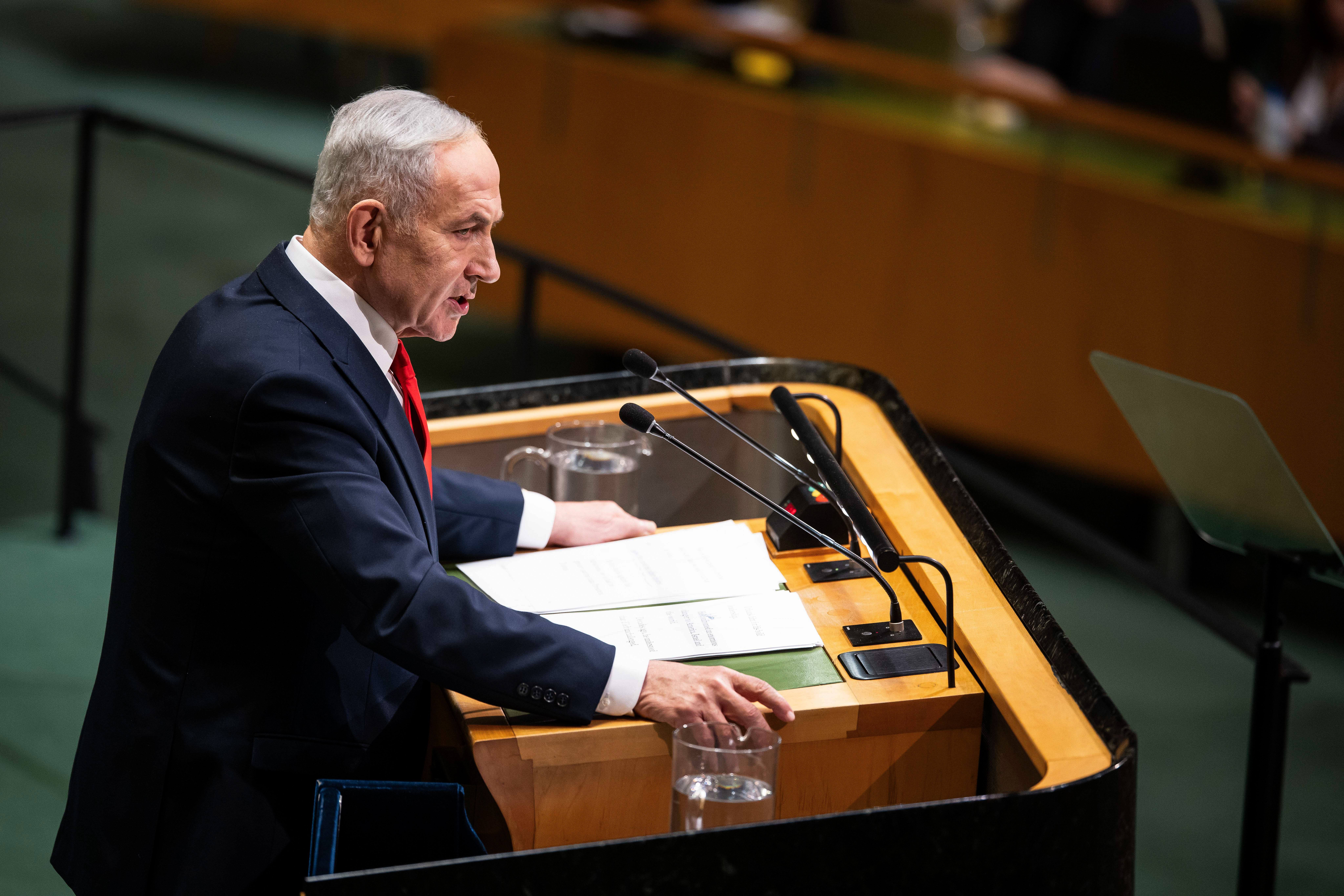
    Prime Minister Benjamin Netanyahu, seeking an unprecedented seventh term, has placed the blame on national security officials, while his critics have said he must personally answer for the failures. When Haaretz, an Israeli newspaper, reported earlier this month that Sheikh Mohammed Bin Zayed, president of the United Arab Emirates, had given Netanyahu a secret warning that Hamas was planning a major attack, the question took on even greater urgency.

    Netanyahu has denied the report.

    But a person who said they had spoken with Sheikh Mohammed and another person who said they had been briefed by someone on the call between the two leaders told the New York Times that the Emirati leader had secretly reported to Netanyahu that Hamas was considering a major attack.

    The warning from the Emirati leader, however, never reached the leaders of Israel’s security establishment, according to five former senior Israeli officials. Netanyahu gathered his security chiefs days later, on Oct. 1, 2023, for a meeting about the situation in the Gaza Strip, and never mentioned the warning, according to minutes of the meeting reviewed by the Times.

    Instead, he told them that the goal should be to maintain calm in Gaza, and he pushed back when some security officials said that Israel should consider military strikes against senior Hamas leaders in Gaza who were overseeing attacks against Israelis in the West Bank, the minutes show.

    At the meeting, details of which have not been previously reported, Netanyahu said that any Israeli action in Gaza might sabotage the prospect of Saudi Arabia establishing diplomatic relations with Israel — a deal the Israeli prime minister believed was imminent.

    Sheikh Mohammed had called Netanyahu in late September to tell him that, based on information he had received, Hamas was planning to launch an attack, according to the two people who said they had spoken with someone on the call. One of those people said the information was not specific about whether Hamas was planning to launch rockets into Israel or preparing for a ground invasion over the border. The original sources of the intelligence that Sheikh Mohammed passed to Netanyahu are unclear, and it is also unclear whether other issues were discussed on their call.

    The warning, though vague, proved to be correct. Days later, thousands of Hamas fighters and their allies launched an invasion over the Gaza border into southern Israel, killing about 1,200 people and taking some 250 more hostage in the deadliest attack on Israel in the country’s history.

    After the Haaretz report, Netanyahu denied in a statement that he had ever received a phone call warning from Sheikh Mohammed and said that if any intelligence came from the Emiratis it was passed to Israel through intelligence channels.

    The Emirati Foreign Ministry and Netanyahu’s office did not respond to requests for comment.

    But Sheikh Mohammed mentioned his September 2023 phone call with Netanyahu months later in a discussion with William Burns, the CIA director at the time, according to a person familiar with that discussion. Sheikh Mohammed told Burns that, during the phone call, he had spoken to Netanyahu about a looming threat of violence in the West Bank or Gaza carried out by Hamas.

    All of the people the New York Times spoke to insisted on anonymity to divulge details of sensitive discussions.

    Netanyahu was not the only Israeli leader to overlook warning signs in the lead-up to the Hamas-led attack Oct. 7, 2023. Israeli security leaders repeatedly downplayed other signs that Hamas was gearing up for an assault, which were abundant at the time.

    The Israeli military even obtained a Hamas battle plan in 2022, but military leaders dismissed it as unrealistic. The plan, which the military gave the code name “Jericho Wall,” turned out to be the blueprint for the Oct. 7 attacks.

    In the years before the attacks, Israeli military and intelligence officials had concluded that Hamas was incapable of carrying out a major attack on Israel, and that Yahya Sinwar, the group’s leader in Gaza, was more interested in governing the enclave than fighting another war with Israel.

    Netanyahu thought that Israel had deterred Hamas from waging war, according to an Israeli state ombudsperson report about government decision-making before the October attack. He instructed Israeli military and intelligence bodies to pursue a policy of “postponing conflicts” and “preserving Hamas as an effective, restrained, and restraining governing authority,” the report said.

    The phone call and the warning from Sheikh Mohammed are not mentioned in any of the internal investigations conducted by the military, intelligence agencies, or other entities into the causes of the severe Israeli security failures leading up to and including Oct. 7, according to the five former senior Israeli officials. The five officials were involved in the assessments, which have not been released in full.

    Late next month, Israelis will vote in their first national election since the Oct. 7 attacks, and the race for parliamentary seats in the highly polarized country is shaping up to be extremely tight. Not only is Netanyahu’s political future at stake, but many Israelis also see the election as fateful for the future of their shaken country.

    The Haaretz report punched a hole in Netanyahu’s argument that Israel’s military and intelligence services were to blame for the intelligence failures leading to the Oct. 7 attacks. He and his allies have blocked efforts by Israeli lawmakers to set up a state commission of inquiry into the security breakdowns that preceded the attacks, saying it would not uncover the truth.

    Earlier this month, Netanyahu’s opponents in the campaign issued a joint statement saying that the Haaretz report about the September 2023 warning “joins a series of revelations concerning Netanyahu’s failures” and “once again underscores why Netanyahu is fighting for his life — to thwart the establishment of a state commission of inquiry and to thwart revealing the truth to the Israeli public.”

    This article originally appeared in the New York Times.
  • France to send soldiers to Saudi Arabia to help secure energy sites

    France to send soldiers to Saudi Arabia to help secure energy sites

    France will send troops and other military assets to Saudi Arabia to help protect critical energy sites along the Red Sea that have come under fire from the Iran-backed Houthi militia in Yemen, the French president said Thursday.

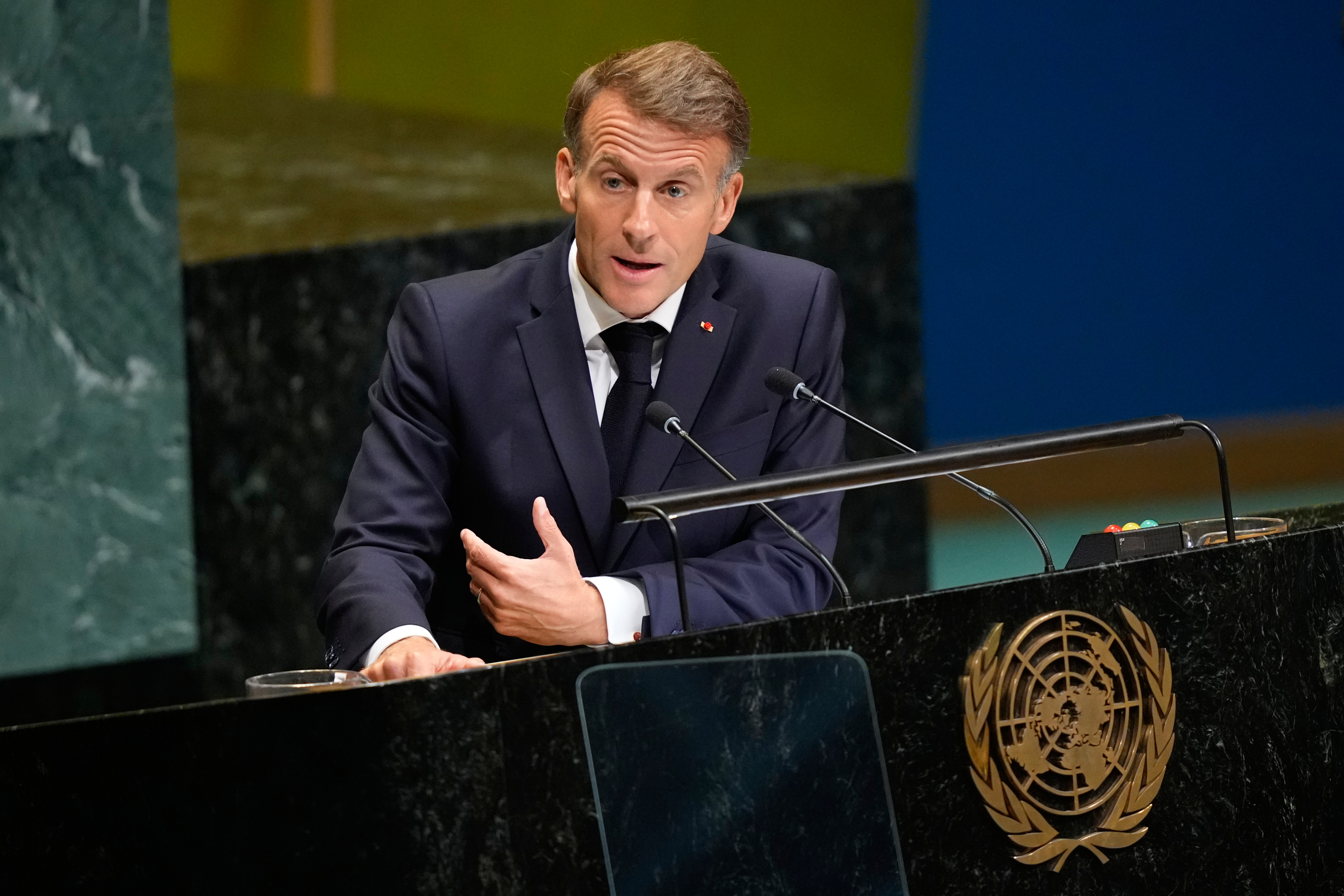
    France will send “soldiers, radars, and defense systems” to help secure energy infrastructure in the coastal city of Yanbu, according to an agreement the two countries sealed Thursday, President Emmanuel Macron said in an interview on public broadcaster France 2. “Not to engage in any conflicts but to protect this site,” Macron said.

    He did not rule out the possibility that additional military assistance might be provided as the situation evolves.

    Macron framed the move as one part of efforts that France is making to ensure energy security and fight for lower gas prices at home amid the war started by the United States and Israel with Iran more than six months ago. That conflict has left the Strait of Hormuz, a key international waterway for oil and gas, effectively blockaded.

    In recent weeks, the Iran-allied Houthi militia has repeatedly attacked Saudi Arabia, threatening its ability to export oil from Red Sea ports. The French president’s pledge came after what appeared to be one of the largest such attacks since the long-running conflict spiraled back into war.

    The Saudi-led military coalition in Yemen said Thursday that it had shot down six ballistic missiles aimed at Yanbu and Taif, another Saudi city. Saudi authorities issued alerts Thursday warning of potential attacks in cities across the kingdom.

    For more than a decade, Yemen’s civil war has pitted the Houthis, a Shiite Muslim group aligned with Iran, against the internationally recognized government backed by Saudi Arabia. A truce was reached in 2022, but the conflict recently reignited, opening a second front in the Middle East after the United States and Israel attacked Iran. The Houthis have accused the Saudis of launching hundreds of strikes in the renewed fighting.

    The Houthis captured the strategic port of Mokha from the Saudi-backed government earlier this month, giving them control of Yemen’s west coast and the Bab el-Mandeb Strait, which connects the Red Sea to the Gulf of Aden, a route that Saudi Arabia has relied on to move oil while the Strait of Hormuz is choked.

    This article originally appeared in the New York Times.
  • Iran proposes a deal to reopen the Strait of Hormuz in 7 days if the U.S. meets its conditions

    Iran proposes a deal to reopen the Strait of Hormuz in 7 days if the U.S. meets its conditions

    Iran has offered to reopen the Strait of Hormuz and resume talks on its nuclear program in seven days if the United States lifts its naval blockade of Iranian ports, waives sanctions on Iranian oil sales, and observes a ceasefire that would include Lebanon.

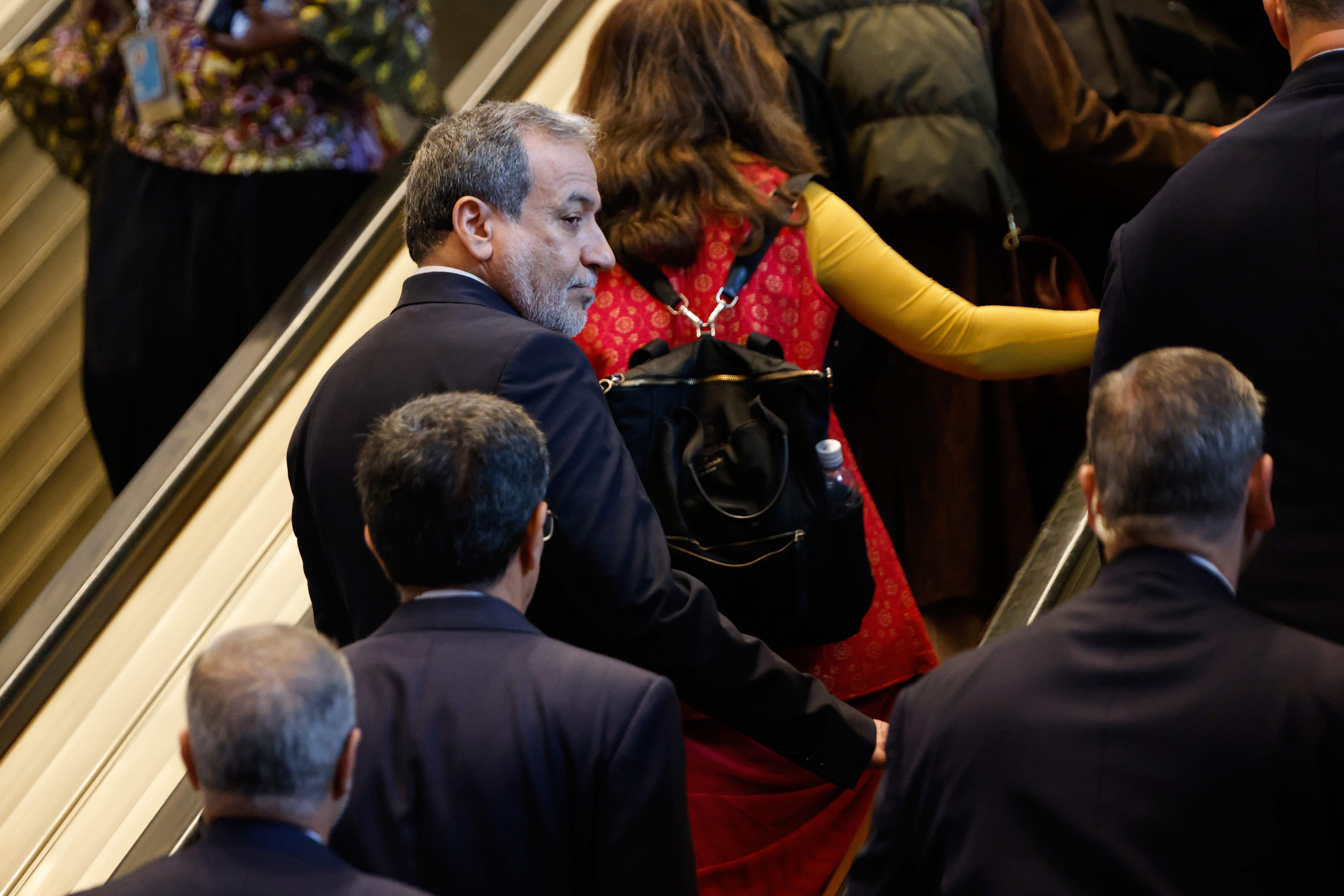
    Iran’s Foreign Minister Abbas Araghchi detailed the proposal in a private gathering on Thursday on the sidelines of the U.N. General Assembly in New York, according to one attendee.

    Trita Parsi, executive vice president of the Quincy Institute think tank, said Araghchi suggested that a speedy agreement would help U.S. President Donald Trump ahead of November’s midterm elections. The arrangement would also relieve enormous economic pressure on Tehran as the U.S. piles on additional sanctions.

    Iran’s disruption of the strait — through which a fifth of the world’s traded oil and gas transited before the war — has emerged as its main point of leverage. The effects have been felt far beyond the Middle East.

    There was no immediate comment from Iran’s U.N. mission or other Iranian officials. A person familiar with the matter, speaking on condition of anonymity to discuss private deliberations, told the Associated Press that Saudi Arabia was skeptical of the latest push for a deal.

    The White House said Friday that U.S. officials are having positive and constructive conversations with mediators on the Iran war. In response to questions from the Associated Press, it said the U.S. is facilitating significant oil exports through the Strait of Hormuz.

    Proposal resembles a June deal that quickly crumbled

    The proposal, conveyed to the U.S. by mediators, strongly resembles the so-called Memorandum of Understanding reached in June, but with an accelerated timetable. The earlier agreement, which called for a 60-day interim period, quickly collapsed as Iran resumed attacks on shipping in the strait.

    Trump has said he is in no rush to reach a deal, even as high oil prices fuel inflation. On the Iranian side, there are questions as to whether the hard-liners who dominate the security forces would accept compromises championed by moderates like President Masoud Pezeshkian.

    “If Trump calculates this arrangement is worthwhile and can bring political benefit before the midterms and reduce gas prices, perhaps we’ll see flexibility not seen in previous weeks,” Parsi said. But he noted “deep suspicion,” especially around the prospect of Iran merely buying time to ship out more of its oil and ease its economic pain.

    Other signs of renewed diplomacy

    In the latest sign of diplomatic movement, Pezeshkian hosted the prime minister of Qatar early Friday. Qatar has been a key mediator, including during hours of indirect Iran-U. S. talks at the U.N. this week.

    It was not clear how long Pezeshkian and Araghchi would stay in the U.S. after Pezeshkian addressed the annual U.N. gathering of world leaders on Wednesday, ending his speech by saying Iran remained open to diplomacy.

    U.S. Secretary of State Marco Rubio, on the same day, said, “If there’s an opportunity to exchange ideas and messages, we will.”

    After multiple failed attempts at a deal, however, suspicion is high on both sides. The U.S. and Israel have attacked Iran twice while it was engaged in nuclear talks, and the U.S. and Iran accuse each other of having swiftly violated the June agreement.

    “The Iranians already know that the chances of this not being accepted by Trump are much higher than the opposite,” Hamidreza Azizi, senior Iran analyst at the International Crisis Group think tank, wrote on X.

    “They want to show that they were ready for diplomacy and that it was the United States that, for the third time, decided to attack in the middle of a diplomatic track — something that people within (Iran’s) strategic community have been anticipating over the past few days.”

    It’s unclear if the proposal would include the Yemen conflict

    The proposal would include Lebanon, where Israel and the Iran-backed Hezbollah have been mostly observing a ceasefire. It’s not clear, however, if it would include the revived conflict between Yemen’s Iran-backed Houthi rebels and Saudi Arabia, which has put even more pressure on global markets.

    Iran appears to think the Houthis’ newly enhanced ability to threaten the Bab el-Mandeb strait on the Red Sea — another trade chokepoint on the other side of the Arabian Peninsula — could push Trump to make a deal.

    Maj. Gen. Yahya Rahim Safavi, a military adviser to Iran’s new supreme leader, told state television that the Americans “face a new problem called the Bab el-Mandeb Strait.”

    He added: “I think the process that is unfolding is in our favor, and the Americans will be forced to accept Iran’s conditions.”

    With the Houthis’ latest surge in attacks, Saudi Arabia was skeptical of Araghchi’s latest push for a deal with the U.S., according to the person familiar with the matter.

    The kingdom, along with other Gulf states, had advocated over the summer for a return to negotiations, saying they could live with an agreement that gave Iran a temporary role in managing the Strait of Hormuz, the person said.

    But the Saudi calculations changed as the Houthis seized Yemen’s strategic Red Sea coast from pro-government forces and a vital Saudi pipeline came under attack.

    Earlier this month, Gulf leaders planned to gather in Oman to discuss an emerging agreement between Oman and Iran on the Strait of Hormuz, which runs between the two countries. But the meeting was canceled after Saudi Arabia called for amendments, only some of which were accepted by Iran, the person said.

    Iran’s leadership has shown signs of divisions

    Iran’s leaders have sought to project unity, but some hard-liners want to continue or escalate the war to secure bigger U.S. concessions and have criticized Pezeshkian and Araghchi’s diplomatic steps this week.

    Firebrand lawmaker Ebrahim Rezaei wrote on X that merely meeting with “the aggressor enemy” showed weakness. Iran’s Assembly of Experts, a panel of Shiite clerics who appoint the supreme leader, said, “There is no path other than resistance.”

    The head of Iran’s powerful Revolutionary Guard, Brig. Gen. Ahmad Vahidi, highlighted the U.N. speech by “the esteemed president” while focusing on Pezeshkian’s comments that Iran doesn’t fear war.

    Iran’s parliament speaker, Mohammad Bagher Qalibaf, who served as chief negotiator in earlier talks with the United States, provided a rare public acknowledgment of the internal divide.

    “There is a view that speaks of war but offers no prospect or mechanism for bringing it to a powerful conclusion,” he wrote on social media. “At the opposite end is a current that makes the error of underestimating national capabilities.”

    He added: “The first error keeps the country in a state of permanent crisis, while the second hands national resources and dignity over to the enemy.”

  • East Whiteland officials approve a lengthy data center ordinance, after residents decried the one being built there

    East Whiteland officials approve a lengthy data center ordinance, after residents decried the one being built there

    As East Whiteland grapples with the community’s resounding pushback to a planned 1.5 million-square-foot data center being built, its elected officials have approved an ordinance that would set greater restrictions for any similar proposals in the future.

    The board voted unanimously Thursday to approve the 32-page ordinance, after members had put a data center moratorium in place for months while they re-examined the zoning ordinance that allowed the supersized project to come into the municipality.

    The ordinance doesn’t affect the project, which is slowly taking shape at the former 79-acre Cyprus Foote Mineral Co. property. But the data center’s existence, which has faced staunch community opposition, is certainly what launched the new ordinance, penned in a collaboration between township staff, consultants, and community members.

    “I think this sends the right message,” said resident Tony Gianino, who served on the committee to draft the ordinance. “I know it’s been a little contentious over the last eight or nine months, and I think that we’re not looking at this as a negative, but as a positive, and as a foothold moving forward.”

    East Whiteland is among a number of municipalities in Chester County and the region that have been hurriedly drafting ordinances as more data center projects arrive at their doorsteps. Public backlash against the projects has been loud as data centers, which handle the cloud-storage and computing needs of the companies behind increasingly sophisticated artificial intelligence tools, have come to their communities. Gov. Josh Shapiro, who once sought to make it easier for the projects to call Pennsylvania home, has even evolved his stance.

    In East Whiteland, the ordinance will establish limitations on how close a data center can be to homes, schools, daycares, parks, or churches. It addresses noise, water usage, cooling systems, power supply, and more.

    It’s not a slam dunk, several said Thursday; some speakers were already suggesting amendments. State Sen. Katie Muth, who represents the area and is a frequent flier at data center meetings, suggested changes on portions of the ordinance, quipping, “I would love to have a township to refer to that has a really great ordinance. If you make those changes, you will be that township.”

    Scott Lambert, the board’s chairman, acknowledged it was a living document.

    “Whatever goes on the books tonight, it’s not permanent. It can be amended going forward,” he said. “We’re not locked into this particular ordinance and the specifics at this point in time.”

    Still, there was applause when the officials voted to approve the measure.

    But the effects of data centers don’t stop at the municipal line. East Whiteland residents have been watching nearby Charlestown, which updated its zoning to allow for data centers to be built on the East Whiteland border.

    “I do hope other communities look at this and end up utilizing it, especially Charlestown,” Lambert said. “I hope they do take a look at what we have and implement, to protect both communities.”

    This suburban content is produced with support from the Leslie Miller and Richard Worley Foundation and The Lenfest Institute for Journalism. Editorial content is created independently of the project donors. Gifts to support The Inquirer’s high-impact journalism can be made at inquirer.com/donate. A list of Lenfest Institute donors can be found at lenfestinstitute.org/supporters.

  • A quiet ICE surge unfolded ‘everywhere all at once’ this summer

    A quiet ICE surge unfolded ‘everywhere all at once’ this summer

    The most effective escalation of President Donald Trump’s mass deportation campaign happened quietly.

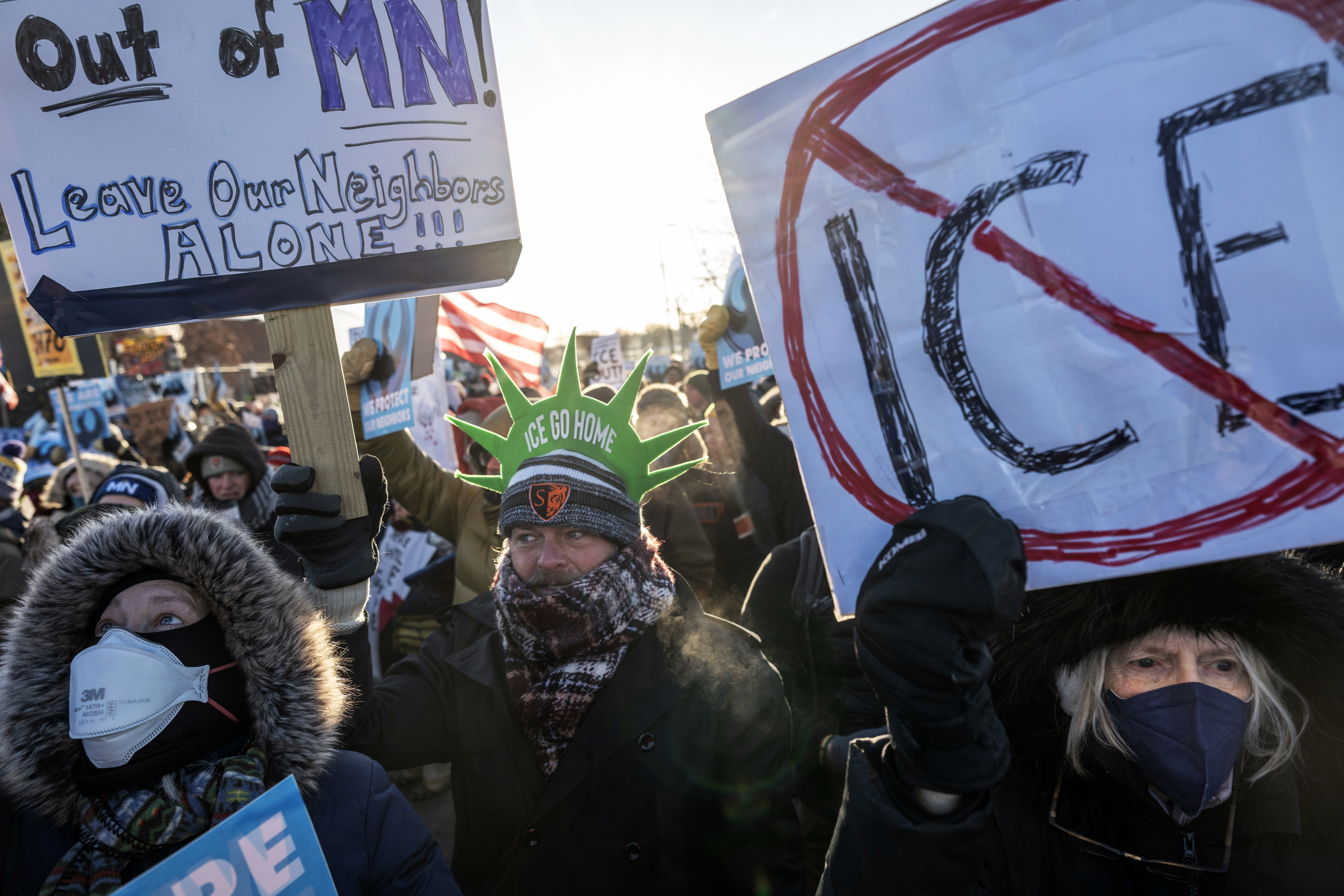
    Unlike earlier high-profile raids that drew thousands of protesters into the streets of Chicago, Los Angeles, and Minneapolis, the surge in arrests in June, July, and August was captured mostly by grainy security camera footage, through cracked blinds, and from behind closed doors.

    Arrests by Immigration and Customs Enforcement this summer soared to record highs since the start of this Trump administration — with 43,000 in June, more than 49,000 in July, and nearly 51,000 in August — as officials cut or narrowed the pathways to legal residency in the United States and expanded the pool of people eligible for deportation.

    Federal agents appeared in nearly every corner of daily life, carrying out operations at hospitals and airports, outside suburban schools and along rural construction sites and truck stops. They fanned out from coastal cities in Maine to desert towns in Arizona, across the open plains of Wyoming and down through the southern borderlands.

    In Republican-led states like Texas and Florida, where the swell was strongest, they amplified their reach through partnerships with sheriffs and state highway patrol officers. In Democratic strongholds, they intensified their activities despite laws meant to restrict them.

    David Bier, director of immigration studies at the Cato Institute, a libertarian think tank, said the local partnerships, an infusion of federal dollars, and new technology had made the dragnet so decentralized that it had attracted less attention.

    “This gradual rise everywhere all at once, through a lot of means, is enabling the operation to fly under the radar,” he said.

    The spike in arrests, to little public backlash, reflects a turning point in the Trump administration’s efforts to carry out large-scale expulsions of noncitizens. Those arrested were accused of violating civil immigration laws, but most had not been charged with or convicted of a crime. In a statement, ICE defended the expansion of immigration enforcement.

    “This is promises made and promises kept in action,” the statement read. “The results speak for themselves.”

    To understand how the operations have unfolded around the country, the New York Times reviewed arrest videos, photographs, and court records from more than 50 incidents. What follows is a sampling of those interactions.

    A presence in routine places

    Federal agents appeared as people carried out their everyday routines. People were detained en route to a soccer match. Leaving Sunday Mass. Having a drink at a nightclub. At national forests and outside polling locations.

    Roger Hansen, 83, owner of the Little Big Load Laundromat in Madison, Wis., said federal immigration agents took five people from two of his locations in June. Statewide sweeps the same day resulted in the arrests of roughly 40 people, many of whom Department of Homeland Security officials said had criminal charges for sexual assault, driving while intoxicated, and other crimes.

    Security footage from one of Hansen’s laundromats shows two agents slamming a young customer to the ground near a soap dispenser. All the while, people continue to do laundry.

    Outside, bystanders recorded the man being walked out in handcuffs and loaded into an SUV with dark-tinted windows.

    Hansen said he was disturbed by the violence. “They were having a heyday beating up on a kid,” he said, adding that business had dropped roughly 50% the next day and had not recovered. He said he believed many of his Latino and immigrant clientele may be too afraid to return.

    In a statement, ICE said the arrests at the laundromat had been part of “targeted operations” in Wisconsin at the end of June. The five people from Nicaragua and Mexico were in the country illegally, ICE said. The agency did not respond to a question about their criminal records.

    On July 7 in Salt Lake City, Elizabeth Garcia recorded three ICE agents forcing their way into her home without showing a warrant after following her father, Raul Moreno Meza, 52, from a gas station.

    In the video, agents handcuff Moreno and his 15-year-old son, a U.S. citizen. Garcia howls and pleads as agents carry her father outside to their vehicles. Her 2-year-old can be heard crying in the background.

    Before departing, an agent removed the shackles from Moreno’s son, who chased the SUVs as they drove away. Moreno was later released on bond, his daughter said, but her brother has become withdrawn and is attending therapy.

    “He had lots of goals and intentions,” she said. “Now he is so negative.”

    In a statement, ICE said officers arrested Moreno after he did not yield to officers at a traffic stop and then fled on foot. The agency alleged in the statement that “a juvenile occupant of Moreno’s vehicle” had assaulted an officer and was “detained in handcuffs for safety.”

    Moreno, who is Mexican, crossed the border unlawfully about two decades ago, after his green card petition languished in delays and as his father, a naturalized U.S. citizen, fell ill, his family said. His father later died. Because Moreno’s green card petition was tied to his father’s citizenship, the application did not advance after the death, the family said.

    All corners of the country

    Immigration arrests climbed to near record highs in almost every state. Some of the sharpest percentage increases in daily arrests occurred in Oregon, Montana, Hawaii, New Mexico, Vermont, and New Jersey.

    In June, the dragnet came to Harrison, N.J., where Asian and Hispanic residents account for about 65% of the population.

    Tugrul Ozkarsli, 33, of Turkey, had just pulled up to his home with groceries when ICE agents in plain clothes boxed his vehicle in with their SUVs, his wife, Kendra Ozkarsli, 46, said. He honked his horn and called her from his phone.

    “All I hear is him screaming,” Kendra Ozkarsli recalled. She ran downstairs to find agents pulling him out of the vehicle.

    “I’m married!” Tugrul Ozkarsli yelled as agents handcuffed him.

    “What are you doing? What are you doing?” Kendra Ozkarsli repeated, her hands shaking as she recorded with her phone. “This is my husband! Please stop!”

    Tugrul Ozkarsli had entered the United States legally on a business visa in December 2024. Before it expired, he applied for a student visa, which is still pending, Kendra Ozkarsli said. ICE said the pending application did not give him legal status.

    The agency also said he had been arrested on burglary charges in New York last year. Kendra Ozkarsli said he was arrested after he entered the apartment of a woman he was dating at the time to retrieve his wallet and passport, prompting the woman to call the police. The charges were ultimately sealed and dismissed, she said.

    Tugrul and Kendra Ozkarsli had married this summer, and he had been preparing to apply for a green card, she said.

    From roads to airports

    Traffic stops were central to the summer surge. Some were deadly. In Houston and Biddeford, Maine, traffic stops ended in fatal shootings involving officers. An encounter between people in a vehicle and agents at a Florida gas station resulted in a fatal car crash.

    In Milwaukee, Frankely Quezada, 34, and Estenderly Marte Polanco, 31, of the Dominican Republic, were running errands with their 7-year-old son on a Saturday morning in June. Near home, Quezada said, he noticed an unmarked SUV trailing his van. He turned into an alley and accelerated.

    The vehicle behind him flashed its lights, and as Quezada crossed the street, more SUVs emerged to box him in. Federal agents jumped out, and one of them pointed a yellow stun gun at him and shattered his window, Quezada recalled. From a balcony, a neighbor filmed officers dragging Polanco out as her son cried.

    Quezada, who was not arrested, said Polanco bit a federal agent as they drove her away after he shoved her face into her lap so forcefully she believed she would suffocate. Polanco, who overstayed a visa and has no other criminal record, remains held without bond in Kansas.

    In response to questions about Polanco’s arrest, ICE said in a statement that both Quezada and Polanco had been combative and refused to obey commands and that Polanco would remain in custody as her case moves through immigration proceedings.

    ICE also stepped up its arrests of foreign citizens at airports in July, in encounters that could be more surreptitious. Footage recorded by an airline manager July 13 captured two ICE officers in plain clothes approaching a gate agent at Dallas Fort Worth International Airport before a flight to Portland, Ore. They identified themselves only as federal officers and instructed the employee to page a passenger.

    Flanking the woman, the men discreetly took her into custody, according to the manager, who asked not to be identified, citing concerns for her job. The worker followed them, recording as they escorted the passenger through the concourse, one of them wheeling her luggage.

    In the parking lot, the woman was handcuffed and put into an unmarked vehicle.

    ICE agents told the manager that the woman was being detained because she had overstayed her visa. U.S. authorities did not share her name with the Times or provide information about her whereabouts.

    No more protected areas

    During the summer surge, displays of force were routine inside some courthouses, and federal agents have increasingly been spotted at and near hospitals and schools.

    ICE acknowledged operating in courthouses but said officers did not target schools.

    “Nothing in the Constitution prohibits arresting a lawbreaker where you find them,” the agency said in a statement. “The ability of law enforcement to make arrests of criminal illegal aliens in courthouses is common sense. It conserves valuable law enforcement resources because they already know where a target will be.”

    On the morning of Aug. 20, Grace Calero, 39, and her daughter, Giulianna Carriel, 19, were rushed to a hospital after a car crash south of Orlando, Fla. As medical staff treated them for injuries, a federal agent entered the emergency ward and began questioning Grace’s sister, Gia Calero, about the women’s immigration status, the sister said.

    He remained in the room, joking with nurses.

    It wasn’t until hours later, after Grace’s neck brace was removed, that the officer announced he was with ICE, Gia said. In the dramatic scene, captured by Gia on her cell phone, five deputies with the Polk County Sheriff’s Office arrived. They handcuffed Grace as Giulianna wailed on a bed, clinging to her mother and begging them not to take her.

    “They didn’t even let them recover,” Gia Calero said.

    In statements, ICE and Polk County sheriff’s officials said the women had overstayed their visas. Gia said her sister and niece had pending asylum claims, stemming from attempted kidnappings in Ecuador. The two have since been deported to their native country.

    This article originally appeared in the New York Times.
  • Man killed in a shooting that involved police in Cape May County

    Man killed in a shooting that involved police in Cape May County

    New Jersey officials are investigating a shooting that involved police in Middle Township, Cape May County, that left a person dead Friday morning.

    The incident occurred near Route 9 and Satt Boulevard just before 10:30 a.m. Friday, the New Jersey Attorney General’s Office said in a statement. One man was killed, though officials did not identify him publicly.

    The Cape May County Prosecutor’s Office said no further details about the circumstances of the incident or the people involved were immediately available. Officials said the shooting involved police but did not specify who fired the shot that killed the man, or how many officers were involved.

    There was no ongoing threat to the public, the prosecutor’s office said in a statement. The area where the shooting took place was closed as the investigation progressed Friday afternoon, the Middle Township Police Department said in a social media post.

    Prosecutors noted the scene had been secured, and the New Jersey Attorney General’s Office was investigating the incident.

    Middle Township police referred requests for comment to the prosecutor’s office, which referred requests to the state attorney general’s office.

    New Jersey law requires the attorney general’s office to conduct an investigation when a person dies during an encounter with law enforcement. The results of the investigation are to be presented to a grand jury, the prosecutor’s office said.

  • Former Kibitz Room owner files for bankruptcy as he tries to repay debts from shuttered King of Prussia restaurant

    Former Kibitz Room owner files for bankruptcy as he tries to repay debts from shuttered King of Prussia restaurant

    Brandon Parish, former owner of the Kibitz Room in King of Prussia and deli manager at the original Cherry Hill location, has filed for personal bankruptcy, months after his Montgomery County restaurant closed amid mounting debts.

    Parish owes creditors nearly $1.8 million, including $1.2 million to Hanover Community Bank for a small-business loan, and has about $15,500 in assets, according to documents filed in U.S. Bankruptcy Court for the Eastern District of Pennsylvania.

    The 33-year-old King of Prussia resident filed for bankruptcy in early September, five months after he and his father, Neil, were evicted from their storefront in the Valley Forge Center on U.S. Route 202. Their landlord won a judgment for more than $194,000 in rent and fees.

    The restaurant was in business for a year.

    Brandon Parish sits at a table at the now-closed Kibitz Room in King of Prussia in April 2025.Kriston Jae Bethel / For The Inquirer

    The restaurant also owed more than $135,000 to distributor Foods Galore, a debt listed in Parish’s personal bankruptcy filing alongside more than $140,000 owed to other business vendors and related services.

    The King of Prussia location’s debts are “going to take some work to clean up,” Brandon Parish said in April, noting the expansive full-service restaurant strayed too far from its over-the-counter roots. “Obviously, it’s been a disaster since day one. Nothing went as planned. But we’ll have to figure all that out.”

    Meanwhile, the Cherry Hill Kibitz Room — a separate business that had been owned by Brandon Parish’s mother, Sandy — abruptly closed and filed for bankruptcy earlier this year. Neil and Brandon Parish, backed by outside investors, negotiated a deal in bankruptcy court to buy the Cherry Hill equipment and sign a new lease there, though neither Parish would be an owner. The Springdale Road deli reopened in May, with the Parish men behind the counter.

    Brandon Parish (right) waits on a customer at the Kibitz Room in Cherry Hill on May 1. Michael Klein / Staff

    Brandon Parish’s personal bankruptcy case will not impact operations at the Cherry Hill deli since he is only an employee, according to a spokesperson.

    The Kibitz Room has been part of the Parish family for more than two decades.

    In 2003, Neil Parish purchased the Cherry Hill spot from Russ Cowan, who had given the deli its name, a loose translation of the Yiddish chitchat. Cowan, a local legend, owned Philly’s Famous 4th Street Deli for 18 years and now owns Radin’s Deli in Cherry Hill.

    Brandon grew up at Kibitz, standing on milk crates to wash dishes for his father. Ever since he was a kid, delis were his “comfort zone,” Brandon said in 2025.

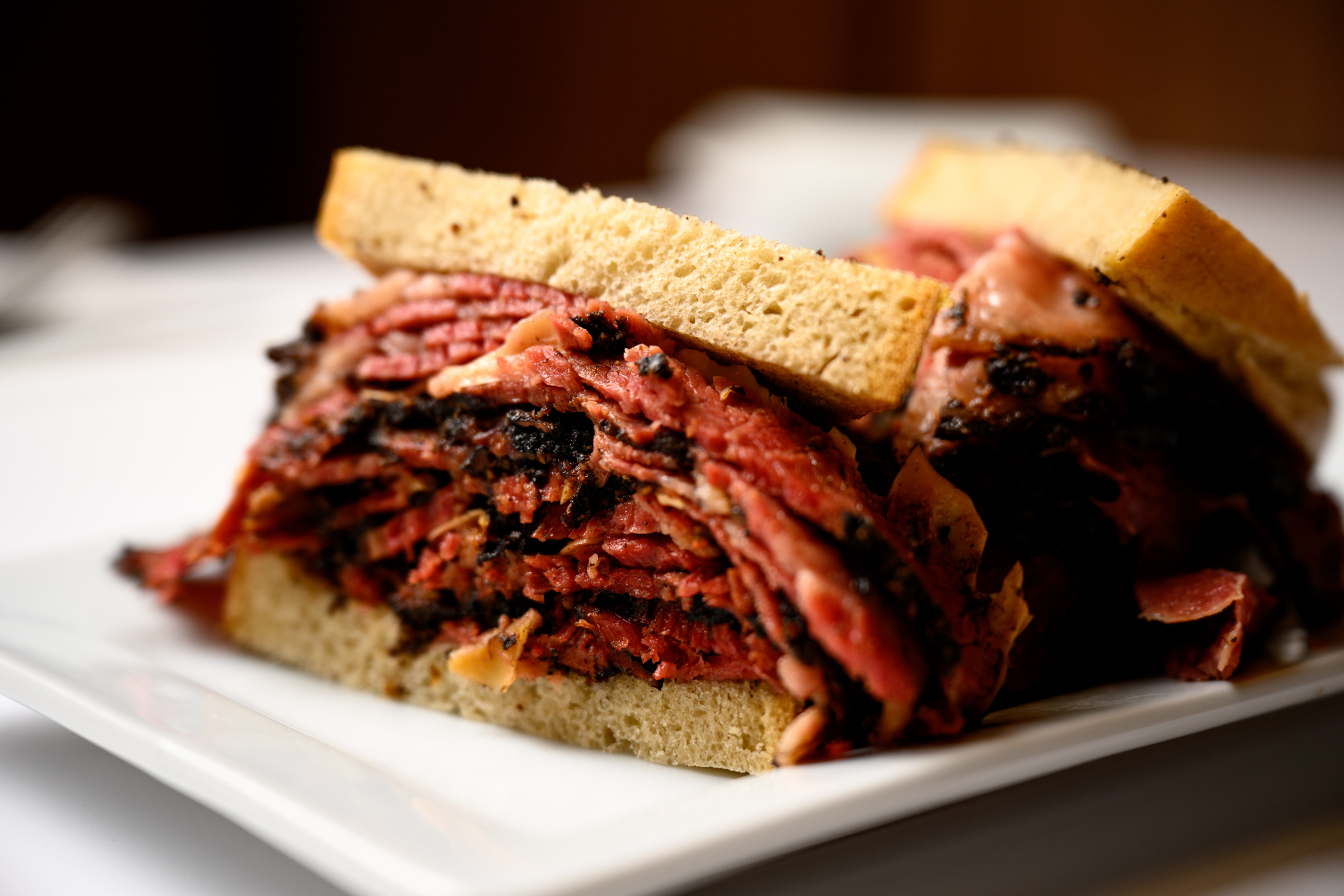
    A pastrami sandwich at the now-closed Kibitz Room in King of Prussia. Kriston Jae Bethel / For The Inquirer

    After Brandon’s mother and father split about a decade ago, his dad moved back to the Baltimore area, and Brandon continued to run the Cherry Hill restaurant with his mom. But he was itching to open his own place, he said.

    In 2025, Brandon left his post in Cherry Hill to open a Kibitz Room in the former Michael’s Deli in King of Prussia. The business was an independent venture with his father, who had returned to the Philly area from Baltimore. The senior Parish was in charge of the menu, but his son was the boss: “This is Brandon’s store,” Neil said at the time.

    The pair said they were excited to open a full-service restaurant that was about four times the size of the Cherry Hill deli and could seat 200 people.

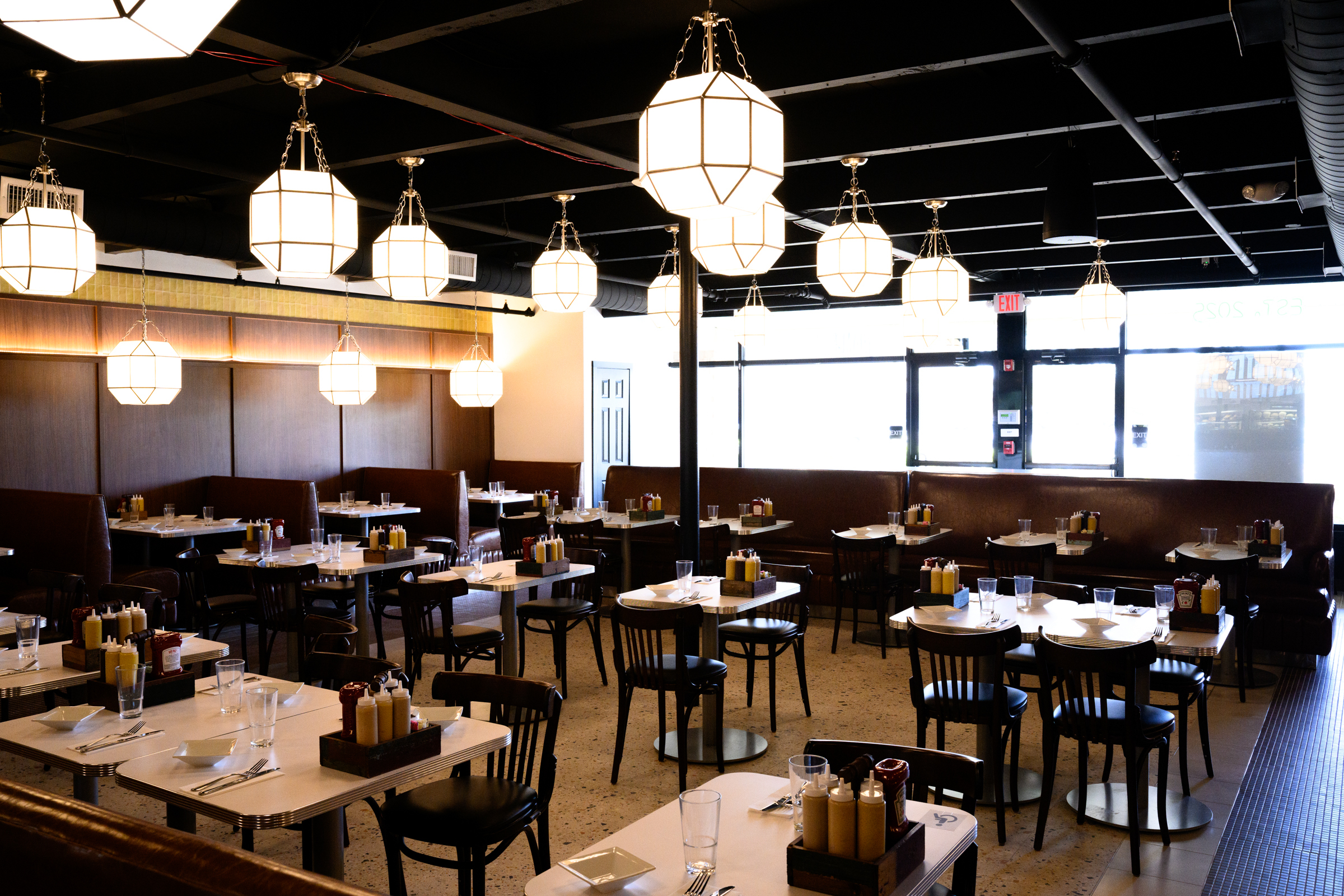
    The Kibitz Room in King of Prussia was about four times the size of the original deli in Cherry Hill, a separate business not owned by Brandon Parish. Kriston Jae Bethel / For The Inquirer

    They created a giant menu full of staples like corned beef and pastrami sandwiches, matzo ball soup, knishes, and chicken pot pies, as well as elevated items like garlicky flank steak. They planned tableside chopped liver service.

    “I feel like this really encapsulates the Jewish deli as a whole experience,” Brandon Parish said at the time. “The old, the new, the vibe, the aesthetic, the personality, the quality, the menu mix.”

    And he scoffed at occasional reports that Jewish delis were going out of style: “I think if you do it well, then you never have to worry about failure.”

  • Pope praises free press, warns a ‘paradise of machines’ could undermine humanity as he opens France trip

    Pope praises free press, warns a ‘paradise of machines’ could undermine humanity as he opens France trip

    PARIS — Pope Leo XIV warned Friday that a “paradise of machines” risked undermining humanity as he opened a trip to France by posing fundamental questions about what it means to be human in the age of artificial intelligence, a nuclear arms race, and other threats to life itself.

    Leo raised existential concerns about scientific progress, life, and human rights during his opening speech to President Emmanuel Macron and authorities at the Élysée Palace and then to diplomats and United Nations employees at the headquarters of UNESCO, the U.N. culture and education organization.

    With wars plaguing Europe and the Middle East, he reaffirmed the Vatican’s opposition to nuclear weapons and said the nuclear deterrence doctrine was “mistaken” since it was just fueling a new arms race.

    “Peace is not a balance of power; rather, it is built day by day through dialogue and justice,” he said.

    Leo has an intense four days in France, where the Catholic Church has lost ground in influencing ethical issues given the strict approach to secularism that is enshrined in the French Constitution.

    Yet thousands of people lined his motorcade route, waving French and Holy See flags, with some braving hours of the unseasonable heat to catch a glimpse of him. The turnout underscored the surprising level of interest in Leo’s visit, the first official state visit by a pope to France in 18 years.

    “To see him, praying with us, it comforts us in our faith and on our path,” said Senegalese Sister Antonia Faye, who was glowing after her first-ever event with a pope, an evening prayer service at Notre Dame that featured angelic choirs and the cathedral’s booming organ.

    “Being with the pope is different to being alone or praying alone. We felt the benediction that came down on us,” she said.

    Pope says reporters ‘are all welcome’

    During his flight to France, Leo told journalists they were welcome to report on him, as he responded to the Trump administration’s attempt to bar U.S. media from the White House and affirmed the importance of journalists covering public figures.

    Asked by a CNN reporter about the Trump administration’s attempt to bar CNN and other reporters, Leo said the media was welcome on his plane.

    “I am very happy that here, you are all welcome,” he said. Good media coverage is important, he said, and equally important “that we have it all the way around, for everyone”

    The American pope has long affirmed the need for free and independent press, a point he made in one of his first audiences as pope. Speaking to journalists who covered the 2025 conclave that elected him, Leo called for the release of imprisoned journalists and affirmed the “precious gift of free speech and the press.”

    A capstone visit as Macron’s term ends

    For Macron, who is barred from seeking a third term in May elections, hosting the American pope is something of a capstone. Pope Francis had refused repeatedly to make a proper state visit to France during his 12-year pontificate and pointedly refused to join the inauguration of the rebuilt Notre Dame cathedral in 2024 that Macron had championed.

    “For a president of the republic as Macron, who is at the end of his mandate, it can be important to be aside the pope and to capture a part of his popularity,” said Charles Mercier, director of history and sociology of Catholicism studies at Paris EPHE university.

    With seven months left in his term, Macron’s approval ratings are near record lows, driven by anger over the rising cost of living and criticism of France’s growing debt and deficit and deteriorating public services.

    Smiling broadly as Leo spoke French, Macron thanked the pope for visiting, saying: “You are here with us for an extended visit, giving us your time, and that is moving.”

    Leo calls for the French to mull lofty questions about life

    Unlike Francis, who liked to travel to small Catholic communities far from Rome, Leo has been keen to emphasize and reawaken Europe’s Christian roots. He is seeking to push the church’s message about the value and dignity of human life in a country where the right to abortion was enshrined in the constitution in 2024, and where lawmakers recently gave final approval to a bill allowing adults with incurable illnesses to receive lethal medication.

    The French Catholic hierarchy strongly opposed the measures, in keeping with Catholic teaching that human life must be protected and defended from conception until natural death.

    In his speech to Macron and other government and diplomatic authorities, Leo reminded France of its “deep Christian roots” and called for the French to remember that the right to life is the “indispensable foundation of every other human right.”

    His concern about the dignity of human life and humanity as a whole extended to the threats posed by artificial intelligence.

    “The paradox has become increasingly evident: while ‘intelligence’ is attributed to computational systems, we struggle to recognize the inalienable dignity of human persons, whose lives are judged according to the criterion of efficiency and, when deemed no longer productive, are rejected and discarded,” he said.

    From the very start of his pontificate, Leo has identified AI as one of the greatest challenges facing humanity. He dedicated his first encyclical to the topic, “Magnificent Humanity,” calling for robust regulation and for AI developers to work for the common good rather than profit.

    Leo also appealed to AI developers and political leaders responsible for regulating them to slow down, an appeal that several top AI companies seem to have taken to heart recently.

    “If we are to avoid losing our humanity amid a ‘paradise of machines’ invading and conditioning our daily lives, there is an urgent need for education in ethical discernment and the capacity to acknowledge the moral good,” he said.

    Leo earlier told reporters that he was pleased his message was being heard and said he hoped the dialogue that the Vatican initiated with tech companies would continue.

    “And I think from their perspective, many of them, they’re very much open to looking for ways of making sure that AI does not displace or ultimately destroy humanity, but rather is a tool for human beings,” he said.

    A visit to Notre Dame that Francis declined

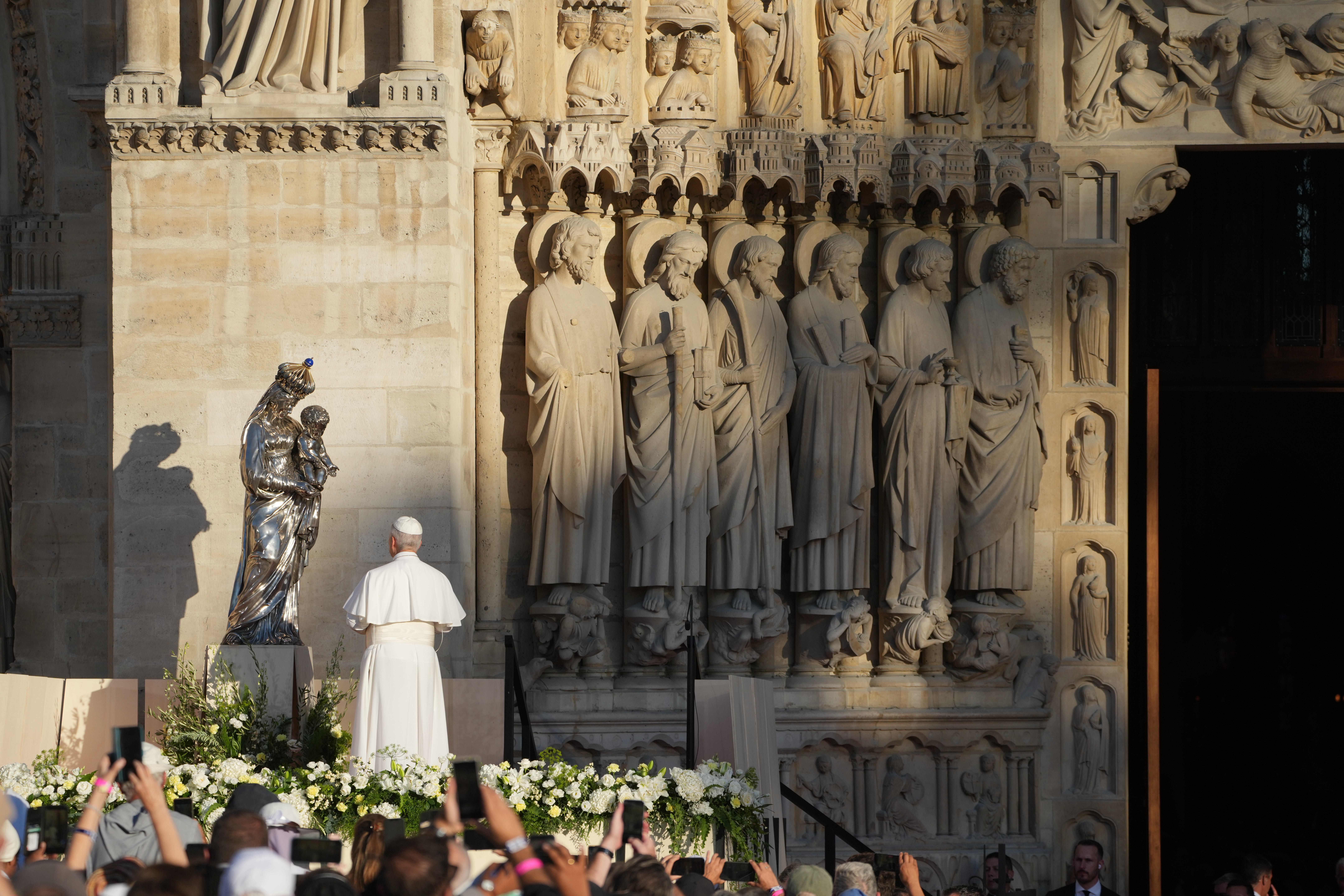
    Later on Friday, Leo presided over evening prayers in Paris’ soaring Notre Dame cathedral, the first pope to celebrate there since the devastating 2019 fire that consumed the cathedral’s roof and toppled its spire.

    After being mobbed by a crowd of eager nuns outside, Leo walked down the central aisle to the combined thundering of the organ above and cheers from the pews below. As bells tolled, he knelt in silent prayer in the same spot where, in 2019, flames brought down scorched roof beams.

    Leo marveled at the brilliance of the stained-glass windows and restored cream columns and praised the artisans who repaired them. He urged the priests and nuns gathered in the pews to be inspired by the combined effort to bring the Gothic masterpiece back to life.

    Francis had refused to visit France on a proper state visit, and explicitly refused Macron’s invitation to come for the 2024 reopening of the cathedral that drew dozens of world leaders.

    He did make three short trips to French cities, however, including Strasbourg in 2014 and Marseille and Corsica in 2024, a one-day visit that became his last foreign trip.

  • Democrats press RFK Jr. on an ethics agreement change involving law firm fees

    Democrats press RFK Jr. on an ethics agreement change involving law firm fees

    WASHINGTON — Congressional Democrats are pressing for answers from Health Secretary Robert F. Kennedy Jr. over what they describe as a previously undisclosed change to the ethics agreement he made before being confirmed, which they say calls into question his credibility and the integrity of his decisions.

    Ahead of his confirmation vote last year, Kennedy told lawmakers that he would not collect fees related to litigation he pursued before becoming a government official against the drugmakers of a cervical cancer vaccine, saying he would transfer his financial interests to his adult son.

    The lawmakers say they recently learned, however, that shortly after his confirmation hearings, Kennedy quietly changed his ethics disclosures and transferred his stake to his former employer, the personal injury law firm Wisner Baum, apparently contradicting his sworn commitments to members of Congress.

    In a letter sent to Kennedy on Thursday, Democratic Sens. Elizabeth Warren of Massachusetts, Ron Wyden of Oregon, Richard Blumenthal of Connecticut and Angela Alsobrooks of Maryland said the health secretary has provided no explanation for the change.

    “Your decision to withhold this information from Congress and apparent failure to report this change to agency ethics officials is deeply alarming,” the senators wrote. “These troubling findings call into question the veracity of your public ethics commitments, your transparency with Congress and the public, and potentially, your compliance with federal ethics disclosure laws and regulations.”

    Emily G. Hilliard, an HHS spokesperson, told the Associated Press that HHS had confirmed Kennedy’s compliance with his ethics agreement in May 2025. “Any claim that Secretary Kennedy maintained a financial interest in this litigation after taking office is false,” she said.

    Kennedy’s testimony to lawmakers during his confirmation hearing has come under scrutiny before.

    During the arduous confirmation process in which he needed the support of some skeptical Republican lawmakers to advance, Kennedy pledged to maintain vaccine policies that, once in office, he moved to change. He also said a 2019 trip to Samoa had “nothing to do with vaccines,” an account refuted by documents recently obtained by the AP. The Department of Health and Human Services has denied Kennedy lied over the Samoa trip.

    Kennedy’s initial ethics disclosure, filed in January 2025, allowed him to retain a 10% contingency fee in cases that he had referred to Wisner Baum. After warnings from lawmakers about the conflict of interest, Kennedy agreed to amend his ethics agreement to divest his interest to his son.

    But in an Aug. 25 letter to Warren, HHS revealed Kennedy transferred those fees to Wisner Baum. Kennedy’s son Conor Kennedy is employed at the firm.

    “At the time, Secretary Kennedy intended to assign those interests to a non-dependent adult family member,” said the letter. “After further consideration, Secretary Kennedy irrevocably assigned his outstanding contingency-fee interests in the Gardasil cases directly to Wisner Baum.”

    The senators are now pushing Kennedy for answers on what his agreement with Wisner Baum entails, noting that if it involves any agreement about future payments, it could amount to a conflict of interest.

    “If you made any kind of implicit or explicit agreement for future payment or other future rewards with Wisner Baum in exchange for assigning them this stake, it would mean that you have an ongoing conflict of interest that calls into question your integrity and the motivations for your decisions as HHS Secretary,” the lawmakers’ letter to Kennedy said.

  • CDC vaccine policy recommendations grind to a halt under Health Secretary Kennedy

    CDC vaccine policy recommendations grind to a halt under Health Secretary Kennedy

    NEW YORK — The Food and Drug Administration recently approved a new flu vaccine that tested well in older adults. But the federal agency responsible for telling doctors and the general public how to use it has made no recommendation on it.

    The Centers for Disease Control and Prevention’s inaction on the mFlusiva vaccine marks a break in longstanding practice. It’s also an example of how the agency’s vaccine review-and-recommendation process has been blown up in the past year, grinding decision-making to a halt.

    Efforts by vaccine-wary officials in President Donald Trump’s administration to scale back shot recommendations have been put on hold. Federal guidance on new vaccines has stopped. And public discussion of vaccine policy questions that might cross political divides — including whether there’s solid evidence to justify giving fewer shots to kids — has diminished.

    Health Secretary Robert F. Kennedy Jr.’s crusade to upend vaccine policy and the legal action opposing it have disrupted longstanding systems that deliver crucial health guidance to Americans, affecting whether people are getting the best available protection against vaccine-preventable diseases.

    “We find ourselves at a point where even if credible evidence (for a new vaccine policy) has reached a tipping point, we don’t have an obvious mechanism that can formalize that change,” said Jason Schwartz, a Yale University health policy researcher who studies government health agencies.

    Many in medical field praised a ruling that halted Kennedy’s changes

    For 60 years, the Advisory Committee on Immunization Practices guided the CDC’s vaccine recommendations. The committee met publicly, reviewed vaccine data, and sought input from various health groups. The panel voted on recommendations that went to the CDC director, who almost always adopted them as the government’s guidance, leading public and private insurers to pay for the shots.

    Trump, a Republican, appointed Kennedy to oversee federal health agencies, including the CDC. Kennedy last year dismissed the committee and replaced it with a group that included several anti-vaccine voices. Controversial decisions followed, leading to a lawsuit from the American Academy of Pediatrics and some other medical groups.

    In March, a federal judge said Kennedy likely violated federal procedures, stopped Kennedy’s panel from holding further meetings, and suspended Kennedy’s decision to reduce the number of vaccines recommended for children.

    Many in the medical and public health communities celebrated the decision and took the order as a respite from what they saw as the Trump administration’s assault on vaccines.

    Jason Goldman, president of the American College of Physicians, said he hoped “it will mean a return to a transparent and evidence-driven process that safeguards the health of all communities and the best interests of our patients.”

    In reality, the process stalled and splintered

    With Kennedy’s committee shut down by the court order, doctors’ groups that used to collaborate with the ACIP have gone their own way. Working with a University of Minnesota researcher, they have debated — not publicly — the kind of medical evidence formerly presented at ACIP meetings and issued their own recommendations.

    The trade association for private health insurers decided to heed the medical societies’ choices, and the insurers have continued to pay for shots recommended by those organizations.

    Many of the groups’ recommendations match prior ones made by ACIP and the CDC before Kennedy’s arrival. But they also made their own updates.

    For example, ACIP previously recommended that a new shot be given to women late in pregnancy: a vaccine against respiratory syncytial virus, or RSV, which can be dangerous to newborns. The government panel recommended that the vaccine be given between September and January in most of the U.S., to coincide with the time of year when RSV infections are most common.

    But RSV season sometimes remains active longer. For that reason, the medical groups recently said the shot should be offered to those women through the beginning of March.

    “We all recognized this needs to evolve,” Chris Regal, director of clinical innovation at America’s Health Insurance Plans, the health insurance trade association, said in a recent webinar.

    The official CDC guidance remains unchanged.

    Unanswered vaccine issues are piling up

    The mFlusiva flu shot is another example of the unusual way vaccine policy updates have stalled.

    The shot is the first flu vaccine made with the mRNA technology that was key to ending the COVID-19 pandemic. Kennedy has criticized mRNA vaccines and last year canceled contracts for the development of new ones. The shots also took a tortuous path through the FDA, which finally granted full approval in people ages 50 to 64.

    But the CDC this month quietly posted that it has decided to maintain its flu vaccine endorsements from last year due to “legal uncertainties and inquiries.” That means mFlusiva is not among the listed flu vaccines recommended to the public this fall.

    The medical societies are recommending it as an option, however.

    Another ACIP function was to vote on whether certain vaccines should be covered by Vaccines for Children, a government program that pays for shots for children who have no health insurance.

    The FDA approved updated COVID-19 vaccines, but as the summer dragged on — and fall vaccination campaigns got underway — the government would not say if the VFC program will pay for those shots. It was only this week that officials confirmed orders could be placed through that program.

    HPV vaccine reassessment is derailed

    Another question concerns the HPV vaccine, given to preteens to prevent certain cancers.

    Two HPV shots are recommended, but some recent research has suggested that perhaps one shot could be enough — at least for girls. Indeed, in 2024 the ACIP formed a working group to begin a reassessment of the recommendations.

    That work was derailed when Kennedy fired the entire committee. In January, he decided on his own to order that the number of recommended doses be reduced to one as part of a dramatic contraction of the childhood vaccination schedule. His decision was suspended by the judge’s order.

    Experts are trying to better understand the timing and the duration of protection from just one dose, particularly in boys. The American Academy of Pediatrics is weighing a change to its HPV vaccination recommendations and could reach a conclusion later this year, said the AAP’s James Campbell.

    It’s possible that the medical societies will end up agreeing with Kennedy on just how many HPV shots make sense. But that might not necessarily clear up the current mess, Schwartz said.

    “The credibility of the Trump administration, when it comes to vaccine recommendations, is so compromised in the eyes of the mainstream medical and public health communities,” he said, “that even recommendations that might align with where the public health community was trending are likely to be viewed with skepticism or distrust.”

    Meanwhile, the Trump administration is considering changing the federal government’s categories for vaccine recommendations, although a specific proposal has not been released and a Department of Health and Human Services spokesperson did not respond to questions about what is being contemplated. Public comments were due earlier this week.

    An alliance of 15 Democratic state governors said the proposed changes are likely to increase confusion and administrative complexity.

    “It’s Governors and their residents who bear the brunt of any increased disease outbreaks due to confusion related to hastily made federal changes,” Angela Botticella, managing director of the Governors Public Health Alliance, said in a statement.