Category: News

  • Alumni, students call on Haverford College to protect speech, academic freedom following antisemitism legal settlement

    Alumni, students call on Haverford College to protect speech, academic freedom following antisemitism legal settlement

    A group of alumni and students called on Haverford College to “preserve the rights to free speech and academic freedom” after the college settled a lawsuit alleging it allowed antisemitic speech on campus and failed to support Jewish students amid a rising tide of anti-Israel rhetoric.

    In an open letter, nearly 340 alumni and students of Haverford, Swarthmore, and Bryn Mawr Colleges voiced opposition to the settlement, writing it would ”abrogate the rights of all Haverford community members to academic freedom, free speech, and the thoughtful exchange of ideas.”

    Concerned Jewish Faculty and Staff, a Massachusetts-based membership organization of Jewish university employees, published the Sept. 14 letter, which states that its signatories “affirm the necessity of combating antisemitism and all other forms of prejudice” while being “particularly mindful of the safety and rights of Palestinian students.” The letter references an act of violence against a Palestinian student in 2023. Kinnan Abdalhamid, a West Bank-born Haverford College student, was shot in Vermont that year.

    The letter comes as the Trump administration has threatened sanctions and launched investigations into antisemitism on college campuses in the wake of the Israel-Hamas war and ensuing campus protests, actions that some advocacy groups say have suppressed pro-Palestinian speech on campus.

    Haverford was sued in 2024 by a group of Jewish students, faculty, parents, and alumni represented by the Deborah Project, a pro-Israel legal group based in Merion Station that has filed suits against a number of schools and universities since the start of the war in 2023.

    The lawsuit, filed in U.S. District Court for the Eastern District of Pennsylvania, said Haverford students faced discrimination for supporting Israel, including not being allowed to speak during campus-wide gatherings and being disrupted by bullhorns and cowbells during a meeting about antisemitism.

    Ally Landau, a plaintiff and a student at the time of the lawsuit, alleged she was pressured to cancel an event promoting antisemitism awareness as it would prove “too antagonistic to the pro-Palestinian students on campus.”

    After the lawsuit was initially dismissed by a federal judge, the students filed an updated complaint, and the college settled with the Deborah Project in August. Under the settlement terms, Haverford College president Wendy Raymond released a public letter affirming the college’s support of Jewish, Israeli, and Zionist students. The college confirmed that campus events hosted by Jewish or Israeli students would receive the same security as other campus programs and agreed to form an antisemitism committee and require annual antisemitism awareness training for students, faculty, and staff.

    The alumni and students who signed the Sept. 14 letter say the settlement designates supporters of one particular political belief, Zionism, as a protected class, a move they describe as stifling legitimate political debate and misrepresenting the beliefs of many Jewish people. The group wrote that the settlement follows a larger trend “in which organizations like the Deborah Project, together with politically-motivated operatives in the Trump administration, have weaponized accusations of antisemitism in order to silence criticism of Israel on campus.”

    Lori Lowenthal Marcus, the Deborah Project’s legal director, said in an email that accusing the organization of weaponizing antisemitism “evokes the rank racism of the pre-Civil Rights era when racists demanded the law not be used to shield Black Americans from harassment and other harms.”

    The student and alumni group has no legal standing to make demands regarding the settlement, Lowenthal Marcus wrote. She added that they “could be subject to legal action if they insist on continuing on their path of tortious interference.”

    “Thank them for supplying their names and affiliations, so we know how to reach them,” Lowenthal Marcus wrote.

    Dominic Mercier, a spokesperson for Haverford College, wrote in an email that the college understands “that the settlement has evoked strong feelings from many community members, both positive and negative,” and that it is unable to share the settlement in its entirety.

    The settlement did not change the college’s civil rights policy, nor did it change its official list of protected classes, which does not list Zionism, according to Mercier’s email. Community members are not prohibited from criticizing Israel or Zionist beliefs, but the college “prohibits conduct that crosses the line from protected speech into discrimination or harassment on the basis of a protected class,” Mercier wrote.

    Academic freedom and freedom of expression “remain central to our shared experience and community expectations, and are not in tension with our continued commitment to be a campus free from acts of harassment and discrimination against any community members,” Mercier wrote.

    Raymond, in her August letter, wrote that all students, including those who support Zionism, are “welcome and enjoy equal access to the College and all of its educational programs and activities” and that acts of discrimination against Jewish, Israeli, and Zionist students “violate College policy and are antithetical to Haverford’s mission, values, and standards.”

    The alumni and student letter called on Haverford to declare that the college’s nondiscrimination and anti-harassment policies extend to Palestinian students. It also included demands that the college include material related to Islamophobia and anti-Palestinian racism in its annual Title VI training and ensure that antisemitism training does not “equate Jewishness with support for Israel, nor erase the existence of Palestinians.”

    The letter also asked Haverford to affirm that members of a newly established antisemitism committee would not include individuals unaffiliated with the college.

    The committee, whose members were announced the same day the letter was published, includes two Haverford professors; a member of the college’s board of managers; a student; the college’s director of interfaith life and practice; the director of the Rohr Center for Jewish Life; and a Haverford alumnus.

    It will also include two members not directly affiliated with Haverford: Michael Balaban, president and CEO of the Jewish Federation of Greater Philadelphia, and Jeremy Winaker, a rabbi and the executive director of the Greater Philly Hillel Network, which serves Haverford’s Jewish Student Union.


    Clarification: This story has been updated to clarify that Haverford College and The Deborah Project settled an updated complaint after an initial complaint was dismissed.
  • Hegseth to cut more generals, admirals in bid to remake military’s top ranks

    Hegseth to cut more generals, admirals in bid to remake military’s top ranks

    Defense Secretary Pete Hegseth is expected to announce deeper cuts to the military’s top ranks, reducing the total number of positions for general and flag officers by as much as 20%, officials told the Washington Post on Tuesday.

    The potential cuts could impact the careers of hundreds of current and rising military leaders following scores of firings and denied promotions that Hegseth has directed since becoming President Donald Trump’s defense secretary in January 2025.

    Hegseth’s tenure atop the Pentagon has been marked, in part, by his drive to dramatically reshape the military’s senior-most ranks. Former top defense officials, congressional Democrats, and some fellow Republicans who are alarmed by his leadership purge and efforts to impose structural changes argue that the moves are politically motivated and threaten to do lasting harm.

    One of the officials who spoke to the Post said the defense secretary could outline the initiative publicly as soon as Wednesday, during a planned gathering of military officers in Quantico, Va. This person, like the others, spoke on the condition of anonymity to provide details that had not been publicly announced.

    Hegseth’s plan to further reduce the number of senior military leaders was reported earlier by Fox News. A spokesperson for Hegseth said that the Fox report was accurate but declined to comment further.

    Through several previous administrations, both Pentagon and congressional leaders have worked to reduce the size of the U.S. military as it evolved from a vast institution built for the Cold War to one that now sees more of its fighting done by drones and other technologies, rather than through a conventional infantry force.

    There are about 850 general or flag officers — military members with the rank of one-star general or above or, for the Navy, rear admiral or above — in the military, which is less than 1% of the total force.

    The total size of the military also has shrunk in recent decades, so even though generals and admirals make up less than 1% of the total force, there are more of them now proportionally — a trend Hegseth targeted last year when he first directed sprawling cuts to the number of general and flag officers.

    Hegseth, who rose to prominence in conservative politics as a host at Fox News, served for many years as a midranking officer in the Army National Guard. The experience, including wartime deployments to Afghanistan and Iraq, hardened some of his most searing views of military culture and leadership.

    A year ago in Quantico, Hegseth convened hundreds of the military’s generals, admirals, and senior enlisted leaders — each with decades more military experience — for an unorthodox, highly partisan address alongside Trump. He vowed that “more leadership changes will be made” and, in forecasting a plan to mandate new fitness standards for the force, lashed out at those he characterized as “fat generals and admirals in the halls of the Pentagon.”

  • CDC adds second measles death to official tally

    CDC adds second measles death to official tally

    The Centers for Disease Control and Prevention updated its national measles tally late Monday to include another death in 2026, bringing its total to two, after Pennsylvania reported four measles-associated deaths in a growing outbreak.

    The CDC’s website did not identify the person who died or say where the death occurred, leaving unclear whether it was one of the four Pennsylvania cases. No other states have reported any measles-associated deaths. The agency updated its tally last week to include one death in 2026.

    A spokesperson for the Department of Health and Human Services said Tuesday that the National Center for Health Statistics informed CDC that it had received another report from a state about a measles-related death. “Through its standard process, NCHS verified that the death occurred and that measles was listed as the underlying cause of death,” Emily Hilliard said. “This is now reflected on the CDC website.”

    The deaths have become the center of a bitter political feud between Pennsylvania Gov. Josh Shapiro (D) and Health and Human Services Secretary Robert F. Kennedy Jr. that started when Pennsylvania announced two measles-associated deaths in Lancaster County last month. The outbreak has grown to 903 cases, including 114 in the past seven days, state health authorities reported Monday.

    After Pennsylvania announced its first deaths, the CDC excluded them from its weekly measles case-and-death tally, a decision that came from the agency’s new director, Erica Schwartz, the Washington Post previously reported. The highly unusual decision is a departure from the CDC’s practice of including such data from state health departments, which historically make the determinations.

  • The Philly man charged with stabbing another driver during a road-rage dispute in Lower Merion will face a county judge

    The Philly man charged with stabbing another driver during a road-rage dispute in Lower Merion will face a county judge

    After being boxed in by two cars, rear-ended by a U-Haul truck, and punched in the face through his car’s open window, a man driving to Philadelphia on I-76 said he heard Samuel Marquez say a few words that filled him with dread.

    “Go get my knife.”

    The man testified Tuesday at Marquez’s preliminary hearing that, fearing for his life, he crawled out the window of his damaged Mercedes-Benz and called 911 from a median on the Blue Route in Lower Merion after taking the exit from I-76.

    And while trying to read the license plate of one of the vehicles involved in the four-car crash Sept. 6, the man said, he felt a blow to his side. At first, he said, he thought Marquez had punched him. Then he saw the blood.

    Marquez, 40, of Kensington, was held for trial on charges of aggravated assault and related crimes in the alleged road-rage stabbing, which left the victim with a 2-inch wound to his lower abdomen, as well as a shallow slash to his left arm.

    Marquez’s attorney, Andrew Levin, said afterward that, given the chaotic nature of the fight on the highway, it was unclear who held the knife that stabbed the victim: The melee involved Marquez, as well as his nephew, his girlfriend, and another male relative.

    “You have multiple vehicles involved, and what I believe is a mutual physical altercation,” Levin said. “It’s clear that the complaining witness got stabbed. I don’t think it’s clear by who.”

    Assistant District Attorney Robert George said the evidence was clear that Marquez was the one holding the knife, which investigators later recovered, still covered in the victim’s blood, from behind a Sunoco where he parked the U-Haul.

    That truck was part of a caravan of vehicles, including a Toyota Sienna minivan and an Acura SUV, whose drivers were heading to Philadelphia to help Marquez move to the city from Reading, according to the affidavit of probable cause for his arrest.

    During the trip, a minivan driven by Marquez’s girlfriend had engine trouble, and the group pulled onto the highway’s shoulder to fix it, the affidavit said.

    When they merged back onto the road, they cut closely in front of a Mercedes-Benz, the driver of which told police he honked his horn and drove around the group.

    The man testified Tuesday that Marquez was driving aggressively, veering into his lane and gesturing at him as he drove. The other vehicles connected to Marquez tried to pass him, he said, but he did not allow them to do so. He also brake-checked the U-Haul to get it off his tail.

    “Wouldn’t you, if you thought something bad was going to happen?” the man testified.

    Eventually, the man took the exit onto a ramp connecting I-76 with I-476, known as the Blue Route. As he did so, the U-Haul intentionally rammed his vehicle, while the minivan and SUV drove past and stopped in front of him, he said.

    The fight, and eventual stabbing, broke out afterward, and Marquez fled in the U-Haul.

    He was later arrested at Memorial Park in Bryn Mawr. The knife police believe he used in the stabbing was found nearby.

    At the time of the highway stabbing, Marquez had an active arrest warrant out of Delaware County in connection with the gunpoint robbery of a Royal Farms gas station in Upper Chichester in November 2022.

    In that case, Marquez plotted the robbery with Elizabeth Serrano, his girlfriend, who worked at the store as a cashier, according to the affidavit of probable cause for his arrest.

    Serrano pleaded guilty to conspiracy to commit robbery and a related crime in 2024, and served a year in county jail, court records show.

    Marquez remained in custody in the road-rage case with bail set at $1 million. He will be arraigned in Montgomery County Court in November.

  • Central Bucks engaged in a ‘concerted cover-up’ of abuse at elementary school, lawsuit says

    Central Bucks engaged in a ‘concerted cover-up’ of abuse at elementary school, lawsuit says

    The parents of a nonverbal autistic 10-year-old who was among the students the Central Bucks School District has said were abused in an elementary school classroom in 2024 have filed a lawsuit against the district and nearly a dozen former and current employees.

    James Pepper, a former school board member, and his wife, Lisa Pepper, say their son’s “horrific abuses” at Jamison Elementary School amounted to a “calculated pattern of debasement” that district and school leadership failed to report as part of a “concerted cover-up.”

    The bulk of the 92-page complaint, filed Tuesday in federal court in Philadelphia, outlines events that began in fall 2024, when a special education aide reported the abuse. Her allegations rocked Pennsylvania’s third-largest district, spurring an investigation by a disability rights watchdog, a public outcry, and a series of terminations that included the district’s superintendent.

    Now, the Peppers are suing Central Bucks, as well as former Superintendent Steven Yanni, former Jamison principal David Heineman, other former district administrators, the special education teacher and educational assistant accused of misconduct, and teachers union representatives.

    The district continued to endanger the child after learning about the abuse, and the alleged “cover-up” was motivated by James Pepper’s position as a board member and history of advocacy, the suit says.

    “This case involves an extraordinary betrayal of a child who depended entirely on the adults around him for his safety, education, and care,” M. Stewart Ryan, the attorney representing the parents, said in a statement.

    Central Bucks spokesperson Michael Petitti said in a statement that the district “has acknowledged what occurred” in that classroom.

    Petitti said the district “took the actions within its power” to discipline employees, including firing Yanni, Heineman, and the former special education director, Alyssa Wright. It also “fully litigated” terminations of the teacher and educational assistant, Petitti said, and “implemented significant changes at Jamison Elementary School to make sure that nothing like this ever happens again.”

    “The district understands that none of these actions can change what happened,” Petitti said.

    The allegations

    District officials learned about the allegations in November 2024 from Alyssa Kline, who was assigned as the one-on-one aide for the Peppers’ child.

    Kline said special education teacher Gabrielle McDaniel and educational assistant Rachel Aussprung had improperly restrained and punished the Peppers’ child, among other forms of abuse.

    The abuse included “nearly 3,000 illegal restraints … water restriction, corporal punishment, forced exposure to nudity and sexual self-stimulation, screaming, mocking, belittling, and concealment of a head injury in a series of events that were intended to, and indeed did, dehumanize” the boy, the lawsuit says.

    The nonverbal child could not share his experience in school, and his parents were not initially informed of the accusations, the suit says. The district reassigned Kline days after she made the allegations, telling the Peppers the reason for the change was a “personal conflict” between the aide and classroom staff, according to the complaint.

    The Peppers learned about the allegations of abuse only in December, when Kline reached out to share what she had reported with the parents, the suit says. But in an official letter that month, the district said its investigation found “no evidence of abuse.”

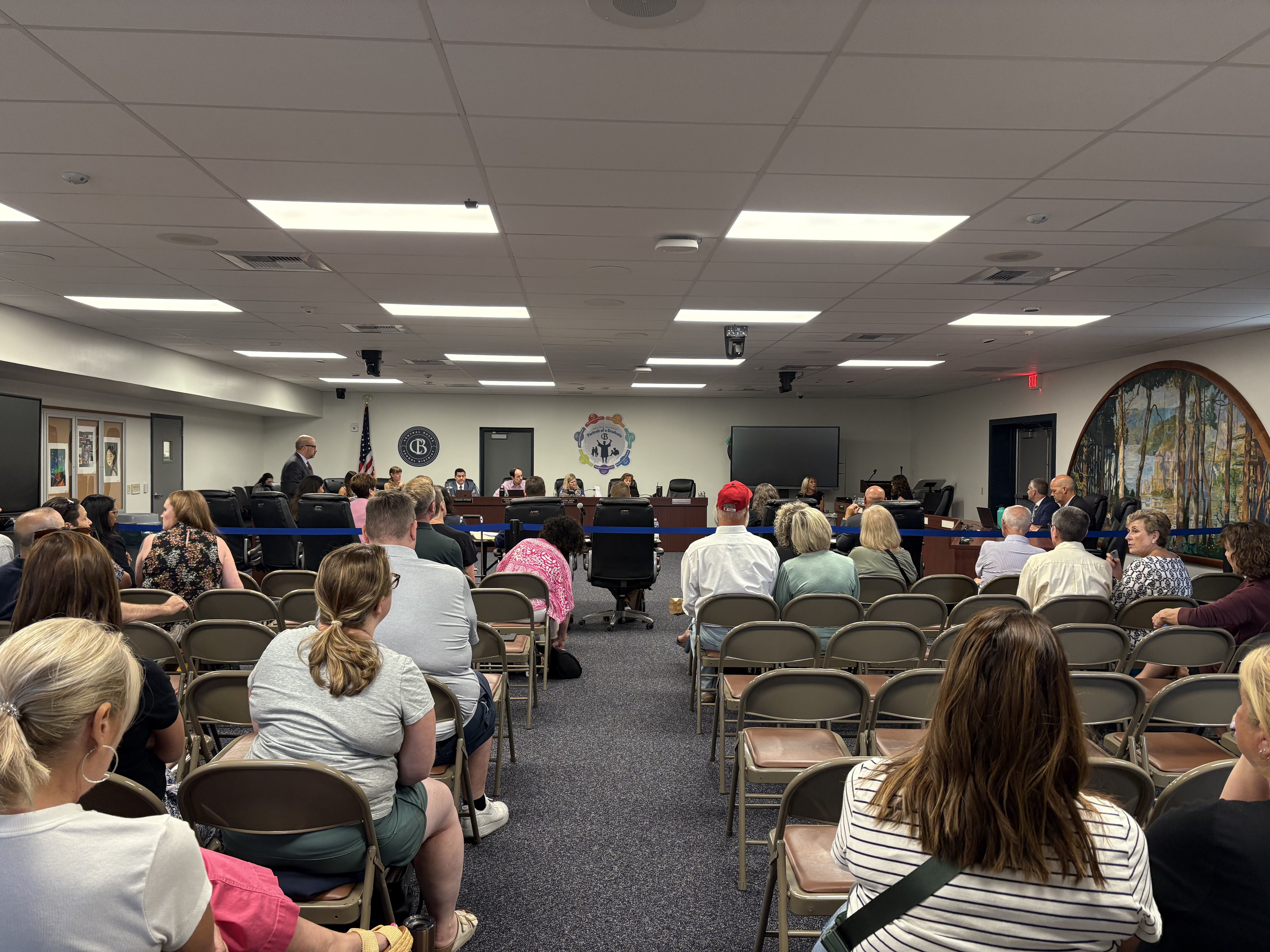
    Members of the public watch the joint termination hearing of Central Bucks Superintendent Steven Yanni and Jamison Elementary School Principal David Heineman in August 2025.Fallon Roth / Staff

    School board members initially stood by district officials, who noted police had not found any abuse. But that changed in April 2025, when a report from the watchdog group Disability Rights Pennsylvania found that the teacher and assistant had illegally restrained students, creating a “reasonable likelihood of bodily injury” and likely interfering with their breathing, among other abusive behaviors.

    It also faulted Yanni and other administrators for failing to adequately investigate the allegations, and accused Yanni of withholding information from police.

    The school board terminated Yanni and Heineman in October. Pepper recused himself from the vote and the termination hearings that preceded it.

    Yanni, now the CEO of Northwood Charter School in Philadelphia, did not respond to a request for comment.

    A lawyer for Heineman did not return a request for comment. Neither did a lawyer for McDaniel and Aussprung, who have sued the district since their terminations. Wright, whose lawyer did not return a request for comment, has also sued the district, saying she was scapegoated.

    The Peppers’ lawsuit says district and teachers union officials, whom Kline also informed, failed to report the abuse.

    Cara Alderfer, the union president, declined to comment Tuesday.

    The ‘cover-up’

    The Peppers’ lawsuit alleges a sprawling cover-up that started the moment Kline made the allegations.

    The accused teacher and assistant were not removed from the classroom, and the district recommended that McDaniel or Aussprung take the Peppers’ child to therapy sessions after Kline was reassigned, according to the complaint.

    The district did not turn over an email outlining Kline’s allegations to Disability Rights Pennsylvania, the suit says.

    Yanni and other officials “were actively engaged in a conspiracy to bury the reports of child abuse they had received,” the complaint says.

    The complaint blames a few factors as motivating the alleged “cover-up.”

    Yanni, who took over the deeply divided district after a bitter and highly publicized school board election won by Democrats, said one of his goals was to keep the school system “out of the newspaper,” the suit says.

    And the district was motivated to retaliate against Pepper — then the only Republican on the board — for stances he had previously taken against the district, the suit says.

    The actions of the school district and its employees deprived the Peppers’ son of “safety, liberty, and bodily integrity,” the complaint says.

    “It is devastating to learn that our son was treated this way by the very people we trusted to care for and protect him,” the Pepper family said in a statement. “Our son and entire family have been changed forever. This can never happen again to another child.”

  • Lindsay Clancy’s lawyer now questions whether there is proof she killed her 3 children

    Lindsay Clancy’s lawyer now questions whether there is proof she killed her 3 children

    PLYMOUTH, Mass. — Lindsay Clancy’s lawyer argued Tuesday that there wasn’t enough evidence to prove she killed her three children, a striking turn after a lengthy trial that focused more on her mental state than on whether she took their lives.

    “This entire case is based on speculation,” attorney Kevin Reddington said during the first hearing since Clancy’s trial ended Sept. 4 with a deadlocked jury. They were split 11 to 1 in her favor.

    During that trial, Reddington didn’t dispute that Clancy killed the children at the family’s home in 2023. Instead, the defense sought to persuade the jury that the 36-year-old former labor and delivery nurse was not criminally responsible because of mental disease, a rare condition called postpartum psychosis.

    Clancy’s lawyer now says there is not enough evidence to prove she did it

    But at Tuesday’s hearing, Reddington changed strategies and sought to persuade Judge William Sullivan — the same judge who presided over the first trial — to acquit Clancy.

    There is, Reddington contended, not enough evidence “that this woman killed those children.” He pointed to matters ranging from her condition when she was found badly injured and bleeding in the yard outside her home, to her lack of memory of what happened when she woke up in a hospital. At the first trial, her now ex-husband and first responders testified that they arrived at the house and discovered she had tried to take her own life right after killing the children.

    “Where is the admission? Where does she say that she did this?” Reddington said, going on to recap his arguments that she also was psychotic and delusional at the time of the children’s deaths. He didn’t offer alternative theories or evidence about who might be responsible.

    Prosecutor Shanan Buckingham called his argument “laughable,” pointing to witness testimony that Clancy said she heard voices instructing her to kill her children. Clancy was the only one home at the time with the children and her DNA was found on exercise bands used to strangle them, she added.

    “For the first time, the defendant is arguing that there is no evidence she did this,” Buckingham said. “I’d suggest to you the entire record is voluminous as to information supporting the fact that she did this.”

    During trial Paul Zeizel, a clinical and forensic psychologist and defense witness, testified that he overheard her saying a disembodied male voice told her she had no choice but to kill the children and then herself.

    Before trial Reddington filed a motion in which he said Clancy would be willing to stipulate in writing “to her involvement in the underlying conduct resulting in the death of the three young children.”

    The judge didn’t immediately rule on the motion, and no trial date was set.

    The prosecution maintains that Clancy knew her actions were wrong when she used exercise bands to strangle 5-year-old Cora, 3-year-old Dawson, and 8-month-old Callan Clancy. They said she contrived to get her husband out of the house that evening by sending him to pick up medicine for one of their children and dinner for the family.

    It’s still unknown whether Clancy will face a second trial

    Prosecutors have yet to decide whether to retry Clancy, Plymouth County District Attorney Timothy Cruz said after the hearing. They could choose to retry her on first-degree murder charges or pursue lesser charges, including second-degree murder or manslaughter, or drop the case entirely.

    “We are going to do what we can for the children,” Cruz told reporters outside court. “That is what this case is about.”

    Sullivan said he wanted to set a new trial date, but both sides pushed back — arguing that the judge should rule on several motions in front of him first.

    Initially the defense urged the court to set a new trial date soon. But on Tuesday, Reddington told Sullivan he couldn’t see having a new trial before June due to his schedule.

    Legal wrangling over the holdout juror is also unresolved

    Clancy’s attorneys have asked the judge to dismiss the criminal case, a motion that will be heard Nov. 2.

    Among other things they have argued that the judge should have ousted the one juror who favored a murder conviction after the jury foreperson complained he was refusing to listen to the law on reasonable doubt.

    The juror, Michael Desronvil, has said through his lawyer that he had no doubts about his stance. Desronvil told Fox News’ Hannity in a brief video statement Monday that “the whole focus has been on me, but we want to reel everything back and put the focus on the three angels,” meaning the children.

    Among other motions that was pushed back was a Commonwealth request for a gag order that would bar attorneys and their supporters “from making extrajudicial statements to the media that would have a substantial likelihood of materially prejudicing the criminal proceeding.”

    Reddington has given a series of interviews since the mistrial and held walking news conferences almost every day during the proceedings. Prosecutors, in contrast, never talked to reporters.

    The case is still capturing attention

    The livestreamed trial generated intense public interest and drew attention to maternal mental health after childbirth. About a dozen Clancy supporters, most dressed in pink, stood outside court Tuesday waiting for her.

    Clancy remains charged with murder and is expected to stay at a psychiatric hospital until her case is resolved.

    She could have been sentenced to life in prison if convicted of murder. If acquitted, the judge could have ordered her confined to a mental health facility.

  • Seven new fishing piers are opening at Newton Lake Park in Camden County

    Seven new fishing piers are opening at Newton Lake Park in Camden County

    Surrounded by government officials with fishing rods, Nancy MacGregor proved herself to be the master angler of the afternoon at the 103-acre Newton Lake Park on Tuesday.

    MacGregor, president of the Oaklyn Borough Council, pulled in a four-inch fish and, with a shocked look, asked what to do next. Camden County Commissioner Director Louis Cappelli Jr., who spent time as a kid fishing in the park that runs through Oaklyn, Collingswood, and Haddon Township, removed the tiny catch from the hook and tossed it back into the lake.

    Cappelli, MacGregor, and others were there to officially open seven new fishing piers at the park that replaced deteriorated ones from the 1930s, a $1.3 million project developed using open space funds.

    “These piers are safer, stronger, and fully ADA compliant, making sure residents of all abilities can enjoy fishing, spend time along the water, or simply enjoy everything Newton Lake has to offer,” Cappelli said at the opening.

    Newton Lake has several varieties of fish, including large-mouth bass and catfish. They are strictly catch-and-release and not safe to eat, according to the county.

    Olivia Liu of the nonprofit Upstream Alliance said the piers mean more than just catching fish. Looking on is, from left, Collingswood Mayor Daniela Solano-Ward, Camden County Commissioner Edward T. McDonnell, and County Commissioner Director Louis Cappelli Jr.Neill Borowski for The Inquirer

    Improved paths near the piers will be the next phase of the project, said Jeremy Noll, whose company, Environmental Resolutions Inc. of Mount Laurel, oversaw the project. Some will be raised so they are not covered in mud during heavy rain, which is an issue with the current ones, he said.

    The piers are also 6 to 8 inches higher than the old ones, so they will be accessible when Newton Lake rises.

    Noll said he expects the piers to last 50 years, but the decking may need to be replaced after 20 years.

    Local leaders at the opening said they are excited for the public to visit the piers, which are free to use.

    “This project here today isn’t just about catching fish. It’s about improving people’s quality of life and creating fun, engaging, and meaningful outdoor experiences right in their own backyard,” Olivia Liu, program and communications director for the nonprofit Upstream Alliance, told the group. “It’s about having the opportunity to love and appreciate the community that you live in.”

  • Pa. Supreme Court to decide whether ban on mandatory life terms for second-degree murder is retroactive

    Pa. Supreme Court to decide whether ban on mandatory life terms for second-degree murder is retroactive

    The Pennsylvania Supreme Court agreed Tuesday to decide whether its March ruling striking down automatic sentences of life without parole for second-degree murder applies to the people already serving them.

    The high court will rule in the case of Jerome Coffey, a Philadelphia man convicted in a 1992 killing in which prosecutors said a group of men posing as law enforcement officers boxed in a man’s car and shot him.

    The court’s decision will reach well beyond Coffey. It will settle whether roughly 1,100 people — including more than 500 convicted in Philadelphia — can ask judges for new sentences, or will remain bound by a punishment the state’s highest court has ruled unconstitutional.

    In a unanimous decision in March, the justices said Pennsylvania’s mandatory life sentence for second-degree murder violates the state constitution’s ban on cruel punishments.

    Second-degree murder covers killings committed during another felony — even when the defendant did not kill anyone. The high court held that judges must weigh a person’s individual role before imposing a punishment that lasts a lifetime.

    But the high court did not say whether its ruling applied to people who had already been sentenced. Instead, it put the decision on hold for 120 days so the General Assembly could write a new sentencing law and, if lawmakers chose, decide the question of retroactivity themselves.

    The legislature did neither, as measures introduced in both the Republican-controlled Senate and Democratic-controlled House failed to advance.

    Tuesday’s order in Coffey’s case comes weeks after four other people serving life sentences asked the court to take up the same question.

    Coffey was convicted in 1994 in the death of Johnny Moss two years earlier. According to court records, three men got out of two cars that had pinned Moss’ vehicle near 24th and Thompson Streets in North Philadelphia. One man shouted “task force” and pulled Moss from his car.

    Moss was shot in the head. His brother, who was standing beside the car, was shot in the arm.

    At trial, prosecutors said Coffey was the man who shouted “task force,” while Coffey’s mother and sister testified that he was at home that night. The jury convicted him of second-degree murder, conspiracy, and related crimes. It acquitted his codefendant, Lee Smith, of all charges.

    No physical evidence tied Coffey to the killing, his lawyers have said, and a key prosecution witness recanted before trial. The lawyers also said prosecutors withheld evidence that could have helped Coffey, but the state Superior Court rejected those contentions.

    And on Tuesday, the state Supreme Court declined to review them, limiting the scope of his appeal to the sentencing question alone.

    Even so, Bret Grote, the legal director of the Abolitionist Law Center, which represents Coffey, praised the court’s decision to hear the case.

    “This is what those who have been serving this sentence have been waiting for,” said Grote, who also represented Derek Lee, the Pittsburgh man whose appeal of his life sentence for his second-degree murder conviction led to the court’s decision in March.

    Grote said Coffey, who founded the grassroots Human Rights Coalition from prison, will be “well able to demonstrate” why the decision “should apply to people like him who need to be home with us out here in our communities.”

    Because Coffey’s case began in Philadelphia, the district attorney’s office will argue for the state in his appeal. In an interview Tuesday, District Attorney Larry Krasner reiterated his support for retroactivity, saying, “We cannot have a legal system where people sit in jail for the rest of their lives for an unconstitutional sentence.”

    He added that “this office, consistent with its obligation to seek justice and uphold the Constitution, will support retroactivity” in Coffey’s case.

    Prosecutors elsewhere have signaled resistance, however. In August, the Pennsylvania District Attorneys Association’s communications chair, Berks County District Attorney John Adams, said prosecutors would not concede that the high court’s ruling applies retroactively without a new sentencing law.

    Coffey’s case is unlikely to be resolved quickly. And in the meantime, lawmakers could still act.

    Some stakeholders have predicted that legislative agreement on how to handle such cases is more likely after the Nov. 3 elections. A law that applies to people already serving the sentence could make the court’s answer moot.

    But the outcome was always likely to land back with the high court without action by lawmakers, said Ben Lerner, a former Philadelphia Common Pleas Court judge and former chief defender.

    “I’m not surprised,” Lerner said Tuesday. The high court, he said, was going to give the legislature “the first crack” at reforming the system. But if it failed, “the court was always going to have to step in and do what needs to be done.”

    “It’s too important an issue,” he added. “Too basic a right.”

  • Here’s what a 34% hike in health costs could mean for Camden and hundreds of other N.J. school districts in 2027

    Here’s what a 34% hike in health costs could mean for Camden and hundreds of other N.J. school districts in 2027

    Health insurance premiums will cost 34.4% more for 300,000 public school and county college employees and their families across New Jersey next year as medical costs continue to escalate and the popularity of costly prescription drugs soars.

    The change will affect teachers and other school staff in Camden, Pemberton, Evesham, and nine other South Jersey districts, as well as six unions at four local colleges.

    What is to come for students, employees, and taxpayers may be just as dire. Cutting jobs, reducing transportation and student extracurricular activities, and raising property taxes are the most likely options school districts and colleges will consider, said Jonathan Pushman, advocacy director for the New Jersey School Boards Association.

    “The dilemma is there are limited options we can turn to,” Pushman said. “A lot of difficult decisions are ahead.”

    On Friday, the New Jersey School Employees Health Benefits Commission voted 4-2 to accept the premium increases forecast by the state’s actuary. Democratic Gov. Mikie Sherrill’s administration had warned that if the commission did not act, it would have closed down the insolvent program at the start of the new year.

    Instead, the rate hikes will take effect in January.

    The School Employees’ Health Benefits Program serves 212 school districts and county colleges, representing 300,000 employees, retirees, and their dependents.

    The local districts covered by the plan are Camden, Brooklawn, Beverly, Delanco, Evesham, New Hanover, Pemberton, Willingboro, Elk, Newfield, Camden County Technical Schools, and the Burlington County Board of Special Services, which serves special-needs students.

    It also provides coverage for employees of Camden County College, Rowan College at Burlington County, Rowan College at Gloucester County, and Rowan College of South Jersey, according to the New Jersey Treasury Department.

    There are a total of 590 school districts in New Jersey, with the majority of them, including Cherry Hill, obtaining health coverage outside the state plan. In recent years, steeper costs have compelled many districts to leave in search of a more affordable option. Those who stay tend to serve an older and sicker — and therefore a more expensive — population and cannot afford a better deal on the open market.

    These conditions have created a “death spiral” for the plan, actuarial and state officials say. The State Health Benefits Plan for state and local workers faces a similar crisis.

    As it is, the health benefits program owes the state $70 million to cover midyear shortfalls, according to Aon, the state’s healthcare actuary.

    The union-affiliated members on the commission voted against the premium hikes, insisting there had to be a way to cut costs.

    After the vote, New Jersey Education Association president Steve Beatty and other top officials said in a statement that their members on the commission “requested information, proposed specific steps to reduce the rates and sought greater transparency about the factors driving these increases. Unfortunately, the division has refused to meaningfully engage in that effort.”

    The rate hikes “threaten the resources available for students,” the union officials’ statement said. “They should not lose out because health care costs are out of control. When districts are forced to spend significantly more on health care, that leaves less money for the programs, staff and services our students rely on every day.”

    School officials huddled this week to consider the array of unpalatable options. Few were ready to say what comes next.

    Rowan College of South Jersey “will continue to evaluate the situation and make adjustments as necessary while keeping student success our priority,” said Susan Nardelli, vice president of communications, marketing, and enrollment management. “Every industry is facing the same healthcare struggle.”

    Union leaders said they are counting on state lawmakers to find a solution. They said they seek action on a proposed bill that would create a new health benefits trust, composed of union and management leaders, and establish a three-doctor medical advisory panel. Districts that join would not be permitted to leave, according to the bill.

    The new insurance trust would “provide greater transparency and accountability and is focused on controlling costs,” the union’s statement said.

    School boards agree that dramatic changes are necessary, Pushman said. This must include “honest conversations with unions,” he said.

    Schools — which are funded by taxpayers — bear 98% of the cost of health insurance compared with the 2% covered by employees, Pushman said. In the private sector, employers pay about 90% of the cost.

    A law enacted during the pandemic set specific limits on what school employees must pay for healthcare, based on their income level. That law, which expires at the end of next year, has limited the options for savings, Pushman said.

    “As much as we want to provide quality healthcare coverage, bearing the costs of these incredibly rich plans is getting to the point of unsustainability,” he said.

    State Sen. Troy Singleton (D., Burlington) agreed.

    “We have to be honest with … what the state can afford to provide sufficient coverage for employees. It’s not a bottomless pit for taxpayers,” Singleton said. “It’s become a frustrating point for all parties.”

  • Saxophonist Immanuel Wilkins, an Upper Darby native, gets a MacArthur ‘genius grant’

    Saxophonist Immanuel Wilkins, an Upper Darby native, gets a MacArthur ‘genius grant’

    Upper Darby native and saxophonist Immanuel Wilkins is among the MacArthur Foundation’s 20 “genius grant” recipients for 2026, the foundation announced Tuesday.

    In more official terms, that makes Wilkins, 29, a MacArthur Fellow — the youngest member of his class. All fellows will receive $800,000 in unrestricted funding over the next five years, with the awards giving financial flexibility to recipients for their artistic and scholarly visions.

    Wilkins, in an interview Tuesday with the Associated Press, said he received word that he had been named a MacArthur Fellow while traveling from New York to Philadelphia.

    “I was just outside,” he said. “Which was nice because then I could yell as loud as I wanted to and celebrate.”

    In a video introducing the 2026 fellows, Wilkins described himself as a saxophonist and composer who anchors “original compositions in history and spirituality.” He added that as a performer, he was “looking to escape the gaze that might be on me and direct my creative energy inwards and upwards.”

    Widely considered a leading contemporary jazz musician, Wilkins was joined by jazz great Odean Pope for “RECESS,” an immersive musical experience staged at the Power Market, a former Peco electrical station in North Philadelphia. Pope, 87, and Wilkins met when Wilkins was a young student at the Clef Club of Jazz and Performing Arts, and Pope took him on as a mentee, The Inquirer reported.

    Presented by Ars Nova Workshop, “RECESS” featured the musicians playing on a stage modeled into a combination playground and bandstand, which Wilkins earlier told The Inquirer was a way to inspire “radical play.”

    “I started thinking about the landscape of Philadelphia as functioning as a kind of abstracted play space,” Wilkins said in a May interview.

    Wilkins’ debut album, Omega, was released in 2020, and connects the 1918 lynching of a pregnant Black woman, Mary Turner, to the 2014 fatal police shooting of a Black teenager, Michael Brown. The abstraction of music, Wilkins told the AP, allows him to represent these stories without “recreating the violence of them.”

    “Although it is some of the most painful material, the music itself feels so good,” Wilkins said in the MacArthur Foundation clip.

    Most recently, Wilkins released Immanuel Wilkins Quartet: Live at the Village Vanguard Vol. 1, a three-volume recording of performances at the iconic New York City jazz club.

    In addition to Wilkins, two other MacArthur Fellows this year have ties to the Philadelphia area. Both are Princeton University professors.

    Ellora Derenoncourt, an associate professor in the university’s economics department, told the AP that she would use the award to translate issues of economic justice for the broader public and interested policymakers. And Elizabeth Ellis, an associate history professor, hopes to support research projects focusing Native American history, the university said.

    This article contains information from the Associated Press.