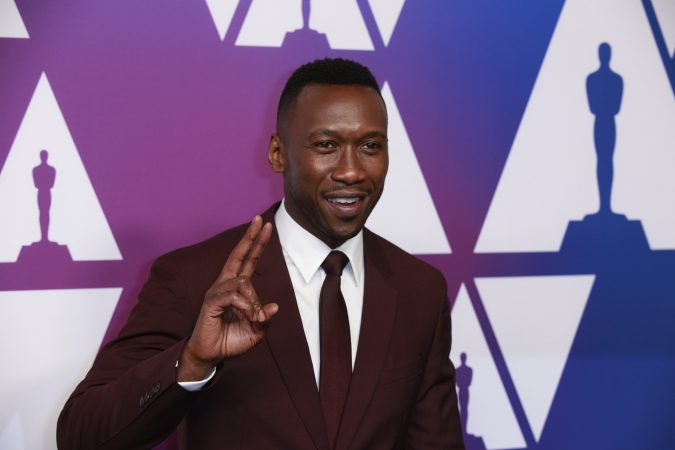
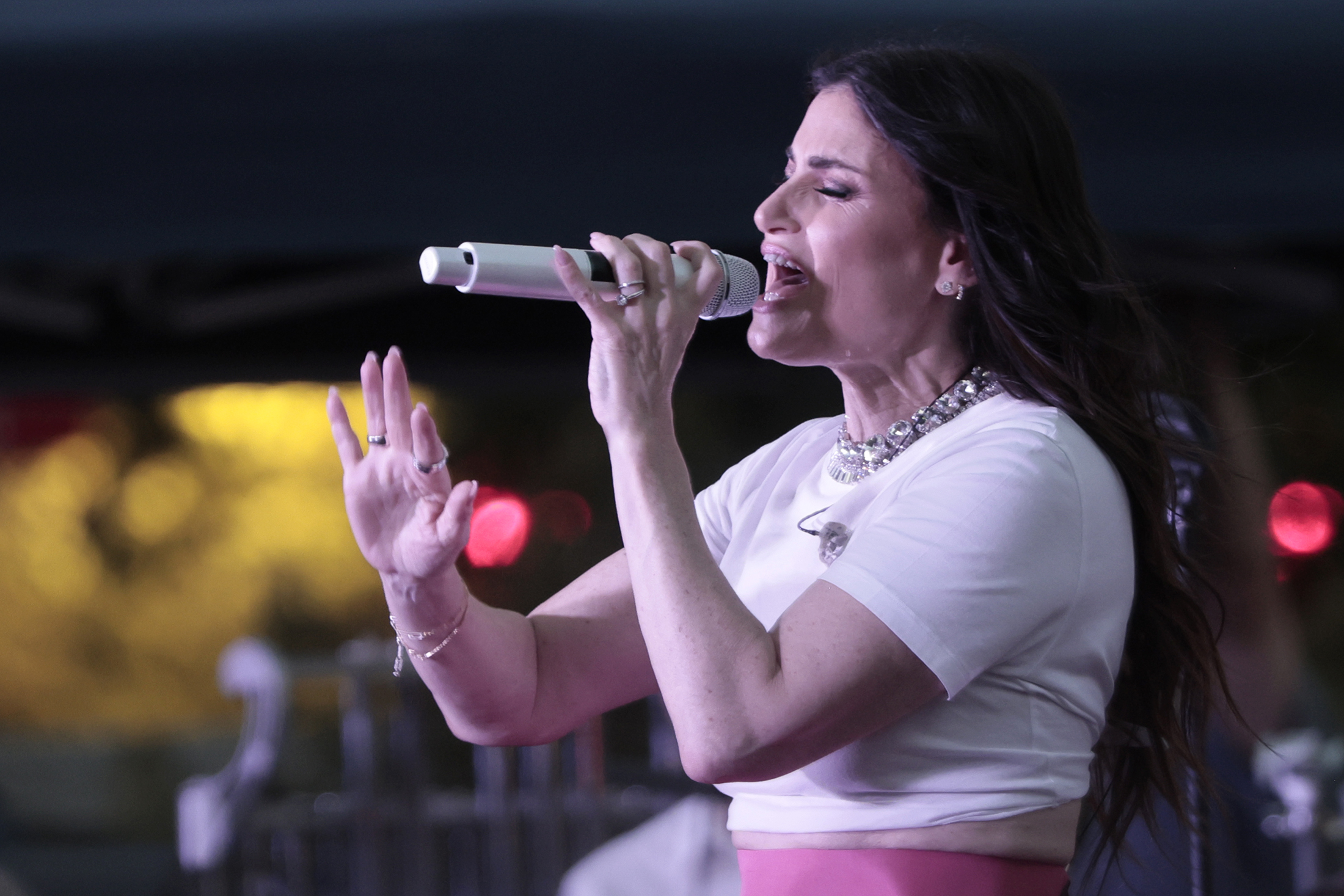
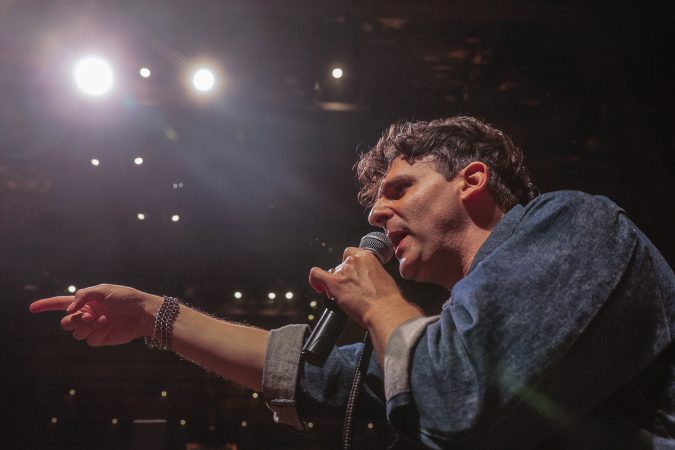
Mahershala Ali is staying warmed up amid filming for Season 2 of the HBO series Task.
The Oscar-winning actor was spotted on Grape Street in Manayunk, jumping rope between scenes. Wearing a gray polo shirt, blue jeans, and a Phillies hat, Ali seemed to be getting in quick exercise while the Task crew set up equipment behind him, according to a video posted to the Roxborough Rants & Raves Facebook group on Tuesday.
The video was posted by Facebook user Trevor D’Arcy, a Doylestown native, per the social media profile.
The second season of the Mark Ruffalo-led, Delco-set series has been filming in the area since Monday. Ruffalo will be reprising his role as FBI agent Tom Brandis while Ali will be playing a longtime Philadelphia DEA agent named Eddie Barnes. Barnes will reportedly rival Ruffalo’s efforts in his new task force.
The first season was filmed in the Greater Philadelphia region, with the production team having deep Philly roots. Executive producer Jeremiah Zagar is a South Philly native, and is the son of the late Philadelphia mosaicist Isaiah Zagar.
Ali grew up in Oakland, Calif., but his wife, Amatus-Sami Karim, spent part of her childhood in Philadelphia. Ali, raised Christian, converted to Islam after attending a prayer at a Philadelphia mosque with Karim and her mother, according to People.
“I converted Dec. 31, 1999. It was a Friday. That was my second time going to the mosque,” Ali said to Kansas City NPR affiliate KCUR in 2017. “I went to a mosque in Philadelphia with her … and I just had such a strong reaction to the prayer.”
In 2017, Ali became the first Muslim actor to win the Academy Award for best supporting actor, for his role in Moonlight. He won the same award two years later for Green Book.
Task is Ali’s second HBO venture after the third season of True Detective, where he played Arkansas State Police Detective, Wayne Hays. He was most recently seen in Jurassic World: Rebirth.
No premiere date for Season 2 of Task has been announced.
This article has been updated to include Mahershala Ali’s wife, Amatus-Sami Karim, and details about her connection to Philadelphia.
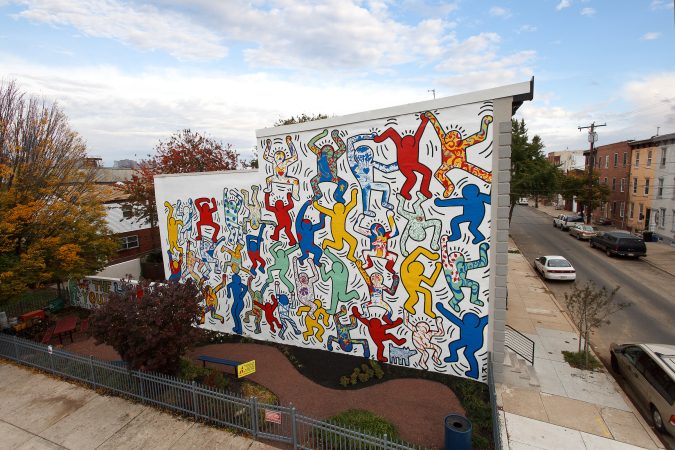
Keith Haring’s We the Youth is already a Philadelphia landmark, but what if the city made that designation official?
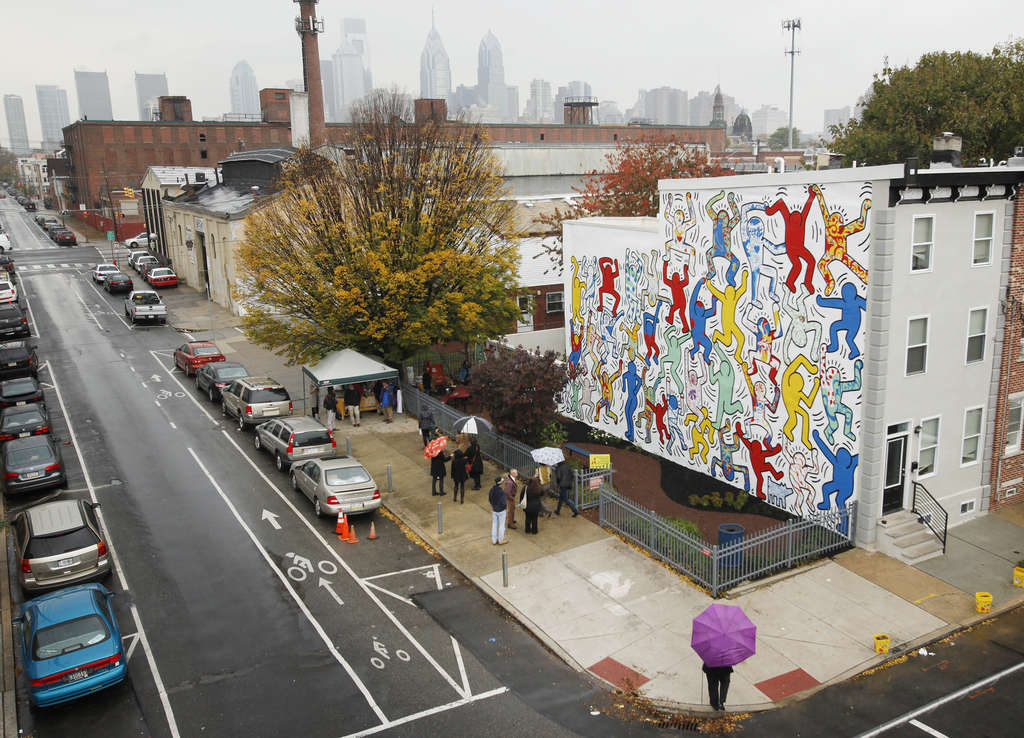
The Point Breeze mural, the only collaborative Haring mural that still hangs in its original location, is being proposed to be added to Philadelphia’s Register of Historic Places, which would make it an officially designated and protected landmark.
Haring was born in Reading, raised in Kutztown, and died in New York City in 1990, at age 31, from AIDS-related complications.
“Keith Haring was an extremely important artist who tragically died fairly young,” Alexander Till, a historic preservation planner at the City of Philadelphia, said to WHYY in a statement. “This nomination gives us an opportunity to preserve this piece of his work and his legacy in Philadelphia.”
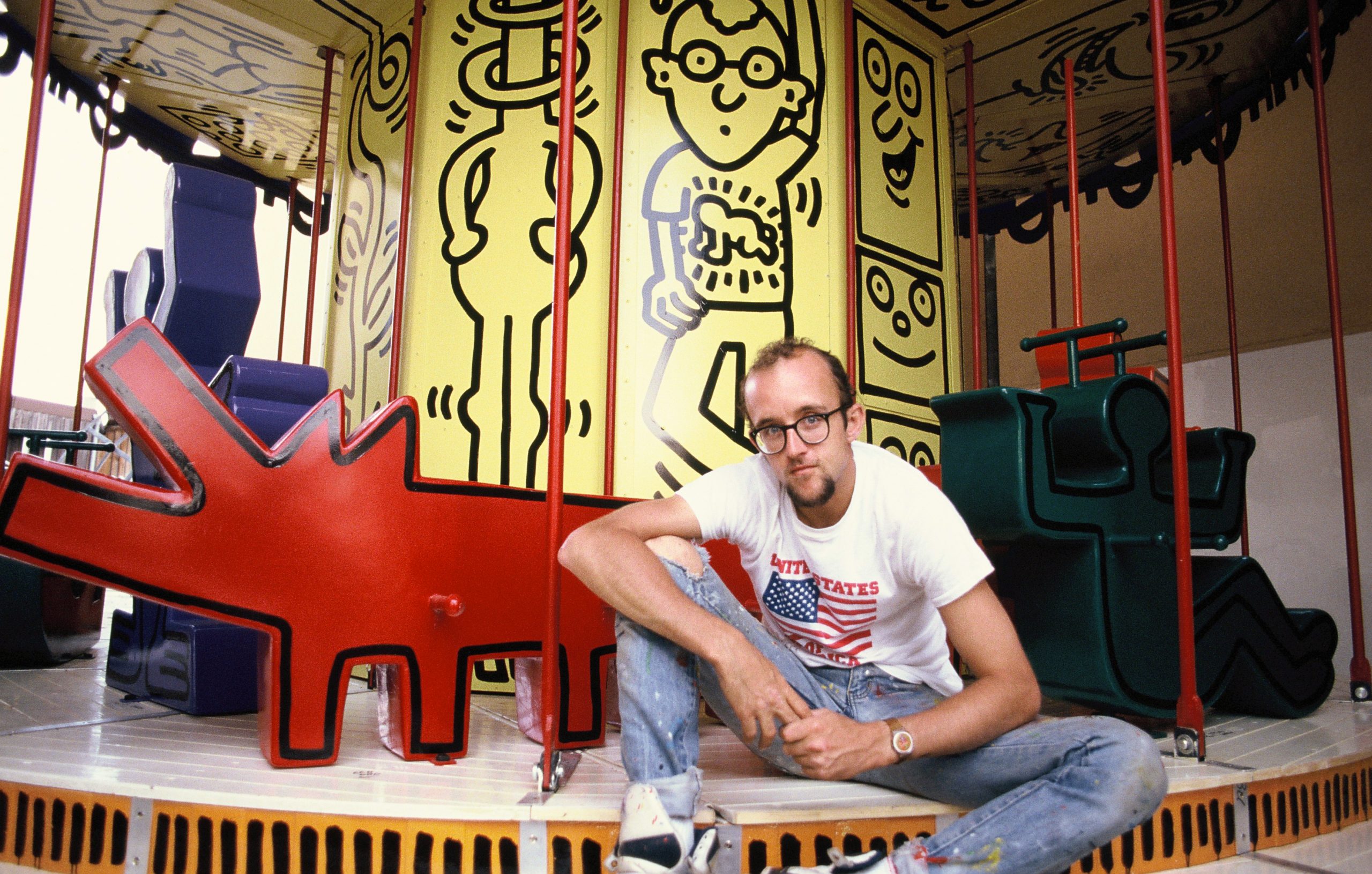
Keith Haring, who died in 1990, with his painted carousel. MUST CREDIT: Sabina Sarnitz/Luna Luna/Keith Haring Foundation/Artestar
We the Youth, according to Till, who made the nomination, fits Criteria A and E for designation, stating that it “has significant character, interest or value as part of the development, heritage or cultural characteristics of the city … or is associated with the life of a person significant in the past.” Plus, it “is the work of a designer … whose work has significantly influenced the historical, architectural, economic, social, or cultural development of the city.”
The South Philly mural has stood at the corner of 22nd and Ellsworth Streets for nearly four decades. It was painted in 1987 to commemorate the U.S. bicentennial, and intentionally placed in a less-mainstream neighborhood.
Defined by its colorful dancing characters, We the Youth was painted in collaboration with a group of Philadelphia students, through a partnership with the nonprofits CityKids NYC and Brandywine Workshop.
“Philly is very proud to have a Keith Haring mural and especially one embedded in the community that was done in such a collaborative manner,” Jane Golden, founder and executive director of Mural Arts Philadelphia, said last month. “We get nothing but positive response and excitement when people learn there is a Haring mural in our city.”
In 2013, Golden and her Mural Arts team undertook a massive restoration of the Haring mural.
“As the local caretaker of the Haring mural, we are committed to helping ensure this mural stays at its original location for generations to come,” she said.
“We the Youth” is a Keith Haring mural painted in 1987 on the exterior of a rowhouse at 22nd and Ellsworth Streets. Photo from 2018.Michael S. Wirtz / Staff Photographer
Murals, especially outdoor ones, are notoriously difficult to get put on the city’s Historic Places Register. They can only be nominated as an “object,” defined under city preservation laws as “a material thing of functional, aesthetic, cultural, historic, or scientific value that may be, by nature or design, movable but yet related to a specific setting or environment.”
Out of 21 objects designated since 1971, only four were murals or mural collections: TheDream Garden inside the Curtis Center, the New Deal-era murals inside the Family Court building, Angelic Exaltation of St. Joseph into Heaven inside Old City’s Old St. Joseph’s Church, and Iron Plantation Near Southwark inside the Southwark Station Post Office in South Philly.
If approved, We the Youth would be the first designated mural in over four years, and the first outdoor one in the city’s history.
Some preservationists have reservations with such a designation.
“The nomination raises broader policy questions about how to evaluate murals under the city’s historic preservation rules,” Paul Steinke, executive director of the Preservation Alliance of Greater Philadelphia, said in a statement. “Murals are often created as public art on blank walls. Getting designated can have lasting effects on property, new construction, and neighborhood revitalization.”
The owner of a historic property in Philadelphia is obligated to keep the property in good repair and obtain approval from the Historical Commission before making any changes to the site, according to the city’s website.
The mural stands at 2147 Ellsworth St., on the facade of a three-bedroom rowhouse that is available for rent, per an OCF Realty listing. A potential historic designation will not affect the larger property and will be restricted to the mural and the wall it is painted on.
The building’s owner, listed as “2147 Ellsworth LLC” in city records, will be required to maintain the structural integrity of the wall and commit to set obligations, with Mural Arts making any necessary restorations to the mural itself.
The owner would not be allowed to remove or alter the appearance of the mural without the Historic Commission’s review, “just as the owners of historic properties are not allowed to perform exterior alterations to their properties without review,” a representative from the commission said.
OCF Realty did not immediately respond to further queries around the building’s ownership.
“We believe it is essential for the Historical Commission to consider both the importance of this specific work and the precedent it may set for future mural nominations,” Steinke said.
The Philadelphia Historical Commission’s Committee on Historic Designation will discuss Till’s proposal at its July 22 meeting. The nomination would have to be approved by the entire commission for We the Youth to be added to the register.
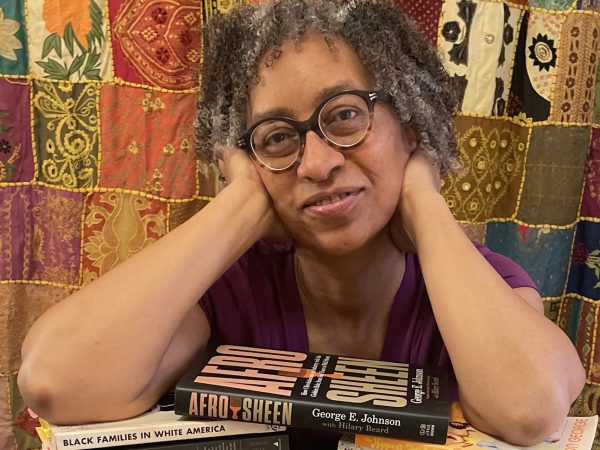
Like many Black children growing up in the ‘70s and ‘80s, Mount Airy author Hilary Beard had fond memories of Afros and Soul Train dancers.
“I was a little Black girl with braids who sat between my mother’s knees every day as she combed my hair and oiled my scalp with Ultra Sheen,” Beard recalled in a recent video chat. “When I was in the seventh grade and cut my hair into an Afro, I used Afro Sheen. I grew up watching Soul Train. I lived in a world created by this man.”
It wasn’t until 40 years later that she realized these hallmarks of Black culture had a common author, George E. Johnson, the father of modern Black hair care.
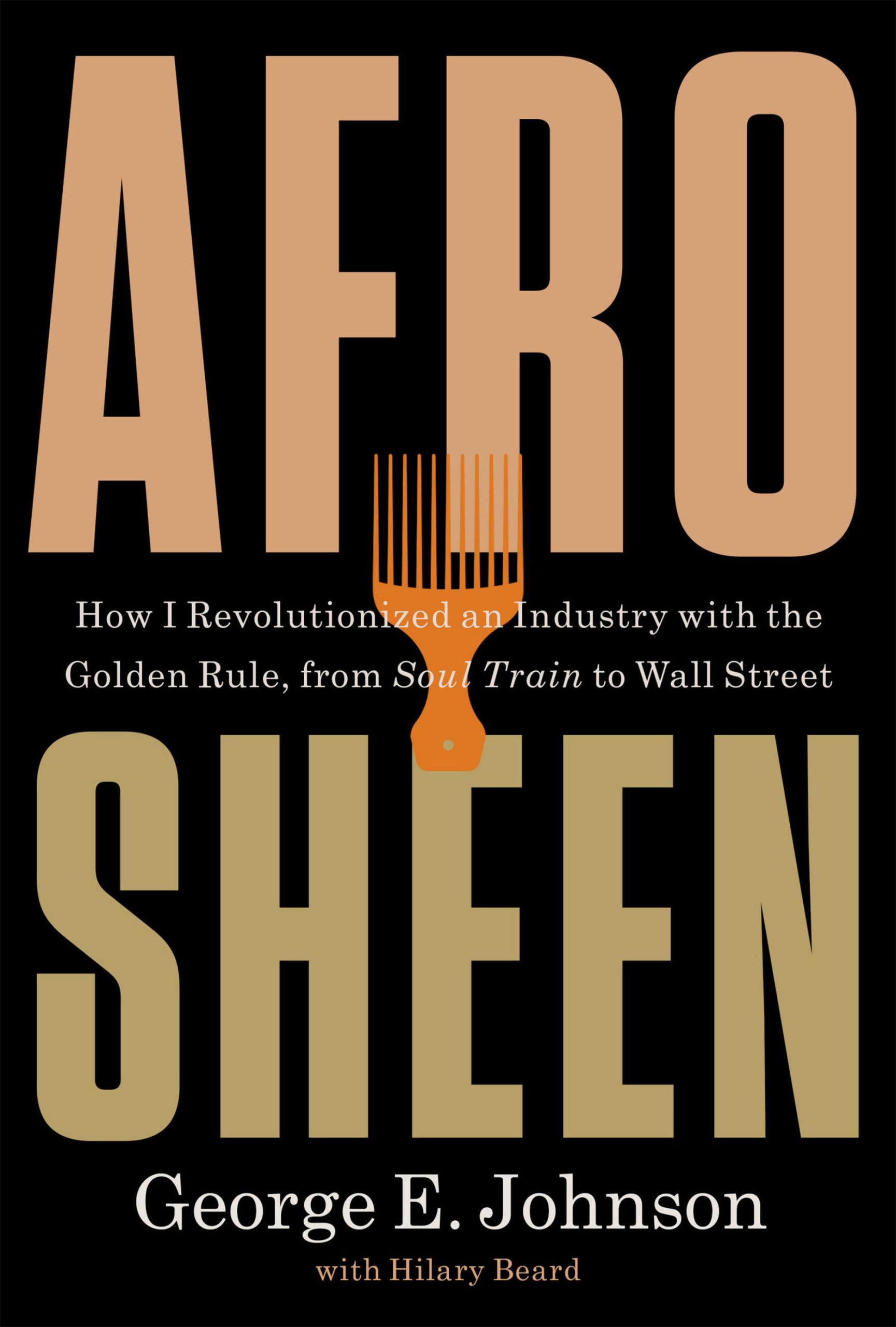
Three years ago, Beard teamed up with a then 94-year-old Johnson to cowrite his memoir. She combined her warm memories of plaits, kinky blowouts, Black power picks, and the Soul Train Line with more than 2,000 pages of interviews to write Afro Sheen: How I Revolutionized an Industry with the Golden Rule, from Soul Train to Wall Street,a 320-page story of entrepreneurship, civil rights, and Black culture, spanning nearly a century.
“Mr. Johnson’s story sweeps through the Cotton South, the Great Migration, the Jim Crow North, the Jim Crow South, World War II, and the civil rights of the 1950s and 1960s,” Beard said. “And it’s told through the perspective of an African American man. We know many of these stories have not been told, they have also been actively suppressed.”
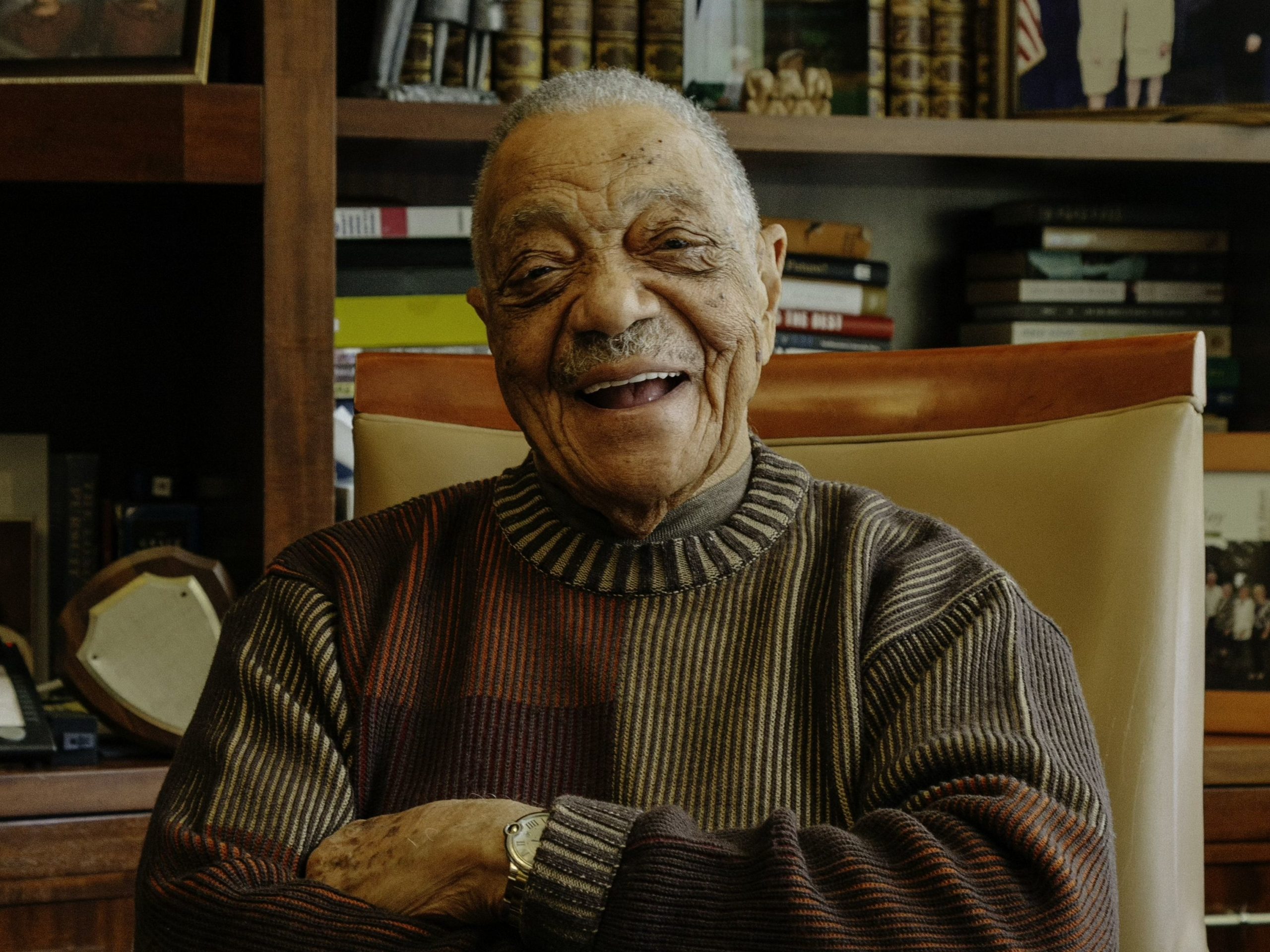
George Johnson, founder of Afro Sheen, in his Chicago study. Johnson is the founder of the first Black company to go public. He also funded the early episodes of Soul Train, for which the Sound of Philadelphia, Gamble & Huff, wrote the soundtrack.George Johnson
Johnson’s story begins in 1927 Richton, Miss., on a small sharecropping farm. His mother, Priscilla, left his father in 1929, and moved Johnson and his two brothers to Chicago’s South Side. In his early 20s, he worked as a production chemist at the Black-owned cosmetics company Fuller Products, owned by S.B. Fuller, the richest Black man in America at the time.
In the early to mid-20th century, many Black people’s grooming habits included straightening their hair to assimilate, often affording them better jobs in mainstream America. The hair straightening concoctions — a mix of potatoes, lye, and eggs — separated, were messy to apply, and burned.
While working at Fuller Products, Johnson developed Ultra Wave Hair Culture, a creamy emulsified product barbers applied to clients’ hair, giving them the slicked back look popularized in the 1940s by Little Richard, Nat King Cole, and Sammy Davis Jr.
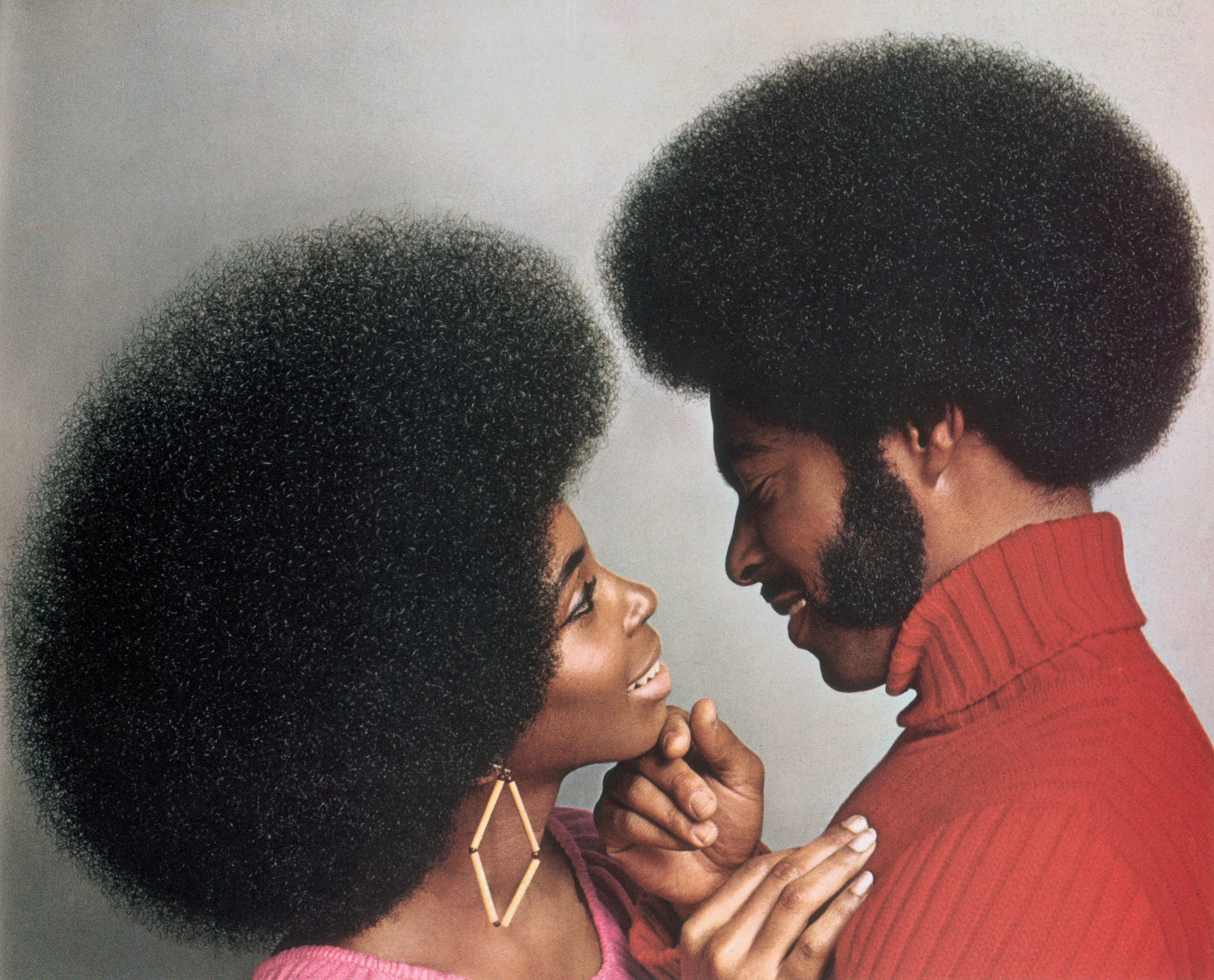
Ultra Wave Hair Culture marked Johnson Products Co.’s debut. In the next decade, JPC introduced Ultra Sheen Cream Satin Press, which hairdressers applied to Black women’s hair before pressing it straight with a hot comb; and Ultra Sheen Relaxer, a lye-based hair straightener for Black women. The “Black is Beautiful” movement birthed Afro Sheen, a spray that left Afros voluminous and glossy.
“A Natural Explosion! Afro Sheen® Blowout Creme Relaxer 1973/2007” from the series “Unbranded: Reflections in Black by Corporate America” by Hank Willis Thomas. MUST CREDIT: Rubell Museum
“The thing that moved my products forward was innovation,” said Johnson, who, at 97, still sounds like a salesman talking to potential customers. “We created something like a new mousetrap, it had never been done before.”
In 1971 — with sales of $12.1 million, or $94 million in today’s dollars — JPC became the first Black-owned company to be publicly traded on the American Stock Exchange, now known as the New York Stock Exchange. Although at the time it was a major achievement, Johnson said that with hindsight, he realized it was a big misstep as he was forced to answer to a board that didn’t understand the Black community.
Creating his lane
Johnson — not to be confused with John H. Johnson, founder of Ebony and Jet magazines — built his empire when banks did not loan money to Black startups, and groceries and drugstores did not stock Black hair care products, let alone place them on endcaps. Johnson remembers struggling to build his business when there were no federal laws to protect him from discrimination. He built his own manufacturing facility and created networks to distribute and advertise his products, and was among the first to sell Black hair care products in mainstream retail outlets.
To see companies like Target and Walmart — which up until recently had a stellar reputation of stocking Black hair care by Black-owned companies — cower under the Trump administration and roll back DEI initiatives is not only disheartening, but it also signals going back to a time when disenfranchisement of minority- and women-owned businesses was standard operating procedure. This reality, Beard says, makes Johnson’s story particularly timely, serving as a road map with young entrepreneurs of color.
“There is a widespread movement to make programs, books, and context that remind us of the bigotry in our nation’s history illegal,” Beard said. “Mr. Johnson is a witness to the overt racism many Americans would like to sweep under the rug. The irony is the very history they don’t want us to know is the reality they are attempting to create.”
JPC was among the first companies to advertise products to Black consumers using images of Black professionals — like doctors, lawyers, and teachers — instead of subservient characters like Aunt Jemima and Uncle Ben.
Johnson created Soul Train with Don Cornelius in 1971 so his advertising dollars could reach Black consumers directly. Soul Train — the hippest trip in America — was modeled after Dick Clark’s American Bandstand, and featured R&B acts, creating the community that bought Afro and Ultra Sheen products. In 1974, Kenny Gamble and Leon Huff wrote Soul Train’s iconic theme song, “T.S.O.P. — The Sound of Philadelphia,” performed by Philadelphia International Records’ The Three Degrees. Soul Train laid the cultural groundwork for MTV and Black Entertainment Television, and “T.S.O.P.” was the first TV theme song to reach No. 1 on the Billboard Hot 100. JPC’s profits nearly tripled to $37 million a year by 1975.
“That was tremendous growth,” Johnson said. “And in 1980, I gave Don my share with the stipulation he keep one minute of advertising time a show to JPC.”
Living history
Johnson never planned to write a book.
“I certainly wouldn’t have waited until I was 94 to do this,” he said. “But I had an epiphany, a real experience and I clearly heard five words, ‘You must tell your story.‘”
Afro Sheen: How I Revolutionized an Industry with the Golden Rule, from Soul Train to Wall Street by George E. Johnson, written with Mount Airy-based author, Hilary Beard.
Beard read 16 books about Black hair care culture and Chicago history. The two-year-long writing process became emotional, especially when Johnson recalled his infidelity and losing his first manufacturing facility to fire.
“When Mr. Johnson contacted me, I thought of the African proverb: when an elder dies, a library burns down,” Beard said. “So, I dropped everything to capture this piece of living history on the page.”
Whatever brutally hot designs the weather gods had in store Friday for Philadelphia’s Independence Day celebrations, by 8 p.m. the temperature fell below 90 degrees, and the music on Independence Mall arrived like a balm.
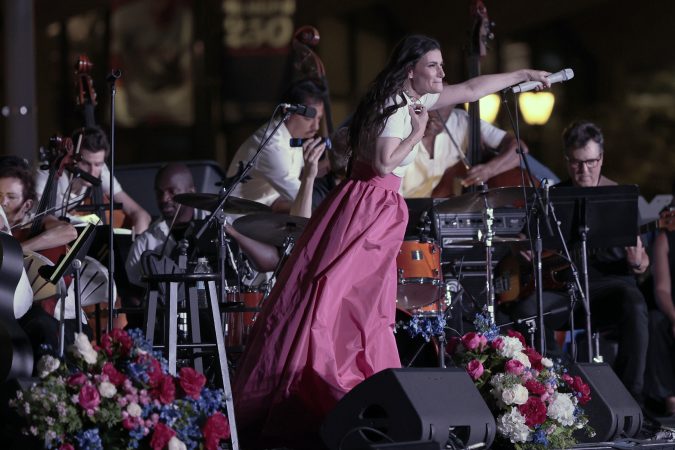
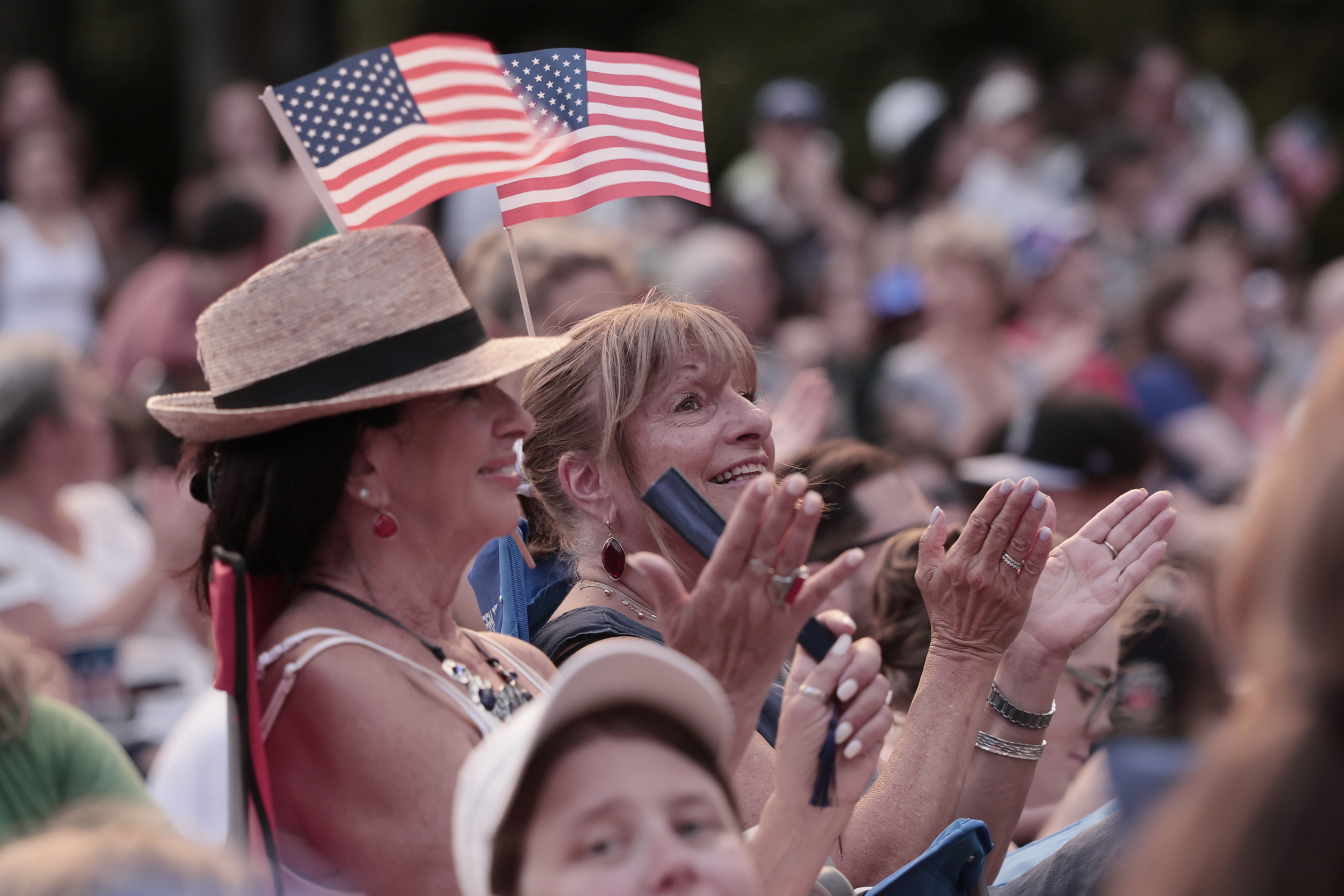
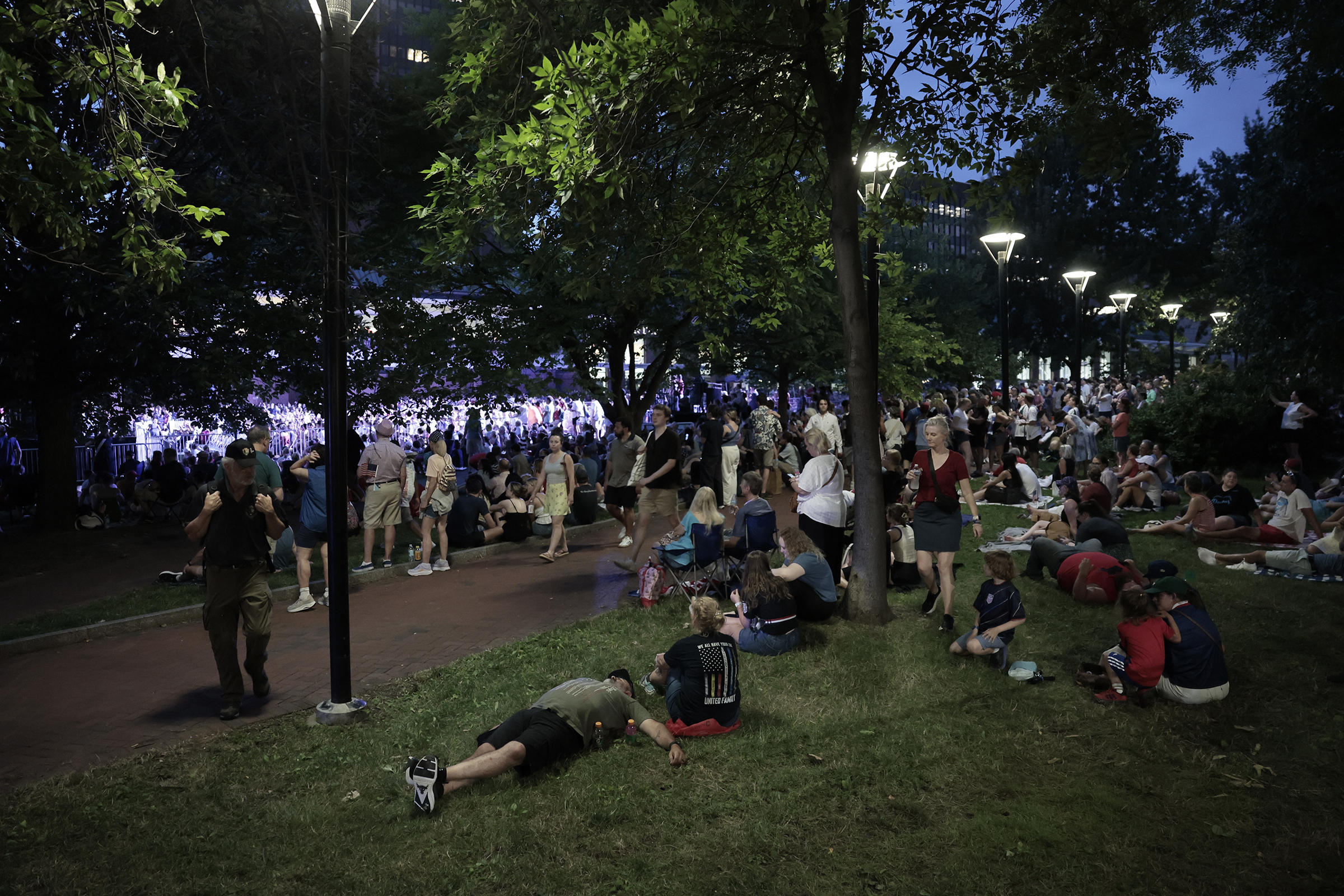
Listeners were stretched across the lawn of the mall fairly solidly from Independence Hall to Arch Street — an estimated 12,000 attendees, according to a Wawa Welcome America spokesperson. Whether drawn by the Philly Pops with tunes patriotic or stirring, or by popular actress-singer Idina Menzel, the crowd was in a mood at once celebratory and relaxed.
The weather posed no threat, at least for the first hour or so.
At Friday night’s Philly Pops concert on Independence Mall.Elizabeth Robertson / Staff Photographer
This annual tradition of “Pops on Independence,” a free Philly Pops concert on the mall, has become a way of taking the national temperature. Last year, a few months into the new presidential administration, there were subtle references to the political moment, with the acting superintendent of Independence National Historical Park speaking to the audience about equal rights of all kinds, including marriage rights, and referencing a nation “built on the struggle for freedom from tyranny, and the principle of liberty for all under the just rule of law.”
Friday night, park superintendent Steven Sims struck a more anodyne note, speaking of the historic setting, the city’s events this week commemorating the 250th anniversary of the nation, and of celebrating with “one of our most universal languages — music.”
The audience seemed only too happy to live inside of this bubble for a while, though to the woman holding up a “Striving for Democracy” sign, you were seen.
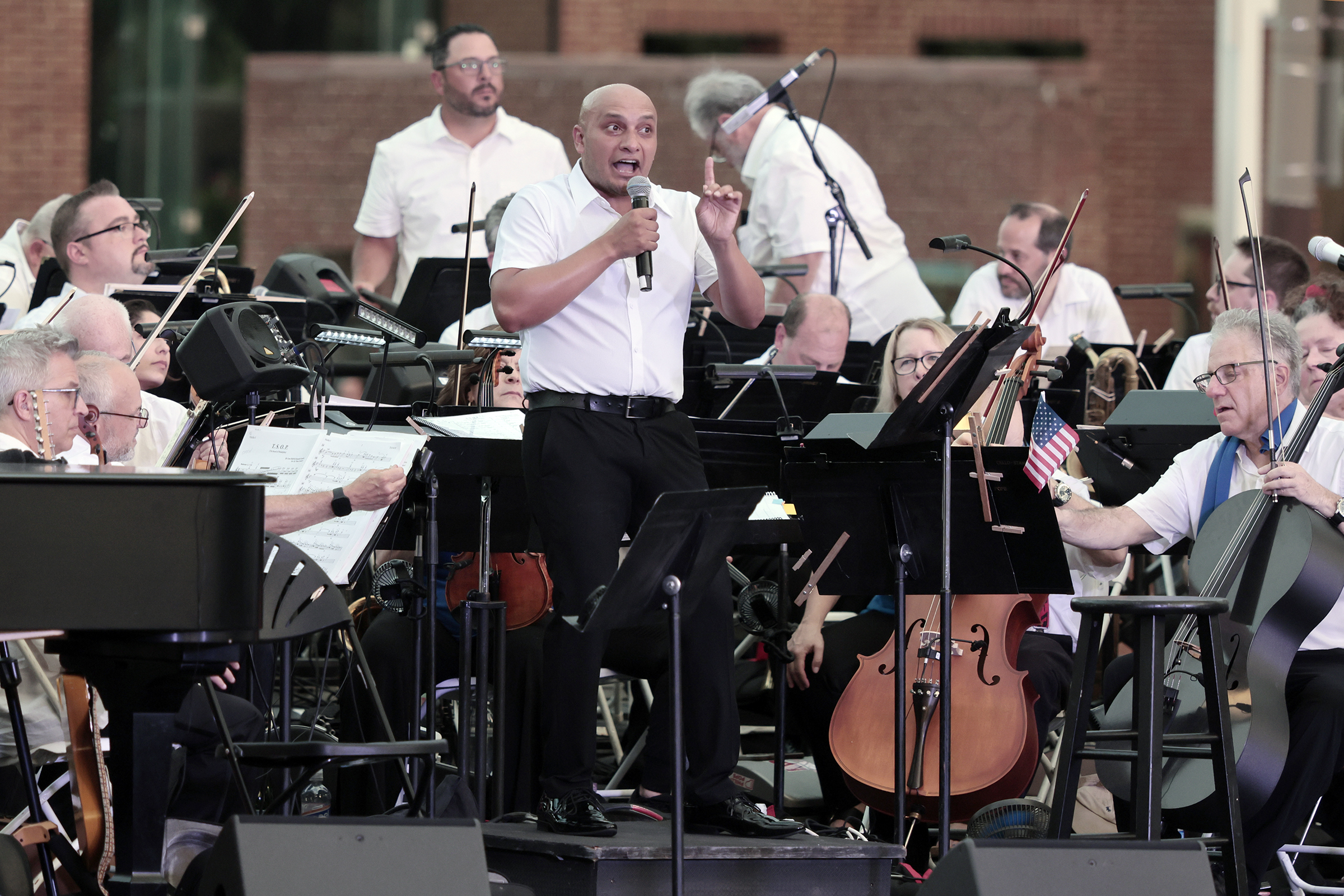
Philly Pops music director Chris Dragon speaking to the crowd during Friday’s “Pops on Independence” concert on Independence Mall.Elizabeth Robertson / Staff Photographer
No one should take for granted the fact that this concert endures. The group performing Friday under the Philly Pops name is a band of survivors, emerging after the demise of the original Philly Pops and much organizational and legal drama. Had the orchestra not reorganized, a 4 ½-decade tradition of hearing music with no less a backdrop than Independence Hall might be gone.
Listening and strolling on Independence Mall Friday night at the Philly Pops concert.Elizabeth Robertson / Staff Photographer
How many other cities can boast as powerful and authentic a resonance between art and setting? When the Pops performed its Armed Forces Salute — having audience members stand as the respective song of the military branch in which they served was played — it made real and human the idea of such service to the nation.
A section has been added to the medley to recognize the U.S. Space Force, established during the first Trump administration; I could be mistaken, but no service member from that branch who might have been in Friday’s audience appears to have stood for this song, called “Semper Supra.”
Idina Menzel performing with the Philly Pops Friday night.Elizabeth Robertson / Staff Photographer
Judging by the number of families with young children in attendance, the main attraction was Menzel, and if they came to hear “Let It Go” from Frozen, they were not disappointed. Menzel was a canny choice for this occasion; she is a singer who knows how to send sound and charisma back to the farthest reaches of the audience.
It was not necessarily the best night to appreciate the talents of the Pops and conductor Chris Dragon. The sound system near me, fairly far back from the stage, cut in and out. No sound check had been possible because of the heat, a Pops spokesperson said. And the concert ended earlier than planned after organizers grew concerned by gathering dark clouds and flashes of lightning. The last few pieces that might have showcased the ensemble weren’t played. A loss, for sure.
But the event succeeded on so many other levels, that it didn’t matter.
As the crowd headed off with the music fresh in their ears, downtown buildings were aglow red, white, and blue; young families lingered and took selfies; and Market Street on a Friday night seemed like the lively urban stretch it once was and could be again.
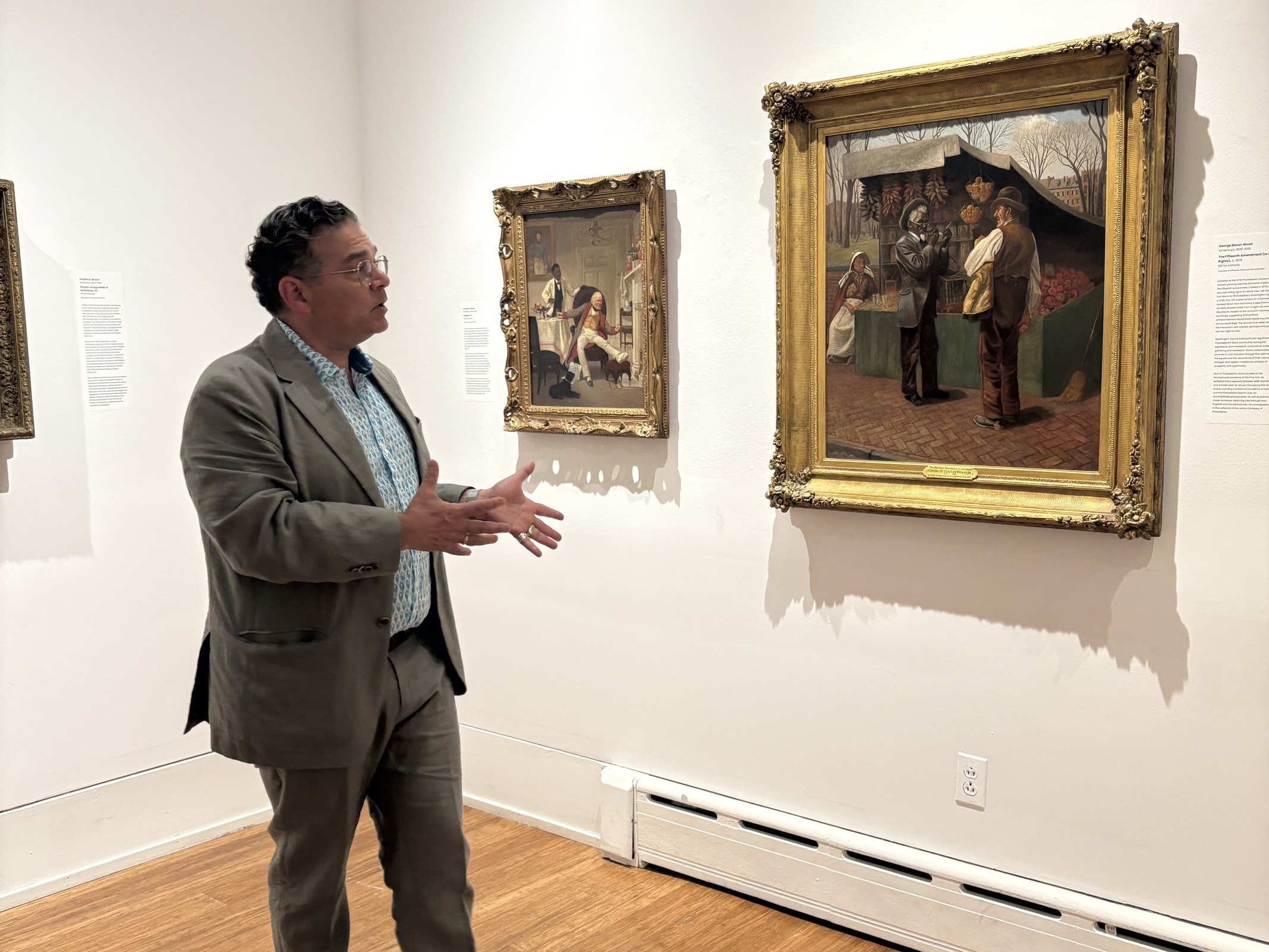
Last week, Woodmere director William R. Valerio stood in front of six vibrant works in Woodmere’s Charles Knox Smith Hall’s Antonelli Gallery.
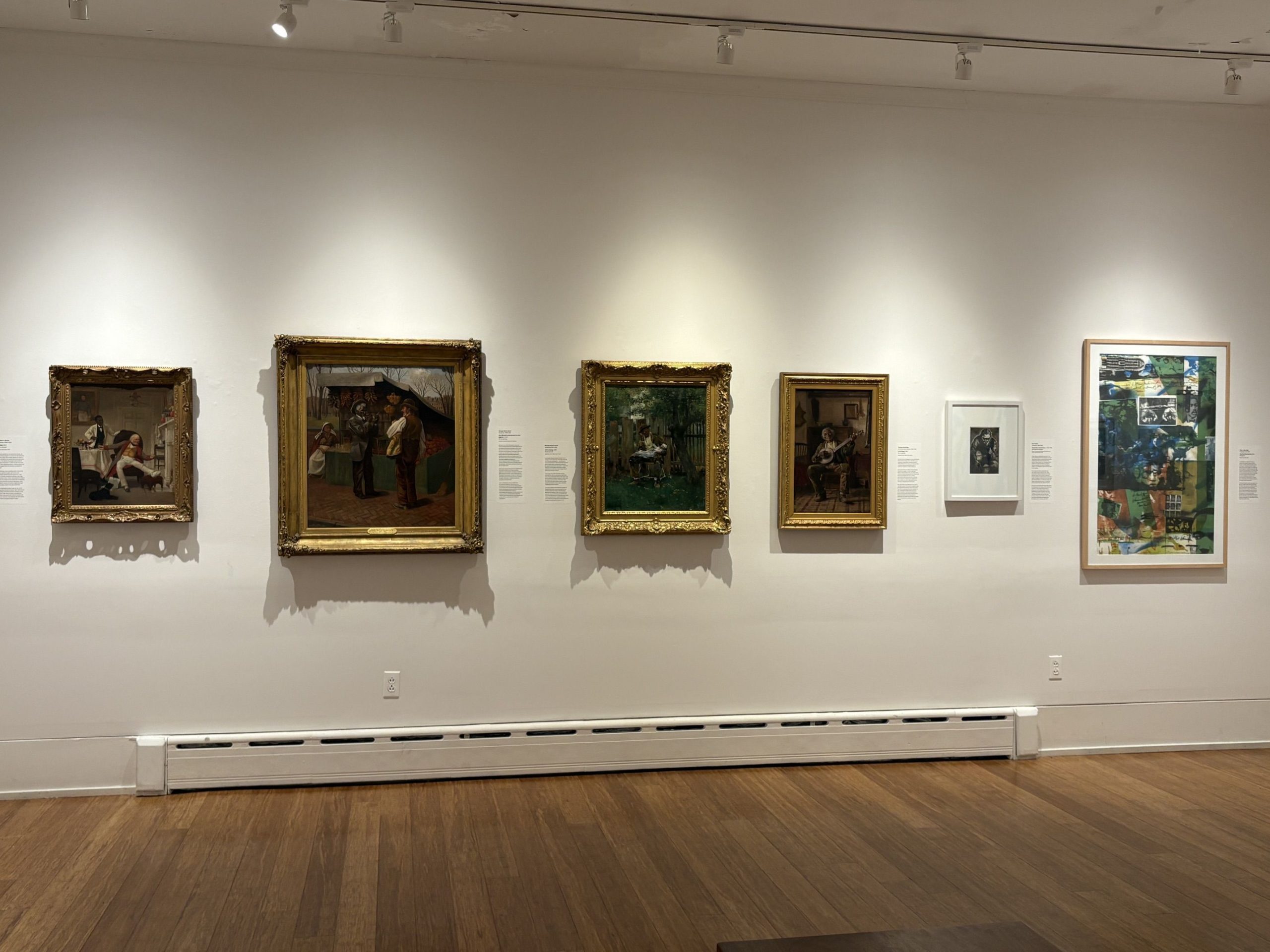
Behind him were two works by Philadelphia painters Francis Coates Jones and Thomas Hovenden, both depicting an elderly Black person named Sam, who lived in the Germantown/Chestnut Hill area, enjoying moments in nature. Another work, a Dox Thrash etching of a man holding a banjo, suggests he’s more than an entertainer; he’s also an introspective thinker.
Woodmere director William R. Valerio discusses the “Arc of Promise” exhibition, featuring the work of Philadelphia artists who portray Black people with humanity. A number of the works are from the Civil War era.Elizabeth Wellington
Contemporary artist Allan L. Edmond’s lithograph, America’s Bicentennial, features luminaries Frederick Douglass, Martin Luther King, and Barack Obama alongside scenes of African American struggle and achievement.
What if America in the 19th century — when many of these works were made — embraced Black men’s humanity? Valerio asked, sparking my own questions.
What if we came to terms with how unfair treatment of women, minorities, and immigrants in the past impacted our lives today?
Would America be a different place?
These questions find answers in every nook, cranny, and inch of Woodmere’s “Arc of Promise” exhibit. Each painting, ceramic, map, or mixed media collage speaks to how Philly artists — from the 17th century through today — envisioned the idea of America.
From left to right, “Untitled,” 1874; by Charles V. Brown; Francis Coates Jones; “The Fifteenth Amendment (or Civil Rights), George Bacon Wood, 1875; “Left in Charge,” 1882; Thomas Hovenden, “I’s So Happy,” 1882; Dox Thrash, “Played Out” c. 1937; “American Bicentennial,” Allan L. Edmunds. These photos show the humanity of Black men during an era when art didn’t portray them as such.Elizabeth Wellington
But there are also several important works on loan including protest photography by Harvey Finkle and a mixed-media necklace by Teri Hislop, a member of the Lenape Nation of Pennsylvania. Henry Bermudez’s Miss America, completed in 2019, offers a layered vision of America through migration, mythology, and identity. It sits next to sculptor Hiram Powers’ “America,” in which 19th-century America is depicted as a Greek goddess.
There is a lot of pomp, circumstance, and sparkle in this lively retrospective. The must-see gallery, however, is the Schnader Gallery Hall because it includes a pristine collection of refurbished American landscapes by local 19th-century artists Frederic Edwin Church and James Hamilton featuring many a Schuylkill waterfall. Think of this gallery as a place to retreat after a bustling Fourth of July weekend.
“Arc of Promise” takes its name from watercolor artist Jerry Pinkney, a longtime friend of the Woodmere who used the term as a way to speak to an America of unfolding potential, despite its past unequal treatment of Black people, immigrants, and women.
“Arc of Promise” runs through Nov. 2, 2026, Woodmere’s Smith Hall is located at 9201 Germantown Ave.
— Elizabeth Wellington
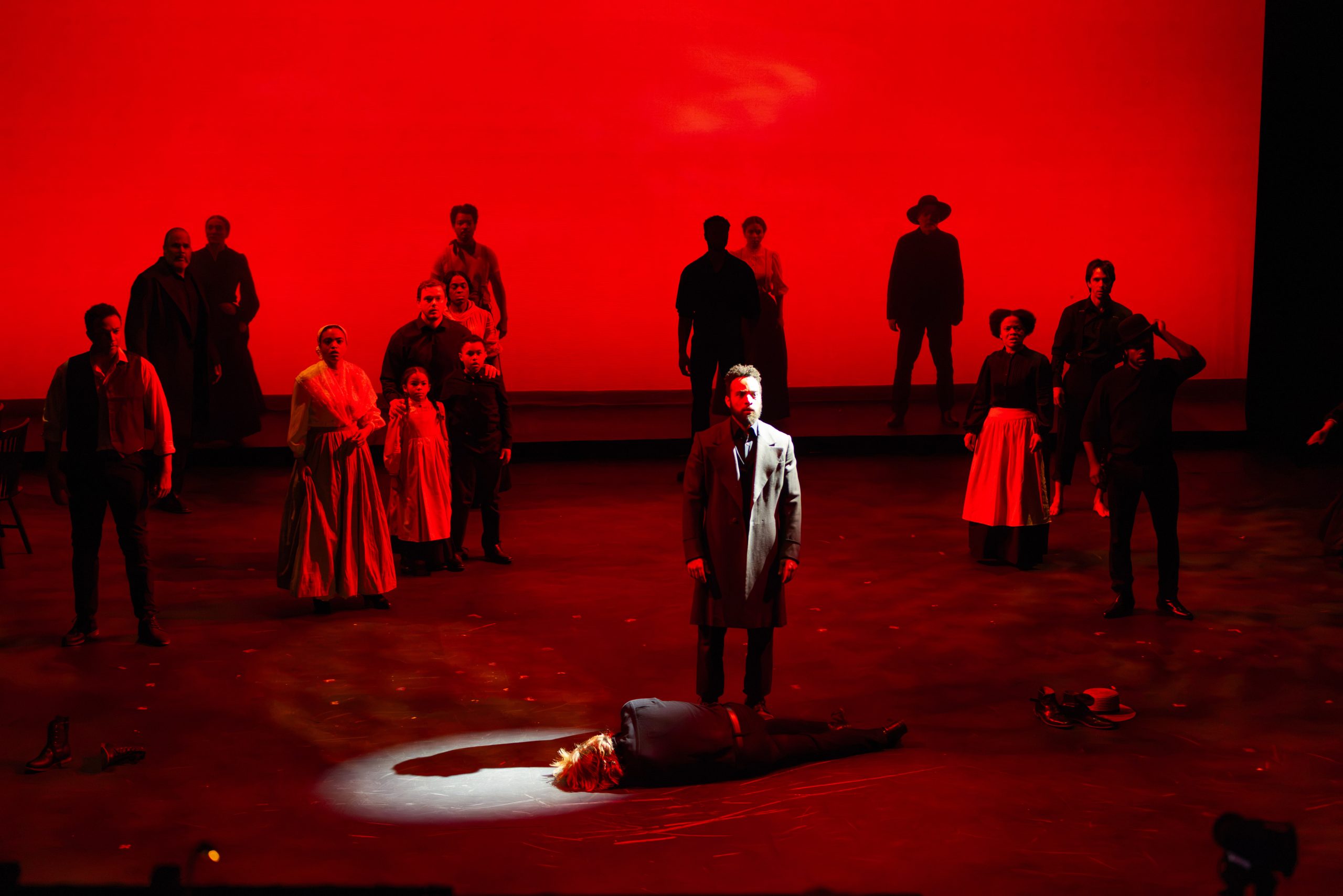
Actor John Clarence Stewart as the titular character in “Basil Biggs” at the Wilma Theater.REC Philly
Excavating history with ‘Basil Biggs’
There is something so powerful about seeing someone grapple with their personal experience of American history. As Semiquincentennial fanfare reached a fever pitch in Philadelphia, this workshop of a developing play by actor/playwright Anna Deavere Smith was a deeply moving performance about her great-great-grandfather, Basil Biggs, a conductor on the Underground Railroad. Smith learned of him in an episode of Finding Your Roots; even then, she knew his story was worthy of a play, though she didn’t start writing until a decade later.
Biggs was a veterinarian and farmer in Gettysburg during the Civil War, a free Black man who helped fugitives escape slavery and who buried the tens of thousands of soldiers who died in the war’s bloodiest battle. The Biggs family house still stands today, and Smith visited the grounds, as well as the Adams County Historical Society, while she researched the time period. There was little historical documentation about her family, so this work is narrative speculation, based on her research of the time period, much like groundbreaking scholar Saidiya Hartman’s critical fabulation: In the absence of records about African Americans, visionaries use archival materials to imagine the lives of those largely erased from written memory.
Smith crafted a riveting world that showcased fierce resilience, disarming humor, and profound empathy during a painfully divided time. The story is fueled by original music from actor/violinist Edward W. Hardy. It was an honor to experience one of the earliest presentations of this play, which will likely grow into a major production. It’s the kind of honest work about this nation’s bloody, conflicted history that feels like essential viewing for anyone who calls themself a patriot.
“Basil Biggs” ran June 26-28 at the Wilma Theater as part of ArtPhilly’s What Now: 2026 festival.
— Rosa Cartagena
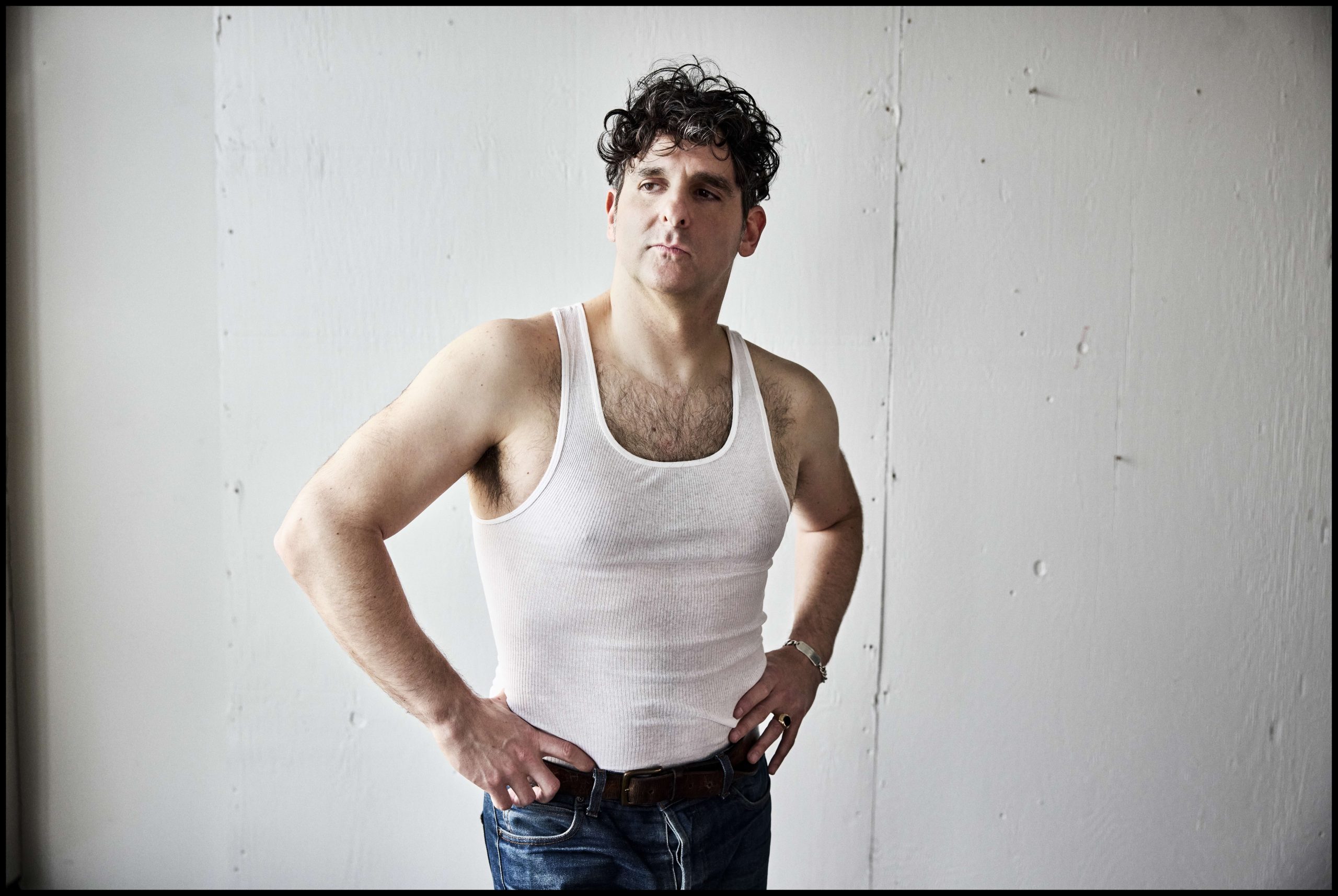
Adam Weiner of Low Cut Connie. The band’s new album is “Livin’ in the U.S.A.”Danny Clinch
Romping, stomping, piano-pounding resistance with Low Cut Connie
Adam Weiner of Low Cut Connie has stressed that the band’s eighth studio album, whose release is timed to America’s 250th birthday, is an act of resistance.
Shortly after becoming one of the first artists to cancel at the Kennedy Center after the Trump administration’s takeover of the D.C. institution in early 2025, Weiner recorded what became the title song.
As he explains in an explanatory note that accompanies the album, it addresses “the atrocity of ICE, authoritarianism, racism” and led to a full set of songs “about the times we are living through in America 2026.”
But while Weiner’s political stance is unequivocal — “I made this album to say f— you to this regime, to the brutality, and inhumanity of our tech leaders,” he writes — his music is much more subtle.
Many of the titles like “Oh Yeah” and “Get Down” on Livin in the USA are essentially party songs: romping, stomping, piano-pounding, and saxophone-wailing celebrations of diversity and sexuality that aren’t the slightest bit preachy or pedantic.
Singing a gospel of self-liberation, Weiner is accompanied by the touring LCC band, which includes singer Amanda “Rocky” Bullwinkel,” guitarist-sax player Kelsey Cork, and drummer Jarae Lewis. Occasionally, as in the grinding “Human Condition,” the songs are overt in their condemnation of life during Trump time, which he likens to “living in a house of detention.”
But in general, he heeds lessons learned from favorite albums like Bruce Springsteen’s Born in the USA and Sly and the Family Stone’s There’s a Riot Goin’ On. When delivering a heavy message, always keep the groove going and the rock rolling.
“Just because the world is collapsing,” Weiner writes in his Livin album note, “doesn’t mean we can’t go skinny dipping this weekend.” “Can’t Be Wrong” is perhaps the most grabby earworm in a tight, 10-song set whose energy never flags. In that song, the prospect of “gettin’ naked in the afternoon, or maybe later underneath the moon” leads to an obvious conclusion: “Oh babe, you know it can’t be wrong.”
“Livin in the USA” releases July 3
— Dan DeLuca
Remembering LGBTQ+ activists
Resting in peace can also mean resting in pride and power. A new Gayborhood mural provides a tribute that does exactly that.
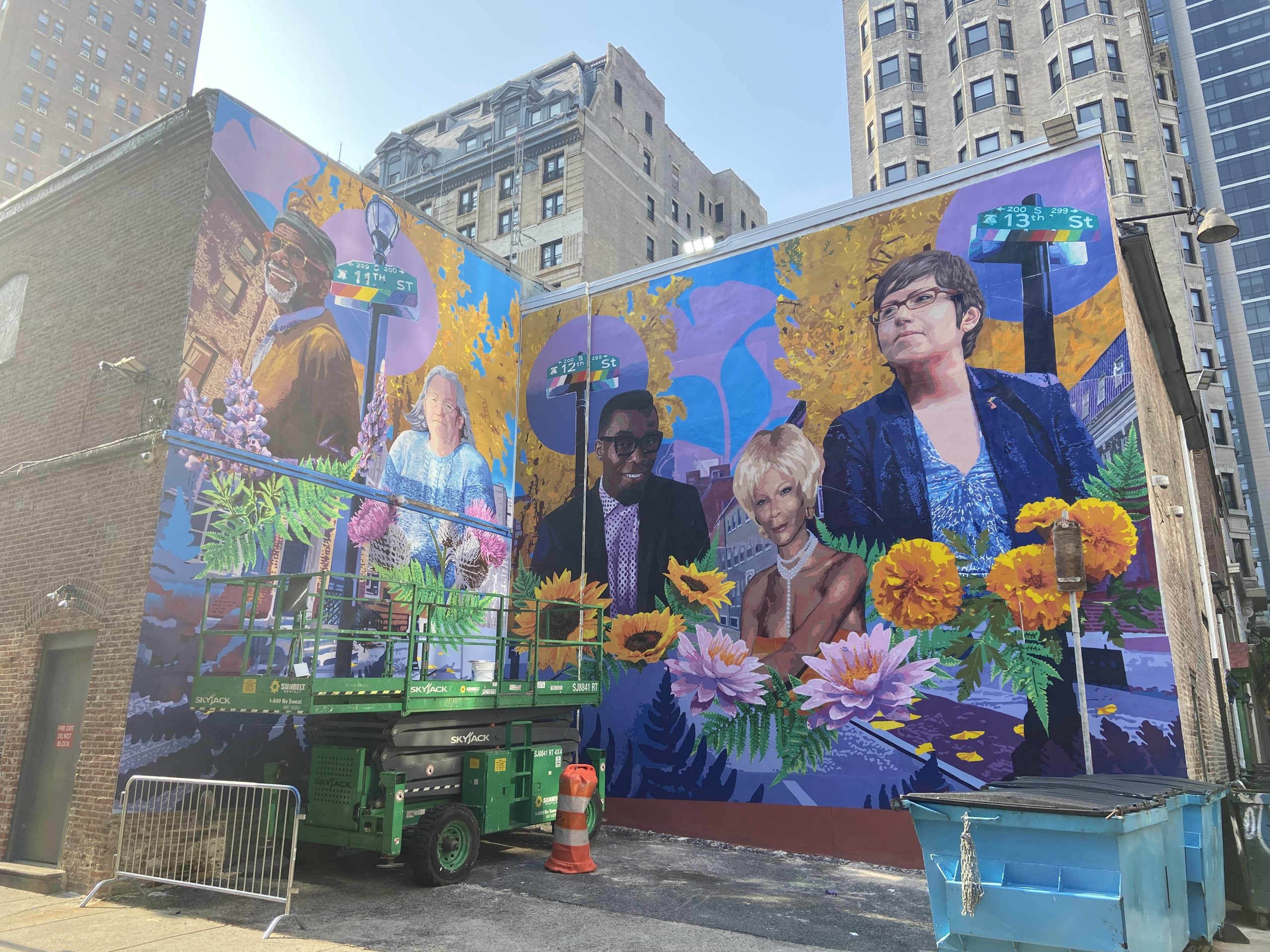
In Pride, In Power, In Memory is located on the side of Voyeur Nightclub at 1221 James St., a prominent spot amid Philadelphia’s queer nightlife.
The mural is located outside of Voyeur Nightclub in Philadelphia’s Gayborhood.Morgan Ritter
Painted by artist Santiago Galeas, the mural displays portraits of Gloria Casarez, Michael S. Hinson Jr., Tyrone Smith, Nizah Morris, and Dawn Munro; all LGBTQ+ activists who called Philadelphia home.
Each figure is accompanied by a flower symbolizing the person’s life and identity; Casarez’s portrait is adorned by Mexican marigolds, for example, as a nod to her heritage. The faces were all drawn referencing photos of them looking hopeful and optimistic.
The mural is strikingly bright, with vivid shades of purple and yellow illuminating the portraits.
These trailblazers pursued several kinds of activism in their lives, including AIDS awareness, trans rights, and community organization to rally for queer rights. Without them, the status of Philadelphia’s acceptance of the queer community may have looked completely different today.
“In Pride, In Power, In Memory”is located on the side of Voyeur Nightclub at 1221 James St.
Taylor Swift and Travis Kelce may or may not be getting married this weekend. But the pop singer and Kansas City Chiefs tight end are celebrating their impending nuptials with some philanthropy.
The couple donated $26 million to 20 charities across the United States on Thursday — including one in Swift’s hometown of Reading. Helping Harvest, a food bank that serves “seniors and adults experiencing food insecurity” in Berks and Schuylkill Counties, received $1 million from the couple.
The donation was unexpected, Helping Harvest said in a statement on Thursday, but greatly appreciated.
“The $1 million that Ms. Swift and Mr. Kelce donated to us today will be used and the impact will be exponential in allowing us to rescue more food from waste and provide more food to people in need,” Helping Harvest president Jay Worrall said to The Inquirer. “[Swift] has done the people in her home community a great service, and we thank her for it.”
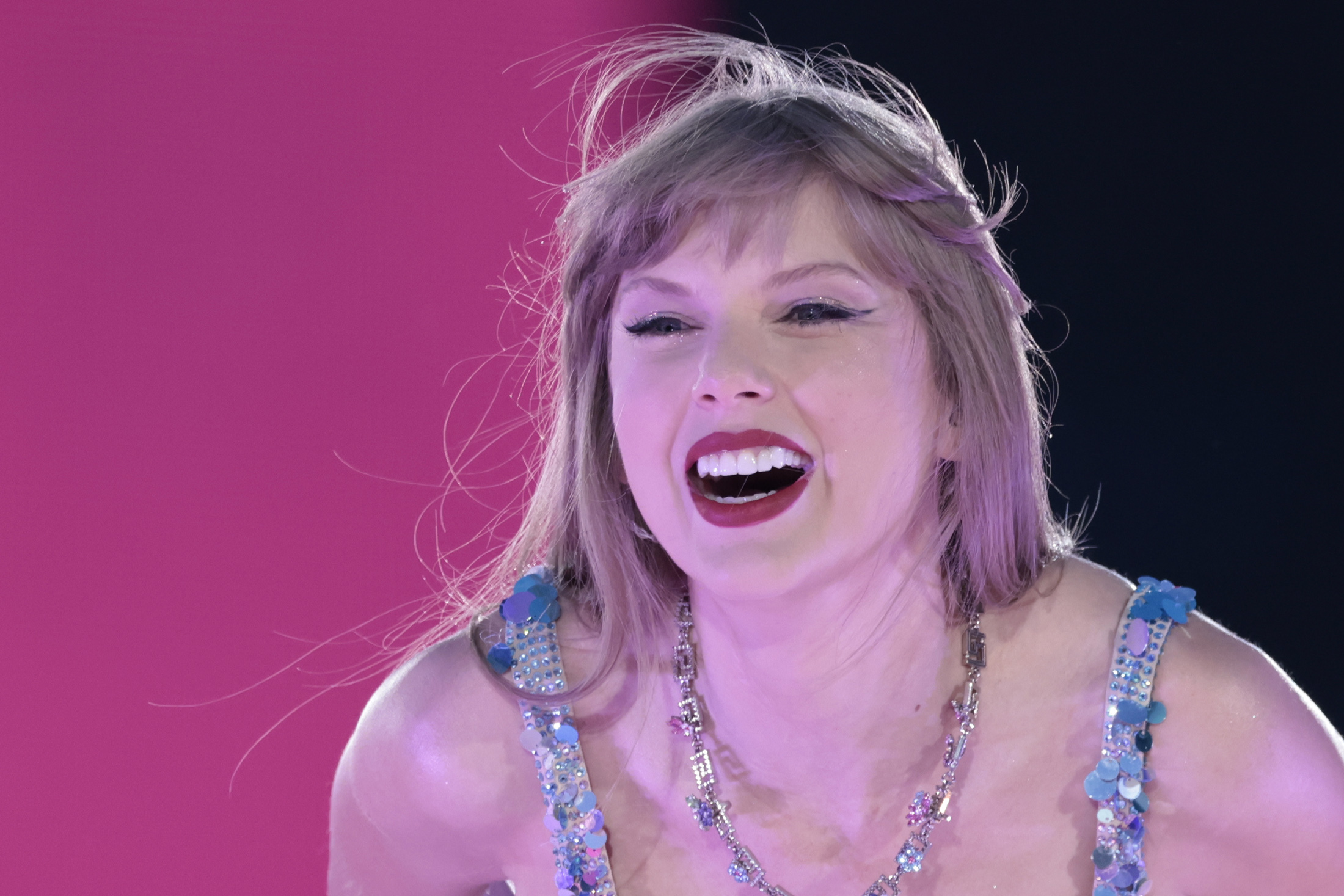
Taylor Swift performs during the first of three Eras Tour performances at Lincoln Financial Field in Philadelphia on Friday, May 12, 2023. .Elizabeth Robertson / Staff Photographer
Swift has a history of donating to food banks, particularly when on tour. During the “Eras Tour” in 2023, Swift donated to Three Square Food Bank in southern Nevada, Food Lifeline in Seattle, and Second Harvest of Silicon Valley in San Jose, Calif., among others.
One of Helping Harvest’s largest expenses is its infrastructure, such as cold storage and refrigerated trucks for food distribution. The donation, Worrall said, would likely be invested in additional trucking or warehouse space that would allow them to store more food.
“There have been substantial reductions in federal resources for food banks over the past few years, compounded by the reductions to the SNAP programs that are being enacted right now,” he said. “The state has tried to step up in some ways, but the increase in state funding has been modest compared to the reductions in federal funding.”
Last year, Gov. Josh Shapiro’s administration invested $459,000 in Helping Harvest’s new community kitchen, which provides culinary training and is where meals are prepared for people in need.
In the last two years, Helping Harvest’s federal funding has decreased by a little over a third. The organization received $2,687,166 in grants awarded under federal programs, compared to $4,240,293 in 2024, according to a recent audit for the 2025 fiscal year. The organization anticipates distributing over 14 million pounds of food this year, up 3 million pounds from 2024.
A spokesperson for Swift did not immediately respond to The Inquirer’s request for comment about the donation to Helping Harvest.
While there has been no confirmation from the couple, Swift and Kelce are reportedly tying the knot on Friday at New York City’s Madison Square Garden, where Swift was most recently seen cheering on New York Knicks in Game 4 of the NBA Finals against the San Antonio Spurs.
Celebrity news publication Page Six released a video of large Sysco-branded boxes of food being brought into the venue, including lobster meat, french fries, andchicken. The Associated Press has reportedly obtained a copy of a city permit for a “special event” taking place at the venue on Friday night.
The article has been updated to include details about Swift and Kelce’s reported wedding. Staff writer Beatrice Forman contributed to this article.
Bill Wine, 81, of Philadelphia, three-time Mid-Atlantic Emmy Award-winning film and TV critic, retired tenured associate professor of TV and film at La Salle University, onetime freelance TV critic for the Daily News, freelance writer, playwright, and popular lecturer, died Sunday, June 14, of complications from Parkinson’s disease at his home in Chestnut Hill.
The son of two part-time amateur actors and a lifelong devotee of theater, film, TV, writing, and teaching, Mr. Wine was a film critic for WTXF-TV, Channel 29, for 12 years and KYW radio for 17 years. Known for his pithy, witty, and often acerbic reviews, and a breezy conversational style of writing, he worked at Channel 29 from 1990 to 2002 and KYW from 2001 to 2018.
“Bill Wine was a character out of a Neil Simon comedy, more Oscar than Felix,” said Carrie Rickey, former Inquirer movie critic. “You didn’t have to wait long for the punchline.”
Mr. Wine’s film reviews on Channel 29 were often funny and entertaining. Channel 29
At Channel 29, Mr. Wine was nominated for eight regional Emmy Awards for commentary and writing, and won three. He appeared regularly on the station’s Ten O’Clock News, in primetime movie preview and review programs, and later on Mondays, Wednesdays, and Fridays on Good Day Philadelphia.
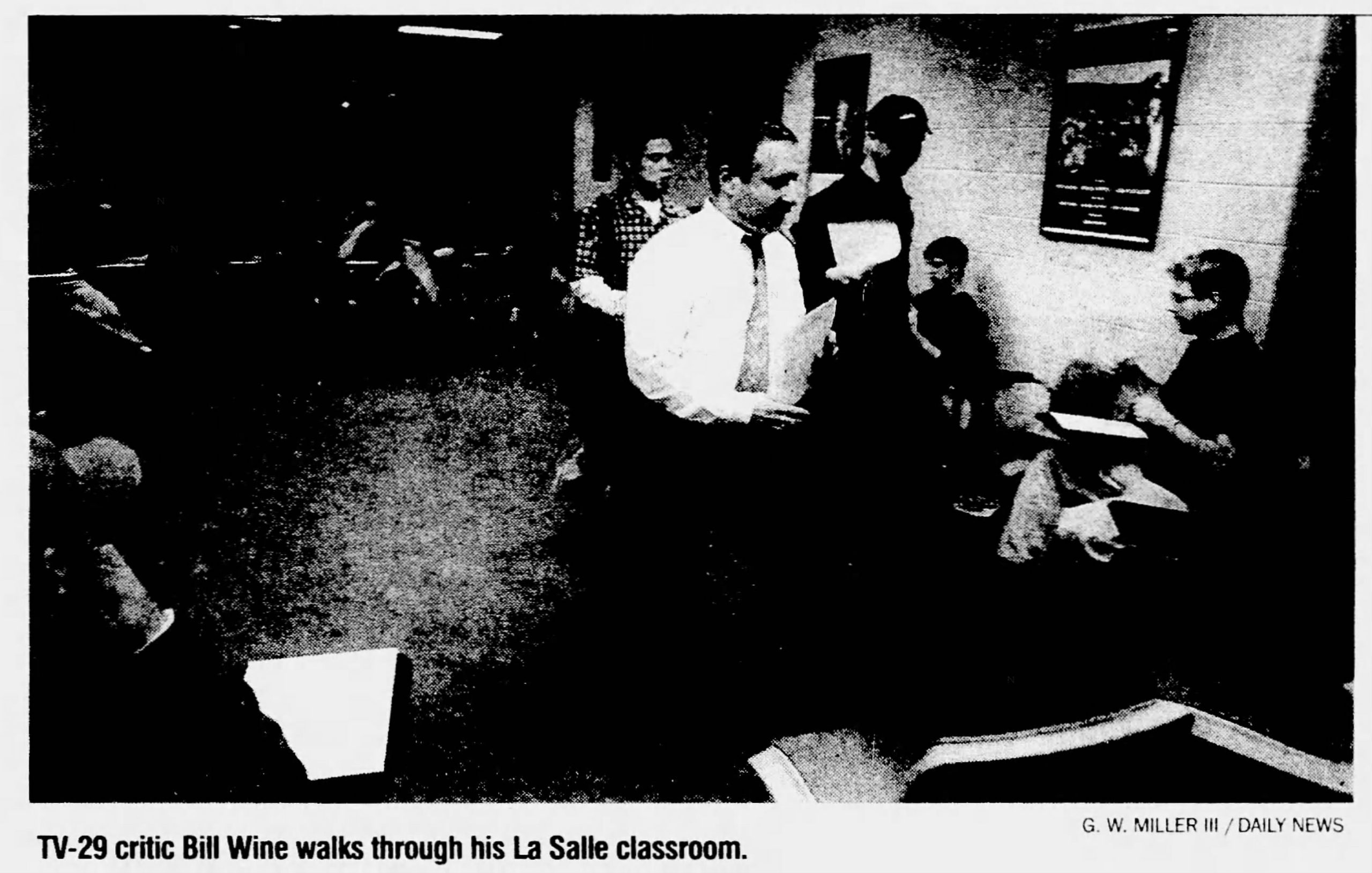
By 1990, he had already written hundreds of freelance film reviews for the Daily News and Courier-Post, done radio reviews for WPEN, and taught a variety of classes about film and writing for a decade at La Salle. So, despite no previous TV experience, he was hired at Channel 29 over 60 other film critic applicants.
“I had never been on TV, but I wasn’t nervous,” he told the Daily News in 2001, “because I had been standing in front of 100 students for 10 years.”
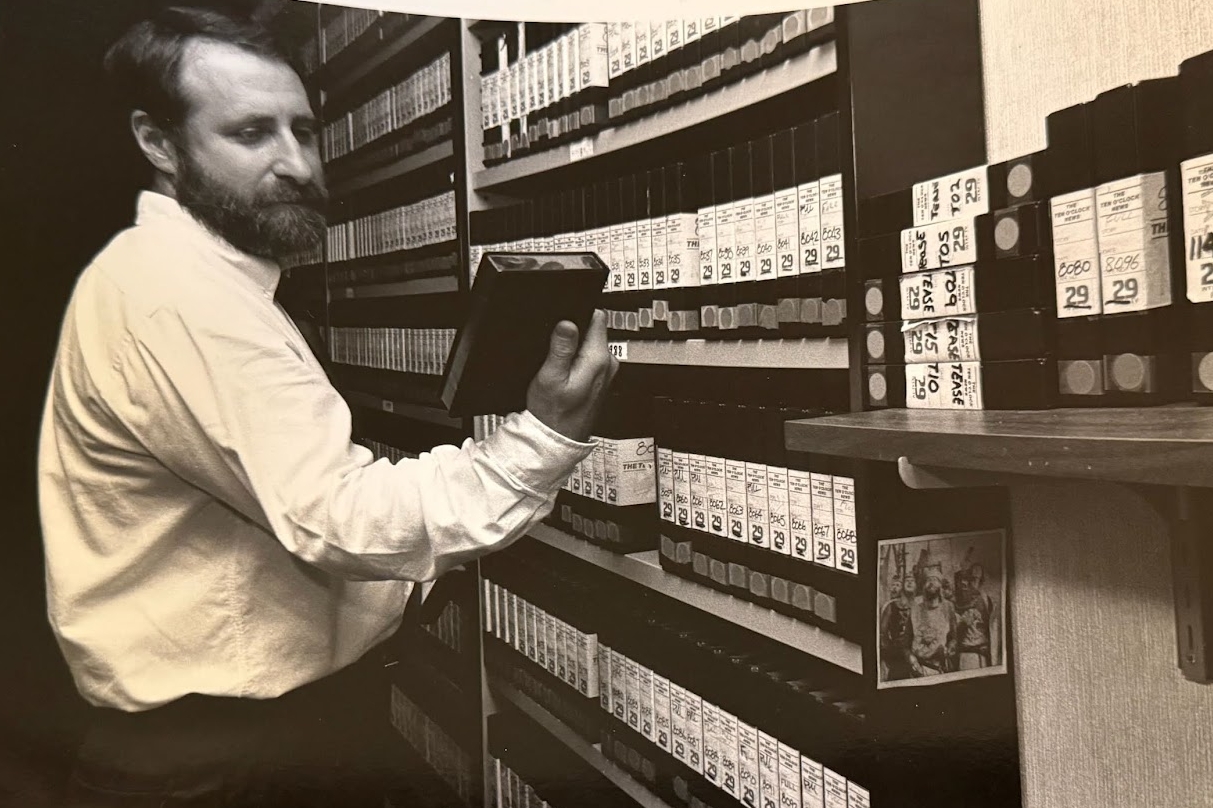
Mr. Wine worked at at WTXF-TV, Channel 29, for 12 years.Courtesy of the family
He started at KYW radio in 2001 and usually aired reviews and reports on Thursdays, Fridays, and Saturdays. Sometimes, he watched three movies in one day. He left Channel 29 in 2002 and KYW in 2018 only after both companies eliminated their local film critic position.
“When I started [writing film reviews], it was before the internet,” he told The Inquirer in 2018. “A lot of people [now] feel like, ‘Who the heck is a movie critic to come on in a minute and to dismiss something that took hundreds of people and millions of dollars to create?’”
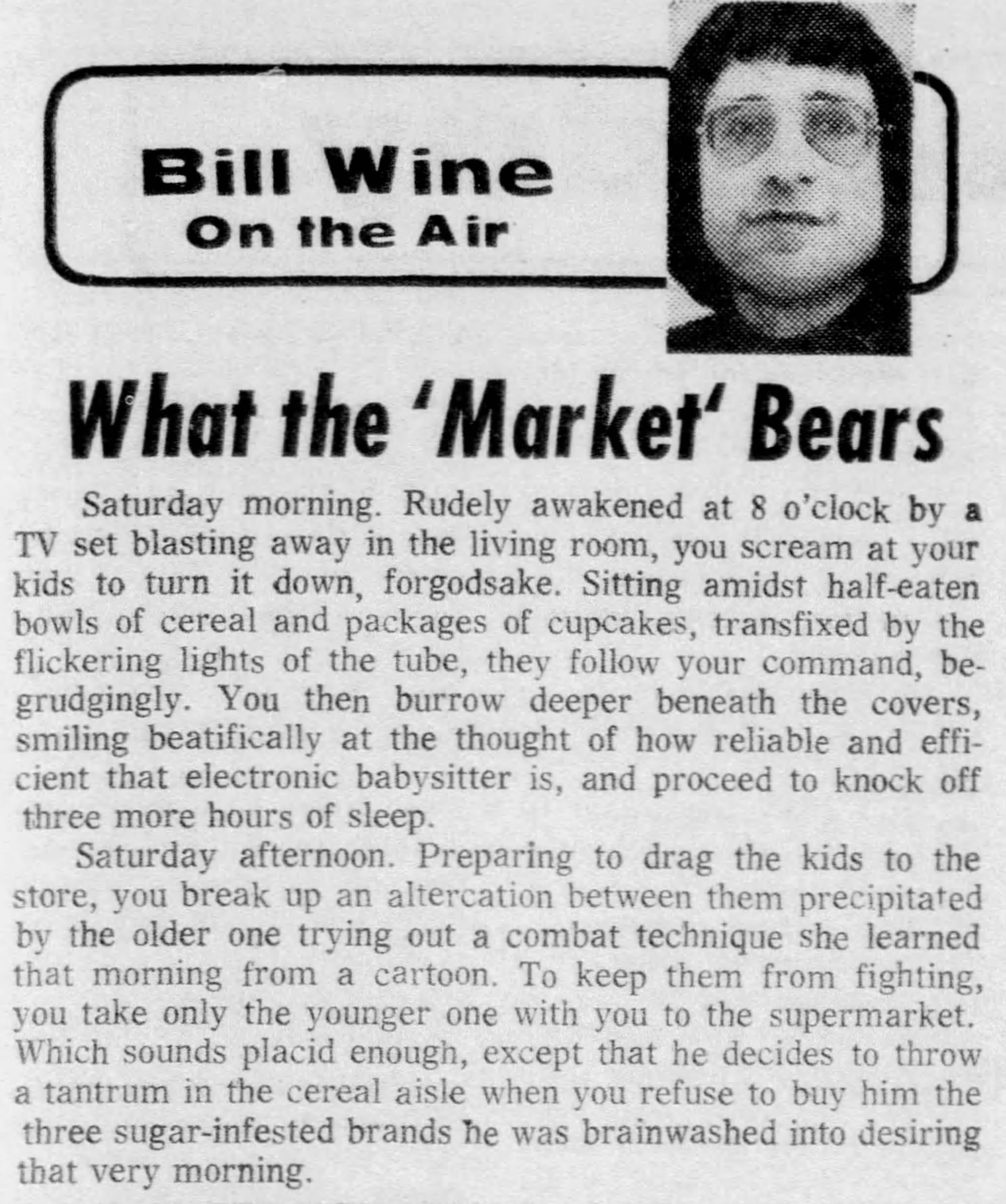
In the 1970s and ‘80s, he wrote articles and reviewed films, TV shows, books, and plays for WPEN, The Inquirer, Courier-Post, Philadelphia Magazine, and other outlets. In 1975, he wrote dozens of freelance TV columns called “On the Air” for the Daily News.
Mr. Wine wrote dozens of columns as a freelance TV critic for the Daily News in 1975.Newspapers.com
He spent three years in California in the 1970s working on plays and film and TV scripts. He hobnobbed with famous writers, producers, and actors in Los Angeles, staged one of his own plays, and was a winning contestant on a new TV game show.
He wrote 11 plays over the years, and several made it to the stage. “Now the people who disagree with my reviews can come and find out if I’m as dumb as they think I am,” he told The Inquirer in 2002.
He aired reviews on WIP radio and lectured often at libraries, schools, community centers, theaters, and other venues about his favorite films, adapting books to film, and other topics.“He could be wickedly funny, especially when delivering a pan of a movie,” his family said in a tribute. “One of his favorite quotes was: ‘I had a bad seat. It was facing the screen.’”
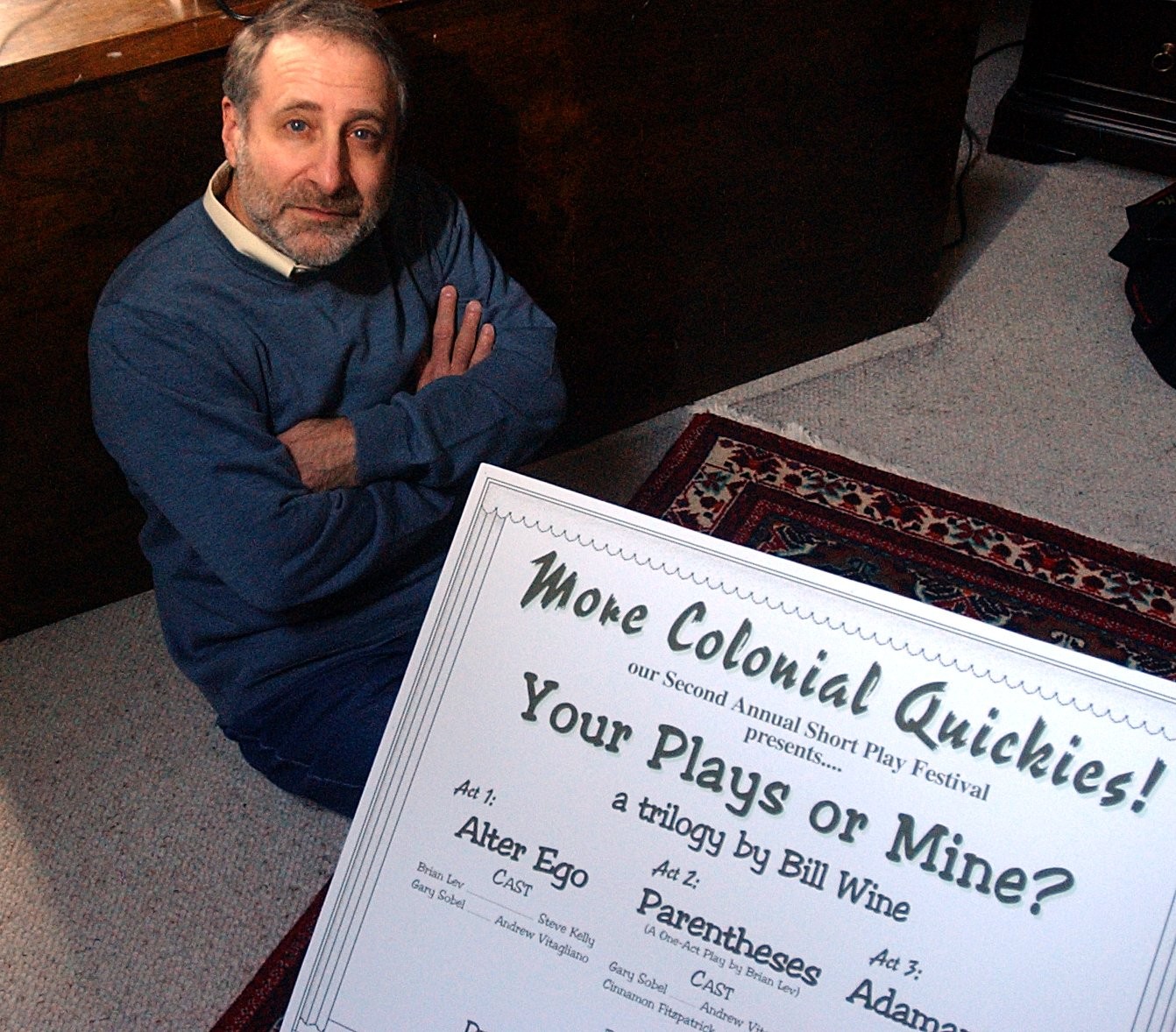
Mr. Wine was a prolific playwright who enjoyed table readings with family and friends. La Shina Clark / Staff Photographer
Mr. Wine earned a bachelor’s degree in math at Drexel University and a master’s degree in communications at Temple University. He helped design La Salle’s nascent Communication Department in the 1980s, and school officials called him one of their “Founding Fathers.” He also taught briefly at Drexel, and came close to earning a doctorate at Temple.
In 2001, he was featured in a Daily News story about “celebrity professors” and said: “You have to remind yourself that this is television, not the classroom. You mention, say, ‘film noir’ on TV, and you get a memo.”
William David Wine was born June 21, 1944, in Germantown. He grew up in West Oak Lane and Cherry Hill, attended Central High School, and graduated from the old Cherry Hill High School.
A story and this photo of Mr. Wine about his time as a professor at La Salle appeared in the Daily News in 2001.Newspapers.com
As a boy, he devoured newspaper movie reviews and fell in love with film after seeing Alfred Hitchcock’s 1954 thriller Rear Window. He got positive reviews of his own freelance movie review when he was at Temple, and he knew then, he said later, that writing about movies was his creative niche.
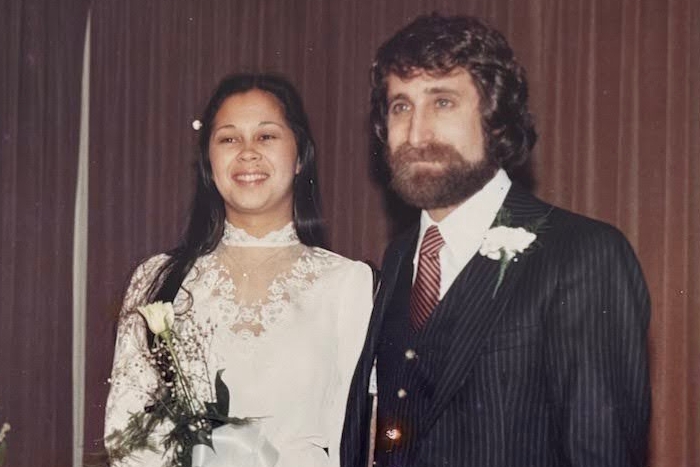
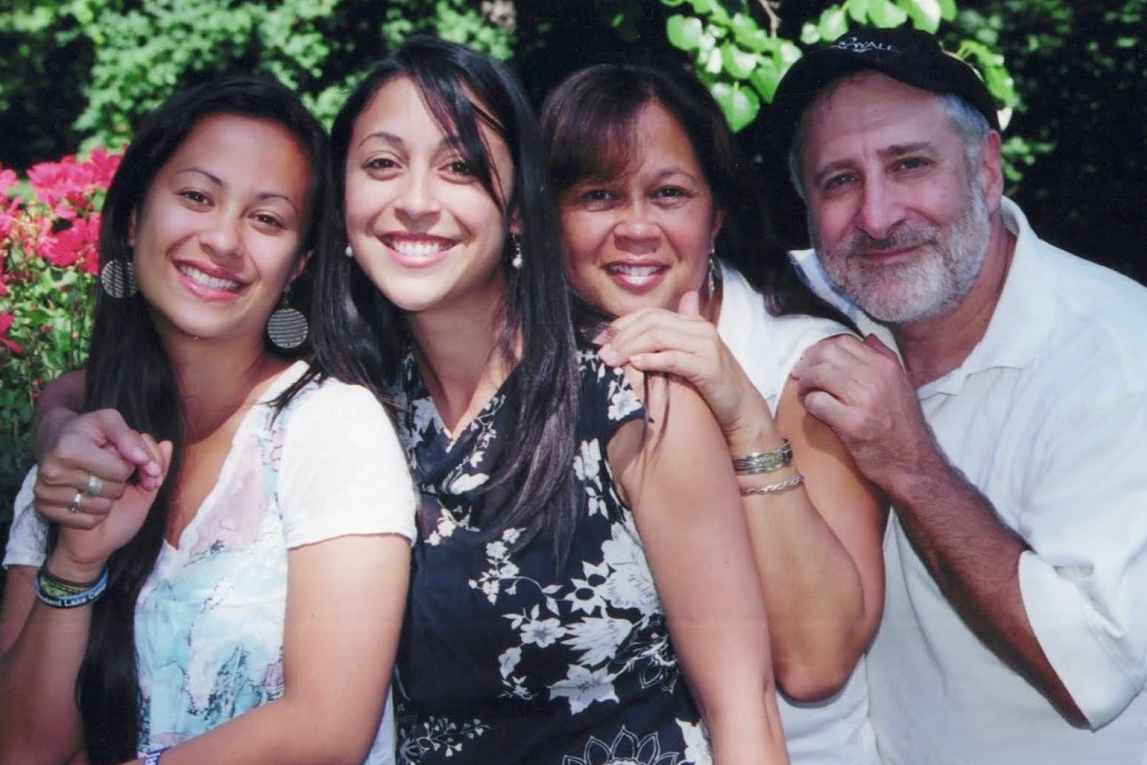
He married Dina Lichtman, and they divorced later. He married Suzanne Monsalud in 1981, and they had daughters Simone and Paulina, and lived in Germantown, Wyncote, and Chestnut Hill.
Mr. Wine and his wife, Suzanne, married in 1981.Courtesy of the family
Together, Mr. Wine and his family traveled to Paris and London, and he and his wife honeymooned in Rio de Janeiro, Brazil. He doted on his daughters and sometimes took them to his La Salle classroom, the Channel 29 TV set, and movie screenings.
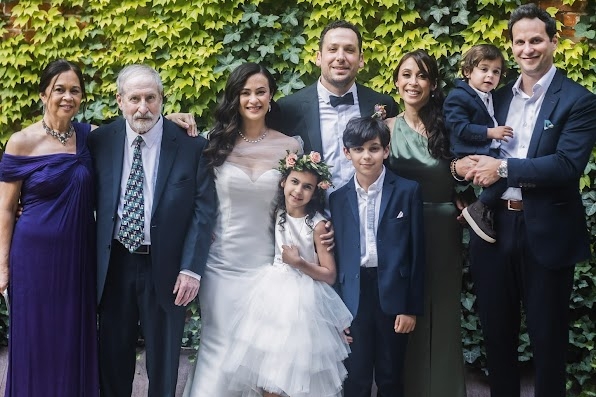
Friends, former colleagues, and former students called him “a force of nature,” “smart and gifted,” and “a rare combination of kindness, professionalism, and humor.” His daughter Simone said: “His humor, warmth, and presence made life brighter.”
Mr. Wine played tennis, third base on adult softball teams, and pickup basketball into his 70s. He followed the Phillies, 76ers, and Eagles closely, and hit tennis balls with Hall of Famer Rod Laver at a publicity event in Los Angeles.
Mr. Wine and his family made memorable trips to Paris, London, and elsewhere. Courtesy of the family
“He was a wonderful father and a dedicated teacher,” his wife said. “He was a real Philadelphian, and we complemented each other.”
His daughter Paulina said: “Dad, I think you cracked the code. We’ll see you at the movies.”
Some donors who intended to give money to a bipartisan effort to celebrate the nation’s 250th anniversary were, instead, steered to a White House-backed initiative under false pretenses, House Democrats allege in a report released Thursday morning, citing whistleblower interviews and newly obtained documents.
The donors meant to give money to America250, a congressionally chartered initiative to celebrate the nation’s semiquincentennial, according to Democrats on the House Natural Resources Committee. They instead were given routing and account numbers that directed their funds to Freedom 250, which President Donald Trump established last year to organize anniversary events, the report says.
The report does not identify the donors. In interviews, Democrats said they needed to protect the identity of whistleblowers who worked with the panel. But they said their report — which includes other allegations of Freedom 250 officials and allies explicitly steering money away from America250 and toward projects shaped by Trump — shows how the president transformed a bipartisan celebration of the nation’s anniversary into an initiative that benefited him and his allies.
“I’m a lawyer, and I know better than to pronounce that a crime has been committed,” said Rep. Jared Huffman (D., Calif.), who oversaw the report as the committee’s top Democrat. “But I do know the elements of fraud, and there is evidence of all those elements here.”
The White House referred questions to Freedom 250, which denied that donors had been misled by its fundraising activities and criticized Democrats for the timing of their report.
“This so-called ‘report’ is nothing more than a partisan smear from politicians who would rather manufacture division than celebrate America’s 250th birthday alongside the rest of the country,” Freedom 250 spokesperson Danielle Alvarez said in a statement.
Alvarez also criticized America250, saying that the bipartisan organization — which Congress established in 2016 — “had nothing to show” for its 10 years of planning and spending.
“Freedom 250 was created because the American people deserved better,” Alvarez said.
America250 declined to comment on the specific allegations in Democrats’ report.
“America250 will continue to focus on the values-based programming approved by our bipartisan Commission at the local, state, national and international levels, including once-in-a-lifetime celebratory moments during the 4th of July weekend,” Rosie Rios, who chairs America250, said in a statement. “We are supportive of the many other organizations planning events for the 250th at the federal, state and local level, so all Americans have ample opportunities to join in the celebration.”
Trump has extolled Freedom 250 in public remarks, saying that the initiative has organized multiple special events. The public-private partnership, which the White House launched in December, has overseen a flurry of high-profile announcements, including some from the Oval Office.
“We’ll have a Freedom 250 Grand Prix right here in Washington around the Capitol,” the president said last week in remarks kicking off the Great American State Fair on the National Mall — another Freedom 250-backed event.
The Trump-backed initiative has overtaken some efforts led by America250, which is directed by a bipartisan board created by Congress a decade ago.
America250 originally applied for and received a grant from the Institute of Museum and Library Services for so-called Freedom Trucks, mobile museums inspired by the American Freedom Train that crisscrossed the country from 1975-1976. The institute is a federal agency that provides financial support for museums and libraries.
Officials have said the grant was later voluntarily transferred to Freedom 250, which is now operating Freedom Trucks that provide a sanitized version of the nation’s founding, according to administration critics.
America250 officials have said they reoriented their initiative to organize events outside Washington, while Freedom 250 focuses on events in the nation’s capital. But the dueling organizations and approaches have confused some corporate leaders and lawmakers, and tensions between the groups have grown, the Washington Post reported earlier this year.
The Democratic lawmakers’ report offers further examples of how the two groups have come into conflict.
Some donors and sponsors interested in donating to America250 were told by the Trump administration that they lacked a “green light” to do so, according to the Democrats. The report also claims that administration officials pressured donors to redirect donations from the bipartisan effort to Freedom 250, with the Trump-backed group conducting outreach to America250 sponsors with donation requests.
Some corporate executives did not understand the difference between the two organizations and were confused by this process, the report says.
Freedom 250 officials also worked to deprive America250 of money, the Democrats charge, citing new examples of Trump allies pressuring donors to reallocate funds away from the bipartisan initiative. They also allege that Trump allies worked to shift public financial support away from America250, including $75 million of congressionally allocated funds that America250 leaders were expecting to receive. The remaining funds are likely to be kept by the White House, the report says.
The reduced funding posed challenges for America250 to execute planned programming, according to the report, including grants, educational initiatives, and volunteer programs. Redirected federal funding created “significant headwinds” for this programming, the Democrats said, though the group still sought to execute all planned events through additional private fundraising.
Though America250 is still organizing anniversary celebrations in large cities across the country, its programming has been overshadowed by that of Freedom 250. The Trump-backed group helped organize last month’s UFC fight on the White House lawn, this week’s opening of the Theodore Roosevelt Presidential Library in North Dakota, and a Trump rally and fireworks show scheduled for the evening of Independence Day.
Freedom 250 also employs many former U.S. DOGE Service officials and harvested users’ data for political purposes, according to the report.
Huffman said that if Democrats retake the House this fall — and obtain the power to issue subpoenas — they will open broader investigations into Freedom 250.
“If and when we have more tools at our disposal to do investigation and oversight, perhaps in the next Congress you will see a lot more information on this, I’m sure,” he said.
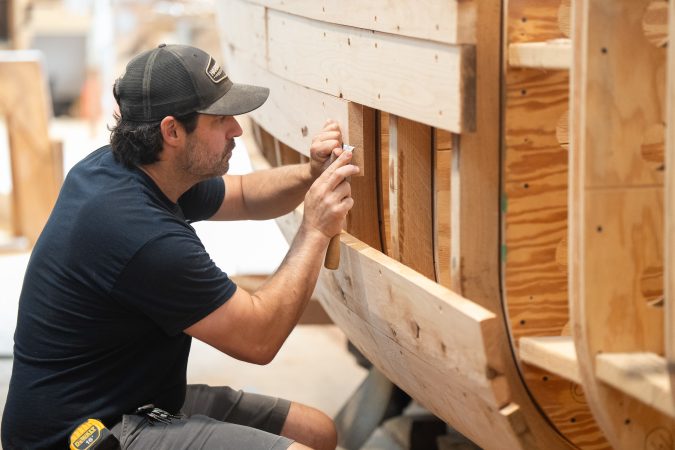
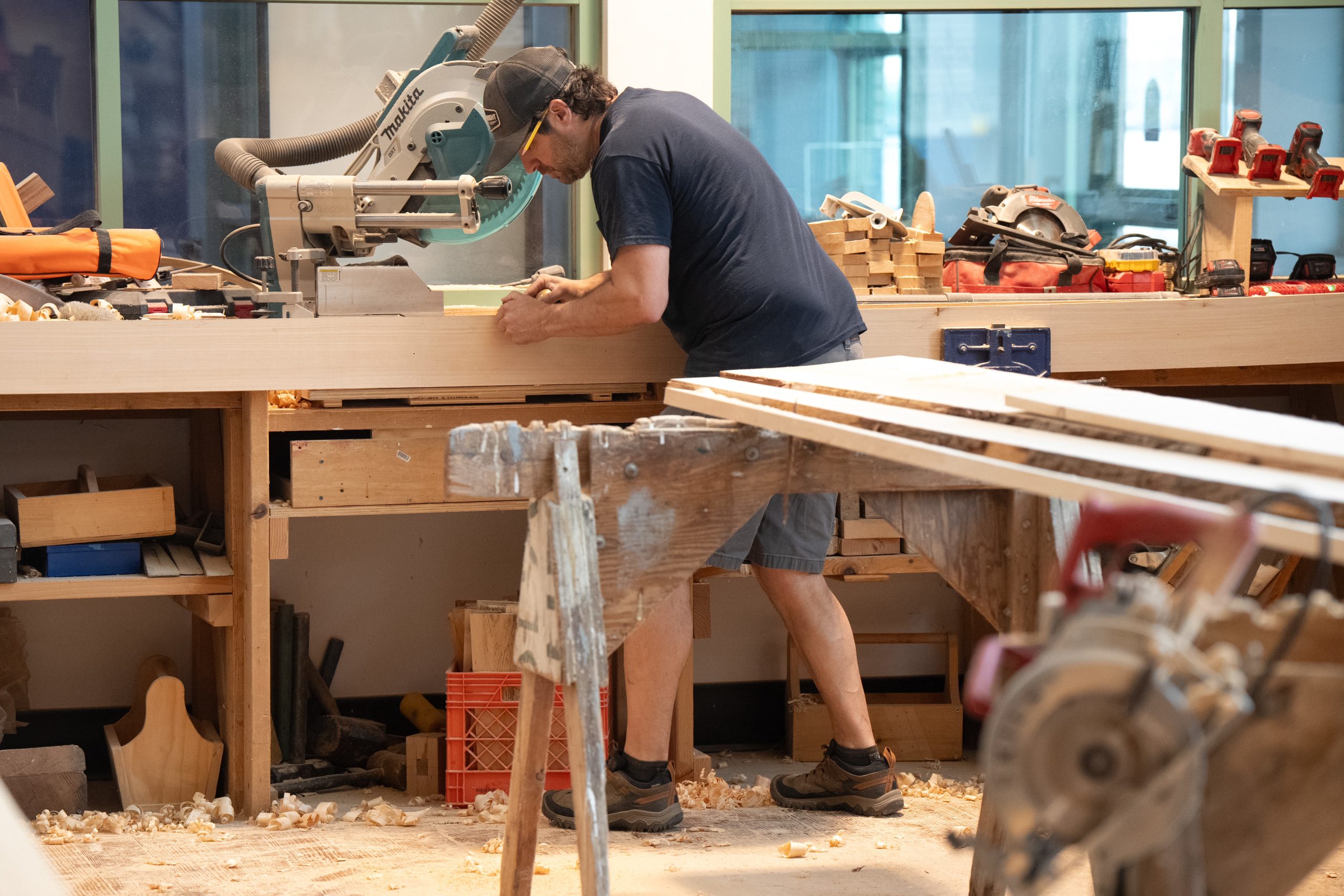
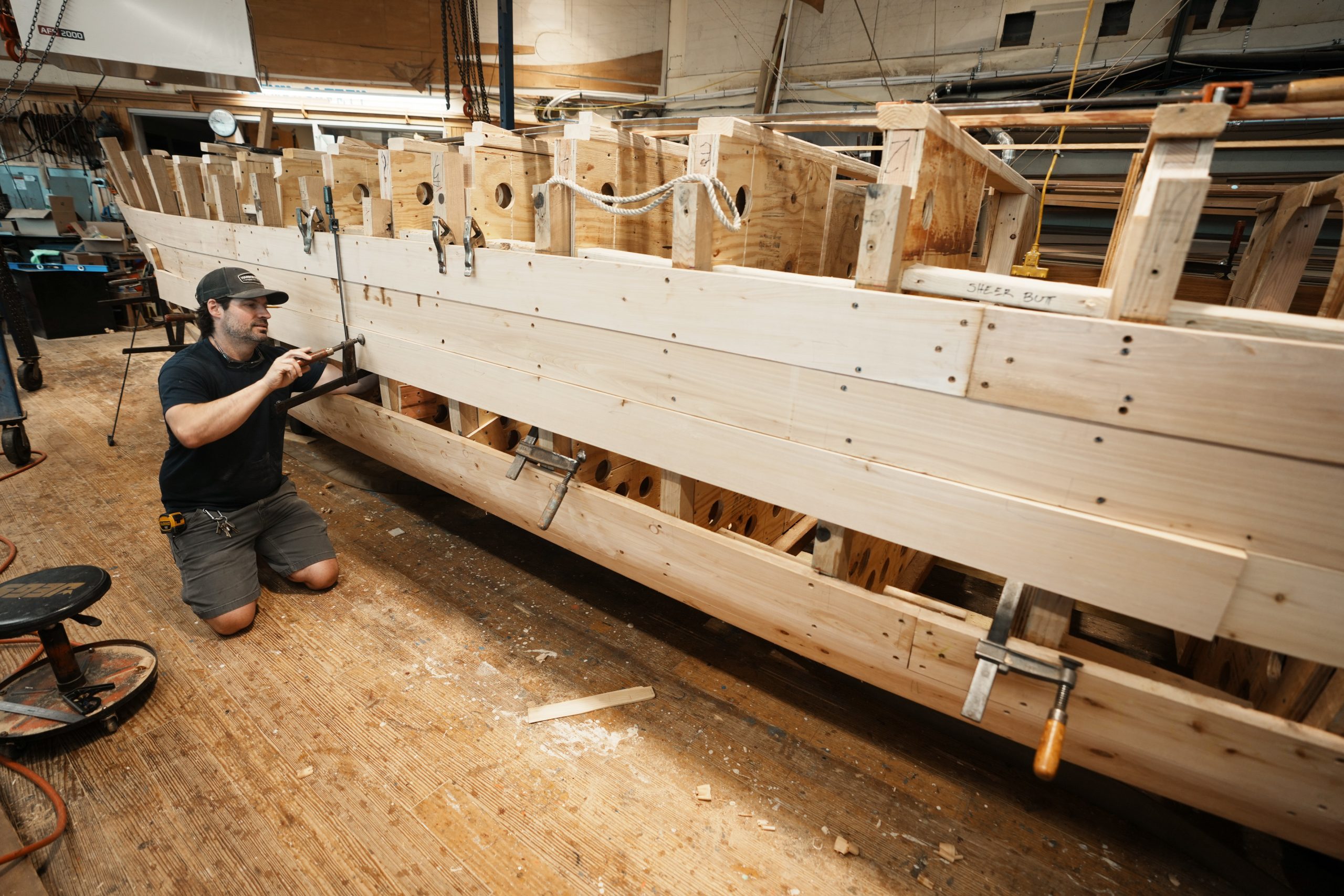
The floor of David Dormond’s workshop is scattered with wooden planks, shaving piles, and machines that scream “DO NOT TOUCH!” In the middle of it all sits a 40-foot-long, 3500-pound wooden boat that looks like it could hold an army.
That’s because it’s meant to. Well, sort of.
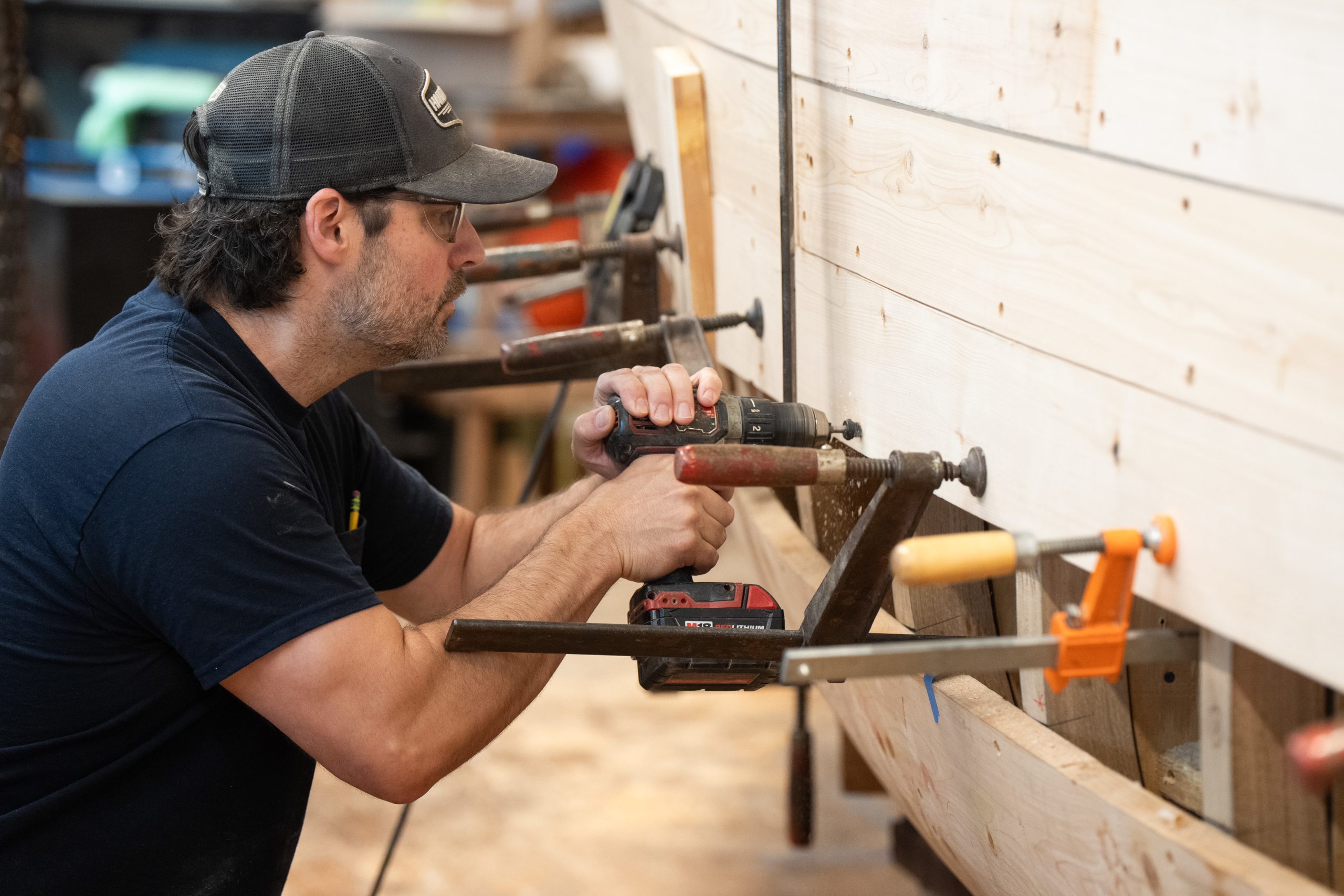
It’s a Durham boat, named because the design was used to transport iron from Durham Ironworks in Bucks County to Philadelphia. It is better known as being the model of boat George Washington used to cross the Delaware with his Patriot troops on Christmas in 1776.
At the Independence Seaport Museum in Philadelphia, David Dormond is replicating the boat Washington used to cross the Delaware River, June 18, 2026.Jessica Griffin / Staff Photographer
“The moment Washington decided to use these boats to cross the Delaware and storm Trenton changed the tide of the [Revolutionary] War,” said Dormond, who is the director of the Seaport Boat Shop at the Independence Seaport Museum (ISM). “It was one of the pivotal points for the U.S. in gaining our freedom.”
Dormond and his team have built a full-scale replica of the Durham boat to be displayed in Washington Crossing Historic Park. Authenticity was at the forefront of its construction, with Dormond committed to making the boat as historically accurate as possible.
The wood for the replica was sourced locally, including cedar from Medford, N.J., and white oak for the framing from Reading.
David Dormond and his team have spent more than a year constructing the boat in the Seaport Boat Shop at the Independence Seaport Museum in Philadelphia.Jessica Griffin / Staff Photographer
“The reason we do that is to keep things just the same as they would’ve been in the 1700s,” Dormond said. “When they were building these boats, they weren’t bringing lumber in from across the country, they were using what they had available to them, so we follow in that tradition.”
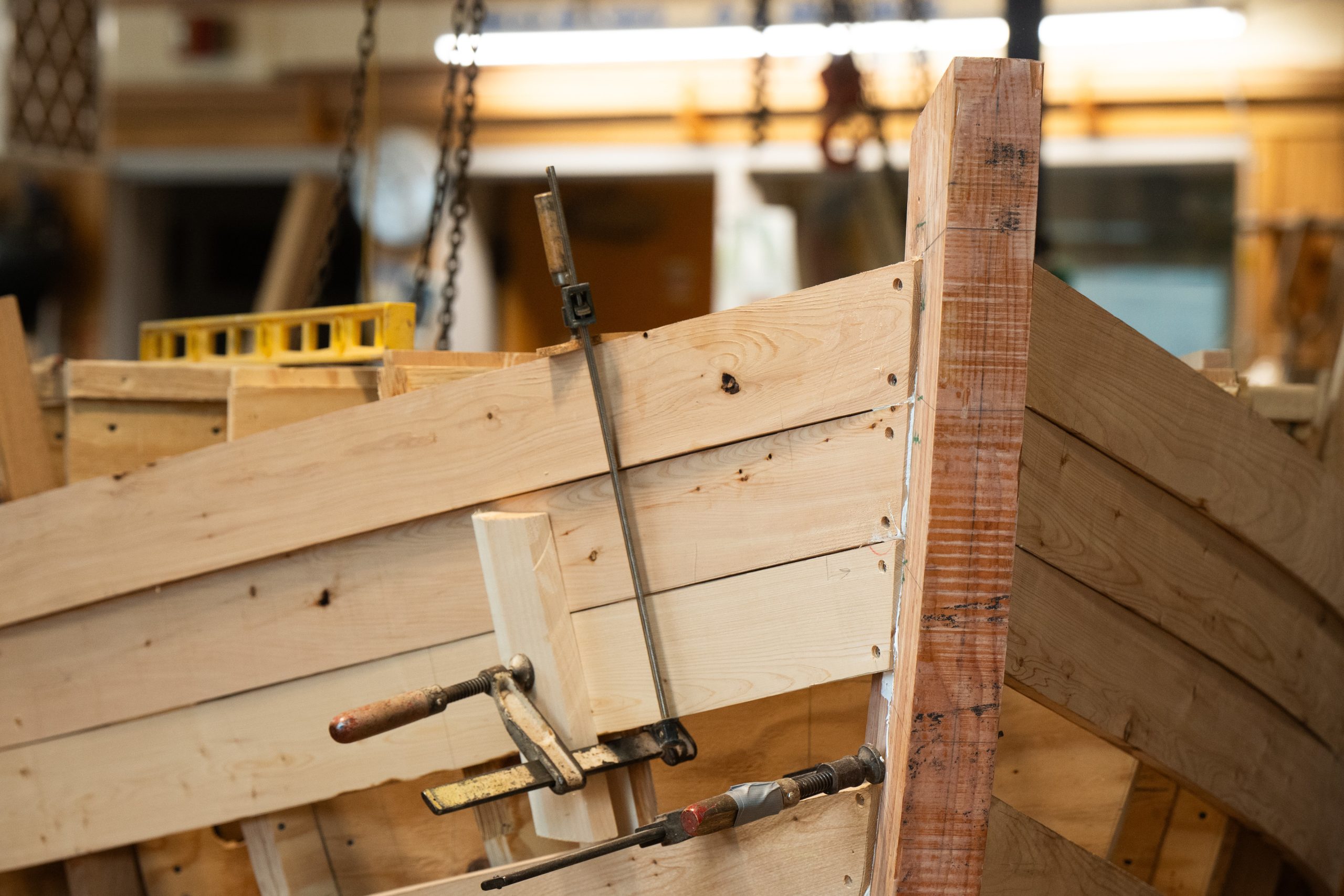
Nearly every part of the boat was handmade by Dormond and his team, down to the bolts holding the wood together. They steam-bent the frames and used 18th-century-style spokeshaves and batten strips to help shape the boat like they would have in Washington’s day.
But this boat, now on display in Washington Crossing Historic Park, isn’t just for viewing. Visitors will be able to board the ship and see how grand it was in height and length, but also how cramped the 8-feet-wide interior was for the 2,400 soldiers that crossed the Delaware.
Most of the boat was handmade, with emphasis on using 18th-century materials to make it as period-accurate as possible.Jessica Griffin / Staff Photographer
The park currently has four Durham boats that sit on the water and are used for historical reenactments. This new boat will be parked on land along the waterline, and will be the first that visitors can walk onto and interact with directly.
“We were talking about some of the things that people are interested in learning about when they come to the park, but that they can’t necessarily experience. [And] people often asked about the Durham boats,” said Jennifer Martin, director of Friends of Washington Crossing, who collaborated on the boat project with ISM.
Martin said civilian support played a vital role in the Revolutionary War, and part of that was boat-building.
“This was trade work. This is something that was passed on and learned,” she said. “I think that there’s an art to handcrafting things and getting people to understand that life was very different in the 18th century.”
At the Independence Seaport Museum in Philadelphia, David Dormond is replicating the boat Washington used to cross the Delaware River, June 18, 2026.Jessica Griffin / Staff Photographer
Planning for the build started two years ago, with full-time construction beginning in spring 2025. The plans were made by a designer in Maine in the 1960s; Dormond and his team modified them to be truer to what they know of boat-building processes of the 1700s.
Dormond has built boats at ISM for almost 13 years, and this one is “one of the bigger vessels that we’ve done,” he said. The shop cycles between larger construction projects and simpler boat restorations, commissioned by both institutions, like Washington Crossing, and private customers.
“It’s a part of our history, so it’s neat to bring back and share that with the public and create something that will be a landmark for visitors at the park for years to come.”
The Durham boat project is part of a larger revitalization of the riverside at Washington Crossing Historic Park for America’s 250th. This includes a new ADA-accessible trail complete with signs with original artwork that depicts the history being taught.
At the Independence Seaport Museum in Philadelphia, David Dormond is replicating the boat Washington used to cross the Delaware River, June 18, 2026.Jessica Griffin / Staff Photographer
The park has also invested greatly in a Williamsburg-style experience for the roughly 10,000 field trip students that visit every year. Activities such as hands-on butter churning, gardening, blacksmithing, woodwork, quill handwriting, and soldiers drills give visitors a glimpse into 18th-century living.
“When people come to the park, a lot of our programs are free,” Martin said. “We wanted to be really intentional with creating more of these living history, immersive learning opportunities that people could experience every day that they come to the park.”
Though the shop’s team has some finishing touches to make, the boat is currently on display at Washington Crossing Park, ready for visitors amid the nation’s 250th anniversary.
It will be officially completed and installed by the end of July. It will be posted in the park indefinitely, with Dormond and his team assisting with any maintenance needs to keep it preserved for many years, and visitors, to come.
The Durham boat is on display at Washington Crossing Historic Park, 1112 River Rd., Washington Crossing, Pa. washingtoncrossingpark.org
The Revolutionary War ended in 1783, but when the 1790s rolled in, America was in an economic spiral. Citizens were broke. Businesses were going under. The government had little money.
So the first United States Treasurer Alexander Hamilton came up with a plan to create a national bank to serve as the primary fiscal agent for the federal government. It would issue paper money, pay America’s bills, provide loans to private citizens, and collect taxes so the country could fund itself.
“Hamilton had been studying the British banking system for decades,” said Lynn Nash, a park ranger at Philadelphia’s First National Bank that is managed by the U.S. National Park Service. “He did a deep dive and decided America needed a similar system to build more fiscal authority.”
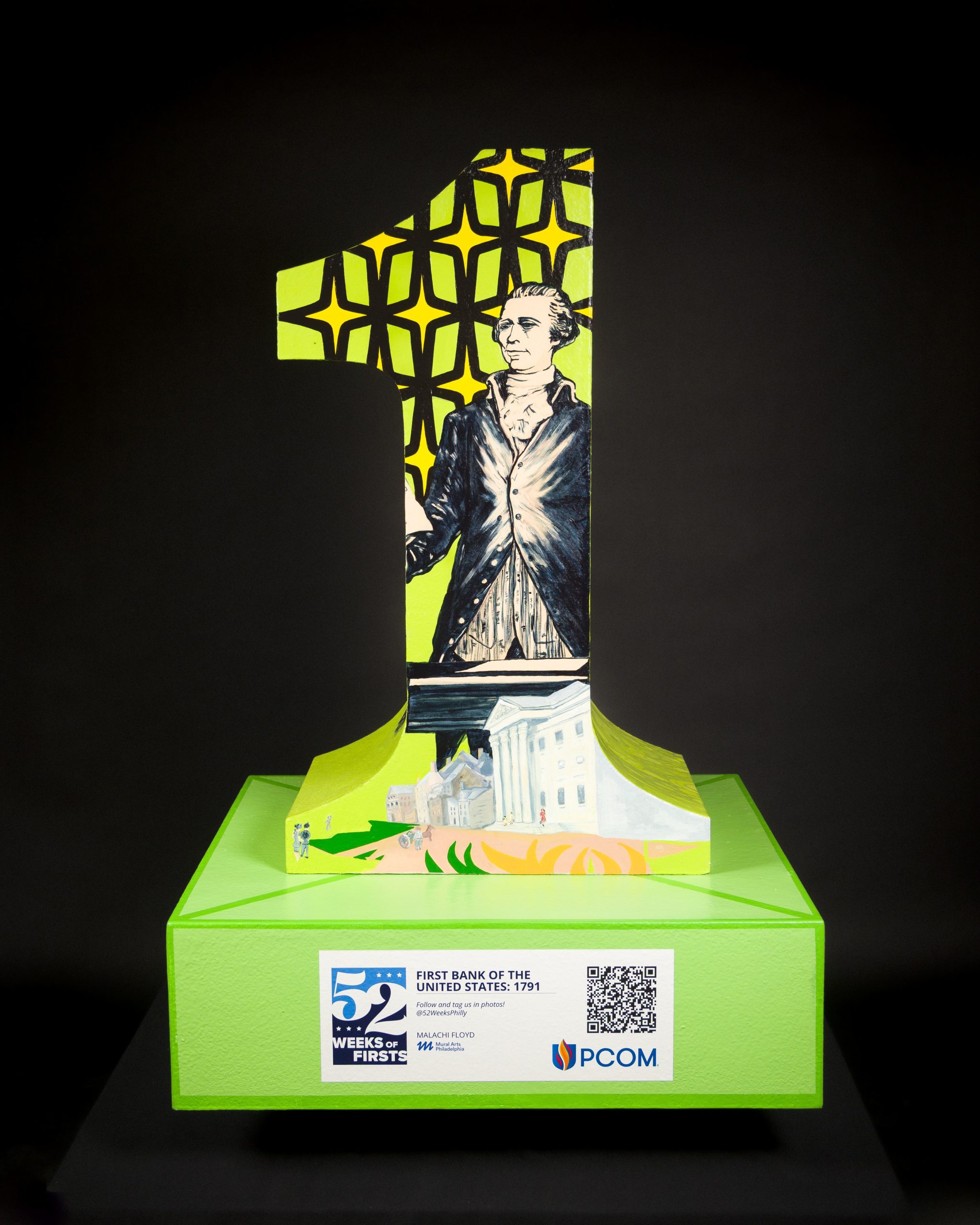
Malachi Floyd’s image of Alexander Hamilton, stacks of money, and the original First Bank of the United States’ building honors Philadelphia’s history as the seat of the federal banking system.Malachi Floyd for the Colibrà Workshop
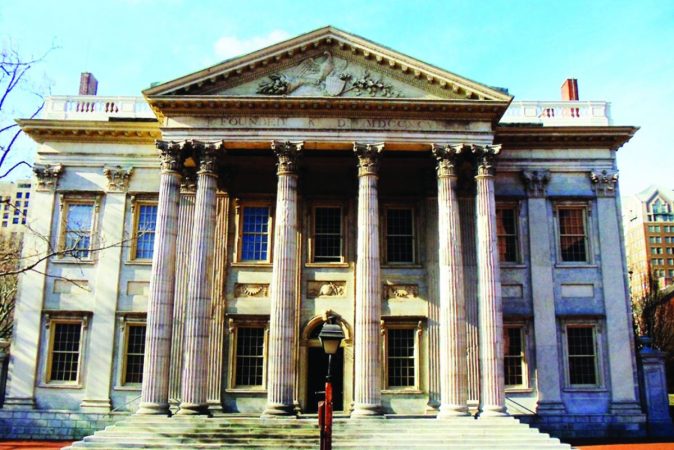
On Feb. 8, 1791, Congress passed a law establishing America’s first federally backed bank, which was located inside Philadelphia’s Carpenter’s Hall.
In honor of the Semiquincentennial, the National Park Service will reopen the First Bank to the public on July 1, following a multiyear $43 million rehabilitation. The gleaming Greek Revival-style building will feature exhibits centering on the history of American banking.
America’s first commercial bank, the Bank of North America, was charted by the Continental Congress in 1781 to provide loans to colonists and fund the Revolutionary War. And some lawmakers, especially Thomas Jefferson, thought that was sufficient and that the Federal Bank overstepped the Constitution.
“He writes a letter to George Washington telling him how the bank needs to be housed in a large commercial seat,” Nash said. ”And that he knows Philadelphia will remain prosperous.”
The First Bank of the United States’ charter ended in 1811. Hamilton had died by then and President James Madison did not renew the charter. The next year, the building was purchased by Stephen Girard, who opened a private bank in the space.
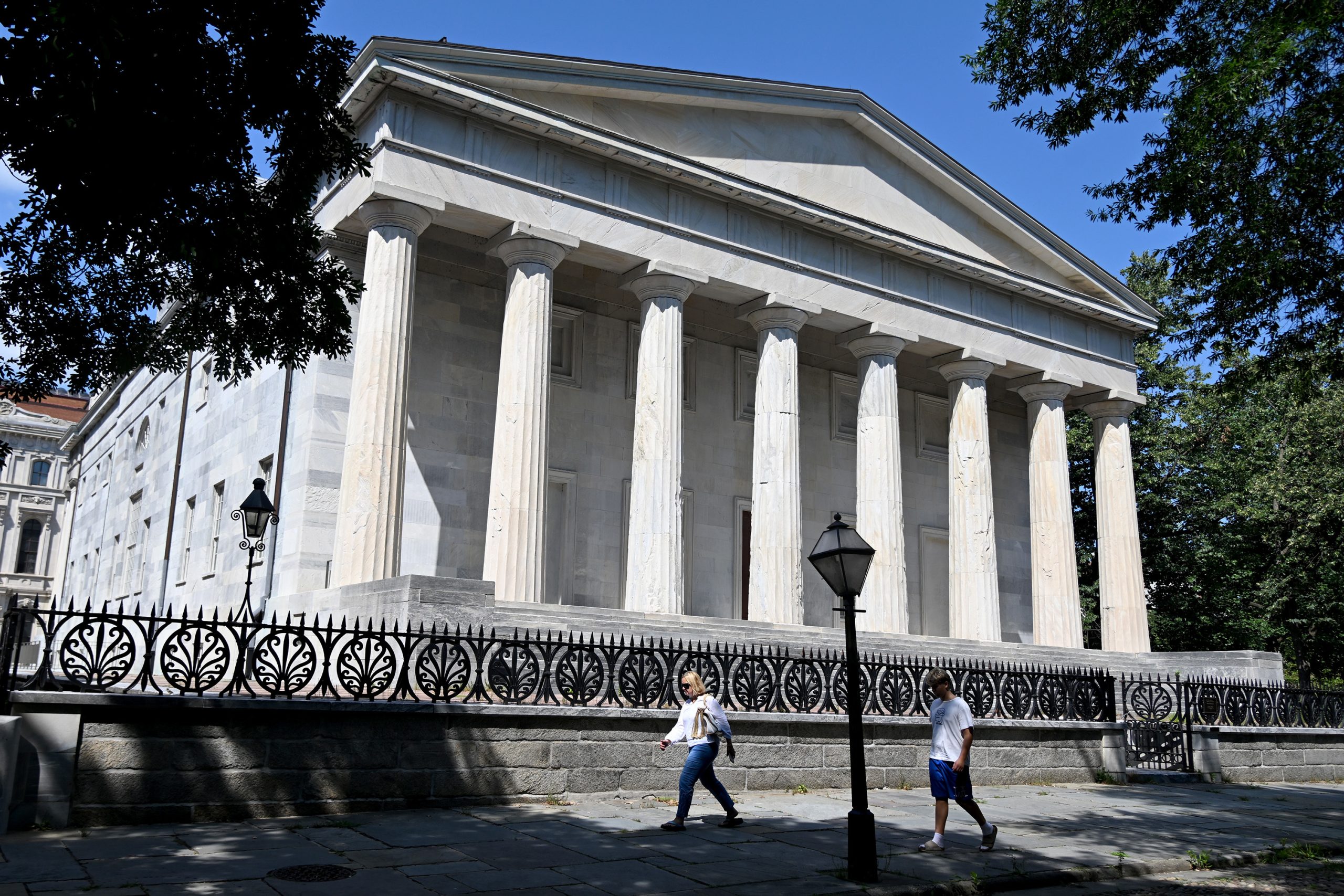
“But the War of 1812 was hard on the economy again,” Nash said. On April 10, 1816, Madison signed legislation establishing the Second Bank of the United States at 420 Chestnut St., Nash said.
(Today that building is the Second Bank of the United States Portrait Gallery.)
Second Bank of the United States at 420 Chestnut Street. Today it is the Second Bank of the United States Portrait Gallery. Tom Gralish / Staff Photographer
Its charter expired in 1832; Andrew Jackson was president, and he, too, opposed the idea of a federal bank. The charter was not renewed and America didn’t have a federal banking system for 77 years.
In 1907, New York financier J.P. Morgan and a consortium of bankers stopped the American banking system from collapsing by extending a line of credit to banking institutions. Without a federal banking system, the government could not bail these institutions out, so government officials began discussing the establishment of yet another national bank.
Finally, President Woodrow Wilson signed the Federal Reserve Act in 1913, setting up the federal banking system we know today.
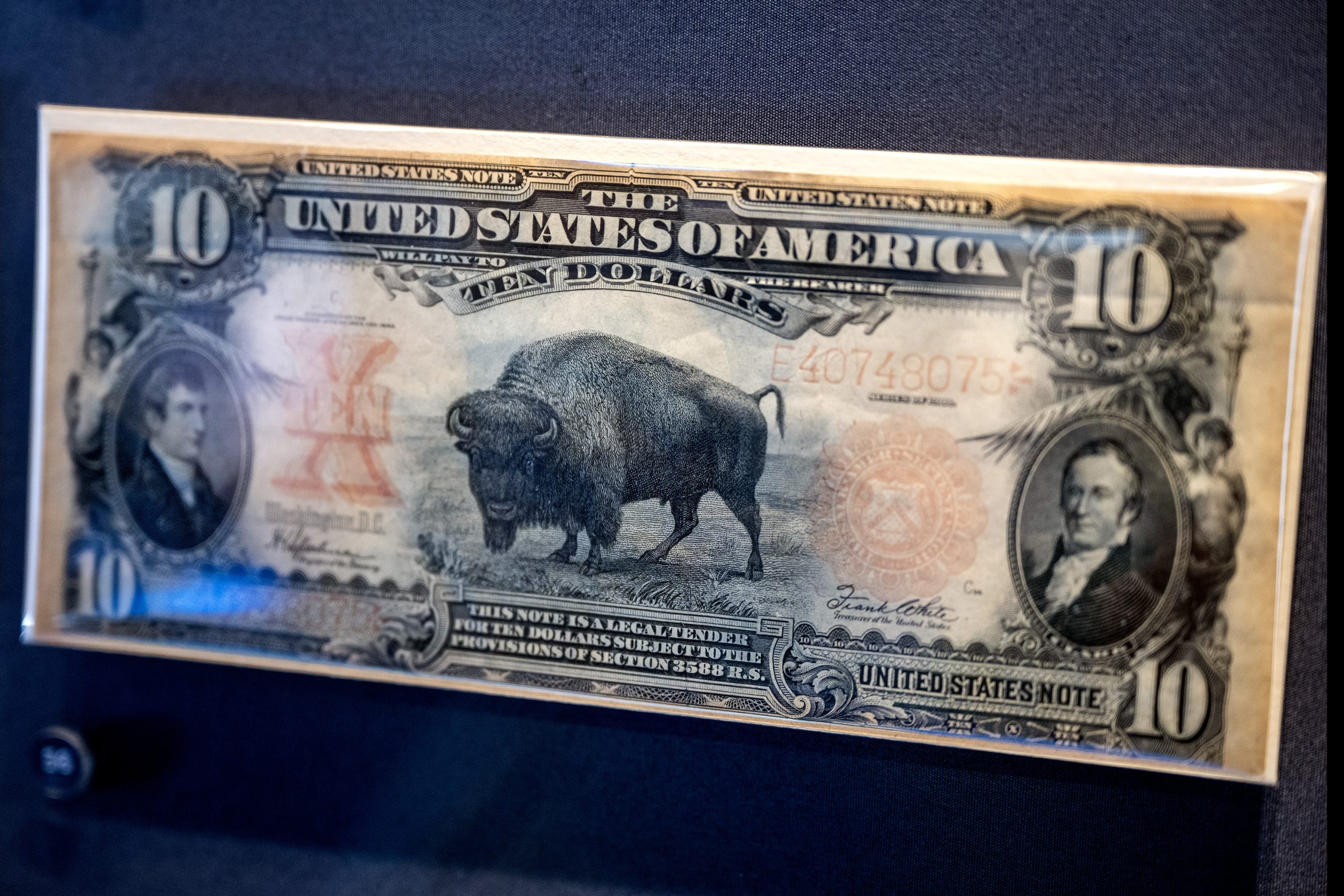
A 1901 $10 Bison Note on display at the Federal Reserve Bank of Philadelphia’s newly redesigned “Money in Motion” exhibit Thursday, May 7, 2026. The bill was issued during the 100 year anniversary of the Lewis and Clark expedition. The exhibit features nearly 400 historic artifacts and interactive installations that explore currency and the Federal Reserve’s mission.Tom Gralish / Staff Photographer
The Federal Reserve is headquartered in D.C., but there are 12 branches across the country; Philadelphia is home to one of them.
Today, the Federal Reserve acts as a fiscal agent for the U.S. Treasury, which issues paper money, collects taxes, and pays America’s bills. It does not offer private loans to businesses or individuals.
Like the national banks, the Federal Reserve also began with a 20-year-charter. But in 1927, Congress passed the McFadden Act, granting the Federal Reserve Bank perpetual succession.
“The government finally agreed that a federal banking system was something America needed,” Nash said. “It just took them more than 100 years to agree.”
America’s First National Bank Firstival will be celebrated on Saturday, July 4, from 11 a.m. to 1 p.m., the First Bank of the United States, 120 S. Third St.