On Tuesday, a casting call from Philadelphia-based casting agency Kathy Wickline Casting announced that the pop singer and Pittsburgh native was looking for non-union male dancers who live within an hour’s commute from Philadelphia, “unless you have family/friends to stay with in the area,” the call reads.
The quick turnaround call, which was open only for a day, sought talent between ages “20-30s” with a background in dance, acrobatics, or choreography. They should be fit like a soldier, the call specified, and although no military buzzcut is needed, their hair should not be long.
The dancers needed to make themselves available for the show on July 4 and a rehearsal on the day before.
The call closed on Tuesday afternoon. Kathy Wickline Casting did not respond to The Inquirer’s request for comment.
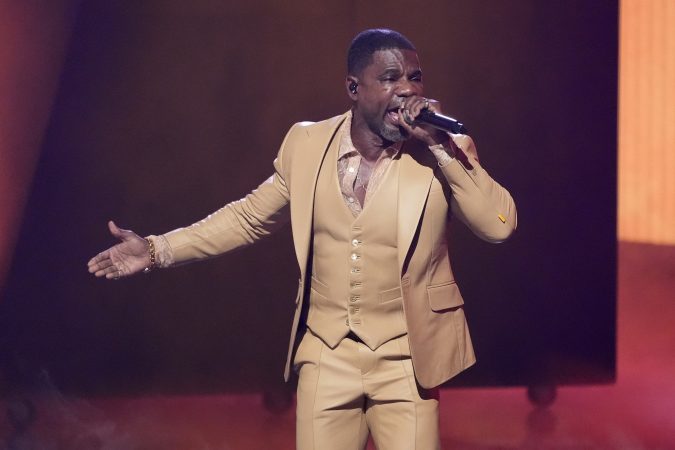
Her setlist for July 4 has not been announced, but Aguilera’s discography doesn’t boast songs directly related to the military.
However, the music video for her 2006 hit “Candyman” is World War II themed, featuring background dancers and Aguilera dressed in glamorized military uniforms. She also has several songs with themes surrounding strength and empowerment, such as “Fighter” and “Army of Me.”
Philadelphia’s celebration of America’s 250th birthday culminates July 4 with a free concert and fireworks on the Benjamin Franklin Parkway.
The One Philly: Unity Concert for America begins at 5 p.m. in front of the Philadelphia Museum of Art, featuring Christina Aguilera, Jill Scott, Meek Mill, Will Smith, The Roots, DJ Jazzy Jeff, Jordan Davis, Seal, State Property, Kathy Sledge, and more.
This year’s event is no longer part of the longtime Wawa Welcome America festival. Mayor Cherelle L. Parker’s administration took over production of the annual July Fourth concert, renamed it the One Philly: Unity Concert for America, and hired ESM Productions to produce the show.
Wanda Sykes will emcee the concert, which concludes with the city’s official fireworks display over the Parkway.
Here’s everything you need to know before you go.
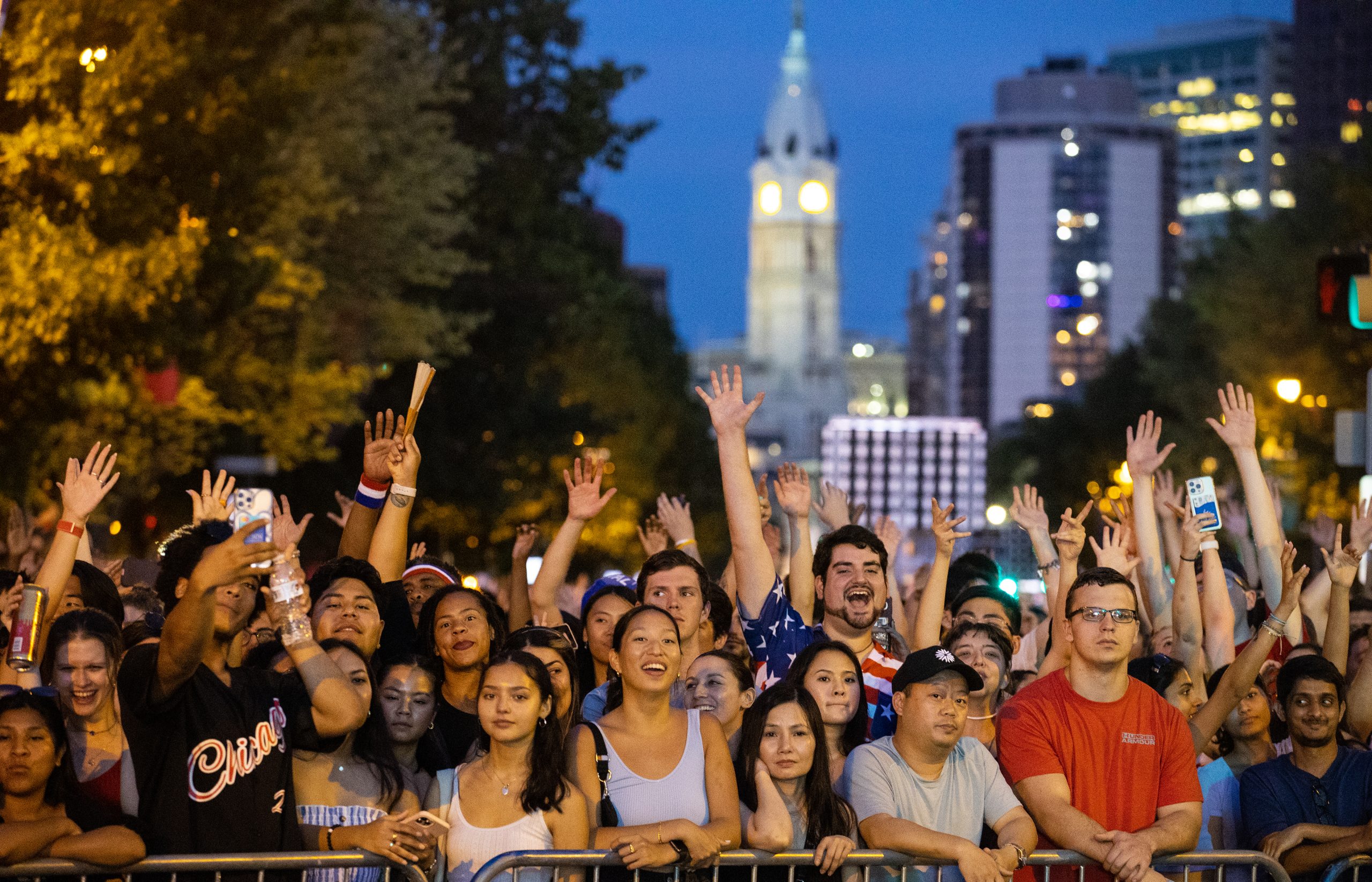
Fans react to the music as the Wawa Welcome America Festival concluded on July 4, 2023, with a free concert featuring Ludacris on the Benjamin Franklin Parkway.Charles Fox / Staff Photographer
Schedule and entry
Guests must enter through a secure checkpoint at 20th Street and Logan Circle, where security may search attendees and their bags. Gates open at 3p.m.
The concert will start around 5p.m., followed by the fireworks around 11:30 p.m., according to city officials.
Who is performing at Philadelphia’s Fourth of July Concert?
Headliners include Christina Aguilera, Jill Scott, Meek Mill, Will Smith, The Roots, and DJ Jazzy Jeff.
Other performers include Jordan Davis, Kathy Sledge, State Property, Seal, and several others.
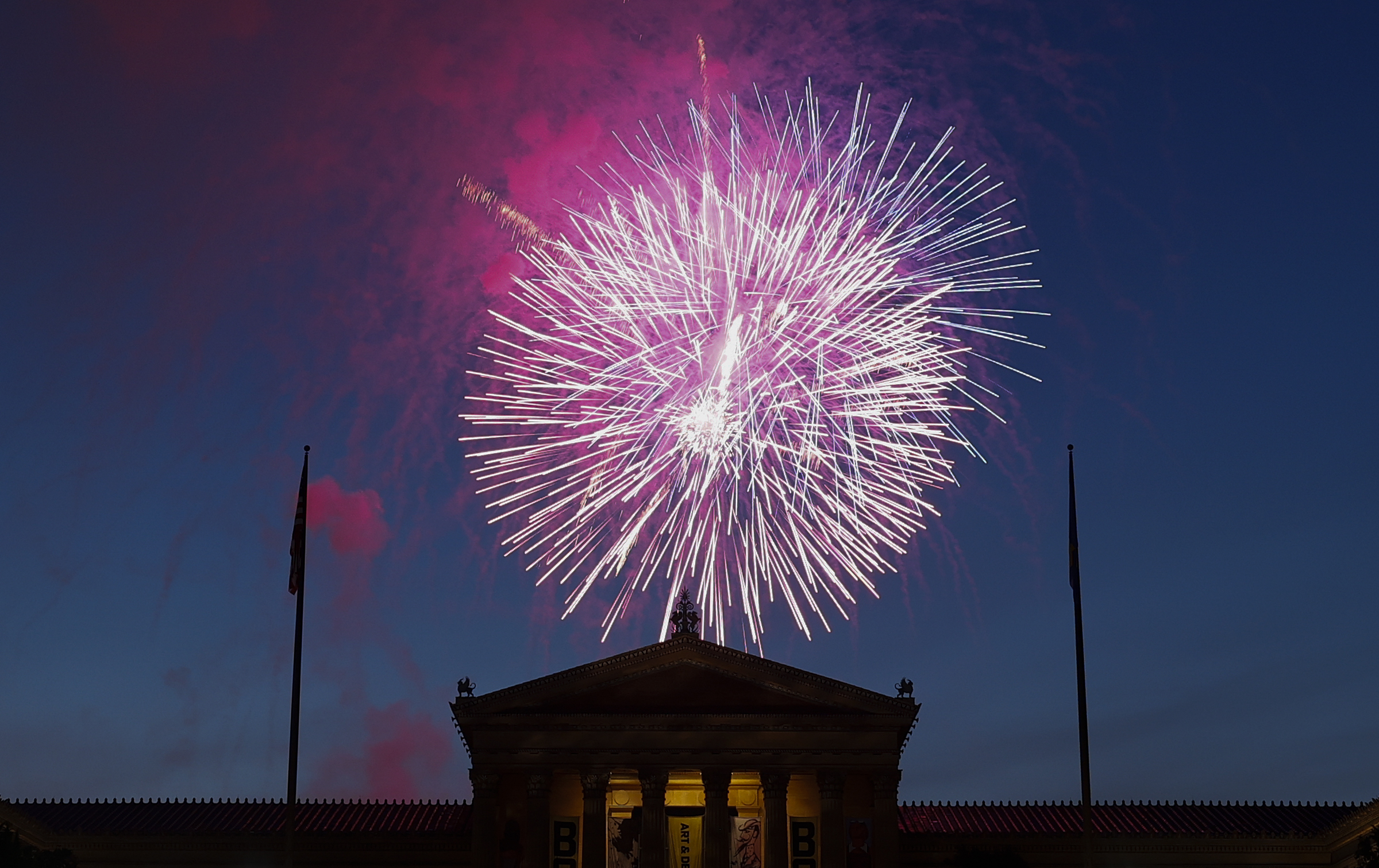
Fireworks over the Philadelphia Museum of Art along the Benjamin Franklin Parkway on Friday, July 4, 2025.Yong Kim / Staff Photographer
Fireworks
Following the concert, the city’s official July Fourth fireworks display will begin at about 11:30 p.m. The show will be visible from throughout the Parkway and surrounding neighborhoods.
The concert and fireworks will also air live on NBC10 and Telemundo62.
Road closures
Unless otherwise noted, the following closures will be in effect from approximately 6 a.m. Friday through 6 a.m. Monday:
1900 Race Street
1800-1900 Vine Street
I-676 off-ramp at 22nd Street
I-676 on-ramp at 22nd Street
I-76 eastbound off-ramp at Spring Garden Street
Spring Garden Tunnel
Park Towne Place between 22nd and 24th Streets
20th Street between Arch Street and Pennsylvania Avenue
19th Street between Callowhill and Cherry Streets
Benjamin Franklin Parkway from 17th Street to Eakins Oval
Eakins Oval
Kelly Drive between Eakins Oval and Fairmount Avenue (inbound traffic closes at Fountain Green Drive beginning about 5 p.m.)
2000-2100 Winter Street
Spring Garden Street between Pennsylvania Avenue and 31st Street
23rd Street between Pennsylvania Avenue and Eakins Oval
22nd Street between Winter Street and Pennsylvania Avenue
21st Street between Winter Street and Pennsylvania Avenue
All roads from Arch Street to Spring Garden Street between 18th and 22nd Streets (local access maintained for residents)
All roads from Arch Street to Fairmount Avenue between 22nd and Corinthian Streets (local access maintained for residents)
16th and 17th Streets between Arch Street and Spring Garden Street will close only if conditions warrant.
1600-1700 Benjamin Franklin Parkway will close only if conditions warrant.
Beginning at 4 a.m. Saturday, the following roads also will close:
Anne d’Harnoncourt Drive behind the Philadelphia Museum of Art
Martin Luther King Jr. Drive from Falls Bridge to Eakins Oval
From 8 p.m. Saturday until approximately 1 a.m. Sunday, Kelly Drive between Fairmount Avenue and Fountain Green Drive and Waterworks Drive also will be closed because of the fireworks display.
Parking
Temporary no-parking signs will be posted along streets affected by closures. Vehicles left in those areas will be courtesy towed to another nearby location.
Most Regional Rail lines will offer additional inbound and outbound service before the fireworks. All Regional Rail lines except the Airport and Cynwyd lines will provide late-night outbound service from Jefferson Station, Suburban Station, and William H. Gray III 30th Street Station after the fireworks.
Other SEPTA service will operate on a Sunday schedule. Routes without Sunday service will not operate.
Routes 7, 32, 33, 38, 43, 48, and 49 will be detoured beginning at 5 a.m. Thursday through 5 p.m. Sunday because of road closures.
SEPTA ambassadors will be stationed at major transit hubs to help direct passengers after the July 4 FIFA World Cup match and the One Philly concert and fireworks.
PATCO will operate on a holiday schedule July 4, with trains running every 10 minutes throughout the day. More information is available at ridepatco.org.
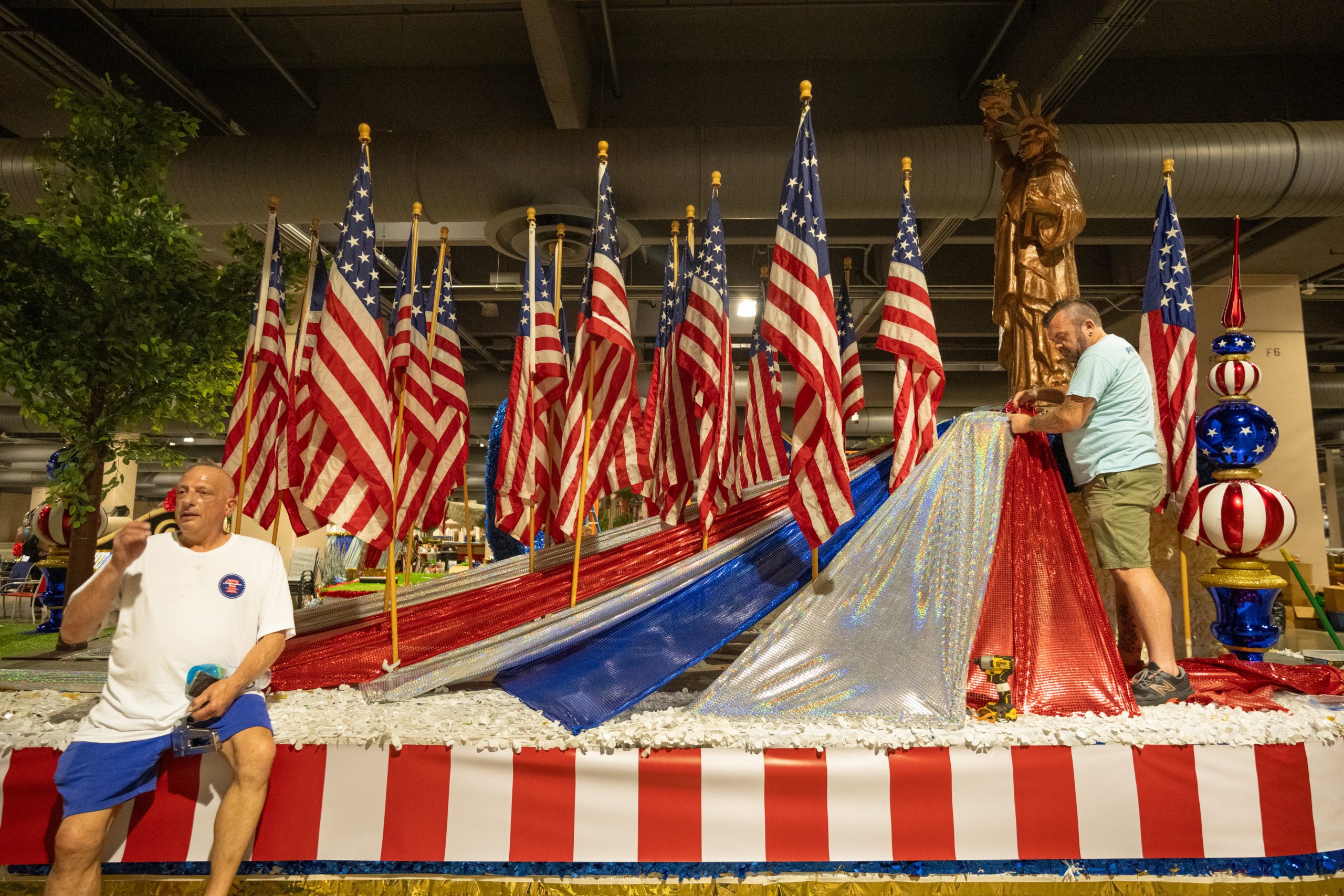
Todd Marcocci (left) and Jeremy Williams work on a float on Monday for this year’s big Fourth of July parade, in Philadelphia.Jessica Griffin / Staff Photographer
Fourth of July celebrations happening elsewhere in the area
Fourth of July Freedom Festival at Pleasant Hill Park: 💵 Free, 🕒 July4, 5 to 9:30 p.m., 📍Linden Ave., Philadelphia, Pa 19136
We all have a mental image of Benjamin Franklin, thanks to the $100 bill: balding, middle-aged, with tiny glasses and a stern look.
But what if he had a full head of hair poking out the sides of his tricorn? What if we saw Franklin singing and jamming on a guitar?
The Sound of America, a new musical showing at FringeArts this month, imagines Franklin as a young man: America’s very first rock star who finds fame after discovering electric rock and roll from the power of a lightning strike.
In the musical, he gains fame and fortune as a rock star. But stardom sweeps him up and pulls him away from the people and values that once defined him as a struggling musician, leaving him to question his true identity.
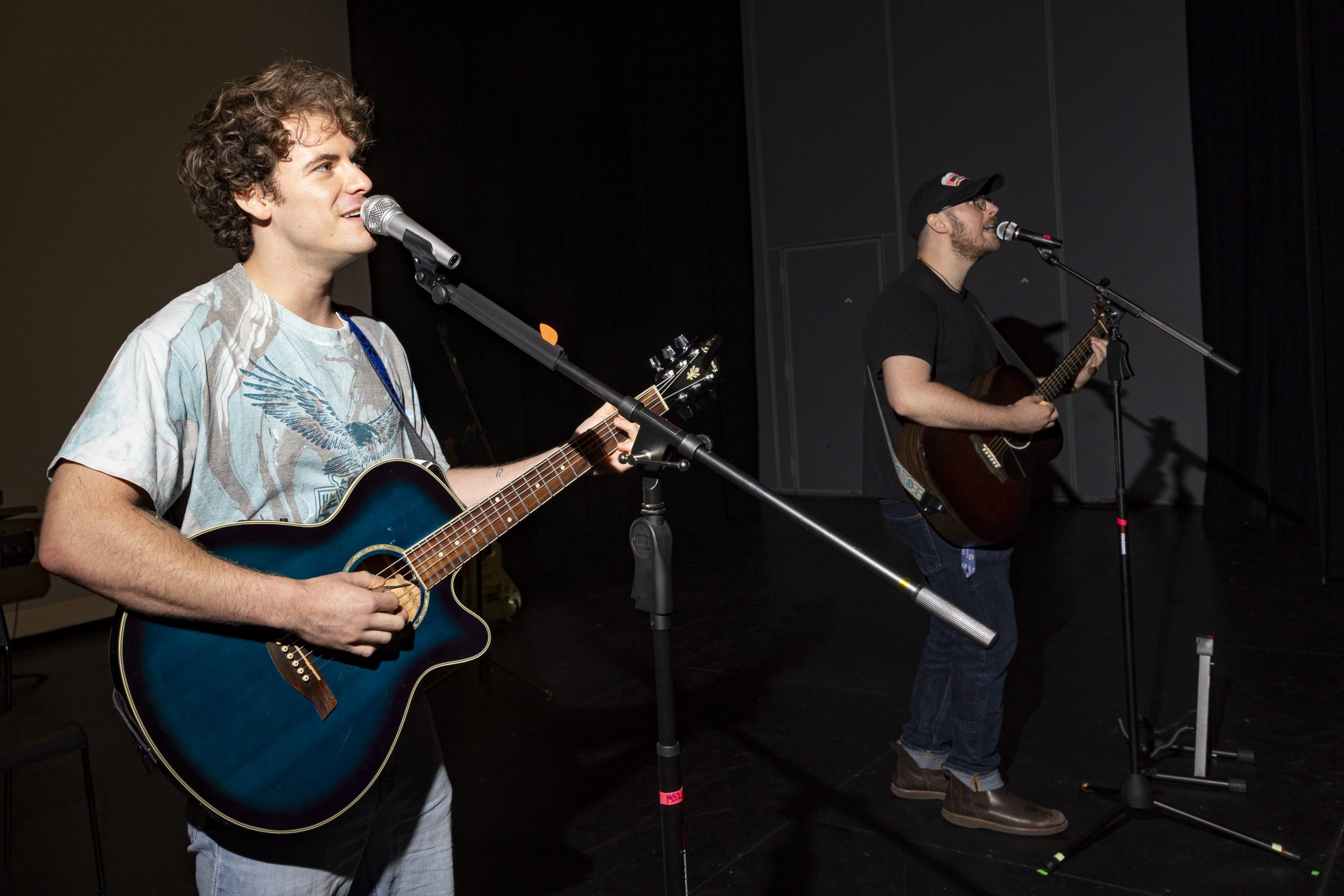
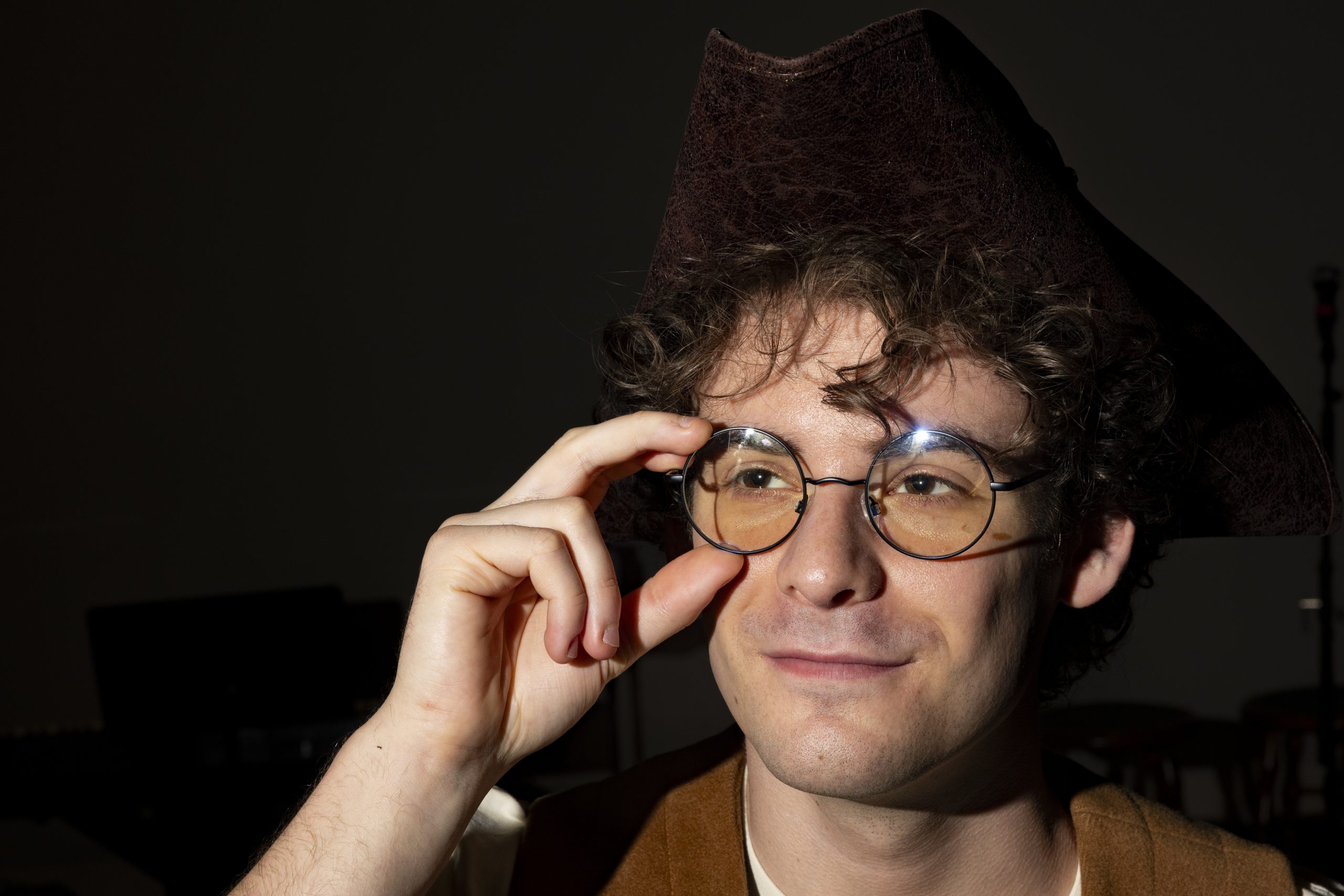
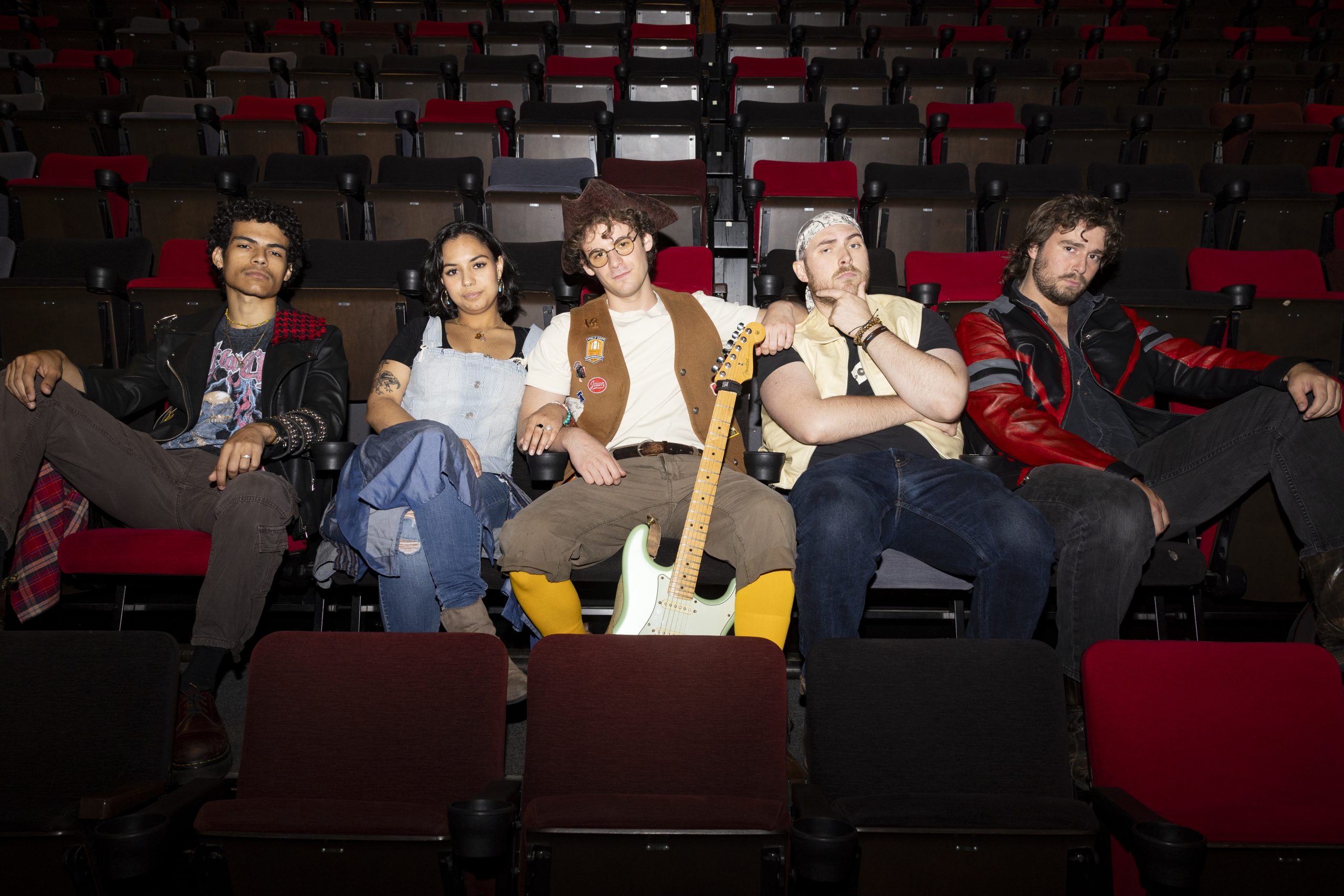
Leading the ensemble cast is a newly minted Temple musical theater graduate, Kohl Pilgrim. Last week, he stood with fellow actors Federica Andino-Vega and Jameson May, who play Franklin’s wife Deborah Read and best friend Hugh Meredith, respectively.
Pilgrim and cast play their instruments live, serving as both performers and a band.Aidan T. Gallo / Staff Photographer
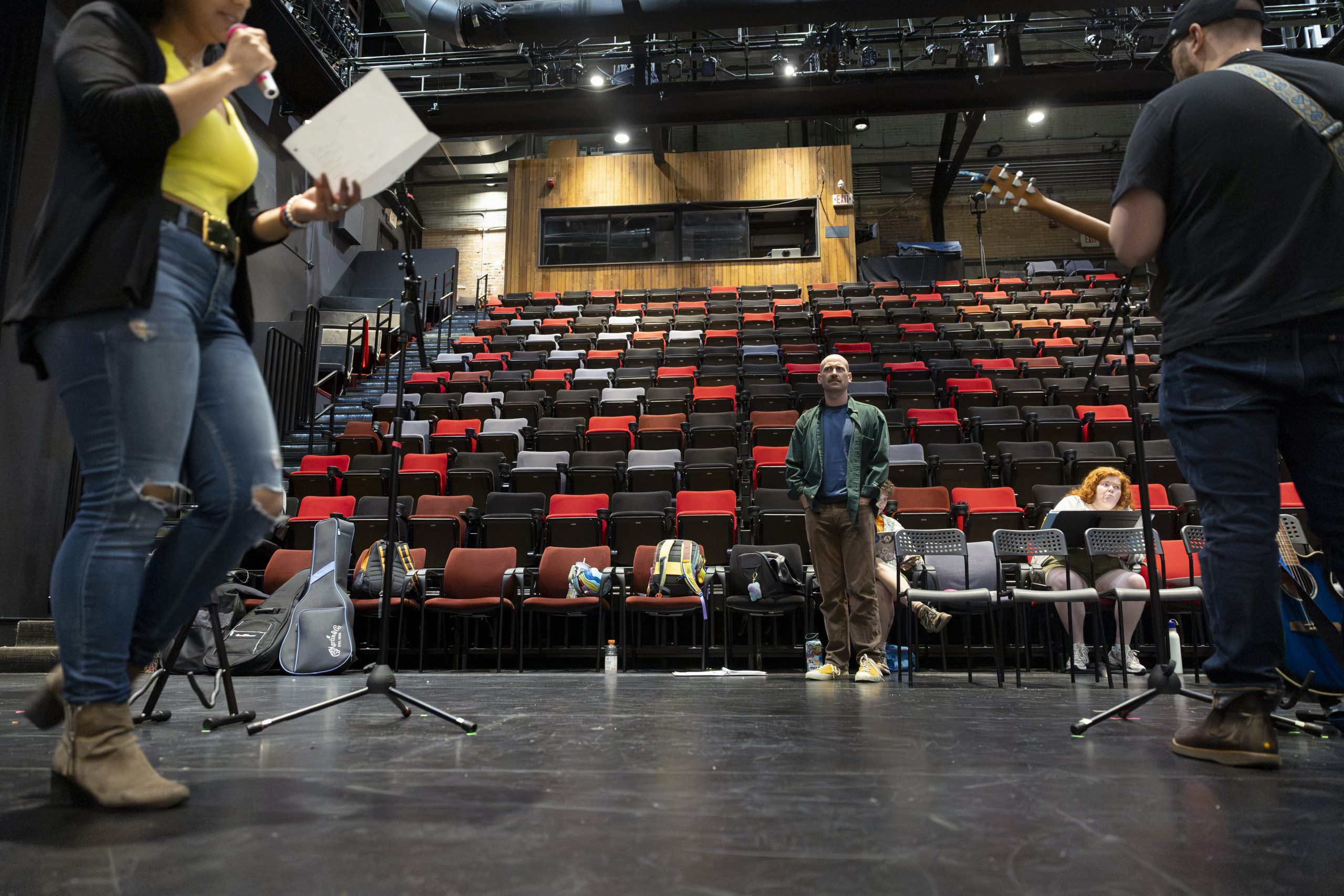
Delivering their lines and singing at microphone stands, Nashville Bluebird Cafe-style, the three practiced blocking the scene where Franklin and Read first meet. After a flirty exchange, a naive and confused Franklin finds out Read is married to a man who has disappeared without evidence of his death.
“We tend to see [Founding Fathers] as these infallible perfect people who created the perfect society,” director and Temple professor Kyle Metzger said. “It’s exciting to see a young Founding Father making mistakes and being complex and messy. It’s important to remember these were people, too, who didn’t have all the answers and were trying their best.”
The choice of protagonist was a no-brainer for the musical’s cocreator and Emmy-award winning producer Randall Lane and longtime friend and singer-songwriter Todd Schwartz.
“Under Poor Richard, he was the lyricist for colonial America,” said Lane, referring to Franklin’s pseudonym under which he published a yearly almanac. “And then when he discovered the lightning rod, he literally became the first American who was world famous, and toured the world.”
Just like a young rock star.
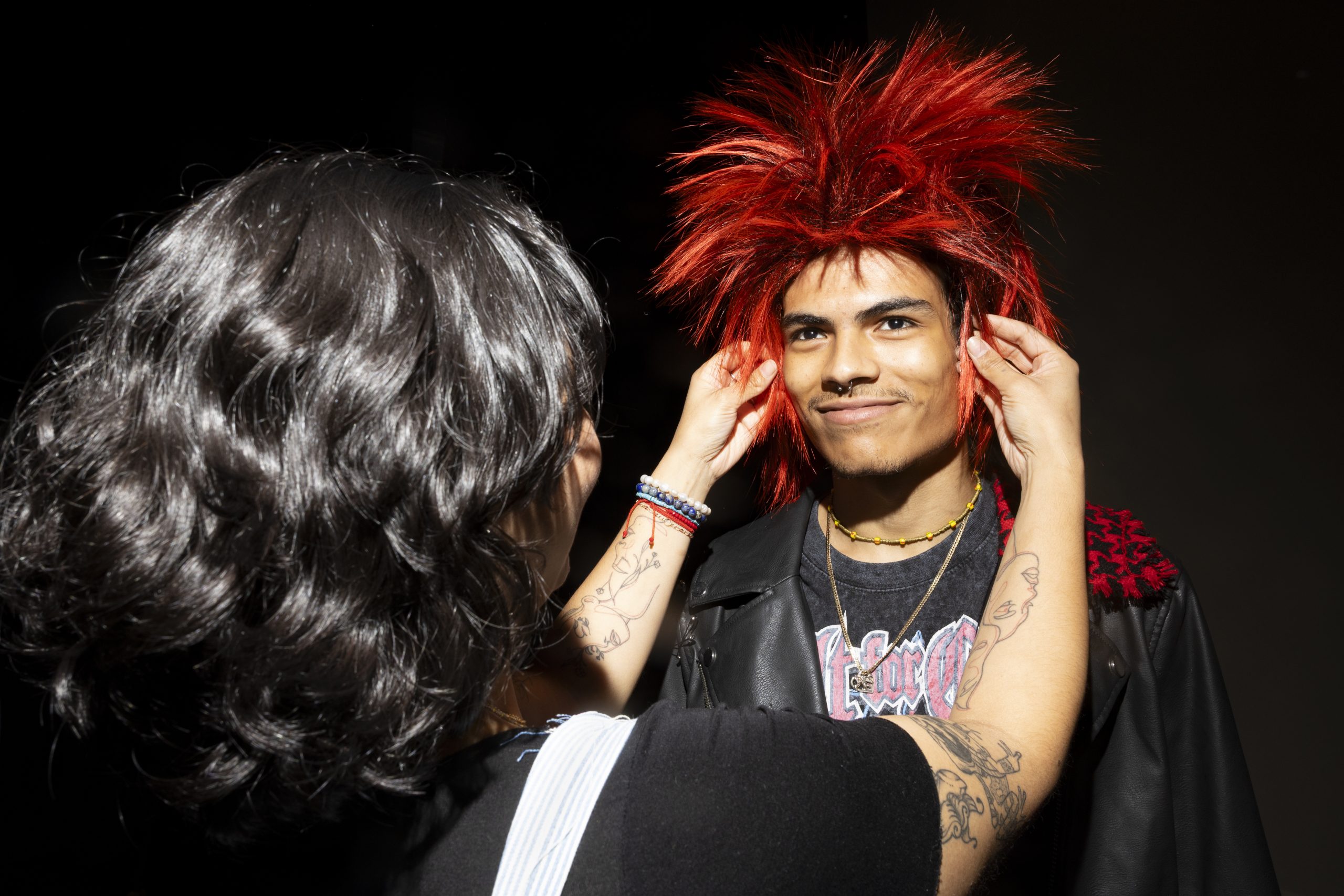
Federica Andino-Vega (left), who plays Franklin’s wife Deborah Read, adjusts Gerson Malave’s wig during a dress rehearsal for “The Sound of America” on June 24.Aidan T. Gallo / Staff Photographer
Lane, who is also the editor in chief of Forbes magazine, lives in Saratoga Springs but feels deeply connected to Philadelphia through the years he went to Penn to study history and political science.
For him, Franklin “checked every box.”
“He was a teenage fugitive who ran away from home and every Friday he was hanging out [at] the Leather Apron Club,” the mutual-improvement society Franklin and his friends founded in 1727, said Lane.
Every week, they’d meet in taverns, “jamming out intellectual ideas,” said Lane. In the case of his musical, they create a garage band.
Franklin, after all, invented the glass harmonica.
The musical’s soundtrack includes 23 original songs cowritten by Lane and Schwartz, influenced by Queen, Nirvana, Bruce Springsteen, and the Beatles. Metzger describes the production as “80% rock concert, 20% musical.”
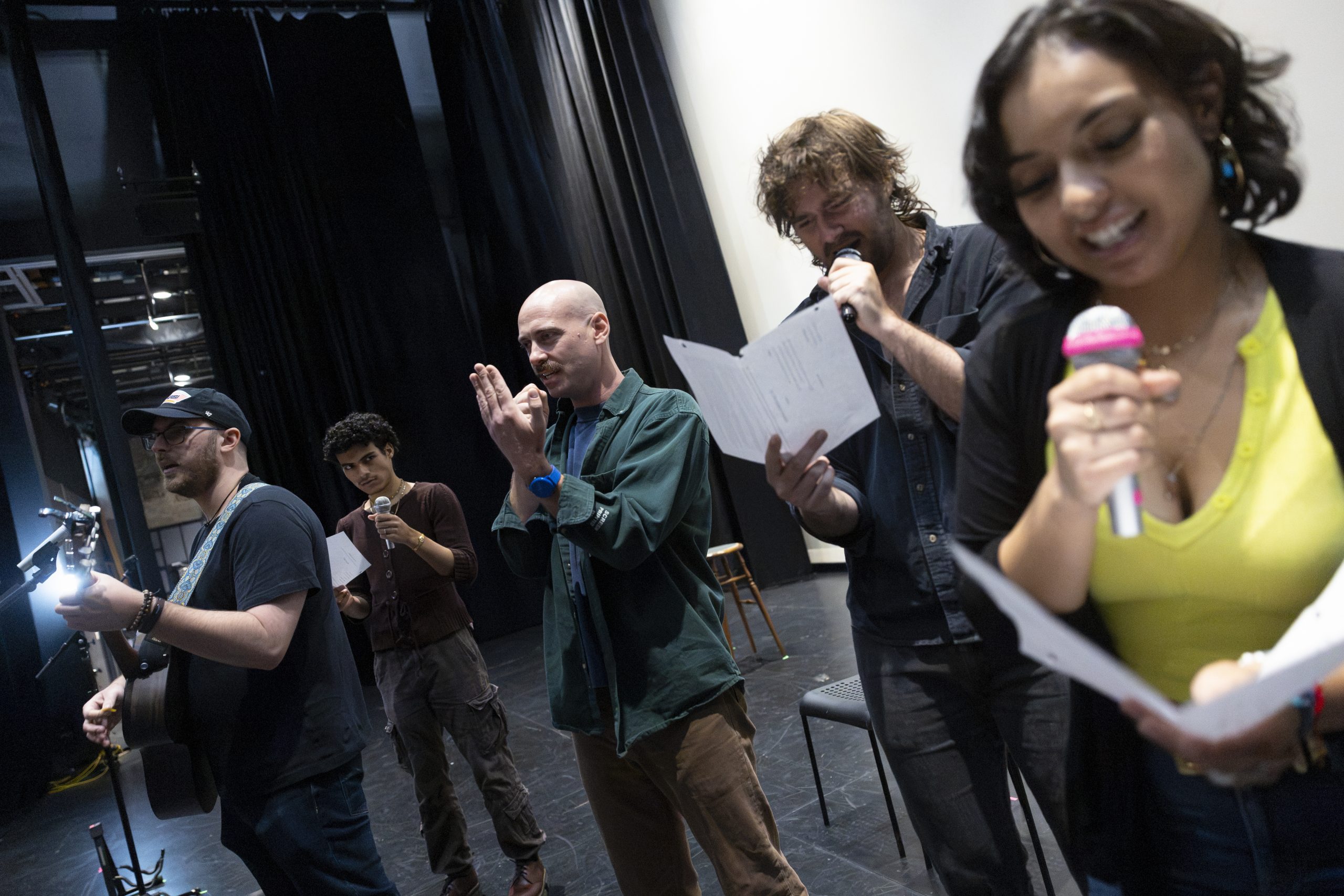
Kyle Metzger (center), the director for “The Sound of America,” directs the cast inside FringeArts for the forthcoming musical on June 24.Aidan T. Gallo / Staff Photographer
The cast will serve as narrators at the front of the stage, while a live band plays behind them. Floor seats will be available and swaying arms and singing along will be highly encouraged. It’s meant to feel like a concert and not just another historical “rock” musical (sorry, Hamilton).
“I’m always drawn to theater that’s untraditional or pushing into other mediums or incorporating other art forms,” Metzger said.
True to style, The Sound of America also doubles as a walking tourled by Pilgrim, still in character as Benjamin Franklin. After curtain call, audiences can participate in a tour of Franklin’s Old City house and grave, a short walk away from the FringeArts venue.
Needless to say, Pilgrim has had to really pack on the homework for this portion of the show.
“Most of my free time when I am not in rehearsal or with friends, I am home reading his autobiography,” he said. “I am reading anything I possibly can because there’s probably going to be a kid that’s like ‘What’s his favorite food? Did he like burgers?’ So I’m researching that, too.”
Barrymore award-winning director Kyle Metzger is also a professor in Temple’s Musical Theater program.Aidan T. Gallo / Staff Photographer
When asked about Franklin’s favorite drink, Pilgrim was certain it was wine. As for his hypothetical Jersey Shore vacation spot, Pilgrim named Cape May.
“I think he would like the houses,” he said.
“I want to pay homage to how honest, wise, and hard-working he was,” said the actor, who sought inspiration from iconic rock figures like David Lee Roth, Elvis Presley, and Sir Roger Daltrey, frontman of the Who.
Daltrey, in fact, makes a remote cameo in the musical, in support of Teen Cancer America, the nonprofit he founded along with Who bandmate Pete Townshend.
Lane and Schwartz’s royalties will be donated to the charity, which partners with Children’s Hospital of Philadelphia (CHOP). The production is also collaborating with Federal Donuts & Chicken for a specialty doughnut called “The Ben”; a portion of its sales will benefit the cause.
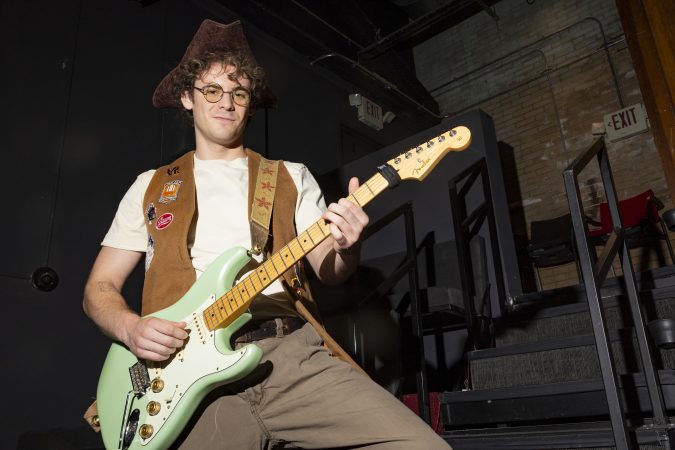
Kohl Pilgrim, the actor bringing Ben Franklin’s rock and roll persona to life, inside FringeArts.Aidan T. Gallo / Staff Photographer
“We want this to be a really big win to fight cancer, but we think that it’s also super true to the spirit of Benjamin Franklin,” Lane said. “He was a rock star in all the senses, but he was also somebody who really cared about where he lived, and we want to leave Philadelphia better than we found it.”
But as with any rock star, Franklin’s story would be nothing without his entourage.
In addition to wife Read and bestie Meredith, the ensemble cast includes British antagonist Lord Wedderburn, played by Kaedon Knight and Franklin’s illegitimate son William Temple Franklin (aka “WTF”), played by Gerson Malave.
Read is the only female character in the show, accompanying Franklin on his journey to stardom. Though she is often forgotten in history, her common-law marriage to Franklin saw her holding down the Franklin household and publishing company with a shotgun during the unrest of the Stamp Act.
“She was a baddie, the baddie on Market Street,” Andino-Vega said. “But [Franklin] got most of the spotlight just because she was very shy and a bit illiterate. I want to shine a light on those special ladies that have been forgotten, and bring them up a little more in a way where they can also be seen like Ben Franklin.”
The cast of “The Sound of America” are committed to delivering a rock concert, not just a musical.Aidan T. Gallo / Staff Photographer
The cast and crew, largely Philadelphia-based and/or raised, are deeply committed to reflecting the grit of the city through this unique portrayal, especially in light of the 250th anniversary of the nation.
“It’s almost like Ben was talking to us saying this year’s really important and this summer is important to Philadelphia,” Lane said. “It gives everybody that visits Philly a reminder that Philadelphia was the birthplace of democracy and it’s the soul of America.”
The Sound of America runs July 1-Aug. 1 at FringeArts, 140 N. Christopher Columbus Blvd. Tickets start at $60. soundofamericamusical.com, 215-413-1318, or hello@fringearts.com.
A previous version of the article misidentified the actors playing Hugh Meredith and Lord Wedderburn. Jameson May and Kaedon Knight play the characters respectively.
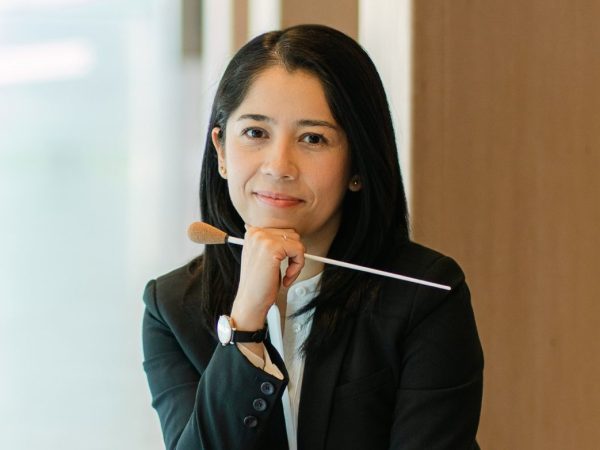
When Sara Aldana auditioned for the coveted Philadelphia Orchestra assistant conductor spot in April, she tried out in front of the ensemble with Copland and Bartok.
For the third piece, she chose an excerpt from Rachmaninoff’s Symphony No. 2. The Russian composer is closely associated with the Philadelphians — he once called the orchestra the greatest in the world — and the second symphony, Aldana said, was close to her heart.
“I was like, whatever happens with the audition, I just want that memory of — wow — doing Rachmaninoff Two with Philadelphia for five minutes.”
Now she’ll be spending many more minutes with the Philadelphians. Aldana won the audition, and is the orchestra’s next assistant conductor, the group announced Wednesday.
The position is a junior one, though it has been a steppingstone to bigger opportunities. Aldana follows Naomi Woo, who has already been engaged as a guest conductor next season.
Aldana studied with Philadelphia Orchestra principal guest conductor Marin Alsop and worked as a cover conductor with the Detroit Symphony Orchestra. As assistant conductor in Philadelphia, she will lead family and special concerts and give pre-concert talks.
One of her biggest responsibilities will be one that the public may never get to see — or that could make her career. She will serve as cover conductor, which means she could be tapped to lead a Philadelphia Orchestra concert at any moment if the scheduled conductor falls ill or is otherwise unable to perform at the last minute.
“I always think it’s like the Formula 1 reserve driver, you know? You might not be driving the car, but you could get a call and you have to get on, driving the car,” she said Aldana.
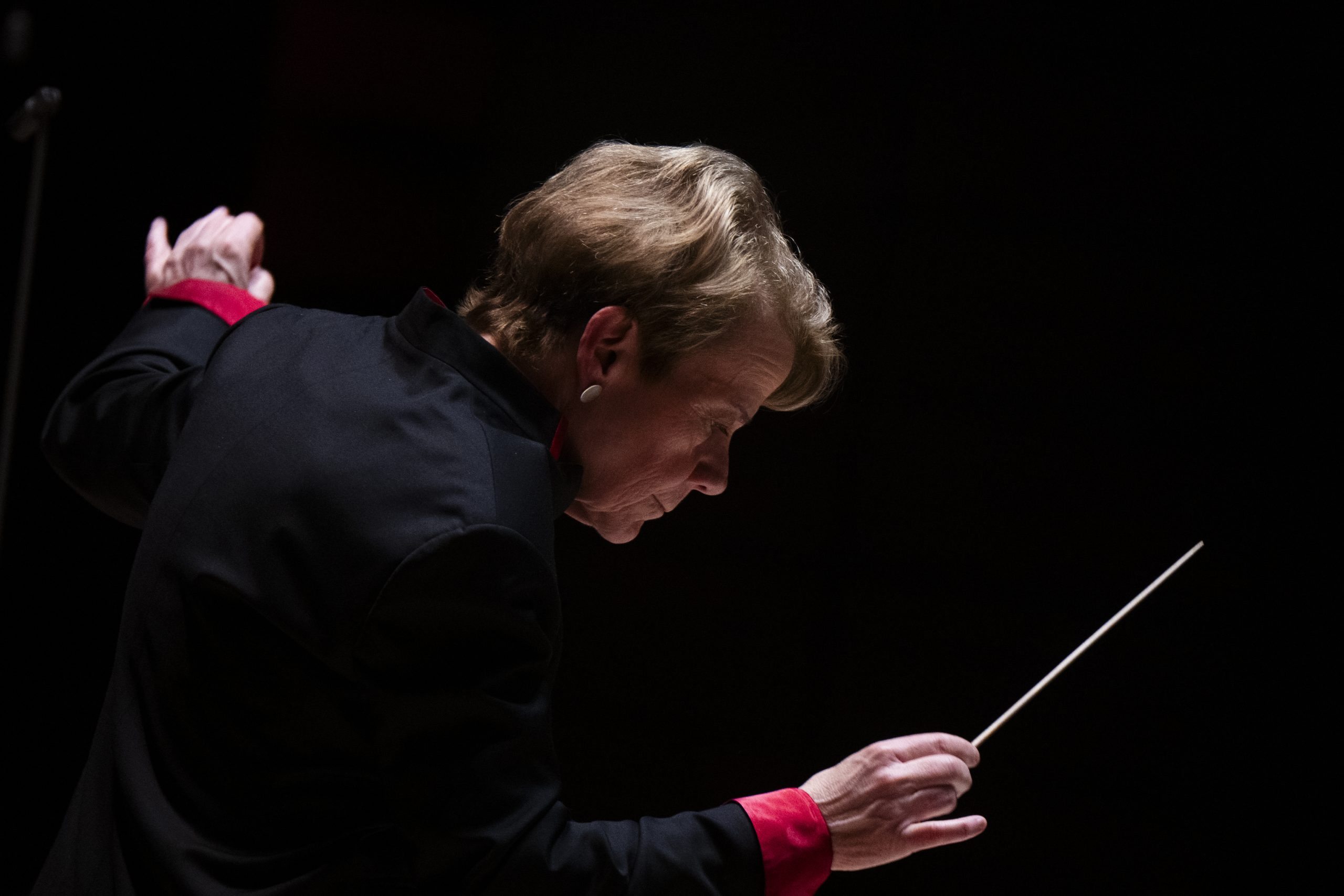
Conductor Marin Alsop — who has worked with Aldana — leading the Philadelphia Orchestra, May 28, 2026, in Marian Anderson Hall.Joe Lamberti / For The Inquirer
Aldana, 30, was born in Bogotá, Colombia, and earned an undergraduate degree in violin performance at the University of Texas at Austin. She holds a master’s degree in orchestral conducting from the University of Michigan, where she studied with Kenneth Kiesler, and did further studies with Alsop and Joseph Young at the Peabody Institute of the Johns Hopkins University.
She has served as assistant conductor of the Reno Chamber Orchestra and is a 2026 mentee with the Taki Alsop Conducting Fellowship.
Aldana was at Peabody for a year, but left after winning the Philadelphia audition.
That tryout ended with five finalists for the job. Each had a short time conducting the orchestra, dipping into excerpts of various styles — Copland’s Appalachian Spring, Bartok’s Miraculous Mandarin Suite, and the third piece, which the finalists could choose themselves from among three possibilities.
All five chose the last few minutes of the famously emotive third movement of Rachmaninoff’s Symphony No. 2.
Why this piece?
“I’m a violinist by training, and so I absolutely love Rachmaninoff Symphony No. 2.”
The audition lasted all of 15 minutes.
“Fifteen minutes is a short amount of time, but you realize with Philadelphia, it’s all you need to get a good idea of who they are as an ensemble and the culture that they have as a group. It just happened to be a beautiful connection.”
Although Aldana started out as a violinist, she long harbored, even as a child, an interest in conducting.
“Your instrument is the orchestra, all these colors, and it’s just getting to play with all of them — how you create sound, balance, getting to discover, you’re continuously learning. That’s something that really appealed to me.”
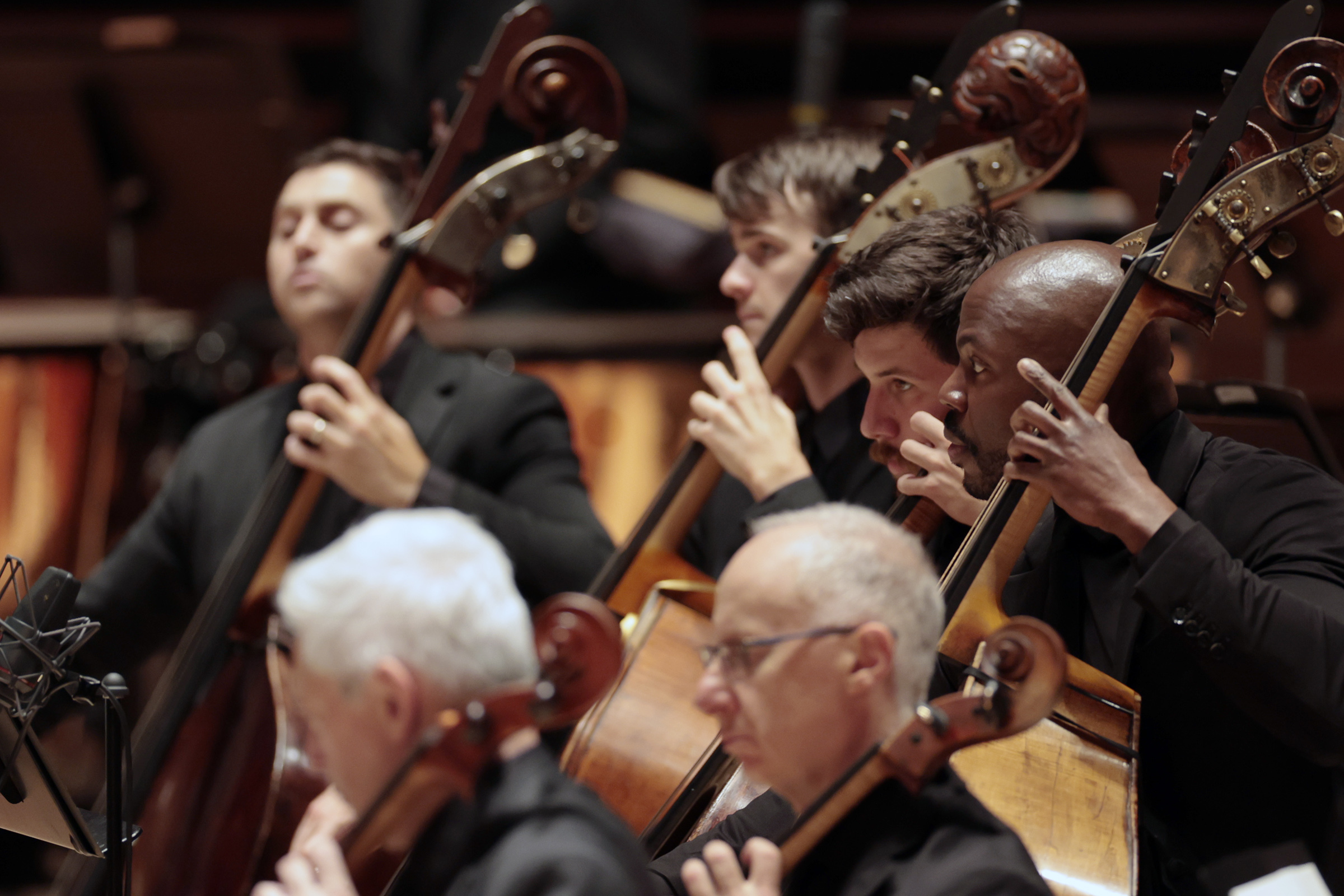
The double bass section of the Philadelphia Orchestra performing on opening night of the 2025-26 season in Marian Anderson Hall, Sept. 25, 2025.Elizabeth Robertson / Staff Photographer
Aldana’s official start is Sept. 1. Her first scheduled concert with the orchestra is a Jan. 2 matinee in Marian Anderson Hall of Strauss family waltzes and other works.
Asked what piece she might dream of someday conducting with this orchestra, Aldana said any Tchaikovsky symphony, but especially the Sixth.
“There was an Ormandy recording that I remember listening to a lot. I was obsessed with this piece — obsessed. I remember that lush of the strings in the most heart-wrenching moments.”
Is there a piece she would find too daunting to conduct?
“Daunting. Hmm. I don’t think so.”
Does that mean she’s musically fearless?
“I am a little fearless,” she said, “when you have one of the best orchestras in the world in front of you.”
In the early 1780s, Revolutionary War era Jewish patriot and Philadelphian Lt. Col. David S. Franks had a desperate work situation in hand.
He had served as one of Benedict Arnold’s high-ranking personal assistants, and after Continental militiamen discovered Arnold’s intentions to sell America out to the British in 1780, it became nearly impossible for Franks to find ajobwith the United States government.
Franks was cleared of wrongdoing. But working with Arnold made the Founders wary of employing Franks.
But not Thomas Jefferson, who hired Franks as his secretary. By the time the Treaty of Paris ending the Revolution was ratified in January 1784 in Annapolis, Md., then America’s capital, Franks had been Jefferson’s secretary for almost a year.
It was Franks who carried at least one official copy of the finalized treaty to Benjamin Franklin — who was in Paris at the time — and other officials in Britain and France.
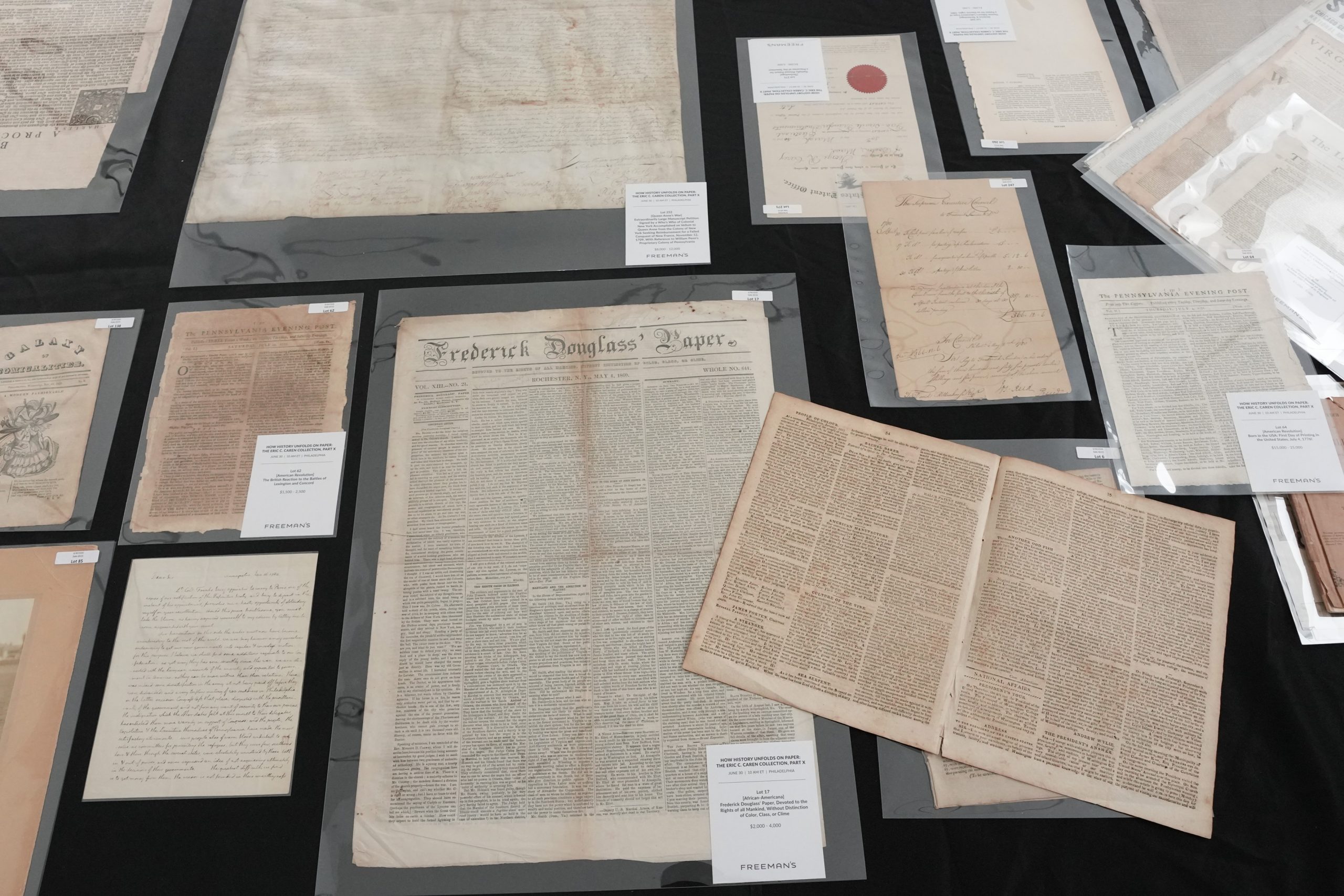
Frederick Douglass’ Paper (front center) and other documents, part of the collection “How History Unfolds on Paper: Important Americana from the Eric C. Caren Collection,” which boasts more than 320 rare newspapers, books, pamphlets, and ephemera tracing the development of printing and publishing in America, an enterprise that started in Philadelphia in1690 with the first paper mill.Jessica Griffin / Staff Photographer
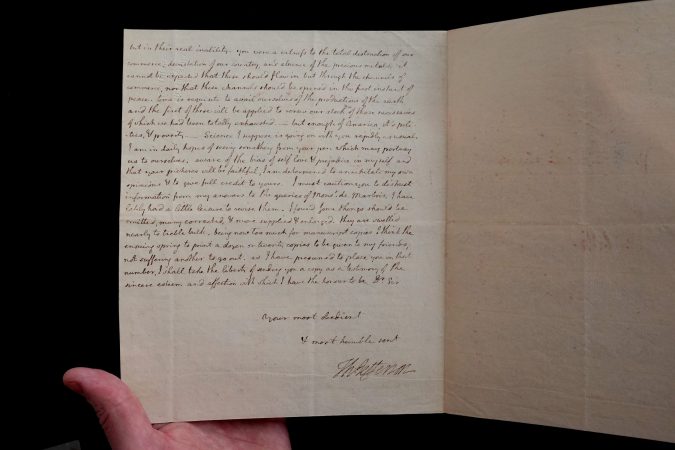
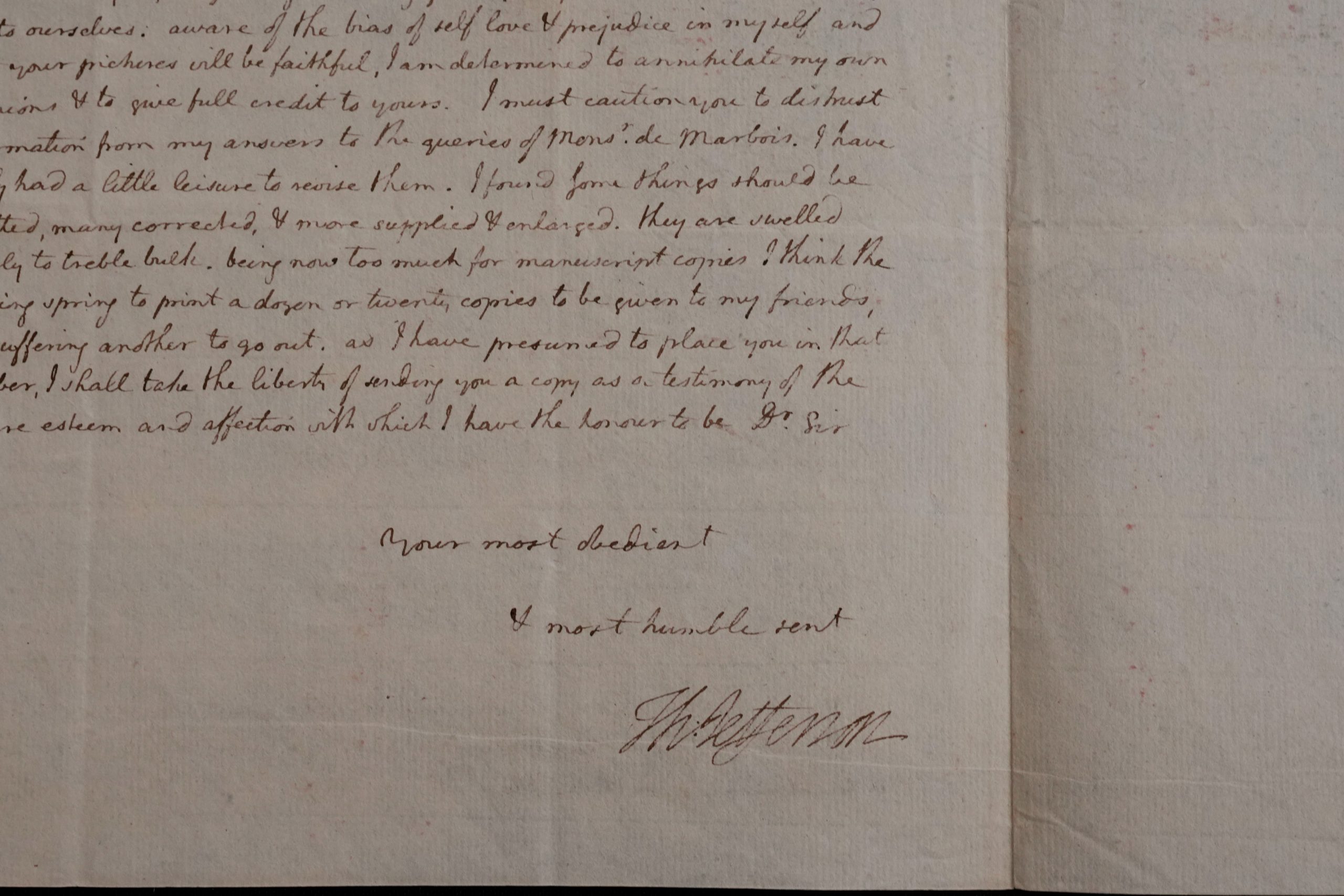
Franks also carried a two-page letter written in Jefferson’s customary neat hand for Francois Jean de Beauvoir, Chevalier de Chastellux. It was a friendly message between the longtime acquaintances, in which Jefferson wrote to the French noble about how America was progressing as a sovereign nation and about his forthcoming book Notes on The State of Virginia.
That letter sold for $108,000 Tuesday as part of an online and in-person auction presented by Philadelphia’s Freeman’s auction house.
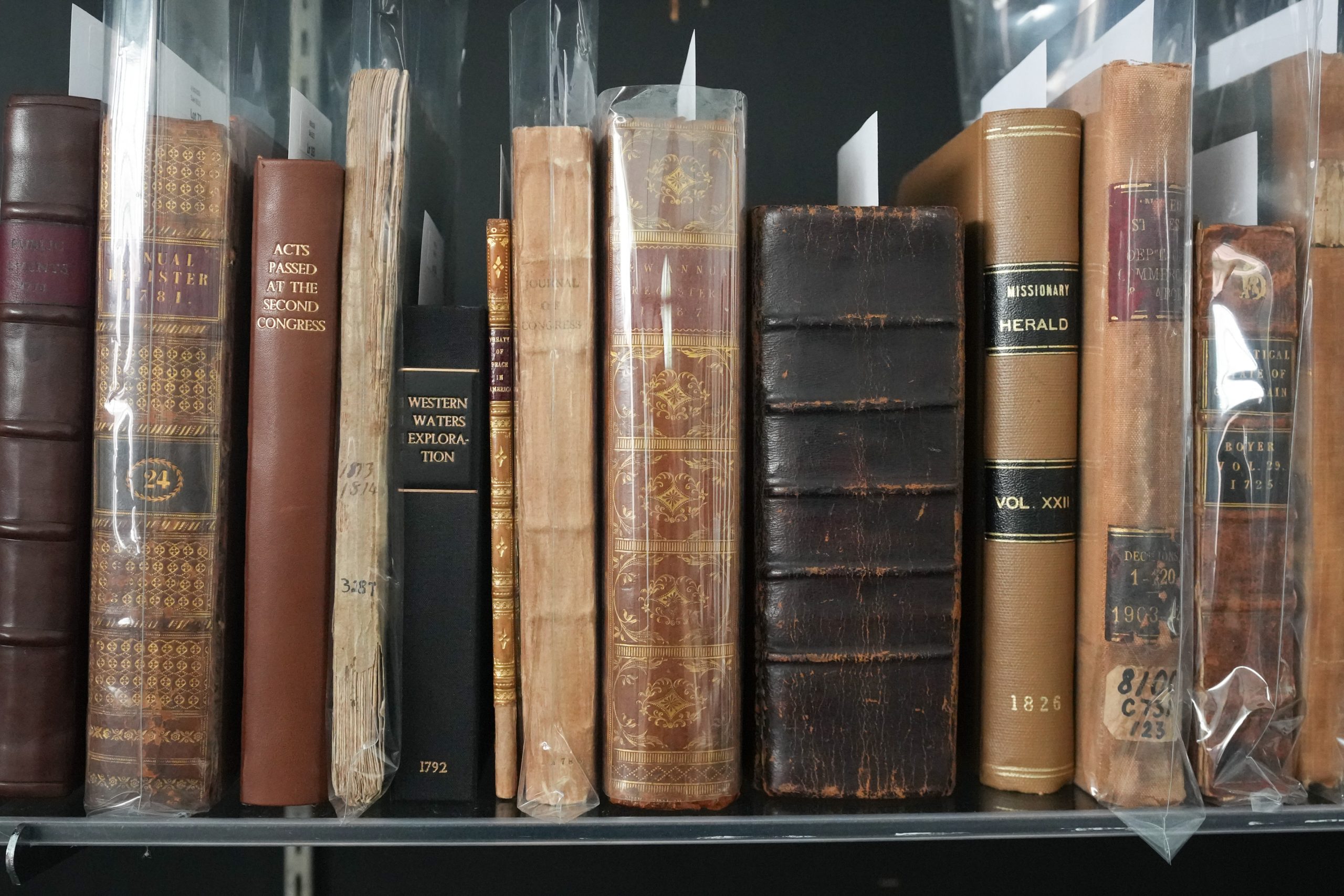
Books from the collection “How History Unfolds on Paper: Important Americana from the Eric C. Caren Collection,” which boasts more than 320 rare newspapers, books, pamphlets, and ephemera tracing the development of printing and publishing in America.Jessica Griffin / Staff Photographer
“Caren goes where the history leads him. His collection reflects that,” said Darren Winston, Freeman’s senior vice president and head of the books and manuscripts department. “When he asked us to host a sale in honor of the 250th, we immediately said yes.”
18th century news treasures
The vast sepia-hued collection of aged newspapers and bound volumes was heaven sent for primary-source junkies who can afford to plop down a few hundred or several thousand dollars for the kinds of historical gems usually found only on microfilm. It’s also a gold mine for those who think hundred-year-old newspapers in near mint condition are frame-worthy.
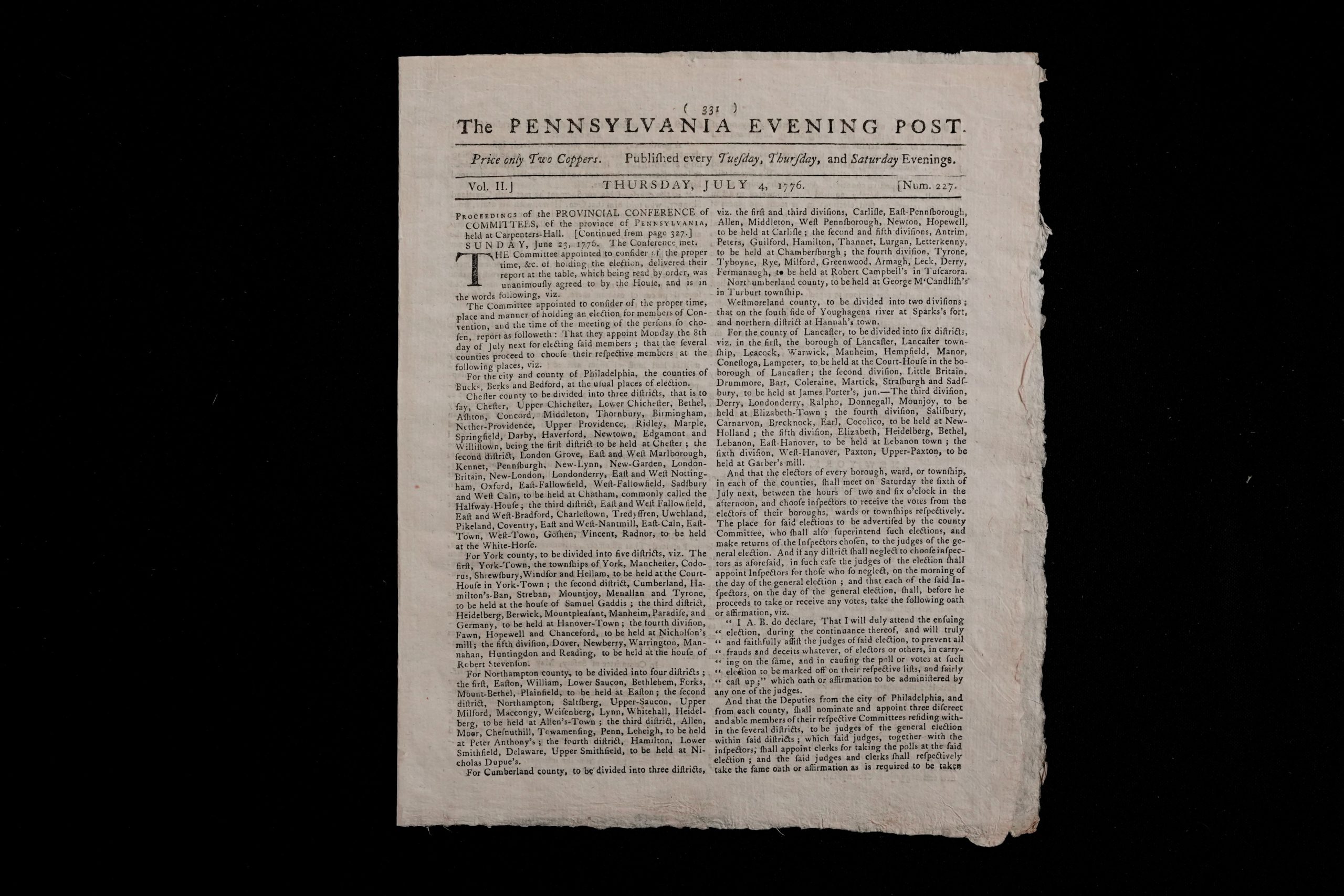
A four-page Pennsylvania Evening Post printed on July 4, 1776, believed to be the first daily newspaper printed on North American soil just declared free of the monarchy.Jessica Griffin / Staff Photographer
The Evening Post, founded by printer Benjamin Towne in 1775, was published just a few blocks from the Pennsylvania State House on Tuesday, Thursday, and Saturday evenings.
The July 4 edition contains a short mention that the Continental Congress declared the United Colonies free and Independent States earlier in the day. And “the day before, we had a King in charge,” Winston said.“How History Unfolds on Paper” included five 18th century newspaper editions, including one printed in Scotland, that published the Declaration of Independence in full.
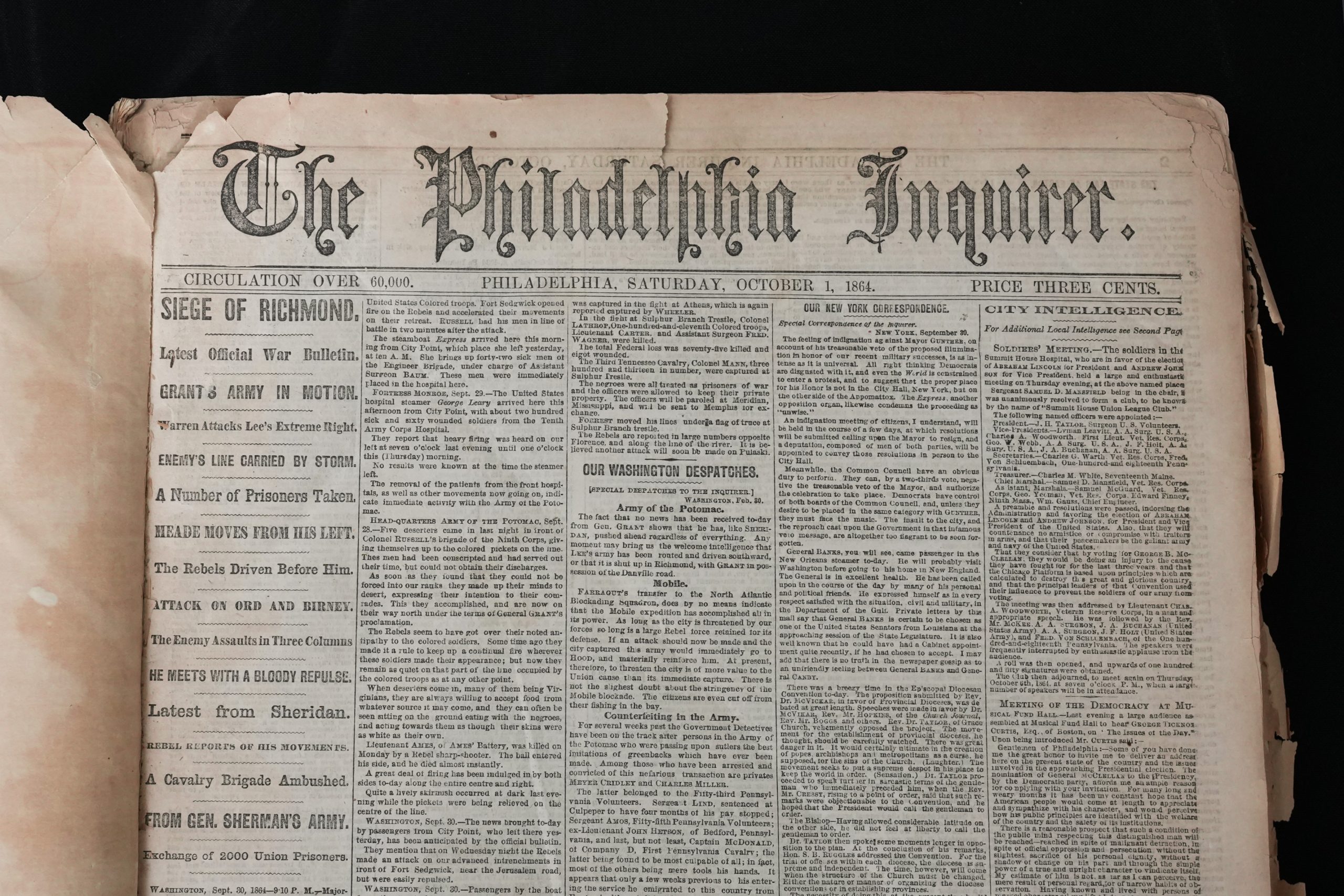
Other archival gems included a copy of the Frederick Douglass Paper from 1860; copies of the Emancipation Proclamation as they appeared in the Daily Globe, the New York Tribune, the Evening Journal Almanac, and The Philadelphia Inquirer; Abraham Lincoln’s second inaugural address as printed in the New York Times in 1865; and more than 70 issues of Civil War-era Philadelphia Inquirers.
A copy of the Philadelphia Inquirer, part of the collection “How History Unfolds on Paper: Important Americana from the Eric C. Caren Collection,” which boasts more than 320 rare newspapers, books, pamphlets, and ephemera tracing the development of printing and publishing in America, an enterprise that started in Philadelphia in 1690 with the first paper mill.Jessica Griffin / Staff Photographer
But Caren’s collection is more than weathered newspapers.
The auctioned collection bubbled with relics, collectibles, and keepsakes that speak to the economy, such as a note signed by first director of the U.S. Mint, David Rittenhouse — for whom Rittenhouse Square is named — ordering payment of 350 pounds to a doorkeeper employed at the Pennsylvania State House. (That’s about $107,000 in today’s money.)
“Freeman’s is America’s oldest auction house, and Philadelphia is the birthplace of the United States,” Caren said. “So for the 250th anniversary [of America], I thought this sale would be quite fitting.”
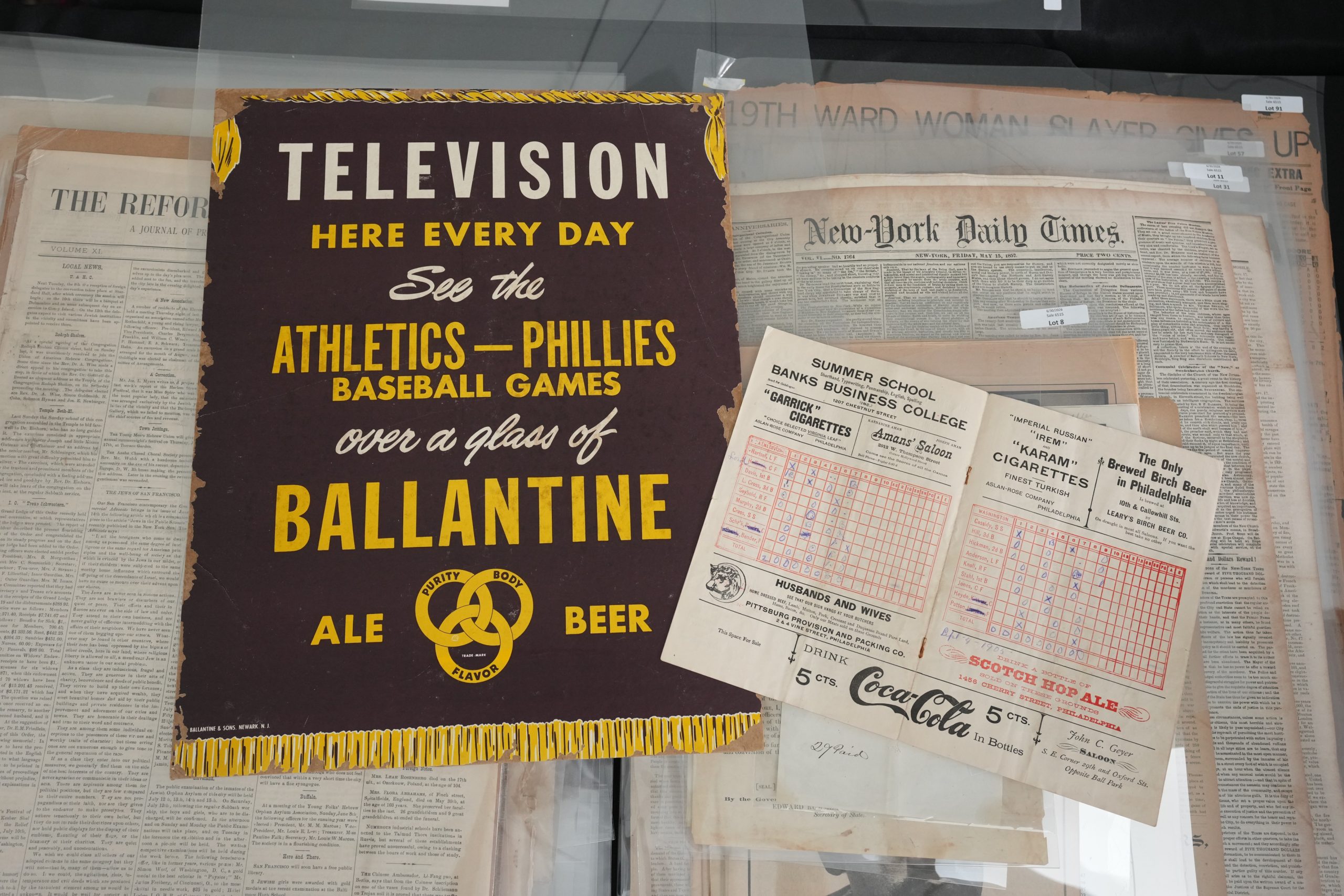
Some of the sports memorabilia featured in “How History Unfolds on Paper: Important Americana from the Eric C. Caren Collection” Jessica Griffin / Staff Photographer
50 years of collecting
Caren, 66, is a New Yorker and said he came out of his mother’s womb collecting — starting with comic books, stamps, coins, and baseball cards.
In 1970, he learned that a few of his friends were going rummaging through an abandoned house in Rockland County and that they had found newspapers from the turn of the 20th century.
“I asked them to try and find me a sports page with Babe Ruth, and they brought me one from 1913 and I was mesmerized,” Caren said.
After some cajoling, Caren convinced his friends to reveal their secret treasure trove. There, he discovered periodicals going back to the 1890s and was hooked.
Caren spent the next 50-plus years collecting the printed and written word. He has traveled the world to estate sales, garage sales, rare book shops, and antique shows. He’s one of the founders of the Ephemera Society of America and a member of the American Antiquarian Society and the Grolier Club.
He owns hundreds of thousands of paper items, and pieces of his collection have been sold at the auction houses Christie’s and Sotheby’s. “How History Unfolds on Paper” was his 10th auction and first in Philadelphia.
“If ever there was a Philadelphia item, this is it”
In his travels, Caren has come across many of Jefferson’s letters. The one written to Chastellux, he says, is particularly noteworthy because Jefferson wrote it himself, as opposed to dictating it to a secretary, like Franks.
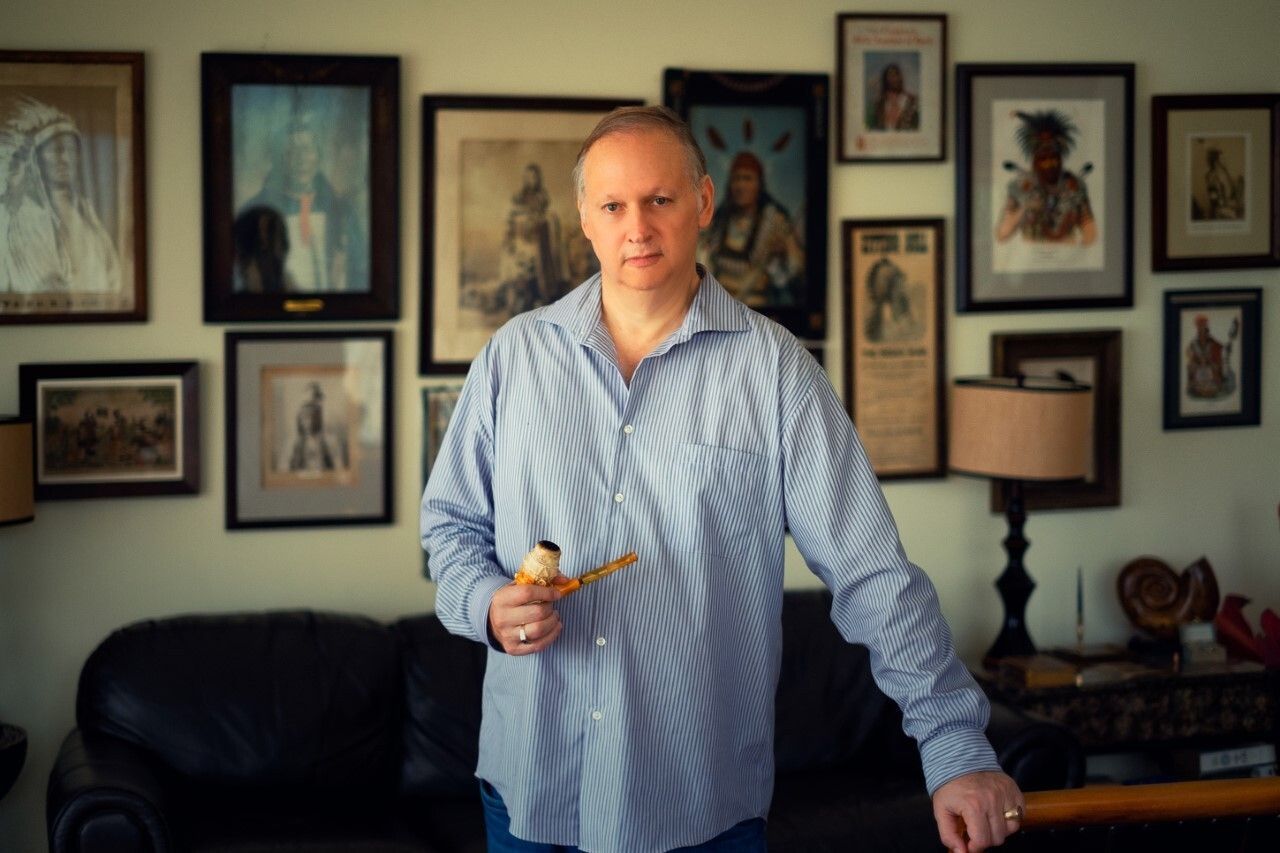
Long-time ephemera collector Eric C. Caren, his collection “How History Unfolds on Paper: Important Americana from the Eric C. Caren Collection, Part X” went to auction at Freeman’s in Philadelphia.courtesy of Freeman Auction House
The letter had been in the Chastellux family for centuries before landing at an auction a few years ago. Caren passed it over a few times before recognizing Frank’s name in the first paragraph.
“It was a great example of how even great things can slip by,” Caren said.
The Treaty of Paris was signed in September 1783. The following January, legislators ratified it in Annapolis.
Dated Jan. 16, 1784, Jefferson’s letter reads like a chatty blog of late 18th century American happenings. In the five months since the war’s end, news traveled to Europe that Americans were behaving badly. One of the reasons Jefferson penned this missive, Caren said, was to “dispel [this] fake news.”
“There was indeed some dissatisfaction in the army at not being paid off before they were disbanded and a very trifling mutiny of 200 souldiers in Philadelphia,” Jefferson wrote, playing down the Pennsylvania Mutiny of 1783, during which a few Continental Army soldiers rioted in Philadelphia streets when they weren’t paid.
Thomas Jefferson’s signature on a letter to Francois Jean de Beauvoir, Chevalier de Chastellux, a part of the auction at Freeman’s.Jessica Griffin / Staff Photographer
He also mentions his yet-to-be published book Notes on The State of Virginia and encouraged Chastellux to write one of his own. He did.
Voyages de M. le Marquis de Chastellux dans l’Amerique septentrionale, published at theturn of the 20th century, is what rare book dealer Wright Howes described as “the first trustworthy record of life in the United States.”
He spent years trying to restore his name. During his first term, President George Washington helped Franks secure a job as an assistant cashier at the Bank of the United States of America, but Franks was no longer accepted in the Founding Father’s circle.
He died in 1793 during Philadelphia’s yellow fever epidemic.
“If ever there was a Philadelphia item, this is it,” Caren said. “This letter is the intersection between the history of Philadelphia and the history of our nation.”
The headline and article have been updated to include the winning bid at the auction on Tuesday morning.
The concert, scheduled for 7 p.m. at Independence Mall, was initially postponed because of lightning and thunder detected in the area.
Wawa Welcome America officials, who organized the concert, said there were plans to restart the show, but it was ultimately canceled due to inclement weather.
There are currently no plans to reschedule Franklin’s show.
Franklin, however, found a way to greet fans as he briefly stood on top of an SUV as the crowd exited Independence Mall.
A downpour started shortly after his departure.
In a video posted on his Instagram page, Franklin explained his intention to put on an “incredible concert.” “I was really excited about it,” he said in a video with the caption, “I need the weather to repent! LOL! 😂❤️🙏🏽.”
“People were really disappointed,” he wrote. “But I need you to know that I’m more disappointed because I was really, really, really ready to go. I love Philadelphia. I’ll get back, man. I can’t let Philly down like that.”
“My feet still hurting from standing out there waiting,” one fan commented under Franklin’s Instagram post.
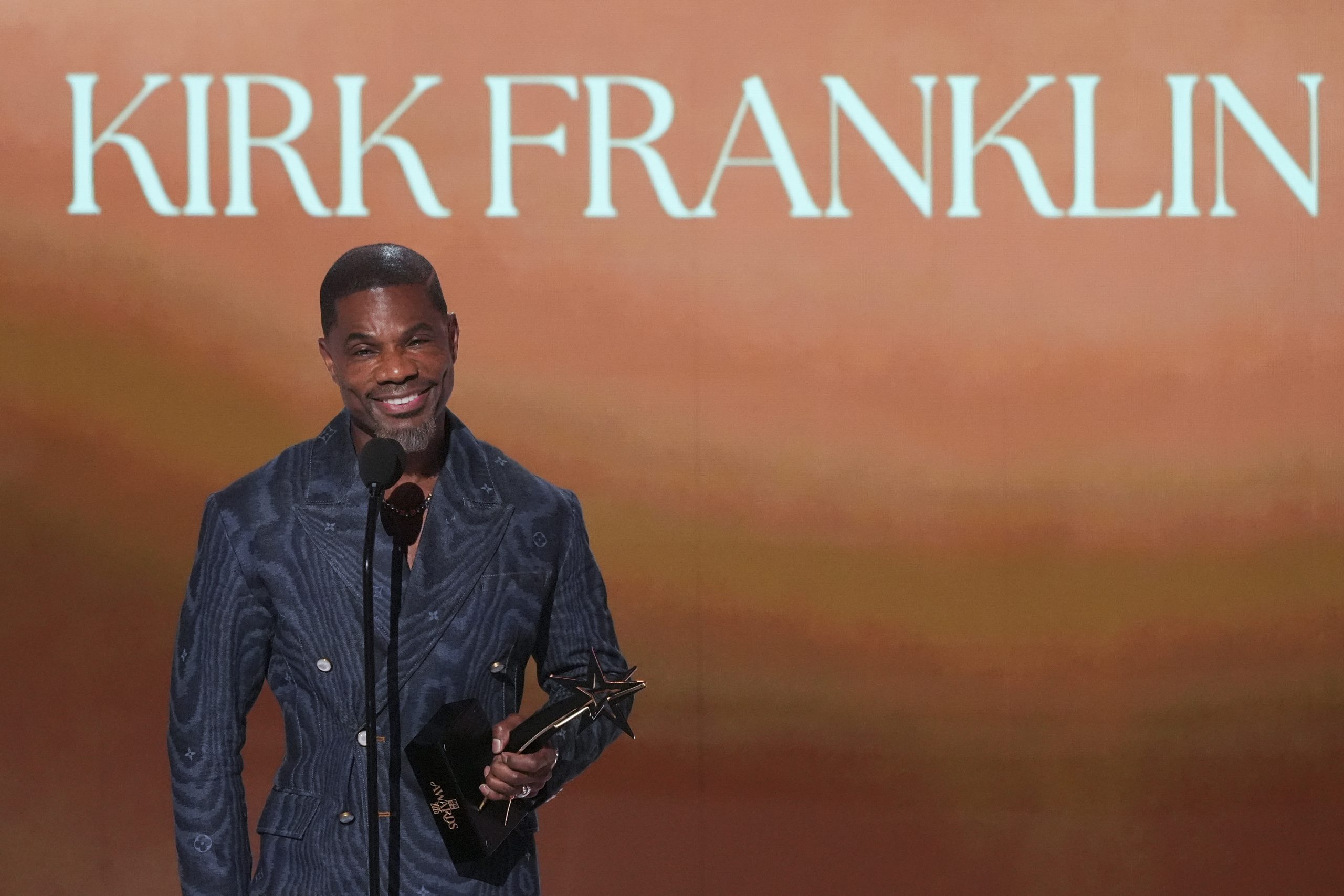
Kirk Franklin accepts the ultimate icon award during the BET Awards in 2025, at the Peacock Theater in Los Angeles. (AP Photo/Chris Pizzello)Chris Pizzello
Not all of Franklin’s interactions with fans on Sunday were as jovial.
In a now-viral social media video, Franklin is seen arguing with an attendee, who urged the singer to “repent” for his sins. Otherwise, he and his wife, Tammy Franklin, are “going to go to hell,” the attendee threatened.
Franklin attempted to confront the unidentified man but was held back by several security guards.
The man was eventually escorted out of the venue by law enforcement officers.
Before the show’s cancelation, fans enjoyed the opening performances and food vendors at Sunday’s event at the Independence Mall, which was part of this week’s lineup of Wawa Welcome America Festival events and concerts.
The celebration of the nation’s 250th birthday will continue with Tuesday’s Philadelphia Orchestra’s Pride concert, Thursday’s “Salute to Service” concert, and Friday’s Pops on Independence concert.
On July 4, the free “One Philly: Unity Concert for America” will take place on the Benjamin Franklin Parkway. Featuring Christina Aguilera, Jill Scott, The Roots, and others, that show is not part of Wawa Welcome America but counts Wawa among its sponsors.
“Smokin’” Joe Frazier is finally in his new home, just in time for the 250th birthday of the United States.
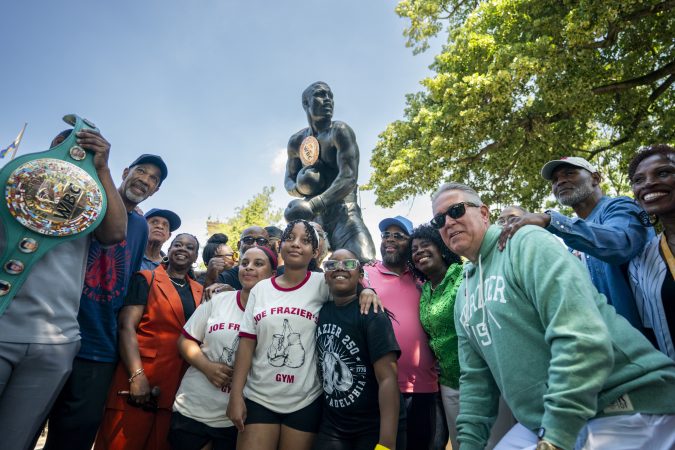
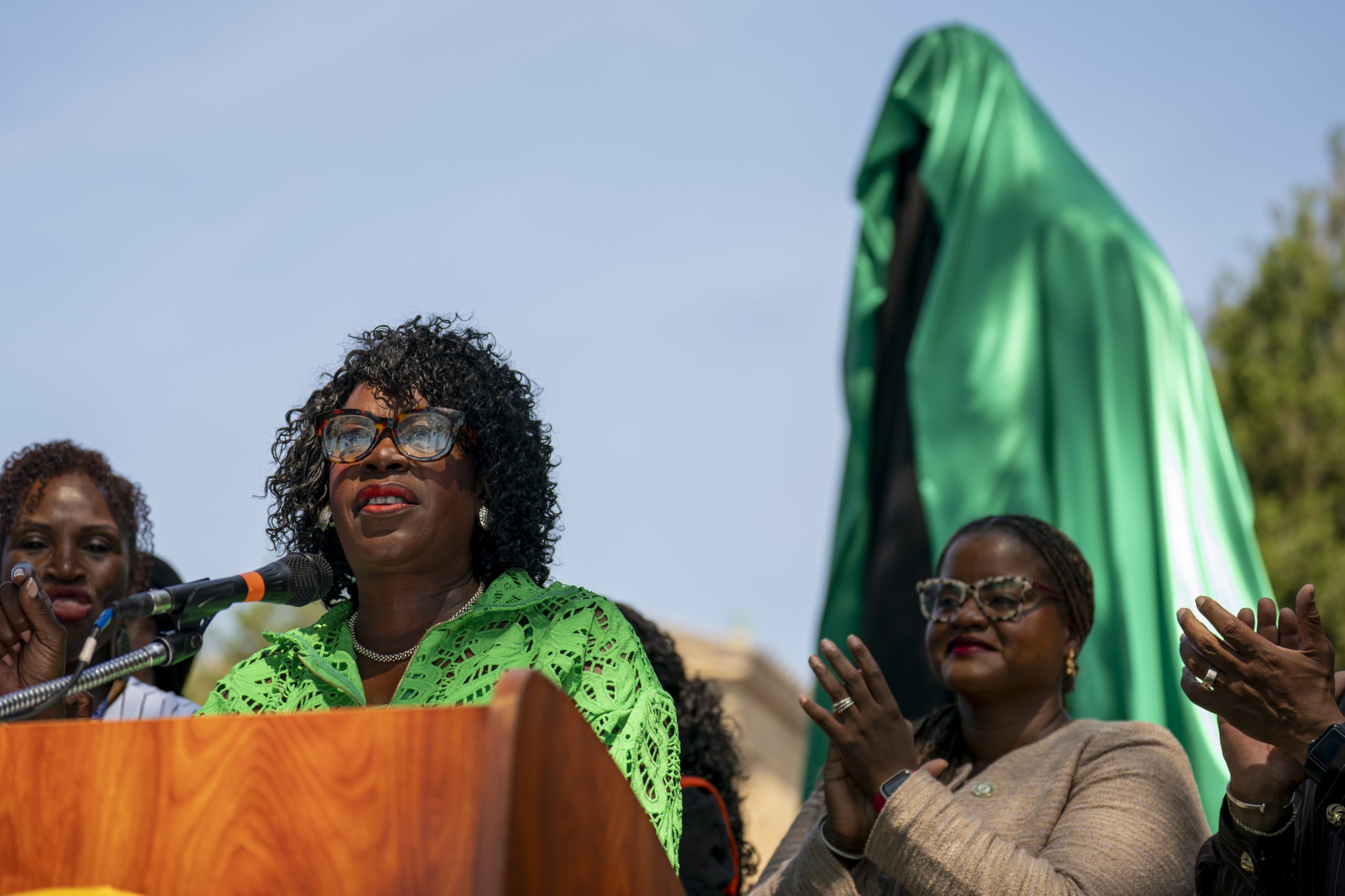
City officials, alongside Frazier’s family, friends, and fans, on Monday unveiled the real-life heavyweight boxing champion’s statue at the base of the Philadelphia Museum of Art. Intended to be the statue’s new location in perpetuity, the spot was occupied by a monument to fictional boxer Rocky Balboa for two decades.
“During this 250th celebration in the birthplace of democracy, we will forever remember that the city got right what it had gotten wrong for a long, long time,” Mayor Cherelle L. Parker said. “Now, Joe Frazier is attached, and connected to, and will permanently be here at our Philadelphia Museum of Art.”
Monday’s unveiling was the culmination of months of planning. The Philadelphia Art commission in February approved a plan to move the statue from by Creative Philadelphia, the city’s office for the creative sector. Chief cultural officer Valerie V. Gay said Monday’s event was something of a “soft launch” for the statue’s new home, as a granite base will be installed in the future, along with more formal interpretive panels.
Mayor Cherelle L. Parker speaks at the unveiling of the statue of former heavyweight boxing champion Joe Frazier at its new home outside the Art Museum. Jessica Kourkounis / For The Inquirer
“Today, we did not want to wait,” Gay said.
Frazier’s statue, after all, lived at the South Philadelphia sports complex for more than 10 years. Created by sculptor Stephen Layne, the statue was unveiled outside what is now Stateside Live! in 2015, four years after Frazier’s death in 2011 following a battle with liver cancer. Frazier, the undisputed heavyweight champion in 1970-1973, is probably best remembered for his three battles against Muhammad Ali in the 1970s.
The city’s statue of Rocky had called the base of the Art Museum’s famed steps home since 2006. The monuments’ moves are part of a larger shuffling of statues at the Art Museum that began in March, when the Rocky statue was moved inside the museum for the first time as part of the ongoing exhibition Rising Up: Rocky and the Making of Monuments.
That Rocky statue will be installed at the top of the Art Museum steps in the fall, when the statue of the Italian Stallion currently there will be returned to actor Sylvester Stallone’s private collection. Stallone, Parker said, was supportive of the Frazier statue’s new location.
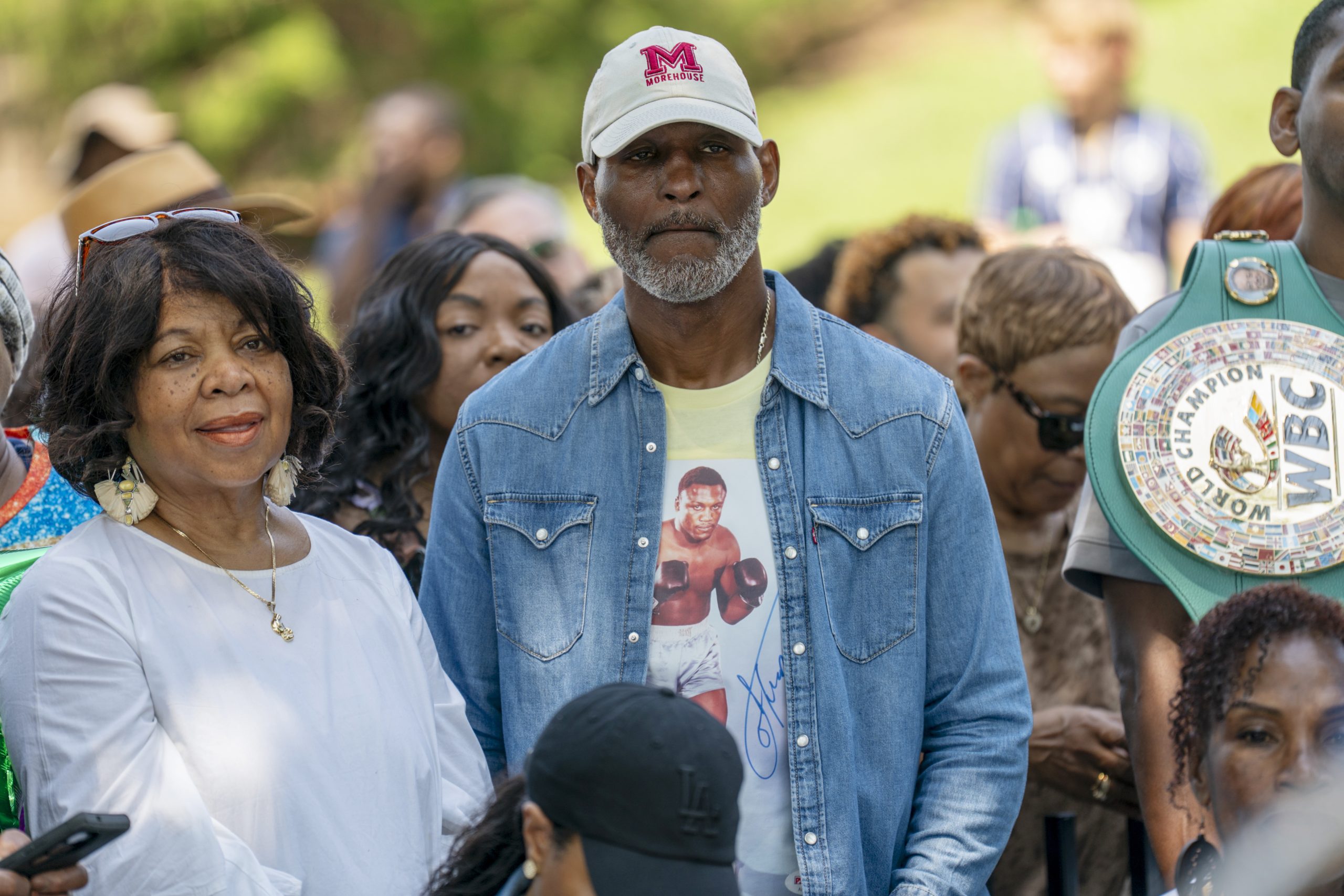
Dozens of the boxer’s supporters attended on Monday, including Philadelphia boxer Bernard Hopkins who held world championships in two weight classes, promoter Joe Hand Jr., and Frazier’s daughter Jacqueline Frazier-Lyde. Frazier-Lyde, a retired boxer and current Municipal Court judge, said the the color of the shroud covering her father’s statue — green —was fitting.
“My mother’s favorite color was green, because we’re from the South and we love green, because it represents life,” she said. “My father, Joe Frazier, liked it because it was the color of money.”
Boxing legend Bernard Hopkins at the unveiling of the new home for the statue of heavyweight boxing champion Joe Frazier.Jessica Kourkounis / For The Inquirer
To the end, the statue’s new location wasn’t the end of efforts in the boxer’s memory. Parker also announced plans for a capital campaign to restore the former Joe Frazier’s Gym on Broad Street above Glenwood Avenue in North Philadelphia. Now a discount furniture store, the building is a legendary location in Philadelphia boxing history, having served as a training location for not just Frazier but other famed fighters and community members.
Parker said plans were underway to establish a way to accept donations for that effort via the Philadelphia City Fund. The amount of funds targeted be raised was not immediately clear.
“It’s important to show the world who we are,” Gay said. “Joe Frazier was a humble underdog whose determination and grit inspires us all. What could be more [a] more Philadelphia story than that?”
Most of us remember the 2010s Obama-era stomp-clap folk music, brought on by bands like the Lumineers, that graced the soundtracks of films like Silver Linings Playbook, sparking an intensely optimistic sound.
But can that even exist today? Can folk music rise in the 2020s, amid rapid social media usage, volatile politics, and a general feeling of uneasiness?
It can and it does.
Often veering into the gloomy and the existential, but somehow still managing to stay romantic and rebellious, thanks to the folk-pop stylings of Noah Kahan.
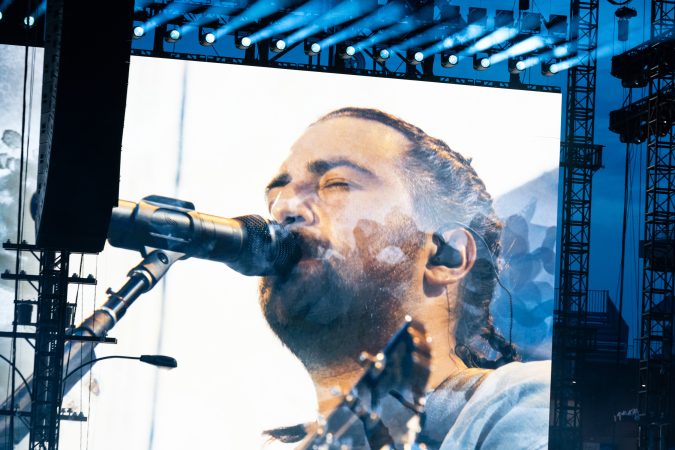
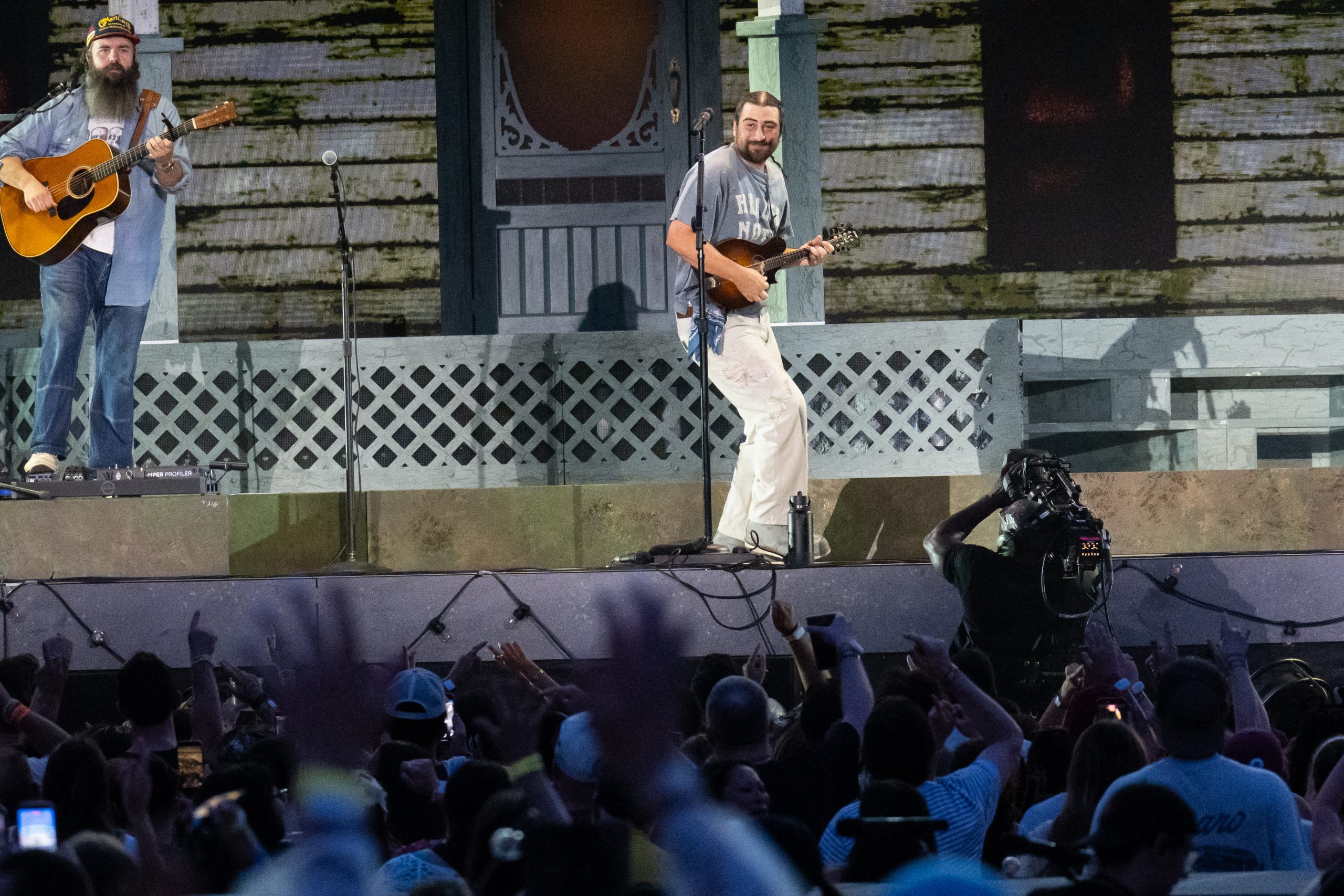
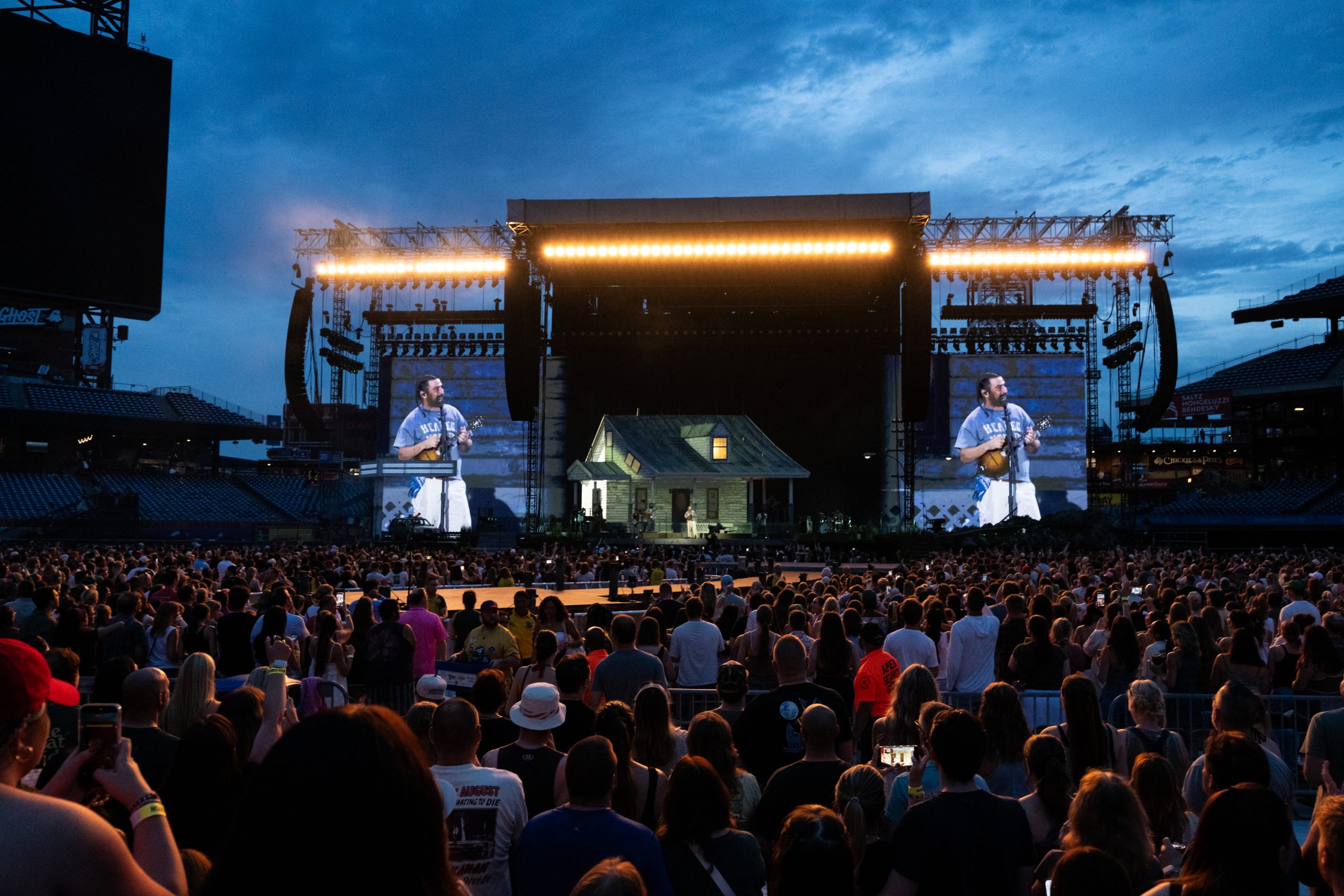
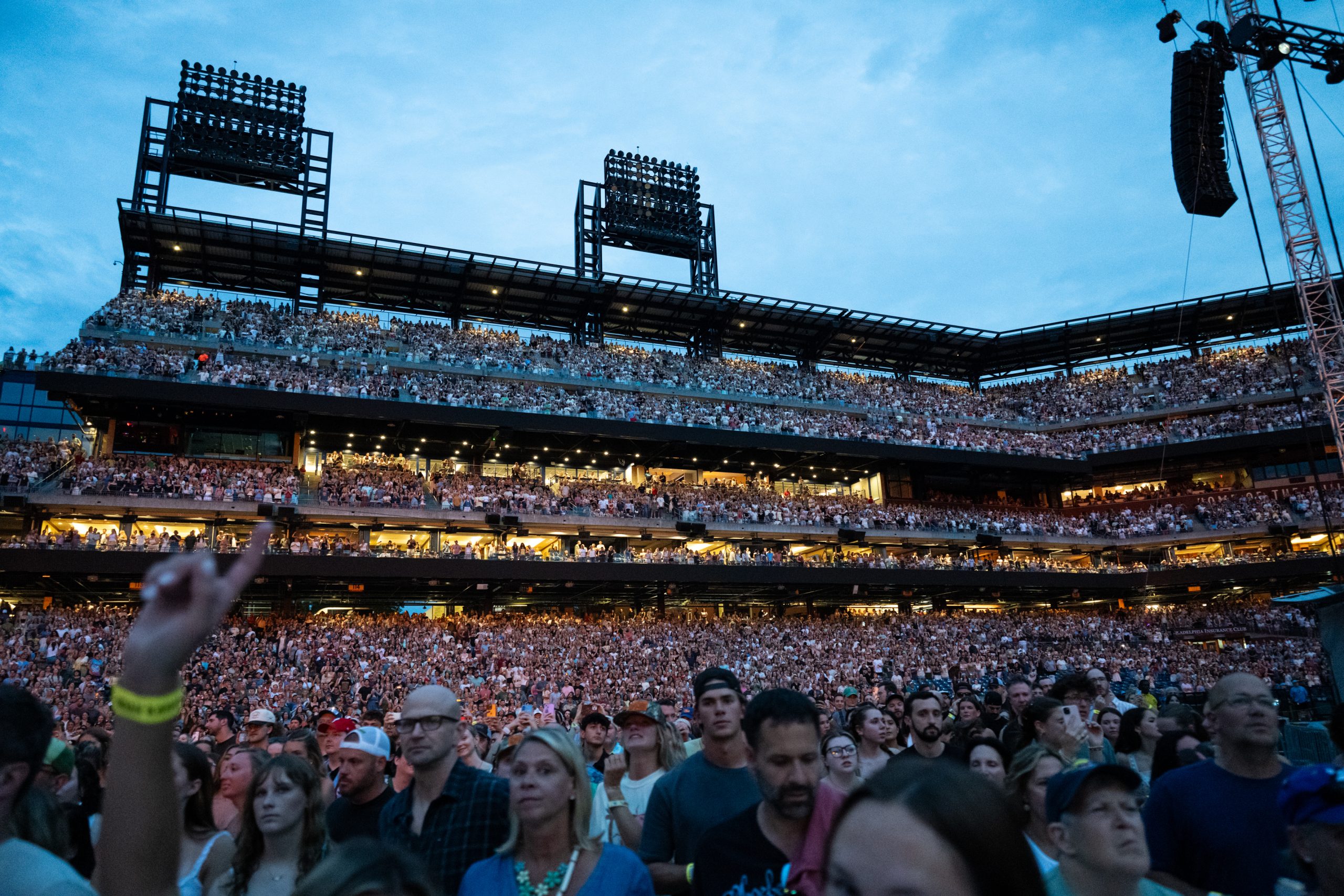
Kahan and his band performed for a sold-out crowd of 40,000 people.Erin Blewett / For The Inquirer
Kahan released his latest The Great Divide in April. The introspective collection of songs explores the realities of fame and the isolating feeling of leaving home. The tour behind that album brought him to Citizens Bank Park on Friday night.
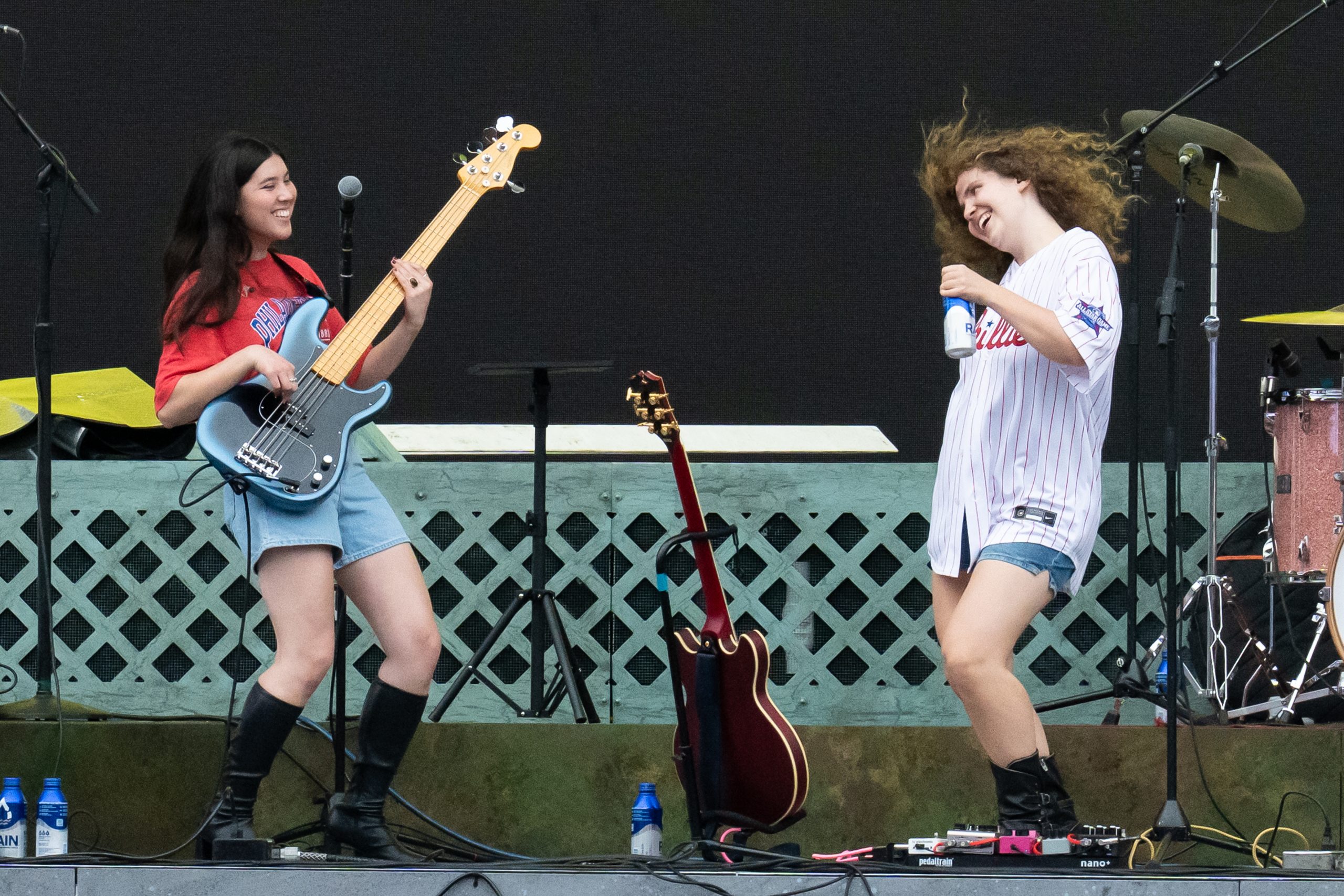
After the openers — Wayne native Annabelle Dinda, sporting a Phillies shirt, and Gigi Perez — a one-minute countdown popped up on the screen at 8:30 p.m., met with loud cheers from the audience.
When the clock struck zero, a sunset scene of a field appeared on a screen on stage, with The Great Divide displayed across it.
The roof of a house slowly descended from the top of the stage to meet the rest of the barn house in the middle of the stage. Then out came Kahan, with his signature French braids and baggy clothes, ready to bring his woodsy vibe to Philadelphia.
Annabelle Dinda performs an opening set during the Philadelphia stop of Noah Kahan’s “The Great Divide Tour” at Citizens Bank Park in South Philadelphia on Friday, June 26, 2026. Dinda was one of two opening acts performing before Kahan took the stage.Erin Blewett / For The Inquirer
The audience in the 40,000-plus-seat stadium reacted swiftly, jumping to their feet and screaming for Kahan. The crowd was a mix of Gen Z fans, new to the contemporary folk-pop sound, and millennials, who were undoubtedly jamming out to Mumford & Sons during the aforementioned 2010s folk-rock era.
There were also families with young children in tow. Some appeared to be fans themselves, wearing the tour’s merchandise and singing along.
After performing “American Cars” and “Doors” from The Great Divide, Kahan addressed the sold-out crowd, promising to make the audience very sad with his melancholic music.
“Philadelphia, what a … dream,” he said. “It must be something in the water. How do you all have clinical depression?”
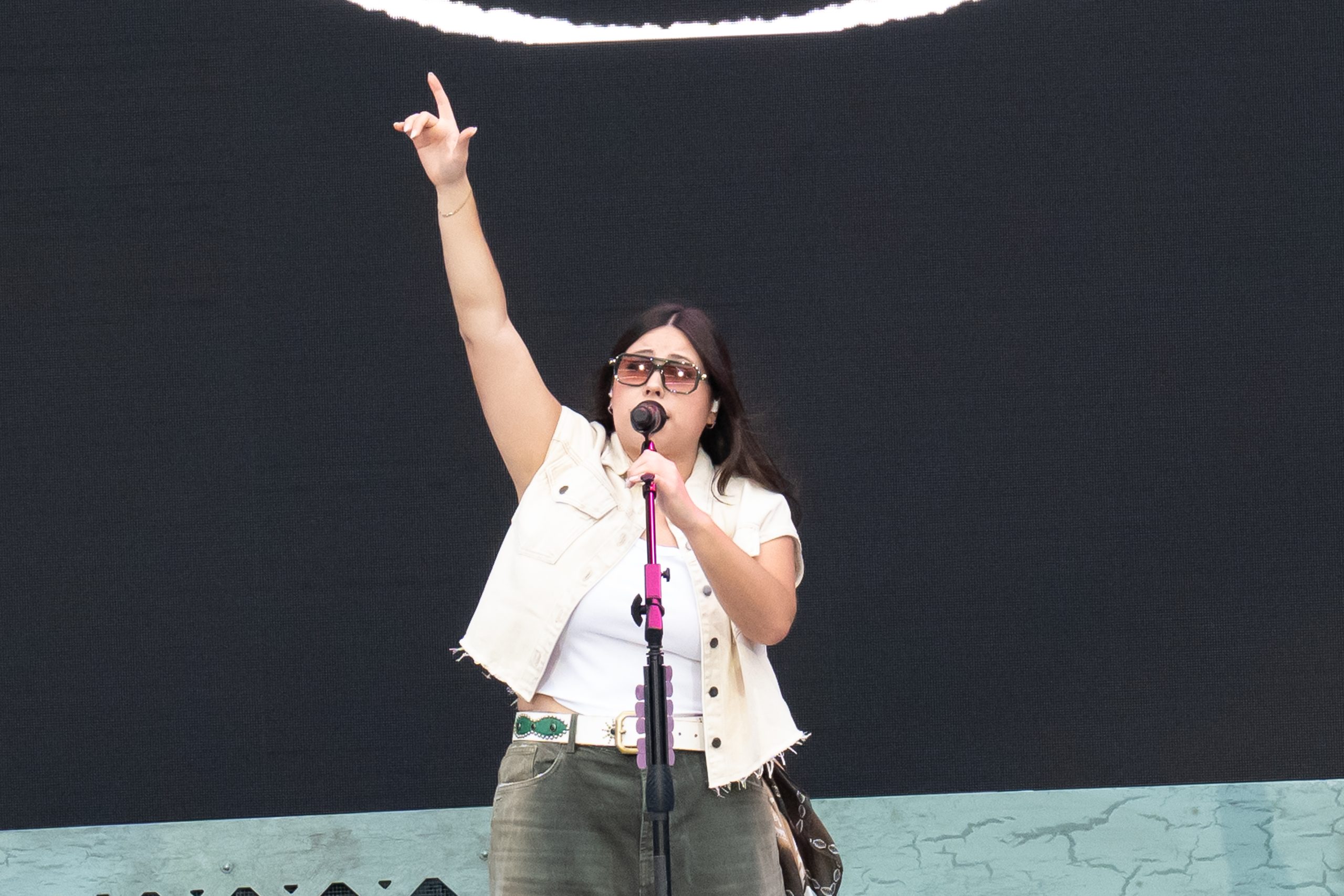
Gigi Perez performs an opening set during the Philadelphia stop of Noah Kahan’s “The Great Divide Tour” at Citizens Bank Park in South Philadelphia on Friday, June 26, 2026. Perez gained widespread recognition with her 2024 single “Sailor Song” and opened for Kahan on select dates of the tour Erin Blewett / For The Inquirer
Kahan continued with “All My Love” from 2022’s Stick Season, with the set around him bringing the music to life, even in the face of the promised melancholy.
Rocks covered in moss sat one side of the stage with an abandoned gas station scene set up on the other, with tall grass scattered throughout. String lights warmed up the setting as it got darker, making Citizens Bank Park feel like a small-town backyard. On the screen behind Kahan, seasons changed and insects crawled around amid visuals from the singer’s home state of Vermont.
The foresty and naturalist aesthetic of both the music and the setting was an homage to Kahan’s childhood spent on a tree farm in rural Vermont.
The concert was Kahan’s first arena show in Philadelphia, on his second arena tour in his career.Erin Blewett / For The Inquirer
The crowd matched the scenery: flowing skirts, bandannas, cowboy hats and boots, denim, corduroy, and just about every other clothing item you’d see when searching “farm aesthetic” on Pinterest. Everyone attending could easily pop over to the Schuylkill River Trail for a quick hike after the show.
After singing another new song, “Downfall,” Kahan pretended to answer a phone call.
“What’s up, Twitter,” he said into the phone. “Oh, Noah Kahan can’t sell out stadiums?” The response was a thunderous cheer as Kahan pretended to hang up.
This is Kahan’s fifth concert tour and his first time headlining a show at Citizens Bank Park, playing for a sold-out crowd. His last tour, “The Stick Season (We’ll All Be Here Forever)” Tour in 2024, didn’t stop in Philadelphia.
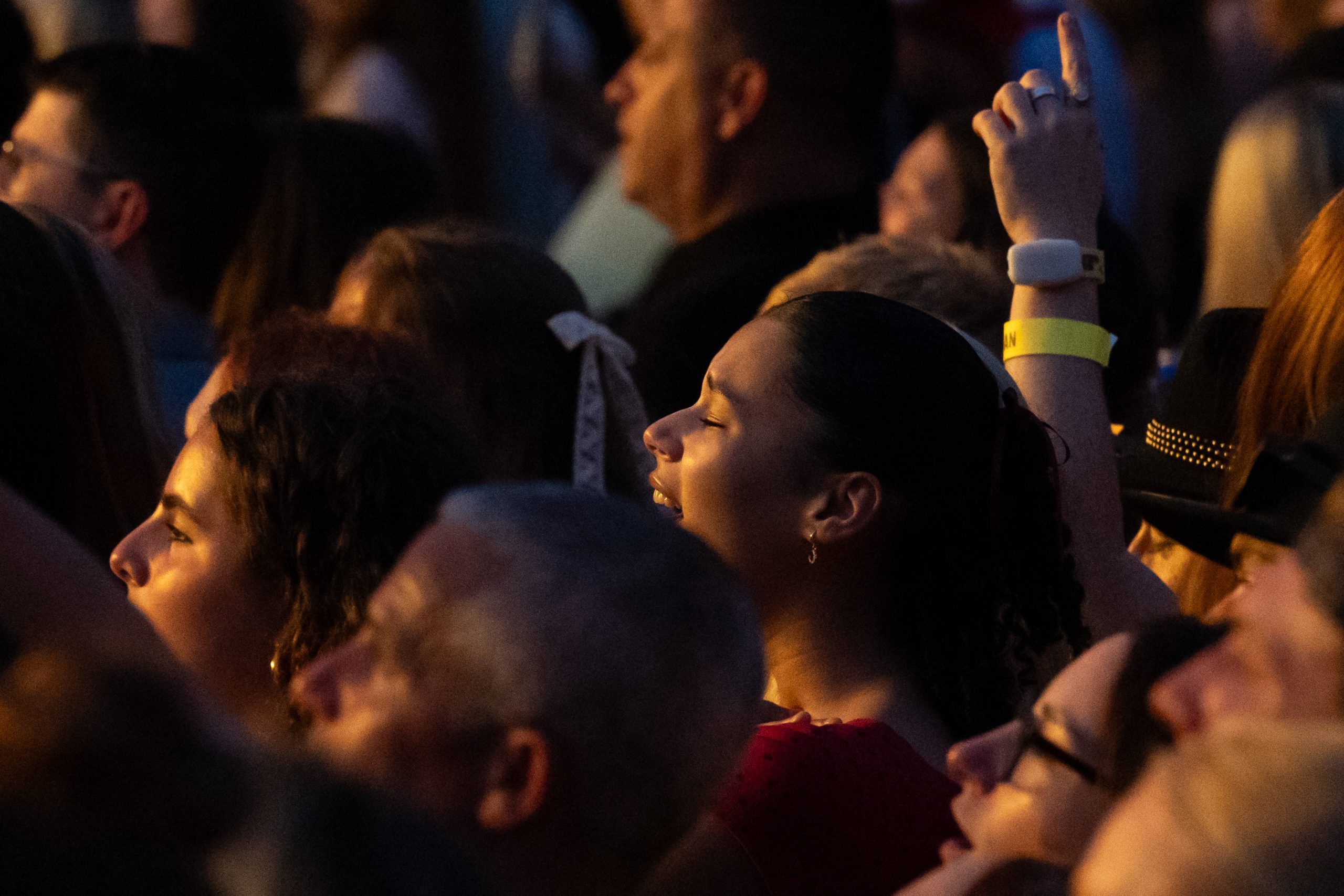
A fan sings while Noah Kahan performs at Citizens Bank Park in South Philadelphia on Friday, June 26, 2026. More than 40,000 people attended the sold-out show. .Erin Blewett / For The Inquirer
After singing and playing the guitar for nine songs standing on the main stage, Kahan decided to shake things up a bit. For “Dial Drunk,” he moved to the left side of the stage, where an actor dressed as a police officer arrested him. He performed the first half of the song from inside a police car fitted with cameras.
For “Willing and Able,” Kahan sat upon the roof that came down in the beginning of the show. There, he softly played the guitar and sang the lyrics to the somber song about a strained sibling relationship.
Fans sang along and cheered until Kahan made his gravest mistake of the show: suggesting that Philadelphians be friendly toward Boston.
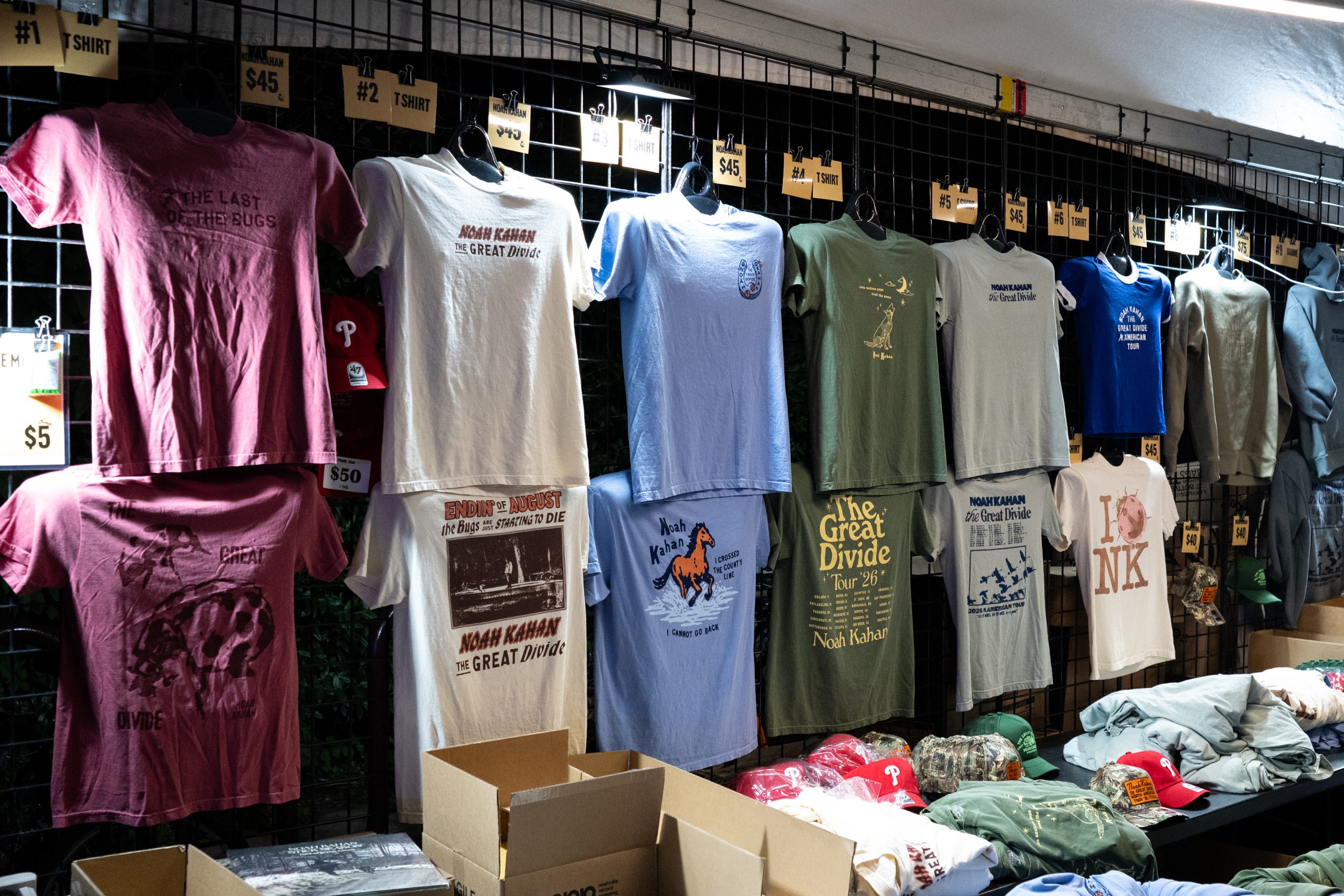
Noah Kahan merchandise is displayed outside Citizens Bank Park in South Philadelphia on Friday, June 26, 2026. More than 40,000 people attended the sold-out show, with some fans lining up as early as 9 a.m. to purchase merchandise.Erin Blewett / For The Inquirer
“Having lived in Boston, you guys are a lot more alike than you think, and I think you need to reconcile,” Kahan said, citing the tough brotherly relationship in “Willing and Able.” This sentiment was the only thing that was met with boos on Friday.
Fittingly enough, Kahan recalled being heckled at a Philly show.
One hopes the city hosting a sold-out show will soften his feelings toward Philadelphia.
Fans matched the forest aesthetic of Kahan’s music, with flowy outfits and cowboy apparel.Erin Blewett / For The Inquirer
He also took the opportunity, standing in the middle of the floor seats, to address the backlash he received on Twitter for his original setlist he played in Orlando on June 11. Fans complained about the lack of older songs, as the singer filled the set with songs from his last two albums. The fans who booed Kahan’s online haters were rewarded with his older song “Maine” from the EP Cape Elizabeth, which he called his favorite song he’s ever written.
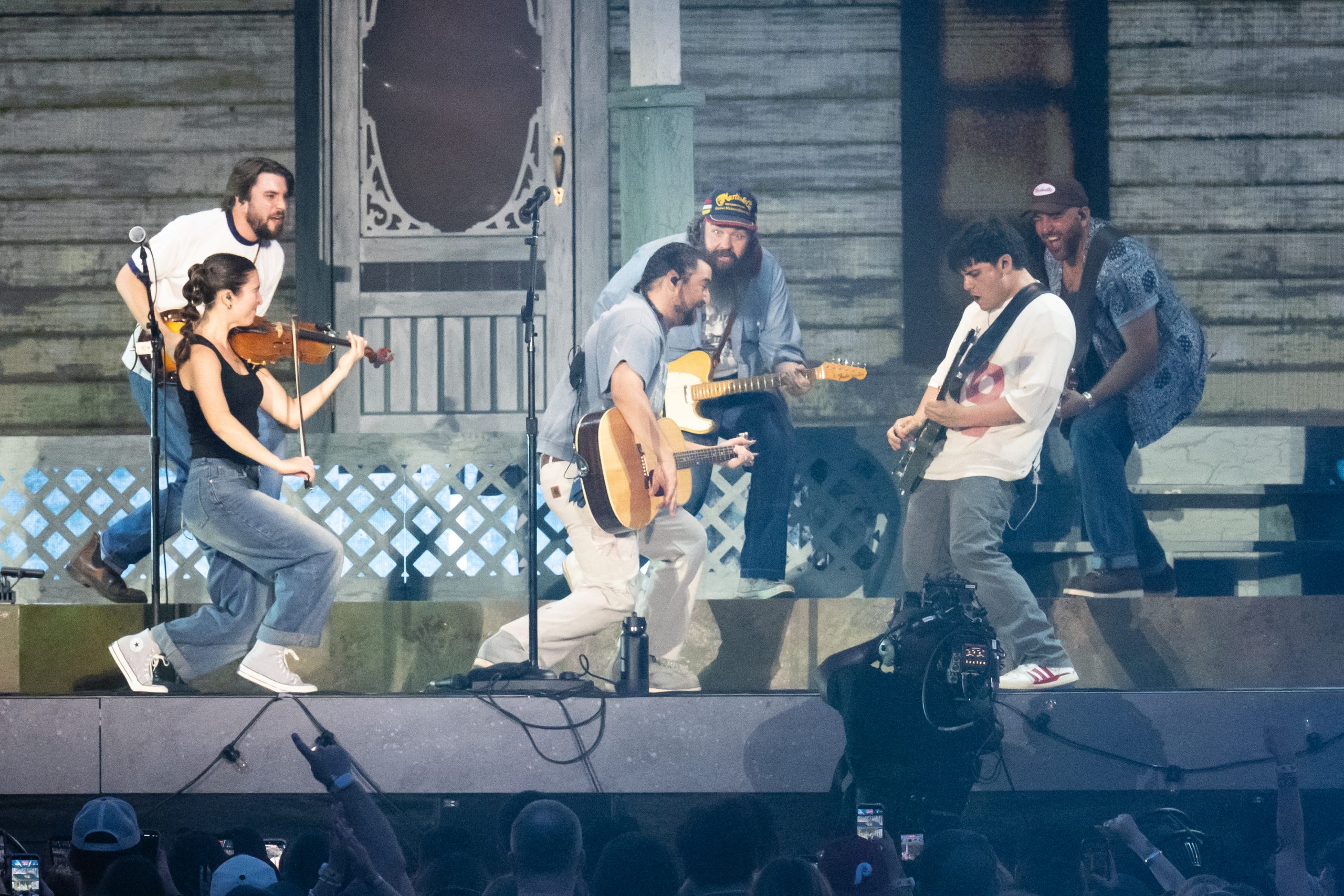
In addition to the guitar, Kahan’s six-piece band comprised a host of other unique instruments that got to shine. This included a fiddle, banjo, mandolin, and a resonator guitar, all contributing to Kahan’s unique folk sound that blends both rock and pop.
Noah Kahan performs at Citizens Bank Park in South Philadelphia on Friday, June 26, 2026, during his “The Great Divide Tour.” The Philadelphia concert was part of the North American leg of Kahan’s summer tour Erin Blewett / For The Inquirer
As the show went on, Kahan took multiple opportunities to listen to the crowd sing and coyly smile as he expressed his gratitude, often peppering it with his well-known dry humor.
“You guys are gonna make me emotional,” he said to the screaming fans, giggling.
Kahan closed out his main set with “Orange Juice” and “New Perspective” before exiting the stage and reentering it as fans started growing restless. For the encore, sitting at a spotlit piano, he performed the incredibly moody “End of August.”
That was followed by a more upbeat “Homesick.” Of course, he wrapped things up with an explosive extended performance of his biggest hit, “Stick Season.”
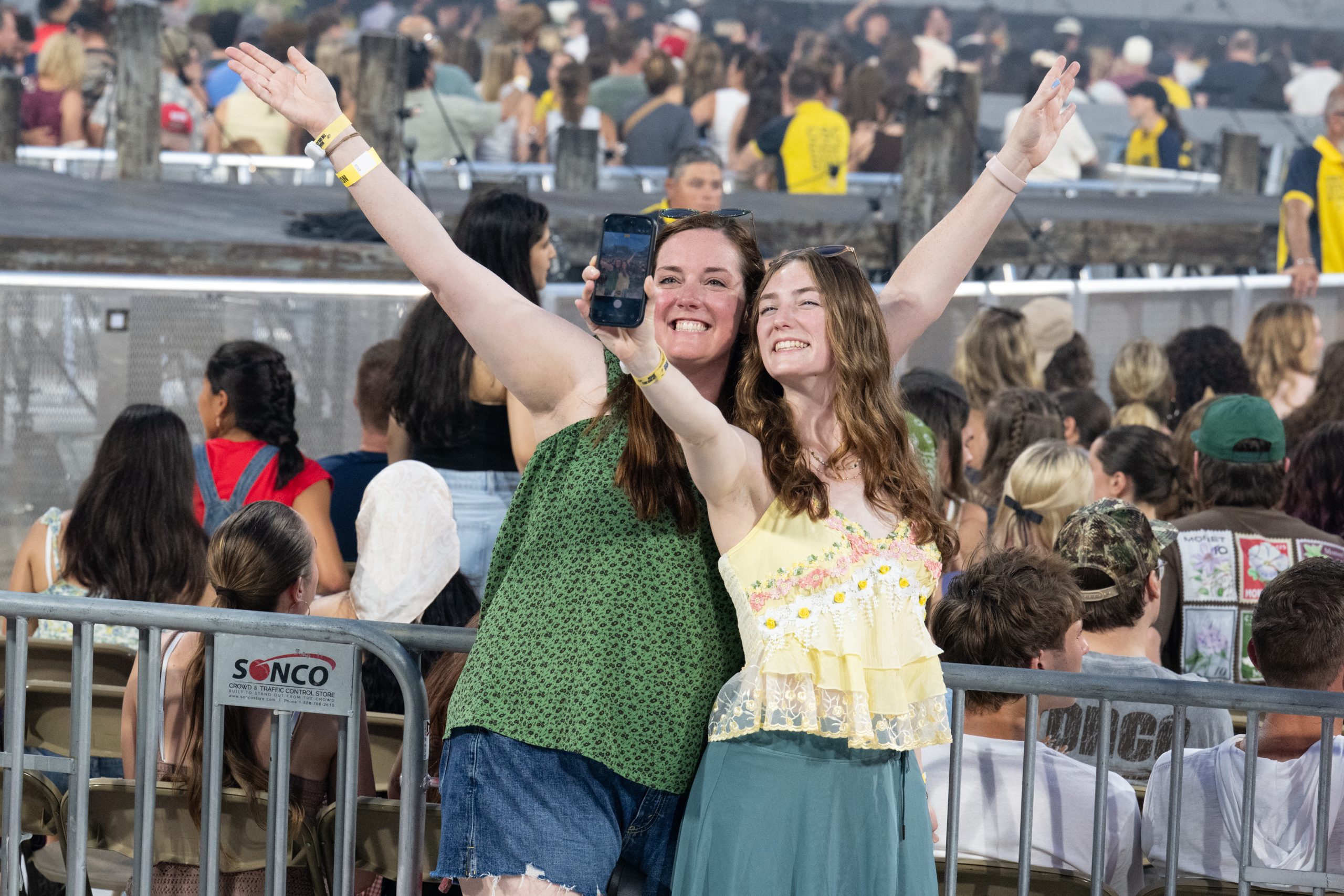
Two fans take a selfie before Noah Kahan performs at Citizens Bank Park in South Philadelphia on Friday, June 26, 2026. More than 40,000 people attended the sold-out show. .Erin Blewett / For The Inquirer
There was no one in the crowd who didn’t sing along.
Kahan made sure to thank his bandmates before one final chorus that culminated in a brief fireworks display over the stage.
And just like that, the woodland escape that is a Noah Kahan concert came to an end for Philadelphia.
Noah Kahan, setlist from “The Great Divide Tour.” June 26, 2026, Citizens Bank Park, Philadelphia
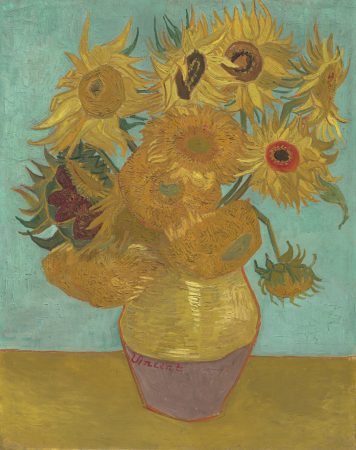
There’s a rare reunion at the Philadelphia Museum of Art this year: Two of Vincent van Gogh’s famous sunflower paintings are on view side by side. Only five large-scale paintings comprise his Sunflowers series, scattered over three continents. But now, Philadelphia gets a chance to see two together.
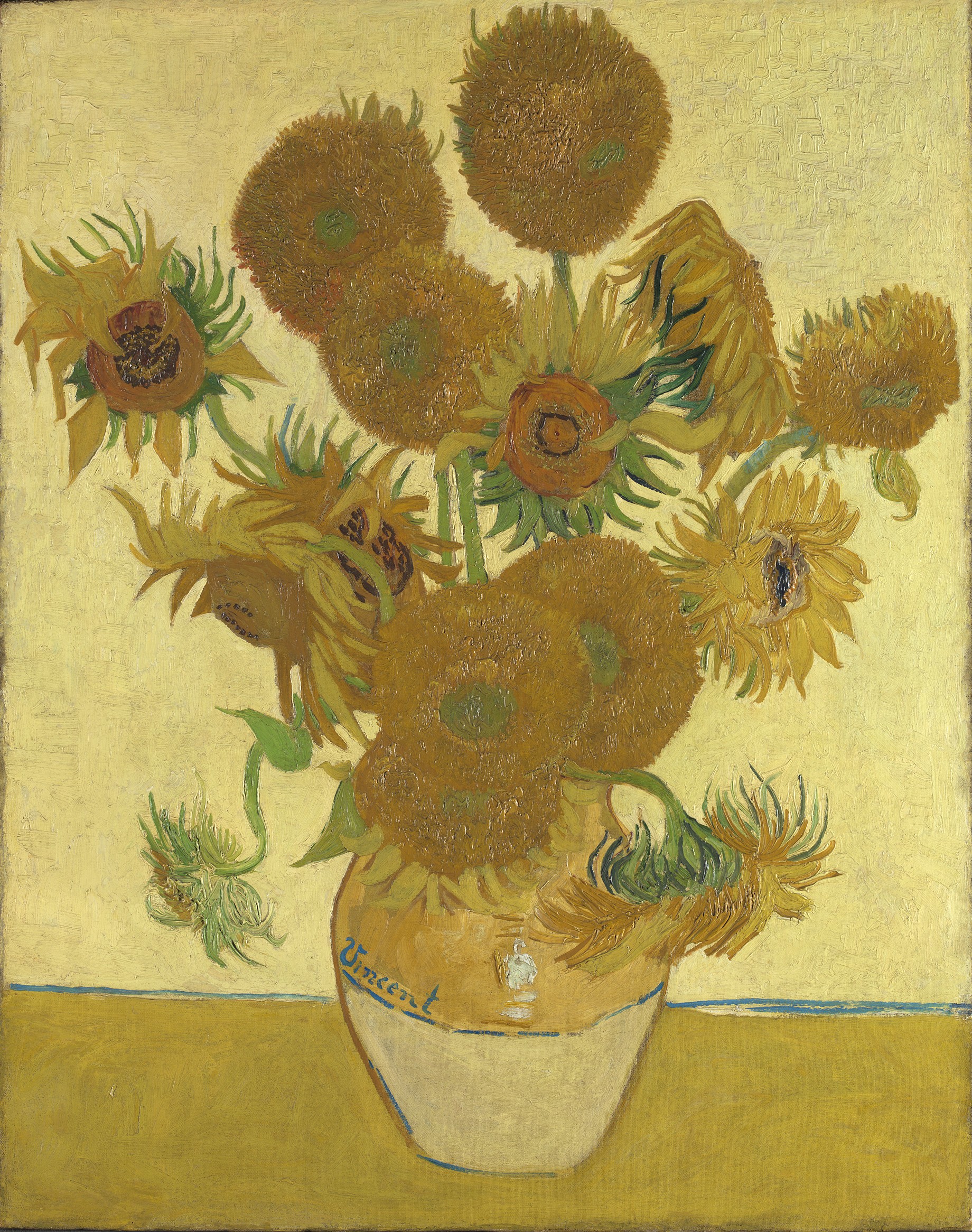
For the first time in its history, Sunflowers (1888), from the collection of London’s National Gallery, has traveled across the Atlantic for its United States premiere alongside the PMA’s own Sunflowers (1889). The London artwork shows the sunflowers on a pale yellow background while Philadelphia’s features a soft blue; both exemplify the artist’s desire to create what he described as “a symphony of blue and yellow.”
It’s a historic display of signature works by a world-famous artist who sadly never achieved critical acclaim during his lifetime. But, all of that aside, these are simply two marvelous paintings to see.
“Sunflowers” (1888), Vincent van Gogh. Courtauld Fund, The National Gallery.
Their charm isn’t solely in the pretty subject matter; it’s all about the texture. Thick globs of paint in various shades of yellow give the appearance of a not-quite-settled image, enchanting the viewer with dynamic motion that can only be experienced up close. Each bloom has its own stylistic personality as the paint takes on an almost sculptural presence. Both paintings create a mesmerizing display — pictures truly don’t do it justice.
“Van Gogh’s Sunflowers: A Symphony in Blue and Yellow” is on view through Oct. 11 at the Philadelphia Museum of Art, 2600 Benjamin Franklin Pkwy, Philadelphia, 215-763-8100 or philamuseum.org.
— Rosa Cartagena
Kevin Devine performs at Spruce Street Harbor Park on June 25, 2026.Emily Bloch
Kevin Devine at Spruce Street Harbor Park
Some of the best shows of the summer can be enjoyed for free, from a picnic table, with a Tecate in hand.
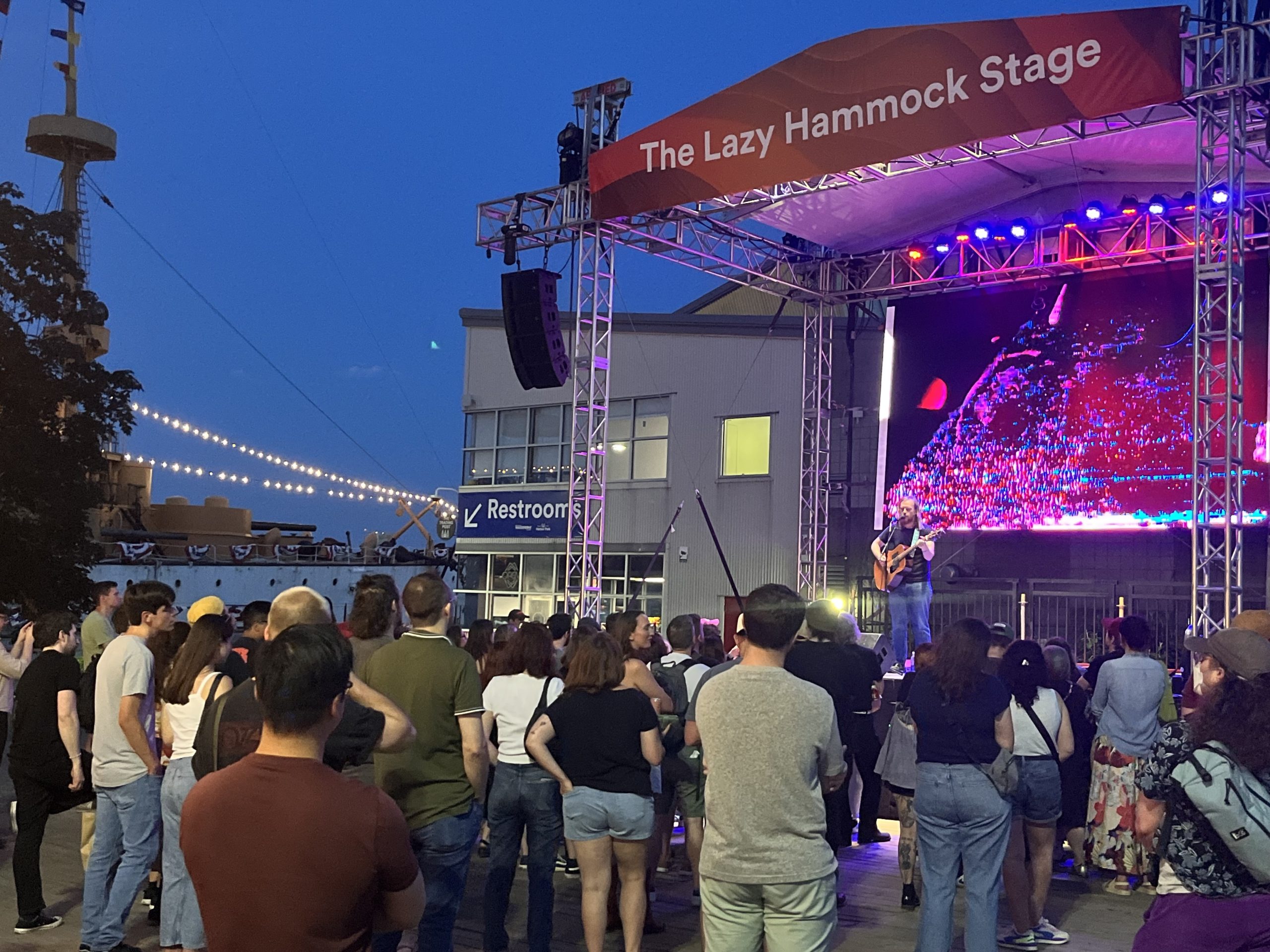
On Thursday night, I attended Kevin Devine’s free show at Spruce Street Harbor Park, where he was joined by openers Shannen Moser and Abi Reimold. It was the first of Devine’s short two-weekend tour through non-traditional spaces across the Northeast, including mostly house shows and an arcade.
For about an hour, Devine played — just him and his acoustic guitar — a stretch of old and new songs from his repertoire that dates back over two decades. Currently, Devine’s 11th LP is in the works. It will have distinct Philly ties, being recorded at Will Yip’s Memory Music Studios and produced by Steph Marziano, one of Hayley Williams’ longtime collaborators who cut her teeth in Philly’s music scene.
But back to Thursday night’s show. It was one of an impressive series of free shows at Spruce Street Harbor Park programmed by 4333 Collective.
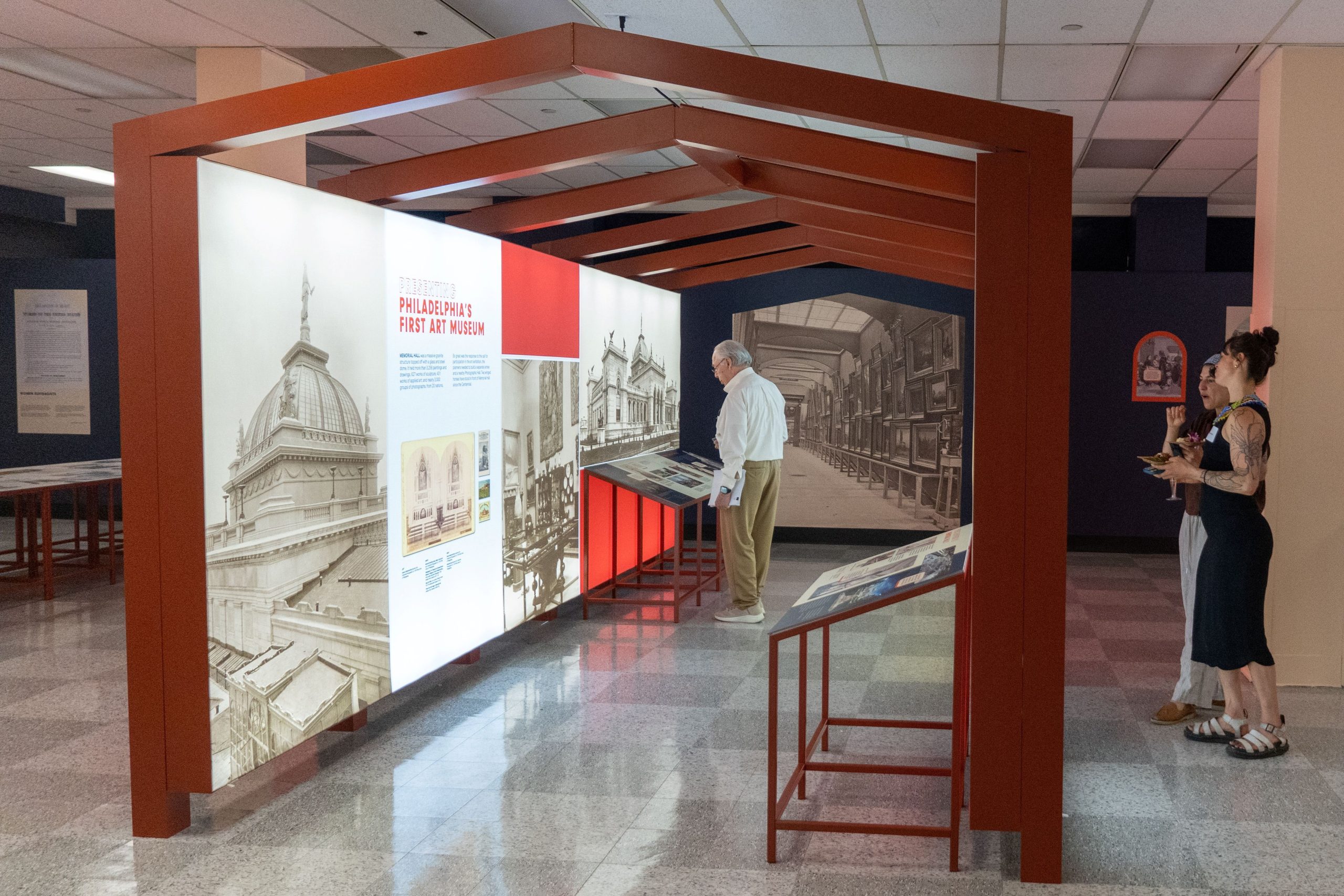
An exhibit on Memorial Hall at “Revist: 1876,” a recreation of the Centennial Exhibition at the Fairmount Park Grounds in 1876. Before Memorial Hall was turned into the Please Touch Museum, it was the first site of the Philadelphia Museum of Art.Leo Manning for Center City District
The first telephone, at the Lits Building
Before the Please Touch Museum was the go-to hangout spot for our city’s adventurous toddlers, it housed the first Philadelphia Museum of Art.
The 70,000-square-foot Beaux Arts building was originally built to showcase the work of late-19th-century American artists — including Philadelphia’s own Thomas Eakins — for the Centennial Exposition of 1876.
The history of Memorial Hall is told in one of four pavilions featured in “Revisit 1876,” the 8,000-square-foot exhibition located in the ground floor of the Lits Building, produced by the nonprofit arm of the Center City District Foundation.
The exhibit aims to connect present-day Philly with the innovations that were introduced at the fair 150 years ago, said Paul Levy, the foundation’s executive director.
And they do a pretty good job.
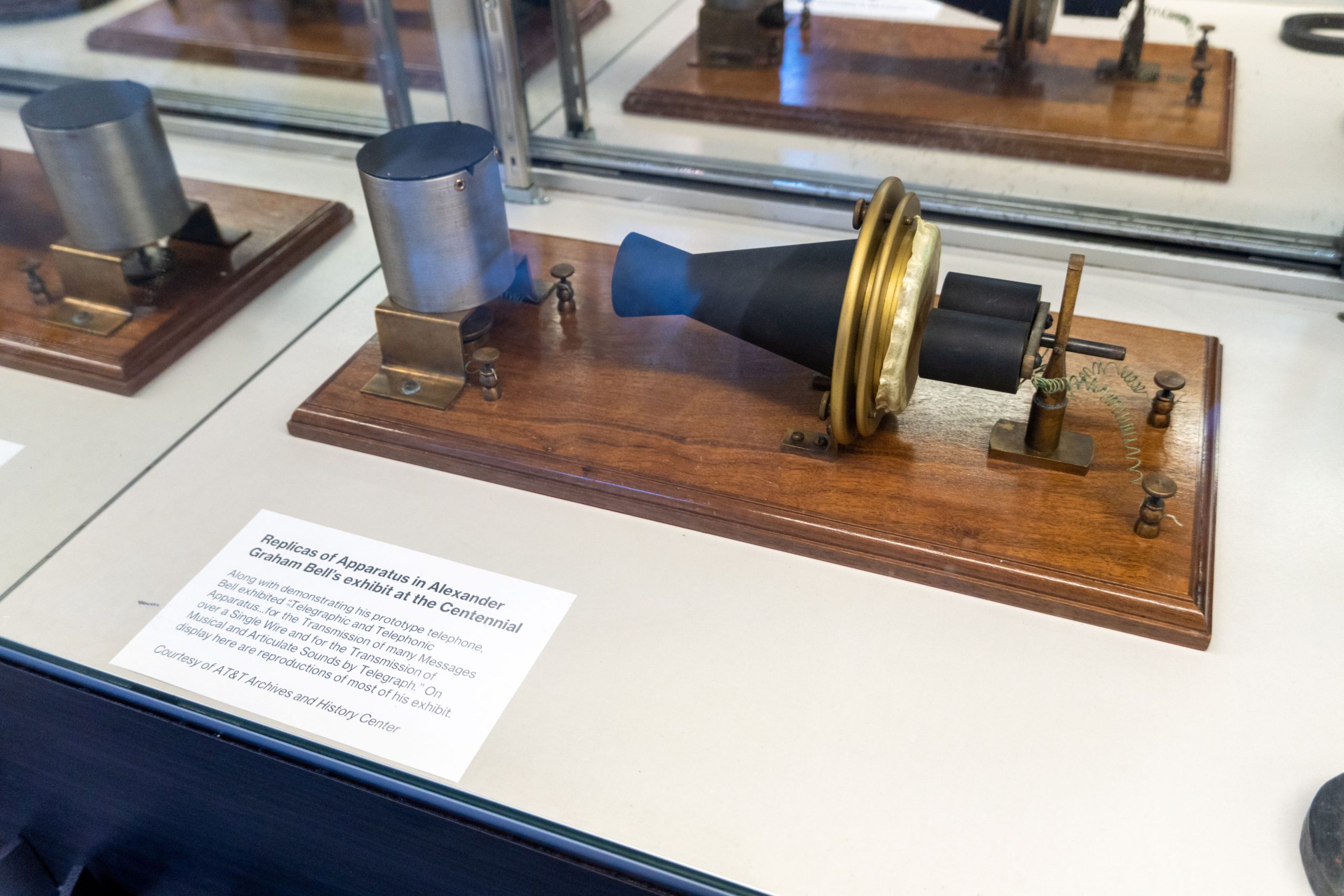
A replica of Alexander Bell’s first telephone that was shown for the first time for the 1876 Centennial Exhibition in Fairmount Park. The replica is on exhibit at “Revisit: 1876” in the Lits Building, 701 Market St. Entrance is on Eighth Street.Leo Manning for the Center City District
Silhouettes of women in corseted dresses and twirling umbrellas and dandy men in top hats greet visitors. Behind the sales counter is the replica of the first telephone that Alexander Graham Bell brought to the Centennial. Also behind the glass counter is a 3-foot terra-cotta model of the Statue of Liberty made by the original sculptor Frédéric Auguste Bartholdi.
There is even Centennial merch, including puzzles and wallets, all in pristine condition.
My favorite part is the flyover video from Independence Hall to Memorial Hall. It’s layered with historic photos connecting 2026 to 1876. In other words, the 2026 flyover includes our majestic City Hall. In 1876, it was an active construction site. (Construction started in 1871 and wasn’t finished until 1901.)
In addition to Memorial Hall, there are exhibits on Machinery Hall, Horticultural Hall, and the Main Building. A special section spotlights how the former enslaved abolitionist Frederick Douglass was prevented from speaking at the event and how Ben Franklin’s great-granddaughter Elizabeth Duane Gillespie fought to have women included.
“Revisit 1876” is open through December. The Lits Building is at 701 Market St. (Entrance is on the Eighth Street side). Admission is free.
In past years, the city’s budget process has followed a certain pattern for Mural Arts Philadelphia and other groups.
The mayor’s proposed budget lists city funding at one level; City Council and others advocate for modifications at a higher level; and the budget goes back to the mayor and is finalized with the higher allocation in place.
This year was different.
Philadelphia’s nationally acclaimed program that puts colorful murals in neighborhoods and provides jobs was hoping for a boost in city funding.
Instead, the budget ultimately agreed to by Mayor Cherelle L. Parker’s administration and City Council cut funding to Mural Arts — from $5.1 million in fiscal year 2026 to $3.7 million in 2027.
Likewise the Philadelphia Cultural Fund. The group — which awards hundreds of grants to arts groups throughout the neighborhoods — was looking for increased funding in the city’s newly approved $7.1 billion budget for the fiscal year starting July 1.
But the arts nonprofit, established by the city recently, learned that it will get substantially less — $3.5 million instead of the $5 million it received from the city for the fiscal year now ending.
As a result, both groups say they will have to make deep cuts to programs.
Philadelphia’s arts and culture sector had greeted the start of Parker’s term 2½ years ago with optimism for increased funding. Today, it is “alarmed” by the cuts to Mural Arts and the Cultural Fund, said Patricia Wilson Aden, president and CEO of the Greater Philadelphia Cultural Alliance.
“We always say that your budget tells a story, and I have to say that the cultural community is disappointed and frustrated with the story being told by this FY27 budget,” she said. “Cutting the budget of signature programs like Mural Arts by 26% or decreasing funding to the Philadelphia Cultural Fund, that’s going to have ramifications throughout the city.”
Parker was not available for comment, a spokesperson said.
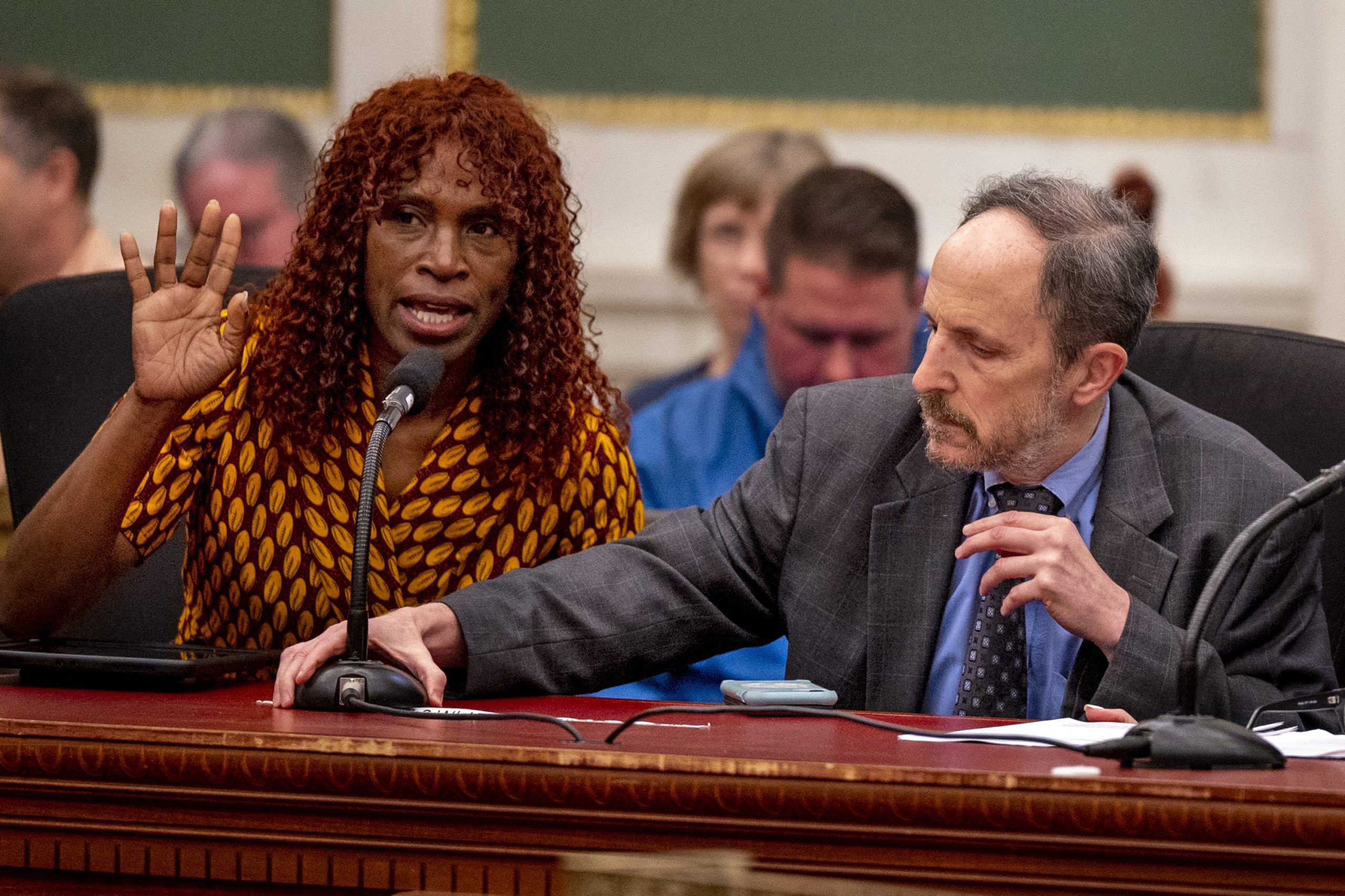
Valerie V. Gay (left) chief cultural officer with the City’s Office of Arts, Culture and the Creative Economy, and finance director Rob Dubow (right) testify at a Philadelphia City Council hearing, Aug. 8, 2024 on the collapse of the University of the Arts.Tom Gralish / Staff Photographer
Valerie V. Gay, the city’s chief cultural officer, said it was the city’s view that funding for the two groups had remained flat from 2026 to 2027, since the base allocation stayed the same and it was only the added amount that did not come through — though she allowed that “absolutely I can see how it can be perceived.”
A ripple effect
The resulting cuts at both groups promise to be substantial. The Cultural Fund will be forced to reduce the number of grants it had been expecting to distribute in the coming year, from 332 to 232. It has changed its eligibility requirements, which will eliminate grants to a pool of midsize organizations currently eligible.
“It’s going to be a ripple effect. People are going to feel it and communities are going to feel it,” said Philadelphia Cultural Fund executive director Gabriela Sanchez.
“An investment in the Philadelphia Cultural Fund is more than a budget line item,” Sanchez wrote in a statement distributed by the group. “Funding to PCF represents how the city values neighborhood theaters, cultural centers, museums, arts education programs, festivals, dance companies, community storytelling initiatives, music programs, and cultural traditions that bring Philadelphians together. These spaces are where young people discover their creativity, where seniors find connection, where communities celebrate their heritage, and where residents gather across lines of difference.”
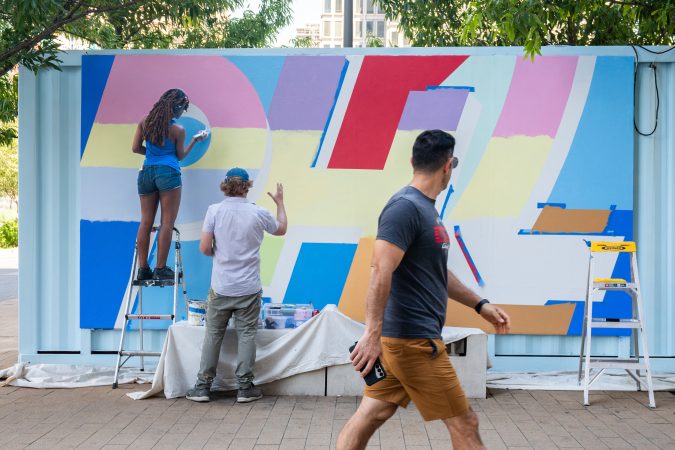
Jane Golden (center right) speaks with press at the Wawa Welcome America media preview for the Philly Fair 250, outside the Please Touch Museum in West Philadelphia, June 18, 2026. Mural Arts held a ceremonial unveiling of a 10-story-high mural replica, originally titled ‘CityKids Speak On Liberty,’ and created by Keith Haring.
Mural Arts director Jane Golden declined to comment, but an initial assessment from the group obtained by The Inquirer says that “hundreds of residents in at least 15 Philadelphia communities will lose the opportunity to develop public art projects,” and that opportunities for paid work, job training, and mentorship through the Mural Arts Restorative Justice program will be reduced by 25%.
Mural Arts will also have to cut by 75% its program of restoring and preserving the city’s murals, “putting at risk community landmarks that took years and significant public investment to create,” the impact statement reads.
Of the program reductions at both groups, Gay said: “I am always sad that any cuts are made or that any organizations are unable to do the work they thought they were going to be able to do. That’s always a sad time for us, and I’m looking forward to when we are a fully funded sector.”
A city spokesperson was unable to provide a full list of groups that in past years had received higher allocations after advocacy from City Council and others, but this year did not.
What’s behind the cuts
Aden says arts and culture has seen some significant recent “wins” from city government. Among them is the advancement of a referendum that, if approved by the mayor and then by voters this fall, would enshrine the city’s office of arts and culture, called Creative Philadelphia, in the City Charter.
The city has approved $500,000 a year to develop and implement a cultural plan for Philadelphia that would document financial needs and could identify potential pathways to establishing funding.
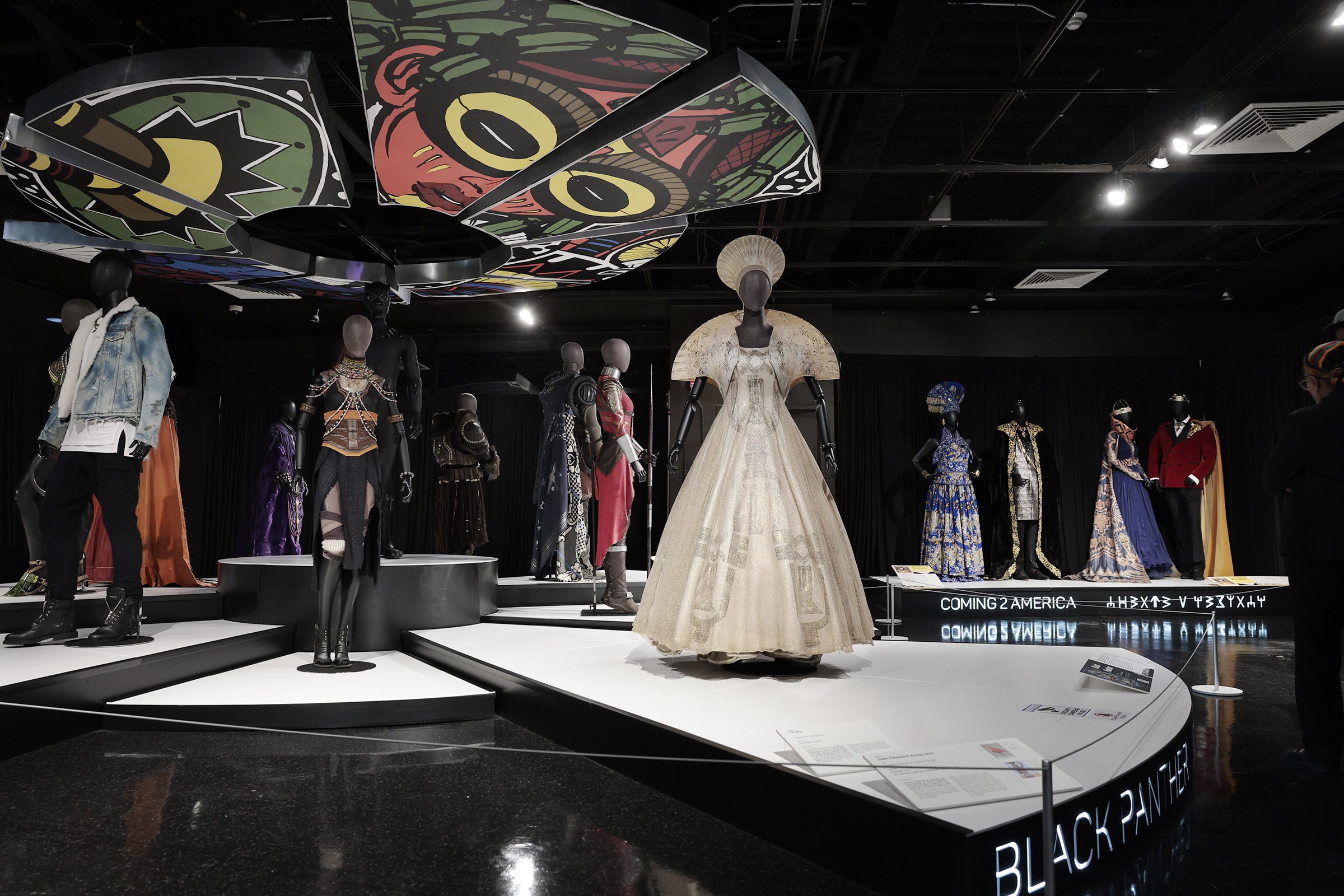
The ‘Ruth E. Carter: Afrofuturism in Costume Design’ exhibition at the African American Museum in Philadelphia, Nov. 1, 2025.Elizabeth Robertson / Staff Photographer
Sometimes the city’s support is for regular operations, and other times it is for specific capital projects. In an unusually large commitment, the city has pledged $50 million to the African American Museum in Philadelphia for its relocation to the Benjamin Franklin Parkway.
The city is providing nearly $32.5 million to arts and culture in FY27, according to a list provided by Parker’s office. While that total includes small items that might seem mundane — paying utility bills at various facilities, for instance — it also shows multimillion-dollar allocations to the Philadelphia Museum of Art, Dell Music Center, and Philadelphia Zoo.
But the arts and culture sector often finds itself fighting for adequate funding in the annual budget process. Arts leaders and others say it has been standard practice in recent memory that funding is listed at one level in the mayor’s proposed budget and after City Council testimony in budget hearings ends up being higher.
This year, the mayor “could have funded [the arts] at a higher amount,” as she did last year, but did not do so, Councilmember Rue Landau said.
The cuts came after a budget that passed without a series of tax increases proposed by Parker, including a $1 tax on rideshare services, after failing to win support from City Council. After Council signaled it would reject Parker’s tax proposals, the administration would not agree to any last-minute line items for new funding requests from lawmakers.
Councilmember Isaiah Thomas, a consistent arts supporter who, like Landau, is an ex-officio Mural Arts board member, said that with the lack of new tax revenue and the city’s extra allocation of $48 million to cover the Philadelphia School District’s budget shortfall, the funding pie for other allocations got smaller.
“This budget year, a lot of attention and advocacy went toward schools,” Thomas said. The funding cuts to Mural Arts and the Cultural Fund were “extremely unfortunate,” he said, “and I wish we could have done something different.”
The need for ‘predictable, stable, reliable’ funding for the arts
While the city’s budget is now final, there is another potential window of opportunity for funding through a midyear budget transfer process in which the city might see expenditures in certain areas coming in lower than expected, and then transfer money from those categories to other areas.
Asked whether funds might be restored through a budget transfer to Mural Arts or the Cultural Fund, Gay said:
“I think anything is on the table, but I also think nothing is guaranteed.”
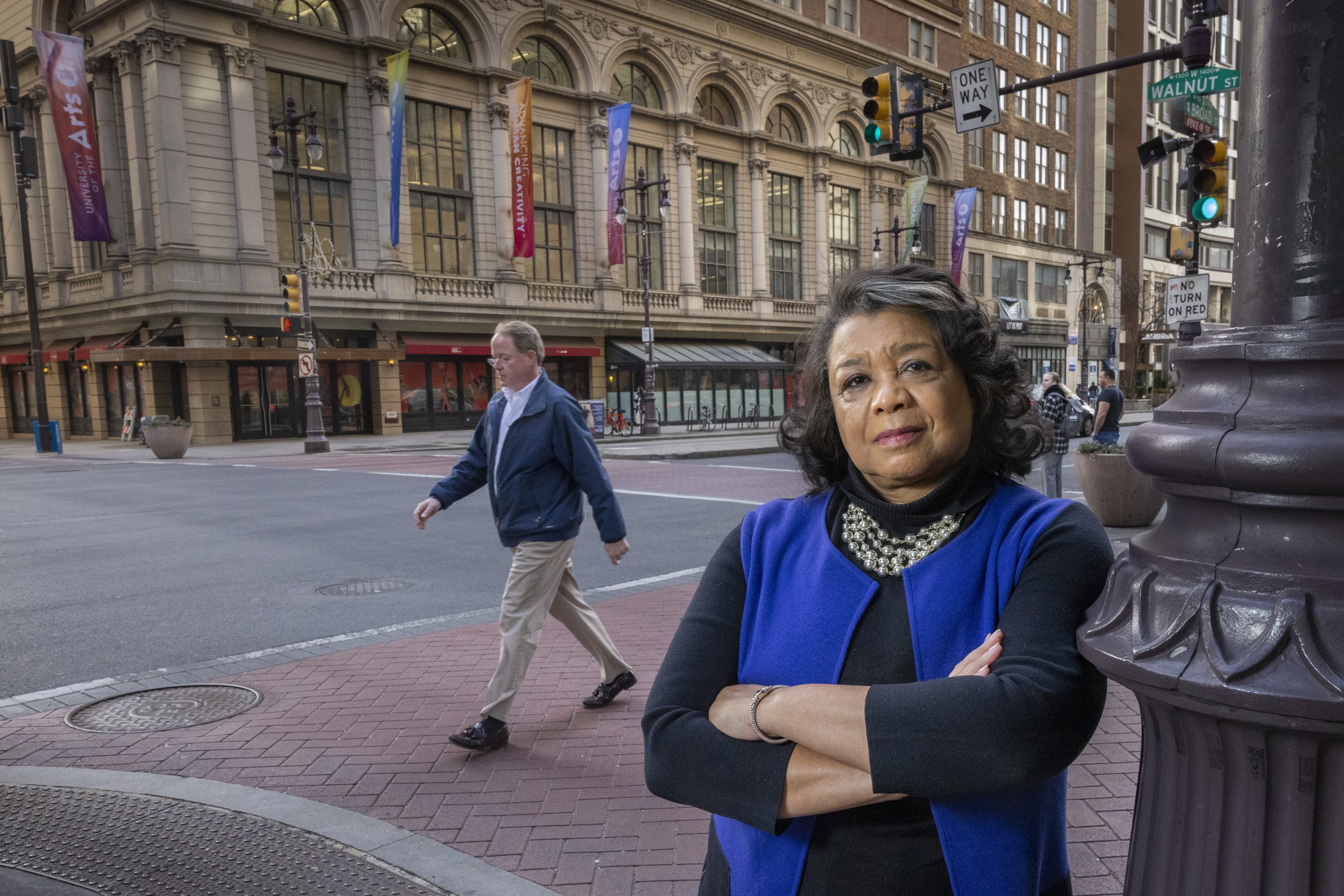
Patricia Wilson Aden, president and CEO of the Greater Philadelphia Cultural Alliance, at S. Broad Street and Walnut along the Avenue of the Arts, Feb. 15, 2023.Alejandro A. Alvarez / Staff Photographer
Any restoration of funds would happen after arts groups have already put cuts in place, and this kind of unpredictability “makes planning by these organizations very, very difficult,” Aden said.
“The practice of underfunding the arts and having Council and other entities have to go on an advocacy campaign to increase funding is illogical,” Landau said. “It is clear as day that we should be supporting the arts with additional funding every single year, so we don’t have to go through this and it won’t ever be a question mark for them.”
What is really needed, Aden said, is a dedicated arts fund in Philadelphia and the region.
“We’ve seen other regions benefit from this predictable, stable, reliable funding. And instead, here in Philadelphia, each year we have this conversation about increases and decreases and their impact. We are sometimes left to the will and whim of elected officials, and we would like to take the creative economy out of the political realm and put it solidly within our larger civic interest, so that it is stable and has the investment that is required to reach its full potential.”
Staff writer Anna Orso contributed to this article.