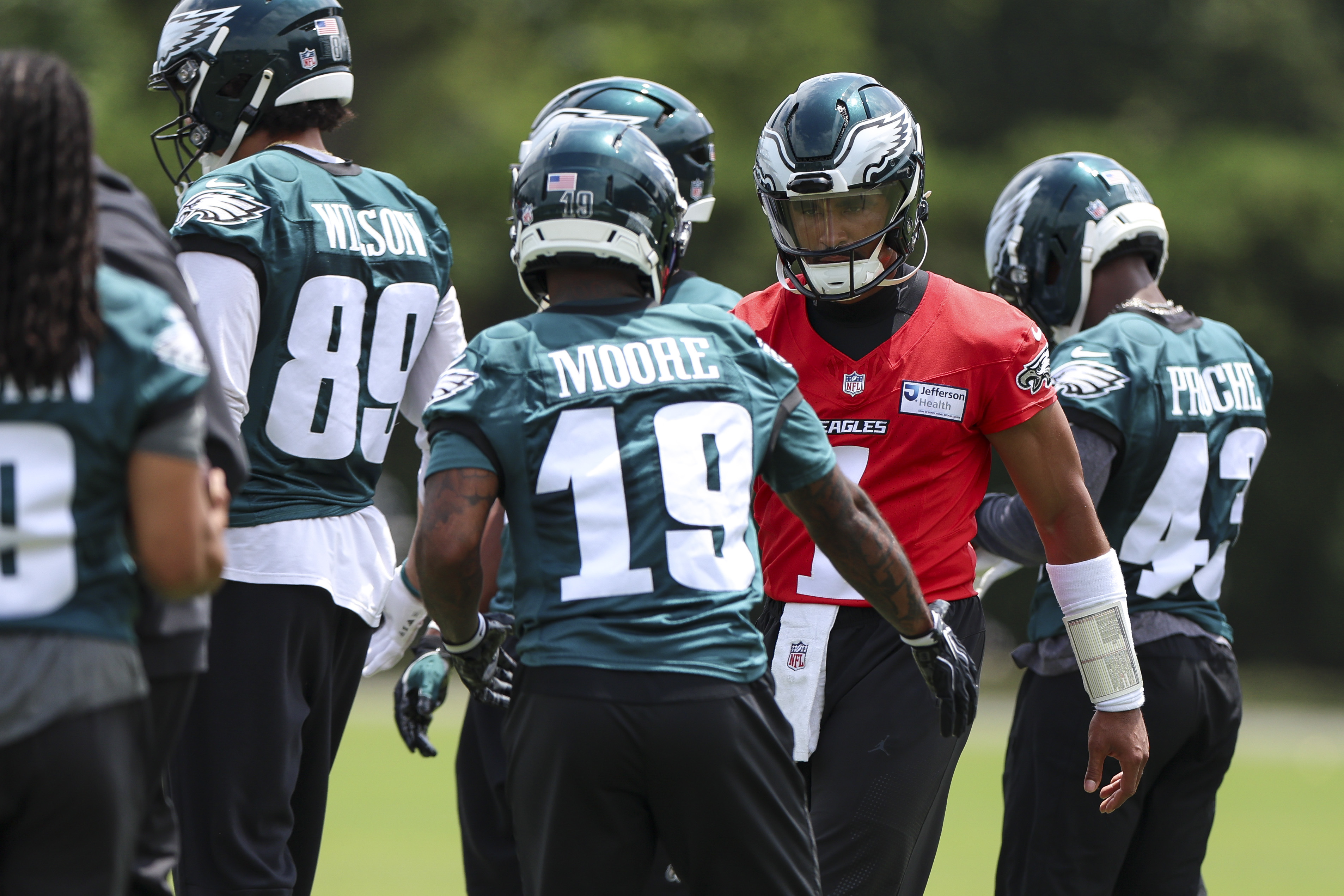
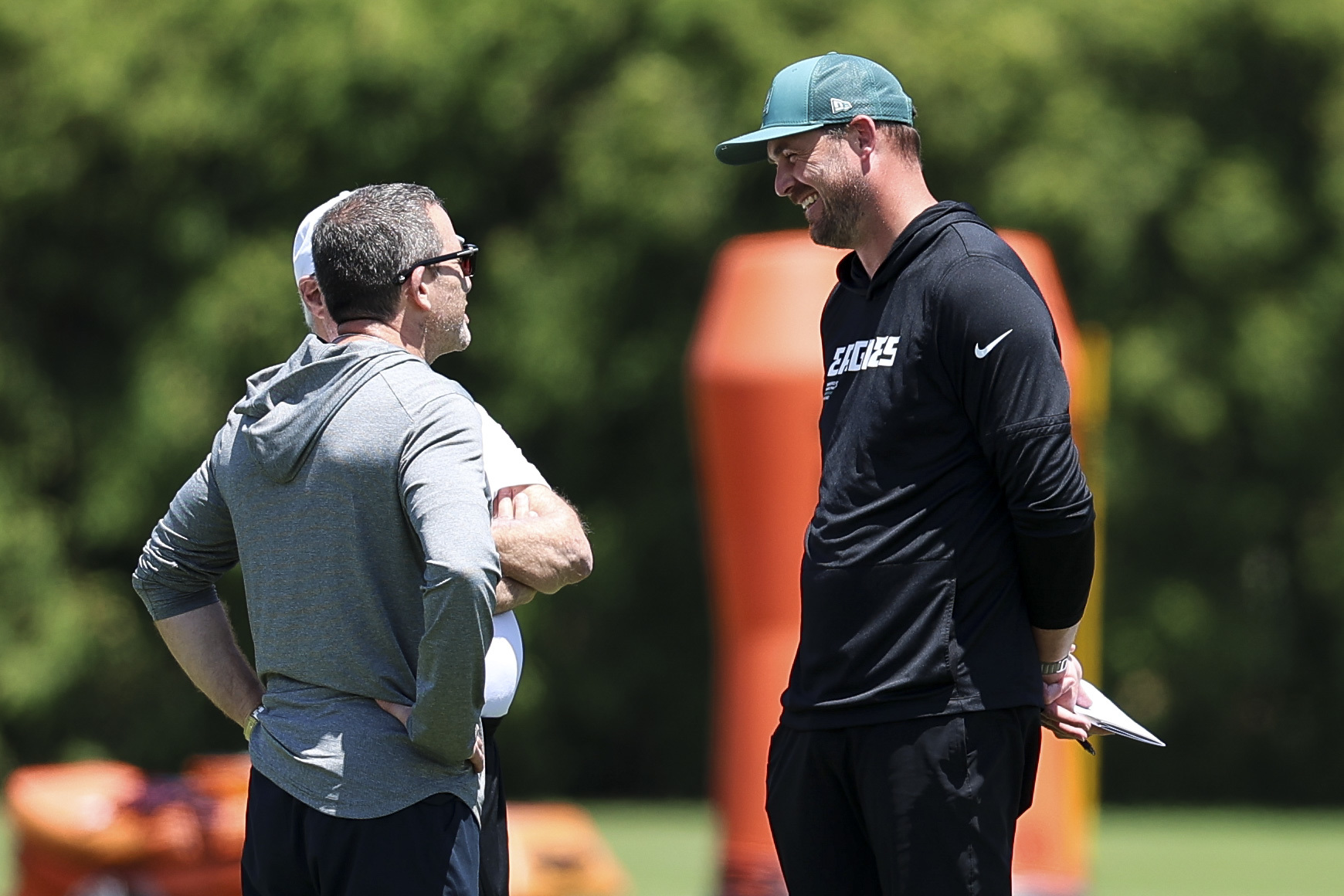
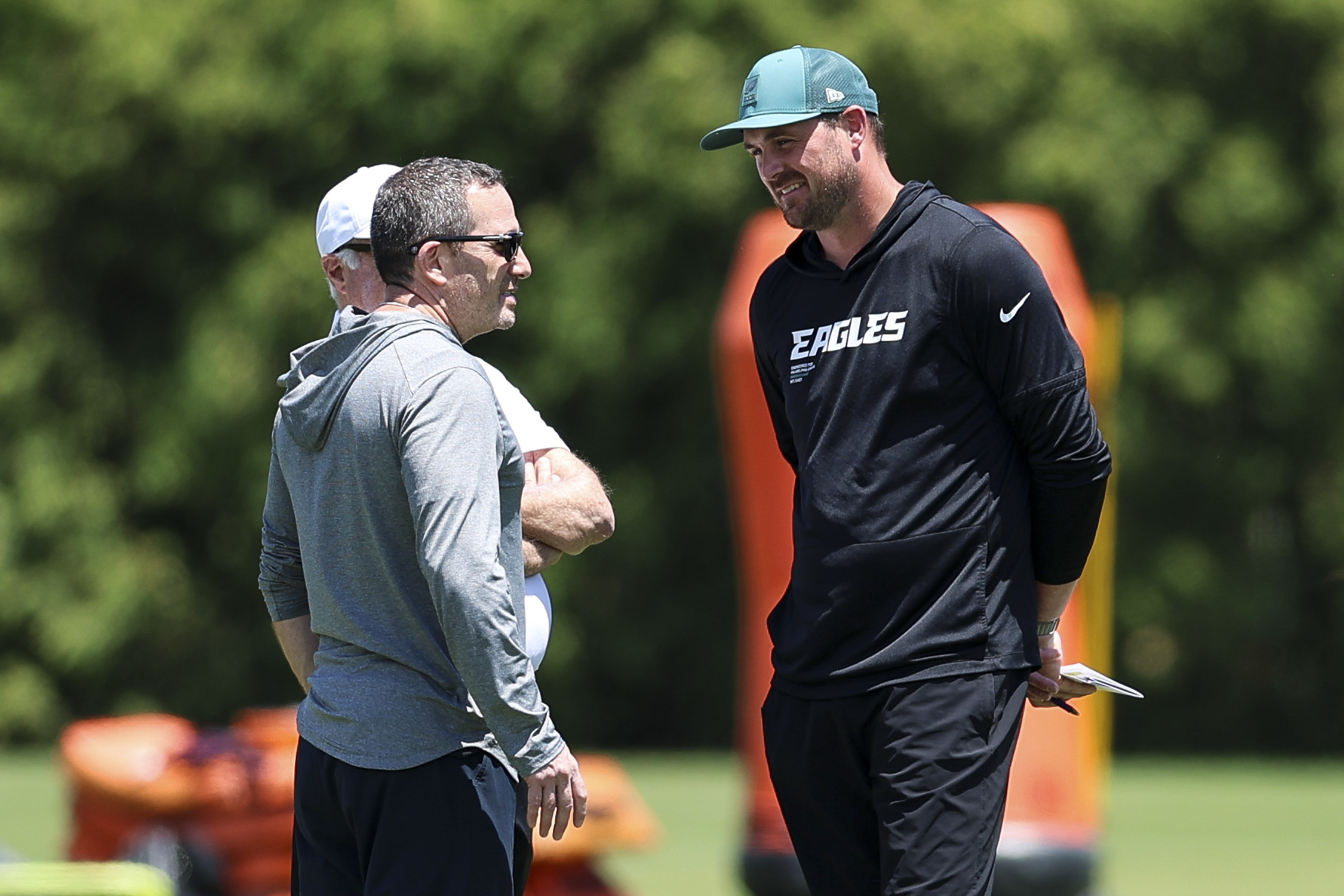
It’s Week 5 of the Eagles’ season. They’re 2-2, but their record is not the concerning thing, not really. They have lost their most recent game, at home to the Los Angeles Rams, but that loss, in and of itself, is not the concerning thing, not really. The Rams are favored to represent the NFC in the Super Bowl, after all, and any team would struggle to hold Myles Garrett at bay, and the Eagles could not.
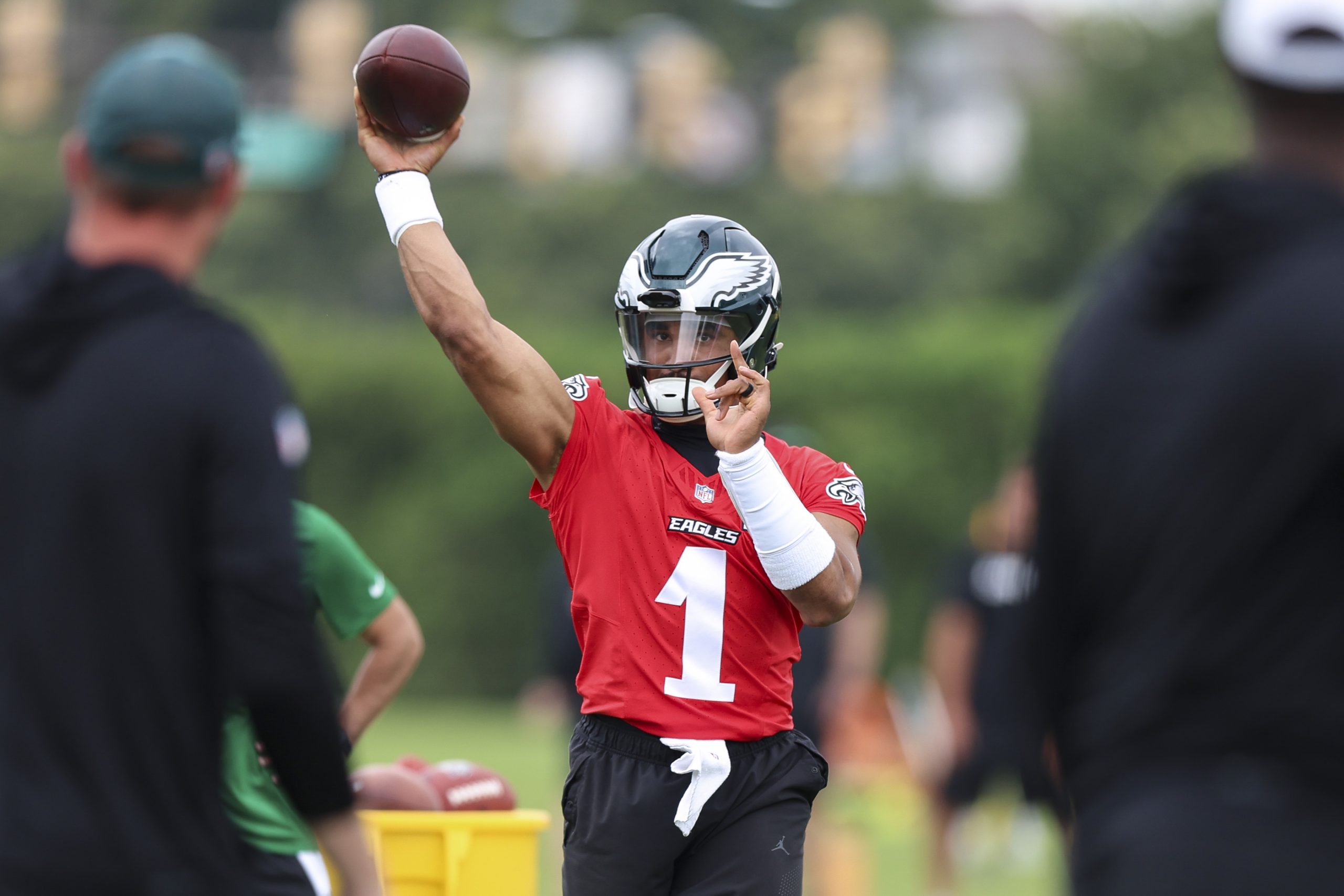
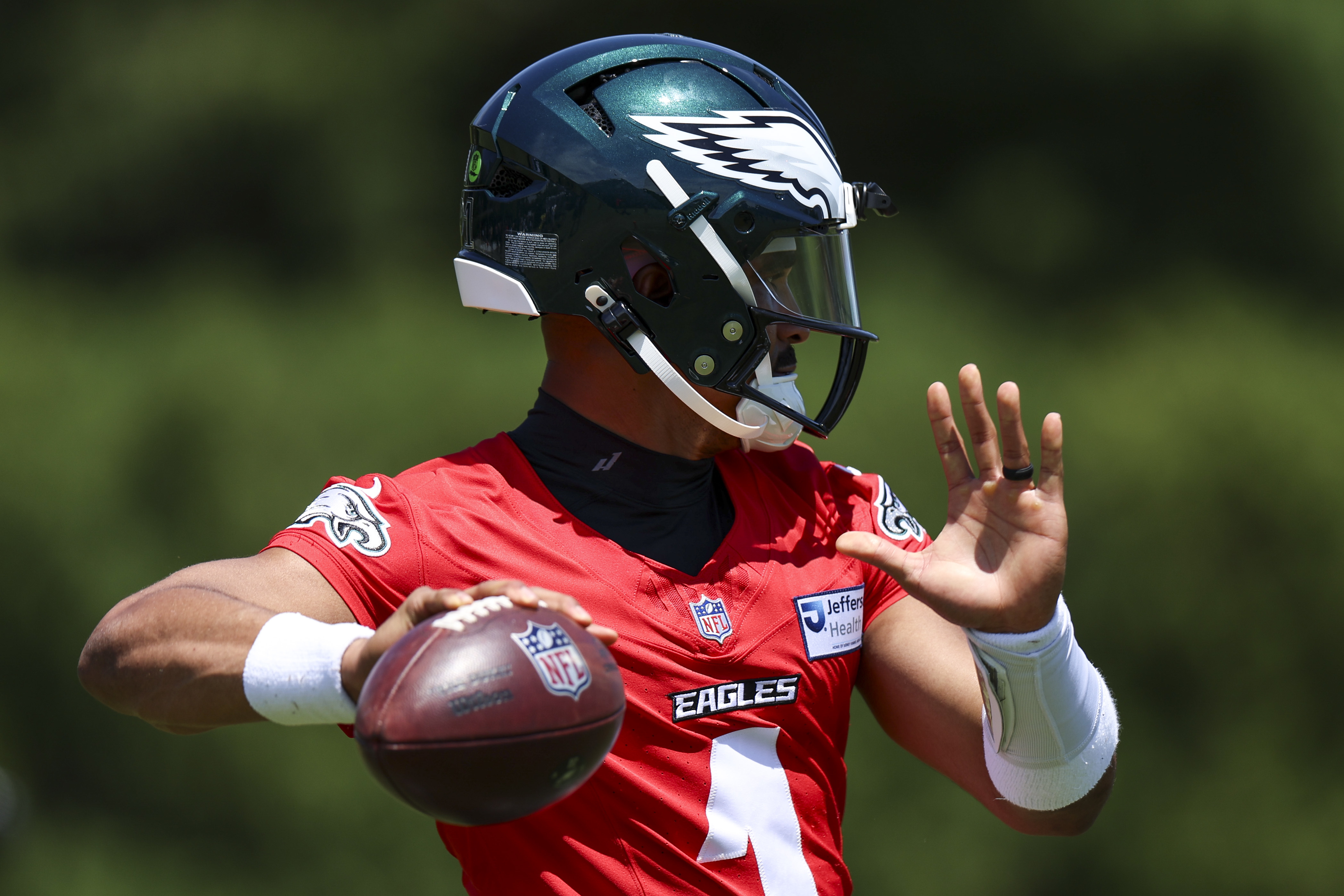
No, here’s what’s concerning: Jalen Hurts is doing the one thing that he generally does not do. He’s turning the ball over. He’s throwing interceptions, and it’s clear that those interceptions are born of his acclimation to the Eagles’ new offensive system under their new offensive coordinator, Sean Mannion. The Eagles would be at least 3-1, perhaps 4-0, if not for Hurts tossing the ball to their opponents too many times.
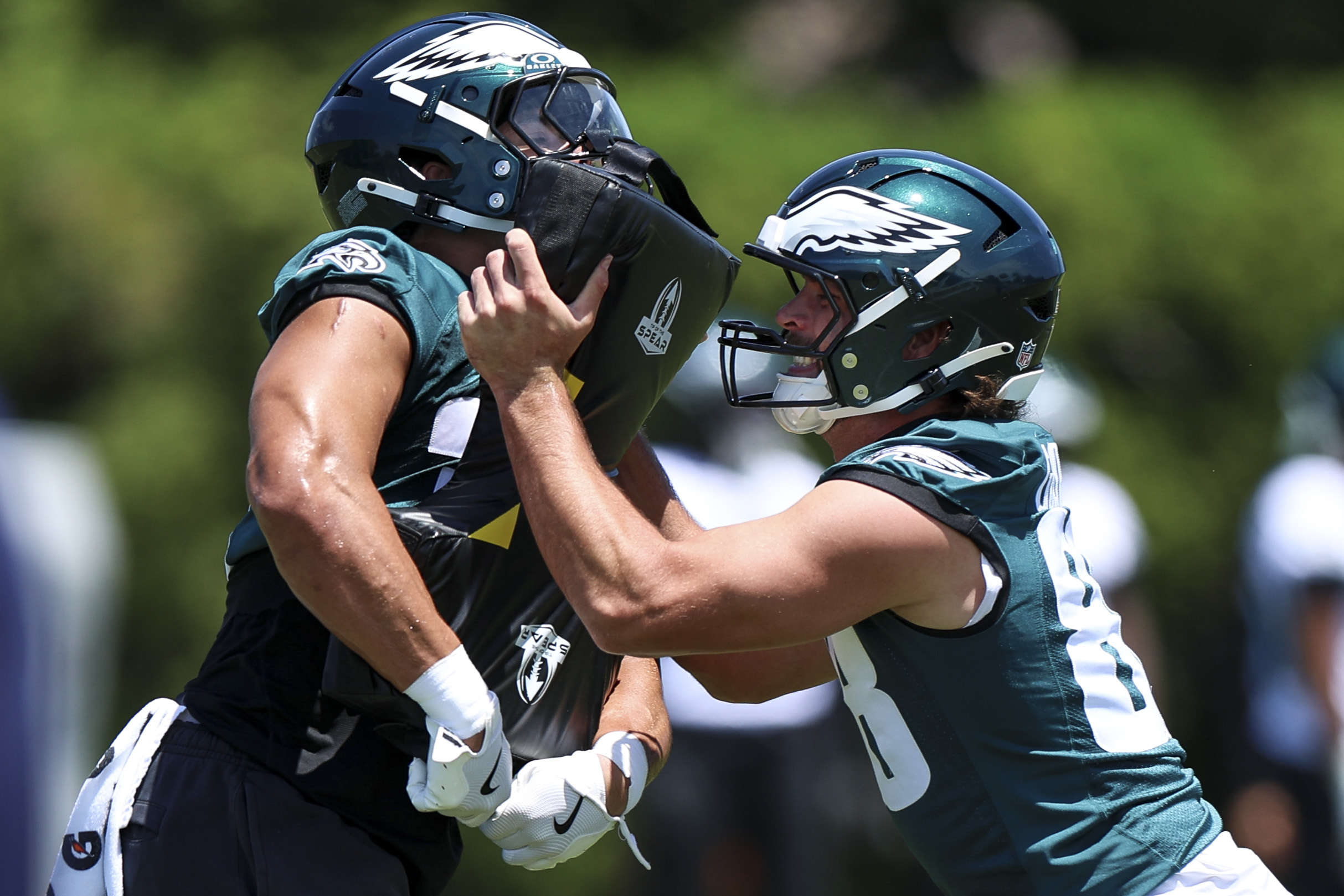
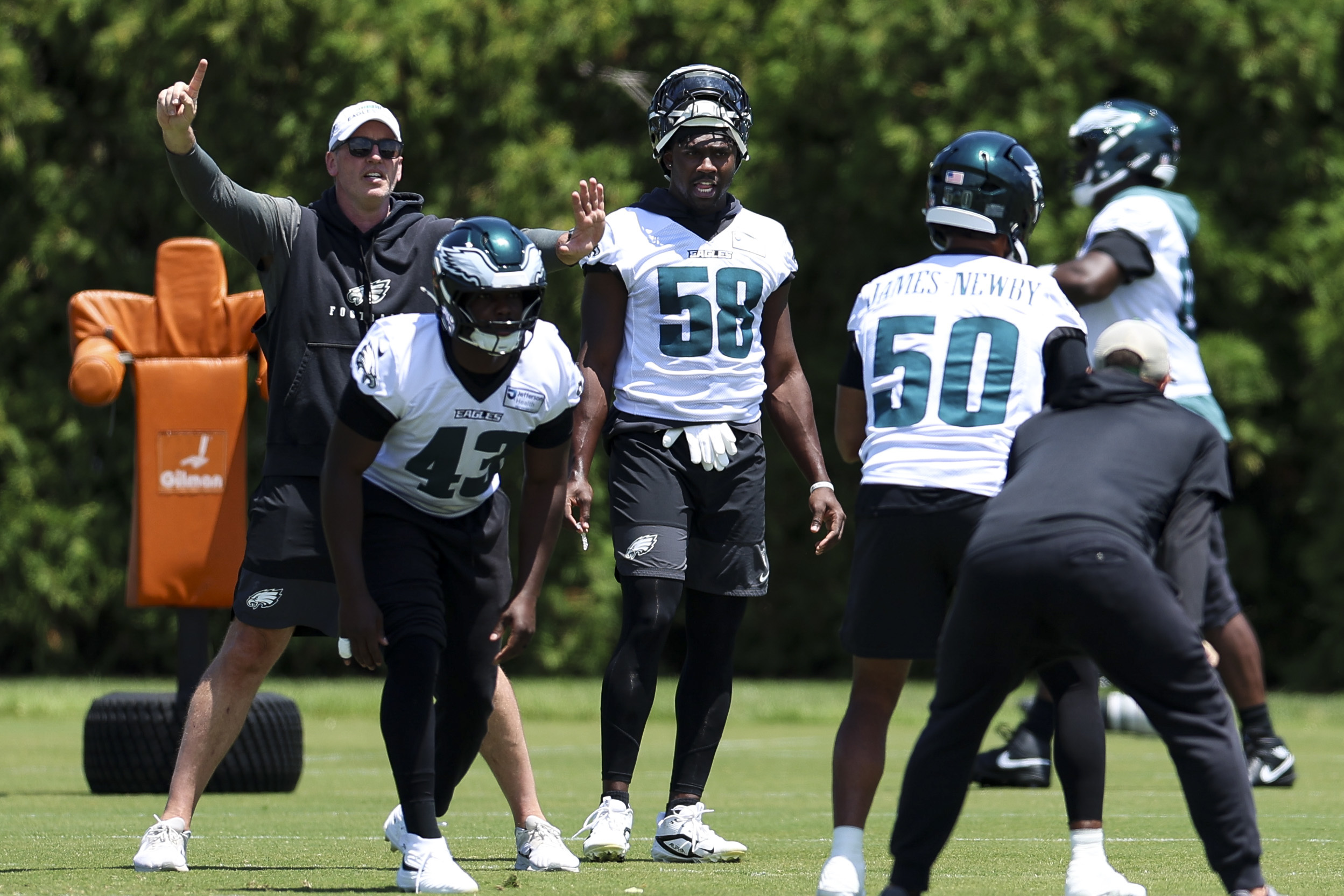
The question cuts to the core not only of the Eagles’ fortunes this season but their long-term future. And Hurts’ future. And Sirianni’s. Spend just a few minutes watching one of the Eagles’ recent minicamp workouts or listening to Hurts and Lane Johnson speak about Mannion’s offense, and you understand how big a change this will be and how committed the Eagles are to making it. Hurts will be under center more. The offensive line’s blocking techniques and schemes will be different. Oh, and A.J. Brown isn’t here anymore.
Put simply, this transition may take some time, and it may be rough at the start. If it is, it promises to force Sirianni to choose between riding out Hurts’ rite of passage in Mannion’s system and falling back on one of his primary coaching principles: Above all else, protect the football.
“As long as I’m the head coach here, we’re going to be very diligent about winning that turnover battle and winning the explosive-play battle,” Sirianni said Wednesday. “I know it’s like, ‘OK, that sounds simple,’ but there’s an art to it because you’ve got to be able to create explosives in different ways and sometimes that puts the ball at risk. But at the end of the day, that ball is still the most important thing.
“We’ll know how to create explosives in that time, but taking care of the ball is the most important thing, and we talk about this all the time: Can we come out of a game with every drive ending in a kick? Whether that’s an extra point, hopefully, whether that’s a field goal, or whether that’s a punt.”
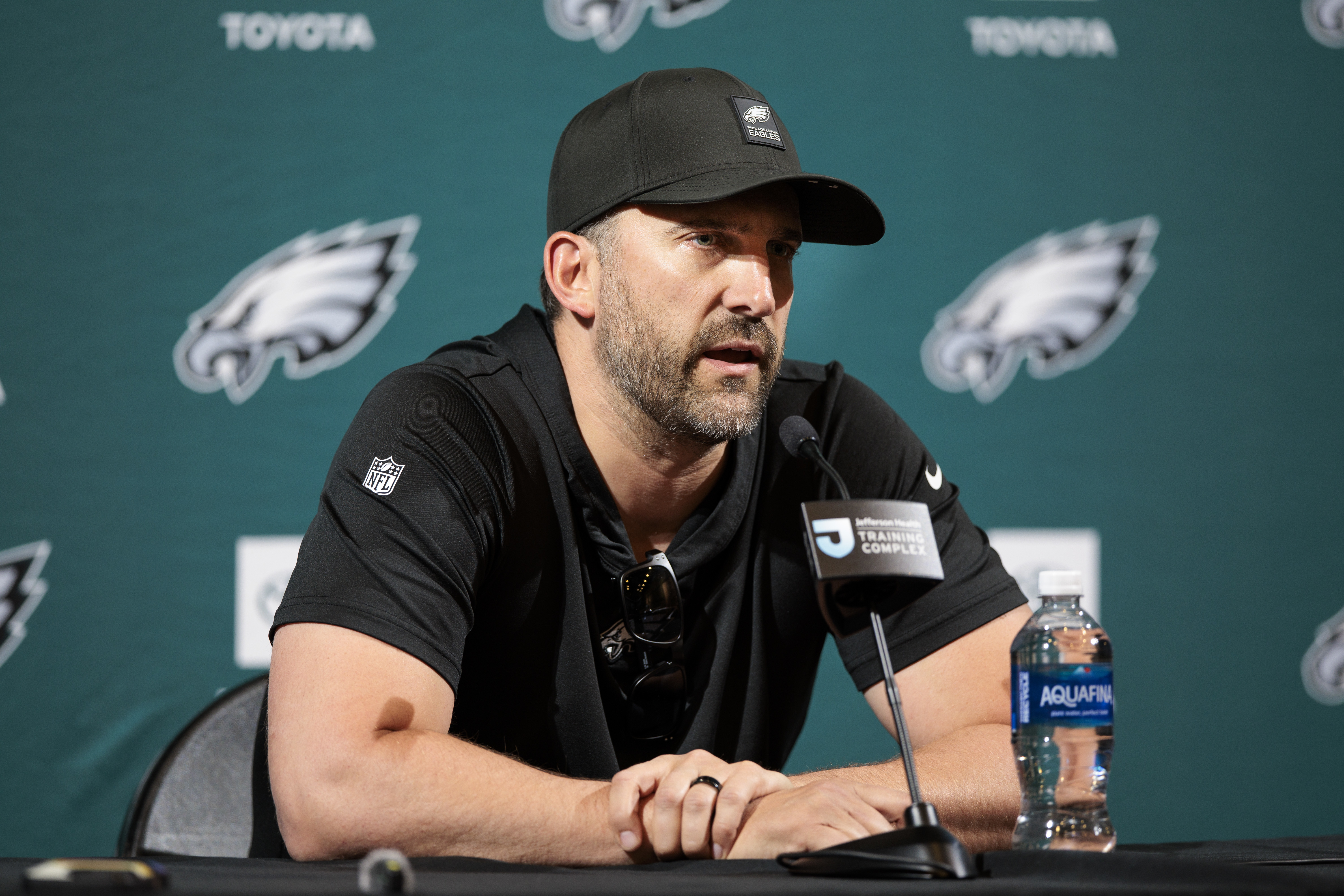
Will Jalen Hurts be given the bandwidth to struggle in his early moments within the Sean Mannion offense?Monica Herndon / Staff Photographer
A quick review of the last two seasons provides plenty of evidence that Sirianni is pastor of The Church of Do No Harm. In 2024, Hurts threw the ball at least 30 times in each of the Eagles’ first four games and was intercepted four times as the Eagles went 2-2. Over the remaining 13 regular-season games, he surpassed 30 pass attempts in a game once, and he threw just one interception, and the Eagles rode Saquon Barkley, their O-line, and their defense to a Super Bowl victory.
In 2025, Hurts’ most daring passing performance — and, in Sirianni’s eyes, his most destructive — came in Week 14 against the Los Angeles Chargers. Hurts made some dazzling downfield throws that night … and tossed four picks, including one in overtime that ended the Eagles’ hopes of winning. His subsequent four games were a case study in cautiousness. He attempted just 15 passes in a rout of the (awful) Las Vegas Raiders. He had 185 passing yards on 30 attempts against the Washington Commanders, then threw for a piddling 110 yards (in freezing and windy weather, granted) against the Buffalo Bills, then managed just 168 yards on 35 attempts in that maddening wild-card loss to the San Francisco 49ers.
The Eagles wouldn’t have hired Mannion if they believed such an approach were sustainable. The combined greatness of Barkley and their offensive line was responsible for the offense’s quick-strike and big-play capabilities in 2024, and it had the added bonus of cutting down the occasions when Hurts or anyone else had to put possession of the football at risk. But those circumstances and conditions were ideal and difficult, if not impossible, to replicate, and the Eagles couldn’t and didn’t in 2025.
Now they have Mannion, who is regarded as a sharp, up-and-coming mind in the NFL. And they have Hurts, who for the sake of his own improvement and his team’s fate has to master a system unlike any he has played in before. And they have Sirianni, whose instinct has been to minimize any possibility of a big mistake. Something might have to give, and the season just might come down to the head coach and his ability to resolve a fundamental conflict within himself.
Drumroll, please! The full list of Philadelphia’s most iconic dishes — including our top 10 — is below.
What is the most Philadelphia dish? What are the foods that have most shaped the culinary scene in Philadelphia? That’s what the food team set out to assess for this, our ranked list of the 76 most iconic Philadelphia dishes. In celebration of the 250th anniversary of the founding of the country — of which Philadelphia was a crucial part — we looked at the history of the city, and at the dining trends that define its regional cuisine to the rest of the country.
To make our annual list of the 76 most essential restaurants in the area, we ask: What’s vital now? Where is the energy of the city in the past 12 months? But for this project we took a longer scope. It’s not just what’s good now, but what shaped the culinary landscape up until now. Then we debated, hotly, where we would place certain dishes. Some inclusions were a given — yes, there are cheesesteaks — while others represent growing immigrant communities, innovations in food and beverage technology, and restaurants that have come and gone but left an indelible imprint on the culinary scene. Below, our picks for the most iconic Philadelphia dishes of all time.
Disagree? Have an addition? Let us know in the comments.
The Pizzazz Pizza at Celebre's PizzaTyger Williams / Staff Photographer
Ronnie Celebre — the original owner of Celebre’s Pizzeria in Packer Park — invented this hyperlocal pie in the 1970s as a means of grilled cheese-ifying pizza, layering beefsteak tomatoes and a sprinkle of banana peppers atop slices of white American cheese. The Pizzazz remains one of Celebre’s best sellers, according to current owner Michael Spina, who believes the American cheese adds a sharpness and creaminess that’s worth some skepticism. “When people come in and ask about our best pizza and we say Pizzazz, they look at me and say, ‘American cheese? No, I don’t wanna try that,’” Spina told The Inquirer. “Afterwards, they say it’s one of the best pizzas they ever had.” The Pizzazz remained a South Philly secret until recently, with newer school versions at Northeast Philly’s Cafe Carmela and University City’s Tempoopting for Cooper Sharp to add an extra dose of Philly. Not that the Pizzazz needs it. The pizza is a perfect metaphor for the city: underdog-ish, Italian-ish, and so much better than you expected. — Beatrice Forman
75
Khachapuri at Gamarjoba
The Khachapuri 'Ajaruli' at Gamarjoba.Monica Herndon / Staff Photographer, Food Styling / Emilie Fosnocht
Philadelphia’s broad awakening to the wonders of Georgian cuisine has finally taken root as that country’s distinctive khachapuri — sometimes simply called cheese boats — sailed into the Center City spotlight at Saami Somi in the Reading Terminal Market and charming Kinto in Fishtown. Northeast Philadelphia is the epicenter of the region’s growing influx of immigrants from that former Soviet republic, and sprawling Gamarjoba remains a drive-worthy destination for the best khachapuri in town. The famous canoe-shaped Ajaruli, named for its home region, is notable for the delicate snap and thinness of its crust. Its dough is enriched with enough yogurt and eggs to hold a boatload of blended Georgian cheeses which, when mixed tableside with the raw yolk and butter on top, turn into a luxuriously golden pudding. The Kubdari khachapuri is a double-crusted meat-lover’s beauty filled with cumin-laced minced beef seasoned with garlic salt from Svaneti. The dough for the round Imeruli khachapuri, meanwhile, is completely different, and so is its cheese, a blend of brined sulguni with younger Imeruli, the cheese for which the pie is named. It is essentially a dreamy cheese pizza, but with Georgia’s trademark swagger and tang. — Craig LaBan
74
The Zep
The small zep from Lou's in Norristown is served on a round roll.Michael Klein / Staff
The zep is Norristown’s great sandwich flex: hyperlocal, fiercely defended, and absolutely not a hoagie. It may look like one from a distance, but locals know the rules. A proper zep starts on a specialized Italian roll — longer, wider, and squatter than the usual hoagie roll — and is built with one meat (cooked salami), an onion-tomato-oregano balance, and never, ever lettuce. Its origins are murky, with one story tracing the name to zeppelin-shaped rolls after the Hindenburg disaster. What is clear: the zep proves Philly food culture does not stop at city limits. — Michael Klein
73
The Schmitter at McNally’s Tavern
The Schmitter sandwich.Tim Tai / Staff Photographer
The Schmitter is Philadelphia sandwich logic pushed to its most lovable extreme. Created at McNally’s Tavern in Chestnut Hill, it piles sliced beef, grilled salami, cheese, fried onions, tomatoes, and special sauce onto a Kaiser roll, landing somewhere between cheesesteak, burger, deli sandwich, and bar-food fever dream. Our old colleague Steve Lopez once described it as “a steak and salami sandwich that comes with cheese, tomatoes, fried onions, a secret sauce, and a paramedic.” That about covers it. The Schmitter – named after a regular customer’s favorite Schmidt’s beer – made the classic Philly leap: neighborhood tavern oddity to ballpark staple. It is excessive, specific, faintly absurd, and impossible to mistake for anything from anywhere else. In other words, very Philadelphia. — M.K.
72
Middle Child BLT
Tomatoes from Urban Roots Farm star in Middle Child's BLT.Lauren Schneiderman / Staff
Everyone knows it’s peak tomato season in Philadelphia when Middle Child’s beloved BLT, served at both Center City and Fishtown locations, emerges from hibernation. What makes a really good BLT sandwich? Ask owner Matt Cahn, and he’ll tell you it’s the heirloom tomatoes oozing with red juice. The sandwich is made exclusively with tomatoes from Urban Roots Farm. At their peak, the heirlooms are big, plump, soft, sweet, and super juicy — Cahn salts three-quarter-inch cuts and stuffs them in Merzbacher’s rye bread with four to six slices of bacon, arugula dressed in a salted tomato juice vinaigrette, and Duke’s mayonnaise. It’s the sandwich that may have set the trend for the city’s BLT love. “I don’t think I invented the BLT. But I do think that I hyped it up in Philly,” he said. — Hira Qureshi
story continues after advertisement
71
Galette de Crabe from Le Bec-Fin
La galette de crabe Le Bec-Fin, Perrier's signature crab cake.Courtesy of Marc Vetri
Georges Perrier put Philadelphia on the national dining map when he opened Le Bec-Fin in 1970. His luxurious galette de crabe was its signature dish. It was inspired by an American crab cake he’d eaten on Maryland’s Eastern Shore, but reimagined through a French haute cuisine lens, suspending jewels of sweet lump crab in a pedestal of ethereally creamy seafood mousse that came glazed in a mustardy mayonnaise over haricot verts arranged in spokes across the plate to recall crab legs. It’s a presentation detail missing from modern tributes like the one currently at Parc, but the dish also lives on elsewhere with Le Bec-Fin alums such as Richard Cusack at June BYOB. The recipe from Perrier’s cookbook is famously finicky for its rigorous attention to temperatures and technique. But its legacy endures in the DNA of Philly’s restaurant scene. — C.L.
70
Country Club Diner Cheesecake
CheesecakeClay Hickson / For The Inquirer
Diner culture is vanishing in Philadelphia. We still have the Country Club, which Jack and Miriam Perloff opened on Cottman Avenue in Northeast Philadelphia in 1956, as the area surged amid the postwar housing boom. Operating round the clock for its first several decades, the Country Club was indeed Rhawnhurst’s country club. One of the gifts of membership, if you will, is the cheesecake: dense, smooth and almost fudgy, its outer edge dusted in graham cracker, and not cloyingly sweet. There are always several varieties besides plain (the standby) and chocolate chip (every kid’s favorite). The Perloffs sold the Country Club in 2004 to diner magnate Michael Petrogiannis, who still maintains the bake shop and its case up front between the counter and dining room. The world may be changing, and the diner’s hours are now shorter, but the cheesecake offers the reassuring possibility that no matter when you walk in, something good and familiar will be waiting. — M.K.
69
Milan salad
Milan SaladClay Hickson / For The Inquirer
The Milan salad has survived on local menus for three decades after its namesake creator closed. It’s a retro chopped salad – a bowl of lettuce (iceberg, of course) with peeled shrimp, bacon, hard-boiled egg, and tomato, tossed in more than enough creamy dressing. The DiBattistas – Jimmy and son Jimmy Jr. – served untold thousands of them at Jimmy’s Milan, the old-school supper club and politico hangout whose 45-year run on 19th Street near Chestnut ended in 1995. Nostalgists say the key was the dressing (equal parts Russian and Italian, according to insiders). The version at D’Angelo’s in Rittenhouse has direct ties to the original because Milan's longtime chef was Tony D’Angelo, brother of owner Sal D’Angelo. You can also order one at the Happy Rooster in Center City (to name another oldtime saloon) and Ryan Christopher’s BYOB in Narberth. Further, Ann Conlin, whose late husband was Jimmy Jr., said she plans to bring her bottled version of the dressing back to supermarket shelves after a few years’ hiatus. — M.K.
68
Famous Chicken Soup
The Famous Chicken Soup at Famous 4th Street DeliTyger Williams / Staff Photographer
There’s matzo ball soup. And then there’s the Famous Chicken Soup at Famous 4th Street Deli, a giant bowl of Jewish comfort that is four soups in one. A planet-size matzo ball enriched with schmaltz comes bobbing in a half gallon of broth steeped from whole chickens and parsnips, along with housemade kreplach dumplings, pasta bowties, and kasha, the toasted buckwheat groats that lend this combo an earthy shtetl note that sets it apart. The bowl is big enough to feed four and has become every bit as iconic as the mile-high pastrami sandwiches that typify the bigger-is-better aesthetic cultivated by Famous’ previous owner Russ Cowan, who, over nearly two decades of stewardship, elevated this century-old deli’s food to a level of quality that puts it on the map as among the best in the country. Cowan sold the deli in 2024 to open Radin’s in Cherry Hill (where he still makes arguably the best version of this mish-mash soup). But Cowan’s legacy and recipes persist here and no doubt played a role in Famous earning a Bib Gourmand from Michelin. The ownership transition has not always gone smoothly, but a promising recent visit felt like the new management was finally bouncing back. This majestic soup was as restorative as ever. — C.L.
67
The BBQ Platter at Vietnam Restaurant and Vietnam Cafe
Vietnam Cafe's barbecue sampler heaped with grill-charred cartridges of grape leaves stuffed with ground pork; skewers of savory meatballs; crisp, airy (not too dense) spring rolls, fried and chopped to bite-size pieces; and glistening slivers of marinated chicken.Michael S. Wirtz / Staff Photographer
A mere $36 buys you a veritable feast at Vietnam Restaurant in Chinatown (which also has a presence in West Philly with Vietnam Cafe). There are crackly fried pork spring rolls (some of Philly’s finest), delightfully rich beef wrapped in grape leaves, grilled meatballs, and chicken dusted with a handful of crushed peanuts. These are all anchored by a cool avalanche of tangled rice vermicelli noodles, fresh lettuce, and mint, and served with chili vinegar and hoisin sauce for dipping. The legendary BBQ platter masquerades as an appetizer sampler for two diners, but good luck saving room for anything else on the menu if you order it. — Kiki Aranita
66
Fried Chicken at Corinne’s Place
The fried chicken at Corinne's Place with a side of mac’n cheese and okra, corn, and tomatoes.Tyger Williams / Staff Photographer
Dubbed an American Classic by the James Beard Foundation in 2022, Corinne Bradley-Powers’ soul food joint on Haddon Avenue “puts the ‘C’ in Camden,” at least according to Bradley-Powers herself. To hear Bradley-Powers, now 81, tell it, no one wanted to come to Camden when Corinne’s Place opened in 1989. But they did, lulled by her tender ribs and no-nonsense fried chicken, with crackly skin and wings so juicy you can’t help but lick the bone clean. There’s no secret to the fried chicken, Bradley-Powers said, “besides me, the [salt-and-pepper] rub, and the prayer” kitchen staff say after every batch. Devotees know to pair the chicken with a side of collard greens, baked mac-n-cheese, and a complimentary piece of warm cornbread for a timeless Southern plate, but what makes Corinne’s a classic are the stories held inside the dining room’s pink walls. A children’s counselor before becoming a chef, Bradley-Powers preferred to staff her restaurant with neighborhood kids who could use an escape from home. “When those children succeed … when they come up out of here and become doctors and lawyers, that’s my true James Beard award,” Bradley-Powers said. — B.F.
65
Banh Chow Salad at Mawn
Banh chow salad at Mawn restaurant.Jose F. Moreno / Staff Photographer
The banh chow salad at Mawn started as a memory. As a child, Chef Phila Lorn had difficulty eating the large coconut milk and turmeric yellow crepes with his tiny hands, so he’d break them up into pieces. This translated into one of the best items on Mawn’s stellar menu. Crunchier than most any banh xeo found in Philly, Mawn’s grown-up version is stuffed with ground chicken and shrimp, topped with peanuts, and served alongside herbs and fresh lettuce. Break the crepe up into salad croutons, like little Phila once did. Its refreshing textures are all different types of crisp and crunch. The salad is just one of the reasons Mawn has become one of the city’s hardest reservations. — K.A.
64
Banh Mi at Cafe Cuong
A deluxe banh mi.Tim Tai / Staff Photographer
In Philadelphia, there are Cafe Cuong’s banh mi and then there are all the rest. Don’t get me wrong, the rest are excellent, thanks to waves of Vietnamese immigration to the city. But Cafe Cuong’s are simply in their own solar system. This is a sandwich that could only have been born in Philly, with a crusty, soft Sarcone’s roll, then its smear of secret-recipe mayo. Meatyshredded roasted chicken (or whatever meat you choose — but the chicken banh mi is the best) is tucked into its roll with slivers of pickled daikon and carrot, fresh cilantro, cucumbers, and jalapeno. When the chicken juices meet fresh mayo, the result is ethereal. — K.A.
63
The burger at Fountain Porter
The burger from Fountain Porter.Monica Herndon / Staff Photographer, Food styling by Emilie Fosnocht
Once upon a time, Fountain Porter’s burger was the best $5 deal in town. It is now the best $6 deal in town. The bar’s wine and beer lists are esoteric and interesting. It's a precursor to every “listening lounge” in town, an effortlessly cool, unpretentious neighborhood bar. But its cheeseburger makes Fountain Porter one of the most enduring and beloved bars in South Philly. It tastes like a loving dad grilled the burger in the backyard just for you. It has a salty char, and the cheese is melted just enough. It’s served with lettuce and tomato on a potato bun that’s neither too small nor too unwieldy. This is the simplest, most satisfying, and most straightforward burger in the whole city. — K.A.
62
Czerw’s Kielbasa
KielbasaClay Hickson / For The Inquirer
You can smell the dreamy campfire aroma of garlicky kielbasy slow-cooking in a haze of Jersey fruit wood smoke from blocks away before you get to the low-slung brick facade of Czerw’s in Port Richmond. That’s because one of Philly’s last great kielbasa artisans still makes its all-natural links in the 88-year-old brick smokehouses Jan Czerw built on Tilton Street in 1938. Last year, Czerw’s suffered the death of its third-generation owner, John Czerw, but the shop is still bustling and the sausages are as good as ever, with a bold, deep resonance that’s far superior to mass-produced sausages found in most supermarkets. The smoked and “extra garlic” are the standards, although the Cajun-spiced links and jalapeño-cheddar poppers are ideal for heat-seekers. A fridge case of housemade pierogies and pickles makes Czerw’s a one-stop shop for a proper Polska party. Swiacki Meats just a few blocks to the northeast, is another outstanding traditional Polish butcher with comparable kielbasy. — C.L.
story continues after advertisement
61
Upside-Down Pizza at Santucci’s
A personal-sized "The Works" pizzaTim Tai / Staff Photographer
Santucci’s upside-down pizza is one of Philadelphia’s clearest arguments for having its own pizza identity. The formula is instantly distinctive: square pie, cheese first, sauce on top, with a thick, chewy crust built for crisp corners and loyal devotion. It is the sort of pizza locals grow up with and outsiders sometimes need explained, part of its power. This is not Philadelphia imitating New York or Naples. This is Philadelphia doing Philadelphia. Santucci’s, which launched in 1959, became the standard-bearer for the style, turning a Juniata Park specialty into a regional touchstone. Its importance lies not only in flavor, though the brightly sweet sauce and sturdy structure do plenty of work. Upside-down pizza is proof that Philly pizza culture is broader and more self-defined than people elsewhere often realize. — M.K.
60
Junior hot fudge sundae at Franklin Fountain
Ice cream chef Franny Zehmer arranges a display of (empty) pint containers at Franklin Fountain on April 6. As part of their 250th celebration, the company is releasing 26 new limited edition ice cream flavors over the coming months.Tom Gralish / Staff Photographer
This 1920s-themed ice cream parlor in Old City is so historically accurate that tourists and tour guides alike mistake Franklin Fountain as the country's oldest continuously operating soda fountain. In reality, Media-born brothers Ryan and Eric Berley opened Franklin Fountain in 2004 with an eye for restoration; the building and its penny tiles date back to the 1890s. Still, Eric Berley told The Inquirer that he doesn’t mind the misconceptions. For years, people have likened Franklin Fountain’s iconic takeout ice cream and sundae receptacles to Chinese takeout containers. They’re actually replicas of the Progressive Era oyster pails Philadelphians used to carry wet foods in — ice cream included. Berley said Franklin Fountain went through roughly 104,000 of those iconic 8-ounce takeout containers in 2025. The most popular way to fill them is with a junior hot fudge sundae: a single scoop of ice cream topped with whipped cream, hot fudge, and a cherry. The fudge — made in batches three times a week with 63% dark chocolate — and the takeout containers are the most important parts. “The pituitary gland in the brain lights up for cute and small things,” Berley said. “And with the takeout pails, we got lucky that a lot of people think they’re cute.” — B.F.
59
Jollof rice at Lè Mandingue
Jollof rice with lamb and potato green with white riceCaean Couto / For The Inquirer
There are as many variations of Jollof rice as there are home kitchens in West Africa. That diversity is on vivid display in Southwest Philadelphia, where as many as 40,000 people have emigrated chef from the 16 sub-Saharan countries of West Africa, and where I joined locally based Nigerian chef Shola Olunloyo for a Jollof rice crawl through nine restaurants around Woodland Avenue and into Delaware County. At its most elemental, Jollof is rice stewed in flavorful tomato broth, but variations range with types of rice, heat levels, textures, and garnishes. We tasted Mauritanian Jollof with tomatoey tripe stew at African Small Pot and versions in the distinctively red Nigerian style that reminded Olunloyo of home at both Suya Suya and WaZoBia in Collingdale. A standout was found at Lè Mandingue, a longstanding takeout on Woodland Avenue since 2005, where chef-owner Fanta Fofana serves her Liberian-style Jollof in a big aluminum pan seasoned with sumbala (fermented locust beans) that radiates a lasting glow. Order it topped with the restaurant’s grilled lamb dibi, which Fofana deliberately cuts into bony little chunks, “because the bones slow you down and make you take your time.” — C.L.
58
Plov at Uzbekistan
A family-sized pan of Uzbek plov is filled with tender lamb and cumin-flecked rice that is as aromatic as it is delicious.Craig LaBan / Staff
The fragrant Central Asian rice dish known as plov is the national dish of Uzbekistan, but you can find it at dozens of restaurants in Northeast Philadelphia and nearby suburbs, from the 24-hour Plov House off Bustleton Avenue to Sarmarkand in Feasterville. One of my favorites is still served at Uzbekistan Restaurant, the 20-year-old Uzbek standby where the charcoal-fired kebabs, samsa pastries, and manti dumplings draw crowds to its glassed-in front porch, and a heaping pile of cumin-scented rice plov (or “pilaf” as the menu calls it) anchors virtually every table. The rice steams in layers atop the meat, carrots, and broth bubbling in a kazan (cauldron), where the oil is infused with waves of onions, the rendering of well-marbled lamb breast, a generous helping of cumin, and whole heads of garlic buried deep into the pile. When the plov is done, every grain of rice should be glossy and distinct. There will be tender chunks of slow-braised lamb (or sometimes beef) perched atop. But those meats are mostly tokens of the savoriness they’ve already imparted to the dish. The real treasure are the shiny batons of soft, sweet carrot where all the flavors are steeped into one tender bite. — C.L.
57
Turkey Rachel at Hershel’s Deli
Turkey RachelClay Hickson / For The Inquirer
First, let’s get the nomenclature straight. A Reuben is a grilled corned beef sandwich on rye with sauerkraut, while a Rachel – its newer cousin – substitutes turkey or pastrami and coleslaw. Both are topped with Swiss cheese and Russian dressing. Not to slight Hershel’s East Side Deli’s corned beef or pastrami, but its turkey Rachel earns its place in Philadelphia’s food conversation because it takes classic Jewish deli sensibility and plants it squarely inside one of the city’s busiest public stages: Reading Terminal Market. Line up to watch the counter person in action, piling carved-to-order roasted turkey atop the rye, adding cheese, slaw, and dressing in a frenzied burst, and placing the creation on a press. What you’ll get is a sandwich that is rich, tangy, hot, and gloriously overbuilt, and feels like something that requires both appetite and commitment. That is part of the appeal. Philadelphia is a place where hand-carved meat still matters. — M.K.
56
Mofongo at El Cantinflas
The Mofongo with a side of garlic shrimp and carne frita.Tyger Williams / Staff Photographer
The menu at this Norris Square institution revolves around the plantain. El Cantinflas goes through 20 pounds of plantains a day, according to head chef Ingrid Ortiz, split between sweet caramelized maduros, deep-fried tostones, and bird’s nest-shaped arañitas made with shoestring-thin shreds of the fruit, among other Puerto Rican snacks. But nothing is more quintessential than El Cantinflas’ staple mofongo, which uses a buttery garlic mojo gravy to keep the mound of mashed and fried plantains incredibly moist. You can order the mofongo on its own or with a side of one of seven meats, including a steel crock of garlicky shrimp and compulsively snackable pork chicharrones. Owned by Migdalia “Daly” Morales, El Cantinflas has stood on the corner of West Dauphin and Hope Streets for more than 21 years, enduring as its neighbors turned over from working class Latino families to luxury apartments, trendy coffee shops, and at one point, even an upscale, short-lived French restaurant from George Sabatino. But if you stick around for a Phillies game, it feels like nothing has changed as reggaetón plays from a jukebox asregulars sip rum and cokes while bemoaning what’s become of Johan Rojas. — B.F.
55
Mussels at Monk’s Cafe
Singing MusselsClay Hickson / For The Inquirer
Beer lovers might know Monk’s Cafe for the impressive selection of craft brews — they’re the farthest east that you can obtain offerings from cult favorite Russian River Brewing, for example. But Monk’s isn’t just an excellent Belgian beer bar, it's also a steadfastly good restaurant. An unassuming spot just two blocks east of Rittenhouse Square, here you can get the best moules frites in town. The mussels come steamed in your choice of five aromatic broths, including Thai curry, a golden ale sauce with chile de arbol and garlic, and a caramelized leek, blue cheese, bacon, and Ommegang Hennepin concoction. It’ll soak up whatever you’re drinking. — Margaret Eby
54-33
54
Dmitri’s Octopus
The grilled octopus.Tim Tai / Staff Photographer
Philadelphians embrace octopus with an enthusiasm that defies the logic of geography or historic foodways. But one man — Dmitri Chimes — can take credit for jumpstarting this city’s steady craving for the cephalopod in 1990 when he opened Dmitri’s, a tiny Greek seafood grill that became one of the city’s first hit BYOBs. Its Mediterranean simplicity resonated in a big way until its three locations ultimately closed in 2020. But Dmitri’s culinary legacy lives on with the octopus he perfected in Queen Village, where it was simply grilled, sliced into thin rounds, and splashed with olive oil, herbs, and lemon. That accessible presentation had a lasting influence as Philly’s gateway octopus, says Stina chef Bobby Saritsoglou: “If it had been just one big tentacle with suckers all over it, people might have been turned off. ” Stina’s rendition, which is in fact one big tentacle with suckers, gorgeously garnished, is emblematic of the next level of octo-cookery that continues to shine here, from the octopus and beans at Friday Saturday Sunday to the wood-fired whole octopus that’s a modern Mexican showstopper at Amá. “Dmitri’s octopus laid the groundwork for it all,” says Saritsoglou. “That version was the beginning of a love affair.” — C.L.
53
Salted Caramel Budino at Barbuzzo
Salted Caramel BudinoClay Hickson / For The Inquirer
When married entrepreneurs Marcie Turney and Valerie Safran opened their Mediterranean and wood-fired pizza restaurant Barbuzzo in 2010, it was a single dessert that cemented the Gayborhood spot as an early icon. Enter the salted caramel budino, a not-quite-trifle composed of four layers: a brown butter-and-dark chocolate wafer cookie crumble, caramel pudding, gooey caramel, and a sweet crème fraîche flecked with Maldon salt. Hailed as “arguably one of the best desserts in Philadelphia,” the budino is inspired by Turney’s Gen X childhood when pudding everything — prepackaged cups, poke cakes, pudding pops — was all the rage. “We were looking for something craveable,” Turney said. “And pudding is nostalgic for people.” To date, the budino is Barbuzzo’s best-selling item, according to Turney. The restaurant sold 12,000 of them in 2025 alone. And while the recipe has remained the same, Safran and Turney have played with form over the years. There were dalgona coffees during the pandemic, the cruffins that caused lines around the block, and the fudgy pudding pops, Turney’s favorites. None of them quite topped the O.G. in its cute glass cup. — B.F.
52
Pound cake at Stock’s Bakery
Stock's pound cakes come wrapped in white paper – easy to throw on a bow and a tag for a gift.Carolyn Wyman
Much has changed in Port Richmond in recent years, where anchors of this historic epicenter of Philadelphia’s Polish community have begun to disappear. But little has changed at Stock’s, a century-old institution that still draws the faithful back with long lines at Christmas for the city’s definitive pound cake, the 2 1⁄2-pound loaves wrapped in white paper the bakery refers to as “bars.” This fifth-generation bakery was founded by Josef Stock in 1924, but the pound cake actually made its debut in 1940 when Stock’s son, Frank, introduced a tweak to the standard recipe that took this icon of home baking to the next level of density and richness. I’m partial to cutting thicker slices of the marbled loaves, whose buttery crumb toasts nicely in a cast-iron pan, as the ideal pedestal for seasonal fruit and whipped cream. Stock’s is still cash-only and does not ship. It also sells one of the best examples of another Philly tradition, the gooey-centered butter cake, which is yet one more reason to pay a visit in person. — C.L.
51
Gelati
A Willows Way Water Ice "Spicy Gelati" features flavored water ice – in this case watermelon – mixed with custard topped with chamoy and Tajin.Tom Gralish / Staff Photographer
While some argue that water ice is just rebranded Italian ice (and they’d be very wrong), gelati is a truly Philadelphia treat, sandwiching water ice between custard or soft-serve ice cream. The last sheet of water ice is always topped with a perfectly-coiffed soft-serve swirl, and you’re supposed to eat it straight down the middle to get a little bit of everything — never in layers, or you’ll be hit with a cup of a melted, muddled mess. At most classic cash-only takeout windows, like Pop’s and Jimmy’s and Morrone’s, you’ll have to choose between vanilla or chocolate soft serve, but some newer-school joints are switching things up. At South Philly Ice on East Passyunk Avenue, their bestseller is black cherry water ice topped with bright blue hard Cookie Monster ice cream from Leiby’s Dairy in Schuylkill County, according to co-owner Nikos Antonogiannis. And at Cherry’s Ice Cream & Water Ice in Cherry Hill, three different soft-serve machines are spinning nine different flavors of ice cream, from toasted coconut to a creamy pistachio that pairs well with cold brew water ice for a gelati that’s a Dubai chocolate dupe. Regardless of how you take it, the creamy and fruity treat always tastes like summer. — B.F.
story continues after advertisement
50
Satay at Hardena
The chicken sate (chicken marinated in garlic sweet soy sauce, grilled, topped with creamy peanut sauce, then served with pickled vegetables) at Hardena.Elizabeth Robertson / Staff Photographer
Marinated in garlic sweet soy sauce, the satay at Hardena has been on the menu since its inception. The beloved, late Ena Widjojo would offer the dish at the many bazaars and street fairs before she opened the South Philly restaurant. It was a number one seller back then, and remains as such to this day at the restaurant, which is now run by her daughters. Folks can order chicken, lamb, or tempeh tofu satay topped with their housemade peanut sauce — a recipe that was passed down through generations of the Widjojo family. The satay is just one menu item that demonstrates how Hardena has paved the way for Philly’s recent boom of Indonesian restaurants serving both traditional and fusion items on their menus. — H.Q.
49
Limonana at Bishos
LimonanaClay Hickson / For The Inquirer
Nothing beats the electric green slush in a cup from Bishos. It’s been on the menu since Zohra Saibi and Bishara Kuttab opened their Palestinian cafe in 2017. Nana in Arabic translates to mint — so the slushie is made from lemon and mint leaves crushed with a housemade simple syrup and slushed together in a machine. It’s a popular drink throughout the Middle East, and at Bishos, it takes the form of a slushie to bring forth the full force of this mixed drink. The husband-and-wife duo added a new flavor last year — strawberry — alongside the original. Whether you’re sipping on the original or the new one, the drink is the perfect companion for perusing the neighboring marketplace filled with Arab spices, nuts, candies, oils, and more. — H.Q.
48
Pernil at Freddy & Tony’s
The pernil with crackling skin.Tom Gralish / Staff Photographer
Freddy & Tony’s has been the center of Centro de Oro since Tony Santiago and his wife, Dhamla, opened up shop on Allegheny Avenue in 1980, serving up platters of piping hot pernil alongside thinly cut tostones and piles of sweet maduros. (The Freddy in the name comes from Tony’s onetime best friend). “We do it old school,” said manager Rob Santiago. F&T’s goes through about 700 pounds of roast pork shoulder a week, he estimated. It’s slow-roasted for 10 hours at a time and seasoned with homemade adobo, its aroma and the sizzle of crackling skin circulating through the dining room to create a slice of Puerto Rico right in North Philly. Philly’s Puerto Rican population grew to become the second largest stateside in the 46 years after F&T’s opened, bringing with it chefs like Bolo’s Yun Fuentes, who have translated the island’s staples into fine dining recipes that sing with local ingredients. But for out-of-towners, there’s simply no place like Freddy & Tony’s: When former Vice President Kamala Harris hosted a roundtable at the restaurant before the 2024 election, they sent her on her way with a plate of pernil and arroz con gandules that she praised in an email sent to staff. Still, said Santiago, pleasing the hometown crowd matters more. “It means a lot to the community,” he said, “to have a place where you can get a taste of what an abuela used to cook.” — B.F.
47
Pepper Pot
Chef Ashbell McElveen presents Pepper Pot soup at Jansen.Monica Herndon / Staff Photographer
One of Philadelphia’s most essential dishes, pepper pot, has become nearly extinct in 2026. But it was synonymous with the city in the 18th and 19th centuries, a hearty stew of vegetables and mixed meats, frequently including tripe, glowing with spice from the cauldrons of female street vendors from the West Indies immortalized in engravings chanting “Pepperee-pot! All hot!" Pepper pot shares Afro-Caribbean roots with New Orleans gumbo and was a reflection of colonial Philadelphia as a haven for free Black communities and the tropical foodstuffs that arrived in the port — allspice, habaneros, sea turtles, and pumpkins — on trade ships from the Caribbean. The stunning diversity of recipes, says historian William Woys Weaver in his book, Pepperpot City, is emblematic of Philadelphia’s status as a focal point of the New World melting pot, where the confluence of Black, white, and Creole foodways began to define this newly founded country’s culinary identity. By the time Campbell’s Soup discontinued its canned version in 2010, pepper pot had almost completely disappeared. A recent boost in pepper pot revivals by the chefs at Elwood, Honeysuckle, Studio Kitchen, and Friday Saturday Sunday, however, reassures this Philadelphia birthright is not dead yet. — C.L.
46
Herr’s Potato Chips
Herr’s chips are shown at the factory in August 2022, in Nottingham. While it makes 300 products, Herr's is famous for its potato chips.Jose F. Moreno / Staff Photographer.
Philly’s snack powerhouse is Herr’s Potato Chips. Sure, they aren’t made in Philly, but you’d be hard-pressed to find a deli or sandwich shop that doesn’t have the bags of salty snacks on offer alongside your meal. The first flavor, BBQ, debuted in 1958 and was followed up by other staples like salt and vinegar. The chips are produced at a potato chip plant in Nottingham, Chester County, where softball-sized potatoes are whittled down into paper-thin chips. For 76 years, Herr’s chips have been a signature brand found across the city. — H.Q
45
Industry Chirashi Bowl at Royal Sushi and Izakaya
Industry Chirashi BowlClay Hickson / For The Inquirer
Served on a bed of rice in a plastic pint container, Royal Izakaya’s “industry chirashi” bowl has given those longing for a taste of Jesse Ito’s nearly-impossible-to-get-into omakase a tiny sampling. Composed of off-cuts from that omakase, famous for its extremely high-quality fish, the bowl is a mere $20 and available for delivery on DoorDash (now you know my secret to obtain it). The exact lineup of items and fish changes, of course, but expect odd-shaped pieces of tamago and a symphony of wonderful misfits. — K.A.
44
Saad’s Chicken Maroosh Way
The Chicken Shish Tawook Maroosh Way.Monica Herndon / Staff Photographer
The best sandwich in Philly might just be Saad’s chicken maroosh way. It’s unanimous among neighborhood residents, college students, the local Muslim community, and everyone in between that a visit to the West Philly mainstay requires an order of the chicken shish tawook, better known simply as the chicken maroosh. The icon comes together with juicy pieces of grilled chicken, tomato slices, sautéed onions, and snappy pickles packed into a long hoagie roll — the namesake “maroosh way” — then generously drizzled with creamy garlic sauce. — H.Q
43
Bun Bo Hue at Cafe Nhan
The Bun Bo Hue Dac Biet at Cafe Nhan.Monica Herndon / Staff Photographer
This tiny cafe in deep South Philly makes excellent versions of a great many Vietnamese dishes, from banh mi to fried chicken wings to pho, but you, along with most of Philadelphia’s service industry workers, are here for the bun bo hue. Owner Nhan Vo’s bun bo hue is like no other version of the noodle soup in the city. It’s richer, spicier, deeper, perhaps more lemongrass-inflected. Spiked with shrimp paste and fish sauce, it’s got irresistible funk. The rice noodles are bouncy, soaking up the juices of intermingled cubes of pork blood, pigs’ feet, beef brisket, and steamed pork roll. Crowned with slices of raw white onion and fresh scallion, it will warm you from deep within your bones. — K.A.
42
Pomegranate lamb shoulder at Zahav
The lamb shoulder with Persian wedding rice (rear) at Zahav.Tim Tai / Staff Photographer
Few dishes land with the wow factor of the lamb shoulder at Zahav, a massive hunk of bone-in flesh so tender it practically melts when you reach for it with tongs. But the wave-like complexity of its flavors — the deep wood smoke, the sweet-and-sour gloss of chickpeas in pomegranate molasses, the earthy depth of lamb stock — renders it magnetic. It also reflects why chef Michael Solomonov’s modern Israeli cooking has become a national draw. The starring ingredients show off the international collage of flavors that contribute to Israeli cooking, including the Persian influence of crispy turmeric rice. But the dish was born of Solomonov’s formative experiences as an American chef, wood-roasting baby goats during his early days at Vetri, followed by an eye-opening encounter with a bo ssam pork shoulder at Ssam Bar in New York. The notion of such a messy large-format centerpiece was novel in 2008 when Zahav opened. But, accompanied by a parade of seasonal mezze, silky hummus, and fresh-baked laffa bread, it unlocked the whole concept of Zahav’s multi-course “mesibah” sharing experience and marked a major shift in Philadelphia restaurants away from fussy fine-dining to something far more rustic — and also so much fun. — C.L.
41
Bread Basket at Parc
The bread basket at Parc is still free but worth so much more.Tim Tai / Staff Photographer
Receiving the bread basket at Parc feels like one has struck gold. In recent months, it has made national headlines by the simple virtue of being free but excellent. It’s piled high with generous slices of house-baked baguette, squishy and crusty sourdough, that now viral cranberry walnut bread, and ramekins of cold, salted butter. The cranberry walnut bread is simultaneously tartly sweet, soft, and textured. It, in itself, contains multitudes. The bread beautifully soaks up the gently sweet, beefy broth of Parc’s excellent onion soup gratinee. Use it to swipe the lingering sauces left by pastas.The bread basket has fed veritable generations of Philly’s impoverished artists. — K.A.
40
Snapper soup at Oyster House
Snapper SoupClay Hickson / For The Inquirer
The Mink family’s Oyster House earned the distinction as an “America’s Classic” by the James Beard Foundation this year, in part for its role as a final guardian of the fish house tradition that once defined Philadelphia to the world. Among the most iconic of those specialties is snapper turtle soup. This dish has roots in Philadelphia’s colonial past, when 70-pound live green sea turtles would step off ships carrying all manner of tropical produce and spices from the West Indies. Smaller snapping turtles are the norm for the soup now, but you can still taste the echoes of that Caribbean spice trade — a heady current of allspice and clove — swirling through the mahogany broth the restaurant steeps with whole turtles for nearly four hours. There are some other differences in Oyster House’s current snapper soup, served only during the cold months there, and the style that was once standard across Philly in places like the (now long-gone) Bookbinder restaurants. It’s nowhere near as sludgy as the thick brown soups of yore. But the flavors of tradition shine through even more, as well as the velvety softness of the tender meat, helped along by a generous tableside splash of sherry. — C.L.
39
Dumplings at Kalaya
The shaw muang, blue chicken-filled dumplings shaped like flowers.Charles Fox / Staff Photographer
A few things precede Kalaya, starting with its reputation: the staggering number of national accolades bestowed upon the restaurant and its chef, Chutatip “Nok” Suntaranon; the airy elegance of its sophomore space in Fishtown; and the now-iconic photos of their tiny bird-shaped dumplings and floral electric-blue dumplings, dotted with a bright red chili navel and set atop a tiny slice of cucumber. Kanom Jeeb Nok, the bird-shaped dumplings, a nod to their creator’s nickname meaning “bird,” have bellies stuffed with preserved radish and caramelized cod, little eyes made of black sesame seeds, and beaks of Thai chili. Shaw Muang, indigo dumplings tinged with butterfly pea flowers, are just as intricate and lovely, stuffed with chicken. These dumplings may have their ancestral roots in the royal Thai court, but they are now just as emblematic of Philly’s excellent Thai cuisine. — K.A.
38
Special combo at Kim’s Restaurant
Korean BBQ at Kim’s Restaurant.Monica Herndon / Staff Photographer, Food Styling by Emilie Fosnocht
There are a number of newer destinations for Korean barbecue, but none hit the spot like Kim’s Restaurant, Philly’s original Korean tabletop grilling extravaganza in Olney. Kim’s, which opened in 1982 in a converted Silk City diner, is one of the last places in the Philly area diners can still experience galbi grilled over live charcoal flames, not the gas-fueled grills that are now the fire marshal-mandated norm. Kim’s Special Combo for two ($101.99) is the best way to experience the difference. A generous platter of chuck flap, pork belly, and marinated short ribs are sizzled to perfection over a blazing screen inset in the table by an attentive server, who will also make sure you’re fully stocked with lettuce leaves, ssamjang sauce, and watercress salad for wrapping the warm meats into crunchy fresh bundles. A dozen banchan of kimchi-spiced cabbage, cucumbers, daikon, and sesame-splashed tofu add to the parade of bold flavors while two hot stone bowls — one a souffle of steamed egg; the other a bubbling doenjang-jigae soybean soup —- assure no one goes hungry. Kim’s also has an impressive selection of sojus and craft brews, including the unfiltered Korean rice beer called makgeolli, to wash it down. — C.L.
37
Vietnamese coffee at Caphe Roasters
An iced ca phe sua and a bac xiu at Caphe Roasters.Monica Herndon / Staff Photographer
Caphe Roasters completely changed Philadelphia’s coffee scene in three notable ways. First, its Kensington cafe is perpetually busy with a constantly changing menu of drinks that shake up their small-batch roasted coffee with Southeast Asian flavors like Thai tea, tropical fruits like guava and coconut, and even specialty teas. Second, they roast the coffee for cafes and restaurants’ drinks programs around the city. And third, they paved the way for a renaissance of Asian-inflected cafes. All this aside, their coffee beans are simply delicious. They roast beans from Vietnam specifically for ca phe sua, or traditional Vietnamese coffee, bringing out the beans’ almond-esque, chocolatey notes. They also have dark robusta roasts and a medium roast of beans from Sumatra. — K.A.
story continues after advertisement
36
Rutabaga Fondue at Vedge
Rutabaga fondue at Vedge.Tyger Williams / Staff Photographer
For a town associated with meaty sandwiches, Philadelphia has a robust and ever-evolving vegan scene, thanks in part to trailblazing chefs Rich Landau and Kate Jacoby, who opened Vedge in 2011. For the past 15 years, Vedge has been serving show-stopping vegan food with many seasonal tweaks to the menu, but the rutabaga fondue has been a staple throughout. Infused with miso, vegan sour cream, potato, and dry white wine, the fondue has a sweet, nutty profile, as complex as the cheese-based kind. Like all the best vegan food, it doesn’t taste like a substitute for an animal-based product or a compromise, but a dish that’s worthy of its own spotlight. — M.E.
35
Original Nick’s Roast Beef
Nick's Roast BeefClay Hickson / For The Inquirer
Few people talk about roast beef in Philadelphia, even if it was always a traditional staple on the steam tables of local Italian-American banquets. It is the roast pork from those events that has lingered and flourished as a more steady presence, while Philly’s beef sandwich energy has been almost entirely diverted into the cheesesteak. But a few tempting relics of that history remain. None are juicier than Old Original Nick’s Roast Beef at 20th and Jackson, a classic South Philly corner tavern opened in 1938 where massive sides of prime-grade beef are still carved to order. Get the “combo overboard on the out,” with long hots, provolone, and extra trimmings from the roast’s outer edge loaded onto a kaiser roll followed by a thorough drenching of juice. Try to devour it before it dissolves in your hands. It’s so profoundly good that it’s enough to make one believe Philly could have been a great roast beef town if it had really wanted to. A revival of excellent new versions made in Nick’s image, including at Meetinghouse and Wine Dive, suggest it might not be too late.
34
Carter’s Watermelons
Dov-Bes Carter’s Melons, watermelon stand in West Philadelphia.Alejandro A. Alvarez / Staff Photographer
The best place to buy watermelons during the scorching Philadelphia summer isn’t the local Acme, or even your farmers market. It’s a truck in West Philadelphia, where the Carter family has been selling the choicest, juiciest fruits of the season for 75 years. From April to September, the family sells melons seven days a week, and they offer a variety: orange meat, yellow meat, sangrias, and sugar babies. The family patriarch, Dover V. Carter, a civil rights activist, began the business in 1950, starting in Mantua. They’ve recently expanded to a second spot on 52nd and Pine, and even deliver melons right to your door. — M.E.
33
Tibs at Abyssynia
Beef Tibs from Abyssinia.Alejandro A. Alvarez / Staff Photographer
There’s one dish at Abyssinia that makes the restaurant a beloved West Philly staple among the plethora of Ethiopian mainstays — including Amsale, Doro Bet, and Gojjo — in the neighborhood. A plate of aromatic tibs — sautéed, bite-sized meat (beef, lamb, or goat) seasoned with herbs, garlic, and onions — served on a fresh blanket of chewy injera brings loyalists back inside the intimate, casual setting time after time. Nothing stops Tedla Abraham's long-standing neighborhood restaurant and bar from being the neighborhood spot — not even a truck ramming into the restaurant's front entrance. — H.Q.
32-11
32
Dollar Dogs
The Phillie Phanatic shoots hot dogs into the stands during the spring training game against the New York Yankees at Baycare Ballpark.Monica Herndon / Staff Photographer
We didn’t know how good we had it. Dollar Dogs are Philly’s entry to 27 Club, suffering an untimely death in 2024 when the Phillies top brass suddenly decided that it was rude to throw hotdogs on the field. To that, I say: How else are you supposed to tell the team to play better? And more importantly, how else are we to enjoy a baseball game now? With full-priced food? Gross. Devised at Veterans Stadium in 1997 as a way to get spectators in stands when the Phils weren’t at their best, Dollar Dog night outlived slumps and victories alike to become a time-honored Philly tradition, complaints about long lines and cold wieners be damned. It was practically a rite of passage to test the limits of how many $1 glizzies you could consume in nine innings, and a way for vibes-focused fans like myself to feel like they finally had their own reason to be there, cheering as loudly as the diehards who keep score by hand. BOGO dogs just don’t hit the same. — B.F.
31
South Philly Barbacoa
South Philly Barbacoa is pictured in Philadelphia's Italian Market.Tim Tai / Staff Photographer
While the Italian Market may have begun life as an Italian enclave, its demographic has seen seismic shifts over the years, to the great boon of anyone seeking out some of the city’s best Mexican food. Its pinnacle, at least in terms of barbacoa, is South Philly Barbacoa, now housed in Casa Mexico. South Philly Barbacoa has long been deceptively humble, focusing on lamb barbacoa and pancita (a spicy lamb offal sausage). Chef Cristina Martinez is a master and champion not only of impossibly tender, slow-cooked lamb and its rich accompanying consomme, but of corn. South Philly Barbacoa’s masa is made from indigenous corn and pressed into elastic, fragrant tortillas, both at Martinez’s hands, and those at other spectacular Mexican restaurants in Philadelphia, like the conjoined Tequilas and La Jefa. — K.A.
30
Spaghetti and Crabs at Palizzi Supper Club
Blue crabs simmer in "crab gravy" as chef Joe Cicala shows how to make spaghetti alla chitarra with crab at his restaurant, Cicala at the Divine Lorraine.Tim Tai / Staff Photographer
An Italian American specialty in Philadelphia and South Jersey, crab gravy is a red sauce imbued with the subtle brininess of whole crabs. You can find it all over the Jersey Shore when crabs are at their peak, usually in the summertime. The version chef-owner Joey Baldino serves at the Palizzi Supper Club, called simply spaghetti and crabs, is an homage to the classic dish: pasta piled high and topped with whole crab shells, as is tradition dictates. It’s one of the restaurant’s most popular dishes, with gravy finished with brandy, anchovies, wine, and clam juice, an irresistible combo of marinara and the heady flavors of the ocean. — M.E.
29
Panzarotti
PanzarottiClay Hickson / For The Inquirer
Panzarotti have always felt like the Philly region’s answer to the question: What if pizza were more dangerous and more fun? Fried dough stuffed with sauce and cheese sounds simple enough until you bite into one and realize it is basically a hand grenade of molten filling. Back in Puglia, they have roots as a peasant dish. Around 1960, Pauline Tarantini of Camden began frying dough pockets filled with sauce and mozzarella, first selling them for 25 cents. By 1963, she and her family had opened Pizza King in Camden and trademarked the name “panzarotti.” Cherry Hill-based Tarantini Panzarotti sells these crisp, cheap, and portable snacks to the local pizzeria community, where they’ve become a staple at even hip, new shops like Paffuto. The difference between panzarotti and calzones? Panzarotti are smaller, crescent-shaped, and usually deep-fried, while calzones are generally larger, baked (though sometimes fried), and are often filled with ricotta cheese. – M.K.
28
Surfside
Surfside canned cocktails available for purchase at Citizens Bank Park.Elizabeth Robertson / Staff Photographer
It took a homegrown canned cocktail to turn Philadelphia away from being Twisted Tea country. Launched in 2021 by the Kensington distillery Stateside, Surfsides are a crushable can of 100-calorie, 4.5% ABV vodka soda and lemonades that taste crisp enough to feel almost hydrating. The cocktail was a recipe for near-immediate success. Stateside went from selling 200,000 cans in 2022 to 11.1 million in 2025. Forbes deemed it the fastest-growing beer or ready-to-drink boozy beverage, but fame has not made Surfside any less Philly, according to co-owners Matthew Quigley and Clement Pappas. The drink is in part inspired by the half gallon jugs of Wawa iced tea Quigley would mix with vodka growing up, and its marketing consistently pulls from our city’s ethos as a hard-partying sports city. Pappas said he knew Surfside made it when he saw hawkers at Citizens Bank Park selling the sunshine-y cans at Phillies games. Now, Surfsides are as ingrained in our culture as Crabfries, thanks to a 15-year Stateside Live! licensing deal in the sports complex, a new Center City headquarters, and the rows of empty cans that litter our stadiums after seemingly every game. Repping Philly “isn’t charity work,” Pappas said. “This is where we live. And it’s where we want to be.” — B.F.
27
Roast duck in Chinatown
Businesses are reflected in a window in front of roasted ducks at Lau Kee in Philadelphia's Chinatown.Tim Tai / Staff Photographer
Not all roast duck in Philly’s Chinatown is roasted equally. In the past two years, we have seen an expansion of duck styles, as newer restaurants introduced different approaches to Peking duck and older ones like M Kee kept making Hong Kong-quality Cantonese roast duck. But what makes roast duck so special to the Philly region is that the majority of the ducks come from right nearby, from the Jurgielewicz farm, a fourth-generation family farm that has been in operation for almost a century. These are ducks that have led happy lives, nurtured and pampered, right up until slaughter and transport to Chinatown. — K.A.
26
Peanut Chews
The wrapper of Peanut Chews again has the Goldenberg's name on the front.Courtesy of Just Born Inc.
Gusts of wind frequently waft trash around South Philly and nary a breeze goes by that doesn’t contain wrappers from Goldenberg’s Peanut Chews candy. Despite this being a somewhat vintage candy — they were born in 1917 — consumption rates in Philly are still very high. Peanut Chews are a mystical union of chocolate (either dark or milk), peanuts, and molasses. They’re sort of like Snickers but crunchier, flatter, and less chewy and cloying. Originally a military ration bar for U.S. troops in World War I, the full-size bars were shifted to small pieces, able to be consumed in a few bites, in 1930. Nearly 100 years later, these little candies are still going strong. — K.A.
25
Fish hoagie
The fried fish hoagie at Everybody Eats Cafe in Chester.Allie Ippolito / For The Inquirer
A fish hoagie is, technically, chopped fried whiting, melted American cheese, and crunchy vegetables stuffed into a long roll. But it's also the “intersection of the cheesesteak, the hoagie, and the Nation of Islam,” according to writer Max Johnson Dugan, who had his first one at Sister Muhammad’s Kitchen and Bakery in Nicetown. Owner Sister Sharon Muhammad and her late husband, Brother Abdul Rahim Muhammad, ran the institution from 1999 until 2022, where the sandwich reigned supreme. The Muslim fish hoagie, an adaption of the Italian American classic sandwich, is part of a long tradition of Black and Muslim dishes in the city — from salmon cheesesteaks to navy bean pies — that stretches back decades. Sister Muhammad traces the sandwich back to the pita-based “fish in a pocket,” a sandwich that was popularized by Nation of Islam establishments in New York City, later taking on its Philly form with Muslim chefs in Philadelphia innovating the sandwich by adding raisins and rebranding the special sauce as “Muslim sauce,” Dugan explained. While it is no longer available in Nicetown, the legend persists with variations found across the city such as the ones at Saad’s Halal and Jordan Johnson — H.Q.
24
Mole Poblano
Mole PoblanoClay Hickson / For The Inquirer
Philadelphia has become all the more flavorful thanks to the arrival of 35,000-plus immigrants from Mexico over the past quarter century, and no dish tells that story — and the emergence of “Puebladelphia” — more vividly than mole poblano. Most of this community has origins in the state of Puebla and, in particular, the tiny village of San Mateo Ozolco, where this intricate pre-Columbian stew of chilies, fruits, nuts, and chocolate is essential. Every family-owned restaurant has its own rendition, but my favorite remains the sublimely balanced version at appropriately named Mole Poblano. One of the original anchors of Calle Nueve, it was launched in 2012 by brothers Pedro and Javier Ríos as a platform for their parents, Ines Sandoval-Pérez and Pedro Ríos-Hernandez. The parents have since returned to San Mateo, but Ines still crafts the base regularly in Puebla and ships it to Ninth Street, where it’s blended with fresh stock and simmers whole chickens until tender, and glazes enchiladas, tamales, and fluffy eggs. Try the sauce at some other favorites, including Tlali in Upper Darby, and South Philly standbys such as El Chingon, Tamalex or San Miguelito, each of which has its own story to tell. — C.L.
23
Zitner’s Butter Krak Eggs
They have been making chocolates at Zitner's in Philadelphia for 90 years. These are Butter Krak Eggs in their finished wrapped form.Courtesy of Sharon Gekoski-Kimmel
In Philadelphia, Zitner’s Butter Krak Eggs do not simply show up before Easter; they announce it. Generations have hunted for the familiar boxes, homing in on them as if spring depends on them. Butter Krak is dark chocolate enveloping a fluffy center of buttercream, long-shredded coconut, and toasted coconut. Rich without being heavy, it lands somewhere between a Cadbury egg and a Mounds bar, with the toasted coconut adding an almost caramelized finish. Their temporary absence stings while the century-old Zitner’s sets up its new factory in Montgomery County. But the attachment is bigger than one missed Easter. When Zitner’s returns, Philadelphia will know exactly what to do. — M.K.
22
Spinach gnocchi at Vetri Cucina
The spinach ricotta gnocchi at Vetri Cucina.Monica Herndon / Staff Photographer
Marc Vetri was raised on the Italian Market classics of meatballs and eggplant parm. But when he returned to Philadelphia in 1998 to open Vetri, he was determined to showcase dishes that better reflected what he’d eaten and cooked in Northern Italy. His spinach gnocchi, perfected just before opening in the storied townhouse at 1312 Spruce St., still exemplifies that spirit. These airy orbs of puréed greens just barely bound with ricotta — far lighter than the usual potato — are so delicate they melt away like a dream. There are other notable signatures on Vetri’s menu, including boar ragù, baby goat, and his sweet onion crêpe. But none carry the game-changing surprise factor of texture, richness, and intensity of flavor these gnocchi deliver. They are also the ultimate vehicles for the sage-infused brown butter sauce that also immediately set Vetri apart from Philly’s red gravy roots and helped launch Philadelphia’s modern Italian era. You’ll find similar ricotta-based dumplings across town these days referred to as “gnudi,” including at Vetri’s more casual pasta bar, Fiorella. But none surpass the original spinach beauties that launched Vetri’s star as one of the city’s most influential chefs from day one. — C.L.
21
Fish House Punch
Fish House PunchClay Hickson / For The Inquirer
Philadelphia’s historic Fish House Punch is patient zero of all the best fruity and boozy mixed drinks — Surfsides, Fishtown Iced Teas, and homemade Jungle Juices included. The historic punch was created in 1732 at the State of the Schuylkill, a secretive members-only club for the Quaker elite in what’s now Bensalem’s Andalusia neighborhood. No one quite knows the original recipe, but historians say it boils down to something like this: sugar, lemon peels and juice, Jamaican rum, cognac, boiling water or black tea, and a splash of brandy mixed together in a big punch bowl over ice with a garnish of grated nutmeg. The citrusy concoction was reportedly so good it once caused George Washington to go on a three-day bender. “He who sips for the first time imagines that he has been made immortal by the ambrosia of the gods,” the New York Times wrote in 1896. You can still get modern adaptations of Fish House Punch in Philly today, like during happy hour at historical cocktail bar 1 Tippling Place or as an off-menu drink at Oyster House, a Philly icon in its own right. — B.F.
20
Crabfries
"Famous Crabfries" with cheese sauce from Chickie's & Pete's in Philadelphia.Sara Griesemer
Pete Ciarrocchi certainly was not the first person to sprinkle crab seasoning over an order of crinkle-cut fries, as he started doing in 1982 at his parents’ corner bar in Tacony. But he was the first to trademark “Crabfries,” and woe betide the restaurateurs who crib that name for their menu. Crabfries are less about crab seasoning than about attitude. People eat the salty snack from Chickie’s & Pete’s locations all over — stadiums, concerts, the airport, casinos, down the Shore — swiping them through little plastic cups of molten white cheese. Crabfries may not be heritage food in the old, Philly immigrant-neighborhood sense, but they are one of those rare dishes that instantly scream “Philly.” Mention them anywhere in the region and people know exactly what you mean, what they taste like, and where they first fell for them. — Michael Klein
19
Irish Potato Candy
Shane Confectionery's Irish Potatoes, 18 in a box. A sweet, coconut cream-filled candy rolled in cinnamon that resembles a potato.Courtesy of Shane Confectionery
Irish Potatoes, in the Philadelphia context, are neither Irish nor made of potato, both surprising facts to those unfamiliar with the seasonal regional candy. Rather, around St. Patrick’s Day every year, boxes of these truffle-like confections — made of coconut, sugar, and cream or cream cheese, then rolled in cinnamon to resemble a russet potato — start popping up in Philly-area grocery and convenience stores. Their history is murky. Irish potatoes started appearing in Philadelphia in the mid-1800s or early 1900s, alongside waves of Irish immigration to the area. Whatever their roots and rough aesthetics, they’re delicious — and a uniquely Philadelphian treat. — M.E.
18
Broccoli Rabe
The Arista features roasted suckling pig, broccoli rabe, provolone, and long hots at Paesano’s Philly Style.Monica Herndon / Staff Photographer
It’s bitter. It’s brash. But it’s also hard not to love once you get to know it. Could there be a vegetable more Philadelphian than broccoli rabe? “It’s an acquired taste, for sure, but especially if you’re Italian,” says chef Joey Baldino of Palizzi Social Club and Bomb Bomb Bar & Grille, who grew up eating broccoli rabe sandwiches at his grandfather’s tavern. Baldino’s dad used to forage wild versions of rabe in FDR Park in the 1950s and sautee them in olive oil and garlic. (To blanch or not is the subject of endless debates.) An estimated 80% of the national crop is now grown in California for the Andy Boy brand by D’Arrigo Bros., whose 1940s patent renamed its “rapini” seeds as “broccoli rabe.” More than half of D’Arrigo’s crop is shipped to the Mid-Atlantic and its large concentration of families with Italian roots. But one can argue our sandwich culture takes broccoli rabe fervor to unparalleled heights. Broccoli rabe is part of the Holy Trinity of Philly sandwich toppings, along with long hots and provolone, and brings the perfect peppery note to counterbalance a roast pork, cheesesteak, or chicken cutlet. And as Baldino says, “the more bitter the better.” — C.L.
17
Pho at Pho 75
The pho with steak, flank, fatty brisket, tendon, and tripe.Tim Tai / Staff Photographer
Everyone comes to Pho 75. Its customers are a cross-section of Philadelphia, coming for its robust, aromatic, beefy pho. It’s a favorite of local chefs, families looking for a quick and affordable meal, and soup enthusiasts of all stripes. The broth strikes a perfect balance of herbaceous and meaty, salty and sweet. Unlike other pho joints in the city, at Pho 75 there are no distractions. No appetizers, no banh mi, no rolls, just steaming hot pho. The beef is exceptionally tender, the tripe is bouncy and clean, and the piles of basil and bean sprouts are always fresh. Dive in and focus on this pho, and tailor it to your liking, whether you’re a meatball person, a simple pho tai person, or you want everything (order number 1). Sauce your always-perfectly portioned bowl to your tastes and remember to bring cash. — K.A.
16
Meatballs at Villa di Roma
Spaghetti with meatballs from Villa di Roma.Caean Couto / For The Inquirer
In a city packed with Italian restaurants, Villa di Roma remains a red-gravy favorite for a reason. The Italian Market spot’s atmosphere is casual, the helpings ample, and the wine list an afterthought. Any local will have a favorite order, but the star of Villa di Roma’s culinary offerings is, without a doubt, the meatballs. They’re all-beef (sourced from Italian Market neighbor Esposito’s), tender, flavorful, about the size of a billiard ball, and served in the house’s signature gravy. I’ve ordered just meatballs, salad, and tiramisu at the bar, and it makes for a perfect solo dinner. You can even grab some to go, if you’re so inclined. —M.E.
15
Draft Latte from La Colombe
Draft latte at La Colombe in Fishtown.Michael Klein / Staff
La Colombe’s Draft Latte is a modern Philadelphia success story with a pull tab. It took frothy, stylish cold coffee — once the exclusive province of the cafe counter — and made it portable, branded, and endlessly copied. Todd Carmichael, who cofounded La Colombe near Rittenhouse Square in 1994, developed a draft system for the cafes in 2015 to end those “watered-down” iced lattes once and for all. He infused cold-pressed espresso and milk with nitrous oxide in a keg, mimicking the airy texture of freshly whipped milk on cold brew. A year later, he introduced the drinks in special cans and the drinks went national. In late 2023, he and partner J.P. Iberti sold La Colombe to Chobani for $900 million. The can speaks to today’s food economy: design-conscious, quality-minded, and smart enough to travel. In a canon crowded with sandwiches, snacks, and bakery loyalties, draft latte earns its place by proving Philadelphia can produce contemporary icons, too. — M.K.
14
Stromboli
A meatball stromboli at Anomalia Pizza in Fort Washington.Tyger Williams / Staff Photographer
Stromboli is the Philadelphia region’s great pizzeria workhorse: less glamorous than pizza and less argued over than the hoagie, but every bit as useful. It’s not to be confused with a calzone or panzarotti, another Italian delicacy perfected in the Philadelphia area. The stromboli goes back to 1950 when Nazzereno “Nat” Romano of Romano’s Italian Restaurant & Pizzeria in Essington rolled dough around ham, salami, cheese, and peppers — no tomato sauce within — and baked it. His future son-in-law named the turnover for the hot Ingrid Bergman movie that was shocking audiences at the time. The stromboli stuck because it solved a problem: cheap, filling food that traveled well, reheated easily, and fed a crowd. Other shops have picked it up over the years, but Romano’s still gets the glory, especially after winning Herr’s Flavored by Philly potato chip contest in 2024. The stromboli is unmistakably Delco — sturdy, shareable, and built to last. — M.K.
13
Scrapple
Two slices of fresh scrapple made from local ingredients by Primal Supply Meats.Courtesy of Primal Supply Meats
Pork scrapple is the meat equivalent of “No one likes us, we don’t care.” Sure, you can get it all over the state, but Philly is one of this meat medley’s biggest champions. It’s a particularly popular breakfast option. To make it, pork byproducts are blended with cornmeal into a creamy inner texture and like other mystery meats (say, SPAM), they come out really delicious when cooked properly — sliced and then griddled until crispy. This humble product even fascinates restaurant chefs, like Enswell’s Andrew Farley, who makes a stunningly delicious mushroom scrapple from local mushrooms that taste confusingly exactly like really good pork-based scrapple. — K.A.
12
Butterscotch Krimpet
Butterscotch KrimpetClay Hickson / For The Inquirer
It’s a Krimpet, not a crumpet, and if you didn’t know that, you are not a Philadelphian. Every city has its beloved snack cake. Philadelphia’s signature comes from hometown hero Tastykake, which unveiled them in 1927. A Krimpet is a soft sponge cake with crimped sides. They’re baked in long strips, topped with thick icing, and wrapped in plastic (it used to be waxed paper), engineered for lunchboxes, corner stores, school cafeterias, and late-night kitchen raids. The butterscotch version is the bestseller, though jelly-filled is a strong runner-up. Tastykake also deserves flowers for its Peanut Butter Kandy Kakes — a similar sponge cake, layered with peanut butter, cut into discs, and covered in chocolate.— M.K.
11
Wawa Shorti
Michael Alfton of Philadelphia has been attending Hoagie Day for the past 10 years. The Wawa Welcome America Hoagie Day public distribution of 6” hoagie is an important date in Philadelphia’s calendar.Alejandro A. Alvarez / Staff Photographer
Is the 6-inch Wawa Shorti the best hoagie you’ll ever have? No. But it’s the one you’ll probably have most often: after a night out, before your kid’s soccer game, at the beach, or on road trips. Wawa is likely the biggest domestic exporter of Philadelphia culture, no matter how hard the Delaware County-based convenience store chain wants to distance itself from the city, between closing stores and letting employees in other regions call the sandwich — ugh — a “sub.” The chain has 1,200 stores across 13 states and Washington, D.C., but the Shorti launched in Philadelphia with a literal party. The sandwich was introduced in 1992, the same year Wawa started Hoagie Day by handing out free Shortis before the Fourth of July (former Mayor Ed Rendell even declared it a citywide holiday). Sure, some argue the quality of the sandwiches has gotten worse over time but a good Shorti is a Goldilocks: not too big, not too small, and just right when stuffed with all the Italian hoagie fixings. Even at its most mid, the Shorti has inspired songs and powered Phillies playoff runs. Schwarberfest makes any Wawa hoagie taste a little better. — B.F.
Top 10
10
Papaya salad at FDR Park’s Southeast Asian market
Papaya SaladClay Hickson / For The Inquirer
Pok! Pok! Pok! Do you hear the thump pulsing through the aisles of the Southeast Asian Market in FDR Park? That’s the sound of wooden pestles pounding shredded papaya salads into zesty submission with fish sauce, peppers, eggplants, and salted crabs. “How many chiles? How sour do you want it?” a vendor asks, customizing the heat, spice, and tang for each customer as a long line waits patiently. Few dishes are as emblematic of the diversity and bold flavors that fuel the SEA Market as papaya salad, known as bok lahong in Khmer, or som tum in Thai. That’s in part because this cold salad is prepared to order, but also because it is shared by most of the cultures represented here, albeit with a different balance of seasonings depending on whether it’s ordered in the Cambodian, Lao, Thai, or Vietnamese style. Heat levels can escalate swiftly, so first-timers can request some dried chilies on the side to modify their own spice — then head directly to a nearby stand for a quenching cup of fresh-squeezed cane juice. — C.L.
9
Cannoli
Cannoli at Nonna & Pop's, a dessert shop across from Termini Bros Bakery.Jessica Griffin / Staff Photographer
Cannoli are more than a pastry. They are one of Philadelphia’s edible heirlooms, embodying everything you want from an old-line bakery: consistency, craftsmanship, and the reassuring sense that some things do not need updating. To get to the center of this Sicilian-rooted treat, head to South Philly, where bakeries still pipe the bubbly, crispy shells to order with ricotta filling. Rivalries are fierce. Some swear by Isgro, where they’re still made on Mario Isgro’s original Carrara marble table. To others, Termini Bros.’ sweeter version is the standard. Others crave Rim Cafe’s maximalist versions dipped in pistachios, mini chocolate chips, or both, and still others head to Varallo Bros., which offers a variety including one in which the ricotta is blended with whipped cream and herbaceous Strega liqueur, and then piped into a chocolate-dipped shell. The only wrong answer is calling them all the same. – M.K.
8
Soft Pretzels
Pretzels from Miller’s Twist.Monica Herndon / Staff Photographer, food styling by Emilie Fosnocht
Soft pretzels’ roots stretch back to German-speaking Europeans, who brought the tradition to Pennsylvania in the 1700s. But Philadelphia turned the pretzel into something different. They became an urban working-class staple — a cheap, filling snack you buy in multiples from a street cart, a Wawa, or some guy standing near traffic. Unlike the puffier, butter-drenched belly bombs from Auntie Anne’s, the Philly pretzel evolved into flatter, denser, figure-8 loops with a firmer texture and more salt. It just needs mustard, preferably yellow, and maybe a napkin if you’re feeling fancy. A good one has some pull to it. A bad one is still useful, which is more than you can say for most snacks. It can be breakfast, lunch, after-school food, office bait, or something to eat in the car while pretending you’re not getting salt all over yourself. It’s not elegant. It’s not precious. It’s ours. – M.K.
7
The City Wide
The City WideClay Hickson / For The Inquirer
Sure, the City Wide is just a shot of liquor and a beer, but it’s the most efficient and cost-effective option to catch a buzz at just about any bar in Philly. The humble one-two punch’s origins trace back to the South Street dive Bob & Barbara’s, which has been serving a shot of Jim Beam and a PBR as a package deal since at least the mid-1990s. There, the duo is affectionately called the “Special” and prices have climbed from $3 to $5 over time. But the City Wide is called the City Wide for a reason: It’s ubiquitous. The pairing is also customizable, and a way to immediately sum up a bar’s vibe. At the newly 25+ Dirty Frank’s, you can order it with a can of Hamm’s. At heavy metal bar Doom, it’s an $8 Budweiser and a shot of tequila. And at fancier joints like Fishtown’s R&D and Little Walter’s, the combos are a $15 Guiness with a shot of small-batch Teeling Whiskey and a $16 can of Polish źubr lager with a shot of żubrówka rye vodka, respectively. The City Wide is also Philly’s version of the hemline index for the economy: When times are good, the combo hovers around $5 on average. When times are bad, it creeps up. Right now, the special averages just under $7. — B.F
6
Long Hots
Long HotClay Hickson / For The Inquirer
The long hot pepper is the signature spice of the Phila-talian pantry. These slender, finger-like chilies are most commonly grown from a variety of cayenne and are rarely fermented, unlike equally ubiquitous pickled cherry peppers. The long hot’s appeal comes from the distinctive character of the fresh pepper itself, whose vegetal green notes turn earthy once roasted in olive oil. Adding one is the Philly equivalent of hitting the flavor volume boost button, dialing up a fiery liftoff for any roast pork, hoagie, or chicken cutlet sandwich, a prickle of heat to pizza toppings or simmering red gravy, or stuffed lengthwise with prosciutto and provolone. It’s always a toss of the dice when you lay a pepper on that roll, because sometimes it brings a whisper of heat, but more often a whipcrack of fire, with an inevitable reverb of uncomfortable penance a few hours later. I nonetheless find them impossible to resist. Now that the long hot has made the leap from its sandwich counter roots to mainstream condiment — as fiery pesto, cream cheese bagel schmear, Jawndiment mayo, and now a potato chip flavor — its impact as a Philly icon only grows. — C.L.
5
Pork Sandwiches
A roast pork sandwich with spinach and cheese.Tyger Williams / Staff Photographer
Philadelphia’s greatest hot sandwich? It isn’t the cheesesteak. It’s a crusty long roll stuffed with juicy roast pork, provolone, and greens. This isn’t a hot take. The pork sandwich came first. Steaming pans of roast pork fragrant with garlic and herbs were mainstays at wedding parties and banquets for the Italian immigrants who settled in South Philadelphia in the late 19th century, and that community adapted whole pig porchetta to a sandwich-friendly staple in delis across town. The advent of the steak sandwich in 1930, and the instant gratification of its short-order sizzle, overtook labor-intensive pork as the Philly street food with the broadest appeal. But the tradition persists as an underdog favorite at iconic destinations such as John’s Roast Pork, the 96-year-old shack that makes my platonic ideal of the classic shaved pork, as well as the wine-braised pulled pork variation at Tommy DiNic’s counter in the Reading Terminal Market. There’s been a surge of compelling new entries of late, at Dolores’ 2Street, a.kitchen, Meetinghouse, and Bomb Bomb Bar & Grill, whose chef Joey Baldino also recently collaborated with Mexican chef Frankie Martinez at Amá on an Italian roast pork and provolone tamale with long hot salsa. Is this century-old classic finally poised for its modern glow-up? It’s long overdue. — C.L.
4
Tomato Pie
Tomato pie from Liberty Kitchen.Monica Herndon / Staff Photographer, food styling by Emilie Fosnocht
Whether the tomato pie is ultra thin and forged in Cacia Bakery’s ancient ovens, airy and focaccia-esque like Brass Monkey Bread’s, or gorgeously almost-gelatinous like Pizzeria Beddia’s, it’s one of Philadelphia’s most defining dishes. Born in the early 1900s in Italian bakeries in South Philly, this square, cheeseless pie has now been served by the slice for over a century by bakeries like Iannelli’s, Sarcone’s, and Tacconelli’s. Its ancestor is the thick and spongy Sicilian sfincione (which unlike most tomato pies, is finished with a hard, dried cheese). Tomato pie is simple: tomato sauce and dough, sometimes with a smattering of dried oregano. But it is constantly being redefined by new school bakers like Downtime Bakery and Machine Shop. It’s a modern classic, like the pies sold retail and wholesale by Liberty Kitchen, with an optional topping of white anchovies. And yet, like pretzels, it’s an old stalwart, there to fill you up at any temperature, soak up the booze, and anchor the potluck. — K.A.
3
Cheesesteaks
Cheesesteaks from Uncle Gus and John’s Roast Pork.Monica Herndon / Staff Photographer, Food Styling by Emilie Fosnocht
The cheesesteak, much like the city in which it was invented, is a working-class sandwich. Its rugged beauty is in its simplicity. Three simple ingredients that coalesce into a hearty, tasty answer to a blue-collar worker’s lunchtime quandary. It’s not expensive, it fits easily between the hands, and has traditionally supplied a lot of protein to roofers, electricians, and mail carriers. Along the way it became a symbol of Philadelphia, just like the broken bell that can’t ring. Over the years, lesser versions have become tourist fodder. But at its best, like offerings from John’s Roast Pork, Angelo’s, or Shay’s, it's an authentic taste of home: a fresh-baked roll worth its salt, tender meat with taste, and cheese that doesn't soak the whole thing into submission. In other words, a long-rolled reminder of life’s redeeming qualities. — Tommy Rowan
2
Water Ice
Customers line up for Italian ice on April 16 at Tranzilli's Real Italian Water Ice.Jose F. Moreno / Staff Photographer
Nearly every culture has its version of ice, water, sugar, and syrup or fruit — Japanese kakigōri, Puerto Rican piragua, and Filipino halo-halo, to name a few. But only water ice captures the beauty of a Philadelphia summer. The treat traces its roots to the waves of Italian immigrants who landed in Philly in the 1900s and the granita recipes they brought with them. Over time, the texture became creamier and more stirrable, with adventurous flavors, from the electric Shirley Temple at D’Emilio’s Old World Ice Treats to the cantaloupe at Siddiq’s Real Fruit Water Ice and the seven-layer birthday cakes at South Jersey’s The Water Ice Factory. While nothing beats a classic cherry or lemon ice in a dixie cup at Italian-American joints like John’s and Pop’s in South Philly, there’s comfort in knowing you can walk along a boardwalk down the Shore or a strip mall anywhere in the U.S and get a sweet taste of home — even if it’s from a Rita’s. At least the Bensalem-based chain still uses the same formulas as it did when it was just a Philly thing. — B.F.
1
Hoagies
Hoagies photographed in the Philadelphia Inquirer studio.Monica Herndon / Staff Photographer, food styling by Emilie Fosnocht
The hoagie is Philadelphia’s most complete food expression: humble but exacting, commonplace but deeply personal, mundane enough to seem simple until you realize everything that’s at stake. Bread matters. Oil matters. The cut of the meat matters. The proportion of lettuce, onion, tomato, and peppers matters. Everyone has a favorite shop, a preferred build, a strong opinion about who gets it right, and even where the name comes from. That is precisely why the hoagie is essential. It is not just a sandwich; it is a shared local language. Philadelphia claims it not because nobody else stuffs deli meat into an Italian roll, but because the region shaped the form, named it, and built a culture around it. The hoagie reflects the city’s Italian American roots, its corner-store economy, and its love of portable food that still deserves care and craft. But it has also become a template: something newer Philadelphians can adapt, reinterpret, and make their own. The fish hoagie, the Vietnamese hoagie — banh mi, by another local name — and countless other variations show how the form keeps moving as the city changes. That makes the hoagie more than a relic of old Philadelphia. It is a marker of the city’s evolving demographics, a sandwich sturdy enough to hold tradition and flexible enough to absorb new flavors. It is the order people miss when they move away. It is the order that proves where you are. It is Philadelphia in two hands. – M.K.
Staff Contributors
Design: Julia Duarte
Development: Julia Duarte, Charmaine Runes
Reporting: Kiki Aranita, Bea Forman, Michael Klein, Craig Laban, Hira Qureshi, and Tommy Rowan
Editing: Margaret Eby and Sam Ruland
Photography: Alejandro A. Alvarez, Jessica Griffin, Monica Herndon, Jose F. Moreno, and Tyger Williams
Photo Editing: Jasmine Goldband
Illustration: Clay Hickson
Subscribe to The Philadelphia Inquirer
Our reporting is directly supported by reader subscriptions. If you want more journalism like this story, please subscribe today
The tree-lined 100 block of North Mole Street seems to cast a spell on everyone who lives there.
This cluster of 30 two-story brick houses dates to the mid-19th century — some are close to 200 years old — and has long turned residents into devotees of its artsy parties and communal life.
The street standsout from the surrounding blocks of high-rise buildings and surface parking lots, a lone historical holdout in the heart of Center City, where most rowhouses have been erased. Affordable rents two blocks from City Hall have attracted a mix of artists, students, and — for some reason — airline flight attendants.
Except, now, almost all the trees have been cut down and the mid-block pocket park torn up. Many of the homes are being redeveloped, and leases are not being renewed for the motley assortment of renters who have long populated the block.
“I’m pretty close with most people on the block, and, I mean, this sucks,” said Teddy Powell, 34, a musician who has lived on this stretch of North Mole since 2020 and can reel off the names and occupations of most people on the block.
“We’re all being forced out of the houses that we love living in,” he said.
Teddy Powell is being forced off the 100 block of North Mole along with most of the rest of the tenants.Jake Blumgart
The 100 block of North Mole Street managed to stand apart for so long because it is owned by a family trust, which also dates to the 1800s, and belongs to descendants of founding father Robert Morris. The homes on Mole Street were given historic preservation protections in 1960.
It neighbors the Central Friends Meeting, which lies just to the east and dates to the 19th century as well.
Until last year, the trust owned 25 of the 30 homes. Rents were kept low: well under $2,000 for four-bedroom homes, mostly hosting roommates, a stone’s throw from City Hall. Individual renters would often pay just hundreds of dollars a month.
That’s a deal that cannot be found in most other parts of Center City, where new buildings have an average rent of over $2,600 and median household incomes are among the highest in Philadelphia.
And the group houses on this block of Mole Street tended to be tight knit, with parties spilling into the shaded street.
From the 1980s until the COVID-19 pandemic, the block hosted the Molestice Festival, with live music, food trucks, and a pop-up bar in the pocket park tucked into the block. In 2018, cheerful chalk graffiti daubed frontages with phrases like “The Mole Hole” and “We R Sky Trash Kappa Mole.”
“We had a lot of fun here; we’ve carried on the tradition,” Powell said. “It’s all over now, though, man. The party’s over.”
Last year, a developer bought eight of the North Mole Street homes for $3.1 million.
The new owner is Purity Homes Inc. Some of the zoning documents filed with the city are signed by real estate investor Armando Ahmad, with the owner’s mailing address listed in either Arlington, Texas, or a Point Breeze rowhouse that hosts seven other real estate-related LLCs.
Ahmad did not respond to a request for comment, and the architect for the project, Carey Jackson-Yonce of Canno Design, declined to comment.
The rowhouses holding out on the 100 block of North Mole Street in Center City are conveniently located to almost everything.John Duchneskie
But at a meeting last September of the city’s Historical Commission reviewing Purity Homes’ plans for eight of the homes, Jackson-Yonce said his client planned to acquire most of the block.
“They are heavily investing on the entire block, and I think in the end they will probably be able to acquire approximately 80% of the block,” Jackson-Yonce said. “This is just probably Phase One of what will probably be at least one more, if not two, more phases.”
Jackson-Yonce noted that the family trust that has owned North Mole Street for the better part of two centuries is selling the properties in batches, perhaps to see how the developer does with the first eight.
He assured commission members that his client was “100% committed to the faithful restoration of these homes.”
The plans displayed at that meeting centered on adding square footage to the rear of the homes, while the interiors are being gutted to create more space. The Historical Commission regulates only the exteriors that can be seen from the street. Currently several of the homes lack roofs.
The exception to the plan to supersize the block is the three homes at 1527, 1525, and 1523 Cherry St., on the south end of the block, which are being demolished.
1527 to 1523 Cherry St., three 19th-century homes slated for demolition at the end of Mole Street. This photo was taken before most of the trees were cut down. Jake Blumgart
They are not protected by historic regulations. Paul Steinke of the advocacy group Preservation Alliance says the developer wants to build an eight-unit apartment block in the place of those 19th-century rowhouses.
Purity Homes’ plans for Mole Street will necessarily entail sharp rent increases due to the amount of money being spent to acquire and redevelop the homes.
Powell and two other tenants on the block say that they were recently told their leases won’t be renewed.
“Everybody that I know over here is pretty sad and disappointed about the whole thing,” said Joshua McIntyre, a more recent resident of the 100 block of Mole.
“It’s a lot of different kinds of young people, artists, and there were several bands that practice over here, but now it’s going to be like the rest of Center City, I guess,” McIntyre said.
Canno Architects’ designs promise that the exteriors of the buildings on this stretch of Mole Street will remain — as preservationists watch closely.
“This block is really a magical one,” David Traub of the preservation group Save Our Sites said at last September’s Historical Commission meeting. “It’s really a miracle that it still exists in the context in which it is situated, immediately adjacent to the very center of the city … [it’s an] extremely important remnant of Old Philadelphia in Center City.”
After a tragic and unprecedented spike in officer deaths, Philadelphia’s police union made an emotional plea for help: Its charitable organization was running low on funds and struggling to give fallen officers the respectful burials they deserved.
City officials stepped up, agreeing in 2014 to significantly boost how much they would pay to cover funeral expenses. Since then, for each officer who died in the line of duty, the city has contributed up to $75,000 in tax dollars, up from $15,000.
But an Inquirer investigation found that the Fraternal Order of Police Lodge 5 has billed the city for an array of expenses that are far outside the scope of funeral home and cemetery costs. The union has asked to be reimbursed tens of thousands of dollars for bar and restaurant tabs, alcohol, catering costs, car repairs, carpet and upholstery cleaning, socks and underwear, garbage bags, and paper towels.
The FOP has submitted receipts from businesses such as Target, Home Depot, Walmart, Acme, 7-Eleven, and CVS that include no explanation for why they qualify as funeral expenses.
The union has also forwarded monthly statements of corporate credit cards held by various members of the FOP leadership team, circling bill totals mostly for restaurants, bars, and beer stores. Other reimbursement requests lack any receipt or itemized breakdown, or are simply requests for cash, making it practically impossible to judge their merits at face value.
Records show the FOP has billed the city for food and alcohol for at least eight events at its own bar, 7C Lounge, located within the union’s 50,000-square-foot headquarters in Northeast Philadelphia.
One of the 7C events resulted in a $5,700 bill, plus an additional $5,375 for a “gratuity.”
And in one handwritten memo, an FOP official asked the city to reimburse the union $3,500 in cash for a survivor’s family, with no explanation except that it was “per John McNesby,” then the FOP’s president.
Current FOP president Roosevelt Poplar and McNesby, who served as the union’s president for 16 years before stepping down in 2023, did not respond to requests for comment.
FOP Lodge 5 President Roosevelt Poplar, left, in a portrait next to John McNesby, right, who at the time led the union on Sept. 4, 2019.Charles Fox / Staff Photographer
The city’s $75,000 contributions for officer funeral expenses, which have not been previously reported, prompt new questions about the FOP’s Survivors’ Fund, the union’s charitable organization that raises money to pay for funerals and support the families of officers who were killed or seriously injured in the line of duty.
A 2025 Inquirer investigation found that the FOP reported spending hundreds of thousands of dollars on “funerals and special events” in years when no officers died in the line of duty, and that its expenditures and cash donations had been loosely documented and were difficult to track.
The Inquirer sought further insight by examining more than 1,000 pages of invoices, bills, emails, and other documents obtained in Right-to-Know requests for public records concerning 17 police line-of-duty deaths since 2014. Eight of the deaths were attributed to COVID-19.
The FOP publicly criticized The Inquirer for requesting the records.
The city’s risk management team is primarily responsible for deciding which costs the city should reimburse. A third-party administrator, with expertise in workers’ compensation laws, offers guidance.
Emails, memos, and copies of checks show the city has covered the bulk of the FOP’s requests, although in almost every case, the city’s documents do not indicate which specific reimbursement requests were approved. An FOP request for $1,870 to cover two bar tabs and pipes and drums after a dinner is the only explicit denial in the records.
Mayor Cherelle L. Parker and Sharolyn Murphy, the city’s risk manager, declined to be interviewed.
The Inquirer sent Murphy and Parker’s office a list of the FOP’s expenses that did not appear to be directly related to funeral costs. In an email response, Murphy said that the city did not reimburse the FOP for the 7C event with the $5,375 gratuity and that the city does not reimburse for alcohol. She did not include explanations for the other expenses.
Barry Scott, who headed risk management for 21 years before retiring in 2024, said the city would deny beer runs and State Store bills, but would approve restaurant bills if they appeared to be tied to a funeral.
“Frequently the bills were not specific enough that it was difficult to discern whether or not there was alcohol involved,” he said. “We tried to make the best decision that we could with regard to how we approached the particular bill and the funeral-relatedness of the expense. Where we did not feel we had sufficient justification or documentation in order to make a determination, we would not pay the bill.”
Barry Scott, the city’s risk manager for 21 years until retiring in 2024, in his office in November 2021.Tyger Williams / Staff Photographer
Scott acknowledged that once the city increased its maximum contribution, the FOP started asking for more and more expenses to be reimbursed.
“It’s hard to know exactly what happened and why we saw such a precipitous increase in invoices from the FOP,” he said. “But the sharp increase to $75,000 did leave an opportunity for it to be abused.”
Separate from the city’s contribution, the FOP’s Survivors’ Fund raises money by hosting benefits, often at the 7C Lounge, in which it charges around $45 a person in cash at the door for food, soda, and beer. Most attendees donate money, participate in raffles or auctions, or buy memorial T-shirts.
McNesby has previously described himself as the “Santa Claus” of the Survivors’ Fund, which exists not just to pay for funerals but also for when “families request help with their houses, or issues with their cars,” he told The Inquirer in 2023.
Meanwhile, the FOP’s arrangement with the city does not appear to be widely understood, and rank-and-file cops may assume that the Survivors’ Fund takes care of funerals and assorted costs for families of officers killed in the line of duty.
The Inquirer interviewed a dozen active and retired police officers about the city’s financial contribution in the wake of an officer’s death, and all said they did not know the city was paying as much as $75,000. Half said they believed the city covers some of the funeral costs, while the FOP pays for luncheons and bar tabs. The other six said they had no idea the city contributed anything.
“It was always my understanding that the FOP, through its Survivors’ Fund, paid for any and all funeral expenses for an officer killed in the line of duty,” said a retired veteran with more than 30 years on the job, who was granted anonymity in order to speak openly.
“The fact that the fund deals in cash and is untraceable is extremely disturbing,” the retired officer added. “There is no accounting of any kind as to how these funds are distributed.”
‘Public money requires public eyes’
The FOP’s contract with the city calls for the union to be reimbursed for “reasonable and necessary funeral expenses.”
There is no clarification on what would qualify under either standard, and it does not explain how reimbursement requests will be processed. The records the city provided seem to reflect a haphazard system in which the FOP submits incomplete expenses to the Philadelphia Office of Risk Management and then follows up by email several times to ask when payment could be expected.
Murphy wrote that although there is not a list of allowed expenses, the city typically will not cover luxury caskets, large floral arrangements, catering or reception costs, and travel expenses for family members.
Officer Raul Ortiz, in suit, was with Officer Richard Mendez when Mendez was fatally shot at Philadelphia International Airport while attempting to stop a car theft. Ortiz was shot in the arm. The funeral for Mendez was held on October 24, 2023.Alejandro A. Alvarez / Staff Photographer
Experts say both the FOP and the city should have clear policies for which expenses are considered funeral-related, what documentation is required, and who should have authority to approve reimbursements.
“Public money requires public eyes,” said Andrew McGinley, vice president of policy for the Committee of Seventy, a civic leadership organization that works to promote effective and ethical government. “We want the union to be able to support families who are grieving and provide whatever support they can in this horrible, tragic circumstance. But that doesn’t mean we shouldn’t also make sure that the public money spent is accountable and appropriate.”
McGinley suggested the city’s controller’s office or City Council require proper recordkeeping. “As stewards of public dollars, we have to be able to ensure that the money is being spent for things that it’s allocated for, and right now it doesn’t sound like we’re able to track it.”
Joseph H. Thompson, a former federal prosecutor who served as acting U.S. attorney for the district of Minnesota until 2025, said tax dollars require transparency and extra scrutiny, particularly when public confidence is strained.
“Those entrusted with public resources, especially in law enforcement, must remain above not only impropriety, but even the appearance of it,” he said.
The money that the FOP receives from the city is not required to be itemized — or even mentioned — in federal tax filings, making it even more difficult to reconcile the money moving in and out of the Survivors’ Fund.
For example, Police Officers Richard Mendez and Jaime Roman were shot to death in 2023 and 2024, respectively. The city paid for both funerals, totaling nearly $76,000. The FOP submitted to the city additional expenses of more than $20,000, including a catering bill and two bar tabs, one of which was at 7C Lounge.
But in federal tax documents that cover that time frame, both FOP Lodge 5 and its Survivors’ Fund reported spending a total of $745,000 for funerals, memorials and events, or help for survivors.
In 2024, 10 years after the city bumped its funeral expense contribution for the police to $75,000, the union representing Philadelphia firefighters reached a similar agreement. (There are no reimbursement requests from firefighters because none have died in the line of duty since. But roughly the same number of police officers and firefighters have lost their lives in the line of duty over the last decade.)
Unlike the FOP, the International Association of Fire Fighters, Local 22, does not act as a go-between to handle the city’s money. The Philadelphia Fire Department, not the union, sends the funeral home and cemetery bills to the city’s risk management office, which then reimburses the vendors directly.
The union has previously contributed $5,000 of its own funds to the family of a deceased firefighter to help cover the costs of a memorial reception and meal, according to Tommy McKiernan, Local 22’s first vice president.
Going forward, he said, he would submit that bill to the city so the family did not have to pay out of pocket.
“Our intent is to keep the cost to the family as minimal as possible,” McKiernan said.
Unanswered questions
On March 13, 2020, members of the Philadelphia Police Department’s SWAT team climbed a flight of stairs to the second floor of a stash house crammed with guns and drugs on Bridge Street in Frankford to serve a murder warrant.
A gang member fired a semiautomatic assault rifle 16 times through a bedroom door, striking Cpl. James O’Connor IV in the neck and arm.
O’Connor, a 23-year veteran and married father of two, was declared dead at the hospital not long after at the age of 46. It was a tragedy that was amplified due to his family’s multigenerational roots in law enforcement: His father was a police officer, his son is a current officer, and his cousin was a homicide detective. O’Connor was posthumously promoted to sergeant and awarded the department’s Medal of Honor, a Purple Heart, and the Medal of Valor.
Because of the COVID pandemic, his funeral was delayed for eight weeks, and a limited number of people were permitted inside Our Lady of Calvary Church for the memorial. Most mourners had to sit on opposite ends of the pews, and all had to wear masks.
Pallbearers place the body of Cpl. James O’Connor IV in the back of an armored vehicle named after him. The funeral for O’Connor, who was killed in March 2020, was held at Our Lady of Calvary Church in Philadelphia on May 8, 2020. ALEJANDRO A. ALVAREZ / Staff PhotographerAlejandro A. Alvarez / Staff Photographer
“The city has not, and the city will not, forget Cpl. James O’Connor,” then-Mayor Jim Kenney said at the funeral ceremony. “We won’t forget the sacrifices he made, or the sacrifices your family has made.”
The city reimbursed the FOP $30,075 to cover O’Connor’s funeral home and cemetery costs.
But additional requests for money kept coming in, totaling 108 pages.
The city had imposed restrictions on restaurants and bars, limiting them to takeout and delivery service to prevent the spread of COVID. After the funeral, the FOP held a 2½-hour lunch for O’Connor at its own bar.
The FOP billed the city for $5,700 worth of bottled beer, an open bar, and food for 160 people at the 7C Lounge, then added a 94% gratuity, for a total bill of more than $11,500.
The one-page reimbursement document for the luncheon does not include an itemized receipt and describes the terms of the lunch as “cash.” At the bottom of the page is a typed request: “Please make checks payable to: Phila Police Home Association,” the charitable organization that manages the 7C Lounge.
The body of slain Philly Police Cpl. James O’Connor IV leaves Our Lady of Calvary Church in Philadelphia on May 8, 2020. Cpl. O’Connor was killed in the line of duty. ALEJANDRO A. ALVAREZ / Staff PhotographerAlejandro A. Alvarez / Staff Photographer
Although the records do not indicate it, Murphy said the city did not reimburse the FOP for the O’Connor luncheon.
Additional reimbursement requests included more than $1,600 at beer distributors, $450 for carpet and upholstery cleaning, and a $2,375 invoice from Dunphy Ford to make repairs on a F150 truck.
The records also include a handwritten note on FOP pension chairman Michael Shellenberger’s stationary that requests “$3,500 in cash given to Mrs. O’Connor per [then FOP president] John McNesby.” The records include no further explanation.
In July 2020, an FOP treasurer sent then-Deputy Mayor Richard Lazer a $32,600 reimbursement request for “expenses associated with services provided and caring for the O’Connor family during their mourning.” The amount was separate from the previous bill for funeral costs.
The city approved $20,256 of that amount and sent a check to the FOP’s Survivors’ Fund. The documents do not indicate which specific expenses the city approved and denied.
One tragedy after another
Beginning in 2006, Philadelphia police suffered through a brutal three-year stretch.
Seven officers were killed in the line of duty, more than in any other law enforcement agency in the country during that 33-month span. Five were shot to death. The other two were struck and killed by other drivers while in their patrol cars.
The tragic ritual of honoring fallen officers became too familiar. Hundreds of police officers in dress blues and glossy black shoes, their white-gloved hands raised in salute as the flag-draped coffin is hoisted into the church. Motorcades of blue- and red-flashing squad cars and motorcycles escorted the funeral procession to the cemetery.
At the grave site, Taps is played on a bugle and then “Amazing Grace” on bagpipes. The flag on the coffin is neatly folded and given to the widow. And a police radio calls out the officer’s name and badge number for the last time, acknowledging a job well done.
The body of Sgt. Stephen Liczbinski, who was killed in the line of duty, is carried into the Cathedral Basilica of Saints Peter and Paul in Philadelphia on May 9, 2008. Alejandro A. Alvarez / Staff Photographer
The city paid for all seven funerals, totaling almost $200,000, exceeding the $15,000 limit for each at the time, according to city records.
But by 2008, McNesby and other FOP leaders said the Survivors’ Fund was seriously depleted. FOP vice president John McGrody told The Inquirer that the fund may be called on to spend up to $50,000 for each burial, meals for the bereaved, and school expenses for the fallen officer’s children. These expenses can occur even in years when no officer has died.
The spate of fatalities paved the way for the city to honor the FOP’s request for help during contract negotiations. A three-member panel — one person appointed by the city, one by the union, and the other from the American Arbitration Association — agreed to contribute more taxpayer money toward the cost of burying fallen officers, beginning in 2014.
“At that point it was much easier to go into excess just because there was so much money potentially on the table,” Scott said. “But at some point when we reach the $75,000 number, I think we are beyond what is absolutely directly related to the funeral of the officers.”
If Scott and his staffers had questions, their point person at the FOP was Terry Reid, a member of the union’s executive board and its disability coordinator.
Records show she sent the majority of the emails and requests for reimbursement to the city, as well as American Express charges for food establishments ranging from Dunkin’ Donuts to Maggiano’s. A nearly $300 reimbursement request for the restaurant Santucci’s that Reid sent in 2020 includes the notation “missing,” presumably indicating there was no receipt.
In July 2023, McNesby fired Reid when the family of a late police officer alleged that she had borrowed at least $20,000 from the officer’s widow and then ignored the woman’s requests to be repaid.
Reid did not respond to requests for comment.
City officials balk
In most cases, the records are unclear as to which specific items the city denied. A few, however, spell them out.
The FOP sent the city a list of expenses after the death of Mendez, who was a 22-year veteran when he was killed in 2023 while interrupting a car theft at Philadelphia International Airport.
Pallbearers carry the body of Officer Richard Mendez out of the Cathedral Basilica of Saints Peter and Paul on Tuesday, October 24, 2023. Mendez was shot and killed at the Philadelphia Airport.Alejandro A. Alvarez / Staff Photographer
The reimbursement requests were not for the funeral home, which was covered in a separate invoice for $33,576.
The list included payment for two 60-passenger buses, food, catering, ceremonial pipes and drums, two bar tabs, and the cost to detail three cars. The total amount was nearly $21,000.
This time, city officials balked.
In an October 2024 email, Raashida Fleetwood, Philadelphia’s risk management counsel and employee disability manager, wrote to PMA Management Corp, a third-party company the city paid to help manage claims for workers injured or killed, explaining what the city declined.
“Here is the updated expense sheet,” she wrote. “We are not paying for Bar Tab- $667.00, Pipes and Drums after dinner- $839.44 or Bar Tab- $363.60.”
PMA issued a check on behalf of the city to the FOP’s Survivors’ Fund for $18,651, about $1,900 less than what the FOP had requested.
The COVID pandemic created an additional complication in that it required city officials to determine whether an officer who died of COVID had gotten sick while at work. That would make it a line-of-duty death and entitle the officer’s family to additional benefits.
Risk management officials determined that in a single year, six officers who succumbed to the virus had contracted it on the job, including Officer Vladimir Nikolaev Maleev, 39, who died Aug. 6, 2021.
A native of Karlovo, Bulgaria, Maleev had come to America at the age of 19, and his parents and extended family wanted his remains flown home. The FOP asked the city to pay the $7,115 bill for the international flight. The city agreed.
When Officer Tab T. Ali — a former Marine and a 25-year veteran of the department — died in November 2020 from COVID complications, his aunt paid $7,056 to the funeral home. The city reimbursed her.
The FOP subsequently forwarded an additional invoice totaling $6,708 for Ali’s headstone and foundation. Emails between city risk management officials and PMA questioned whether this should be covered.
“Have we paid up to $75k already,” the city’s employee disability manager wrote. “If not, you can process for payment.”
“Not even close. We only paid $7056.00. We get the additional payment processed. Grand total increases to $13,764.00,” a PMA regional claims supervisor replied.
The most recent Philadelphia police officer to die in the line of duty was Highway Patrol Officer Andy Chan, 55, a married father of three. He died in December, almost seven years after he was struck while riding his motorcycle in Northeast Philadelphia.
On Dec. 16, a horse-drawn carriage took Chan’s body in a cherrywood coffin draped in an American flag to the Cathedral Basilica of SS. Peter and Paul in Philadelphia. Officers towed Chan’s motorcycle, still bearing his name, in the procession.
The funeral caisson for Philadelphia Highway Patrol Officer Andy Chan arriving at the Cathedral Basilica Saints Peter and Paul on December 16, 2025. Chan died six years after a driver struck his patrol motorcycle. Alejandro A. Alvarez / Staff Photographer
On that frigid, windy Tuesday, hundreds of police officers joined city leaders to memorialize the man who had wanted to be a cop since childhood.
By the time of Chan’s death, The Inquirer had already filed Right-to-Know requests with the city asking for records of city payments or reimbursements to FOP Lodge 5 for all funeral-related expenses for officers killed in the line of duty. FOP leadership publicly criticized the records request on social media, contending that The Inquirer was seeking “private financial information” to “put a price tag on our heroes.”
The body of Philadelphia Highway Patrol Officer Andy Chan arriving at the Cathedral Basilica Saints Peter and Paul on December 16, 2025.Alejandro A. Alvarez / Staff Photographer
The reimbursement requests for Chan’s funeral show the FOP was unusually restrained.
The city received two documents, this time from the Philadelphia Police Department instead of the FOP: a bill for the funeral home and one for the carriage service. The total was $48,983.
The FOP did not submit any invoice, bill, or credit card statement for items unrelated to a funeral.
The Eagles held their second and final practice of minicamp on Wednesday at the Jefferson Health Training Complex. Here were my observations:
Bell bottom
Markel Bell was the most notable addition to the Eagles’ injured list. The rookie tackle, who repped with the starters in Lane Johnson’s absence during organized team activities, watched practice. Bell joined the following who continued to sit out with injuries: linebacker Jihaad Campbell (shoulder), wide receiver Makai Lemon (hamstring), tight end Grant Calcaterra, receiver Britain Covey, fullback Carson Steele, linebacker Chandler Martin (who was later released), and safety Tucker Large.
The Eagles had several players who were limited to varying degrees. Defensive tackle Jalen Carter and edge Jonathan Greenard (shoulder) sat out team drills again. Eagles coach Nick Sirianni declined to say whether Carter’s reduced workload was due to his health or ongoing contract negotiations. The Eagles seem intent on getting one of their more important players, who dealt with shoulder woes all last season, to training camp 100%. Receiver Darius Cooper was also limited.
Receiver DeVonta Smith was excused for a personal reason. Edge Joe Tryon-Shoyinka was missing again.
Eli Stowers was in full uniform, but he didn’t partake in most drills. The rookie tight end wore a sleeve on his right leg. I mentioned on Tuesday that he had been relatively quiet during the competitive periods that reporters witnessed this spring, but it seems likely he’s been held back by injury. Sirianni had glowing things to say when I asked about the second-round pick before practice, but conceded that he has plenty to learn. The Eagles aren’t sounding the alarms, but it wasn’t ideal to have all three of their top draft picks — Lemon, Stowers, and Bell — injured during minicamp.
Saquon Barkley got dinged up during seven-on-seven drills. The running back stretched out for a Jalen Hurts pass he couldn’t haul in near the sideline and landed awkwardly. He got checked out by trainers and returned.
Eagles tight end Dallas Goedert (right) made a nice catch on a crossing route during Wednesday’s minicamp.Monica Herndon / Staff Photographer
For the offense
I’m going to lead with the first-unit offense because I thought it had its best set of the four open practices during team drills. The first three plays came with Hurts under center and two were well executed. On the first play, the offense was in 13 personnel with all three tight ends with their hands in the ground. Hurts’ play-action fake and a deep post route by receiver Hollywood Brown seemingly created space for tight end Dallas Goedert on a crossing route. Hurts hit him in stride. On the second, Barkley bounced outside through a gaping hole and was off to the races. There was also a successful pass play out of shotgun with Hurts layering a throw over the outstretched hand of a defender to receiver Dontayvion Wicks.
The first-team defense rebounded during the next team period. Riq Woolen has a been a clear standout. He added to his spring resumé with a sack on a corner blitz and followed with an interception on the very next play. Hurts’ pass went right to the cornerback. There had to be a miscommunication between the quarterback and intended target Goedert.
There was also some confusion on where to line up so the offense had to re-huddle a play later. Hurts’ last two attempts fell incomplete: a dropped checkdown by tight end E.J. Jenkins and a throw wide of receiver Danny Gray on a comeback route.
Eagles defensive back Riq Woolen has a been a clear standout during practices open to the media this summer.Monica Herndon / Staff Photographer
Deep impact
Spring workouts offer the chance to glean early information on new players and schemes, but the Eagles won’t get a better sense of where they’re at until full pads are on in training camp. It’s difficult to put stock in competitive portions when plays are prescripted, but the first-unit offense didn’t get much going downfield in the four open workouts.
Hurts, despite being without Smith, went deep twice during seven-on-sevens. Both passes weren’t close to being completed. The first went to receiver Elijah Moore. He might have had a half step on Woolen, but the cornerback accelerated and muzzled Moore from making a play on the ball. Hurts also heaved one to Quez Watkins. But safety Michael Carter was in prime position and the ball floated out of the back of the end zone.
If I was asked to give a short list of players trending up after watching four spring practices, I’d rank them:
Woolen: His length and speed really stood out.
Running back Tank Bigsby: He displayed juice with the ball and should be utilized more this season.
Linebacker Jeremiah Trotter Jr.: He made the most in Jihaad Campbell’s absence.
Edge Arnold Ebiketie: He seemed to always be around the ball.
Linebacker Chance Campbell: He could make the roster if he proves he’s valuable on special teams.
Backing up
Sirianni confirmed that Tanner McKee is no longer the unquestioned backup quarterback. He said that Andy Dalton and McKee were rotating at the No. 2 spot and declined to make any further declarations about the depth chart. While Dalton had gotten more snaps with the second offense in the open sessions, McKee ran with the twos on Wednesday. It was mostly checkdown city during seven-on-sevens, which might have been all that was there.
But the quarterback didn’t get much going during team drills either. McKee one-hopped a throw to Watkins off play-action, although his receiver could have run a better route. He got sacked by a blitzing Campbell. And McKee had a play effectively blown dead when he dropped and seemingly had nothing.
Sean Mannion’s (right) scheme will bring more changes to the Eagles’ running game than any other aspect of the offense. Monica Herndon / Staff Photographer
Scheme theory
There’s a lot of new from Sean Mannion’s scheme if you look close enough. There’s been more under-center and play-action passes. There’s been more motion. But I think the biggest changes will come once we see more of the run game. The wide zone blocking scheme employed in the Shanahan-McVay system is completely foreign to some Eagles offensive linemen. I asked center Cam Jurgens if he had any prior experience with it — maybe in college? — and he said only in watching.
We should see more bunched sets in the Mannion offense. Wicks got wide open out of a three-by-one formation and Hurts found him in stride on a short crossing route. I think we’ll see more diversity in the screen game, too. Mannion dialed up back-to-back screens with the second unit in team drills. Bigsby knifed through a crowd of bodies on the first. Jenkins had two blockers and space on the second.
Third-and-10
Dalton got just one set under center with the third-team offense in team drills. His first throw was late and cornerback Ambry Thomas jumped the out route for an interception. Rookie quarterback Cole Payton had more success with the group. He completed back-to-back throws with the second going to tryout receiver Joaquin Davis on a second-level dig route.
Defensive tackle Marlon Tuipulotu, who was drafted by the Eagles in 2021 and played three seasons in Philly, was a tryout participant. … The Eagles had Family Day on the last day of minicamp. It was the first time I recall that happening. … The spring program is over. The Eagles will reconvene sometime in late July for the start of training camp. The official schedule has not yet been released.
Philadelphia School District students receive report cards on Thursday, the last day of the 2025-26 school year.
But it’s an open secret that in many schools, it is nearly impossible to fail a student, according to interviews with two dozen teachers from schools across the city who say the district is making them give passing grades.
Many teachers said they passed students who did little or no work, did not understand concepts being taught, or did not show up to class much. Most of the teachers interviewed requested anonymity for fear of reprisal.
“There’s a bunch of kids in my class that have F’s in reading, and I’m probably going to pass them — I’ll bump it up to a D and call it a day,” one middle-grades teacher at a K-8 school said. “I don’t know of anyone who’s been able to keep anyone back, and we’re just setting kids up for failure.”
On paper, Philadelphia students can fail courses, or be retained in a grade, so long as they are offered appropriate interventions and supports. Officially, the district, according to its policy, “is committed to excellence in student accomplishments and recognizes the contribution of a district wide promotion policy moving all schools to models of achievement.”
But many teachers said that they were discouraged or forbidden by their principals from flunking students, or that they have given out failing grades that were overridden. Others said failing students was permitted if justified, but the administrative burden to rationalize failure, even for students who did not show up to school, is onerous or impossible.
All of the teachers who spoke with The Inquirersaid they fear for the long-term implications for students who are passed along without the skills they needto advance — especially in a city where so many students cope with the effects of poverty and trauma and a majority of students do not meet grade-level standards on state testing.
Monique Braxton, district spokesperson, said the district’s policies “emphasize that student grades are meant to accurately reflect their academic performance and progress toward learning standards. Schools are required to provide and document appropriate interventions and progress monitoring when students encounter academic challenges. The district remains steadfast in its commitment to maintaining high expectations for students while ensuring they receive the necessary support to achieve success.”
When did it start?
The K-8 teacher, a veteran of district schools for three decades, said that at the beginning of her career, it was easier to give F’s or retain students who did not meet the learning standards. But, the teacher said, there has been a “subtle shift” since the early 2000s, the era of the federal No Child Left Behind Act.
“When the pressure was on the schools to show promotions and graduation rates, and the district was so focused on showing data, it’s shifted grading, and now it’s a joke,” the teacher said.
Philadelphia changed its grading policy in 2017, setting a 50 out of 100 as teachers’ grading floor and making it easier to pass. The minimum score for a D, once a 64, was changed to a 60.
The rationale for the change, leaders said at the time, was standardizing grading procedures and preventing students from giving up if they perform poorly early in the year. Detractors of the policy shift said at the time they feared it would water down standards.
The K-8 teacher, and others interviewed, emphasized that most Philadelphia students are bright and capable. But those who do not try because of complicated home lives or other reasons can skate by, they said.
“We have a kid who’s done no work all year, and we’ve done everything, and they’re just going to push him forward,” the K-8 teacher said.
The teacher also works in the service industry, and said the effects of passing students who have not earned passing grades is evident in that workplace.
“We see people who don’t come to work on time, they can’t take orders, they can’t use a computer or figure things out, and this is why,” she said. “They’re not being held to standards for all their years in schools.”
‘Is there anything you can do to bump these up?’
A second teacher said he hasfailed students who did not earn passing grades, though he has more latitude because he does not teach a major subject. But heabsolutely understands why some teachers give 60s that should be F’s: With full course loads, teachers do not have time to document a pattern of contacting guardians, giving extra time for work, breaking down assignments, allowing extra credit, orextending deadlines.
“Who has time to do that when you have 30 other kids?” the teacher said. “And the system is inherently causing laziness from teachers also, to just shut up, pass them, and you don’t get grief.”
There is a ripple effect, hesaid.
“I feel sorry for the good kids, the kids who struggle, do their work, and get a C. So I give them a B, a low A. They try,” he said.
“The PSSA scores don’t match the grades kids are getting,” the second teacher said.
The district’s four-year graduation rate has also risen. In 2024-25, it was up to 84%, from 69% in 2014-15.
Grade inflation comes at the end of every year, said a third teacher, who works at a district high school.
“There’s a push right after grades are due,” said the third teacher, who noted that administrators will say, “‘Is there anything you can do to bump these up?’”
Grades are not changed for every student, but in some cases, administrators will “push [students] along because they want to see them graduate or pass,” the third teacher said. “There’s all this pressure from the district to increase the graduation rate — there are so many layers to it. I know that it happens in a lot of places. It’s not just our school. But this year, it was huge margins and huge numbers.”
Administrators sometimes change the grades themselves, the third teacher said.
In one instance, a student’s grade shot up with no explanation, the teacher said. “This student had a 50 yesterday. How did he have an 82 today? This was a student who didn’t turn in any additional work, and missed 63 of 84 classes,” the third teacher said.
The third teacher said another student who was moved on without doing the work admitted it.
“Even he was like, ‘Yeah, I didn’t deserve to pass, I don’t know how that happened. But I’m excited to graduate,’” the teacher said.
The third teacher underscored that while the practice could be making the district’s numbers look better, it is not serving students.
After graduation and not being held to standards, the teacher said, one former student “lost the first three jobs he had because he didn’t go to them. He had to learn that lesson in a much harder, more adult way, and he could have learned that in high school. I worry that when kids graduate and get into the workforce, it will impact the way they approach the goals they set for themselves and how they try to achieve those goals.”
‘The gap was huge’
A fourth teacher who has worked in multipletypes of schools in Philadelphia said the practice is not limited to the district.
She most recently taught at a city charter and said some of her middle-grades students were at kindergarten reading and math levels.
“The gap was huge,” the fourth teacher said. “The school’s explanation is that there’s a school-to-prison pipeline, and the older students are, the less likely they are to graduate. But they’re not meeting standards. The gaps are huge. It was very shocking to me how they would just pass the kids. I’m a parent, and I want my kids to be prepared properly.”
A fifth teacher said that at herschool, it is rare for students to be pushed along without doing work.
“I can’t in good conscience pass anybody who doesn’t show up,” she said. “I think a lot of teachers around me also can do that. But I have also seen that teachers — maybe at a particular building, maybe those who work for a particular administrator — who say, ‘You know what, I’m not going to fight it.’”
What is definitely not rare, the fifth teacher said, is giving students “a lot of different lifelines, a lot of different ways for them to pass,” whether it’s in-school credit recovery or summer school, “even when their trends of behavior and attendance and performance and engagement in the class suggest that they needed more time with that content.”
A sixth teacher said his principal permits failure and retention, in rare cases, with significant documentation. There is some pressure to not fail students, but when needed, the teacher has been able to produce adequate paperwork to show failure was the last resort.
But when deciding whether to pass or push through a student, “I ask myself whether holding them an extra year will make a significant difference,” the teacher said. One of the teacher’s students is bright but unmotivated and rarely completes work.
“I don’t think that’s going to change with an extra year in the same grade, and therefore, I decided to pass him,” hesaid.
Does he worry about the implications for the district writ large?
“Honestly, I do think about it sometimes, but I’m just not sure there’s a right answer with the current situation,” the sixth teacher said. “I’m no policy expert, but I think for it to make sense on a larger scale we’d need significant cultural shift and policy changes.”
The Eagles held their first practice of minicamp on Tuesday at the Jefferson Health Training Complex. Here are my observations:
Pave the Lane
We had our first Lane Johnson spotting of the spring, and, really, since November when he suffered a season-ending Lisfranc foot injury. The right tackle also spoke with reporters after practice for the first time since October. He talked about former offensive line coach Jeff Stoutland’s departure, among other topics.
Johnson looked in fine shape. He opted to miss most of the Eagles’ offseason program, but returned for this week’s mandatory workouts. We also got our first look at defensive tackle Jalen Carter, who was absent from the two open organized team activities. He is believed to be fully recovered from his shoulder woes, but he didn’t participate in team drills. Outside linebacker Joe Tryon-Shoyinka was the only player from the 90-man roster who was missing.
Makai Lemon remained out with an apparent hamstring strain. The rookie wide receiver was initially sidelined last week. If he misses Wednesday’s session, he should be fully recovered in time for training camp. Tight end Grant Calcaterra was a new addition to the injury list and watched practice. Linebacker Jihaad Campbell is still working his way back from shoulder surgery.
Receiver Britain Covey was still out, as were fullback Carson Steele, linebacker Chandler Martin and safety Tucker Large. Edge Jonathan Greenard also wasn’t active. He, too, is recovering from shoulder surgery, but should be ready by late July.
Offensive start
It would be simple to focus on Vic Fangio’s defense considering how well it performed in seven-on-seven and 11-on-11 drills. His first two units outplayed the offense in my estimation. And maybe they should have since first-time offensive coordinator Sean Mannion is installing a new scheme. Fangio returns seven starters on his side of the ball with many entering Year 3 in his system.
Sean Mannion (right), shown with Howie Roseman (left) and Jeffrey Lurie during mandatory minicamp on Tuesday. Mannion’s first-team offense struggled.Monica Herndon / Staff Photographer
But this offseason is mostly going to be about how quarterback Jalen Hurts and Co. adjust to learning a new offense. There are going to be some ugly moments early on. And we saw plenty on Tuesday. Hurts threw over and behind a covered (by Riq Woolen) DeVonta Smith on two pass plays during seven-on-sevens. The second could have been intercepted by post safety Drew Mukuba if he wasn’t intent on breaking up the pass. There was another toss into traffic that surprised receiver Hollywood Brown and bounced off his shoulder. In team drills, Hurts heaved one ahead of Smith, who had cornerback Quinyon Mitchell on his heels. He later just flicked a pass out of bounds rather than to an open Smith, who was near the line of scrimmage.
There were completions, with most of them of the check down variety to running back Saquon Barkley or tight end Dallas Goedert as a safety outlet. There were also a few over-the-middle hookups. But the first-unit pass offense, which often worked from under center and off play action, looked out of sorts. On a red zone play, Smith and receiver Dontayvion Wicks were run out of bounds by defenders and Hurts had nothing. Nevertheless, it’s way too soon to make any proclamations about the season. There were bound to be growing pains.
Dutch Dalton
The same thinking could apply to the apparent competition for the backup quarterback spot. Andy Dalton continued to get snaps ahead of Tanner McKee. We haven’t been to every workout this spring and were told that the two split time with the second offense. But McKee no longer has a firm grip on the No. 2 spot, which is mildly surprising.
Eagles linebacker Jalyx Hunt (center) intercepted Andy Dalton during minicamp practice on Tuesday.Monica Herndon / Staff Photographer
It’s not like Dalton has overly impressed. Like Hurts a week ago, Dalton’s first pass in seven-on-sevens resulted in an interception. Outside linebacker Jalyx Hunt dropped into coverage and undercut a slant route for the pick. Later on, Dalton was nearly intercepted by cornerback Jonathan Jones. He had some solid throws, too. Dalton found receiver Elijah Moore down the seam on a busted coverage. He twice hit receiver Johnny Wilson on crossers. And he found Danny Gray in the end zone after the receiver beat his man to the sideline.
Tight lies
As Goedert said after practice, the tight end position is central to the Shanahan/McVay style of offense. A lot of that has to do with deception and marrying the run with the pass. But Goedert and others have been featured a fair amount in what is essentially a passing camp. New guy Johnny Mundt might have been brought in primarily as a blocker, but he broke through the secondary and probably would have pulled in a Dalton deep ball had safety Michael Carter not held him.
E.J. Jenkins was on the receiving end of passes from Hurts and Dalton. He saw more time with Calcaterra out. Rookie tight end Eli Stowers has been quiet in the practices we’ve attended. He has a lot to learn.
Johnson’s return meant a slight change on the offensive line with rookie Markel Bell dropping from first-team right tackle to second-team left tackle. Here’s a look at the updated depth chart:
Drew Kendall was the lone O-lineman I didn’t spot in team drills.
Depth thoughts
Jordan Davis and Moro Ojomo were the first-team defensive tackles in nickel with Carter watching. Byron Young was the third interior lineman in base personnel and was still ahead of second-year defensive tackle Ty Robinson.
Jeremiah Trotter Jr. took most of the first-unit repetitions alongside Zack Baun at inside linebacker with Campbell out.
Trotter was around the ball all practice. He blitzed and forced Hurts outside the pocket in team drills. A play later, he filled the hole on a Barkley run. And he nearly picked off rookie quarterback Cole Payton when he worked with the third-unit defense. (Payton almost tossed another interception on the next play, but cornerback Tariq Castro-Fields couldn’t hang on to a ball that hit him in the hands.)
Eagles wide receiver Hollywood Brown is one of the new additions vying for a role in the remade position group.Monica Herndon / Staff Photographer
Receiving line
Coach Nick Sirianni didn’t have much to say about A.J. Brown, who was traded to the Patriots last week. He instead focused on the Eagles’ existing receivers when asked about Brown before practice. Sirianni first mentioned Smith, Lemon, and Wicks before he got to Hollywood Brown and Moore. He also mentioned Wilson and Darius Cooper, who didn’t partake in team drills, as “dirty work” receivers.
Brown and Moore were featured most on this day, partly because of the first-unit offense’s struggles. Brown caught several passes from McKee late in the session and flashed strong hands on low throws. Moore, playing with the starters, was set up on a screen pass, but Young wasn’t fooled by misdirection. The receiver later caught a seed from Hurts over the middle.
Highs and lows
McKee had some highlights with the third group. He connected with tryout receiver James Proche on a few occasions. He hit receiver Samori Toure over the middle off play-action.
There were defensive standouts, as well. Hunt and Ojomo teamed up for a would-be sack. Defensive tackle Ta’Quon Graham batted a Dalton pass. Rookie cornerback Maximus Pulley broke up a Payton toss. ChanceCampbell almost got to a Dalton misfire. And corner Kelee Ringo forced a wide throw in the end zone in man coverage.
Extra points
I narrowed my binoculars on the Eagles’ two international pathway prospects: defensive tackle Uar Bernard and edge Joshua Weru. Needless to say, getting those two acclimated to football at this level will be a process. … The Eagles return on Wednesday for the last practice of minicamp.
City Councilmember Cindy Bass on Monday night was facing a challenge in her bid to be reelected as the Democratic leader of Mount Airy’s 22nd Ward. Her opponent, Octavius Price, had the backing of a well-organized group of progressive activists, many of whom were newly elected as committeepeople in last month’s Democratic primary election.
As the incumbent, Bass chaired the meeting to determine her own fate as ward leader, and she held a voice vote to determine whether she or Price had more support among the committeepeople assembled at the Germantown Seventh-day Adventist Church.
A video of the meeting obtained by The Inquirer appears to show a narrowly divided room, with many people saying, “Aye,” in support of bothBass and Price. Attendees cried out for a roll call, in which the committeepeople’s votes would be counted one by one, clarifying which candidate had more support.
But Bass immediately announced herself the winner, rejected all motions from committeepeople objecting to the vote, and quickly adjourned the meeting, the video shows.
Bass, a centrist Democrat, narrowly won reelection to her fourth term on Council in 2023 and has clashed with left-leaning activists in her Northwest Philadelphia-based 8th District. A progressive takeover of Bass’ own ward could hinder her reelection chances in next year’s Council election.
She is now facing accusations that she skirted the party’s procedures for ward reorganization meetings by declaring herself the victor while denying requests for a roll-call vote.
Democratic City Committee Chair Bob Brady said Monday night that wards can use voice votes for leadership elections, especially when the results are “overwhelming,” such as when an incumbent is running unopposed. But if a committeeperson calls for a roll-call vote to ensure greater accuracy, he said, the request must be honored.
“You can do a voice vote,“ Brady said in an interview. ”If they do a voice vote and somebody calls for a roll call, you gotta do a roll call.”
On Monday night, Bass, who has been ward leader since 2018, maintained she had the votes to win another four-year term. But she did not respond to a request for comment on why she ignored requests for a roll call.
“We had the votes,” she said in an interview. “No matter what I did, some of these people are not going to be happy.”
Ward leaders and committeepeople are the frontline workers of the local party, charged with getting out the vote for Democratic candidates running for everything from Municipal Court to president.
Fights over control of the city’s 69 Democratic ward leader positions have for years provided flash points in the long-running battles pitting the party establishment against anti-corruption reformers and, more recently, the local progressive movement.
State Rep. Chris Rabb, a Northwest Philly Democrat whose victory in last month’s primary election for the 3rd Congressional District marked a landmark victory for progressives, on Tuesday linked Bass’ reelection bid to his broader criticisms of the Democratic City Committee.
“If she ‘wins’ this battle, the Philly Dem Party will lose the war,” Rabb posted on X. “Either it refashions itself around equity, accountability & transparency OR it just withers away election cycle by election cycle while Dem voters statewide suffer because … as Philly goes, so goes PA.”
Brady, who is expected to be reelected to an 11th term as party chair next week, declined to comment on the result of the 22nd Ward election, but said he expects it will be challenged. Challenges are heard by the party’s contest committee, which is made up of other ward leaders. If Price formally objects, the committee would likely hear the challenge Saturday, Brady said.
“[Price] would have to notify us that he’s contesting the election, and then we’ll hear from both sides,” Brady said.
The committee, he said, could declare a winner if members determine the results are clear, or call for a rerun of the election.
Price, a fiber optic engineer, called Bass’ handling of the election “unjust” and said he plans to file a challenge.
“I initially ran to be a committeeperson because I believe in democracy and I believe in transparency and fairness,” Price said in a statement following the vote.“This was an example of moral decay and emboldened cruelty and corruption that has made so many people disillusioned with participating in politics.”
A “vote here” sign outside the polls at Marconi Plaza in South Philadelphia, Pa., on Tuesday., May 19, 2026.Tyger Williams / Staff Photographer
Another point of contention on Monday was the number of people in the room, which could become a key factor in a contest committee review of the election results because it changes the number of votes needed for a majority.
Price, whose supporters whipped votes ahead of the meeting, said that by his count at least 26 committeepeople were planning to vote against Bass and for a candidate who, like him, supports “open wards,” which allow committeepeople to vote on political endorsements rather than letting the ward leader decide unilaterally for the entire jurisdiction.
Price said his supporters counted 48 committeepeople present on Monday evening, meaning he should have had the votes sufficient for a victory.
But a sign-in sheet at the meeting told a different story.
The sheet, a photo of which was obtained by The Inquirer, listed 55 committeepeople and appeared to include a tally of their allegiances before the election was even held. Price said ward organizers who appeared to be working with Bass circulated the sheet at the beginning of the meeting. The paper showed 29 for Bass and 26 for “other.”
“Her sheet has a total of 55 people who voted, but we know for a fact that’s not the case,” he said.
Former Councilmember Derek S. Green, a 22nd Ward committeeperson who ran against Bass for ward leader in 2018, flirted with running for the post again this year. But he did not end up throwing his hat in the ring, resulting in a one-on-one showdown between Bass and Price.
Green, who was present Monday night, declined to comment on the election results.
After Price was nominated during the meeting, Bass launched into the voice vote.
“All in favor of Octavius Price, signify by saying, ‘Aye,” Bass said. “All in favor of Cindy Bass, signify by saying, ‘Aye.’”
In the video recording of the meeting, many people can be heard supporting each of the candidates. Even before Bass announced the winner, a participant can be heard saying, “roll call.”
Bass then said, “In the call of the chair, the ayes have it for Cindy Bass.” The room immediately erupted with objections.
“No, no, no — you’ve got to have a roll call,” one person said. Others shouted: “Roll call!”
“There will be no motions accepted on the floor,” Bass said over the commotion. “We’re going to have to adjourn the meeting. There is no point of order. So the motion has been made — that concludes — there is no additional business for the ward tonight. Thank you for coming.”
The tensions did not end there.
After the election, participants in the meeting clashed outside the church as a man and a woman holding the sign-in sheet refused to let other committeepeople record their attendance on the form, a separate video reviewed by The Inquirer shows.
“Y’all got to get back. Better get back,” the man told a crowd pleading to sign the forms. “Shut up!”
As the man walked away, one person can be heard turning to Green, who was caught in the middle of the fracas.
“Derek, we just wanted to get our sign-in [on] the sheet. He took it from us,” the man said.
“I know. That’s why I came,” Green responded. “It’s not right. It’s not right.”
He called himself “the Beast,” and he killed six people in six months.
Several of his victims were retail store workers who gave up cash or goods during robberies, and he decided to shoot them anyway. One of the victims was his mother — he shot her at her office because he wanted the payout from her life insurance policy.
On Tuesday, Keith Gibson, 44, was delivered a measure of accountability for his killing spree — one of the worst in recent city history — when a jury convicted him of four counts of first-degree murder and related crimes for the killings he committed in the city in 2021.
He was immediately ordered to serve four consecutive life sentences in prison. That’s on top of the seven life sentences he had already been handed for two murders and a string of robberies he committed in Delaware.
The case attracted attention when the crimes happened five years ago, in part because some of Gibson’s targets were compliant and effectively defenseless when he shot them. In one murder, at a Dunkin’ store in Fairhill, surveillance video showed an employee speaking with Gibson for several minutes and handing him cash before he shot her in the head and left her for dead.
Surveillance video showed Keith Gibson inside the Dunkin’ before he shot and killed Christine Lugo in June 2021. Courtesy of Philadelphia police
Assistant District Attorneys Jeffrey Hojnowski and Katie Wood called Gibson’s crimes despicable.
“These were regular, ordinary people, fellow Philadelphians going about their business, trying to work, and they were gunned down callously, needlessly,” Hojnowski said. “This was never about the money. This is about control. This is about dominance.”
The case also stood out because of questions about why Gibson had been free to kill in the first place. In April 2021, he was jailed in Delaware for a probation violation, and a probation officer told a judge that police considered Gibson a suspect in his mother’s killing. But the judge ordered Gibson released, and in the weeks after, he went on to kill three more people.
The weeklong trial that led to his conviction in Philadelphia relied heavily on surveillance video and ballistics evidence. Testing showed that Gibson had used the same revolver in every crime, and officers in Wilmington found the gun as they arrested him for robbing a Rite Aid store.
A former friend, Amanda Masteller, took the stand and testified that Gibson, who she said referred to himself as “the Beast,” carried that revolver everywhere — including into her house and around her children when she let him stay in a spare room from time to time.
She wanted to tell him to stop coming over, she said, but the gun and his aggressive demeanor left her afraid of what might happen if she did so.
“I was petrified of this man,” she said.
Gibson’s crimes
Gibson’s killing spree began Jan. 28, 2021, at Al-Madinah Traders store in Germantown. There, he rummaged through the shop and stole several watches. He forced employees Roy Caban and Eric Flores into a back room, where he shot Flores in the head and Caban in the back as he tried to flee.
The following week, Gibson set out after his own mother.
Christine Gibson, 54, was shot and killed by her son, Keith Gibson, in February 2021. She worked as the director of a mental health program at a community center in East Falls.Courtesy of David Thornton
Christine Gibson, 54, told family members she was afraid of her son and wanted him to move out of her North Philadelphia home. And, prosecutors said, she had made plans to remove him as the beneficiary of her life insurance policy.
On the morning of Feb. 8, Keith Gibson accompanied her to the United Peers Community Center in East Falls, where she worked as the director of a mental health counseling program. Once inside, he took her to a small office room in the rear of the building and shot her in the back of the head. Her body was found two days later.
Soon after, probation officials in Delaware sought to have Gibson held in jail, filing paperwork saying he was a suspect in his mother’s killing and that violated the terms of his probation from a 2010 manslaughter conviction.
But Superior Court Judge Vivian L. Medinilla declined to extend Gibson’s time in custody. He was released in late April.
A few weeks later, in late May, Gibson robbed an AT&T store in Elsmere, Del., of cash and phones, and shot and killed the store attendant before stealing her car.
And in early June, his crimes continued in Philadelphia.
Surveillance video played at trial showed Gibson wandering the city on foot before dawn on June 5. After leaving his house on the 2700 block of North Croskey Street at 4:25 a.m., evidence showed, Gibson walked about a mile and a half to the Dunkin’ at Fifth Street and Lehigh Avenue.
Christine Lugo was unlocking the store to start her shift when Gibson walked over to her with his gun and shoved her inside.
Christine Lugo was killed during a robbery at the Dunkin at 532 W Lehigh Ave. on June 5, 2021.
Cameras from inside the store captured the lengthy encounter. Lugo did not appear to panic, and was not aggressive toward Gibson. Instead, she could be seen shrugging at times and showing Gibson her wallet, as if to suggest she didn’t have anything for him to take.
Eventually, she sat down on a chair in a closet-size office and gave Gibson about $300 from the cash register trays.
Gibson then glanced at his watch, shot Lugo in the head, and walked out.
Later that day, he went to Wilmington, where he shot and killed Ronald Wright, 42, during a robbery.
His string of crimes began to unravel there three days later, when he robbed a Wilmington Rite Aid and stole a bag of cash — with a tracking device inside. Police quickly arrested him with a revolver behind a rowhouse. Ballistics tests later showed the same gun had been used at Al-Madinah Traders and in the killings of Gibson and Lugo.
Tips from the public identifying him in surveillance footage then bolstered the investigation. After Lugo was killed, police released some footage from the incident to try to identify a suspect. Masteller — his former friend from Delaware — said she saw it and called to tell police the man in the video was Gibson.
Gibson’s attorneys, Jonathan Strange and Brian Johnson of the Defender Association, said homicide detectives rushed to tie Gibson to other crimes as a means of closing old, unsolved cases. They failed to collect or test certain evidence, Johnson said, including surveillance video and DNA in some of the cases.
“The police had to take the easy way out,” he said.
Following his convictions, Gibson, in a lengthy ramble, said he was not happy with his legal representation and intended to appeal his convictions. He was not guilty, he said. And he only briefly addressed his victims’ families, saying: “I’m extremely sorry for your loss.”
It brought no comfort to the loved ones of his victims who had filled the courtroom throughout the trial.
Lugo’s children, Frances Rodriguez and Christian Lugo, said the disturbing video of their mother’s death will remain etched in their memories. Still, as prosecutors played it several times, they stayed to watch.
Left to right: Frances Rodriguez, Christine Lugo, Christian Lugo, and another family member celebrate Christmas.Courtesy of Frances
“I didn’t want my mom to be alone,” said Rodriguez, 27. “She already had to experience it alone already.”
Lugo, originally from Massachusetts, had a vibrant laugh and believed fiercely in giving people second chances, they said. She had two children and three grandchildren.
Also in the courtroom Tuesday were members of Gibson’s family, who had spent years praying he would be held accountable for killing his mother.
David Thornton, 68, said his nephew stole the golden years of his sister’s life.
Christine Gibson overcame years of addiction, he said, and went on to earn a master’s in sociology from Widener, bought a house in Philly, and was working a job she loved. She was strong, outgoing, and full of joy.
She had told Thornton she was afraid of her son, he said, but did not want to call the police.
“She’d say, ‘That’s my son,’” Thornton said. “That was her only child.”
They never imagined it would come to this.
“Some things,” he said, “are not meant to be understood.”
The World Cup officially lands in Philly on June 14, when the Ivory Coast takes on Ecuador at the temporarily-renamed Philadelphia Stadium (aka Lincoln Financial Field) in South Philly, with five more games to follow.
But let’s be real: Getting into a match is going to be difficult. And besides, nothing screams Philly more than taking in a game at a local bar alongside strangers and Citywides that will give you the courage to cheer even louder.
Here are 19 bars in Philly and the suburbs that are going all-in on the World Cup, including four planning to be open until 4 a.m. for late-night matches.
🍺 Bars allowed to stay open until 4 a.m.
Earlier this year, Gov. Josh Shapiro signed a bill into law permitting Philly bars to stay open until 4 a.m. for the duration of the World Cup. Just over 50 bars in the city thus far are eligible to apply for a permit to stay open that late, according to a list from the City of Philadelphia, and several told The Inquirer that extending their hours just wasn’t worth it.
On the eve of the World Cup, several bars were still waiting to get permit approval to stay open late.
These are four spots that plan to be open until 4 a.m. in Philly, from a bowling alley to a Latin American club-staurant.
The bar at Cavanaugh’s Rittenhouse, 1941 Sansom St., on Aug. 31, 2022.MICHAEL KLEIN / Staff
While Cavanaugh’s Headhouse location has a rep among Newcastle United and Liverpool fans as a solid bar for soccer matches, the sports bar’s Rittenhouse location is the one that will be open until 4 a.m. during the World Cup. Cav’s will be serving daily drinks and food specials, and is one of more than 20 bars participating in the Crawl for the Cup, a citywide World Cup-themed bar crawl, including a scavenger hunt, on June 20.
The World Cup is practically a 24 / 7 event at Mamajuana. The Latin American Northern Liberties club-staurant will be staying open until 4 a.m. on match days while also hosting Sunday brunches and watch parties for 10 games from June 13 through July 19. The club’s World Cup special promises mascot appearances, daily food specials, and limited-edition cocktails, such as the Golden Cup, an old-fashioned served in a gold globe-shaped goblet. A full schedule can be found on Mamajuana’s Instagram.
This lively Hunting Park institution will be open until 4 a.m. during the World Cup to broadcast games in its downstairs bar and upstairs night club. Tierra Colombiana’s menu spans Latin America, which means you can have arepas while Colombia plays, ceviche during Ecuador’s matches, and extra large mojitos all tournament long.
Soccer at a bowling alley? That’s literally the vibe at Oregon Avenue’s South Bowl, a bowling alley and bar (with an outdoor lounge) that is staying open until 4 a.m. to broadcast the following matches: Australia vs. Turkey on June 14, Austria vs. Jordan on June 17, and Tunisia vs. Japan on June 21. Games will play on the screens above each lane, which means there’s the potential to land a strike while watching pro athletes score goals.
If the 4 a.m. crowd isn’t your speed, these 10 Philly bars are hosting World Cup watch parties that don’t skimp on the fun — even if they aren’t going all night long.
Scenes from the opening night of Bok Bar — initially called Le Bok Fin — in 2015.Michelle Gustafson
The Black Taxi
This Irish pub in Fairmount has long been a host for English Premier League matches, at one point even displaying the trophy for an afternoon of photo ops. Roughly a half-mile from the FIFA Fan Fest at Lemon Hill, this is the spot to take in a game with a perfect pour of Guinness.
📍 745-747 N. 25th St., 📞 215-232-1086, 🌐 theblacktaxi.com
All of Philly’s tournament matches will be simulcast on screen’s atop Philly’s most famous rooftop bar, which is hosting Puyero Venezulean Flavor for a monthlong food pop-up in June that includes arepas, empanadas, and bite-sized churros. Where else can you see the lights from the Linc — I mean, Philadelphia Stadium — twinkle in distance during a knockout game on July 4?
The crowd at Brauhaus Schmitz in Philadelphia cheers USA’s first goal against the Netherlands in the World Cup on Dec. 3, 2022.Tyger Williams / Staff Photographer
Bella Vista’s sprawling German biergarten is taking the party to the streets, closing down the block for free outdoor watch parties for matches on June 25, June 27, July 3, July 4, and July 19. Games will be broadcast on 20-foot-tall TVs in the middle of South Street, while indoors will feature 34 beers on tap, surprise giveaways, and burgers with novelty soccer ball pretzel buns. And on non-block party days, Brauhaus Schmitz will be still be airing World Cup matches indoors.
This Brazilian sports bar in Northeast Philly is the place to be for fans of team Brazil and is hosting not one, but two lively watch parties during the team’s match against Morocco on June 13 and Haiti on June 19. And if you’re only there for the vibes, Guanabara has a rooftop, three types of caipirinhas, and Brazilian-style cheesesteaks.
Known for its supremely satisfying smashburger, this neighborhood bar with a French twist has big plans for the Group Stage. Good King Tavern will open daily starting at 3 p.m. with an extended happy hour that features mini cocktails and street food-style snacks. Its upstairs wine bar, Le Caveau, will also be getting in on the action, which means you can sip a draft negroni and nosh on a fancy hot dog while watching your team of choice.
A bar where you can play 18-holes of mini golf between matches? Sign us up. Libertee Grounds will be gamifying its World Cup watch parties with the Pitch Passport, a punch card that rewards guest for watching every game at the bar-slash-indoor-mini-golf-course. How it works: Earn a punch for each nation when you a watch a match, which are redeemable for rewards such as a free beer, mini golf passes, or a lifetime membership. Drink specials will also be available.
This Chinatown sports bar is committed to soccer year-round, airing everything from Premier League matches to La Liga games on its 35 TVs. Expect the World Cup to be no different. Lion Sports Bar will be airing all matches at its original location and taking over Yamitsuki Ramen across the street for a ticketed open bar and buffet. Also available at both locations: a signature World Cup pink margarita garnished with collectible Lionel Messi stickers.
This longstanding Irish Pub in Center City is the official home of Philly’s Chelsea FC and Manchester City FC clubs, so you can expect that it will be a hub for World Cup games. The bar will air all 104 matches (with the sound on!) across 14 TVs and two projectors. Weeks one and two of the tournament are bringing specials on Michelob Ultra and Stella Artois, plus a ticket giveaway on June 13 for a future match.
The real fun at this rowdy, double-decker sports bar comes during the USMNT’s matches against Paraguay on June 12, Australia on June 19, and Turkey on June 25. The American Outlaws — the official support group for Team USA — will be taking over Top Tomato during those games for block parties with a live DJ that are open to all, no RSVP required.
The newly renovated (and re-christened) Stateside Live! now includes a rooftop bar and beer garden. Just steps away from the action at Philadelphia Stadium, what will it offer soccer fans? The entertainment complex is hosting the official World Cup pregame for ticketholders. A match ticket and $50 will get you expedited entry and access to a tailgate with a food voucher, while $175 buys a spot at a prematch buffet with cheesesteaks, roast pork sandwiches, and open bar.
Stateside Live! will also be open to the general public during all six of Philly’s World Cup games. Matches will be simulcast on the venue’s new outdoor stage alongside a selection of food trucks.
But if you’re looking to keep it extra local during the World Cup, these bars in the Philly suburbs are going above and beyond for the World Cup, from erecting a pop-up beer garden to brewing a special IPA.
The Landing Kitchen, an all-day cafe created by Nicholas Elmi and Fia Berisha at the riverside redevelopment of the Pencoyd Ironworks on July 10, 2021.CHARLES FOX / Staff Photographer
Located in Bala Cynwyd, just across the Pencoyd Bridge from Manayunk, this all-day riverside cafe with a family friendly vibe will be broadcasting all quarterfinal, semifinal, and finals matches outdoors on a 164-inch screen. Chef Nicholas Elmi will be firing up a smoker for barbecue specials during the games, and guests are strongly encouraged to play bocce or relax at a fire pit during halftime.
Named one of the 10 best bars for watching soccer in the U.S. by the Men in Blazers, Bucks County’s Villa Capri is one of the only bars in the Philadelphia suburbs that has committed to airing all 104 World Cup matches — with the sound on. The Doylestown bar is also rolling a limited-edition cocktail menu for the tournament that includes drinks such as the $14 Equalizer margarita, which comes in passionfruit, pineapple, strawberry, or pomegranate.
This haunt for West Chester University students already has a reputation in Chester County as a Liverpool bar that airs Philadelphia Union games. During the World Cup, Kildare’s is going all in on USMNT. The bar will be shutting down a portion of Gay Street for a free, 21+ watch party during Team USA’s matchup against Paraguay on June 12. Kildare’s will also be showing a selection of other games starting at noon daily, with to-be-announced drink and food specials on offer.
Malvern’s Locust Lane Craft Brewery is hosting a pop-up World Cup beer garden in Upper Merion’s Nor-View Farm Park with free entry from June 11 through July 19. Games will be broadcast on TVs under the park’s pavilion, where attendees can bring their own chairs and enjoy a selection of $8 beers on tap, plus food from the Epicurian Garage Truck. The beer garden will open one hour before the first broadcast game and close before midnight; schedule can be found here.
A former New Jersey Brewery of the Year, Zed’s Beer takes the World Cup as seriously as it takes its brews. The Marlton bar will be airing all Team USA matches, alongside several other key games as designated on the bar’s digital calendar. Also on offer: Soccer-themed quizzo and a new limited-edition IPA called the “48 hops for 48 teams.” Made with hops from each country with a qualifying FIFA team, this beer will be available for the duration of the tournament.
📍19 N. Maple Ave., Ste. A, Marlton, N.J. 📞 856-872-7632, 🌐 drinkzeds.com