Tag: Weekend Subscribers

  • Donald Trump hits Josh Shapiro, promotes defense investments in Pa. during industry summit hosted by Dave McCormick

    Donald Trump hits Josh Shapiro, promotes defense investments in Pa. during industry summit hosted by Dave McCormick

    CARLISLE, Pa. — President Donald Trump — as fighting resumes in Iran and his administration’s request for $1.5 trillion in defense funding stalls in Washington — used a Wednesday appearance at a defense industry summit in central Pennsylvania mostly to boast about his perceived foreign and domestic achievements, from the oil business in Venezuela to the National Guard’s security work during Mardi Gras.

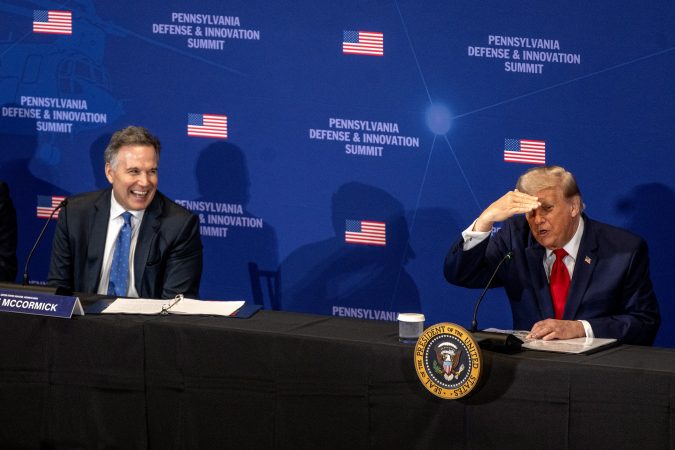
    In a 53-minute speech that was set up as a roundtable conversation, Trump occasionally applauded the latest investments in Pennsylvania’s defense manufacturing and research, which was the focus of the two-day Pennsylvania Defense and Innovation Summit organized by U.S. Sen. Dave McCormick (R., Pa.).

    He also acknowledged the setbacks in Iran and the widely recognized need for the country to more quickly build items like submarines and munitions.

    But in his second stop in three weeks in Pennsylvania — and specifically in a Republican-held U.S. House district that is critical to his party keeping control in the midterm elections — Trump also weaved through a wide range of topics.

    That included the prospect that Democratic Gov. Josh Shapiro would defeat his preferred candidate in this year’s Pennsylvania governor’s race, Republican Treasurer Stacy Garrity.

    “This guy Shapiro is totally overrated. I watched him the other night doing a speech, and he does not have what it takes,” Trump said in Carlisle. “Maybe he’ll win, and he’s expected to win, but I hear things about Stacy, and I’m hearing some poll numbers that are very good. But Shapiro is — he doesn’t have what it takes.”

    Shapiro, who also attended the summit, held back from pointedly criticizing Trump’s foreign aggression during his panel, and he left the summit before the president’s appearance.

    While most panelists and convention-goers praised the federal government’s focus on military investment, there was little discussion about specific developments abroad or controversies around Trump’s use of the armed forces.

    Just this week, fighting in Iran resumed after a tentative ceasefire was reached and then fell apart. The U.S. Senate, which had previously voted — in a mostly symbolic gesture — to restrict Trump’s actions in Iran, has meanwhile stalled the president’s defense budget as Democrats attempt to exert more leverage to wind down the conflict.

    “This war continues to be a costly blunder that has only made us worse off than before,” U.S. Sen. Andy Kim, a New Jersey Democrat who served as a diplomat before entering Congress, said on social media this week as Trump continued the war effort.

    The bombing campaign that began in late February has been both unpopular — a Fox News poll in June found 58% think the U.S. made the wrong decision by starting it — and costly, as gas prices have remained elevated and the nation’s arsenal of Tomahawk cruise missiles has depleted. It will take years to replenish the stockpile, according to an analysis by the Center for Strategic and International Studies.

    McCormick, who has supported Trump’s efforts in Iran, said in opening the summit on Tuesday that the gathering came “in a moment as consequential as any moment in American history, and maybe in human history.”

    “President Trump’s vision of peace through strength demands new players and new ways of doing business,” McCormick said. “Such radical new thinking has never been more needed in America’s history, in the history of our military. China, Iran, Russia, North Korea: They all share one objective — a weakened United States. And they’re actively working together toward that end.”

    But Shapiro said he believed the administration’s antagonistic relationship with longtime allies is a risk to national security, though he did not specifically frame his comments around the wars in Iran or Ukraine.

    “Candidly, I get a little bit concerned when our administration pokes their finger in the eye of our allies,” Shapiro said. “That undermines our ability to innovate, and it undermines our ability to be stronger with our national defense and to have a deterrence that is going to protect the American people and protect our interests abroad.”

    McCormick, a U.S. Army veteran and former hedge fund CEO, organized the 1,300-person gathering to bring defense contractors and other companies together with government officials, military leaders, and research institutions.

    As at a similar energy- and technology-focused event last year, McCormick used the event to highlight what he described as about $10 billion worth of investments in the state.

    The list featured several ongoing Philadelphia efforts — including new ship orders at the Hanwha Philly Shipyard that McCormick valued at $1.5 billion, and a 10-year, $2.5 billion agreement to support submarine construction by Rhoads Industries and General Dynamics.

    Day & Zimmermann, a Philadelphia-based and family-owned conglomerate that is one of the Army’s largest ammunition suppliers, also won a $2.3 billion contract to update, operate, and run the Hawthorne Army Depot in Nevada, according to McCormick.

    JPMorgan Chase & Co. chief executive Jamie Dimon, who visited the Navy Yard on Wednesday ahead of the conference, also appeared in Carlisle to discuss $13 million in financing his company is providing to Rhoads’ ongoing project.

    Not all of the announcements are new or immediate — such as a recent $84 million order of heavy dump trucks from Mack Defense, which is part of a five-year, $221.8 million contract signed last year and that Trump touted in Macungie last month.

    Trump called the announcements “a colossal victory for this commonwealth and for the entire nation.”

    “Pennsylvania workers will build the ships, submarines, trucks, weapons and industries that will ensure America remains the strongest and the most powerful nation in the history of the world,” Trump said.

    In between diversions about the 2024 election, COVID-19, and claiming — as he has before during rallies in Pennsylvania — that affordability concerns are “fake,” Trump also addressed the focus of the gathering by stressing the need for a faster buildup of military equipment.

    “We used to make a ship a day, and now we’re a laggard in that department,” he said while asking the submarine construction workers in Philadelphia to pick up the pace. “We do lots of great things, but we’re a laggard there.”

    Like his rally in Lehigh County in June, Trump’s speech on Wednesday was located in a congressional district with one of the most competitive races — both in Pennsylvania and nationally — this year.

    U.S. Rep. Scott Perry, a York County Republican, is seeking an eighth term in the 10th Congressional District, which covers all of Dauphin County and parts of York and Cumberland Counties. Perry narrowly fended off a challenge from former local television anchor Janelle Stelson in 2024 and is facing her again as Democrats invest more into the race.

    As polls show Democrats have some broad momentum in the midterms, a new Pennsylvania poll released Wednesday found 39% of voters in the state approve and 58% disapprove of the president’s job performance.

    The same poll from Quinnipiac University found 40% approve of McCormick’s job performance, 33% disapprove, and 28% had no opinion.

    The event Wednesday and the energy-focused summit in Pittsburgh last July have spotlighted McCormick in rare, high-profile ways for a freshman senator. The former CEO of Bridgewater Associates, one of the world’s largest hedge funds, has also developed a close alliance with Trump in ways that have elevated his political stature.

    “Hopefully we’ll fix some of these societal problems,” Dimon, one of the country’s most powerful executives, said when McCormick asked him onstage what the next decade would look like. “And Secretary of Treasury Dimon will be happy to report to you, will be happy to report to President McCormick.”

    McCormick has not publicly expressed an interest in running for president — though at least one widely expected 2028 contender was in attendance Wednesday at his invitation.

    “Defense is critical to the future growth of this commonwealth,” Shapiro said, while praising McCormick in a bipartisan showing.

    Shapiro spoke emphatically about bolstering the state’s role in the defense industrial base and said he is doing what he can to have the state benefit from defense-related jobs and a federal focus on national security.

    Shapiro also appeared at the conference at the U.S. Army War College in Carlisle earlier in the day. In a panel conversation there, he did not criticize Trump by name as he fully endorsed the summit’s goal of supercharging the defense industry and placing Pennsylvania at the center of the expansion.

    President Donald Trump and Secretary of Defense Pete Hegseth (right) are on stage at a Defense and Innovation Summit hosted by U.S. Sen. Dave McCormick at the US Army War College in Carlisle Wednesday, July 15, 2026.Tom Gralish / Staff Photographer

    Those jobs include about 2,200 at General Dynamics, a global corporation whose Pennsylvania employees work on everything from sonar and artificial intelligence to submarine defensive systems and electronic warfare, the company’s president, Danny Deep, said while sitting alongside Shapiro.

    Deep referenced the governor’s 2024 visit to the General Dynamics munitions manufacturing plant in Scranton, when Shapiro and Ukrainian President Volodymyr Zelensky signed both empty artillery shells and agreements to work together. Because of the demand during Ukraine’s war with Russia, the company has ramped up its monthly munitions production from 14,000 to 50,000 — a move that Deep said was possible only with help from the state.

    “That’s because of this public-private partnership, and that’s what makes Pennsylvania so special,” he said.
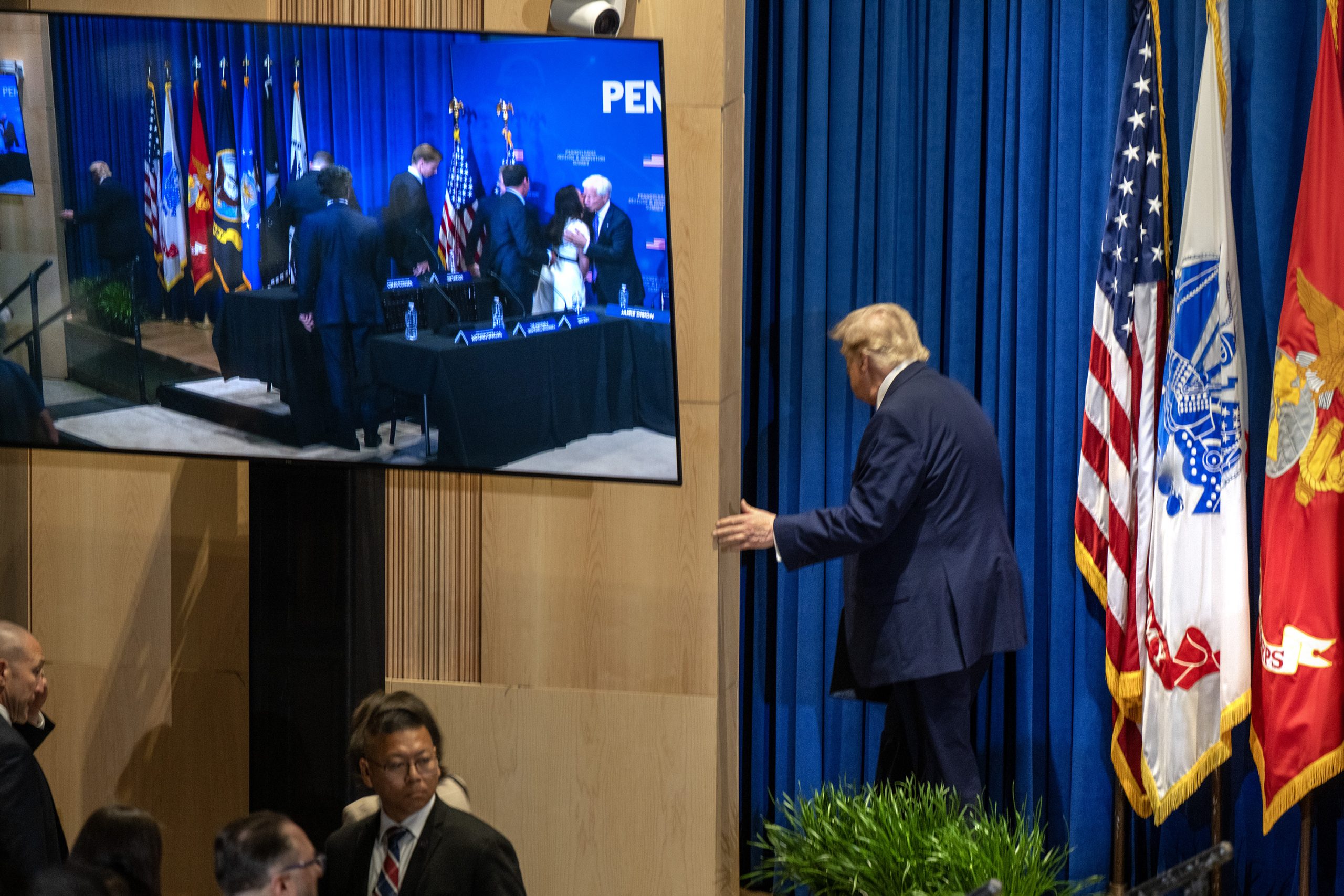
    President Donald Trump leaves the stage at the end of a Defense and Innovation Summit hosted by U.S. Sen. Dave McCormick at the US Army War College in Carlisle Wednesday, July 15, 2026.Tom Gralish / Staff Photographer

    Michael Coulter, president and CEO of Hanwha Defense USA, likewise said on the panel that the cross-party and cross-government support is essential in the company’s continued expansion at the Navy Yard in Philadelphia. The investments announced by McCormick on Wednesday included a federal government order of new ships that was valued at $1.5 billion and supporting more than 2,000 jobs in Philadelphia.

    “We are foot-on-the-throttle to make shipbuilding great again,” Coulter said. “And Pennsylvania’s the heart of that.”

    Staff writer Joseph N. DiStefano contributed to this article.
  • Slavery exhibits at the President’s House have been swapped for the Trump administration’s version

    Slavery exhibits at the President’s House have been swapped for the Trump administration’s version

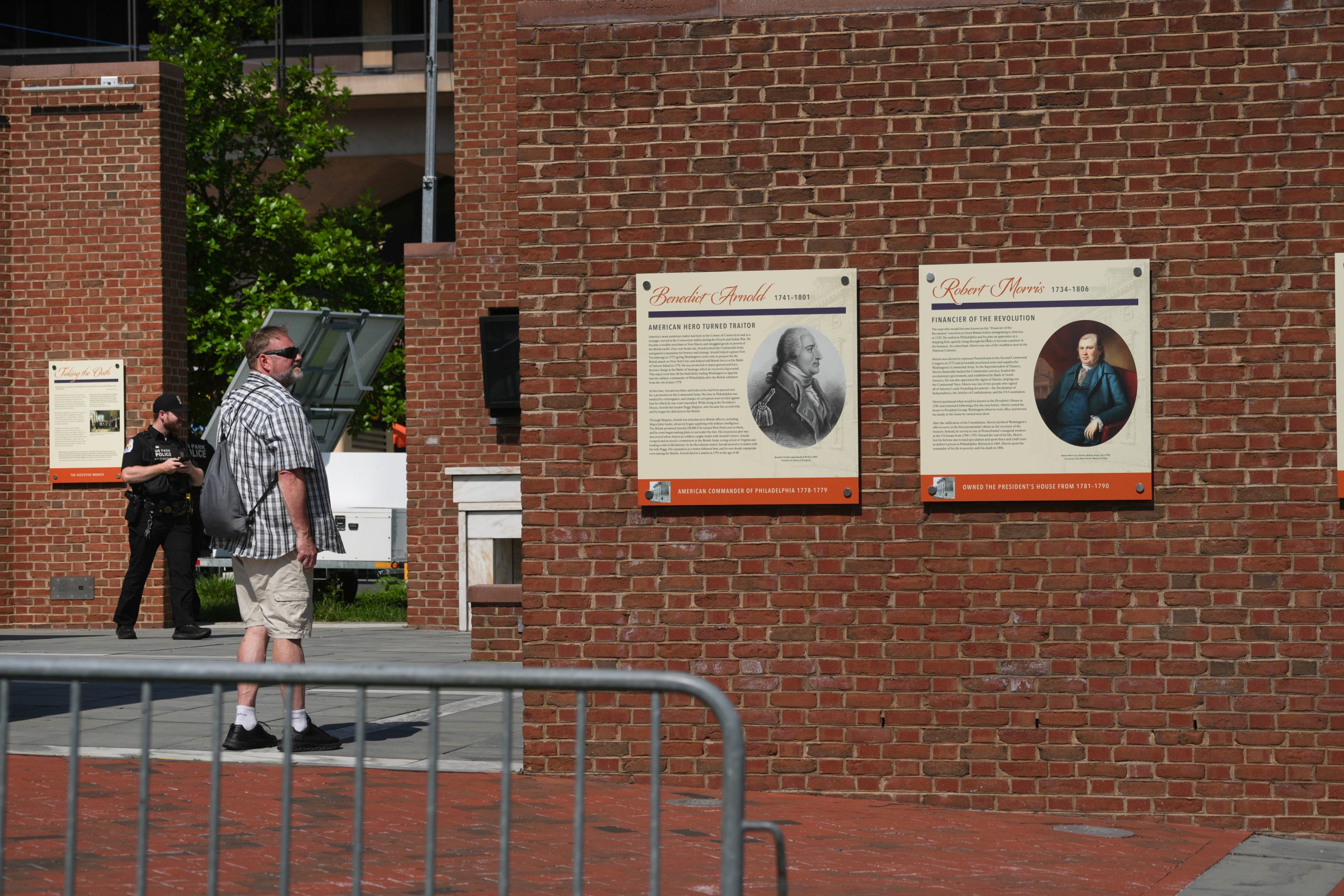
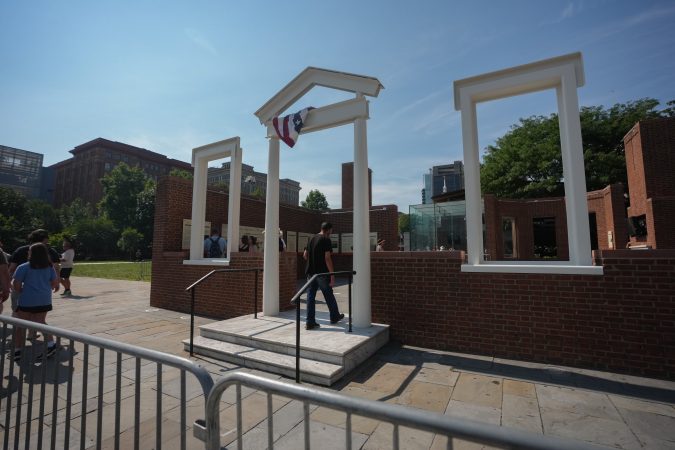
    President Donald Trump’s administration has installed its own version of history at the President’s House Site, swapping panels on the brutality of slavery at the site for displays that experts say sanitize George Washington’s role as an enslaver.

    The replacement caps a monthslong legal battle over the site on Independence Mall that was the first direct skirmish between Mayor Cherelle L. Parker and the Trump administration.

    The change happened overnight Tuesday into Wednesday, hours after the city hosted MLB All-Star Game events near the site, allowing the government to switch out the displays and shut down the television screens without public scrutiny.

    Roughly a week prior to the changes, park employees installed security cameras near the site, which one worker explained as being for the All-Star Game festivities. The cameras were still present Wednesday.

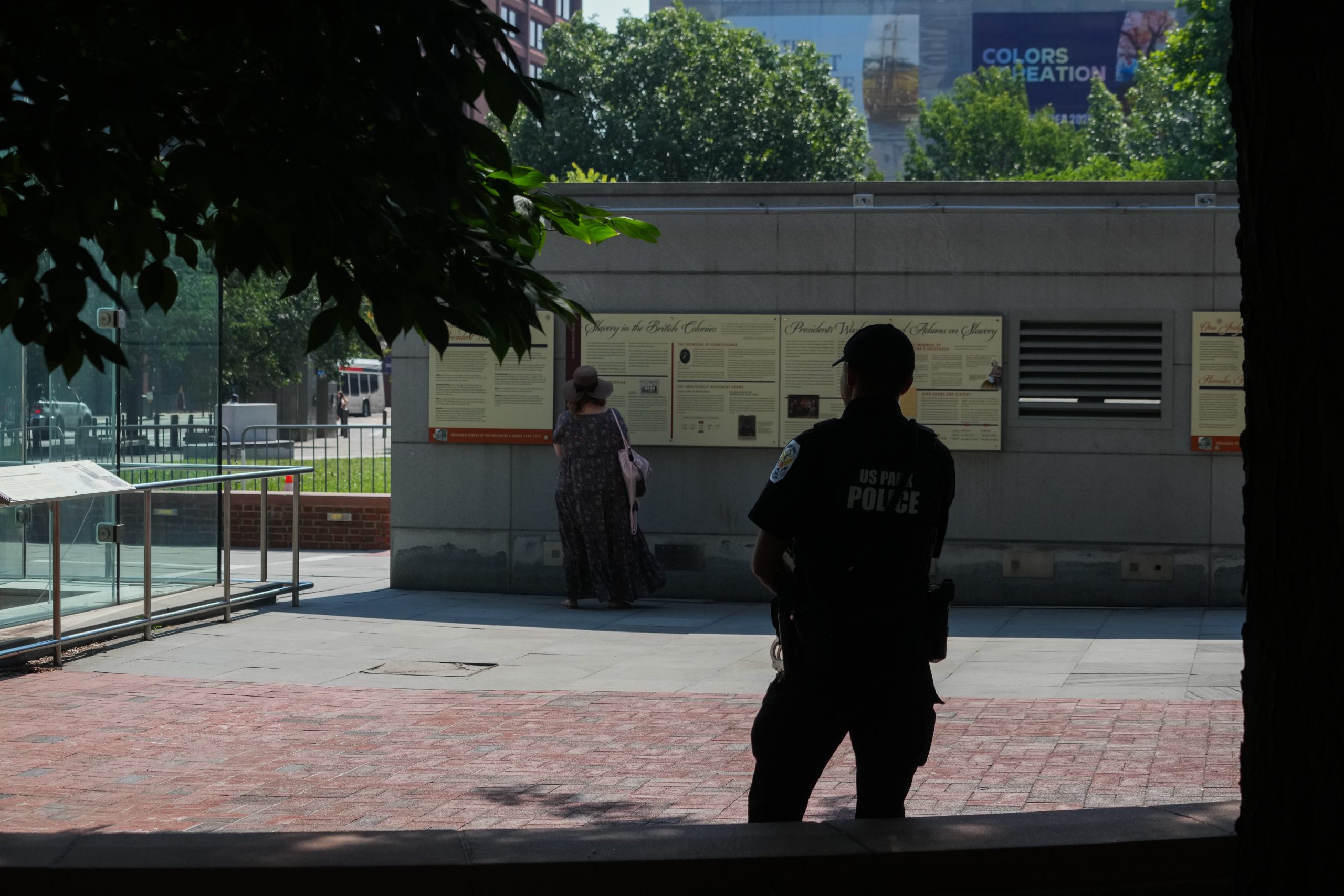
    A U.S. parks police officer and a visitor at the President’s House Site, where new panels have been installed, in Philadelphia, July 15, 2026. Historians and advocates have criticized the panels for minimizing Washington’s role as an enslaver.Jessica Griffin / Staff Photographer

    The overhaul of the President’s House exhibit, which was established to memorialize the nine people Washington enslaved at his Philadelphia residence, comes a little more than a week after the city celebrated the United States’ 250th birthday and tourists from around the world saw an incomplete version as the exhibit hung in limbo.

    On July 3, the U.S. Court of Appeals for the Third Circuit gave the Trump administration the final go-ahead to replace the panels.

    In a statement, Parker said the city intended to seek a rehearing on “serious legal issues” presented in the Third Circuit’s decision and slammed the federal government for installing the panels ”under the cover of darkness.”

    “It was allowed to do this by the decision of the federal court, but that it did so at night shows it understands this action is shameful, that it violates community trust,” Parker said.

    The site now features the 11 panels were proposed by the Trump administration in April, in addition to more than a dozen smaller panels that detail governmental processes, the lives of various historical figures, and a panel dedicated to the escape of Ona Judge and Hercules, two people enslaved by Washington who fled to freedom.

    Though the panels do mention slavery and the people Washington enslaved, the new exhibits mostly offer a broad timeline of U.S. history that significantly strays from the original intent of the President’s House as outlined in the park’s foundation document in 2017: “It would explore the historic context of the site in the context of its ties to slavery and the lives of the enslaved who lived at the site.”

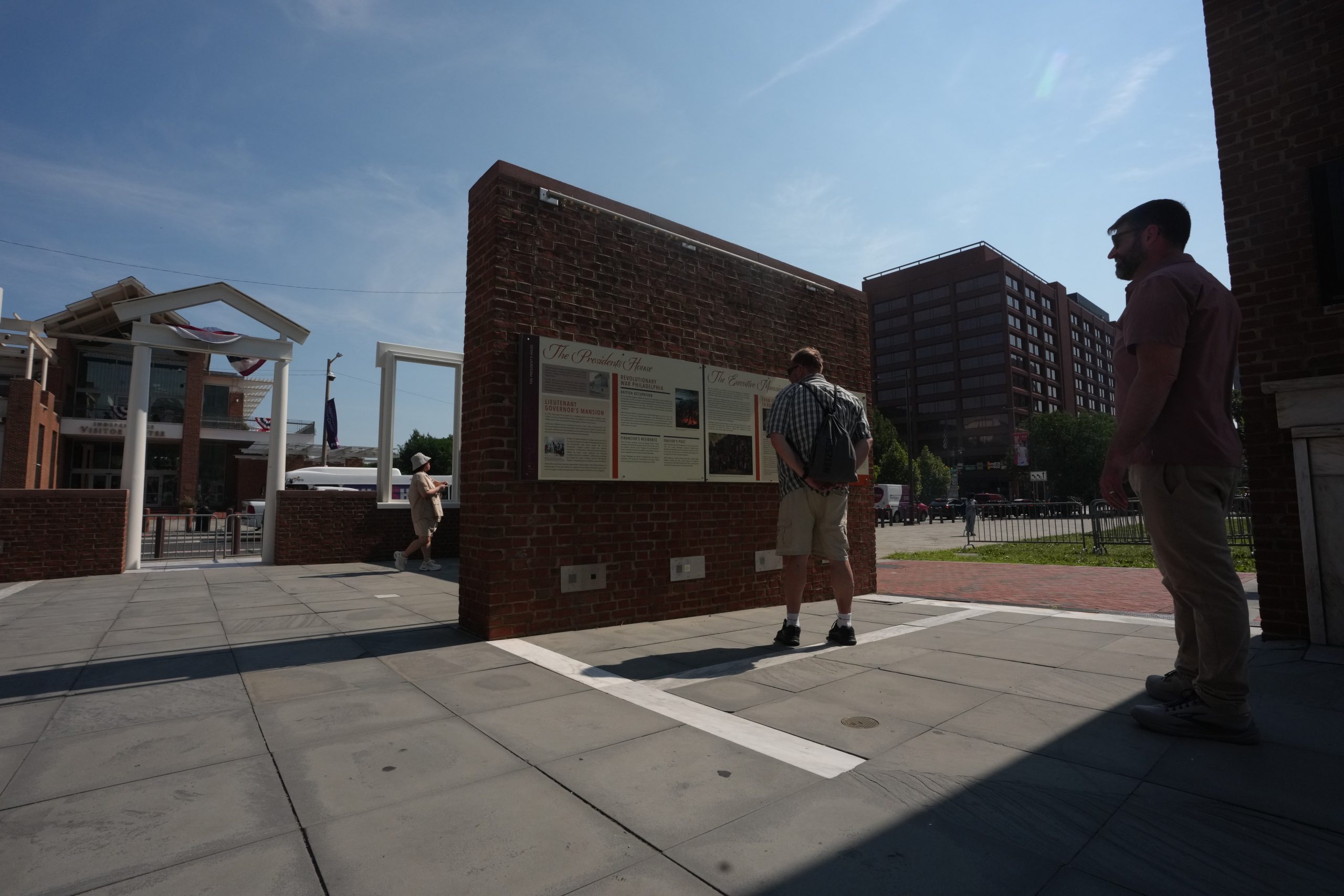
    Visitors to the President’s House Site, where new panels have been installed, in Philadelphia, July 15, 2026. Historians and advocates have criticized the panels for minimizing Washington’s role as an enslaver.Jessica Griffin / Staff Photographer

    The new panels also soften Washington’s role as an enslaver.

    For instance, one display says: “Caught between his private doubts about slavery and his public responsibilities as president, George Washington navigated a nation deeply divided over slavery.”

    “Privately, George Washington often expressed discomfort with the institution and a desire to see it abolished,” the panel continued. “Yet as a Virginia plantation owner, his wealth and livelihood were deeply tied to it.”

    Later in that panel, the Trump administration writes: “Slaves living in the President’s House experienced a greater modicum of autonomy than elsewhere in the South such as to explore the city and sometimes even attend the theater, with Washington buying the tickets.”

    Another panel, titled “Enslaved People at the President’s House,” discusses the lives of each of the nine individuals enslaved by Washington, but reframes Washington’s role.
    “President Washington knew and trusted his enslaved house staff enough to buy them tickets for the circus and theater and to let them venture out into the city’s markets on their own,” the panel says.

    A spokesperson for the Interior Department said in a statement that the “new panels are full of historical context and highlight the momentous events that took place in the President’s House and other sites at Independence National Historical Park.”

    The statement said that the panels “acknowledge the evils of slavery, including its injustice and hypocrisies,” and properly tells the story of the nine individuals enslaved by Washington and the “full story” of U.S. history.

    Michael Coard, leader of Avenging the Ancestors Coalition, a group that has fought to protect the President’s House, said stakeholders were “not surprised — we saw it coming” and were reviewing all possible legal avenues and advocacy options.

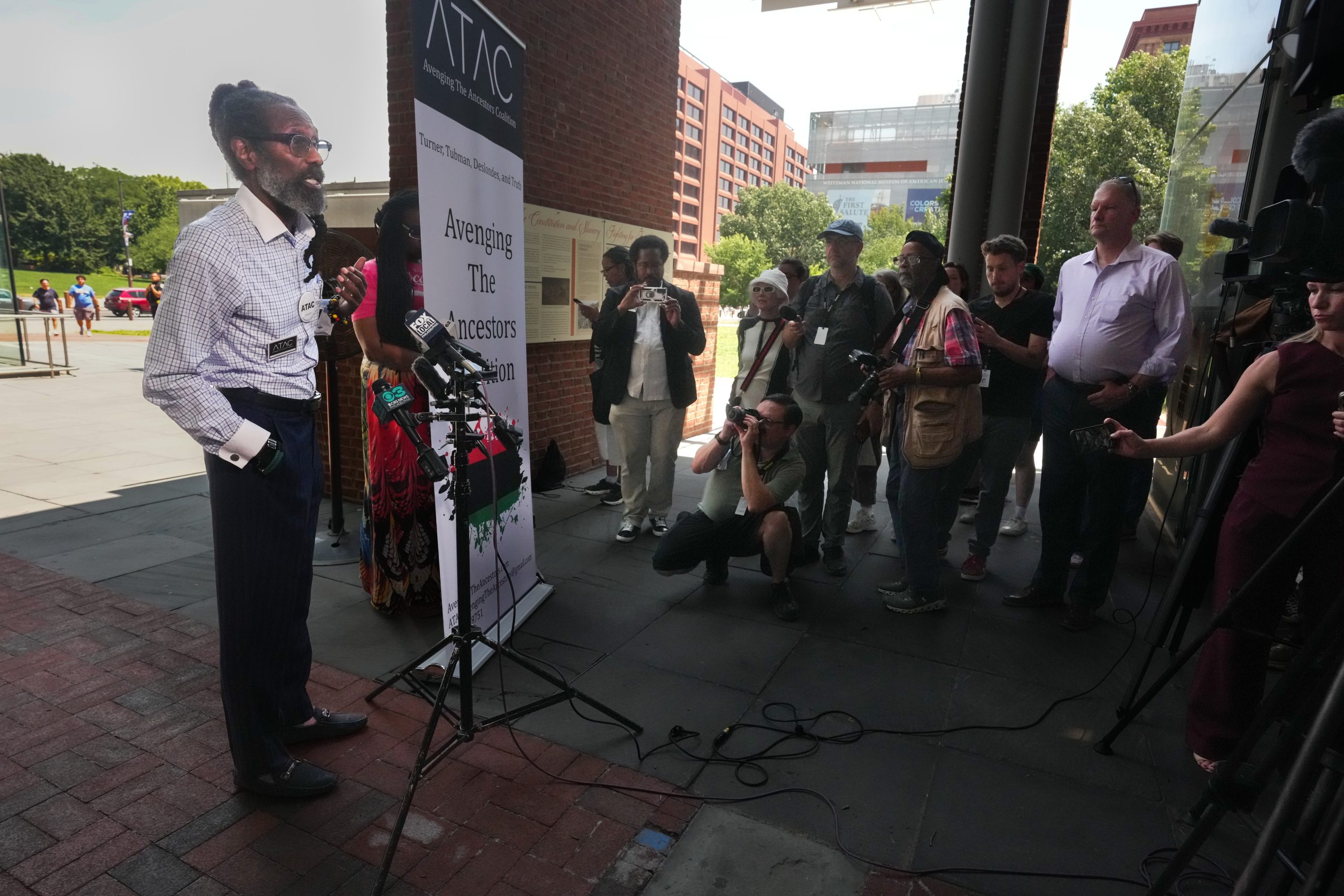
    Shortly after noon, Coard and other activists spoke defiantly at the site.
    He called the new panels “a complete whitewashing of American history” and said the few references to existence of slavery are a reminder that “the best lie is one that has a little bit of truth.”

    Lawyer Michael Coard holds a press conference at the President’s House Site, where new panels have been installed, in Philadelphia, July 15, 2026. Historians and advocates have criticized the panels for minimizing Washington’s role as an enslaver.Jessica Griffin / Staff Photographer

    The drastic alterations are a culmination of about a year of turmoil since the Trump administration began scrutinizing the site as part of the president’s executive order to review or remove displays at national parks that “inappropriately disparage Americans past or living.”

    In January, the administration abruptly removed all of the exhibits at the President’s House, provoking a legal battle waged by the City of Philadelphia and nonstop advocacy from stakeholders who helped develop the site in the early 2000s.

    Removals also happened at national parks around the country.

    Sheri Utain, 77, has been coming to the President’s House site since January to read aloud the content of the missing panels. When she arrived Wednesday, she was shocked to learn the exhibit had been replaced overnight.

    “How sneaky is that?” Utain said. “What kind of government is that?”

    Others also continued with their routines, but the response from National Park Service rangers was harsher.

    Sandra Shachar has been posting news articles on the President’s House walls almost every day since January to provide visitors updates on the court battles over the slavery exhibit.

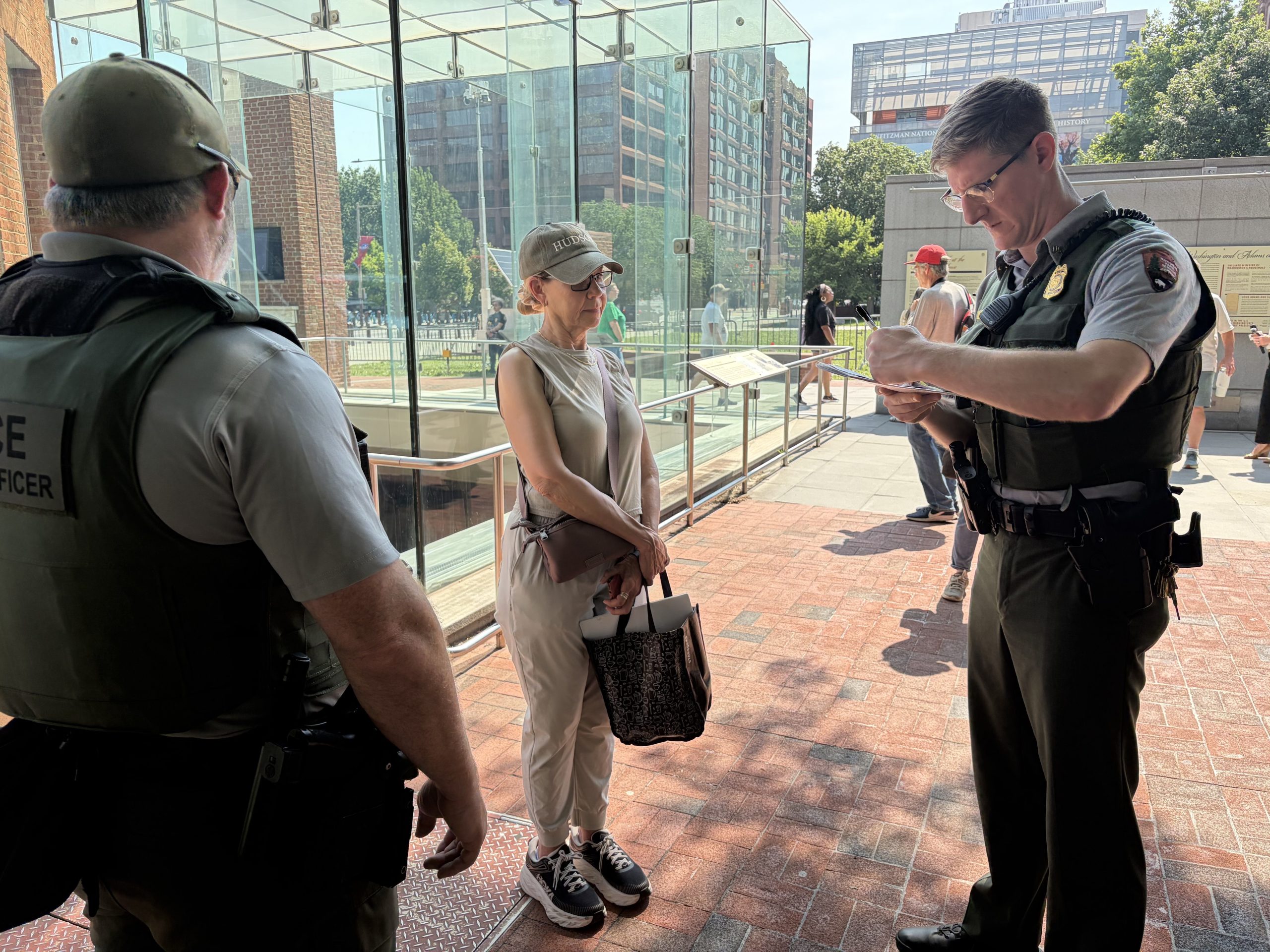
    Sandra Shachar, 72, cited for vandalism at the President’s House Site on July 15, 2026 for attempting to post news articles on the walls.Abraham Gutman

    But Wednesday, the local psychologist was cited for vandalism and ordered to pay a $305 fine.

    “It was something I could do … it feels better than doing nothing,” Shachar said, holding back tears. “Part of free speech and our First Amendment rights is to put up signs. It’s not defacing. It’s not vandalizing.”

    An Interior Department spokesperson said “any vandalism, tampering, destroying, or defacing of cultural or archaeological resources is a federal crime.”

    The installation of the new exhibit marks the end of a phase in the city’s legal battle against Trump’s administration.

    The city sued in January when the slavery exhibit was abruptly dismantled, asking a federal judge to issue an injunction ordering the panels be restored. Judge Cynthia M. Rufe issued a blistering opinion on Presidents’ Day ordering the restoration, comparing the Trump administration’s action to the Ministry of Truth from George Orwell’s 1984 novel.

    The administration installed roughly half of the removed panels before Rufe’s deadline, but left the site’s walls half bare after appealing to the Third Circuit and securing an administrative stay.

    A unanimous Third Circuit three-judge panel — which included Trump, George W. Bush, and Barack Obama appointees — held in June that the city had no rights over the exhibit after having donated the President’s House Site to the National Park Service.

    No changes followed on the ground immediately after the ruling because of litigation in federal court in Boston that challenged the legality of display removals in national parks and historic sites nationwide, leading a district judge to order the Trump administration to restore all removed items.

    Visitors to the President’s House Site, where new panels have been installed, in Philadelphia, July 15, 2026. Historians and advocates have criticized the panels for minimizing Washington’s role as an enslaver.Jessica Griffin / Staff Photographer

    But on July 2, the U.S. Court of Appeals for the Second Circuit stayed that order, clearing any legal obstacles preventing the federal government from installing the new panels.

    In the aftermath of the 250th anniversary celebrations, Parker said, examining the paradoxes of liberty and slavery that existed during the founding of the United States is key.

    “This paradox reveals core questions we still live and struggle with today — how do we share power for the betterment of all people? That is a hard question, and one that President’s House forced us all to consider,” Parker said.

    As activists and the city vow to continue the legal fight, the efforts to educate visitors about the history of the President’s House will also continue.

    Mijuel Johnson, a guide with the Black Journey: African-American Walking Tour of Philadelphia, will lead a tour of the site Thursday.

    “Regardless to what it says on the walls,” Johnson said, “the whole truth is still going to be told.”

  • Brandon Marsh’s dad died of cancer in 2021. He found a way to honor him in his first All-Star Game.

    Brandon Marsh’s dad died of cancer in 2021. He found a way to honor him in his first All-Star Game.

    Every time Sonja Marsh is at a major league baseball game to watch her son, or an international track meet to watch her daughter, she brings a small, gray urn with butterflies on the side.

    It contains the ashes of her late husband, Jake, who died of cancer in April of 2021. There are countless ways the family has kept his memory alive. Brandon Marsh and his sister, Erin, each have a tattoo on their arm that says “believe,” a favorite mantra of their father’s.

    They wear rubber bracelets bearing his name, and always seem to find signs that their father is with them. Butterflies are a big one. The Phillies outfielder said he’s seen “millions” of the winged creatures since his father passed.

    Another example came in May of 2024, when a black T-shirt was unexpectedly delivered to Marsh’s locker in Miami. On the front was the logo of Jake’s favorite band: Guns N’ Roses.

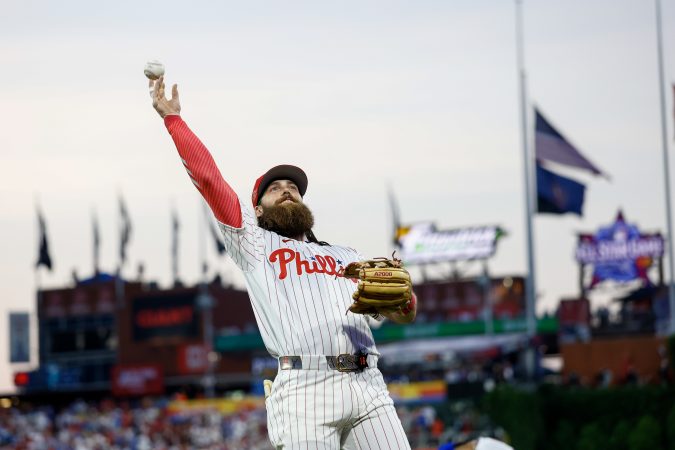
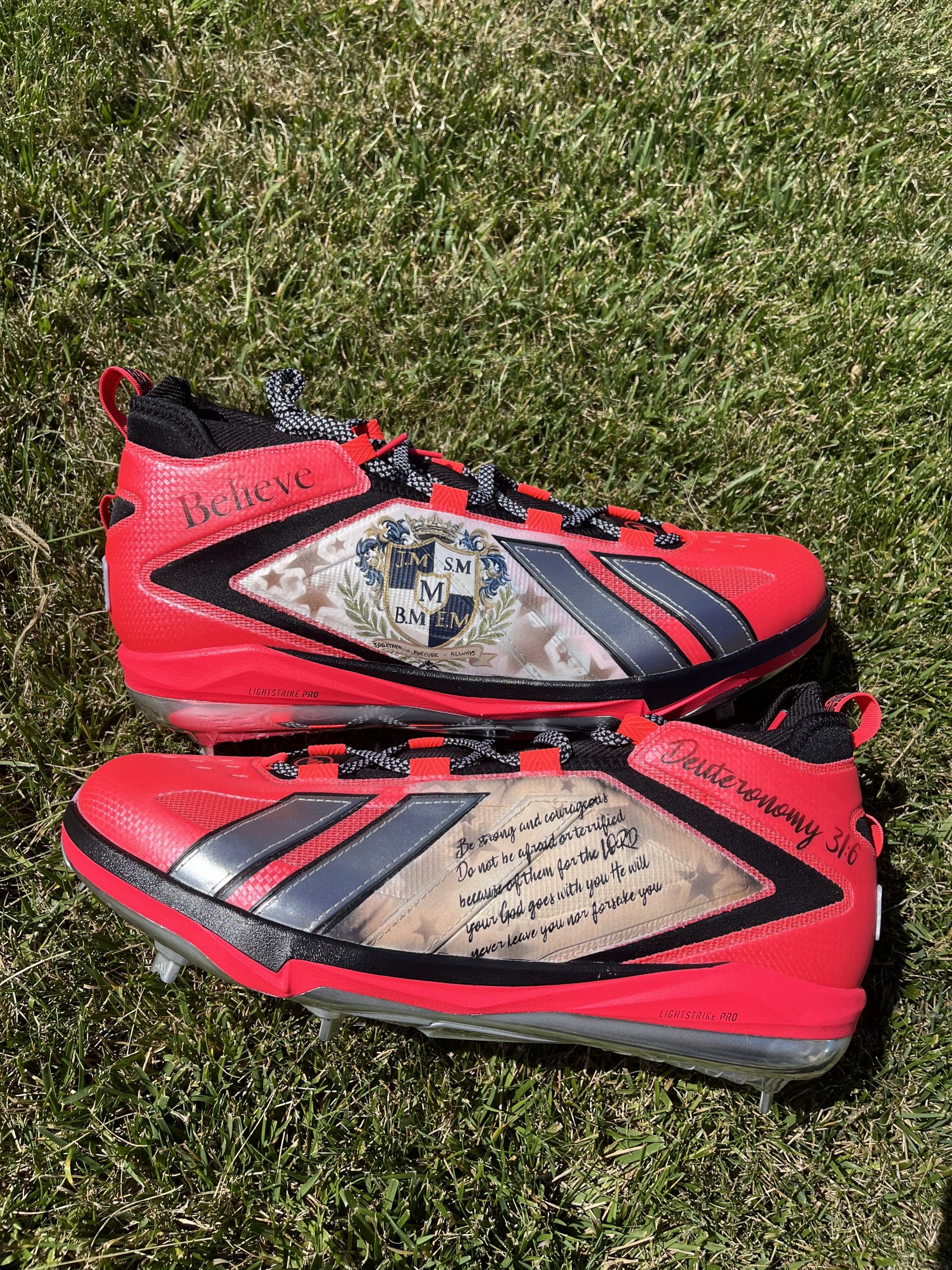
    So, it was only fitting that in Marsh’s first-ever All-Star appearance on Tuesday at Citizens Bank Park, he and his family found a way to include their loved one. Not long after the All-Star roster was announced on July 4, Sonja began designing a logo for her son’s cleats.

    On the left side, was a family crest, split into four initials: “J.M., S.M., B.M., E.M.” On the right, a Bible verse, Deuteronomy 31:6: “Be strong and courageous. Do not be afraid or terrified because of them, for the Lord your God goes with you; he will never leave you nor forsake you.”

    Brandon Marsh’s All-Star cleats honoring his late father.Marsh family

    She sent the design to Marsh’s agent, Eric McQueen, who put it on some bright red cleats. The outfielder received them on Tuesday morning, as a surprise before the All-Star Game.

    “I wanted to make sure Jake was on them,” Sonja said. “Because I just think his dad would be so proud to be here. And he is 90% of the reason [Brandon] is where he is.”

    Marsh’s ascension from platoon outfielder to everyday player has been well-documented. In April of 2025, he went hitless through 29 at-bats before landing on the injured list.

    Now, 15 months later, the 28-year-old is among the best players in the league, leading his team in batting average (.301) and hits (102). Those struggles have made his All-Star berth all the sweeter. Sonja said she’s noticed a change in her son’s energy.

    “Whenever I call him now, it’s not, ‘Hey Mom, I’ve only got five minutes. Walking into the training room, what you need?’” she said. “It’s, ‘So, Mom, can you believe such and such? Hey, did you see so and so?’ Conversationally, it’s gotten better.”

    Brandon Marsh’s mother Sonja (left) and sister Erin at the All-Star Game on Tuesday at Citizens Bank Park.Alex Coffey

    She said he was struggling with stress more than anything else; about performing, about his role. When Jake was alive, he was his children’s biggest cheerleader, knowing the right words to say in a moment of self-doubt.

    This is not Sonja’s strong suit — “I’m not as good at that,” she said — which made those brief phone calls especially challenging. But bit by bit, Marsh worked his way out of it, en route to his best season to date.

    He is so locked in that he wouldn’t even discuss the All-Star Game with his family — even after he’d made the team.

    “I called him, to say congratulations,” Sonja said, “and he’s like, ‘Mom, thank you for calling, can we talk about this on Sunday? Because I still have six more games to win.’”

    Added Erin: “Brandon would not talk about the All-Star Game. He was like, ‘I don’t want to jinx it.’”

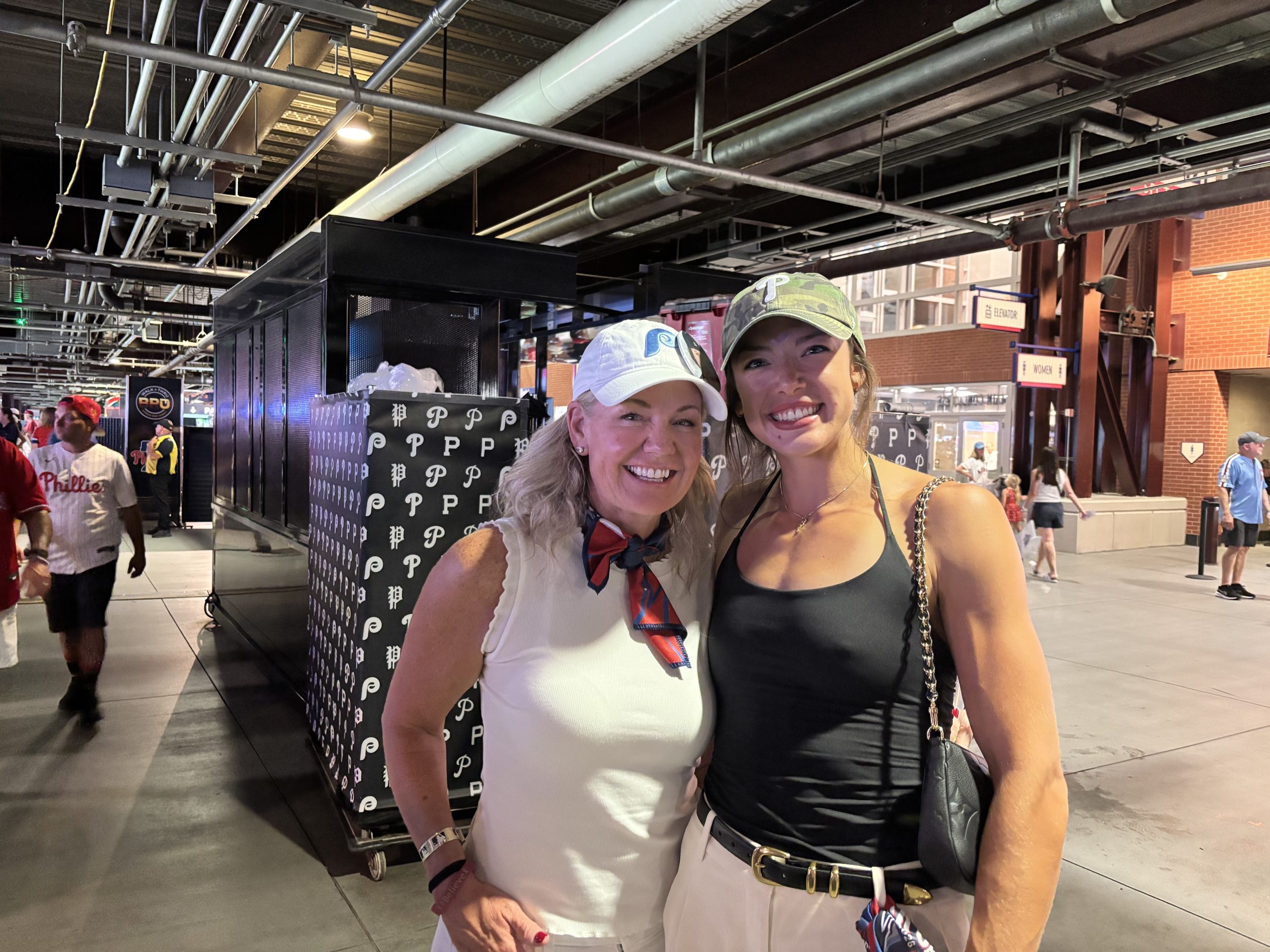
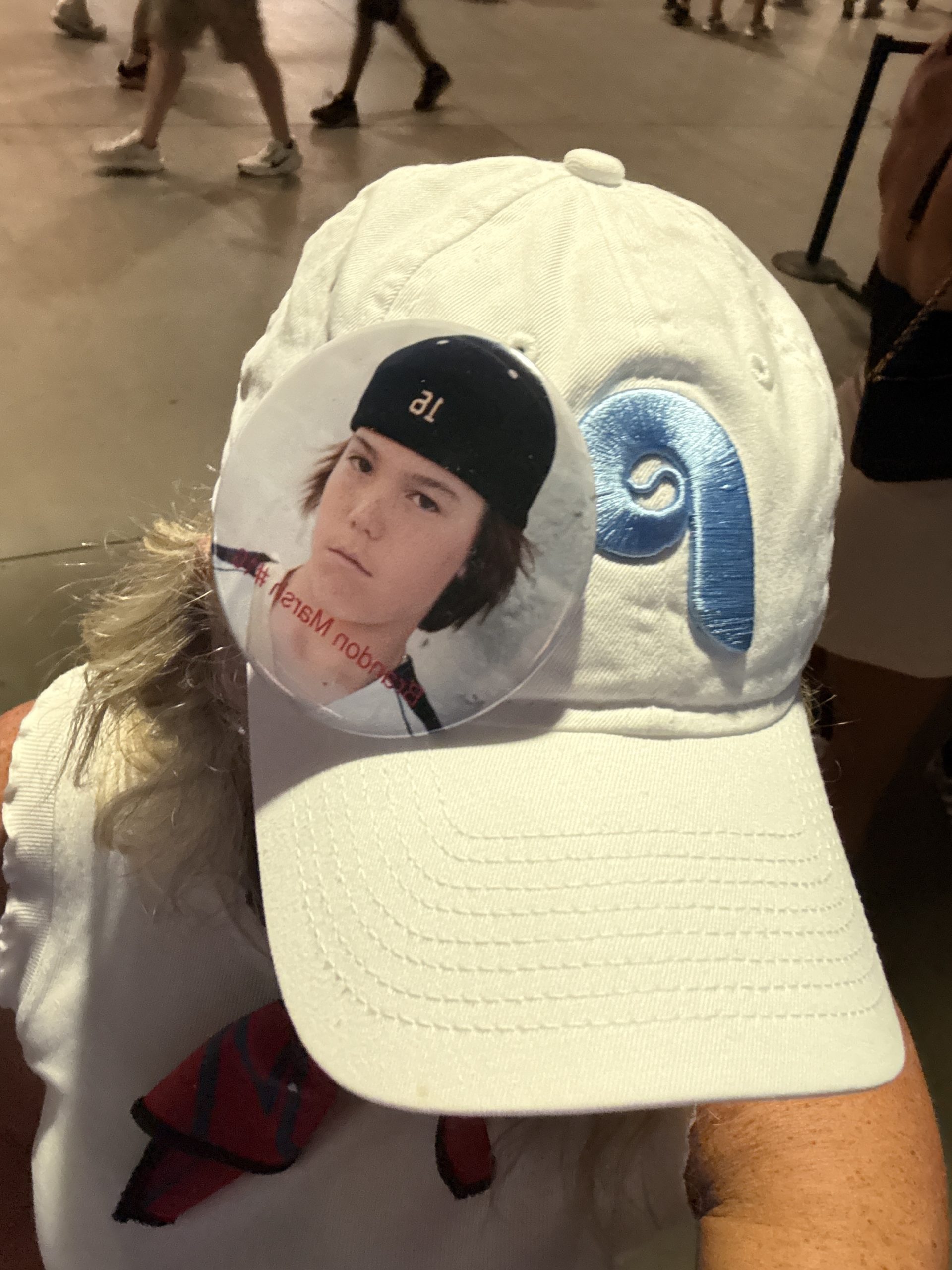
    It’s hard to overstate how proud his family is. On Tuesday night, Sonja watched from Section 120 with a large button of her son’s face on her cap (a clean-shaven Marsh, age 9, glowering at the camera).

    Erin, a professional heptathlete, was also able to make it to Philadelphia, finding a pocket of time between competitions. They watched the game with family and friends, remarking on how far Brandon has come.

    During the All-Star Game, Brandon Marsh’s mom Sonja was wearing a pin showing a 9-year-old Marsh.Alex Coffey

    But Jake Marsh was there, too; in the urn by Sonja’s side, the bracelets on Brandon’s wrist, and of course, the bright red cleats on his feet.

    “I know he was watching tonight,” Brandon said, “and he had the best seat in the house.”

  • ‘My favorite place to play’: Philly and Citizens Bank Park were All-Stars on a magical night. Just ask the actual All-Stars.

    ‘My favorite place to play’: Philly and Citizens Bank Park were All-Stars on a magical night. Just ask the actual All-Stars.

    Whenever somebody asks me to name my favorite ballparks, I spend most of my time trying to talk myself out of the most boring possible answer.

    Sure, Dodger Stadium is a personal favorite. There’s something about the way a SoCal dusk blends with Dodger Blue and the peaceful rise of the San Gabriel Mountains in the distance beyond center field.

    And, yeah, you won’t find a more distinctive setting than Oracle Park in San Francisco, where Mission Bay laps against the outfield walls and the lack of a second deck gives you the sense that you are watching a baseball game on a barge. The counterintuitive microclimate only adds to the surreal vibe. Half the winter coats I own were purchased in July in San Francisco.

    I can name a half dozen other stadiums that are worth a special trip. Each is unique in its own way. Yet they all have one thing in common. They aren’t Citizens Bank Park.

    I don’t know if the whole world saw it on Tuesday night. But anybody who attended sure did. The 68 players. The two coaching staffs. The nearly 50,000 fans who packed the rows and the aisles and seemingly every square inch of concourse.

    “Philly was awesome,” said Blue Jays infielder Ernie Clement. “What a great sports city.”

    On a competitive level, South Philly’s first All-Star Game in 30 years was a ho-hum affair. The American League scored three first-inning runs off Phillies lefty Cristopher Sánchez and then engaged in an eight-inning sprint for the exit. The two sides finished with 10 hits, only one for extra bases. Kyle Schwarber, Brandon Marsh and Bryce Harper combined to go 0-for-6.

    On every other level, it was a triumph.

    It was a triumph for the city, whose splendid skyline first gleamed and then glowed in the summer haze. It was a triumph for the Phillies organization, in particular a grounds crew and game day operations staff that has long powered one of the sport’s best extracurricular environments. Most of all, it was a triumph for the setting and its people: for a ballpark that doesn’t get the respect it deserves as one of the sport’s Crown Jewels, and for a fan base that consistently shows that a household is only as strong as its inhabitants.

    For years, it seemed like a glaring oversight that 22 ballparks would host an All-Star Game before Citizens Bank Park got its turn. As it turned out, the wait was more of a feature than a bug. The bright lights and national television cameras only served to accentuate the glow of a ballpark that somehow looks even better than it did when it opened in 2004. Similar to the red brick rowhouses in the city proper, the outfield’s masonry facades have an age-defying property, especially when contrasted with the industrial steel and wide-open concrete of the concourses and seating decks. You won’t find a stadium or arena in any sport that has aged as gracefully as the house that David Montgomery (and others) built.

    Earlier this spring, with the Eagles beginning their due diligence on a potential replacement for Lincoln Financial Field, Phillies owner John Middleton said he sees no reason why Citizens Bank Park shouldn’t last another 100 years.

    Tuesday night was a triumph for him, then, too.

    Of course, Middleton would be the first one to tell you that the people make the place. So it was on All-Star Weekend. The real star of the show on Monday and Tuesday night was the home crowd, whose caustic electricity provided a much-needed edge for an over-corporatized event that most years feels emptier than a bowl of sugar cereal.

    You saw it in the smiles that appeared on the faces of players as the crowd booed its lengthy list of civic enemies. From Yankees starting pitcher Cam Schlittler to Mets outfielder Juan Soto to anybody in a Braves or Red Sox jersey, those targeted grinned and waved in appreciation. By the end of the proceedings, it felt like an insult to be ignored.

    “Like they always say,” said Soto, “if they boo you, then you’re doing things right.”

    The heckling was mostly good-natured, save for an appearance by Mr. and Mrs. Met.

    This was a celebration first and foremost. The event’s organizers and executors were aided by a number of ready-made story lines. They included the All-Star debut of Catholic League standout Kevin McGonigle and the homecoming of Mike Trout in his career’s twilight, in addition to Sánchez on the mound and Schwarber and Marsh in the starting lineup. But MLB also did its part. With a devastating labor stoppage potentially looming in a sport that increasingly feels anachronistic in the swirl of a country’s division and distraction, baseball managed to summon a lot of its friendlier ghosts on Tuesday night.

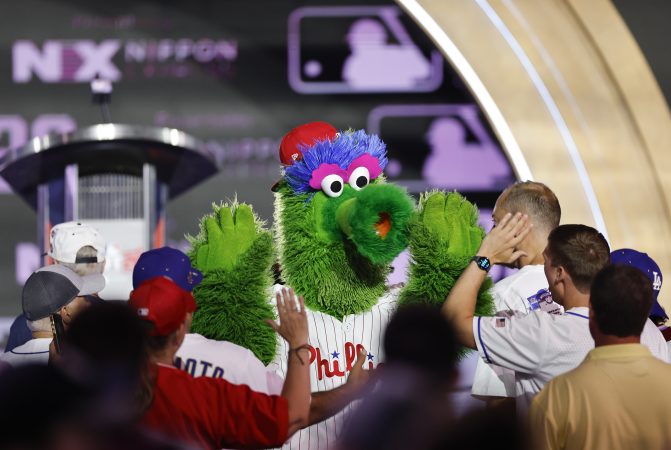
    The Phanatic gives Washington Nationals mascot Teddy Roosevelt a ride during the presidents race before the bottom of the fourth inning on Tuesday.Yong Kim / Staff Photographer

    The climactic moment was curiously timed and even more curiously powerful. In the fifth inning, with the stadium lights dimming and Ray Charles’ famous playing on the oversized videoboard in left field, Citizens Bank Park erupted with a fireworks display complete with players holding sparklers and Dodgers first baseman Freddie Freeman playing catch with one of the local kids who rode their bikes onto the field as part of the program.

    “Like I’ve been saying the last two days, since I came up with the Braves, this is my favorite place to play,” Freeman said after the game. “I love the Bank. It wasn’t fun to play because it was Halladay, Hamels, Lee every time, but it was packed every night. It’s a great place to play. Great city.”

    Sounds like a win in our book.

  • Brandon Marsh’s dry hair, Paul Skenes matches Livvy Dunne, and the best looks from the MLB All-Star Game red carpet

    Brandon Marsh’s dry hair, Paul Skenes matches Livvy Dunne, and the best looks from the MLB All-Star Game red carpet

    You can take the baseball players off the field, but that doesn’t mean they’re going to stop sporting coordinated outfits.

    The All-Star red carpet ran through Independence Mall on Tuesday before that night’s All-Star Game at Citizens Bank Park, and the stars were putting their stellar fashion skills on display, as fans saw a lot of coordinated outfits between families.

    Here are some of the best looks from the All-Star red carpet:

    Brandon Marsh

    Sometimes the best outfits are less about the clothes and more about the overall look, and with a head of hair like Brandon Marsh’s, there’s little the clothes have to do.

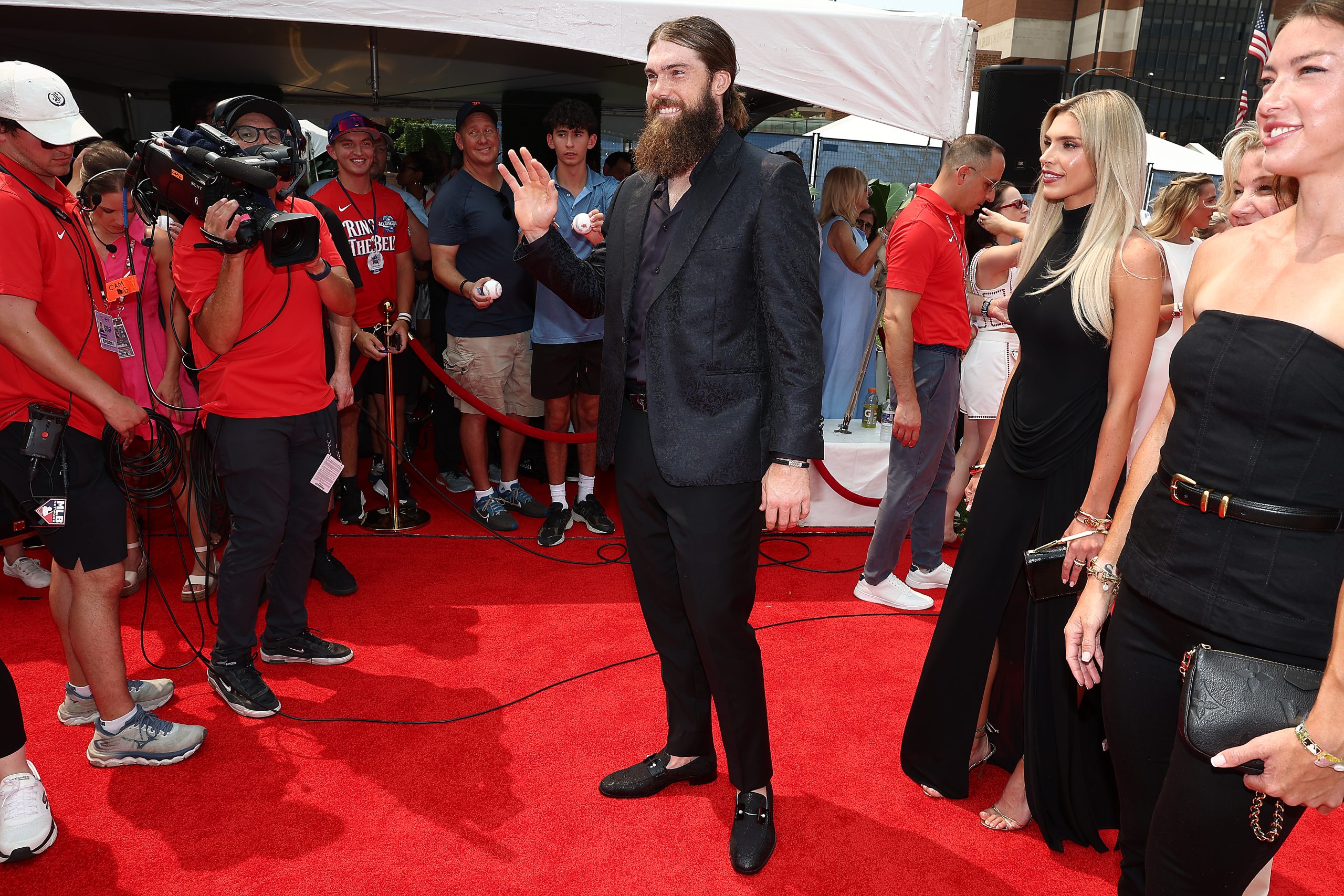
    Phillies outfielder Brandon Marsh with dry hair? We didn’t know that was possible.Monica Herndon / Staff Photographer

    Marsh wore his signature locks notably dry and tied back with an all-black look from shirt to pants, jacket, and shoes.

    But he wasn’t just bringing the fashion, he also was offering tips on haircare.

    The Phillies outfielder shared his hair routine with MLB Network’s Kait Maniscalco, stating that he doesn’t do much beyond washing it once or twice a week, usually after day games, and then, of course, wetting it every inning.

    “I just water it every inning just like you do the grass or the flowers,” Marsh said.

    Pennsylvania Gov. Josh Shapiro (left) greets Phillies slugger Kyle Schwarber and family on the red carpet.Monica Herndon / Staff Photographer

    Kyle Schwarber

    Kyle Schwarber might hit bombs, but his son apparently slings webs and is the real superhero in the family.

    The Schwarbers wore similar shades of blue as they walked the carpet. Schwarber’s two sons, Kade and Asher, wore matching blue suits and white shirts, while Kade struck a Spiderman pose in the family’s picture. Schwarber’s wife, Paige, who was credited with coordinating the family’s look, wore the same shade in her blue-and-orange patterned dress as she carried their 6-month-old daughter, who wore a cream tulle dress with flowers, down the carpet.

    Monday night’s Home Run Derby runner-up matched his daughter in a cream suit while coordinating with his wife and sons in a pinstriped button- up in a different shade of blue. The family completed the look with white shoes; the boys and their father in sneakers, and Paige in white heels.

    Freddie Freeman

    The first family of the Los Angeles Dodgers, the Freemans, brought their charm to Philadelphia, also wearing coordinated family outfits but with an earth-tone theme.

    All three sons, Charlie, Brandon, and Max, wore linen button-ups and pants in neutrals matching their father’s beige suit with a white shirt underneath.

    Freeman’s best accessory, however, was newborn daughter London, whom he carried on the red carpet. The almost 3-month-old also matched the family in a beige outfit of her own, complete with a pink headband and bow. His wife, Chelsea, wore a green satin mid-length dress to tie the looks together.

    Paul Skenes and Livvy Dunne

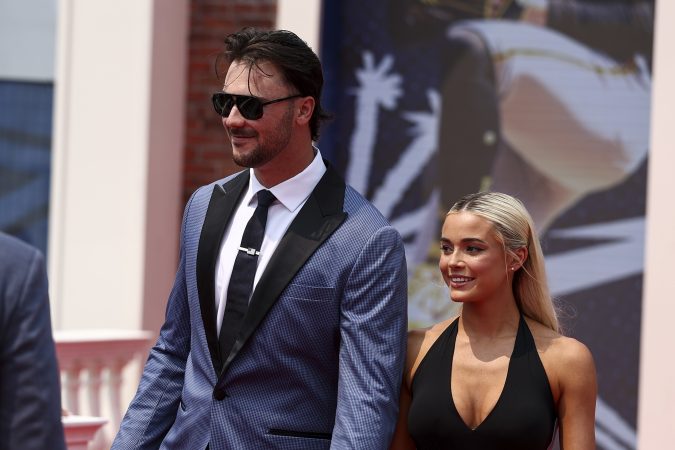
    Paul Skenes and his girlfriend, former LSU gymnast Livvy Dunne, walked the carpet together in coordinated black-and-blue outfits.

    The Pirates ace wore a blue suit with a subtle plaid pattern and black details at the collar. He tied it together with a blue tie, an American flag tie clasp, black sunglasses, and black patterned shoes which Skenes called his “alligator boots.”

    Dunne said once Skenes said he was wearing blue and black, she found a dress to match. The gymnast turned actress and influencer wore a black halter-neck gown with blue waist detail and minimal jewelry to coordinate.

    Kevin McGonigle

    Detroit Tigers rookie Kevin McGonigle made his All-Star red carpet debut in his hometown and walked the carpet with his parents.

    The 21-year-old shortstop wore a green patterned suit with a blue button-up underneath. He completed the look with a matching blue pocket square, brown shoes, and sunglasses.

    McGonigle didn’t specify whether the green was an ode to his hometown football team or his high school, Monsignor Bonner & Archbishop Prendergast, but he did have his high school’s logo on the inside of his jacket, along with the All-Star Game logo and a Delco patch. He also shared what it means to walk his first red carpet in the city he grew up in.

    “Growing up in Philly, being able to have this experience in my home city, it’s really special, and I’m sure I’m going to see some more people down the red carpet,” McGonigle told MLB Network’s Lauren Shehadi.

    Juan Soto

    Sorry Philly fans, you can dislike him in orange and blue, but Juan Soto’s style out of uniform can’t be denied.

    The Mets superstar wore a golden taupe suit with a white shirt underneath and, naturally, he had the collar popped for some added swagger.

    His look was complete with silver chains, brown shoes, and sunglasses.

    Soto said he was dressed by a Dominican stylist with whom he collaborated to focus on dressing in a color scheme fit for the warm weather.

    Here are some more looks from the red carpet:

  • Three Philly City Council districts emerge as key battlegrounds in the 2027 election

    Three Philly City Council districts emerge as key battlegrounds in the 2027 election

    Philadelphia City Council is already looking to 2027. And with all 17 seats on the ballot next spring, the elections are shaping up to be a pivotal test of whether the city’s established politicians can withstand a rising tide of frustration with the party among Democratic voters.

    All of the incumbents have said they intend to run for reelection, and several are likely to face serious challenges from new candidates focused on grassroots organizing and progressive groups — hoping to seize the opportunity presented by a nationwide leftward shift amid President Donald Trump’s second term.

    Three districts have emerged as key battlegrounds.

    In the North Philadelphia-based 5th District, at least four people are considering challenging Councilmember Jeffery Young Jr., a freshman lawmaker who has championed controversial legislation and at times publicly clashed with constituents.

    And the city’s progressive organizations, emboldened by a series of wins locally and nationally, are targeting two other districts: the 1st, which stretches from South Philadelphia to Fishtown and is represented by Councilmember Mark Squilla, and the 8th, which includes parts of North and Northwest Philadelphia and is represented by Councilmember Cindy Bass.

    “We’re definitely feeling confident,” said Robert Saleem Holbrook, executive director of the progressive advocacy group Straight Ahead. “Anyone who is going to be running under a progressive banner or a progressive movement is going to have to be running against the establishment, not toward it.”

    A competitive race also appears to be taking shape for the seven Council seats that represent the city at-large.

    Five of those seats are all but certain to be won by Democrats, making the May 2027 primary the key election in deep-blue Philadelphia.

    The other two at-large seats — set aside for Council members outside the majority party under the city’s Home Rule Charter — will be decided in the November 2027 general election. Currently, the two minority party seats are held by Councilmembers Kendra Brooks and Nicolas O’Rourke of the left-leaning Working Families Party.

    Several insiders said one bold-faced name is considering a run for a Democratic seat: Jane Golden, the well-known founder and executive director of Mural Arts Philadelphia, who is stepping down from her full-time role later this month.

    Jane Golden, founder and executive director of Mural Arts Philadelphia, takes the stage during the dedication of the Super Bowl LIX mural at Spike’s Trophies on June 17, 2025 in Philadelphia.Monica Herndon / Staff Photographer

    Golden, 73, said last week that she is not currently running for Council, but acknowledged she has thought about it for years.

    “It’s always something that is tempting to me, because I just love the city so much,” she said. “I feel honored that people even think of me.”

    Progressives eye Bass’ North Philly seat

    Philadelphia’s progressive activists this year see two key opportunities to expand the loosely organized left-leaning bloc on Council, which currently consists of four members. Winning additional seats could also grow their influence by enticing more moderate members to vote alongside them if they believe primary voters are moving left.

    Progressives have in the last year authored some of the most high-profile legislation to come out of Council, including one package of bills by Brooks and Councilmember Rue Landau meant to set limits on federal immigration enforcement in the city and another by O’Rourke that codified new rights for renters.

    Leftists have notched high-profile wins in Democratic primaries across the country this year, including in Philadelphia, where democratic socialist State Rep. Chris Rabb (D., Philadelphia) bested more moderate candidates for a seat in Congress representing about half of the city. The district is one of the most Democratic in the nation.

    Next on progressives’ wish list: ousting Bass and Squilla, two more centrist Democrats who have both been on Council since 2012.

    In Bass’ 8th District, longtime labor organizer Seth Anderson-Oberman may challenge Bass for a second time after losing to her in 2023 by just 423 votes.

    Anderson-Oberman, 55, the executive director of the progressive group Reclaim Philadelphia, said last week that he is “leaning” toward taking another swing.

    “We’re in a moment in this country and this city where people have had enough,” he said. “People are looking for new answers. … Cindy represents the old way of doing things.”

    Union organizer Seth Anderson-Oberman, running for 8th District City Council, joins in a small rally with community and Happy Hollow Advisory Board members along Wayne Avenue at Happy Hollow Playground in Philadelphia on April 2, 2023.Tyger Williams / Staff Photographer

    Another Council run by Anderson-Oberman may test how far progressive momentum can go in Philadelphia. He was a member of the Communist Party USA in his 20s, and has said he is proud of that experience.

    Bass, 58, said she is ready for the race no matter who her opponent is.

    In June, she survived a contentious fight for another four-year term as Democratic leader of Mount Airy’s 22nd Ward. She was criticized for her handling of the process, and the party ordered a redo of the election.

    She and her progressive opponent, Octavius Price, tied, then struck a power-sharing agreement. Through it all, Bass said, longtime residents stuck by her — and she is confident voters will do the same next year.

    “My voters are people who are based in this community, committed to this community, intend to stay in the communities that they are in,” she said.

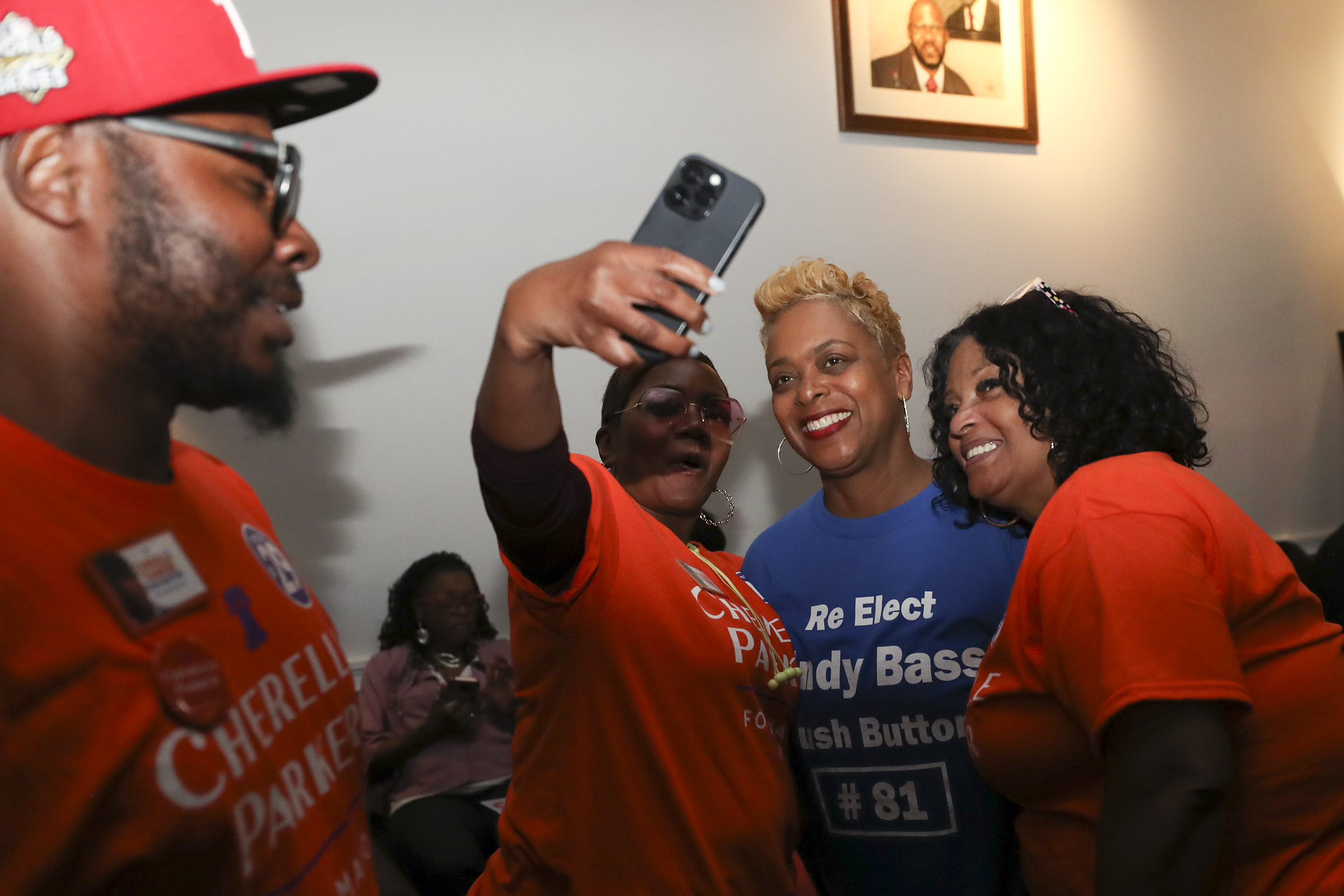
    City Councilmember Cindy Bass (center) attends the watch party for Democratic candidate for mayor Cherelle L. Parker at Laborers 332 in Philadelphia on May 16, 2023.Heather Khalifa / Staff Photographer

    Jeff Jones, a community leader and social justice advocate from Germantown, has also said he intends to run in the 8th District.

    “I want to bring that new vision and a new voice to the 8th District, where residents and children and families can know that their voice matters, their concerns will be heard, and their challenges will be met,” said Jones, 61, a first-time political candidate.

    Squilla could see a lefty challenger

    Leftists are also eying Squilla’s seat, which represents the area along the Delaware River from Pennsport to Kensington. Since Squilla took office in 2012, the district has transformed from a bastion of working-class white voters to one of the most progressive swaths of the city.

    Squilla, 63, who has strong labor ties and is one of the most pro-development district Council members, said being a centrist has likely put a target on his back in the 2027 election.

    Another contributing factor may be Squilla’s support for controversial legislation in 2024 to approve the 76ers’ since-abandoned plan to build a new arena in Center City. The project, which would have been in Squilla’s 1st District, was opposed by advocates for Chinatown, which the arena would have bordered.

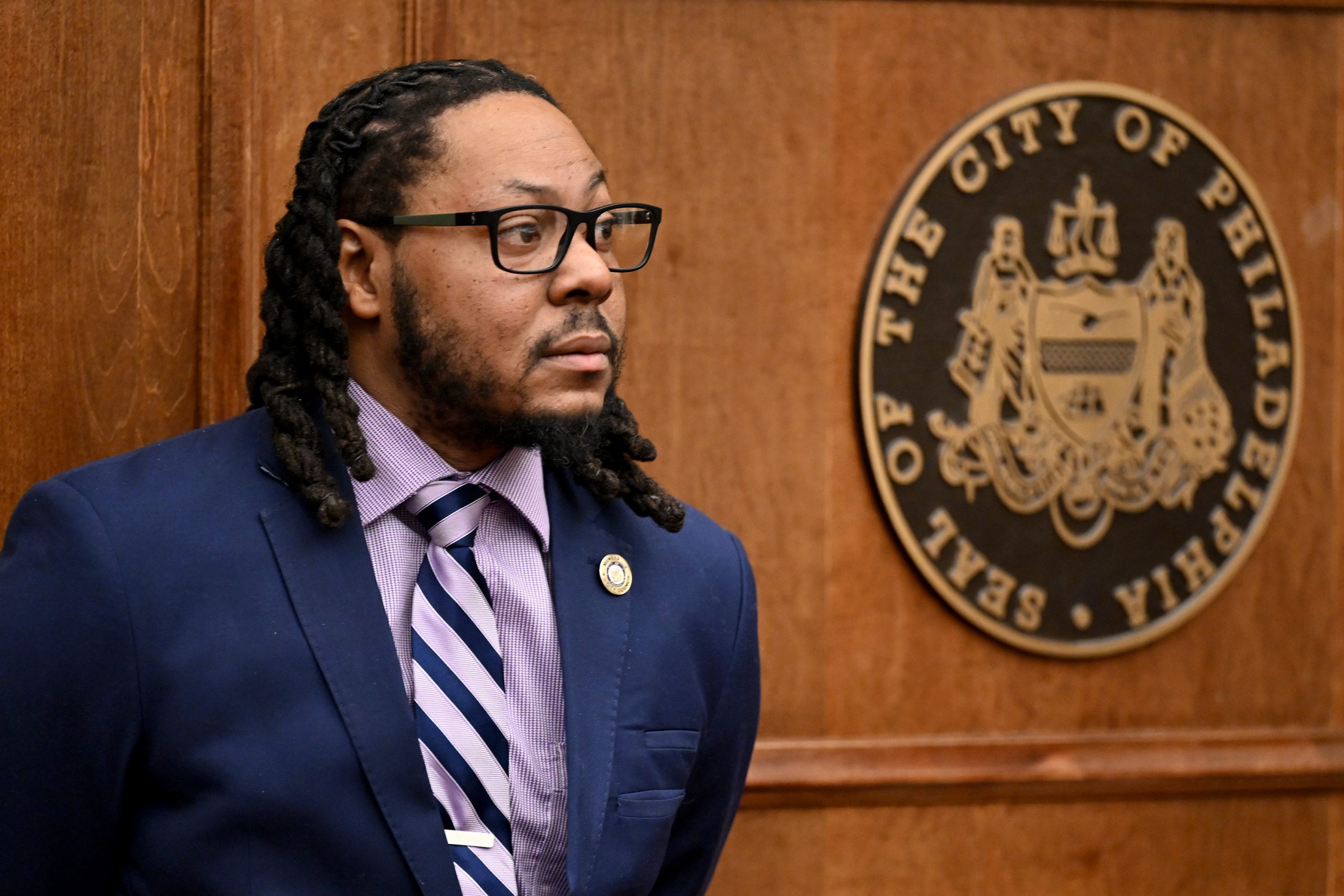
    Councilmember Mark Squilla arrives in Council chambers on Nov. 12, 2024, before the start of a public hearing on a proposed Sixers arena.Alejandro A. Alvarez / Staff Photographer

    Despite the fierce objections, Council approved the project with Mayor Cherelle L. Parker’s support in December 2024. Weeks later, the basketball team announced it was abandoning its Center City plan and would instead build its next arena in South Philly.

    Squilla said he is prepared to defend his actions, noting that he worked to ensure any arena deal would benefit his district and that many of those promises are moving forward despite the 76ers withdrawing their proposal.

    “The goal as an elected official, and also as a leader, is not always to make the popular decision,” he said. “The goal is to have a process to make the decision that would be best for the people around it.”

    One prominent opponent of the Center City arena plan was Will Gross, the owner of Ox Coffee in Queen Village and a progressive who is the Democratic leader of the 2nd Ward. He is seen by political insiders and progressive organizations as the most likely candidate to take on Squilla.

    Gross declined to comment.

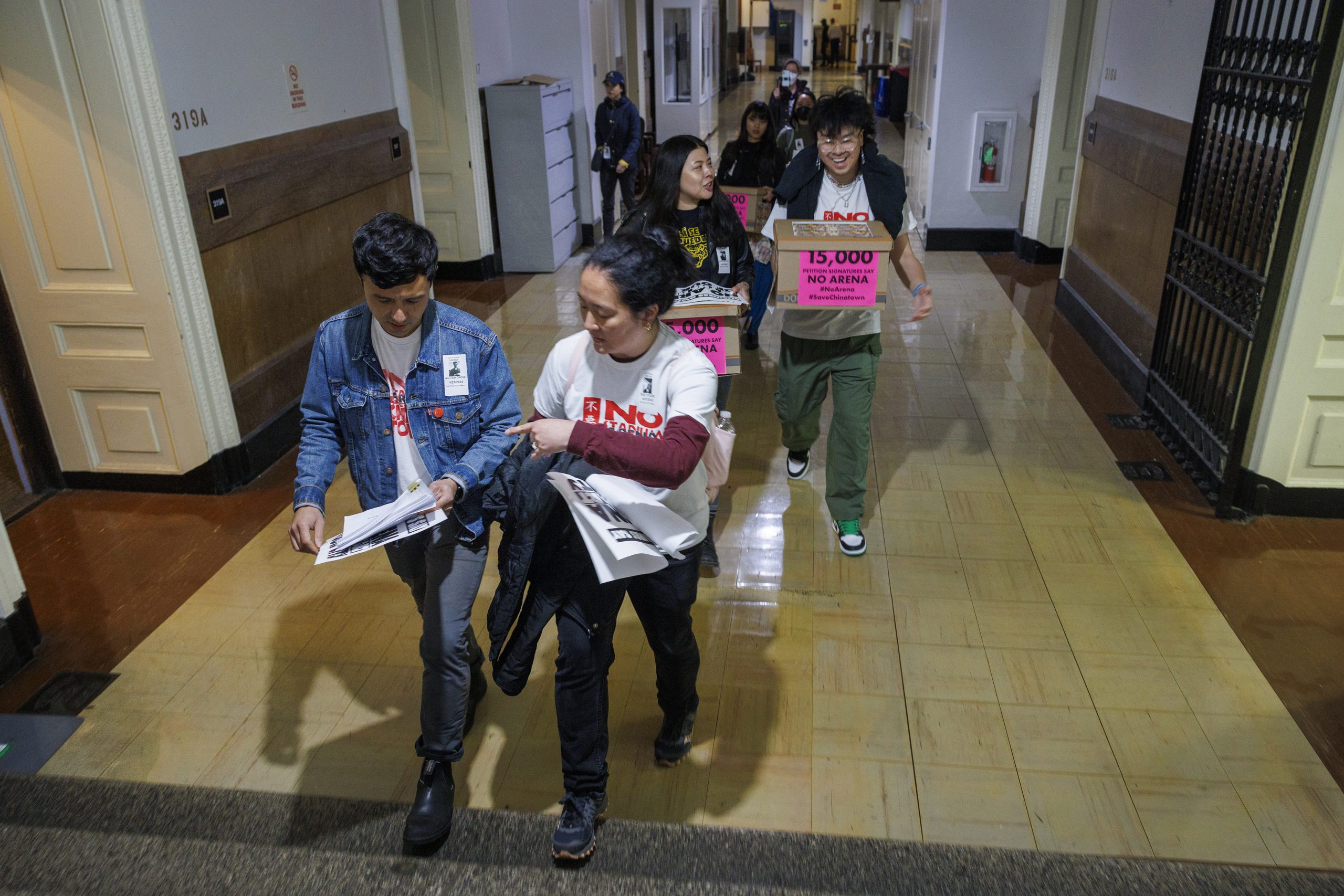
    In this 2023 file photo, Will Gross and Kay Yoon, of the No Arena in Chinatown group, deliver petitions to Councilmember Mark Squilla. Alejandro A. Alvarez / Staff Photographer

    A progressive challenger may also emerge in the North Philly and Kensington-based 7th District, which is represented by Councilmember Quetcy Lozada.

    In 2023, Lozada, Council’s only Latina member, won decisively over social worker Andres Celin, who argued for a more social services-driven response to address longstanding issues in the beleaguered district.

    Some insiders have speculated that Celin may run again. He declined to comment.

    Lozada, 55, said she “can’t focus” on potential challengers.

    “If I spend my time listening to the buzz about who is running,” she said, “we won’t get any work done.”

    A battle takes shape in the 5th District

    In the 5th District, a seat that represents parts of North Philadelphia and Center City, a handful of Democratic challengers are lining up to take on Young, 40, who is seen as one of Council’s most vulnerable members.

    That is in part because of the unusual way in which he was elected in 2023. He ended up being the only Democrat on the ballot after several others, including party officials’ preferred candidates, were removed amid legal challenges.

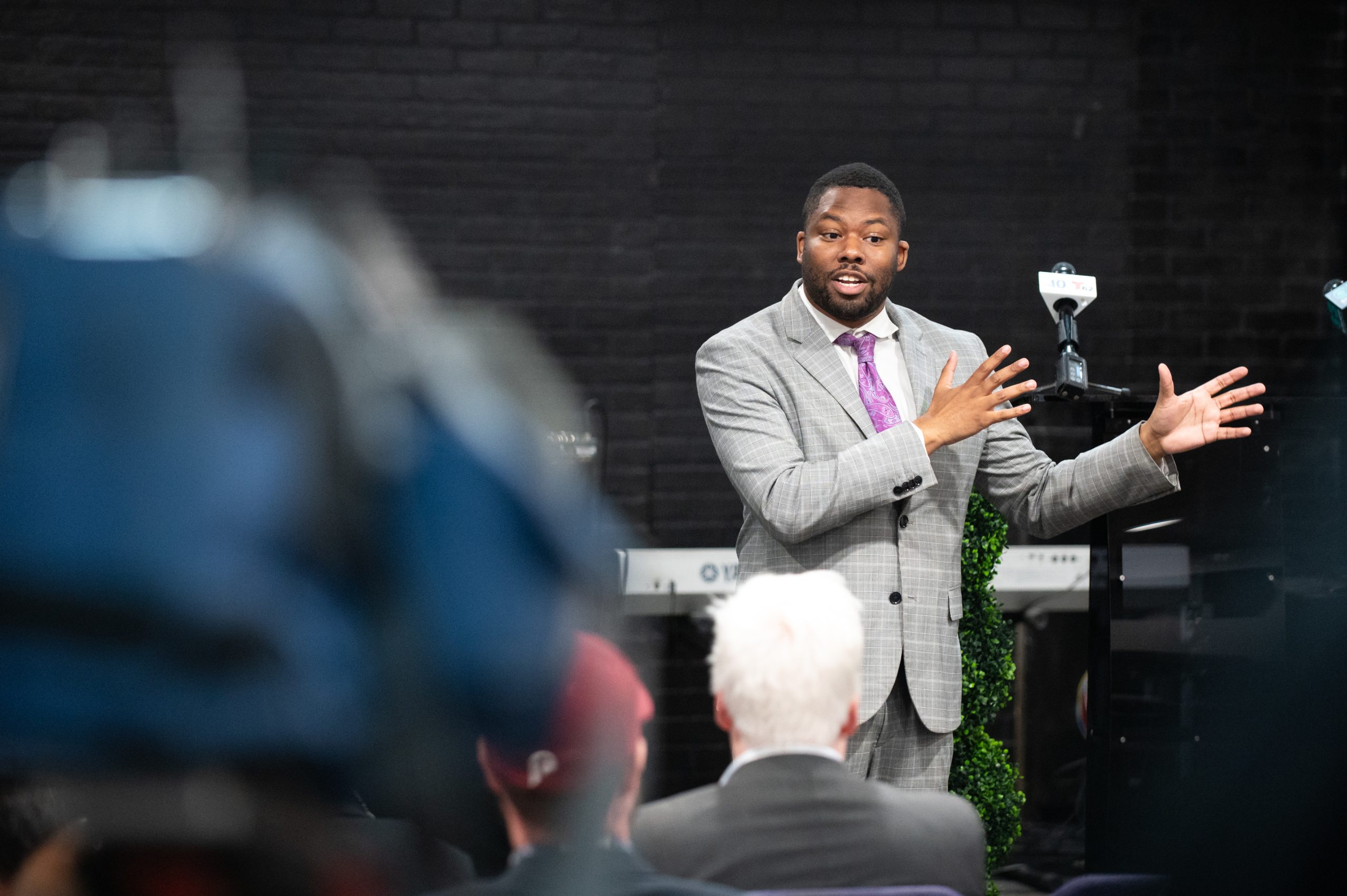
    Councilmember Jeffery Young Jr. in chambers as City Council meets Dec. 11, 2025.Tom Gralish / Staff Photographer

    One of those candidates was Curtis Wilkerson, who was chief of staff to former City Council President Darrell L. Clarke. Two sources, who spoke on condition of anonymity because they were not authorized to discuss the campaign dynamics, said Wilkerson is considering running for the seat again next year. He did not respond to a request for comment.

    Also likely to run is Jalon Alexander, an attorney who unsuccessfully ran for an at-large seat on Council in 2023. Alexander, 33, formed an exploratory committee last year and is expected to formally declare his candidacy later this summer.

    Two others are also considering running.

    Dustin Dove, a lawyer and the president of the Fairmount Civic Association, said neighbors and community leaders have encouraged him to get in the Council race, and he is “taking the possibility of running seriously.”

    “I think our city government should work for everyone by keeping our neighborhoods safe and streets walkable, making housing affordable, and ensuring fairness and access in public services,” Dove, 38, said last week.

    Jalon Alexander, an attorney and community advocate, speaks to attendees at a meeting about potential SEPTA budget cuts hosted at Garden of Prayer Church in Strawberry Mansion on June 9, 2025.Erin Blewett / For The Inquirer

    And Max Tuttleman, 37, a philanthropist who unsuccessfully ran for an at-large seat in 2023, said he “cares deeply about the 5th District and would never close the door to serving Philadelphia.”

    He added that “Center City and the neighborhoods around it should be growing faster than they are.”

    That was a subtle dig at Young, who critics say has been too hostile to development in his district by opposing some residential projects.

    Young said in an interview last week that he intends to run for reelection, but that challengers are not his focus.

    “I‘m focused on serving my constituency, serving my community,” he said. “The work that we’ve been doing will hopefully earn the support of the residents of the 5th District.”

    A smaller, but competitive, at-large field

    Over the last several election cycles, dozens of candidates lined up to run for at-large seats during a time of immense turnover in Council.

    But with seven incumbents all looking toward reelection in 2027, there may be fewer challengers who line up to take them on. So far, only Golden and a handful of others have emerged as possible contenders.

    David Alexander Jenkins, a cultural strategist known for delivering impassioned speeches during Council’s public comment section, said he is considering a run, encouraged by fellow community members.

    “When the community that is around you constantly pushes you to intercede on their behalf, then it’s because they have trusted you to do what it is that you do best,” Jenkins, 39, said. “I think it would be incredibly unwise to ignore that.”

    And Jude Husein, 28, a Palestinian-born community activist who was raised in North Philly, has already launched her campaign. If her bid is successful, Husein, a former staffer for State Sen. Art Haywood, would be the first member of Gen Z on Council.

    In this 2023 file photo, Jude Husein, of North Philadelphia, speaks at a rally for a Day of Solidarity event at the Art Museum steps.Tyger Williams / Staff Photographer

    Leaders of progressive organizations said they are closely watching her candidacy. However, Husein is not exactly running as a leftist. She said that her policy positions are varied and that she will seek endorsements from any institution that is “values-aligned.”

    “I’m running because I think government should work for the people who pay for it, and should make neighborhoods affordable and safer,” she said.

    Also in the running for Council at-large seats are Billy McCann, 46, a former teacher who lives in Port Richmond, and Isaiah T. Martin, 26, who lives in West Philly and leads a community development nonprofit. The pair, who both said they are progressive, have established something of a slate with Jones, who is challenging Bass in the 8th District.

    They said they would prioritize public education, affordability, housing assistance, and government accountability, and they argued that establishment Democrats are failing to connect with voters.

    “A new day is coming,” said Martin, another member of Gen Z who would make history on Council if elected. “It’s time we get people who are going to do the actual work and not just sit here and talk about it.”

  • Several Federal Donuts and Goldie locations in Philadelphia are closing amid a slowdown in fast-casual lunch business

    Several Federal Donuts and Goldie locations in Philadelphia are closing amid a slowdown in fast-casual lunch business

    Restaurant group CookNSolo will close three Center City Federal Donuts & Chicken locations and shrink its Goldie falafel chain from four shops to one as owners Steve Cook and Michael Solomonov retrench, citing weakened demand for fast-casual dining, particularly at weekday lunch.

    Federal Donuts’ shop at 1909 Sansom St. — designated only months ago as the company’s flagship after the South Philadelphia location closed in February — shut down after business Sunday. Locations at 21 S. 12th St. and 18th Street and Benjamin Franklin Parkway are expected to close by July 31, although Cook said staff departures could accelerate the timetable.

    Of Federal’s 45 employees, 27 will be laid off, Cook said. Eighteen employees will be retained to staff the two remaining Philadelphia stores, on Fairmount Avenue and on South Street. Federal launched in 2011 in South Philadelphia with a menu of fried chicken, coffee, and hot doughnuts from a robotic fryer.

    Federal Donuts founders (from left) Tom Henneman, Michael Solomonov, and Steve Cook at the Federal Donuts & Chicken location at 1776 Ben Franklin Parkway in 2022.Michael Klein / Staff

    Goldie, which debuted in 2017 with a menu of falafel, fries, and tehina shakes, will close its restaurants at 1218 Sansom St., Franklin’s Table food hall at 34th and Walnut Streets, and the Whole Foods Market at 2101 Pennsylvania Ave. in late July or early August. The lone remaining Goldie, at 1911 Sansom St., will absorb the chain’s delivery, takeout, and catering business.

    Eighteen of Goldie’s 36 employees will lose their jobs. Cook said the company is working to help find former Federal Donuts and Goldie workers other roles. Hourly staffers will not be given severance, Cook said, as is standard industry practice.

    Cook said the closures reflect a restaurant landscape that has changed dramatically since the pandemic.

    Dozens of fast-casual and quick-service restaurants have opened in recent years. “We feel like we’re oversaturated in the city, given the economy right now and the demand for fast-casual restaurants,” he said. Federal Donuts has experienced “significant” year-over-year same-store sales declines, he said. He hopes the closures stem the losses.

    “We have two great brands here that are worth saving, and we feel like economically this is the best way to preserve those brands.”

    Falafel from Goldie.Craig LaBan / Staff

    The company’s full-service restaurants — including Zahav, Dizengoff, K’Far Cafe, Jaffa Bar, and Laser Wolf — are unaffected by the shutdowns.

    ‘A mixed bag’

    Cook cited both the lingering decline in Center City office workers and inflation as contributing factors to the closures.

    “Post-COVID, while we’ve seen really good rebounds in the dinner, more fine-dining side of our business, weekday lunch traffic has never really returned to full strength,” he said. “The $10-to-$15 lunch is an easy thing to kind of do without.”

    Cook’s assessment reflects broader industry trends.

    Tehina shakes are a signature product at Goldie.Tim Tai / Staff Photographer

    While some national fast-casual brands such as Chipotle and Cava continue to post strong results, many regional chains are struggling as consumers increasingly choose prepared foods from grocery stores and convenience stores instead of restaurant meals, according to R.J. Hottovy, head of analytical research at Placer.ai, a location analytics and foot-traffic company.

    While fine-dining restaurants have generally continued to gain traffic through much of 2026, “fast-casual has been more of a mixed bag,” Hottovy said.

    Placer.ai’s findings show visits to grocery stores, convenience stores, and wholesale clubs increasing from a year earlier while overall restaurant visits have declined. “Middle-income consumers are increasingly substituting restaurant visits with meals at home,” Hottovy said.

    Restaurants also continue to battle rising labor costs while customer traffic softens as menu prices rise. “Price increases are increasingly showing up as lost visits,” he said.

    A sharp reversal

    The Federal Donuts closures mark a sharp reversal from its expansion ambitions after Radnor-based NewSpring Capital acquired a controlling interest in 2022.

    Federal then operated 11 locations and arena concessions, and executives envisioned a franchise system that eventually could reach 150 stores.

    The company’s largest franchisee later closed its restaurants in Radnor, Conshohocken, and Willow Grove and returned several Philadelphia stores to the company. In April, Cook and Solomonov announced plans to regain control of those city locations, simplify operations, and improve execution.

    At the time, the Sansom Street restaurant was designated as the flagship to redevelop menu items. “I thought we would get a significant bounce in sales [there] and it just didn’t happen,” Cook said.

    Cook said NewSpring remains the majority owner of Federal Donuts, while he and Solomonov retain a significant ownership stake and seats on its board. Representatives of NewSpring did not respond to requests for comment.

    Under the restructuring, two Philadelphia stores will remain. CookNSolo will take over the location at Seventh Street and Fairmount Avenue, now owned by the company, as a franchisee around Aug. 1.

    Federal cofounder Tom Henneman confirmed that he was in talks to operate the location at Sixth and South Streets as a franchisee.

    Cook said those stores were chosen because of their historical performance and geographic separation. Consolidating delivery and takeout in two locations instead of five should improve profitability, he said.

    Besides the two city stores, Federal will continue operating independently owned franchises in Marlton, Lancaster, and the Hard Rock Hotel & Casino in Atlantic City, along with its licensed airport and stadium locations.

    Goldie, unlike Federal Donuts, is owned entirely by CookNSolo.

    CookNSolo has also been the focus of pro-Palestinian demonstrations and boycott campaigns since the start of the Israel-Hamas war on Oct. 7, 2023. Activists have criticized the restaurant group for raising money for an Israeli emergency medical nonprofit as well as Cook’s and Solomonov’s outspoken support for Israel. The chefs have said their support for Israel was “not unqualified” and have criticized the Netanyahu government’s efforts to thwart a two-state solution.

    A group with the Instagram handle @boycottcooknsolo on Monday reported word of the store closings, contending that the boycott had softened sales.

    Cook disagreed. “Any time there’s been a protest, it’s always resulted in a short-term increase in business,” Cook said. “This is really an economic decision that goes back many years at this point.”

    (function(){function e(){window.addEventListener(`message`,function(e){if(e.data[`datawrapper-height`]!==void 0){var t=document.querySelectorAll(`iframe`);for(var n in e.data[`datawrapper-height`])for(var r=0,i;i=t[r];r++)if(i.contentWindow===e.source){var a=e.data[`datawrapper-height`][n]+`px`;i.style.height=a}}})}e()})();

  • Tom Burgoyne insists he’s just the Phanatic’s best friend. A new documentary convinced him to admit he’s more.

    Tom Burgoyne insists he’s just the Phanatic’s best friend. A new documentary convinced him to admit he’s more.

    Tom Burgoyne was selling computer supplies for six months after graduating from Drexel when he saw a listing in the newspaper that said “mascots wanted.” It didn’t say who was looking for mascots or where the job would be located. Burgoyne, who was the mascot in high school at St. Joe’s Prep, didn’t need to know.

    “I sent my resume to the P.O. Box,” Burgoyne said. “I thought I’d be like the Hamburglar or the Statue of Liberty at tax time. And then the Phillies called.”

    Burgoyne aced his audition and spent five years as the backup Phillie Phanatic before becoming the main man inside the flightless bird from the Galápagos Islands.

    But Burgoyne has long protected the mascot like a professional wrestler protecting the business.

    He’s not the Phanatic. He’s the Phanatic’s best friend. He talks about the mascot in third person — “The Phanatic will be busy on Tuesday,” Burgoyne said of the All-Star Game — and does his best to separate the man from the bird. He knows another big-league mascot who is a teacher during the day but keeps his other job so secretive that people in his school don’t know he’s a mascot.

    “I respect the hell out of that,” Burgoyne said.

    So Burgoyne, who is participating in his 30th All-Star Game, needed some convincing to peel back the curtain for a documentary expected to premiere later this year about the character he brings to life every summer. But then Burgoyne remembered watching a documentary about the Muppets that showed Jim Henson pulling the strings for Kermit The Frog. If Henson could do that, then Burgoyne could talk about what he does.

    Tom Burgoyne, the man inside the Phanatic, posed for a portrait with some of the children’s books he’s written at Citizens Bank Park in 2024.Monica Herndon / Staff Photographer

    The documentary — which is titled Big Phan — is directed by Flourtown native Hoag Kepner, the brother of longtime baseball writer Tyler Kepner. It tells the history of the mascot, Burgoyne said, and “has a lot of heart.” And it allowed Burgoyne a chance to admit that he’s more than just a friend of the Phanatic.

    “You never want to think that there’s someone in the costume,” Burgoyne said. “I can look at an old clip of the Phanatic and I’m not thinking, ‘Oh, that’s me in there.’ I’m just thinking ‘That’s the Phanatic.’ You want that magic to stay alive.”

    Burgoyne’s first All-Star Game was in 1996 at Veterans Stadium when Major League Baseball invited every mascot for the first time. The mascots were told to dress across Pattison Avenue at the Spectrum before the Home Run Derby, but the locker rooms were under construction when they arrived. So they took over the Vet’s umpire dressing room, which equipment manager Joey Dunn had already set up for the next day’s All-Star Game.

    “Here come the mascots trashing the place on Monday,” Burgoyne said. “MLB has learned a lot over the years.”

    The game has become the annual gathering of the mascots as they didn’t have a reason to come together before MLB started to invite them each July.

    Burgoyne was in Boston in 1999 when Ted Williams returned to Fenway Park. He was in Pittsburgh when Ryan Howard won the 2006 Derby, and he was in New York in 2008 when they played 15 innings. But his favorite memory is the one that leaves him wondering what could have been.

    The mascots were taking turns sliding down Bernie Brewer’s slide in Milwaukee during the 2002 Home Run Derby when the Phanatic took his turn.

    “I think someone had to give him a shove with their foot,” Burgoyne said.

    The big, feathery green thing neared the bottom of the slide just as Sammy Sosa homered off it. The Phanatic could have made a play.

    “I’m telling you, the Phanatic was coming down the slide and it just missed,” Burgoyne said. “If the Phanatic slid two seconds earlier, he could’ve caught it on the fly in the slide. It’s such a regret. It would’ve been the ESPN Play of the Day.”

    The mascot arrived in Philadelphia in 1978 and was brought to life by Dave Raymond, who retired after the 1993 season. The schtick has been fine-tuned in nearly 50 years, but the main elements have remained unchanged. Burgoyne makes fans allow themselves to believe that what they’re seeing is real. Because he’s not in the costume. He’s just a friend. And he has no plans of stopping.

    “I’m still having fun,” Burgoyne said when asked how much longer he has in the gig. “I’ve been thinking of David Montgomery a lot and when they announced the All-Star Game so long ago for him, I was like ‘2026? Someone else can do that.’ But here we are. When you’re having so much fun, why not?”

  • Here’s what’s in — and not in — Pennsylvania’s $50.8 billion state budget

    Here’s what’s in — and not in — Pennsylvania’s $50.8 billion state budget

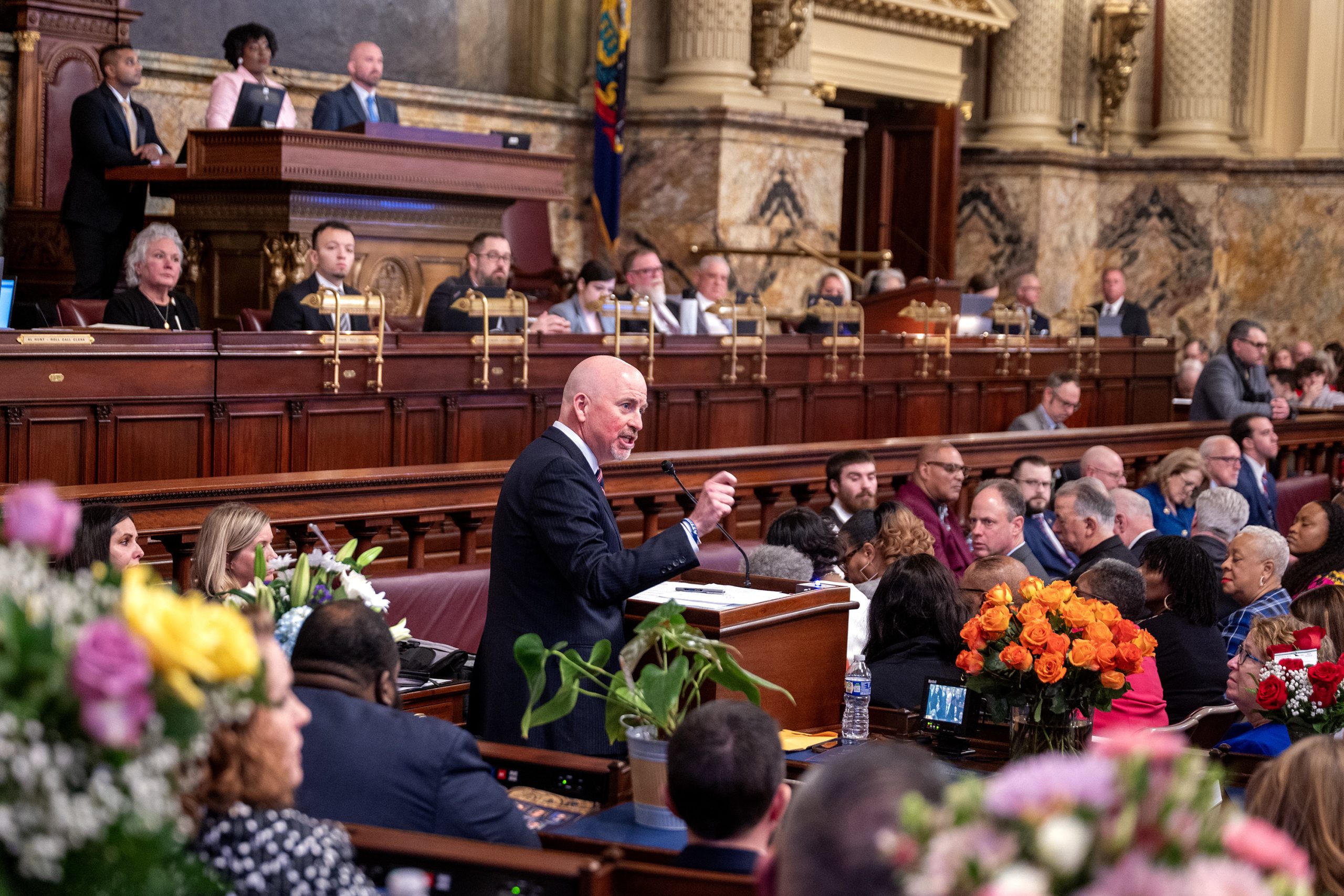
    HARRISBURG — Pennsylvania’s new $50.8 billion state budget was sprawled across more than 600 pages of legislation and signed into law on Sunday. New data center regulations, education funding, and more were approved in the wide-ranging spending package.

    But some of the most pressing issues facing the General Assembly were noticeably absent from the final deal, as Gov. Josh Shapiro and lawmakers in the split legislature were unable to reach a compromise — or did not want to touch the contentious issues until after they are up for election in November, sidelining some of Shapiro’s top budget priorities.

    Here’s a look at what is in — and what was left out of — the 2026-27 Pennsylvania state budget.

    In: Education funding increases

    Pennsylvania took another jump toward filling a multibillion-dollar funding gap between wealthy and poor school districts, after a court found that the state’s old system of funding education was unconstitutional. Since 2024, when the state first implemented new adequacy and tax equity formulas in efforts to fill the $4.5 billion “adequacy gap,” lawmakers have put nearly $1.9 billion toward funding lower-income districts, with plans to fill it by 2032.

    “It keeps our promise to our school districts,” said State Rep. Jordan Harris (D., Philadelphia), who serves on the powerful appropriations committee responsible for allocating state dollars, in remarks on the House floor Sunday.

    The latest installment of adequacy and tax equity payments — $565 million — will largely go to low-income districts that already have high property taxes. The Philadelphia School District, Pennsylvania’s largest district and the only one in the state that is unable to raise its own revenue, will get $136 million of that funding increase.

    Out: Revenue generators

    Shapiro proposed generating new revenue streams to help the state fix its multibillion-dollar structural deficit in his last four budget addresses. But the ways he wants to raise that cash have drawn resistance from Senate Republicans, who argue they are not policies that will improve the state’s economic standing — or cannot reach agreement within their caucus on how to address the issues.

    Shapiro this year did not get the hefty minimum wage increase he asked for, seeking to raise the hourly rate from $7.25 to $15 — and counting on the higher wage for $80 million in higher income tax revenues. Nor was he able to get the General Assembly, where Democrats control the House and Republicans lead the Senate, to approve adult-use cannabis, which his office estimated would bring in $729.4 million in its first year, largely through licensing. (House Democrats have approved plans for a minimum wage increase and recreational marijuana legalization, but the Senate has not voted on the bills.)

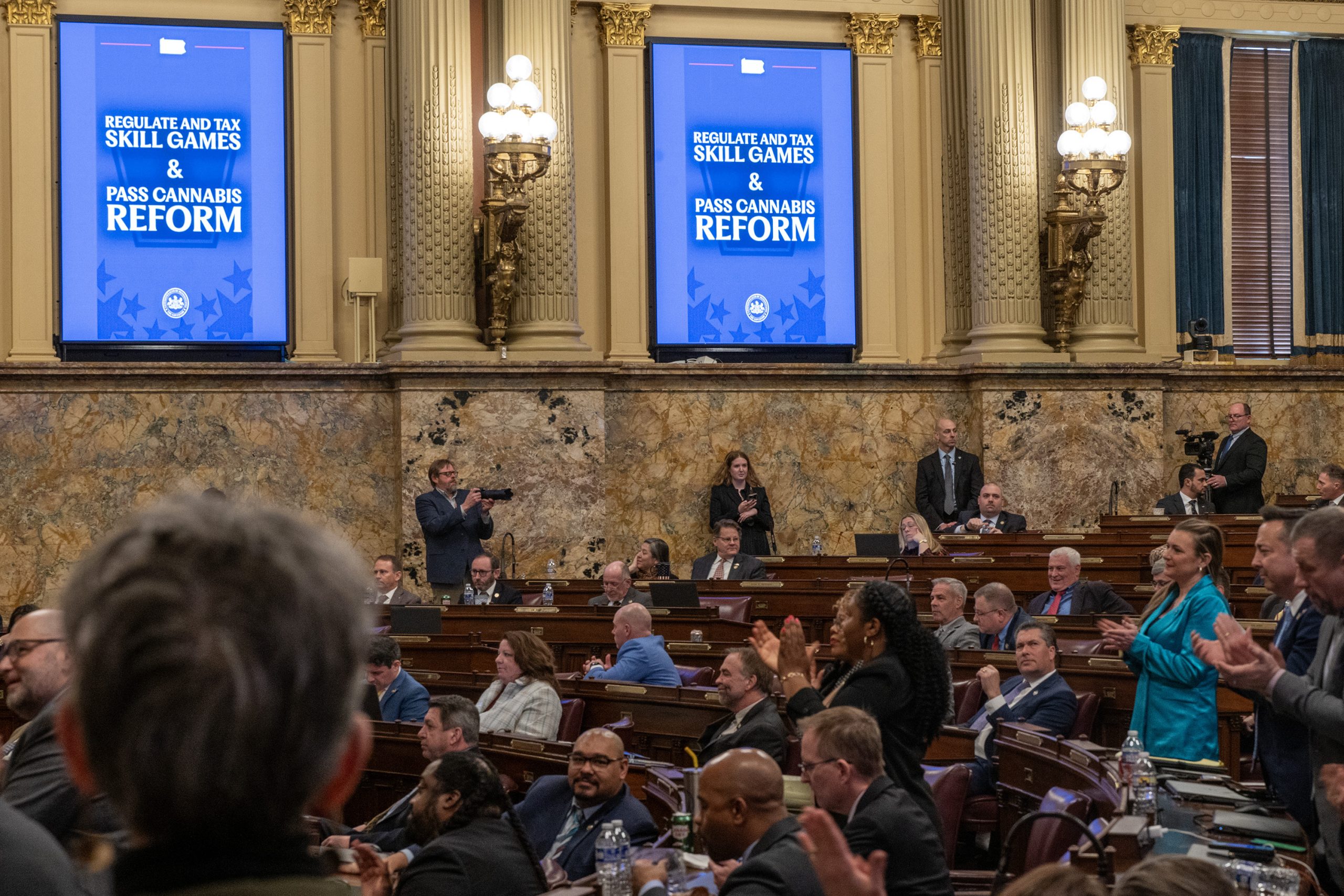
    Screen shows skill games and cannabis regulation and reform as Gov. Josh Shapiro makes his annual budget proposal in the state House chamber in Harrisburg Tuesday, Feb. 3, 2026.Tom Gralish / Staff Photographer

    Shapiro, in his February budget proposal, also called on the General Assembly to regulate and tax skill games at the same rate as casinos, a move that he has estimated could generate nearly $800 million in revenue in its first year. But any regulation of skill games — slot machine look-alikes that the state Supreme Court ruled last month are a form of gambling — was left out of the budget.

    Lawmakers have until October to decide whether skill games will be taxed and regulated, under a grace period in the high court’s ruling. Otherwise, the devices found in many corner stores, gas stations, and bars will become illegal gambling machines. The issue has been the target of more than $8 million in lobbying and $9 million in campaign spending in Harrisburg, mostly funded by one company.

    State Senate Majority Leader Joe Pittman (R., Indiana) during a press conference at the Capitol in Harrisburg Feb. 3, 2026.Tom Gralish / Staff Photographer

    “We can act within the 120 days; we can act after the 120 days,” Senate Majority Leader Joe Pittman (R., Indiana) said Sunday. “But the choice is now quite simple. These machines are illegal, and in less than 120 days, they will be leaving the marketplace.”

    In: Data center reporting requirements

    Data centers — which are seeing a boom in Pennsylvania as artificial intelligence usage increases and communities push back on where the centers are being built — will be required to submit information about their energy and water usage.

    Beginning next summer, data centers in the state with a peak energy demand greater than 10 megawatts will be required to submit information annually to the Pennsylvania Department of Environmental Protection.

    Outlined as part of this year’s fiscal code, those reports will be publicly accessible. Data centers that do not submit information about their resource usage will be fined $10,000 a day.

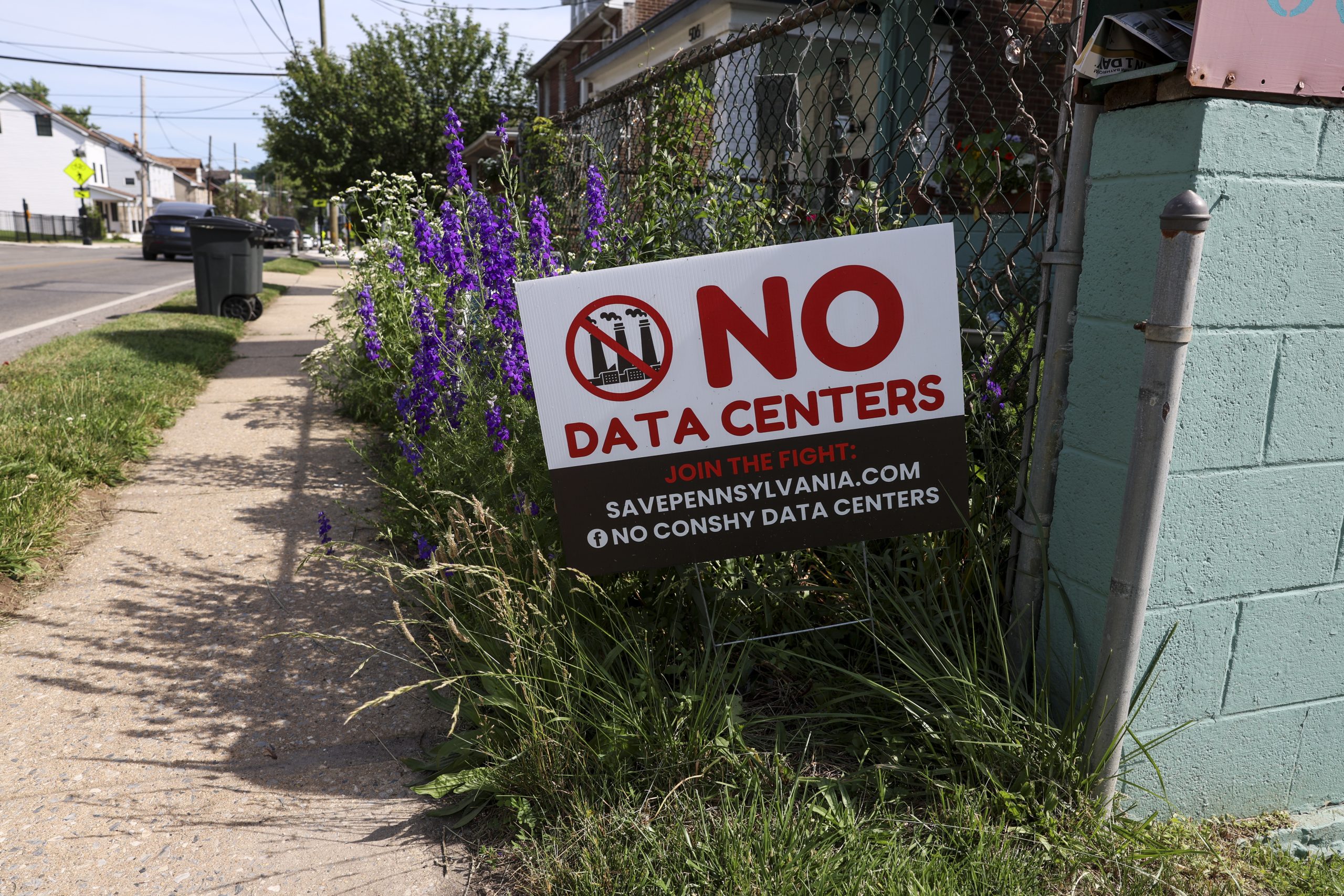
    A yard sign protests the proposed data center on New Elm Street near the Closed Cleveland-Cliffs steel mill photographed on Thursday, June 4, 2026 in Conshohocken, Pa.Monica Herndon / Staff Photographer

    Out: Data center regulations

    A data center regulation bill, which would have limited state benefits for data center developers and was championed by Shapiro, was not included in the final budget deal. The governor called for limiting a sales and use tax exemption and expediting permitting to projects that comply with a set of transparency and environmental standards.

    And several other data center regulation efforts that have received bipartisan support in recent weeks were also absent from the final spending package.

    Those included efforts to repeal the sales tax exemption afforded to data center developers and attempts to enact a local or statewide moratorium on new data center development.

    Both chambers passed language repealing the tax exemption and advanced differing bills to freeze development. One Democratic-sponsored bill would have given municipalities the option to implement a 180-day moratorium on new centers. The other, a Republican-sponsored measure, would allow for local moratoriums of up to 18 months.

    In: Compromise

    Compromise was the word of the day around the Capitol on Sunday, when the legislature swiftly passed the more than 600-page budget deal hashed out behind closed doors by Shapiro, Pittman, and House Majority Leader Matt Bradford (D., Montgomery) and passed with bipartisan support in both chambers.

    The legislative leaders and Shapiro emphasized that they did not get exactly what they wanted in the budget, as a symptom of dealing with divided government. And leaders were proud to have reached the deal less than two weeks after their July 1 deadline, rather than the nearly five months it took to hash out an agreement last year.

    House Majority Leader Matt Bradford (D., Montgomery) speaks on Tuesday, Jan. 7, 2025.Tom Gralish / Staff Photographer

    Lawmakers had agreed to work over the weekend to hurriedly approve the budget deal, with members of the Senate coming in on Saturday night to begin advancing parts of the budget deal and the House joining them Sunday afternoon. By 6:15 p.m. Sunday, Shapiro had signed it.

    Among the inspirations for the weekend of productivity, Bradford said: making it to the MLB All-Star Game in Philadelphia, for which he had tickets.

    Out: Typical budget math

    Leaders returned to some old accounting maneuvers to address the state’s multibillion-dollar structural deficit and avoid pulling from the state’s emergency savings account.

    They spent down unused and underused dedicated funds, and rolled some of the state’s Medicaid payments totaling $1.3 billion to the next fiscal year, a move lawmakers typically resorted to before the state saw an influx of federal dollars during the COVID-19 pandemic.

    Without those delayed payments, the state budget would total closer to $52.1 billion, and several GOP members criticized the total as being disingenuous.

    In: Cost-of-living bumps for pensioned workers

    More than 80,000 retired public-sector employees will receive a cost-of-living adjustment to their pensions, something advocates have sought for years.

    Public school teachers and other state employees who retired before July 1, 2002, will receive a tiered monthly payment based on the date of their retirement. Similarly, police officers and firefighters who retired more than five years ago will receive monthly payments ranging from $50 to $300, depending on how long they have been retired.

    Lawmakers from both parties had called for the cost-of-living increase.

    In: Closing Philly’s sales tax loophole

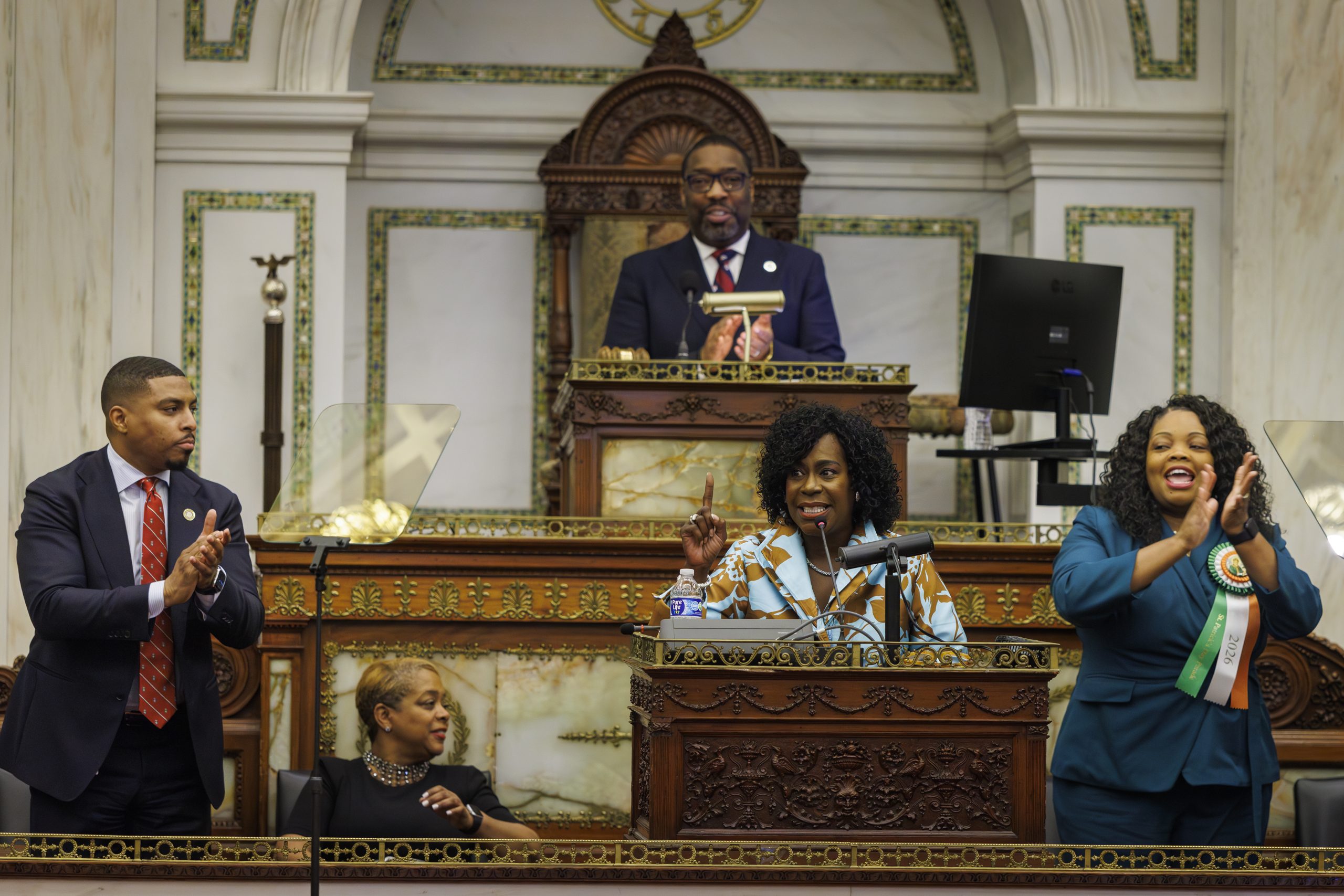
    Legislators also agreed to close a loophole that allowed online sellers to avoid paying Philadelphia’s local 2% sales tax on purchases made in the city.

    Mayor Cherelle L. Parker had asked the General Assembly to close it as part of her own city budget pitch in a move estimated to bring an additional $1.5 million to Philadelphia.

    Philadelphia Mayor Cherelle L. Parker is cheered by members of Philadelphia City Council at conclusion of her budget address, Thursday, March 12, 2026.Alejandro A. Alvarez / Staff Photographer

    Out: Banning cell phones in schools

    Twenty-nine states have bell-to-bell cell phone bans. This year, Pennsylvania will not join them, despite the passage of two separate phone ban bills — one in each chamber of the legislature.

    In: Mandatory recess for students K-5

    Recess is now law in Pennsylvania.

    Another education policy change championed by Shapiro, a mandatory, 30-minute recess for students in kindergarten through fifth grade was established in this year’s budget as a way to improve learning outcomes.

    Out: Addressing looming problems — with looming deadlines

    Several Pennsylvania funding issues that have gone years without being addressed were left out of the latest budget, some with more pressing deadlines than others.

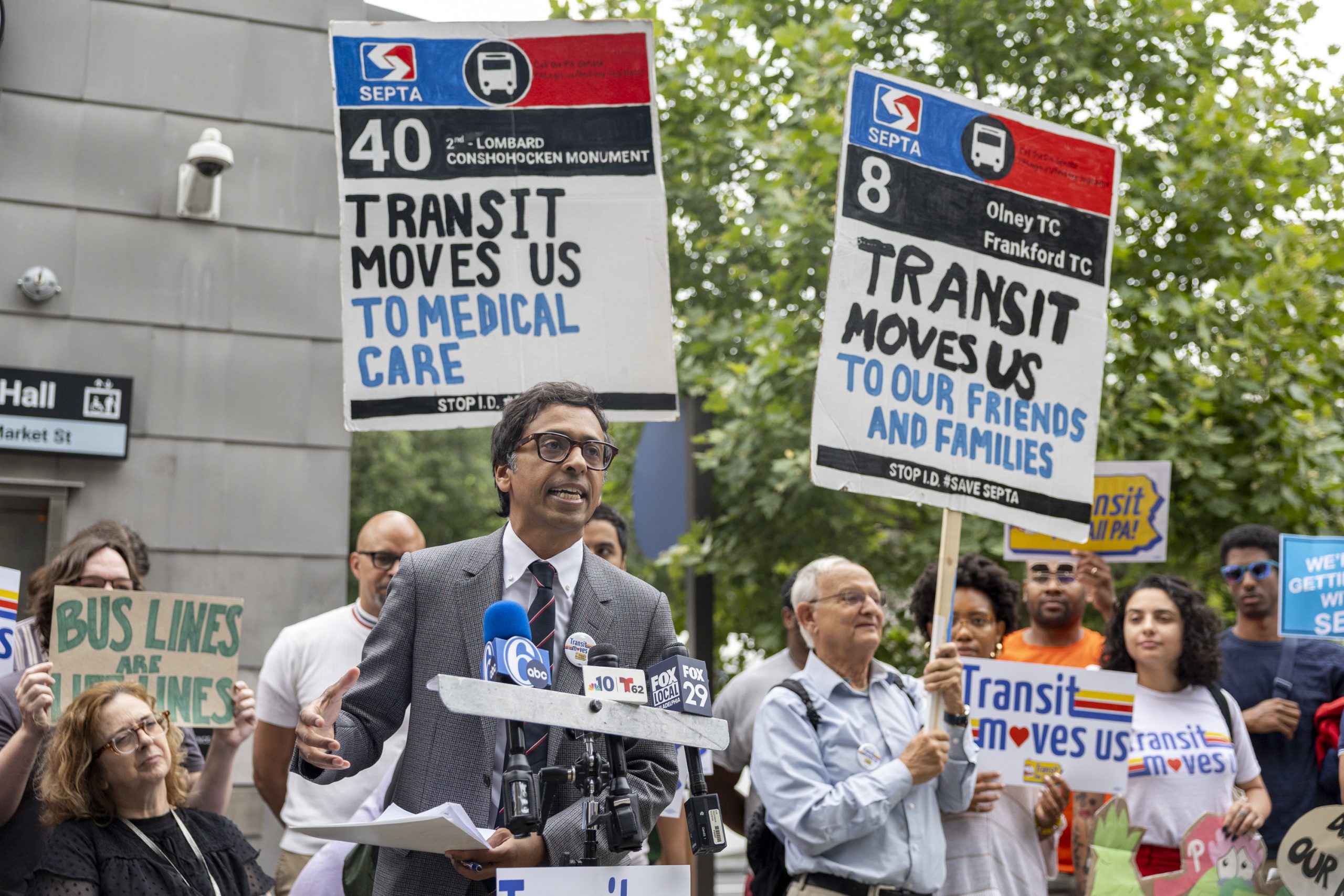
    Lawmakers did not address a need for mass transit funding — which led to last year’s bitter budget stalemate among legislators — but are expected to identify a long-term funding stream for the transit agencies next year when a two-year fail-safe runs out.

    Senator Nikil Saval, speaks at a press conference calling for more SEPTA funding from the state at Independence Hall in Philadelphia, Pa., on Friday, June 26, 2026.Tyger Williams / Staff Photographer

    Other local governments and service providers said their needs are more pressing.

    The County Commissioners Association of Pennsylvania released an urgent plea after the state budget was signed, noting that counties still have not received the critical mental health funding they need, or a surcharge increase used to fund 911 call systems. Home-health service providers also continued their calls for increased state funding they say is needed, as the industry faces serious staffing issues due to low state reimbursement rates.

    In: More funding for rape crisis centers

    Rape crisis centers got a much-needed funding increase, from $12 million to just over $24 million.

    Philadelphia’s only rape crisis center had to lay off its employees and rely on volunteer work during last year’s monthslong state budget impasse.

    Republican and Democratic lawmakers championed the organizations in this budget, making it the largest single-year increase for the critical services in state history, according to the Pennsylvania Coalition to Advance Respect.

    “Today marks a turning point for survivors and rape crisis centers across Pennsylvania,” said Joyce Lukima, the organization’s coalition director, in a news release.

    Ethan Young is an intern with the Pennsylvania Legislative Correspondents’ Association.