Mita says the 17,694-square-foot home at 5475 Dune Drive is not for his personal use, but rather a house built by his Achristavest construction company that will be offered for sale. There is no designated buyer yet, he said.
“This is a spec home,” he said by telephone. “Is it the biggest home in Avalon? Yes, absolutely. It’s not just one big home. It’s a home with a carriage house.”
Construction will require additional sand trucked in to fortify the dune for the property, which will include a 14,000-square-foot main house connected to a 3,000-square-foot carriage house.
Mita said he will continue to personally use a home on the beach in Ocean City, at 28th and Wesley.
Two stories in the new house will be subterranean and three will be above ground, he said. The below-ground floors will include a bowling alley, golf simulator, indoor pool, home theater, recording studio, and cold plunge.
He said has secured state environmental proposals and emphasized that the house, because it will occupy the same footprint as the existing house, did not need a zoning variance from Avalon borough.
Avalon’s impressively high and vast dune system has 11 homes. The largest existing house in the dunes is at 5299 Dune Drive and owned by the heirs to the Utz potato chip family business. It is 12,631 square feet.
In Mita’s case, the Avalon planning and zoning board approved the plans June 9, with the only notes being that the sand brought in should be “clean, uncontaminated, and free of hazardous substances.”
At the July borough council meeting, several residents expressed concern about the size of the project and its impact on the dunes.
Mita said the additional sand was requested by state environmental officials to fortify the dunes and will be placed on the street side near the retaining wall, not “onto the dunes” as some residents feared.
“I didn’t even need variances,” he said. “The renderings make it look overpowering.”
The additional sand, he said, was mandated by CAFRA (Coastal Area Facility Review Act) regulations.
“I can’t build one inch into the existing toe of the dunes,” he said. “I have to build a retaining wall as to not to encroach on the dune. It preserves the integrity.”
Eustace Mita, arriving at the Ocean City Music Pier for a city planning board meeting on Jan. 7, 2026, about the old Wonderland Pier site he owns.Amy S. Rosenberg / staff
Residents expressed concerns at a recent Avalon council meeting.
“It’s just a ruin, a ruin of the dunes,” said Elaine Scattergood, who said borough officials were being misled by claims that the property would stay within the footprint and elevation of the existing house. “If the dunes were a child, I think the protective agency would have taken it away from us.”
In Ocean City, those engaged in the back and forth over the Wonderland site also had a lot to say about Mita’s plan for Avalon’s high dunes.
“His home looks bigger than the hotel he wants to build in O.C.,” said one Facebook commenter.
“Barge the old home up to the Wonderland site,” said another. “Problem solved.”
Mita said his company is currently building three beachfront spec homes at 77th in Avalon, and three beachfront homes at 116th Street in Stone Harbor.
He said building a spec home of this size and expected sale price in the many tens of millions was “so risky.”
Who would be a potential buyer?
“LeBron James,” he mused. “Or Taylor Swift. She spent summers in Stone Harbor. There’s a recording studio. You can’t even buy a beach block lot in Avalon or Stone Harbor for $5 million.”
For nearly a dozen years, Vito Maglio’s family has agonized over who could have shot him in the head and neck, torched his SUV, then dumped his body into the Schuylkill.
“I said to myself, maybe I’ll die before I know,” his wife of 40 years, Maria, 75, said from her Bustleton home.
Then, this week, Philadelphia police arrested a 30-year-old woman in connection with Maglio’s death, saying she and others robbed him of his gold ring, phone, and a small amount of cash, then killed him and tossed his body into the river in December 2014.
Melanie Morat was taken into custody at her East Frankford home Tuesday afternoon and is expected to be charged with murder, robbery, arson, and related crimes, police said. Detectives are investigating whether at least two other people were involved in the crime, law enforcement sources said.
The arrest comes as Philadelphia homicide detectives, with more time and resources amid a striking decline in violence, continue to work through a backlog of unsolved cases — a combination of the hundreds of killings from the pandemic-era spike in shootings and higher-profile cases from years past that ran cold.
The killing of Maglio, 69, was among the latter, a disappearance and death that shocked his family and community, and left police struggling to amass enough evidence to make an arrest.
Maglio, a father of six, was a mechanic who owned several gas stations and ran a social club, the Napoli Association in Rhawnhurst, for many years before selling the businesses and retiring in November 2014.
Maria and Vito Maglio had been married for 40 years.
But on Dec. 14, 2014, he did not return to his Bustleton home, and his family reported him missing. Several days later, police found his GMC Yukon in East Germantown, charred and windowless, with a bullet casing inside and a pool of blood beneath the driver’s seat, police said.
His remains were not recovered from the Schuylkill until late March. He was identified by his pacemaker.
The investigation was challenging from the start, officials said, in part because homicide detectives did not take over the case until his body was recovered months after his disappearance. The assigned detective, Gregory Santamala, said in a 2016 interview that police did not know where Maglio was killed because his phone records showed that he was in various neighborhoods on the night he disappeared, and there were no surveillance cameras in the area where his car was burned.
Detectives suspected he had been set up in a robbery that went awry, he said. An early tip led investigators to interview two women in the Northeast, and both failed polygraph tests. But the women immediately hired lawyers and stopped talking, officials said.
Santamala retired in 2022, and the case went cold.
Then, this summer, the case was reassigned to Detectives Joseph Cremen and Robert Daly, who began reviewing phone records and the more than a dozen interviews their colleagues held with suspects and witnesses over the years.
Investigators told Maglio’s family it was not necessarily new evidence that allowed them to make an arrest this week — but a new style of building cases. Years ago, they said, prosecutors had less experience making cases from cell phone location data and circumstantial evidence. Now, they said, law enforcement has greater expertise in understanding those records, which, alongside the witness statements, allowed prosecutors to conclude there was sufficient evidence to charge Morat with murder.
Deputy Police Commissioner Frank Vanore said using today’s technology to solve older cases is the crux of cold case review.
The Philadelphia District Attorney’s Office declined to comment.
Maglio’s family said the developments came as a welcome surprise after a decade of fleeting hope. Sitting in the green-walled living room of their parents’ home Tuesday night, Maglio’s children said they were grateful for an arrest and eager for the court process to begin.
“I’m just glad it didn’t fall through the cracks,” said daughter-in-law Sandra Maglio, 50. “It was our biggest fear. We live in a city where people die every day, sadly. … So I’m just glad that, you know, someone took the initiative to say, ‘Hey, let’s look at this again.’”
They were also struck by the timing. Maglio’s brother-in-law died Monday. And his son, Donato, died three years ago this month at the age of 47.
They imagine them all together now.
“It gives us some kind of closure,” said daughter Lucia Thrasher, 37. “But we already got the outcome we didn’t want to 12 years ago.”
Thrasher’s eyes welled with tears as she looked at her 6-year-old twins, Charles and Thomas, who never got to meet their grandfather. Charles, bouncing in the doorway, asked why everyone was in the living room.
“Nonno,” she told him.
“You know, Nonno,” she said, as he looked away bashfully. “Where’s Nonno?”
He pointed toward a gold-flecked picture frame in the corner of the room.
Vito Maglio, 69, was a father of six.Jessica Griffin / Staff Photographer
Rebecca Cox Jackson was often told no. As a free Black woman in Philadelphia at the start of the 1800s, she wasn’t allowed to learn to read. No, she couldn’t leave her husband. No, she couldn’t become a preacher like her brother at Mother Bethel African Methodist Episcopal Church.
Undeterred, Jackson accomplished everything she set out to do — and more.
A pivotal pioneer who founded the only Black-led Shaker community, Jackson became a spiritual leader whose legacy has far outlasted her wildest dreams. Today, some 150 years after her death, the Shaker preacher still draws passionate followers: artists, filmmakers, and dancers who have created work inspired by her trailblazing life and archived writings.
This summer that work took center stage at “A World in the Making: The Shakers,” on view at the Institute of Contemporary Art in West Philly. Running through Aug. 9, the show features several works reflecting specifically on Jackson’s life story as well as highlights of Shaker inventions and creations, like seed packets and minimalist wooden furniture.
Finnegan Shannon’s “I Want to Believe” (blue banners) is on view at “A World in the Making: The Shakers,” at the Institute of Contemporary Art in West Philadelphia. The show ends Aug. 9.Constance Mensch
Shakers have lately seen renewed pop culture interest, with contemporary artists reflecting on the small but impactful Christian sect founded in the 18th century (now only three active members remain). An offshoot of Quakers — initially called “Shaking Quakers” because dance and movement is central to their ecstatic worship — Shakers practice simple communal living, pacifism, celibacy, and gender and racial equality.
“Shakers are kind of everywhere — and we’re hardly the first institution to do a Shaker show — but I think this is a different show because we’ve inverted the emphasis to be on the contemporary contextualization of the Shakers,” said Johanna Burton, the director of ICA.
“All of these artists have independently talked about why it’s so important to them to revisit this material, because it’s about utopia … it’s a kind of flawed model of rethinking society that ultimately has its own conditions that have complications, and nothing’s perfect, but it’s inspirational to watch people do it.”
Revolutionary beliefs
The most prominent Shaker was Ann Lee, one of the founding leaders of the movement that began in mid-1700s England, about 50 years before Jackson was born. An early feminist, Lee believed in a dual nature of divinity that was both male and female, and later was convinced that she was a prophet representing the second coming of Christ, returning to Earth as a woman.
Lee was memorialized in the 2025 film, The Testament of Ann Lee, in which Allentown nativeAmanda Seyfried stars as the charismatic leader (she received a Golden Globe nomination for her riveting performance). It follows Lee’s spiritual awakening and her journey to Watervliet, N.Y., where her congregation built homes, furniture, and a following.
The idea that a woman could serve as a trusted link to divinity and hold the power of a preacher was revolutionary at the time; even more groundbreaking was the conviction that forsaking marriage for a life of celibacy was a means to get closer to God. At a time when women were only ever considered useful as a wife and mother, the belief that they should have control over their bodies was strikingly liberating.
This image released by Searchlight Pictures shows Amanda Seyfried in a scene from “The Testament of Ann Lee.” (Searchlight Pictures via AP)Uncredited
For Jackson, that journey began with a fateful thunderstorm one night in 1830 when she was 35 years old.
“The cloud bursted, the heavens was clear and the mountains was gone,” Jackson wrote in her diary, according to Gifts of Power: The Writings of Rebecca Jackson, Black Visionary, Shaker Eldress. “My spirit was light, my heart was filled with love for God and all mankind, and the lightning which was a moment ago the messenger of death, was now the messenger of peace, joy and consolation. And I rose from my knees, ran down the stairs, opened the door to let the lighting in the house, for it was like sheets of glory to my soul.”
Motivated by her visions — like Lee — Jackson began preaching, going beyond the confines of Mother Bethel AME Church to lead private prayer groups and causing conflict in her neighborhood, modern-day Bella Vista. She left her husband in 1836 and a year later met Rebecca Perot, the woman who would become her life companion and devoted disciple.
After the church accused Jackson of heresy, she and Perot left Philadelphia to preach across Pennsylvania and New York, where they encountered a Shaker service that left them invigorated and inspired. Following years on the road, they eventually moved to the Shaker village in Watervliet, where Jackson felt deeply aligned with the group and soon adopted the title Mother Rebecca Cox Jackson.
Amie Cunat’s “2nd Meetinghouse,” on view at “A World in the Making: The Shakers,” at the Institute of Contemporary Art in West Philadelphia. The show ends Aug. 9.Constance Mensch
By the mid-1800s, Shakers peaked at some 6,000 members in about 20 communities from Maine to Kentucky. But the primarily white village in New York remained rather isolated from the political chaos in other parts of the country as the Civil War neared. Jackson ultimately felt that they were not doing enough to reach Black followers so she and Perot returned to Philadelphia in the 1850s to create their own community.
The pair founded a modest and mighty community of mostly working-class Black women Shakers, including seamstresses, housekeepers, laundresses, who lived and worshipped together at 724 S. Warnock St. (then known as 724 Erie St.).
When Jackson died in 1871, it was Perot who took up the title of Mother Rebecca so that she could continue their important work for decades to come.
Remembering a foremother
In The Testament of Ann Lee, the film hints at the Shaker belief in racial equality. In one instance Lee sees enslaved people on an auction block and shouts, “Shame! Shame! Shame!” Later, some Black women appear in the congregation, though their presence is largely unexplored.
There are no blockbuster movies about Jackson and Perot in development, but Black artists today are ensuring that contemporary conversations about the Shakers do not erase their impact.
As revolutionary as Lee was, Jackson, too, was a foremother for increasingly progressive ideas that still hold urgency hundreds of years later. She fostered a society of Black women in Philadelphia who exercised autonomy over their bodies while slavery remained legal and the Fugitive Slave Act was enforced nationwide.
Kameelah Janan Rasheed’s “Under it, and spread about one yard around…It was all I seen,” inspired by Rebecca Cox Jackson’s writings, appears in “A World in the Making: The Shakers,” running through Aug. 9 at the Institute of Contemporary Art in West Philadelphia.Constance Mensch
What did their worship look like? How did Jackson’s style of body movement differ from the Shakers in Watervliet? What African influences appeared in their ecstatic dance practices? Those are questions that dancer and choreographer Reggie Wilson has investigated with his Brooklyn-based company, Fist and Heel Performance Group, in recent years. A recording of their dance work POWER, which came to Philadelphia as part of the 2024 Fringe Festival, is on view at ICA.
“I never interpreted the Shakers as running away from their bodies. I felt like they were considering their bodies as sacred. To dance and to move, to go through as much work that they did to have dancing spaces … that’s kind of phenomenal, especially with the legacy of the West of degrading women [and] degrading the body,” said Wilson, who calls himself a “kinesthetic anthropologist.”
In developing the choreography for POWER, Wilson pulled from preserved records of Shaker movements and African traditions of call-and-response, where repetition and rhythm can provide a spiritual experience and lead some into a trance.
“When we started learning the dances and moving together rhythmically in choreographic architecture and patterns and time and space, it just felt good,” said Wilson. “Just the feeling of breathing and moving in unity with other bodies is profound. It’s deeply, deeply profound, sometimes to the point of tears for some members.”
Reaching that profound experience sounds remarkably similar to what Shakers sought to achieve.
“A World in the Making: The Shakers” ends Aug. 9 at the Institute of Contemporary Art, 118 S. 36th St., Phila., 215-898-5911 or icaphila.org.
Ellen Yin’s newest Philly restaurant doesn’t have a grand opening date yet, but it does have a vintage-looking light blue Lambretta scooter parked out front.
Why? To set the mood.
The acclaimed restaurateur’s latest project is Bar Cicci, an all-day aperitivo bar soft-opening Aug. 18 at 1620 Sansom St., just next door to Uchi. Inspired by Yin’s longstanding, almost obsessive love of northern Italy, the bar is an ode to the country’s casualdrinking culture, with classic pastries in the morning followed by sandwiches in the afternoon and snacks and spritzes in the evening.
Yin has traveled to Italy more than any other country. There, “a bar is a place where you go in the morning to have an espresso and meet up with your neighbors, chit-chatting away,” she said. “And that morning ritual turns into sandwiches and gelato at lunch time, and then [drinks] at dinner.”
Pronounced “Bar CHEE-CHEE,” the name is a play on the Italian word ciccio, a term of endearment for something small and plump. The menu — curated by Yin and Christina McKeough, the culinary director for High Street and the Bread Room — will be a smorgasbord of little things. The dayside, counter service-only lineup will feature traditional Italian pastries and sandwiches. Starting at 4 p.m., the menu will switch to showcase 20 small plates and a rotating array of cicchetti (or snacks), with prices falling between $5 and $20 each.
An assortment of sandwiches, small plates, pastries, and drinks that will be available at Bar Cicci, Ellen Yin’s new restaurant set to open in mid-August. Tyger Williams / Staff Photographer
Yin envisions Bar Cicci as a catchall space for those who live and work around Rittenhouse Square. In theory, a customer could stop in three times in one day: first for coffee and a pastry on the way to work, then again for a business lunch, and once more for pre-dinner drinks.
Cicci will be Yin’s sixth Philly restaurant as part of High Street Hospitality, the restaurant group Yin cofounded with chef Eli Kulp. Fork, her first, opened in 1997 and went on to become one of Old City’s most enduring fine dining restaurants. She would follow it up with High Street — one of the city’s first all-day cafes, now located in Center City’s Franklin Residences — and a.kitchen, the Rittenhouse Square hotel restaurant. The Bread Room, known for its grown-up pop-tarts and morning buns, is the group’s bakery.
Yin and McKeough had been working on Bar Cicci since April 2025. It’s their first themed project. “We don’t just get to do what we want here,” Yin said. Everything in the space has some tie to northern Italy, down to its groovy accent pillows.
High Street/The Bread Room culinary director Christina McKeough (left) and restaurateur Ellen Yin outside Bar Cicci, their new restaurant inspired by northern Italy. The light blue Lambretta scooter helps set the mood.Tyger Williams / Staff Photographer
Bar Cicci’s 30-seat dining room channels1970s Milan. Plush burnt-orange banquettes decorated with Missoni-style striped pillows wrap around black marble tables that interior designer Marguerite Rodgers repurposed from the lobby bar inside the Franklin Residences.
The counter is outfitted witha modernized Faema E-61, at one point Italy’s best-selling and only semiautomatic espresso machine. Even the dome-shapedmid-century modern light fixtures — a holdover from whenSandler’s on 9th occupied High Street’s spaceat 101 S. Ninth St. — cast a slightly hazy glow, as if you’re sitting in a scene from a film.
An assortment of cicchetti at Bar Cicci. The crostini-like snacks are a Venetian speciality meant to be served with wine.Tyger Williams / Staff Photographer
The vibe is inspired by Yin and McKeough’s favorite bars from research trips to Venice and Milan, such as Milan’s Bar Basso, where Yin recalled being offered seemingly endless pours of Campari. The duo intend for Bar Cicci to be an introduction to Italy’s slower-paced aperitivo hour, a time in the early evening when lower-ABV cocktails are paired with bite-sized snacks designed to get people socializing without pretense.
Aperitivo is “supersocial,” McKeough said. “A lot of bars in Italy, people aren’t even sitting down. They’re standing up.”
Sandwiches, spritzes, and snacks
The centerpiece of Bar Cicci’s evening menu will be a rotating array of cicchetti, crostini-esque bites that you typically eat with a glass of wine while standing. The restaurant will offer about a dozen at a time, in sets of three or five, all prepared on McKeough’s version of an Italian baguette, which is chewier than its French counterpart.
The pastry case at Bar Cicci is full of classic Italian pastries such as maritozzi and cornetti. Tyger Williams / Staff Photographer
The bread was the hardest to perfect, according to McKeough, and the most crucial to get right: “No matter where we went, [the cicchetti] were always so easy to eat … you could take a bite without it falling apart.” She anticipates Bar Cicci’s opening lineup will include Venetian standards such as salted cod and tuna with eggs.
The Bread Room will bake all the bread for Bar Cicci’s lunchtime sandwiches, will which include a long olive oil sfilatino loaf filled with mortadella; tuna and jammy egg on slider-sized rolls; and Roman-style pizza biancas layered with eggplant, bomba, and radicchio or anchovies, watercress, and tomato tonnato.
A pizza bianca sandwich from Bar Cicci, which will be baking all of its breads in house.Tyger Williams / Staff Photographer
As for the grab-and-go case, it will contain tried-and-true pastries that range from trendy cream-stuffed maritozzi to Italian-style chocolate chip pound cake and five versions of cornetti, which McKeough likened to a “reverse-engineered croissant.”
Bar Cicci will serve dark-roast espresso and coffee from Arkansas-based roaster Onyx and Italian-style wines from Mural City Cellars, the popular Fishtown winery. The restaurant is going all in on aperitivi with its cocktail lineup, which will include a spaghett-style Aperol spritz, foamy espresso martinis al freddo, and the Garibaldi, a Campari cocktail made with the juice of a whole orange.
For McKeough and Yin, the hope is that the food, if not cocktails, will make people linger.
“There’s just something about a little bite that makes you want to have another drink,” McKeough said.
A cornetto filled with seasonal jam at Bar Cicci.Tyger Williams / Staff Photographer
Bar Cicci, 1620 Sansom St. Suite C3, 215-515-3793, barcicciphl.com. Hours: 8 a.m. to 9 p.m. Tuesday through Friday; 9 a.m. to 10 p.m. Saturday (to start). Soft-opening Aug. 18.
It is routine for election officials throughout the country to inspect their voter rolls to ensure people who have moved, died, or not cast a ballot in a while do not linger for years in the data.
But that has not stopped right-wing activists, Republican U.S. senators, and the richest man in the world from suggesting Pennsylvania’s latest update to its voter rolls Monday was a mass expulsion of potentially fraudulent voters as the high-stakes midterm elections approach.
Presler, who six years ago led a two-day demonstration in Harrisburg over the 2020 election results,claimed the numbers showed his effort to “clean the voter rolls is actually working.”
And U.S. Sen. Dave McCormick,Pennsylvania’s highest-ranking Republican, praised Presler for “leading the charge.”
The reality of Monday’s update is that both parties saw voters moved from active to inactive status (meaning they have not voted in a while).
Among Democrats, 55,241 were moved to inactive status on Monday, while 23,832 Republicans also became inactive.
Those voters have not actually been removed from the rolls and can still vote in November, despite Presler’s claims of a purge. Being inactive is not the same as being ineligible.
“Updating these voter records is not a ‘purge’ of voters and does not mean that they were on the rolls improperly,” said Geoff Morrow, a spokesperson for the Pennsylvania Department of State.
Morrow called the update a reflection of county election offices’ diligence in their duty to regularly perform maintenance to their lists.
“There are many reasons people come off the voter list, most likely they moved, and this is all part of the normal process,” said Montgomery County Commissioner Neil Makhija, a Democrat who serves on the county’s election board. “There’s nothing particularly special or unusual about this.”
What is happening?
Counties across Pennsylvania have been updating their voter lists, as required under the National Voter Registration Act of 1993. This update must occur no later than 90 days before a federal election. The midterm elections, which will feature the Pennsylvania governor’s race and several competitive congressional contests, are Nov. 3.
As part of the maintenance process, voters who have not participated in five years are moved from active to inactive status. Inactive voters are still registered and can still vote, just like an active voter.
A voter who cast a ballot in 2020 but sat out the following elections, for example, would be considered inactive.
This practice is standard, said Philadelphia City Commissioner Seth Bluestein, the Republican member of the three-person board that oversees the city’s elections.
“Philadelphia conducts regular list maintenance activities in compliance with federal and state laws to determine whether a voter should be marked as ‘inactive’ or removed from the registration rolls,” he said on X.
Voters may also be categorized as inactive if they have submitted a USPS mail-forwarding request or registered to vote in another state, or when a mailing to their registered address is returned as undeliverable.
Montgomery County Commissioner Neil Makhija speaks during a March board meeting. Alejandro A. Alvarez / Staff Photographer
Becoming an inactive voter is the first step on the path to being removed, which is done if the inactive voter does not participate in the next two federal elections.
“What we’re seeing here is an example of our current process for voter roll maintenance playing out, and it works,” Makhija said. “It’s designed to actually protect people’s registration because it gives them a chance to respond if we mark them as inactive, and it also keeps them on the rolls if they do respond.”
In addition to tracking whether voters are active, Morrow said, election officials in the state regularly review death records, U.S. Postal Service address changes, and other reliable sources “to identify records that may require updating” when a voter dies or moves.
Can inactive voters cast a ballot in November?
Yes. Voters who are inactive can change their status simply by voting. Those who have been removed can reregister, too. Registration must be done 15 days prior to an election, which is Oct. 19 this year.
“Voters with an ‘inactive’ status are still eligible to vote and can be moved back to ‘active’ status if they take an action to update their record or vote before the passage of two federal general elections,” Bluestein said.
To vote in Pennsylvania, you must be a U.S. citizen, a resident of the state for 30 days, and 18 years old by Election Day. It is possible that someone who is eligible to vote has become inactive after years of sitting out elections.
Does this have anything to do with noncitizen voters, like those found in New Jersey?
Presler, who said he “won’t stop until all 67 counties comply,” posted a cartoon image of himself pressing a light switch as cockroaches — labeled with phrases like “illegal voter” and “dead voter” — scurry away.
Presler did not respond to requests from The Inquirer to answer questions about his posts, which appear to conflate inactive voters with ineligible voters.
The posts come after President Donald Trump’s administration claimed Pennsylvania was one of four Democratic-led states with thousands of noncitizens on its voter rolls, a claim state officials say the federal government has not provided evidence for.
MAGA influencer Scott Presler energizes people attending a Republican event at the Newtown Athletic Club ahead of the 2024 election. Elizabeth Robertson / Staff Photographer
But a change in a voter’s status from active to inactive is not related to citizenship or other issues of eligibility.
Noncitizens would actually be removed from rolls under Pennsylvania law and face potential prosecution and deportation if they had cast a ballot — as the Pennsylvania Department of State noted in a Friday report from WHP on an apparent case of a noncitizen voting in Lancaster County.
Pennsylvania Secretary of State Al Schmidt, a Republican appointed by Democratic Gov. Josh Shapiro, has said noncitizen voting “is extremely rare across the country, including in Pennsylvania.”
New Jersey last month revealed 6,600 people — a number later reduced to roughly 4,600 — who were not citizens were improperly registered to vote over a yearlong span ahead of the 2024 election because of a software error in New Jersey’s motor vehicle system.
Schmidt had identified a similar glitch in Pennsylvania in 2017 as Philadelphia’s Republican city commissioner, identifying 168 noncitizens on the city’s voter rolls at the time. They were removed from the rolls and the glitch was fixed.
Why are Elon Musk and senators from other states posting about routine maintenance?
Prominent Republicans who elevated Presler’s post tied it to their efforts to pass the SAVE America Act, a sweeping national voting overhaul that has been championed by Trump ahead of the midterms.
The act would require proof of citizenship to register to vote and mandate all voters show photo identification at the polls, something some conservatives say would prevent noncitizens from voting.
But the legislation has faced significant pushback, including from some elected Republicans, over concerns that it would make it tougher for many Americans, especially married people whose last names may no longer match their birth certificate, to vote.
How do party registrations compare?
According to state data as of Monday, Democrats have more than 3.4 million active voters and Republicans are not far behind, trailing by only 25,811 active voters.
But each party also has hundreds of thousands of inactive voters — 437,330 in the case of Democrats and 256,711 for Republicans — who could potentially vote in November.
Can we say anything about party odds in the midterms?
The Pennsylvania Republican Party celebrated the news of the narrowing gap in active voters as a milestone its “ultimate mission of turning Pennsylvania into a permanent red state.”
Both parties want to win the registration war,but party registrations alone will not predict victory in November.
Just because someone is registered as a Democrat or Republican does not mean he or she will necessarily vote for every candidate in that party on the ballot.
And there are also nearly 1.5 million unaffiliated voters — including inactive registrants — who could sway the state’s elections.
Staff writer Joe Yerardi contributed to this article.
Cheltenham High School varsity football families repeatedly warned district officials about allegations that former head coach Terence Tolbert allowed bullying to fester in his previous coaching position at Abington Senior High School, parents say.
Tolbert, along with three other Cheltenham coaches, was charged last week with endangering the welfare of a child and conspiracy after a 15-year-old player was allegedly assaulted in the football team’s locker room by teammates twice last year. Six players were also charged. The assaults have led to the cancellation of two football seasons.
Both the district and a Montgomery County grand jury found that inadequate supervision played a role in the assaults. The district also found coaching staff displayed “a failure to prioritize student safety.”
Tolbert and the other coaches are no longer with the district. Tolbert has declined to comment on the matter, and he and his lawyer did not respond to requests for comment on this story.
‘We protested and pleaded’
In the two months leading up to Tolbert’s hiring in June 2025, Cheltenham football families urged district officials to reconsider Tolbert’s hiring in numerous private conversations and public meetings, parents said in interviews this week.
“We protested and pleaded,” said Naim Ferguson, father of Cheltenham quarterback Kendall Jackson during Cheltenham’s last season. “We didn’t think the people they were putting in place were adequate to handle the kids.”
Parents went to the principal, Benjamin Hammond, and vice principal Samuel Sheridan, who is also the athletic director,emails between the officials and football parents show.
A then-junior on the varsity team started a petition against hiring Tolbert.
“We … do not want this position to be arbitrary given to the district’s so-called qualified candidate,” the petition reads.
A petition started by a Cheltenham varsity football player against the hiring of Terence Tolbert as head coach.Change.org
Taryn Knox, then the vice president of the football parent board, shared her concerns about Tolbert’s hiring process and his record at Abington at school board meetings and in meetings between administrators and football parents until the district formally made Tolbert the coach in June.
At a May board meeting, Knox said Tolbert had been “let go” from Abington, calling him “not appropriate or qualified” for the head coach job.
She was not the only parent who spoke out at that meeting.
“We asked for our children to have a solid leadership,” said Dana Burnley, whose son was on the team. Burnley said that her son had interest from seven Division I schools but that the coaching switch had disrupted the recruitment process.
Burnley’s husband, Ralph, a volunteer coach,was among those charged alongside Tolbert last week and faces the same charges of endangering the welfare of a child and conspiracy. Ralph Burnley has not responded to calls seeking comment.
Multiple upperclassmen also met with Hammond and Sheridan in April to voice their concerns,according to a list that Knox emailed to the principal. Included in the list of concerned players were at least two who were charged last week in connection with the assaults.
“Every plea that we tried was ignored,” Knox said — including one at an April 22 meeting with parents where Knox asked Tolbert to voluntarily resign to reopen the hiring process. Hammond rushed to take the microphone from Tolbert before he could respond, she said.
Cheltenham did not answer any questions this week about parent concerns ahead of Tolbert’s hiring.
Tolbert applied for the open Cheltenham position after a brief stint at Abington that he had left an offensive coordinator role at Cheltenham to pursue. The 2023 move to Abington was a promotion to head coach, but his tenure there was short-lived.
The Abington team won only one game that season, and Tolbert’s employment expired. Abington has acknowledged that the district opted not to renew the one-season appointment but declined to give further details.
Parents from both schools said they believed it was a failure to address bullying and a toxic team culturethat led to his departure.
“There were kids being bullied in the locker room, the language, cussing out coaches,” Knox said this week.
After charges against Tolbert went public last week, an Abington parent shared with The Inquirer the text of a 2023 email he said was sent to Abington officials outlining similar allegations he had heard at the time, including that Tolbert failed to intervene in persistent bullying on the team and crude language from other coaches.
Before a Sept. 8, 2023, game, a coach used the f-slur to refer to the opposing team in a pep talk in front of Tolbert, who did not intervene, the email alleges. The complaint also describes instances when Tolbert failed to break up fights or react appropriately when he saw bullying, including a player who verbally berated a teammate with disabilities.
“It wasn’t a secret,” said the Abington parent, who requested anonymity for fear of retaliation against his child, who still attends the school. “Many parents knew why he was removed. I’m shocked that he was able to get another job.”
Union contract gave Tolbert leg up for coach
Knox and Ferguson said the district hired Tolbert without an interview.
“The [same] buildup that happened here, happened at Abington,” Knox said. “It just didn’t lead to an assault.”
Before Tolbert’s hiring, Cheltenham parents were already upset about former coach Troy Gore’s removal during an important recruitment period, Knox and Ferguson said, because it left players who anticipated scholarships from Division I schools without an advocate.
“These are students who are trying to achieve higher education while also playing a sport that they love, and for some of them, this is their only option,” Knox said at the May 2025 school board meeting.
But when parents questioned what they viewed as an abbreviated hiring process for Gore’s replacement, administrators pointed to a clause in the teachers union contract that gives qualified staff first pick of coaching jobs ahead of external candidates, Knox and Ferguson said.
Tolbert briefly taught business at Cheltenham until he resigned in October 2023, board documents show. He then took a job at Abington as a long-term substitute for business education in addition to coaching.
Cheltenham rehired Tolbert as a business teacher before announcing his 2025 appointment as head coach.
‘Be accountable’
Knox returned for the June 2025 board meeting and said she had been promised a call from the superintendent after the May meeting, but did not receive one.
“Be accountable,” Knox said at the June meeting. “If you say you’re going to follow up, please follow up.”
Superintendent Brian Scriven replied that there was a meeting planned with football players.
“I did say I was going to call you. I opted not to. I will own that,” the superintendent said, adding that Knox had his number and could call him.
The board officially appointed Tolbert as coach at the meeting.
Knox’s son did not trust Tolbert as a teacher or a coach, she said.
“He had been a part of the team for two years prior to that and didn’t have the relationship with the boys,” Knox said.
‘The administration failed these kids’
The administration erred again, Ferguson said, by not suspending students who were involved in the locker room assault recorded on video.
Nearly 20 members of the team witnessed the locker room assault, according to the district’s investigation, and the video was widely circulated. Ferguson said his son and most of the team did not witness the attack.
Jackson always stayed on the field after practice running extra drills, his dad said, and Ferguson would bring his younger son to hang out on the grounds while they waited for him to finish.
By January, the superintendent had publicly acknowledged the district was aware of “several” perpetrators.
But the lack of disciplinary action left the entire team in limbo all year — isolating Jackson from teachers and other students, who were not sure which players were involved, Ferguson said: “People can’t fathom the fact that he’s the starting quarterback and he didn’t know about it.”
Now Jackson, who broke the school’s sophomore quarterback passing record in 2024, is struggling to find a transfer school.
“The administration failed these kids,” Ferguson said.
Knox transferred her son to a Philadelphia school before the incidents. He is set to play football at East Stroudsburg University, a Division II school.
“Thank God I pulled him out,” Knox said. “Every school said, ‘We know you came from Cheltenham; we’re glad you transferred.’”
Staff writer Maddie Hanna contributed to this article.
This suburban content is produced with support from the Leslie Miller and Richard Worley Foundation and The Lenfest Institute for Journalism. Editorial content is created independently of the project donors. Gifts to support The Inquirer’s high-impact journalism can be made at inquirer.com/donate. A list of Lenfest Institute donors can be found at lenfestinstitute.org/supporters.
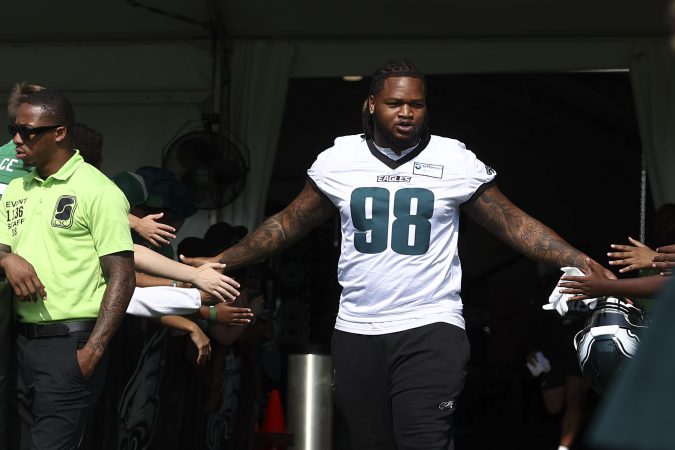
The Eagles held the fifth practice of their 2026 training camp on Tuesday at the Jefferson Health Training Complex. Here were my observations from Day 5 (and links to Days 1, 2, 3 and 4):
Receiving line
The Eagles were without wide receivers DeVonta Smith and Makai Lemon due to hamstring injuries. Lemon left Monday’s practice early, while Smith appeared to finish the workout. The team doesn’t expect either player to be out for an extended period. Both receivers were present Tuesday, which was a positive sign.
I wouldn’t be worried about Smith. He might have tweaked something, but the educated guess here is that the Eagles shut him down for the time being. They’ve been careful with him before, just as they were with A.J. Brown last year at camp. Smith is far and away the best receiver on the team and the Eagles can’t afford a needless injury with the drop-off relatively steep.
Lemon is another story. The rookie needs the reps. It also doesn’t help that he suffered a hamstring strain in the spring. While it’s unclear if he hurt the same one, two soft tissue injuries in the span of six weeks isn’t likely how he wants to start his career. Lemon has been quiet in the early going. He’s yet to make a play that screams “first round draft pick,” but it’s also very early.
Lane Johnson speaks with reporters during the first day of training camp on July 29. Monica Herndon / Staff Photographer
Paving the Lane
Lane Johnson missed a third straight practice for an excused non-injury-related reason. The Eagles have declined to offer more detail on their right tackle’s absence. Johnson’s only other extended absences that didn’t involve injury came in 2014 and 2016 when he was suspended for performance-enhancing drug use and in 2021 when the team granted him a leave to address his mental health.
The following Eagles remained injured and out: outside linebacker Keyshawn James-Newby (ankle), guard Micah Morris (shoulder), guard Jaeden Roberts (calf contusion) and safety Cole Wisniewski (hamstring). Tackle Cameron Williams (knee contusion) was back to full participation. Receiver Britain Covey walked off the field with trainers late in the workout.
Sean Mannion (center) did not oversee a sharp day from his offensive unit. Yong Kim / Staff Photographer
Offensive offense
It was a tough day for Sean Mannion’s offense after it appeared to make strides in the bubble on a rainy Monday. The Eagles were in full pads for a second straight day and the outside environment and intensity seemed to benefit the defense. It’s long been understood that NFL defenses are typically ahead in the early portion of camp. Coordinator Vic Fangio’s seasoned unit is also facing an offense that is still learning a new system.
As I’ve written here since the spring, there are going to be growing pains. It’s better to fail now rather than later. It also didn’t help that Smith was out. But I don’t think there was an offensive position group that could be happy about its performance on Tuesday, especially the O-line. Chris Kuper was without Johnson again, and the O-line coach juggled his units some, but there was too much sloppiness up front.
We also had our first few skirmishes of camp. Guard Tyler Steen and defensive tackle Ty Robinson got into a brief skirmish after several plays of facing each other. Safety Andrew Mukuba and receiver Dontayvion Wicks mixed it up after the former didn’t appreciate the latter’s downfield run blocking. There’s nothing wrong with a little extra fire between teammates, as long as no one gets burnt.
Landon Dickerson is among the offensive linemen trying to adjust to a new blocking scheme. Yong Kim / Staff Photographer
Blocking it out
The new wide-zone run blocking scheme will require an adjustment period for a starting group that had done it a different way under former O-line coach Jeff Stoutland. Johnson and left tackle Jordan Mailata shouldn’t be that affected. They could thrive in any system. Center Cam Jurgens and Steen should, theoretically, benefit because of their athleticism.
Left guard Landon Dickerson, though, could struggle the most. He’s not as nimble as the others and has had well-documented series of injuries that have put his future in question. Whenever he’s been asked to work to the perimeter on outside zone runs, it’s apparent he just doesn’t have the motor he once did.
That doesn’t mean he can’t get by or even flourish if healthy. But staying healthy has been an obvious issue, and he admitted earlier this week that he’s had to reconsider how he’s previously played through injury. That could place a greater emphasis on the backup guard spot. Drew Kendall appears to be the leading candidate right now. He took some first-team reps at left guard on Tuesday.
The Eagles know Kendall can play center. He’s Jurgens’ likely backup. But can he hold up in the interior at 308 pounds? He seemed to hold his ground against defensive tackle Moro Ojomo when he was with the starters. And he did well to pick up a Jeremiah Trotter Jr. blitz later with the second unit. But the tests will keep coming.
Jalen Hurts (1) did not have his best day of camp. Tyger Williams / Staff Photographer
Hurting for certain
Objectively, Jalen Hurts was sharp on Monday. The opposite could be written a day later. The O-line problems didn’t help, and neither did occasionally poor pass catching. I thought Hurts threw a catchable deep ball to Quez Watkins, but the route wasn’t crisp and the receiver’s dive came up short. Hurts then floated a dime to Will Shipley after he was schemed wide-open on a wheel route. But the running back stone-cold dropped a would-be explosive play.
Hurts made some head-scratching decisions on throws downfield, though, some of them vs. the second defense. There was a heave to a double-covered Hollywood Brown that safety Michael Carter II intercepted after surviving a collision with the ground and a slight bobble. There was a tight-window toss to Wicks on the next play that cornerback Jakorian Bennett got his hands on.
Hurts later chucked another one up for grabs to Wicks that was only slightly overthrown past a few pursuing defenders. In the red zone, he hitched off play-action and still threw to a covered Wicks. Mukuba was in Wicks’ pocket, but cornerback Quinyon Mitchell came over and got a hand on the ball.
There were some good moments, too. Hurts had Brown alone in the end zone after a scissor route concept caught cornerback Jonathan Jones sleeping. Wicks shook cornerback Riq Woolen on an outside release and the ball arrived in time. Hurts had excellent ball placement on a pass to Wicks that required he throw it away from the lurking Mitchell.
But there just wasn’t much rhythm to the passing offense — not to mention the run game. Hurts, on several occasions, had no one open and had to either eat the ball or throw it away. During one pass play, after he went through his reads and the pocket collapsed, he simply dropped the ball to the ground.
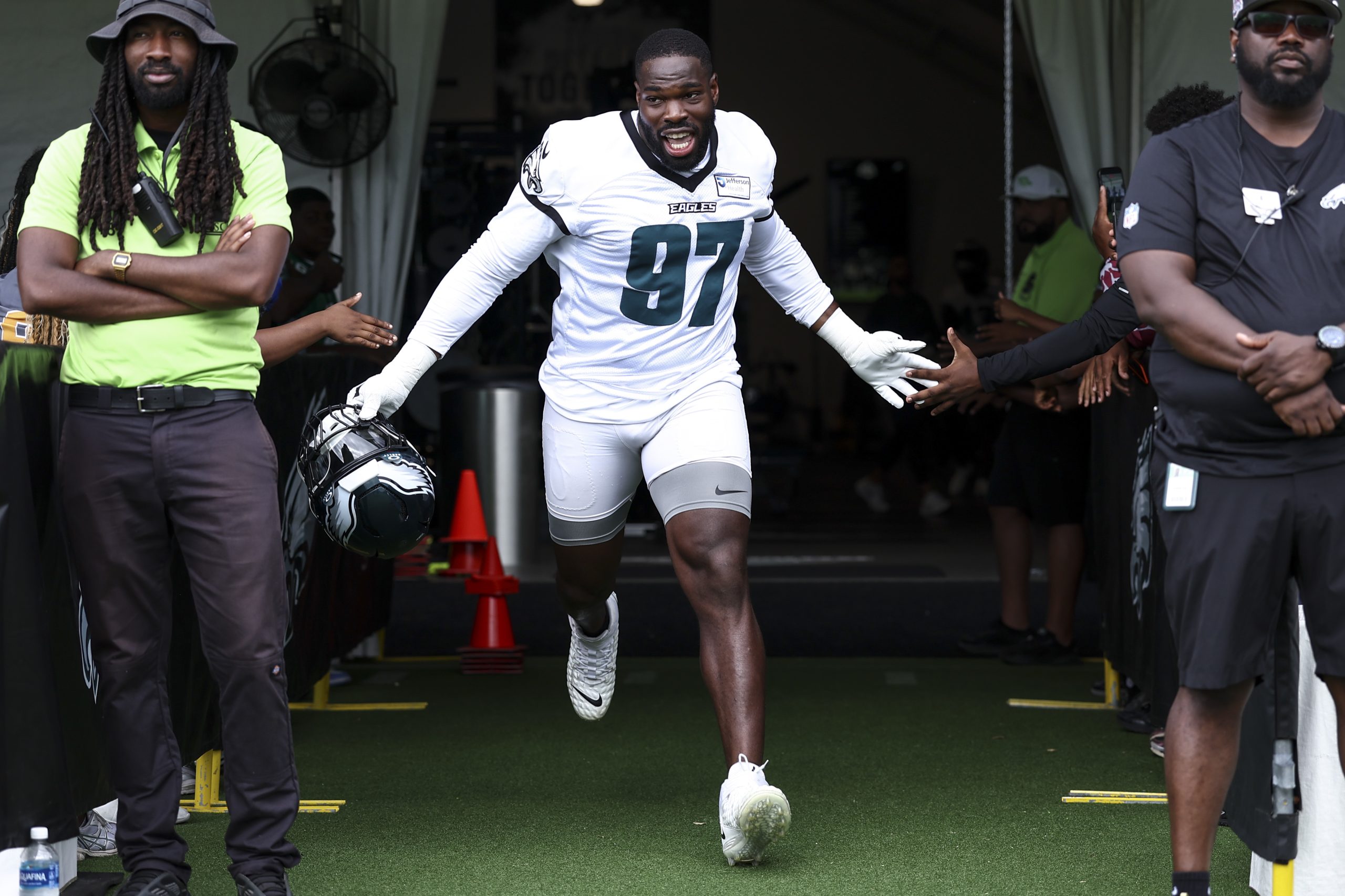
Moro Ojomo (97) was among those who excelled on defense Tuesday. Monica Herndon / Staff Photographer
D-light
The good news is that the defense could be dominant this season, barring significant injuries. Cornerback Cooper DeJean briefly ran off the field after dinging his left hand — a reminder that the game can take anyone — but he appeared fine after getting checked out by trainers.
Fangio has new faces on his side of the ball, but the biggest upgrade to last season’s very-good-but-not-great defense could be a 100% Jalen Carter. He seems to make a few eye-popping plays every practice. He bested Steen on back-to-back reps. Carter gave him the finger wag after stopping a Saquon Barkley run near the line, and then clubbed him to the helmet on the way to a would-be sack.
Moro Ojomo was a menace at defensive tackle as well. He jetted past Dickerson and might have caused Barkley to bobble a pitch that resulted in little gain. The Eagles’ depth at D-tackle allows Ojomo to face the second unit at times, and it can be unfair. He made quick work of tackle John Ojukwu and notched a run stop near the line.
And then there were missed blocks that gifted the front four. Carter was mind-bogglingly granted a free pass to Shipley on one rush. Defensive end Jalyx Hunt notched a unblocked sack when left tackle Fred Johnson appeared to have his eyes in the wrong spot.
Jihaad Campbell is making his presence felt at linebacker. Monica Herndon / Staff Photographer
Back off
The off-ball linebacker group is pretty good, too. Jihaad Campbell still has lots to prove, but his talent is evident. He jacked running back Tank Bigsby onto his back and blew up a Barkley inside zone run near the goal line. Zack Baun lined up on the edge at one point and beat Ojukwu with an outside rush to record a sack. He also broke up a pass to tight end Dallas Goedert.
Trotter blitzed once and steamrolled Shipley. Smael Mondon had maybe his best practice of camp and made multiple tackles, including a run stop after he shook the pulling to Williams.
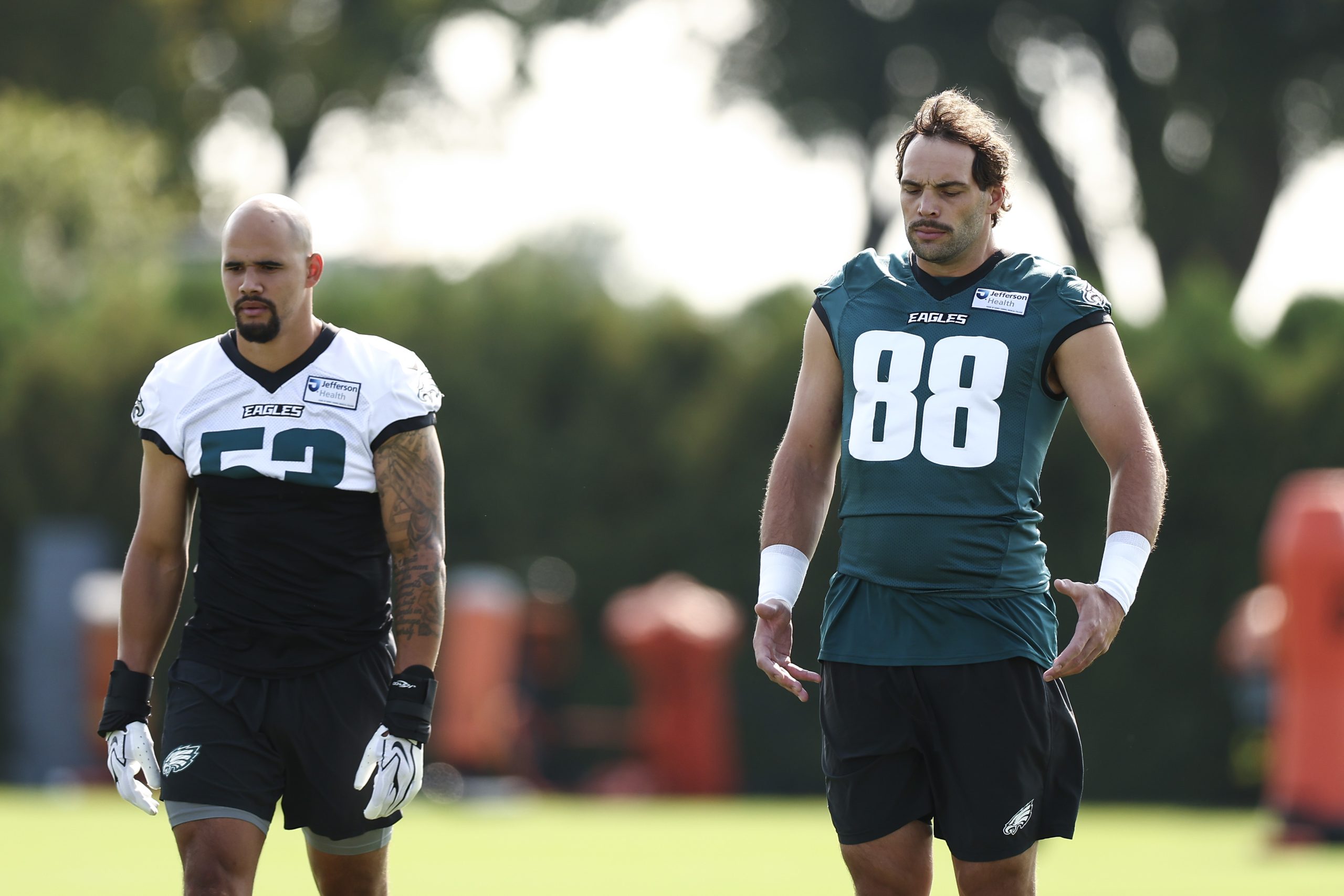
Dallas Goedert (88) and the tight ends have not been much of a factor in the passing game thus far in camp. Monica Herndon / Staff Photographer
Tight lies
I mentioned recently here that the tight ends haven’t been featured as much as the receivers and that trend continued. I recall past years when Goedert would be Hurts’ favorite target, but that has yet to happen. It could certainly change. But tight ends have more blocking responsibilities in the Kyle Shanahan/Sean McVay scheme.
New guy Johnny Mundt will be key, with more need to block defensive ends at the point of attack. Goedert isn’t the blocker he once was, but he has the wherewithal, even as he enters his ninth season. Cameron Latu may have a roster spot based on his special teams capabilities. He trucked receiver Darius Cooper during kick return drills. But he’s a physical blocker and displayed as much when he wham blocked Hunt out of a run play.
Neither Tanner McKee (16) nor Andy Dalton (14) got much of a leg up on Tuesday. Tyger Williams / Staff Photographer
Under center
In the backup quarterback competition, it was a relative draw in which neither Andy Dalton nor Tanner McKee was very consistent. As with Hurts, they were hardly all to blame for the offensive inefficiency.
Dalton did find tight end Grant Calcaterra for a nice pickup after a naked bootleg fooled the first unit defense. And Cooper made a splendid one-handed grab on one of Dalton’s red zone throws. But the receiver was unable to get both feet in the back of the end zone. Later on, Cooper ran an in-breaking route when Dalton’s ball went outside to an empty space.
McKee had a couple hookups with receiver Samori Toure. But like Hurts, he took sacks or simply ate the ball when the clock ran out on a fruitless play.
Jake Elliott (4) was perfect on Tuesday. Monica Herndon / Staff Photographer
Extra points
I’ve written a fair amount about rookie defensive tackle Uar Bernard’s trials and tribulations as he tries to make it in the NFL. But there’s another neophyte from Africa in camp: undrafted edge Joshua Weru. He plays a different position than Bernard, but he’s looked more fluid. He still has a ways to go, but there’s some potential there. He had a pressure during the developmental period. … Jake Elliott was a perfect 6-for-6 during the kicking period. He was good from 33, 38, 42, 44, 50 and 52 yards. He also split the uprights from 44 yards out later during team drills. … The Eagles practice again on Wednesday and have a closed walkthrough on Thursday.
HARRISBURG — Hidden deep in more than 600 pages of state budget documents, Pennsylvania lawmakers last month quietly repealed an unenforced 1929 law that allowed traditional midwives, the main group of midwives delivering home births, to practice.
Now, traditional midwives — who differ from midwives usually found in hospitals, are not medically trained, and often serve religious minorities like the Amish — are worried they have no legal standing to work in Pennsylvania and are challenging the repeal and a new lawin state court.
The 1929 law had been on the books for nearly a century, asking traditional midwives to submit a paper application and a $10 fee to get a state certificate. But it had not been enforced for decades, and Pennsylvania, which has one of the highest rates of home births in the nation, was counted as one of 13 states that did not regulate the practice at all.
Meanwhile, other forms of midwifery — such as nurse midwives and certified midwives, who are medically trained and are formally affiliated with a doctor or health system — are highly regulated by the state and its medical board. But these affiliations often prevent nurse midwives and certified midwives from offering home births, as the health systems see them as possible risks for medical malpractice lawsuits.
The practice of traditional midwifery dates back to the Old Testament and has lived on through centuries of community knowledge and traditions. It can include Amish and Mennonite midwives, who are limited in the amount of education they are allowed to receive, as well as other unlicensed midwives who say they take only low-risk pregnancies.
Some Pennsylvania traditional midwives say their practice is more necessary than ever, citing the United States’ maternal mortality and morbidity rate and cesarean section rates that outpace most of the rest of the Western world. They see their work as more holistic and personal than the American medical system, offering more personalizedcare to the new parent and baby for weeks after birth, as well as an answer to maternity care deserts as more hospitals and birth centers close.
Medically trained midwives and physicians, who receive licenses from the state,argue the practice of traditional midwifery is potentially unsafe for mothers and babies, and requires little to no oversight in comparison to their medical training and licensure.
A new law, and legal uncertainty
There is no state law regulating home births — which are chosen by a variety of families for different reasons, from Amish who have religious beliefs about delivering at home to Black and brown women who have felt underserved or discriminated against by the modern healthcare system. But if traditional midwives — the primary group delivering babies in home births — cannot practice, some argue, home births will become inaccessible.
The legal fight over midwifery began earlier this year, when the General Assembly approved changes to a separate law to include another class of midwife: certified midwives, who have all the same education training as nurse midwives except the nursing degree.To receive a certification from the Pennsylvania Board of Medicine, nurse midwives and certifiedmidwives must provide proof of education and a collaborative agreement with a physician or medical institution.
The law, the Midwife Modernization Act, was written to protect traditional midwives’ ability to practice, its author, Sen. Rosemary Brown (R., Monroe), said in a statement.
Kate McHugh, a nurse midwife who has worked for a decade with lawmakers on updates to midwife regulations, said stakeholders approached traditional midwives during earlier iterations of the bill to see how they would like to be regulated. The different groups of traditional midwives could not agree, so the nurse midwives and certified midwives moved forward on their own.
But the changes to Pennsylvania’s laws created a legal gray area, some midwives argued in a lawsuit filed last month.
An anonymous group of two traditional midwives, a nurse midwife, and an Amish man whose family utilizes traditional midwifery filed a lawsuit in a state appellate court, challenging Brown’s law as unclear about their ability to practice, and asking the state to enforce the 1929 law already on the books.
After the lawsuit was filed, legislators repealed the 1929 law as part of an overall state budget deal, creating more uncertainty for traditional midwives, according to their amended filing. Some lawmakers said they did not know they had voted to repeal the law, as the state budget is drafted in closed-door meetings among top leaders and fast-tracked through the legislative process with little time for rank-and-file members to review what they are voting on.
The law was repealed as part of a request by Democratic Gov. Josh Shapiro’s administration, according to a source briefed on budget conversations. The administration works closely on legal matters with Republican Attorney General Dave Sunday’s office, which is defending the state in the case. Shapiro’s office declined to comment.
“It’s not fair the way [the budget] is done,” said Rep. Dave Zimmerman (R., Lancaster), who said he unknowingly voted in support of the bill that repealed the 1929 law in an omnibus bill.“It concerns me a little bit that we repeal something in the fiscal code rather than right up front where it’s transparent.”
“You have people in the Amish and Mennonite community that this is what they do. We have midwives that have been doing this for 30 and 40 years, They’re probably as good as anyone else doing it, certified or not,” Zimmerman added.
The lawsuit
The group oftraditional midwivesfiled the lawsuit anonymously out of fear of retribution from the state for continuing to practice, said the group’s attorney, Jonathan Goldman, of the Goldman Law Team, based in Fort Washington. The midwives spoke with The Inquirer on the condition of anonymity for the same reason.
One of the midwives, who serves south-central Pennsylvania with a largely Amish and Mennonite clientele, said she has delivered 1,600 home births over 38 years. She had practiced traditional midwifery in other states, before similar certifications were required there. At one point, she said, she was arrested and charged with a misdemeanor for continuing to practice home births in New York.
Unlike medically trained nurse midwives and certified midwives, traditional midwives are prohibited from practicing medicine, which could mean dispensing medication or conducting medical procedures as simple as stitches. They have historically been investigated by state boards of medicine if this is called into question, making the group even more distrustful of state oversight.
One of the anonymous traditional midwives, who has delivered an estimated 600 births around eastern parts of Pennsylvania, said her clients are often religious and want traditional models of care, such as no lab work and one ultrasound — a very hands-off approach compared to the highly surveilled pregnancies in modern medicine.
The midwife, who delivered four of her 10 children in the hospital before finding an interest in home births, said her faith as a born-again Christiandrew her to the “completely different model of care” that does not rely on pharmaceuticals, with a comfortable home setting and few restrictions like in a hospital.
“In the hospital, it’s a fractured system. There are several midwives and physicians, you never know who you’re going to get, who is going to be on call,” said the midwife, who works with Amish and Mennonite populations in south-central Pennsylvania. “We are the community midwives. We know the secrets, we know the stories, we know what kind of care works. We know the family intimately. And it improves outcomes because knowing them intimately and emotionally allows us to provide that kind of specialized care.”
Sunday’s office, defending the state in the suit, said in a July 24 filing that the midwives’ claims are a “misreading and misunderstanding of the current law,” and that traditional midwives “can continue to practice as lay midwives without certificates.” Sunday’s office did not respond to a request for comment.
The case is scheduled for a preliminary injunctionhearing to block the law from going into effect on Wednesday, where Brown and other lawmakers may be called to testify and a judge is expected to rule whether current laws prevent traditional midwives from practicing.
Outside the medical system’s framework
Obstetricians in hospitals and birth centers routinely work with certified midwives, who have an advanced degree in midwifery, and nurse midwives, who have a nursing degree in addition to specialized midwifery training.
“As an OB-GYN physician, I absolutely respect somebody’s right to make a medically informed decision about how they take care of themselves in their pregnancy, and who they request assistance from in birth, and where they give birth to their babies,” said Holly Cummings, an OB-GYN in Philadelphia and chair of the Pennsylvania section of the American College of Obstetrics and Gynecology, a leading physician organization. “But I do also believe a hospital or an accredited birth center is the safest place to give birth. I don’t think in the U.S. in 2026 we can currently safely, uniformly support home birth.”
ACOG does not support traditional midwives, who can also be known as lay midwives.
But traditional midwives maintain they should be able to continue their work outside the medical system’s framework, citing it as a religious tradition and safe practice, and hope the judge rules in their favor.
“Pennsylvania has a rich history of midwifery,” said the midwife listed in the lawsuit who serves parts of eastern Pennsylvania. “We have some of the highest home-birth numbers in the country. … It would be sad to see Pennsylvania not acknowledge the heritage in midwifery that we have here.”
Staff writer Sarah Gantz contributed to this article.
The Korean-owned yard’s leaders thought they had found just the place, four miles by barge down the Delaware River at the New Jersey-funded Paulsboro facility, vacated by the offshore wind industry when President Donald Trump killed that program. In December, Hanwha agreed to take over the lease.
Philadelphia Shipyard as seen from southbound I-95 in 2024.Alejandro A. Alvarez / Staff Photographer
This despite the fact Hanwha’s proposal enjoyed support from federal, state, and local officials and even made it into the U.S. military budget for fiscal year 2026, which called for $110 million “to support shipbuilding industrial capacity” and steel fabrication in a manufacturing facility “formerly used for offshore wind manufacturing.”
Paulsboro Mayor John Giovannitti estimates that on a given day, there are fewer than 50 workers at the port.
Leo Holt, whose century-old company runs ports in Gloucester City and South Philadelphia, said he’s not completely averse to manufacturing around the Paulsboro terminal after his family’s plans to beef up container and bulk shipping there accelerate.
Hanwha declined to comment, confirming only that the shipyard is still looking for space “in the U.S.”
A rendering of a 600-acre shipyard that the Port of Tampa Bay has offered to build for Hanwha. Port Tampa Bay
What went wrong?
Since the early 2010s, New Jersey borrowed and spent more than $500 million building a Paulsboro wharf, highway ramps, and other facilities to attract big employers to the port. It replaced lost oil industry jobs and also compensated for nearby Camden’s loss of piers due to Holtec Inc.’s redevelopment in that city’s aging port district.
In borrowing documents and news releases, the public spending was justified by predictions that the port would draw hundreds, even thousands, of port and industrial jobs, which in more than a decade have yet to arrive.
Paulsboro sublets the facility to Holt as the port operator. Holt paid $1.6 million to use the property last year.
At the urging of then-Gov. Phil Murphy, then-State Senate President and iron workers union leader Steve Sweeney, then-Paulsboro Mayor John Burzichelli, and other officials, Holt in 2020 agreed to let EEW, a global pipemaker based in Germany, build supports up to 400 feet long and 40 feet across for the federally subsidized offshore wind-electric generation facilities that its Danish partner Orsted planned to locate off the New Jersey coast.
Orsted canceled in 2023, citing rising costs. Trying to cut his company’s losses, EEW executive vice president Esben Strandgaard began looking for new tenants, attracting more than 200 inquiries and initiating talks with Hanwha.
Hanwha needed the landlord’s permission to take over the lease. Hanwha Defense USA president Tom Anderson, a retired Navy rear admiral, and the Holts met last fall to discuss the proposal.
Instead of approving, the Holts sued, challenging EEW’s authority to pick a replacement and demanding control of the facility.
Hanwha, aided by its political supporters, tried to make a deal, but Holt stood firm. In March, Hanwha canceled the agreement.
What the Holts want
“The north star for redevelopment at Paulsboro has been marine terminal operations,” said Leo Holt, president of the Gloucester City-based company. “We stretched to assist the state in any way we could,” but “Hanwha was never a part of the plan, nor was shipbuilding.”
Holt spoke of the failed industrial proposals — wind, shipbuilding, and others to build power plant equipment on site — as an obstacle, not a goal.
“The detour imposed on New Jersey is over, and the road is clear to the Paulsboro Marine Terminal,” he said. “We were glad to see that the page was turned on the detour.”
Holt Logistics, which has been expanding containerized cargo facilities on both sides of the river, has shipped containers to Paulsboro and hopes to augment Paulsboro’s current port tenants, Holt said.
Those include Novolipetsk Steel (NLMK), owned by Russian billionaire Vladimir Lisin, which due to Ukraine war sanctions stopped importing Russian steel through the port for its plant in Farrell, Pa., and has switched to steel from Latin America, East Asia, and other countries, according to Holt.
The port also ships containers to the U.S. Navy base in Rota, Spain, and to ports in Cyprus, Israel, and other Mediterranean countries.
More than a container port
New Jersey has spent more than half a billion dollars improving the Paulsboro site with a wharf, highway connections to I-295, and other public works, the mayor said.
“I’m not aware of Paulsboro people, Gloucester County people, working there right now,” said Burzichelli, now a state senator and a supporter of both the wind and the Hanwha projects.
New Jersey invested in the BP site to make it more than a container port, Burzichelli says.
“That [state-built] wharf was designed to handle any industry, and the public investment was designed to create the maximum amount of high-paying jobs that can be created,” he said.
The port section “was always intended to be a bulk port,” requiring plenty of longshoremen’s labor, and “certainly not a container port,” which “take up a lot of space but don’t generate big jobs,” Burzichelli said.
“They don’t pay taxes the way an [industrial] building will pay,” he added.
The Holts’ “choices and the interest of the state of New Jersey, the interests of Gloucester County, and the interests of the borough of Paulsboro, are not aligned, at this point,” Burzichelli said. “I hope we can get them aligned.”
Mayor Giovannitti said, “We thought we had a deal last year with Hanwha” but are left with “a $750,000 hole in our budget” — the annual payment, in lieu of taxes, that EEW and its partners paid the borough while it was operating. The town’s annual budget is $13 million.
Instructors and graduates of the union-backed preapprenticeship program Global Skills Union Pathways Project at Philly Hanwha Shipyard in February.GSUPP
What Paulsboro could offer
Strandgaard says he’s not surprised Hanwha decided not to “waste any more of their time” on Paulsboro: “They could not see themselves working with a hostile landlord.”
It’s an ideal site for shipbuilding or any other industry that needs a deep water port, he said. But “Holt Logistics really controls what comes in and out. This was very upsetting, for us and Hanwha, that Hanwha with the support of the Navy did not have enough leverage.”
Other East Coast sites would take a year or more to prepare. “The beauty of Paulsboro is they could start the day after” concluding a deal, Strandgaard said.
He said he was surprised the new administration of New Jersey Gov. Mikie Sherrill didn’t make landing Hanwha a priority.
Sherrill was “disappointed that EEW could not reach an agreement with Hanwha or other parties despite the state’s efforts to facilitate discussions and bring stakeholders together,” spokesperson Maggie Garbarino said in a statement.
Holt’s goal: A modern marine terminal
On any given day, between 500 and 900 Holt employees are moving cargo at the company’s South Jersey operations, Holt said. He declined to estimate how many of those were in Paulsboro.
According to tax records, the port handled about 250,000 tons of cargo last year. That’s less than one-tenth of all South Jersey Port Corp. cargoes.
Holt called the state “vital partners in the renovation of the facility. We are working to have both marine operations and manufacturing operations. But we cannot be deterred from taking it where we promised: to be an active modern marine terminal.”
He said he expects the Sherrill administration will prove to be more congenial to the Holts’ vision for the property — “manufacturing, distribution, or anything” that makes sense to his family.
South Jersey officials say they haven’t given up. “The people of Paulsboro were told this was about jobs, jobs, jobs, and those would be manufacturing jobs. Not stacking containers four high with automated forklifts,” Giovannitti said.
Burzichelli still hopes Hanwha and Holt can be brought to the same page. “Many of us still don’t think we are done with manufacturing,” he said.
I want to root for a restaurant like Side Eye. There’s the quirky name, of course; a tribute to the owners’ beloved late dog, Sheba, whose legacy lives on in the many pooch pictures posted around the space and which has fostered a strong pull from the city’s canine-centric crowd, my family included. What a perfect place to catch up with our dog Buttercup’s veterinarian over steak fries and a peppercorn burger! And was that the (human) mom of Buttercup’s playmates sipping a glass of wine at the long bar? Yes, it was. Philly’s dog lovers are an easy demographic for any new restaurant to target, especially one with a pet-friendly 10-seat patio outside its Queen Village storefront.
But there are other reasons to wish for Side Eye‘s success, including its aim to be an affordable neighborhood bistro when soaring prices are on everyone’s mind. In an era when $35 chicken entrees and $20-plus cocktails are not uncommon in local restaurants, Side Eye’s half bird is selling for $25 and nearly every cocktail and glass of wine is $13 or less.
Given that Side Eye’s co-owner, Hank Allingham, is a numbers guy, having previously spent his career in finance for large restaurant companies, including the Patina Group in New York and Nando’s Peri-Peri in D.C., it’s no surprise he’s using fair prices as a draw for this new venture, launched in February with his wife, Katherine Hanson.
The exterior of Side Eye on Thursday, July 23, 2026 in Philadelphia.Monica Herndon / Staff PhotographerSide Eye co-owner Hank Allingham inside the bistro at Sixth and Bainbridge on Friday, January 23, 2026.Yong Kim / Staff Photographer
But value is a relative concept. What good are house-baked buns if the inexperienced kitchen frequently scorches them before sending a burger out to the dining room? Does it really matter that the roast chicken is relatively inexpensive if the skin on those commodity birds is underseasoned and flabby? (It’s also set over borlotti beans — a nice idea until the beans were overcooked to a sticky paste.) Also, does Side Eye make the worst cocktails in Philly? The drinks at our first visits ranged from watery and muddled to raggedly boozy, providing a reminder that you sometimes get exactly what you pay for.
That is, until recently, when I’ve finally begun to detect some needed improvements on multiple fronts. One key has been a shift in the front house staff, essential to maintaining the warm neighborhood mojo at the Queen Village space that once housed beloved Bistrot La Minette, which called it quits in 2024.
The service during my early visits ranged from chaotic — with more plates landing simultaneously at our little table than it could possibly hold (and the server impatiently waiting for us to play Tetris to somehow find space) — to borderline hostile.
“OK, now who‘s ordering here?!” snapped the waiter at my second meal, scolding me for ordering fries for the table when it apparently wasn’t my turn to speak. He’s coincidentally no longer with the restaurant, Allingham said, before I could even mention it.
The Lipstick Stain (left) and Bulldog Cooler at Side Eye on Thursday, July 23, 2026 in Philadelphia.Monica Herndon / Staff Photographer
What a difference the calming presence of a pleasant server such as Tessa Draper can make, righting the mood as weekend sunshine poured through the windows into the cobalt blue room, and we settled into a lovely brunch. It was highlighted by a perfectly fluffy French omelet rolled around house-made fromage blanc, topped with roasted mushrooms, and finished with a dessert of crêpe Suzanne, sweetly named for the chef’s mom. The warm crêpes bundled around that same cheese, all topped with brandied warm caramel and juicy orange segments.
The crêpe Suzanne at Side Eye on Thursday, July 23, 2026, in Philadelphia.Monica Herndon / Staff Photographer
The meal was far from perfect. The cucumber-gin Breakfast Cup cocktail had too much bitterness from the lime peel. The avocado toast was not especially green. And this kitchen burned the slender toast “soldiers” served alongside its soft-boiled eggs. But we loved the poached shrimp and fresh-dressed cod rillettes salad that came on the side. The lemony hollandaise for the Parisian ham Benedict served over house-baked brioche was extremely tasty.
It felt like Side Eye had finally found a comfortable groove, enough for me to return for one more dinner.
With Draper once again tending to our table, the improvements continued, especially with new vegetable-forward dishes that turn out to be a strength for chef Finn Connors, 26, an alum of Osteria, Wilder, and Sally. He cooks a range of diverse ingredients but also concedes, “I mostly eat vegetables.”
The tomato and honeydew salad makes the most of summer’s bounty.Monica Herndon / Staff Photographer
His tomato and honeydew salad makes the most of summer’s bounty, winding luscious tomato chunks inside ribbons of shaved honeydew that added a textural snap and juicy burst of bright sweetness. Snappy batons of zucchini are roasted with just a touch of char, dressed with basil oil, and paired with a creamy dip of that ricotta-like house-strained cheese for another simple but memorable starter. A classic ratatouille, with separately stewed eggplant, red peppers, and zucchini finished with saucy tomatoes, sherry vinegar, and herbs, was one of the menu’s most confident nods to a French canon the chef had never previously cooked.
Connors bakes a very respectable French baguette, a nice wink to the standby offering at La Minette. I just wish they offered more than a stubby little heel of it for $5. That bread may be at its best diced into croutons that give the delicious French onion soup a sturdy, spoonable body and an irresistible dome to be gratinéed; delicious even when they occasionally burn it.
The French onion soup at Side Eye on Thursday, July 23, 2026 in Philadelphia.Monica Herndon / Staff Photographer
When it comes to cooking proteins, Side Eye has work to do. They struggled to nail a medium-rare doneness on the burger (twice overcooked, once underdone) but also need some basic seasoning to boost the flavors of the Camembert and peppercorn aioli garnish. The coarse-chopped beef tartare was both unpleasantly chewy and overwhelmed by the sharp garnish of crumbled Gorgonzola cheese.
An intriguing early menu item of stuffed cabbage filled with braised short rib suffered from some less-than-tender braised meat. This kitchen also got too clever with a usually no-brainer pot of mussels marinières, swapping out the shellfish’s natural liquor for a Miller High Life-infused dashi mixed with crab fat and a hunk of not-especially-tender pork belly. Not only was the dashi lacking focused flavor, there wasn’t nearly enough of it, leaving the bowl so dry that the high percentage of empty shells was obvious.
A simple plate of flaky hake with chile-spiced piri-piri broth and herbed potatoes (reminiscent of the similar retro hit at Meetinghouse) offered minimalist satisfaction. The dish was recently updated to seared cod with a summery garnish of couscous in a tomato-tinted velouté Aurora sauce. I’ll order that next time.
The lasagna at Side Eye on Thursday, July 23, 2026 in Philadelphia.Monica Herndon / Staff Photographer
Fresh pasta is consistently one of Side Eye’s better moves. I enjoyed the early menu’s tagliolini with Café de Paris butter and shaved Mimolette cheese. But this summer’s lasagna is one of the kitchen’s best dishes to date; a low rise double stack of fresh pasta sandwiching the fresh cheese with artichoke hearts, topped with a crispy pasta lid that gets gratinéed with Manchego cheese and scattered with a fistful of peas.
As inconsistent as the drinks were at my early meals, something also clicked in the glass for our final visit. The refreshing tequila and Aperol-fueled Lipstick Stain and a solid old-fashioned hit the spot. For $12 to $14 a pour, an accessible wine list of independent French producers of picpoul de pinet, Anjou rouge, and a cinsault-syrah blend from Les Enfants Sauvage proved to be among the restaurant’s better values.
The bar at Side Eye on Thursday, July 23, 2026 in Philadelphia.Monica Herndon / Staff Photographer
When it comes to dessert, Side Eye serves up an olive oil cake trifle layered with lemon curd and a fluffy marshmallow crown torched for drama. But we couldn’t resist the low-key crème caramel, a fresh take on the standard that gives the silky sweet custard a modern update with a crunchy dusting of bittersweet cocoa nibs and flaky Maldon sea salt.
The effect of those bold contrasting flavors and textures — when perfectly fine-tuned — compels your spoon to return for another scoop. It was an irresistible finale for a meal that finally gave a hint of what this restaurant can be. Side Eye still has plenty of wrinkles to iron out to reach its full potential, but I’ve seen enough signs of progress lately, and I’m hopeful that can continue.
Side Eye
623 S. Sixth St., Philadelphia, Pa. 19147,267-807-1164, sideeyephilly.com
Dinner Sunday through Thursday, 4 to 11 p.m.; Friday and Saturday, until 1 a.m.; brunch Saturday and Sunday, 11 a.m. to 3 p.m.
Dinner entrees, $14-$25.
Wheelchair accessible.
About half the menu is gluten-free or can be modified.
Menu highlights: Dinner: French onion soup; tomato-honeydew melon salad; roasted zucchini with fromage blanc; ratatouille; bread and butter; triple-cooked steak fries; artichoke-pea lasagna; cod. Brunch: French omelet; Benedict variations; crêpes Suzanne.
Drinks: Cocktails and affordable French wines (all $14 or less a glass) drive the program. Reasonable prices are the draw, but craftsmanship on cocktails has been shaky. There are some thoughtful nonalcoholic options and the beer list has several worthy choices, from local Forest & Main and Monk’s Flemish sour to La Fin du Monde.
The dining room at Side Eye on Thursday, July 23, 2026 in Philadelphia.Monica Herndon / Staff Photographer