Tag: Weekend Reads

  • Many Pa. colleges aren’t properly training future teachers how to teach reading, a report finds

    Many Pa. colleges aren’t properly training future teachers how to teach reading, a report finds

    Nearly half of educator preparation programs are failing to adequately train future teachers in how to teach reading, according to a new report, even as states across the country have passed laws to overhaul reading instruction.

    And in Pennsylvania, even more teacher preparation programs may be falling short, according to the National Council on Teacher Quality, which released a report this week reviewing whether colleges and universities had aligned their instruction for future teachers with the so-called science of reading.

    Of 23 graduate and undergraduate programs evaluated in Pennsylvania, five received A’s, according to the report. Just as many received F’s.

    Pennsylvania is “among the lowest-performing states in this analysis,” said Ron Noble, NCTQ’s director of teacher preparation.

    Most of the state’s programs declined to participate in the review — including some, like the University of Pennsylvania, that were ranked poorly when the group last released a report in 2023.

    Some colleges have criticized the group’s methodology, and literacy advocates had mixed reactions to the findings.

    Still, progress has been made since 2023, Noble said, as more states have made changes to how reading is taught amid fierce debate over best practices and deepening concern about poor reading scores. Here is what the group found, and how Pennsylvania universities and colleges fared:

    How reading instruction is evaluated

    For decades, the predominant approach to reading in many schools, balanced literacy, sought to foster a love of reading in children by focusing on stories and de-emphasizing skills-based instruction.

    But literacy experts say most kids need explicit instruction in connecting sounds to letters to learn how to read. In recent years, a growing movement has successfully pushed states, including Pennsylvania, to require schools to adopt structured literacy, which aims to teach kids to read with evidence-based practices.

    The National Council on Teacher Quality scored education programs on how well they prepare teachers in the “five core components” of scientifically based reading instruction: phonics, fluency, vocabulary, comprehension, and phonemic awareness — the ability to identify units of sounds in spoken words.

    The group, which evaluated course syllabi, curricula, and lecture schedules, also considered whether programs taught debunked practices, including “three-cuing” — prompting students to guess words based on context clues — and running records, an assessment that involves listening to a child read aloud to determine what level of book is appropriate.

    Programs that earned A’s are adequately covering all five core components, Noble said, while not teaching more than three practices “that run counter to the science of reading.” Those that received F’s, meanwhile, are not adequately covering more than one of the core components, or teaching enough contrary practices that their letter grades were reduced, Noble said.

    How Pa. colleges scored

    Nationally, the percentage of programs receiving A’s more than doubled from 2023, from 26% to 53%.

    In Pennsylvania, the number of programs receiving A’s grew from two in 2023 to five.

    (function(){function e(){window.addEventListener(`message`,function(e){if(e.data[`datawrapper-height`]!==void 0){var t=document.querySelectorAll(`iframe`);for(var n in e.data[`datawrapper-height`])for(var r=0,i;i=t[r];r++)if(i.contentWindow===e.source){var a=e.data[`datawrapper-height`][n]+`px`;i.style.height=a}}})}e()})();

    Among them was East Stroudsburg University. Brooke Langan, dean of the university’s College of Education, said the school had produced more records in this review.

    East Stroudsburg also reviewed its coursework after Pennsylvania required structured literacy competencies to be embedded in teacher preparation programs in 2022, Langan said.

    “It really made us take a moment and think about: Did we structure those correctly? Are they scaffolded well for our students developmentally?” Langan said.

    Other schools getting top grades were Carlow University, Millersville University, Pennsylvania Western University, and Shippensburg University.

    At the other end, Cheyney University, the Commonwealth University of Pennsylvania, Lincoln University, West Chester University, and Widener University’s graduate education program received F’s.

    Julie Stellfox, a spokesperson for Commonwealth University, said the school “does not subscribe” to NCTQ’s research methodology. She noted a statement about the report from the American Association of Colleges for Teacher Education, which voiced concern about relying “primarily on document review as a proxy for the quality of educator preparation.”

    Nancy Gainer, a spokesperson for West Chester, said that school also disagrees with NCTQ’s methods. She noted that West Chester complied with an “open source request” from the group in 2023 and received a B in its report then; this time, the school did not receive such a request, and West Chester did not supply information, she said.

    An NCTQ spokesperson said the group submitted a formal records request to West Chester.

    Mary Allen, a Widener spokesperson, said the university had asked NCTQ to reassess the graduate education program “and include additional courses that focus on reading instruction, which were not included in their review.”

    “Academic rigor and student success are our top priorities, and we have aligned our teacher education programs to all the required competencies related to structured literacy and the science of reading outlined in Pennsylvania Department of Education guidelines,” Allen said.

    Noble acknowledged the criticism of a review process limited to records. But, he said, NCTQ is evaluating whether colleges adequately cover foundational reading skills, and it was “highly unlikely that something that doesn’t appear in course materials” is being taught.

    Fewer Pennsylvania programs agreed to be evaluated by NCTQ this year — the program reviewed 33 in 2023, compared with 23 in the latest report. Overall, 63% of Pennsylvania teacher preparation programs did not participate.

    Of schools nationally that declined to be reviewed after participating in 2023, NCTQ said, more than 60% had received F’s previously.

    It also said that it identified textbook requirements for more than 80% of nonparticipating programs, and found they used textbooks misaligned with the science of reading at the same rates as programs receiving D’s and F’s.

    Noble noted that the four largest teacher preparation programs in Pennsylvania either did not participate in this year’s review — Pennsylvania State and Temple Universities — or received F’s, in the case of West Chester and Commonwealth.

    “It’s even more concerning: The places producing many of Pennsylvania’s newest teachers are either a black box for us or did not perform well,” Noble said.

    Calls for more state oversight

    Rachael Garnick, Pennsylvania Literacy Coalition manager with the Teach Plus group, which advocates for structured literacy implementation, said there was value in the report’s effort to evaluate how well colleges are preparing future teachers.

    But “I don’t think it’s a conclusive verdict,” including about schools that did not participate, Garnick said, noting that one university she had spoken with said NCTQ had sent its request for information to the incorrect administrator.

    Pennsylvania itself needs to do more to hold teacher preparation programs accountable for reading instruction, Garnick said. While the state now requires structured literacy in teacher preparation programs, it does not set requirements for the number of courses or hours of instruction.

    And the state’s certification exam for new teachers has not been aligned with the science of reading. For instance, it still includes questions on three-cueing, Garnick said — even though Pennsylvania has banned that practice. The coalition is pushing the state to adopt a standalone exam to test teaching candidates on reading.

    The failure of teacher preparation programs to adopt the science of reading has ripple effects, said Kate Mayer, a consultant with Keystone Structured Literacy Partners. Mayer, who has advocated for many Philadelphia-area families whose children are struggling with reading, said she sees area school districts working with universities to make changes to their reading instruction that still are not best practices.

    “In my experience, the bar is even lower than it should be for what we’re looking at,” said Mayer, who served on a committee that worked with NCTQ on its scoring rubric in 2019. She said “there should be no excuses” for universities that are not adequately covering the five reading components.

    Some states, including Ohio and Indiana, have significantly improved teacher preparation programs through new accountability measures, including audits and the prospect of revoking accreditation, Noble said.

    “When you’re providing teacher preparation programs with really clear standards” and consequences for not meeting them, “that’s a recipe for pretty dramatic” changes, Noble said.
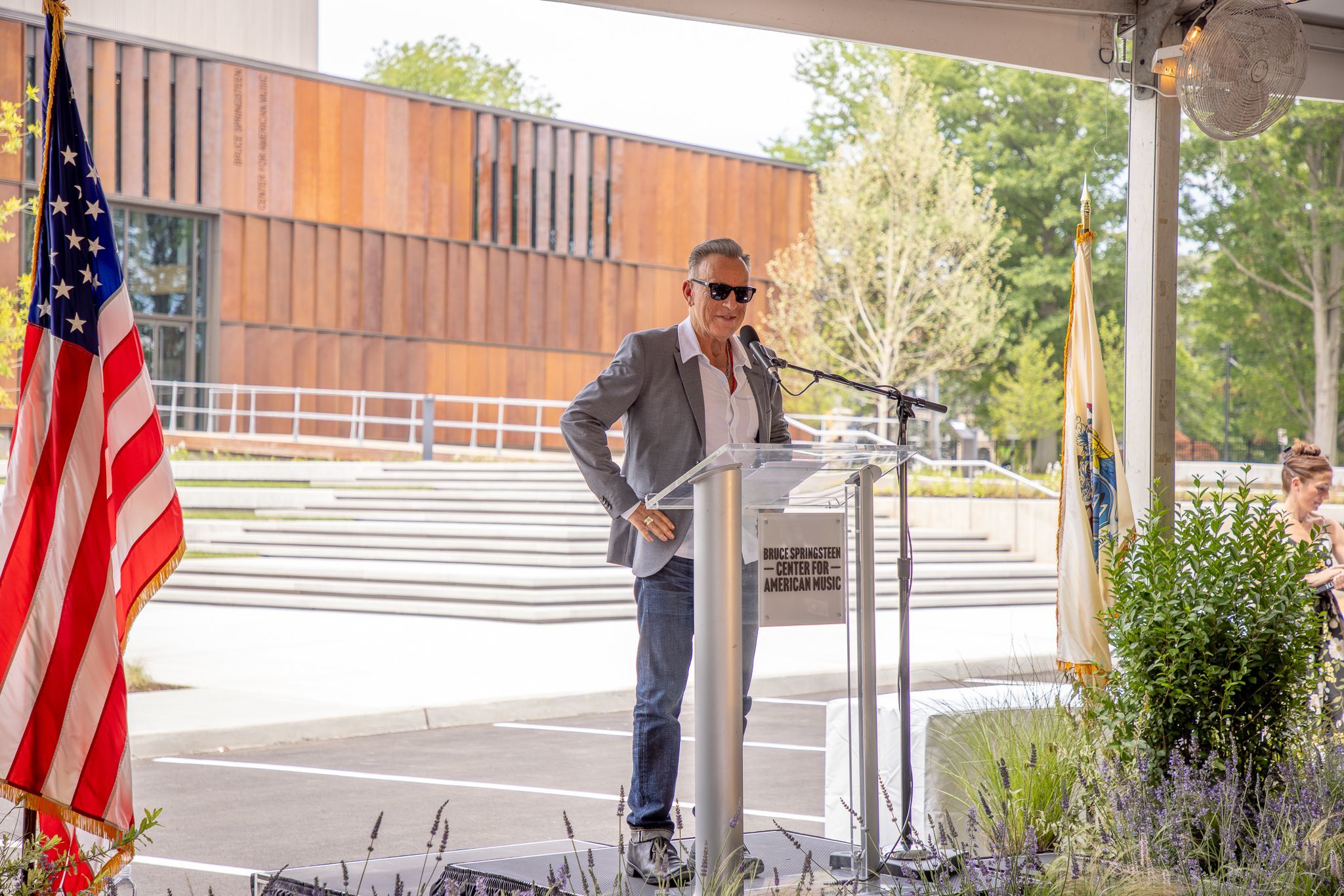
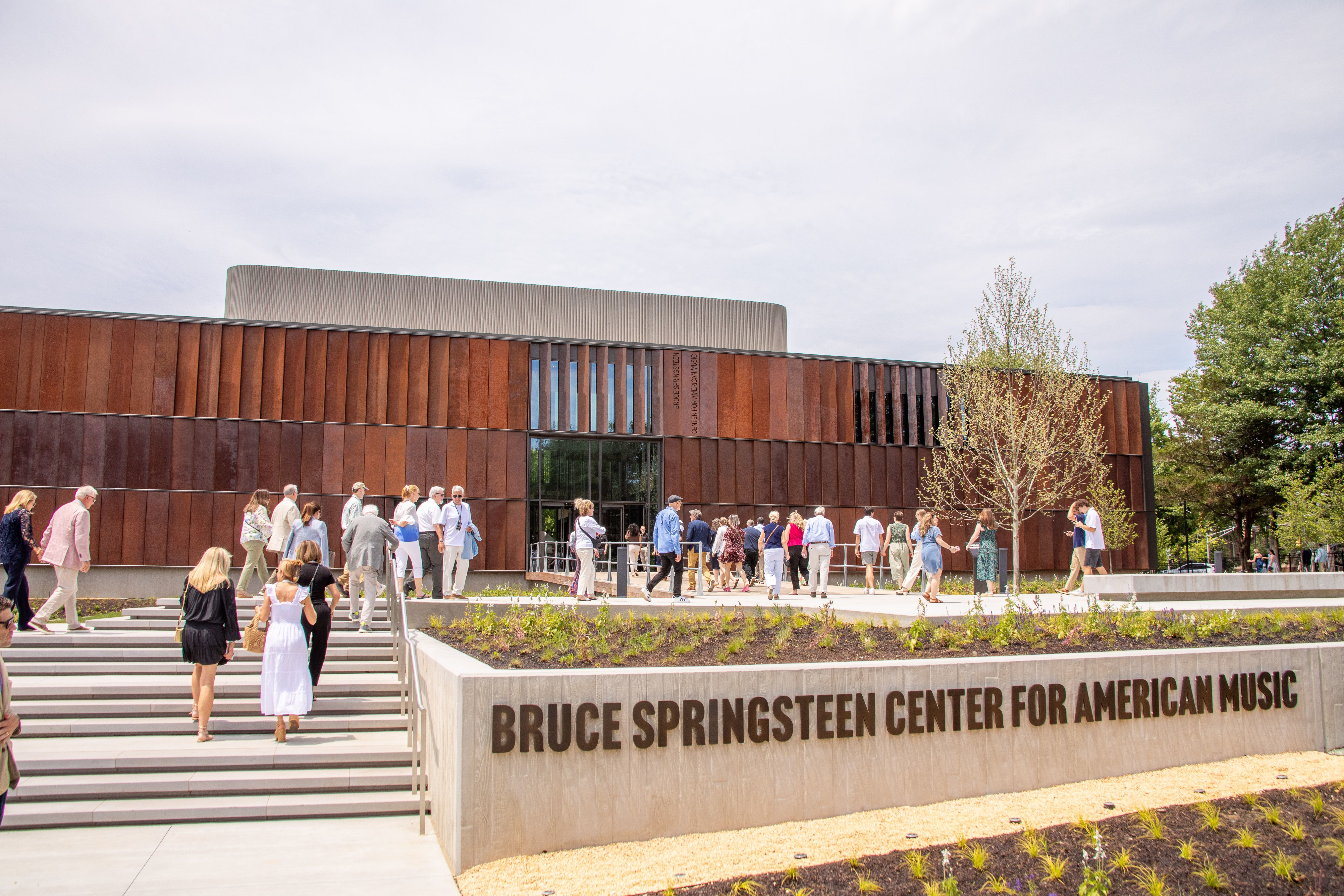
  • The new Bruce Springsteen museum is a giant scrapbook that validates New Jersey’s role as a music incubator

    The new Bruce Springsteen museum is a giant scrapbook that validates New Jersey’s role as a music incubator

    There has always been a Church of Bruce. Now it has its own building.

    Officially called the Bruce Springsteen Center for American Music, it’s located on the Monmouth University campus, four miles north of Springsteen’s old Asbury Park stomping grounds. As the name suggests, the center — part museum, part archive, part concert venue — is seeking to broaden the conversation by situating the Jersey rocker along a continuum, one that starts with Indigenous drumming rituals and stretches into the hip-hop era.

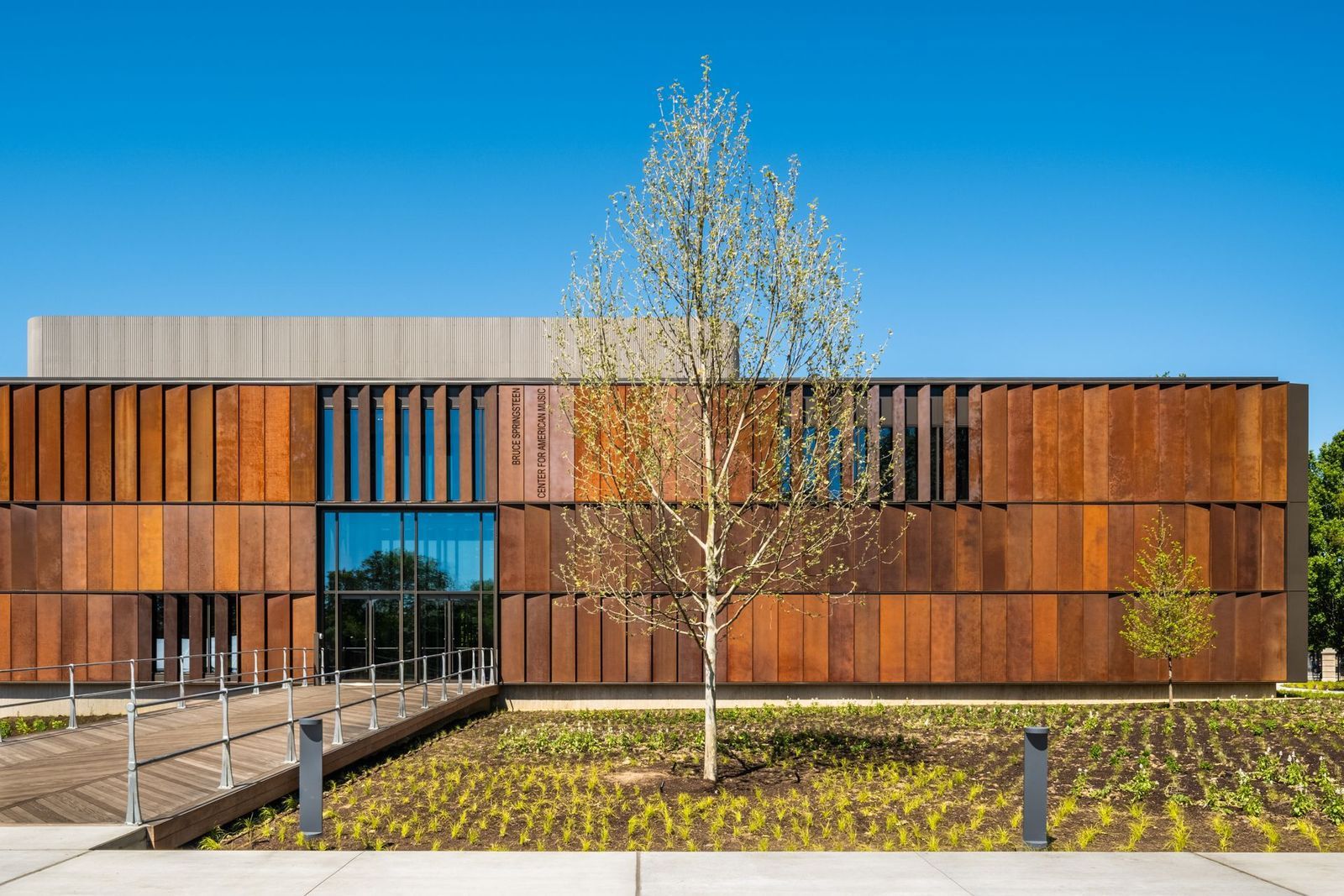
    And yet, as you stride up the center’s boardwalk-style entrance ramp, past the memory tree that commemorates the one from Springsteen’s childhood home, and come face-to-face with the building’s rust-hardened steel walls, there’s little doubt that you are really entering Bruce’s house.

    Springsteen has been such a cultural presence in American life over the last half century that it is hard to imagine it otherwise. Every detail of the building designed by New York’s CookFox Architects is keyed to some piece of his well-known biography. The joy in the architecture, particularly for the legions of Springsteen superfans, will come from decoding the references.

    Guests gathered June 7 for the opening of the new Bruce Springsteen Center for American Music on the campus of Monmouth University in Long Branch, N.J.Monmouth University

    There is the site itself, on the shady university campus where Springsteen played one of his first big concerts in 1969, at a time when most of his gigs were confined to dive bars. The simple rectangular building is put together with the same devotion to craft you find in Springsteen’s lyrics, and it’s similarly infused with grit.

    On the facade, vertical slats of weathering steel angle in search of sun and shade. Their calloused red surface evokes the aging factories that stood on the edge of Springsteen’s hometown of Freehold, and that form a recurring motif on “Born in the U.S.A.,” an early and prescient elegy for America’s dying manufacturing towns and diminished working class.

    A replica of the Asbury Park boardwalk leads visitors to the entrance of the new Bruce Springsteen Center for American Music, which just opened on the Mounmouth University campus in Long Branch, N.J. The tree is reference to the one that stood in front of Springsteen’s childhood home.Alex Ferrec © COOKFOX Architects

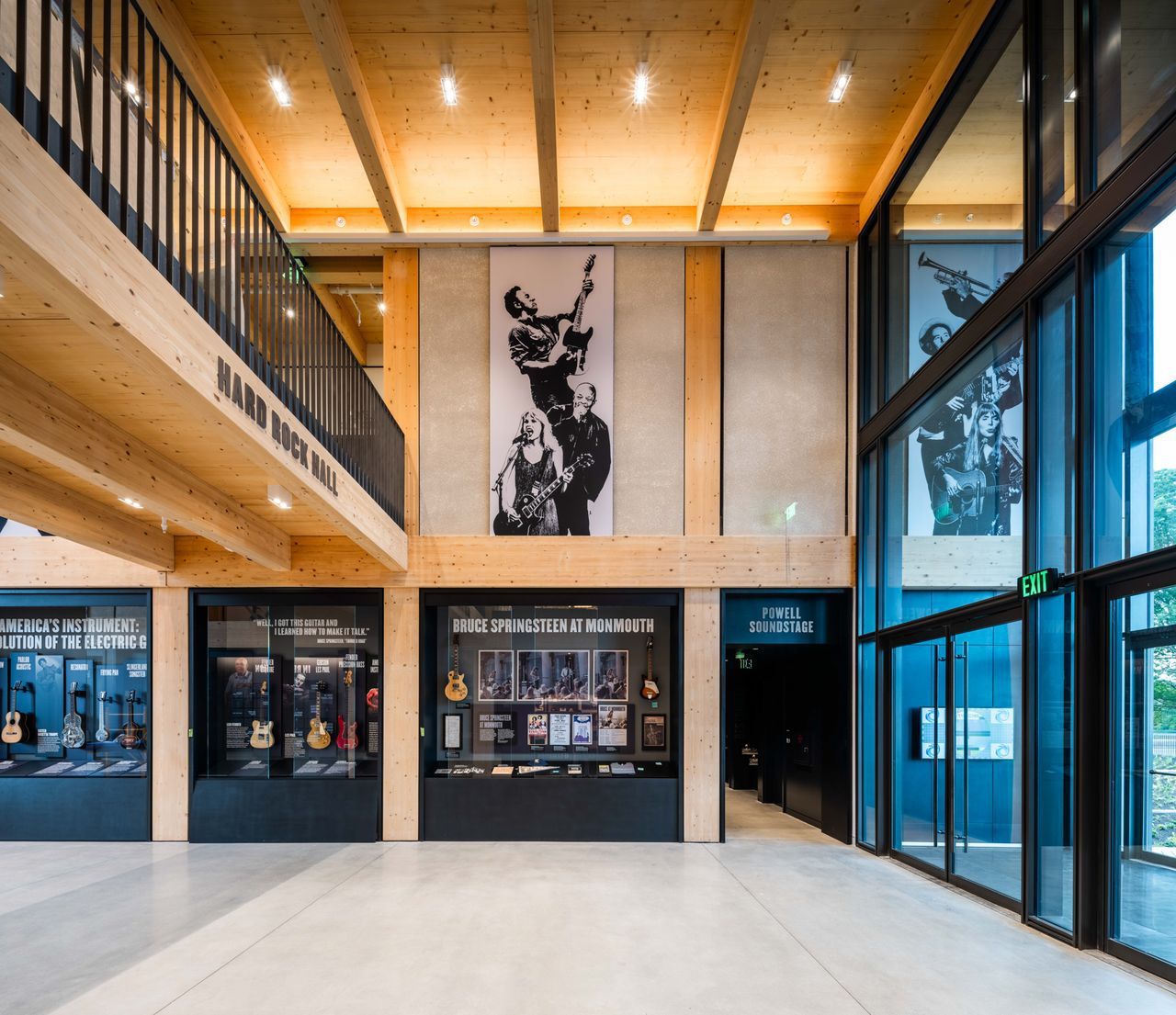
    That industrial theme is reinforced once you step inside. Muscular columns and beams, made from environmentally friendly engineered wood, structure the interior. There are wood slats on the ceilings and chunky blocks on the theater floor. They are the same hardy, end grain cut that factories once used to support heavy machinery.

    Why fans will come

    While Springsteen’s work tends toward darkness, the new center, which opens Saturday, emphasizes the light, both in its design and in the content of the exhibits.

    Most visitors probably won’t be making the pilgrimage to Long Branch for the architecture, good as it is. They’ll come for the same reason they have attended so many concerts over the years, standing for the Boss’ relentless, three-hour jams and chanting the lyrics by heart. His stories of yearning and defiance have become the soundtrack for their lives. The $50 million center promises to serve as a giant scrapbook for those memories.

    The project’s origins go back to 2011, when a donor gave Monmouth University a collection of Springsteen memorabilia, mostly posters and magazine clippings. At the time, it seemed likely that Springsteen’s much larger personal archive would end up at the Rock & Roll Hall of Fame in Cleveland.

    The university nevertheless continued to expand its holdings, and in 2016, several people connected with the collection decided to make a play for Springsteen’s personal archive. A delegation was sent to meet with the musician and make the case that the material belonged in New Jersey, not Ohio.

    Springsteen’s longtime manager and friend, Jon Landau, “loved the idea,” recalled Eileen Chapman, the center’s director. Springsteen agreed to donate his archive to the university — gratis — and the university agreed to erect a suitable place to house it.

    The Boss did make one stipulation: He didn’t want the exhibits to focus on him exclusively, said Robert Santelli, a Grammy-award winning music historian and Monmouth alum who is now the center’s executive director. Once again, the university agreed, and the center’s scope was expanded.

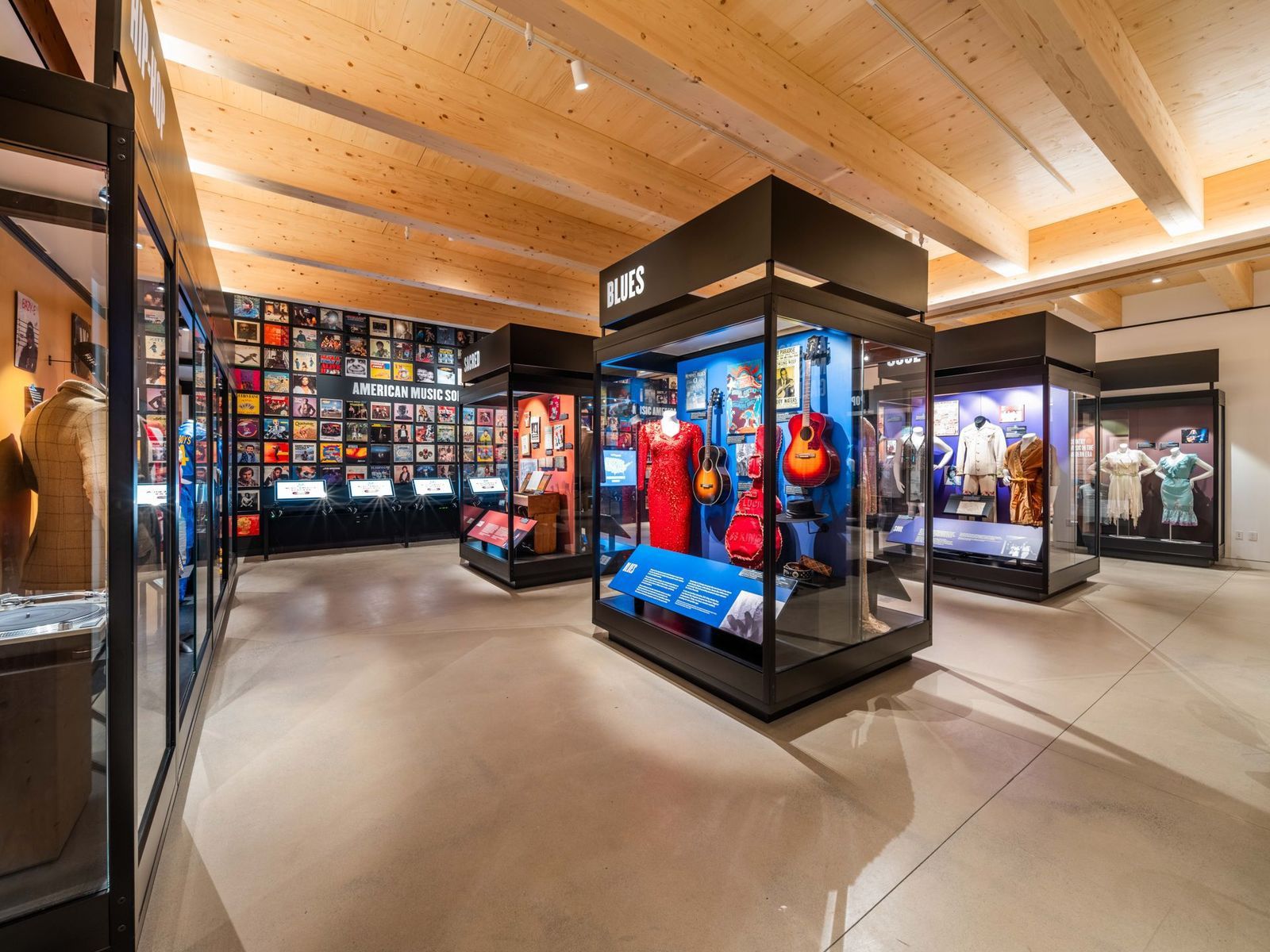
    The ground floor exhibit at the new Bruce Springsteen Center for American Music traces the history of American music, from Indigenous drumming rituals to the hip-hop era.Alex Ferrec © COOKFOX Architects

    ”The Bob Dylan archives are about Bob Dylan. The Woody Guthrie Center is about Woody. We felt the best way to tell Bruce’s story was to make him a chapter in an ongoing story of American music,” said Santelli, who has helped start several music museums, including the Grammy Museum in Los Angeles.

    Everything went smoothly at first. CookFox Architects, who are known for their commitment to both green and healthy design, won the design competition for the center in 2018. Then the pandemic hit and fundraising slowed.

    First exhibit: Protest songs

    Although it has taken eight years to get to this point, there is a certain poetic alignment in the timing of the opening, as America celebrates its 250th anniversary. The center’s first special exhibit will be devoted to protest songs.

    “Chimes of Freedom: Protest, Patriotism, and the Power of Song” takes its title from a Dylan song, later covered by Springsteen, and should help place Springsteen’s work in the tradition of traveling troubadours who sang about injustice. A vocal critic of the Trump administration, Springsteen made his new anti-ICE song, “Streets of Minneapolis,” a centerpiece of his just-wrapped tour.

    Richard A. Cook, the CookFox partner who oversaw the design, considers himself a casual fan. But he said he was deeply moved by the passages in Springsteen’s autobiography about his father, who struggled with bipolar disorder, as Cook’s father did. As an architect, he has embraced biophilic design, which uses sunlight and nature to shape soothing interiors.

    CookFox Architects, the New York firm that designed the new Bruce Springsteen Center for American Music in Long Branch, N.J., constructed the sustainable building using an environmentally friendly wood structure.Alex Ferrec © COOKFOX Architects

    Entering the building from the boardwalk, visitors will be immersed in a calming, double-height hall flooded with natural light and smelling of wood. From there, they are directed to an intimate, 240-seat auditorium — where more light pours in from a floor-to-ceiling glass wall behind the stage — for an introductory film by Thom Zimny.

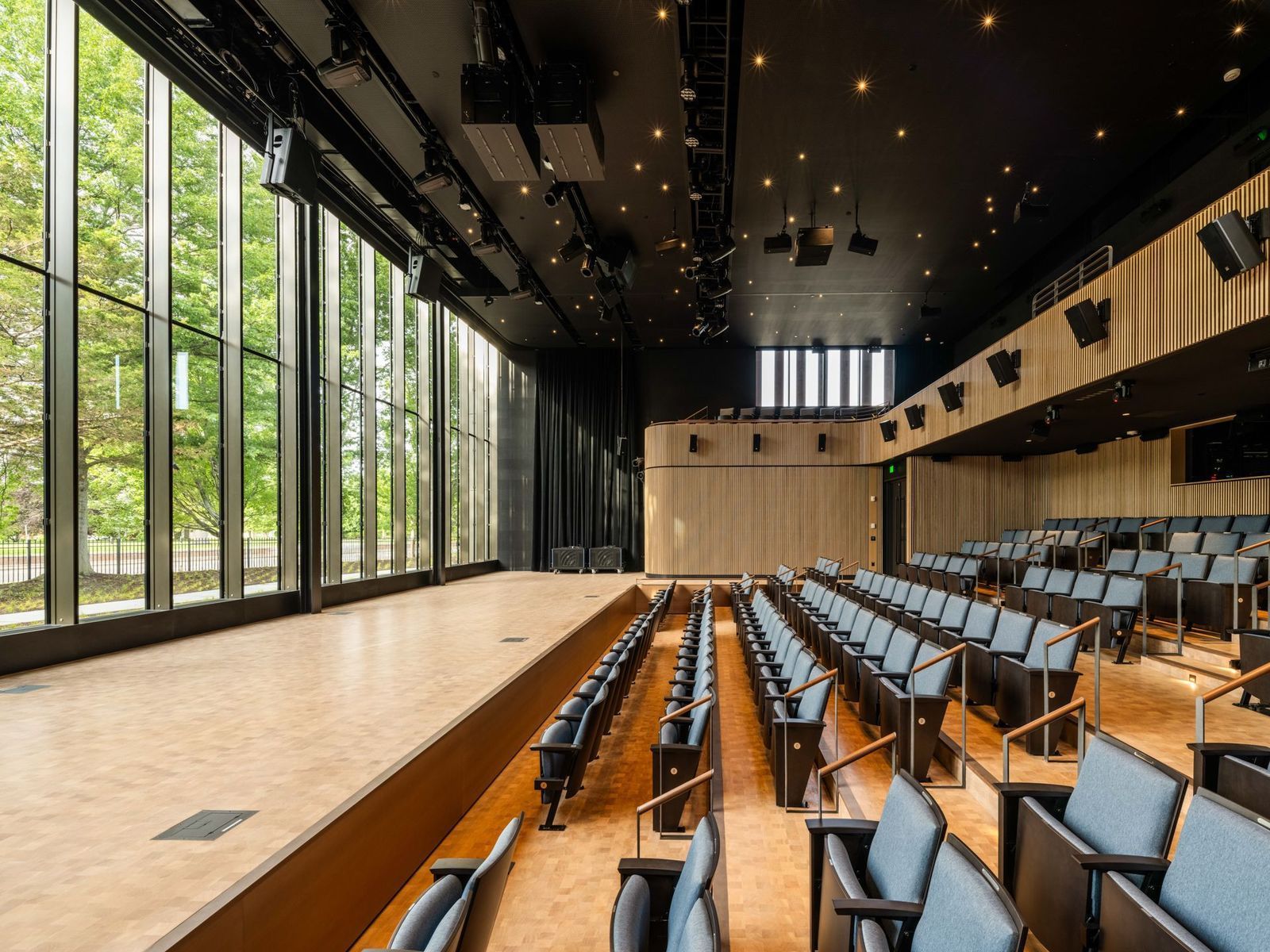
    The theater is easily the most expressive space in the building. It is rare to see such large windows in a performance venue, which are typically hermetic boxes that overwhelm the street with blank walls. By offering views of the planted meadowland that encircle the center, Cook sets the mood for the entire visitor experience. Just before a film or concert starts, a curtain and screen will drop down, completely covering the wall.

    Unlike most theaters, which are hermetic boxes, the Powell Sounstage at the new Bruce Springsteen Center for American Music is flooded with natural light. A curtain darkens the space when films are being shown. In a tribute to the musician, the seats are covered with denim.Alex Ferrec © COOKFOX Architects

    Sound quality was a priority, and the theater is outfitted with the latest technology and acoustical materials. Unlike most stages, this one has no steps, which means performers who use wheelchairs can roll directly onto the platform. Even in this space, Springsteen’s presence is conveyed through the use of denim upholstery on the seats.

    As Springsteen himself remarked at the June 7 dedication, “The building really feels like me, feels like where I came from.”

    Springsteen’s archive, open to all

    The rest of the building is divided neatly in half: A permanent exhibit on American music and a special exhibition gallery occupy the ground floor. Upstairs, it’s all Springsteen. Those second-floor exhibits include several interactive displays, including a room of instruments where visitors can don headphones and hear tips for replicating Springsteen’s music.

    But the heart of the center is the archive. While many museums limit access to scholars, this one is open to everyone. Springsteen was known to labor for months on some songs, and Chapman says she wants to use the archival material to bring his artistic process to life.

    Probably the most literal reference to Springsteen’s work can be found in the restrooms. The architects converted the cover of Greetings From Asbury Park, N.J. into bathroom tile, then cut it into sections and installed a piece in each restroom. It’s a nice idea, but I suspect only hardcore fans will be able to recognize the source of the scaled-up, pixilated image. A room filled with iconic photographs of Springsteen, donated by Philadelphia lawyer Robert J. Mongeluzzi, also feels a bit padded.

    The walls in the restrooms at the Bruce Springsteen Center for American Music are decorated with a pixilated section taken from the cover of “Greetings from Asbury Park, N.J.”Alex Ferrec © COOKFOX Architects

    Outside, the center, which received a Gold certification from the U.S. Green Building Council, is surrounded by a sustainable and biodiverse meadow by LaGuardia Design Group. A small concert venue has been tucked in amid the flowers.

    Plenty of museums around the world are devoted to individual visual artists (i.e., Calder Gardens) and important historic figures, but exhibits focused on popular musicians seem to be growing by the day, perhaps in response to the increasing sophistication of audio and interactive technology. Along with museums covering specific musical genres, shrines are devoted to the work of Dylan, Guthrie, Johnny Cash, Louis Armstrong, and, of course, Elvis. The Springsteen Center won’t be the last.

    Although Monmouth University is a 90-minute drive from Center City, the center is close to several Springsteen-specific sites, including the Long Branch house on West End Court where he wrote “Born to Run,” as well as several Asbury Park venues.

    The Jersey Shore has been an incubator for musical talent for nearly a century, from Count Basie — the “Kid from Red Bank” — to Jon Bon Jovi, yet that legacy has never gotten its due. While Springsteen’s name is the one etched onto this building, the project is really a validation of New Jersey’s enormous contribution to the history of American music.

  • Five hours at Philly’s FIFA Fan Festival in the sweltering heat

    Five hours at Philly’s FIFA Fan Festival in the sweltering heat

    When organizers announced two years ago that Philly’s FIFA Fan Festival site for the World Cup would be at Lemon Hill, many Philadelphians responded with a collective: Huh?

    Located between the Philadelphia Museum of Art and Girard Avenue, the grassy site in East Fairmount Park hasn’t hosted many big public gatherings, though it was the staging and undressing area for the Philly Naked Bike Ride in 2022.

    In my many years in Philly, I’d never covered an event at the site — and I’d never been to a FIFA Fan Fest either, which features live broadcasts of the games, entertainment, vendors, and soccer-related activities. So I went on Thursday, the opening day of the 39-day festival, to bring a minute-by-minute report of what I experienced to you.

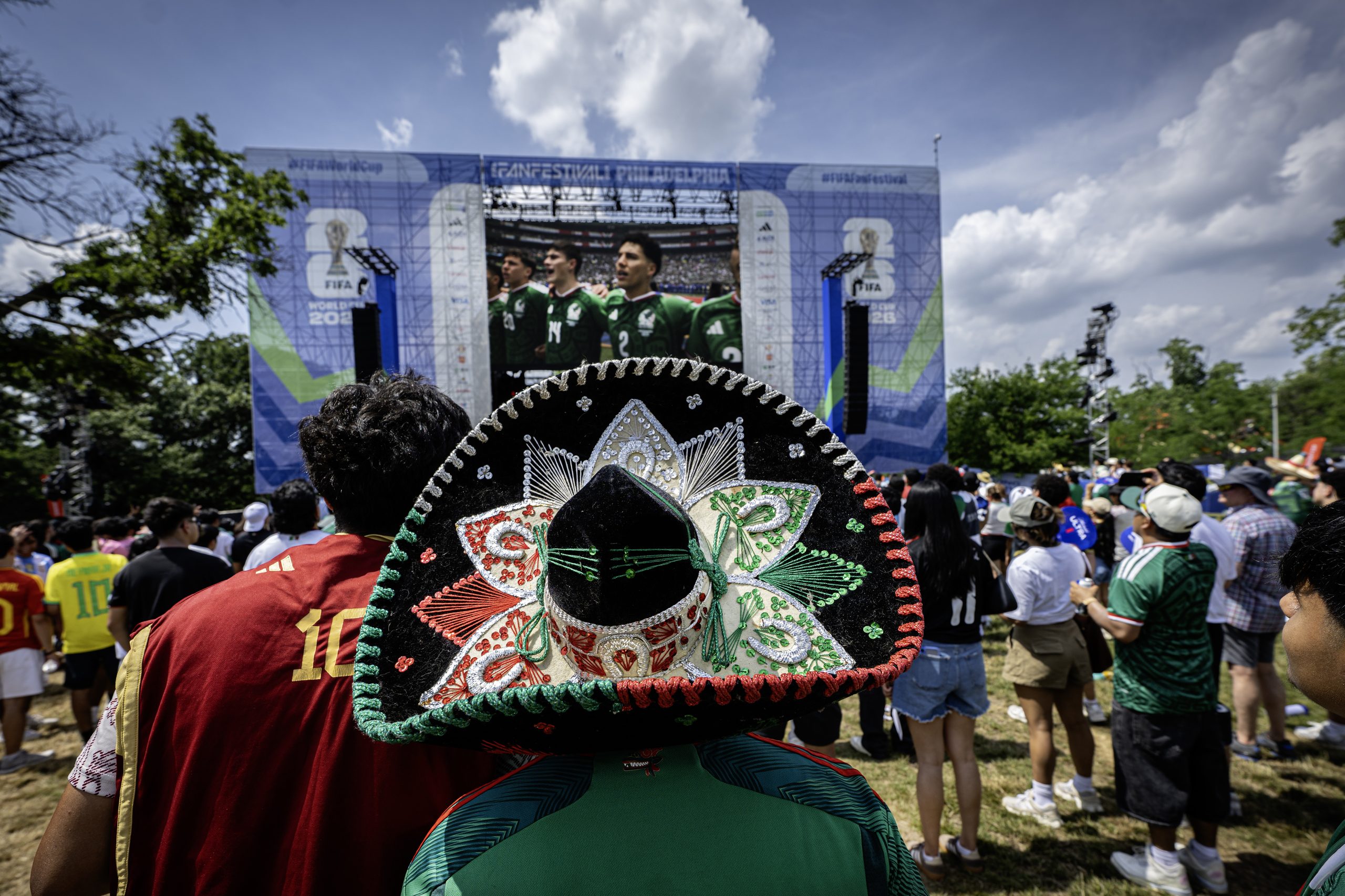
    Using a zoom lens technique, Mexican fans watch the FIFA World Cup opening match between Mexico and South Africa on a giant screen during the opening day of the FIFA Fan Festival at Lemon Hill on Thursday.Jose F. Moreno / Staff Photographer

    I knew the journey wouldn’t be easy. Not only were temps forecast to be in the mid-90s (with heat indexes over 100 and a heat health emergency in place), you can’t drive to the site, or get close with ride share apps. Roads around the venue are closed and street parking has been restricted to neighborhood residents.

    To get to the event, the city is urging guests to take the Philly PHLASH bus, take SEPTA’s bus routes 32 or 48, use a bicycle, or walk. I chose the latter.

    12:30 p.m.

    I begin my journey at LOVE Park, where I see a group of five friends in their team Mexico jerseys — and a sixth in a white T-shirt and sombrero — getting their photo taken with the LOVE statute.

    Alexis Arellano, 29, tells me they’ve come from Atlantic City to catch the Mexico v. South Africa game at the FIFA Fan Festival.

    “It’s a once-in-a-lifetime opportunity. You’ve got to take advantage of everything they got going on. It’s in our backyard,” he said.
    12:39 p.m.

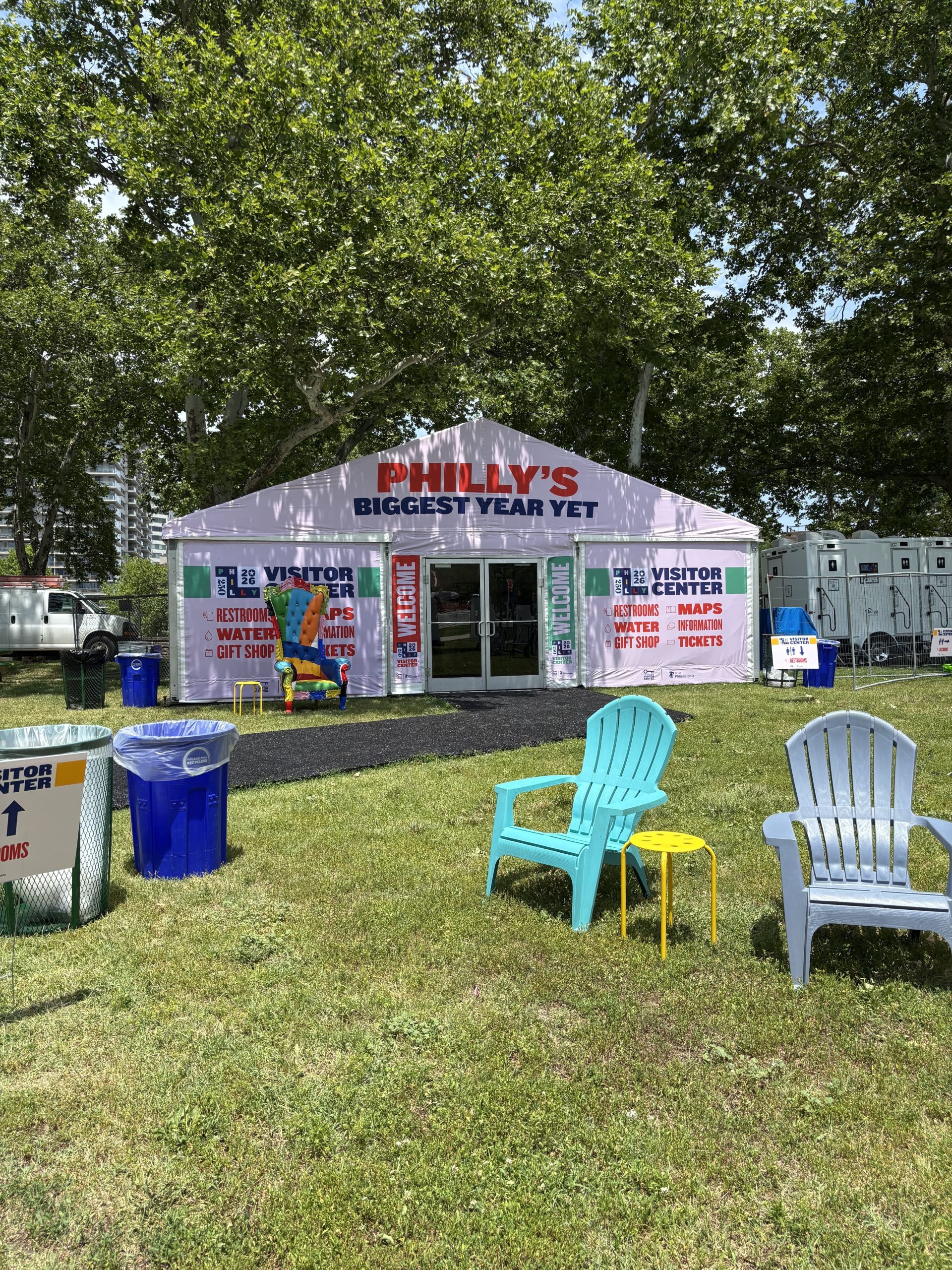
    I stop into the pop-up Philadelphia Visitor Center hospitality hub at the park. The space is tiny, but the air-conditioning feels like silk sheets on my sweaty skin. I strongly consider buying the $14 portable fan that sprays wooder at your face and ponder at a bucket hat that reads: “Freedom has a Philly accent.”

    12:45 p.m.

    I head over to the public bathroom trailer that’s temporarily been installed in LOVE Park in front of the circular building known as flying saucer.

    “What a waste,” I think, as I look up at the very cool saucer, which remains closed and empty, despite a call-out last year from the city for ideas to reactivate the space in time for the World Cup and the Semiquincentennial.

    The new, temporary public bathroom trailer set up in LOVE Park.Stephanie Farr / Staff

    I step inside the bathroom trailer. Not only is it air-conditioned, it’s outdoor-wedding-quality nice. Next to the trailer is a sink of water fountains and water bottle-filling stations.

    1:15 p.m.

    After making my way down the Ben Franklin Parkway, I spot another, larger hospitality hub across from Eakins Oval. This one has several large boards in front of it you can stick your face into to get a photo with Gritty, Rocky, or Patti LaBelle.

    When I step inside the hub, I almost weep tears of joy because it’s so cold. It has much of the same items as the other, but with more Rocky merchandise (“Yo, Adrienne! Buy my stuff!”).

    The pop-up Philadelphia Visitor Center hospitality hub across from Eakins Oval.Stephanie Farr / Staff

    Outside of the hub, I meet Valentine Emeré, 20, and his parents, who are on holiday from France and had no idea the World Cup was in town. They’re in Philly as part of an East Coast tour of the U.S.

    “It’s a very good city, it’s a living city,” Emeré tells me when I ask his thoughts on Philly. “We really like how many things there are to do.”

    1:41 p.m.

    I arrive at the FIFA Fan Fest welcome center tent. Aside from the oppressive heat, the walk was easier than I expected. I pass the Philly Phestival Marketplace, a row of vendors selling everything from nail polish to onesies that read “baby jawn.”

    1:48 p.m.

    At the Glitterbrush Facepainting booth, I chat up Martiza Quendo of North Philly, who wore a team Mexico shirt, and Marissa DeMatteo of South Philly, who was repping team USA. They’d just had their faces painted and told me they came to Fan Fest because they love free merch and “participating in Philly.” Mostly they were there for the live Luis Fonsi concert after the Mexico vs. South Africa game.

    Martiza Quendo of North Philly, at left in a team Mexico shirt, and Marissa DeMatteo of South Philly, at right in a team USA shirt, pose after getting their faces painted at the Philly Phestival Marketplace.Stephanie Farr / Staff

    1:52 p.m.

    As several hundred people wait in line for the gates to open, visitors pose for pictures in front of a large soccer ball surrounded by fresh flowers, a photo-op that looks straight out of the Philadelphia Flower show. An enterprising street vendor nearby tries, without success, to sell umbrella hats.

    “You think business would be better in this heat,” he says.

    2:10 p.m.

    Philadelphia Mayor Cherelle L. Parker joins fans in a Mexican chant before entering the FIFA Fan Festival at Lemon Hill on opening day of the FIFA World Cup 2026 on Thursday, June 11, 2026, in Philadelphia. Fans gathered to watch Mexico face South Africa in the tournament’s opening match.Jose F. Moreno / Staff Photographer

    Gates open to the festival, a little behind schedule, but folks get in calmly, quickly, and with little trouble. Some come in singing, others run in waving Mexican flags. My colleague, photographer Jose Moreno, later shows me pictures of Mayor Cherelle L. Parker walking in with the crowds.

    2:18 p.m.

    I stop by the Home Depot activation, billed as “Beckham’s Backyard,” which features the facade of a home with a 12-foot-skeleton in front of it. An employee tells me this mimics a backyard with Beckham’s flair.

    “He’s not here though, right?” I ask.

    “I wish. This would be a lot more popular if he was,” he said.

    Inside, there is a giant Home Depot bucket with a TV screen inside showing games. The nearby Casamingos stand selling margaritas for $17 appears to be far more popular.

    2:26 p.m.

    I ask an employee manning the Bank of America activation why the line there is so long. He tells me they’re letting people make their own bracelets — with very cool Philly and World Cup charms — for free.

    2:28 p.m.

    At the Visit PA pavilion, the lines for the free prize wheel and claw machines — which dole out Visit PA-branded merch — were very long.

    But nobody was at the “Soccer Jawn” video game, which pits two players head-to-head in a Pong-like game of soccer on a big screen. I yell to a young woman passing by to battle me and she accepts my challenge.

    Biance Yetta, 16, of Easton, beats me 5-4. In my defense, she plays soccer on a traveling team and I’ve never played before in my life (though I’ve probably played way more Pong).

    2:38 p.m.

    A message plays on the 60-foot-wide main screen of the festival from astronauts aboard the International Space Station. I’m too far away to hear everything they say, but I can make out the words: “Sharing one planet, one game,” and that makes me smile.

    2:40 p.m.

    I walk into the massive FIFA Fan Fest store, which is so well air-conditioned I almost fall to my knees and thank the gods of consumerism.

    I browse for a bit, but when I check the price of a FIFA cropped women’s sweatshirt — $104.99 — I walk right back out.

    2:56 p.m.

    The national anthem of South Africa begins and crowds gather around the big screen. Folks try to hide under what little shade is available, but most of us are forced to swelter in the sun.

    Shortly thereafter, the Mexico national anthem plays and many in the crowd — which now numbers in the thousands and is mostly team Mexico fans — sing along.

    It feels electric being in the middle of them and watching the game begin, but I have more of the festival to explore.

    Mexican fans sing the national anthem before the start of the FIFA World Cup opening match between Mexico and South Africa at the FIFA Fan Festival at Lemon Hill on Thursday.Jose F. Moreno / Staff Photographer

    3:04 p.m.

    I approach what looks like a nice little area called “The Orchard” and am immediately stopped by a security guard. I’m informed it’s a VIP-only area for sponsors (enjoy the perks, 12-foot Home Depot skeleton).

    Next to it was another public viewing area with a smaller screen showing the game. This one had picnic tables under shade (huzzah!). Nearby was a food area with booths selling street corn, cheesesteaks, and churros — none of which sounded appetizing in 94-degree heat. I’d spotted a single water ice stand at another food vendor area across the way earlier, but the line was 42 people deep and there was one guy working the booth.

    3:24 p.m.

    I spot a woman in a Phamassador T-shirt, the Visitors Center program that’s recruited 10,000 volunteers to be ambassadors of Philly this summer.

    Ruth Bangura, 19, tells me she’s a Philly transplant who’s “obsessed” with the city and wants to help others become obsessed, too. Despite the heat, she’s loving the “good energy” at Fan Fest and loves seeing people waving flags of all colors coming together.

    “Everyone is different but at the same time, we’re all here for one game. This is the best thing that could ever happen to the United States right now,” she says. “This is the melting pot, this is what America is supposed to be instead of differentiating each other and dividing each other.”

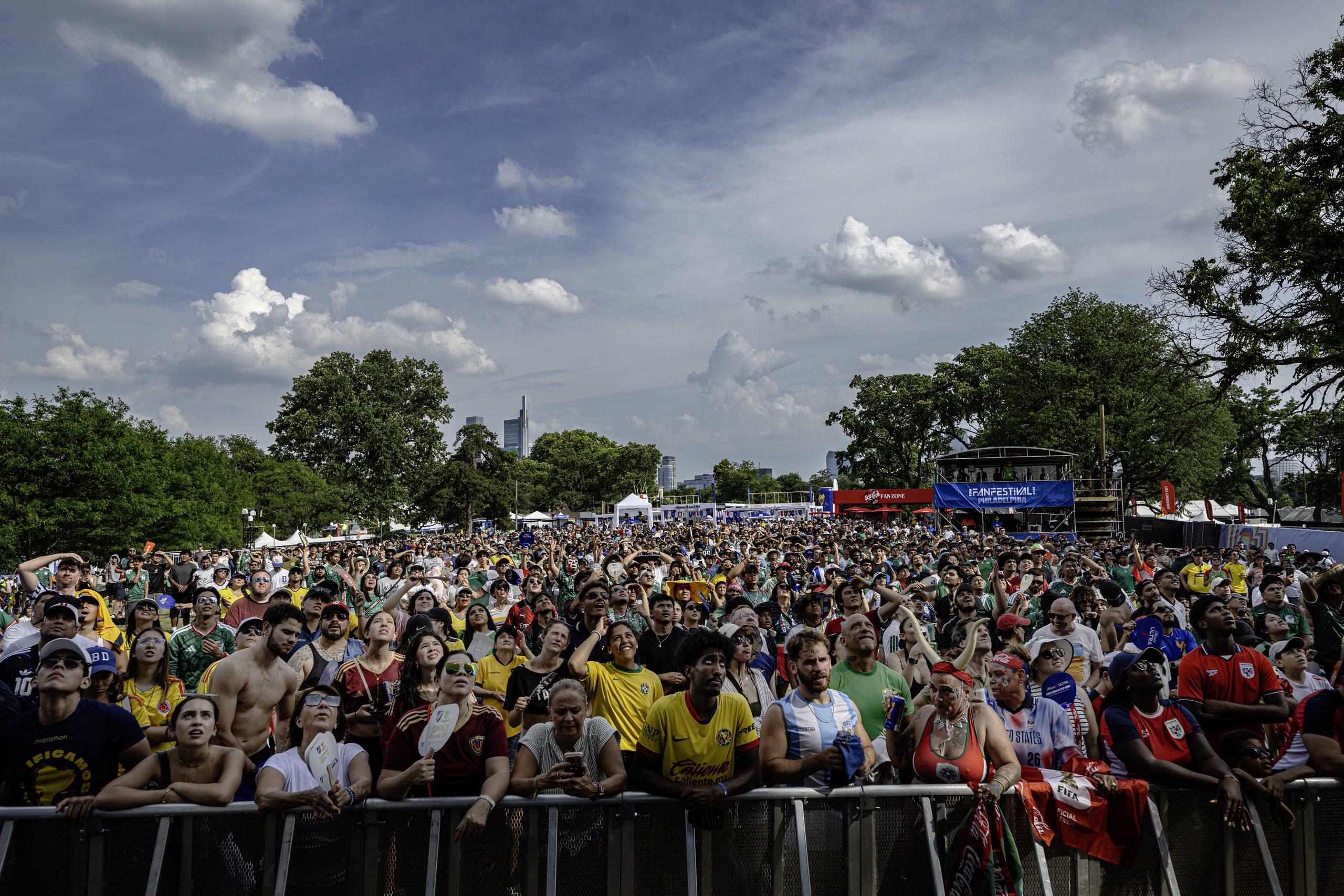
    Soccer fans gathered to watch the FIFA World Cup opening match between Mexico and South Africa during the opening day of the FIFA Fan Festival at Lemon Hill on Thursday.Jose F. Moreno / Staff Photographer

    3:31 p.m.

    As I walk by an American Heart Association tent filled with CPR dummies, staffer Jennifer Russ asks if I want to learn CPR. She teaches me chest-compression as music that’s 100-to-120 beats per minute plays in the background. Like “Staying Alive,” these are songs you should time chest compressions to.

    Russ’ manager tells me they’re on site because CPR is a skill they want people from all over the world to learn.

    “And, honestly, sports is one of the main places cardiac arrests happen,” she says. “So this is great because it’s just such a big footprint.”

    3:46 p.m.

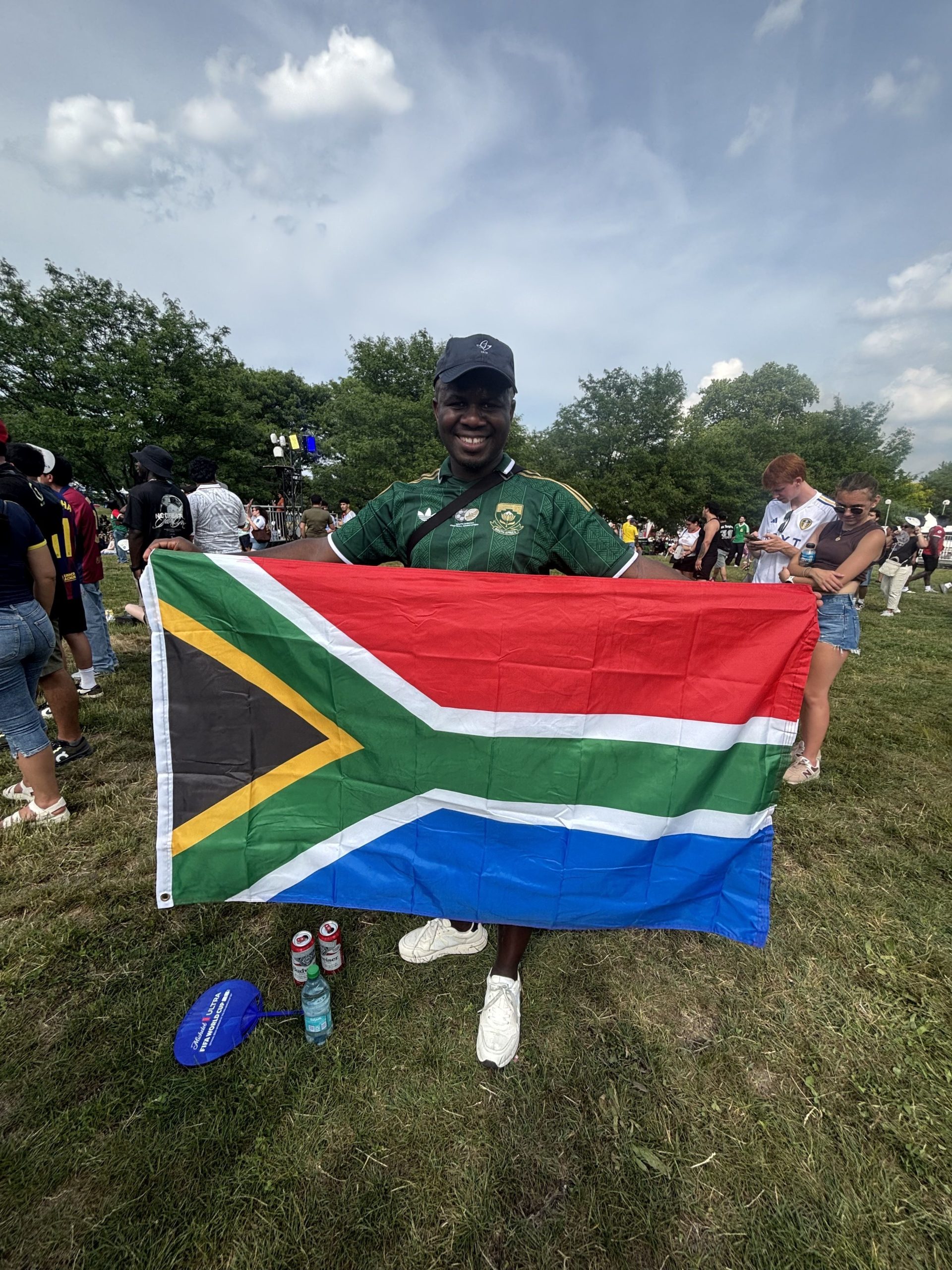
    Back at the big screen showing the game, I introduce myself to Mla Mhlongo, 34, a native of South Africa now living in Claymont, Del., who came to support his national team. He tells me that when the World Cup was in South Africa in 2010, they showed all the games at outdoor parks, so Fan Fest feels like a small tase of home.

    Mla Mhlongo, a South African native now living in Delaware, waves the South Africa flag in support of his home country at FIFA Fan Fest in Philadelphia.Stephanie Farr / Staff

    “I’m enjoying the game with a lot of people; I’ve taken a lot of pictures with people from Mexico and people from around the world,” he says. “The World Cup is supposed to unite the world and it does that.”

    4:06 p.m.

    An Eagles chant breaks out in the crowd.

    4:23 p.m.

    I need to find shade. I head to one of the misting tents with fans, but the mist evaporates before it even reaches me.

    4:38 p.m.

    Once I cool down a little, I realize how hungry I am. I consider a jerk chicken wrap, until I realize it’s $24. I settle on a hot dog and soda for $14. I try to pay with cash and am told everything is card-only.

    4:42 p.m.

    As I sit to eat in the shade near the smaller screen, I realize that hardly a single person is on their phone. They’re tuned into the game or each other and I think about how nice — and rare — that is.

    4:52 p.m.

    I try my hand at the Philadelphia Union’s activations, which test your soccer shooting and passing skills by having you kick balls at a series of blinking lights. They’re fun — and one of the few activations that doesn’t require you to scan a QR code. I fail miserably at both games, at one point kicking the ball into the crowd outside the tent.

    5:05 p.m.

    Mexican fans celebrate after Mexico scores against South Africa while watching the FIFA World Cup opening match on a giant screen during the opening day of the FIFA Fan Festival at Lemon Hill on Thursday.Jose F. Moreno / Staff Photographer

    The match on the big screen ends and fans of Mexico cheer their team’s win. People make their way to the stage under the screen for the Luis Fonsi concert. I spot the two facepainted Philly ladies I talked to earlier right up against the stage barrier.

    5:17 p.m.

    Singer Luis Fonsi performs during the opening day of the FIFA Fan Festival at Lemon Hill on Thursday.Jose F. Moreno / Staff Photographer

    Fonsi takes the stage. A woman with a man in a Mexican wrestling mask, both of whom are wearing Mexican flags as capes, dance in front of me. I see a mom and daughter singing together in Spanish and a man dancing through the crowd, his arms raised. Everyone is happy and smiling.

    5:30 p.m.

    I leave early to beat the crowds and walk back. On my way out, I see a man at a picnic bench reading Booked by Kwame Alexander. He tells me the American Federation of Teachers is giving books away for free at the Philly Phestival Marketplace. I stop by the booth and talk with Leslie Koelsch, deputy director of communications for the federation.

    “We launched the Summer Reading Cup and we’re giving away thousands and thousands of soccer-themed books this summer to get kids excited about reading,” she tells me.

    5:42 p.m.

    Just outside the fest, I see a sign for the “LOVE Park shuttle” and a row of four school buses. A driver tells me they’re giving free rides back to LOVE Park after the fest. It’s a wonderful service, but the buses don’t have air-conditioning and the first one isn’t anywhere near full yet, so I decide to continue on foot.

    5:55 p.m.

    Walking along the Parkway, I think about all the events I’ve covered there — the good and the bad, the celebrations and the protests — and I look at all the nationality flags waving in the warm breeze.

    Soccer fans gather to watch Mexico play South Africa on a giant screen during the opening day of the FIFA Fan Festival at Lemon Hill on Thursday.Jose F. Moreno / Staff Photographer

    I’ve had conversations with many people over the last few months who find it very hard — if not impossible — to consider celebrating anything amid the current climate of our country. But when you attend one of these events in Philly that brings people from all over the world together, you get something you don’t get when you sit at home and watch all the horrors of the news.

    You realize how much people want to connect with one another, and how easily we still do, when we choose to.

    Soccer fans gather to watch Mexico play South Africa on a giant screen during the opening day of the FIFA Fan Festival at Lemon Hill on Thursday.Jose F. Moreno / Staff Photographer

    Know before you go

    • The festival is free but online registration is required in advance at phillyfwc26.com/fifa-fan-fest.
    • The list of prohibited items is lengthy — and includes Vuvuzelas and umbrellas — so be sure it check it before you go.
    • Information about ADA accessible transportation and entry can be found on Philly’s FIFA Fan site .
    • The venue is card-only; no cash is accepted.
    • Kids under 18 aren’t permitted at the festival without an adult guardian.
    • The big screen audio can get very loud, so if you’re sensitive to noise, bring ear plugs.

    This article has been corrected with the proper spelling of Leslie Koelsch‘s name.

  • In Lancaster, measles cases are rising as providers try to combat low vaccination rates

    In Lancaster, measles cases are rising as providers try to combat low vaccination rates

    In late April, Joshua Good got a call from a parent at Ephrata Mennonite School: Two of their children had been diagnosed with measles.

    Good, who heads the private religious school in Lancaster County, knew he had to act quickly to prevent further spread of the highly contagious disease. But he was not particularly surprised that measles had turned up at his school.

    Ephrata Mennonite, a K-12 school with 375 students, is among the most under-vaccinated schools in the state. Less than half its 27 kindergarten students last school year were immune to measles, which can infect nine in 10 unvaccinated people.

    Good, who vaccinated his own children, had watched over the last 10 years as more and more parents in his school and church communities had opted out. He knew firsthand how difficult it had become to change minds.

    He contacted a local school district nurse who works closely with Ephrata Mennonite, and then got “right away on a conference call with the state Department of Health.”

    In neighboring Lebanon County, three people had arrived at a hospital days earlier with the highly contagious disease. State contact tracers quickly found eight more cases in the county.

    Now the outbreak had come to Lancaster.

    By this Friday, 53 measles cases had been detected in four counties in Southeastern and Central Pennsylvania, the state’s biggest outbreak in more than 30 years.

    The outbreak remains unpredictable as it unfolds in rural counties just west of the Philadelphia metro area, where a recent Inquirer analysis found under-vaccinated pockets pose a rising risk to a region with higher overall vaccination rates.

    Lancaster, which has some of the lowest kindergarten vaccination rates in the state, has been a hot spot all year, with 39 of the 65 total measles cases reported in the state.

    And healthcare providers there now worry that measles is circulating far more widely than anyone realizes in a county that, like most in the state, lacks a public health department, and where anti-vaccination sentiment runs high.

    Good provided information to help state heath officials trace classmates exposed to the infected students in an effort to contain the spread.

    The two students at Ephrata Mennonite have recovered, Good said, and there were no more cases at the school. He feels lucky: One of the infected students had never been at the school while contagious, and the school’s classes end around Memorial Day, so the virus no longer has a chance to spread there.

    He welcomed a pop-up vaccination clinic on campus, but even measles cases so close to home were not enough to convince many parents who had not previously accepted shots to immunize their children.

    “The measles continues to go around here in the Lancaster-Lebanon area,” he said. “Will that move things at all? I’m not sure.”
    Vaccination attitudes in Lancaster

    Pennsylvania’s first measles scare this year came in February, when eight people contracted measles in Lancaster County in an outbreak that expanded to neighboring Chester and Montgomery Counties, suburbs of Philadelphia. Twelve cases were ultimately reported, the bulk in Lancaster.

    Yet few people were aware of the threat at Lancaster’s bustling flea markets and “mud sales” in late February. While area libraries posted signs warning of a measles outbreak, some parents said they believed the risks of vaccination are worse than the prospect of catching measles.

    The Green Dragon Market in Ephrata bustles with activity in early spring. The area, in the north of Lancaster County, has seen several measles cases this year.Bob Williams / For The Inquirer

    One Amish father, who had never been vaccinated himself, said his 23-year-old son got immunized only because he was born prematurely.

    “God will send you what you want anyway,” said the man, who declined to share his name because he was speaking about private medical details.

    Only 88.5% of the county’s kindergartners were immune to measles in 2024, the last year for which data are available — well below the 95% threshold scientists consider necessary to protect a community.

    Several Lancaster parents said they’d vaccinated their older children and then had opted against immunizations for their younger children. Others said they’d always considered vaccination the best way to protect their children.

    Lancaster’s Amish communities have presented a unique concern for health providers, who have long sought to increase their access to vaccination.

    In 1991, these communities were at the center of an outbreak of rubella — a virus sometimes called “German measles” that produces a similar rash and fever to measles, and can cause severe birth defects in pregnant women. Today’s measles vaccines provide protection against rubella, too.

    Lancaster General Hospital physicians vaccinated hundreds to stop the outbreak, launching the Child Protect Clinic, which provides free vaccines to uninsured children and builds trust in communities that have difficulty accessing medical care.

    These days, about 70% of patients at the Child Protect Clinic are from Plain communities, Christian groups like the Amish and some Mennonite sects that adhere to modest dress codes and in some cases avoid modern conveniences.

    Some members of Plain communities oppose vaccination, but opinions can vary widely, and the current outbreak is not centered in Amish households, said Pia Fenimore, Lancaster General Hospital’s vice chair of pediatrics.

    Anti-vaccination sentiment has spread broadly across Lancaster — and is not confined to Plain communities — in recent years.

    At Ephrata Mennonite, Good said, opposition to vaccination has become entrenched in a “significant portion of parents,” with concerns ranging from how vaccines are developed to their safety to resentment over the handling of the immunizations and public restrictions during the COVID-19 pandemic.

    “And then you throw in messaging from key health people like RFK Jr.,” he said, referring to Robert F. Kennedy, Jr., the anti-vaccine activist at the head of the country’s public health apparatus.

    Higher vaccination rates at Ephrata Mennonite among seventh and 12th graders speak to how “there’s been a big shift in the last 10 years,” Good said.
    Good believes that vaccination is a parent’s choice, and supports Pennsylvania’s relatively lax vaccination exemption rules. Parents here can opt out of vaccinating children for religious, personal, or medical reasons.

    He vaccinated his own children and recalls how when they were young, he would often try to convince others in his community to do the same.

    “I would get into protracted conversations, trying to persuade people. But the amount of success that I’ve had in that has been pretty low,” Good said.
    “When someone asks me for my opinion, I’ll provide it to them.”

    Tracking cases

    As Pennsylvania’s worst measles outbreak in three decades spreads in Lancaster County, Alice Yoder said she remains unable to convince her fellow county commissioners to post details on the county’s website informing residents of the spiraling case counts and urging vaccination.

    The only Democratic county commissioner in Lancaster and a former nurse and executive at Lancaster General, she feels certain the county needs to do more to address the outbreak.

    The county’s health advisory website is so outdated that it advertises an April 2025 meeting, ironically on measles preparedness, beside a fact sheet that merely mentions vaccination as a “highly effective” prevention measure instead of the best defense against the disease.

    “If it wasn’t for our local newspaper, I don’t know how many people would be aware,” Yoder said.

    So far, Lancaster has reported 31 cases in the current outbreak.
    Twice in the last month, potential exposures in public places prompted state health officials to issue news releases. At a Kohl’s in Lancaster in late May, shoppers were potentially exposed to measles, which can linger in the air for up to two hours, over four days after an employee tested positive.

    And on June 3, a person with measles visiting the Lancaster County courthouse’s marriage license office may have exposed others to the virus between 10 a.m. and 4:30 p.m. The person is now isolating at home, officials said Friday.

    Neighboring Lebanon County, where vaccination rates for kindergartners are around 93%, has seen 19 cases. Berks and Dauphin Counties have reported three cases between them.

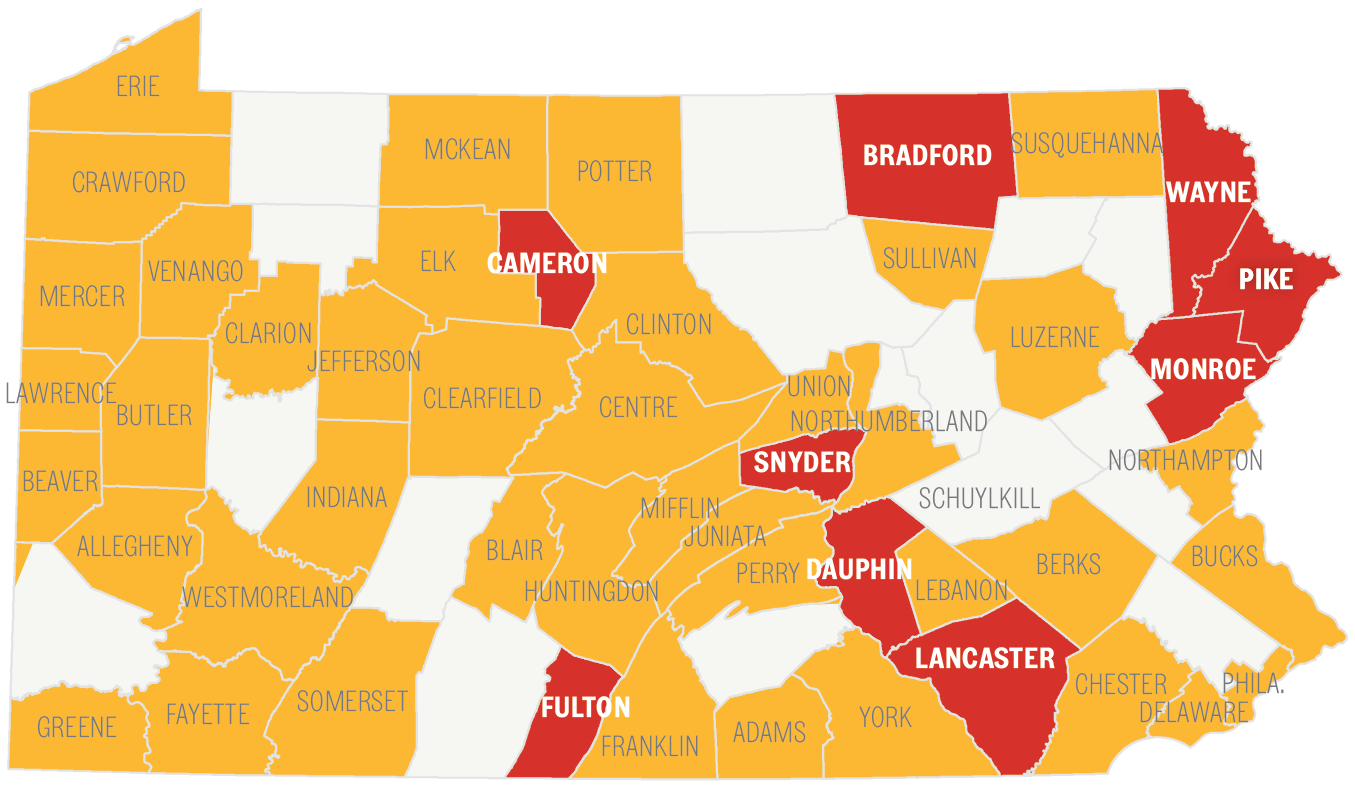
    A map showing vaccination rates in kindergarteners for the 2024-2025 school year. Counties in yellow have vaccination rates between 95% and 90%. Counties in red have vaccination rates below 90%. To halt the spread of measles, at least 95% of a given community must be vaccinated against the disease.John Duchneskie

    Last week, state health officials reported that they’d confirmed 20 cases. That alone surpassed the total of 16 cases statewide from all of last year.

    The rapid case jump, coupled with Lancaster’s low vaccination rates, concerns Remy Pasco, a research associate at the University of Colorado who helped develop a measles outbreak simulator based on school vaccination rates.

    Without more information on when and where patients developed symptoms, he said gauging future case patterns is difficult. Only three patients were still contagious as of Wednesday, according to the state.

    Measles can incubate in patients for up to 21 days; more active infections means more residents of the county are currently at risk.

    Local physicians fear cases are going unreported, and say communication remains a challenge as the outbreak spreads in a county without a local health agency to lead the response.

    “There may be many more cases in the community that don’t come to light because people aren’t getting tested,” said Jeff Martin, a physician who heads the family medicine department at Lancaster General.

    In some cases, patients may not appreciate why it’s important for health officials to track the spread of the disease, which typically presents with a fever and a rash but can cause brain inflammation and pneumonia in serious cases.

    Others may be afraid that if they report a measles case, “there will be some kind of repercussion,” said Fenimore, a hospital pediatrician.

    Could a local health department help?

    Yoder has spent years calling for a local health department that could update county residents regularly on health threats and educate about the importance of vaccination and other public health measures. But there is little political will to do so, she said.

    Lancaster, like 60 of Pennsylvania’s 67 counties, has no local health department, which makes it difficult for Martin and Fenimore to get the full picture of what’s happening.

    State officials, who are largely handling the response, say they’re working diligently to contain the outbreak, by conducting contact tracing and hosting vaccine clinics in hot spots that have drawn residents by the dozens.

    Martin tracks cases that come through Lancaster General Hospital and its affiliated provider offices. Despite serving on the county health advisory council, Martin learns of cases elsewhere in the county “through the newspaper just like anyone else.”

    Martin said that the health department should give physicians details on cases near them regardless of the health system they are detected in.

    And, he said, while state health officials are responsive to local physicians and “doing a very good job” at conducting contact tracing, sometimes residents are more receptive to information that comes from their local physician, instead of a state official.

    “From a state level, trying to do this in a local community is a little more difficult. We know the providers really well and the unique cultural variations within the community,” he said.

    Department of Health press secretary Neil Ruhland said the state is in regular communication with local health systems, working directly with providers to provide “resources and guidance” when cases are detected in an area. The state operates its own health centers in Lancaster and Lebanon Counties, which have “strong ties to the communities they work in.”

    State officials have hosted 12 vaccination clinics across the region as the outbreak has unfolded, and local providers routinely offer immunizations at doctor’s offices, fire departments, and state-run health clinics.

    Yet no details about the circulating measles threat have reached State Rep. Russ Diamond, a Republican who represents Lebanon County, even as cases in the community where the outbreak began have risen to 19.

    “If folks are worried about it,” he said, “then get your kid vaccinated. That’s your right.”

    “I don’t know how the state should respond.”

    Encouraging vaccination

    Parents who have opted against vaccinating their children because of misinformation about vaccine safety have become a focus for local pediatricians trying to halt the outbreak.

    The parents coming to Lancaster General often ask about the long-debunked theory that vaccinations cause autism, or ask whether measles is truly dangerous.

    In March, two members of Lancaster County’s health advisory board — a nonbinding group that meets every other month — falsely suggested measles vaccines can be deadly and raised long-debunked concerns about measles and autism, according to local news reports.

    Neither of Yoder’s two colleagues on the board of commissioners returned calls for comment on the county’s approach to the outbreak.

    As physicians race to increase vaccination rates among children whose parents have avoided immunization, they’re also trying to reassure parents in Lancaster whose children are too young to be vaccinated and concerned about the growing risks from measles.

    Typically, children receive two vaccines for measles, mumps, and rubella at 1 and 5 years old, but Fenimore increasingly recommends that young children receive an extra early dose at six months, especially if they’re going to spend time around unvaccinated people.

    The state is also considering whether to recommend that physicians deliver this “zero dose” to babies as young as six months old in affected counties, said Ruhland, the health department spokesman.

    Physicians in Lancaster say it’s key to take time to listen to parents, hear their concerns, and provide accurate information about vaccine safety. These efforts can take several visits.

    “We know scare tactics don’t work. What does work is developing a rapport,” Fenimore said. “The fact that we have a current measles outbreak makes this more imperative.”

    Inquirer staff writer Gillian McGoldrick contributed to this article.

  • A Wawa bag at the Vatican, a cheesesteak crisis, and Tina Fey’s Knicks fandom | Weekly Report Card

    Tina Fey and Taylor Swift’s Knicks fandom: F

    Look, we understand how these things happen.

    You move to New York, you work in New York, you spend years in New York. Eventually somebody hands you Knicks tickets and before you know it you’re sitting courtside wearing orange and blue.

    Still. Tina Fey is from Upper Darby. Taylor Swift is from Reading. At some point, Pennsylvania has to ask whether we’re comfortable with this arrangement.

    The internet’s answer arrived quickly in the form of a Sopranos screenshot declaring: “You’re weak, you’re outta control, and you’ve become an embarrassment to yourself and everybody else.”

    A bit harsh, maybe, but not entirely unfair.

    We’re not saying they have to root for the Sixers. The Sixers haven’t always made that easy.

    We’re just saying there are certain things that hit differently when they come from your own people. And watching two Pennsylvania icons cheer on the Knicks in the NBA Finals is one of them.

    Cheesesteak olive oil is either genius or evidence we’ve gone too far: B+

    Philadelphia added another item to the growing list of products that sound completely fake until you learn they’re real: cheesesteak-infused extra virgin olive oil.

    And somehow the marketing may be even better than the product. “It tastes like the oil from a real cheesesteak wrapper!” was highlighted as a testimonial, which is an astonishing sentence to see in the wild. Because that’s not a flavor profile most companies would voluntarily advertise.

    The reaction online was divided. Half the internet was horrified, and the other half was brainstorming recipes involving Sarcone’s bread, pizza, omelets, pasta, and popcorn.

    Somewhere between “that’s disgusting” and “OK, I’d try it” lies the city’s entire food identity.

    The best part, though, is that the olive oil helps support Mama-Tee Community Fridge, which stocks community refrigerators across Philadelphia with prepared meals. And, let’s be honest, nobody can convincingly argue they aren’t at least a little curious.

    A Wawa bag full of Tastykakes made it to the Vatican: A

    When a Philadelphia delegation traveled to the Vatican to meet Pope Leo XIV, they brought a Liberty Medal, Villanova gear, a historical document connected to George Washington… and a Wawa bag full of Tastykakes.

    According to the National Constitution Center, the pope, a Villanova graduate, gave a “big belly laugh” when he saw the Tastykakes.

    And the story contains one of the most Philadelphia sentences ever printed: “Where else would this happen that you meet up with the archbishop toting Tastykakes in a Wawa bag?” Iconic.

    The delegation was there for a serious purpose ahead of next month’s Liberty Medal ceremony. But it’s hard not to appreciate that somewhere inside the Apostolic Palace sat a Wawa bag and a box of Tastykakes.

    Amy Poehler arrives at the Oscars on Sunday, March 2, 2025, at the Dolby Theatre in Los Angeles. (Photo by Richard Shotwell/Invision/AP)Richard Shotwell

    Amy Poehler got cursed out at PHL. Tina Fey had the perfect response: A

    Amy Poehler revealed this week that the only time she’s ever been called the c-word to her face was at Philadelphia International Airport after she declined an autograph request.

    Tina Fey’s response? “Welcome to Philly.” No outrage, no apology, and no attempt to explain the behavior.

    Just a simple acknowledgment that, yes, this sort of thing occasionally happens here. Philadelphia is one of the few places where somebody might yell at you in an airport and another person will later explain that this is actually part of the culture.

    Philly cheesesteaks at Nihonbashi Philly on Sunday, Nov. 9, 2025, in Tokyo, Japan.Monica Herndon / Staff Photographer

    An American cheese shortage in Japan is now a Philadelphia emergency: A-

    There are international crises, and then there are international crises.

    This week brought news that Nihonbashi Philly, Tokyo’s beloved cheesesteak outpost, is struggling after Costco Japan discontinued the American cheese that powers its sandwiches.

    Philadelphia, of course, was ready to give solutions. Offers to smuggle in Cooper Sharp. Debates over Whiz vs. provolone. Strong opinions about what constitutes an authentic cheesesteak from 6,700 miles away.

    The whole thing feels oddly moving. A couple in Tokyo became so obsessed with Philadelphia that they built a restaurant around cheesesteaks, pretzels, Tastykakes, and Eagles fandom. Now Philadelphians are responding as if a neighborhood institution is facing hard times. You stand up for us, we’ll stand up for you.

    A large FIFA World Cup banner hangs from an entrance of Philadelphia City Hall as the city prepares to host matches during the FIFA World Cup, Wednesday, June 3, 2026, in Philadelphia.Jose F. Moreno / Staff Photographer

    The World Cup hotel boom hasn’t exactly arrived: C+

    For years, the World Cup was sold as a tourism bonanza that would fill hotel rooms, pack Airbnbs, and send visitors flooding into host cities.

    So far, Philadelphia’s hotel industry seems to be responding with a polite shrug.

    Days before kickoff, plenty of hotel rooms remain available. Some Airbnb hosts who expected a month-long gold rush are still waiting for bookings. One South Philly host told The Inquirer she expected to be full all month and has gotten just a few nights reserved.

    That’s not exactly soccer Coachella.

    To be fair, this doesn’t mean the World Cup won’t be successful. Tens of thousands of fans are still coming, and hotels expect a solid summer between FIFA, the Semiquincentennial, and the MLB All-Star Game.

    They’re just apparently not paying $900 a night for an Airbnb in South Philly.

  • Her son was killed in a mass shooting. Graduation day brought his family joy, grief — and an unexpected reunion.

    Her son was killed in a mass shooting. Graduation day brought his family joy, grief — and an unexpected reunion.

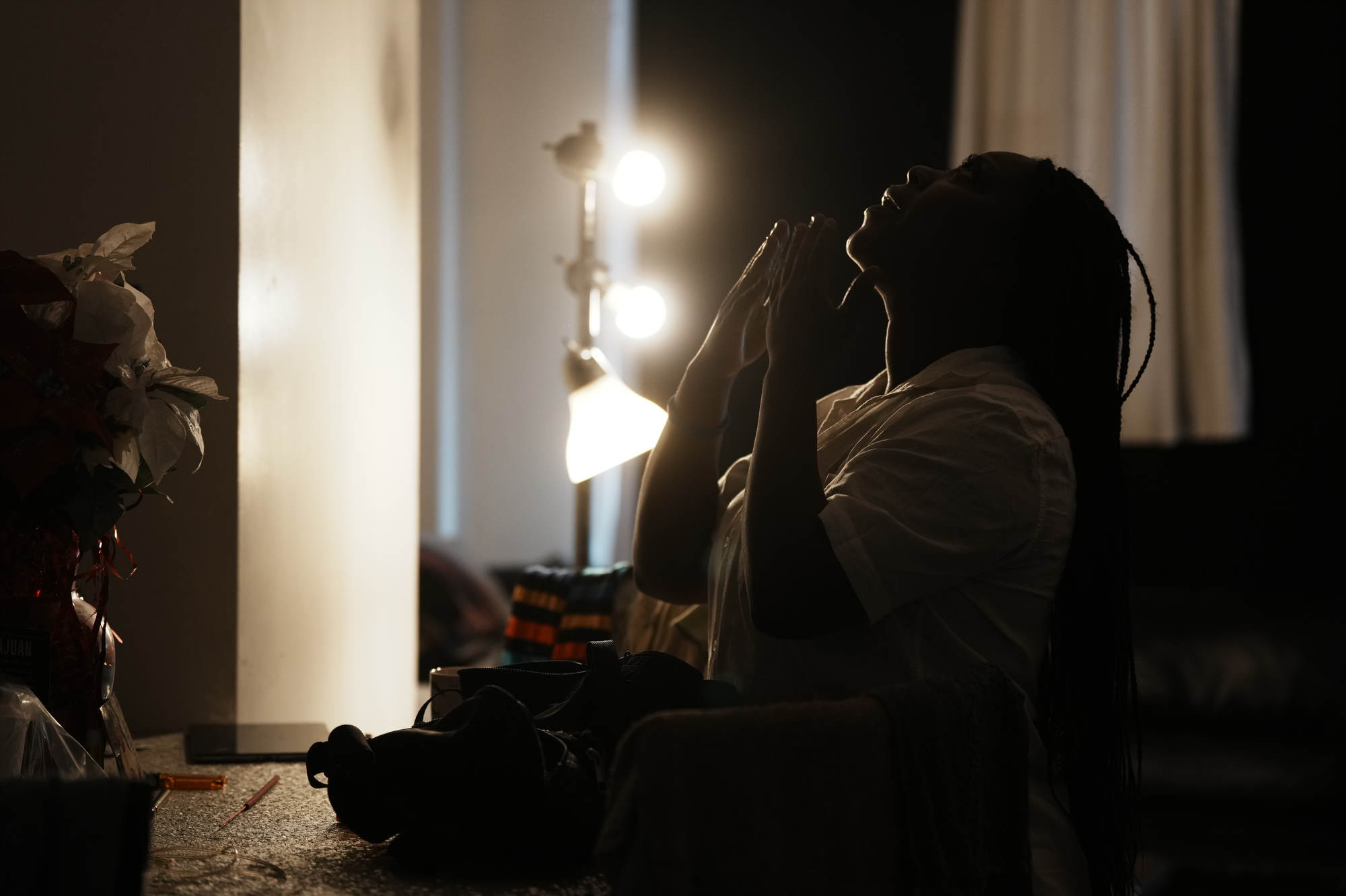
    Unable to sleep, Nyshyia Thomas stepped into the shower at 4 a.m.

    She stood beneath the water longer than usual, feeling its warmth against her face and running down her skin, hoping it would carry her tears with it.

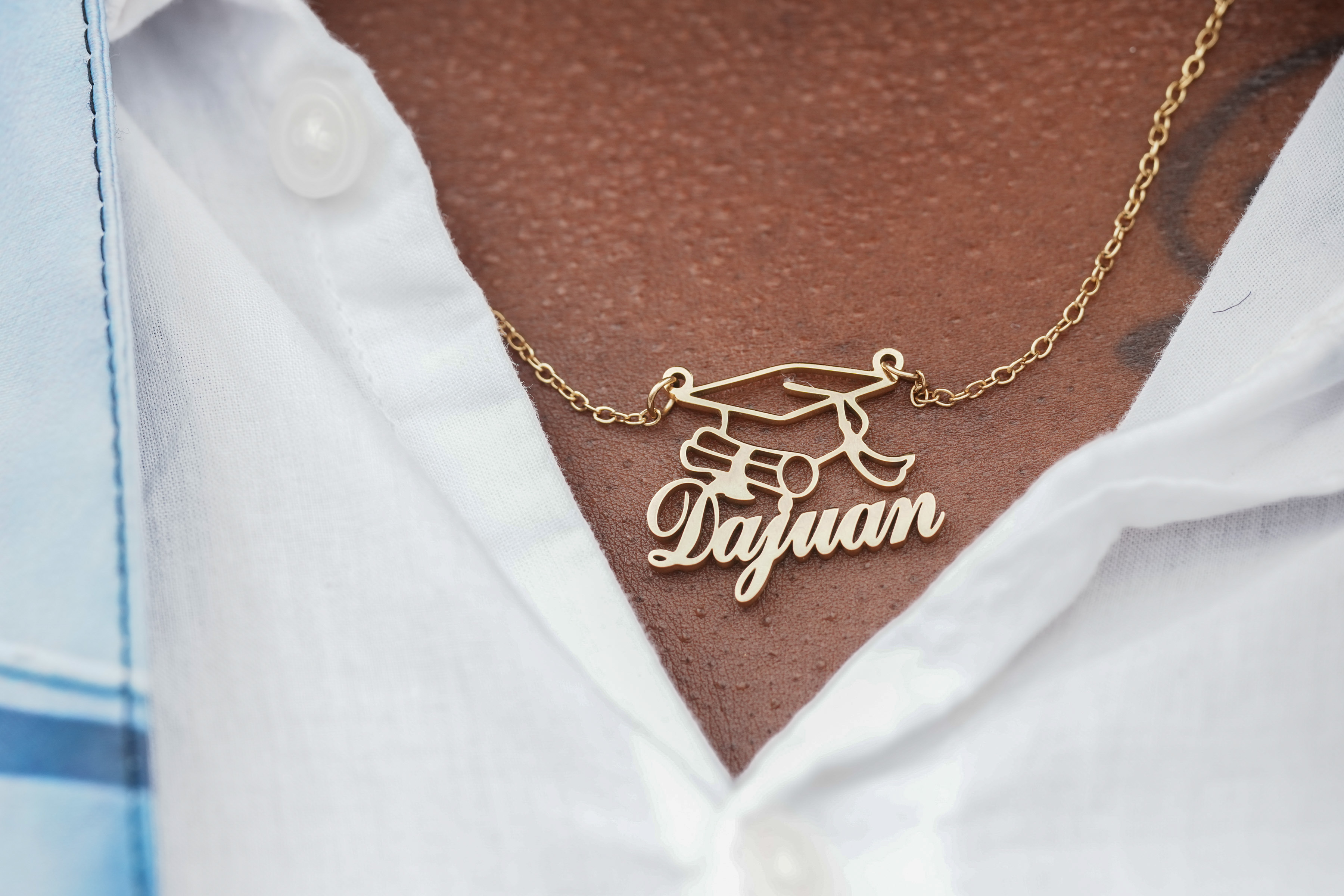
    It was graduation day. A day she’d been waiting for since 2022, when her youngest son, DaJuan, started his freshman year at Jules E. Mastbaum High, where she had graduated years earlier, and where her eldest child had graduated as well.

    Nyshyia Thomas gets ready to attend the Jules E. Mastbaum High School graduation, where her son DaJuan Brown was honored and would have graduated.Jessica Griffin / Staff Photographer

    DaJuan was supposed to graduate on this day.

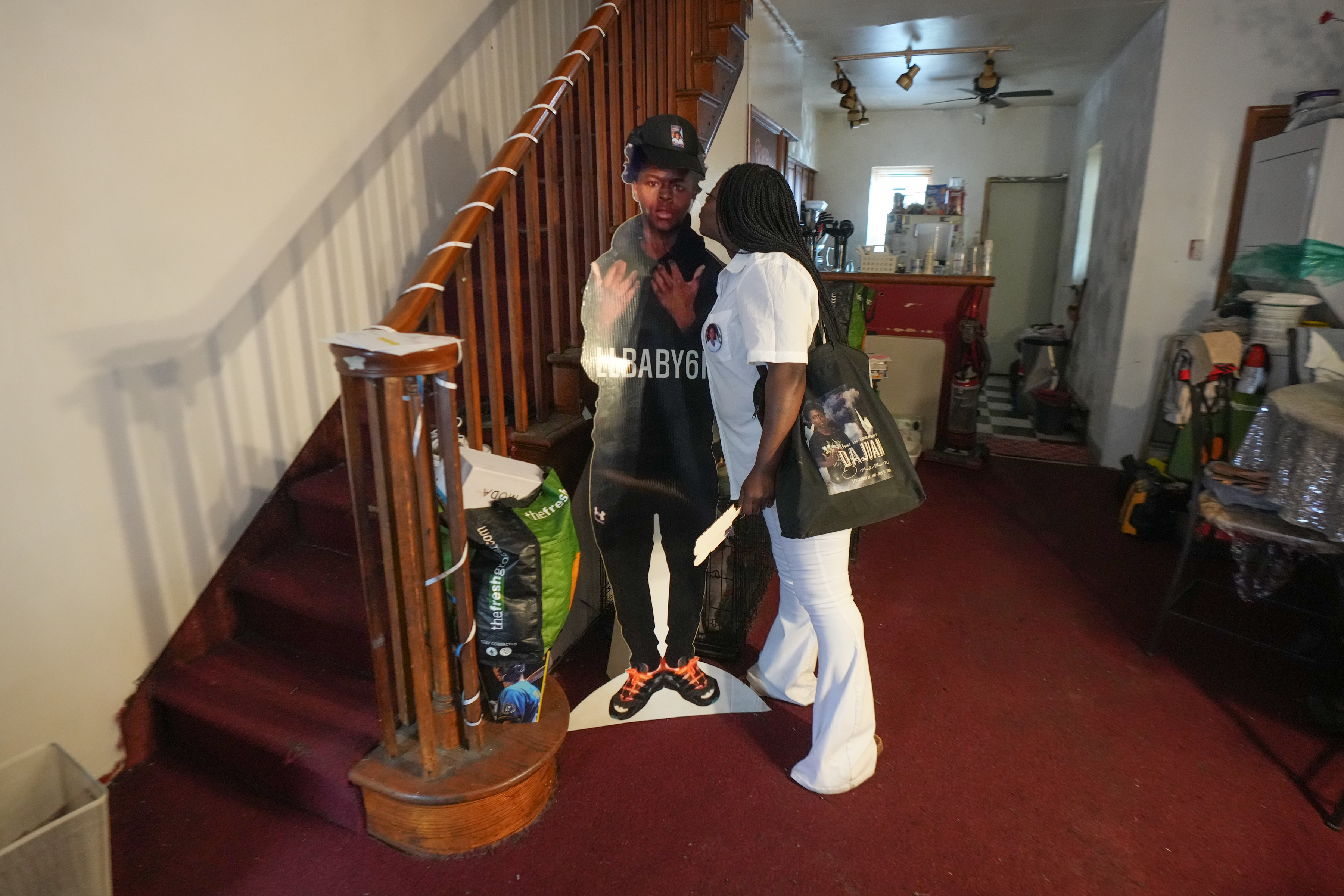
    She stood at the base of her stairs, wrapped in a purple silk robe, and stared at the life-size cardboard cutout picture of him in her living room, her cheeks quivering through a smile.

    DaJuan Brown was only 15 when he was one of five people shot and killed by a mentally ill man dressed in body armor who gunned people down at random on the streets of Kingsessing in July 2023.

    He had just completed his freshman year at Mastbaum.

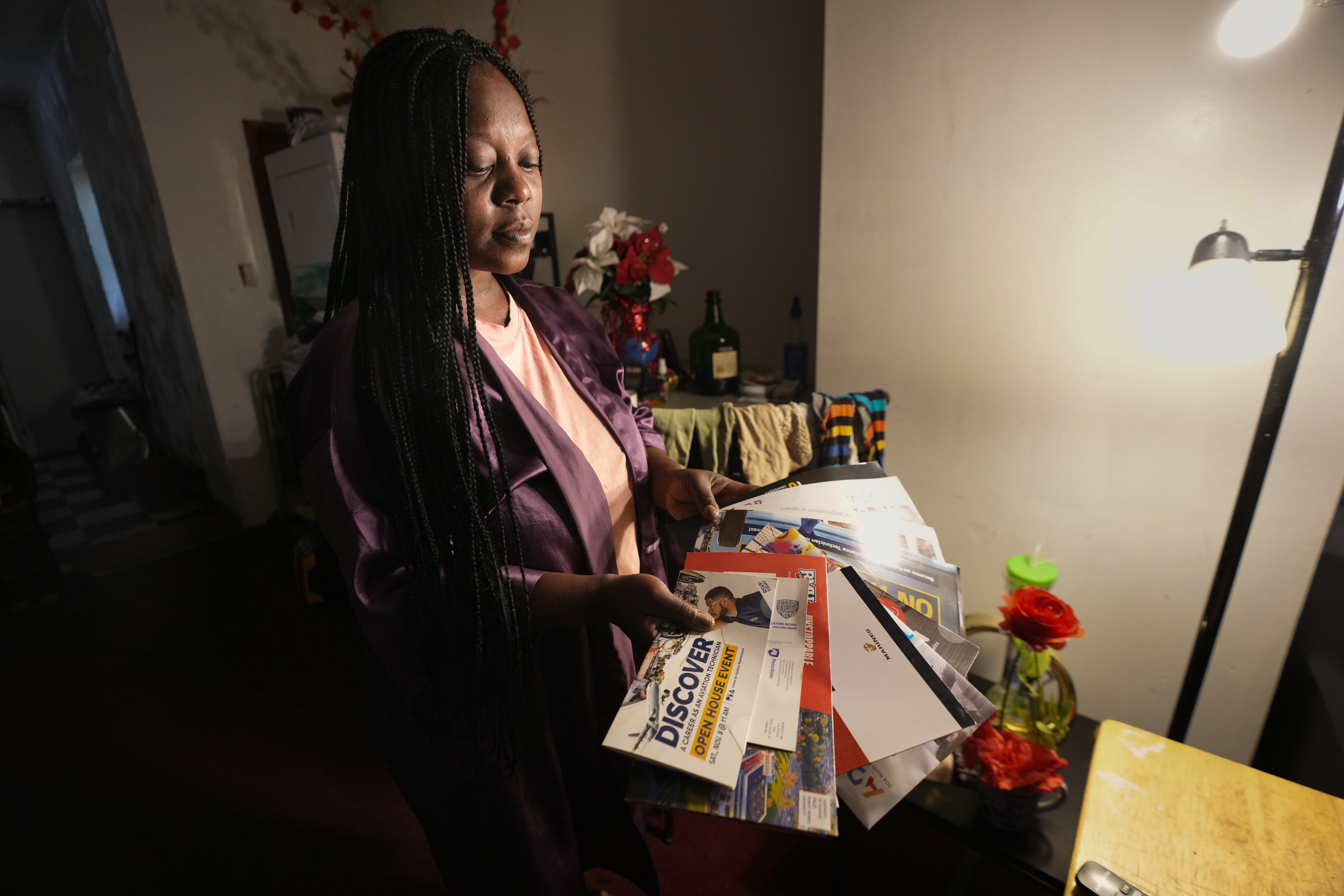
    Now, three years later, college brochures regularly arrived in the mail, addressed to him.

    Mail from different colleges has often arrived addressed to Nyshyia Thomas’ son, DaJuan. Jessica Griffin / Staff Photographer

    Penn State. Indiana University of Pennsylvania. The Marines. Towson. Aviation school.

    Each one like an arrow through his mother’s heart.

    But now she had something to look forward to. Mastbaum was honoring DaJuan at its graduation ceremony Wednesday with a posthumous diploma.

    “You did it, Juan Juan,” she told the cutout. “I’m so proud of you.”

    She kissed his cheek and walked upstairs to get ready.

    Thomas, 37, plumped her skin with Vaseline, dabbed her lips with coconut oil gloss, and carefully applied fluttering eyelashes with waterproof glue.

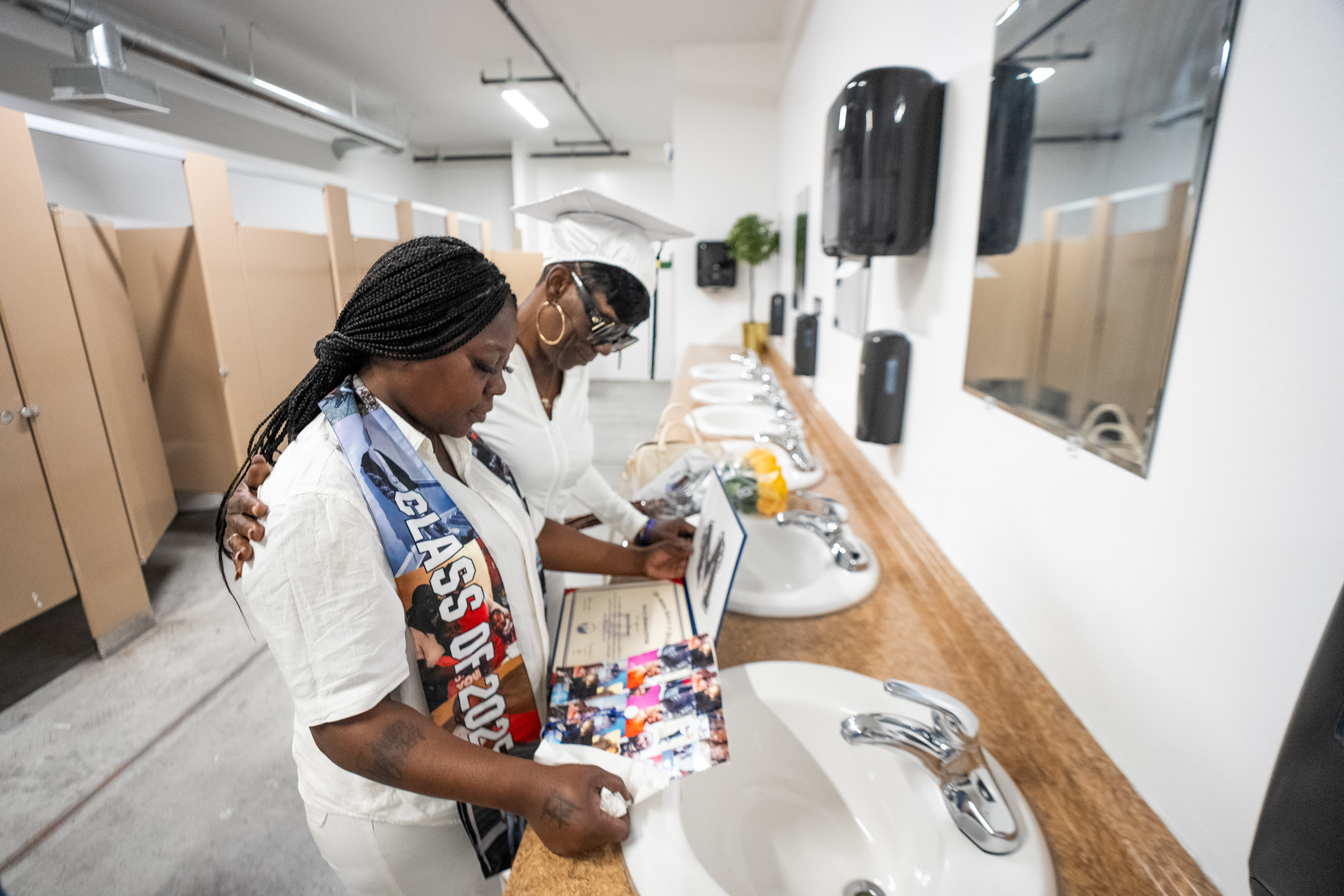
    Then she dressed, all in white — the color of angels, of the doves they released at DaJuan’s funeral.

    Nyshyia Thomas at the Mastbaum High School graduation, where her son Dajuan Brown was honored and would have graduated Wednesday. Jessica Griffin / Staff Photographer

    Around 9 a.m., her eldest son, DaQuan Brown, called from jail, his morning voice slow and gravelly.

    He has been incarcerated since August after police said he was among at least 15 people who fired guns aimlessly down the 1500 block of Etting Street during a block party last July, leaving three dead and 10 others wounded. Defense lawyers have said Brown, 22, and other partygoers thought they were being shot at and were defending themselves when they opened fire and unintentionally shot one another.

    Prosecutors say that there was no one targeting the party, and that a loud “pop” triggered contagious gunfire. Anyone who fired a gun that night, officials said, is responsible for the carnage.

    So Brown is in custody, held without bail, facing three counts of murder, 10 counts of attempted murder, and related crimes.

    The father of her children was locked up, too. Police said that when they reviewed surveillance footage from that night on Etting Street, it showed TyeJuan Brown, 38, running down the block toward his son and the gunfire, holding a firearm, which he is barred from owning because of criminal convictions.

    He was charged with illegal gun possession and had been held on $250,000 bail since August.

    Nyshyia Thomas prayed for strength before attending what would have been her son’s high school graduation.Jessica Griffin / Staff Photographer

    Thomas hadn’t heard from him in a few days. She suspected his cellblock was on lockdown again.

    She often wonders: How is this my life?

    One son killed in a mass shooting, another charged with committing one, and their father in jail.

    On this morning, at least, DaQuan called.

    “Stay strong today,” he told her.

    “Love you,” she said. “Call me when it’s over, like 2 o’clock.”

    Nyshyia Thomas kisses the life-size cardboard cutout picture of her son DaJuan Brown before leaving for what should have been his high school graduation ceremony.Jessica Griffin / Staff Photographer

    Her nerves worsened as she, her daughter, and her mother-in-law arrived at the South Philadelphia venue. They were 15 minutes late. And where were her sisters?

    “I told y’all hurry up!” she said into the phone.

    Just wait, they told her. We’re almost there.

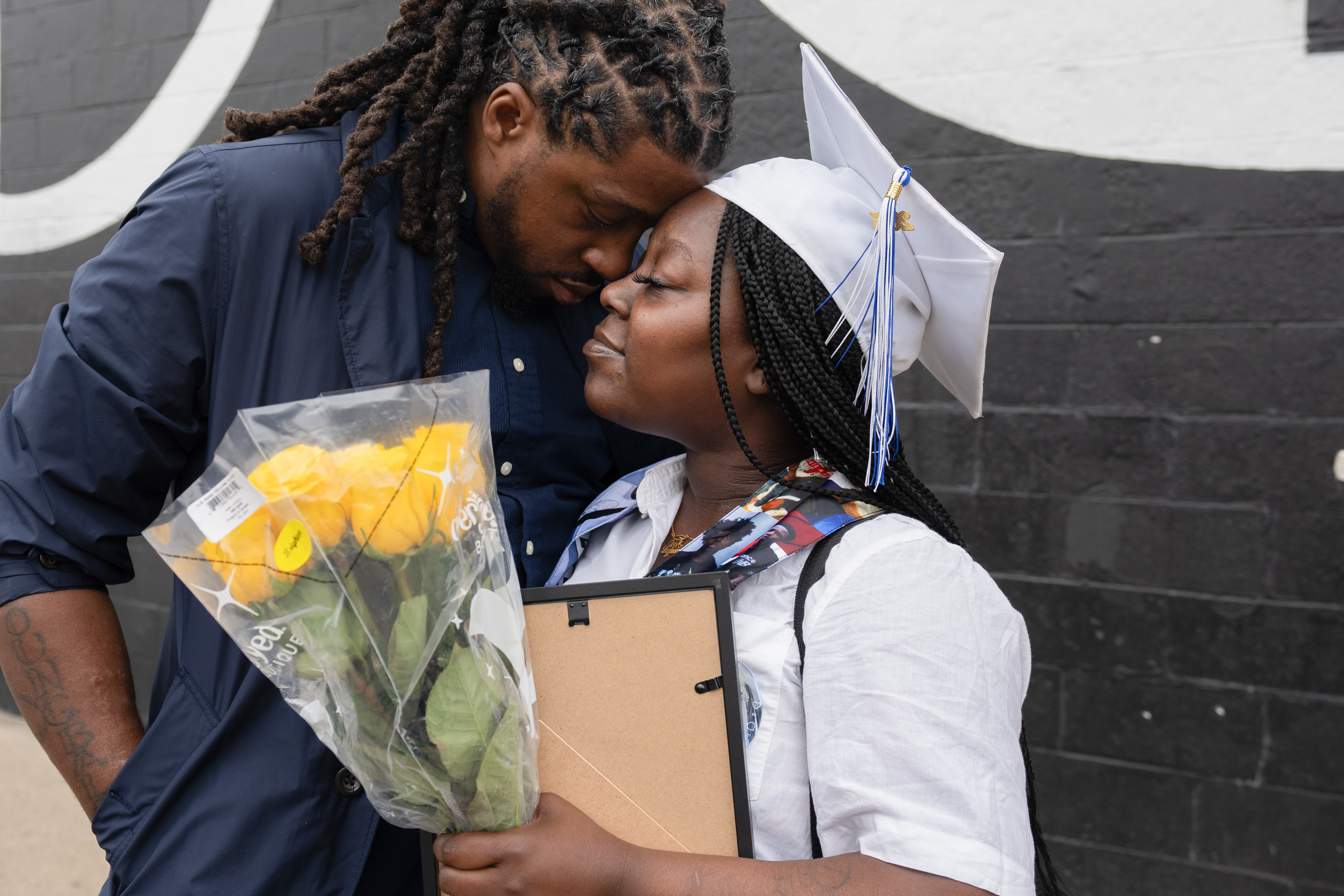
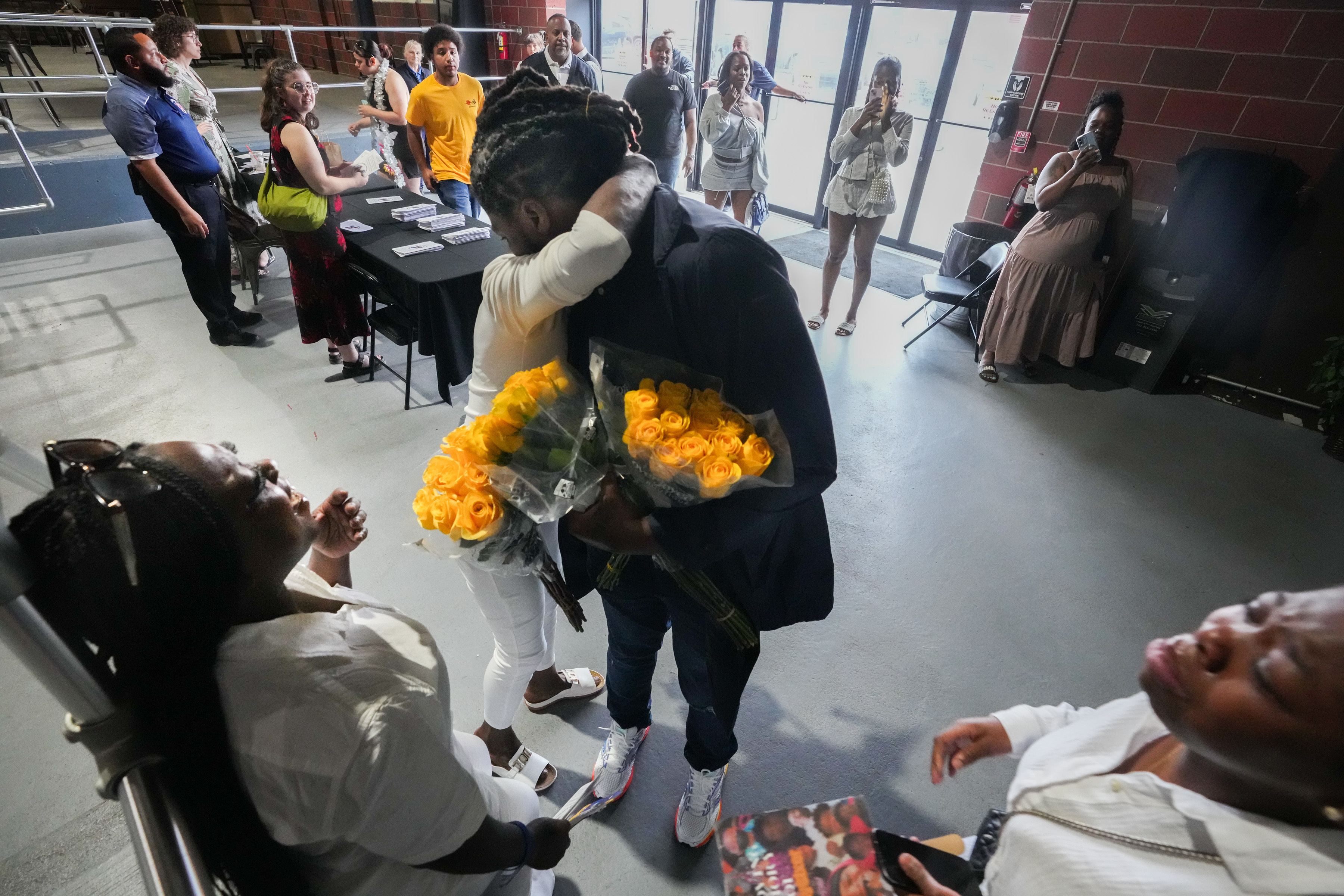
    She paced the hall, deciding whether to take a seat without them, when she saw TyeJuan Brown walk through the door carrying three bouquets of yellow roses.

    She ran into his arms and buried her head in his chest. Their daughter, NeSiyah, 15, turned away in tears, then dived into his arms. Their three faces nuzzled together at last.

    TyeJuan Brown had been jailed since August, when police said he was seen on video with a gun, rushing toward the sounds of gunfire the night of the July 2025 mass shooting. After his bail was lowered, he surprised his family, including his daughter and the mother of his children, at what would have been his son’s high school graduation.Jessica Griffin / Staff Photographer

    “How?” Thomas cried.

    His bail was lowered last week, he said, so his sister posted the $250 necessary for his release and started planning the surprise.

    She couldn’t stop touching his face. His cheeks were fuller, his skin was healthier. But his eyes, those rich mahogany ones she had loved since she was 12, were filled with relief. She kissed him deeply.

    “All right, all right,” said his sister, Shikema. “We’re going to miss the graduation!”

    Nyshyia Thomas, left, and TyeJuan Brown, reunite at what would have been their son DaJuan’s graduation day. They met when they were 12, and share three children.Jessica Griffin / Staff Photographer

    Thomas could not stop giggling as she took her seat beside the broad-shouldered man she had known more than half her life and missed every day for 10 months.

    Their relationship had its trials, and he had been jailed years ago for drug and gun charges. But with their eldest son now fighting a murder case, Thomas and her daughter needed him more than ever.

    She interlaced her fingers through his, and leaned into his shoulder. NeSiyah kept glancing over at her father, as if to make sure he was still there.

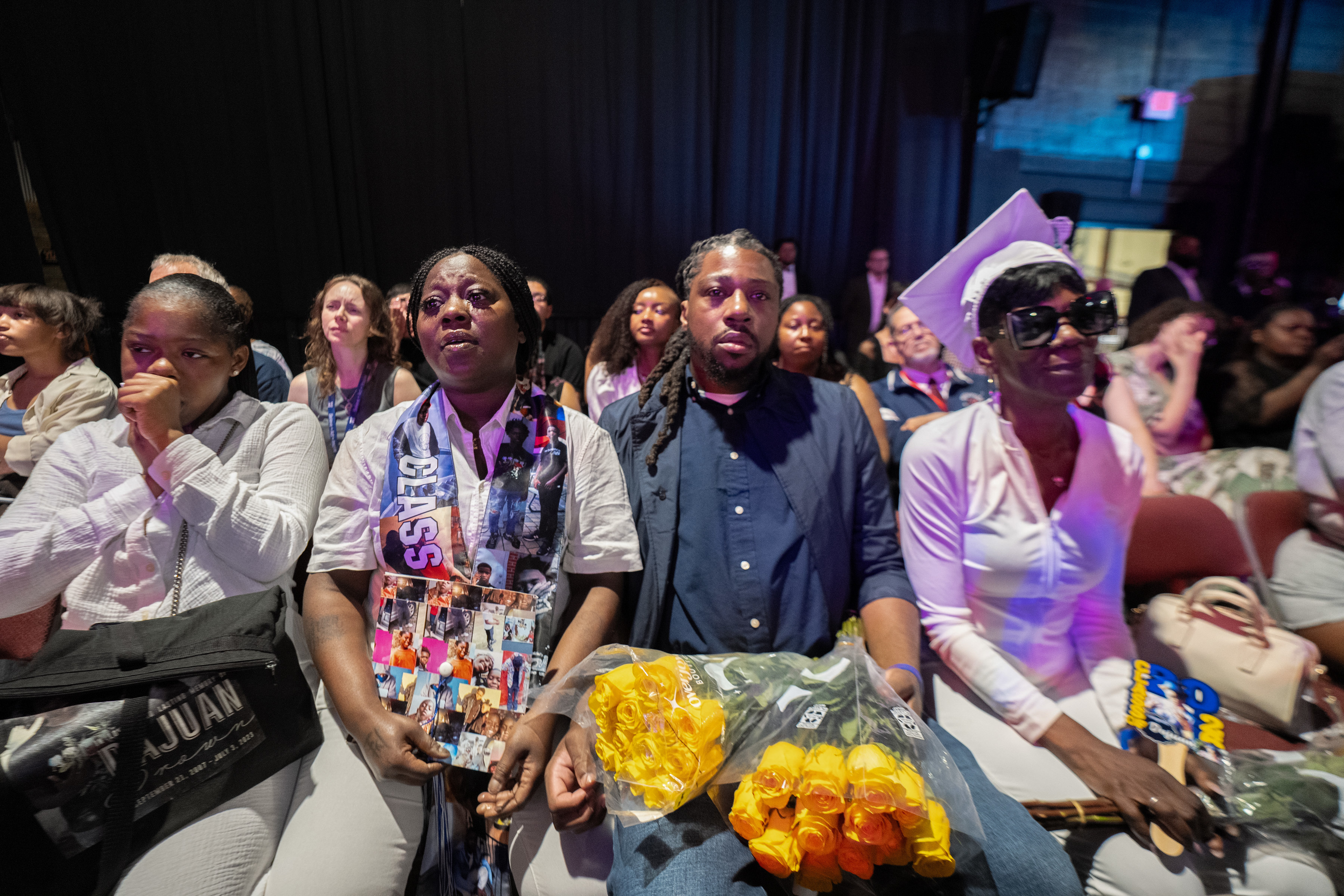
    But as the ceremony progressed, each moment of celebration wore on them. Their smiles faded. When the students from each vocational program stood to applause, Thomas pinched her eyes shut.

    NeSiyah Thomas-Brown, Nyshyia Thomas, TyeJuan Brown, and Odessa Brown (left to right) experience a range of emotions during the graduation ceremony.Jessica Griffin / Staff Photographer

    What would DaJuan have chosen? she wondered. Culinary or carpentry? Maybe film and video?

    Name after name was called. Past the B’s, where DaJuan would have been mentioned.

    Thomas clapped. NeSiyah sucked her thumb.

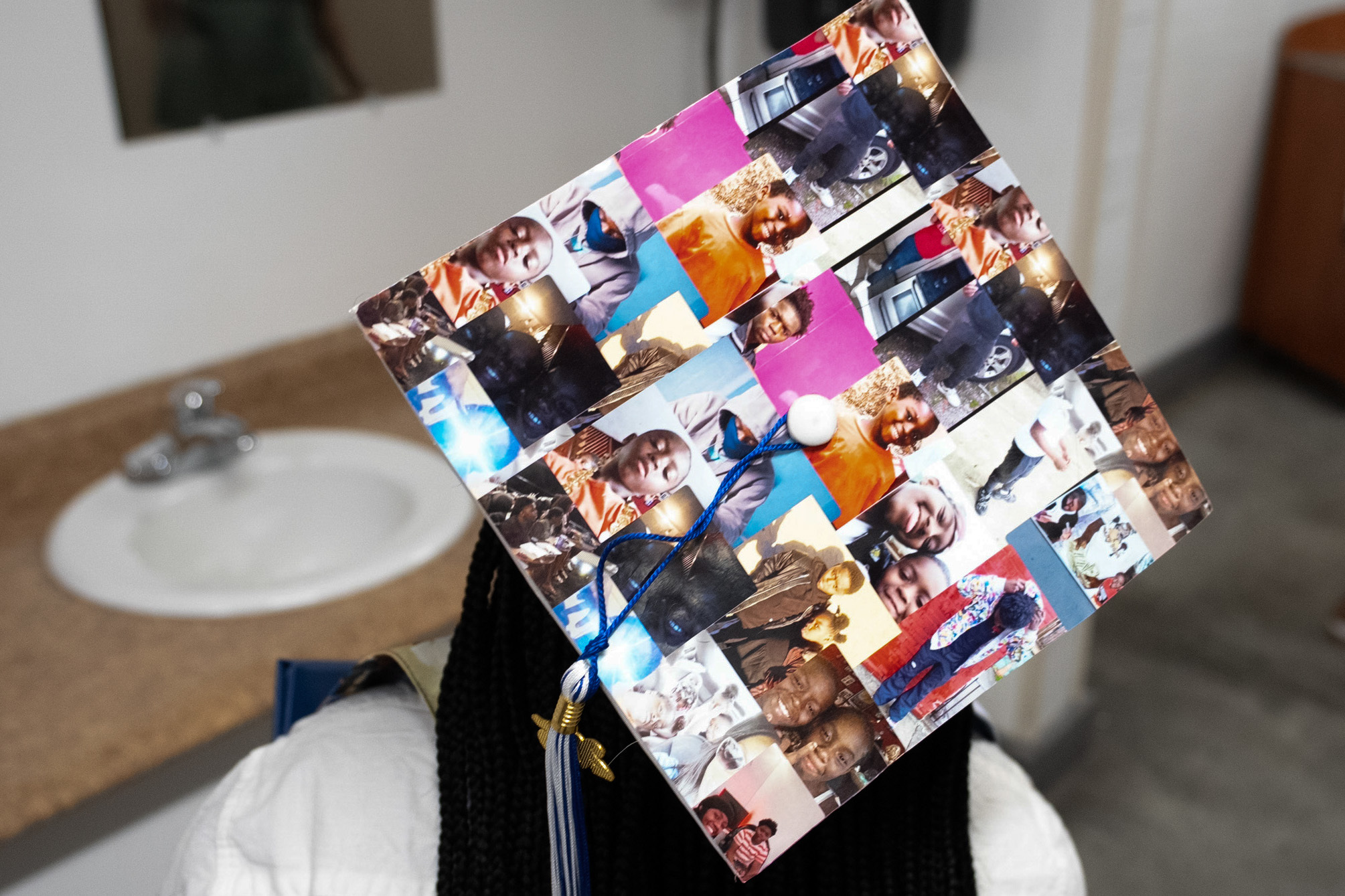
    How would he have decorated his cap?

    As the final students picked up their diplomas and the cheers waned, a quiet fell over the auditorium. It was time for the school to honor DaJuan.

    Just at the sound of his name, Thomas’ eyes welled and she looked toward the ceiling.

    Nyshyia Thomas, left, and Odessa Brown, right, at the Mastbaum High School graduation, where Thomas’ son and Odessa Brown’s grandson Dajuan Brown would have graduated.Jessica Griffin / Staff Photographer
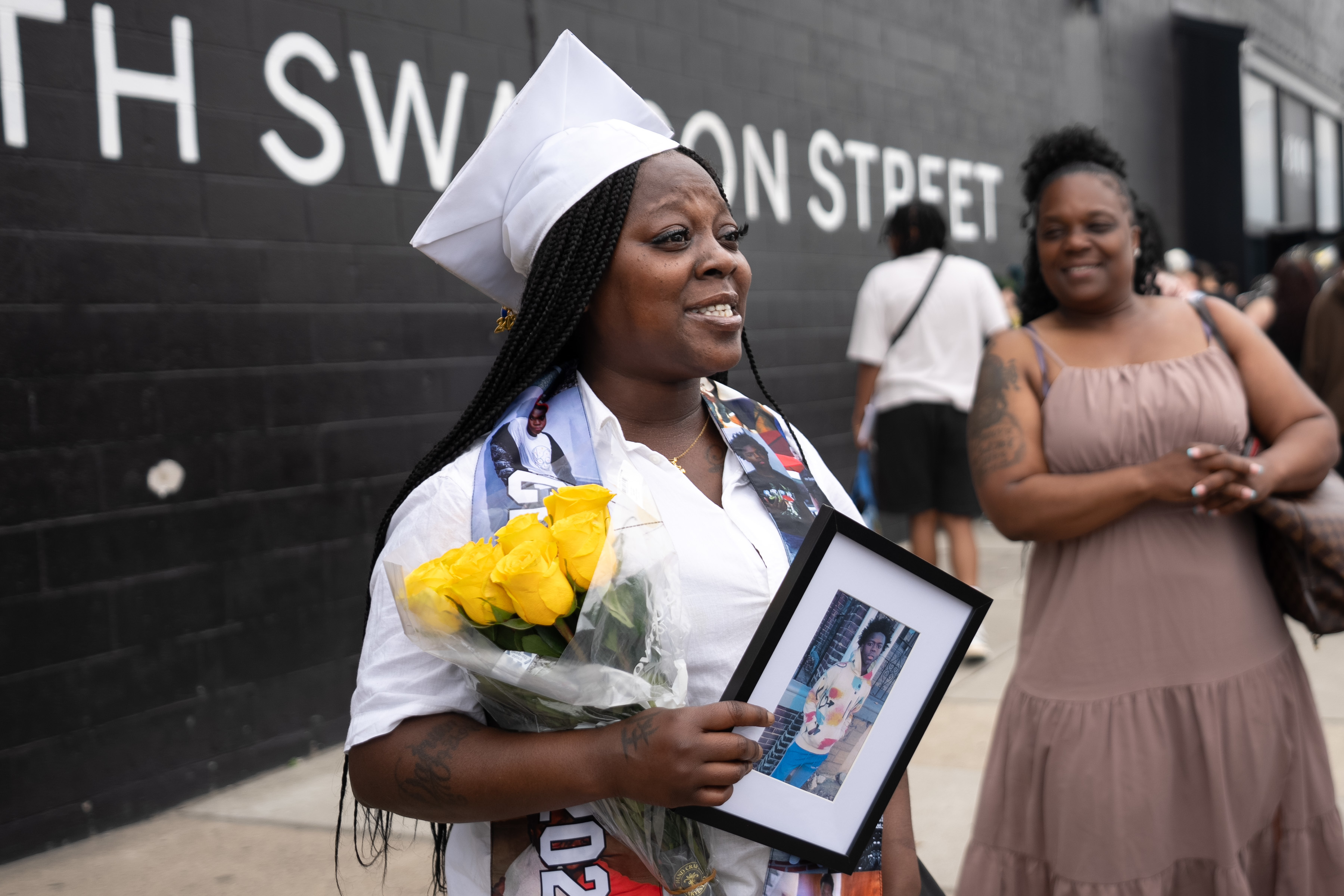
    Nyshyia Thomas wore a graduation cap she decorated with photos of her son DaJuan. Jessica Griffin / Staff Photographer

    “It’s hard to find the right words to say goodbye to someone who had so much life to live,” assistant principal Amy Georgia Foster told the crowd. “He had a beautiful, silly streak in him, the kind of sweet, mischievous energy that made you feel the protective love of a grandparent.”

    That’s my Juan Juan, Thomas thought.

    “DaJuan undoubtedly left his mark on each one of us,” Foster said. “He brought warmth to our halls, and light to our lives.”

    Thomas walked toward the stage, her face streaked with tears, her chest heaving. She embraced Foster and the teaching staff, and in her arms they placed a glass box frame, holding a red Class of 2026 stole, and his cap and gown. She pressed his diploma to her heart.

    Principal David Lon, left, and the staff at Mastbaum High hand Nyshyia Thomas, center, and Odessa Brown, right, DaJuan’s stole, cap and gown, and diploma.Jessica Griffin / Staff Photographer
    DaJuan Brown, 15, was killed in the Kingsessing mass shooting in July 2023. Jessica Griffin / Staff Photographer

    The ceremony continued with final words from the class president, before all the students moved their tassels from left to right.

    “Congratulations, Class of 2026!” their principal cheered.

    Thomas and her family moved through the crowd toward the door. Beaming teens snapped selfies. Overjoyed mothers embraced their children.

    She held hers in a picture frame.

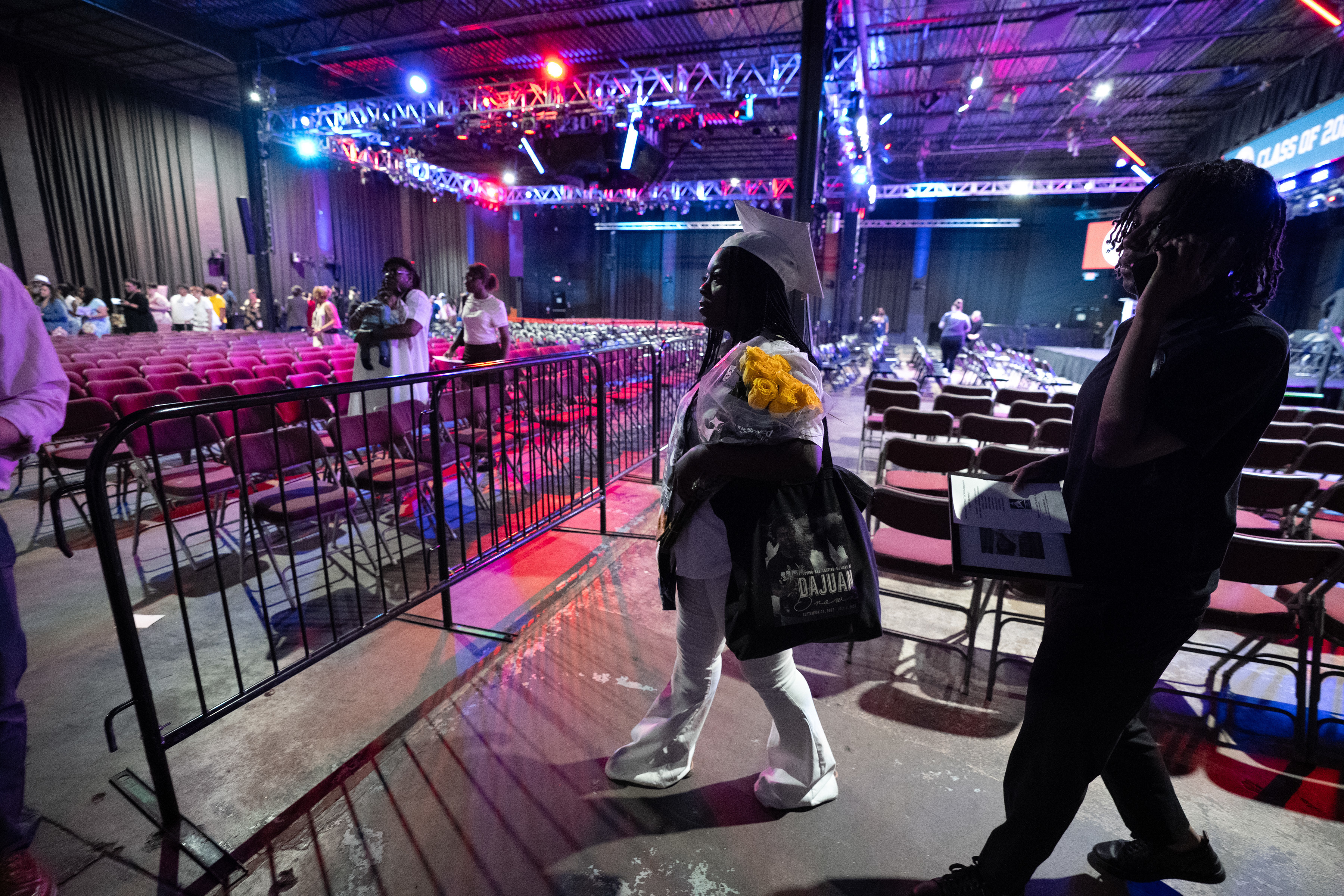
    Nyshyia Thomas walks through the auditorium after her son was honored.Jessica Griffin / Staff Photographer
  • A Chester County cop made an illegal recording of the school board he served on. He lost both jobs.

    A Chester County cop made an illegal recording of the school board he served on. He lost both jobs.

    For nearly 30 years, Anthony Falgiatore Sr. served his community in Chester County in two roles: as an East Whiteland Township police sergeant and a member of the Octorara Area Board of School Directors.

    But Falgiatore lost both of those positions, resigning after Pennsylvania State Police charged him in January with illegally recording a closed executive session of the school board, a felony offense.

    Last month, Falgiatore, 57, of Atglen, enrolled in an advanced rehabilitative disposition program for first-time offenders that will see his charges dismissed and expunged upon completion.

    In a statement, Falgiatore’s attorney, Vince DiFabio, said neither he nor his client wished to comment on the case.

    Members of the school board that served with Falgiatore before he resigned after a decade said they were frustrated that someone who swore to uphold the law would violate it so blatantly.

    Brian Fox, who served as the board’s president when the 32-minute recording was made, said Falgiatore’s actions were a “betrayal of trust.”

    “The thing that made it egregious was his role as a police officer,” Fox said in an interview. “These meetings are closed for a reason. We vote publicly, but we need to meet beforehand to discuss sensitive topics like personnel and legal matters.”

    Fox said the April 17, 2023, executive session Falgiatore recorded was one in which they discussed a federal civil-rights lawsuit filed by John Ryan Miller, a local activist. Falgiatore, according to Fox, argued that the Octorara Area School District should not be paying the legal expenses for board members named in the lawsuit.

    Anthony Falgiatore Sr. (center, in blue shirt), seen here in January 2020 with other board members, served on the Octorara Area School Board from 2015 until his resignation last year.Handout

    Miller filed the suit against nearly 80 public officials in the county, including all of the Octorara Area school board except Falgiatore, asserting that his constitutional rights were violated when he was barred from speaking at a public meeting in 2022 and later arrested for trespassing when trying to speak at another meeting.

    U.S. District Judge Karen S. Marston dismissed Miller’s suit in March 2024, court records show, saying he had failed to demonstrate that his First Amendment rights were violated by the school board.

    A week after he recorded the meeting, Falgiatore wrote in a post on his public Facebook page that he opposed paying legal bills related to Miller’s lawsuit because it “is a private legal matter against the balance of the board members and other district staff in their private person capacity.”

    “I am the only board member not named in the lawsuit because I honored my oath of office to protect and defend the US Constitution and the Pa State Constitution and persons rights,” he wrote. “The board denied a citizen the right to speak for 3 minutes during the public comments portion of a board meeting because the citizen would not follow a policy that requires a speaker to identify who they are.”

    He said the board’s policy “does not supersede the constitution” and said the issue was one he was fighting on behalf of the constituents who elected him.

    It was unclear how much Miller’s lawsuit cost the school board.

    Falgiatore was elected to the Octorara Area school board in 2015, and served on it until his resignation in March 2025, days after state police began investigating the recording.

    In a letter sent to the board, Falgiatore said he was resigning “so as not to be a distraction to the business of the board.”

    Falgiatore’s career with East Whiteland Township police started in 1997, according to an article published in the West Chester Daily Local.

    East Whiteland Township Police Chief G. Christian Yeager confirmed to a reporter that Falgiatore is no longer employed by the department but declined to comment further.

    What motivated Falgiatore to make the illegal recording of the Octorara Area school board’s executive session remained unclear.

    Investigators wrote in the affidavit of probable cause for Falgiatore’s arrest that an East Whiteland Township lieutenant discovered the audio file on his department-issued cell phone in March 2025. Falgiatore had named the file “OSB private meeting.”

    Investigators did not say what prompted the East Whiteland lieutenant to search Falgiatore’s phone.

    State police troopers played the recording for school board members, including Fox, who confirmed that it was made without their knowledge, the affidavit said.

    Investigators also found Falgiatore exchanged texts with someone in December 2024, months after making the illegal recording.

    The person, whom police did not name in court filings, instructed Falgliatore to make another recording like he did with the “Curtis blowup,” an apparent reference to the April 2024 executive session, which included then-Octorara Area School District business manager Jeff Curtis, the affidavit said.

    (In an interview with state police, Curtis listened to the recording and said he recognized it as being a meeting at which he had “blown up” at Falgliatore, according to the affidavit.)

    Two months after making the recording, in an interview with the Lancaster Patriot, a conservative news website, Falgiatore said he was the victim of a harassment campaign because of his support of Miller. He told the site that someone had sent anonymous, threatening letters to his home and began contacting the East Whiteland Township police after he “spoke up on behalf of Miller.”

    Falgiatore and Miller were also interviewed together on an October 2023 episode of Lancaster Patriot’s podcast that discussed Miller’s lawsuit against the district.

    Despite his stated support, Falgliatore said he was not part of the lawsuit — he was not named as a plaintiff — and was supporting Miller because he believed his rights were violated.

  • Penn president announces he will leave his job next summer

    Penn president announces he will leave his job next summer

    University of Pennsylvania President J. Larry Jameson will conclude his presidency next June, he announced in an email to the Penn community Friday.

    “Although I greatly enjoyed serving as president, now is the right time for Penn to begin its next chapter under new leadership,” Jameson said in the email. “My goal was to help restore stability during unanticipated leadership transitions, refocus our community on Penn’s mission, and strengthen Penn for the future during a challenging time for higher education.”

    Those goals have been accomplished, he said.

    There was much speculation about whether Jameson — an endocrinologist who previously led Penn’s health system and medical school for more than 12 years — wanted or would be asked to remain in the seat beyond next year’s expiration of his current contract. Many have credited Jameson with steadying the school during a turbulent time, including as the school faced funding threats and increased scrutiny by President Donald Trump’s administration.

    His departure will leave the Ivy League school searching for a new leader during a time of uncertainty under Trump, who has targeted elite universities.

    Board chair Ramanan Raghavendran said he respected Jameson’s decision and the board will begin searching for the school’s next president in the fall.

    Jameson, 71, will have served in the top job at Penn just three-and-a-half years, one of its shorter presidential tenures. But he came into the job by circumstance rather than desire.

    Jameson took over in December 2023 during perhaps one of Penn’s greatest leadership upheavals. Former President Liz Magill had just resigned amid a bipartisan backlash over her testimony involving the school’s response to antisemitism complaints. He first was named interim president and then was elevated to the permanent post in March 2025.

    Jameson earned total compensation of more than $8 million in 2024, the most recent tax year available. That included $5.4 million in “reportable compensation” and more than $2.5 million in other compensation.

    “Dr. Jameson stepped in at a pivotal moment, and what he has accomplished in two-and-a-half years has been simply extraordinary,” Raghavendran said in a statement.

    Neither Raghavedran nor Jameson were available for interviews Friday, the university said.

    In his message, Jameson said “the momentum we have built will continue,” noting his intention to work over the next year on implementing the Penn Forward plan. The plan calls for everything from more transparent and predictable tuition and cost policies and improved student experience to more efficient operations, a focus on keeping Penn at the forefront of best uses of artificial intelligence, and a growing presence in the San Francisco Bay Area — where Wharton already has a campus.

    Penn also has some tough decisions ahead in his final year. During the spring semester, the school proposed new open expression guidelines that some on campus say are too restrictive and would chill free speech. The university is considering the feedback and plans to issue final guidelines next academic year.

    The university also is undergoing belt-tightening in anticipation of potential federal cuts and increased legal and insurance costs. Penn in January asked schools and centers to pare 4% from their budgets for the next fiscal year, on top of a 5% cut last year.

    Penn’s Graduate School of Education laid off several staff members last week as part of those cuts, according to The Daily Pennsylvanian, the student newspaper.

    Many at Penn speak highly of Jameson’s leadership, though some wish he had made a stronger defense against some Trump demands.

    “Even if this were a good time to search for a new president — and it decidedly is not — I cannot imagine Penn finding a more effective leader,“ Eric Feldman, faculty senate tri-chair and a law school professor, said last month. ”His deep knowledge of the medical school is a significant asset amid continuing pressures on federally funded research, and his extensive leadership experience, spanning decades, makes him uniquely well suited to guide the university through what are likely to be several more complex years.”

    During an interview with The Inquirer last month, Jameson explained his decision to resist the Trump administration on some things and negotiate on others.

    “My approach has been not just to complain,” Jameson said during his first interview as Penn’s president with a major media outlet, “but to say, ‘Well, here’s where we’re working together very effectively. Here’s where we’re not necessarily aligned, but let’s discuss how to move forward.’”

    Jameson was at the helm when Penn last summer struck an agreement with the White House over the prior participation of transgender swimmer Lia Thomas on the school’s swim team. The school agreed to adhere to the Trump administration’s definitions of sex, female, male, women, and men in regard to athletics, and send letters of apology to female athletes who felt aggrieved by Thomas’ participation on their team during the 2021-22 season.

    But he also was at the helm when Penn rejected a compact that would have given it preferential treatment for federal funding if it agreed to the Trump administration’s operational demands. The school also is actively fighting a demand by the Equal Employment Opportunity Commission to turn over lists of Jewish people on its campus for its investigation into alleged antisemitism at Penn. The agency sued Penn for not complying with its subpoena and a federal judge sided with the EEOC, but Penn is appealing the decision.

    Jameson said he gained new perspective in the presidential role, which “allowed me to learn each day from the people, ideas and achievements that define this university and its extraordinary breadth. …While my career has been in academic medicine, it has been illuminating to reacquaint myself with other fields, from poetry to political science, from finance to fine arts.”

    He said the university is on a positive trajectory.

    “Penn has tremendous momentum and is exceptionally well positioned for the future,” Jameson wrote.

  • Acquitted of double murder as a teen, he now faces new charges in a West Philly shooting that left two dead

    Acquitted of double murder as a teen, he now faces new charges in a West Philly shooting that left two dead

    Andre Bowie was just 17 when he was arrested and charged with killing two men in West Philadelphia in the fall of 2020.

    But a jury acquitted him of those crimes, and he walked free in May 2023.

    Three years later, Bowie, now 22, is back in jail — again accused of killing two people.

    Police said Bowie and several others drove to 60th and Delancey Streets on the night of March 30, and opened fire on a group of people standing outside a corner bar, wounding three and killing Paul “PJ” Cobb and Naasir Boyd, both 24.

    More than a dozen shots were fired from three different 9mm handguns, police said. In the hours after the shooting, police found the Mercedes on fire on the 1200 block of Cumberland Street.

    Another man, Marquis Andrews, is also expected to be charged, police said. Andrews, 22, has been in custody since April after he was charged with illegally carrying a loaded gun, court records show.

    Paul “PJ” Cobb, 24, was shot and killed near 60th and Delancey Streets on March 30. Cobb was the eldest son in his large, blended family, and was born and raised in West Philly.Courtesy of the Cobb family

    The deaths of Cobb and Boyd, childhood friends born and raised in the neighborhood, came amid what law enforcement officials described as an escalating feud between the crews “Northside” and “Southside” in West Philadelphia — groups that have warred across the Market Street corridor for more than a decade.

    Cobb’s and Boyd’s killings not only devastated their families, but police said the shooting likely led to another. The week after they were killed, police said, four Southside affiliates seeking revenge opened fire on a Northside rival standing outside a corner store at 60th and Market Streets.

    Instead, the bullets struck and killed 20-year-old Imani Ringgold, who was walking with a slice of pizza and talking to her grandmother on the phone — and who had nothing to do with the feud.

    Photos of Imani Ringgold are laid out on the table at her grandmother’s home. Jessica Griffin / Staff Photographer

    One detective, at a recent court hearing, testified that at least 30 people have been killed in connection with the groups’ conflicts since 2015 — a beef that has festered for so long that many people at the center don’t even know how it started.

    Bowie’s cases

    Prosecutors previously said the first two killings Bowie was charged with — and later acquitted of — were also tied to the Northside-Southside feud.

    In that case, lifelong friends Jarell Jackson and Shahjahan McCaskill, both 26, were driving near 57th Street and Locust Avenue when three gunmen jumped out of a black SUV and fired more than two dozen bullets into their car, killing them, in October 2020.

    Jarrell Jackson, left, and Shahjahan McCaskill were killed in a case of mistaken identity in West Philadelphia in October 2020.Family photos

    Investigators at the time said they believed the gunmen were Northside members who shot up the car in a botched retaliation for an earlier homicide.

    Chesley Lightsey, then-homicide chief at the district attorney’s office, said Jackson, a Jefferson Health technician who mentored troubled teens, and McCaskill, who was a cancer survivor and small-business owner, had nothing to do with that conflict. The men, she said, “were targeted because of the neighborhood they live in.”

    Bowie was among three teens charged. But at the May 2023 trial, jurors acquitted him and his co-defendants. (Bowie was convicted of illegal gun possession in the case, and sentenced to 11½ to 23 months in jail, allowing his immediate parole, court records show.)

    Marisa Palmer, a spokesperson for the district attorney’s office, said in an emailed statement that at Bowie’s trial, prosecutors presented witness testimony, and social media, video, and firearm-related evidence that prosecutors “believed established the defendants’ guilt beyond a reasonable doubt.”

    The office respects the jury’s decision, she said. She called the new allegations against Bowie “deeply concerning,” and declined to comment further.

    Bowie was taken into custody last week and charged with two counts of murder, as well as three counts of attempted murder, arson, and related crimes.

    Police and homicide detectives investigate a double homicide at 60th and Delancey Streets on March 30. Jessica Griffin / Staff Photographer

    Investigators tied Bowie to the crime after his cell phone location data placed him near the scene of the shooting, according to the affidavit of probable cause for his arrest. Andrews’ cell data also links him to the crime, the affidavit says, and call detail records and text messages show the two men were in communication in the hours after the killings.

    The records say that police also recovered the murder weapon linked to Bowie. During an April 30 car stop in Kensington, the records say, police encountered Bowie and another man, and officers recovered a 9mm handgun that a ballistics test showed was used in the killings of Boyd and Cobb.

    Court records did not list an attorney for Bowie.

    Families in mourning

    Boyd and Cobb have deep ties to the neighborhood, and were killed just blocks from where they lived.

    Cobb’s mother said in an interview that her son was raised in a house at 60th and Delancey, and that she had countless memories of him playing and riding bikes on the block where he was killed. He was the eldest son of a large, blended family.

    Cobb’s mother and sisters, who asked not to be identified for fear of retaliation, said he was goofy and protective, loyal and independent. He attended Sayre High School, before earning his GED, they said, and worked in construction with his father.

    Paul “PJ” Cobb, 24, loved helping take care of a collection of nieces and nephews. Courtesy of the Cobb family

    But his favorite role, they said, was being an uncle to his many nieces and nephews. He picked several of them up from school and daycare each day, and cared for them as if they were his own until his sisters finished work.

    The sisters said they now tell their kids their favorite “Uncle P” is “in the sky.”

    One older sister said that on a recent flight, her 3-year-old kept staring out the airplane window, looking for him in the clouds.

    “She asked ‘Mom, where’s Uncle P at?’” she said. “And I had to tell her, ‘He’s further in the sky than we are on the plane.’”

    His death, they said, has fractured their lives and ability to feel safe in their neighborhood.

    Cobb’s mother said the conflicts of Northside and Southside have always loomed. Her son was not affiliated with Southside, she said, but having grown up on blocks at the center of the group’s feuds, he was cautious about his whereabouts, and she often worried about him.

    When she first heard police made an arrest, she said, she was relieved. But learning that Bowie had been charged and acquitted before left her uneasy.

    “There are things that happened,” she said, “that could have prevented this.”

  • North Philly coaches feel overlooked by MLB’s decision to not invest in their baseball programs

    North Philly coaches feel overlooked by MLB’s decision to not invest in their baseball programs

    When a panel of baseball representatives discussed how to revive the sport in North Philadelphia at a Temple University event last August, Tyrone Young was the first person in the audience to stand and ask a question.

    “How can we sit at the table that y’all want to put together so we can help make the decisions?” Young, who runs the North Philadelphia Heritage League, asked the panel composed of MLB and Phillies leadership. “Some of the things y’all want to put together, it’s not what we need.”

    Almost a year later, Young and other North Philly baseball coaches have their answer: MLB will pour $5.5 million into a variety of initiatives as part of its All-Star Legacy program benefiting host cities of the annual showcase, but the money won’t be going to the fields or programs they say are in desperate need.

    “When they earmarked this money, we’re not sitting at the table to say where we want the money used at,” Young said in a recent interview. “It’s really a slap in the face.”

    Instead, MLB is renovating Ashburn Field in FDR Park, a city field managed and maintained by the Phillies that hosts a variety of youth baseball programs.

    “Ashburn Field was originally built in 1998 using funds generated from the 1996 All-Star Game in Philadelphia,” said Jon Joaquin, the Phillies’ director of youth baseball and softball development programs. “For nearly 30 years, it has served area youth and remains an extremely popular field, hosting approximately 125 events each year, including games, practices and programming for local colleges and high schools.

    “This investment will make a meaningful difference for so many young athletes and we’re excited to see the impact it will have across the community.”

    With the All-Star Legacy funds, MLB will also host a PLAY BALL event at Athletic Recreation Center on July 10; invest in renovations of the Shane Victorino Boys & Girls Club in Nicetown, Tree House Books in North Central, and the Veterans Multi-Service Center in Old City; fund statues honoring Negro League players in West Philadelphia; and pour dollars into the Miracle Leagues of Southeastern Pennsylvania, which builds fields for ballplayers with disabilities, and the Pennsylvania Horticultural Society.

    MLB has donated funds to the host of the All-Star Game since 1997. In years past, baseball has invested between $4 million and nearly $7 million in the form of field renovations, funding for veterans, and grants to nonprofits.

    Many recreational fields across the city, especially those in nonwhite areas, are in poor condition. Trash, holes in base paths, and a lack of nearby bathrooms for players are just some of the issues coaches say make it difficult to maintain programming.

    Those difficulties are reflected in the Phillies’ youth baseball program, which primarily operates in the city’s predominantly white, middle-class neighborhoods in the Northeast. The Phillies recently partnered with a neighborhood-led baseball league trying to address the disparity by introducing baseball to young children primarily in North and West Philly.

    MLB is replacing Ashburn’s 135,000-square-foot grass and dirt field with a “high-performance synthetic turf system” and an updated drainage system, according to Tuesday’s announcement. The renovation will benefit teams in the Phillies MLB Urban Youth Academy and Nike RBI All-Star teams as well as high school, college, and community teams who use the space, including the Anderson Monarchs, whose Philadelphia Stars teams play and practice there.

    Amos Huron, the Monarchs’ executive director, said the field renovation at Ashburn is an important first step in closing the gap between the quality of fields in Philly compared to the suburbs and other cities. The field renovation will help bring consistency to the Stars’ practices and play during more times of the year, he added. Thirty percent of scheduled events at Ashburn are canceled each year due to weather, according to the MLB announcement.

    But Huron also understands where coaches upset with the decision to not renovate their fields are coming from, he said, as the Monarchs are constantly pouring their own money into upkeep of their field at the Marian Anderson Recreation Center in Graduate Hospital.

    “I know that in certain parts of the city, where the neglect has been greater and the disinvestment has been greater, it’s almost impossible to even start a baseball program because of the condition of the fields,” Huron said. “I hope that this is a step in building better infrastructure around the city.”

    Dave Fisher, who runs Tioga United Baseball, said he sees hypocrisy in how MLB can pay for statues of Negro League players but not fix up the fields that his “Black, young, underserved players” use. In Tioga, the program maintains its field, sustained by donations from volunteers who used to play there, he added.

    “We’re doing everything we can do to keep baseball alive and violence from entering in the community where young kids who still want to play and develop in the game of baseball can play,” Fisher said.

    MLB is renovating Ashburn Field in FDR Park, a city field managed and maintained by the Phillies that hosts a variety of youth baseball programs.Colin Evans / For The Inquirer

    Joaquin said the Phillies invite feedback from their RBI program participants through surveys and convene focus groups with coaches to understand “where additional support may be needed.”

    “North Philadelphia coaches and organizations also play an important role in growing the game, and we are always open to hearing their feedback,” Joaquin said. “We welcome continued input and communication from coaches and organizations, and remain committed to working collaboratively to support and strengthen youth baseball across the community.”

    David Lisby, who coaches the North Philly Camelots, said he feels “very negative” about the decision to not invest in North Philadelphia baseball. The field he plays on at 33rd and Diamond streets needs a makeover, he said, which would get kids to come out and play in his program.

    “I don’t appreciate how they overlook North Philly,” Lisby said.

    Playing Fields, not Killing Fields is an Inquirer collaboration with the Claire Smith Center for Sports Media and The Logan Center for Urban Investigative Reporting, to produce a series examining the current state of Philadelphia’s youth recreation infrastructure and programs. The project will explore the challenges and solutions to sports serving as a viable response to gun violence and an engine to revitalize city neighborhoods.