While the city’s attention may be mostly tuned to the World Cup games, we are also in the midst of another cutthroat period where only a few can be named the best.
Hearts will be broken. Medals will be hoisted in the air. It’s restaurant awards season.
Publications grant restaurants awards, with major ones being Bon Appetit, the New York Times, Food & Wine, and of course, The Inquirer’s own annual list, The 76. But none are quite as prestigious as Michelin stars, the 50 Best’s rankings, and the James Beard Foundation Awards, which were doled out in Chicago on Sunday.
(Philly took home two, including the much-coveted outstanding restaurant, a little like the best picture accolade at the Oscars).
What’s the difference between all these lists? Michelin and 50 Best are internationally renowned awards-granting institutions, whereas the James Beard Foundation is strictly American. North America’s 50 Best Restaurants list is a 2-year-old subsidiary of 50 Best, which judges restaurants from the United States, Canada, and the Caribbean. Michelin only reviews restaurants that fall into the geographic confines of its specific guide.
These awards follow different criteria (though it often seems like the same chefs are being decorated, with little variation in lineups of nominees) and operate independently of one another. Michelin is the most secretive of the three major awards, as its inspectors are anonymous Michelin employees. 50 Best and JBF draw judges from the restaurant and food media industries.
Last month, Kalaya and Friday Saturday Sunday celebrated their placements on the North America 50 Best Restaurants list. These were the hometown restaurant heroes up for national JBF awards: Kalaya for outstanding restaurant, Friday Saturday Sunday’s Lover’s Bar for best bar, and Emmett for best new restaurant. As for chefs, Fiore’s Justine MacNeil was a contender for outstanding pastry chef or baker.
MacNeil had a steep hill to climb — Washington’s Susan Bae of Moon Rabbit took home the prize, and she, like Kalaya’s Chutatip “Nok” Suntaranon, has been a darling of national and international awards. After nine nominations, Philly’s Jesse Ito finally took home the award for best chef, Mid-Atlantic.
You’d be forgiven for experiencing déjà vu from scanning this list and celebrating the recent wins of restaurants from North America’s 50 Best Restaurant, as well as those from Michelin’s inaugural Northeast Cities edition in November. It can feel like the same handful of Philadelphia chefs and restaurants receive the majority of the national attention from food media.
Suntaranon, Chad and Hanna Williams, and Jesse Ito are at every awards ceremony. They each have compelling narratives, making food storytelling incredibly easy.
Suntaranon and Kalaya have been on a tear, topping lists and gaining national recognition. The JBF outstanding restaurant title comes as little surprise. Until Sunday night, Jesse Ito was among the most nominated of chefs without a win in the Foundation’s history. (In comparison, Jose Garces had seven finalist nominations before winning the same award in 2009. Nobu Matsuhisa, whose eponymous restaurant won best new restaurant in 1995, was subsequently nominated for outstanding chef nine times and has not won yet).
Chad and Hanna Williams of Friday Saturday Sunday.Kiki Aranita
Both Suntaranon and Ito are iconoclasts. They’re making world-class Thai and Japanese food in a city that is not known for either (Philly has seen no significant immigration from either Thailand or Japan). They’re an immigrant and the child of immigrants, excelling and winning awards at a time when anti-immigrant policies are upending the restaurant world.
And awards do matter. They can (but not always) bolster business. They bring attention to our city. And they bring other restaurateurs to Philly, weaving them into a food scene that continually becomes more diverse, interesting, and excellent.
In recent years, Philly chefs, especially the ones who have received these awards, have been part of a larger national conversation. These awards, and the communities their ceremonies foster, expand Philadelphia’s culinary borders.
To be sure, the chefs who are garnering these awards — stars, scarves, and medals — are hardly the only ones making excellent food, treating their employees decently, and sourcing ingredients that benefit our food systems. In fact, the latter has little to do with any of these awards, especially given Michelin’s retirement of its green star designation. Benefiting the food system and sourcing sustainably often has little to do with chefs being granted any of the most-coveted awards.
May this be a reminder that awards aren’t everything. But it sure is nice to win.
Disclaimer: Members of The Inquirer Food Team have been part of the James Beard Foundation Awards’ voting body.
The World Cup’s hottest accessory is free, but it’ll cost hours of your time.
At the FIFA Fan Festival in Lemon Hill, fans watched Germany beat Curacao, the Netherlands and Japan draw, and Ecuador lose to Ivory Coast on Sunday. Between games, attendees bought snacks or tried their hand at sponsored booths for prizes. Lines ebbed and flowed. But one stretched across the field with seemingly no end in sight.
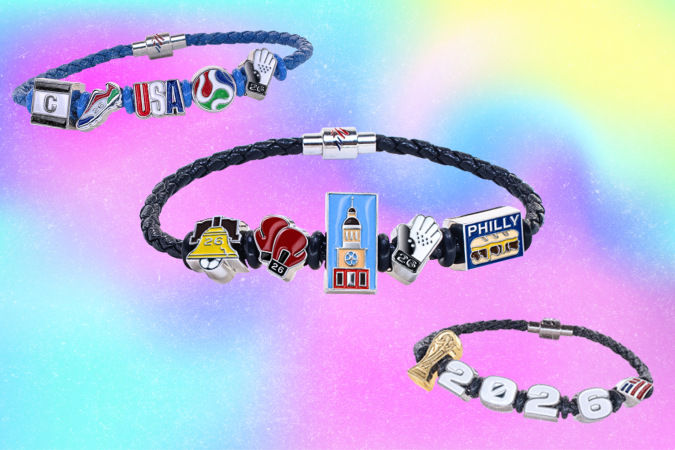
A simple customizable charm bracelet has taken off at FIFA Fan Festivals nationwide, including Philly’s. The accessory has prompted wait times rivaling a Taylor Swift merch line, the latest sneaker drop, or John’s Water Ice during a record-breaking heat wave.
“Get there early!” TikTokers warned while showing off their new hardware. “I waited four hours,” one user wrote.
Bank of America is the sponsor behind the giveaway. The company announced in a news release that it was armed with more than 2 million “Fan Bands” and 10 million beads.
Mimicking a Pandora bracelet, the Fan Bands are composed of a red, blue, or black woven band and an assortment of metal beads that lace through. Available beads include numbers, flags, a FIFA World Cup trophy, and several city-specific designs that pair with World Cup host cities.
City-specific designs include a cable car for San Francisco, Mount Rainier in Seattle, a yellow cab in New York City, and a lobster in Boston.
Philadelphia’s city-specific charms include the Liberty Bell, a cheesesteak, the LOVE statue, Rocky’s boxing gloves, and Independence Hall. Visitors can either design a custom bracelet, selecting five beads, or opt for a faster pre-designed bracelet.
The bracelets are completely free for Fan Festival attendees — no sign-ups or bank loyalty required, either. But be warned: The lines are serious.
On Reddit, an attendee said visitors ran straight to the Bank of America booth when Philly’s Fan Fest opened and that they waited an hour and 20 minutes to get theirs. On TikTok, users said they waited anywhere from four to eight hours depending on when they arrived and their level of determination.
The allegiance isn’t limited to Philadelphia. People attending Fan Fests in other cities are also complaining about the lines.
In Dallas, one attendee noted: “more people [were] lining up for bracelets than watching the match.”
And if waiting in lines isn’t your thing, Philly has another charm bracelet ready and waiting.
Artist John Wind launched a collection of Philly charms in honor of the nation’s 250th birthday that feature the LOVE statue, a boxing glove, and even a soccer ball.
The locally made bracelet, which is a collaboration with the Philadelphia Visitor Center, is $98.
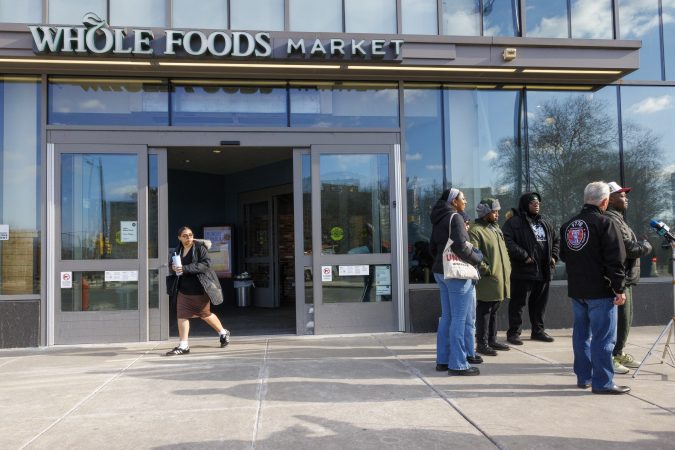
Philadelphia Whole Foods workers cleared a major hurdle in their unionizing efforts this week, paving the way to negotiating their first union contract.
Workers at the 2101 Pennsylvania Ave. store voted last year to join UFCW local 1776, becoming the first group within the Amazon-owned Whole Foods chain to unionize. But they have been caught in a procedural standstill for months.
Whole Foods challenged the union election, citing multiple objections, including allegations that the union promised employees would get a raise if they voted for a union.
A few months after the election, a regional director at the National Labor Relations Board dismissed Whole Food’s challenge — but the company pushed back, asking for a review by the national board. That brought the case to a standstill because the NLRB was without a quorum after President Donald Trump fired a board member.
The board has since gained two new members, including one with ties to the Philadelphia area, Scott A. Mayer, a Villanova University graduate who has worked for locally headquartered concessions company Aramark and area law firms.
This month, the board stood by the regional director’s conclusion upholding the union election, saying Whole Foods’ latest challenge “raises no substantial issues warranting review.”
Wendell Young IV, president ofUFCW local 1776, said Tuesday that the union had been expecting this outcome.
The NLRB decision “completely vindicates the union and these workers, and there’s no reason at this point Whole Foods/Amazon shouldn’t sit down and begin bargaining right away, although I suspect they won’t,” Young said.
A Whole Foods Market spokesperson said in an emailed statement that the company strongly disagrees with the board’s decision.
During a hearing on the issue last year, the spokesperson said, Whole Foods argued that “restrictions on free speech and the union’s illegal conduct interfered with our team members’ right to a fair vote at our Philly Center City Store.”
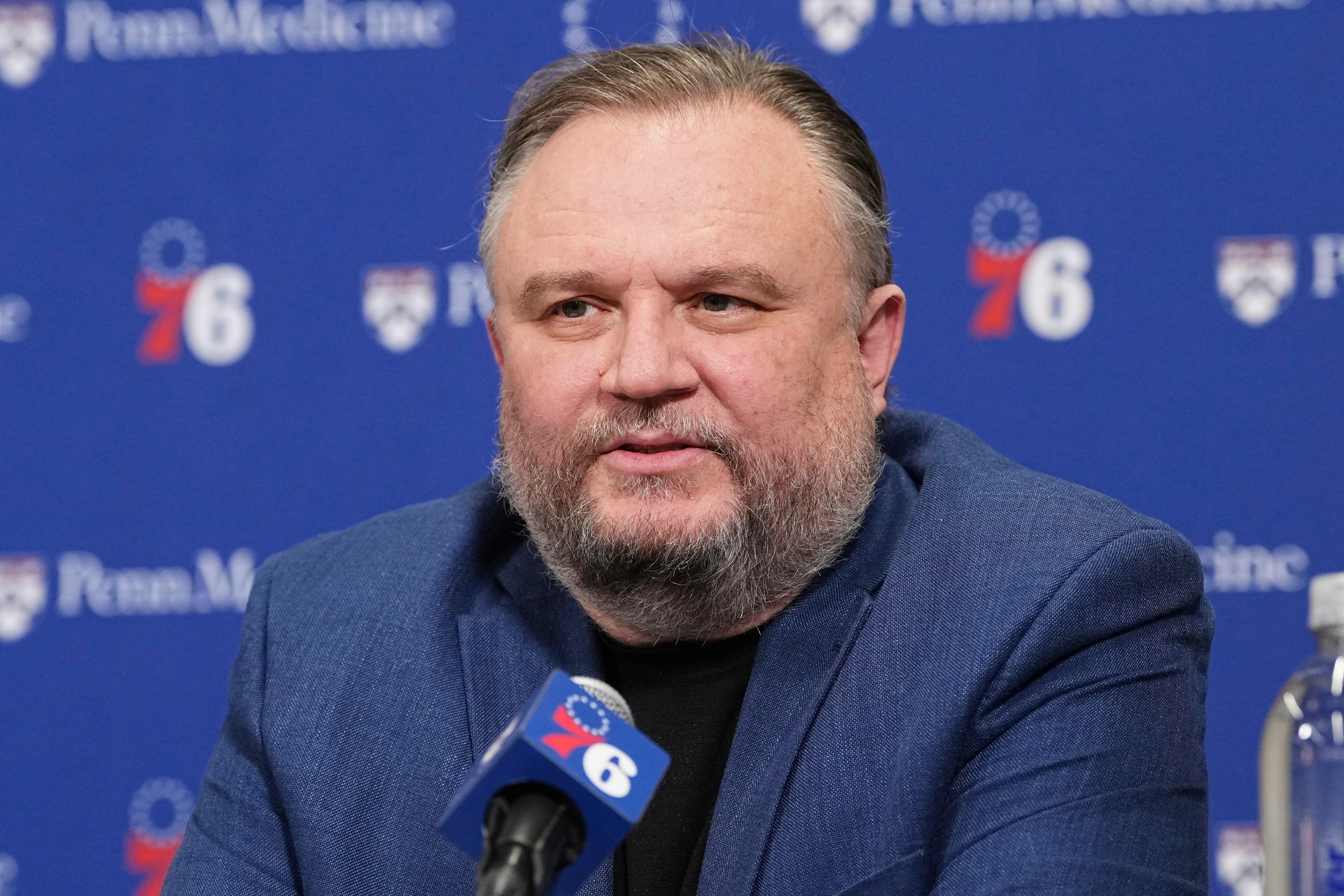
Would Sixers owner Josh Harris have fired president Daryl Morey if the Knicks hadn’t rolled the Sixers?
Working big sporting events can be an exercise in frustration. The Olympics, the World Cup, the Super Bowl, the World Series are objects of spectacle and celebration for a sports fan but can be vehicles of exclusion and futility for a sports writer.
They also can be veins of golden intel. Such was the case last week in New York.
Thanks to the vanity of the New Yorker in Chief, entering the arena last week was a protracted challenge. An NBA source with ties to the 76ers told me in the hours before Game 3, as we waited for President Trump to arrive:
“You know, if the Sixers had won a couple of games against the Knicks, no way Morey gets fired.”
That piqued my interest. The Knicks had swept the Sixers in the second round of the playoffs. Morey was fired two days later, news that shocked the NBA world.
Did the Knicks’ storybook run to the hoop-crazed city’s first title in 53 years make Morey’s career an unlikely casualty? Did the sweep cost Morey his job? Was it at least the final straw?
Apparently so.
The Knicks weren’t considered elite when they rolled the Sixers. By Game 3 of the Finals, however, they were playing great.
Folks were talking: Was Morey’s firing less warranted than it seemed at the time?
I was eager to leave Madison Square Garden and try to track down Morey himself, see what he’d say. He’s going to continue to live in Philadelphia, but, since he got fired, he’s been hanging out in New York, feeding his Broadway addiction and waiting for the unemployment checks to come in.
Then, a few hours later, the Knicks had lost Game 3, the Spurs seemed to have turned a corner, and the assertion lost its legs.
But only briefly.
Daryl Morey did some things well, but the Sixers were also hamstrung by some of his decisions. Matt Rourke
Genius dismissed
A computer scientist with an MBA from MIT, Morey’s moves might draw criticism but his intellect never has been in question. Twenty-one years ago he co-founded the annual analytics nerd-fest at MIT, the Sloan Sports Analytics Conference, a stats-based Davos gathering of the smartest suits in the sports industry, designed to render obsolete knuckle-draggers like Doc Rivers and me.
Despite having never won a title, Morey is front-office royalty. As such, the NBA was rocked by Morey’s dismissal, especially coming, as it did, on the heels of such a dizzying postseason high.
The week before the sweep, the Sixers beat the arch rival Celtics in seven games to win their first-round series. Boston had held a 15-7 record in the teams’ playoff series and had won the last six; the last time the Sixers won was 1982. It was their first Game 7 win in 25 years. It was their first Game 7 road win in 44 years (the aforementioned 1982 series). It was the first time the Sixers won a series when trailing 3-1 in their last 18 tries, and the Celtics had won 32 times in a row when leading a series 3-1.
Euphoria barely describes the mood around the franchise after Tyrese Maxey dropped 30 points and pulled down 11 rebounds in that Game 7. Maxey was Morey’s first draft pick when he arrived in 2020.
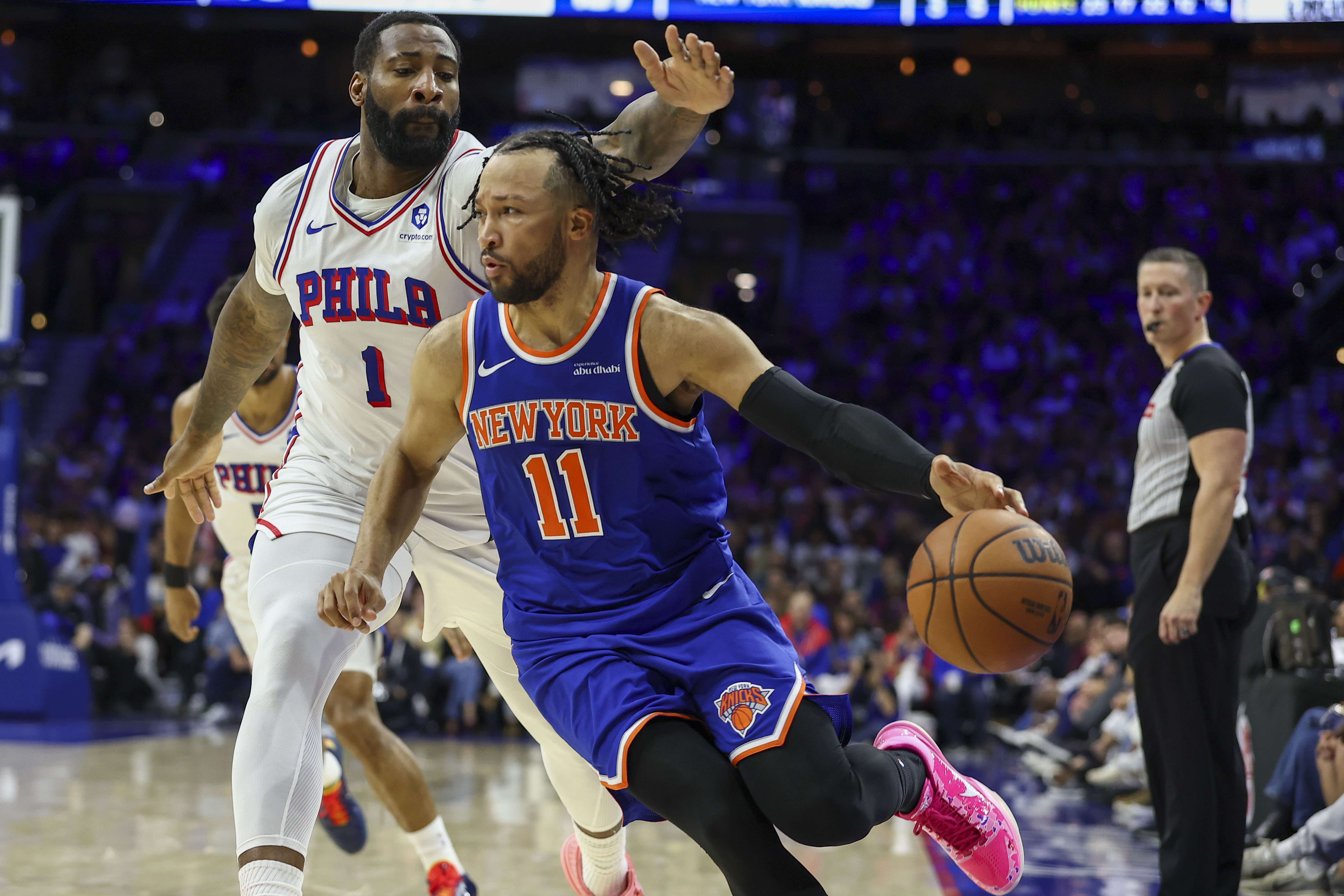
Humiliation barely describes the mood around the franchise 10 days later. The Knicks won Game 1 in New York by 39 points. They won Game 4 in Philadelphia by 30 and, at one point, they led by 44. That wasn’t the worst of it. Xfinity Mobile Arena was inundated with Knicks fans for Game 3 and was predominantly pro-Knicks in Game 4.
Harris, a New Yorker for most of his adult life, was galled. More than anything else, according to the source, it was those two home losses and the Knicks fans’ takeover that cost Morey.
It didn‘t help, of course, that Morey traded popular shooter Jared McCain in February, after which McCain thrived in Oklahoma City. It also didn‘t help that, two years ago, Morey max-extended the contract of Joel Embiid and max-signed Paul George. Both have been injured and suspended since.
Both were bigger stars than anyone on New York’s team. Neither played well against the Knicks.
As it turned out, nobody would play well against the Knicks.
Jalen Brunson and the Knicks rolled the Sixers in a way that was humiliating for the team and the fan base. Monica Herndon / Staff Photographer
Juggernaut
The Knicks’ sweep of the Sixers included wins three through six of 13 playoff wins in a row, the second-best streak in NBA history and just two fewer than the Warriors in 2017. Those Warriors had Steph Curry and Kevin Durant, Hall of Fame scorers who’d been to 12 All-Star Games between them.
Again, at the time of the Sixers series, nobody considered any of the Knicks on par with Steph or KD.
Then, the Knicks swept the Cavaliers in the Eastern Conference Finals.
Then, they won Games 1 and 2 in San Antonio.
Then, after losing Game 3 at home, they executed a Finals-record 29-point comeback in Game 4.
Then, on Saturday, they won Game 5 and the title in San Antonio. Jalen Brunson proved himself the biggest star in the playoffs, capping his Finals average of 32.6 points with 45 in the closeout game, a record for a Knick in the Finals, tied with Michael Jordan for the third-most in a Finals closeout game.
The Knicks finished the playoffs with a point differential of plus-283, the biggest in NBA history. Of course, the Sixers contributed 89 of those positive points, and the Knicks played only one team from the superior Western Conference, but those arguments are thin gruel.
The 2025-26 Knicks were a powerhouse team: deep, talented, hungry, well-coached, and led by a bona fide, if unlikely, superstar.
That’s who beat the Sixers.
That’s who, according to an NBA source, ultimately cost Morey his job.
It’s new president of basketball operations Mike Gansey’s show now in Philly. Tom Gralish / Staff Photographer
So what?
I’ve always believed Morey to be a bit overrated as a team builder but I’ve always admired his innovation, his transparency, and intellectual capacity. These, I believe, burnished an image that was more impressive than the reality. He was, nevertheless, a very good basketball president.
Still, when a team with high expectations repeatedly fails to meet them, change is almost always good. Embiid just ate his way into wasting two more seasons. Paul George popped for PEDs. Both happened on Morey’s watch. Will it happen again under his replacement, Mike Gansey, who helped resurrect the Cavaliers after the LeBron James Era, Part 2? Will Gansey and his overseer, Bob Myers, the former Warriors president who runs all of Harris’ numerous sports franchises, keep the old guys from stealing more money?
Maybe a new sheriff in town who has no connection to either Embiid or George will serve as a catalyst for them to deliver more value for the combined $112 million they will make in the next season alone.
But maybe, had Harris known how humiliated his peers in Cleveland and San Antonio were going to be a month later, he wouldn’t have let go the man he’d introduced six years prior as “extraordinary,” an “innovator,” and a “visionary.”
After nearly 25 years in operation, the newly renovated H Mart in Cherry Hill is drawing crowds as regulars and newcomers marvel at its major improvements.
The outpost of the renowned Korean grocery store off Route 70 has served the local community since 2001. In April 2025, the Cherry Hill Township Planning Board approved plans for an expansion. A year later, the grocery store reopened with enhancements to the first floor and an open-concept food court, bakery, and retail space on the second.
As a diehard H Mart fan, I decided to venture across the bridge on a recent Thursday and see the 39,000-square-foot store for myself.
Customers shop inside H Mart Cherry Hill.Hira Qureshi
Where to start your H Mart visit
I arrived at the brick building, marked with the familiar “H Mart” sign in big red letters, at about 11 a.m. Entering through the double sliding doors of the second floor, I found myself inside the new food court.
A few customers dined in the massive seating area that morning, enjoying various dishes. I decided to grab an iced brown sugar coffee boba from Tiger Sugar as a little treat to sip on during my exploration.
Beginning the journey on the second floor was the right move, according to Ryan Solot, a regular shopper at H Mart. He and his wife, Miki Solot, came to the store once a week before renovations. The couple were shopping for dashi stock and Japanese sauces when I ran into them. They were happy to see the makeover, particularly on the second floor’s general shop department. But the Solots still felt the first-level aisles were a bit narrow for ideal grocery shopping.
“The layout is strangely unchanged,” Ryan Solot said. “It’s still kind of awkward to get through the aisles … but start from the top [floor] and make your way down, it’s much more organized upstairs.”
Korean beauty section at H Mart Cherry Hill.Hira Qureshi
The second floor of H Mart: general goods, Korean beauty products, and an arcade
Walking out of the food court area, I found a mini Korean beauty store with boxed shelving displaying creams, serums, cleansers, tonics, and other products from popular brands such as Medicube, Anua, and Beauty of Joseon. Attendants explained the various products to customers, especially to Korean skincare novices like myself.
Neon arrow signs next to the beauty department directed me into H Mart’s general store and “H Pop” section. A small selection of drinks and snacks lined the shelves leading me into the rows of shelves with over-the-counter medicines, vitamins, toiletry items, slippers, bedding, and kitchenware.
In the back corner I found a vast selection of cutesy notebooks, pens (ones with funky kiwi and toilet attachments), furry character key chains, mini toys, makeup storage containers, and other knickknacks. The prices for items were organized by serial numbers, which were listed on a card hanging off the shelves. Pro tip: Take a photo of that price card to reference as you shop.
Customers shop inside H Mart Cherry Hill.Hira Qureshi
The first floor of H Mart: frozen foods, fresh produce and seafood, snacks, and lots of instant noodles
Taped to the elevator, two signs offered directions on where to find specific items. “Second floor: food court, house ware, characters, K-beauty, game, health food” and “First floor: Asian/Western, produce, fish, meat, ready to eat, banchan” were written in all caps and highlighted in yellow.
The elevator also had another sign with an important tip for shoppers: “You are welcome to shop freely on both 1st and 2nd floor, and you may check out either floor.”
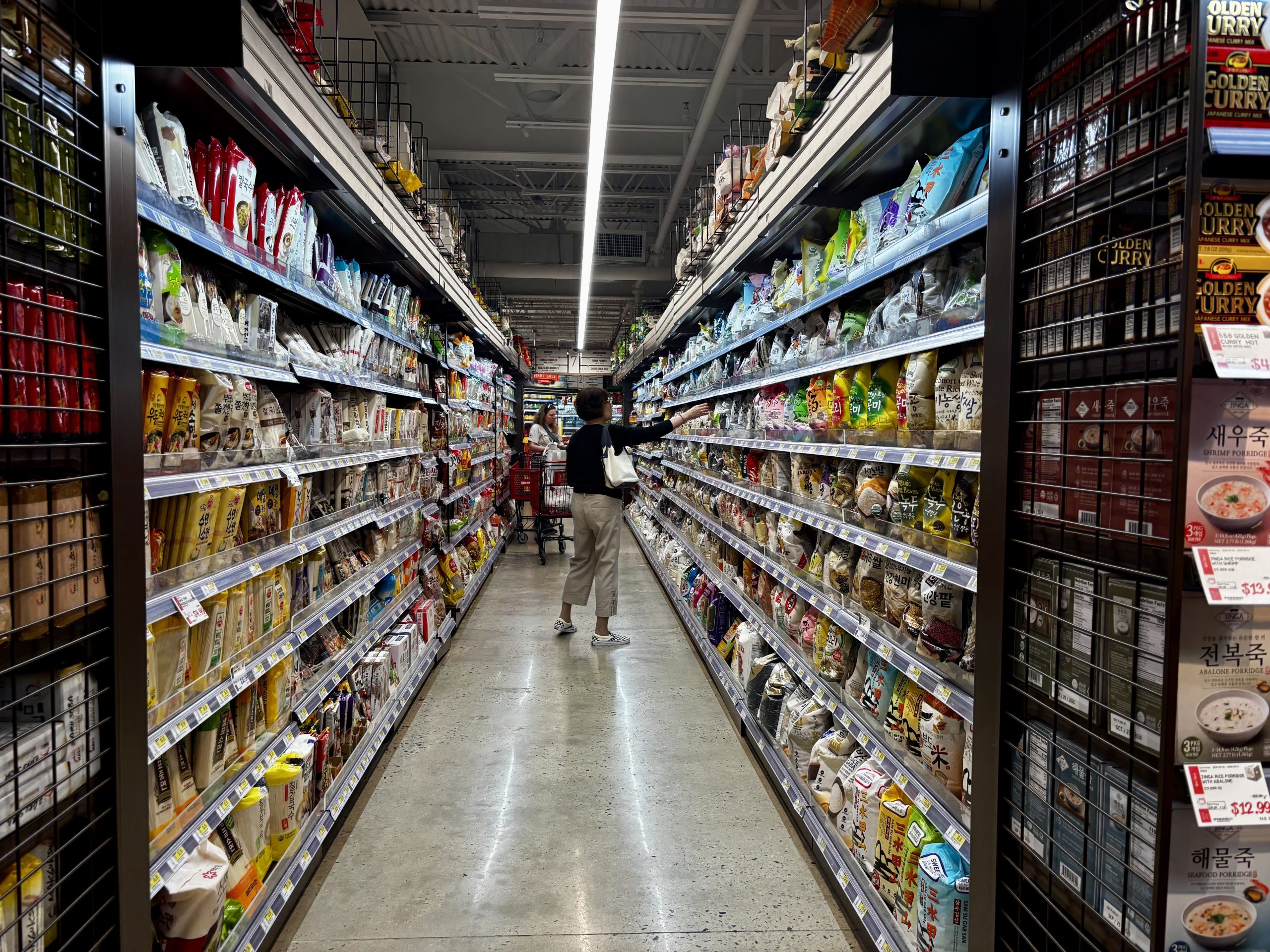
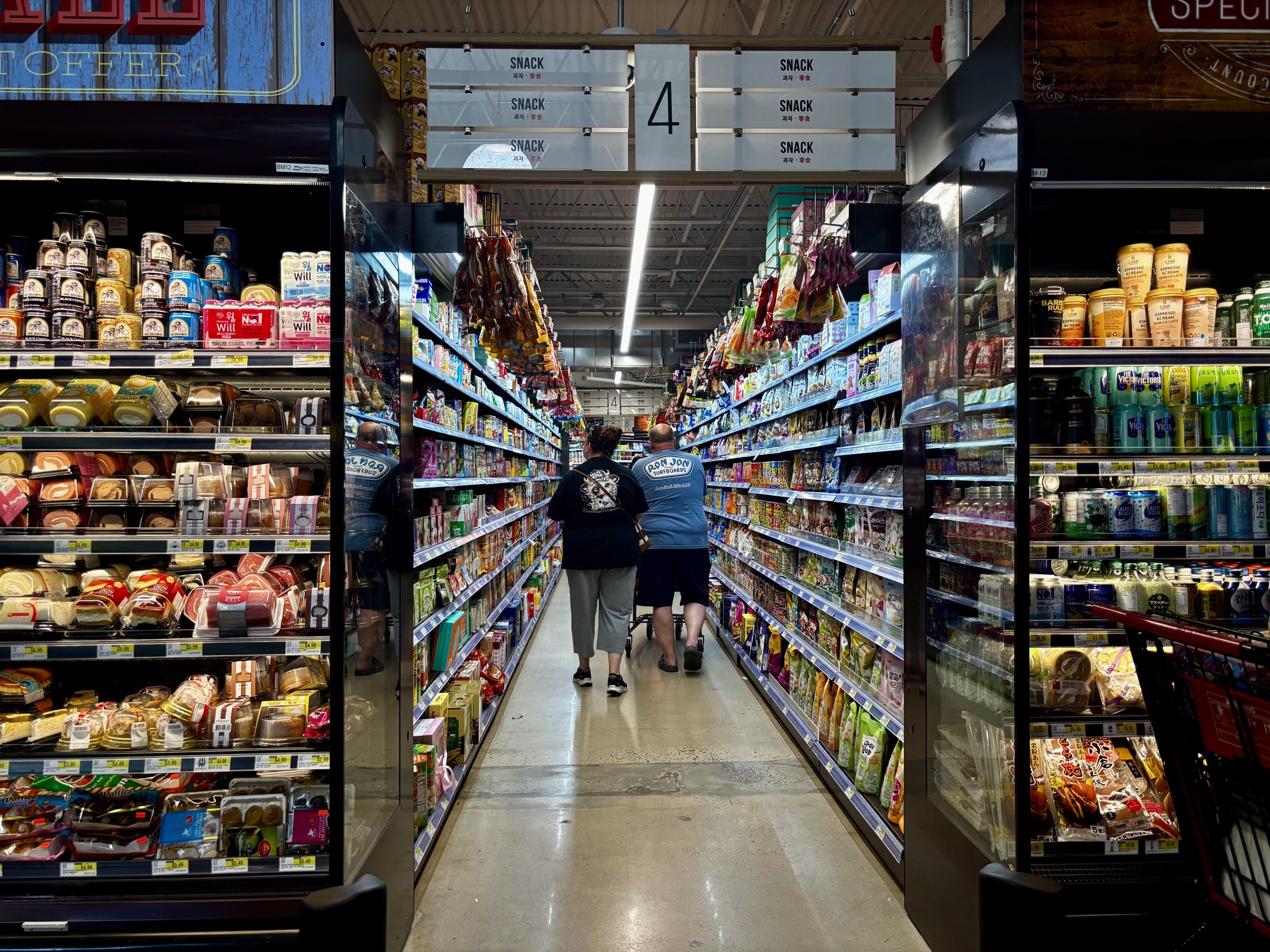
Downstairs on the first level, the elevator opened up to aisles upon aisles of snacks, produce, sauces, packaged sweets, and lots of instant noodles. Each aisle is organized by number with a sign noting all the items available.
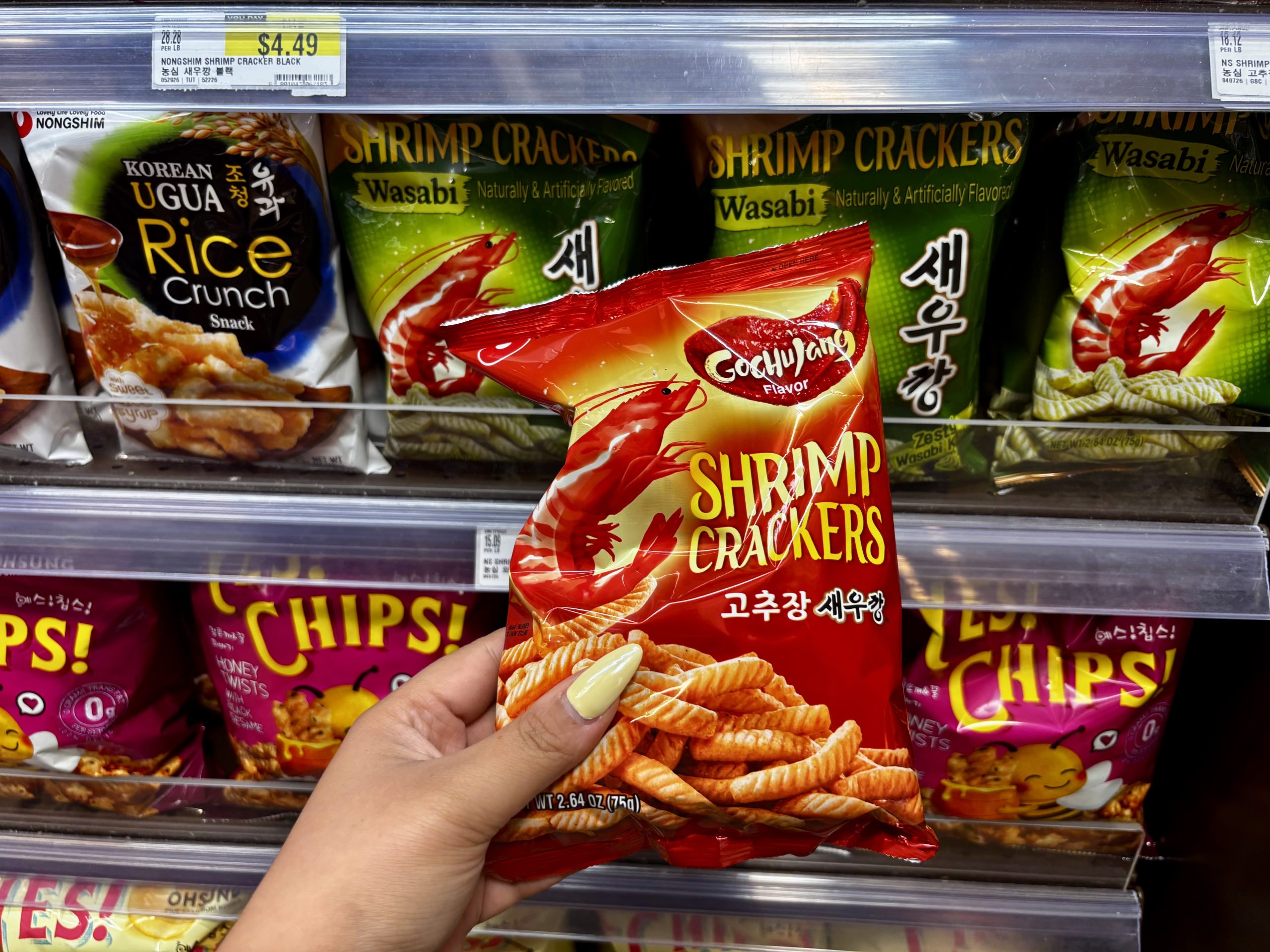
Shrimp crackers at H Mart Cherry Hill.Hira Qureshi
I walk into Aisle 3 as I exited the elevator and found snacks galore. KitKats, Pocky sticks, Buldak ramen-flavored chips, O’jelly real plum candies, lychee gummies, Poongnyun Bakery seaweed crackers, and so much more lined the shelves. I picked up some of my favorites: Shrimp crackers, crispy snacks made from starch and ground shrimp, and a bag of chocolate yogurt-covered orange slices sitting nearby.
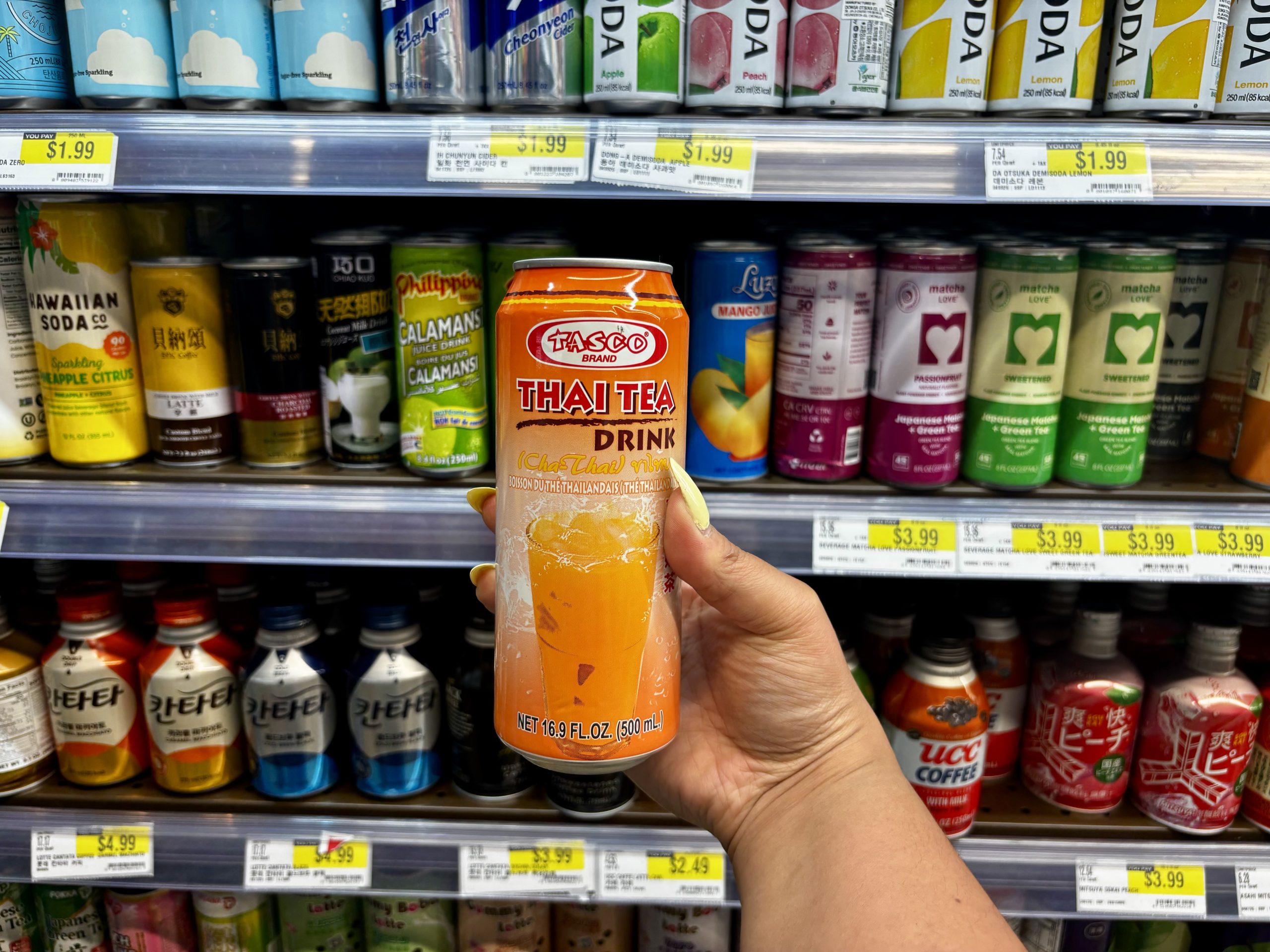
Next, I headed into Aisle 5 for beverages. The vast selection includes soy milk, hojicha, banana milk, corn silk tea, coconut milk and juice, and taro. I grabbed a tall can of Thai tea and a couple of glass bottles of Ramune, a fizzy, fruity, sweet Japanese soda.
Thai tea at H Mart Cherry Hill.Hira Qureshi
I stopped by Aisle 10 for chili oil and pho seasonings. And on Aisle 1, I found instant noodles plentiful — the Japanese-style soba noodle box piqued my interest. At the end of Aisle 9, I saw cups filled with ice in the freezer section and drinks packaged in pouches for easy pouring. I grabbed the peach mango tea to accompany my post-shopping food court lunch.
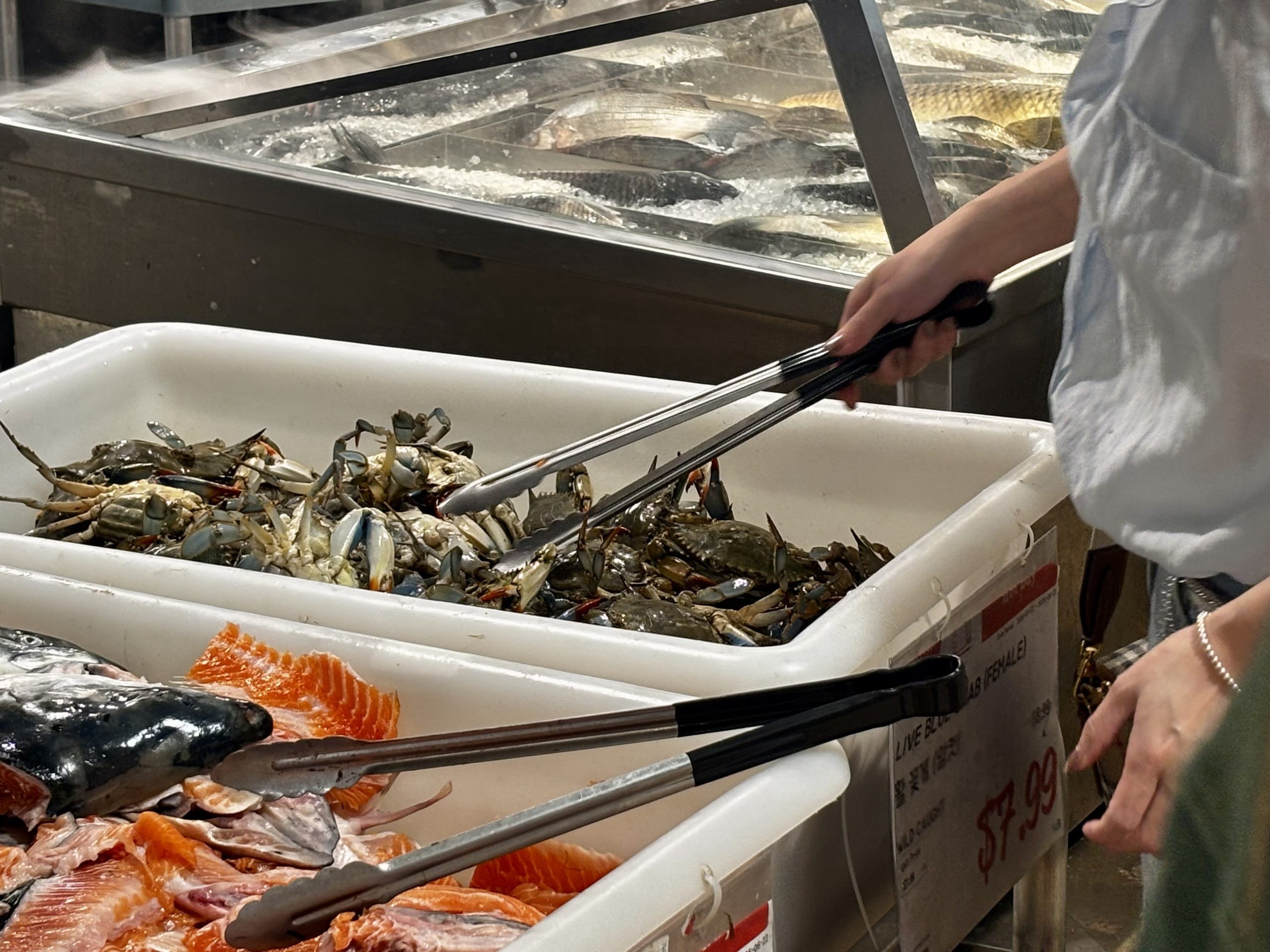
As I walked deeper into the store, I found Catherine Yao and her mother, Jingjing Dong, in the massive seafood section, picking live crabs from a big box.
Live crab selection at H Mart Cherry Hill.Hira Qureshi
Yao and Dong, who live five minutes from the store, come to the H Mart every week. They come for the fresh seafood — live fish, lobsters, and crabs swim in big tanks near the butchers, while some sit in displays on ice — and frozen meats — think beef bulgogi and pork belly. The two also like exploring the premade foods section next door; I picked up a crab onigiri for the road.
The mother-daughter duo recommended stopping by the vast produce section near the cashiers. “I like the fresh durian, lychees, mangoes, and the gold melons,” Dong said.
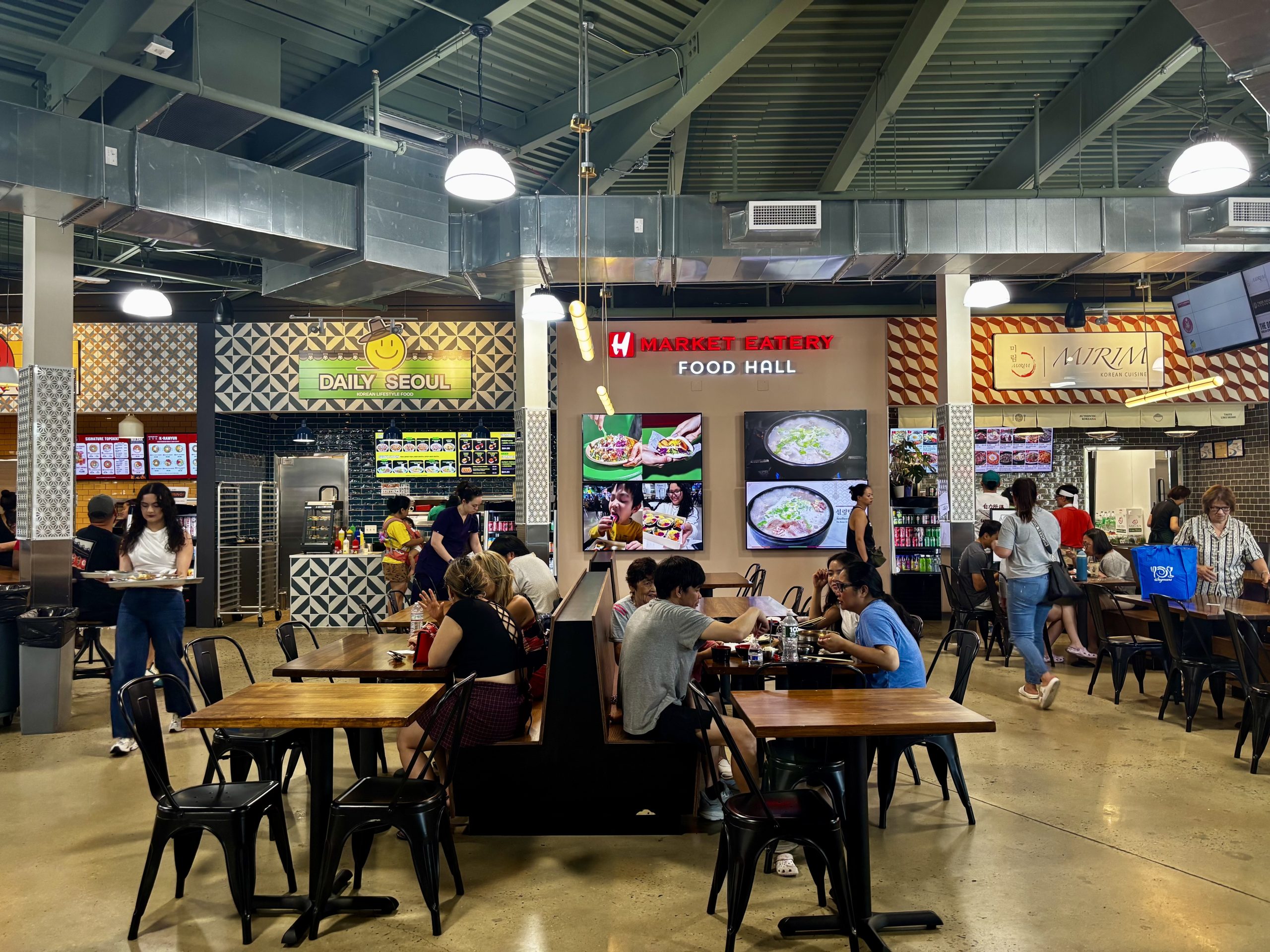
Food court at H Mart Cherry Hill.Hira Qureshi
The food court
Around noon, I took the elevator back up to the second floor and ventured back into the food court for lunch.
The court can feel overwhelming, with nine vendors to choose from — think bibimbap, Korean fried chicken, and noodles. Thankfully, Yao and Dong recommended a couple of options: Kyodong Noodles, a Korean-style Chinese noodle restaurant; Daily Seoul, a Korean lifestyle food brand; and Tiger Sugar, the Taiwanese bubble tea vendor I sampled earlier.
While perusing the vendors, I ran into regular Ryan Solot at Mirim, a traditional Korean restaurant. He recommended the cold buckwheat noodle soup. “I didn’t like how it looked at first but then I tried it and it was very good,” he said.
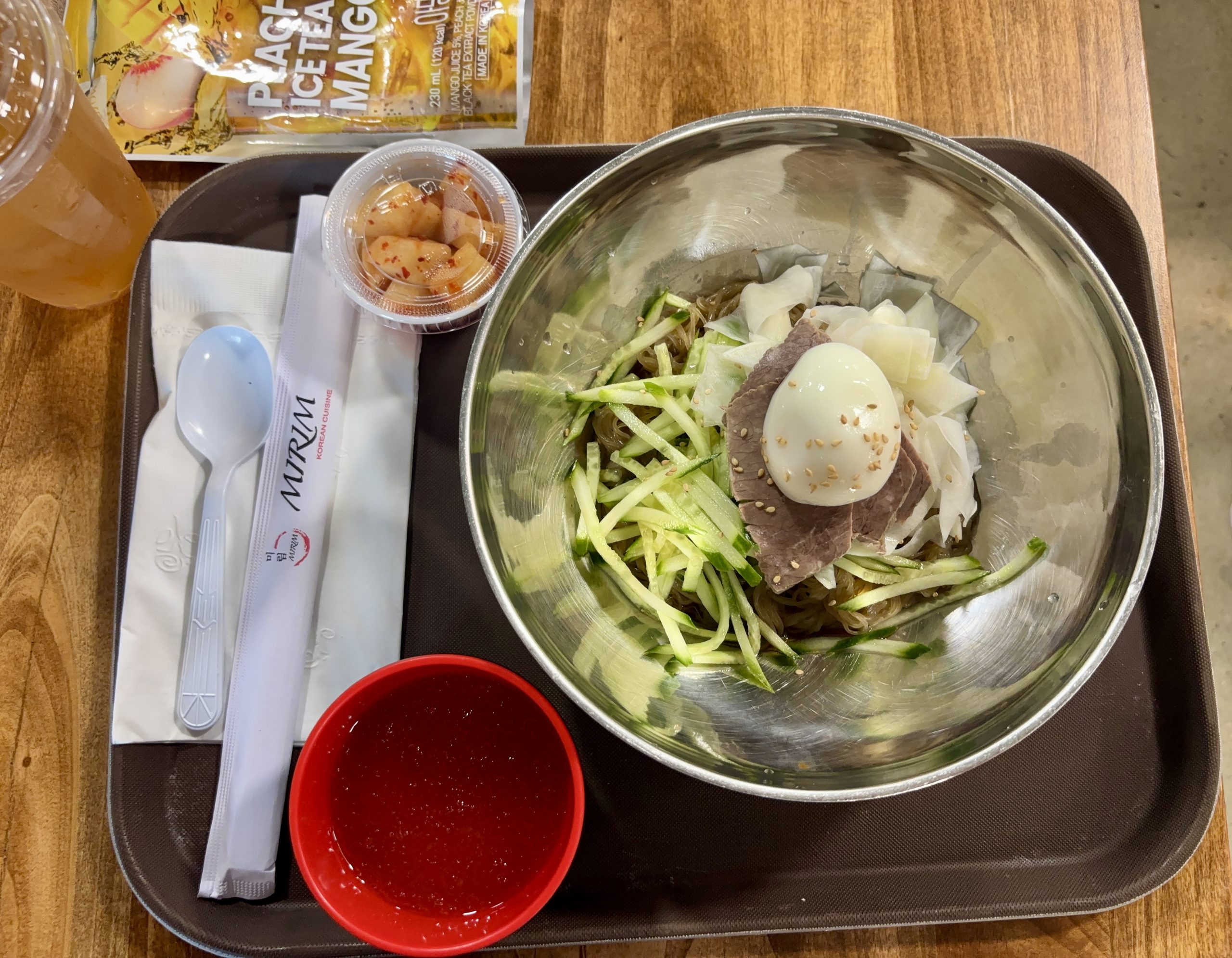
Spicy cold buckwheat noodle soup H Mart Cherry Hill.Hira Qureshi
I ordered the spicy buckwheat noodles with beef at Mirim. The dish was served in a metal bowl with pickled vegetables on the side, chopsticks included.
For Yao, the food court is a great addition to the store.
“I like coming here more now because they have a food court — we go to eat there pretty often, for lunch and dinner sometimes,“ she said.
H Mart Cherry Hill: 1720 Route 70 E, Cherry Hill; 856-489-4611; Monday to Sunday, 9 a.m. to 9 p.m.
Cheltenham High School football players expected a major decision was coming following an ongoing investigation from an alleged hazing incident that terminated the 2025 season. But when the verdict arrived last month that the 2026 varsity and junior varsity seasons would be canceled, those associated with the program were shocked.
The news came in the form of an email from the Cheltenham School District on May 26, and the district said more work was needed to “reset the program” after about 20 students witnessed a student-on-student assault in a locker room in September, and no one tried to stop it.
“Until those investigations are concluded and their findings are known, it is not possible to define, develop, or execute the necessary corrective actions,” wrote Dr. Brian W. Scriven, Cheltenham’s superintendent of schools, in the release. “The district cannot build a path forward around unknowns. The scope and nature of what must be addressed will be determined by the evidence, and that process must be allowed to run its course before any meaningful next steps can be taken.
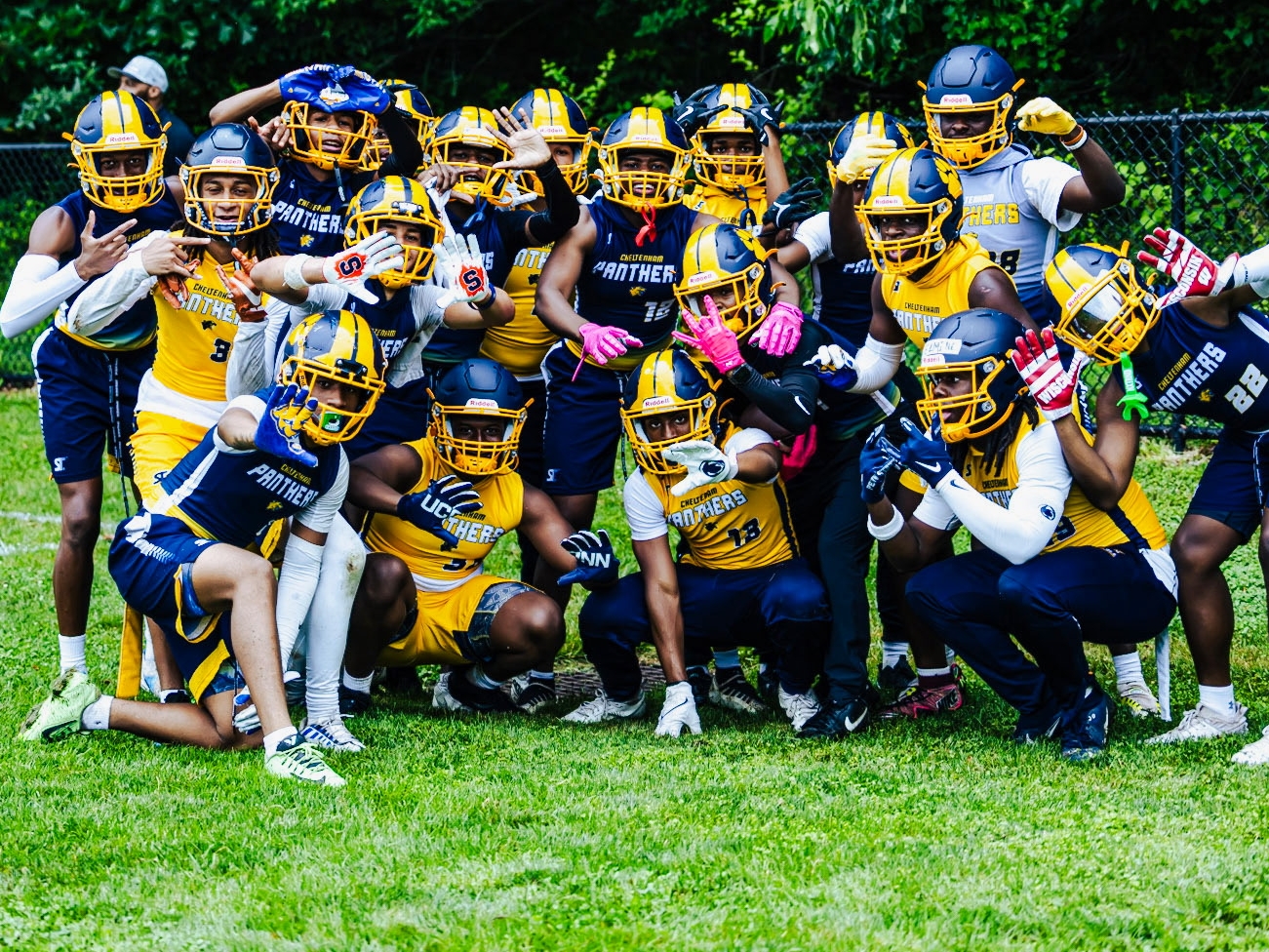
Prior to the ruling, about 50 players — 30 rising seniors and 20 rising juniors — at the Montgomery County school were wondering what to do next.
“We weren’t updated about anything,” said Kendall Jackson, a rising senior, who was a two-year starting quarterback at Cheltenham. “We’re sticking together. We’re trying to be there for each other, because no one else is. This has not only affected kids at Cheltenham, but the future kids thinking about coming to Cheltenham. Those kids might think Cheltenham is not the right place for them because of what supposedly happened. We’re all frustrated.”
The school district and Cheltenham declined to comment. Cheltenham will field a freshman team next season, and it’s unclear if it would field a varsity or junior varsity team in 2027, which will also impact the rest of the Suburban One League Continental Conference.
According to the school district, Cheltenham was set to debut its $13.4 million football stadium complex this season, which has been in the works since 2024.
‘I feel defeated’
When the announcement that the rest of the season would be canceled was made on Oct. 20, 2025, the players said then-Panthers coach Terence Tolbert, a former teacher at the school who could not be reached for comment, and his coaching staff were no longer around.
The players were not allowed to work out in the weight room or on the practice field because they did not have the supervision of a coach or an administrator.
The Inquirer also learned that the school district could not find a varsity coach for the Cheltenham football team. Two area coaches, who asked that their names not be mentioned, confirmed that they submitted their names for consideration to the district and later withdrew, with one citing the program’s “unstable” culture.
Jackson has been in contact with several area schools about transferring in the fall. Rosalind Jackson, Kendall’s mother, said the district told parents it would keep them informed about the situation, but she said that did not happen.
“I feel defeated,” she said. “My son and these other kids are paying a price for what others did. … The school district hasn’t provided any answers. These kids should have been treated with far better respect than they were. They should have been told in person by a school administrator about this news, [rather] than receiving an email at 4 in the afternoon. The school district let me down.”
Kyle Montgomery, a rising senior defensive end, had an idea something was coming. So in December, he took the Archbishop Wood entrance exam and was accepted in January. Montgomery said he did not like how the school district handled the investigation.
“They were taking a long time with the investigation and not telling us anything,” said Montgomery, who has attracted attention from Ivy League schools. “I thought that was a sign that they would cancel the season. I want to play in college, and I have moved on from this. I have already made plans. I can see where other guys who are stuck there feeling let down by the school and the school district.”
Brian Palmer-King, a wide receiver and cornerback, said the school provided counseling services after the 2025 season was canceled, but he claimed it did not offer direction or support on other options.
His mother, Brandi King, held out hope that her son would have a senior football season, but as a precaution, King and her son made other plans. He’ll attend Wood next season.
“You feel a little betrayed, because Brian grew up with Cheltenham and the football program,” Brandi King said. “Wood is a very good school and we’re happy about the move. But I’m a little sad, because Brian was hoping to graduate from Cheltenham and play his senior year.”
‘We’re working on it’
Elijah Stehman, a rising senior running back who also kicks and punts, pushed for answers this past year.
He said he repeatedly approached Cheltenham Principal Benjamin Hammond, went to school board meetings, and questioned Scriven. He said he received the same answer: “We’re working on it.”
“The administrators lied to us and lied to me,” said Stehman. “They said they would stand up for us having a season. We got nothing. I mean we got called all kinds of things on social media and in the classroom. I won’t forget my mom coming into my room after I saw they canceled the season and consoling me. My mom was more upset over how the adults handled the situation.
“The Cheltenham teachers have been great. They have been supportive. It’s everyone that is above them that has failed us. It’s not fun when you can’t trust the people who are responsible for educating you.”
Looking for a home for senior year Please Contact me! Class of 2027 3.48 GPA RB/P/KR pic.twitter.com/PDDB5pt0fD
Stehman said he emailed the administration and Scriven, and showed up at a school board meeting in January asking what would happen to the 2026 team.
He said he was told that Cheltenham would hire a coach in March and that they would open the weight room for football players.
No coach was hired, and he said they didn’t open the weight room.
“It does feel like we are in football jail,” Stehman said. “We’re paying a price for something we had nothing to do with. Every other football player in the state is preparing for the 2026 season. We can’t. We are going to be getting a new stadium. No one will be there to play.
“I tried to talk to Dr. Hammond and Dr. Scriven. They never gave me an answer.”
Stehman is looking to transfer to the Philadelphia Public League’s Martin Luther King, where his father, Kirk, was a longtime assistant coach.
What’s ahead
With Cheltenham off the schedule, Suburban One League Continental Conference schools have been in a scramble to replace those games. The SOL two-year schedule cycle was made in December, according to league officials.
This will not impact District 1 playoff seedings, since the point system can be divided by nine games instead of the traditional 10. But several SOL Continental athletic directors have said they prefer to play 10 games.
“With Cheltenham not competing next year, the teams impacted have the opportunity to reschedule that week with a different opponent. If a school is unable to find a contest, it will be considered a bye week,” said Jason S. Traczykiewicz, the Council Rock North principal and president of the Suburban One League. “Since the teams create their schedules on a two-year cycle, Cheltenham will need to inform the league of their intent for the fall of 2027 season by Aug. 31, 2026.”
As for the Cheltenham players looking to leave the school, they have a process ahead of them.
According to District 1 Chairman Dr. Michael Barber and District 1 Executive Director Sean Kelly, a student cannot transfer from one public school to another for athletic purposes, despite the extraordinary circumstances at Cheltenham.
The procedure includes the sending school signing off on the student-athlete and the receiving school signing off on accepting the transfer. If the sending school contests the transfer, a hearing is held in the school district to where the student-athlete is transferring. Both schools must sign off for the transfer to be accepted.
If a student-athlete transfers after his or her sophomore or junior year, that student-athlete would be deemed ineligible for the postseason. But considering Cheltenham’s unusual situation, postseason rulings would be addressed on a case-by-case basis, according to Barber and Kelly, by the respective PIAA district where the student-athletes intend to transfer.
As of early June, Cheltenham has not sent official transcripts or report cards to other schools, according to football coaches at Wood, Neumann Goretti, and Roman Catholic, which have received request of transfer from Cheltenham students. By PIAA bylaws, Cheltenham does not have to sign off on transfers until the student-athletes have physically left the school, with a two-week window that usually applies.
Three Cheltenham parents, who did not want their names published, are threatening lawsuits if the transfers do not come through.
“There have already been a number of missteps by the school district in this matter, and I have June 15 circled on my calendar, because if my son’s transfer does not go through, I’m going to be retaining a lawyer. I know a number of other [Cheltenham] parents who will,” said one parent. “I’m sure this is not over yet. I have no trust or have any faith in the Cheltenham School District.
“This is going to continue. They will have a freshman team in 2026, but ask yourself this, will they allow an all-sophomore team to play a Suburban One varsity schedule in 2027? No, this will go on for another year.”
Many rising seniors were looking forward to playing their final season at Cheltenham. Now they won’t get that chance.
“Everyone wants out, and we all learned something: The world does not stop,” said Jabriel Epps, a two-year starting defensive back who is talking to Kutztown. “ … I still want to play football. What’s sad is I’ll never wear anything with Cheltenham football on it again.”
In the summer of 2022, a sheepish teenager with a backpack walked into Moshood Abiola National Stadium in Abuja, Nigeria. He was there for a basketball camp, but his physique looked like that of an edge rusher; lean and athletic with sculpted calves.
Two coaches told him as much. Mustapha Musa and Dike Christian of Pro Prospects Program were in the same building for a flag football event coordinated by former New York Giants defensive end Osi Umenyiora’s agency, The Uprise. Musa and Christian approached the teenager and asked if he’d ever played American football.
The teenager said no. They asked if he would give it a try. He explained that this would be logistically difficult; he had traveled six hours from Unguwa Uku, a suburb of Kano, in the northern part of the country.
But the coaches were insistent. They asked if the teenager would consider extending his trip.
“You know,” Musa said, “you look like a footballer, not a basketballer.”
The teenager let out a laugh. He decided to stay, and underwent a workout the following day. Ejike Ugboaja, a co-founder of The Uprise, sent Umenyiora some video.
Former Giants star Osi Umenyiora has played a role in the discovery of players, including Uar Bernard, in Africa.provided by NFL Africa
He didn’t know the teenager’s name, but quickly came up with a moniker.
“[Ejike] just called him Bigfoot,” Umenyiora said. “And he was a freak athlete. I saw him running and moving around, and I was like, ‘OK, this kid, he’s got something.’”
By the time he showed up tothe next flag football event, everyone knew him as Uar Bernard. But “Bigfoot” stuck, in part because the coaches couldn’t find cleats that fit him.
“He had like a size 18,” Umenyiora said. “It was ridiculous.”
At 17 years old, Bernard was too young to qualify for the NFL’s International Player Pathway (IPP) program but too old for the NFL Academy. He would have to wait until he was three years removed from high school to try again.
Over those three years, Bernard trained with Musa and Christian in Abuja. In 2024, he attended another NFL Africa Camp in Lagos, but failed again to make the IPP, this time because he was not considered mobile enough.
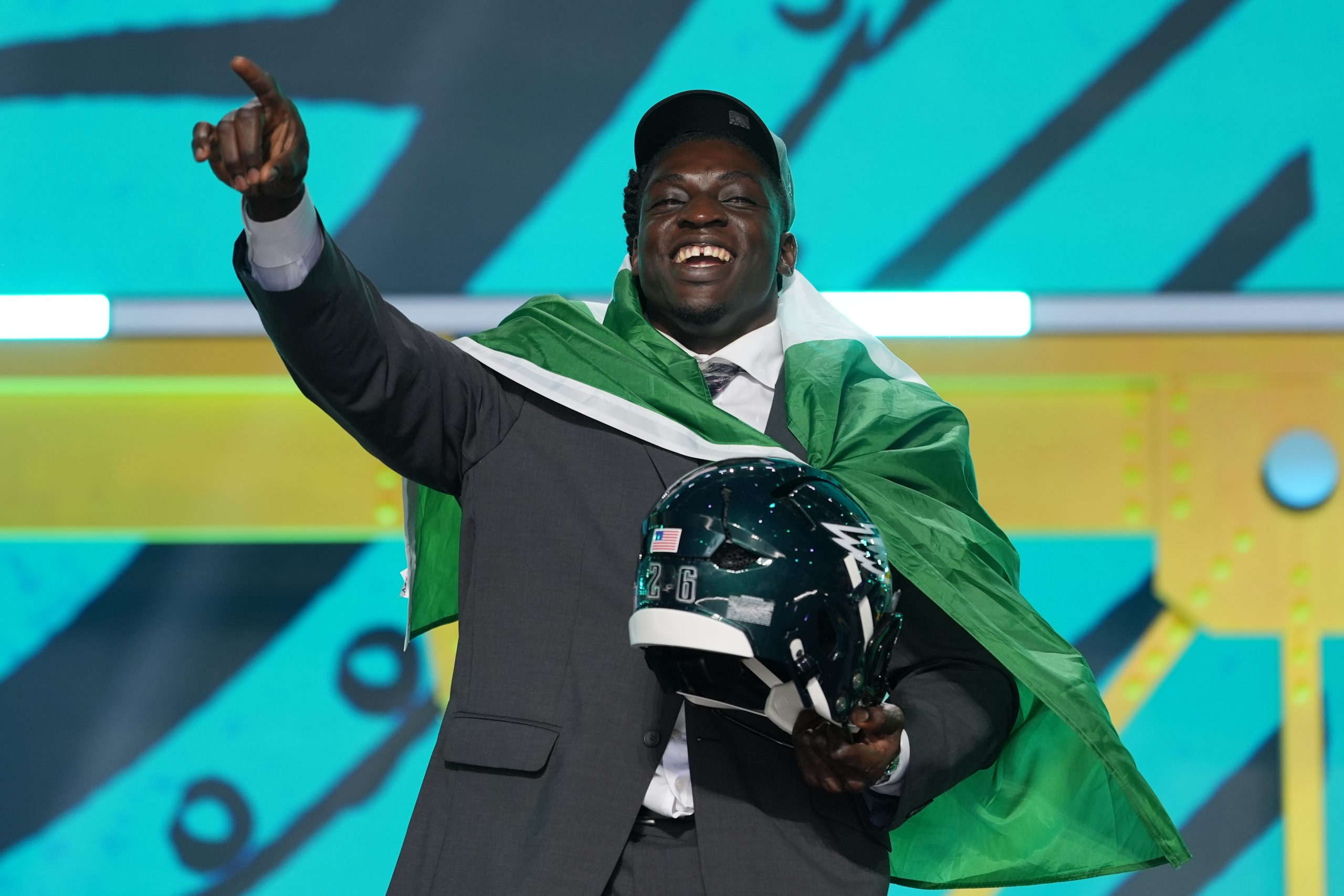
The Nigerian finally qualified in 2025. He entered a 12-week training program in Florida in January, and in April, he was drafted by the Eagles in the seventh round.
Bernard has never played a down of organized football. He didn’t spend his childhood on a Pop Warner team. But Musa and Christian have helped him prepare for this moment.
And Umenyiora is confident it is all going to work.
“I think one of the GMs for the Giants used to call it ‘planet theory,’” he said. “There are only so many people walking around the planet that have that type of physique and ability. And so whenever you get that, you have to take a chance on them, and give them an opportunity to develop.
“And hopefully, Philadelphia — who have been absolutely tremendous — will give him that opportunity.”
Training in ‘The Trenches’
Of the tens of thousands of players who have ever competed in the NFL, only 40 were born in Nigeria.
Twenty-one of those 40 hailed from Lagos, the country’s largest city; Umenyiora says most come from the southern and eastern regions.
Osi Umenyiora (center) has discovered players in Nigeria previously, but never from the impoverished community that Uar Bernard calls home.provided by NFL Africa
None have come from Kano. According to the World Bank Group, the state has a poverty rate of 53.75%, more than double that of Abuja, and more than six times that of Lagos.
“It’s a dangerous place,” Musa said. “You only see a few kids that will grow up in that area, and be like, ‘I want to do sports.’ It’s very hard and very rare in that kind of environment.”
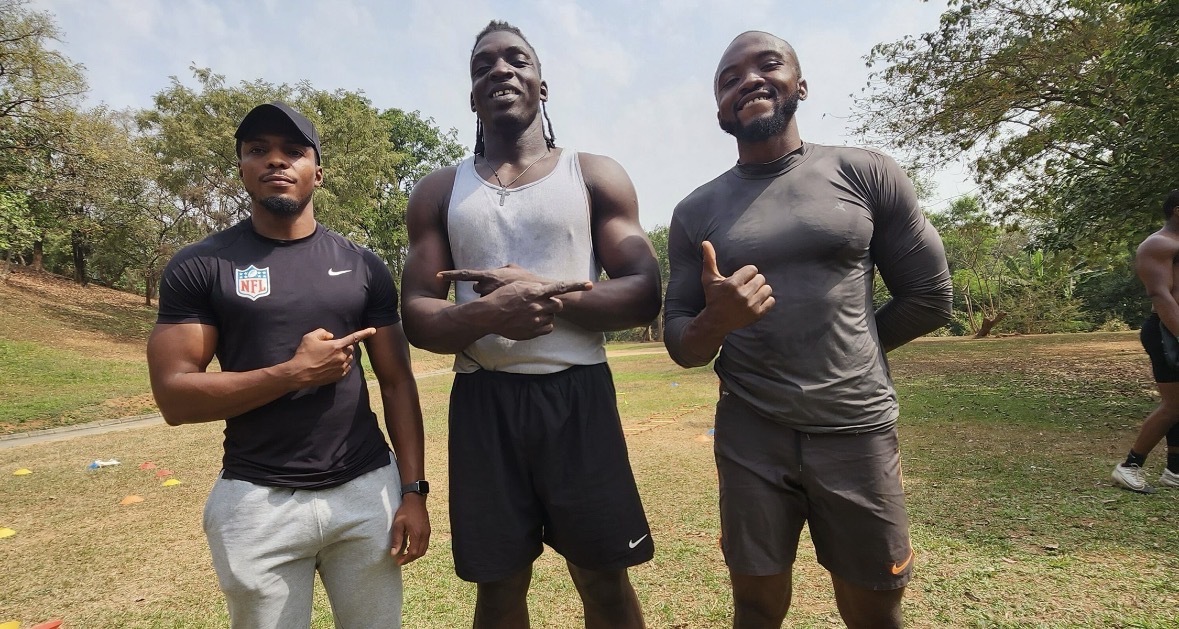
When Bernard moved to Abuja, Musa already hada handful ofaspiring football players living with him. So Christian took the teenager in. Together, they’d work every day, from 8 a.m. to 11 a.m., at a local public park they called “The Trenches.”
This wasn’t an NFL training facility, but Musa and Christian saw potential. The park had a sand pit. Its hills were steep, perfect for mid-morning sprints, and its trees were as sturdy as a blocking sled.
The coaches purchased small pieces of equipment, like cones, ladders and mini hurdles, and set them up on the grass, sharpening the players’ skills under the blistering sun.
They’d also use the natural resources around them. Bamboo sticks were repurposed for cross-chop drills and honing inside shoulder drops. Bernard and his fellow athletes had occasional access to a gym, but due to limited funds, everyone had to get creative.
This was especially true for Bernard. One of his biggest early obstacles was mobility, and he didn’t have access to a physical therapist in Nigeria.
So, Musa and Christian came up with an idea.
“We had to push him into a dance class,” Musa said. “We’re like, ‘Yo, you need to go to a dance class.’ It was to help his flexibility. More aerobics than Afro dance.”
“He laughed about it,” Christian said, “but even if he laughs, he will never say no. He will do it. He’s humble.”
Bernard knew virtually nothing about American football when he started working with the coaches. But even from West Africa, Musa and Christian had learned quite a bit.
In 2011, a former University of Maryland linebacker, Ricardo Dickerson, co-founded the American Football Association of Nigeria, an organization focused on youth development. He started going on visits to high schools around the country, which is how Musa was introduced to the sport.
He and his classmates stayed in touch with Dickerson, who sent them YouTube tutorials and documentaries. Musa had hoped to attend an American university on a football scholarship, but the pandemic — and a lack of financial support — made that a nonstarter.
The coach wasn’t getting any younger, and as months turned into years, he conceded that his dream had passed him by. But he and Christian still felt a passion for the sport, and continued to follow it religiously.
They’d seek advice from high-profile coaches on Instagram, like defensive line trainer Javon Gopie. They’d study film of pass rushers including Umenyiora and Myles Garrett.
Before long, Musa and Christian could recite defensive drills and plays by heart. And the two coaches would break them down for the future Eagle, bit-by-bit.
If a move required three steps, Musa, Christian and Bernard would spend a week working on each one. Their pupil had many God-given gifts — explosiveness, quickness, strength — but the coaches wanted to refine the basics.
Bernard would know exactly where his size-18 feet would need to be planted before and after the snap. He’d know exactly how to get off for a cross chop play, and which direction to break in the following moments.
He would know the difference between bull rush and speed rush, and when to use each move.
“Small details,” Musa said, “that will make him outstanding.”
Like his coaches, Bernard was a voracious learner. After spending three hours at The Trenches, he’d put in extra work, calling Musa or Christian with follow-up questions.
At night, over the West African dish soup and swallow, Bernard and Christian would study more video, usually of Uar’s favorite player, Aaron Donald.
“He would show me tape, and then say, ‘What’s my take?’” Christian recalled. “And then we’d try to dissect and talk about it.”
Unlike other athletes his age, Bernard wasn’t prone to distraction. When he wasn’t at the gym, he was at The Trenches. When he wasn’t at The Trenches, he was often in prayer.
“The boy only goes to church, gym, training,” Musa said. “That is his life. Because he came with the hunger that nobody believes in him. Sometimes we even needed to tell him, ‘You need to slow down before you break down.’
“He would go to the church and do overnight prayer, and early morning he would come to the field and keep working. And I’m like, ‘Yo, I know your eyes. You haven’t slept.’”
‘Our boy has been drafted’
Musa and Christian were 5,166 miles away from Pittsburgh on Day 3 of the NFL draft, but that didn’t help calm their nerves. In an homage to Bernard, Musa watched the broadcast at home, on his prayer mat.
He was concerned after the Kano native hadn’t been picked in the earlier rounds.
“I was like, ‘Oh God, please let this happen to us,’” Musa said. “It wasn’t just happening to him. It was happening to the whole of Africa.”
When Bernard was finally selected, with the 251st pick, the coach called Christian, who had dozed off. It was just past midnight in Nigeria.
“He woke me up,” Christian said. “He was like, ‘Yo, are you sleeping? Our boy has been drafted!’”
Uar Bernard’s seventh-round selection was one of the feel-good stories of the 2026 NFL draft. AP Photo/Jeff Roberson
Musa and Christian were overcome with excitement. So was Umenyiora. The longtime Giant may have hated the Eagles as a player, but as an ambassador for NFL Africa, he looked at the organization through a different light.
In his mind, Philadelphia was a perfect fit for “Bigfoot.”
“[The Eagles] have this mentality that they’re going to be patient with these guys,” Umenyiora said. “A lot of times, teams will get a guy who’s never played football before, and after maybe a month or two, they’ll cut him and get rid of him.
“And you’re like, ‘Well, what were you thinking was going to happen in a month or two?’ But with Philly, when they get them, they stick with the process. It’s like they’ve done so much homework, that when they get them, they are stuck in their belief system that they can turn this guy into a player.
“And they have the right coaches, and they believe in their coaches. So, when I found out he was going there, quite frankly, I was really happy. Because they get it. A lot of teams don’t get it. But they do.”
The work is far from over. Going from the basics to Vic Fangio’s defense will be challenging. The Nigerian is still getting used to wearing a helmet; soon, he’ll be facing the best players in the world.
But no matter what happens, Bernard has already proved something.
Back in Abuja, at The Trenches, a handful of football players are waking up each morning to run grueling sprints.
It wasn’t so long ago that locals used to mock them. They’d compare their drills to kung fu, as if their sport was a novelty.
Not anymore.
“The athletes here are super proud,” Christian said. “He’s the motivation to all of them who are working so hard. And we keep preaching that.
“‘Bernard was here with you guys. He’s not a stranger. He’s not a ghost. He’s someone you all know. So, if he can do it, you can do it.’”
Coverage in The Philadelphia Inquirer of the opening of the Robin Hood Dell in July 1930.
Philadelphia Inquirer
July 8
1930
Admit One
The Robin Hood Dell in East Fairmount Park opens with an estimated 10,000 to 12,000 people attending the concert by the Philadelphia Orchestra. Later that month at the Dell, a young conductor named Eugene Ormandy conducts the ensemble for the first time.
All weather event
SEC
ROW
SEAT
July 24
1931
Admit One
The popular Hall Johnson Choir performs — the first Black artists to appear there.
All weather event
SEC
ROW
SEAT
Aug. 30
1933
Admit One
Samuel Barber’s *Overture to the School for Scandal* receives its world premiere at the Dell.
All weather event
SEC
ROW
SEAT
a brief pause for this advertisement
July 18
1940
Admit One
More than 12,000 attend and thousands more are turned away from Marian Anderson’s Dell debut the year after her historic Easter concert at the Lincoln Memorial.
All weather event
SEC
ROW
SEAT
July 1
1943
Admit One
Judy Garland, age 21, performs at the Dell in her first public concert.
All weather event
SEC
ROW
SEAT
July 17
1944
Admit One
Dean Dixon becomes the first Black conductor to lead the Robin Hood Dell Orchestra (the name used for the Philadelphia Orchestra at the venue at the time).
All weather event
SEC
ROW
SEAT
Frank Sinatra at the Robin Hood Dell, July 6, 1945.
Frank Sinatra sings in an unscheduled performance when Dinah Shore calls him up to the stage from the audience.
All weather event
SEC
ROW
SEAT
a brief pause for this advertisement
July 22
1948
Admit One
Following a shutdown of the Dell after poor ticket sales and a deficit, businessman Fredric R. Mann takes over as board president.
All weather event
SEC
ROW
SEAT
June 27
1949
Admit One
Leonard Bernstein makes a splash with a concert version of Wagner’s *Tristan und Isolde*.
All weather event
SEC
ROW
SEAT
July 25
1949
Admit One
Duke Ellington and his Orchestra appears with the Robin Hood Dell Orchestra — the first time a Black orchestra and a white orchestra perform together on the Dell stage.
All weather event
SEC
ROW
SEAT
Summer
1959
Admit One
The Dell season opens with competition: noise from the Schuylkill Expressway, which had recently opened nearby. Soon, leaders begin to consider a new site in the park.
All weather event
SEC
ROW
SEAT
A poster for Van Cliburn's Aug. 1, 1963, debut appearance at the Robin Hood Dell.
Photo courtesy of Highmark Mann Center for the Performing Arts Archive
Aug. 1
1963
Admit One
Superstar pianist Van Cliburn makes his Dell debut.
All weather event
SEC
ROW
SEAT
a brief pause for this advertisement
June 22
1964
Admit One
Verdi Requiem in memory of John F. Kennedy.
All weather event
SEC
ROW
SEAT
Aug. 8
1967
Admit One
Jerry Blavat produces and emcees Rock ‘n Roll Jamboree, drawing 19,000 ticket buyers for a concert including the Soul Survivors and Patti LaBelle.
All weather event
SEC
ROW
SEAT
Detail from a 1976 promotional brochure for what was then called the Robin Hood Dell West.
Photo courtesy of Highmark Mann Center for the Performing Arts Archive
June 14
1976
Admit One
The Robin Hood Dell West officially opens in West Fairmount Park. Artists, including the Philadelphia Orchestra, perform in that first season.
All weather event
SEC
ROW
SEAT
Summer
1978
Admit One
Fully staged opera and ballet are presented.
All weather event
SEC
ROW
SEAT
June 13
1979
Admit One
The Dell West is renamed the Fredric R. Mann Music Center.
All weather event
SEC
ROW
SEAT
a brief pause for this advertisement
July 6
1981
Admit One
Mann debut of cellist Yo-Yo Ma, age 25.
All weather event
SEC
ROW
SEAT
1982
Admit One
Between 1982 and 1984, the Mann hosts the Kool Jazz Festival, with artists including Ella Fitzgerald, Miles Davis, and Dizzy Gillespie.
All weather event
SEC
ROW
SEAT
Riccardo Muti leading the Philadelphia Orchestra with pianist Andre Watts at the Mann Center, June 30, 1983.
Photo courtesy of Highmark Mann Center for the Performing Arts Archive
Summer
1990
Admit One
Conductor Charles Dutoit becomes chief of the Philadelphia Orchestra’s Mann series.
All weather event
SEC
ROW
SEAT
Summer
1998
Admit One
Facing financial challenges, the Mann cuts back on its free lawn ticket program.
All weather event
SEC
ROW
SEAT
a brief pause for this advertisement
Sept. 16
2001
Admit One
Just days after 9/11, the Philadelphia Orchestra led by Wolfgang Sawallisch performs a memorial benefit concert.
All weather event
SEC
ROW
SEAT
July 27
2010
Admit One
Aretha Franklin and Condoleezza Rice, as pianist, perform with the Philadelphia Orchestra at a gala fundraising concert.
All weather event
SEC
ROW
SEAT
July 23
2016
Admit One
An estimated 10,000 people turn out for the Philadelphia Orchestra’s live-to-screen performance of *Harry Potter and the Sorcerer’s Stone*.
All weather event
SEC
ROW
SEAT
Summer
2019
Admit One
The Roots Picnic is held at the Mann for the first time.
All weather event
SEC
ROW
SEAT
Fans sit on the lawn at the Mann Center in Fairmount Park while Wilco performed on Sunday, August 22, 2021.
Yong Kim / Staff Photographer
May 15
2021
Admit One
At the Mann, the Philadelphia Orchestra performs for a live audience for the first time in more than 14 months after the start of the COVID-19 pandemic.
All weather event
SEC
ROW
SEAT
Spectators attend the second day of The Roots Picnic 2025 at the Mann Center.
Yong Kim / Staff Photographer
Oct.
2025
Admit One
The arts center announces a 12-year sponsorship agreement rebranding it the Highmark Mann Center for the Performing Arts.
All weather event
SEC
ROW
SEAT
Staff Contributors
Design and development: Charmaine Runes
Reporting: Peter Dobrin (Source: *A Century of Music Under the Stars* by Jack McCarthy)
Editing: Bedatri D. Choudhury
Photography: Highmark Mann Center for the Performing Arts Archive, The Inquirer
Copy Editing: Lissa Atkins
Subscribe to The Philadelphia Inquirer
Our reporting is directly supported by reader subscriptions. If you want more journalism like this story, please subscribe today
Since 1986, Philadelphia has had six different mayors and five City Council presidents. But over those four decades, the city’s Democratic Party has known only one leader: Robert A. Brady.
And he’s not done yet.
Brady, 82, on Monday night won an 11th term as chair of the Democratic City Committee, continuing an astonishing run as the top official in the local party despite growing tensions between the local Democratic establishment and progressive insurgents.
Fresh off democratic socialist Chris Rabb’s victory in last month’s Democratic primary for an open Philly congressional seat, District Attorney Larry Krasner called on Brady to resign, and progressive activists hoped to shake up the local party they blame for Philly Democrats’ lackluster turnout in recent federal elections.
But following last week’s ward leader elections — in which left-leaning candidates notched at least five victories but came up well short of the numbers needed to seriously threaten Brady and his allies — the writing was on the wall.
No challenger stepped forward during Monday night’s leadership elections at the party’s headquarters, the Robert A. Brady Office Building on Spring Garden Street, and the incumbent won another four-year term.
“It‘s pretty nice to get it unanimous — nobody complains at all, no problems whatsoever, and that’s the way I like to have it,” Brady told reporters after his reelection, in which the ward leaders approved his slate of party officers in a unanimous voice vote.
He added that he believes the party’s factions can overcome their differences.
“They know that my heart’s in the right place,” Brady said of the party’s left-leaning critics. “I want to go in the right direction, and it might be the direction that they want to go.”
Mayor Cherelle L. Parker, who leads the 50th Ward, addressed party officials during the election meeting, telling them she is a “progressive with a capital P — because if you want to be a progressive, you got to make some progress.”
“People want results,” Parker said in an interview afterward. “They don’t want to see fighting. They don’t want to see finger-pointing. Let’s focus on an agenda and not try to eat our own.”
Also Monday, the party elected several new officers to serve alongside Brady and ordered reruns of three ward leader elections with contested outcomes.
Brady lives in Overbook, where he is the 34th Ward leader.
His mother was a committeeperson, and he worked as a union carpenter before his mentor, the late City Council President George X. Schwartz, got him a patronage job as a Council sergeant-at-arms. (Schwartz later went to jail after being convicted on corruption charges as part of the Abscam scandal in the 1980s.)
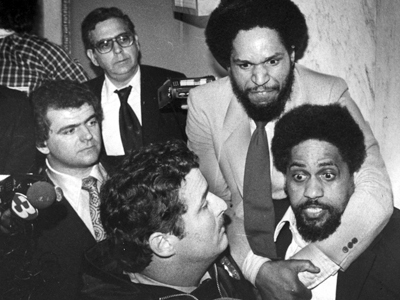
City Council Sergeant-at-Arms Bob Brady, left, looks on as Councilmember John F. Street, top, and State Rep. Milton Street, right, take part in a near-riot in Council chambers. (Daily News File Photo)
Brady was elected to Congress in a 1998 special election, and eventually chaired the House Administration Committee, which handles behind-the-scenes tasks such as assigning office space to lawmakers.
While in Congress, he ran unsuccessfully for mayor in 2007, losing to Michael A. Nutter, who ran on an anti-corruption campaign.
In 2017, news broke that Brady’s congressional campaign was the subject of a federal investigation over an alleged scheme in which a would-be challenger accepted $90,000 to withdraw from running against Brady in a 2012 primary.
Two of Brady’s aides served prison time, but Brady never admitted wrongdoing. He chose not to run for reelection the following cycle, in 2018.
A modern political ‘boss’
While Brady is often referred to as Philly’s “party boss,“ leading the Democratic City Committee is not the same job as it was in the heyday of big-city machine politics.
Thanks to civil service reforms in the 1950s, there are far fewer patronage jobs to hand out. And Brady’s time is more often spent attempting to maintain peace among the various political organizations around the city, rather than telling them what to do.
“It really isn’t all that easy, you know, keeping everybody together,” Brady said Monday night. “You got all kinds of factions, all kinds of egos, and I try to do the best I can to keep together, like we did tonight.”
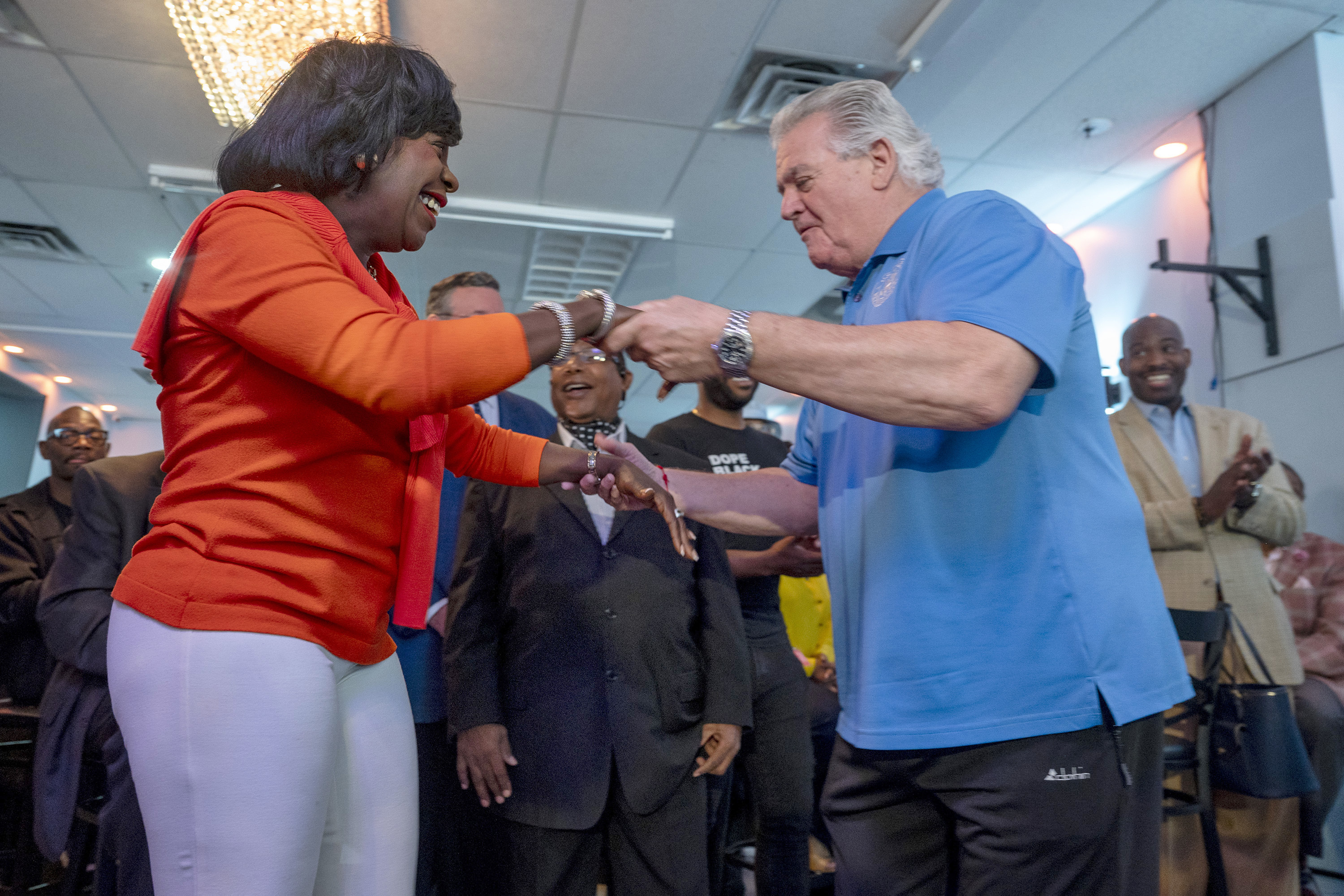
Bob Brady, right, chair of the Philadelphia Democratic City Committee, dances with Cherelle L. Parker at a “unity breakfast” following her victory in the 2023 Democratic mayoral primary. Tom Gralish / Staff Photographer
One area where today’s party does resemble the machine politics of old is local judicial elections. Party-endorsed candidates almost always win seats on the local Municipal Court and Common Pleas Court benches, and many of their staffs are in turn filled with people connected to the local party.
Brady and party leaders have no qualms about admitting what it takes to win their approval: doing favors and free legal work for the city committee, ward leaders, and their constituents.
Philly Democrats’ new No. 2
Although the Democratic City Committee does not have a new chair, ward leaders on Monday elected a new No. 2.
Former Councilmember Sharon Vaughn, who leads the 49th Ward, will be the new first chair of the party, replacing former Councilmember Jannie Blackwell, who did not run for reelection as 46th Ward leader.
Vaughn, who is also a secretary of the Pennsylvania Democratic Party, would temporarily become city committee chair if Brady were to step aside. Brady said Monday he would support her to one day hold the position on a permanent basis as well.
“She’s a great world leader, a former Council person, a hard worker,” Brady said. “What you see is what you get, straight shooter, and she’ll tell you just what it is. And she’s a loyal lady.”
Lauren Rinaldi, the 18th Ward leader who is seen as having relationships with both the progressive and establishment wings of the party, became the second vice chair. She replaces Bass, who has now lost out on her citywide party leadership post regardless of how Wednesday’s 22nd Ward election redo shakes out.
Rinaldi said Monday night she understands her election to leadership was partially an olive branch to the left wing of the party.
“I‘m sure that’s part of it, definitely,” Rinaldi said in an interview. “But I am seeing my role as an advocate — advocating for reform to strengthen the party and modernize the way we do some things and bring more people in instead of shut them out. Basically to rebuild trust with voters.”
The third vice chair remains 7th Ward leader Angel Cruz, and 63rd Ward leader Brian Eddis has replaced Bill Dolbow as fourth vice chair.
Former City Controller Jonathan Saidel will stay on as the party’s treasurer, with John Brady, who is not related to the chair, serving as assistant treasurer.
And 6th Ward leader Pete Wilson was retained as secretary, with 8th Ward leader Elaine Petrossian elected as assistant secretary.
Back-to-back-to-back reruns
The party on Monday ordered the results of three contested ward leader races voided. They will be rerun on Wednesday at the Brady building, with a committee of other ward leaders overseeing the results.
In all three instances, the ward elections were found to have violated the party’s procedures.
The redo for the 14th Ward, in which incumbent Arthur Green lost to Valerie Williams, will take place at 6 p.m.
City Councilmember Cindy Bass, left, speaks with a reporter about her contested 22nd Ward leader election. Aidan T. Gallo / Staff Photographer
That will be followed by a 7 p.m. rerun of the 17th Ward election, which was an open seat in which Tyrone Barge defeated Michelle Schley.
And finally, the 22nd Ward redo will take place at 8 p.m., with progressive challenger Octavius Price taking on Bass.
In all three races, the party will allow submission of “proxy votes” from committeepeople who cannot attend if they are accompanied by notarized affidavits.
Brady said the decision to redo the 22nd Ward vote was an easy one after he saw a video published by The Inquirer showing Bass, who chaired her own reelection meeting, shutting down requests for a roll-call vote that could have clarified the results.
“I don’t think anybody that saw that … was supportive of it,” Brady said. “One ward is one ward, and there’s 68 others, and we’re all going to fix that on Wednesday night.”
Danny Simmons, founder of Rush Arts Philadelphia, an arts community that provided space and motivation for local artists to be discovered and show their work, has died at 72. The cause of death was not announced.
Mr. Simmons was the older brother to hip-hop mogul and Def Jam Recordings cofounder Russell Simmons and Rev. Joseph “Run” Simmons, one-half of the classic rap group Run-DMC.
Mr. Simmons’ death was announced Monday by his brother Russell on Instagram.
“It is with a profound sense of loss that we honor and celebrate the life of Danny Simmons Jr., a beacon of love and creativity,” Russell Simmons wrote on the social media post.
“He was not just a brother, father, uncle, grandfather, and loving husband; he was a vibrant artist, dedicated supporter of creatives and a cherished friend. Though he has transitioned from this world, his legacy of kindness, generosity, and artistic brilliance will forever shine brightly in our hearts.”
Daniel Simmons Jr. was born on Aug. 17, 1953, in Hollis, Queens. His father, Daniel Simmons Sr., was a truant officer and Black history professor who also wrote poetry. His mother, Evelyn Simmons, was a teacher who painted as a hobby.
Both of his parents encouraged Mr. Simmons’ art but also pushed him to work a stable job with a pension. After receiving his degree in social work from NYU, he worked at the New York Bureau of Child Support through the 1980s.
“He was the true artist in the family,” Russell Simmons said in a subsequent social media post. “Joey and I went into music … but Danny was the one who created from the deepest place. His poetry, art, and ideas shaped how we think and gave us freedom to dream beyond limits.”
In 2003, Simon & Schuster published Mr. Simmons’ Three Days as the Crow Flies, a novel about a drug-addict hustler named Crow Shade, who poses as an artist in New York’s drug and arts scene.
Three Days as the Crow Flies is fictional, but by the 1990s, Mr. Simmons had kicked a 20-year heroin addiction, given up his 9-to-5, and leaned into abstract painting.
“I quit my job, started painting, and it started taking off,” he told The Inquirer in 2016. “But I couldn’t find a whole lot of outlets for my work. There were very few galleries dedicated to emerging Black artists. I figured if I was in that position, there had to be other artists in that position.”
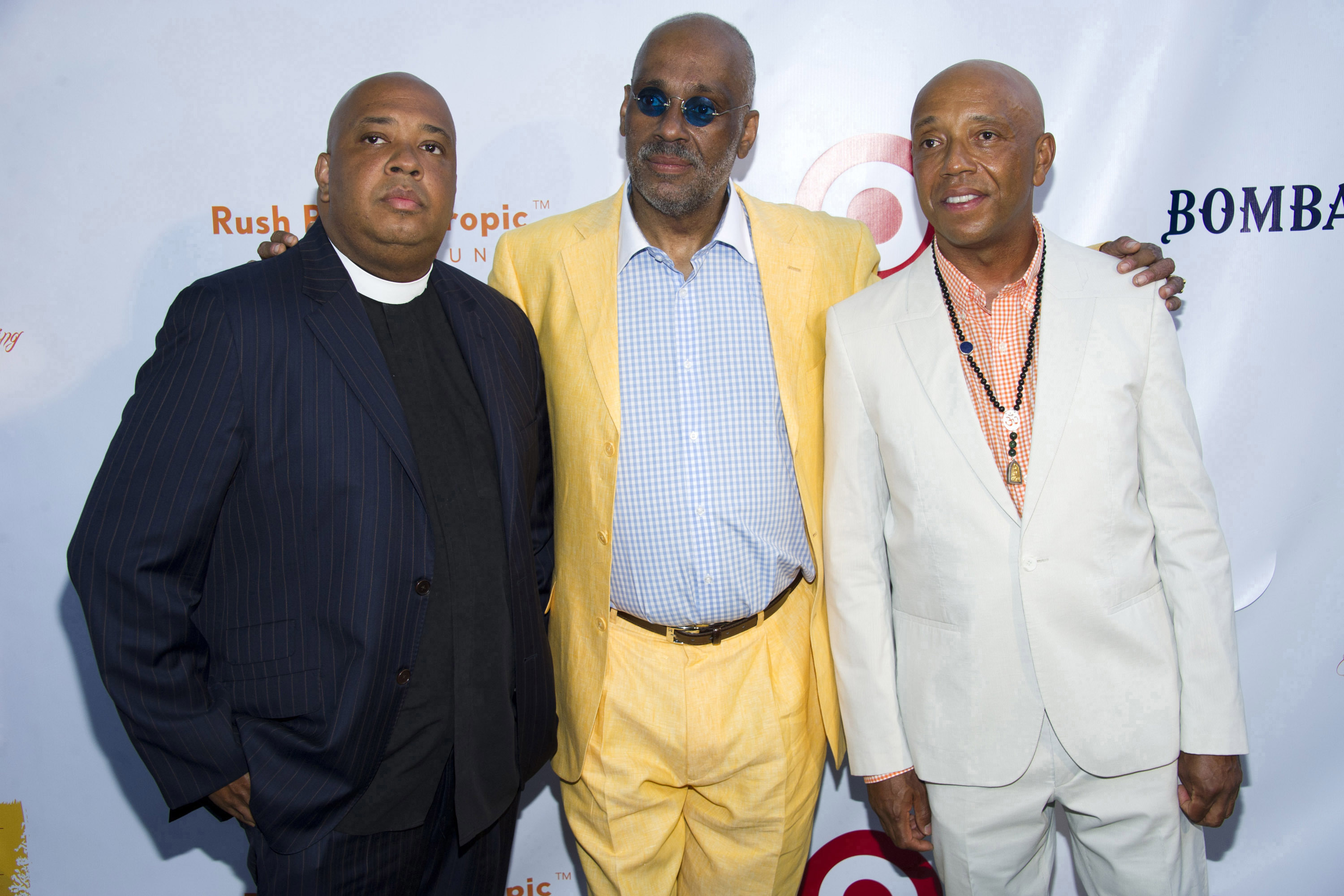
Joseph “Rev. Run” Simmons (left), Danny Simmons (center), and Russell Simmons attend the 12th annual Art For Life Benefit Gala at Russell Simmons’ estate in East Hampton, N.Y., on Saturday, July 30, 2011.
(Charles Sykes / AP Images for Rush Philanthropic)AP IMAGES FOR RUSH PHILANTHROPIC
Mr. Simmons became an avid collector of Black art, opened two galleries in downtown Manhattan, and founded Rush Philanthropic Arts Organization, supporting Black artists around the world.
“Danny’s impact has been global,” said Vashti DuBois, executive director of the Colored Girls Museum in Philadelphia. “His investments in and support of Black artists and Black institutions have fundamentally transformed the landscape of the Black art scene.”
In the early 2000s, Mr. Simmons convinced his brother Russell to produce HBO’s Def Poetry Jam. The show, a spinoff of HBO’s Def Comedy Jam, ran from 2002 to 2007 and breathed new life into spoken word poetry, first popularized by the 1970s Black Arts movement.
A prototype of Def Poetry Jam, that often showcased Philly artists Sonia Sánchez and Ursula Rucker, was filmed at the African American Museum in Philadelphia.
Mr. Simmons won a Tony for the stage adaption in 2003.
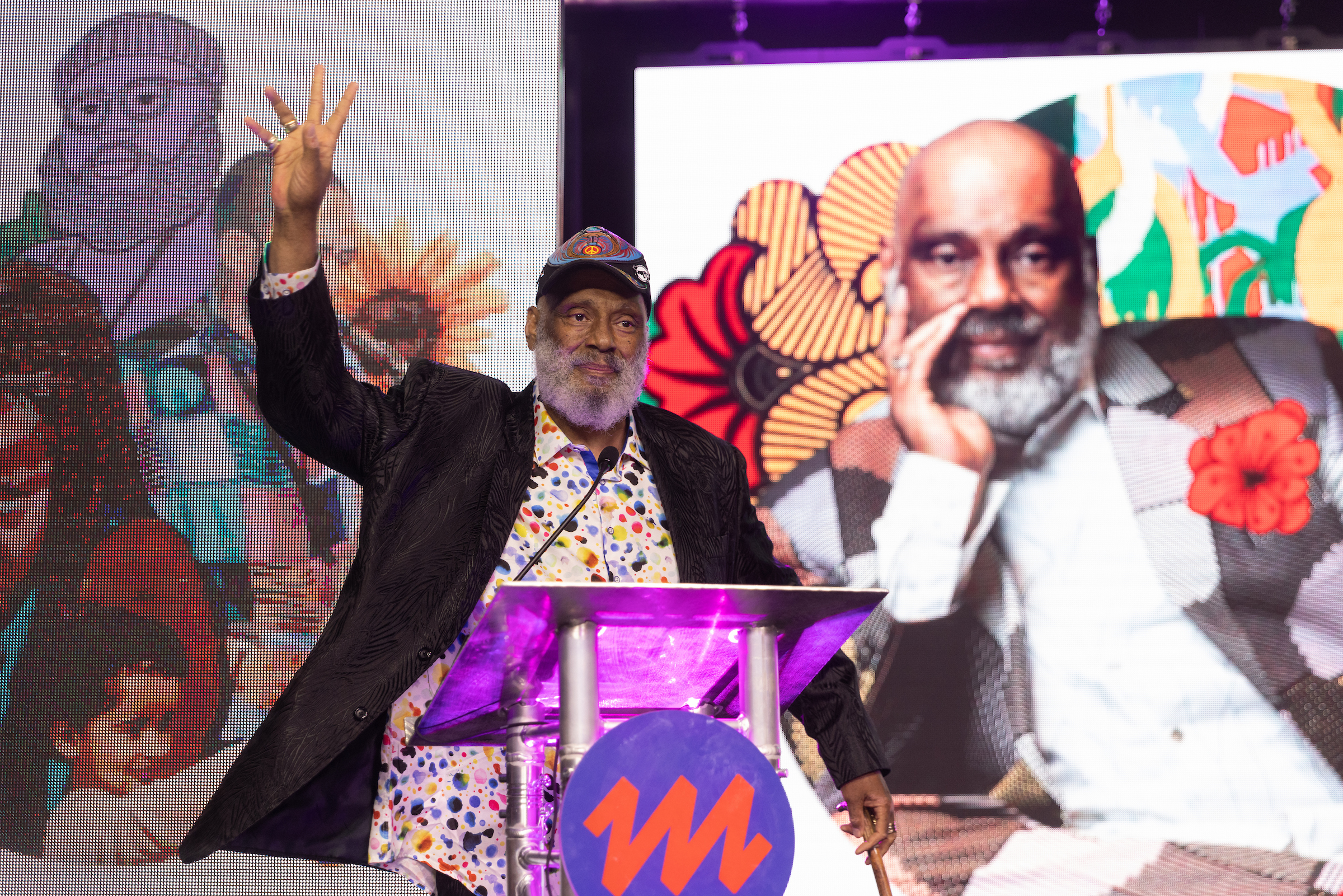
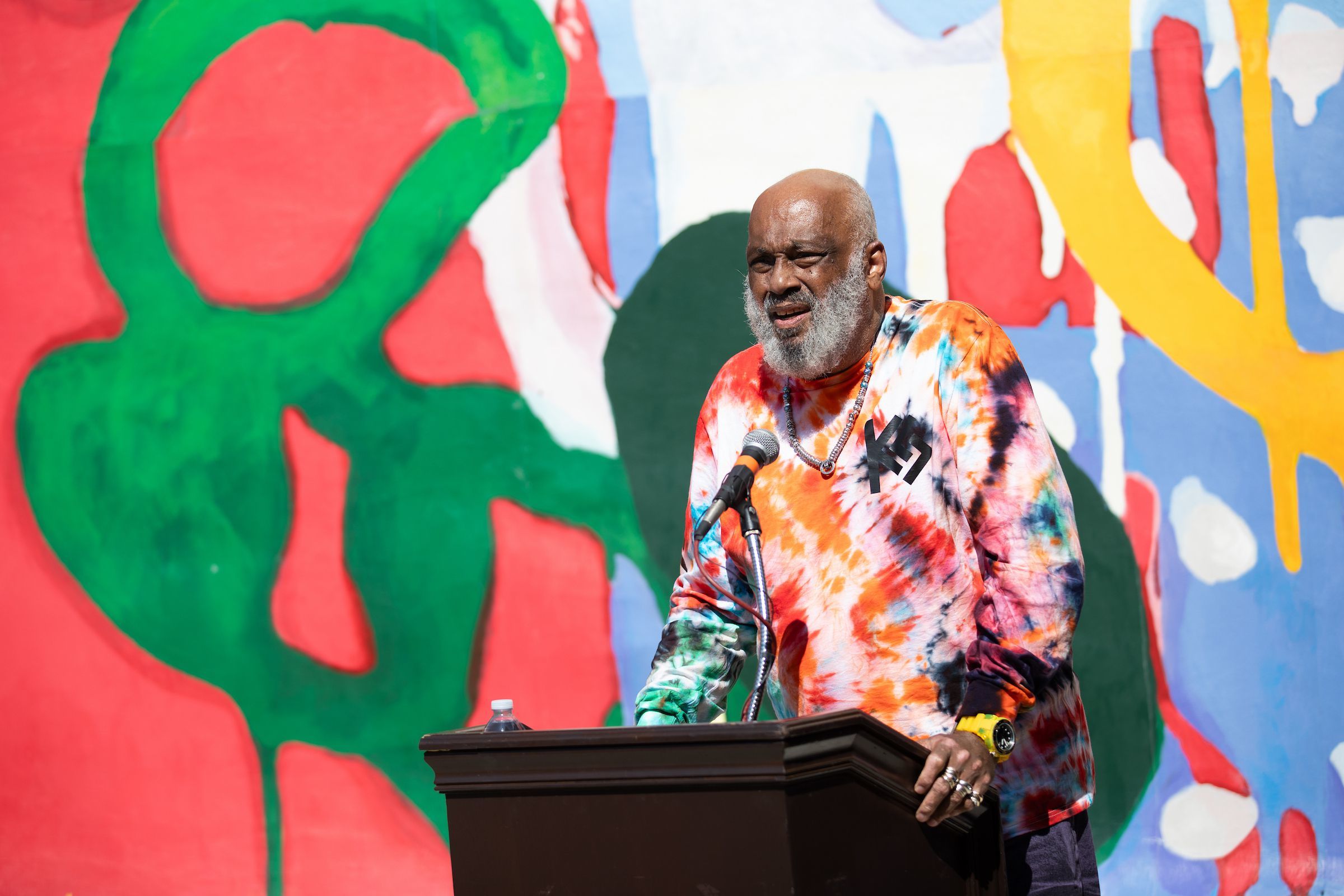
Danny Simmons speaking at a Mural Arts Philadelphia event to unveil the 2023 mural, “My Crazy Red Rooster.”Mural Arts
In 2015, the African American Museum hosted his solo show, “Badass Art, Man!” a colorful collection of paintings, collages, and statues he described as “neo-African abstract expressionist.”
Later that year, he moved to Northern Liberties, because it reminded him of parts of Brooklyn, into a place with a backyard large enough to store his immense collections.
He purchased an old bank building in the Logan section of Philadelphia on Old York Road and made it a home for Rush Arts Philadelphia, a community center and gallery. Until last month, the center supported the work of Philadelphia artists through a series of shows, exhibitions, and receptions.
“Mr. Simmons had a remarkable ability to bring people together through art, inspiring others to see the world through a more vibrant lens,” said Ashley Jordan, president and CEO of the African American Museum in Philadelphia. “His presence was as memorable as the masterpieces he created and championed.”
Mr. Simmons served on the Mural Arts board from 2022-25 and was the lead artist on four mural projects in Germantown and North Philadelphia.
His work resides in the Woodmere Art Museum and the Pennsylvania Academy of Fine Arts. In 2019, he was appointed to the Philadelphia Museum of Art’s African American Collections Committee.
“Danny was an extraordinary artist and human being,” said Jane Golden, founder and executive director of Mural Arts. “Danny was one of a kind, and he leaves very big shoes to fill in our city and our world.”
Apart from his brothers, Mr. Simmons is survived by his wife, Keia Simmons; son, Jamel Simmons; and other family members and friends.
Memorial services and celebrations have not been announced by the family.







 a brief pause for this advertisement