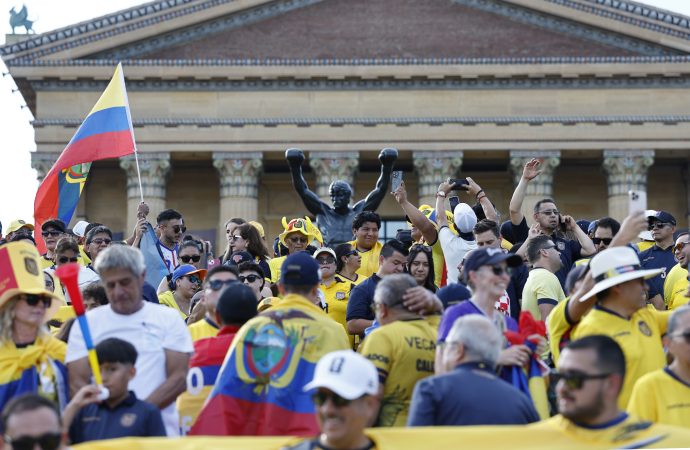
When Ecuadorian soccer content creator Leandro de Vera, aka DonFutbol, tied his country’s flag around the neck of the Rocky statue at the top of the Philadelphia Museum of Art’s steps, he was unaware of the butterfly effect he had set in motion.
De Vera inadvertently triggered the “Rocky statue curse” — a jinx that comes into effect when a team’s fans dress the boxer in an opposing team’s gear — at an Ecuadorian fan celebration at the Art Museum on Saturday.
Earlier that day, two Ecuadorian journalists from Guayaquil’s Radio Diblu had warned fans not to put flags or jerseys on the statue.
“The people of Philadelphia say doing that doesn’t bring good luck and can make a team lose,” reporter Carlos Morales said Saturday, standing by the Rocky statue at the base of the Art Museum.
“The recommendation is to take a picture, put your flag next to it, but don’t put anything on him,” reporter Nico Rivera added.
In the past, multiple NFL fan bases have dressed the statue in their team’s colors prior to a matchup with the Eagles. Most went on to see their team lose. Most notably, Vikings fans wrapped a purple towel around Rocky’s waist before being blown out 38-7 in the 2017 NFC Championship. The Patriots, 49ers, and Commanders have fallen to the same jinx.
Philadelphia sports magic strikes again 🥊
The moment Ecuador fans put their shirt on Rocky, the outcome was inevitable 🫣 pic.twitter.com/IeqYaICygy
— CBS Sports Golazo ⚽️ (@CBSSportsGolazo) June 15, 2026
Ecuador was no exception. On Sunday, to kick off World Cup play in Philadelphia, Ecuador was defeated by Ivory Coast, 1-0, at Lincoln Financial Field, renamed Philadelphia Stadium for the World Cup. Ivory Coast’s single goal came in the 90th minute. Meanwhile, Ecuador could not catch a break. The team hit the post three times — becoming just the fourth team in World Cup history to do so and go on to lose.
Perhaps it was the emotion, naivete, or the fact that de Vera was standing on the Rocky statue at the top of the steps, rather than the bottom. But his excitement was apparent when he climbed the statue, screaming: “Friends, we are here in Philadelphia, Pennsylvania. Rocky is from Ecuador — Rocky Zambrano,” he proclaimed in Spanish, baptizing the Philly icon with a common Ecuadorian last name.
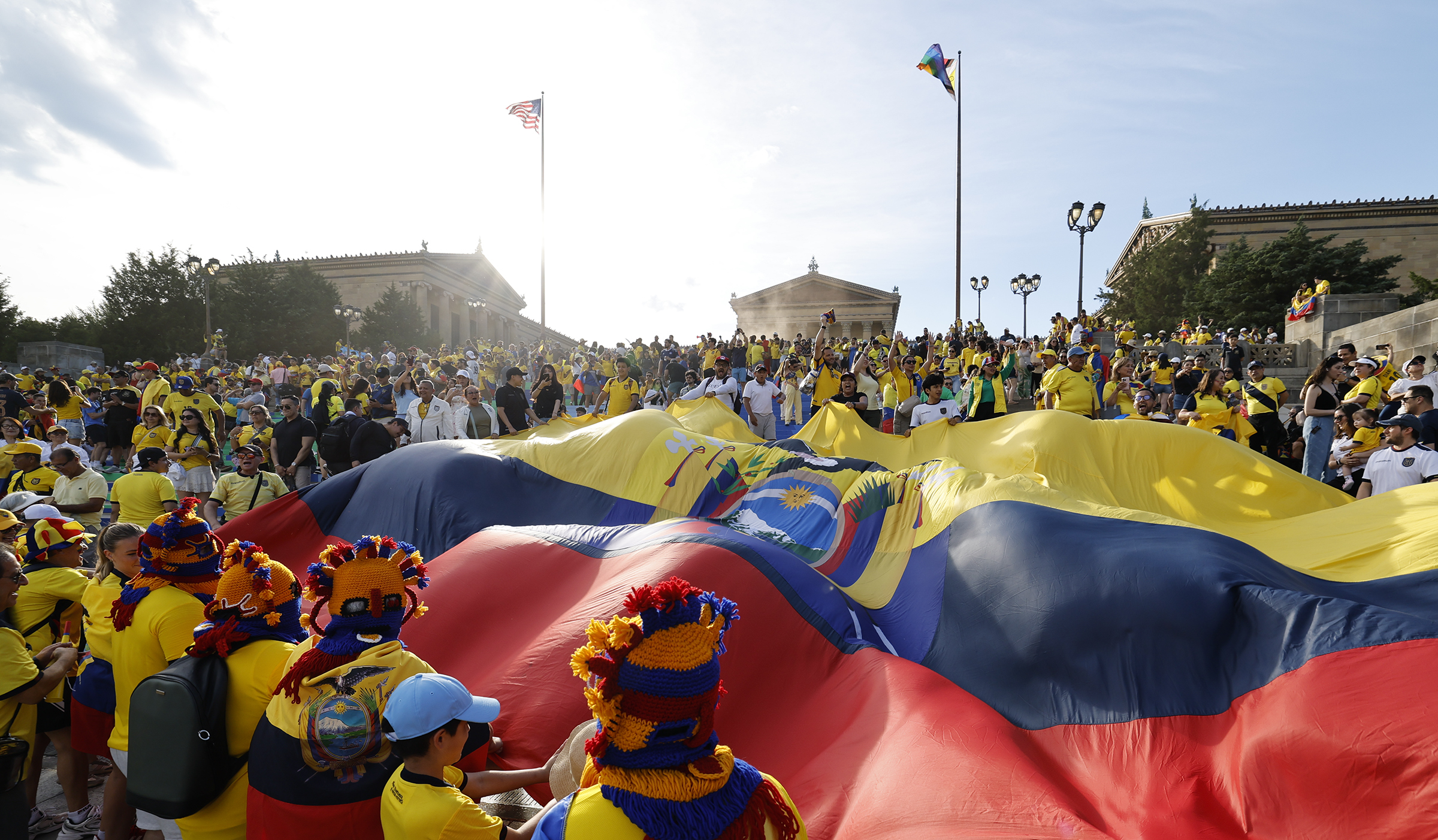
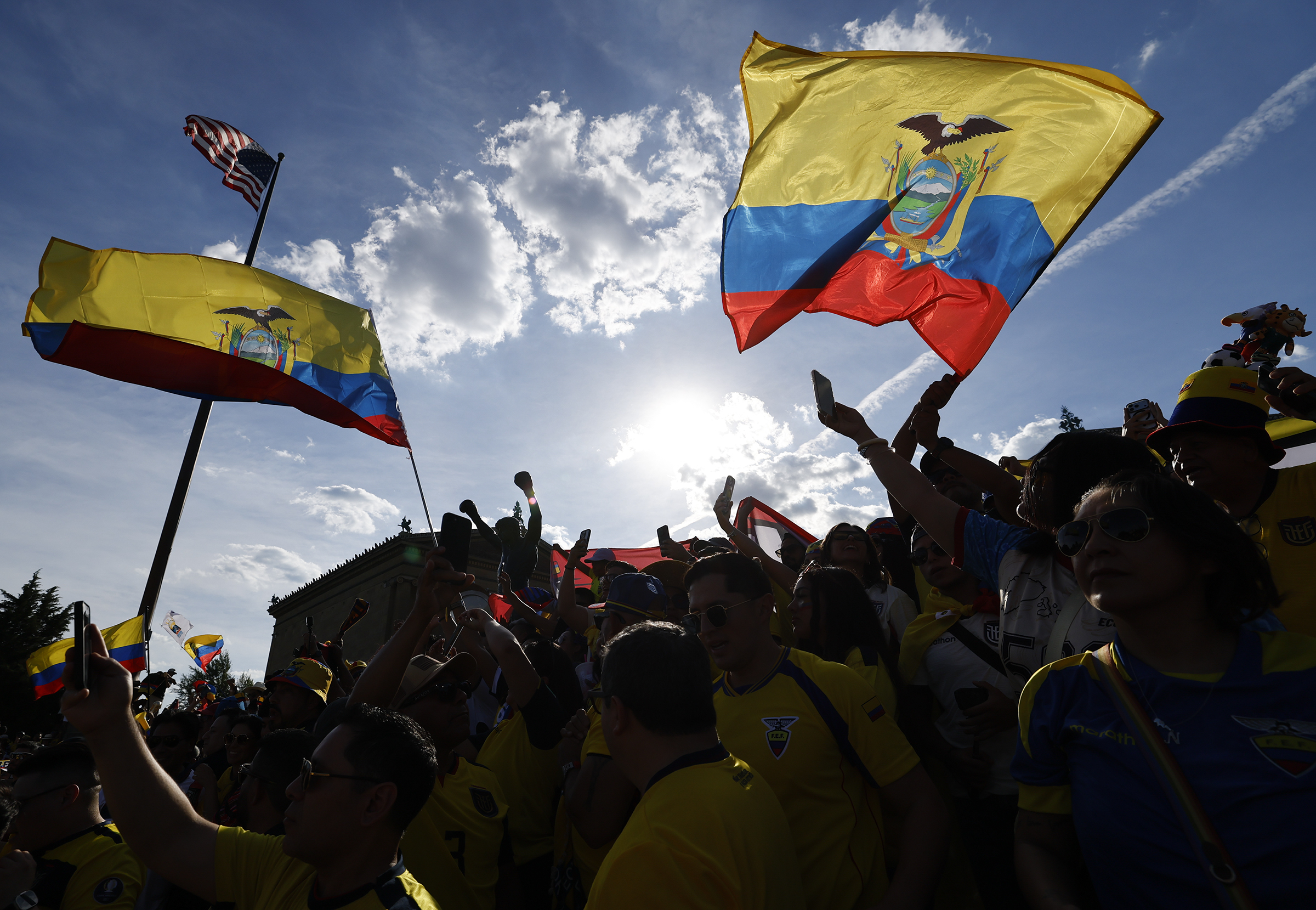
Ecuadorian soccer fans attend a flag waving event at the Philadelphia Museum of Art steps along the Benjamin Franklin Parkway, ahead of their first round World Cup match against the Ivory Coast, on Saturday, June 13, 2026.Yong Kim / Staff Photographer
Ecuadorian Instagram commenters reacted in horror, letting the content creator know of the bad omen he had cast upon their team.
“Friends, it’s amazing how much I’ve been insulted for putting the flag on Rocky,” said de Vera in Spanish in a video posted to social media. “I look at my direct messages, and they’re dragging my mamita [mother] through the mud.”
After Ecuador lost, the hate worsened. One fan even approached de Vera to take a photograph with him just to caption it: “with the most insulted person in Ecuador.”
“It’s been tough since the game ended,” de Vera told The Inquirer in Spanish.
De Vera’s own superstitiousness has made the entire situation harder to deal with. He commonly wears different-colored socks to send his team good luck, and it hurt him personally not to have known about the curse ahead of time. If he had, he would have never touched the statue.
“I was just excited, and there was so much going on I didn’t even realize people were screaming ‘no’ to me until much later,” he said.
De Vera meant no disrespect to his team or to Rocky, he said. He just wanted to bring both Philly and Ecuadorian cultures together, hence giving the fictional boxer a temporary Ecuadorian last name.
“I saw the first movie, but by the time he was done climbing the stairs, I was so out of breath I couldn’t watch the other movies,” de Vera said jokingly. “Let’s wait until the World Cup ends and I will watch the rest. I owe it to the city.”
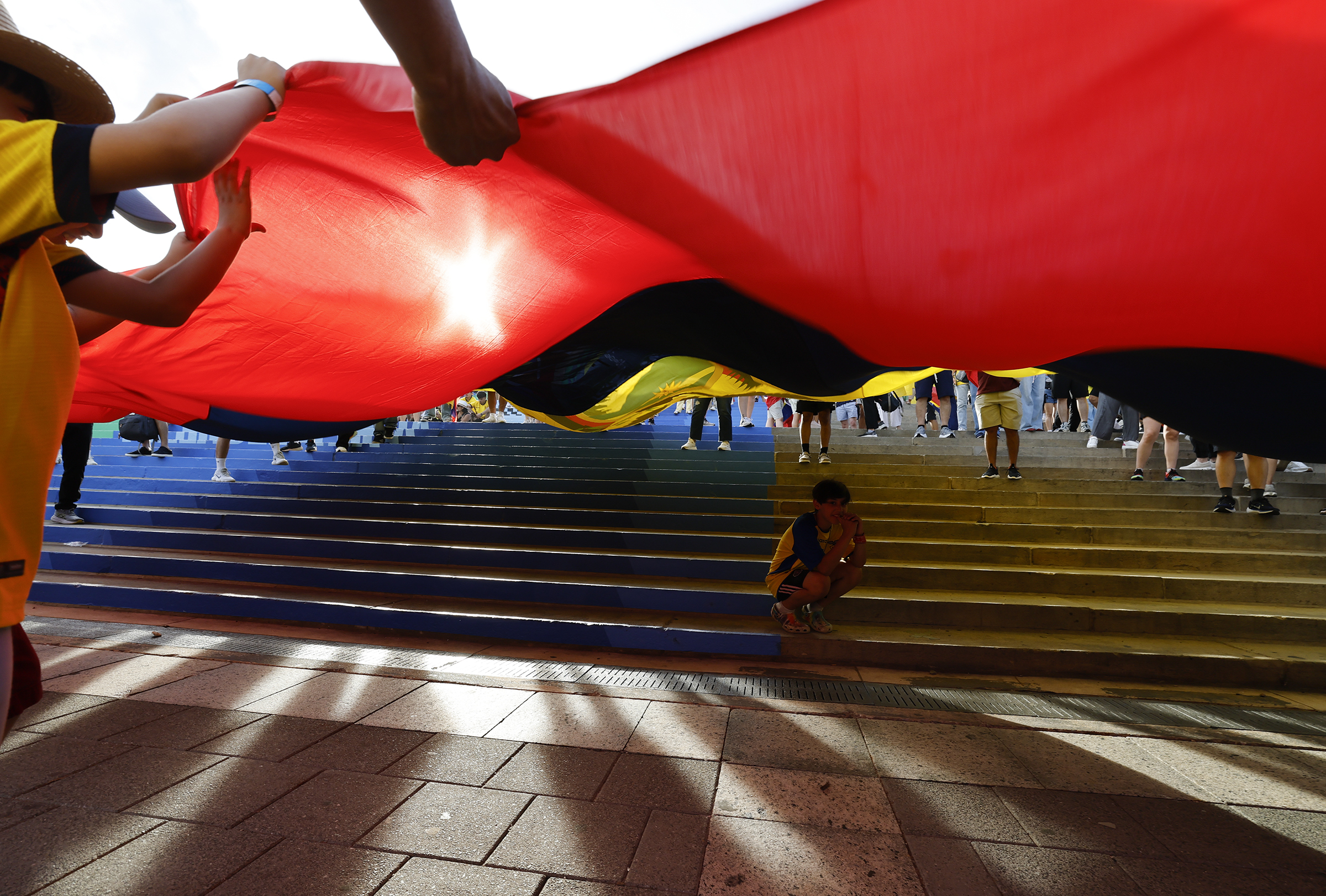
A young Ecuadorian soccer fan sits under the Ecuadorian flag during a flag waving event at the Philadelphia Museum of Art steps along the Benjamin Franklin Parkway, ahead of Ecuador’s first round World Cup match against the Ivory Coast on Saturday, June 13, 2026.Yong Kim / Staff Photographer
‘I think I messed up’
De Vera wasn’t alone in taking the blame.
Colombian social media star Beta Mejía, who is dating Ecuadorian influencer Alejandra Jaramillo, was also in the hot seat after videos of him doing the same went viral. As he wrapped the flag around the statue’s shoulders, shouts of “No” from Ecuadorian fans familiar with the curse rained down the museum steps.
Beta Mejía 🇪🇨 protagonizó un curioso momento en Filadelfia 🥊 al intentar colocar una bandera ecuatoriana sobre la famosa estatua de Rocky, pero su acción fue detenida de inmediato con un contundente “¡No, no, no!” 😅. pic.twitter.com/EZax5oWb0p
— ÚLTIMA HORA ECUADOR (@UltimaHoraEC_) June 14, 2026
“Parse, I think I messed up,” Mejía said in Spanish on a video Sunday before the match. “God, it’s me again, your favorite soldier; I didn’t know, I really didn’t know.”
Mejía blamed his actions on an act of kindness, saying he was trying to help a fan who had passed him the flag. After the backlash, he looked to reverse the bad luck. On video, Mejía lit four candles, praying for God to bless the Ecuadorian players with his blood.
“Fear nothing,” Mejía said, ending his video quoting Ecuadorian player Niño Moi (Moisés Caicedo) and rooting for the team to win.
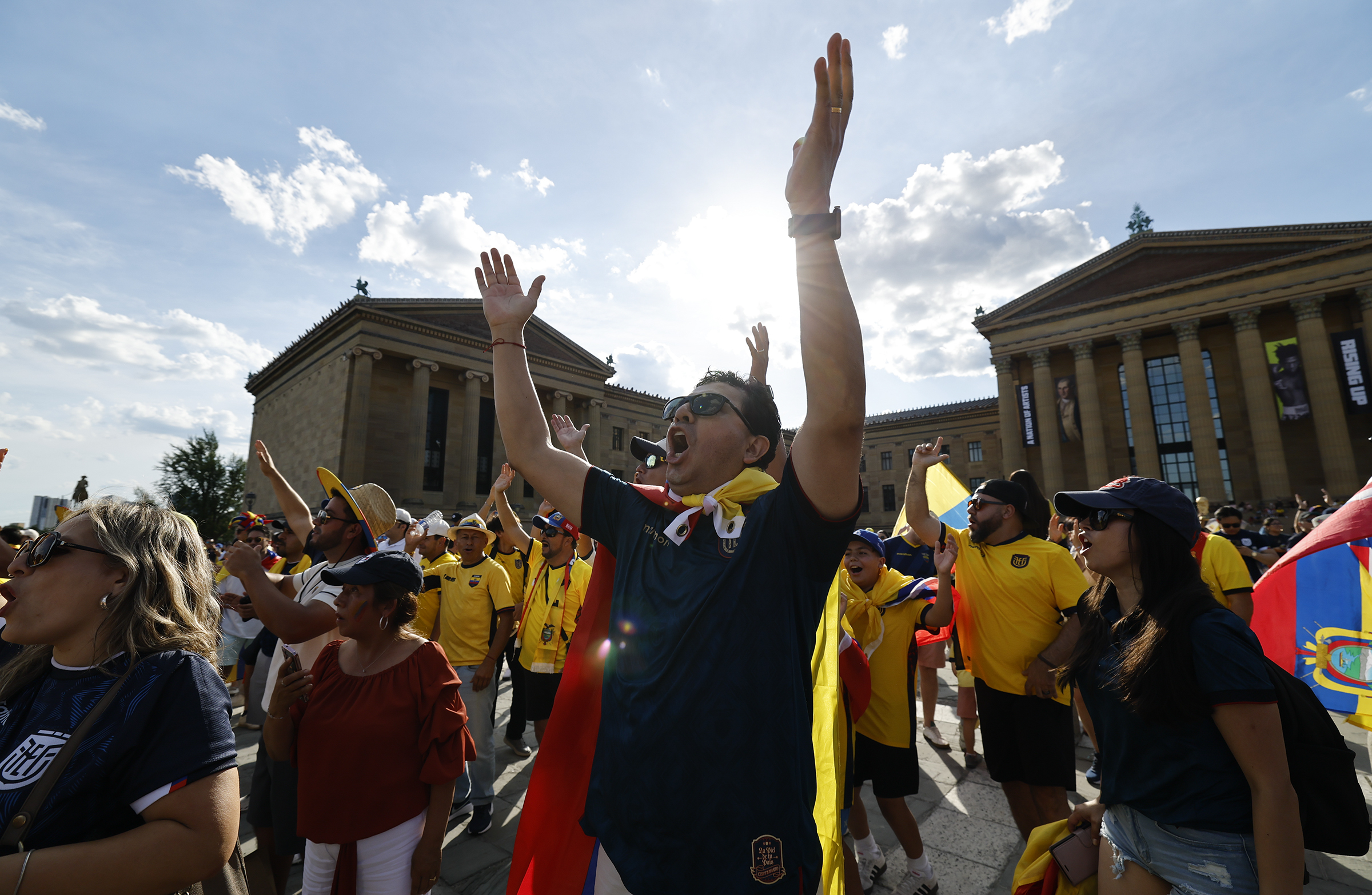
Ecuadorian soccer fan Freddy Baquelo cheers during a flag waving event at the Philadelphia Museum of Art steps along the Benjamin Franklin Parkway, ahead of their first round World Cup match against the Ivory Coast on Saturday, June 13, 2026.Yong Kim / Staff Photographer
Along with de Vera and Mejía, another fan dressed Rocky, attaching a custom Rocky jersey to the statue. He explained his rationale on an Instagram post:
“This is my good luck charm,” Gigio Benavides Peralta wrote. “Traveling for more than 26 hours, more than 5000km from Loja Ecuador to fulfill my promise to put the T-shirt on Rocky. For if I did that, Ecuador would win the World Cup… Let’s go Ecuador.. thanks to @maconsport and my Aunt Odi who helped me make the shirt.”
Despite the supposed Rocky curse, many Ecuadorians on social media seemed to think the bad omen did not come from the shirt or flags, but rather from having the president at the match.
Ecuadorian President Daniel Noboa left the small South American country on June 11 for a four-day U.S. diplomatic trip meant to build bilateral relationships with the United States. He was captured at the game by FIFA cameras, shocking many Ecuadorians.
In a post-match video posted by Ecuador TV, Noboa was recorded leaving the stadium with his cabinet and a band of security guards.
Ecuadorian fans are heard in the background booing him, surrounding his convoy, calling him “salado” (an Ecuadorian word for someone with or who brings bad luck), and shouting that he “came for a vacation.”
Philadelphians react — and also blame Hard Rock Cafe ‘takeover’
Meanwhile, Philadelphia fans are having a bit of fun with the whole ordeal.
“Attention all teams visiting Philly, if you put your jersey on the Rocky Statue the ghost of Adrian will direct all of your shots towards a goalpost,” one wrote on X. “She and Paulie haunt the Linc, it’s a thing.”
As one fan pointed out on social media, Ecuador may have been jinxed by its fans flocking to the Market Street Hard Rock Cafe — just as Commanders fans did before their team’s 55-23 loss to the Eagles in the 2025 NFC Championship.
"Philadelphia has a cursed Hard Rock Cafe" is honestly just fun world building. Love this development. https://t.co/u5GN2objpJ
— one dozen rats at a keyboard (@PanasonicDX4500) June 15, 2026
A Commanders fan known as Tailgate Ted proudly proclaimed that his fan base had taken over the chain outpost prior to the 2025 conference championship game. At the time, the video received mass ridicule from the Philadelphia faithful, including Phillies second baseman Bryson Stott, as the restaurant has little cultural significance to the city.
“Oh no the Philly Hard Rock has fallen. Maybe next they will take over Applebees,” one Eagles fan wrote at the time.
On Saturday, Ecuador will face Curaçao in Kansas City before playing Germany in New York on June 25. De Valera is hoping to enact the Rocky curse again — this time for his benefit.
“We are not out of the World Cup; Argentina once lost [their first match] and still won the World Cup,” de Valera said. “But now that I know, I am going to buy a Germany flag for Rocky ahead of the game.”
Ecuadorian soccer fans wave their flags ahead of their first round World Cup match against the Ivory Coast during a flag waving event at the Philadelphia Museum of Art steps along the Benjamin Franklin Parkway on Saturday, June 13, 2026.Yong Kim / Staff Photographer
Inside Philadelphia’s new RNA manufacturing hub, scientists are working to create vaccines for fish, precision pesticides, and treatments to protect plants from extreme heat.
The recently launched biofoundry at the University of Pennsylvania aims to expand biotechnological capabilities in the United States, funded by an $18 million federal grant. The National Science Foundation has invested infive such facilities nationally, each focused on a specific biological material.
The term foundry traditionally refers to a factory where metal is melted and shaped into desired forms. Expanding the concept, Penn’s NSF AIRFoundry now offers a one-stop facility for designing and building RNA technology.
All products under development involve ribonucleic acid, or RNA, a key molecule in living cells. Some consider it the cousin of the better-known molecule, DNA. Both can carry the genetic instructions for life.
The facility opened in March at One uCity Square in University City. It builds upon Penn’s success with the 2023 Nobel Prize-winning development of an mRNA platform that led to the first COVID-19 vaccine.
“We need to democratize this technology,” said Daeyeon Lee, a Pennprofessor of chemical and biomolecular engineering who serves as the foundry’s director.
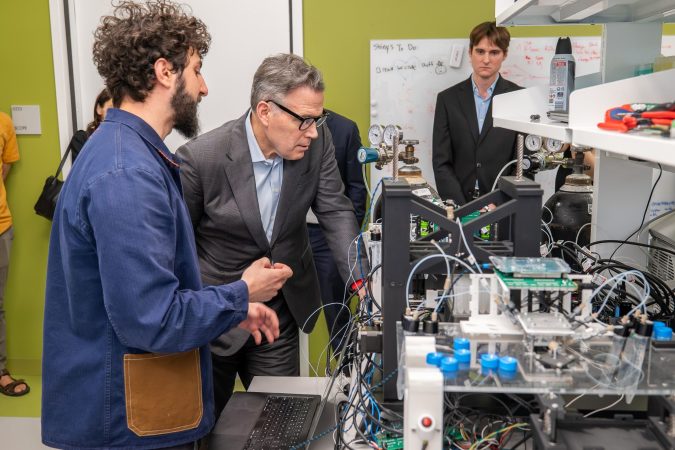
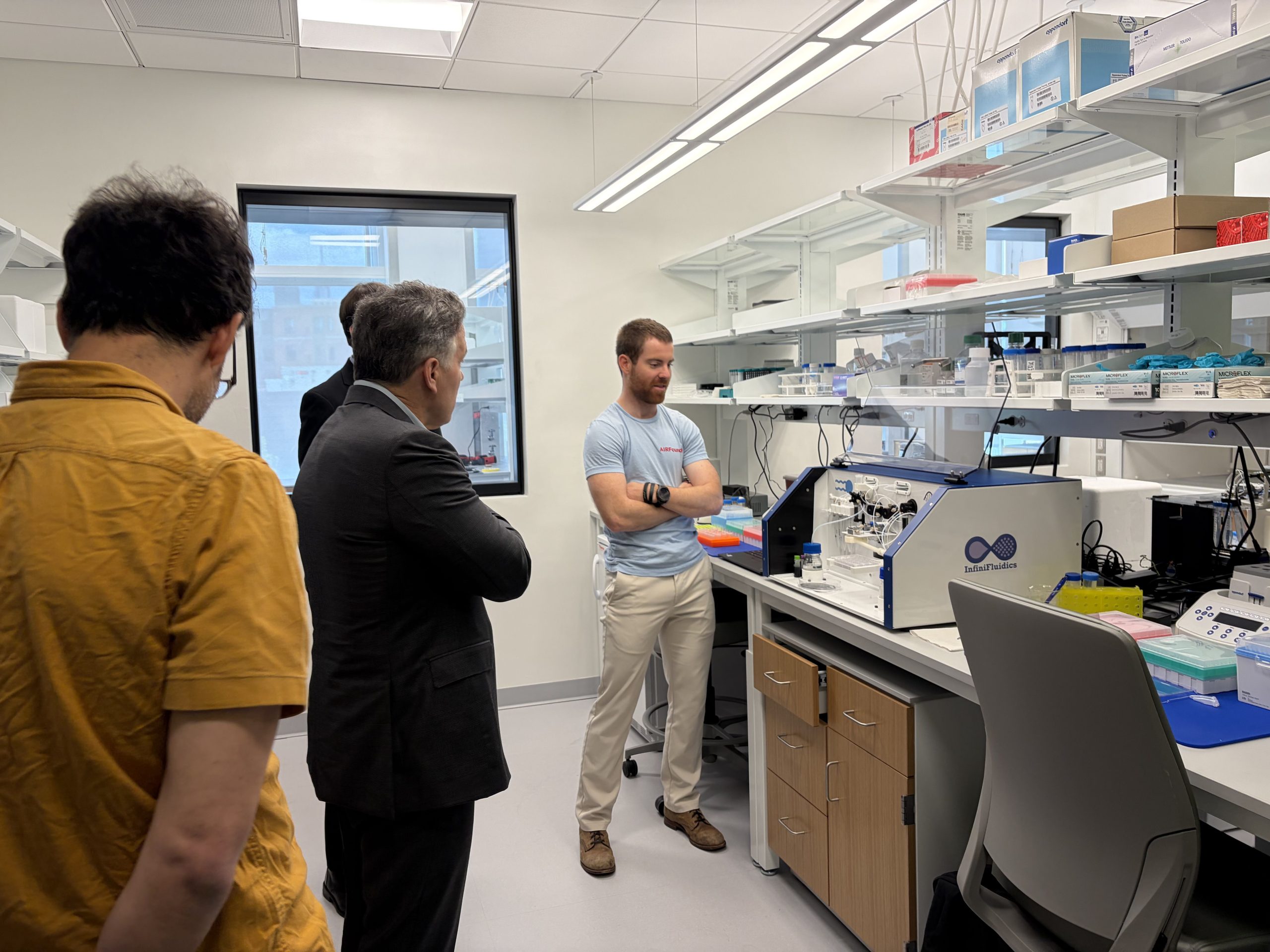
Penn Engineering professor George Pappas speaks with Sen. Dave McCormick about the AIRFoundry.Kayla Yup / Staff
AIRFoundry stands for Artificial Intelligence-driven RNA BioFoundry. Scientists hope AI will help them automate aspects of the design and manufacturing process, serving as a resource for researchers and commercial companies across the world.
A longtime anti-vaccine activist, Kennedy has claimed the technology is unsafe and ineffective, despite scientific evidence finding the vaccines to be highly safe and beneficial.
Now the foundry seeks to expand RNA’s applications in healthcare, agriculture and beyond.
Lee compared the technology to a hammer — good for certain things, but not everything.
“Our students and postdocs that get trained right now are going to be sort of the first generation of people to think about RNA as a tool for whatever problem they’re trying to solve,” Lee said.
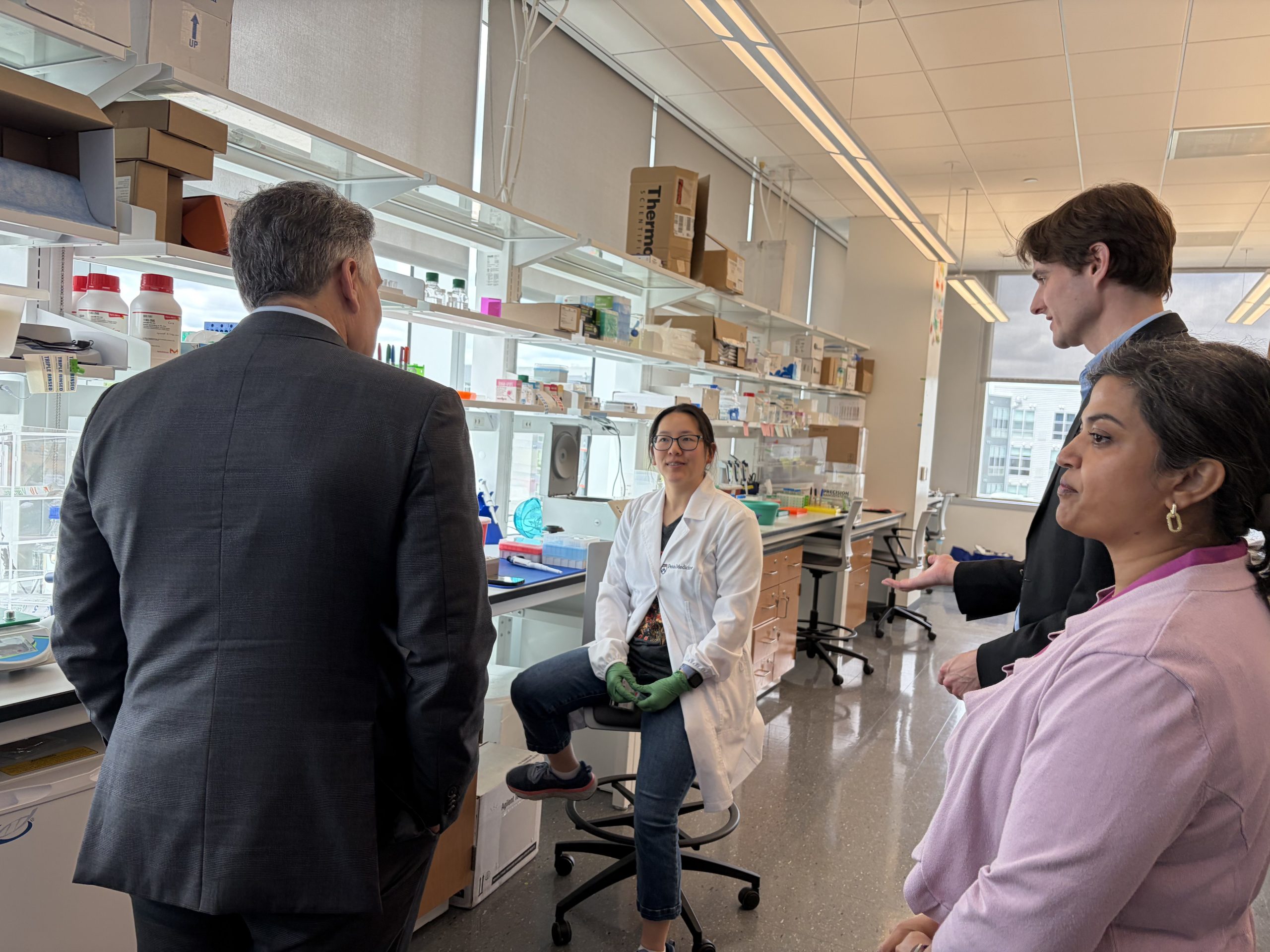
An AIRFoundry scientist describes her work in the facility.Kayla Yup / Staff
A foundry for RNA
In themRNA COVID-19 vaccines, injected mRNA provides the instructions for cells to build a harmless fragment of the viral protein. That trains the body to recognize and fight a future infection.
Compared to traditional vaccines that use live or inactivated pathogens, mRNA vaccines can be produced more rapidly — useful in a pandemic.
One of the Nobel laureates behind that effort, Pennscientist Drew Weissman, has operated a smaller scale version of the facility, mainly to make mRNA for his lab and collaborators. The foundry’s launch marked an expansion beyond Penn.
Its sterile instruments and busy lab benches were on display last month as students and faculty walked through the manufacturing process.
“It takes special facilities and skills to make RNA and associated materials,” Lee said.
Owen Land, an engineer at Infinifluidics (a Penn spinout), spoke about a device used to automate part of the process of creating liquid nanoparticles (a delivery vehicle for RNA).Kayla Yup / Staff
So far, Penn’s facility has operated on a “fee-for-service” basis, where collaborators request a specific RNA technology and the foundry builds it.
But its scientists hope to incorporate AI to help with synthesizing all the current knowledge, best practices and databases.
They also want to reach a point where users can come to the physical facility and use the instruments themselves.
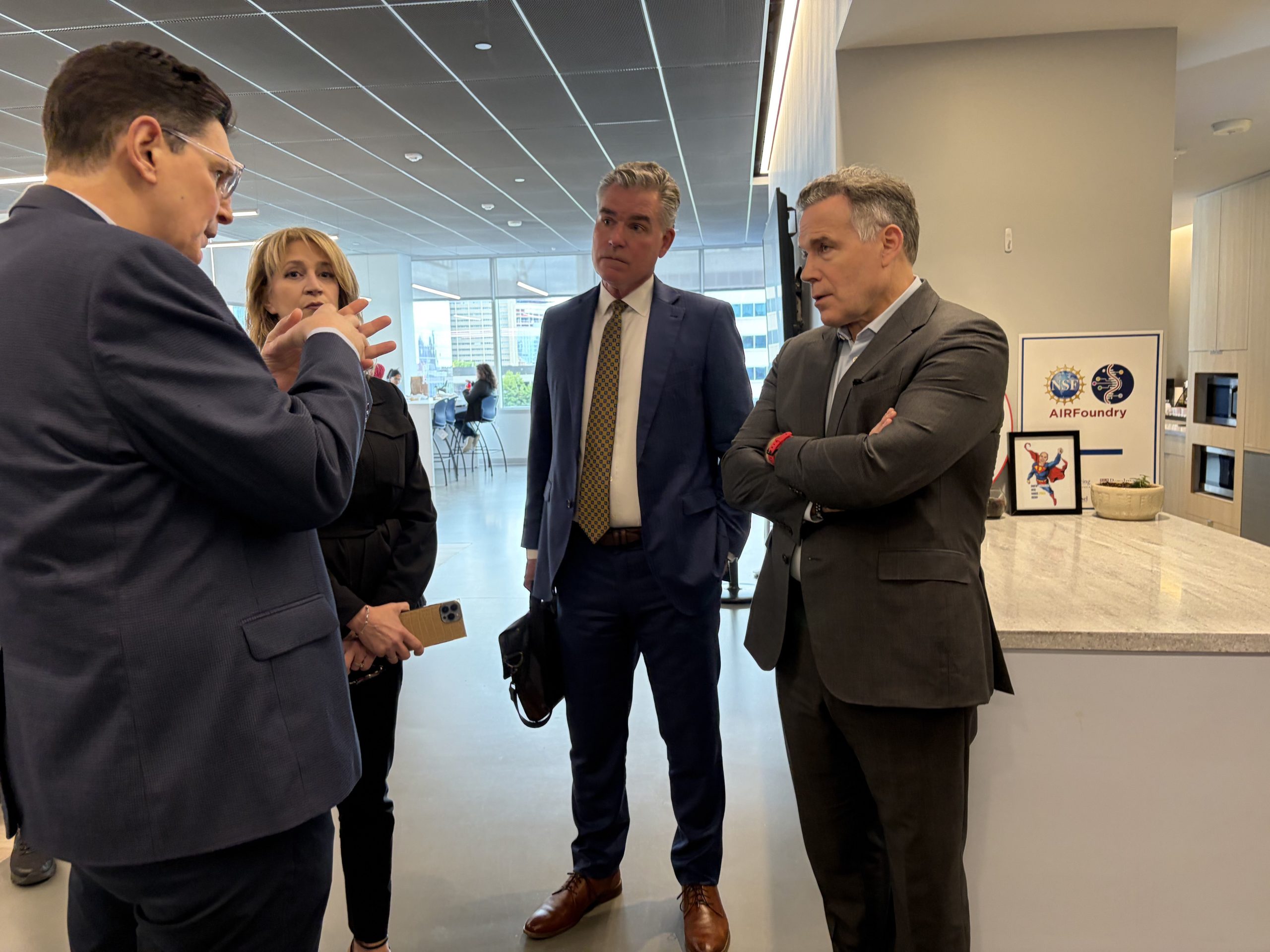
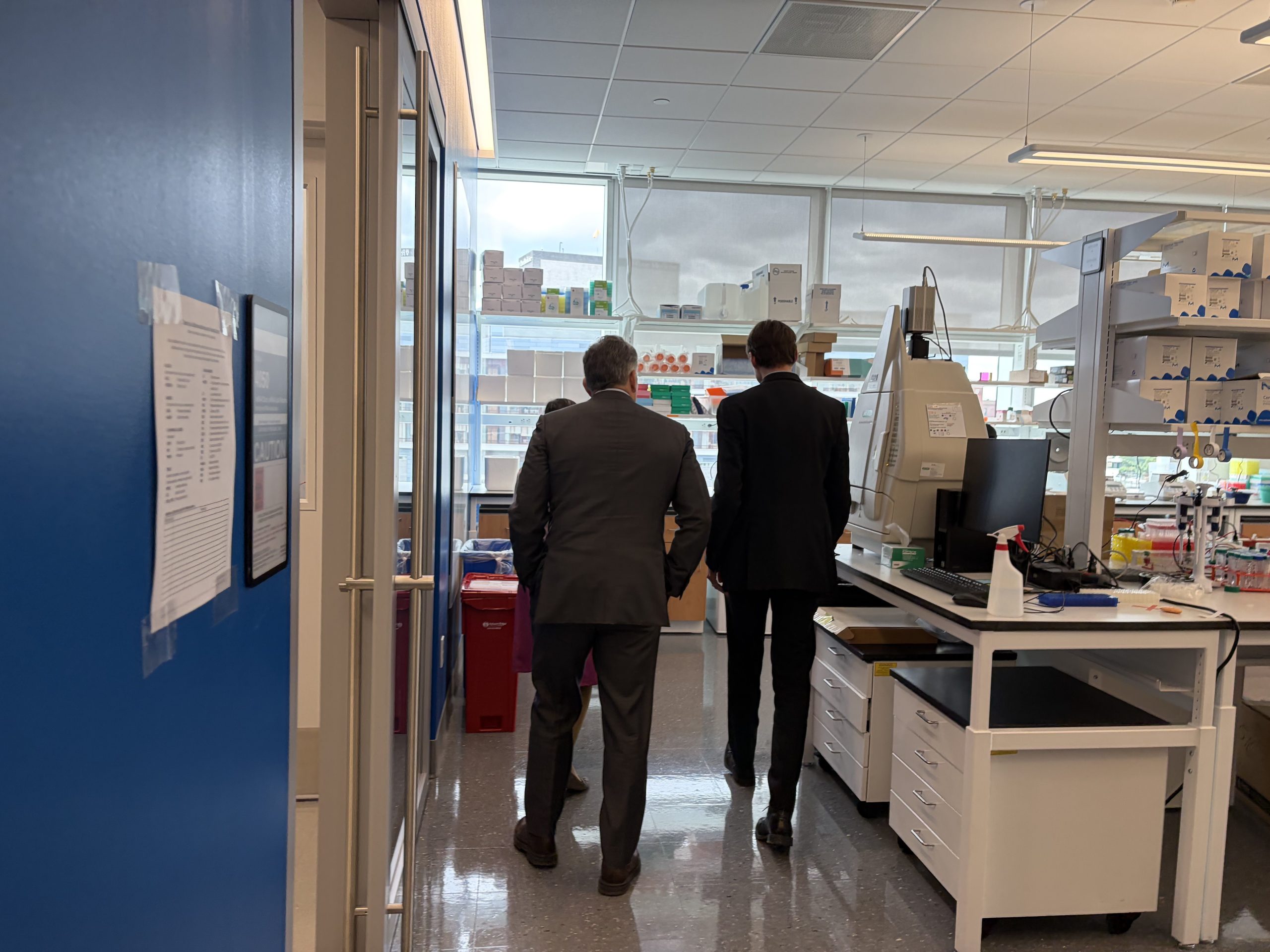
Sen. McCormick toured the AIRFoundry in May.Kayla Yup / Staff
The federal grant, which started in September 2024, supports the foundry for six years. Lee hopes it will eventually become self-sustaining through the services they provide.
Projects underway includeworking on vaccines to keep fish healthy.
Another collaboratoris developing ways to deliver RNA into plants to benefit the agriculture industry. For example, designing RNA molecules that carry instructions for producing a heat shock protein could protect plants from high temperatures. The plant would produce the protein and theoretically have greater resilience against extreme heat.
The molecule degrades over time, making its effects temporary. So if used during the summer months, the RNA could be gone by the time harvest rolls around.
This transient quality could also make RNA useful for pest control, in lieu of chemical-based pesticides, Lee said.
“We want to interact with everyone that’s interested in using RNA technology,” he said.
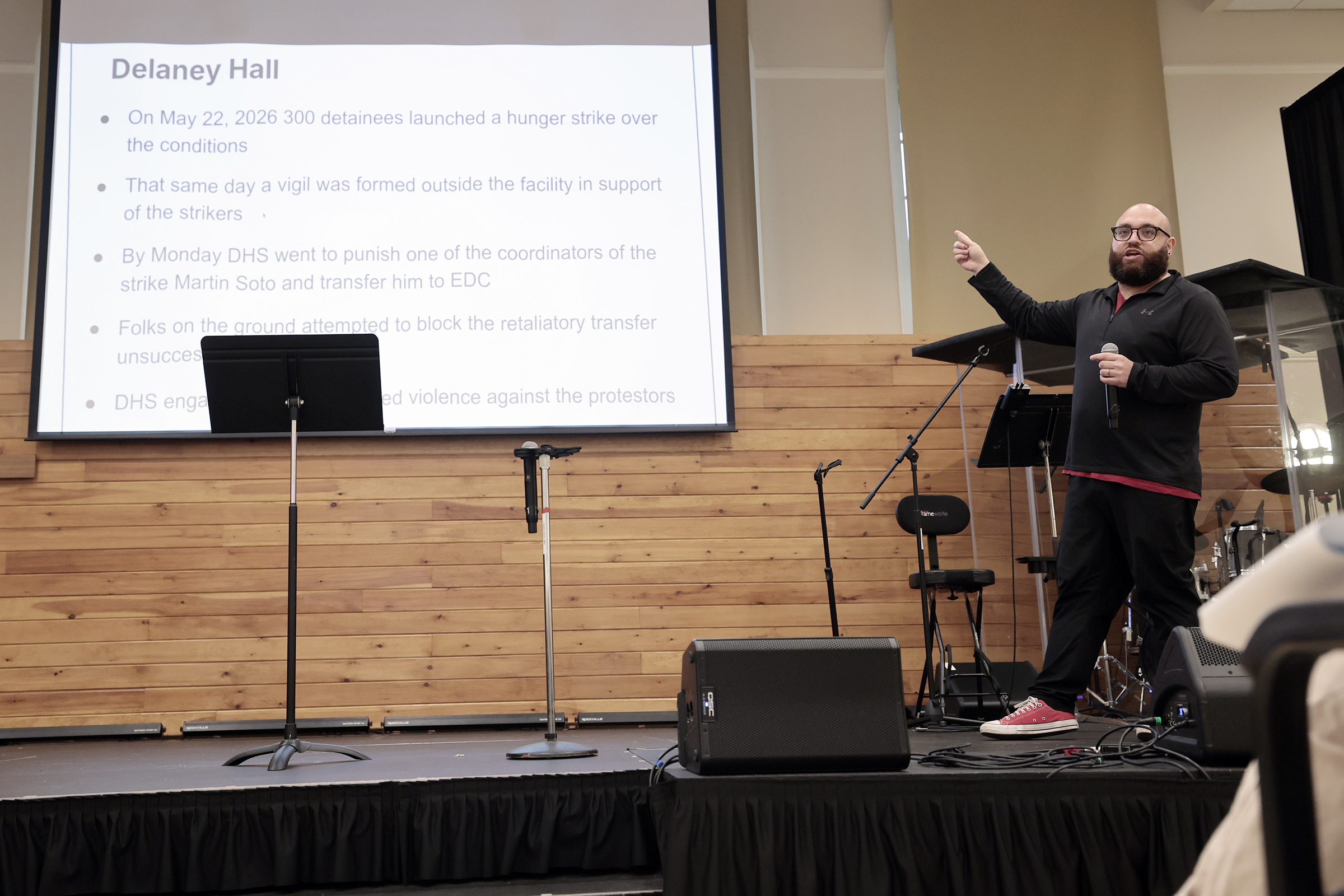
Josue Barreiro stood in front of a crowd of 200 people seated inside a church last week in Haddonfield. He was there to speak about his experience as one of 61 protesters arrested in one night outside Delaney Hall after Gov. Mikie Sherrill had sent over state police.
He told the crowd, gathered for a meeting of the South Jersey progressive group Cooper River Indivisible, that the governor made it seem like she was sending state troopers to protect demonstrators from federal immigration officers. Instead, he said, they brutalized protesters on horseback in riot gear. He showed a video of state police knocking him to the ground.
“All accounts say the state police were considerably more violent than the federal government was,” Barreiro, a Bridgeton resident and activist with Los Tequios, told receptive audience members who made sounds of disgust.
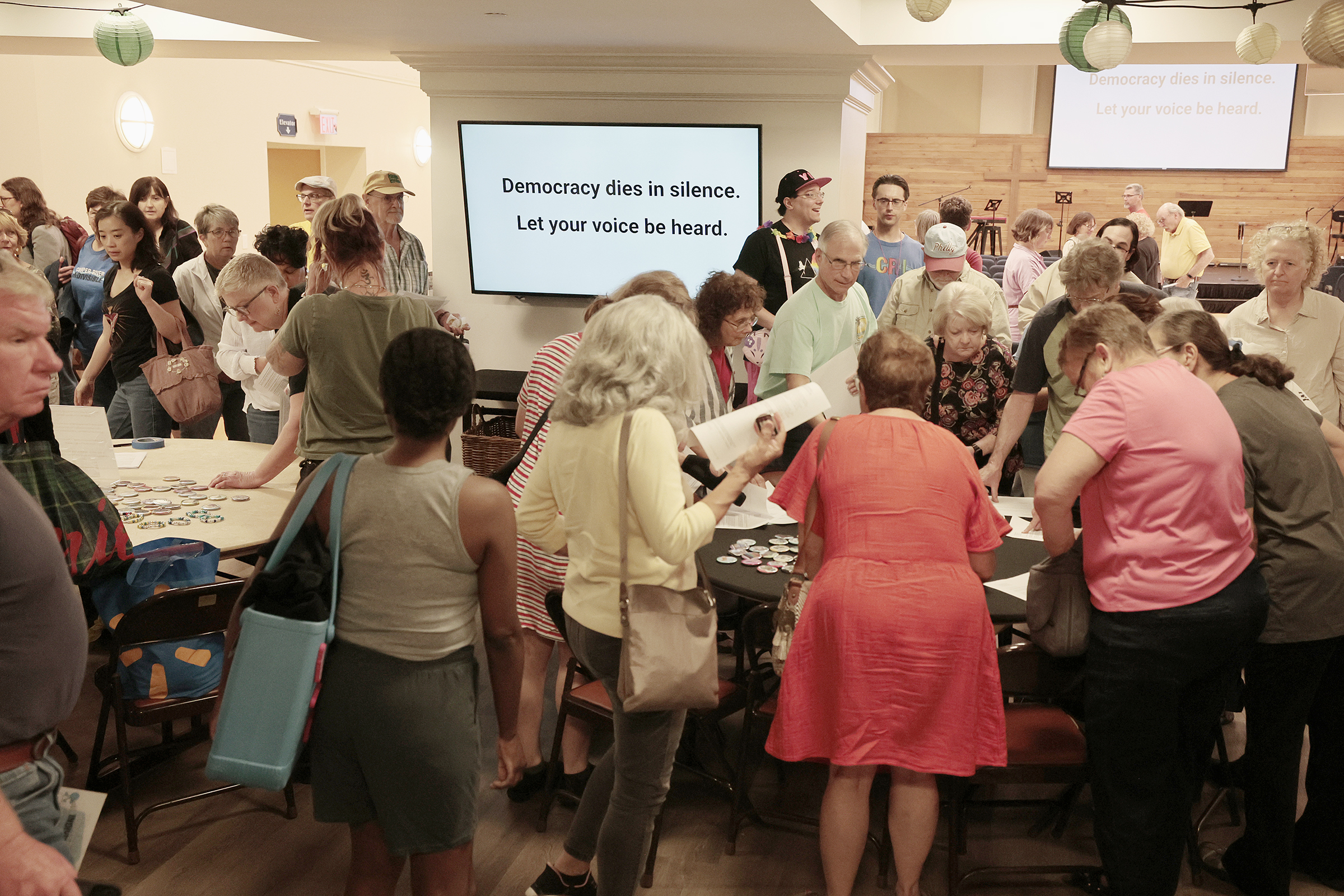
Josue Barreiro speaks about the protests outside Delaney Hall during the Cooper River Indivisible general meeting at the Haddonfield United Methodist Church on June 9.Elizabeth Robertson / Staff Photographer
Sherrill, a former member of Congresswhose double-digit victory last year was seen as a rebuke of President Donald Trump, has been in her most high-profile political bind yet as she juggles her opposition to the ICE detention center while facing widespread criticism for her handling of protests outside it.
The first-term governor campaigned as a fighter against Trump and Immigration and Customs Enforcement. She highlighted her experience as a Navy helicopter pilot and said she was trained “that in a crisis, you run toward the fight.” But to South Jersey progressives who worked hard to campaign for her, Sherrill’s decision to respond to tensions between protesters and ICE with a designated protest zone policed by state officers represented a betrayal. The governor called the decision “absolutely necessary to protect public safety and avoid escalation from ICE.” But the state police’s show of force, video of which replayed across national news and social media channels for days, “kind of resembled what ICE was doing in the first place,” said Newark Mayor Ras Baraka, one of Sherrill’s primary opponents, who was arrested outside the facility last year.
“This was not the kind and quality of leadership we were voting for, or hoping to see,” said Michele Messer, 52, a leader of Cooper River Indivisible, one of the groups that campaigned for Sherrill.
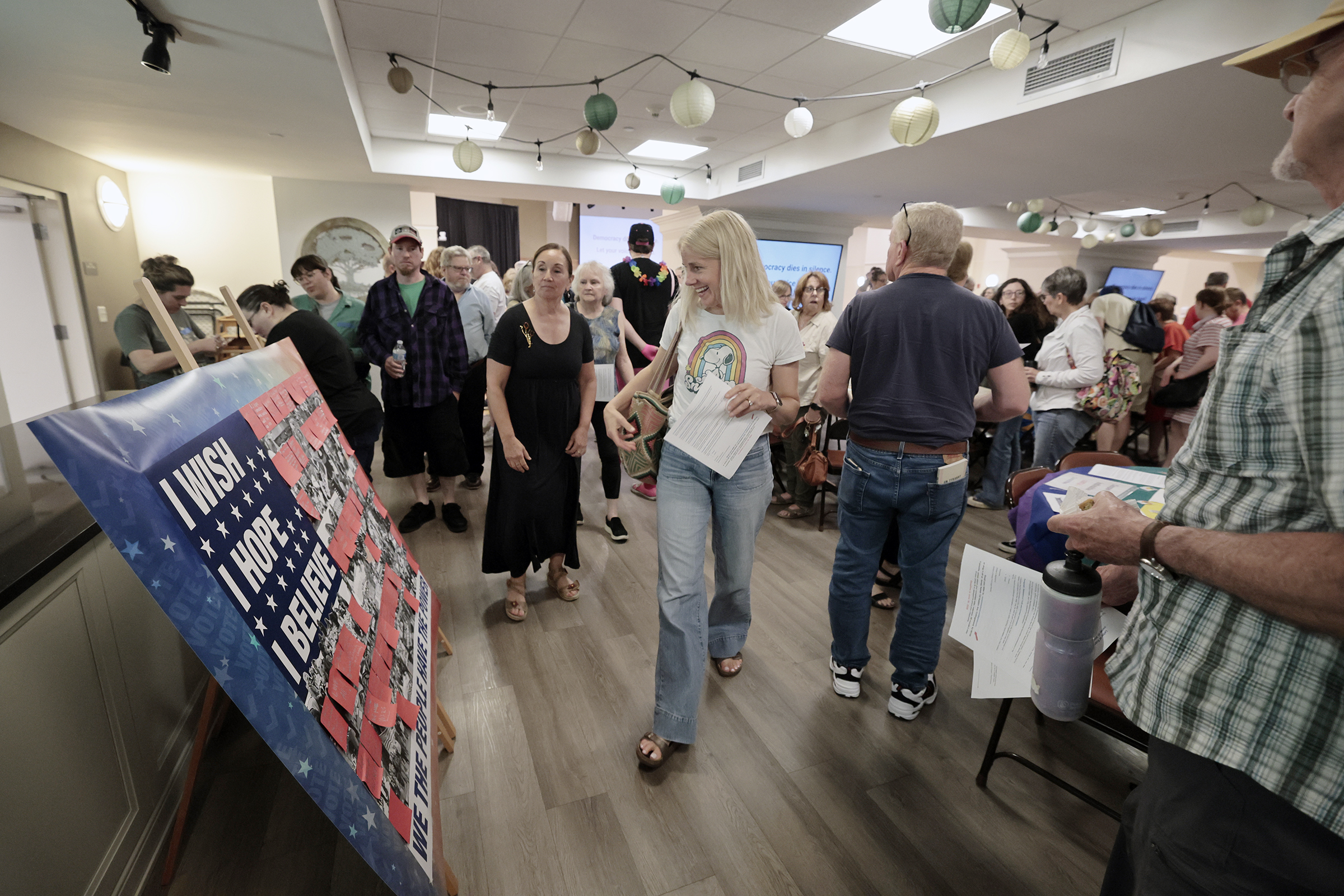
People sign up to volunteer after the Cooper River Indivisible general meeting at the Haddonfield United Methodist Church.Elizabeth Robertson / Staff Photographer
Sherrill said she was trying to “lower the temperature” to prevent Newark from becoming another Minneapolis when she announced her plans to send state troopers to Delaney Hall. She later disagreed with a comparison between state police and federal immigration officers in Minneapolis during a tense interview on WNYC’s Ask Governor Sherrill, noting that state police didn’t kill anyone.
“I don’t think they have the same concern for human life in many cases that I do, and that our police forces in New Jersey share,” she said.
Activists said she should have known that sending in police and corralling people into a free speech zone can escalate already fraught demonstrations.
“I mean, there’s precedent, there’s history. We’ve all read about how these things go, and yet that was the choice she made,” said Messer, a Haddon Township resident who has protested at Delaney Hall.
Patricia Campos-Medina, a former campaign adviser to Sherrill, said the governor’s handling of Delaney Hall — and how she manages “the fallout of her decisions” — has been an early test of her leadership.
“It’s her first real test [of] how she manages the duties of being the highest public safety officer of the state leading New Jersey, and then still protecting the immigrant community who lives here,” said Campos-Medina, an ally of the governor who works with the labor movement.
Sherrill has built her national profile on fighting the Trump administration, and those who have become the most frustrated with her share that mission. How she navigates this moment could determine whether she can keep that base focused on fighting the president, instead of her.
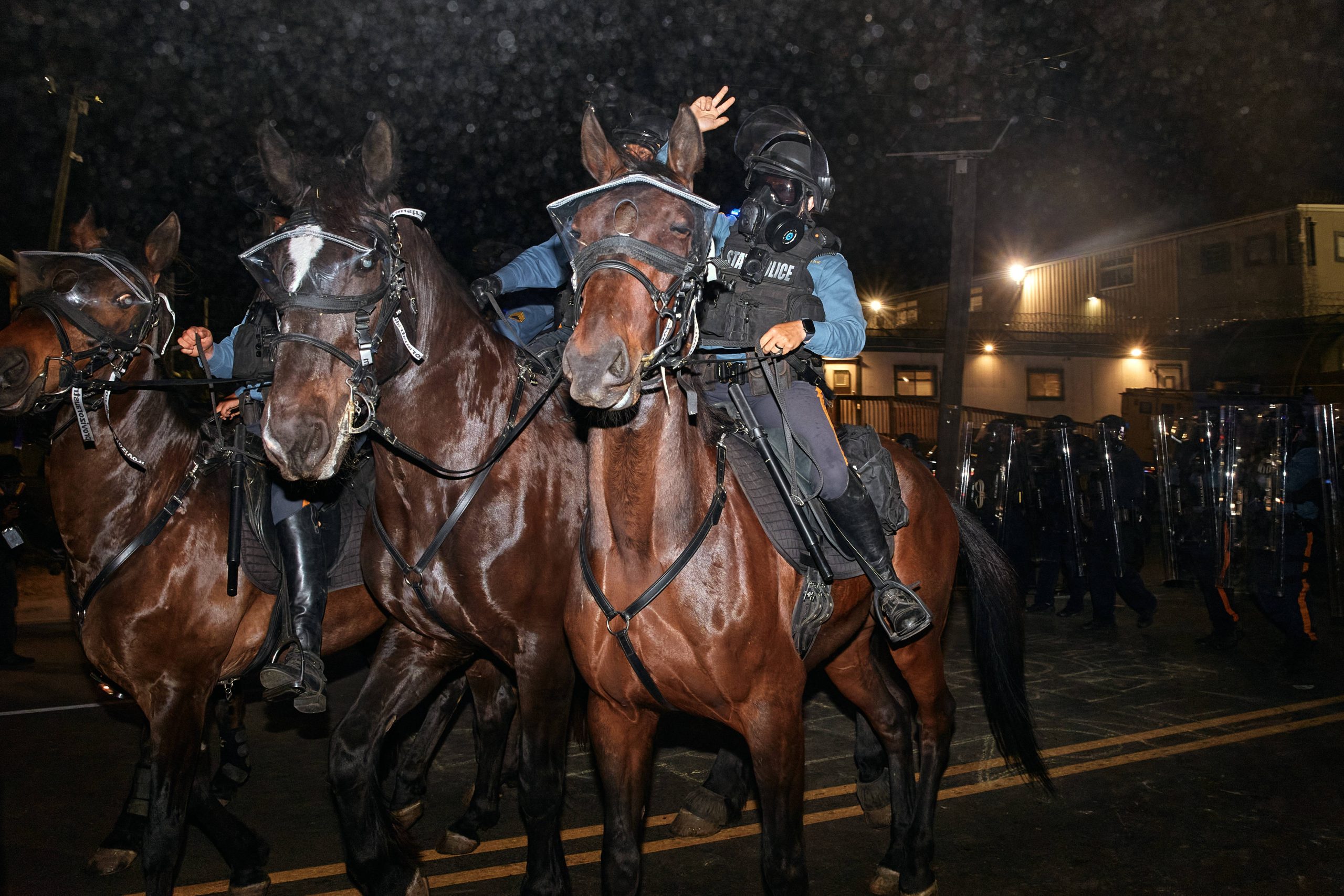
Mounted New Jersey State Police troopers move toward protesters outside the Delaney Hall detention center on May 29 during a protest against the transfer of detainees and federal immigration policies.AP Photo/Andres Kudacki
‘I’m not proud to have voted for her’
Sherrill has called for the closure of Delaney Hall and her administration announced multiple measures to support the fight against the detention center since the late May backlash against her began.
Activists from across the staterallied in Trenton on June 1 and delivered a letter to Sherrill calling on her to “honor our First Amendment rights, cease police brutality and to enable the closure of Delaney Hall.”
“As the grassroots who campaigned for you, we also expect ongoing communication with your administration to navigate this perilous time in New Jersey,” the letter continued, signed by about 40 organizations statewide, including Cooper River Indivisible and several other South Jersey groups.
The next day, New Jersey Attorney General Jennifer Davenport, Sherrill’s appointee, filed a lawsuit against GEO Group — the private company that runs Delaney Hall — to give the state health department full access to the facility over reports of “inhumane and unsanitary conditions.”
Two days later, Sherrill and the state legislature announced an infusion of $20 million to assist with immigration defense and launched a rapid legal defense effort amid concerns about due process.
Marie Henselder-Kimmel, 65, a Cherry Hill resident who leads the South Jersey group NJ Voters Want More Say, said the reports of bad conditions in the facility are not new, so she doesn’t understand why the administration did not take legal action months earlier.
“I foresee that we’re going to have to keep pressuring to get them to keep doing those more bold things,” she said.
Henselder-Kimmel said she feels “torn” about Sherrill’s decision to send state police because she agrees ICE would have escalated otherwise. But she said it seemed like Sherrill may have sent the police in without understanding what they were going to do.
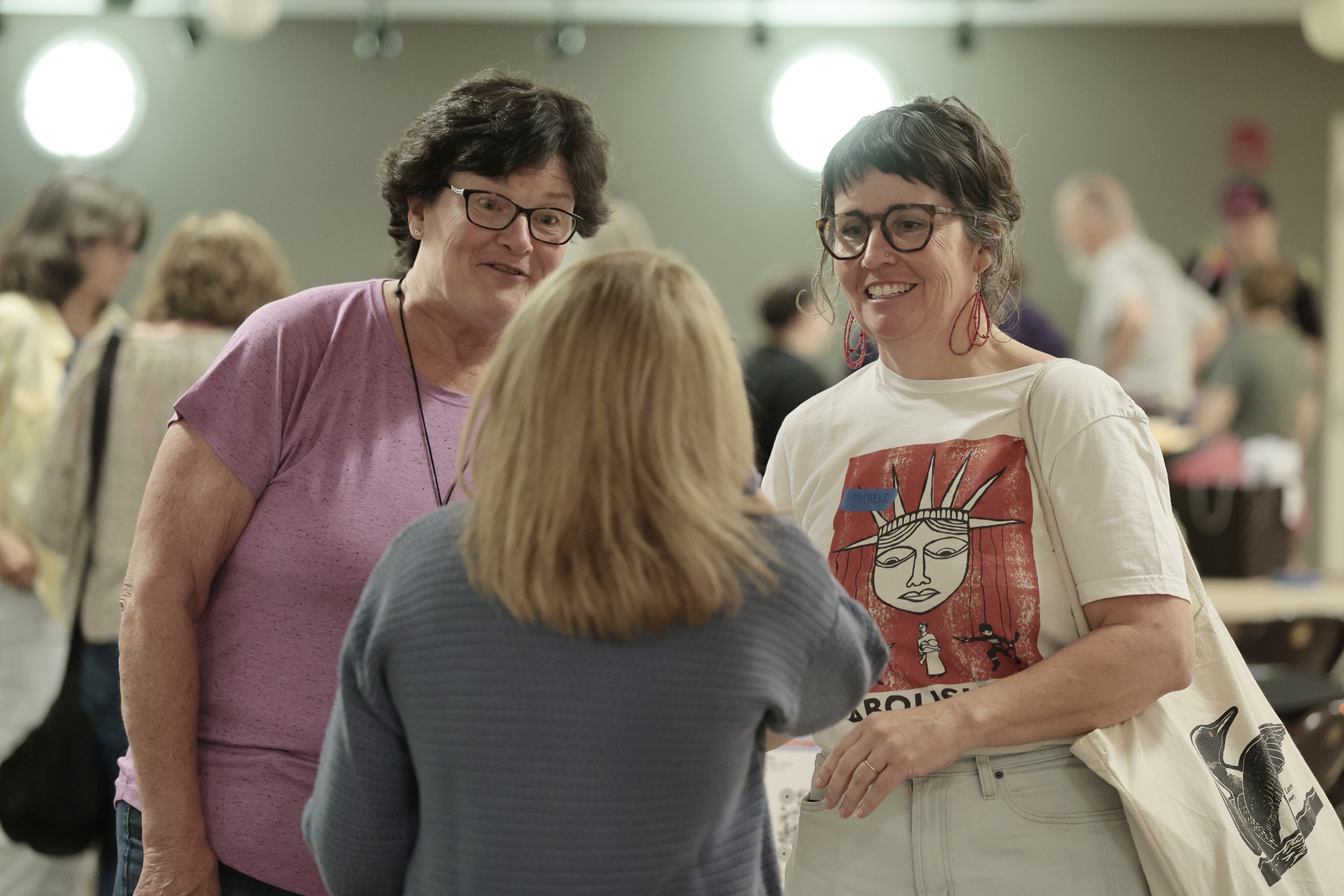
Marie Henselder-Kimmel (left) and Michele Messer (right) talk with Vikki Toomer (back to camera) after the Cooper River Indivisible general meeting at the Haddonfield United Methodist Church.Elizabeth Robertson / Staff Photographer
Cristian Moreno-Rodriguez, who works as the executive director of El Pueblo Unido of Atlantic City, an organization that supports Latino immigrants, said Sherrill’s handling of the protests has fully broken the trust with his community.
Sherrill’s campaign made a particular effort to target Latino voters. She did particularly well in New Jersey’s largest Hispanic-majority cities, which moved an average of 18 points toward the Democrat after rightward shifts in 2024.
“We’re not going to forgive her for what she’s done,” said Moreno-Rodriguez, who worked for One Giant Leap, asuper PAC that supported Sherrill and raised about $9 million by the end of 2025.
Sherrill was not Moreno-Rodriguez’s first choice in the primary, but she was a better choice for his community than Republican Jack Ciattarelli, he said. Still, he said he was expecting better from the Democrat.
“I don’t regret voting for Mikie Sherrill because she was better than Jack Ciattarelli, but I’m not proud to have voted for her,” he said.
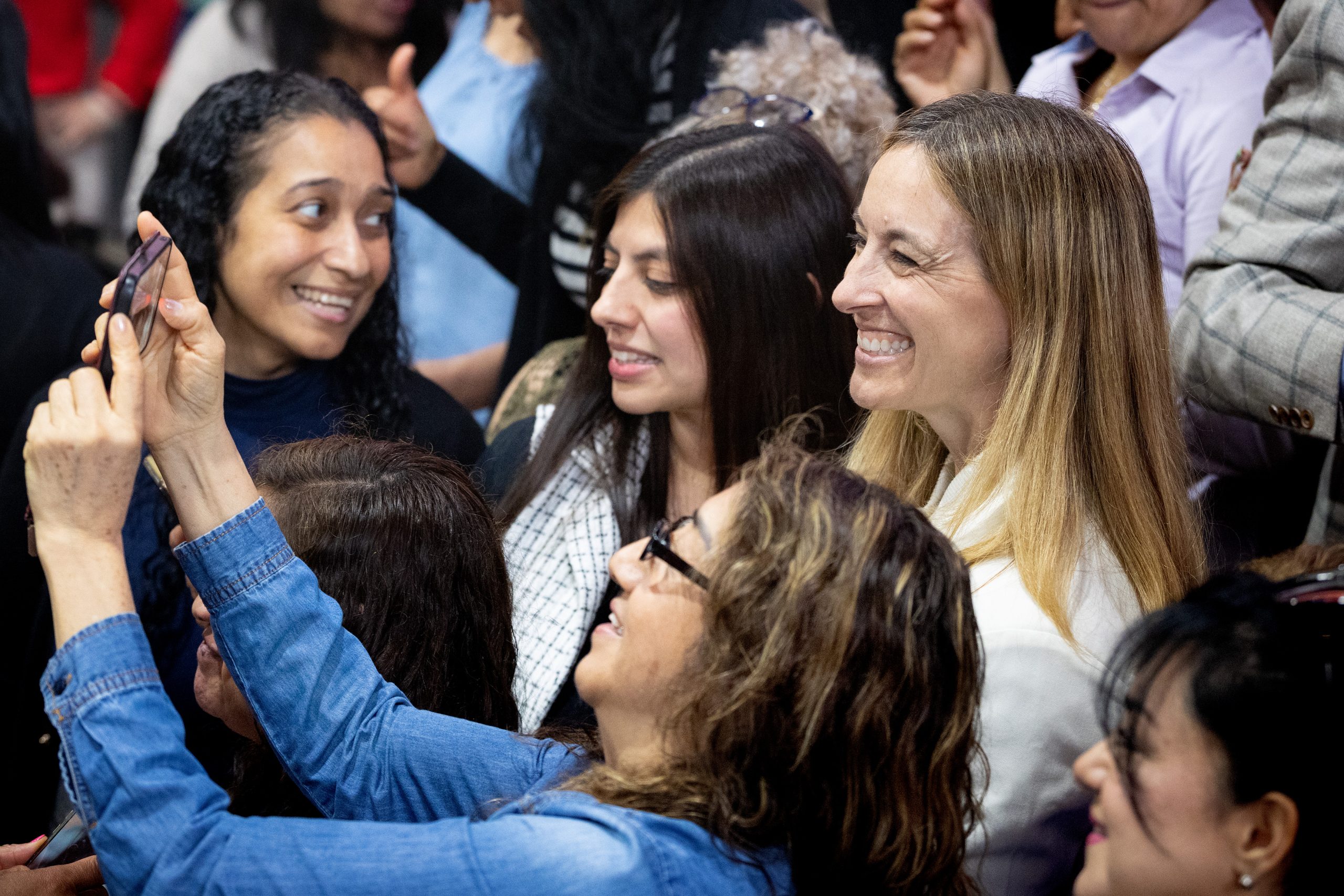
Gov. Mikie Sherrill poses for a selfie at a Latinos for Mikie event at the Rancho Mateo restaurant in Elizabeth, N.J., last May.Aristide Economopoulos
Activists have been demanding Sherrill meet with detainees, but she says she has not been allowed in except for one “closely controlled and limited tour” on June 8, in which she was not allowed to speak with those being held there.
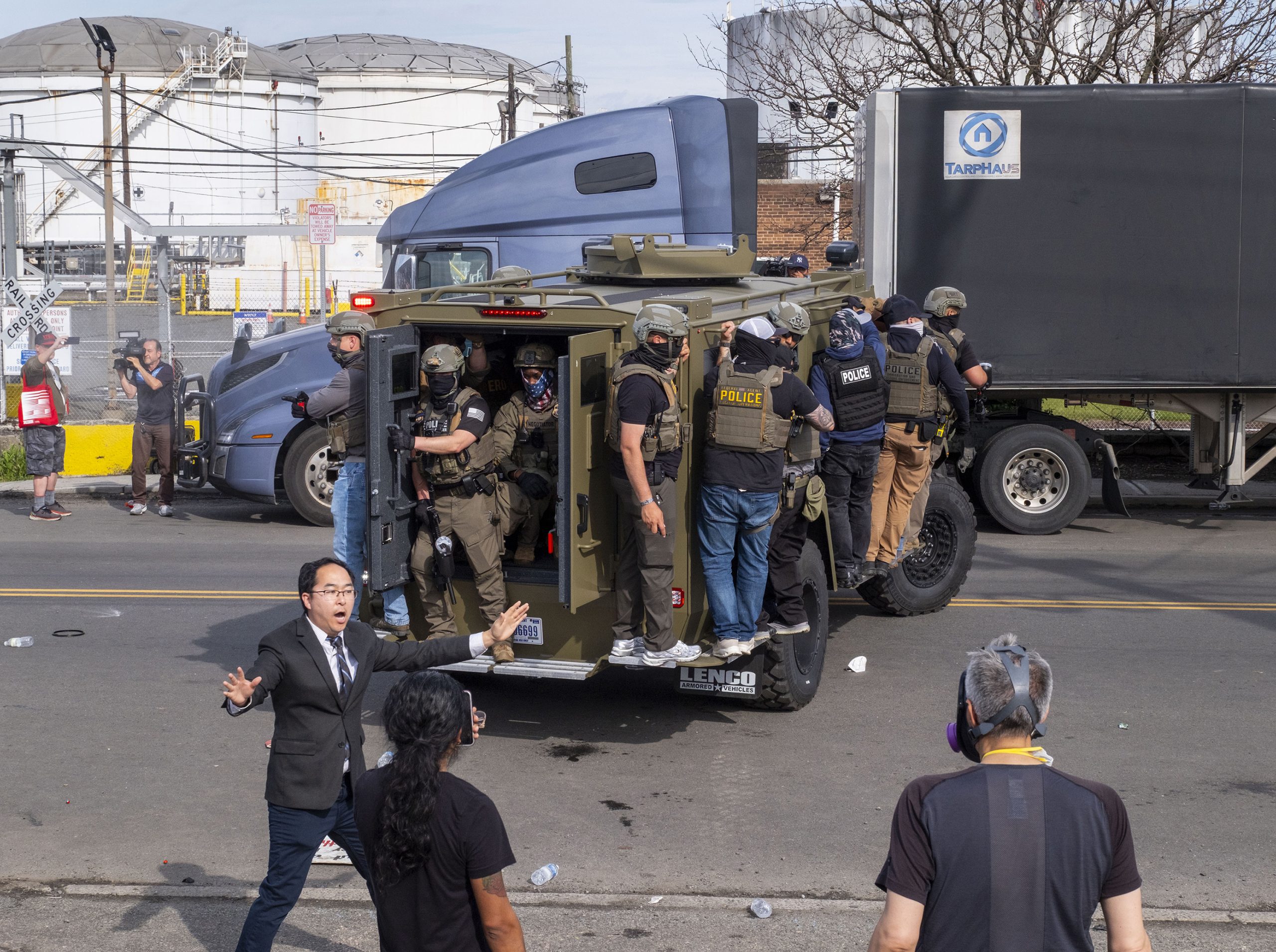
Several members of Congress, who are authorized to conduct oversight visits, have visited the detention center, including Sen. Andy Kim, a South Jersey Democrat who made headlines for getting pepper-sprayed while trying to de-escalate tensions between federal immigration officers and protesters. Kim faced criticism from some activists for what they viewed as trying to negotiate with ICE, but others have praised him for being on the ground in a way they have not seen from Sherrill.
Sen. Andy Kim stands between federal agents and demonstrators in an attempt to prevent a clash outside the Delaney Hall migrant detention center in Newark on May 25.DAKOTA SANTIAGO
Sherrill and activists alike have said that the demonstrators have been largely peaceful. But U.S. Rep. Jeff Van Drew, a Cape May County Republican, accused the protests of being “more like anarchy” and called on Sherrill to bring state police back.
State Sen. Michael Testa, a Cumberland County Republican, praised Sherrill’s “decision to cooperate with federal authorities” and “restore order” by bringing state police in, and added fuel to the fire by thanking her for “supporting President Trump and the brave men and women of ICE.”
‘The buck stops with her’
Activists have expressed frustration that the narrative has strayed from the conditions inside Delaney Hall to the fight outside it — a point Sherrill has echoed.
But after state police clashed with protesters, Sherrill focused her criticism on what she described as “aggressive and dangerous” disruptors and defended the officers.
Her remarks further infuriated activists who accused her of echoing the state police’s narrative, which they say does not align with what they experienced on the ground or saw online.
When a radio caller confronted Sherrill on WNYC over state police brutalizing nonviolent protesters, the governor said “if there were incidents like that, the attorney general will be looking into that.”
Vikki Toomer, a Cooper River Indivisible leader who has protested outside Delaney Hall, said that listening to Sherrill’s news conferences have given her “that same visceral reaction” she gets from listening to Trump.
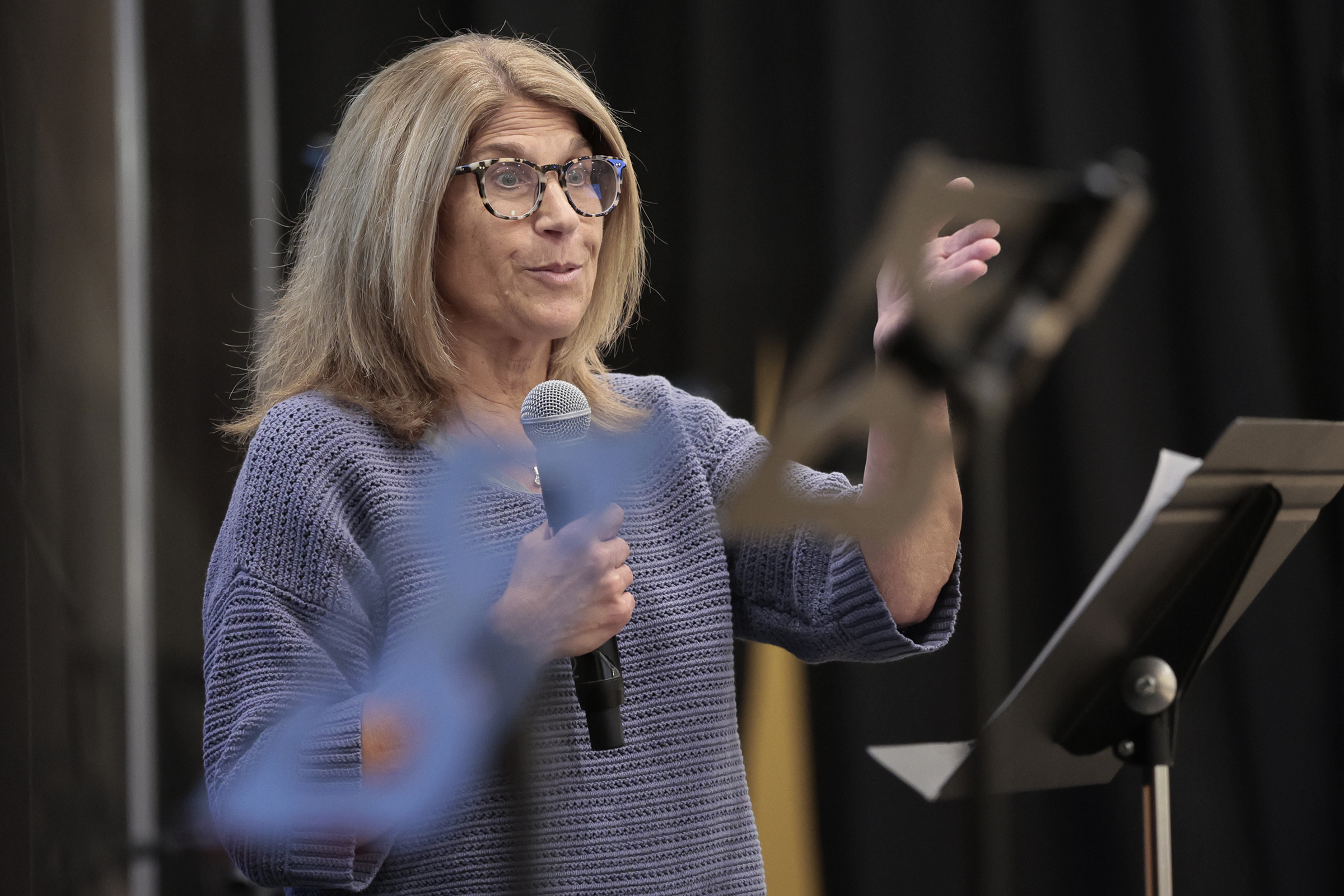
Vikki Toomer speaks during the Cooper River Indivisible general meeting at the Haddonfield United Methodist Church.Elizabeth Robertson / Staff Photographer
“I don’t know if they were feeding her lies, or that’s the narrative she was trying to spin … all I know is what she was saying was not true, and she was not taking the time to listen,” Toomer said.
Toomer said she believes the governor knows her plan did not go well but also “has not come out publicly and said, ‘Oops, I made a mistake.’”
When asked on the radio whether she believes her administration has suffered a loss of trust, Sherrill said sending state police “was really not done focusing on politics, and I certainly hope not.”
“This was focused on making a really hard decision in a situation that nobody wanted,” she said.
Folks leave messages on a collage (left) during and after the Cooper River Indivisible general meeting at the Haddonfield United Methodist Church on June 9. The poster will be part of an exhibit at Perkins Center for the Arts.Elizabeth Robertson / Staff Photographer
Linda Greenwood, 74, a Voorhees resident who belongs to Cooper River Indivisible and campaigned for Sherrill, believes the governor has good intentions but does not think she has been unfairly blamed.
“She’s the governor,” Greenwood said. “The buck stops with her. She brought the state police in. She has to take responsibility for what happened there, and I think she will.”
Lawrence Garrity, 29, was the lead volunteer for long shifts at Sherrill’s Cumberland County campaign office between overnight shifts at Wawa last year. The Rowan student said he feels “salty” he worked so hard to elect her and it feels like she is not on their side.
“It doesn’t feel like she’s not on our side either. It’s like she’s sitting in the middle … people are genuinely in danger, and you’re trying to, like, half-ass fight it,” he said.
Garrity said he had to go to urgent care after state police unleashed tear gas and pepper balls on protesters.
“Somebody said they’re gonna make T-shirts that said ‘I voted for Mikie Sherrill and all I got was tear-gassed,’” he said.
McDonald’s golden arches. The Nike swoop. Apple’s apple.
Take a look around you right now. Even if you’re sitting alone in your home, you can probably spot logos for businesses in every corner.
The best logos serve as a visual shorthand for a company. They are simple and bold, recognizable and enduring.
But even the most well-established logos sometimes get refreshed to signal a brand’s evolving mission or products.
story continues after advertisement
The Philadelphia area is home to some classic business logos that have evolved over time. Can you choose the current logo for these popular local companies?
Question 1 of 6
CorrectIncorrect. XX% of other readers got this question right.
0% voted
0% voted
0% voted
0% voted
Wawa takes its name from the Native American word meaning "wild goose.” The goose has remained a part of the convenience store’s logo since 1974 when a Villanova University student and part-time worker at a Delaware County Wawa won a design contest.
Question 2 of 6
CorrectIncorrect. XX% of other readers got this question right.
0% voted
0% voted
0% voted
0% voted
Acme, which began in South Philadelphia as a neighborhood grocery store, started with a retro cursive logo. As the store expanded into a regional chain and was later acquired by Albertson’s, the logo evolved to feature bold red typography.
story continues after advertisement
Question 3 of 6
CorrectIncorrect. XX% of other readers got this question right.
CorrectIncorrect. XX% of other readers got this question right.
0% voted
0% voted
0% voted
0% voted
Tastykake cofounder Herbert Morris, formerly an egg salesman, designed the company’s first logo. No one knows why he chose to use two letter Ks, but the spelling stuck.
Question 5 of 6
CorrectIncorrect. XX% of other readers got this question right.
0% voted
0% voted
0% voted
0% voted
Beginning in the 1920s, Pep Boys’ logo featured caricatures of the three owners: Manny, Moe, and Jack. It included a fat cigar dangling from the corner of Manny’s mouth, an homage to co-owner and devout smoker Emanuel (Manny) Rosenfeld. But in 1990, as smoking fell out of favor, the company nixed the cigar to promote healthier lifestyles for consumers and employees.
story continues after advertisement
Question 6 of 6
CorrectIncorrect. XX% of other readers got this question right.
0% voted
0% voted
0% voted
0% voted
In 2022, The Inquirer redesigned its nameplate with a new font called Philadelphia Inquirer Clarendon — based on a Clarendon slab font seen in The Inquirer from the 1860s to the 1920s. The change included tweaking the official logo so the “d” in Philadelphia once again tipped to the left — The Inquirer’s style for more than 100 years until a brief change in 2019.
story continues after advertisement
Your Results
You have skipped .
You scored XX out of 6.
The average reader scored XX out of 6
Yikes! You need to brush up on your Philly-area businesses. Read inquirer.com/business to learn more about companies in our region.
You know something about Philly-area businesses, but read inquirer.com/business to take your knowledge to the next level.
Nice! You really know your Philly-area businesses. Keep reading inquirer.com/business to learn even more about companies in our region.
Staff Contributors
Design and development: Garland Fordice
Reporting: Erica Palan
Editing: Lizzy McLellan Ravitch
Copy Editing: Scott Sturgis
Subscribe to The Philadelphia Inquirer
Our reporting is directly supported by reader subscriptions. If you want more journalism like this story, please subscribe today.
VALLADOLID, Spain — As Pope Leo XIV prepared last month to issue a major statement about the perils of artificial intelligence, he briefly turned his attention to an evening WhatsApp message about a car part.
One of the pope’s close friends, Armando Jesús Lovera, had sent Leo an image of a flashing sign on his car’s dashboard warning about the state of the vehicle’s catalytic converter.
“What’s going on with the Citroën?” the pope texted back.
“It’s dying,” Lovera responded.
“Is it running or is it stopped somewhere?” the pope asked.
Lovera informed “Bob” — the name he uses for the pope in his contacts — that he was on the way back to his home city in Spain after an event to promote his new book, From Roberto to Leo, about their friendship.
“How much further do you have?” the pope asked, in an exchange Lovera showed me on his phone. Then the pope implored his friend to “keep a close eye on the engine temperature” and to “drive carefully.” Finally, the Holy Father signed off with a word of fatherly advice to Lovera, an editor at a Catholic publishing group, whom he has known for decades.
“Sometimes at low speed it doesn’t run well,” the pope wrote. “But at a higher speed, the oil flows normally.”
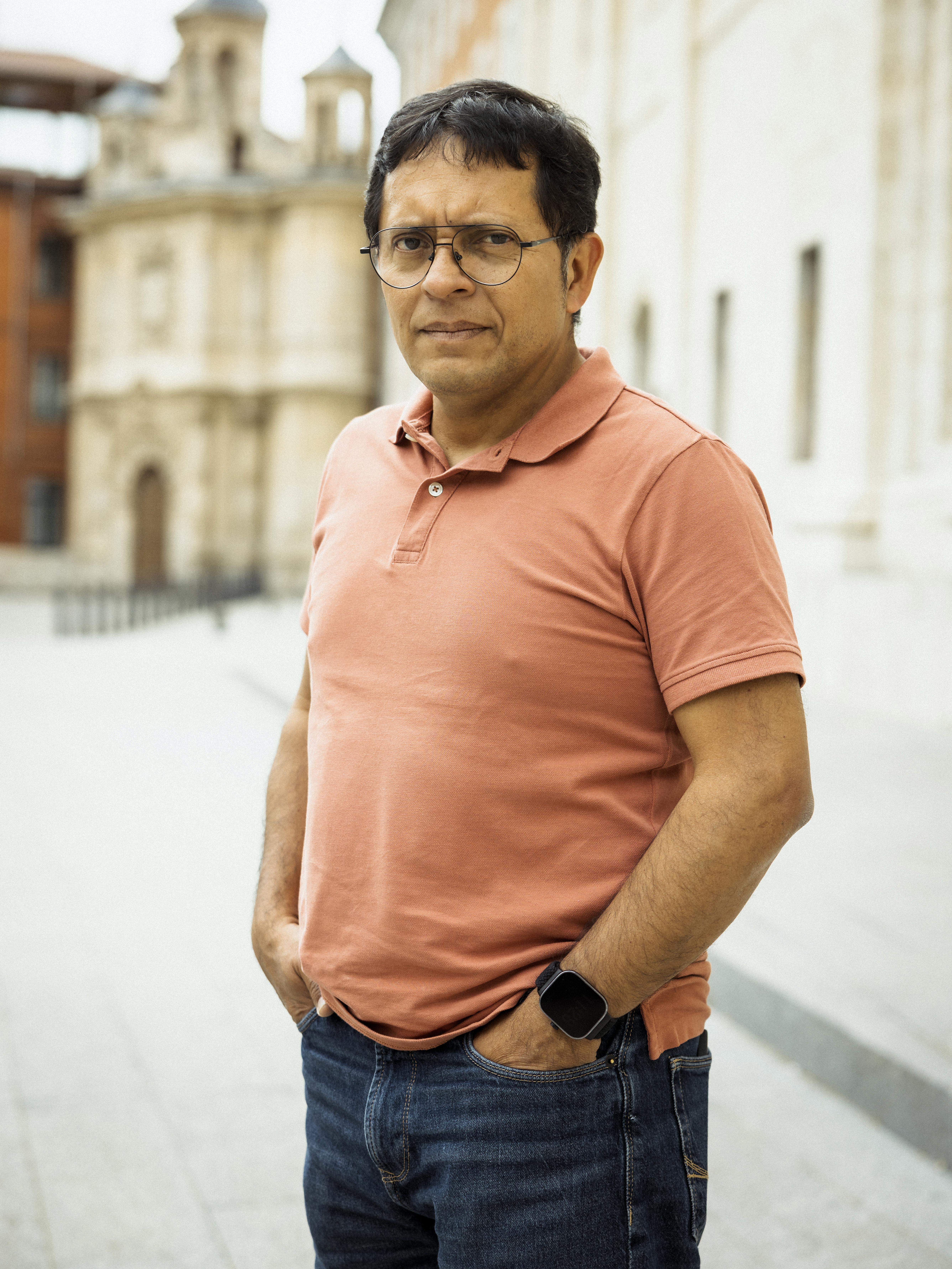
Armando Jesús Lovera in Valladolid, Spain, at the local headquarters of the Augustinian order.Gianfranco Tripodo for The New York Times
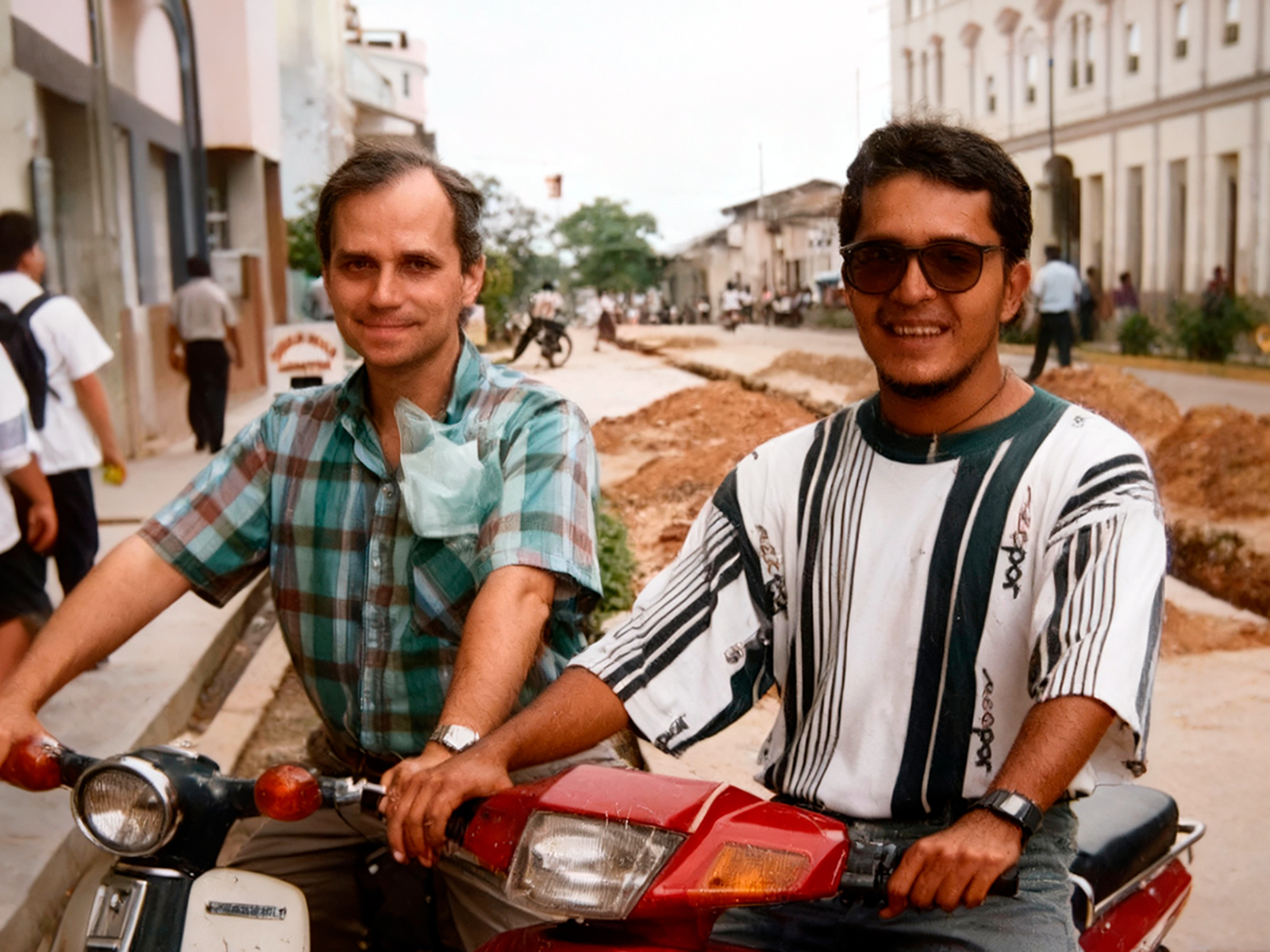
Lovera, 52, and Leo, 70, have been close friends since they lived together for seven years in Peru, in a formation house, a live-in community for Catholics considering a life dedicated to the faith. Leo, then a missionary priest known by his pre-papal name of Robert Prevost, ran the house.
Over the decades — as Lovera moved to Spain and Prevost became a bishop, cardinal and then pope — the two have stayed tight.
Lovera and his family visited the pope for five days in July, and they will join the pope again in Rome this August, Lovera said.
“To play tennis,” he said, “to feed the fish.”
This past weekend, as Leo began his weeklong visit to Spain with a tight schedule of events, he found time to send his old friend a greeting in a text message. “We said hello,” Lovera said.
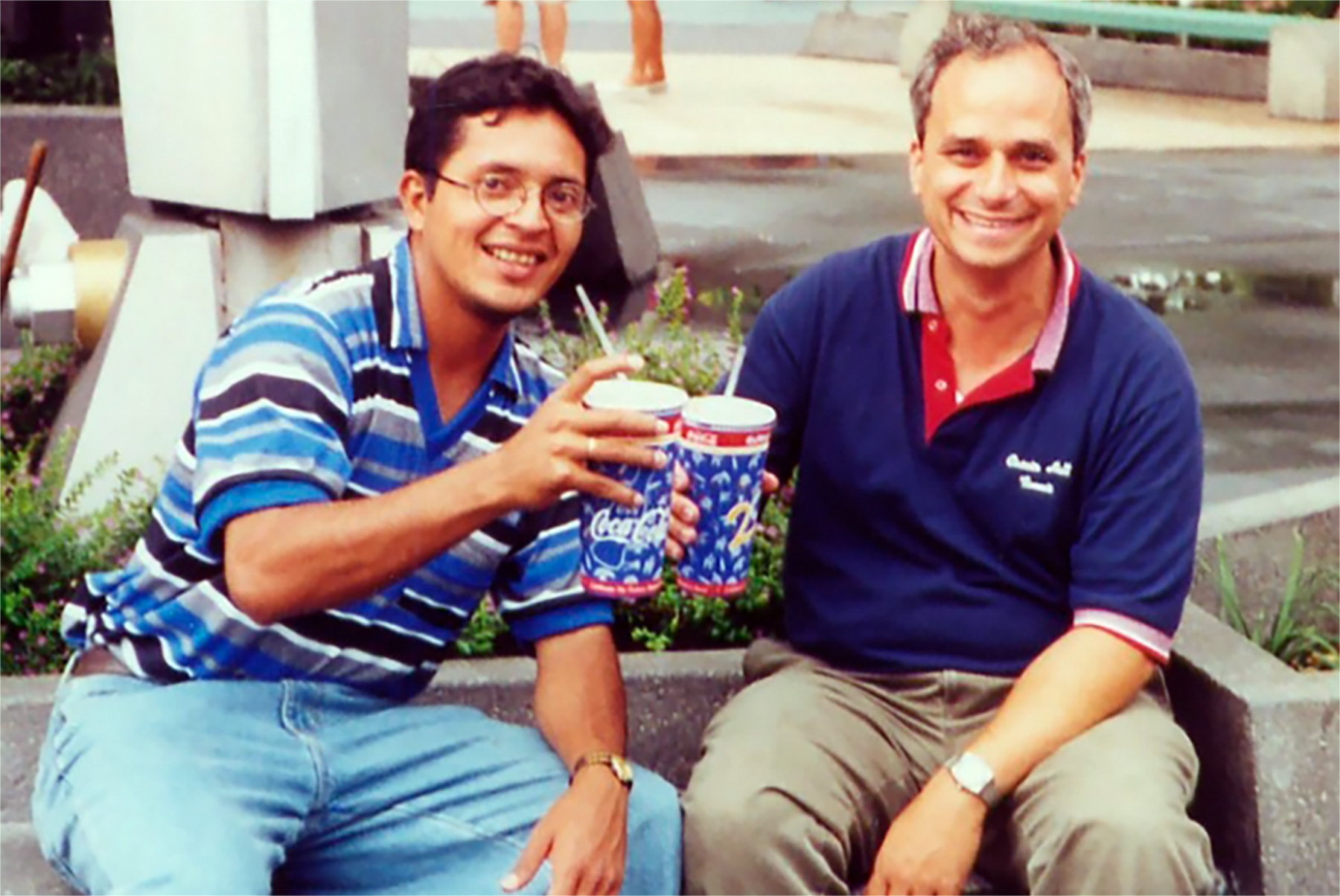
Lovera, left, and the future Pope Leo in Orlando, Fla., in 2000.Armando Jesús Lovera via The New York Times
Originally from a Roman Catholic family in Iquitos, a town in the Peruvian part of the Amazon, Lovera moved to Colombia with the goal of becoming an Augustinian missionary. There, in 1991, he first met the man who would become Leo; soon after, Lovera moved with other Augustinians into the formation house, in Trujillo, Peru.
Leo taught the small, tight-knit group spiritual exercises and also how to manage money — “because you cannot give what you don’t have,” Lovera said, in an interview at the vast Augustinian headquarters in Valladolid, the city where he lives, a two-hour drive north of Madrid.
“He used to tell me that a community isn’t made of superheroes, but of brothers who decide together what is best,” Lovera added.
The two shared a love of music, mathematics and long road trips.
“We’ve been travel buddies,” said Lovera, who became the group’s driver, even though he didn’t have a driver’s license. The future pope filled their long hauls with car talk, expounding on how to drive cars through flooded streets. When he once spent the night at the Lovera family’s modest home, they had no bed to offer him, only a sofa.
It was so hot and humid that the future pope elected to sleep in a rocking chair. “My mother was dying of embarrassment,” Lovera recalled.
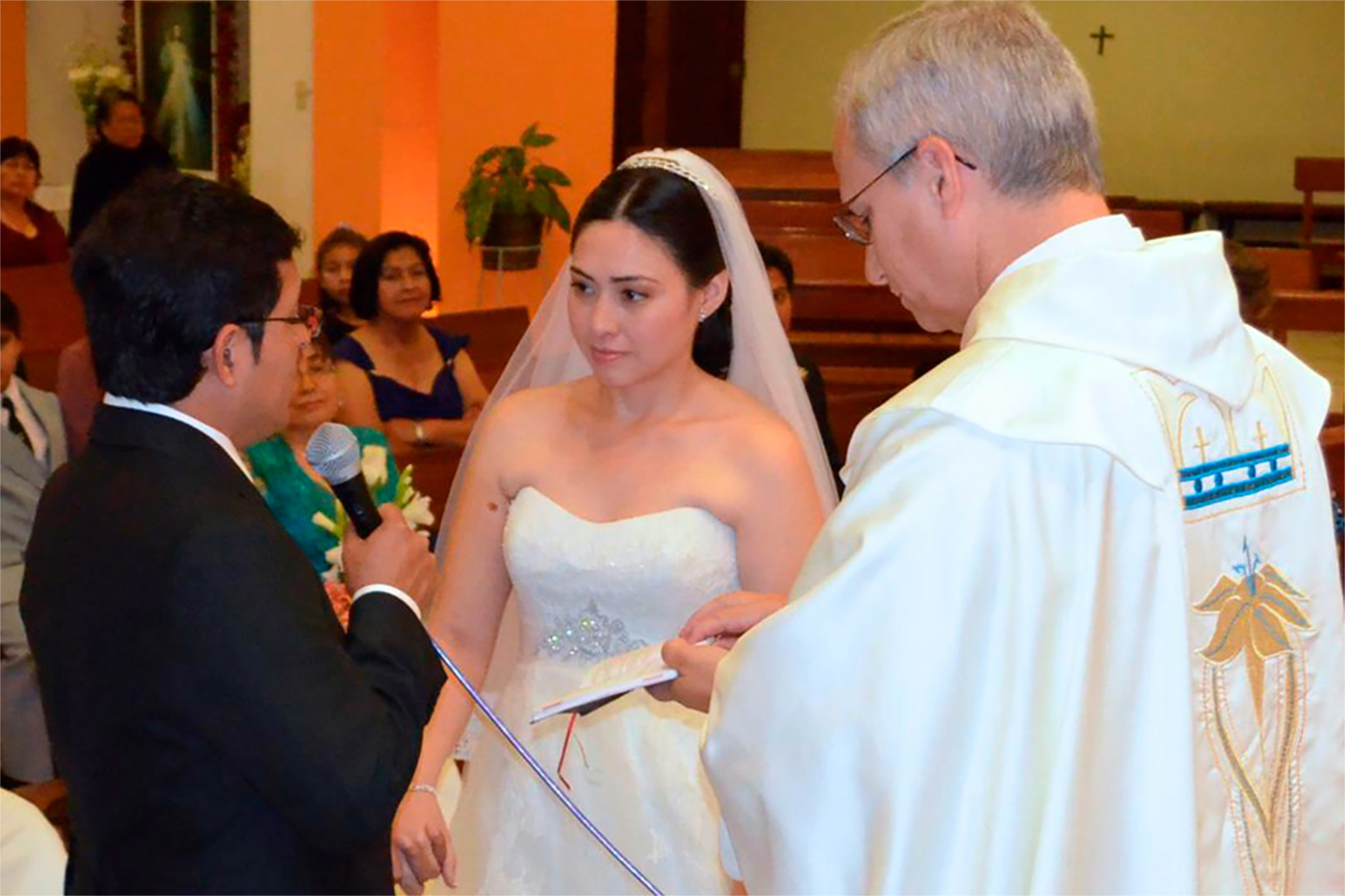
The future pope officiating the church wedding of the Loveras in Trujillo, Peru, in 2013.Armando Jesús Lovera via The New York Times
Leo left Peru in 1999 after being elected to lead the Augustinian Order in the Midwest, and soon after, Lovera decided to leave the missionary track. Community living, he decided, wasn’t for him, and he wanted to do more to protest against the economic policies of the Peruvian government at the time. He also didn’t take well to an order to travel to Rome to study the teachings of St. Augustine: “I wanted to be more independent,” he said.
Lovera said Leo had talked to him about the change and, instead of giving him a teacher’s lecture, had offered a friend’s understanding.
“Don’t feel obligated,” Lovera recalled his friend telling him, emphasizing that a holy life could be lived in different ways. Mostly, Lovera recalled, they joked about the Y2K bug that people at the time feared would wipe out the world’s computers at the turn of the millennium.
Soon after, Lovera moved to Spain for a job with a Catholic publisher. Leo later became the global leader of the Augustinian Order, a job based in Rome that required constant international travel, including to Spain, where he visited Lovera.
Lovera would often visit Chicago and catch up with the future pope’s family, including Leo, who happened to be there in November 2004. At that meeting, Lovera told his friend about a young Peruvian woman in Spain who had caught his eye. But when he had asked her out, Lovera explained, she had told him only that she would think about it — and mentioned a teddy bear that she coveted.
“I told him, ‘I have to find a teddy,’” Lovera recounted. The men hit the road, driving to malls looking for the right stuffed toy, finally finding what Lovera was looking for in a Target near New Lenox, Illinois.
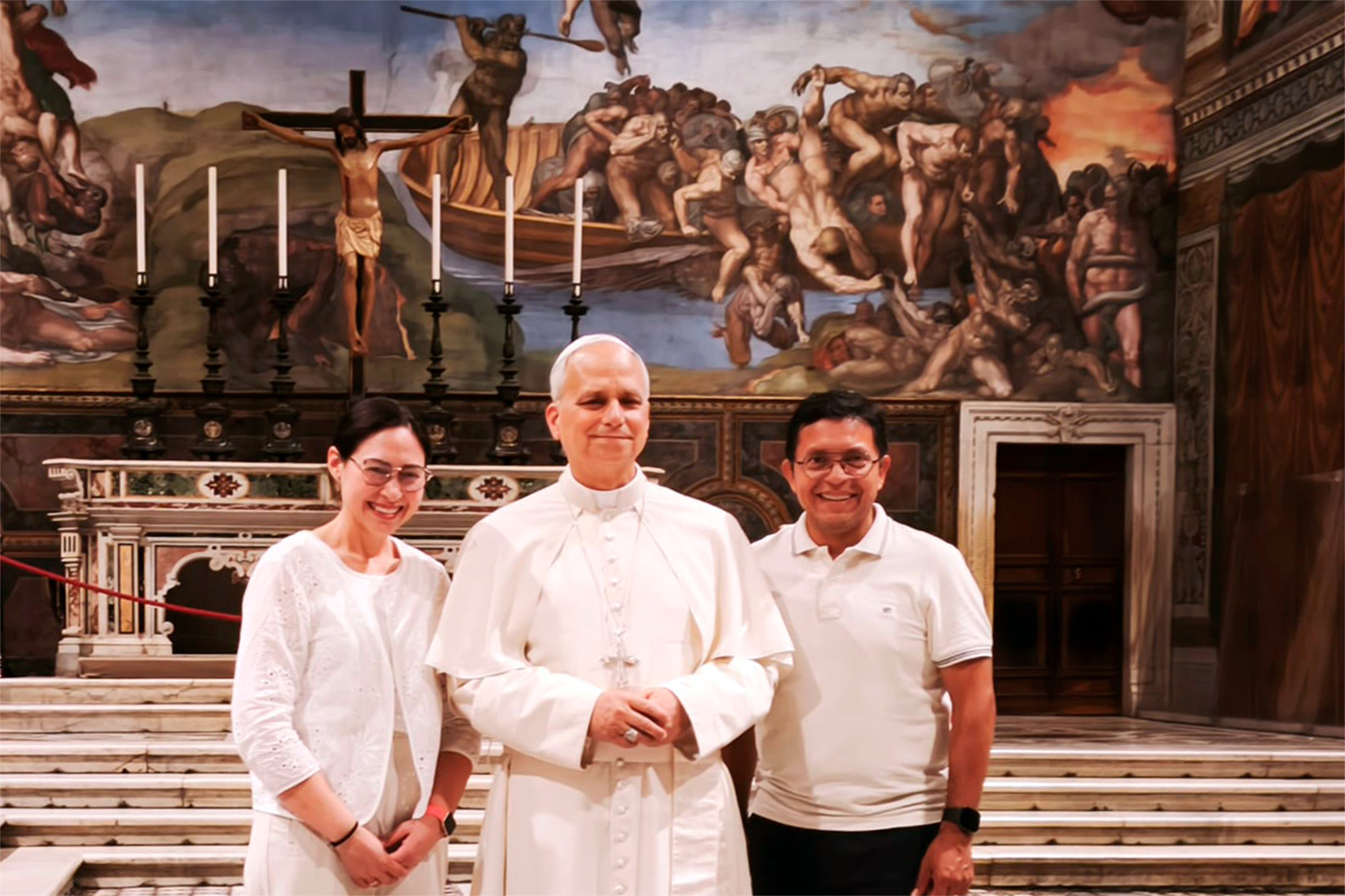
The Loveras with Pope Leo at the Vatican in 2025.Armando Jesús Lovera via The New York Times
Back in Spain, the woman accepted the gift but initially rejected Lovera. He persisted, though, and they eventually married in a civil ceremony with the future pope as their witness.
In 2010, Leo landed in Spain for meetings with Spanish Augustinians, and Lovera picked him up at the airport. It was the day of the final of the soccer World Cup, and the future pope — a professed Real Madrid fan — decided that they should pull over to watch the match. In a pizza bar, they watched Spain defeat the Netherlands with a late goal in overtime, and both men chanted, “I am Spanish,” with the crowd, Lovera said.
For Lovera, the pope was his co-pilot. In 2012, for instance, Leo drove with Lovera to check out a house in Valladolid that Lovera and his wife wanted to buy. “I have never stopped consulting him,” Lovera said.
In December 2013, after the Loveras’ civil wedding, Leo married the couple in a church in Trujillo, and he later traveled to see them after the birth of their two daughters, whom he baptized. The girls, now 9 and 11, don’t quite understand that he is pope, Lovera said, and “see Roberto as part of the family.”
Once they reached school age, Lovera began to call his friend from the car when driving to pick the girls up from school, he said. When Leo became pope, those frequent calls became texts, but they remained in regular contact, Lovera said.
Last May, he asked the pope’s permission to write a book about their friendship, and the pope approved. “I trust you. You are my friend,” the pope said, according to Lovera.
In October, they posed together with the published book, which highlights their efforts to build solidarity among marginalized Peruvians in a time of upheaval.
Last month, Leo mentioned to Lovera that his brother, John Prevost, still called the pontiff from Chicago for information technology support.
“And Roberto says, ‘John, I’m the pope,’” Lovera recalled.
“‘Oh, sorry, pope,’” the pope’s brother responded, according to Lovera. “‘My computer is broken.’”
On his own calls to the pope, Lovera said that he didn’t talk about tech or politics or about the church’s future. Instead, he said, “I talk about cars!”
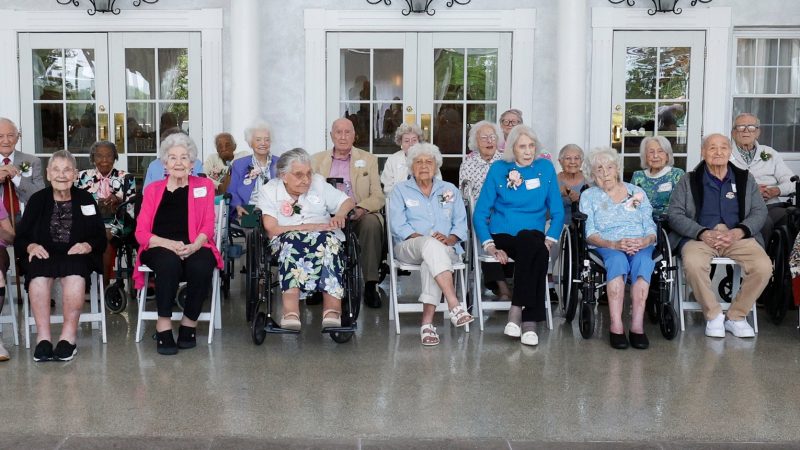
From horses giving way to cars and the invention of television, to the election of more than a dozen presidents, World War II, and even the sale of sliced bread — the 45 Chester County centenarians who gathered for an annual luncheon this week have watched the world remake itself time and time again.
“I saw a lot of things. A lot of wars, and a lot of popes. There’s a lot of good things,” said Anne Caporale, who will turn 100 in July. “I got married, had a family. I had a good life.”
The annual luncheon celebrated Chester County’s group of centenarians — a total of 57 residents reaching or surpassing the milestone. Tuesday’s celebration saw a dozen who would turn 100 this year, plus quite a few returning attendees, including 108-year-old Evelyn Fair, who still writes poetry.
“You are the builders, the teachers, the parents, the neighbors, and the foundation of the Chester County community,” Josh Maxwell, chair of the board of county commissioners, told attendees. “Every single comfort and freedom we enjoy today is a direct result of the hard work, sacrifice, and grace you poured into the world decades and decades ago. We are walking today on paths that you have all cleared.”
Meet some of Chester County’s longest residents.
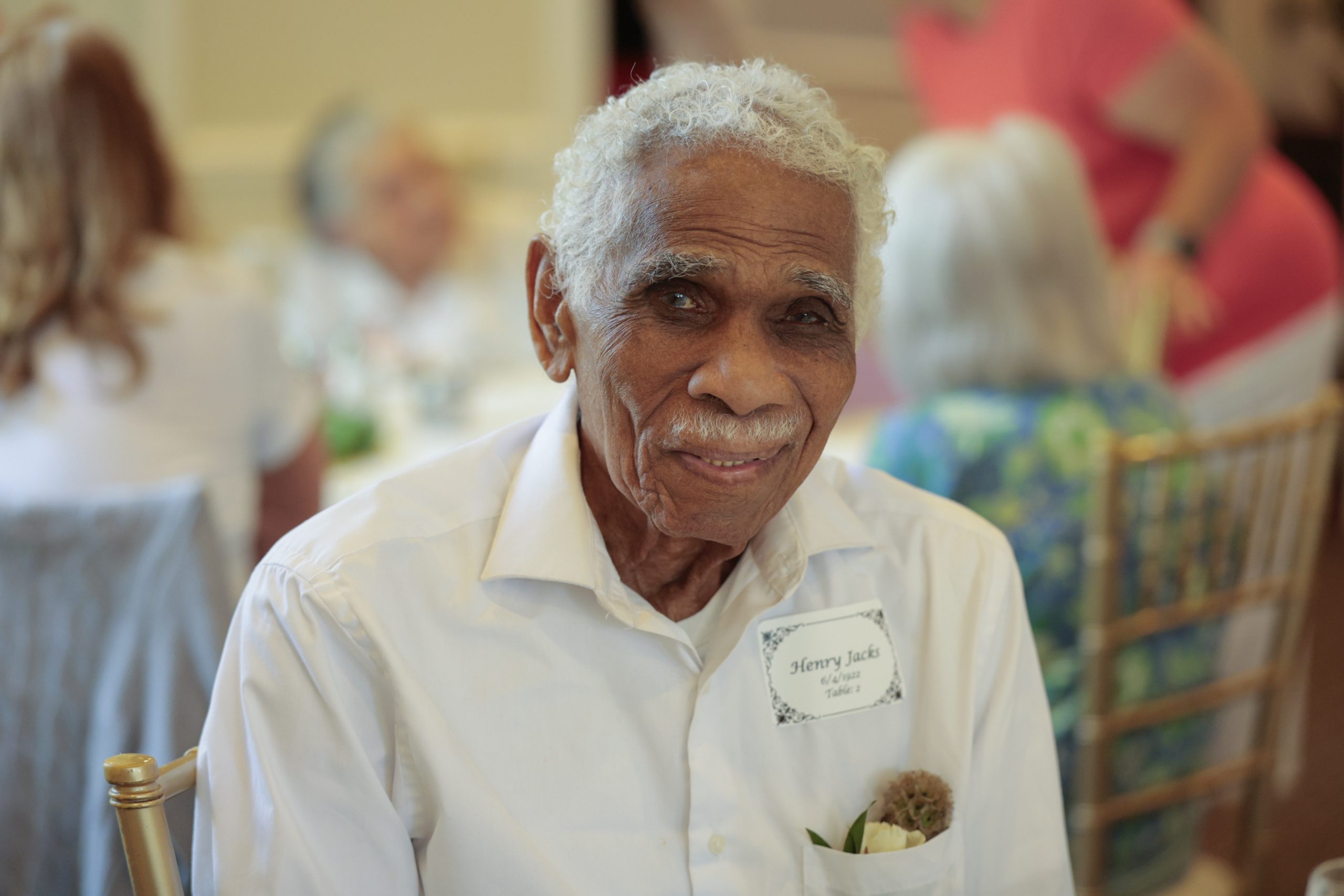
Henry Jacks, 104
Henry Jacks, 104, enjoys the annual centenarian luncheon hosted by the Department of Aging. Steven M. Falk / For The Inquirer
Henry Jacks moved to South Coatesville when he was 4 years old, and has called it home ever since. He’s witnessed “quite a bit of change.”
He remembers watching deliveries come by horse and wagon and recalls the hard days of the 1930s during the Great Depression (“cost of living wasn’t as bad as it is now,” he noted). Jacks joined the Army in 1940 during World War II, serving in the 92nd Engineers Regiment, and was stationed in Africa and Italy. He came back home to have three children, a boy and two girls.
He was a Boy Scout leader, the first Black mail carrier in Coatesville, a city council member, and a judge of elections. He still sings in the church choir. (His advice: “Treat people right. Go to church.”)
“So many changes that I’ve seen in the days,” he said. “I remember when I first saw TV; one of the neighbors had one, and all of the kids used to watch through his window. I’ve seen from the horses, to the cars, to the jet airplanes. And it’s been a wonderful life.”
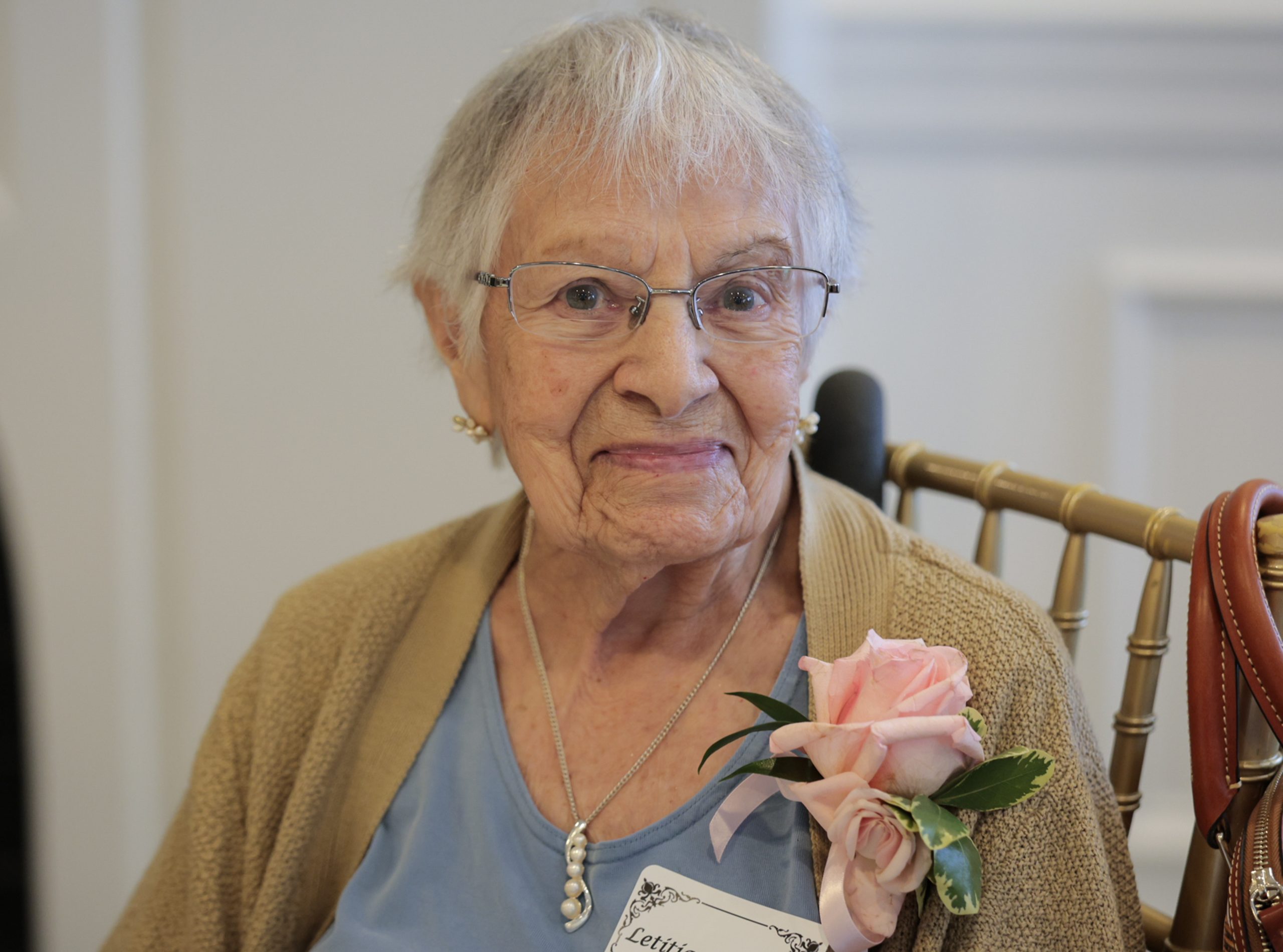
Letitia Hemphill, 103
Letitia Hemphill, 103, at Tuesday’s luncheon. Steven M. Falk / For The Inquirer
Letitia Hemphill started her working life at the candy counter at the former F.W. Woolworth’s five-and-dime in her hometown of West Chester. Though her father remarked she wasn’t good at math, she’d go on to have a long career using her skills while filling the registers and doing the end-of-day count in a department store and later at the treasurer’s office.
She retired in 1986 but had trouble sitting still.
“I got bored of not working,” she said.
She started cleaning houses. It was something she’d always done: help her mother clean in the morning, and then go to the park in the afternoon. She kept up the tradition with her two grandkids and her two great-grandkids, whom she babysat for 14 years.
An active life has been key to Hemphill, who did 10 years of ballroom dancing and more than 20 years at the gym.
“Keep your body moving and keep your mind moving,” she said.
She keeps her mind active by painting landscapes in watercolor, a hobby she took up in 1995.
Hemphill was born in West Chester to a stonemason father and a stay-at-home mother. Once, someone asked Hemphill if she had a lot of friends. With 11 brothers and sisters, she remarked she didn’t need any.
When she journeys through West Chester, she points out all the stores that have changed over time.
Still, Chester County is “beautiful,” and much of her family is still around to keep her moving: two children, two grandchildren, and two great-grandchildren.
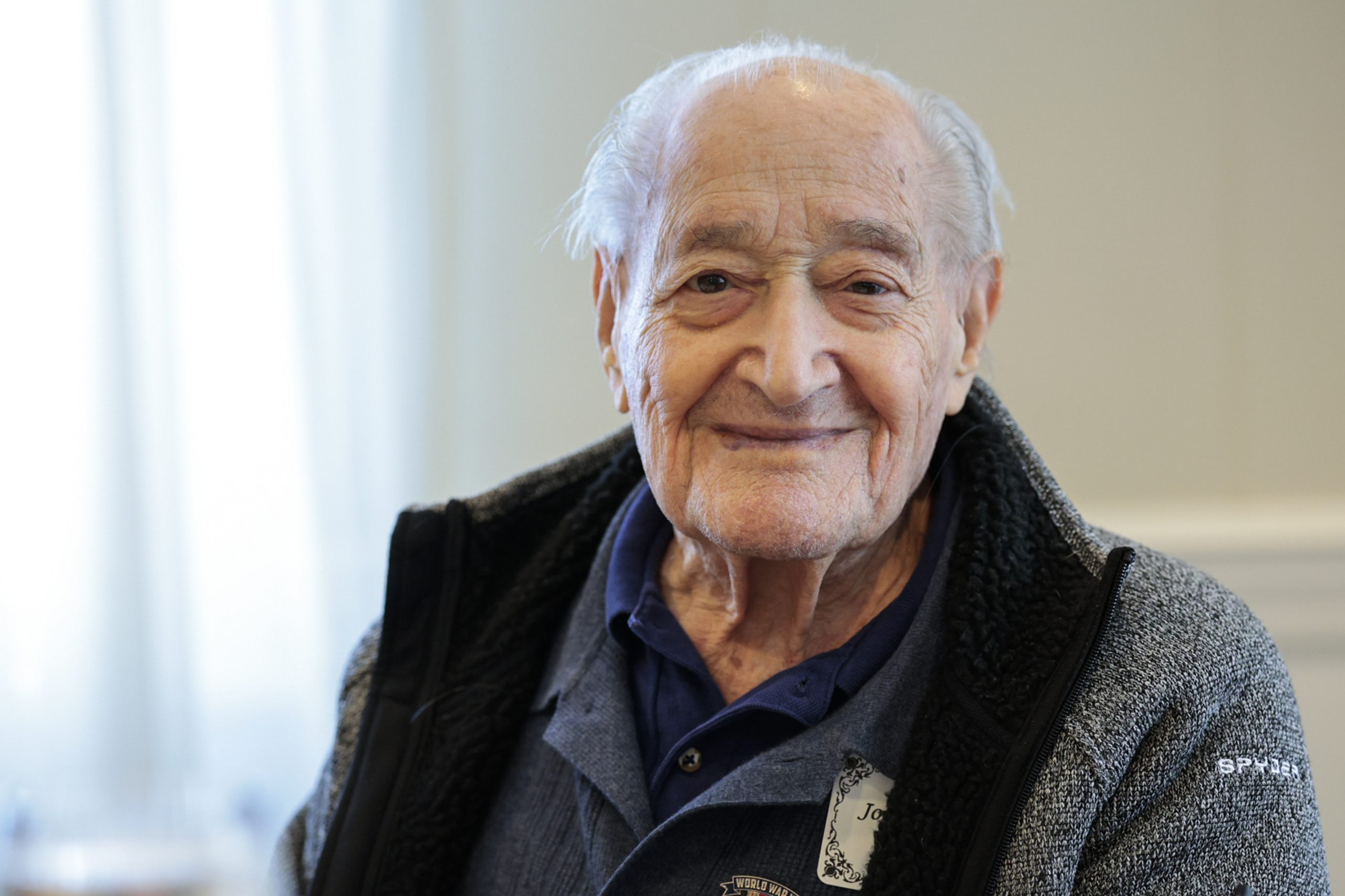
Joseph Donia, 100
Joseph Donia, 100. There were 45 centenarians in attendance at Tuesday’s luncheon.Steven M. Falk / For The Inquirer
Up until last year or so, Joseph Donia’s hobby was building boats. He constructed a 20-foot wooden cabin cruiser from scratch. He had it for 40 years.
“The only reason I sold it — my wife couldn’t get on it anymore,” he said.
He had a lifelong love of boats, and spent five years at sea for the U.S. Merchant Marine in World War II. His time in service was the only time he wasn’t living in West Chester, where he bought a house and raised three kids. He also has six grandkids and three great-grandkids.
His most recent project was a 35-foot sailboat. It’s still sitting behind his West Chester home, but he’s given it to his son to finish.
It kept the 100-year-old active — something he advises.
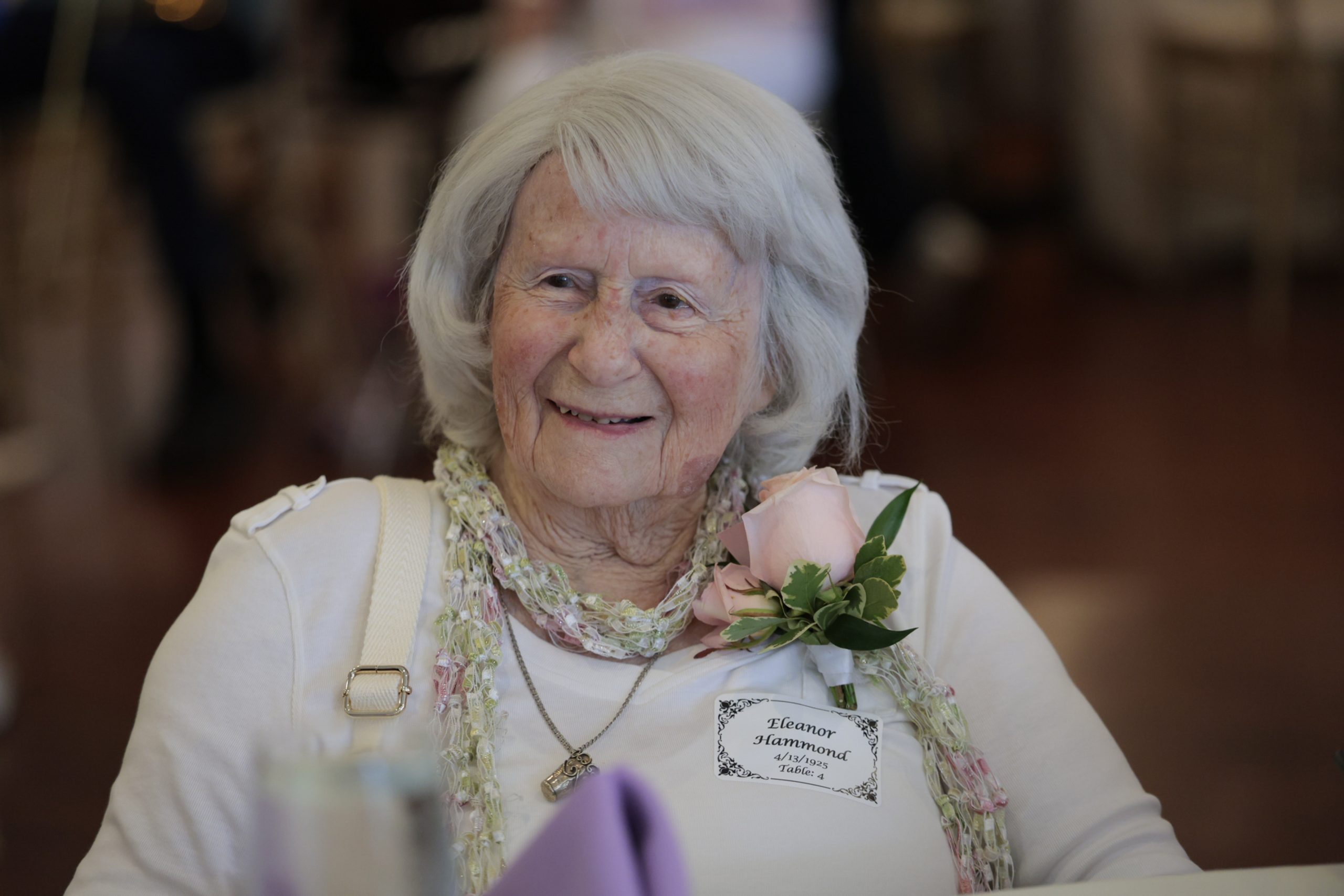
Eleanor Hammond, 101
Eleanor Hammond, 101, enjoys Tuesday’s annual luncheon. Steven M. Falk / For The Inquirer
Eleanor Hammond has always been a fan of creative pursuits: a voracious reader who knitted and sewed. She stitched her daughter’s wedding gown, and, perhaps more memorably, a jacket for her husband.
“He insisted I make him a jacket because I sewed for everyone else. He picked out the material; looked like Liberace. It was horrible,” she said. “I wouldn’t go out with him when he wore it.”
A graduate of Coatesville High School, Hammond would go on to work there until she was 81, in the principal’s office. She was once a disciplinarian, and truancy officer. She’s watched the county change over time, marveling at the amount of development. And, less positively, the traffic.
“The way to get here, I used to zip here,” she said. “But I can’t do that now.”
Still, she likes it, and the changes that have come with time.
“I’ve been here a long time. Everything about it is beautiful. The people are friendly, and it’s a beautiful place,” she said.
And as much as she loves home, she recommends travel. If you don’t know the language, be nice, smile, and “use your arms” to convey your meaning.
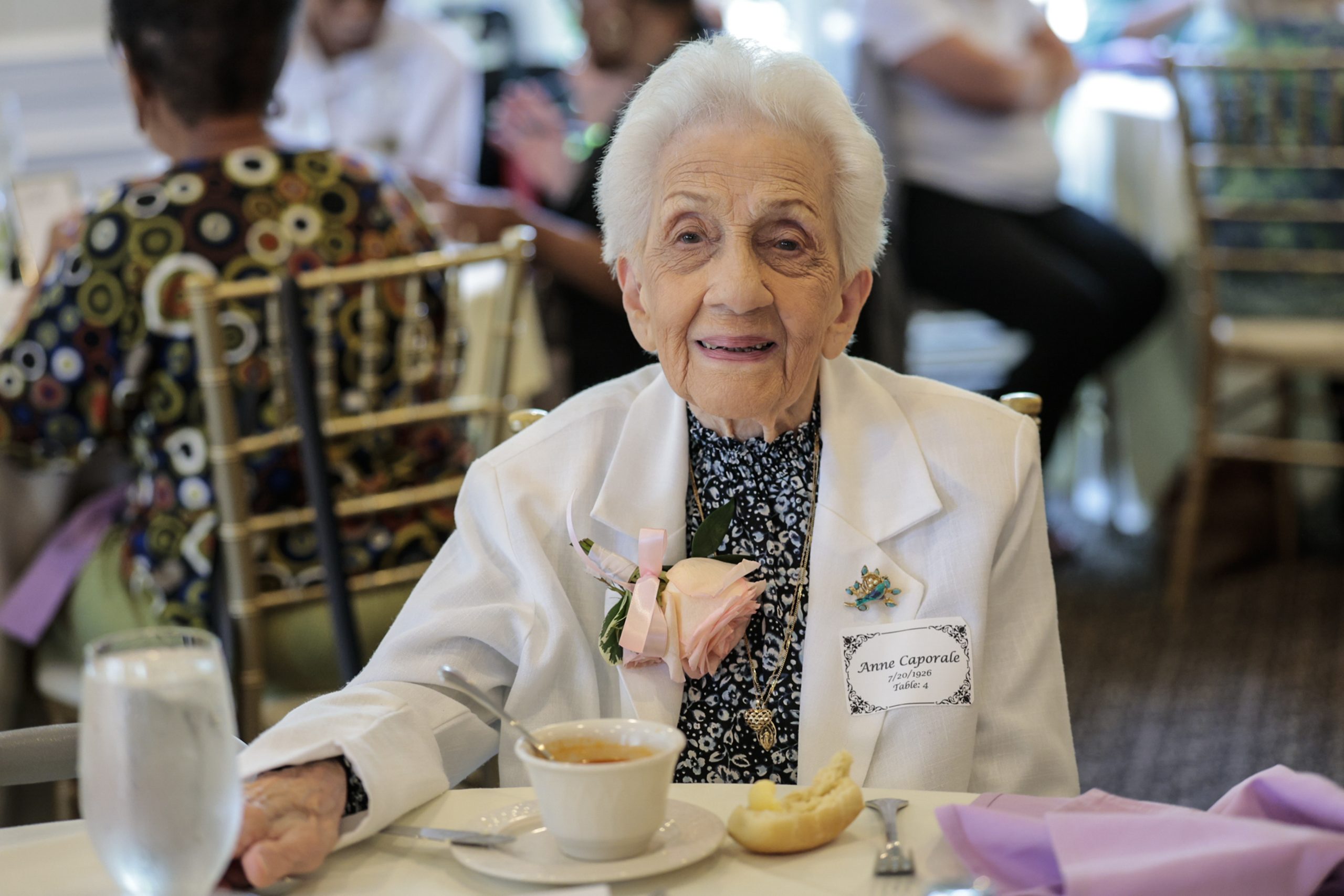
Anne Caporale, 99
Anne Caporale, who turns 100 in July.Steven M. Falk / For The Inquirer
Anne Caporale graduated alongside Hammond at Coatesville High School. She went on to raise six kids, and has 10 grandchildren, 27 great-grandchildren, and three great-great-grandchildren.
“We have quite a group,” she said. “I love them.”
She has found Chester County to be a good place to live and “wouldn’t want to live anywhere else.”
She lives at home, right by one of Downingtown’s high schools, which she loves because “the kids are great.” She still does her laundry and cooks every day. The luncheon Tuesday was a treat for her. “Let somebody else do the cooking,” she said.
Keeping active is the secret, she said.
“I know we’re here for a reason, but I don’t know it. I don’t question it,” she said.
This suburban content is produced with support from the Leslie Miller and Richard Worley Foundation and The Lenfest Institute for Journalism. Editorial content is created independently of the project donors. Gifts to support The Inquirer’s high-impact journalism can be made at inquirer.com/donate. A list of Lenfest Institute donors can be found at lenfestinstitute.org/supporters.
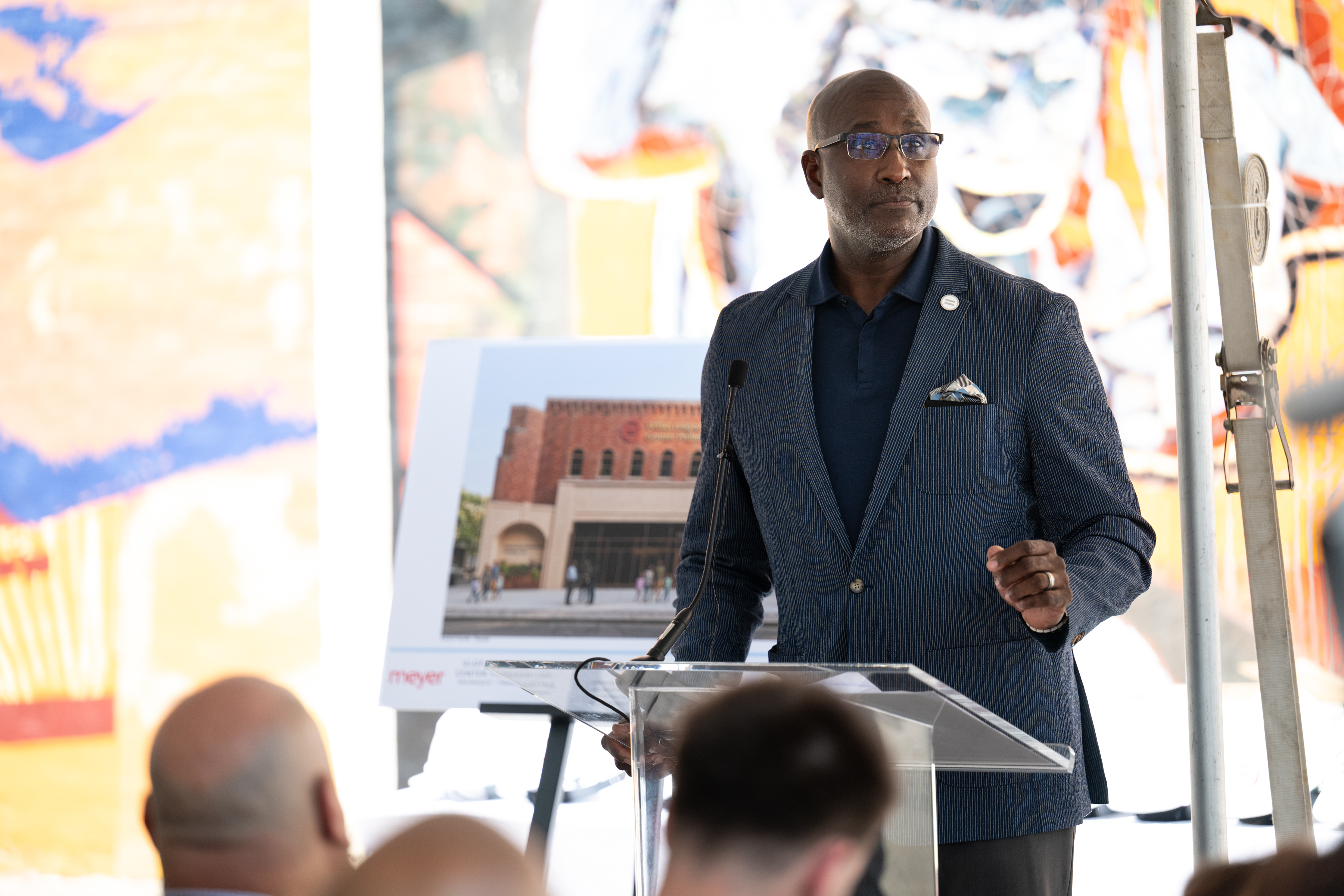
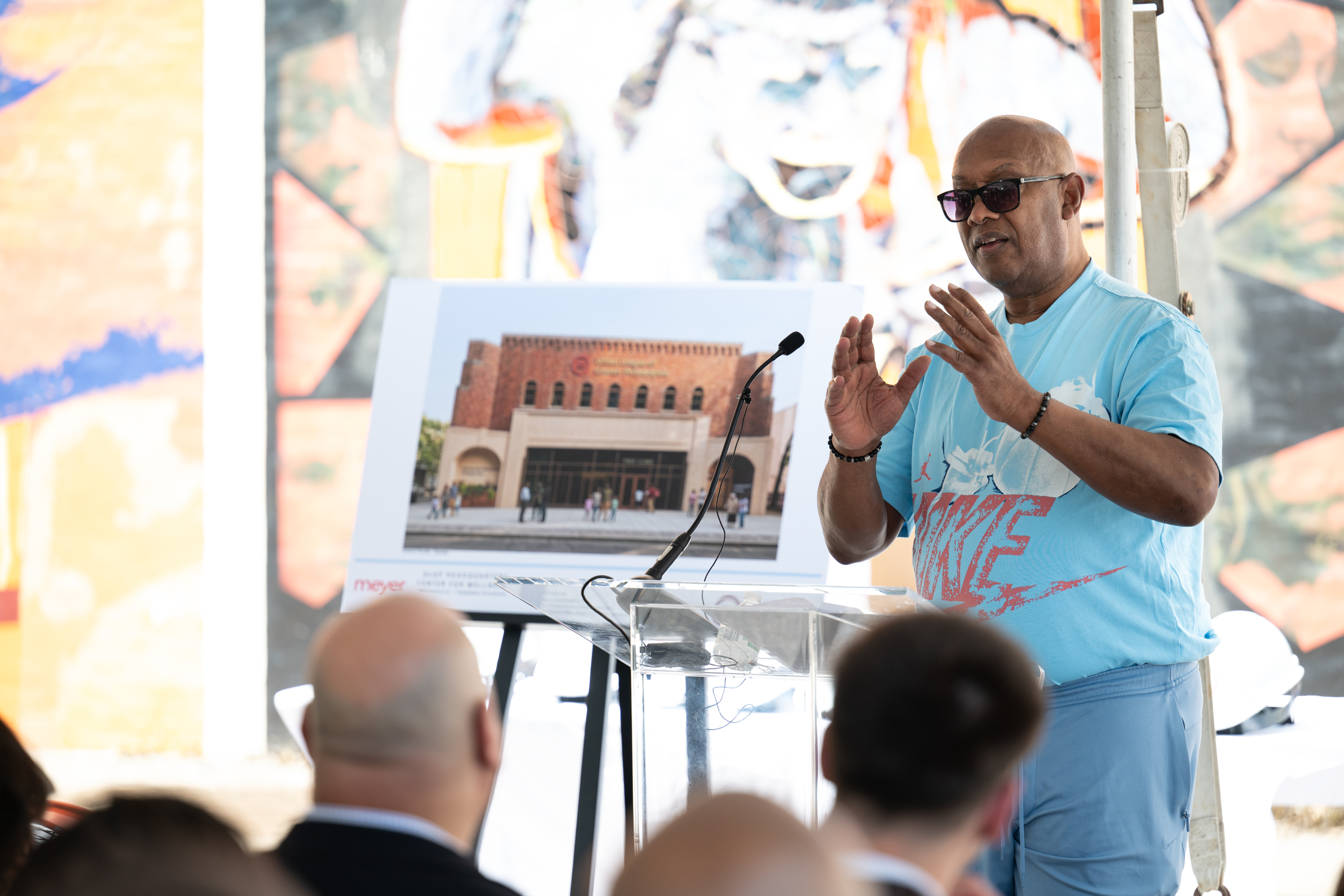
The Urban League of Greater Philadelphia is opening a free clinic in West Philadelphia for people without health insurance. The $8 million Center for Well-Being will also offer workforce development, housing, and other services, Urban League officials announced Friday.
The clinic will be open to all Philadelphia residents and expects to serve residents of eastern Delaware County as well, Urban League president Darrin W. Anderson Sr. saidat Friday’s kickoff event.
“Across Philadelphia, too many residents continue to face barriers to good health, economic mobility, stable housing, quality jobs, and the resources needed to thrive. These challenges are deeply interconnected and require more than isolated solutions. They require a comprehensive community center approach,” Anderson said.
The Urban League acquired the building in March for $1.6 million — attracted by the proximity to the Market-Frankford El and its parking lot, both of which make the building accessible to people outside the immediate neighborhood. With internal demolition about half finished, the center is expected to open in the first quarter of next year.
U.S. Rep. Dwight Evans secured $1.2 million in seed money for the Urban League of Philadelphia’s Center for Well-Being in West Philadelphia. He spoke Friday at an event announcing the project.Erin Blewett / For The Inquirer
The center — in a former Mercy Hospital of Philadelphia building — will employ around 30 people when it is fully operational, said Chetan Panda, vice president of community and economic impact for the Urban League.
The hires for the 4,500-square-foot clinic with eight exam rooms will include a medical director this fall, he said.
The project’s funding comes from a federal tax credit program designed to encourage private investment in economically distressed neighborhoods.
Finanta, a nonprofit Community Development Financial Institution and credit union in Philadelphia, arranged the financing.
Three years ago, U.S. Rep. Dwight Evans, a Philadelphia Democrat retiring at the end of his current term,secured $1.2 million in seed money for the project.
The role of free clinics
The Urban League modeled its free clinic on those in Cherry Hill, Phoenixville, and West Chester. The city’s numerous free primary care clinics are only open periodically, as opposed to being open daily.
Philadelphia has 110,000 people without insurance, according to Panda. Many of them earn too much to qualify for Medicaid, yet don’t have access to insurance through their jobs. Their jobs pay too poorly for themto afford insurance on the state’s Affordable Care Act exchange, Panda said in an interview Thursday.
The clinic will refer people who have Medicaid, Medicare, or private insurance to the federal health clinic closest to them. In West Philadelphia, that could be Spectrum or PHMC at the former Mercy Hospital of Philadelphia.
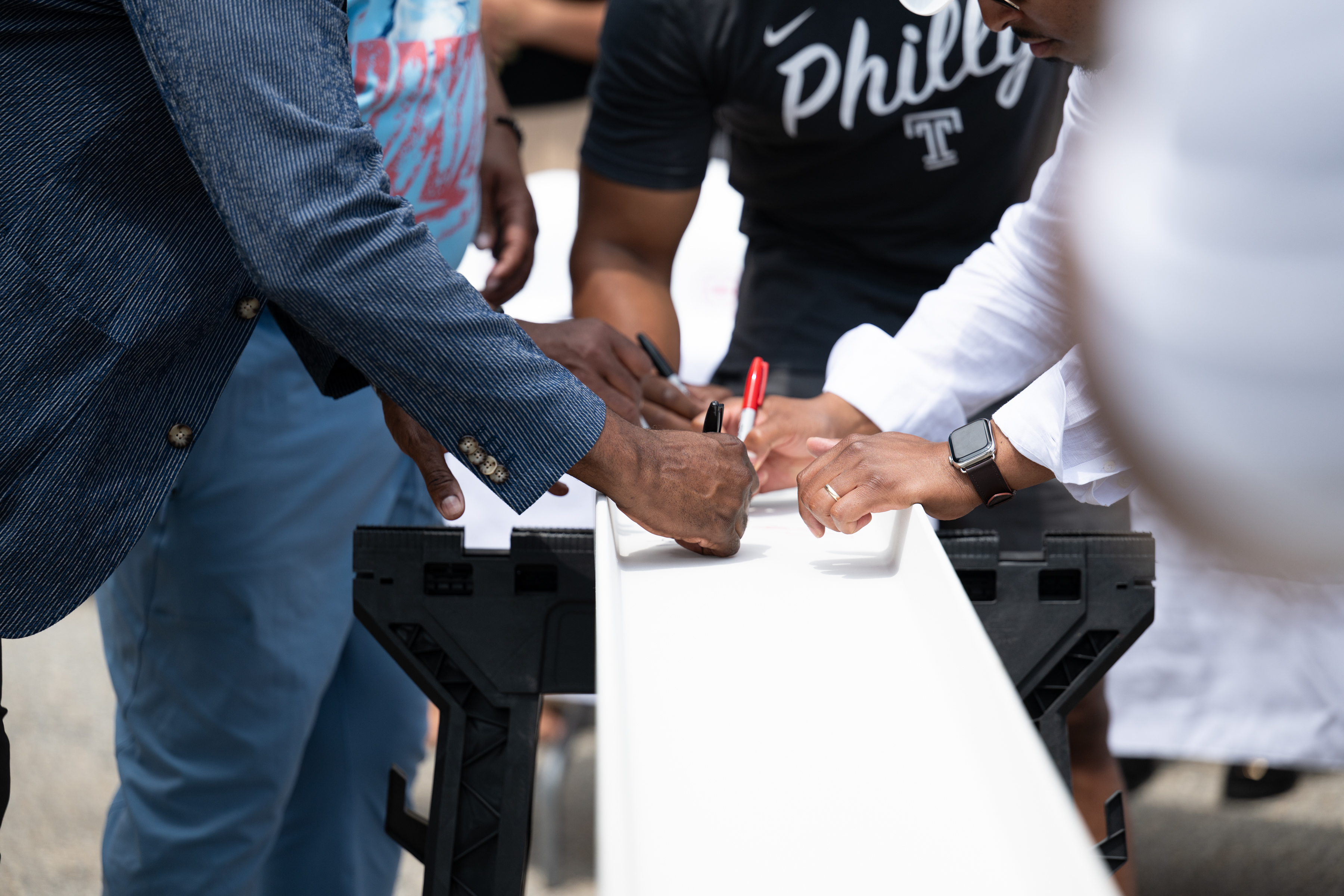
Urban League of Greater Philadelphia officials, politicians, and other supporters sign a beam that will be used in the the refurbishing of the the Urban League’s planned Center for Well-Being.Erin Blewett / For The Inquirer
Federal clinics, known as federally qualified heath centers, have a sliding payment scale for people who don’t have insurance. “We see that a lot of uninsured people forgo care at the FQHCs because they don’t want to pay the sliding scale. That’s a cost burden,” Panda said
When they need care, they often seek it in high-cost emergency departments, he said.
Free clinics rely on nearby hospitals for some of their staff and for donated services, such as X-rays and other diagnostic tests. Penn Medicine will support the new clinic in West Philadelphia, just as it does existing federal health centers, said Richard Wender, Penn’s chair of family medicine, who was at Friday’s event.
Correction: This story has been updated to correct Chetan Panda’s title to vice president, and with the correct name of Community Volunteers in Medicine in Chester County.
At noon on a bright June Tuesday, the scene at Skinny Joey’s Cheesesteaks & Pizza on the Wildwood boardwalk felt more like a South Philly block party than a soft opening.
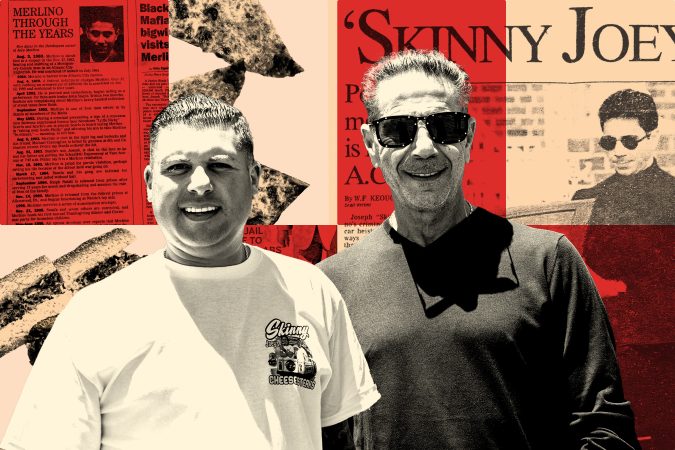
Joseph “Skinny Joey” Merlino worked the crowd at his new shop — hugging, shaking hands, posing for photos — moving easily among his friends and admirers. At 64, five years removed from the criminal justice system, the onetime alleged head of Philadelphia’s underworld is enjoying a second act that few could have predicted: cheesesteak entrepreneur, podcaster, and social-media personality.
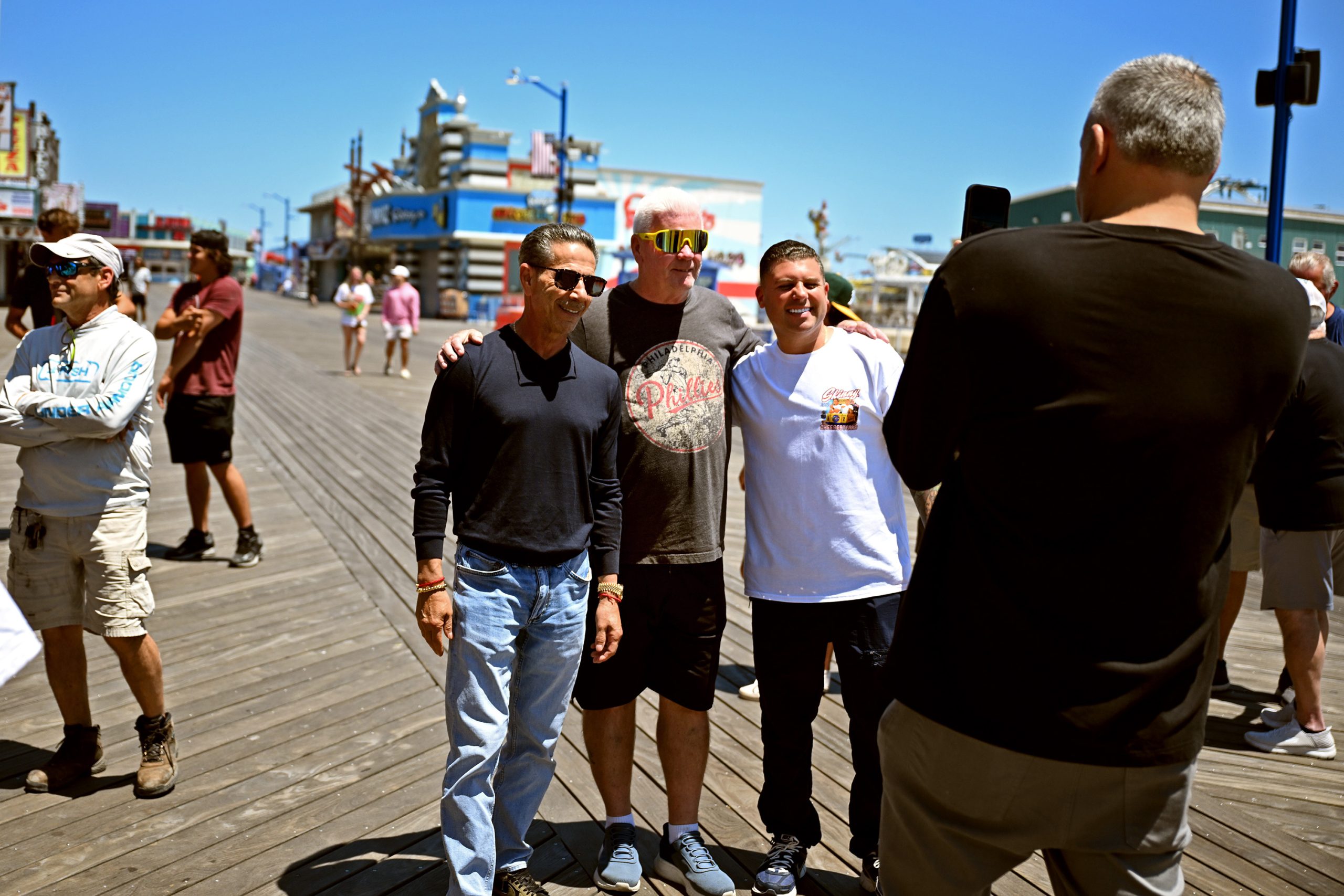
Joseph “Skinny Joey” Merlino (left) and Joe “Lil Snuff” Perri Jr. (right) posing with a customer outside the Skinny Joey’s Cheesesteaks & Pizza shop in Wildwood.Tom Gralish / Staff Photographer
Orbiting him with a phone and a grin was Joe “Lil Snuff” Perri Jr. — 30 years his junior — Skinny Joey’s collaborator and the man who helped set him up with a new career. While customers lined up out front for steaks, slices, photos, $35 hats, and $25 T-shirts, Perri was shooting clips for social media.
Their partnership has transformed Merlino from a flashy, polarizing tabloid fixture into a flashy, polarizing Instagram-age brand. Merlino provides the mythology, while Perri supplies the algorithm.
Symbiotically, they are building an unlikely enterprise. Merlino gives Perri access, credibility, and a bigger stage. Perri gives Merlino comic relief, social-media fluency, and a way to be seen as entrepreneurial rather than simply infamous as a reputed former mob boss.
“Without me, there’s no him,” Perri said. “Without him, there’s no me. It’s just a good mix.”
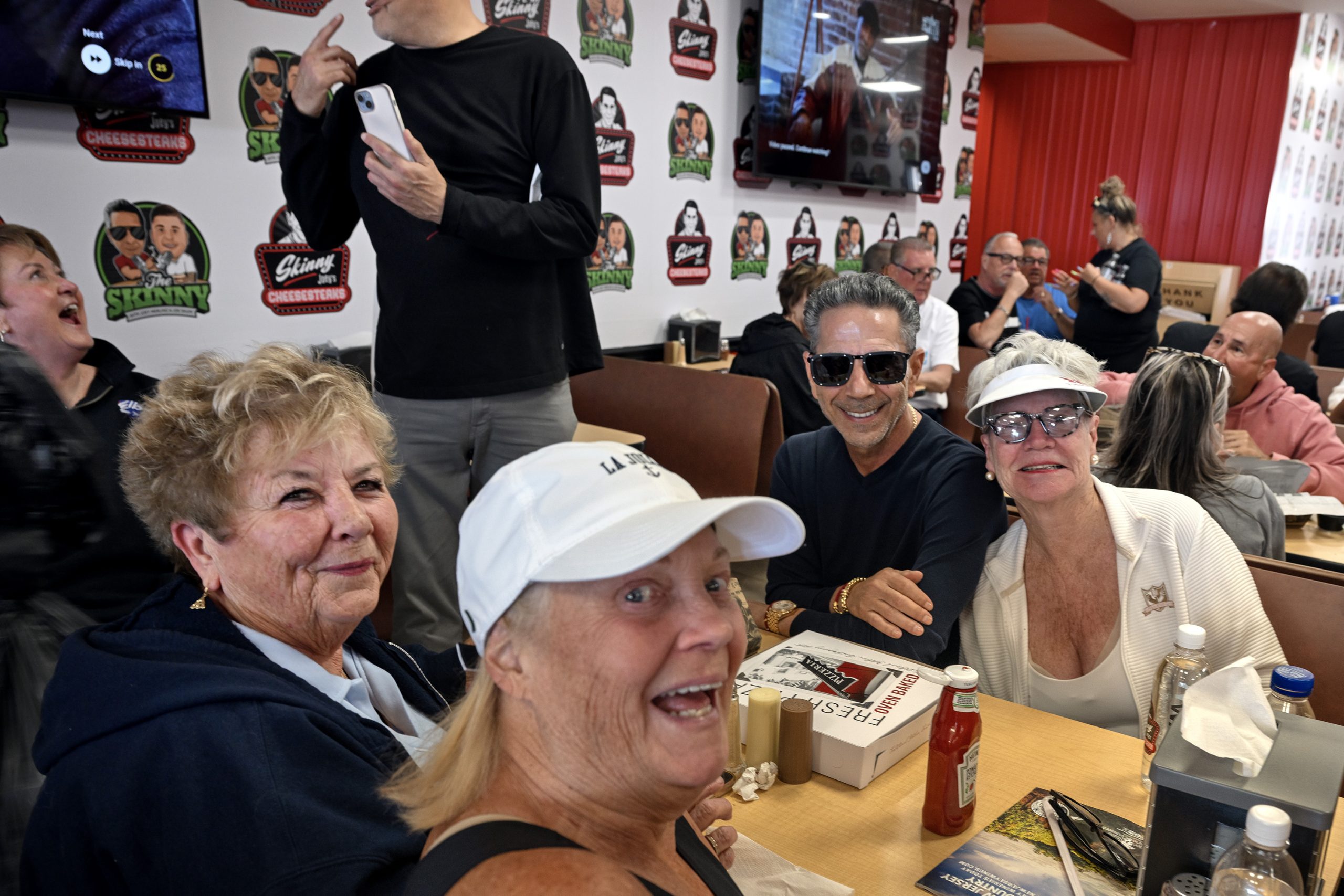
Joseph “Skinny Joey” Merlino joining customers at Skinny Joey’s in Wildwood during its soft opening on June 2. They call themselves “the Schuylkill Girls” (from left): Julie Shelton, Cindy McCullough, and Terry Landy, all of whom now live in Wildwood.Tom Gralish / Staff Photographer
A ‘mob media’ moment
George Anastasia, who covered organized crime for more than 30 years at The Inquirer and now teaches an organized-crime course at Rowan University, said Merlino’s new career fits a broader moment in mob media.
Former wiseguys, associates, historians, and fans now gather in a true-crime subculture known online as “MobTube,” where the lore is packaged into YouTube shows, Patreon feeds, podcasts, clips, and merch.
Merlino has lived the story that fuels the genre. One of Philadelphia’s most recognizable organized-crime figures, Merlino was convicted in 1990 for his role in a $352,000 armored truck robbery in 1987.
In 2001, he and six co-defendants were tried on federal racketeering charges, including three counts of murder and two of attempted murder. Merlino was acquitted on those counts, but served about 12 years on other charges, including gambling and extortion. A supervised-release violation briefly returned him to prison in 2014, and a second major racketeering case ended in 2018 with a guilty plea to a single illegal-gambling charge after a mistrial. In a separate trial in 2004, he was acquitted of the 1996 killing of Joseph Sodano, an underling in North Jersey. Merlino completed federal supervision in 2021, but he’s been banned from New Jersey casinos since 1988 and from Pennsylvania casinos since a 2016 incident at the former SugarHouse Casino.
And Merlino has made it no secret that he is different from many of the former figures who populate the MobTube genre. Unlike Sammy “The Bull” Gravano, John Alito, and Jimmy Calandra, Merlino never cooperated with prosecutors.
“He saw guys who cooperated come back and become media sensations,” Anastasia said. “And I think he got [annoyed] that these are all guys who, in his view, violated the code, and now they’re making money on that old life. He did his time as a stand-up guy. ‘So [to heck with that] — I’m going to make money, too.’ And he created this brand.”
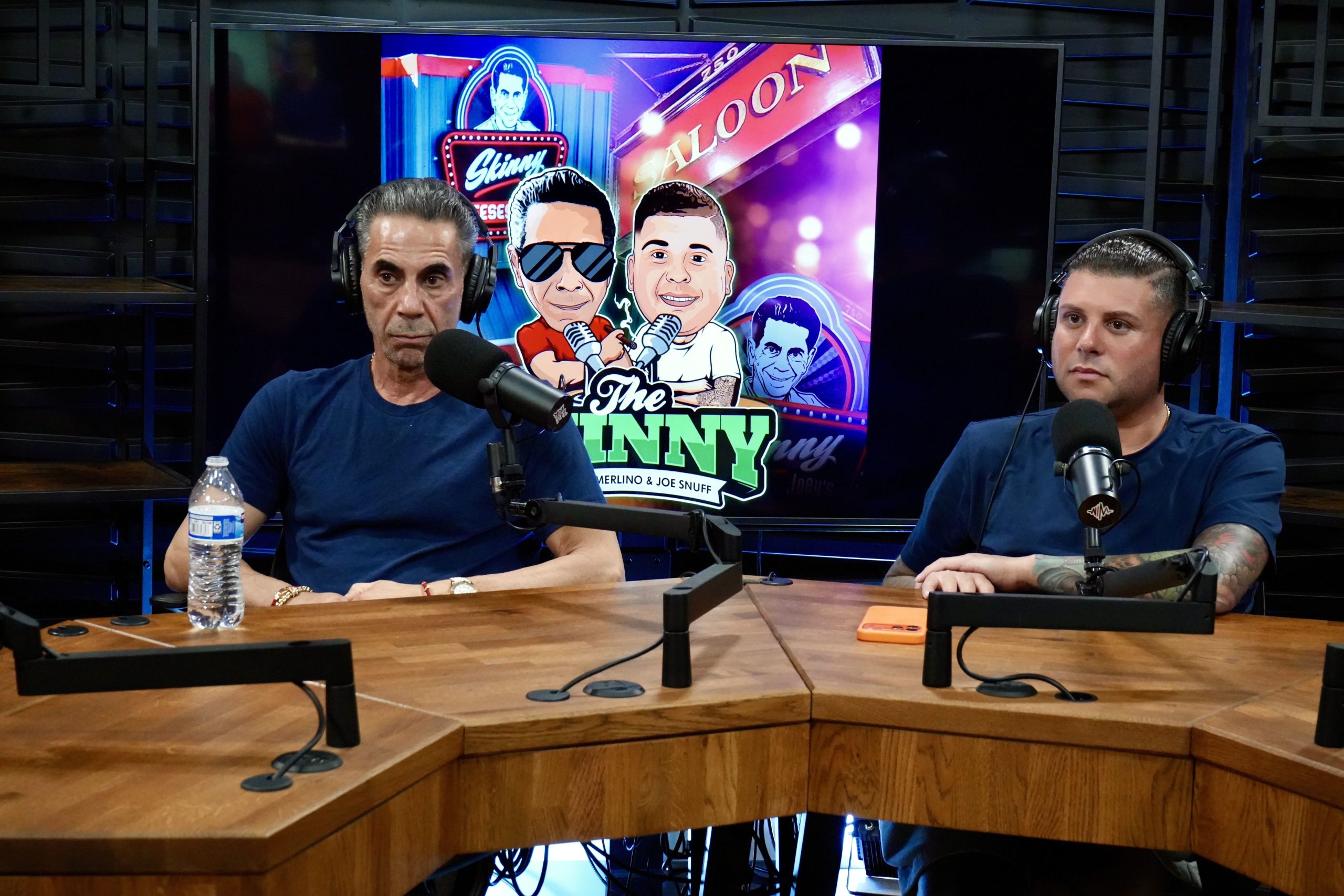
Joseph “Skinny Joey” Merlino (left) and Joe Perri Jr. on the set of “The Skinny” podcast.Courtesy of Joe Perri Jr.
Perri helped make that legible to a younger audience.
“Lil Snuff is part sycophant and part guide,” Anastasia said. “He’s the one who, in a lot of ways, sets the flow. Joey is going to be Joey, but somebody has to keep bringing him back to the point.”
The rise of Lil Snuff
Before he was Merlino’s co-host, Perri was Lil Snuff.
The nickname came from his father: As a 10-year-old, Joe Sr. turned around when a cousin was calling for a dog named Snuffy. Boom. He was Snuff. When his son was born at Methodist Hospital in 1992, Snuff became Big Snuff.
As a teenager, Lil Snuffbussedtables at Stogie Joe’s, the Saloon, and Fitzwater Cafe. At 18, he joined the stagehands union. At 21, he got a job at Mall Chevrolet in Cherry Hill. The older salesmen had relationships and repeat customers. Perri’s mentor told him that he needed a lane.
It was 2013, and social media was beginning to reshape promotion. Perri started making his own brassy, unscripted commercials. “Selling Chevys for less” became his tagline.
He also made videos about gambling and food, his two passions. He was not famous, but he was visible in the South Philly-to-South Jersey social media corridor where restaurants, sports, betting, family, and neighborhood identity blur into one feed.
At the same time, Perri said, he was abusing pills. In 2014, at 22, his parents found him a rehab center in South Florida. To make sure he got there safely, they called a family friend whose Italian restaurant in Boca Raton had recently opened:
Joey Merlino.
“My father grew up with his grandfather,” Merlino said, explaining the bond. “I grew up with his father. I’ve known him since he was born.”
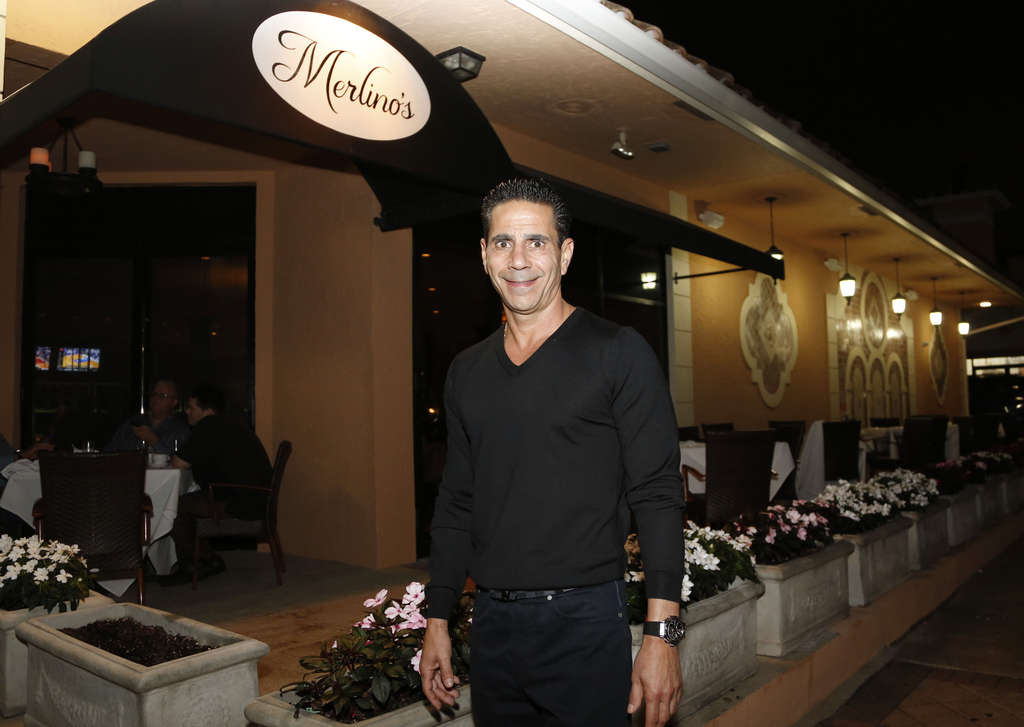
Joseph “Skinny Joey” Merlino in 2014 at the Boca Raton restaurant bearing his name.Terry Renna / For The Inquirer
Perri said it took several attempts before recovery stuck. He has been sober since Sept. 11, 2016. “I’m big with recovery,” he said. “That’s the main thing in my life. I put sobriety first and then everything after that.”
Merlino’s — where Merlino was maitre d’ because his legal situation then precluded ownership — closed in 2016, just before the feds arrested Merlino at his home in Boca in the lead-up to his second racketeering case. “If I didn’t have this trouble, it would still be open,” Merlino said earlier this month.
After Merlino attained freedom in July 2021, producers called with movie, television, and book deals. Merlino turned them all down. “Nothing seemed right,” Merlino said. Someone brought up the idea of a podcast.
“I didn’t even know what that was,” Merlino said.
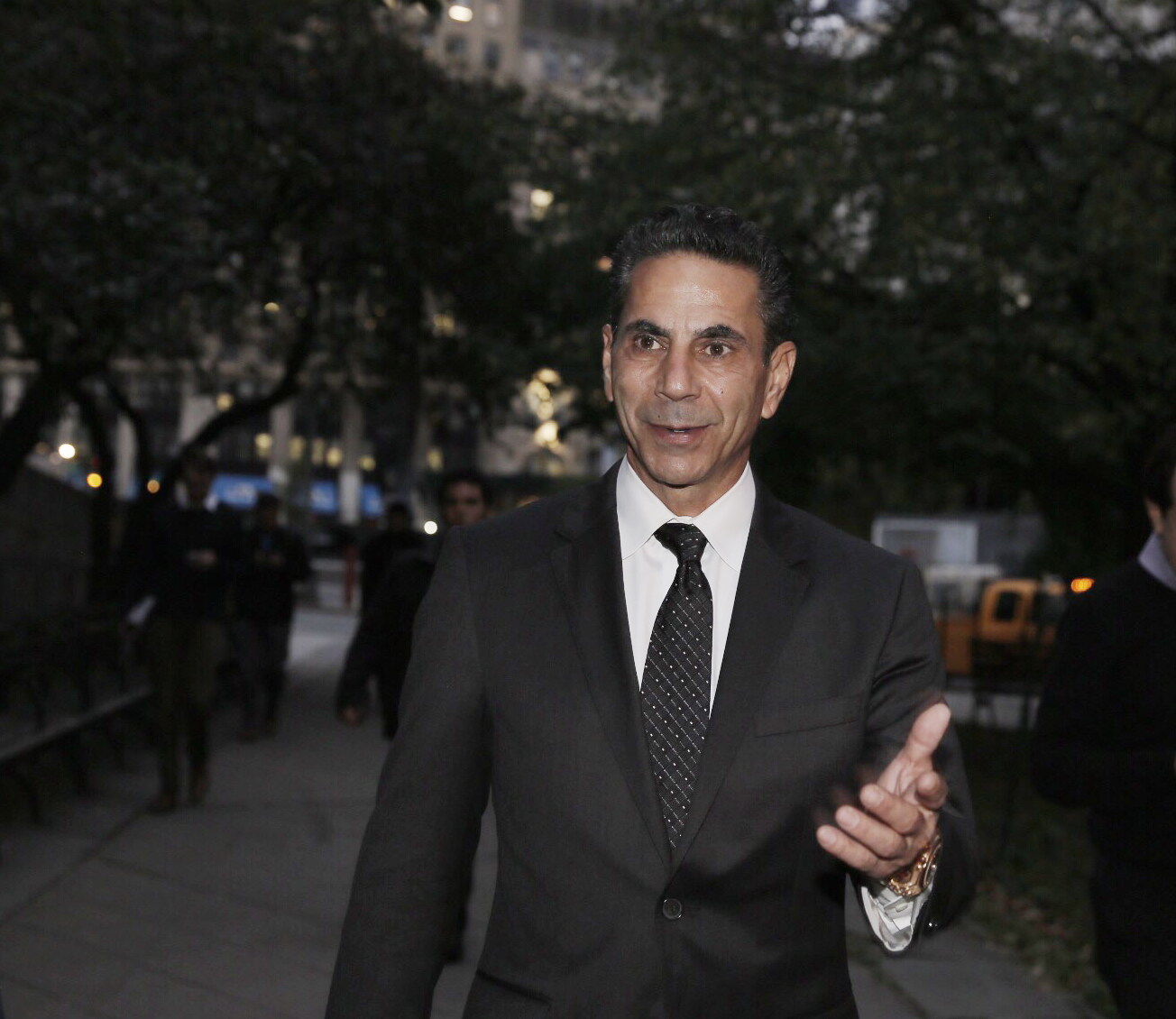
Joseph “Skinny Joey” Merlino leaving the federal courthouse in Manhattan after being sentenced on Oct. 17, 2018.Elizabeth Robertson / Staff Photographer
His friend Raymond “Wags” Wagner explained the concept and suggested a loose format built around food and sports betting. Actor Kevin Connolly of Entourage fame, who was involved early as a producer, told Merlino that he needed a co-host.
“They said, ‘Who would you want?’” Perri said. “They were sending him people, and he was like, ‘I’m not doing nothing with these people.’”
Then Ray Wags suggested Perri.
“Joey was like, ‘100 percent. Get him on the phone,’” Perri said. “Kevin Connolly said, ‘Send me your videos.’ I sent him my videos, and he said, ‘You’re the guy.’ The rest was history.”
The world of ‘MobTube’
Merlino and Perri launched the video podcast in 2023. Viewers are not just watching Merlino talk about the old life. They see him bust Perri’s chops about eating too much and mock his parlays. They get gambling tips, watch them interview athletes and celebrities — all part of a South Philly generational comedy.
Perri describes it in family terms. “My dad’s my dad, but he’s also my best friend, too,” Perri said. “We gamble together. We go out together. We have fun together. So they see me and Joey as that, and they can’t figure out how we mix so good.”
“He’s good,” Merlino said. “I’m old, he’s young. He talks good, he’s funny. He’s a pain in the balls, but it’s a good fit.”
They began The Skinny podcast on YouTube, but now focus more on Patreon, where the content is unfiltered. And better monetized. Perri says TheSkinny has 1,600 Patreon subscribers paying $15.95 a month. He said their social-media pages combined average 30 million views a month.
Perri’s wife, Danielle, handles bookings and schedules. “I produce,” Perri said. “I cut the clips. I do everything. It’s me and Joey. Two-man show.”
A wider audience
When they started, Perri was still selling cars at Mall Chevrolet. But the now-shuttered dealership got tired of people showing up hoping to see Merlino instead of test-driving a Suburban.
Perri quit. The show grew.Merlino’s reinvention has coincided with a broader shift in the gambling world. Legal sportsbooks, now ubiquitous on television and online, have largely supplanted the corner bookmaker, turning an activity once associated with organized crime into a mainstream consumer business. Guests span sports, hip-hop, gambling, and entertainment, including Wallo267, Fat Joe, Ric Flair, and Bernard Hopkins.
Each booking widened his audience, and Merlino was being absorbed into a broader celebrity ecosystem.
Last October, Netflix released Mob War: Philadelphia vs. The Mafia, a docuseries revisiting the violent 1990s power struggle between John Stanfa and Merlino’s younger faction. It steered even more viewers to Merlino and Perri’s world.
‘Skinny Joey,’ wit’
Then came the cheesesteaks.
One night, Perri, Merlino, and friends were playing poker. Merlino wanted cheesesteaks. Perri said he’d make them.
“He’s like, ‘You can’t make cheesesteaks,’” Perri said. “I said, ‘Are you nuts? I’ve been making them my whole life.’”
Perri cooked some. “He was like, ‘This is the best f— cheesesteak ever,’” Perri said. “He said, ‘Let’s open up a cheesesteak place.’ I said, ‘All right. Call it Skinny Joey’s Cheesesteaks.’ And that was it.”
The first shop opened in March 2025 at 3020 S. Broad St., near the sports complex. From the start, Skinny Joey’s was more than a sandwich shop. It was a set. The shop leaned into Merlino’s notoriety; the sandwiches are wrapped in a collage of newspaper articles about his past.
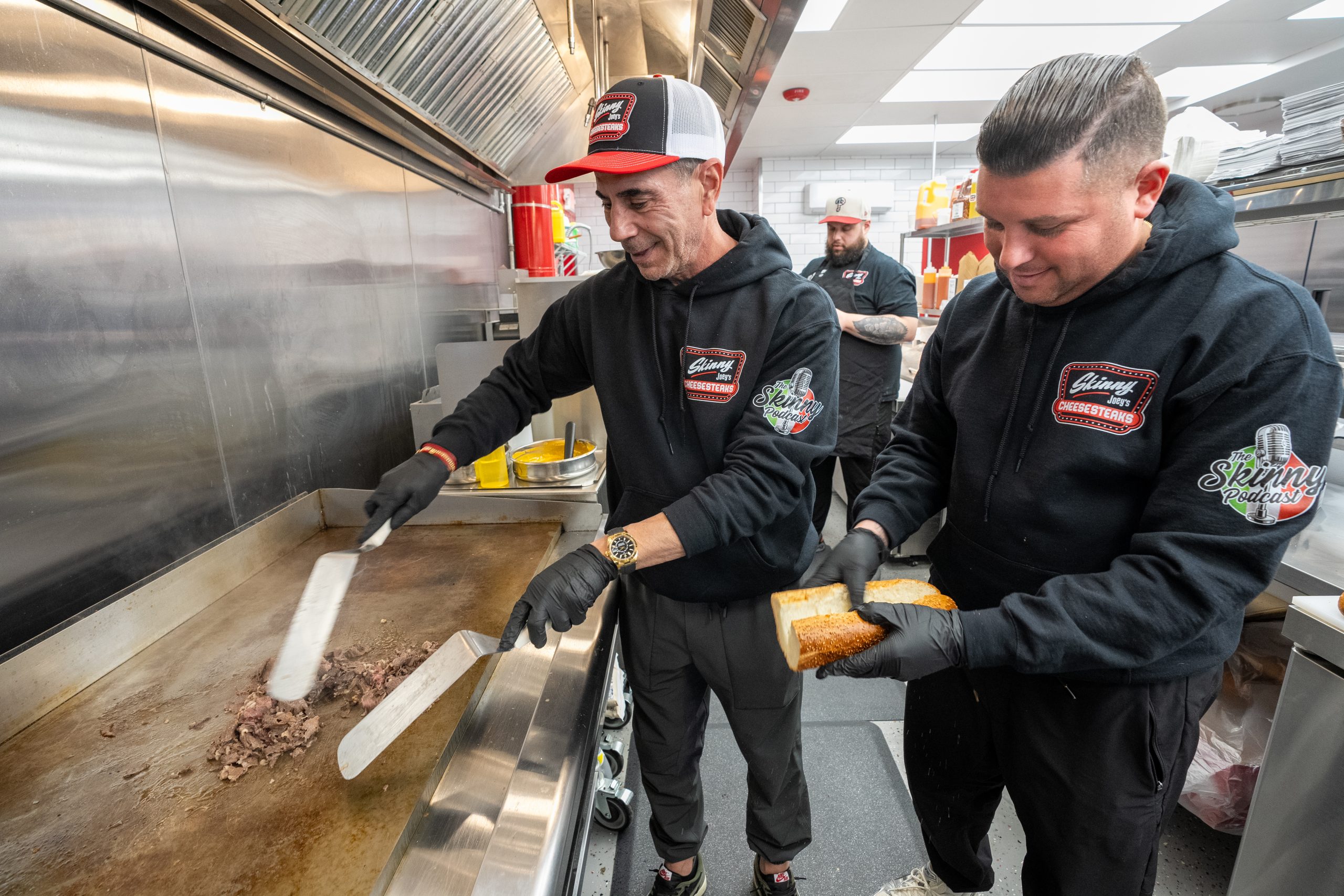
Joseph “Skinny Joey” Merlino (left) working the grill beside Joe “Lil Snuff” Perri Jr. at the Skinny Joey’s Cheesesteaks in Philadelphia at its opening in March 2025.Jessica Griffin / Staff Photographer
Celebrities showed up: Jason Kelce, Landon Dickerson, Mack Wilson. A customer eating a cheesesteak was good content. A recognizable person eating one on camera was better.
The restaurant also became a magnet for the kind of drama that fuels digital engagement: online beef. Podcaster Gene Borrello, a former Bonnano crime family associate and Merlino antagonist, weighed in last year on an apparent feud between Skinny Joey’s camp and Frank Olivieri of Pat’s King of Steaks. Merlino and Perri had taken issue with a video posted by Olivieri — whose great-uncle invented the steak sandwich — in which he chided shops that chop the meat on the grill. Like most online food feuds, this seems to have subsided.
Then came the deal for Wildwood, where Skinny Joey’s replaced Joe’s Pizzeria, which had been on the boardwalk at Magnolia Avenue for 15 years. There, Skinny Joey’s added pizza and stromboli, which are not sold at the South Philadelphia location.
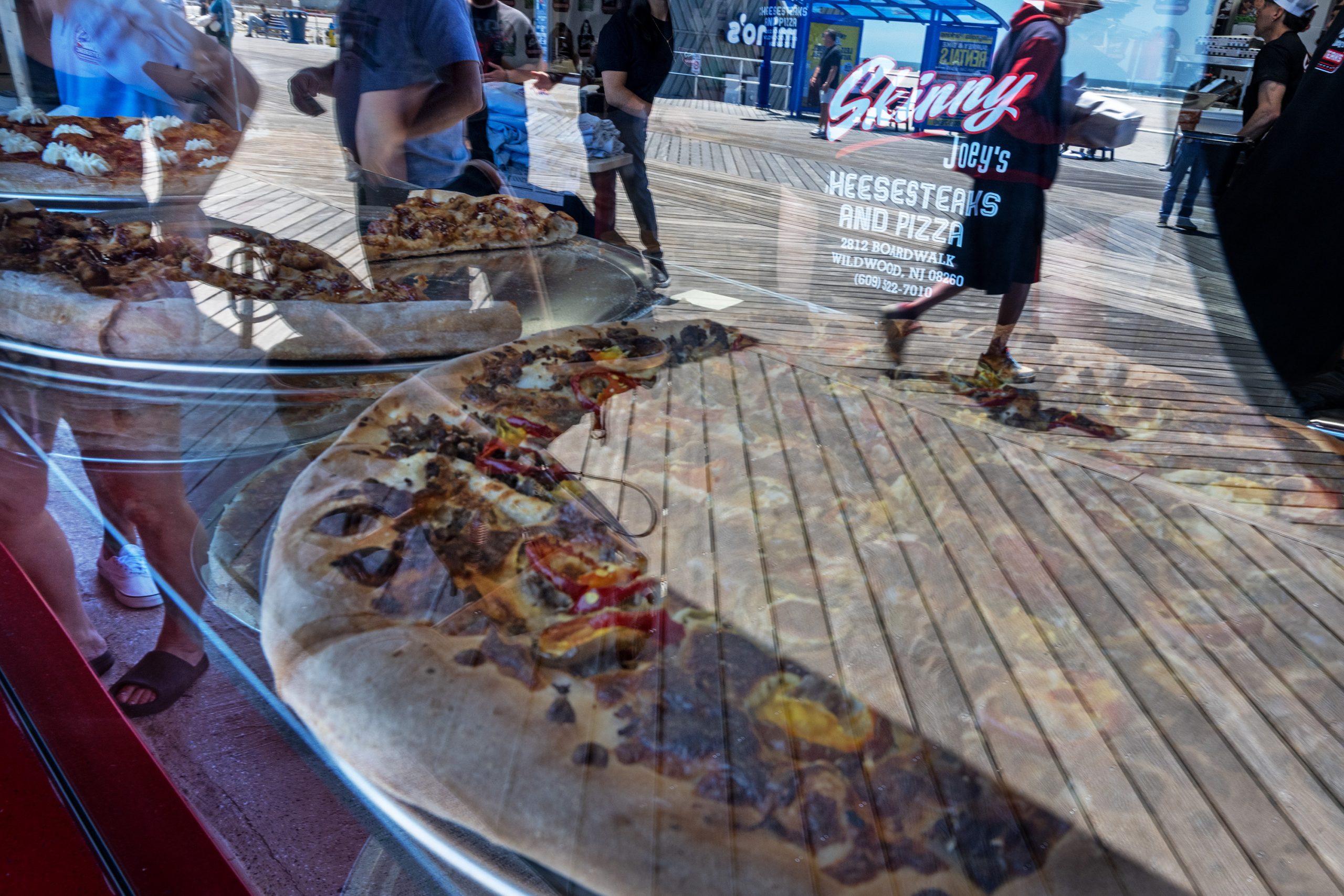
Reflections in the pizza display case on the boardwalk at Skinny Joey’s Cheesesteaks & Pizza in Wildwood.Tom Gralish / Staff Photographer
The pizza recipe comes from Vito’s on Haddonfield Berlin Road in Cherry Hill, and the stromboli from Pizza Shack at 15th and Oregon in South Philadelphia, both owned by Skinny Joey’s business partners Stephen Casasanto and John Fioravanti, whom Merlino also described as longtime friends.
More locations are planned. Perri said a Boothwyn shop is expected around Sept. 1, and several others are in the pipeline.
Bypassing the gatekeepers
Merlino is an extreme case of a recent phenomenon. People with complicated histories — criminal, scandalous, controversial, or simply overexposed — no longer need traditional gatekeepers to reintroduce themselves. They can speak directly to followers and monetize the attention.
Perri is not a journalist, of course, or a publicist, exactly. He is not merely a manager, producer, or sidekick. He is something in between — a new kind of local media operator.
He knows the scene, and how to make content feel unscripted even when the business behind it is deliberate. He is close enough to Merlino to bust his chops and deferential enough to preserve the hierarchy. He can translate Merlino to younger audiences without making him seem managed.
Perri softens Merlino without sanding him down. Merlino still curses, rants, and mocks rivals. Anyone they disagree with is a “bedbug.”
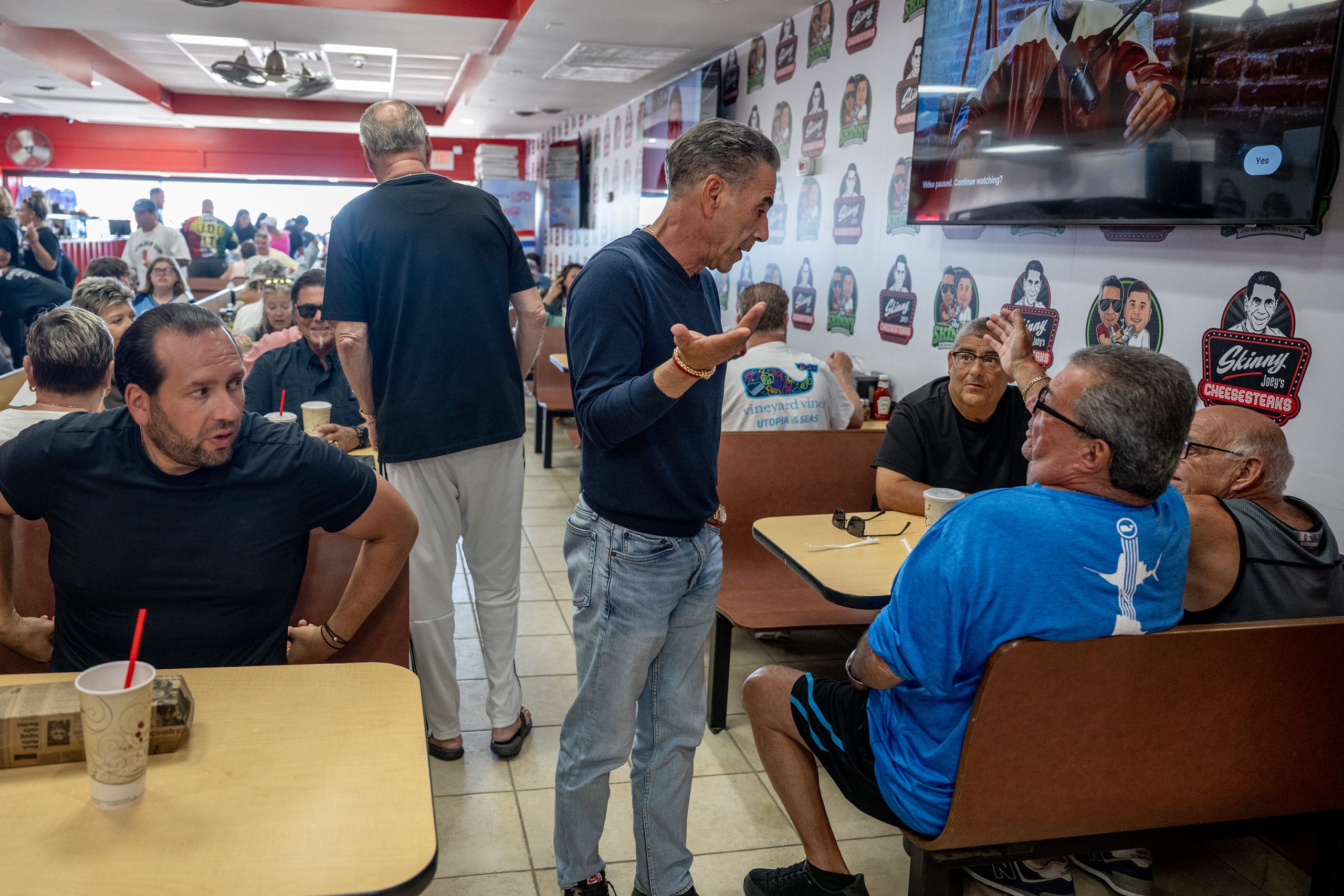
Joseph “Skinny Joey” Merlino greets a table of customers at Skinny Joey’s Cheesesteaks & Pizza in Wildwood.Tom Gralish / Staff Photographer
“At the end of the day, Joey isn’t going to change who he is for anybody,” Perri said. “If he can’t talk the way he wants to talk, what’s the point?”
That is part of the appeal and part of the discomfort. The audience knows Merlino’s history. They may see him as funny, defiant, loyal, misunderstood, or simply entertaining.
“There’s a segment of the American population that has always been fascinated with the outlaw: Billy the Kid, Jesse James, Don Corleone, Al Capone,” Anastasia said. “What the internet has provided is: Here are these guys in their own words. Are they being genuine? I don’t know. You can say that about any personality. But here’s a look at them without any filter.”
The filter used to be people like Anastasia.
“I was, in a lot of ways, the middleman between the people who were interested in this and the guys who were doing it,” he said. “And people who are interested in this don’t need the middleman anymore. They just go online and listen to whoever they want to listen to.”
Independence Blue Cross, the Philadelphia region’s largest health insurer, launched this month a policy designed to move care into lower-cost surgery centers and away from hospitals and clinics that can generate payments twice as high for the same treatment.
The policy started June 1 echoes Medicare’s efforts to slow federal healthcare spending by paying the same price for outpatient procedures such as colonoscopies and knee surgery in hospitals as in surgery centers.
Pressure from employers to control costs has similarly motivated IBX and a newer regional competitor, Pittsburgh-based Highmark, which implemented a similar policy on Jan. 1. Both companies’ policies affect people with low risk of complications who are covered by commercial insurance or Medicare Advantage.
When doctors seek insurance authorization for certain procedures, IBX reviewers will ask whether doctors can treat low-risk patients in a surgery center, according to the company’s chief operating officer Richard Snyder.
“This is a gentle move,” Snyder said. “We’re not willing to force you to change doctors to have your colonoscopy or your service, but we want docs to get privileges in ambulatory surgery centers.”
The region doesn’t have enough low-cost surgery center capacity for a large-scale move to that setting, Snyder said. That means the policy might not hit hospital finances right away.
But the implication is that the policy could take a harder edge in the future. IBX’s goal is to spur the development of more surgery centers — either by the incumbent health systems or by new competitors, Snyder said.
Even now, the potential for delayed care and denied coverage has several regional health systems worried. Temple University Health System, for example, does not own ambulatory surgery centers, so the time could come when it has to coordinate care with outside providers.
The money at stake
Surgery to remove torn cartilage on the knee can cost $7,190 when performed on an outpatient basis in a hospital, nearly three times the $2,477 cost in ambulatory surgery centers, according to Philadelphia-area commercial insurance averages from heath prices data firm Turquoise Health.
Smaller gaps exist for hernia repairs and colonoscopies with a biopsy, Turquoise reported. Another data firm, Medscout, showed that a majority of those colonoscopies had already shifted to ambulatory surgery centers by 2024. The shift was far less advanced for hernia repairs— a procedure IBX is targeting.
(function(){function e(){window.addEventListener(`message`,function(e){if(e.data[`datawrapper-height`]!==void 0){var t=document.querySelectorAll(`iframe`);for(var n in e.data[`datawrapper-height`])for(var r=0,i;i=t[r];r++)if(i.contentWindow===e.source){var a=e.data[`datawrapper-height`][n]+`px`;i.style.height=a}}})}e()})();
Some physicians’ groups already are seeing opportunity in commercial and government insurers’ increased emphasis on surgery centers as a way to reduce spending — as well as regulatory changes that allow more procedures to be done in free-standing surgery centers.
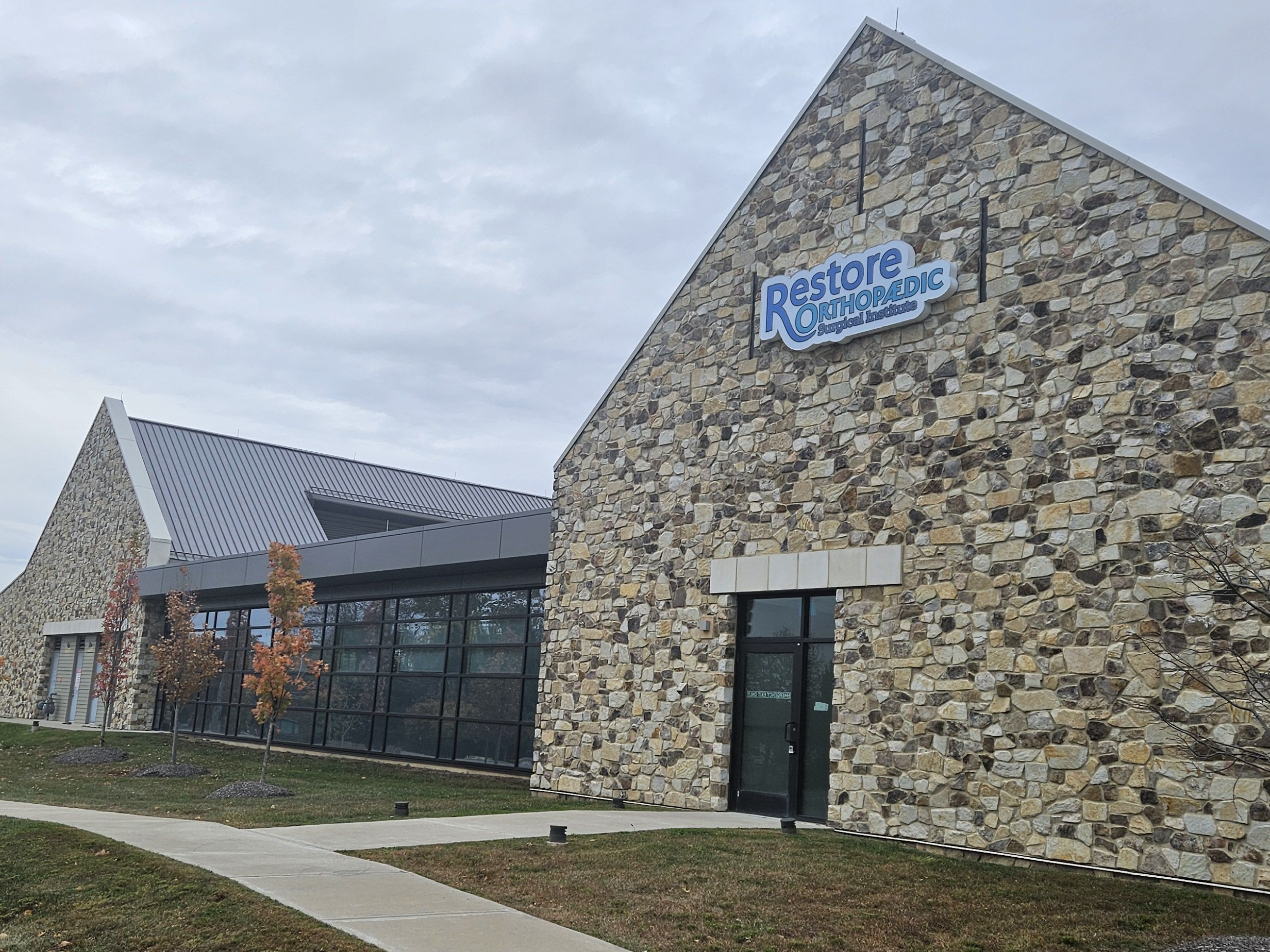
Restore Orthopaedic Surgical Institute in Chadds Ford, founded by a group of Delaware doctors, has been quickly become a high-volume joint-replacement center.
In the coming year, Rothman Institute plans to open three surgery centers in the Philadelphia region, the private practice’s CEO Christian Ellison said.
Restore Orthopaedic Surgical Institute in Chadds Ford has grown quickly to become one of the top joint replacement destinations in Southeastern Pennsylvania after opening in March 2023. The center is positioned to take advantage of an effort by Highmark and IBX to move outpatient procedures from high-cost hospitals to lower-cost surgery centers.Restore Orthopaedic Surgical Institute
Potential consumer impact
Several major health systems said the new site-of-care review policies raise questions about the potential impact on patients, without commenting on the implications for their finances.
Because Temple University Health System does not have any ambulatory surgery centers, “the policy will require certain studies and procedures to be referred outside the health system. This could create additional coordination requirements and may contribute to delays in testing, crucial diagnosis, and/or treatment,” Temple said in an email.
Main Line Health also said it anticipates the policy “could disrupt established care pathways, including in circumstances where surgeons lack privileges at available free-standing surgery centers,” the nonprofit said in a statement. Main Line has ownership interest in three surgery centers in Philadelphia’s western suburbs.
The University of Pennsylvania Health System said it will “advocate for our patients’ best interest and appeal any service denials based on the clinical and nonclinical exceptions outlined in the policy.”
Additional concerns for consumers include complexity, confusion, and possibly more risk of having care denied to what can already be a burdensome prior authorization process, said Christine Monahan, assistant research professor at Georgetown University’s Center on Health Insurance Reforms.
Monahan said she understands insurers’ impulse to steer people to lower-cost settings, but called policies like IBX’s “maybe not the most efficient way to handle the inefficient pricing in the system.”
The economic and political backdrop
The biggest increases in healthcare costs in 15 years are hitting employers this year, according to Mercer’s National Survey of Employer-Sponsored Health Plans.
The average increase was 6.7%, according to the February survey of 161 chief financial officers, who were not identified.
The increases are substantially higher than broader inflation. “It becomes more of a tax on employers,” Snyder said. “Next to salaries, many will tell you, that’s the biggest line item” in their expenses.
IBX has taken other steps to reduce healthcare spending, such as in 2015 introducing a benefit design that includes a preventive colonoscopy with no out-of-pocket costs for the patient at what are called Preventive Plus facilities. Elsewhere, they have a $750 co-pay.
Highmark and IBX have new policies designed to move more outpatient procedures and treatments out of high-cost hospitals and into lower-cost surgery centers.Pablo Martinez Monsivais
Medicare has pushed for the last decade to pay the same for services in hospital outpatient departments as in doctors’ offices and surgery centers.
Medicare prohibited most new off-campus hospital clinics from billing at hospital rates in 2017. So-called site-neutral payments expanded in 2019 to include clinic visits. This year, the government applied the standard to payments for drug administration, such as chemotherapy.
Highmark Health Plans’ approach
In the first five months of under new policy, Highmark Health Plans has found some health systems are willing to accept lower surgery center rates for procedures performed within hospitals.
“What we’ve found is that a number have been willing to do that,” said Kate Musler, chief financial officer for Highmark’s insurance arm. “It may be advantageous for them to have that volume flow through the hospital and keep some volume there, it’s just not necessary in terms of the expense level.”
Musler cited bariatric surgery as an example of how technology and surgical practices have advanced to the point where a hospital is no longer needed.
It’s too early to say how much savings the new policy has generated, including in Southeastern Pennsylvania, Musler said. Highmark has seen its policy accepted at different levels across the five states where it took effect.
Some hospital systems are proactively shifting care to surgery centers to reduce costs, said Musler, who oversees Highmark underwriters helping employers understand their health expenses.
“We hear directly from employers who are making very difficult decisions,” she said. “It is now more than ever a question of whether they can afford employee health.”
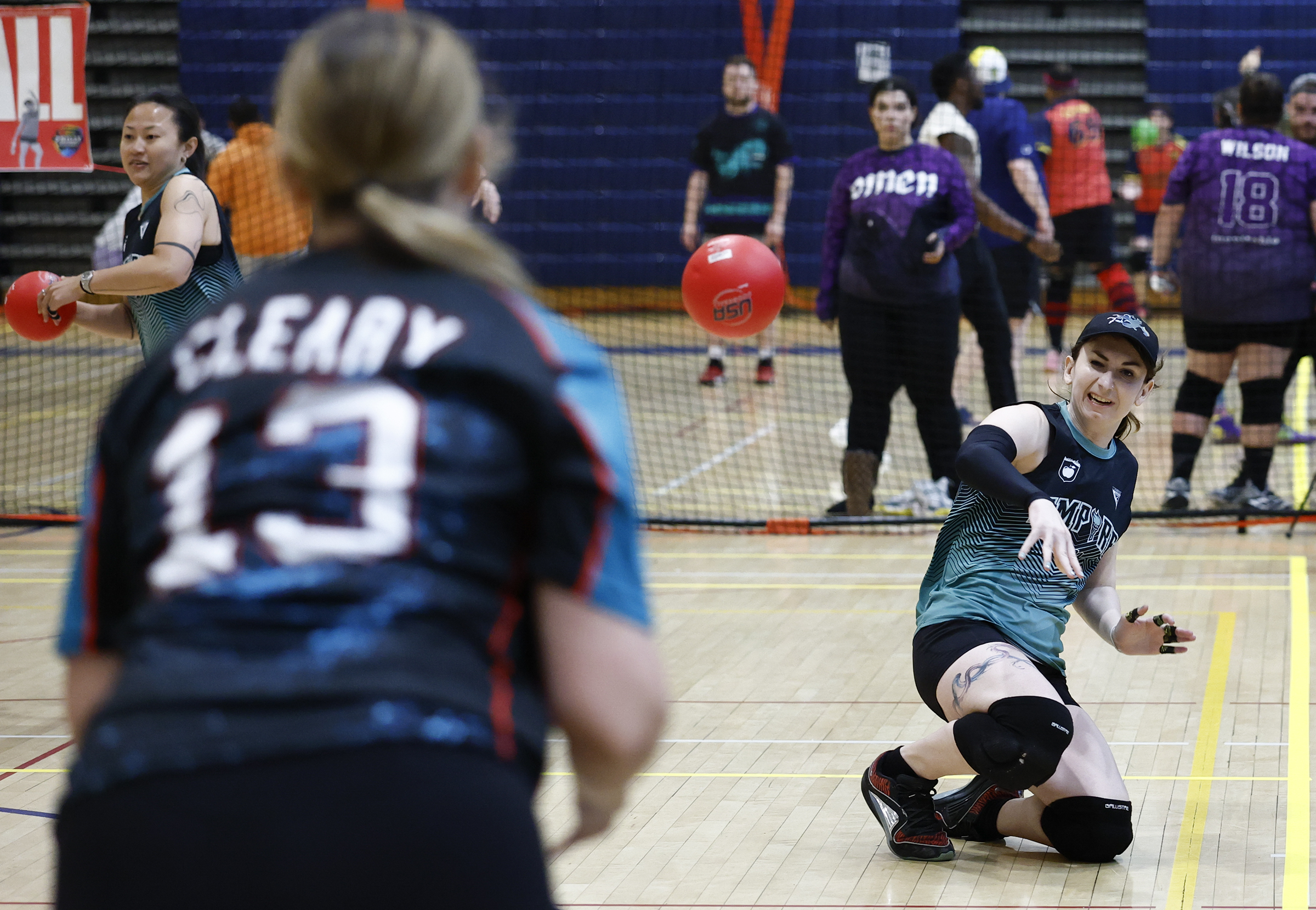
On a weekend when World Cup soccer was drawing people from all over the world to Philadelphia, Ashley Elder was the exception. She came to play dodgeball.
“Honestly, it’s amazing,” said Elder, 28, from Vernon, Conn. “I love being able to represent my state. This is history. For us, this is a pretty big deal.”
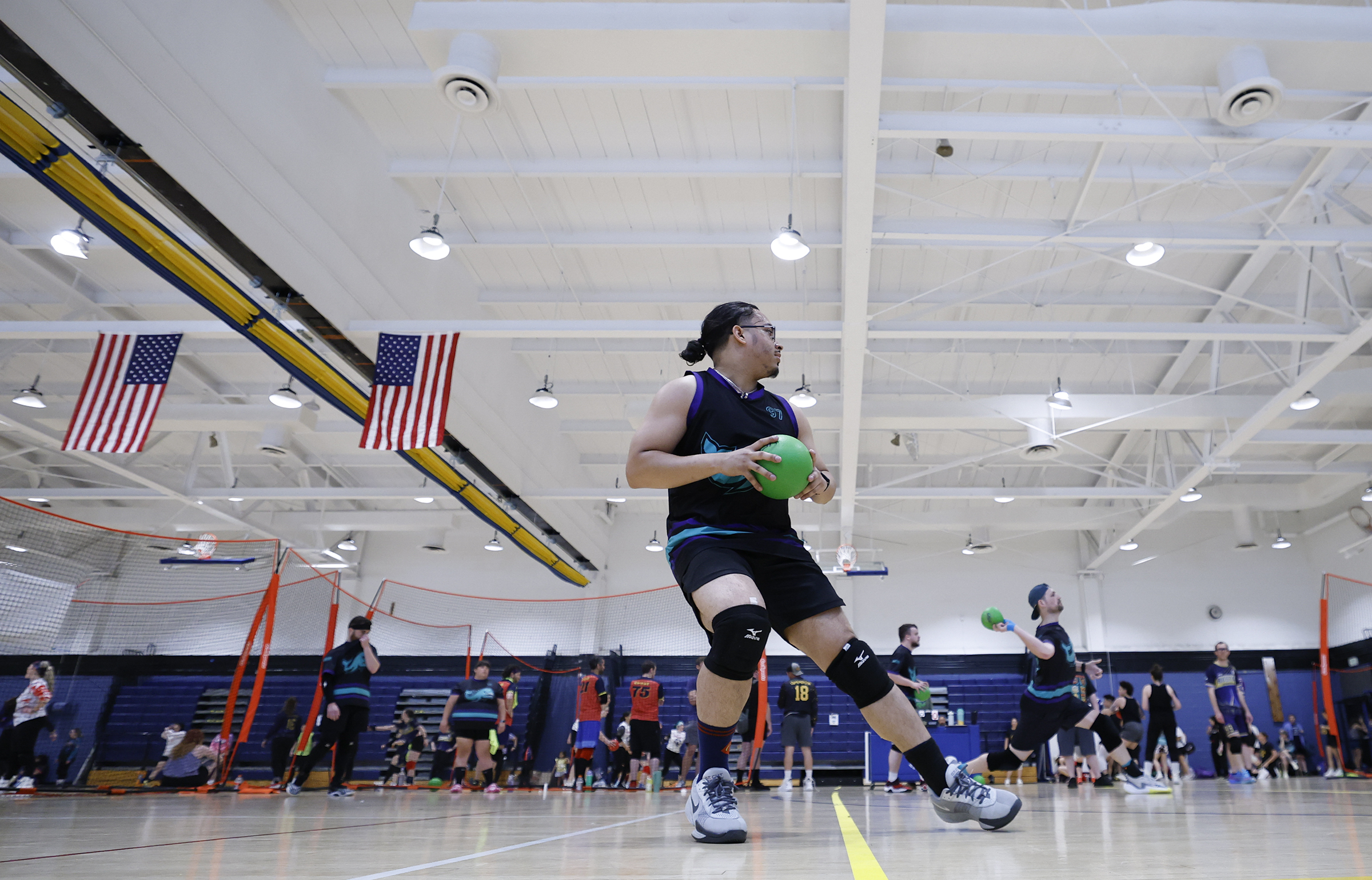
Elder is one of 217 adult recreational league dodgeball players from Boston, Connecticut, New York, D.C., Pittsburgh, Ohio, and Philly who converged on the indoor gym at Ben Franklin High School in Philadelphia Saturday.
Representing 27 teams, they competed in the “Beast Coast” championship — five rounds of fierce round-robin play, followed by a final four tournament in each of two divisions: one for women, transgender, and nonbinary players and the other open to any player, which in practice was mostly men.
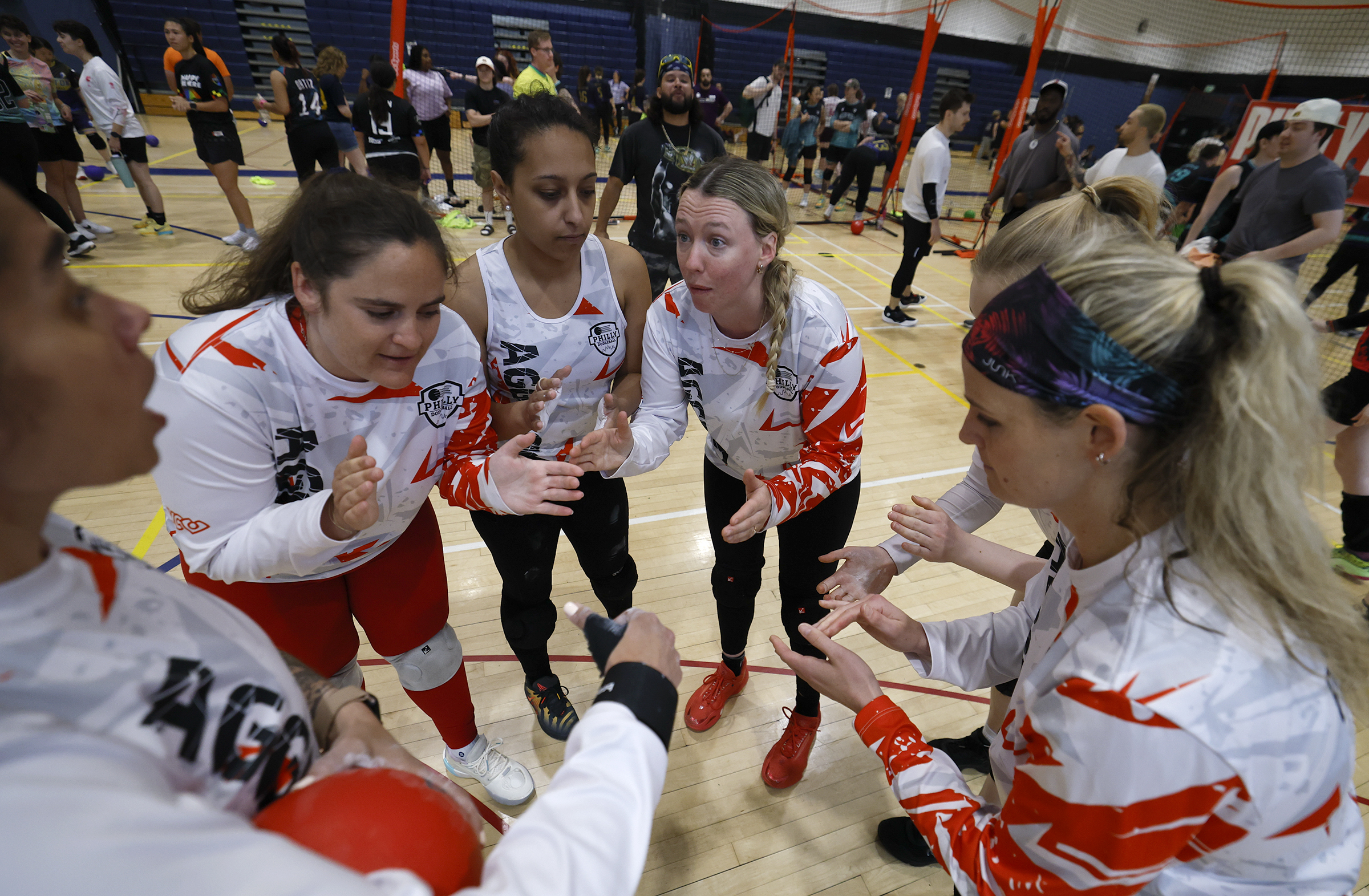
Members of the Aggression, a WTNB (women, trans, and nonbinary) dodgeball team gather before they played the Duckin’ Savages during the “Beast Coast” championship Saturday at Ben Franklin High School.Yong Kim / Staff Photographer
The game is six-on-six, with six balls on the court, and teams win the round after hitting all opposing players with a ball. For the first three minutes of a round, players can use a ball to block one that is thrown at them. After that, no blocking. The team that wins the most rounds within 20 minutes wins the match.
Gameplay in the women’s, transgender, and nonbinary division was intense. During the “opening rush” where players scramble to grab one of the six balls at the center of the court, one of Elder’s Connecticut teammates took a ball to the face, point blank, from her opponent on the Philadelphia team. Elder’s teammate shouted, laughed it off, and left the court.
“Yeah, one tactic is to rush the ball, pass to your teammate, and get that opponent out right away to get that quick advantage,” Elder said after the game.
Recreational league dodgeball is nothing new, and is a popular way for people in their 20s and 30s to make friends in new cities. But one league, Philly Dodgeball, has grown over the past four years as it organized what its promoters say is the premier competition on the East Coast.
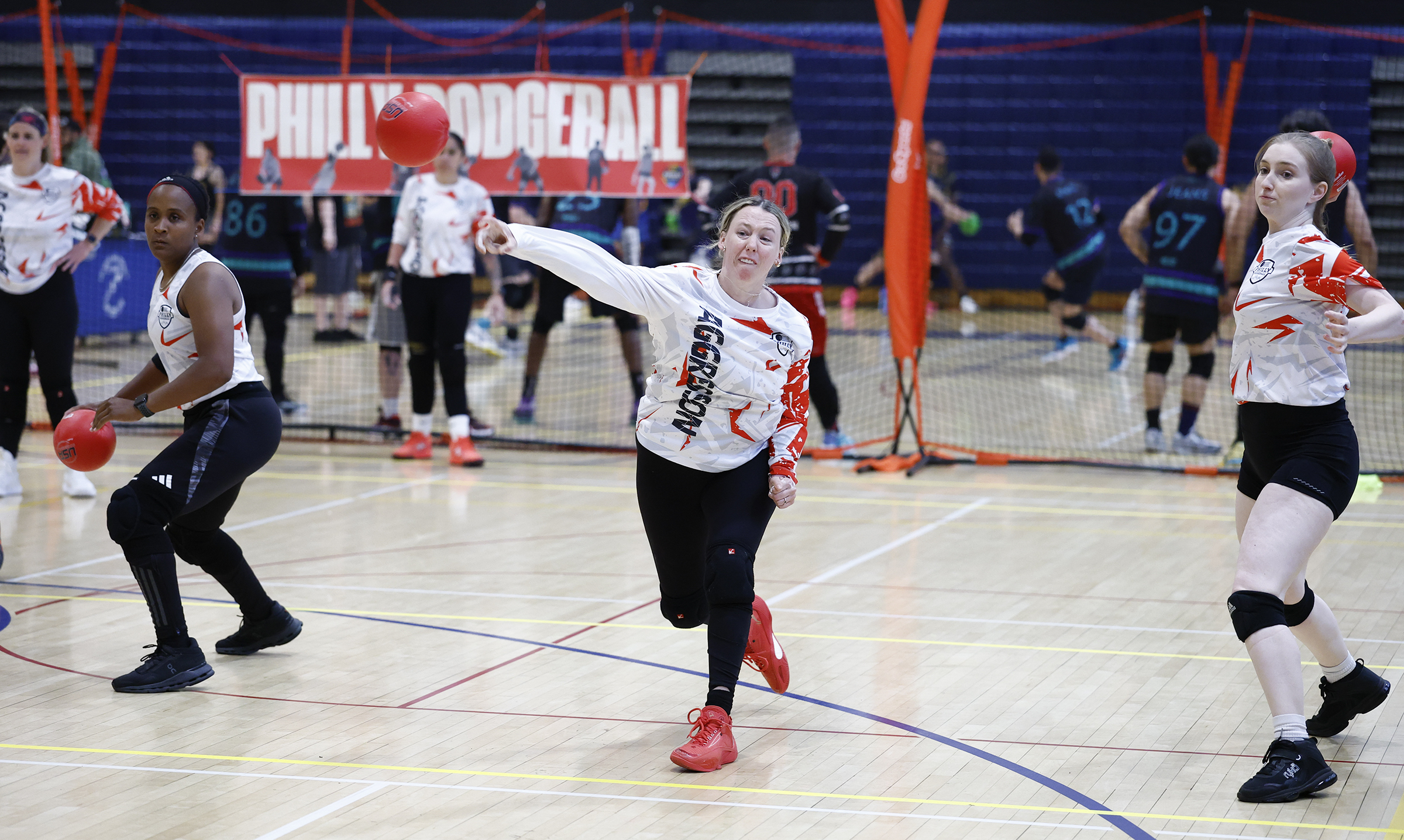
Samantha Sayward (center) of the Aggression, a WTNB (women, trans, and nonbinary) dodgeball team, throws a dodgeball against the Duckin’ Savages during the “Beast Coast” championship.Yong Kim / Staff Photographer
In the process, it’s brought in elite players from around the country — Elder certainly fits that bill. Elder played basketball and track and field during high school, competed in shot put and discus at Southern New Hampshire University, and was named an NCAA Indoor Track and Field All-American in 2020.
Elder said that after graduating, she powerlifted her way through the worst of COVID-19 isolation. Once she got a chance to join a dodgeball league, she threw her energy into the game.
What started as a way to stay active and have fun led Elder to Graz, Austria, with Team USA for the 2024 world championships. (The Austrians won.) Now, she is one of 10 players at the Beast Coast competition who is headed to Bangkok this winter to compete for the biennial world championship.
It’s a rare sport, Elder said, where casual players can play alongside some of the best out there.
“If you stick to it, you’re going to get better,” she said. “We want people to have fun.”
Members of the Splooters from Connecticut play team Bostonian during the “Beast Coast” championship.Yong Kim / Staff Photographer
Philly Dodgeball
Samantha Sayward got her start when she moved to Philly from Boston in 2018 and was looking to make friends. But Sayward said she wanted to play in a league that followed USA Dodgeball rules, which she said are regarded as the standard rules and keep the games competitive and fair.
When she couldn’t find one, she launched Philly Dodgeball in 2022. As the league grew, she formed an LLC and hired three staffers to help run the league. In 2024, Sayward competed for Team USA in the World Dodgeball Championships.
Sayward, who is 35 and lives in Manayunk, said participation in Philadelphia has blown up in the past two years, from about 40 players to around 500.
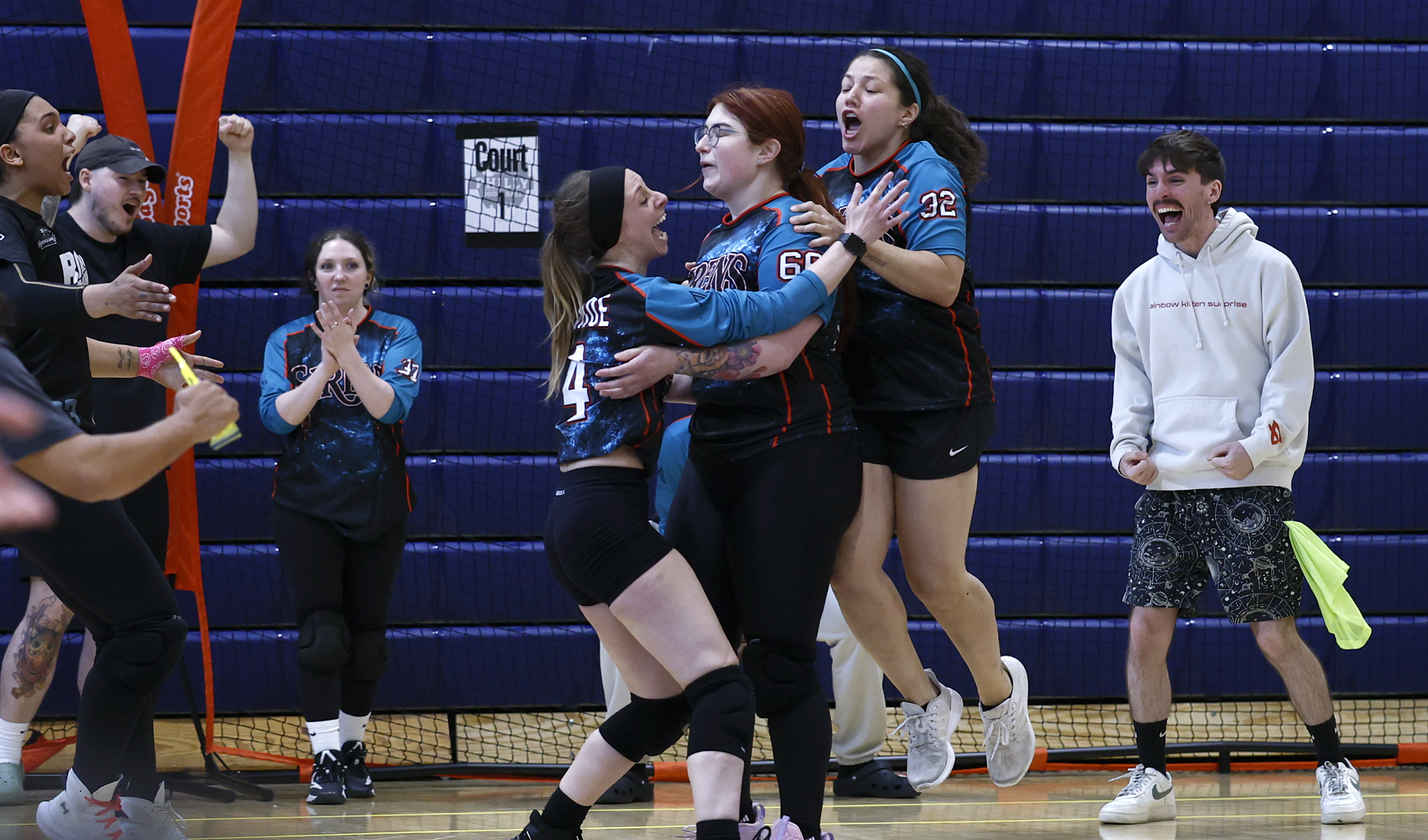
Members of the Sirens celebrate after beating team Empire in a WTNB (women, trans, and nonbinary) dodgeball quarterfinals game.Yong Kim / Staff Photographer
She said most players are like her, “transplants” to the city in their 20s and 30s, looking to meet people in an inclusive community. Many identify as part of the LGBTQ+ community, she said, and the league hosts a women, transgender, and nonbinary “Lavender League” every Thursday.
“It is one of the most inclusive sports out there,” said John Michael Szczepaniak, 35, a casual player who came to the league after playing dodgeball in the LGBTQIA+-oriented Stonewall Sports. “There’s men and women, there’s every walk of life, respecting each other, cheering each other on. Even though we’re competitive, we’re the most supportive community.”
But as participation grew, Sayward drew on her experiences as a former Navy hospital corpsman and event planner in the nonprofit world to improve the league: Players have jerseys, regulation gear, referees, and a scoring system. There are custom medals. There’s even a commissioner. And that, she said, has helped bring in similar-minded leagues from across the East Coast for the Beast Coast competition.
By midafternoon, Elder and Sayward’s teams were both knocked out of the competition, with Long Island winning the tournament after beating the D.C., Maryland, and Virginia team in overtime.
Still, eight years after Sayward threw her first dodgeball in Philadelphia, the sport has changed her life. Her boyfriend — they met playing dodgeball — proposed to her in Dublin, Ireland, this year, just before she had to fly to Arizona to attend the Team USA combine. She said yes. And then she made the team.
“It builds friendships, relationships,” she said. “All the girls in my wedding, besides my sisters, I met them in dodgeball.”