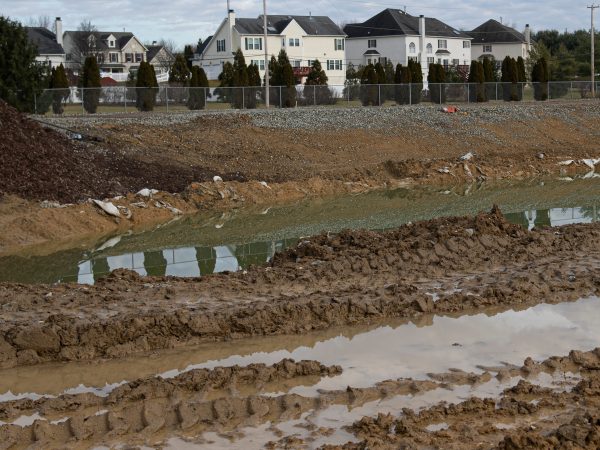
Kelly Donia was seated in her Malvern Hunt home when she spotted dust plumes rising from construction vehicles combing the site of a planned data center complex in East Whiteland Township.
She immediately drove to the site, across Swedesford Road from her development, to watch that day in June, anxious about the safety of building a 1.5 million-square-foot data center directly on top of a Superfund site in Chester County.
“No one seems to be concerned, but I mean, we live right here, we work right here, there are children — there’s a daycare,” Donia said. “I don’t understand. I don’t understand our officials, and I don’t understand the developer, and I don’t understand the general contractor.”
Donia is not alone in her fears. She and many of her neighbors, who had packed into East Whiteland meetings about the project for months, have continued to raise concerns about the safety of the building on the former 79-acre Cyprus Foote Mineral Co. property, which was contaminated over decades by a range of chemicals such as lithium, arsenic, and hexavalent chromium.
Not long after Donia saw those plumes, the township issued a stop-work order until it gathers more information on the environmental impact of construction.
While the developer says the site is safe, and the township has approved the plans, some residents believe that documents filed with the township and U.S. Environmental Protection Agency show that the site is still contaminated from its years as an industrial site, and they worry about what impact the construction will have on their community.
Here is what The Inquirer knows about the Foote Superfund site.
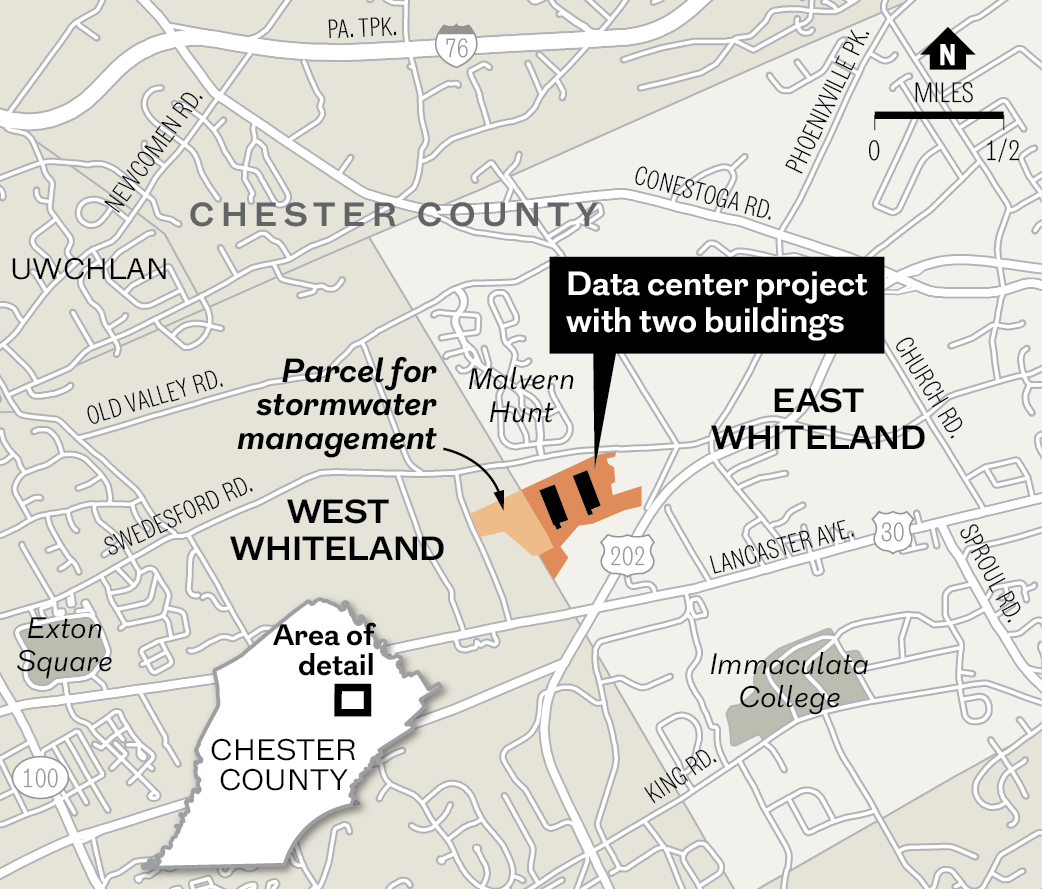
Location of the two-building data center project in East Whiteland, Chester County.John Duchneskie
Green Fig LLC first proposed a data center in 2018 and secured early zoning board approvals. The plans were greenlit by the township’s supervisors in 2024, drawing little pushback from the community.
Residents have been more engaged since the plan came back before the township earlier this year, first with ambitions to scale it up, then with a proposal to shrink it to appease outraged residents.
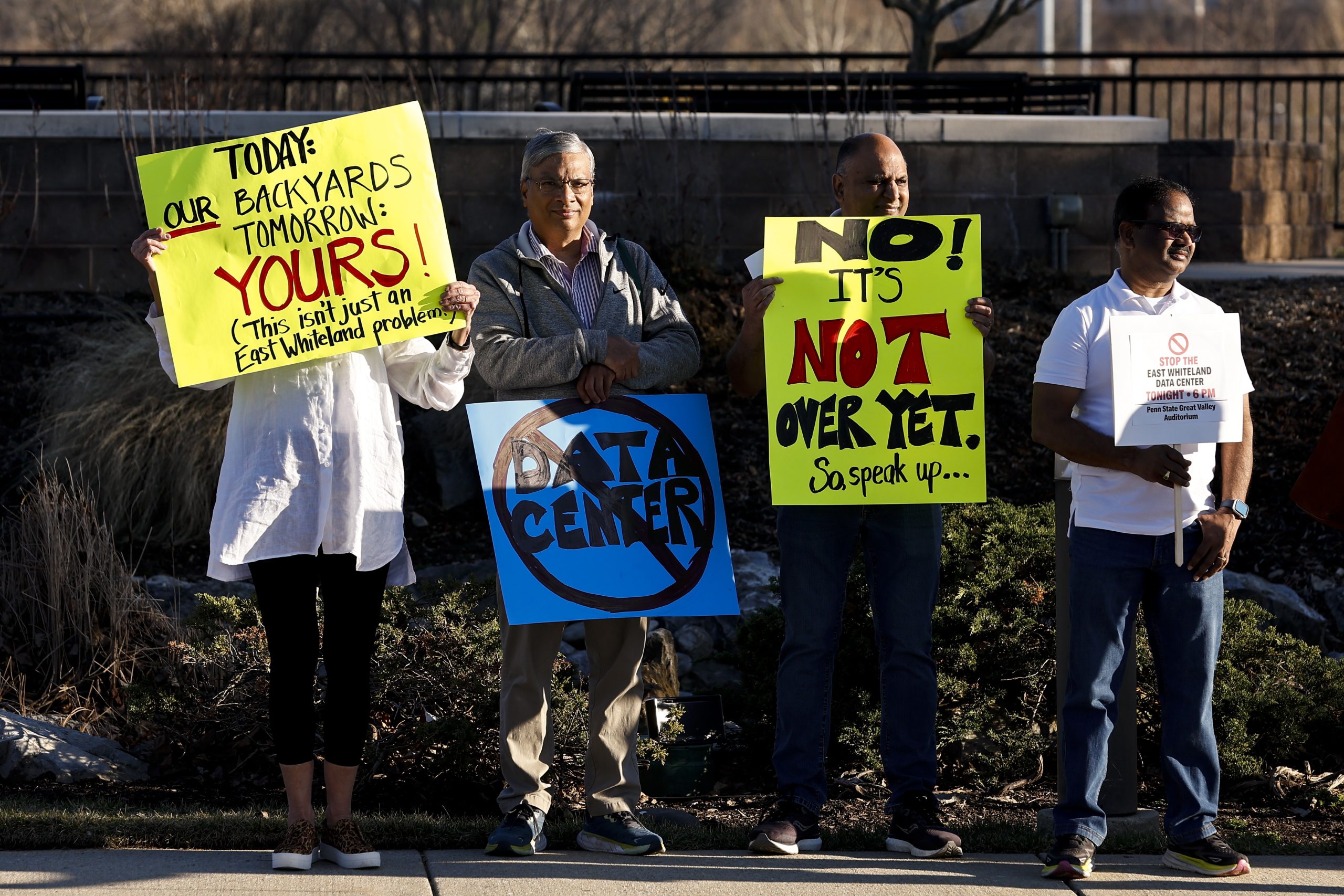
People protest the expanded data center before the East Whiteland Planning Commission meeting held at Penn State Great Valley on Monday, March 9, 2026 in Malvern.Monica Herndon / Staff Photographer
What are residents concerned about?
Residents fear that construction work on the site will kick up pollution in the air and release contaminants into the drinking water. They worry that there has not been ongoing testing of the soil on the site, especially knowing that contamination exists below.
How did the site become polluted?
Pollution at the Foote Mineral Co. likely started as soon as 1941 when the company began crushing ores and minerals.
Foote closed in 1991 with two quarries, a pit where solvents were burned, a lined wastewater basin, and more than 50 buildings and processing areas. Three unlined lagoons were backfilled.
At the time, public and private wells within four miles of the site had supplied drinking water to approximately 42,300 people. Several private wells near the site were found to be contaminated and were closed. A public water-supply well one mile away was also shuttered.
Cleanup, led by the EPA, has included capping contaminated quarries, stabilizing waste areas, and maintaining a long-term monitoring program for an evolving groundwater plume. Pollutants included lithium, boron, and low-level radiation.
An open land site is shown in East and West Whiteland Townships in Chester County on Thursday, January 5, 2023, where Green Fig LLC has proposed its data center project.Jose F. Moreno / Staff Photographer
What is a Superfund site, and how did it become one?
A Superfund site is a contaminated location in the United States designated by the federal government as a severe health or environmental hazard. Foote was added to the federal Superfund list in 1992.
In a 2023 letter to East Whiteland Township officials, a contractor hired on behalf of the developers incorrectly said that the site had been removed from the U.S. Environmental Protection Agency’s National Priorities List, an inventory of the nation’s most serious hazardous waste sites.
As of Friday, Foote Mineral Co. remained on the list posted on the EPA’s website. The EPA says because of the ongoing pollution, there is no proposal to remove the Foote site from the National Priorities List, nor any timeline for remediation to be complete.
What does the EPA recommend?
It’s complicated.
A 2024 EPA report, the most recent environmental evaluation of the site, found concentrations of certain pollutants have decreased over time, but an excessive amount of volatile organic compounds, or VOCs, remained. VOCs are gases that contain a variety of chemicals that may adversely affect human health. VOCs tend to be much more concentrated when contained indoors.
The EPA recommended updated land-use restrictions and further data collection to ensure the site remains safe during future redevelopment.
On its website, the EPA wrote that the “hazardous substances, pollutants or contaminants remain at the site above levels that allow for unlimited use and unrestricted exposure.”
Days before the 2024 findings were released, an EPA engineer filed a report known as a “Superfund Checklist for Retracting the Sitewide Ready for Anticipated Use Measure (SWRAU)” that said the site “no longer meets” standards for human exposure.
The EPA said in an emailed statement that SWRAU forms are only for guidance.
SWRAU “designations are not required for redevelopment,” the statement said. “So long as all land and groundwater use restrictions continue to be met and redevelopment does not interfere with EPA’s cleanup or future investigations, sites can be reused and redeveloped.”
“Based on a careful review of construction plans by EPA subject matter experts, the agency does not anticipate the development to impact the remedy at the Foote Mineral Co. Superfund site,” Mike Bastasch, an EPA spokesperson, said in June. The EPA “remains engaged and will continue monitoring redevelopment progress to ensure the remedy remains intact,” he said.
What do experts say?
If a site is properly cleaned up, there are “potential ways that a data center could be a better use, environmentally, of the land,” said Noah Kittner, associate professor in the Department of Environmental Sciences and Engineering at the University of North Carolina Gillings School of Global Public Health.
But that is contingent onhow it uses water, what kind of systems are in place, what types of energy and electricity are being used, and whether diesel generators are being used in the construction, development, and operation of the site, he said.
The documentation from the EPA showing remaining contamination “certainly raises some red flags” about redeveloping the site, he added. And whether the project does more harm than good is “highly dependent on plans for construction.”
“You could have a poorly executed project, and it causes a lot more problems for the community,” Kittner said. “Or you could have a really well-designed remediation project that builds in sustainability principles and other factors that could really transform that area from what was once highly polluting to something that is environmentally positive.”
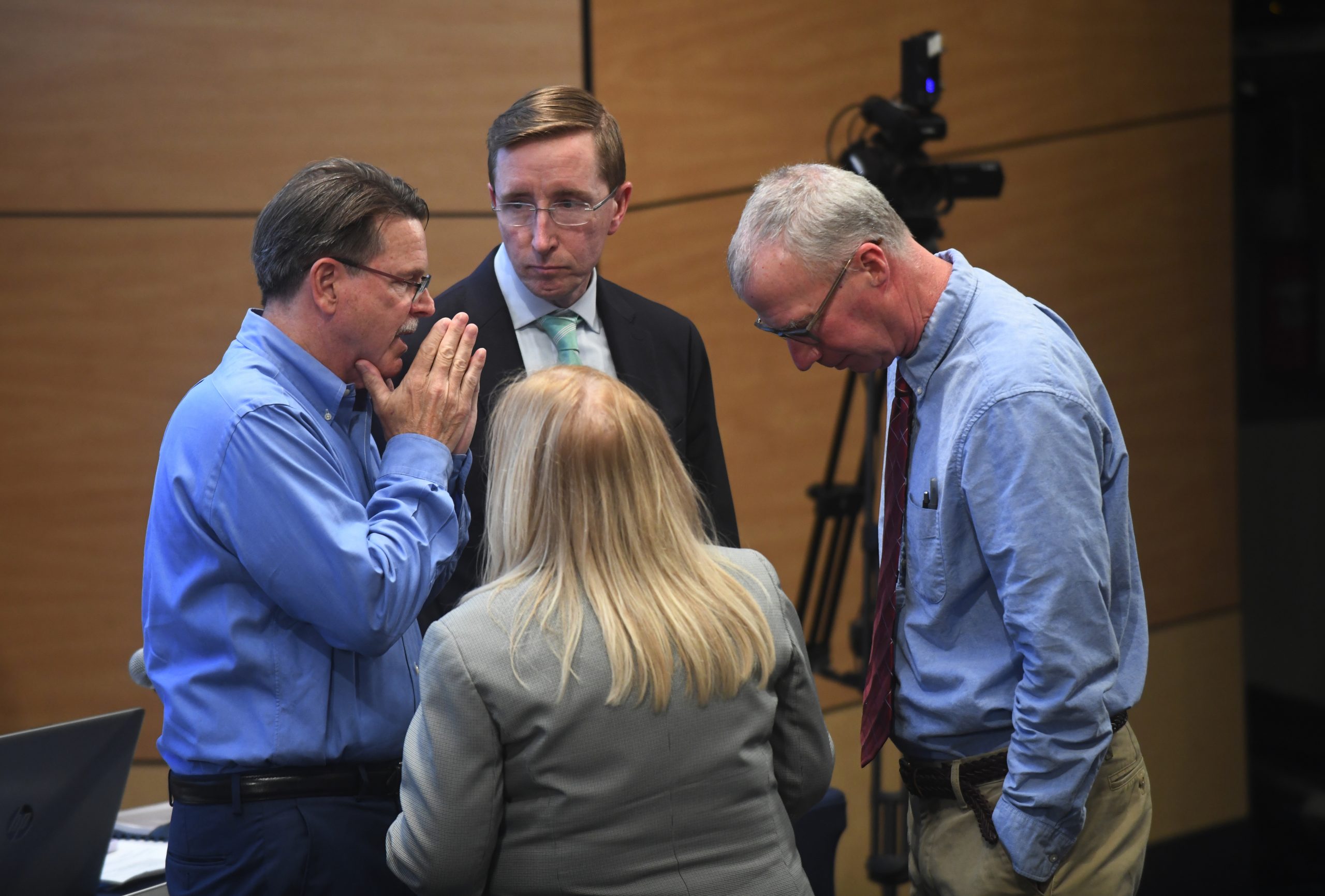
Scott Lambert, chair of the East Whiteland board of supervisors, left, confers with township officials about the data center proposal on April 14, 2026.Bob Williams / For The Inquirer
Who decides?
The EPA said in a statement to The Inquirer that it does not “recommend, propose, or approve specific Superfund redevelopment plans.” The agency reviews proposed uses and checks if there are “any potential conflicts with the selected remedy (including cleanup standards) or any issues that could reduce protection of human health and the environment,” the statement said.
The EPA’s goal is that most Superfund sites will be cleaned enough for commercial or industrial use. However, in some cases, the EPA can impose near permanent, severe restrictions on potential uses. Most Superfund sites undergo evaluations every five years to make those determinations until a site is removed from the National Priorities List.
Beyond that, it falls to the township to make final decisions on what the project will ultimately look like, and whether it could be built. Municipal leaders have said previously that, due to state law, they feel their hands are tied to allow for uses such as data centers.
What’s next?
The project remains in limbo: The developers have returned to the township seeking to amend their plans and alter the final design for the project. Supervisors tabled their decision at their last meeting on July 8, saying they needed more information about proposed changes.
Residents remain concerned about long-term construction at the site.
This suburban content is produced with support from the Leslie Miller and Richard Worley Foundation and The Lenfest Institute for Journalism. Editorial content is created independently of the project donors. Gifts to support The Inquirer’s high-impact journalism can be made at inquirer.com/donate. A list of Lenfest Institute donors can be found at lenfestinstitute.org/supporters.
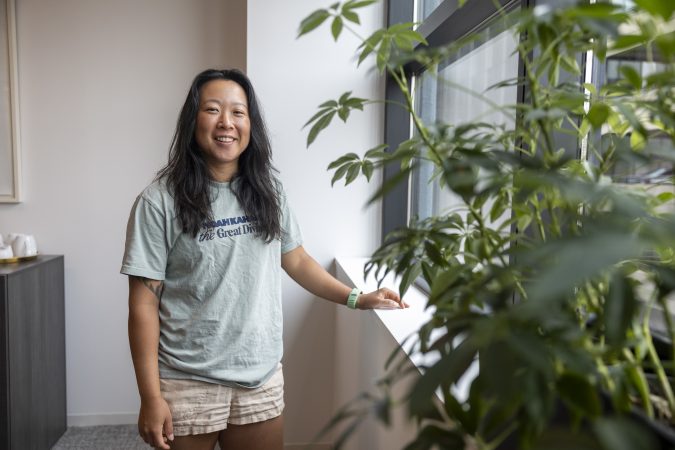
Lilly Chen, 30, wants people to stop thinking local government software “sucks.”
The cofounder and CEO of Philadelphia-basedFSH Technologies once worked at Facebook writing software that trains AI models, lived in a monastery as a teen, and is now on a mission to make local government technology more efficient.
In the last two years, her company has raised $5.5 million from venture capital, and secured a contract with the city’s Department of Commerce.
“We’re so gung ho about local government, which is like a weird thing to say, but it’s true,” said Chen.
The business just moved into a new office at 2400 Market St., where Aramark is headquartered, and opened a smaller outpost in New York City this month. Chen hopes to hire 40 workers by early 2027, adding to the current 12-person staff, to work on contracts the company has alreadysecured. She’s looking for software engineers and client strategists — positions that can come with a starting salary of $150,000 at FSH Technologies, as well as a signing bonus and equity, she said.
The company is “winning government contracts at a clip,” said Chen, who was born in New Jersey and went to college in Colorado. She was working in San Francisco when the pandemic started, and decided to move closer to her parents in Media.
She declined to share how much the company brought in last year in revenue but says “it’s in the millions.”
The Inquirer interviewed Chen on a hot July day over the phone while she enjoyed an ice cream from 1-900-ICE-CREAM. The following conversation has been edited for clarity and brevity.
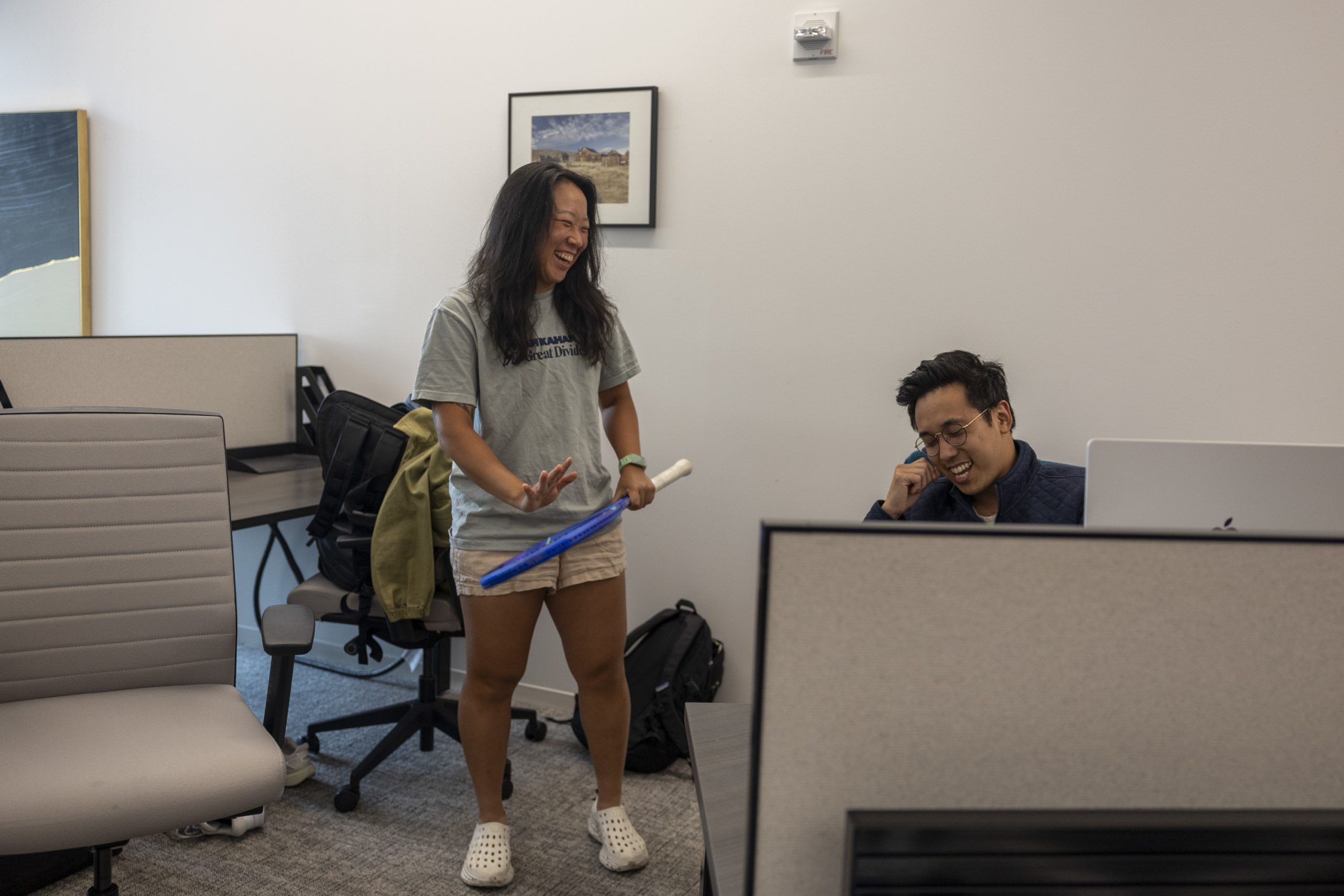
FSH Technologies cofounder Lilly Chen chats with COO Jason Chen in their Philadelphia office.Tyger Williams / Staff Photographer
Why did you start this company, FSH Technologies?
I used to work at Meta… when I worked there it was called Facebook. I was just very disenchanted with the apathetic nature of tech bros and the real-world impact that technology has on regular people.
FSH technologies is focused on creating software for local government. Why this niche?
I was [thinking about] what is a net positive on society that I can feel very good about, that I think technology is a good solution for. I landed on local government because it’s the one thing that universally everybody in America has to interface with, and the technology is so outdated. If you’ve tried to pay a parking ticket, get a permit, just try to navigate your local municipality, it’s so hard, it’s so complicated. Usually the software doesn’t even exist. It could be a manual paper thing.
In the last year there was a lot of talk in the Donald Trump administration of making the federal government more efficient. You’re talking about efficiency at the local government level. Did any of that narrative impact you?
There was actually no technology involved in the DOGE effort. When you drive real efficiency in government, it’s not rip and burn things. It’s actually getting into the weeds to understand the current process, who’s doing it, how they’re doing it, why they’re doing it, and then iteratively improving and wherever possible digitizing the relative components of that.
It’s not at all just being like, “Let’s just fire these people and see what happens.”
What about the name FSH Technologies? Where does that come from?
I used to be a Buddhist monk. I dropped out of high school when I was 16, and I moved to China and I lived in a monastery….We had a pond where we kept fish, and [my sensei] … would describe to me: “You are the pond, not the fish.”
If you can kind of separate yourself from the immediate feelings and see things as a bigger picture, as a system, you actually have a much more cohesive understanding and view of the problem.
You were a monk?
I was a real troublemaker in high school. I actually ended up getting very sick — I had an autoimmune disease … I was missing a lot of class, I was kind of misbehaving. My mom at one point threw her hands up in the air and was like, “We’re now Buddhists, we are moving to China, we’re going to live in a monastery, we’re shaving our heads.”
Can you tell me more about your work for the Philadelphia Department of Commerce?
We build software for the entire Department of Commerce, actually.
We standardized and unified all their forms into one platform, and then we created business profiles so that businesses would have to input, for example, their EIN number…once, and it’s there. If you put in your revenue, it will show you what you qualify for.
Prior, if you think about a Google form and you fill it out, you don’t actually know if you qualify, because anybody can open the form, anybody can submit it. It creates a lot of bureaucracy on both ends. You, as the business, don’t know if it was worth your time to fill it out, so you just fill it out – or you don’t fill it out. You, as the city, don’t know if this business is eligible, so you just spend time reviewing stuff for people who don’t qualify. Everything becomes slower and like sludge because the interface is really bad for actually streamlining the process.
The city spends so much less time reviewing applications now because they only get access to the ones that are actually qualified.
How are you managing the company’s work with your current staff of 12?
We have actually won a ton of contracts that are coming down the pipeline, but we haven’t started them yet. We have time to staff up, which is what we’re trying to do. If I can hire 50 people, I would.
Why can’t you?
What we do requires two things. One, is a deep passion and empathy for communities, civil servants, public good. You really need to care about the details because if you don’t care about them, you’re going to let people fall through the cracks.
That’s actually kind of hard to find because … people hear government software and they think it’s boring. They don’t necessarily realize how much impact you can have if you care deeply about this boring thing.
The second thing is software skill — the craft of building software that just works is hard.
The Venn diagram of skill and care is hard because a lot of people who are highly, highly skilled in technology end up at these AI frontier labs, which are paying a million dollars in salary.
What do you want the company to look like in five years? What’s the goal?
The goal is being able to have people no longer think local government software sucks.
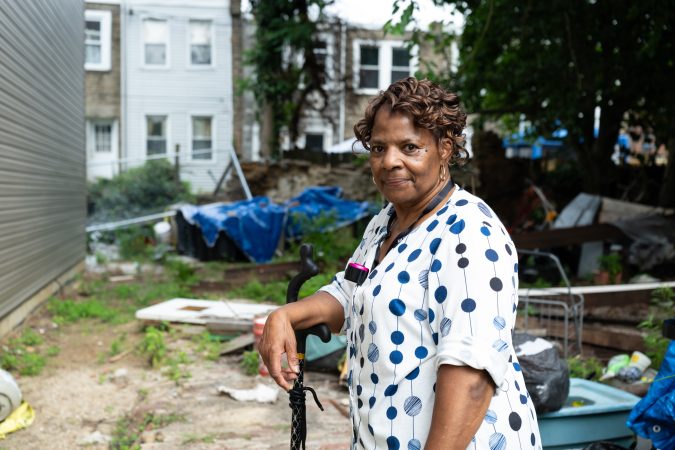
Most days during the summers — sometimes well into the evening — Delores Lawrence is outside her home in Germantown weeding, watering, and otherwise tending her garden.
Her small front yard is where she grows tomatoes, blackberries, purple daisies, and orange and yellow lilies, all planted closely together. There’s also a narrow strip on the side where Lawrence cares for a mix of potted calla lilies, peonies, and other vegetation.
The land around her home is her peace.
It’s her little slice of the American dream.
But instead of being able to enjoy another summer growing season, Lawrence is livid about how the construction of a new apartment building next door has disrupted life on the block where she has lived for more than 30 years.
Her garage is no longer standing, her brick driveway damaged, and the construction noise at times was absolutely unbearable.
Lawrence, who worked in nursing before being injured, doesn’t know what to do. “I want my garage built back up. I want my driveway reconstructed,” she told me recently over the phone. “It makes me angry. It makes me upset. I even went to the doctor. I can’t even sleep.”
I recently paid a visit to the 200 block of East Bringhurst Street and walked with Lawrence as she pointed out the shambles the construction had made of her beloved yard.
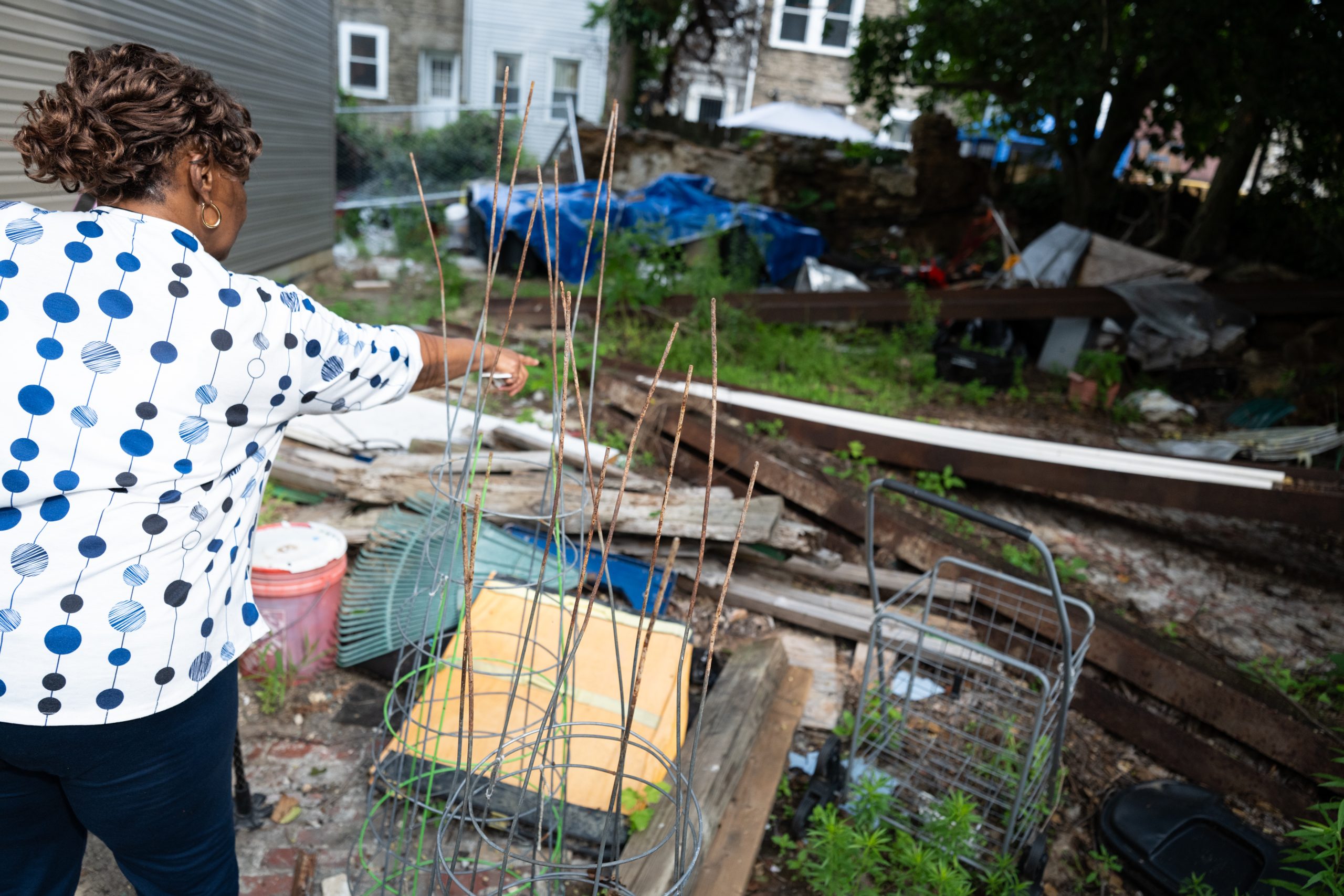
There was a stack of old bricks that had been removed from her driveway. The remnants of an old stone garage where she would do arts and crafts projects. “These are iron beams that they took off the roof,” she said. “It was a building back here.”
There was more — a tree trunk lying on its side with its roots exposed, what looked like electrical cables in the rear, and containers of paint that she said belonged to the builders working next door.
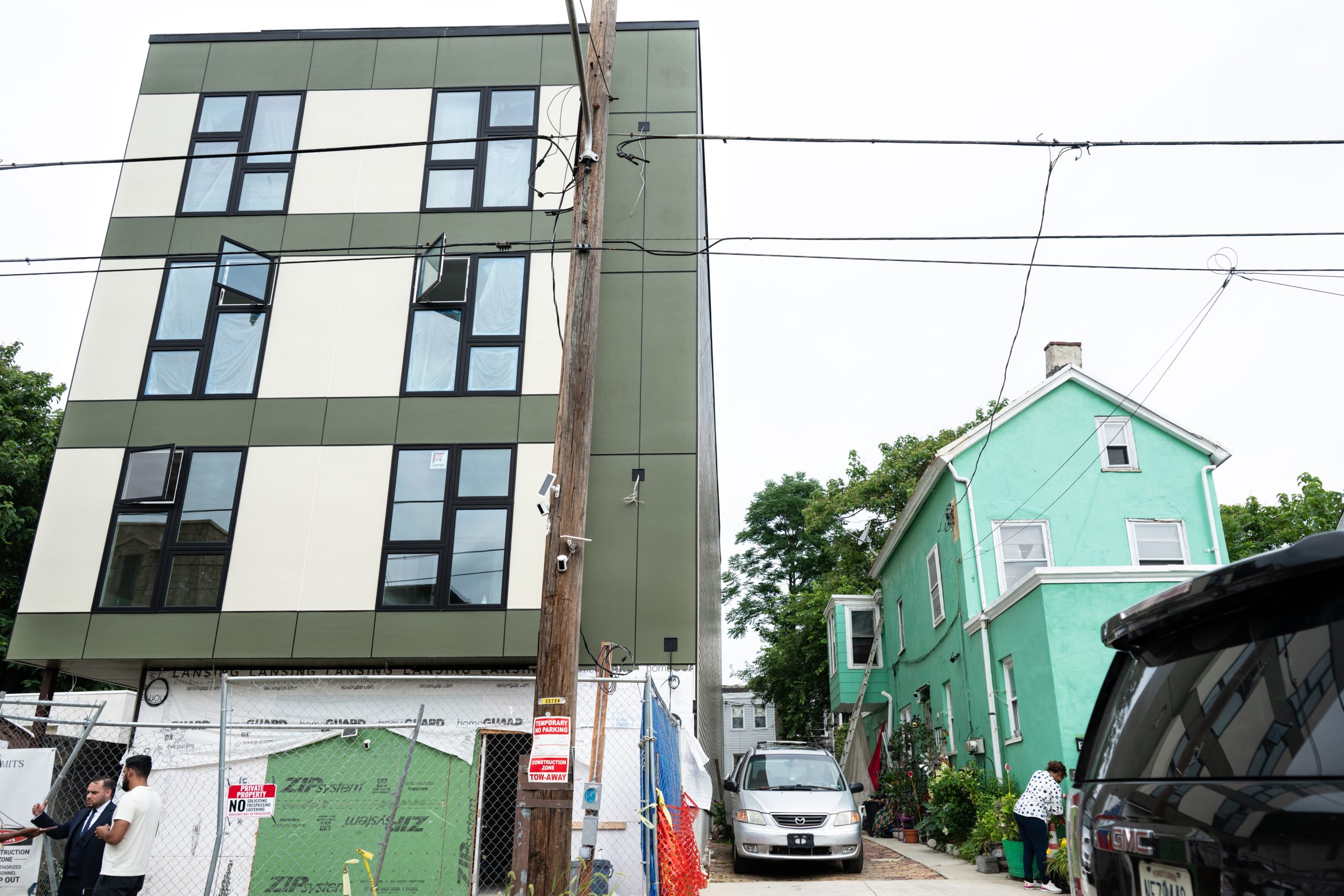
Delores Lawrence points to the remains of a garage where she used to do arts and crafts projects amid the detritus of a construction project next door. The project — a 15-unit apartment building — has been underway since 2024.Erin Blewett / For The Inquirer
Taking in the scene, I thought to myself that this is a whole situation — and I saw how it has turned into a court fight that is shaping up to be as messy as Lawrence’s backyard.
On one side, there’s Lawrence, a 70-year-old homeowner who has filed a lawsuit demanding compensation for damage to her property caused by the construction of a new four-story, 15-unit building immediately adjacent to her driveway.
On the other side is Danilo A. Burgos, the cofounder of Burg Properties and the 29-year-old son of State Rep. Danilo Burgos, a Democrat who was first elected in 2018 and who serves the North Philly neighborhoods of Kensington, Hunting Park, and Feltonville. The four-story, 15-unit building is under the charge of the younger Burgos and has been in the works since 2024.
Given everything going on in Philly right now, it would be easy to ignore the situation between a politically connected developer creating much-needed affordable housing and a senior citizen upset about its impact on her property. But I can’t help but feel for Lawrence.
Besides, hers isn’t an isolated situation. What’s happening to her in Germantown is actually emblematic of similar struggles playing out between residents and developers in neighborhoods around the city.
Residents of Chinatown successfully pushed back against a proposal to build a new Sixers arena along Market Street. In Northern Liberties, several neighbors on Brown Street are suing a developer, claiming their homes were damaged by the construction of a nearby apartment building. In 2024, my colleagues at The Inquirer produced an entire series called Crumbling City about how housing redevelopment created construction issues among some rowhouses.
Whatsets the situation in Germantown apart is the reality that the developer is the son of a state legislator.
“This is about entitlement and privilege,” Kevin L. Valentine, Lawrence’s attorney, told mein an email.
Property owner Danilo A. Burgos speaks to the press outside his affordable housing project under construction in the Germantown section of Philadelphia on Thursday, July 9.Erin Blewett / For The Inquirer
I reached out to Burgos, the state representative, who said: “My son has not done anything wrong. The lady, she’s suing him, and they’re in court. That’s it.” He added, “They have everything documented, and when the court case comes, everything will be squared away, God willing.”
As for the son, he says he’s doing good for the community by providing affordable housing. Philly is in the midst of a “severe housing crisis,” which is why Mayor Cherelle L. Parker has made building and restoring roughly 30,000 homes a cornerstone of her legislative agenda.
But developers still need to respect neighbors in the communities where they build. Christopher Edwards, a block captain and president of the Baynton Hill Neighbors Association, is deeply concerned about the impact the new Bringhurst Street apartment building will have on the narrow street with limited parking.
“We can see where this thing is going to become very unpleasant, especially for those of us who have lived there for years,” he told me.
After meeting with residents who aired their concerns, Burgos, a Temple University graduate, said he purchased a nearby lot that he intends to convert into a parking lot for his tenants’ use. Neighborhood residents, he said, will have priority when it comes to renting units.
As far as the garage in the rear of Lawrence’s home that had been negatively impacted, Burgos said that “it wasn’t a structure. It wasn’t a garage. It was like freestanding walls scattered [around]. Because some were up. Some weren’t.”
He said his workers knocked down a party wall the properties shared. “We notified her of the wall that we were going to knock down,” Burgos told me as we stood with his attorney in front of his new apartments. “Everything we did, we didn’t do it behind her back; we did it with her knowing what we were going to do.”
Attorney Saury A. Mejia and property owner Danilo A. Burgos (left) speak to the press outside Burgos’ affordable housing project under construction as neighbor Delores Lawrence (right) tends to her garden in the Germantown section of Philadelphia on July 9. Lawrence says construction of Burgos’ low-income housing project next door damaged her property.Erin Blewett / For The Inquirer
I liked hearing him say he was prepared to fix any of the property damaged by his workers. But Burgos said he is awaiting permission from Lawrence to do it.
“We’re willing to put it back to its prior condition,” Burgos said, adding that he’s willing to negotiate. “We’ve been open to dialogue the entire time.”
It sounds to me as if a meeting with all parties involved needs to happen quickly.
“I want him to sit down with my client and for him to make her whole,” Valentine said. “I’m just trying to get some justice for this woman.”
Councilmember Cindy Bass is willing to convene such a gathering. “If we can get all parties together, we’re certainly willing to do that and to do it soon,” she said.
Meanwhile, the proverbial clock continues to tick. Time is money. That’s not something Lawrence, who worked at Shriners Hospital for Children, has much of.
The more I think about what Lawrence is going through, the angrier I get. I’ve never been in her situation personally, but who would want workers coming onto their property and damaging it? People work hard for what they have. Your home is supposed to be your sanctuary. You may not have a say in what goes on around you, but you’re the custodian of what goes on inside your proverbial picket fence.
“I’m here minding my business. I’m not bothering nobody,” Lawrence told me. Her voice broke into sobs as she added, “How long do I have to put up with this?”
The first time people openly referred to the pocket of Center City between Jefferson University and Broad Street as the “Gayborhood” was 1995. Within a year, the William Way LGBT CommunityCenter made it official by purchasing a stately, Georgian-style clubhouse at Juniper and Spruce. The building has been a refuge for Philadelphia’s LGBTQ+ community ever since.
Sadly, that groundbreaking haven is now closed. It was shuttered in December to address maintenance issues, including an outbreak of black mold. At the time, the board said it was gearing up for a major renovation and would temporarily relocate its core services to St. Luke’s church on 13th Street.
Just three months later,William Way’s boardabruptly changed course and revealed the center would be demolished to build subsidized housing aimed at LGBTQ+ seniors.
The announcement came not from William Way’s board, but from Mark Segal, a longtime activist who founded the Philadelphia Gay News and oversees a nonprofit that has built affordable housing, the dmhFUND. The timing was noteworthy: The plan was made public a few days after a Common Pleas Court judge overturned the neighborhood’s historic district protections.
Segal’s announcement stunned William Way regulars, including many former board members. Sure, COVID-19 had scrambled the organization’s finances, as it did for many Philadelphia nonprofits. Revenue and donor gifts fell precipitously. The center laid off nearly a third of its staff in 2024, and its longtime director, Chris Bartlett, retired soon after.
The building was known to be in poor condition. But total demolition? Nothing suggested that the building was unsalvageable, including a major facilities assessment by Metcalfe Architecture& Design in late 2024.
While there is no doubt that the building requires extensive renovations, demolition is the wrong solution. It would rob all of Philadelphia — not just its LGBTQ+ community — of a major cultural touchstone.
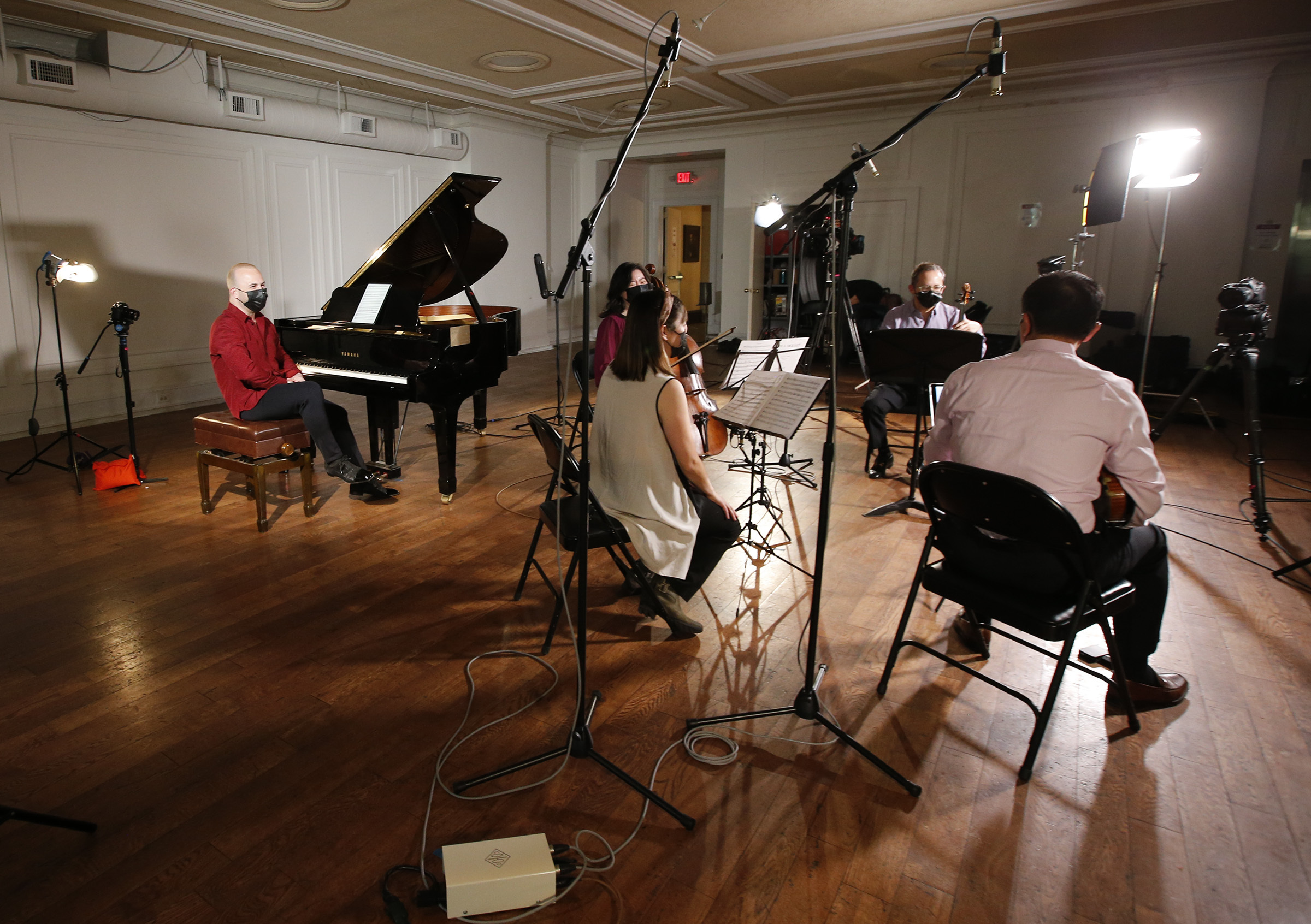
Philadelphia Orchestra music director Yannick Nézet-Séguin filmed a series called “Our City, Your Orchestra” in the William Way center ballroom in 2021, along with violist Pierre Tourville and other musicians.YONG KIM / Staff Photographer
A civil rights landmark
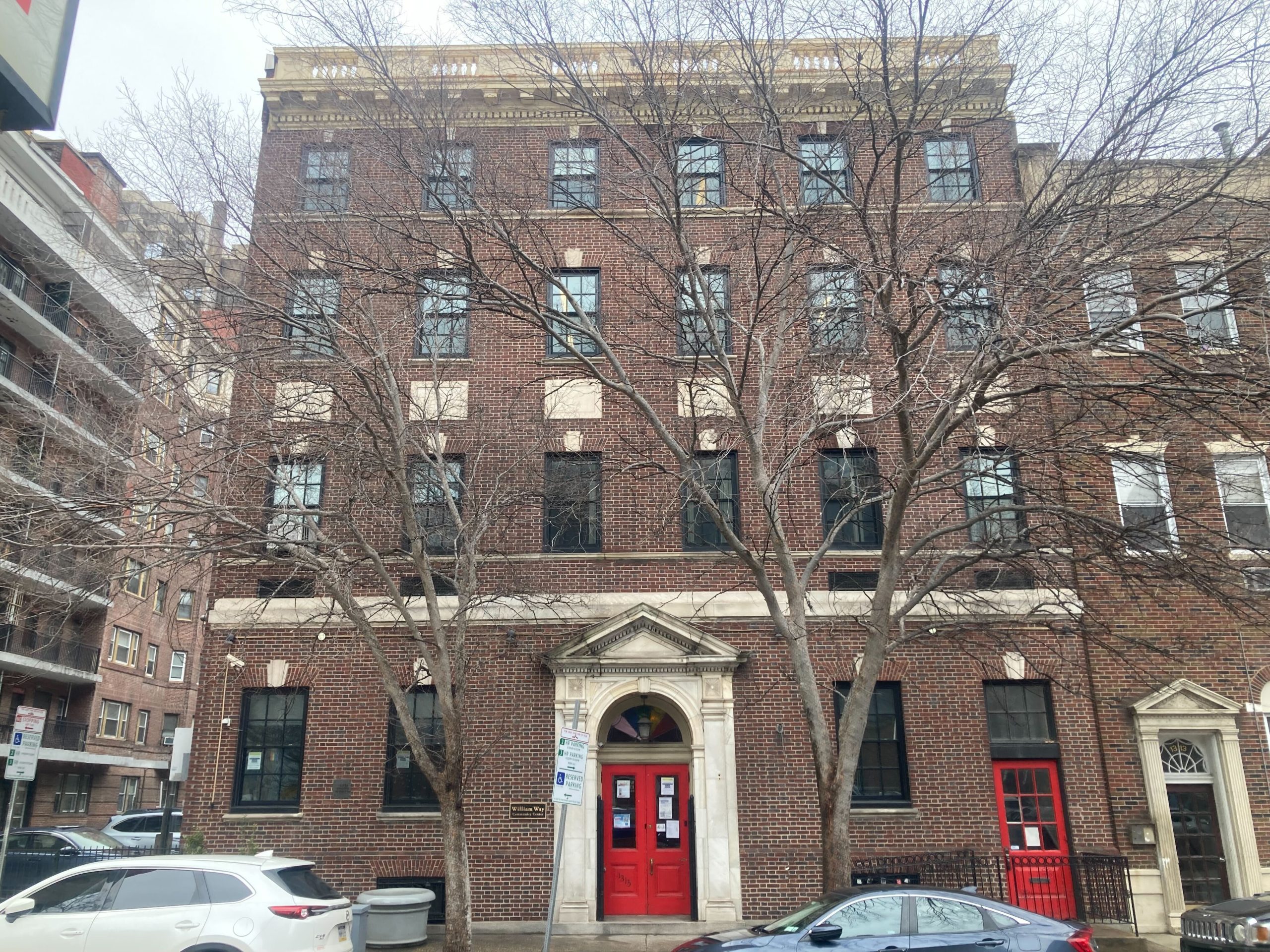
Although the William Way center has called 1315 Spruce St. home for only three decades, its presence has transformed the 19th-century building — originally a private club for engineers — into a civil rights landmark.
This is where Philadelphia’s LGBTQ+ community fought to address the AIDS crisis, advance marriage equality, and be accepted into the mainstream of American life. It’s where they attended cabarets in the elegant ballroom and art exhibits in the wood-trimmed parlor. The building’s visibility makes it the architectural equivalent of being out.
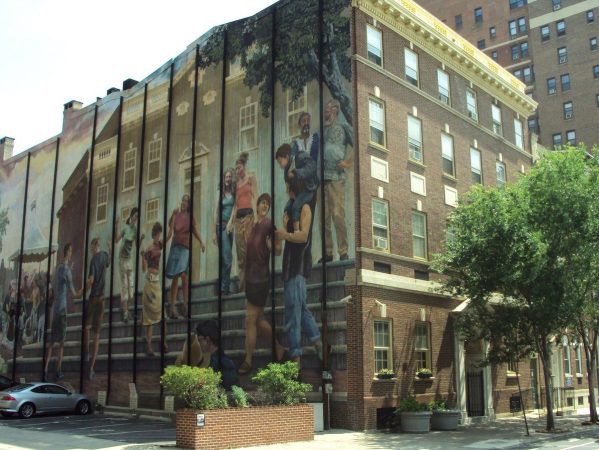
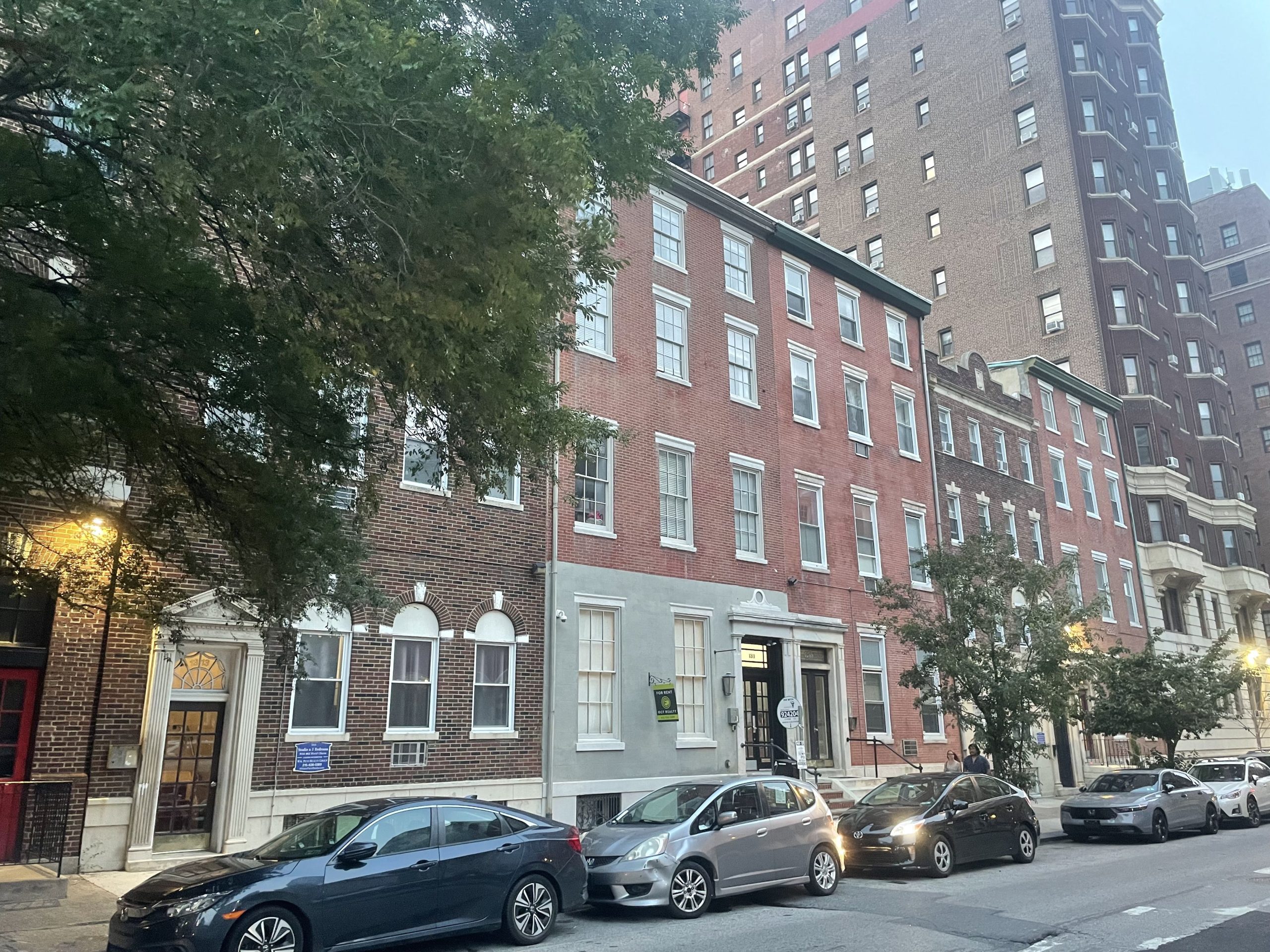
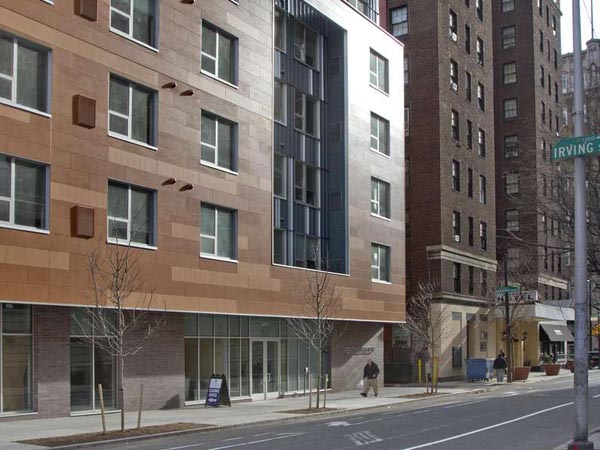
Beyond losing a place with profound cultural resonance, the demolition would break up the historic 1300 block of Spruce Street, a stretch that is still remarkably intact despite the presence of two unsightly parking lots at the Juniper Street corners.
Although the block’s large townhouses, which were built for lawyers and doctors in the 1840s, have been divided into apartments, the row retains most of its original architectural features and reads as a single ensemble. The William Way building, which was created in 1929 by fusing two townhouses behind a single facade, was designed to blend in with its neighbors.
No one would consider demolishing other community anchors, such as Christ Churchin Old City, Mother Bethel A.M.E. Churchin Center City, Rodeph Shalom synagoguein Spring Garden. So why is this one being written off so casually?
The 1300 block of Spruce Street, where the William Way Center is located, remains a largely intact architectural ensemble. The townhouses date from the 1840s and were originally private homes occupied by doctors and lawyers.Inga Saffron
I couldn’t get any of William Way’s board members or employees to answer that question. A communications consultant did provide written responses to several queries, but eventually directed me to Segal.
He told me that the financially strapped nonprofit had reached out to him because of his development experience, as well as his long association with the center. The second-floor ballroom is named in his honor.
Segal was also the guiding force behind the John C. Anderson Apartments on 13th Street, the first subsidized housing in the United States marketed to low-income LGBTQ+ seniors. After the building opened to raves in 2014, Segal began searching for another Gayborhood site for a second affordable project. But land prices in the desirable Washington Square West neighborhood were just too high.
Completed in 2014, the John C. Anderson apartments at 13th and Spruce Streets were the first subsidized housing in the U.S. marketed to low-income LGBTQ+ seniors.
A new plan for William Way
William Way’s troubles provided a solution.
Segal told the board he could replace its 180-year-old clubhouse with a mid-rise building that would include both subsidized apartments and a new home for William Way. Theboard chairs, Dave Huting and Laura Ryan, readily accepted the deal and signed a letter of intent with the dmhFUND earlier this year. In exchange for providing the land, William Way would be given a condo space large enough to accommodate its programs for a dollar.
Completing that project won’t be easy, however. To raise money for the apartments, Segal and the dmhFUND will have to cobble together a mix of federal, state, city, and private grants. Most affordable housing projects rely heavily on Low Income Housing Tax Credits from Washington, and there is stiff competition for those funds. Any new construction on the site would also require Philadelphia Historical Commission approval, eventhough the historic district is currently in limbo.
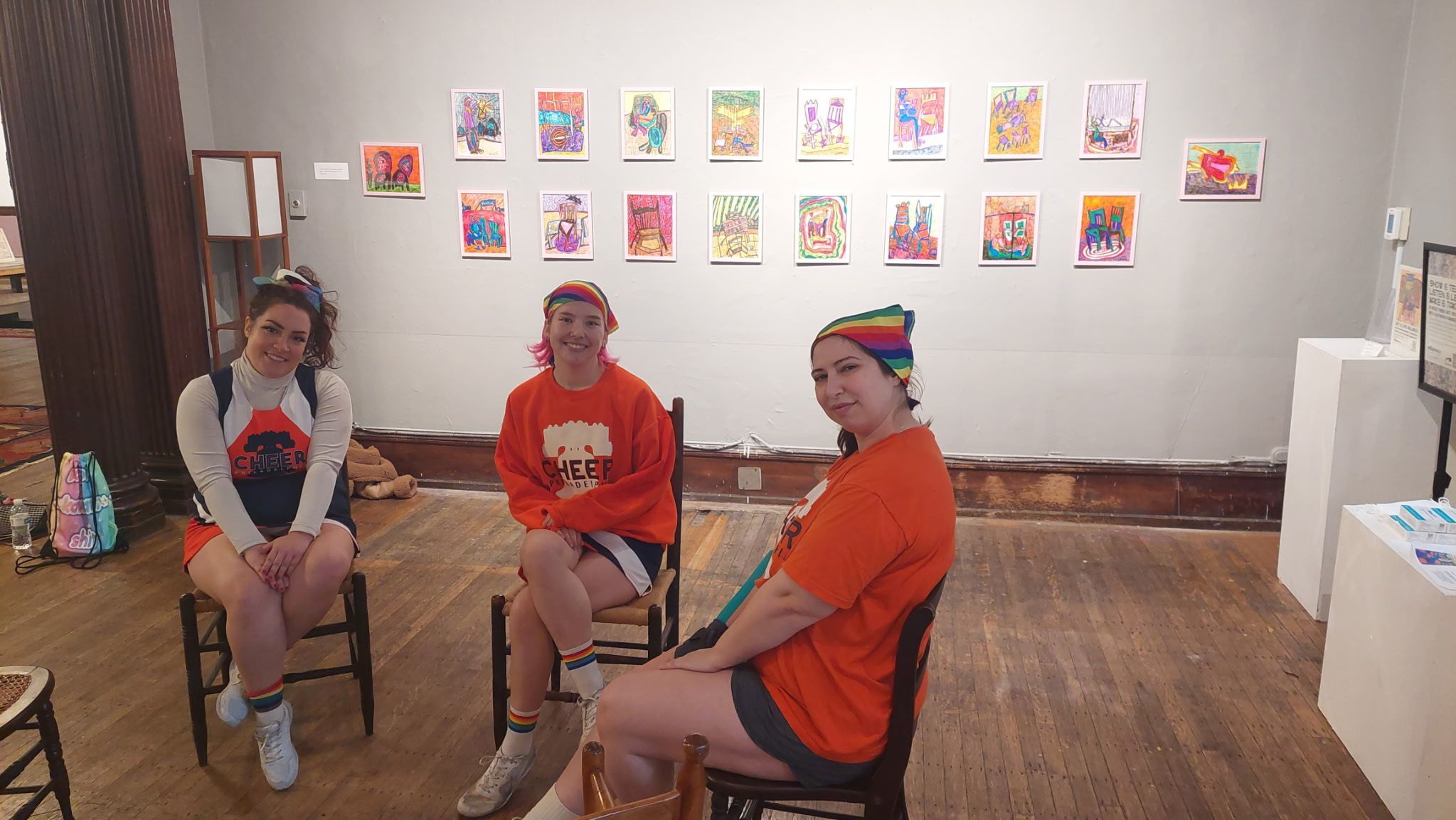
Artist Kathryn Pennepacker staged one of the last art exhibits in the William Way center’s wood-trimmed reception area. Titled “You are welcome here. I saved a chair for you,” it encouraged visitors to sit, talk and view her artwork.Courtesy of Kathryn Pennepacker
Because of those hurdles, Segal told me, it could take five to seven years to complete the apartments. During that time, William Waywould be without a permanent home. And once it moves back to Spruce Street, it’s unlikely the new space will have the same level of visibility as the existing building.
Segal says he is undaunted by the challenge. “People told me John C. Anderson was impossible,” he said. “People told me all the things I’ve fought for were impossible.”
Despite the Metcalfe report’s conclusions and a more upbeat assessment from J&M Preservation Studio, Segal maintains that the building is too far gone to be saved at a reasonable price. In his view, William Way must now choose between saving itself or saving the building.
Alternatives to demo?
It’s hard to believe the situation is that binary. Several people who have been involved in the center’s programs told me that the decision to go with Segal’s plan was made by a small circle of board members, without consulting the larger William Way community and its longtime donors.
Demolition “wasn’t even mentioned” as an option at the organization’s 50th anniversary gala celebrations in February, held just a week before the arrangement with Segal became public, noted Paul Steinke, executive director of the Preservation Alliance for Greater Philadelphia and a former William Way board member.
In a guest essay published last month in the Philadelphia Gay News, Steinke and a group of activists urged the board to hold a community meeting where the issues could be aired and debated. Segal has responded by forming an advisory board composed of a handpicked group of William Way staff, activists, elected officials, and neighborhood residents.
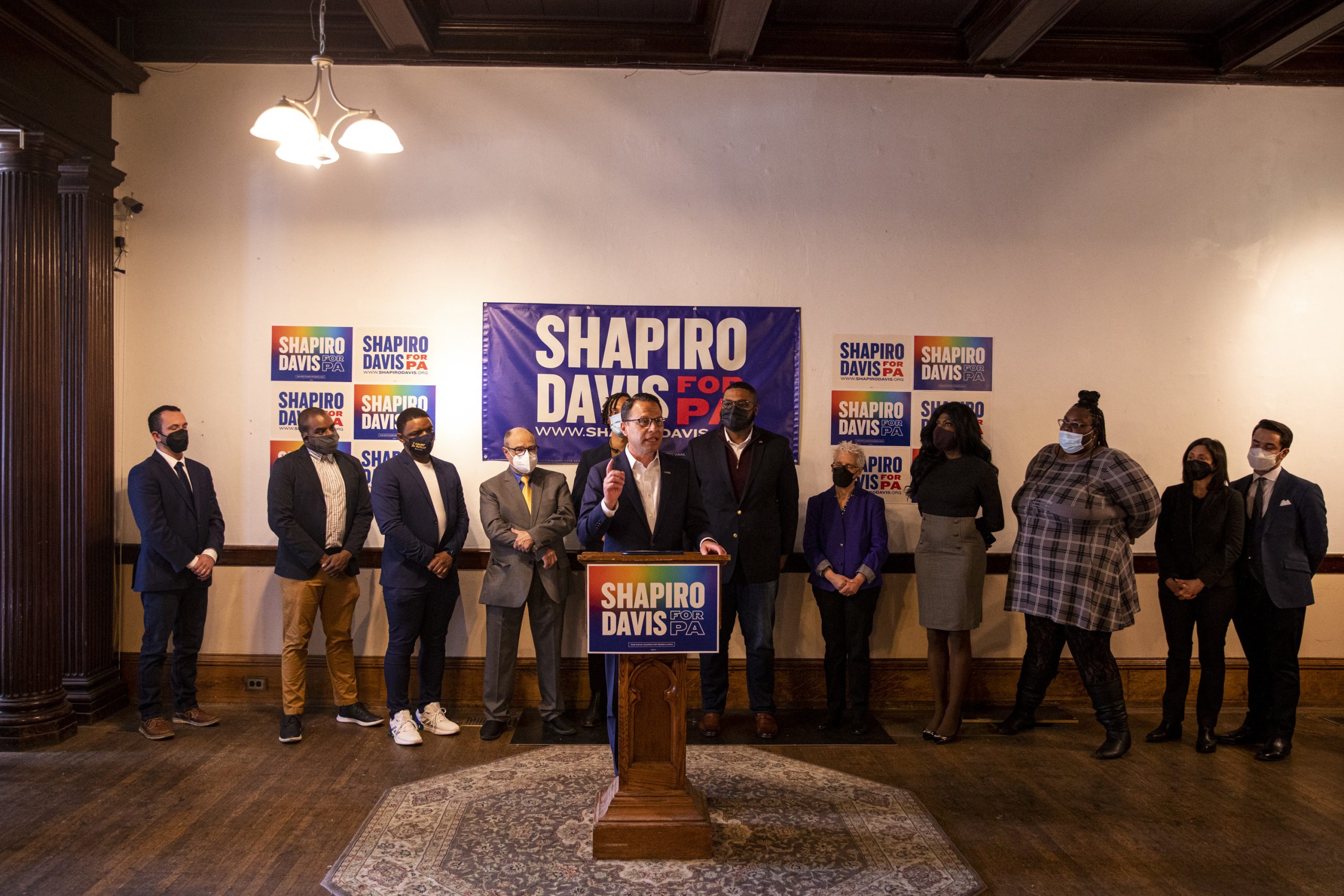
In 2022, Gov. Josh Shapiro spoke in the parlor of the William Way center, where he received endorsements from a variety of LGBQT+ leaders. TYGER WILLIAMS / Staff Photographer
Before COVID interfered, the board had been working on a design to reconfigure the building to address longstanding circulation issues. The plan called for slicing off the back of the structure and inserting a small tower with space for offices or apartments. The arrangement would have preserved the facade and the two most important ceremonial rooms, the ballroom and the large lobby area.
Why not use that idea to create affordable housing?
Segal argues that it would be difficult to insert two separate entrances — one for the William Way center, the other for the apartments. But there are plenty of narrow rowhouses in Philadelphia that have separate entrances serving apartments. I know it’s heresy in progressive circles to say this, but how about partnering with a market-rate developer who could finish the overbuild in less than five years?
An even faster option? Renovate the existing building. It can be done in stages so the center could move back sooner.
The William Way LGBT Community Center already has two entrances, which could be repurposed to serve an apartment tower inserted behind the front rooms.Jake Blumgart / Staff
Building affordable housing in Center City, close to transit, is a noble goal, and Segal deserves praise for making it a priority. But there is something seriously wrong when we demolish a building rich in Philadelphia history, while leaving the surface parking lots that flank it in place.
Since COVID, Philadelphia has lost a series of legacy cultural institutions that shaped the city’s identity. The Painted Bride. The Atwater Kent history museum. And, most painful of all, the University of the Arts.
William Way worked too hard for visibility to now be erased.
Between them, artists on the Historic New Jersey record label — which, despite its name, is headquartered in South Philadelphia — have released dozens of full-length albums and EPs since the start of the decade.
That’s a whole lot of indie music in a wide range of styles coming out of a South Philly basement studio, all demonstrating an old-school dedication to craft that prizes first-class songwriting above all else.
And it’s all being created by a small group of close friends who moved to Philadelphia as adults. They all contribute to one another’s records and play in one another’s bands.
The Historic NJ collective core consists of just five musicians, four of whom gathered in their subterranean studio for an interview on a recent summer day.
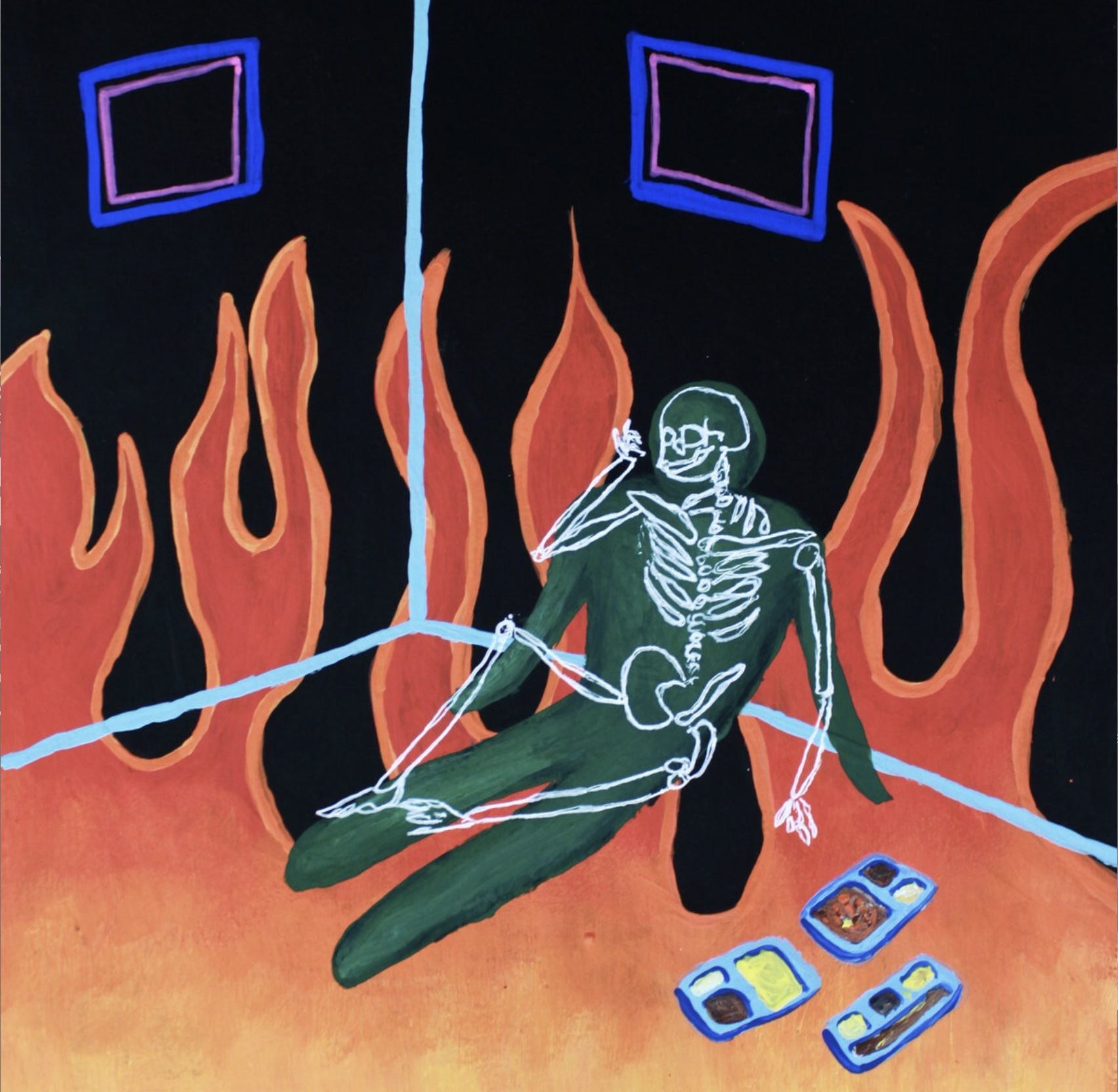
Emily Moales records as Star Moles — a self-described “sci-fi DIY Wi-Fi band.” She has a new album with a cheeky title that nods to AC/DC called Highway To Hell. It’s one of the most acclaimed releases of the year.
Kevin Basko is super prolific as Rubber Band Gun, and is the label’s founder and producer. He also teams with his housemate Moales in the brash Hot Machine, which he compares to Gorillaz, “like a fake band, something we can have a little more fun with.”
And siblings Sam and Louise Sullivan are a folk-pop duo whose third album, Love & Devotion, released this week. It moved pop culture magazine Paste to call them “the next great family band.”
Drummer and comedian Jem Seidel, who keeps the Historic NJ beat in the studio and onstage, is the fifth core member of the collective.
Musician Emily Moales, who records as Star Moles, inside the Historic NJ studio in South Philadelphia on July 10.Aidan T. Gallo / Staff Photographer
‘The song comes first’
Moales, 27, is a New Hampshire native who started making music with Basko — a Berklee College of Music grad who has toured as a member of indie band Foxygen — after they met online in 2017.
Basko, 34, grew up in Monmouth County in Central Jersey, where he came up with the Historic NJ moniker.
He was intrigued by Moales’ imaginative ‘70s style folk rock. “She reminded me of Stevie Nicks,” he says and admits he initially clicked on her Twitter profile because she used a Barbra Streisand photo as her profile picture.
“There was an instant sense that we were on the same page,” Moales recalls. It took only a week to record their first work together, the Star Moles album Camelot, in 2018. Two weeks before the pandemic began in 2020, Moales and Basko moved to Philly, a city where he had made friends while working as a touring musician.
The cover image to Star Moles’ album “Highway To Hell.”Historic New Jersey
The Sullivans grew up in Portland, Ore., and New York, raised by music loving parents who schooled them in Woody Guthrie, Richard and Linda Thompson, and traditional Irish music.
Sam Sullivan, 35, who lives in Germantown, moved to Philly in 2016 to take a job teaching English literature at Germantown Friends School, where he still works. His sister, 30, followed a few years later and has also taught at GFS, but is now focused on music and her ceramics business.
In 2022, Basko messaged the Sullivans on Instagram after seeing a video of the siblings performing in a West Philly backyard. They soon joined the Historic NJ song-making family.
“We all share a philosophy, you know?” said Moales, who’s worked retail and food service jobs since moving to the city, including at sustainable general store Good Buy Supply. “All of us here, we’re just truly songwriters at heart. We hold the song as holy, above everything.”
“The vibe comes later,” Basko said. “The song comes first.”
Once assembled, the Historic NJ crew began quietly — and quickly — making music under the radar.
The Sullivans’ debut album Papier Mâché, which includes “Holy Philly,” an ode to their adopted hometown, came out in 2023. Star Moles’ Snack Monster, inspired by Andreas Capellanus’ 12th-century treatise Rules of Courtly Love, was released last year.
Basko makes music at a dizzying pace. The multi-instrumentalist who cites Todd Rundgren as a “musician producer” role model has a staggering 84 releases available on his Bandcamp page. Listeners are truthfully advised: “There’s something here for everyone.”
He’s also made music for TV shows like Walker and Superman & Lois. And he welcomes clients like Brooklyn violinist Marji Shemanski, who was due in for a session later the day of the interview.
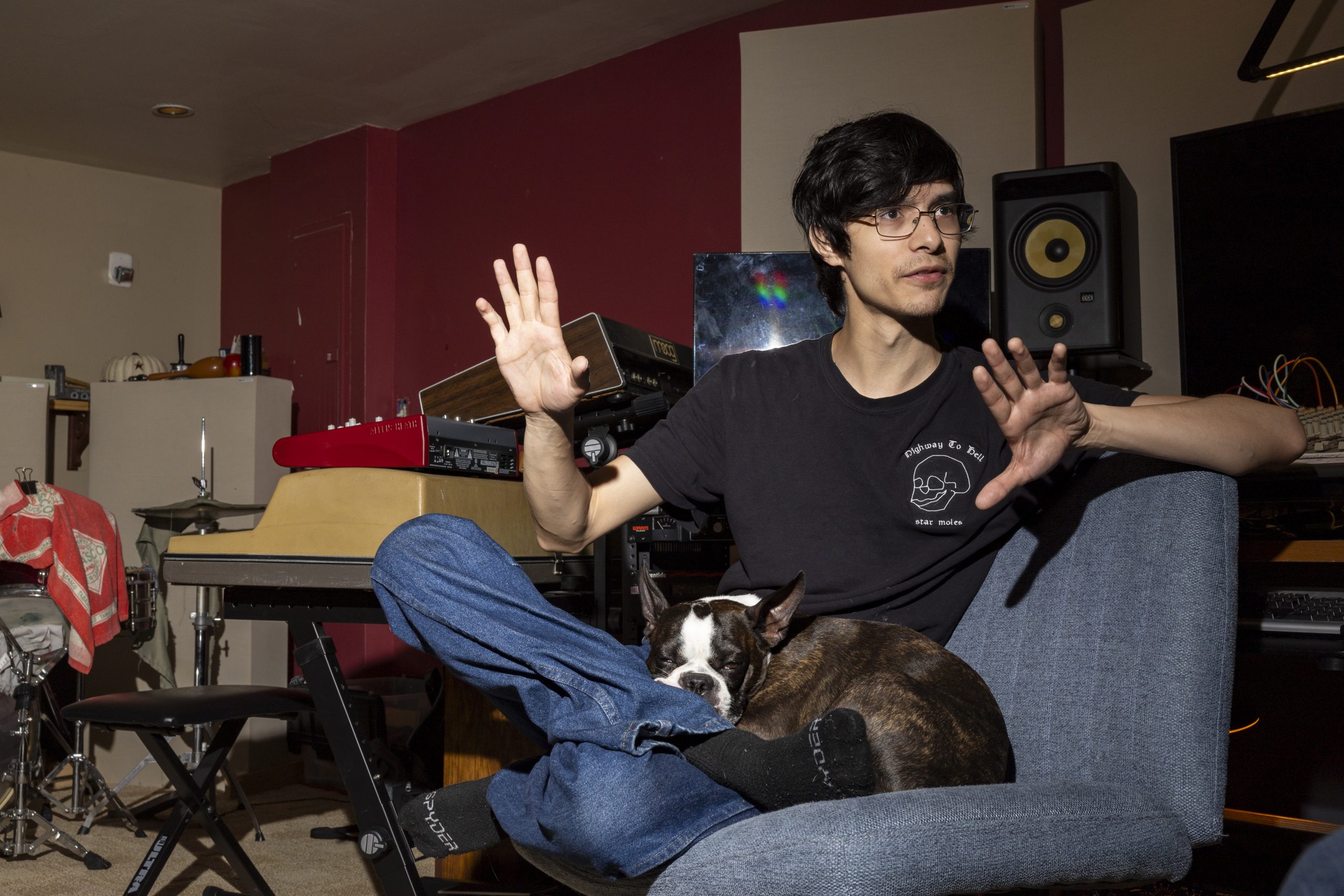
Kevin Basko, a multi-instrumentalist, producer, and engineer, sits with his dog Jones, 5, inside the Historic NJ studio in South Philadelphia. Basko and Moales were both collaborators for Louise and Sam Sullivan’s newest release “Love & Devotion.”Aidan T. Gallo / Staff Photographer
People are getting hip
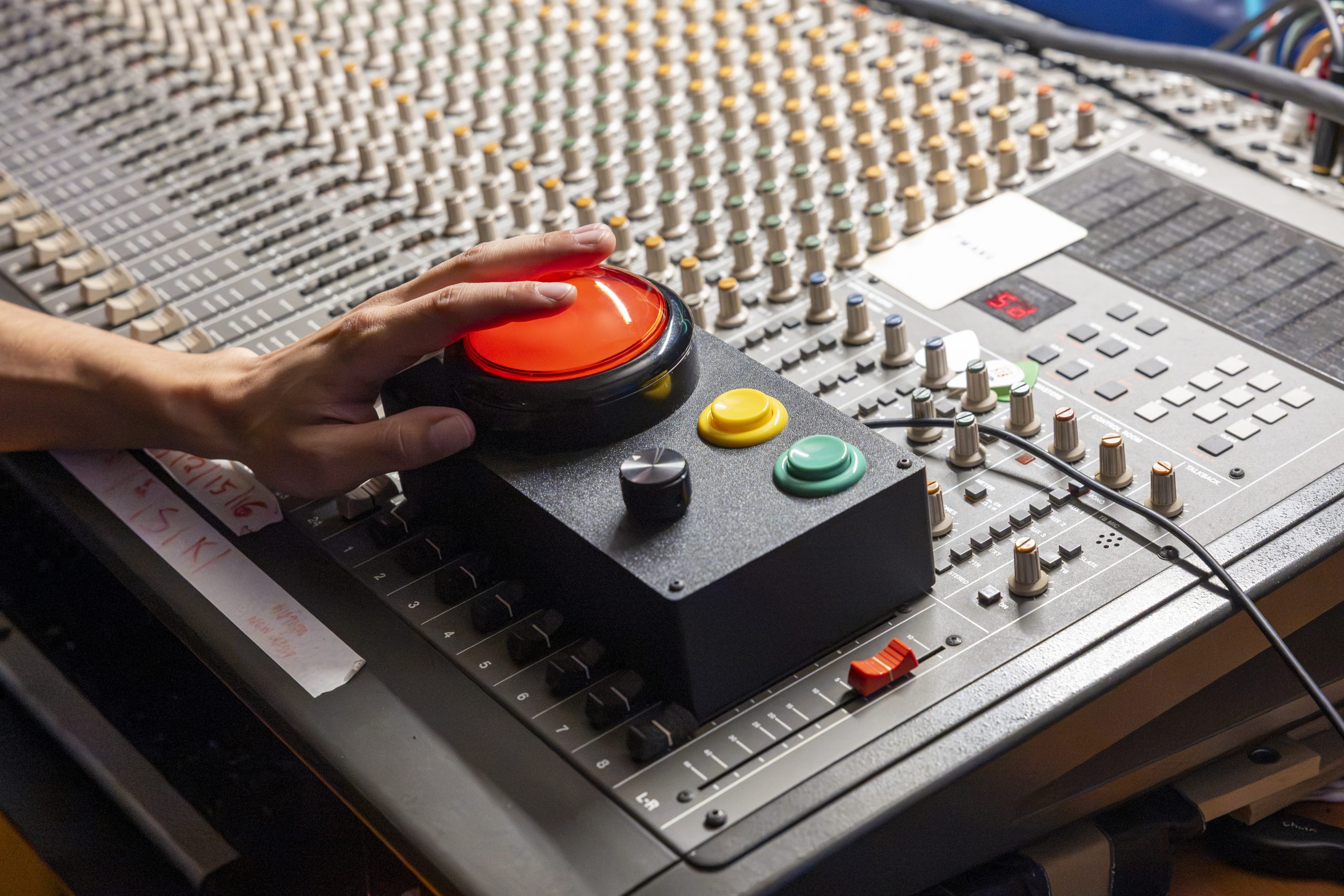
“There’s all this great stuff happening, with people getting hip to what we’ve been doing, said Basko, speaking while sitting cross-legged in front of a control board with a custom made big red button that he presses to start recording sessions with dramatic flair.
Jones, his pint-size Boston terrier, sits in his lap. The carpeted room is full of old-school analog recording equipment, with a kitschy guitar-shaped lamp illuminating posters from three Muppets movies.
“But there’s no greater feeling when a second ago we didn’t have it, and a minute later, we do. Prince talks about that. People don’t know what they’re missing when they don’t have that experience of creation,” Basko said.
People are definitely getting hip to Historic NJ. Highway To Hell is a unanimous best-of-2026 pick by taste-making sites like Stereogum and Brooklyn Vegan. The album, which came out in February, will be rereleased by a larger, yet-to-be-announced indie label this fall.
“Emily’s leading the pack in terms of pure industry success,” said Basko. “I keep making the joke that she’s falling into the volcano in a ceremonial way, into an industry that isn’t always kind. It’s like [Indiana Jones and the] Temple of Doom.”
The artwork for Sam and Louise Sullivan’s new album “Love & Devotion.”Historic New Jersey
The spotlight is also shining on the Sullivans, who have sung together all their lives.
“Our dad really loved music,” Louise Sullivan said. “He wanted his family to play music. They would give us a song to learn and we would sing it at the end of dinner.”
“Like Pete Seeger songs, or the Watersons, or ‘Here We Come A-wassailing,’” said Sam.
“Or Kirsty MacColl,” added Louise. “Sam would play mandolin and I would sing.”
Sam Sullivan calls himself “a failed poet.” He had never written songs before moving to Philadelphia. But while planning to work on graphic arts projects, he played guitar instead and started putting words to music.
“Sam is one of the most brilliant songwriters I’ve ever heard,” said Basko. “I’ve been trying to be a songwriter my whole life. So for Sam to be just ‘Oh I started just a few years ago’ is mind-boggling.”
“I’m not really a musician,” said Sam Sullivan.
Kevin Basko clicks his big red record button inside the Historic NJ studio in South Philadelphia.Aidan T. Gallo / Staff Photographer
That led to a high profile gig at Wilco’s Solid Sound Festival in North Adams, Mass., last month, which turned into a coming-out party for the collective.
The Sullivans played a stripped-down set inside Mass MoCA, the contemporary art museum where the festival is held, as well as a crowd pleasing outdoor show, backed by their Historic NJ compadres.
“It went great,” said Louise Sullivan. “We rocked our little hearts out,” her brother added.
An elusive band
Opportunities to see the Historic NJ groups perform live are scarce. In May, the whole crew banded together and played a two hour show at Johnny Brenda’s.
Star Moles’ last solo show was on Friday, opening for Hannah Cohen at 118 North in Wayne. And the Sullivans have one gig that requires a road trip: opening for Iron & Wine in Lowell, Mass., on Aug. 7.
The siblings would love to become a touring band, but will have to wait, probably till next year when Sam has the summer off from teaching.
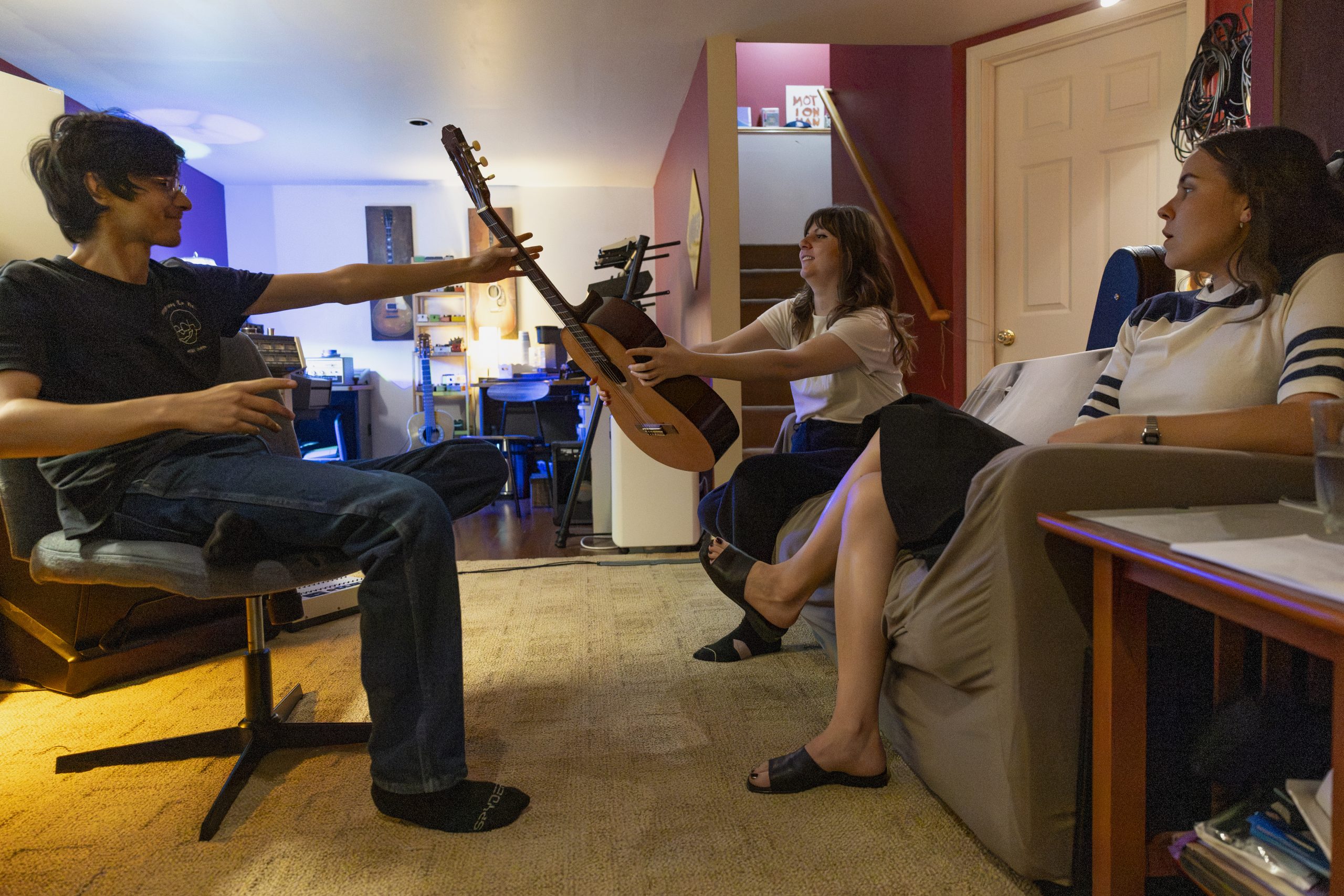
Emily Moales (center), known as Star Moles, passes a guitar to long-time collaborator Kevin Basko inside the Historic NJ studio in South Philadelphia. Louise Sullivan is on the right.Aidan T. Gallo / Staff Photographer
Meantime, there’s music to be made.
On a whiteboard in the Historic NJ studio, Basko and Moales worked out the track listing for the next Rubber Band Gun album, due next month. And Sam Sullivan was working up songs for another release with his sister, which they hope to release by year’s end.
“We want to play shows,” said Louise Sullivan. “But you have to make music to play shows, and I feel like that’s the thing we love to do.”
Everyone nods in agreement.
“We want to make the next thing already. That’s what’s invigorating. That’s what’s going to last.”
Anybody who doubts the existential significance of the news that broke late Friday morning only needed to walk through Center City as the world broke for lunch. It was the darnedest of things, borderline ridiculous, enough to make you cringe in real time at the thought of writing it down. You could keep a steady pace and never escape the news, for every few strides there was another person telling someone else at a volume everybody else could hear, receptionists and tradesmen and medical technicians and folks waiting for buses to parts unknown, flashing phone screens like lottery tickets and yelling “Yo” into microphones and, in at least one case, wandering alone looking up toward the sky with a smile so zen you could have sworn you were one of the ones getting left behind.
It was a startling thing to witness. A revelation, even. Amid the direct and inescapable blast of modern day America’s technological firehose, there are still stories so universally relevant as to draw a chorus from chaos and fragmentation.
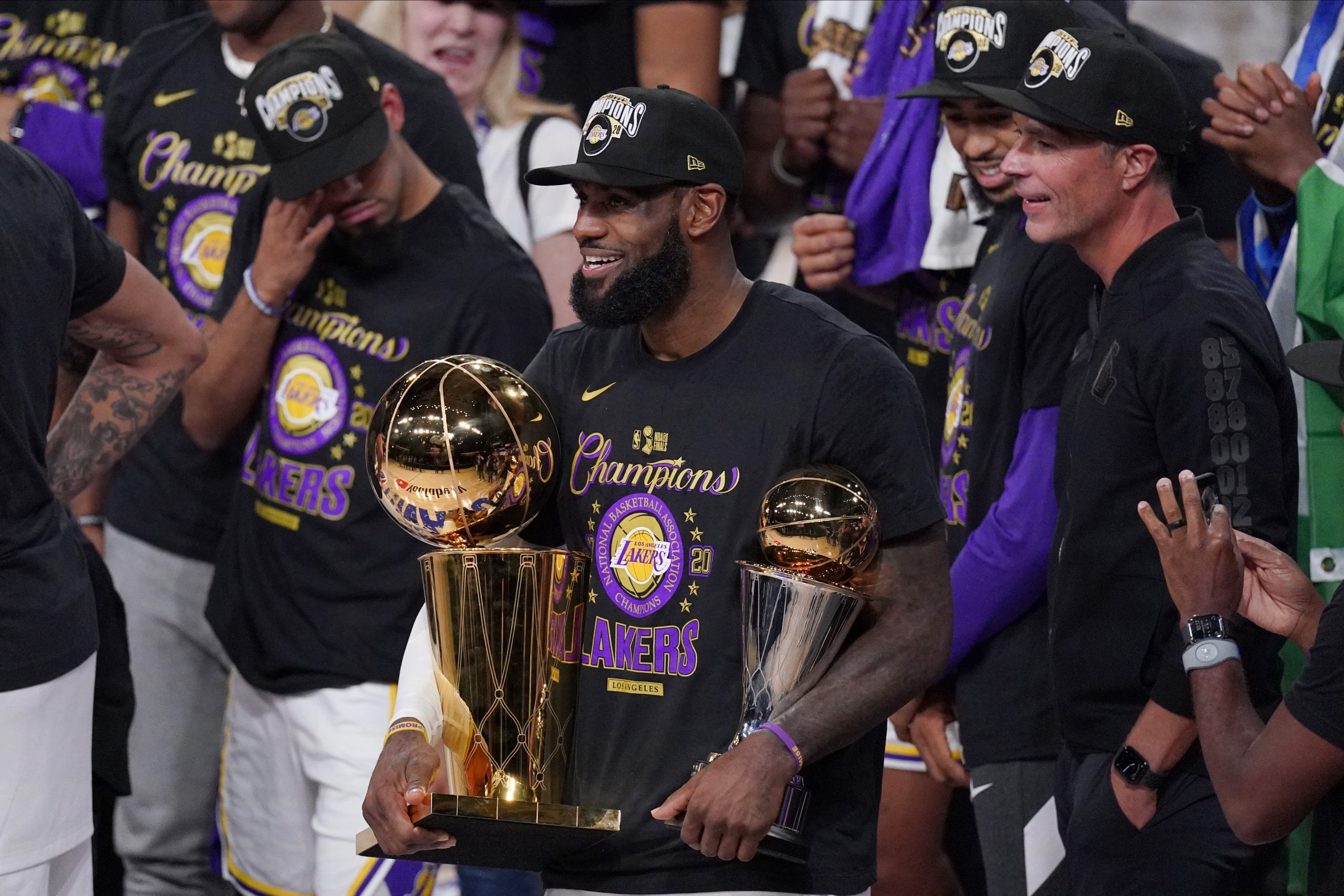
It was also a reminder. A reminder that, however ardent his skeptics and critics, however loud their sighs, however long their rolls of eyes, LeBron James long ago escaped the containment of both basketball court and court of public opinion. He is a cultural singularity, to an extent that few athletes before him have ever been.
That might be a helpful thing for the sighers and eye-rollers to keep in mind. Even if LeBron is not your GOAT, or even your ideal of what a great athlete should be, it has little bearing on the significance of his deciding to cast his final lot with the Sixers. He is unquestionably on the shortest of short lists for the best to have ever done something, and even if he isn’t the best still doing it, he is good enough to have had a standing offer from virtually every contending team in the NBA. Sure, there are teams, and fans of teams, who could argue that the spectacle might conflict with the mission. But, then, these are the Sixers. The spectacle is James choosing to join them. The reputational risk is disproportionately his to bear.
LeBron James has won titles recently, and the Sixers have not been close. Mark J. Terrill
It would be silly and self-disqualifying to ignore the magnitude of such a decision. Miami, Cleveland, Golden State, Denver — all have won titles. Those who have done it without him might be justified in thinking about legacies, whether that of the organization or that of the incumbent superstar. The Sixers have no legacy. Less than a month ago, they had very little hope of being relevant for the next three years. There aren’t many worst-case outcomes for them.
Isn’t that the genesis of the reaction? Its universality? Its … audibility? On a basketball level, on a competitive level, one has no choice but to at least pay some reconsiderations to one’s prior assumptions about both player and team.
The only thing the Sixers had going for them was the basketball level. Whether James proves to be a difference-maker is almost secondary to the fact that he thinks he can be. Nobody has ever done what he is attempting to do, on practically every different level. Win a title with a fourth team. Win a title at the age of 42. Win a title alongside Joel Embiid.
Nobody has ever done those things. Yet, few have done anything that James has already done at every juncture of his career. He already holds the record for most minutes played at both age 40 and age 41. The 1,989 he logged last season were nearly 300 more than Kareem Abdul-Jabbar in 1988-89. That doesn’t include the postseason, when James averaged 38 minutes and 23.2 points per game to lead the Lakers to a first-round upset of the Rockets without co-star Luka Dončić.
James isn’t the player he once was, obviously. He may not even be the player that the current consensus holds him to be. His .594 true shooting percentage — a measure of collective offensive efficiency from the field and foul line — was slightly better than league average in 2025-26. His 30.8 points per 100 possessions average was his lowest since his rookie season and nearly four points lower than any season since. He does not rebound or force his way to the foul line the way he once did.
But all of that only lowers James to the level of all of the other players throughout his career who weren’t anything close to the players he was in his prime. The difference is that those players were also in their primes. James is 41. If you erased everybody’s age from the stats, you’d easily zero in on him as a player who would be a massive value on a playoff roster at $4 million per year. That’s before you factor in the sum of his game: not only the ability to carry an offense for stretches as a primary scorer and spend the interim as an elite connector, but also the true ballplayer aspects of the game that escape quantification. It isn’t a fluke that the Lakers were a better defensive team in both the regular season and postseason when James was on the floor. It isn’t a coincidence that they rebounded better and committed fewer turnovers in the postseason.
For all of James’ physical advantages, for all of the legitimate debates one can have when weighting those advantages in the Greatest of All Time argument, anybody who has watched James play should be able to appreciate the feel that he has for the game of basketball. He is the rare superstar who is also a glue guy, as evidenced by the varied rosters with which he has won championships.
Following my first visit to Boston two years ago, I penned a column (against my better judgment) bemoaning what a surprisingly good time I had there (against my will).
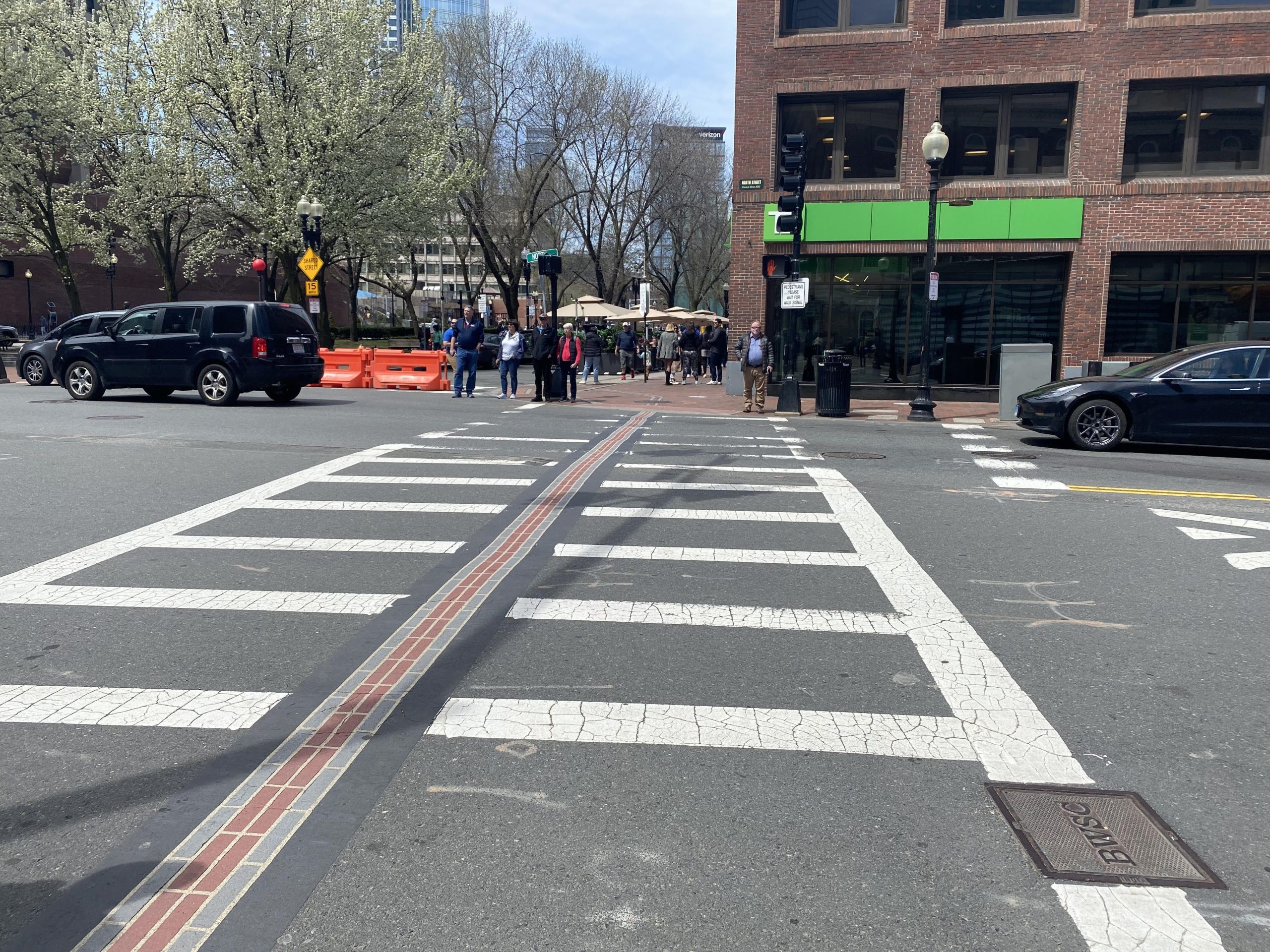
I was particularly taken with the city’s Freedom Trail, a 2.5-mile walking path embedded in Boston’s sidewalks that leads to 16 historic sites. Far from being half-baked, I had to admit this Beantown tourist attraction was “annoyingly great.”
Look at the Freedom Trail being all cute running through this Boston Street. Gawd! STEPHANIE FARR / Staff
Why didn’t we have anything like this in Philly, I wondered, and could we get our own version in time for the nation’s 250th anniversary?
I was flooded with emails in response from readers who not only agreed with me, but offered route suggestions and names for a potential Philly path. I also received a cryptic message from someone at Visit Philadelphia who said they had some things up their sleeves.
That was more than two years ago and I’d all but given up hope. Then I received an email this month from Jenea Robinson, vice president of communications for Visit Philadelphia.
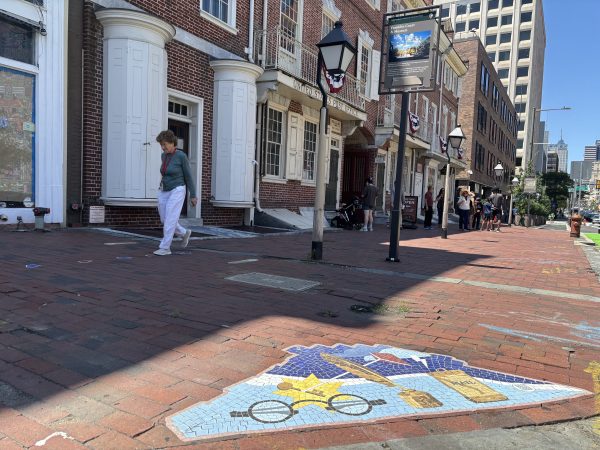
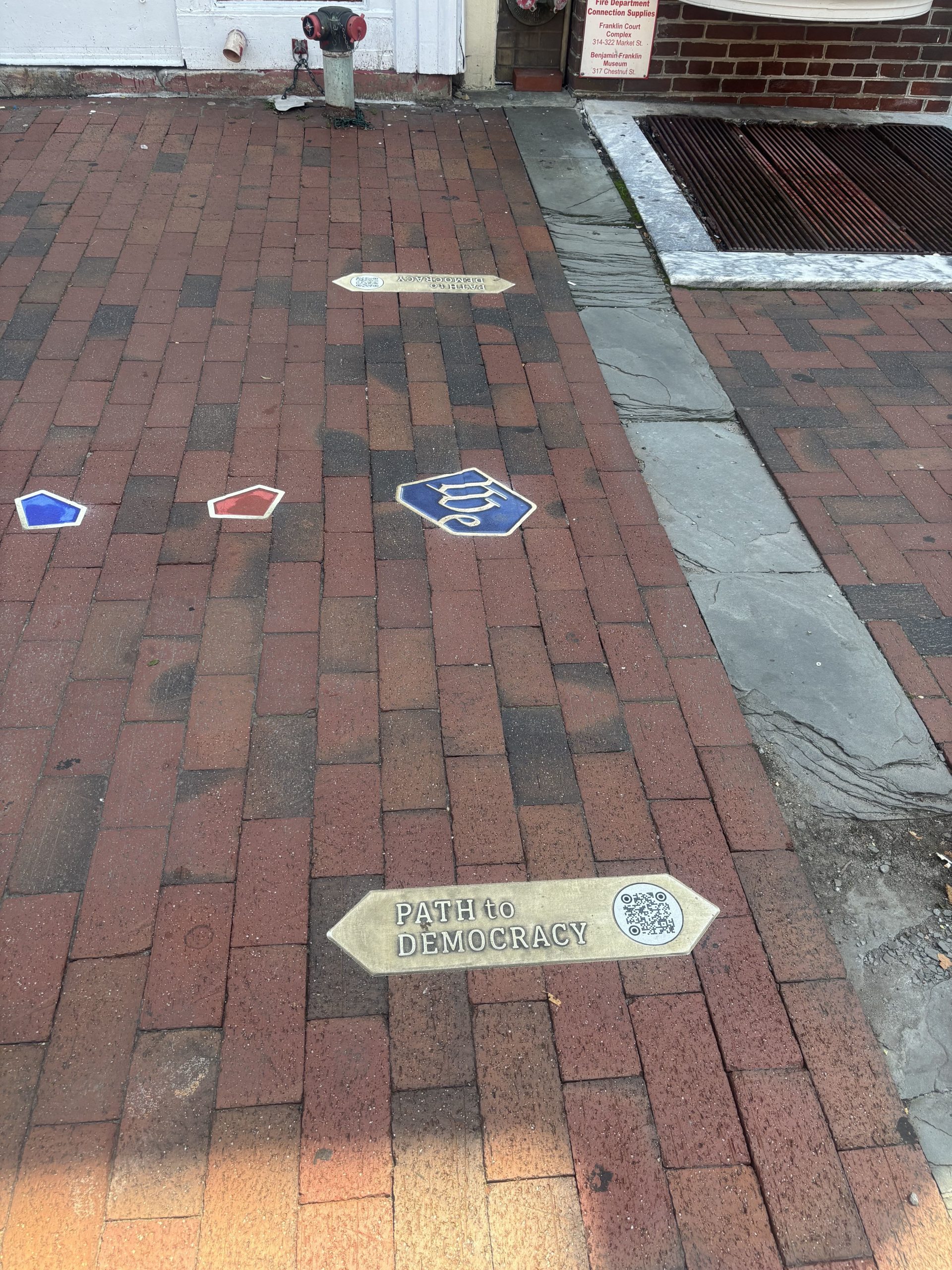
Vinyl decals resembling ceramic tiles and a brass plaque mark the public pilot version of the Path to Democracy.Stephanie Farr / Staff
“Because you wrote that delightfully, ‘annoyingly accurate’ story about Boston’s Freedom Trail a few years ago, I wanted to make sure you got the first look at Philadelphia’s answer to it: Path to Democracy,” she wrote.
Could it be true? Are we actually getting our own historic trail and did someone really call my work “annoyingly accurate?!?” Be still my craggy, Philly heart!
‘A legacy project’
Still in its early phases, there are currently only six stops on the Path to Democracy as it undergoes public beta testing through Labor Day. The full path, which is slated for next summer, will have 21 stops and is based on a self-guided tour Visit Philly has had on its website for years, said Kyle Stein, senior marketing project manager for Visit Philly.
“This is something we wanted to introduce to people this year and have it be a legacy project for years to come,” he said.
(function(){function e(){window.addEventListener(`message`,function(e){if(e.data[`datawrapper-height`]!==void 0){var t=document.querySelectorAll(`iframe`);for(var n in e.data[`datawrapper-height`])for(var r=0,i;i=t[r];r++)if(i.contentWindow===e.source){var a=e.data[`datawrapper-height`][n]+`px`;i.style.height=a}}})}e()})();
In its final iteration, the Path to Democracy will be marked by colorful ceramic tiles, brass directional plaques, and large tile mosaics embedded in the sidewalks that will pay “homage to all of the art across Philadelphia” and particularly, to that of Isaiah Zagar, Stein said.
“Whatever look and feel we went with had to be authentic to Philadelphia,” he said.
For now, Visit Philly is using sturdy, eye-catching vinyl decals that resemble tiles and mosaics to mark the path and stops along it. Zagar’s studio wasn’t consulted on the project, but Stein said Visit Philly would love to work with them going forward.
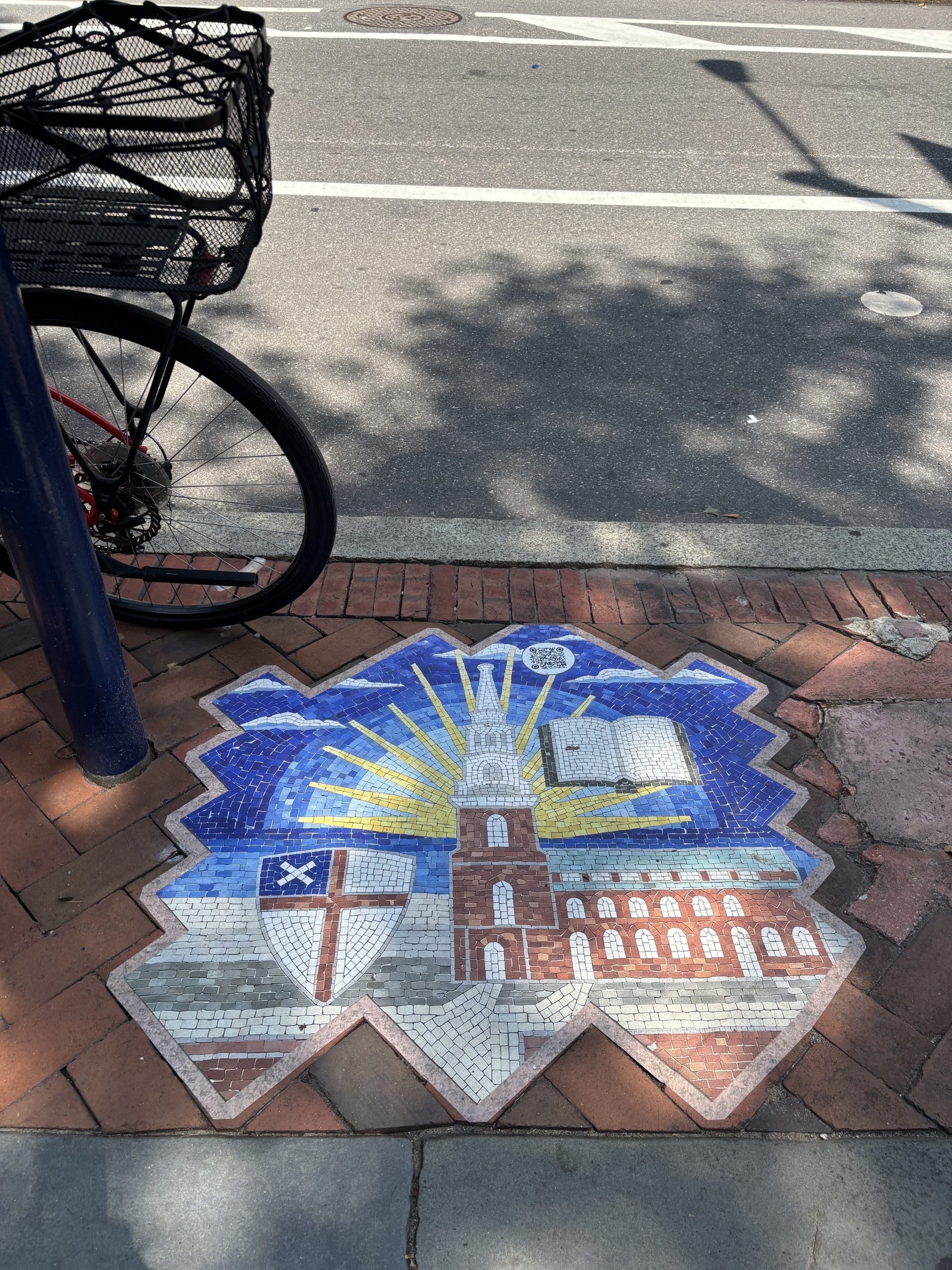
The vinyl mosaic decal at Christ Church along the Path to Democracy.Stephanie Farr / Staff
The Path to Democracy will not only be unique from Boston’s trail in look but in substance as well. The Freedom Trail traces Revolutionary War history, but Philly’s path will highlight sites and people that have shaped American democracy over the years.
“It’s not just something that happened in 1776,” Stein said. “Democracy is something that is an evolving thing.”
I knew there was only one way to suss out this path and that was to walk it myself. Plus, Stein said feedback from locals is essential during beta testing, and who doesn’t love being essential and opinionated in Philly?
Choose-your-own adventure
I snagged a parking space on Race Street near Second last week, knowing that the sites are all within a four-block radius from Front to Fourth and from Market to Arch Streets.
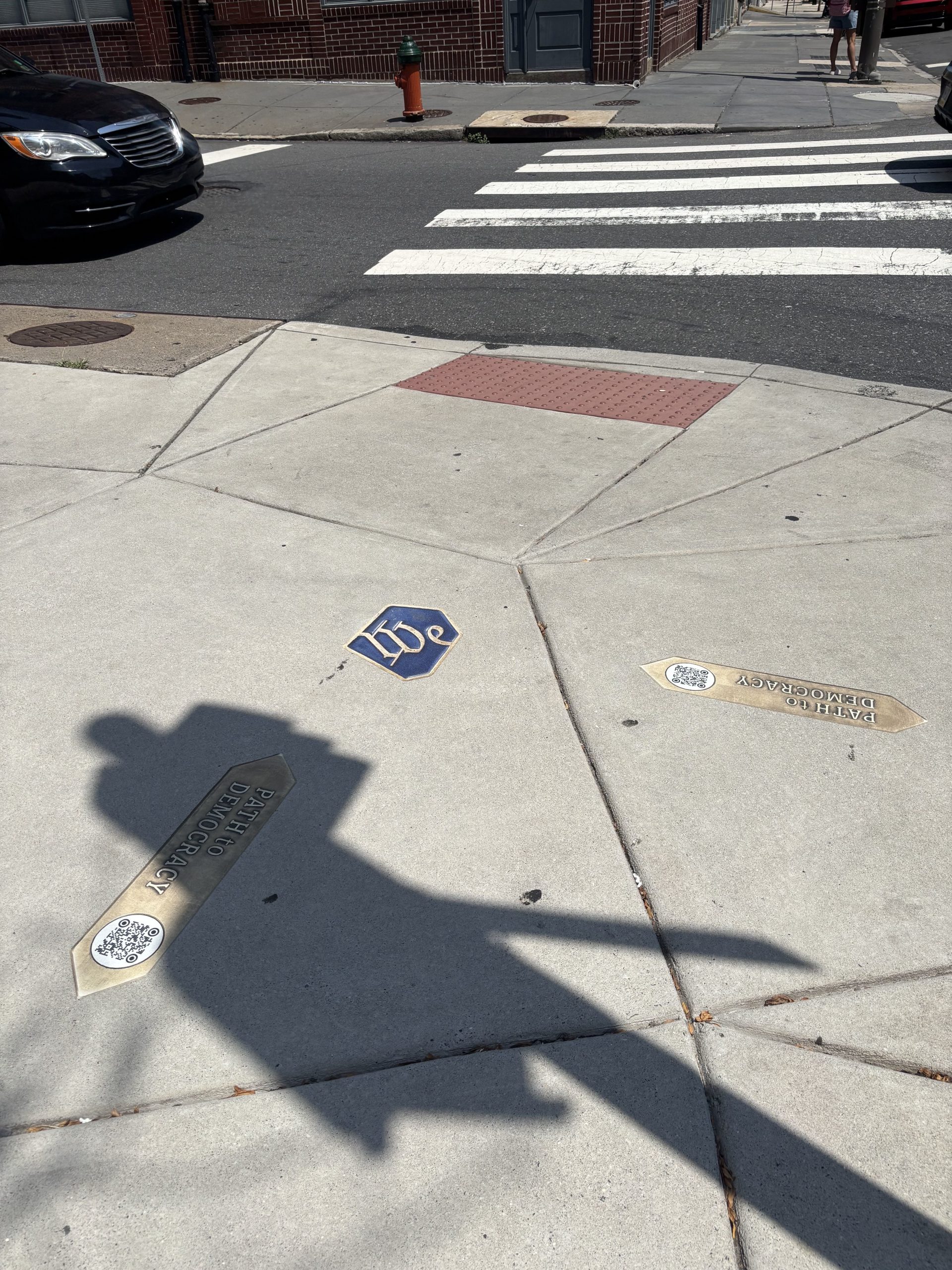
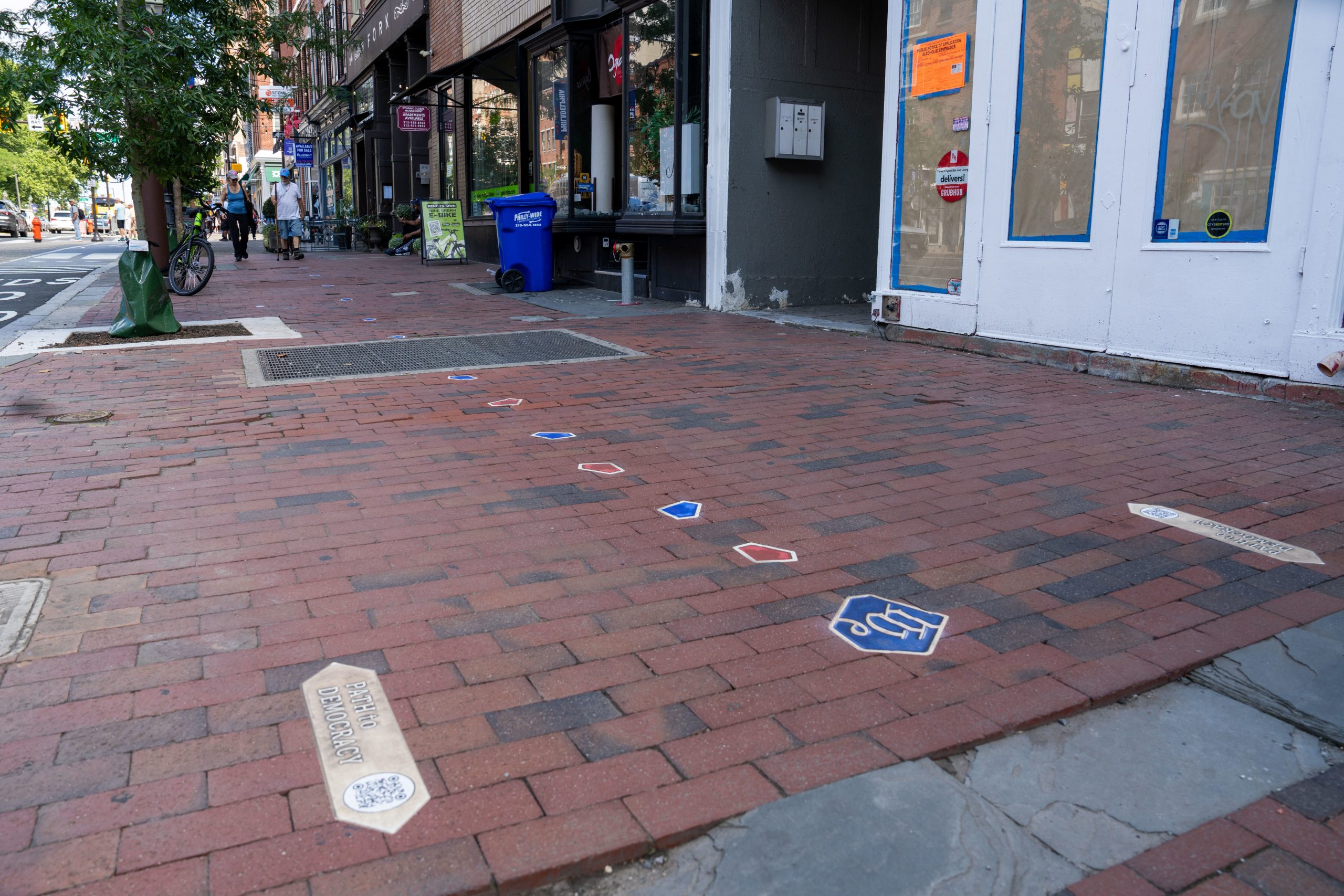
My first stop wasn’t planned. I just kept my eyes on the ground until something caught them, which happened at the corner of Second and Arch Streets. I spotted a blue vinyl tile that said “We” (written in the script of the Declaration of Independence) and two vinyl directional decals that said “Path to Democracy” with QR codes that led to an accompanying website. One pointed up Arch Street to Third and the other pointed down Second Street to Market.
Vinyl brass-colored decals at Third and Arch Streets in Old City denote that the Path to Democracy can be taken in one of two directions here. In the center is a “We” tile that is found on multiple spots along the path as well.Stephanie Farr / Staff
I decided I’d follow the arrow pointing right up Arch Street. As I walked, I spotted gem-shaped blue-and-red vinyl decals that were peppered like breadcrumbs down the sidewalk and led me straight to the Betsy Ross House.
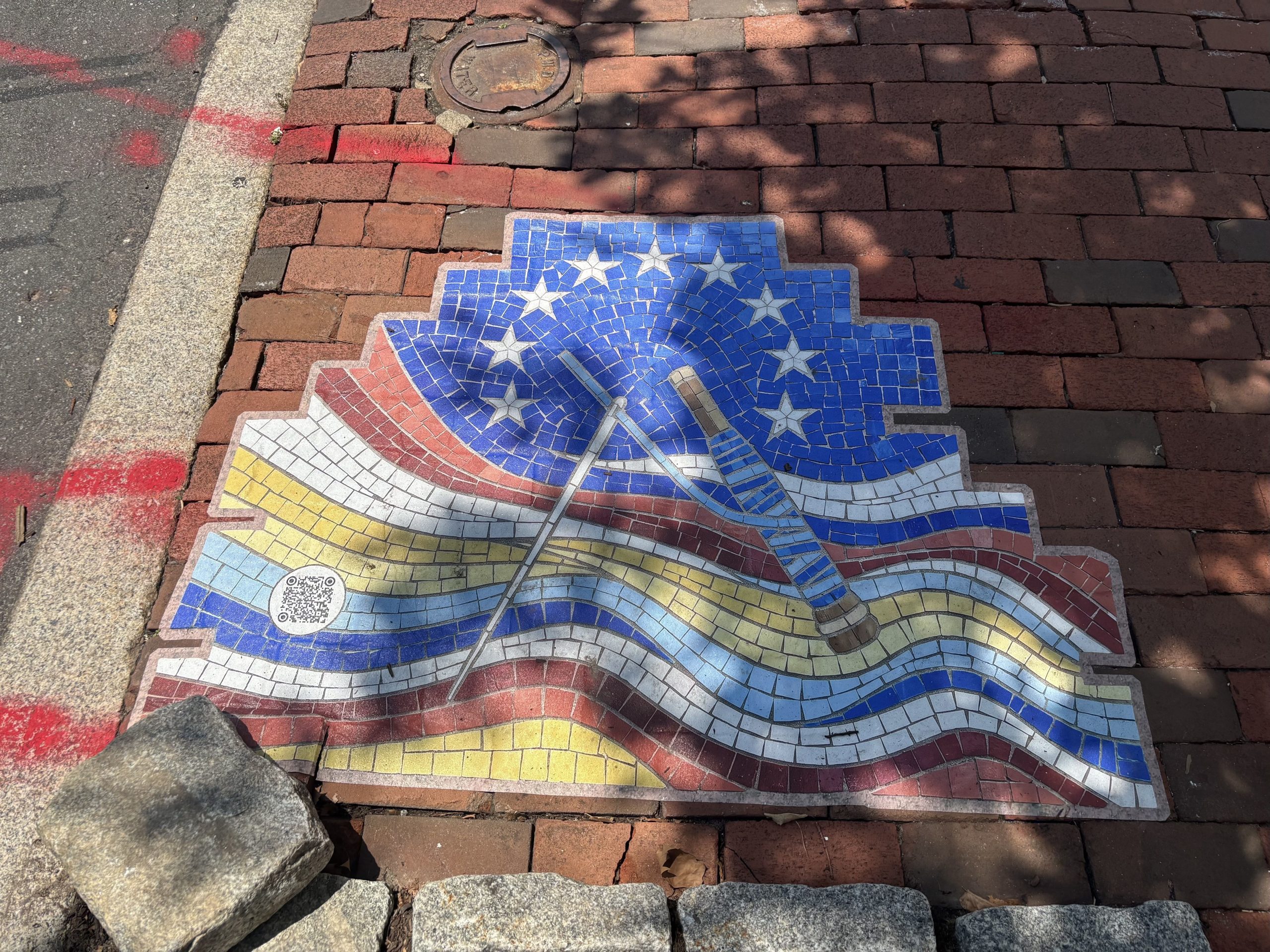
On the sidewalk outside of the site, I spotted a lovely vinyl mosaic of a needle and thread superimposed upon a multicolored flag. A QR code on it took me to a mobile-friendly webpage about Ross. I listened to a 51-second audio clip about her life and read about the mosaic before me. Also provided on the page was the Betsy Ross House’s address, operating hours, and other useful visitor information.
The vinyl mosaic decal outside of the Betsy Ross House along the Path to Democracy.Stephanie Farr / Staff
At the bottom of the site was a nifty little guide showing me that I was currently a four-minute walk away from Christ Church in one direction and a two-minute walk away from the Arch Street Meeting House in the other.
“All right, this is pretty cool,” I whispered.
Confusing corners
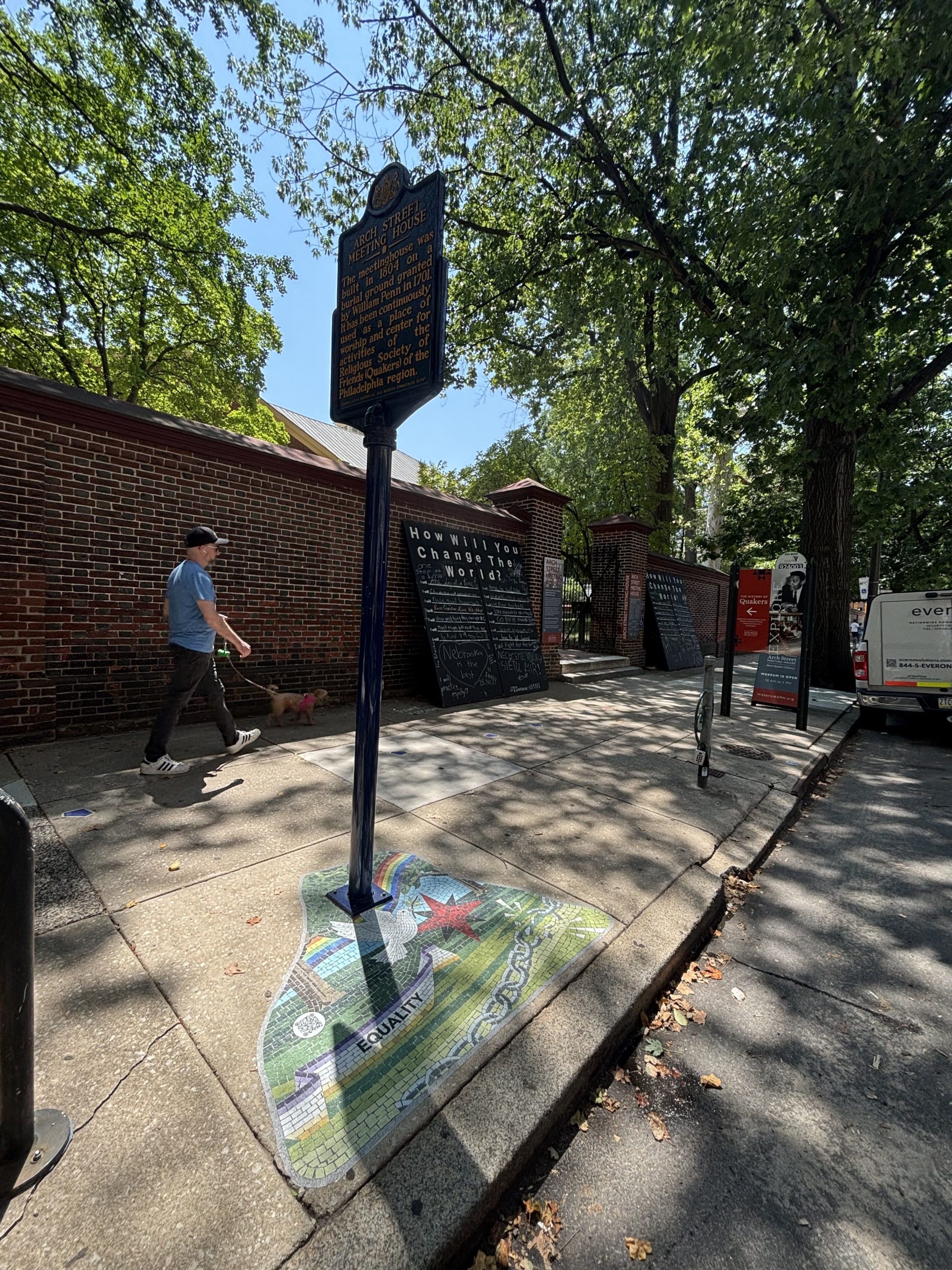
I chose to follow the blue-and-red vinyl decals to the Arch Street Meeting House where a vibrant vinyl mosaic of a dove and the word equality was plastered on the sidewalk. The QR code led to a page about the meetinghouse and to an audio clip about how “Religious radicals founded Philly.”
When I was done, I discovered I’d reached the end of the path, much to my chagrin. I didn’t realize it wasn’t a continuous loop and I had to retrace my steps back past the Betsy Ross House to the next site, Christ Church.
From there, the vinyl decals led me to the southwest corner of Second and Market Streets, where a directional decal with arrows on both ends pointed me toward Front Street on my left and also to Third Street on my right.
“Well this is confusing,” I thought.
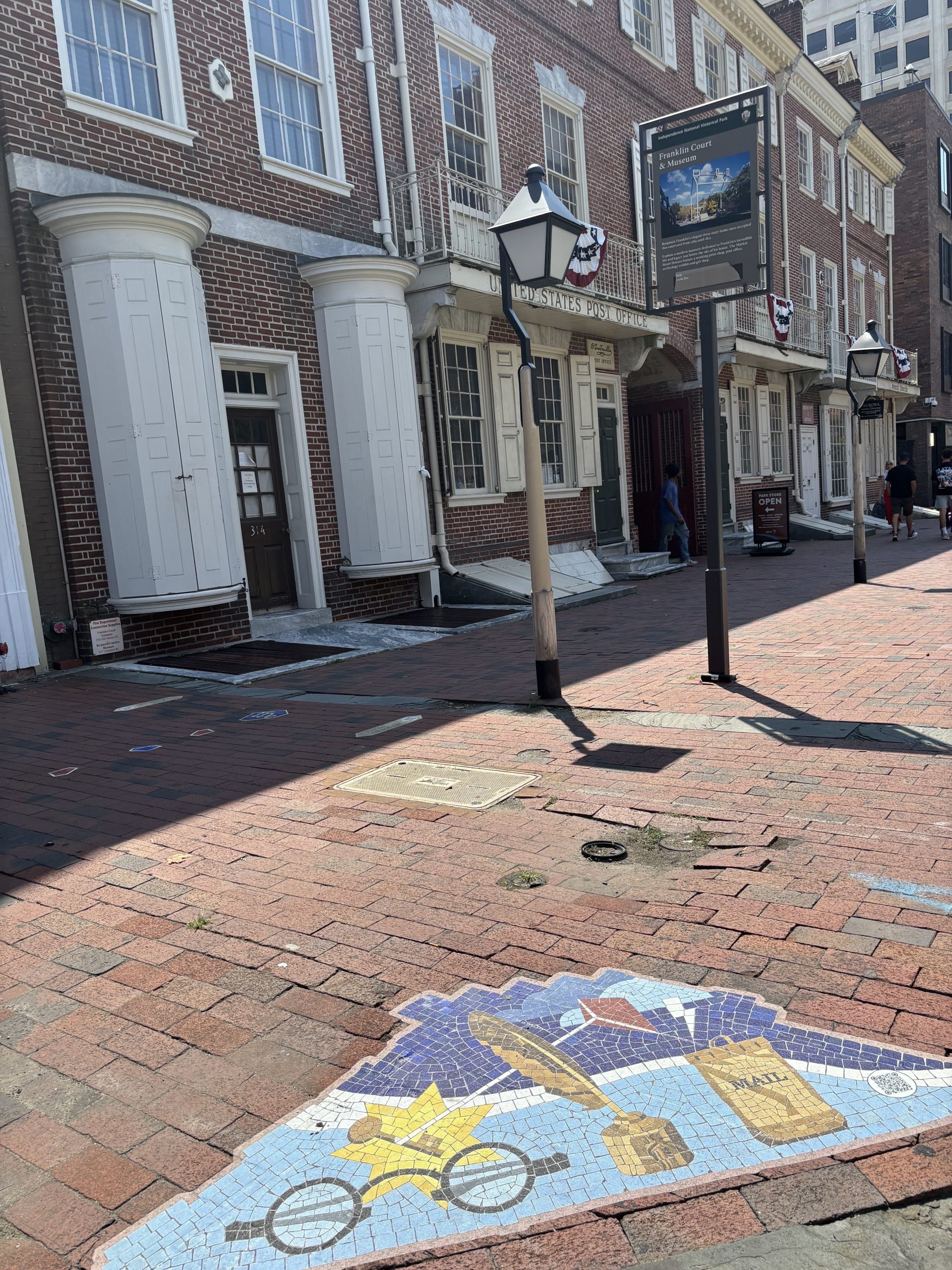
I decided to follow the path up Market Street past Third Street to Franklin Court, where I spotted a large vinyl mosaic decal of a key, kite, quill pen, and spectacles.
The Path to Democracy leads to just outside Franklin Court, where this vinyl mosaic decal located.Stephanie Farr / Staff
I headed inside Franklin Court and walked around. I always forget how many privies there are in there (the place had more johns than the Second Continental Congress!).
Franklin Court marked another terminus of the path, so I turned around and headed back down Market Street to Front to check out the other direction of the trail I’d forgone.
Lesser-known sites
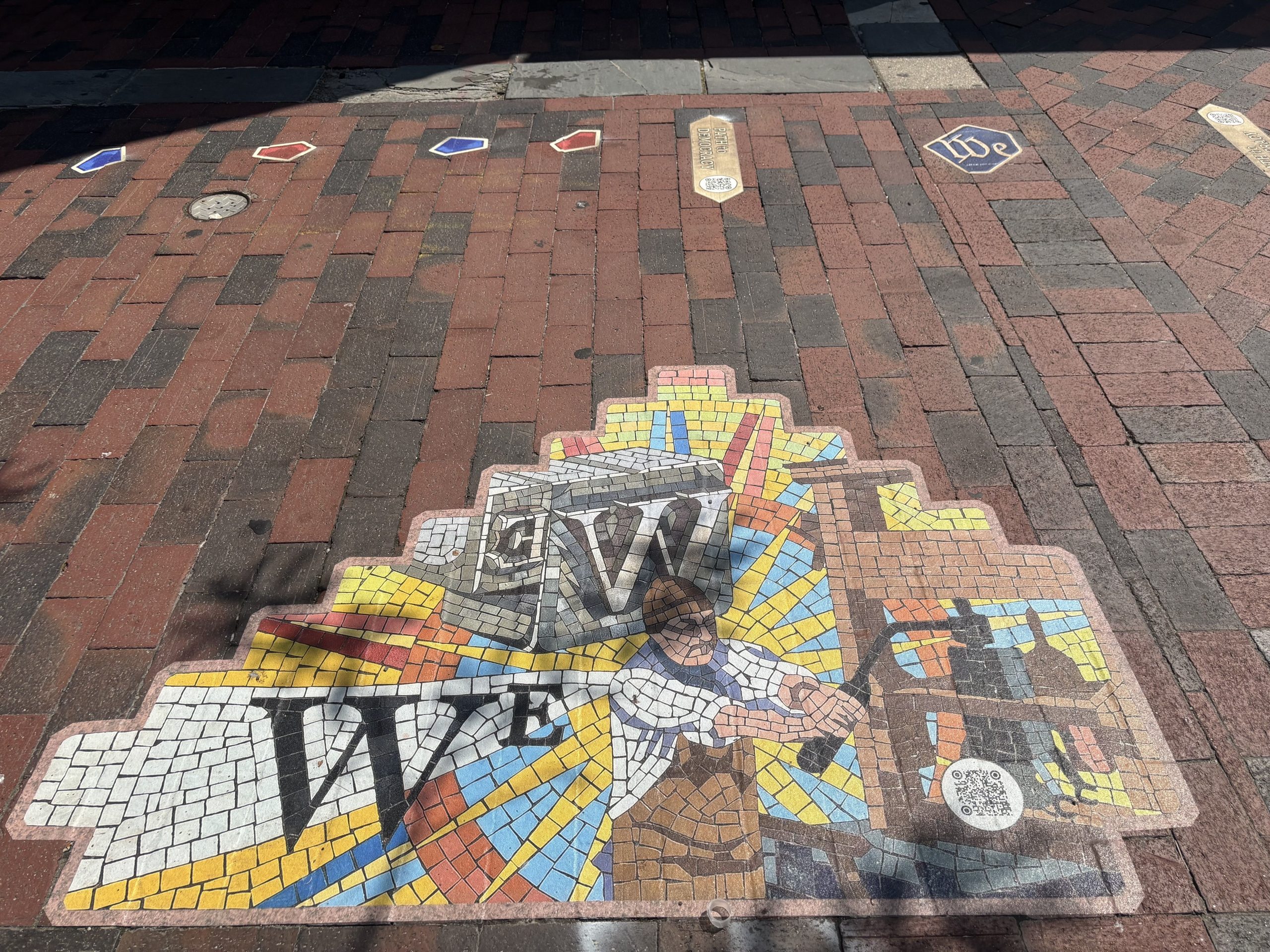
On the southeast side of Second Street as it crosses Market, I found a large mosaic decal of a man operating a printing press. Scanning the QR code, the website told me this was once “Printers’ Row,” where many important documents — including the first copies of the Declaration of Independence — were made.
Unlike the other sites along the path, there was nothing already at this one to indicate it was of any importance, aside from an easy-to-miss plaque embedded in a crumbling wall of a vacant building nearby.
A vinyl mosaic decal marks the site of Printer’s Row on Market Street near Second along the Path to Democracy.Stephanie Farr / Staff
I appreciated this more-obscure site being highlighted on the path. Stein said its inclusion in the beta test was very intentional.
“Not every historic site in Philly is one people can enter. We wanted a tried-and-true one, like the Betsy Ross House, and lesser-known ones, like Printers’ Row,” he said.
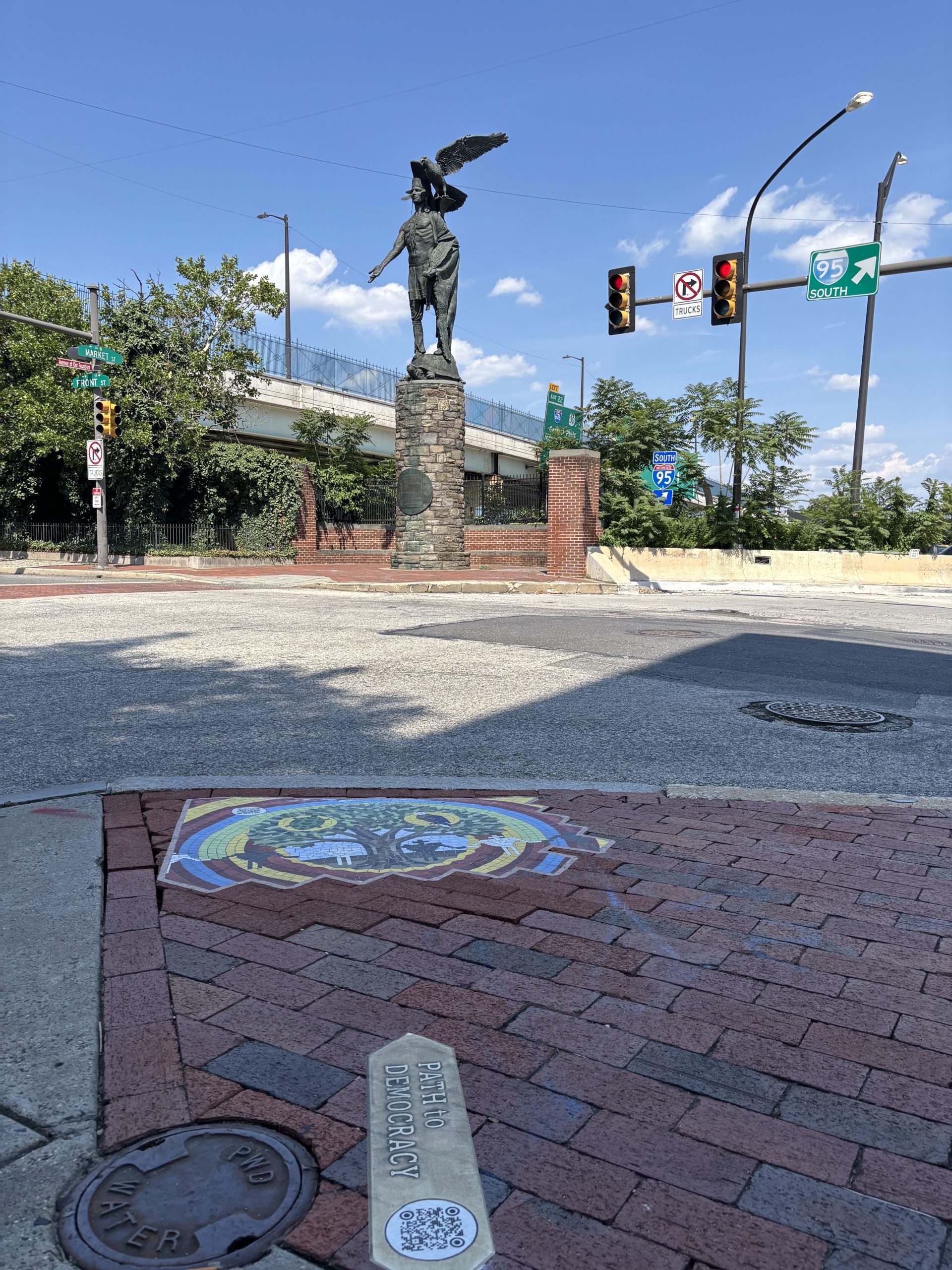
Following the decals, I reached my final stop at the corner of Front and Market Streets. There, a vinyl mosaic decal of a tree, animals, and human figures was situated on the sidewalk catty-corner to the Chief Tamanend statue at the I-95 on-ramp.
As I listened to the accompanying audio via the QR code, I found myself staring at the statue.
The Path to Democracy highlights the “Chief Tamanend” statue at Front and Market Streets in Old City.Stephanie Farr / Staff
Then, I did something I’ve never done before — I crossed the street and approached it. I stood below Chief Tamanend’s feet, I looked up at him and the eagle on his shoulder, I marveled at the details of his clothing, I read the accompanying bronze plaque.
And I couldn’t believe that it took me this long and this path to do so.
A worthy pursuit
I spent about two hours walking the path, but I backtracked often and took my time. You could feasibly do it in 30-60 minutes.
After my walk, I filled out the pilot program survey via the QR code.
“I want more sites and would love for it to be a circular path you could start at any place and keep going around until you get back where you started, like a Phlash bus loop,” I wrote.
Vinyl decals mark the Path to Democracy on the 300 block of Market Street in Old City during the beta testing phase of the project.Courtesy of Visit Philadelphia
Stein said the goal is to have the path be multidirectional.
“I think in the future we’re considering the best way to actually connect the sites,“ Stein said. ”Printers’ Row and Chief Tamanend was an opportunity to test out a spur. That will be something we may come up against in the future, some sites may not fall within a perfect pathway.”
While I didn’t see anyone else following the path as I was exploring it, Visit Philly’s Robinson told me about 50 people a day have been scanning the QR codes.
Though there are still some kinks to work out, the Path to Democracy shows a lot of promise. Like democracy itself, we don’t know where it will lead, but it’s a worthy pursuit — and one that requires our participation to succeed.
So before Labor Day, go try it out and provide feedback. You could help shape a path in Philly that may be walked for generations to come.
“We just want Philadelphians to be proud of this and be aware of it,” Stein said. “I think that this path is another way for us as Philadelphians to celebrate how great this city and these sites are.”
The Path to Democracy leads to the Arch Street Meeting House, where a vinyl mosaic decal wraps around the site’s historical marker.Stephanie Farr / Staff
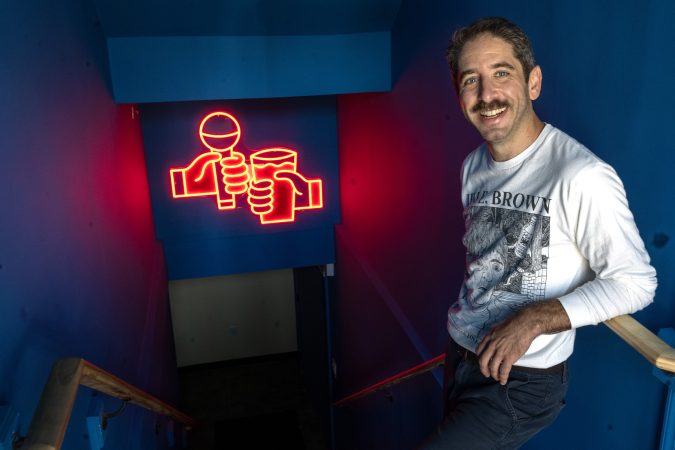
Benditt, 43, has spent years of producing comedy shows behind the scenes. He hopes the South Philly venue, at 1123 S. Broad St., will become a premier destination for emerging acts to build their names, and for touring comics to engage with a wider range of fans.
“We’re kind of like the ‘Adult Swim’ brand of comedy,” Benditt said.
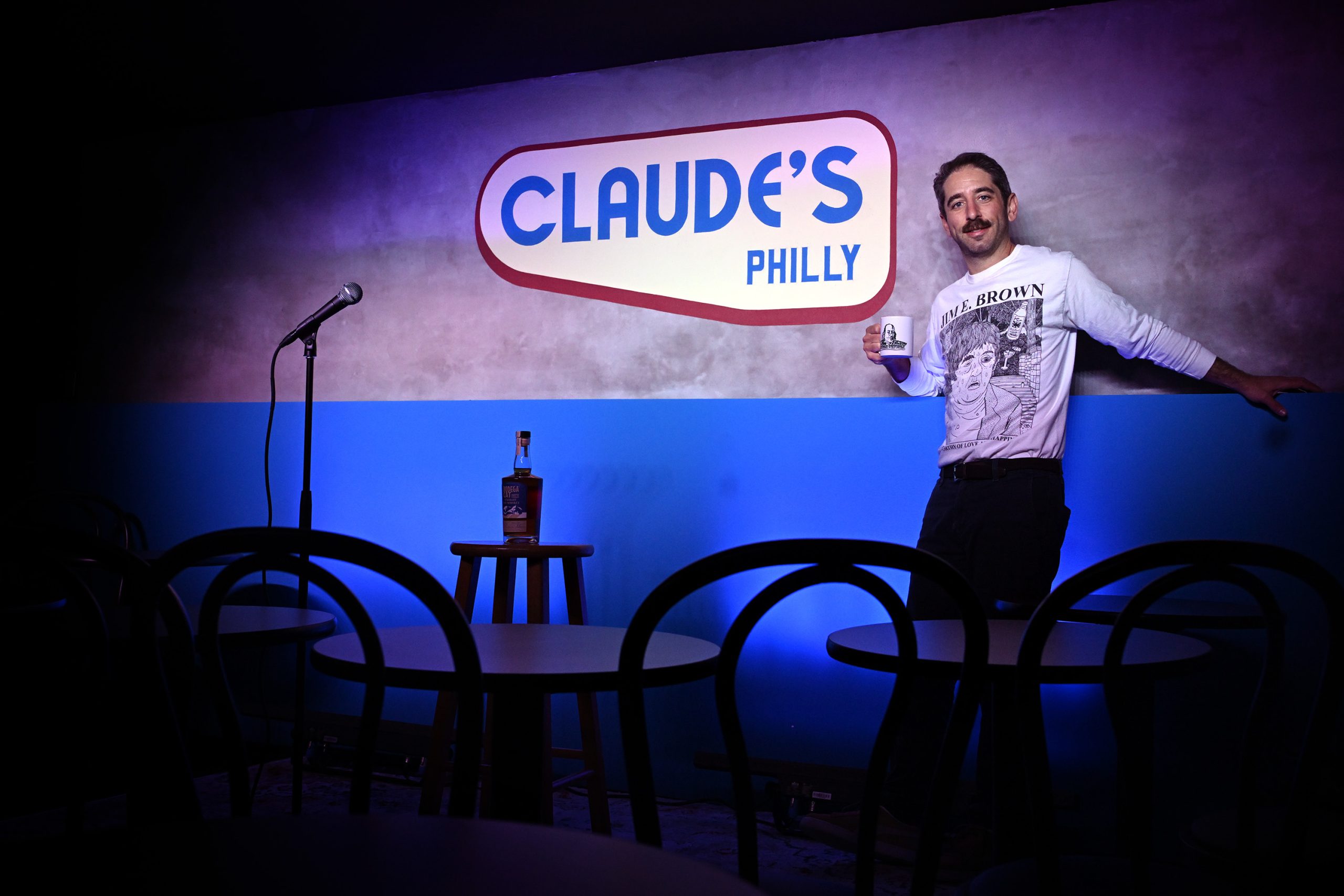
Owner Reid Benditt is onstage at Claude’s Comedy Club on South Broad Street on Wednesday, July 1, 2026.Tom Gralish / Staff Photographer
Many rising stand-ups, he said, are reduced to backrooms at Philly dive bars and restaurants, where the crowd is more interested in clearing their plates and drink tabs than they are in comedy. Few, if any, venues are dedicated to rising comics on a nightly basis, Benditt said, which forces early-career comics to test their skills in larger entertainment markets before they’re ready.
“Philly is a really underserved city as far as the number of [comedy] clubs,” he said. “I think it’s saying something when we only have a handful of clubs, and we have all this great talent around.”
The clubs are even fewer in South Philly, where Benditt said Claude’s comes in.
Just under South Broad Street’s United Check Cashing marquee stands Claude’s doors. Visitors are immediately transported to a dimly-lit, subterranean space that’s reminiscent of legendary clubs like New York City’s Comedy Cellar. There are low ceilings, intimate lighting, and an audience that’s fully invested in local comedy.
Down the steps is a full-scale bar, fashioned with lush seating, and a drink menu filled with spirits and nonalcoholic options. The food menu offers small bites like specialty hot dogs, grilled cheese sandwiches, dill pickle plates, and Tastykake flights garnished with small puddles of whipped cream.
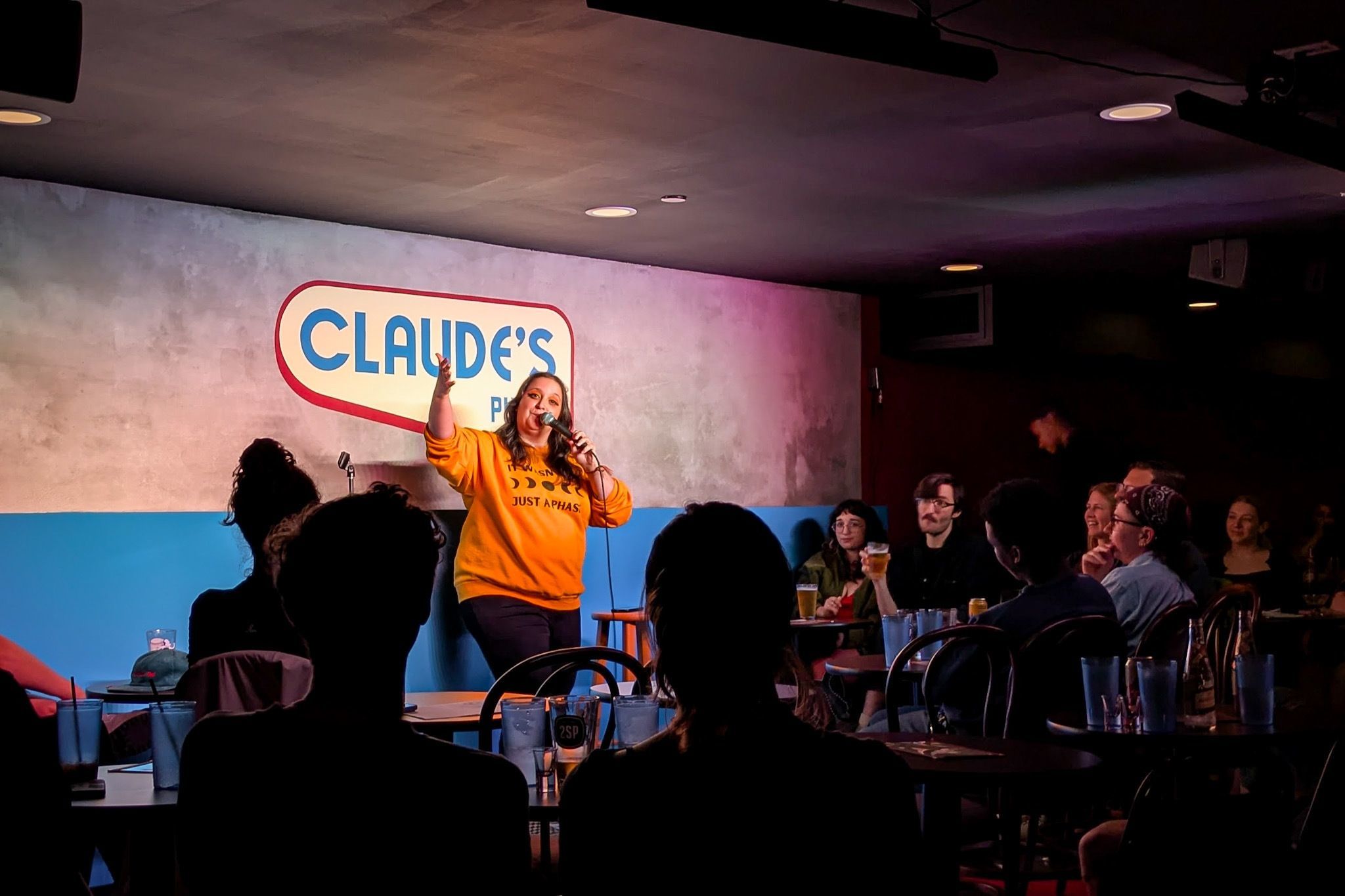
To the right of the bar are the doors to Claude’s 100-person show space. Cushioned sheets rest on its perimeter, while small table sets are positioned toward the illuminated stage, with the Claude’s logo serving as the backdrop.
It’s where rising comics can bring their mangled notebooks on stage to test new material, and where touring acts can drop in to perform outside of the city’s long-running venues.
The bar at Claude’s Comedy Club on South Broad Street on Wednesday, July 1, 2026.Tom Gralish / Staff Photographer
In less than a month, the club has drawn the kind of talent and crowd Benditt envisioned two years ago when he decided to transform the former thrift store into a comedy hub.
Comics like Carmen Lynch, KC Shornima, and Lukas McCrary have headlined at Claude’s, their signatures gracing the club’s green room walls. Other comedians have participated in open mic nights, pun comedy showcases, and other themed events. Benditt also plans to establish programming for Philly’s robust clown community.
While he’s spent the majority of his career as an event coordinator at Union Transfer and Electric Factory, Benditt has been a part of Philly’s comedy scene for more than a decade.
After taking an improv class in 2013, he began performing stand-up with the collective Laughs on Philly. In 2019, he helped organize the Whiz City Comedy Festival, a two-day, three-venue event on South Street. But he knew, even then, being a performer wasn’t in the cards.
“Performing was never my thing,” Benditt said. “I’ve done stand-up enough times to know which side of the microphone I belong on, and which side I want to be on.”
He discussed the idea of opening a comedy club among friends, but it wasn’t until late 2020 that his plans were set in motion. He took a small-business class at Temple University and began searching for potential venues.
Benditt looked at spaces in Passyunk and West Passyunk before signing the lease to the lower-level venue in November 2024. He chose the South Broad Street location because of the absence of live comedy venues in the area.
“When you look at the map where the comedy clubs are in the city, it’s easy to see where there’s a void,” he said.
He didn’t reveal the cost of construction but said he poured his life savings into transforming the “raw” cement stage and barren walls into a formidable entertainment destination.
“It was enough, where I had to put my house on the line as an insurance policy,” he said. “I’m going all in.”
Comedian Meg Goetz entertains at a preview at Claude’s Comedy Club & Bar, 1123 S. Broad St.Reid Benditt
Originally, Benditt anticipated an October 2025 opening, but he didn’t account for the mountain of permits required by the Department of Licenses and Inspections. But after securing the final permit needed to operate as a comedy club and sit-in restaurant in June, Benditt’s dream was finally fulfilled.
For the name, Benditt wanted something catchy with a more personal touch.
“Something that gets out of the way and gives performers a spotlight.”
His mother’s name is Claudia, his family affectionally calls her “Claude.” And like his “selfless” mother, who routinely puts others before herself, Benditt is determined to showcase local and national comics, even with his livelihood on the line.
Claude’s Comedy Club & Bar, 1123 S. Broad St. Cellar, Philadelphia. Open everyday 4 p.m. to midnight. instagram.com/claudescomedy
Before you start pointing out that he’s 41, remember who we’re talking about. This is arguably the greatest basketball player of his generation — one of the few athletes whose name alone can change the mood of an entire city. There will be plenty of time to debate how much he has left in the tank.
But now isn’t the time.
Now is the time for imagining LeBron in a Sixers jersey. It’s for checking the schedule, texting your friends in all caps and wondering how quickly the team store can stock No. 23.
Will this end with a championship? Nobody knows. But sports are supposed to be fun, and this is fun.
Freshly baked “penny pretzels” cool in the test kitchen at Philly Pretzel Factory headquarters in Bensalem, Pa., on the morning of Thursday, August 9, 2018.MAGGIE LOESCH / Staff Photographer
Keep your protein out of my pretzel: C
There are plenty of places to squeeze in an extra 20 grams of protein. A Philadelphia soft pretzel shouldn’t be one of them.
Sure, the business logic is there. But some foods don’t need to become “functional.” They already have a purpose.
A Philly soft pretzel isn’t just a snack. It’s breakfast after a youth soccer game, lunch when you’re running late. It’s something you grab at a Wawa, a corner store, or outside the stadium without giving a second thought. It’s warm, salty, a little messy, and unapologetically carb-heavy.
We’ve spent years turning ice cream into protein shakes, cookies into protein bars, and cereal into a dietary supplement. Now we’re coming for the pretzel? Somewhere, Gritty is shaking his fuzzy orange head.
If you want more protein, eat some chicken. Leave the pretzel alone.
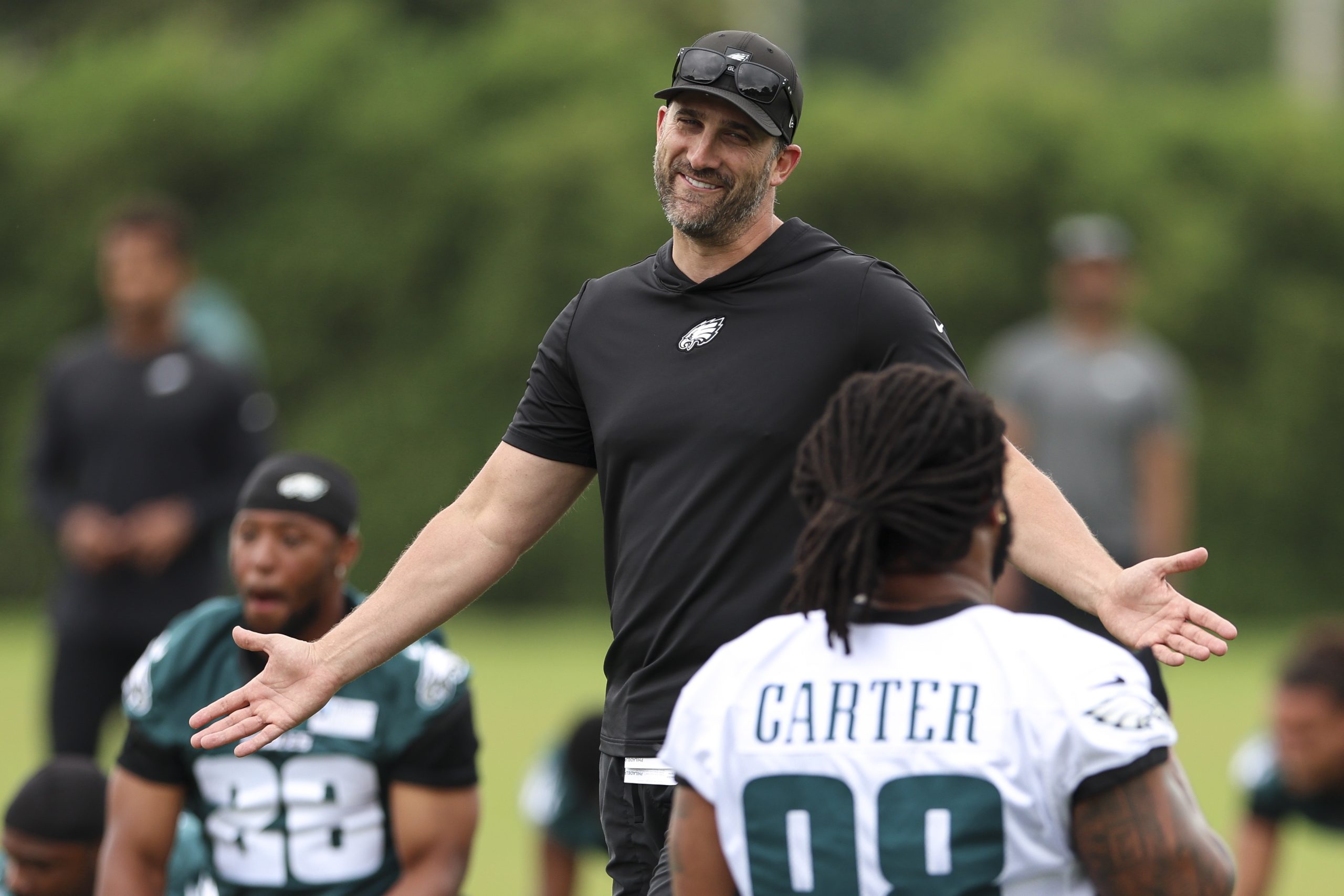
Philadelphia Eagles head coach Nick Sirianni laughs with defensive tackle Jalen Carter during mandatory mini-camp at the Jefferson Health Training Complex on Wednesday, June 10, 2026, in Philadelphia.Monica Herndon / Staff Photographer
Nick Sirianni’s AI pep talks: D
The robots aren’t taking over the Eagles playbook just yet. Instead, Nick Sirianni says he’s been using ChatGPT to find inspirational sports stories to share with his players, according to The Athletic.
Somewhere, decades of coaches who relied on Remember the Titans, grainy YouTube highlight reels, and laminated printouts with motivational quotes are shaking their heads.
Apparently even locker room speeches have entered the AI era.
It’s objectively funny to imagine Sirianni sitting at his computer typing, “Give me a great relentless effort true sports story,” before walking into a room full of NFL players.
Then again, maybe this is just what coaching looks like in 2026. At least he’s using ChatGPT to inspire the team — not to draw up game plays.
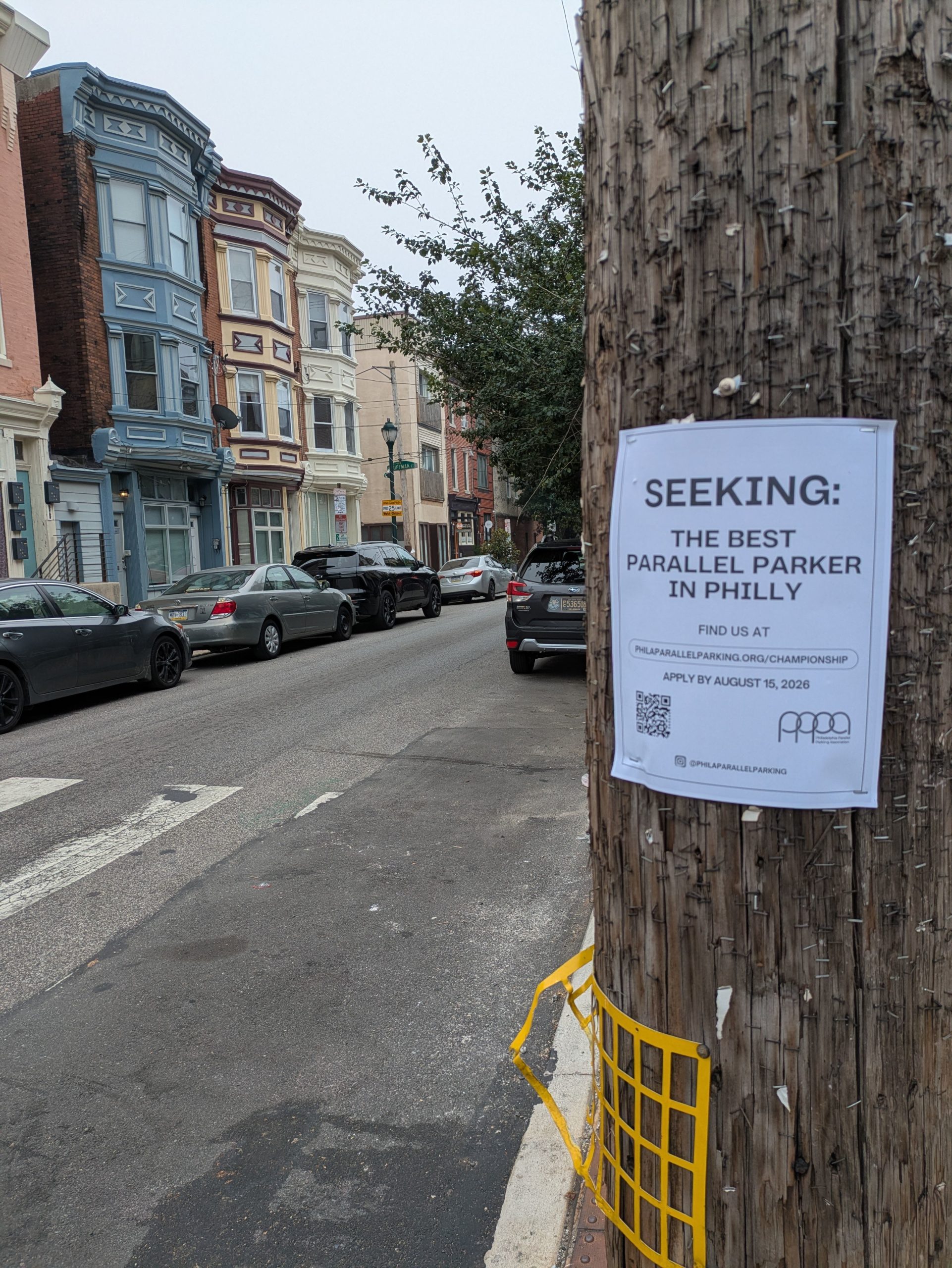
A sign advertising the 2026 Philadelphia Parallel Parking Association Championship is affixed to a pole across from some fine examples of parallel parking in the city.Courtesy of Adam Wodka
Competitive parallel parking: A
There are two types of Philadelphians. Those who dread parallel parking, and those who quietly believe they’re among the best to ever do it.
This is a city where successfully squeezing into a parking spot the size of a shoebox earns applause from strangers, where people take it personally when someone leaves three feet between bumpers, and where every South Philly resident has at least one story about fitting into a space they probably shouldn’t have.
The organizers somehow made it even more Philly by including an “under duress” category, complete with a savesies chair, an angry neighbor yelling that the spot is reserved for their granddaughter, honking traffic, and other distractions. That’s less a competition than an average Tuesday.
The winner gets $76… just enough to cover your next parking ticket, and the most Philadelphia prize imaginable.
The worst part? Players from the Nationals, Yankees, and even the Dodgers got it right. Come on, Bryce. You’ve spent years playing in the birthplace of American democracy. We weren’t expecting a dissertation on the Continental Congress, we just wanted 1776. Heck, the basketball team that plays across the parking lot isn’t called the 75ers.
Then again, if the price of 40 home runs is occasionally forgetting what year America declared independence, that’s probably a trade Phillies fans are willing to make.
$1,500 in Philly rent: B
Nobody is going to look at 591 square feet and say, “Wow, what a palace.” That’s about what $1,500 a month gets you in Philadelphia, according to a new RentCafe study. It’s smaller than the national average and not even enough for a typical one-bedroom apartment.
But perspective matters.
In Manhattan, the same $1,500 gets you about 210 square feet — roughly enough room for a bed, a mini fridge and an existential crisis (a dorm room, essentially). In Boston, it won’t even cover a studio.
So suddenly, Philly’s 591 square feet starts looking… respectable.
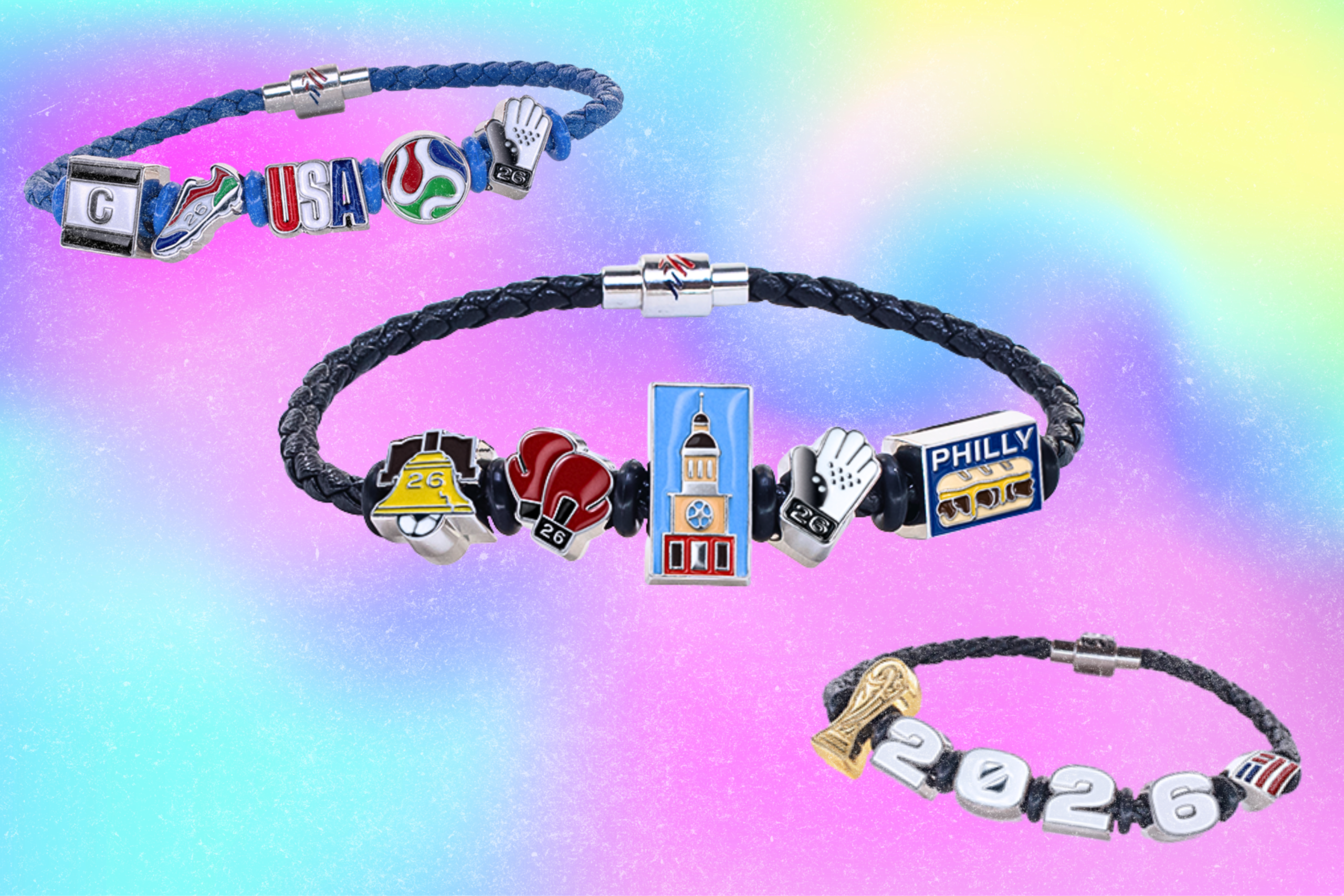
A free charm bracelet available at FIFA Fan Festivals nationwide, including Philadelphia’s in Lemon Hill, had fans waiting hours in line to get one. Bank of America is behind the coveted Fan Bands, drawing hours-long lines.Emily Bloch / Staff illustration / Bank of America
Nothing stays free for long: A-
The World Cup ended, everyone went home, and right on schedule, the internet got to work.
Remember those free Bank of America charm bracelets that had people waiting in line for hours at Lemon Hill?
Honestly, you almost have to respect the hustle. If someone is willing to pay $150 because they didn’t want to stand in a four-hour line for a tiny cheesesteak charm, that’s capitalism doing what capitalism does.
After the blockbuster trade with the Boston Celtics that brought Jaylen Brown to Philadelphia, you might be forgiven for thinking new team president Mike Gansey was done adding stars. But that deal kicked off rumors that one of the game’s all-time greats, LeBron James, could also ply his trade in South Philly.
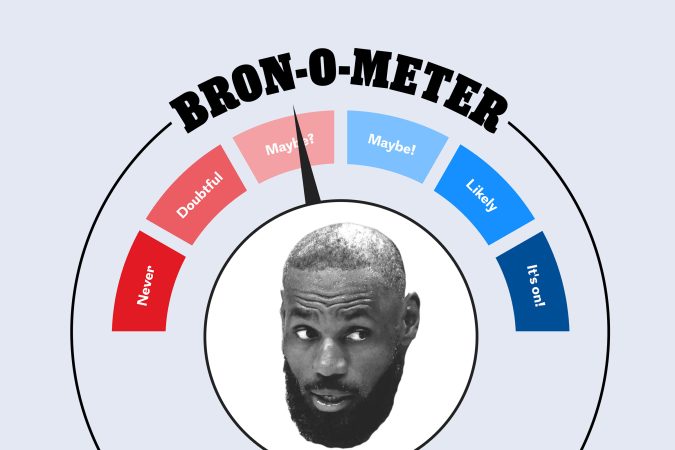
Despite the initial talk linking him with a return to Cleveland or Miami, “King James” confirmed on June 24 that he’ll be a Sixer. We tracked it all with our initially unscientific Bron-O-Meter. He’s how it all unfolded…
Latest updates
Here's a look back at all that's happened since James informed the Lakers on June 30 that he'd play his 24th NBA season elsewhere, and how each moment impacted the vibes around him potentially joining the Sixers …
news
July 24, 11:43 a.m.
This is not a drill.
In a series of posts on X, LeBron James confirmed that he is bringing his talents to South Broad. According to ESPN, he agreed to a two-year contract with the Sixers on Friday in one of the more improbable roster additions in Sixers history.
“I believe I can help make the Philadelphia 76ers a championship team and I am so excited to energize a new fan base and start this incredible journey one last time.” said James on X while confirming the news.
Get the latest on the Hall of Famer’s move to Philly in our live blog.
news
July 22, 8:32 a.m.
Talk about a whoopsie. A member of the Miami Heat’s social media staff posted a link Tuesday night for a July 27 livestream titled “LeBron James Introductory Press Conference.” The post was later deleted and a Heat spokesperson told ESPN that the team was preparing for the possibility of James signing in Miami and accidentally posted the link to the team’s YoutTube page.
Needless to say, the errant post sent the internet into a frenzy, but it’s not hard to imagine how it happened. All the teams reported to be finalists for James — and the news organizations that cover them — are similarly preparing just in case he picks their city. It’s just that one of them jumped the gun. The real question is whether it was truly an accident, or if Miami knows something the rest of us don’t.
story continues after advertisement
podcast
July 21, 11:47 a.m.
Mark J. Terrill
The waiting game continues. Rich Paul, LeBron James’ agent and longtime friend, reiterated that there’s no timetable for a decision from his client.
“We're not going to be rushed,” Paul said on the latest episode of his Game Over podcast with Max Kellerman, which was released Monday evening. “We're not going to be rushed. It's his choice to make and when he makes the choice, he'll make it.”
Paul added that a decision could come at any time — “It could be 48 seconds [from now]. It could be 48 minutes.” — and that there’s nothing teams can do at this point to sway King James.
“There's been several people to call and say, ‘Hey, Rich, is there anything more we should be doing? We could be doing?’” Paul said. “And my answer is, ‘No. We don't need you to go above and beyond about anything. We understand it. It's clear. All the messages have been sent.’”
If people were taking Tyrese Haliburton’s mention of “Year 76” as a possible hint that James is coming to Philly, then those same people might notice Paul twice mentioned the number 48. First seconds … then minutes … next would be hours. The 1982 movie 48 Hours was set in San Francisco. Is it a sign LeBron is headed to the Warriors? If we’re going to read the tea leaves, let’s read all the tea leaves.
report
July 20, 4:24 p.m.
After LeBron was spotted meeting Gov. Josh Shapiro and Sixers owner Josh Harris while in New York City for Fanatics Fest, it doesn't appear the prized free agent’s top three teams have changed. According to ESPN's Shams Charania, the pitches are in and "the choice is LeBron James' right now." The Sixers, Cavaliers, and Heat remain the possible landing spots.
"All of the information is in, the teams are set, everyone has made their moves," Charania, who said he spoke with James' agent Rich Paul earlier on Monday, reported on NBA Today. "There is no decision or choice yet. There's no timetable on a choice of a team. … My understanding over the past couple weeks, that the focus has been primarily on the Eastern Conference teams, being Cleveland, Miami and Philadelphia."
podcast
July 17, 1:34 p.m.
LeBron James continued making appearances at Fanatics Fest In New York City Friday, and during one of them — a live recording of The Shop — the 41-year-old future Hall of Famer sent the crowd into a frenzy when he said he wants to play for a team that “trusts the process.”
While “The Process” was both a rebuilding period for the Sixers and Joel Embiid’s nickname, James went on to say that he has been using the phrase for his entire career, and that it was not a reference to the Sixers or their former motto.
story continues after advertisement
podcast
July 17, 9:58 a.m.
LeBron James made a pair of appearances Thursday at Fanatics Fest, and shared his first public comments since his free agency began. While James didn’t say much at either — first on a live recording of Mind the Game podcast, and then on CNBC’s Boardroom — he did hint that a decision could be coming soon, saying that he “won’t hold you guys up too much longer.” He also hinted that his 24th NBA season may not be his last.
report
July 15, 12:53 p.m.
Chris Szagola / AP
ESPN reported that the Sixers’ three biggest stars have all been in touch with LeBron James, with Tyrese Maxey leading the team’s pitch to the superstar free agent.
“As LeBron James' free agency decision extends into its second week, the Philadelphia 76ers have kept up their pursuit of the four-time NBA champion through three of their players, league sources told ESPN,” Dave McMenamin wrote. “Tyrese Maxey, Joel Embiid and Jaylen Brown have all been in communication with James, sources told ESPN on Tuesday, with Maxey leading the charge. … Sources told ESPN's Shams Charania on Tuesday the Sixers remain one of the top potential destinations for James, along with the Cavaliers and the Miami Heat.”
reporting
July 14, 5:29 p.m.
Gansey told the Inquirer that “we’d love to have [LeBron] in Philly. I think he’d really, really help us and add to our group. But he’s making a big decision here. It’s wild [that], at his age, he’s playing at such a high level.”
“I have all the respect in the world for him, and he’s smart as heck. He’s going to figure it out and talk to his family, and we’ll be waiting. Whatever he decides, I know he’s going to make the right decision.”
interview
July 11, 11:34 a.m.
Rich Paul, LeBron James’ agent, is in Las Vegas for NBA Summer League, and joined ESPN Friday night to discuss James’ free agency. In addition to saying there’s no timeline for a decision — "I just tell him take your time, [and] whenever you’re ready, just let me know," he said — Paul added that his client and longtime friend isn’t “chasing a ring” and is “not worried about nobody’s opinions.”
That could be taken a couple of different ways by Sixers fans: a negative, since their team arguably gives him the best fit and best chance to win; or a positive, since some have said that LeBron finishing his career in Philly would be awkward, especially compared to places like Cleveland or Miami.
podcast
July 10, 4:22 p.m.
Rich Paul dropped another episode of his Game Over podcast with Max Kellerman on Friday, and was asked about Tyrese Maxey being the main draw in Philly. His response? “First of all, none of these lists [of teams] are accurate, what you’re seeing out there. No one knows what the list looks like.”
While that wasn’t the question — and was certainly an interesting start to his answer — Paul went on to outline some of the reasons Maxey is at the top of the list of reasons his client would want to play for the Sixers. But he also talked about Joel Embiid, the Jaylen Brown trade, and more.
report
July 10, 2:19 p.m.
While attempting to temper Cavaliers fans' expectations during a radio hit in Cleveland, ESPN's Brian Windhorst said he "had somebody on the phone with me today that I consider a good source who was swearing it's a done deal in another city [outside of Cleveland] a couple hours ago."
"And so, I am being very, very cautious. Right now, it's too scattered," Windhorst said. "I also know how LeBron has operated. They have kept their circle very tight. … I'm hearing rumors all day long, and all of them make some level of sense, and all of them make some level of not sense. So I'm just telling you: Cleveland is not the only place where there are rumors."
social
July 9, 5:26 p.m.
Two Philly sports stars — including one of the newest Sixers — made public pitches to James on Thursday. First up was Saquon Barkley, who said he’d tell LeBron that he’ll be “remembered forever” if he brings a championship to Philly.
Later in the day, Jaylen Brown used an appearance with streamer iShowSpeed during the France-Morocco World Cup quarterfinal to have Speed, an Ohio native whose real name is Darren Watkins Jr., to court James to the Sixers.
report
July 9, 8:06 a.m.
ESPN's Brian Windhorst reiterated how impactful Tyrese Maxey could be in the Sixers' recruitment of James, but also said on First Take that other teams “are skeptical” they can compete with Cleveland in the recruiting process. He did, however, point out another reason the Sixers are a compelling option:
"What I suspect is going to be important to him is he is going to get through the regular season without having to go to extraordinary measures. Without having to play 38 minutes per game, take 25 shots. I think Philly can make a compelling case that they would not tax him too much, that he could save up his body for the postseason. … But so can Cleveland. Cleveland has a buildout just as strong as Philly and they are home. That's what everybody out there is worried about. Can anybody make a more compelling case on the roster than Cleveland and more compelling on the home front than Cleveland? The teams out there that I've talked to are skeptical. They don't know for sure, but they're skeptical."
opinion
July 9, 5:01 a.m.
Inquirer columnist Marcus Hayesisn't buying the hype, and outlined all the reasons why he believes James doesn't actually want to be in Philly, adding that "LeBron’s representatives are using this (feigned) interest as leverage to land the King elsewhere."
"I don’t think he wants to be in Philadelphia, which is a much tougher city than anywhere else he’s played. I don’t think he wants to deal with an organization with anabsentee owner and afirst-time top executive. I don’t think he wants to be associated or represent one of the most dysfunctional organizations in major league sports over the past 14 years, and with the NFL’s Jets, Raiders, and Browns in that mix, that’s quite an accomplishment. I don’t think he wants to play for the NBA veteran minimum, which is all he’d get at this point."
While not ruling the Sixers out, Brian Windhorst reported Tuesday thatthere is a "vibe" suggesting the Cavaliers are the most likely destination for James. He also added some more teams — the Warriors, Nuggets, and Timberwolves — back into the mix.
“While there is a ‘vibe’ pointing toward the Cavs, coming off their best non-LeBron season in more than 30 years and signing Donovan Mitchell to a four-year maximum contract extension, other teams are not counting themselves out,” Windhorstwrote. “The Golden State Warriors, Denver Nuggets, Minnesota Timberwolves, and Philadelphia 76ers each believe they have a compelling case, per sources."
He doubled down on Wednesday:
podcast
July 8, 9:00 a.m.
Bob Myers, the president of sports for HBSE and the man who led the search to replace Daryl Morey (and hire Mike Gansey), was a guest on the Game Over podcast andpitches the Sixers directly to LeBron's agent and longtime friend, Rich Paul.
“If he was here, I’d say I honestly believe [Philly] is your best chance to win,” Myers said. “… What I would just say is, if it’s about winning, let’s talk about this team. Because you can win here in Philly.”
report
July 7, 6:24 p.m.
ESPN's Shams Charania reported that the Sixers are one of the top-three teams in the running to land James, along with the Cavaliers and Heat.
analysis
July 7, 5:01 a.m.
Gina Mizellbroke down some backup options for the Sixers if their pursuit of James comes up empty. Obviously none are as impactful as the four-time MVP, but there are still some quality veterans — and familiar faces — available on the free-agent market.
opinion
July 6, 5:01 a.m.
Inquirer columnist David Murphy outlinedwhy you can't rule out LeBron to Philly: "The Sixers do offer James a chance to do something novel. You can’t say that about many of his potential landing spots."
social
July 4, 10:21 p.m.
James was spotted in Cleveland over July Fourth weekend with some former high school teammates, including with Cavaliers assistant GM (and longtime friend) Brandon Weems, whom Paul previous said was "basically LeBron's brother."
podcast
July 3, 6:00 a.m.
Paul outlined James' possible landing spots on Game Over, and included the Sixers among them,launching a million consipiracy theories and causing Sixers fans to ask, "Why was Maxey the only player with a star next to his name?" and, "Why were the Sixers the first team added to the board?" The four other teams listed among the top contenders were the Cavaliers, Heat, Timberwolves, and Nuggets.
report
July 2, 3:30 p.m.
ESPN's Shams Charania and Brian Windhorstboth signal the Sixers are seriously in the mix for James and outline their potential pitch.
social
July 1, 8:11 p.m.
Steven Gansey, the younger brother of new Sixers president of basketball operations Mike Gansey,posted a photo on X of his sibling alongside James during their time as high school basketball players in Ohio.
news
July 1, 6:33 p.m.
The Inquirer confirmed that the Sixersacquired Jaylen Brown from the Celtics in exchange for Paul George and four draft picks.
report
July 1, 11:04 a.m.
ESPN's Shams Charania reported that James is willing to play for a veteran minimum.
podcast
July 1, 6:00 a.m.
Paul told Game Over podcast cohost Max Kellerman thatbetween 12 and 14 teams have reached out about his client, and says that it's not about money.
report
June 30, 1:07 p.m.
The Cavaliers, Heat and Warriorsemerged as the initial suitors for James, according to NBA insiders Chris Haynes (NBA on Prime), Jake Fischer (SteinLine), and Brian Windhorst (ESPN).
report
June 30, 12:03 p.m.
James informed the Lakers he's leaving Los Angeles and will play his 24th NBA season elsewhere.
Staff Contributors
Design and Development: Sam Morris
Reporting: Matt Mullin
Editing: Matt Mullin, Sam Morris, and DeAntae Prince
Photography: AP
Subscribe to The Philadelphia Inquirer
Our reporting is directly supported by reader subscriptions. If you want more journalism like this story, please subscribe today