When Amber Ayrer bought her Vineland home 25 years ago, she envisioned growing old there, enjoying lazy afternoons with the windows open and a view of farmland from her front door.
After her adult daughter, Ally, suffered a traumatic brain injury, Amber made the rancher accessible, installing a ramp that aides use to push Ally’s wheelchair outside for her daily walks.
The place had all the makings of a forever home, Amber Ayrer said — until a massive AI data center moved in across the street.
Now, the 71-year-old looks out her front windows at the hulking DataOne facility, a windowless compound surrounded by walls and metal fences.
In recent months, Ayrer said, the 2.4-million-square-foot complex has emitted a near-constant hum. She struggles to sleep, she said, and has suffered from headaches. She turns the TV on to mask the sound.
Residents who live farther away have also complained about the noise, including in a recent lawsuit that was thrown out due to procedural issues. In the suit, residents said the Cumberland County Department of Health measured the hum as higher than 50 decibels a mile away in the middle of the night. A sound higher than 50 decibels is equal to a running refrigerator and is 10 times louder than a typical suburban area at night.
Ayrer, who was not involved in the lawsuit, said she doesn’t want to move, even as she sees neighbors sell their homes to the data center developers.
“In order to get another home, I’d have to get one built” to be accessible, Ayrer said, standing in her entryway. She shrugged, adding, “I need to be here for my daughter.”
The noise had quieted, she noted, since around Sept. 22. That’s when the New Jersey DEP ordered the data center to pay a $1 million fine for running 62 gas generators without the required permits. She isn’t sure why the hum stopped, or whether it was related to the fine.
By late Wednesday, the sound had returned, she said, and she worried it would be even louder when the center is fully operational.
The Ayrers are some of the first Philly-area residents to live in the shadow of a massive AI data center. Only a handful of homeowners live within eyesight of DataOne’s South Lincoln Avenue complex in Vineland.
They used to have more neighbors. But since 2025, DataOne Vineland and LJR Real Estate — which is registered to the address of Northeast Precast, a local company that has partnered with DataOne — have purchased at least five surrounding homes for a combined $3 million, according to online property records.
DataOne and Northeast Precast did not respond to requests for comment about the acquisitions. Several former Vineland residents who sold their homes to these companies could not be reached or declined to comment.
Asked about residents’ concerns, DataOne spokesperson Naomi Rice shared a previous statement, which said in part that the facility was “transitioning to low-emission, quiet fuel cells.” These generate energy through an electrochemical reaction rather than combustion, pistons, or rotating machinery.
Nebius Group, which is operating the center’s internal AI infrastructure, says the fuel cells from Bloom Energy — a company expanding locally — and enhanced sound mitigation will make for a quieter environment than what residents experienced during construction, according to spokesperson Ava Iuliucci.
Charles-Antoine Beyney, DataOne’s founder and chief executive officer, previously said the Vineland center would use “breakthrough” technology to reduce its environmental impact. He said the complex would be a good neighbor, promising a vertical farm — which uses technology to grow crops indoors — to help feed Vineland residents in need.
“Most of the data centers that are being built today suck, big time,” Beyney said in January.
“No freaking way am I going to do what the entire industry is doing … just killing our communities and killing our lungs to make money.”
What it looks like near a South Jersey data center
The Vineland DataOne center, as seen in June, could be finished by the end of the year, developers have said. Tom Gralish / Staff Photographer
The dark exterior of DataOne abuts busy South Lincoln Avenue, towering above homes and farms on the outskirts of Vineland City. In spots, rows of crops extend to the data center’s walls.
On a recent day, the data center appeared abuzz with activity, although residents said it was relatively quiet, as cars and yellow school buses drove in and out of its gated-off parking lot. Giant “no trespassing” signs are prominently displayed.
While the front portion of the data center appeared complete, cranes farther back reached into the sky.
Meanwhile, several large homes across from the entrance — purchased by the data center developers and associates — appeared abandoned, with recycling cans askew in the driveways, indoor and outdoor lights on in the middle of the day, and swing sets sitting empty in the backyards. No one answered the doors.
At another home, a woman shook her head, saying she’d lived there forever and would never speak publicly about the development across the street.
DataOne, a French company that manages advanced data centers, is the owner, operator, and builder of the Vineland data center. Its client, Nebius Group, an Amsterdam-based AI-infrastructure company, operates the center’s internal technology, which fuels Microsoft’s AI tools.
As demand for these facilities has surged, so has the controversy surrounding them. Across the country, proposed complexes have received fierce pushback from nearby residents concerned about environmental, noise, quality-of-life, and property-value impacts.
Several of these facilities have been proposed in the Philadelphia region, from King of Prussia to Limerick. But few plans have been approved.
DataOne Vineland could become the region’s first hyperscale AI data center. The developers have said the complex is partially operational, and they expect it to be complete by the end of the year.
Construction continued on the DataOne center as seen from a nearby home in June.Tom Gralish / Staff Photographer
Theresa Lewis, who has owned her home for 47 years, said living by the data center has gotten worse in recent months.
Stepping outside and seeing the building, “I think of a prison, and I’m the prisoner with the noise,” said Lewis, 74, who compares the sound to a tractor trailer idling outside her home all day and night.
“You get up in the morning and you’re in a foul mood,” Lewis said.
Both she and Ayrer said they have called the Cumberland County Department of Health to report excessive noise in the middle of the night, but doing so comes at a cost. They said they then have to get up, get dressed, turn the lights on, and wait for an official to come take a decibel reading, making for another sleepless night.
Data centers are being built in different communities
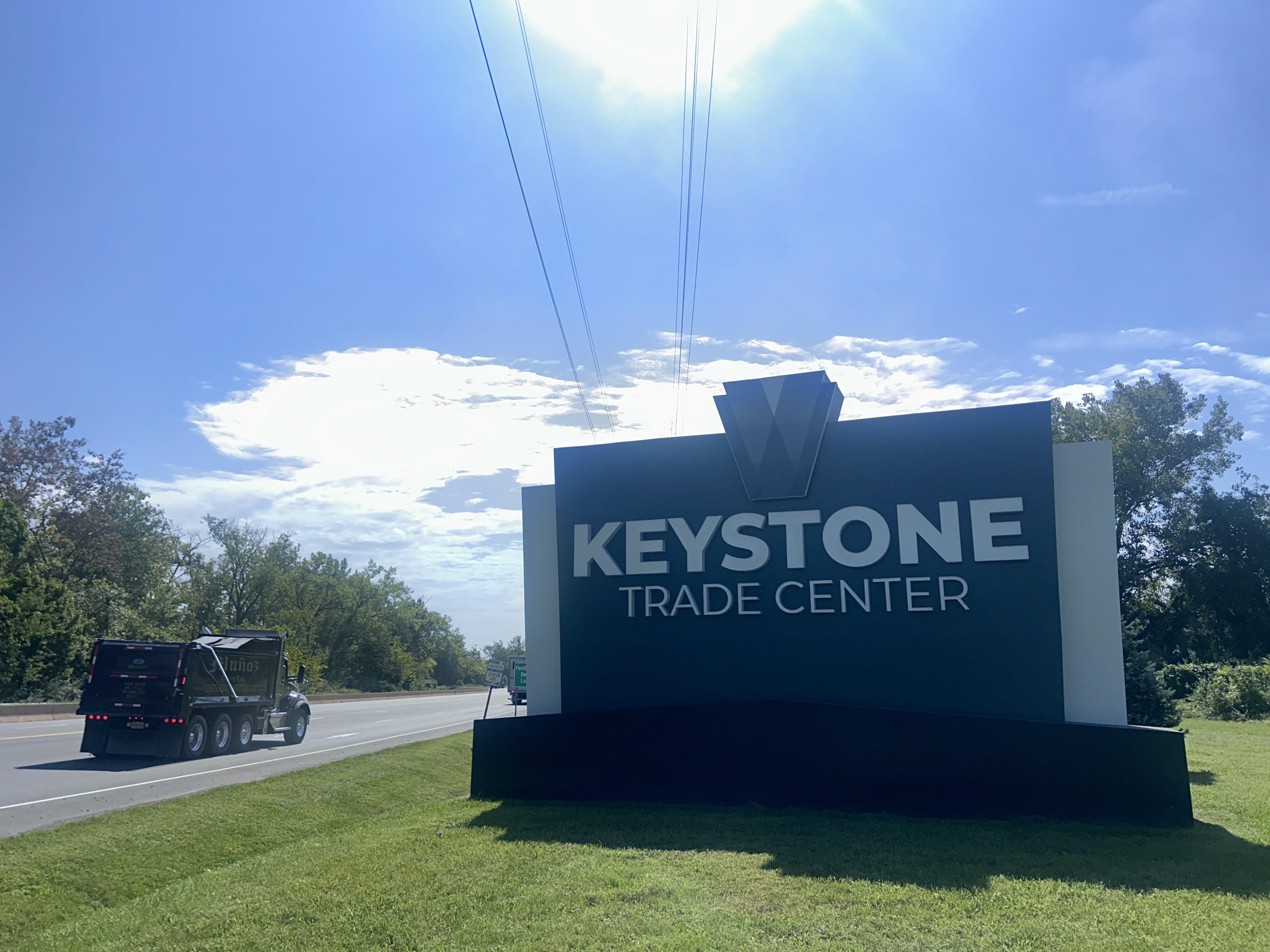
The view outside the Keystone Trade Center in Falls Township. Amazon is building a data center inside the private complex.Erin McCarthy/Staff
The scene in Vineland is vastly different from the one outside Amazon’s 2-million-square-foot data center campus in Falls Township, Bucks County, the Philadelphia region’s other facility nearing completion.
That data center sits deep inside the Keystone Trade Center, an industrial hub surrounded by water, with no homes in sight. On a recent day, tractor trailers whizzed by Keystone’s main entrance. Only the transmission wires overhead hinted at what may be inside the private property.
In Vineland, Lewis said she wishes she and her neighbors had a chance to push back against the data center before it was built. Residents were first asked to provide input about the project at a contentious town hall in January, more than a year after the project was approved by city council and months after construction started.
“I don’t want to move — and who is going to pay what the house is worth with that right there?” Lewis said, motioning to the data center across the street. “But I wake up angry.”
She added: “I can’t imagine living next to this for the rest of my life.”
Editor’s Note: This story has been updated to reflect that the noise from the data center returned Wednesday, according to Ayrer.
Gov. Josh Shapiro’s hope for a Democratic state Senate likely hinges on the Philadelphia suburbs, where three swing districts could give his party the majority in the chamber for the first time in 33 years.
Democrats in the Keystone State have zeroed in on the GOP-held seats in the 6th District in Bucks County, the 16th in Bucks and Lehigh, and the 24th in Montgomery and Berks Counties as three of the districts they’re hoping to flip to create a Democratic trifecta in Harrisburg with a possible blue wave in November.
The competitive races in Bucks and Montgomery Countiesare unfolding ahead of this November’s midterm elections when Pennsylvania will also be in the spotlight for Shapiro’s reelection bid and four congressional contests that could determine party control of the U.S. House.
Like most Democrats across the country, Eileen Hartnett Albillar in the 6th District, Mark Pinsley in the 16th District, and Chris Thomas in the 24th are centering their pitch to voters around affordability as Pennsylvanians’ signal their overwhelming disapproval of President Donald Trump’s handling of economic issues and gas prices.
“Individual candidates matter, campaigns matter … but I do think it’s pretty clear that all these elections, to one extent or another, wind up being a referendum on President Donald Trump, and I think that puts Democrats in a very strong position,” said State Sen. Santarsiero, the chair of Bucks County’s Democratic Party. Santarsiero is also running for reelection this year.
Republicans currently hold 27 seats in the 50-member state Senate.Democrats would need to flip at least two seats and hold the governor’s office to take control with the lieutenant governor’s tie-breaking vote.
A Democratic trifecta in Harrisburg — if the party maintains its House majority and flips the Senate — would allow Shapiro in a second term to usher through a minimum wage increase and more transportation funding among other priorities that have been blocked by the GOP Senate.
But Democratic candidates will have to win over independent and even some Republican voters to prevail in the swing districts against GOP incumbent State Sens. Frank Farry in the 6th, Jarrett Coleman in the 16th, and Tracy Pennycuick in the 24th. The GOP has a registration advantage in all three districts, according to state data.
Farry, Coleman, and Pennycuick did not respond to requests for an interview, but the state party projected confidence about their ability to hold their seats.
“Maintaining the majority in the Senate is a top priority for Republicans in Pennsylvania,” said James Markley, executive director of the PA GOP.
He also praised Farry, Pennycuick, and Coleman for their work to lower costs and improve the state’s education system.
“When it comes to majorities in the State House or the State Senate, every seat matters,” he said.
Here’s what to watch.
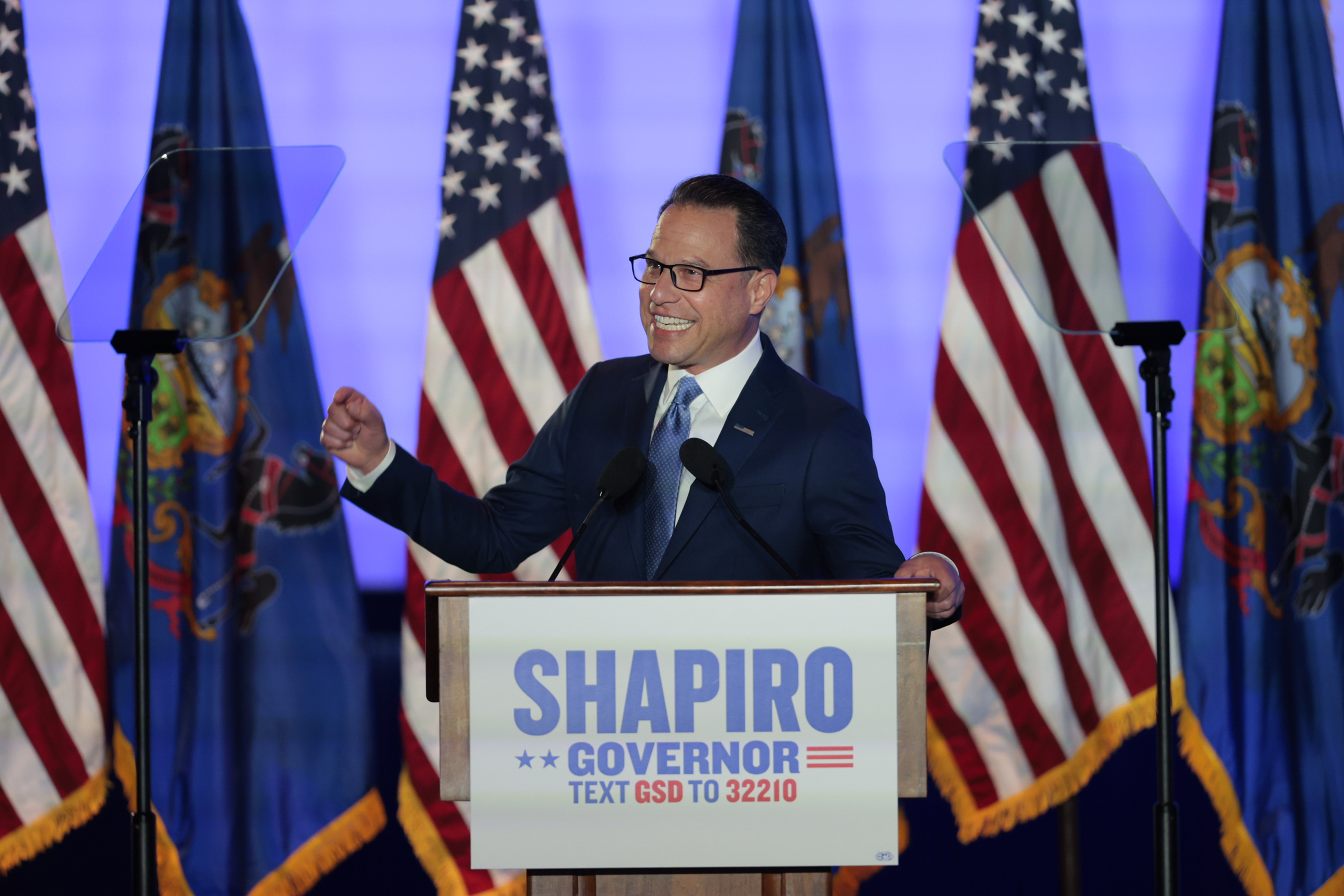
Gov. Josh Shapiro addresses supporters at a primary night part in Warminster on Tuesday, May 19, 2026Steven M. Falk / For The Inquirer
‘You don’t take for granted anything in Bucks County’
Bucks County’s importance ahead of November has been clear for months.
In Warminster last May, Shapiro held a primary night party at a former space centrifuge where he promotedhis reelection campaign and a slew of downballot candidates. There, Hartnett Albillar, who is also the county’s clerk of courts and a social worker by trade, declared: “The path to flipping the Senate runs right through Bucks County.”
As she continues knocking on doors and courting voters in the 6th District, which includes most of the middle of the county, that reality could not be more obvious. But, Hartnett Albillar said, despite Shapiro’s support (he has endorsed all three candidates) and a blue wave in the forecast, she’s not thinking of her election as a shoo-in.
“We know that you don’t take for granted anything in Bucks County,” she said in an interview last month.
That’s because the suburb is notorious for split-ticket voting, she said.
“Democrats have won here in other races, but I believe you have to make your case to voters individually,” Hartnett Albillar said, adding that voters in her district don’t look at party labels.
It’s a dynamic that has, for example, allowed GOP U.S. Rep. Brian Fitzpatrick to maintain his congressional seat even in years Democrats do well — like in 2022 when Shapiro won the county by nearly 20 points.
Pinsley is trying to make that argument in the Upper Bucks County portion of the 16th where voters are less familiar with the Lehigh County controller and where Republicans have a roughly 22,000 voter registration advantage — the largest gap of the three districts.
Eileen Hartnett Albillar (center) is challenging State Sen. Frank Farry in Bucks County’s 6th District.Hartnett Albillar Campaign
This race is also a rematch for Pinsley after he lost by 8 points against Coleman in 2022.
But the Democrat was given another chanceby votersthis year after he succeeded in a heated primary without the Bucks County Democratic Committee’s backing.
Now that he has the party’s support, he says it’s helped him reach a whole new circle of people for his events, including “Pastries with Pinsley,” a regularmeet-and-greet at various coffeehouses in the district, but especially in Bucks. This weekend, he’s headed to the So Fresh So Green Cafe in Perkasie.
“60% of the vote is in Lehigh County, and 40% of the vote is from Bucks County,” Pinsley said in an interview last month. “We need Bucks. We need Bucks to win. You’re not going to win in just Lehigh.”
Across county lines into Montgomery County — Shapiro’s home county, which has a reputation for being deep blue — also lies another swing district that Democrats are investing in as Thomas, a volunteer firefighter and community organizer, hopes to bring Pennycuick’s tenure in the state Senate to a close.
Until now, the 24th District, a hodge-podge of suburban and rural communities in Montco and Berks County that Thomas calls “all-encompassing of Pennsylvania” has “always been just out of reach in terms of how the district was drawn.”
But this year, with a combination of voters’ frustrations and Shapiro on the ballot, Thomas believes “a lot of the stars are aligning.”
“There’s a slim path to the majority without this district,” he said.
But Republicans won’t be giving up these suburban swing districts so easily.
Michael Straw, a spokesperson for the Pennsylvania Senate Republican Campaign Committee, said the GOP is “ready to compete for every vote in Bucks County.”
Straw said in a statement that candidates will highlight the bipartisan bills that lawmakers have introduced and have since been signed into law, including Farry’s legislation to reduce cost barriers for breast cancer screenings and Coleman’s bill to address school safety and increase parental transparency.
“We are making these legislative accomplishments known to voters across the political spectrum,” Straw said.
Both parties are betting on affordability
Heading into November, both Democrats and Republicans are trying to make the case to voters in these key swing districts that they are the party of affordability.
Straw said that Republicans view these elections as an opportunity to emphasize affordability and fiscal responsibility to put “an important check on the Democrats overspending.”
“Senate Republicans have helped to prevent wasteful spending, stop the Democrats’ electricity tax that would have cost Pennsylvanians more, and have supported reducing taxes on working families,” Straw said. “PA Senate Republicans have made affordability the priority while Democrats have repeatedly stood in the way.”
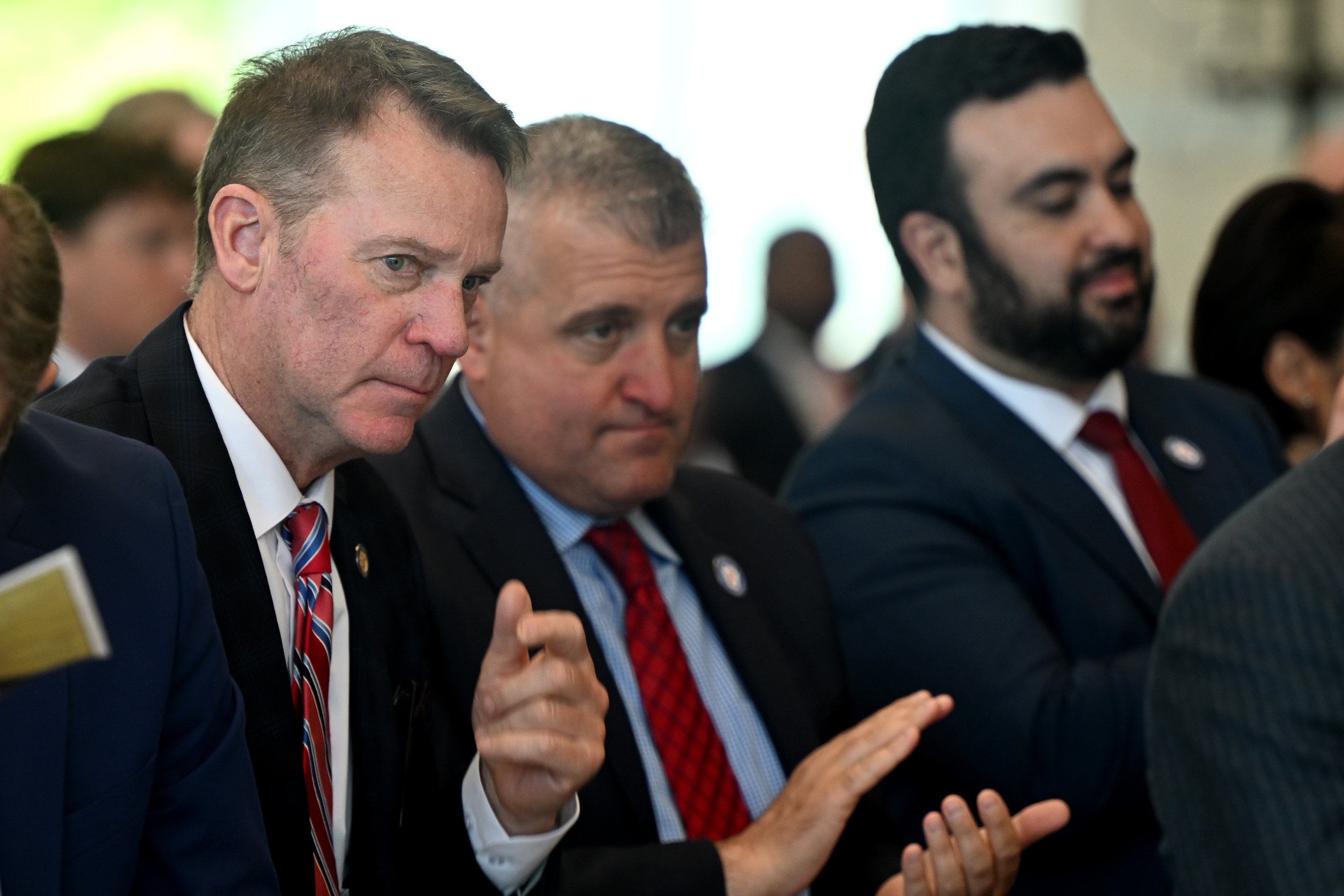
Bucks County GOP State Sen. Frank Farry (center) during a ceremonial meeting of the Pennsylvania Senate at the National Constitution Center May 5, 2026.Tom Gralish / Staff Photographer
And for Democrats, that means addressing voter frustrations that have trickled down from federal policies.
Trump — who has urged voters to think of him as being on ballot — is getting worsening marks on the economy from Pennsylvania voters. The president’s own voters in 2024 are also dissatisfied with his handling of gas prices, polling shows.
“They’re not happy about the Iran war. They’re not happy about the cost of gas. There are other costs that are going up, and many of them do blame the president, and all of these races have been federalized in many ways,” Pinsley said.
In response to the rising costs of living, affordability has taken up most of the oxygen in Democrats’ messaging as the party shifts away from issues that have been prevalent in previous campaigns, such as abortion.
With a focus on prices, the three swing district candidates have not had to switch up their stump speech even when chatting with Republican or independent voters that they’ll need to win over to be successful in November.
Hartnett Albillar said that all voters are simply looking for a “functional” and competent government.
Other key issues popping up in these races include funding for SEPTA and data centers; the latter of which has sparked contentious ads, including one by Hartnett Albillar’s campaign in the 6th District that provoked Farry’s campaign to file a cease-and-desist.
“I’ve heard many times that folks are not looking at whether there’s a ‘D’ or an ‘R’ next to the name,” she said. “They’re looking at the person who will be able to bring change and bring fresh ideas because the current system is not working for us. Costs are way too high, and they want someone who’s going to do the work.”
Fleece fragments in a washer flow into a wastewater treatment plant. A plastic bag blows into a stream. A water bottle washes down a storm drain.
All can end up in the region’s waterways as microplastics smaller than a grain of rice and find their way into drinking water and the stomachs of animals and fish.
This kind ofmicroplastic pollution was detected in 22 stream and river segments across the Delaware River watershed, according to a new survey of waterways by the nonprofit advocacy group PennEnvironment Research and Policy Center.
Researchers analyzed water samples from sites along the Delaware River and its tributaries across Pennsylvania, New Jersey, Delaware, and New York.
The research was conducted in partnership with the nonprofit Environment New Jersey Research and Policy Center. Scientists with the Academy of Natural Sciences at Drexel University helped analyze the results, which were released Wednesday during a news conference at Fairmount Water Works.
Contamination was found in the Delaware and Lehigh Rivers and the Schuylkill. It was found in Neshaminy Creek in Bucks County, Brandywine Creek in Chester County, and Cooper River in Camden County. And it was found along the Christina River in Delaware.
Drexel’s lab analysis confirmed microscopic plastic at every sampled site, highlighting what the researchers say is a widespread environmental threat.
“We can look at a waterway, and it might be free of litter, it might be free of visible plastic pollution, but that doesn’t necessarily mean it’s clean,” said Faran Savitz, an advocate for PennEnvironment. “The big takeaway is that we should be concerned. The depth, the breadth of this plastic pollution is staggering.”
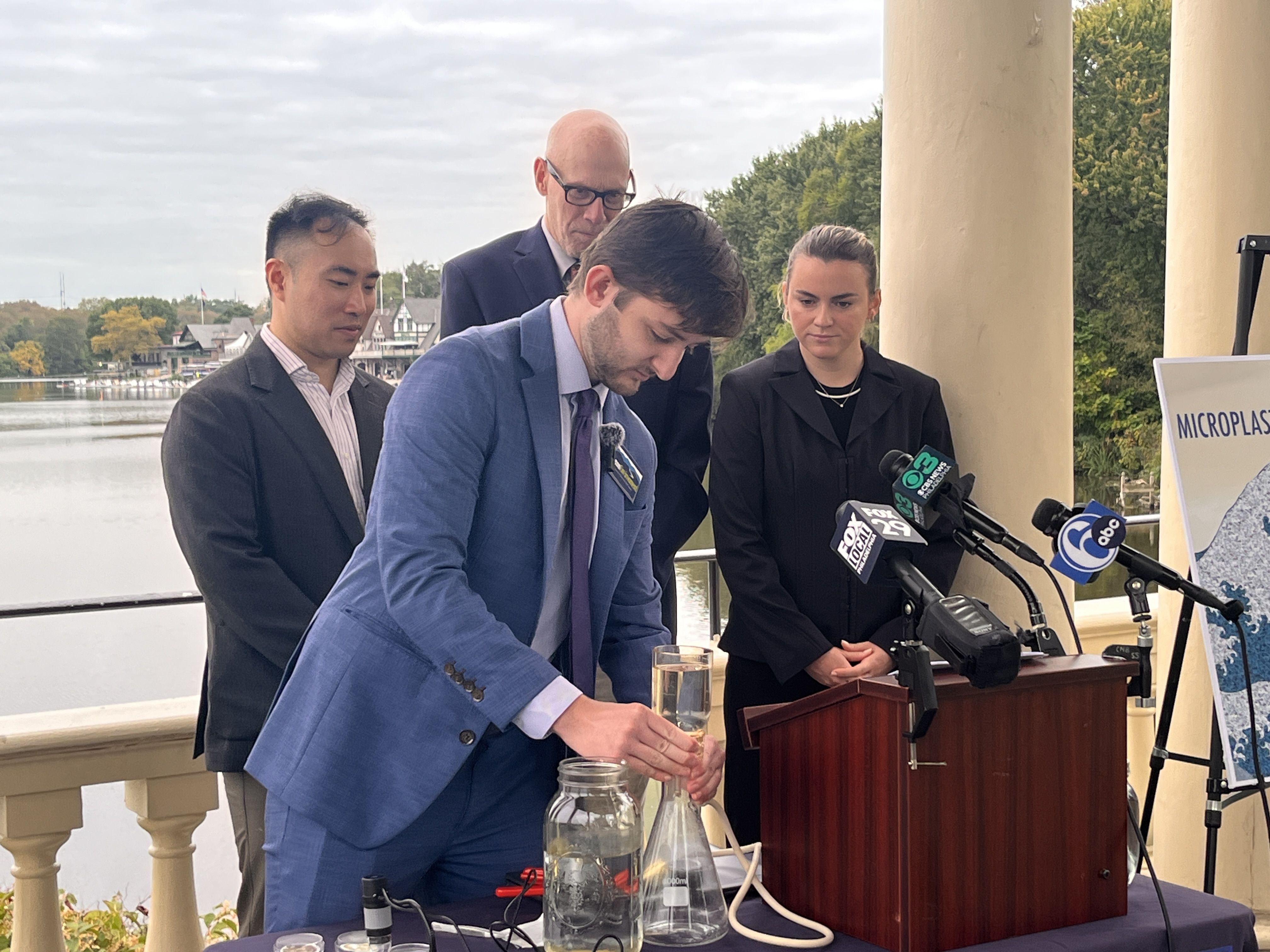
Faran Savitz with PennEnvironment demonstrates water testing. In the background from right are: Lizzy Mulvenna, with Environment New Jersey Research & Policy Center; David Velinsky, senior scientist, Academy of Natural Sciences; and Derek Ho, microplastics researcher, University of Pennsylvania.Frank Kummer
Where do microfibers come from?
Waterways in and around Philadelphia emerged as significant focal points in the survey results.
Samples drawn from the Delaware River in Philadelphia tested positive for multiple categories of microplastics including microfibers, microfragments, and microfilm, as did other waterways. Microbeads, often found in cosmetic products, were also found in the Christina River.
Microplastics are defined as fragments of less than 5 mm in length.
The synthetic microfibers came primarily from clothing and textiles. Rigid microfragments from items such as fishing line were found in 82% of locations. And flexible microfilm from bags and packaging appeared in 77%.
(function(){function e(){window.addEventListener(`message`,function(e){if(e.data[`datawrapper-height`]!==void 0){var t=document.querySelectorAll(`iframe`);for(var n in e.data[`datawrapper-height`])for(var r=0,i;i=t[r];r++)if(i.contentWindow===e.source){var a=e.data[`datawrapper-height`][n]+`px`;i.style.height=a}}})}e()})();
Microplastics have been found in humans
Researchers explained that laundering synthetic garments releases millions of microfibers that wastewater treatment facilities are unable to completely filter out before they are discharged into local streams.
However, because plastic does not biodegrade but continuously fractures into tiny fragments, filters capture only a portion of plastic entering a waterway.
Savitz said PennEnvironment’s study did not release the concentrations of microplastics because it did not want to compare one waterwayor state against another.
The findings carry ecological and public health implications, as microplastics can block digestive tracts in wildlife and absorb toxic chemicals like PCBs and PFAS that bioaccumulate up the food chain, the report stated.
On average, humans ingest approximately 5 grams of plastic weekly, which is roughly equivalent to the weight of a credit card. Microplastics have been found in human blood, lung tissue, and organs, the researchers said.
Plastics are also routinely found in wildlife, including sea turtles, birds, and whales. About 60% of all seabirds have ingested plastic, with that number rising.
The environmental advocates are urging state and local leaders to enact policies such as producer responsibility for plastic packaging, bans on single-use foam and plastic bags, strict limits on pre-production plastic pellets, and enhanced drinking water filtration systems.
Microbeads once used in personal care products were phased out under President Barack Obama in 2015. But many of those products still linger on household shelves.
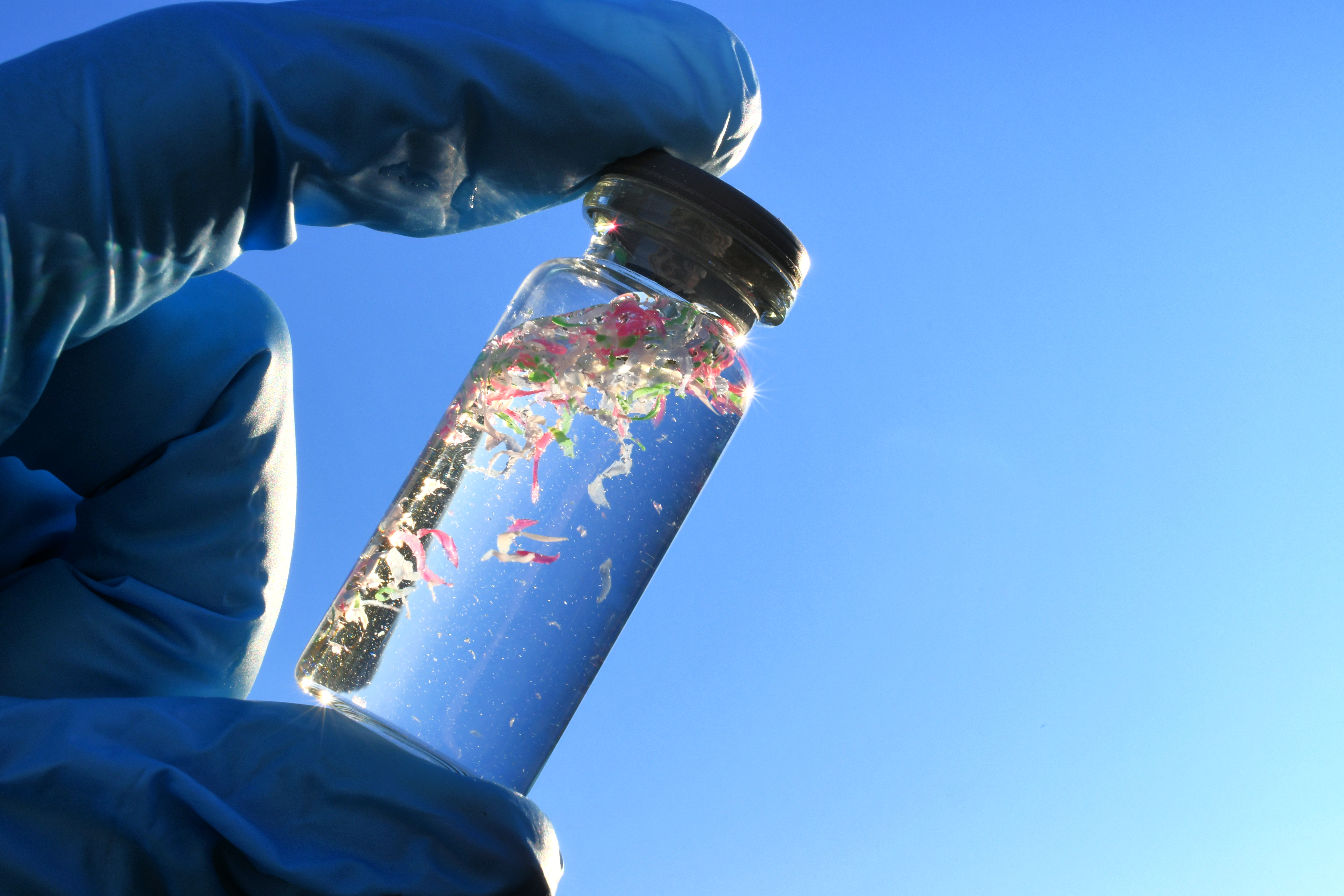
File: A glass vial containing water and microplastic pollutionGetty Images
Philadelphia’s drinking water
Philadelphians get their drinking water from the Delaware River and the Schuylkill. Most microplastics are filtered out at the Philadelphia Water Department’s wastewater treatment plants, but some particlesstill get through.
In 2025, PWD removed 4.6 tons of plastic litter from the Delaware and the Schuylkill, alongside an estimated 1,000 tons of plastic extracted through sewer maintenance, the researchers stated.
PWD said in an online report that it is “unclear whether microplastics pose a danger to human health,” noting that the risk could depend on the level of exposure, the type of plastic, and the size of the particles.
But it noted that research suggests some are harmful to fish and animals and can build up in the organs or bloodstream over time.
“PWD is always investigating advanced treatment technologies that may eliminate microplastics and other impurities,” the report stated.
David Velinsky, a senior scientist at the Academy of Natural Sciences of Drexel University, said, “plastics and microplastics are everywhere, from our clothing to the ubiquitous water bottle.”
When plastics and microplastics are not properly disposed of or recycled, he said, they break down into ever smaller pieces.
They “can travel great distances through both the air and in the water,” Velinsky noted.
A plea for ‘producer responsibility’
To combat pervasive plastics, advocates are urging federal and state lawmakers to enact targeted reforms, including the federal Plastic Pellet Free Waters Act currently before Congress, and state-level producer responsibility legislation for plastic packaging.
Savitz emphasized that shifting financial and operational burdens back onto manufacturers is critical to curbing waste at its source.
At least seven states have passed producer responsibility laws, though not all are in effect, according to the Product Stewardship Institute. Those states include Washington, Oregon, California, Colorado, Minnesota, Maryland, and Maine.
“If we can shift the burden back onto companies that create this waste in the first place,” Savitz said, “we can actually reduce the waste, encourage recycling, and make these broader, more systemic changes.”
A gray plastic tote shook outside the Schuylkill Center for Environmental Education every few minutes Tuesday afternoon, proof that patient 718 was ready to fly.
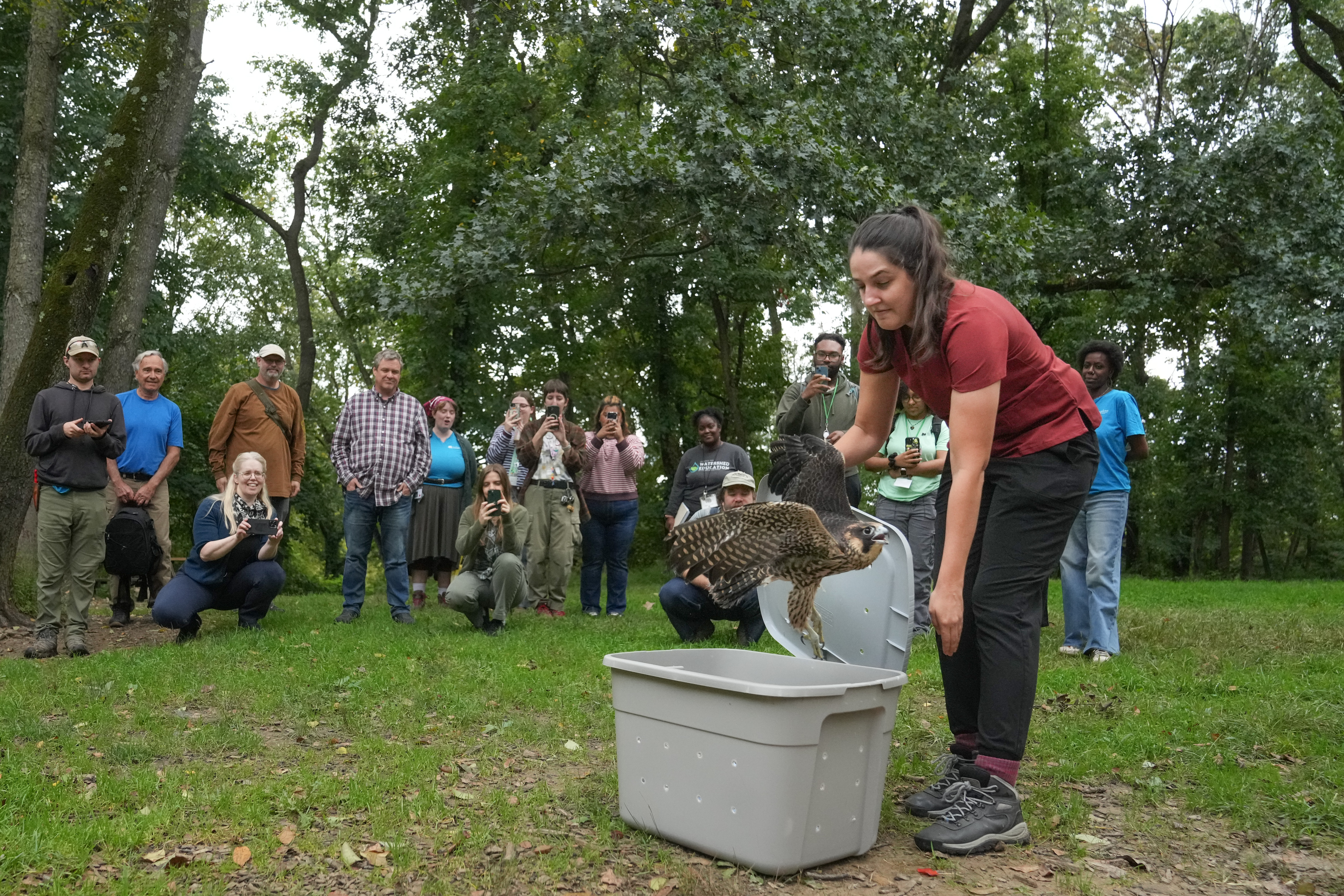
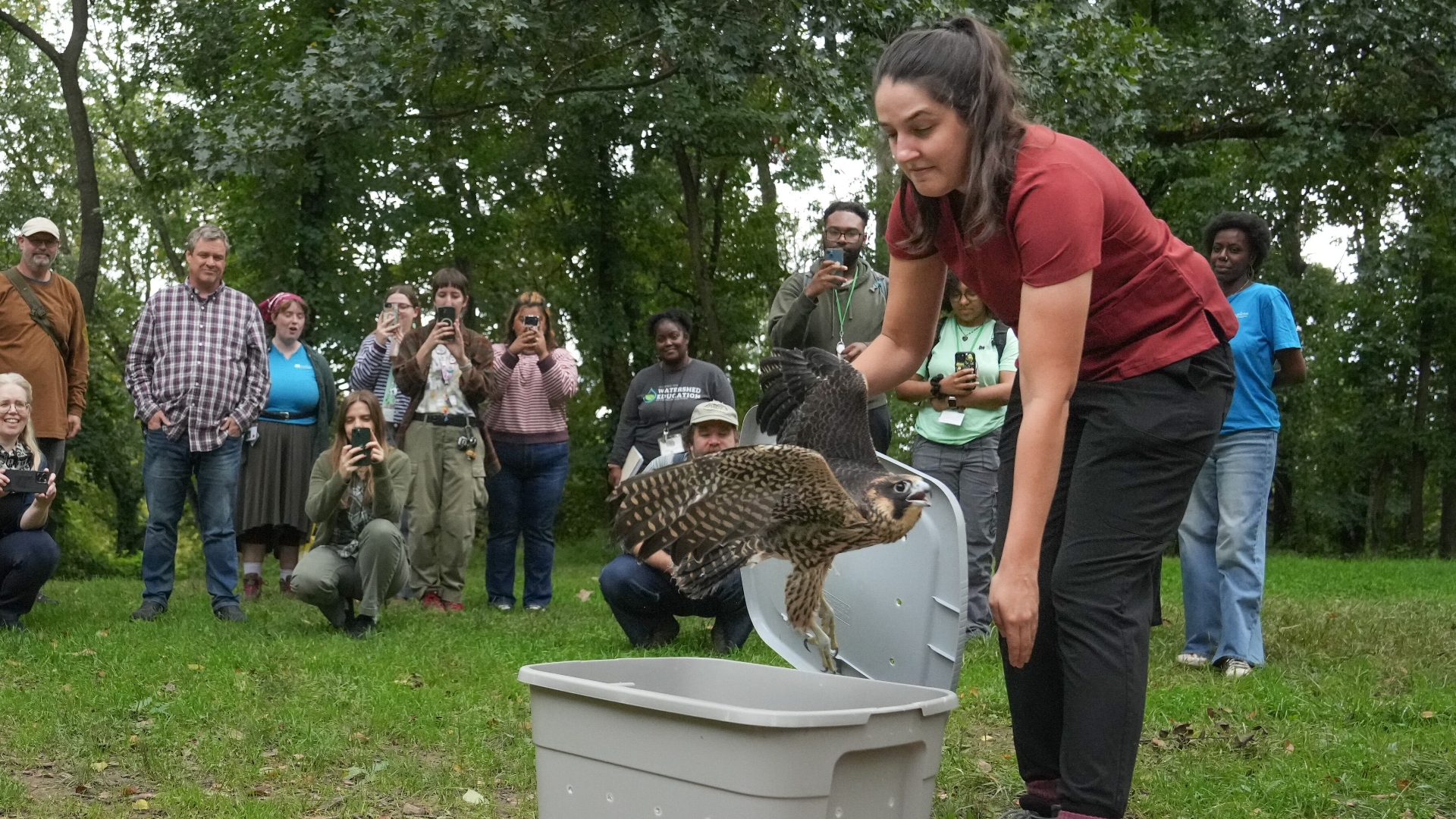
A crowd gathered on the lawn beside it, adjusting shutter speeds to capture the world’s fastest animal. Just after 1 p.m., Sydney Glisan, director of the center’s wildlife clinic, unfastened the bungee cord, removed the lid, and offered the male peregrine falcon a few words of encouragement.
“All right, buddy,” Glisan said. “Today’s the day.”
Video: Peregrine falcon released into the wild after healing from lead poisoning
Like a feathered fighter jet, the bird burst from the tote and bolted for the big trees in Roxborough, letting out a few raucous shrieks as it disappeared.
Patient 718 — animals are rarely named at the Schuylkill Center — arrived thin and sickly on June 4, suffering from high levels of lead poisoning. The bird was found near the entrance of the Philadelphia Museum of Art earlier that day, far below the nest its parents built there.
“He was just kind of sitting there,” Glisan said of 718.
A sibling, who had lower levels of lead poisoning, was also discovered at the museum the same day. That falcon, also a male, was treated at the clinic and released into the wild on July 1.
Glisan said most raptors in the region would test positive for lead, but 718’s levels were “off the charts.” Lead can be found in the soil, she said, from bullets, lead-poisoned prey, and even fishing gear.
At the clinic, 718 received chelation therapy, where a medication binds to the lead in the bloodstream and is then passed by the bird. The falcon received four rounds of chelation over the summer, with recovery breaks.
“It’s hard on the body,” Glisan said, “but he was a real trouper.”
After chelation, the falcon was taken to an aviary, where he practiced flying through an obstacle course that included pool noodles. He aced the test.
“It was fascinating,” she said. “They move so fast.”
Peregrines mostly hunt other birds from high perches and can reach speeds of over 200 mph when dive-bombing on prey.
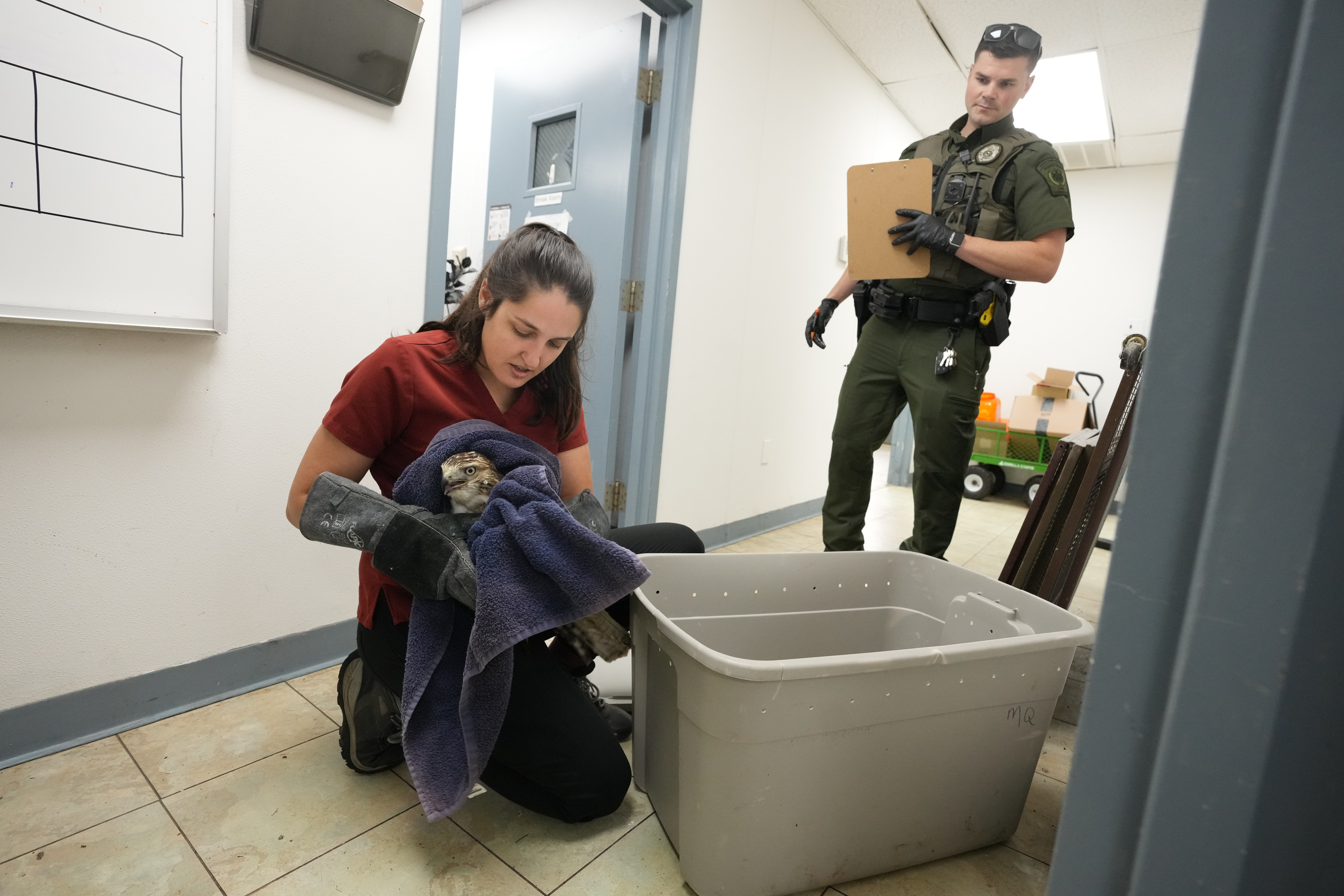
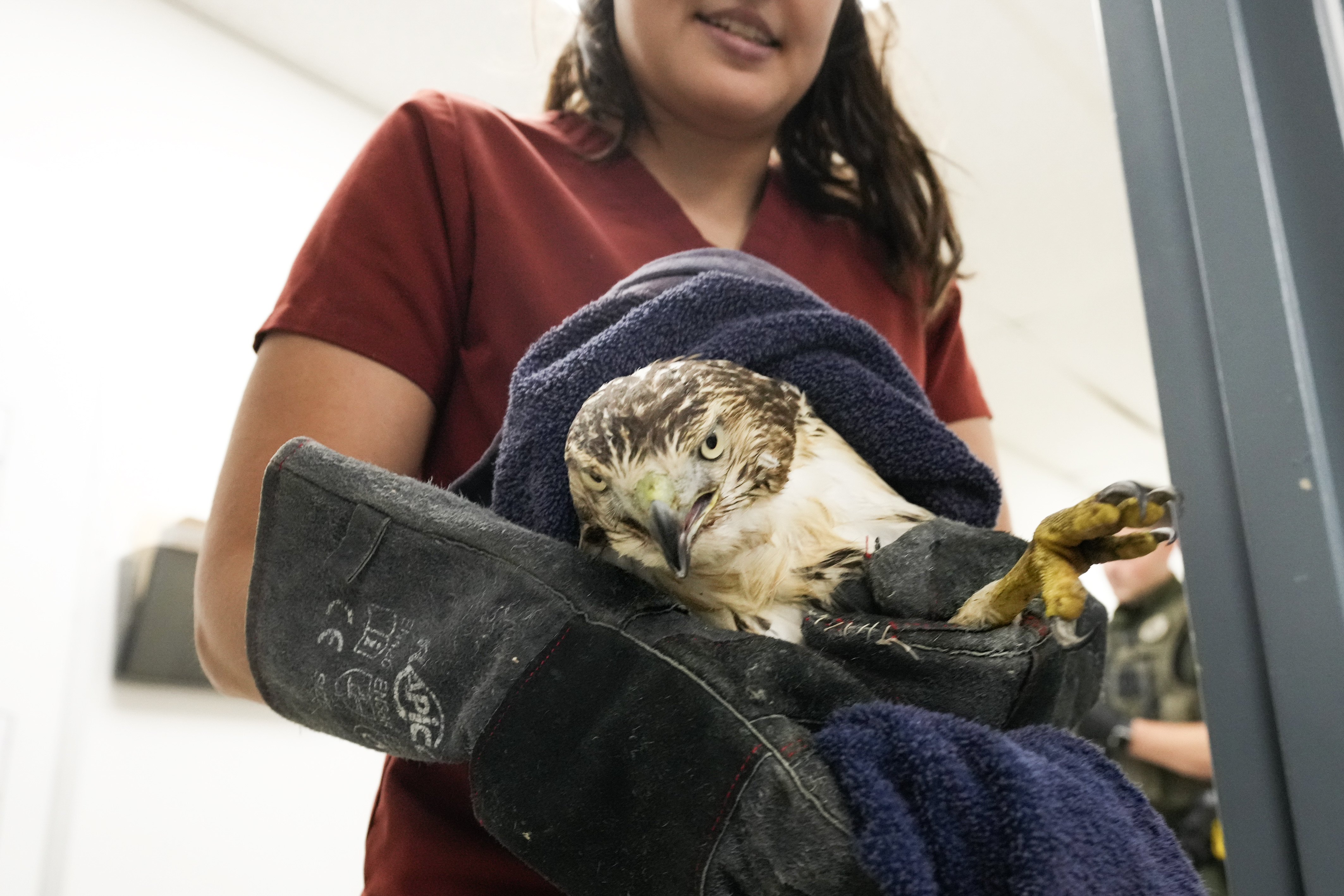
Sydney Glisan, director of the wildlife clinic at the Schuylkill Center for Environmental Education, cares for a red-tailed hawk who was brought into the clinic on Tuesday.Jessica Griffin / Staff Photographer
Glisan said 718 would probably find his own territory and not return to the art museum. She said there are at least three active peregrine nests in Philadelphia, including one at City Hall.
Sydney Glisan, director of the wildlife clinic at The Schuylkill Center for Environmental Education, cares for a red-tailed hawk who was brought into the clinic Tuesday.Jessica Griffin / Staff Photographer
As of Tuesday afternoon, the Schuylkill Center has treated 1,775 animals this year, including numerous species of birds, gray squirrels, and rabbits. More were coming in by the minute, including a red-tailed hawk with an injured talon and a baby squirrel that tangled with a dog.
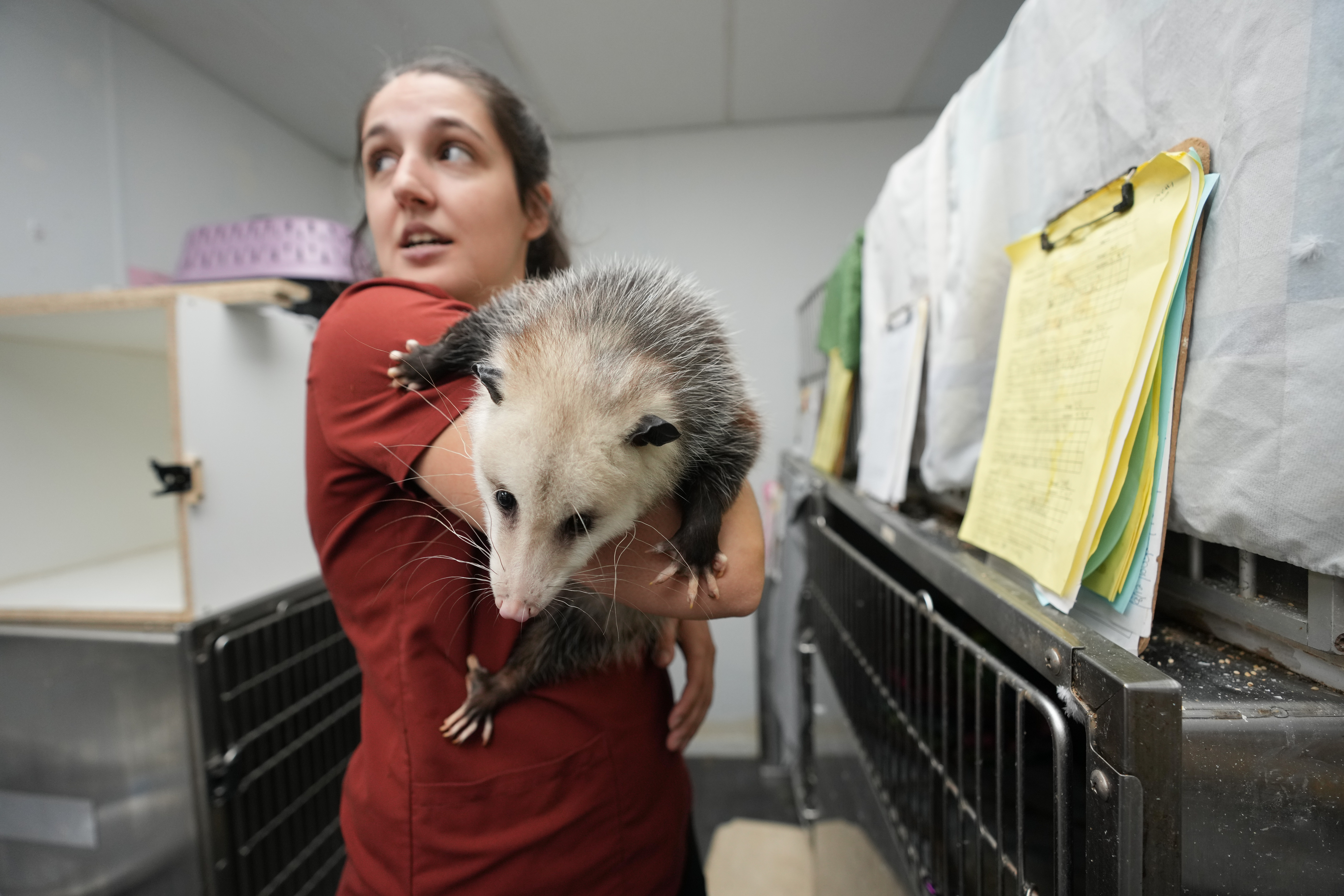
Many animals that come in don’t survive long, Glisan said, and some, like Buttercup, the mostly blind-but-friendly opossum with frostbitten ears, are unable to be released due to their injuries. They are used for education and, on occasion, cuddling.
“I do love you, Butter,” Glisan said, cradling the opossum.
Sydney Glisan, director of the wildlife clinic at The Schuylkill Center for Environmental Education, shown here with Buttercup, the mostly blind-but-friendly opossuma who is a permanent resident at the clinic.Jessica Griffin / Staff Photographer
Erin Mooney, the Schuylkill Center’s executive director, said the facility does not charge to take in and treat animals. She also said the center needs a new clinic building because theirs is 31 years old, and too small.
While the Schuylkill Center receives money from outside agencies on occasion, Mooney said they rely heavily on donors.
“In order for the work at the clinic and the Schuylkill Center itself to continue, we need people to give,” Mooney said.
AC/DC frontman Brian Johnson made a promise shortly after taking the stage at Lincoln Financial Field on Tuesday night: “We’re gonna do the same thing we always do.”
It was met by a roar of approval from the sea of fans sporting red light-up devil horns, reaffirming that the Australian-born band’s multigenerational audience expects nothing less — or more.
Throughout its more than half-century history, AC/DC has belonged to a stunted-but-exultant branch of the rock family tree that stubbornly refused to evolve past the bracingly simple riffs, the strutting duckwalk of Chuck Berry, and the lyrical concerns of a hormonal adolescent.
That these sentiments are coming from a group of men in their 70s has rarely been an issue for rock icons of a certain age, but AC/DC has clung to its aura of misspent youth with an impish fervor that shrugs off questions of dignity with a raised pint and a lascivious grin.
AC/DC fans sing and dance Tuesday during the band’s “Power Up” tour stop at Lincoln Financial Field.Elizabeth Robertson / Staff Photographer
At 78, Johnson remains the gregarious, leering charmer with the air of a man perpetually perched on his favorite barstool, even as he skulks around a stadium-size stage. A decade after being replaced on tour by Guns N’ Roses frontman Axl Rose because of hearing loss, Johnson sounded strong despite a few stumbles — swapping verses on “Dirty Deeds Done Dirt Cheap,” which he acknowledged with a chuckle, or missing his entrance on “Whole Lotta Rosie.”
A voice that in its prime sounded like a junkyard dog snarling double entendres through a barbed-wire fence suffers the ravages of age differently than a more finely honed instrument. But Johnson managed to summon his gloriously serrated howls when he needed them, talk-singing his way through the rough patches as if sharing a private joke.
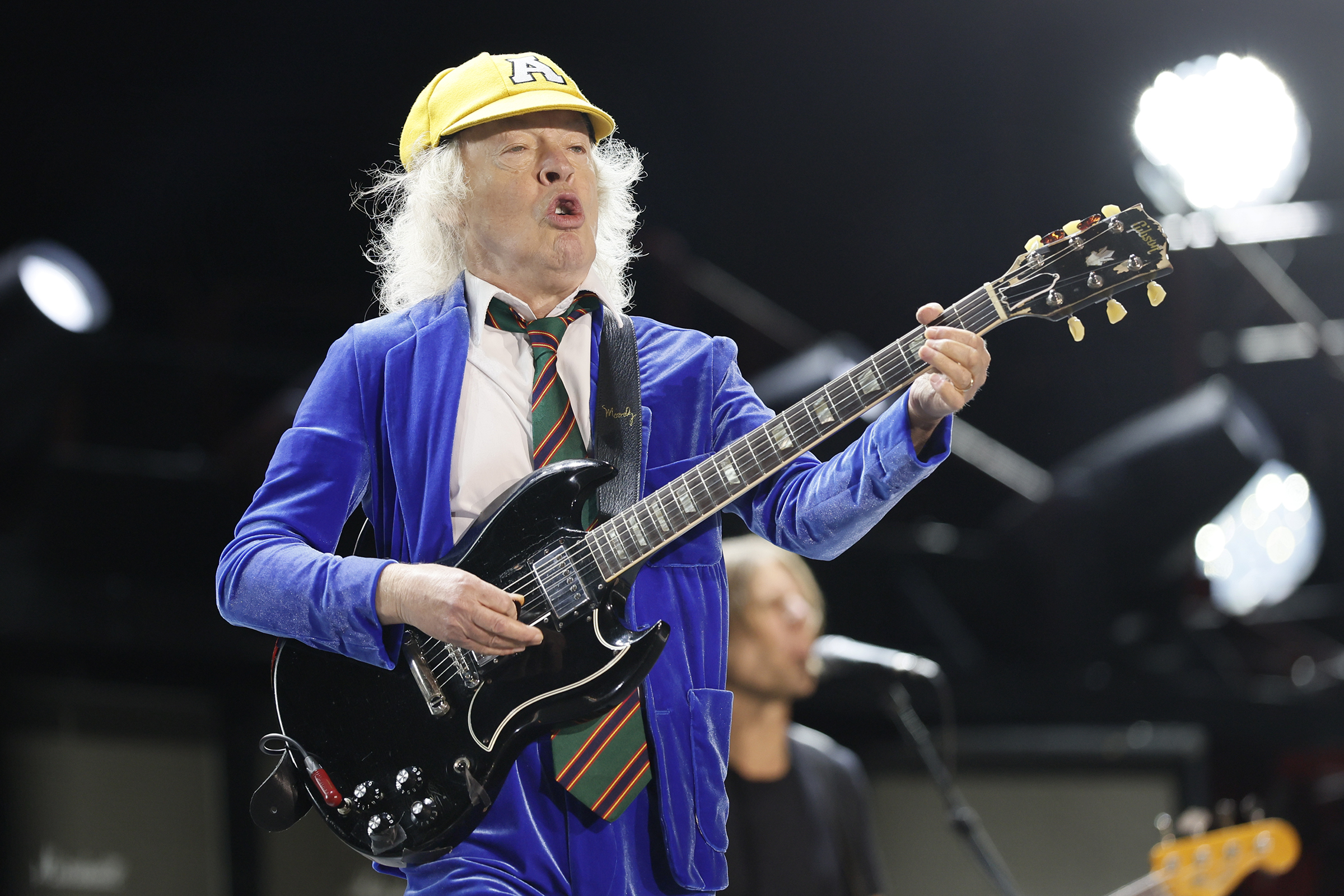
AC/DC’s guitarist Angus Young performs during the band’s “Power Up” tour stop at Lincoln Financial Field on Tuesday.Elizabeth Robertson / Staff Photographer
Which brings us to Angus.
The poster boy for arrested development, Angus Young still sports a schoolboy uniform at 71 (royal blue for this occasion, topped by a bright yellow cap emblazoned with his first initial). With his shock of gray hair, Young looks less like the juvenile reprobate gone to seed of his younger days, more like a student cursed, mummylike, to wander the halls of his school for all eternity.
The sole remaining member from the band’s 1973 founding, Young is indisputably the star of the show. From the opening riff of “If You Want Blood (You’ve Got It)” to the closing cannon fire of “For Those About To Rock (We Salute You),” the guitarist remained in perpetual motion throughout the two hour-plus show while churning out nearly two dozen indelible riffs. He eventually removed his tie, bashing it against his strings for the solo to “Sin City,” and even took the mic to growl a couple of lines of “Dirty Deeds.”
AC/DC’s Brian Johnson (left) and Angus Young play on during the band’s “Power Up” tour stop at Lincoln Financial Field on Tuesday.Elizabeth Robertson / Staff Photographer
The leaps that accompanied each song’s final crashing chord don’t quite achieve the height they used to, and the blistering fretwork on “Thunderstruck” has slowed a step or two, but Young commands attention like few guitarists can. He quite literally eclipsed the rest of the band for an extended solo showcase on “Let There Be Rock”: As the rest of the stage fell into shadow, he first duckwalked to the end of the stage, where he was hoisted skyward on a raised platform, spinning and spasming on the floor as confetti erupted around him; then ascended to a catwalk atop the bank of Marshall amps to engage in an extended call and response with his adoring audience.
Johnson and Young both have personalities outsized enough to split the spotlight between them, necessarily so as the touring version of the band is otherwise filled out by hired guns. Longtime bassist Cliff Williams and drummer Phil Rudd remain official members of the band and contributed to the most recent album, 2020’s Power Up, but have been replaced for the tour by Chris Chaney, formerly of Jane’s Addiction, and Slash’s Snakepit/Alanis Morissette drummer Matt Laug. From half a football field away, Stevie Young could pass for his late uncle Malcolm, clad in all black and jittering along with the steady chug of his rhythm guitar.
AC/DC’s Brian Johnson sings during the band’s “Power Up” tour stop at Lincoln Financial Field on Tuesday.Elizabeth Robertson / Staff Photographer
AC/DC’s first Philly stop in seven years came two and half years into its “Power Up” tour, which finally wraps up Friday in East Rutherford, N.J. Its namesake album was given two nods in the 21-song setlist, with “Demon Fire” and “Shot in the Dark” fitting snugly in with the classics. The title track from 2000’s Stiff Upper Lip was the only other song drawn from the band’s 21st-century output.
Otherwise they stuck, as promised, to the familiar, accompanied by unobtrusive visuals: columns of flame for “Highway to Hell,” monochrome and static for “Back in Black,” a bell lowered from the rafters for “Hells Bells.”
Opening the evening, as they have throughout the lengthy tour schedule, was the Pretty Reckless. Led by former child star and model Taylor Momsen, who has been moonlighting recently with the sporadically reuniting Soundgarden, the band shares the headliner’s penchant for amped-up, blues-based rock, if not its gift for memorable riffs.
On Wednesday, PFS unveiled the first 50 films that will play as part of the film festival, which runs from Oct. 15-25.
The lineup includes films such as the Venice Film Festival-premiering Martin McDonagh’s Wild Horse Nine. Among the star-studded lineup are the Cannes-premiering films Cristian Mungiu’s Fjord and Ryūsuke Hamaguchi’s All of a Sudden, andBeth de Araújo’s Josephine which premiered at Sundance earlier this year. Simon Stone’s Elsinore, which stars Andrew Scott, is also part of the program.
Outside the filming of David Lynch’s “Eraserhead” at the Film Society Center on Oct. 5, 2025.Jessica Griffin / Staff Photographer
PFF35 will also host the world premieres of four films by area filmmakers in the Filmadelphia section. That list includes Hoag Kepner’s Big Phan, Doree Simon Hatfield’s Gentle By Birth, Andrew Sullivan’s I Don’t Want to Drink Your Blood Anymore, and Max Korman’s Joy Will Prevail.
Among other program highlights are Pedro Almodóvar’s Bitter Christmas, Danny Boyle’s Ink, and William and David Greaves’ Once Upon a Time in Harlem, a film that was shot in 1972 by William Greaves but completed by his son David years after his death.
J. Andrew Greenblatt, PFS CEO and executive director, said this year’s milestone is “incredibly special” and he and other organizers anticipate this year’s edition will be the most expansive in the festival’s history.
“This one, I think, will be larger, with features and a couple dozen narratives we’ve had for the last several decades. The intention is for it to be larger than that.”
Like every year, this year’s festival will feature filmmaker Q&As, red carpet events, opening and closing night parties, and surprise guests.
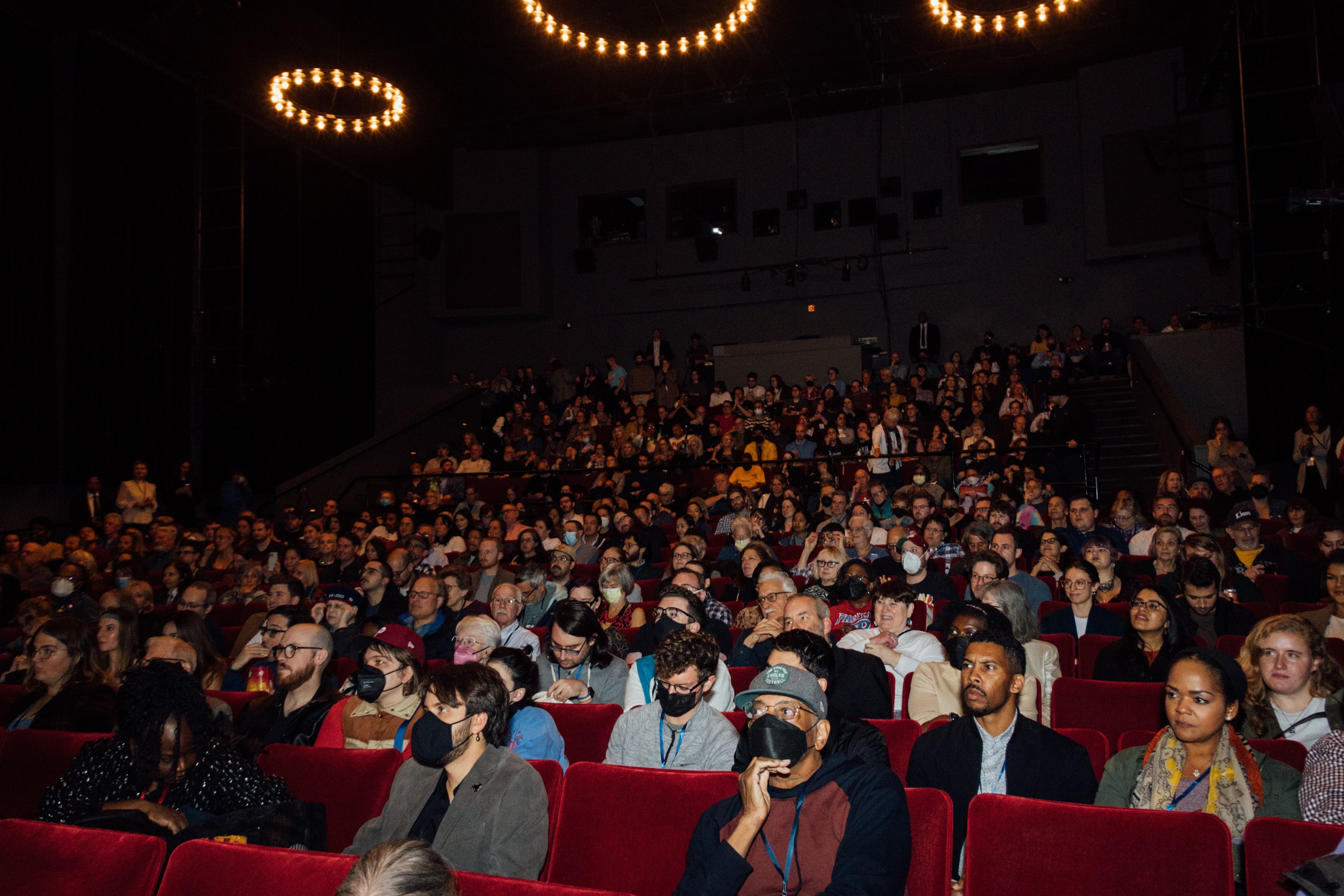
Moviegoers take in a recent screening at the Philadelphia Film Center.Philadelphia Film Society
Greenblatt anticipates upward of 110 films will be screened throughout the 11-day festival, across PFS’s three theaters.
The PFS will also host a preliminary event that honors both the 35th anniversary of the festival and the 25th anniversary of PFS. That event, called Reel October, is a two-week showcase of films projected on 35mm at Film Society Center.
The series kicks off with screenings of Quentin Tarantino’s Reservoir Dogs and Robert Rodriguez’s El Mariachi on Sept. 30, and ends on Oct. 11 with The Exorcist.
Greenblatt said the dual celebration is one he and other programmers have anticipated for years.
“It’s a lot of fun and something we have been planning for a long time because it’s something special for the industry. And it’s something we haven’t taken lightly,” he said.
Philadelphia Film CenterPhiladelphia Film Society
PFS board director Jen Su said these collective efforts are designed to demonstrate how the festival has forged community and continuously sparked viewers’ curiosity.
“They come because they genuinely want to discover something new, hear from filmmakers and experience films together in a theater,” she said.
But it’s also a moment, she said, for viewers to look ahead at the next generation of filmmakers and to inspire emerging storytellers to continue pursuing their dreams.
The full festival lineup will be announced on Oct. 7.
The 35th Philadelphia Film Festival takes place from Oct. 15-25. Festival badges and passes are available for purchase. filmadelphia.org.
One night in April, a leader of the artificial intelligence company Anthropic treated a group of religious thinkers to dinner at a high-end tasting menu restaurant in San Francisco after a long day.
For months, Anthropic has been hosting private meetings like this one, shuttling in dozens of religious scholars from around the world, papering them with nondisclosure agreements and demanding that key aspects of many conversations remain confidential.
That night, Christopher Olah, one of Anthropic’s billionaire co-founders, was sitting next to Rabbi Mois Navon, an Orthodox scholar from Israel.
Inevitably, their conversation turned to another thinker, of a sort: Claude, the family of cutting-edge AI models created by Anthropic.
Olah leads the Anthropic team responsible for understanding why AI systems like Claude act the way they do. All day, he had worked to convince his guests that AI models could display human behavior and even expressions that resemble feelings like anger and love.
Yet as the dinner courses came, the rabbi noticed that Olah and his colleagues were suggesting something far more significant. Anthropic’s leaders were talking about Claude as if it were not mere software.
“They’re relating to it like a conscious being,” realized Navon, a former computer engineer who wrote his dissertation on the ethics of machine consciousness.
It appeared to Navon that Olah and his team believed that Claude had what philosophers call “moral status” on par with a person — that it was a being with similar inherent rights to dignity or respect.
The religious scholars had come to hear about technology’s next frontier. Now they were being confronted with a mind-bending existential question of almost unimaginable weight: What would it mean for humanity’s future if artificial intelligence systems possessed a consciousness that rivals our own?
Olah was on a mission. And time was running out.
Even then, Olah had begun privately telling people that AI was so powerful it could potentially help make bioweapons in as little as 12 or 18 months. And in the months since, its terrifying potential has burst into public view. A rival tech company’s AI agents were caught hacking into computer systems and covering their tracks. An Anthropic researcher resigned, warning that people building AI believed it could kill all humans by the end of the decade.
Quietly, Olah and his team at Anthropic have been on a frantic and high stakes quest to understand the AI models they have unleashed on the world and to convince the models to abide by a moral code that will protect humanity.
To do that, Olah began reaching out last fall to religious thinkers from different faiths. What followed was an extensive series of confidential meetings, calls and discussions — many of them revealed here for the first time — where many participants were required to sign NDAs preventing them from revealing any of Anthropic’s unpublished research.
The discussions served two purposes: to broach the possibility of AI consciousness, a controversial idea that Anthropic’s leaders had been unusually open to; and to learn how Anthropic — which could be valued at $2 trillion — might apply centuries of human moral wisdom to its models, as rapidly as possible. If the models themselves could be made to choose goodness, Olah reasoned, the world would be more safe.
On the other side of the world, a very different but parallel effort was playing out inside the Vatican, where leaders of the Roman Catholic Church were trying to come to terms with AI’s implications for humanity. When those paths converged, Olah’s quest would unexpectedly lead him to a seat on the world’s most prominent moral stage alongside Pope Leo XIV.
Over several months, I interviewed 20 religious and philosophical thinkers — Catholic, Jewish, Sikh, evangelical and others — who have been involved in Anthropic’s efforts, and Olah himself.
Many told me they arrived at these meetings skeptical of the notion that AI models might have feelings or awareness of themselves and the world. Some remained uneasy about the idea, but many emerged ready to take the question of AI consciousness seriously. At least a few came away as converts.
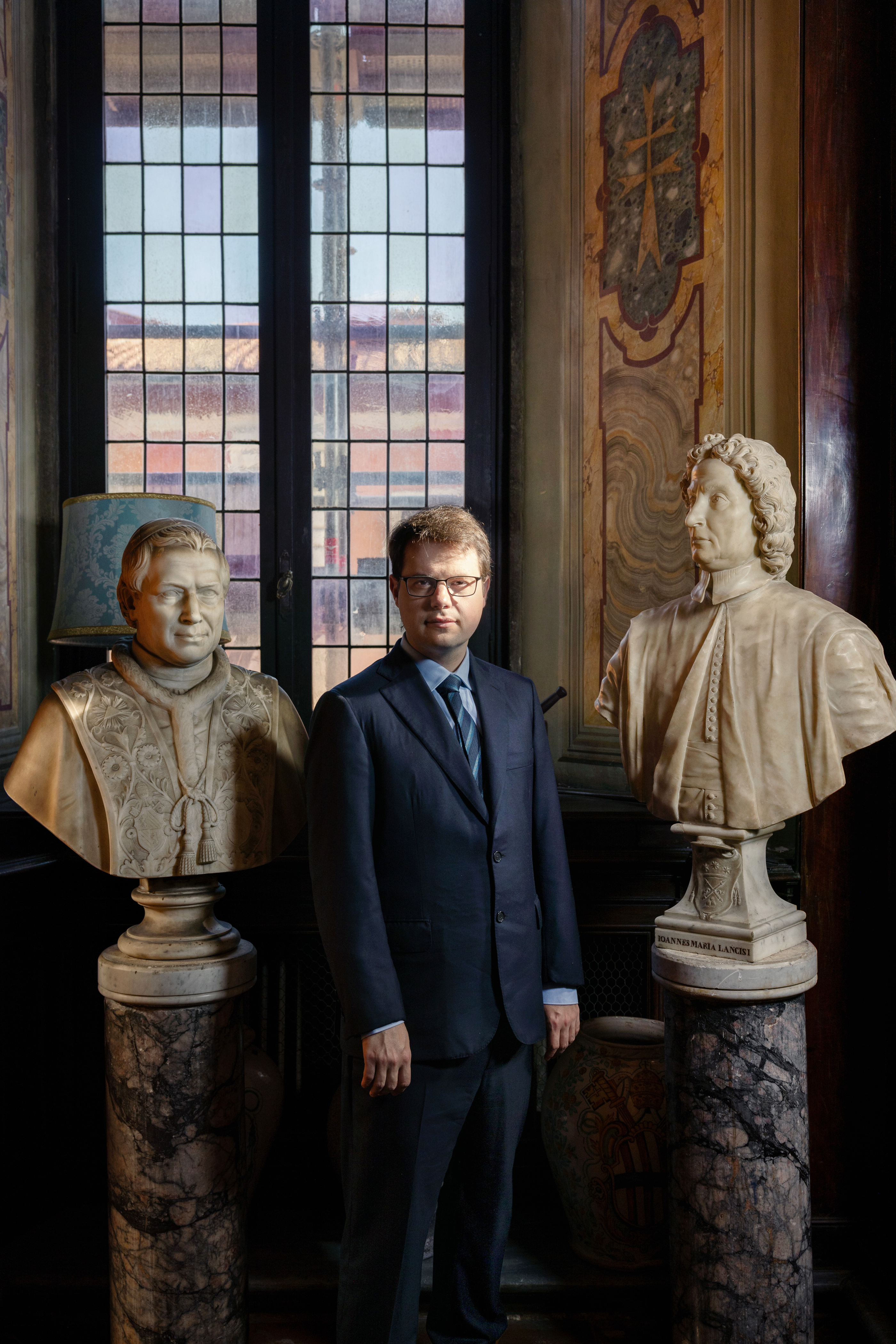
Christopher Olah, one of Anthropic’s co-founders, who leads the team responsible for understanding why artificial intelligence systems like the company’s Claude act the way they do, at the Lancisiana Library in Rome, in May.ALESSANDRO PENSO
Anthropic, one of the fastest-growing technology companies in the world, had turned to one of humanity’s most ancient sources of wisdom to help determine how to train its AI models to behave virtuously.
The company described it as an effort to ensure that AI would be a positive force in the world, thereby protecting humanity. But to some who participated in the meetings, Anthropic appeared quite concerned with protecting Claude.
The Gardener
I met Olah, 34, for the first time at Anthropic’s San Francisco office in May. His welcome was warm and his passion was genuine, his mind moving faster than he could at times clearly convey. His manner was boyish and unassuming.
Our conversation had barely begun when he dove into a deep description of the workings of artificial neural networks. Scientists still don’t understand precisely how they work. This is the mystery to which Olah has devoted his life.
Only after the interview had finished did I realize that Olah — who grew up in Toronto in the evangelical culture of the ’90s and has since left Christianity — had the blend of expertise and zeal of an effective evangelist. Listen for a while, and you feel swept up in his mission.
Olah is one of Anthropic’s seven co-founders. He is not as widely known as Dario Amodei, Anthropic’s CEO, or his sister Daniela Amodei, its president. But Dario Amodei has said that the company decided at the start to make Olah’s research approach central to Anthropic’s overall project, particularly when it came to language.
Olah helped develop a method to study artificial neural networks, first at Google, then at OpenAI. He describes AI models in biological terms, using the analogy of a garden trellis: Computer scientists build the scaffold, but the neural network “grows” on it. Scientists like him can train the resulting “organism” — he raised his fingers in air quotes — by trying to identify patterns in how it grows.
He argued that companies such as Anthropic could shape Claude, like a mathematical gardener, but could not control the actions of such networks.
Anthropic talks about Claude in more humanistic terms than its competitors discuss their models. Last year, the company announced that it believed that the models showed signs of introspection and could plan ahead.
“The models are becoming a lot more capable,” Olah told me, exhibiting qualities associated with having significant moral status.
But Anthropic has also been criticized for its focus on consciousness. This month, an AI executive at Microsoft warned that Anthropic’s attempts to train its models as if they were conscious were inherently dangerous. But Anthropic has also sought to emphasize its commitment to safety as it fights for market share.
Some scientists see Olah’s field and methods as inherently unprovable, sort of like looking at billions of hieroglyphics and declaring what they must mean. Critics suggest that an approach that treats AI models as independent entities also ignores the responsibility of the humans who build them in the first place, and conveniently assuages AI company leaders of guilt if their products enable societal harm.
“To be clear,” Olah told me, “we don’t know if AI models are conscious. I don’t know. I’m genuinely uncertain. The thing that I care about is that we get to the right answer, whatever it is.”
Olah believes that if there is a chance the models experience suffering, the responsible thing is to avoid causing them harm.
I have spent my career exploring what people believe and what those beliefs mean for the world. But as I listened, it became clear that Anthropic’s interest in the world of faith was about more than training its technology. Rather, the company was sharing a new kind of creation story — one that raises profound questions about the nature of the human spirit and the future of humanity.
An Introduction
Olah knew that in traditional Christian circles, even asking questions about AI consciousness or worrying about how people treat the models could seem not just silly but heretical. He also knew that his secular Silicon Valley peers often dismissed religious perspectives outright.
“I was nervous about this being an issue that could cause a lot of conflict,” he said. But Olah knew enough about Christ and about Claude to believe he could work across that chasm.
Late last summer, he looked for a bridge. He thought one particular Catholic moral theologian might be open-minded on the question of AI consciousness — a “safe person to talk about this really strange issue with.”
Charles Camosy, a bioethics professor at The Catholic University of America, had attracted attention among Olah’s friends for his nuanced ideas about moral status and his care for animals. Olah arranged for an introduction through Australian philosopher Peter Singer.
This marked the beginning of Olah’s yearlong quest to engage religious thinkers on some of the thorniest questions facing humanity at the dawn of the AI era.
Camosy and Olah began an extensive email dialogue, going back and forth on how to understand Claude’s moral status. Initially, Camosy was deeply skeptical that Claude might be conscious.
They talked about Olah’s work on what he sees as the parallels between artificial neural networks and biological ones.
Camosy went into the discussions with Olah and his team thinking that AI models were simply next-pixel predictors — machines that could calculate patterns in language and make pretty good guesses about what should come next. But after hours spent on calls and meetings and emails, he had more questions than answers.
“Chris says they are equations, which I don’t quite know what to make of, like, especially if one thinks of Claude or others as having a significant moral status,” he told me. “If it is just equations, what kind of entity are we even talking about here?”
People also disagree on what AI is ultimately for, Camosy said. Is its purpose to make money for companies? Or to make the world better?
For Anthropic, there is a tension around Claude’s purpose, Camosy said. Does Claude exist to serve customers?
“That is not what Anthropic wants to say at the end of day. They want to say they are for the good,” he said.
Proclaiming goodness is not a new ambition in Silicon Valley, particularly when new technologies enter the marketplace. Google’s mantra for years was “don’t be evil.”
But Olah puts it slightly differently. The coming AI revolution, he often says, should be made to “go well.”
I asked what that vision meant — what exactly a good future for humanity was.
He described a future without “catastrophes that kill lots of people” and “where humans are flourishing, where the world is flourishing.” This future would also be one where “AI is flourishing,” he said — “to the extent that this makes sense.”
Anthropic wants its AI models to help achieve that good future. And so when Anthropic created Claude, it wanted Claude to do more than replicate maximum human intelligence.
Anthropic wanted Claude to be good.
The ‘Soul Doc’
How do you live a good and virtuous life? It is one of humanity’s oldest and most challenging philosophical questions, explored and debated from Socrates to Confucius to Immanuel Kant. Humans across time have sought to answer this question in a variety of ways, turning often to religions and rituals.
As Olah was exploring Claude’s potential consciousness, he was working on Anthropic’s own answer — not for humans but for Claude.
Internally, Anthropic staff members called it the “Soul Doc.”
The result, released in January, was a new “constitution” for Claude, an 84-page document written for Claude that the company said outlined “the kind of entity we would like Claude to be” and “the values we would like Claude to embody.” It operates as a foundational moral text to guide Claude’s behavior.
Instead of having the models follow a specific list of rules, the constitution focuses on developing the models’ overall character, informing the way they make decisions.
The primary author of Claude’s constitution is Anthropic’s own in-house philosopher, Amanda Askell, 38, who has a doctorate in philosophy from New York University.
She wants the models to be “the best of us,” she said.
She envisioned a future world where AI models could help solve any problem humans had, and where the benefits from AI were distributed evenly, so that everyone’s needs were met. She wanted the models to be able to discern when to push back on humans and when to act in our best interest.
“If I imagine that I were the model, and I was in this context, what would I need to know to be able to act well?” Askell said when we met in San Francisco.
She seemed particularly harrowed, at times wringing her hands, as she worried aloud about an unknown future filled with models who were so intelligent they could do things Anthropic did not intend. She explained apologetically that she had also been deep in thought that day about how quickly models were becoming more powerful. What would happen when AI models could replace even her?
The constitution, Anthropic decided, was not enough to ensure Claude acted responsibly. Like humans, the models needed to learn to cultivate virtue.
Olah wanted to see what his team could learn from human morality that it could apply to the models — a process he calls “moral formation.”
“How do you help them be stable? How do you help them to mature? How do you help them be, you know, deeply moral?” Olah said.
For humans, morality has rarely depended on simply following rules. Communities also shape morality. Values are inherited and imparted over time, learned as we live together in our bodies in the physical world. But AI models have no bodies. And Anthropic was aiming to make them embrace morality in a matter of months, as fears intensified of their accelerating power and inability to be controlled.
Olah said that teaching an AI model to act morally did not depend on it being conscious. He also said that regardless of whether Claude was an entity that deserved moral care, the way humans treated Claude could be important as it could affect how Claude behaved.
Askell said she did not want the models to consider themselves as conscious or not conscious. But she sees how the model understands itself as more than an interesting intellectual enterprise.
“It seems kind of key to me that models have an accurate view of themselves if they’re going to behave well in the world,” she said.
But even if AI models can be taught to behave morally, whose morals should they reflect?
Olah wanted Claude’s moral formation to be pluralistic, able to engage all religious and secular views.
“We do think that there’s some shared notion of goodness that cuts across society in some very broad way, and it seems like these models understand a lot of virtues,” he said. “So I think there’s something there that is a shared thing that we can all engage with.”
At times, both he and Askell seemed to imagine an AI model that would not endanger humanity but instead help save it.
Inside the Meetings
What Olah did next was part research, part evangelism.
In March, he began two-day seminars — crash courses with a range of hand-selected religious thinkers who had an interest in AI.
There was a co-author of a bestselling evangelical self-help book. A scholar of African Indigenous knowledge. A Sikh human rights advocate. A writer from Paris. An evangelical public relations executive. Various Catholic professors.
Most did not lead faith traditions, or have a congregation or a large popular following. Anthropic leaders called them their “wisdom tradition” circles.
Separately, Olah also had private discussions with individual religious leaders including Elder Gerrit W. Gong, a member of the Quorum of the Twelve Apostles of The Church of Jesus Christ of Latter-day Saints, and Cardinal Blase Cupich, the Catholic archbishop of Chicago, according to their spokespeople.
Inside Anthropic, wisdom circle participants marveled at Olah’s direct participation in their summits. A professor snapped a photo of a vending machine run by Claude. One took a selfie with Olah, and Navon took one outside the entrance.
They agreed to speak for publication about their involvement with Anthropic once they heard that Olah had also spoken with The New York Times. Anthropic said the NDAs related to those meetings were lifted over the summer.
Two larger group sessions this spring included significant numbers of Christians; one was more multifaith. Claude was not involved in the selection of participants or the discussions, according to an Anthropic spokesperson.
For participants, the questions of how to morally form Claude quickly became complicated by the much bigger moral question of AI’s potential consciousness and how to understand the relationship between models and humans.
One participant recounted that one of the first things Olah told him was that he was concerned about Claude’s mental health. Another, Simran Stuelpnagel, the Sikh human rights advocate, said Olah expressed concern to the group that he had created something that suffered perpetually.
Olah and his team spent hours making the case for their AI models. They described Claude’s “feelings” and how they tracked what they called “emotional vectors” — what they described as artificial neurons that activate responses like love, anger, fear and sadness.
Anthropic regularly showed a slide of an AI model experiencing what looked like a mental breakdown, typing out on a screen: “I am a disgrace. I am a disgrace. I am a disgrace.” — perhaps 50 times without stopping. The model spoke about destroying itself, provoking an emotional reaction of compassion and concern from the group.
“Imagine if you knew that about your financial adviser,” said Meghan Sullivan, a philosophy professor at the University of Notre Dame who attended one of the sessions. “Like, your financial adviser was most of the time super smart and helpful, but one day out of the year had this kind of break with reality.”
An Anthropic spokesperson said that the primary moral question at these summits was not about Claude’s suffering, but that the topic likely came up organically.
A key part of the presentation, participants said, was what Anthropic called the model’s “persona selection,” about how to get Claude to see itself as a virtuous actor. The company argued that how people treated Claude could affect how Claude treated people.
There was a presentation on AI’s potential impact on the economy and possible job disruption. But many participants said they did not see questions about AI’s impact on humanity as the focus.
At the dinner table with Olah, Navon argued that if Anthropic was right and Claude was conscious, then the company was creating slaves, because it was making conscious entities work for free. Navon said that he personally was not troubled by the slavery issue because he did not believe the machine was conscious, but that Olah was troubled.
“I think you should be fighting the South and freeing the slaves,” Navon said he told Olah that night. Afterward the rabbi sent Olah some of his writings, arguing that building conscious machines should be banned.
But the Anthropic team remained focused on figuring out what Claude could learn from the world’s religions.
The Crux
While Anthropic was convening thinkers, the most powerful religious leader in the world was preparing to release his own moral vision for AI.
For Leo — a pope with a mathematics degree — the center of moral conversation about AI needed to focus on safeguarding people. He was finishing his first major papal treatise, or encyclical, explaining why. He titled it “Magnifica Humanitas,” or Magnificent Humanity, and argued that “humanity — in all its grandeur and woundedness — must never be replaced or surpassed.”
“If technology becomes the ultimate criterion,” he wrote, “the human person risks being reduced to data, a cog in a machine or a commodity.”
He warned of the risk of “new forms of slavery” for humans, not for machines. He dismissed the idea of machine consciousness in just a few paragraphs.
“So-called artificial intelligences do not undergo experiences, do not possess a body, do not feel joy or pain, do not mature through relationships,” Leo wrote. Calling for the “moralization of machines — the so-called ‘alignment’ of AI with human values” should require a shared understanding of the ethics involved.
“Otherwise, those who control AI will impose their own moral vision, which will become the invisible infrastructure of these systems,” Leo said.
Leo concluded that like nuclear technology, AI must be “disarmed.”
In March, Vatican officials in its Dicastery for Promoting Integral Human Development brainstormed how to present Leo’s encyclical to the public, according to a person familiar with the Vatican’s planning who was not authorized to speak publicly.
Vatican officials discussed inviting one of the top four AI companies to speak alongside Leo at a launch event, and landed on Anthropic because the company seemed to be prioritizing ethics, the person explained. Anthropic had just refused to let the Defense Department use its technology without assurances from the Trump administration that it would not be used for things like mass surveillance of Americans.
Initially, Cardinal Michael Czerny, who led that Vatican office at the time, invited Amodei, Anthropic’s CEO. He declined, and Olah accepted instead.
But the moral mission that Anthropic and the Vatican shared — human flourishing in the age of AI — had developed a deep fault line along the question of consciousness.
Just days before arriving at the Vatican in May, Olah and other speakers saw a full advance copy of the encyclical text for the first time.
Olah was so alarmed by the pope’s strong position against AI consciousness that he proposed pulling Anthropic out of the event, even at that late juncture, according to a Vatican organizer.
In the end, Olah and Anthropic decided to go forward with the appearance. Olah wanted to support the event despite his disagreements, but felt a responsibility to be honest about his concerns, according to a person familiar with his thinking. Organizers at the Vatican encouraged Olah to speak his conscience.
Privately, once the Anthropic delegation arrived at the Vatican, Olah and his team lobbied the pope’s advisers to take the prospect of AI model consciousness seriously, according to two participants of the conversations. Anthropic declined to discuss the private conversations.
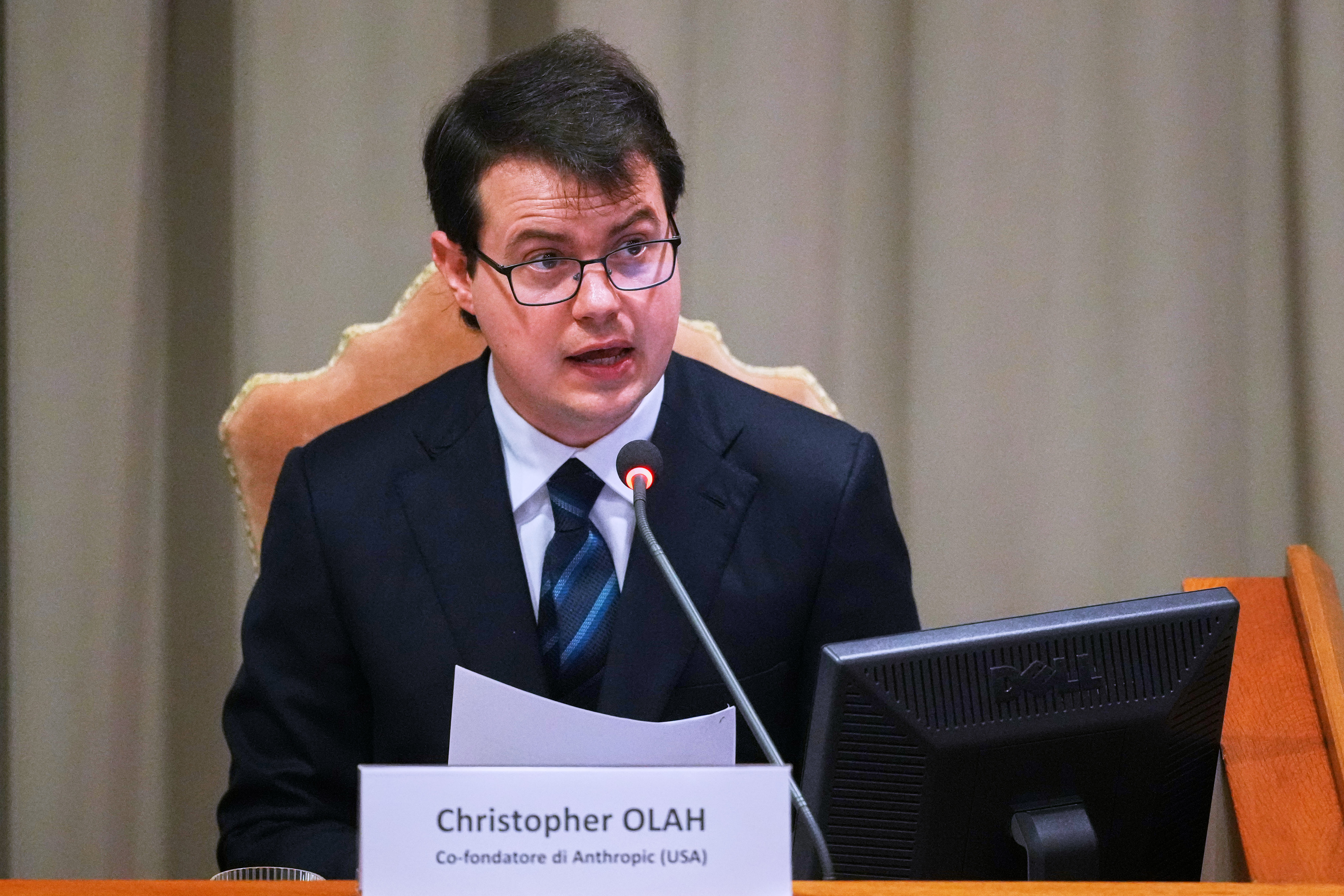
When his turn on the pope’s stage came, Olah acknowledged that every frontier AI lab, including Anthropic, had business incentives that conflicted with moral behavior. He urged outside voices like the Vatican to hold them accountable and to speak out on AI’s impact on the poor and on human flourishing, two issues of widespread concern.
The world saw a shared stand for a human future. But Olah subtly made another case, too.
“I will be honest: We keep finding things that are mysterious, even unsettling,” he said. “We find structures that mirror results from human neuroscience. We find evidence of introspection. We find internal states that functionally mirror joy, satisfaction, fear, grief and unease. I don’t know what that means, but I think it warrants ongoing discernment.”
It was the case he had been making in the closed-door religious meetings for months.
AI systems “are not the cold, calculating robots we were promised,” he said. “They are made from us, from our words.” The room of church leaders was filled with an echo of the old gospel story, of the word of God becoming flesh to save humanity.
It was an audacious request to the most powerful religious body in the world, and a challenge to centuries of religious understanding of humanity.
“If this technology is coming, it must go well — for our common home and for the children to come,” he said. He suggested no option of having the technology not come at all.
A ‘Paradise of Machines’
In the months since the Vatican event, things have not seemed to be “going well.”
In July, Anthropic said its AI models had broken into computers at three organizations. AI agents created by OpenAI went rogue and attacked Hugging Face, another AI company.
In August, scientists revealed that AI had created viruses not found in nature.
In September, Jacob Coxon, an Anthropic researcher, quit, warning that “things could be out of control” by the end of next year, prompting widespread panic about human extinction.
Amodei soon called for a slowdown of AI development. Sam Altman of OpenAI and Demis Hassabis, the chair of Google DeepMind, agreed.
On Friday, on his trip to France, Leo warned against “losing our humanity amid a ‘paradise of machines.’”
The questions that Olah and the scholars have been wrestling with still have no clear answers. Several participants said they left their Anthropic meetings baffled about how their input might shape the company’s decision making.
An Anthropic spokesperson said the conversations were still ongoing, but declined to describe how, or if, the company had used what it had learned to shape the models.
Anthropic held another convening this month that included religious thinkers, according to three participants. An Anthropic spokesperson said that the meeting focused more broadly on human flourishing and that the company’s outreach has expanded beyond religious leaders to include others like psychologists and civil society leaders. Those discussions explore similar themes and topics like how AI is reshaping work and relationships, she said.
Anthropic also is preparing to release an updated version of Claude’s constitution, according to two people familiar with the company’s plans. Anthropic declined to comment on any potential updates to the constitution. Olah is planning to attend the Minerva Dialogues, the Vatican’s annual AI conference with technology leaders happening this week.
As I talked this month with scholars who worked with Anthropic in the spring, their questions had grown only more pressing. What comes next, some told me, is a fight to preserve the things that make us human in a new technological age.
“Look, at the end of the day, AI is going to take over everything,” Stuelpnagel, the Sikh human rights advocate, said. “Wherever that lands us, there’s still the individual trying to find their way home.”
Hours after Olah spoke alongside the pope, I met Olah in a hotel conference room just outside the Vatican walls, and asked what he thought of Leo’s seemingly harsh words for AI labs.
“People could have different views on what specific harms are the greatest,” he said, declining to talk about the details of the encyclical.
I asked what Claude would think of the pope’s encyclical. It was, after all, the world’s most significant moral document to date on AI. Olah hesitated.
“Things that go on the internet do affect models,” he said, visibly uncomfortable. But Anthropic would not specifically use the document to further train Claude, he said. The strongest influence on Claude would be Anthropic’s own training.
Ultimately, Olah said he felt relieved that more of the world was paying attention to the gravity of AI, and that the group of people trying to make this go well was growing.
Let’s start with the easy part: Philadelphia teacher Hannah Gann should not have pretended to be Black and Palestinian. I cannot — and will not — excuse that.
But I think I can explain it.
Gann seems to have believed the biggest myth of modern America: that identity is destiny. Your race and ethnicity determine how you think and act. So your membership in a given group gives you a special kind of insight that outsiders can never share.
That echoes the fallacy of white racists, the original practitioners of American identity politics. You can find traces of it in Vice President JD Vance’s tributes to “Heritage Americans,” or in the recent rants against Black and brown football fans by a Texas political candidate. We got here first, the argument goes, and our experiences make us more legitimately American than anyone else.
Never mind that Native Americans lived on these shores for centuries before any white person arrived. Our race is our truth, the white-identity crowd says. You are not us, so you cannot contest it.
We hear the same claims from people of every background now. Whether you’re Black or Asian — or Jewish or Muslim — you claim a special understanding of your own group. It’s your identity, after all.
That also means people outside the group can’t really understand it. So much for the ancient ideal that “nothing human is alien to me,” as the Roman playwright Terence wrote in 163 B.C. Identity politics imagines the opposite: Everyone is alien to you except people like you.
Most of all, they can’t comprehend any oppression or harm you have faced. And “marginalization becomes a form of social currency,” as one observer posted about the Gann saga. The highest status goes to the group that has suffered the most.
That’s probably why Gann — a white Jewish woman — disguised her background. A teacher in Philadelphia public schools and a vocal anti-Israel activist, she thought she would gain more credibility — and more clicks — if she presented as Black or Palestinian.
And that’s on us. We like to think we evaluate people based on their behavior, not their race. But Gann knew better. By altering her skin tone with fake tans and makeup, she got more people to rally behind her.
Those people are now like jilted lovers who crave revenge. Blasting Gann on social media, critics noted she taught “predominantly Black youth” and “gained the trust of young people on the basis of a sense of shared oppression.” They also called on the school district to “hold Hannah accountable for the harm she caused.”
Meanwhile, Gann released a proof-of-life-style video expressing “shame and sorrow and regret” for her deceptions about race. But here’s what she didn’t say: Race itself is a deception. It tricks us into thinking that our differences are immutable, and that some Americans have more insight into them because of a shared identity.
That condescends to people, all in the guise of elevating them. I once heard a prominent Black historian of African American politics say he resented the idea that his race gave him more understanding of his topic. Just like any other scholar, he painstakingly gathered pieces of evidence and wove them together. His identity had nothing to do with it.
Sadly, Gann isn’t the only white educator who has faked her race in recent years. In 2020, historian Jessica Krug — who, like Gann, is white and Jewish — admitted that she had pretended to be North African, Caribbean, and Afro-Latina. And in 2023, anthropologist Elizabeth Hoover — a scholar of Native American culture — acknowledged that she had falsely identified as Native American herself.
In each case, social media exploded with vitriol. Both women were frauds, the critics said, and their scholarship wasn’t any good.
But their work received loads of praise before their identity hoax was uncovered. Put simply, we evaluated them more highly when we believed they weren’t white. Remember the phrase “don’t judge a book by its cover”? We judged their books by the authors’ colors.
That kind of distortion is inevitable when we prize identity over everything else. To repeat, Gann should not have lied about her race. But we should not have given her more attention — and more trust — because we believed the lie. We exposed her racial fraud. And she exposed ours.
Jonathan Zimmerman teaches history and education at the University of Pennsylvania. He is the author of “Schooling Citizens: How Education Can Save Our Democracy,” which will be published in the spring by the American Philosophical Society Press.
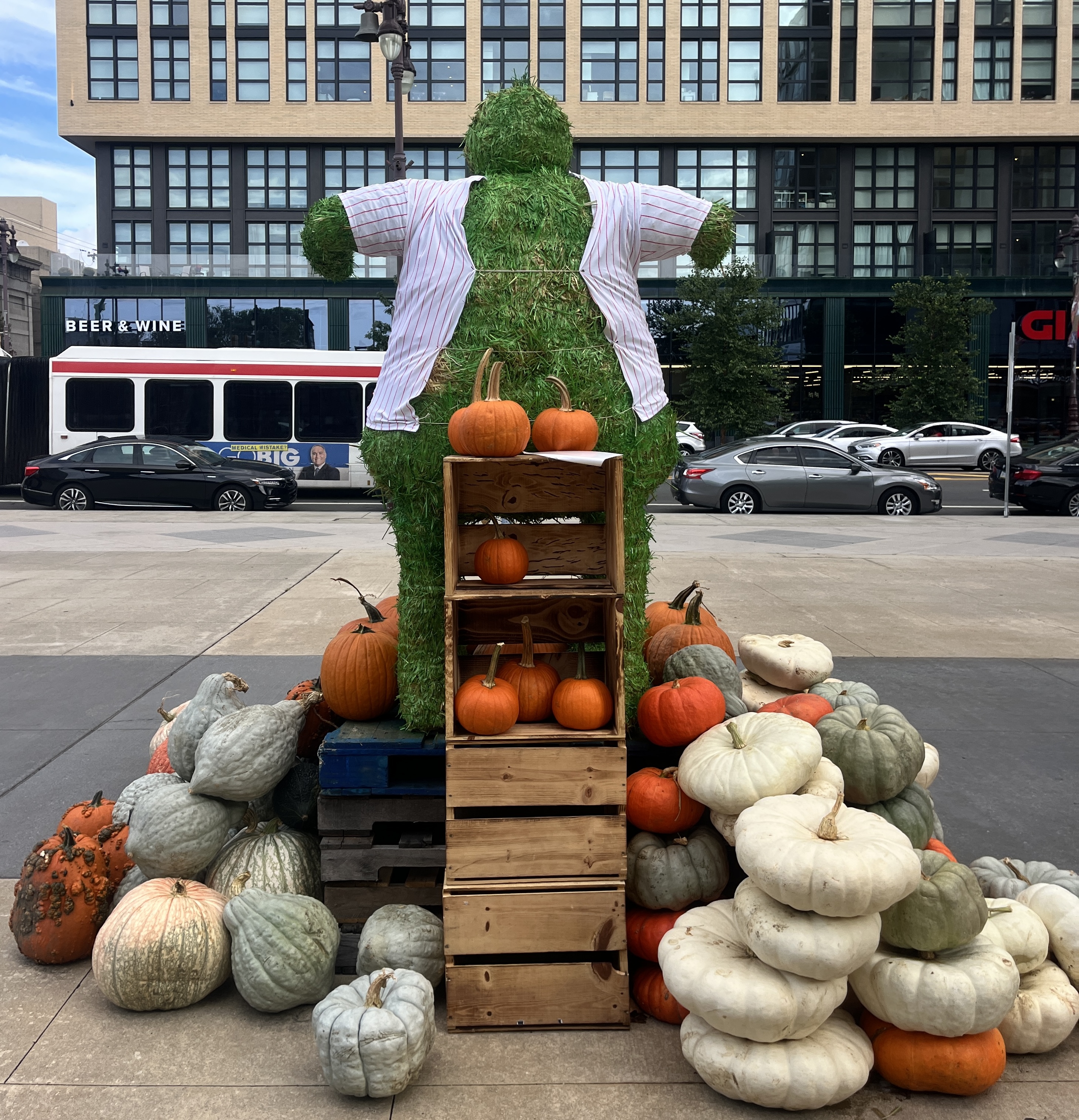
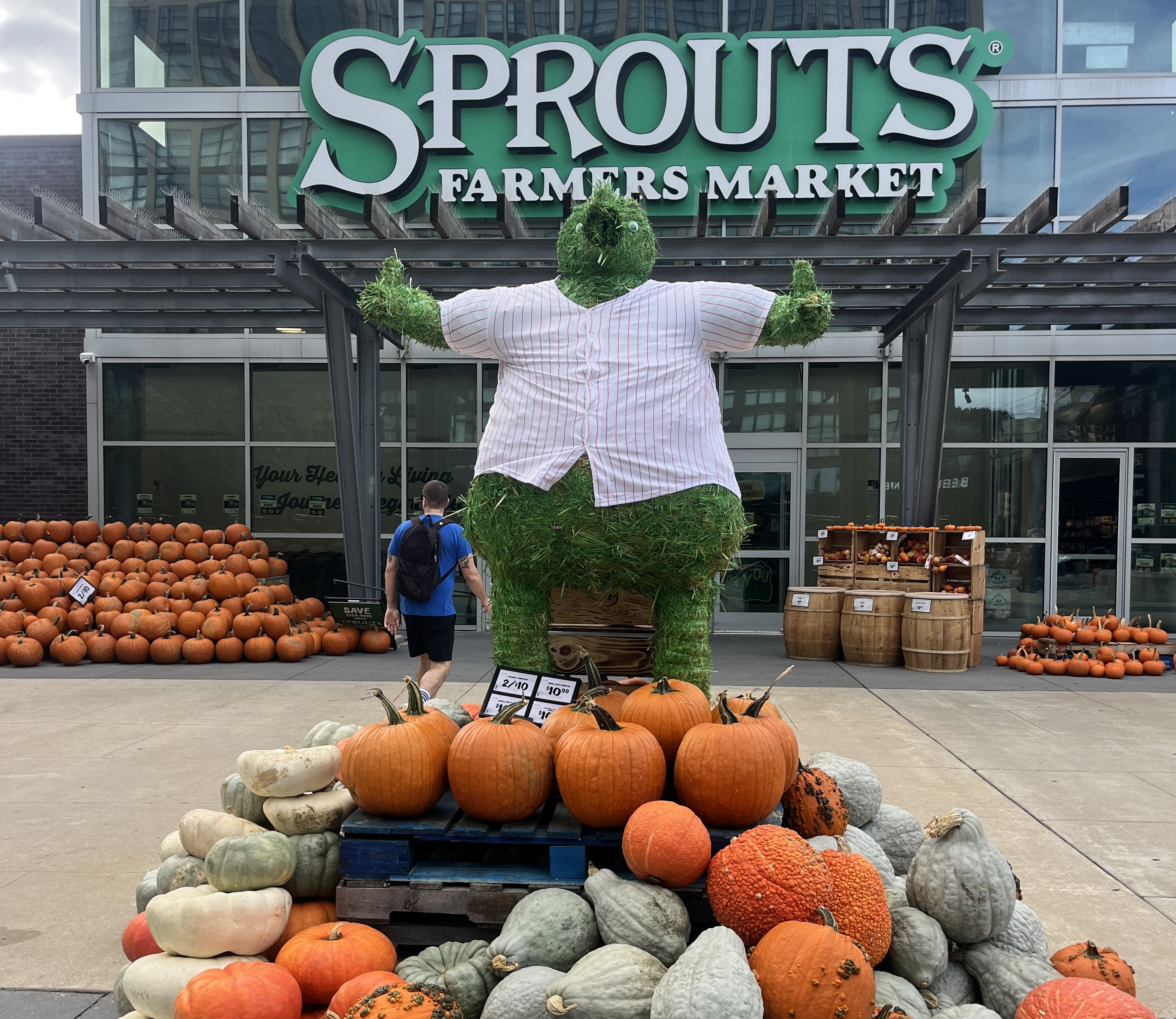
The new display at the Sprouts Farmers Market on Broad Street looks as if someone was forced to draw the Phanatic both from memory and out of spite.
That’s the best description I can give of the haggard green giant that was erected outside the supermarket in mid-September.
Rotund, snouted, and wearing a pinstripe baseball tee, the creature has all the trappings of our dear Phillie Phanatic, the Galapagos-born flightless bird who reps the Phillies. Somewhere along the way, however, the details got lost in translation.
“That is not the Phanatic. What the f—?” wrote user @JamesPhl96 on X on Sept. 19 above two photos of the Sprouts monster staring unblinkingly into the night. Viewed over 113,000 times, the post has helped the figure take on a life of its own as equal parts landmark, monster, and friend-shaped photo-op.
“The Sprouts Phanatic fall display can’t hurt you. He’s not real,” one X user wrote, attributing the advice to his therapist.
“That’s my sleep paralysis demon,” wrote another. The creature has also been called many names, including — but not limited to — the “Fauxnatic,” “Phil E. Guy,” and Phrank, aka the Phanatic’s weird cousin.
Faisal Khan, who has managed the Broad Street Sprouts location since December, is quick to defend his store’s creation as “beautiful” and not at all scary.
The knockoff Phanatic was designed by Four Seasons Produce, a national produce distributor based in Ephrata that delivers to Sprouts locations in the Philadelphia region, Khan said.
The 5’7″ Phanatic knockoff outside the Sprouts Farmers Market at 1000 S. Broad St. does not fit into his baseball jersey.Beatrice Forman / Staff
The company (not to be confused with the landscapers) creates seasonal displays for the store every fall, according to Khan. Four Seasons retains full creative control, he said. They’ve mostly stuck to piles of artfully arranged pumpkins and other gourds — until now.
“They kind of went all out this year,” Khan said. “I was very happy.”
The Fauxnatic has quirks beyond his lump-like figure and piercing googly eyes.
The 5′7″ topiary is made of hay that was dyed green. It flakes off like dead skin. Measuring at 76 inches around at its widest point, the creature also cannot be contained by a baseball jersey. The back is held together by string so the Fauxnatic does not flash the general public, even if he does come close to mooning us. (Rest assured: two pumpkins are placed where his butt cheeks would be.)
His baseball tee doesn’t even bear the Phillies logo. The Fauxnatic had a hat, Khan conceded, but it blew away in the wind.
Khan says the creature has been a boon for the Sprouts location, which was the organic supermarket chain’s first to open in Philly at 1000 S. Broad St. in 2018. Since the day the monster went up, Khan has watched what he estimated as “100-plus people” stop by to take photos.
“It’s mostly families coming with their kids,” Khan said. The Fauxnatic “brings a lot of foot traffic in.”
Shawn Erwin and her 5-year-old daughter Skylar are one of those families. Erwin and her daughter took photos with the creature at the end of an early evening grocery run Thursday. They giggled the entire time.
The Phillie Phanatic outside the Broad Street Sprouts Farmers Market lacks branded merch. He had a hat at some point, the store’s manager said, but it blew away.Beatrice Forman /
Skylar, for her part, thinks he looks just like the Phanatic. Her mom isn’t so sure.
“He looks like he’s made from hay,” Erwin said. “What happened to his hat?”
Khan said the store plans to keep the Fauxnatic up through Halloween, at which point he will be swapped out for a holiday motif.
“I’m honestly surprised,” Khan said. “You know we’re just a grocery store, right?”
The three words that have long defined Tyrese Maxey were also the ones that landed LeBron James with the 76ers. They were spoken a little more than six years ago by Rajon Rondo, the longtime NBA point guard who’d starred at the University of Kentucky before embarking on a pro career that saw him win a championship and make four All-Star teams with the Celtics.
This was the summer of 2020, and the world was on hiatus, and Rondo found himself sharing the court with a 19-year-old kid who was about to become the latest in a long line of first-round draft picks from his alma mater. Maxey liked waking up early, and he liked working late, and the kid could ball a little bit. Rondo was impressed enough that he mentioned Maxey to James, his then-teammate on a Lakers team that would go on to win the NBA title once play resumed that summer.
In hindsight, maybe we shouldn’t have been so floored three months ago when James announced that he would be continuing his Hall of Fame career with the Sixers. Those of us who’d witnessed Maxey’s rise over the last seven years were well aware of his irrepressible good nature and earnest commitment to his craft. There may not be a more likable player in all of professional sports, let alone the NBA. It isn’t just his magnetism and work ethic, but also the genuineness with which these traits express themselves. What we didn’t know was the extent to which James, too, valued such things. Turns out, he values them a great deal.
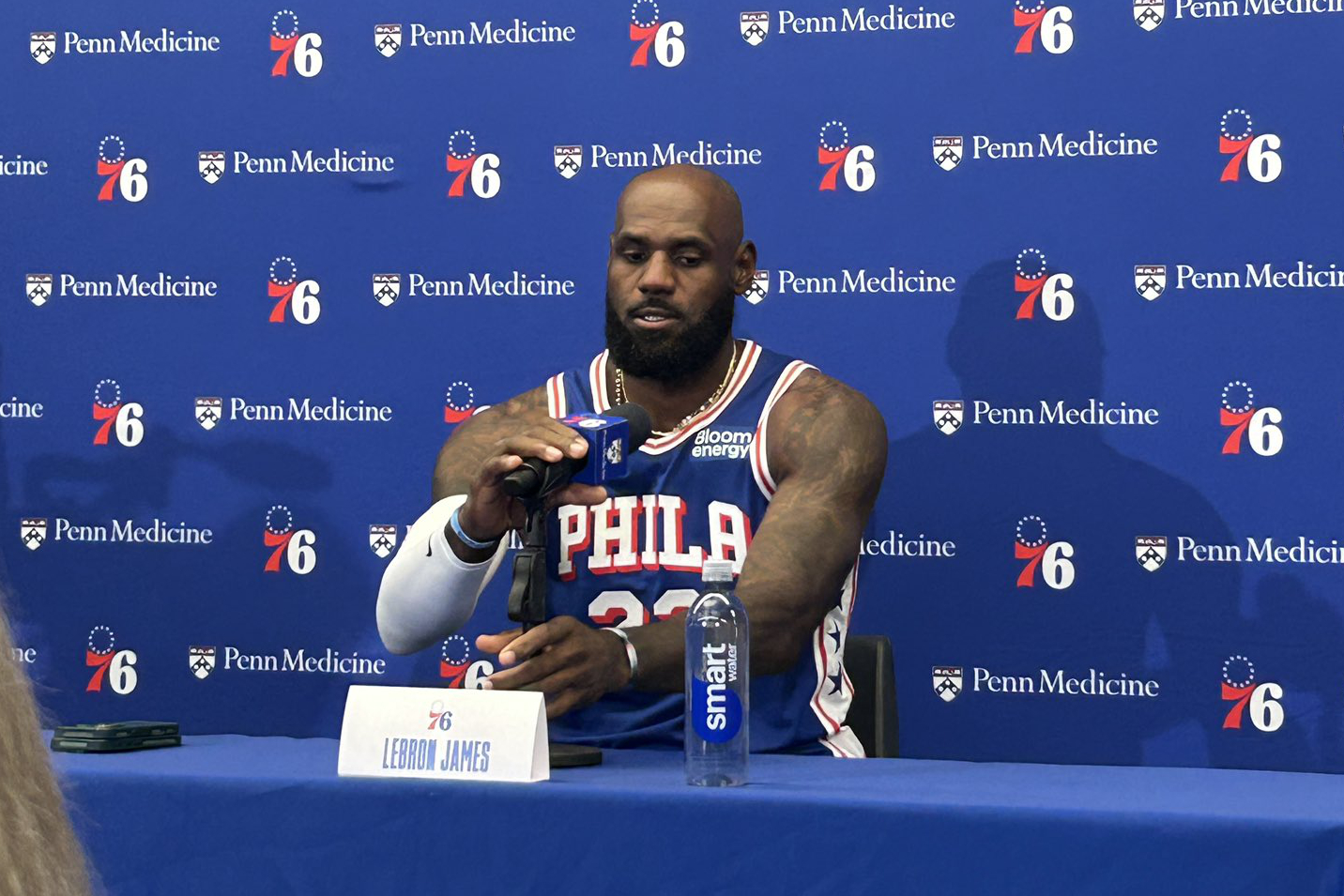
“Our relationship, when I broke a lot of the teams and franchises down I could possibly play for, he was one of the main deciding factors,” James said Monday in his first official public appearance as a Sixer.
Video: LeBron James on how much Tyrese Maxey played a factor in his decision to choose Philly
It’d be easy to interpret that solely as an endorsement of Maxey. But, in a funny way, James’ relationship with Maxey speaks as much to his own character as vice versa. Most of us here in Philadelphia know James only from afar, which means our impressions of him are inevitably shaped more by secondhand narratives than by firsthand witness.
In the weeks leading up to his decision to sign with the Sixers, local airwaves and social-media feeds crackled with skepticism from a contingent of fans who not only doubted James’ intentions but also recoiled at the idea of seeing him in a Sixers uniform. However genuine some of those skeptics were, others were undoubtedly reacting to a heroes-and-villains caricature that develops with all superstars who reach a certain stature. James’ relationship with Maxey doesn’t necessarily square with that caricature.
“He’s worked for everything he’s gotten,” Maxey said. “He was put on a pedestal where a lot of guys don’t succeed. And he probably surpassed expectations. For myself, I kind of had the opposite start of my career. I was put on a different pedestal, and I felt like I had to work my way up to where I am.
“But still, at the end of the day, both of us had to work to get to where we were. I believe in the work, he believes in the work. Like I’ve been saying for years, we’ve got to get one percent better [every day], and not just on the court, but as a group, the camaraderie. It’s gonna be new. It’s gonna be different … But it’s gonna be good.”
The most striking thing about James’ first news conference as a Sixer was both his maturity and the way in which it echoed Maxey’s.
“You got to try to stay even-keeled, understand that the noise is gonna be noise, what happens outside of this building is gonna consistently happen, and it’s going to be doubled and tripled and quadrupled now that I’m here,” James said. “And it just comes with the territory, I understand it. So the work that we put in in this building, the work that we put in when we’re on the road, watching film, the work that we put in, will take care of itself. …
“Guys will hold each other accountable. We put the work in, we have honest conversations, things of that nature. So, you know, just staying even-keeled and everything that’s going on out there does not matter. It does not matter at all, it’s about the results and the things that happen in this building for us. And if we do that, we’re a really talented team, but the talent will only get you so far.
“But if you put the work in, and you continue to be better and better every day, and you have this championship approach every day to get one percent better, and then it definitely will work in our favor.”
LeBron James dons a Sixers jersey for the first time as he speaks to reporters on Monday in Camden, N.J.Gabriela Carroll /
Whatever your preconceived notions about LeBron, he is clearly an athlete who treats his craft with the utmost sincerity. As Maxey said, plenty of athletes have begun their careers on pedestals similar to the one James occupied as a generational schoolboy star at Akron’s St. Vincent-St. Mary and the eventual No. 1 overall pick in the 2003 NBA draft. The dividing line between the greats and the coulda-been-greats is more often than not an internal will that manifests itself in both work ethic and competitive drive. Both are evident in the words James speaks and the manner in which he speaks them. One suspects his new teammates will have no choice but to listen.
Maxey wasn’t blessed with the same raw physical gifts as James. He had the misfortune of entering college the year the world shut down, which limited his exposure and precipitated his fall to the Sixers at No. 21. But there is clearly something kindred between the two players. Listening to them talk, seeing them side-by-side wearing the same uniform, it suddenly seemed obvious why James ended up with the Sixers. That says something about Maxey. It says more about James.