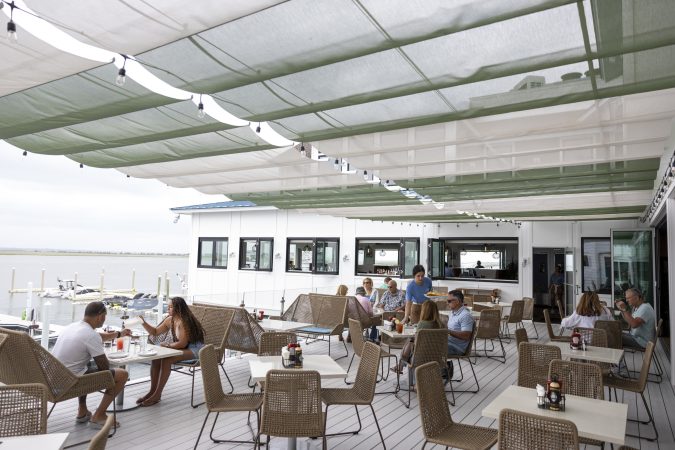
Earlier this year, restaurant owner Ray Leotta decided to add an eyebrow-raising cocktail to the “House Favorites” drink menu at Tideline, Margate’s latest bayside restaurant. The drink would befit the splashy 240-seat restaurant, which spans multiple floors and offers stunning sunset views and full service to the boats and Jet Skis parked in its slip.
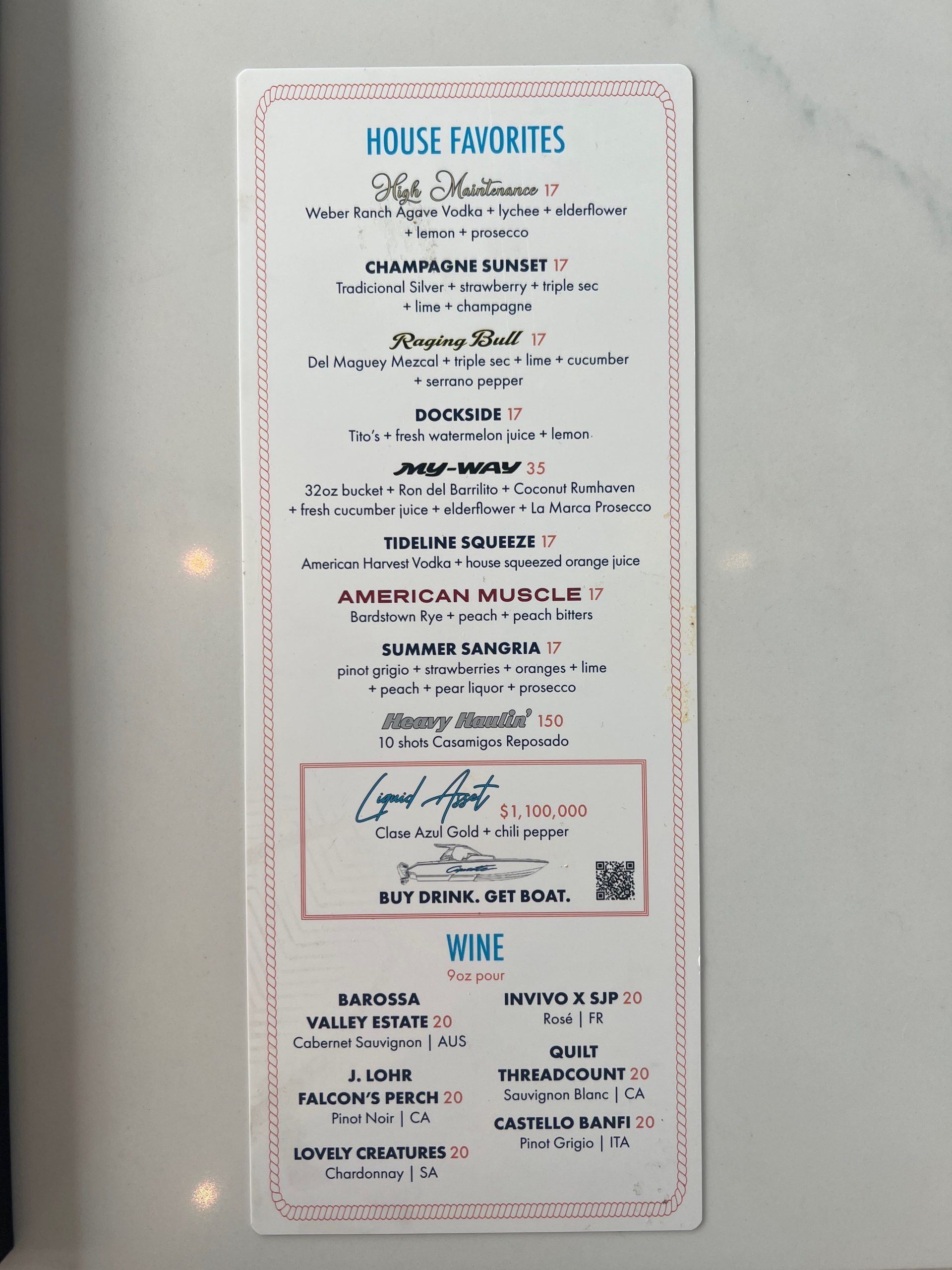
Called the Liquid Asset, the drink consists of top-shelf tequila, a big ice cube, and a red chili pepper — for the hefty price of $1.1 million.
The menu has a QR code for interested buyers to see renderings of the boat.Craig LaBan
That’s because this summer sipper comes with acustom-built39-foot speedboat.
“Everybody reads the menu and goes, ‘Oh wow, $1,100. What kind of drink is this?’ And we’re like, ‘No, that’s $1.1 million.’ And then, they freak out for a minute,” Leotta said.
The cocktail-and-a-boat idea was a 3 a.m. musing, said Leotta. Given the Shore’s bustling market for the boats, he thought the combo would be fun for local buyers. If he gets any takers, Leotta plans to offer the option every summer.
No one has purchased the Liquid Asset yet, but five regular customers have expressed interest in the unusual pairing so far, Leotta said.
“These boats are all custom-tailored, so they do take over a year and a half to make,” he said. “That’s another reason people are interested, because you can skip the line and you don’t have to wait.”
A rendering of the speedboat from Cigarette Racing company.Cigarette Racing
A year ago, Leotta reached out to Cigarette Racing, a Miami-based boat builder that specializes in luxury cigarette boats, who put him in touch with a New Jersey dealer to commission the speedboat. The boat, which will sport the restaurant’s blue-and-gray color scheme, is currently in production, with delivery anticipated for mid-August. Customers can use a QR code on the drink menu to view renderings.
If someone buys the“cocktail,” they’ll be presented with a contract to sign off on the purchase price, the boat, and all its features — plus a special engraved bottle of Clase Azul Gold tequila and the cocktail itself.
The Liquid Asset at Tideline costs $1.1M and comes with a custom speedboat.Tideline
Because the boat is still in production, the buyer would be on the hook for a $400,000 deposit now, with the remainder owed once the boat is completed. If someone buys it after delivery, it’s $1.1 million at signing.
Despite the spicy pricing, Leotta is optimistic the Liquid Asset will find a buyer.
And if it doesn’t sell?
“It’s mine,” Leotta said. “And the cocktail will remain on the menu.”
A few blocks and a few days apart, two of the same story: people showing up, in public, as exactly who they are.
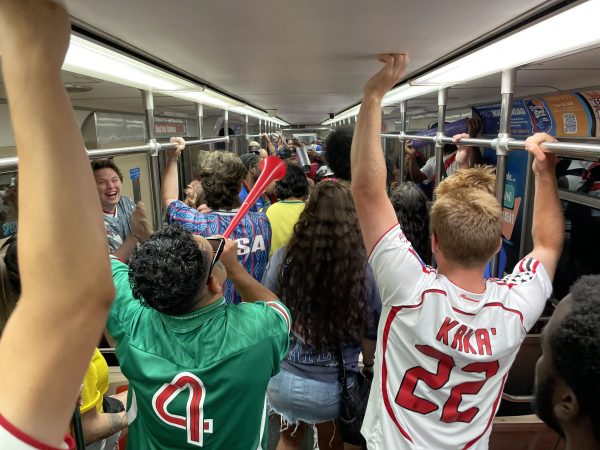
That’s what this World Cup summer has felt like across Philadelphia. Six matches at Lincoln Financial Field (or what was called Philadelphia Stadium for the tournament). A 39-day Fan Festival at Lemon Hill drawing tens of thousands a day. Northeast Philly, long home to one of the city’s largest Brazilian communities, turning into a sea of yellow jerseys. Africatown is filled with the flags of Ghana, Côte d’Ivoire, Curaçao. None of it required anyone to tone anything down.
Maxence Jeanty, 41, a fan from Chicago arrived at the FIFA World Cup game at Lincoln Financial Field between Brazil and Haiti, dressed as Jean-Jacques Dessalines, the leader of the Haitian revolution.Kerith Gabriel / Staff
I’ve spent years thinking about what it costs people to make themselves “easier to hold.” I host a podcast called Immigrantly, and after more than 4 million downloads and conversations with guests from New York City Mayor Zohran Mamdani and political candidate Darializa Avila Chevalier to comedians Hari Kondabolu and Aparna Nancherla, the thing I hear most often isn’t about policy or politics.
It’s usually much simpler: First- and second-generation immigrants didn’t know they were allowed to be complicated. Allowed to hold two, three, four places inside themselves at once without apologizing for the seams.
I know that erasure personally. I was born in Pakistan and built my adult life in America, and for years I made myself legible in rooms that hadn’t asked me to. I told myself it was politeness. It took me well into my 30s to understand it was a choice I’d been making so often it stopped feeling like one.
Which is why this summer has been disorienting in some ways. On the one hand, the World Cup has allowed people to make their origin pride more legible publicly. On the other hand, visibility doesn’t necessarily mean safety, warmth, or belonging.
Philadelphia has spent 2026 rehearsing its own origin story — the run-up to the country’s 250th birthday, with a Round of 16 match on July Fourth itself, in the city where the Declaration of Independence was signed.
And at the exact same time, in the exact same city, thousands of people have been reminding us that America was never actually one thing. It was Curaçao and Ghana and Ecuador and Brazil and Haiti, all at once, all unbothered, in a city built by people who never stopped arriving.
Philadelphia Mayor Cherelle L. Parker joins fans of Mexico’s soccer team in a chant during the FIFA Fan Festival at Lemon Hill on June 11, the opening day of the World Cup.Jose F. Moreno / Staff Photographer
Mayor Cherelle L. Parker put it plainly after the festival’s opening weeks: The energy across the city, she said, reflected Philadelphia “at its best — welcoming, diverse, joyful, and proud.”
I believe she meant it. I also know that sentence is easy to say about a festival and much harder to sustain on an ordinary Wednesday, after the last match, after the Fan Festival tents at Lemon Hill come down and Kelly Drive goes back to being Kelly Drive.
That’s the question I can’t stop asking: What happens on July 20?
Because the pride on display this summer isn’t new. The Brazilian families in the Northeast, the West African community that fills Africatown, the Haitian, Ghanaian, and Ivorian Philadelphians who’ve been here for decades — they didn’t invent their culture for this tournament.
A Brazil fan waves his national flag before a FIFA World Cup Group C soccer match between Brazil and Haiti at Lincoln Financial Field on June 19. Jose F. Moreno / Staff Photographer
What the World Cup did was give them permission to bring it fully into public view, and give the rest of us permission to celebrate it instead of asking it to quiet down.
I think about the women I talk to through my work — the ones fluent in code-switching, who’ve spent decades reading a room and calibrating themselves to fit it. I want to point them toward Lemon Hill in July and say: Look at what happens when nobody has to shrink. Look at what this city sounds like when everyone’s whole self shows up at once.
The tournament will end. The flags will come down. Philadelphia will go back to being, simply, Philadelphia.
But the pride we’ve watched all summer doesn’t have to be seasonal. It doesn’t need a stadium or a festival permit.
It can be what a Tuesday looks like here, if we decide it is — a city that doesn’t just tolerate its immigrants during a global tournament, but actually wants to see them, unedited, all year long.
Saadia Khan is a Pakistani immigrant and mother, host of the podcast “Immigrantly,” a Columbia University human rights graduate, and creator of Belong On Your Own Terms, an app for multicultural individuals reclaiming their full identity. Find her work at immigrantlypod.com.
Burlington County was left behind when a new free shuttle bus for South Jersey launched in June. That is going to change in September.
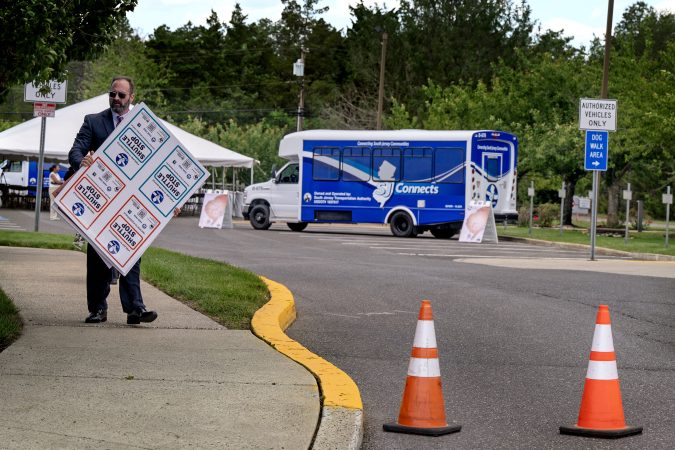
The South Jersey Transportation Authority (SJTA) announced June 1 that a free shuttle bus program called South Jersey Connects was launching that day with routes in all seven southern counties: Atlantic, Camden, Cape May, Cumberland, Gloucester, Salem — and Burlington.
But as the other routes launched, the promised Burlington County route never began. On the authority’s website, it is still marked as “coming soon.”
That is because until recently, the transportation authority was not actually authorized to operate in Burlington County. The county considered operating its own route for the program but ultimately agreed to have the authority run it instead.
But that required legislation.
South Jersey lawmakers had proposed bringing Burlington County into the authority back in the 2022-23 legislative session, but it was not until the South Jersey Connects program was about to launch this year that legislators had the wherewithal to actually hit the gas pedal in Trenton.
“We worked in partnership with our county commissioner, then the administration of Burlington County, and just realized we just couldn’t pull that off,” Sen. Troy Singleton, a Burlington County Democrat, said in an interview. “And speaking with the administration, they were like, look, we feel more comfortable running this through the SJTA, and we already had this legislative vehicle, so that’s when it took on a greater sense of urgency.”
The bill to bring Burlington County into the SJTA passed the Assembly in mid-May and was approved by the Senate just a few days before the June 1 announcement. But Gov. Mikie Sherrill did not sign it into law until the night of the budget deadline — a month after the program had been announced.
“The timing just didn’t work out,” Singleton said.
The Burlington route is expected to start in September, said Dominic D’Amico, director of transportation services at the SJTA, but a start date has not been announced.
The new shuttle’s path has been finalized but has not been shared publicly. D’Amico said in an interview that, like the other routes that launched June 1, it will connect with NJ Transit’s existing infrastructure and the region’s “eds and meds.”
Burlington County Commissioner Felicia Hopson said the new shuttle will enhance the NJ Transit River Line and help residents access jobs, appointments, stores, and schools.
“Stretching 820 square-miles, Burlington County is New Jersey’s largest county, making transportation essential but also challenging for residents without motor-vehicles,” she said in a statement.
The idea of South Jersey Connects emerged from the Chamber of Commerce Southern New Jersey’s advocacy after former Gov. Phil Murphy implemented the 2.5% Corporate Transit Fee on businesses to fund NJ Transit in 2024.
The project was granted $5 million for an 18-24 month pilot, and the future beyond that is uncertain. The South Jersey chamber unsuccessfully requested more money for the effort in this year’s budget, and proponents of the project are hoping to show that it is worth the investment during next year’s budget negotiations.
The summer launch so far has been a little slow, which is to be expected, according to D’Amico.
The authority has seen about 600 one-way trips in the first month of the program, he said, a number he expects to go up as people learn about the routes and as school starts in the fall. He wants to see the service hit at least 5,000 one-way trips each month.
“It takes some time to spread the word, for the marketing campaign to reach the social media platforms, getting brochures delivered to each facility — all those types of things factor into what is a normal slow start,” he said.
“It could be worse, it could be better,” he said.
Why wasn’t Burlington County part of the SJTA before?
Sherrill said in a statement that Burlington County deserves to be part of the authority as “a vital part of the region.”
The reason Burlington County has not been included in SJTA is not because anyone was denying the county is part of South Jersey. Rather, the agency was set up to replace an entity that oversaw the Atlantic City Expressway, which does not go into Burlington, said David Zappariello, the authority’s director of communications.
Along with adding Burlington County to the authority’s coverage zone, the new law allows Sherrill to appoint another member to its board. Members of the board represent the region as a whole, not their home county, Zappariello said, and there is already a Burlington County resident sitting on the board.
Assembly member Alex Sauickie, an Ocean County Republican who also represents part of Burlington County, voted against the bipartisan legislation because it did not also add Ocean County to the authority.
“I just don’t like it when you’re picking winners and losers for political reasons,” he said.
Assembly member Andrea Katz, a Burlington County Democrat, said none of the South Jersey Connects routes will touch her district, where she has concerns about transit deserts. But she is hopeful about public transit expanding in the region and the county getting a seat at the transit table.
“Burlington County now being included means that we’re going to get to have that voice,” she said. “We’re going to get to not be the one stuck in the middle there. We’re going to start to get our own access to public transportation.”
You’ve built up your business over years. Now it’s time to sell. You’ve found a buyer. You’ve negotiated a good price. You close the deal.
And then comes the hard part: paying taxes on your gain.
It could be a big number. But there are a number of ways to potentially defer — or even reduce — this cost.
Here are two strategies that have grown in popularity.
Structured installment sale
Using this approach, you don’t take the money up front from the buyer. Instead, a third-party assignment company assumes the buyer’s obligation to make future payments to you.
In many structured installment sales, that obligation is funded by an annuity.
An annuity is an investment vehicle that makes a fixed payment to you over a number of years — even your entire lifetime — in exchange for a lump-sum payment up front, which would be made directly by the buyer of your company. These are usually sold by insurance companies or other large financial services firms.
People like annuities because they protect their principal and offer longer-term financial security. Because many fixed annuities offer a guaranteed payment that covers your expenses, they can also potentially minimize the risk of you outliving your savings.
A structured installment sale defers the capital gains tax on the sale of your company into the future because you only owe the tax in the year when you receive your annuity payment. Interest earned on the annuity is taxed at your ordinary rate as you receive the payment. If your total income declines in the future, this tax could decrease.
“A lot of owners have put everything they had into building the business,” said Wade Martin, a financial adviser with RBC Wealth Management in Princeton. “They don’t have a pension, they haven’t focused on their own financial planning, and they don’t want to take stock market risk. For someone like that, a fixed monthly payment can let them sleep at night.”
There are downsides to annuities.
You lose control over your investment decisions and forego potentially higher gains if you had invested the money on your own. Each installment payment may include a return of basis (part of the money originally put in), capital gain taxed at capital gains rates, and an interest component taxed as ordinary income. Depending on your circumstances, that interest income — or the tax treatment of any remaining annuity value inherited by your beneficiaries — could result in a higher overall tax bill than taking the proceeds up front. You’ll incur fees and you’d likely be susceptible to surrender charges if you withdraw your money early.
“You could theoretically invest the money elsewhere and earn a better return than the annuity’s guaranteed rate,” said Bejan Shirvani, head of structured settlements at MetLife. “However, a good annuity can offer guaranteed payments and professional management.”
Dianne Stewart sold her New Jersey-based auto repair business, Kingston Garage, in 2024. At first she was dubious about a structured installment sale. But then she saw the benefits.
“I asked myself: Do you really need all the cash up front? What are you going to do with it?” she said. “I soon realized that it would be stupid to sell the business outright and lose about 30% to taxes, so for me it’s like a tax-deferred pension.”
But this arrangement may not be for everyone, Stewart acknowledges.
“If you need the money to buy another business or make another investment, it may not fit,” she said. “But if you’re retiring, I think it’s geared toward people who want income instead of one big check, and who want to spread out their tax bill over a longer period of time.”
Donor-advised funds (DAFs)
Setting up donor-advised funds with a wealth adviser allows you to make charitable contributions each year, and then take a tax deduction (subject to some limitations) without actually giving the money away immediately. The fund grows tax-free and you can decide in the future where you want the savings to go. It’s a great way to take advantage of the charitable deduction without committing to a specific charity.
DAFs can also be used to reduce your taxes when you sell your business. The trick here is to make sure your DAF owns a minority shareholder interest in your company before the sale. That way when you sell the company, cash goes to the DAF based on its ownership percentage without generally incurring capital gains taxes because it is a charitable organization.
“A donor-advised fund gives you an immediate tax deduction, tax-free growth inside the account, and the flexibility to decide later which charities will ultimately receive the money,” said Jesse Wideman, a financial adviser with Zenith Wealth Partners in Philadelphia. “Many of my clients have unusually high-income years, often because they’re selling a business. A donor-advised fund lets them capture the charitable deduction in that high-tax year while distributing the money to charities over many years.”
If a business owner is charitably inclined a DAF should be seriously considered, Wideman says, but it’s also important to make sure it’s part of your overall financial plan.
Martin noted that any of these approaches requires thought and long-term planning.
“It’s a holistic viewpoint,” Martin said. “you have to look at estate planning, income taxes, risk tolerance, and what helps someone sleep at night. It’s important to bring in your accountant, attorney, and financial adviser together before making a decision.”
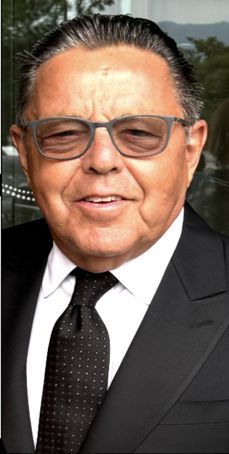
Marc Kaplin takes “pit bull” as a compliment when it’s used to describe him. The longtime real estate lawyer who has championed property rights for developers in the region takes it to mean “aggressive, prepared, knowledgeable.”
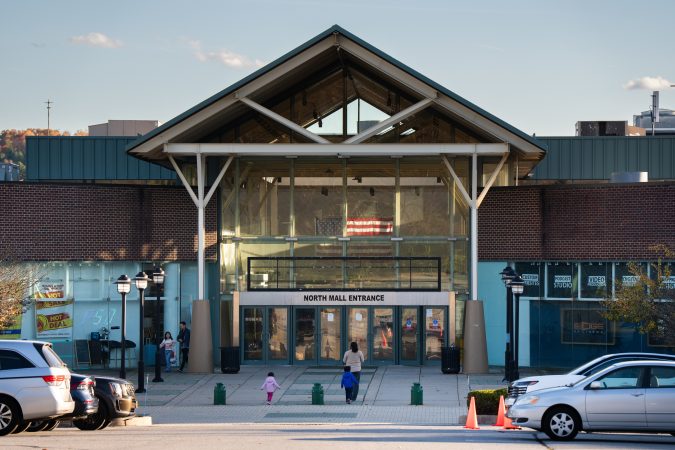
He’s using that tenacity right now in court, battling over whether his client’s plan to redevelop the recently shuttered Exton SquareMall into a mixed-use town center can go forward despite the town supervisors’ denial.
For decades, Kaplin, 82, has been behind dozens of regional development projects, with clientele spanning the Delaware Valley, into the Lehigh Valley, the Poconos, Delaware, and New Jersey.
Kaplin’s interest in real estate law kicked into high gear when his family moved to Blue Bell in 1978, near Wings Airways. It was still “a prairie” with little development, he recalls. The airway owners wanted to expand the runway, challenging the township’s ordinance. He was hired by a group of neighbors to oppose it.
Marc Kaplin, a real estate powerhouse, talked to The Inquirer about the Exton mall redevelopment project and more.Courtesy of Marc Kaplin
That led to his role as township solicitor for Whitpain Township in Montgomery County in the early 1980s. Eventually, he moved into development: First working for his landlord, Bud Hansen of Hansen Properties, which becameone of the biggest developers in Montgomery and Chester Counties.
When Toll Brothers started, Kaplin was there. He’s represented the home construction company for more than 40 years. Other clients, like retail developers Wolfson Group, have also spent decades alongside Kaplin.
This conversation has been edited for clarity and brevity.
You’ve worked in the city and the suburbs. Where is it easier to get projects done?
They’re both extremely difficult and getting more and more difficult for different reasons.
Philadelphia, if you don’t have a by-right project, you’ve got to go to the neighborhoods, the RCOs [registered community organizations]. You got to spend a lot of time, and it’s more political and satisfying people, than it is complying with every small [thing].
Not only do you have to make sure that all the I’s are dotted and T’s are crossed in the suburbs, you got to know what to look for.
There’s often community pushback in development projects. What are you hearing now when communities oppose a project?
Just seems like everybody is against almost everything for a variety of reasons. Everybody complains about traffic. That’s the biggest thing. It’s ‘We’re here, we live here, we don’t need any more stores. We don’t need any more of this or that.’ But a lot of times you get a mixed bag.
Now the Exton mall, we got very good reception to the Exton mall. It’s only a small group of people who are against the redevelopment of the Exton mall.
Does the pushback to Exton Square Mall feel representative of larger trends in the region?
It’s an anomaly for a project like that. When you look at the malls that are in really bad shape, townships are reaching out and want them redeveloped. Montgomery Mall. Plymouth Meeting Mall. Some over in New Jersey. I’m working on the Berkshire Mall up in the Reading/Wyomissing area, and we’re getting tremendous cooperation.
These malls are 1,500-pound gorillas. They killed tax base, millions and millions of dollars that were coming in before. … I can’t give you a logical reason why two supervisors in West Whiteland are putting up this fight. I’m waiting for a judge to make a decision.
We’re pretty optimistic that we’ll be able to go ahead, but it ain’t over until it’s over.
You’ve been quoted as saying ‘indoor malls don’t work,’ but we are seeing some success in King of Prussia and Cherry Hill. What do you think sets them apart from places like Exton mall?
They are the super regional malls, and they do work, and Simon controls many, many of them. They work, but the Plymouth Meeting Mall doesn’t work, the Exton mall doesn’t work, the Willow Grove mall doesn’t work, and many, many more.
There’s a whole long history of why that’s so. There were, in the ’60s and ’70s, department stores we no longer have: Wanamakers, Strawbridge’s, Snellenburg’s, and on and on. … And then you had J.C. Penney and Sears, and it was much easier way back then to get three large anchors. Then the Kmarts came along, and the Walmarts, the big boxes that didn’t have all of the infrastructure. The common operating expensesare much less, because you have all interior halls — heating, air-conditioning, and all that.
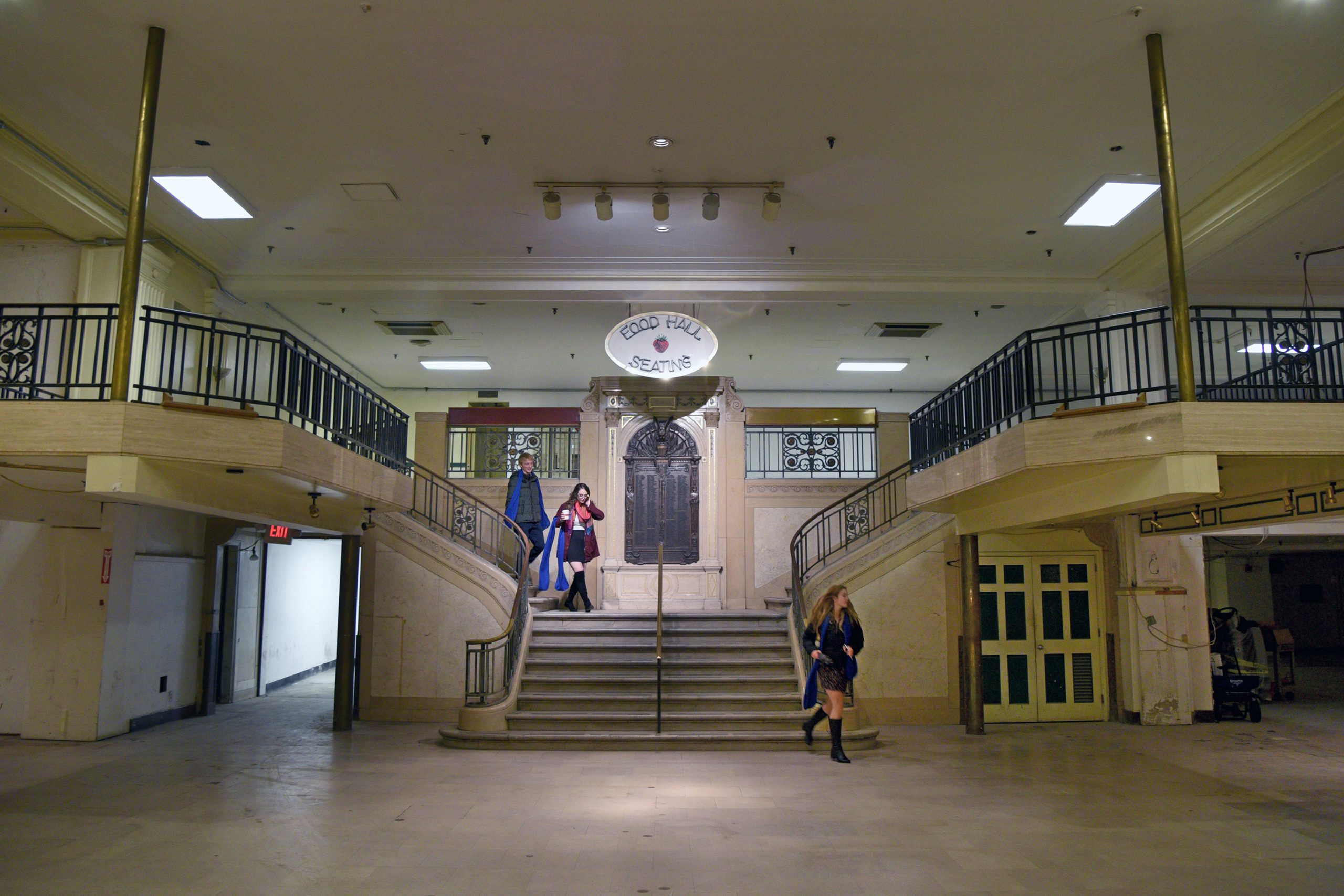
Members of the Strawbridge family explore the old Food Hall on the first floor of the former Strawbridge & Clothier department store site on the north side of the 800 block of Market Street Dec. 17, 2019.Tom Gralish / Staff Photographer
Because it’s run by the best operator around.That’s my client, Steve Wolfson. It’s had a[n] … anchor for now over 20 years.
In Exton, there was about a 10-year period when there were two supervisors who were against everything. So you didn’t see a great deal more development, but the Main Street at Exton used the new urbanist approach 22, 23 years ago and made huge improvements to the roads. There are great roads there, and it was right in the path of development.
Are there any cases or projects that have shaped Chester County as we know it today?
Exton has always been called the crossroads of Chester County. You’ve also got the Hankin Group that has done all the development in Chester County. … You had very big companies come in — Vanguard — and you had good school systems and relatively decent roads. I think it’s just the continued outward development from Philadelphia.
Many suburbs are facing affordable housing crises. How do you predict municipalities will overcome NIMBYism when it comes to those projects?
It’s a very, very, very difficult problem. There are very few places in the entire country where it’s been solved. New Jersey has the most extensive program in the country to cause the development of affordable housing … that’s really the Mount Laurel doctrine, and where the townships are required not only to make affordable housing available, but also to make it happen.
The market cannot create affordable housing without governmental help. Just can’t be done. It’s not enough land. Regulations are enormous, expensive.
It’s a societal problem that can’t be solved just by municipalities and homebuilders and homebuyers.
Do you think all of the proposed data centers will actually get built?
I’m involved in a couple of data centers. … At first the communities were dead set against more warehouses, particularly up in the Lehigh Valley, and then when this particular community heard ‘data center,’ they were ecstatic — for a whole variety reasons: very little traffic, very few people in schools, high-paying jobs, and now there’s this national swell attacking data centers.
The data centers we’re seeing now, in one fashion or another, are creating their own energy. So my own particular opinion is that it’s just blown up, overblown, over-exaggerated, and we’re going to need all this computing power as we move into the next technology age.
Archaeologists have nearly wrapped up their analysis of artifacts found at Cherry Hill’s Croft Farm, a historic Underground Railroad site where items have accumulated over thousands of years.
That catalog includes 6,300 ceramic fragments, hundreds of bones, and belongings of the Lenni-Lenape Indigenous people who once inhabited the land along the Cooper River.
In February, Cherry Hill Township invited the public to spectate the dig at Croft Farm, a property purchased by Cherry Hill in 1985 and since added to the National Register of Historic Places. It sits at a dead end behind a playground and a dog park, and Megan Brown, deputy chief of staff for Cherry Hill Mayor David Fleisher, said lifelong residents tend to not know it exists.
The township recruited PS&S, an architectural firm headquartered in Somerset County, a year before the February dig to oversee cultural resource management at the site, triggered by renovations to preserve a building there.
Upgrades to the Kay-Evans House, an 18th-century home at Croft Farm that once served as a stop along the Underground Railroad, are funded in part by a $638,000 grant from the New Jersey Historic Trust, which requires work to ensure the safety of historic artifacts found there. Those items will become Cherry Hill Township property.
Brown said the artifacts collected could find their way into public displays on the first floor of the house.
“We do tell the history, but kind of more as a whispering,” Brown said. “We’re going to start really yelling about it.”
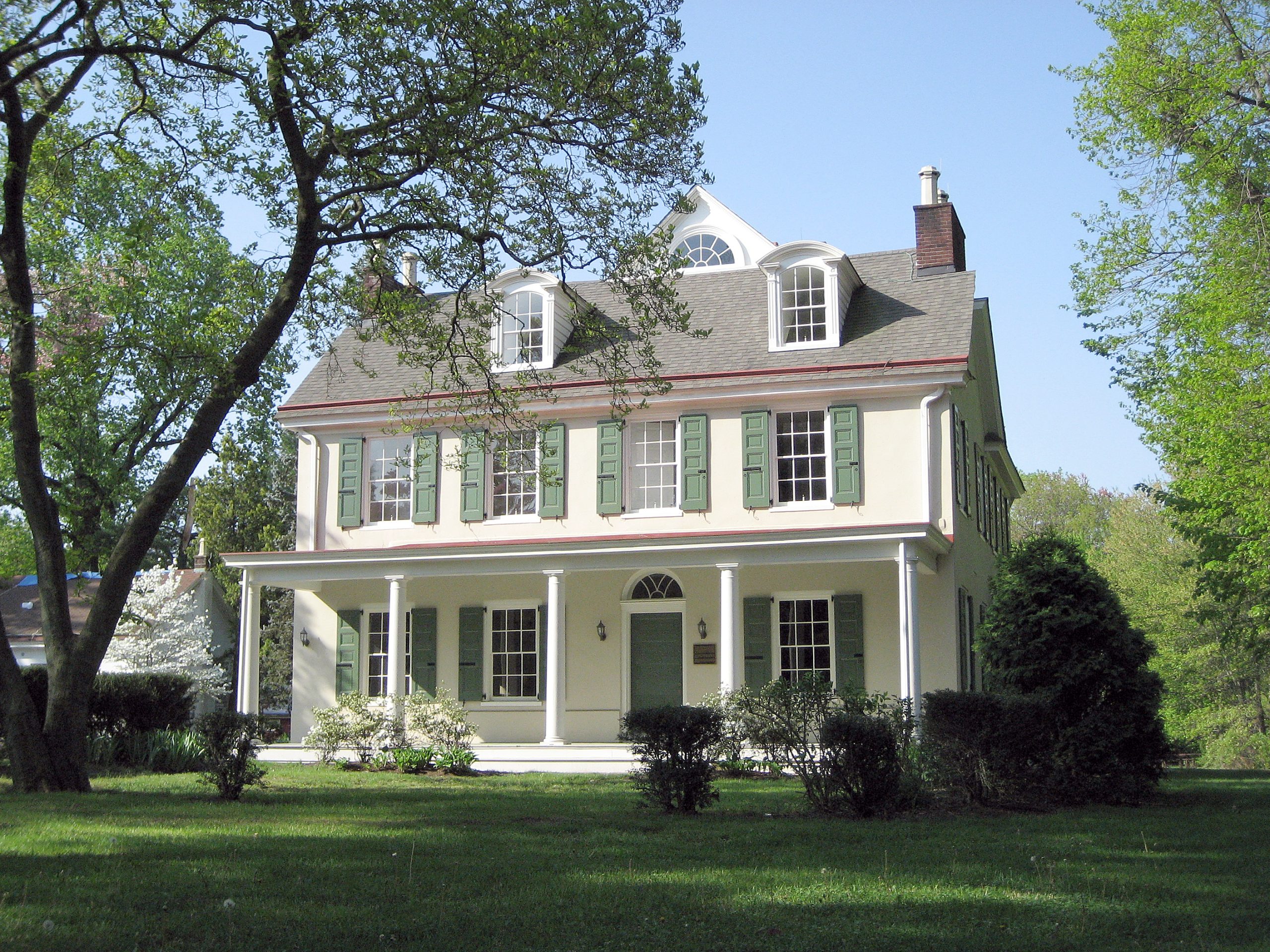
The Kay-Evans House, a historic building at Croft Farm in Cherry Hill, is home to Cherry Hill Township’s Recreation Department.Cherry Hill Township
Hundreds of ceramics
Croft Farm has housed generations of people living along the Cooper River, and artifacts like ceramics help archaeologists identify lifestyle and socioeconomic changes over time.
The land at Croft Farm was purchased by the Kay family in the early 18th century, and around 1750, Quaker Isaac Kay built an early version of the building now known as the Kay-Evans House, which today houses the Cherry Hill Recreation Department.
In the 19th century, the Evans family moved onto the property and expanded the home. Like other Quakers, owner Thomas Evans and his son Josiah were members of the New Jersey Abolition Society who pushed to end slavery and support the Underground Railroad, according to the township’s online history of Croft Farm.
Matthew Tomaso, the senior director of cultural resources for PS&S, said the firm found material spanning from the 18th century to the early 20th century. About 1,000 artifacts come from the 18th and 19th centuries, including when the Evans family helped operate the Underground Railroad.
Nineteenth-century hand-painted polychrome ceramic sherds are among the artifacts found by PS&S during site work at Croft Farm in Cherry Hill. Matt Kraemer
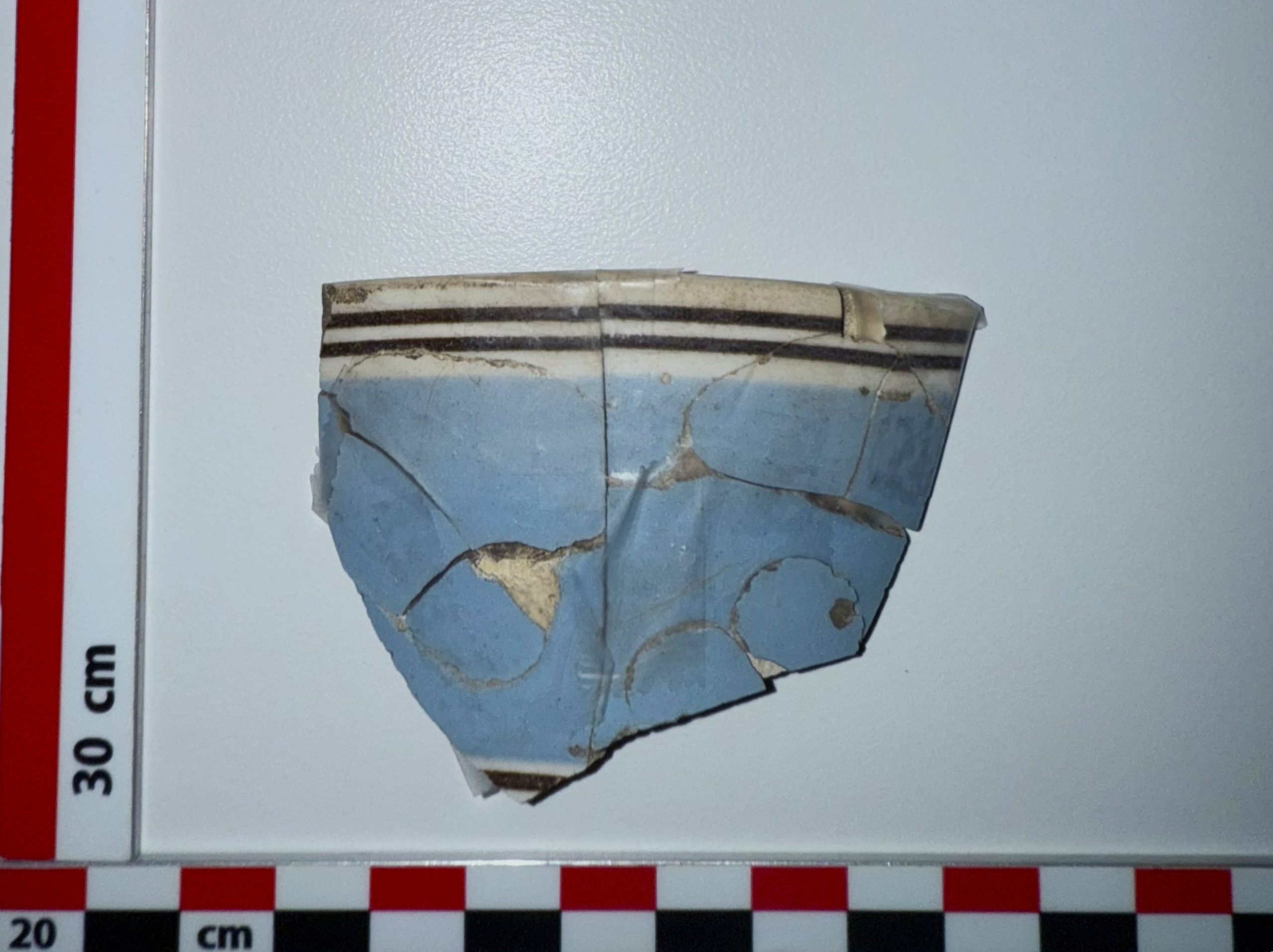
Matthew Kraemer, a PS&S archaeologist on the project, said the type of ceramics discovered on the site varied by time period, from 18th-century Staffordshire slipware to more creamware, pearl ware, earthenware, and whiteware as time went on.
The ceramics, buried by time, were not found in one piece. Tomaso said his team sorted through thousands of tiny fragments to assemble 359 vessels.
Kraemer said he is looking at how the ceramics change through time, since a transition from simple to fancy bowls could indicate shifting values among the Quakers, traditionally known for their modesty.
The location where the ceramics are found matters, too. Since enslaved people often used backyards as outdoor kitchens, Kraemer said, finding ceramics outside the house is telling, since that tradition likely continued as formerly enslaved people fled northward.
A 19th-century annular banded dipware ceramic refit, with shards pieced together by PS&S archaeologists, is one artifact found during site work at Croft Farm in Cherry Hill, New Jersey.Matt Kraemer
“If we find a higher proportion of hollowware in the backyard, then we know this could further indicate, from an archaeological point of view, involvement in the Underground Railroad,” Kraemer said.
The Croft Farm site is known as a former home to previously enslaved people, including Joshua Saddler, who founded nearby Saddlertown, a Black settlement in what is today Haddon Township.
‘An awful lot of butchering’
Chelsea Carriere, another archaeologist at PS&S, said she had not expected to find so many animal remains, since nearby water typically makes bones degrade faster.
But Carriere ended up with a stash of 480 bone fragments showing human alteration, or bones with burn or cooking marks.
So far, she has identified goat, cow, sheep, rodent, and turtle bones, along with a raccoon scapula, clearly chopped, and animals likely trapped and hunted, like rabbits. While historical documents show pigs lived on the property, Carriere did not find many pig bones, though she said it could be that the animals were butchered elsewhere or were cooked in a way that did not make for good preservation.
“We can dive into what the recipes of the time were and see if there’s any correlation between the cut marks we’re seeing and what kind of foods were typically cooked or fashionable during certain periods,” Carriere said.
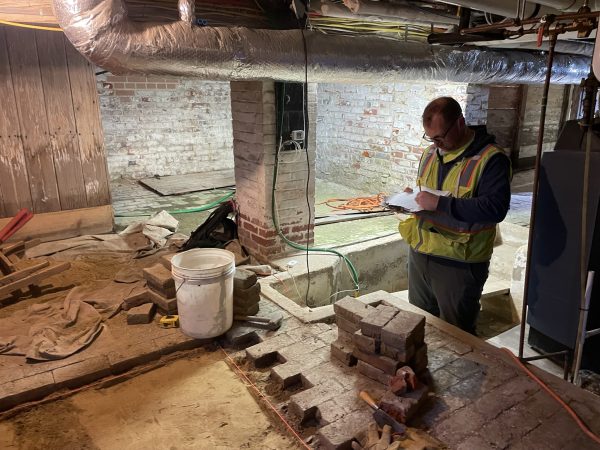
The team also found bones in the Kay-Evans House basement, which Tomaso said was strange, since people did not usually throw away organic waste indoors.
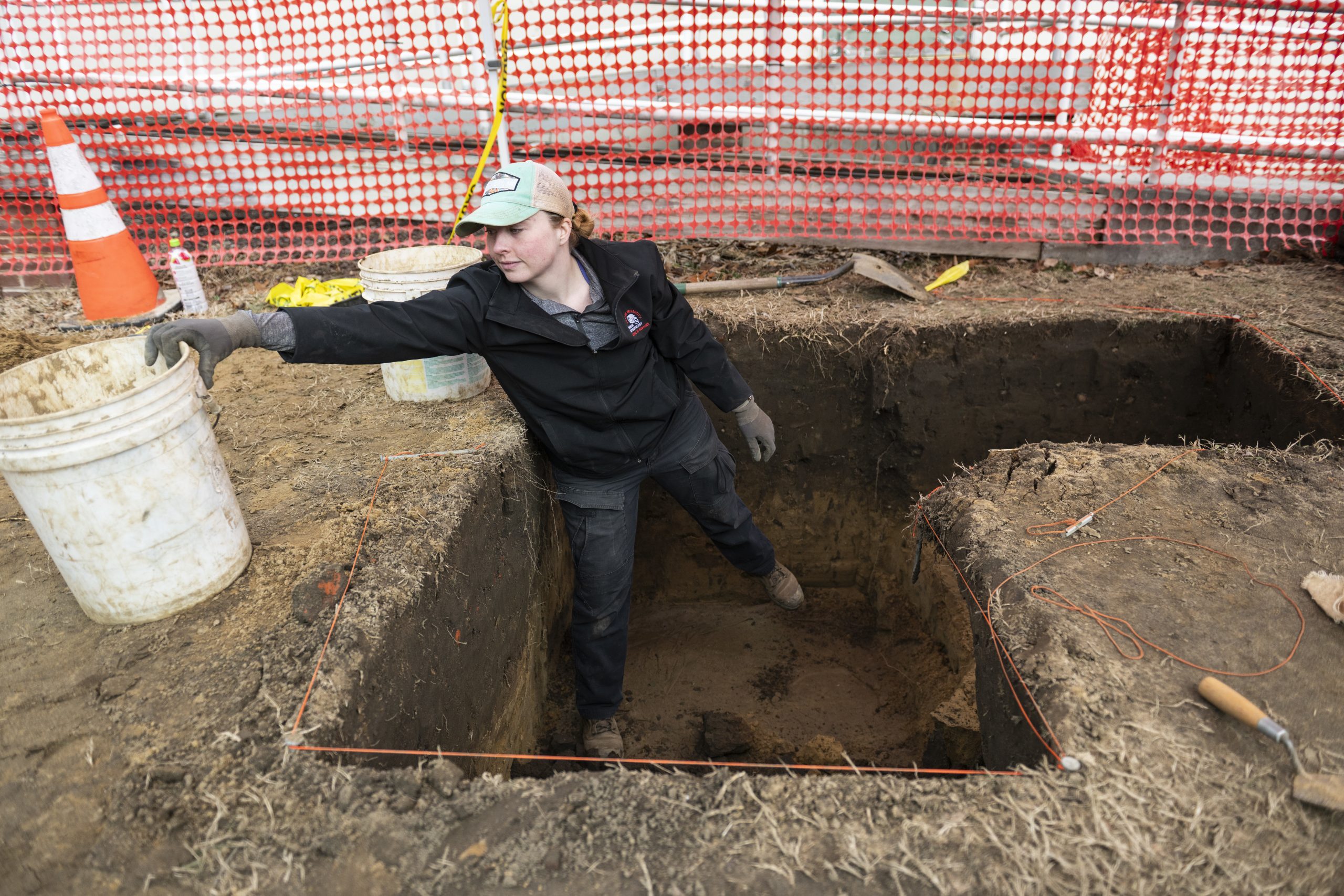
Chelsea Carriere, archeologist with PS&S, grabs for a bucket while digging at Croft Farm in Cherry Hill, N.J. on Saturday, Feb. 21, 2026. Allie Ippolito / For The Inquirer
Studying those remains will help Carriere determine how the people living there butchered and prepared their food, and how the Evans family lived off the land. Bones with rough, choppy markings could indicate at-home butchery by a novice, while clean cuts imply meat purchased from a local butcher.
“You would kind of expect to see a change there where people might be having more access to store-bought cuts of meat in the 19th century during the Evans family’s occupation,” Tomaso said. “And one of the things I think is really interesting … is that it seems like they’re doing an awful lot of butchering right there on the property.”
Over 4,500 years
Most of the recently found artifacts came from the last 300 years, but some items go back further, including ones PS&S archaeologists have not disturbed at Croft Farm.
“We now know that it was probably reoccupied over about 4,500 years or more,” Tomaso said. “So that’s kind of cool.”
Before white settlers came to Croft Farm in the late 17th century, the Lenni-Lenape Indigenous people are known to have lived on the land. Tomaso said artifacts from the Indigenous people are deeper in the ground, and seemingly less intact.
But based on the site’s location and proximity to water, Tomaso said, he suspects Native American tribes used the land for thousands of years, though not continuously. PS&S has bolstered that timeline with the Indigenous artifacts its team managed to find, including triangular projectile points typical of the Woodland Period long before the arrival of white colonists.
The absence of some typical artifacts caught Tomaso’s eye, too. The Croft Farm site had very few glass and liquor bottles, and few smoking apparatuses, and Tomaso said the team is still trying to figure out why.
“I think that these guys might have been practicing temperance, which would have been common for the Evans period, really uncommon for the Kays, even among Quakers,” Tomaso said. “Because 18th century, basically, people just drank all the time. For example, beer was not considered an alcoholic beverage.”
Once the project is wrapped up and the data compiled, PS&S will report its findings to the state, Tomaso said.
In the meantime, Brown said, Cherry Hill is working toward awarding a bid for construction at the Kay-Evans House and finding ways to increase the public’s awareness of the Croft Farm property.
“You can really just kind of disappear from Cherry Hill in this location,” Brown said. “It’s really beautiful and we’re really just looking forward to having people take more advantage of it and having people get to understand it better.”
With Eagles training camp drawing nearer, The Inquirer is taking a closer look at the more than three dozen new faces who are expected to report along with the rest of the team on July 28.
Player: A.J. Epenesa
Position: Defensive end
Age: 27
Previous experience: Epenesa is a veteran defensive end who spent the first six years of his NFL career with the Buffalo Bills. Buffalo selected him in the second round (54th overall) of the 2020 NFL draft. A five-star prospect out of high school, Epenesa played college ball at Iowa. He was the highest-rated recruit to play under head coach Kirk Ferentz.
The 27-year-old was mostly a rotational piece on Buffalo’s defensive line, but he made the most of his role. His best season came in 2022, when he logged a career-best 6½ sacks, 10 quarterback hits, 14 quarterback pressures and 16 tackles. He initially signed with the Browns this offseason, though Cleveland eventually called off the deal because of a failed physical. The Eagles signed him on June 10.
Path to a roster spot: Boasting a decent NFL resumé as a situational pass rusher, Epenesa has a strong chance to make the 53-man roster if he stays healthy. He likely won’t start a game this season — which is a testament to Philadelphia’s loaded edge rusher corps, made up of Jonathan Greenard, Nolan Smith, Jalyx Hunt and Arnold Ebiketie — but don’t be surprised if he turns into a key cog on Vic Fangio’s defensive line.
Fun fact: Epenesa’s father, who also played at Iowa, is named “Epenesa Epensa.” His nickname is “Eppy.”
Quotable: “We had some battles,” five-time Pro Bowl tackle Tristan Wirfs, Epensa’s teammate at Iowa, said of the defensive end. “When I met with the Broncos, they said a scout was there [at Iowa’s practice] and I didn’t lose to A.J. So I said, ‘I’m glad you were there on that day.’”
Guard Micah Morris is another in a long line of Georgia draft picks for the Eagles. Elizabeth Robertson / Staff Photographer
Player: Micah Morris
Position: Guard
Age: 22
Previous experience: The Eagles selected Morris in the sixth round (207th overall) of the 2026 NFL draft. He played collegiately at Georgia, where he initially struggled to climb the depth chart until morphing into the starting left guard. At Georgia, he was teammates with current Eagles defensive tackles Jordan Davis and Jalen Carter.
Path to a roster spot: The Eagles drafted Morris because they needed interior offensive line depth. Landon Dickerson is a guaranteed starter, but he’s battled multiple injuries in recent years. Fellow starting guard Tyler Steen has just one year of starting experience on his resumé. The depth pieces behind them are green. Morris will likely make the roster — and he might even see some action, if Philadelphia’s injury woes persist.
Fun fact: Morris, who stands at 6-foot-4, 330 pounds, earned a spot on The Athletic’s“Freaks” list last season for his weightlifting prowess. According to The Athletic, Morris has done two reps on the bench of 420 pounds and squatted 505 for a double.
Quotable: “The first time I tried to sit down a Jordan Davis bull rush, that’s when I realized this was not high school ball,” Morris said before the Eagles’ two-day rookie camp. “My feet were planted, but I was sliding backward.”
Every time Sonja Marsh is at a major league baseball game to watch her son, or an international track meet to watch her daughter, she brings a small, gray urn with butterflies on the side.
It contains the ashes of her late husband, Jake, who died of cancer in April of 2021. There are countless ways the family has kept his memory alive. Brandon Marsh and his sister, Erin, each have a tattoo on their arm that says “believe,” a favorite mantra of their father’s.
They wear rubber bracelets bearing his name, and always seem to find signs that their father is with them. Butterflies are a big one. The Phillies outfielder said he’s seen “millions” of the winged creatures since his father passed.
Another example came in May of 2024, when a black T-shirt was unexpectedly delivered to Marsh’s locker in Miami. On the front was the logo of Jake’s favorite band: Guns N’ Roses.
So, it was only fitting that in Marsh’s first-ever All-Star appearance on Tuesday at Citizens Bank Park, he and his family found a way to include their loved one. Not long after the All-Star roster was announced on July 4, Sonja began designing a logo for her son’s cleats.
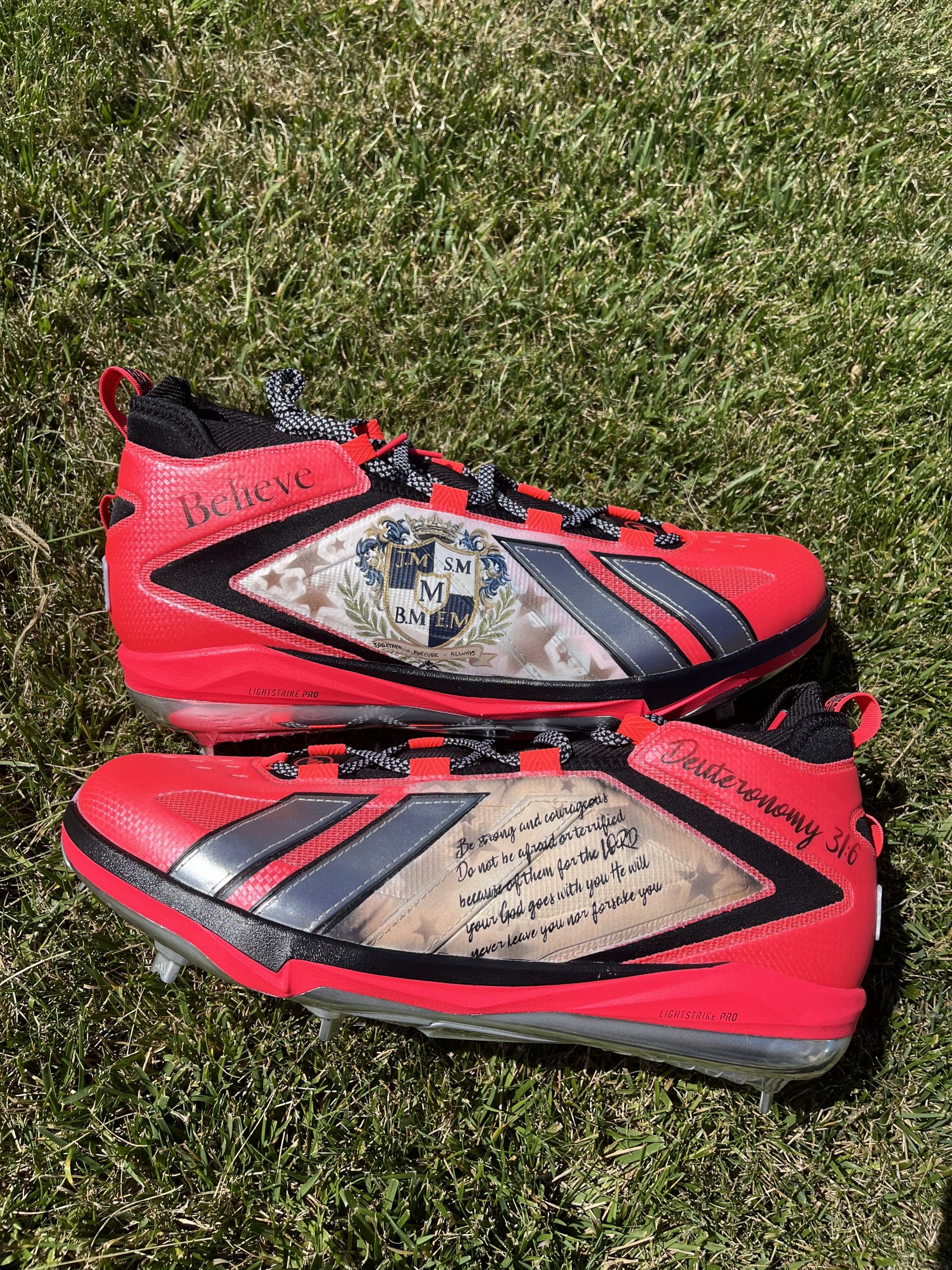
On the left side, was a family crest, split into four initials: “J.M., S.M., B.M., E.M.” On the right, a Bible verse, Deuteronomy 31:6: “Be strong and courageous. Do not be afraid or terrified because of them, for the Lord your God goes with you; he will never leave you nor forsake you.”
Brandon Marsh’s All-Star cleats honoring his late father.Marsh family
She sent the design to Marsh’s agent, Eric McQueen, who put it on some bright red cleats. The outfielder received them on Tuesday morning, as a surprise before the All-Star Game.
“I wanted to make sure Jake was on them,” Sonja said. “Because I just think his dad would be so proud to be here. And he is 90% of the reason [Brandon] is where he is.”
Marsh’s ascension from platoon outfielder to everyday player has been well-documented. In April of 2025, he went hitless through 29 at-bats before landing on the injured list.
Now, 15 months later, the 28-year-old is among the best players in the league, leading his team in batting average (.301) and hits (102). Those struggles have made his All-Star berth all the sweeter. Sonja said she’s noticed a change in her son’s energy.
“Whenever I call him now, it’s not, ‘Hey Mom, I’ve only got five minutes. Walking into the training room, what you need?’” she said. “It’s, ‘So, Mom, can you believe such and such? Hey, did you see so and so?’ Conversationally, it’s gotten better.”
Brandon Marsh’s mother Sonja (left) and sister Erin at the All-Star Game on Tuesday at Citizens Bank Park.Alex Coffey
She said he was struggling with stress more than anything else; about performing, about his role. When Jake was alive, he was his children’s biggest cheerleader, knowing the right words to say in a moment of self-doubt.
This is not Sonja’s strong suit — “I’m not as good at that,” she said — which made those brief phone calls especially challenging. But bit by bit, Marsh worked his way out of it, en route to his best season to date.
He is so locked in that he wouldn’t even discuss the All-Star Game with his family — even after he’d made the team.
“I called him, to say congratulations,” Sonja said, “and he’s like, ‘Mom, thank you for calling, can we talk about this on Sunday? Because I still have six more games to win.’”
Added Erin: “Brandon would not talk about the All-Star Game. He was like, ‘I don’t want to jinx it.’”
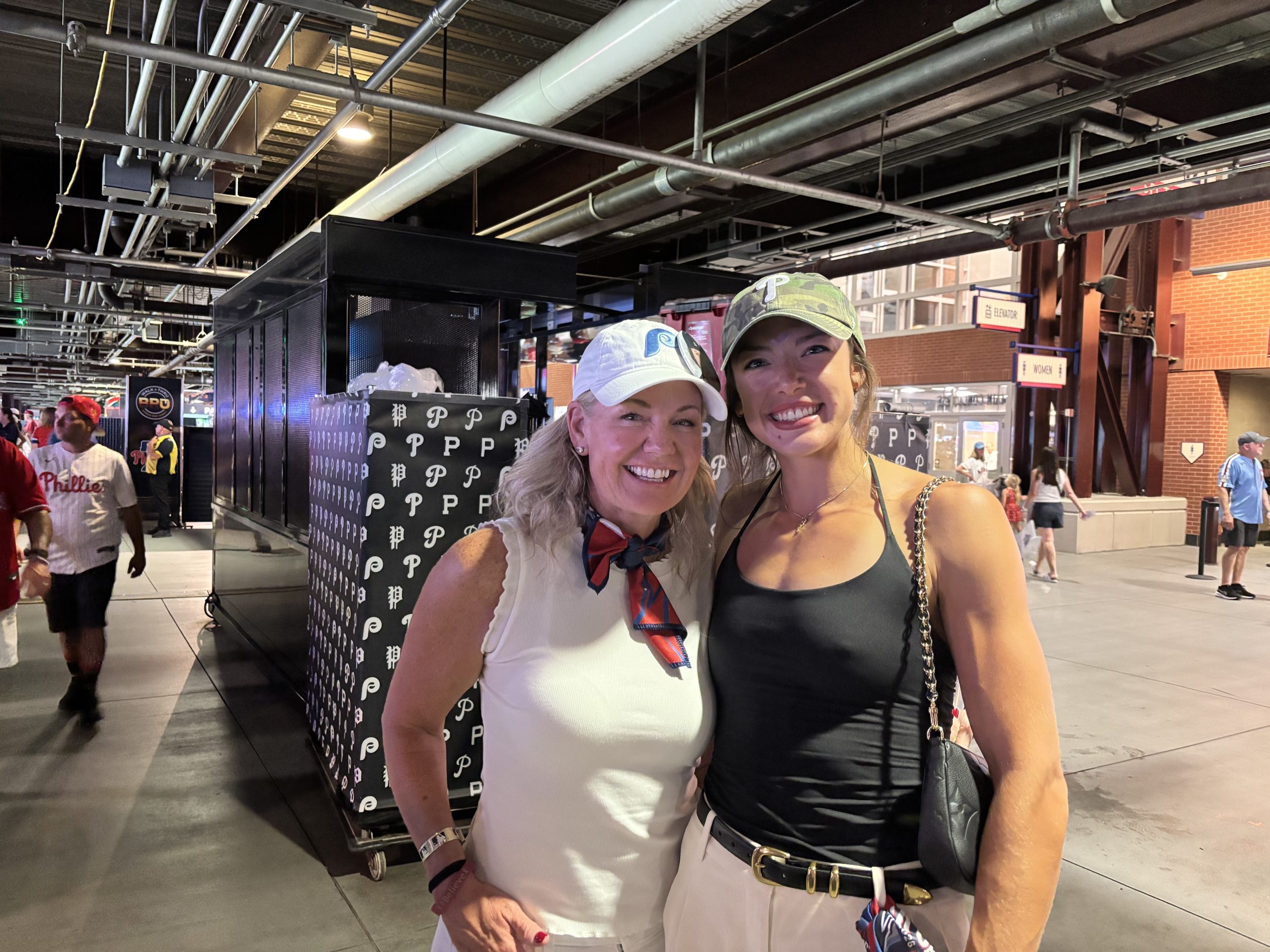
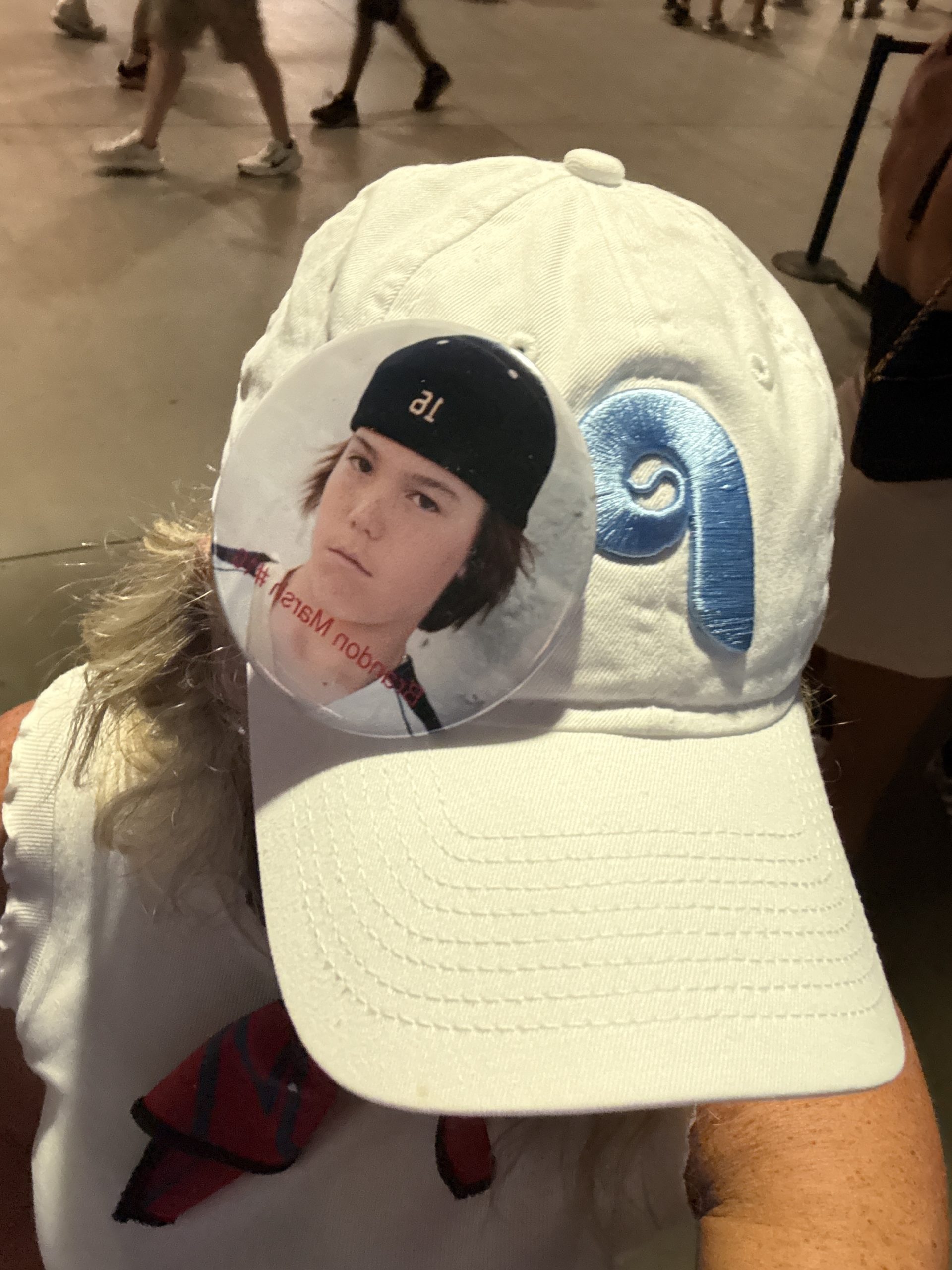
It’s hard to overstate how proud his family is. On Tuesday night, Sonja watched from Section 120 with a large button of her son’s face on her cap (a clean-shaven Marsh, age 9, glowering at the camera).
Erin, a professional heptathlete, was also able to make it to Philadelphia, finding a pocket of time between competitions. They watched the game with family and friends, remarking on how far Brandon has come.
During the All-Star Game, Brandon Marsh’s mom Sonja was wearing a pin showing a 9-year-old Marsh.Alex Coffey
But Jake Marsh was there, too; in the urn by Sonja’s side, the bracelets on Brandon’s wrist, and of course, the bright red cleats on his feet.
“I know he was watching tonight,” Brandon said, “and he had the best seat in the house.”
A newly created nonprofit wants to borrow $617 million through tax-free bonds to buy Advantage Behavioral Health, a fast-growing South Jersey behavioral health company.
The current owner, a Connecticut private equity firmcalled Clearview Capital, isn’t walking away from Advantage, which it bought 15 months ago.
Clearview Capital and current executives will continueto own the for-profitentity that manages Marlton-based Advantage, according to a preliminary bond offering statement filed late last month.
Advantage’s proposed sale to a nonprofit called QCF Advantage LLC is noteworthyfor mixing for-profit and nonprofit business interests. It would make aprivate-equity company a keypartner ina nonprofit organization with financing from the tax-exempt municipal bond market.
Advantage’s sale price is about $520 million. That price includes $80 million being held back to see if Advantage hits profit targets after the sale. The company had $141.6 million in revenue in the 12 months that ended May 31. Most of the remaining money from the bond sale will go into reserve funds.
Like many other mental health service providers, Advantage does not accept Medicare or Medicaid. Taking only private insurance and out-of-pocket payments helps Advantage register strong profit margins amid growing demand for mental health and addiction services.
The transition to nonprofit ownership creates “a structure that’s designed for long term stability, reinvestment, and patient care,” James D. Golden, CEO of QCF’s parent company, told prospective investors in a recorded presentation.
“We can provide an efficient exit to private capital,” he said in the recording,published June 30 on a website that tracks documents related to the municipal bond market. “Tax-exempt financing is really the mechanism that makes all that possible.”
That financing will leave Advantage with an extraordinarily large debt load, said Robert Q. Kreider, a former nonprofit CEO who has no ties to Advantage. He noted that debt of that sizerequires continued strong growth to make the debt payments and have enough money to continue growing.
“The bondholders are getting such a juicy rate, they’re willing to accept the risk,” said Kreider, a consultant and former CEO of Devereux Advanced Behavioral Health.
Officials at Clearview Capital, Advantage, and QCF Advantage did not respond to requests for interviews.
Advantage’s founding and growth
Advantage has expanded to Pennsylvania and six additional states beyond New Jersey since its founding in 2017.
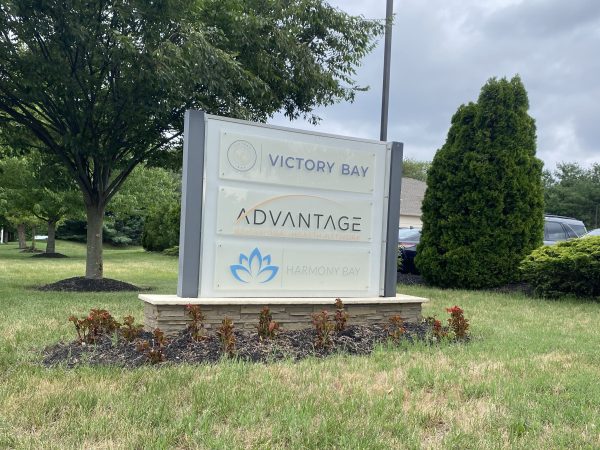
It initially providedintensive outpatient therapy through a business called Victory Bay in Laurel Springs.
It launched a telehealth version of its services, called Harmony Bay, in 2020. Outside of New Jersey, Advantage uses Harmony Bay as a way to build a presence in a new state, before introducing in-person services through Victory Bay.
(function(){function e(){window.addEventListener(`message`,function(e){if(e.data[`datawrapper-height`]!==void 0){var t=document.querySelectorAll(`iframe`);for(var n in e.data[`datawrapper-height`])for(var r=0,i;i=t[r];r++)if(i.contentWindow===e.source){var a=e.data[`datawrapper-height`][n]+`px`;i.style.height=a}}})}e()})();
Advantage alsooperates 17 sober-living houses under its Dignity Hall brandin Blackwood, Laurel Springs, Sicklerville, and several other South Jersey towns.
The average daily census of patientsat Victory Bay has soared over the last five years to 805 in the three months that ended June 30, from 81 in the first quarter of 2021, according to data in the bond disclosures. The company employs more than 700.
Despite the expansion to Massachusetts, Florida, Indiana, Maryland, Ohio, and California, the services provided in a string of buildings along Chews Landing Road in Laurel Springs accounted for 55% of revenue, most of the company’s cash flow last year.
The parking lots at several of those buildings were packed last Thursday. As part of the bond financing, 20 New Jersey properties valued at $14.4 million are being mortgaged.
New projects are under development in Absecon and Pine Brook, N.J.; Scranton, Pa.; and Lancaster, Ohio, the bond prospectus said.
A nonprofit buyer as a vehicle for private equity sales
QCF Advantage was created in April to acquire Advantage.
Owner QCF/I Inc., a tax-exempt organization based in Houston, acquires healthcare facilities that can be paid for with tax-exempt financing, according to its 990 tax form. Founded in 1997, QCF stands for Quality Care Foundation.
“We’re a nonprofit focused on improving the quality of care in the behavioral health industry. We believe mental health is one of the most persistent, complex, and costly challenges in our country today,” Golden told prospective bond investors.
QCF/I’s niche is buying for-profit businesses, often from private equity firms, while giving the sellers the option to keep managing the business, he said.
In the Advantage arrangement, QCF/I will collect 2.25% of revenue for administrative services — to be paid before bondholders.
Clearview Capital, the current private equity owner, will stay involved through an existing management entity that will collect 5% of monthly revenue under an initial 15-year contract.
Golden and Richard T. Needham together form QCF’s board. They have a background in private equity at a Houston private equity firm called Domain Capital Partners that is not related to Clearview. The phone number on the 990 led to a voicemail box that was full. A voicemail at Domain Capital got no reply.
QCF’s other businesses include a psychiatric hospital in Las Vegas and an addiction treatment center in North Jersey.
Surging debt load
Advantage had about $6 million in long-term debt at the end of 2024, three months before itssale to Clearview for an undisclosed price.
A year later, the debt totaled $52.5 million, not including a $10 million line of credit.
If the bond sale happens as expected, the company’s long-term debt would skyrocket to $604 million at the end of this year, according to the bond document.
That large debt means the success of QCF Advantage depends on continued dramatic growth in revenue and profits, according to a deal summary from Stacy DiStefano, CEO of Consulting for Human Services, a Philadelphia-based advisory firm.
Advantage’s projected annual interest expense is $42.7 million. For context, that’s about the same as the combined $42.2 million in interest paid last year by three large unrelated health systems in the same South Jersey market, Cooper University Health Care, Inspira Health Network, and Virtua Health.
Colin Studwell, Advantage’s CEO, said during the investor presentation available on Munios.com that the company is well-positioned for strong growth. He credited the management entity, known as a management servicesorganization, or MSO, that Clearview and executives, including Studwell, alreadyown.
Studwell will continue to runthe MSO, which handles operations support, billing, collections, human resources, information technology, and everything else it takes to run the business.
“Our MSO capabilities are the engine which allow us to continue to scale our services and treat more patients without any decay in clinical or operational efficiency,” Studwell said.
The Fringe Festival celebrates its 30th anniversary this fall with a month of experimental, genre-blending, and provocative theater hosted all over Philadelphia.
Running Sept. 8 to 27, the festival will feature more than 338 productions spotlighting groundbreaking local and international talent, including a play about infectious disease scientist Anthony Fauci and AIDS activist Larry Kramer, an absurdist clown show, and a multimedia music experience inside the Franklin Institute’s planetarium.
“Fringe performance — often characterized by free expression, communal experience, collective wonder, challenging perspectives, and a DIY ethos — plays an essential role in our community,” said FringeArts CEO and producing director Nell Bang-Jensen in a statement. “This year, you can find us at nearly 100 venues, from traditional theaters and large cultural institutions to neighborhood bars and city sidewalks.”
With a lineup featuring world and regional premieres, the Philadelphia Fringe Festival is one of the biggest Fringe events in the country.
Organizers say they are on track to surpass the number of productions they presented last year, which was the largest festival in Philly Fringe history: A record high of more than 35,000 tickets were sold, with unique ticket buyers up 17% from the previous year — and for the first time, millennials and Gen Z made up more than half of the audiences.
A scene from “Friday Night Rat Catchers” by Lisa Fagan and Lena Engelstein, playing at FringeArts from Sept. 17-19, 2026. Photo credit: Maria BaranovaMaria Baranova
Festival “hubs” returning this year include Cannonball (at Asian Arts Initiative and Icebox Project Space), Circus Campus Presents in West Mount Airy, Dumb Hub at Pig Iron Theatre in Olde Kensington, and West Philly’s Studio 34. Newcomers this year are the Lemonade Stand, focusing specifically on new artists at Skinner Studio at Plays and Players, and a dance-focused hub at Performance Garage in Spring Garden. Each hub hosts more than a dozen experiences.
Among the hundreds of shows participating, there are 10 curated productions from FringeArts with artists both familiar and new to Philly Fringe audiences.
The lineup includes Friday Night Rat Catchers (Sept. 17-19 at FringeArts), a disco era-set dance production from choreographers Lisa Fagan and Lena Engelstein; Handle With Care (Sept. 17-19 at the Athenaeum of Philadelphia) from the boundary-testing Belgian theater collective Ontroerend Goed; and How Does It Feel to Look at Nothing (Sept. 25-27 at FringeArts), an avant-garde musical performance from clarinetist/vocalist Holland Andrews and violinist/composer yuniya edi kwon.
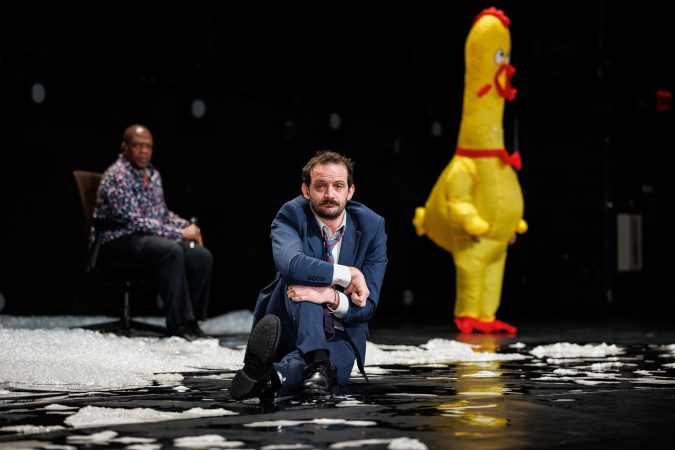
A scene from “Handle with Care” by Ontroerend Goed, which will perform Sept. 17-19 at the Athenaeum of Philadelphia.Ontroerend Goed
Another musical experience will take place inside the Fels Planetarium at the Franklin Institute with the Philadelphia premiere of Utopian Hotline: A Telephone Hotline, A Vinyl Record, A Performance (Sept. 24-27). The Brooklyn-based group Theater Mitu combines science and theater for fascinating explorations of humanity; in this case, they created a public hotline to encourage people to share messages to the future, taking inspiration from the Voyager space missions. The voicemails join the sounds of vinyl records and the visuals of the planetarium to immerse audiences into the otherworldly.
Kramer/Fauci (Sept. 8-11 at FringeArts), which premiered at New York University’s Skirball Center for the Performing Arts earlier this year, examines the contentious and complicated relationship between a public health official and a playwright/organizer. It’s a dramatic retelling of a C-SPAN segment from 1993 when Fauci, who led the National Institute of Allergy and Infectious Diseases, and Kramer, the founder of the AIDS activist organization ACT UP, clashed over a new AIDS task force. The two adversaries (Kramer publicly called Fauci “a murderer”) later developed a close friendship. Broadway director Daniel Fish, who won a Tony Award for his Oklahoma! revival, crafted the show verbatim from the heated but riveting news segment.
The beloved and eccentric drag queens of the Bearded Ladies Cabaret — frequent Fringe headliners — are taking a look back through 16 years of performances with an installation and show called Priority Hoarding: A Retro-spectacle (Sept. 10-27 at the Hairport, 444 N. Third St.). It’s designed to feel like viewers are digging through a chaotic closet full of baggage both literal and metaphorical. The cabaret will stage three performances weekly on Saturdays during the run.
A scene from Nichole Canuso and Branching Path’s “Lunar Retreat,” which begins performances starting Sept. 10 at the Pearlstein Gallery. Photo credit: Theo CoteTheo Cote
Fringe regular Nichole Canuso will return with her eponymous dance company for the world premiere of Lunar Retreat (Sept. 10-20 at the Pearlstein Gallery), an interactive choose-your-own-path performance inspired by the moon’s orbit. Canuso developed choreography in collaboration with ocean explorer and visual artist Rebecca Rutstein.
For audiences looking for something immersive and outdoors, Blank Placard Dance, Replay (Sept. 13) is a silent protest march in Center City. The first march of its kind debuted in San Francisco in 1967 from artist Anna Halprin as a response to the Vietnam War. The procession consists of protesters holding blank signs and posters, backed by a marching band; Philadelphia’s performance will be led by choreographer Sherwood Chen. It’s billed as an invitation for public engagement: “When intrigued passersby ask what they are protesting, the marchers turn the question back to them: What do you want to protest? A discussion ensues. Ideas circulate. Protest takes root.”
A scene from “Blank Placard Dance, Replay,” a silent protest march with blank signs. It will performed in Philadelphia on Sept. 13, 2026. Photo credit: Herve VeroneseHerve Veronese
The local experimental dance theater group the Ninth Planet is back at Fringe with a world premiere of The Holy Fool (Sept. 10-19 at Impact Services, 124 E. Indiana Ave.), a dreamy ghost story about an American family struggling with aging, grief, and heartache accompanied by original music featuring trumpet, percussion, and synthesizers.
One of the most curious offerings this year comes from an Estonian clown. In Ha Ha Ha Ha Ha Ha Ha(Sept. 10-13 at the Proscenium at the Drake), Julia Masli wants to solve people’s problems. With a persona that the New York Times described as “halfway between curious child and ingenuous alien just landed on Earth,” Masli asks audience members to tell her their problems and she invents unexpected solutions ranging from funny to serious.
Tickets for Philadelphia Fringe Fest go on sale July 15 for FringeArts members and July 18 for the public.