Fetterman’s disdain for the job — which comes with a $174,000 annual salary, free healthcare, and months off at taxpayer expense — has been well documented. He whined about missing a family beach trip during a lengthy debate last year over Donald Trump’s costly and harmful One Big Beautiful Bill.
Several major media outlets have chronicled the senator’s dysfunction. In May 2025, New York Magazine detailed Fetterman’s erratic behavior as staffers expressed concerns about his mental health since suffering a stroke. The New York Times quoted staffers who feared his mood swings and were warned not to get in the car if he is driving.
The Washington Post reported on Fetterman’s clashes with Democratic colleagues and increased isolation, while Politico detailed efforts by Republicans to get Fetterman to switch parties.
The Inquirer disclosed last year how Fetterman lashed out at representatives from the teachers’ union, and cited a half dozen former staffers who said he skipped meetings and spent hours alone in his office scrolling on his phone.
“It’s pretty impossible to overstate how disengaged he is,” a departed staffer said.
Last week, a devastating story in the Wall Street Journal underscored the senator’s disregard for voters and his job in a story headlined: “Behind Closed Doors, John Fetterman Shows Little Interest in the Work of a Senator.”
The story included text messages between Fetterman and staffers that showed him dismissing executives from Children’s Hospital of Philadelphia (CHOP) who wanted to discuss Medicaid cuts and changes to vaccine policy.
“Why do I have to keep having to meet with chop,” Fetterman texted an aide.
“Because they’re worried about Medicaid cuts,” the aide wrote.
Fetterman responded, “Well, I’m not,” before adding, “I’m convinced they just want free trips to DC.”
Fetterman later told CNN that comment was a “dumb joke, and for that, I sincerely apologize.”
In another exchange, Fetterman nixed a plan to attend a funeral for three police officers killed in the line of duty in York County, where he grew up. Apparently, Fetterman was put off by the time commitment.
“3 hours??” he wrote, before adding that attending the services “may be a nonstarter.” The senator did not go, but said he sent flowers and met with the families later.
The Journal reported that Fetterman also stiffed three disabled veterans who traveled to Washington to meet with him, alleging he was ill, only to appear later that day on Fox News to talk about Israel and the war in Iran.
Apparently, teachers, healthcare officials, police, and veterans take a backseat while Fox News and the Israel-Hamas war command Fetterman’s full attention. The senator has appeared on the conservative news outlet roughly 60 times this year and has gone on two junkets to Israel since 2024. (He even made a cameo at the GOP convention in Dallas Wednesday night to praise Trump and boost Republicans before the midterms.)
The Journal reported that Fetterman told aides he wanted to introduce a resolution to force lawmakers to vote on whether the war in Gaza constituted a genocide. But instead, Israel’s ambassador to the U.S., Yechiel Leiter, suggested he write an op-ed explaining his support for Israel, while many Democrats have turned against the country because of killings and destruction in Gaza.
Leiter even supplied the talking points. But Fetterman’s aides did not tell him about the talking points out of fear that the op-ed would violate the Foreign Agents Registration Act.
Fetterman did not publish the op-ed, but the incident reinforces the perspective of critics who argue that his tenure has been marked by complacency and carelessness: He was either unaware of the potential ramifications of penning the essay, or he chose to ignore them — both explanations should concern Pennsylvanians.
Like the previous reports, Fetterman called the Journal story a “hit piece.” The sad truth is the reports from his own staffers paint a picture of a lazy, unengaged, and unstable senator who is not up to the job.
Last year, this Editorial Board said Fetterman should either do his job effectivelyor step away.
In the private sector, most workers who fail to perform their basic job duties get fired. Unless Fetterman resigns, voters will get their chance to oust him in 2028.
Here’s a look at the intensifying conflict along the Red Sea that could tear the Arab world’s poorest country apart once more and potentially send oil prices even higher above the $100 per barrel mark.
What’s happening could return Yemen to civil war
Yemen is home to over 40 million people who fear a return to the civil war that killed 150,000 and brought many others to the brink of famine in one of the world’s most sprawling humanitarian crises. A ceasefire with Yemen’s internationally recognized government and a wider coalition backed by the Saudis began in 2022.
Now that truce is buckling.
Yemen’s troubles are in part because of its strategic location at the southern tip of the Arabian Peninsula and alongside the Bab el-Mandeb Strait at the southern end of the Red Sea. It’s one of the busiest global shipping lanes and one that the world is turning to as Iran continues to target ships on the Strait of Hormuz.
The civil war left many Yemenis hungry and beyond the reach of aid. In a significant advance, Houthi and Yemeni officials said the Houthis had taken over Yemen’s port city of Mokha, which has been held by Yemen’s internationally recognized government.
That endangers another crucial entry point for food and other assistance.
The Houthis’ takeover of Mokha puts them about 50 miles from the Bab el-Mandeb, creating further complications for shipping on the Red Sea — and not only for neighboring Saudi Arabia. The United States has shown signs of wanting to wrap up the Iran war and get oil-laden vessels on the move everywhere, not broaden the fight.
Houthis’ grievance with Saudis could affect global oil
The ceasefire’s fragile calm held until weeks ago, when the Houthis tested a Saudi-led blockade of rebel-held areas. The Saudis struck the international airport in the rebel-held capital, Sanaa, which the Houthis called an attempt to prevent a plane carrying Houthi leaders from returning home after attending the funeral of Iran’s late supreme leader Ayatollah Ali Khamenei.
Now, with the Iran war choking the Strait of Hormuz, the Houthis have a new way to inflict pain on their neighbor by declaring a blockade against Saudi Arabia and targeting its efforts to ship its oil via the Red Sea.
The Houthis’ backer, Tehran, doesn’t object to causing the U.S.-allied Saudis pain as it tries to limit oil shipments from the Gulf in service of its war aims.
This week, Saudi Foreign Minister Prince Faisal bin Farhan said the path was not closed to diplomacy but that his country would not hesitate to defend itself.
Houthis have been relatively unscathed by the recent war
Among Iran’s armed proxies in the region, the Houthis have had a lower profile than Hezbollah in Lebanon and Hamas in Gaza. That, as well as their relative distance, has helped shield them from Israeli attack in the nearly three years since the war in Gaza began.
But the Houthis were quickly targeted with U.S. airstrikes when they tried to insert themselves into the regional conflict by targeting what they called Israeli-linked shipping on the Red Sea off Yemen’s west coast. Those attacks soon faded.
Now, the Houthis are back with a different target, aiming at ships and other assets of Saudi Arabia as it seeks to get its oil out to the world via the Red Sea and the Bab el-Mandeb strait. That Red Sea corridor usually sees $1 trillion of goods move through it per year.
The Houthis are “no longer just positioned on the northern part of the western coast; they now control a much larger stretch of the coastline, bringing them closer to the areas around Bab al-Mandeb,” said Ahmed Nagi, a senior analyst on Yemen at the International Crisis Group.
For global oil consumers already worried about Iran’s attacks on vessels trying to transit the Strait of Hormuz, the threat to yet another global shipping lane is a flashing danger sign, especially with the price of crude oil again trading above $100 a barrel.
President Donald Trump’s low approval ratings and widespread economic discontent, along with historical trends, point to a clear Democratic advantage come November and the midterm elections. But Republicans also see reasons for optimism, and it’s not just about gerrymandering.
Six factors working in Democrats’ favor:
Out-of-power parties typically pick up seats in the midterms
The Democrats’ most basic advantage is the fundamental pattern of midterm elections: The party that controls the White House usually loses seats.
In midterms from 1934 to 2018, the president’s party bled an average of 28 seats in the House and four in the Senate, according to the American Presidency Project at the University of California, Santa Barbara.
If Democrats added 28 House and four Senate seats this cycle, they would win majorities in both chambers. The House, in particular, is seen as a promising target for Democrats this cycle, in part because Republicans are clinging to a razor-thin advantage in that chamber.
Trump is deeply unpopular
Parties have occasionally defied the historical trend and won seats in the midterms on the strength of popular presidents.
But this year, Trump is widely expected to hurt Republicans’ chances. His approval rating, dampened by voter disenchantment with the war in Iran and stubbornly high inflation, has recently sunk to the lowest level of his second term. The New York Times polling average currently shows that 58% of Americans disapprove of the president’s job performance, while only 38% approve.
Voters are dissatisfied with his handling of immigration and the war with Iran. Trump is also losing ground with white working-class voters on the economy. And he is deeply unpopular with voters of color without college degrees.
House races in particular tend to follow the national mood closely, and analysts see Democrats as favorites to win the House.
The Iran war has driven up prices, and voters are focused on inflation
Polls consistently show that the economy and inflation are the top issues for voters. And voters say they are unhappy with the economy under Trump.
His war with Iran, now in its seventh month, has driven up the price of oil, fertilizer, healthcare and other goods and services, as well as mortgage rates. Gas costs more than $4 a gallon, and the AAA motor club reported that drivers over Labor Day weekend were facing “the highest gas prices ever for this time of year.”
By July, consumer prices were up 3.7% from a year earlier, according to the Federal Reserve’s preferred inflation gauge, far above the Fed’s target rate of 2%. The cost of diesel, which powers the farming economies of key midterm battlegrounds, hit a record high Friday.
Senate Minority Leader Chuck Schumer, D-N.Y., said his party’s candidates were competing in challenging territory by keeping their campaigns focused squarely on costs.
“Americans see what’s happened,” Schumer said in an interview. “They’re paying more, and getting less.”
Democratic candidates are outraising their rivals
In five of the six most closely watched Senate contests, Democrats had outraised Republicans through the first half of the year, according to campaign finance filings. In some races, such as those in Texas, Ohio and Alaska, the gap was vast.
Democrats’ fundraising advantage in two other states, North Carolina and Georgia, has helped to transform races once seen as toss-ups. Analysts with the Cook Political Report, a nonpartisan election forecaster, now say both races lean toward Democrats.
The large hauls suggest enthusiasm for individual Democratic candidates. But Republican groups still have a huge money advantage over Democratic ones.
Several Democrats have shown strength in states Trump carried
Two popular, moderate Democratic Senate candidates in the South, Sen. Jon Ossoff of Georgia and former Gov. Roy Cooper of North Carolina, appear to have maneuvered into particularly strong positions. Both have vast fundraising advantages and clear polling leads.
Democrats are also bullish about the chances of former Rep. Mary Peltola, a Democrat, to flip a Senate seat in Alaska. She is running on “fish, family and freedom.” Her Republican opponent, Sen. Dan Sullivan, must contend with two other Republicans on the ballot, including one with the same name.
Peltola, the lone Democrat on the ballot, led Sullivan by more than eight percentage points in a nonpartisan primary in August.
Democratic primaries have set turnout records
One clear reflection of Democratic energy going into the fall: the huge turnout the party has recorded in primary after primary. Some primaries, including ones in Michigan and Texas, set midterm records for the party.
Strong turnout in primaries is not necessarily predictive of a strong performance in the general election. But Republicans acknowledge that there has been a significant enthusiasm gap between the two parties this primary season and describe it as one of their starkest challenges heading into the fall.
Six factors working in Republicans’ favor:
Republicans won the gerrymandering war
In a burst of rare mid-decade redistricting, Republicans were able to give themselves a structural advantage in House races by redrawing maps to carve out more safe red seats.
Congressional maps are typically drawn just once a decade to reflect population shifts after the census. But after Trump urged lawmakers in Texas to draw new maps favoring Republicans, Democrats and Republicans across the country engaged in an intense, cross-country redistricting tug of war to try to shift the House map in their favor.
Aided by favorable rulings in state and federal courts, Republicans emerged with a national map that tilts in their favor and could help them counter a difficult political environment. Seven Republican-led states had redrawn their maps while only two Democratic-led states did so.
The new maps could position the Republican Party to net roughly five to 10 additional House seats. Still, despite that edge, the House battle is still seen as tilting toward Democrats because of the political climate.
The GOP is sitting on a mountain of cash
The main Republican groups have a large overall financial advantage — totaling hundreds of millions of dollars — over the main Democratic ones, and the Democratic National Committee is in debt.
Republican advertising spending has eclipsed Democrats’ ad spending in all the top six Senate races except for the contest in Texas, according to the ad-tracking firm AdImpact.
Trump’s super political action committee, MAGA Inc., which has raised hundreds of millions of dollars and had long resisted tapping its war chest to help the party in the midterms, recently made its first general-election investment, a $10 million ad buy in Texas.
Still, it is not yet clear how much the group will spend overall and which races it will target. Trump said Friday that he planned to spend “probably” $400 million to $500 million on the midterms, but that he also expected “to have money left over.”
The Democratic brand is weak
Trump may be deeply unpopular. Yet Democrats might eagerly trade their approval ratings for his.
One Quinnipiac poll in July pegged Trump’s approval rating at 32%, worse than usual for him. But it measured congressional Democrats’ approval rating even lower — at 23%.
Still, the same poll suggested that voters were eager for Democrats to win back Congress. It also indicated that Democratic voters were far more motivated than Republican voters to go to the polls. But Republicans have seized on a series of recent Democratic primary victories by left-wing candidates and democratic socialists to try to paint the party as out of step with many voters.
The Senate map tilts to Republicans’ advantage
Republicans hold 53 Senate seats. For Democrats to win back the chamber, they need to flip seats in four states while defending their own most vulnerable ones. Five of the six most competitive Senate races are in states Trump won in 2024. Four are in states he carried by double digits.
And even among three other relatively competitive Senate battlegrounds where Democrats are seen as having an advantage — Georgia, New Hampshire and North Carolina — two are states that Trump captured two years ago.
Democratic divisions could complicate their paths in two key states
In Maine, where Sen. Susan Collins has been seen as one of the most vulnerable Republican incumbents, the Democrats’ initial nominee, Graham Platner, was accused of rape in early July. Platner denied the allegation but eventually dropped out of the race, requiring his party to scramble to find a new nominee outside the usual primary process.
The candidate that the Maine Democratic Party settled on, Troy Jackson, had finished third this year in Maine’s primary for governor. Some Maine Democrats were dissatisfied by the rushed convention process and many are anxious about Jackson’s chances in a short campaign he had not planned for.
In Michigan, where Democrats hope to keep a seat that is being vacated by a retiring senator, Democrats are still trying to heal the wounds after a tense, expensive primary race that centered on disagreements about Israel. Some Jewish Democrats in Michigan have declined to immediately support the candidate who won the nomination, Abdul El-Sayed, a progressive who has been a forceful critic of the Israeli government.
The stock market is strong, and crime is down
Wall Street has been on a remarkable, three-year run of gains. There have been some signs that inflation is cooling, too. And the Labor Department reported that hiring was unexpectedly strong in August, with the unemployment rate steady at 4.1%.
Republicans can also point to positive trends on crime, an issue that has often swayed elections over the years. Today, violent crime rates are extremely low by historical standards.
“Republicans have a real chance at defying history in November because of our candidates, massive war chest, and enthusiasm behind President Trump’s agenda,” Joe Gruters, chair of the Republican National Committee, said in a statement.
Still, voters say that the economy is their No. 1 issue — and polls suggest that they don’t approve of how Trump is handling it.
Last month, Daii’yaHnna Fleming posted a video of her move-in day at Southern University in Louisiana. As a bleary-eyed rising freshman, she lugged a half-dozen candy-hued suitcases on her trip from Las Vegas to Baton Rouge. After arriving, she began to settle into her new life on campus, stocking up on school supplies and setting up a side business doing makeup from her dorm room.
Then the trouble began. The ample walking across campus aggravated her health issues, and Fleming didn’t feel safe commuting to her job near campus. One night, she decided to join friends for an off-campus party. “I had never really been to a party, and I really just did not like it at all,” Fleming, 17, said. “I got really fed up with everything.”
On the way back to her dorm, Fleming texted her mother and told her she was coming home for good. She had been in college for two weeks.
In a TikTok video about her decision to switch to her university’s online program, Fleming panned over her dorm room. “I’m not gonna force myself to be uncomfortable and unsafe, ’cause randos think I should be,” she wrote in the caption, adding, “I don’t care about the college experience. I just want my degree.”
In the thousands of comments underneath her post, as well as under similar viral videos of other students moving out or dropping out and sharing it online, a firestorm of debate has been playing out: Are Generation Z students too unwilling to face discomfort, to the point of missing out on a formative experience? Or are older generations valorizing struggle?
Though leaving campus early is nothing new — and the rate of college dropouts has declined slightly in recent years — social media has put a magnifying glass on students’ struggles and prompted a wider discussion about generational differences. As they face shrinking federal financial aid and a tough job market with no guarantees, some say they are reconsidering whether college is worth the staggering tuition fees. Others say they are switching to online school or becoming commuter students.
Many of the videos, like Fleming’s, focus on the mental health impacts, saying they feel anxious and overwhelmed. One student mentioned a towed car and more homework than they expected. Another expressed concern about wasting tuition money on an experience they disliked that affected their mental health.
The debate touched a nerve.
In response videos, millennials and Gen Xers have been pleading with students to hold on and tough it out.
“Everything worth having is not easy,” said Ebony Simpson, a mother of a college sophomore who posted one of those videos.
She said that students needed to put themselves out there. “It’s for you to sit up and say, ‘Oh, they’re having a cookout, let me go,’” Simpson said.
Her daughter, Adrianna Bankston, said she struggled as a freshman last year at a Georgia university. The idea of leaving “was a thought that we all had when we first got here,” Bankston, 19, said. She didn’t leave her room much during that first week, she said. But she had a realization: “I need a friend group. I need to go out and do stuff.”
She pushed herself to meet people at parties and campus events, and she’s learned a lot. “I did have fun,” she said. “I found out not everybody is your cup of tea.” She said she now had a busy social life and great people around her.
Rates of college dropouts have declined: According to a report from the Education Data Initiative, 22.9% of all students who entered college as freshmen in fall 2024 did not return in fall 2025, down from a prepandemic average of around 24%.
Yet the videos highlight real issues for those working to fight college attrition. “Kids are not weak,” said Sarah Manville, an assistant dean and adviser at Case Western Reserve University in Cleveland. “They’re extremely resilient — but there’s something about this phenomenon that they cannot persist through.”
Feeling homesick in the first few weeks is normal, but Manville said she noticed some younger students were reluctant to seek help. “My concern is students are not giving themselves enough of a chance to be successful,” she said, “and that’s where I think that fear-based decision making comes in.”
Michael Williams, a New York City-based college access and success professional, said, “I’ve noticed a definite dip this year and last year, compared to prior years, in how socially adjusted and how much, like, social emotional competency this set has compared to the prior classes.”
Students also face grim job prospects, amid worries of artificial intelligence encroaching on entry-level jobs, and steep tuition. “The barriers to entry just keep compounding in this particular moment,” Williams said.
The costs of dropping out or moving home will vary from school to school, but student loans are generally easier to cancel in the first two weeks.
Fleming said she had not yet paid the fee for room and board for this year. Another student who posted a video on TikTok said in a comment that she had received a refund from her university after leaving.
Back home in Las Vegas, Fleming said she felt good about her decision: “If I would have stayed longer, it would have made everything harder.”
She’s doing well in online business management classes and has dreams of law school. But she hasn’t discounted the idea of returning to Southern: She’d like to spend more time with her suite mate, who’s now a close friend, and other classmates she met from her stint in Baton Rouge. But if she returns, perhaps next year, she plans to live off campus.
First, at the start of his second term, President Donald Trump promised a DOGE dividend, a pledge to take the money that Elon Musk’s team would cut from the federal budget and send it to the American people.
Then Trump moved on to a “tariff refund,” a plan to use the money the government was collecting in import taxes to fund payments for the public.
Those ideas never panned out. Nevertheless, Trump is again talking up the possibility that the federal government will send Americans thousands of dollars in cash. At the Republican midterm convention in Dallas on Wednesday, the president pledged that every American adult would receive $5,000 if Republicans retain control of Congress in November.
Trump did not offer many details about the proposal, but there’s reason to think that Republicans in Congress, like they did with his two previous promises of quick cash, could shrug off the president’s suggestion.
That’s in no small part because the $5,000-per-American promise would be enormously expensive to fulfill, with a price tag over $1 trillion. Its actual cost, though, would depend on what, if any, eligibility requirements Congress would ultimately impose on the plan. Trump did not mention a proposal to finance the $5,000 payments, which beyond their fiscal cost could also prove inflationary.
The conceit of Trump’s other pitches was that the money to pay for them was already available, from Musk’s so-called Department of Government Efficiency or tariff revenue. On both of those fronts, though, the envisioned funding sources proved illusory: Musk’s team did not save the government much money, and the Supreme Court struck down many of Trump’s initial tariffs.
Republicans did succeed in providing Americans with substantial cash payments when they cut taxes last year. Under the design of the tax law, many Americans first experienced the policy change in the spring, when they received larger-than-usual tax refunds. Trump and Republicans have spent much of the year promoting those refunds, hoping that the larger lump-sum payments would be politically resonant before the midterms.
But even after Trump delivered those tax refunds, his approval poll ratings are still sagging.
Those tax cuts were also very expensive, though Republicans did cover some of the fiscal cost by reducing federal spending on healthcare and food assistance for poor Americans.
It had been six days since Dillon Minacci waited at school for his parents to finally pick him up. National Park rangers told the Minaccis to stay inside their Queen Village home — which sits on the grounds of the Gloria Dei Old Swedes Episcopal Church — as a precaution following the terrorist attacks that morning in New York.
Could the old church where Betsy Ross was once married be next? So Dillon was one of the last kids to leave St. Mary School in the shadow of Independence Hall. No one knew what to think that day, Paula Minacci said of Sept. 11, 2001. And everyone seemed to struggle to find normalcy in the days that followed.
Finally, the Phillies were back at Veterans Stadium. Their game against the Braves on Sept. 17 was the first major league game after the season was paused. Jim Minacci told his son they were going. Then he went to the church basement — where he still works with his wife as the sextons — and grabbed a big American flag on a wooden pole.
“It was embarrassing, right?” said Dillon, who was then in the fourth grade and just old enough to roll his eyes at his parents. “I was like, ‘What are you doing? Why are you bringing a flag to the park? What are we doing?’”
Paula Minacci dropped them off at the stadium and then waited to make sure they’d let them in with the big flag. The Vet was filled that night with American flags. People waved them in the stands and the players had them stitched on their uniforms. Phillies manager Larry Bowa cried during the anthem and Harry Kalas opened the telecast with an emotional monologue about how sports can be a diversion and a unifier.
No one questioned Minacci’s flag.
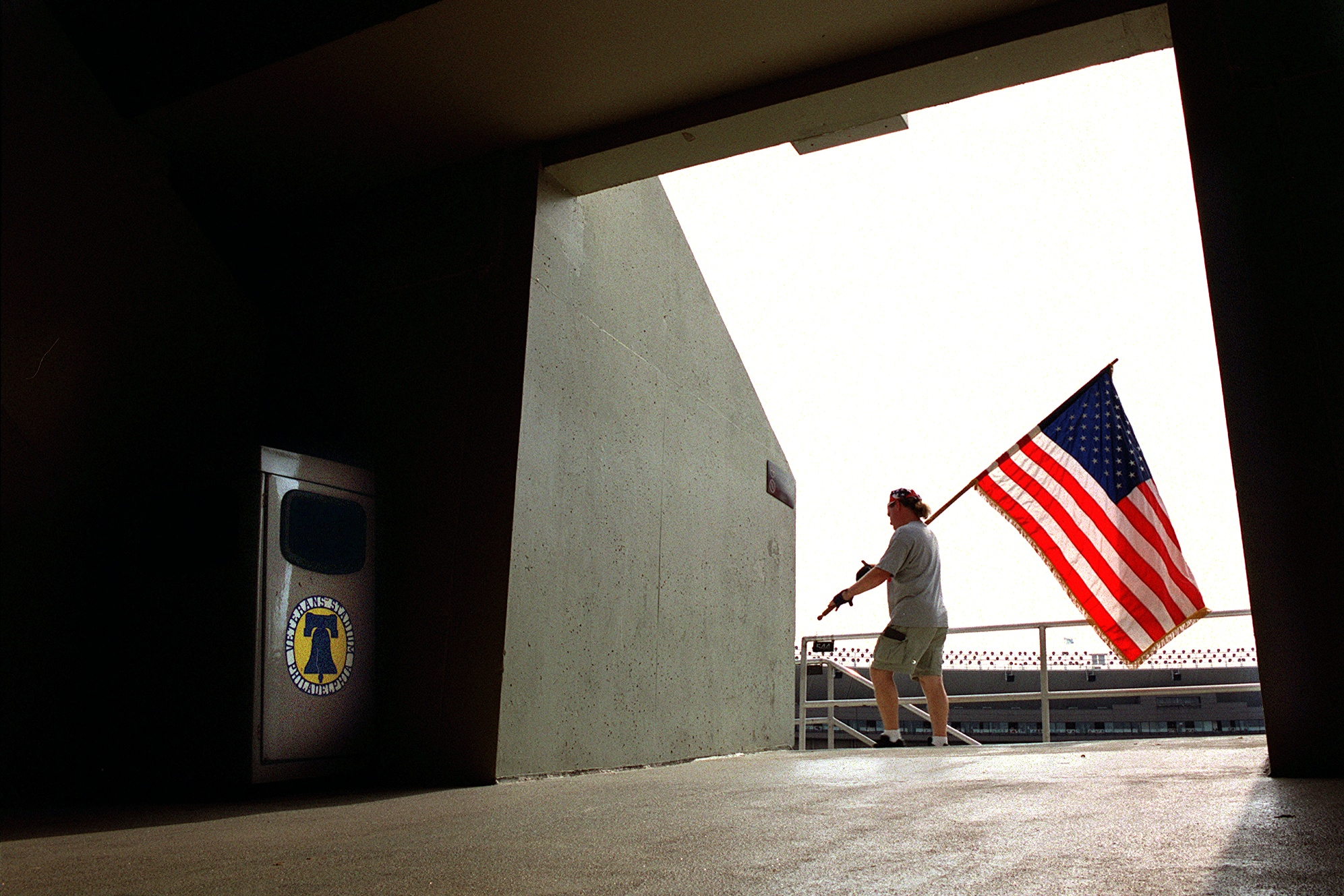
Jim Minacci carries his large American flag as he walks around Veterans Stadium on Sept. 23, 2001.Tom Gralish / Staff Photographer
He sat with the pole for a few innings in the upper deck before telling his son he wanted to take a lap around the stadium, which had a rung in front of the seating bowl. His son was embarrassed, but he told his dad he’d come with him. And then the cheers started. The fans chanted U-S-A and shouted for Minacci as he marched around a half-filled stadium with the flag over his shoulder like a patriot. Embarrassed? Not anymore, his son said.
“For us, we were like, ‘Hell yeah. This is awesome,’” Dillon, 35, said. “We got back to our seats and he said, ‘We’re going again.’ OK. I didn’t expect this to be happening. Let’s go.”
The Minaccis attended every game the rest of the season as the late-30s dad became Flag Man, a symbol of patriotism when everyone seemed to rally around the flag. They started their night marching around the upper deck before heading to the lower bowl where the chants were just as loud.
A cast of kids would leave their seats every night to walk behind Flag Man, whom Pat Burrell called “the pied piper” when Minacci was featured in the team’s highlight video.
Phillies general manager Ed Wade presented Flag Man with a custom jersey and a security guard started letting the Minaccis in without tickets. Flag Man’s hands were so sore from carrying the wooden pole that he started to wear fingerless gloves. He loved it.
Jim Minacci, aka Flag Man, is trailed by a line of kids as he walks around the upper deck over the outfield at Veterans Stadium on Sept. 23, 2001.Tom Gralish / Staff Photographer
The Vet already had the Wolf Pack and other fan groups that injected character to a concrete goliath. Flag Man fit right in. Minacci became part of the scene.
All these years later, the 64-year-old Minacci is still not sure why he brought the flag that first night. He remembers watching the news and seeing people at Ground Zero, volunteering to dig through the rubble of the World Trade Center. Minacci wanted to be in Manhattan but had two jobs in Philly and a son. So he grabbed his flag and went to the game.
“I probably brought the flag so it could represent all those people doing all that good work,” he said. “People were doing extraordinary things against the backdrop of this terrible disaster that in our lifetime was unprecedented. I felt a real sense of wanting to go to the game to enjoy myself and be free of all the struggle and strife but also be part of a community and be with my son in a moment that meant something.”
“It was just being present and showing support for these people who were doing extraordinary things.”
Flag Man grew up near Binghamton, N.Y., in a small town he said had more cows than people. His father Paul was a Yankees fan but he often took his family in the early 1970s to Philly — where he graduated from Penn — to see games at the Vet when tickets were easy to get.
Minacci chased down players for autographs and can still remember how it felt to sit in the stands with his dad. He moved to Philly in the 1980s and soon found himself sitting in the same seats with his son.
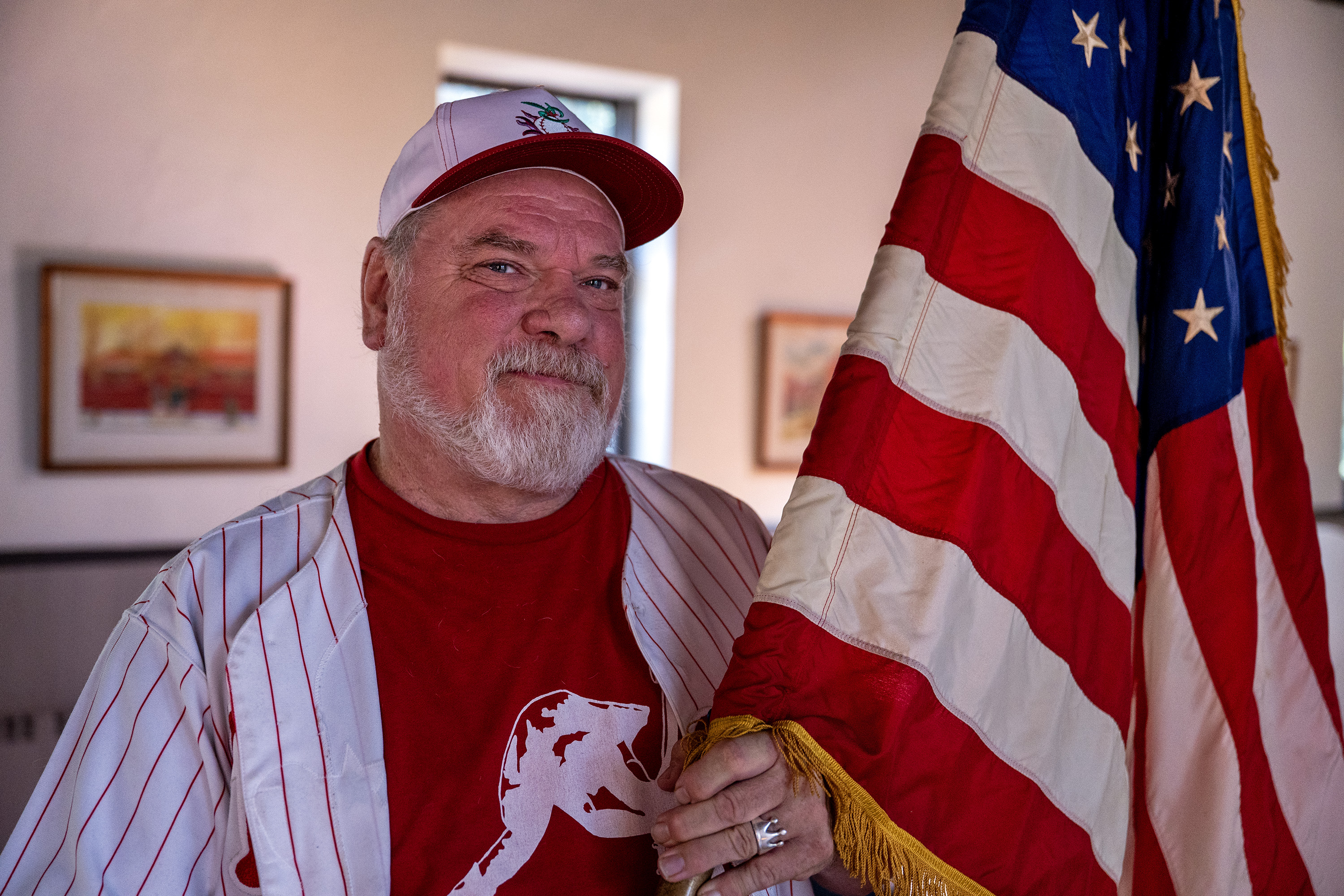
Jim Minacci looks back on his Flag Man days as “a unifying visual. Something everyone could agree to. Back then, it was an agreeable moment.”Tom Gralish / Staff Photographer
“I just always loved baseball and doing it with my dad just like he did it with his dad,” Dillon said. “Baseball is so unique in that you don’t really have to pay attention to it. That’s kind of the beauty of it. It’s an atmosphere that’s open to whatever you make it. Other sports, you’re kind of locked in on the time limit or the net you have to hit it into. Baseball is very much, ‘Are you paying attention or not? Can I take advantage of that?’ For a father and son, you get to spend time whether you’re talking or not.”
The Vet was their place before 9/11 so it was where the Minaccis needed to be after that dark Tuesday. The Minaccis — just like the rest of the 27,910 fans — longed for an escape. They didn’t know their night would be the dawn of Flag Man.
“We got home and he said, ‘We have to go again tomorrow,’” Dillon said. “I was like, ‘I’ll go to baseball every night of the week if that’s what this is.’ I was totally in. If you get a couple drinks in me, then I pull down the old video yearbook. Damn, that was cool. I can’t believe I was a part of that and my dad had the idea to do that.”
He took a trip with his parents last month to a minor-league game in upstate New York and told his dad how impactful those nights at the Vet were. His parents were always “locally minded,” Dillon said, as their work at Old Swedes made them a fabric of the neighborhood. Flag Man was an extension of that. His dad always seemed to bring people together. Everyone just got to see it this time.
“I know my son is a better person today for it. His awareness of being a part of a community,” Minacci said. “As a father, as a human being, that’s the reward.”
Dillon now lives in Austin, Texas, and will often ask another Philly transplant if they remember Flag Man. Of course, they remember that guy who used to carry a flag around the Vet. That’s my dad, the proud son tells them. No way, he hears. Flag Man is a memory.
Jim Minacci and his wife Paula at Gloria Dei Old Swedes Episcopal Church, where they work and live as sextons/caretakers.Tom Gralish / Staff Photographer
“There’s the baseball game, the baseball team, the baseball staff, and then the crowd who fills the stadium,” Minacci said. “We got to be a part of that community.”
Minacci brought his flag back to the Vet in 2002 and 2003 as he continued to march before the Vet closed. Citizens Bank Park opened in April 2004 and Minacci was there with his flag for the first game. The guy at the gate apologized. Minacci couldn’t bring the long wooden pole into the new park. Flag Man was finished.
“I think what bummed him out the most was him not being able to end it in a way that he wanted to,” Dillon said. “He wanted the chance to say ‘Thank you.’ It really meant a lot to him and it meant a lot to me. We met a lot of people at the ballpark and became a part of the Phillies community. So it goes.”
Dillon (front) and Jim Minacci at the Rush concert earlier this month.Dillon Minacci
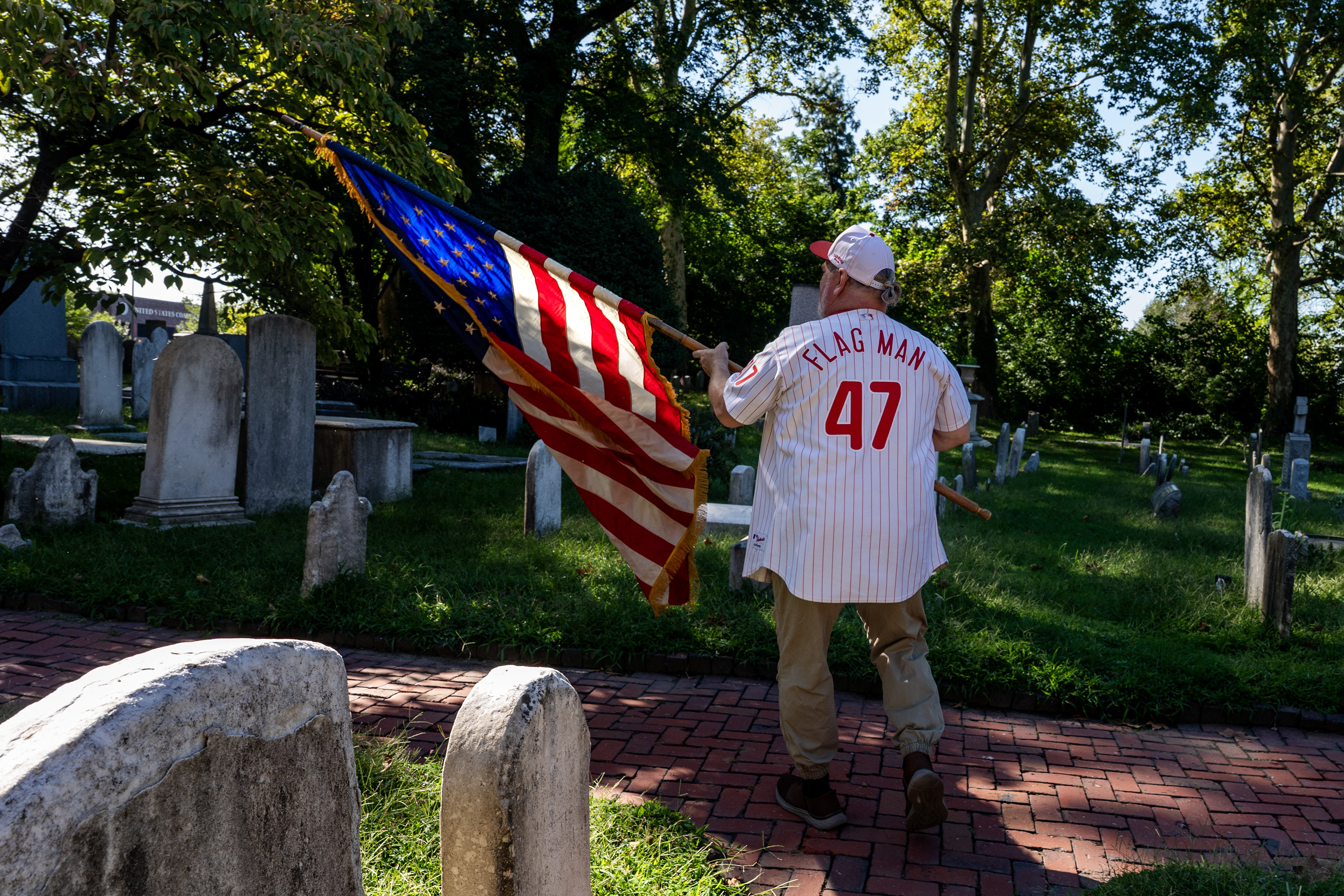
Minacci stood outside the stadium that day before deciding to go home. It was over. He’s another fan now when he goes to the ballpark except that he still wears his Flag Man jersey — with No. 47 as a nod to Larry Andersen — when he sits in the seats. Kids who used to trail him at the Vet will stop him and tell him about those days. Now those kids have kids of their own. Minacci helped people come together that September. It was a time and place he’ll never forget.
“It was a unifying visual,” Minacci said. “Something everyone could agree to. Back then, it was an agreeable moment. It would be hard to find that agreeable moment today. We’re all so segmented. It’s awful. It’s really hard.”
Until the 1750s, America was a community of loosely organized colonies where residents were content — if not happy — to be a part of the powerful British Empire.
But, after the colonists joined Britain to help the Crown win the French and Indian War, they started to wonder if it was worth it to remain the King’s subjects.
For one, King George III issued the Royal Proclamation of 1763 forbidding Americans west of the Appalachian Mountains, angering the land-hungry colonists.
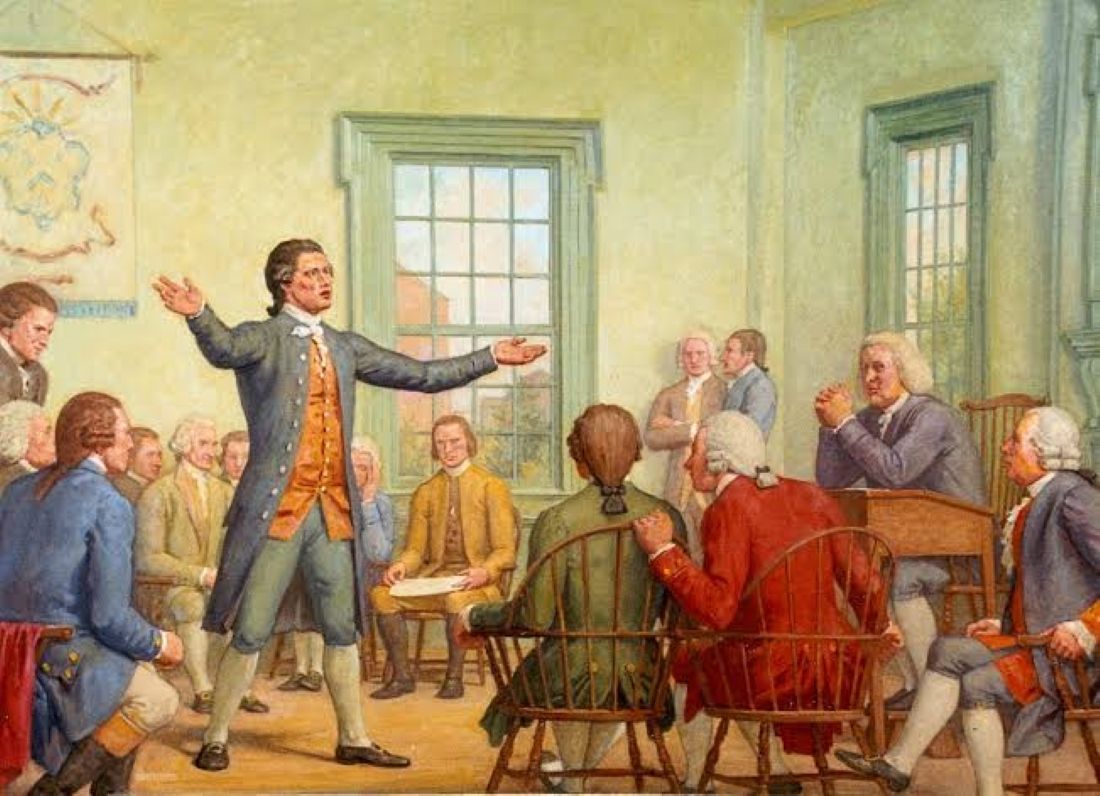
Gwenn Seemel depicts Patrick Henry in front of Carpenters Hall for the No. 1 in honor of the First Continental Congress.Gwenn Seemel courtesy of Colibrí Workshop
Then came the beginnings of taxation without representation. In 1765, England enacted the Stamp Act, levying a tax on every piece of paper, pamphlet, or card bought and sold in America. Eventually, the colonists rebelled and Britain repealed the act five months after it started.
However, the seeds of rebellion were planted.
Uncomfortable with angry subjects, Britain stationed troops in New England. Those rising tensions led to the Boston Massacre in 1770. In 1773, King George III taxed tea imported to the colonies from London. (He was insistent on collecting the colonists’ money by any means necessary.)
When tea arrived from London in Boston Harbor in December of 1773, colonists dumped it into the Atlantic Ocean. In retaliation to the infamous Boston Tea Party, the Crown levied a series of Intolerable Acts.
“In the eyes of the colonists, the Intolerable Acts were severe,” explained Michael Norris, the executive director of Carpenters Hall.
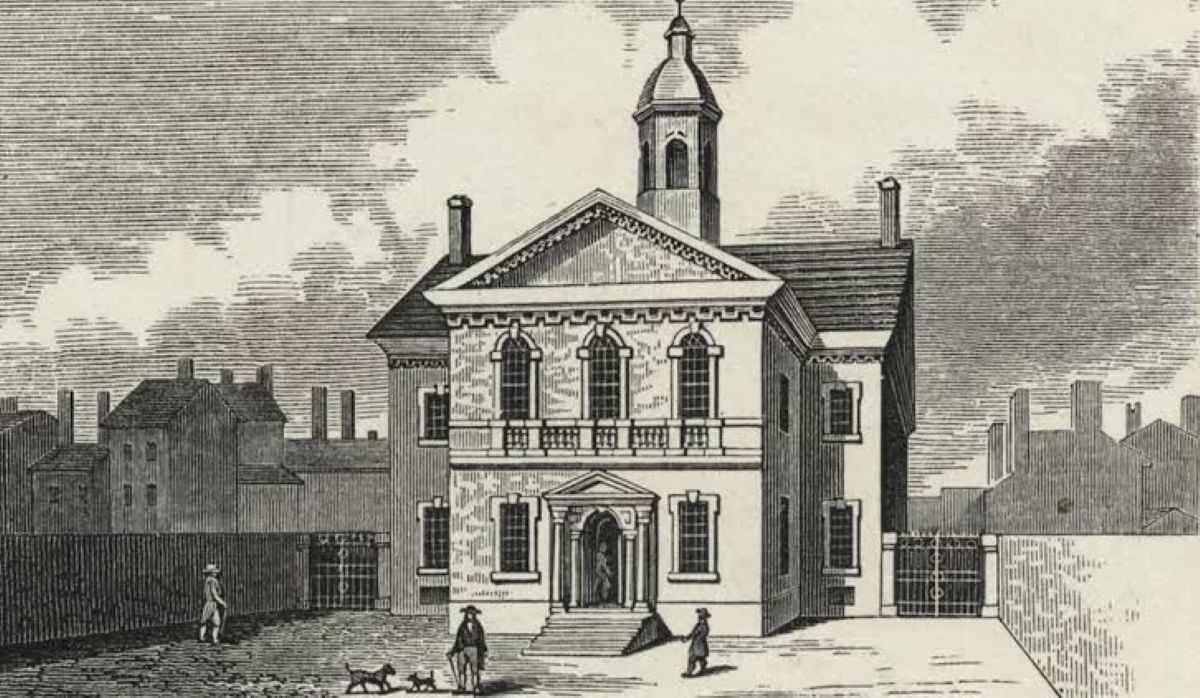
An etching of what Carpenters Hall looked like in the 1700s.Courtesy of Carpenters Hall
The acts, Norris explained, disbanded the Massachusetts legislature, putting Britain in charge of the state’s government. Britain closed the Port of Boston and stationed British troops in Massachusetts, requiring residents to feed, clothe, and house them.
The colonists thought, “if Britain could do this in Massachusetts, what would that mean to the rest of the colonies?”
On Sept. 5, 1774, 56 delegates from 12 colonies — Georgia didn’t come — convened at the then-new Carpenters Hall for the First Continental Congress. Their goal: to work out a deal between the colonies and their Mother Country so life in the New World could continue, albeit a bit smoother.
That first meeting of the Continental Congress will be remembered Saturday at Carpenters Hall from 11 a.m. to 1 p.m. during the Philadelphia Historic District’s weekly “Firstival” celebration. Each Saturday this year, the district is throwing a day party honoring events that happened in Philadelphia that changed the world.
For eight weeks, through Oct. 25, delegates hashed out a plan for independence and to heal their disagreement with the Crown.
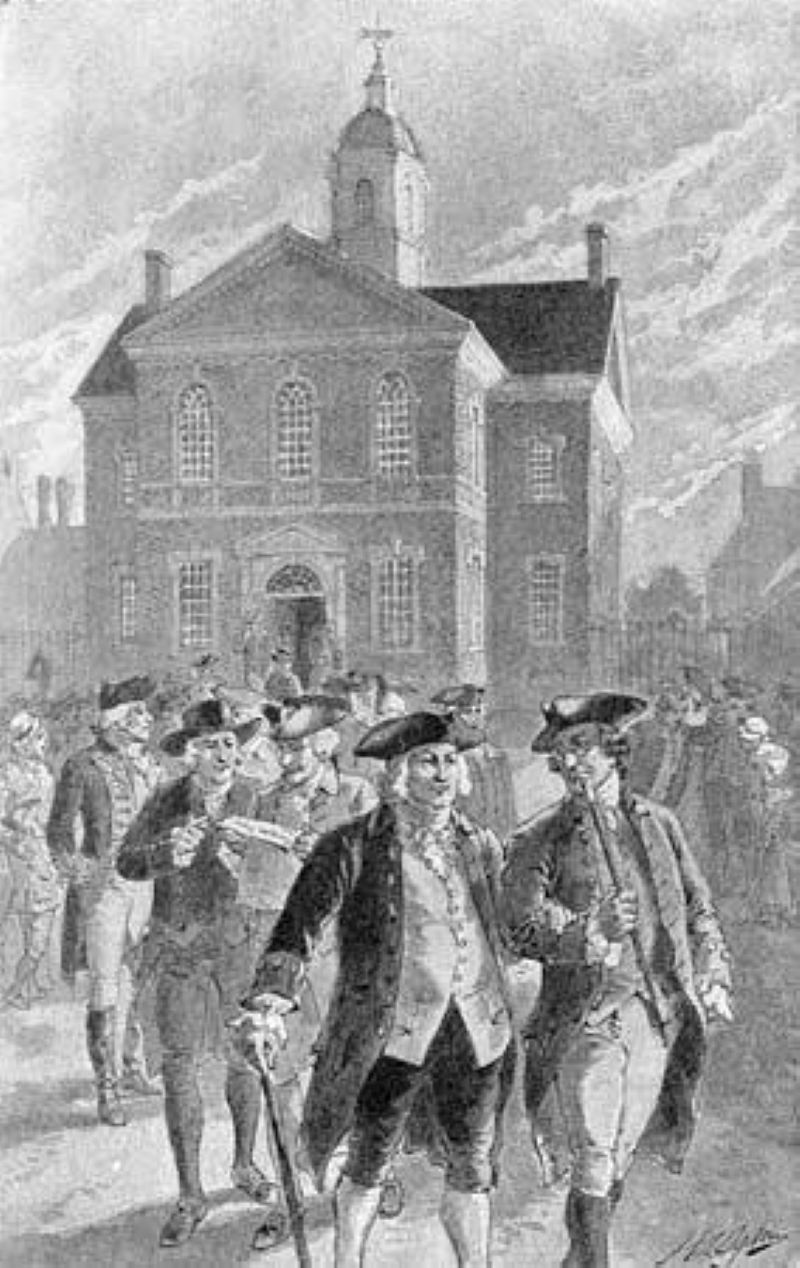
An etching of colonists and delegates gathering in front of Carpenters Hall.Courtesy of Carpenters Hall
They drafted a Declaration of Rights & Grievances in which they demanded England send its troops home and stated they wouldn’t stand for taxation without representation. (Historians refer to this declaration as a prelude to the Declaration of Independence.) Delegates also adopted the Articles of Association, in which they voted to stop all trade with England until the Intolerable Acts were repealed.
“They were trying to use their economic muscle to get England to the table,” Norris said.
The First Continental Congress created a unity among the colonies that hadn’t existed before, Norris said. “Up until then, they thought of themselves as British subjects, more connected to the Mother Country than their neighbors. The Congress changed this dynamic.”
This sentiment is best illustrated in Patrick Henry’s famous quote, during the opening sessions of that first Congress: “The distinctions between Virginians, Pennsylvanians, New Yorkers, and New Englanders are no more,” Henry said. “I m not a Virginian, but an American.”
It is why the late historian David McCullough referred to Carpenters Hall as the “acorn of American democracy.” It is where, Norris said, “the seed of independence was built that ultimately grew into the United States of America.”
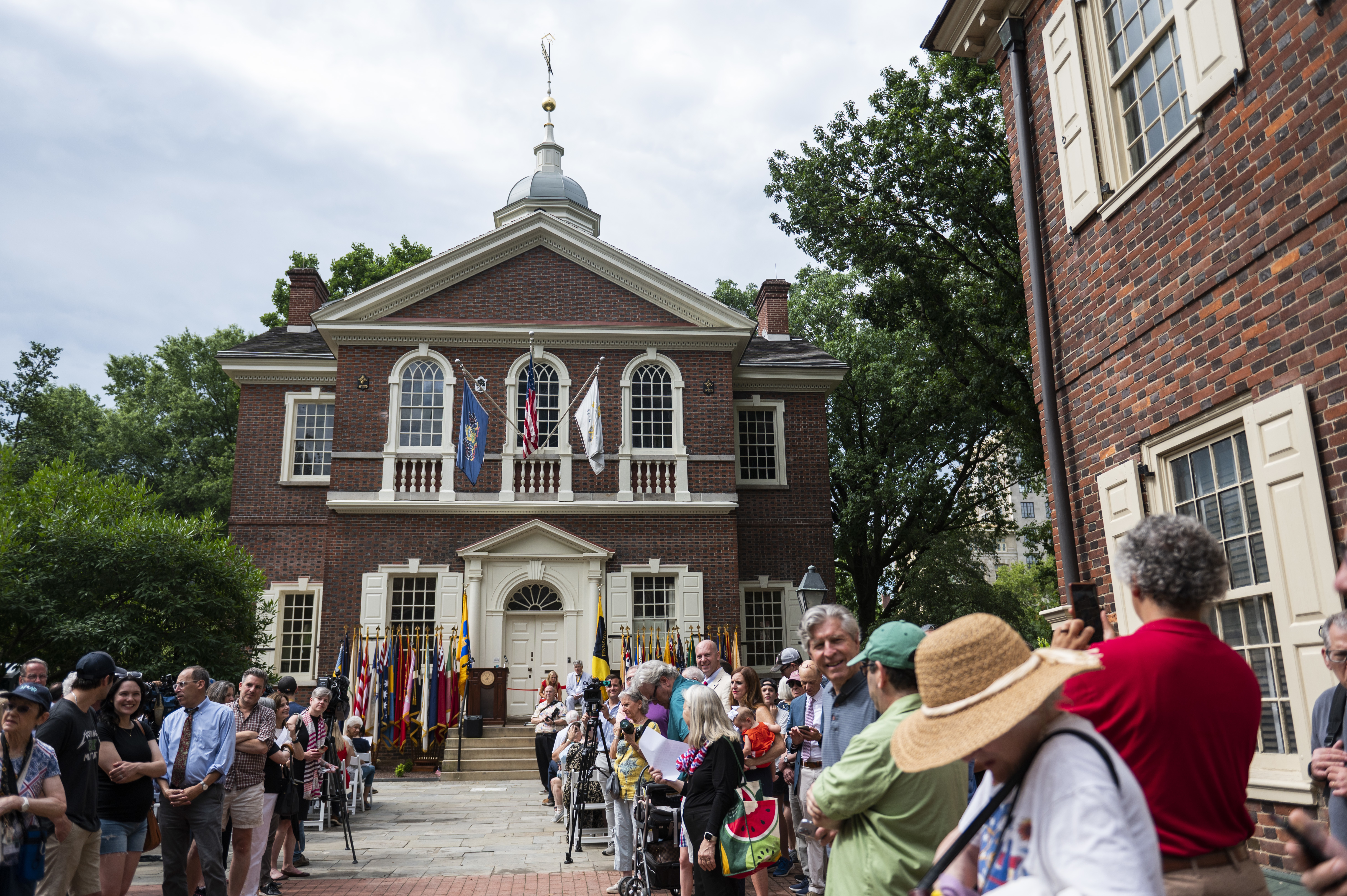
A reopening ceremony at Carpenters Hall on Monday, July 3, 2023. The building opened to the public for the first time since April 2022.Allie Ippolito / Staff Photographer
Delegates planned to reconvene in May of 1775 to address England’s response to their demands. But in April, the first shots of the Revolutionary War were fired and the Continental Army — victorious in the Battles of Lexington and Concord — were in a full-fledged war.
Making nice with England was completely off the table.
This week’s Firstival is Saturday, Sept. 12, from 11 a.m.-1 p.m., at Carpenters Hall, 320 Chestnut St., Philadelphia, Pa.
Within weeks of the Sept. 11 terror attacks, the U.S. government launched airstrikes and sent American troops to Afghanistan. In March 2003, spurred by claims that Iraq possessed weapons of mass destruction, the U.S. bombed and invaded the country.
In the two wars that followed, hundreds of thousands of Iraqis and Afghans died, with civilians making up a significant number of the dead.
On the U.S. side, more than two million American military personnel served in Iraq or Afghanistan, and over 7,000 died in these conflicts. Hundreds of thousands more live with service-related disabilities, and according to Brown University research, more than 30,000 post-9/11 veterans have since died by suicide.
Over 117,000 Pennsylvanians served in the military since 9/11, according to 2023 state data, and 295 died in Iraq and Afghanistan. At least 50,000 hailed from New Jersey, including 163 who died.
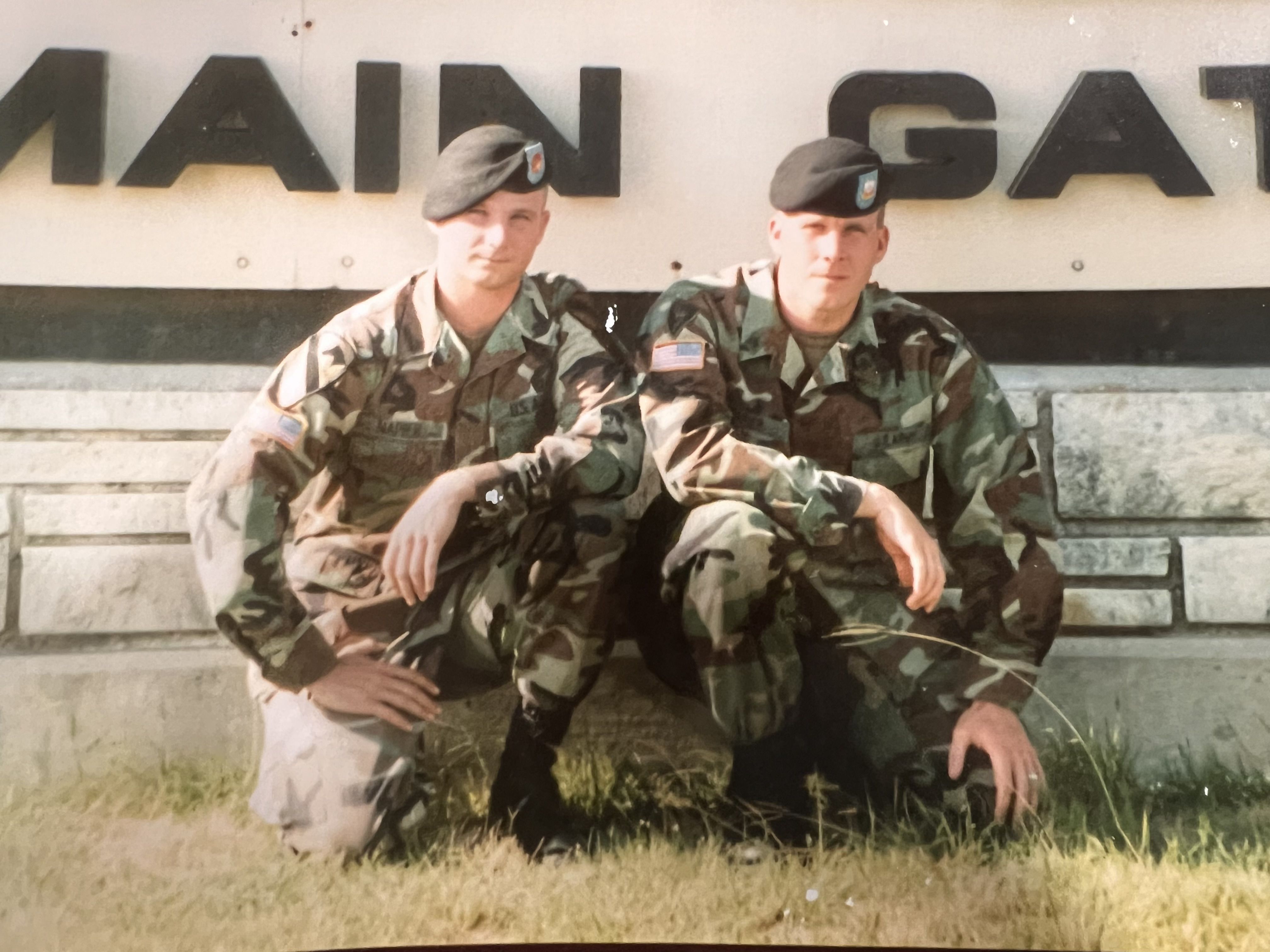
Benjamin Napier (right) and Brian Napier crouch for a picture in front of the main gate at Fort Hood, an Army base in Texas, in 2005. The brothers enlisted two days after Sept. 11 and were deployed to Iraq in 2004.Courtesy of Benjamin Napier
“I think it’s important, regarding the veteran population, to understand the diversity of experience,” said West Chester University historian Robert Kodosky, who has interviewed hundreds of post-9/11 veterans. “Some struggle. Some don’t. Some look back on their experience with pride. Some don’t want to talk about it at all.”
As the nation marks the 25th anniversary of the Sept. 11 attacks, the stories of these four military veterans from the Philadelphia region offer a glimpse into the experiences of countless others whose lives have been shaped by the wars that followed.
‘I can’t believe I made it home’
Benjamin Napier was 25 and living in Drexel Hill when 9/11 happened. The following evening, Napier and his younger brother, Brian, were gathered with friends in Upper Darby to attend a candlelight vigil, and Napier remembers noticing that the normally steady flow of air traffic had completely ceased. The skies were empty. That’s when he shared his thoughts with Brian.
“And I kind of turned to him, and I was like, you know, I think I’m going to do it. I’m going to join. And he was like, if you do it, I’m going to do it,” Napier said.
They enlisted in the Army on Sept. 13. Both were stationed at Fort Hood, Texas, and deployed to Iraq in 2004.
After riding in a convoy for three days from Kuwait to Baghdad, Napier, whose specialty was setting up computer and telephone networks, was sent to Abu Ghraib Prison.
The prison was not yet known for the horrific mistreatment of prisoners by Americans. But the squalid, cinderblock-walled compound, which had been a site of mass killings and torture under the Saddam Hussein regime, felt like “pure evil” to Napier.
“The place just had a vibe to it,” Napier said. “And we’re thinking, we don’t have running water. We don’t have toilets. I’m sleeping on a cot. And you’re just thinking to yourself, what in the world is going on over there.”
Soon, Iraqi insurgents began launching ferocious mortar attacks on the prison, Napier said.
Only when the U.S. soldiers got access to a TV did they learn that Abu Ghraib had become infamous. Widely shared photos of tortured Iraqis, flanked by smiling American soldiers, had became a rallying cry for war opponents.
The news also made the prison a target, and for the rest of Napier’s deployment, he said he witnessed sniper fire, shelling that killed and wounded prisoners, and the intervention of U.S. Apache helicopters that saved the prison from a hostile Iraqi takeover.
“I can’t believe I made it home,” Napier said.
It took him three years of intensive therapy to process his trauma, as well as extensive support from his wife and family, he said. Brian survived an improvised explosive device blast that left him disabled from the military due to post-traumatic stress disorder. The brothers now live in Delaware County and remain close.
Napier said despite all that he and Brian went through, he’s still glad they enlisted.
“A lot of the veterans that I talk to have that same sort of feeling. You raise your hand for something bigger than you. You’re kind of doing something for the greater good. And I think we still kind of feel that way,” Napier said.
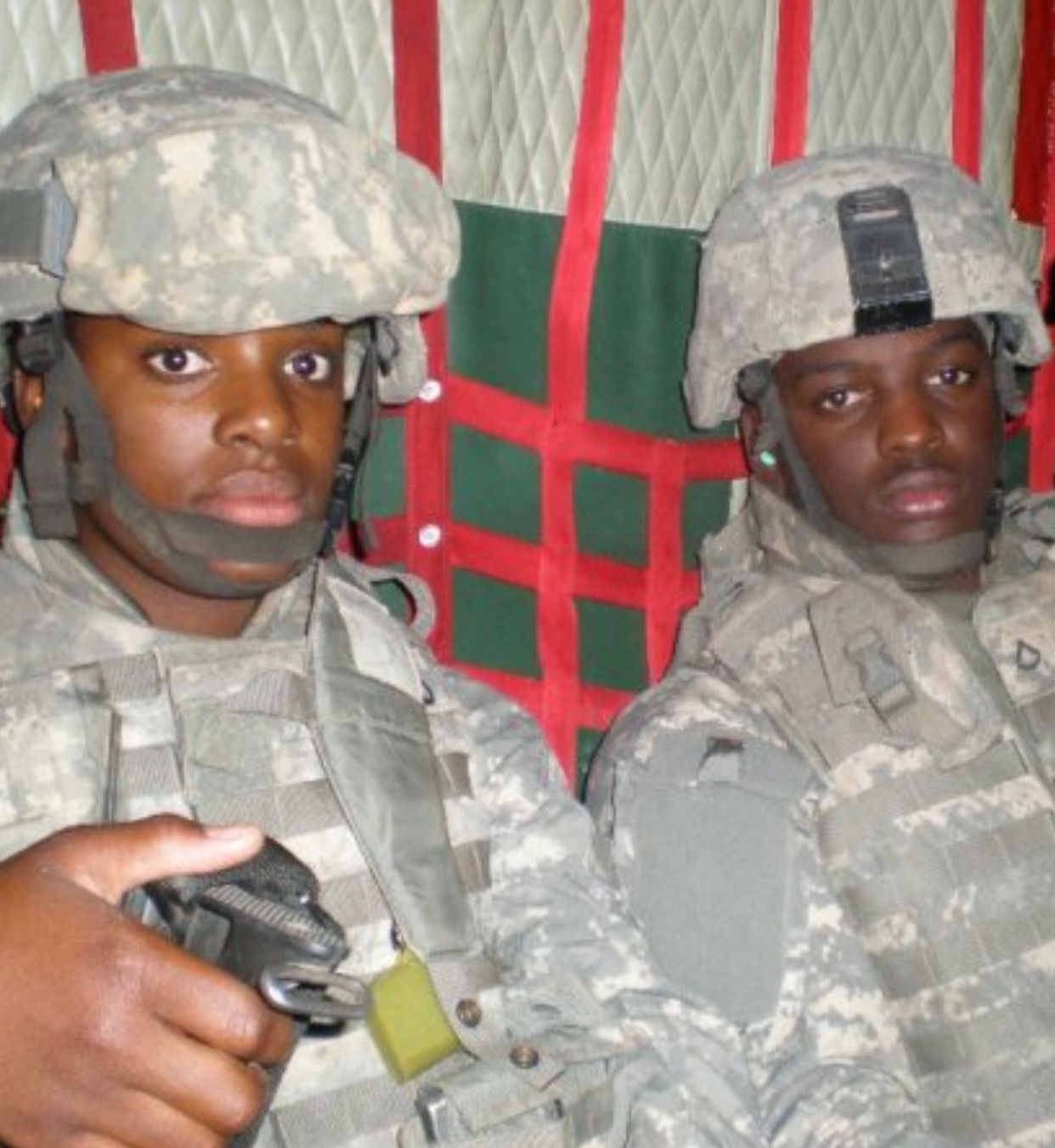
Keshina Bouie (left) on board a C-130 aircraft, preparing to fly from Kuwait to Iraq in 2007. At right is her future husband, Anthony.Courtesy of Keshina Bouie
‘I wanted to do something positive’
Keshina Bouie, 43, remembers being sent home from South Philadelphia High School on Sept. 11. Ironically, she said, her junior ROTC class is what got canceled.
Bouie’s parents had been in the Air Force, but Bouie hadn’t planned to follow their path. However with no college scholarships lined up, she enlisted in the Pennsylvania Army National Guard to pay for school.
“At that point in my life, I wanted to do something positive. And I wanted to get a degree and break generational cycles, and I was determined to be successful,” Bouie said.
Bouie earned her degree at Cheyney University in 2007. One day before her college graduation ceremony, she received deployment orders to Iraq.
Bouie was stationed at Balad Air Base, about 40 miles north of Baghdad. There, she guarded a secret Special Forces base that was embedded within the military installation. Exploding mortars and the rush of incoming wounded soldiers became part of her routine.
“When I was in Iraq, I just wanted to focus on doing my job and getting home safe,” Bouie said.
While on deployment, Bouie met Anthony, a soldier who grew up just blocks away from her Point Breeze home.
A romance blossomed in the spare hours, though they remained separated by their jobs. When they returned home, they got married. They’ve since had two children.
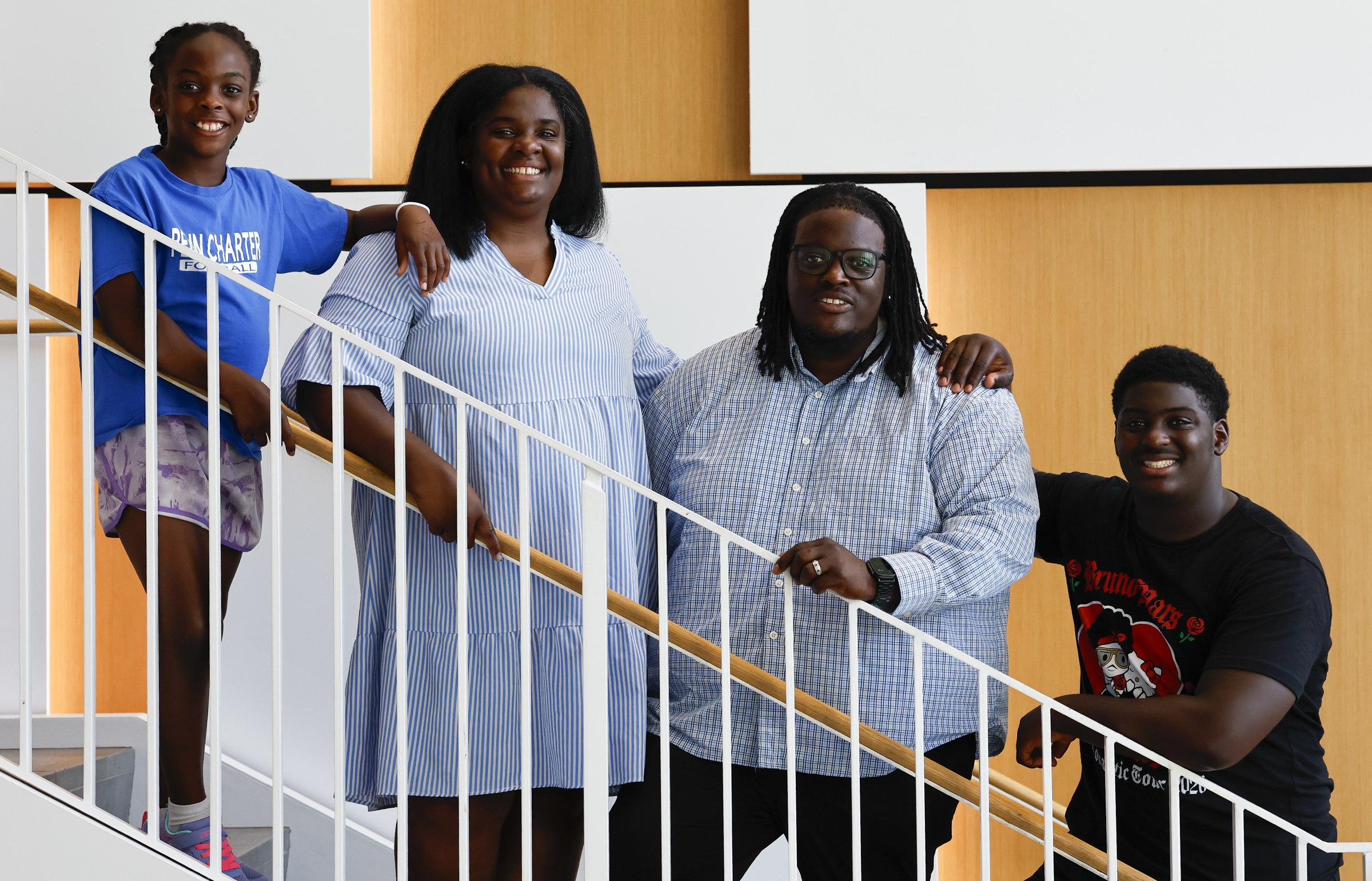
The Bouie family (from left to right): daughter Savannah Bouie, mother Keshina Bouie, father Anthony Bouie Sr., and son Anthony Bouie Jr., at William Penn Charter School on Sept. 3. Army veteran Keshina Bouie grew up in Philadelphia and was in high school ROTC on Sept. 11, 2001. She joined the Army, which helped her reach personal educational goals and give her children a good life, and played a big role in her being who she is today.Yong Kim / Staff Photographer
Bouie stayed in the Guard for 16 years, earned a master’s degree from La Salle University, and worked for the Department of Veterans Affairs and the Defense Logistics Agency. Her military service, she said, ultimately helped her provide a better life for her son and daughter.
She said there are things she’s not proud of about her country, but she’s always proud of the people she served with in Iraq and glad she enlisted.
“It was literally the best decision I made in my life. And I know not everyone can say that.”
‘What are we protecting?’
Michael Miller, 52, grew up in City of Chester with seven brothers and one sister.
“We grew up pretty poor. But being a child, you don’t know that you’re poor. We had fun. We did all the things that kids do,” Miller said.
Already a father at 19, Miller joined the Marine Corps in 1994 to provide for his family. He returned home after eight years, but missed military life. He joined the Army National Guard in 2007 and deployed to Bagram Air Base, Afghanistan, in 2010.
“For the first six months, it was like being on a weird vacation,” Miller said. “But let me tell you something: When the snow melted off those mountains, things totally changed.”
Three of his comrades died in an IED blast that summer, and of the 370 people serving with him, about 300 returned home with Combat Action Badges, a designation given to soldiers involved in ground combat.
Miller’s main job entailed driving a large truck known as a wrecker and using it to retrieve destroyed Army vehicles and cargo.
But it was while on a mission delivering supplies that an IED detonated under his truck, launching it into the air “like it was a piece of paper.”
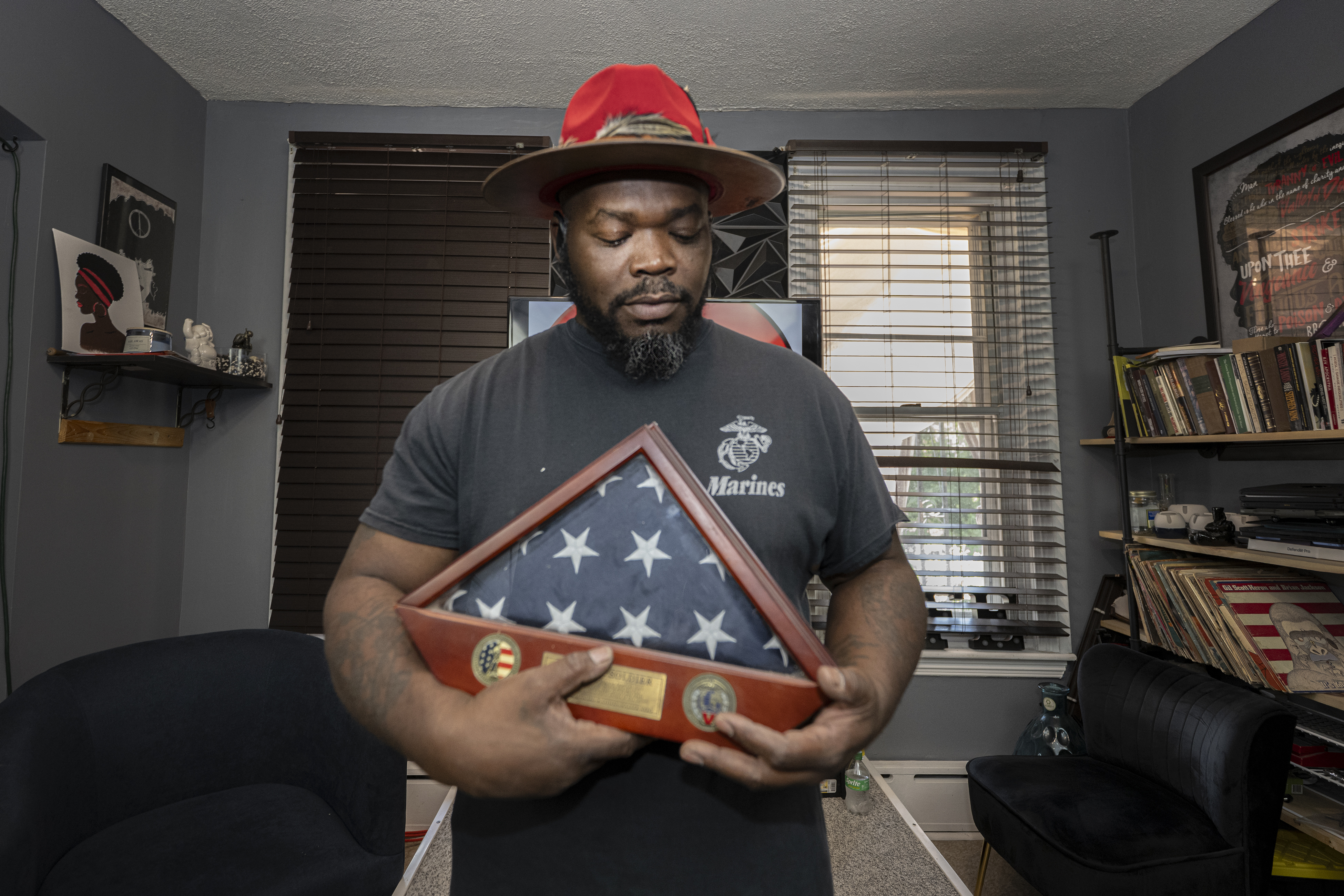
Marine veteran Michael Miller holds an American flag given to him for his military service in Afghanistan as he poses for a portrait at his home in Chester on Aug. 31. Miller deployed to Afghanistan in 2010 and survived an IED blast that caused a traumatic brain injury. After returning home, he was diagnosed with PTSD and an anxiety disorder. Miller has turned to poetry, writing, and podcasting to help cope with his experiences and the loss of three comrades who died by suicide after returning home.Jose F. Moreno / Staff Photographer
A doctor told Miller he had a concussion, he said, and he finished his deployment. It was only when he returned home that the extent of his traumatic brain injury and PTSD became clear. Panic attacks made him a “frequent flyer” at local emergency rooms.
“I used to go to sleep fully dressed, because I wanted to make everything convenient for the paramedics, because I was sure I was dying,” Miller said.
Miller joined Warrior Writers, a group of veterans who process their experiences through writing.
“Honestly? I do poetry. I learned to express myself,” Miller said.
What he struggles with now, Miller said, is that despite his efforts, three people he served with have since died by suicide. That’s left him feeling that the war wasn’t worth fighting.
“Because, honestly, what are we protecting when the wealth gap gets so much larger? What are we protecting, when we have so many homeless? It’s a bunch of stuff that in the grand scheme of things wasn’t worth the blood that was left there.”
‘Shona ba shona’
Milan Moncilovich, 62, said he learned about the Sept. 11 attacks while on duty at Methodist Hospital in South Philadelphia. By then, the pharmacist and hospital administrator was also a seasoned officer in the U.S. Navy Reserves.
“My first thought was, this is the beginning of something that’s going to be big, and that’s going to take a while, and most likely I am going to be part of this, and be deployed at some point,” Moncilovich said.
In 2010, the Navy sent him to Afghanistan to train Afghan medical personnel. He recalled seeing a stunning sunrise as his plane performed a tactical landing in Kandahar to avoid rocket attacks.
“To me it was like a personal, spiritual kind of sign that said, ‘Hey, anything that’s going to come in the future, just take this in, take this beauty in, and remember where your inner soul is,’” Moncilovich said.
In the northern Afghanistan city of Mazar-i-Sharif, Moncilovich and other American medical professionals worked closely with Afghan doctors and nurses, he said. As they got to know one another, their motto became “shona ba shona,” a Dari phrase that meant “shoulder to shoulder” or “together.”
In this advisory role, Moncilovich’s team supervised treatment of Afghan soldiers and civilians who had been struck by IEDs or gunfire.
“I can close my eyes at any time, and I can see those soldiers in that trauma bay and on those tables,” he said. “It’s not ever going to go away. I won’t say I’m OK with it. It’s just going to be there.”
Moncilovich said he saw the positive side of the U.S. missions there, such as the construction of schools and medical facilities.
The U.S. exit from Afghanistan in August 2021 angered him, he said.
“Just to see 13 more American lives lost, it really, really upset me. That’s probably the only thing that really probably brought my rage up pretty high. Especially seeing everything we left behind,” he said.
Moncilovich, who now works for Shriners Children’s hospital in North Philadelphia, said he would jump at a chance to return and get closure.
“I know that it’s completely changed now, and I understand a little more how the Vietnam vets feel now. Time will kind of change things. I know how angry they were. But now, I know what our mission was, but at the end of the day, things kind of went back to the way they were.”
Democratic leaders in New Jersey learned Lt. Gov. Dale Caldwell was under investigation for alleged inappropriate behavior with women at the same time the public did — from a news report just before Labor Day weekend.
And still it took nearly a week before Democratic Gov. Mikie Sherrill finallytook questions from reporters Wednesday on what has reportedly been a monthslong investigation by an outside law firm.
But even then she refused to confirm an investigation into her lieutenant governor or even refer to him by name. It was unlikely to relieve the growing concerns of many in her party.
New Jersey Democratic Party leaders, frustrated by her decision to hide the matter from them, had privately urged Sherrill to share what she could ahead of Wednesday’s event, rather than let Republicans calling for Caldwell’s resignation dominate the headlines.
After this pressure, her team announced the governor would take questions from the media during a visit to a Woodbridge pizza shop Wednesday evening, her first public event since the news broke Friday.
But she offered no new details in her answers.
“I’m not going to confirm or deny whether there is an ongoing investigation, but what I can commit to people is that any complaints are taken very seriously and certainly anyone who has a complaint lodged against them, their rights are protected and they will have a full hearing,” Sherrill told more than 15 members of the media gathered outside Pino’s Pizzeria & Restaurant in Woodbridge.
She declined to answer when the complaint against Caldwell was filed or whether she had curtailed any of his responsibilities, including whether he would act on her behalf when she traveled out of state.
A Democratic operative who requested anonymity to speak freely about private conversations with legislators said Sherrill has put her allies in a tough position where they feel obligated to weigh in but do not know enough to make a public statement.
“Legislators are pissed off about this,” the operative said earlier Wednesday. “They feel left in the dark, and they feel like they’re put in a weird place.”
The operative said it feels as if Sherrill and Caldwell, who are both Trenton newcomers, have been on their own “island.”
Sherrill on Tuesday released her first comment on the matter, which did not acknowledge the existence of the investigation or name her lieutenant governor. In vague terms, she said she demands members of her administration “hold themselves to the highest standards and put their obligations to public service first.”
‘The sooner, the better’
New Jersey political operatives questioned why Sherrill did not address the investigation earlier, or by addressing it head-on with a news conference, as she did earlier in the summer when her administration discovered that thousands of noncitizens had been registered to vote during her predecessor’s administration.The governor has touted herself as prioritizing transparency and accountability.
“If I were the press secretary in that administration, I would have urged a Friday statement, the sooner the better,” said Micah Rasmussen, director of the Rebovich Institute for New Jersey Politics, who worked as former Gov. Jim McGreevey’s press secretary.
“By not doing that, you really do raise suspicions … whereas if you can tamp that down and say, ‘Here’s what we know, here’s what we’re waiting for, here’s what you’re going to know,’ that can put everything into perspective.”
Former State Sen. Loretta Weinberg, a Democrat from Bergen County, said Wednesday that she has faith in Sherrill’s nascent administration, but that it was time for the governor to personally address the investigation — the details of which have been leaked in media reports.
“I think that has been too long for what obviously began in May and has not yet come to fruition. What is taking so long?” said Weinberg, who served as Senate majority leader and made combating sexual harassment and violence a cornerstone of her long legislative career.
“When you have an unwillingness to talk, the rumor mill fills in the gaps. That’s not good for transparency,” she said.
Sherrill spokesperson Sean Higgins declined to comment on the criticism from other Democrats outside the pizza event Wednesday evening.
BINJE.com reported Wednesday that Caldwell denied allegations of misconduct toward women in a May 28 letter to Christina Fullam, the state’s chief ethics officer. He said it was “personally painful for someone to attempt to damage my reputation and slander my character with false and misleading accusations” and suggested race was involved.
“While I am troubled by this accusation, as the first single Black man to serve at this level in government, I suspect that there will be other false accusations or rumors in the future,” he wrote. “Unfortunately, in this current political environment, false accusations, especially against people of color, seem to be commonplace.”
Sherrill has garnered national attention for her decisive win last year and outspoken criticism of President DonaldTrump. She has also been supporting Democrats in other states ahead of this year’s midterms, making appearances for candidates in New Hampshire and Massachusetts, which has fueled speculation about national ambitions.
But the investigation into Caldwell and widespread media coverage could complicate her rise.
“This isn’t going away until [Sherrill and her team provide] answers,” said a Sherrill adviser, who was not authorized to speak about the matter and did so on condition of anonymity. “If they do not handle this now, it will metastasize and burst those bubbles of being on the national stage.”
Some party operatives have even begun mulling who might replace Caldwell, the adviser said.
Acting governor when Sherrill travels out of state
Caldwell served as acting governor while Sherrill was out of state on more than half a dozen days in July and August, with no opportunities for the media to ask him questions. His public schedule included appearances at a United Airlines event in Newark, a tennis event in Paterson, and a Puerto Rican Festival in Vineland.
But the role of acting governor is not just attending community events and photo ops. The position takes on all the responsibilities of governor, and choosing Caldwell as her running mate was a personal judgment call for Sherrill.
“It’s a big power to be governor — you have clemency powers,” noted one Democratic political insider who requested anonymity to speak freely, questioning why Caldwell was left to run the state while under investigation.
Assembly member Alex Sauickie, an Ocean County Republican, on Tuesday called on Sherrill to stop traveling out of state while Caldwell is the subject of investigation.
“This is no longer simply about the governor leaving New Jersey to campaign for politicians in other states or build her national political profile. This is now about who is actually in charge of our state when she leaves,” he said in a statement.
Some Democrats watching the controversy around Caldwell unfold have cited other issues that concern them with Sherrill’s administration, such as the New Jersey State Police’s aggressive response to protesters outside the Delaney Hall Immigration and Customs Enforcement facility in Newark, and major companies leaving the state, the Sherrill adviser said. They pointed to this episode as another example of Sherrill and her team operating without communication or input from other elected officials.
Only acouple ofDemocratic legislators have publicly commented on the news.
Assembly member Katie Brennan (D., Hudson), who accused a senior campaign adviser to former Democratic Gov. Phil Murphy of sexual assault in 2017, released a statement Tuesday calling the allegations serious. She used the opportunity to promote legislation that she said would “set clear standards” for how complaints are handled.
On Wednesday, State Sen. Britnee Timberlake (D., Essex) defended Sherrill’s handling of the investigation and criticized Republicans’ “selective outrage,” the New Jersey Globe reported.
Rasmussen noted that he has not seen anyone come to Caldwell’s defense in Trenton.
“Maybe he doesn’t have those people in Trenton. He was picked primarily because he was an outsider,” he said.
Another Democratic leader, who requested anonymity to speak freely and not alienate the administration, expressed disappointment that it took so long for Sherrill’s administration to acknowledge the investigation but said Caldwell deserves to have judgment wait until the investigation is complete.
“He’s played the role this administration has asked of him, advancing the governor’s agenda. He has been visible. I truly believe they have a good partnership. Everyone should have the presumption of innocence,” the leader said.
“But it’s fair to say all of us were pretty shocked when we saw the accounts. It is my hope the governor and the investigations will be completely transparent.”
Barb Hertline didn’t have any coaching experience in flag football prior to 2025.
Jim McHugh, the Camden Catholic High School athletic director, told her there was a grant available to start a girls’ flag football program at the school and asked Hertline if she would be willing to be the first head coach of the program.
“Without a doubt, I said yes because it was an opportunity for our girls,” said Hertline, the executive assistant & special projects manager at Camden Catholic. “I didn’t know anything about flag football or the rules or really anything that it would entail. I just knew I wanted to be a part of it to give these girls a chance to experience it.”
The decision gave Camden Catholic’s girls an opportunity to play the sport that was quickly gaining popularity in South Jersey.
“They wanted this opportunity and we were able to give that to them, and it has opened so many doors,” Hertline said.
In May, the New Jersey State Interscholastic Athletic Association sanctioned girls’ flag football as a high school varsity sport with the first official season starting in the spring of 2027.
The sport initially began as a club activity at several South Jersey high schools in 2023. June Cioffi, director of athletics at Kingsway and president of the West Jersey Football League, said the first two years served as a “pilot stage” for coaches, athletic directors, and league officials.
“It was an easy sell, and everyone was on board,” Cioffi said.
The Eagles and New York Giants played a significant role in helping girls’ flag become sanctioned in New Jersey.
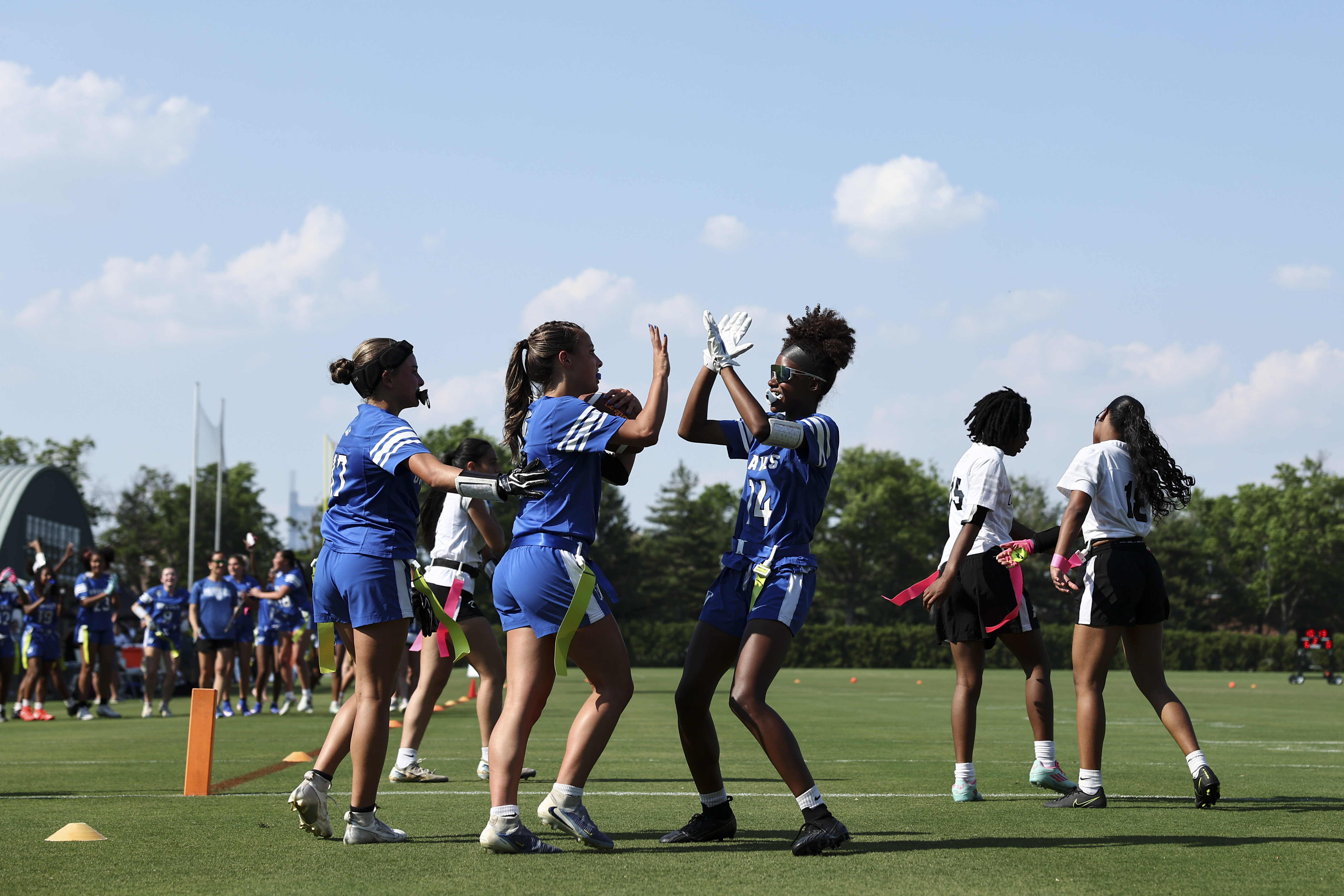
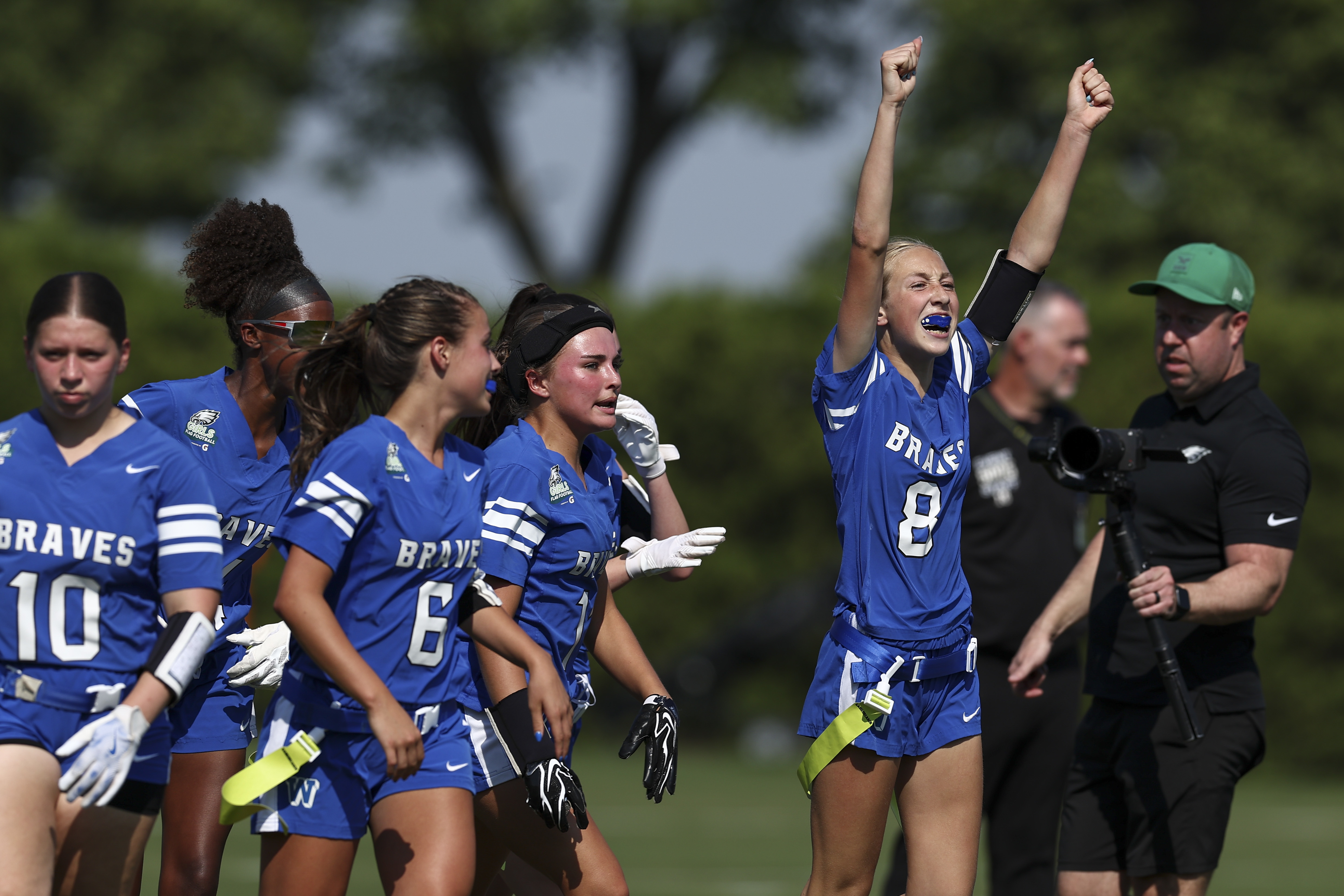
The Eagles launched a girls’ flag football league in 2022 with the intention of reducing barriers of entry. The league began with 16 teams, but has now expanded to 100 teams from Pennsylvania and 30 from South Jersey.
Kingsway celebrates after winning the Eagles’ New Jersey flag football championship in 2024.Charles Fox / Staff Photographer
“They were very helpful in offering all of that for those first couple years and to try to bring on new schools and make it more of an easy sell to the superintendents,” Cioffi said.
The Eagles offered each team funds to get programs started and provided uniforms, footballs, coaching seminars and equipment. Clinics were also hosted for players and coaches, and the Eagles partnered with Operation Warm, a non-profit organization that manufactures sports bras to provide gear for girls in sports. According to their website, by the age of 14, girls are dropping out of sports at two times the rate of boys because of a lack of access to basic gear.
“A barrier to participation was the lack of equipment and so working with Operation Warm, we can now give sports bras to every participant,” Eagles president Don Smolenski said.
The Eagles support was intended to represent who they are as an organization.
“We’ve opened up our facilities; fields and indoor practice facilities,” Smolenski said. “That’s us sort of embracing the community around us, and you see the impact when you see how excited the athletes are when they come to a practice or run onto the field for the very first time — it’s incredibly gratifying and motivates us to continue to explore how we can further support it.”
The Eagles hosted more than 100 girls’ flag football coaches and players from the tri-state area at training camp on Aug. 24. It was an experience, some coaches and players say, they never thought they would have.
“It’s really nice to know that a male-dominated sport is very supportive of women coming in and just kind of making it their own,” Kingsway Regional High School senior Jade Matthew said. “I feel like all the opportunities that we get, even something like this, and the fact that they host our championship and playoff games, it’s just nice to be a part of.”
Matthew and teammate Jayda Romagnoli grew up playing co-ed flag football with their siblings.
“It was a bit hard competing with boys even. … when I was little, normally the boy would never really pass to us, and we kind of always got ignored,” Matthew said. “But it’s nice to see that we’re kind of growing out of our little shy phase and actually embracing that this is ours and we can make it what we want.”
When they first heard girls’ flag was going to be a high school varsity sport, they thought it was going to be co-ed.
“They’re really taking this serious and they were actually growing it,” Romagnoli said. “I want to go to college for it, so it’s nice to hear that more people are going to start getting the love for this sport that I had before.”
Interest in flag football has “exploded”, Cioffi said, with more college programs including flag as a varsity sport at all levels.
Several South Jersey high school coaches said the Eagles’ backing their teams helped speed up the process to sanction the sport.
“We want the sport of football to be embraced by everyone — men, women, boys, girls,” Smolenski said. “We don’t want it to just be thought of as, ‘Oh, that’s a boy sport, only boys can play,’ and flag football is a sport that can be played by everyone.”
Harper Carney of Williamstown celebrates a touchdown during the Eagles’ New Jersey flag football championship on May 18.Monica Herndon / Staff Photographer
Last year, Hertline knew very little about flag football during her first season as coach at Camden Catholic, but the growth of the game is a testament to the increased opportunities and the determination of the girls.
“Girls get such a bad reputation sometimes, with the ‘play like a girl,’” Hertline said. “Yeah, play like a girl because if you see the way our girls play, they are second to none against any boys’ team. They really raise the bar and because there has been so much excitement surrounding the announcement of all of this and the NFL is backing it, everyone wants to be a part of this.”