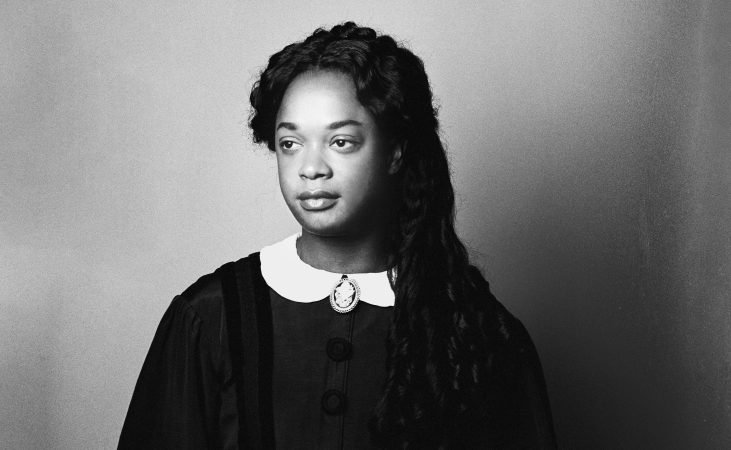
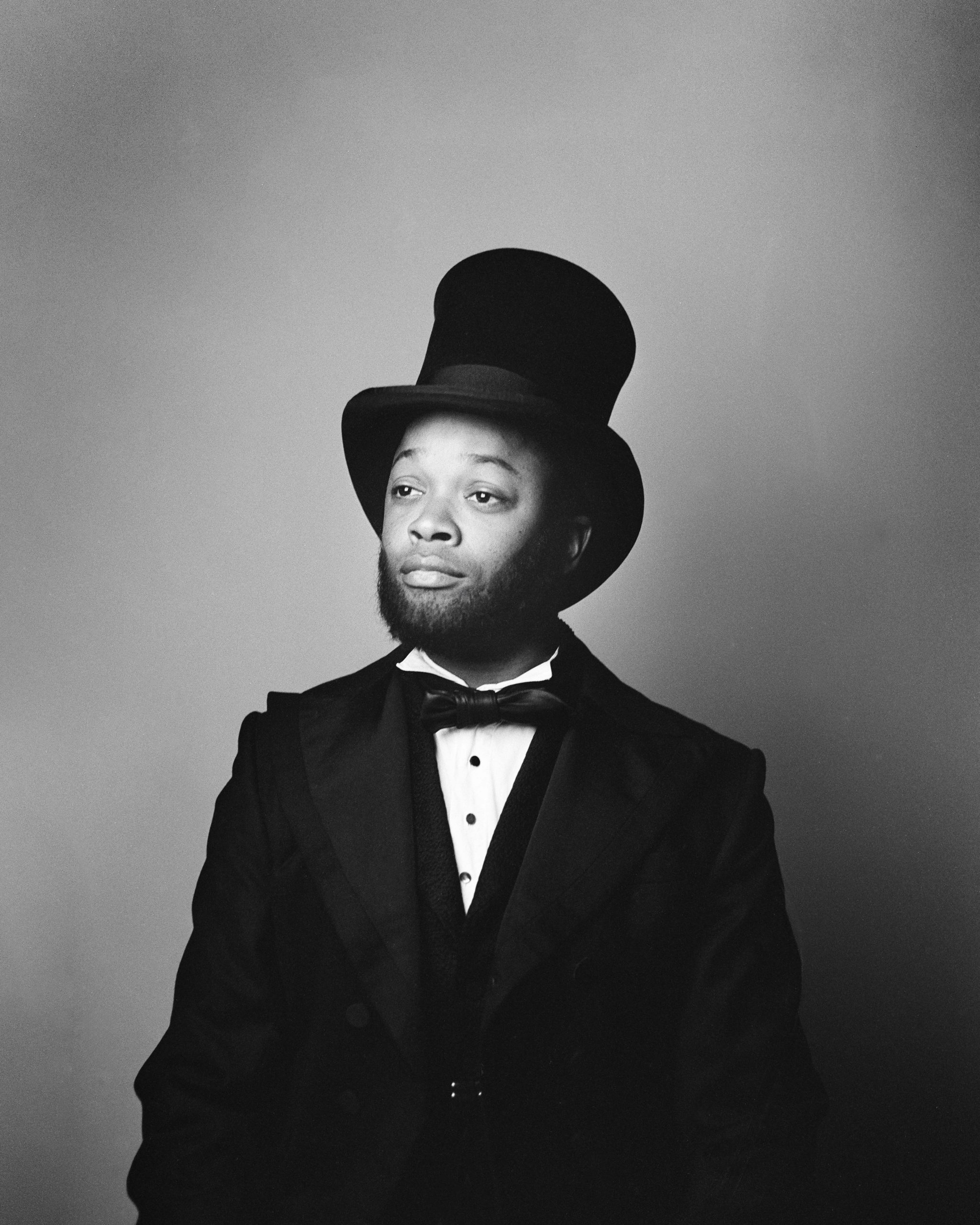
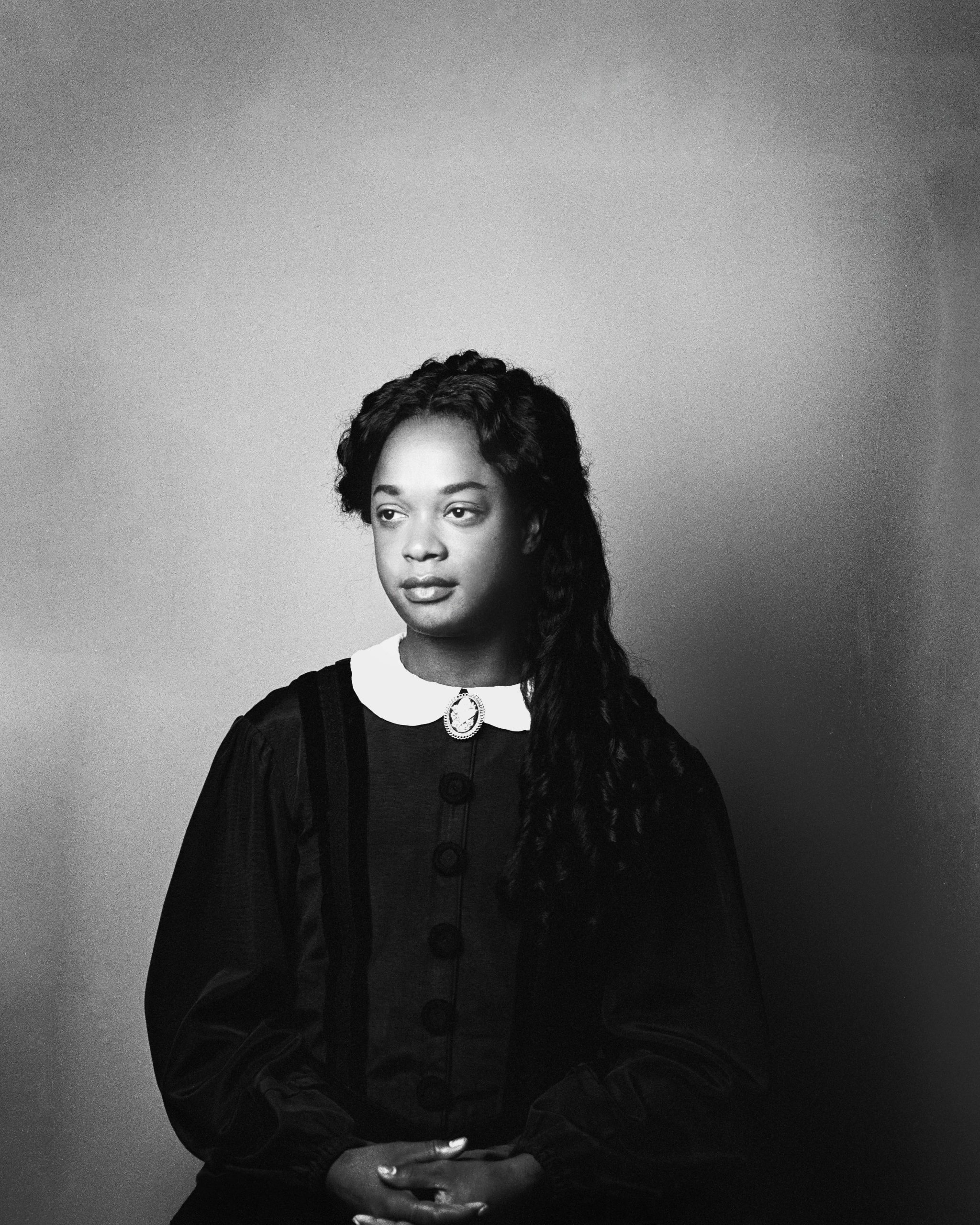
The riotous play Oh, Mary! has found two new leads for its first North American tour kicking off this fall: drag queen Alaska Thunderf— and Broadway darling J. Harrison Ghee. When the show lands in Philadelphia next March, Ghee will take the spotlight as the delightfully mad first lady Mary Todd Lincoln.
First, though, the titular role will go to Alaska, a winner of RuPaul’s Drag Race All Stars, who grew up in Erie, Pa., and graduated from the University of Pittsburgh. While she stars as Mary, Ghee — a longtime New Yorker originally from Fayetteville, N.C. — will play “Mary’s Husband,” aka President Abraham Lincoln, becoming the first actor to play both roles in the play.
J. Harrison Ghee will play “Mary’s Husband” opposite Alaska Thunderf-‘s Mary Todd Lincoln in the first part of the North American tour of “Oh, Mary!” before they take the titular role in Jan. 2027.Daniel Rampulla
The 2026-27 tour starts in Hartford, Conn., in September and runs through May, with stops including Washington, Boston, Los Angeles, and Detroit. Alaska will play Mary through Jan. 17 and Ghee will take over the lead role beginning Jan. 19 in Chicago. They will be the star during the show’s brief Philly run at the Miller Theater from March 9 to 14.
The camp comedy from actor/comedian Cole Escola follows a miserable, alcoholic Mary Lincoln just before her husband’s assassination in a satirical story that “finally examines the forgotten life and dreams of Mrs. Lincoln through the lens of an idiot.” Following Escola, several stars have put their own stamp on the role, including Tituss Burgess, Maya Rudolph, Jane Krakowski, and Jinkx Monsoon (another breakout star from the RuPaul’s Drag Race universe).
Drag queen Alaska Thunderf— will play Mary Todd Lincoln in the first part of the “Oh, Mary!” North American tour.Daniel Rampulla
The play was a massive hit when it landed on Broadway in 2024, becoming a Pulitzer Prize finalist and receiving five Tony Award nominations. Oh, Mary! won two in 2025, including best direction of a play and best performance by an actor in a leading role in a play for Escola — who made Tony Award history as the first nonbinary actor to win in that category.
So it’s fitting that Ghee — a nonbinary actor who also achieved a historic first at the 2023 Tony Awards when they won best leading actor in a musical for playing Daphne/Jerry in Some Like It Hot — will get a chance to play Mary, too.
The two actors haven’t yet talked in-depth about the roles, but earlier this year, they crossed paths when Ghee was waiting to hear back on their audition results. “We spoke briefly at the Tony [Awards] after-party at the Carlyle [Hotel], and they had kind of given me a hint,” said Ghee, who’s currently playing Hermes in Hadestown on Broadway.
“They were like, ‘I feel like I’m gonna see more of you coming up.’”
Ghee has seen Krakowski, Monsoon, and Hannah Solow play Mary so far and they can’t wait to take up the role. “I’ve seen a spectrum of Marys, and I’m excited to, as Billy Porter would say, ‘steal the good sh—,’ and also just bring myself to it and really have fun.”
They first auditioned for the role of “Mary’s Husband” but had eyes on the lead, too.
“It was very much a ‘yes, and’ [situation],” Ghee said. “A lot of my career has been based in duality. I am very that, and I love versatility. I don’t ever want to be pigeonholed … I want to show people the capacity — don’t let other people limit you.”
J. Harrison Ghee pictured as Mary Todd Lincoln. “Oh, Mary!” lands at Philadelphia’s Miller Theater from March 9 to 14, 2027.Daniel Rampulla
As for stopping in Philadelphia, Ghee said it’s one of the cities where they’re most eager to perform. They love visiting the city and enjoying the food culture.
“I love to take an Amtrak down to Philly because you still get city vibes, but it breathes a little easier,” they said. “So I’m even considering, like, is there a world where I live in Philly one day? I don’t know!”
Tickets are on sale now for “Oh, Mary!,” which runs March 9-14, 2027, at the Miller Theater, 250 S. Broad St., Philadelphia, 215-893-1999 or ensembleartsphilly.org.
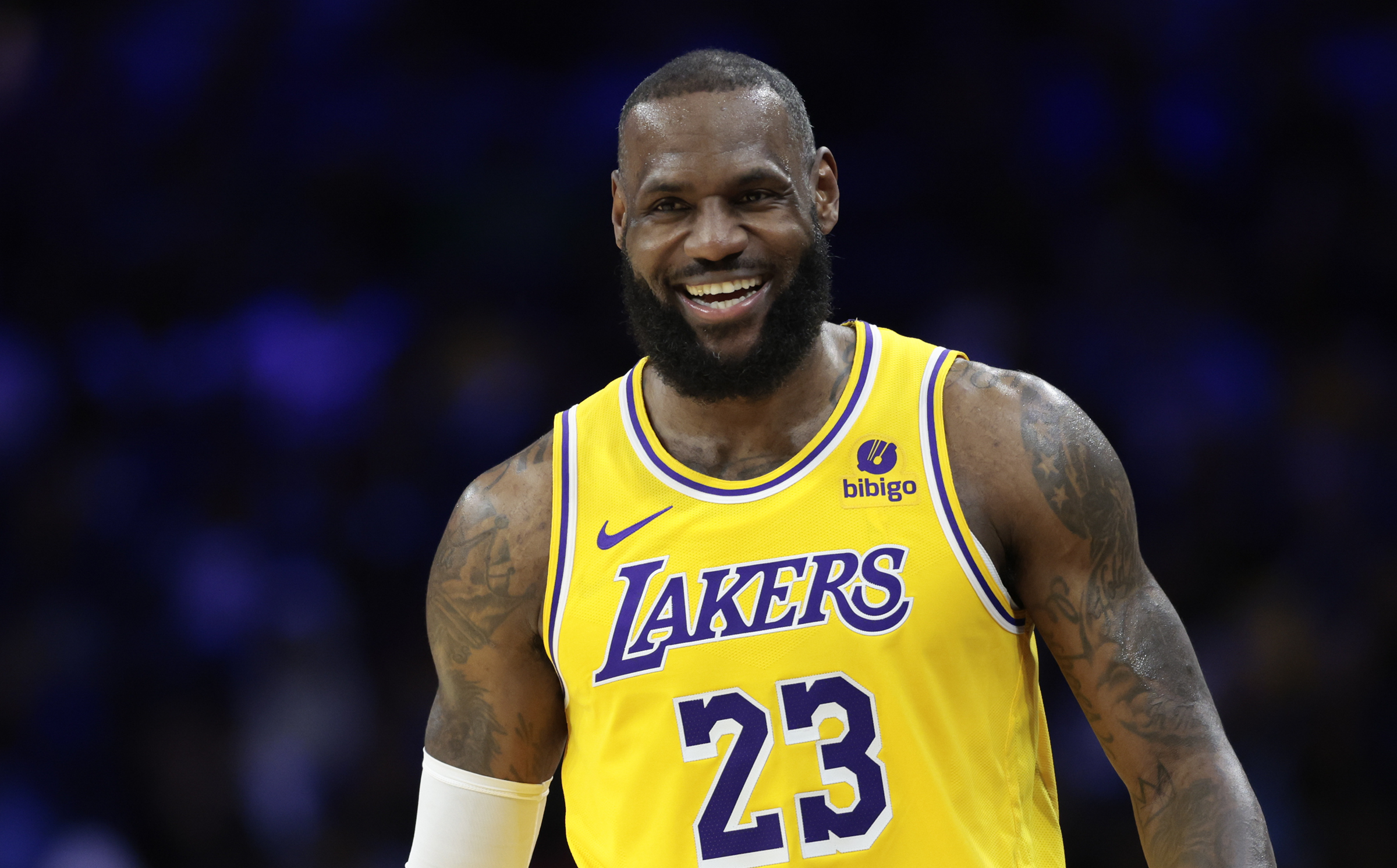
To witness the reaction to LeBron James’ decision to play in Philadelphia the next two seasons, you might have thought we’d beaten the Russians to the moon or ended the next world war. Folks drove down Broad Street honking their horns, heads hanging out of their cars. Total strangers standing on subway trains staring at their phones got the notification, looked up, and high-fived. Somewhere, lions lay down with lambs.
This, for a 41-year-old coming off the worst of his 23 seasons?
Yes. Yes. A thousand times, yes. But why?
Because Philadelphians won. They won the LeBron Sweepstakes.
The King chose Philly.
The King chose us.
James chose a franchise that hasn’t won an NBA title in 43 years, has only one title in almost 60 years, and hasn’t advanced past the second round of the playoffs in 25 years. He chose a city with three total championships since James was born in 1984; James himself has won four. He chose a city with a national reputation for abrasiveness, confrontation, and, above all, losing — a reputation resented by the residents of Philadelphia and its region.
Still: He chose us. He might occasionally commute to Philly from Manhattan, but he’s paying his taxes here.
If Joel Embiid and Tyrese Maxey and Jaylen Brown and VJ Edgecombe again fall short in the playoffs, LeBron still chose us. He could have joined Steph Curry in San Francisco, Giannis Antetokounmpo in Miami, James Harden in Cleveland.
But no. We won. And we acted like it.
Phil Martelli, revered basketball coach and lifelong Philadelphian, knows why.
“I’ve had this in my head forever. People think we’re bad losers. That’s not what we are,” Martelli said. “We are insufferable winners.”
Validation
I’ve been a Philadelphian for 31 of my 57 years. Martelli’s been a Philly guy for all 71 of his. I told him that, in my three decades, I’ve observed that Philly has an inferiority complex, a chip on its shoulder, and a healthy sense of pride.
“No doubt,” Martelli agreed. “No doubt.”
So, when good things happen, a dam always breaks. From climbing greased streetlights to eating horse manure (this really happened), Philly fans have earned a reputation of, well, overexpression when the rare championship finally lands at their feet.
It is that rarity, that desperation for validation, that generates euphoria when a big name decides that Philly is good enough for him.
That’s the key: The decision must belong to the player.
LeBron James validated Philadelphians when he picked us. Yong Kim / Staff Photographer
That’s why Reggie White doesn’t qualify. Eric Lindros, Julius Erving, Moses Malone, Roy Halladay, all trades or purchases.
Bryce Harper, however, already had won an MVP by the spring of 2019. The Yankees, Dodgers, Giants, and White Sox courted him. So did the Padres, until they signed Manny Machado, who, folks might not remember, was the Phillies’ first choice. But the fans always preferred Harp, and, ultimately, Harp preferred them. And he was only 26.
Similarly, by the 1978 offseason, Pete Rose had been a National League MVP, but he also was the MVP of one of his two World Series titles with Cincinnati. He was a stone-cold winner, and, even though he would be 37 in 1978, he was still the top free agent. The Phillies’ four-year, $3.24 million offer was the worst he received — others included more money, a lifetime $100,000 annual pension, oil and beer investments, and racehorse ownership — but Rose saw a winner in Philly, and Philly utterly rejoiced.
Compared with Harper and Rose, there was less excitement (and less competition) when Saquon Barkley signed with the Eagles in 2024. The Bengals, Texans, Ravens, and Bears contended but the Eagles won, and Barkley, a Lehigh Valley native, came home, to much rejoicing. That season Barkley produced record-setting numbers and pushed the Eagles to a Super Bowl win, so it’s tempting to recast his choice as being a bigger deal than it was. He’s still never going to have to buy his own beer in Philly.
Saquon was the centerpiece of a run to the Eagles’ second Lombardi Trophy. Rose pushed the 1980 Phillies to the first World Series win in franchise history. Harper won a second MVP, in 2021, and led the Phillies to the 2022 pennant.
They delivered on their promise.
This seldom is the case.
Unfulfilled promise?
Age, injury, and Ryan Howard made Jim Thome redundant in the mid-2000s. Cliff Lee rejected the Yankees and took less to return to the Phillies in 2011, but to no good end. Jake Arrieta was a big-time bust, Lance Parrish was a late-80’s disappointment, Al Horford was a bad fit with Embiid, and Nnamdi Asomugha was cooked by the time he became a “Dream Team” Eagle in 2011.
LeBron never will be classified among Philly’s worst signings, if only because his two-year, $8 million contract earns him 33% less than Anfernee Simons (for casuals, Simons is the new backup shooting guard). LeBron would be a magnificent value at $4 million a year if he was an assistant coach.
Still, there are expectations. After LeBron signed, the Sixers’ aggregate odds to win the NBA title jumped from tied for sixth-best, at 20-1, to third-best, at about 9-1.
“You know there’s people already staking out spots on Broad Street for the parade,” Martelli said.
When Rose, Harper, and Saquon signed, everybody got excited. Nobody staked out spots on Broad Street.
The LeBron-mania is palpable. Ticket and jersey sales have been inflated beyond sanity and availability, with no real end in sight. Don’t expect Knicks fans to take over Xfinity Mobile Arena this season.
There has been excitement surrounding arrivals before, but never anything like this. The only arrival that might cause a similar disruption would involve a biblical rapture.
Like that king, this King will be expected to raise his following from the dead.
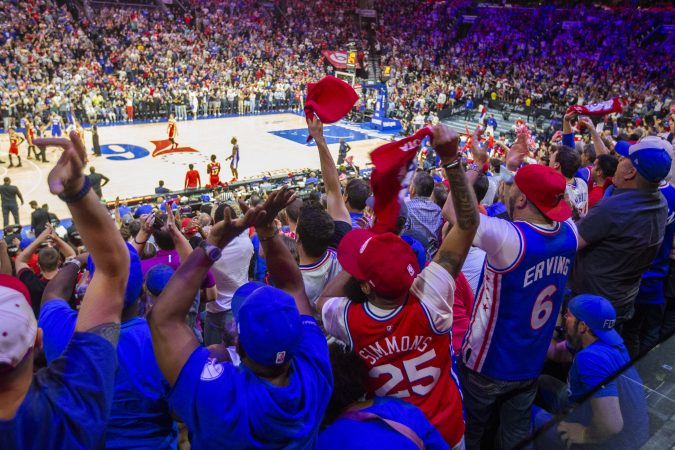
When LeBron James signed with the 76ers, he wasn’t just bringing his talent to the roster, he was bringing a whole new fan base to Philadelphia as well.
As one of the most famous basketball players of all time, James’ fans run deep and wide. So if you’ve spent the past few years rooting for the Los Angeles Lakers after multiple stints as a Cleveland Cavaliers fan and experienced a couple championships while rooting for James on the Miami Heat, here’s what you need to know about being a Sixers fan:
Here come the Sixers
There’s a chance you’ll be hearing a lot of the Sixers victory song, “Here Come the Sixers” this season, so be prepared to know every word.
The tune was commissioned in 1975 by the then-general manager Pat Williams as a way to bring energy into the arena. Randy Childress, Terry Rocap, and Joe Sherwood, better known as the band Fresh Aire, created the song that’s still used today and encourages fans to “clap your hands” and “stomp your feet” for the Sixers.
In 1986, when Williams left the Sixers, the song became less used until the early 2000s, when WIP host Angelo Cataldi repopularized it on his show.
If you can remember the hand clapping, the feet stomping, and can count “one, two, three, four, five, Sixers,” you already know the basics of the song.
If you’ve ever watched an episode of The Pitt, Grey’s Anatomy, or any other medical drama and thought that some of the ailments seemed a little far-fetched, then you don’t know the Sixers.
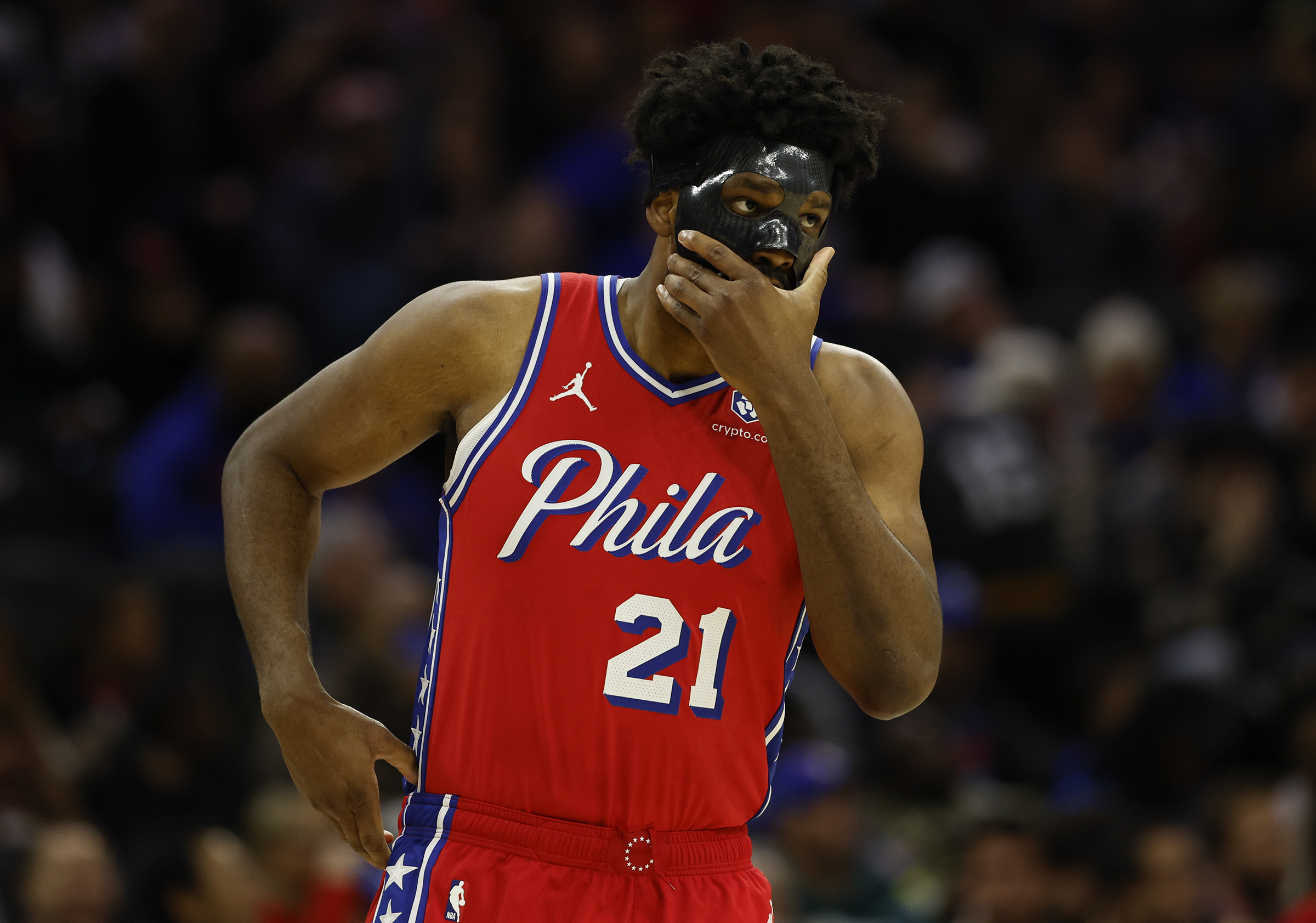
Shortly after Markelle Fultz returned after a monthslong shoulder injury, he collided with Joel Embiid during a game, breaking Embiid’s orbital bone in 2018. And it wouldn’t be the only time Embiid broke that facial bone. He did so again in 2022 after an elbow to the face in Game 6 of the first round of playoffs against the Toronto Raptors. He also dealt with Bell’s palsy, or facial paralysis, on the left side of his face during the 2024 playoff run. And these are just Embiid’s face-related injuries.
Sixers center Joel Embiid adjusts his mask during a game against the Charlotte Hornets in 2024.Yong Kim / Staff Photographer
But if those aren’t convincing enough, there also is the time in 2018 Zhaire Smith ate a chicken dish during his rookie season and suffered a severe allergic reaction because of sesame in the dish. Fortunately, Smith was OK.
With Ben Simmons’ fractured foot after rolling over his ankle in training camp as a rookie, or the time Kelly Oubre Jr. reportedly being hit by a car, the injury list goes on and on.
Yes, on a team with Constitutional-esque branding, the mascot is a dog. Franklin the dog to be exact.
But there’s still a founding father tie-in there. Franklin gets his name from none other than Ben Franklin, whose legacy lives on in the Constitution, electricity, and a giant dog with blue fur.
Franklin was introduced in 2015, marketed as a “fan’s best friend,” after the Sixers went four years without a mascot.
Before Franklin, there was Hip-Hop, the acrobatic rabbit known for slam dunks. Hip-Hop, who reigned as the primary mascot from 1998 to 2011, was brought back as a secondary mascot for the 2025-26 season.
The first Sixers mascot, however, was Big Shot, a fuzzy blue creature with red hair and big sunglasses, who came from the same creators as the Phillies’ mascot, the Phillie Phanatic. Big Shot was the Sixers’ mascot from 1982 to 1996.
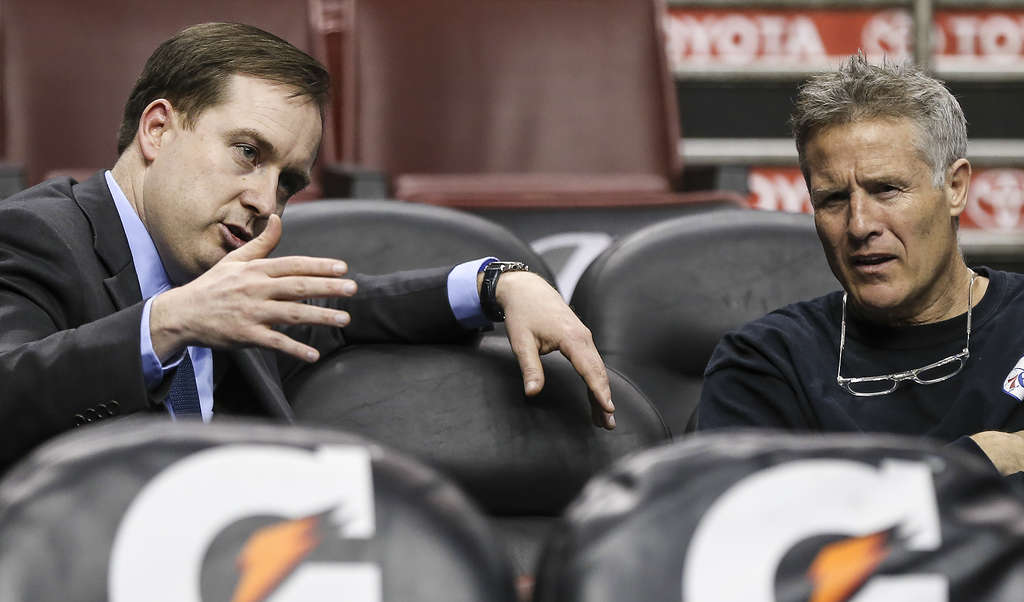
“Trust the Process” has become a slogan closely associated with the Sixers’ rebuild process, starting in 2013 under former general manager Sam Hinkie.
During the Hinkie years, “The Process” became synonymous with tanking for draft picks in an attempt to rebuild. Despite some big trades, like trading the team’s only All-Star at the time, Jrue Holiday to the New Orleans Pelicans for the sixth overall draft pick, some continued to trust.
Sixers GM Sam Hinkie (left) and coach Brett Brown oversaw the early Process years.Steven Falk
Others weren’t so sold, and the phrase became divisive among Sixers fans.
“The Process,” however, has since led to the Sixers acquiring Jaylen Brown and James during this offseason, with James even hinting during Fanatics Fest a few weeks before signing with Philly that he wanted to go somewhere that he could “trust the process.”
Love it or hate it, “The Process” is part of the Sixers lore.
Learn the language
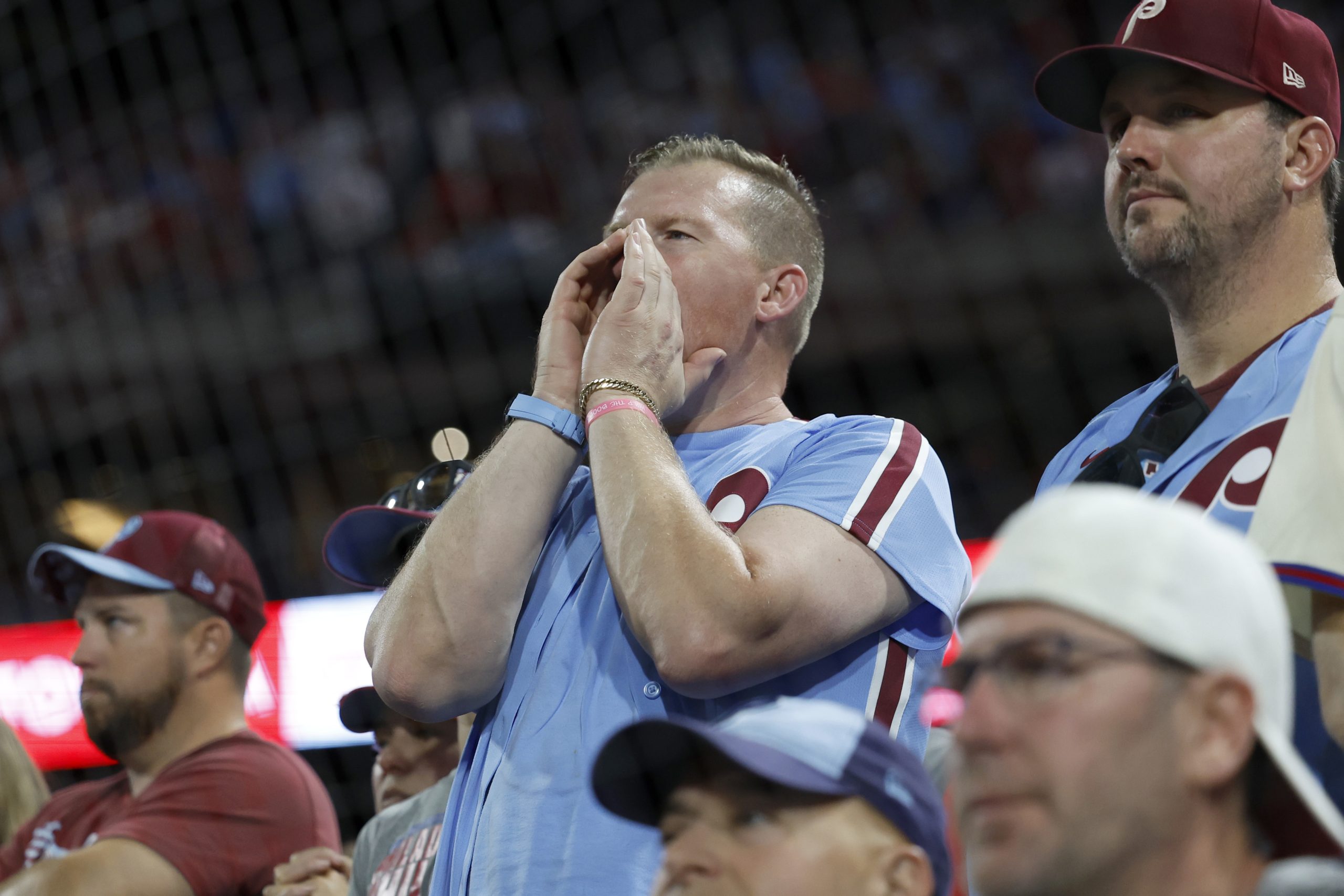
If you’re going to fit in at a Sixers game, or really any Philly sporting event, it’s important to know that it’s OK to boo. It’s even encouraged.
This doesn’t just apply to opposing teams or bad calls by the refs, it goes for the Sixers own players, too. If a player — or the team at large — isn’t performing well, Philly fans aren’t afraid to let them hear it.
When the Sixers are playing against the top talent from an opposing team, especially the Knicks or the Celtics, you better let them hear it as well.
A Phillies fan boos after the eighth inning against the Los Angeles Dodgers in Game 2 of the 2025 NLDS at Citizens Bank Park.Yong Kim / Staff Photographer
And while being a Sixers fan doesn’t automatically mean being a fan of other Philly teams, it’s best to learn the words to the Eagles chant as well. Those aren’t resolved for Lincoln Financial Field, and more often than not, they’ll ring out at any Philly event, sports-related or not.
It’s especially common after a loss by one of the other big four sports teams, so start studying.
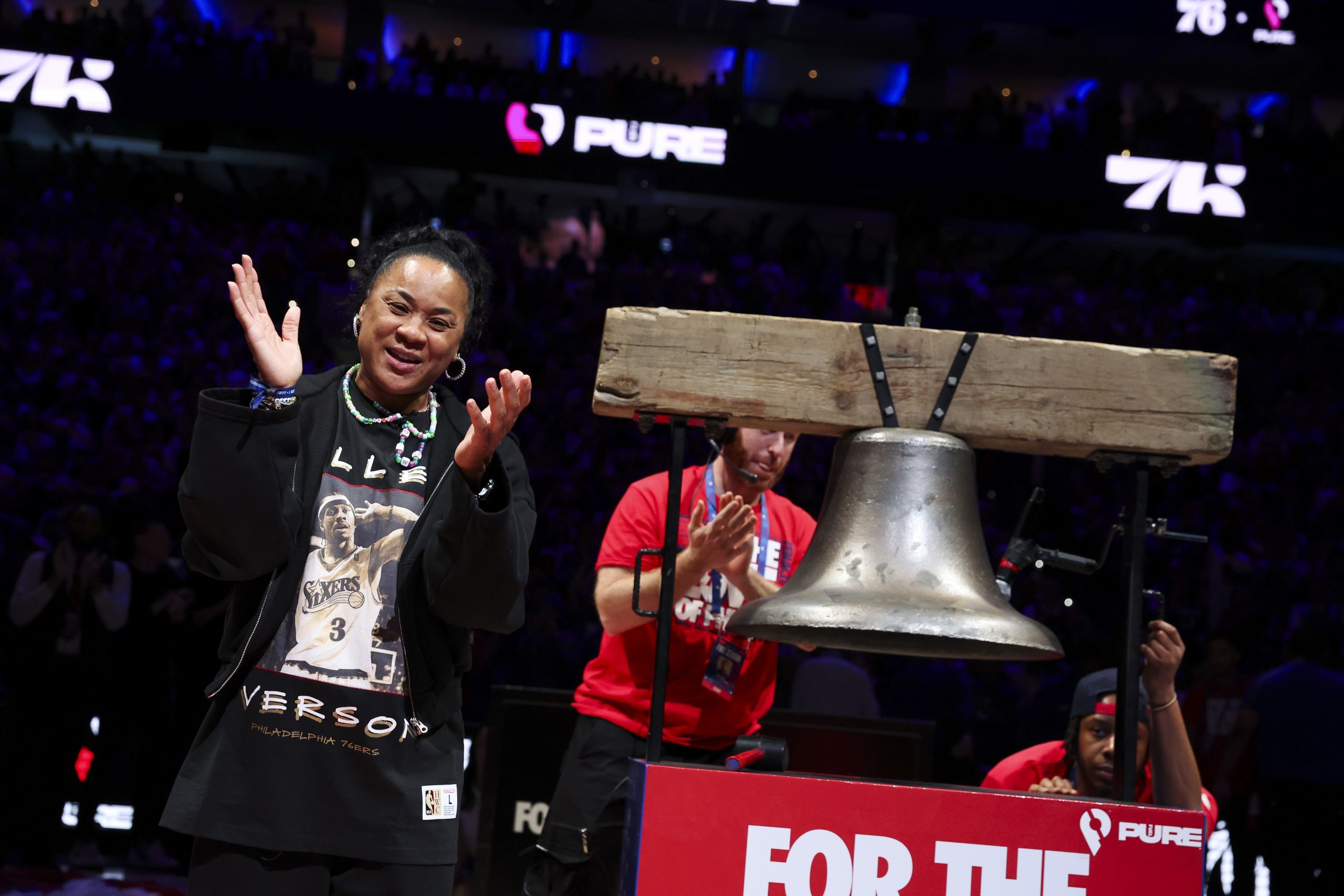
North Philly’s Dawn Staley rings the Sixers’ bell before Game 4 of a first-round playoff series against the New York Knicks in 2024.Monica Herndon / Staff Photographer
Fast facts
Those are some of the big things that make up the basic knowledge of a Sixers fan, but these are some other fun facts to keep in mind as well:
Sixers managing partner Josh Harris also owns the NFL’s Washington Commanders and the NHL’s New Jersey Devils.
The Sixers’ practice facility is in Camden.
A major series win in the playoffs, like an Eastern Conference championship, will be celebrated on Broad Street.
The Sixers Stixers is the official drumline of the Sixers and performs at games and events.
The Sixers share an arena with the Flyers, and a new arena is slated to open in 2030 that will accommodate the WNBA expansion team as well.
There is a pregame tradition for home games that includes local celebrities, athletes from other sports, and more ringing a Liberty Bell replica before games to fire up the arena.
Work has resumed on a 1.5 million-square-foot data center in East Whiteland after developers were told to stop early construction this month while the township reviewed its soil and health safety plans.
Township officials issued a permit that includes “many conditions related to soil monitoring and reporting, dust control, and protection of the remedy for the Superfund site,” they said in a statement Wednesday.
Development began again on Wednesday, said Lou Colagreco, an attorney representing the developers, Green Fig LLC and Sentinel Data Centers.
Earlier this month, township officials told the developer to stop work “until greater clarity is provided with respect to the ongoing review” of the soil and health and safety plans. The stoppage came amid increased scrutiny from residents, who have fears about the impact of the data center being built upon the former Cyprus Foote Mineral Co., which contaminated the land with chemicals such as lithium, arsenic, and hexavalent chromium.
On Wednesday, the township said in a statement posted online that it had issued a permit regarding erosion and sedimentation control.
“The Township and its inspectors will also be maintaining a regular presence at the site to oversee implementation of the permit conditions,” the township’s statement said.
The permit allows for “earth-moving activities.” The developers will still need to secure construction permits for things like pouring concrete for footings, or foundations. But they can move dirt and dig via these permits, East Whiteland Township Manager Steve Brown said.
The developers came back before the township this month, intending to change the design again, saying the revised proposal would use less water. It could also possibly scale down the overall footprint of the data center, from 1.5 million square feet to a total of 536,000 square feet.
The township’s three elected officials ultimately tabled the matter at their July 8 meeting, saying they needed more information. The board’s next scheduled meeting is Aug. 19.
“The only issue before the Supervisors is whether the data center will use air chilled coolers to conserve water or whether water chilled units will be utilized,” Colagreco said in an email. “In either event, Sentinel is proceeding with development.”
This suburban content is produced with support from the Leslie Miller and Richard Worley Foundation and The Lenfest Institute for Journalism. Editorial content is created independently of the project donors. Gifts to support The Inquirer’s high-impact journalism can be made at inquirer.com/donate. A list of Lenfest Institute donors can be found at lenfestinstitute.org/supporters.
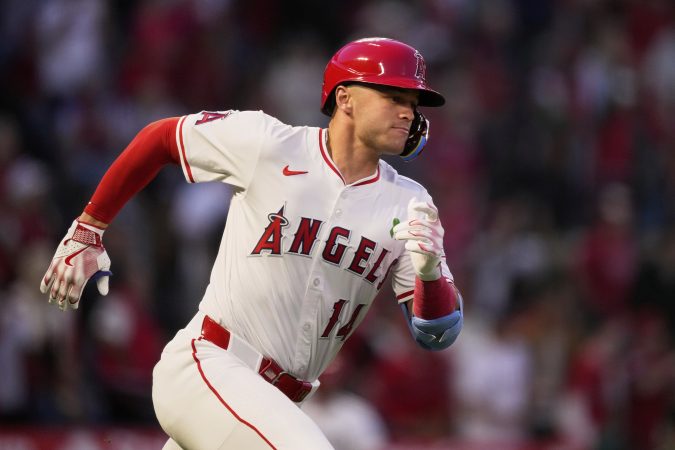
Former Phillies catching prospect Logan O’Hoppe was traded by the Los Angeles Angels to the Texas Rangers on Wednesday along with reliever Chase Silseth for third base prospect Angel Arredondo.
The Angels acquired O’Hoppe, 26, from the Phillies in exchange for outfielder Brandon Marsh just before the 2022 trade deadline. At the time, O’Hoppe was the Phillies’ fifth-ranked organizational prospect. Marsh was named a starter in his first All-Star Game appearance earlier this month.
O’Hoppe had his best season with Los Angeles in 2024, when he hit 20 home runs and had a career-high 2.7 wins above replacement. He is batting .209 with a .565 OPS in 256 plate appearances this season.
Out of the 20 catchers with 250 plate appearances, O’Hoppe ranks 18th in on-base percentage, 19th in batting average, and tied for last in home runs. Texas plans to option him to triple A, according to the Dallas Morning News.
Silseth, 26, was an 11th-round pick by the Angels in 2021 and is having a breakout season. He led the Angels with 47 appearances and had a 2.72 ERA.
Arredondo is a 19-year-old third baseman who has spent all of 2026 with single-A Hickory. He is slashing .247/.372/.397 in 361 plate appearances. Arredondo wasn’t ranked among Texas’s top 30 prospects, per MLB.com, although pipeline rankings have not been updated since the start of the season.
This isn’t just a bad year for measles. It looks to be the start of a bad era. Confirmed measles cases just hit a 35-year high, and it’s only July. Together with last year, the number of cases has exceeded the combined total over the previous 25 years. The vast majority of cases stem from domestic outbreaks fueled by low rates of vaccination—and rates are declining.
For the first time in a quarter century, the U.S. no longer meets a main criterion for having eliminated measles as a public health threat. That status hinges on sporadic outbreaks fizzling out within a year. Utah’s outbreak has lasted for longer, since June 2025.
Nearly 400 people have been hospitalized with measles in the U.S. this year and last, three people have died, and at least three suffered brain swelling with lingering symptoms.
This month, the Centers for Disease Control and Prevention is set to finalize a comprehensive study of the nation’s measles situation, examining data from January 2025 through June 2026.
“I don’t think we could say with a straight face that there hasn’t been transmission over the past 12 months,” said a CDC scientist with knowledge of the agency’s measles report. (KFF Health News agreed not to name the researcher, who is concerned about retaliation.) The researcher said a national committee of measles specialists will review the CDC’s internal report, which then goes to the Pan American Health Organization, a group that evaluates the measles elimination status of countries throughout North, South, and Central America, and the Caribbean.
PAHO will make its decisions at an annual meeting this fall, but scientists say the writing is on the wall. “The assessment for elimination isn’t until November, but that is a scheduling issue, basically,” said Anne Schuchat, who led the CDC’s immunization and respiratory disease group from 2006 to 2015.
“It’s just so sad, because some people will get brutally ill,” she said of measles’ return. “This is a wake-up call.”
Pediatricians in Utah have been on the front lines as measles and other vaccine-preventable ailments have returned to the U.S. In interviews with KFF Health News, six doctors shared insights on this new era of vaccine hesitancy — and what could be done to turn the situation around.
The conversations have been edited for clarity.
On unvaccinated children hospitalized with measles complications
Emilie Morris, a hospital pediatrician in Salt Lake County and Utah County: When children come in, they’re often bent over. We call it tripoding, which is particular to upper respiratory infections and airway swelling. They have a rash — viruses cause rashes all the time — but in this context, the kid is hunched over, mouth open, drooling, crying, maybe not even producing tears, because they’re so dehydrated. Really labored breathing, kind of tugging in their belly, tugging between their ribs. Their eyes look kind of glazed over. It’s like they’re seeing through you.
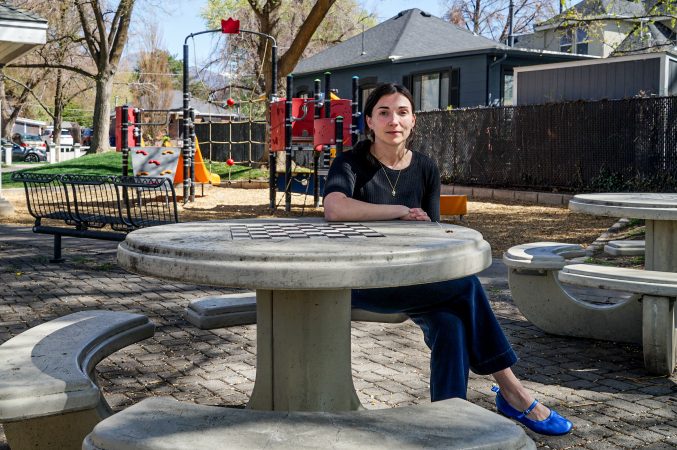
Nathan Money, a hospital pediatrician in Salt Lake County and Utah County in Utah, says it’s “heartbreaking” to see children with measles struggling to breathe. (Amy Maxmen/KFF Health News) Amy Maxmen/KFF Health News
Nathan Money, a hospital pediatrician in Salt Lake County and Utah County: If the child has a fever or trouble breathing, and they’re unvaccinated, I have to be way more aggressive from a medical standpoint, because they are at higher risk of having life-threatening illnesses. I have to do more blood work, or lumbar punctures to rule out meningitis. I have to do things which are painful, and it’s traumatic for the families.
I tell them, “Because your child doesn’t have vaccines, I have to be more worried about conditions like sepsis or meningitis, so therefore I need to do more workup.” The last thing I want to do is miss something. These are parents who love their children. They always tell me, “Do what you need to do to make sure my child is safe.”
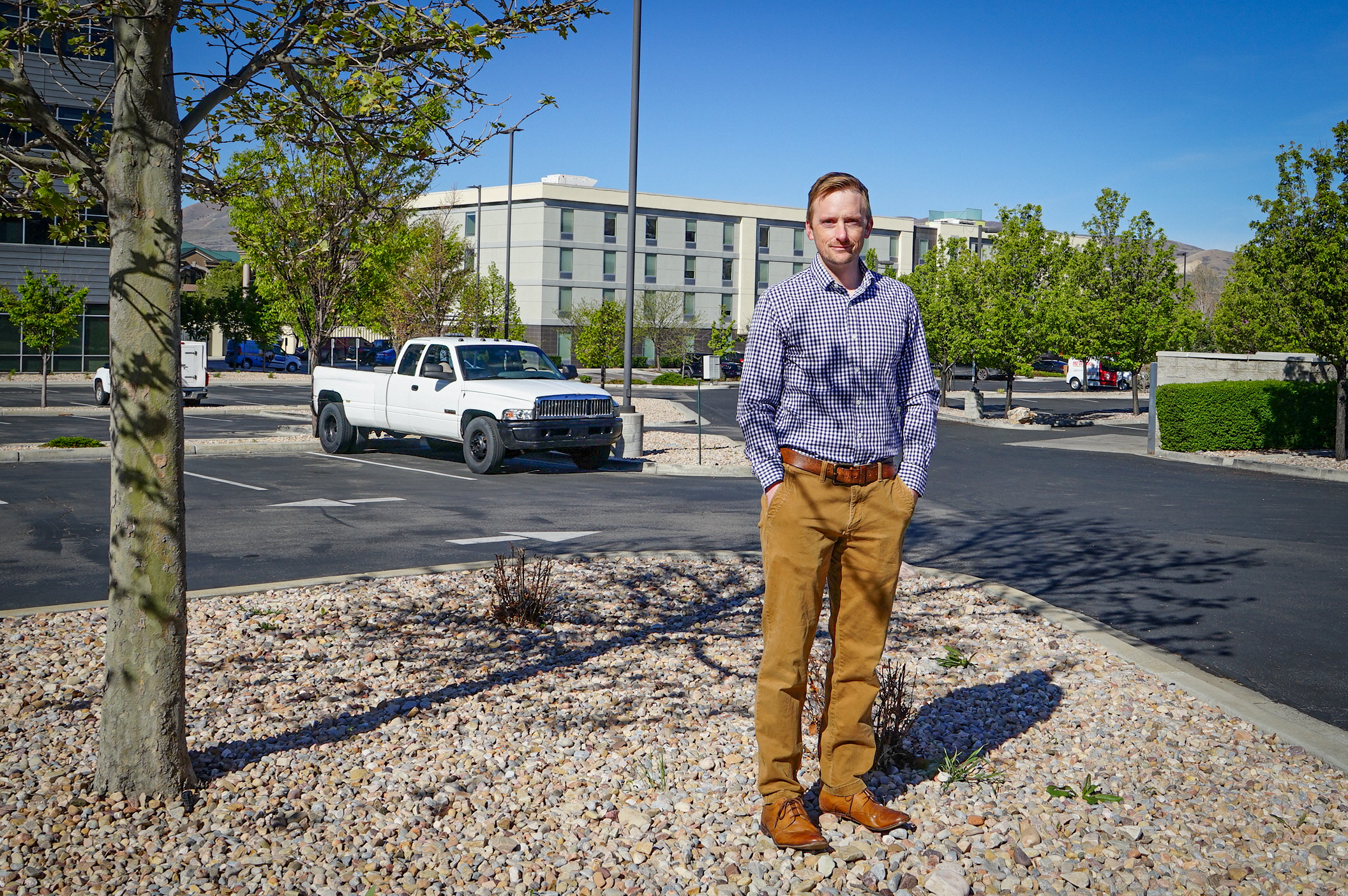
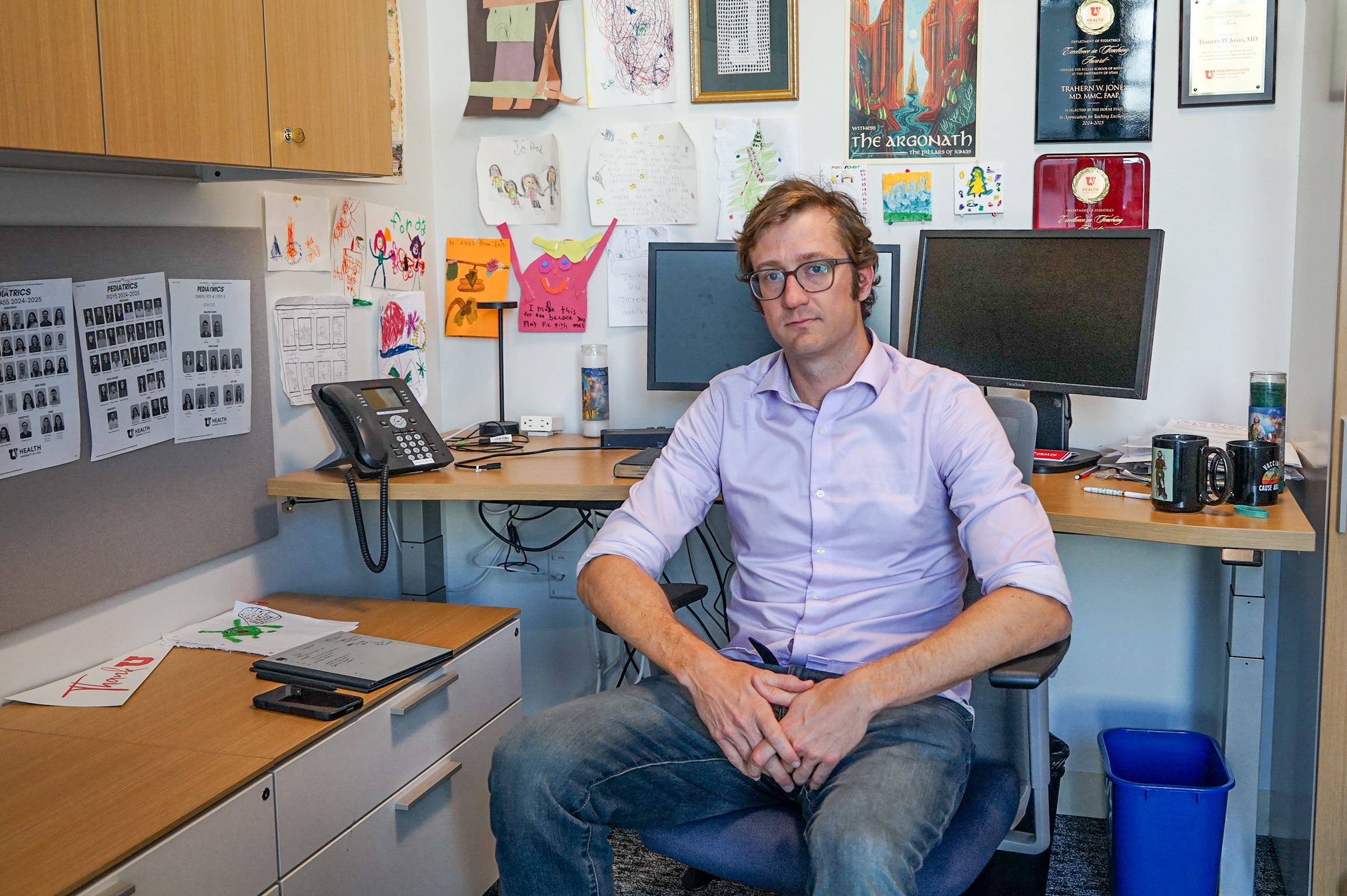
Trahern W. Jones, a pediatric infectious disease specialist based in Salt Lake County, Utah, says parents are often surprised by how severe measles can be. (Amy Maxmen/KFF
Health News)Amy Maxmen/KFF Health News
On treating unvaccinated children hospitalized for measles
Trahern W. Jones, a pediatric infectious disease specialist based in Salt Lake City: So I’m coming into a room and just hearing the most awful barking cough, just a cough and a high-pitch stridor as the child is trying to breathe. And he’s just coughing so hard it just makes you feel short of breath. He looks like he’s been beaten down for days, but he can’t rest, because the cough keeps him awake.
The parents tell me they’re not anti-vaccine, but in the past, somebody they know had a reaction to a vaccine — or something they thought was a reaction to a vaccine — and so they paused vaccines when the child was a baby. They were planning to catch up later.
In another case, the parent was stunned by how awful it was. I asked them what they knew about measles before their child was sick, and they said the only person who’d ever taught them anything about measles was their grandmother who had taken care of her kids with measles ages ago. That’s something I’ve heard from other parents. It’s such an awful illness. Even the best possible course is going to be one of the worst diseases most children ever go through.
There are multiple facets to it. Physically, the child has been beat down for multiple days by this virus. The parents don’t get to sleep, because they’re nursing their child. Then there’s the emotional component because the parent is regretting not getting the vaccine, not realizing how bad this was, and then feeling deeply ashamed, trying to reconcile with family members who are really upset at them for not getting their child vaccinated.
Morris: One child was from a family that was uninsured because they didn’t feel that they would need to use the medical system. They were faced with the high burden of cost of our healthcare system. The cost was playing into the parents’ decision on whether or not their child should receive necessary medical care. I said something like: “Please don’t go home. Your child needs oxygen. She has pneumonia. We will figure out a way to pay for this, because we acknowledge what we do is expensive.”
On top of that, the parent had several other children in the home who weren’t vaccinated. It was past the period where we could intervene with vaccines to try to prevent infection, so then our recommendation was to quarantine their children at home for 21 days: “Don’t interact with anybody else in your community. Don’t go to the grocery store, even with a mask. Please take this seriously.”
It takes time for parents to understand the level of concern I have, even when their child is physically ill in the hospital requiring ongoing care. It’s pretty indicative of the breakdown of trust between physicians and families. I say, “This is the gravity or severity of your child’s situation and how serious we need to be about protecting other people.”
It’s frustrating. How can I make people understand I have a very genuine concern for their child? And I know they share that concern, but maybe it’s not the same degree of concern, because they don’t understand the illness and how severe it can become.
Money: It’s heartbreaking to see these children struggling to survive when measles could have been easily prevented by a safe mechanism that is readily available and well studied. These are well-meaning parents who love their children, who have gotten bad information from federal leadership or from online sources. The saddest part to me is when I am caring for a child and the parent says, “I didn’t know that this could get so bad.”
Tim Duffy, a pediatrician in Salt Lake County, Utah, says many parents are concerned about incorrect claims about vaccines seen on social media. (Amy Maxmen/KFF Health
News)Amy Maxmen/KFF Health News
On conversations with parents who don’t vaccinate their children
Tim Duffy, a pediatrician in Salt Lake County: A lot of families aren’t aggressively anti-vax, but they’re hesitant. Younger parents who grew up in the digital age have done their research — “research” in quotation marks — for months. And they keep getting confirmation of their concerns on social media. They think they’re doing what’s best for their child.
I’ve told families: “You could do nothing I say as a pediatrician. You could sleep your child on their stomach. You could not put them in a car seat or, when they’re older, not use seat belts. You could do nothing I say, and for your individual child, they will probably be OK. But from my standpoint, where I’m taking care of thousands of kids, within a system that takes care of hundreds of thousands of kids, we will have bad outcomes. These children will show up at our facilities, and it’s so sad.”
Pediatrician in southern Utah whom KFF Health News agreed not to name, because of concerns about harassment after being targeted by anti-vaccine activists in the past: A lot of parents are concerned about autism. I’ve told them that I’d be very concerned if there was any evidence that what we’re doing is causing autism. But if vaccines were causing autism, we should see more cases of autism in vaccinated kids compared to unvaccinated kids, and we’re just not seeing that.
I’ve also had families who say they want to be natural, or that they’re concerned about what is in the shots. A frequently asked question is: “Did you vaccinate your children?” I say that knowing what I know, I’m confident giving this to my kids. They’re all vaccinated.
On the influence of politics on vaccine hesitancy
Jones: Vaccines have become a political football. That wasn’t true 20 years ago. But now it’s used to drive a wedge between groups of people, which is unfortunate. Vaccines are one of the main reasons why we don’t have to worry about losing our kids.
Southern Utah pediatrician: People don’t know who to believe. If politics comes up, I tell parents that my messaging on vaccines is not politically motivated. When parents ask about changes to the vaccine schedule, I’m transparent. [In January, the Department of Health and Human Services controversially recommended reducing the number of vaccines given to children. A few months later, a federal judge blocked those changes.]
I’ve said there was a process for the approval of immunizations through ACIP [the Advisory Committee on Immunization Practices], which is made up of scientists, public health experts, and doctors, and all those people were let go, and a new panel was selected. A couple of individuals changed the recommendation outside of the time-tested, evidence-based process for evaluating vaccines. That raises concerns for me as a doctor. I tell parents that the American Academy of Pediatrics, the American Academy of Family Physicians, and several other professional organizations have issued statements saying that these changes are not based on evidence.
Ellie Brownstein, a pediatrician in Salt Lake County and president-elect of the Utah chapter of the American Academy of Pediatrics: I avoid talking about politics, but what’s being said has added another layer to our work. One family asked me about changes to vaccine recommendations, so instead of just telling them what immunizations are due, I talk with them about why physicians and researchers have followed a different schedule for years, about the reasoning and the science behind it. I explain that I trust these experts over someone without a lot of experience.
Money: People are not vaccinated, because they’ve lost trust in the medical community. They’re placing trust elsewhere. Rebuilding trust is a complicated process, but it comes from consistent messaging at every level, from the pediatrician to local health departments to community leaders, city leadership, district leadership, religious leadership, educational leadership.
We need consistent messaging from state leadership, which has been pretty absent. I want to see commercials on TV about the safety of the MMR [measles, mumps, and rubella] vaccine and the dangers of the measles, sponsored by my state leadership. I’d like to see this on billboards and in schools, in public buildings and grocery stores. I want to go to a sports event and see messages about the measles and the MMR vaccine. Right now, people have to go out of their way to find information from reputable sources.
We also need policy changes to support vaccination. This train is going in the wrong direction, and it can feel like a helpless situation, because we’re just not seeing the public messaging and leadership that’s needed to turn this around.
Advice on talking with parents who don’t vaccinate their children
Jones: Approach them with as much compassion as you possibly can. Ask open-ended questions to learn about their experiences that led them to have these concerns. I think it’s really important to not come down on them, citing facts and figures and pointing to guidelines on why they need to get their kids vaccinated. But try to direct their attention to the fact that you’re a real person with your own real experiences and knowledge. I point out to families that I have my own kids, and I would never recommend something for your kids that I wouldn’t do for mine.
Southern Utah pediatrician: I’ve learned that if you come down hard, you’re going to lose people who need care. My number one goal now is to build bridges and maintain a relationship with families, because that’s what’s going to allow me to convince some of them.
I approach people differently depending on where they are. Parents who are very skeptical or anti-vax will say no when I tell them their child is due for immunizations. I’ll say: “Fine. You guys get to choose. You’re the parents. But I’m curious to know what your reasoning is.” Sometimes they’re just like, “It’s something I’ve decided.” They don’t want to have a conversation.
It’s a good day if I can have a conversation with someone who doesn’t want to vaccinate, even if I don’t convince them. I try to help them think through things rather than shoving anything down their throat. When they’re done talking, I’ll ask, “Can I share my perspectives on this?” Some will say yes enthusiastically, and others will say yes because they’re being polite.
A lot of parents aren’t sure what to do, and those are the people I focus most of my time on. I focus our conversation on their specific concerns, and I’m open about specific side effects that different immunizations can have. For example, I’ll tell them that some children get a fever after a vaccine, which is OK. The fever is not harmful, but it can make babies feel crummy as their body is building up antibodies against viruses and bacteria.
Brownstein: I don’t like the idea of excluding unvaccinated kids from my practice. I know some do that. But what that does is it ends any future discussion. I can’t keep talking with parents about vaccines if I kick them out of my practice, and if these parents find like-minded doctors, this situation will get worse.
On being on the front lines of measles’ comeback in the U.S.
Money: I wish that people could see what I see. Everyone else sees what people post on Instagram. Or they think, “Someone I know had measles when they were a kid and they were fine.” But as a hospital-based pediatrician, I see what happens when things go poorly. I see what happens when children with measles aren’t able to breathe on their own, and they’re in a hospital bed with a cannula in their nose, struggling to breathe, an IV in their arm because they can’t drink on their own. And the child is terrified, and the parents are scared that their child might die.
It’s heartbreaking as a pediatrician and as a father to know that the entire situation could have been easily prevented.
Duffy: Even though parents say vaccination is their choice, I still feel personally responsible if something bad happens that’s preventable, because I feel like I didn’t say the right thing, I didn’t ask the right questions. Maybe I let it drop because of the look on a parent’s face.
Morris: Every pediatrician I know cares so deeply about what they do. Sometimes people forget that we are human beings practicing this discipline, and we bring all our concerns for our community into this space. I’m trying to navigate a lot of complex human emotions, like how it feels to hold grief with a family when something bad happens that was preventable — which is the worst situation, because you think, “Could I have done something differently?”
Jones: I think we’ll see more diseases start coming back that we thought we had gotten rid of. I think it’s going to take dramatic changes to actually prevent those outcomes. I’m not necessarily seeing those changes being done by those in power.
I think of that quote from The Lord of the Rings. It’s something like, you don’t get to choose the time that you’re born into, but you get to choose what you’re going to do about it. And if there’s any comfort that I have, it’s in knowing that there are right decisions to make and that I’m going to make them, and I’m going to help others make them, too.
KFF Health News is a national newsroom that produces in-depth journalism about health issues and is one of the core operating programs at KFF — the independent source for health policy research, polling, and journalism.
This season, South Jersey figure skater Isabeau Levito is branching out for her programs.
Previously, her coach, Yulia Kuznetsova, would suggest the music and choreograph the programs for Levito, 19, who grew up in Mount Holly and lives in Mount Laurel.
For the 2026-27 season, Levito announced on social media that three choreographers had created her programs. Her short program will be to the song “Memória” by Rosalia, choreographed by Lori Nichol and Carolina Kostner. Levito went to Canada to learn that program.
Her free skate will be to the soundtrack from Pirates of the Caribbean, choreographed by Benoit Richaud.
Skaters used to keep programs strictly under wraps until their first competitions in late summer or early fall. Sometimes, their final costumes wouldn’t be ready yet and they would skate in older costumes or elevated practice clothes.
But now, program announcements are more like movie trailers, getting fans eager to see what’s coming. This has been especially true after the Olympics this past winter in Milan, Italy. Many skaters have retired — or in the case of pairs and ice dance, switched partners. Some talked about taking a year off. A small number of skaters, including Levito, toured in prominent shows such as Stars on Ice.
But it was a big transition season and a time when many people forget about winter sports.
Levito has said that she’s barely been home in months. Along with the tour and Canada, she returned to Italy to participate in Richaud’s Peak Ice Camp in Courmayeur.
She also may start the season without her final costumes. Despite releasing a video on Instagram that includes a thumbnail of her in a pirate costume, that is not what she will be wearing. In an interview on Peak Ice Camp’s YouTube page, she said she called costume designer Lisa McKinnon to discuss her new programs and that it would be a minute before they could move forward.
“Benoit proposed the idea of pants” for Pirates, Levito said, “and I was like, ‘No.’”
Levito released a portion of her free skate step sequence on Instagram, and her programs are the subject of much speculation on social media. She is known as an elegant, balletic skater with beautiful spins and a lot of personality.
Pirates of the Caribbean music is considered overdone. There is a long list of skaters who performed to Pirates, including 2008 U.S. champion Mirai Nagasu, Spain’s Javier Fernandez (a two-time World champion and 2018 Olympic bronze medalist), eight-time Polish champion Ekaterina Kurakova.
But certain pieces of music are used frequently in skating for a reason. In the case of Pirates, it is lively and fun. Richaud also is a popular choreographer for a reason, and there is room for him to have made Levito’s Pirates different and special.
Richaud, a French former ice dancer, is one of the hot choreographers of the moment. At February’s Olympics, he worked with 16 skaters from 13 countries and was frequently seen with them in the kiss and cry, wearing jackets from different countries. His skaters included American ice dancers Emilea Zingas and Vadym Kolesnik, French skater Adam Siao Him Fa, and Georgian skater Nika Egadze.
Nichol, who is Canadian, also has been a hot choreographer. She created many fan-favorite programs for Michelle Kwan and more recently two-time Olympic silver medalist Yuma Kagiyama. She works often with Kostner, the 2014 Olympic bronze medalist from Italy.
Levito has said that she wants to increase her difficulty and is eager to eventually land a triple axel and a quadruple jump, whether or not she does them in competition.
A cruise ship sailed out of the Port of Philadelphia this springfor the first time in 15 years, as state and local officials celebrated a new economic driver for the region.
Officials have projected that the new cruise business — anchored by Norwegian Cruise Line at a Hog Island terminal near Philadelphia International Airport — will create more than 2,100 jobs and generate $300 million in annual economic activity.
What they did not anticipate before breaking ground in December was that several obstacles — including several weeks of subfreezing temperatures and icy conditions on the Delaware River — would send the construction project millions of dollars over budget.
The cost of building the terminal has increased 50% to more than $60 million, according to the Philadelphia Regional Port Authority (PhilaPort), an independent state agency that owns seaport facilities along the Delaware. The port authority is funding the project.
PhilaPort is considering obtaining financing to help cover the $20.1 million in cost overruns. The authority’s board this month approved a resolution authorizing staff to borrow up to $15 million. PhilaPort spokesperson Marty O’Rourke said loan terms remain under negotiation.
In addition to the potential financing, the port authority is funding the project from operating revenues, O’Rourke said. PhilaPort generates revenue from its leases with tenants that operate facilities such as marine terminals and warehouses.
PhilaPort’s budget for the fiscal year that began July 1 includes $34.5 million in revenue.
Despite the delays, Norwegian Cruise Line’s ships have continued to dock at PhilaPort’s under-construction terminal since April. Mayor Cherelle L. Parker and Gov. Josh Shapiro, both Democrats, attended an onboard ceremony for the Norwegian Jewel’s inaugural call that month.
Shapiro — whose appointee chairs PhilaPort’s board — touted the cruise business “as the newest addition to our commonwealth’s fast-growing tourism industry.”
There had been 13 voyages as of mid-July.
PhilaPort remains upbeat about its new revenue stream. Under a seven-year agreement, Norwegian Cruise Line has committed to 41 voyages annually to locations like Bermuda, and PhilaPort says it will receive $59 million in rent from the company over that period of time.
“The key point to remember moving forward is that all infrastructure is now in place for additional cruise lines to start using the PhilaPort Cruise Terminal,” O’Rourke said. Each new line has the potential to generate an additional $8.5 million in annual rent, he said.
Construction began in December after PhilaPort acquired the Hog Island terminal facility in Tinicum from Energy Transfer Marketing & Terminals L.P. for $10. Under the deal, ownership of the 15.5-acre property reverts back to Energy Transfer in seven years.
PhilaPort’s board in November authorized the agency to bypass competitive bidding “due to the urgency of need to ensure that the cruise terminal is operational and ready to receive passengers by the first scheduled sailing in April 2026.”
The port authority hired Bridgeport, N.J.-based Commerce Construction Corp. to handle waterside construction, based on their past maritime experience, O’Rourke said.
Norwegian Cruise Line tapped Philadelphia-based A.P. Construction to lead landside construction.
O’Rourke said PhilaPort “had a very narrow four-month window to complete construction in time for the first ship berthing.”
“This tight construction window was compounded by severe weather-related obstacles and delays caused by several weeks of subfreezing temperatures, resulting in higher-than-anticipated costs for labor overtime and added acceleration fees for materials acquisition,” he said in an email.
Also contributing to added costs were regulatory requirements, environmental remediation, additional landside mooring work, and temporary facilities needed to support vessel operations, O’Rourke said.
The landside construction was originally scheduled for completion by the end of June. The port authority now anticipates the terminal will be complete by its grand opening Aug. 27.
Commerce Construction didn’t respond to a request for comment, but the contractor posted on LinkedIn earlier this summer that it had made progress despite “extreme cold, icy conditions, and a relentless deadline.”
At some point in his 86 years of life, Herbie Hancock — one of the most revered artists in jazz — became a rock star.
That was evident simply from the rapturous reception that greeted the legendary keyboardist and composer at Kimmel Center’s Marian Anderson Hall on Wednesday night, from a packed crowd that would have been a demographer’s dream.
The point was driven home throughout his nearly two-hour performance, which was raucous, pyrotechnical, and just plain big.
That includes the members of his audacious quintet, outsized musical personalities all.
Trumpeter Terence Blanchard is a fellow NEA Jazz Master who likely answers few calls for sideman work these days, busy as he is writing scores for Spike Lee and other filmmakers, composing acclaimed operas, and leading his own band.
Benin-born guitarist Lionel Loueke pairs a singular sound (Hancock mused that he must be “either alien or AI”) with vocals that incorporate Xhosa-inspired rhythms and tongue clicks.
James Genus is a virtuoso with a deep groove whose Saturday nights have been booked solid for more than 25 years as the bassist in the SNL band.
The wild card was 27-year-old drummer Jaylen Petinaud, who played with the destructive force of a bulldozer, an avalanche of funk that provoked his elders on the stage into visceral flights. He was embraced so quickly by the Kimmel crowd that he received a trademark hazing, getting heckled for daring to show up for the gig sporting a Knicks cap. He obliged by turning the offending logo to the back.
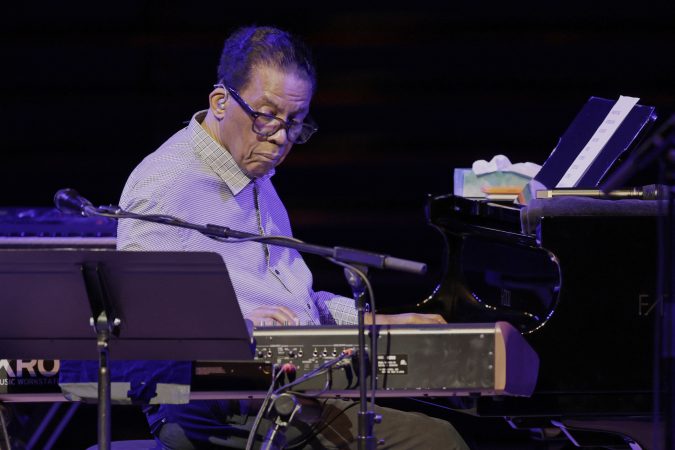
Herbie Hancock greets the audience during his tour stop at the Kimmel Center in Philadelphia on Wednesday, July 29, 2026.Elizabeth Robertson / Staff Photographer
Hancock, attempting to introduce the band, was unaware of the details but quickly picked up on the vibe, asking, “What’s that, some Philly stuff?”
As tumultuous as the set would become, it began in a meditative mood. Hancock spent the first few minutes musing on “Maiden Voyage,” the title tune from his 1965 Blue Note classic, letting the melody submerge and rise again from his elegant, gossamer lines as if gently bobbing on ocean waves.
After a few minutes, he turned to his right, bringing in the band with the familiar strains of “Watermelon Man” on his Korg keyboard. In that 90-degree swivel was represented a pivot point in jazz, the turn from the acoustic piano to the electric keyboard and the adoption of ‘70s rock into fusion, as embodied by Hancock’s Headhunters.
The bandleader has long since melded the two strains into one, moving effortlessly throughout the show between piano, keyboard, and keytar — the latter allowing him to roam the stage and bend notes like a guitar wizard.
Hancock’s age was a constant theme of the night, for him at least — nothing about his playing or his stamina showed any sign of slowing, even if his gait shuffled more than in the past. By the end of the night, he would be face-to-face with Loueke, wailing on the keytar while executing synchronized jumping jacks with the guitarist more than three decades his junior.
Herbie Hancock (left) and guitarist Lionel Loueke perform during “Herbie Hancock’s Summer Tour 2026” stop at the Kimmel Center in Philadelphia on Wednesday, July 29, 2026.Elizabeth Robertson / Staff Photographer
He introduced much of the set with jabs at the material’s age, only backing off when he realized that he might be insulting fans who can remember when these songs were new. “I was going to say this one is older than me, but that can’t be,” he remarked at one point — then added, “Nothing’s older than me.”
This was in Hancock’s introduction to “Actual Proof,” an avant-funk framework for improvisation from 1974’s Thrust that proved to be one of the show’s most vital and exuberant highlights. Driven by Petinaud’s percussive barrage, Hancock erupted into forceful cascades along the piano, his hands crashing down onto the keys and then skittering away into curious, serpentine lines. (“I call that a finger-breaker,” he commented afterward.)
Blanchard’s turn opted for tension, his electronically-enhanced trumpet sculpting sleek contours vigorously resisting the pull of Petinaud’s boisterous funk. Loueke’s quicksilver solo, Genus’ burbling flow unfolding with the logic and cadence of a monologue, and Petinaud’s final explosion rounded out the jaw-dropping showcase.
These classics were balanced by a few newer pieces that Hancock introduced as works in progress, though “Secret Sauce” has been a staple of his setlist for nearly a decade. The other, tentatively titled “Phoelix” after one of its cocreators (along with Loueke and flutist Elena Pinderhughes), was a neo-soul-inflected number featuring Hancock singing through a vocoder. Genus’ eloquent unaccompanied solo, fleet and mellifluous, so impressed one woman in the audience that she was moved to announce, “I love bass players!”
Herbie Hancock (left) and guitarist Lionel Loueke perform during “Herbie Hancock’s Summer Tour 2026 Tour” stop at the Kimmel Center in Philadelphia on Wednesday, July 29, 2026.Elizabeth Robertson / Staff Photographer
“Footprints” was also included as an homage to the late Wayne Shorter, Hancock’s bandmate in Miles Davis’ second great quintet and “my best friend.” His investigatory piano solo offered a capsule portrait of Shorter’s quizzical and mysterious nature, becoming increasingly insistent and blistering as it unfurled, hinting at stride inflections that further expanded the historical reference points. Loueke’s solo turned from an intricate guitar/vocal pairing to blues-rock shredding, then to taut, gnarled figures, the malleable rhythm section hyper-attuned to every swerve and sudden stop.
“Let’s see if we can have some fun,” is how Hancock introduced the evening, making sure to wave to every section and balcony before taking his seat at the piano.
Mission accomplished, judging by the standing ovation from the crowd and the ear-to-ear grin on Hancock’s face after every tune. He confirmed the feeling with a final outburst of, “We had fun!” before breaking into a giddy run across the stage and shaking hands with an adoring crowd.
Tyler Humphreys, 24, pleaded guilty in March to rape, corruption of minors, involuntary deviant sexual intercourse, and related crimes in connection with the assaults, which took place between 2014 and 2022.
The sentence was handed down by Chester County Court Judge Annalisa Sondergaard during a lengthy hearing Wednesday evening. As a condition of his sentence, Humphreys, of Malvern, is barred from contacting any of the victims or their families.
His attorney, Elliot Marc Cohen, did not immediately return a request for comment Thursday.
During the hearing, the mother of one of the victims described how Humphreys betrayed the trust afforded him as a public servant and had torn their family apart.
Humphreys was hired as a Sharon Hill police officer in September 2023, three months before he was arrested.
The borough fired Humphreys shortly after the charges were filed by prosecutors in Chester County. During his brief stint with the department, Humphreys worked as a school resource officer, but Sharon Hill officials have said there were no allegations that he had committed any crimes during his tenure with the department.
Investigators said they received a report in November 2023 about the rape, which occurred the previous December at a home in Charlestown Township, according to the affidavit of probable cause for Humphreys’ arrest.
The victim, then 15, told police Humphreys served her alcohol until she was drunk, then carried her to a bedroom and raped her as she was “in and out of consciousness, the affidavit said. Humphreys was 20 at the time.
Another victim later told police about a second incident that also occurred in December 2022.
The woman, then 19, told police she woke up next to Humphreys in bed, and felt sharp pain in her genitals, according to the affidavit. Earlier, she said, Humphreys had urged her to take over-the-counter medication in a dosage that far exceeded what was recommended. When she confronted him about the pain she felt, he denied any wrongdoing, the affidavit said.
She also told investigators that Humphreys sexually assaulted her, groped her and exposed himself a number of times between 2014 and 2018, starting when she was 11 and he was 12, according to the affidavit.
Humphreys was also charged with — and admitted to — the sexual assault of a 9-year-old boy that took place when Humphreys was 12.