The Pennsylvania Insurance Department last week detailed its plans to intervene in the contentious contract negotiations between Highmark, Independence Blue Cross, and Jefferson Health to ensure patients continue receiving care if the parties don’t have new agreements by Dec. 31.
The first step would be to suspend the contract terminations for up to six months and then schedule public hearings to investigate the reasons for the terminations, the department said in letters sent Friday to the CEOs of Highmark, Independence, and Jefferson.
The department, however, cannot force the insurers and the Philadelphia region’s largest health system to reach a deal under Act 94 of 1975, which gives regulators the right to take the planned steps. Jefferson also owns Lehigh Valley Health Network, which stretches from Allentown north. That’s an area where Highmark has a large share of the insurance market.
The department is regularly hearing from Pennsylvania residents worried about continued access to their doctors next year, the letters said.
“The fear of not being able to continue to see an existing provider, or wondering how to find a new location for one’s next scan or preventive service will take place, is very real,” insurance commissioner Michael Humphreys said in the letters, which the department provided to The Inquirer.
The letters ask for lists of the Jefferson locations that acceptHighmark and Independence insurance, information on how the parties are handling appointments and preauthorization for next year, and contract negotiation updates every week starting Nov. 25.
It’s not unusual for contract talks to go down to the wire, but the negotiations between Jefferson and Highmark and Independence Blue Cross have been more public than most. Both Jefferson and Independence have advertised their positions to sway public opinion.
Highmark and Independence said they continue negotiating.
“We remain focused on our members and on negotiating an agreement with Jefferson Health that preserves access to quality care at an affordable cost. Consistent with the Commonwealth’s focus under Act 94 on consumer protection and continuity of care, we will continue working toward a resolution that shields our members and customers from unsustainable cost increases,” Independence said in an email.
Highmark provided a similar statement: “We remain focused on reaching a fair agreement with Jefferson Health. Our priority is to ensure access to quality, affordable care for the people we serve.”
“We welcome the commissioner’s engagement and support a transparent, independent analysis of the issues at the center of these negotiations. We’re hopeful in finding a sustainable approach that protects patients’ access to the physicians, hospitals and specialized services they depend on.”
Returning home after a five-game, 11-day road trip, the Flyers faced an Edmonton Oilers squad they lost to in overtime on Wednesday. That was a highly competitive game that the Flyers could easily have won.
Sunday’s rematch was similar, and while the Flyers lost 5-2, the score didn’t tell the full story. Here is one positive and one negative from the game.
Slowly but surely, it is starting to feel like Cam York is returning to form. He has been better at closing out plays, blocking shots, and stepping up recently; however, in the past two games, with Rasmus Ristolainen returning, his ice time dipped, and he averaged under 13 minutes a night.
On Sunday, he had his best game of the season, playing 18:16. York was back on the second power-play unit with Oliver Bonk a healthy scratch, and helped create two goals — one at five-on-five and one at four-on-four — getting an assist on one, and posting season-highs in shots (three) and plus-minus (plus-2). He was on the ice for a weird Vasily Podkolzin power-play goal, but that does count toward plus-minus.
“It has been a difficult start to the year for me. I haven’t liked my game. Just felt like tonight, I guess, in a good way, giving a little bit less of an eff,” said York.
“It sounds weird, but I feel like that just allows me to play with more confidence, and I’ve consistently felt like if I can just get the ball rolling a little bit, get a little momentum going for myself, that will help me and allow me to play with a little more confidence.”
Philadelphia goal!
Scored by Cole Knuble with 07:47 left in the 2nd. Assisted by Cam York and Owen Tippett.
York, 25, was in command, first slicing through Edmonton’s defense before centering a puck that Cole Knuble knocked in for the Flyers’ first goal. On Noah Cates’ four-on-four goal, he joined the rush and tried to get a shot off before responsibly staying high just in case as his unit scored.
According to Natural Stat Trick, at five-on-five, York entered the game with a 44.1% Corsi For Percentage, while the Flyers were outscored 15-5, including nine from high-danger spots when he was on the ice. Sunday, he was No. 2 on the team, behind his partner Simon Benoit, with a 68.8% Corsi For Percentage; it was 71% across all strengths, and he had three individual shot attempts and three individual scoring chances.
“It’s been a frustrating start, but I know that when I play like that, I’m a really good player in this league, and just need to do it on a more consistent basis,” York said. “But I’ve been trying. It’s just been a little bit of a struggle, but felt like I got to it a little bit tonight, and just want to continue to build off that.”
The Californian is coming off one of his best seasons, collecting a career-best 22 assists and plus-5 while averaging five seconds shy of his career high in ice time (22:32). However, in 15 games this season, York has just two assists and is minus-9 while averaging his lowest ice time (19:43) since 2022-23.
“I played with Yorkie for a long time … when he’s got confidence and a little bit of room up top, he’s a special player,” said Trevor Zegras, who was teammates with York at the U.S. National Team Development Program.
“He does so many things that nobody would ever see,” Zegras added. “Like going back for a puck with two guys on him, getting banged into the wall like every night. He’s blocking big shots every game, body taking a beating. So for him, when he’s feeling good, and he’s moving his feet, and he’s making plays like that, he’s pretty much doing it all for us.”
Cam York (right) celebrates with Cole Knuble after setting up Knuble for the Flyers’ first goal on Sunday.Yong Kim / Staff Photographer
Two seasons ago, York missed 13 games with a shoulder injury, his longest disruption since becoming a full-time NHL player. He acknowledged that he underestimated what missing a month would do to his game and his rhythm.
Earlier this season, York missed eight games due to an upper-body injury. In the five games York played before the injury, he had the worst Corsi For Percentage among the regulars at five-on-five and was on the ice for seven goals against.
“I don’t want to make any excuses,” he said when asked if the injury in October stalled his season. “I just haven’t played good enough. Pretty plain and simple. But you never want to miss time, obviously. But I think tonight was a step in the right direction.”
The Bad: Piling on the missed opportunities
Missed opportunities have been a recurring theme for the Flyers.
According to NHL stats, the Flyers have missed the net 281 times. They have had the second-most shots blocked (389) and have put the 10th-most shot attempts toward the net (1,219).
Those numbers don’t track how many times they’ve shot the puck right into the goalie’s midsection or pads. It doesn’t count the giveaways, like Travis Konecny’s early in the third period of a one-goal game that directly led to Leon Draisaitl’s NHL-leading 20th goal.
And it doesn’t include the fact that the Flyers had eight power plays Sunday and couldn’t find one goal despite 22 shot attempts, 12 shots on goal, 16 scoring chances, and 10 high-danger chances.
“Us going 0-for-8 is not great,” Zegras said. “A couple of those could drop and it’s a different story. But it didn’t. I thought we played a great game five-on-five. I’d like to see a couple go in on the power play, for sure.”
The Flyers dominated in shot attempts, especially around the crease, with 80% of the high-danger chances.Natural Stat Trick
Konecny called the game frustrating, especially since the Flyers had a chance to win.
They had 63.6% of the shot attempts and 65.1% of the scoring chances. The Flyers had 24 high-danger chances to the Oilers’ six and 74.5% of the expected goal share (5.71 expected goals). The only part that mattered, however, was that the Flyers had 28.6% of the goals.
“[Oilers goalie Tristan Jarry] had a good game, but I just think it’s those greasy goals, like Knubes’ goal,” Cates said. “It’s just getting bodies there, and crashing, and sometimes pucks just went right through us, or whatever it was. Just got to find a way to finish those chances, and arrive when the puck’s getting there, or whatever it might be; pistoning, and switching off with someone in front of the net to get free for that half second to score a goal.”
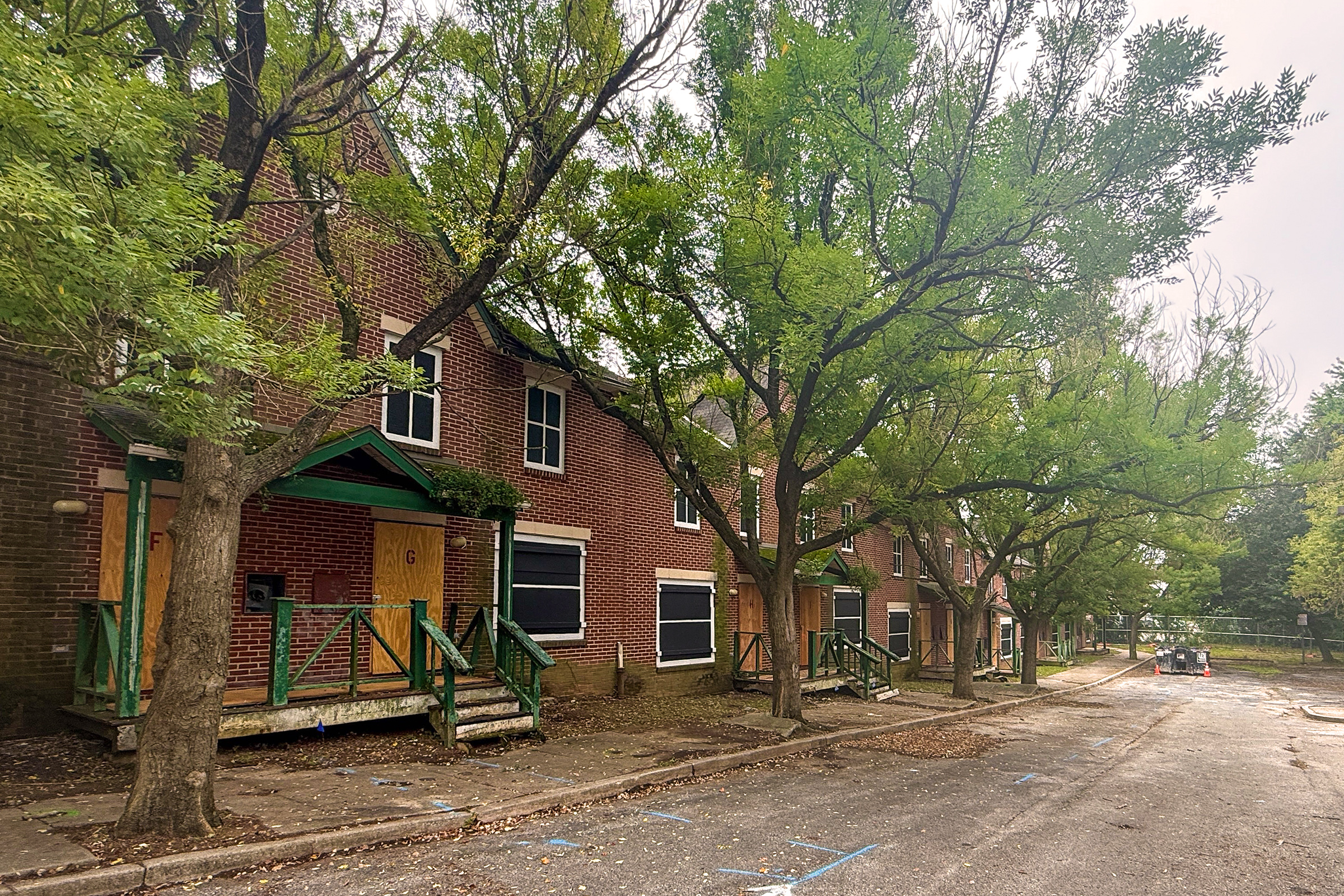
For 16 years, its buildings have sat vacant, deteriorating, and magnets for crime.
On Nov. 9, Habitat for Humanity Philadelphia broke ground on a $3 million renovation of 16 former Germantown Settlement homes on 60–74 E. Collom St.
“It’s been a horror,” Bracey said. “It’s just good that a property that was lying vacant for so long and was just being trashed and vandalized and [attracting] violence is now going to be brought back into Germantown so we can move forward.”
The houses have three bedrooms and 1½ bathrooms. Habitat for Humanity estimates that the redevelopment will be complete in three years, when the homes will be ready for sale to new owners.
They will be sold to income-restricted households, making 80% of area median income — or roughly $98,000 for a family of four.
“To give you a sense of what that means, these are meant to be affordable to a nursing assistant, a teacher’s aide, a bus driver for the school district,” said Corinne O’Connell, CEO with Habitat for Humanity of Philadelphia.
Her organization has had its eye on these 16 homes for years because they are of a relatively recent vintage. They were built in 1993, which means they are suitable for the group’s practice of using volunteer construction labor.
“There’s no lead paint. There’s no asbestos in them, so there is very little environmental hazard remediation that we have to do,” said Ed McColly, director of real estate for Habitat for Humanity Philadelphia. “That then also lends itself really well to volunteer engagement, which is part of Habitat’s DNA.”
Some work tearing out moldy drywall is already underway.
“Now we’re really able to see the guts of the building underneath, and they’re in really good shape,” McColly said.
In June, the nonprofit acquired the homes from the Philadelphia Housing Authority, which in 2024 was given control of 121 properties that had been owned by Germantown Settlement.
Habitat for Humanity workers rehabbing one of the homes.Courtesy of Carey Porter
Seventy-nine of the remaining properties will be redeveloped for rental housing by PHA, with work already begun on a handful of the scattered site homes.
A 17-unit senior apartment building will be constructed at 6657-59 Blakemore St., and nine other properties will have for-sale homes built on them.
Many of the other former Germantown Settlement properties are in much worse shape than the Collom Street homes being redeveloped by Habitat for Humanity. PHA president Kelvin Jeremiah says many have been heavily vandalized, with all the copper wiring stripped out.
“We just couldn’t understand why it took so long for these properties to be renovated,” Bracey said. “There are other properties around that will still need to be done, but at least these 16 will be done, so that’s an improvement.”
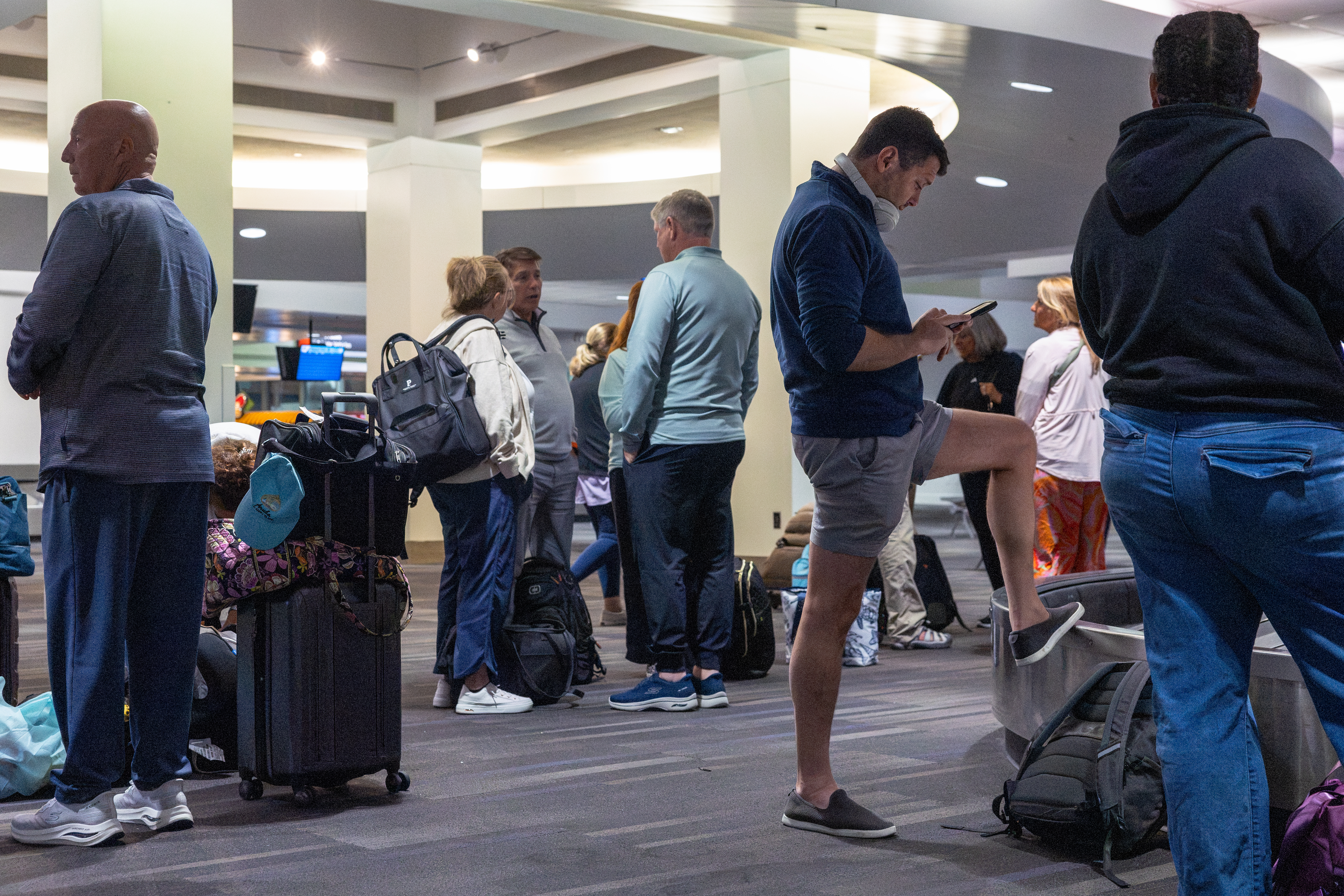
Philadelphia International Airport returned to a more typical pace of delays and cancellations on Monday following Friday’s nationwide ground stoppage issued by the Federal Aviation Administration.
There were 74 delays and 11 cancellations at PHL as of 11 a.m., according to flight tracker FlightAware, which “is a little higher than normal,” said PHL spokesperson Christine Ottow.
“We have many days with zero or one cancellation, then occasional days where a weather event here or somewhere in the country may cause a spike of cancellations,” Ottow said.
A nationwide ground stop was issued Friday afternoon due to the FAA’s air traffic system becoming overloaded after routine upgrades in parts of the country. This led the FAA to issue the ground stop, which cascaded throughout the country, bringing 25,000 delays and nearly 10,000 cancellations nationwide Friday.
Delays continued into the weekend at PHL, which saw more than 200 flight cancellations and delays on Saturday, with 249 delays and 83 cancellations Sunday, according to FlightAware.
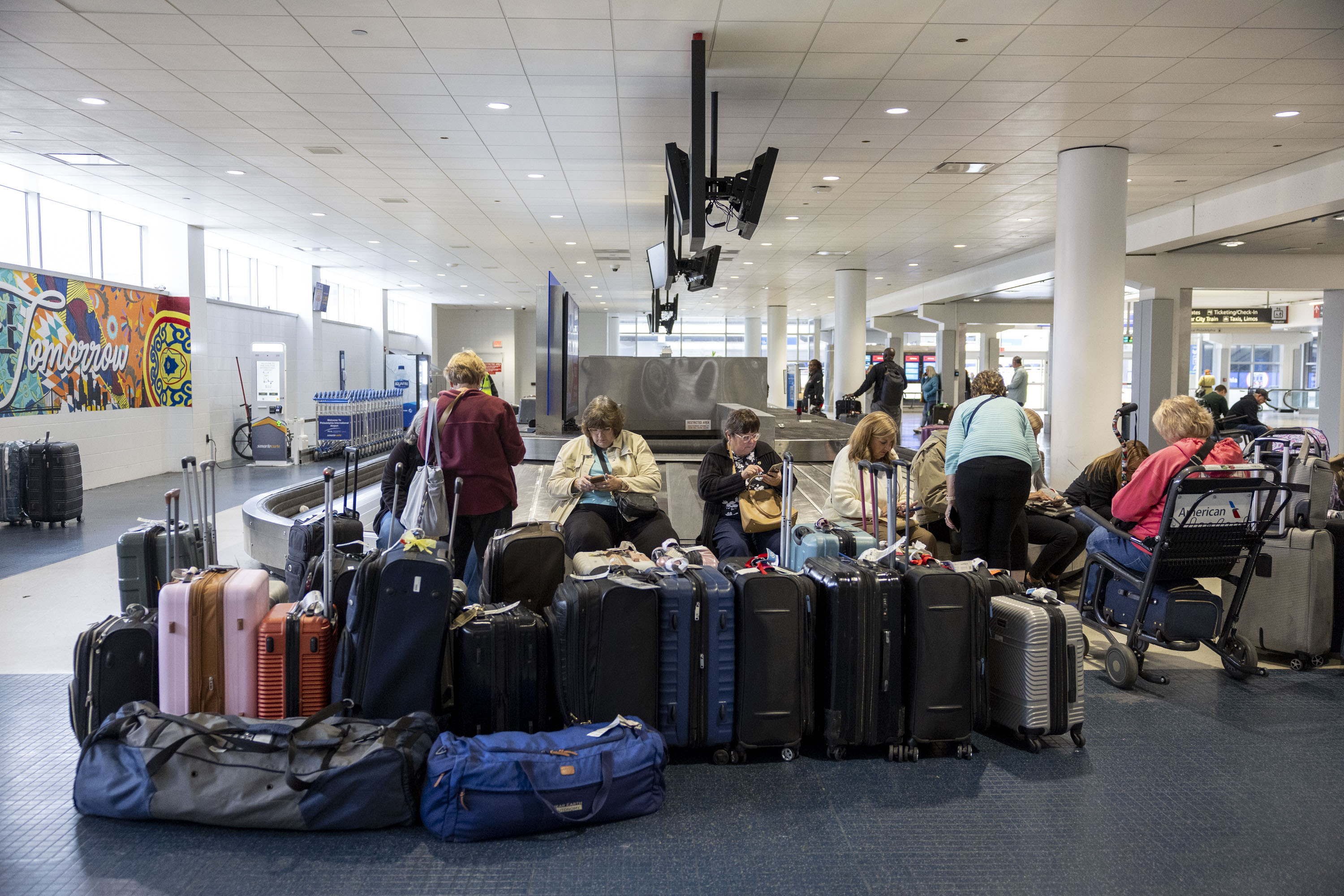
A group of 10 retired teachers from Sellersville Elementary are stuck waiting on a few pieces of luggage Saturday after their flight to Turks and Caicos was canceled at Philadelphia International Airport.Tyger Williams / Staff Photographer
With Monday morning’s more typical delay and cancellation levels, Ottow said it’s comparable to similar days in November, such as Nov. 2, which saw eight cancellations, or Nov. 6, with 13 cancellations. When the region experienced a tornado and hailstorm the day before the ground stop, there were 91 cancellations.
FAA officials are still investigating the exact cause of Friday’s ground stop, but said they believe routine wiring and router upgrades to the FAA’s air traffic control system in Arkansas and Texas overwhelmed what Transportation Secretary Sean Duffy called an “incredibly old telecommunication system.”
While the router was being replaced and switched from copper wire to fiber optic, the router began flooding other routers throughout the national air traffic control system, transportation officials said.
“We had over 1,000 connection attempts every four to five seconds. And what that did was give us issues with our communication with airplanes, and it also caused some disruption with our radar feeds.”
New Jersey Gov. Mikie Sherrill said Monday she was “deeply disappointed” that a Rutgers University student organization will host the Trump administration official who oversaw the controversial immigration enforcement operation in Minneapolis that resulted in the death of two U.S. citizens.
Gregory Bovino, the former head of U.S. Border Patrol, will speak Monday night at an event hosted by Rutgers Republicans.
Bovino oversaw the controversial operation in Minneapolis that involved ICE and other agencies, but he was removed from command in January after federal agents shot and killed two protesters, Renee Good and Alex Pretti, in separate incidents. He retired from the Border Patrol in March.
Bovino also oversaw Operation Midway Blitz in Chicago, which preceded the Minneapolis deployment. The family of Silverio Villegas González, who was killed by ICE officers during that operation, is suing the federal government over the killing.
Protesters plan to hold a demonstration outside the Douglass Student Center in New Brunswick Monday evening whenBovino addresses the group.
Sherrillsaid in a social media post she would work with the university to “protect the safety of everyone and the rights enshrined in our constitution” for those who attend the speech.
Then-U.S. Border Patrol Cmdr. Gregory Bovino shouts at protesters, Jan. 11, 2026, in Minneapolis.Jen Golbeck
But the Democratic governor also challenged attendees to ask tough questions.
“I would hope that those in attendance use that opportunity to ask him. why he chose cruelty over humanity and put Americans’ lives at risk in their own communities,” Sherrill wrote in her Threads post.
“They should also ask him what he makes of Americans’ overwhelming rejection of his policies in the midterms,” Sherrill’s post said.
Sherrill has contended with her own controversy involving ICE.
A spokesperson for Rutgers University said as “a recognized student organization at Rutgers University–New Brunswick,” the Rutgers Republicans are permitted to host guest lectures and other activities.
“As a public university, Rutgers is committed to protecting freedom of expression, even when views expressed may be controversial or generate disagreement,” Megan Florance, the spokesperson said.
Campus police would be prepared to provide a safe place for people to gather, including demonstrators, she said.
In an interview with NJ.com last week, Andrew Joseph, the club’s president, said he can why Bovino’s presence is “very inflammatory” but argued it was worth having him on campus.
“I’m willing to take the risk on that. We are the Rutgers Republicans. We believe in the open market of ideas,” he said.
Joseph could not immediately be reached for comment on Sherrill’s social media post.
In its quest to relocate the Academy of Natural Sciences of Drexel University’s priceless collection out of Philadelphia, the Academy contacted 15 natural history museums in the United States as well as the Natural History Museum Abu Dhabi, according to confidential minutes from a September 2025 Academy board of trustees meeting.
Museums in Pittsburgh, New York, and Cleveland were the only ones in the U.S. to express interest, said the document submitted to City Council by Drexel Monday as part of its testimony.
“Cleveland is currently the only viable partner, willing to move quickly without funding concerns,” the document said. “Cleveland has stated they are ‘all in,’” Scott Cooper, former Academy CEO, told the board at a September 2025 meeting.
The meeting minutes were part of Drexel’s supplemental materials given to City Council, whose hearing Monday was the second investigating thelate September shutdown of the Academy museum.
The Academy of Natural Sciences of Drexel Universityalso explored a complete retooling of the Academy that would have turned it into a Freshwater Institute and would have “uniquely integrate[d] ANS’s irreplaceable assets — two centuries of biodiversity collections and archives, field ecology expertise, and scientific credibility — with cutting-edge genomic capabilities,” according to a detailed report on the potential revamping dated September 2025 that Drexel also submitted to Council.
The report, however, noted “a fundamental financial reality: that ANS’s apparent assets — $74 million in endowments, the 1900 Parkway building, and world-class collections — cannot be readily monetized due to inter alialegal restrictions, market constraints, and professional ethics considerations.”
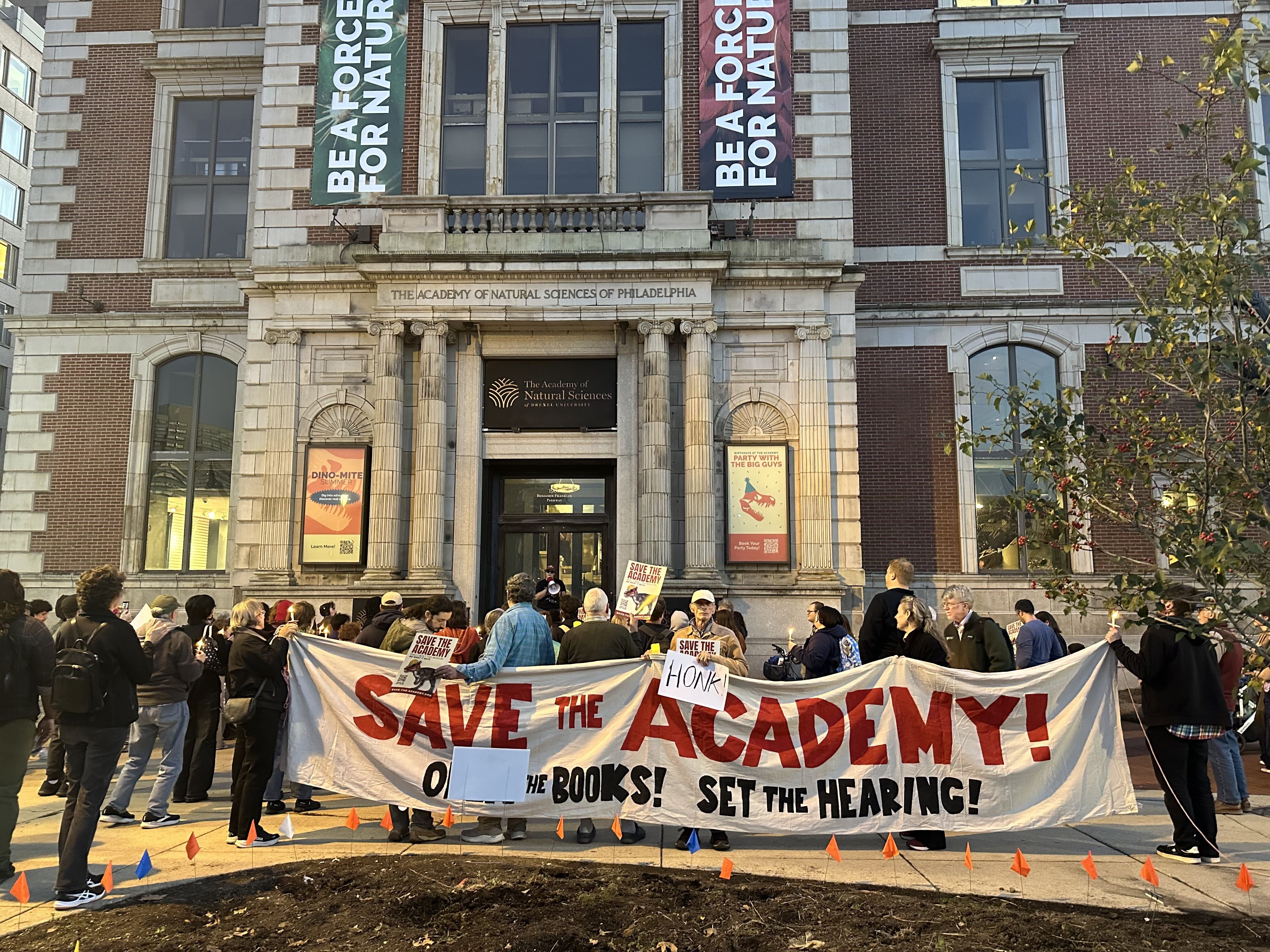
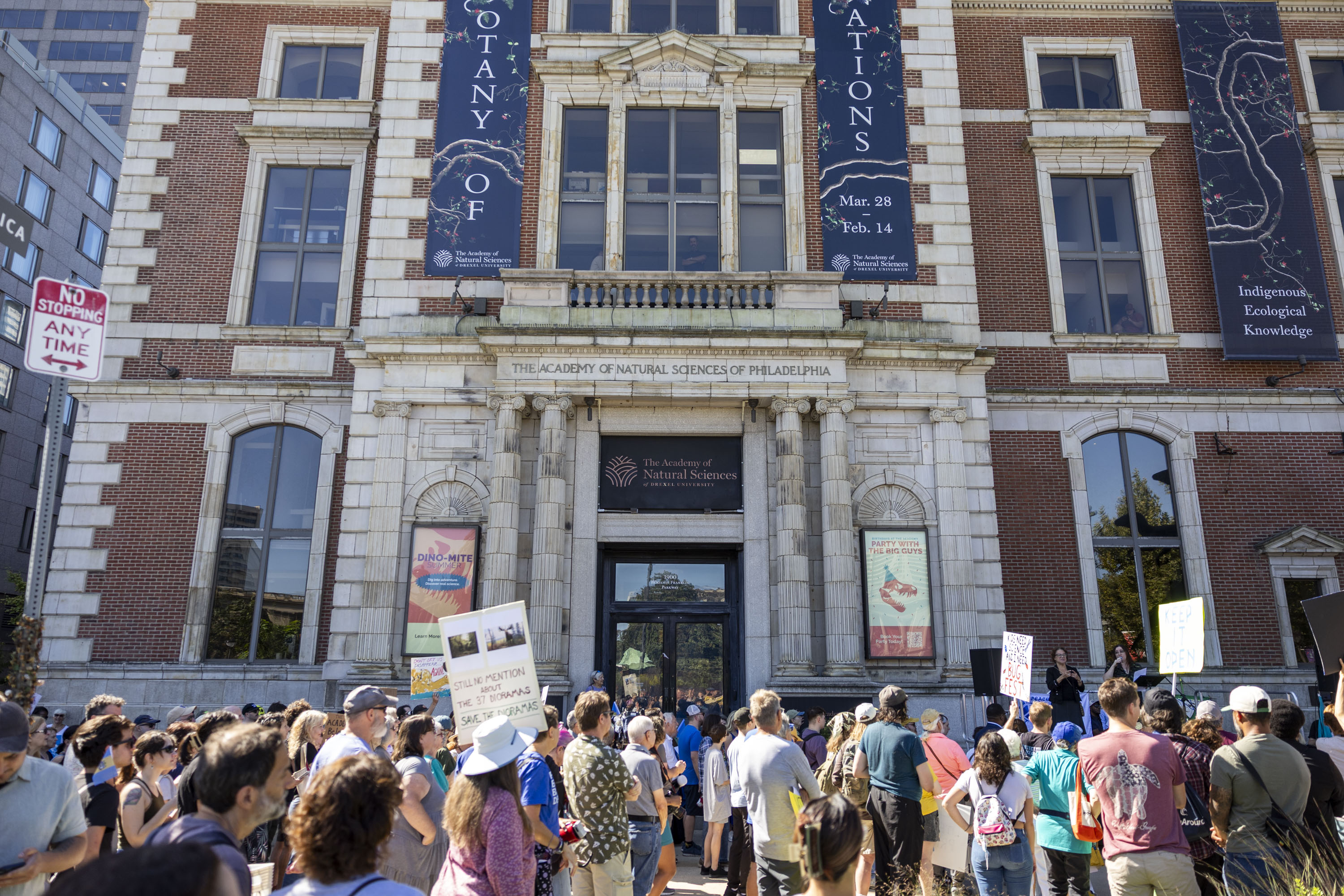
A rally outside the Academy of Natural Sciences of Drexel University in September protesting the museum’s closure.Tyger Williams / Staff Photographer
Only the “international option” — a partnership with the Abu Dhabi museum in the United Arab Emirates — would have achieved “financial sustainability through complete partner funding and elimination of collection storage costs.”
One Academy board member, John Smith, noted that the attorney general and Orphans Court “will significantly influence Academy options.” He believed an Abu Dhabi transfer would be too heavily contested for approval, according to the Sept. 18, 2025, meeting minutes.
Neither the Freshwater Institute nor the Abu Dhabi, or Cleveland partnership materialized. The Cleveland and Abu Dhabi solutions were part of “staff explorations,” said Academy board chair Suzanne Biemiller. “They never developed as real options and were never presented to, voted on, or advocated for by the board.”
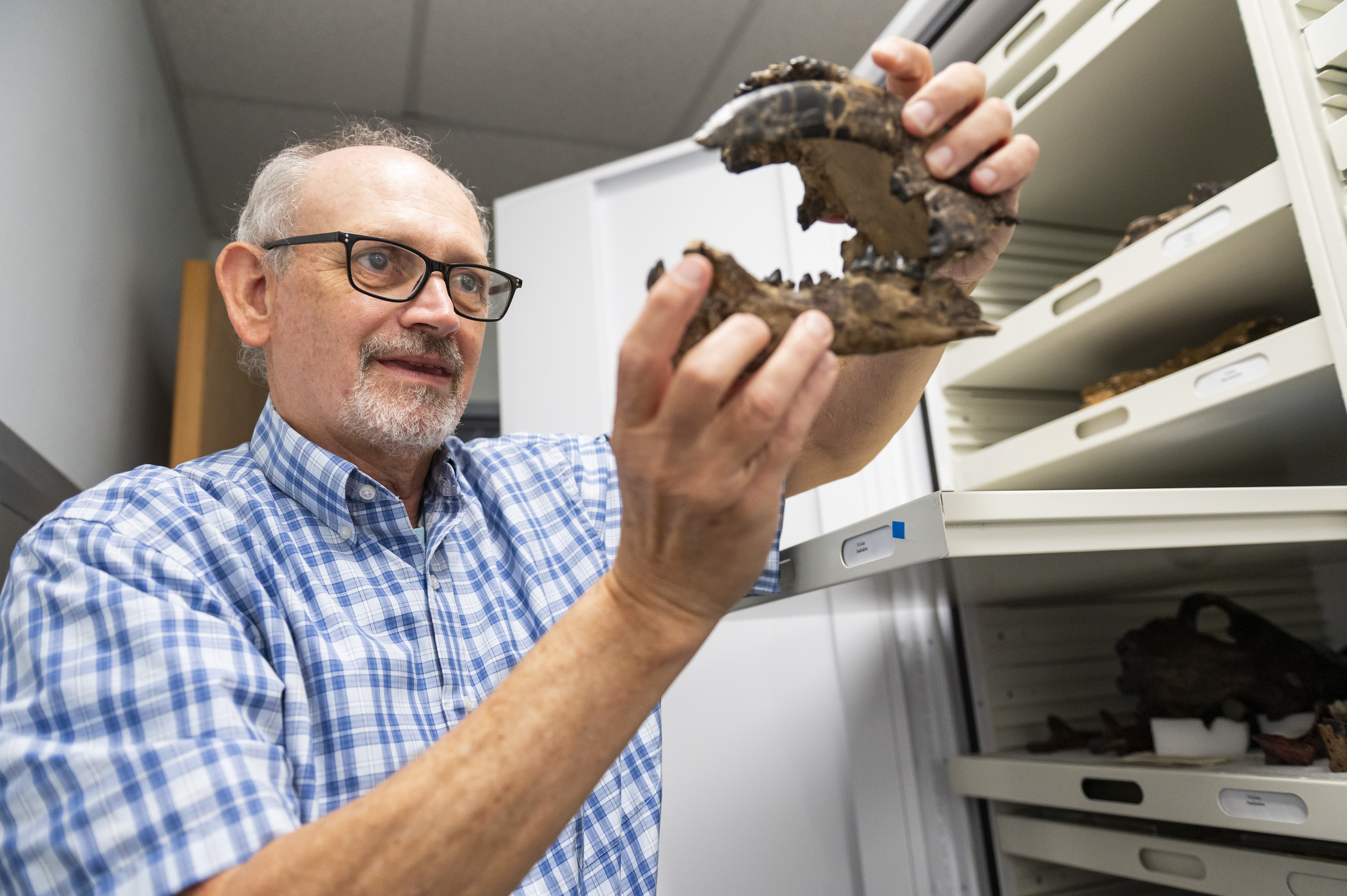
Ned Gilmore, collection manager for vertebrate paleontology, holds up the mouth of a Smilodon gracilis in the collection of the Academy of Natural Sciences of Drexel University, in August.Allie Ippolito / For The Inquirer
Some Academy objects moved to Abu Dhabi anyway
But that wasn’t the end of the matter. The Academy did make an unusually large loan of specimens to the Abu Dhabi museum — at least 2,000 objects, and perhaps closer to 3,500, according to a source close to the project who did not want to be named because they were not authorized to speak on the matter.
“We routinely lend specimens from our collections to other institutions for research projects and specific exhibitions but have never done so on that scale,” Robert McCracken Peck, curator of art and artifacts and senior fellow emeritus of the Academy of Natural Sciences of Drexel University, told The Inquirer recently.
The objects are still at the Abu Dhabi museum, as part of a three-year loan arrangement.
The Academy’s Robert McCracken PeckELIZABETH ROBERTSON / Staff Photographer
‘Highest risk’ but ‘most financially viable’
That loan happened in spite of the earlier option of moving the entire collection to the Abu Dhabi museum being deemed to hold “significant political risk.” But “their investment level (full digitization and AI-first research platform) would be unmatched,” the document said. This option, the document said, is the “most financially viable,” though “carries highest risk.”
Cooper “acknowledged the complexity of conducting business in the Middle East, describing it as time-consuming and frustrating,” according to the minutes. Drexel president Antonio Merlo, who was present at the meeting, also expressed skepticism, having had experience worked in Abu Dhabi when he worked for New York University.
Merlo was worried about the “political optics” and “implications for Drexel,” according to the minutes.
At a May 2025 Academy board meeting attended by Peter Kjaergaard, executive director of the Natural History Museum Abu Dhabi, Cooper called the potential Abu Dhabi deal a “a partnership … that could see the relocation of the Academy’s collections to NHMAD for an extended period.”
Academy of Natural Sciences of Drexel University board chair Suzanne Biemiller steps forward to testify at a City Council hearing Oct. 26 on the closure of the museum.Tom Gralish / Staff Photographer
Biemiller at the September meeting “emphasized the need for thorough discussion,” according to the minutes, “noting that paths to success are narrow with no certain outcomes.”
The meeting concluded with the following “action items”: Establish feasibility of campus collections move and 1900 Parkway building sale; secure letters of intent from Abu Dhabi and Cleveland by the end of November; and obtain a legal opinion on the likelihood of each option’s approval.
But none of the options ever came to pass, and Drexel and the Academy remain atan impasse over the Academy’s future.
During that September 2025 meeting, a question was asked about splitting the collection among multiple partners. Cooper said the preference would be to keep it together “to preserve the Academy’s legacy,” but that splitting was possible.
At the meeting, Merlo made clear that Drexel “cannot currently afford activities that do not directly support student education,” according to the minutes. “The Academy must sustain itself like every other Drexel unit.”
He suggested moving the collection to Drexel’s campus.
What specimens were sent to Abu Dhabi?
The Philadelphia specimens now in the United Arab Emirates at the Natural History Museum Abu Dhabi — a 377,000-square-foot museum that opened last November as part of the city’s ambitious museum district — include fish, mammals, and more.
Academy leaders say the items are there on a three-year loan agreement, and are then set to return to Philadelphia. The arrangement was seen as the start of a potential deeper relationship between the Academy and Abu Dhabi museum, according to an Academy source.
“There were ideas about other ways to partner with the newest museum and oldest museum, and Drexel, and research, and other avenues within our mission,” said the source, who asked not to be identified because they were not authorized to speak. Talks “didn’t get any further than the lending.”
A potential sale was “never on the table,” the source said.
Abu Dhabi’s natural history museum is the latest addition to a collection of museums in the Saadiyat Cultural District, which includes the Zayed National Museum and Louvre Abu Dhabi. Guggenheim Abu Dhabi, designed by architect Frank Gehry, has announced an opening for this December.
Attempts to reach the natural history museum were not successful. Phillip Manning, director of science at the Natural History Museum Abu Dhabi, said he would forward an Inquirer request to speak to him to the communications team at the museum. A spokesperson, Dan Leach, did not respond to subsequent emails in the past month from The Inquirer.
Drexel spokesperson Britt Faulstick declined to share details of the loan agreement. More than 50,000 items from the Academy are currently out on loan to more than 120 institutions, he said.
Asked whether conversations between the Academy and the Smithsonian, the American Museum of Natural History in New York, and the Cleveland Museum of Natural History were over potential mergers, deaccessioning of the collection, or to replace Drexel as a partner for the museum, Faulstick said:
“As part of the work to explore a sustainable future for the Academy, the Academy leadership had conversations with a number of peer institutions about potential opportunities for collaboration. Those conversations were exploratory and did not advance beyond the discussion stage or result in any formal agreements.”
Tom Moran is the author of the Substack Jersey Lowdown and the former editorial page editor of the Star-Ledger in Newark, N.J.
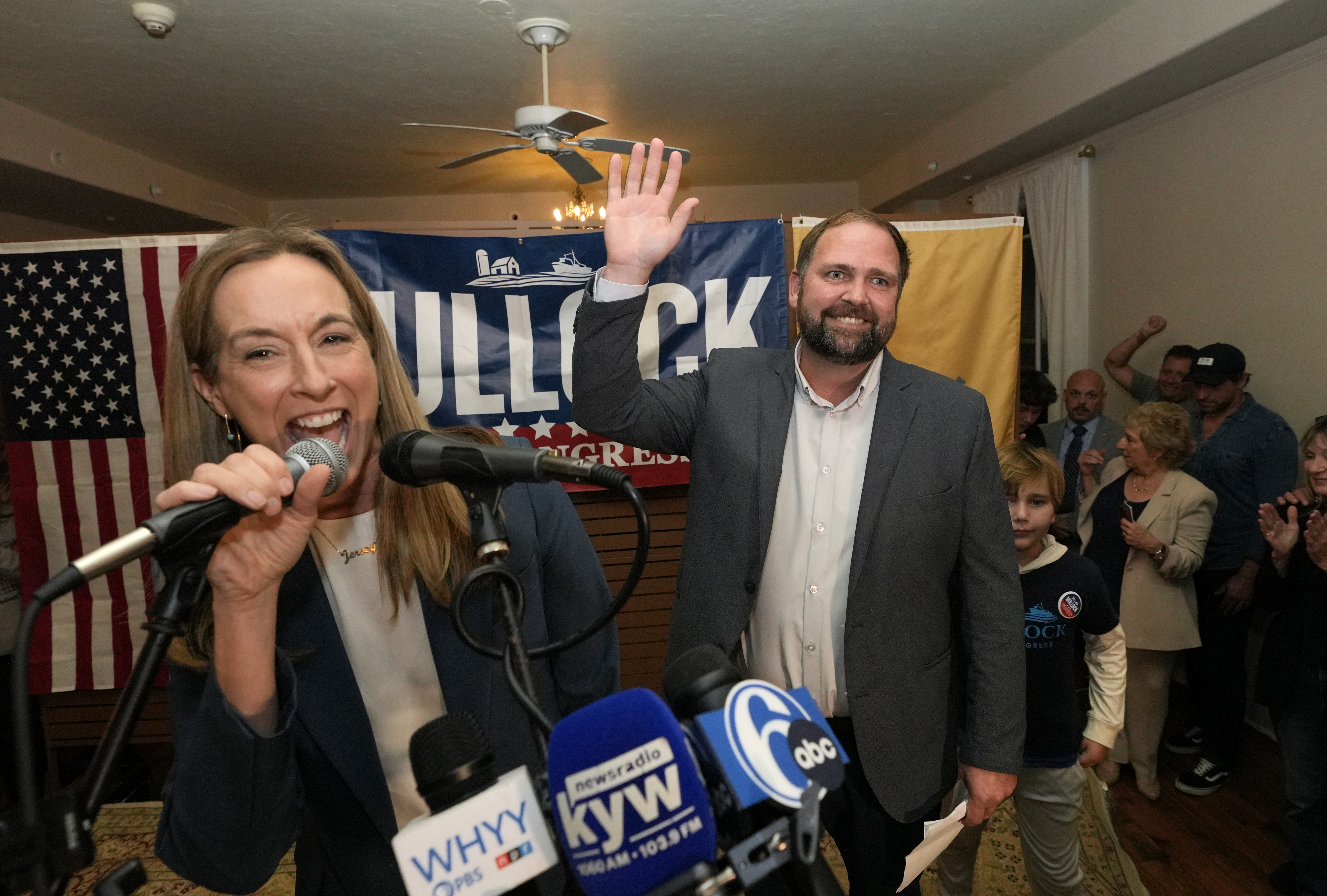
Zack Mullock, the mayor of Cape May and a newcomer to national politics, is among the surge of Democrats who just won congressional seats in red districts, thanks mostly to the political malpractice of Donald Trump. Even Texas and Kansas went blue.
The big question now is whether Democrats can hold their new majorities and make this moment more than another swing of the pendulum.
Put another way: Are we rid of MAGA once and for all, or is the beast crouching just offstage, waiting for an opportunity to come back?
The Republican who just lost to Mullock, Rep. Jeff Van Drew, is hungry for a rematch. He’s kept his campaign staff intact, had $900,000 in the bank as of mid-October, and is planning a “listening tour” of his South Jersey district, where he’s been winning elections at every level for nearly 30 years. If Democrats blow this moment, Van Drew will have his chance.
“It’s going to be fun for me,” he told the New Jersey Globe.
I can think of two distinct ways Democrats might falter.
They could overreach by going hard left. The best example is the Medicare for All bill championed by Sen. Bernie Sanders. Polls show that most people who say they support his bill don’t realize it would phase out private insurance over four years, like it or not. Van Drew would love that, given 80% of those with private insurance say their plans are “excellent” or “very good.”
Or, at the opposite extreme, Democrats could fail to deliver by playing it too safe, confirming to many voters that neither party has made their lives more affordable, or addressed the widespread feeling that the economy is obscenely rigged in favor of the rich. In that case, why would they keep electing Democrats?
So how do they thread this needle? I talked it over with Mullock, and he put my mind at ease. If Democrats navigate these political fault lines as well as he does, their majorities could last.
Mullock wants to open Medicare to all, but would not force anyone to give up their private insurance if they prefer to keep it. “I’m for Medicare for All who want it,” he said.
He says Democrats “screwed up” under President Joe Biden by failing to secure the border with Mexico, but he wants a deal on immigration that would provide a path to citizenship for law-abiding immigrants who lack documentation.
“We need a strong border and to be selective about who we let in, but it’s time to treat people with decency and dignity,” he said.
He wants a big increase in the minimum wage, calling the current federal minimum of $7.25 “absolutely insane.” He wants to immediately reverse the Republican cuts to Medicaid and restore the Obamacare subsidies that were allowed to expire. And he wants to increase taxes on the rich, but never on the middle class.
“We’ve got to deliver,” he said. “And that means working together. That means all of us compromising and focusing on the big goals.”
Mike DuHaime, a Republican strategist based in New Jersey who ran Chris Christie’s campaigns, has seen the pendulum swing back and forth, but believes it’s possible this moment might be different.
“Democrats will be successful if they realize they didn’t really win; the Republicans all lost,” he said. “Van Drew would not have lost if not for Donald Trump … To stay here, they’ll need to govern in a way that the center-left and center-right are comfortable with.”
I’m optimistic for two reasons. One is that Trump just showed Democrats how bad it can get if they screw up, that our democracy is on the line. That terror focuses the mind.
And two, their wins are so big that they can afford defections and still pass bills. So if a candidate like Mullock needs to vote against a Democratic bill that he feels goes too far left, the party leaders can give him free rein without pressure. Unlike Republicans today, they won’t need every vote.
The paradox for Democrats is this: Progressive candidates scored big wins, and not just in high-profile races like Abdul El-Sayed’s in Michigan. The Congressional Progressive Caucus expects to add at least 25 new members, and even centrist Democrats benefited from their passion and volunteer efforts.
But the bulk of the wins came in red districts Trump won in 2024, places like New Jersey’s 2nd District, which he carried by 13 points. In all, Democrats took 30 seats in districts Trump carried by double digits. Of the eight Senate seats they won, all but Maine voted for Trump in 2024.
Mullock, at least, seems to understand that voters who abandoned Republicans this year could abandon him just as easily. The question is whether his party does, as well.
As a kindergarten teacher at Los Angeles’ 100 Black Men mentoring organization, Kareem Edouard often struggled to find nontraditional learning resources for his students.
For years, he searched for children’s shows to use as an “enrichment curriculum tool,” but what he found was a shortage of Black lead characters and programs written with sensitivity and nuance.
Drexel professor Kareem Edouard was tired of seeing ‘flat representation’ of Black characters in children’s shows. He decided to make “Stuntboy: The Animated Series,” based on the 2021 novel by author Jason Reynolds.Courtesy of Rahoul Ghose
According to a 2019 study by the Geena Davis Institute, white characters accounted for 74% of leading roles in children’s television shows.Andthough there was a surge of characters of color in new children’s programming in 2023 (63.4%), only 26.8% of all characters were Black.
“That’s a problem for me,” said Edouard, who moved to Philadelphia in 2018, and is now an assistant professor at Drexel University.
These disparities, he said, often lead to a “very flat representation” of Blackness, especially in the minds of young viewers.
In January,Edouard decided to take matters into his own hands.
Working with production partner Kevin Clark of the We Up Collective, Edouard assembled an all-Black creative team to develop Stuntboy: The Animated Series, based on a 2021 book by acclaimed author Jason Reynolds.
“Stuntboy was my chance to show a Black boy who is full and complex, through the lens of mental health,” said Edouard, who serves as the series’ executive producer, showrunner, and writer.
An image of fourth grader Portico Reeves, who adopts the heroic alter ego of “Stuntboy.” The animated series is based on author Jason Reynolds’ 2021 middle-grade graphic novel.Courtesy of Chaz Bottoms
The series follows fourth grader Portico Reeves, who adopts the heroic alter ego of “Stuntboy” to navigate his anxiety, which he calls “the frets,” and the stress of his parents’ conflicts and separation. He lives in the fictional apartment building Skylight Gardens, which he imagines as a castle.
The YouTube Kids series is based on author Jason Reynolds’ 2021 graphic novel Stuntboy, in the Meantime, illustrated by best-selling author and Boston-based artist Raúl the Third.
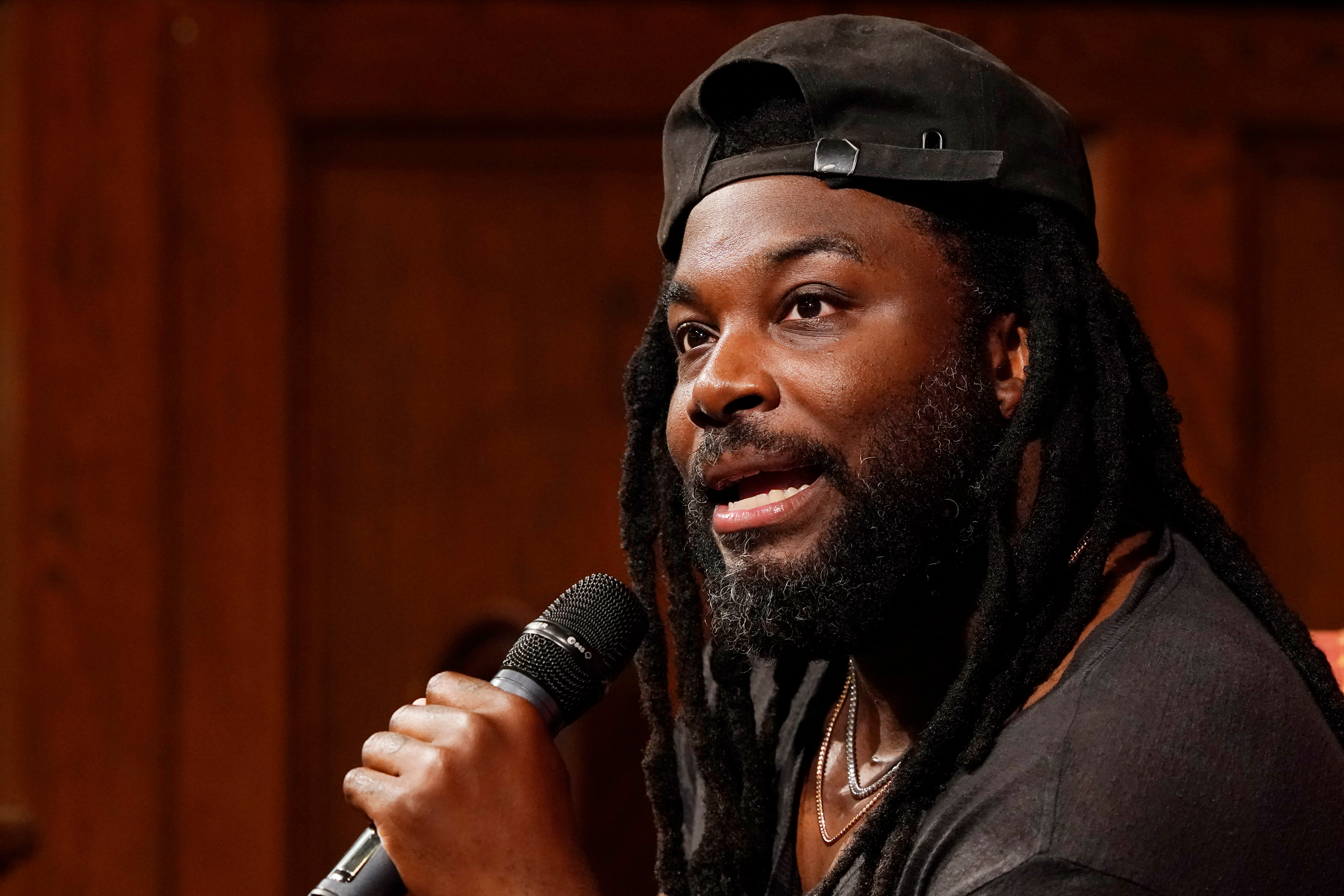
FILE – Author Jason Reynolds appears at the Mississippi Book Festival in Jackson, Miss., on Aug. 19, 2023. (AP Photo/Rogelio V. Solis, File)Rogelio V. Solis
An all-Black crew
After reading the book, Edouard met with Reynolds through a mutual friend, and the author agreed to adapt the book into a children’s series.
Reynolds was impressed with Edouard’s previous work as a kids media consultant, producer, and showrunner, who brought shows like Work it Out Wombats!, MayNERD’s Wild World of Science, and other programs to life.
An image from “Stuntboy: The Animated Series.” The forthcoming series is based on author Jason Reynolds’ 2021 middle-grade graphic novel.Courtesy of Chaz Bottoms
But most importantly, Reynolds said, Edouard recognizes the need for more Black-led children’s media.
“I like imaginative people who can recognize where there’s a white space and plug into those spaces. [Edouard] also has a fervent heart for Black children,” he said. “That’s all I really needed. These are my tenets for how I live my life, and how I sort out my career as a writer.”
Reynolds said Edouard and Clark also assured him that he would retain the rights to Stuntboy, and that the show would be handled by an all-Black creative team.
“Which matters to me because we need the work,” he said. “They put me at ease.”
The team behind Stuntboy includes rapper Asheru Benn (The Boondocks), who created the theme song, and music producers Damyon “Choppy Chop” Richardson and Roderick “Roddyrod” Bridges Jr. Black-owned CBA Studios is behind the animation, with founder Chaz Bottoms serving as the series’ animation director.
Edouard also tapped Allison Briscoe-Smith, a child clinical psychologist, to offer insight into the mental health concerns often unaddressed in children’s media.
An image of producer Kevin Clark, who partnered with Drexel professor Kareem Edouard, to develop “Stuntboy: The Animated Series.”Courtesy of Kevin Clark
This move was intentional, Edouard said. While shows like Doc McStuffins, Craig of the Creek, and others feature Black-coded characters, Edouard said very few of these programs were created by or led by Black writers and showrunners.
‘It’s all of us, or none of us’
With Reynolds’ blessing, the show’s collaborators began fast-tracking the animation process.
By February, they mapped out their animated storyboards, and delivered the first look at episode one by the following month.
“We were ready to go because we were driven to not only take care of what [Reynolds] and Raúl created, but to make sure we got it out to the public around Mental Health Awareness Month,” Edouard said. “There’s a lot of independent animation that’s happening right now. We wanted to be a part of that movement.”
Edouard and Clark rolled out Stuntboy the Animated Series Mixtape on YouTube Kids in June.
The larger mixtape features short videos with the show’s collaborators, who detail the creation of the characters and the broader Stuntboy universe.
Edouard and the team have released the first two episodes of Stuntboy on YouTube Kids, titled “Welcome to Skylight Gardens” and “The Frets!” So far, they have generated more than 125,000 combined YouTube views, and Edouard said the team intends to release new installments sometime next year.
An image from “Stuntboy: The Animated Series.” The forthcoming series is based on author Jason Reynolds’ 2021 middle-grade graphic novel.Courtesy of Chaz Bottoms
As the series develops, Edouard is hopeful that Stuntboy will encourage more Black animators, showrunners, and creative directors to produce more shows with characters that reflect the children in educators’ classrooms.
Accessibility is also among the team’s top priorities. Beyond creating a show centered on a Black lead character, Edouard wants to ensure that children from varying socioeconomic backgrounds can watch it.
While YouTube Kids provides that extensive access, the showrunner is open to working with traditional media networks to roll out the series in its “authentic framework.”
Reynolds said he’s on board, as long as the potential partner respects him, Edouard, and Clark as a team.
“We move as a unit,” he said, “and if one person is poaching, you can’t have Stuntboy. It’s all of us, or none of us.”
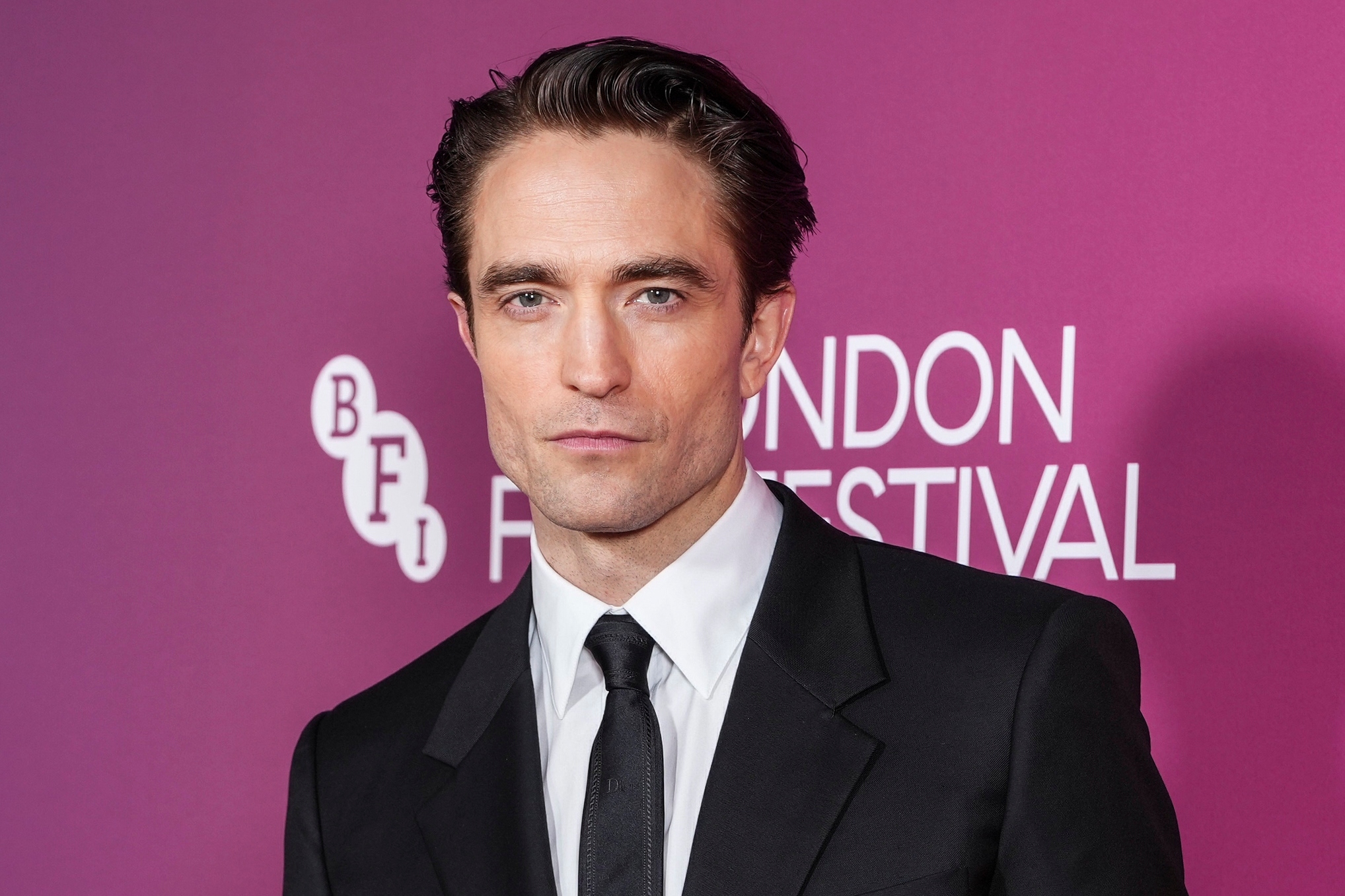
After years of debate and endless conjecture, Pattinson was unveiled as the next James Bond on Monday, becoming the seventh actor to play the iconic British spy and the first since Amazon MGM took over the beloved film franchise.
The naming of Pattinson comes during the longest hiatus in 007 history and ends years of rampant speculation about who would inherit the role from Daniel Craig. It comes five years after 2021’s “No Time to Die,” the first film in Bond’s 64-year history on the silver screen to conclude with the character’s death. But 007 will be reborn, yet again, in the 26th Bond film, directed by Denis Villeneuve.
Amazon MGM Studios announced Pattinson’s casting on social media with a brief snippet of the actor emerging from the shadows with a gun.
“James Bond is one of the most legendary characters in cinema, and to be entrusted with 007 is the honour of a lifetime,” Pattinson said in a statement. “To say this role is a dream come true is an understatement. I couldn’t be more excited about this partnership and the work ahead with this fantastic team.”
Pattinson only entered the Bond rumor mill recently after the revelation that he screen-tested for the role. Others reportedly in the mix included Callum Turner, Josh O’Connor, Jack Lowden and Nicholas Hoult.
But they were only the finalists in a Bond search that dated back to before Craig’s final 007 film.
While producers were long expected to go with a young, less-proven star, they instead opted for one of the best-known actors of his generation. Pattinson, 40, is also relatively old to begin as 007. The actor is currently in production on another iconic role in “The Batman Part II.”
Pattinson comes in already associated with several mega-franchises in “The Batman,” “Dune,” “Twilight” and “Harry Potter.” But since his breakthrough in “Twilight,” Pattinson has worked largely in more independent, auteur-driven films such as “Good Time” with the Safdie brothers, Robert Eggers’ “The Lighthouse” and Bong Joon Ho’s “Mickey 17.”
Earlier this year, he drew rave reviews for his villainous performance in Christopher Nolan’s “The Odyssey” and for his portrayal of “To Catch a Predator” host Chris Hansen in the film “Primetime.” He co-stars in Villeneuve’s upcoming “Dune: Part III” as a shape-shifting assassin.
Villeneuve said it was a tough choice, but the right one.
“We were surrounded by extraordinary talent, but there can only be one 007. I am overjoyed to welcome Robert Pattinson as our new James Bond. He has the timeless soul of 007 and brings a spirit that is completely new. I cannot wait to begin,” the director said in a statement.
The casting comes at a pivotal juncture for the franchise. In 2022, Bond’s longtime studio, MGM, was bought by Amazon for $8.5 billion. After haggling over next steps for 007, producers Barbara Broccoli and Michael G. Wilson relinquished creative control of Bond in 2025. The still-untitled Bond 26 is the first Bond movie since 1962’s inaugural “Dr. No” in which a Broccoli didn’t handpick the super spy.
“Today marks a defining moment for our studio and a significant milestone in the history of James Bond as we proudly introduce Robert Pattinson as the next 007,” said Mike Hopkins, head of Prime Video and Amazon MGM Studios.
Casting a new Bond fell instead to producers Amy Pascal — the former Sony Pictures chief and “Spider-Man” producer — and David Heyman, shepherd of “Harry Potter” and “Paddington.” Steven Knight (“Peaky Blinders,” “Locke”) was brought in to write the script.
Before Craig even departed the role, rumors and odds-making persisted nearly round-the-clock on who would follow in the footsteps of Sean Connery, George Lazenby, Roger Moore, Timothy Dalton, Pierce Brosnan and Craig. Idris Elba, for one, has spent half his career deflecting 007 conjecture.
The Bond machine has historically never slowed down. But the 26th installment will follow the longest absence ever for Bond. Given that “No Time to Die” completed principal photography in 2019 (its release was delayed due to the coronavirus pandemic), the lull is even longer.
Some fans are skeptical about the new Amazon-controlled chapter for Bond. Hopkins, head of Prime Video and Amazon MGM Studios, has vowed to uphold the franchise’s legacy and usher in “the next phase in the legendary 007 for audiences around the world.”
At stake is one of the most lucrative film series in Hollywood, based on Ian Fleming’s series of novels. The Bond movies have grossed more than $7 billion worldwide in ticket sales. “No Time to Die” collected $774 million in 2021. The movies also spin out endless other revenue streams, from streaming deals and video games to Aston Martins.
Although some Bond actors came to view the role as a yoke around their necks, it turned Craig into a household name. The British actor wasn’t widely known before his casting and, at the time, was derided as the first “blond Bond.”
When Anthropic goes public on Wall Street, the new pressure to deliver profits will test a commitment it has made since its founding: to prioritize humanity’s benefit as it develops artificial intelligence.
The San Francisco startup, which plans an initial public offering this month, has sketched out a governance structure that it says will protect the company’s broader mission against the pull of financial interests. But the mechanisms it describes give the company wide leeway to decide how to measure whether it’s benefiting society, experts say.
Like its rival OpenAI, Anthropic is a public benefit corporation, a legal designation used by companies that pledge to balance shareholder interests with the public good. How that will play out for companies worth potentially trillions of dollars is uncharted territory.
“I think then the real test emerges if and when the question of public benefit becomes costly” — or when the public benefit comes into conflict with making a profit, said Sarah Kreps, a professor and director of Cornell University’s Tech Policy Institute.
In its regulatory filings, Anthropic pledges to pursue long-term benefits of humanity through the responsible development of advanced AI. “We strive to help bring humanity safely into an era where transformative AI exerts tremendous and potentially decisive influence over a broad range of human undertakings,” the company said. Anthropic also has pledged at least 5% of its stock to a “public benefit” fund and its founders have committed to donate 80% of their wealth.
A pledge to do good is baked into corporate structure
Other tech companies have pledged to do good including Google, which prominently featured its then-motto, “Don’t Be Evil,” in its investor prospectus when it went public in 2004. But the words were not legally binding, and critics have accused the tech giant of leaving them behind.
Elon Musk’s takeover of Twitter in 2022 shows how the conflict between profit and public good might play out in real life, said Stavros Gadinis, a law professor at UC Berkeley School of Law.
“Let’s say that Twitter’s directors felt that Elon was the wrong guy to police the public square because they didn’t trust him, they didn’t like him, they didn’t think he’d be fair, whatever it was,” Gadinis said. “But he made them an offer that was so high compared to what their advisors told them the company was really worth that it would be against their fiduciary duties to not sell to Elon. This is the situation that the public benefit charter is trying to avoid.”
Had Twitter been a public benefit corporation, it could have been required to consider factors beyond maximizing shareholder value when selling the company.
There aren’t many public benefit corporations whose shares are publicly traded and they are all much smaller than Anthropic and OpenAI. They include the eyewear company Warby Parker, the insurance company Lemonade and software developer Veeva Systems, which had a conventional corporate structure when it went public in 2013 and converted to a public benefit corporation in 2021.
Anthropic’s idealistic ambitions for how it develops AI could run up against competitive pressure, such as from China, Kreps said.
Anthropic and OpenAI’s models have gone from answering almost any question, even if it was dangerous, to becoming much more circumspect. But as they face more competition, including from open-source Chinese models that likely will tell you whatever you want, she said, “will they start to rethink some of those guardrails? And what happens then?”
The setup generally is not preferred by shareholders because it gives more power to the company’s board than it does to shareholders.
Whatever a company decides as its public benefit mission, it will likely be much more difficult to measure than profits. That’s particularly true for AI companies, whose leaders have exalted AI as the solution to many of humanity’s problems — from curing cancer to creating economic prosperity.
“There are these echo chambers, the Silicon Valley bubble where they really think that what they’re doing is for the good of humanity,” Kreps said. And someone immersed in that environment, she added, might not even ask the right questions or understand how “public benefit” should be measured.
A trust aims to hold Anthropic accountable
A Long-Term Benefit Trust created by Anthropic is intended to operate as an independent body of trustees with expertise in AI safety, national security, public policy, and social enterprise.
Through a special Class T common stock, the trust “generally has the authority to elect and remove” Class T directors, who together will constitute a majority of Anthropic’s board of directors, according to the IPO filing. The Class T common stock is a single share that allows the five trustees to vote as a unit. It has no economic rights — meaning they get to vote but they don’t see any financial benefit or losses from the share and can’t sell it.
“The LTBT’s arrangements are designed to minimize the LTBT’s and the Trustees’ exposure to our financial performance and grant the Trustees sufficient independence to ensure we are striking this balance appropriately,” the filing said.
Three of the company’s board directors are elected by the trust directly, and another three are elected by other shareholders, which include the company founders with a 50.1% voting majority. A seventh director, with a potentially tie-breaking vote, is nominated by the trust and the holders of the Class T shares, but cannot be appointed or removed without consent from the board’s nominating committee, which is expected to be controlled by the founders.
Effectively, the trust can only hold Anthropic accountable on issues such as AI safety and the company’s broader mission up to a point, Gadinis said.
The trust “cannot determine the everyday decisions of these directors or the management of the company,” he said. ”If they disagree, they will have to go through the effort of removing directors, and they may not be able to remove a majority.”
As a public company, Anthropic also will be required to report finances and generally be more transparent than a privately held one. Many public companies dealing with AI, including Google and Microsoft, regularly update the public on efforts to develop AI responsibly.
The incentive for transparency could be as powerful as other mechanisms set up in Anthropic’s corporate structure, Gadinis said.
“I do think that by being public, we are going to get a lot more information, because a lot of people are going to be asking questions, and companies will be responding to these questions. Not only because they’re required by security laws, but also because they want to build this kind of trust with the investing community,” he said.