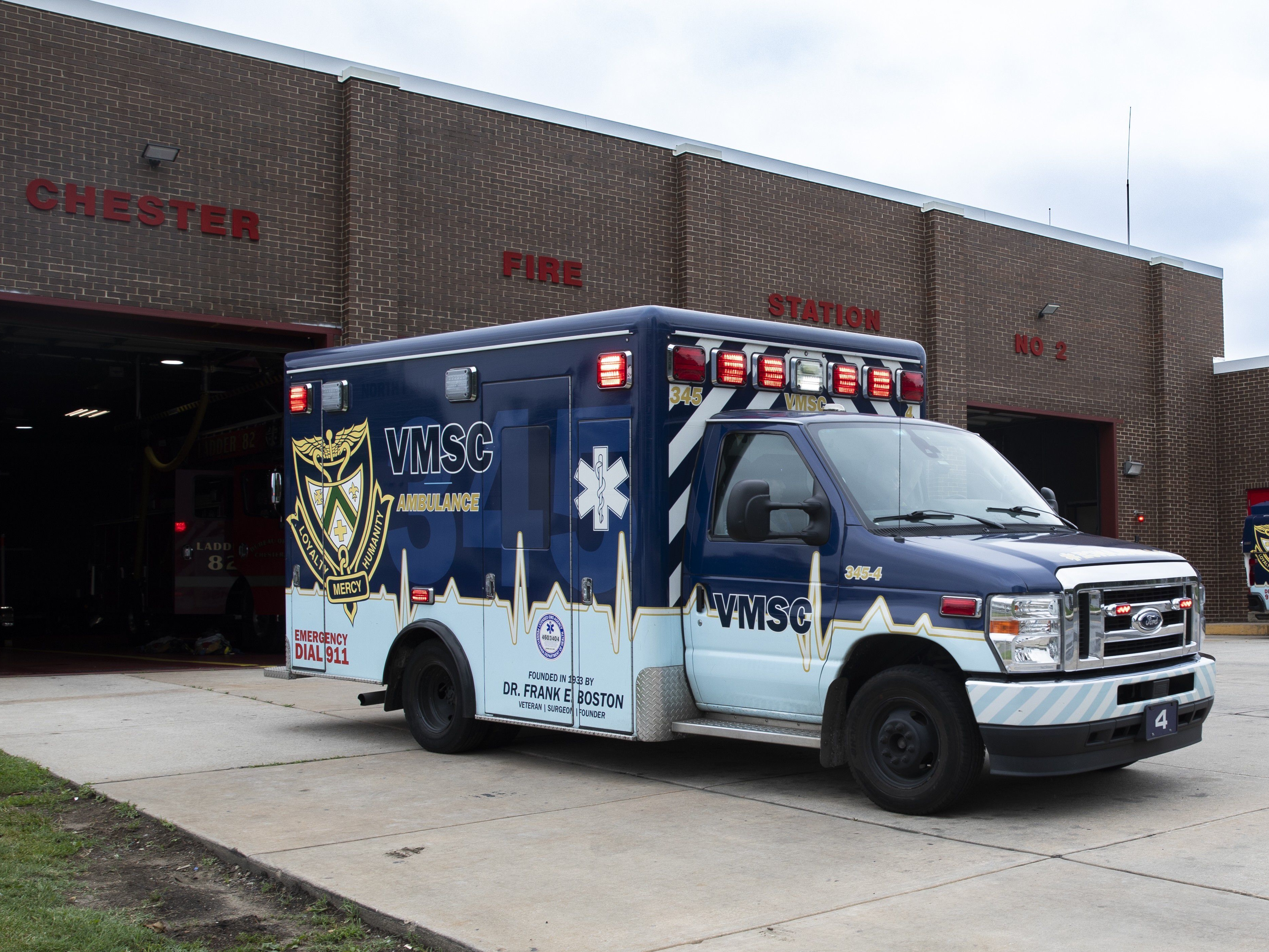
Chester City agreed to a five-year, $2.8 million contract with VMSC Emergency Medical Services, a nonprofit that started providing ambulance services in the community after the closure of bankrupt Crozer Heath a year ago, the city and VMSC announced Monday.
During VMSC’s first year in Chester, the Lansdale organization had a $470,000 shortfall, chief executive Shane Wheeler said. The $2.8 million is expected to support operation of the services — including the cost of serving uninsured patients — and pay for equipment needs.
The ambulance company has responded to 8,324 calls since May 2, but 35% did not require transport to a hospital, Wheeler said. In many cases, the ambulance crew fulfills the function of primary care for residents.
“We’re assessing blood pressure or helping someone with their medication, helping people get up” from a fall, Wheeler said.
VMSC’s accomplishments in the first year reducing ambulance response time to about 5½ minutes from more than 12 minutes, according to Wheeler.
The contract requires VMSC to assign at least three basic ambulances to serve Chester and its direct neighbors, with two staffed 24 hours a day. The organization also must provide at least one commander with training in more advanced treatment.
Just when you think the White House policy toward refugees can’t get any uglier, it sinks to new depths that should infuriate Americans of all political persuasions.
After the suspension in November of a resettlement program for Afghans who helped U.S. soldiers and civilians, the Trump administration is now trying to send up to 1,100 of such Afghan refugees to the Democratic Republic of Congo. These include former interpreters for the U.S. military, former members of the Afghan Special Operations forces who worked alongside their U.S. counterparts, and families of U.S. service members — including about 400 children.
These Afghans are trapped in limbo at a former U.S. military base in the Gulf emirate of Qatar (amidst the U.S.-Iran war), where they were taken in late 2024 for a short stay while they completed the resettlement process.
Now, the U.S. Department of State wants to rid itself of the problem, and these refugees may soon be given a brutal choice between death and disaster.
One option will be to return to Afghanistan, where many are on the Taliban death list for aiding Americans. The other choice would be the Democratic Republic of Congo (also known as the DRC), a country in central Africa enmeshed in bloody civil wars that have killed and displaced millions.
Why would U.S. officials choose the DRC? A State Department spokesperson told the New York Times the focus is on “voluntary resettlement.” Refugee organizations beg to differ.
“They have been trying to wash their hands of these Afghans,” I was told by Shawn Van Diver, president of the aid group AfghanEvac. “The DRC may be the only ones who will play ball with them. So the DRC is rising to the top.”
Other refugee aid groups are equally horrified, as we all should be.
“It is horrific and absurd to think of it as a viable option to send persecuted people to a country in the midst of active conflict and listed as Do Not Travel by the State Department,” said Jennifer Patota, deputy director of U.S. legal services at the International Refugee Assistance Program.
“This is a complete betrayal of our promise to Afghans who stood by us. Any future partners will be watching,” she said.
But concepts like honor and loyalty or even simple human decency don’t move the White House officials who devise U.S. refugee policy. They should, however, move every citizen and U.S. legislator who cares about the future safety of our military, and the immorality of U.S. leaders eager to sell out allies.
This latest disgrace sent my mind racing back to President Joe Biden’s shameful and botched withdrawal from Afghanistan (following on Trump’s equally shameful first-term pullout accord with the Taliban). After many trips to Afghanistan, I tried, as did so many U.S. journalists, former U.S. military, and U.S. officials who had served there, to get friends and comrades out.
One of those, whom I wrote about, was a judge who had worked with U.S. officials and had stellar recommendations for the special immigrant visa, known as an SIV, for those who helped Americans. After harrowing months hiding outside Kabul with the Taliban on his heels, and then waiting a year in Pakistan for an SIV, he finally had to return to with his ill wife to Afghanistan when their Pakistani visas expired. I can’t use the judge’s name because he is in hiding.
Although he had completed essential parts of the application process, the Trumpers froze the program at the end of 2025. The supposed reason was a murder in Washington, D.C., by an Afghan refugee (not an SIV holder). Absolutely no excuse for rejecting Afghans who risked their lives to help U.S. personnel.
I spoke about this latest Afghan tragedy to Najib Bakhshinda, a former journalist, who, with his human rights lawyer wife, now heads a nongovernmental organization (NGO) in Canada called GCARR-CANADA that works to help refugees facing danger. Along with their four sons, they made it from Kabul to Ottowa.
I asked Bakhshinda what would happen if the Afghans in Doha returned to Afghanistan.
“They will simply get killed,” he replied. “The Taliban have an official office in Doha, Qatar, and they know who is in Camp As Saylihah [where the Afghans are held]. They even visited the camp and tried to ask about the residents, but people don’t trust them.”
So let me repeat: The White House wants our Afghan allies trapped in Doha to choose between terrible danger and likely death.
What makes this story even darker is the Kafkaesque process that doomed many of these refugees after they reached Doha. “There had been pre-vetting before they reached the camp,” I was told by Andrew Sullivan, a military veteran who served in both Iraq and Afghanistan, and now heads No One Left Behind, an organization that helps Afghans resettle here.
But many of the 1,100 couldn’t qualify for SIVs because of arcane regulations, so they had to apply as refugees.
For example, Afghan Special Forces operators who fought side-by-side with and supported U.S. troops were disqualified if the Afghan government paid them rather than the U.S. military. Yet, the Taliban wants them dead just the same.
There are cases where a child of an SIV applicant aged out at 21 while the family waited years for their visa, and thus was no longer eligible. Or interpreters for U.S. units — prime targets of the Taliban — who didn’t work the required 365 days.
“Absolutely, exceptions should be made if they pass final security clearance,” insisted Sullivan, whose organization helped resettle 3,300 Afghan and Iraqi SIV holders. And, if the U.S. is still unwilling, said Sullivan, then officials should ensure they are going to a safe country where they can survive.
Once upon a time, a bipartisan movement of veterans in Congress promoted laws to enable Afghans who helped us to get visas. But as time passed, and foreign policy crises multiplied, the issue faded from view.
“There is still strong bipartisan support, but the issue has fallen out of sight,” Sullivan said. “Congress needs to act. It can change the law any time.” Or, I’d add, it can press to revive the SIV program the White House froze. Pressure can also be brought on the State Department to drop the two despicable options it is trying to impose on the Afghans in Doha.
This is a refugee issue that all Americans should be able to unite behind.
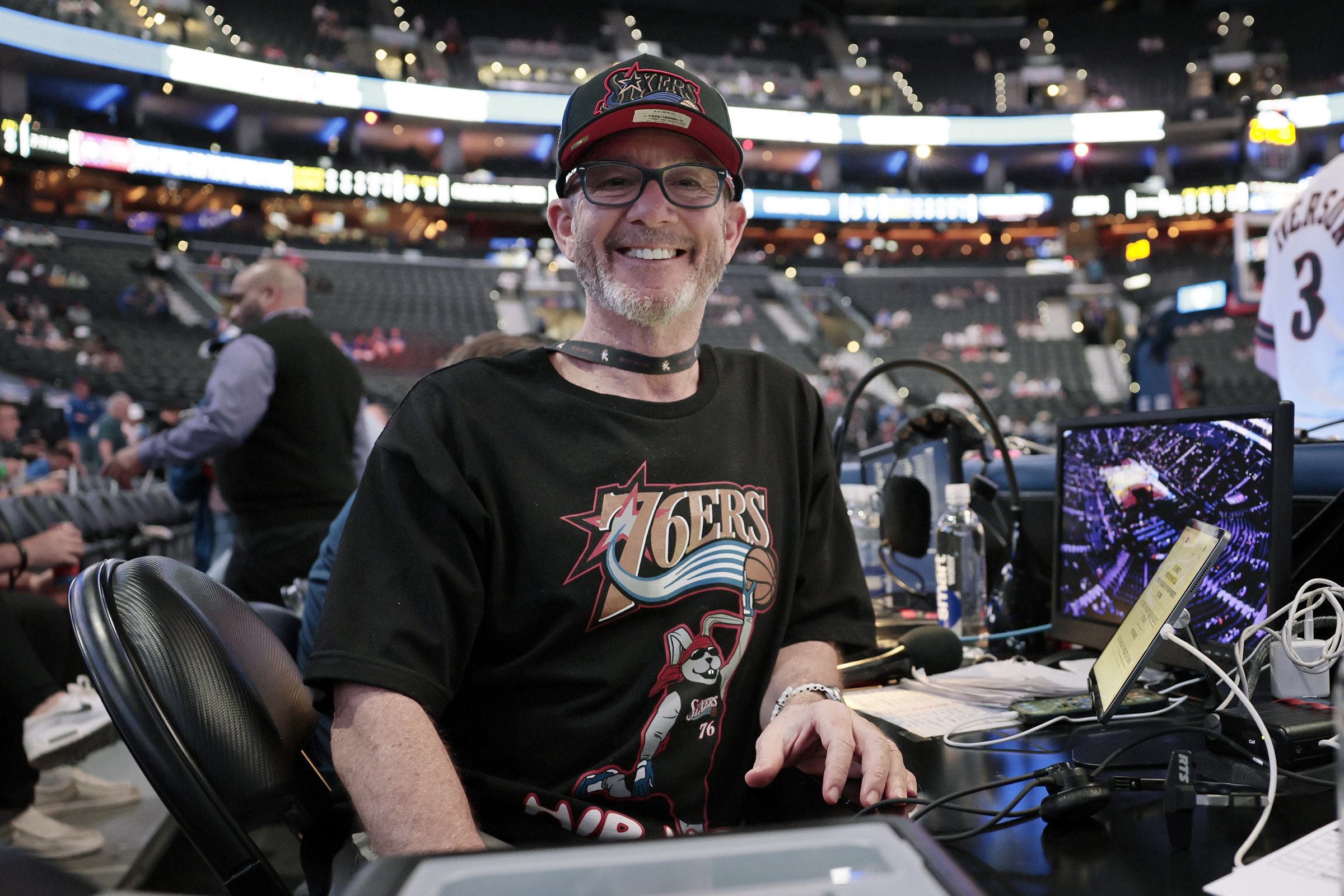
With just a tick over two minutes left in the first half of the 76ers’ Play-In Tournament victory over the Orlando Magic, a familiar face was shown on the massive video board suspended over the court. It was accompanied by an even more familiar, iconic introduction.
“AND FINALLY,” Sixers public-address announcer Matt Cord’s voice boomed, the crowd knowing what was coming next. “A 6-FOOT GUARD FROM GEORGETOWN. NUMBER THREE. ALLEEEEEN I-VERSONNN.”
The cheers began at “6-foot” — just as they did 25 years ago when Allen Iverson willed the Sixers to the NBA Finals. Cord was then in just his third year as the team’s announcer, but he had already crafted much of his signature, electric style.
Now, after nearly three decades, the Sixers will need to find a new voice.
Cord, 66, announced in March that his 28th season with the Sixers would be his last. Immediately, clips of his legendary calls and support from fans flooded social media. At every home game since, colleagues and fans have thanked Cord and shared some of their favorite moments from his tenure.
“It was all very humbling,” Cord said last week, ahead of the Sixers’ first-round playoff series against the Boston Celtics. “I was like, ‘Are you kidding me? All these people and the different stories. … It makes me feel like I’m pretty special and blessed.”
The Sixers and the Celtics were tied 1-1 after the 76ers’ win in Boston on Tuesday and heading into Friday’s matchup at the Xfinity Mobile Arena, but Cord is still prepping to call his final game. It is possible the next two home games are the legendary announcer’s last, but the Sixers can guarantee him at least one more night on the mic if they win another game.
Cord’s retirement, in a few ways, mimics that of longtime Sixers television announcer Marc Zumoff. In 2021, Zumoff announced that he would hang up his headset after 27 years in the booth. With the beloved play-by-play commentator being just 65 at the time, the news came as a surprise to most — including the team’s PA voice.
“It was kind of out of nowhere,” Cord said. “We were like, ‘How come?’ He’s certainly not old and he’s still great.”
Former Sixers guard Allen Iverson talks with former play-by-play announcer Marc Zumoff during the 25th anniversary of the 2001 NBA Finals team in January. Yong Kim / Staff Photographer
In January, the two were asked to lend their iconic voices to the 2001 Sixers reunion night. Cord was tasked with introducing the players while Zumoff emceed the event. Throughout the course of the game, the announcers got the chance to catch up.
“You could go to any NBA team and you wouldn’t miss a beat,” Cord recalled saying to Zumoff. “You can just go back to work if you wanted. … I mean, you really went out on top.
“You know what? That’s what I want to do,” Cord said.
Cord’s decision had been mounting for awhile, mostly because of the role’s significant time commitment. Including travel to the arena and pre-production, Cord spends around eight hours working each Sixers home game. With 41 home games, not including possible playoff games, the schedule has become increasingly taxing in recent years — especially because the Sixers are not his day job. Cord hosts the midday show on WMMR radio, replacing Pierre Robert.
However, it was talking to “Zoo” that tipped the scale.
“It takes a certain amount of guts to [retire now], because he’s still flying high,” Zumoff said. “He is still at the top of his game. The inclination would be, ‘People know me as the public-address voice of the Sixers. It’s a great gig. I’m sitting there in the front row watching the world’s greatest athletes. I’m getting paid for it. Why should I leave?’ … You’re leaving on your own terms and, as a performer and as a human being, it is absolutely the best way to exit any kind of a gig.”
Cord has been there for teams that have won the Eastern Conference as well as teams that failed to win 20 games in a season.Elizabeth Robertson / Staff Photographer
‘Really an honor’
Cord, like the players he’s introducing, admittedly gets a little more amped for the playoffs. However, he still attacks every night with the intensity of a Game 7 no matter the circumstances … even during the down years.
“I’ll be going to a game one night, and we’ll be playing Washington — a bad team,” said Cord, whose voice is featured in 2K’s NBA video games. “They’re like, ‘Boy, bet you don’t want to do this.’ I always say, ‘I did a season once where we won 10 total games. So anything’s easy.’”
The Sixers went a combined 75-243 over a four-season stretch from 2013 to 2017, including that 10-win season in 2015-16. As the team looked to tank for draft position, the era dubbed The Process saw the Sixers roll out starting lineups filled with players who would likely be found near the bottom of most NBA rosters.
Still, Cord performed.
“You’re still on a microphone, you’re still entertaining. That’s the way I looked at it,” Cord said. “I always say there’s somebody in this building right now that’s never seen a game before. I just made those games special. Like, ‘[Isaiah Canaan] CANNONBALL; TONY WROTEN!’ I tried to, when I say their names, say it like they’re an NBA All-Star.”
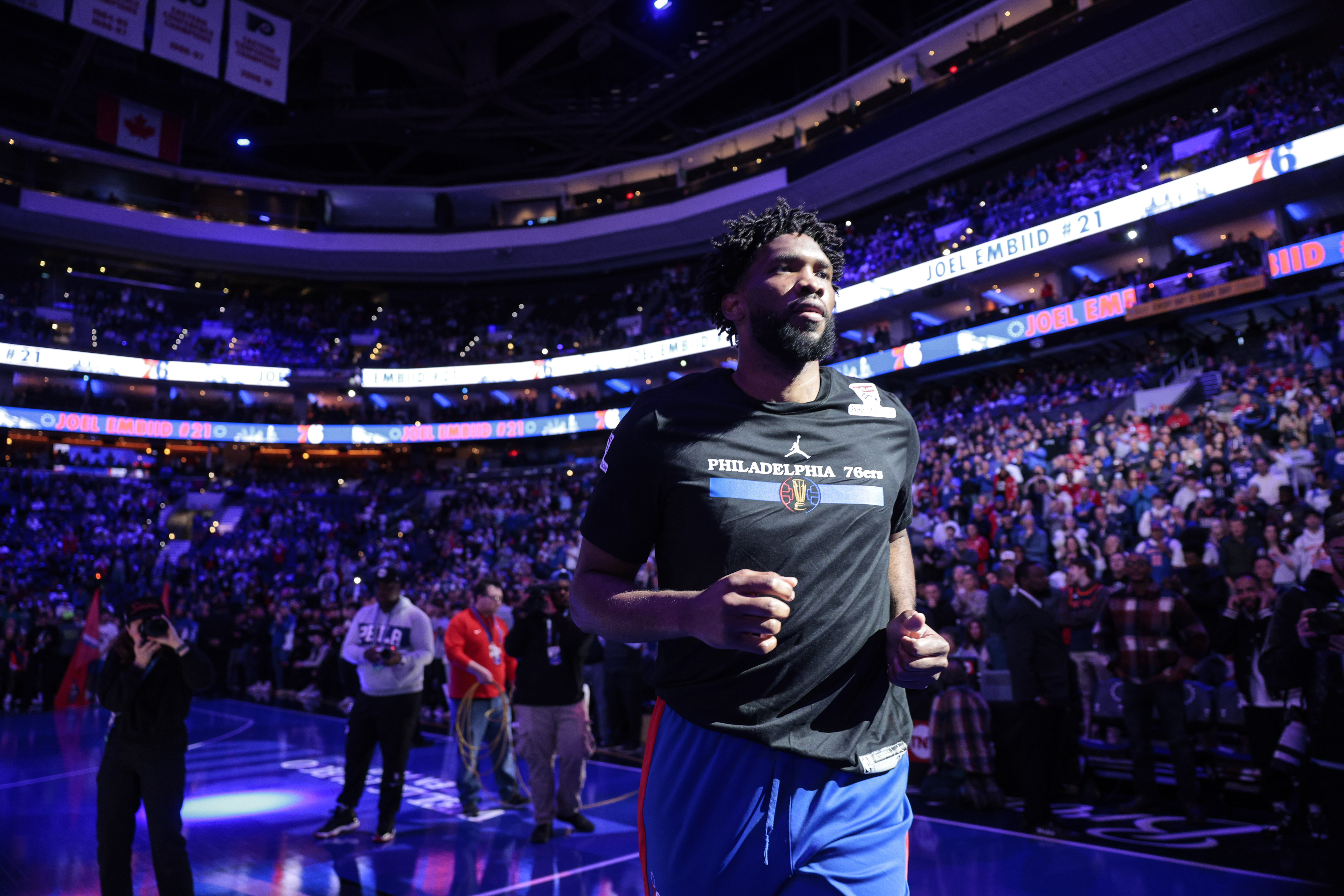
There has been a lot of debate over the success or failure of The Process. Although the Sixers have made the playoffs eight of the last nine seasons, they have not advanced past the second round. Outside of the plan’s architect — former general manager Sam Hinkie — the main figure in the debate has been Joel Embiid, who has put together a Hall of Fame-worthy career despite consistently being injured come playoff time. This year, Embiid is out after undergoing an appendectomy.
Cord’s introduction of Sixers center Joel Embiid is one of his best known.Steven M. Falk / Staff Photographer
Still, Embiid reenergized the franchise. For Cord, whose trademark intensity always mixed well with Embiid’s larger-than-life personality, this especially rings true. For a newer generation of fans, Cord’s introduction for the Sixers big man has become as iconic as Iverson’s once was — even if some fans still have a soft spot for his Jumaine Jones call.
“I love the guy,” said Cord. “I’ve always said it’s one of my favorite names to say. ‘SEVEN-TWO FROM CAMEROON. JOEL “THE PROCESS” EMBIIIIID.’
“One of my [career] highlights was when he won the MVP award in 2023. … I got to introduce [the award] on court. It was live on ESPN. We introduced [NBA commissioner] Adam Silver. It was really an honor.”
‘Carrying on the Sixers tradition’
The biggest wrinkle in Cord’s story with the Sixers came in 2011, when he was taken off the mic for one season.
After Comcast-Spectacor sold the franchise to Josh Harris and David Blitzer, the new ownership group looked to revamp the team’s entire look and feel. Then-CEO Adam Aron became engrossed by nonbasketball matters, polling fans on what mascot should replace Hip-Hop and persuading American Idol contestant Ayla Brown to sing the national anthem before games. He also fired Cord, replacing him with longtime CBS3 newscaster Tom Lamaine.
After one year though, Aron moved on from Lamaine, and the Sixers held a tryout where anyone could audition for the open PA role. Cord, who had been relegated to working for the team’s website, showed up to win back his old job.
“There were probably 150 people from all walks of life there,” Cord said. “God bless them — younger people, older people, females, males. They’re all screaming and trying. It was pretty funny.”
After vying against contestants mostly doing bad impressions of himself, Cord won his old job back. Fans, including some who had created Facebook pages devoted to bringing the announcer back, were delighted by the news. Shortly after, Aron told Cord, “You will have this job forever.”
“We were at the Sixers Youth Gala two years ago,” Cord said. “[Aron] went up to my wife and said, ‘The biggest mistake I ever made was with Matt. You know, that’ll never happen again. I’ve done everything in my career. I’ve only made one mistake.’”
Cord’s final game with the Sixers could come as early as Sunday, unless they pick up a win over the Celtics.Elizabeth Robertson / Staff Photographer
If the Sixers hold auditions this time, Cord will not be there.
A successor has yet to be officially announced, but one name to keep an eye out for is Rob Strauss, the Wilmington Blue Coats public-address announcer who has filled in for Cord in the past.
One thing is for sure, Cord does not want to get in the way of the team’s next voice — another reason for why he is retiring now. He wants to help usher in the new PA announcer, similar to how Zumoff handed off the play-by-play reins to Kate Scott after his departure.
“We love our announcers [in Philadelphia]. … They become members of the family,” Zumoff said. “And when somebody new comes into the family, it takes a little while for them to be accepted and eventually loved. I’m confident that will happen with Matt’s replacement. I know it’s already happened with Kate.
“Matt and I will just be very happy sitting in a diner somewhere, having breakfast, talking about retirement and kind of winking at each other, knowing that we got out at the right time and that we were replaced with some younger people who are doing an excellent job and carrying on the Sixers tradition.”
A man who shot his girlfriend twice in the back on a quiet Chester street on Wednesday night later turned his gun on responding police officers, prompting them to shoot him, authorities said.
The man and the woman — whom authorities did not identify — were in critical condition at an area hospital, Delaware County District Attorney Tanner Rouse said.
Authorities said the man shot the woman shortly before 9 p.m. near the intersection of East Ninth and Walnut Streets. Then, Rouse said, the man opened fire on passing vehicles.
No drivers were struck.
When officers arrived at the scene, the man turned his weapon toward them, authorities said, and at least one officer shot him.
Helicopter footage of the scene shows more than two dozen bullet casings littering the streets and what appears to be a parked power-washing truck riddled with bullet holes.
A Chester Police Department spokesperson did not return a request for additional information on Thursday.
Rouse said his office was reviewing camera footage of the incident and would “make sure we have every angle that depicts the events that transpired.” When its investigation is complete, he said, charges will be filed against the man.
Meanwhile, he praised law enforcement for its response to the shooting.
“I can tell you with confidence that the actions of the Chester Police Department were nothing short of lifesaving and the defendant in this case had every intention to kill anyone he could,” Rouse said.
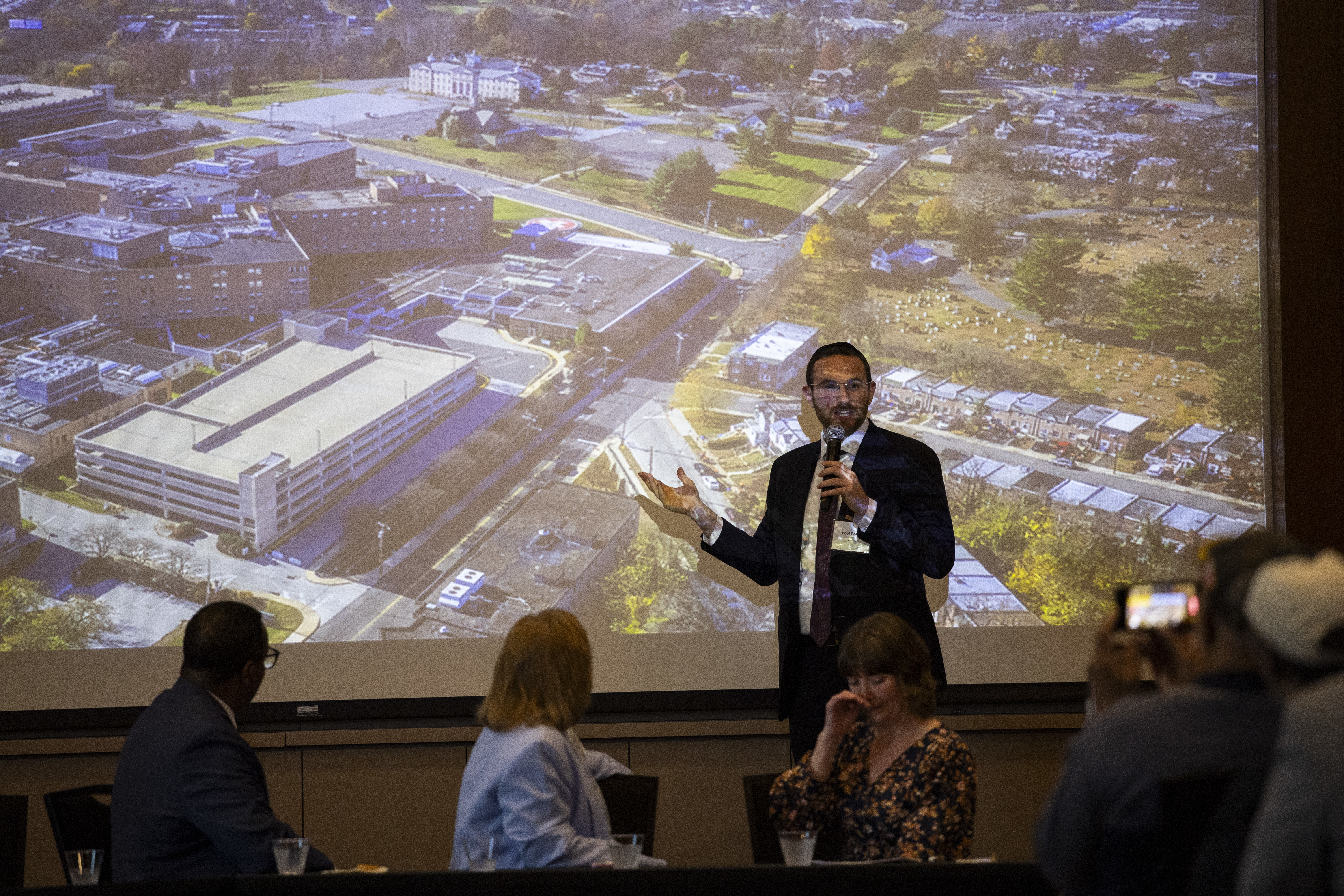
The new owner of the shuttered Crozer-Chester Medical Center in Delaware County shared what he called an “aspirational” plan to restore healthcare services to the Upland facility at a town hall meeting Tuesday in Chester.
The vision includesreopening of the emergency department, creating a small hospital above the ED, and developing outpatient services — all operated by one or more local nonprofit health systems, Yoel Polack told a standing-room-only crowd of more than 200 at Widener University.
Polack isCEO of Chariot Allaire, the for-profitpartnership that paid $10 million for Crozer in January. His group has been talking to all the regional health systems for months and expects soon to begin “a study process with two and hopefully three of the major academic medical centers in the region,” he said.
That is expected to last up to 90 days, he said, “and hopefully at the end of that period, we’re going to be having some outline of partnership with the system.” Polack described his anticipated partner as an institution “you know and trust.”
The entire process could take two or three years after a partnership is formed, he said Polack, whose company is registered in Lakewood, N.J.
He provided no details on how much Chariot Allaire would be willing to invest to attract a health system to the site, where state-led efforts previously failed to savea major safety-net provider for Delaware County that closed last May amid the bankruptcy of its California-based owner, Prospect Medical Holdings Inc.
Chariot Allaire paid relatively little for the 64-acre campus, which gives the company a low cost basis for owning the site. But that doesn’t mean it will be easy to attract a partner at a time of thin to nonexistent profit margins for the region’s health systems.
“It does not seem like there’s an easy and obvious candidate,” said Dan Grauman, managing director at VMG Health, a national healthcare consulting firm.
“There’s no question there’s need for care and for services, said Grauman, who has decades of familiarity with the Philadelphia region’s healthcare market.
A welcome public meeting
During an hourlong question and answer session, residents expressed gratitude for the meeting with Polack and his senior medical adviser, Arthur Klein, a pediatric cardiologist who spent decades as an executive at nonprofit health systems in New York.
A town hall meeting Tuesday in Chester about plans for the former Crozer-Chester Medical Center drew a large crowd.Monica Herndon / Staff Photographer
“Many times things happen in our community, and we are the last to know, so you started off very, very well,” said Zulene Mayfield, chairperson of Chester Residents Concerned for Quality Living, a community group known for the fight to close alarge trash incinerator in the city.
Some residents pushed back againstPolack and Klein’s plans for a much smaller hospital than the more than 400 beds Crozer-Chester Medical Center had at its peak. During a March interview with The Inquirer, Klein suggested the new hospital could have 80 beds.
“You don’t want a hospital of the 1990s,” Klein said Tuesday.
The current hospital structure encompasses 750,000 square feet — now completely empty. Crozer’s shuttered ED took up 30,000 of the square feet. Chariot Allaire contemplates opening a hospital a tenth of the size of the old hospital.
Operating that hospitalcost way too much, Polack said. ”It also doesn’t meet the way medical care is done today, which is mainly on the outpatient side,” said Polack,who has worked in healthcare real estate development in New York.
Simone Development Cos., where Polack worked before striking out on his own, often collaborated on real estate deals with Montefiore, a health system in the Bronx that serves many patients with Medicaid insurance, Grauman said.
That experience is relevant to the effort here, he said, given that Crozer also served large numbers of people with Medicaid, which pays significantly lower rates than private insurers.
The role of local health systems
Before Prospect’s bankruptcy filing in January 2025, a few local health systems explored establishing a new nonprofit to take over Crozer-Chester Medical Center. Those talks continued during the bankruptcy, but failed to produce a solution.
The University of Pennsylvania Health System saidit remains at the table.
“We continue to work with committed partners to restore crucial healthcare services for Delaware County residents,” Penn said in a statement. “It’s important that any new models for the former Crozer-Chester site are built to be sustainable amid a rapidly changing healthcare landscape and persistent financial challenges.”
ChristianaCare, which plans to open a micro-hospital in Aston in June, is not in discussions with Chariot Allaire, it said, but supports “their efforts to expand access to quality heath care in Delaware County.”
Arthur Klein, senior medical adviser (left), and Yoel Polack, CEO of Chariot Allaire, greet attendees during a town hall in Chester on Tuesday.Monica Herndon / Staff Photographer
While Chariot Allaire is wooing health systems, the new owners of two other closed Crozer Health hospitals,Taylor and Springfield, are doing the same thing. Local investors paid $1 million each for those hospitals. Those low prices could allow the owners to offer below market rate leases to attract tenants.
Polack noted that if no local systems want to bring services to the Crozer site, he would look farther afield.
“We don’t control hospital systems and operators, but we are doing everything that we can to put the pieces together to illustrate the opportunity that we see here to those hospital systems,” he said.
The Delco 10 Miler race is back for what organizers hope will be a bigger and better second lap. Changes for 2026 include a revised course, more than twice the number of runners, and a faster pace requirement.
The race will take place on Oct. 4. Registration is open. This year’s race will be capped at 2,500 runners, up from 1,200 last year. About 700 runners registered in the first 24 hours, race director Kevin Nolan said.
Some residents and drivers passing through the area were unhappy with road closures, which cut a long swath across the county. The course‘s adjustments should mean fewer closures along main roads.
“Logistically with all this traffic, it’s a tough race to manage,” Nolan said. “It’s tougher than the Philadelphia ones … because I’ve talked to all the race directors and they don’t have the issues that we have to deal with, with all this traffic.”
Course changes
The race will again start at Rose Tree Park in Upper Providence and end at Subaru Park in Chester. Last year, the race shut down parts of Route 252 and Route 320, as well as portions of Third, Fourth, and Fifth Streets in Chester, including a loop that took runners past Subaru Park before returning.
(function() {
var l2 = function() {
new pym.Parent(‘delco_10_miler_2026’,
‘https://media.inquirer.com/storage/inquirer/projects/innovation/arcgis_iframe/delco_10_miler_2026.html’);
};
if (typeof(pym) === ‘undefined’) {
var h = document.getElementsByTagName(‘head’)[0],
s = document.createElement(‘script’);
s.type = ‘text/javascript’;
s.src = ‘https://pym.nprapps.org/pym.v1.min.js’;
s.onload = l2;
h.appendChild(s);
} else {
l2();
}
})();
This year, runners will turn west on Rose Valley Road in Nether Providence and travel through residential streets before crossing Route 320 and heading into Chester and Widener University’s campus. The course crosses I-95 on the Melrose Avenue bridge again before heading south toward Subaru Park. The loop at the end has been eliminated.
The new course:
Starts at Rose Tree Park South on Providence Road/Route 252
Right on West Rose Valley Road
Left on Bickmore Drive
Left on Sheffield Drive
Left on Georgetown Road (becomes Media Parkway)
Left on Chestnut Parkway (becomes Chestnut Street)
Right on East 18th Street
Left on Walnut Street
Left on East 14th Street
Right on Melrose Avenue
Right on Morton Avenue
Right on East Fifth Street
Left on Penn Street
Right on West Third Street
Right on Tillman Street
Left on West Fourth Street
Left on Rainey Street
Ends at Union Yards at Subaru Park
Getting the word out
Some residents complained to race organizers that they weren’t told ahead of time that their streets were being closed.
“As much as you try to get the word out, there are people that don’t know,” Nolan said. “So you have to do more.”
This year, volunteers will walk some sections of the route ahead of time to let residents know about the race and road closures, Nolan said.
St. John Chrysostom Catholic Church in Nether Providence told the Delco Times last year that the parish was not consulted about the race, which took place on a Sunday and impacted their Mass schedule. This year’s route avoids St. John’s, as well as St. Katharine Drexel Catholic Church in Chester and some fire departments.
Faster pace
In another change this year, the race will have a faster pace requirement. Runners will have to maintain a minimum pace of 13 minutes, 30 seconds per mile. Last year’s minimum pace was 15 minutes per mile.
“Police are after us to open the course up. They were pretty aggravated last year with all the walkers,” Nolan said. “You hate to kick someone off the course.”
A few more quality-of-life improvements include more bathrooms at the start and at water stops. There will also be four staggered starts based on runner speeds.
This suburban content is produced with support from the Leslie Miller and Richard Worley Foundation and The Lenfest Institute for Journalism. Editorial content is created independently of the project donors. Gifts to support The Inquirer’s high-impact journalism can be made at inquirer.com/donate. A list of Lenfest Institute donors can be found at lenfestinstitute.org/supporters.
“It had a good vibe,” said Scott Carpel, describing what attracted him to the Havertown neighborhood where he lived for 22 years.
“There was no pretentiousness. It was family and community oriented, there isn’t a day goes by that there isn’t a bouncing basketball on the street or a Wiffle ball in the air,” he said.
The four-bedroom, 1½-bathroom Craftsman-style home was a good size for him and his then wife to raise their two daughters, who are now in college.
The kitchen has a breakfast bar.Shawn May Photography
But now Carpel, who is in sales for a major food distribution company, is headed to the Garnet Valley area of Delaware County to live with his fiancée.
The house, built in 1923, is 2,337 square feet and is in the Brookline neighborhood.
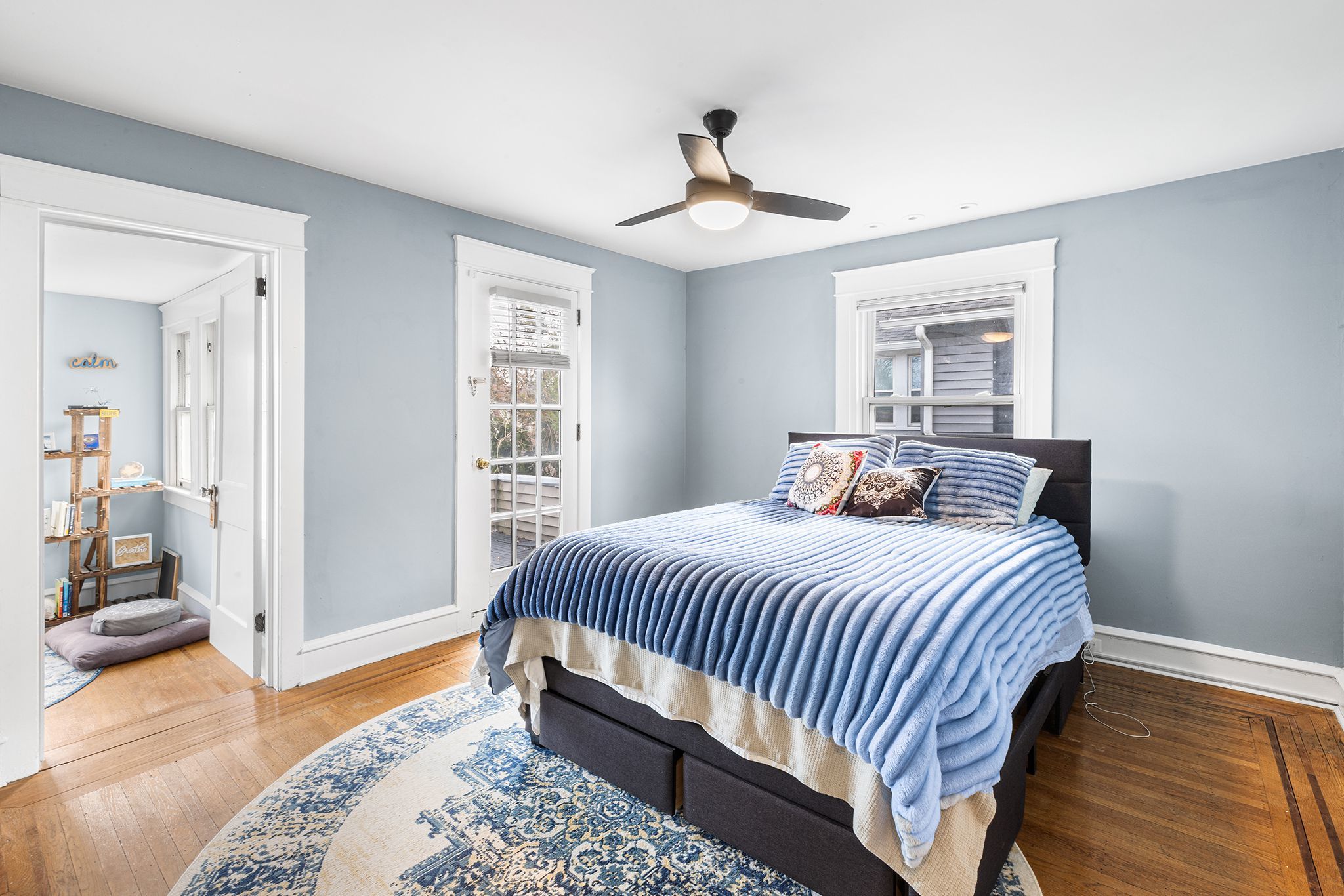
One of the home’s four bedrooms.Shawn May Photography
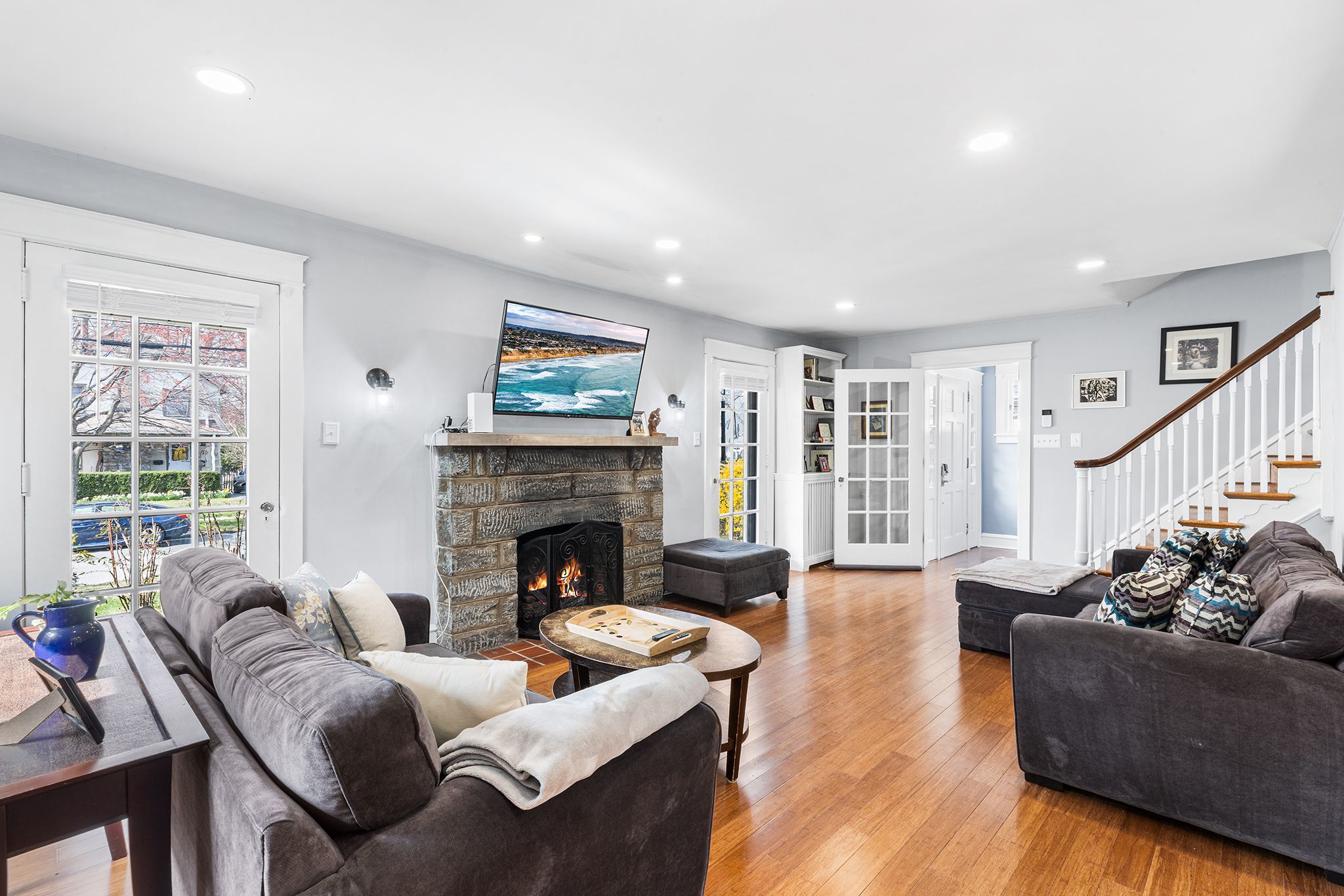
The first floor has a large dining area, a living room with working gas fireplace, laundry, kitchen with a breakfast bar, and an extra room that could be used for a home office.
There is a powder room, a sunroom off the dining room, a rear deck, and a fenced-in yard.
The sunroom is off the dining room.Shawn May Photography
The second floor has three bedrooms, a full bath, and a den.
The attic has a fully carpeted bedroom with built-in shelving and a bonus room.
And the unfinished basement has ample storage space and could be converted into a workshop.
The deck.Shawn May Photography
The house has a detached one-car garage.
There is a Norristown High Speed Line stop at the bottom of the street. Haverford High School and Haverford Middle School are within walking distance, as are the Brookline Boulevard commercial area, and the Karakung Drive recreation area.
The house is listed by Larry Levin of Realty Mark Associates for $675,000.
Nothing so perfectly demonstrates Donald Trump’s reckless approach to waging war on Iran than his rebuff of Ukraine’s offer to share drone technology that could save U.S. military lives.
Clearly, the president had little idea what he was getting into when he joined Israel in bombing Iran and killing its top leadership. This was a war of choice — the ugly Iranian regime posed no immediate threat to the U.S. — but Trump thought the effort would be easy.
As his tsunami of Truth Social verbiage and endless stream of comments to reporters show, he expected a quick victory — either a popular uprising leading to regime change, or a Venezuela-type win in which the ouster of a dictator (or ayatollah) let him dominate the country and its oil.
How any president could be so willfully blind is a question for psychiatrists, but Tehran ain’t Caracas. POTUS failed to foresee the obvious: that Iran would likely retaliate by closing the Strait of Hormuz to oil exports from the Persian Gulf for the very first time.
Voila! U.S. gas is at over $4 a gallon, and the entire world economy is threatened if the strait isn’t reopened. Now, Trump faces only bad options in a war he clearly doesn’t understand.
Despite his claims, indirect U.S. contacts with Tehran via Pakistan are likely going nowhere since the president is demanding total surrender, and Israel keeps wiping out potential Iranian negotiators.
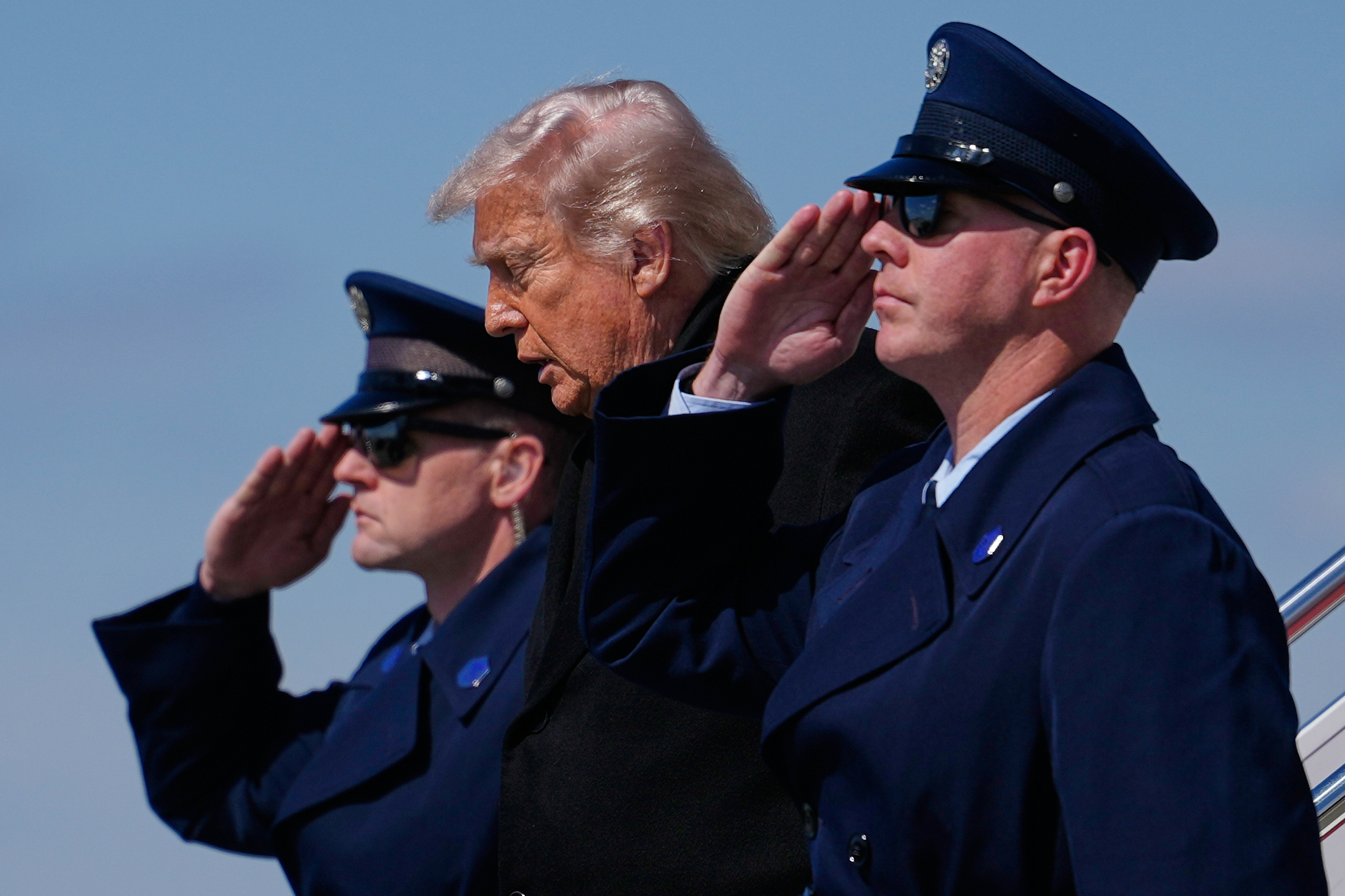
President Donald Trump arrives on Air Force One at Dover Air Force Base, Del., on March 18 to attend the casualty return for the six crew members of an Air Force refueling aircraft who died when their plane crashed in western Iraq while supporting operations against Iran.Julia Demaree Nikhinson
Most scary, as POTUS keeps dispatching more troops to the Mideast, he seems oblivious to the nature of the war in which he has enmeshed our conventional forces. For the first time, the United States is facing the new style of hybrid warfare that Ukraine has been waging for four years against Russia.
Neither the White House nor the Pentagon is ready. Yet, Trump keeps rejecting President Volodymyr Zelensky’s offers of vital help.
The Iran war has exposed how unprepared the United States still is for modern conflicts in which large numbers of inexpensive unmanned drones and smaller, cheaper missiles can be used asymmetrically against pricey U.S. conventional weapons.
Over the past four weeks, Gulf allies and U.S. forces have been downing Iranian Shaheds, drones that cost $20,000 to $50,000, with Patriot interceptors and other multimillion-dollar systems meant for targeting ballistic or cruise missiles.
The U.S.-made Patriots are in increasingly short supply, as the demand for them mounts in Europe, including Ukraine, and Asia — as well as among Gulf allies whose infrastructure is now being attacked by Tehran.
In the first four days of the Iran war, according to figures published by Philadelphia’s Foreign Policy Research Institute, the Gulf allies used up 618 Patriot PAC3 missiles, the equivalent of a whole year’s production by Lockheed Martin.
In those first four days, the Pentagon likely fired about $5.7 billion worth of interceptors to shoot down Iranian ballistic missiles — and drones.
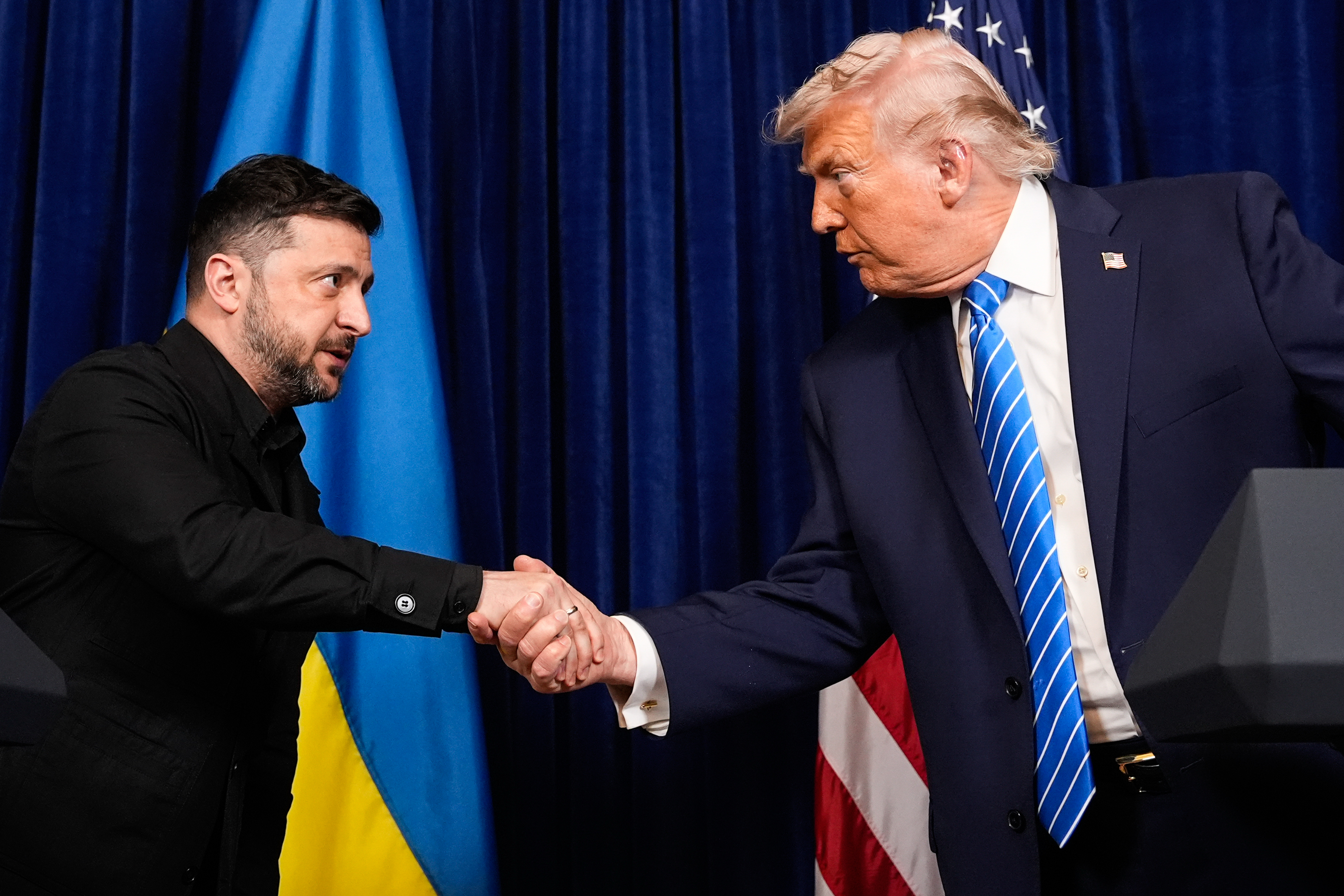
President Donald Trump and Ukraine’s President Volodymyr Zelensky shake hands at the start of a joint news conference following a meeting at Trump’s Mar-a-Lago club in December.
It is infuriating, then, that Trump keeps rejecting help from the country that knows better than any other how to counter drone attacks, especially Iranian Shaheds.
It was Iran that first sent Russia the Shahed drones Moscow has used relentlessly to attack Ukrainian soldiers and cities. Vladimir Putin, in turn, has upgraded those drones and is transferring drone technology and satellite intelligence to Tehran to help target U.S. soldiers in the region. (Yet, Trump still insists on giving Russia a pass.)
Zelensky offered nearly a year ago to share Ukraine’s experience and technology, and to send drones and interceptors that have been tested and constantly updated on Ukraine’s front lines. In return, he requested U.S. air defense missiles that Europe would pay for.
“Today, Ukraine has more experience than anywhere in the world to defend against drones,” I heard the Ukrainian president tell European leaders at the Munich Security Conference in February. “Iranian Shaheds are killing our people. Our world of drones is your world of drones. Our ability to stop this sabotage is yours.”
But POTUS keeps turning the Ukrainian leader away.
Sneering at Kyiv’s offer, Trump insisted in March that the U.S. military didn’t need Ukrainian expertise. “No, we don’t need their help. We know more about drones than anybody,” the president boasted in a Fox News interview. That simply isn’t true.
If U.S. Marines and soldiers try to take Iran’s key oil depot on Kharg Island, or attempt an extremely risky effort to unearth buried stores of enriched uranium at Isfahan, they will provide rich targets for drone warfare. The island is only around 21 miles from the Iranian mainland, within easy reach of waves of Shaheds.
Plumes of smoke and fire rise after debris from an intercepted Iranian drone struck an oil facility, according to authorities, in Fujairah, United Arab Emirates, March 14.Altaf Qadri
Landing craft and vehicles make easy targets. And even though the U.S. has sunk Iran’s navy, its small boats can launch drones at American ships. Recall that Ukraine drove Russia’s Black Sea fleet out of its waters and back to home ports using unmanned sea drones, some of which could fire missiles.
Iranian drones are now also targeting the infrastructure of Arab allies and U.S. bases in those countries. More than two dozen U.S. troops were injured by an Iranian missile and drone strikes at the Prince Sultan Air Base in Saudi Arabia on March 24, proving their reach. And the six U.S. Army Reserve soldiers who were killed in Kuwait on March 1 were victims of a drone attack.
That is why those Gulf states, unlike Trump, have been eagerly courting help from Ukrainian drone experts. In mid-March, according to Zelensky, 201 drone defense specialists had been deployed to Qatar, the United Arab Emirates, Saudi Arabia, and Jordan, where the Ukrainians are setting up anti-Shahed defenses for a U.S. military base.
It gives me chills to think of Trump sending U.S. troops to launch a ground war in Iran when he is so blinkered about his goals or the necessary means to achieve them. He enjoys using force, but wants easy wins, and is clearly uneasy with complex challenges. He is hinting he may quit this war without Iran regime change, or removing enriched uranium, or reopening the Strait of Hormuz, leaving the whole region in chaos and the global economy in peril as energy prices continue to soar.
Honestly, I don’t know which would be worse: sending ground troops to Kharg or to the Iranian mainland, with a high likelihood of disaster and/or a quagmire, or the president pulling a TACO (Trump always chickens out) and leaving ill-equipped Arab and European allies to cope with a global economic mess.
I do know that it is criminal to reject the help of Ukrainians who stand ready to aid U.S. troops against the asymmetrical warfare that a weakened Iran can still muster. If more U.S. troops die from Iranian drone strikes that Kyiv could have helped counter, then their blood will be on Trump’s hands.
KINMEN, Taiwan — From this tiny outer island of Taiwan, which lies less than two miles from the Chinese mainland, one can view the high-rise towers of the Chinese port city of Xiamen.
Looking out over an extensive beach and through the mist at China, I realize Xiamen could probably be reached from where I stand by a good swimmer. From this vantage point, it’s easy to imagine Chinese leader Xi Jinping pursuing his obsession to “reunify” with the self-governing island democracy of Taiwan — whether by so-called peaceful means, by blockade of the Taiwan Strait, or using more direct force.
I traveled to Taiwan because President Donald Trump was supposed to meet Xi in Beijing this week. POTUS had previouslysignaled he might weaken long-standing U.S. support for Taiwan out of his desire to cozy up to the Chinese leader and sign an advantageous trade deal. Moreover, the White House has frozen a deal Trump had already endorsed for Taiwan to purchase around $11 billion to $13billion worth of U.S. defensive weapons, so as not to upset Xi before the visit.
But Trump’s poorly planned war on Iran (he apparently never considered how Tehran would retaliate) has caused a postponement of the long-awaited trip until mid-May. As the erratic POTUS sinks into a potential Iran quagmire, lacking any cohesive strategy to thwart Tehran’s partial closure of the Strait of Hormuz, he is even less likely to focus strategically on the Taiwan issue.
Yet, any potential Chinese blockade of the Taiwan Strait in the next few years could present an equal or even greater security threat to the United States than Iran’s blockage of the Strait of Hormuz, through which about 20% of the world’s oil trade flows.
To understand why, it helps to know a bit about Kinmen’s history.
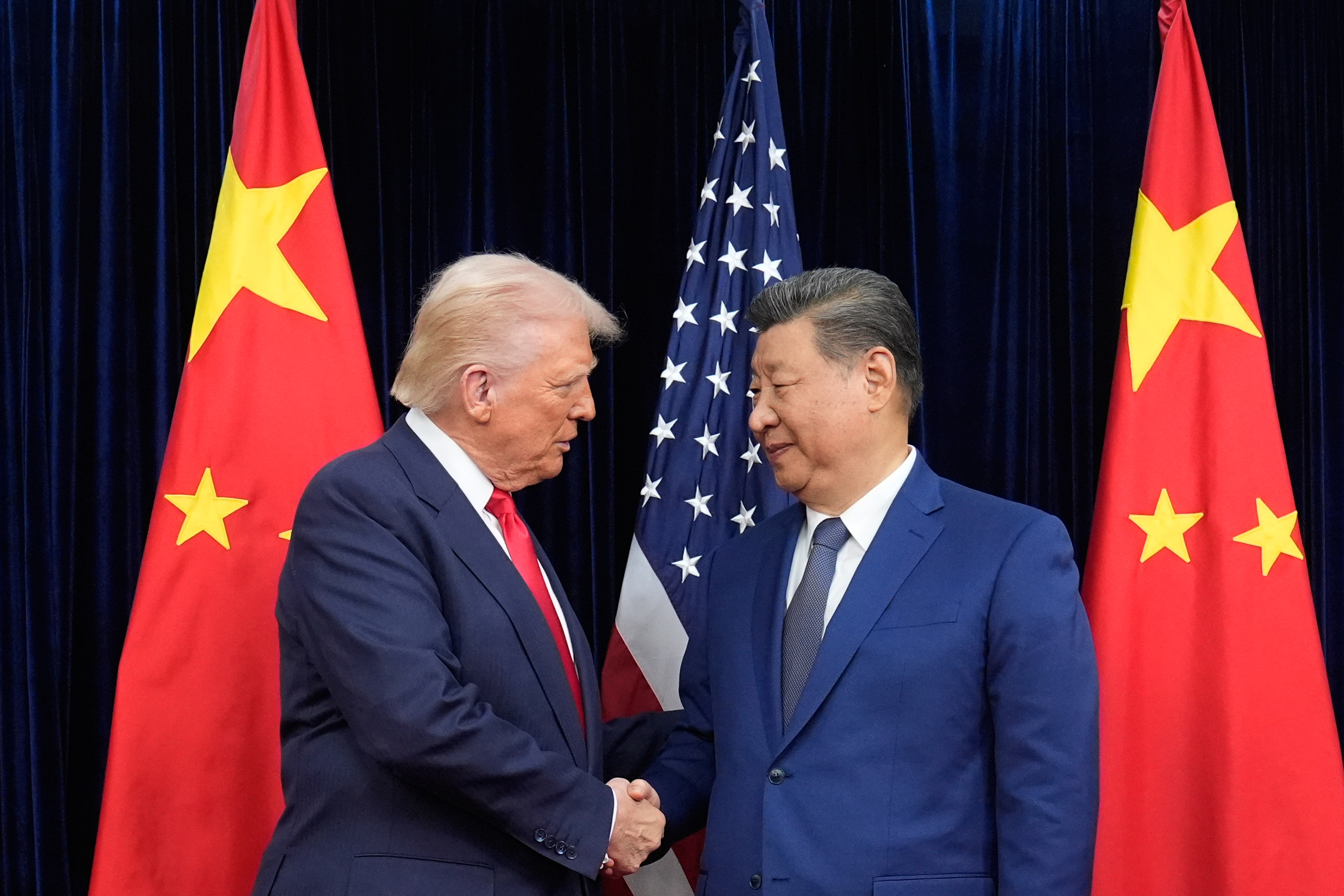
President Donald Trump and Chinese President Xi Jinping shake hands before their meeting at Gimhae International Airport in Busan, South Korea, in October.Mark Schiefelbein
Until 1993, Kinmen was off-limits to visitors because it was a closed military zone, and locals lived under martial law from 1956 to 1992. Most of the 120,000 Taiwanese troops have been withdrawn, although a small garrison remains.
Yet, an endless row of rusty anti-landing spikes along the beach line stand as a reminder of the 1949 civil war Battle of Guningtou between the Communist People’s Liberation Army (PLA) and Chiang Kai-shek’s Nationalists, who were defeated on the mainland and had retreated to Taiwan. With U.S. backing, the Nationalists set up the Republic of China (ROC) government on Taiwan’s main island, roughly 110 miles from Kinmen, and held off the PLA.
Those Americans who are old enough may recall the 1958 battle of Quemoy, as Kinmen was formerly known. During that battle, massive PLA shelling along with a Chinese blockade of the Taiwan Strait tested U.S. support for the ROC government. But President Dwight D. Eisenhower sent ships to break the blockade and repel the missiles. A local war museum displays huge photos of U.S. troops arriving on Kinmen.
Since the U.S. formally recognized the Beijing government in 1979, and cut diplomatic ties with Taipei, Taiwan has existed in a diplomatic grey zone. China treats it as a renegade province and only a handful of countries recognize it as an independent country.
But the U.S. insists that differences between Beijing and Taipei be settled peacefully, and is committed to providing Taiwan with defensive weapons. Moreover, U.S.-Taiwan relations are close: few Americans realize that Taiwan is America’s fourth largest trading partner, due to its technological prowess.
As for Kinmen, these days China tempts its youth with the glitzy shopping malls of Xiamen, reachable by a 30-minute ferry ride, while a massive new international airport, built on a man-made island, cuts the sea distance between China and Kinmen to roughly one mile.
Kinmen has become a tourist destination, with its beaches, war museums, and preservation of historic Qing dynasty homes. Mainland Chinese visitors pour into Kinmen, and the Beijing government heavily promotes the purported advantages of “reunification” to the Kinmen public — including jobs and entertainment sites — as part of its effort to win Taiwan citizens to its side.
Taiwanese flags in Kinmen, Taiwan, in 2024.I-Hwa Cheng
So it’s not surprising that the Taiwanese government has blocked construction of a bridge that would connect the airport directly to Kinmen, presumably to prevent both the escalation of propaganda and the security threat of a direct link.
“Kinmen is at the front line of geopolitical conflict,” said youthful local Councilor Tung Sen-pao, as he greeted visitors in a curio shop. “We are a small lens through which you can view a much larger conflict between the U.S. and China and Taiwan and China.” As he spoke, the sound of military target practice reverberated outside.
Indeed, in recent months, China has been conducting the largest-ever live military fire drills all around Taiwan, and simulating a total blockade of its largest and smaller islands. An aggressive Xi refuses to rule out using force for “reunification.” Locals speculate what he might do by 2027, when he has ordered the PLA to be ready to invade (without making a commitment to do so).
This month, the U.S. intelligence community’s 2026 Annual Threat Assessment report determined that China does not plan to invade Taiwan in 2027 (although the report is published by the Office of the Director of National Intelligence, Tulsi Gabbard, whose gutting of the intel community raises the question of whether its reports can be trusted).
That trust factor becomes critical, as does American preparedness to respond if Xi does try to limit traffic or impose a full blockade of the Taiwan Strait, given its centrality to international trade.
Taiwanese Councilor Tung Sen-pao.Courtesy of Mark F. Nelson
An estimated 20% of global maritime trade passes through the Taiwan Strait, and it is the main maritime route for technology and consumer goods from South Korea, Japan, and Taiwan to U.S. consumers.
The United States has no treaty commitment to defend Taiwan, only a strategic necessity to prevent its forcible seizure by China. Little Taiwan, with 23 million people, produces 90% of the world’s most sophisticated semiconductor chips. If cut off, it could be disastrous for U.S. civilian and military needs.
Moreover, if Taiwan falls, the security of U.S. allies in Seoul, Tokyo, and Manila, with whom America does have military commitments, would be at deep risk.
Equally troubling, Trump’s Mideast war has drained missile interceptor stockpiles, including Patriot missile batteries and other weapons that are vital to dissuade Xi from taking rash steps. It is hard to believe a president who has acted so fecklessly on Iran strategy has any adequate plan for handling a meeting with China’s leader, except possibly to cave on supporting Taiwan.
Meantime, Councilor Tung admits that Kinmen will have little say over its future. “We are a tiny island,” he said with a wry smile. “There is now no way for us to counter an attack if China tries to invade Kinmen.”
However, he also believes “a direct attack on Taiwan in a conflict is more likely than targeting offshore islands such as Kinmen.”
The 50,000 or so permanent residents of Kinmen just hope the status quo can endure for a few more years.
Dawn Pierce felt heartbroken last spring when she learned that Crozer-Chester Medical Center was closing.
The hospital had long been a lifeline in a city with limited healthcare services. Many Chester residents, like Pierce, were unsure where to turn for care when the hospital’s for-profit owner, California-based Prospect Medical Holdings, declared bankruptcy and shut down Crozer and Taylor Hospital in Ridley Park last spring.
“I don’t think of myself as one that will sit around and watch things happen, but I felt hopeless,” Pierce said.
Nearly a year later, Pierce and other residents say the community was left with major healthcare gaps: There are no primary care doctors or pediatricians in town. Locals who received routine care at the hospital had to switch to doctors outside the city, dealing with long drives or rides on public transportation. Some are going without care.
And many worry about whether they can make it to another hospital in time during a medical emergency.
Janice Cimabue, left, and Jamie Blair, center, with Put People First PA, after a news conference outside of the recently closed Crozer Medical Center in Delco, in Philadelphia, May 15, 2025. Jessica Griffin / Staff Photographer
These concerns have emerged through grassroots canvassing by One Pennsylvania, which shared its findings at a news conference this month. In recent months in Chester, organizers have knocked on 4,300 doors to gauge residents’ thoughts on Crozer’s closure and encourage them to advocate for better healthcare options in the city.
The membership group focuses on issues including housing rights and environmental justice. Originally founded as part of a 2011 Pittsburgh campaign by the labor union SEIU, it became an independent organization in 2015 and expanded into the Philadelphia area in 2016.
Pierce, who heads its Chester chapter, counts herself relatively lucky: While she saw specialists at Crozer, her primary care physician was at a different health system. But her brother and his significant other spent most of last year looking for a new doctor after Crozer closed.
“I do think they finally found someone, but at this point those visits are not near Chester. They’re 20 to 30-plus minutes away,” Pierce said.
Residents told One Pennsylvania organizers they felt relief that Chester officials did find a solution for EMS services lost in the closure. The city contracted with VSMC, an ambulance company, for higher-level care on the go, including blood transfusions.
“The restoration of EMS services and ambulance for our city — this matters,” Pierce said at the event held outside a downtown church on a recent Saturday. “However, EMS is a bridge. It’s not the final destination.”
(function() {
var l2 = function() {
new pym.Parent(‘he_chester’,
‘https://media.inquirer.com/storage/inquirer/projects/innovation/arcgis_iframe/he_chester.html’);
};
if (typeof(pym) === ‘undefined’) {
var h = document.getElementsByTagName(‘head’)[0],
s = document.createElement(‘script’);
s.type = ‘text/javascript’;
s.src = ‘https://pym.nprapps.org/pym.v1.min.js’;
s.onload = l2;
h.appendChild(s);
} else {
l2();
}
})();
Chester Mayor Stefan Roots told residents at the news conference that he met recently with representatives from the Crozer property’s new owner, for-profit Chariot Equities, which says it wants to restore medical services to the campus.
Roots said he couldn’t provide many details about a plan for the 64-acre campus that straddles Chester and Upland Township in Delaware County, which Chariot purchased last month for $10 million. Chariot said at the time it planned to operate a “right-sized” hospital and emergency department at the facility.
The new ownership comes after government-supported efforts failed to convince other local health systems last year to form a new nonprofit to run Crozer-Chester and other Crozer Health facilities.
Chester Mayor Stefan Roots told city residents that he met recently with representatives from the Crozer property’s new owner, for-profit Chariot Equities, which says it wants to restore medical services to the campus. Tyger Williams / Staff Photographer
Roots said the new owner has impressive plans, but it could take years to bring back medical services, if successful. “It’s going to take some time, it’s going to take some money, and all we can do right here is to readjust,” he said.
Delaware County Council voted Wednesday to end a disaster declaration over lost EMS services in the wake of Crozer’s closure, since communities left without services, like Chester, had been able to contract with other EMS providers, WHYY reported.
Chester resident Andrea Robinson say she’s still feeling the impact of the lost medical services.
Robinson had to find new doctors after the closure, and a family member is now traveling farther to receive care for a mental health condition once treated at Crozer. And while other area hospitals are taking patients from Chester, the influx of new patients has at times led to long wait times elsewhere.
“We are truly in need of medical services now,” she said.