CLEVELAND — Cleveland’s WNBA expansion team had three priorities for the franchise’s name.
It had to have its own identity and not be related to the Cavaliers. It needed to tie into Lake Erie. And fans wanted something progressive.
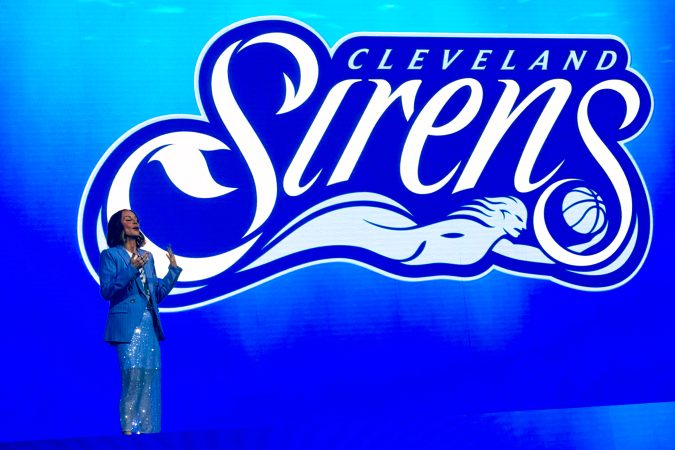
The Cleveland Sirens think they accomplished all three Tuesday when they introduced the name and branding during an event on Tuesday at Rocket Arena.
The WNBA’s 16th team will begin play in 2028. Cleveland was home to one of the league’s original franchises when the WNBA started in 1997, but the Rockers folded in 2003 when owner Gordon Gund could not find a new buyer.
Franchises coming to Detroit (2029) and Philadelphia (2030) have yet to announce names or branding. Philly’s franchise will be owned by Harris Blitzer Sports & Entertainment, which owns the 76ers, and will share an arena with the Sixers and Flyers.
Dan Gilbert’s Rock Entertainment Group, which has owned the Cavaliers since 2005, paid a $250 million expansion fee for Cleveland’s return to the WNBA.
Janice Braxton, who played for the Rockers for three seasons (1997 to 1999), narrated a video introducing the name and the theme of “Hear the Call.”
Braxton, along with other former Rockers players, also attended Tuesday’s event.
“We were at dinner with them last night, and we gave them a sneak peak of the video,” Sirens president of business operations Allison Howard said, “and they were overwhelming in their support and clapped several different times.”
The logo features a Siren underneath the name. The “S” in the wordmark also conceals “CLE.” The two shades of blue take inspiration from Lake Erie and the Rockers logo.
“We really wanted something that people could rally behind a real character. And we’re really excited about that,” said Grant Gilbert, Rock Entertainment Group’s vice president of business and basketball operations. “I think the other aspect of the Siren name and brand that was really considered and that we get very excited about is how authentically it extends just beyond the name and branded logos itself. The potential of the name is endless.”
Over the past year, Cleveland has had 9,000 deposits for season tickets. Howard expects that to increase now that the name has been announced.
“This team can exist very much on the independent side of the Cavaliers,” Howard said. “And that’s also what we are seeing right now. The demographic is totally different. They eat different food, they drink different drinks, they get here earlier, they purchase merchandise differently, and they come from all over the state and even outside of the state.”
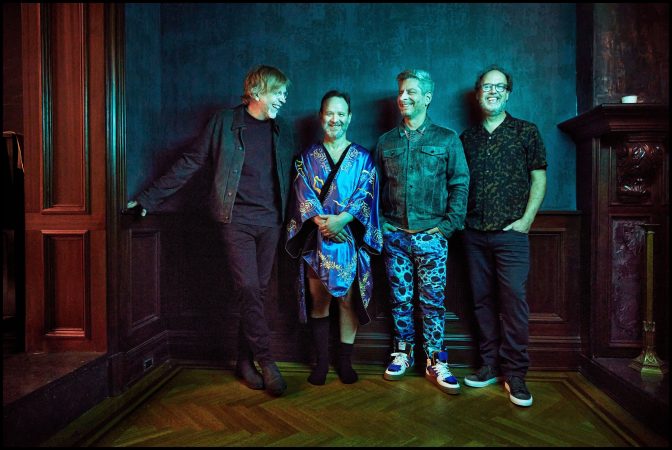
The preeminent jam band led by guitarist Trey Anastasio — who grew up in Princeton — will kick off its fall 2026 tour with three nights at Jim Whelan Boardwalk Hall on October 2-4.
The Vermont-born band, which also includes bassist Mike Gordon, drummer Jon Fishman, and keyboard player Page McConnell, have a long history at the Jersey Shore resort town.
Twice before, in 2010 and 2013, the band did three-night Boardwalk Hall stands in October, with each of those including one of the band’s trademark surprise Halloween sets. Also, in 2012, the quartet played three outdoor shows at Bader Field. In 2021 and 2022, the band did three shows on the Atlantic City beach.
In general, Phish doesn’t play Philadelphia the years it plays in Atlantic City. It played in Philadelphia for three nights at the Mann in 2013 and 2015, and in 2024 changed things up with a trio of shows at its own Mondegreen Festival in Dover, Del.
Fans pack the beach near the stage as Phish performs a beach concert in Atlantic City, Friday, Aug. 13, 2021. At right is Caesars Casino. VERNON OGRODNEK / For The InquirerVERNON OGRODNEK / For The Inquirer
Other high profile non-casino bookings this year included a stop on Shakira’s “Las Mujeres Ya No Lloran” World Tour at Boardwalk Hall last month and the beach show with Australian electronic band Rüfüs Du Sol on Aug. 29.
Phish posted ticket instructions for the Atlantic City shows on Tuesday. A fan club ticket request period at tickets.phish.com is now underway and continues until noon Monday, Aug. 10.
Tickets go on sale to the general public beginning Friday, Aug. 14 at 10 a.m. Also, a limited number of travel packages for Atlantic City will go on sale Wednesday at noon at https://phishfall.100xhospitality.com/.
Bryce Harper got what he asked for at the trade deadline: some help. But will it be enough?
On Monday, the Phillies traded for San Francisco Giants second baseman Luis Arraez — a three-time batting champion who leads the National League with a .324 average this season. The team also added some much-needed relief pitching help, acquiring the Giants’ Caleb Kilian and the New York Mets’ Brooks Raley.
Each year after the deadline passes, members of the media rush to their keyboards to grade each teams’ deadline dealings. This year is no different, and the Phillies have been getting mixed reviews.
Here’s what those in the national media are saying:
The Athletic: B+
The Athletics’s Jim Bowden praised Phillies president of baseball operations Dave Dombrowski, noting his deadline moves “proved once again why he’s a future Hall of Famer.”
“Even with a subpar farm system, he was able to add the pieces he needed to improve the Phillies’ chances for a postseason berth,” Bowden wrote. “Arraez will create traffic at the top of the order and turn some of Kyle Schwarber’s solo homers into two-run homers. The bullpen depth is much improved, as well, with the additions of Kilian and Raley.”
However, Bowden did have some reservations that prevented an “A” grade. Namely, the former baseball executive expressed concerns with how the team will adjust to positional changes made due to the acquisition of Arraez. With Arraez playing second base, Harper will move to right field, Alec Bohm to first base, and Bryson Stott to third.
On Tuesday, Stott told the Inquirer that Harper’s willingness to move positions paved the way for the rest of the team to follow suit.
“It should be not lost that our superstar first baseman, two-time MVP is willing to move,” Stott said. “And when you’re on a team and you see a guy do that, what are we going to say, no, we’re not moving?”
From left: New Phillies Caleb Kilian, Luis Arraez, and Brooks Raley.Associated Press
Yahoo! Sports: B-
Jake Mintz of Yahoo! Sports called the positional changes “fancy problems” to have, arguing that the addition of Arraez strengthens the team, not harms it.
“This lineup, second-to-last in OBP, needed a boost,” Mintz wrote. “Arraez should provide it and give the Phillies the contact-oriented piece they’ve lacked the past few Octobers, when they’ve collected strikeouts by the dozen.”
Against the Los Angeles Dodgers in the National League Division Series last year, the Phillies hit for a combined .212 average as they were eliminated from the playoffs in four games.
Mintz also praised the bullpen additions of Raley and Kilian, writing that “one or both should find himself tossing high-leverage frames once the weather gets cold.” He then took some time to address the team’s needs that went unanswered.
“The only two unfulfilled items on … Dave Dombrowski’s shopping list were a veteran depth starter and a righty-hitting outfielder,” Mintz wrote. “The reemergence of Andrew Painter (he looked good the other day) should solve the first problem. Dombrowski and Co. likely believe Arraez is good enough that the second problem won’t matter.”
Phillies president of baseball operations Dave Dombrowski had a busy Monday leading up to the trade deadline.Yong Kim / Staff Photographer
ESPN: Phillies are a deadline ‘loser’
ESPN’s David Schoenfield did not deal out letter grades, but he did look to sort a handful of teams into two categories: winners and losers. The Phillies were placed in the latter.
Before airing out his grievances, Schoenfield praised Dombrowski for “adding Arraez to provide some much-needed OBP at the top of the lineup plus relievers Brooks Raley and Caleb Kilian for key bullpen depth.”
However, he felt the position changes that came with the acquisition of Arraez significantly weakened the team’s defense.
“Given Stott’s inexperience at third base, the Phillies are arguably making themselves worse on defense at all four positions if they stick to this plan, which is why they’re a loser and not a winner,” Schoenfield wrote.
He also feels that the Phillies should have added another starting pitcher.
“Oh, and with the Phillies suddenly fighting just to win a wild-card spot, they could have used a starting pitcher, but Dombrowski failed to land one on a day when so many were traded.”
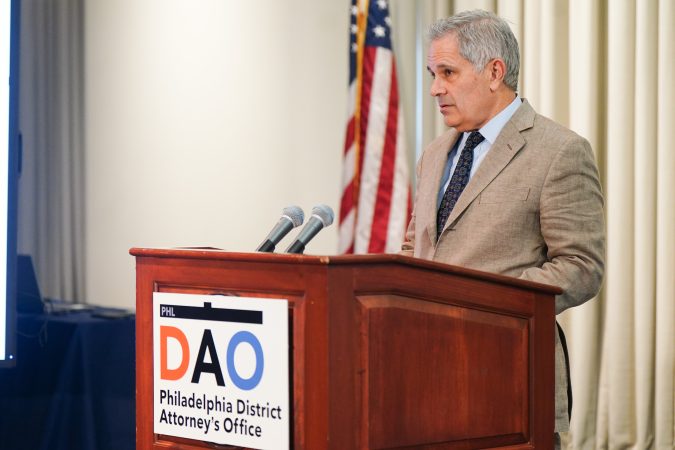
District Attorney Larry Krasner on Tuesday said he strongly disagreed witha judge’s decision to overturn the murder conviction of a man who killed Philadelphia Police Officer Moses Walker Jr. in 2012 and vowed to appeal.
Krasner said Common Pleas Court Judge Jennifer Schultz, who handed down the ruling Monday, was “legally incorrect” in vacating the conviction of Rafael Jones, who is serving life in prison for killing the officer during a street robbery at the end of his shift.
But Krasner, speaking at a news conference alongside Walker’s mother and Roosevelt Poplar, president of Lodge 5 of the Fraternal Order of Police, said Jones’ conviction was different from others involving Nordo that have since been reevaluated.
“We believe now that Rafael Jones is guilty — that he murdered Moses Walker Jr.,” Krasner said.
If the appellate court denies the district attorney’s appeal, he added, “we will be retrying this case. We have a lot of evidence to do so. And we will be retrying it vigorously.”
Jones’ attorney, Jason Edward Parris, said Tuesday afternoon that the vacated conviction represented justice.
If jurors heard Jones’ case today, Parris said, they would have information about Nordo’s sex abuse crimes involving informants in homicide investigations that was not available at the time of Jones’ trial.
“I don’t think anybody should be comfortable with someone serving life in prison based in part on an investigation done by an officer who is now doing 49 years [in prison] for crimes committed during the investigation of this case,” Parris said.
Walker, 40, was shot and killed shortly before dawn on Aug. 18, 2012.
The officer had just left the 22nd District station in North Philadelphia dressed in civilian clothes when Jones and another man, Chancier McFarland, targeted him in a robbery, prosecutors said.
Jones fired at Walker after the officer reached for his gun, according to prosecutors. Both men were arrested, and McFarland pleaded guilty and testified against Jones as part of a deal to avoid life in prison.
Years later, during Nordo’s sexual abuse trial in 2022, one of his accusers testified that the detective had steered him toward a $20,000 reward and later raped him.
Though Krasner acknowledged the “messy history” that came with Nordo’s involvement in Jones’ case, he said the district attorney’s office was confident in the conviction.
There were multiple pieces of evidence that pointed to Jones’ guilt, he said, including a murder confession that was not introduced at trial because Jones did not testify, and McFarlane’s eyewitness account of the crime.
“We concluded years ago that this conviction was in the category that should not be disturbed,” Krasner said.
The district attorney’s office will appeal Schultz’s ruling to Superior Court, a process Krasner said could take up to two years.
Poplar, the FOP president, said he had faith that Krasner’s office would prevail.
“Yesterday was a tough day,” he said, echoing comments made by Police Commissioner Kevin Bethel, who said he was disappointed by the ruling.
Walker’s mother, Wayniya, said she and her family “would not allow these latest developments to weaken us.”
“We remain confident justice will prevail,” she said, adding that she hoped that the death of her son, not the vacated conviction of his killer, would “remain at the center of this case.”
“No decision rendered can alter what happened on Aug. 18, 2012,” she said.
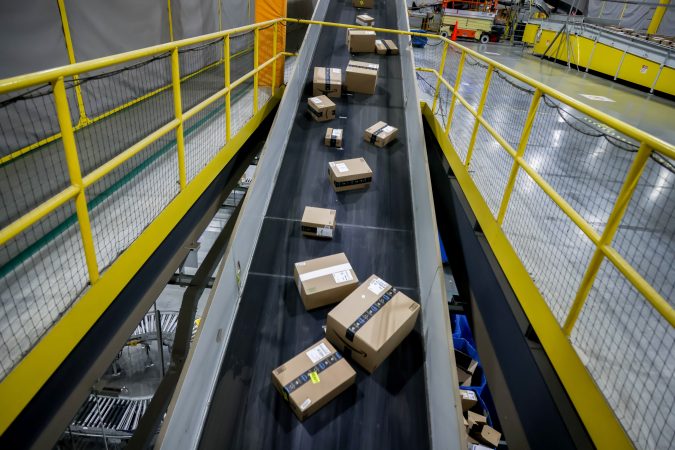
New Jersey Attorney General Jennifer Davenport filed the state’s fourth open lawsuit against Amazon on Tuesday, accusing the tech giant of creating worse work conditions for lower pay through its “anticompetitive” delivery driver network.
“Today, my office is acting to stand up for thousands of New Jersey delivery drivers who are being exploited every day by one of the world’s biggest, richest corporations,” Davenport said at a news conference.
The suit homesin on Amazon’s Delivery Service Partners (DSPs) program, which the company advertises as an opportunity for prospective entrepreneurs to open their own business while partnering with the tech giant by managing a local system of drivers. But these businesses are beholden to Amazon, Davenport argues, and the tech giant’s system prevents drivers from unionizing or getting better work conditions.
“These are the workers who bring Amazon packages to our front doors,” she said. “They often show up in Amazon vans, wearing Amazon vests, carrying boxes with the Amazon logo on them. And in our view, they are working longer hours in worse conditions and for less money because of Amazon’s anticompetitive behavior.”
These drivers earn “significantly less” than drivers for UPS, FedEx, and the U.S. Postal Service, according to the complaint.
The complaint describes a work environment of employee surveillance, union busting, and drivers having no choice but to urinate in water bottles to meet Amazon’s metrics.
“They must accept invasive surveillance that monitors their every moment and action while at work and face the possibility of immediate termination for the smallest infraction or failure to meet these unreasonable requirements,” the complaint states.
Steve Kelly, a spokesperson for Amazon, pushed back strongly on the claims made in the suit and accused Davenport of choosing to hold a news conference rather than seeking a greater understanding of the program.
“This complaint is not grounded in fact. The Attorney General’s characterization of the DSP Program and the claims about working conditions are just wrong. The truth is, DSPs are independent business owners who make their own decisions about hiring, fleet management, and capacity planning — and they choose whether to work with other companies besides Amazon,” Kelly said in a statement.
“Had the Attorney General bothered to look at the facts, they would have also seen that the vast majority of routes are finished on-time or early — built on real-world data accounting for stop complexity, traffic, and geography. DSPs manage their drivers’ workday and route execution, and DSP employees are free to choose their employer and associate with who they want, full stop.”
Kelly said the company was confident that it would prevail in court.
On its website, Amazon advertises the DSP program as providing “the unique opportunity to create jobs in your neighborhood and lead a team that delivers gifts, textbooks, and pet food to your community.”
But Davenport’s office argues that the DSPs “are anything but independent.”
“Rather, Amazon keeps control of the levers that matter — setting demanding operational requirements, monitoring driver performance, controlling route allocations, and restricting DSPs from hiring one another’s drivers — with exploitative consequences for the drivers themselves,“ her office said in a release.
Davenport also alleges that Amazon monitors DSP workers with artificial intelligence and cameras inside the vehicles they drive, and that the company has intimidated and retaliated against drivers who were suspected of union organizing.
The complaint cites an incident in Queens, N.Y., in which Amazon allegedly sent drones to blacklist striking workers. It also cites an instance in Edison where workers were allegedly told that labor organizing could endanger DSP’s partnership with Amazon, putting their jobs in jeopardy.
The suit claims also accuses Amazon of blacklisting workers who support unionization from a broad network of DSPs, and cites workers who were terminated after their bosses learned they supported labor organizing.
Amazon is the dominant purchaser of this delivery driver labor, and since it is about buying rather than selling, their alleged anticompetitive practice is called a monopsony, rather than a monopoly. Davenport’s office said this is the first time a state has filed a monopsony complaint.
It adds to a list of court battles with the company.
In September 2023, former Attorney General Matthew Platkin joined the Federal Trade Commission and other states in suing the tech giant for allegedly maintaining a monopoly. Last October, Platkin filed one complaint over the company’s treatment of pregnant people and workers with disabilities, and another over how Amazon classifies certain workers as independent contractors and therefore denies them rights and benefits.
Davenport’s lawsuit Tuesday is the first lawsuit against Amazon filed under Democratic Gov. Mikie Sherrill’s administration, but the state’s top lawyer said the three other cases are ongoing.
The complaint, filed in the U.S. District Court for the District of New Jersey, alleges violation of the federal Sherman Antitrust Act and New Jersey’s Antitrust Act and seeks damages for DSP drivers and for Amazon to stop the alleged behavior.
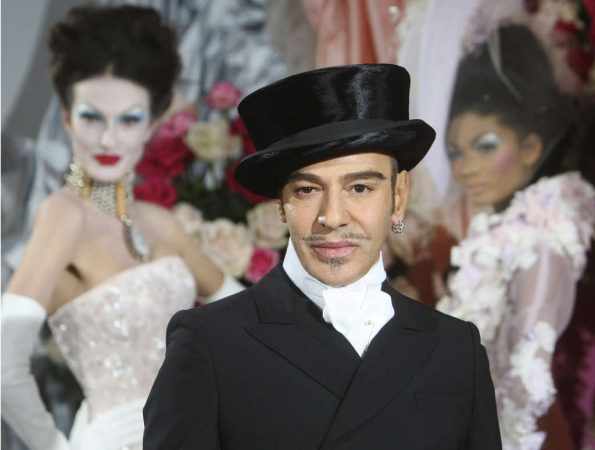
The next Met Gala is nine months away, but it’s already sparking charged opinions. The controversy centers around the Costume Institute’s decision to honor one designer at its next exhibit: John Galliano, a lauded fashion designer with a checkered past.
Galliano’s exhibit at the Met will be significant, marking only the third solo show for a living designer in the gala’s history. (The others were Rei Kawakubo in 2017 and Yves Saint Laurent in 1983.)
But it’s not all pierced leather and newspaper print (just two of the designer’s many signature elements). In 2011, Galliano was infamously canceled after his conviction in a Parisian court over a series of racist and antisemitic comments.
It cost him his job leading Dior. At the time, Galliano said his alcohol abuse sparked the outburst.
After “two years of exile‚” the designer’s career bounced back. Now, it will be showcased at length. Still, the Met is working to emphasize that the exhibit would not shy away from the problematic aspects of Galliano’s history.
“His career isn’t defined by a moment — something that he will live with for the rest of his life. The exhibition won’t shy away from any of the darkness in John’s past,“ Anna Wintour told Vogue. Wintor is the global editorial director of Vogue, chief content officer of Condé Nast, and Met Gala chairperson responsible for the event’s programming. “It’s part of what has shaped him. The show will take in the full arc of his career and grapple with all of it.” Wintour is a longtime champion of Galliano and his work.
The exhibit’s announcement — and the rehashing of Galliano’s comments — come during a time when antisemitism is surging globally. Fashion expert and professional thrifter Virginia Chamlee says the Met is equipped to accurately cover an influential artist without sanitizing the ugly parts.
Still, Chamlee noted, the biggest publicity draw for the Met’s annual exhibit is the televised red carpet walks leading up to the gala itself — not the exhibition that follows. She’s concerned that whatever efforts the Met has devoted to accountability could be lost to the larger audience.
“So there’s a real risk here,” Chamlee said. “Even if the museum intends to offer a complete examination of Galliano’s complicated legacy, it may come off as a straightforward celebration of someone who said things so heinous and racist that they were charged and fired for them.”
Met Gala attendees often wear looks by or inspired by the artists being honored, meaning Galliano’s pieces will likely be worn on celebrities whose looks will be photographed and televised prominently.
Fashion influencer and writer Ashley Ballard has collected vintage Galliano Dior-era pieces for years.
“It’s undeniable that Galliano’s time at Dior had a ripple effect on fashion and greater culture,” she said. The designer’s work redefined haute couture with immersive fashion shows, used historical references in fashion, and often bled into pop culture, with top celebrities wearing his designs.
“It’s key for us to remember that pioneers from this time period [1996-2011] — particularly Galliano and Alexander McQueen — created pieces that challenged high fashion as an institution,” Ballard said.
Citing Galliano’s incorporation of subcultures into his art, breaking the traditional molds of luxury fashion, Ballard called the designer’s work art that “bridged the gap between traditional fashion houses and audiences that historically were considered an afterthought.”
Ballard said the controversy over honoring Galliano was valid.
“This doesn’t exist in a vacuum, and people have the right to be upset by what was said 15 years ago,” she said. “[But] as a culture, if we genuinely care about minimizing hatred and the effects of addiction, it’s imperative that we support rehabilitation and reconstruction, offering the possibility that change is possible and welcomed — otherwise we become participants in the continuity of harm.”
Here’s everything else you need to know.
Who is John Galliano?
Galliano, 65, is a British designer who has worked for some of the industry’s top fashion houses, including Christian Dior, Givenchy, and Oscar de la Renta.
At the peak of his career, he served as Dior’s creative director for nearly 15 years. Galliano went on to work for Maison Margiela from 2014 through 2024.
Earlier this year, Zara announced a two-year creative partnership with Galliano.
What work is John Galliano best known for?
While at Dior, Galliano’s haute couture and ready-to-wear collections were hailed as among the best of the best.
He designed the fashion house’s signature Saddle Bag, premiering in 2000 and remaining a staple shape.
He’s also responsible for iconic looks, including the newspaper dress worn by Sarah Jessica Parker’s Carrie Bradshaw in Sex and the City, and model Kate Moss’ 2011 wedding dress.
“Galliano’s work as a fashion designer is very highly regarded [and collectible],” Chamlee said. “Just look at the asking price [$375,500] of this Galliano for Dior Homme menswear leather skirt. The industry also largely welcomed him back years ago.”
Galliano was recorded at a Paris bar making drunken, antisemitic comments to a group of Jewish women.
The video recording surfaced in February 2011, just before Paris Fashion Week. Dior suspended and ultimately fired the creative director.
Galliano was tried by French authorities under national laws against antisemitic speech, where he was found guilty and ordered to pay €16,500 (about $19,000) in fines and damages. He also lost a compensation case against Dior in labor court.
What happened to Galliano after Dior fired him for his antisemitic comments?
Galliano spent years involved in public and private efforts to rehabilitate.
The 2024 documentary High & Low — John Galliano suggests Galliano was overworked and abusing alcohol and drugs when he made the disparaging comments. The documentary features interviews and analysis on Galliano’s efforts to repair the harm he’d done.
After a period of silence, alcohol rehabilitation, and outreach to Jewish organizations, some of the designer’s fashion peers and religious leaders began publicly forgiving him.
Notably, Anna Wintour has repeatedly championed Galliano’s work, both in the early days of his career and later, after his period of cancellation.
She reportedly helped the designer secure funding over the years, as well as his positions at Givenchy and Dior prior to his conviction and at Oscar de la Renta in 2013. In March, he announced his partnership with Zara.
Wintour and Galliano met with Jewish leaders to discuss the planned Met Gala showcase, according to the New York Times.
The Times quoted Jonathan Greenblatt, chief executive of the Anti-Defamation League, as saying: “We believe John Galliano has genuinely worked through the issues that led to his antisemitic outburst years ago in Paris, and we have long since accepted his apology.”
Greenblatt added: “His efforts to repair the damage his words caused and to learn from that incident should be applauded.”
What has the Met said about the Galliano exhibit?
In a news release Friday, the museum promised John Galliano: Horizons would address the good, bad, and ugly of Galliano’s career.
“It will directly address the rupture caused by his antisemitic, racist, and anti-Asian conduct in 2010 and 2011, which resulted in his dismissal from Christian Dior and his eponymous label and his conviction by a Paris court for public insults based on race, religion, ethnicity, or origin,” the release said. “It will also consider his subsequent treatment for substance addiction and his later public acknowledgment of his actions. Rather than presenting a conventional narrative of disgrace and redemption, the gallery will examine how memory, experience, cultural values, and historical circumstances continually reshape the reception of a designer’s work.”
Have other ‘canceled’ designers been honored at the Met Gala?
Several Met Gala showcases and exhibitions have been considered controversial over the years, but experts say this time is different.
The celebration for Yves Saint Laurent in 1983 was criticized for being the first to celebrate a living artist. Critics and art historians suggested the precedent could lead to a promotional advertorial-style treatment for an active brand.
“Lagerfeld had a long record of cruel and discriminatory public comments … But Galliano’s conduct was explicit enough to result in his firing and a criminal conviction,” said Chamlee. As a living designer, Galliano stands to benefit professionally and financially from the renewed attention, she added.
When is the 2027 Met Gala?
The Met Gala will take place May 3. John Galliano: Horizons will premiere to the public May 9 and be on display through Jan. 9, 2028.
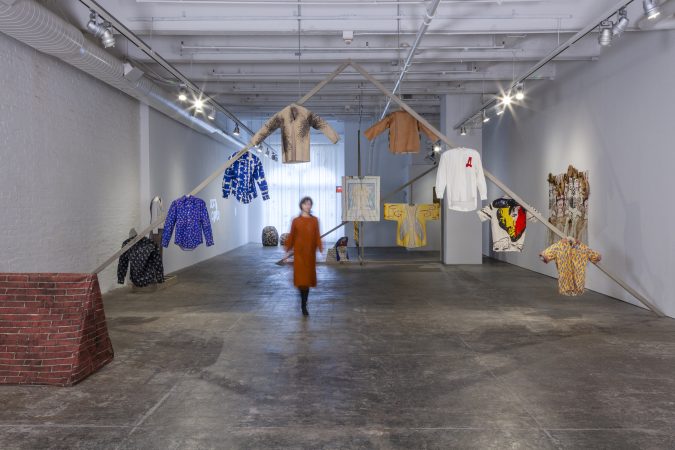
Employees of the Fabric Workshop and Museum in Philadelphia adopted their first union contract this month, joining a wave of museum worker organizing in recent years.
The 22 workers covered by the new contract are represented by the AFSCME District Council 47, Local 397, and work in visitor services, education, marketing, and communications roles, among other jobs.
“The Fabric Workshop and Museum’s commitment to creating a space of artistic experimentation is propelled by its staff, who bring a unique sense of creativity and care to their work,” Local 397 president Halcyone Schiller said. “Our collective bargaining agreement ensures that on-the-job protections and pay structures will enable staff to continue to do this exciting work for years to come.”
The museum voluntarily recognized the union in May 2025, and bargaining started in October. The workers ratified the new contract on July 23, a spokesperson for the Fabric Workshop and Museum confirmed.
Aeniah Godwin (center) and Saoni Lorenzo (right) participate in a sewing workshop at the Fabric Workshop and Museum in Philadelphia as part of a 2023 internship through the Greater Philadelphia Cultural Alliance.Carlos Avendaño, courtesy of The Fabric Workshop and Museum
The three-year contract went into effect Aug. 1 and includes raises, as well as a guarantee that internal candidates get preference during hiring for union jobs.
Under the new union contract, the minimum annual salary increased to $45,000 from $40,000, and the minimum hourly wage is increasing to $17 from $16.
Over the course of the contract, salaried employees will see an 11% pay increase as well, according to a spokesperson for the Fabric Workshop and Museum. The starting hourly wage will increase to $18.04 over the course of the three-year contract, the spokesperson said.
Workers are also guaranteed “at least one dedicated, annual professional development opportunity focused on core museum or studio skills,” the spokesperson said, as part of the new agreement.
“The negotiation process called on us to work together with kindness and respect to achieve the best outcome for our staff and the institution we all care for deeply,” said Kelly Shindler, executive and artistic director of the Fabric Workshop and Museum. “This contract proudly affirms our commitment to artists — first and foremost those on our staff — and to fostering a vibrant and accountable organization.”
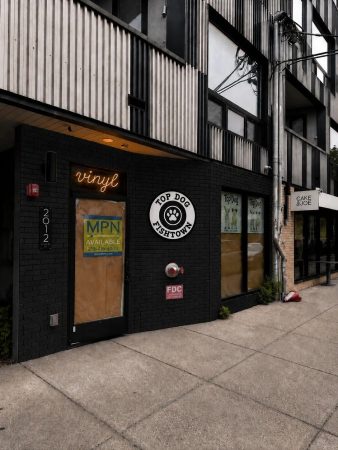
A new vinyl listening room and bar concept is coming to Kennett Square and Fishtown this fall, seeking to help people connect in person around music and over cocktails.
Top Dog Cocktails, a ready-to-drink 12.5% ABV cocktail brand with a distillery based in Kennett Square, will open its first two brick-and-mortar locations in the coming months, embracing the Japanese jazz kissa model — a music cafe or bar that’s focused on listening to vinyl records.
“It’s all to drive this analog feel in a digital world,” said founder Ken Smukler, a longtime political strategist who dipped his toe into the alcohol space roughly a decade ago. “It’s all about the community, listening and respecting music, and enjoying the cocktails at the same time.”
With his distillery location in Kennett Square already tied to music, and a teeny space in Fishtown in a former ATM calling for some creative reimagining, Smukler saw opportunity.
The locations will look a little different from each other, but the heart of both will be similar. There will be a small retail component, a bar that will double as recipe development for the brand, and, of course, an expansive catalog of music on rotation.
Top Dog Cocktails is “designed for a more sophisticated consumer” who “recognizes what a craft cocktail is in a can,” he said.
That vibe applies to these locations; Smukler envisions their demographic as cocktail appreciators, who want to unplug from their phones or TVs.
“This is a quieter, safer, more sophisticated space to consume alcohol and listen to really good music,” he said.
Smukler, a former political operative for then-U.S. Rep. Bob Brady, was first drawn to ready-to-drink cocktails in 2015, and began raising capital to launch his own brand. That early effort dissolved in 2019, when he went to federal prison for campaign finance law infractions.
But while in prison during the COVID-19 pandemic, quarantined without much to do other than chat, he learned his cellmate’s brother worked in the alcohol industry. On his way out of prison, Smukler called his friends and family — and his former cellmate’s brother.
“There’s literally a straight line from there into launching Top Dog,” he said.
He reconstituted the investor group, and the brand launched in 2022. They’ve sold nearly 1.5 million cans, Smukler said, with distribution in Pennsylvania, New Jersey, and Florida.
Options include a few variations of the margarita, an espresso martini, a vodka and grapefruit Greyhound, and a whiskey lemonade.
The brand’s distillery operation is in Kennett Square, near Kennett Flash, a live entertainment venue. He first picked the spot, at 110 E. State St., because he felt there could be “synergy” between Top Dog’s tasting room and live music. The roughly 750-square-foot space will be the bigger of the two listening rooms.
Smukler plans to work with the Kennett Flash in a joint venture; the nonprofit will be able to use the venue as a green room for performers, a space for music classes, or however they see fit. They’ll also get a cut from the retail sales.
He’s looking to do something similar with the Fishtown location, but is still seeking a partner, he said. The location, at 2012 Frankford Ave., may be the smallest bar in Fishtown, at 350 square feet. It’ll have a 15-seat bar, a two-turntable DJ station, and a retail component.
Fishtown feels like “ground zero” for the demographic they’re trying to reach, Smukler said. As for Kennett Square, he just happens to love it.
“I just think it’s a gem, and I think if we can do something with the Kennett Flash … and for the community, that’ll pay back in spades for us,” he said.
They’ll be able to test new drinks through the outposts, Smukler said. They’ve never had a gin or a rum product, for instance, and this will give them a chance for some R&D.
As for music, they’ve amassed more than 500 albums ready to spin. Smukler’s creative director is planning themed nights to let them shine. Though the Japanese kissa model is usually jazz-forward, there will be a cross section of what gets played, he said.
Moving the business into physical locations has been a creative challenge, but an exciting one, he added.
“If you ask me, what is the most fun part of my job? It’s not trying to figure out how to sell more cases in Florida. I guarantee you, it is designing a kissa concept in Fishtown or working with a nonprofit in Kennett,” he said. “That’s the fun part.”
This suburban content is produced with support from the Leslie Miller and Richard Worley Foundation and The Lenfest Institute for Journalism. Editorial content is created independently of the project donors. Gifts to support The Inquirer’s high-impact journalism can be made at inquirer.com/donate. A list of Lenfest Institute donors can be found at lenfestinstitute.org/supporters.
Today’s newsletter is all about things I thought I was done writing about: COVID-19, Kamala Harris, and the World Cup. Regarding the latter, FIFA strongman Gianni Infantino walked off the pitch after last month’s final like the hero in Steve Miller’s “Take the Money and Run”: He got the money — an ungodly $15 billion in revenue — thinking he got away. But instead, just like Icarus, Infantino flew too close to the sun. A plan to make even more cash off the world’s greatest sporting event — by selling a share to private investors led by the brother of Donald Trump’s son-in-law — outraged so many folks that the FIFA chief could lose his job. What a shame.
The right can’t shut up about COVID-19 because it needs your outrage against experts
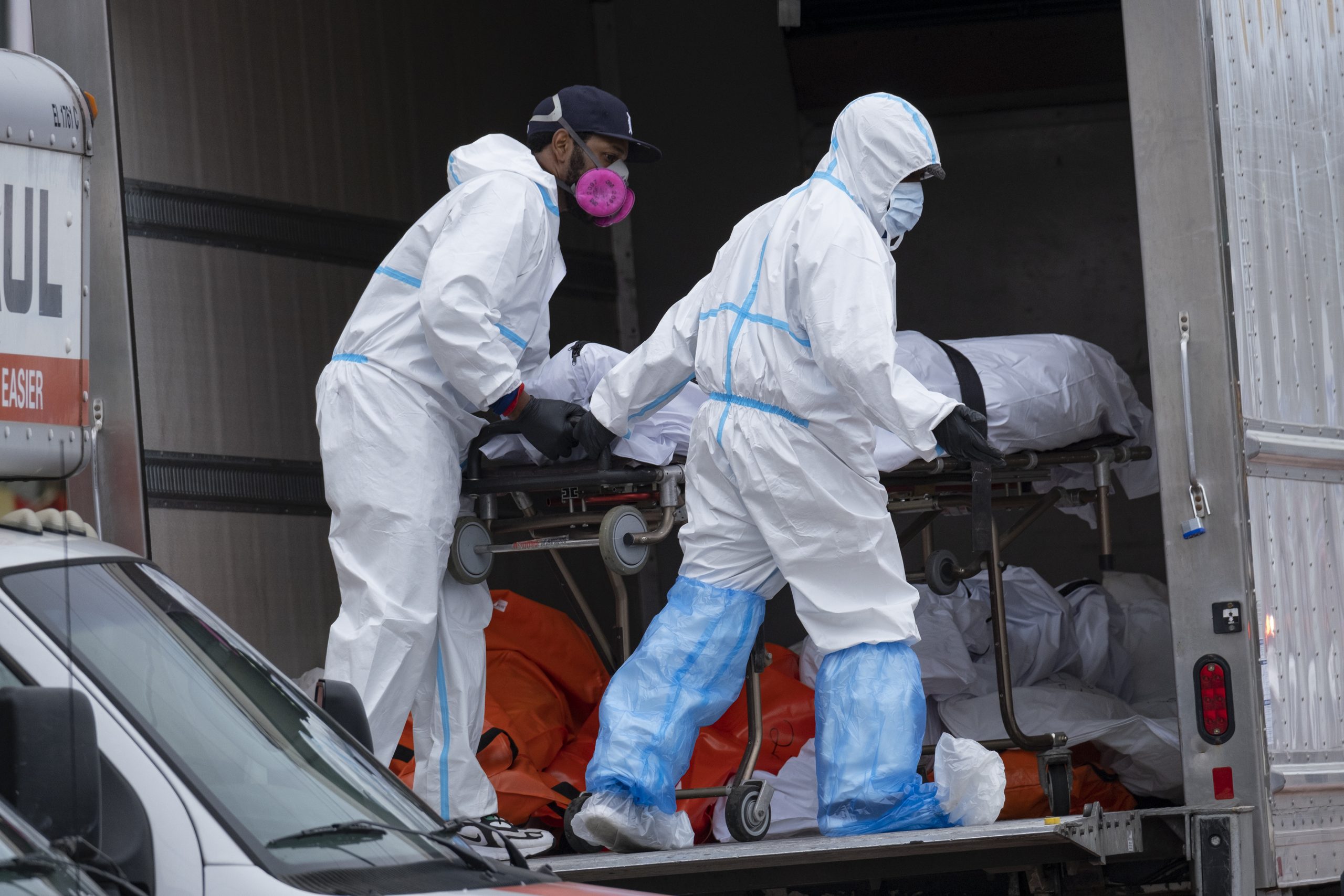
Workers move bodies to a refrigerated truck from the Andrew T. Cleckley Funeral Home in the Brooklyn borough of New York in April 2020.AP
Honestly, I thought — and hoped, frankly — that I’d written about the COVID-19 pandemic for the last time by the end of 2021. The issues it raised — about everything from public health preparedness to conspiracy theories — had seemed important enough, but I was more than ready to move on from empty baseball stadiums and masks in the supermarket.
I thought most folks felt the same way — that we were all eager to put the coronavirus in the rearview mirror. Clearly, I was wrong. The people we call MAGA still can’t stop yelling about it.
Last week brought the acid flashback of the government’s communicable disease czar when the pandemic erupted in 2020,Anthony Fauci,getting dragged before a U.S. Senate committee in a Joe McCarthy fashion, forced to take the Fifth Amendment to avoid any perjury traps that would satisfy the senators’ mouth-breathing constituents’ raw lust to imprison the 85-year-old public health icon.
The realization that they weren’t going to send Fauci — who was pardoned for his past actions in January 2025 by outgoing President Joe Biden to protect the good doctor from GOP wrath — up the river led these Republican statesmen to do the only thing left: scream at him.
“Who the f— do you think you were for doing that?” Ohio Sen. Bernie Moreno yelled at Fauci, even as it’s hard to understand what “that” was, except for working tirelessly to give Americans the best information about a rapidly evolving, deadly pandemic. “It is a total disgrace what you did to this country.”
The baseless attacks on Fauci by right-wingers — who’ve convinced themselves that the real crisis of 2020-2021 wasn’t the invisible virus that caused the early death of more than 1.2 million Americans, but an authoritarian government (led at the time by Donald Trump, but no matter) making them wear those masks and avoid those baseball games — were both infuriating and unconscionable. Still, maybe because of my aversion to reliving the pandemic, I was going to let the subject slide.
But then the current government’s top health official, Health and Human Services (HHS) Secretary Robert F. Kennedy Jr., went on CNN to double down on the Trump regime’s Big Lies about what really happened during the COVID years. And like Moreno, RFK Jr. turned the volume up to 11.
“Anthony Fauci was mismanaging the COVIDpandemic and was doing it under the Biden administration. President Trump wanted to end the lockdowns,” Kennedy loudly told CNN’s Dana Bash, inventing a farcical, backward timeline. An agitated RFK Jr. insisted the government’s priority during COVID-19 should not have been saving lives, but “protecting constitutional rights,” yet to make this fiction sound less ridiculous, the HHS chief also had to lie about the extent of thecrisis.
“There were ICUs that were empty all over the country, including in New York, at the height [of the pandemic],” Kennedy insisted.
This can no longer be ignored. There are two very important points that need to be made here.
First, when a high-ranking government official tells a lie on national television, this must be debunked immediately. The truth here is that the hospital emergency rooms and intensive care units, especially in New York City but other locales as well, were overwhelmed in the spring of 2020. So were many morgues and funeral homes, which struggled to keep up with the dead.
“I worked for New York’s largest medical center at the start of the pandemic,” Lucky Tran, a Columbia University scientist, posted on Bluesky. “There were morgue trucks on the streets. They set up emergency medical tents in Central Park. Healthcare worker colleagues died. It is horrific that RFK Jr is on national TV lying that ICUs were empty.”
Of course, this is just one of a number of lies about the pandemic — that the vaccines released to the public in early 2021 are dangerous (they’re not), that the virus came from a Chinese lab (it almost certainly didn’t) and not animal-to-human contact, and that Fauci led some kind of Watergate-level cover-up (his personal diaries, obtained by the senators, revealed exactly the opposite) — that are matters of faith among the political right.
Which brings us to the second big thing: Why? Why are all of these petty grievances about inconveniences we experienced six years ago still so gosh-darned important to these yelling people in 2026? Why do they want to send an octogenarian Fauci — a grandson of Italian immigrants whose life was the kind of American dream 20th-century Republicans would have celebrated — to prison?
The real virus here is anti-intellectualism — a strain that has always existed in American life, as the historian Richard Hofstadter famously wrote in 1964 — that has metastasized from a small, well-contained syndrome to overtaking the entire Republican Party. So-called rural resentment leads angry voters to think people like college professors or doctors in white coats are looking down on them.
It’s an antisocial worldview that was encouraged from on high by the likes of Big Oil executives who love it when the masses scoff at climate scientists. But the rejection of expertise reached a whole new level in 2020 when doctors like Fauci started telling Americans to wear masks or avoid social gatherings to slow the spread of COVID-19.
Sure, there were tough calls around issues like how long to close schools, but in real time, health experts were erring on the side of caution — the right thing to do — while shell-shocked regular folks stewed about an assault on their liberty.
As the revived Fauci controversy continued online this week, Mike Adams, whose website has been accused of spreading medical disinformation, posted Monday on X that getting a COVID-19 vaccine “reveals a twisted and artificial obedience to the falsified appearance of authority. People like that should never be trusted, because they are not in control of their own minds.”
They believe experts like Fauci don’t want to help you, but control you — welcome to the far right’s Bizarro World.
But still, why? At the end of the day, these extremists might care somewhat about thwarting climate science or not wearing masks, but the real reason they despise educated experts is because facts shatter the ancient, lie-based hierarchies such as white supremacy, the patriarchy, or homophobia that give meaning to their broken world.
I think some of the reason they still care so much about Fauci is that the pandemic spring of 2020 also brought the police murder of George Floyd and the subsequent Black Lives Matter marches that shocked many of the communities where they occurred. In their minds, all of it — masks, diversity training, vaccines, calls to “defund the police” — merged into one giant threat.
Which brings us to: Why now? There’s no question that the lingering resentments of 2020-2021 over both the coronavirus and the Floyd protests were the rage fuel that revived Trump, who looked dead in the water after his failed coup of Jan. 6, 2021. Now, it’s less than 100 days until a new election that could cripple Trump and his MAGA movement. And they are desperately waving the bloody shirt of COVID-19.
We must never forget the truth about 2020, Fauci, or the necessity of public health in a true democracy. Our anti-science government is seeing rising cases of measles and of the bacteria that causes explosive diarrhea (which has now been linked to two deaths), and God only knows what elseis in the pipeline.
Experts like Fauci aren’t here to tell you how to live your life — just how to not die.
Yo, do this!
I remain fascinated with the hidden history of American reactionary movements, which is coming out of the shadows during the Trump era. I’ve been listening to the audiobook of The Biggest Lie: The Prehistory of American Fascism, 1818-1915 by College of Charleston historian Joseph Kelly, which looks at how the defense of slavery in the antebellum South, Jim Crow, and the early 20th century revival of the Ku Klux Klan all bore the defining characteristics of an American strain of fascism, often for the self-preservation of monied interests. In the same mode, I highly recommend a recent New York Times guest essay, “It Wasn’t a Civil War. It Was the Slaveholders’ Rebellion,” by history writer Anthony Conwright, who argues persuasively that the name most of us have always used to describe the 1861-1865 conflict is actually a whitewash pushed by the South. The piece is a real eye-opener.
Did I mention that 2026’s summer of soccer isn’t over? The Philadelphia Union have emerged from the two-month World Cup break with a completely different look from the group that tanked in the first half of the MLS season, with the return of Kai Wagner (from England) and Quinn Sullivan (from injury) and rising young stars Neil Pierre and Cavan Sullivan, Quinn’s brother. They’ll also get a fresh start for a trophy opportunity with the arrival of the Leagues Cup tournament against the best teams of Mexico’s Liga MX. Check out their first match Thursday night at 8 p.m. against traditional powerhouse Cruz Azul, live at Subaru Park in Chester and on Apple TV.
Ask me anything
Question: Do you believe the Dems have a chance to take the Senate in November? — Elise (@bnat4.bsky.social) via Bluesky
Answer: Elise, I’d almost bank on it happening, and here’s why. Since the early months of the Trump 47 presidency, Democrats — who need to gain four seats for a majority — have consistently run double digits ahead of past performance in special elections. That should put seven states in play, with the strongest possible candidates in places like North Carolina (ex-Gov. Roy Cooper), Alaska (ex-Rep. Mary Peltola), and Iowa (Josh Turek). Maine voters will forget the Graham Platner fiasco long before they forget Sen. Susan Collins’ vote to confirm Justice Brett Kavanaugh. Ironically, the battle to hold a Democratic seat in Michigan looks toughest, but likely primary winner Abdul El-Sayed is an excellent campaigner. As Trump’s popularity plummets, there’s even a chance for shockers in places like Florida or with independent candidates in Nebraska or Idaho. For me, the bigger question is whether 51-plus Dems will dump Chuck Schumer as their leader after November. Stay tuned.
What you’re saying about …
Many of you had great ideas for a fall Democratic message that’s about more than just “affordability” — the preferred mantra of the party’s consultant class. Many sought to widen the conversation to issues around corruption and inequality. Here are some pithy ones. Roberta Soules wants to “take power away from the large corporations and oligarchs.” Meg Berlin suggested “More Butter. Fewer Guns.” Dane Madsen prefers “Stop the Trump Crime Family,” while Frank Friedman went with an even simpler, “We will be honest with you.” Stephen R. Rourke wrote simply, “Peace, prosperity, and justice for all.”
📮 This week’s question:CNN is reporting that the Pentagon recently took the highly unconventional step of asking rank-and-file troops for creative new ideas on how “to punish Iran.” But what should be done about this mess? Can the United States simply walk away at this point? Or do big problems like the flow of oil through the Strait of Hormuz or Iran’s nuclear ambitions require a response, and what is that, exactly? Please email me your answer and put the exact phrase “Iran war ideas” in the subject line.
Backstory: Is Kamala Harris ‘the new Nixon’?
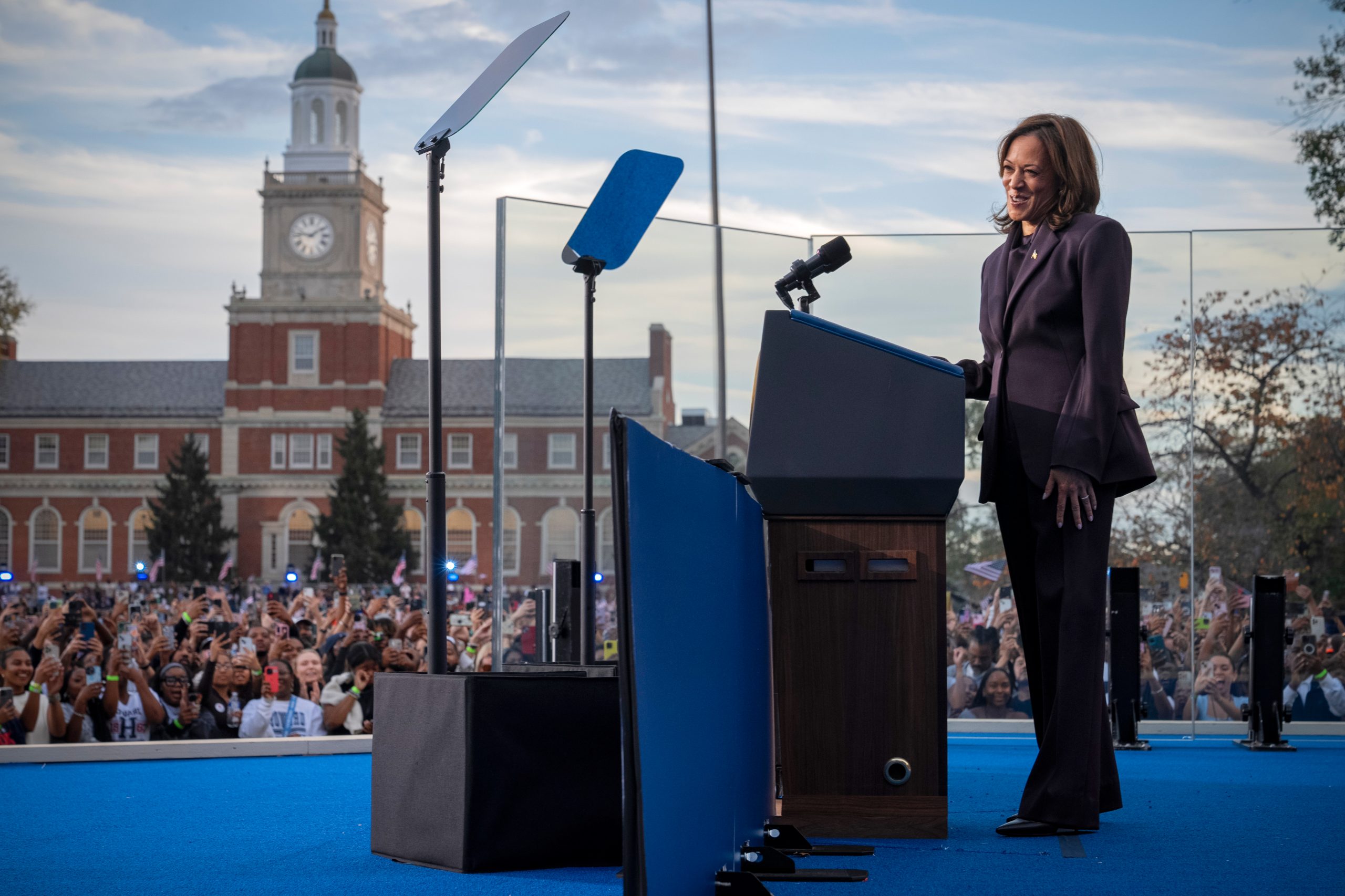
Democratic presidential nominee Vice President Kamala Harris delivers a concession speech for the 2024 presidential election, Nov. 6, 2024, on the campus of Howard University in Washington. Jacquelyn Martin
Although it’s true that, as a 5-year-old kindergartner in 1964, I nearly got into a fight with a kid who said he supported Barry Goldwater, the first presidential election I really followed came four years later in 1968. I was probably waiting for the baseball scores when I saw news reports that the GOP front-runner was a “New Nixon,” which made this 9-year-old wonder what was wrong with the old one. Indeed, a Californian who’d lost a presidential election (and a gubernatorial race just two years later) stunned America with the political comeback that made him the 37th president. We’d spend the next six years of Kent State and Watergate learning the kinder, gentler Richard Nixon of 1968 was all a lie.
It would be a Nixon-level comeback if Kamala Harris were to win the Democratic nomination in 2028, let alone the presidency. Like Tricky Dick, Harris is a child of the Golden State and former vice president to the oldest-ever POTUS at that time (Dwight Eisenhower was 70 when he left office, which was unprecedented before Ronald Reagan, Joe Biden, and now Donald Trump), and a failed nominee, although shewas smart enough not to run for governor when she returned home. People forget the brief lightning bolt of excitement when she replaced Biden on top of the 2024 ticket, and so the smart money has been that her moment has passed, as the Democratic base looks for new blood.
But it feels like the earth has shifted a bit, and the reason can be summed up in two words: South Carolina. Last week, the Democratic National Committee unveiled its list of the first six presidential primary states, and the South Carolina primary tops the list. The same South Carolina where, in 2020, the state’s main Democratic voting bloc — older, center-left, Black members of the middle- or working classes — turned the race around for Biden, the man who then tapped Harris as his veep. The same South Carolina whose Democratic power broker, Rep. James Clyburn, is close to Harris. A state that seems tailor-made for a Harris comeback.
But the Palmetto State isn’t the only reason to start taking a Harris return seriously. In politics, your weakness is often also your strength, or vice versa. Harris has long been a political chameleon — from tough 2010s prosecutor to a sharp left turn during Trump’s first term that she backpedaled away from in 2024. Today, Harris is feeling the zeitgeist. She is drifting left again, but perhaps more importantly, she understands the desire by core Democrats to support fighters, not milquetoast cowards.
“They are ruthless,” Harris told the annual gathering of the National Urban League in Nashville on Friday, referring to Republicans. “We need to be ruthless, too” — explaining that Democrats should not be “cruel,” but “uncompromising.” She added: “For example, and I know this is going to be controversial coming from me, in particular, we need to revisit the Electoral College. We need to revisit the point of expanding the court to 13 justices, like we have 13 district courts. We need to revisit, if they so want, statehood for Puerto Rico and D.C.” Harris has also been holding extensive meetings with some of the pro-Palestinian activists who often clashed with her over Israel policy in 2024.
She’s running? It sure sounds like it.
To be clear, while I thought in the fall of 2024 that Harris had thepotential to become a very good president, and I still do, I’m also very much in the “new blood” camp when I think about 2028. I’d love to see what someone from the progressive Bernie Sanders-Alexandria Ocasio-Cortez wing of the movement could do in wiping away the stain of Trumpism. But establishment Democrats, intentionally or not, have thrown Harris a lifeline with their South Carolina gambit. The coming months will reveal whether this former vice president can be “the new Nixon” of the left.
What I wrote on this date in 2013
I was reminded that the 25th anniversary of the 9/11 terror attacks is almost upon us. Expect a lot of what you might call negative nostalgia about that wretched day in 2001, but also the bad times that followed. Do you remember the terror alerts? Many of us thought those would vanish when George W. Bush left the White House, so it was a little jarring when Barack Obama continued the practice, including this major one 13 years ago. I wrote that “the problem with the terror warning of 2013 is not the warning itself but the decade of government baloney that preceded it. Washington needs to acknowledge the reality: If it wants to do a better job of keeping the public safe, it will need to start doing a much, much better job of telling the public the truth.”
The Trump regime’s cruel campaign against our immigrant neighbors is the biggest story of our time. Last week, I traveled to a tiny borough in Central Pennsylvania, Mount Holly Springs, where a budding partnership with U.S. Immigration and Customs Enforcement has seized 32 immigrants in just four months, and angrily divided a rural community. Pennsylvania’s small towns are becoming the front line of mass deportation. Over the weekend, the immigrant crackdown was central to my essay about the rising death toll that’s attributable to Trump’s misrule, which includes murdered deportees in Guatemala, a woman left by ICE agents to die at a Pittsburgh bus terminal, the latest civilian bombing victims in Iran, and many, many more. It’s a humanitarian crisis that demands our immediate attention.
No two people define the world-class journalism that we regularly produce here at The Inquirer more than my longtime friends Wendy Ruderman and Barbara Laker, who could have rested on their laurels after winning the Pulitzer Prize for investigative reporting in 2010. Instead, both are working harder than ever. Ruderman has applied her talent for digging to Philadelphia’s leading industry, healthcare, with remarkable results. Check out her latest exposé about a Main Line psychiatrist who lost her license after a wildly inappropriate affair with a troubled younger client. Laker remains a linchpin of The Inquirer’s investigative unit, and — joined by her colleagues Ryan W. Briggs, Max Marin, and Ellie Rushing — she has been digging into the dark tale of a Philadelphia pornographer and his family’s mysterious ties to two missing women. Investigative reporting is essential to democracy and forging better communities, but it’s costly, time-consuming, and won’t happen without your support. Subscribe to The Inquirer today.
By submitting your written, visual, and/or audio contributions, you agree to The Inquirer’s Terms of Use, including the grant of rights in Section 10.
After an undiagnosed heart condition led to a sudden cardiac arrest and the death of Danny Rumph at the former Mallery Recreation Center in August 2005, his friends and family turned grief into action, creating the Rumph Classic a year later.
While honoring Rumph’s legacy and raising awareness for hypertrophic cardiomyopathy, this five-day pro-am tournament has also become one of the premier basketball tournaments in Philadelphia and a summer staple for the past 21 years.
Here’s what you need to know about this year’s event, taking place from Thursday to Monday…
What is the Rumph Classic?
The Rumph Classic is a five-day pro-am tournament honoring the memory of Danny Rumph. It serves as the signature event for the Daniel E. Rumph II Foundation.
Eight teams will compete in this year’s men’s tournament, with four teams competing in the women’s tournament. There will also be two showcases on Monday, including a Girls and Boys Next Bright Star Showcase at 20 minutes each.
This year, there was a kick-off picnic on Sunday with both a youth game and a 50-and-over game. There was also a panel discussion on July 29 to discuss the tournament’s history and impact.
The Danny Rumph Classic will be held at Drexel’s Daskalakis Athletic Center starting on Thursday.Elizabeth Robertson / Staff Photographer
When and where is the Rumph Classic?
The Rumph Classic will take place over five days at Drexel’s Daskalakis Athletic Center, beginning at 5:45 p.m., Thursday and Friday.
Saturday will feature two men’s games at 3:30 p.m. and 4:30 p.m. and the women’s semifinals at 1:30 p.m. and 2:30 p.m. Sunday will follow a similar format with the women’s championship at 2 p.m., and the men’s semifinals following at 3 p.m. and 4 p.m.
Monday will kick off with the girls’ Next Bright Star Showcase at 7 p.m. and the boys’ Next Bright Star Showcase at 7:30 p.m. The men’s championship will follow and conclude the tournament.
What’s the easiest way to get there?
Drexel’s arena, the Daskalakis Athletic Center, is located at 3300 Market St., and is mainly accessible by taking SEPTA’s Market-Frankford Line to the 34th Street Station stop and walking a block to 33rd. There are also a number of buses and a trolley that pass the DAC’s location.
The Daniel E. Rumph II Foundation, which puts on the Rumph Classic, was founded after Rumph’s passing in 2005. The foundation was created by friends and family with Rumph’s uncle, Marcus Owens, serving as a co-founder and the organization’s president. Rumph’s mother, Viola Owens, is the board chair.
Rumph, a promising young basketball player who played college basketball at Western Kentucky, was 21 when he passed away.
Viola “Candy” Owens stands for a portrait on the basketball court inside the Rumph-Mallery Recreation Center last summer. Allie Ippolito / For The Inquirer
Hypertrophic cardiomyopathy, or an enlarged heart, is the leading cause of sudden cardiac arrest in youth today, and the tournament and the foundation work to bring awareness to the issue.
Mallery Recreation Center, the Germantown-based recreation center now known as the Rumph-Mallery Recreation Center, did not have an AED in 2005, nor did any of Rumph’s friends know CPR.
The foundation now works to raise money for youth heart screenings, and to place defibrillators in gyms in Rumph’s memory. They also provide free CPR and AED training within the Philadelphia community.
On his way up to NBA superstardom, Celtics guard Jayson Tatum took part in the Rumph Classic. Courtesy / Rumph Classic
Who competes in the Rumph Classic?
The Rumph Classic usual features a collection of Philly-area players, including former college basketball players and even a few NBA players.
In previous years, NBA champion Jalen Brunson and coach Mark Tyndale have participated. Current and former Sixers — including Tyrese Maxey and James Harden — have participated and Allen Iverson has made an appearance.
Lou Williams, Collin Gillespie, and Bones Hyland have all also been a part of the event in past years. Last year, Blue Magic — which featured Archie Goodwin, Providence’s Ed Croswell, Trevon Duval, and Jordan Hall — won the men’s championship.