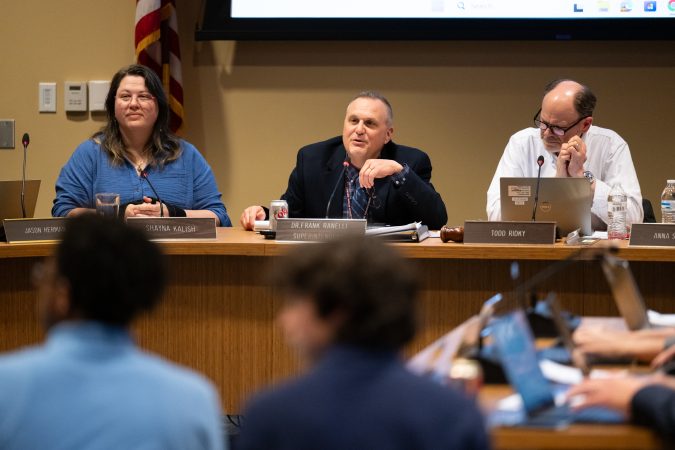
A Lower Merion school board committee on Monday advanced new rules on when screens should be used in classrooms, while facing anger from parents who want more limits on technology.
The policy committee, which has been hammering out a technology policy after parental backlash to excessive screen time, went into recess and later shut down its meeting in the district’s administrative offices in response to shouts from people in the crowd.
“When you are disrupting a public meeting, you are actually breaking the law,” school board president Kerry Sautner said, as a parent in the crowd, David Smyth, called on the committee, which had stopped public comment after 45 minutes, to allow more people to speak.
Sautner — who said earlier that 45 minutes was typical for the committee’s public comment period — told Smyth he could leave, or stay and listen. When he answered that he wanted more public comment, the committee ended the in-person meeting and switched to Zoom to vote to advance the policy.
Lower Merion’s proposed policy scales back on screens for the youngest students — specifying that kids in kindergarten and first and second grades will not be issued individual devices. Previously, kindergartners and first graders were given iPads, while second graders received Chromebooks.
“Many of you came and said, ‘I don’t think my kindergartener needs a one-to-one device.’ I don’t disagree with you,” Superintendent Frank Ranelli said at Monday’s meeting.
Under the proposed policy, any technology use for K-2 students “shall be minimal, highly structured, and limited to specific educational purposes.”
Students in third and fourth grades will not have personal devices, but will have “an assigned log-in” that they can use to access computers on classroom carts, according to a district spokesperson, Amy Buckman.
In grades five and six, students will be assigned devices but will not bring them home unless their parents want them to, Ranelli said.
While bringing computers home becomes the default by seventh and eighth grade, Ranelli said, students who choose not to do so will not be penalized.
But, the superintendent said, families “cannot decline technology” in the new policy — a bitter point of contention throughout school board debates earlier this year, as families demanded to opt out of devices.
At Monday’s meeting, Matthew Posey, a district parent, read from an April 9 email obtained through a Right-to-Know request, indicating that Ranelli had “instructed” Sautner to repeal the policy, according to Posey.
“We also want to make sure … that the board sees the vision in not allowing parents to totally ‘opt out’ of getting a device and having to use it for part of our curriculum,” Ranelli wrote, describing the district’s response to parental concerns.
Replying the next day, Sautner told Ranelli: “Got it.”
“We do not pay premium local taxes to have this insulting, rubber-stamp school board governance,” Posey said. He accused the board of treating months of public meetings over technology use as “an inconvenience to be managed,” rather than a genuine consideration of parental concerns.
Sautner said that she would have to review the email Posey mentioned, but that she sometimes responds “got it” to indicate she has received a message.
“We hold the superintendent accountable,” she said. “It is literally our job as the board.”
Parents pressed the committee for answers Monday on how the policy would work in practice. Ranelli said the district had been training principals in a “default to off” philosophy, to instruct their teachers to tell students that if they are not actively using their computers for an activity, “we want your screens to be down. Or we don’t want them at their desks.”
While rules accompanying the policy include some guidelines for how much screen time kids should be getting each day — from 30-45 minutes in third and fourth grades to up to 90 minutes in fifth through eighth grades — there are no parameters for high school.
School officials said that was too difficult, given how many classes high school students have in a given day.
“I want to make sure we’re not handcuffing the teachers,” Ranelli said.
Ranelli also said the district had stepped up efforts to block inappropriate websites, including all Google sites, which kids had used to play games, he said. It has also blocked all streaming services and AI summaries, Ranelli said.
He said the district — and parents — would be able to better monitor kids’ online activity through a new Securly program, which allows teachers to monitor what kids are looking at in class. Parents, meanwhile, can block more categories of websites and set schedules for their kids’ devices out of school hours, Ranelli said.
Smyth, the parent whose interruptions led the board to end the meeting, said in an interview that parents feel like board members are “checking a box and not really interested” in their comments.
“In our mind, the big sin is really one-to-one devices,” said Smyth, who has children in seventh and eighth grade. He had planned to ask if the district will be tracking time spent by students on various computer programs — to set metrics for “what would have them reconsider” the amount of technology use in classrooms.
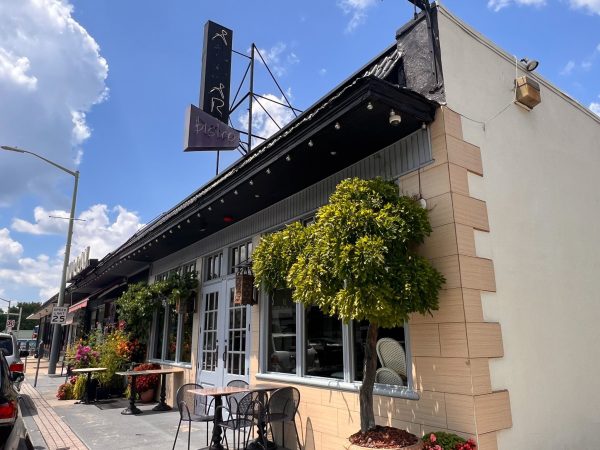
After more than three decades, the Wakim family is handing off Bala Cynwyd’s Aldar Bistro to veterans of Center City’s Gran Caffè L’Aquila, who plan to transform the longtime Lebanese restaurant into a soft-lit, white-tablecloth Southern Italian destination called Bruzi.
Two Philly-based couples from Cosenza in Calabria — Luciano and Tania Spensierato and Marco Mondello and Anna Bellizzi — are buying the restaurant at 285 Montgomery Ave. from Joseph Wakim and family.
The sale, contingent on approval of the liquor license transfer, will end the Wakims’ 34-year run at Aldar, which will be open during the transfer process. The restaurant succeeded the family’s Italian restaurant, Allegresse, which opened in 1980.
The Wakims — brothers Joseph, Michel, and George, and sister Fadia — also own Murray’s Deli next door, as well as Evviva, a restaurant, catering venue, and private-events space in Narberth.
“We all grow older, and it’s time to step aside,” Joseph Wakim said. “Over the past five years, we probably had 10 suitors, and I said, ‘No, thank you.’”
He said he ultimately chose the two couples because they were “the right families for us to pass the torch to.”
Tania Spensierato said Aldar “checked all the boxes we were looking for. We wanted to be on the Main Line. We wanted tall ceilings, an existing liquor license, and a space that was roomy but not enormous. We weren’t looking for a 200- or 300-seat restaurant. We wanted a spacious kitchen so the chef would have room to do what he does best.”
“We also wanted to be part of a community,” she said. “Bala Cynwyd and Lower Merion really fit that vision. The location on Montgomery Avenue was exactly what we were looking for.”
Aldar will remain open until the liquor-license transfer is approved, a process that Wakim believes could be completed in September. The new owners then anticipate about two months of renovations before opening Bruzi in late October or November.
Luciano Spensierato has worked behind the bar at Gran Caffè L’Aquila since 2015, while Marco Mondello joined the Center City restaurant a year later as a bartender. Tania Spensierato works in retail, though her background is in restaurants. Bellizzi is a scientist at Temple University.
The name Bruzi refers to the ancient people of Calabria, where all the partners trace their roots. Tania Spensierato, a first-generation Italian American, said the restaurant is intended to reflect that heritage.
The menu will focus on house-made pastas and traditional Calabrian cooking. Planned dishes include sliced black boar prosciutto, Calabrian cheeses, fusilli with slow-cooked meat sauce, baked lamb with tomatoes, olives, and roasted peppers, and grilled tuna with arugula.
The beverage program also will be a centerpiece. Marco Mondello, an Italian-trained sommelier, plans to open with about 100 Italian wines and expand the list over time. Spensierato, who has worked as a bartender for 35 years, said cocktails will also play a prominent role.
Glynis Tart of Verden Interior Design will give the dining room a modern Mediterranean makeover with blue-and-gold accents inspired by the Calabrian flag, along with olive trees and other greenery, Tania Spensierato said. A small retail section will sell imported Italian products.
The partners have hired an Italian-born chef currently working in Florida but declined to identify him until a later date. “Our first priority is simply to get started,” Tania Spensierato said. “One goal at a time.”
The long road to the 2030 men’s World Cup, and Mauricio Pochettino’s second term as U.S. men’s soccer team manager, will kick off in late September.
FIFA this year combined the September and October windows into one long stretch in which teams can play up to four games. The U.S. will play all four, against a combination of familiar regional rivals and visitors from South America.
Up first will be Peru on Sept. 26 in Orlando. Then it’s off to the Midwest to face Chile on Sept. 29 in St. Louis. Both of those games will be played at the local MLS stadiums.
Next up will be a renewal of the U.S. team’s most famous rivalry, against Mexico, on Oct. 3 in Glendale, Ariz. That gets an NFL stadium stage for the 80th edition of the matchup, and the first since last year’s Concacaf Gold Cup final.
Mexico beat the U.S. in last year’s Concacaf Gold Cup final.Ashley Landis
Because the nations cohosted this summer’s World Cup, they didn’t have to qualify. That meant there were none of what are usually the best clashes, on each team’s home turf in World Cup qualifying. And they might not return, because the World Cup’s expansion to 48 teams means Concacaf’s qualifying groups are spread out.
So we will be left with friendlies and hopes for meetings in the Gold Cup and Concacaf Nations League, which officially are neutral-site games, even though they’re always in the United States.
The last game of the slate will be against Canada on Oct. 6 in St. Paul, Minn. That will give the U.S. a chance to renew acquaintances with an old friend, the Canucks’ Wisconsin-born manager Jesse Marsch. The Princeton alumnus undoubtedly will relish that, as he so often relishes tossing barbs across the border at a U.S. program that spurned him when it first hired Pochettino.
Who will play in the games is an interesting prospect. Though the stars from the World Cup teams might sell tickets, many fans hope to see a new era of younger players get a shot. Potential call-ups include the Union’s Cavan and Quinn Sullivan, Frankie Westfield, and Neil Pierre; Red Bull New York’s Adri Mehmeti and Julian Hall; and Real Salt Lake’s Zavier Gozo.
Cavan Sullivan played for the United States at last year’s under-17 World Cup. He could get a shot with the senior squad this fall.Chris Ricco
It’s notable that MLS is playing a full round of games during the FIFA window, on Sept. 26 and 27. We’ll see how that affects Pochettino’s selections, and if he can get all the MLS-based players players he wants. (Europe’s leagues will be off.)
Keep an eye on goalkeeper, too. One of the U.S. pool’s top prospects, Diego Kochen, went on loan from Spanish superpower Barcelona to Denmark’s Lyngby — a team part-owned by the Union — for the upcoming European season.
Though none of the venues are near Philadelphia, they might at least make a nice quick escape for fans looking for a trip. Presales for U.S. Soccer members start Wednesday, and sales to the general public start Friday.
After the September-October window, the U.S. will enter the 2026-27 Concacaf Nations League in the November window. That will be a home-and-away quarterfinal series, and the opponent will be determined by first-round contests during that September/October window. The top four teams in the region got a bye to the quarters: the U.S., Mexico, Canada, and Panama.
The 2027 final four will be played in its usual window, next March, at SoFi Stadium in Inglewood, Calif.
SoFi Stadium hosted two of the United States’ group stage games at this summer’s World Cup.Jonathan Tannenwald
USMNT schedule (all times Philadelphia time)
Saturday, Sept. 26: vs. Peru at Inter.co Stadium, Orlando, 4:30 p.m. (TNT, truTV, Telemundo 62, Universo, HBO Max, Peacock)
Tuesday, Sept. 29: vs. Chile at Energizer Park, St. Louis, 8 p.m. (TNT, truTV, Universo, HBO Max, Peacock)
Saturday, Oct. 3: vs. Mexico at State Farm Stadium, Glendale, Ariz., 10 p.m. (TNT, Telemundo 62, Universo, HBO Max, Peacock)
Tuesday, Oct. 6: vs. Canada at Allianz Field, St. Paul, Minn., 8 p.m. (TNT, truTV, Universo, HBO Max, Peacock)
Lindsay Ward grows more nervous with each passing year, knowing her ultra-rare genetic disease could emerge at any time.
The 37-year-old schoolteacher from West Deptford, New Jersey, inherited the genetic mutation that causes RVCL — retinal vasculopathy with cerebral leukoencephalopathy — which damages small blood vessels throughout the body and typically shows up between the ages of 35 and 50. It causes premature death as brain, retinal, liver, and kidney damage accumulate.
Many patients die within five to 10 years of symptom onset.
“It’s relentless,” said Jonathan Miner, who directs the RVCL Research Center at Penn. “They go from being completely healthy to becoming blind, unable to walk or talk, with kidney failure and other problems.”
The disease currently has no cure. However, Miner recently received a $10 million gift from the Illinois-based nonprofit Clayco Foundation to develop a potential treatment.
The idea behind his small-molecule drug is to eliminate the faulty protein driving the disease before it can cause damage. The drug will still need to be tested in animals to evaluate safety before possibly moving into clinical trials.
Most exploratory scientific efforts do not advance to the point where they are found safe and effective in humans. Even if the results are promising, it could take years before a potential new drug becomes widely available.
Ward has already seen the disease ripple through her family.
Her uncle died from RVCL last year. Her mother, Barbara Small, was diagnosed in 2018 after almost four years of symptoms.
She hopes for a treatment that can help her avoid their fates.
“I do as many active things as humanly possible because I’m so worried about becoming frail,” Ward said. “I see the weakness that my mom has and I don’t want that.”
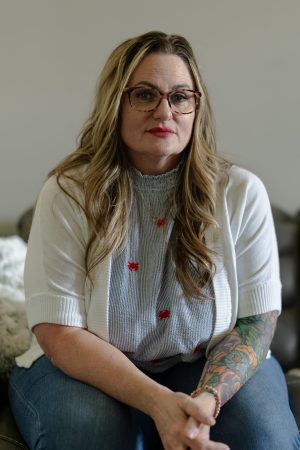
Lindsay Ward, who inherited the mutation that causes RVCL from her mother, lives an active lifestyle.CHARLES FOX / Staff Photographer
What is RVCL?
Fewer than 50 families worldwide are known to have RVCL.
The rare disease is often misdiagnosed as various autoimmune diseases, including multiple sclerosis and lupus. Only through a genetic test can patients verify an RVCL diagnosis — characterized by a mutation in a gene called TREX1.
The gene encodes a protein of the same name, TREX1, which, when mutated, becomes misplaced in a cell and damages DNA.
Over time, this causes small blood vessels to break down and disappear. The loss of blood flow leads to organ damage, including blindness, glaucoma, chronic kidney disease, strokes, and neurological effects.
When asked how he felt about the donation, Miner reflected on seeing many patients die from the disease and kids lose their parents young.
“I believe that everybody deserves a chance to live,” he said.
A potential drug
Jonathan Miner directs the RVCL Research Center at Penn.Credit to StoryTrack Studio
Miner’s drug candidate belongs to a new class of medicines called a degrader.
The drug eliminates the mutated TREX1 protein by pairing it with another protein called “E3.” E3’s role is to label other proteins for destruction, much like putting a shipping label on a package to direct it to the right address.
By labeling TREX1, “it basically tells the cell’s own machinery to eliminate this faulty protein,” Miner said.
If the drug proves effective, patients would ideally take it before they get sick, to prevent injury to blood vessels and organs.
When tested in mice with the disease, the drug protected cells from DNA damage and prevented premature death.
“We haven’t seen side effects in the mice, but we need to do much more extensive studies to prove that there are no side effects in animals before we can move forward,” Miner said.
The first and only FDA-approved degrader was developed for advanced breast cancer and approved in May. Miner’s TREX1 degrader is one of many variations on the novel technology that have emerged.
The $10 million donation will fund preclinical safety studies. The goal is to complete this testing over the next year, and, if it proves to be safe, move on to humans.
If the drug advances to a clinical trial, it would still take years to test the safety and efficacy. Most treatments evaluated in clinical trials do not become standard practice.
“Nothing has moved the needle yet in terms of delaying death and disability,” Miner said. “This, we think, gives us a real chance.”
Waiting
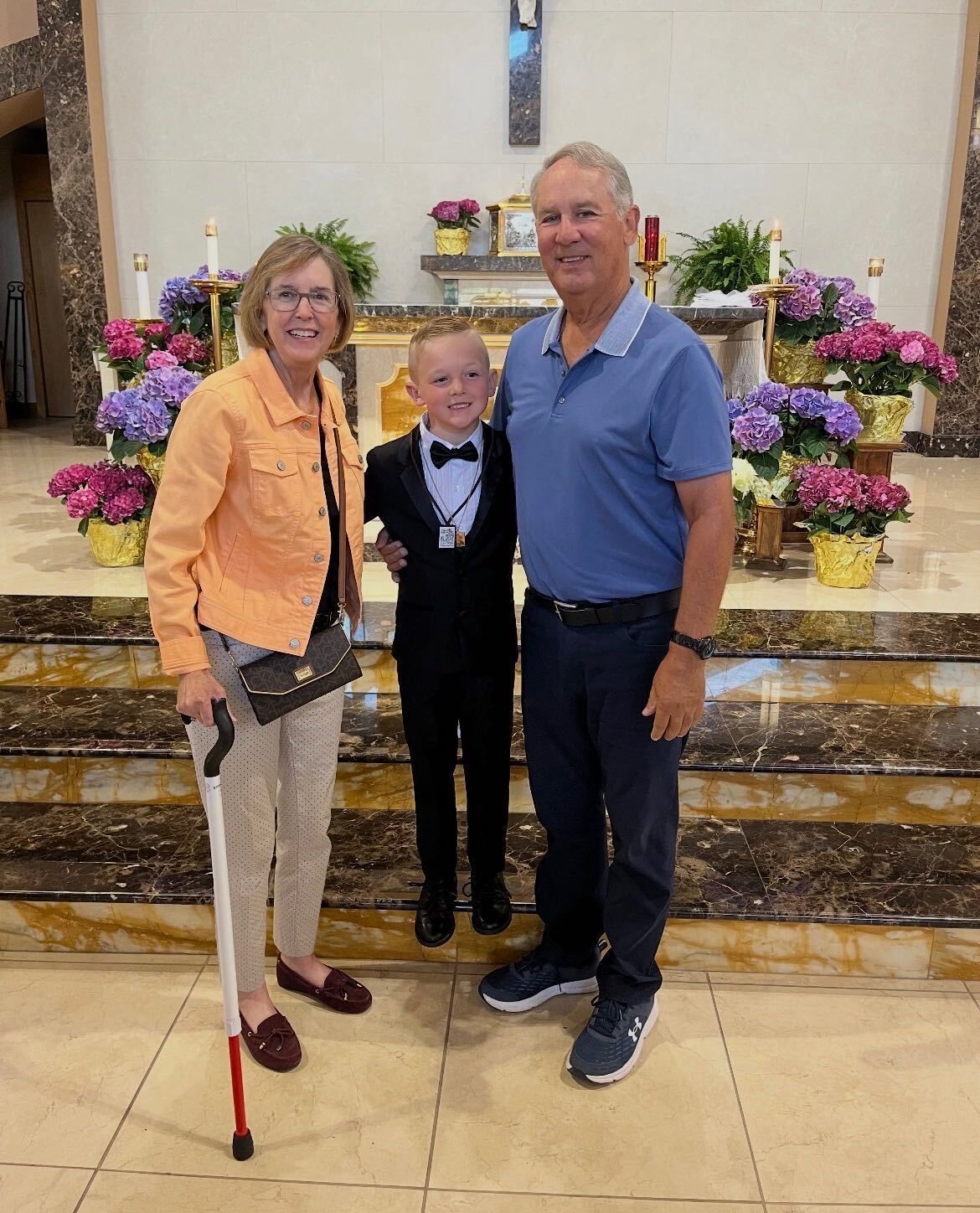
Barbara Small, her husband Dave, and grandchild Declan.Courtesy of Lindsay Ward
Ward’s 67-year-old mother, Barbara Small, who lives in Cape May Courthouse,started to show symptoms in her 50s.
What began as blurry vision and a damaged optic nerve progressed to a stroke. Roughly four years later, in 2018, she was diagnosed with RVCL.
Today, she is “pretty much blind” in one eye, Ward said, and has had a few strokes. She will frequently have aphasia, a communication disorder that can cause trouble speaking, and memory issues. Small is physically weak overall, and cannot walk very far without having to sit down.
“It is very challenging to see what your future will be,” said Ward, who helps take care of her mother.
Ward gets an MRI and diagnostic eye testing every six months to check for symptoms.
She and her husband, Matt, have three kids, with the youngest being a year and a half old. They don’t know whether their children inherited the mutation (testing is not recommended in children due to the late onset of the disease).
Lindsay Ward, 37, has three children with her husband, Matt.Courtesy of Lindsay Ward
However, if a preventive treatment were to come out, she would test them sooner.
Ward recently attended the International RVCL Symposium at Penn, where Miner presented on his research and potential clinical trial.
For patients like her mother, the treatment would likely just stabilize her condition and not reverse existing damage, she said. However, Ward is hopeful that the drug, if proven to be safe and effective, could help prevent her and her kids (should they test positive for the mutation) from becoming symptomatic.
“I would like to live a long, healthy life,” she said. “That would be my goal.”
WASHINGTON — In a Pennsylvania election where a few thousand votes could make all the difference, the last-minute entrance of a Green Party candidate with a background in Republican politics has sparked the second allegation of election meddling in three months and complicated one of the nation’s most competitive U.S. House races this fall.
But the emergence of a third-party candidate has alarmed both Democrats — who have long claimed that Green Party candidates pull votes from their nominees — and the Green Party of Pennsylvania, which said it does not know the person now representing its platform in one of the state’s highest-profile races.
“It sounds a lot like somebody’s just fooling around and trying to use the Green Party name, which is a well-known thing that happens in many states,” said Tim Runkle, cochair of the state party.
Andrew Tupone, 37, of Northampton County, filed his nomination papers with the state last week ahead of a Monday deadline for third-party candidates. He was the only candidate to file to represent the Green Party in a Pennsylvania race for Congress.
Unlike the Green Party’s endorsed candidate for governor — Tony Dastra of Lancaster County — Tupone does not have a long association with the party or its left-leaning policies. In 2021, he was the Republican nominee for a Northampton County magisterial court seat. Voter registration records show he changed his party affiliation from Republican to Democrat in February, and then from Democrat to Green in April.
In an interview, Tupone rejected accusations that he remained affiliated with the Republican Party or that he was asked to run in a way that would draw votes away from the Democratic nominee. He described a leftward shift in his political views after voting for President Donald Trump in 2020, though he said he could not recall whom he voted for in the 2024 presidential race between Trump and Democratic Vice President Kamala Harris.
“A lot of people are disillusioned with both parties,” Tupone said. “They’re sick of all the stuff that’s going on.”
Tupone also said he did not pay anyone to help gather signatures for his nominating papers, which he turned in with upward of 9,000 signatures — more than twice as many as required. Runkle said Green Party members encountered paid canvassers for Tupone who declined to say who was funding the effort.
According to a copy of the nominating papers obtained by The Inquirer, only one of the 22 individuals who gathered signatures is from Pennsylvania. The rest are from all over the country. Multiple have worked for Republican campaigns, according to public records.
Colin McEvers, who gathered signatures for Tupone in Lehigh County, is a Republican candidate for the Maryland General Assembly who is also listed as the contact for the Maryland White Republican Council. Others — including individuals from Illinois and Michigan — have been paid to canvas for GOP campaigns, according to Federal Election Commission records.
Tupone said he had no knowledge of anyone paying his canvassers.
“I went around and I gave a lot of my nominating papers to friends to give to other people, and I sent it to them as well,” Tupone said. “And as I went around, I recruited people and asked them.”
While the signatures appear to be based in the district — which stretches from the cities of Allentown, Bethlehem, and Easton into the more Republican-leaning Poconos — the other candidates have until Aug. 10 to challenge their legitimacy.
Such challenges are common, and the Brooks campaign is reviewing its options to decide whether to bring a challenge, according to a source familiar with the campaign’s thinking.
‘No one’s paying me to run’
Jenna Kauffman, Brooks’ campaign manager, in a statement described the situation as a GOP-initiated and “desperate scheme to meddle in this race.”
She connected it to a last-minute $1.7 million advertising campaign against Brooks in the May primary that appeared to be run by Democrats but was actually funded by a Republican political organization.
The spending, by a political action committee called Lead Left, was aimed at boosting another Democrat who observers considered to have a worse shot at beating Mackenzie in the November election. But the effort was anonymous, and records that became public only after Brooks won show that it was funded by the Conservative Americans PAC.
The effort to prevent Brooks from emerging from the Democratic primary came as he coalesced support from across the ideological spectrum with high-profile endorsements ranging from moderate Democratic Gov. Josh Shapiro to U.S. Sen. Bernie Sanders (Ind., Vt.), a democratic socialist.
“Voters deserve to know who is paying for this effort and whether Ryan Mackenzie and his Republican backers are involved,” Kauffman said, painting Tupone’s candidacy as a continuation of the move in the primary.
Mackenzie’s campaign did not address that comment when asked about it Monday.
Tupone said that the inference was “just false,” and that he instead likes the values of the Green Party, which he said included supporting the environment, social justice, and “stopping the corruption and also the genocide in Gaza.”
“No one’s paying me to run. No one’s asked me to run for this office. I’m running on my own, hopefully with a lot of hope from everyone who wants to volunteer,” Tupone said. “I’m not associated with the Republican Party anymore. I’m not a candidate for them.”
For years, Democrats have voiced concerns about the Green Party and other third-party candidates “spoiling” elections, from Jill Stein in the 2016 presidential race that first put Trump in power to the 2024 U.S. Senate race in Pennsylvania, when Democratic U.S. Sen. Bob Casey lost to Republican Dave McCormick by about 15,000 votes. In that 2024 election, a Green Party candidate won about 66,000 votes, a Libertarian candidate won almost 90,000, and a Constitution Party candidate won more than 23,000.
In the 7th District in 2024, Mackenzie defeated incumbent Democrat Susan Wild by 4,062 votes out of more than 403,000 cast. That was the narrowest margin out of any of the state’s 17 districts, making it a key tossup district this year.
That margin is also significantly different from the one Shapiro potentially faces during his reelection campaign this year as he maintains a sizable lead over Republican Stacy Garrity, and as a Green candidate officially filed to run on Monday. Shapiro defeated Republican Doug Mastriano in 2022 by almost 793,000 votes; the Green Party candidate won just over 24,000 votes.
Runkle said that nobody solicited the Green Party’s endorsement in a Pennsylvania congressional race this year, and that a conversation he had with Tupone left “a lot of questions.”
He said the party is concerned about its reputation and about being targeted in ways that do not lift up its platform, which focuses on environmental protections and liberal positions on healthcare. But he also pushed back on concerns that the party should be considered a spoiler.
“I do solidly believe that the Green Party policies and the values we represent has a solid bloc of voters,” Runkle said. “If people think that’s spoiling the race, then they should try harder to speak to the issues that we speak to.”
Cannabis is seemingly everywhere. Is it in the workplace?
More than 64 million Americans over the age of 12 used marijuana in 2024, a 19% increase since 2021, according to a recent report from the U.S. Department of Health. And while cannabis is restricted to medical use in Pennsylvania, customers can now easily purchase these products over the bridge at more than 300 shops in New Jersey, where state law allows recreational use.
Currently, cannabis is classified as a Schedule I controlled substance by the federal government. But an active effort to move it to the less restricted Schedule III classification is underway. If that happens, cannabis use will likely become even more common.
All of this is having an impact on employers’ drug policies. Given its widespread use, and predicted growth in popularity, should cannabis be included in the testing and screening of employees at all?
Should employment drug screens include cannabis?
Some experts, like Marissa Mastroianni, an employment attorney at Cole Schotz in Hackensack, think not.
“In most cases I recommend clients drop cannabis from their testing and screening in light of the employment protections being passed for cannabis users across the country and particularly New Jersey,” she said.
“I see many employers simply dropping cannabis from their standard drug testing panels unless federal law, industry rules, or a safety-sensitive job requires it,” Mastroianni said. One of the big reasons, she points out, is that cannabis, unlike alcohol, can remain in your bloodstream for many days after it’s been consumed.
“In both Pennsylvania and New Jersey, the old blanket zero-tolerance approach just doesn’t work anymore,” she said. “The focus has shifted — it is no longer about whether someone uses cannabis at all, but whether they are actually impaired at work.”
A changing process for drug testing
Drug testing, depending on the company and its industry, is still very common, and for good reason. But the process is changing.
“Reasonable-suspicion testing, where a supervisor sees actual signs of impairment, is really the most defensible and practical approach right now,” said Mastroianni. ”Random testing is best saved for safety-sensitive positions or jobs where federal regulations require it, like Department of Transportation-regulated roles.”
Employers must be careful when requiring testing, said Marjorie Obod, co-chair of the labor and employment practice at Philadelphia law firm Dilworth Paxson.
“Because Pennsylvania recognizes medical marijuana, it prohibits employers from discriminating against somebody based on its use,” she said. Occupational Health and Safety Administration (OSHA) rules say employers “can’t just go drug test everybody.”
So, Obod said, “if there’s an incident, you’ve got to have some proof that the drug abuse had something to do with the incident.”
To minimize potential discrepancies, Obod recommends that a company’s screening and testing policies include “at least two people, not just one person claiming that the person needs to get tested.”
Reporting incidents
A good policy must also address how to handle drug-related incidents. I learned this recently when visiting a manufacturing client, where one employee arrived at work under the influence of opiates and had a violent reaction on the factory floor. Luckily, the client had a medical kit on hand that included the drug Narcan.
The employee was ultimately fine. My client, having seen this before, had a strict protocol. He said keeping medical supplies handy and providing training for all workers on how to identify and address a potential substance-abuse issue has been important.
“All employees should be on the lookout for suspected drug or alcohol impairments,” Mastroianni said. “When an incident occurs it should be documented in writing with all reports going to a designated point of contact — like an HR professional or safety officer — and grounded in what someone actually observed like slurred speech, or unsteady body movements.”
Obod said it’s important to have “a clear, written reporting protocol” so employees can flag suspected impairment without worrying about retaliation.
“If there’s an incident, you’ve got to have some proof that the drug abuse had something to do with the incident,” she said.
Your cannabis policy is your policy
Some businesses, particularly those that handle hazardous materials or are engaged in higher-risk work, will create drug policies in keeping with stringent regulatory rules.
But for the most part, as long as you’re in compliance with both federal law and state laws, which differ in Pennsylvania or New Jersey, you’ll be free to determine the extent of cannabis testing and screening requirements you want to include. Considering the changing complexity of this issue, it’s critical to have an expert, such as an HR professional or employment attorney, perform regular reviews of your company’s drug policies.
“You have OSHA, you have the Americans With Disabilities Act, you have privacy issues, you have governmental, federal law, state, you have all of these things,” said Obod. “If you’re not talking to a lawyer, you may not recognize that your drug policies are not in compliance.”
Gabriella’s Vietnam, the acclaimed South Philadelphia restaurant known for showcasing regional Vietnamese cooking, will close in mid-December after nearly six years as chef-owner Thanh Nguyen searches for a new home.
Nguyen began looking for another location last fall after the building at 1837 E. Passyunk Ave., near Mifflin Street, was sold. She has continued operating under a month-to-month lease while planning the restaurant’s next chapter.
The building’s new owners, Bharat Bist and Gigi Giri — who operate Mount Masala in Voorhees and Nepali Momo Kitchen in Spring Garden — plan to open a yet-to-be-named Himalayan restaurant there early next year. Giri said the menu will combine Mount Masala’s bold stews with Nepali Momo Kitchen’s extensive lineup of momos, the steamed, filled dumplings.
“I have a dream to do something different,” said Giri, whose husband, Bist, is the chef.
The couple also plan to open a shop serving coffee and momos on Third Street near South Street within the next two months.
Nguyen said she and Giri reached an agreement that allowed Gabriella’s to remain open through mid-December.
“Gigi was very sweet and nice,” Nguyen said. “She didn’t kick me out right away, and she gave me a year.”
Gabriella’s backstory and future plans
Gabriella’s, which opened in February 2021 in the former home of Ange Branca’s Saté Kampar, has earned widespread acclaim. It appeared on The Inquirer‘s 76 list and was named to the New York Times’ 2022 list of Best New Restaurants.
The restaurant helped broaden Philadelphia’s understanding of Vietnamese cuisine beyond pho and bánh mì, centering its menu on dishes from across Vietnam’s regions. Among its specialties are lemongrass clams and a catfish hot pot, dishes rarely found elsewhere in the city.
For Nguyen, Gabriella’s also fulfilled a longtime personal ambition.
“I came to the U.S. and went to school for my family, not for me,” said Nguyen, who left the University of Pennsylvania one English composition class short of completing an undergraduate degree in biochemistry. “I wanted to make a business like my family did.”
She told The Inquirer’s Craig LaBan that her parents own a seafood market in Ho Chi Minh City, formerly Saigon, and initially disapproved when she entered the restaurant business with her husband, Chris.
The couple began building their restaurant company in the suburbs in 2012, opening Banh Mi Bar & Bistro in Norristown, followed by Melody’s Grillhouse in Ambler. Gabriella’s Vietnam, named for their younger daughter, marked a shift toward a more ambitious menu focused on traditional Vietnamese cooking beyond the country’s best-known dishes.
Nguyen hopes her next restaurant will have a full liquor license, allowing her to expand the beverage program alongside the food. Gabriella’s now operates under a satellite license through Five Saints Distilling that permits it to serve Pennsylvania-produced spirits, including the vodka used in its signature pho cocktail.
Developing those drinks sparked an unexpected passion for mixology, Nguyen said, and she envisions her next restaurant having a larger cocktail program and a menu of bar snacks to complement its Vietnamese cuisine.
“I had several restaurants in the suburbs, but when I came to Philly, I realized Philly was really missing traditional Vietnamese food besides bánh mì,” Nguyen said. “There are so many other foods popular in Vietnam that don’t get as much focus. And I want people to try it.”
JEFFERSON, Ga. — Marci Bakely couldn’t understand how her ex-boyfriend always seemed to know where she was.
When she went to buy groceries or on a date or to the doctor, he’d text her about it, sometimes within minutes, despite working 15 miles from her home as a police chief in a small town in the Atlanta suburbs. One day in 2024, when he incorrectly suspected that she’d gone to see a man against his wishes, he messaged her, “I didn’t think you would slip up,” according to texts she shared with The Washington Post.
Bakely, 50, began to feel like she was constantly being watched. She says she installed three cameras around her home and on her patio, to see if he was staking out her cul-de-sac. She bought a hidden-camera detector and nervously waved it down every wall. Three times, in desperation, she says she drove her Kia to a mechanic’s shop, asking them to scan for trackers on her car.
Then one day, when she pressed him for answers, her ex told her in a text: He was using Flock.
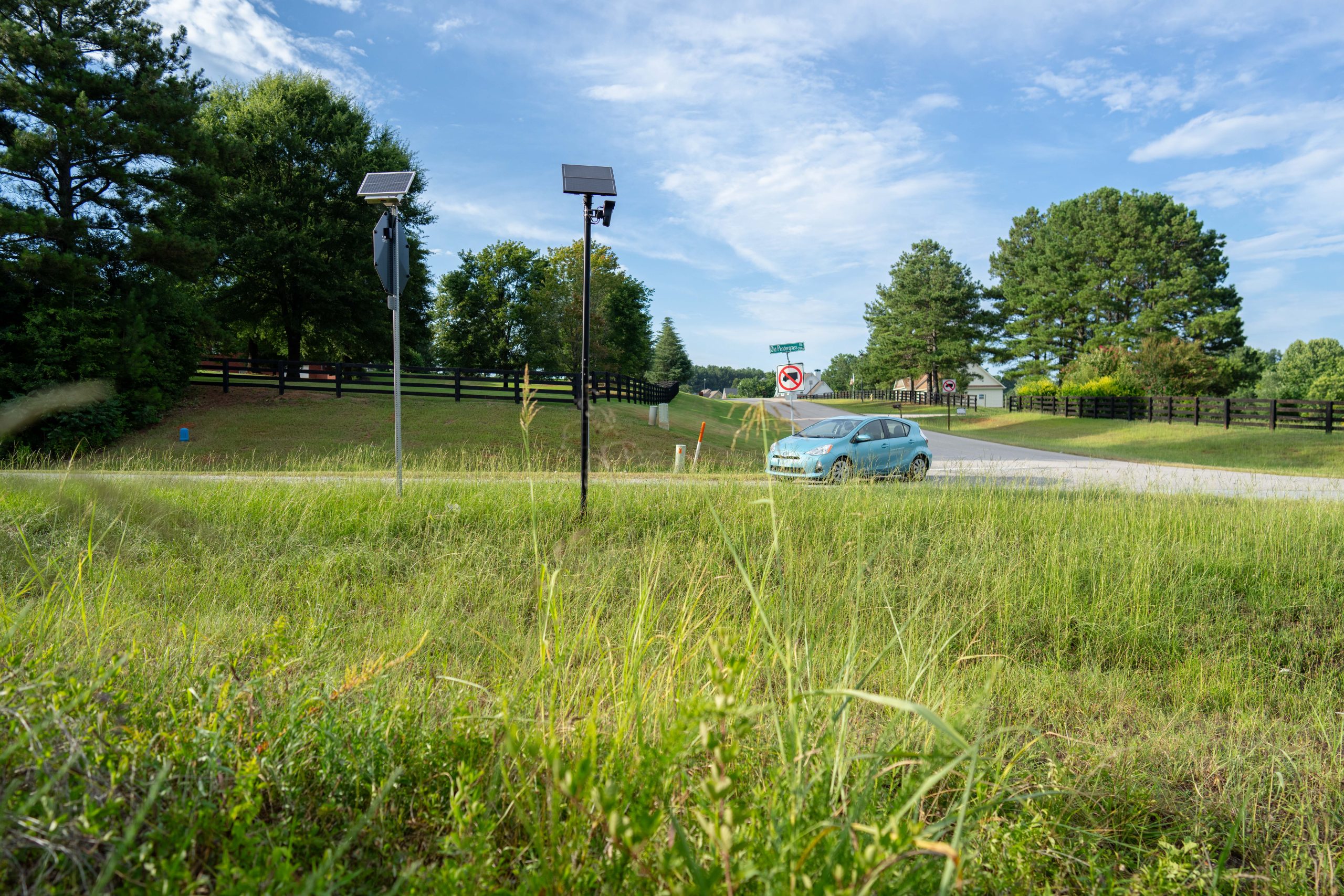
Like thousands of other law-enforcement agencies across the United States, his police force could follow cars spotted by Flock’s sprawling network of artificial-intelligence roadside cameras, which record passing license plates into a mappable database that officers can search while investigating crime.
Flock had sold its system as a police officer’s dream crime-fighting tool. But the tool had also given the chief, Michael Steffman, the power to silently monitor Bakely’s life. By the time she understood what was happening, Steffman had looked up the tags for her and her teenage daughter roughly 600 times, according to Have I Been Flocked, a website that aggregates police search logs made available through public records.
Steffman was arrested in November on charges of stalking, harassment and license-plate-reader misuse. In April, before a trial could take place, he was found dead in his home from what officials said was a suicide. The town manager of Braselton, where Steffman worked, declined to comment. The town’s new police chief and four members of Steffman’s family did not respond to requests for comment.
Backed by some of Silicon Valley’s top investors, Flock has rapidly grown into a colossus of American technological surveillance. A leader of the surging industry for license-plate readers, the company told The Post that its more than 120,000 shoebox-size cameras now scan the roads of more than 6,000 communities and record 20 billion plate scans a month.
But bad actors have used this massive camera network as a powerful weapon for intimate surveillance. Authorities have charged or accused at least 50 law-enforcement officers of using license-plate readers for unauthorized purposes, including to stalk women without their knowledge or consent, a Post analysis of police and court records found.
In 26 of these cases, police investigators and prosecutors said the officers used the technology to spy on their wives, their girlfriends, their exes, their exes’ new partners or women they wanted to meet. In other cases, police or prosecutors have not specified the alleged surveillance targets. Flock’s system was used in 46 of the cases analyzed by The Post, while the other cases involved competing products.
Many of the plate-reader misuse cases were previously covered by local media outlets, and some were first compiled by the Institute for Justice, a civil liberties law firm in Arlington, Virginia.
The Post reviewed thousands of pages of court documents and internal police reports and conducted interviews with seven alleged victims, some of whom spoke publicly for the first time, to paint a comprehensive picture of the misuse of Flock and other license-plate readers by police officers around the country.
The review found that Flock gave police departments wide latitude about whether to activate settings that some police and privacy advocates argue could deter misconduct, and that many departments conducted limited oversight of their officers’ searches. As a result, rogue police were able to monitor their subjects’ movements with precision and secrecy.
After The Post relayed its findings to Flock, the company said in a statement it “will soon be announcing better filters and tools to stop abuse before it happens.”
Flock officials said in interviews that officers who misuse its technology represent a small share of its 140,000 active users, and that the company offers training guides and search logs to help police departments run internal audits. In April, the company rolled out a new voluntary “audit assistance” feature, which agencies can choose to enable, that automatically scans officers’ searches for suspicious activity, such as queries repeatedly targeting the same vehicle or run by officers off the clock.
In an interview with The Post, Flock chief executive Garrett Langley said misuse of its systems is inevitable and that the company is focused on providing tools to catch perpetrators after the fact. In their contracts with Flock, police departments agree to use the tool solely for “bona fide investigations” of crime.
“We’re not going to change humans, and humans make bad decisions,” Langley said. “What we can do is make sure that they know if you use this tool, you will be held accountable.”
The Post’s investigation sheds light on the scope of the technology’s misuse across the country, as well as the toll on victims and families who felt they were constantly being watched.
Through automated license-plate reader systems, or ALPRs, officers could trace the rhythms and travels of their subjects’ daily lives, leading in some instances to violent confrontations, moments of psychological manipulation, and threats of coercion and control, the analysis found.
In Wisconsin, a police officer allegedly used Flock to check whether his ex-girlfriend had gone to an abortion clinic, according to a police affidavit for a case set for trial this month.
In Kansas, a police chief who tracked his ex through Flock sneaked up on her while she was intimate with another man, a state police certification body alleged, leading to his firing.
In Florida, a deputy speeding to stop a young actress he’d added to a watch list for a license-plate tool called Guardian nearly caused a head-on crash, according to a police report and video from his dashboard camera. The deputy was arrested in March, and his attorney declined to comment.
And in California, prosecutors said a former deputy, Alexander Vanny, used Flock as part of a months-long campaign of “stalking” and “humiliating” his former fiancée that also involved following her around town and installing a hidden camera in her roommate’s bathroom, according to a sentencing brief.
Vanny was convicted by a jury on 10 charges, including stalking and unauthorized access of electronic data, and sentenced in February to six years in prison. His attorney told The Post that case focused on Vanny photographing the license plate of a man who’d driven away with his former fiancée after she’d gone to a bar, and that he’d done so out of concern for her.
While some of the searches resulted in officers’ firings, prosecutions and prison sentences, police departments in other cases allowed officers to continue using the systems even after receiving warnings that they were being misused.
“This was not a lapse in judgment; it was a continual, repetitive, obsessive behavior,” a Wisconsin woman wrote in a domestic-abuse restraining order petition, saying that Flock data showed that her officer ex-boyfriend had searched the plates for her and her partner 179 times. She said she lived in a “constant state of fear and unease.”
An array of privacy advocates has argued that Flock could deter bad actors by making simple changes to its product, such as requiring officers to label every search with a criminal case number. Some policing experts also warned that agencies’ inconsistencies in developing and enforcing standard procedures for license-plate readers could lead to further misconduct. With no federal laws governing use and only a patchwork of state laws, many of the country’s roughly 18,000 police agencies are left to decide their rules on their own.
Christian Quinn, a former commander with the Fairfax County police in Virginia who now consults with agencies and technology vendors, said privacy features and oversight by local governments shouldn’t undermine the ability of police to do their jobs. Rules that significantly limit license-plate technologies, he said, could “chill the use of them altogether.”
But Eva Galperin, the director of cybersecurity at the advocacy group Electronic Frontier Foundation, said that abuse of the tool is “inevitable” and that the company’s approach to date, coupled with poor supervision by police leadership, has done little to protect women from abusive police officers.
“Flock has already claimed that they have oversight, that they have guardrails, and we still see these kinds of abuses,” she said.
Officers’ searches are logged by police agencies, but only some of them have been made available through public-records requests, making it tough for people to find out whether their cars are being tracked. Some of the women said they learned of the surveillance only after they received calls from internal-affairs investigators or ran their plate numbers through third-party tools such as Have I Been Flocked.
Some victims, such as Bakely, also say they’ve struggled to get their experiences taken seriously because the perpetrators are police, entrusted with broad authority to pursue investigations with operational secrecy and employed by the same agencies they were told to call for help.
Bakely said the cameras had left her feeling powerless to stop her ex-boyfriend from tracking her life. She didn’t feel safe asking the police agency he led, she said, and she couldn’t get access to records that would have shown the surveillance was happening in real time. After Steffman told her about his Flock searches, she filed for a restraining order, but a judge denied it on the basis that she couldn’t prove ongoing abuse, court records show.
He “watched every single move I made,” she said. But “who do you turn the chief of police in to?”
Flock has more than 120,000 cameras in more than 6,000 communities that record 20 billion plate scans a month. (Kevin D. Liles/For The Washington Post)Kevin D. Liles
‘As transformational as DNA’
When Bakely met Steffman on the dating app Tinder in 2022, he seemed like a perfect catch.
He had kids and coached Little League baseball. He loved crude jokes and was quick with a compliment. And he had a stable career, with 20 years in law enforcement. After several tough months during which Bakely, an Air Force veteran, uprooted her life to move closer to her parents, he helped her feel safe, like she wasn’t alone.
“He literally was my only friend,” she said in an interview.
After a few months, she said, he began to act differently — more controlling and paranoid. He looked through 13 years of her Facebook history, forcing her to block men who’d left her comments, she told The Post. He also demanded access to her Ring doorbell camera and looked up all the names in her phone’s contact book.
The couple broke up in late 2023, she said, but Steffman’s texts didn’t stop. Randomly, sometimes in the middle of the night, he’d ask cryptic questions about where she’d gone then say he’d already “looked it up,” according to a text exchange reviewed by The Post. She said he seemed to relish the idea of knowing things about her she had not wanted to share.
One day in July 2024, after she had pushed him to explain himself, he told her he had used a “Flock camera.” She had no idea what that meant.
“It’s a camera system that reads tags,” he wrote in messages she shared with The Post. He insisted that it was a lapse in judgment and that he wouldn’t “ever look again.”
“Don’t worry I’m not tracking you or some weird stalker s–t,” he wrote, with a cry-laughing emoji.
It had been seven years since Flock had installed its first camera not far from here, in Atlanta, as part of an idea by Langley — then a recent engineering graduate from Georgia Tech — to protect his neighborhood from a string of smash-and-grabs.
Langley’s first camera was an Android phone, hung outside in a rainproof box. But soon his start-up began promoting itself as something far bigger, saying it was building “the first public safety operating system that eliminates crime.”
The company dispatched installers to hang the cameras along public roadways and sent sales teams to city halls and police expos with offers of quick-start leasing deals costing around $3,000 per camera per year, public contracting documents show.
Thousands of cities and police departments bought into the idea, and Flock gave them the choice to share their Flock data with other agencies or to view others’ data from across city or state lines. Many homeowners associations, apartment complexes and strip malls began signing up, too, giving them a way to search through their own local camera feeds.
Flock quickly became the most prominent player in the burgeoning license-plate-reader business, rivaling systems from competitors such as Axon’s Fleet 3 and Motorola’s VehicleManager. Despite lacking the established law-enforcement relationships of its peers, Flock’s surveillance-subscription packages made its cameras accessible for small-town police departments and neighborhood-watch groups. Flock said last year it had surpassed $300 million in annual revenue.
Flock told agencies that it could set its “own written rules for who can access the system and how it can be used,” company documents show. Agency leaders decide which officers receive log-in credentials, according to Flock’s rules, and the officers don’t need a warrant to run a search; they just type a plate number and go.
Over time, Flock upgraded its tool’s surveillance power, creating “hot lists” that notify officers whenever a target car is captured on camera and a “vehicle fingerprint” feature that lets them search for a vehicle by its look or characteristics — say, any white minivan with bumper stickers — without knowing its plate number, company documents show.
Flock engineers improved the cameras, too, wiring them to use solar panels and cellular networks so that they could be installed anywhere and record at all hours. Flock’s flagship camera, the Falcon, uses a style of AI image recognition, known as computer vision, that can read the plate on a speeding car at night or in heavy rain.
Big venture capital firms including Andreessen Horowitz, an early Facebook investor, have poured money into Flock, betting on the company as a way to revolutionize policing. Flock, a private company, said last year its business was worth $7.5 billion.
In a TED Talk in April, Langley said the company had expanded into making camera drones, police software and audio-detection devices after seeing its success in license-plate readers, which he said a police chief had told him were, for crime fighting, “as transformational as DNA.” He shared the story of how police used Flock to stop the abductor of a girl in Tennessee and said, “I don’t know how many more 11-year-old girls need to be kidnapped … before we say enough is enough.”
Asked onstage whether his system’s use ever made him uncomfortable, Langley cited three recent instances of officer misuse, including a case that resembled Steffman’s: “a police chief in northern Georgia that used Flock to track an ex-partner.” Langley noted, however, that Flock’s audit logs had been used to investigate the abuse — evidence, he said, that the company’s safeguards were working.
“He was probably a bad person. He was going to do this, one way or another,” Langley said. “And so I look at the 1 million-plus” criminal investigations Flock says it helped support last year “and go, okay, this is a trade-off that I can make.”
Bakely says her ex-boyfriend “watched every single move I made” by using Flock. (Kevin D. Liles/For The Washington Post)Kevin D. Liles
‘The police are already here’
For months, Bakely hadn’t realized how often she had been driving by Flock cameras, which looked like automatic air fresheners and had been mounted high atop black utility poles. One recorded the road she drove to the Kroger supermarket; another faced a gas station. In the small downtown of Jefferson, where she lived, there were two recording in opposite directions, one on each side of the town’s central creek.
She had believed Steffman when he said he had looked up her plates just once. Months later, when Bakely heard about the Have I Been Flocked website on the local news and looked up her plate’s search history, she learned the truth. He had searched her car hundreds of times over a span of about 13 months, sometimes dozens of times a week, the audit records showed. Many of his searches were made between midnight and 4 a.m.
As Flock’s popularity had ballooned with police, more officers had begun treating the tool like a personal spy device. In Kansas, a woman who drove her children to her father’s house for breakfast one morning began receiving text messages from her ex-husband, Kechi police lieutenant Victor Heiar, demanding to know where she had taken their kids, according to an interview she gave police and text messages she shared with investigators that were reviewed by The Post.
Heiar later described the restaurant where she had just celebrated her birthday and the center where she took their kids to day care — a location she had hidden from him out of fear and distrust, she told police. Heiar was fired, his state police certification was revoked and he pleaded guilty to computer crime and stalking, for which he was sentenced to 18 months of probation. The Kechi police chief declined to comment. Heiar and his attorney did not respond to requests for comment.
And the monitoring sometimes preceded threats of violence or control. In Florida, Orange City officer Jarmarus Brown called his girlfriend on FaceTime to show her videos of her driving, according to a sheriff’s office report. Once, he went to her apartment, grabbed her and reminded her that he carried a gun, leading her to threaten to call the police, an investigator’s incident report alleged. He responded, the report said, by referring to himself: “The police are already here.”
Brown was arrested last year and pleaded no contest to a charge of unauthorized use of computers. He was sentenced this month to five years of probation and a $618 fine. Brown’s attorney and the Orange City police did not respond to requests for comment.
In some of the cases, officers used the searches to uncover deeply personal information about their subjects’ lives. In Wisconsin, Menasha officer Cristian Morales used Flock to check whether his then-girlfriend had gone to a clinic to “seek a potential termination of said pregnancy,” according to an affidavit from an investigating officer with another police department seeking to subpoena Flock for search records.
He texted the woman to say he had verified she didn’t go to the clinic and told her, “You continue to lie,” the affidavit alleged. He later contacted the clinic in an attempt to obtain her medical records, confronted her at her home and began calling her as many as 19 times a day, according to the affidavit.
The woman and Morales’ attorney declined to comment. The Menasha police did not respond to requests for comment. Morales was charged in January with misconduct in public office and has pleaded not guilty. A criminal complaint said Morales admitted to searching for the woman’s vehicle, labeling them in the Flock system as “welfare” checks, and blamed his decision on bad judgment, desperation and a lack of sleep.
Some officers, however, have defended their personal searches as normal behavior for police. Coty Wayne Hall, an officer in Niceville, Florida, ran 192 inappropriate Flock searches, including to track a former romantic partner, according to an internal-affairs investigation. The woman, a fellow officer, told investigators he once texted her details about what she was wearing one day when she took her kids to the park.
Hall was fired, pleaded no contest to charges of computer-system misuse, stalking and battery, and was sentenced to probation. In an interview, he said it was unfair that he was being made “out to be some sort of monster.”
“Pretty much everybody uses that computer system” improperly in the department, he said, and “they don’t audit it [nearly] as much as they should.” Niceville Police Chief Mark Hayse said in a statement that the department’s Flock use was audited “and only one individual was found to be out of compliance.”
‘No consequences’
Flock’s defenders have argued that the prosecutions of rogue officers prove that its guardrails work. But in some cases, officers were allowed to keep searching Flock’s data after being accused of misuse.
In Jerome County, Idaho, Sheriff Gary Taylor told The Post that a previous sheriff, George Oppedyk, had searched for his wife’s car several times a day in the weeks after a prosecutor filed a complaint about him to the Idaho attorney general’s office.
Oppedyk resigned months afterward, more than two years before his term was slated to end, and faced no charges with the attorney general, Raúl R. Labrador, who said in a February letter that his office couldn’t prove a crime “beyond a reasonable doubt.” Oppedyk, the letter said, had argued he’d run the searches “to check the system’s reliability.”
Labrador said in a statement that his office did not have the authority to prosecute Oppedyk because license-plate-reader misuse in Idaho is not regarded as a “standalone crime.” He said he is working with state legislators to address this “gap in the law” so that they can prosecute future misuse.
Taylor said in an interview that Flock is a powerful law-enforcement tool but that he worries “a few bad apples [could] ruin it for everybody.”
“If there are no consequences because the sheriff who abused it didn’t get in trouble, what’s to deter other people from doing the same thing?” Taylor said. Oppdeyk did not respond to requests for comment.
The vast majority of the surveillance targets identified by The Post are women, and several of them said the experience — menacing messages and confrontations that led to the revelation they’d been watched — left them feeling violated and paralyzed. Galperin, of EFF, said that asymmetry of power is a large part of what makes the tool so dangerous in the hands of bad officers.
“The goal of the abuser is to make themselves seem omniscient and omnipotent,” she said. “You don’t have to be watching your victim all the time. They just have to believe that at any moment you could be.”
In some cases, license-plate data was just one component of a broader stalking campaign. In April, Kyle Rector, a former officer in Bonner Springs, Kansas, was charged with using law-enforcement equipment to stalk his estranged wife and two men he thought she was seeing, including by using data from a license-plate-reader system called ELSAG. Investigators also alleged they found monitoring software installed on her computer and a video camera hidden in her bedroom light switch.
Rector has not offered a plea yet in the case, and his attorney declined to comment. A preliminary hearing is scheduled for September. Bonner Springs police said the agency is cooperating with investigators. ELSAG’s developer, the security contractor Leonardo, said it offers training and auditing tools to encourage responsible use.
Being subjected to extensive tracking left some women deeply unnerved, pushing some to change their lives or start driving their relatives’ cars in hopes of not being tracked. One woman, a sheriff’s deputy in Wisconsin who spoke on the condition of anonymity because she was fearful of further harassment, said she had her plate searched 16 times in a single day by a fellow deputy with whom she had been romantically involved.
The deputy lost his job after an internal investigation but has faced no criminal charges, and the lack of punishment has made the situation harder for her to move on, she said in an interview.
“I didn’t leave my house for a week,” she said. “I was scared to see him.”
Adam Dodge, a former family-law attorney and founder of the cyber safety training group EndTAB, said the tool is too easily misused by officers to engage in acts of domestic violence. The fact that the offenders have guns, badges and access to surveillance technology makes it even harder for victims to report their suspicions, he said, for fear that they won’t be believed and could face retribution if they speak out.
“Any time you give an abusive individual access to one of those systems, they are likely going to misuse it,” he said. And “where do you go as a victim if you’re being abused — you go to law enforcement, right?”
Some of the women who ultimately reported the misuse said they were dismissed or ignored. Alexandria Griffith, a mother in Leechburg, Pennsylvania, said in an interview that she repeatedly warned the police department and district attorney’s office that her officer husband had stalked and threatened her. During one text exchange she shared with The Post, the officer, Michael McSherry, shared a screenshot of her license plate in the search results of a Flock competitor to claim she had lied to him. “Plate readers dont lie,” he wrote.
Griffith said officials at both agencies dismissed her pleas. Within days, she said, McSherry confronted her in her parents’ home armed with a gun, shoving her and her 4-year-old son and threatening to kill himself, according to a police report.
In an interview with The Post, McSherry expressed regret for misusing the license-plate reader to track Griffith and disputed the police report’s characterization of the altercation. He was arrested and pleaded guilty to stalking and official oppression, for which he served roughly 11 months in jail.
“A lot of people … knew that all of this was happening,” Griffith said. “And they kind of just brushed me off.”
A car drives past a pair of Flock cameras in Jefferson, Georgia, last month. (Kevin D. Liles/For The Washington Post)Kevin D. Liles
‘Police the police’
Flock has said incidents of abuse are unfortunate but tough to fully prevent, given the vast network of nationwide users and the reality that any tool can be abused. The company said that its audit logs have proved valuable for internal investigations, and that the “audit assistance” feature has already helped address some instances of misuse. Flock last month said a department in Albany, Georgia, fired five officers after the feature flagged signs of misconduct.
Langley, Flock’s chief, has dismissed pushes by activists for the company to further limit how officers use its product.
“No one elected me the police chief of America,” he told Forbes last year, adding, “I don’t think it’s our job to police the police.”
Most law-enforcement agencies prohibit officers from accessing any police database for personal purposes, and in many departments such misuse is regarded as a fireable offense, according to Max Isaacs, director of law and policy at the New York University Law School’s Policing Project.
But due to a patchwork of rules and regulations, the extent to which such officers are punished varies widely based on their agency and state. Thirteen states have adopted laws requiring police departments to audit officers’ license-plate reader usage, the NYU group found. At least eight states have criminalized the misuse of license-plate readers, including Georgia, which classified this crime as misdemeanor “of a high and aggravated nature,” the statute says.
Some privacy advocates argue there are very basic changes Flock and police departments could make to prevent abuse. Jay Stanley, a policy analyst at the American Civil Liberties Union, told The Post that every search should require a criminal case number as “standard expected practice” because it could help “make lying harder and detection easier for a department that is well-managed enough to care.”
Flock said last year that it would start allowing agencies to turn on the criminal-case-number requirement for its own officers, but it’s an optional setting. A company spokesman told The Post that roughly 1 in 4 agencies had turned on the “audit assistance” feature, which sends in-app notifications to police supervisors.
Though Flock says in training guides that officers should detail a reason for each search, many of them have been justified with vague, one-word explanations, such as “investigation,” that make it harder for internal-affairs teams to evaluate, documents reviewed by The Post show.
After DeFlock Joplin, an advocacy group in the Missouri city, requested audit logs from the police, the group said that 85 percent of searches had a one-word justification, such as “suspicious” or “drugs,” and that less than 3 percent of searches had been linked to a criminal case.
Some experts suspect that many audit logs aren’t being reviewed at all — and that, if they were, officials would discover more cases of misuse. The Institute for Justice and other groups have proposed that Flock searches should be permitted only for officers who have obtained a warrant from a judge, much like police searches in the real world. A Flock spokesman said the company isn’t “capable or responsible for mandating a warrant,” and Flock’s defenders and investors have argued that the restriction would make the tool cumbersome and erode officers’ investigative edge.
“Most of the time when you need license-plate information, it’s a timeliness thing,” said Quinn, the former police commander. Requiring a warrant, he said, could delay police from responding to active safety threats.
Police departments largely acknowledge that license-plate readers require oversight, but absent federal laws around the technology many of them have not implemented strict guidelines to prevent abuse, said Chuck Wexler, executive director of the Police Executive Research Forum, a nonprofit that advises agencies on policing practices.
“This is the nature of technology and policing,” Wexler said. “Very often a technology will be farther ahead of policy, and that’s what has happened, I think, with license-plate readers.”
Some agencies that have set their own rules have found themselves scrambling to update them amid updates to the technology’s power. Jim Sheehan, a New Jersey program coordinator who helps write policies followed by more than 500 law-enforcement agencies in the state, said he is helping to revise local license-plate-reader standards for the third time since the rules were adopted in 2010.
Some advocates, however, fear Flock’s current approach merely allows police officials to police themselves. In Milwaukee, an internal-affairs detective investigating a fellow officer’s misuse of Flock was found, in a separate investigation, to have misused Flock to surveil an unnamed victim and later admitted to installing a GPS tracker on the victim’s car, according to a criminal complaint last month.
The detective, Tehrangi Chapman, was charged with misconduct in public office and misuse of a GPS device. Chapman and his attorney did not respond to requests for comment. Milwaukee Police Chief Jeffrey B. Norman said in a statement, “No one is above the law.”
Torin Monahan, a professor at the University of North Carolina at Chapel Hill who studies surveillance, said Flock’s resistance to stricter user oversight offers only “a performance of accountability” designed to minimize scandal and maximize new sign-ups from public-sector clientele.
“They don’t want any impediments to police adoption,” he said. “The more cameras that are on the network, the stronger the network becomes.”
But David Ulevitch, a partner at Flock investor Andreessen Horowitz, said the more than 40 Flock misuse cases were “an infinitesimally small number” relative to the hundreds of thousands of officers nationwide. It’s “truly a nonissue,” he said in an interview, “… and by the way, that’s 40 officers that now have been disciplined or charged or fired that otherwise would not have been, thank you to Flock.”
For Bakely, the searches from her ex-boyfriend stopped in August 2025, according to search logs later made public and compiled by Have I Been Flocked. That month, she had filed for a restraining order against Steffman, writing that he “uses the traffic (Flock) cameras to track my location,” her petition said.
A judge denied her request, saying that Steffman’s conduct was “concerning” but that Bakely had no evidence to “support current allegations of stalking.” After he suggested Bakely file a complaint with the local sheriff’s office, that office then referred the case to the Georgia Bureau of Investigation. Three months later, when agents arrested Steffman, bureau officials said an investigation found he had misused the license-plate system “to harass and stalk multiple individuals.”
Steffman died before a trial could be initiated, and superior court records do not list an attorney. Calls, emails and text messages sent to four of Steffman’s family members were not returned. On LinkedIn, he had said he retired after a career in law enforcement focused on “ensuring that every resident feels seen, heard and protected.”
Braselton’s town manager declined to comment, but a previous town manager said in a statement that the town was “disappointed by the circumstances and the charges.” Five days before GBI announced his arrest, the town’s Facebook page had posted a photo showing Steffman posing with the mayor and town council for a celebration of his 20 years of “dedicated service.”
His “leadership and commitment,” the post said, “have helped shape the department and strengthen the safety of our community.”
Patrick Marley contributed to this report from Madison, Wisconsin.
SPOKANE, Wash. — A man charged with intentionally setting a wildfire that’s destroyed hundreds of buildings in and around Washington state’s second-largest city was contacted by law enforcement about two fires last year, though he wasn’t charged in either, court documents show.
Aaron F. Farinacci, of Spokane, was arrested Monday and booked on suspicion of first-degree arson in connection with the Old Trails Fire, the biggest of three blazes that have destroyed at least 700 buildings and forced tens of thousands of people from their homes. According to court records, he denied setting the fire. His bond was set at $1 million and he was due in court later Tuesday.
Authorities haven’t said what caused the other two fires burning around Spokane. No deaths have been reported.
Farinacci, 37, served about a decade in prison after killing his father in Arizona in 2010. Last year, authorities questioned him about two fire-related cases in Spokane, according to a probable cause statement filed in Spokane County Superior Court.
One involved several “bus-sized” fires in an area near Farinacci’s apartment in July 2025, police records in that case say. The other involved a wildfire in a state park that prompted evacuation notices the following month. In neither case was he arrested.
A tip leads to an arrest
On Saturday, a 64-year-old man who lives in a rural neighborhood northwest of Spokane was driving with his grandson when he saw a man standing along some railroad tracks and looking toward nearby trees, sheriff’s detective Michael Drapeau wrote in the probable cause statement. About 10 minutes later, as they were returning home, the man was still there, this time bending over as he faced the tree line. He stood up and acted “nervous” as the vehicle passed, the man told police.
Soon after they returned home, the man’s daughter noticed smoke rising from the area and called 911. The man drove back there and gave a police officer a description of the man he had seen — bald, white, wearing a green shirt, and carrying a backpack.
A responding sheriff’s deputy saw a man matching that description walking more than a mile away and detained him. Another deputy also responded, and the man who reported the tip showed up to identify the person in custody — Farinacci — as the one he had seen in the area of the fire, the document states.
Farinacci had a backpack and a fanny pack, in which he had a pack of cigarettes, waterproof matches, and a butane lighter, it says. He told the deputies he didn’t start the fire and he denied having been in the area where it started. He was wearing a green T-shirt that read, “Who needs luck I have charm,” the detective wrote.
The deputies were unaware of Farinacci’s prior fire-related contacts and the cause of the Old Trails Fire hadn’t been determined yet, so they released him to continue working on evacuation efforts, Drapeau wrote.
But the following day, a wildland fire investigator for the state determined that the fire had started in the same area where Farinacci had been seen, the document says. The investigator ruled out other possible causes, including sparks from electric wires or passing trains, and police arrested Farinacci on Monday.
“As it happens in so many critical cases, it was citizens who were paying attention to their surroundings, being aware, and willing to step up and say something that led to the relatively quick apprehension of Mr. Farinacci,” Sheriff John Nowels told reporters Monday.
Farinacci remained jailed ahead of Tuesday’s hearing. The Spokane County Public Defender’s office will represent him during the appearance, and a lawyer will be assigned to him afterward if it’s determined he needs one, said its director, Colin Charbonneau. In an effort to get comment from Farinacci’s family, the Associated Press sent a message to a possible social media account for a brother.
Police contacted him about earlier fires
A detective investigating the Old Trails Fire ran a criminal history check on Farinacci and found that he had been contacted by law enforcement twice before during fire investigations.
Spokane police responded to reports of several fires on July 8, 2025, near Farinacci’s apartment. The area near the Spokane River involved several “bus-sized” fires and prompted a significant emergency response, according to a police record.
The Washington State Patrol made contact with Farinacci the following month while pursuing a suspect in a wildfire at Riverside State Park. They found him on a park bench, “seemingly out of breath from possibly running.” They took photos of him. He was wearing a green T-shirt just like the one he was seen wearing on Saturday, the document says.
Convicted of manslaughter
Farinacci, then age 21, shot and killed his father in Mesa, Ariz., during a 2010 argument about washing dishes, police said. Farinacci also shot himself but survived.
He was charged with murder but pleaded guilty in 2012 to manslaughter and aggravated assault, records show.
A judge in 2011 found that Farinacci was mentally fit to assist in his own defense, though defense lawyer Jose Colon continued to raise questions about his mental health and noted that he had been hospitalized multiple times for psychiatric treatment, court records show.
In a letter to the judge, Beth Farinacci, who had married Farinacci’s father, said second-degree murder, not manslaughter, would have been a more appropriate way to resolve the case. But she went along with the plea deal because she believed a trial wouldn’t be beneficial to her family.
“Manslaughter is for when someone accidentally kills another person. It is not for someone who intentionally points a loaded gun at their father and shots him in his face and back,” Beth Farinacci wrote.
Farinacci was released from probation in Arizona in early 2024. A probation officer said Farinacci maintained a stable residence with his girlfriend and her family in the previous year, but also noted he hadn’t completed a mental health evaluation or domestic violence treatment.
Residents return to destroyed homes
The fires were among dozens across the Western U.S. that have stretched the ability of federal, state, and local agencies to fight them. More than 1,000 firefighters, many from outside of Washington state, were in the Spokane area Tuesday, and that number was expected to rise.
Winds died down Monday and Tuesday, aiding the efforts of firefighters, but the weather was expected to get hotter by Wednesday.
In one neighborhood, blackened vehicles, a boat twisted by the heat and melted plastic recycling bins remained. Across the street, lawns were still green and houses were spared, as residents continued to run hoses or sprinklers to water their properties.
Some residents who had to flee blazes over the weekend returned to find homes that had been burned to the ground. In some cases, only chimneys were left standing.
“There’s nothing to save,” Miriam Sim, 76, said as she and her husband, Daniel Sim, surveyed the ruins of the home where they had lived since 2005.
Backpacks can be fashionable and functional, but they can also be too heavy — weighed down by digital devices, musical instruments, sports equipment and more. Some kids carry home a laptop or tablet and textbooks, too.
It’s good to be prepared, but kids who walk to school or participate in extracurricular activities may be lugging more than their bodies can handle. Lockers and classroom storage aren’t available everywhere — and a child carrying too much weight might not be ready to learn.
As families begin back-to-school shopping, here’s how to know if your child’s backpack is too heavy, and how to lighten their load.
How heavy is too heavy?
The modern school backpack has evolved, but it hasn’t necessarily gotten lighter. Whether students have textbooks, digital devices or both, they often are accompanied by notebooks, water bottles, lunch containers, workout clothes and more. Individually, those items may not seem heavy, but together they can add unnecessary strain to children’s bodies.
According to the American Academy of Pediatrics, signs a backpack may be too heavy include a child leaning forward to support its weight or having difficulty walking. Straps should not dig into shoulders.
Don’t wait for a child to express discomfort or pain to lighten the load, experts say.
Dr. Sadika Kendi, a physician who chairs the academy’s injury-prevention efforts, says back injuries are uncommon but possible, particularly if a child falls while carrying a heavy backpack.
“It’s worse if, for example, they trip and fall and they have a huge, heavy backpack on their back. Then that’s just more weight that could increase the severity of an injury,” she said.
Although 10% to 15% of a child’s body weight is often cited as a backpack guideline, there isn’t enough evidence to establish a one-size-fits-all approach, Kendi said. Because children vary in size, strength, physical development and daily routines, caregivers should consider their child’s individual needs and, in general, keep backpacks as light as possible.
Teachers say leave this stuff at home
After families receive back-to-school checklists for classroom materials, they should take an audit of what a child really must carry every day.
Samantha Ness, a history teacher in Phoenix, said parents should focus on making sure children have basic supplies rather than getting caught up in trendy, decorative or expensive items. Her students have access to classroom textbooks but are still expected to carry a laptop and charger each day. As technology becomes more central to schoolwork, some students have stopped bringing paper, she said. They rely instead on their devices, which can also become distractions.
“When considering the things going into their backpacks, how is it going to help them be successful in the classroom?” said Ness, who has been teaching for about 10 years.
In Fairfax County, Virginia, the school district is bringing back math textbooks after a backlash against technology. That was a win for the group Fairfax County Parents for Intentional Technology, but it also means hard decisions about weight in backpacks.
Parents should think carefully about whether a child really needs to carry both books and a laptop every day, said mom Alix Fetch, a spokesperson for the parents group. Some elementary schools don’t require students to take computers home, while others allow parents to opt out, she said. Block scheduling can also mean older students don’t need every textbook every day.
Fetch said her 7-year-old typically carries lunch, a water bottle and occasionally a folder with homework or notes from the teacher. Even that can feel burdensome, she said, particularly when students move between classrooms for activities such as art or music. And the inside of the bag can still be messy.
“Kids are still kids. There’s food in their backpack and water, and they’re scrunching up papers,” Fetch said.
As students get older, Ness said, backpacks can become more personal storage than school storage, carrying items such as makeup, nail polish and hair dryers.
“They’re using their backpacks more as purses and like storage than they are actually using them for school,” she said.
How to carry the load safely
Experts recommend choosing a backpack that fits the child and has two broad, padded shoulder straps, a padded back, compartments to distribute weight and a waist or chest strap to redistribute the load. The American Academy of Pediatrics also recommends teaching children to pick up and carry backpacks safely, including bending at the knees rather than the waist when lifting heavier bags to avoid strain.
Backpacks with wheels can be helpful, especially for children with injuries, but experts say they may be problematic in schools with stairs or crowded walkways, where they can pose a tripping hazard.
Children should remove their backpacks before riding in a moving vehicle, Kendi said, because wearing one can interfere with how a seat belt works during a crash or sudden stop. Instead, place the backpack beside the child, even if leaving it on seems more convenient during drop-off.
“Don’t wear it in a car or any form of transportation while that car is moving,” Kendi said. “It’s just incredibly dangerous.”
Regularly cleaning out backpacks can also help reduce unnecessary weight and keep track of notes, permission slips and assignments. Some teachers recommend doing it weekly to catch missing work, spills from leaky water bottles and accumulating crumbs.