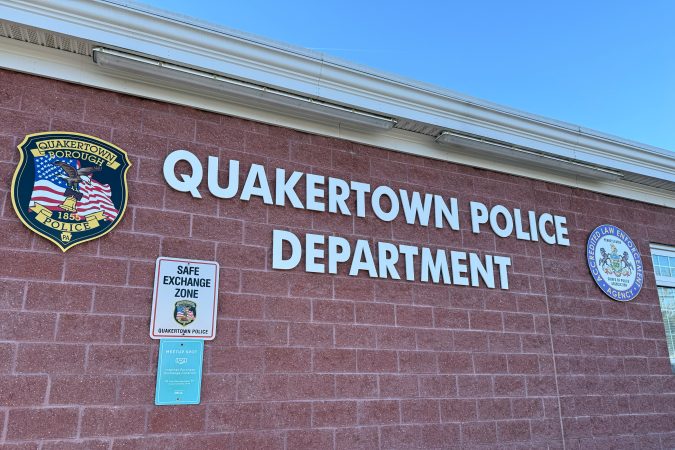
Family-owned Kepple’s Carpet Inc., which has served the South Jersey region for more than 30 years, has filed for Chapter 11 bankruptcy protection.
The West Berlin-based company reported less than $50,000 in assets in its bankruptcy petition filed on July 22. The company could owe up to $500,000 in unsecured creditor claims, the filing shows.
Some of Kepple’s largest outstanding debts include $138,000 across three financing firms, more than $60,000 in state taxes, and over $50,000 owed to Comcast Business, the filing shows.
The company also owes its landlord $29,000 for their sprawling Cushman Avenue showroom featuring floor-to-ceiling carpet and flooring samples.
Chapter 11 allows the company to continue operating under court supervision while it restructures its finances and develops a plan to repay the debt over time.
Neither Kepple’s Carpet nor the company’s bankruptcy attorney returned multiple requests for comment. The large showroom was open for browsing Tuesday morning as signs indicated staff were away on a consultation.
Kepple’s filing comes as the American flooring industry grapples with inflation and tariffs.
The family of an immigrant from El Salvador who died in ICE custody in New Jersey on Tuesday outlined a list of demands for state and federal officials that they said would bring justice after his death.
Edwin Jeovanny López Cornejo, 41, whose family said he had been living in the U.S. for two decades, died in ICE custody on Saturday after having a medical episode at Delaney Hall in Newark. The privately run ICE facility has been the subject of complaints of poor conditions, ongoing protests, and the site of clashes between federal officials and elected Democrats.
“On the same day, we were both dead, the only difference was his heart stopped beating,” his 12-year-old daughter Ashley López said at a news conference held outside the Reformed Church of Highland Park on Tuesday streamed by Cosecha New Jersey, an immigrant-rights group. “I am going to grow up without a father. They did not even let me see him one last time before he died.”
“We had so many plans, we will never do them, because they are heartless monsters,” she added.
López Cornejo’s family members have accused ICE of neglecting to provide proper medical care to him, an accusation the federal agency denies. His mother María Cornejo questioned whether ICE gave her son his medicine for high blood pressure, diabetes, and seizures. He was detained in Plainfield in North Jersey on June 18.
ICE said Monday evening that López Cornejo’s cause of death was pending further medical review, but Sen. Andy Kim shared later that night that he died of a heart attack and cardiac arrest. Kim said López Cornejo already had a habeas corpus case calling for his release due to his medical issues.
(function(){function e(){window.addEventListener(`message`,function(e){if(e.data[`datawrapper-height`]!==void 0){var t=document.querySelectorAll(`iframe`);for(var n in e.data[`datawrapper-height`])for(var r=0,i;i=t[r];r++)if(i.contentWindow===e.source){var a=e.data[`datawrapper-height`][n]+`px`;i.style.height=a}}})}e()})();
While speaking at the news conference, Danilo López, the brother of López Cornejo, called for an independent investigation of the incident by New Jersey Attorney General Jennifer Davenport, a release of his brother’s medical records by the facility’s owner GEO Group and ICE, the closure of the detention center and the release of all those detained. He also asked Gov. Mikie Sherrill to open an investigation into health protocols at the center.
“I know that there’s nothing that will bring my brother back but if we feel our pain now maybe we can avoid other deaths,” Danilo López said in Spanish.
Davenport’s office said Tuesday it “can neither confirm or deny an investigation at this time.”
Sherrill has called for the shuttering of Delaney Hall amid a broader battle over President Donald Trump’s immigration crackdown. Her administration is in various court fights with Trump’s administration, including one attempting to gain access to Delaney Hall for a full state health inspection.
Activists have repeatedly called for Delaney Hall to shut its doors but the Trump administration has made clear it’s not closing the facility anytime soon as it holds a crucial role in the president’s mass deportation operation.
U.S. Rep. Analilia Mejia, a progressive Democrat who represents a North Jersey district, said at the news conference that she’s spoken to people inside Delaney Hall during oversight visits who say they’re being denied their medication and proper medical care.
A spokesperson for U.S. Rep. Bonnie Watson Coleman, a Central Jersey Democrat, said her office gets calls from families saying their loved ones aren’t receiving their medication and are getting moldy food inside the facility.
Trump officials and allies have denied there are issues inside Delaney Hall, including U.S. Rep. Jeff Van Drew, a South Jersey Republican who, prior to this incident, visited the facility and called it clean and “well-run” with “medical care, recreation, and other basic services.”
ICE said it provides “comprehensive medical care” to people in the facility, including 24 hour emergency care.
“While in custody, Lopez-Cornejo received proper medical care and was seen by medical professionals,” the federal agency said in a statement.
Danilo López said that his brother had told him over the phone that he had to fill out a form to just get Tylenol at Delaney Hall and it could be days before he received it.
María Cornejo accused ICE of lying about giving her son proper medical attention.
“I just want justice for my son and for my granddaughter who is going to grow without a father,” she said in Spanish.
Danilo López said Tuesday he didn’t know why his brother was detained because he had a valid work permit, but ICE said López Cornejo was arrested by the U.S. Border Patrol “for illegally entering the United States without inspection” in August 2006 and was sent back to El Salvador that October before returning without permission.
López Cornejo’s daughter, Ashley, said Tuesday that “no one is illegal on stolen land,” a common refrain from immigrant rights activists.
Her mother, who was not named, called the incident the result of a systemic failure.
“From the bottom of my heart I feel the system failed Edwin,” she said in Spanish. “Failed my daughter, failed me as a mom, and failed all those other kids who are suffering like my daughter is.”
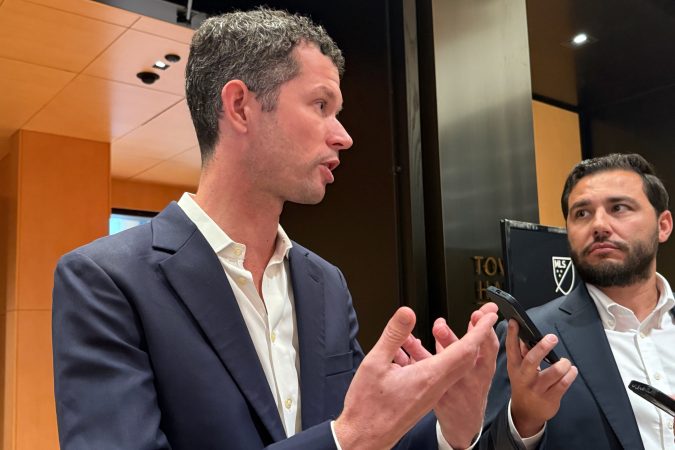
NEW YORK — U.S. Soccer Federation CEO JT Batson was among the VIPs at Larry Berg’s introduction as Major League Soccer’s next commissioner on Tuesday. After the event, Batson took questions from the media. But that didn’t mean he offered detailed answers to all of them.
That was particularly true when questions about FIFA president Gianni Infantino came up.
“As we shared publicly, we supported Concacaf’s statement on Friday with regards to FIFA Forward Enterprises,” Batson said, referring to Infantino’s plan to sell shares in a new FIFA private company — including to Josh Kushner, whose brother’s father-in-law is U.S. President Donald Trump.
That “support” was a mere one-sentence post on X: “U.S. Soccer stands with Concacaf and its members.” It was attached to Concacaf’s post with its statement that formally “rejected” Infantino’s plan.
“We have a board meeting in September where, among many topics, one of [them] is thinking about what the best future is for global soccer,” Batson said. “There’s so much more opportunity to grow soccer in more communities around the world, and to do it in a way where those communities are healthier, where they’re more sustainable, and everyone around the world is more connected. We’re looking forward to that discussion, and I don’t anticipate a whole lot of communication ahead of that.”
What happens if the issue is forced with Infantino before then? Europe’s soccer governing body UEFA could call for an extraordinary FIFA Congress to try to overthrow FIFA, and might get Concacaf’s help in doing so.
The Guardian reported Tuesday morning that all 41 of Concacaf’s member nations sent letters endorsing Infantino’s reelection before the World Cup, but “many are now giving serious consideration to withdrawing them.”
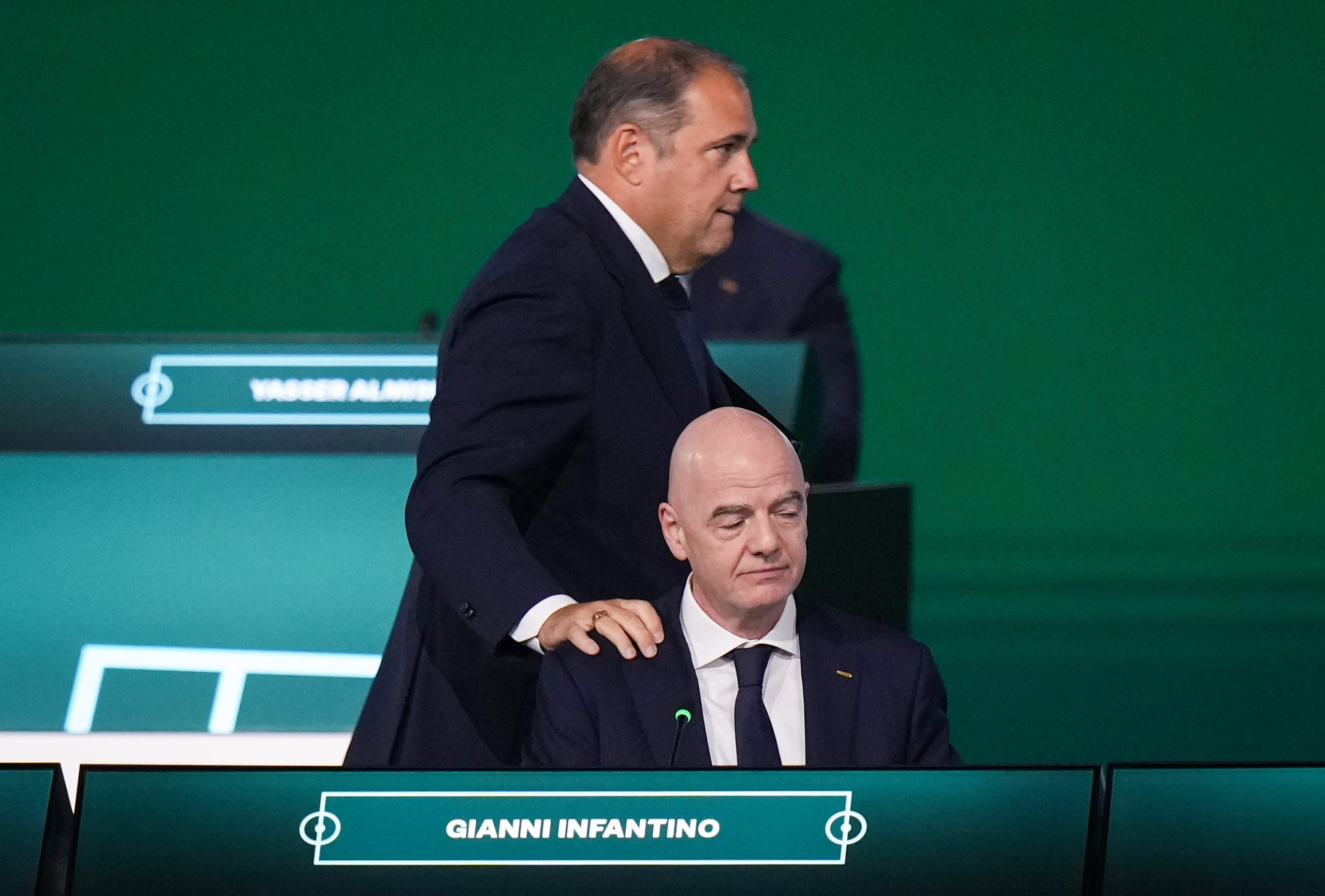
Concacaf president and FIFA vice president Victor Montagliani (top) with FIFA president Gianni Infantino at the FIFA Congress in Vancouver, British Columbia, in April.Darryl Dyck
The report further said U.S. Soccer specifically “is understood to be deeply unhappy with Infantino,” with the backlash over President Trump’s intervention on Folarin Balogun’s red card a key point. But “given the political sensitivities,” the report added, U.S. Soccer “may not feel able to take him on.”
When Batson was asked if U.S. Soccer wrote such a letter and might withdraw it, he answered: “I haven’t seen that story, so it’s hard for me to comment on it.”
He was also asked whether U.S. Soccer would back Concacaf president Victor Montagliani if he runs against Infantino, which looks increasingly possible. Batson didn’t answer that question directly.
Current MLS commissioner Don Garber was asked his opinion of it all, not just as the MLS’ leader but as a member of U.S. Soccer’s board.
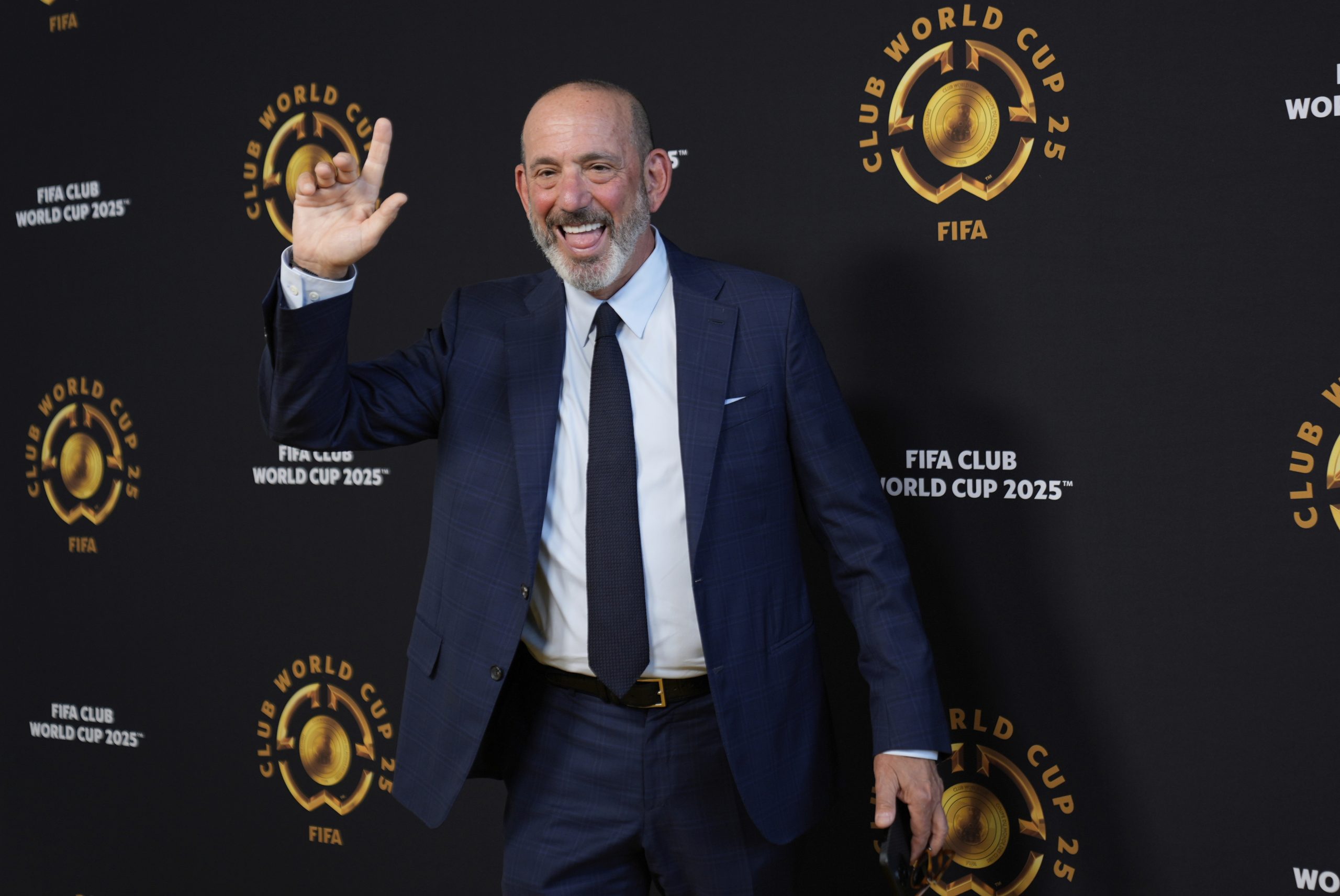
MLS commissioner Don Garber at last year’s Club World Cup final.Pamela Smith
“I’m going to wait for JT and Cindy [Cone, U.S. Soccer’s president], who I have a lot of faith in, and see what they want or don’t want to do,” he said. “But I haven’t spent any time thinking about it. I’m still reveling in the beauty and joy of the World Cup, disappointed that there’s negativity, but this is an issue that’s going to have to be addressed — but it’s going to be addressed by others.”
Garber spent plenty of time in Infantino’s orbit leading up to this summer, including when three MLS teams played in last summer’s Club World Cup. But he claimed he had no inside knowledge of Infantino’s privatization plan.
“I found out when everybody else did by reading it on social media,” he said. “And I’ve been focused on today, and our Leagues Cup which starts [this week]. I have no information, and probably no more or no less than anybody else in the world.”
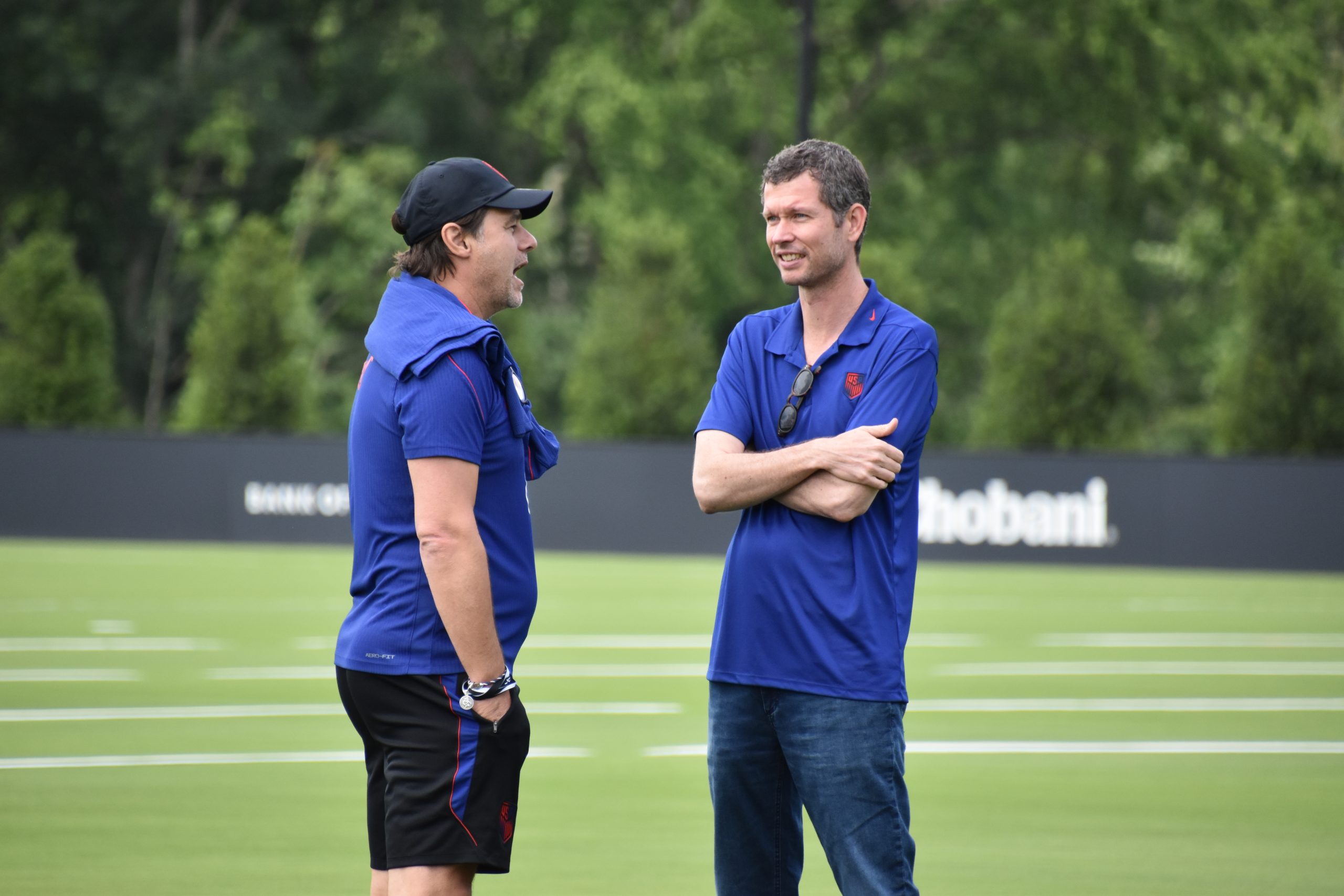
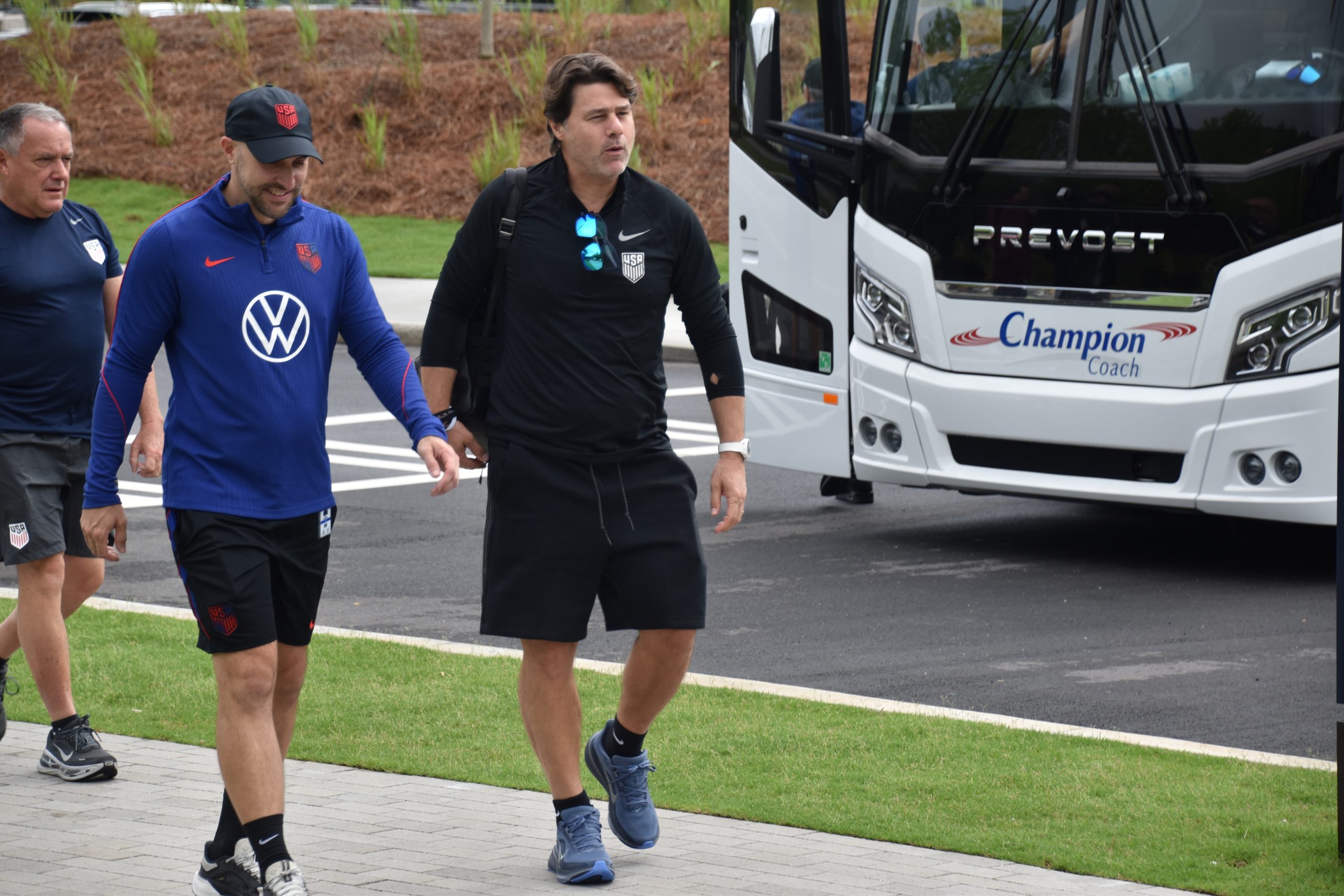
Mauricio Pochettino (left) with JT Batson during the U.S. men’s team’s pre-World Cup training camp.Jonathan Tannenwald
Contract talks started well before the World Cup, as Batson acknowledged when the U.S. team’s World Cup training camp kicked off in late May. An extension offer was put on the table back then, but both sides agreed to wait to see how the tournament played out.
After the Americans were eliminated in the quarterfinals on July 6, both sides took a breather for a bit. But once they started talking again, it didn’t take long for a deal to get done.
“We’re super excited that Mauricio and his staff are joining us for this next project,” Batson said. “We signed the contract Sunday, we announced it Monday, and at 7 a.m. this morning Eastern time, I was on with Mauricio, and Jesús [Pérez, Pochettino’s top assistant], and Dan [Helfrich, U.S. Soccer’s chief operating officer], about all the planning and everything around the next steps. They’re pumped, we’re excited, and we’re ready to get going.”
Batson confirmed an ESPN report that there are “mutual protections” in Pochettino’s deal, which runs through the 2030 World Cup, in case he doesn’t see it all the way out.
Mauricio Pochettino (center) has agreed a new deal to stay on as the U.S. men’s soccer team’s manager through the 2030 World Cup.Jonathan Tannenwald
That is an unusual phrase, certainly not as simple as “a buyout.” But it feels like an implicit acknowledgment that European clubs might pursue Pochettino, and that the summer of 2028 might be a natural separation point if the circumstances are right — especially if the U.S. plays in the 2028 Copa América with South American teams.
“Of course there are protections for both sides in this,” Batson said. “They were incredibly thoughtful, it was very straightforward, and we’re excited for the next four years.”
Asked to put a dollar figure on it, Batson only said “it’s material.”
If Pochettino does leave in the summer of ‘28, Steve Cherundolo would have an easy move over from the Olympic squad — mostly an under-23 age group — to the senior team.
Steve Cherundolo played for the U.S. national team for many years, and was Los Angeles FC’s manager from 2022-25.Michael Wyke / AP
But Batson believes Pochettino might stay for the whole term.
“I know from the moment we announced Mauricio, there were lots of folks skeptical that they actually were committed, and that they cared about soccer in this country, and they wanted to do all the things necessary to make us successful as a men’s national team, but more broadly as U.S. Soccer,” Batson said. “I’m incredibly excited that folks now are getting — obviously this summer, they got to see — the Mauricio and staff that we all knew, and of course now we’re seeing with their very long-term commitment to U.S. Soccer.”
A federal judge in Philadelphia ruled Monday that a lawsuit alleging discount retailer Five Below defrauded investors can move forward as a class action on behalf of numerous shareholders.
U.S. District Judge Gerald Austin McHugh’s 34-page order handed a win to the lead plaintiffs, two Arkansas public employee retirement plans. The pension funds say that for more than a year, Philadelphia-based Five Below misled investors about its ability to identify and stock popular products — a skill company executives referred to as their “secret sauce.”
Once investors learned the full extent of the company’s challenges in July 2024, Five Below’s stock price plummeted, wiping out almost $8 billion in shareholder value, the suit says. The company’s CEO resigned around that time.
The Arkansas Public Employees’ Retirement (APER) and the Arkansas Teacher Retirement System say they lost more than $5 million combined due to the alleged fraud.
McHugh granted their motion asking him to certify a class of people and entities who bought Five Below stock between December 2022 and July 2024.
“We are pleased to be able to represent the interests of these public pension funds, where teachers and other public servants were invested in this company and lost a considerable amount of money,” Michael Dell’Angelo, executive shareholder and general counsel of Philadelphia-based law firm Berger Montague, said in a statement.
“Our clients lost millions of dollars after they relied on the exaggerated expectations set by this retailer,” he said.
Five Below has 1,800 stores in 44 states and says most of its products are priced between $1 and $5, many of them aimed at children and teens. The company didn’t respond to a request for comment. Attorneys for Five Below and two other defendants — former CEO Joel Anderson and chief operating officer Kenneth Bull — didn’t respond to requests for comment.
The defendants have denied the allegations in court papers.
“Being honest with the market about the pitfalls of a business strategy as they are learned in no way reveals advance knowledge that the approach would fail, and failing to make accurate predictions does not amount to securities fraud,” Jay A. Dubow and Erica H. Dressler of the Philadelphia firm Troutman Pepper Locke LLP wrote in a court filing last year.
The suit alleges that despite management’s repeated assertions that Five Below could identify and capitalize on trends, the company in fact “did not operate with any real ability to stock its stores with in-demand products.”
Nevertheless, Five Below told investors it planned to triple its number of locations and double its sales based on this “trend-right” strategy, the suit says. The “plan was abruptly throttled down” shortly after Anderson, the CEO, resigned in July 2024, according to the complaint.
Even as Five Below’s problems with product assortment, inventory, and expansion dragged on its operating performance, executives falsely blamed shoplifting, the suit says.
The company eventually allegedly admitted its shortcomings in a series of disclosures to investors, with executive Bull conceding in late 2024 that Five Below had “lost our way.”
While investors suffered losses, Bull and Anderson sold more than $9 million in Five Below shares during the period in question, “while also receiving incentive compensation valued at over $10 million based on the inflation in the company’s share price,” the suit says.
The company has since rebounded, with executives citing the popularity of games and viral toys, as well as artificial-intelligence tools that help with inventory.
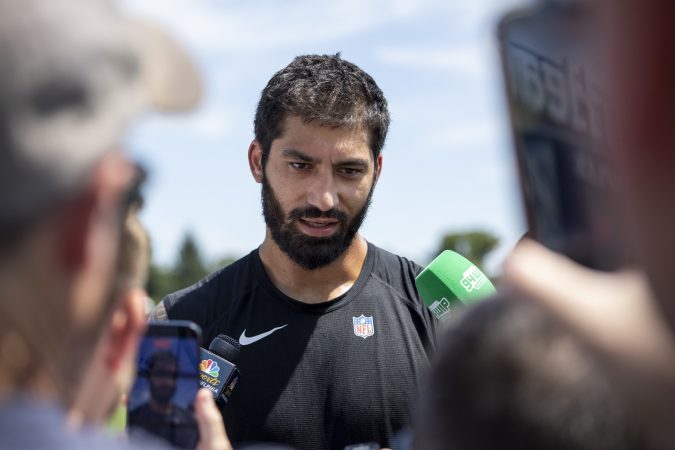
Sixteen years into his NFL career, Andy Dalton has seen just about everything. But this training camp — his first with the Eagles — is unlike any Dalton has participated in before.
Dalton, 38, is competing with incumbent Tanner McKee to back up Jalen Hurts. That isn’t a new phenomenon for Dalton. He hasn’t been a full-time starter since 2019, his ninth and final year with the Cincinnati Bengals, the team that drafted him 35th overall in 2011.
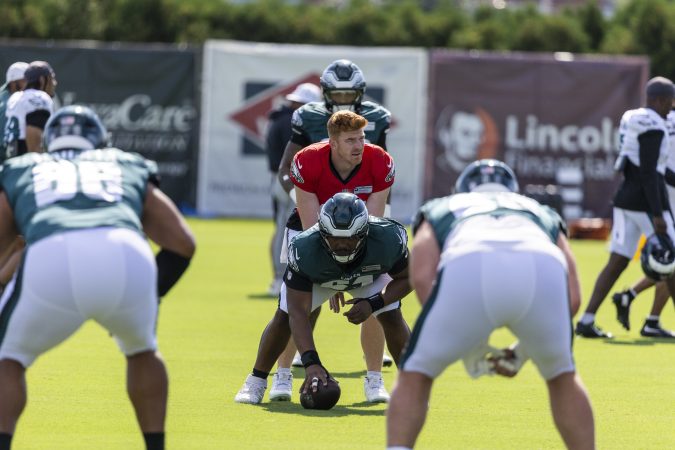
What is unfamiliar, however, is that Dalton doesn’t know when it’s his turn to take reps with the second-string offense in team drills. Neither does McKee. Both quarterbacks wait for orders from their coaches before one or the other joins the huddle.
At first, Dalton had questions about how they would split reps. Now, he’s accepted the surprise element of their current situation, which is reminiscent of game days for the backup quarterback.
“I was joking with Tanner, I was like, ‘This is just real life right here,’” Dalton said Tuesday. “‘You don’t know when you’re going to be going in.’”
It’s been an offseason of surprises for Dalton, who was traded to the Eagles after spending the last three seasons with the Carolina Panthers. He had never been traded before. He only had experience choosing to sign with teams in free agency, including the Dallas Cowboys (2020), Chicago Bears (2021), New Orleans Saints (2022), and Panthers.
Still, Dalton said he is “excited” to be in Philadelphia and to play in the new Sean Mannion-led offense. But the scheme isn’t entirely new to him. Dalton has experience in similar offenses that were also offshoots of the Kyle Shanahan/Sean McVay coaching tree, namely Zac Taylor’s first year with the Bengals in 2019 and the past two seasons with Dave Canales and the Panthers.
Andy Dalton (right) knows some of the principles of the Sean Mannion offense from his time working alongside Zac Taylor (left) in Cincinnati. Wilfredo Lee
There are some similarities among the three systems. Dalton pointed out their shared emphasis on quick decision-making and pure-progression passing. He also noted that Mannion’s offense requires its quarterbacks to use a cadence that Dalton has learned in the past.
“Everybody’s got their own little variation of it,” Dalton said of the broader offensive scheme. “But for me, I feel very comfortable in this offense.”
The trade may have come as a surprise to Dalton, but McKee expressed an understanding of Howie Roseman’s rationale behind the move.
Yes, McKee was the primary backup last season, a role that was hardly threatened in camp by Dorian Thompson-Robinson (who is now playing in the UFL) or Kyle McCord (who is in camp with the Green Bay Packers). McKee has generally fared well in his handful of preseason and regular-season outings over the last two years, save for his lone start in 2025 — a 24-17 loss to the Washington Commanders in Week 18 — in which he primarily played with backups.
However, McKee acknowledged Roseman’s objective to strengthen the roster every season.
“I don’t think you can be surprised whenever they bring in somebody or there’s competition, because in the NFL, there’s always going to be competition,” McKee said Tuesday. “They’re trying to improve the roster every year, and so anybody that they can bring in to make you compete or make you earn your spot, that’s definitely what everybody wants.
“And for a player, it’s great. It is great to have somebody to push you and to make you better. The stakes in practice are a little bit higher, and so it makes it fun.”
Tanner McKee has been focused on trying to learn things from the veteran Andy Dalton, even as both vie for the same job. Tyger Williams / Staff Photographer
McKee is embracing Dalton’s presence, especially his knowledge of the offense. In practice on Tuesday, for example, the 26-year-old quarterback was on the field for a play that broke down. Later on, McKee said he went to Dalton for insight on how he would’ve read the play given the defensive coverage.
“It is great having that overall wisdom, I guess you could say, of just the experience that he’s had to talk through things,” McKee said. “It really does make each other better, and that’s exactly what everybody wants when we have competition, is to make the Eagles organization better.”
The lessons McKee has learned aren’t limited to firsthand experiences on the field. Because he is splitting second-string reps, unlike last year’s training camp, McKee is forced to take more mental reps from the sideline while Dalton is on the field.
McKee likened that experience to practices during the season, when Hurts is commanding the majority of the snaps. Those mental reps can be valuable, too, he explained.
“Sometimes, you learn from mistakes, but a lot of times you have to learn from mistakes of other people as well,” McKee said. “And so paying attention on the sideline, watching film, all those things are just a little bit more important when you’re not getting as many.”
The two depth quarterbacks will soon take their competition to the next level when preseason begins. The Eagles open their exhibition slate against the Baltimore Ravens on Aug. 15.
Each player will make his case for the backup role. Dalton may not have the starting job he once held down at the outset of his career, but he has approached his role as a backup with the same level of preparation and attention to detail.
Most importantly, he hasn’t lost his love for the game and all of the surprises that come with it.
“There’s nothing else like this,” Dalton said. “So I’m trying to soak it all in as much as I can. Trying to get the most out of the game because obviously once you’re done, you’re done.”
An investigative review of the February clash between student anti-ICE protesters and Quakertown police sharply criticized Police Chief Scott McElree for his “calamitous” decision to charge into the crowd of demonstrators.
The 20 page review, ordered by by the Bucks County District Attorney’s Office, however did not call for any new criminal charges against either the protesters or police.
“The investigation established that the precipitating factor that led to violence was Chief McElree’s decision to swiftly enter an agitated crowd of teenagers while wearing plain clothes, with no visible badge, uniform, body-worn camera, or handcuffs,” the investigative report said.
“This decision created a ‘fog of war’ where students — believing that an unidentified vigilante was attacking them — acted to defend themselves or others, while police officers, seeing McElree attacked, acted lawfully to stop and arrest people who were assaulting a police officer,” the report said.
McElree’s “ill-advised decision to do so was the precipitating incident which led to violence,” the report said.
Quakertown Police Chief Scott McElree.Courtesy of Bucks Back the Blue
The clash between the students and police on Feb. 20 was captured on video by onlookers and circulated widely online. One video showed McElree grappling with a boy on the sidewalk. Another captured the 72-year-old McElree with his arm around a teen girl’s neck.
The Quakertown Police Department had sought additional charges against juveniles for allegedly assaulting McElree, who also holds the position of borough manager, but the District Attorney’s Office announced Monday that it has denied the request.
Officials said McElree had sought medical care after the clash for injuries that included fractured ribs. He also took worker’s compensation leave for several weeks before returning to work in May.
A spokesperson for Quakertown Borough could not be reached for comment Monday evening.
The investigative report also placed blame on some of the students.
“The truth is that while most students protested lawfully, some broke the law. While most protestors and observers did not recognize McElree as a police officer at first, a few students assaulted police officers in uniform and assaulted McElree even after it should have become evident that he was with the” Quakertown Police Deparment,” the report said.
Investigators also looked at allegations that McElree was ideologically hostile to the anti-ICE protest and had tried to stop it from happening.
The investigation “found no evidence to support these claims,” the report said.
Ettore Angelo, a lawyer for one of the teens who was charged, said in a statement Tuesday that the police chief should have faced more consequences for his actions.
“My client was incarcerated for four days, on house arrest for 28 days, has been vilified in the community, has been harassed in school, and has faced trauma and turmoil no 15-year-old should ever have to endure. She is a remarkable child, and I am very proud of her, as are her parents,” Angelo said.
“She did not deserve this, nor did the other kids. Meanwhile, Chief McElree ends up with no consequences. Apparently, even when not wearing a badge or uniform, he can manhandle children with impunity,” Angelo said.
District Attorney Joe Khan said in a statement that he and members of his staff will “engage in conversations with the Quakertown community” over the next 45 days and then release recommendations “about how to move forward to help heal these rifts.”
Khan also said it was important to remember the events leading up to the Quakertown protest.
“Kids across Bucks County, including my own, learned of the horror of civilians like Renee Goode and Alex Pretti being shot and killed in the streets of Minneapolis by ICE and Border Protection agents,” Khan said.
“Young people witnessed their immigrant neighbors living in fear. Bucks County students raised their voices and spoke up about the grievous injustices they saw,” Khan said.
“It’s true that some students broke the law, though most protested and exercised their First amendment rights peacefully. It’s also true that the police chief made terrible mistakes even as most officers acted with professionalism and restraint that day,” Khan said.
“The heavy-handed actions of ICE nationwide have caused stress between law enforcement and the communities they serve. We saw that reflected in so much of the footage we reviewed of the protest. For many folks, it was traumatic to see front page images of a law enforcement officer with his arm around the neck of a teenage girl who was protesting ICE. That is why it is important for our office to explain our findings and to engage the community in a meaningful dialogue in the weeks ahead,” Khan said.
The investigative review was assigned to the Special Investigative Unit of the district attorney’s office, with prosecutors and detectives who had no ties to Quakertown or any involvement in the delinquency proceedings against the five juveniles.
County detectives conducted more than two dozen interviews over the course of five months. The interviews included 22 civilian witnesses, including four juveniles who could not be interviewed until after their prosecutions had been resolved. The last interview took place last week.
The annual preseason college football coaches poll was released, and Penn State was included despite a disastrous 2025 season.
On Tuesday, Penn State was ranked No. 17. Eight Big Ten schools were included in the Top 25 poll, with Ohio State atop the list.
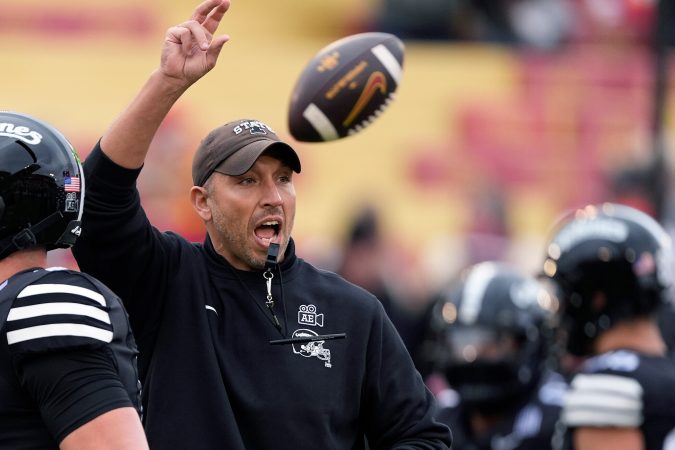
Last season, the Nittany Lions were ranked third overall in the same preseason poll, which was not indicative of the season the team had. The Nittany Lions finished 7-6 overall and 3-6 in conference play. Longtime head coach James Franklin was dismissed in the middle of the season. Former Iowa State coach Matt Campbell was hired in December to take over the program.
“Over the past six months, we’ve been reminded every day why Penn State was the right fit,” said Campbell during Big Ten media day last week. “The history is special. The tradition is special. But what really resonated with me is how Penn State has always valued integrity, character, and class at its best.”
It seems Campbell’s peers believe he can help the program bounce back. To do so, he will lean on some familiar faces, as 24 Iowa State players followed Campbell to Penn State through the transfer portal, including starting quarterback Rocco Becht.
In 12 games last season, playing with a torn labrum on his nonthrowing shoulder, Becht threw for 2,584 yards and 16 touchdowns. He is the winningest returning quarterback in college football.
Quarterback Rocco Becht followed Matt Campbell to Penn State.Carolyn Kaster
“We have our goals in mind, and that’s to win a Big Ten championship and ultimately get to the College Football Playoff to have a chance to win a national championship,” Becht previously told the Inquirer. “With the team that we have now, I think we’re fully capable of doing that. Everybody just has to buy in, be consistent with the standards, and I think we’ll be in good hands.”
WHYY is one step closer to taking ownership of Pennsylvania State University’s public radio and television station, WPSU, with a new Federal Communications Commission filing.
WHYY and Penn State filed an application with the FCC late last week to transfer WPSU-FM and WPSU-TV, among other properties, to WHYY for a sale price of $1, according to commission records. The station said in a statement that it was “pleased to have reached an agreement with Pennsylvania State University that marks an important milestone.”
“We are appreciative of Penn State’s partnership throughout this process, as they have been integral to ensuring uninterrupted service for WPSU’s viewers, listeners and communities,” the station added. “Our shared goal is to preserve and strengthen WPSU’s longstanding mission of providing trusted local journalism, educational programming and community storytelling for the enjoyment and enrichment of generations to come.”
The FCC needs to approve the deal before it can be completed, the station said. It was not immediately clear how long that process could take, but the review period typically includes a 30-day window during which the public may submit comments.
The application’s submission marks the latest step in a lengthy process. In October, Penn State trustees unanimously approved a revised proposal to sell WPSU’s operating assets to WHYY, which itself revived a path to keep the station alive following a previous failed deal.
Under the approved agreement, WHYY is to continue operating WPSU for at least three years following the station’s sale, and give current employees the opportunity to interview for roles under the new leadership. About 44 employees remained at the station following layoffs in June last year, The Inquirer previously reported.
Previously, WHYY said it was working to raise funds to support WPSU to allow it to continue broadcasting.
In September, WPSU’s days appeared to be numbered, with Penn State saying it planned to wind down the station’s operations and lay off employees by the end of June. The station’s annual budget was funded largely by the university coupled with federal dollars, the latter of which had been slashed after President Donald Trump’s administration stripped away federal funding for public media, The Inquirer previously reported.
School trustees in September unanimously voted down a plan for WPSU’s sale to WHYY, largely citing concerns about $17 million in subsidies Penn State would have to provide to WHYY over five years as part of that deal. Under the plan approved in October, the university said last year, WHYY agreed to raise funds itself.
WPSU began broadcasting more than 70 years ago. When it was faced with a possible closure last year, university leaders said that they received about 1,300 public comments about the station, many of which urged the school to reconsider its decision to wind down operations. WHYY president and CEO Bill Marrazzo later said WPSU would “continue to be here” for listeners.
“WHYY and WPSU are joining forces to expand what is possible — strengthening local journalism, creating new educational opportunities, and developing innovative ways to deliver the content people value most,” Marrazzo said last year.
Asked Tuesday about the offseason drama he endured when the Browns signed him to a one-year deal worth up to $5 million before balking at the deal weeks later (reportedly due to a failed physical), the Eagles edge rusher first took a diplomatic approach, before taking a shot at Cleveland.
“It was a weird situation,” Epenesa said after Day 5 of Eagles training camp. “I don’t necessarily want to go back and talk on that in just a weird sense.
“I’ll just leave that in the past and just be happy that I’m not a Brown and that I’m an Eagle.”
The 27-year-old certainly looks like he’ll fit right in with the loaded edge rusher group. Epenesa, formerly of the Bills, recorded multiple would-be sacks the first week of camp and even nabbed an interception on a pass intended for wide receiver Danny Gray on Day 2.
He looks sharp. But the fact remains that the Browns backed out of signing him because of health concerns. So, is he healthy? Epenesa, who played in 16 games last season but suffered a concussion in November as well as battling pectoral, foot, and neck injuries, didn’t hesitate when the question was asked.
“Oh, very healthy,” Epenesa said. “Feeling good and happy to be here.”
A.J. Epenesa (57) is part of a deep and talented pass-rushing group. Tyger Williams / Staff Photographer
Epenesa hopes to be a key cog in an edge group that features Jonathan Greenard — who’s nursing a pectoral injury — Jalyx Hunt, Nolan Smith, and Arnold Ebiketie. The Eagles lost Jaelan Phillips to the Carolina Panthers in free agency, so improving the group’s depth was one of general manager Howie Roseman’s top priorities this offseason. The trade for Greenard and the signing of Epenesa on June 10 signified that.
Epenesa was mostly a rotational piece on Buffalo’s defensive line, starting just 19 games in six seasons, but he made the most of his role. His best season came in 2022, when he logged a career-best 6½ sacks, 10 quarterback hits, 14 quarterback pressures and 16 tackles.
So, what drew him to the Eagles — whose defense is powered by a loaded defensive front — over another team where he could win a starting job?
“I wanted to go to a place that could help make me better,” Epenesa said. “A place that’s going to win games and a place that has competition. I don’t want to go to a place and just be handed everything.
“I love having this around me. These guys are making me better. They’re incredible athletes. They’ve all been in the system for two, three-plus years. So all of that knowledge that they have is leaking into me. Whether they know it or not, I’m watching.”
A.J. Epenesa (57) was a situational pass rusher for most of his tenure in Buffalo. Bob Donnan, Bob Donnan-Imagn Ima
Epenesa’s coaches are taking notice of this spongelike attitude. Epenesa rarely dropped back in coverage in Buffalo, but he’s quickly added that skill to adapt to Vic Fangio’s scheme. Fangio seldom goes out of his way to praise players, but he did so for Epenesa last Thursday.
“I told A.J. this, and I said it in front of the whole team, too,” Fangio said. “For a guy that’s being asked to do a few things that he’s never done before, I thought he did a nice job. It was very encouraging.”
Epenesa winding up in Philadelphia is a positive outcome to a bizarre situation. Now, the veteran edge rusher said, he wants wins to come with it.
“[The Eagles] are always competitive every year,” Epenesa said. “That’s one of the key things, I think, when you’re trying to find a team. That’s something you’re looking for. And these guys, they messaged, they hit me up, they wanted me.
I want to be on a team that competes and wants to win. And it worked out.”
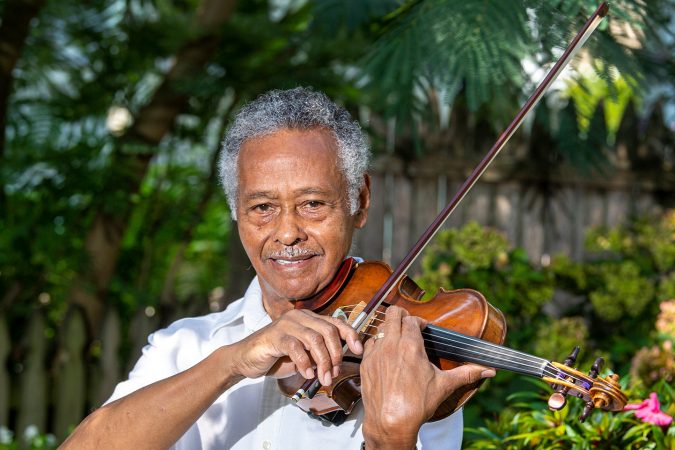
Booker Rowe, 85, of Philadelphia, award-winning violinist, the first Black musician to play with the Philadelphia Orchestra and the Nashville Symphony String Quartet, the second permanent full-time Black player in the Philadelphia Orchestra, teacher, mentor, and role model, died Friday, July 31, of complications from pneumonia and sepsis at Jefferson Abington Hospital.
A lifelong musician — he played piano at age 5 and violin at 11 — Mr. Rowe was invited by famed music director Eugene Ormandy in 1968 to become the first Black musician to perform with the Philadelphia Orchestra. He was a substitute violin during most of the 1968-69 season and returned for good in 1971 as the orchestra’s second Black permanent full-time member.
Mr. Rowe stayed for 49 years.
“My first day, I came in late from New York, and the orchestra was already rehearsing, and I sat myself down on the last stand to play,” Mr. Rowe told The Inquirer’s Peter Dobrin in 2020. “The sound was amazing. It was like stereo all around me. The stage was slanted down, and when the brass and winds would play I had to brace myself with my right leg from being blown off stage. It was just so beautiful.”
For five decades, until his retirement in 2020, Mr. Rowe played with half a dozen elite conductors and traveled the world in the orchestra’s second violin section. He and his colleagues gave thousands of memorable performances at the Academy of Music, the Kimmel Center, and the Mann Center in Philadelphia, Carnegie Hall and the Lincoln Center in New York, and the Saratoga Performing Arts Center in Saratoga Springs, N.Y.
They played at the 1993 World Series at Veterans Stadium, for Pope Francis in 2015, and at the Vail Music Festival in Colorado. They played in Europe, South America, Asia, and elsewhere around the world.
This photo of Mr. Rowe (left) appeared in the Daily News in 1993Newspapers.com
In 1973, the orchestra made a historic 10-day, five-concert cultural exchange tour in China, and Mr. Rowe told the Daily News afterward that he visited a commune and returned with Chinese instruments. In 2008, he mingled with former Secretary of State Alexander Haig and other international notables after a concert in Beijing.
In 2013, he posed for pictures with the Chinese welcoming contingent at Shanghai Airport. “Booker was such a kind soul, and his passion, his artistry, and his humanity are woven into who we are,” Yannick Nézet-Séguin, the orchestra’s music and artistic director, said in a tribute.
Ryan Fleur, the orchestra’s president and chief executive officer, said: “He was a warm and steadying presence in our orchestra.”
Born in Kentucky, Mr. Rowe and his family moved to North Philadelphia when he was 2. His father was a singer, and his mother played piano, and they “pushed me in the direction of classical music,” he told the Daily News in 1981.
He became concertmaster for the West Philadelphia High School orchestra, the All-City high school orchestra, and the old all-Eastern Conference college orchestra. He earned a bachelor’s degree in music at Temple University in 1963 and a master’s degree in music at Yale University in 1968.
Before Philadelphia, he played solo in New York and with symphony orchestras in Nashville, New Haven, Conn., and Washington. Later, he played with the old Symphony Club of Philadelphia, the Lansdowne Symphony Orchestra, and other local groups.
Mr. Rowe (left) stands with fellow musicians Andre Watts (center) and Renard Edwards.Courtesy of the family
He also got freelance gigs with Sammy Davis Jr., Isaac Hayes, Smokey Robinson, the Supremes, Barbra Streisand, Aretha Franklin, and other stars. He played with chamber music ensembles around the country and gave dozens of free concerts for children, churches, and community and scholarship fundraisers.
He championed racial and ethnic diversity, and was active with the Philadelphia Orchestra’s cultural diversity initiative. He sought and performed work by Black and other minority composers, and mentored dozens of colleagues and students.
He encountered at least one racist incident that first year in Philadelphia and told the Daily News in 1981: “The time was right for an Afro-American in the Philadelphia Orchestra. It was just a matter of finding somebody who was ready.”
Mr. Rowe and his family lived in Center City, East Mount Airy, and Germantown. Courtesy of the family
A friend said on Facebook: “His legacy and historical contributions are unparalleled.”
Mr. Rowe taught at Settlement Music School and gave private lessons. He earned music and service awards from City Council, the American Foundation for Negro Affairs, and other groups.
In 2019, he was asked to advise young musicians in a video interview for the Philadelphia Orchestra website, philorch.ensembleartsphilly.org. “Practice, practice, practice,” he said. “But also enjoy, enjoy, enjoy. Do it with love in your heart.”
Booker Taliaferro Washington Vance Rowe Jr. was born Dec. 10, 1940, in Lexington, Ky. In Philadelphia, he studied at the old Philadelphia Musical Academy and Settlement Music School, and his father worked at RCA Victor records in Camden. So their home was always filled with music.
Mr. Rowe (rear center) stands with Philadelphia Orchestra colleagues and members of the Chinese welcoming contingent in 2013.
Jan Regan / Philadelphia Orchestra
He met soprano Patsy Baxter at a Philadelphia Orchestra concert, and they married in 1970 and had a son, Landis, and a daughter, Vivian. They lived in Center City, East Mount Airy, and Germantown, and visited his family often back in Kentucky and Tennessee.
Mr. Rowe enjoyed puzzles, hiking and kayaking with his family, and tai chi. Friends noted his “kindness,” “million-dollar smile,” and “cheerful presence” in Facebook tributes.