Tag: topic-link-auto

  • Philly-area AMC Theatres will screen two Dolly Parton movies

    Philly-area AMC Theatres will screen two Dolly Parton movies

    In the days since her Aug. 25 death, the tributes to country music icon Dolly Parton have piled up: from music megastars, tech-industry titans — even the Buckingham Palace guards.

    Add AMC Theatres to the list.

    The company announced this week that it will be holding a retrospective of the artist’s film work, with screenings of a pair of Parton-starring films — Steel Magnolias and The Best Little Whorehouse in Texas — in her honor. Screenings begin Friday and run through Sept. 2, the company said.

    In all, roughly 200 AMC locations nationwide will hold screenings.

    Participating Philadelphia-area theaters include AMC Cherry Hill 24 and AMC Voorhees 16 in New Jersey, and AMC Neshaminy 24 in Bensalem. Tickets will be offered at discounted prices and are available through the AMC website.

    The two films are among several that Parton appeared in between 1980 and 2015, a list that also includes 9 to 5, in which she starred alongside Jane Fonda and Lily Tomlin, and received three Golden Globe nominations.

    The 1982 musical comedy The Best Little Whorehouse in Texas saw Parton play a brothel madam alongside Burt Reynolds, earning her another Golden Globe nomination in the process.

    In 1989’s Steel Magnolias, Parton stars alongside Julia Roberts, Sally Field, Shirley MacLaine, and Daryl Hannah.

    A longtime star of the music, film, and television industries, Parton’s death has brought a wave of homages this week from everyone from Taylor Swift to Amazon founder Jeff Bezos. Her death followed a brief battle with cancer, a family spokesperson has said.

    Parton was a 10-time Grammy Award winner, and her 55 Grammy nominations make her the third-most nominated woman in the awards’ history, according to the Associated Press, trailing only Beyoncé and Swift.

    In addition to AMC, Regal Cinemas will be screening both films, as well — though screenings will be limited to Parton’s home state of Tennessee.

  • Trump’s Supreme Court is still helping him try to steal elections | Editorial

    Trump’s Supreme Court is still helping him try to steal elections | Editorial

    The U.S. Supreme Court, as one of its members recently noted, has held that judges “are not required to exhibit a naiveté from which ordinary citizens are free.” And yet, that is precisely what its conservative justices just did.

    Considering one of Donald Trump’s latest attempts to illegally suppress votes, the court’s Republican-appointed majority was — or pretended to be — so naive as to fail to notice the president’s plain intent.

    At issue was Trump’s March order directing the U.S. Postal Service to restrict mailed ballots by delivering only those sent by “confirmed” citizens listed by the U.S. Department of Homeland Security.

    The court allowed the government to proceed with this plot on the grounds that it wasn’t fully hatched. Because postal and other officials hadn’t yet developed a full-fledged plan to meddle with the election, the justices reasoned, it was too soon for Gov. Josh Shapiro and 22 other state officials to sue to stop them.

    The ruling came, by the way, with just over two months left until the midterm elections, and some mail-in ballots expected to be sent to voters in less than a week.

    It doesn’t take half a dozen elite jurists poring over this set of facts to understand what’s going on.

    It isn’t genuine presidential concern about a means of voting that Americans have practiced since the Civil War and even beforehand — Pennsylvania pioneered military absentee ballots in the War of 1812 — and which Trump used as recently as this month, when he cast his ballot by mail in Florida.

    Rather, the president is trying to head off a well-earned midterm shellacking of his fellow Republicans in Congress any way he can other than by actually persuading Americans to vote for them. He has already pushed unprecedented partisan gerrymandering, lobbied for legislation to make voting harder, and after his 2020 defeat, attempted to overturn results with fraud and violence. The Supreme Court helped him get away with that, too.

    But it’s not impossible for a federal judge to dispense with a state-sponsored attack on democracy swiftly, decisively, and appropriately. We know that because it’s what happened when U.S. District Judge Indira Talwani ruled on Trump’s mail heist in June.

    The Boston-based judge blocked the president’s executive order until after the midterms in light of the elections’ imminence and because, as she succinctly put it, “The Constitution does not grant the President any specific powers over elections.” As Talwani pointed out, the founding document delegates authority over elections to Congress and the states, neither of which ever asked a post office to take over for them.

    The judge is not an outlier here: The First U.S. Circuit Court of Appeals upheld her decision in July, noting that the administration hadn’t even argued that Trump’s order was legal, only that it was too soon to consider it. The appellate court added that the states, given the approach of elections they play a substantial role in running, had “no practical choice but to respond” to the executive order when they did.

    It’s not impossible for a member of the Supreme Court to recognize reality when she sees it, either. In dissenting from the majority, Justice Ketanji Brown Jackson wrote that “what makes today’s ruling so off-base is the Court’s lack of situational awareness.” She added that her colleagues overlooked the administration’s “actual objective: to secure our imprimatur for its effort to foment chaos ahead of the November elections.”

    As unstinting as Jackson’s dissent is, her attribution of the majority’s decision to obliviousness is charitable. The problem is less likely that the Republican appointees don’t know what Trump is up to than that they don’t care.

    While the court’s ruling isn’t close to the end of the legal challenges to Trump’s scheme — another lawsuit was filed Wednesday in response to the Postal Service’s newly finished plan to lose our votes in the mail — it does perpetuate unnecessary confusion over a popular means of participating in a crucial election. Even if the president is never permitted to block ballots outright, bewildering the people who cast them will serve his purposes just fine.

    In an age of official disinformation and artificial intelligence, the country could use some clarity. Fortunately, we have a Constitution that provides a crystalline degree thereof on the subject of authority over elections. Unfortunately, we have a Supreme Court that refuses to acknowledge the obvious.

  • What geriatric emergency departments do differently

    What geriatric emergency departments do differently

    It had been a rough few months. Cynthia Tompkins was hospitalized in May for osteomyelitis — a bone infection — then spent six weeks in a rehabilitation facility. “It was a struggle,” she said. “I didn’t bounce back too well.”

    Tompkins returned to her home in San Diego, but she was still taking antibiotics, along with a host of other drugs for diabetes, pain, and blood clots. The deaths of her husband the previous year and her closest friend more recently had sapped her spirits.

    In early July, a new symptom appeared: violent vomiting three times within about 24 hours. “I was so depleted,” she said. “I got weaker and weaker.” A friend who was visiting her called an ambulance.

    “It’s the last place you think you want to go, the ER,” said Tompkins, 75, a retired teacher and family program director. She anticipated spending hours on an uncomfortable stretcher in a chilly hallway. Arriving at the emergency department at UC San Diego Health in La Jolla early in the morning, “I was in a knot,” she said.

    But the place upended Tompkins’ expectations. Since 2022, this and every other adult ER in San Diego has been accredited as a geriatric emergency department, redesigned to address the specific risks and needs of older patients. It’s an approach, recent studies show, that can reduce hospital admissions and deaths among older adults and lower costs.

    “They took me right to a room,” Tompkins said. She was transferred to a gurney with a thicker mattress to prevent bedsores and given blankets. “I got an IV right away because I needed fluids,” she said.

    She was pleased that the small, curtained room, with sound-absorbing walls to lower the cacophony of emergency care, had a cushioned chair for her friend, who would stay with her, and a window looking out on trees.

    The window served a medical purpose, too. Patients “can see whether it’s day or night,” said Denise Valenzuela, the geriatric emergency nurse assigned to Tompkins. “It prevents delirium,” the sudden change in mental status that can arise in hospitalized older patients and increase dementia risk.

    Before long, “I just felt a calmness,” Tompkins said. “I felt, I’m where I need to be right now.”

    Since 2017, the American College of Emergency Physicians has accredited 624 such geriatric emergency departments across the United States, including 73 in Department of Veterans Affairs medical centers. “A fairly exponential rate of growth,” said Kevin Biese, the emergency doctor who directs the Geriatric Emergency Department Collaborative.

    Few of these units are restricted to older patients. Instead, like the ER in La Jolla, they serve all ages but incorporate senior-friendly practices and protocols in an environment aimed at staving off disorientation, falls, and other elder hazards. They’re classified from Level 1, for those fulfilling the highest number of criteria, to Level 3.

    Adults 75 and older visit the emergency room at a higher rate than any other age group except infants: 76 visits per 100 people in 2022. Yet standard emergency care “wasn’t correctly designed for the needs of older adults,” Biese said.

    The mission of a traditional ER is to speedily identify the central problem and either fix it or admit the patient to the hospital for ongoing care. “We ask, ‘What’s your chief complaint?’” Biese said. “You fell down the stairs and broke your leg.”

    Older patients rarely arrive with a single ailment, however. Like Tompkins, most contend with several chronic conditions, take multiple prescriptions, and need a variety of tests and assessments. Trained geriatric emergency teams focus not only on the broken leg but on determining what caused the fall, and how to prevent another one.

    “An emergency department doesn’t routinely screen for delirium” and cognitive impairment, said Ula Hwang, an emergency doctor and researcher at NYU Langone Health. “But it’s one of the first things geriatric emergency departments will do,” along with a careful review of all the patient’s medications.

    Geriatric ERs also try to counter sensory impairment, another contributor to delirium, by distributing reading glasses and sound-amplifying devices. They dim glaring lights and offer eye masks and earplugs to promote sleep. If Tompkins had forgotten her walker, the unit would have lent her one.

    These ERs also aim to address a rising concern in emergency departments: hours or even days spent “boarding,” when admitted patients wait for open beds before they can leave the ER.

    “Prolonged boarding has increased among older adults,” said Cameron Gettel, an emergency doctor and researcher at the Yale School of Medicine, referring to waits that last over three hours. He is a co-author of a study on the topic published in Health Affairs Scholar.

    Spending more time boarding isn’t merely uncomfortable or inconvenient. Researchers studied patients 75 and older in emergency departments across France. They found that those kept there overnight before moving to an inpatient ward had a higher in-hospital mortality rate (15.7%) than those admitted to a ward before midnight (11.1%). Overnight boarding was associated with more falls and infections, too.

    What geriatric emergency staffers prefer, however, is to help patients avoid hospitalization altogether. “Admission may not be the best thing for an older adult,” Hwang said. “It might be the worst.”

    Hospital patients, she said, are exposed to infections, staff errors, and the rapid deconditioning that accompanies days spent in bed. All pose a greater threat to older patients.

    Previous studies have found reduced admissions from geriatric emergency departments, but most of those studies involved one or two hospitals. Now, Hwang and her team have used nationwide data from the federal “Health and Retirement Study” and Medicare claims for nearly 4,600 adults age 65 or up, comparing those treated in geriatric emergency departments with a matched group seen in standard ERs.

    The differences were stark: Patients in the geriatric units had a 39% lower likelihood of hospital admission and a 38% reduction in mortality over 30 days. The geriatric ERs also saved Medicare up to about $3,000 a visit, according to an earlier study Hwang led.

    So having more than 600 accredited geriatric emergency departments nationwide represents both great strides and — in a country with more than 5,000 emergency departments — missed opportunities, Biese said.

    In the Philadelphia region, the VA medical centers in Philadelphia and Wilmington are accredited as geriatric ERs, as are Pennsylvania Hospital in Philadelphia, Cooper University Medical Center in Camden, Jefferson Lansdale Hospital, and Inspira Medical Center Mullica Hill, according to the American College of Emergency Physicians.

    “I’d encourage people to ask why their hospitals don’t have an accredited GED,” he added, referring to a geriatric emergency department. “We should demand that.”

    In La Jolla, Tompkins began feeling stronger. The intravenous fluids supplied anti-nausea medication and corrected the electrolyte abnormalities that her lab work revealed. She was able to sip water and juice and eat a few graham crackers.

    A battery of other screens and scans found no serious concerns. After completing a geriatric assessment, Valenzuela, the nurse, suspected Tompkins hadn’t been eating well and was taking medications on a mostly empty stomach.

    By about 6 p.m., Tompkins and her doctor agreed she could return home. She left the hospital with numbers to call for further help, and several staff members checked in by phone to see how she was doing.

    Better, was her answer. “They took care of the whole me and put me on the right track,” Tompkins said. “I’m progressing. It’s slow, but I’m OK.”

    The New Old Age is produced through a partnership with The New York Times.

    KFF Health News is a national newsroom that produces in-depth journalism about health issues and is one of the core operating programs at KFF — the independent source for health policy research, polling, and journalism.

  • Makai Lemon has all of the opportunity in the world. The Eagles need him to seize it.

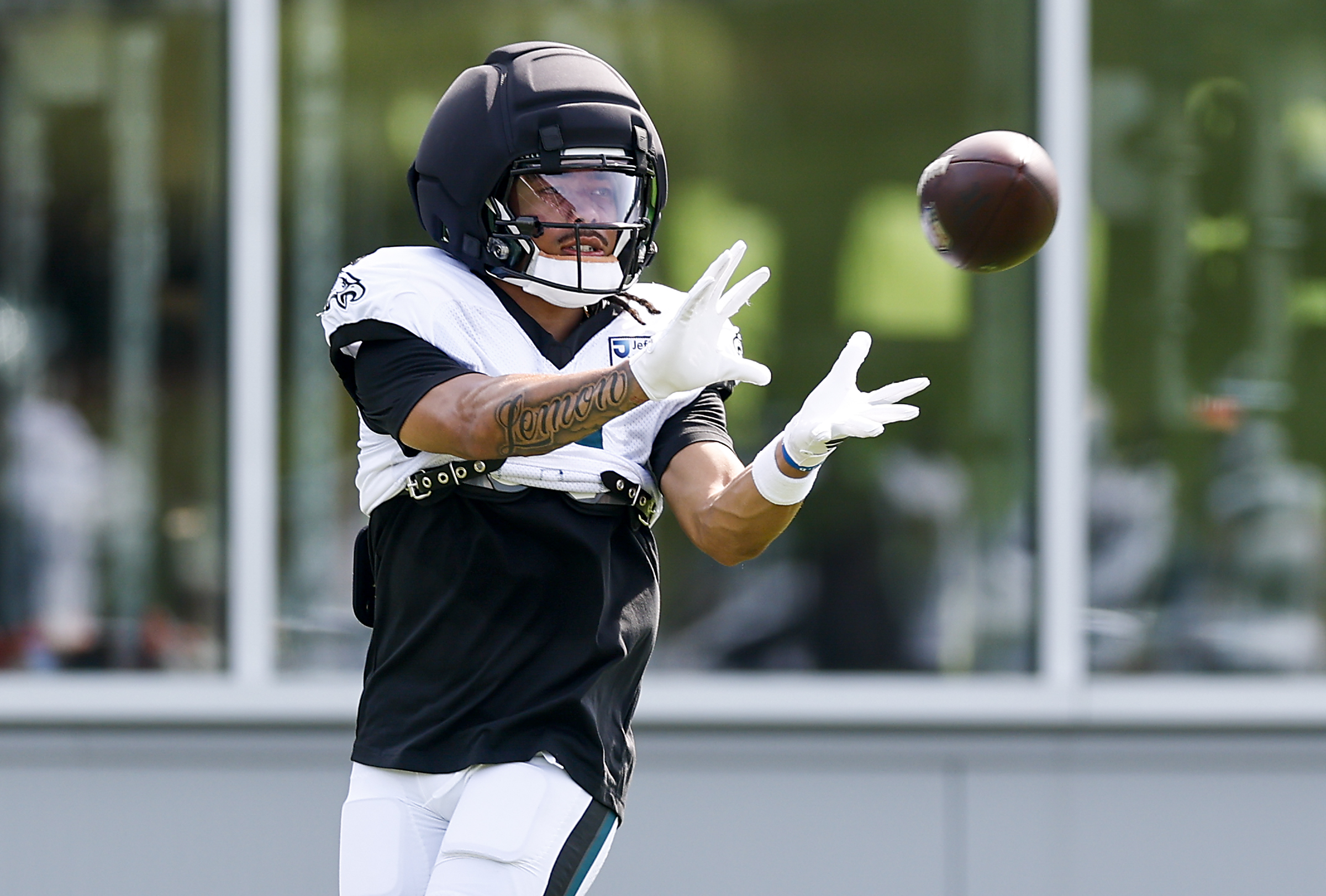
    Makai Lemon has all of the opportunity in the world. The Eagles need him to seize it.

    There is a piece of math that makes it awfully difficult to assume anything about Sean Mannion’s offense.

    It’s a piece of math that is either working in strong favor of or in strong disfavor of Makai Lemon. It depends on how the rookie feels about pressure.

    The expectations for the Eagles’ 2026 first-round pick should be a lot higher. Because the bar is high. And he is the only one who has the skill set to clear it.

    Let’s start with the math. Specifically, with the number 142.9. That’s how many targets A.J. Brown averaged per 17 games during his four seasons with the Eagles.

    Add to that 34.5, the number of targets that Jahan Dotson averaged per 17 games in his two seasons with the Eagles.

    Our total is 177.4.

    Which brings us to the most critical number: 66.5.

    That’s how many targets Dontayvion Wicks has averaged per 17 games in three NFL seasons.

    As the signs will say in London in Week 5: Mind the gap!

    One thing you can safely say about the Eagles offense in its first year under Mannion: some wide receiver is going to have a breakout season, or the defense is going to need to win them a lot of games.

    The other options are outliers. Even if the offensive line recaptures the bodily spirit of 2024, are the Eagles really going to average nearly 5 yards per carry without somebody drawing Brown’s level of gravity opposite DeVonta Smith? If not, are they really going to run the ball 621 times while passing it only 448? If not, are the Eagles really going to put up championship-caliber point totals with Smith accounting for a third of the targets and yards?

    DeVonta Smith figures to be the main beneficiary among Eagles receivers after A.J. Brown’s departure.Elizabeth Robertson / Staff Photographer

    The breakout certainly could be Smith’s. Plenty of folks inside and outside of the Eagles organization have murmured Jaxon Smith-Njigba and DK Metcalf when hypothesizing about Smith in his post-Brown chapter. Last season, after the Seahawks traded Metcalf to the Steelers, Smith-Njigba’s target share jumped from 137 to 163 and his yardage from 1,130 to 1,793. In other words, he turned from Smith into a supersized Brown.

    In the event of such a breakout from Smith, the Eagles wouldn’t necessarily need anything greater than replacement-level production from the rest of the Eagles’ receiving corps. Last season, the only Seahawks receiver other than Smith-Njigba with more than 26 targets or 188 yards was the ghost of Cooper Kupp, who finished with 47 catches and 593 yards.

    But, like we said, that’s an outlier.

    One can argue that the Denver Broncos, Buffalo Bills, and Kansas City Chiefs offer alternate hypotheticals for life without a true No. 2.

    Denver made it to last year’s AFC championship game with Troy Franklin’s 65 catches and 709 yards in the second chair behind Courtland Sutton’s 74 and 1,017.

    The Bills had the second-highest scoring offense in the NFL in 2024 with Khalil Shakir leading the way at 100 targets and 821 yards. That was the year after they parted ways with Stefon Diggs.

    The Chiefs had the NFL’s highest-scoring offense in 2022, the year after they traded away Tyreek Hill. Their top wideout was JuJu Smith-Schuster, who had 101 targets and 933 yards.

    The rebuttals are easy.

    The Chiefs had Travis Kelce, who filled the Hill vacuum with a career-high 152 targets and 110 catches for 1,338 yards. If Dallas Goedert does that, great. He’s the breakout. Otherwise, Smith-Schuster’s 933 yards would be a heck of a season for Lemon or Wicks.

    The Broncos and Bills traded significant draft capital for receivers this offseason; Jaylen Waddle headed to Denver from Miami, and D.J. Moore went to Buffalo from Chicago. Both served as verdicts on a by-committee approach at wide receiver.

    There’s a lot we don’t know about Mannion and how his scheme will express itself. There’s even more we do not know about how Jalen Hurts and the rest of the Eagles’ talent will play without a generational wide receiver on one side of the field and Smith on the other.

    But we can venture to say that nobody besides Lemon or Smith has the potential to maintain the Eagles’ aggregate WR1/WR2 production. Ours is not the first fan base or media contingent to sell themselves on best-case scenarios for Wicks, Marquise “Hollywood” Brown, or Elijah Moore. Those players are here for a reason. Their sample sizes are more than large enough.

    That’s one of two reasons Lemon is the player most integral to the Eagles’ 2026 hopes. The second is that he has the ability.

    The Eagles traded up a spot and snaked the Steelers for a reason. He isn’t your typical late first-round receiver. There is plenty of maturity and present-day NFL value evident in his game tape. He doesn’t have the outlier physical or athletic measurable of a potential generational performer like Brown. But he has the technical skills and toughness that play immediately in the NFL.

    We have not heard much of Lemon this last month. Summer-long soft tissue injuries have a knack of doing that to rookies. The big question is whether the time he has lost can quickly be regained.

    That’s true for Lemon individually. It’s just as true for the Eagles’ offense overall.

  • Camden drops uniforms in high schools in favor of a dress code

    Camden drops uniforms in high schools in favor of a dress code

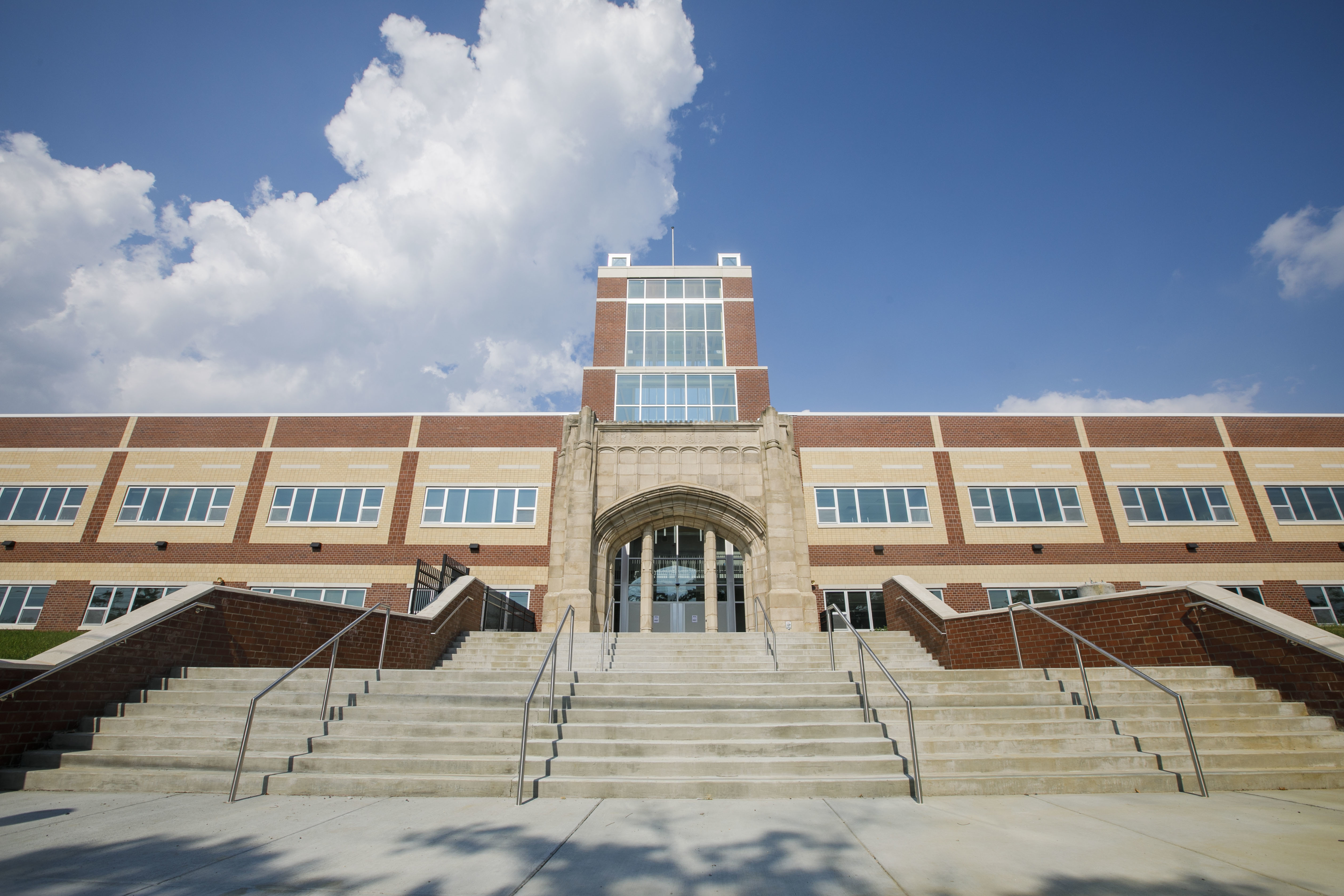
    The Camden school district has dropped its longtime mandatory school uniform policy at its five high schools.

    Instead of wearing uniforms that included khaki pants and a shirt based on their school colors, students returning to school on Sept. 3 will have a dress code that allows more flexibility but bans durags, bonnets, hair rollers and curlers, pajamas, and revealing clothing.

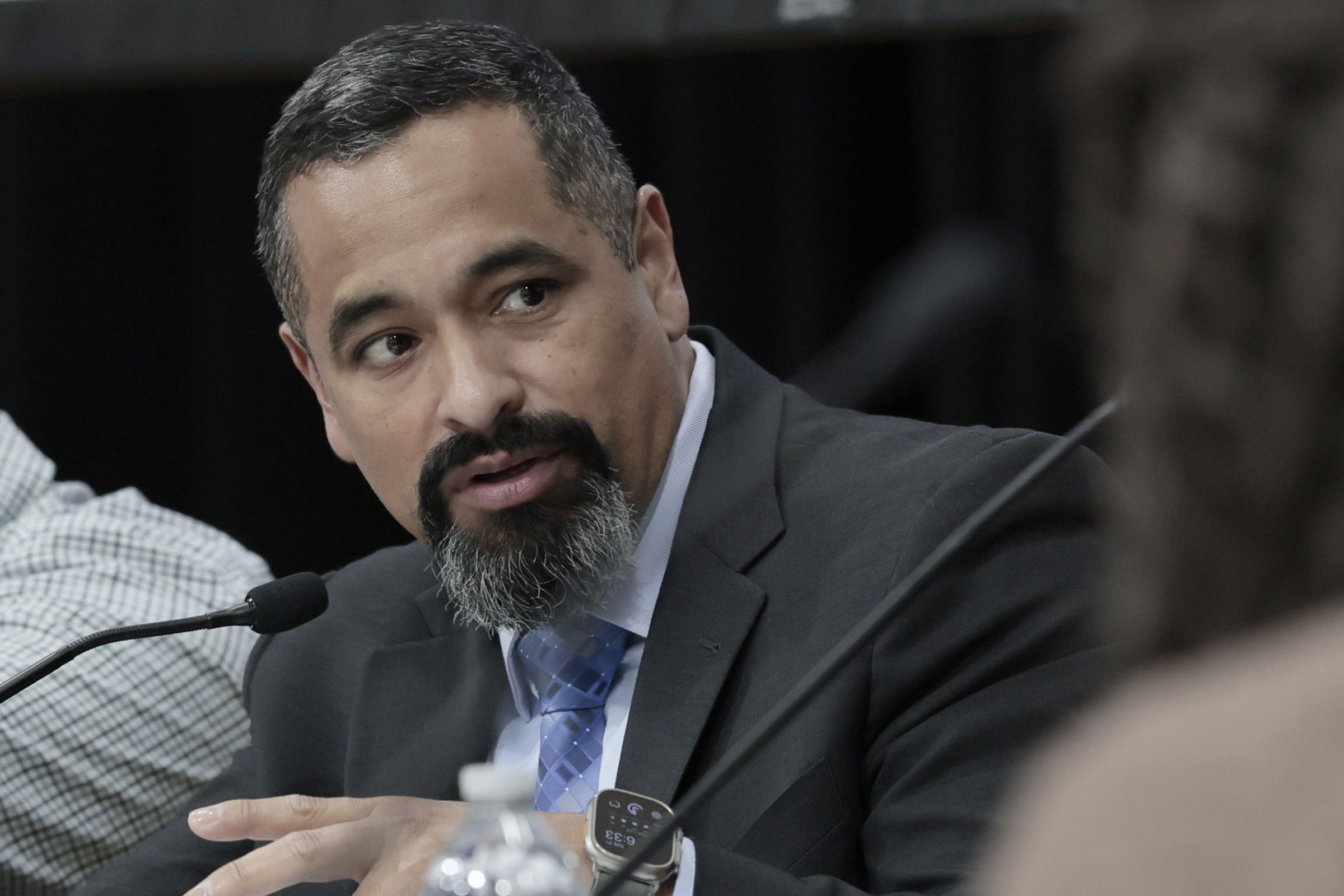
    Superintendent Alfonso Q. Llano Jr. said the decision was made after feedback from students and staff in the South Jersey school system. Elementary and middle school students will continue to wear uniforms. In a social media post earlier this month, the district explained the decision as a response to students who expressed “desire for greater opportunities to express themselves through their clothing while maintaining a safe learning environment.”

    High school will also start an hour earlier at 8:05 a.m. and run until 2:25 p.m. The district said the earlier time aligns with national start times and better meets the needs of students who work after school or have extracurricular activities.

    The new dress code has drawn mixed reaction from students and staff. It will impact students at the district’s two traditional high schools, Camden High and Eastside High, and three magnet schools, Dr. Charles E. Brimm Medical Arts High, Creative Arts High, and the Big Picture Learning Academy.

    “I think it’s a good idea. It allows students to break the mode, creates more creativity,” said Odalys Dejesus, 17, a rising senior at Eastside. “It’s a good step forward.”

    Former school board member Jose E. Delgado said the uniform policy was established more than two decades ago to improve security by making it easier to identify students entering buildings, curb bullying, and stop students from wearing gang colors.

    Delgado and others who served on the board that adopted the uniform policy have asked state Department of Education Commissioner Lily Laux to review whether Llano followed procedures for switching to a dress code.

    “It makes no sense,” Delgado said. “The uniform policy was working.”

    A state education department spokesman said the dress code policy was a local matter. Camden has been a state-operated district since 2013.

    Llano has been making changes since becoming schools chief in March. He sent pink slips to the entire central office staff. He backpedaled on a plan to merge the three magnet high schools after a backlash.

    State superintendent Alfonso Q. Llano Jr. speaks during the Camden City board of education regular meeting in Camden on Tuesday, April 21, 2026.Elizabeth Robertson / Staff Photographer

    Delgado believes the dress code policy is too subjective and can be interpreted differently by school leaders. He also worries about enforcement.

    “The teachers are not going to enforce this,” Delgado said. “They have enough problems.”

    Camden Education Association President Pam Clark said she supported the new policy for high school students only.

    “I’m for the district giving the students a chance to wear their regular clothes,” Clark said. “However, the students need to know there will be consequences if they do not come to school presentable.”

    The policy also bans open-toe shoes, most face coverings like ski masks, baseball hats, short shorts and mini-skirts, and baggy pants with underwear showing. Hoodies are allowed but the hood must be removed when the student enters the building.

    The policy calls for progressive disciplinary action for violators, beginning with a warning, and possibly escalating to in-school suspension and a meeting with a parent or guardian for repeat offenders.

    Last year, then-acting Superintendent Davida Coe-Brockington said the district would enforce a long-standing policy banning students from wearing all-black outfits at the Camden High campus.

    Interim state-appointed Camden school Superintendent Davida Coe-Brockington.Camden school district

    The complex houses four separate wings, and students were assigned shirt colors based on their school. Coe-Brockington said the all-black outfits made it difficult for staff to easily identify which school a student attends.

    Karen Borrelli, a veteran health and physical education teacher at Brimm, does not support the move to a dress code. She said the uniforms gave the schools identity, especially at the Camden High campuses. Some parents depended on district-issued vouchers to purchase uniforms, she said.

    “They don’t have the money to get outfits and keeping up with the Jones,” Borelli said referring to possible peer pressure students may face to wear the latest fashions. “Our parents can’t afford that.”

    Llano said students may still opt to wear uniforms. Borrelli expressed doubt that they would because they would stand out.

    “The focus shouldn’t be on what they are wearing to school, but on academics,” Borrelli said. “It’s going to be a mess.”

    Tuskegee University sparked a national debate earlier this year when president Mark Brown tackled the thorny issue of proper attire for students at the historically Black college.

    Like Camden, Tuskegee banned students from wearing hair bonnets and durags, which customarily are worn to protect Black hairstyles while people sleep.

    The Philadelphia school district leaves it to schools to set a dress code policy for students “so that their appearance does not constitute a health or safety hazard.”

    Last school year, an uproar flared at Philadelphia High School for the Creative and Performing Arts when female students complained they were unfairly flagged for dress code violations.

    Students said they were told by administrators that the crackdown was imposed because men outside of school were following female students. The district said it would review the dress code policy.

    Staff writer Kristen A. Graham contributed to this report.

  • The sheriff’s office doesn’t need a babysitter; it needs to be abolished | Shackamaxon

    The sheriff’s office doesn’t need a babysitter; it needs to be abolished | Shackamaxon

    This week’s edition of Shackamaxon covers data centers, property assessments, and more woes at the Philadelphia Sheriff’s Office.

    Jason Kelce with Liquid Death mascot Murder Man in an ad for the canned water and Garage Beer.Garage Beer

    Sports data center

    Former Eagles offensive lineman Jason Kelce seems to be more omnipresent in retirement than he was during his career. Most recently, he filmed a commercial for Garage Beer and Liquid Death that asked Americans to send him their urine to supply data centers.

    While conjuring a negative image of yellow liquid in a cup is probably an unwise strategy for someone who co-owns a light beer company, Kelce’s commercial had another major problem — data centers don’t actually use as much water as public perception suggests.

    In fact, the biggest threat to U.S. water supplies is something far more mundane: alfalfa farming.

    Across the arid Western states, farmers are using vast amounts of water to irrigate their fields, which are then used to feed cows for the beef industry. A single acre of alfalfa uses 1.6 million to 2.5 million gallons of water. In Utah, feed farming uses over half the state’s water supply. Meanwhile, the data centers themselves increasingly rely on closed-loop systems. The water used as coolant gets purified and reused, reducing their own need.

    The confusion over water use is emblematic of the general debate over the centers, which is rife with hard-to-vet claims. And shifting public opinion has left politicians in both parties flat-footed and scrambling to react.

    Gov. Josh Shapiro, the ever-Ambitious Abingtonian, issued his own response to the situation. Much of what Shapiro said is reasonable. He wants tech companies to pay for their own power and contribute to community benefits agreements, and to respect the Pennsylvania Constitution’s guarantee of clean air and pure water. Some of it is less sensible, specifically his commitment to local control.

    Local control sounds great in theory: Why shouldn’t communities have the final say over how they are developed? In practice, however, it is shortsighted. There are two reasons for this.

    One, the impact of data centers is regional, not local. If opponents are correct about the impact on water and electricity bills, this impact will exist no matter where the centers operate. Given the PJM grid Pennsylvanians rely on spans multiple states, there is no plausible pathway for local communities to insulate themselves from rising energy demand by blocking data center proposals.

    Two, not every community can afford to say no. Take the bankrupt city of Chester, for example. From its efforts to sell the Chester Water Authority to its role as host for the Reworld Trash Incinerator, financial considerations already play a big role in that city’s policymaking. By handing control to local authorities, the governor is ensuring cities like Chester will disproportionately play host to data centers.

    For those who believe they will have a strong negative impact on quality of life, how is that possibly fair?

    Instead, what is needed is federal, regional, or at least statewide coordination.

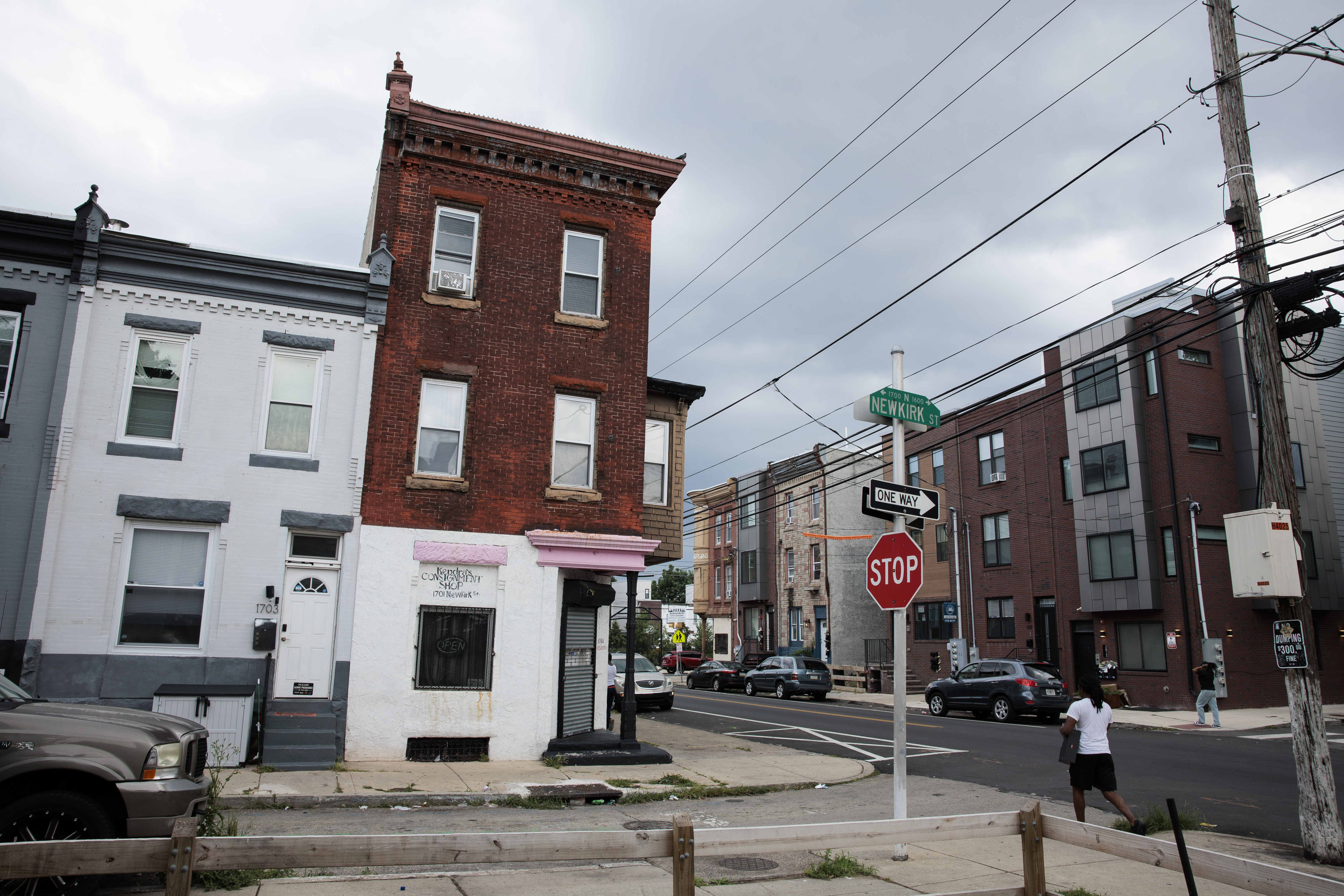
    The 1700 block of North Newkirk Street on Aug. 20. On this block in Strawberry Mansion, some homeowners saw their property assessments double.Monica Herndon / Staff Photographer

    Fair value

    Over in Allegheny County, home to Pittsburgh and many of its suburbs, the courts have ordered local officials to begin a full property reassessment, which must be completed by 2032. Pennsylvania is unique in not requiring regular reassessment.

    Pittsburgh’s values were last set in 2012, but more than a third of the state’s counties haven’t been reassessed since the 20th century. This leads to wildly out-of-whack and unfair tax bills for some residents.

    Of course, Philadelphians can tell you that regular reassessment is not a panacea for discontent. The city’s most recent valuations have set off a firestorm of consternation, especially given how many lower-income areas saw big increases. It doesn’t help matters that the neighborhoods Cherelle L. Parker used to represent on City Council, and powered her election as mayor, saw some of the smallest boosts in valuation.

    As tempting a story as the mayor favoring her core supporters while squeezing the city’s poorest neighborhoods may be, that is not an accurate assessment.

    Given the massive decrease in shootings and consistent efforts to clean and green the city, it is not surprising to see increased demand for neighborhoods like Kensington, Grays Ferry, and Fairhill. While there is still a long way to go on public safety, higher valuations are a sign of progress.

    It also should remind Council members that their theory that development drives property appreciation is faulty. Many of the neighborhoods with higher appreciation have seen little to no new development. In Northern Liberties/Fishtown, one of the city’s hot spots for new construction, values increased by just 1.7%.

    Additionally, the city has a powerful tool for protecting low-income homeowners: the homestead exemption. While the city’s stated property tax rate is 0.013998, owner-occupants pay a much lower rate. For a home valued at the city’s median of $260,000, the total tax bill is $2,239.68, or 0.008614. In Fairhill, where the median home value is $80,000, the homestead exemption eliminates the total tax liability for many residents. Boosting the exemption from $100,000 to $110,000 or $120,000 would ensure more low-income homeowners are protected from rising tax bills.

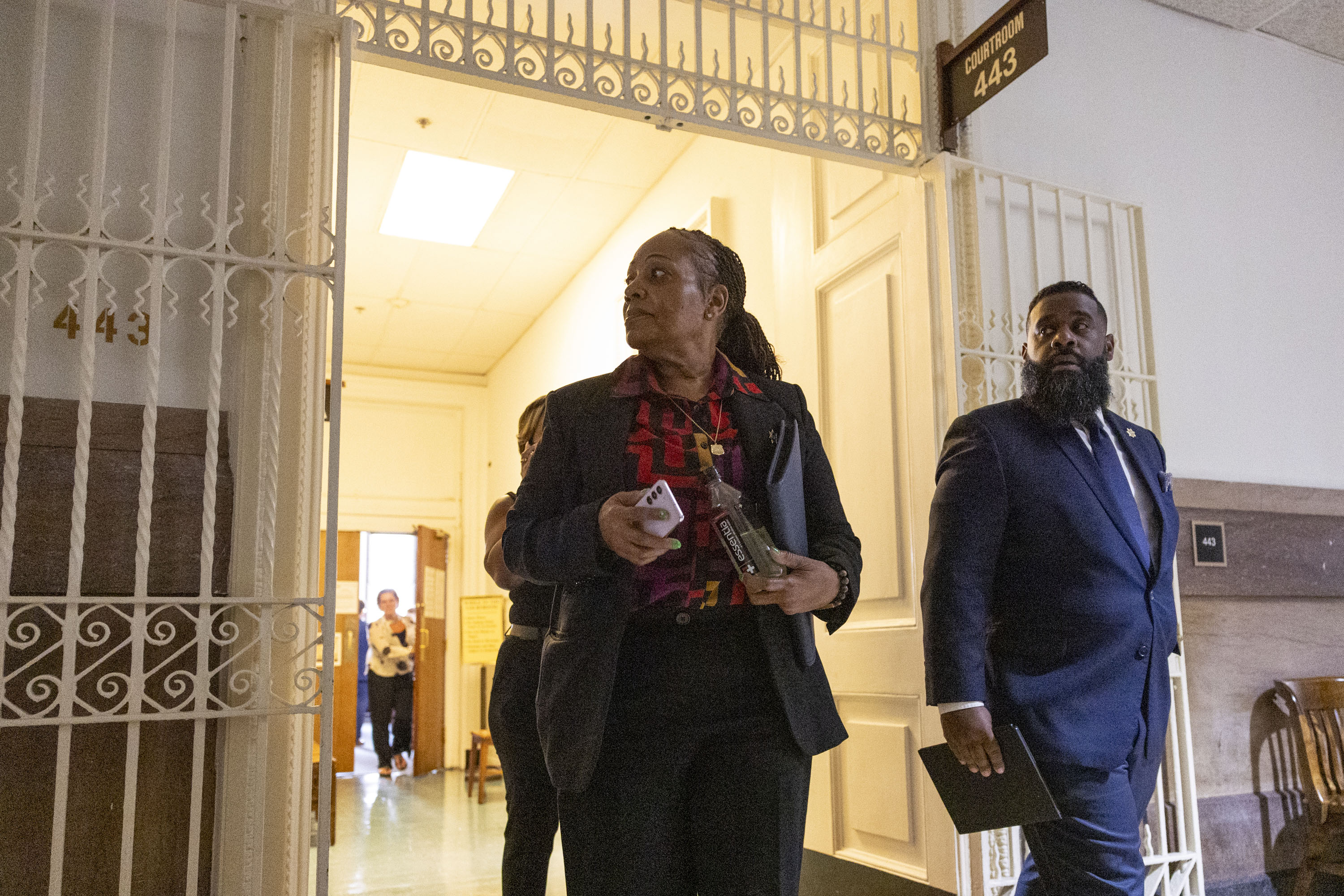
    Sheriff Rochelle Bilal is seen exiting a courtroom at City Hall on Wednesday.Tyger Williams / Staff Photographer

    Bilal’s babysitter

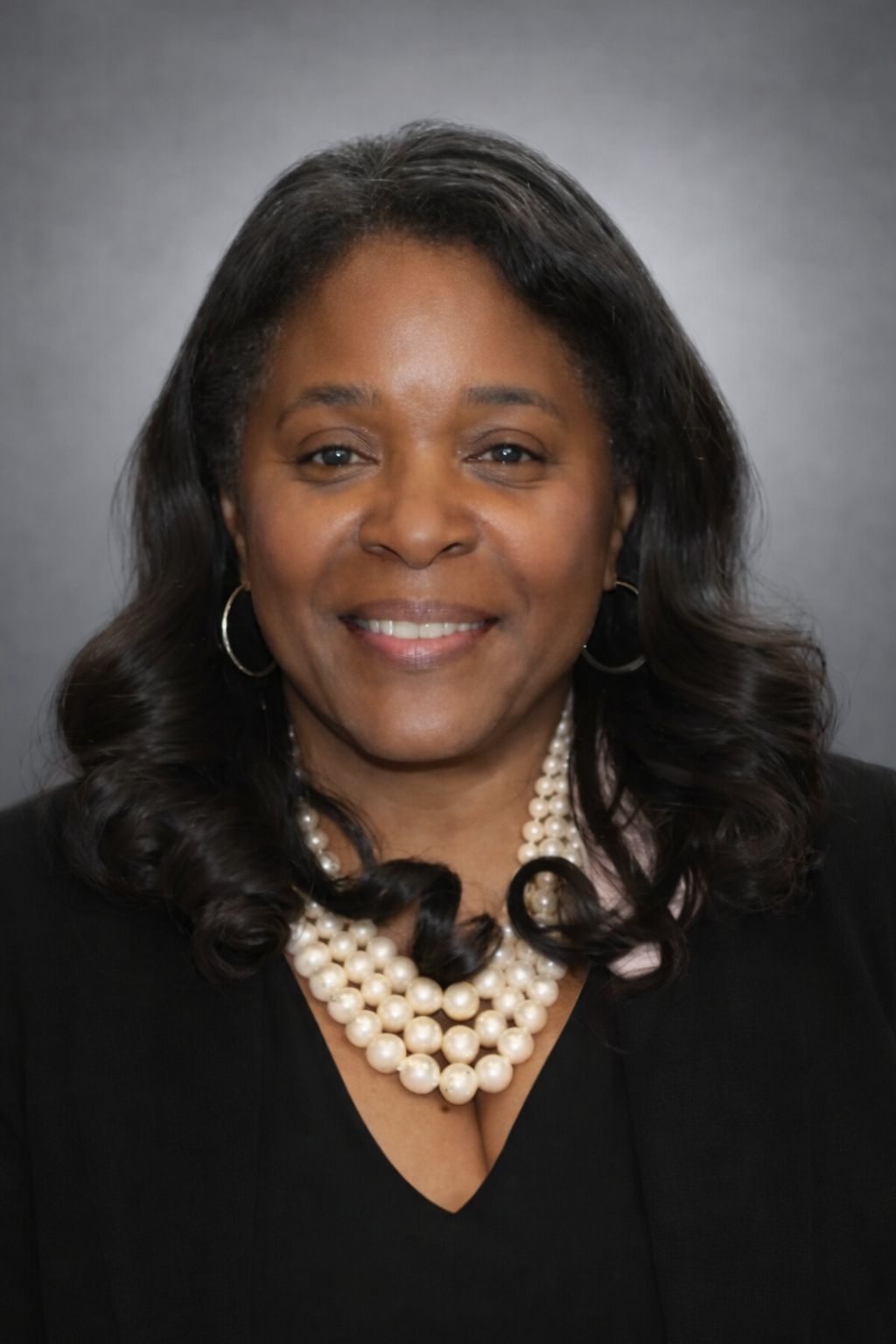
    Mayor Parker wouldn’t do it. City Council wouldn’t, either. Accountability for the Philadelphia Sheriff’s Office instead came from Common Pleas Court Judge Paula A. Patrick.

    After listening to a list of excuses and promises, it was clear Patrick had her fill of incompetence. The beleaguered department, which had been ordered to produce a specific set of documents months ago, suddenly released thousands of pages the night before the hearing.

    Instead of putting officials before the court with direct knowledge of why a backlog in processing property deeds began, Sheriff Rochelle Bilal instead sent Steven Wakefield, a deputy undersheriff who was hired just two months ago. Wakefield was tasked with testifying about past events he was not privy to, despite repeated warnings from the judge.

    As for Bilal herself, she claims to have “limited personal knowledge of the underlying facts.”

    Issuing deeds is one of the core functions of her job, but apparently the sheriff had no idea what was going on. Instead, Wakefield tried to scapegoat a former employee named Melissa Simpson, who had apparently been handling the entire process on her own without oversight from anyone.

    This testimony led to an agreement in which Bilal will have to identify someone to oversee deed sales for six months. A babysitter, essentially.

    While it is good to see someone holding the sheriff accountable for once, a temporary babysitter is only a partial solution. The office should be abolished.

    Sadly, that seems unlikely. Bilal may struggle to perform her day job, but she has thrived at building up political allies. She has been invited to news conferences by District Attorney Larry Krasner, remains a political player after her years running the Guardian Civic League, and faces next to no criticism from City Council. She was even honored by the Phillies as a “hometown hero.”

    Troublingly, Bilal does not even seem to have an opponent in next year’s elections, despite the continued public mismanagement of her office. That, at least, should change.

    Perhaps the Ambitious Abingtonian can find a Perspicacious Philadelphian willing to take on the challenge of replacing Bilal.

  • Winners of the Philadelphia Cycling Classic recall ‘the theater’ the race once was, and can be again

    Winners of the Philadelphia Cycling Classic recall ‘the theater’ the race once was, and can be again

    There’s a stretch along the 14.4-mile course of the Philadelphia Cycling Classic that remains a core memory for Freddie Rodriguez.

    It’s been more than a decade since his last professional race, but the former American road racer described the course as a scene that engaged all five senses.

    Rodriguez referred to it as “the theater.”

    “As you come into Ben Franklin Parkway, there’s the park on the right that feels like you’re riding into a stadium,” Rodriguez recalled this week, ahead of the race’s return after a 10-year hiatus. “It all almost feels like a track, like a velodrome; it’s a really cool feeling, and then you head down Kelly Drive, which is open and where the race opens up. And just the mix of people out watching a bike race and all of us [racers] riding really hard, it’s really a great part of what makes this race so special.”

    While the famed Manayunk Wall gets all the notoriety, Rodriguez contends that multiple sections of the course are appealing to riders and spectators alike. From going through Lemon Hill to the bottleneck of riding down Main Street Manayunk, Rodriguez says all of it is “iconic to the race.”

    Rodriguez, who won the men’s event in 2001 and placed in the top 10 on four other occasions, including a pair of third-place finishes (2008, 2012), says there was a time when the annual Classic, which has been referred to by many different names over the years, was the preeminent road race in the country.

    “I’m not kidding, it was the No. 1 one-day race in America,” Rodriguez, who will be on scene as a commentator alongside former racers John Eustace and Mark Holden for 6abc’s broadcast. “And I do believe it’s now again the number one day race in America. Hopefully, this will also help set a foundation for professional racing in the United States.”

    Eric Heiden raises his hands in victory, crossing the finish line for Team 7-Eleven, becoming the first winner of the men’s event.George Widman

    ‘Ten laps of that thing’

    It’s hard to look at the Eric Heiden’s cycling career and not call him an overachiever. The former Olympic speed skater turned cycling road racer, won the first Philadelphia Cycling Classic when it was called the Philadelphia International Championship in 1985, and parlayed a Hall of Fame sports career in cycling and speed skating. Now, he’s an orthopedic surgeon with a practice in Utah, previously serving as team doctor for a number of U.S. Olympic teams and even doing a stint for the NBA’s Sacramento Kings.

    His favorite memories mirrored Rodriguez, noting that the stretch along Kelly Drive offered a “recharge.”

    “For me, the nicest thing was riding along the river there, the Schuylkill River, just where it was nice and cool,” Heiden recalled. “It was flat and you could kind of recharge before you took that ride and headed into Manayunk, which was very hard.”

    Riding up the steep half-mile stretch of the famed Manayunk Wall has been a daunting task for amateur and professional riders alike. Akira Suwa / Staff Photographer

    But his memory of tackling The Wall, the near half-mile stretch of Levering Street in Manayunk, is a memory he’ll also never forget — but not because it was another favorite.

    “We had to do 10 laps of that thing,” Heiden told The Inquirer. “And, I’m not a very good climber; I was a little heavy for that climb. Even if you’re a good international racer, it’s a challenge getting up that thing; I’m not going to lie to you. I mean, it’s like 20% grade. Yeah. You look at that, and as you come around the corner you’re going, ‘Whoa, nelly.’”

    Heiden, who originally used bikes to cross-train for his Olympic speed skating career, ended his cycling career as an inductee into the United States Bicycling Hall of Fame. Racing in Philly, he says, was a big part of that.

    “This race proved a lot to me, not just in my abilities as a racer, but how much I was able to do,” he said. “To me, this was the first legitimate national championship where the distance was significant. The organizers, those guys were passionate about the sport, and they really put together a good experience for the riders and for the teams.

    Eric Heiden said that the Philadelphia International Cycling Classic, in all of its iterations, served as a proving ground for many cyclists, including himself. Photo by Lee Rogers

    “It was really professionally run. Our team came there expecting to win the national championships, and we had all the top guns and 7-Eleven showing up. It meant that much and was a race that was taken very seriously.”

    What does the return of the Philadelphia Cycling Classic represent?

    “This race has a strong tradition in the USA, and in the history of USA cycling,” Heiden said. “To see it once again resurrected gives us a lot of hope on where cycling is headed these days.”

  • Violence against women in a Good Good ad stains slow responders: PGA Tour, Callaway, Golf Galaxy, Golf Channel

    Violence against women in a Good Good ad stains slow responders: PGA Tour, Callaway, Golf Galaxy, Golf Channel

    The only thing more disappointing about the slow and weak response by the principals in the Good Good Golf YouTube channel scandal was its utter predictability.

    There should have been immediate distancing and disassociation from Callaway Golf and Good Good Golf after they aired an outrageous commercial that endorsed violence against women. Instead, it took almost a week.

    Why?

    Because corporate America, the foundational structure for the golf industry, hoped it would all blow over.

    It did not.

    Last Friday, an ad aired online in which Good Good Golf co-founder Garrett Clark rushes across a tee box and levels a female golfer who is looking in his bag, then stands over her, points at her on the ground, and says, “Do not touch my new driver.”

    Who thought this was acceptable? Who thought this was funny? Who thought this was anything but horrific?

    Good Good, that’s who. Of course they did.

    It’s a frat bro content creator and apparel company with more than 2 million subscribers to its YouTube channel, making goofy videos. It also sells ugly hats and even uglier shirts. When you hear some idiot on TV scream, “Get in the hole!” when a pro golfer tees off on a par-5, dollars to doughnuts he’s wearing Good Good gear, hat on backward, shirt untucked.

    Then, the commercial.

    There was, appropriately, immediate backlash that convinced Good Good to delete the ad. The backlash snowballed into international outrage, with resounding consequences.

    Cool. It took far too long.

    The ad aired Friday.

    By Saturday night the PGA Tour, Tour CEO Brian Rolapp, Callaway, Dick’s Sporting Goods and Golf Galaxy, and Golf Channel all should have cut ties with Good Good. The fact that none did until they were forced by public sentiment tells you everything to need to know about these folks and how they view women.

    In case anyone wants to argue that this commercial was not an endorsement of violence against women, know that Callaway, as penance, on Thursday committed $1 million to support initiatives that combat violence against women.

    The club in question was a driver made by Callaway in collaboration with the new hip-and-with-it brand. The ad was vetted by both Callaway and Good Good. Incredibly, it raised no alarms at either place, with anyone, until social media began its cycle of outrage.

    The irony is few brands had done as much to promote women in golf than Callaway, which has perhaps the most potent brand-to-athlete recognition relationship in the women’s game, the one-time face of women’s golf, Annika Sorenstam. She condemned the ad but, sadly, did not condemn either Callaway or its leadership.

    Callaway Golf balls shown at the Cobbs Creek Golf Course.Tom Gralish / Staff Photographer

    This comes at the height of the Caitlin Clark era, when women’s sports are surging like never before. She’s a basketball player, but she loves to golf.

    Her involvement in the game might have helped spur the biggest growth spurt women’s golf has ever seen. The COVID-19 lockdown triggered massive growth in the golf industry in the United States, and the segment that has grown the most by both percentage and raw numbers is women’s golf, up 45% and 2.5 million golfers compared to 12% and 2.3 million for men, according to the National Golf Federation.

    Callaway just scored the worst own-goal in sports marketing history.

    More than 8 million women now play golf, but the chairmen of all of the entities in question — the Tour, Callaway, Dick’s, and Golf Channel — all are men. Which might explain the slowness and gradualness of the only acceptable responses.

    So we had the scramble, and the admonitions, and the apologies, and the disassociations. The problem with all of it is, nobody wanted to do the right thing unless they had to. Everybody wanted to try to ride it out. Which means they are all as guilty as they could possibly be.

    That includes the Tour, which, on Thursday, announced that Good Good would no longer be the title sponsor of a tournament in Texas in November.

    That includes Golf Channel, which needed four days to decide to not air the Good Good edition of “Big Break,” which was due to begin Tuesday but, after sponsor Golf Galaxy pulled out, was initially pushed back a week and has since been canceled altogether.

    That includes Dick’s Sporting Goods and Golf Galaxy, which needed five days to decide to pull Good Good merchandise from its shelves.

    That includes Rolapp, who only responded to the commercial’s misogyny when he was questioned at a press conference four days after the incident, then landed this stinging indictment: “I think what we saw was concerning.”

    Rolapp’s milquetoast response was a resounding reminder that, before moving to the PGA Tour last year, Rolapp spent more than two decades working for the NFL, America’s most notorious sports league when it comes to ignoring issues like domestic violence and sexual harassment in the workplace.

    That includes Callaway, whose executive roster looks like President Donald Trump’s cabinet. After one day, Callaway issued a chastisement … of Good Good. After three days, Callaway pulled the driver from its website. After six days, as its stock continued to lose value, Callaway finally cut ties with Good Good.

    Callaway’s abrupt about-face, after partnering with Good Good for three years, might have been prompted by Callaway being threatened with exclusion by huge retailers like Costco, which apparently removed access to Callaway products Thursday, at least temporarily.

    And, of course, there is Good Good.

    Clark is the general manager.

    He should resign.

    He should have resigned Saturday morning.

    Instead, five days after the commercial aired, as Dick’s, Golf Galaxy, and the PGA Tour Superstores began pulling Good Good stock from their shelves, Clark issued a rambling, 8½-minute “apology.” In it, he explains the process of the production of the ad, and insists that the woman was not injured, and that Good Good is women-friendly — as if any of this matters.

    At all.

    It does not.

    The obtuse and embarrassing statement just paints Clark and Good Good as defensive, tone-deaf, and completely uncomprehending of the gravity of the moment.

    As tone-deaf as Rolapp, the PGA Tour, Callaway, Golf Channel, and Dick’s/Golf Galaxy.

    All of them did the right thing, eventually, when forced to do so.

    But none of them did the right thing for the right reasons in the right time frame.

  • 7th Street Burger, an NYC-based chain, opens its first Philly location

    7th Street Burger, an NYC-based chain, opens its first Philly location

    You’d be forgiven if you walk into any 7th Street Burger and think that the burger chain has been around forever. Its spare, almost bare-bones menu of smash burgers and fries is more classic than innovative, but perhaps its austerity is part of what is fueling its growth.

    The chain is growing at a breakneck pace. The New York-based chain opened its 35th location in Fishtown (1215 Frankford Ave.) earlier this week. It has three more Philly-area locations that are slated to open by the end of this year, in University City, Center City, and Conshohocken.

    On a Wednesday at 4 p.m., squarely between regular lunch and dinner hours, it was packed with people of seemingly every demographic, waiting in line for burgers.

    It was first opened on its namesake East 7th Street in New York’s East Village in May 2021 by entrepreneurs Kevin Rezvani and Paras Jain who “maxed out” their credit cards in order to do so. The burger joint took off. They quickly opened another location in Greenwich Village within a year. Venture capital firm Left Lane Capital invested in 7th Street Burger in 2023, and since then, the brand has been on an opening spree up and down the East Coast.

    Philly’s first location took nearly a year to open, from when the chain first took possession of the previously empty space in October.

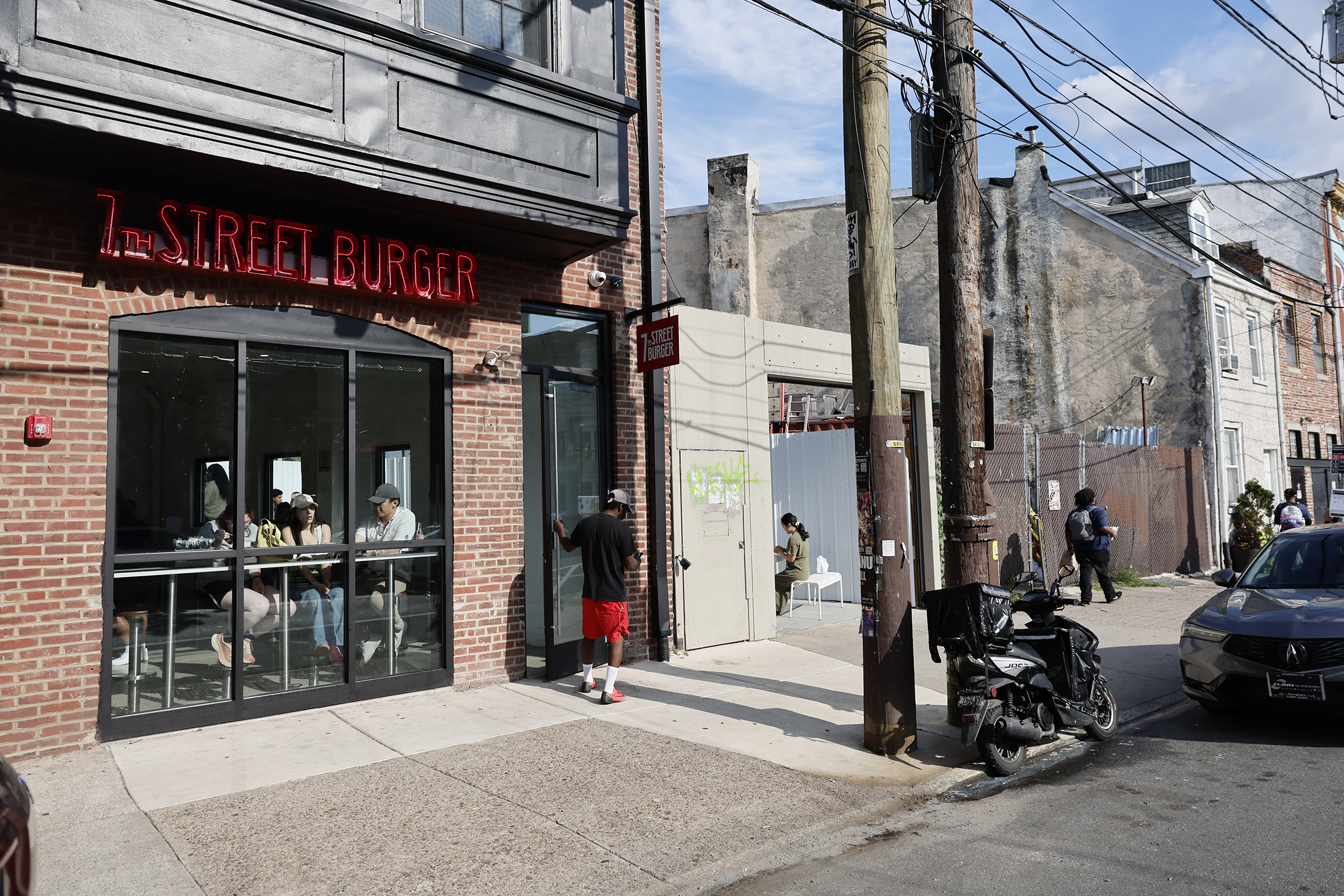
    7th Street Burger at 1215 Frankford Ave.Elizabeth Robertson / Staff Photographer

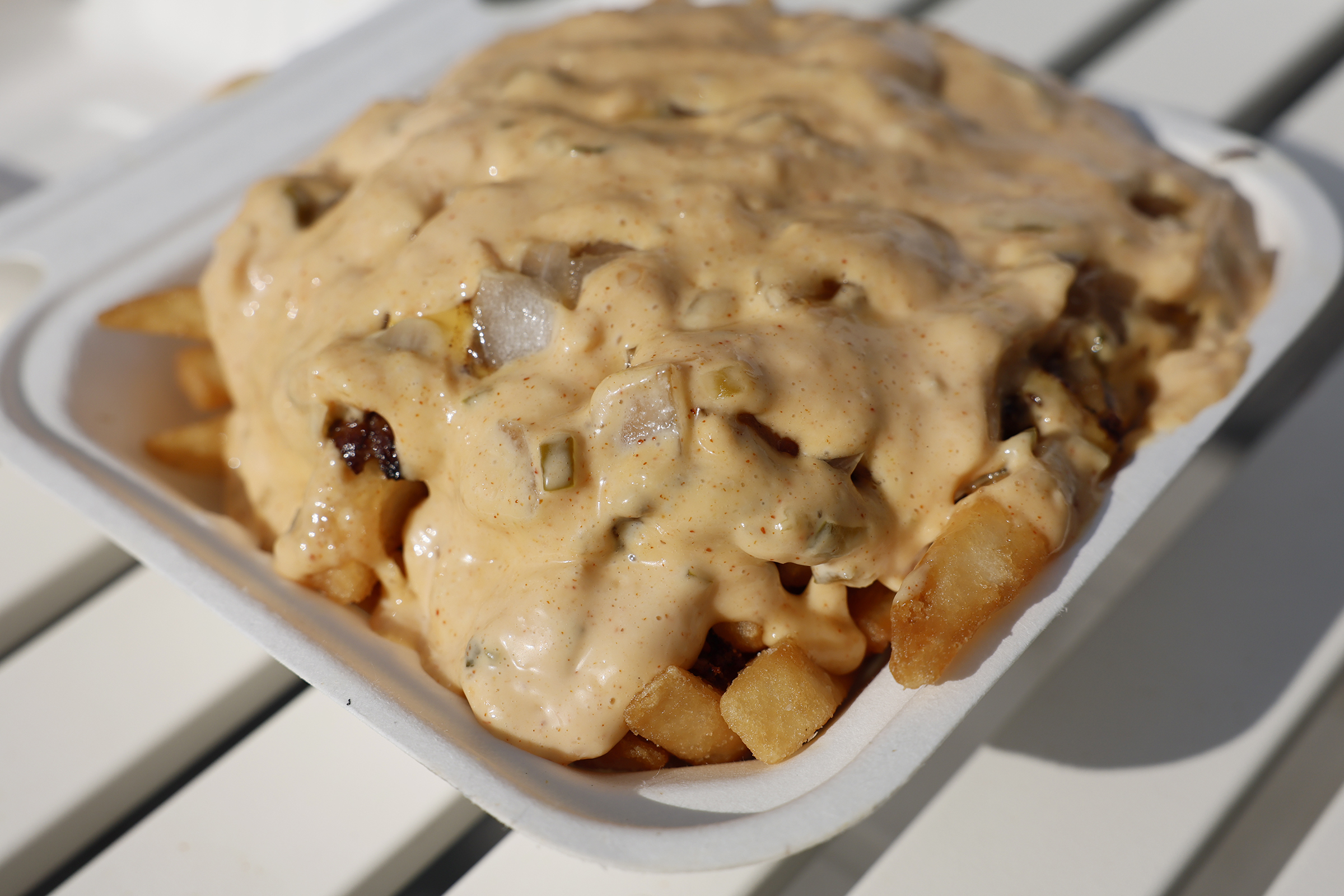
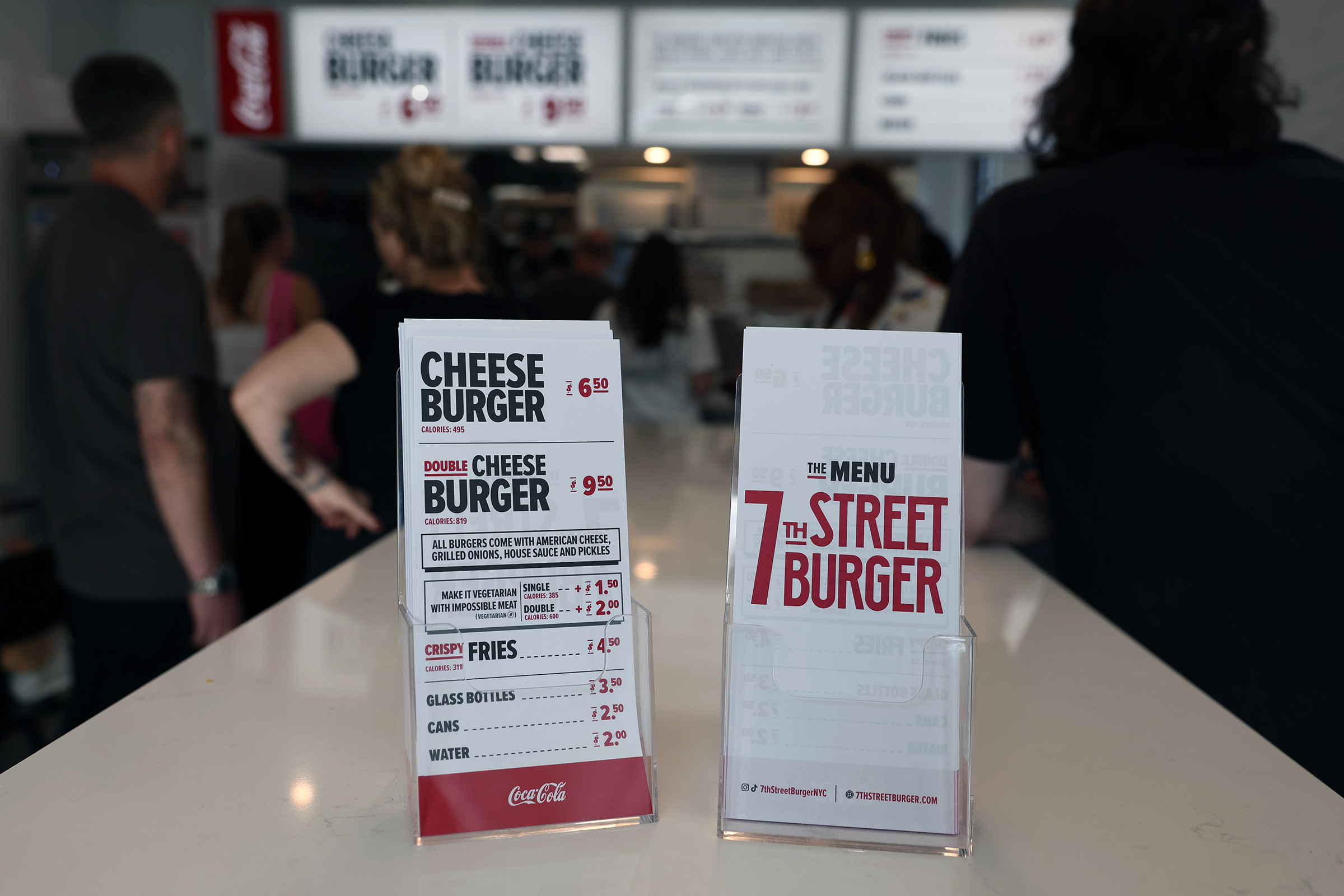
    All 7th Street Burger locations serve the same menu (at the same prices) consisting of a cheeseburger ($6.50), double cheeseburger ($9.50), and crispy fries ($4.50). Cheeseburgers and double cheeseburgers can be made vegetarian with Impossible Meat for an additional $1.50 and $2, respectively. Only Coca-Cola, Sprite, and water are available as beverages. All burgers are served on Martin’s potato rolls with American cheese, grilled onions, a mayonnaise-based house sauce that manager Frank Perez declined to give any other ingredients of, and pickles. There is a secret menu of Cajun fries and loaded fries that isn’t posted at any of their restaurants, but is rather written with a Sharpie on a takeout box at the register. Loaded fries are topped with the same ingredients as the burgers, with options to make them spicy (with a ghost pepper sauce and jalapeños).

    The loaded French fries at 7th Street Burger.Elizabeth Robertson / Staff Photographer
    The menu is limited and the same from location to location.Elizabeth Robertson / Staff Photographer

    Hours will likely change, as 7th Street Burger learns the Philly market’s demands and that of their locations’ surrounding neighborhoods. “For late night, we’ll probably extend Friday and Saturday to be closer to our New York shops,” said Perez. In New York, the locations are open until 3 a.m.

    Since opening, Philly’s 7th Street Burger has sold hundreds of burgers (Perez declined to state how many hundreds) but did note that they have sold far less Impossible Meat burgers here than in any other markets.

    7th Street Burger is at 1215 Frankford Ave. 877-428-2693, 7thstreetburger.com. Hours: 11 a.m. to midnight every day. Hours may change depending on demand.

  • NBC Sports Philadelphia’s Tom McCarthy will miss most of Phillies-Angels series

    NBC Sports Philadelphia’s Tom McCarthy will miss most of Phillies-Angels series

    One familiar Phillies voice will replace another this weekend during the team’s series against the Los Angeles Angels.

    Tom McCarthy, in his 20th season as the TV voice of the Phillies, will call Friday night’s game on NBC Sports Philadelphia alongside Ben Davis. Scott Franzke, the team’s longtime radio announcer on 94.1 WIP and other stations throughout the Delaware Valley, will take over Saturday and Sunday alongside Davis, with Gregg Murphy calling the game on radio with Kevin Stocker.

    So where will McCarthy be? He’ll be on Peacock and NBCSN calling a noon matchup between the Washington Nationals and Miami Marlins, part of an NBC Sunday triple-header. Joining him in the booth is one-time Phillies radio announcer Kevin Frandsen and four-time World Series champion Jeff Nelson.

    But unlike John Kruk, McCarthy has no issues wearing a suit.

    McCarthy initially though he might call Saturday night’s Phillies game, then take an overnight flight to Miami. But the notorious workaholic thought better of trying to navigate such a narrow window.

    “It just wasn’t prudent to get in at 5:30 a.m. to do an early game,” McCarthy said. “I like to work. I like the opportunity. I like the adrenaline rush. But I also thought it was probably better for everybody if I didn’t do that.”

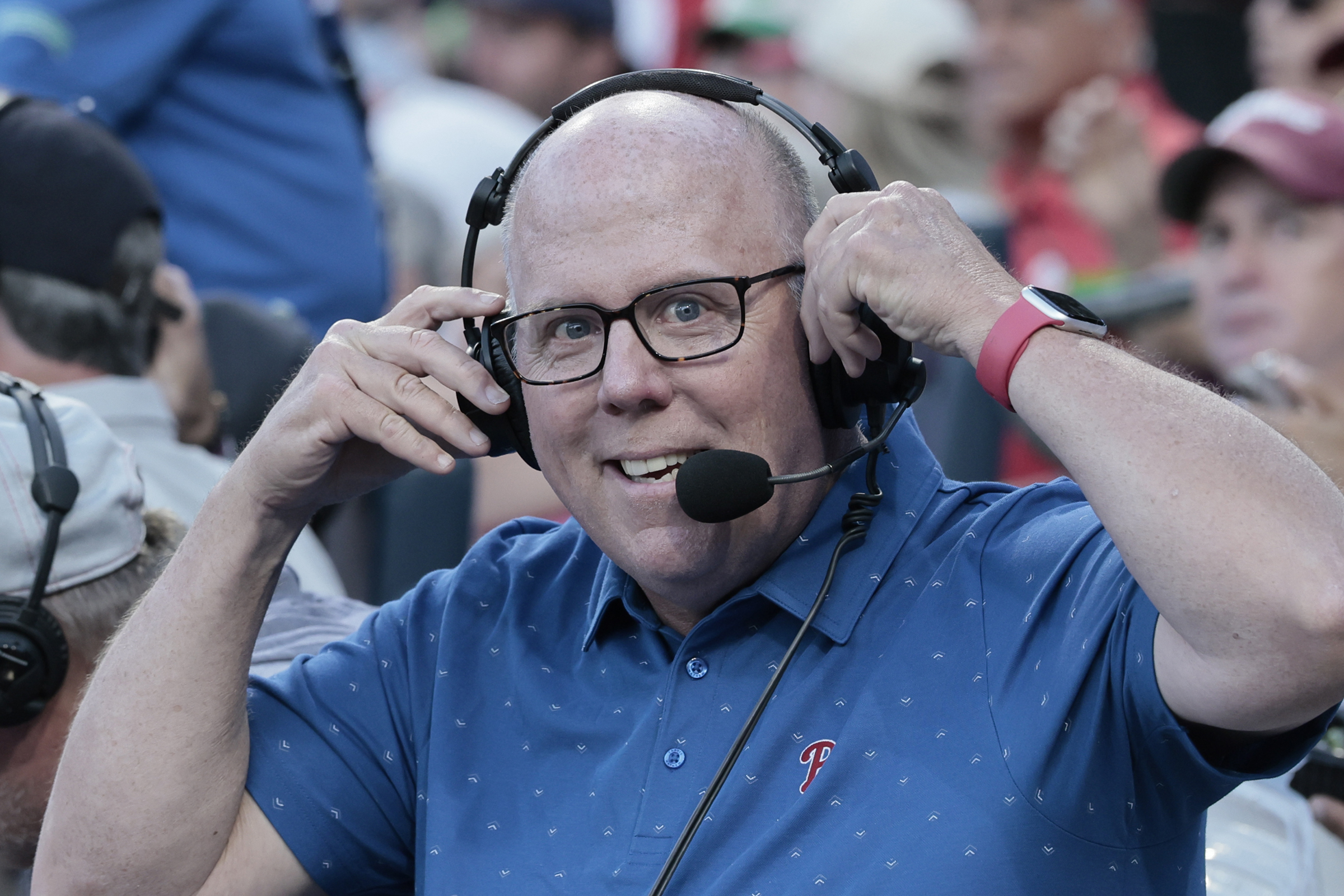
    Phillies radio announcer Scott Franzke will be on TV this weekend. NBC Sports Philadelphia

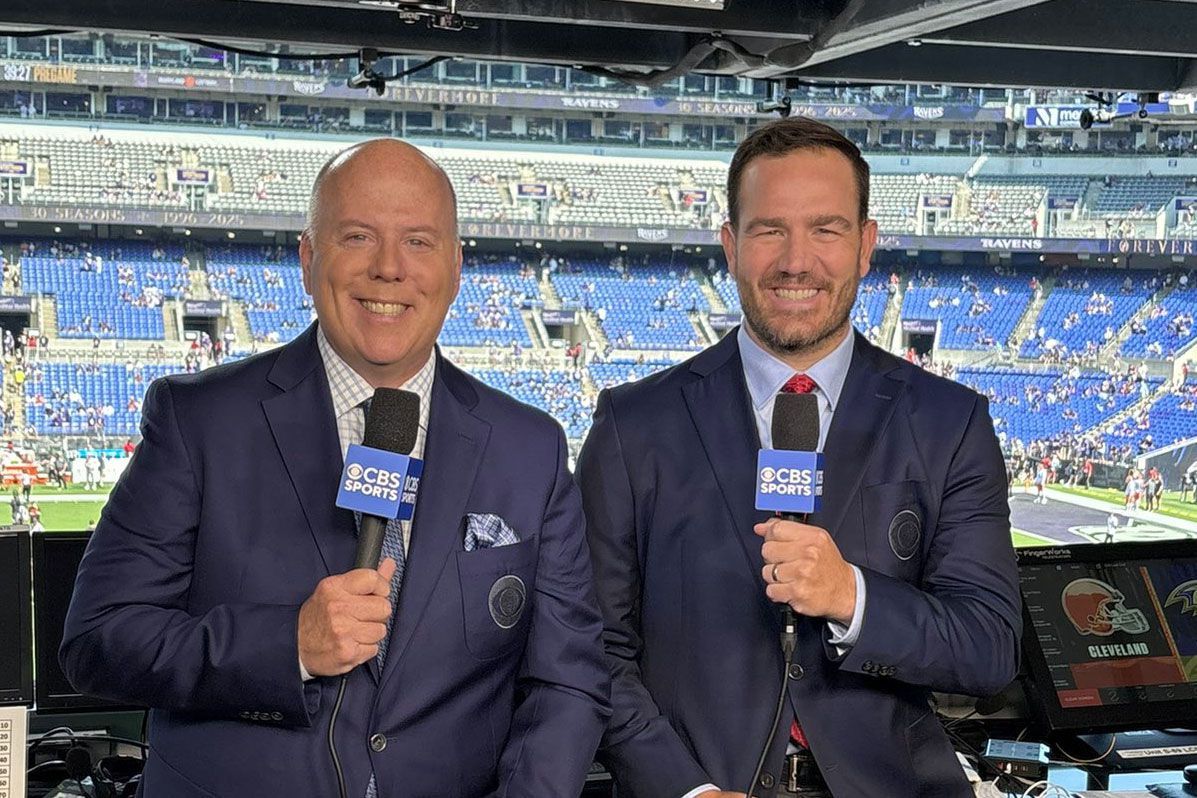
    The late-season shifting is nothing new for McCarthy or Philly fans. In addition to his role calling Phillies games, McCarthy is also entering his 13th NFL season as a play-by-play announcer with CBS. This year he expects to call around 10 games, but he won’t do it alongside Ross Tucker, who was promoted to the network’s No. 2 booth alongside Ian Eagle.

    “I’ve known him since he was 18 years old. I’m very proud of him,” McCarthy said of Tucker. “He’s one of the hardest workers I’ve ever been around.”

    Instead, McCarthy will call games with former Seattle Seahawks and Indianapolis Colts running back Robert Turbin in his first season as an NFL color analyst.

    Because the start of the NFL season was pushed back by a late Labor Day, McCarthy will actually end up missing fewer Phillies games this season.

    Last season, Tom McCarthy (left) called NFL games alongside Ross Tucker. CBS

    His first NFL game is the Week 1 matchup between the Cleveland Browns and Jacksonville Jaguars on Sept. 13, somewhat appropriate because he once called Browns preseason games. As a result, he’ll miss all three games of the Braves-Phillies series that weekend.

    He’ll also work Week 2 and Week 3 for CBS, though the network hasn’t publicly announced which games he’s calling. But thanks to national broadcasts, McCarthy will only miss a total of three Phillies games on NBC Sports Philadelphia those two weekends, though it does include the season finale against the Tampa Bay Rays on Sept. 27.

    “The Phillies are great about it,” McCarthy said. “I don’t miss any games during the regular season, kind of by design. Unless it’s my kid’s graduation. … I save it for football season.”

    The Eagles have two games scheduled to air on CBS, though the Birds’ Week 11 matchup against the Pittsburgh Steelers will be a national 4:25 p.m. game. The other is a Week 6 matchup against the Carolina Panthers.

    While McCarthy has called Eagles games on the radio for Westwood One, he’s never had the opportunity to broadcast the Birds on CBS. The streak will likely continue this season, since McCarthy isn’t assigned any games that weekend.

    “I would love to do an Eagles game. I think it’d be a hoot,” McCarthy said. “But I just roll with wherever they send me.”

    McCarthy’s absence is a Phillies tradition that goes back to the late, great Harry Kalas, who called Notre Dame football games in September and national radio games for Westwood One. He also missed games on Tuesdays and Wednesdays to do voice-over work for NFL Films.

    It was actually one of those absences where McCarthy got his first opportunities to call the Phillies on TV.

    While Sunday is McCarthy’s first-and-only regular season game for NBC, he’ll call a wild-card series next month for the network. That means for the first time, McCarthy has the chance to actually call some Phillies postseason games.

    “I don’t know if NBC would put me there or not, but I think there’s a possibility,” McCarthy said. “It would be awesome.”

    Phillies’ standings and NL playoff picture

    window.addEventListener(“message”,function(a){if(void 0!==a.data[“datawrapper-height”]){var e=document.querySelectorAll(“iframe”);for(var t in a.data[“datawrapper-height”])for(var r,i=0;r=e[i];i++)if(r.contentWindow===a.source){var d=a.data[“datawrapper-height”][t]+”px”;r.style.height=d}}});

    If the season were to end today, the Phillies would be the No. 2 wild card in the National League. That would currently mean a best-of-three series against the Chicago Cubs in Wrigley Field, with the winner advancing to the National League Divisional Series.

    Here’s how the wild-card race in the National League currently shakes out:

    window.addEventListener(“message”,function(a){if(void 0!==a.data[“datawrapper-height”]){var e=document.querySelectorAll(“iframe”);for(var t in a.data[“datawrapper-height”])for(var r,i=0;r=e[i];i++)if(r.contentWindow===a.source){var d=a.data[“datawrapper-height”][t]+”px”;r.style.height=d}}});

    Phillies news

    Bryce Harper has five homers this month and is hitting .338 and slugging .600. Elizabeth Robertson / Staff Photographer

    Remaining Phillies TV schedule

    • Phillies at Angels
    • Phillies at Diamondbacks
    • Braves at Phillies
    • Astros at Phillies
    • Phillies at Braves
    • Phillies at Nationals
    • Phillies at Mets
    • Brewers at Phillies
    • Rays at Phillies