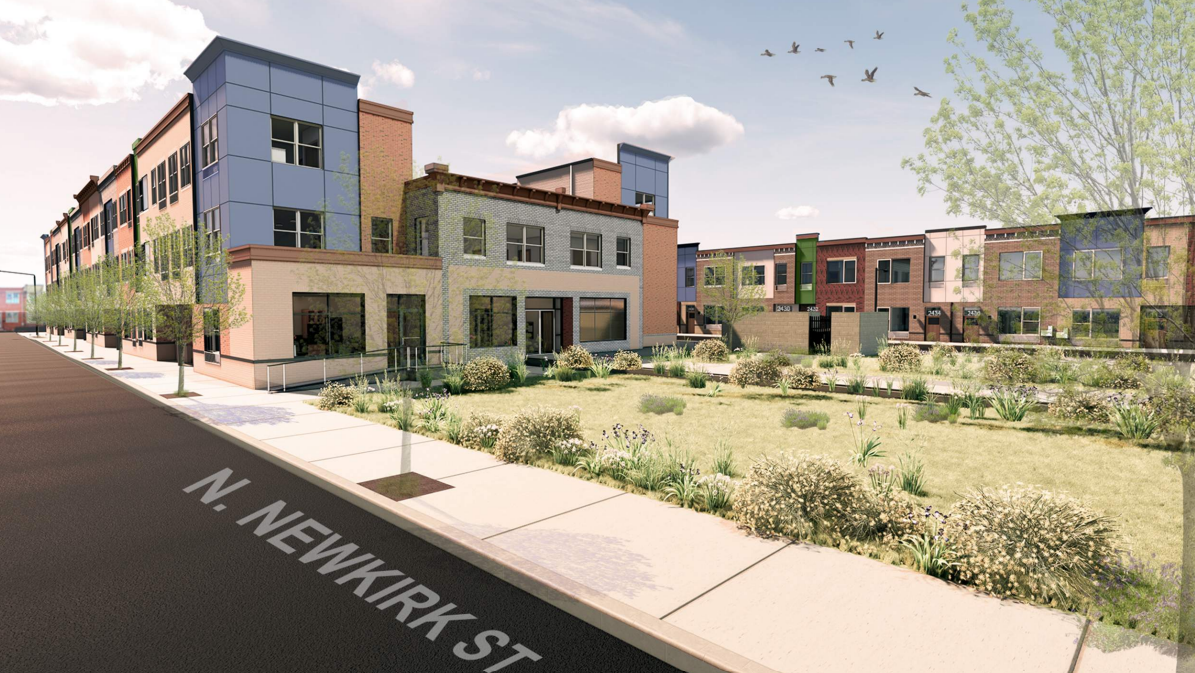
The Philadelphia Housing Authority is planning an 85-unit mix of affordable rental and homeownership units in Strawberry Mansion, around 28th and York Streets.
The proposal is part of a burst of PHA activity in this North Philadelphia neighborhood in recent years, as the agency has sought to use vacant land to add affordable housing to the area.
“This proposed development at 28th and York represents exactly the kind of investment Strawberry Mansion deserves — one that replaces long-term vacancy and blight with affordable homes, open space, and renewed opportunity,” Kelvin A. Jeremiah, president and CEO of the Philadelphia Housing Authority, said in a written statement.
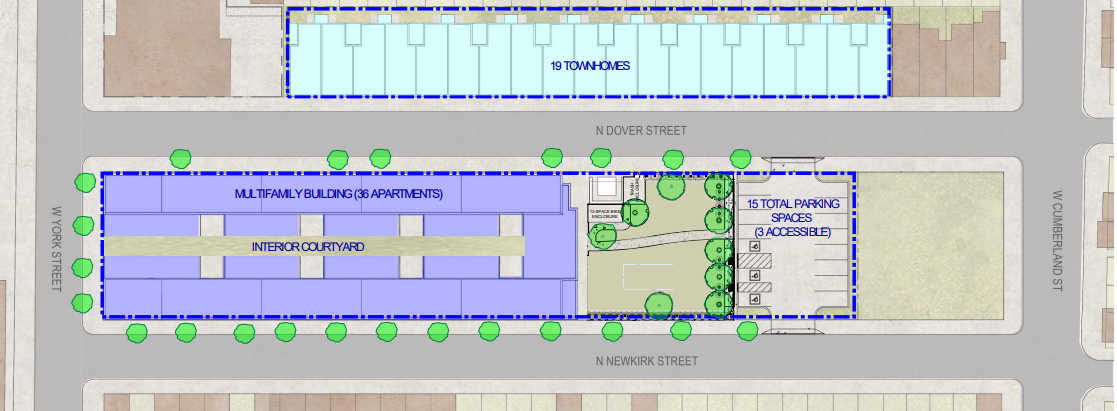
The project has 30 single-family houses that will be built using the city’s Turn the Key program, 19 rental townhouses, and a 36-unit apartment building roughly split between one- and two-bedroom units.
PHA also plans 15 parking spaces, street widenings to allow more parking, and a new agency-run park.
The rental portion of the project, which includes the apartment building at 2401 N. Dover St. and the 19 rental townhouses at 2416 N. Dover St., received permission to move forward from the Zoning Board of Adjustment in late July and early August.
The housing authority has the support of many of the area’s elected representatives, including State Sen. Sharif Street and State Rep. Keith Harris. The politically influential Laborers union also submitted testimony to the zoning board in support ofthe project.
The biggest regulatory hurdle to PHA’s plans isthat the land slated for multifamily development is zoned for single-family use, but the board waived that requirement after hearing from community members about PHA’s proposal.
“I would love to see some development on Dover Street,” said Altrena Nixon, who owns a business at 29th and York Streets.
“It’s been sitting like that for many, many, many years,” Nixon said in testimony before the zoning board. “We need the vibrancy. We need the development. We need the jobs that it’ll bring to our area.”
Two speakers warned about the housing authority’s history in the neighborhood, arguing against adding so much density and too much affordable housing.
All In The Family Group Associates Inc., a community organization, wanted further meetings with PHA to discuss how the project related to other nearby developments.
In a letter, PHA declined to enter into an agreement with the group over a planned park at 27th and York Streets. All In The Family did not respond to a request for comment.
“The PHA should not be able to get away with not coming to the table with us and ironing out these issues and ensuring that we have stability in our communities,” Odessa Tate, a member of All In The Family, said in testimony before the board.
Councilmember Jeffery Young — who is engaged in a legal action against a ZBA ruling in favor of another 57-home development PHA proposed in Strawberry Mansion — asked the board to delay its ruling to allow more time to meet with All In The Family.
A map showing where the rental portion of PHA’s plan will lay out.Cicada
But the zoning board ruled in the project’s favor at hearings on July 29 and Aug. 5. Six of the nine speakers at the hearing were in favor of the project.
“There is a dire need for affordable housing in our community, and to continue to just delay and delay and delay is counterproductive to the needs of the community,” said the Rev. Warren Marshall at the July hearing.
The 30 homeownership units did not require zoning board permission to move forward. They will be on 29th, Newkirk, and Dover Streets and are being built by Civetta Property Group, the developer that has used the city’s Turn The Key program the most extensively.
Construction will begin on the for-sale units in October. The rentals are slated for next year as they seek competitive Low-Income Housing Tax Credits that will become available in 2027.
The 15-space surface parking lot will be next to the apartment building, while Dover and Newkirk Streets will be widened to allow for more on-street parking.
A proposedpark at 27th and York, meanwhile, is being described as a space for community events.
“PHA will be responsible for development, maintenance, use procedures, and related management functions necessary to preserve the park as a community asset,” Jeremiah said in a letter to local political leaders.
This isn’t the authority’s only current project in Strawberry Mansion. WHYY recently reported PHA also has proposed converting a 126-year-old school on North 22nd Street into a 50-unit affordable apartment building for seniors.
The Phillies tell me they sell more than 40 brands of beer, priced from $6.99 for a 12-ounce can of nonalcoholic beer to $17.69 for a 24-ounce premium can. Beer is everywhere at Citizens Bank Park, including at a humongous walk-through cooler on the main level.
I recently strolled into that cooler and found a lager — at $38.48 for two 19-ounce cans — that paired nicely with chicken fingers and the Fightin’ Phils. OK, so 64 ounces of the exact same beer costs $11.99 at Acme, but you can’t watch the Phils live from Acme, can you?
“Sometimes, things become clichés because they’re true: A cool beer on a warm summer day at the ballpark is among the great joys of fandom,” says the avuncular Glen Macnow, the former Inquirer reporter (and colleague) and sports talk-show host whose What’s Brewing PA beer show appears on the NBC Sports Philadelphia networks.
Macnow — who is, full disclosure, also the part-owner of Conshohocken Brewing Co., which vends two of its brands at the ballpark — adds: “I’ve spent many an afternoon (or evening) with a beer in one hand, a hot dog in the other, juggling both so I can fill out the scorecard balanced on my knees.
“Those are simple and eternal pleasures. Baseball isn’t designed for trendy cocktails in a can; it’s designed for the tradition of leisurely enjoying a cold brew over several innings as you try to convince the guy in the next seat that the manager (whoever he is) is the dumbest one in Phillies history.”
OK, but just in case you don’t care for a brewski, the Phillies also sell about a dozen different trendy cocktails in cans, with prices running from $14.55 to $23.99. These are no bargains, either, but consider the alternative: The Phillies used to not sell booze at all.
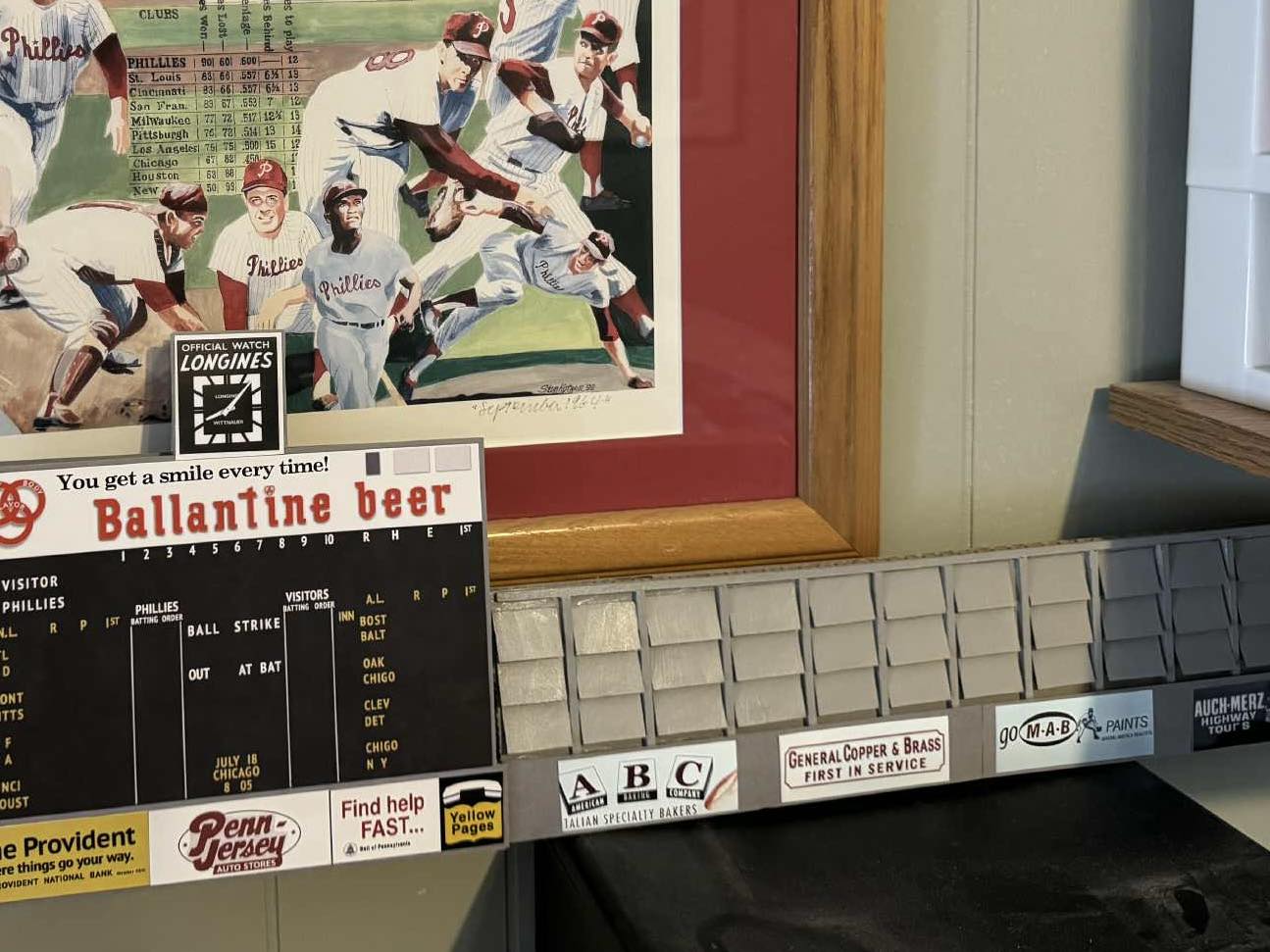
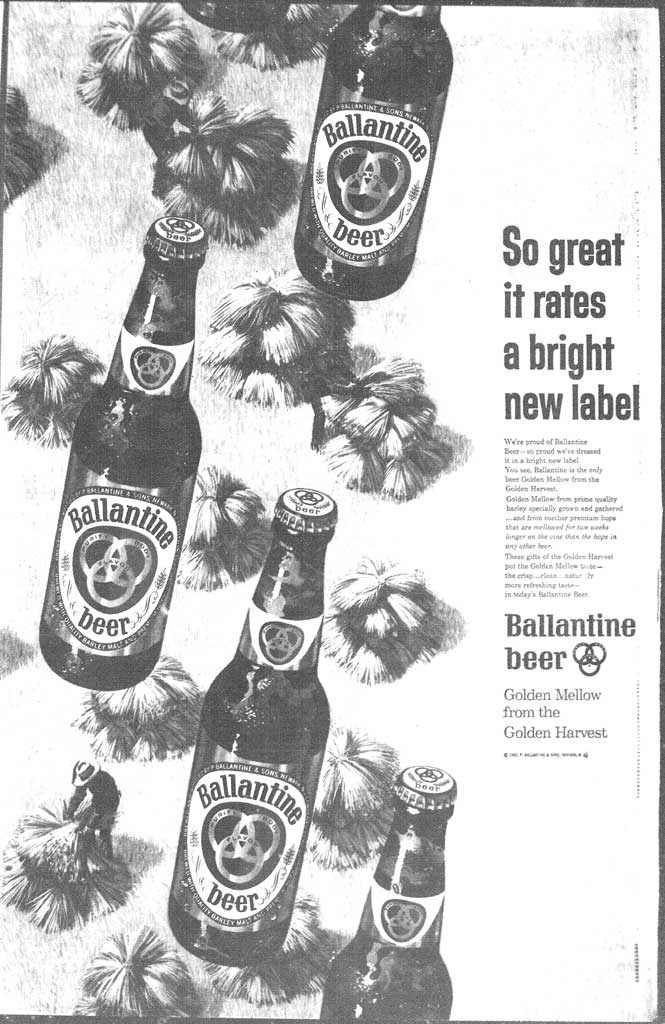
Baby boomers like me vividly remember the towering, then-state-of-the-art right field scoreboard at Connie Mack Stadium, topped by a gigantic advertisement for Ballantine Beer (and its three-ring logo, for Purity, Body, and Flavor).
A handmade model of the iconic Ballantine Beer scoreboard at Connie Mack Stadium by Phillies fan Bernie Valente.Courtesy of Bernie Valente
Well, that scoreboard was erected in 1956, five years before beer was sold there.
The Phillies first legally sold beer inside Connie Mack Stadium, their musty old park in North Philadelphia, on Aug. 7, 1961, when they put seven local brands of bottled beer on sale for 35 cents, first poured into a paper cup by eight vendors working the aisles.
The paper cup was a vital part of the transaction, because, prior to legal sales, Phillies fans used to sneak in cans of beer, often sold in “cold packs” at nearby bars like Charlie Quinn’s Deep Right Field Cafe at 20th and Lehigh.
Beer cans were heavier in those days, so they tended to become missiles when the umpires missed a call, or if the Phillies stank, which was quite often.
The low point probably came on June 12, 1959, when a twi-night doubleheader against San Francisco was halted after five innings because of rain. The Phillies were no-hit — but even worse, fans were denied rain checks to both games because the first game was official.
As Frank Fitzpatrick, the now-retired Inquirer reporter who attended the game as a 9-year-old, recalled in the paper in 2016: “Suddenly, one empty can fluttered toward the field. A second followed quickly. Soon, it was a dangerous deluge. So many were tossed that cans obscured the tarp, from the mound to the batter’s box.”
That was not good news for Robert R.M. Carpenter, the Phillies owner, who dearly wanted a new ballpark for his team. Plans had been drafted for a 45,000-seat, $8 million stadium in the Torresdale section of Philadelphia, with an adjoining theme park, yacht basin, and bird refuge park adjacent to I-95. Beer sales would bring in some cash for that amazing project.
On June 20, 1961, the Pennsylvania Senate passed a previously approved bill by the state House that would permit the sale of beer every day but Sunday at sporting events at stadiums in the state that seated more than 25,000. (The Pittsburgh Pirates also happened to be looking for a new ballpark.)
But they faced stout foes. After voting against the bill earlier in 1961 that would have enabled the Phillies to sell beer, a Democratic state assemblyman from Philadelphia, Charles Heavey, predicted that the sale of beer would actually “contaminate” youngsters.
So … first the beer had to be poured into a paper cup before drinking, preventing another beer can pileup on the field like the one in 1959. And there would be more than one starting pitcher: Schmidt’s, Esslinger, Old Dutch, Horlacher, Neuwiler and, yep, Ballantine were all included in the original sudsy rotation.
A 1962 newspaper advertisement for Ballantine beer.
Larry Merchant provided statistics in his Daily News column the next day: A total of 3,739 beers were served to 5,586 who attended that Aug. 7 game, a 3-1 Pittsburgh victory on a Monday, which was also the Phillies’ 10th straight loss. No bottles or cans were thrown on the field, he reported, but fans did pop the cups and try to throw those onto the field — often in vain.
“For serious drinkers, it was about a four-beer game, just two and a half hours long,” Merchant joked. “For serious Phillies fans, it was a six-beer job. They look better that way.”
Merchant made note of signs at the entrances that read, “Bringing in of canned beer or bottled beverages will be a cause for ejection from the park.” Nonetheless, he reported, seven would-be beer smugglers were caught at the gate, their brews returned when they left the park.
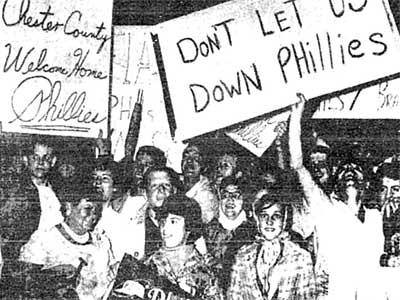
Those 1961 Phillies were so lousy that their losing streak grew to 23 games, still a modern record. After the Phillies beat Milwaukee, 7-4, on Aug. 20 in the second game of a doubleheader, their flight home was welcomed by 500 fans at 1 a.m. the next day at the airport.
About 500 Phillies fans welcomed the team home at the airport like conquering heroes after the club broke a 23-game losing streak in August 1961.
“They are selling rocks at $1.50 a pail,” Phillies pitcher Frank Sullivan, looking out of the plane, joked to his teammates.
He then wisecracked: “Leave the plane at five-minute intervals. That way, they can’t get us all with one burst.”
In truth, the beer ploy sales did not seem to provide much of a boost to the 1961 Phillies, who lost 107 games and finished last in the National League in home attendance in 1961, averaging only about 7,600 per home game. But a door, or many brewskis, had been cracked.
Beer would not be sold at Sunday home Phillies games until 1972, after the Phillies moved to Veterans Stadium, following the amendment of the ancient Pennsylvania Blue Laws, intended to curtail activities on Sundays (including Phillies and A’s home games until 1934).
“My parents didn’t drink, so I always associated the public consumption of alcohol as something dark and troubling,” Fitzpatrick told me recently. “That feeling was confirmed in spades at that 1959 game.
“By 1966, the summer I worked at the ballpark, I felt differently. I was a soda vendor, and beer suddenly was a precious commodity. Now I envied the beer sellers, because they made the most money and had the least amount of walking. Occasionally, rowdy fans would harass young vendors like me, hurling popcorn containers or wadded-up cups at us, [but] it definitely was comforting to know you wouldn’t have to dodge metal cans. On the other hand, in ’66 the smell of spilled beer now permeated the place. I don’t remember that same aroma when fans brought their own.”
Carpenter never did get his Torresdale stadium. After a one-year delay because of construction, however, the Vet opened in 1971 in South Philadelphia. A few fans grumbled about paying 75 cents for a 12-ounce beer served there by a vendor, perhaps because those same items were 40 cents and 60 cents, respectively, at Yankee and Shea Stadiums in New York.
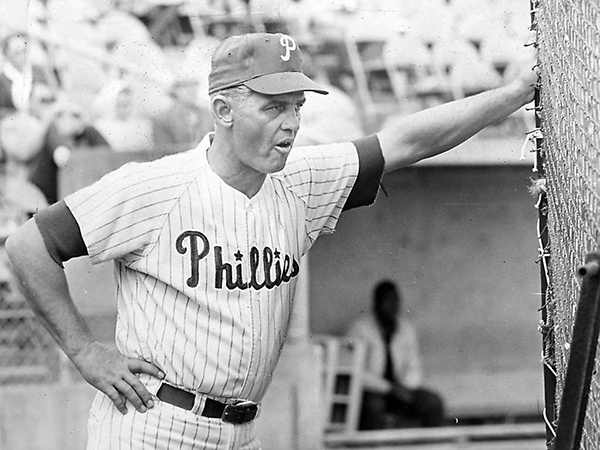
Gene Mauch managed the Phillies during their historic 107-loss season in 1961. That team dropped 23 straight contests.
The pricing was actually meant to be sort of a deterrent. Bud Vye, the Connie Mack stadium manager, told The Inquirer, “At these prices, they’ve got to bring a bankroll just to get bombed out.”
But beer stuck around. A 1998 Daily News exposé into how Ogden Entertainment, then the vendor at the Vet, was caught skimming a half million dollars in annual beer sales led to a price reduction. Local brands, kicked to the side by the national brews, were sold again when the Phillies moved to Citizens Bank Park in 2004. (Large premium drafts then sold for $6.)
Cups were eventually discontinued, and most beer at the ballpark is sold in much lighter cans (which, it should be noted, are opened by the cashier, lest someone try to hurl a full can on the field). Dozens of different brands of beer can be spotted at any Phillies game.
“A big part of this is marketing,” Macnow tells me. “Beer at the ballpark is no longer poured into paper cups, so there’s a long-term benefit to seeing people walking around the park holding cans of your beer. Labeling becomes important. Naming beers becomes important.”
And so is the vessel itself. The Phillies continue to sell “beverage bats,” large hollow plastic souvenir baseball bats that can be filled with any beverage. Those are not cheap, either. Phillies fans may be held captive by the prices, but beer and baseball are inseparable.
Dave Caldwell lives in Manayunk and covered sports for The Inquirer from 1986 to 1995.
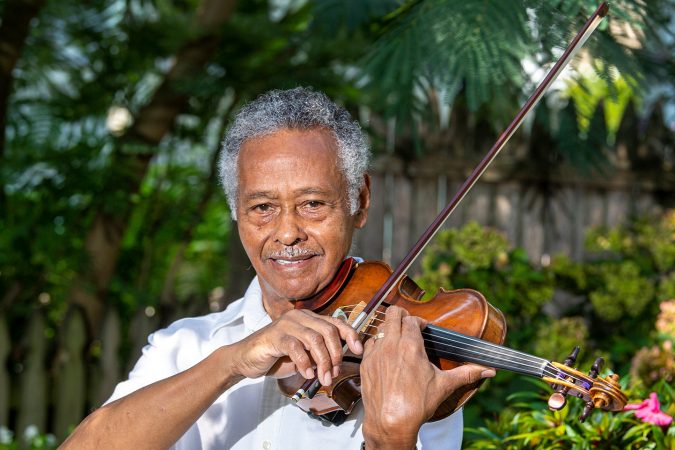
Booker Rowe, 85, of Philadelphia, award-winning violinist, the first Black musician to play with the Philadelphia Orchestra and the Nashville Symphony String Quartet, the second permanent full-time Black player in the Philadelphia Orchestra, teacher, mentor, and role model, died Friday, July 31, of complications from pneumonia and sepsis at Jefferson Abington Hospital.
A lifelong musician — he played piano at age 5 and violin at 11 — Mr. Rowe was invited by famed music director Eugene Ormandy in 1968 to become the first Black musician to perform with the Philadelphia Orchestra. He was a substitute violin during most of the 1968-69 season and returned for good in 1971 as the orchestra’s second Black permanent full-time member.
Mr. Rowe stayed for 49 years.
“My first day, I came in late from New York, and the orchestra was already rehearsing, and I sat myself down on the last stand to play,” Mr. Rowe told The Inquirer’s Peter Dobrin in 2020. “The sound was amazing. It was like stereo all around me. The stage was slanted down, and when the brass and winds would play I had to brace myself with my right leg from being blown off stage. It was just so beautiful.”
For five decades, until his retirement in 2020, Mr. Rowe played with half a dozen elite conductors and traveled the world in the orchestra’s second violin section. He and his colleagues gave thousands of memorable performances at the Academy of Music, the Kimmel Center, and the Mann Center in Philadelphia, Carnegie Hall and the Lincoln Center in New York, and the Saratoga Performing Arts Center in Saratoga Springs, N.Y.
They played at the 1993 World Series at Veterans Stadium, for Pope Francis in 2015, and at the Vail Music Festival in Colorado. They played in Europe, South America, Asia, and elsewhere around the world.
This photo of Mr. Rowe (left) appeared in the Daily News in 1993Newspapers.com
In 1973, the orchestra made a historic 10-day, five-concert cultural exchange tour in China, and Mr. Rowe told the Daily News afterward that he visited a commune and returned with Chinese instruments. In 2008, he mingled with former Secretary of State Alexander Haig and other international notables after a concert in Beijing.
In 2013, he posed for pictures with the Chinese welcoming contingent at Shanghai Airport. “Booker was such a kind soul, and his passion, his artistry, and his humanity are woven into who we are,” Yannick Nézet-Séguin, the orchestra’s music and artistic director, said in a tribute.
Ryan Fleur, the orchestra’s president and chief executive officer, said: “He was a warm and steadying presence in our orchestra.”
Born in Kentucky, Mr. Rowe and his family moved to North Philadelphia when he was 2. His father was a singer, and his mother played piano, and they “pushed me in the direction of classical music,” he told the Daily News in 1981.
He became concertmaster for the West Philadelphia High School orchestra, the All-City high school orchestra, and the old all-Eastern Conference college orchestra. He earned a bachelor’s degree in music at Temple University in 1963 and a master’s degree in music at Yale University in 1968.
Before Philadelphia, he played solo in New York and with symphony orchestras in Nashville, New Haven, Conn., and Washington. Later, he played with the old Symphony Club of Philadelphia, the Lansdowne Symphony Orchestra, and other local groups.
Mr. Rowe (left) stands with fellow musicians Andre Watts (center) and Renard Edwards.Courtesy of the family
He also got freelance gigs with Sammy Davis Jr., Isaac Hayes, Smokey Robinson, the Supremes, Barbra Streisand, Aretha Franklin, and other stars. He played with chamber music ensembles around the country and gave dozens of free concerts for children, churches, and community and scholarship fundraisers.
He championed racial and ethnic diversity, and was active with the Philadelphia Orchestra’s cultural diversity initiative. He sought and performed work by Black and other minority composers, and mentored dozens of colleagues and students.
He encountered at least one racist incident that first year in Philadelphia and told the Daily News in 1981: “The time was right for an Afro-American in the Philadelphia Orchestra. It was just a matter of finding somebody who was ready.”
Mr. Rowe and his family lived in Center City, East Mount Airy, and Germantown. Courtesy of the family
A friend said on Facebook: “His legacy and historical contributions are unparalleled.”
Mr. Rowe taught at Settlement Music School and gave private lessons. He earned music and service awards from City Council, the American Foundation for Negro Affairs, and other groups.
In 2019, he was asked to advise young musicians in a video interview for the Philadelphia Orchestra website, philorch.ensembleartsphilly.org. “Practice, practice, practice,” he said. “But also enjoy, enjoy, enjoy. Do it with love in your heart.”
Booker Taliaferro Washington Vance Rowe Jr. was born Dec. 10, 1940, in Lexington, Ky. In Philadelphia, he studied at the old Philadelphia Musical Academy and Settlement Music School, and his father worked at RCA Victor records in Camden. So their home was always filled with music.
Mr. Rowe (rear center) stands with Philadelphia Orchestra colleagues and members of the Chinese welcoming contingent in 2013.
Jan Regan / Philadelphia Orchestra
He met soprano Patsy Baxter at a Philadelphia Orchestra concert, and they married in 1970 and had a son, Landis, and a daughter, Vivian. They lived in Center City, East Mount Airy, and Germantown, and visited his family often back in Kentucky and Tennessee.
Mr. Rowe enjoyed puzzles, hiking and kayaking with his family, and tai chi. Friends noted his “kindness,” “million-dollar smile,” and “cheerful presence” in Facebook tributes.
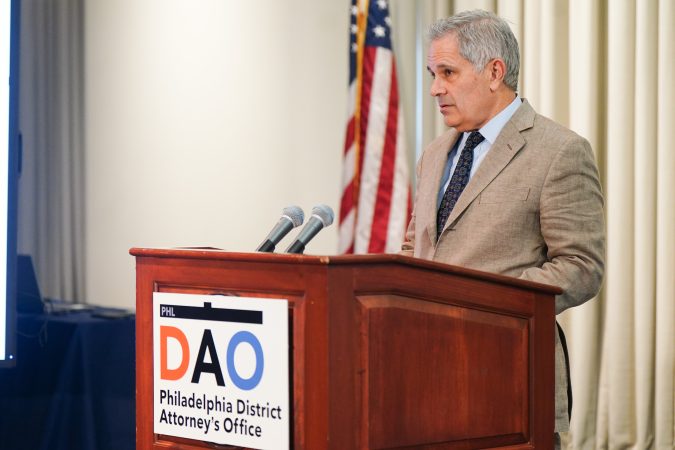
District Attorney Larry Krasner on Tuesday said he strongly disagreed witha judge’s decision to overturn the murder conviction of a man who killed Philadelphia Police Officer Moses Walker Jr. in 2012 and vowed to appeal.
Krasner said Common Pleas Court Judge Jennifer Schultz, who handed down the ruling Monday, was “legally incorrect” in vacating the conviction of Rafael Jones, who is serving life in prison for killing the officer during a street robbery at the end of his shift.
But Krasner, speaking at a news conference alongside Walker’s mother and Roosevelt Poplar, president of Lodge 5 of the Fraternal Order of Police, said Jones’ conviction was different from others involving Nordo that have since been reevaluated.
“We believe now that Rafael Jones is guilty — that he murdered Moses Walker Jr.,” Krasner said.
If the appellate court denies the district attorney’s appeal, he added, “we will be retrying this case. We have a lot of evidence to do so. And we will be retrying it vigorously.”
Jones’ attorney, Jason Edward Parris, said Tuesday afternoon that the vacated conviction represented justice.
If jurors heard Jones’ case today, Parris said, they would have information about Nordo’s sex abuse crimes involving informants in homicide investigations that was not available at the time of Jones’ trial.
“I don’t think anybody should be comfortable with someone serving life in prison based in part on an investigation done by an officer who is now doing 49 years [in prison] for crimes committed during the investigation of this case,” Parris said.
Walker, 40, was shot and killed shortly before dawn on Aug. 18, 2012.
The officer had just left the 22nd District station in North Philadelphia dressed in civilian clothes when Jones and another man, Chancier McFarland, targeted him in a robbery, prosecutors said.
Jones fired at Walker after the officer reached for his gun, according to prosecutors. Both men were arrested, and McFarland pleaded guilty and testified against Jones as part of a deal to avoid life in prison.
Years later, during Nordo’s sexual abuse trial in 2022, one of his accusers testified that the detective had steered him toward a $20,000 reward and later raped him.
Though Krasner acknowledged the “messy history” that came with Nordo’s involvement in Jones’ case, he said the district attorney’s office was confident in the conviction.
There were multiple pieces of evidence that pointed to Jones’ guilt, he said, including a murder confession that was not introduced at trial because Jones did not testify, and McFarlane’s eyewitness account of the crime.
“We concluded years ago that this conviction was in the category that should not be disturbed,” Krasner said.
The district attorney’s office will appeal Schultz’s ruling to Superior Court, a process Krasner said could take up to two years.
Poplar, the FOP president, said he had faith that Krasner’s office would prevail.
“Yesterday was a tough day,” he said, echoing comments made by Police Commissioner Kevin Bethel, who said he was disappointed by the ruling.
Walker’s mother, Wayniya, said she and her family “would not allow these latest developments to weaken us.”
“We remain confident justice will prevail,” she said, adding that she hoped that the death of her son, not the vacated conviction of his killer, would “remain at the center of this case.”
“No decision rendered can alter what happened on Aug. 18, 2012,” she said.
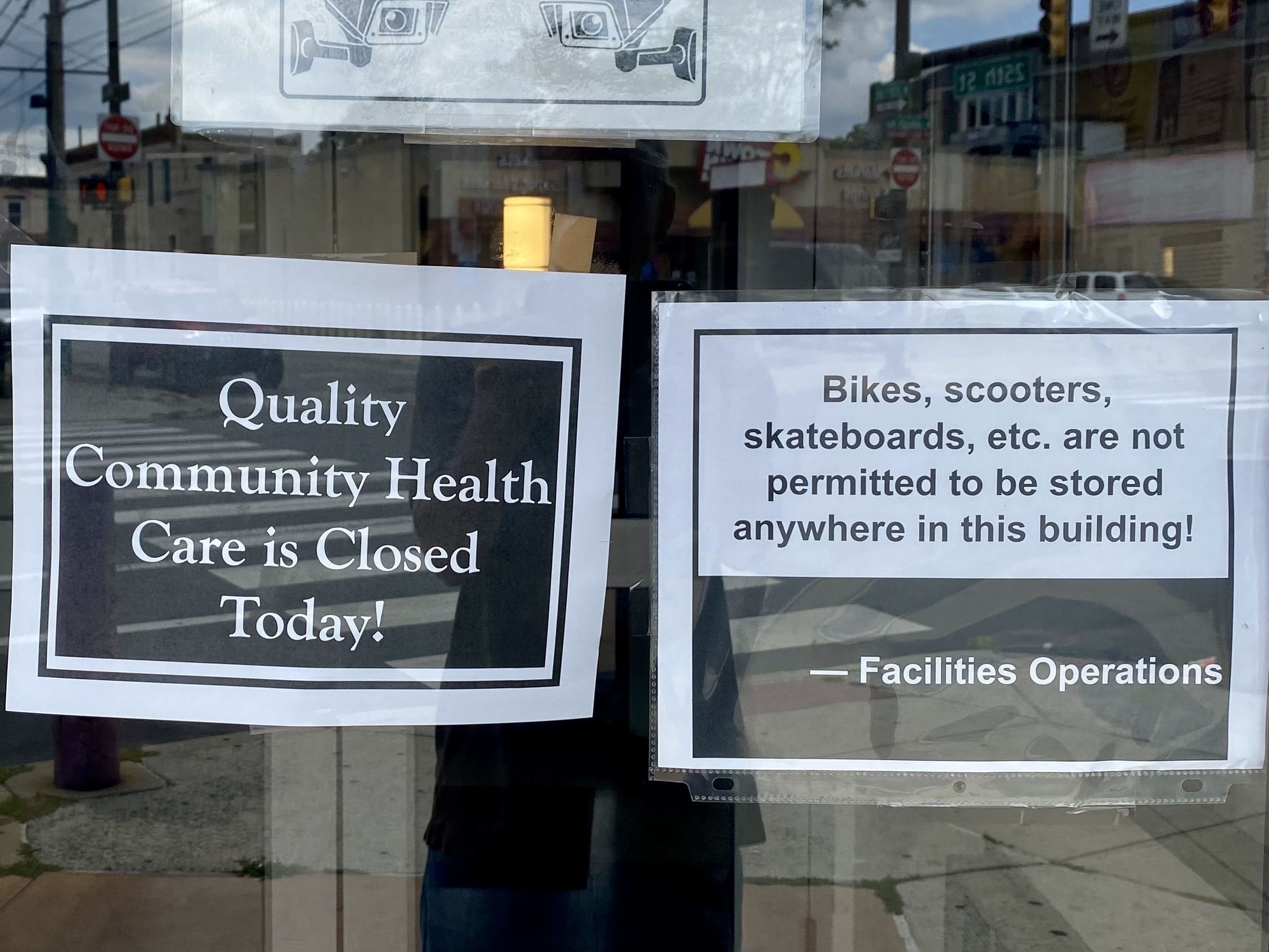
When Pele Lewis arrived at Quality Community Health Care’s clinic in North Philadelphia Wednesday for his 1:30 p.m. appointment, he found the doors locked and a sign saying the clinic was “closed today.”
Lewis was puzzled. “They called me this morning” with a reminder to come in, he said, as he stared at the door.
The clinic, known as QCHC, was closed Thursday and Friday, as well, according to its phone message.
“For many of our patients, QCHC is far more than a medical office,” its CEO, Helen Wilkinson, said in an email. “Members of our community are treated with dignity and respect regardless of their ability to pay.”
She did not answer specific questions.
The clinic at 2501 W. Lehigh Ave. began operating in 1981 under a federal program designed to provide medical and dental care in neighborhoods with few other options.
Its troubles became public in the spring.
After years of warnings from federal regulators that the clinic was delinquent on its audits, officials took the rare step in March of suspending it from the federally qualified health center program. At that time, audits for the years 2021 to 2024 were overdue. Now, the same is true for 2025. Typically such audits are due nine months after the fiscal year ends.
Quality Community Health Care Inc., at 2501 W. Lehigh Ave. in North Philadelphia, was closed Wednesday. Management did not respond to emailed questions about the clinic’s status.Harold Brubaker / Staff
A new audit
In a small sign of progress, Quality Community Health Care last week posted an audit for the fiscal year that ended July 31, 2021, on a federal audit clearinghouse. Federal regulators had given a May 2 deadline to complete that audit or risk termination.
The fiscal 2021 audit pointed to significant problems.
“None of the data in it can be verified by the auditor,” said Steven Balsam, a professor of accounting at Temple University’s Fox School of Business.
The auditor put it this way in the filing: “Because of inadequacies in QCHC’s accounting records, we were not able to obtain sufficient appropriate audit evidence for the amounts” stated in numerous categories of the financial statements.
“I don’t know if just filing reports, if they look like this, is going to get them their funding back,” said Balsam, who reviewed the audit at The Inquirer’s request.
The federal Health Resources and Services Administration, which regulates federally qualified health centers, has not responded to questions about QCHC since the suspension.
Missed paychecks
Some employees were not paid on July 10 and July 24, according to an email from the organization’s chief financial officer to staff Monday. This followed the organization not receiving the main federal funding for health centers, known as Section 330 grants, CFO Denise Ingram wrote.
“QCHC is experiencing significant cash flow constraints following the suspension of 330 grant funding associated with the unresolved FY2021 audit submissions requirements,” Ingram wrote in the email obtained by The Inquirer.
“QCHC remains committed to paying employees for all wages earned. Leadership continues to pursue funding, financing, and other lawful alternatives to address outstanding payroll obligations and restore normal operation,” the email said.
Ingram did not respond to an emailed request for comment.
A prosecutor dropped felony rape and sexual assault charges against Philadelphia-area doctor John Smyth Michel on Tuesday after his accuser failed to appear at his criminal trial.
The woman’s testimony against Michel, the former medical director of Excel Medical Center, was key because the case lacked physical evidence. The then-38-year-old patient from Northeast Philadelphia had claimed Michel raped her during a 2024 office visit.
Michel’s criminal defense lawyer, Andrew Gay Jr., told jurors the sex was a “terrible” mistake but consensual.
“As terrible of a decision as it could have been for a physician to make,” Gay said during his opening statement Monday on the trial’s first day, “it was an entirely consensual act between two adults.”
Gay declined to comment on Michel’s behalf after Common Pleas Court Judge Chesley Lightsey dismissed the case at the prosecutor’s request.
“This case is done,” Lightsey declared before excusing the jury empaneled at the city’s Criminal Justice Center.
The stakes were high for the 56-year-old doctor from Jenkintown on two fronts: He faced up to 20 years in prison on the rape charge alone and loss of his medical license, if convicted.
Under state law, doctors convicted of sexual offenses are prohibited from being licensed and practicing medicine.
The Pennsylvania State Board of Osteopathic Medicine, which regulates and oversees licensure of osteopathic doctors like Michel, suspended his license last year after he apologized for having sex with a patient — a violation of state licensure laws. As of Tuesday, his license remained suspended, according to a state spokesperson.
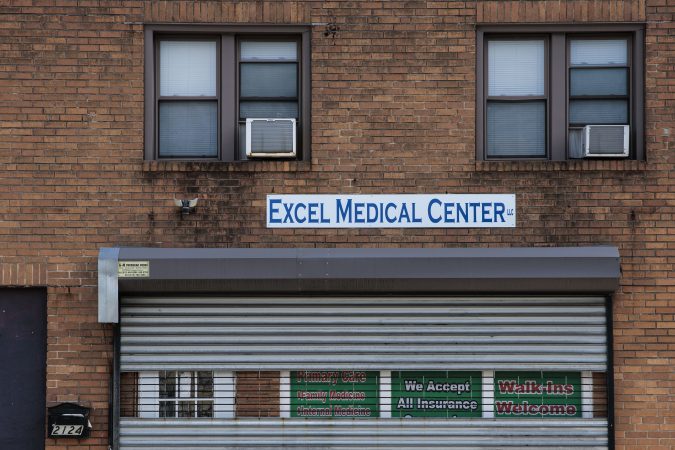
Excel Medical Center, which Michel founded, is currently closed, Gay said. The center was composed of 12 locations in the Philadelphia region, with more than 200 employees and about 20,000 patients.
In a letter to the medical board last year, Michel described the October 2024sex with the patientas a “lapse in judgment” for which he is “profoundly contrite.”
“I fully acknowledge that I crossed a professional boundary,” Michel wrote to board members last year. “I recognize that boundaries are not only a legal and ethical obligation but a critical element of safe, respectful, and therapeutic care. I make no excuses for my actions.”
Claims of rape
The patient, identified in police records by the initials “D.R.,” had accused Michel of kissing her during a May 2024 exam at his East Mount Airy office on Stenton Avenue. She told him “no,” left the office, and did not report the kissing incident.
About five months later, she went to an appointment at Michel’s North Philadelphia office on West Diamond Street. During the Oct. 14, 2024, visit, she said, Michel raped her with such force that her head banged twice against the exam room wall. She pushed him off her and fell to the ground crying, according to criminal court records.
In early November 2024, she told her husband what had happened and subsequently filed a police report, records show.
Late last year, a second woman accused Michel of sexual abuse.The woman had worked for Michel as a medical assistant from 2015 to 2019 at his East Mount Airy office and at a location in Germantown on Chelten Avenue.
The former employee claimed that beginning in 2018, Michel touched her breasts over her clothing on multiple occasions while she was working in the office. He additionally groped her vagina over her clothing before she quit in 2019, according to a document filed in court last year by the Philadelphia District Attorney’s Office.
Prosecutors never charged him in connection with those accusations, but argued the former employee’s claims bolstered their patient rape case, given there were no witnesses. Gay, Michel’s lawyer, had declined to comment after the second woman came forward.
A no-show witness
In the patient’s case, Philadelphia police arrested Michel in February 2025 after prosecutors charged him with three felonies — rape, sexual assault, and involuntary deviate sexual intercourse — and two misdemeanors — indecent exposure and assault. He was released on bail.
Assistant District Attorney Allison Christian dropped all but the rape and sexual assault charges prior to the trial. Michel pleaded not guilty.
The former patient had been scheduled to testify on Tuesday morning. Christian told the judge that she had spoken with her the night before. She sounded “very emotional” and seemed to be having a “nervous breakdown,” but said she would testify, Christian said.
“I’ve been calling her since 8:15 a.m. this morning every 15 minutes,” Christian said. “I haven’t heard from her.
“I’m not going to issue a bench warrant for a rape victim,” she said before dropping the charges.
A path to practicing medicine
Prior to the patient’s accusations, Michel had no criminal complaints and no disciplinary history against his medical license, state records show.
Michel agreed to be disciplined by the board of osteopathic medicine for violating a state law prohibiting sexual misconduct, according to a June 2025 agreement.
The discipline included a $4,000 civil penalty and an indefinite suspension of his medical license for a minimum of 24 months, followed by probation, according to a spokesperson for the Pennsylvania Department of State, which oversees licensing boards.
While Michel is on probation, a chaperone must be physically present when he treats female patients and a separate monitor must oversee his practice. Michel also must complete in-person classes on physician-patient boundaries and 15 hours of continuing education on ethics, the disciplinary agreement says.
The state spokesperson on Tuesday said the board will reinstate Michel’s license to “non-suspended, probationary status” once he has met the agreement’s reinstatement conditions.
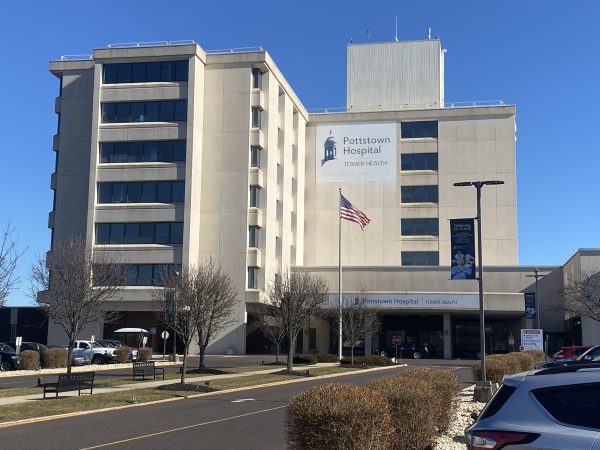
Tower Health is eliminating 160 jobs at Pottstown Hospital as part of an effort to bring staffing at the Montgomery County facility in line with lower patient volumes, the Berks County nonprofit announced Tuesday. The cuts amount to 22% of the workforce at Pottstown.
In addition to the job reductions — which are more than the 131 positions cut last year at Pottstown — Tower also plans “a multimillion-dollar investment” to expand the emergency department, enhance inpatient and outpatient behavioral health services, and update portions of the hospital, Tower said.
“These changes are designed to strengthen the hospital’s ability to serve local residents for generations to come by preserving access to the services patients need most, investing in the areas of greatest community need, and ensuring Pottstown Hospital remains a strong, sustainable community hospital for the future,” Tower said in a statement.
To expand behavioral health, Tower will convert some underused general-purpose hospital beds to inpatient behavioral health beds. The behavioral health total will rise to 52 from 28, an 86% increase. Pottstown has 213 licensed beds.
Tower did not provide a timeline for the changes but said it plans to hire 38 people to staff the expanded emergency department and behavioral health unit, which will have a separate entrance for the sake of patients’ privacy when they seek mental health services.
Another change at Pottstown involves the lease of an unspecified amount of space to Community Health & Dental Care, a federal health clinic that was formed in 2008 with funding from Pottstown Area Health and Wellness Foundation.
Unlike the restructuring Tower announced last fall at Pottstown, which included the closures of the combined intensive care/critical care unit, the Pottstown location of the McGlinn Cancer Institute, and the hospital’s endoscopy center, this round is not eliminating any services, Tower said.
In the nine months that ended March 31, Pottstown has 5,104 inpatients, down 9.7% from the same period the year before. Most of that decline came in the first three months of this year, after Tower’s service cuts, according to data shared with bondholders.
After last year’s layoffs, which included about 60 registered nurses represented by Pennsylvania Association of Staff Nurses & Allied Professionals, Pottstown employed about 700 people. Overall, Tower employs more than 10,000.
The union said it still has 200 Pottstown nurses in its ranks. “We have been in touch with hospital management to better understand the context for and impact of the proposed layoffs and to push hard for solutions that protect both patient care and the dedicated nurses who serve the Pottstown community,” a union spokesperson said.
Tower’s anchor is Reading Hospital in West Reading, Pa. In additional to Pottstown, it owns Phoenixville Hospital, plus St. Christopher’s Hospital for Children in North Philadelphia in a 50-50 joint venture with Drexel University. Tower previously owned Brandywine, Jennersville, and Chestnut Hill Hospitals.
Tower recently announced that Jefferson Health, Nemours Children’s Health, and Temple University Health System are working on forming an alliance to support St. Chris clinically. Last week, Tower said that it had formed a clinical affiliation to expand advanced care in its markets.
A Philadelphia man has been charged with fatally gunning down another man three years ago on a North Philadelphia street, authorities said Thursday.
A grand jury on Wednesday indicted Richard Pridgen, 21, on charges of murder, attempted murder, and related crimes for the 2023 shooting death of George Smith, according to the Pennsylvania Attorney General’s Office.
The case marks the third time state prosecutors have charged Pridgen with murder. He is currently serving a 17-year federal prison sentence for a separate crime.
In a news release Thursday, state prosecutors said Pridgen is a member of the “Backblock” gang, a violent North Philadelphia group that has been at the center of joint investigations by the attorney general’s office, the Philadelphia Police Department, and the federal Bureau of Alcohol, Tobacco, Firearms and Explosives for years.
Just before midnight on April 22, 2023, two people attacked Smith, 27, in the 2400 block of North 17th Street, state prosecutors said. Surveillance cameras captured the killing, and showed one of the men — whom state prosecutors identified as Pridgen — firing multiple shots into Smith’s body before fleeing in a vehicle driven by a third person.
That vehicle, state prosecutors said, had been stolen at gunpoint the day before in the 2500 block of East Monmouth Street, less than four miles away.
The two other homicides Pridgen is accused of committing also occurred in 2023 in Philadelphia, state prosecutors said.
In one case, Pridgen is accused of shooting Hassan German, 31, and another man, who survived, on May 24, 2023, at the intersection of North Gratz Street and Susquehanna Avenue in North Philadelphia. The details of the other case were not immediately available on Thursday.
“There are public dangers, and then there is Richard Pridgen — for whom killing, stealing, and harming people is a way of life,” Pennsylvania Attorney General Dave Sunday said in the news release.
Pridgen has pleaded not guilty in both prior murder cases.
A spokesperson for the Defender Association of Philadelphia, which is representing Pridgen in those cases, declined to comment.
In February, Pridgen was convicted in federal court of two carjackings and sentenced to more than 17 years in federal prison.
In the carjackings — which also took place in 2023 in Philadelphia — Pridgen robbed two men of their vehicles at gunpoint, federal prosecutors said. Neither man was injured.
The Philadelphia District Attorney’s Office is investigating ties between one of DA Larry Krasner’s top advisers and a man serving life in prison after prosecutors learned that the official sent the man money years ago and did not disclose it.
G. Lamar Stewart, chief of external engagement and government affairs in the DA’s office, said he sent $100 to Anthony Sutton in January 2021 to support Sutton’s mentorship program, “Mann Up,” for men incarcerated at State Correctional Institute Phoenix.
Sutton, 61, who is serving life in prison for killing a man in Germantown in 1984, has been appealing his conviction for more than a decade.
The issue came to light last week, after the prosecutors assigned to Sutton’s appeal were reviewing his prison records and noticed that Stewart was among those who had sent Sutton money in recent years.
The records showed Stewart did so only once, Krasner said.
The payment raised concerns, in part because Stewart had organized and participated in meetings between Sutton’s defense attorney, Krasner, and prosecutors about the case, according to a source familiar with the matter.
Krasner’s office has opposed Sutton’s appeal and said his profession of innocence lacked merit.
When the prosecutors discovered the payment, it was quickly brought to the attention of Krasner, who then asked his office’s special investigation unit to investigate, according to multiple sources familiar with the case. The inquiry remains ongoing.
Stewart, who is also senior pastor of Taylor Memorial Baptist Church in Nicetown-Tioga, was working as the head of the office’s community engagement unit at the time of the donation. In an interview, he said he used his own money to support Sutton’s program as part of the faith-based charitable work he does to assist families and community organizations across the region every holiday season.
“I thought that the work that they were doing was positive, transformative, and it was geared to helping reduce violence in Philadelphia and to make communities and families whole,” he said.
He said he did not know of any way to reach the organization other than to send it through Sutton directly. “I was very intentional to make sure that my name was listed because when you’re not trying to hide anything, you just do things above the board,” he said.
District Attorney Larry Krasner (left) and G Lamar Stewart, head of the Community Engagement and Government Affairs at the DA’s Office, outside the President’s House in Independence National Historical Park in February 2026.Tom Gralish / Staff Photographer
During a brief hearing in Sutton’s case on Monday, Assistant District Attorney David Napiorski, supervisor of the office’s law division, told Common Pleas Court Judge Giovanni O. Campbell that his attorneys needed additional time to investigate Sutton’s case after they found that someone in the office had put “money on the defendant’s books in prison.”
“That needs to be investigated by the office thoroughly before we can take any further action,” Napiorski told the judge.
Stewart said he did not try to influence the outcome of the appeal or advocate for Sutton. He acknowledged that he attended at least one meeting about Sutton’s case, but said his job requires him to coordinate and attend meetings with Krasner.
Krasner said that he saw no issue with Stewart’s donation or subsequent participation in meetings, and that his office’s inquiry and prosecutors’ comment in court Monday “establishes integrity.”
“G. Lamar Stewart gave a small amount of money for an organization … and then this office decided to oppose Mr. Sutton’s request. Where’s the issue?” he asked.
He added: “Any rock we haven’t flipped yet, we will flip. Preliminarily, it seems quite clear that this was a donation given for a completely legitimate purpose.”
Sutton did not immediately respond to a request for comment sent through a messaging app for people in prison. His attorney, Jason Javie, said Tuesday that he did not know anything about Stewart’s payment to Sutton and declined to discuss the matter further.
“My focus is 110% on the exoneration of Mr. Sutton,” he said.
The revelation comes amid mounting scrutiny over Krasner’s office’s handling of post-conviction matters. In a forceful ruling last month, the Pennsylvania Supreme Court said Krasner’s office had a pattern of misleading judges when seeking to overturn old murder convictions.
Last week, in a separate, controversial federal appellate case, a former assistant district attorney in Krasner’s office said prosecutors were “colluding” with defense attorneys to find the most effective way to have the murder conviction thrown out. And then, on Monday, in a striking court filing in that same contentious case, two supervisors in the law division said Krasner had instructed them to litigate the matter in a way that would “protect the office.”
And now, the office is investigating a case connected to Stewart, who has worked in the DA’s office since 2019 and is one of Krasner’s most trusted advisers.
District Attorney Larry Krasner at a press conference in May, denouncing criticism of his office leveled by Republican members of the House Judiciary Committee.Tom Gralish / Staff Photographer
Stewart, who is paid $154,500 annually, oversees the office’s community engagement, public affairs, and communications strategies, and acts as a conduit between Krasner and other public officials. Since Robert Listenbee retired as first assistant district attorney in January, Krasner has not named a successor — and several prosecutors say Stewart, who is not a lawyer, has effectively absorbed parts of that job. He often helps coordinate sensitive matters in cases, including relocating victims and witnesses.
He is respected by many in city government and across the community. Mayor Cherelle L. Parker, speaking at Krasner’s inauguration ceremony in January, mentioned Stewart as one of the office’s most essential staffers.
“District Attorney Krasner, as a moment of personal privilege, I want you to know that G. Lamar Stewart is one of the most committed, committed, committed members of your team in engaging in community outreach, and he represents you well, sir,” she said to applause.
Stewart, born and raised in Germantown and North Philadelphia, served in the U.S. Army and worked for the Philadelphia Police Department before joining Krasner’s team in 2019. At his church, he runs a nonprofit called Taylor Made Opportunities that offers job support and mentorship to young men in the neighborhood, and supports families of homicide victims.
Stewart said he donates to community organizations, and provides meals, Christmas gifts, and other means of support to crime victims’ families each year, using his personal money.
He does not typically disclose those donations to the DA’s office, he said, and it has never been a problem.
“My Christian faith is rooted in giving, in love, in showing up for the least of these, showing up for those who have been harmed, for showing up for those who are trying to rehabilitate and be accountable for the harm they caused to bring healing to our community,” he said. “For anyone to suggest that me giving through a faith lens, in the interest of good for community, is problematic for me, that is an infringement upon my faith tradition and my religious rights.”
Krasner said he did not think it was necessary for Stewart — or other employees in the office — to disclose donations.
“I don’t know that it makes sense to require 700 employees, especially if they’re doing so on a faith basis, to disclose everyone they give donations to,” he said. “It’s certainly something we could think about.”
In Stewart’s case, his money went to support a program run by Sutton, better known as Benny Doo, who was sentenced to life in prison after a jury convicted him of first-degree murder in the shooting death of Richard Berry in the Pelham section of Germantown in December 1984. In the early 1980s, prosecutors said, Berry hired Sutton and other members of his crew, called the “Ghostbusters,” to retrieve jewelry that had been stolen from him, and agreed to pay with “a few ounces of blow and a couple thousand dollars.”
Berry never paid up, and after he started avoiding Sutton and his crew, Sutton killed him, prosecutors said.
But Sutton said prosecutors violated his right to a fair trial when they failed to turn over police documents — including polygraph results and police interviews with several witnesses — to his defense attorney. One man who testified at trial has also since come forward to recant his testimony.
Prosecutors, in a court filing in May, said Sutton failed to show how those issues could have changed the outcome of his trial. His appeal, prosecutors wrote, was untimely and lacked merit.
The Philadelphia School District’s negligence proved fatal for a woman who died when a Roxborough High School utility pole fell and crushed her while she was walking at the school’s athletic complex, a new lawsuit alleges.
Paula Budin, a retired teacher, was walking on the Roxborough High track on the morning of Dec. 5, 2024, when a 45-foot wooden pole snapped at its base, striking her.
A passerby found her, bleeding and unresponsive on the ground, and called emergency services, but paramedics could not revive Budin, who died of blunt force trauma injuries from the accident.
Lawyers for Budin’s family accuse the district — and the Parsons Corp., which was hired by the school system to complete a facilities assessment of all its properties — of negligence. Officials failed to flag rotting at the base of the pole or properly maintain or inspect the pole, the suit said.
“The School District of Philadelphia knew or should have known of the dangerous condition of the subject pole as there were visible signs of its decay as far back as 2014,” the suit, filed this week in Philadelphia Common Pleas Court, reads. “Despite this actual and/or constructive knowledge and their appreciation of that risk of catastrophic harm, the district did not take corrective action nor did it warn students or members of the community of the risk of catastrophic harm.”
Budin’s family is seeking financial damages.
The school district does not comment on pending litigation, spokesperson Naima DeBrest said. Parsons spokesperson Bryce McDevitt said the same.
Philadelphia’s underfunded school system has a massive footprint — more than 300 buildings and athletic complexes. It has, in some cases, struggled to adequatelymaintain its facilities.
Budin, who was 73 when she died, had enjoyed an active lifestyle, her family said. She had taught at Germantown Academy and the Community Partnership School in North Philadelphia before her retirement and was close to her family — two sisters, two nephews, and a niece.
On the morning of her accident, Budin was walking near her home on Roxborough’s track on Pechin Street, which is generally open to the public. Four poles typically used to hold lighting or security cameras were positioned around the athletic complex.
Sometime after the accident, the district removed the three remaining poles from the property, the suit said. A subsequent inspection by Budin’s and the district’s lawyers and experts revealed the poles had no inspection tags, indicating they had not been inspectedprior to the accident, the suit says.
Budin’s lawyers say that the pole in question was buried in grass near a storm drain, on a slope near the track. The drain was filled with debris, and because of the condition of the area, no standing water could drain — leading to “lengthy periods of water exposure to the base of the pole at ground level that caused the pole to deteriorate and rot to the point of severe and dangerous decay,” the suit says.
The other poles were not situated near storm drains, and had no water damage or decay, the suit says.
Budin’s estate alleges that Parsons, which was hired by the district in 2015 to complete facilities condition assessments of all of its buildings and athletic complexes, is also culpable.
Parsons inspected the Roxborough fields more than once, issuing multiple reports about the fields, but did not inspect the poles, Budin’s lawyers say.
“The Parsons defendants knew or should have known they should inspect the utility poles located on the Roxborough athletic track and field yet failed to do so,” the suit reads. “At the time of December 2024 incident, the pole at issue had discoloration at the base and other visible signs of rot which must have been present for a significant period of time.”