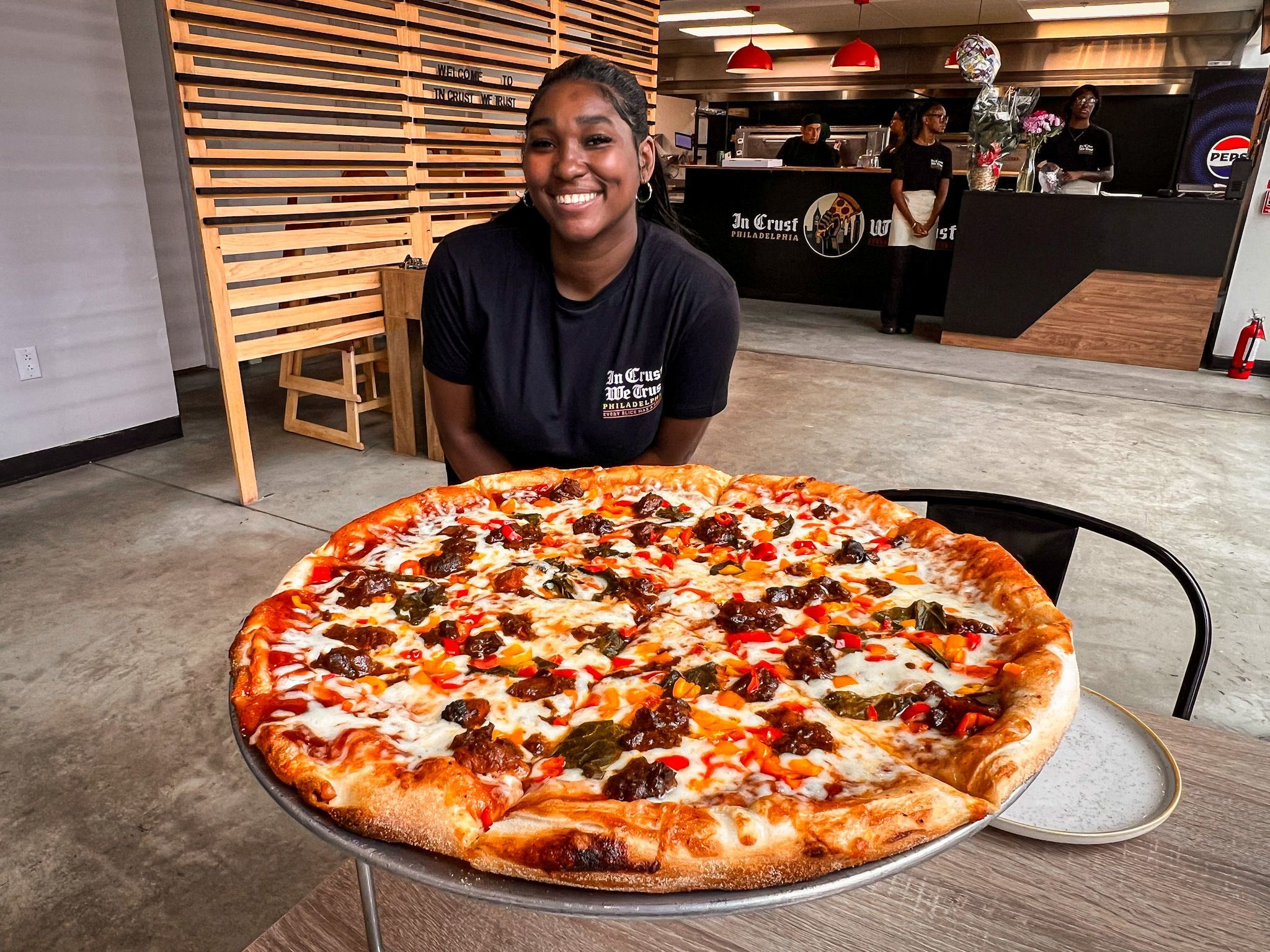
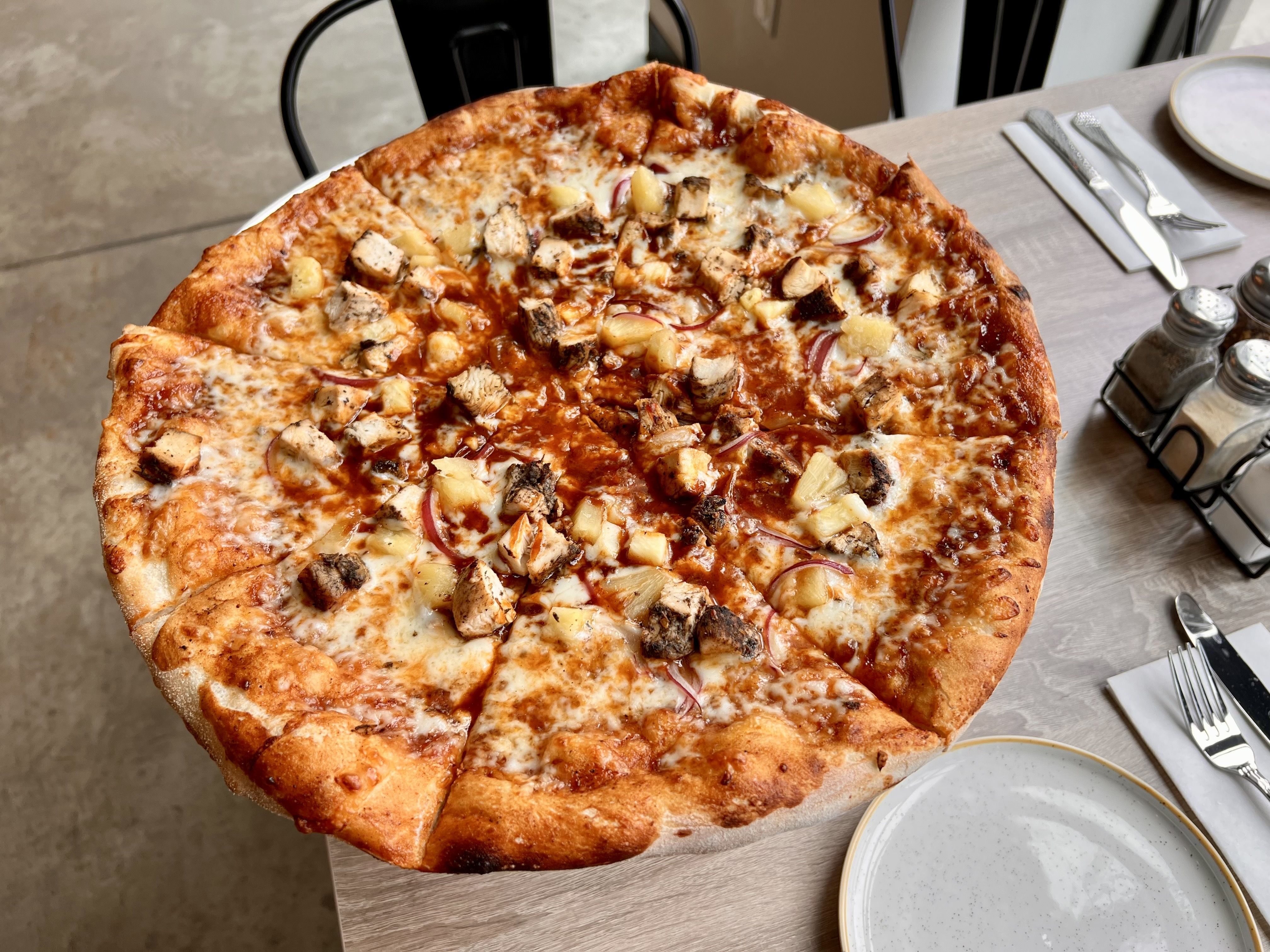
You can eat quite well at the nearby Pizzeria Beddia, Liguria, Marina’s, Shackamaxon, D’Oliva, Scusi, Rustica, Urban Village, and Bar1010. But no other pizzeria in Fishtown offers pies topped with oxtail and collard greens, Cajun shrimp with broccoli and grits, or jerk chicken with pineapple and mango glaze.
The Bottom (jerk chicken, mozzarella, pineapple, and mango glaze) at In Crust We Trust.Michael Klein / Staff
In Crust We Trust, which opened Aug. 1 in the former Vince’s Pizzeria at Frankford Avenue and Richmond Street, across from the Fillmore, is the first solo restaurant from Anyae Wilson-Worley, 25.
Though she grew up around restaurants and learned the business from her mother, restaurateur Felicia Wilson, Wilson-Worley is emphatic that In Crust We Trust is distinctly her own.
Pizzaiolo Jose Maria worked with Wilson-Worley on intentional menu combinations for the New York-style pies. She said she wanted to bring Black culture into the recipes while creating a dining room that reflects it. “When people walk in, I want them to feel like a story is being told — taking them back to a Harlem Renaissance type of thing,” she said.
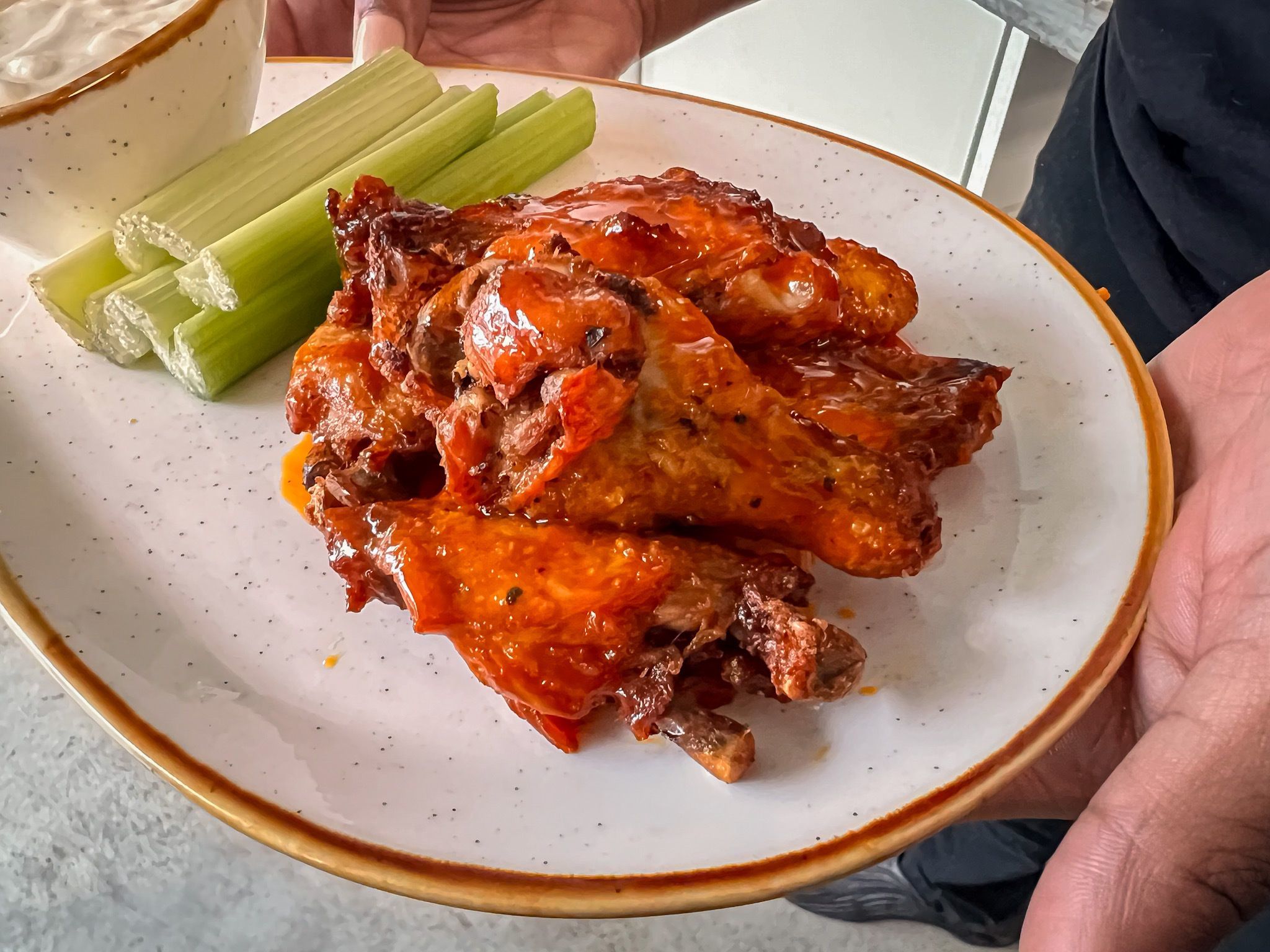
Corner store wings, topped with cayenne pepper and peri peri, at In Crust We Trust on Aug. 2.Michael Klein / Staff
The roughly 80-seat restaurant offers table service as well as a takeout counter and delivery. Beyond pizza, the menu includes wings, two salads, cheesy collard greens, and desserts (including a chocolate chip-oatmeal raisin-sugar cookie baked in a cast-iron skillet and topped with vanilla gelato) — all made with halal ingredients.
Wilson-Worley is the oldest of Felicia Wilson’s three children. Her mother owns Amina, Avana, Fia, First Daughter Oyster & Co., and BlackHen. “She’s been much more than a role model,” Wilson-Worley said. “I definitely wouldn’t be in this position without my mother.”
Still, restaurants were not part of Wilson-Worley’s original plan.
She attended the University of Miami, where she majored in health sciences on the pre-med track. She said she was lucky enough to come out of school with no debt. “I took that as an opportunity to seize what was around me,” she said. “At the time [four years ago], my mom was in the height of opening all of her restaurants.”
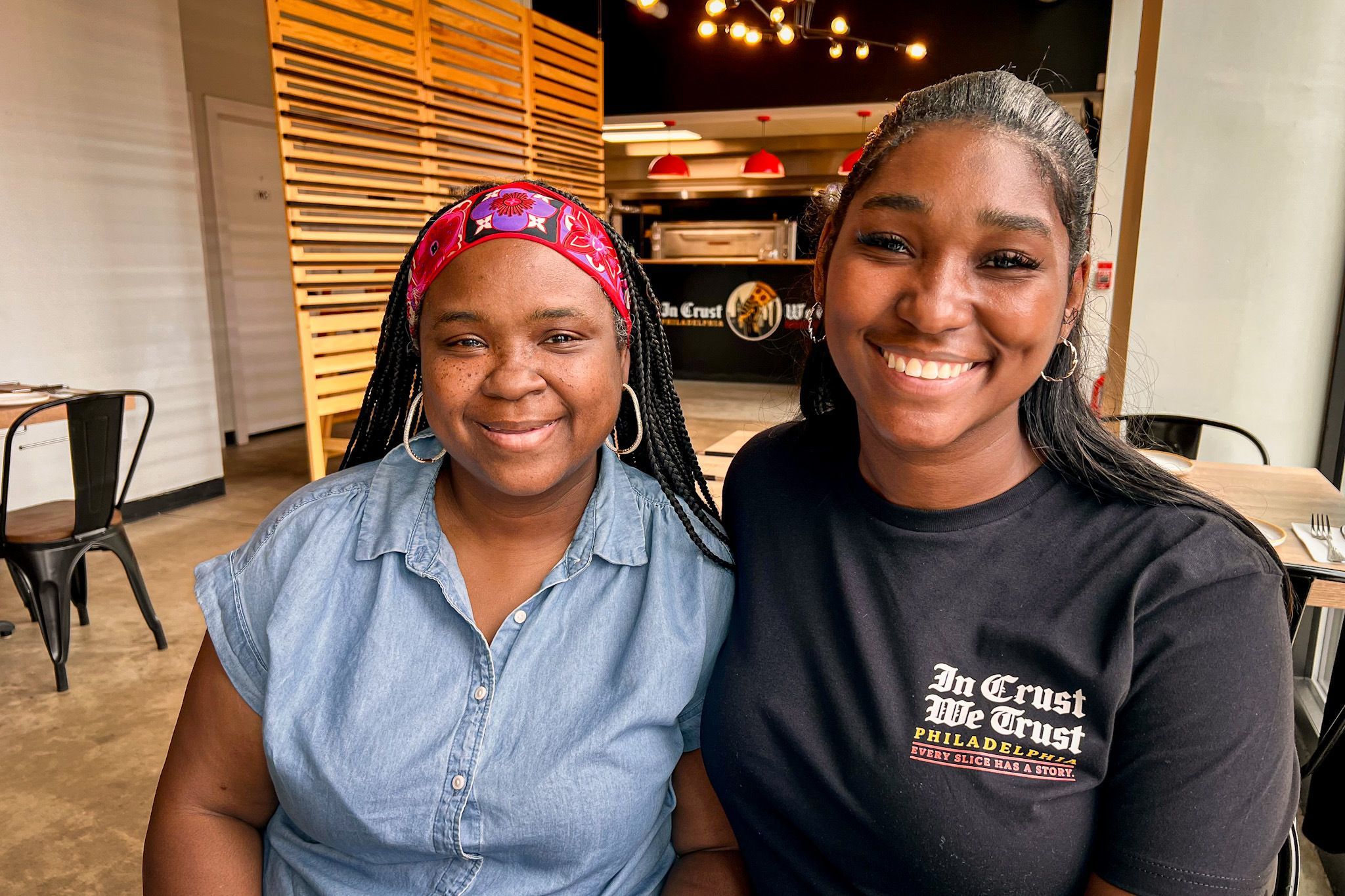
Anyae Wilson-Worley (right) with her mother, Felicia Wilson, at In Crust We Trust on Aug. 2.Michael Klein / Staff
While finishing school, she regularly flew back to Philadelphia to help with the expanding restaurant group. Eventually, she decided to stay to help her mother run the business.
“Anyone who knows me can tell you that ever since my mom opened the restaurant, I always said, ‘This is not what I want to do. I don’t want to be here,’” Wilson-Worley said. “But now this has become my life.”
Her mother provided the example and the education, but Wilson-Worley said the concept, menu, and identity of In Crust We Trust reflect her own perspective.
Wilson-Worley describes Philadelphia as a city whose Black culture is foundational but not always fully recognized. Through the restaurant, she hopes to celebrate that culture while encouraging others to pursue their own ambitions.
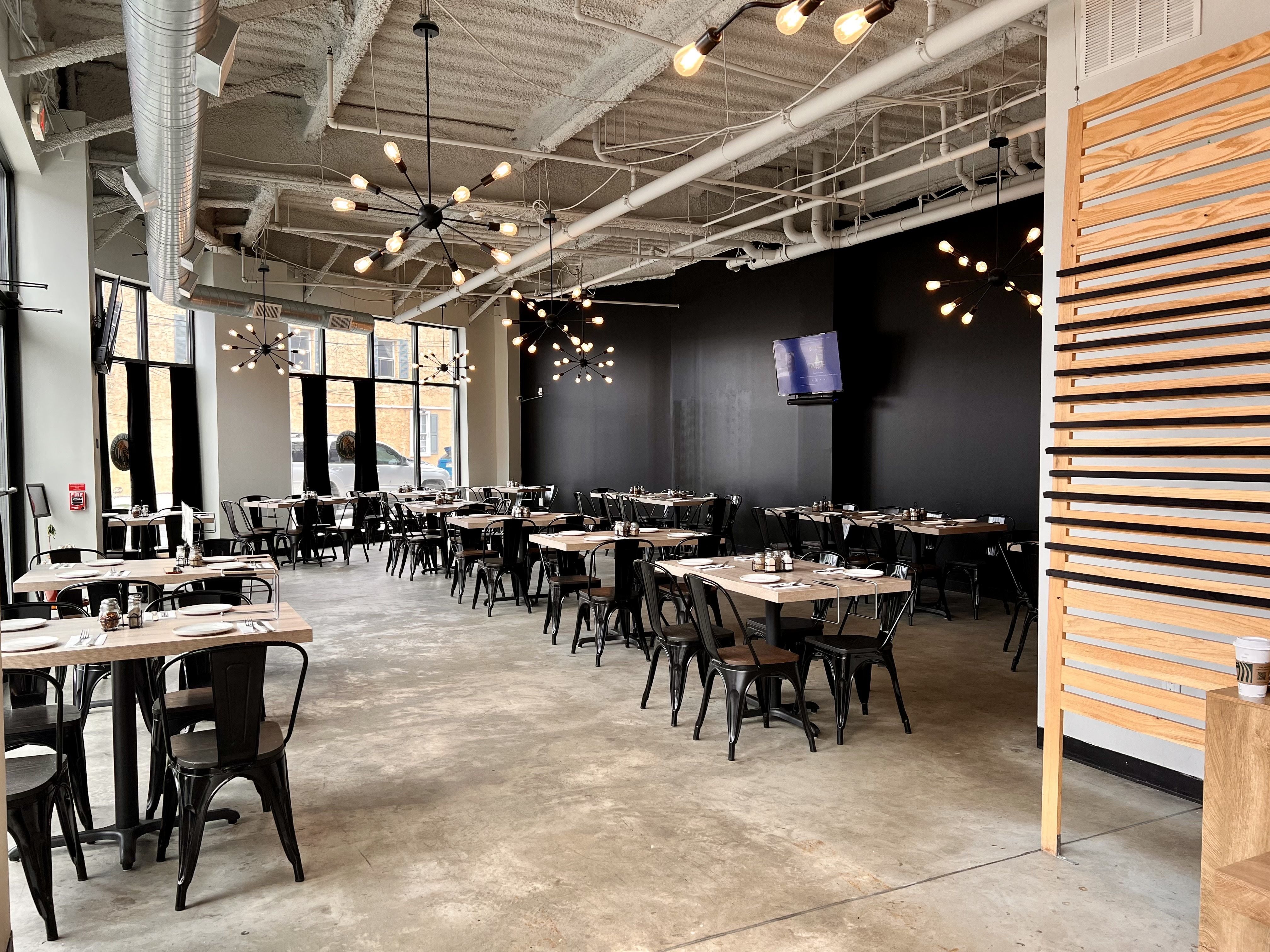
Dining room at In Crust We Trust.Michael Klein / Staff
“I hope to create a pathway for other Black people like myself to get involved,” she said. “Not only through food, but through anything.”
The menu draws from years spent observing professional kitchens.
“I’ve learned a lot from being around the chefs,” she said. “Watching them, listening to them, and working alongside them has expanded my culinary knowledge. I took everything I learned from them and applied it to create a menu that I’m really proud of.”
Wilson-Worley also sees common ground with Down North Pizza, the Black-owned North Philadelphia pizzeria known for hiring formerly incarcerated employees. Both restaurants emphasize community engagement, though she said she does not view them as competitors.
“I’m all about Black empowerment and working with other people like myself in this industry to contribute to the greater good of hospitality,” she said.
Ultimately, she said, her goal is more immediate than making a statement with every slice.
“I want people to feel loved and appreciated,” Wilson-Worley said. “When someone dines here, I want them to walk away thinking, ‘I’ve never had pizza like this before.’”
In Crust We Trust, 965 Frankford Ave. Hours: 11 a.m. to midnight Monday to Thursday, 11 a.m. to 3 a.m. Friday and Saturday, and noon to 11 p.m. Sunday.
The father of a Philadelphia man who was killed in an ATV crash this spring said police officers pursued his son moments before he drove the wrong way down a one-way street, ran a red light, and collided with a sedan.
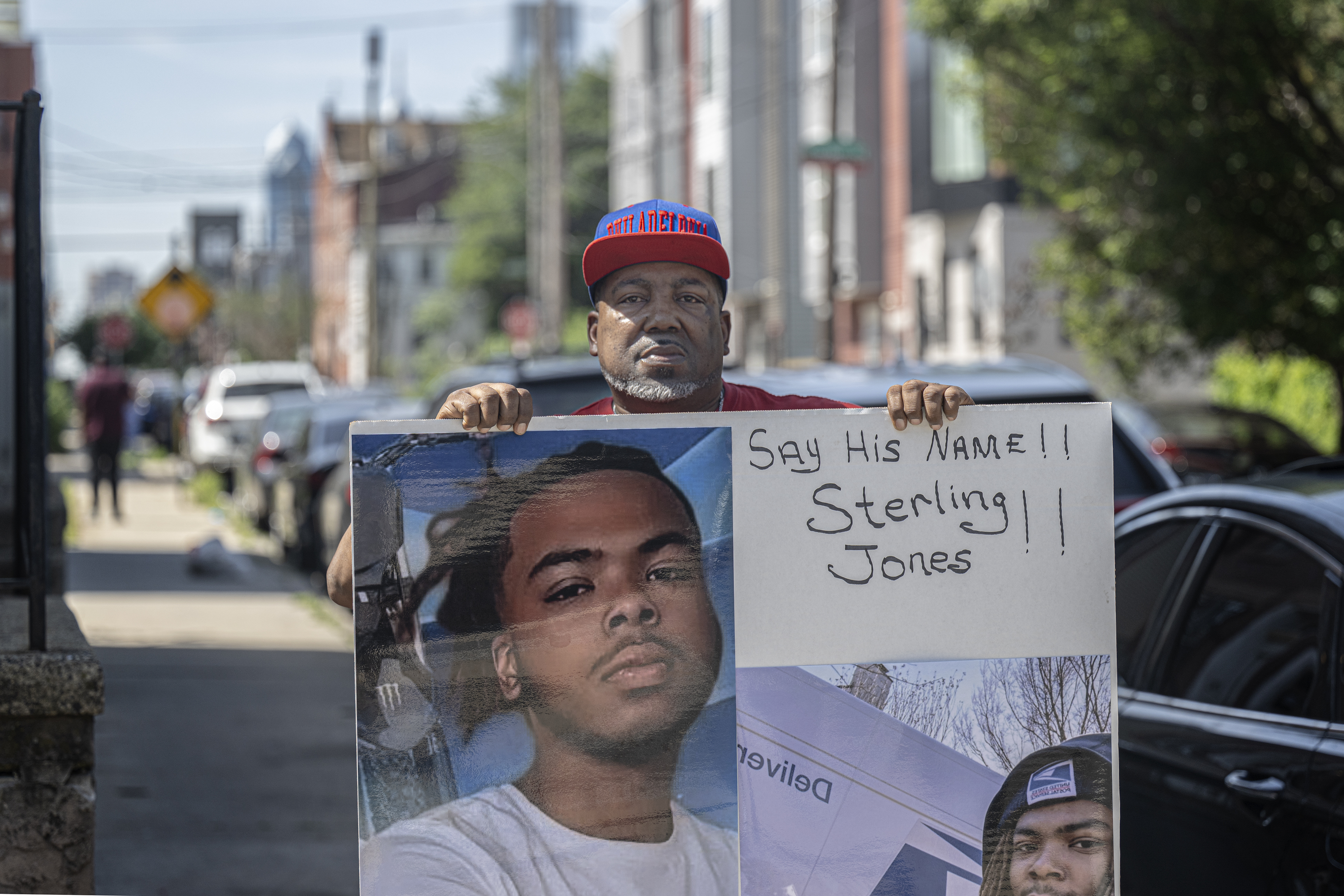
Sterling Jones, 22, was killed on May 9 after the crash in North Philadelphia, according to police.
Lawyers for Jones’ father, Sterling Lamont Jones Sr., said his son and a group of friends had been riding off-road vehicles near Broad Street and Fairmount Avenue when officers from the police ATV and dirt bike detail spotted the young men popping wheelies and began a pursuit.
They followed Jones up Broad Street to West Thompson Street, the attorneys said. There he briefly sped in the wrong direction down the one-way street and ran a red light before striking an Uber driver’s Toyota sedan at the intersection as it turned onto 15th Street.
He was taken to Temple University Hospital and pronounced dead shortly after his arrival.
Sterling Jones Sr., 57, has since hired a team of attorneys to investigate the incident. Late last month, they filed a notice of intent to sue the city, alleging that the officers and the department violated Jones’ constitutional rights when they chased him and caused his fatal injuries.
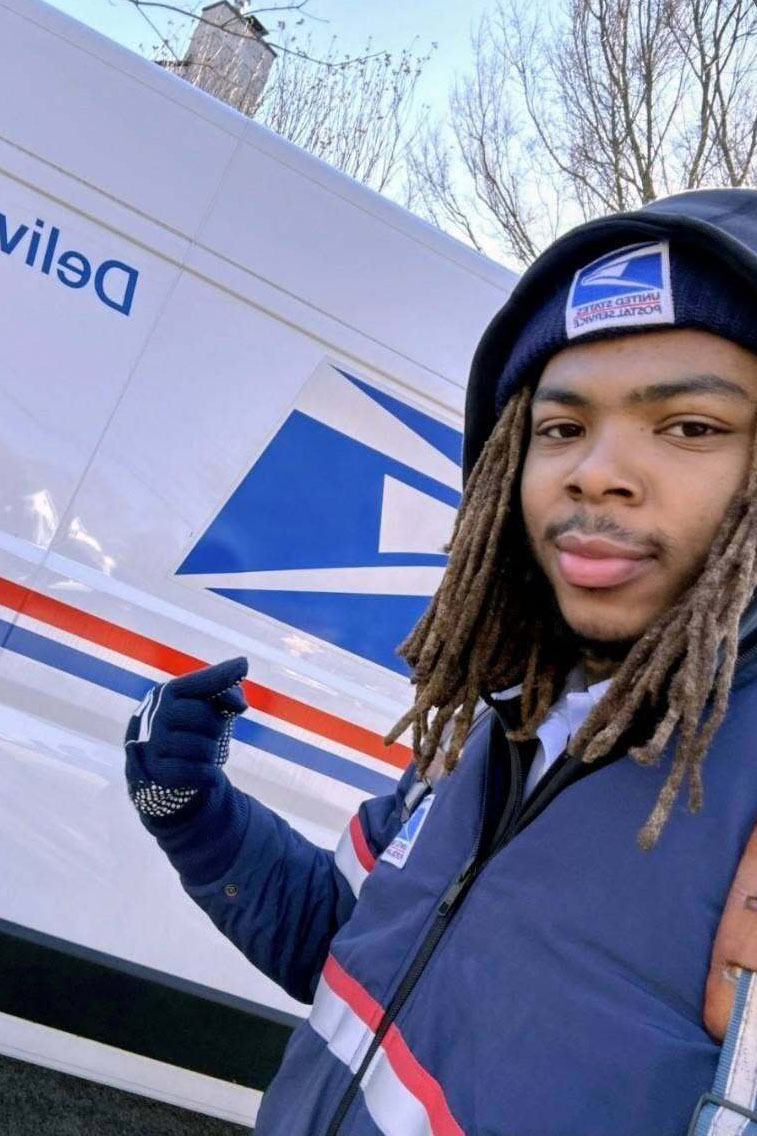
Sterling Jones, a 22-year-old who lawyers say was killed in an ATV crash after being chased by police officers.Courtesy of Sterling Lamont Jones Sr.
Riding ATVs and dirt bikes on public streets in Philadelphia is against the law, and police have increased efforts to crack down on that behavior in recent years.
But the incident raises questions about whether the officers followed a department directive barring vehicular pursuits for all but the most serious offenses — a policy enacted because of the public safety risks posed by such chases, particularly in densely populated areas.
The initial police account of the incident did not mention that officers had been pursuing Jones before the crash. It could not be learned whether the department had since concluded that officers were engaged in a pursuit and whether it was conducted a high rate of speed, as the lawyers contend.
Sgt. Eric Gripp, a police spokesperson, said the incident is under investigation by the department’s internal affairs bureau. He declined to comment further, referring questions to the city’s law department.
A spokesperson for the law department said the city does not comment on pending litigation.
Surveillance footage gathered by lawyers for Jones’ father and viewed by The Inquirer showed at least eight police officers on dirt bikes, a squad car, and a tow vehicle tailing Jones that evening.
Around 9:23 p.m., Jones was seen cutting through a Sunoco gas station and speeding down West Thompson Street with dirt bike officers close behind. Within seconds, his ATV careened into the driver’s side of the sedan.
Under police department policy, vehicular chases are allowed only in situations in which officers believe they can prevent imminent danger to others, or if a suspect is either fleeing after committing a violent felony or in possession of a deadly weapon used in a crime.
And while riding off-road vehicles violates city code, attorneys for Sterling Jones Sr. say that type of infraction still should not trigger a police chase.
“The police department’s policy is, in our view, clearly violated,” said Thomas Kline of Kline & Specter, which is handling the case alongside the firm Hill & Associates.
A 2025 Inquirer investigation found police in Philadelphia and across Pennsylvania were conducting hazardous and unnecessary chases, disproportionately endangering young people. Roughly half of all reported pursuits conducted by city police were not justified under department policy, the investigation found.
A police department spokesperson attributed the increase in chases to the COVID-era surge in violent crime, and said the department investigates every crash for policy violations.
Between 2020 and last year, records show, the city had paid out $20 million in crash- or chase-related settlements as a result of such chases.
In 2017, a 6-year-old girl and her great-aunt were seriously injured when they were struck by a dirt bike rider who was being chased by Philadelphia police into Upper Darby Township. The city settled a lawsuit with their attorneys for nearly $3 million last year.
Sterling Jones Sr. said that while he was planning to sue, no amount of money could make up for the loss of his son.
The young man was a graduate of Hunting Park Christian Academy and had been working for two years as a delivery driver for the U.S. Postal Service before his death. He had bought the ATV with money from that job, his father said.
“He wasn’t a criminal. He had a license,” he said.
Jones Sr. learned of the crash in the early morning of Mother’s Day, when his son’s mother came to his house to tell him Jones was dead.
He said he hired lawyers with the aim of ensuring that the officers who pursued his son would be reprimanded and removed from the beat.
“They killed my only son,” he said. “I just want justice.”
Pediatrician Daniel Taylor opened a crisp hardcover book and began reading to a 5-year-old patient inside an exam room at the clinic at St. Christopher’s Hospital for Children.
“I am laughter that falls like —,” Taylor read, pausing.
“Rain!” the little girl finished, smiling.
“That was amazing,” Taylor said to the girl’s mother, LaShonda Williams, 35, of East Mount Airy. “That’s nice phonetic awareness.”
Williams’ daughter, Xylo, already grasped context and recognized some words. Both crucial skills for school readiness as she prepares for kindergarten this fall.
Xylo and her two siblings — 12-year-old Isaac and 9-month-old Xymia — each got a new book suited for their ages during Wednesday’s checkup. Seated on her mother’s lap, Xymia pointed to a carrot in the First Book of Colors, demonstrating a skill infants ideally master by age 1.
Taylor is one of a growing number of pediatricians who are using books to measure developmental milestones, bolster literacy, and connect with families.
LaShonda Williams and her children, 12-year-old Isaac and 9-month-old Xymia, read together during a checkup at the Center for the Urban Child at St. Christopher’s Hospital for Children.Jessica Griffin / Staff Photographer
The program, “Reach Out and Read,” a national nonprofit literacy group that started in Boston, is celebrating its 25th year at St. Christopher’s in North Philadelphia and its 30th anniversary at the Children’s Hospital of Philadelphia (CHOP) in West Philadelphia.
Participating pediatricians model reading aloud for parents and prescribe reading to children during each well-visit from birth to age 5, although St. Christopher’s program extends into early teens. The children keep the books, building home libraries.
“North Philadelphia is considered `a book desert,’ where there aren’t a lot of bookstores — i.e., none — and families don’t have a lot of children’s books in their homes,” Taylor said. “Just like food insecurity and trying to feed people food. Here we’re trying to feed people with words and books.”
Caregivers often don’t have time or don’t feel safe traveling to their local library in city neighborhoods with high crime, Taylor said.
Taylor helps run “Reach Out and Read” out of the hospital’s Center for the Urban Child, which he described as “an outpatient academic pediatric integrated practice” that sees about 48,000 children a year. There, families can access both medical treatment and social services.
LaShonda Williams, 35, of East Mount Airy, with three of her four children during a checkup with pediatrician Daniel Taylor. Williams, a special education assistant teacher at Wissahickon Charter School, said she’s a big proponent of reading to her children. Jessica Griffin / Staff Photographer
The burgeoning brain
The Pennsylvania chapter of “Reach Out and Read” has grown from three clinics at CHOP in 1996 to 264 pediatric practices today, mostly in the Philadelphia region. Now, local organizers say they plan to expand the program statewide by an additional 100 sites within the next few years.
Pediatrician Trude Haecker, one of the founders of CHOP’s “Reach Out and Read” program, said parents who get a book during a well-visit are two and a half times more likely to read to their child. The research also shows that reading is an important part of the brain development that occurs within the first three years of a child’s life, Haecker said.
“The brain is burgeoning, so in the first three years of life, 80% of your brain is formed,” Haecker said in an interview last week. “There’s a million neurons a second being formed in that first year of life, which is incredible. So having that ability to engage with that child changes that child’s brain.”
Reading to your child also helps offset adverse childhood experiences, like divorce or substance use, Haecker said.
“We’re also really changing that child’s lifetime trajectory,” she added. “It’s really magical.”
A recipe for school success
An estimated 46% of children in the Philadelphia school district are not prepared with the skills they need to start kindergarten. Those children lag in vocabulary, language, reading, and listening skills, according to Taylor.
One of the greatest predictors of whether a teen will graduate from high school is how well they read by third grade, which is directly tied to their speaking skills at age 3, Taylor said.
“So we’re trying to get as many books in the home as possible so that a 3-year-old is saying three-word sentences and a lot of words,” he said.
Taylor said St. Christopher’s raised more than $120,000 last year for new books through its annual basketball tournament fundraiser. The program has given out nearly 1 million books, written in English and about a dozen other languages, since 2001, he said.
“This is one of the most joyous things we do,” Taylor said. “It’s not giving shots; it’s giving immunization against potential future literacy issues.”
Pediatrician Daniel Taylor, co-director of the “Reach Out and Read” program at St. Christopher’s Hospital, organizes the books he selects for his patients before entering an exam room. He has books in 12 different languages, including Urdu, Hmong, and Arabic. He also gives children culturally diverse books in which they can see themselves. More than 90% of his patients are Black or brown.Jessica Griffin / Staff Photographer
No one should have to spend even a single day behind bars for a crime they did not commit. But in his zeal to right legal wrongs, District Attorney Larry Krasner lost the plot.
Since first getting elected in November 2017, Krasner, a former defense and civil rights attorney, has pushed for scores of exonerations for people convicted mainly of murder. But, it turns out, most are not exonerations in which the convict’s innocence is proven through incontrovertible evidence, such as DNA.
Instead, the DA’s office often sides with defense attorneys who claim some sort of procedural error, such as withheld evidence or inadequate defense counsel. In most of thesecases, there isn’ta court hearing in which the new findings get presented, and witnesses testify under oath. Instead, the prosecutors offer what is known as a concession, which often results in dropping the charges and letting the person go free.
But state and federal courts are starting to challenge Krasner’s tactics.
In June, the state Supreme Court rebuked the DA’s handling of a case in which it was seeking to vacate a 2004 murder conviction of Laver Brown, who was convicted of second-degree murder and robbery following the shooting death of Michael Richardson, a Rite Aid worker at a North Philadelphia store.
In July, former Assistant District Attorney Jaclyn Mason testified in federal court that Krasner’s office did not investigate the appeal of another convicted murderer and instead relied on the claims of his defense attorneys — and then encouraged her to lie about the lack of independent verification. Instead of going along with the scheme, Masonsaid, she quit.
That hearing before U.S. District Judge Paul S. Diamond was continued to Aug. 27, where more damning testimony may come.
The state Supreme Court has already seen enough. The court ordered the state attorney general to be allowed to review future cases in which Krasner’s office is seeking to overturn a conviction.
“What we have seen in this case and too many others is the opposite of justice,” Justice Kevin Dougherty wrote in the scathing 109-page opinion.
The high court found Krasner’s office misled the courts and submitted false statements when asking a lower-court judge to vacate Brown’s life sentence.
In June, the state Supreme Court ordered Pennsylvania’s attorney general to be allowed to review future cases in which Krasner’s office is seeking to overturn a conviction.
After his conviction, Brown’s attorneys said some earlier witness statements were not provided to his trial lawyer, which violated his right to a fair trial. Krasner’s office agreed and argued thatthe case file revealed a “pattern of prosecutorial misconduct” and requested Brown receive a new trial.
But lawyers for the families of Richardson and a second man Brown was convicted of killing in a separate incident asked the state Supreme Court to intervene.
Lawyers for the victims’ families argued that Krasner had a conflict of interest because two of his former law partners had been involved in Brown’s case.
The high court ordered a hearing that shed a harsh light on the conduct of Krasner’s prosecutors.
“We find the [district attorney’s office] … violated its duty of candor to the [Post Conviction Relief Act] court, withheld material evidence from the court, opposed efforts by [the victims’ families] to gain access to this evidence, submitted a false stipulation of fact, misstated facts in its pleadings, failed to conduct a reasonable investigation, and opposed a required evidentiary hearing,” Dougherty wrote.
Whoa. What the heck is going on?
The Supreme Court also found the prosecutors filed a joint document with Brown’s attorneys that “was false in multiple respects.”
The court rejected claims by the DA’s office that it conducted a thorough review of the record in the case. Instead, the court said prosecutors “cut corners” and failed to interview a single witness or any of the original investigators involved in the case.
The DA’s handling of Brown’s case is troubling enough. But it turns out this was not a one-off blunder. The Supreme Court found the case fit a disturbing pattern.
“There have been numerous instances of untrustworthy concessions, lack of candor, misrepresentations of fact, lack of adequate investigation, and avoidance of hearings,” the opinion said.
The Supreme Court went on to highlight problems with the DA’s handling of 10 additional cases, and said there may be many more.
One case involved efforts by Krasner’s office to overturn the death sentence of Robert Wharton, who was convicted in the 1984 strangulation and drowning deaths of a couple in their East Mount Airy home, leaving their then-7-month-old child alone. She survived.
The case eventually ended up before a three-judge panel of the U.S. Court of Appeals for the Third Circuit. In a unanimous decision, the panel found that Krasner’s office misled the court and “slant[ed] the facts” surrounding Wharton’s case before a lower federal court in 2019 in an attempt to vacate the death penaltyand instead let Wharton remain in prison for life.
Again, with the lack of candor.
U.S. District Judge Mitchell S. Goldberg denied the request and imposed penalties that required Krasner to write a letter of apology to the family of Wharton’s victims, which the appellate panel found were both “mild and fitting.”
“Courts rely on lawyers’ honesty; lawyers may not mislead them,” Circuit Judge Stefanos Bibas wrote in the panel’s March 2024 opinion. “But the Philadelphia District Attorney’s Office did just that.”
Back to the state Supreme Court.
After highlighting problems with the Brown case and 10 others, the court wrote, “These cases, and the present one, likely represent only a fraction of the [district attorney’s] problematic concessions since January of 2018.”
The court said many of the DA’s concessions did not include hearings in which sworn testimony from both sides is presented, which the court wrote “is generally the best means to expose problems and ensure a reliable and just outcome.”
For his part, Krasner was unrepentant. He issued a video statement following the Supreme Court opinion that leaned on his electoral victories to claim the ruling “undermines the value of a vote in Philadelphia as compared to every other county.”
District Attorney Larry Krasner (left) and G. Lamar Stewart, head of the community engagement and government affairs division, at Independence National Historical Park in February.
Krasner added that social justice efforts like his often face a familiar pattern of resistance: “First they ignore you — we’re past it. Then they laugh at you — we’re past that. Then they fight you — and we have been fighting for 8½ years.”
The district attorney’s website trumpets 59 “exonerations” by the Conviction Integrity Unit created by Krasner. But the National Registry of Exonerations said the total number of exonerations by the DA’s office during Krasner’s tenure is 75 — an extraordinary number given that reversing a conviction faces a high bar and often takes years.
Nearly all of those set free have been Black men, underscoring how the legal system is often stacked against people of color. At the same time, no new charges have been brought in those cases, leaving killers and other wrongdoers walking the streets.
There is no denying systemic racism exists across our legal system, including in Philadelphia. I witnessed abuses and failures of cops, prosecutors, lousy defense attorneys, eyewitness misidentifications, and forced confessions up close as a reporter covering the courts years ago for the Wall Street Journal.
I wrote a story about a Latino man who was convicted of murder in the Bronx, N.Y., despite having a solid alibi: On the night of the murder, he was in prison in the Dominican Republic.
That’s all to say wrongful convictions happen, and sending someone to prison for a crime they didn’t commit — or worse, putting them to death — is the most heinous abuse of the legal system imaginable.
That’s why I welcomed Krasner’s efforts to review cases in which misconduct or errors may have occurred.
But the sloppy work by Krasner’s office has undermined his theory of the case. Sadly, those who have been truly wrongfully convicted will be the ones to suffer because judges will no longer trust the DA’s office.
When judges in state and federal courts and former prosecutors in Krasner’s own office are citing similar patterns of corner-cutting and lying, there is a serious problem.
Krasner built his career on demanding accountability from the system. He owes Philadelphians no less from his own office.
The Philadelphia Housing Authority is planning an 85-unit mix of affordable rental and homeownership units in Strawberry Mansion, around 28th and York Streets.
The proposal is part of a burst of PHA activity in this North Philadelphia neighborhood in recent years, as the agency has sought to use vacant land to add affordable housing to the area.
“This proposed development at 28th and York represents exactly the kind of investment Strawberry Mansion deserves — one that replaces long-term vacancy and blight with affordable homes, open space, and renewed opportunity,” Kelvin A. Jeremiah, president and CEO of the Philadelphia Housing Authority, said in a written statement.
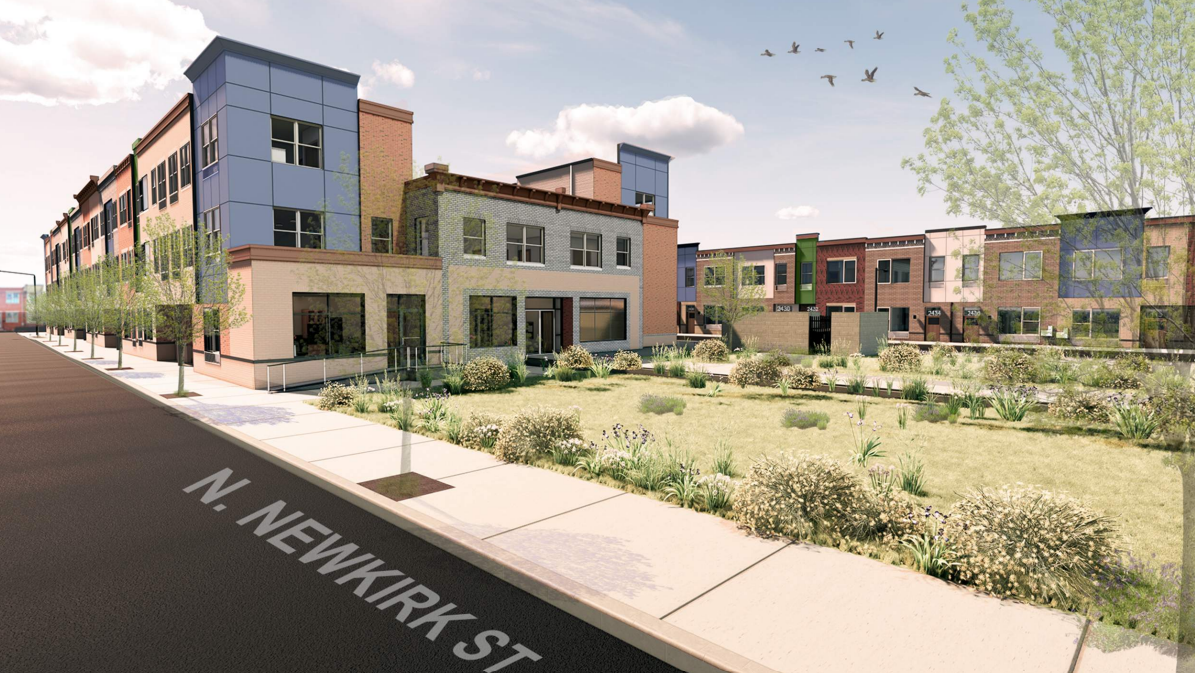
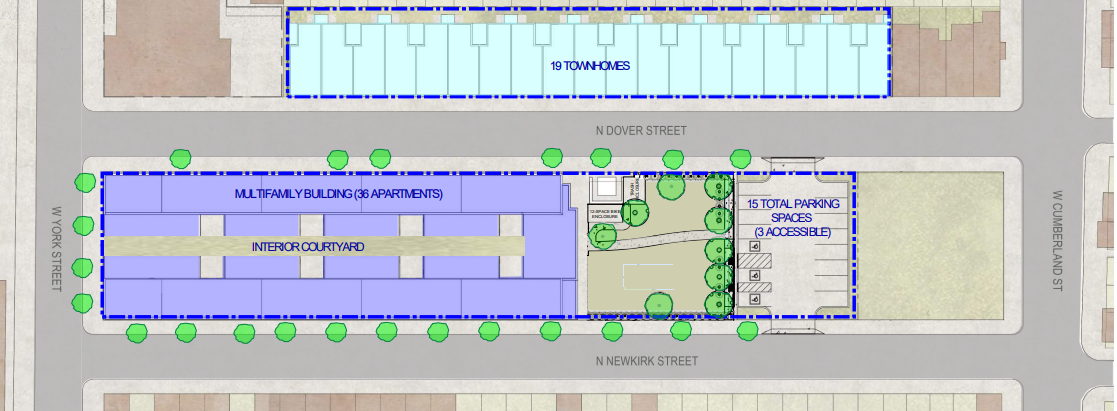
The project has 30 single-family houses that will be built using the city’s Turn the Key program, 19 rental townhouses, and a 36-unit apartment building roughly split between one- and two-bedroom units.
PHA also plans 15 parking spaces, street widenings to allow more parking, and a new agency-run park.
The rental portion of the project, which includes the apartment building at 2401 N. Dover St. and the 19 rental townhouses at 2416 N. Dover St., received permission to move forward from the Zoning Board of Adjustment in late July and early August.
The housing authority has the support of many of the area’s elected representatives, including State Sen. Sharif Street and State Rep. Keith Harris. The politically influential Laborers union also submitted testimony to the zoning board in support ofthe project.
The biggest regulatory hurdle to PHA’s plans isthat the land slated for multifamily development is zoned for single-family use, but the board waived that requirement after hearing from community members about PHA’s proposal.
“I would love to see some development on Dover Street,” said Altrena Nixon, who owns a business at 29th and York Streets.
“It’s been sitting like that for many, many, many years,” Nixon said in testimony before the zoning board. “We need the vibrancy. We need the development. We need the jobs that it’ll bring to our area.”
Two speakers warned about the housing authority’s history in the neighborhood, arguing against adding so much density and too much affordable housing.
All In The Family Group Associates Inc., a community organization, wanted further meetings with PHA to discuss how the project related to other nearby developments.
In a letter, PHA declined to enter into an agreement with the group over a planned park at 27th and York Streets. All In The Family did not respond to a request for comment.
“The PHA should not be able to get away with not coming to the table with us and ironing out these issues and ensuring that we have stability in our communities,” Odessa Tate, a member of All In The Family, said in testimony before the board.
Councilmember Jeffery Young — who is engaged in a legal action against a ZBA ruling in favor of another 57-home development PHA proposed in Strawberry Mansion — asked the board to delay its ruling to allow more time to meet with All In The Family.
A map showing where the rental portion of PHA’s plan will lay out.Cicada
But the zoning board ruled in the project’s favor at hearings on July 29 and Aug. 5. Six of the nine speakers at the hearing were in favor of the project.
“There is a dire need for affordable housing in our community, and to continue to just delay and delay and delay is counterproductive to the needs of the community,” said the Rev. Warren Marshall at the July hearing.
The 30 homeownership units did not require zoning board permission to move forward. They will be on 29th, Newkirk, and Dover Streets and are being built by Civetta Property Group, the developer that has used the city’s Turn The Key program the most extensively.
Construction will begin on the for-sale units in October. The rentals are slated for next year as they seek competitive Low-Income Housing Tax Credits that will become available in 2027.
The 15-space surface parking lot will be next to the apartment building, while Dover and Newkirk Streets will be widened to allow for more on-street parking.
A proposedpark at 27th and York, meanwhile, is being described as a space for community events.
“PHA will be responsible for development, maintenance, use procedures, and related management functions necessary to preserve the park as a community asset,” Jeremiah said in a letter to local political leaders.
This isn’t the authority’s only current project in Strawberry Mansion. WHYY recently reported PHA also has proposed converting a 126-year-old school on North 22nd Street into a 50-unit affordable apartment building for seniors.
The Phillies tell me they sell more than 40 brands of beer, priced from $6.99 for a 12-ounce can of nonalcoholic beer to $17.69 for a 24-ounce premium can. Beer is everywhere at Citizens Bank Park, including at a humongous walk-through cooler on the main level.
I recently strolled into that cooler and found a lager — at $38.48 for two 19-ounce cans — that paired nicely with chicken fingers and the Fightin’ Phils. OK, so 64 ounces of the exact same beer costs $11.99 at Acme, but you can’t watch the Phils live from Acme, can you?
“Sometimes, things become clichés because they’re true: A cool beer on a warm summer day at the ballpark is among the great joys of fandom,” says the avuncular Glen Macnow, the former Inquirer reporter (and colleague) and sports talk-show host whose What’s Brewing PA beer show appears on the NBC Sports Philadelphia networks.
Macnow — who is, full disclosure, also the part-owner of Conshohocken Brewing Co., which vends two of its brands at the ballpark — adds: “I’ve spent many an afternoon (or evening) with a beer in one hand, a hot dog in the other, juggling both so I can fill out the scorecard balanced on my knees.
“Those are simple and eternal pleasures. Baseball isn’t designed for trendy cocktails in a can; it’s designed for the tradition of leisurely enjoying a cold brew over several innings as you try to convince the guy in the next seat that the manager (whoever he is) is the dumbest one in Phillies history.”
OK, but just in case you don’t care for a brewski, the Phillies also sell about a dozen different trendy cocktails in cans, with prices running from $14.55 to $23.99. These are no bargains, either, but consider the alternative: The Phillies used to not sell booze at all.
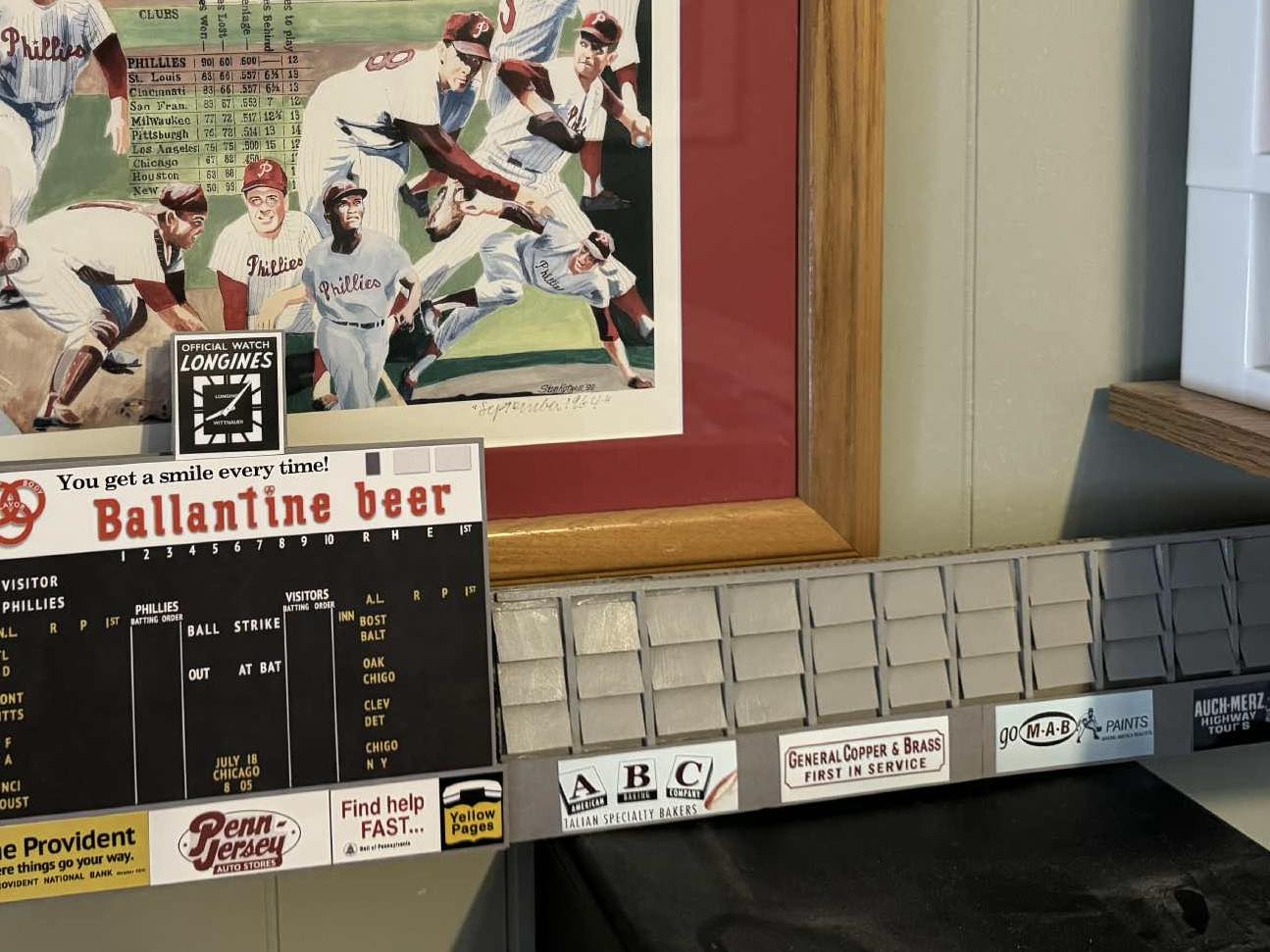
Baby boomers like me vividly remember the towering, then-state-of-the-art right field scoreboard at Connie Mack Stadium, topped by a gigantic advertisement for Ballantine Beer (and its three-ring logo, for Purity, Body, and Flavor).
A handmade model of the iconic Ballantine Beer scoreboard at Connie Mack Stadium by Phillies fan Bernie Valente.Courtesy of Bernie Valente
Well, that scoreboard was erected in 1956, five years before beer was sold there.
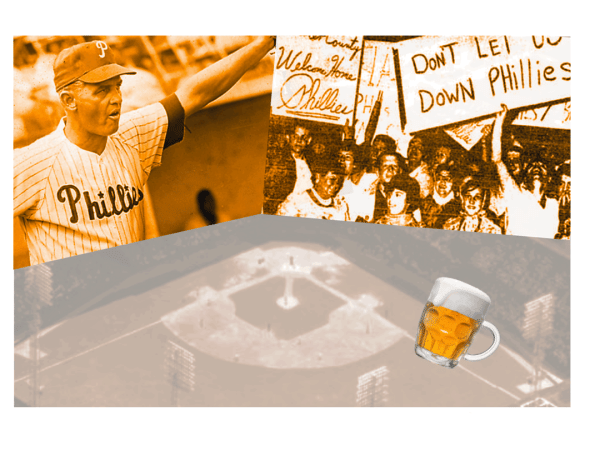
The Phillies first legally sold beer inside Connie Mack Stadium, their musty old park in North Philadelphia, on Aug. 7, 1961, when they put seven local brands of bottled beer on sale for 35 cents, first poured into a paper cup by eight vendors working the aisles.
The paper cup was a vital part of the transaction, because, prior to legal sales, Phillies fans used to sneak in cans of beer, often sold in “cold packs” at nearby bars like Charlie Quinn’s Deep Right Field Cafe at 20th and Lehigh.
Beer cans were heavier in those days, so they tended to become missiles when the umpires missed a call, or if the Phillies stank, which was quite often.
The low point probably came on June 12, 1959, when a twi-night doubleheader against San Francisco was halted after five innings because of rain. The Phillies were no-hit — but even worse, fans were denied rain checks to both games because the first game was official.
As Frank Fitzpatrick, the now-retired Inquirer reporter who attended the game as a 9-year-old, recalled in the paper in 2016: “Suddenly, one empty can fluttered toward the field. A second followed quickly. Soon, it was a dangerous deluge. So many were tossed that cans obscured the tarp, from the mound to the batter’s box.”
That was not good news for Robert R.M. Carpenter, the Phillies owner, who dearly wanted a new ballpark for his team. Plans had been drafted for a 45,000-seat, $8 million stadium in the Torresdale section of Philadelphia, with an adjoining theme park, yacht basin, and bird refuge park adjacent to I-95. Beer sales would bring in some cash for that amazing project.
On June 20, 1961, the Pennsylvania Senate passed a previously approved bill by the state House that would permit the sale of beer every day but Sunday at sporting events at stadiums in the state that seated more than 25,000. (The Pittsburgh Pirates also happened to be looking for a new ballpark.)
But they faced stout foes. After voting against the bill earlier in 1961 that would have enabled the Phillies to sell beer, a Democratic state assemblyman from Philadelphia, Charles Heavey, predicted that the sale of beer would actually “contaminate” youngsters.
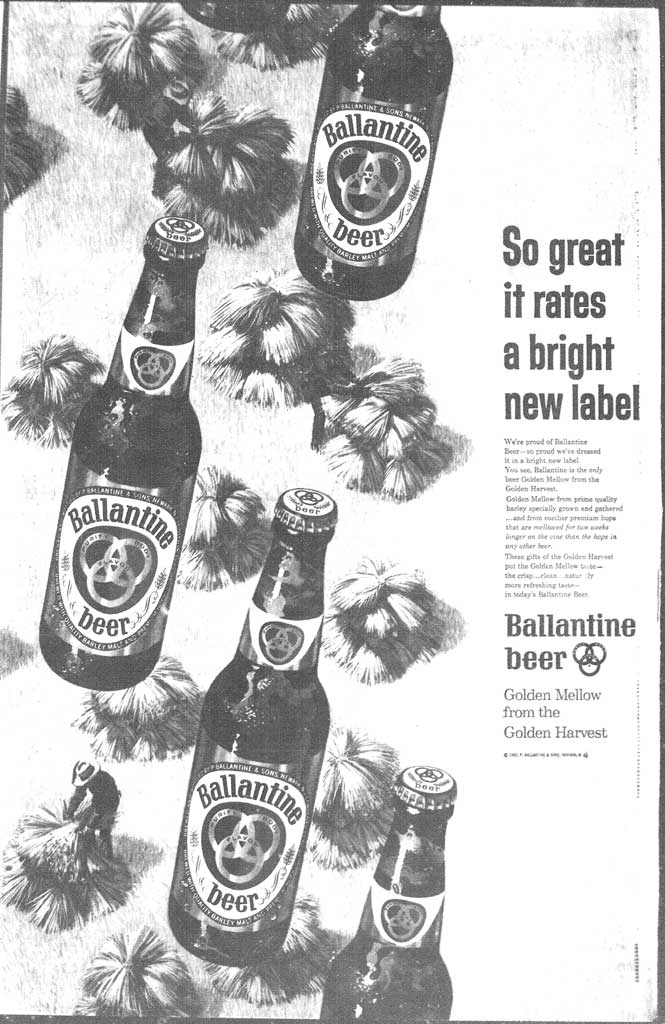
So … first the beer had to be poured into a paper cup before drinking, preventing another beer can pileup on the field like the one in 1959. And there would be more than one starting pitcher: Schmidt’s, Esslinger, Old Dutch, Horlacher, Neuwiler and, yep, Ballantine were all included in the original sudsy rotation.
A 1962 newspaper advertisement for Ballantine beer.
Larry Merchant provided statistics in his Daily News column the next day: A total of 3,739 beers were served to 5,586 who attended that Aug. 7 game, a 3-1 Pittsburgh victory on a Monday, which was also the Phillies’ 10th straight loss. No bottles or cans were thrown on the field, he reported, but fans did pop the cups and try to throw those onto the field — often in vain.
“For serious drinkers, it was about a four-beer game, just two and a half hours long,” Merchant joked. “For serious Phillies fans, it was a six-beer job. They look better that way.”
Merchant made note of signs at the entrances that read, “Bringing in of canned beer or bottled beverages will be a cause for ejection from the park.” Nonetheless, he reported, seven would-be beer smugglers were caught at the gate, their brews returned when they left the park.
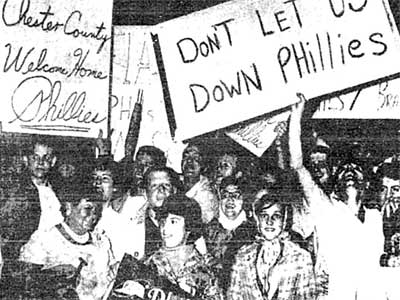
Those 1961 Phillies were so lousy that their losing streak grew to 23 games, still a modern record. After the Phillies beat Milwaukee, 7-4, on Aug. 20 in the second game of a doubleheader, their flight home was welcomed by 500 fans at 1 a.m. the next day at the airport.
About 500 Phillies fans welcomed the team home at the airport like conquering heroes after the club broke a 23-game losing streak in August 1961.
“They are selling rocks at $1.50 a pail,” Phillies pitcher Frank Sullivan, looking out of the plane, joked to his teammates.
He then wisecracked: “Leave the plane at five-minute intervals. That way, they can’t get us all with one burst.”
In truth, the beer ploy sales did not seem to provide much of a boost to the 1961 Phillies, who lost 107 games and finished last in the National League in home attendance in 1961, averaging only about 7,600 per home game. But a door, or many brewskis, had been cracked.
Beer would not be sold at Sunday home Phillies games until 1972, after the Phillies moved to Veterans Stadium, following the amendment of the ancient Pennsylvania Blue Laws, intended to curtail activities on Sundays (including Phillies and A’s home games until 1934).
“My parents didn’t drink, so I always associated the public consumption of alcohol as something dark and troubling,” Fitzpatrick told me recently. “That feeling was confirmed in spades at that 1959 game.
“By 1966, the summer I worked at the ballpark, I felt differently. I was a soda vendor, and beer suddenly was a precious commodity. Now I envied the beer sellers, because they made the most money and had the least amount of walking. Occasionally, rowdy fans would harass young vendors like me, hurling popcorn containers or wadded-up cups at us, [but] it definitely was comforting to know you wouldn’t have to dodge metal cans. On the other hand, in ’66 the smell of spilled beer now permeated the place. I don’t remember that same aroma when fans brought their own.”
Carpenter never did get his Torresdale stadium. After a one-year delay because of construction, however, the Vet opened in 1971 in South Philadelphia. A few fans grumbled about paying 75 cents for a 12-ounce beer served there by a vendor, perhaps because those same items were 40 cents and 60 cents, respectively, at Yankee and Shea Stadiums in New York.
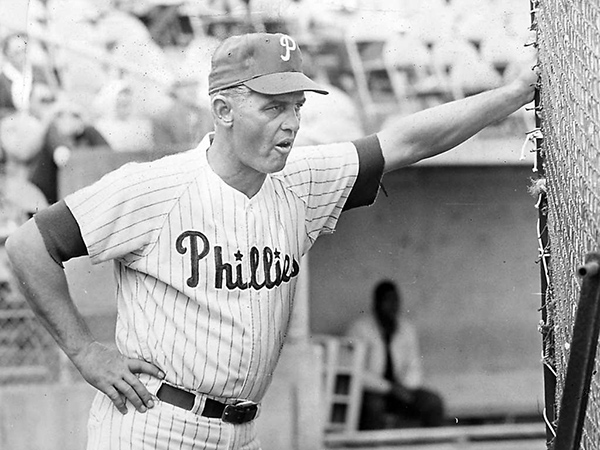
Gene Mauch managed the Phillies during their historic 107-loss season in 1961. That team dropped 23 straight contests.
The pricing was actually meant to be sort of a deterrent. Bud Vye, the Connie Mack stadium manager, told The Inquirer, “At these prices, they’ve got to bring a bankroll just to get bombed out.”
But beer stuck around. A 1998 Daily News exposé into how Ogden Entertainment, then the vendor at the Vet, was caught skimming a half million dollars in annual beer sales led to a price reduction. Local brands, kicked to the side by the national brews, were sold again when the Phillies moved to Citizens Bank Park in 2004. (Large premium drafts then sold for $6.)
Cups were eventually discontinued, and most beer at the ballpark is sold in much lighter cans (which, it should be noted, are opened by the cashier, lest someone try to hurl a full can on the field). Dozens of different brands of beer can be spotted at any Phillies game.
“A big part of this is marketing,” Macnow tells me. “Beer at the ballpark is no longer poured into paper cups, so there’s a long-term benefit to seeing people walking around the park holding cans of your beer. Labeling becomes important. Naming beers becomes important.”
And so is the vessel itself. The Phillies continue to sell “beverage bats,” large hollow plastic souvenir baseball bats that can be filled with any beverage. Those are not cheap, either. Phillies fans may be held captive by the prices, but beer and baseball are inseparable.
Dave Caldwell lives in Manayunk and covered sports for The Inquirer from 1986 to 1995.
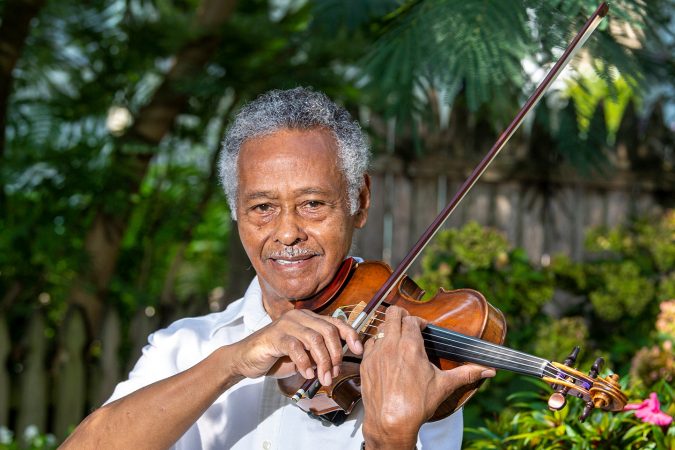
Booker Rowe, 85, of Philadelphia, award-winning violinist, the first Black musician to play with the Philadelphia Orchestra and the Nashville Symphony String Quartet, the second permanent full-time Black player in the Philadelphia Orchestra, teacher, mentor, and role model, died Friday, July 31, of complications from pneumonia and sepsis at Jefferson Abington Hospital.
A lifelong musician — he played piano at age 5 and violin at 11 — Mr. Rowe was invited by famed music director Eugene Ormandy in 1968 to become the first Black musician to perform with the Philadelphia Orchestra. He was a substitute violin during most of the 1968-69 season and returned for good in 1971 as the orchestra’s second Black permanent full-time member.
Mr. Rowe stayed for 49 years.
“My first day, I came in late from New York, and the orchestra was already rehearsing, and I sat myself down on the last stand to play,” Mr. Rowe told The Inquirer’s Peter Dobrin in 2020. “The sound was amazing. It was like stereo all around me. The stage was slanted down, and when the brass and winds would play I had to brace myself with my right leg from being blown off stage. It was just so beautiful.”
For five decades, until his retirement in 2020, Mr. Rowe played with half a dozen elite conductors and traveled the world in the orchestra’s second violin section. He and his colleagues gave thousands of memorable performances at the Academy of Music, the Kimmel Center, and the Mann Center in Philadelphia, Carnegie Hall and the Lincoln Center in New York, and the Saratoga Performing Arts Center in Saratoga Springs, N.Y.
They played at the 1993 World Series at Veterans Stadium, for Pope Francis in 2015, and at the Vail Music Festival in Colorado. They played in Europe, South America, Asia, and elsewhere around the world.
This photo of Mr. Rowe (left) appeared in the Daily News in 1993Newspapers.com
In 1973, the orchestra made a historic 10-day, five-concert cultural exchange tour in China, and Mr. Rowe told the Daily News afterward that he visited a commune and returned with Chinese instruments. In 2008, he mingled with former Secretary of State Alexander Haig and other international notables after a concert in Beijing.
In 2013, he posed for pictures with the Chinese welcoming contingent at Shanghai Airport. “Booker was such a kind soul, and his passion, his artistry, and his humanity are woven into who we are,” Yannick Nézet-Séguin, the orchestra’s music and artistic director, said in a tribute.
Ryan Fleur, the orchestra’s president and chief executive officer, said: “He was a warm and steadying presence in our orchestra.”
Born in Kentucky, Mr. Rowe and his family moved to North Philadelphia when he was 2. His father was a singer, and his mother played piano, and they “pushed me in the direction of classical music,” he told the Daily News in 1981.
He became concertmaster for the West Philadelphia High School orchestra, the All-City high school orchestra, and the old all-Eastern Conference college orchestra. He earned a bachelor’s degree in music at Temple University in 1963 and a master’s degree in music at Yale University in 1968.
Before Philadelphia, he played solo in New York and with symphony orchestras in Nashville, New Haven, Conn., and Washington. Later, he played with the old Symphony Club of Philadelphia, the Lansdowne Symphony Orchestra, and other local groups.
Mr. Rowe (left) stands with fellow musicians Andre Watts (center) and Renard Edwards.Courtesy of the family
He also got freelance gigs with Sammy Davis Jr., Isaac Hayes, Smokey Robinson, the Supremes, Barbra Streisand, Aretha Franklin, and other stars. He played with chamber music ensembles around the country and gave dozens of free concerts for children, churches, and community and scholarship fundraisers.
He championed racial and ethnic diversity, and was active with the Philadelphia Orchestra’s cultural diversity initiative. He sought and performed work by Black and other minority composers, and mentored dozens of colleagues and students.
He encountered at least one racist incident that first year in Philadelphia and told the Daily News in 1981: “The time was right for an Afro-American in the Philadelphia Orchestra. It was just a matter of finding somebody who was ready.”
Mr. Rowe and his family lived in Center City, East Mount Airy, and Germantown. Courtesy of the family
A friend said on Facebook: “His legacy and historical contributions are unparalleled.”
Mr. Rowe taught at Settlement Music School and gave private lessons. He earned music and service awards from City Council, the American Foundation for Negro Affairs, and other groups.
In 2019, he was asked to advise young musicians in a video interview for the Philadelphia Orchestra website, philorch.ensembleartsphilly.org. “Practice, practice, practice,” he said. “But also enjoy, enjoy, enjoy. Do it with love in your heart.”
Booker Taliaferro Washington Vance Rowe Jr. was born Dec. 10, 1940, in Lexington, Ky. In Philadelphia, he studied at the old Philadelphia Musical Academy and Settlement Music School, and his father worked at RCA Victor records in Camden. So their home was always filled with music.
Mr. Rowe (rear center) stands with Philadelphia Orchestra colleagues and members of the Chinese welcoming contingent in 2013.
Jan Regan / Philadelphia Orchestra
He met soprano Patsy Baxter at a Philadelphia Orchestra concert, and they married in 1970 and had a son, Landis, and a daughter, Vivian. They lived in Center City, East Mount Airy, and Germantown, and visited his family often back in Kentucky and Tennessee.
Mr. Rowe enjoyed puzzles, hiking and kayaking with his family, and tai chi. Friends noted his “kindness,” “million-dollar smile,” and “cheerful presence” in Facebook tributes.
District Attorney Larry Krasner on Tuesday said he strongly disagreed witha judge’s decision to overturn the murder conviction of a man who killed Philadelphia Police Officer Moses Walker Jr. in 2012 and vowed to appeal.
Krasner said Common Pleas Court Judge Jennifer Schultz, who handed down the ruling Monday, was “legally incorrect” in vacating the conviction of Rafael Jones, who is serving life in prison for killing the officer during a street robbery at the end of his shift.
But Krasner, speaking at a news conference alongside Walker’s mother and Roosevelt Poplar, president of Lodge 5 of the Fraternal Order of Police, said Jones’ conviction was different from others involving Nordo that have since been reevaluated.
“We believe now that Rafael Jones is guilty — that he murdered Moses Walker Jr.,” Krasner said.
If the appellate court denies the district attorney’s appeal, he added, “we will be retrying this case. We have a lot of evidence to do so. And we will be retrying it vigorously.”
Jones’ attorney, Jason Edward Parris, said Tuesday afternoon that the vacated conviction represented justice.
If jurors heard Jones’ case today, Parris said, they would have information about Nordo’s sex abuse crimes involving informants in homicide investigations that was not available at the time of Jones’ trial.
“I don’t think anybody should be comfortable with someone serving life in prison based in part on an investigation done by an officer who is now doing 49 years [in prison] for crimes committed during the investigation of this case,” Parris said.
Walker, 40, was shot and killed shortly before dawn on Aug. 18, 2012.
The officer had just left the 22nd District station in North Philadelphia dressed in civilian clothes when Jones and another man, Chancier McFarland, targeted him in a robbery, prosecutors said.
Jones fired at Walker after the officer reached for his gun, according to prosecutors. Both men were arrested, and McFarland pleaded guilty and testified against Jones as part of a deal to avoid life in prison.
Years later, during Nordo’s sexual abuse trial in 2022, one of his accusers testified that the detective had steered him toward a $20,000 reward and later raped him.
Though Krasner acknowledged the “messy history” that came with Nordo’s involvement in Jones’ case, he said the district attorney’s office was confident in the conviction.
There were multiple pieces of evidence that pointed to Jones’ guilt, he said, including a murder confession that was not introduced at trial because Jones did not testify, and McFarlane’s eyewitness account of the crime.
“We concluded years ago that this conviction was in the category that should not be disturbed,” Krasner said.
The district attorney’s office will appeal Schultz’s ruling to Superior Court, a process Krasner said could take up to two years.
Poplar, the FOP president, said he had faith that Krasner’s office would prevail.
“Yesterday was a tough day,” he said, echoing comments made by Police Commissioner Kevin Bethel, who said he was disappointed by the ruling.
Walker’s mother, Wayniya, said she and her family “would not allow these latest developments to weaken us.”
“We remain confident justice will prevail,” she said, adding that she hoped that the death of her son, not the vacated conviction of his killer, would “remain at the center of this case.”
“No decision rendered can alter what happened on Aug. 18, 2012,” she said.
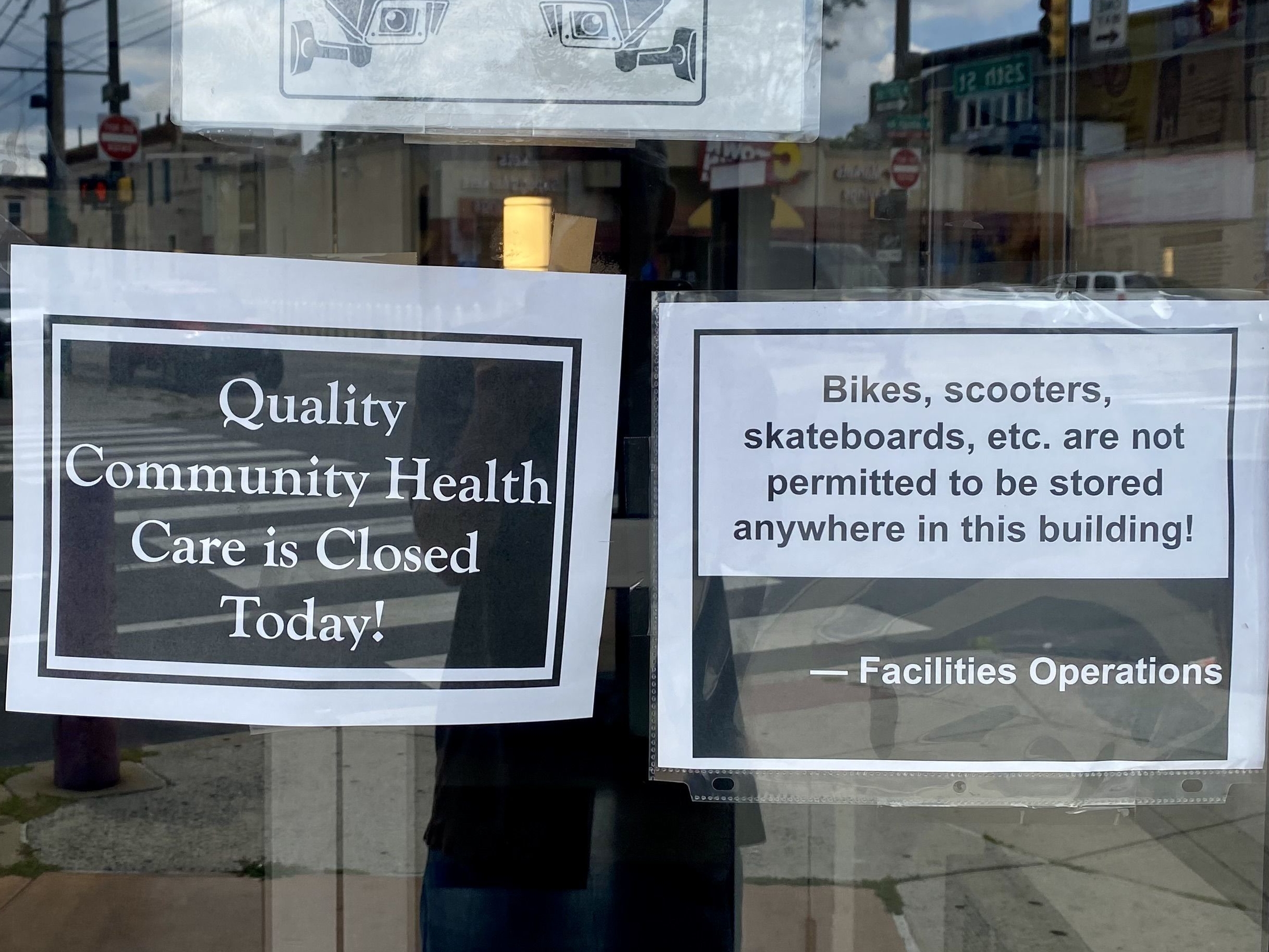
When Pele Lewis arrived at Quality Community Health Care’s clinic in North Philadelphia Wednesday for his 1:30 p.m. appointment, he found the doors locked and a sign saying the clinic was “closed today.”
Lewis was puzzled. “They called me this morning” with a reminder to come in, he said, as he stared at the door.
The clinic, known as QCHC, was closed Thursday and Friday, as well, according to its phone message.
“For many of our patients, QCHC is far more than a medical office,” its CEO, Helen Wilkinson, said in an email. “Members of our community are treated with dignity and respect regardless of their ability to pay.”
She did not answer specific questions.
The clinic at 2501 W. Lehigh Ave. began operating in 1981 under a federal program designed to provide medical and dental care in neighborhoods with few other options.
Its troubles became public in the spring.
After years of warnings from federal regulators that the clinic was delinquent on its audits, officials took the rare step in March of suspending it from the federally qualified health center program. At that time, audits for the years 2021 to 2024 were overdue. Now, the same is true for 2025. Typically such audits are due nine months after the fiscal year ends.
Quality Community Health Care Inc., at 2501 W. Lehigh Ave. in North Philadelphia, was closed Wednesday. Management did not respond to emailed questions about the clinic’s status.Harold Brubaker / Staff
A new audit
In a small sign of progress, Quality Community Health Care last week posted an audit for the fiscal year that ended July 31, 2021, on a federal audit clearinghouse. Federal regulators had given a May 2 deadline to complete that audit or risk termination.
The fiscal 2021 audit pointed to significant problems.
“None of the data in it can be verified by the auditor,” said Steven Balsam, a professor of accounting at Temple University’s Fox School of Business.
The auditor put it this way in the filing: “Because of inadequacies in QCHC’s accounting records, we were not able to obtain sufficient appropriate audit evidence for the amounts” stated in numerous categories of the financial statements.
“I don’t know if just filing reports, if they look like this, is going to get them their funding back,” said Balsam, who reviewed the audit at The Inquirer’s request.
The federal Health Resources and Services Administration, which regulates federally qualified health centers, has not responded to questions about QCHC since the suspension.
Missed paychecks
Some employees were not paid on July 10 and July 24, according to an email from the organization’s chief financial officer to staff Monday. This followed the organization not receiving the main federal funding for health centers, known as Section 330 grants, CFO Denise Ingram wrote.
“QCHC is experiencing significant cash flow constraints following the suspension of 330 grant funding associated with the unresolved FY2021 audit submissions requirements,” Ingram wrote in the email obtained by The Inquirer.
“QCHC remains committed to paying employees for all wages earned. Leadership continues to pursue funding, financing, and other lawful alternatives to address outstanding payroll obligations and restore normal operation,” the email said.
Ingram did not respond to an emailed request for comment.
A prosecutor dropped felony rape and sexual assault charges against Philadelphia-area doctor John Smyth Michel on Tuesday after his accuser failed to appear at his criminal trial.
The woman’s testimony against Michel, the former medical director of Excel Medical Center, was key because the case lacked physical evidence. The then-38-year-old patient from Northeast Philadelphia had claimed Michel raped her during a 2024 office visit.
Michel’s criminal defense lawyer, Andrew Gay Jr., told jurors the sex was a “terrible” mistake but consensual.
“As terrible of a decision as it could have been for a physician to make,” Gay said during his opening statement Monday on the trial’s first day, “it was an entirely consensual act between two adults.”
Gay declined to comment on Michel’s behalf after Common Pleas Court Judge Chesley Lightsey dismissed the case at the prosecutor’s request.
“This case is done,” Lightsey declared before excusing the jury empaneled at the city’s Criminal Justice Center.
The stakes were high for the 56-year-old doctor from Jenkintown on two fronts: He faced up to 20 years in prison on the rape charge alone and loss of his medical license, if convicted.
Under state law, doctors convicted of sexual offenses are prohibited from being licensed and practicing medicine.
The Pennsylvania State Board of Osteopathic Medicine, which regulates and oversees licensure of osteopathic doctors like Michel, suspended his license last year after he apologized for having sex with a patient — a violation of state licensure laws. As of Tuesday, his license remained suspended, according to a state spokesperson.
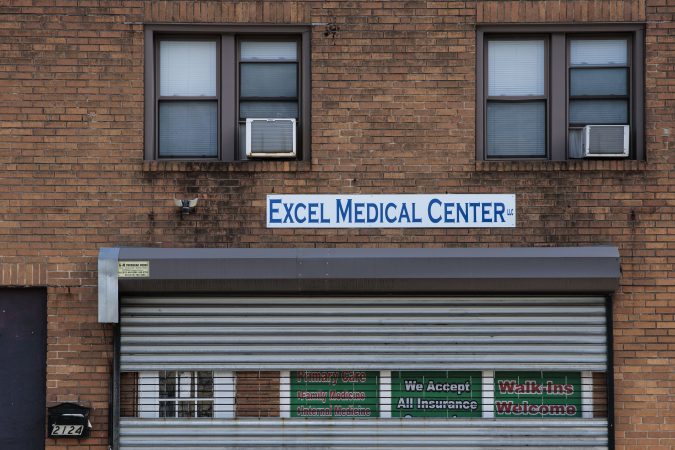
Excel Medical Center, which Michel founded, is currently closed, Gay said. The center was composed of 12 locations in the Philadelphia region, with more than 200 employees and about 20,000 patients.
In a letter to the medical board last year, Michel described the October 2024sex with the patientas a “lapse in judgment” for which he is “profoundly contrite.”
“I fully acknowledge that I crossed a professional boundary,” Michel wrote to board members last year. “I recognize that boundaries are not only a legal and ethical obligation but a critical element of safe, respectful, and therapeutic care. I make no excuses for my actions.”
Claims of rape
The patient, identified in police records by the initials “D.R.,” had accused Michel of kissing her during a May 2024 exam at his East Mount Airy office on Stenton Avenue. She told him “no,” left the office, and did not report the kissing incident.
About five months later, she went to an appointment at Michel’s North Philadelphia office on West Diamond Street. During the Oct. 14, 2024, visit, she said, Michel raped her with such force that her head banged twice against the exam room wall. She pushed him off her and fell to the ground crying, according to criminal court records.
In early November 2024, she told her husband what had happened and subsequently filed a police report, records show.
Late last year, a second woman accused Michel of sexual abuse.The woman had worked for Michel as a medical assistant from 2015 to 2019 at his East Mount Airy office and at a location in Germantown on Chelten Avenue.
The former employee claimed that beginning in 2018, Michel touched her breasts over her clothing on multiple occasions while she was working in the office. He additionally groped her vagina over her clothing before she quit in 2019, according to a document filed in court last year by the Philadelphia District Attorney’s Office.
Prosecutors never charged him in connection with those accusations, but argued the former employee’s claims bolstered their patient rape case, given there were no witnesses. Gay, Michel’s lawyer, had declined to comment after the second woman came forward.
A no-show witness
In the patient’s case, Philadelphia police arrested Michel in February 2025 after prosecutors charged him with three felonies — rape, sexual assault, and involuntary deviate sexual intercourse — and two misdemeanors — indecent exposure and assault. He was released on bail.
Assistant District Attorney Allison Christian dropped all but the rape and sexual assault charges prior to the trial. Michel pleaded not guilty.
The former patient had been scheduled to testify on Tuesday morning. Christian told the judge that she had spoken with her the night before. She sounded “very emotional” and seemed to be having a “nervous breakdown,” but said she would testify, Christian said.
“I’ve been calling her since 8:15 a.m. this morning every 15 minutes,” Christian said. “I haven’t heard from her.
“I’m not going to issue a bench warrant for a rape victim,” she said before dropping the charges.
A path to practicing medicine
Prior to the patient’s accusations, Michel had no criminal complaints and no disciplinary history against his medical license, state records show.
Michel agreed to be disciplined by the board of osteopathic medicine for violating a state law prohibiting sexual misconduct, according to a June 2025 agreement.
The discipline included a $4,000 civil penalty and an indefinite suspension of his medical license for a minimum of 24 months, followed by probation, according to a spokesperson for the Pennsylvania Department of State, which oversees licensing boards.
While Michel is on probation, a chaperone must be physically present when he treats female patients and a separate monitor must oversee his practice. Michel also must complete in-person classes on physician-patient boundaries and 15 hours of continuing education on ethics, the disciplinary agreement says.
The state spokesperson on Tuesday said the board will reinstate Michel’s license to “non-suspended, probationary status” once he has met the agreement’s reinstatement conditions.