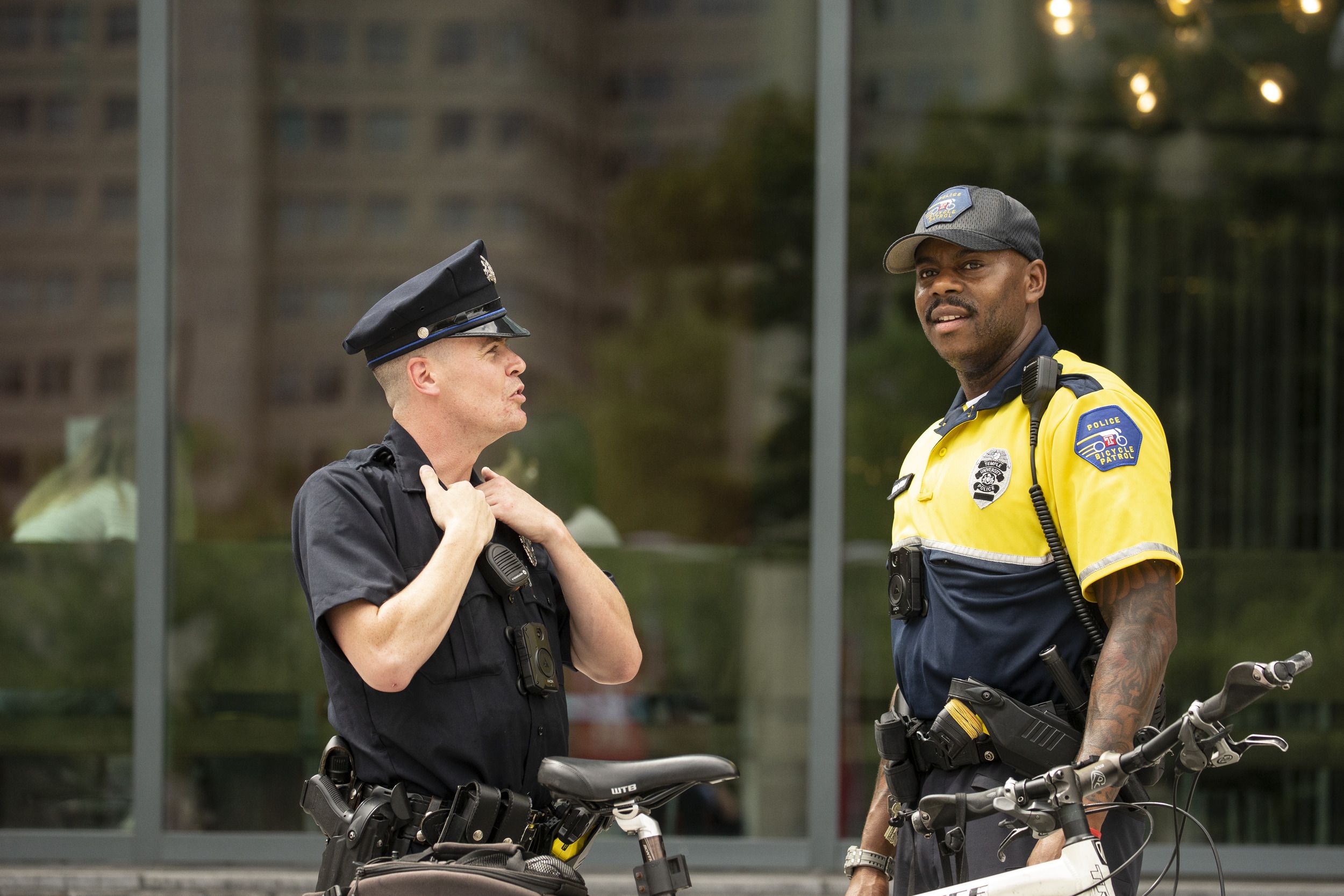
Temple University will significantly raise the salaries of its police force under a new five-year contract aimed at addressing its longstanding problem of attracting and retaining enough officers.
The new contract — which comes a year before the previous contract was set to expire — was initiated by university president John Fry after a staffing study released in December found the school needed to increase its number of police officers.
The new pay scale more closely aligns with that of the Philadelphia Police Department, the university said, and is expected to help the school reach its goal of increasing its number of patrol officers by 29, or 58%, over five years. It now has 79 police officers on staff — about 50 of them patrol officers — with three more poised to start Sept. 8. Five more are ready to graduate from Temple’s police academy in October, with more lined up to start there, the university said.
“We understand, like in our bones, how vital this work is not only to the safety of our students and our employees but to our neighbors, which we prioritize as well,” Fry said in an interview Thursday. “If we’re going to make North Philadelphia in particular an investable area, it all starts with public environment and public safety. No one’s going to contemplate making major research or commercial or residential or retail investments in an area that they don’t have confidence in.”
Under the new pact — which was ratified in June and runs through June 30, 2031 — an officer with at least three years of experience will start at a salary of $92,000, up $8,572, or 10.25%, from the previous salary of $83,428.
Those with at least five years of experience will start at $100,000, up $12,878, or 14.75%, from $87,122.
And officers will get raises ranging from 3% to 6.5% at anniversary milestones or across-the-board increases of 3% — whichever is greater. The agreement was announced Thursday.
“From a competitive standpoint, this new contract will make a huge difference,” Andrew Lanetti, president of the Temple University Police Association, the union, said in a statement. “It is going to entice young officers at the beginning of their career to join Temple, and it will also entice officers from other agencies to join our department.”
And it is helping to keep officers, too, he said in an interview.
“Many people who were thinking about moving on to other departments have now changed their minds,” he said.
Officers will see significant salary bumps, ranging from $5,000 to $17,000, as they reach each level, he said.
The contract, said Denise Wilhelm, interim vice president of public safety, also has made officers feel more valued.
“This is a true partnership, and it shows,” Wilhelm said.
Temple enrolled 29,503 students last year excluding its campuses in Rome, Tokyo, and Kyoto, Japan. Its police officers patrol on and around the school’s main campus and health sciences campus in North Philadelphia and on its Ambler campus.
The university had faced criticism from the Temple police union in the past for not doing enough to recruit and retain officers. In a social media post in December 2024, the union said the department had lost more than 50 officers since 2022.
The new pact also includes paid parental leave, an additional week of vacation for a total of five after 15.5 years, field training officer pay, and hazard pay for working during declared states of emergency, the university said.
The staffing study released in December showed that Temple was below the middle tier of a framework that rates law enforcement agencies. The university at that time had 77 sworn officers — 50 of them patrol officers — and Fry pledged to add 29 patrol officers, one detective, six sergeants, and one lieutenant over the next five years. That would increase the overall number of sworn officers to 114.
“We must, and we will, deploy ever more compelling and creative incentives to make Temple’s Department of Public Safety a destination employer for law enforcement in our region,” Fry, who named public safety a top priority when he started as Temple’s president in November 2024, said at that time.
Retaining and hiring police officers have remained challenging, as has been true for police departments nationally. The university in the past had increased salaries and benefits, added signing and retention bonuses and higher contributions to retirement accounts, and hired an associate director to focus solely on hiring, recruitment, retention, and training.
But the overall number of officers had declined over the last few years anyway. Temple ended the last academic year with 76 officers, down one from December.
Fry said he is confident this time will be different because the strategy is long-term and intentional, with the university prepared to make the budgetary investment, even though it means sacrifices will have to be made elsewhere.
“We’re certainly going to do better than we have been doing,” he said.
The university is preparing to bring in new leadership for public safety. Jennifer Griffin, Temple’s former vice president of public safety, resigned in June after nearly four challenging years on the job. The university is conducting a national search for her replacement.
Griffin had started in August 2022 as the university continued to cope with the aftermath of the shooting death of student Samuel Collington outside his off-campus apartment in November 2021.
She led the department when Temple Officer Christopher Fitzgerald was shot and killed in 2023 while on duty and through other challenges facing the campus.
During her tenure, the university implemented or began implementation of all 68 recommendations from a safety audit by former Philadelphia Police Commissioner Charles Ramsey’s firm.
Tower Health reported an $8.5 million operating profit in the year that ended June 30, compared to a $20.6 million loss the year before.
The fiscal 2026 profit will be Tower’s first in eight years, if the result holds in its audited financial.
In the Berks County nonprofit’s preliminary financial report to bond investors Friday, Tower management called the result “an important milestone in Tower Health’s ongoing journey toward sustained financial strength.”
In addition to Pottstown, Tower owns Phoenixville Hospital and Reading Hospital in West Reading, and half of St. Christopher’s Hospital for Children in North Philadelphia in a joint venture with Drexel University.
Here are more details:
Revenue: Tower reported a 2% increase in revenue, to $2.07 billion from $2.03 billion. Reading Hospital in West Reading logged an 11% increase in revenue, while the combined revenue of Phoenixville and Pottstown Hospitals fell 8%.
Patient volumes: Pottstown saw an 11% decrease in hospital admissions, likely because Tower closed the hospital’s intensive care unit at the beginning of the this year. Phoenixville had a small gain of 0.7% in admissions, while Reading was flat. Total surgeries across the system were flat.
Notable: A year ago, Tower reported a preliminary operating profit of $5.9 million for fiscal 2025, thanks to a gain on the sale of the former Brandywine Hospital. That would have been the system’s first profit in seven years, but it turned into a $20.6 million loss in Tower’s audited financial statements. Auditors from KPMG decided that Tower needed to boost medical malpractice reserves and give up on collecting millions owed by patients.
In an email to The Inquirer, Tower CEO Michael Stern expressed confidence this year’s audit will uphold the preliminary result, giving Tower its first profitable year since 2017.
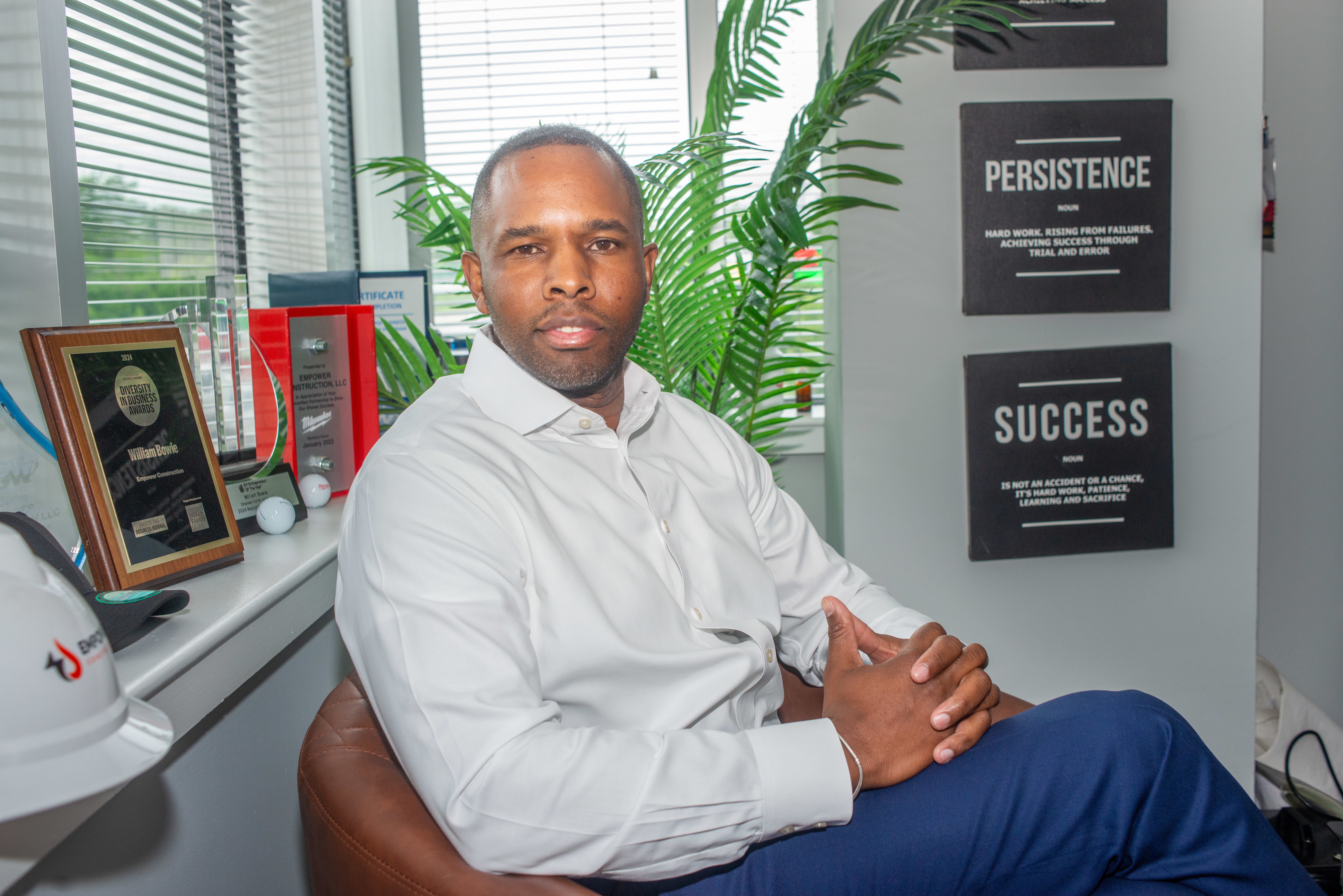
Growing up, William Bowie measured poverty in cups of water warmed in the microwave for his morning baths at a sink. He lived in the Richard Allen public housing project in the Poplar section of North Philadelphia, raised with his brother by a single mother. Even as a high schooler, he was eager to improve his life’s circumstances, but lacked just about everything he needed to do so except a willingness to work hard.
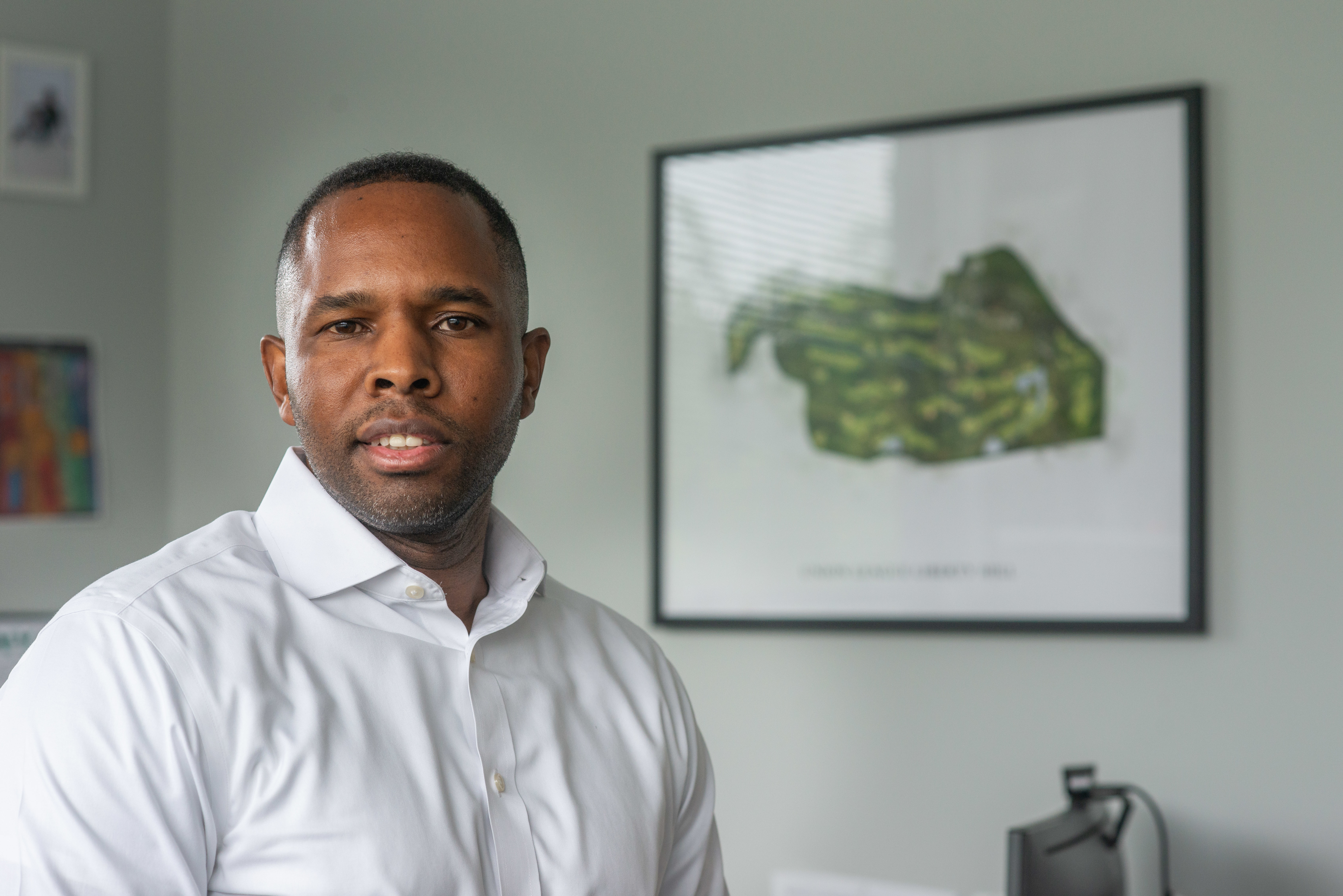
Three decades later, Bowie is president and CEO of his own nine-figure construction company, a journey that he largely attributes to a Philadelphia-based trade community apprenticeship system, similar to the “Nwa Boy” model that has been practiced in West Africa for centuries.
“I kind of challenged myself,” said Bowie, who’s 42,referring to his mindset when he was embarking on his career. “Why can’t I be the best? And why can’t I open that door for others?”
Bowie’s path is hardly an isolated success story. It is one node in a growing, informal network — from union apprenticeships in Philadelphia to a training cohort in Oakland, Calif. — of programs borrowing the Nwa Boy model’s core promise: a credentialed path from labor to ownership, built on relationships and trust rather than credit scores or venture capital.
As race-conscious funding efforts designed to level the playing field for African Americans are dismantled, that promise is drawing new attention from investors, workforce officials, and Black entrepreneurs looking for an alternative route to generational wealth.
The Nwa Boy system, which has its roots in the communities of the Igbo people in southeastern Nigeria, works this way: An established craftsman or business owner — known as the “Oga,” or master — takes on the training of a young person — known as the “Nwa Boy” (pronounced: nwah), or apprentice — often straight out of secondary school.
The apprentice lives and works closely with the Oga for as long as eight years, learning the nuances, logistics, and administration of their chosen craft.
When the apprenticeship ends, the Oga provides the graduate with a “settlement,” or capital — which often includes giving them money or business space — to launch their own independent businesses. The apprentice then continues the cycle.
The Harvard Business Review has called the Nwa Boy system “a Nigerian model for stakeholder capitalism” in which community, workers, and shared prosperity take precedence over individual shareholder return.
In 1970, at the conclusion of three years of civil war, the Igbo people used the Nwa Boy system to build a multibillion-dollar economy from the ground up. That’s when the Nigerian government seized control of the nation’s financial institutions and gave the equivalent of only about 20 British pounds (or roughly $400 in today’s money) to every Igbo adult, regardless of how much they had in their bank accounts before the conflict.
Today, at a moment when Black Americans are witnessing the erosion of affirmative action and DEI programs through court rulings and presidential executive orders, Bowie and others believe the Nwa Boy system may provide an answer to the question of what happens when the system meant to fix a problem becomes the next thing that needs fixing.
As he was embarking on his career in construction, North Philadelphia native William Bowie said he asked himself, “Why can’t I be the best? And why can’t I open that door for others?”William Thomas Cain / For The Inquirer
The blueprint
While Bowie’s blueprint moves from employment to ownership, it did not happen in a vacuum.
After finishing his first year at Drexel University, Bowie faced a dilemma — he had no way to pay a $6,500 bill to enroll for his sophomore year.
“I tested into a magnet school,” Bowie said. “Academics wasn’t a problem. I was thriving in that environment. It’s just that financially I couldn’t afford it after the first year.”
Bowie was not deterred.
“I looked for a different path,” he said. “I tried to make money to get back into my second year in college.”
In Nigeria, young men had been solving the same problem for generations — not with legislation, but with a handshake that meant more than a contract between an Oga and their apprentice. The pact is simple: The master teaches. The apprentice serves.
In North Philadelphia, though, the syndicate of trust had little that resembled the stalls of Lagos’ Alaba International Market. It had Frank Murray.
Murray, a member of the International Brotherhood of Electrical Workers (IBEW) and a family friend of Bowie’s mother, Margaret, encountered a young man desperate for an opportunity. He told Bowie, “This is where the money is at.”
In the Nwa Boy system, the Oga does not simply teach a trade — he transfers his reputation, his customer network, and at the end of the apprenticeship cycle, his start-up capital. The system does not run on contracts, but on trust enforced by community witnesses.
Murray gave Bowie the same thing — a pathway — and Bowie walked through it. Bowie joined IBEW at 19 years old.
He completed a four-year U.S. Department of Labor-certified apprenticeship in three and a half years, earned $75,000 in his first year, and rose to become the youngest area manager overseeing about $300 million in business.
Bowie says IBEW gave him what the Nwa Boy system has always understood, and American institutions have always struggled to replicate — a means to succeed that required no college degree, no venture capital pitch, and no generational wealth.
‘Financial gravity’
Bowie’s playbook from two decades ago is what many American venture builders and investors are now being forced to consider as the formula for prosperity is being recalibrated. They must confront the brutal reality that even seven-figure salaries are no guarantee for wealth creation.
“A paycheck — even a seven-figure one — is just a stay of execution. It doesn’t detach you from financial gravity,” Brandon Jones, founder and CEO of Gravy Capital, said during a virtual panel in April hosted by Visible Hands VC.
When Bowie applied for capital to launch his company, Empower Construction, he felt the earth tugging at his dreams. Even though he had two decades of industry experience and managed a $300 million book of business, the banks still said no.
What finally opened the door was not a stronger application, but a different messenger.
One of Bowie’s mentors, Daniel K. Fitzpatrick, an executive at Citizens Bank, made a single phone call to his colleagues. A line of credit came through. To Bowie, it was the equivalent of receiving an Oga’s settlement.
Saantis Fenmu Davis, a Philadelphia-based financial literacy educator and founder of Geb Cultural Exchange, said the problem starts earlier than the bank. He said it’s essential that Black Americans are taught how to be producers and investors, and not just consumers. “While higher spending and status-signaling often masquerade as affluence, they represent a fundamental mirage of social capital, which may or may not translate to equity or wealth,” he said.
Saantis Fenmu Davis, a Philadelphia-based financial literacy educator and founder of Geb Cultural Exchange, says consumerism is a “fundamental mirage of social capital.”Courtesy of Saantis Fenmu Davis
Murray did not teach Bowie to consume. He taught him to produce.
Patrick Clancy, president and CEO of the city’s workforce development program, Philadelphia Works, is trying to replicate what Murray did across its programs. Philadelphia Works manages roughly $11 million in apprenticeship funding across skilled trades and emerging sectors including IT, healthcare, and education.
Murray was Bowie’s Philadelphia Works, but the path is not without its shadows.
For every successful apprenticeship program or Nwa Boy story told, there is a possibility of exploitation.
In the Nwa Boy framework in Lagos, Nigeria, some apprentices have reported exploitation at the hands of their masters.
Naboth Nwaikwu spent 20 grueling years navigating three successive apprenticeships before finally being settled. He was an orphan. His first master did not settle him because his aunt and uncle instructed him not to. The same thing happened the second time.
It wasn’t until his third attempt, under the apprenticeship of a friend, that he got his settlement, all of which could not account for the years lost.
Nwaikwu now sells construction accessories for a living at Lagos’ Alaba International Market, and makes enough profit to take apprentices of his own if he wanted to, but told me he refuses to do so because “There is a thin line between unpaid apprenticeship and indentured service. I do not want to be the one to cross it.”
Uyi Samuel Oni, a corporate attorney licensed in Nigeria and trained at the University of Pennsylvania’s Carey Law School, said the covenant must become a contract before it can successfully cross continents. “The Nwa Boy system must avoid negative historical connotations linked to terms such as master,” Oni said.
Uyi Samuel Oni, a corporate attorney licensed in Nigeria and trained at the University of Pennsylvania’s Carey Law School, says the Nwa Boy covenant must become a legally binding contract before it can successfully be used in America.Courtesy of Uyi Samuel Oni
A legally compliant American adaptation, he said, must be a win-win for both parties — not merely vocational or community service, but a binding agreement that protects the apprentice’s right to the capital payout that makes ownership possible.
In Oakland, a program called Built Here has emerged as a 21st-century proxy for the Nwa Boy system.
Onye Ahanotu, a former Harvard engineering research fellow and founding member of Built Here, uses training cohorts to mirror the communal trade apprenticeships of southeastern Nigeria. “We meet every week,” Ahanotu said.
The frequency is intentional. In the Nwa Boy system, the covenant is not a one-time transaction — it is a continuous relationship between master and apprentice, reinforced week by week, skill by skill, until the apprentice is ready to stand alone.
Clancy, of Philadelphia Works, understands that frequency. But he said the barriers that push apprentices out are not about ambition. They are about logistics. Most apprentices who do not complete the program fall offbecause of logistics — literacy gaps, a lack of childcare, transportation difficulties, and rigid drug-testing requirements.
The apprenticeship demands sacrifice.
Bowie was 19 years old and the only African American male in a trade that was overwhelmingly white and male. The culture shock was real. His determination was not given. It was chosen every single day.
Bowie narrated his apprenticeship years as a period of determination and exposure to wealth — not suffering. Once he entered IBEW, his obstacles became opportunities.
Clancy said Philadelphia Works offers pathways into the building trades and is open to second-chance applicants. Prior convictions are not automatic disqualifiers. The door is open. Most people do not know it is there.
At the Philadelphia Navy Yard, Hanwha builds ships. The company needs welders. It cannot find them.
Patrick Clancy, president and CEO of Philadelphia Works, the city’s workforce development program, which offers pathways into the building trades and is open to second-chance applicants.Courtesy of Patrick Clancy
Not because the welders do not exist. Not because the work is not there. Not because the wages are not competitive — apprenticeship wages in the building trades start at $25 per hour and can exceed $100,000 annually with overtime. The positions have gone unfilled for three years, Bowie said, because nobody told the kids in North Philadelphia, West Philadelphia, and Germantown that the door is open.
Bowie knows this the way he knows everything about the trades — from the inside. He gives talks online. He goes into Philadelphia schools. And while he may not have known about the Nwa Boy system when he was an apprentice, he regularly references its principles today.
He stands in front of teenagers the same age he was when the system ran out of road for him and tells them what Murray told him: This is where the money is at.
“In Philadelphia, there’s a shipbuilding company at the Navy Yard,” Bowie said. “They need welders. They can’t find them. And you’re telling me that in the city of Philadelphia, in the communities that we come from, that we can’t find welders?” He paused. “The parents don’t know. The kids don’t know. Nobody’s telling them.”
Clancy is trying to change that. Philadelphia Works is actively pursuing apprenticeship funding for Hanwha’s shipyard — planned cohorts of 20 to 30 apprentices at a time. The infrastructure, funding, and jobs exist. What is missing is the same thing that was missing when Bowie was standing at the edge — someone to point at the door.
Murray pointed. One phone call — and a kid from the Richard Allen Homes became a $100 million CEO. Philadelphia has not yet produced its Frank Murrays at scale.
Bowie is working on it. One conversation — and one handshake — at a time.
Ibe Imo is a Philadelphia-based investigative journalist whose reporting examines technology, power, capital, and the systems that determine who builds wealth and who pays for it. He is a recent graduate of the master of journalism program at Harvard University.
Six people were killed in Philadelphia between Friday morning and Sunday night — five shot and one stabbed — in a wave of violence across the city, according to police.
At least two others were wounded in the spate of attacks, a jarring stretch of violence in a year that has otherwise been among the least deadly Philadelphia has recorded in decades.
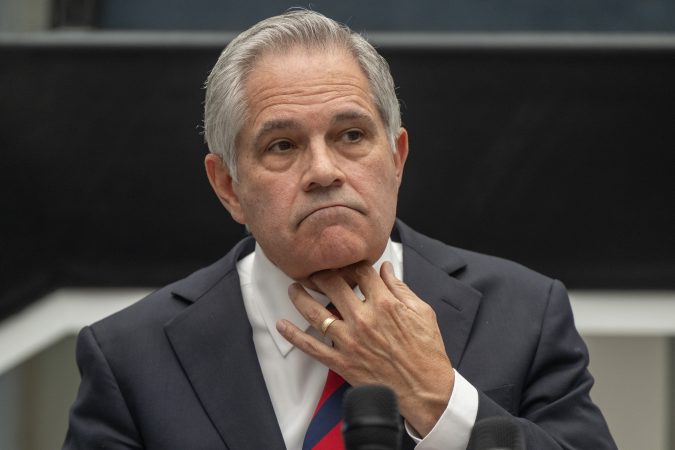
At a news conference on Monday, District Attorney Larry Krasner acknowledged the weekend’s toll but pointed to the city’s steep drop in killings, arguing that a brutal few days had not erased months of historic progress.
“We had a bad weekend,” Krasner said. “We’re not having a bad year.”
As of Monday, Krasner said, there had been 108 homicides so far this year in the city — 29 fewer than at the same time last year.
Even so, the six deaths amounted to more than 5% of the city’s homicides this year, a striking toll for a single weekend. The victims ranged in age from 26 to 70.
The bloodshed began shortly after 9 a.m. Friday, when officers responded to a report of a gunman on the 2100 block of North 20th Street in North Philadelphia West and found Savion Young, 31, shot in the chest and arm. He was pronounced dead at Temple University Hospital about 20 minutes later, police said.
That same evening, Felix Serrano, 70, was found shot inside a BMW on the 4300 block of North Seventh Street in Hunting Park, according to police. Investigators believe Serrano’s vehicle may have traveled a short distance after he was shot before his car struck a parked vehicle. He was also pronounced dead at Temple University Hospital.
The killings resumed before dawn Sunday. At about 3:20 a.m., police who were called to the 800 block of West Oxford Street in Ludlow found Rafi Colón-White, 30, shot in the head inside a Subaru Outback.
Colón-White was pronounced dead at Temple University Hospital. A 34-year-old man who arrived separately at the hospital with gunshot wounds to his legs was in critical condition, police said. That man, whom police have not identified, was also a victim in the shooting, said police spokesperson Cpl. Jasmine Colón-Reilly.
Sunday evening brought three more killings in as many hours. About 8:20 p.m., a man was fatally stabbed on the 500 block of West Courtland Street in Logan, and pronounced dead at Einstein Medical Center, police said. He has not been publicly identified.
Less than an hour later, DaJuan Coffee, 26, was shot multiple times on the 2000 block of East Lehigh Avenue in East Kensington and pronounced dead at Temple University Hospital, police said.
The weekend’s final killing came at about 11:49 p.m. Sunday. Officers sent to the 2800 block of North 24th Street in Strawberry Mansion for a report of a person with a gun found Michelle Wilson, 61, on a porch, shot in the neck and back, police said. She was pronounced dead moments later.
Wilson’s husband was also on the porch and was shot, but survived, police said. They did not share the man’s condition, but said he was stable.
Loved ones lingered on the sidewalk in front of the North 24th Street house Monday afternoon, hugging, trying to find comfort in one another amid their grief. They declined to be interviewed.
A 71-year-old neighbor said the family has lived on the block for decades.
“They were quiet people,” said the woman, who asked not to be identified for fear of reprisal. On Sunday afternoon, she said, Wilson’s family had a barbecue, with children and extended family playing on the porch.
Surveillance video from a business on the block, reviewed by The Inquirer, showed a man wearing a hat and surgical face mask walking down the street when he appeared to take a black handgun from his bag and slip it into his jacket. The video showed him then calmly walk up to the porch and open fire.
Police have not shared the video with the public, nor identified the man captured in it as a suspect.
Nearby, on North 20th Street, an array of candles, stuffed teddy bears, and handwritten posters lay Monday across the sidewalk where Young was killed Friday morning.
Police said Young and his girlfriend were arguing outside the apartment around 9:10 a.m. when the woman’s 16-year-old brother pulled a gun and shot Young multiple times, police said. He died at the hospital.
The teen is wanted for murder.
Tributes for Young, also known as Apex, poured across social media over the weekend, and hundreds gathered in North Philadelphia for a balloon release.
Young had a daughter and large family scattered across the city, friends said. He had just started a clothing brand called Bad English, and neighbors said he was frequently seen lifting weights and working out outside his rowhouse.
“This was his Planet Fitness,” a man who trained with him said Monday on the block. The man, who declined to give his name for privacy reasons, looked down at the dozens of candles melting into the sidewalk beneath a collection of silver balloons. “He will be truly missed,” he said.
William Fritze, chief of the district attorney’s office Gun Violence Task Force, declined to provide additional information on the incidents, citing ongoing investigations.
No arrests have been made in any of the cases, said Colón-Reilly. Police are asking anyone with information to contact the department’s homicide unit at 215-686-3334, or its tip line at 215-686-TIPS.
Last year marked Philadelphia’s fewest homicides in nearly six decades, with 222 people killed. The last time the city’s homicide numbers fell below that mark was in 1966, when there were 178 murders.
During Monday’s news conference, called to announce grants awarded to more than 20 anti-violence organizations in the city, Krasner called the weekend’s violence a tragedy that “no one would ever celebrate,” even as he stressed that the city remained far safer than in years past.
“The facts are clear: Homicides are way down,” he said. “In almost every category, crime is down.”
The ultracompetitive race to replace Philadelphia City Councilmember Jeffery Young Jr. is officially underway.
With nine months until next year’s primary election, two candidates are already taking steps to challenge the first-term incumbent Council member from North Philly — and more may be to come.
“We’ve spent the last two years meeting with different community organizations, speaking with different ward leaders, and community groups, and just everyday people,” Alexander said in an interview. “This is going to be a people-powered campaign that really is grassroots.”
And on Friday, Curtis Wilkerson, who was the chief of staff to former City Council President Darrell L. Clarke, announced that he’s forming an “advisory committee” to evaluate a prospective run for the seat. The group will host community roundtables and neighborhood listening sessions to collect policy ideas and feedback from residents.
Wilkerson, who campaigned for the seat four years ago but did not make it onto the ballot, said he’ll likely decide whether to launch an official campaign by September.
A third potential candidate, Democratic political operative Kellan White, has been having conversations with party officials and labor leaders about running. White is a former deputy city controller who has managed and advised campaigns, including physician Ala Stanford’s recent unsuccessful run for Congress.
At least two others have said they are considering launching campaigns for Young’s seat: Dustin Dove, the president of the Fairmount Civic Association, and Max Tuttleman, a philanthropist who in 2023 unsuccessfully ran for seat on Council representing the city at-large.
The recent moves by several prospective candidates are the latest sign that the 5th District is likely to be the most crowded Council race this spring, when all 17 members of Council will be up for reelection and are expected to seek another term. The 5th District, which includes parts of Center City, North Philadelphia, and Fishtown, is overwhelmingly Democratic, meaning whoever prevails in the May primary is all but certain to win the seat in the general election.
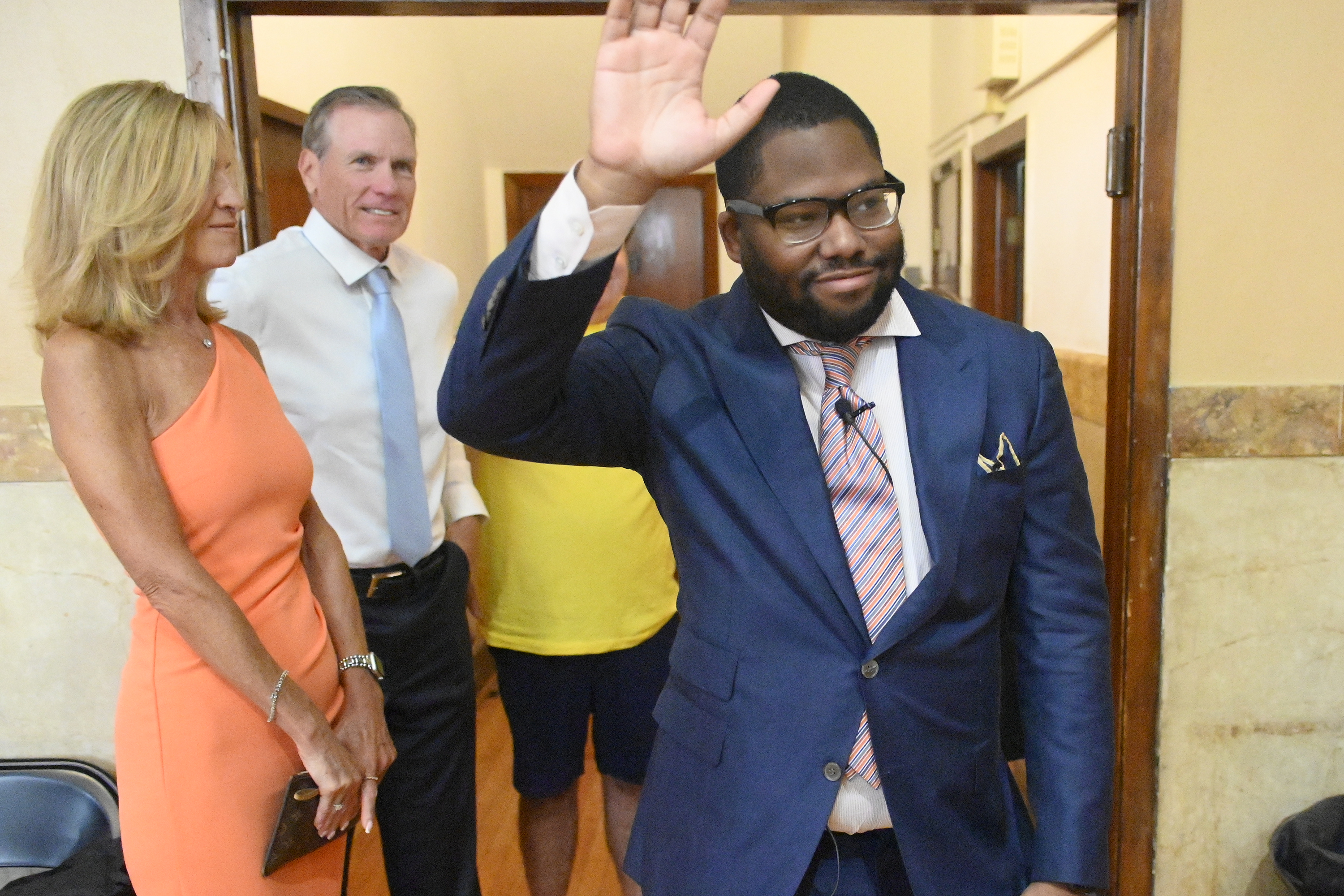
Fifth District Councilmember Jeffery Young Jr., during the Barber’s Hall community legacy celebration, a daylong celebration of music, history, and community in North Philadelphia on Aug. 1.Yong Kim / Staff Photographer
Young’s campaign did not respond to a request for comment. In an interview last month, he said he intends to run for reelection and sees facing challengers as a normal part of the process.
“People have a right to do what they want in a democracy,” he said. “But I’m focused on myself and what we can do as a leader of the 5th Council District and get the constituents to understand that every decision that we make is to improve their life.”
The freshman lawmaker is seen as Council’s most vulnerable member in the upcoming election, in large part because of how he got into office.
In 2023, several other candidates — including Wilkerson, who was Clarke’s preferred successor — were kicked off the ballot amid a series of legal challenges questioning the validity of their nominating petitions. Young ended up being the only Democrat on the ballot.
Since January 2024 when he was sworn in, Young’s tenure has been tumultuous. He has championed legislation that at times has sought to slow or halt housing construction in parts of the district, drawing the ire of developers. Constituent groups have loudly opposed Young, specifically over his controversial plans for a popular library branch in North Philly.
And he has publicly clashed with Mayor Cherelle L. Parker’s administration, including in 2024, when he took the rare step of introducing legislation to authorize Council to subpoena the mayor.
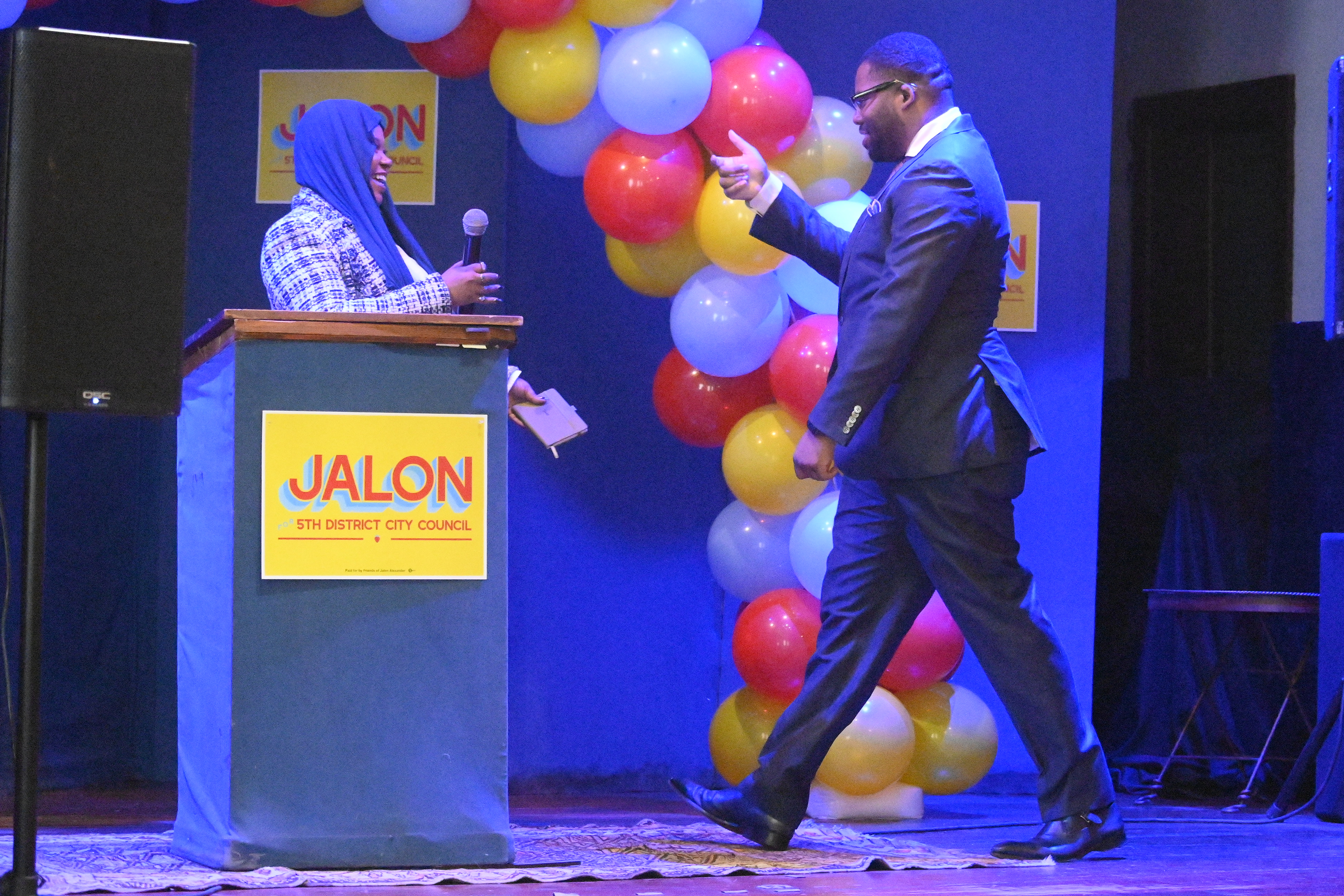
Jalon Alexander greets supporters and community members as he kicks-off his bid in the 5th Council District seat, at a campaign event in Fairmount on Saturday.Bastiaan Slabbers / For The Inquirer
Young, 40, an attorney by trade, has something of an independent streak. He has at times aligned with different political factions, and he does not fit neatly onto the Democratic ideological spectrum.
Neither do some of his opponents. Alexander, 33, said he has progressive views on workers’ rights and keeping homes affordable, and he has built relationships with some leaders of the city’s progressive political organizations.
But the tenor of Alexander’s campaign is pro-growth. He said he wants to cut the city’s business taxes with the goal of eventually eliminating the business, income, and receipts tax. And he said he’s committed to facilitating more development in the district, including through the city’s Turn the Key program that provides mortgage support to some first-time homeowners.
Alexander has been particularly critical of Young’s use of councilmanic prerogative, the unwritten rule that gives district Council members an extraordinary level of control over land-use decisions and construction projects in their district.
Young has used prerogative to attempt to obstruct projects he opposes, such as the redevelopment of the former Hahnemann University Hospital. He introduced legislation to ban residential housing development in the area, a move he said was to preserve the area’s job-generating capacity, but he did not advance the bill amid opposition from interest groups and Parker’s administration.
Alexander — who was born and raised in Strawberry Mansion and still lives in the neighborhood — said his campaign is targeting Democrats “all over the tent.”
“There’s room for progressives. There’s room for people who are loyal Democrats but feel let down by the establishment,” he said. “We’ve got one goal: We’re fully committed to removing and replacing Jeffery Young.”
A 61-year-old woman was shot and killed in North Philadelphia after a shooting Sunday night.
Philadelphia Police Department officers responded to the 2800 block of N. 24th Street around 11:49 p.m. for a report of a person with a gun. Officers found Michelle Wilson, 61, on a porch suffering from gunshot wounds to the neck and back. Wilson was transported to Temple University Hospital, where she was pronounced dead at 12:04 a.m. on Monday.
A second person, a 67-year-old man, was found on the same porch suffering from gunshot wounds to his backside. Police transported the man to Temple University Hospital and was placed in stable condition.
Anyone with information is urged to contact the Homicide Unit at 215-686-3334 or call the PPD tip line at 215-686-8477. As with all homicides in the city of Philadelphia, there is a $20,000 reward for information that leads to an arrest and conviction.
This section of North Philadelphia has already experienced two fatal shootings this summer in June, according to the most recent data supplied by the City Controller, and in that same month, a 16-year-old was shot and injured one block from where Sunday night’s shooting occurred.
According to police, at least seven shootings occurred this past weekend, including the fatal shooting of 70-year-old Felix Serrano, who was found shot in the chest while sitting in his car near Hunting Park.
You can eat quite well at the nearby Pizzeria Beddia, Liguria, Marina’s, Shackamaxon, D’Oliva, Scusi, Rustica, Urban Village, and Bar1010. But no other pizzeria in Fishtown offers pies topped with oxtail and collard greens, Cajun shrimp with broccoli and grits, or jerk chicken with pineapple and mango glaze.
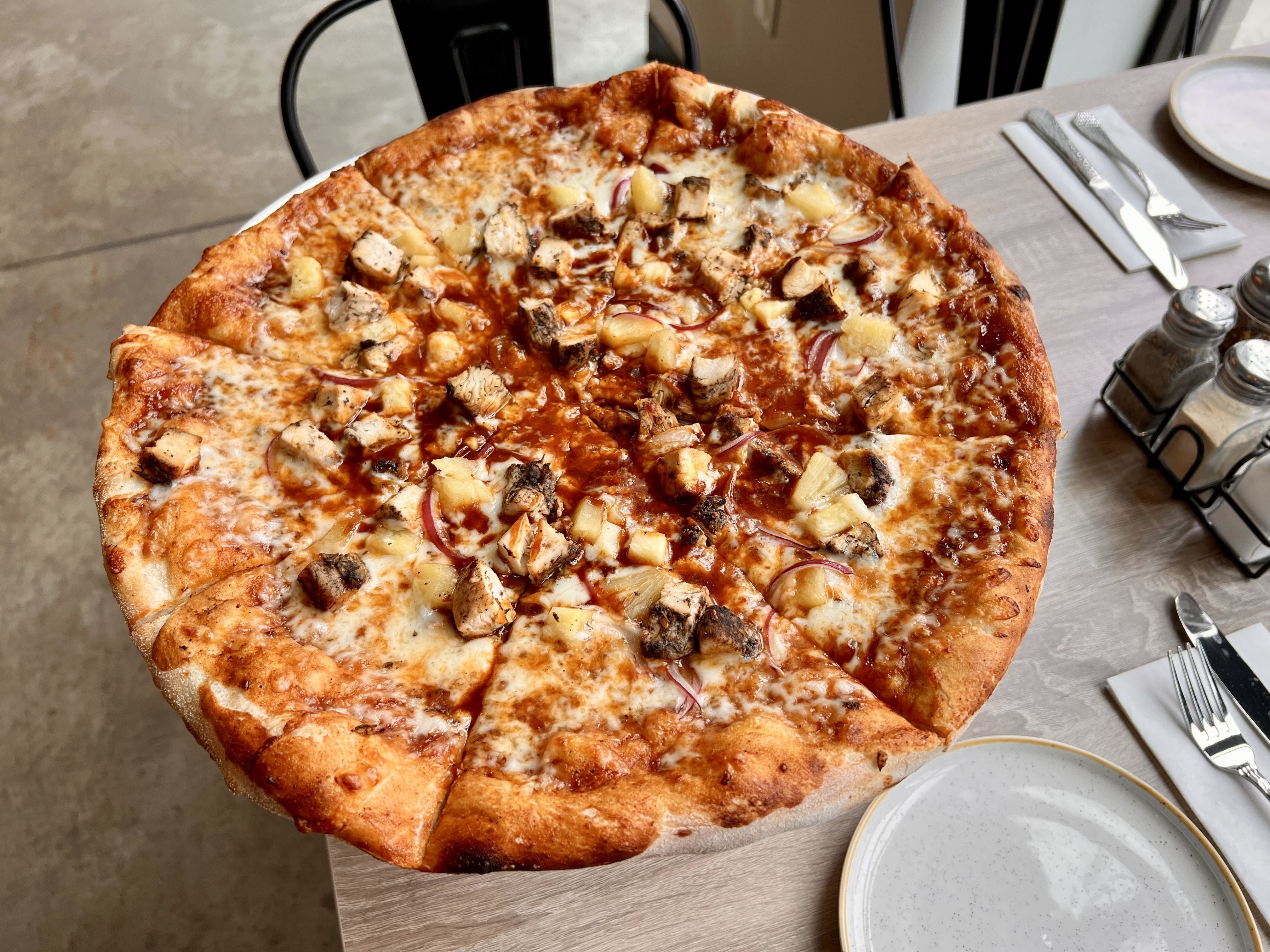
The Bottom (jerk chicken, mozzarella, pineapple, and mango glaze) at In Crust We Trust.Michael Klein / Staff
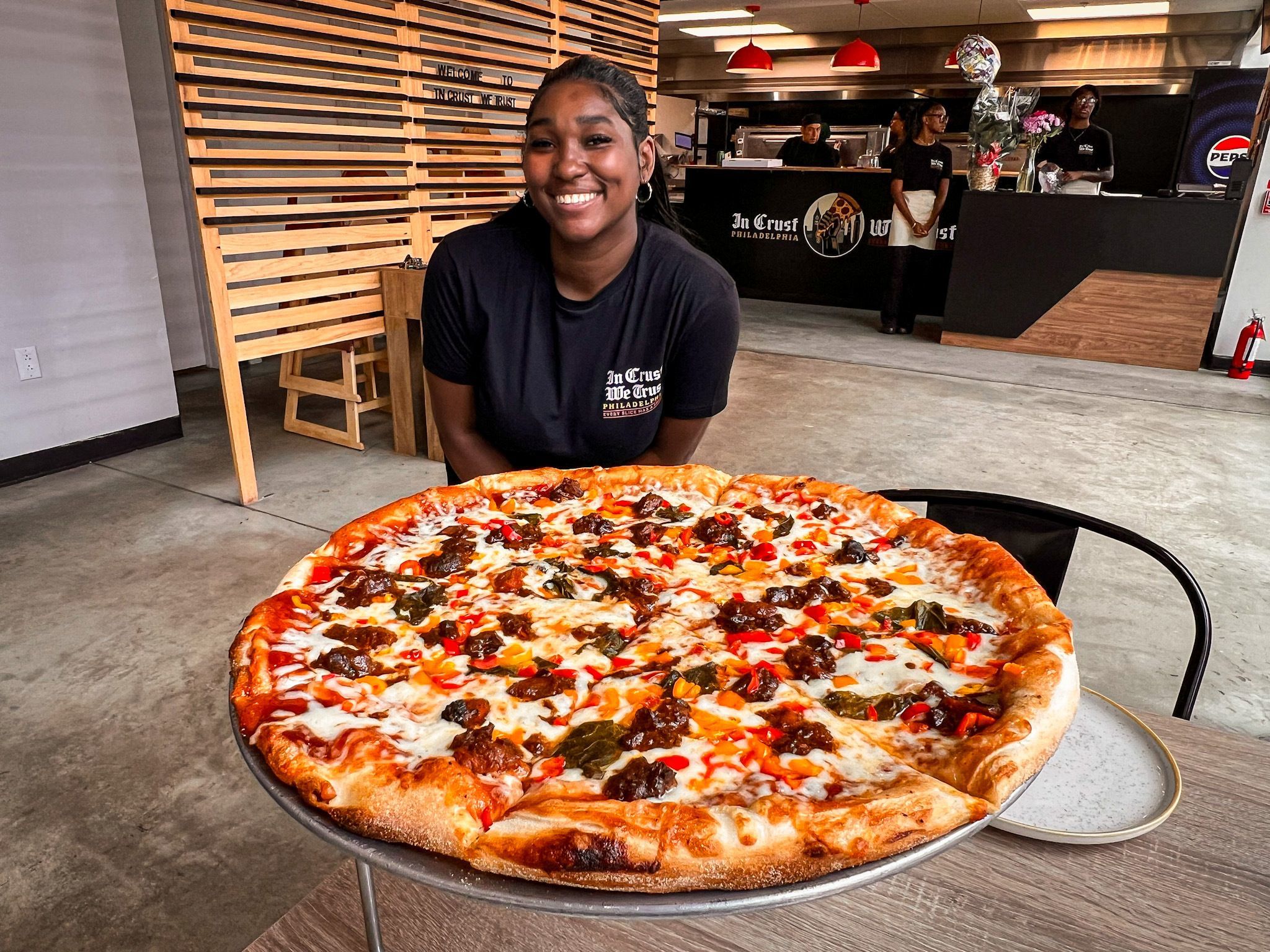
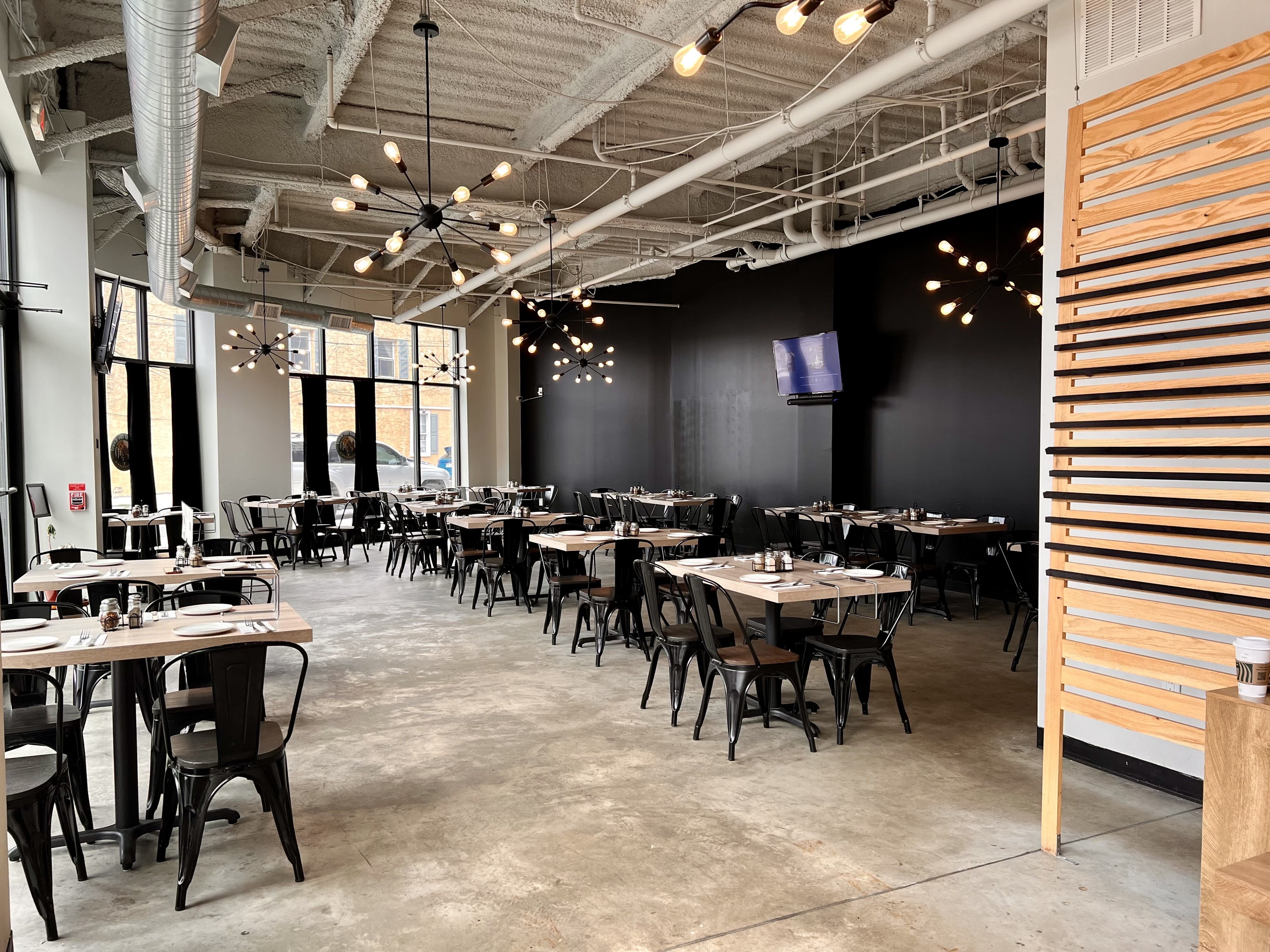
In Crust We Trust, which opened Aug. 1 in the former Vince’s Pizzeria at Frankford Avenue and Richmond Street, across from the Fillmore, is the first solo restaurant from Anyae Wilson-Worley, 25.
Though she grew up around restaurants and learned the business from her mother, restaurateur Felicia Wilson, Wilson-Worley is emphatic that In Crust We Trust is distinctly her own.
Pizzaiolo Jose Maria worked with Wilson-Worley on intentional menu combinations for the New York-style pies. She said she wanted to bring Black culture into the recipes while creating a dining room that reflects it. “When people walk in, I want them to feel like a story is being told — taking them back to a Harlem Renaissance type of thing,” she said.
Corner store wings, topped with cayenne pepper and peri peri, at In Crust We Trust on Aug. 2.Michael Klein / Staff
The roughly 80-seat restaurant offers table service as well as a takeout counter and delivery. Beyond pizza, the menu includes wings, two salads, cheesy collard greens, and desserts (including a chocolate chip-oatmeal raisin-sugar cookie baked in a cast-iron skillet and topped with vanilla gelato) — all made with halal ingredients.
Wilson-Worley is the oldest of Felicia Wilson’s three children. Her mother owns Amina, Avana, Fia, First Daughter Oyster & Co., and BlackHen. “She’s been much more than a role model,” Wilson-Worley said. “I definitely wouldn’t be in this position without my mother.”
Still, restaurants were not part of Wilson-Worley’s original plan.
She attended the University of Miami, where she majored in health sciences on the pre-med track. She said she was lucky enough to come out of school with no debt. “I took that as an opportunity to seize what was around me,” she said. “At the time [four years ago], my mom was in the height of opening all of her restaurants.”
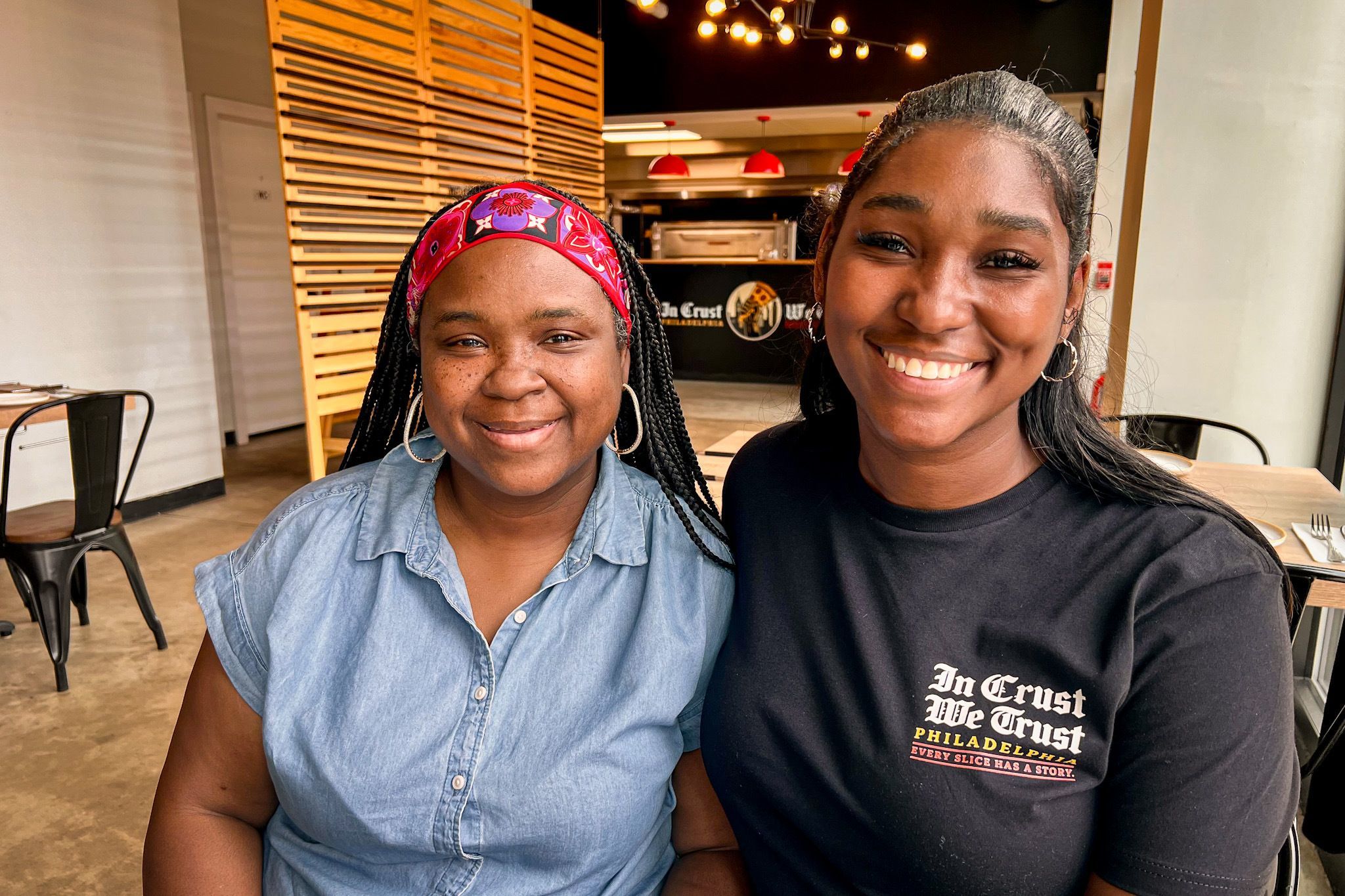
Anyae Wilson-Worley (right) with her mother, Felicia Wilson, at In Crust We Trust on Aug. 2.Michael Klein / Staff
While finishing school, she regularly flew back to Philadelphia to help with the expanding restaurant group. Eventually, she decided to stay to help her mother run the business.
“Anyone who knows me can tell you that ever since my mom opened the restaurant, I always said, ‘This is not what I want to do. I don’t want to be here,’” Wilson-Worley said. “But now this has become my life.”
Her mother provided the example and the education, but Wilson-Worley said the concept, menu, and identity of In Crust We Trust reflect her own perspective.
Wilson-Worley describes Philadelphia as a city whose Black culture is foundational but not always fully recognized. Through the restaurant, she hopes to celebrate that culture while encouraging others to pursue their own ambitions.
Dining room at In Crust We Trust.Michael Klein / Staff
“I hope to create a pathway for other Black people like myself to get involved,” she said. “Not only through food, but through anything.”
The menu draws from years spent observing professional kitchens.
“I’ve learned a lot from being around the chefs,” she said. “Watching them, listening to them, and working alongside them has expanded my culinary knowledge. I took everything I learned from them and applied it to create a menu that I’m really proud of.”
Wilson-Worley also sees common ground with Down North Pizza, the Black-owned North Philadelphia pizzeria known for hiring formerly incarcerated employees. Both restaurants emphasize community engagement, though she said she does not view them as competitors.
“I’m all about Black empowerment and working with other people like myself in this industry to contribute to the greater good of hospitality,” she said.
Ultimately, she said, her goal is more immediate than making a statement with every slice.
“I want people to feel loved and appreciated,” Wilson-Worley said. “When someone dines here, I want them to walk away thinking, ‘I’ve never had pizza like this before.’”
In Crust We Trust, 965 Frankford Ave. Hours: 11 a.m. to midnight Monday to Thursday, 11 a.m. to 3 a.m. Friday and Saturday, and noon to 11 p.m. Sunday.
The father of a Philadelphia man who was killed in an ATV crash this spring said police officers pursued his son moments before he drove the wrong way down a one-way street, ran a red light, and collided with a sedan.
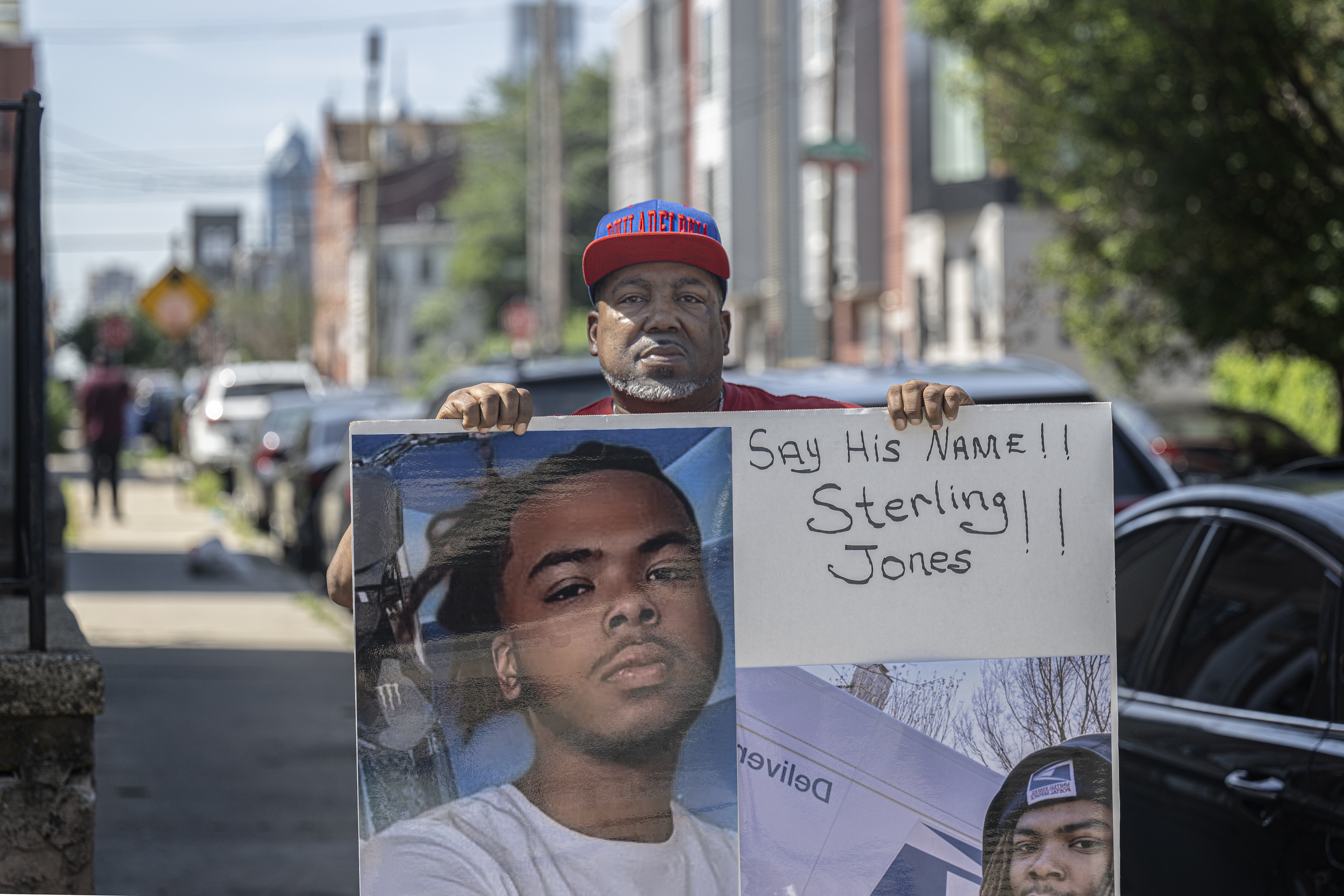
Sterling Jones, 22, was killed on May 9 after the crash in North Philadelphia, according to police.
Lawyers for Jones’ father, Sterling Lamont Jones Sr., said his son and a group of friends had been riding off-road vehicles near Broad Street and Fairmount Avenue when officers from the police ATV and dirt bike detail spotted the young men popping wheelies and began a pursuit.
They followed Jones up Broad Street to West Thompson Street, the attorneys said. There he briefly sped in the wrong direction down the one-way street and ran a red light before striking an Uber driver’s Toyota sedan at the intersection as it turned onto 15th Street.
He was taken to Temple University Hospital and pronounced dead shortly after his arrival.
Sterling Jones Sr., 57, has since hired a team of attorneys to investigate the incident. Late last month, they filed a notice of intent to sue the city, alleging that the officers and the department violated Jones’ constitutional rights when they chased him and caused his fatal injuries.
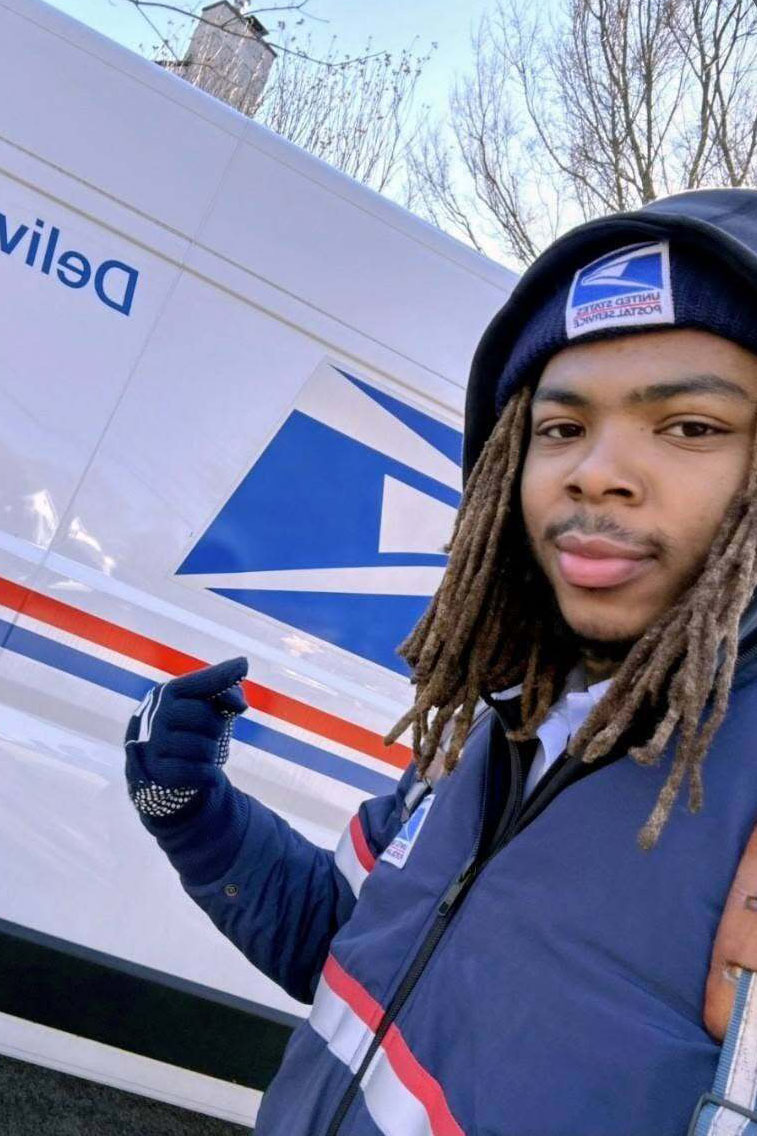
Sterling Jones, a 22-year-old who lawyers say was killed in an ATV crash after being chased by police officers.Courtesy of Sterling Lamont Jones Sr.
Riding ATVs and dirt bikes on public streets in Philadelphia is against the law, and police have increased efforts to crack down on that behavior in recent years.
But the incident raises questions about whether the officers followed a department directive barring vehicular pursuits for all but the most serious offenses — a policy enacted because of the public safety risks posed by such chases, particularly in densely populated areas.
The initial police account of the incident did not mention that officers had been pursuing Jones before the crash. It could not be learned whether the department had since concluded that officers were engaged in a pursuit and whether it was conducted a high rate of speed, as the lawyers contend.
Sgt. Eric Gripp, a police spokesperson, said the incident is under investigation by the department’s internal affairs bureau. He declined to comment further, referring questions to the city’s law department.
A spokesperson for the law department said the city does not comment on pending litigation.
Surveillance footage gathered by lawyers for Jones’ father and viewed by The Inquirer showed at least eight police officers on dirt bikes, a squad car, and a tow vehicle tailing Jones that evening.
Around 9:23 p.m., Jones was seen cutting through a Sunoco gas station and speeding down West Thompson Street with dirt bike officers close behind. Within seconds, his ATV careened into the driver’s side of the sedan.
Under police department policy, vehicular chases are allowed only in situations in which officers believe they can prevent imminent danger to others, or if a suspect is either fleeing after committing a violent felony or in possession of a deadly weapon used in a crime.
And while riding off-road vehicles violates city code, attorneys for Sterling Jones Sr. say that type of infraction still should not trigger a police chase.
“The police department’s policy is, in our view, clearly violated,” said Thomas Kline of Kline & Specter, which is handling the case alongside the firm Hill & Associates.
A 2025 Inquirer investigation found police in Philadelphia and across Pennsylvania were conducting hazardous and unnecessary chases, disproportionately endangering young people. Roughly half of all reported pursuits conducted by city police were not justified under department policy, the investigation found.
A police department spokesperson attributed the increase in chases to the COVID-era surge in violent crime, and said the department investigates every crash for policy violations.
Between 2020 and last year, records show, the city had paid out $20 million in crash- or chase-related settlements as a result of such chases.
In 2017, a 6-year-old girl and her great-aunt were seriously injured when they were struck by a dirt bike rider who was being chased by Philadelphia police into Upper Darby Township. The city settled a lawsuit with their attorneys for nearly $3 million last year.
Sterling Jones Sr. said that while he was planning to sue, no amount of money could make up for the loss of his son.
The young man was a graduate of Hunting Park Christian Academy and had been working for two years as a delivery driver for the U.S. Postal Service before his death. He had bought the ATV with money from that job, his father said.
“He wasn’t a criminal. He had a license,” he said.
Jones Sr. learned of the crash in the early morning of Mother’s Day, when his son’s mother came to his house to tell him Jones was dead.
He said he hired lawyers with the aim of ensuring that the officers who pursued his son would be reprimanded and removed from the beat.
“They killed my only son,” he said. “I just want justice.”
Pediatrician Daniel Taylor opened a crisp hardcover book and began reading to a 5-year-old patient inside an exam room at the clinic at St. Christopher’s Hospital for Children.
“I am laughter that falls like —,” Taylor read, pausing.
“Rain!” the little girl finished, smiling.
“That was amazing,” Taylor said to the girl’s mother, LaShonda Williams, 35, of East Mount Airy. “That’s nice phonetic awareness.”
Williams’ daughter, Xylo, already grasped context and recognized some words. Both crucial skills for school readiness as she prepares for kindergarten this fall.
Xylo and her two siblings — 12-year-old Isaac and 9-month-old Xymia — each got a new book suited for their ages during Wednesday’s checkup. Seated on her mother’s lap, Xymia pointed to a carrot in the First Book of Colors, demonstrating a skill infants ideally master by age 1.
Taylor is one of a growing number of pediatricians who are using books to measure developmental milestones, bolster literacy, and connect with families.
LaShonda Williams and her children, 12-year-old Isaac and 9-month-old Xymia, read together during a checkup at the Center for the Urban Child at St. Christopher’s Hospital for Children.Jessica Griffin / Staff Photographer
The program, “Reach Out and Read,” a national nonprofit literacy group that started in Boston, is celebrating its 25th year at St. Christopher’s in North Philadelphia and its 30th anniversary at the Children’s Hospital of Philadelphia (CHOP) in West Philadelphia.
Participating pediatricians model reading aloud for parents and prescribe reading to children during each well-visit from birth to age 5, although St. Christopher’s program extends into early teens. The children keep the books, building home libraries.
“North Philadelphia is considered `a book desert,’ where there aren’t a lot of bookstores — i.e., none — and families don’t have a lot of children’s books in their homes,” Taylor said. “Just like food insecurity and trying to feed people food. Here we’re trying to feed people with words and books.”
Caregivers often don’t have time or don’t feel safe traveling to their local library in city neighborhoods with high crime, Taylor said.
Taylor helps run “Reach Out and Read” out of the hospital’s Center for the Urban Child, which he described as “an outpatient academic pediatric integrated practice” that sees about 48,000 children a year. There, families can access both medical treatment and social services.
LaShonda Williams, 35, of East Mount Airy, with three of her four children during a checkup with pediatrician Daniel Taylor. Williams, a special education assistant teacher at Wissahickon Charter School, said she’s a big proponent of reading to her children. Jessica Griffin / Staff Photographer
The burgeoning brain
The Pennsylvania chapter of “Reach Out and Read” has grown from three clinics at CHOP in 1996 to 264 pediatric practices today, mostly in the Philadelphia region. Now, local organizers say they plan to expand the program statewide by an additional 100 sites within the next few years.
Pediatrician Trude Haecker, one of the founders of CHOP’s “Reach Out and Read” program, said parents who get a book during a well-visit are two and a half times more likely to read to their child. The research also shows that reading is an important part of the brain development that occurs within the first three years of a child’s life, Haecker said.
“The brain is burgeoning, so in the first three years of life, 80% of your brain is formed,” Haecker said in an interview last week. “There’s a million neurons a second being formed in that first year of life, which is incredible. So having that ability to engage with that child changes that child’s brain.”
Reading to your child also helps offset adverse childhood experiences, like divorce or substance use, Haecker said.
“We’re also really changing that child’s lifetime trajectory,” she added. “It’s really magical.”
A recipe for school success
An estimated 46% of children in the Philadelphia school district are not prepared with the skills they need to start kindergarten. Those children lag in vocabulary, language, reading, and listening skills, according to Taylor.
One of the greatest predictors of whether a teen will graduate from high school is how well they read by third grade, which is directly tied to their speaking skills at age 3, Taylor said.
“So we’re trying to get as many books in the home as possible so that a 3-year-old is saying three-word sentences and a lot of words,” he said.
Taylor said St. Christopher’s raised more than $120,000 last year for new books through its annual basketball tournament fundraiser. The program has given out nearly 1 million books, written in English and about a dozen other languages, since 2001, he said.
“This is one of the most joyous things we do,” Taylor said. “It’s not giving shots; it’s giving immunization against potential future literacy issues.”
Pediatrician Daniel Taylor, co-director of the “Reach Out and Read” program at St. Christopher’s Hospital, organizes the books he selects for his patients before entering an exam room. He has books in 12 different languages, including Urdu, Hmong, and Arabic. He also gives children culturally diverse books in which they can see themselves. More than 90% of his patients are Black or brown.Jessica Griffin / Staff Photographer
No one should have to spend even a single day behind bars for a crime they did not commit. But in his zeal to right legal wrongs, District Attorney Larry Krasner lost the plot.
Since first getting elected in November 2017, Krasner, a former defense and civil rights attorney, has pushed for scores of exonerations for people convicted mainly of murder. But, it turns out, most are not exonerations in which the convict’s innocence is proven through incontrovertible evidence, such as DNA.
Instead, the DA’s office often sides with defense attorneys who claim some sort of procedural error, such as withheld evidence or inadequate defense counsel. In most of thesecases, there isn’ta court hearing in which the new findings get presented, and witnesses testify under oath. Instead, the prosecutors offer what is known as a concession, which often results in dropping the charges and letting the person go free.
But state and federal courts are starting to challenge Krasner’s tactics.
In June, the state Supreme Court rebuked the DA’s handling of a case in which it was seeking to vacate a 2004 murder conviction of Laver Brown, who was convicted of second-degree murder and robbery following the shooting death of Michael Richardson, a Rite Aid worker at a North Philadelphia store.
In July, former Assistant District Attorney Jaclyn Mason testified in federal court that Krasner’s office did not investigate the appeal of another convicted murderer and instead relied on the claims of his defense attorneys — and then encouraged her to lie about the lack of independent verification. Instead of going along with the scheme, Masonsaid, she quit.
That hearing before U.S. District Judge Paul S. Diamond was continued to Aug. 27, where more damning testimony may come.
The state Supreme Court has already seen enough. The court ordered the state attorney general to be allowed to review future cases in which Krasner’s office is seeking to overturn a conviction.
“What we have seen in this case and too many others is the opposite of justice,” Justice Kevin Dougherty wrote in the scathing 109-page opinion.
The high court found Krasner’s office misled the courts and submitted false statements when asking a lower-court judge to vacate Brown’s life sentence.
In June, the state Supreme Court ordered Pennsylvania’s attorney general to be allowed to review future cases in which Krasner’s office is seeking to overturn a conviction.Tom Gralish / Staff Photographer
After his conviction, Brown’s attorneys said some earlier witness statements were not provided to his trial lawyer, which violated his right to a fair trial. Krasner’s office agreed and argued thatthe case file revealed a “pattern of prosecutorial misconduct” and requested Brown receive a new trial.
But lawyers for the families of Richardson and a second man Brown was convicted of killing in a separate incident asked the state Supreme Court to intervene.
Lawyers for the victims’ families argued that Krasner had a conflict of interest because two of his former law partners had been involved in Brown’s case.
The high court ordered a hearing that shed a harsh light on the conduct of Krasner’s prosecutors.
“We find the [district attorney’s office] … violated its duty of candor to the [Post Conviction Relief Act] court, withheld material evidence from the court, opposed efforts by [the victims’ families] to gain access to this evidence, submitted a false stipulation of fact, misstated facts in its pleadings, failed to conduct a reasonable investigation, and opposed a required evidentiary hearing,” Dougherty wrote.
Whoa. What the heck is going on?
The Supreme Court also found the prosecutors filed a joint document with Brown’s attorneys that “was false in multiple respects.”
The court rejected claims by the DA’s office that it conducted a thorough review of the record in the case. Instead, the court said prosecutors “cut corners” and failed to interview a single witness or any of the original investigators involved in the case.
The DA’s handling of Brown’s case is troubling enough. But it turns out this was not a one-off blunder. The Supreme Court found the case fit a disturbing pattern.
“There have been numerous instances of untrustworthy concessions, lack of candor, misrepresentations of fact, lack of adequate investigation, and avoidance of hearings,” the opinion said.
The Supreme Court went on to highlight problems with the DA’s handling of 10 additional cases, and said there may be many more.
One case involved efforts by Krasner’s office to overturn the death sentence of Robert Wharton, who was convicted in the 1984 strangulation and drowning deaths of a couple in their East Mount Airy home, leaving their then-7-month-old child alone. She survived.
The case eventually ended up before a three-judge panel of the U.S. Court of Appeals for the Third Circuit. In a unanimous decision, the panel found that Krasner’s office misled the court and “slant[ed] the facts” surrounding Wharton’s case before a lower federal court in 2019 in an attempt to vacate the death penaltyand instead let Wharton remain in prison for life.
Again, with the lack of candor.
U.S. District Judge Mitchell S. Goldberg denied the request and imposed penalties that required Krasner to write a letter of apology to the family of Wharton’s victims, which the appellate panel found were both “mild and fitting.”
“Courts rely on lawyers’ honesty; lawyers may not mislead them,” Circuit Judge Stefanos Bibas wrote in the panel’s March 2024 opinion. “But the Philadelphia District Attorney’s Office did just that.”
Back to the state Supreme Court.
After highlighting problems with the Brown case and 10 others, the court wrote, “These cases, and the present one, likely represent only a fraction of the [district attorney’s] problematic concessions since January of 2018.”
The court said many of the DA’s concessions did not include hearings in which sworn testimony from both sides is presented, which the court wrote “is generally the best means to expose problems and ensure a reliable and just outcome.”
For his part, Krasner was unrepentant. He issued a video statement following the Supreme Court opinion that leaned on his electoral victories to claim the ruling “undermines the value of a vote in Philadelphia as compared to every other county.”
District Attorney Larry Krasner (left) and G. Lamar Stewart, head of the community engagement and government affairs division, at Independence National Historical Park in February.Tom Gralish / Staff Photographer
Krasner added that social justice efforts like his often face a familiar pattern of resistance: “First they ignore you — we’re past it. Then they laugh at you — we’re past that. Then they fight you — and we have been fighting for 8½ years.”
The district attorney’s website trumpets 59 “exonerations” by the Conviction Integrity Unit created by Krasner. But the National Registry of Exonerations said the total number of exonerations by the DA’s office during Krasner’s tenure is 75 — an extraordinary number given that reversing a conviction faces a high bar and often takes years.
Nearly all of those set free have been Black men, underscoring how the legal system is often stacked against people of color. At the same time, no new charges have been brought in those cases, leaving killers and other wrongdoers walking the streets.
There is no denying systemic racism exists across our legal system, including in Philadelphia. I witnessed abuses and failures of cops, prosecutors, lousy defense attorneys, eyewitness misidentifications, and forced confessions up close as a reporter covering the courts years ago for the Wall Street Journal.
I wrote a story about a Latino man who was convicted of murder in the Bronx, N.Y., despite having a solid alibi: On the night of the murder, he was in prison in the Dominican Republic.
That’s all to say wrongful convictions happen, and sending someone to prison for a crime they didn’t commit — or worse, putting them to death — is the most heinous abuse of the legal system imaginable.
That’s why I welcomed Krasner’s efforts to review cases in which misconduct or errors may have occurred.
But the sloppy work by Krasner’s office has undermined his theory of the case. Sadly, those who have been truly wrongfully convicted will be the ones to suffer because judges will no longer trust the DA’s office.
When judges in state and federal courts and former prosecutors in Krasner’s own office are citing similar patterns of corner-cutting and lying, there is a serious problem.
Krasner built his career on demanding accountability from the system. He owes Philadelphians no less from his own office.