Tag: Donald Trump

  • Brian Fitzpatrick is the least loyal House Republican. But he still votes with Trump and the GOP most of the time.

    Brian Fitzpatrick is the least loyal House Republican. But he still votes with Trump and the GOP most of the time.

    More than a year and a half into President Donald Trump’s second term, U.S. Rep. Brian Fitzpatrick has voted against the White House and the GOP more than any other House Republican.

    Yet, he has still voted with the president and his party nearly 70% and 77% of the time, respectively, during this congressional term, according to a new Inquirer analysis.

    Fitzpatrick’s nuanced voting record has become a focal point of Democrats’ campaign against the five-term GOP incumbent from purple Bucks County this fall.

    His Democratic challenger, Bob Harvie, argues that Fitzpatrick has been a “rubber stamp” for Trump’s policies and the GOP establishment when it matters most. Meanwhile, Fitzpatrick continues to tout his moderate, bipartisan brand that has proved successful in elections past.

    Both of those assertions will be tested in front of voters this November as Fitzpatrick defends his swing district seat in a heated race in the 1st Congressional District, which includes all of Bucks County and a sliver of Montgomery County. Trump narrowly lost the district in 2024, despite winning Bucks County.

    Fitzpatrick is voting with the president and his party less frequently during the current Congress, which began last year, than he did during the two years of Trump’s first term, when the GOP also held the majority, The Inquirer found in a comprehensive analysis of the Bucks County lawmaker’s 5,064 roll-call votes since he joined Congress nearly a decade ago.

    (function () {window.addEventListener(‘message’, function (e) { var message = e.data; var els = document.querySelectorAll(‘iframe[src*=”‘ + message.id + ‘”]’); els.forEach(function(el) { el.style.height = message.height + ‘px’; }); }, false); })();

    The data underscore how Fitzpatrick, the last remaining GOP U.S. representative in the Philadelphia suburbs, is able to simultaneously straddle party lines and talk about his disdain for the two-party system while also serving as a key vote in the Republican conference — a cocktail of qualities that has made him difficult to unseat in years past.

    This year, Democrats are hoping that a focus on affordability issues amid a national environment that has become increasingly unfavorable to Republicans will be what it takes to unseat Fitzpatrick.
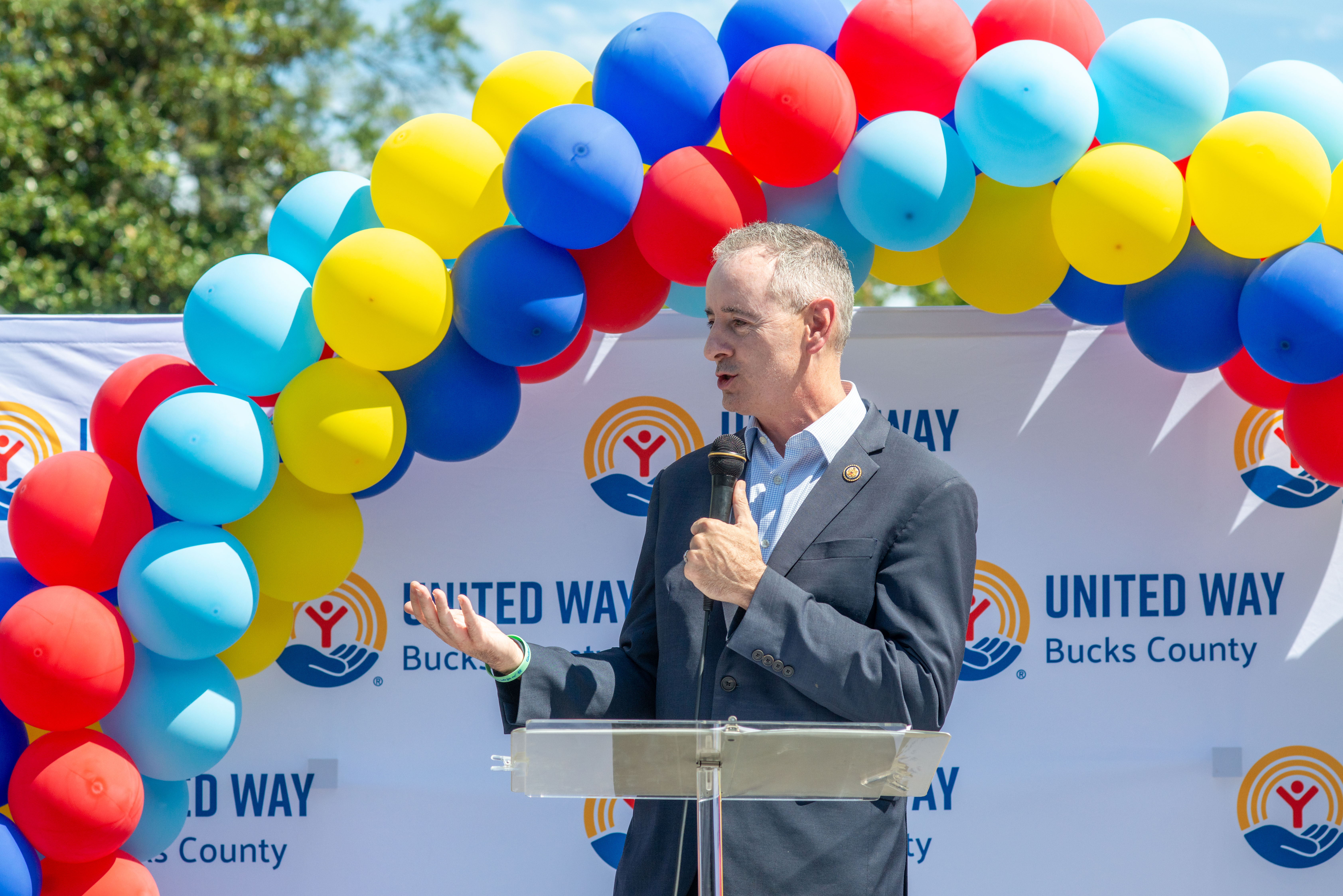
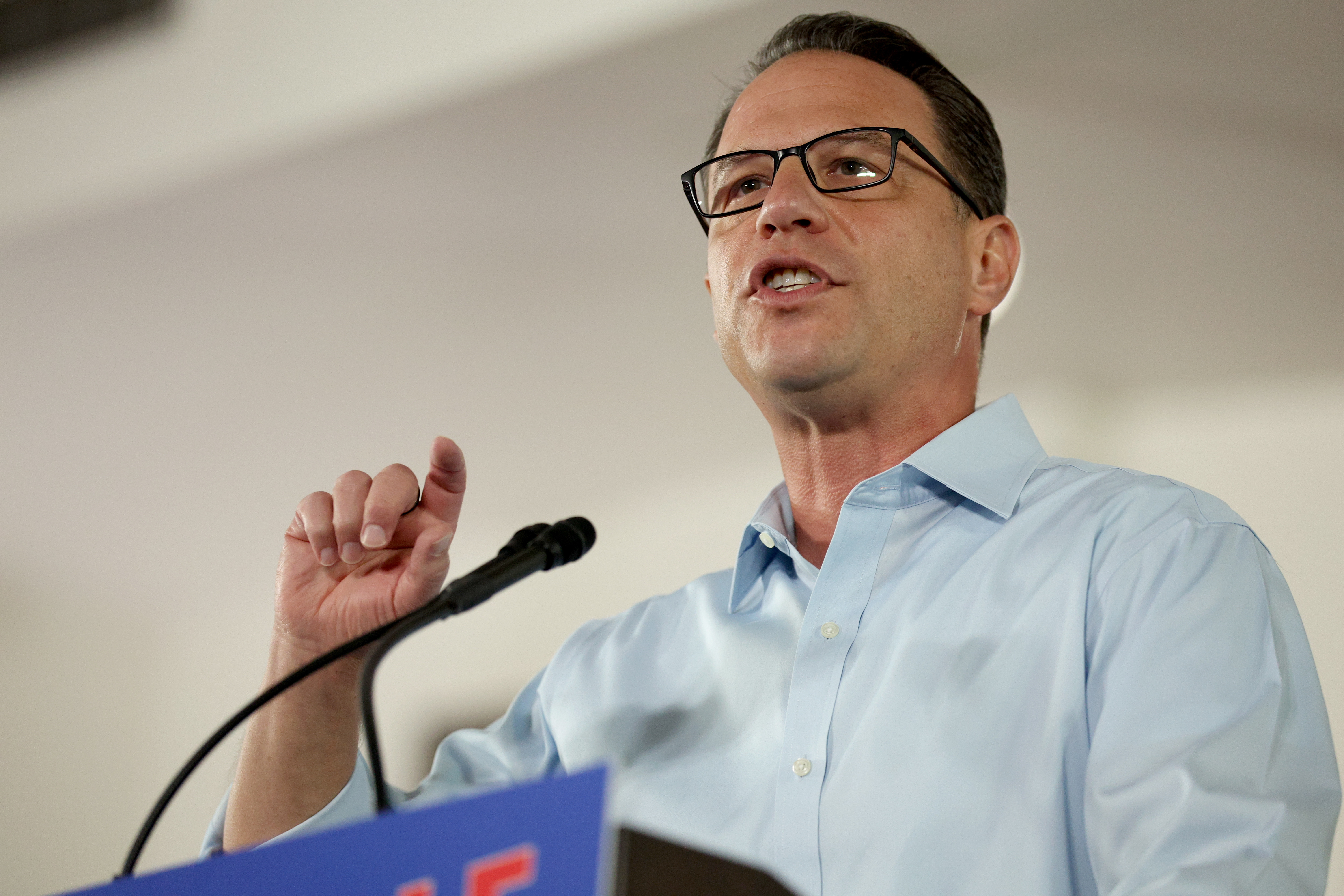
    U.S. Rep. Brian Fitzpatrick (R-Pa.) makes remarks in support the grand opening of the new headquarters and expanded financial stability center for United Way Thursday, Sept. 10, 2026 at United Way of Bucks County Headquarters in Levittown.William Thomas Cain / For The Inquirer

    When Fitzpatrick does — and doesn’t — back Trump

    Trump and the Bucks County Republican have had their fair share of tense moments, including the president threatening the lawmaker in May for voting against him.

    Fitzpatrick has continued to vote against the president recently, including on a war powers resolution to restrict Trump’s military actions in Iran.

    “[Fitzpatrick’s] bosses are his constituents back home,” Heather Roberts, a spokesperson for the Fitzpatrick campaign, said in a statement. “Political party retaliation has zero impact on his decision-making.”

    Since January 2025, Fitzpatrick has voted with the Trump administration’s 133 stated positions on congressional votes 93 times, according to the analysis.

    (function () {window.addEventListener(‘message’, function (e) { var message = e.data; var els = document.querySelectorAll(‘iframe[src*=”‘ + message.id + ‘”]’); els.forEach(function(el) { el.style.height = message.height + ‘px’; }); }, false); })();

    Fitzpatrick voted with Trump on several high-profile GOP bills, including the SAVE Act, a controversial overhaul of voting laws, and the Laken Riley Act, legislation also supported by some Democrats that requires federal authorities to detain undocumented immigrants arrested for theft-related crimes, issues that Roberts maintained 1st District voters of both parties support.

    Fitzpatrick’s votes have also aligned with the White House on other legislation related to immigration, law enforcement, energy, and renaming the Gulf of Mexico the “Gulf of America.”

    At the same time, no other House Republican has been less loyal to the president in this time frame. That includes every GOP member from Pennsylvania, many of whom are staunch supporters of Trump. Republicans like U.S. Reps. Ryan Mackenzie, Rob Bresnahan, and Scott Perry, who are defending their seats in contentious swing-district races, vote with Trump more than 90% of the time.

    Both Mackenzie and Bresnahan spoke at Trump’s Republican midterm convention in Dallas this month, but Fitzpatrick — the only GOP member of Congress from Pennsylvania not endorsed by Trump — did not attend.

    (function(){function e(){window.addEventListener(`message`,function(e){if(e.data[`datawrapper-height`]!==void 0){var t=document.querySelectorAll(`iframe`);for(var n in e.data[`datawrapper-height`])for(var r=0,i;i=t[r];r++)if(i.contentWindow===e.source){var a=e.data[`datawrapper-height`][n]+`px`;i.style.height=a}}})}e()})();

    Fitzpatrick’s defections — which have spanned from supporting Ukraine to condemning Trump’s rhetoric — have earned him the president’s ire.

    Since 2025, the analysis found, he has voted against the administration’s efforts to overturn numerous environmental regulations implemented by former President Joe Biden, many of which ultimately passed the House. He also was one of two Republicans to vote against the One Big Beautiful Bill Act, Trump’s signature domestic policy bill, on final passage (though he had cast a key vote to advance the bill earlier in the process).

    The final bill had enough GOP support — 218 members voted yes — to pass without Fitzpatrick’s vote.

    Harvie, Fitzpatrick’s Democratic challenger, contended that Fitzpatrick “has mastered the art of the meaningless gesture and breaks with Trump only when he gives him a hall pass.”

    “[Voters] want somebody who’s going to go there and fight for them,” Harvie said. “And, you know, people’s lives aren’t better than they were 10 years ago. And Brian Fitzpatrick and Donald Trump are the big reasons why.”

    Roberts said Harvie’s criticism is “absurd” and has been “debunked many times over and in every single election cycle.” She also criticized Harvie’s voting record and said he has not exercised similar levels of independence during his time as Bucks County commissioner and Falls Township supervisor.

    Back in Trump’s first term in office, Fitzpatrick sided with the White House on 59% of votes — 81% of the time in 2017-18, but dropping to almost 42% in the following two years, after Democrats gained control of the U.S. House in the 2018 midterms.

    Fitzpatrick voted with his party roughly 60% of the time during both the 117th and 118th Congresses, when Biden was in office and the GOP had the majority for the latter two years of his term.

    The lawmaker played a key role in getting Biden’s signature bipartisan infrastructure law passed, drawing sharp attacks from fellow Republicans when he was one of 13 GOP members to support it in the House.
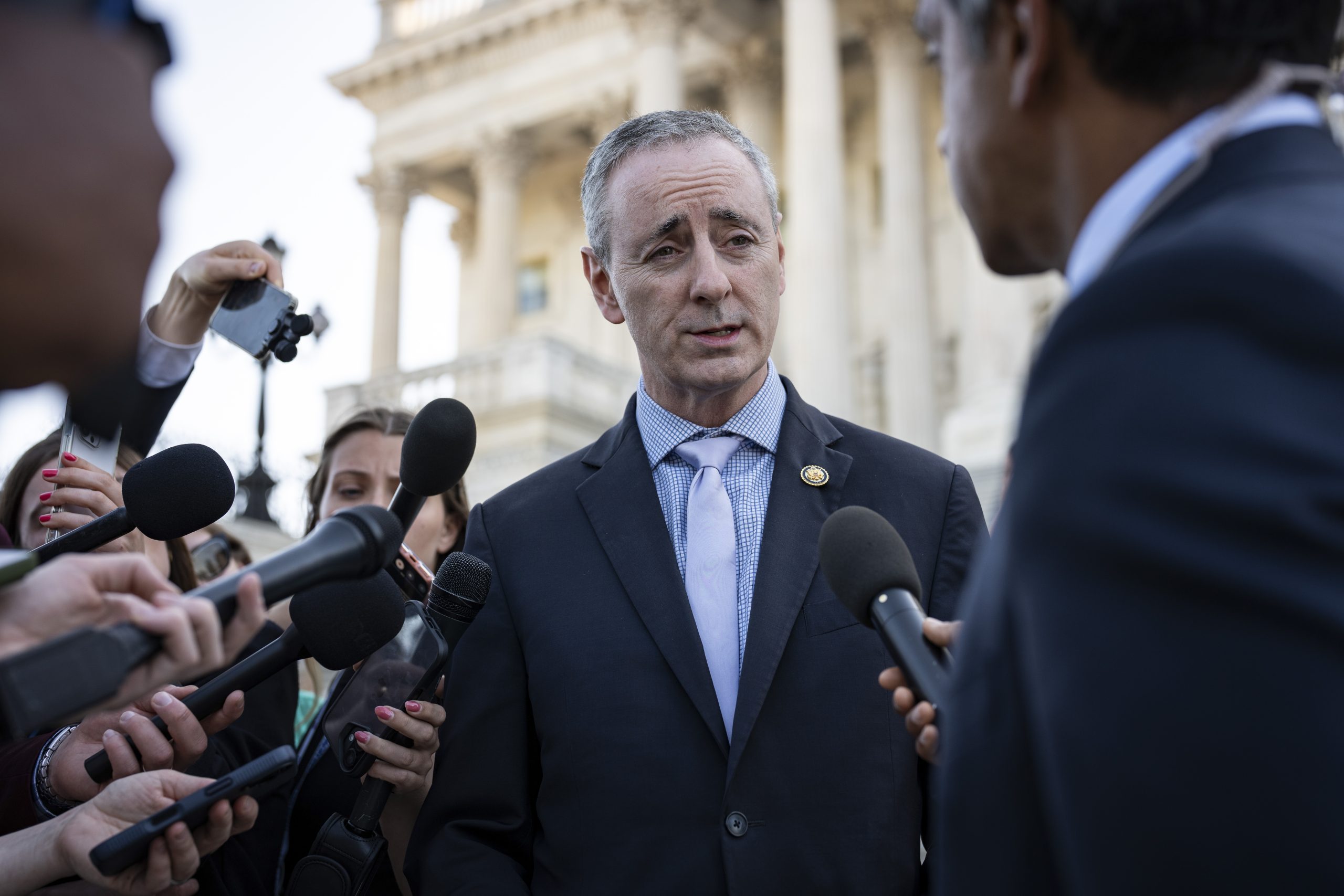
    Rep. Brian Fitzpatrick (R-Pa.) speaks to reporters after the House passed an Iran war powers resolution on Capitol Hill in Washington, on Wednesday, June 3, 2026. Haiyun Jiang

    What about the GOP?

    Fitzpatrick’s alignment with the House Republican Conference has fluctuated depending on which party is in power.

    During this Congress, when the GOP holds a narrow majority in the U.S. House, Fitzpatrick has voted with his party 77% of the time, meaning he has split from Republicans 107 times on 472 party unity votes, defined by CQ Roll Call as instances when a majority of voting Republicans oppose a majority of voting Democrats.

    That figure is the highest of his career, the analysis shows, though still far below the median of Republicans. It was a similar story during Fitzpatrick’s first term during the 115th Congress in 2017-18, when Trump was in office and Republicans had the House.

    By contrast, Fitzpatrick was the least loyal to his party during the 116th Congress in 2019-20 — at 55% — when Trump was still in office, but the GOP did not have the gavel.

    A congressional lawmaker’s votes are dependent on which bills make it to the floor. Currently, that is up to House Speaker Mike Johnson, a Louisiana Republican, whom Fitzpatrick has criticized for his reluctance to bring some bipartisan bills for a vote if Trump opposes them.

    Fitzpatrick has introduced 249 bills as lead sponsor, and just under half — 123 — have a bipartisan group of cosponsors.

    “The numbers and percentages will change from year to year based entirely on what votes are put on the House Floor,” Roberts said in her statement. “The best measure of independence is how often, and on which issues, does one vote against their own political party, regardless of who the President is and regardless of who the Speaker is.”

    (function(){function e(){window.addEventListener(`message`,function(e){if(e.data[`datawrapper-height`]!==void 0){var t=document.querySelectorAll(`iframe`);for(var n in e.data[`datawrapper-height`])for(var r=0,i;i=t[r];r++)if(i.contentWindow===e.source){var a=e.data[`datawrapper-height`][n]+`px`;i.style.height=a}}})}e()})();

    Jim Worthington, a major GOP donor in Bucks and owner of the Newtown Athletic Club, said Fitzpatrick’s record is representative of the purple county, home to a plethora of split-ticket voters, and shows that he is able to go against power structures in Washington.

    “When you have someone who’s willing to stand up to the power of the majority and take a stand, that’s the type of guy you want,” Worthington said. “It’s pretty lonely when there’s 216 other people in your party voting for something, and you’re voting no. It takes guts, and that’s what he’s doing.”

    Over the course of his time in Congress, Fitzpatrick has defected from his fellow House Republicans on votes related to economic and public finance issues, but has agreed with his caucus most on legislation connected to international affairs.

    Of the 10 closest votes in which Fitzpatrick diverged from the GOP this year, three were decisive votes that blocked GOP amendments to bills.

    Two others were votes in which he supported Democratic motions that fell just short of passing.

    Fitzpatrick also joined Democrats in voting against five GOP amendments to bills that passed by one vote.
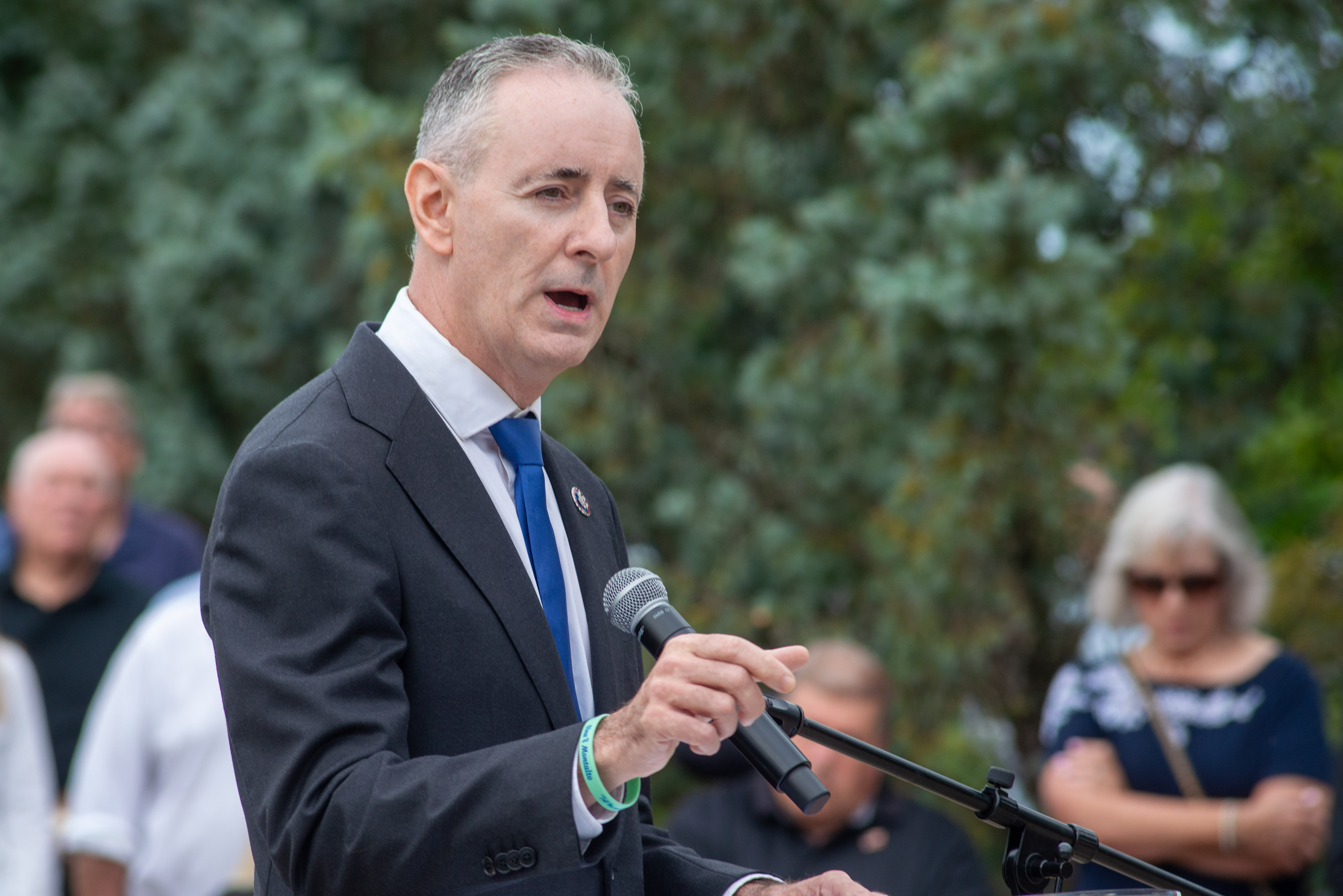
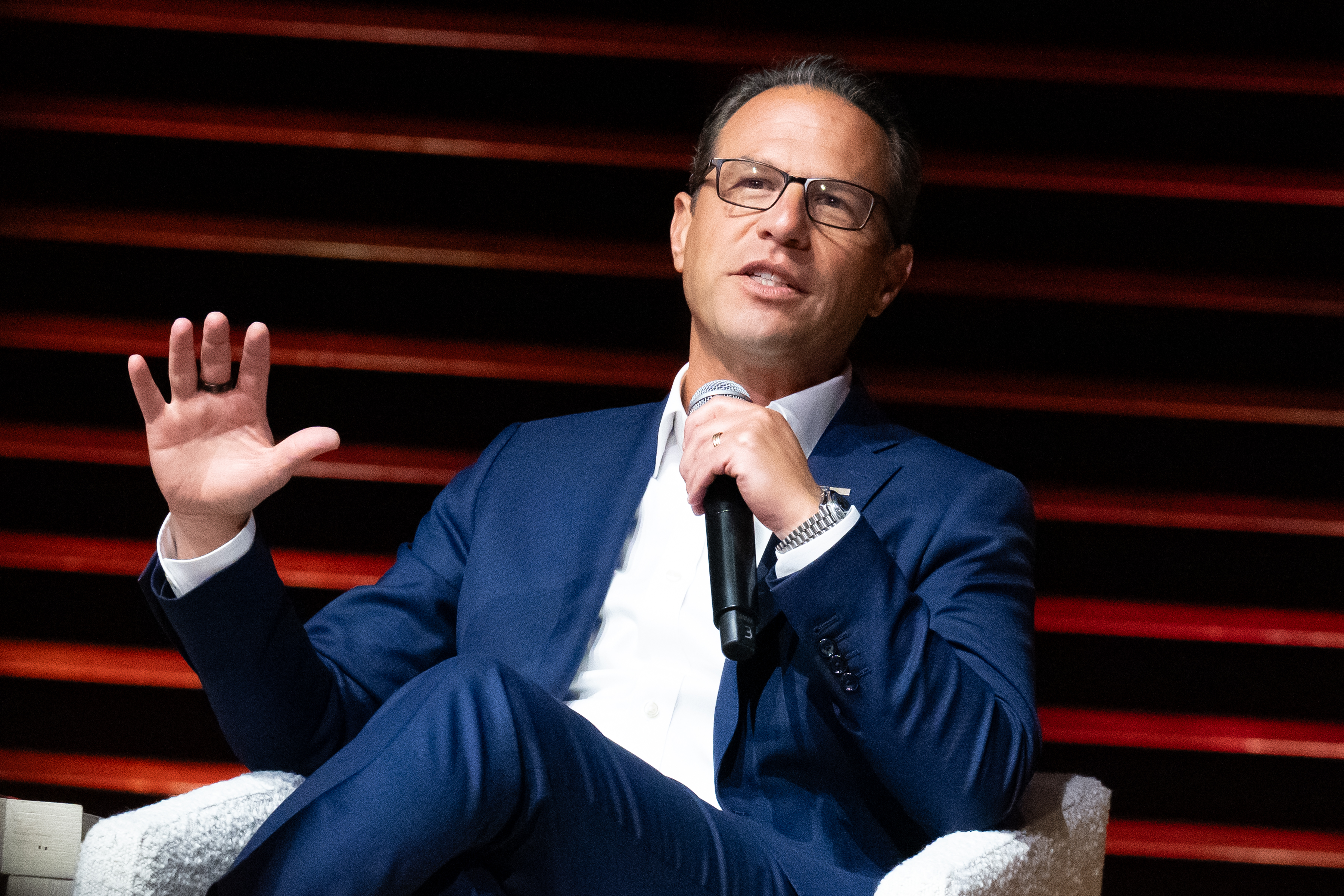
    US Rep Brian Fitzpatrick speaks during the Garden of Reflection remembrance ceremonies Friday, Sept. 11, 2026 at Garden of Reflection in Yardley, Pennsylvania. The Garden of Reflection is Pennsylvania’s official state memorial honoring all 2,973 victims of the September 11 terrorist attacks, with a special tribute to 18 local residents from Bucks County, Pennsylvania.William Thomas Cain / For The Inquirer

    What does this mean for the midterms?

    At the U.S. Capitol on Wednesday, Fitzpatrick stood alongside members of the bipartisan Problem Solvers Caucus that he cochairs, condemning the redistricting wars both parties have engaged in and unveiling legislation to prevent a similar situation in the future.

    He said in an interview that both Trump and Democrats were “wrong” to kick-start a gerrymandering spree.

    “There are so many forces pulling us away from the center, when most Americans are in the center,” he said.

    Fitzpatrick has been working to run on that centrist message back at home — even as he wages an aggressive ad campaign against Harvie.

    But will his brand and well-fundraised campaign help him in a disadvantageous national political environment for Republicans this year?

    Brittany Crampsie, a Democratic consultant in Pennsylvania, said 1st District voters should consider whether they, too, agree with Trump a majority of the time, noting that Fitzpatrick creates an “illusion” that he is independent from the president or his party.

    “[Fitzpatrick] doesn’t have enough to celebrate, and voters don’t want to see him pat himself on the back for only supporting this administration 75% of the time,” Crampsie said.

    She said that Fitzpatrick’s voting record will not help him survive a blue wave this time around because the issues facing the country, such as the cost of living, are too dire amid what she calls a “change election.” Crampsie said Harvie should continue to focus his campaign on both Fitzpatrick’s record and kitchen-table issues.

    “Making a campaign all about opposition to Trump, we’ve seen, is not successful,” Crampsie said. “Voters want a new vision. They want a new platform. They want new ideas, and that’s what Bob Harvie is offering.”

    Worthington, the GOP donor, predicted that Fitzpatrick will once again be victorious this year, noting the lawmaker’s massive coalition of labor support, which would typically go to a Democratic candidate, and voters’ desire for a moderate candidate.

    “He’s a free, independent thinker. At the end of the day, he tries to do what’s right for everybody, for the majority of people,” Worthington said.

    “That’s the problem — there’s too many extremes. You’re either one side or the other. It shouldn’t be like that.”

    Staff writer Sam Janesch contributed to this article.

  • The Trump administration will force Pa. to pay more for SNAP. Shapiro’s office says it can’t.

    The Trump administration will force Pa. to pay more for SNAP. Shapiro’s office says it can’t.

    The Trump administration will be overhauling the SNAP program in two major steps, forcing Pennsylvania to pay more for the federal food program and jeopardizing those in need, according to Gov. Josh Shapiro’s office.

    The first phase begins Oct. 1, when states will have to pay for 75% of the expense of administering the Supplemental Nutrition Assistance Program, an end to the 50-50 cost-sharing relationship between the federal government and the states that existed for decades.

    The second and more dramatic change is scheduled to commence a year from now, when the Trump administration demands that states pay for a portion of SNAP benefits — an unprecedented arrangement that could put Pennsylvania on the hook for as much as $400 million of the approximately $4 billion the state receives in SNAP benefits annually.

    That’s a price the state is not ready to pay.

    “Pennsylvania’s state budget cannot make up for huge cuts to federal SNAP funding that will shift these costs onto states,” Shapiro spokesperson Rosie Lapowsky said in a statement. “And those cuts risk leaving hungry Pennsylvanians without food assistance.”

    The Trump administration plan, part of President Donald Trump’s One Big Beautiful Bill Act, is roiling Democrats and SNAP advocates who view it as an effort to weaken the food benefits program by saddling Pennsylvania and other states with the responsibility of paying for something they cannot afford.

    In anticipation of the first new rule going into effect in two weeks, Shapiro earmarked $87 million in the state budget to administer the SNAP program in the state, which includes paying for operating expenses.

    Burdening states with increased financial demands is “catastrophic,” said St. Joseph’s University sociologist Maria Kefalas.

    Kefalas said it will force states to make drastic moves to make up for lost dollars, including making eligibility rules harder and shrinking benefits.

    “The pressure on states to push people off SNAP will be tremendous,” she said. “The Trump act was written to shift blame for cuts to safety-net programs from the federal government to the states. Now, the states will be seen as the bad guys.”

    The original even split for administrative costs had the state and the federal government each paying $250 million in SNAP administrative costs, according to the Pennsylvania Independent Fiscal Office (IFO), a nonpartisan legislative agency that analyzes budgetary issues. But after Sept. 30, the state could be looking at as much as a $125 million increase in payments annually, IFO figures show.

    Shapiro’s $87 million budget infusion covers that increase for a portion of the state fiscal year, said Brandon Cwalina, press secretary for the Pennsylvania Department of Human Services, which oversees SNAP.

    The Trump administration says that by forcing states to put skin in the game, it is incentivizing them to cut waste, fraud, and abuse in the program.

    “President Trump is strengthening SNAP for the Americans who need it by ensuring these programs are sustainable for future generations,” White House spokesperson Anna Kelly said in a statement.

    She added that the One Big Beautiful Bill Act implements “reasonable” cost-sharing measures with states.

    Kelly also said that by signing the bill into law, Trump is “uplifting every American’s financial situation by passing the largest tax cut in history.”

    But concern is growing that by compensating for SNAP shortfalls, states will pull funds from other sources.

    “Does this mean money will be taken from police, courts, and other critical functions to pay for SNAP?” asked State Sen. Art Haywood, the top Democrat on the Health and Human Services Committee, who represents part of Philadelphia and Montgomery County.

    Error rates

    How much the state will have to pay in SNAP benefits in October 2027 depends on its payment error rate, a measure of overpayments and underpayments of benefits.

    Error rates are largely unintentional and are not fraud, according to the Food and Nutrition Administration of the U.S. Department of Agriculture, which runs the SNAP program.

    “It’s like doing your taxes and accidentally switching numbers,” said Ann Sanders, director of public benefits policy and programs for Just Harvest, a Pittsburgh-based anti-hunger nonprofit. “Not a crime, just a mistake.”

    In fiscal 2025, Pennsylvania’s error rate was 9.2%, mostly representing overpayments, said IFO director Matt Knittel.

    Even though it is below the national error rate of 10.6%, if the 9.2% level holds, Pennsylvania could be made to pay as much as $400 million a year when the new rule takes effect, IFO figures show.

    “These are costs Gov. Shapiro has made clear we cannot backfill,” Cwalina said. The Shapiro administration, which has had some success lowering error rates, has introduced new technology that helps flag potential errors before incorrect payments are made.

    The reorganization of SNAP’s functions and financing comes during an ongoing affordability crisis, said George Matysik, executive director of the Share Food Program, which supplies many food pantries in the Philadelphia area.

    “Instead of the federal government helping to solve it, it’s just passing the buck onto the consumer,” he said. “Prices are going up, while Washington punches down on the working class.”

    While the new changes have yet to kick in, Trump’s One Big Beautiful Bill Act has already altered SNAP to help pay for his tax cut.

    The administration has expanded work and documentation requirements for SNAP recipients, resulting in millions of people seeing their benefits lowered or eliminated.

    Nationwide, between July 2025 and May, SNAP rolls have decreased by more than 5 million people, or 12%, according to the Center on Budget and Policy Priorities, a left-leaning Washington-based think tank.

    As of July, the latest Pennsylvania DHS estimates show that 94,200 people have lost benefits since Trump’s law took effect.

    The changing contours of the SNAP program worry legislators accustomed to its normally steady rhythms.

    “There was a 60-year-long partnership between the federal government and the states on SNAP, without problems,” Haywood said.

    “SNAP worked well since it got its start in 1964. But now, unfortunately, the current administration is dramatically changing it.”

  • President Donald Trump praises Stacy Garrity for Pa. governor, says Josh Shapiro ‘does not have what it takes’

    President Donald Trump praises Stacy Garrity for Pa. governor, says Josh Shapiro ‘does not have what it takes’

    In a video shared to his social media platform on Friday, President Donald Trump reinforced his endorsement for Republican Stacy Garrity in her bid for Pennsylvania governor, while panning Democratic Gov. Josh Shapiro as an incumbent “who does not have what it takes.”

    “Stacy has been really special [and] has my complete and total endorsement,” Trump said in the video, posted Friday afternoon to Truth Social, praising her tenure as the state’s treasurer and applauding her military service and career in business. “She’s somebody that is going to do a fantastic job.”

    The video was posted in a string of more than a dozen similar endorsements on Friday afternoon for Republican congressional candidates in Alaska, Florida, Georgia, Michigan, North Carolina, and Texas.

    Garrity, who did not attend the president’s midterm convention in Dallas last week, appeared to be the only gubernatorial candidate, as well as the only candidate from Pennsylvania, to receive a video acknowledgment from Trump.

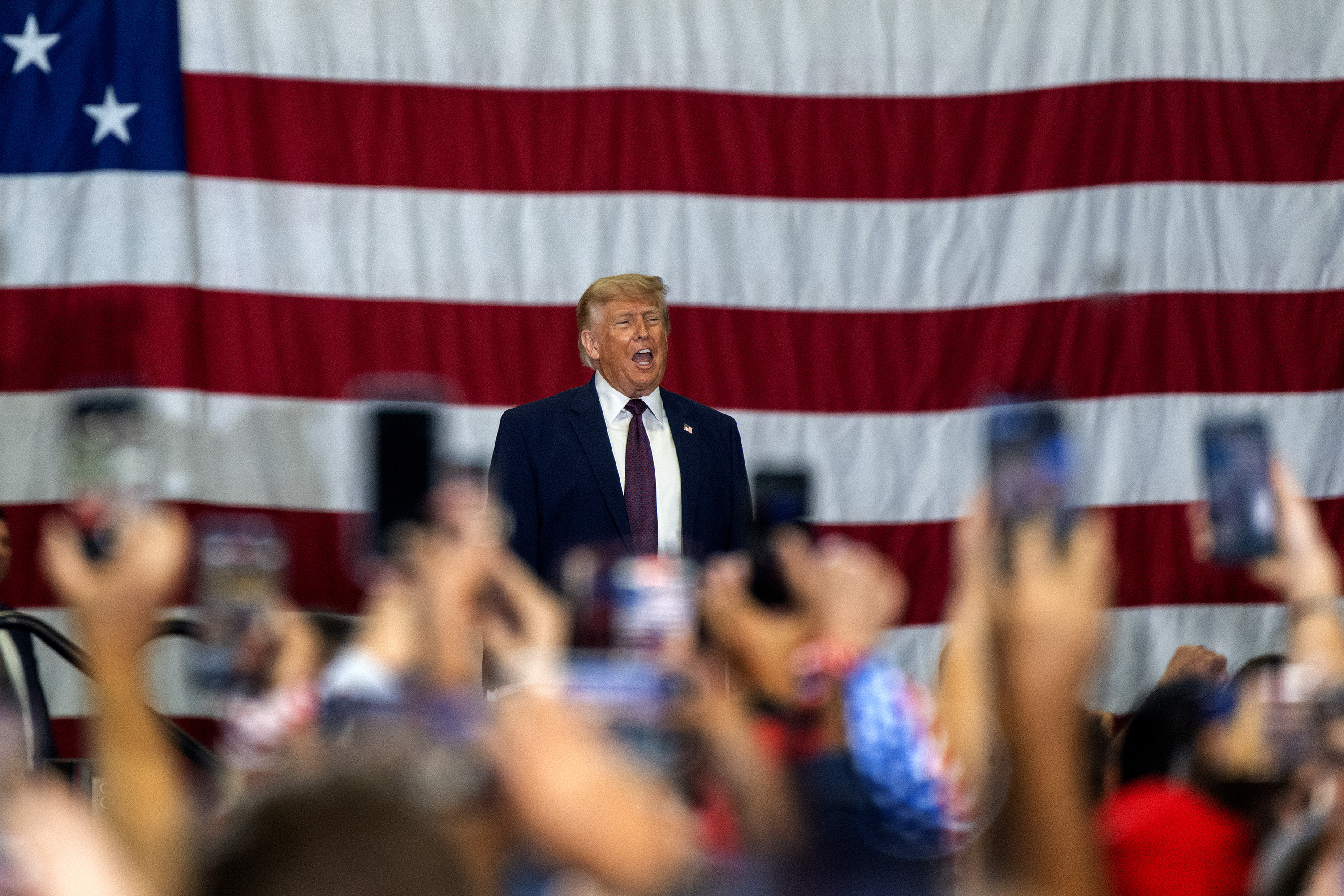
    President Donald Trump visits Mack Trucks in Macungie in the Lehigh Valley Tuesday, June 23, 2026.Tom Gralish / Staff Photographer

    Trump followed the endorsement videos on Truth Social with a post about his approval ratings, and another post featuring a video touting his own accomplishments in office. The endorsement blitz came less than seven weeks before the Nov. 3 midterm elections, in which Democrats are vying to retake control of Congress.

    In Pennsylvania, Shapiro — who has maintained a double-digit lead over Garrity in multiple public polls and has a commanding fundraising advantage — is seeking to use his advantage to secure Democratic wins in four nationally watched congressional seats, and to flip the state Senate to Democratic control for the first time in more than 30 years.

    Trump’s boost for Garrity comes as she has struggled to compete with Shapiro. She has not attracted outside ad-spending support from top GOP groups, such as the Republican Governors Association or the Commonwealth Leaders Fund, backed by Pennsylvania billionaire Jeffrey Yass. This week, Shapiro spent $2.4 million on advertising buys, while Garrity spent just $672, according to the media tracking firm AdImpact.

    Garrity and Shapiro have agreed to a live, televised debate on Oct. 7 in Harrisburg.

    In the video Friday, Trump swiped at Shapiro, who is viewed as a likely contender for the 2028 presidency and who has been critical of the president’s administration.

    “Your current governor does not have what it takes,” Trump said. “His reputation is far better than he is — that I can tell you and everyone knows it.”

    Shapiro’s campaign responded on X to Trump’s video by calling Garrity “100% MAGA.”

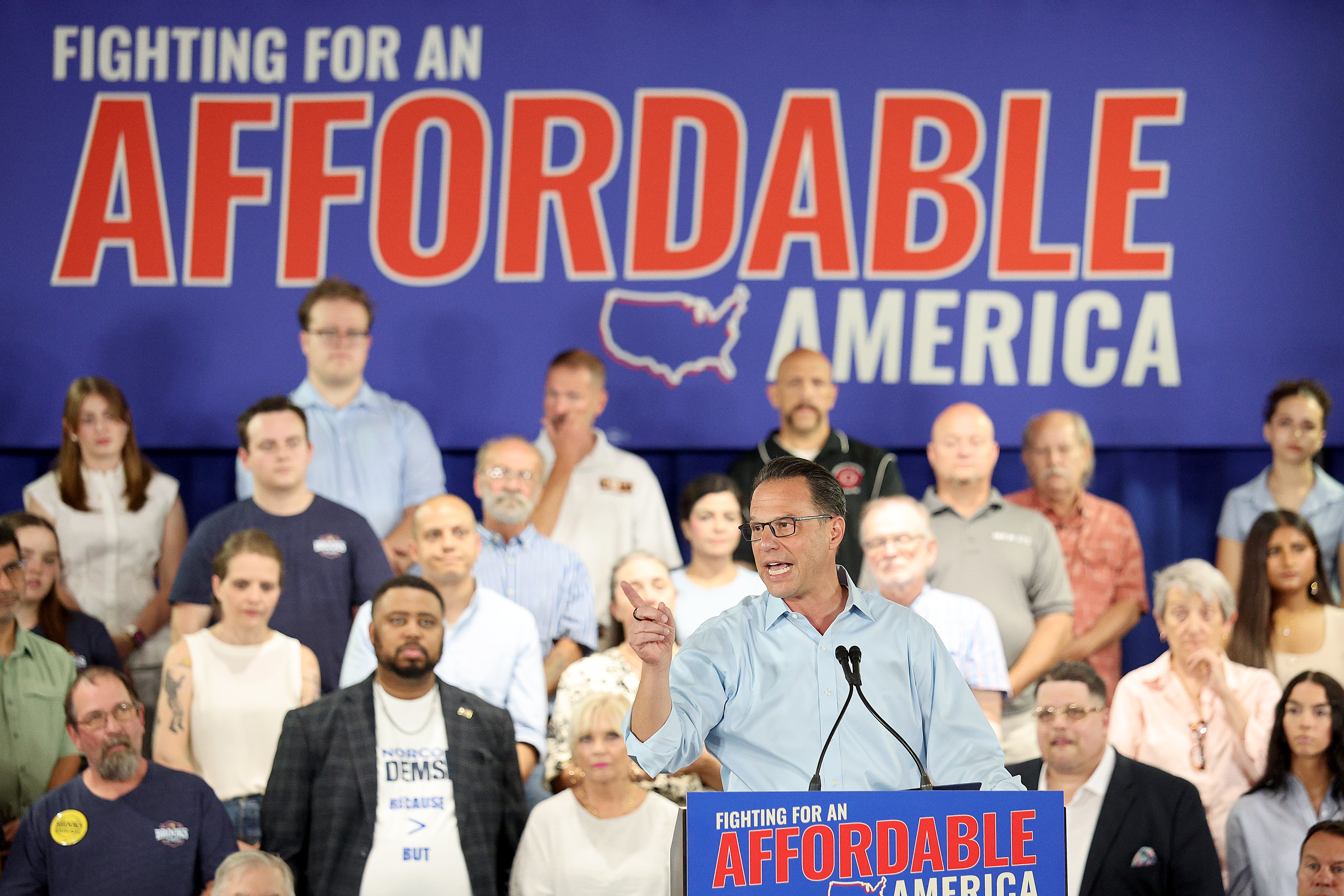
    Gov. Josh Shapiro addresses the audience during a rally for congressional candidate Bob Brooks at the United Steelworkers Union Hall in Bethlehem, Pa. on Sunday, July 26, 2026.David Maialetti / Staff Photographer

    It remains to be seen whether Garrity will receive additional national support or financial backing in the weeks before the election.

    Trump first endorsed Garrity, who ran unopposed in the Republican gubernatorial primary, in January. In March, he said “she should win” during a fundraising dinner at his Mar-a-Lago Club in Florida.

    In June, he seemed to forget her altogether during a speech in Macungie, Pa., where he celebrated Republican U.S. Rep. Dan Meuser and even name-checked Shapiro but did not mention Garrity.

    Last month, in a video posted to his Truth Social account, Trump called Garrity a “spectacular person” who he believes will win the race.

    On Friday, Trump said Garrity “will work tirelessly to grow Pennsylvania’s economy, cut your taxes, slash regulation and bring jobs, opportunity, and wealth to the Commonwealth of Pennsylvania.”

    A spokesperson for Garrity did not immediately respond to a request for comment about Trump’s video, but she reposted his endorsement video on her X account.

  • Clergy and others gather outside Philadelphia ICE office in aftermath of officer’s suicide

    Clergy and others gather outside Philadelphia ICE office in aftermath of officer’s suicide

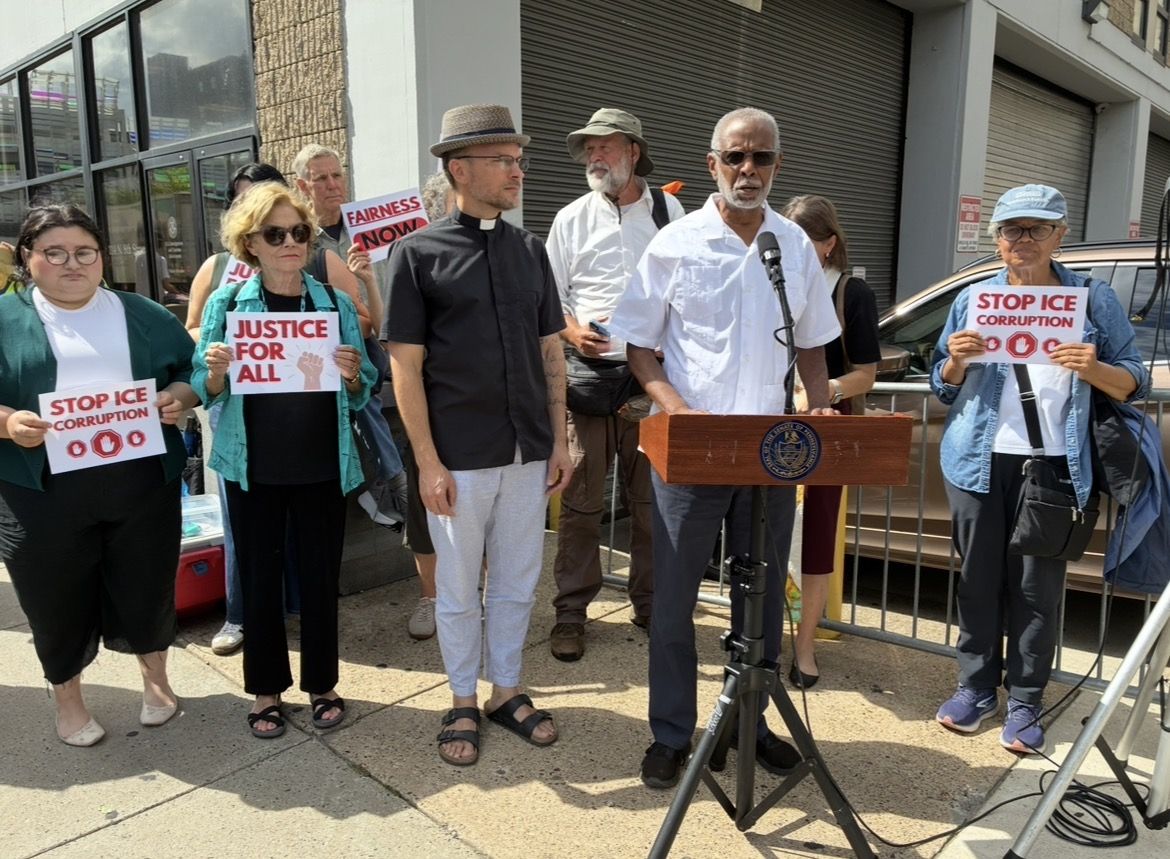
    A group of clergy, political leaders, and activists gathered at the Philadelphia ICE office on Friday in the wake of a deportation officer’s suicide, condemning what they said was the agency’s destruction of lives both inside and outside its ranks.

    Speakers said they said they grieved with the family of Joseph Moore, 38, who died of a self-inflected gunshot wound while parked near the Center City headquarters, and with the families of immigrants treated wrongly and cruelly by the agency.

    Moore died Aug. 28 as he was facing dismissal, along with other new officers brought on amid a huge wave of ICE hiring, one that critics say has led to the employment of unqualified and unvetted recruits.

    “He was an ICE agent,” said state Sen. Art Haywood, a Democrat who represents parts of Philadelphia and Montgomery counties, “but he was also a human being.”

    Local ICE officials did not immediately respond to a request for comment.

    Speakers called ICE a rogue agency, and called on its officers to quit their jobs.

    One man, who kept vigil outside ICE headquarters nearly every day in August, said he tried to talk to officers as they went inside, and wished he could have talked to Moore.

    Generally, said Jim Nicholson, who described himself as Quaker and non-violent, the officers he addressed were “not interested in being human, compassionate beings,” that they told him everyone they arrest is a criminal.

    “I’m a very sorry to hear an agent of ICE committed suicide. That’s a tragedy,” he said. “If the agent had come to us, to me, I would have tried to help.”

    U.S. Immigration and Customs Enforcement, charged with carrying out President Donald Trump’s mass-deportation plan, has been on a hiring binge that more than doubled the size of the agency. Now ICE has begun quietly firing some of those new officers, The Washington Post reported, citing multiple officials who said officers were put on the streets without being properly vetted.

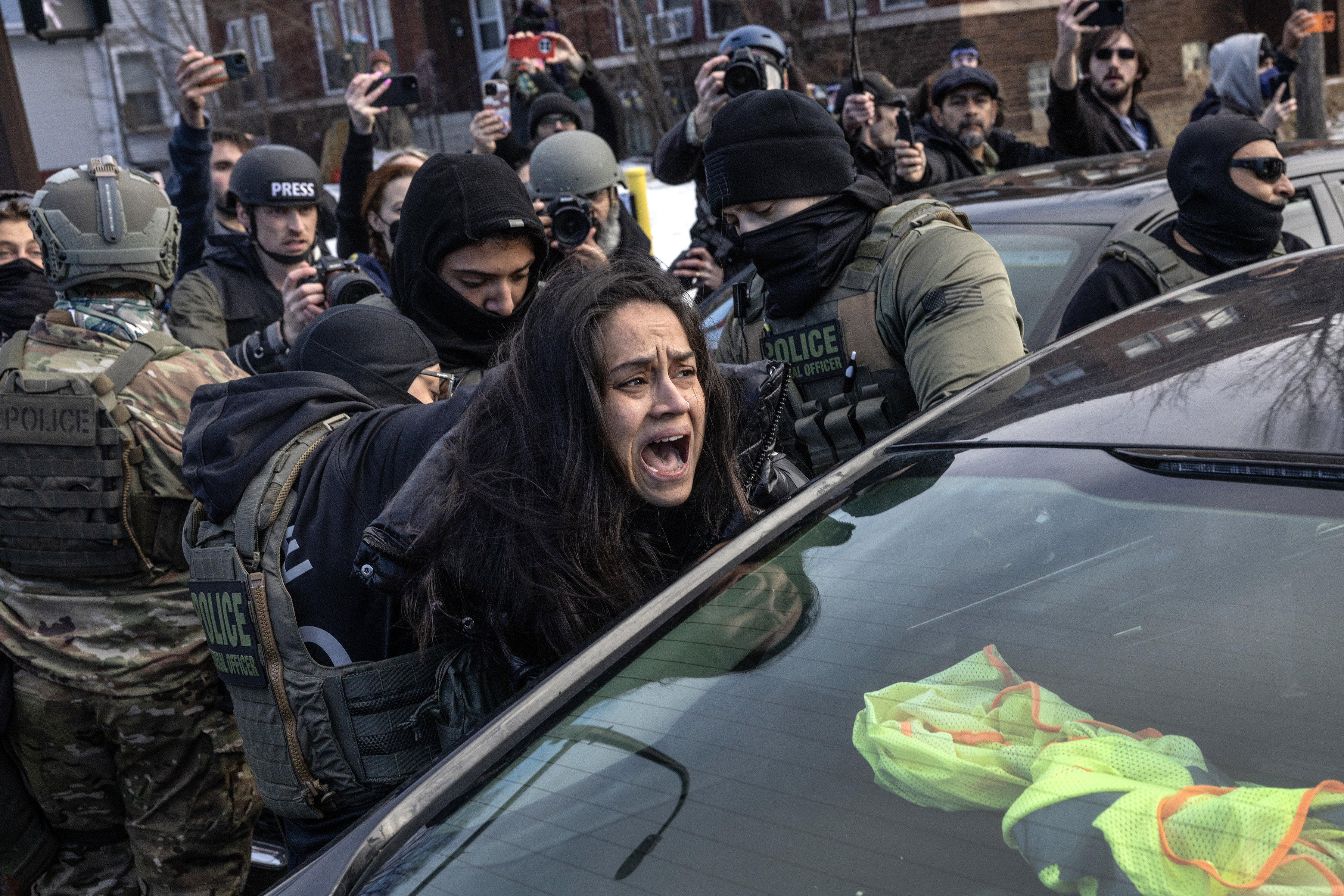
    Federal agents arrest a woman after smashing her car window and dragging her from the vehicle in Minneapolis on Jan. 13, 2026. The legality of the Trump administration’s tactics during its immigration enforcement operation, known as Metro Surge, in Minneapolis early this year was challenged by a series of federal lawsuits.DAVID GUTTENFELDER

    The Post reported on Monday how Moore, a Marines reservist who graduated from Cheltenham High School in 2006, died by suicide while parked near ICE headquarters.

    The newspaper said ICE notified Moore in late August that he would be fired, and told him to come to the Philadelphia office at Eighth and Cherry Streets. His family has disputed the suicide ruling, according to The Post.

    Philadelphia police officials said officers called to the scene tried to stop Moore from hurting himself.

    Police were summoned to the area of Eighth and Race Streets ― the ICE office is one block south ― for a report of an armed man in distress who had barricaded himself inside a vehicle, officials said.

    The officers communicated with the man and tried to de-escalate the situation, but he drew a gun and shot himself, police said. No Philadelphia officer fired a weapon, the department said.

    Police, without identifying Moore by name, said they have finished their inquiry into the death, and would provide no additional details because it involved a suicide.

    In mid-2025, ICE received massive new funding for hiring — about $30 billion, part of $76.5 billion it received through President Donald Trump’s “Big Beautiful Bill.” The administration has said it wants to deport a million people a year, which would require a vastly larger ICE and extensive new detention capability.

    In January, ICE said an unprecedented nationwide recruitment campaign had shattered expectations, resulting in the hiring of more than 12,000 officers.

    That more than doubled the staff from 10,000 to 22,000.

    “That’s a 120% increase in our workforce,” Tricia McLaughlin, then an assistant secretary at Homeland Security, said at the time. “And that’s in just about four months.”

    Part of the lure was a promised $50,000 signing bonus.

    ICE said the majority of new hires were police and military veterans, but an investigation by The Associated Press found evidence that applicants with questionable histories were not fully vetted or were hired in spite of their pasts.

    The Post said Homeland Security would not answer questions about specific hiring decisions. It did say that some applicants received “tentative selection letters” and offers to begin working on a temporary status before being subjected to full background checks.

    The hiring happened so fast that new officers were put on the streets before being adequately vetted, multiple former officials told the Post. One ICE whistleblower urged officials to halt the expansion, saying in an August 2025 memo that the “overwhelmed” agency had hired officers without checking their fingerprints or their identities, the Post said.

    In recent months, ICE has begun quietly firing some of the recruits, the Post reported, citing three former DHS officials who spoke on the condition of anonymity. They said ICE has cited poor performance or red flags that should have been identified earlier.

    The Department of Homeland Security rejected those concerns.

    Relatives of an ICE officer who shot a Colombian man in Maine in July told The Associated Press he struggled with serious mental health issues since early childhood, and never should have been given a badge and gun. The revelations about the officer, David Brouillette, brought fresh attention to ICE hiring procedures.

    The Post said Moore had dreamed of a life in law enforcement since he was a teenager. But two law enforcement agencies fired him, and others rejected him. ICE hired him in the fall as a deportation officer.

    Efforts to reach Moore’s family members were unsuccessful.

    His obituary said the father of two served 20 years in the Marines as both an active member and a reservist. And that he graduated with a 4.0 grade-point average from Rosemont College, where he earned a bachelor’s degree in criminal science.

    His funeral is scheduled for Sept. 25 at Hope Community Church in Gilbertsville, Pa.

    If you or someone you know may be considering suicide, help is available. Contact The 988 Suicide & Crisis Lifeline by calling or texting 988.

  • Gov. Josh Shapiro spent more than $2.4 million on ads this week. His GOP opponent, Stacy Garrity, spent $672.

    Gov. Josh Shapiro spent more than $2.4 million on ads this week. His GOP opponent, Stacy Garrity, spent $672.

    Gov. Josh Shapiro is dominating Pennsylvania’s media markets in his reelection campaign, spending more than $24 million with less than seven weeks left until the Nov. 3 election — and trouncing his GOP challenger, State Treasurer Stacy Garrity, who has spent a small fraction of that on ads.

    Shapiro, a Democrat seeking reelection and potentially a 2028 White House bid, has spent more than $2.4 million on advertisements per week since Aug. 25 from his campaign war chest of more than $50 million, according to media tracking firm AdImpact. One ad pitches Garrity as “Pennsylvania’s #1 fan of data centers,” and in another, Shapiro boasts about his efforts to cap energy costs. He has also released a number of audience-specific ads to reach Black and Latino voters, including a radio advertisement in Spanish in the Lehigh Valley.

    A clearer picture of Shapiro’s full campaign haul will become public this week, with updated campaign financial filings due Tuesday. The last filing deadline for state candidates was in June. But Shapiro’s multimillion-dollar flurry of ad buys offers early insight into his strategy heading into November in a race where he holds a double-digit polling lead — and where he is hoping to achieve downballot wins in the statehouse and critical congressional districts.

    Garrity has spent just $743,000 on ad buys so far, and paid out only $672 last week, according to AdImpact. No top GOP groups, such as the Republican Governors Association or the Jeffrey Yass-backed Commonwealth Leaders Fund, have purchased TV ads supporting Garrity, and she has struggled to fundraise to compete with Shapiro, a popular incumbent who has raised more money than any governor since at least 2010.

    State Treasurer and Republican candidate for governor Stacy Garrity is seen on a big screen as she speaks to supporters before the arrival of President Donald Trump at Mack Trucks in Macungie Tuesday, June 23, 2026. Tom Gralish / Staff Photographer

    Shapiro’s mass ad buys despite his commanding lead in the polls indicate the governor is a risk-averse politician, said Christopher Borick, a political science professor at Lehigh University.

    “He’s cautious. He wants to make sure nothing goes awry, and to do that, you buy insurance,” Borick said.

    “The governor has also been clear that the midterms run through Pennsylvania — and he is leading the fight to win critical races up and down the ballot in order to flip the House, put a check on Donald Trump’s chaos, cruelty, and corruption, and get even more stuff done,” said Manuel Bonder, a spokesperson for Shapiro’s campaign.

    Garrity, meanwhile, has spent the lion’s share of her ad buys on a digital social media video campaign called “Twilight Justice,” which promises the future release of bombshell details about Shapiro. She has also released an attack ad about Shapiro’s past support for data centers, but it has been seen by far fewer eyes than those Shapiro is reaching in his multimillion-dollar ad campaigns. Both Shapiro and Garrity initially embraced data centers, though both shifted their positions as the projects became increasingly unpopular among Democrats and Republicans.

    Matthew Beynon, a spokesperson for Garrity’s campaign, declined to comment on whether top GOP groups will get involved in the Pennsylvania governor’s race in the coming weeks. But he said any pro-Shapiro mailer or TV ad “is just another reminder to the people of Pennsylvania that Josh Shapiro sold them out.”

    “All the money in the world will not help Josh Shapiro paint over his administration’s failed economic record or erase his ethics scandals that have cost the taxpayers of Pennsylvania and embarrassed the entire commonwealth,” Beynon added.

    Data center power play

    The regulation of data centers and artificial intelligence have become key issues in midterm races nationwide, including in the Pennsylvania governor’s race, where Shapiro’s past support for the projects appeared to be the biggest test of his popularity.

    Shapiro changed his position last month and subsequently began running attack ads against Garrity for her past support of the unpopular centers. Garrity has also changed her position, from initially advocating for the rapid development of data centers around Pennsylvania to now calling for “a pause” on their development. Shapiro, in an executive order signed last month, will now require any prospective data center developers to meet a number of environmental and energy factors in order to build in Pennsylvania.

    “That’s why you’ve seen this enormous ad buy that she can’t even come close to matching, when, in reality, he’s as exposed as her on the issue, but she doesn’t have the resources,” Borick said.

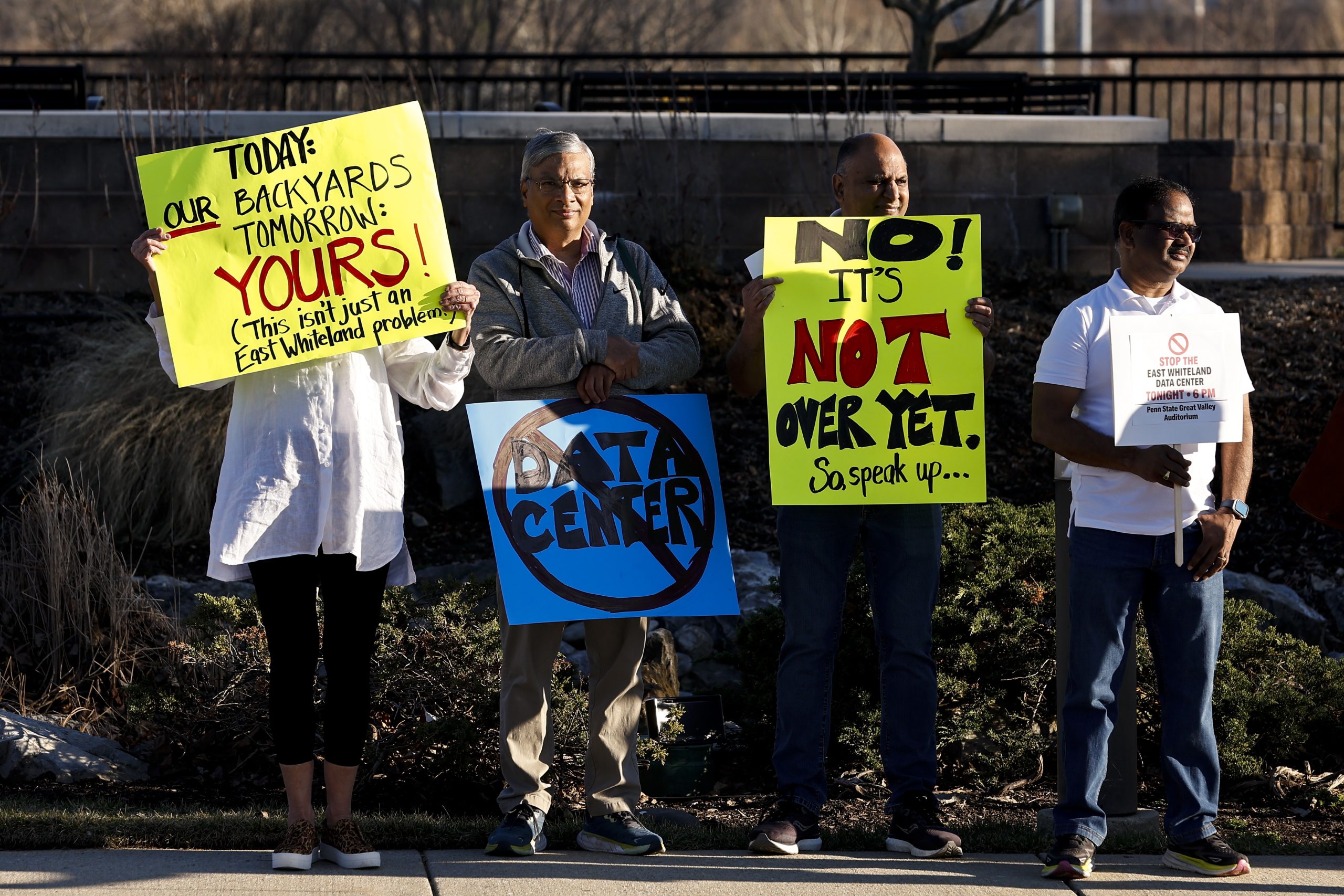
    People protest the expanded data center before the East Whiteland Planning Commission meeting held at Penn State Great Valley on Monday, March 9, 2026 in Malvern, Pa.Monica Herndon / Staff Photographer

    Pennsylvania Republicans endorsed Garrity in September 2025 — an unprecedented early nod that helped clear the field for her as the party’s nominee. President Donald Trump endorsed her in January, calling her an “America First Patriot.” She ran unopposed in the primary election, and top GOP leaders said they wanted to wage a stronger fight against Shapiro this time than in 2022, when far-right State Sen. Doug Mastriano (R., Franklin) won the endorsement in a crowded field and the state GOP largely did not financially support his candidacy.

    Despite all of the additional time to drum up support, Garrity has struggled to raise funds and has yet to be able to cash in on Trump’s backing. As of Thursday, she had spent just $300,000 more than Mastriano had at this point in the race. Shapiro, meanwhile, has spent less this election than he did at the same point in 2022, when he spent $28 million as of mid-September.

    “When you’re making comparisons to the amount of money Doug Mastriano raised, it’s a really troubling sign,” Borick added.

    Garrity and Shapiro will face off in a televised debate on Oct. 7 hosted by ABC27 in Harrisburg.

  • Josh Shapiro’s not an AI ‘doomer,’ but the Pa. governor wants federal regulations for the industry

    Josh Shapiro’s not an AI ‘doomer,’ but the Pa. governor wants federal regulations for the industry

    Gov. Josh Shapiro on Thursday called on the federal government to enact new guardrails on artificial intelligence, days after a number of tech industry figures raised concerns about the danger posed by AI’s rapid development.

    As he spoke in Pittsburgh, the Democratic governor was critical of both House Speaker Mike Johnson (R., La.) and President Donald Trump for refusing to erect such safety measures “whether out of willful ignorance or personal greed.”

    And, he said, he does not believe that concern about this technology “is a hoax, as our president has called it.”

    But as he urged more regulation of the industry, he also warned against adopting an overly pessimistic view of the technology.

    “I am not a doomer. I don’t think it is inevitable that AI is going to take over the world, or that someone will misuse it to kill us all or to do harm,” Shapiro said.

    Shapiro’s appearance at the AI Horizons PGH Summit, sponsored by Microsoft and the Bank of New York, helps position the governor as a leader on the issue among Democrats.

    Last week, former President Barack Obama urged Democrats running for the White House to define the risks of AI, according to the Washington Post.

    That advice — and Shapiro’s speech — followed warnings from AI executives last week that the technology is developing too quickly, and that it poses threats to human life.

    “I won’t lie to you — there are real dangers,” said Anthropic CEO Dario Amodei, adding that the development of AI has accelerated much faster than he had expected.

    Shapiro — who has consistently led his November opponent, Stacy Garrity, in polls — is widely expected to pursue a presidential run in 2028 after this fall’s reelection contest.

    A growing concern among voters, AI is expected to continue being a significant issue for candidates, and Shapiro has shifted his stance in recent months to reflect questions about the technology.

    In August, he issued an executive order that restricts data center development in the state, a noticeable shift from when he enthusiastically supported a $20 billion commitment from Amazon last year to build at least two data centers in Bucks and Luzerne Counties.

    Shapiro now says future developments require local approval for projects to receive state permits, which in effect may block many developments from moving forward.

    “The real folks I listen to are the people of Pennsylvania,” Shapiro told Politico before Thursday’s speech.

    Six in 10 likely Pennsylvania voters oppose construction of data centers to house artificial intelligence, according to last month’s poll from The Inquirer, the New York Times, and Siena University.

    In contrast to the growing voices calling for AI guardrails, President Donald Trump on Monday wrote on social media that the only guardrail the industry needed it already had: “a STRONG AND SMART (High IQ!) PRESIDENT.”

    Shapiro, in his speech, said he is calling on the federal government to establish “strict rules of the road” regarding AI, and then to enforce those rules.

    “I’ve called on the federal government to step up and regulate the AI industry, just like they do for nearly every other industry,” he said.

    Industry leaders should not exclusively guide the regulatory process, Shapiro said. The government should also work with leading researchers.

    What is vital, Shapiro said, is establishing rules that require independent third-party oversight of “frontier” — most advanced — models, increasing transparency into the development of these models, and prioritizing safety.

    Protections might mean placing some limits on technology sharing and slowing down frontier AI development until we can be sure that these systems are safe, Shapiro said.

    Acknowledging that building a regulatory network from the ground up is hard work, Shapiro took a jab at Congress, and Johnson in particular, when he said “too many in Congress are content to do absolutely nothing.”

    Shapiro noted that the speaker adjourned the House until after the election just days after companies issued “apocalyptic” warnings about the real dangers of AI.

    “He has abdicated his responsibility to lead at a time when we cannot afford weakness and retreat,” Shapiro said of Johnson.

    The United States should work with other nations on an international consensus on how to use AI, but that is hard to do when Trump has “isolated” us from the world, Shapiro said.

    When Trump meets with Chinese President Xi Jinping next week, Shapiro said, he hopes Trump will “leave bluster and the showmanship at the door” and engage productively with him.

    As for the home front, Shapiro said, “I’ll be leading the conversation here in Pennsylvania for safe and responsible use of AI.”

  • Pa. is asking CDC for more emergency aid, but only if measles deaths are reported

    Pa. is asking CDC for more emergency aid, but only if measles deaths are reported

    Pennsylvania is seeking more emergency aid from the Centers for Disease Control and Prevention to respond to the state’s largest measles outbreak in more than 30 years, but only if the federal agency acknowledges the four measles-associated deaths Pennsylvania has reported.

    The CDC has so far declined to publicly report Pennsylvania’s measles-associated deaths, reportedly at the direction of Health and Human Services Secretary Robert F. Kennedy Jr.

    The CDC’s measles dashboard says the agency is still reviewing death data and developing a new standard definition of a measles-associated death.

    Public health experts say it is highly unusual for the CDC to challenge routine disease surveillance by states, and delaying death reporting could affect efforts to control Pennsylvania’s outbreak, which has sickened more than 700 people and is now this year’s largest in the country.

    “The CDC’s choice not to publicly recognize the deaths undermines our response,” Pennsylvania Health Secretary Debra Bogen wrote in a Wednesday letter to CDC Director Erica Schwartz, a nominee of President Donald Trump who was confirmed to the post last month. The state shared the letter with The Inquirer.

    Bogen wrote that the CDC’s Epi-Aid program, which provides short-term technical assistance and subject matter expertise during health crises, will benefit Pennsylvania’s outbreak response only if she can assure her staff that the CDC’s assistance “will not will not undermine their efforts and will partner with them toward a common goal, including publication of timely, accurate information about the outbreak.”

    The CDC said it had not received Pennsylvania’s Epi-Aid request “through its normal channels” and accused state leaders of politicizing outbreak response. Federal outbreak assistance and national mortality reporting are separate issues, the agency said.

    “CDC will not submit to political blackmail that conditions critical public health assistance,” the agency said in a statement Thursday. “The people of Pennsylvania should never be used as leverage in a political dispute over how deaths are classified.”

    The back-and-forth comes after the CDC has said the state is not cooperating with the agency and, for days, highlighted the fact that health officials here had not requested an Epi-Aid team from the agency, as other states with measles outbreaks have done.

    (function(){function e(){window.addEventListener(`message`,function(e){if(e.data[`datawrapper-height`]!==void 0){var t=document.querySelectorAll(`iframe`);for(var n in e.data[`datawrapper-height`])for(var r=0,i;i=t[r];r++)if(i.contentWindow===e.source){var a=e.data[`datawrapper-height`][n]+`px`;i.style.height=a}}})}e()})();

    An ongoing political clash

    Pennsylvania defines a “measles-associated death” as one that occurs within 30 days of symptom onset in a person with clinical evidence of infection and a positive laboratory test, and who did not die of another unrelated cause, like a car crash.

    The state announced its first two measles-associated deaths in late August, but provided no information on them beyond that both were in unvaccinated Lancaster County residents. The county coroner later said he did not believe measles caused one of the deaths, involving an infant with a lacerated spleen who tested positive for measles, though physicians have noted measles can weaken the organ and make it more likely to rupture.

    The coroner, an elected Republican, said a second death, in another infant with a fatal genetic condition, was caused by measles.

    Two other measles-associated deaths were reported this week in Mifflin and Jefferson Counties. Mifflin County’s coroner confirmed the death of an unvaccinated 18-year-old who died from a serious neurological complication of measles; Jefferson County’s coroner said measles led to the death of an unvaccinated 40-year-old woman with severe respiratory conditions.

    Gov. Josh Shapiro, a Democrat, has criticized Kennedy, a longtime anti-vaccine activist, for spreading misinformation and contributing to lower vaccination rates that he says have allowed the virus to spread through 38 counties in Pennsylvania.

    Kennedy had accused the state of “fabricating” two deaths, although he later acknowledged one was caused by measles.

    Both have said the other is politicizing the deaths, the first reported in Pennsylvania and the highest death toll linked to the virus nationally in more than three decades.

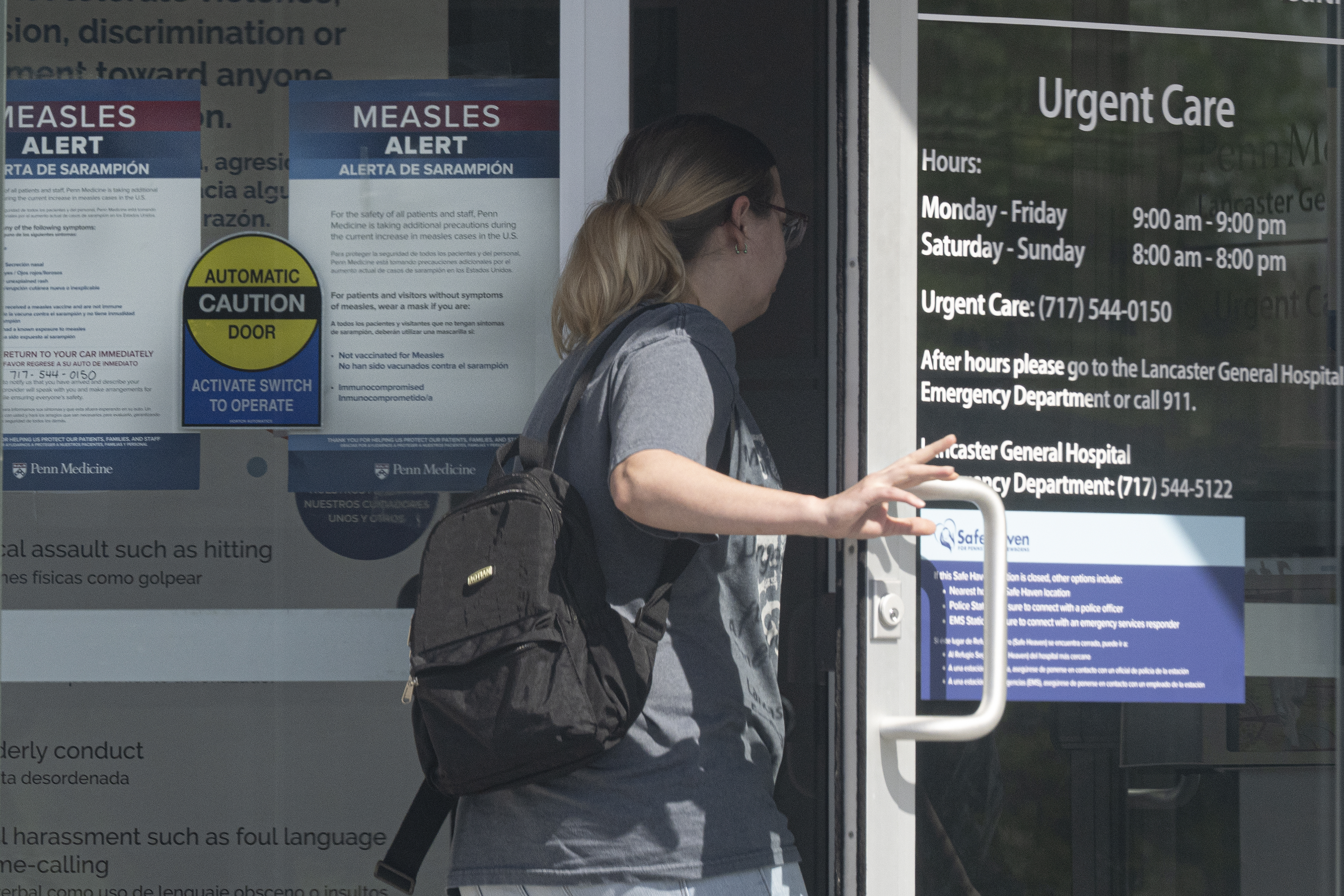
    On Wednesday, the state reported that 731 people have been sickened in Pennsylvania so far this year — with 117 cases reported in the last week alone. Just over 140 people had been hospitalized, with 18% of them under 18.

    An Epi-Aid team typically works with a state for one to three weeks to provide technical assistance investigating an “urgent public health problem,” according to the CDC’s website.

    “The focus of an Epi-Aid investigation is to assist partners in making rapid, practical decisions for actions to control and prevent the public health problem,” the website reads.

    In the letter sent to Schwartz on Wednesday, Bogen said that the state is already working closely with the CDC and recently made two requests for “technical assistance” from agency staff.

    She said the state appreciated “the CDC professional staff’s timely and thoughtful responses.”

    Since the state is still seeing measles cases and deaths, Bogen said, officials are now requesting an Epi-Aid team from the CDC.

    But Bogen will rescind the Epi-Aid request “if CDC is unable to transparently and accurately communicate information about those measles-associated deaths,” the letter said.

    “While our professional teams have collaborated well on the measles outbreak response, including the identification and reporting of four measles-associated deaths, CDC’s public communication about the deaths has not been reflective of our close collaboration,” she wrote.

    (function(){function e(){window.addEventListener(`message`,function(e){if(e.data[`datawrapper-height`]!==void 0){var t=document.querySelectorAll(`iframe`);for(var n in e.data[`datawrapper-height`])for(var r=0,i;i=t[r];r++)if(i.contentWindow===e.source){var a=e.data[`datawrapper-height`][n]+`px`;i.style.height=a}}})}e()})();

    Protocol on counting measles deaths

    The CDC’s measles web page, updated weekly with new case information, has featured an asterisk in the column for 2026 deaths.

    The CDC initially posted an explanation saying it had omitted Pennsylvania’s deaths because “available information does not establish whether measles caused or contributed to the deaths or whether the individuals died from other causes while infected with measles.”

    The agency later updated its asterisk language to note that the National Center for Health Statistics (NCHS) “does not currently have any death records from 2026 that indicate measles is the underlying cause.”

    The web page also says that the agency is working with the Council of State and Territorial Epidemiologists to develop a standardized case definition for measles deaths, in an effort to promote “consistent classification and reporting of measles deaths across jurisdictions.”

    Pennsylvania health officials said their definition of a measles-associated death is modeled after existing CSTE definitions for deaths from other respiratory illnesses, like flu.

    In the interim, the CDC will wait to report measles-related deaths until the NCHS “identifies measles as the underlying cause based on death record information submitted by the states,” the agency said in a statement to The Inquirer.

    Relying on the NCHS for measles deaths is a departure from the CDC’s standard protocol for tracking infectious diseases, said Demetre Daskalakis, a former director of the National Center for Immunization and Respiratory Diseases, which oversees state immunization efforts and disease surveillance within the CDC.

    In the past, the CDC has relied on the National Notifiable Diseases Surveillance System, its system for monitoring dozens of diseases, such as meningitis, pertussis, botulism, and measles. States submit new case reports as they obtain them.

    States will typically alert the CDC in advance of entering data into the database when it is urgent — for instance, signs of an infectious-disease outbreak or a death associated with an outbreak.

    This is the approach Pennsylvania’s health department said it took to report its first measles-associated deaths earlier this month.

    By contrast, the NCHS database tracks all deaths in the United States, and is the source of the routine Vital Statistics reports. States upload death certificates, and the CDC’s system skims data about primary and secondary cause of death, and any additional details noted. The process can take weeks because states enter each death individually.

    With both databases, information entered by states is reviewed for completeness (for instance, to ensure no required fields have been left blank) and then recorded.

    “Generally, they are cleaning data to make sure it’s coming in as quality data. They’re not litigating the decisions on a death certificate,” Daskalakis said. “This relitigation is highly atypical.”

    Deaths in which measles is listed on the death certificate will eventually be logged by the NCHS, but relying on this database will mean a longer delay between when a death occurs and when it is reported nationally.

    The CDC did not answer multiple requests for comment explaining its updated protocol.

    Slowing down measles death reporting could minimize the outbreak, and give Kennedy time to design new definitions that will manipulate how measles deaths are counted, Daskalakis said.

    Daskalakis was among the top CDC officials who resigned last summer after its director at the time, Susan Monarez, clashed with RFK over vaccine recommendations and was fired.

    He said he worries that “the goal of the secretary is to say that measles doesn’t kill anyone. And that’s not true, but when you own the keys to the kingdom …”

  • Upper Darby passed an ordinance aiming to limit cooperation and data sharing with ICE

    Upper Darby passed an ordinance aiming to limit cooperation and data sharing with ICE

    Upper Darby passed an ordinance on Wednesday aiming to restrict the township’s cooperation with federal immigration agents.

    Township council unanimously approved legislation banning local police from assisting ICE and other federal agencies with immigration enforcement activities. The legislation bars federal agents from using township property to stage immigration raids, prohibits township staff from providing resident information to federal agents for civil immigration enforcement, and bans township personnel from recording or maintaining data about residents’ immigration statuses, unless it is required by law.

    It also prohibits township police officers from wearing masks or obscuring their identities in most cases and “formally requests” that federal agents clearly identify themselves and do not wear masks.

    The ordinance includes exemptions, including cases in which immigration agents possess a judicial warrant or there is a criminal law enforcement matter requiring Upper Darby officials’ cooperation.

    The legislation codified many of the tenets of a resolution passed by Upper Darby’s council in February. It largely mirrors a sweeping legislative package passed by Philadelphia City Council earlier this year.

    At the more than three-hour meeting on Wednesday, residents decried the actions of federal immigration agents and President Donald Trump and described a rich patchwork of races, religions, and backgrounds that defines Upper Darby, where nearly a quarter of the population is foreign-born.

    Some described immigrant neighbors currently living in fear, unable to answer the door or go to religious services due to the anxiety of potentially being apprehended by ICE. Many said they moved to Upper Darby specifically for its diversity.

    “Our history reminds us that legality and morality are not the same thing. Upper Darby Township cannot determine federal immigration policy, but it can determine how our own lawful authority and resources are used,” said State Rep. Heather Boyd, who spoke during public comment and represents parts of Upper Darby in the Pennsylvania House.

    A smaller contingent of residents, however, pushed back against the proposal, warning that the ordinance makes few tangible changes to the police department’s policies while potentially putting a target on Upper Darby’s back for the federal government to strip away funding.

    When asked if he believes the legislation is in the best interest of the police department, police superintendent Timothy Bernhardt said the ordinance “isn’t going to change what the Upper Darby Police Department does.”

    The department has never been an immigration enforcement body, worn masks, worked with ICE under a 287(g) agreement, or stopped individuals simply to ask about their immigration status, Bernhardt said.

    “I have no objection to it. It’s not going to change what we do every day, day in and day out,” the police superintendent added.

    Township council members described the ordinance as a set of responsible guardrails for local officials in a municipality defined by its immigrant population.

    “It’s an issue of establishing trust and making sure that people know that in Upper Darby, if you need help, you can call because this community serves you,” said council member Kyle McIntyre, who helped to draft the legislation.

    “We will follow the law, but we will do everything in our power to protect our community and keep everyone safe,” Mayor Ed Brown said.

    This suburban content is produced with support from the Leslie Miller and Richard Worley Foundation and The Lenfest Institute for Journalism. Editorial content is created independently of the project donors. Gifts to support The Inquirer’s high-impact journalism can be made at inquirer.com/donate. A list of Lenfest Institute donors can be found at lenfestinstitute.org/supporters.

  • Mayor Parker has ordered a task force to study data centers in Philly and report back by June

    Mayor Parker has ordered a task force to study data centers in Philly and report back by June

    Philadelphia Mayor Cherelle L. Parker on Wednesday ordered a task force largely composed of members of her administration to explore whether the city should place new regulations on the construction of data centers — and to present her with its findings in about nine months.

    The mayor, a Democrat who has not staked a position on whether Philadelphia should host the controversial “hyperscale” data centers that power artificial intelligence, signed an executive order establishing the task force on Wednesday.

    In a video message posted to social media, the mayor said the issue is of “grave importance.” She said she has heard from residents who are concerned that a large data center in the city could hike utility bills and drive pollution.

    “This does not mean that a hyperscale data center is being built now; however, if a firm was to apply to the City of Philadelphia to build one of these hyperscale data centers, we want to make sure that we are fully prepared to know what the impact on Philadelphians would be,” Parker said. “We want the appropriate guardrails in place so that we do everything possible to protect our city.”

    The task force will be made up of members of Parker’s administration, as well as a representative from City Council President Kenyatta Johnson’s office. The group is charged with gathering information from neighborhood groups, unions that represent construction workers, environmental advocates, public health experts, and others.

    According to the executive order, the task force must present a final report to the mayor by June 30.

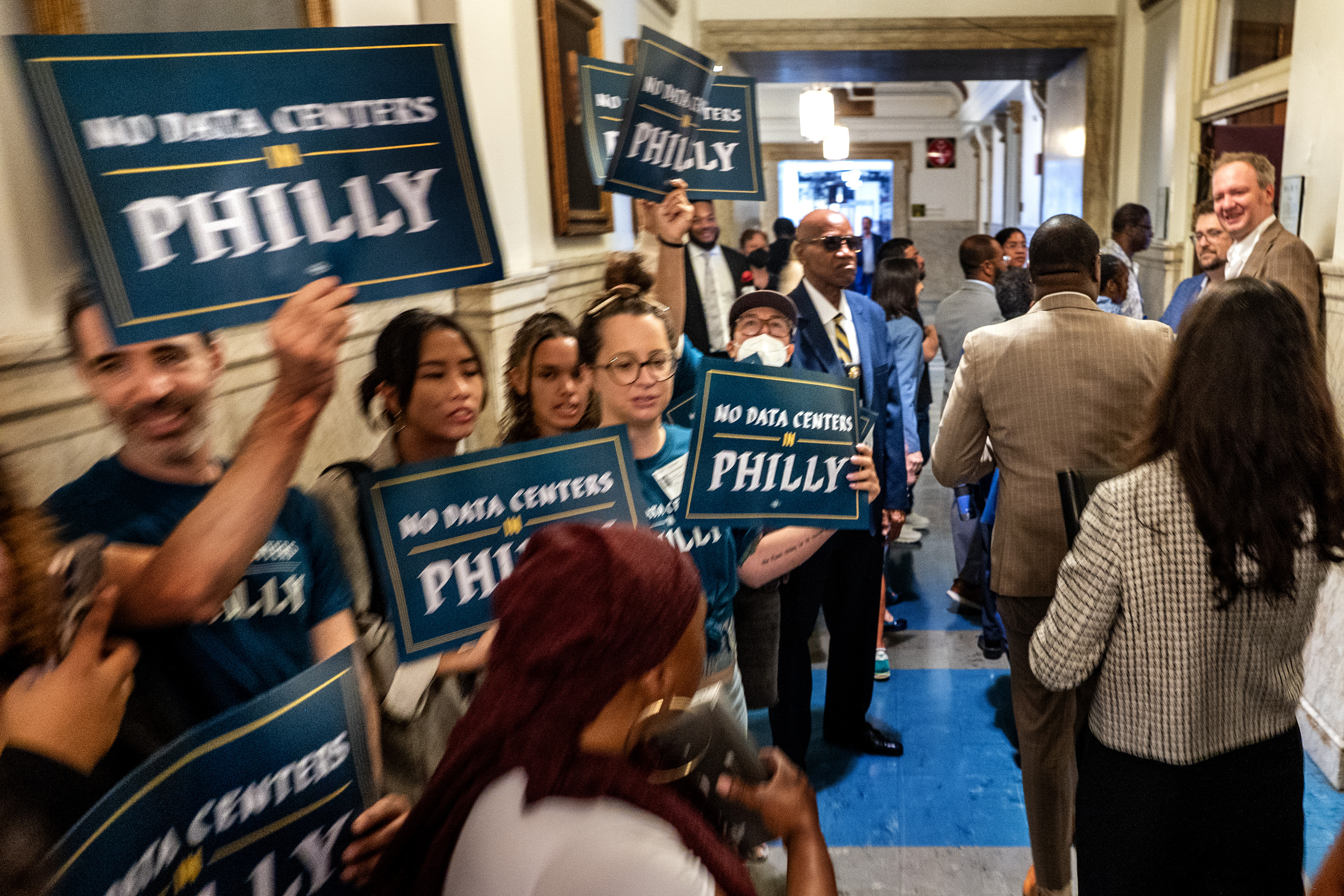
    The mayor’s move came just two days after dozens of activists held a rally outside City Hall calling on Parker and members of Council to pass a multiyear moratorium on the construction of data centers in Philadelphia. They vowed to make data centers an electoral issue ahead of the May primary election, when the mayor and every Council member will be on the ballot.

    The group, called No Data Centers in Philly, said in a statement Wednesday that Parker giving the task force until June to make its recommendations is too little, too late, and that “a task force does nothing to protect us now and takes time that we don’t have.”

    “Across the country, data centers have relied on dirty deals to get built, with NDAs, backroom negotiations, and massive tax handouts,” the statement read. “We can’t let that happen here. The communities who will see their health, homes, and wallets hurt by a data center need to be at the table.”

    President Kenyatta Johnson (right) is greeted by data center protesters in the hall while he heads toward City Council chambers Thursday, Sept. 17, 2026, as the body returns for start of its fall session.Tom Gralish / Staff Photographer

    Parker’s order also comes as talks of regulating artificial intelligence have gripped Washington after a handful of tech executives called for a global slowdown on the advancing technology. There has been bipartisan backlash across the country to the data centers that power AI; however, President Donald Trump has said the industry does not need new regulations.

    Last month, Gov. Josh Shapiro signed an executive order that effectively placed limits on data center construction in the state and required that the projects receive local backing before obtaining a state permit. It would also ban state agencies from using nondisclosure agreements.

    In Philadelphia, no member of City Council has said publicly that they would introduce legislation to place a moratorium on data center construction. Lawmakers are not currently considering any specific proposal to construct a data center.

    This summer, the city’s planning commission issued a report indicating that there are just two plots of land in Philadelphia that could accommodate a hyperscale data center: the former South Philly refinery site known as the Bellwether District and 2600 Grant Ave., a city-owned plot adjacent to Northeast Philadelphia Airport.

    However, building a data center in either of those locations would face hurdles.

    District Council members wield enormous power over land-use decisions in their districts, and the Council members who represent the two potential locations said they oppose a hyperscale data center in their jurisdictions.

    City Councilmember Mike Driscoll, a Democrat who represents the district where the Grant Avenue site is located, said in an interview Thursday that he “is a no, until we really figure this whole thing out.” He said he is concerned that a data center could drive higher utility bills for his constituents.

    “I think we have to participate to be competitive in the global economy,” he said. “But it’s ripe for some problems, and I think we have to sort that out at the federal level.”

    And Council President Kenyatta Johnson, who represents the area where the Bellwether district is located, said Thursday: “We don’t support any type of hyperscale data centers.” He cited concerns about environmental impacts and noise.

    “I haven’t gotten to the point that it should be a moratorium,” Johnson said. “But we are looking at regulations.”

    Bellwether district leaders have said no data center is currently in the works there.

    Mia Fioravanti, senior vice president of corporate affairs for the HRP Group/The Bellwether District, said earlier this week at the Economy League of Greater Philadelphia PAGE Real Estate and Construction Summit that there are no “data center users in our current project pipeline.”

  • Violence toward journalists is a symptom of a terminally ill U.S. democracy

    Violence toward journalists is a symptom of a terminally ill U.S. democracy

    Some days it’s hard to know what’s worse for America: the wars Donald Trump is losing — most notably in Iran, as U.S. motorists pay painful reparations at the gas pump — or the ones he’s winning, like his onslaught against a free press.

    This February will mark 10 years since the president first declared that journalists are “the enemy of the people,” and he has spent much of the last decade making good on his threat — in constant lawsuits, in wielding federal licensing power like a nightstick, in criminal investigations, and in verbal assaults on journalists that have escalated to lunging.

    Americans are sadly used to such appalling behavior at the White House, but what’s much more alarming is the countless ways hostility, contempt, and Trump-flavored threats to a free press have filtered down to town halls, college campuses, the football field, or other mileposts of Main Street USA.

    One glaring example: Tensions between student journalists asking the right questions about labor disputes and other problems at Southern Illinois University at Edwardsville (SIUE) and the school administration escalated to the point where officials demanded to sit in and monitor interviews by reporters for the Alestle. When the paper’s editor complained in an email, a top university official called the cops and triggered a university police investigation. SIUE’s Nicole Franklin had reported that a journalist questioning school policy “has become an unsafe environment for me.”

    Another: A bad on-the-field encounter between ESPN sideline reporter Holly Rowe and Texas football coach Steve Sarkisian was made much, much worse when a) some knucklehead on social media used AI to alter the footage to end with the Longhorns’ coach slapping Rowe, and b) their highly touted quarterback Arch Manning told a news conference he found the video “hilarious,” prompting laughter.

    The fact that Manning later apologized for the incident, and that the Edwardsville cop who had to go out and interview Alestle editor Dylan Hembrough was embarrassed by the probe, only means that respect for the First Amendment and the humans struggling to uphold it 235 years later is hanging by a thread.

    The stinking fish at the head of all this — Trump — hasn’t physically attacked a White House reporter … yet. But he sure came close last weekend, lunging at ABC News’ Rachel Scott as she tried to ask the president about his harebrained scheme to send every American a $5,000 check, wagging his finger and screaming, “Not you!”

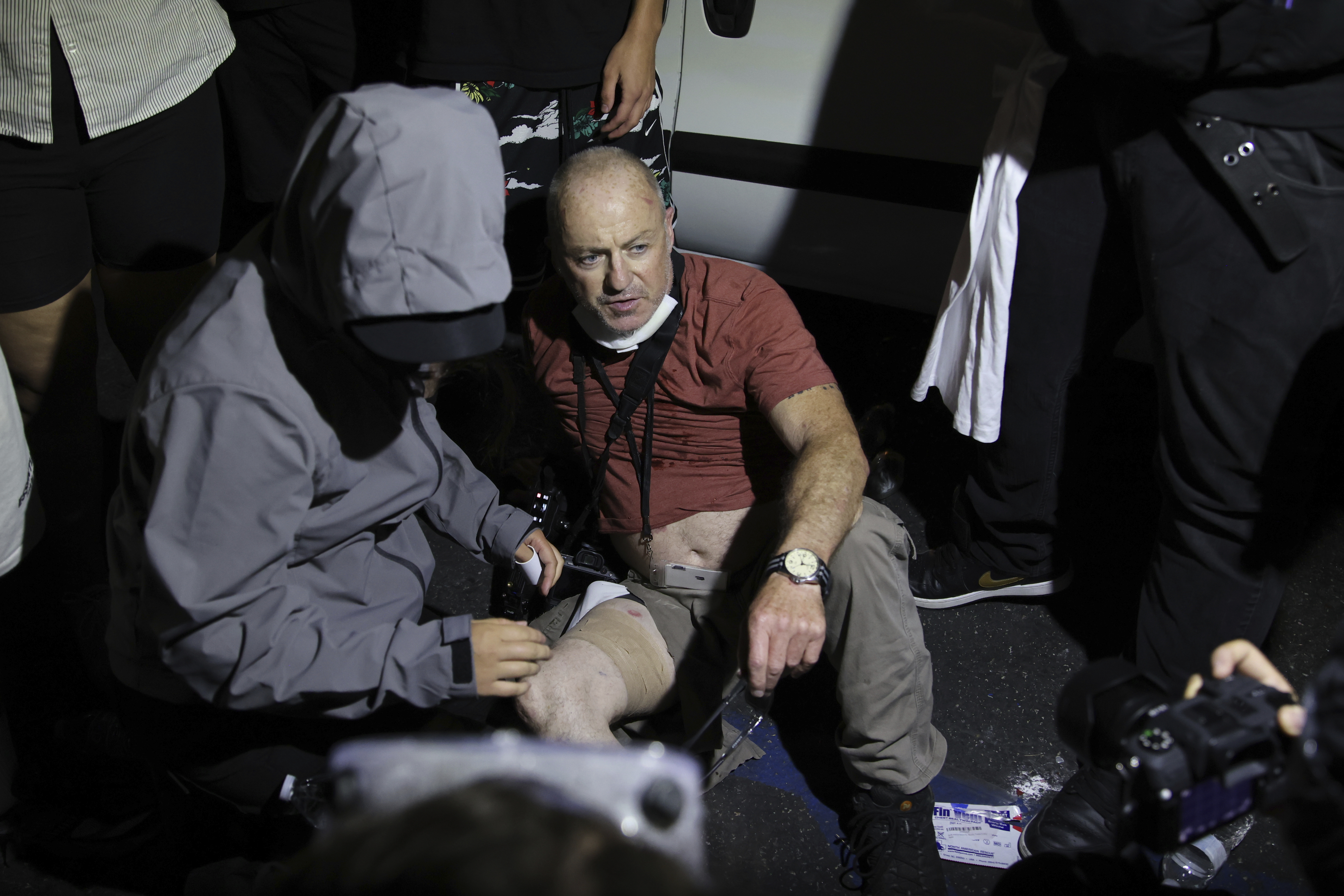
    But out in the American streets, actual violence — as well as unconstitutional arrests and other restraints — is happening on a routine basis. During Trump’s first year back in office, 2025, the Freedom of the Press Foundation found a massive upsurge in assaults on journalists. It said the 170 incidents were roughly equal to the prior three years combined. The attackers ranged from federal immigration agents to riot cops under the control of big-city Democratic mayors.

    But things were deteriorating well before Trump became the 47th president on Jan. 20, 2025. The year before, a survey of working U.S. journalists by the International Women’s Media Foundation revealed that 36% have experienced either physical threats or actual violence.

    I’m publishing this piece on Constitution Day, and a nation that has long touted the guarantees of its then-landmark 1791 First Amendment as proof of American exceptionalism ought to be ashamed that our current press freedom ranking from Reporters Without Borders has plunged to 64th out of 180 nations, the lowest ever.

    But I’m also writing this column now because a) I’m terrified that the climate in which everyone laughs at AI videos of a journalist getting slapped is the prelude to somebody getting killed in the real world, and b) I, and it’s safe to say most of my colleagues, feel an increasing climate of contempt toward just the day-to-day stuff of answering a reporter’s questions or providing basic information about how our government is spending our tax dollars or policing our streets.

    I’ve been a full-time journalist for 45 years now — a half century if you throw in high school and college — and the changes I’ve witnessed over the course of a lifetime have been remarkable, epitomized by the evolution from phone books that listed almost everyone’s number to call-screening and spam filters that make it virtually impossible to connect with people and tell their stories.

    When they threw me onto the night shift at the Washington (Pa.) Observer-Reporter in September 1981, the job consisted of calling hospital emergency room nurses who’d happily volunteer the names and conditions of that night’s car-crash victims, and then police desk sergeants who’d chit-chat and tell you about any major crimes.

    It’s good, actually, that HIPAA was enacted and medical information can’t be volunteered to the public, but it’s bad that police departments — whose track record for honesty runs neck-and-neck with the current administration in the White House — now dole out as little information as possible through stage-managed press releases.

    I thought a lot about those hazy days as a rookie reporter out in Western Pennsylvania this summer, as I tried to report on local police cooperation with federal immigration agents on this side of the state. Police chiefs and township officials batted 1.000 when it came to not returning phone calls or emails. In person, they insisted the federal government told them not to divulge how much of their taxpayer-funded time is spent on busting immigrants instead of protecting neighborhoods.

    Whatever your personal opinion toward journalists, the arrogant and autocratic stance of today’s public officials is spreading to what they think of you, the everyday citizen, and your right to know. This was summed up this week by the police chief of Pitcairn, Pa., who, after listening to public complaints that his 287(g) cooperation pact with U.S. Immigration and Customs Enforcement was reached without a council hearing or vote, said, “I’ve been listening to this crap all night.”

    A couple of important points: Like so many of my colleagues, I’ve felt the growing threats firsthand, from various efforts on social media to map where I live or describe my house, to the time someone drew a bullet hole on a sheet of paper and mailed it to my home.

    But, as a white man, I know things are many, many times worse for my friends and colleagues who are Black or brown or women or in the LGBTQ+ community.

    It’s no accident that the worst invective gets slung toward a female sideline reporter like Rowe, or that Trump goes out of his way to abuse Black female journalists like ABC’s Scott. It’s impossible to draw the boundaries between media hatred and the racism and misogyny that fuel American fascism. That is also clear in the Trump regime’s unconscionable targeting of on-the-ground journalists from immigrant communities like Nicaraguan exile Luis Galeano, detained this week by ICE in Florida.

    It’s all connected.

    Second, my love for journalism and the role we must play in a healthy democracy is exactly why I also believe the media deserves tough scrutiny for the many times we get it wrong. (And I have my receipts from CNN, the New York Times, the Washington Post, etc., etc.) The back-and-forth of media criticism is also the mark of a healthy society in every way that anti-media violence and government officials’ contempt for your right to know are not.

    We can acknowledge that we live in a world where our privacy is under constant assault and needs to be protected — yet also believe, at the same time, that there’s no excuse for government officials or police to hide information that needs to be in the public domain, such as whom they’re arresting and why.

    That requires a vibe shift from all of us — whether it’s not laughing at a video of a female journalist getting slapped, or not dialing 911 when a journalist asks a well-intended question. It means privileged white reporters need to object and walk out of the room the next time Trump verbally assaults a Black female reporter.

    But that also means we need to be as vocal in praising the times journalists get it right — ProPublica’s scoop about Vladimir Putin’s pal paying for the president’s son’s wedding springs to mind — as we are in carping at the many peccadillos of elite media.

    What’s scary is that all of this is happening at a time when vulture capitalists are cutting news organizations to the bone, especially in rural and small-town news deserts. The fewer working journalists that are left, the easier it will be to crush what remains.

    That’s why I was so taken by what a Lexington, Ky., City Council member, Emma Curtis, just said about destructive layoffs at her local paper by the corporate pooh-bahs at McClatchy.

    “All of us who sit up here have been held accountable at one point or another by the Herald Leader,” she said. “Not everything that they have ever written about me is stuff that I’ve liked, but our community is better for it. We are smarter, more informed citizens because of it.”

    I wish more of our leaders — and heck, more regular folks — would talk about this more often. Any attack on a journalist — whether it’s physical or verbal, or some ridiculous AI video posted on X, and whether it comes from the president of the United States or a college quarterback — is ultimately an attack on our sick, barely breathing democracy.