Tag: Donald Trump

  • Trump administration sues Philadelphia over ‘ICE Out’ face mask ban for law enforcement

    Trump administration sues Philadelphia over ‘ICE Out’ face mask ban for law enforcement

    President Donald Trump’s administration sued Philadelphia and some of its top officials Thursday over a new ordinance that bars law enforcement officers from concealing their identities and effectively bans federal immigration agents from wearing masks.

    The law, part of City Council’s recently adopted “ICE Out” package of legislation imposing some of the nation’s toughest local restrictions on immigration agents, is “blatantly unconstitutional,” the lawsuit said.

    “Such an ordinance also undermines the principles of federalism that underlie our entire constitutional order by seeking to prevent effective federal law enforcement within Philadelphia,” according to the complaint.

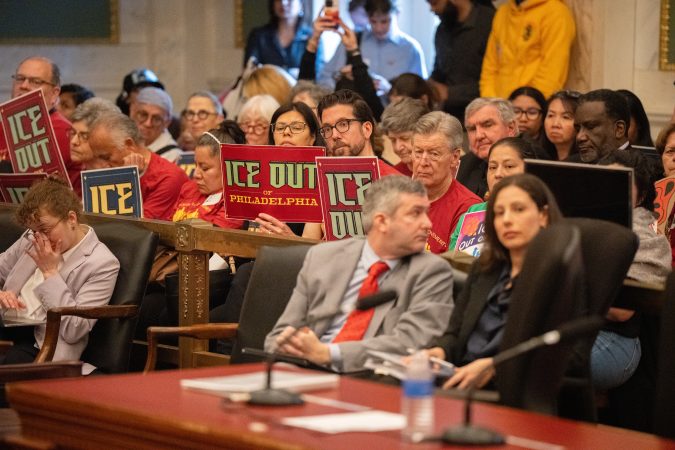
    The ordinance makes it a crime for any law enforcement officer, including Immigration and Customs Enforcement agents, to wear face coverings or conceal personal identifiers like badges and nameplates while carrying out their official duties in the city, and it requires officers to identify themselves. It also prohibits the use of unmarked vehicles.

    The bill includes exceptions allowing officers to wear masks in certain circumstances, such as medical emergencies or SWAT operations.

    An officer who violates the ordinance could be prosecuted, and risks up to 90 days in jail plus a fine.

    The suit, filed in the Eastern District of Pennsylvania, names as defendants the city, Mayor Cherelle L. Parker, District Attorney Larry Krasner, and City Solicitor Renee Garcia. It asks a federal judge to find the bills unconstitutional, warning that federal agents could suffer irreparable harm if the policy remains in place.

    “Protecting officers’ personal identities is particularly important during high-risk enforcement operations involving individuals with violent criminal history, gang affiliations, transnational criminal organizations, and known or suspected terrorists,” the suit says.

    The lawsuit marks the Trump administration’s most significant action targeting Philadelphia’s immigrant-friendly policies to date.

    “Today we regrettably had to sue the birthplace of this great Nation,” Associate Attorney General Stanley Woodward said in a statement. “But we will not sit by while Philadelphia flagrantly violates our Constitution, seeking to criminally punish our Nation’s law enforcement heroes merely for doing their job.”

    Philadelphia has long been known as a sanctuary city primarily because it does not comply with ICE-issued detainers, in which federal agents ask local jails to facilitate the arrest of undocumented immigrants in their custody.

    But Parker has largely avoided direct confrontation with the White House over the issue, a reversal from the combative stance of her predecessor, former Mayor Jim Kenney.

    Parker’s supporters credit her with careful, crafty management of the city’s relationship with Trump, noting Philadelphia has been spared from the surges of federal agents the president has sent to other cities. But immigration advocates say Parker has backed away from a fight at a time when strong action is most needed.

    The tension surfaced when Parker decided to let the mask bill became law without her signature, after Garcia warned the mayor that the provisions might not be legally enforceable.

    Council members, however, wanted to take a more proactive stance against Trump’s nationwide deportation campaign. And they seem to have gotten his attention.

    Councilmember Kendra Brooks, who coauthored the “ICE Out” package, said she “will not back down from this fight.”

    “Philadelphia doesn’t like bullies. And we certainly don’t like masked PPD officers or ICE agents terrorizing our neighbors,” Brooks said in a statement. “The people of this city expected our leaders to fight back against Trump’s invasion. That’s what we did when we passed ICE Out.”

    Brooks noted that the lawsuit cites the Parker administration’s publicly aired concerns about the bill, and said other jurisdictions targeted by Trump after they passed legislation restraining ICE have not had to deal with that dynamic.

    “Other lawsuits aren’t dealing with the City’s own words about the laws being used against them,” Brooks said.

    The Parker administration declined to comment.

    The Pennsylvania Immigration Coalition condemned the lawsuit as a political effort to undermine local policies that keep families safe, strengthen public trust, and ensure city resources serve Philadelphians.

    “Once again the Trump administration is using the courts to wage a political campaign against immigrant communities, instead of addressing the real needs of our country,” coalition executive director Jasmine Rivera said in a statement. “Pennsylvanians have been clear, they do not want more immigration enforcement and detention centers, they want affordable education, healthcare, and housing.”

    Councilmember Rue Landau, the legislation’s other coauthor, criticized Trump for “targeting Philadelphia because our city dared to stand up and say that masked federal agents should not be able to operate in our communities and target our vulnerable neighbors without accountability.”

    ‘We will arrest you’

    In addition to banning officers from concealing their identities, the “ICE Out” package, which in April passed Council with a veto-proof supermajority, prohibits federal immigration agencies from staging raids on city-owned property, bans discrimination on the basis of citizenship status, and prohibits the city from engaging in most forms of information-sharing with ICE.

    The legislation also codified some of Philadelphia’s long-standing sanctuary city policies that had been established only through executive order — most notably a ban on city jails honoring ICE detainers not accompanied by judicial warrants.

    Parker signed six of the seven bills in May, and allowed the ban on agents hiding their identities to become law without her signature.

    Parker did not sign the bill after Garcia expressed concern about the ban’s “significant legal and operational challenges,” the suit notes. The mayor’s signature would signal the Parker administration’s intent to enforce the requirement, the solicitor said, and would send an inaccurate signal that the prohibition was enforceable.

    While Parker might have attempted to distance herself from the requirement by not signing the bill, the lawsuit quotes Krasner threatening federal agents with prosecution.

    “We will arrest you. We will put handcuffs on you. We will close those cuffs. We will put you in a cell,” Krasner said in January. “We will do everything in our power to convict you and we will make sure you serve your entire sentence because Donald Trump has no power whatsoever to pardon you.”
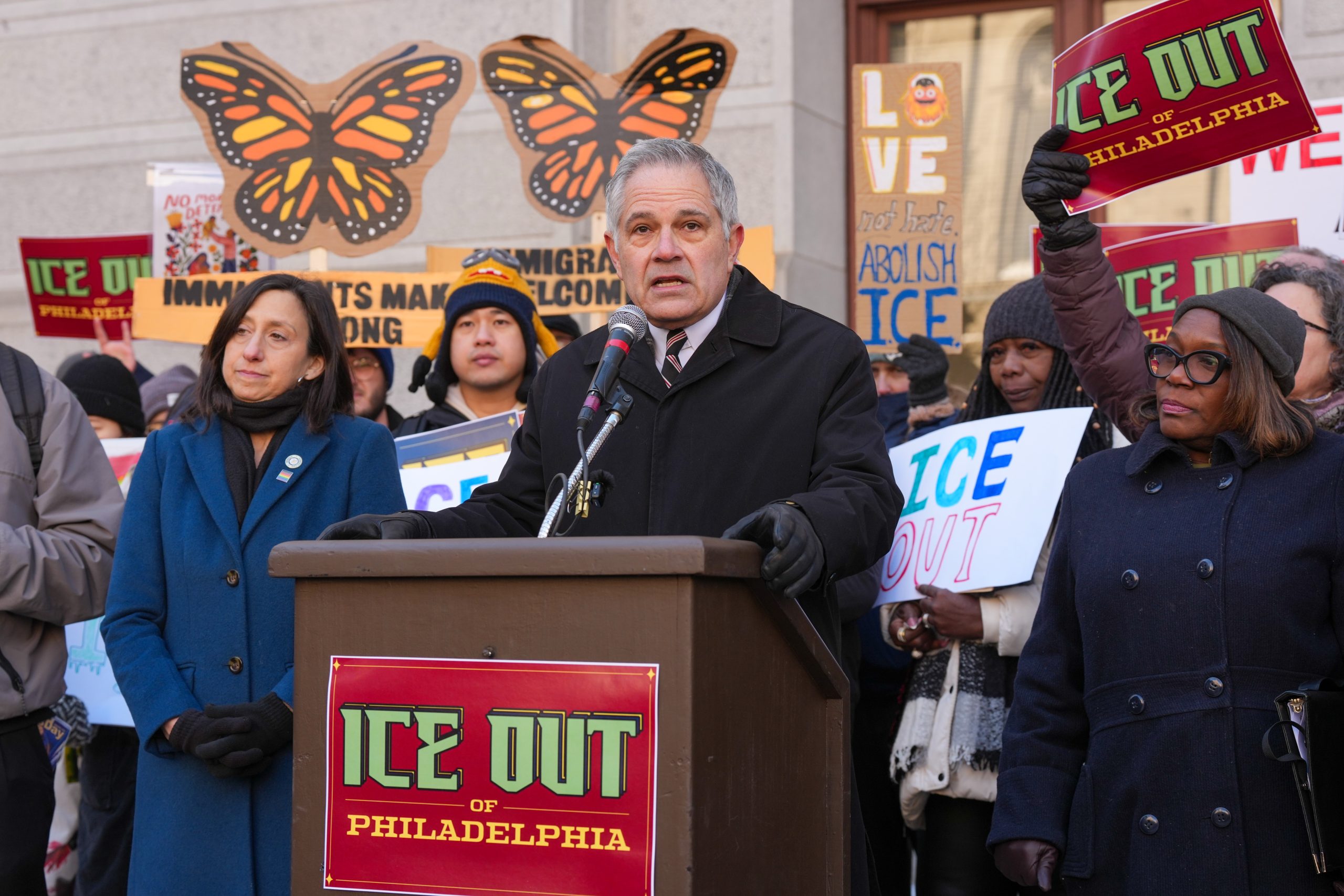
    Larry Krasner shown here during a press conference at City Hall to announce a package of bills aimed at pushing back against ICE enforcement in Philadelphia, January 27, 2026.Jessica Griffin / Staff Photographer

    Philly case could have national stakes

    The complaint makes clear that by bringing this lawsuit, the Department of Justice is not closing the door on challenges to other ICE Out ordinances.

    Around the country, more and more Democratic-led communities are attempting to regulate what ICE can and cannot do within their jurisdictions. And doing so with the support of immigrant communities.

    “In all the ways that ICE agents terrorize and violate the rights of our community, masked kidnappings are ones we consistently see and hear about,” said Erika Guadalupe Núñez, executive director of Juntos, the South- Philadelphia-based immigrant advocacy organization.

    She said, however, that “we’re part of a strong local movement organized to fight back, and we all embody the spirit of this city, we will not back down easily.”

    In March, the Montgomery County Board of Commissioners passed a resolution that restricted the agency from using county property or resources for civil investigations.

    Issues around masks and identification have been particularly contentious.

    Activists in Philadelphia and elsewhere say ICE arrests often look like kidnappings or muggings, where men in ordinary clothes, with no visible identification, suddenly descend on their target. The people being arrested may think they are being attacked by criminals.

    Several states, including New Jersey and New York, have passed laws to ban law enforcement officers, including ICE, from wearing facial coverings while on duty.

    In April, the U.S. Court of Appeals for the Ninth Circuit upheld a lower court’s injunction on a California law that required federal agents to “visibly display identification.” The unanimous three-judge panel ruled that the requirement violated the Constitution’s supremacy clause, which bars the states from regulating federal government activities.

    New Jersey Gov. Mikie Sherrill signed bills in March that essentially banned ICE agents and police from wearing masks on the job, drawing pushback from Republican lawmakers. The Trump administration sued New Jersey in federal court in April, and the New Jersey Monitor and others reported that ICE agents continued to cover their faces during recent clashes with demonstrators outside the Delaney Hall immigrant detention center in Newark.

    The Trump administration says federal immigration officers wear face coverings to protect themselves and their families from anti-ICE activists who may seek to identify and harm them. Assaults and death threats are on the rise, the administration said.
  • Trump administration can install its own slavery exhibits at President’s House, Third Circuit rules

    Trump administration can install its own slavery exhibits at President’s House, Third Circuit rules

    President Donald Trump’s administration can replace the slavery exhibits it removed in January from George Washington’s Philadelphia residence, a federal appeals court ruled Thursday.

    A three-judge panel of the U.S. Court of Appeals for the Third Circuit unanimously agreed to toss out an injunction issued by a Philadelphia district court judge in February that ordered the National Park Service to restore interpretive panels telling the history of the nine individuals who were enslaved by Washington at the President’s House Site.

    The city does not have a right to dictate the content of the panels, the court found.

    The judges further found that the federal government’s proposed replacement panels, which historians say whitewash Washington’s role in slavery, “are full of historical context.”

    The proposed panels “highlight the momentous events that took place in the President’s House and the other sites at Independence National Historical Park,” Judge Thomas M. Hardiman, a President George W. Bush appointee, wrote in the opinion. “They acknowledge the evil of slavery, including its injustices and hypocrisies, and, by telling the story of the nine slaves that Washington kept in the President’s House, remind us of their essential humanity.”

    Judges Luis F. Restrepo, appointed by President Barack Obama, and Peter J. Phipps, appointed by Trump, joined the opinion.

    It was not immediately clear what would happen next at the site. The federal government did not immediately outline its next steps, and there are conflicting court rulings over the Trump administration’s push to remove displays from national parks that “inappropriately disparage Americans past or living.”

    But the ruling does bring to a close a chapter in the President’s House litigation, the first courtroom clash between Trump and Mayor Cherelle L. Parker’s administration. Any further review of the injunction is at the discretion of the three judges, the full Third Circuit, or the Supreme Court and is not guaranteed.

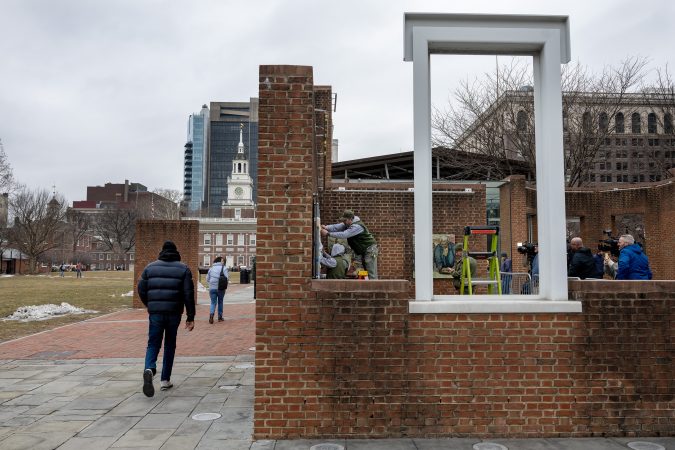
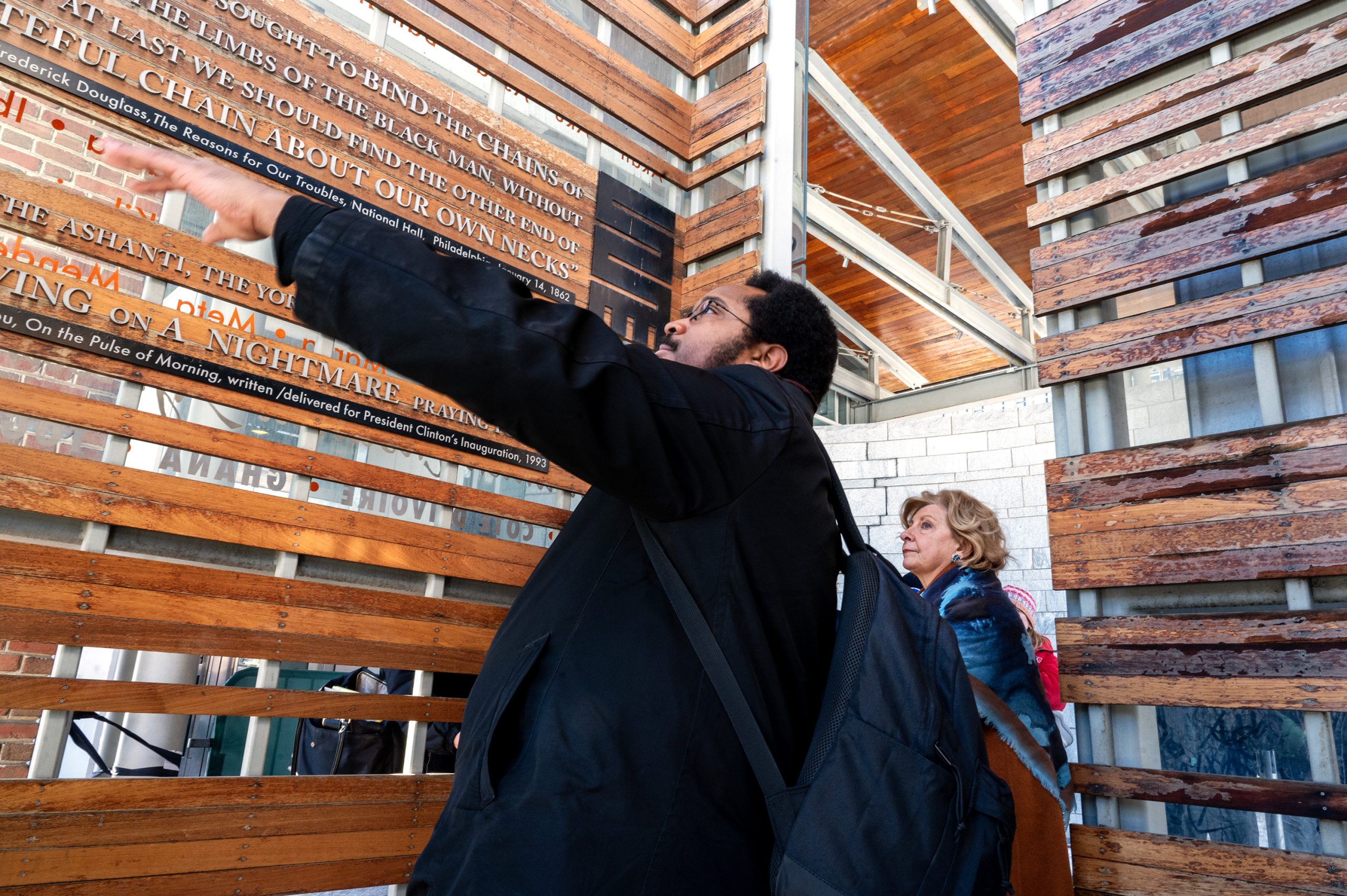
    Mijuel Johnson, a guide with The Black Journey: African-American Walking Tour of Philadelphia, leads District Court Judge Cynthia Rufe (right) as she visits the President’s House in Independence National Historical Park in February.Tom Gralish / Staff Photographer

    The city was unable to convince the Third Circuit panel it has joint decision-making power with the federal government over the entirety of Independence National Historical Park because of the local ownership of Independence Hall.

    Philadelphia has standing to argue in court that the federal government violated the contract signed when the city donated the President’s House to the National Park Service, Hardiman wrote. The agreement included a guarantee the federal agency would maintain the site.

    But the city had to prove it could win based on that argument to keep the injunction alive, and the judges disagreed.

    “The duty to ‘maintain’ is better understood as a general management obligation that accompanies ownership, not a promise that the exhibits will forever remain in place regardless of the owner’s wishes,” the opinion said.

    The city’s claim that the removal was “arbitrary and capricious” under the Administrative Procedure Act also did not find purchase. The federal law allows challenges only to “final” agency actions, but the newly proposed panels show the January removal was not the Trump administration’s “last word on the matter,” the opinion said.

    The ruling vacates U.S. District Judge Cynthia M. Rufe’s injunction from February that ordered the full restoration of the site to its state before exhibits were removed. The National Park Service restored some exhibits, but some metal interpretive panels could not be reinstalled because they required fixes.

    Avenging the Ancestors Coalition, one of the advocacy groups leading efforts to protect the President’s House, said in a statement that the group was disappointed by the decision but would persevere. The coalition was consulting its legal team to consider potential next steps.

    “This is definitely not the end of this fight, nor does it diminish the importance of ensuring that the full truth of our nation’s history is preserved and presented accurately,” the organization said.

    In a video statement Thursday, Parker said, “I will pursue every legal action possible in efforts to reverse this decision.”

    A spokesperson for the U.S. Department of the Interior simply said: “Trust in Trump.”

    Debate over history

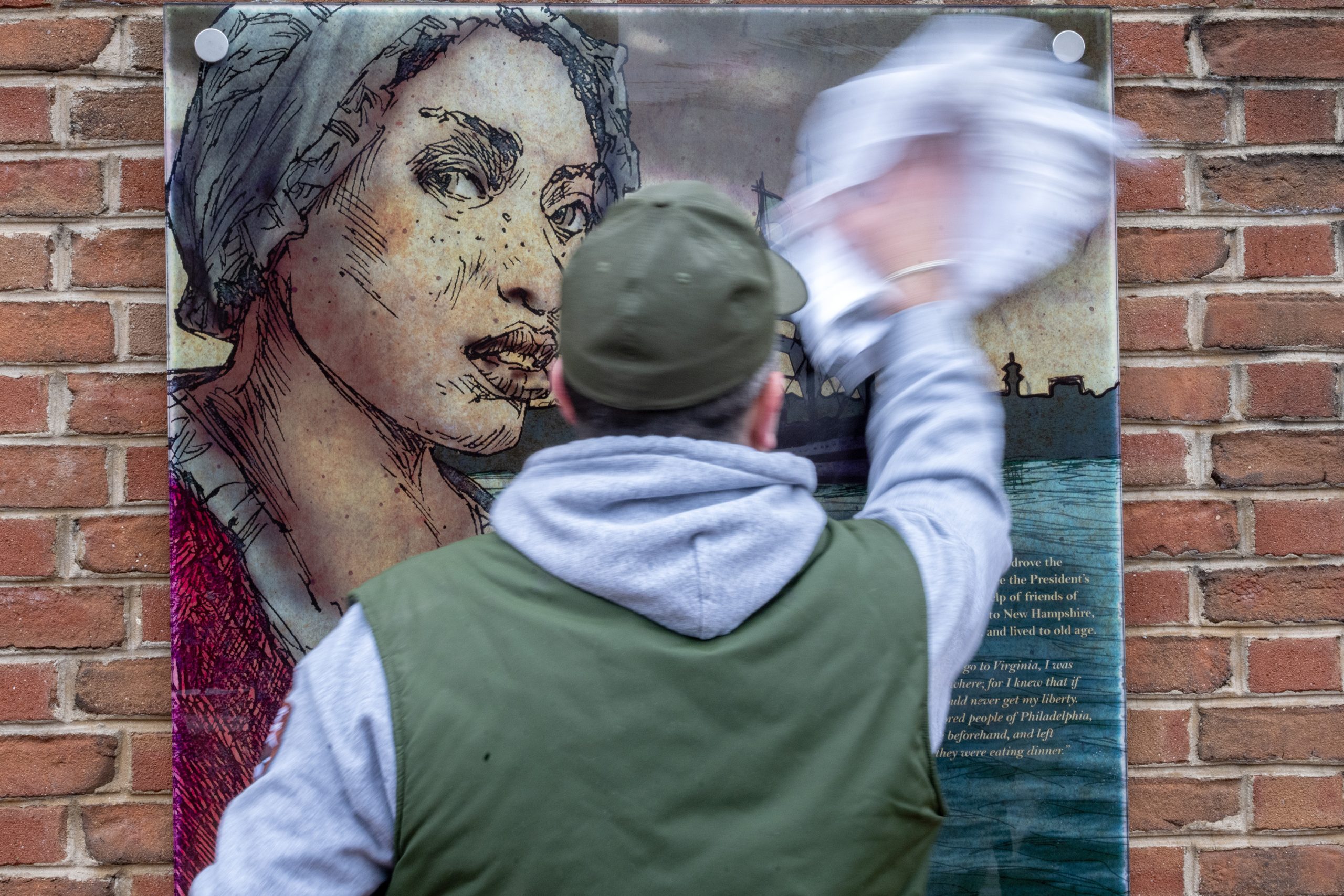
    A worker cleans the glass on the panel for Oney Judge after re-hanging it at the President’s House in Independence National Historical Park in February.Tom Gralish / Staff Photographer

    The ruling is an inflection point in the tumultuous legal saga over whether the federal government has power to determine which version of U.S. history is displayed for public viewing — an issue even more salient ahead of the country’s 250th birthday on July Fourth.

    The Trump administration ordered the removal of the President’s House exhibits in January after almost a year of scrutiny of the site. Months later, the government offered its own vision for how those panels would be replaced, quietly uploading them to the National Park Service website in April.

    An Inquirer review of the panels found that the federal government had softened Washington’s role as an enslaver.

    For instance, one proposed panel argues the people who were enslaved at the President’s House “experienced a greater modicum of autonomy than elsewhere in the South such as to explore the city and sometimes even attend the theater, with Washington buying the tickets.”

    Historians argued the original panels were accurate, well-researched, and site-specific. The development of the site in the early 2000s was the product of collaboration across various disciplines including historians, artists, architects, and advocates.

    But Thursday’s ruling says the Trump administration’s proposed displays offer a nuanced view on Washington’s and John Adams’ roles in or opinions on slavery, adequately highlight the stories of the nine people enslaved at the President’s House, thoroughly acknowledge the horrors and brutality of slavery, and uplift key figures in Black history.

    “One panel … explains that Washington ‘often expressed discomfort with the institution and a desire to see it abolished,’ but, ‘as a Virginia plantation owner, his wealth and livelihood were deeply tied to it,’“ Hardiman wrote. ”Other panels provide an even broader overview of slavery and the struggle to extirpate it.”

    The ruling landed just less than three weeks before the 250th anniversary celebrations, and one day before Juneteenth. Attorneys for the federal government said the new panels had been manufactured and were ready to be installed.

    U.S. Rep. Brendan Boyle (D., Philadelphia), whose district includes Independence Park, said in a statement that Thursday’s ruling highlighted the urgency of passing his Protecting American History Act, which would shield historical displays at the park from government censorship.

    “Just a block away from where our nation was founded, Donald Trump is choosing the path of tyrants who rewrite history instead of learning from it,” Boyle said. “As we approach America’s 250th anniversary, we must tell the full truth of our nation’s history — the good and the bad.”

    Another legal case

    Last week, U.S. District Judge Angel Kelley in Massachusetts ordered the Trump administration to restore all exhibits it had removed as part of its “restoring truth and sanity to American history” push. Following the Third Circuit ruling, the appointee of President Joe Biden rejected a Justice Department request for a stay on the order, saying other circuits’ rulings were not binding on her.

    The administration has appealed to the U.S. Court of Appeals for the First Circuit.

    There is not a prescriptive way to resolve such conflicting rulings, which is why some legal scholars argue against so-called universal injunctions, in which one district judge’s ruling affects the entire country. The Supreme Court signaled its discomfort with those types of orders last year.

    Conflicting rulings have become more prevalent during Trump’s tenure, as his administration has issued drastic measures that take immediate effect, said Michael Foreman, a professor at Penn State Dickinson Law.

    Which order ends up prevailing will depend on whether the Massachusetts ruling is stayed, or if the issue escalates to the Supreme Court.

  • Sen. Andy Kim has ‘no confidence in any aspect’ of Trump’s deal to end war in Iran

    Sen. Andy Kim has ‘no confidence in any aspect’ of Trump’s deal to end war in Iran

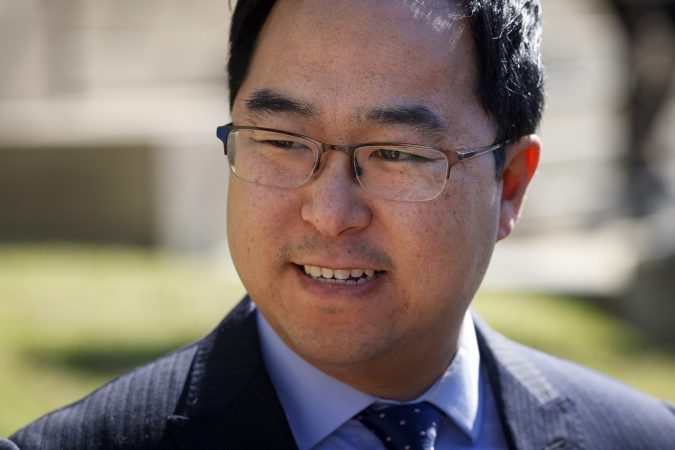
    WASHINGTON — As lawmakers on Capitol Hill grapple with President Donald Trump’s deal to end the war in Iran, the New Jersey Democrat who spent years weighing national security issues in the Middle East described the agreement as a “mind-boggling” move that will have damaging reverberations across the globe.

    “It’s like setting your own house on fire, a good chunk of it burning. You put it out. And then you start clapping, celebrating yourself. That’s what Trump is like right now,” U.S. Sen. Andy Kim, the only career diplomat in the Senate, said of the memorandum Trump signed Wednesday night.

    Democrats representing the Philadelphia region on Thursday blasted the terms outlining the end of a conflict that many of them repeatedly described as a strategic failure from the start.

    Some prominent Republicans echoed those concerns — criticizing Trump’s removal of U.S. sanctions on Iran and his promise to help pull together a $300 billion fund to rebuild the country’s infrastructure after months of bombings — while Pennsylvania lawmakers who supported the war, like U.S. Sens. Dave McCormick (R., Pa.) and John Fetterman (D., Pa.), remained silent or defended Trump.

    “Reagan is rolling over in his grave,” U.S. Sen. Bill Cassidy, a Louisiana Republican, wrote on social media.

    Kim, who worked at the National Security Council under President Barack Obama and spent time as a civilian adviser in Afghanistan, said it was difficult to imagine what will happen next.

    He said the Trump administration had lost all forms of leverage by agreeing to end hostilities, reopen the Strait of Hormuz, and provide financial benefits to Iran without securing any new or firm commitments around the country’s nuclear program. Though the countries vowed to continue negotiating over the next 60 days, Kim said, Iran will already be in a “position of strength” with the financial relief and thus have little incentive to follow through on its pledge not to pursue a nuclear weapon, which was the primary justification for the war by Trump and his allies.

    “I have no confidence in any aspect of this,” Kim said in an interview.

    Kim said he feared not just prolonged issues between the U.S. and Iran — issues that look almost the same as before the war began — but “reverberations everywhere” as the administration signals how it would handle other foreign conflicts, like Russian President Vladimir Putin’s aggressions in Ukraine or Chinese President Xi Jinping’s moves toward Taiwan.

    “We’re just at such a weak point now. We’re still strong enough that we can muscle other countries, but they see through it now,” Kim said.

    Trump has continued to project strength, including with threats to resume attacks if Iran does not comply with the peace deal.

    “It’s a memorandum of understanding, and if I don’t like it, we’ll go ​back to shooting at them, dropping bombs on ⁠their head,” Trump said Wednesday.

    McCormick, who served in the Army during the Gulf War and has described the war in Iran as one of the most effective military campaigns in history, did not agree to an interview with The Inquirer on Thursday as other Republican senators like Cassidy and U.S. Sen. Ted Cruz of Texas raised concerns. In multiple television interviews, McCormick said he had “a number of questions” about the memorandum.

    “If it has the two things the president’s talked about, I think we’re in good shape,” McCormick said on Newsmax. “One thing is that there can be no path to a nuclear weapon or not giving up the enriched uranium. … That has to happen for this to be successful. And the second thing was the president’s words that you have to pay for performance. You can’t lift the sanctions or give them real economic relief on the sanctions until they take tangible steps toward eliminating that nuclear capability.”

    A spokesperson for U.S. Rep. Brian Fitzpatrick, a Bucks County Republican who has voted for more congressional oversight of the war but has not criticized its mission, referred to a statement from before the terms were announced this week. Fetterman, the only Senate Democrat who has fervently supported the war, did not respond to a request for comment.

    Democrats representing the Philadelphia area, meanwhile, were quick to call the deal a symbol of a conflict that was entirely a failure.

    “Now, after billions of taxpayer dollars spent and 13 American service members’ lives lost, we are no better off in Iran than we were before the war began,” said U.S. Rep. Chrissy Houlahan of Chester County, an Air Force veteran.

    U.S. Rep. Mary Gay Scanlon of Delaware County said she was hopeful that the agreement was a step toward peace while calling the conflict damaging to the U.S. economy and embarrassing on the global stage.

    “The war did not accomplish any of the administration’s alleged goals, and has instead only strengthened Iran’s strategic ambitions,” she said.

    In a post on social media, U.S. Rep. Brendan Boyle of Philadelphia called it “total humiliation.”

    Public surveys showed the war was never popular with the majority of Americans, and at least one new poll released this week showed Pennsylvania voters were continuing to sour on Trump’s handling of foreign policy.

    About 29% of voters in the state agreed with the president’s approach to foreign policy in the June poll released Thursday by Franklin and Marshall College in Lancaster. That figure was down from 37% prior to the war.

    “This was just really a lose-lose everywhere,” said Kim, who helped lead a roundtable on Capitol Hill this week to highlight the economic impact of the war, like increasing fuel and fertilizer costs due to the shipping decline. “We need to move on. But this is going to have such a negative impact on America for so long, and in so many different ways.”

    Staff writer Michelle Baruchman contributed to this article.

  • The ‘Minneapolis 15’ ICE-protester indictments are meant to shut you up

    In the tumultuous five-plus months since masked federal immigration agents descended on her hometown, the Rev. Jen Crow of the First Universalist Church of Minneapolis has already been arrested at an airport sit-in, organized a vigil after the murder of her neighbor Alex Pretti, and held trainings at her church for volunteer observers.

    So when Crow learned on Tuesday that 15 local activists had been indicted by federal prosecutors on felony conspiracy charges for monitoring and allegedly at times impeding U.S. Immigration and Customs Enforcement and Border Patrol officers, she did the one thing the Donald Trump regime does not want anyone to do.

    She went down to the St. Paul federal courthouse to protest, again. Crow told me by phone Wednesday that everyday Americans who oppose immigration raids can’t surrender to the fear that the Justice Department wants to create by threatening long prison terms.

    “When you see the federal government turning on its own people, the thing is we have to act anyway and just trust in the purpose and trust in what we’re doing and our care for each other, and just really lean into that,” Crow said. “To let the fear wash through, but not get stuck in it.”

    Crow and as many as 200 other Minnesotans chanting “Free them all!” outside the 15 activists’ arraignment on Tuesday were rewarded for their ongoing courage with a blast of chemical irritants from U.S. Marshals, which, according to videos, started with little or no provocation by the outside protesters.

    “Witnesses tell me that what was going on at the time is that they were holding the doors open, so that you could hear the chants inside the building, when suddenly somebody saw folks putting on gas masks inside the courthouse,” local journalist Pilar Pedraza of KSTP-TV reported. “And all of a sudden they came out and started spraying a chemical irritant at them.” Videos showed other protesters hit with pepper spray, with one violently thrown to the ground.

    The indictment of the Minneapolis 15 — a so-called “conspiracy” that included innocuous acts of dissent like discussing ICE activities on the Signal app or publishing an article on a pro-anarchist website — and the chemical assault against citizens exercising their free-speech rights are all the same instinct from a violently repressive government.

    They want you to shut up. They want you to stay in your home. And they want to make you very afraid — five months before an election that they are practically screaming they plan to do everything in their dictatorial powers to steal.

    The good news is that the government’s intimidation campaign is being met with renewed resistance in the Twin Cities — the place where regular folks with whistles and cell phones eventually drove away most of the immigration raiders, albeit at the horrible cost of more than 4,000 immigrant arrests and two citizens gunned down in the street.

    “The only thing I did was care about this, my community and my neighbors,” Natasha Rakotz — one of the Minneapolis 15, a caretaker whom prosecutors accused of sideswiping an immigration agent’s vehicle — told reporters after her arraignment.

    The charges against the Minneapolis 15 — tied to a protest group known as Direct Action Minnesota, or DAMN — is arguably the most aggressive in a flurry of actions by Trump’s Justice Department aimed at convincing the public that the ideology of aggressively fighting fascism, known as “antifa,” is some kind of highly organized terrorist cell along the lines of ISIS or al-Qaeda.

    It’s one more over-the-top lie from a regime that swims in a stinky green algae pool of falsehoods.

    Federal prosecutors have been racing to crayon in the blanks since Trump’s September 2025 executive order that declared “antifa” — again, not an actual group — as a “domestic terrorist organization.” The Minnesota indictments are the most dramatic of a myriad of federal cases from New Jersey to Oregon.

    These prosecutions have run the gamut. In Texas, an actual criminal act that warranted charges — when a protester at an ICE detention site fired a gun — became the impetus for a sweeping dragnet that led to convictions against nine activists. In Spokane, Wash., prosecutors recently gained convictions against three protesters who tried to stop ICE agents from transporting two Venezuelan immigrants, even after an acting U.S. attorney resigned because he believed the charges were unwarranted.

    But other Trump efforts to criminalize dissent have collapsed, almost farcically so — from a jury’s speedy acquittal of the Washington, D.C. man who threw a salami sandwich at an agent, to the implosion of a case against Chicago ICE-detention-center protesters, including congressional candidate Kat Abughazaleh, known as “the Broadview Six.” The former defendants and some members of Congress are calling for an investigation of alleged grand jury misconduct by Chicago U.S. Attorney Andrew Boutros and his underlings to obtain their indictment.

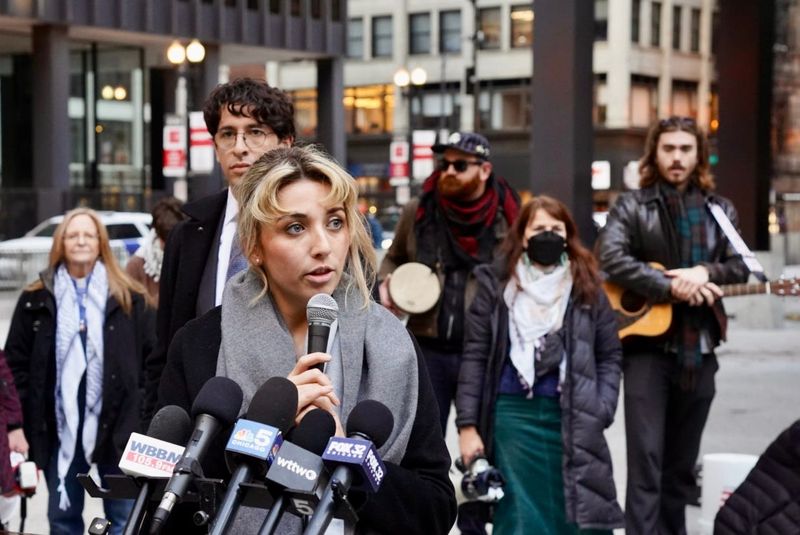
    Democratic Congressional candidate Kat Abughazaleh addresses supporters in downtown Chicago outside the federal courthouse where she pleaded not guilty to charges filed in connection with a protest against the Trump administration’s mass deportation campaign.Michael Loria, USA TODAY

    In Minnesota, U.S. Attorney Daniel Rosen strived on Tuesday to defend the new prosecution as skeptical reporters asked him why felony charges were lodged when not a single agent was hurt, why the urgency of this case when there’s been no prosecution of the agents who shot and killed Pretti or the unarmed motorist Renee Good, and whether the case amounted to what writer George Orwell famously called “thoughtcrime.”

    Rosen insisted that “whether or not they actually, at the end of the day, caused bodily harm is not the measure of whether or not they committed a serious federal crime.”

    Still, the federal case against the Minneapolis 15 contained just a couple of instances of alleged property violence ― the sideswipe and the kicking out of a vehicle’s tail light. Mostly, the indictment describes a lot of activities —like Signal chats, monitoring the movement of immigration agents on public streets, discussing the use of protective gear like shields, or an anarchist’s speaking tour about the protests — that would seem to be constitutionally protected free speech.

    With the enactment of the First Amendment in 1791, America’s founders vowed to protect “the right of the people peaceably to assemble, and to petition the Government for a redress of grievances.” Just days before the nation’s 250th birthday, an authoritarian regime in Washington wants to make this a crime for which you could spend a large chunk of your life in prison.

    “It does look like the government is throwing the book, maybe even over-charging some of the protesters,” Roy Gutterman, director of the Tully Center for Free Speech at Syracuse University, told me yesterday, noting that any act of actual violence wouldn’t be protected by the First Amendment. But he added that “even if some of the charges end up being thrown out, the breadth of the government’s arguments and the weight of the charges certainly send a message to protestors.”

    Exactly. Although the indictments are a living hell for the Minneapolis 15, the real target here is regular American folks like you — citizens who aren’t normally inclined to protest the government, but are starting to wonder what to do as the regime and its 80-year-old and increasingly out-of-touch leader spiral out of control.

    Before you even dare venture out to a church meeting where they pass out whistles and teach you how to warn your neighbors that masked ICE agents are snatching people off the streets, they want to plant seeds of doubt. Am I risking my freedom, and my family, just for posting something in a Signal or WhatsApp chat?

    They want you to be terrified, and on some level you should be afraid, not just of what the government is doing but why they are doing this now. Trump was already nearing record-low approval numbers before this week’s humiliating surrender deal aimed at ending the president’s foolhardy war of choice with Iran. The near inevitability of a Democratic House in 2027 all but guarantees Trump’s next impeachment and two years of political hell to end his 47th presidency.

    Thus, Trump’s desperate determination to interfere in the November election is becoming increasingly clear, with everything from unwarranted meddling by the U.S. Post Office to his insistence that grossly unqualified loyalist Bill Pulte serve as his director of national intelligence, in order to invent foreign election plots.

    Criminalizing dissent isn’t a sideshow. It’s central to the plan. They want to stop you from taking to the streets in massive numbers if and when they take illegal actions to keep the Republican Party in power. They are using these bogus indictments to lay the foundation for the solution that Vice President JD Vance proposed for Minneapolis back in January — to invoke the Insurrection Act and send in tanks.

    The case against the Minneapolis 15 reminds me of the remarkable novel Every Man Dies Alone by the German novelist Hans Fallada, based on the true World War II era heroism of Otto and Elise Hampel, who placed postcards around Berlin criticizing Adolf Hitler and the Nazis for two years before they were arrested and executed by guillotine. Are we now becoming such a totalitarian society?

    Hopefully not, if American citizens like the Rev. Jen Crow continue to speak out.

    “We’re not going anywhere,” she said after the feds’ courthouse chemical attack. “Those of us who care about each other and care about the rule of law and care about following the rules we’ve set out as a society that protect basic human rights, we’re not going anywhere.”

  • New Pa. poll shows Shapiro leading handily against Garrity, trouncing Trump in popularity

    New Pa. poll shows Shapiro leading handily against Garrity, trouncing Trump in popularity

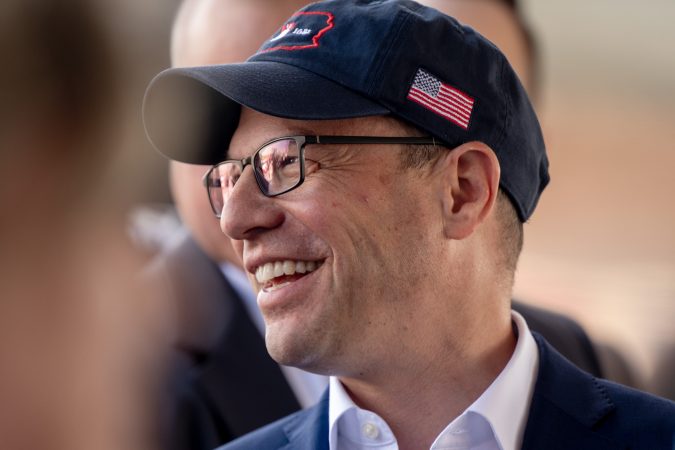
    Democratic Gov. Josh Shapiro has a commanding lead against his Republican rival Stacy Garrity in a head-to-head matchup, and he maintains steady job approval ratings five months ahead of the November election, according to a new poll of Pennsylvania voters from Franklin and Marshall College.

    Shapiro leads Garrity 50% to 28% in the 2026 governor’s race, a crushing advantage well outside of the survey’s margin of error of 5.1 percentage points. It is the first major poll released since both candidates officially secured their parties’ nominations in uncontested primaries last month.

    The survey, conducted June 8-14 by the Center for Opinion Research on behalf of Franklin and Marshall, involved 546 registered Pennsylvania voters. Roughly 42% were Democrats, about the same percentage were Republicans, and about 16% were independents.

    Shapiro won almost half of independents and just over a quarter of Republicans, who rated his performance as excellent or good.

    (function(){function e(){window.addEventListener(`message`,function(e){if(e.data[`datawrapper-height`]!==void 0){var t=document.querySelectorAll(`iframe`);for(var n in e.data[`datawrapper-height`])for(var r=0,i;i=t[r];r++)if(i.contentWindow===e.source){var a=e.data[`datawrapper-height`][n]+`px`;i.style.height=a}}})}e()})();

    About an equal proportion of all voters — 48% — said Shapiro is doing an excellent or good job as governor as those who said he is doing a fair or poor job.

    Shapiro’s approval comes as he continues building a national profile, likely with ambitions for higher office.

    He also boasts relative popularity despite voters’ deep concern with their personal finances and the state of the economy, the top issue among every partisan group.

    “The big concern that people face is economic, and even though that’s the problem that we see facing us, the blame goes outside of Pennsylvania,” said Berwood Yost, the director of the Center for Opinion Research. “People don’t see [Shapiro] as being responsible for the economic concerns that they have.”

    But people do blame President Donald Trump.

    Just 29% of voters said Trump is doing an excellent or good job, while 71% said he is doing a fair or poor job. It marked a 10-percentage-point drop from March, when his positive approval rating was 39%.

    While 63% of Republican voters gave Trump positive reviews in the new poll, that number was almost 80% in March.

    Just under half of respondents said they are “worse off” financially than one year ago, and 35% of voters said the economy, including unemployment, housing and real estate costs, and higher gas and utility prices, is the most important problem facing the state.

    “Pennsylvania should be doing so much better,” Garrity said in a previous interview with The Inquirer. “[Voters] know we’re falling behind. They know that we have a governor who’s more interested in Pennsylvania Avenue than helping Pennsylvania families. They’re very worried about utility prices because their electric bills are going up, up, up. Groceries are expensive.”

    But among those who mention economic problems, voters in the poll trust Democrats over Republicans, 42% to 24%, as the party that can best handle the issue.

    Shapiro’s campaign released a new TV and digital ad Tuesday focusing on his expansion of workforce opportunities, such as apprenticeships in trades like welding.

    “Governor Shapiro bet on workers like me. I’m proof that bet’s paying off,” said Ryan, a worker in Western Pennsylvania, in the ad.

    (function(){function e(){window.addEventListener(`message`,function(e){if(e.data[`datawrapper-height`]!==void 0){var t=document.querySelectorAll(`iframe`);for(var n in e.data[`datawrapper-height`])for(var r=0,i;i=t[r];r++)if(i.contentWindow===e.source){var a=e.data[`datawrapper-height`][n]+`px`;i.style.height=a}}})}e()})();

    Yost said Garrity is a “high-quality candidate” with a great resume that may keep down-ballot Republicans afloat, but she is competing against a popular incumbent in a year where Democrats are poised to win seats.

    “It’s rough to be a Republican at the moment,” he said. “You’re facing those headwinds, no matter what office you’re running.”

    On the economy, the issue voters care most about, a mere 17% of voters approve of how Trump’s administration is handling inflation.

    “The concerns about personal financial circumstances, the economy, and the cost of living — they’re paramount in people’s minds, and they’ve become more pronounced since March,“ Yost said. “That’s had an effect on the president’s job approval ratings in the state, which have declined pretty substantially.”

    In the last four gubernatorial races, the average margin of victory has been about 13 percentage points, Yost said, while presidential races tend to be much tighter — about 2.2 points.

    “What’s essential to understand is that these races happen in a different context than the presidential races. There are a lot of things different about them, and typically incumbent governors have a real advantage,” he said.

    State issues show more consensus

    Many of Shapiro’s budget priorities, such as restricting cell phones in schools and taxing skill games, have widespread public support.

    Almost nine out of 10 people support limiting access to cell phones in classrooms, which follows Shapiro’s urge for legislation to “get distractions out of the classroom and create a healthier environment in our schools.”

    And 71% of registered voters favor regulating and taxing so-called skill games, the slot machine look-alikes around Pennsylvania — an 11-percentage-point increase compared with previous F&M polling in 2024.

    The Pennsylvania Supreme Court ruled Monday the skill games are, in fact, slot machines and should be regulated as such, clearing the way for the state to place new rules on the devices. The decision was celebrated by Democrats who view the machines as “predatory.”

    Most voters, 70%, also support having an independent redistricting commission to draw state legislative districts, and 59% oppose mid-decade redistricting.

    Texas redrew its congressional maps last August at Trump’s urging, shifting five seats to lean more heavily Republican. California voters approved a constitutional amendment in November to permit the adoption of replacement maps that would favor Democrats. Other states have also voluntarily redrawn or created new maps following litigation.

    Shapiro said he also opposes mid-decade redistricting, telling reporters last August: “It’s not on the table here in Pennsylvania.”

    As parties compete for control of the U.S. House of Representatives this midterm election season, the poll found that voters prefer Democrats over Republicans by 12 points, 47% to 35%. Shapiro has personally backed several candidates and is hoping to use his influence to help Democrats win the majority this November.

  • More people in Philly and region struggle with insufficient food after Trump cuts: ‘Hunger has never been higher’

    More people in Philly and region struggle with insufficient food after Trump cuts: ‘Hunger has never been higher’

    Shelly Gaither, 51, of Cheltenham, makes sure her three sons, ages 6, 9, and 18, get their meals while she manages with whatever is left over — if anything ever is.

    “Oh, my God, groceries are too expensive,” said Gaither, a former data analyst who suffers from a disability that makes working difficult. She visits a food pantry regularly to make sure her kids eat chicken when they can. Her monthly SNAP (Supplemental Nutrition Assistance Program) benefits were reduced from $400 to $200 earlier this year because of changes to the program under President Donald Trump’s One Big Beautiful Bill Act.

    “I don’t think there’s hope,” she said. “I feel guilty for bringing children into a world that doesn’t want them to exist because the government makes cuts that take away their food and their healthcare.”

    For people like Gaither throughout the United States, levels of food insecurity have seen a “remarkable” rise since the pandemic in 2020, according to a national survey taken earlier this year and released in late May by the Federal Reserve Bank of New York.

    Around 10% of 1,300 heads of households polled in February reported a lack of enough food and said their children were missing meals, according to the survey. Nearly 16% relied on food donations. Among families taking in less than $50,000 a year, almost 20% reported being forced to skip meals or go without.

    In 2020, when the federal government stepped in to help families at the height of the pandemic, just 4% of households reported missing meals, including less than 7% of families earning less than $50,000 a year, according to the survey.

    At that time, temporary supplemental unemployment benefits, expanded SNAP payments, and direct government relief payments helped stave off hunger among Americans. Food insecurity increased after COVID-19 relief expired, according to the Urban Institute.

    But the recent surge in hunger has also been attributed to the sweeping law Trump signed last year, which reduces SNAP benefits and other safety net programs to help pay for his tax cut.

    Findings in the bank’s report also reflect Gaither’s sense of despair, a pessimism about personal finances and the overall economy among people with low incomes. That same group exhibits diminished expectations for finding a job and declining levels of consumer confidence, the survey says.

    (function(){function e(){window.addEventListener(`message`,function(e){if(e.data[`datawrapper-height`]!==void 0){var t=document.querySelectorAll(`iframe`);for(var n in e.data[`datawrapper-height`])for(var r=0,i;i=t[r];r++)if(i.contentWindow===e.source){var a=e.data[`datawrapper-height`][n]+`px`;i.style.height=a}}})}e()})();

    According to the reserve bank’s report, non-white Americans have been especially hard hit. The number of such households that reported missing meals increased from 4% in 2020 to 19% in February. At the same time, the number of non-white people receiving SNAP benefits jumped from 14% to more than 26%.

    Overall, the survey found food insecurity was particularly acute among lower-educated and lower-income households, as well as households with young children. Many families are experiencing financial stress due to the high cost of living, persistent inflation, and high interest rates, even as the stock market has been steadily rising, according to the survey.

    Pantries struggle to keep up with demand

    More people are flocking to food pantries, but they are not equipped to take up the slack of reduced SNAP benefits.

    “Pantries across the state are in perpetual crisis mode,” said Stuart Haniff, CEO of Hunger-Free Pennsylvania in Pittsburgh. Add to that the advent of summer, when kids are no longer receiving free breakfast and lunch at school. “Families must now provide those 60 to 80 meals a month,” Haniff said.

    In Norristown, “immense need” has increased the number of people frequenting Martha’s Choice Marketplace, the largest food pantry in Montgomery County, by 100% since 2022, said Patrick Walsh, director of programs. “And I don’t expect things to get better.”

    Food prices are also up 3.2% this spring over last, according to U.S. Department of Agriculture figures, exacerbating the issue.

    In South Jersey, “we are seeing record numbers at our food distributions,” said Jane Asselta, president and CEO of the Food Bank of South Jersey, in a statement to The Inquirer. “Life is getting harder to afford for more and more people.”

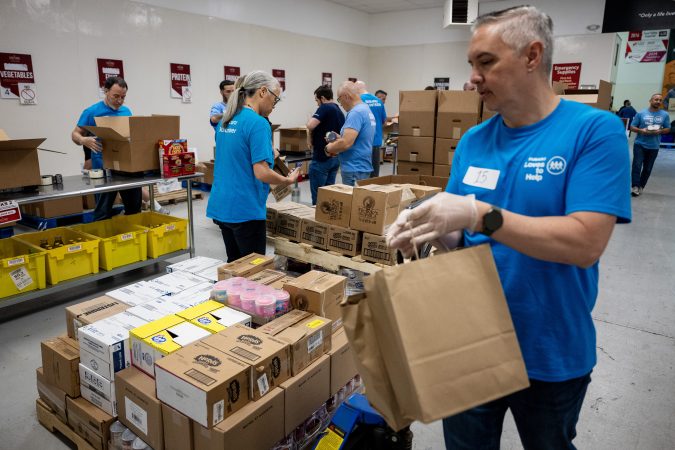
    Matt McDevitt (left) and Michael Hickey load their vehicle at the Food Bank of South Jersey Thursday, June 11, 2026. The men are volunteers at the Temple Lutheran Church in Pennsauken and their food bank is open from 5-6 p.m. every Thursday.Tom Gralish / Staff Photographer

    Asselta said the Federal Reserve Bank’s report “mirrors” what her organization has observed through its network of 300 community partners.

    “Hunger has never been higher,” said Pastor Sonita Johnson, who runs the food pantry at St. John’s Pentecostal Outreach Church in Salem City, Salem County. “Food prices are high, and the lines you see you would not believe — a 50% increase in people just over the last two months.”

    Nationwide, between January 2025 and January 2026, SNAP rolls decreased by more than 4 million people — from 42 million to 38 million — according to USDA figures.

    Between last September and April of this year, nearly 90,000 Pennsylvanians lost SNAP benefits due to new eligibility requirements stipulated by the Trump administration, according to an analysis by the Pennsylvania Department of Human Services (DHS).

    And between December 2025 and last month, more than 32,000 Philadelphians lost benefits, DHS figures show.

    In New Jersey, SNAP participation has fallen by more than 50,000 individuals between March 2025 and March of this year, New Jersey Department of Human Services figures show.

    The Trump administration’s SNAP changes include an expansion of work requirements for people who receive SNAP benefits and increased documentation requirements “designed to make maintaining eligibility increasingly difficult,” according to the Food Research and Action Center (FRAC), the largest anti-hunger lobby in the United States.

    Deputy White House press secretary Anna Kelly said in a statement that Trump signed the changes to strengthen SNAP and to ensure that it is “sustainable for future generations.” She added that Trump was “elected to eliminate runaway spending across the federal government.”

    William Meo works on the loading dock at the Food Bank of South Jersey Thursday, June 11, 2026. Tom Gralish / Staff Photographer

    For people like Shelley Gaither, how her reduced SNAP benefits could be seen as part of “runaway spending” is tough for her to figure, given her needs. To survive this precarious moment, Gaither said, she will do whatever she can.

    “We eat more vegetarian meals and I don’t buy my kids cookies or snacks,” she said. “If I drink enough coffee, maybe I just need one meal a day. This is our existence now. This is how we live.”

  • JD Vance can never become president | Will Bunch Newsletter

    One of my many New Year’s resolutions back in January was never to write what I call “Captain Obvious columns” about the Donald Trump scandal du jour that’s all over your social media feed. So you’ll have to imagine the column I didn’t write about Trump’s tacky UFC cage match that desecrated the White House, and the role of bread and circuses (or just circuses…where’s the bread?) in the inevitable decline and fall of decrepit empires.

    If someone forwarded you this email, sign up for free here.

    A ‘President JD Vance’ would be a different kind of dictator. The scary kind.

    They say you never get a second chance to make a first impression — unless your name is JD Vance, or it becomes JD Vance after a few false starts. In 2016, a then utterly unknown Yale Law grad introduced himself to America with a No. 1 bestseller, Hillbilly Elegy, that used his (sort-of) Appalachian family’s hardscrabble story to come off as an empathetic horse whisperer for the white working class.

    He cemented that first impression when we learned he’d privately described Trump as a kind of a demagogue feeding off the pathologies he’d written about in Elegy — someone he feared might become “America’s Hitler.”

    But Trump’s victory coupled with some exposure to the ketamine-fueled paranoia of Silicon Valley’s billionaires gave the former James Donald Bowman yet another shot at reinvention — now embracing extreme right-wingers and crackpot conspiracy theories all the way to his election, at age 40, as the 50th vice president of the United States.

    Today, less than two weeks before the 10th anniversary of Hillbilly Elegy’s publication, Trump has become America’s…Mussolini, a strutting yet sometimes buffoonish strongman and a hopelessly corrupt invader of faraway lands.

    It’s Vance who could actually become America’s Hitler, if he gets that chance…a very real possibility.

    That’s a strong statement, but it’s also perhaps the most powerful takeaway from the heavily promoted, about-to-be-published book from all-access New York Times reporters Maggie Haberman and Jonathan Swan, Regime Change. It portrays the vice president as eager to go much further than Trump in crushing domestic dissent.

    In book excerpts published Monday, Haberman and Swan depicted Vance — in a tag-team alliance with Trump’s ruthless mass-deportation guru Stephen Miller — as calling for the radical step of invoking the Insurrection Act to send in troops to put down protests by everyday Americans in Minnesota who were enraged by masked goon squads snatching their immigrant neighbors and the killing of two U.S. citizens.

    Describing a White House meeting of senior aides — but not Trump — in late January after Renee Good and Alex Pretti were gunned down, the Times reported that “Vance got to the point. They needed to invoke the Insurrection Act, swiftly, to crush the unrest in Minnesota. It would be painful in the short term, he said, but the message it would send — that paid agitators could not get away with disrupting ICE operations — would make sure no one tried it again.”

    There are many problems with Vance’s anti-democratic impulses. As Haberman and Swan reported, even most of the Trump aides in the room agreed that invoking the 1807 law in this circumstance would be both a significant expansion of presidential power and a public-relations nightmare. Even worse, the nation’s No. 2 official was urging this would-be abuse of power based on a right-wing internet lie — the falsehood that Minnesota’s angry neighbors were “paid protesters.”

    The deeply reported episode isn’t the only disturbing glimpse of Vance’s governing philosophy in recent months, but it’s the most revealing, and most damning: a true believer in the worst conspiracy theories about the left, with the inclination to wield dictatorial powers against them.

    Earlier this month, Vance — arguably the regime’s top cheerleader for Europe’s extreme far-right political parties — stunned the United Kingdom’s center-left government by weighing in on growing unrest over the stabbing death of an 18-year-old English college student by a Sikh migrant. He sounded more like a wannabe X influencer than a top official of the U.K.’s historic American ally. As racist hate mobs prowled streets in England and Northern Ireland, Vance said the murder of Henry Nowak proved that “European elites” had failed to oppose the “politics of self-hatred and the mass invasion of migrants.”

    One thing is clear: Vance is not on the side of calm, which is problematic when what the world needs now is love, sweet love.

    Increasingly, Vance seems to disappear for longer stretches of time, and when he reemerges he is bathed in the stench of the social media sewers where he seems to spend much of his time.

    That’s certainly appears to be the case with his main mission in 2026; rooting out fraud, which isn’t targeted at the nation’s biggest scam — the multi-dollar enrichment of the president’s family — but at alleged schemes by Somali immigrants and other heirs to Ronald Reagan’s racially coded “welfare queen.” A recent Washington Post report found many claims by a Vance-led task force are misleading or overhyped, and that legitimate business have been swept up in its wide net.

    Ten years ago, Vance wrote a book seeking your empathy because that served his true purpose: ruthless ambition. In that context, it was no moral conflict at all to pull a 180 and support a victorious Trump, or to leverage his rising fame into a hookup with Silicon Valley types like his billionaire patron Peter Thiel — people who believe in building private cities to protect them from the masses and the government, and who are more prone to conspiracy theories than your 79-year-old uncle on Facebook.

    Thiel and the other tech billionaires have programmed Vance into a true believer of whatever nonsense they believe, and lined him up next in the queue for power. That makes him even more dangerous than Trump, who believes in nothing beyond himself.

    Ever since Trump first claimed victory on Nov. 8, 2016, I’ve worried that the next guy would be even worse — chasing American autocracy with a real plan, not clown-car narcissism. Vance is the one I was worried about, and he is only an 80-year-old, Big Mac-infused heartbeat away from the presidency for the next 31 months.

    I’ve made clear my disgust at political violence, and the possibility of a Vance succession is another reason why I shudder to think what would happen if an attack killed or disabled the 47th president someday. If Vance was willing to send troops to Minneapolis to stomp down soccer moms and baristas with whistles, his militaristic power grab against the left after an assassination would end any last hope for our bedridden democracy.

    It’s one more item on the pro-democracy checklist. It may be the proverbial lost cause worth fighting for, but we should try to ensure that JD Vance does not become the 48th president of the United States.

    If Democrats stay on track to retake the House and possibly the Senate, they should hold hearings not only on Trump’s high crimes and misdemeanors but on the vice president’s involvement — and, based on that evidence, his possible impeachment. It may prove impossible to remove Vance from office, but hearings will help to establish a record that will end his dreams — and those of his billionaire buddies — about 2028.

    It’s past time for the next transition for this American chameleon who calls himself JD Vance: back to private citizen.

    Yo, do this!

    • The World Cup’s return to North America has gone much as I expected it would: Marred by its runaway commercialism and the U.S. immigration hassles that kept too many fans and a world-class referee from Somalia at home, but with a focus on joy on the pitch and in the stands now that the games have begun. Here in Philadelphia, the essence of everything good about the World Cup has been the FIFA Fan Festival at Lemon Hill, the city greenspace on the hill behind the Art Museum on the Schuylkill. It’s been a daily gathering post for thousands of fans to watch the matches on a 60-foot screen, imbibe from a beer garden, and load up on official merch. It’s free but ticketed; learn how to gain access and how to get there here.
    • Some 51 years after Jaws, filmmaker Steven Spielberg is still finding ways to get us out to the multiplex for a summer blockbuster. His new the-aliens-are-here epic, Disclosure Day, merges nostalgia for his greatest hits like E.T. with our 21st century anxieties about artificial intelligence, outsiders, space, and what it means to be human in our modern world. It’s getting excellent, but not perfect, reviews, and I’m looking forward to seeing it for myself.

    Ask me anything

    Question: What is your favorite fast food joint? — @funkndonuts.bsky.social via Bluesky

    Answer: Most of this week’s questions were in this lighthearted mode; it feels like the good sports excitement of the World Cup and the NBA finals has provided us a calm eye in the hurricane. Anyway, as an apparent donut lover you’ll be glad to know that my modern family runs on Dunkin coffee. As a kid, my barely-evolved-from-hillbillies family had low-brow tastes that I now appreciate in hindsight, and on our yearly road trips to the ancestral home of Peoria, I fell in love with the greasy pizza — later augmented by greasy fried chicken — at Shakey’s. The chain has shrunk to a few West Coast outlets and I haven’t been in decades. Probably for the best.

    What you’re saying about…

    Last week’s question about what the next, hopefully normal U.S. president should do about the ballroom monstrosity rising on the east side of Donald Trump’s White House drew a good array of responses. Although a couple of you wanted to see the project repurposed for community gardens or housing for D.C.’s homeless, others believe any Trump creation must be expunged in dramatic fashion. “Provide Pulaskis (fire axes) and sledgehammers and a good crew of competent supervisors and let we the people come and pay five bucks for the privilege of fifteen minutes of smashing it up,” wrote Linda Nafziger-Meiser. “Hell, I’ll bring my own Pulaski.” But architect Larry Weintraub thinks the White House needs a ballroom, as long as it meets historical and architectural standards. “Hopefully, the new design will be understated but appropriate and subordinate to the majesty of the White House,” he wrote.

    📮 This week’s question: In a recent column, I announced that I’ve deleted Elon Musk’s social-media app X, which once thrived as Twitter. I saw that as a way to protest Musk’s racism, and his obscene wealth. Should governments and corporations continue to use X for communications? Are you still on X or have you left, and why? Please email me your answer and please put the exact phrase “Deleting X” in the subject line.

    Backstory on the birthright citizen who’s a U.S. hero

    Folarin Balogun, now 24, grew up in London, which is where one of the world’s top clubs, Arsenal, spotted him as a potential soccer star at age 8. His parents are Nigerian. He currently plays club soccer in Monaco. So how was it that Balogun found himself last Friday wearing the red, white, and blue jersey of the United States in front of 70,000 delirious Americans on the pitch near Los Angeles, mixing skillful footwork with an aura of glee as he scored two goals in a 4-1 World Cup opener win over Paraguay?

    Credit the 14th Amendment — or maybe blame it, if you’re one of the reactionaries who believe that people like Balogun should not be U.S. citizens, soccer gods be damned.

    Even if for some weird reason you’re not yet a soccer fan, you’ve probably followed the heated debate over birthright citizenship. The notion that anyone born on U.S. soil is automatically an American citizen — an idea enshrined after the Civil War to remove any potential doubts about the citizenship of formerly enslaved African Americans — is disputed by the Donald Trump regime. The president’s executive order seeking to undo the longstanding interpretation of the 1868 14th Amendment, and strip citizenship from millions of people born here to immigrant, non-citizen parents, is currently before the U.S. Supreme Court. Trump’s xenophobic MAGA supporters have long slurred children of undocumented migrants with the epithet, “anchor babies.”

    It turns out that Balogun, when he’s not lighting up the back of the net, is a law-school case study of the immigration debate roiling his accidental country. In the summer of 2001, Balogun’s future mom, who was seven months pregnant, and dad decided to vacation in the United States. When the couple attempted to fly home to London, an unnamed airline worker who would change the course of soccer history told Florence Balogun she was too pregnant to safely fly. So she stayed in Brooklyn, gave birth to her son, and the family left America after two months.

    As he developed into a world-class striker on European soil, Balogun came to understand that his U.S. citizenship offered a much better shot at competing in the World Cup than the other two nations where he was also eligible, England or Nigeria. For his mom, Balogun’s fate was sealed in the summer of 2001. “Even when he wasn’t even thinking of making an international decision, I’d already made up my mind that he is going to play for America,” Florence Balogun said.

    They say that the Supreme Court, despite all the blather about “calling balls and strikes,” is in reality always aware of the political zeitgeist. Even a right-wing justice who happens to also be a long-suffering Phillies fan in Samuel Alito probably sees on some level that stripping citizenship from the breakout star of U.S. men’s soccer would be highly unpopular. The World Cup — the idea, and not its capitalist corruption by FIFA — imagines a society that abhors exclusion, where it takes every kind of people to make what life’s about. I dream of an America that can run with France and Argentina on the pitch, and that welcomes human beings like Balogun, even ones who’ve never kicked a soccer ball in their lives.

    What I wrote on this date in 2019

    This newsletter goes out Tuesday on the 11th anniversary of the day that changed America forever: Donald Trump’s gilded Trump Tower journey down an escalator to join the 2016 presidential race, as Neil Young’s “Rockin’ in the Free World” blared behind him. In 2019, I used that date to reflect how much we’d fallen in just four years since June 16, 2015. I wrote: “The president’s “shocking” tweet or statement of the day still sparked hours and hours of cable TV blather, including a parade of congressional Democrats who were concerned or saddened or what not. They called Trump’s worst acts impeachable offenses, but then nobody impeached him. They said Trump was unpresidential, but the next day he was still president.” Read the rest: “4 years since Trump came down that escalator and the cycle of empty outrage has become unbearable.”

    Recommended Inquirer reading

    • Last week I focused on the little people who’ve been crushed by the return of Donald Trump, and the big guys getting obscenely rich. In my Sunday column, I looked at the agonizing fate of Tuan Van Bui, an Amerasian born in Saigon at the height of the Vietnam War who was welcomed to Philadelphia in 1990 under a government-approved visa. Why was he violently arrested by U.S. Immigration and Customs Enforcement, and what is the truth about his April death behind bars in Indiana, at age 55? Over the weekend, I voiced my outrage over Elon Musk, who in just one week used his massive platform on X to whip up race riots in Belfast, and was rewarded by Wall Street as the world’s first trillionaire. I looked at how we enable this situation, and announced my small step in fighting back by deleting the X app.
    • One depressingly constant story in the 21st century is the way that supposedly liberal blue states and big cities still fall back on oppressive, militarized policing to crack down on protesters. Progressive activists in New Jersey took to The Inquirer this week to express their lingering disappointment in first-year Gov. Mikie Sherrill — a Democrat that many of them had worked to elect in 2025 — and her state police’s aggressive handling of demonstrations outside the ICE detention center in Newark, Delaney Hall. They would have found an amen chorus here in Philadelphia’s LGBTQ+ community, where city cops showed up at the annual Gayborhood Pride festival in riot gear and arrested 15 of the revelers. The backlash against the police actions has already triggered a City Council investigation. Journalists are typically society’s first line of defense against police misconduct. You support that mission when you subscribe to The Inquirer.

    By submitting your written, visual, and/or audio contributions, you agree to The Inquirer’s Terms of Use, including the grant of rights in Section 10.

  • ‘He makes it about himself,’ Philly Dem says after Trump announces plans to transform July 4 fireworks in D.C. into rally

    The Philadelphia Democrat whose district includes Independence Hall accused President Donald Trump of trying to transform the 250th anniversary into a celebration of himself rather than the country.

    Trump announced on Truth Social Monday that a Trump rally will now take place in Washington on July 4, absorbing the long-planned 250th anniversary fireworks celebration at the Lincoln Memorial, the Washington Post reported.

    The move has prompted criticism, including from U.S. Rep. Brendan Boyle, whose district was the site where the Declaration of Independence was debated and signed.

    “Our nation’s 250th anniversary should be an opportunity to bring us together as Americans,” Boyle wrote in a statement. “Any previous president — from either party — would make this event about our nation. But not Trump. He makes it about himself. Because he only cares about himself.”

    Boyle is one of several Democratic lawmakers to criticize Trump’s expanding role in the celebrations.

    “We are going to host the most spectacular TRUMP RALLY of them all, a ‘TRIBUTE TO AMERICA,’ Trump wrote on Truth Social, his social media platform. “This HUGE Celebration will honor our Country’s People, Spirit, Strength, Resolve, and Triumphs.”

    Trump said in the post that the event will include air shows, patriotic music — from Trump’s own playlist — a fireworks show, and a keynote speech from him.

    “To conclude the program, and commemorate this Historic Occasion, I will be launching, what will be, the LARGEST FIREWORKS SHOW IN HISTORY,” Trump wrote.

    The rally is just the latest in a string of controversial choices by Trump ahead of the 250th. The president announced the rally a day after he hosted a controversial Freedom 250 UFC event at the White House for his 80th birthday.

    Sen. Andy Kim (D., N.J.) criticized the decision to hold the UFC event at the White House, noting on X that Trump holds shares in the company and that UFC CEO Dana White donated $1 million to a pro-Trump super PAC.

    “This isn’t a celebration of America 250,” Kim posted on Sunday. “This is corruption on full display on the White House lawn.”

    The event drew further controversy when fighter Josh Hokit made offensive comments about former first lady Michelle Obama in his postfight interview.

    The Trump administration says the events are a way to inspire and excite Americans, the Washington Post reported.

    “Fight for freedom,” the Department of Homeland Security, headed by former MMA fighter Markwayne Mullin, posted on Facebook. “Fight for our way of life. Fight for America.”

  • UFC brings its trademark mayhem to the White House; Philly’s Kyle Daukaus falls to Penn State’s Bo Nickal

    WASHINGTON — President Donald Trump emerged from the Oval Office first, then fighters from around the globe followed straight into the fight cage, in part for the president’s 80th birthday celebration and to bring a sport long on the fringe of mainstream acceptance into a main event on the White House South Lawn.

    For a president who revels in winners, Trump had to enjoy crowning two champions on a big fight night staged closer to the Rose Garden than Madison Square Garden in the co-main event of UFC Freedom 250.

    American lightweight Justin Gaethje capped his unification championship victory in the main event over Ilia Topuria with a backflip off the top of the cage. He crouched near Trump for a celebratory chat and the betting underdog draped the American flag over one shoulder — and the 155-pound title belt over another. Trump later stepped into the cage to congratulate Gaethje.

    “Hey, I’m from America, 250 years ago we were way more than 6-1 underdogs,” Gaethje said. “I know that was absolutely legendary because I can not even believe it.”

    Topuria and Gaethje made their walkouts from the Oval Office as fireworks exploded overhead during Michael Buffer’s introductions. Gaethje — who appeared to skim the copy of the Declaration of Independence on his way out — mustered some scattered “USA!” chants against the Spanish-Georgian Topuria, though not even the main event could stop the trend of mostly quiet fights.

    It took the gory sight of a bloodied Topuria — his back to Trump in a white “USA” hat as he peered through the wire-mesh cage — nearly having the fight waved off to get a “let them fight!” chant going. The fight continued, and the 37-year-old Gaethje won eventually via corner stoppage in the fourth round.

    “Hard work, baby,” Gaethje said. “I am made for these moments. This sport is made for me.”

    Earlier, Ciryl Gane hammered Alex Pereira with a series of elbows and fists to the head and won via TKO in 1:27 of the second round to claim the interim heavyweight belt for a second time and set up a rematch with heavyweight champ Tom Aspinall.

    Like the bulk of the fighters who had their hands raised in victory, Gane thanked Trump.

    The White House was a most improbable all-American setting for a fight promotion that long ago shed the “human cockfighting” tag and decades later became entwined with the emboldened right-wing “manosphere” that soaks up UFC fights and threw its support behind Trump in two elections.

    Trump and UFC boss Dana White, the tempestuous tag-team that rallied the fight company to the nation’s capital, walked from the Oval Office to the Blue Room Balcony to chants of “USA! USA!” to kick off the fight card jacked up by a dose of high-octane patriotism on a blustery night for cage fighting.

    This was no Easter Egg Roll.

    UFC ramped up the patriotism for White House debut

    The Marine Band jazzed up the festivities and played fighter entrance music in front of the White House and Zac Brown sang the national anthem — never performed before normal UFC fight cards because of the mix of nationalities fighting inside the Octagon. The Navy’s Blue Angels and Air Force Thunderbirds zipped overhead as part of a flyover to celebrate Trump’s birthday and the 250th anniversary of the Declaration of Independence’s signing.

    The 4,000-plus fans — Meta CEO Mark Zuckerberg and Paramount Skydance CEO David Ellison among them — on the South Lawn who sat under the claw, the flying saucer-like, open-air structure that housed the cage, mostly sat on their hands until the fighters used theirs to deliver punishing blows and a true fighting spirit that got everyone on their feet.

    Bo Nickal delivered the red, white and boom when the three-time NCAA Division I wrestling champion at Penn State earned the TKO win over middleweight Kyle Daukaus, a Northeast Philly native and Father Judge alum, and immediately bolted the Octagon for a cage-side chat with Trump. Nickal met Trump in 2019 during a ceremony at the White House for collegiate national champions.

    The first blight of the night for Trump came when American heavyweight Derrick Lewis lost his fight after he got a personal invitation from the president. Trump proclaimed himself a fan of Lewis and his unconventional celebrations and asked White to add him to the card. Josh Hokit instead improved to 10-0 when he flattened Lewis by TKO.

    Sean O’Malley celebrated his walk-off KO win with a salute, and Mauricio Ruffy and Diego Lopes won their fights earlier in the night.

    “That was sexy,” O’Malley said to cheers. “I felt the energy in here. I truly felt the energy in here.”

    UFC says it’s only running one card at the White House

    More than $60 million and tens of thousands of hours of labor were poured into building the arena, according to a court filing from the National Park Service, which oversees the South Lawn, and the looming threat of rain that threw White into a tizzy each time a miserable forecast was raised never materialized over the early portions of the card.

    Fight night came only hours after the United States and Iran reached an agreement to end the war and open the Strait of Hormuz, offering relief to the global economy more than three months after the war began.

    The rare UFC outdoors event marked the pinnacle of the relationship between White and Trump that has yielded personal, political and financial dividends for both parties. White’s first card as UFC president came in 2001 at an event held at Trump Taj Mahal.

    Trump has attended four UFC cards as sitting president, walking to the cage amid rock music and patriotic chants from fans. White introduced Trump at two Republican National Conventions.

    Trump got a home game for this one, making the short walk from the Oval Office to the Octagon, much like the fighters who made the walk down West Wing halls covered with presidential portraits and were flanked by first responders and medal of honor recipients, among other individuals who served.

    Strickland causes trouble at the fan zone at the Ellipse

    Thousands more outside the White House lawn watched the fights on big screens from the nearby Ellipse, though not everyone was able to get tickets.

    Even one of UFC’s champions.

    UFC middleweight champion Sean Strickland was escorted out of the Ellipse event by a group of police officers.

    U.S. Park Police said in a statement that Strickland’s presence drew enough attention from attendees that it resulted in disorder. He wasn’t cited or arrested, they said. Instead, he was taken to his hotel and told not to come back to the venue.

  • TMI owner says Pa. nuclear plant is on track to reopen next year

    TMI owner says Pa. nuclear plant is on track to reopen next year

    Constellation Energy crews have been laboring since 2024 to reopen Three Mile Island’s Unit 1 nuclear plant to meet spiking electricity demand. Planned data centers and other new demands have materialized since 2019, when the plant was shut because generating power there was too expensive to compete with cheap natural gas.

    Now Constellation has moved up its own deadlines and says it’s approaching its goal to load uranium next spring and add electricity to the grid later in 2027.

    That’s despite naysayers such as Neil Chatterjee, President Donald Trump’s former Federal Energy Regulatory Commission chair.

    “It will never work” because of TMI’s aging technology and the complex U.S. and Pennsylvania energy bureaucracies, Chatterjee wrote in January in The Hill, which neglected to note Chatterjee had become a solar-power lobbyist.

    In testimony submitted to regulators, environmental groups, including Eric Epstein’s TMI Alert, called the utility’s plans rushed and incomplete. Montgomery County-based PJM, which oversees power distribution for 13 states and the District of Columbia, warned it could be 2031 before the plant could connect to the power grid, Constellation chief executive Joe Dominguez told analysts and investors in March.

    But Dominguez minimized that warning. “Normally, they start off with a pretty long timeline and shorten that up,“ he told investors in a conference call May 11, adding that he would work with states to speed connections.

    Dominguez has moved up the original 2028 target date to next year, in part because of supporters like President Donald Trump and Pennsylvania Gov. Josh Shapiro, and because Microsoft has promised to buy as much power as the plant produces to run a growing array of data centers.

    So Constellation is paying an army of builders, lawyers, and plant operators to prepare the plant.

    Earlier this month, PJM agreed to speed up its process for connecting new power plants in states where regulators agree to approve sites faster.

    Here’s an update on what’s happening at TMI:

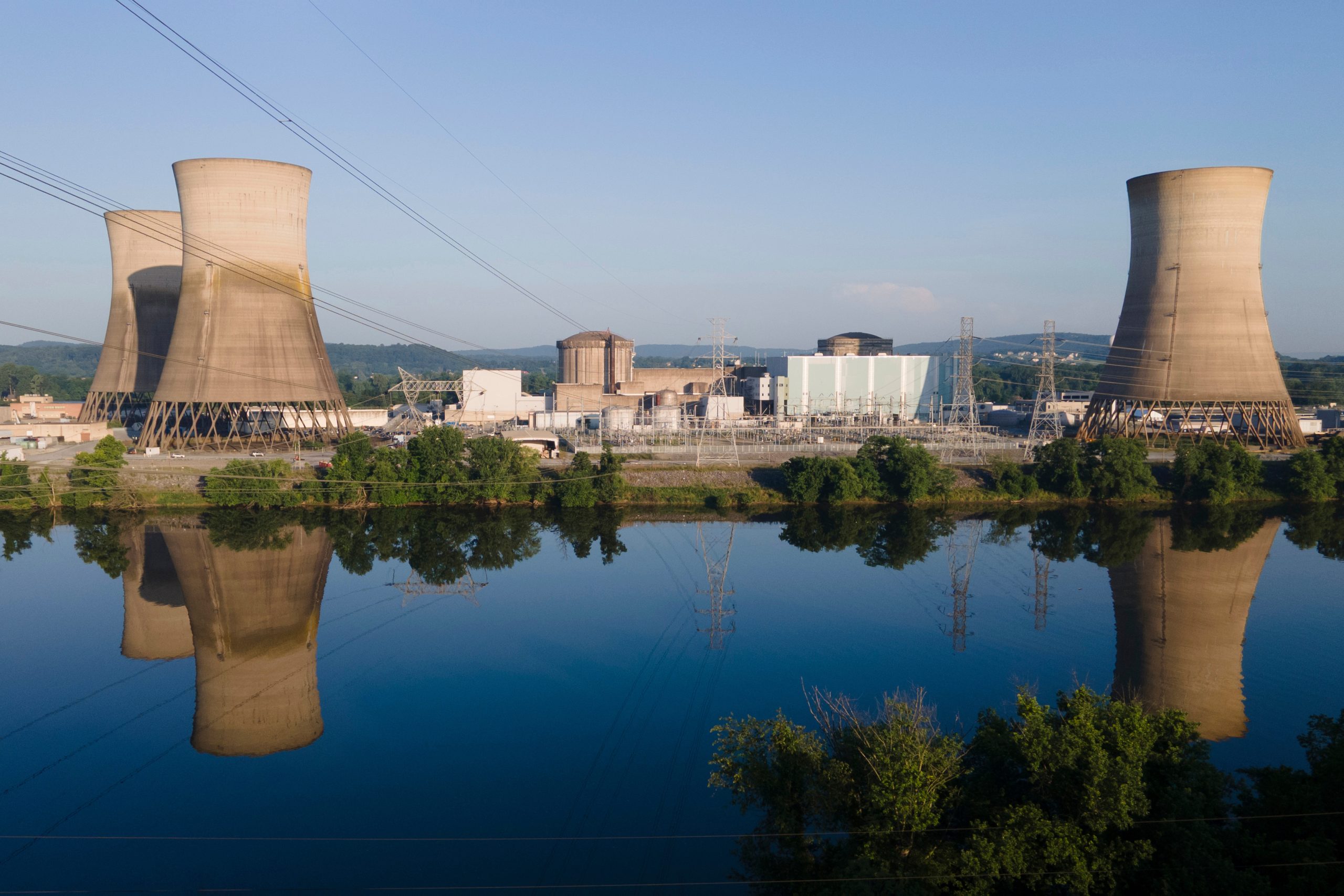
    At Constellation’s nuclear power plant on Three Mile Island near Middletown, Pa., in June 2025. Ted Shaffrey

    New equipment

    Constellation bought three building-sized replacement transformers from manufacturer Hyundai in South Korea, to be delivered later this month, after reinforcing the bridge to the island to bear their weight. Two will be installed “later this year,” one kept as a spare, said spokesperson Paul M. Adams.

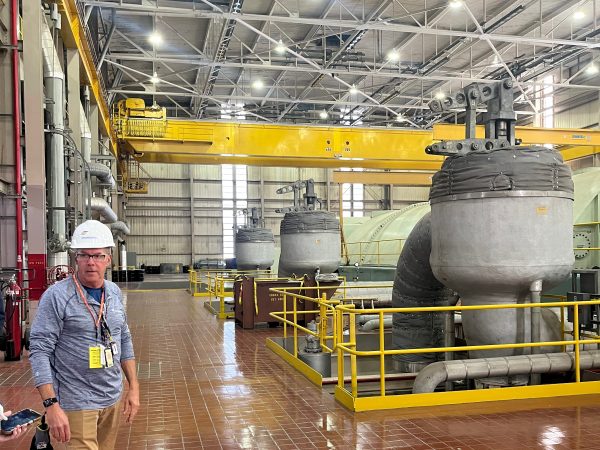
    The company says crews are repairing the partly dismantled Bravo cooling tower and inspecting the reactor building and diesel motors on the site. They are restoring controls — originally analog systems made by manufacturers in Reading and other Pennsylvania cities.

    The company has scheduled enriched-uranium fuel assembly deliveries from its supplier Framatome in Richland, Wash., later this year, so fuel can be loaded into the reactor core next spring. The uranium is sourced from U.S. and foreign mines.

    The deal with Microsoft

    Microsoft has promised to buy power equal to the plant’s entire production at prices above today’s levels for 20 years.

    But that doesn’t mean the software and data-center giant is going to run wires to new, power-burning facilities in the neighborhood.

    The Microsoft deal supports Constellation’s regulatory and investor arguments in favor of reopening. It confirms this major data-center operator will need more power in years to come.

    Jobs for construction and plant workers

    Constellation says more than 3,000 construction workers will help bring the plant, which it now calls the Crane Clean Energy Center, into service.

    The company also has hired hundreds of permanent workers for the plant, named after the late Exelon Corp. CEO who spun off Constellation and championed nuclear power. More than 550 full-time employees are on site, including the current class of 80 operators being trained in federal Nuclear Regulatory Commission procedures.

    About 145 of those employees are “boomerang” staff who worked at Three Mile Island before its 2019 shutdown, according to Constellation.

    More than 400 hires live within 25 miles of the plant. They include about a dozen recent graduates of the Penn State Harrisburg campus nearby.

    U.S. Secretary of Energy Doug Burgum (center) with Constellation Energy staff on May 1 at the Three Mile Island nuclear power complex Unit 1, which Constellation Energy plans to reopen as the Crane Clean Energy Center uranium-powered electric plant in 2027.Constellation

    Financing for the advance work

    In November, the U.S. Department of Energy Loan Programs Office approved a $1 billion low-interest government loan to help Constellation reopen the Three Mile Island plant.

    Supporters of nuclear loan and subsidy programs say federal money ensures long-term operation at reasonable financing costs. Critics such as the Cato Institute, which generally opposes subsidies, say the government shouldn’t help pay for power that would otherwise be unprofitable.

    Supporters of the TMI reopening

    Shapiro, U.S. Energy Secretary Chris Wright, U.S. Interior Secretary Doug Burgum, U.S. Sen. Dave McCormick (R., Pa.), U.S. Rep. Scott Perry (R., Pa.), state legislators, and local officials have toured the plant to tout job and energy creation.

    With permit applications pending before the NRC and other agencies, Constellation says it is “on track” to restart the plant next spring and deliver energy into the grid by summer or fall.

    U.S. Sen. Dave McCormick with Tori VanderMeersch, senior manager, operations support for the Crane Clean Energy Center, in the control room at Three Mile Island Unit 1 nuclear power plant in early 2026.Constellation Energy

    A workaround for PJM’s warning on connecting to the grid

    In early June, the Federal Energy Regulatory Commission agreed to an unusual switch: It will let Constellation transfer “Capacity Interconnection Rights” from its diesel- and natural gas-burning electric power plants at Eddystone, Delaware County, to Three Mile Island, to speed the process of bringing the nuclear plant back online.

    Constellation says it can do this without having to shut the Eddystone complex because the Trump administration gave the company special permission to keep Eddystone open, along with other fossil-fuel plants that were earlier scheduled for closing under a long-term program to reduce carbon-burning. It no longer needs the rights at Eddystone and can apply them at Three Mile Island.

    An agreement on using water from the Susquehanna River

    The Susquehanna River Basin Commission in early June approved Constellation’s plan for using river water at the restarted Three Mile Island nuclear plant.

    Constellation plans to pull 73 million gallons per day from the river to control temperatures at the plant. That’s about one-third of 1% of the river’s average flow; an equivalent volume of water will be released and won’t, on average, cause “significant adverse impact to the ecosystem and other users,” notes commission spokesperson Stacey Hanrahan.

    “Of course, we do not review a project based on average daily flow,” but on days the river is low, for example during a drought, she added. If the river gets too low for too long, Constellation could be ordered to stop using it.