Tag: Donald Trump

  • A new bipartisan housing law was on track to bring Pennsylvania’s home-repair program nationwide. Then Trump refused to sign the bill.

    A new bipartisan housing law was on track to bring Pennsylvania’s home-repair program nationwide. Then Trump refused to sign the bill.

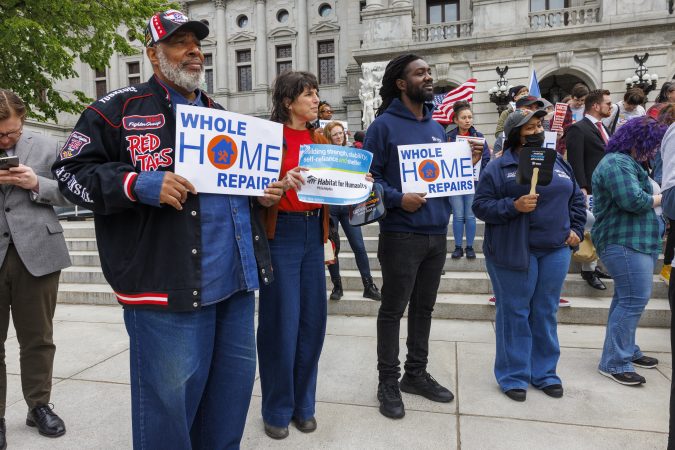
    WASHINGTON — A Pennsylvania program that assists homeowners and small landlords by financing repairs was on track Wednesday to expand nationwide, after Congress this week passed a bill that both Republicans and Democrats are celebrating as the first major federal housing law in decades.

    Tucked into the 374-page omnibus legislation is a pilot version of a federally backed Whole-Home Repairs program — an idea that was originally sponsored by State Sen. Nikil Saval (D., Philadelphia) and passed in Pennsylvania in 2022.

    The program offers grants or loans to address safety, habitability, and efficiency concerns.

    But despite wide bipartisan support for the program and dozens of other housing reforms in the larger bill, final approval was derailed on Wednesday when President Donald Trump canceled the bill-signing ceremony in an attempt to force Congress to first pass more restrictive voter-ID laws.

    Democrats and some Republicans quickly rebuked the president, who still made a rare appearance on Capitol Hill to meet with Senate Republicans. The intraparty meeting turned contentious, according to multiple reports, while Democrats noted they had enough votes to overturn Trump’s veto if he holds out long enough.

    “It’s a mess,” said U.S. Sen. Andy Kim (D., N.J.). “Finally, we’re doing something that the American people want. We got bipartisanship. We worked on it forever. … Then he just parachutes in and just blows it all up here at the end.”

    The 21st Century ROAD to Housing Act aims to incentivize housing construction, restrict large institutional investors from buying single-family homes, improve financial literacy, and more.

    More than a year in the making, it includes a separate stand-alone Whole-Home Repairs Act that U.S. Sen. John Fetterman (D., Pa.) had introduced in each of the last two sessions of Congress. Fetterman’s bill merged last year into the larger bill while keeping many of the same provisions as the Pennsylvania-level program.

    Households that earn less than 80% of the area median income are eligible for grants, while small landlords with affordable units can access loans, including forgivable loans.

    Funded with more than $120 million in COVID-era federal stimulus money, the program has been limited amid high demand, with as many as 18,000 homes on the waiting list.

    Saval said he expects the national version to also reflect that level of “immense demand” — particularly as the program starts small and as homeowners across the country face higher costs to maintain their residences.

    “This is a huge issue. There are some 200,000 homes in Pennsylvania alone that have moderate to severe deficiencies,” Saval said. “Everyone is dealing with rising energy costs. Everyone’s dealing with the cost of materials and labor and the inability to pay for all that.”

    Addressing those kinds of affordability concerns, which have become a top-of-mind political issue during this year’s high-stakes midterm elections, is a rare bipartisan effort to emerge from the U.S. Capitol.

    Philadelphia-area lawmakers on both sides of the aisle had spent months advocating for the bill.

    U.S. Sens. Dave McCormick (R., Pa.) and Lisa Blunt Rochester (D., Del.) — members of the Senate committee that advanced the legislation — both celebrated the final passage by talking about its impacts on affordability and “cutting red tape.” Kim called it a “historic” move to bring costs down.

    “This package comes at a critical moment,” Blunt Rochester said in a statement, noting a nationwide housing shortage of as many as 7 million units. Five bills she separately sponsored — to accelerate building, increase investment in community development projects, develop zoning and land-use policies, and more — were featured in the final law.

    The Whole-Home Repairs provision of the legislation was not a guarantee as negotiations developed over the last year. House Republicans were generally skeptical of creating a new government program, and specifically critical of the policy’s tenant protections, according to a source familiar with the negotiations. But their counterparts in the Senate, and Democrats in both chambers, helped keep it in the larger bill.

    Fetterman said in a statement that Whole-Home Repairs “ensures families can stay in their homes” and that passing it had been a priority since he entered the Senate in 2023.

    “I’ve consistently maintained that our housing crisis needs real solutions that help address the problems at the center,” Fetterman said.

    Saval, who said he made multiple trips to Capitol Hill to work with sponsors and lobby for Whole-Home Repairs, said he was “thrilled” by the inclusion of a program that he and the coalition of advocates who helped push the idea had always envisioned as a model that could be replicated.

    He said he expects the pilot program to prove successful in “a few states” where it is able to launch. Unlike previous version of the federal bill that would have allocated $30 million to the pilot, there is no specific funding number for Whole-Home Repairs in the 21st Century ROAD to Housing Act.

    The legislation calls for the secretary of the U.S. Department of Housing and Urban Development to identify between two and 10 “implementing organizations” every year during the pilot, which is set to run through October 2031. The organizations will be local or state governments that administer the programs.

    Saval said that no matter how much funding is allocated, it “will undoubtedly fall short of the need,” but that its effectiveness will spur further investment.

    “It repays itself,” Saval said. “It repays itself in stabilized communities. It repays itself in stabilized property values, in people remaining in their homes rather than in unsafe or unhealthy homes, or rather than abandoning them.”

    Staff writer Jake Blumgart contributed to this article.

  • Josh Shapiro is most popular politician among Philadelphia residents — by a long shot

    Josh Shapiro is most popular politician among Philadelphia residents — by a long shot

    Gov. Josh Shapiro is by far the most popular political figure among Philadelphia residents, a boost as he looks toward November and beyond.

    In a new Suffolk University/Philadelphia Inquirer CityView poll, 62% of Philadelphians have a favorable opinion of Shapiro, double digits above any other political figure included in the survey.

    Not only did the Democratic incumbent running for reelection win over three-quarters of his own party’s voters in the blue stronghold, he also got positive reviews from almost half the city’s independents and more than one-third of Republicans.

    “He has strong bona fides within his own party, 76% favorable and 11% unfavorable, but he’s also at least somewhat competitive among independents and even some Republicans, so that’s an amazing profile for a candidate who’s an incumbent these days,” said David Paleologos, the polling director at Suffolk.

    Just 16% of residents have an unfavorable view of Shapiro, and only 8% have never heard of the one-term governor, who was on former Vice President Kamala Harris’ short list of potential running mates in 2024.

    (function(){function e(){window.addEventListener(`message`,function(e){if(e.data[`datawrapper-height`]!==void 0){var t=document.querySelectorAll(`iframe`);for(var n in e.data[`datawrapper-height`])for(var r=0,i;i=t[r];r++)if(i.contentWindow===e.source){var a=e.data[`datawrapper-height`][n]+`px`;i.style.height=a}}})}e()})();

    The poll of 500 residents in the city, which was conducted by phone from June 16 to 20, had a margin of error of 4.4 percentage points. Pollsters reached residents in all 66 wards in the city.

    Shapiro clobbers his Republican opponent, Treasurer Stacy Garrity, whom just 9% of the poll’s respondents view favorably.

    That’s not unexpected in a city where Democrats outnumber Republicans 6-1. But it’s Garrity’s lack of name recognition that plays a larger role. A whopping 61% of those surveyed had never heard of Garrity, a glaring figure less than five months until the November election.

    Although the state GOP coalesced around her last year and she faced no challengers for her primary nomination this year, only 26% of Republicans had even heard of Garrity.

    (function(){function e(){window.addEventListener(`message`,function(e){if(e.data[`datawrapper-height`]!==void 0){var t=document.querySelectorAll(`iframe`);for(var n in e.data[`datawrapper-height`])for(var r=0,i;i=t[r];r++)if(i.contentWindow===e.source){var a=e.data[`datawrapper-height`][n]+`px`;i.style.height=a}}})}e()})();

    “She’s kind of a blank slate, and that works to the challenger’s advantage, but if you’re Stacy Garrity you want to start defining yourself quickly before someone else does,” Paleologos said.

    Shapiro can drive up his statewide total if voters in Philadelphia, an overwhelming Democratic electorate, turn out in large numbers — though that has been less reliable in recent years.

    His broad favorability could also help him stretch his bank account further. Shapiro, who hails from nearby Montgomery County, has spent the least amount of money so far in the Philadelphia television market and the most in Pittsburgh, which could show his campaign knows where he is already strong.

    Fetterman is far less popular in Philly, particularly among young voters

    Shapiro’s popularity in the city stands in stark contrast with the state’s other top Democrat: U.S. Sen. John Fetterman.

    In the swing state’s most Democratic city, the one-term senator is faring poorly.

    Less than one-quarter, 24%, of Philly residents have a favorable opinion of Fetterman, compared with 43% with an unfavorable view. The numbers are even worse within his own party, with just 17% of Democrats holding a favorable view of the senator, who has often feuded with progressives and repeatedly crossed party lines to cast key votes in support of President Donald Trump’s nominees.

    His numbers are particularly sour among voters ages 18 to 24 and 25 to 34.

    (function(){function e(){window.addEventListener(`message`,function(e){if(e.data[`datawrapper-height`]!==void 0){var t=document.querySelectorAll(`iframe`);for(var n in e.data[`datawrapper-height`])for(var r=0,i;i=t[r];r++)if(i.contentWindow===e.source){var a=e.data[`datawrapper-height`][n]+`px`;i.style.height=a}}})}e()})();

    A strong majority of Republican voters, 60%, view him favorably in the poll, but the Pennsylvania Democrat has repeatedly insisted he has no interest in switching parties heading into 2028, when he is likely to face a primary challenge if he runs for another term.

    While slightly more Philadelphians have a favorable view of Fetterman than his GOP colleague, U.S. Sen. Dave McCormick, a greater share of Philly voters have an unfavorable view of the Democrat.

    McCormick earned 17% favorable views compared with 25% unfavorable views, while the rest had not heard of the freshman senator or were undecided.

    But the least popular politician in Philly was Trump, who had just 12% favorability in the city.

    Ninety-two percent of Democrats view Trump unfavorably, and 31% of Philadelphia Republicans do, too. The poll also found that nearly 70% of Philly voters had grown less confident in American democracy under Trump’s presidency.

    Trump made inroads in the deep-blue city in 2024, but Harris still won Philadelphia handily with 78% of the vote.

    The president is a frequent target of Shapiro, who has blamed Trump’s tariffs and other policies for exacerbating the cost of living.

    Taking on Trump may be boosting Shapiro’s popularity as he pursues reelection. His numbers show opportunity as he continues building a national profile, likely with ambitions for higher office. In a city where voters favor liberal and left-leaning candidates, Paleologos said, the polling results could be somewhat extrapolated to a national Democratic primary for president in 2028.

    What Shapiro has going in his favor is high popularity among women, with 69% viewing him favorably. That is good news for the governor, since women consistently make up a large proportion of Democratic primary voters, according to exit surveys.

    “In a Democratic primary, you really want to be strong among women, and he is,” Paleologos said. “If 60% of women are voting a Democratic primary, that really plays to his strength.”

    He also ranks in the 70s for favorability among people ages 45 to 74.

    “Those are people who are bill payers, they’re raising children, they’re taking care of sick parents, they’re very stretched in terms of economics. Just terrific numbers,” Paleologos said.

    Shapiro’s favorability is far above that of other Democratic politicians in the city, including Mayor Cherelle L. Parker and State Rep. Chris Rabb, who won last month’s competitive primary to represent the 3rd Congressional District, which stretches from Northwest Philly to parts of South Philly.

    A majority of respondents had not heard of Rabb despite his recent win. But 26% of respondents said they had a favorable view of the progressive lawmaker, compared with only 7% with an unfavorable view.

    The mayor was viewed favorably by nearly 44% of respondents, compared with nearly 35% who viewed her unfavorably — a net positive rating but a much closer split than Shapiro.

    “There are there are pockets of strength that make her electorally strong, but I wouldn’t call it broad-based,” Paleologos said of Parker.

  • The son of the Jersey Kebab restaurateurs now faces his own fight to stay in the U.S.

    The son of the Jersey Kebab restaurateurs now faces his own fight to stay in the U.S.

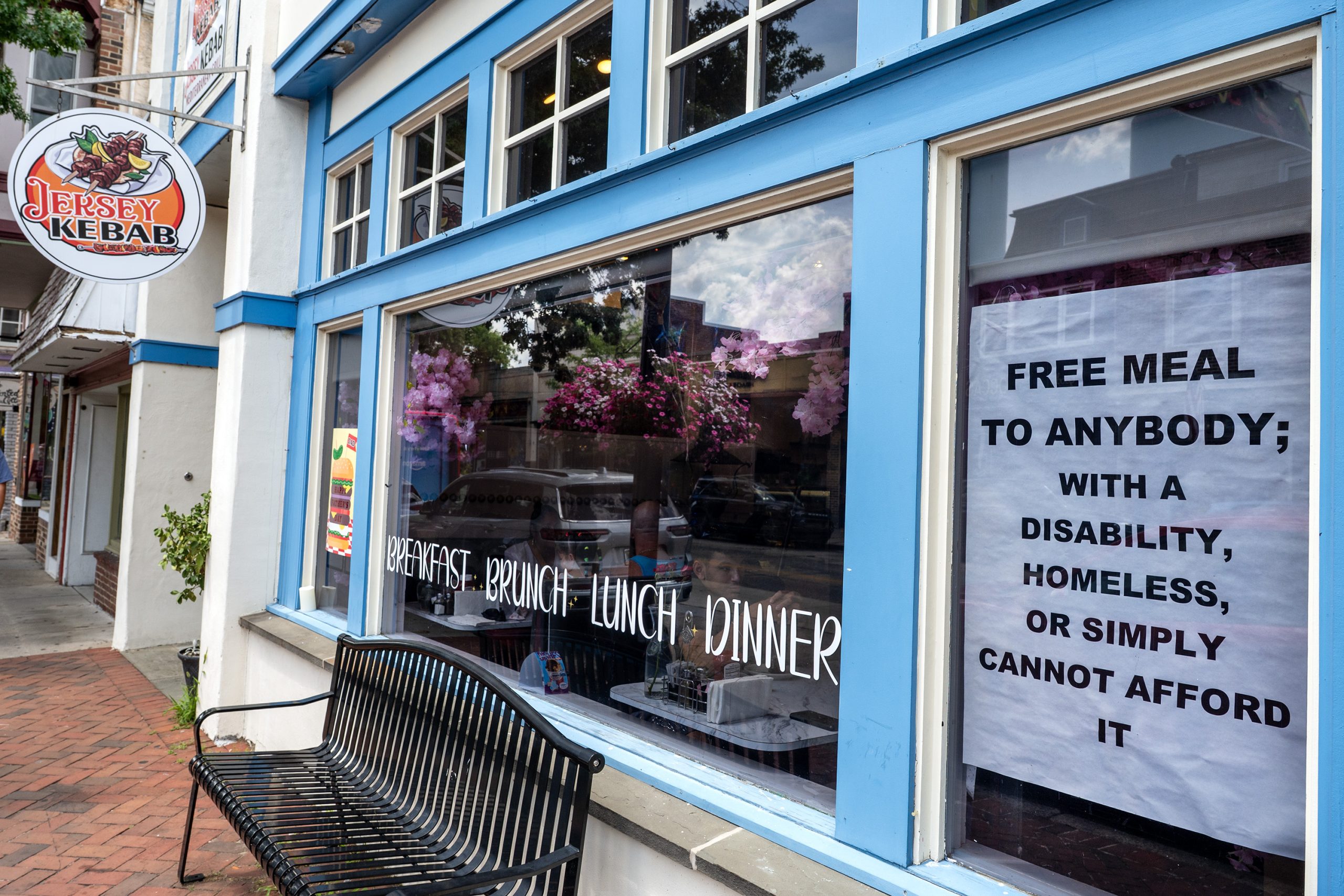
    The son of the Jersey Kebab restaurant owners whose ICE arrests sparked wide condemnation last year now confronts his own battle to stay in the United States.

    Muhammed Emanet, 26, said he is trying to be upbeat as he faces the prospect of being separated from his wife and two sons, ages 4 and 1, all American citizens.

    “I try not to dwell on what I can’t control,” said Emanet, who with his parents operates the popular South Jersey eatery in Collingswood. “I still have a restaurant to run, employees that depend on me, customers, family. I have no other choice but to be positive.”

    Still, his situation feels disorienting, as what seemed to be settled is now newly unsettled.

    In spring the Department of Homeland Security ended its effort to deport Emanet, which seemed to clear the path for him to stay in the U.S. But this month, a different federal immigration agency told him it plans to deny his request for legal permanent residency, what is known as a green card.

    That intended denial carries a 30-day window for Emanet, who came here from Turkey as a boy, to present new or additional evidence to try to change the minds of officials at U.S. Citizenship and Immigration Services.

    The government also told him that under a new Trump administration policy, he and other immigrants who are pursuing green cards while living in the U.S. must leave the country and apply from their home nations. Emanet hasn’t been in Turkey since he was 12.

    It’s unclear what will happen when the 30-day deadline expires around July 2.

    Muhammed Emanet greets Elijah Brown, a friend from high school, and his family, at Jersey Kebab in Collingswood on Sunday.Tom Gralish / Staff Photographer

    A little more than a year ago, on Feb. 25, 2025, the small Mediterranean restaurant on Haddon Avenue generated national headlines. Immigration advocates and local leaders railed against what they saw as government injustice, after ICE agents arrested owners Celal Emanet and his wife, Emine.

    Celal Emanet was released after being fitted with an electronic ankle monitor ― later removed ― while his wife was held at an ICE detention center in Elizabeth. She was released on bond after two weeks and a day.

    Their arrests angered a South Jersey community that has long known the couple as caring people who offer free food to the hungry. A GoFundMe campaign to pay family costs and expenses raised $327,000, drawing donations from across the country and beyond, including from Ireland, Germany, and England.

    Now, a community effort to help Muhammed Emanet is driving a new letter-writing campaign, with person after person attesting to his good character and his importance to his neighbors. Hundreds of letters have been signed and gathered to be presented on his behalf, said Lori Leonard, who organized the GoFundMe campaign last year.

    “People are rallying behind Muhammed,” she said.

    State Assemblyman Bill Moen, a Democrat who represents parts of Camden and Gloucester Counties, signed a letter of support. He said on social media that Emanet “has touched the lives of many people throughout South Jersey” as a husband, father, neighbor, friend, and businessperson.

    “While I don’t make immigration decisions,” Moen said, “I do believe decision-makers should understand the character of the people whose lives are affected by those decisions.”

    U.S. Rep. Donald Norcross, a South Jersey Democrat, met with the family soon after Emine Emanet was released from ICE detention, and as her son’s situation emerged this month he stressed in a statement that the family had been long “rooted in our community.”

    In response to questions on Muhammed Emanet’s situation, USCIS said it does not comment on individual immigration cases.

    Being removed to Turkey would likely separate Emanet from his wife and children for years. It also could subject him to reprisals from the Turkish regime, where repressive human-rights conditions under President Recep Tayyip Erdogan has driven an exodus.

    Marriage to a U.S. citizen by someone who legally entered the country ― as Emanet did ― has long been a reliable route to an adjustment of status and acquisition of a green card.

    But the Trump policy change announced in May said adjustment should be an “extraordinary” relief, one that depends on government discretion, not merely on having a valid marriage and submitting the proper forms. Failing to depart the U.S. under the policy can by itself be treated as a negative factor in the government’s decision-making.

    Emanet’s immigration lawyer, Joseph Best, said that change in administration policy does not alter the law around eligibility for green cards.

    “If USCIS follows the law,” Best said, “he will attain his lawful permanent resident status just as Congress intended. It is not some fluke or exceptional ‘ask’ here.”

    Discretionary factors, he said, all favor Emanet, who was brought legally to the U.S. as a child, was admitted under a valid visa, and has no criminal history. He is loved in his community, and a key person in a successful family business that is known for helping others, Best said.

    The Jersey Kebab restaurant in Collingswood where Muhammed Emanet works is seen on Sunday, June 21. It offers the same “Free Meal” policy as at the prior location in Haddon Township.Tom Gralish / Staff Photographer

    Celal and Emine Emanet came legally to the United States with two young children in 2008, entering under a religious visa that allowed the father to work at a New Jersey Islamic center.

    They said that they sought green cards before that visa expired in 2013, but that the application has been in government limbo for years.

    In 2021, they founded Jersey Kebab in Haddon Township, and the restaurant recently moved west on Haddon Avenue to a new location in Collingswood.

    The couple’s immigration cases continue. Celal Emanet’s next hearing is scheduled for December, while his wife is to appear in April 2027.

    The family stands among roughly 386,000 Turkish immigrants and people of Turkish ancestry who live in the United States, according to Inquirer computations of U.S. Census figures. That includes about 15,000 in Philadelphia and surrounding suburban Pennsylvania and New Jersey counties.

    Turkey is a longtime U.S. ally, a rectangular land bridge between Europe and Asia that is surrounded by sea on three sides. It is a Muslim nation, a country of tea drinkers, the place where Julius Caesar is said to have immortally proclaimed “Veni, vidi, vici” ― “I came, I saw, I conquered” ― after a decisive battle victory near what is now the modern town of Zile.

    Today, people are leaving the country amid economic instability and political purges, with many trying to get to the United States.

    U.S. government apprehensions of Turkish nationals at the Mexican and Canadian borders surged from 67 in 2020 to more than 15,000 in 2022 and another 15,000-plus in 2023, dropping to 10,500 in 2024. Figures for 2025 were not immediately available.

    President Donald Trump is expected to be in Turkey next month to attend the NATO summit in Ankara.

    Muhammed Emanet works at his family’s restaurant, Jersey Kebab, in Collingswood on Sunday, June 21.Tom Gralish / Staff Photographer

    During Trump’s second term, USCIS has repeatedly paused the processing of applications for all types of immigration benefits, including those for legal permanent residency.

    Last month, the administration announced it would require foreigners who are living in the U.S. and want to obtain green cards to leave the country to do so. The administration said they must now apply in their homelands, a departure from longstanding policy that has sowed confusion and concern.

    For decades, foreign nationals who meet requirements have been able to complete the green-card process in the United States, including those married to U.S. citizens, holders of work and student visas, and refugees and asylum seekers.

    USCIS spokesperson Zach Kahler said in a statement that entering the U.S. on a visa should not be a first step toward obtaining a green card, that tourists and temporary workers are permitted to come here for limited times.

    “Our system is designed for them to leave when their visit is over,” he said.

    Making people leave the country to apply for green cards “reduces the need to find and remove those who decide to slip into the shadows and remain in the U.S. illegally,” he said.

    The administration instructed immigration officers to consider violations of immigration laws, including overstaying a visa, as negative factors in their decision-making.

    Since the uproar, though, USCIS has seemed to walk back the policy, saying it would be implemented on a case-by-case basis. That could mean that some immigrants will be able to stay in the U.S. while they seek green cards.

    Emanet said his immigration case started in 2020, when two plainclothes ICE officers arrived at the family home and said he was in the country illegally.

    In spring, his attorney persuaded an immigration court in Newark to terminate Emanet’s court case ― with no opposition from the DHS Office of the Principal Legal Adviser, the ICE prosecutors. That termination seemed to clear the way for Emanet to adjust his status.

    Instead, on June 3 he received a Notice of Intent to Deny from federal immigration officials, indicating they plan to reject his application to adjust his status. He is not sure what will happen when the 30-day deadline for new information expires.

    “I have children here who need my support ― American citizens who depend on me,” Emanet said. “I thought I was that one, that I did everything exactly how I was supposed to, that I should receive my green card. … It feels like a punch in the gut.”

  • Why a Boston-based appeals court ruling matters for President’s House

    Why a Boston-based appeals court ruling matters for President’s House

    President Donald Trump’s administration is closer to getting its way after a Boston-based appeals court said it doesn’t have to restore exhibits it removed — at least for now.

    The Boston-based U.S. Court of Appeals for the First Circuit ruled the National Park Service does not have to restore all exhibits it removed as part of its “restoring sanity to American history” push before the nation’s 250th anniversary celebration, issuing an administrative stay on a lower court’s order.

    That order protected the historic site of George Washington’s Philadelphia residence on Sixth and Market Streets from further changes after the U.S. Court of Appeals for the Third Circuit ruled last week that Philadelphia does not have the right to dictate the content of exhibits at the President’s House. The exhibits were dismantled by the Trump administration earlier this year.

    But it remains to be seen whether the stay allows the Trump administration to install the newly proposed panels, which historians say whitewash Washington’s culpability in enslaving nine people at his Philadelphia home.

    In a statement, the Department of the Interior responded: “We are confident that as this inferior ruling from an activist lower court judge receives further scrutiny, they will be further restrained.”

    Administrative stays are common steps federal courts take to buy time while judges assess the arguments.

    The First Circuit judges intend to rule “promptly” on a request for a more permanent stay during the appeal, the order says.

    Either way, the ruling marks a second blow in a week to the City of Philadelphia and stakeholders who developed the President’s House Site.

    Michael Coard, attorney and founder of Avenging the Ancestors Coalition, which is leading efforts to protect the President’s House, emphasized that the First Circuit action was not a final decision.

    “The stories of enslaved African descendants and other historically marginalized communities are American history and deserve to be preserved and told truthfully,” he said.

    Here is what you need to know about the status of the President’s House exhibits.

    The President’s House in Independence National Historical Park March 11, 2026.Tom Gralish / Staff Photographer

    What do Boston-based courts have to do with the President’s House?

    Earlier this year, conservation groups sued the Trump administration in federal court in Massachusetts challenging Interior Secretary Doug Burgum’s 2025 order implementing the president’s directive to ensure that no displays at national parks “inappropriately disparage Americans past or living.”

    U.S. District Judge Angel Kelley this month temporarily blocked the National Park Service from removing or altering content at parks across the country, and required the agency to restore before July 4 all exhibits that had been removed.

    The Trump administration’s changes to exhibits “seek to rewrite the Nation’s history with a white-out pen,” wrote Kelley, a nominee of former President Joe Biden.

    At least 50 exhibits were removed from more than 30 sites nationwide, according to court records.

    Justice Department attorneys appealed the ruling to the First Circuit and asked the higher court to issue an administrative stay or a stay for the duration of the appeal.

    The three judges assigned to the case — Chief Judge David J. Barron, appointed by Barack Obama, and Biden appointees Gustavo A. Gelpí Jr. and Julie Rikelman — issued the administrative stay Tuesday pausing the majority of Kelley’s order, including the directive to restore sites such as the President’s House.

    The order is not explicit on whether the National Park Service can make changes to sites, but administrative stays are viewed as a way to preserve the status quo while the appeals court can review the facts and arguments in a case.

    “The administration’s decision not to reinstall and reinstate censored materials, particularly in advance of our nation’s upcoming 250th anniversary, is a disservice to every park visitor this summer and to the broader American public,” the conservation groups, represented by Democracy Forward, said in a statement.

    What did the Third Circuit rule?

    The First Circuit ruling comes on the heels of the Third Circuit’s reversal of a February order entered by a Philadelphia federal judge.

    Judge Cynthia M. Rufe issued an injunction that required the Trump administration to restore the President’s House to its form before the abrupt Jan. 22 removal of exhibits.

    A three-judge panel disagreed with Rufe, finding that Philadelphia gave up its rights over the President’s House when it donated the site to the National Park Service. The judges further said the federal government’s proposed replacement panels were “full of historical context.”

    Mayor Cherelle L. Parker thanks workers as the President’s House site in Independence National Historical Park Thursday, Feb, 19, 2026 during a brief visit to the site as they began to return the slavery displays.Tom Gralish / Staff Photographer

    What are the city’s options?

    After the Third Circuit ruling, Mayor Cherelle L. Parker said she would “pursue every legal action possible in efforts to reverse this decision.”

    The city has a few options, but time is running out for a favorable ruling before July 4.

    The city could ask for a rehearing in front of the same three judges who unanimously ruled to overturn the injunction. It can also ask for a hearing in front of the full Third Circuit court, known as en banc, or ask the U.S. Supreme Court to intervene.

    Philadelphia Law Department attorney Anne Taylor argued at the Third Circuit hearing that the federal government’s attack on these exhibits has caused irreparable harm as the city tries to tell its story ahead of next month’s 250th celebrations.

    Philadelphia is expecting a flood of visitors for the Semiquincentennial celebration, Taylor said, adding: “The President’s House is at the doorway to the Liberty Bell. That history is not being told to all the people who are expected to come here.”

    It could be challenging, or even impossible, to get a new panel of circuit judges or the Supreme Court justices briefed on the case to get a ruling in less than two weeks, legal experts said.

  • Trump was welcomed to Pa. by Stacy Garrity. He didn’t mention her at all.

    Trump was welcomed to Pa. by Stacy Garrity. He didn’t mention her at all.

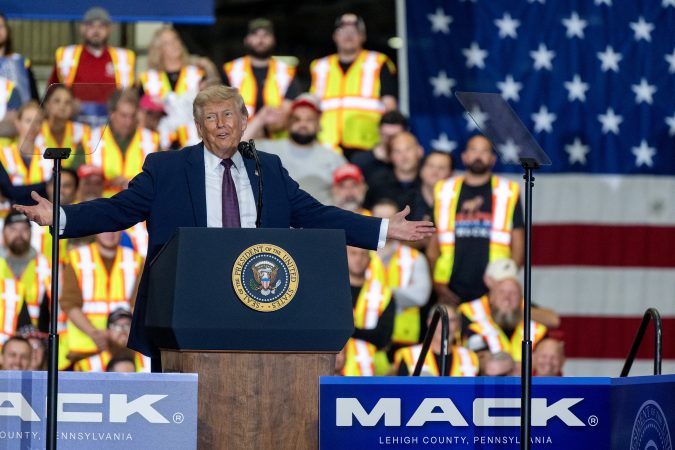
    MACUNGIE, Pa. — President Donald Trump’s speech on manufacturing in a key Pennsylvania swing district repeatedly veered into other topics and musings about elections in other states, like Maine and California.

    It took the president nearly an hour to even reference by name GOP U.S. Rep. Ryan Mackenzie, the vulnerable incumbent whose district Trump was visiting to boost his chances in this year’s midterm elections.

    And GOP gubernatorial nominee Stacy Garrity did not even get a mention during Trump’s speech to roughly 1,500 attendees, including workers at the Mack Trucks facility in Macungie in Lehigh County.

    Trump’s visit came just days after the company received $47 million through a Defense Department contract.

    And while he touted the trucks, he spent just as much time meandering about weight-loss drugs, immigration, firearms, the role of transgender athletes in women’s sports, and the UFC fight recently held on the White House lawn. He also repeated conspiracy theories about the races for Los Angeles mayor and California governor, saying he had asked the U.S. attorney in that state to investigate after conservative mayoral candidate Spencer Pratt did not advance to the general election.

    And he threw jabs at Pennsylvania Gov. Josh Shapiro amid 2028 speculation and appeared to undermine Shapiro’s Republican opponent, Garrity.

    Speaking about recent victories by democratic socialist candidates around the country, Trump quipped that “Shapiro is not that much better, to be honest with you.”

    He referenced the Democratic governor’s potential presidential aspirations, warning that “a guy like Shapiro is going to be forced on the left, otherwise he’s not going to get the nomination.”

    But though he weighed in on Shapiro, the governor’s Republican challenger’s name was noticeably absent from Trump’s list of shout-outs to GOP officials, despite the fact that Garrity spoke earlier in the event.

    Trump instead heaped praised on U.S. Rep. Dan Meuser, a Pennsylvania Republican who considered a run before ultimately opting against it and enabling the state party to coalesce around Garrity.

    “Meuser’s another great guy who was thinking about running for governor. I think he would have won. He was thinking of running for governor, and I said ‘I want you to stay in Congress,’” Trump said.

    Trump endorsed Garrity earlier this year, but the lack of acknowledgment Tuesday was striking given the election year focus of the event and Garrity’s own promises to support Trump’s agenda.

    “We need a governor in Harrisburg who will be a partner with President Trump in Washington, not an opponent in the courtrooms,” she said before Trump took the stage. “We need a governor who will fight for Pennsylvania jobs, like right here at Mack Trucks.”

    State Treasurer and Republican candidate for governor Stacy Garrity is seen on a big screen as she speaks to supporters before the arrival of President Donald Trump at Mack Trucks in Macungie Tuesday, June 23, 2026. Trump did not mention Garrity when he later spoke to the crowd in the Lehigh Valley.Tom Gralish / Staff Photographer

    Trump restated his belief that tariffs have revitalized and would further boost the U.S. economy, though gas prices have reached new heights since he began a war with Iran, stymieing the flow of oil. (The Strait of Hormuz has reopened, following a tentative peace deal struck this month.)

    “I placed a 25% tariff on foreign automobiles and very importantly posed a 25% tariff on medium and heavy-duty trucks, so Mack Trucks could do very well with this factory in Pennsylvania,” he said.

    “They weren’t gonna come in from foreign lands and steal your jobs,” Trump added.

    However, the company cited Trump’s tariffs last year as contributing to its decision to lay off hundreds of workers at its Lehigh Valley operations center, the Pennsylvania Capital-Star reported at the time.

    Tuesday marked Trump’s fourth Pennsylvania appearance in his second term and his first this year ahead of November’s high-stakes midterm elections. The visit was billed as an official event as part of Trump’s American Workers First tour, but the event had the feel of a campaign rally.

    Four U.S. House districts in Pennsylvania are considered competitive, the most of any state, and the event took place in the 7th Congressional District, which is viewed as one of the most likely to flip to Democratic control.

    “We have to reelect a certain congressman,” Trump told the crowd.

    In 2024, Mackenzie won the seat by 1 percentage point, while Trump defeated Democrat Kamala Harris and won Pennsylvania in the presidential race.

    “Workers, like the ones here at Mack, are spearheading the great American comeback,” Mackenzie said.

    Bob Brooks, a union leader and firefighter who won the Democratic nomination to challenge Mackenzie, praised the union workers at Mack ahead of the event for building “the literal engine for the American economy,” but he blasted Trump and Mackenzie for failing to bring down prices.

    “No speech from Mackenzie can change the fact that his time in Congress has been an absolute disaster for the hardworking people of the Lehigh Valley,” Brooks said in a statement ahead of Tuesday’s event.

    Lt. Gov. Austin Davis, in a media call earlier Tuesday, said Trump’s choice to rally at Mack Trucks specifically signals he and his party recognize a “real political danger” because of Trump’s policies.

    “Donald Trump’s agenda is putting Congressman Mackenzie at serious risk,” Davis said. “They’re circling the wagons and trying to save that seat.”

    Affordability is likely to be a key issue on voters’ minds as they choose between Mackenzie and Brooks.

    Steve Leiby, 52, who works for Mack and attended Tuesday’s event, said he understands the tariffs Trump enacted are controversial, but he still supports them.

    “It’s a big risk, if we had a war, that we didn’t make a lot of war supplies in the U.S.,” he said.

    President Donald Trump leaves after a visit to Mack Trucks in Macungie, in the Lehigh Valley Tuesday, June 23, 2026.Tom Gralish / Staff Photographer

    Brent and Francine Stanley, both 60, from New Tripoli, said they support Mackenzie because he shares their conservative values. His office organized an elder-care symposium that Francine Stanley attended because the couple have a 23-year-old child with disabilities, and they were able to get connected to resources.

    But they both know how competitive this election is, noting the stack of pro-Brooks mailers they have already received and predicting that Democrats will be knocking on their doors as November approaches.

    “They’re really persistent, and if you don’t answer, they follow up,” Francine Stanley said. Mackenzie, she said, should consider doing the same.

    Staff reporters Andrea Padilla and Sam Janesch contributed to this article.

  • Brian Fitzpatrick ties the knot with Fox News’ Jacqui Heinrich in NYC wedding

    Brian Fitzpatrick ties the knot with Fox News’ Jacqui Heinrich in NYC wedding

    U.S. Rep. Brian Fitzpatrick (R., Pa.), who represents Bucks County, and Fox News senior White House correspondent Jacqui Heinrich got married Saturday in New York City.

    The wedding was attended by high-profile figures in politics and media and featured a nighttime cruise around the Statue of Liberty.

    The celebrations for the newlyweds and their 302 guests included a ceremony at St. Patrick’s Cathedral and a reception on a yacht called Horizon’s Edge, with a 10-piece brass band and the toasts of former GOP House Speaker Kevin McCarthy and former Sen. Joe Manchin (I., W. Va.), People magazine reported.

    The nuptials of Fitzpatrick, 52, and Heinrich, 37, comes almost a year after their engagement and amid the Republican’s high-stakes reelection campaign to represent Pennsylvania’s 1st Congressional District against Democratic challenger Bob Harvie.

    Fitzpatrick and Heinrich said they chose New York for their wedding because of its significance in jumpstarting their respective careers as an FBI agent and a network news reporter and its connection to their families’ immigration journey, People reported. It was also a central meeting point for the couple’s families from New England and Pennsylvania.

    The reception featured other nods to family — Heinrich’s parents got married on a chartered cruise and the couple’s cake-cutting song was an “Irish tune,” People reported, written by Fitzpatrick’s great-uncle, an NYPD officer who was killed in the line of duty, according to People.

    Former Sen. Joe Manchin (I, W.Va) and former GOP House Speaker Kevin McCarthy (right) give a toast to U.S. Rep. Brian Fitzpatrick and Fox News reporter Jacqui Heinrich’s nuptials.Charming Images

    Guests took to social media to congratulate the newlyweds including Heinrich’s Fox News colleagues, U.S. Rep. Don Bacon (R., Neb.), and President Donald Trump’s former Labor Secretary Lori Chavez-DeRemer.

    Pennsylvania Gov. Josh Shapiro was invited to the wedding, but the Democrat was unable to attend.

    Fitzpatrick and Heinrich met in Washington when Heinrich was a correspondent on Capitol Hill. After she switched beats to cover the White House, Fitzpatrick asked her on a date to the Kennedy Center Honors.

    Heinrich’s LinkedIn page shows she began working as Fox News’ White House correspondent in May 2021 during former President Joe Biden’s term.

    They are one of the most high-profile couples on Capitol Hill, sometimes earning the ire of Trump.

    Last month, after Fitzpatrick won his GOP primary unopposed, Trump threatened Fitzpatrick, without saying his name, when asked a question by Heinrich, who is vice president of the White House Correspondents Association.

    “Her husband votes against me all the time. Can you imagine? I don’t know what’s with him,” Trump said. “You better ask what’s with him. She’s married to a certain congressman. He likes voting against Trump, You know what happens with that? It doesn’t work out well.”

  • A Philly woman pleaded guilty to voting twice in the 2024 presidential election

    A Philly woman pleaded guilty to voting twice in the 2024 presidential election

    A Philadelphia woman pleaded guilty Monday to voting twice in the 2024 election — first in northern New Jersey, then in the city.

    Miya Pack, 40, said little beyond responding to routine legal questions as she pleaded guilty to a charge of voter fraud before U.S. District Judge Joshua D. Wolson.

    Pack has been registered to vote since 2004 in Bergen County, N.J., prosecutors said in court documents, and she’s also been registered to vote in Philadelphia since 2016. She is not affiliated with any political party, voter records show.

    On Oct. 26, 2024, prosecutors said, Pack cast a ballot in that year’s presidential election in Bergen County. Then, 10 days later, prosecutors said, she cast a ballot in the same contest in Philadelphia on Election Day.

    They did not say whom she voted for, and she declined to comment as she left the courtroom Monday.

    President Donald Trump has repeatedly made questionable or false statements about the prevalence of voter fraud, particularly in places like Philadelphia, where Democrats heavily outnumber Republicans. Election officials and experts who study the issue generally agree that voter fraud has not historically occurred at widespread rates.

    Pack was charged by federal prosecutors last September. Prosecutors announced her indictment alongside the indictment of another man, Matthew Laiss, who was separately charged with voting twice in the 2020 election.

    Laiss later said in court documents that he voted twice for Trump, and unsuccessfully sought to claim that his actions were covered by pardons Trump extended to people who tried to help him overturn the results of the 2020 election.

    Laiss was convicted of voter fraud earlier this year at trial and is awaiting sentencing.

    Pack is scheduled to be sentenced in October. She faces the possibility of prison time, although prosecutors said in court that federal guidelines suggest a term of no jail time to six months.

  • Trump to visit Pa. on Tuesday as the battle for control of Congress heats up in the Lehigh Valley

    Trump to visit Pa. on Tuesday as the battle for control of Congress heats up in the Lehigh Valley

    President Donald Trump is scheduled to speak Tuesday at a truck manufacturing facility in the Lehigh Valley, where a competitive race for Congress this year could determine which party controls the U.S. House for the second half of his term.

    Trump will deliver remarks at Mack Trucks in Macungie in Lehigh County, according to the White House and two local members of Congress.

    The visit will mark Trump’s fourth Pennsylvania appearance in his second term and his first this year ahead of November’s high-stakes midterm elections.

    Pennsylvania has four competitive U.S. House districts — the most of any state — and the Lehigh Valley-based 7th District is widely considered one of the most likely in the nation to flip from Republican to Democrat.

    GOP U.S. Rep. Ryan Mackenzie won that seat by 1 percentage point in 2024 as Trump defeated Democrat Kamala Harris statewide. Bob Brooks, a union leader and retired firefighter whom many prominent Democrats rallied behind before last month’s competitive primary, is facing Mackenzie in November.

    The event Tuesday is scheduled as an official White House event, not a campaign event, and it could be the first of several trips by the president to the region and across Pennsylvania in the coming months.

    “We’re looking forward to joining President Trump at Mack Trucks — one of our nation’s most iconic manufacturers,” Mackenzie wrote on social media.

    “By investing in American workers and supporting domestic manufacturing, President Trump and Republicans in Congress have helped to put the Lehigh Valley and the Poconos at the forefront of our nation’s industrial revitalization. We appreciate President Trump coming to the region to help us highlight the work we’ve done together to support American workers, families, and industries.”

    Mackenzie spoke Friday at a different Mack facility outside of Allentown to highlight part of a contract the company won from the U.S. Army last year to produce heavy dump trucks. The deal is worth up to $221.8 million, and Mack Defense said it received $47 million in the latest Department of Defense appropriations act.

    A White House spokesperson said Trump will “stand with the American workers he has fought for” during his visit.

    “Under the President’s leadership, key domestic industries are being revitalized, historic investments are pouring back into communities like Macungie, and families across the country are securing new, high-paying jobs,” Liz Huston said. “Pennsylvanians placed their trust in President Trump, and he has delivered for them.”

    Former President Joe Biden visited the same Mack facility in 2021 for a speech focused on supporting American manufacturing.

    Trump last appeared in Pennsylvania in December for a rally at the Mount Airy Casino Resort in Mount Pocono, which is in the neighboring 8th Congressional District where another freshman Republican is looking to fend off a Democratic challenger. Pitched as a speech to address voters’ concerns about affordability, the president repeatedly veered off script and called affordability concerns a “hoax.”

    Some of the president’s former supporters in the region have since said they regretted voting for him, and national Democrats have made the area a priority as they look to win back a seat that Mackenzie flipped two years ago. Brooks, the Democratic nominee, has leaned into his working-class background while saying he understands voters’ financial concerns.

    U.S. Rep. Dan Meuser, a Republican who represents a different neighboring district, said Trump’s visit signals the president’s support for workers.

    “Mack Trucks are a symbol of America’s manufacturing strength,” Meuser said on social media. “Their Lehigh Valley operations are a pillar of the local economy, employing Pennsylvania workers and driving the nation’s trucking industry. Thank you, President Trump, for supporting American workers.”

  • Time to reengineer democracy

    Time to reengineer democracy

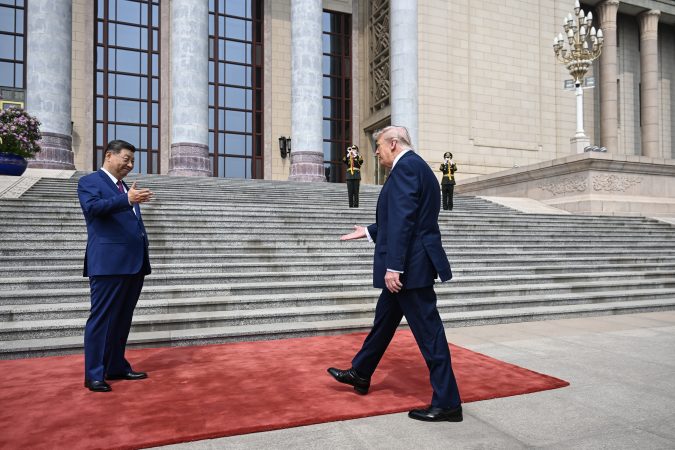
    Last month’s summit in Beijing between Donald Trump and Xi Jinping, the presidents of the world’s largest economies, drove home the magnitude of the crisis facing democracy. At the scale of decisions affecting billions of people, nobody was properly represented.

    Trump and Xi were negotiating for all of us, but representative of hardly any of us, whether American, Chinese, or, like most of the world, completely voiceless in the selection of either leader.

    Americans have a bigger say than most nations in the selection of their leaders, but when the leader of the world’s preeminent representative democracy is openly envying the power of the leader of the world’s biggest autocracy, we know that democracy is in trouble.

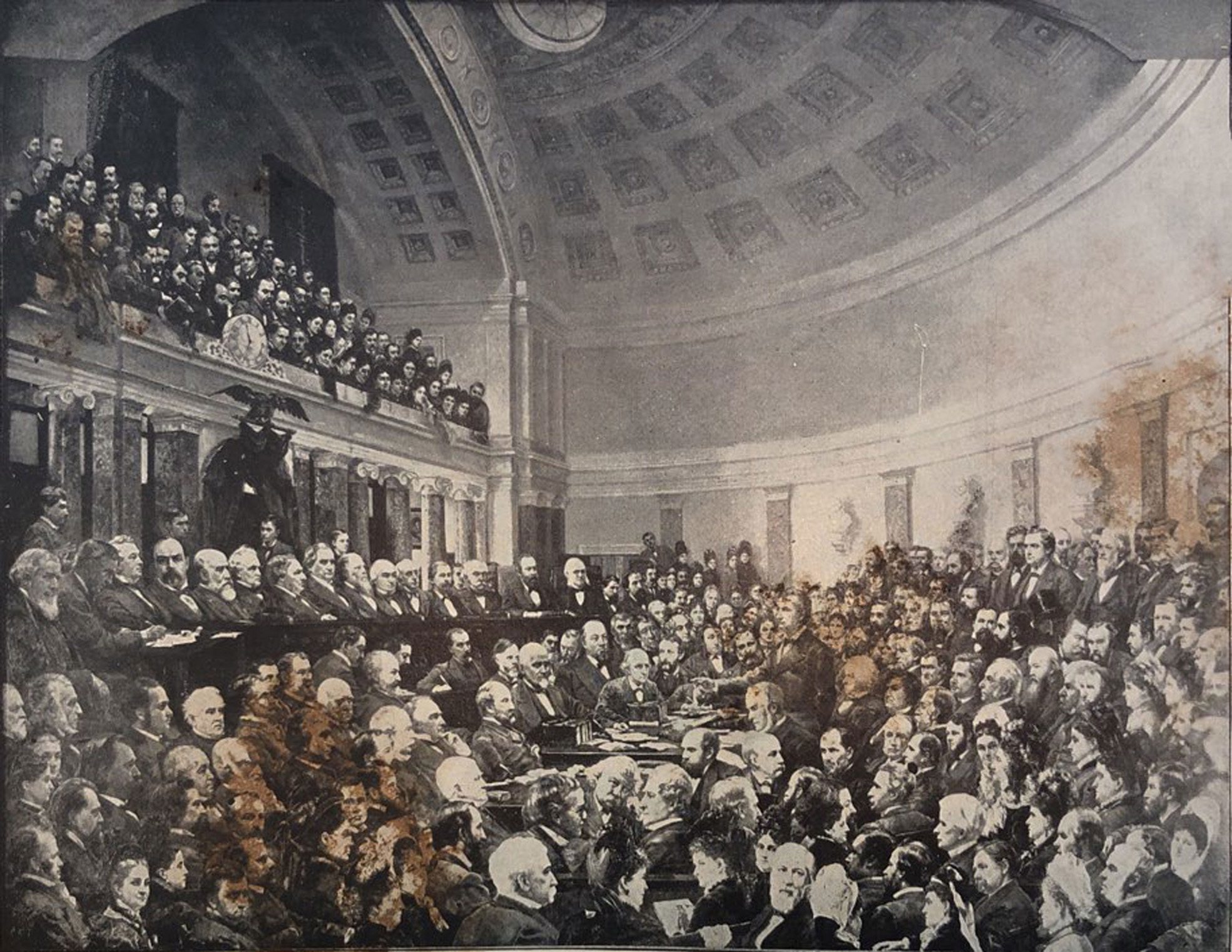
    In 1787, the Constitutional Convention in Philadelphia hammered out a blueprint for representative democracy. Today, we are in a crisis because democracy has failed to scale up to fit the nearly 100-fold growth in population since then. We need to think of alternative ways of ensuring that diverse interests and diverse expertise are represented for the good of the people. We need a new constitutional convention.

    In 1787, the Constitutional Convention in Philadelphia hammered out a blueprint for representative democracy, writes Colin Allen.Campwillowlake/iStockphoto / MCT

    This is not the first time that democracy has failed to scale.

    Athenian direct representation was only barely functional at the scale of the Greek city-state. Even though only male landowners were enfranchised, it was still impossible to accommodate them all at once in the Pnyx, so each voter was required to show up only for a subset of the votes.

    It took another two millennia to invent representative democracy: a manageable number of legislators, each of them elected to represent the interests of thousands of people. The first U.S. census in 1790 recorded just shy of 4 million inhabitants. The newly formed House of Representatives had 65 members: roughly one per 60,000 people.

    Today, over 331 million Americans are represented by 435 members: a ratio of roughly 1 to every 760,000. Not only is each member tasked with representing so many more people, but the diversity of interests in each constituency and the sheer range of issues that must be addressed at this scale mean that practically nobody is properly represented on all issues.

    Voting often feels like selecting the lesser of several evils, and is at best a compromise forced by the need to decide which issue is most important to you, writes Colin Allen.Tom Gralish / Staff Photographer

    Electors face impossible choices. The chance that any one candidate represents all of a voter’s views is vanishingly small. Casting a ballot often feels like selecting the lesser of several evils, and is at best a compromise forced by the need to decide which issue is most important. At worst, voters disengage entirely or resort to preferring qualities that would be more suitable for dominance contests among apes. These problems are aggravated because social media has fractured communal purpose, and gerrymandering is splitting natural constituencies.

    The possibility of electing leaders with autocratic tendencies has always been a weakness of democracy. This weakness is magnified at scale: Larger, more diverse constituencies can come to seem ungovernable, favoring politicians who project strength. We need to grapple collectively with these problems and find better ways of allocating our votes among representatives whose values and expertise match the scope of their powers.

    How might this be done?

    The whole approach to democratic governance needs to be reengineered from the ground up. For example, the existing separation among legislative, executive, and judicial powers should be supplemented by erecting firewalls among different spheres of political decision-making.

    Existing government departments (health, education, agriculture, defense, etc.) provide an initial sketch of where separate legislative bodies might be desirable. Separating legislative functions along these lines would serve to concentrate expertise where it is needed.

    Legislation in one domain would no longer be encumbered by riders that belong in other domains. Funding of health or science initiatives would not be held hostage to disputes about unrelated matters. Reducing the scope of individual legislators would also make them less prone to targeting by the full spectrum of lobbyists.

    The Nobel Prize-winning work of Elinor Ostrom, pictured here, showed how management of scarce common resources is often best handled through local self-governance.

    We also need to rethink the relationship between geography and representation. Some areas of governance are inherently more tied to location than others. The Nobel Prize-winning work of Elinor Ostrom showed how management of scarce common resources is often best handled through local self-governance. People whose livelihoods depend on shared resources they jointly control make better decisions than those acting under rules imposed remotely.

    Current political systems (whether democratic or not) aggregate legislative and economic power hierarchically over increasingly large geographic areas. This favors decisions by people who have little or no skin in the game when it comes to good stewardship of local resources. Hence, in the domains of agriculture or the environment for example, it makes sense that one’s choice of representative should be tied to your location.

    But for other issues, such as justice and civil rights, national defense, or international trade, a voter’s interests and values may be better represented by someone living far away than by local politicians. At-large representation could provide a mechanism for voters to select representatives for domains where geographic location is less important. For some domains, a mixture of local and at-large representation may produce the best deliberative bodies and the greatest sense by voters that their views are adequately represented.

    These ideas merely provide one set of suggestions. They admittedly bring new problems with them. An obvious challenge for multiple specialized legislative bodies is that of coordination among them. Possible solutions to be explored include constitutionally mandated joint sessions. Elected delegations from one legislature could also have voting rights in another. Other solutions come from the power of the purse.

    I suggest giving some of that power back to the people by allowing voters to allocate a certain number of shares of the government’s total revenue to various legislative bodies. A pacifist might opt to allocate zero shares to defense while splitting the remainder 50-50 between health and education, for instance. Other voters with different priorities could steer the money differently. Such a scheme would help to address “not with my tax dollars” complaints that are often heard when people don’t like some government programs that others believe essential.

    In a pluralistic society we can be fairly confident that the allocations emerging from these individual choices would keep the essential parts of the government going via the wisdom of crowds. But there are many reasons for retaining some degree of top-down control. An elected body specializing in finance and taxation would be particularly important. This body could be constitutionally mandated to control some percentage of the total budget, say 30% with the other 70% being allocated through voter preferences.

    The finance body might itself consist of a mixture of at-large representatives and district-based representatives. It could be constitutionally mandated to allocate a substantial portion of revenues to domain-crossing projects, such as education that serves agriculture, or medical research that serves defense department needs, and it could also provide funding in cases where an urgent or unanticipated need has arisen.

    I present these ideas in the spirit of trying to think creatively about how we can harness democracy for the large-scale challenges of the 21st century. I am sure that all of these proposals can be improved upon collectively through the mechanism of a constitutional convention.

    Pie in the sky? Clearly this is not an overnight project. The Philadelphia Convention took place 11 years after the signing of the Declaration of Independence. The deliberations that occurred there were a matter of intense public scrutiny.

    The Constitution took another two years to be ratified. Compromises were necessary and were made. We are still living with the effects of some of those compromises today. But something workable emerged, although it notoriously failed to treat all people as equal.

    The system we have is no longer suited to a modern society in which hard-won gains of underrepresented groups are being rolled back by a Supreme Court that regards the application of the Constitution more as an academic exercise than a serious attempt to deal with all that has changed in the past 239 years.

    Calls for a new constitutional convention, allowed under the Fifth Amendment, have already made progress with resolutions in multiple state legislatures. Such calls have so far mostly been associated with individuals and organizations on the American right wing. But some on the left are beginning to argue that a new convention should not be taken off the table.

    Those on both wings can be suspicious of the motives of those on the other side, but all should be able to take seriously the idea that the United States has outgrown the clothes originally tailored for it almost 250 years ago.

    Colin Allen is a distinguished professor of philosophy at University of California, Santa Barbara and a Public Voices fellow of the OpEd Project.

  • Failure of Iran war reveals Trump’s inability to deal with America’s security needs

    As we approach America’s 250th anniversary, the political party that brags of its patriotism is actively undercutting national security.

    Although many GOP House members and senators are versed in foreign affairs and grasp the irresponsibility of their actions, they are too cowardly to confront the biggest security threat America has faced in decades: President Donald J. Trump.

    As his Iran debacle laid bare, Trump’s ego-driven foreign policy is making America more vulnerable to our enemies — both at home and overseas. Yet, the aging POTUS seems ever more determined to ignore real security dangers. His main focus is on seeking quick military hits he thinks will win him personal acclaim.

    His failed Iran war perfectly displays his misuse of the U.S. military for unnecessary battles that decrease capacity for any future conflicts with Russia and China. And Republican legislators — who claim a monopoly on love of country — don’t have the guts to call him out.

    Why? Because they value their chairs more than keeping Americans safe.

    The Iran war, and the memorandum of understanding that has temporarily halted it, are a perfect example of Trump’s failure to protect the nation.

    In February 2026, Iran presented no threat to the United States. Tehran’s enriched uranium was deeply buried under rubble after the U.S. and Israel waged a 12-day war on Iran in June 2025.

    But, driven by ego, POTUS let Israel’s Benjamin Netanyahu persuade him that a quick bombing run could achieve regime change in Tehran and remake the entire Middle East.

    Don’t blame Bibi, because only a president who knows nothing about Iran and obsessively seeks a Nobel Peace Prize could have believed such nonsense. POTUS ignored warnings from U.S. military brass that Iran would respond by blocking the Strait of Hormuz, because he insists he knows best.

    After four months of war, what has Trump’s ego wrought?

    In desperation to get Iran to reopen the strait and push gas prices down before the midterms, Trump has promised Tehran huge and immediate economic benefits. Meantime, nuclear talks are pushed back to 60 days of negotiations, which will probably be extended indefinitely.

    The one-and-a-half page memo contained only one paragraph on nuclear talks, but POTUS has already revealed a host of U.S. concessions in interviews. They guarantee that if a nuclear deal is ever reached, which is far from certain, it will be similar or worse than President Barack Obama’s JCPOA nuclear accord, from which he withdrew in 2018.

    Rather than ending Iran’s nuclear program altogether, as Trump promised, any deal will permit Tehran to enrich uranium to low levels, as did the JCPOA. It will also allow Iran to downgrade its highly enriched uranium inside their country, rather than send 97% out of the country as required by Obama’s deal.

    In fact, Trump now debunks the importance of rushing to extract Iran’s enriched uranium from the rubble, because Tehran can’t access it. “Nobody’s touching it,” he said. “We have Space Force cameras [monitoring the sites]. It’s actually not valuable. …”

    So tell me again, Mr. President, why you started this war?

    Supporters pass by a billboard showing leaders of Hezbollah, outside the grave of the late Hezbollah leader Hassan Nasrallah, as they mark the first day of Ashoura in Beirut, Lebanon, on Wednesday. The preliminary agreement between Iran and the United States leaves unresolved the two issues at the heart of the conflict: Israel’s occupation and Hezbollah’s arsenal.DAVID GUTTENFELDER

    The list of Trump concessions to Iran goes on, each one explained more bizarrely by the president. Trump casually declared he would allow Iran to keep its ballistic missiles, which were fired at Israel and U.S. bases — a total reversal of his pledge before the war started. “I’m saying that ⁠if other countries have ​them, it’s a little bit ​unfair for them not to have some,” Trump told reporters in Paris the other day. Say what?

    What is particularly dangerous — and requires Congress to confront the president — is that this unnecessary war has degraded the U.S. military, and revealed its weaknesses to our adversaries.

    The war has also exposed the erratic style of the U.S. commander in chief, who treats the U.S. military like his personal plaything. Both he and his showman “secretary of war,” Pete Hegseth, have proved they lack the judgment and temperament to command this force.

    By keeping such a huge percentage of our air force and naval assets in the Mideast for months, Trump has worn out the readiness of our military. This war also used up a staggering amount of U.S. long- and medium-range missiles that are badly needed to stabilize the Indo-Pacific against Chinese aggression, and by NATO allies to ward off Russian aggression.

    Yet, instead of selling such missiles to Taiwan, or letting Europeans buy them to protect Ukraine from massive Russian bombing, Trump used them up against Iran.

    Moreover, the Iran war revealed the continued Pentagon failure to prepare for the new drone and artificial intelligence-driven 21st century form of warfare. The U.S. military used billions worth of $2 million missiles to intercept $20,000 Iranian drones because the Pentagon has been unable to speed up drone production and refuses proffered help from Ukraine.

    In fact, at the G7 summit in France on Tuesday, Trump made a point of how unimportant the Ukraine conflict was to America. “Look, we have nothing to do with it,” he said of that war. “It has no impact on us, other than we sell weapons” to Ukraine, he added. “We’re thousands of miles away.”

    That kind of dumb remark, in a world where satellites and electronic warfare make distance irrelevant, is proof positive of Trump’s total misunderstanding of geopolitics. The U.S. abandonment of Kyiv and coddling of Russia enhances China’s belief that America’s power is declining and the global balance of power is shifting.

    Indeed, the most vivid illustration of the president’s blindness to the fallout from his Iran fiasco, came when he thanked Vladimir Putin and Xi Jinping for their help with ending the Iran war. What head spinning brain-blank could prompt gratitude for Putin giving intelligence information to Tehran to target U.S. bases? Or to Xi for providing all the parts for Iranian drones that killed Americans in Kuwait?

    Which side is Trump on?

    POTUS’s conviction that his personal relationships with Putin and Xi will prevent them from doing America harm is endangers America’s safety. He won’t critique them for aiding Iran, because he believes both men are his comrades. His easily manipulated ego plays into both dictators’ hands.

    This war has provided proof that America’s adversaries need only wait and watch as the U.S. president undermines the U.S. military’s fighting capacity by wasting it on delusionary wars.

    Instead, Trump and Defense Secretary Hegseth make a point of slamming our allies, whose help we need to deter to Russian and Chinese imperialism.

    Even as POTUS was signing the surrender document with Iran, Hegseth announced the U.S. will pull back troops from Europe and weapons support for NATO. Thus, Trump openly advances Putin’s dreams of splitting the transatlantic alliance, at a time when Russia is openly hostile to the West.

    President Donald Trump with Prime Minister Giorgia Meloni of Italy after a Group of 7 photo in Evian-les-Bains, France, Tuesday.HAIYUN JIANG

    POTUS even infuriated his closest European ally, Italian Prime Minister Giorgia Meloni, who accused him of “fabricating” claims that she “begged him” for a joint photo.

    “I can only say it is disappointing that he does not show the same determination with the enemies of the ⁠West and of the United States, whose leaders he instead treats with far ​greater indulgence [than his allies],” Meloni stated angrily.

    There is a name for a leader who coddles the enemy while alienating friendly democracies that share our values. Such treachery, whether carried out wittingly or blindly, betrays our nation.

    Trump’s indifference to U.S. security isn’t just evident in his misadventures abroad.

    At a time when foreign terror threats to the nation are high, the president just refused to reauthorize critical U.S. foreign spy powers, unless they were tied to a voter suppression bill.

    The same week, he used political trickery to officially appoint a fervently loyal ally, Bill Pulte, as temporary director of national intelligence, over bipartisan Senate objections. Pulte has zero intel experience, but is tasked by POTUS to pursue his political enemies and undermine the midterms.

    Never mind the serious risk of terror attacks during FIFA matches or sesquicentennial celebrations — or during fall balloting. GOP senators bowed to their boss man rather than make a big fuss.

    So as July Fourth approaches and Trump busies himself with architectural destruction in the nation’s capital, his GOP enablers in Congress are helping a doddering egomaniac undermine the. security of the citizens he supposedly serves. These Republicans know what POTUS is doing, yet they refuse to stand up and make their voices heard.

    On America’s 250th, GOP pols are aiding Trump in betraying constitution and country. How they can look in the mirror and call themselves patriots mystifies me.