Tag: Center City

  • Philadelphia Marathon 2026: What to know about road closures, parking, and race times

    Philadelphia Marathon 2026: What to know about road closures, parking, and race times

    The Philadelphia Marathon returns Nov. 20-22 for what organizers expect to be the largest race weekend in event history.

    Runners from around the world will compete in the 8K, half-marathon, and 26.2-mile marathon, which stretches from Manayunk to the Delaware River waterfront.

    The first Philadelphia Marathon was held in 1994 with just 1,500 participants. This year, organizers expect nearly 40,000 runners across four races.

    With that many runners hitting the streets, Philadelphians can expect road closures, parking restrictions, and traffic detours throughout the weekend.

    Here’s what to know before the 2026 Philadelphia Marathon Weekend.

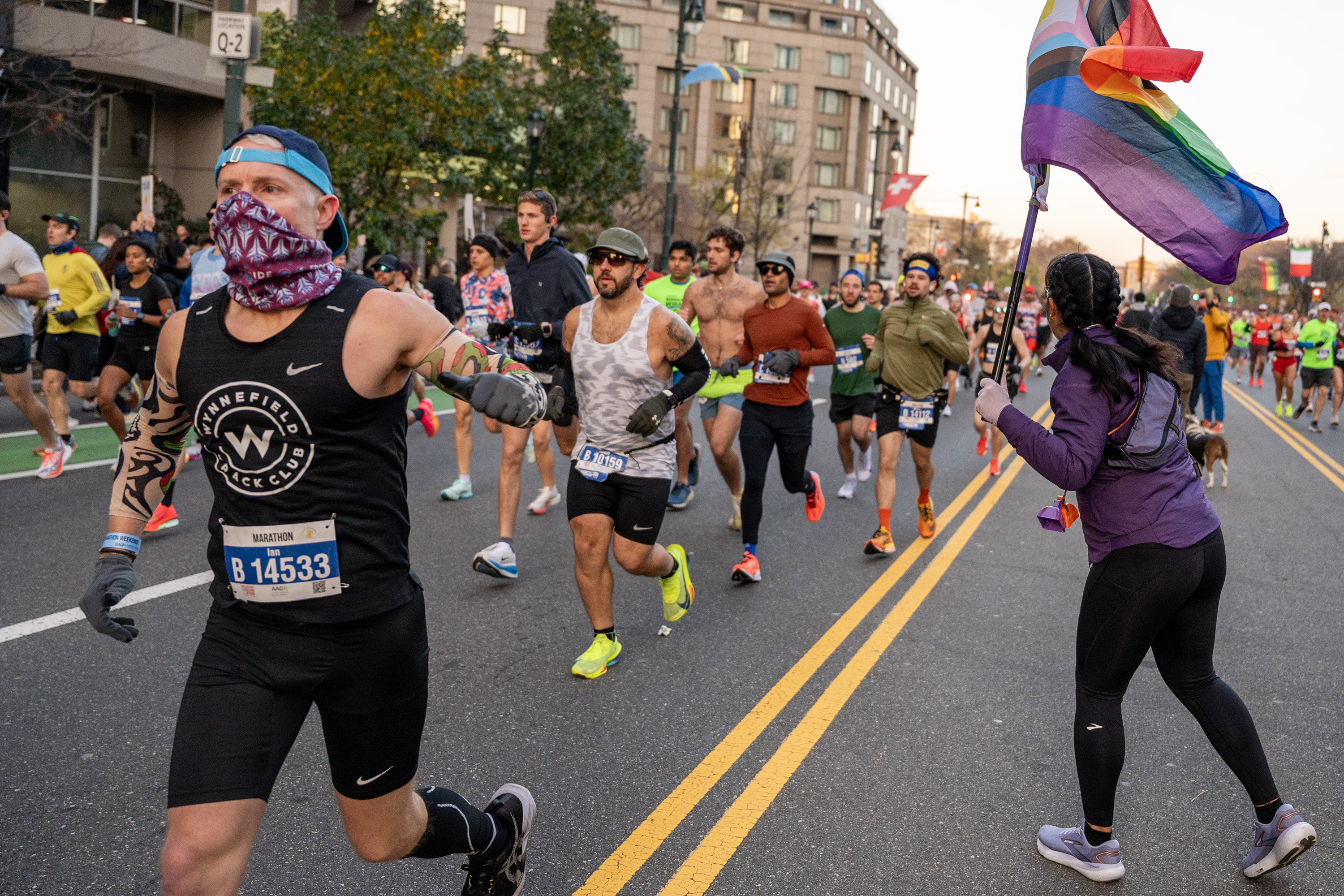
    Sharon Tejada (right), a coleader of Queer Run, encourages runners heading out on the Benjamin Franklin Parkway at the start of the annual Philadelphia Marathon on Nov. 23, 2025.Tom Gralish / Staff Photographer

    Race start times and locations for the Philadelphia Marathon

    All four races start near the Philadelphia Museum of Art. The marathon, half-marathon, and Children’s Run begin at 22nd Street and Benjamin Franklin Parkway, while the Rothman Orthopaedics 8K starts at 25th Street and Kelly Drive.

    • Dietz & Watson Philadelphia Half-Marathon: Saturday, Nov. 21, 6:55 a.m. (wheelchair participants); 7 a.m. (runners and walkers)
    • Rothman Orthopaedics 8K: Saturday, Nov. 21, 10:55 a.m. (wheelchair participants); 11 a.m. (runners and walkers)
    • TIAA Philadelphia Marathon: Sunday, Nov. 22, 6:55 a.m. (wheelchair participants); 7 a.m. (runners and walkers)
    • Philadelphia Children’s Run: Sunday, Nov. 22, 11 a.m.

    Race routes for the Philadelphia Marathon

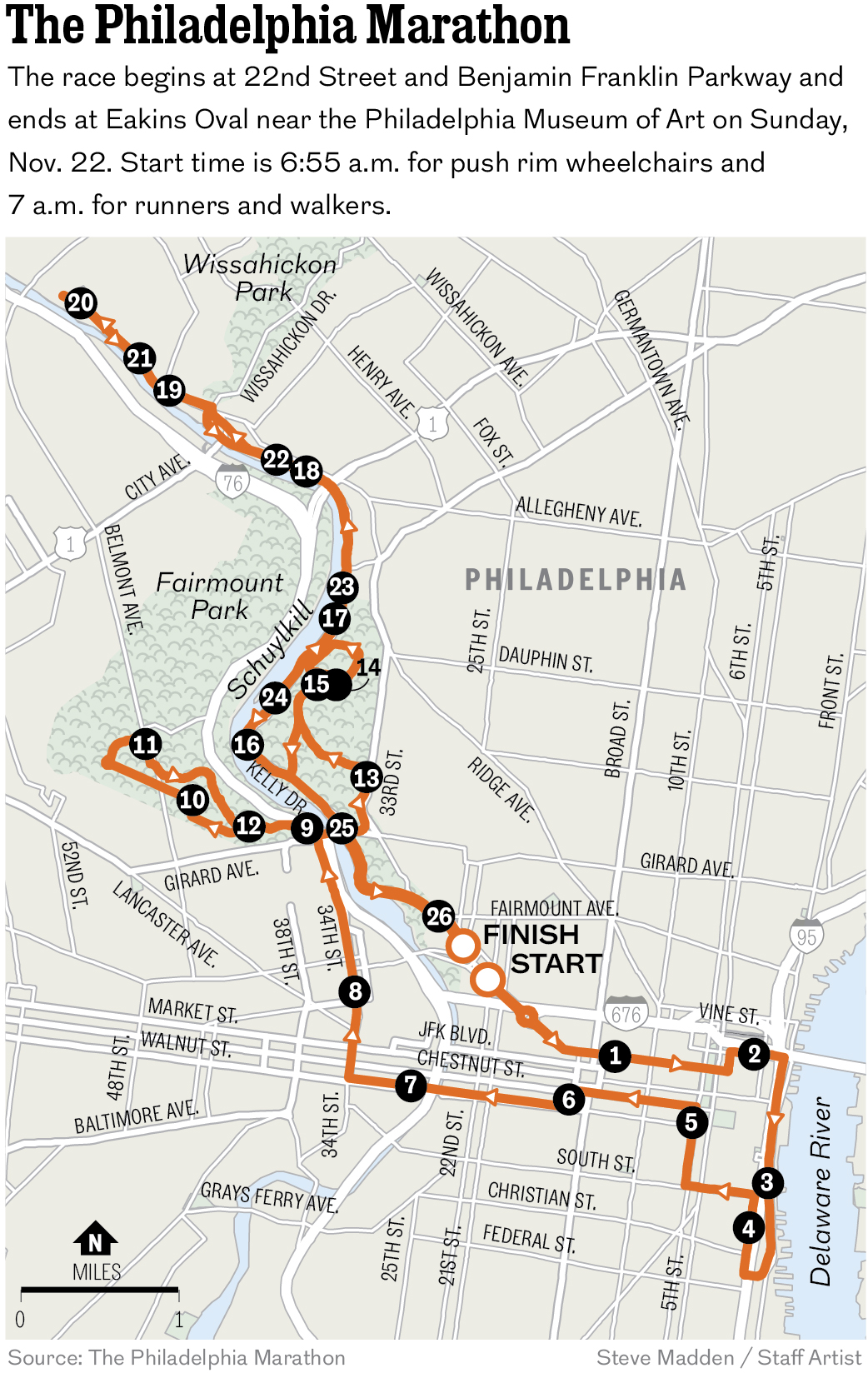
    Each race follows a unique route. The marathon and half-marathon wind through Center City, Chinatown, Old City, Queen Village, Rittenhouse, and University City, with portions of the courses passing through Fairmount Park and along Kelly Drive and the Benjamin Franklin Parkway.

    Course map for the Philadelphia MarathonSteve Madden

    Health & Fitness Expo

    The Philadelphia Marathon Weekend Expo returns to Hall F of the Pennsylvania Convention Center, at 12th and Arch Streets.

    • Friday, Nov. 20: 8 a.m. to 9 p.m.
    • Saturday, Nov. 21: 8 a.m. to 5 p.m.

    The expo features vendors showcasing apparel, shoes, and running gear, along with free product samples and educational booths focused on health and fitness. Both days will also feature a speaker series and meet-and-greets with some of the country’s top runners.

    For spectators of the Philadelphia Marathon

    Spectators are welcome to line the race routes to cheer on runners but will be restricted from the starting lines and in secure running areas until after 8 a.m. on Saturday and Sunday to ensure smooth race starts.

    The Philadelphia Marathon has a list of prohibited and discouraged items for spectators, available in full on its website.

    • Large umbrellas, coolers, alcohol, bicycles, scooters, and animals (except service animals) are prohibited. Organizers also discourage spectators from bringing large blankets, backpacks, handbags, and cameras.
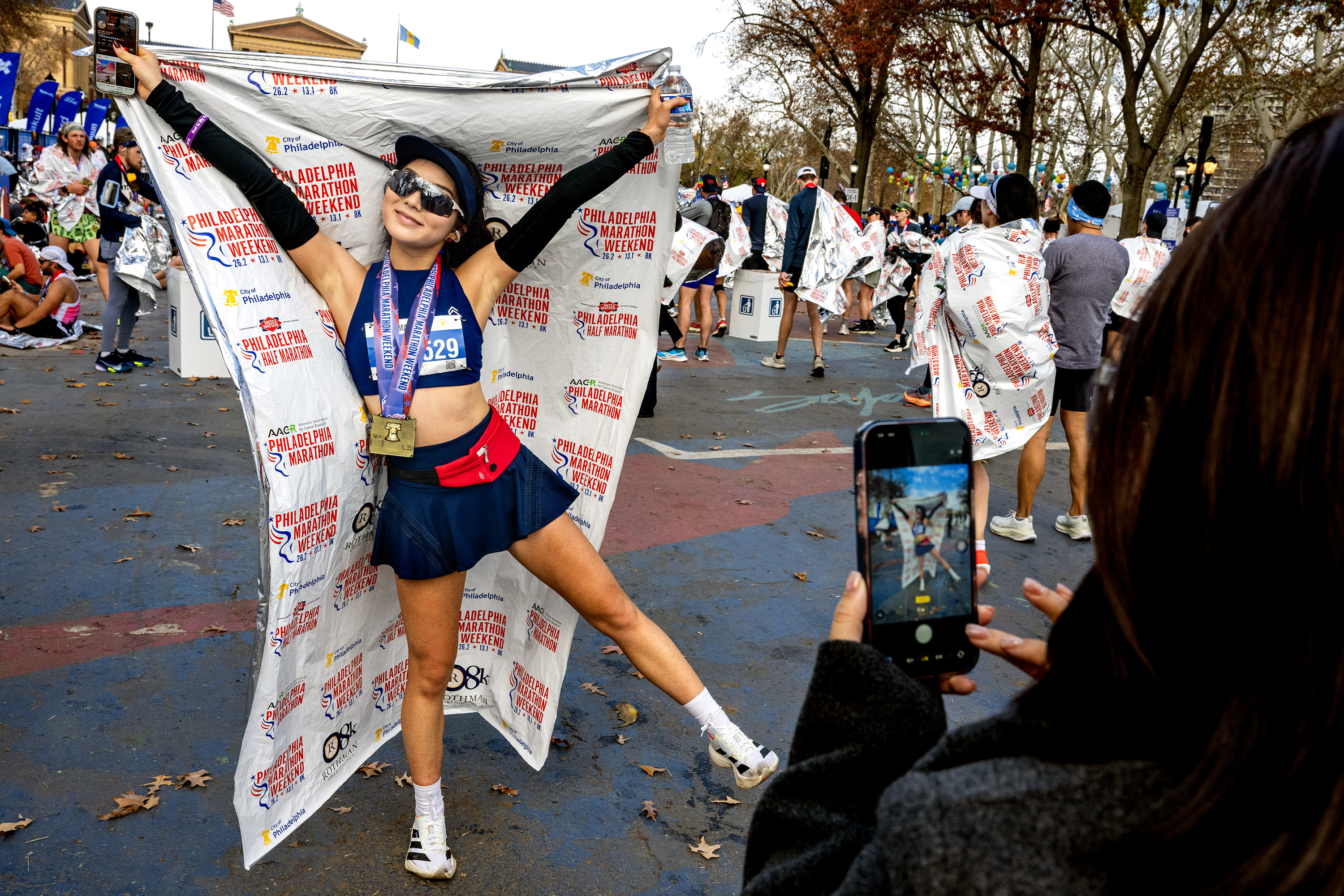
    Lilian Yao, 20, poses for her mother, Leslie Liu, after completing the Philadelphia Marathon on Nov. 23, 2025. This was her first marathon. Her mom arrived from Hong Kong just hours before the start of the race.Tom Gralish / Staff Photographer

    Road closures

    All-weekend closures

    Friday, Nov. 20, through 5 p.m. Sunday, Nov. 22

    • Benjamin Franklin Parkway (all lanes) between 22nd Street and Eakins Oval
    • Kelly Drive (inbound) closed at 25th Street, with local traffic permitted to Anne d’Harnoncourt Drive
    • Spring Garden Street Bridge and MLK Drive (inbound) traffic detoured onto 24th Street
    • Spring Garden Street closed between Benjamin Franklin Parkway and Pennsylvania Avenue

    Saturday, Nov. 21

    2 a.m. closures

    • 2000-2400 Benjamin Franklin Parkway
    • Spring Garden Street, from Pennsylvania Avenue to Benjamin Franklin Parkway
    • 23rd Street, from Pennsylvania Avenue to Benjamin Franklin Parkway
    • 22nd Street, from Winter Street to Park Towne Place (local access to Park Towne Place maintained)
    • 21st Street, from Pennsylvania Avenue to Winter Street

    4 a.m. closures

    • I-676 off-ramp at 22nd Street (westbound)
    • I-76 off-ramp at Spring Garden Street (eastbound)

    6 a.m. closures

    • 17th Street, from Arch Street to Vine Street
    • 18th Street, from Arch Street to Callowhill Street
    • 19th Street, from Arch Street to Callowhill Street
    • 20th Street, from Arch Street to Callowhill Street
    • 21st Street, from Arch Street to Spring Garden Street
    • 22nd Street, from Arch Street to Spring Garden Street
    • Benjamin Franklin Parkway, from 16th Street to 20th Street
    • Market Street, from Sixth Street to 16th Street
    • Chestnut Street, from Fifth Street to Eighth Street
    • Sixth Street, from Market Street to Chestnut Street
    • Fifth Street, from Chestnut Street to Race Street
    • South Penn Square
    • Juniper Street, from Chestnut Street to Market Street
    • John F. Kennedy Boulevard, from Juniper Street to 17th Street
    • 15th Street, from Race Street to Chestnut Street
    • 16th Street, from Chestnut Street to Race Street
    • Race Street, from Sixth Street to Columbus Boulevard
    • Columbus Boulevard (southbound lanes), from Vine Street to Washington Avenue
    • I-95 southbound off-ramp at Washington Avenue
    • Washington Avenue, from Columbus Boulevard to Front Street
    • Front Street, from Washington Avenue to South Street
    • South Street, from Front Street to Seventh Street
    • Sixth Street, from Bainbridge Street to Locust Street
    • Lombard Street, from Fifth Street to Broad Street
    • 13th Street, from Bainbridge Street to Chestnut Street
    • Walnut Street, from 12th Street to 34th Street
    • 34th Street, from Chestnut Street to Girard Avenue
    • Spring Garden Street, from 32nd Street to 34th Street
    • Girard Avenue, from 33rd Street to 38th Street
    • 33rd Street, from Girard Avenue to Cecil B. Moore Avenue
    • Reservoir Drive, from 33rd Street to Diamond Drive
    • Mount Pleasant Drive
    • Fountain Green Drive
    • Kelly Drive

    Access and reopening

    • Local access for residents and businesses will be maintained at police-controlled points.
    • Access to the Philadelphia Museum of Art will be available via Spring Garden Street (Bridge and Tunnel) to Anne d’Harnoncourt Drive.
    • Motorists and pedestrians can expect delays when trying to cross roads or streets along the racecourse.
    • Police will allow traffic through intersections when possible, depending on runner flow.
    • All streets (except Eakins Oval and the Parkway) are scheduled to reopen by 2 p.m. Saturday. Many Center City roads will reopen earlier as they are cleared and serviced.

    Sunday, Nov. 22

    As part of enhanced security for the TIAA Philadelphia Marathon, “No Parking” regulations will be strictly enforced. Vehicles on the race route will be relocated beginning at 1 a.m. Sunday.

    2 a.m. closures

    • 2000-2400 Benjamin Franklin Parkway
    • Spring Garden Street, from Pennsylvania Avenue to Benjamin Franklin Parkway
    • 23rd Street, from Pennsylvania Avenue to Benjamin Franklin Parkway
    • 22nd Street, from Winter Street to Park Towne Place (local access maintained)
    • 21st Street, from Pennsylvania Avenue to Winter Street

    4 a.m. closures

    • I-676 off-ramp at 22nd Street (westbound)
    • I-76 off-ramp at Spring Garden Street (eastbound)

    6 a.m. closures

    • 17th Street, from Arch Street to Vine Street
    • 18th Street, from Arch Street to Callowhill Street
    • 19th Street, from Arch Street to Callowhill Street
    • 20th Street, from Arch Street to Callowhill Street
    • 21st Street, from Arch Street to Spring Garden Street
    • 22nd Street, from Arch Street to Spring Garden Street
    • Benjamin Franklin Parkway, from 16th Street to 20th Street
    • Arch Street, from Third Street to 16th Street
    • Fourth Street, from Arch Street to Vine Street
    • Race Street, from Sixth Street to Columbus Boulevard
    • Columbus Boulevard (southbound lanes), from Vine Street to Washington Avenue
    • Columbus Boulevard (northbound lanes), from Washington Avenue to Callowhill Street
    • I-95 southbound off-ramp at Washington Avenue
    • Washington Avenue, from Columbus Boulevard to Front Street
    • Front Street, from Washington Avenue to South Street
    • South Street, from Front Street to Seventh Street
    • Sixth Street, from Bainbridge Street to Market Street
    • Chestnut Street, from Sixth Street to 15th Street
    • 15th Street, from Chestnut Street to Walnut Street
    • Walnut Street, from Broad Street to 34th Street
    • 34th Street, from Chestnut Street to Girard Avenue
    • Lansdowne Drive, from Girard Avenue to South Concourse Drive
    • South Concourse Drive, from Lansdowne Drive to West Memorial Hall Drive
    • East Memorial Hall Drive, from South Concourse Drive to Avenue of the Republic
    • Avenue of the Republic, from East Memorial Hall Drive to Catholic Fountain
    • Belmont Avenue, from Montgomery Drive to Parkside Avenue
    • States Drive, from Lansdowne Drive to Girard Avenue
    • Girard Avenue Bridge, from Lansdowne Drive to 33rd Street
    • 33rd Street, from Girard Avenue to Reservoir Drive
    • Reservoir Drive, from 33rd Street to Edgley Drive
    • Edgley Drive, from Reservoir Drive to Fountain Green Drive
    • Fountain Green Drive, from Edgley Drive to Kelly Drive
    • Kelly Drive
    • Falls Bridge
    • Ridge Avenue, from Schoolhouse Lane to Manayunk Avenue
    • Main Street (Manayunk), from Ridge Avenue to Conarroe Street

    Access and reopening

    • Local access for residents and businesses will be maintained at police-controlled points.
    • Access to the Philadelphia Museum of Art will be available via Spring Garden Street (Bridge and Tunnel) to Anne d’Harnoncourt Drive.
    • Expect delays at crossings along the course; police will allow traffic through when possible.
    • All streets (except Eakins Oval and the Parkway) are scheduled to reopen by 3 p.m. Sunday; many Center City roads will reopen earlier as they are cleared and serviced.
    • The outer lanes of Benjamin Franklin Parkway, Eakins Oval and Kelly Drive will be reopened to vehicular traffic by 5 p.m. on Sunday. All affected roads will be reopened by 8 a.m. on Monday, Nov. 23.

    Transportation to the races

    🚌 Bus

    Lines 7, 32, 38, 43, 48, and 49 normally stop within a short walk of the Philadelphia Museum of Art. However, race-related detours are expected throughout the weekend.

    Check SEPTA’s system status for the latest route changes and schedules.

    🚄 Trains

    Athletes and spectators can take the Market-Frankford Line to 15th Street at City Hall or Drexel Station at 30th Street, then connect to nearby routes 7, 32, 38, 43, 48, and others to reach the museum area.

    Visitors can also board the Broad Street Line to Fairmount and Broad-Spring Garden stations, and transfer to connecting routes 7, 32, 48, 49, or others serving stops near or at the museum.

    🚆 Regional Rail

    Visitors can take SEPTA Regional Rail to Suburban Station or 30th Street Station to reach the start and finish areas. Check SEPTA’s website for schedules and service updates.

    🚴‍♀️ Bicycle

    The race’s starting line is within a 10-minute ride from the City Hall area and subway stop and other locations. Check the map of Indego bike share stations to rent bikes and return them at a station near the Art Museum.

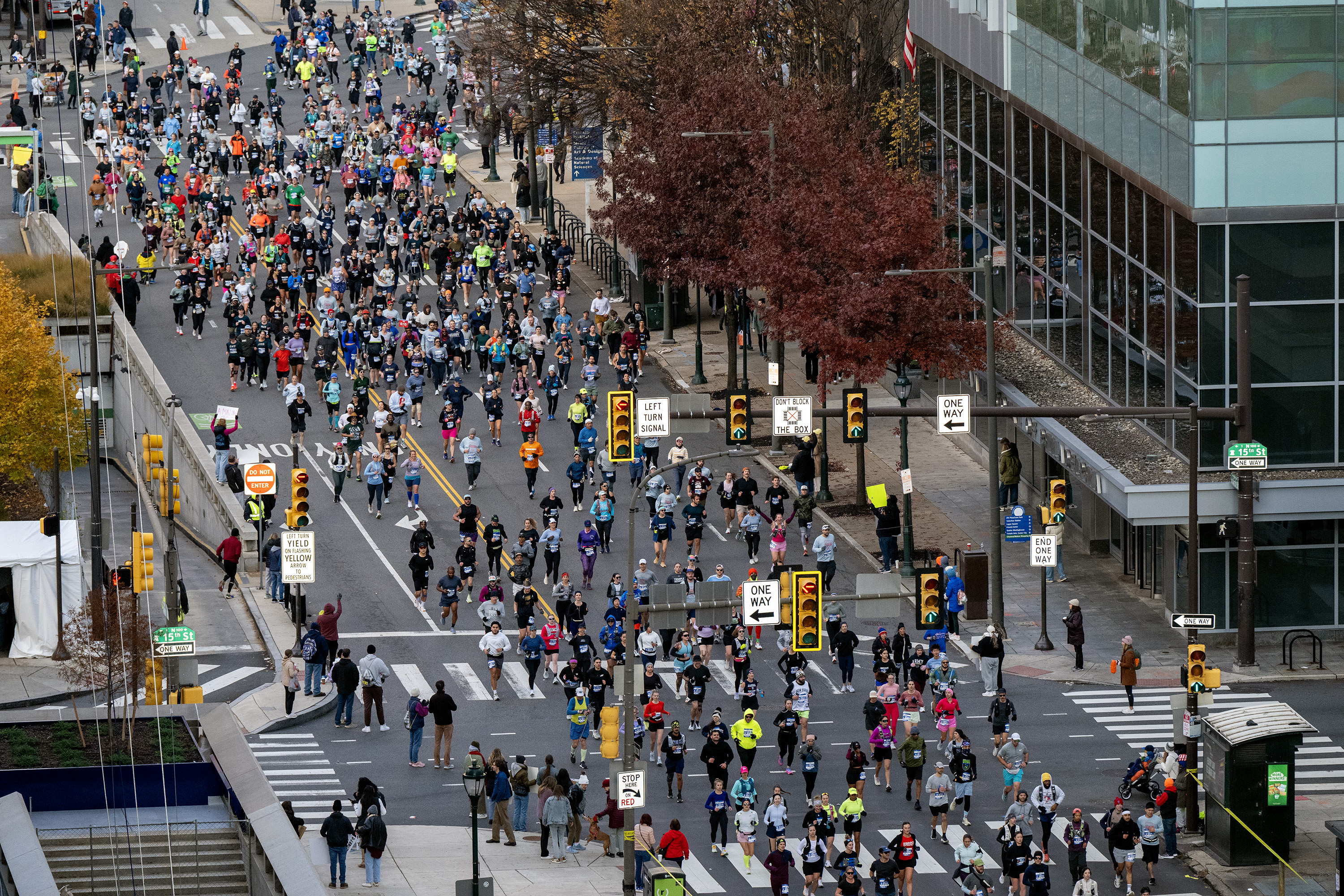
    Runners turn from the Benjamin Franklin Parkway (upper right) onto Arch Street heading to 15th Street (bottom) in the first mile of the annual Philadelphia Marathon on Nov. 23, 2025.Tom Gralish / Staff Photographer

    Where does the money go?

    Proceeds from the Philadelphia Marathon support several charities and nonprofits, including local organizations such as B Inspired Philadelphia and the Mazzoni Center.

    See a full list of partnering nonprofits on the Philadelphia Marathon website.

    Awards & prize money

    Cash prizes range from $1,000 to $10,000, depending on the race, with the Philadelphia Marathon’s professional division offering the largest awards.

    See a full list of awards and prize money on the Philadelphia Marathon website.

  • Here’s how the City of Philadelphia is defending the Wash West historic district

    Here’s how the City of Philadelphia is defending the Wash West historic district

    The battle over the Washington Square West historic district is not over yet.

    The 1,441-property historic district has been caught up in litigation almost since its inception, with Common Pleas Court Judge Christopher Hall ruling against it in October, and the city quickly appealing his ruling to Pennsylvania’s Commonwealth Court.

    The case is unusual because the Philadelphia Historical Commission usually wins appeals that try to reverse its designations.

    The so-far-successful pushback against the Washington Square West district is part of a larger backlash against preservation regulations, which became more prevalent over the last 10 years.

    The city’s appeal means the Washington Square West historic district remains in place while the litigation continues.

    In advance of a Commonwealth Court hearing, Hall will have to write a full opinion on the matter, as his ruling came with only a few paragraphs of footnotes explaining his thinking.

    The city and a group called Philadelphians for Rational Preservation, which opposed the district, will have to write full briefs as well.

    The next ruling is expected by 2028.

    This month, the Philadelphia Law Department filed a list of ways that it thinks Hall erred in his ruling, which offers a sense of how the forthcoming case could unfold.

    Philly doubts validity of public meetings

    Hall’s ruling found that the historic district was not supported by “substantial evidence” and that it was broadly unpopular.

    He also took issue with a historical commission staffer who reviewed the nomination but did not testify in its defense and with a commissioner who helped draft and revise the nomination. The commissioner did recuse herself from the vote.

    Hall found that Philadelphians for Rational Preservation was within its rights to challenge the district because homeowners would be immediately impacted by the new regulations on their homes.

    The city challenged all those findings, arguing that Hall should not consider lack of support for the district when he noted that 85% of those who testified about the district at a 2024 historical commission meeting were opposed.

    “The record does not reflect the overall views of affected owners, businesses, or residents, but only the self-selected bias of the limited number of persons who provided public comments,” the law department wrote in the city’s November rebuttal.

    The city also argued that Philadelphians for Rational Preservation should not be allowed to pursue the case because the group “failed to identify any constitutionally protected property interest affected by historic designation.”

    The law department argued that the group presented “no evidence of actual harm.”

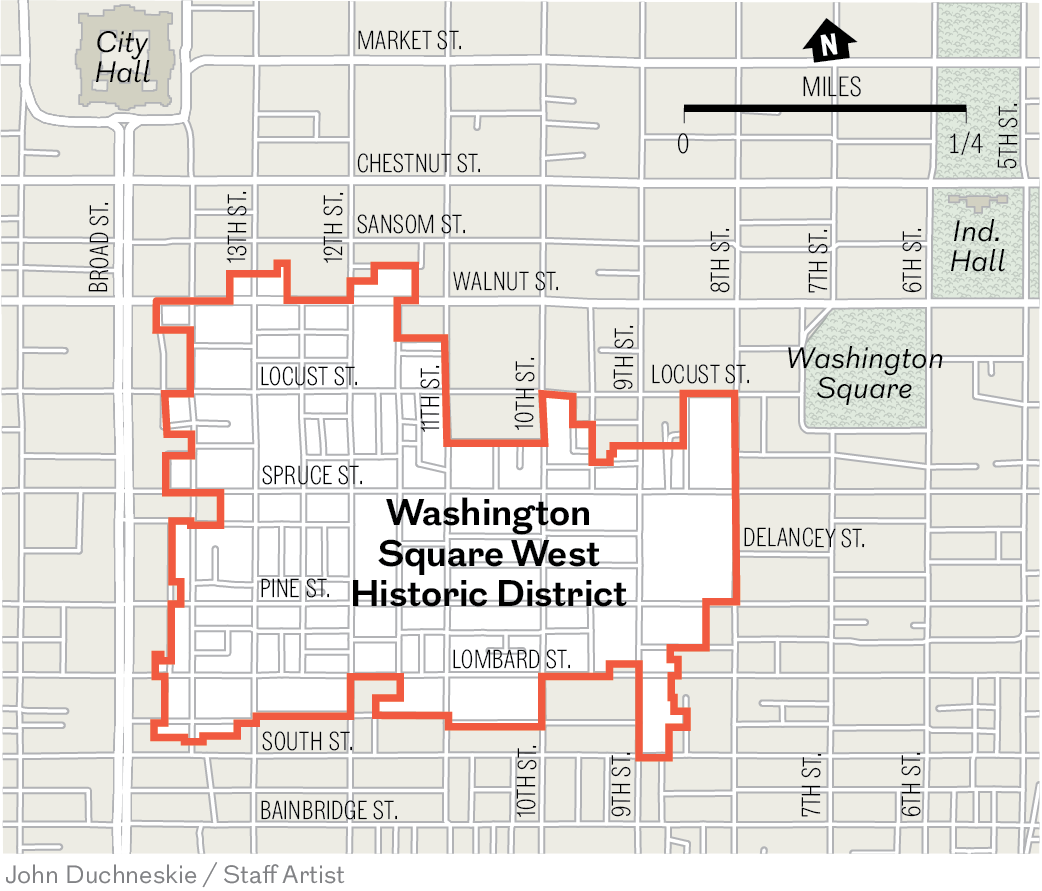
    Map of the newly designated Washington Square West Historic District.

    In recent months, Philadelphians for Rational Preservation has argued that the district would impose a de facto “preservation tax,” which would add thousands of dollars to home renovations.

    The kinds of materials required under preservation regulations are usually more expensive, while some changes — such as replacing doors and windows — would require homeowners to obtain a permit, which they previously would not have needed. That could result in additional wait time, bureaucratic hurdles, and extra costs.

    The group’s website includes quotes from homeowners who oppose the district and who share their negative experiences with it.

    No conflict of interest?

    The judge also ruled against the new district because he found the affirmative case shaky.

    “The nomination papers do not explain why most of the properties contributed to the district,” where the period of significance spans from 1740 and 1985, he wrote.

    Hall noted that much of the documentation for individual buildings remained blank, with no information included for the year they were built, the name of the architect, or the structure’s historic function.

    “No information appears in these fields more often than not,” he wrote.

    The city’s law department disputes those findings.

    The most detail in the appeal is the defense of Emily Cooperman, a member of the historical commission who told The Inquirer she helped write the original historic designation proposal almost 20 years ago, before she was on the commission. She also updated it more recently but recused herself from consideration of the case in 2024.

    Philadelphians for Rational Preservation objected to her involvement while sitting on the commission. The judge appeared to agree, although a detailed objection was not included in his initial ruling.

    “Dr. Cooperman recused herself from the commission’s consideration of the nomination, and there is no evidence of any commissioner having a conflict of interest or being improperly swayed,” the law department argues.

    Further, the department argues, a proper response would have been to remand the issue back to the commission, not reverse its ruling entirely.

  • Can a ‘blue wave’ make U.S. universities great again? | Will Bunch Newsletter

    Can a ‘blue wave’ make U.S. universities great again? | Will Bunch Newsletter

    First things first. During the last week, I heard from a few of you asking whether I would condemn a demonstration that occurred Sunday in Philadelphia in which bike riders, aggrieved by Israel’s war conduct in Gaza, protested a half dozen Jewish-owned dining places. I do condemn it, strongly — and I say that as someone who’s been a fierce critic of war crimes committed under the extreme right-wing government of Benjamin Netanyahu. I applaud those who went to New York this summer to protest him, but harassing businesses explicitly because of their Judaism — and a handful of donations to humanitarian causes that support Israelis — was a jumble of dangerous naivete and antisemitism. This time, the heroes were the many who showed up to support these businesses.

    If someone forwarded you this email, sign up for free here.

    Can the Dems’ blue wave start making U.S. college great again?

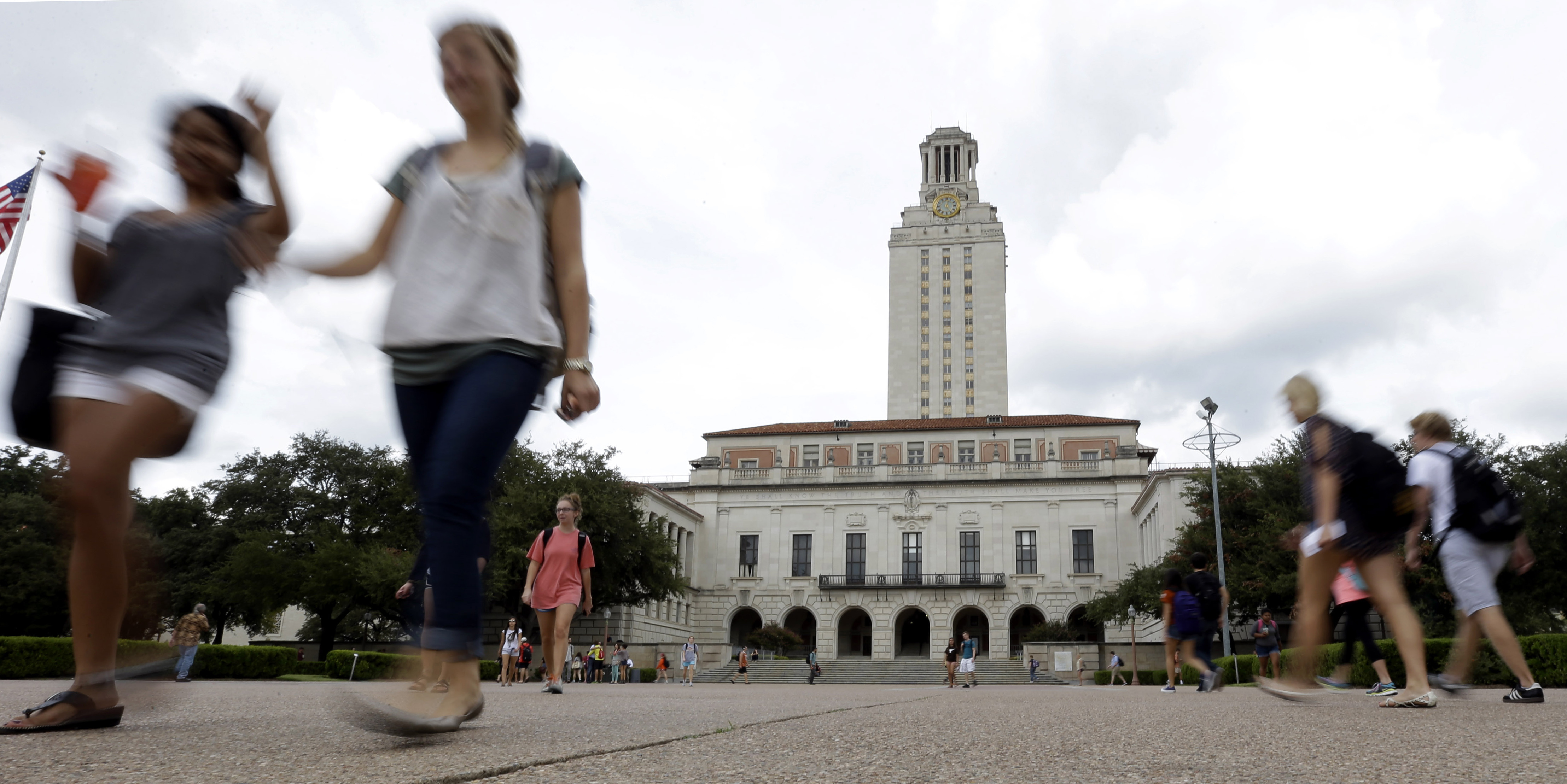
    Students make their way across the campus of the University of Texas at Austin in 2012.Eric Gay

    Last Tuesday morning, as Americans were waiting for the polls to open in a midterm election poised to change everything in U.S. politics, NPR touted on Bluesky its story about the culture wars at Texas Tech University. There, academic freedom has been undermined to the point where professors fear they will soon no longer be allowed to teach great books like Moby-Dick or The Odyssey.

    The head of the nation’s largest union of college academics, Todd Wolfson of the American Association of University Professors (AAUP), later reposted the story from that hopeful morning with a three-word comment:

    “Not for long.”

    That might have sounded overly optimistic in the moment, but just hours later, Texas — which will have a Democratic governor, lieutenant governor, and their party’s control of the Texas House for the first time in decades — emerged as the vanguard of the so-called blue tsunami that rebuked Donald Trump and GOP policies from coast to coast.

    The first two years of Trump’s 47th presidency have been disastrous for the American university — with Black and brown enrollment shrinking at many campuses amid withering government attacks on diversity programs, steep cuts to federal research grants, student loan cuts, and waves of restrictions on free speech in the classroom or at protests.

    Those issues simmered on the back burner in an election in which attention was heavily focused on high prices and widespread corruption in the Trump regime. But advocates such as Wolfson are optimistic that huge Democratic gains in once blood-red states that had all but declared war on higher education — not just Texas but North Carolina, Wisconsin, and Ohio — can start to swing back the pendulum of change.

    Wolfson told me Monday night that allies including groups like the AAUP, the closely connected American Federation of Teachers, and the National Education Association are talking about not just undoing some of the more egregious Republican state laws but to “start to drive proactive visions for higher education.”

    The idea is to change the national debate about academia away from the conservative-driven culture wars and angst over high tuition and student debt and back toward the positive American dream of college that flourished in the decades after World War II.

    After the new Democratic majorities take root on Capitol Hill this spring, Wolfson said higher ed boosters are discussing how to push for a big agenda such as a crusade for free public university education, or perhaps an even broader “crib-to-college” initiative that would also urge more investment in early childhood education and K-12 schools.

    “That is a response to creeping authoritarianism and the threats of AI,” he said. “You know, invest in your children and their future against the threats that we’re facing.” Wolfson acknowledged that it will take a few years, including a robust debate in the 2028 presidential primaries, to turn the battleship of government policy around. “But we’re going to launch it, and fight for it.”

    Existential dread over the future of U.S. higher ed, which is playing out in fears over falling enrollment and closures of some liberal arts colleges, may not have been the marquee issue last Tuesday, but the issue likely played a role in higher youth turnout — especially among students — and a strong shift in the 18-to-29-year-old demographic toward the Democrats.

    At the University of Texas at Arlington, for example, the decision by Republican officials to close a convenient on-campus polling place caused students to organize a march to their new off-campus site. Explained student organizer Emmanuel Hernandez: “Because I think it’s very important for us to just show a message and actually show that we never give up no matter the circumstance.”

    That message could be applied more broadly to advocates for strong universities, who’ve seen Republicans in red states — and the Trump regime — depict campuses as hotbeds of liberal indoctrination that they need to rein in by ending diversity, equity, and inclusion (DEI) programs, terminating departments centered on race or gender and curbing what can be taught, and by restrictions on tenure and faculty governance.

    How much of that can be rolled back under the big Democratic election gains? It’s complicated.

    Wolfson noted that it would be hard for Texas Gov.-elect Gina Hinojosa to repeal the state’s Senate Bill 37, which gave state-appointed university regents sweeping powers to eliminate classes or even degree programs. The measure has been blamed for the end of gender or ethnic and racial studies at some public campuses. The problem with a repeal is that Republicans have retained control of the Texas Senate.

    But Wolfson also believes the Democratic victories in Texas will create a climate that might end the harsh interpretations of the law by college administrators, such as last year’s firing of a Texas A&M professor for classroom comments on gender.

    “Some of the reforms that universities embraced over the last two years were not because of any legal mandate,” John D. Sailer, director of higher education policy at the conservative Manhattan Institute, told the Chronicle of Higher Education. “They went beyond what the law actually mandated. They were, if you want to put it in a term, based on vibes.”

    But the biggest change in the short term may be the ability of new Democratic governors like Hinojosa or Keisha Lance Bottoms in Georgia to appoint new university trustees or regents with a more liberal view of academic freedom and campus diversity. In 2027, Hinojosa will be appointing 20 new regents across seven public universities in Texas.

    Another unheralded source of political power for academic freedom, Wolfson said, will be efforts to undo the curbs on professors or other academic workers from unionizing that exist in a number of heartland states such as Wisconsin, which, with its Act 10, banned faculty unions despite huge, vocal protests in 2011.

    But the conditions for a radical reversal are not in place, not yet. In Washington, two more years of Trump and his close ally, Education Secretary Linda McMahon, will likely thwart efforts to reestablish DEI policies at the federal level. But a Democratic Congress and its power of the purse should be able to undo some of the cuts in scientific research funding that have devastated top campuses.

    Still, Wolfson acknowledged that the desired vibe shift that would lead to long-term policies to make a college diploma more accessible — as opposed to the current push to limit what professors can teach or which students can be admitted — goes beyond just defeating Republicans at the ballot box. Leading Democrats have mostly avoided a positive, pro-college agenda to focus instead on reviving trade schools (which is also a good thing), or opening up more state jobs to noncollege graduates.

    The faculty union president said true leaders can bring the conversation around the American way of college back to ideals like children doing better than their parents, or the need for scientific breakthroughs, or the role education plays in a democratic civil society. “It’s really hard to get that narrative out there in a way that is lifted up when the Elon Musks of the world have such a big megaphone and have been beating us down so hard for so long,” Wolfson said.

    It’s a heavy lift, for sure, but after last Tuesday, the winds of change for American universities are finally blowing in the right direction.

    Yo, do this!

    • I rarely venture out from my undisclosed location, but I’m going to do it this Friday night, Nov. 13, to moderate a very special book event with author Akbar Shahid Ahmed, who formerly covered international affairs for the HuffPost and has written the definitive history of our former president’s badly botched policy in the Middle East: Crossing the Red Line: Biden, His Advisors, and Israel’s War in Gaza. Please read the book, and then meet us Friday at 7 p.m. at the Haraz Coffee House at 1822 Chestnut St. in Center City, Philadelphia, for what should be a lively conversation.
    • It’s still mind-blowing to boomers like me that most voters either weren’t around or were too young to care much about Watergate, the scandal that, in 1974, ended the presidency of Richard Nixon, who was the worst POTUS anyone could imagine until, well, you know. The passage of time has allowed the far right to create a false narrative that Nixon was framed, which is why I’m urging everyone to rent or buy The Watergate Caper: Richard Nixon and the Death of the American Dream, which is narrated by the great (and occasional friend of this space) Harry Shearer. Reviews say you’ll feel like you’re experiencing Watergate in real time, which — as someone who did exactly that as a teenager — is a pretty wild ride.

    Ask me anything

    Question: What does it [the midterm election] mean for [Pennsylvania Sen. John] Fetterman? — John Robinson (@jrobin.bsky.social) via Bluesky

    Answer: Great question from my retired ace journalist friend John, which seems to be on the mind of a lot of my neighbors here in the Keystone State. Fetterman, who has dismal Democratic approval numbers after his hard right turn toward Benjamin Netanyahu’s Israel and other moments of siding with Trump, looked shell-shocked when a reporter tried to interview him this week. The early appearance of a primary opponent, Philly-based Palestinian American writer Ahmed Moor, suggests others with bigger resumés are likely to follow. I don’t see any path for Fetterman as a Democrat, and I think a switch to the GOP would be a bumpy ride that would leave no one happy. That said, the poli-sci major in me does think Fetterman might have a chance as an independent, especially if the major parties both nominated candidates from their left and right flanks. Hard to believe, but some voters still view his erratic behavior as bucking the system. We’ll see.

    What you’re saying about …

    For the second time in three weeks, a question was a total dud. The timing of the newsletter that went out in the middle of Election Day, when people were hanging on the results, all but guaranteed a zero response rate, since folks tend to answer in the moment, or not at all.

    📮 This week’s question: The debate about whether New York’s Chuck Schumer should continue to lead the Senate Democrats has been fascinating to watch. Online progressives seem to agree with me that it’s time for a change, and that Maryland Sen. Chris Van Hollen would be a great alternative. The Morning Joe punditocracy sees this as crazy talk. What do you think? (Feel free to suggest other candidates.) Please email me your answer and put the exact phrase “Replacing Schumer” in the subject line.

    Backstory on the ‘blue wave’ crashing into reality

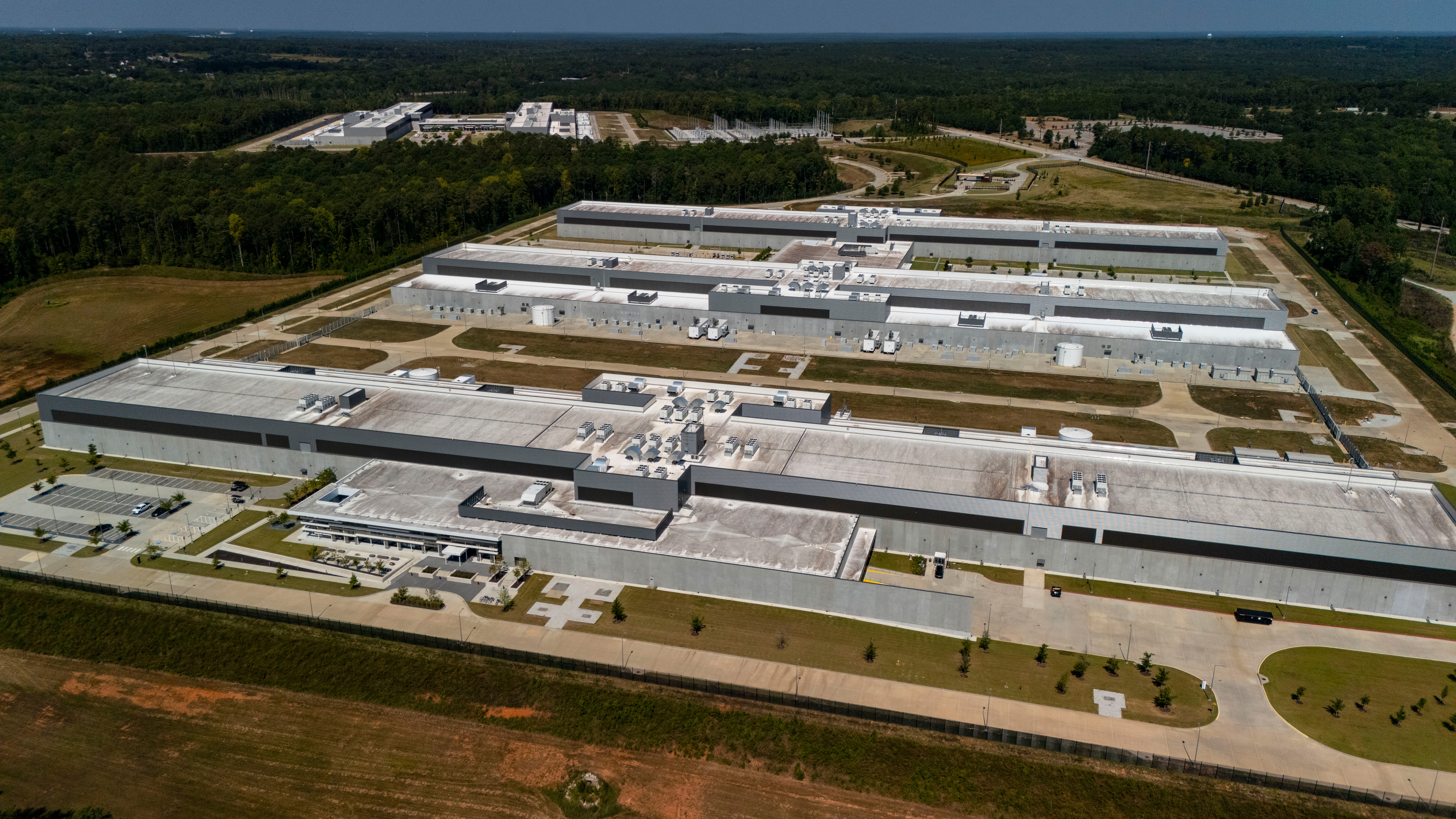
    Meta data centers operate near Social Circle, Ga., in September.Mike Stewart

    For Democrats, winning the midterms will surely be looked back on as the easy part. There’s already been a ton of speculation about how congressional Democrats will try to govern through two more years (probably) of Donald Trump in the White House, and at least 44 Senate Republicans eager to filibuster any left-leaning legislation. But forget next year; the crisis of governing in this brave new world is already here, this week. And it is not going well.

    The issue is a piece of major legislation that — while the mainstream media was obsessing over Sen.-elect James Talarico’s breakfast taco or whatever — sneaked its way through Capitol Hill with no one but congressional aides and a few keen lobbyists paying any attention, until now. It’s called the Bipartisan American Affordability and Jobs Act, or BAAJA, and what’s so complicated is that the sweeping measure deals with a problem that bothers both liberals and conservatives, but in very different ways. The bill aims to speed up the slow pace of environmental and other federal permits for energy-related projects.

    There are energy projects that are largely loved by the right and loathed by the left — hyperscale data centers and the fossil-fuel plants that power them — but the bill would also streamline permitting for projects liberals want, including clean energy developments as well as mass transit and affordable housing. Several key Democrats, led by Sen. Sheldon Whitehouse of Rhode Island, negotiated the bill with Republicans and the Trump regime. It certainly is an old-fashioned compromise in the sense that both sides are conceding some ground to get something they want.

    Still, it’s telling who wants passage of BAAJA and who doesn’t. Trump, arguably Planet Earth’s biggest booster for data centers and climate-crushing fossil fuels, desperately wants the bill and calls it “a BIG WIN for U.S. ENERGY INDEPENDENCE and DOMINANCE.” (He also insists he won’t abide new wind energy projects, which undermines the deal.) But former Vice President Al Gore, who won a Nobel Peace Prize for his climate activism, is urging a no vote.

    “Given how this Administration has run roughshod over the environmental laws and protections that are currently in place, now is not the time to give the Trump administration freer rein to double down on fossil fuels — which is what President Trump would surely do,” Gore posted on X. “And after last week’s historic election, we will have a new Congress in January that can strike a far better balance.”

    I don’t know if Gore is actually right about the last part. A Democratic Congress would surely produce a better bill, but Trump would veto anything that doesn’t serve his obsession with data centers. It’s a tough call. On the whole, I’d argue that both the reality of green-lighting more fossil fuels and the symbolism of giving Trump a victory just days after he was repudiated by American voters outweigh any benefits.

    Right now, 22 Democratic senators see it differently. They sided with the lame-duck GOP majority to avoid a filibuster and set up a vote on final passage. As I said here recently in a different context, lost causes are the ones worth fighting for. Call your senator ASAP and tell them that helping data centers, and Trump, is not what you just voted for.

    What I wrote on this date in 2024

    What a difference two years make. On Nov. 10, 2024, I — like a lot of Americans, although sadly not a majority — was questioning how a seemingly failed one-term president who’d attempted a coup and had been convicted of 34 felony charges got a second crack at the job. A big part of the problem, I concluded, was the broken state of American news media, which helped produce an information-free citizenry. I wrote that “nothing mattered more than this: Donald Trump was returned to power by the most badly informed electorate in modern American history.”

    Read the rest: “2024’s other big loser? The mainstream media. Is there any path forward?”

    Recommended Inquirer reading

    • Yes, it was a busy and memorable week for me. I let others report on what happened, so I could look at lingering questions from the “blue tsunami” of 2026. First, I pondered what didn’t happen on Election Day — the lack of troops or masked goons at polling places, or FBI agents seizing ballot boxes, or any other markings of a Donald Trump coup. That was partly great prep work by democracy defenders, but I also argued that dictatorship just isn’t in Americans’ DNA. Over the weekend, I asked: What’s next? Specifically, can the Democrats accept that voters want a different way of doing things? I made the case that Maryland Sen. Chris Van Hollen — who showed enormous courage in fighting to save the immigrant Kilmar Ábrego García when no one else would — should be the next Senate majority leader. Not Chuck Schumer.
    • Of course, there’s what’s immediately next, and then there’s what’s next after that, as in the 2028 elections that essentially kicked off as soon as the polls closed at 8 p.m. on election night. The next two years are especially pivotal in Pennsylvania, where no one can figure out what will happen regarding the reelection of John Fetterman, who is wildly unpopular in his Democratic Party. Philadelphia U.S. Rep. Brendan Boyle surprised a lot of folks (including me) by not running. Meanwhile, Ahmed Moor, a Palestinian American writer who was born in Gaza and worked in international development, has said he will challenge Fetterman, who’s infuriated many Dems with his stance on the war in Moor’s native Gaza. Meanwhile, did Gov. Josh Shapiro’s landslide reelection launch him into a sustainable orbit for his expected White House bid? It’s a lot to digest, but The Inquirer is already gearing up to give you a steady diet of the political fodder that anyone who’s made it this far in the newsletter craves. Subscribe today and join us at the table.

    By submitting your written, visual, and/or audio contributions, you agree to The Inquirer’s Terms of Use, including the grant of rights in Section 10.

  • Carolyn Marvin blocked a food delivery robot. It was a stand for humanity.

    Carolyn Marvin blocked a food delivery robot. It was a stand for humanity.

    It’s ironic that a fight over our future recently came down to a standoff between a college professor and some takeout food.

    But that’s what happened last month after Carolyn Marvin deliberately stood in front of a food delivery robot on a sidewalk in Center City, blocking its path. She didn’t leave until law enforcement put her in handcuffs and took her away.

    The fact that a respected University of Pennsylvania professor emerita wound up in police custody after squaring off against a plastic cooler on wheels is a fitting metaphor for us and the looming artificial intelligence tsunami.

    Marvin’s story has since gone viral and turned her into a bit of a folk hero, simply because she placed her rights above those of a robot and refused to back down. When I talked to her about what happened, she was defiant, saying, “Do we really want to surrender the sidewalks to the robots instead of human beings?”

    Oh, hell no.

    Center City sidewalks are crowded enough without our having to jostle for space with 150-pound refrigerators on wheels.

    Food delivery robots began operating in Philadelphia in March. More are on the way. If you’re not concerned, you may want to rethink that. They may be cute, but they can cause mayhem.

    Video taken in May shows one entering a crosswalk in Center City as a truck makes a turn and hits it. That same month, a 32-year-old fell off his bicycle after one got in his way in Jersey City, N.J.

    Pedestrians are the most vulnerable. An Uber autonomous delivery bot bumped into a pedestrian from behind as she stood at 15th and Locust Streets. Li Gordon-Washington, 25, wasn’t seriously injured. But what if it had been someone with a physical disability? People using walkers and canes have a hard enough time navigating tight, uneven pathways without also having to dodge delivery pods on wheels.

    That’s why Marvin’s small but mighty act of defiance resonates. The stand she took on a public sidewalk on Oct. 14 wasn’t just against personal delivery devices, but also for all of us.

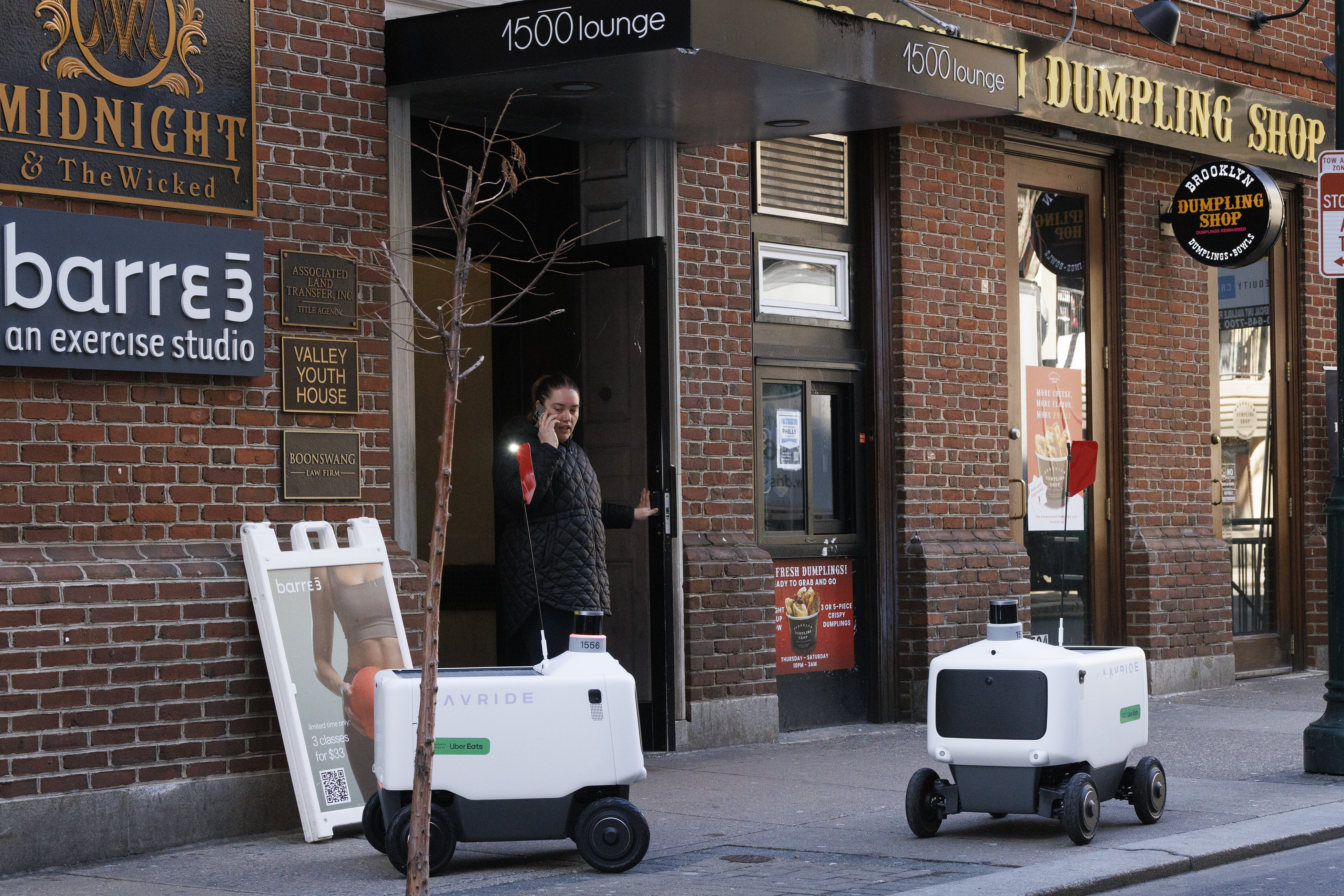
    Uber Eats robot food delivery pods on the sidewalk along 1500 Sansom Street on Tuesday morning, March 17. One robot was present (right) when a second arrived.Alejandro A. Alvarez / Staff Photographer

    It happened on Filbert Street near 12th Street, across from Reading Terminal Market. As Marvin refused to let the delivery pod pass, passersby gathered to watch.

    Some didn’t approve.

    Before long, several members of the Philadelphia police showed up and asked her what she was doing. “I explained that I was exercising my First Amendment right to protest corporate abuses in the same public space that the robots were occupying,” Marvin recalled. “They asked me to move. I said, ‘No, why?’”

    Marvin had gotten a flu shot that day. She had in her hands a jar of enchilada sauce and some chicken biryani. Never in her wildest dreams did Marvin think she’d wind up in handcuffs and in the back of a police cruiser. But that’s what happened.

    People should always come first. Pedestrians before robots. Human rights before those of automation. Besides, autonomous food delivery robots take jobs from poor people.

    What’s next — robots babysitting our kids? Serving tables in restaurants? I’m not for just letting life as we know it disappear as AI takes over. That doesn’t sit right with me.

    Same with Marvin, who had this to say about food delivery bots: “I’d like to see them banned.”

    That’s what some cities have already done — including Jackson, Wyo., and Toronto. San Francisco has put restrictions on them.

    Closer to home, Councilmember Jeffery Young Jr. has introduced a series of regulations on food delivery companies that include a proposed $1,000 surcharge on each delivery by autonomous delivery robots. Councilmember Jim Harrity wants to tax them; State Rep. Ben Waxman would like to limit where they can operate.

    As government officials grapple with how best to regulate them, we can push back by ordering takeout from businesses that still employ human beings as delivery people. Or — gasp — we can even go out and pick up our own food and forego the convenience of having it brought to our front door.

    Marvin wants the 2020 designation of so-called personal delivery devices in Pennsylvania as “pedestrians” repealed. That means they would have to yield to us.

    After all, technology is supposed to make our lives easier — not edge us out of the way.

  • Longtime Philly political strategist Kellan White is running to unseat City Councilmember Jeffery Young Jr.

    Longtime Philly political strategist Kellan White is running to unseat City Councilmember Jeffery Young Jr.

    Kellan White has spent more than a decade working behind the scenes on Philadelphia political campaigns. This week, he’s launching a campaign of his own.

    The longtime Democratic political strategist is running for City Council to represent Philadelphia’s 5th District, which includes swaths of North Philadelphia and Center City, White told The Inquirer.

    He is seeking to unseat incumbent Councilmember Jeffery Young Jr., who has had a tumultuous first term and has already drawn several potential challengers heading into the May primary election. The only other candidate to formally announce a campaign is cybersecurity attorney Jalon Alexander, but as many as four challengers have expressed interest in running.

    The May primary election is likely to be determinative given the heavily Democratic makeup of the district.

    White, 40, of Brewerytown, comes from a family with a long history in public service and started his political career as a City Council intern. He has worked on numerous Democratic campaigns, including for former President Joe Biden, and most recently was an adviser to Ala Stanford, who unsuccessfully ran for Congress.

    In 2017, White ran Rebecca Rhynhart’s successful campaign for city controller, a race in which she toppled a party-backed incumbent. White then became first deputy city controller before managing Rhynhart’s 2023 mayoral campaign. She finished second in the Democratic primary behind now-Mayor Cherelle L. Parker.

    White said that he has developed relationships across the city’s political landscape, and that in an era of factionalism in the party, he is not trying to run as one type of Democrat or another.

    For example, he is seeking the endorsement of politically powerful unions, including the Philadelphia Building and Construction Trades Council, which is often seen as aligned with centrist Democrats.

    And he said that Young — who has championed legislation that at times has sought to slow or halt housing construction in parts of the district — has been too hostile to development and used zoning as a “sledgehammer.”

    But White also has allies in progressive circles and positions that would align with Council’s left wing. He said he would have voted in favor of a recent tenants’ rights legislative package that was backed by the Working Families Party and that Young voted against. The bills passed with a majority of Council’s support and became law.

    “I believe that housing is a human right, and everyone deserves a quality public education, one job should be enough, and every worker has the right to unionize. So that makes me a progressive,” White said. “But I don’t think I’ve ever cleanly fit into any bucket, because I’ve never felt like I had this need to plant my flag in any one camp.”

    Councilmember Jeffery Young Jr., seen at the lunch event at South Jazz Kitchen on Election Day in Philadelphia, Pa., on Tuesday, Nov. 3, 2026.Tyger Williams / Staff Photographer

    White’s campaign, his first time running for office, is the latest chapter in a long family legacy in the city dating to the civil rights era.

    His father, John F. White Jr., served in the state legislature and on City Council, led the Philadelphia Housing Authority, and was the Pennsylvania secretary of welfare under former Gov. Robert Casey Sr. He unsuccessfully ran for mayor in 1999.

    And his grandfather, John F. White Sr., was a leading figure in the movement to build Black political power in the city.

    In the late 1960s, he cofounded the Black Political Forum with future State Sen. Hardy Williams. The organization aimed to develop Black politicians to run for office without the blessing of the Democratic Party establishment.

    The group played a major role in the movement that helped elect W. Wilson Goode as mayor, and Bill Gray to Congress, where he became one of the city’s most powerful lawmakers. The organizing efforts helped shape the Northwest Coalition, a political network that remains active today and counts Parker among its members.

    Shortly before his death in 1999, John White Sr. advocated for Black politicians to build power by aligning with the liberal middle class of all races, according to an obituary in the New York Times.

    Kellan White said he sees his campaign as a reflection of his family’s history and an homage to the legendary Black politicians who have represented the 5th District over history, including Cecil B. Moore, the civil rights activist.

    “There’s pressure in that, but I feel prepared to meet the moment,” he said. “I was born into a family that instilled public service into me from birth.”

    But, he added, “I wanted to and always have forged my own path.”

  • Craig LaBan’s ultimate gluten-free dining guide to Philadelphia and the suburbs

    Craig LaBan’s ultimate gluten-free dining guide to Philadelphia and the suburbs

    No bread-loving human wants to hear the news that they can no longer eat gluten. It can be downright devastating for an avid baker like my daughter, who was diagnosed with celiac disease five years ago, and who learned that the gluten proteins in wheat, barley, and rye were making her sick. We quickly discovered she is hardly alone.

    But a world of food innovators is out there, conjuring everything from flaky croissants to silky fresh pastas, airy doughnuts, crisply fried chicken, and crusty loaves that are both delicious and gluten-free. The wave of new GF options has only continued to grow alongside an uptick in diagnoses, more accurate testing, greater awareness of gluten-triggered autoimmune disorders, and the popularity of gluten-free diets among those without an allergy or intolerance.

    In the two years since I published our first gluten-free guide to the Philadelphia region, the list has expanded considerably, including a next-level pizzeria and new bakeries filling the sandwich-loaf void after the closure of GF stalwart Taffet’s. There’s been a dramatic increase in accessibility-minded restaurants serving mainstream audiences that have embraced protocols to safely produce gluten-free food while minimizing cross-contamination. Several restaurants have even begun monthly events dedicated to GF dining, including Little Walter’s and, just recently, Le Virtu.

    There will always be some risk in eating at establishments that are not 100% gluten-free, and everyone’s sensitivity is different. But diners should never hesitate to ask specific questions to seek clarity and reassurance about ingredients or methods. As evidenced by this growing list, which I’ve vetted largely with my own family, the quest for satisfying new gluten-free options is more rewarding than ever.

    Italian

    Corio

    There’s been a wide selection of thoughtful gluten-free options built into the Italian-ish menu of this sleek University City newcomer from the start, thanks to a family member of the ownership team who has celiac disease. The house pastas can be subbed with gluten-free noodles, but Corio also has a devoted following for its thin-crust pizza — made with a base of potatoes — that gets baked on the top deck of a triple-shelf oven to avoid cross-contamination with the excellent standard pies. The sweet corn risotto is also a popular GF move, and an olive oil cake has also been recently added to the mix because, as co-owner Ryan Mullholland says, “we want guests who eat gluten-free to feel like they can enjoy a complete meal with us, including dessert.”

    3675 Market St., 267-969-5359, coriophilly.com

    Cry Baby Pasta

    This Queen Village corner tavern is a favorite among celiacs for a reason: Any of its five pastas can be substituted with gluten-free bucatini or casarecce (cooked separately in uncontaminated water). I’m a fan of the Bolognese and spicy vodka sauce nod to Upstate New York’s “chicken riggies.” A dedicated GF fryer also turns out crispy calamari and a chicken Parm special available in limited quantities Tuesday through Thursday.

    627 S. Third St., 267-534-3076, crybabypasta.com

    Lark

    Chef Nicholas Elmi’s rooftop Bala Cynwyd restaurant will substitute gluten-free cavatelli for the house noodles. (Get the boar ragù with black trumpet mushrooms.) But the naturally GF dishes are their own draw, from the tuna crudo with blood oranges and golden beets to scallops with chanterelles and polenta, and a torta caprese for dessert with black cocoa caramel and goat yogurt gelato.

    611 Righters Ferry Rd., Bala Cynwyd, 484-434-8766, larkpa.com

    Settantatré Pasta & Provisions

    Fresh gluten-free pasta is exceedingly rare: Most Italian restaurants simply swap in dried gluten-free pasta for their housemade noodles. But chef Matt Gentile has cracked the code for supple egg noodles made with blended alt-flours — they’re among the best I’ve encountered, whether stuffed with burrata for tortelloni or cut into pliant and snappy tagliatelle. That innovation sparked a rapidly growing business for Gentile, the former Panorama chef who has moved Settantatré into a larger Berwyn location with retail sales, a dining room for special events, and a separate facility for dedicated production of GF pastas, focaccias, tomato pies, and strombolis. Settantatré, which also produces outstanding traditional pasta, is a regular at farmers markets in Rittenhouse Square, Burlington County, and Berwyn.

    802 Lancaster Ave., Berwyn, 610-314-0876, settantatrepasta73.com

    Tulip Pasta & Wine Bar

    This intimate Fishtown pasta hub always features several gluten-free small plates, like tuna crudo and charred vegetables with smoky maple yogurt and chile oil. The sweet potato gnocchi made with cassava flour paired with chicken sausage is naturally GF, while the housemade noodles can always be replaced with GF version from the outstanding Rustichella d’Abruzzo brand to go with the lamb sugo, Old Bay-spiced lobster with manchego, or lemon sauce punched up with sweet and spicy peppers and aji dulce vinegar.

    2302 E. Norris St., 267-773-8189, tulippasta.com

    Pizza

    Barclay Pies

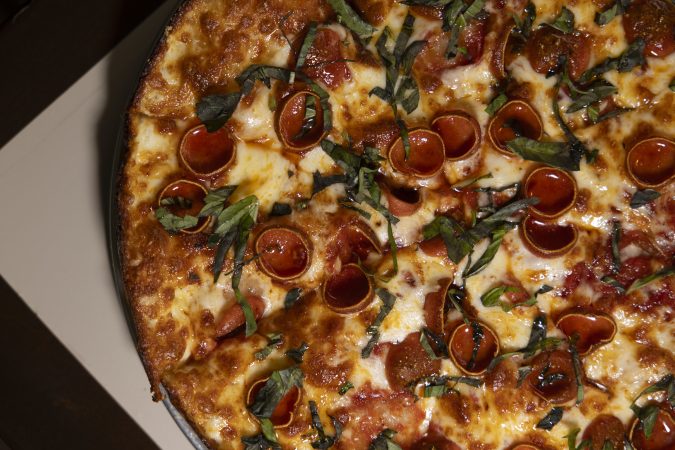
    “Oh wow, that does not even look gluten-free!” That’s been a common response from diners — including those in my family — when they first encounter the pizza at Barclay Pies. The edges of the airy, round Detroit-style crusts arrive crisped to a tawny brown under a crown of molten mozzarella. No matter which toppings you choose — oregano-scented red sauce topped with fistfuls of cup-and-char pepperoni glistening with honey; or the seasonally sweet summer corn, bacon, and chile peppers; or thin-shaved cremini mushrooms and caramelized onions — it’s not hard to understand why this project from friends Thomas “TJ” Hunton and Daniel Romero has set the regional gold standard for GF pizza. (Barclay’s standard glutenful pizzas are fine, but not the draw.) The menu also offers excellent versions of several other deep-fried GF delights, including fresh mozzarella sticks and chicken tenders. One important note: Barclay’s dough recipe uses Caputo Fioreglut, an Italian gluten-free flour blend that contains wheat starch whose gluten proteins have been removed. It is considered safe for most celiacs, but not for those who have an allergy to wheat.

    450 Marlton Pike, Cherry Hill, N.J., 856-712-1900, barclaypies.com

    Emmy Squared

    There’s no mistaking the difference between the puffy standard crust and the more compact gluten-free version at this chain. Still, the GF pies — made daily from rice flour and cornstarch, and proofed on-site — are delicious in their own right, with Emmy’s signature toppings (Roni Supreme!) and a crispy cheese “frico” crust that runs along the borders of the pan-baked edges in classic Detroit-style.

    632 S. Fifth St., 267-551-3669, emmysquaredpizza.com

    Sandwiches, cheesesteaks, and snacks

    Citizens Bank Park, Section 122

    Phillies fans who also happen to be gluten-phree are hardly limited to peanuts when going to a game. Citizens Bank Park has offered GF options at stadium concessions for over a decade, but the stand sponsored by Italian GF mega-bakery Schär, whose U.S. headquarters and production bakery is in Swedesboro, is now the primary hub for hot dogs and cheesesteaks on GF rolls, GF beer, and pretzels from South Jersey’s A&A Soft Pretzels.

    Citizens Bank Park, Section 122, 1 Citizens Bank Way

    Fox & Son

    Any gluten-free person longing for crispy fried food will be in carnival heaven at this essential stand in Reading Terminal Market, where Rebecca Foxman’s menu of state fair-inspired snacks — from corn dogs to fresh-cut fries, cheese curds, poutine, and funnel cakes — is entirely GF. Fox & Son manufactures its own batter and mixes, which make a perfect gift for any friend aiming to make their own GF corn dogs or funnel cakes at home.

    Reading Terminal Market, 1136 Arch St., 215-608-6796, foxandsonphilly.com

    Gouldsburger’s

    Inspired by friends and family with celiac disease, Walter Gouldsbury and David Murray, the founding chefs behind this rapidly growing local steak-and-burger chain, made gluten-free options a cornerstone of their menu since starting in 2023. The fryers use additive-free olive oil and are entirely GF, and rice flour is the batter base for the crispy chicken and fried pickles. (That breading is less successful on onion rings.) Gouldsburger’s is not 100% GF, as everything-spiced wheat flour rolls are standard for their cheesesteaks. But the staff is trained to change gloves and utensils when gluten concerns are flagged, and prewrapped Udi’s buns are used for GF orders, a consistently safe choice — even if eating a big and exceptionally cheesy cheesesteak on two hot dog buns is not ideal. There are a dozen locations now operated largely by franchisees, including the original Haddonfield location, where we visited successfully with our celiac daughter.

    109 Kings Hwy. E., Haddonfield, N.J., 609-301-5293; see website for other locations: gouldsburgers.com

    Joe’s Steaks + Sandwich Shop

    One of Philly’s best cheesesteak shops has been offering a gluten-free option for years, as owner Joseph Groh always has gluten-free rolls from Flakely on hand. Joe’s, which remains in the city’s cheesesteak upper echelon with fresh rib eye sliced in-house, takes extra precautions to avoid cross-contamination, with diligent glove-changing, a separate grill for GF orders, and a GF fryer used exclusively for french fries. Joe’s charges $5 extra for the gluten-free roll (they aren’t cheap), but it’s a fair value considering the quality and heft of these 10-ounce steaks layered with caramelized onions and oozy Cooper Sharp cheese.

    1 W. Girard Ave., 215-423-5637, joessteaks.com

    Middle Child and Middle Child Clubhouse

    This sandwich superstar has always been proactive with gluten-free options, able to make any of its creations GF-friendly, except for the Phoagie. Try the Celiac Sally (a variation of the So Long Sal! hoagie), the Shopsin Club, the breakfast sandwich with house corned beef, or the thick “Latk’d” hash brown crisped in a noncontaminated fryer. When ordering online, be sure to click the celiac button — not just gluten-free — for extra care. Middle Child uses focaccia from DreamWorld Bakes; it’s GF but contains wheat starch, so it’s not suitable for those with wheat allergies. Meanwhile, about 75% of the Clubhouse’s dinner menu is already gluten-free, including the steak au poivre.

    248 S. 11th St., 267-930-8344; 1232 N. Front St., 267-858-4325; middlechildphilly.com

    Nipotina

    Marlo and Jason Dilks, the couple behind SliCE Pizza and P’unk Burger, have updated the old-school South Philly lunch counter at this friendly corner shop off West Passyunk, and its sandwiches are all available gluten-free — including the cutlets encrusted in GF rice flour and crumbs. Pay special attention to the cheesesteaks, whose 12 ounces of tender, marinated meat make it a sleeper pick as one of the better steak sandwiches in town, gluten-free or not.

    2238 S. 21st St., 484-355-5410, nipotinaphilly.com

    Okie Dokie Donuts

    This cheerful South Philly takeout window has long been a destination for some of the city’s most creative, seasonally inspired doughnuts, which just happen to be 100% gluten-free. And since Bill Kelly bought out his partner and co-founder, Carol Ha, this summer, he’s leaned in even harder to the savory side, creating an impressive new sesame-dusted alt-flour hoagie roll for cheesesteaks and eggplant parm (encrusted in leftover doughnut crumbs). Still, the crispy chipotle chicken, served on a savory fried doughnut bun, remains Okie Dokie’s best sandwich. Add some popcorn chicken to your order, along with GF fries and a corn dog shaped like a doughnut, and you’re ready for a tailgate. The savory menu is also soy-, nut- and peanut-free. An expansion currently underway will soon allow for more kitchen space and a broader menu, along with a retail store where customers can buy frozen par-baked hoagie rolls to finish at home.

    1439 Snyder Ave., 267-237-3786, okiedokiedonuts.com

    Paesano’s

    At chef Peter McAndrews’ Italian Market shrine to lunchtime abondanza, the chef works alongside son Aidan, who is celiac, so they’re pros at modifying dishes to be gluten-free. And the exuberantly overloaded Italian sandwiches are all available on GF focaccia that the restaurant now bakes each morning on dedicated cast-iron pans. Try the Daddy Wad Italian, the Gustaio (lamb sausage, Gorgonzola, and sun-dried cherry mostarda), or the underrated Arista with suckling pig. Paesano’s now serves all its sandwiches whole, allowing customers to cut them at the table to avoid any possibility of kitchen cross-contamination.

    943 S. Ninth St., 267-294-3162, paesanosphilly.com

    Pearl’s on the Corner

    This Fishtown gastropub has quietly become a bar food haven for gluten-free diners. Since chef Mark Hennessy took over at the end of 2024, a GF fryer has unlocked the possibilities for both mozzarella sticks and chicken cutlets breaded in rice flour and GF panko crumbs. The meatballs, candied pecans, fries, and semifreddo are also GF, and other dishes, such as the burger or Buffalo chicken dip, can easily be modified. The kitchen is diligent about adhering to strict protocols to avoid cross-contamination, changing gloves, cutting boards, knives, and even cooking surfaces (for example, a sauté pan instead of a plancha) when it’s alerted to any serious concern.

    1444 Frankford Ave., pearlsfishtown.com

    SouthHouse

    This South Philly watering hole is more sports bar than gastropub, but, with its gluten-free fryers, few places are more dependable for celiacs to watch a game and nibble on fried chicken wings (go for the habanero BBQ), loaded tots, or cheesesteaks on GF rolls. Brunch draws include GF pancakes or waffles with crispy GF fried chicken.

    2535 S. 13th St., 267-314-5937, southhousephilly.com

    Sparrow’s

    This all-gluten-free market with two locations, including Reading Terminal, is a fun destination for locally made GF products and snacks, including A&A GF pretzels, fresh popcorn, corn dogs, house-fried potato chips, and “Fairy Floss” candy.

    10 Mechanic St., Haddonfield, N.J., 856-209-2955; Reading Terminal Market, 1136 Arch St., 856-209-2955; sparrowssnacks.com

    Woodrow’s Sandwich Shop

    This next-gen sandwich shop on South Street has long offered a gluten-free option for all sandwiches — except the meatball sub — using GF rolls (currently from Udi’s). The production protocols have been updated over the years, with separate utensils and cutting boards reserved for GF orders in addition to a dedicated portion of the griddle and a gluten-free fryer. That makes for excellent GF hoagie and steak sandwich options, including Woodrow’s signature cheesesteak, layered with truffled house cheese sauce and cherry pepper aioli. If ordering online, be sure to note GF status in the space provided for special requests, because the phone is often busy.

    630 South St., 215-470-3559, woodrowsandwich.com

    Central and South American

    Amy’s Pastelillos

    This charming hot pink takeout hub for Puerto Rican comfort food has become a favorite Fishtown stop for flavorful gluten-free meals, even if the signature pastellito pastries themselves are not among the options. Go for one of the hearty rice bowls topped with pollito (stewed chicken), vegan stewed beans and pumpkin, or the occasional special pernil, topped with avocados and pickled onions. Plantains are typically added to standard bowls, but only for GF customers who can tolerate potential cross-contamination. The occasional arroz con pollo special is a must. A side of rice and gandules (pigeon peas) or tangy yuca en escabeche (salad) is also a smart move.

    2001 Memphis St., amyspastelillos.com

    Cafe Tinto Fishtown

    Many of the Colombian breads and pastries have long been naturally gluten-free at the original Feltonville location of Cafe Tinto — Giselle Poveda’s family 23-year-old takeout bakery — because they are made from pre-Hispanic ingredients such cornmeal, potato starch, and cassava starch. The cheesy pandebono breads, arepas, and almojobanas now have an even brighter showcase at the cheerful new sit-down sibling that Poveda opened earlier this year with her girlfriend and partner, chef Daniela Garcia. Take a seat in the canary-yellow dining room, sip on a panela-sweetened cafe campesino, and bite into chorizo, egg, and cheese breakfast sandwich on a cheesy almojobana bun (subbed for the glutenful pan sobao) or a classic Colombian breakfast platter with perico eggs with green onions and tomato and an arepa. The empanadas are GF, as well, but not suitable for celiacs because they’re fried in contaminated oil. For those especially sensitive to cross-contamination, Cafe Tinto recommends calling in advance so they can bake its gluten-free pastries fresh to order on dedicated pans.

    701 N. Front St., instagram.com/cafetinto.fishtown

    El Merkury

    This fast-casual homage to Central American street food is a longtime favorite for gluten-free diners who prize the pupusa platters that recall chef Sofia Deleon’s Guatemala City childhood, as well as taquitos, tostadas, and dobladas crisped in a GF fryer. Only the churros and baleada (on the Reading Terminal menu) are off-limits. Bonus: Deleon’s Guatemalan rum Tenango is also GF.

    2104 Chestnut St., 267-457-5952; Reading Terminal Market, 1136 Arch St., 215-922-2317; elmerkury.com

    Puyero

    The traditional Venezuelan street foods at this colorful fast-casual cafe just north of South Street are a celiac’s delight because almost the entire menu of corn-based empanadas, stuffed arepas, and sweet corn cachapa pancakes are naturally gluten-free. My favorite arepas are the reina pepiada stuffed with chicken-avocado salad and the fully loaded pabellón-style with shredded meat, black beans, cheese, and sweet plantains. Important note: Call in advance to verify Puyero’s dedicated GF fryer is working. It was broken during my visit, which meant a large portion of the otherwise GF-friendly menu that depends on plantains — including the massive patacón sandwich layered between two fried smashed plantains — was not available due to potential cross-contamination.

    524 S. Fourth St., 267-928-4584, puyeroflavor.com

    Sazón 2 Go

    Judith Suzarra-Campbell remains an empanada force of nature. After she and husband Robert Campbell closed their Venezuelan restaurant on Spring Garden Street, they have reemerged as regulars on the local farmers market circuit, where they sell up to 800 gluten-free empanadas a week. Her half-moon hand pies of crisp masa dough are filled with an array of handcrafted flavors, including cumin-scented chicken guiso, tangy pork with capers and bay, and the classic domino combo of black beans and cheese.

    Regularly at markets in Rittenhouse Square (twice weekly), East Falls, Clark Park, Head House Square, Fairmount, and Media, but always check Instagram for schedule updates; instagram.com/sazonphilly

    Chinese

    DanDan

    Whenever my celiac daughter visits home, a meal from the Rittenhouse location of this Sichuan-Taiwanese standby is required. Few restaurants as busy as DanDan have such reliable gluten-free protocols in place, with solid recipe adaptations that omit commonly glutinous condiments (soy, black bean paste, oyster sauce, pickled Sichuan vegetables), and clear kitchen systems to ensure GF orders are cooked separately in clean woks. Dry pepper chicken, vegetarian string beans, cumin lamb, and scallion fried rice are our standards, but also try the dry pot beef and crispy bunapi mushrooms.

    126 S. 16th St., 215-800-1165; 30 Parking Plaza, Ardmore, 484-412-8178; 214 Sugartown Rd., Wayne, 484-580-8558; dandanrestaurant.com

    Dim Sum Garden

    Chinatown’s classic Shanghai-style destination, Dim Sum Garden, makes gluten-free versions of several of its dumplings, including crystal vegetable dumplings and spicy shrimp dumplings, with GF dipping sauce upon request. (You can also buy frozen dumplings to bring home.) All of the ho fun and mei fun noodles, and rice stir-fries can be made GF on-site.

    1020 Race St., 215-873-0258, dimsumgardenphilly.com

    EMei

    This is where my family celebrates Christmas Eve with a gluten-free Sichuan banquet. EMei easily remains one of the best restaurants in Chinatown (with several new locations expected this year). Owners Tingting Wan and Dan Tsao have collaborated with chef Yongcheng Zhao to make the majority of its Sichuan dishes either naturally GF or easily modified, with clear menu notations. Condiments are made in-house; GF soy sauce is used; and a noncontaminated fryer is employed for the majority of the menu’s items, which are crisped by default in corn and sweet potato starches. Don’t miss crispy whole sweet-and-sour bass, salt-baked seafood, Chongqing chicken, or tea-smoked duck.

    915 Arch St., 215-627-2500, emeiphilly.com

    Mama Wong

    One of the suburbs’ best Sichuan restaurants, Mama Wong can modify nearly 80% of its menu to be gluten-free, in part because its current owner, Linna Li, is gluten-intolerant. Guangdong roast duck, General Tso’s chicken, and rice noodle dishes are popular, but cumin lamb and boiled fish in chili sauce are also worthy choices. Chefs are careful to avoid cross-contamination — changing gloves, cutting boards, utensils, oil, and woks when a concern is noted.

    268 Eagleview Blvd., Exton, 484-713-8888, bestmamawong.com

    Ethiopian

    Amsale Cafe

    Teff, the Ethiopian staple grain traditionally used in injera, has become a darling of the gluten-free world in everything from waffles to pasta; it makes Ethiopian cuisine especially appealing for gluten-free diners. However, most American Ethiopian restaurants that make injera usually blend teff with wheat or barley flour. Amsale Cafe is one of the few local Ethiopian restaurants that reliably also offers 100% teff-flour injera, regularly brought in from markets in Washington by co-owner Bellew Asfa. The remainder of wife Gomege Achamyeleh’s menu is entirely gluten-free and beautifully cooked, whether you go for her slow-simmered meat or veggie stews, or my vote for Philly’s best kitfo, a traditional dish made with raw minced beef spiced with black cardamom and mitmita chili powder. Other Ethiopian restaurants such as Alif Brew (4501 Baltimore Ave.) and Kaffa Crossing (4421 Chestnut St.) also occasionally have pure teff injera available, but always call in advance to verify availability.

    4817 Walnut St., 215-397-4420, amsalecafe.com

    Doro Bet Ethiopian Chicken House

    This West Philly destination serves one of the most distinctive birds in Philly, a teff flour-fried chicken infused with berbere spice that is the creation of Ethiopian-born co-owner Mebruka Kane and her American husband, Brian. Teff, traditionally used for injera, allows the chicken to be gluten-free but also lends a nutty, earthy note. The mild alicha flavor is bright with lemon and turmeric, while the spicier awaze radiates with multiple levels of berbere, both in its buttermilk marinade and a deep red dusting to finish.

    4533 Baltimore Ave., 215-921-6558; alifamilyrestaurants.com/doro-bet

    Filipino

    Manong

    At least 30% of the dinner menu is already gluten-free at Chance Anies’ creative fusion take on Filipino comfort food in Fairmount, including the signature app, the “bloom shroom” enoki mushroom, that is fried in a GF fryer. Since its opening, Manong has evolved to embrace GF possibilities even more with its brunch service, where waffles are pressed using a batter for bibingka rice flour cake, and the chicken is crisped in a rice flour and potato starch crust.

    1833 Fairmount Ave., 445-223-2141, manongphilly.com

    Tabachoy

    Modern takes on classic Filipino dishes have become increasingly friendly to gluten-free diners at this cozy BYOB hit in the Italian Market. A recent menu overhaul includes the longtime GF favorite of sisig (minced pork belly that arrives sizzling on a platter) along with new items such as the pancit malabon, a cornstarch noodle with shrimp and pork in crab fat butter, a calamansi-splashed scallop kinilaw crudo, and a braised pork cheek sinigang soup with sour tamarind broth.

    932 S. 10th St, 215-315-8720, tabachoyphilly.com

    French

    Parc

    The stellar frites alone draw gluten-free pilgrims from far and wide to this landmark brasserie on Rittenhouse Square. As at all Starr restaurants, the staff is highly trained to handle food allergies and there is a separate menu of GF options. Warm shrimp salad, roast chicken, steaks, trout amandine, moules frites, daily specials (bouillabaisse, lobster risotto), bun-less burgers, and crême brûlée are among the many options. Crudité is typically offered in lieu of the famous bread basket.

    227 S. 18th St., 215-545-2262, parc-restaurant.com

    Indian

    Amma’s South Indian Cuisine

    Indian cuisine can be challenging for gluten-free dining due to potential fryer contamination (no samosas, sadly) and premade spice blends that can contain gluten. Amma’s takes a deliberate and handmade approach to its GF offerings, especially with South Indian staples like dosas — the fermented rice-and-lentil batter crepes that are naturally gluten-free (except for semolina-based rava dosas) — smaller benne dosas and biryanis, plus lamb chops, chicken, and salmon from the tandoor oven. The recent addition of a dedicated GF fryer at Amma’s new Center City location has allowed the addition of crisp medhu vada fritters, pakora, and chicken 65. A GF request also triggers a series of precautions, including a separate sambar drawn from a base broth that does not contain asafoetida, a spice that’s sometimes cut with flour when packaged. Menus are clearly marked and servers are well-trained on GF issues.

    1500 Walnut St.; 103 S. 39th St., Philadelphia; 700 Eagle Plaza, Voorhees, N.J.; 808-762-6627, ammasrestaurants.com

    Nagpuri Saoji

    Those who are newly diagnosed with celiac disease are often cautioned to avoid Indian cuisine because curry sauces are commonly made with premade elements that risk cross-contamination. That’s why scratch kitchens such as Nagpuri Saoji in Voorhees are so valuable. Chef-owner Swapna Sagdeo builds every dish and sauce without shortcuts. About 60% of her menu is gluten-free, including all the curries, from the restaurant’s signature curry — a fiery 27-ingredient Saoji — to the creamy Malwani and chile-flared Kohlapuri that make her Central Indian kitchen so distinctive. With advance notice, the kitchen is also able to fry unique specialties such as the sabudana vada tapioca fritters in a GF fryer.

    1227 Haddonfield-Berlin Rd., Unit 3, Voorhees, N.J., 856-805-0339, nagpurisaojiusa.com

    Nanee’s Kitchen

    This family-run Indian and Pakistani steam table is one of the gluten-free highlights of Reading Terminal Market. The menu is clearly marked with GF (and dairy-free) options like chicken korma, tikka masala, and vegetables.

    Reading Terminal Market, 1136 Arch St., 215-678-2789, instagram.com/naneeskitchen

    International

    Mod Spuds

    Chef Ange Branca’s Malaysian menu at Kampar was always one of the city’s more intriguing dinner destinations with gluten-free options until a fire temporarily closed that restaurant in early 2025. Branca hopes to finally reopen that Queen Village destination very soon, but she has since opened a new fast-casual concept on South Street West built around loaded baked potatoes. Mod Spuds is inspired by her full jacket-spud days at university in Scotland. It’s technically not billed as a GF restaurant, due to occasional glutinous specials, but almost the entire menu qualifies as some of the heartiest, most satisfying GF meals you can find in a bowl. The menu has a global reach, with potatoes topped with everything from chili con carne (the Mod Spud) to chicken tikka masala (the Bollywood Spud) to a cheesesteak (the Philly Spud). I’m partial to the Malaysian Spud, topped with Branca’s singular beef rendang. The occasional availability of “tattie scones,” crispy cakes made from leftover potatoes, gives Mod Spuds the ability to also build some of the more intriguing GF breakfast sandwiches in town.

    1424 South St., 215-980-1157, modspuds.com

    Real Food Eatery

    The fast-casual sector has many options with protocols for gluten-free dining, from Chipotle to Cava and Dig Inn, but staff training and follow-through varies greatly. Philly’s homegrown Real Food Eatery and its Mediterranean-forward menu allows no room for error because it is 100% GF. The food is tasty, too, with bountiful salads (go for the Mediterranean) and flavorful proteins (lemon za’atar chicken, Jail Island salmon, or baked falafel) to anchor a meal with sides.

    207 S. 16th St., 215-608-8941, realfoodeatery.com

    Japanese

    Moheji

    The onigiri at Moheji have been giving major Tokyo munchie vibes ever since Kaori “Ori” Ikeuchi decided last year to bring a taste of her Japanese roots to three Philly farmers markets at the stand she operates with husband Vincent Feldman. Ikeuchi, a digital lab technician at Penn’s Weitzman School of Design, brings a decidedly homespun touch to the triangular rice cakes she wraps in nori and blends with several traditional stuffings that are technically gluten-free (with one exception that uses gochujang). I enjoy the ground chicken (tori miso soboro) with miso and ginger, the pickled plum (umeboshi), and mixed mushroom with miso balls. Ikeuchi follows careful protocols to avoid cross-contamination, but since the onigiri are prepared in a commissary that is not GF dedicated, she directs customers with the highest gluten sensitivities to the onigiri with salmon and sesame since very few condiments are added.

    Regularly at farmers markets at Rittenhouse Square Farmers Market (Tuesdays), University City (Wednesdays), Clark Park (every other Saturday); instagram.com/moheji_onigiri

    Zama

    Rittenhouse Square’s contemporary Japanese stalwart has long been a celiac favorite for sushi because the late chef-owner Hiroyuki “Zama” Tanaka always assured gluten-free modifications did not compromise his creativity or flavors. Current chef Jose Luna, who came from Pod to help open Zama years ago, has maintained Tanaka’s approach, not only with basic essentials such as housemade GF miso and teriyaki (great on the avocado maki with barbecue eggplant, a vegan replacement for eel). The kitchen has also created GF tasting menus with distinct dishes that run parallel to the restaurant’s standard $75 and $120 tastings, including a resurrected Zama classic — miso-marinated Chilean sea bass “dice” in lettuce cups — along with a seasonal white fish ceviche starter that nods to Luna’s Mexican heritage.

    128 S. 19th St., 215-568-1027, zamaphilly.com

    Korean

    Maru

    Doughnuts and Korean fried chicken are the star at this sleek, new fast-casual cafe in Chester Springs from David Backhus (ex-Bloom, Oori), who’s designed the menu to be extremely accessible to gluten-free diners. That includes a crackle-crisp rice flour breading for fried chicken that’s been marinated in kimchi and buttermilk, the GF gochujang in ssam wraps of beef and rice, the oil in the GF fryer that also crisps up tater tots that get laced with melted cheese and kimchi, as well as the batter for chewy mochi doughnuts (loved the tangy yuzu glaze). Note that Maru is not 100% GF, which led to a serious error — in which standard wheat noodles were served with the spicy dandan sauce instead of the gluten-free noodles we requested — but Backhus, whose son avoids gluten, has since promised to fix ordering protocols to avoid any other such missteps.

    2922 Conestoga Rd., Glenmoore, 484-558-098, marueats.com

    SouthGate

    Gluten-free Korean food is hard to come by because the essential spice paste gochujang often contains barley malt. This Korean gastropub in Graduate Hospital is one of the few local spots that mixes its own GF gochujang, making 30% of its menu available GF, with modified versions of its bibimbap, bossam, galbi jjim, and bulgogi ssam lettuce wraps.

    1801 Lombard St., 215-560-8443, southgatephilly.com

    Mediterranean

    Estia

    The Center City flagship of the upscale Greek restaurant group has a seafood-forward menu with multiple options that are already gluten-free or easily modified. Estia has a separate menu with GF options, from lamb chops to swordfish souvlaki. Whole fish can be cooked in a clean pan rather than on the grill (which risks cross-contamination). Just be sure rice is actually substituted for the standard orzo.

    1405-07 Locust St., 215-735-7700, estiarestaurant.com

    Renata’s Kitchen

    Outfitted with a splendid patio, this breezy University City restaurant and bar showcasing traditional Palestinian flavors has clearly marked gluten-free options on its popular brunch and dinner menus. Celiac orders trigger glove changes and new cutting boards in the kitchen, which also has a GF fryer. The shakshuka is the go-to move for brunch, where corn tortillas are offered instead of pitas. Turkish hummus, grilled kofta, and the epic lamb shank, as well as rice bowls topped with chicken shawarma, are worthy draws for dinner.

    3940 Baltimore Ave., 267-275-8254, renatas-kitchen.com

    Suraya

    The Lebanese menu at this sprawling and beautiful Fishtown destination from the Defined Hospitality restaurant group is 90% gluten-free. It offers crudité in lieu of pita for the mezza (including the intensely smoky baba ghanoush), and nothing with gluten touches the live-fire grill producing some of the restaurant’s most memorable flavors, from various kebabs to head-on prawns, samke harra branzino, and a rib eye for sharing that’s among the city’s best steaks.

    1528 Frankford Ave., 215-302-1900, surayaphilly.com

    Zahav, Laser Wolf, Dizengoff, Jaffa Bar, and Goldie

    Most of the modern Israeli restaurants owned by CookNSolo offer versatile menus for gluten-free eating, with strong practices to avoid cross-contamination, although extra-sensitive people should know that pita baking is often done on-site. The entire menus at both Laser Wolf and Goldie are GF with the exception of the pitas, which are usually replaced with cucumbers for dipping into that silky hummus. (The store-bought version of the hummus is also GF.) Two of the three rice platters at Dizengoff are GF (excluding the sabich). At Zahav, the menu is 90% GF; the famous smoked pomegranate lamb shoulder with crispy rice, fried cauliflower, and coconut malabi for dessert are all fair game. The deep-fryer at Jaffa Bar is also GF, which means some of the best fries in the city, served with tehina ketchup, are available alongside yellowtail pastrami, steak frites, and the oyster riches of the raw bar.

    Laser Wolf, 1301 N. Howard St., 267-499-4660; laserwolfphilly.com; Goldie, 1911 Sansom St., 267-239-0777; .goldiefalafel.com; Dizengoff, 1625 Sansom St., 215-867-8181, dizengoffphilly.com; Zahav, 237 St. James Place, 215-625-8800, zahavrestaurant.com; Jaffa Bar, 1625 N. Howard St., 267-857-9944, jaffabarphilly.com

    Mexican

    Amá

    Chef Frankie Ramirez’s stunning modern ode to Mexican cooking at Amá rises on house-nixtamalized corn, chiles, and sauces that are naturally gluten-free, with a menu that he estimates is at least 80% GF. Only three items on the current menu contain gluten (mostly desserts) and they are isolated at a separate station. Items off the live-fire hearth — the source of Amá’s famous grilled octopus, carne asada, and wood-fired Caesar salad with crunchy masa croutons (Food & Wine’s “Dish of the Year”) — are a smart centerpiece around which to build your meal. The chef will also personally verify preparations for diners with particular sensitivities.

    101 W. Oxford St., 215-425-5880, amaphl.com

    Condesa

    Like other restaurants in the Defined Hospitality group (Kalaya, Suraya), gluten-free options abound at this modern Mexican destination, where the tortillas are made from house-nixtamalized corn and the staff is well-trained in avoiding cross-contamination. Save for a couple items — for which current chef Jason Peabody is working on an alternative — Condesa is a GF fiesta, with favorites such as the lobster tortillas soup, arrachera taco, sweet potato costras, and camarones zarandeado among the most popular hits. Peabody can also make special GF churros with an advance request.

    1830 Ludlow St., 267-930-5600, condesaphilly.com

    Mission Taqueria

    I love so many Mexican restaurants in Philly for different reasons. But Mission Taqueria is the one we feel most confident eating at safely with our celiac daughter because it is 99% gluten-free, from the chips to the fish tacos fried in rice-flour tempura to, yes, the churros. (Mission does make burritos with flour tortillas, but only for delivery, and always in a separate area to avoid any chance of cross-contamination). The second-story Center City restaurant is also nut-free, which explains why it no longer serves mole, which also often contains gluten.

    1516 Sansom St., Second Floor, 215-383-1200, missiontaqueria.com

    Tamalex

    One of my favorite South Philly taquerias has made great gluten-free strides over the years, adding separate fryers for the chips and other corn tortilla-based dishes to avoid cross-contamination. Don’t miss the weekend tamales, huaraches, and pozole.

    1163 S. Seventh St., 215-465-1665, tamalexphilly.com

    Tamalex Bar & Grill

    This cantina off Head House Square — a slightly upscale sibling to the original South Philly taqueria — was built with gluten-free procedures in mind, so the kitchen turns out GF dishes like outstanding lamb quesabirria, tlacoyos with steak, and mixiote.

    122 Lombard St., 223-228-4025, tamalexbarandgrill.com

    Tlali

    This intimate BYOB tribute to the flavors of Puebla in Upper Darby leans into artful interpretations of pre-Columbian Mexican cooking, so the menu at Tlali is already naturally 90% gluten-free. But its brother co-owners, chefs Alberto and Efrain Sandoval, are also mindful to avoid any potential for cross-contamination, for example, replacing the mole poblano (which has gluten) on their new tasting menu with mole verde. If ordering a la carte, don’t miss the aguachile negro, mitchmole fish, steamy mixiote chicken in adobo, carne asada, or the tacos, which are built on fresh masa tortillas made from heirloom corn nixtamalized in house. To finish, rice pudding or flan for dessert.

    7219 West Chester Pike, Upper Darby, 484-466-3593, instagram.com/tlalirestaurante

    Modern American

    1906 at Longwood Gardens

    Chef George Murkowicz’s vibrantly seasonal American menu at 1906 has become a draw in its own right at Longwood Gardens, whose dancing fountains are framed by the arching windows of this sun-drenched vaulted dining room. At least 80% of the menu can be carefully prepared gluten-free, including a stunning mushroom bisque with enoki mushrooms (crisped in a dedicated GF fryer), charcoal-roasted beets with nasturtium oil, and sablefish with rainbow radishes and local miso beurre blanc.

    1001 Longwood Rd., Kennett Square, 610-388-5290, longwoodgardens.org

    a.kitchen

    The vast majority of chef Eli Collins’ seasonal dinner menus are gluten-free or easily modified. Current hits include the panisse with eggplant tahina, Sweet Amalia oysters with “hoagie” vinaigrette, a smoked duck leg with braised cabbage, steelhead trout with lentils, the pork chop with bacon-braised limas, and crispy oyster mushrooms with preserved mushroom aioli, cooked in rice flour in a noncontaminated fryer. Or you can have one of the city’s best burgers, sans bun.

    135 S. 18th St., 215-825-7030, akitchenandbar.com

    Alice Restaurant

    Most of the menu is naturally gluten-free at Dave Conn’s grill-centric Italian Market gem, where perforated sauté pans and multiple grill grates allow food to benefit from the live-fire hearth without cross-contamination. The coal-roasted octopus, latkes, and toro tartare usually start my GF feast, followed by the spectacular rib eye or poulet for two, hamachi collars, and absinthe ice cream for dessert.

    901 Christian St., 215-798-6766, alicephiladelphia.com

    Banshee

    This creative modern American kitchen is a welcome addition to the west end of South Street near Graduate Hospital, and more than half of its menu is gluten-free or easily modified. Among the biggest GF hits are the tapioca pearl-encrusted croquettes with Mahon cheese and shishitos, the grilled Kyoto carrots with txakoli sabayon, the Berkshire pork collar with roasted kojinut squash, and a flourless chocolate cake for dessert. Banshee’s oysters, persimmon and harissa-glazed prawn skewers, and half-chicken can also be served GF.

    1600 South St., 267-876-8346, bansheephl.com

    Helm

    One of Philly’s most enduring BYOBs has always gone out of its way to offer creative gluten-free options on its ever-changing blackboard menu. As much as 90% of the selections are naturally GF, including the signature smoked carrots with chèvre. Recent items include a sunchoke-potato latke with caramelized onions, smoked Gouda and pimento, a GF apple fritter, and a banoffee pie with caramelized coconut custard, dark chocolate, and banana caramel.

    1303 N. Fifth St., 215-309-2211, helmphilly.com

    The Love and Talula’s Garden

    Even within the Starr universe, which already handles dietary restrictions carefully, these crosstown sibling destination restaurants stand out because co-owner and operator Aimee Olexy is gluten-free herself. She continues to strengthen some of the most meticulous back-of-house protocols for avoiding cross-contamination while crafting menus that are approximately 70% GF or easily modified. Highlights include shrimp and grits for brunch at both places, as well as tuna tartare. Black pepper cornbread (or biscuits) are freshly baked when a GF diner is noted on OpenTable. The salmon and sticky rice bowl is a favorite for lunch at the Love, while GF sausage and gravy is a brunch draw at Talula’s Garden. Olexy’s independent Talula’s Table (102 W. State St., Kennett Square) can also do its entire tasting menu GF.

    Talula’s Garden, 210 W. Washington Square, 215-592-7787, talulasgarden.com; The Love, 130 S. 18th St., 215-433-1555, theloverestaurant.com

    Meetinghouse

    The turkey cutlet and roast beef sandwich are out. But so much else at one of my favorite gastropubs is gluten-free, from the baked clams to Philly’s ultimate green salad, deftly broiled fish, the pork steak, fried mushrooms in broth, and chocolate pôt de crème. Aside from the small but appealing wine list, try a local draft of gluten-free Dornick cider from Ploughman.

    2331 E. Cumberland St., meetinghousebeer.com

    P.S. & Co.

    We’re fond of this organic, vegan, and gluten-free bakery-cafe off Rittenhouse Square where my daughter once worked as a pastry assistant. It’s noted for its gorgeous cakes and pastries, but I also enjoy the savory menu. It ranges from avocado toast to scrambled tofu and GF tempeh tacos, but I especially like items such as the forbidden rice bowl, mohinga soup, and spicy organic stewed chickpeas with kale that reflect owner Andrea Kyan’s Burmese heritage.

    1706 Locust St., 215-985-1706, psandco.com

    Vernick Fish

    Nearly the entire menu at Greg Vernick’s modern seafood hall in the Comcast Tech Center can be made gluten-free, from the endive salad with salmon — my power-lunch pick — to the salmon crudo, roasted shrimp with coconut and watermelon, papaya salad, or the whole branzino with chermoula and charred eggplants. The whole turbot splurge for two can also be dusted in rice flour (in lieu of Wondra) before it’s carved with tableside pomp. It’s no surprise from a restaurant group that has meticulous systems in place to accommodate allergies at all its restaurants, including original Vernick Food & Drink (2031 Walnut St.), where the famous roast chicken can be made GF with two days’ notice, and Emilia (2406 Frankford Ave.), where GF pasta is always available and the porchetta ribs, scallop crudo, and insalata mista are naturally GF.

    1 N. 19th St., 215-419-5055, vernickfish.com

    Polish

    Little Walter’s

    A good gluten-free pierogi is a rare and special thing, in large part because making a supple dumpling dough of any sort is a challenge with GF ingredients. Leave it to chef Michael Brenfleck of Little Walter’s in Kensington to perfect them and then offer nearly his entire modern Polish menu in GF form several times a month. The chef initially embarked on the challenge in response to a Polish neighbor with celiac disease, choosing a Tuesday night, after the restaurant’s weekly deep-clean, to minimize any chances of cross-contamination. The dinner was so well-attended that Brenfleck has been offering GF nights up to three times a month (“It’s like Saturday night on a Tuesday!” he says). Come for the pierogies, stuffed with everything from the classic potato and farmer’s cheese to seasonal specials like Hubbard squash with hazelnuts and horseradish sauce, or local mushrooms with buttermilk ranch. Much of the rest of Brenfleck’s menu is already GF, from the dill pickle soup to the standout smoky kielbasa roasted over the wood-fired hearth. One of Little Walter’s most popular dishes — the massive chicken cutlet cooked in schmaltz and glazed with paprika honey — has improved since Brenfleck found that the GF panko he now uses for that crust results in a better crisp than standard wheat-flour panko; he’s incorporated that panko into the rye-flour breading he uses when the restaurant’s regular menu is in effect.

    2049 E. Hagert St., 267-239-2228, littlewaltersphilly.com

    Portuguese

    Gilda

    Unfortunately, the pastéis de nata pastries baked at this transporting Portuguese breakfast-lunch cafe in Fishtown are not celiac-safe. But there are so many other wonderful gluten-free things it’s absolutely worth a visit, from the potato-kale caldo verde soup with linguica to zesty piri piri grilled chicken buried under a mountain of hot frites, and irresistible bacalhau fritters whose salt cod is simply bound with potato and eggs. All sandwiches (go for the bifana or serrano ham and cheese) can also be served on GF wraps.

    300 E. Girard Ave., gildaphilly.com

    Thai and Lao

    Kalaya

    Kalaya, one of Philly’s most exciting restaurants of any sort, is 99% gluten-free. Chef-owner Chutatip “Nok” Suntaranon goes to the extra expense of using only GF ingredients, assuring the Southern Thai food thrills here — from the exquisite flower dumplings and crispy gui chai cakes to the colossal crab stir-fry and showstopping tom yum — are safe for celiacs, too. Only one dish has gluten (the Thai tea tiramisu), but the festive shaved-ice creations and sticky rice with durian are the must-order desserts for a memorable finale.

    4 W. Palmer St., 215-545-2535, kalayaphilly.com

    Vientiane Bistro and Vientiane Cafe

    Lao cuisine, with its heavy reliance on fish sauce, is naturally friendly to gluten-free cooking, so these two Vientiane outposts operated by mother-daughter duo Daovy and Sunny Panthavong have long been GF havens. There are just a few items to avoid: spring rolls, dumplings, and yellow curry. But the legendary khaopoon “king soup,” vibrantly spiced laab, and sai gawk sausages are up for grabs. Bonus: Retail jars of Sunny Panthavong’s Lao-style hot chile oil, Sunny’s Hot Chili, are also GF.

    Vientiane Bistro, 2537 Kensington Ave., 267-703-8199; Vientiane Cafe, 4728 Baltimore Ave., 215-726-1095, vientiane-cafe.com

    Vietnamese

    Cafe Nhan

    Much of the menu at this family-run Vietnamese cafe is gluten-free or can be modified, including the excellent soups. That includes all the phos (omit the meatballs), the hearty chicken curry, and the house specialty of bún bò Huế: Even without the standard pork roll (which has gluten), owner Andrew Dinh’s rendition of the spicy lemongrass soup is arguably Philly’s best.

    1606 W. Passyunk Ave., 215-551-2407, instagram.com/cafenhan

    Bakeries

    Dreamworld Bakes

    This popular Kensington bakery is known for its wildly creative savory and sweet pastries, largely made from standard wheat flour. But baker Ashley Huston has also devised an incredibly delicious gluten-free focaccia — with an airy and moist crumb and crispy olive-oil soaked edges — that has recently become a wholesale hit with restaurants such as Middle Child and Emilia. The plain GF focaccia is generally not sold retail, but Huston always serves it as a composed seasonal slice — in summer, as a savory tomato pie or with pistachio pesto and mortadella; sweeter renditions emerge in cooler weather, such as the current glazed apple pie focaccia. Huston bakes the focaccia first thing in the morning on dedicated pans before flour can contaminate the kitchen, and no issues have arisen to date, she says. However, hypersensitive people should be cautious that it’s produced in a space that is not dedicated to GF baking. In addition, the dough contains converted wheat starch flour from Caputo, which is generally fine for people with celiac disease, but not suitable for those with an allergy to wheat.

    2400 Coral St., 856-390-0502, dreamworldbakes.com

    Flakely

    Laminated dough is one of the hardest things to find in gluten-free form, but innovative pastry chef Lila Colello has mastered the craft at her celebrated GF bakery, which moved earlier this year from Manayunk to a much larger storefront in Bryn Mawr. The move has allowed Colello to serve fresh-baked versions of flaky mini-croissants stuffed with chocolate and savory variations filled with spinach and cheese, as well as danishes and hand pies. Other popular items include cinnamon bun kits, chocolate-dipped maritozzi stuffed with cream, a new savory cheesesteak croissant roll, and hot breakfast sandwiches on GF brioche buns. The classic iced layer cakes are stunning. Flakely’s kettle-boiled bagels are also notable — both crusty and chewy — and the best I’ve tasted outside of New York’s famed Modern Bread & Bagel. And Colello’s hoagie rolls have also become a popular choice for bars across the region offering gluten-free cheesesteaks.

    1007 W. Lancaster Ave., Bryn Mawr, 484-450-6576, flakelygf.com

    GF Sweeties

    Collingswood has been rolling in gluten-free cookie riches since this summer, when Sachiko Levinson moved her 5-year-old bakery to a storefront on Haddon Avenue. Levinson — who began her business after getting laid off from a marketing job during the pandemic, and whose daughter avoids gluten — makes picture-perfect versions of bake sale-style classics, from chewy ginger spice cookies to adorable animal crackers, gooey chocolate brownies, and excellent cupcakes and pumpkin muffins. I’m especially fond of the coin-sized walnut cookies infused with matcha, a nod to Levinson’s Japanese childhood. GF Sweeties’ cookies are featured at multiple cafes on both sides of the Delaware River, as well as Barclay Pies, but a trip to the bakery itself is very worthwhile.

    811 Haddon Ave., Collingswood, N.J., 856-515-4788, gfsweeties.com

    The Happy Mixer Gluten Free Bakery

    “Get the peanut butter delight!” “We travel here for just the cream-stuffed doughnuts!” “The lemon pound cake is the best.” The devoted regulars behind me in line at the Wayne branch of this local trio of gluten-free bakeries enthusiastically chimed in with friendly advice. And guess what? They were all correct. The Happy Mixer, founded in Chalfont in 2013 by baker Tim Mourer and his wife, Lisa, is one of the closest experiences a GF eater can have to walking into an old-fashioned bakery, from the sweet smell of icing in the air to the wide array of classic sweets that are convincing counterparts of their classic, gluten-laden references. The peanut butter delight was my favorite, followed closely by the moist and zesty lemon pound cake, red velvet cake muffin, and rolled kiffle cookies stuffed with fruit.

    4275 County Line Rd., Chalfont, Pa., 267-663-7209; Summit Square Shopping Center, 12 Summit Square, Langhorne, Pa., 215-860-1989; Gateway Shopping Center, 103 E. Swedesford Rd., Wayne, Pa., 484-580-6680; thehappymixer.com

    Tres Fiori

    “Too Beautiful To Eat” is the slogan for Daniela Malavé’s online cupcake-delivery business, Tres Fiori, and I was amazed to see just how beautiful they actually were. Her floral buttercream icing work is so detailed, the sweets look like a gorgeous bouquet of actual flowers. In fact, they are also incredibly delicious, built on moist chocolate cakes flavored with coffee and filled with a creamy chamber of dulce de leche. They are also entirely gluten-free. Yes, they are exceptionally expensive (count at least $10 a cupcake), but high-quality gluten-free baked goods come at a price, and these are absolutely worth a special-occasion splurge. Malavé’s business has evolved to include some stunning large-format cakes, breads, and other traditional desserts from Venezuela and Italy, reflecting her family roots. Her most recent work is displayed on Instagram, and customers can order directly at orders@tresfiori.com.

    Coordinated pickups at the Cafe at Residences at 1 Brown, 800 N. Delaware Ave., instagram.com/tresfiori

    Pretzels

    A&A Soft Pretzels

    “Are you sure this is gluten-free?” That’s the ultimate praise my daughter can offer a pretzel. And the soft and chewy twists from A&A carry it off. This longtime pretzel family would know, having been in business since 1929. The Oaklyn location, opened in 2021 by fourth-generation baker Anthony Panara and wife Charlene Panara, bakes only gluten-free pretzels. They come in many forms, from twists to buns, stuffed with hot dogs or as “pretzoli” pockets, filled with everything from cheesesteak to pepperoni and cheese. Standard gluten pretzels made at the Camden location are also sold on-site, but are carefully stored and handled to avoid any cross-contamination. Preordering is strongly recommended, especially on weekends. Also available at the gluten-free stands at Citizens Bank Park (Section 122) and Subaru Park.

    511 White Horse Pike, Oaklyn, N.J., 856-338-0208, aandasoftpretzels.com

    Ice Cream

    The Franklin Fountain

    Ice cream shops can be prone to cone and cookie cross-contamination, but this popular parlor with old-timey vibes in Old City has a knowledgeable staff and safe protocols (glove changes, clean scoops from fresh tubs). Ninety-five percent of its flavors and toppings are gluten-free, as are most of its ice cream cakes, including seasonal specials like its ice cream yule logs.

    116 Market St., 215-627-1899, franklinfountain.com
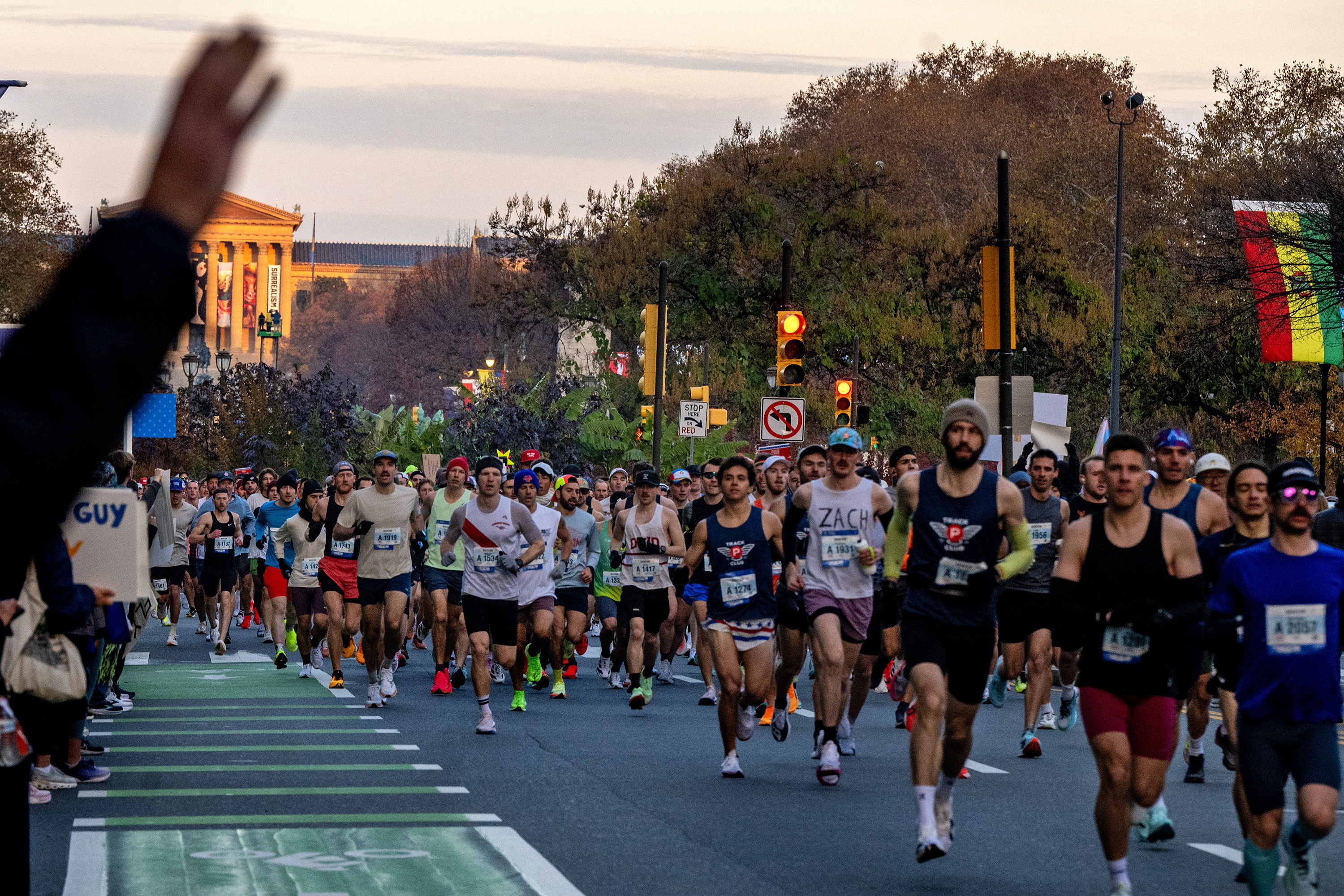
  • A consequential day for democracy, an uneventful day at the Philly polls

    A consequential day for democracy, an uneventful day at the Philly polls

    When I first joined the Office of the City Commissioners back in 2014, I only understood elections as results. Even as I learned all about the process and hard work needed to keep democracy on track, my most important lesson came from veteran administrator Joe Lynch: When you run elections, you don’t care who wins or loses. You just don’t want it to be close.

    On Tuesday, it wasn’t even. Philadelphia, already a Democratic stronghold, reflected the mood of the national electorate, which sharply turned against the GOP.

    At the end of Election Day, after the bulk of the workers had been sent home, Democratic City Commissioners Omar Sabir and Lisa Deeley expressed similar sentiments. “The day was as beautiful as the weather,” Deeley told me. The election was smooth, “just like the weather,” Sabir said.

    That doesn’t mean there weren’t a few clouds, though.

    Commissioner Seth Bluestein, the panel’s Republican member (and a friend since our days at Central High School), compared Election Day to planning 685 weddings — the number of polling places in the city — on the same day. For voters, even the smallest inconvenience can generate anxiety about whether their ballot will be counted. For candidates, this thinking can turn conspiratorial.

    That’s where Bluestein comes in. Both now and in his previous job as deputy to then-Commissioner Al Schmidt — who, as secretary of the commonwealth, is now responsible for elections in Pennsylvania — Bluestein has become widely known as a go-to troubleshooter, with Republicans, mainstream Democrats, and left-leaning insurgents alike calling him for advice and information.

    Thanks to Gov. Josh Shapiro’s 20-plus-point win, this election was a relatively light lift for the commissioners and their staff. At around 10:30 p.m., Bluestein’s deputy, Eric Kapenstein, released most of the workforce. They had already counted the 95,000 mail ballots received. Six years after the introduction of no-excuse mail voting in Pennsylvania, the staff has mastered the process.

    City Commissioners Lisa Deeley, Omar Samir, and Seth Bluestein give election updates to the media at Philadelphia’s election warehouse on Roosevelt Boulevard in 2024.Elizabeth Robertson / Staff Photographer

    Despite some concern over the presence of U.S. Department of Justice poll monitors, the biggest voter suppression worry I heard about Tuesday was a data error. Out of the roughly three million texts sent by the Pennsylvania Democratic Party, around 3,000 went to the wrong person. These voters were given incorrect information on where to vote.

    Clearly, given the Democrats ended up winning control of the General Assembly, this did not have a decisive effect.

    That’s not to say there was nothing to do. After starting his workday at 6 a.m. and spending the morning observing the count at the voter registration warehouse in far northeast Philadelphia, Bluestein took me along as he visited polling stations around the city.

    Most of these visits were done in conjunction with activists from Asian Americans United and the Asian American Legal Defense and Education Fund. After years of lobbying, Philadelphia added Chinese to the list of ballot languages available in 2022.

    In the past, representatives from these groups were able to enter polling places to verify that translators were present and competent, interpretation cards were properly displayed, and to make suggestions for improvements in the future. But because these groups are not affiliated with a campaign or political party, recent state guidelines meant they were not eligible to enter the polls this year.

    This limited their ability to check on polling stations, so Bluestein offered to do it for them. Across Asian American communities in Northeast Philadelphia, Center City, and South Philadelphia, he checked on conditions. Because the addition of Mandarin is still relatively fresh, poll workers sometimes forget to post the pink sample ballot with the new language outside the polling place entrance. The interpretation card was also judged too small.

    Volunteers from Asian Americans United outside Mayfair Elementary School on Election Day.Daniel Pearson

    While these issues may seem trivial, activists like Shihong Lin and Wei Chen with Asian Americans United understand that language access is a key part of democracy.

    The last stop on Bluestein’s polling place tour was a division in the Far Northeast. Out of the three congressional races, three state Senate races, the gubernatorial race, and 26 state House races, only the contest between Republican Martina White and Democrat Rob Gurtcheff in the 170th District was anywhere close to competitive.

    After hearing reports that polling machines may have been temporarily unattended, Bluestein visited the division. Upon reviewing the clerk book, pollbooks, and voting machines, he defused any concerns. White was reelected by roughly 15 points.

    For what ended up being a widely consequential election across the country and the Keystone State, Election Day in Philadelphia was satisfyingly low-key.

    The biggest issues of the day were a translation card that could be bigger, an electrical outage at Germantown’s Happy Hollow Recreation Center, and a texting glitch. The federal election monitors, a source of alarm for many, had no impact as far as I could tell. And threats of immigration agents at the polls did not materialize.

    Spending the day with Bluestein and remembering the elections I’d worked beside him in the past — including the 2020 race when Philadelphia came under siege by election deniers — I was struck by how the job demands patience and understanding.

    Voters, poll workers, and activists need to have election rules explained to them without raising their ire, making them feel ignored, or getting into a back-and-forth about how things should be.

    Still, Bluestein’s efforts and those of his fellow commissioners, although effective, are just one piece of the puzzle. While election officials do all they can to educate the public, prevent fraud, and improve operations, it is incumbent on voters to accept their answers.

    We’ll have to wait until the next fiercely contested election to see if they do.

  • Philly Council member wants to cut fines for speeding violations caught on camera

    Philly Council member wants to cut fines for speeding violations caught on camera

    Councilmember Jeffery Young Jr.’s bill to reduce fines for speeding violations caught by automated enforcement cameras has alarmed safety advocates who say it would weaken a program that saves lives.

    Philadelphia roadways saw a 26% one-year drop in crash fatalities in 2025, according to the city’s annual Vision Zero report, released Monday. Officials credited increased use of automated speed-enforcement cameras.

    “Consistent, visible enforcement changes behavior,” Lana Harshaw, executive director of the Bicycle Coalition of Greater Philadelphia, said in an interview. “Reducing the fines just goes against that goal.”

    Young said in an interview that he supports heightened safety enforcement on North Broad Street, which runs through the heart of his 5th District, but introduced the bill “to make sure that the law is fair and equitable.”

    Neighborhoods along the corridor are some of the lowest-income areas of Philadelphia, the poorest big city in the country.

    Speeding violations fell 67% on Broad Street between November 2025, when cameras began operating, and March 30, according to the Philadelphia Parking Authority, which runs the program.

    Traffic fatalities have fallen by 40% on Roosevelt Boulevard since automated speed-enforcement cameras were installed there in 2020.

    It is too early to see the cameras’ effect on crashes, injuries, and deaths on Broad Street because they are too new. Crash statistics, which come from the Pennsylvania Department of Transportation, lag by a year.

    But the experience on Roosevelt Boulevard shows “this is a successful public health effort, not a money grab,” said Corinne Lagermasini, executive director of 5th Square Advocacy.

    “We worry that the costs will give permission” for elected officials to “wind down the program,” she said.

    Harshaw said, “A monetary fine is minimal compared to a life lost because of a driver’s momentary decision.”

    Speed cameras in Philadelphia issue violations starting at 11 miles over the speed limit, which is mostly 25 mph on Broad Street, except for the area around the sports stadiums on South Broad Street.

    The fine is now $100 for traveling up to 20 mph over the limit in an area covered by speed cameras, $125 for going up to 29 mph over, and $150 for exceeding the speed limit by 30 mph or more.

    Young’s legislation would change the fines to $50, $75, and $125, respectively.

    No hearing date has been set for the legislation. Young said it may be amended to apply only to areas in the 5th and 8th Districts close to North Broad in response to concerns from colleagues.

    Young said he believes that the fact of a fine itself is a deterrent to speeders, not the amount of the penalty.

    New York City has a flat $50 fine for speeding violations issued by camera, he said, and still has reported a 94% reduction in fatal crashes. The NYC program operates only in school zones citywide.

    “I don’t think people are going to say, ‘You know what, the fee is reduced, so I’m going to speed now because I can afford to speed,’” Young said. “Drivers don’t think like that.”

    Correction: A previous version of this story misstated the former speed limit on North Broad Street. The error has been corrected.
  • Much delayed mega retail project in the Italian Market gets approval to start building

    Much delayed mega retail project in the Italian Market gets approval to start building

    A long planned 27,000-square-foot retail project is finally moving forward at 1101-03 S. Ninth St., just south of the Italian Market.

    On Oct. 28, Philadelphia’s Zoning Board of Adjustment gave New York City-based Midwood Investment & Development permission to build a one-story complex with a rooftop illuminated sign reading “Shops at the 9th Street Market.”

    The building will be divided into 11 retail bays, with a roof deck that is intended for a restaurant tenant. Midwood expects to break ground on the project in the second half 2027.

    “We have several tenants where we have signed leases, and we have several tenants that are negotiating leases,” said John Usdan, CEO of Midwood. “It’s a combination of some very well known restaurant concepts and health and wellness concepts.”

    Currently the property is a vast, fenced-in vacant lot, which has seen multiple proposals. Before the pandemic, a large apartment building was slated for the property, but in 2024, the developer shifted to a one-story retail project.

    “While we really wanted to build a residential project and bring more density to the market … we just felt that it was a use that might be too intense given the infrastructure of the market,” Usdan said.

    At the zoning board hearing, Midwood’s development team noted that they had changed the signage from the previously planned “Shops at the Italian Market” at the behest of the local community group, the Passyunk Square Civic Association.

    North of Washington Avenue, more old school Italian shops and restaurants still predominate, although even there, the retail has long been more diverse. South of the avenue, taquerias and other restaurants with roots in Mexico, Central, and South America are the principal presence.

    “We had always heard the market referred to as the Italian Market, but there’s a tremendous amount of diversity,” Usdan said. “We felt the request was well founded … so it was an easy decision on our part.”

    A rendering of the proposed shops, which do not included awnings or overhangs as other retail in the market have.Perkins Eastman

    The signage on top of the building would be illuminated from dusk until the end of business hours.

    “It’s good for the character of the neighborhood,” said David Smallets, an architect with Perkins Eastman Philadelphia office who is designing the building.

    “It’s a retail beacon sign,” Smallets said at the zoning hearing. “It’s for the whole community, not just this building.”

    Usdan said part of Midwood’s plan is to add more weekday traffic to the Ninth Street market area, which currently sees its heaviest business on Friday, Saturday, and Sunday.

    “Part of the idea of our project is to help bring that population to the market every day and to extend the hours of shopping to the evening,” Usdan said. “If we could find an aggregation of some great restaurant concepts to be directly in the market … to bring them into the heart of the market, we think would help all of the merchants.”

    The roughly 27,000-square-foot building would not have any parking associated with it. A curb cut on Ninth Street — which is no longer planned — stirred substantial controversy before the pandemic.

    Earlier proposals would have been six stories tall, with as many as 182 apartments. But the residential plans were scaled down and then eliminated.

    Asked why Midwood was moving forward now — it has owned much of the property since 2012 — Usdan said the company was seeing strong sales in its myriad retail holdings in Philadelphia.

    “We are seeing a very vibrant retail market throughout Philadelphia, both in Center City and in other places,” Usdan said. “We felt that there was an opportunity and a need for more retail in this location, and that it was a way to reconnect the market,” which is divided by busy Washington Avenue.

    The view from the proposed roof deck, which would be used by one tenant — probably a restaurant — not the general public.Perkins Eastman

    The 11 retail spaces would be between 1,000 and 3,000 square feet. One larger space would be 7,000 square feet.

    Usdan said Midwood’s plans for the site evolved as the demographics of the neighborhood changed since they acquired the site.

    “There are lots of families now,” Usdan said. “There’s a need for everyday services like health and wellness that just aren’t to be found in either the neighborhood or in the market.”

    But Usdan said there will be plenty of space for food and beverage operators in the new building, perhaps including some who already run businesses on Ninth Street.

    “There’s a lot of demand for well-known food and beverage operators who don’t have units in the market,” Usdan said. “There’s also demand from food and beverage operators that have units in the market that would like to expand, where they need modern space.”

  • Planned protest against Jewish-owned Philly restaurants draws ire, security, and feelings of unease

    Planned protest against Jewish-owned Philly restaurants draws ire, security, and feelings of unease

    Philadelphia business leaders and elected officials are condemning a planned bike-ride protest against half a dozen eateries owned by Jewish restaurateurs, days before the cyclists are set to gather in Center City.

    The “Boycott Ride” has drawn ire internationally in recent days, as many have denounced the anticipated action — planned for the eve of Kristallnacht on Sunday — as antisemitic and hateful. In response, city, state, and congressional leaders have called for increased security, and Philadelphia’s Jewish community have rallied behind the businesses.

    “Everyone has the right to peacefully protest and express their political views,” Philadelphia Mayor Cherelle L. Parker said in a statement. “But singling out businesses because their owners are Jewish is unacceptable and has no place in our city.”

    It’s unclear how many people will participate in the bike ride or how the organizers plan to express their dissent. An Instagram post promoting the demonstration had less than 800 likes as of Saturday morning. Meanwhile, a counter, “community food crawl” has galvanized, encouraging people to patronize the targeted businesses this weekend.

    Philadelphia police said Thursday they were monitoring the protest and will “take appropriate measures to maintain public safety,” and a spokesperson for Gov. Josh Shapiro said his administration and state police were working with local authorities ahead of Sunday.

    Organizers of the “Boycott Ride” said on Instagram the cycling demonstration was intended to show pro-Palestinian solidarity and protest six businesses they say are “Zionist establishments”: Mac Mart, K’Far Cafe, Huda, Goldie, Dizengoff, and Schlesinger’s Deli. A widely circulated flier reads, “No business for Zionists! These Zionist Establishments must go! Not in our city!”

    Allan Domb, owner of Schlesinger’s Deli and a former Philadelphia city councilmember, called the boycott “unsettling.”

    “This group wants to see our businesses shut down because we’re Jewish,” he said in a phone interview. “Imagine if this was another group that was being targeted — everybody would be up in arms.”

    In a statement, the Jewish Federation of Greater Philadelphia denounced the bike ride as an attempt to “intimidate Jewish businesses or drive them out of Philadelphia.” The federation, and others, have also taken issue with the boycott’s timing: The protest is planned for the eve of the 88th observance of Kristallnacht, an organized attack on Jewish businesses, homes, and synagogues in Nazi Germany in 1938. During Kristallnacht, Nazis assaulted and killed Jewish people, imprisoned about 26,000 Jewish men in concentration camps, and burned more than 1,400 synagogues, according to the U.S. Holocaust Memorial Museum.

    “Publicly identifying Jewish-owned businesses and declaring that they must go sends a message to Jewish Pennsylvanians that they are unwelcome in the economic and civic life of their own communities,” said Andrea Martin, commissioner of the Pennsylvania Human Relations Commission.

    “Such efforts to intimidate, marginalize, and exclude Jewish business owners should concern every Pennsylvanian who believes in equal rights and the dignity of all people,” Martin said.

    On Saturday, the ride’s organizers — a group called Philly Bike On Your Left — posted a statement to Instagram that said in part, “our ride has been grossly misrepresented.”

    “We firmly stand with indigenous Palestinians in their struggle for freedom and justice,” the statement read. “Let us be clear: the reason we are calling for a boycott of these businesses is because of their support for Israel.”

    The statement also addressed the protest’s timing: “We plan rides around people’s schedules. Palestinians need our support now. Any suggestions about the timing of our ride are simply false.”

    Another group, Boycott CookNSolo — a movement protesting the restaurant group that owns Goldie, K’Far Cafe, and Dizengoff, among others — came to Philly Bike On Your Left’s defense, writing on Instagram that all the restaurants’ owners “have made statements and/or raised funds” in support of Israel in the war. Since the Oct. 7 Hamas attack on Israel, when Hamas militants killed 1,200 people and took 251 hostages, Israel has responded with an offensive that has killed more than 74,000 Palestinians, according to Gaza’s Health Ministry.

    Boycott CookNSolo called the social media fury and attention a “coordinated campaign to discredit and villainize the organizers,” while “disingenuously conflating Zionism with Judaism and invoking Kristallnacht.”

    “Hate has no place in our community or directed at small businesses working hard to feed their families and bring joy to others,” Mac Mart owner, Marti Lieberman, said in a statement. “Since day one, Mac Mart has welcomed everyone, regardless of background, culture, religion, or beliefs.

    “Our mission has always been simple: Make people happy with delicious comfort food. That’s what we’re going to continue doing.”

    A spokesperson for CookNSolo — co-owned by Israeli-born chef Michael Solomonov — did not immediately respond to emails seeking comment. Solomonov and CookNSolo have previously come under scrutiny for fundraising for an Israeli nonprofit.

    Tensions escalated in December 2023 when pro-Palestinian protesters chanted, “Goldie, Goldie, you can’t hide, we charge you with genocide” outside of the falafel shop. Those chants drew rebukes from local leaders up to the White House.

    Huda’s owner, Yehuda Sichel, was not immediately available for comment.

    Both Domb and Lieberman said they’ve received an outpouring of support.

    “Right now, it’s just meant to be a bike ride, but there’s a lot of attention,” Domb said. “We want to keep it peaceful, calm.

    “And I actually think the noise might be greater than the reality.”