Tag: Camden County

  • New Jersey enacts law to prevent surveillance pricing of groceries. Here’s what to know.

    New Jersey enacts law to prevent surveillance pricing of groceries. Here’s what to know.

    New Jersey Gov. Mikie Sherrill signed a surveillance pricing ban into law on Thursday as she champions herself as a fighter for lower costs in New Jersey.

    The Democrat lauded the initiative as part of her broader agenda and campaign promise of making life more affordable in the state. Also in line with her messaging, she blamed President Donald Trump’s tariffs and the war in Iran for high grocery prices at a news conference announcing the new law.

    “Surveillance pricing essentially gives Big Brother a look into your shopping cart,” she said. “It’s incredibly invasive and it’s expensive.”

    Several states across the country have similar bills under consideration, but New Jersey is just the third to write the ban into law, after Maryland and Connecticut.

    Here’s what to know about the new law.

    What is surveillance pricing?

    Essentially, it’s when grocery stores or apps create individualized pricing based on shoppers’ personal data.

    As defined by the new law, it’s a pricing strategy in which food prices are adjusted, optimized, or recommended by an algorithm or automatic system that uses personal data, such as through biometrics, cameras, sensors, device tracking, or other forms of observing consumers’ personal attributes.

    What does this law do?

    The new law, called the Fair Price Protection Act, bans surveillance pricing or other pricing strategies that determine the cost of groceries based on consumers’ data. The law takes aim specifically at groceries and not at restaurants or other places that sell food or beverage for immediate consumption.

    It also implements a one-year ban on new electronic shelf labels and requires the state to study the use of such labels. The New Jersey Innovation Authority is required to submit findings no more than six months before the end of the moratorium along with policy recommendations surrounding the practice. Companies are allowed to repair or replace existing electronic shelf labels during this moratorium.

    These labels allow companies to update prices more efficiently and do not mean surveillance pricing is being used. But a group that has lobbied for a surveillance pricing ban — the United Food and Commercial Workers International Union — has also called for bans on electronic price tags and called them “the missing piece of the surveillance pricing puzzle.”

    The surveillance pricing ban will not take effect for a year, but the electronic shelf label moratorium will begin in six months.

    A violation of the new law carries penalties of up to $10,000 for the first offense and up to $20,000 for further violations, and the attorney general can pursue additional civil penalties.

    What did lawmakers think of this bill?

    Earlier this year, some South Jersey legislators said they wish the bill had gone further and banned the practice across other industries.

    The bill passed both chambers of the legislature on June 30 as part of a slew of last-minute actions before the budget deadline.

    It passed largely along party lines, though two Democrats voted against it in the Senate, including Sen. James Beach, a Camden County Democrat who had been listed as a cosponsor on the bill. He did not immediately respond to a request for comment Friday.

    In the Assembly, seven Democrats did not vote on the bill, and one Republican voted for it.

    Does Instacart use surveillance pricing?

    At her news conference, Sherrill cited figures from a Consumer Reports study that found Instacart used artificial intelligence-driven pricing that left customers with price tags differing as much as 23% per item for an annual household cost difference of $1,200 per year.

    However, Instacart has said it did not use personal information to set those prices, and therefore it did not involve surveillance pricing — a practice the company said it does not use. The company also said it has changed its practices outlined in the study.

    That being said, experts have warned that the combination of AI pricing models and the mass amounts of data collected on U.S. shoppers paves the way for surveillance pricing, per Consumer Reports.

    Will this law interfere with your loyalty discounts?

    Opponents of the bill, such as business groups and Republican lawmakers, have argued that the bill will have the opposite effect than intended, leading to higher prices because of negative effects on loyalty discount programs.

    “The reason so many businesses pushed back on ‘The Fair Price Protection Act’ wasn’t because they want to price gouge customers, it’s because the bill threatens the loyalty programs, discount apps, and member pricing that brings in customers and actually brings prices down for everyday shoppers. … This law threatens to take that all away,” Assembly Republicans said in a post on X on Thursday.

    But Sherrill insists the new law will not go after those discounts.

    “Deals are fine,” Sherrill said. “Surveillance-driven surcharges driving up costs are not. If companies violate your privacy to try and make a buck, they’ll be held accountable under our state’s Consumer Fraud Act.”

    The law specifically says it does not prevent discounts with publicly shared eligibility requirements, such as being a teacher or veteran. It also allows companies to offer discounts through loyalty programs that shoppers opt in to and provide discounts based on customers’ purchases as long as all members of the program are eligible to receive them under the same conditions.
  • Collingswood is reviewing its public pool rules after ‘recent incidents’: ‘Harassment of any resident will not be tolerated’

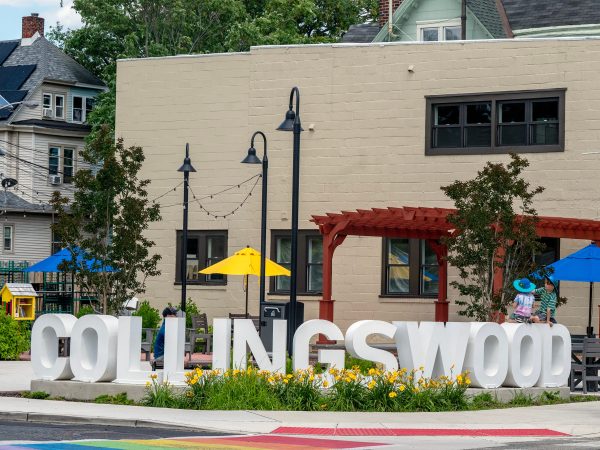
    Collingswood is reviewing its public pool rules after ‘recent incidents’: ‘Harassment of any resident will not be tolerated’

    Collingswood is reviewing the borough’s public pool policies after “recent incidents” at Roberts Pool gained traction on social media, officials said Thursday.

    “The safety and well-being of our residents and Borough employees is our highest priority, and we take these matters seriously,” the borough wrote on Facebook. “Harassment of any resident will not be tolerated. We are currently reviewing our pool policies to determine where updates or clarifications may be needed. Additional information will be shared as appropriate.”

    The statement was posted after Libs of TikTok, an anti-LGBTQ social media account that often gets the attention of conservative media organizations, posted a screenshot from a private local borough Facebook group from someone seeking advice after being harassed for their attire during a visit to Roberts Pool.

    The post from the conservative account also posted photos of the person and described them using transphobic language before pointing to what they called the pool’s “inclusivity policy” that allows people to use the locker rooms based on their gender identity.

    Collingswood Mayor Daniela Solano-Ward declined to provide any details about the incidents that prompted the policy review, but said, “we’ve had multiple complaints over the past two weeks.”

    “We are working to address them all in an appropriate and timely manner,” she said.

    “We are taking this opportunity to review our entire rules and regs sheet that is distributed to both staff and patrons,” Solano-Ward said in an email.

    An update on the policy review will be shared “after all relevant borough personnel have reviewed it,” she said.

    The resident who was the target of the viral post declined to speak to The Inquirer citing fear of more backlash from the far-right.

  • Del Buono’s Pastry Shop set for August opening at former McMillan’s Bakery in South Jersey

    Del Buono’s Pastry Shop set for August opening at former McMillan’s Bakery in South Jersey

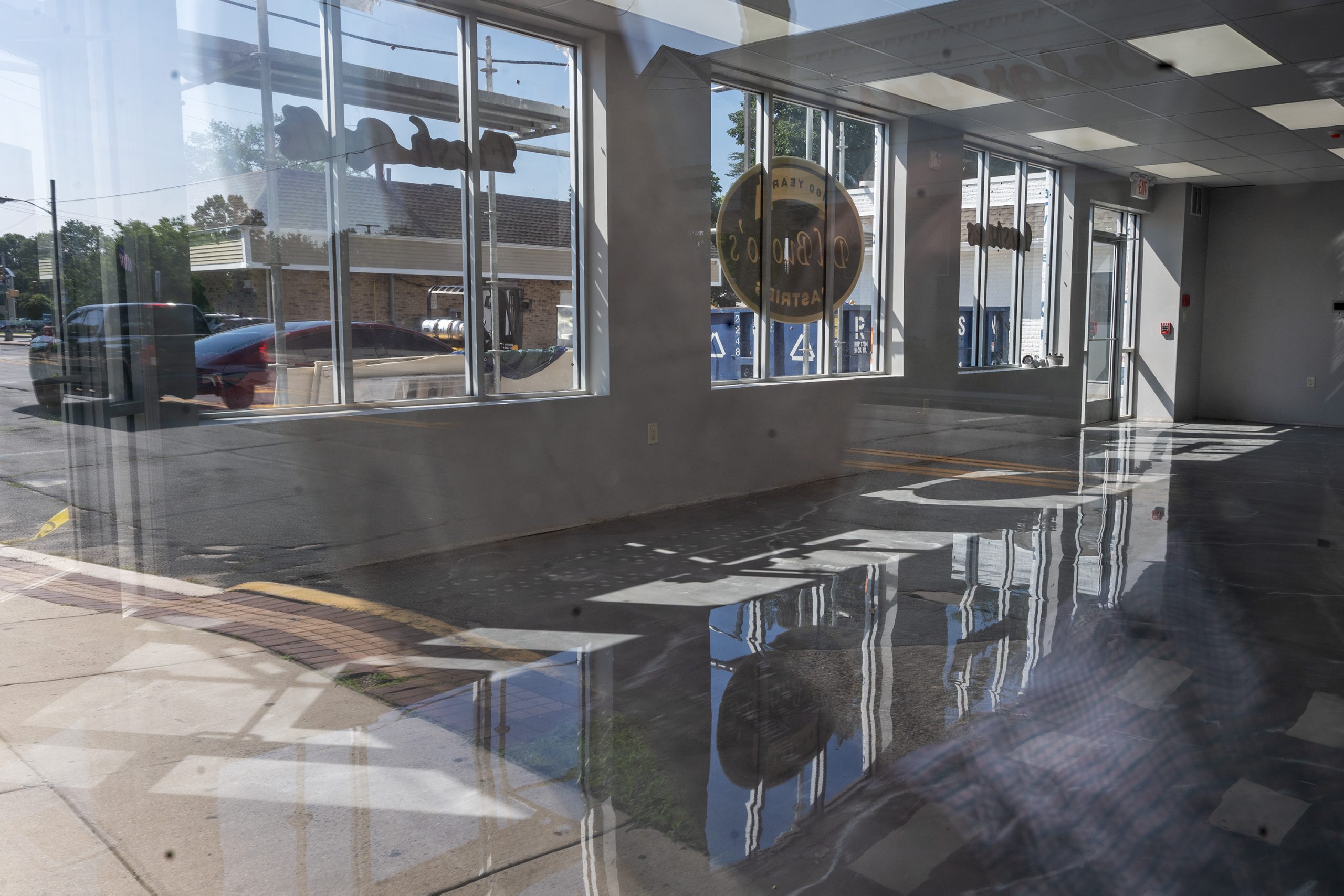
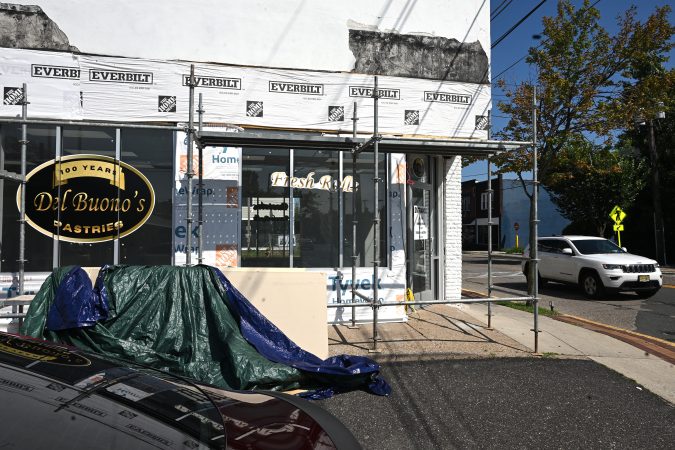
    The former McMillan’s Bakery in Haddon Township will reopen as Del Buono’s Pastry Shop in late August after months of extensive renovations, featuring the expertise of a McMillan family member and a Food Network alum.

    Construction is still underway, but entrepreneur and Haddon Heights resident Tom Whitman, 63, said he plans to host a grand opening on Aug. 29.

    Whitman, who also owns 100-year-old Del Buono’s Bakery in Haddon Heights and all three Carmen’s Deli locations, said he and his team took the South Jersey staple, once known for its cream doughnuts and holiday cakes, down to the studs.

    “We’re going to build upon that legacy,” Whitman said. “We’ll have some of the original flavor of the business, and hopefully make it better.”

    Construction continues July 20, 2026 on the former McMillan’s Bakery on Haddon Avenue in the Westmont section of Haddon Township. The family business closed in May 2025 after 86 years. It will be a new bread-and-pastry shop operated by the local Del Buono’s chain.Tom Gralish / Staff Photographer

    The new pastry shop, set to open seven days a week, will be 2,000 square feet, more than double the size of McMillan’s Bakery. It will feature doughnuts, pastries, desserts, specialty coffee, and bread and rolls sourced from Del Buono’s Bakery. Whitman said he hopes the products at Del Buono’s Pastry Shop will also be sold at his other storefronts.

    “I combine legacies and use the strengths of each of the businesses and try to combine them,” Whitman said.

    The pastry shop will use 900 square feet of the new space to host DiBartolo’s Kakery, a cake shop led by Woolwich resident Al DiBartolo.

    DiBartolo, 51, has long baked for South Jersey residents and made his name in years past as a winner of Food Network’s Halloween Wars and as a contestant on TLC’s Next Great Baker.

    Whitman, a former Domino’s Pizza franchisee, plans to employ between 20 and 40 workers, including part-time and full-time staffers. Some employees who worked at McMillan’s for decades will return, Whitman said.

    One returning employee is Doug Biemiller, a grandson of McMillan’s founders George and Evelyn McMillan. Whitman said Biemiller, DiBartolo, and other bakers have worked together to compile 400 of their recipes to start the pastry shop off.

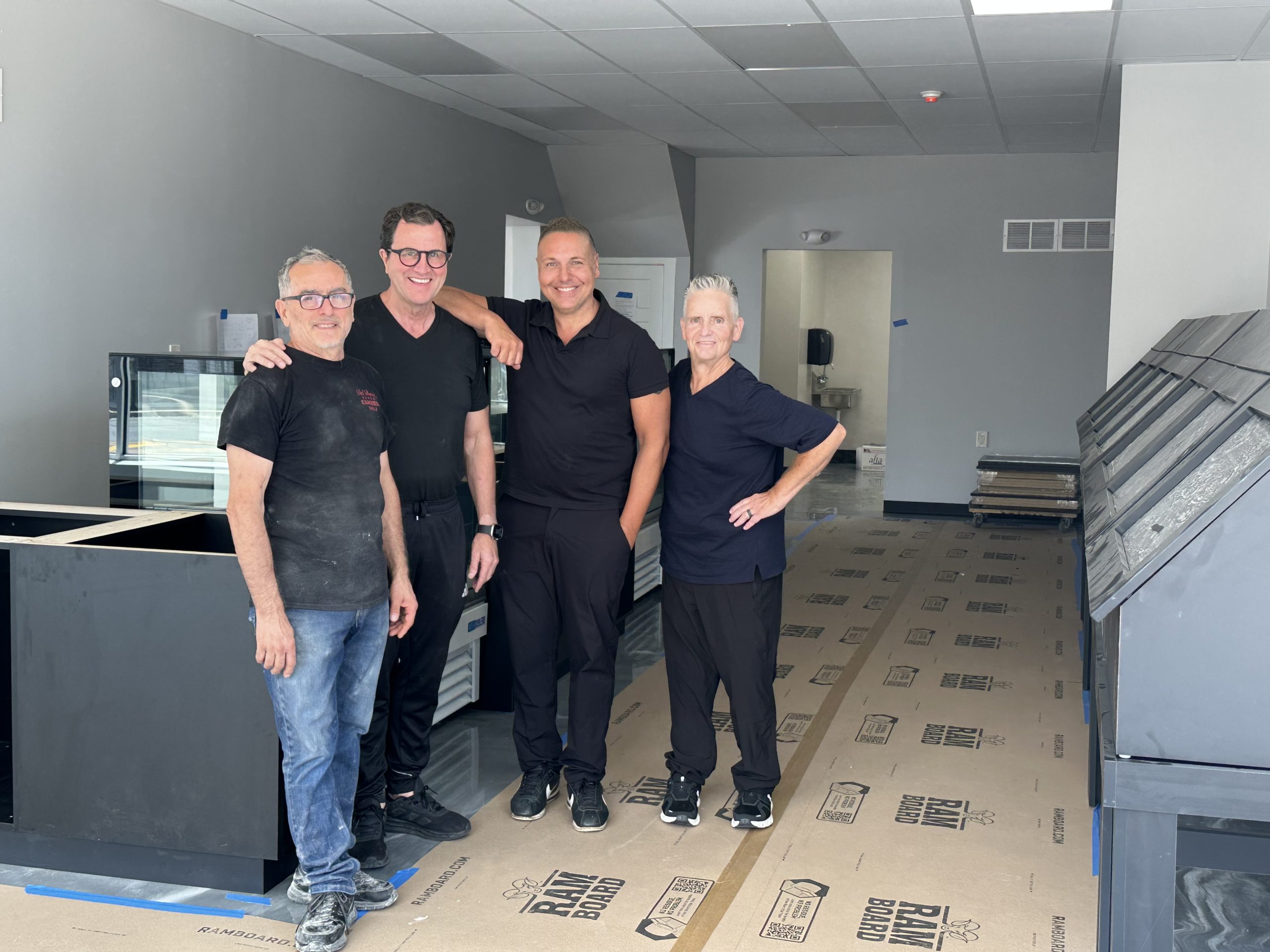
    From left to right, Atilla Baysal, Tom Whitman, Al DiBartolo, and Doug Biemiller stand in Del Buono’s Pastry Shop at 15 Haddon Ave. on Friday, July 24, 2026, in Haddon Township, N.J.Robin Lange

    The founding family of McMillan’s Bakery, a fourth-generation business at 15-17 Haddon Ave., put the shop up for sale in 2024. Whitman purchased the building for $500,000 last September from Grake Homes Construction, according to deed records, to pursue his third revival of a family-owned South Jersey food destination.

    In October, Whitman said he planned to spend $1.5 million to $2 million on the project, including the real estate purchase and the construction of two apartments above the pastry shop. Weeks before the August opening, Whitman declined to share the total spent, but he said the ticket price was over $2 million, after rebuilding the property from scratch.

    He had initially expected the shop to open in February, but construction has taken longer than Whitman anticipated.

    “It was extremely expensive, but I just want to do it once, and I want to do it right,” Whitman said.

    Until recently, DiBartolo served as chief baking officer for Cherry Hill’s Classic Cake.

    But after moving between three jobs in the last two years, DiBartolo said, he jumped at the chance to finally bake with his own recipes again and work with Del Buono’s, where his family members are regulars.

    “It’s still nice to be in your 50s and make your parents proud,” DiBartolo said.

    DiBartolo’s Kakery will have grab-and-go cakes, including fan favorite rum and pound cakes, along with a consultation area where customers can discuss options for custom specialty and wedding cakes.

    Del Buono’s Pastry Shop currently plans to have a soft opening in mid-August. In the meantime, renovations to the property are still in progress, and with the Aug. 29 grand opening looming, Whitman said he thinks the shop will meet the deadline to serve locals looking to rediscover their neighborhood “mental health food” destination.

    “I’m like a little kid waiting for Christmas,“ Whitman said. ”I want to see it as much as anybody else does.”

  • Collingswood wants you to license your pets to help other animals in the borough

    Collingswood wants you to license your pets to help other animals in the borough

    Collingswood is hoping to get more pets on the books as a way to help fund the borough’s animal control services.

    Per New Jersey law, all cats and dogs 5 months of age and older are required to be licensed with their local municipality, but borough officials say registration is lagging.

    Without the fees collected through licensing, Collingswood has to find the funding for animal control services from elsewhere in the budget, Deputy Mayor Amy Henderson Riley said.

    In 2025, the borough spent $33,305 on an animal control officer and other services, she said. But as of the June 17 commissioners meeting, Collingswood had collected only $5,740 this year through residential pet licenses, which cost between $5 and $20 each annually.

    Assuming animal control services will cost the same for 2026, that leaves a more than $27,000 gap to fill.

    “This isn’t meant to be, you know, a ‘nanny state,’” Henderson Riley said of pet licensing. “This is meant to help have a balanced budget in town. We can find the money elsewhere, but I’d much rather have that $27,000 for all the rest of the required and amazing things that we do in town.”

    The cost for a license in Collingswood varies by type of animal and whether it is spayed or neutered:

    • Spayed/neutered dog: $17.
    • Non-spayed/neutered dog: $20.
    • Spayed/neutered cat: $5.
    • Non-spayed/neutered cat: $8.

    Since 2020, Collingswood has struggled to collect even close to half the amount needed to pay for annual animal control services, averaging around $7,680 in fees paid each year, according to borough records.

    As of July 21, registrations were further behind than they were at this time last year, when the borough had already collected around 20% more in fees, totaling over $7,000.

    In response to the drop, the borough is planning a small informational campaign on social media and in town bulletins to spread the word and get licensing rates up, Henderson Riley said.

    She said she wants to better inform the public on how this money is used, including for euthanasia of critically injured animals and reunification services for lost pets.

    If the funding gap continues, she said, the borough will consider conducting a pet census, hiring staff members to go door-to-door counting the animals in town.

    And while Henderson Riley said she understands that many household budgets are already tight, she argues that a relatively small fee can go a long way in helping animals across the borough.

    “Affordability is the word of the year,” she said. “People are paying a ton in taxes, and I think sometimes they think, ‘Why should I be paying for a pet license for my 14-year-old dog?’”

    The money residents spend on licensing may not go directly to their pet, she said, “but it might help care for an animal who’s hurt or injured or who got loose from their house.”

    “That’s money well spent,” she said.

  • Audubon has opened its new history museum. Here’s what you’ll find there, from a New Century Theater seat to ‘Mudubon’ photos.

    Audubon has opened its new history museum. Here’s what you’ll find there, from a New Century Theater seat to ‘Mudubon’ photos.

    More than a century’s worth of varsity jackets, trophies, civic documents, photos, and more memorabilia from Audubon Borough have made their way into Camden County’s newest museum.

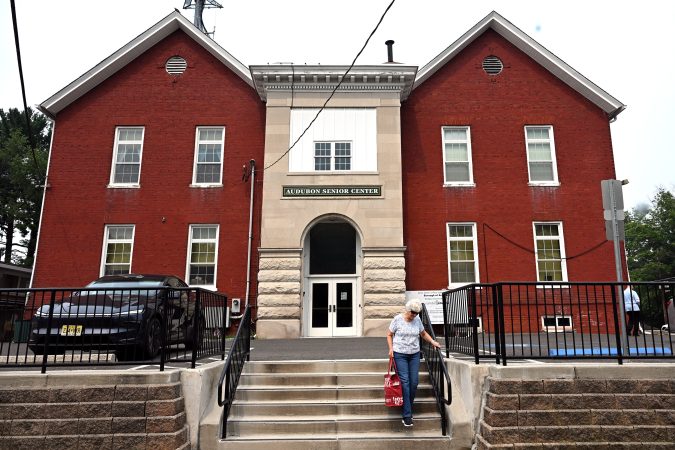
    The Audubon Historical Society Museum takes up much of Audubon Senior Center’s second floor, a red brick building that once served as Audubon School No. 1. The collection includes donated items from Audubon residents, including from the historical society’s own members, found in basements.

    Even though there are still more artifacts to put on display, from a 45-star American flag to thousands of pictures, Audubon’s rich history is already well represented. There’s memorabilia repping Joe Flacco, an NFL player and Audubon High School grad; an Audubon-themed Monopoly board created for a fundraiser; outdated land use maps; and an old police radio. A large section of the museum covers Audubon’s military history, including information about the borough’s three medal of honor recipients and two naval vessels named in their memory.

    The museum hosted its first public open house on July 4, and about 60 people came despite the heat, said Rob Jakubowski, Audubon’s mayor. Starting Aug. 8, the historical society will open the museum from 2 to 4 p.m. on the second Saturday of every month.

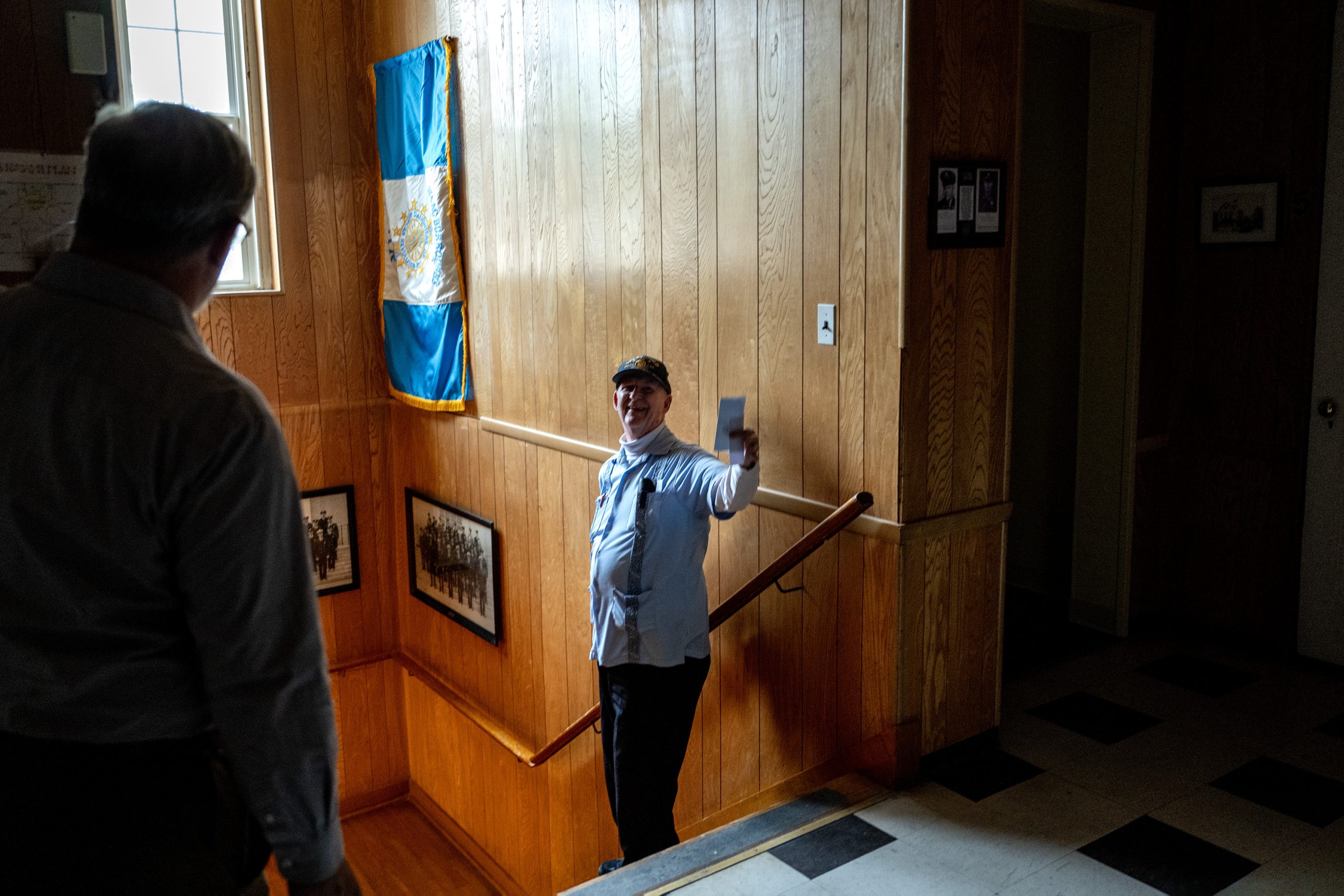
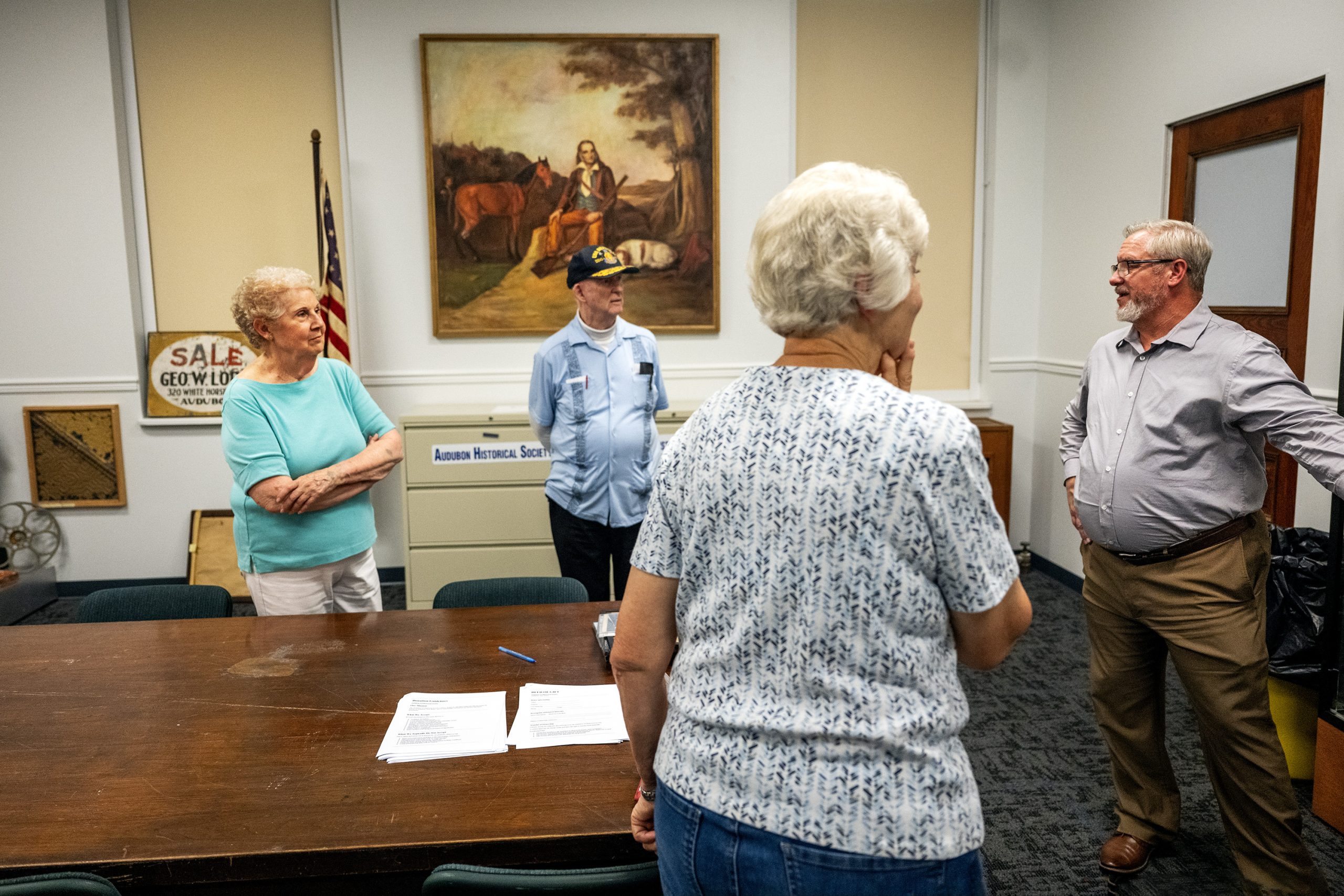
    Mayor Rob Jakubowski (left) and Craig E. Burgess on the stairs at the newly opened Audubon Historical Society Museum. They plan to use the wall space for more displays.Tom Gralish / Staff Photographer

    Jakubowski worked to develop the museum with a small group of Audubon Historical Society members, kept on task by corresponding secretary and longtime Audubon resident Nancy Whalen, 80. The museum, the brainchild of the late Walter Casebeer, a founding member of the society, came together 18 years after his death. Members sorted through four full closets of donated relics to establish the museum’s initial displays.

    “We were able to set up what is a really beautiful museum with a lot more work to do,” Jakubowski said.

    Though the senior center isn’t a schoolhouse anymore, the museum, funded by $40,000 in Camden County grants, was clearly once two classrooms, divided through the middle by chalkboard panels that pull out from the wall. The seniors running the museum hope to rotate the items on display as time passes, but for now, the group is proud to show off their hard work.

    Here are a few of the standouts.

    New Century Theater

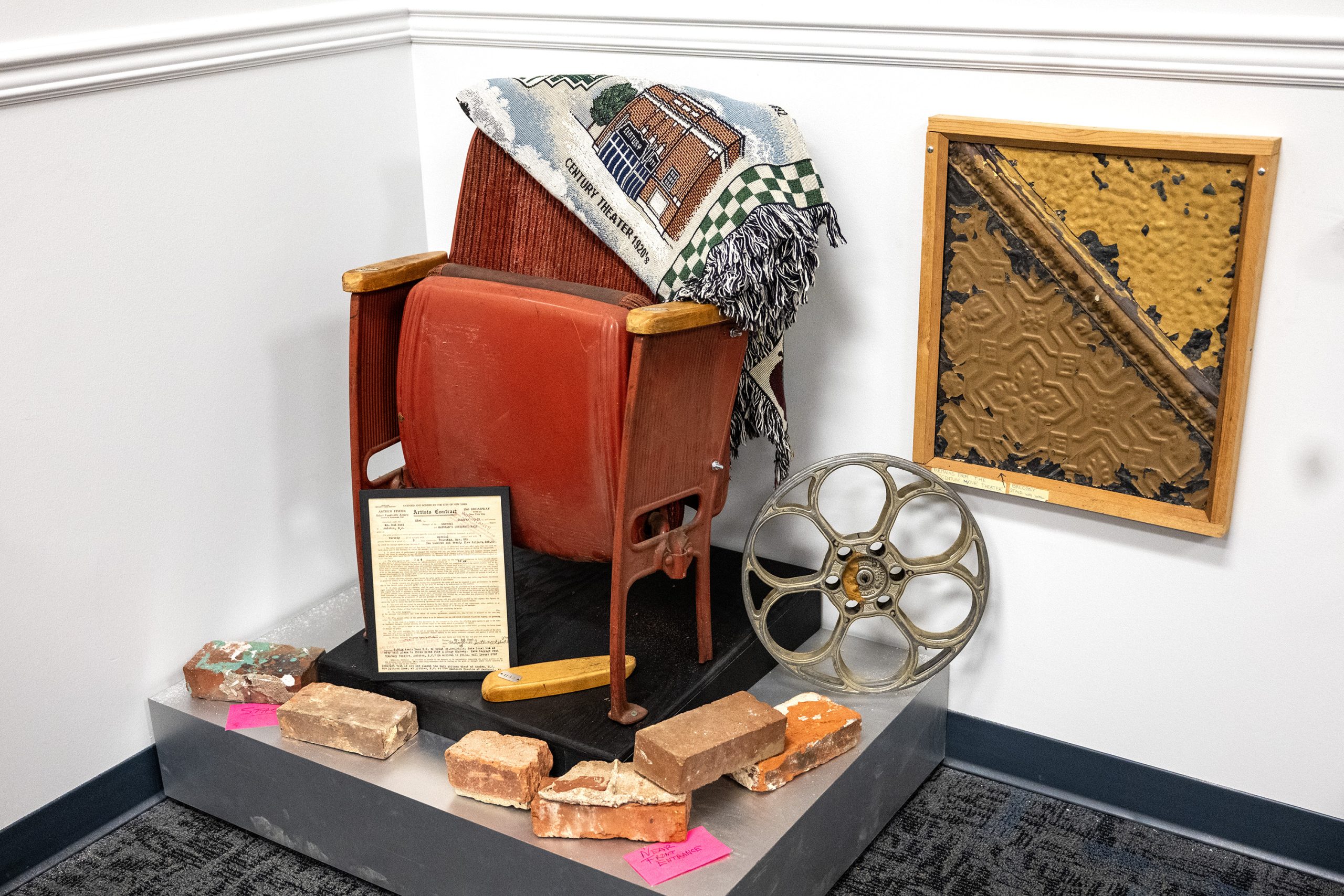
    New Century Theater, founded in 1921, is no longer standing. The theater, renamed the Coronet in the ‘60s, was demolished in 2003. The space is currently being developed by a car wash company.

    But the historical society managed to acquire many keepsakes to remember the theater’s past. They have a seat someone rescued before the building got knocked down, a part of the wall, bricks, faint blueprints, and a movie reel Jakubowski said he found on eBay. A 1931 vaudeville contract is propped against the seat.

    Craig E. Burgess, 81, remembers when he could see a movie, a newsreel, a serial, and get candy, all for 10 cents at New Century Theater. When he found out the Audubon staple was going to be torn down, Burgess, who lived in the same house in Audubon for 73 years before moving to Collingswood, didn’t let the theater die without a last trip.

    “I stood in front of the door and said, ‘You don’t get in here until I get in to get some photos and get some video. If you won’t do that for me, then I will stay here, and you’ll have to push me over into the rubble,’” Burgess said. “And they believed me. I got in.”

    A theater seat and other memorabilia from the New Century Theater that opened in 1921, on display at the newly opened Audubon Historical Society Museum. Tom Gralish / Staff Photographer

    ‘Mudubon’

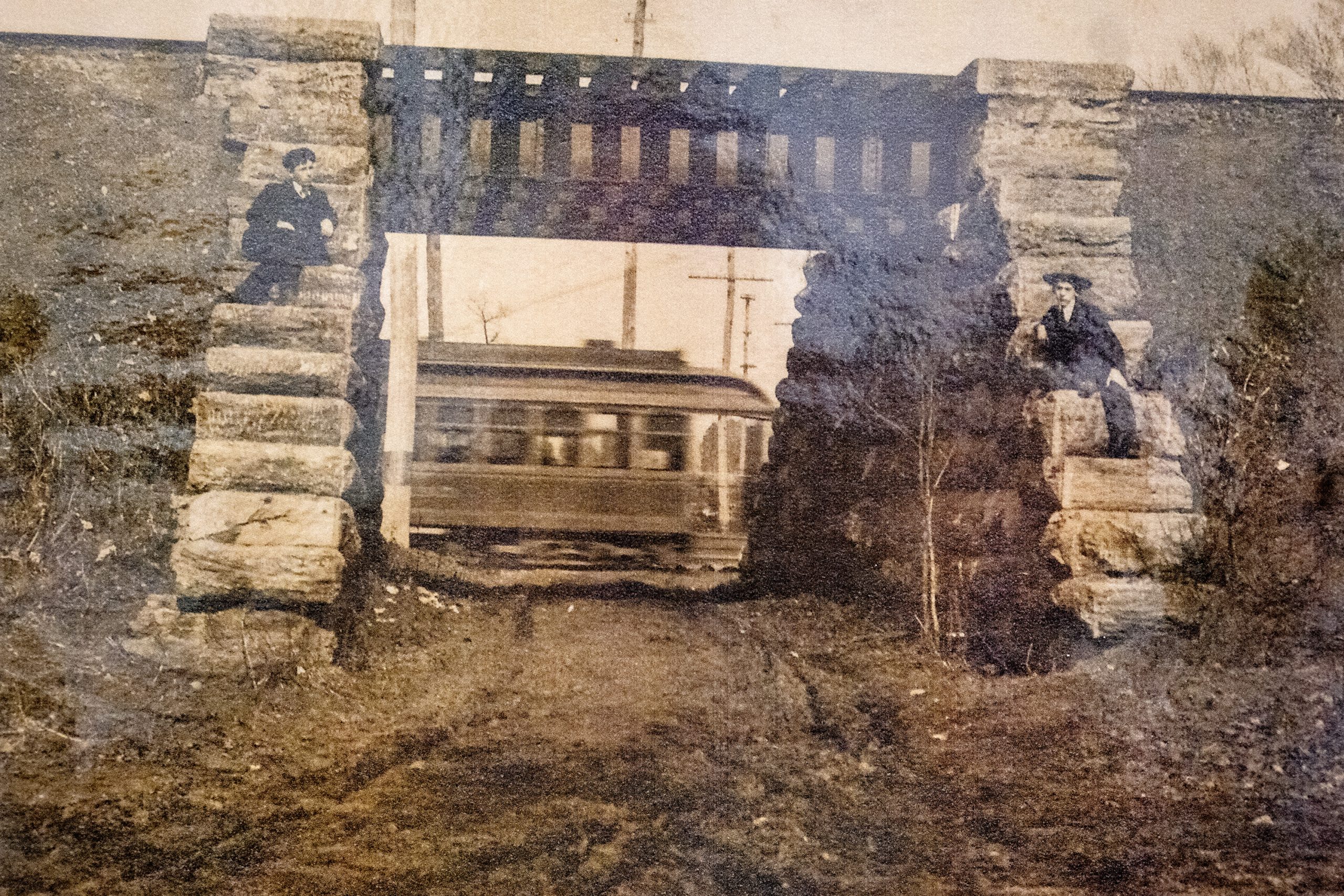
    Audubon, a part of Haddon Township until residents voted to become a borough, was incorporated in 1905. That was a couple of decades before paved roads boomed in the U.S., which made for a lot of wet dirt streets in the early 20th century in Camden County. Some photos at the new museum show those mucky roadways.

    Thus, the nickname Mudubon. It came from the mouths of delivery drivers trekking Audubon after bad weather, Jakubowski said.

    Burgess said ice trucks and milk trucks, along with the horses pulling them, used to get bogged down in the mud when it rained. He likes to tell a story about a boy who spent the summer away with his grandparents in the early 20th century, and returned home to paved roads — and confusion.

    “Mom took him out to visit his grandparents, came back on the bus to get off at Merchant Street. And he refused to get off the bus,” Burgess said. “He said, ‘This is not Audubon. I know my hometown.’”

    An early 20th-century photo showing an unpaved Nicholson Road and the train overpass on display at the new Audubon Historical Society Museum. The trolley passing behind was on the line between Camden and Clementon Park that ran along East Atlantic Ave. The train line is no longer active, but Nicholson Road still goes under the bridge.Audubon Historical Society

    Nancy Ryan, 79, moved back to her native Audubon nine years ago to retire. She recalls stories from her father about the pavers coming in when he was 4 years old, watching the steam shovels digging up Cedar Croft in 1917 or 1918.

    Now, Ryan said, the only people who call the borough Mudubon are non-natives who like to make fun, like her husband. But Audubon residents know the borough has grown far beyond its muddy origins, Burgess said.

    “We’ve come a long way in the last 110 years, more or less,” Burgess said.

    100 years at Audubon High School

    Nearly a century ago, about 500 students took the first classes offered at Audubon High School on Edgewood Avenue in September 1926.

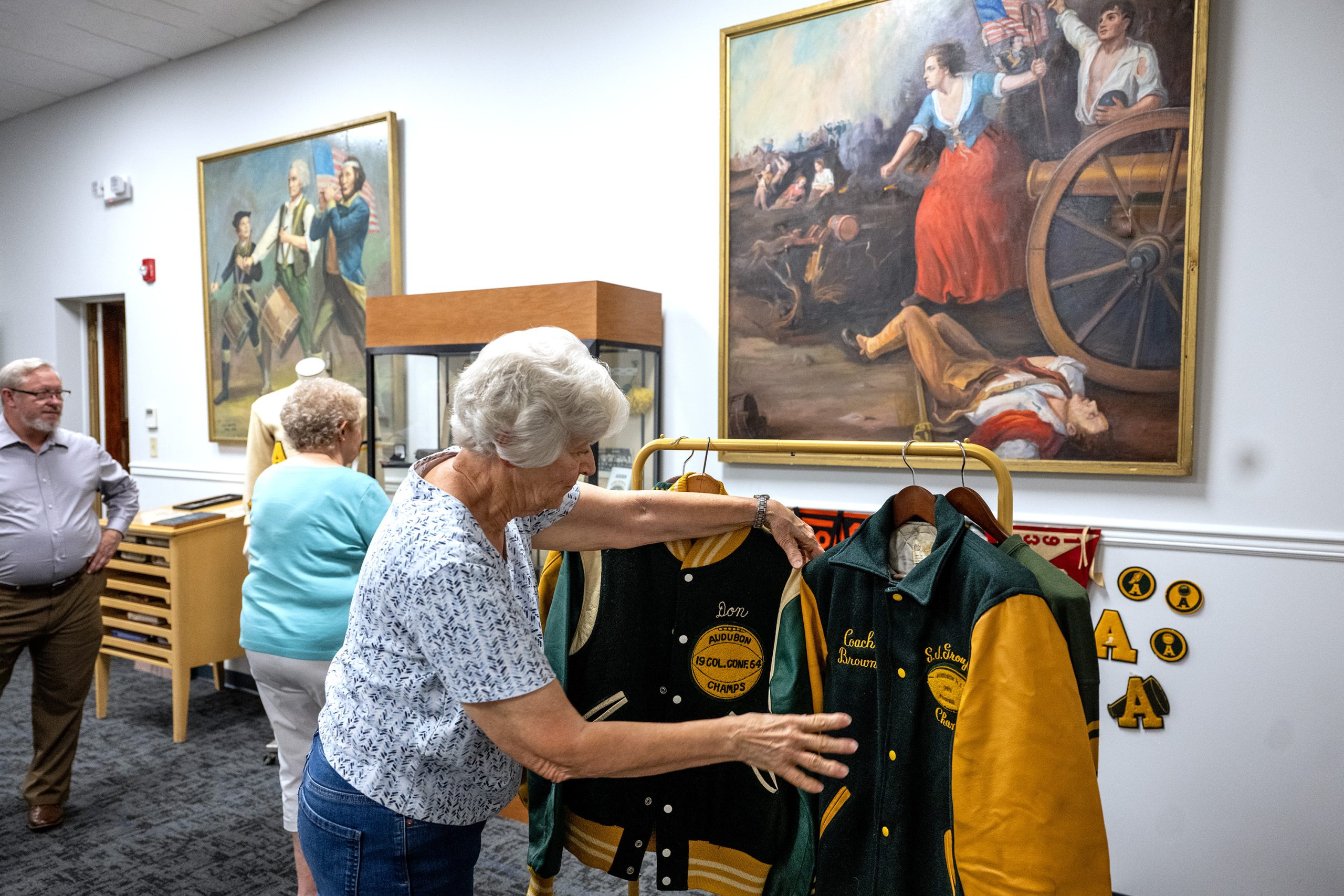
    Today, items spanning the high school’s history are on display: a booklet teaching children the 20th-century Palmer Method to learn cursive, pennants, a rack of letterman jackets, school handbooks, admission cards, and a cream varsity cardigan from 1966. A candlestick telephone used by the school’s first principal, Grace Kramer, sits at the bottom of a display case.

    Mayor Rob Jakubowski (from left), Nancy Whalen, and Nancy Ryan at the newly opened Audubon Historical Society Museum.Tom Gralish / Staff Photographer

    Three replica oil paintings recreated by the late Michael J. Miceli, a Mount Ephraim local, hang on the walls, too. They picture military drummers, fictionalized American Revolutionary War heroine Molly Pitcher, and French American artist and ornithologist John J. Audubon, the borough’s namesake. Their previous home was the Audubon High School auditorium, but when they were removed during recent renovations, a history teacher saved them, Jakubowski said.

    Plus, every high school yearbook available since the school’s founding line a bookshelf in a back room, in case anyone comes looking to do archival research.

    From left: Nancy Whalen, Craig E. Burgess, Nancy Ryan, and Mayor Rob Jakubowski at the newly opened Audubon Historical Society history museum on the second floor of the Audubon Senior Center Thursday, July 16, 2026. Behind them is a painting of naturalist, ornithologist, and painter John James Audubon, for whom the town was named. Tom Gralish / Staff Photographer

    The group is still open to taking donated artifacts, though with their large existing collection, they’re not afraid to decline duplicates. In the meantime, the historical society will continue sorting their archives. It’s a lot of work, all volunteer.

    “But that’s what makes it fun,” Burgess said.

  • Collingswood, ‘a cat community,’ has officially opened its first cat cafe

    Collingswood, ‘a cat community,’ has officially opened its first cat cafe

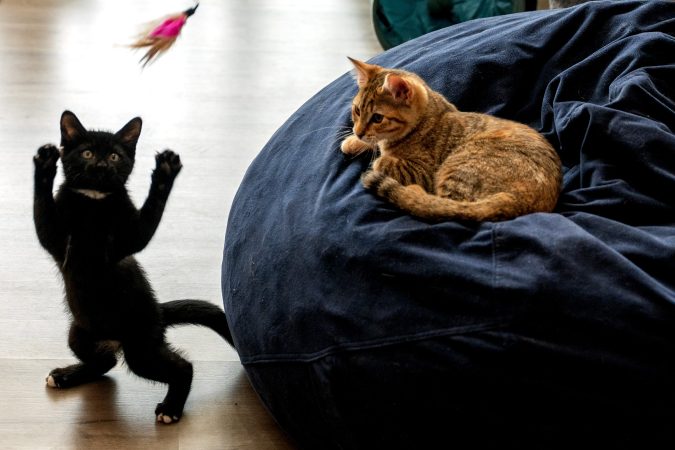
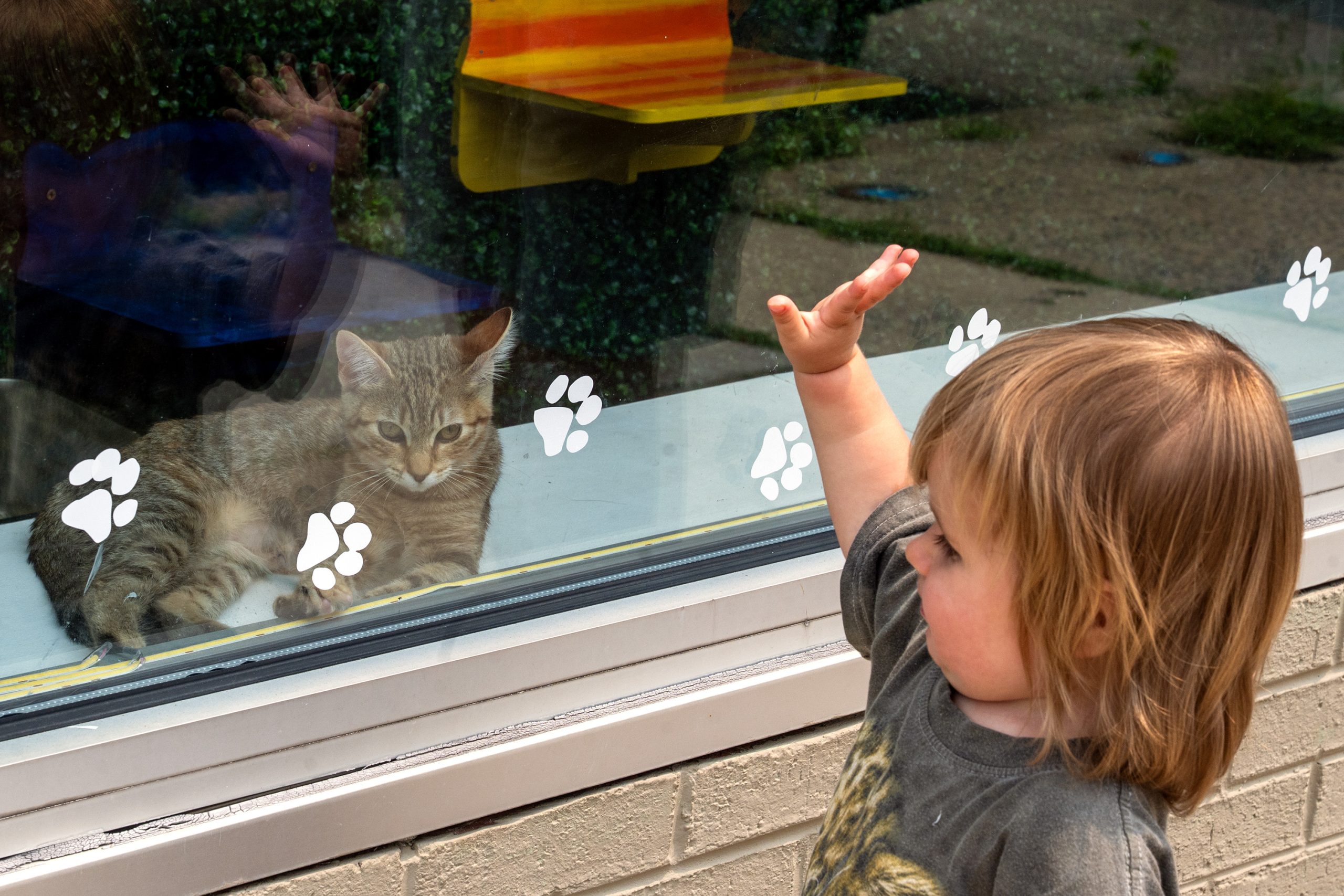
    Two kittens with seemingly endless energy jump around the room in downtown Collingswood chasing their toys, their own tails, and their newest friend, 19-month-old Charlotte Kohlhas-DeMarsh. The toddler babbles excitedly as the kittens, Chicken Nugget and Onion Ring, leap at the feather attached to the wand she’s swinging around.

    The kittens are just two of the adoptable cats at Catmosphere Cafe & Lounge, a new cat cafe that opened at 557 Haddon Ave. on July 10.

    In partnership with Homeward Bound Pet Adoption Center in Blackwood, Catmosphere provides a temporary home for adoptable cats where they can comfortably sleep, play, and potentially meet their forever families.

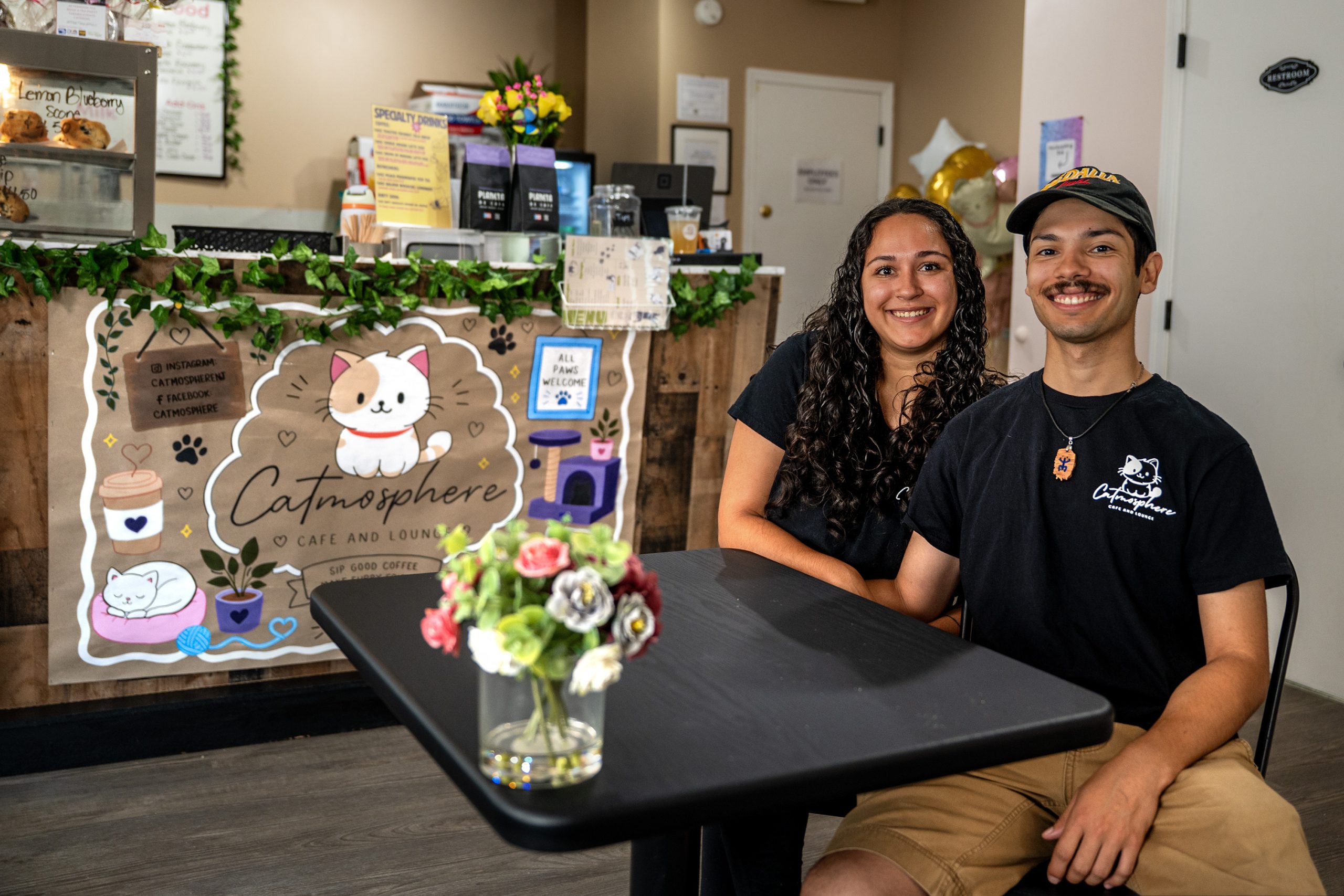
    Owners Sophia Coello and Marcus Tirado at their Catmosphere Cafe & Lounge on Thursday, July 16, 2026. Tom Gralish / Staff Photographer

    Within the first week, the business has already facilitated three adoptions.

    “Every cat has gone to a perfect family,” said Sophia Coello, cofounder of Catmosphere. “It has really been a perfect match with every single cat.”

    The new cat lounge fosters around six to eight cats and kittens at a time, helping to free up space for more intakes at Homeward Bound.

    Equipped with food, water, toys and countless beds, the lounge provides the cats with a less stressful environment than a traditional animal rescue. This gives them a chance to acclimate and eventually feel comfortable showing their real personalities, Coello said, which only increases their chance of being adopted.

    All proceeds collected from adoption fees — $150 for a kitten and $75 for an adult cat — go back to Homeward Bound.

    The idea for Catmosphere was originally inspired by a goat yoga session in December 2024, Coello said. As she was surrounded by the farm animals, Coello, who identifies as a lifelong cat person, couldn’t help but imagine what it would be like to be in a similarly relaxing environment — but accompanied by cats instead.

    “This is my calling,” she said. “I just love watching and understanding cats’ behavior because if you understand a cat’s behavior, you understand how to create a bond with them. I feel like anyone can create a bond with a cat.”

    “And once you form that bond and that trust, it’s actually the most beautiful connection that you could grow with an animal,” she said.

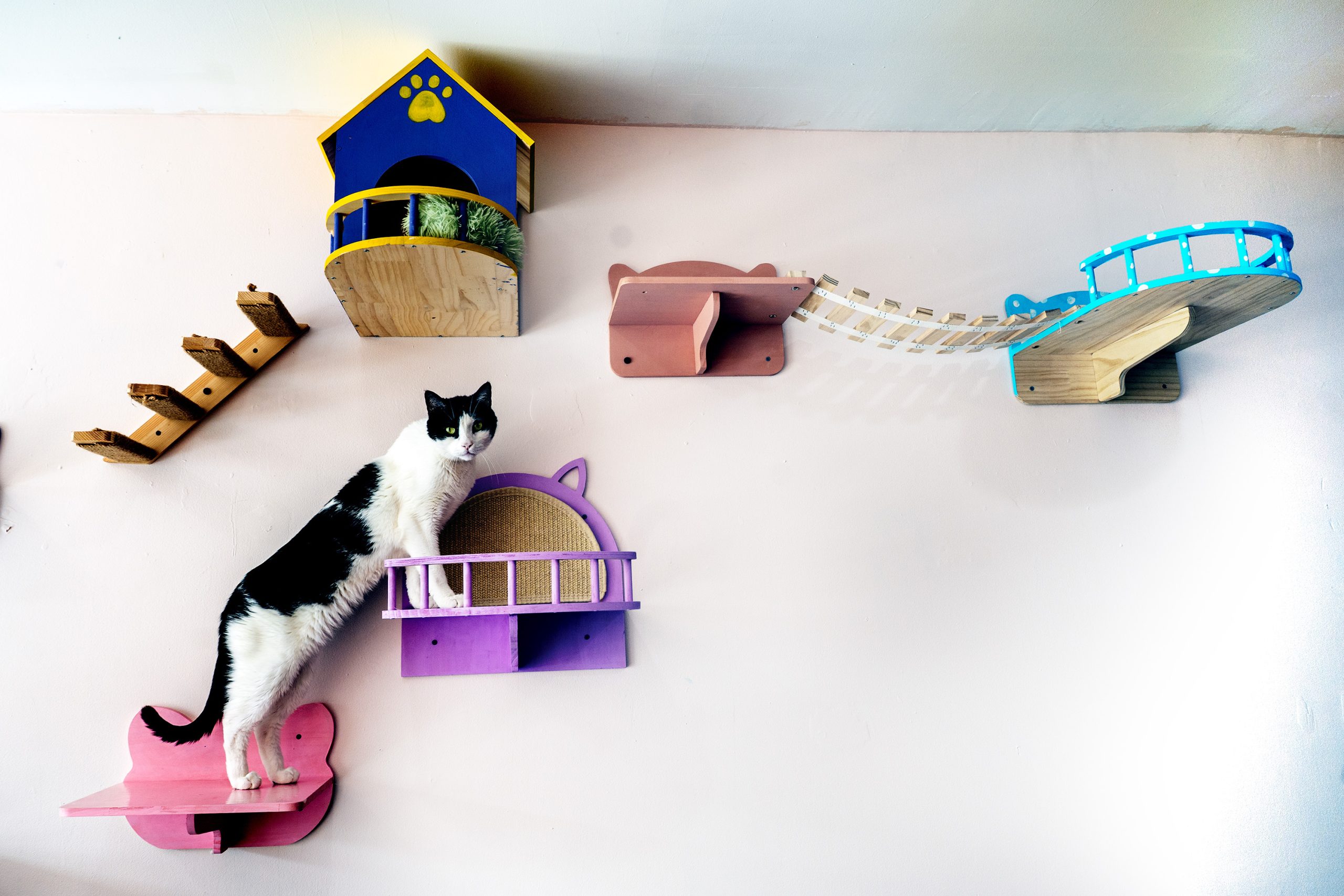
    Cats climb on the wall at the Catmosphere Cafe & Lounge on Thursday, July 16, 2026. Collingswood’s first cat cafe recently opened downtown.Tom Gralish / Staff Photographer

    Alongside her partner, Marcus Tirado, the pair of Rowan University graduates soon began looking for the perfect location to set up their new business — somewhere in an animal-loving community with lots of foot traffic. They eventually settled on Collingswood’s bustling Haddon Avenue, breathing new life into what was once a thrift store.

    “This is a cat community,” Coello said of the borough, where neighborhood cats are common and well taken care of, and residents are quick to come together when locating a lost pet.

    As head of construction, Tirado did the majority of the renovation work himself, leaning on friends and family to help transform the cluttered space into a bright cafe with sleeping kittens dreaming in the front window. The soft-pink walls are adorned with a hand-painted logo as Lego figurines in the likeness of the couple’s two rescue cats overlook the cafe, a reminder of their mission to connect as many cats as possible with loving homes.

    Charlotte Kohlhas-DeMarsh, 19 months, plays with cats at the Catmosphere Cafe & Lounge Thursday, July 16, 2026. She was visiting with her grandmother, Jenifer Kohlhas, at Collingswood’s first cat cafe recently opened downtown.Tom Gralish / Staff Photographer

    Catmosphere accepts both appointments and walk-ins for the cat lounge which currently costs $20 per hour. During some of the early bookings, Coello said they’ve helped kids remain calm and be gentle during their first interaction with a cat.

    As they get more established, they’re looking forward to expanding their business by hosting workshops, working with local schools, and more, they said.

    And if you’re allergic to cats, don’t worry. Catmosphere still has something for you.

    Entirely separate from the cat lounge, the cafe itself is hypo-allergenic, Coello said.

    Cat toys at the Catmosphere Cafe & Lounge Thursday, July 16, 2026. Collingswood’s first cat cafe recently opened downtown.Tom Gralish / Staff Photographer

    Large windows along the walkway from the front door create a “kitty drive-thru,” she said, where you can get a glimpse inside the cat lounge while remaining protected from any allergens.

    Located on the more residential end of Haddon Avenue, the pair also hope that Catmosphere, alongside neighboring businesses like the barber and ice cream shops across the street, can help strike up more activity in this part of downtown.

    “We would love to bring more events to this side of the community,” Coello said.

    They also hope the lounge can serve as an educational resource for the cat-loving community, helping to answer questions about adoption, common cat behaviors, and best practices.

    Charlotte Kohlhas-DeMarsh, 19 months, says goodbye to cats inside the front window as she leaves outside the Catmosphere Cafe & Lounge Thursday, July 16, 2026, She was visiting with her grandmother, Jenifer Kohlhas. Collingswood’s first cat cafe recently opened downtown.Tom Gralish / Staff Photographer

    As Kohlhas-DeMarsh happily followed her furry friends around the room Thursday morning, her grandmother Jenifer Kohlhas looked on, enjoying a drink from the cafe.

    They’ve been looking forward to Catmosphere’s opening and finally stopped in for the first time, in part to avoid last week’s dangerous air quality but also to give Charlotte a chance to interact with friendly cats, Kohlhas said.

    Their family has a formerly feral cat at home who isn’t particularly fond of the toddler, she said.

    “I thought this would be a great opportunity for her to just be with a kitten that actually lets her play with it,” she said, as Charlotte cheerfully waddled around the room. “And she’s having a blast.”

  • A worker was hospitalized after suffering life-threatening injuries at EMR in Camden, shortly after a judge allowed it to reopen

    A worker was hospitalized after suffering life-threatening injuries at EMR in Camden, shortly after a judge allowed it to reopen

    A worker was sent to the hospital with life-threatening injuries on Saturday, just days after the EMR scrap metal recycling plant reopened in Camden, following a court ruling.

    The company had sued Camden after the city suspended its operations last month following the latest in a string of fires at the facility. Just under two weeks ago, a judge permitted the company to reopen with heightened safety precautions meant to prevent further fires. The company announced Monday of last week that it would begin activities on site that day and start full operations this past Friday.

    The next day, an employee working on behalf of EMR was sent to the hospital with “life-threatening injuries,” confirmed Dan Keashen, Camden County spokesperson.

    He said the Camden County Police Department is investigating the “industrial accident.”

    Emergency response units responded to a report of a male with injuries from an accident inside the EMR facility about 11:30 p.m. Saturday, Keashen said.

    He said emergency medical services transported the man to Cooper Medical Center and, as of Tuesday, the worker was in critical but stable condition.

    Camden city spokesperson Vincent Basara confirmed that the Camden Fire Department and EMS were called to the EMR facility on Saturday regarding an injury in the workplace and a person was “taken to the hospital with significant injuries.”

    Representatives for EMR did not respond to requests for comment on Tuesday. The company also faced an emergency across the river last week when a blaze broke out at an EMR facility in Darby, Delaware County, prompting air quality concerns.

  • Touring Camden’s Cathedral Kitchen, Andy Kim calls Trump’s cuts to SNAP ‘devastating and cruel’

    Touring Camden’s Cathedral Kitchen, Andy Kim calls Trump’s cuts to SNAP ‘devastating and cruel’

    Touring Cathedral Kitchen, the largest emergency meal supplier in South Jersey, Democratic Sen. Andy Kim praised the 50-year-old Camden institution Friday for the food it has served and the people it has saved.

    “The Kitchen is building community, right here in New Jersey,” said Kim, who noted that the nonprofit distributes 28,000 meals a month while training low-income people to be chefs and restaurant workers. Cathedral Kitchen also works to help people obtain IDs, apply for jobs and benefits, and find housing.

    Its work is needed more than ever, the New Jersey lawmaker said, with hunger on the rise because of high food prices and President Donald Trump’s One Big Beautiful Bill Act, which reduced federal food assistance such as SNAP (the Supplemental Nutrition Assistance Program) beginning July 4 of last year.

    Cutting SNAP benefits and changing eligibility requirements, Kim said, is a “devastating and cruel thing to do” at a time when cost of living has been climbing.

    “Why are we taking away necessary support at this time?” Kim asked. “I mean, we’re talking about food, the basics of being a human. Why is this happening now, at a time when people are struggling with affordability?”

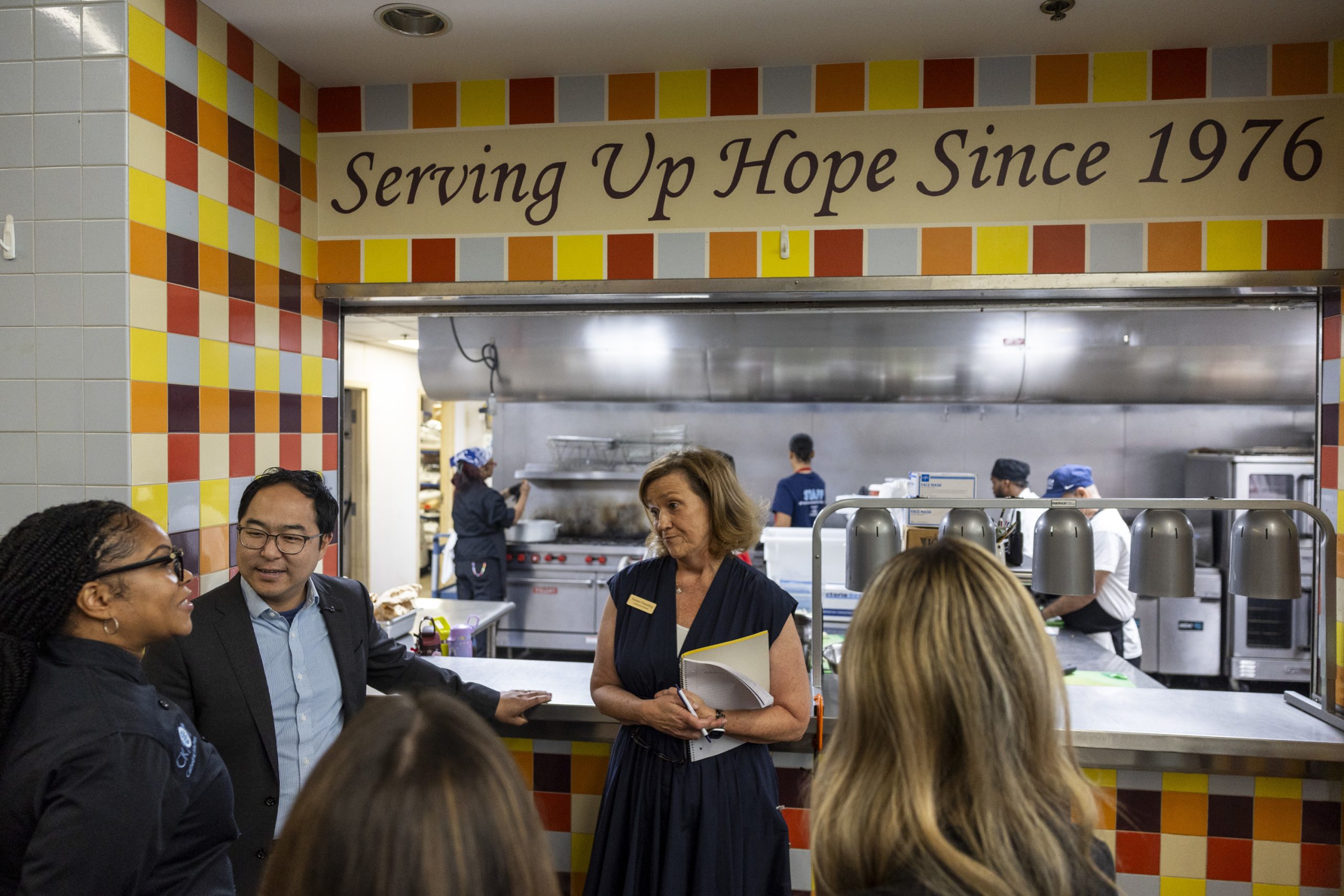
    New Jersey Sen. Andy Kim visits Cathedral Kitchen in Camden, speaking to the workers who provide food for their community and those in need.Tyger Williams / Staff Photographer

    The food assistance cuts are coinciding with the economic fallout from tariffs and the Iran war, Kim noted.

    Nationwide, between January 2025 and January 2026, SNAP rolls decreased by more than 4 million people — from 42 million to 38 million — according to USDA figures.

    In New Jersey, SNAP participation has fallen by more than 50,000 individuals between March 2025 and March of this year, New Jersey Department of Human Services figures show.

    And in Pennsylvania, nearly 90,000 people lost SNAP benefits between July 2025 and April due to new eligibility requirements, according to an analysis by the Pennsylvania Department of Human Services (DHS).

    At the same time, food prices have risen more than 3% in the last year.

    As a result, in Camden, Burlington, Gloucester, and Salem Counties, the number of meals distributed to help those in need grew by 34% over the last four years, according to the Food Bank of South Jersey

    “I know the Camden area,” said Kim, who grew up in nearby Marlton and Cherry Hill. “I’ve seen the struggles that have been here and still persist.”

    The Trump administration has said the cuts it’s made to SNAP, Medicaid, and other programs were necessary to staunch “waste, fraud, and abuse.” It maintains that it’s instituted strict work requirements for SNAP to move more people into the workforce and reduce dependency on government support.

    Kim said many Americans don’t understand that a large number of people who live in poverty also work. “Millions with jobs are still poor, and this country needs a mindset shift to understand that,” Kim said.

    Sen. Andy Kim (D., N.J.) speaks with Naimah Rutling, executive chef at Cathedral Kitchen in Camden, N.J., on Friday.Tyger Williams / Staff Photographer

    As he continued his Tour of Cathedral Kitchen, Kim invariably found himself in the organization’s actual kitchen, bustling with food workers slicing carrots and onions, preparing for meals ahead.

    Clearly enjoying the moment, Kim said that at home, he makes his own bread, including pizza dough.

    Kim asked executive chef Naimah Rutling what her favorite food is. “Grilled cheese,” she said without hesitating. Kim laughed and said, “I have a 9-year-old and a 10-year-old. About 90% of what we eat is grilled cheese.”

    Before leaving, Kim praised workers in the kitchen for their diligence and dedication in preparing food for those who need it.

    “It gives meaning and purpose to their lives,” he said. “I love the passion I see.”

  • Ewart Rouse, retired award-winning Inquirer reporter and editor, author, and journalism professor, has died at 85

    Ewart Rouse, retired award-winning Inquirer reporter and editor, author, and journalism professor, has died at 85

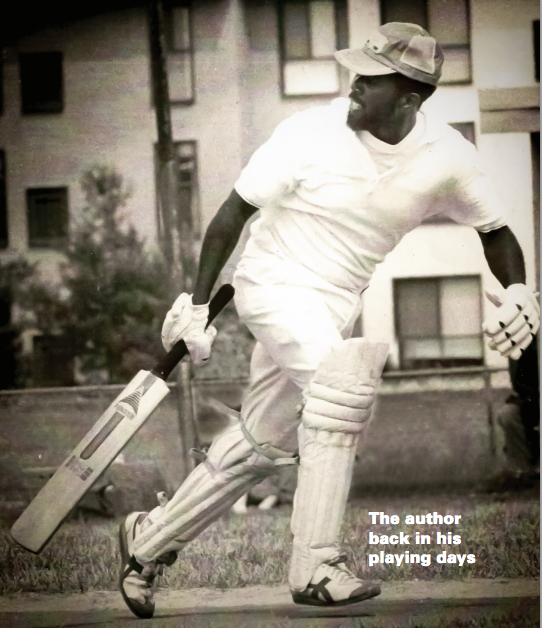
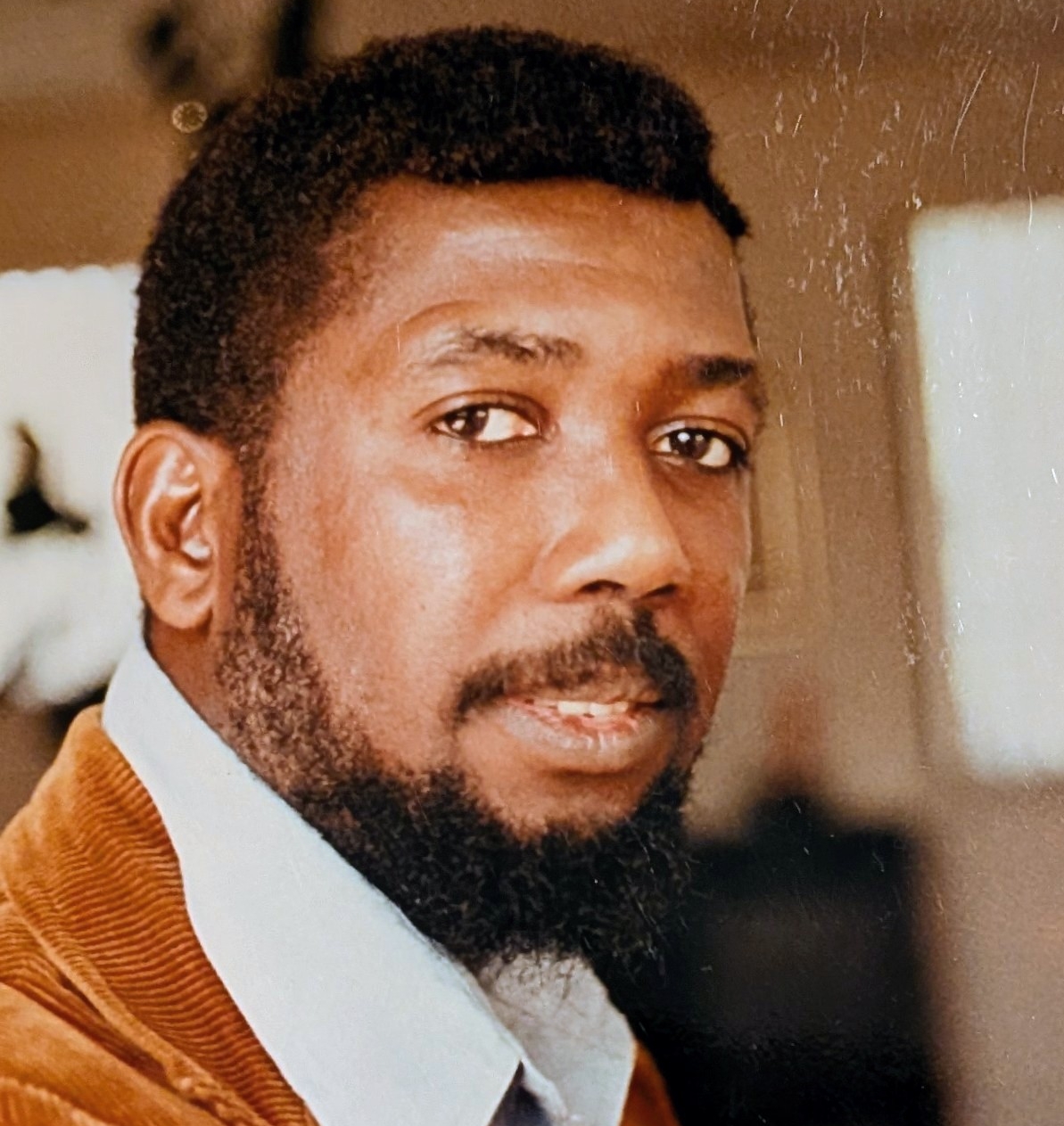
    Ewart Rouse, 85, of Lawnside, retired award-winning reporter and editor for The Inquirer, author, journalism adjunct professor, mentor, immigrant advocate, and indomitable cricketer, died Thursday, July 2, of age-associated decline at the Samaritan Center at Voorhees.

    Born in Trinidad, West Indies, Mr. Rouse immigrated to New York in 1969 and joined The Inquirer in 1974. For nearly 30 years, until he retired in 2002, Mr. Rouse was an award-winning business and news reporter, suburban editor, and mentor to hundreds of young journalists.

    He won a 1980 Keystone Award for a news series on city taxi service and was recognized for another series on street gang homicides involving Black youth. Later, he wrote business columns and covered South Jersey news.

    He opened a 1975 story about former President Gerald Ford’s first visit to Philadelphia with: “The old man sat alone and dejectedly with his flags against the wall of the Philadelphia National Bank building at 5th and Market Streets. ‘Not one,’ he muttered. ‘I haven’t sold not one flag today.’”

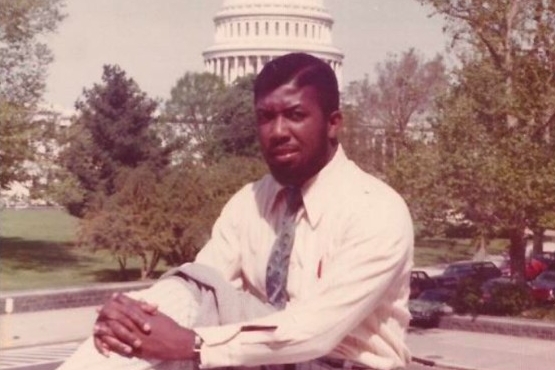
    Mr. Rouse worked for the Associated Press in Washington DC.Courtesy of the family

    Before The Inquirer, Mr. Rouse was a news and political reporter for the Associated Press in Newark, N.J., Atlantic City, and Washington, D.C. “He was a popular colleague who contributed importantly to the paper’s growth,” Gene Foreman, retired managing editor at The Inquirer, said on Facebook.

    Other former Inquirer colleagues called Mr. Rouse “professional and gracious,” “careful and respectful,” and “kind and generous.” Retired Inquirer editor Lil Swanson said on Facebook: “Ewart was filled with wisdom and grace. When he was an editor, young writers flocked to him because he always made their stories better and helped them grow.”

    He covered courts and politics for the Trinidad Guardian in Port-of-Spain before leaving for New York, and interviewed Trinidad Nobel laureate V.S. Naipaul for the 1997 book Conversations with V.S. Naipaul. In Philadelphia and South Jersey, he taught news writing, business writing, and investigative journalism at Temple, Rutgers, and Arcadia Universities.

    He mentored many students of color and edited books for other writers. He enjoyed fiction and detailed plots, and wrote a four-book series of cricket-themed novels he called the Sticky Wicket Collection.

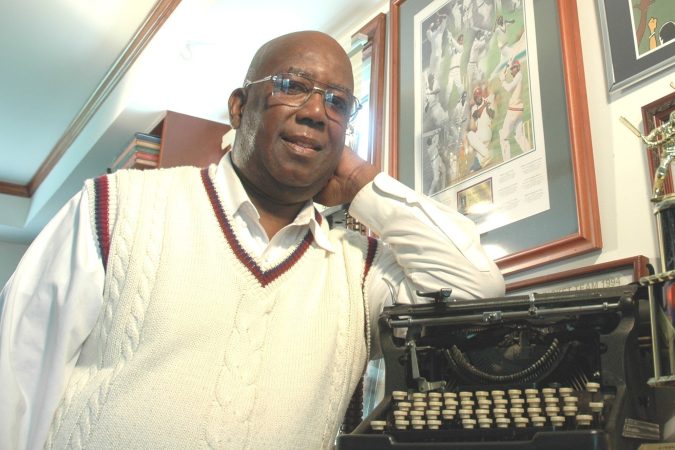
    Mr. Rouse loved to play, watch, and write about cricket.Ewart Rouse

    Readers called his books “highly entertaining” and “a wonderful addition to cricket literature” in reviews. His daughter Karen said: “The clackety-clack (zing!) of his typewriter was a constant in our home.”

    Mr. Rouse played cricket in Trinidad and later in South Jersey, and he cofounded the Philadelphia Cricket League, the New Jersey Cricket Association, and the Echelon Cricket Club. He played the game, managed teams, and became one of the region’s greatest advocates for cricket and its immigrant players.

    In 2013, he earned a lifetime achievement award from the South Jersey Caribbean Cultural and Development Organization, and recognition from then-Camden Mayor Dana Redd for his contributions to the community as a journalist, teacher, and cricket activist. “It truly was an honor to be recognized by my own community,” he said on his website, ewartrouse.com.

    In a 2016 online interview, Mr. Rouse was asked to advise young writers. “Read anything you get your hands on,” he said, “From books and newspapers … to labels on paint. Each contains nuggets of information that the mind will retrieve for just the right spot in your next project.”

    Mr. Rouse and his wife, Vanda, met in Trinidad.Courtesy of the family

    Ewart Rigsby Rouse was born Sept. 16, 1940, in Tunapuna, Trinidad. He was an avid reader and creative writer as a boy, and noticed one day that several of his favorite writers — Charles Dickens, John Steinbeck, and Ernest Hemingway — started out as newspaper reporters.

    “And now I wanted to be a journalist like them,” he said in a short self-published autobiography.

    He met his wife, Vanda, in Trinidad, and they married and had daughters Joann, Karen, and Kristin. They lived in New York, Pleasantville, N.J., and Washington, and settled in Lawnside in the 1970s.

    Mr. Rouse was active with the C.C. Morris Cricket Library Association, the South Jersey Writers’ Group, and the Rainy Tuesday Writers Group. He was an avid gardener and routinely gave away bags of home-grown tomatoes to friends and neighbors.

    Mr. Rouse enjoyed time with his grandsons. Courtesy of the family

    He collected records, listened to Nat King Cole and Frank Sinatra, followed the 76ers, and grilled outdoors as often as possible. He took his family on memorable trips to Trinidad that “opened up a world to us that was accessible, one that we could dare to explore,” said his daughter Karen.

    In 2016, Mr. Rouse told aspiring writers: “Who knows, maybe you end up with a bestseller. Some might call you a dreamer. But, hey, as the saying goes, you can’t have a dream come [true] if you don’t have a dream.”

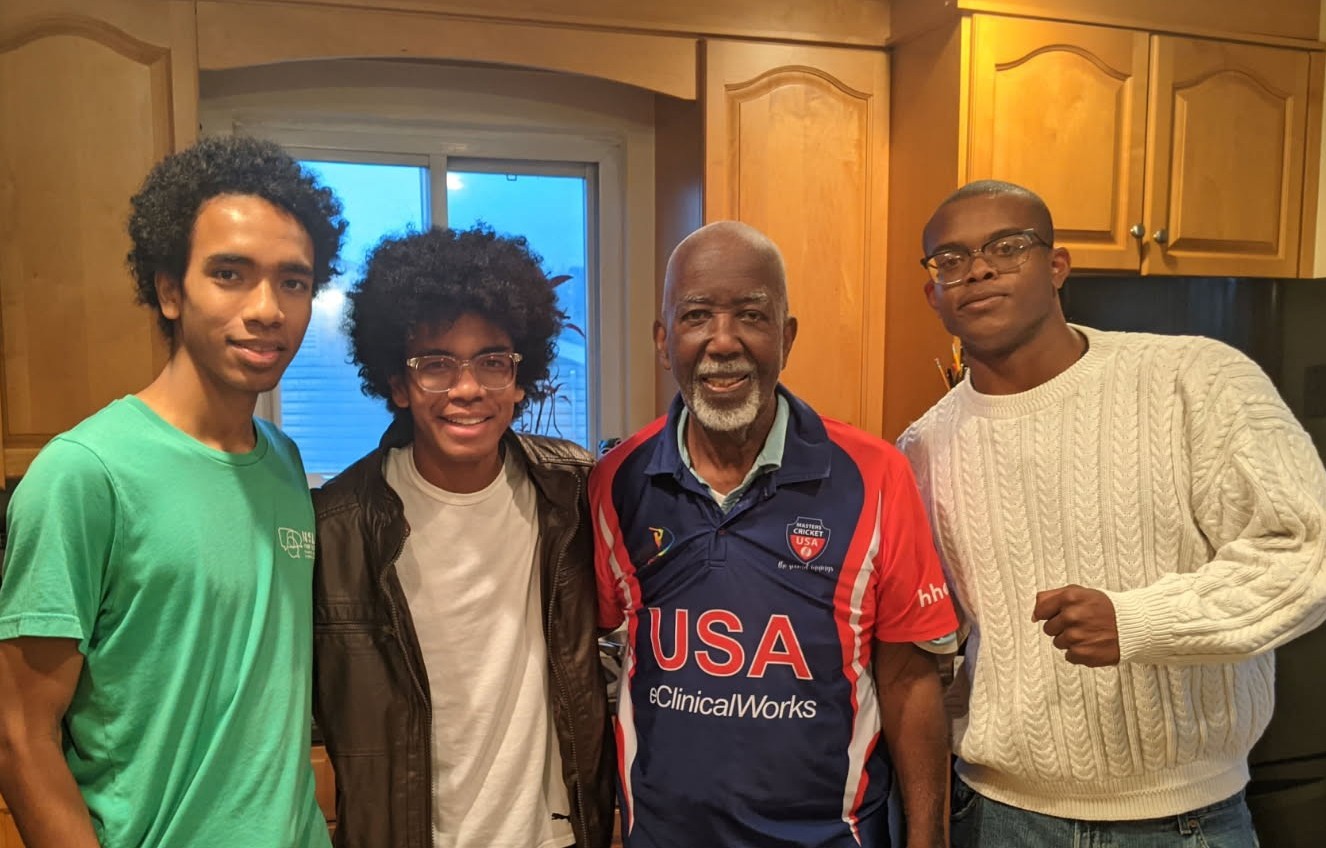
    In addition to his wife and daughters, Mr. Rouse is survived by three grandsons, two sisters, a brother, and other relatives.

    A private celebration of his life is to be held later.

    Donations in his name may be made to the Philadelphia Association of Black Journalists, 30 S. 15th St., 15th Floor, Philadelphia, Pa. 19102.

    A former Inquirer colleague called Mr. Rouse “a true and kind gentleman.”Courtesy of the family
  • Suffocating dome of smoke descends over Philly region

    Suffocating dome of smoke descends over Philly region

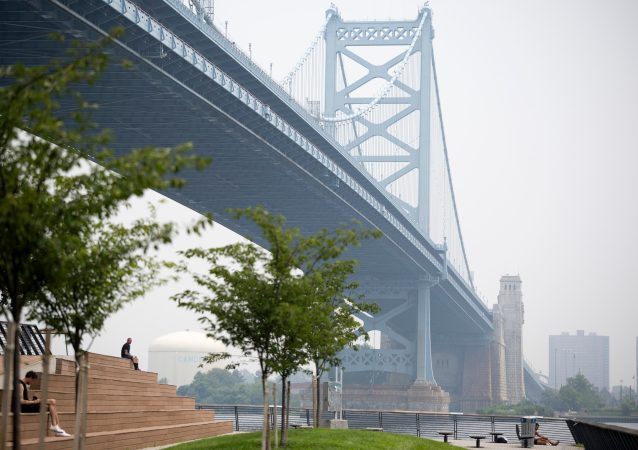
    Philadelphia’s jinxed July, which had already featured a record-setting dome of heat and microburst storms that razed hundred of trees, now includes a smothering, suffocating smoke.

    The polluted campfire-like vapor from Canadian wildfires plummeted air quality Thursday, lowered visibility enough that flights were delayed at Philadelphia International Airport, and prompted cancellation of a concert at Cooper River Park in Camden County. The Phillies moved Thursday night’s game up one hour due to air quality concerns.

    The smoke, which was expected to blanket the region at least through Friday, originated from fires burning in Western Ontario, said Sarah Johnson, a meteorologist at the National Weather Service’s Mount Holly office.

    It was swept in by winds that mixed to keep it closer to the ground.

    “It’s just a factor of the winds at all levels kind of working together,” Johnson explained.

    It is difficult to pinpoint when the air quality might return to normal, she said. Those forecasts come from state environmental protection departments and are usually no more than 48 hours out.

    The Pennsylvania Department of Environmental Protection has declared a Code Purple Air Quality Alert for Friday. Code purple signifies very unhealthy air, meaning people should avoid long or intense outdoor activities, and sensitive groups should avoid all outdoor activities. The department suggested not using gas-powered lawn and garden equipment, and avoiding the burning of leaves or trash.

    Rain forecast for Saturday could help suppress the smoke, Johnson said, but on Thursday afternoon it was too early to be sure.

    Poor air quality caused by the fires remained the biggest issue as they burned through forests and buildings before their smoke swept south, collecting ambient pollution from Boston, New York, and other areas before reaching Philadelphia.

    Philadelphia issued a Code Red Air Quality Caution Day on Thursday, meaning some people were at risk of experiencing health effects, including elevated risks for people with heart or lung disease, asthma, older adults, children, pregnant people, immunocompromised people, people experiencing homelessness, people who use drugs, people without access to air filtration, and outdoor workers.

    The city advised people to limit their time outdoors and consider rescheduling activities.

    “Today is not the day to start your marathon training plan,” Palak Raval-Nelson, commissioner of the Philadelphia Department of Public Health, said in a statement.

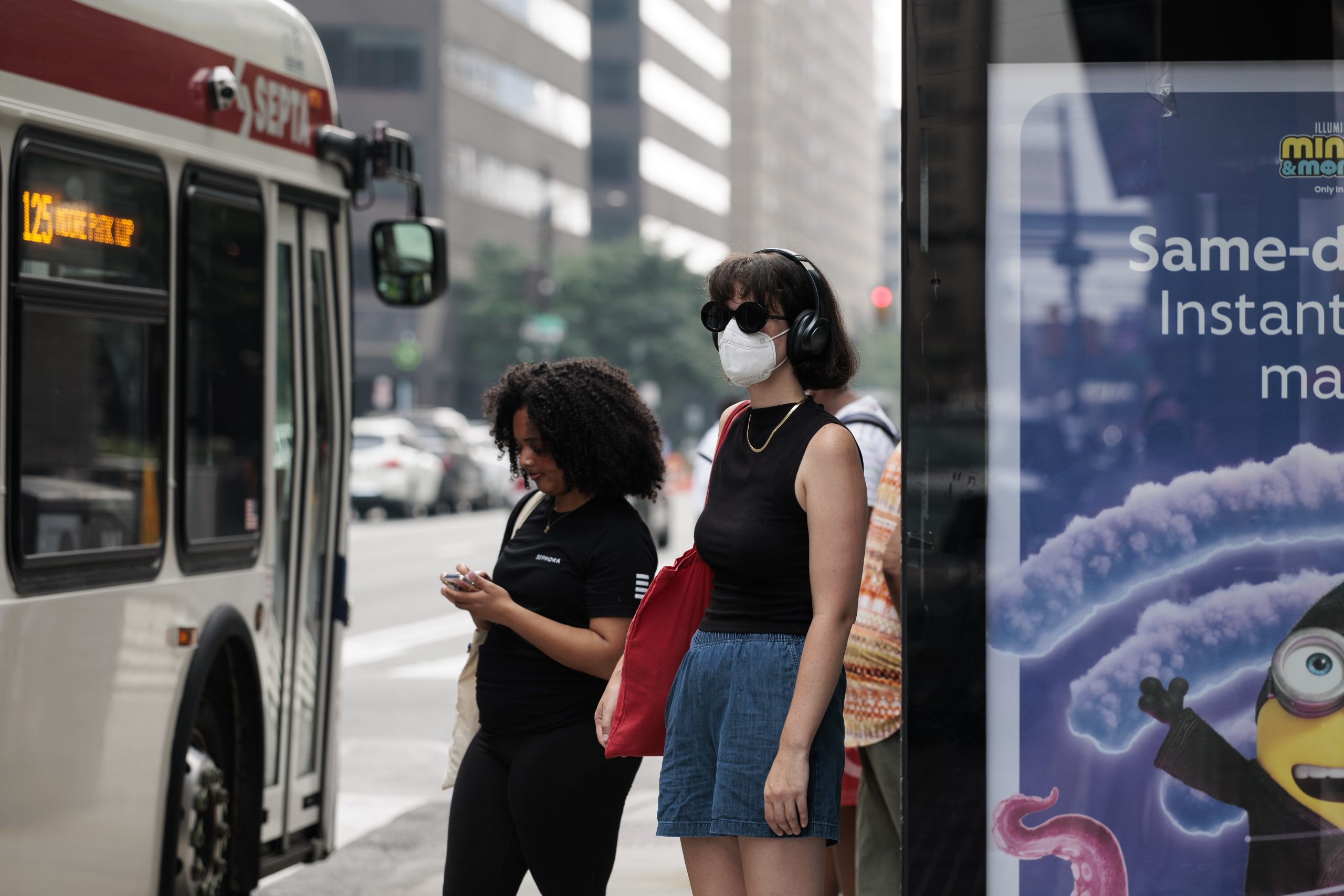
    Penn State graduate student Ray Boone waits for the bus with a face mask on because of the air quality, on Thursday, July 16, 2026 at 17th Street and JFK Boulevard in Philadelphia. The Pennsylvania Department of Environmental Protection has declared a statewide Code Red air quality day due to Canadian wildfire smoke blowing into the Philadelphia region.Monica Herndon / Staff Photographer

    High temps increase risks

    The smoke affected thousands of square miles in the region, from the Poconos to the Shore through Delaware.

    The Air Quality Index, or AQI, by the U.S. Environmental Protection Agency was in the unhealthy range for all of the region as of 4 p.m. Thursday. The index ranges from 0 to 500. Unhealthy is from 151 to 200.

    Censors in Centre County, Pa., recorded a hazardous AQI of 345 by Thursday afternoon, the highest and most dangerous level. Other sensors in Lycoming and Bradford Counties recorded AQIs above 200, or very unhealthy.

    Center City had an index of 192, which is considered unhealthy. Northeast Philadelphia, Chester, Norristown, and Camden all were similarly in the unhealthy range.

    Not helping: Temperatures in the 90s with humidity so high that it made it feel in excess of 100 degrees.

    Julie and Bill Guise, 66 and 72, respectively, basked in the somewhat cool breeze billowing from a giant fan inside the President’s House complex at Independence National Historical Park, hoping to get relief from the oppressive air. The Flagstaff, Ariz., residents, however, were unaware of what exactly was causing it.

    “We couldn’t figure out what it was,” Bill Guise said of the haze in the atmosphere.

    But it did not change their plans. The couple are used to wildfires.

    “It’s much worse out West,” Julie Guise added, likening the western smoke, when it’s extra bad, to sitting next to a campfire.

    Eric Balaban, a pulmonary and critical care fellow at Temple University, was hesitant but still went running Thursday morning.

    “If I didn’t have an addiction to running, I would not have gone. And I would recommend other people not to run. Do as I say, not as I do,” he said with a laugh.

    But exposure to the smoke is a serious matter, Balaban said. He noted that the smoke that travels “carries a uniquely toxic profile that poses severe health risks to both healthy individuals and vulnerable populations.”

    Ruth McDermott-Levy, a professor at Villanova University’s school of nursing, said that air quality had become a risk not only for those already suffering from health issues, but for everyone.

    “All of us are at risk,” McDermott-Levy said. “Certainly there are groups of people at greater risk, from pregnant women, children, older people, and those with cardiac and respiratory illnesses. But we’re at an unhealthy level for everyone.”

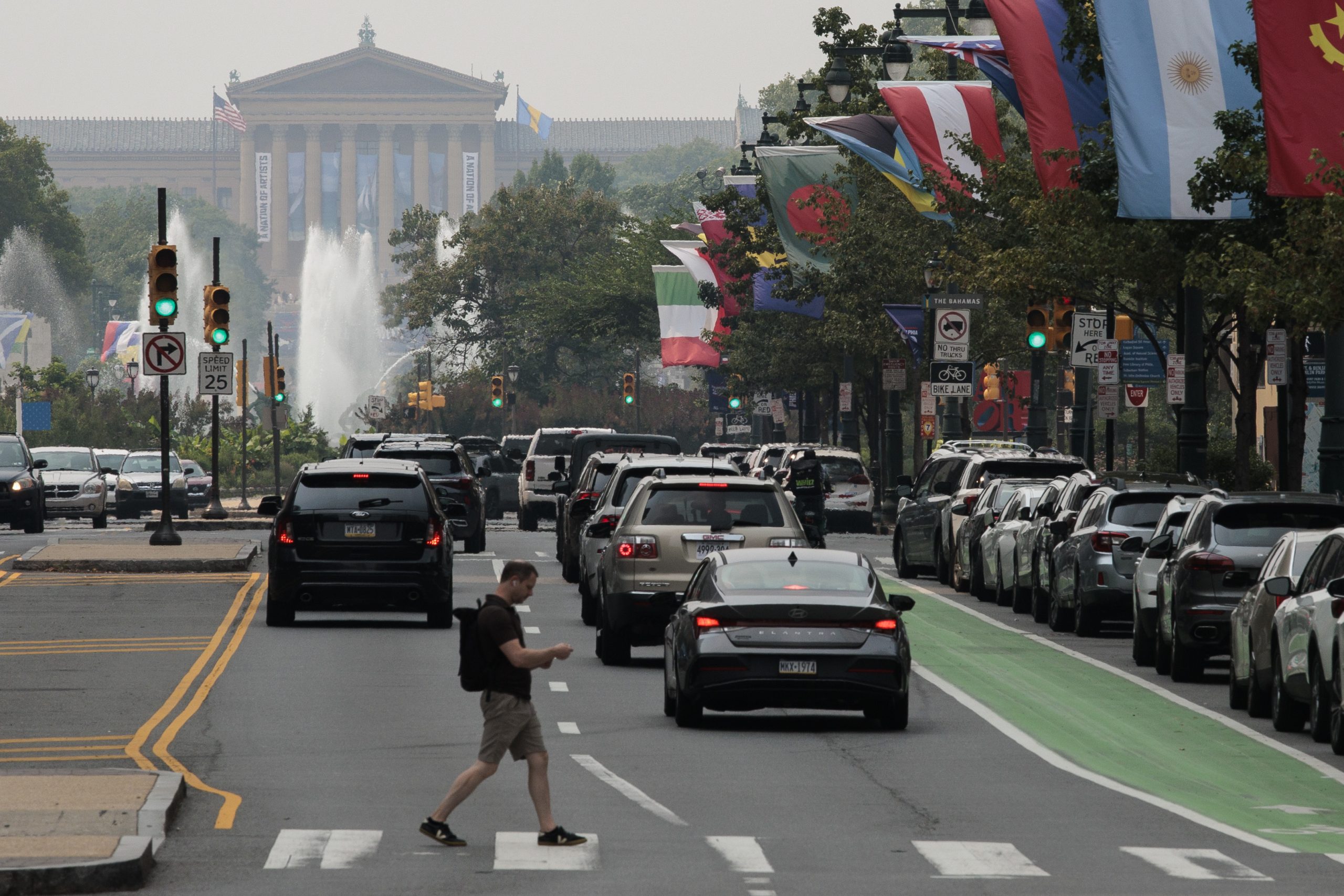
    The Philadelphia Museum of Art behind a smokey haze on Thursday, July 16, 2026 in Philadelphia. The Pennsylvania Department of Environmental Protection has declared a statewide Code Red air quality day due to Canadian wildfire smoke blowing into the Philadelphia region.Monica Herndon / Staff Photographer

    What’s in the air?

    The two major pollutants of concern are ground-level ozone and fine particulate matter known as PM2.5.

    Ground-level ozone is a pollutant that forms when nitrogen oxides and volatile organics emitted by vehicles, power plants, and industry react in sunlight, especially during hot days. It can cause airways to constrict, leading to shortness of breath. It can especially affect those with asthma, emphysema, and chronic bronchitis.

    Fine particulate matter is so small that it can cross from the lungs directly into the bloodstream, bringing a body-wide exposure that can increase the risk of heart attacks and strokes, in addition to causing acute chest tightness, shortness of breath, and dizziness in otherwise healthy people.

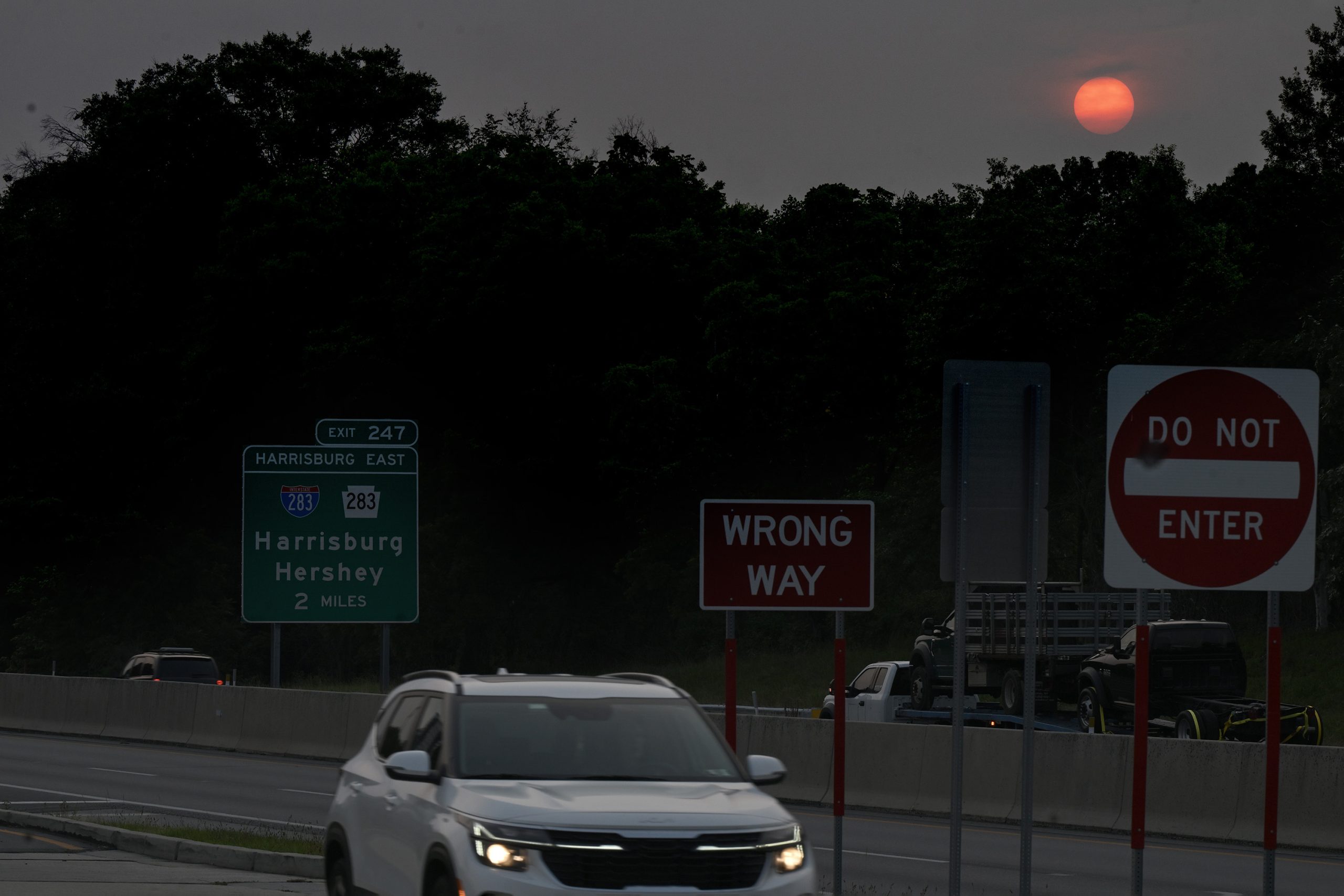
    The sun sets in a hazy sky over the Pennsylvania Turnpike Wednesday, July 15, 2026 as the Canadian and Great Lakes wildfire smoke moves into the region’ This at the Highspire Service Plaza], eastbound near Middletown.Tom Gralish / Staff Photographer

    Staff writer Nate File contributed to this article.