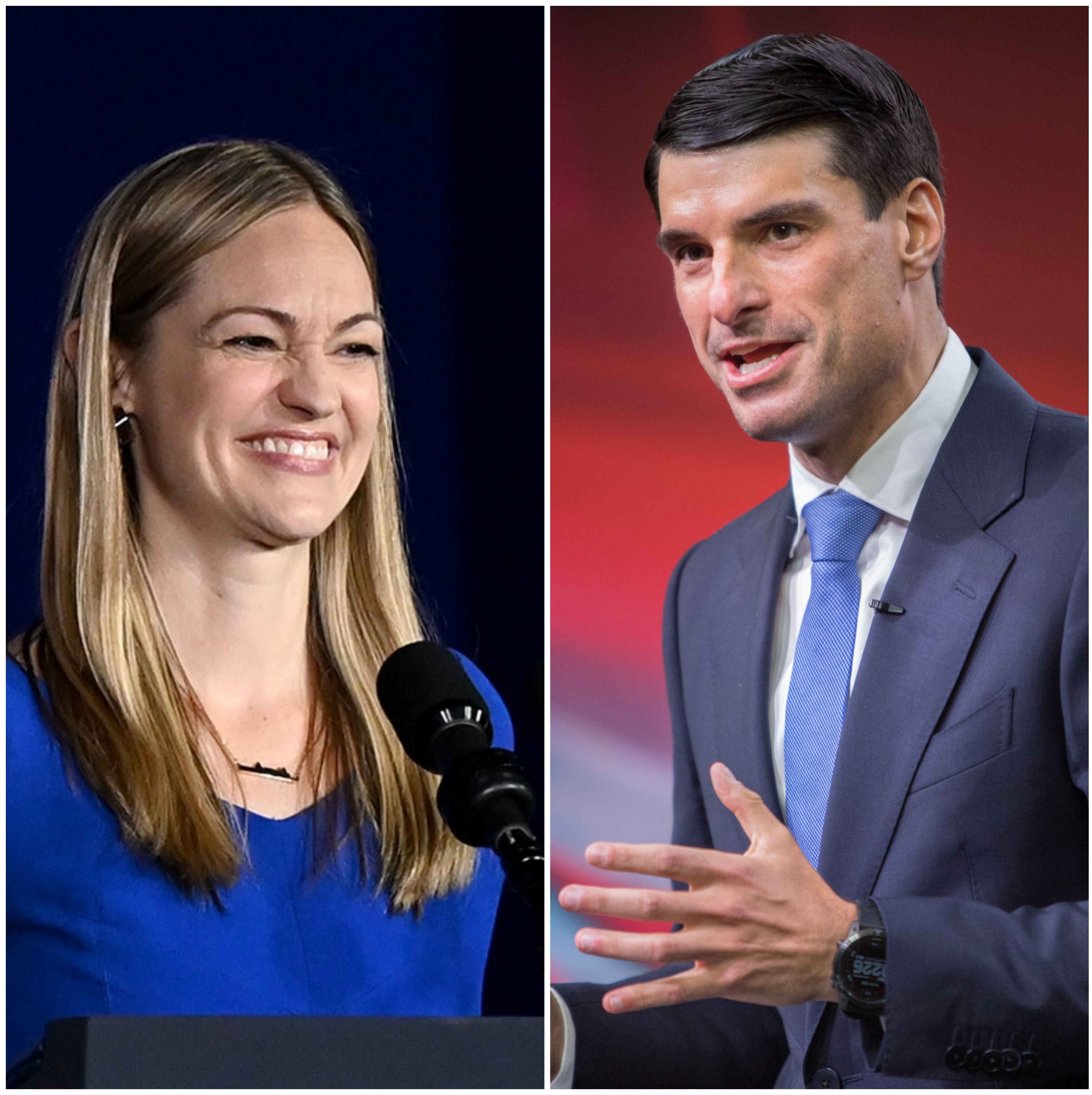
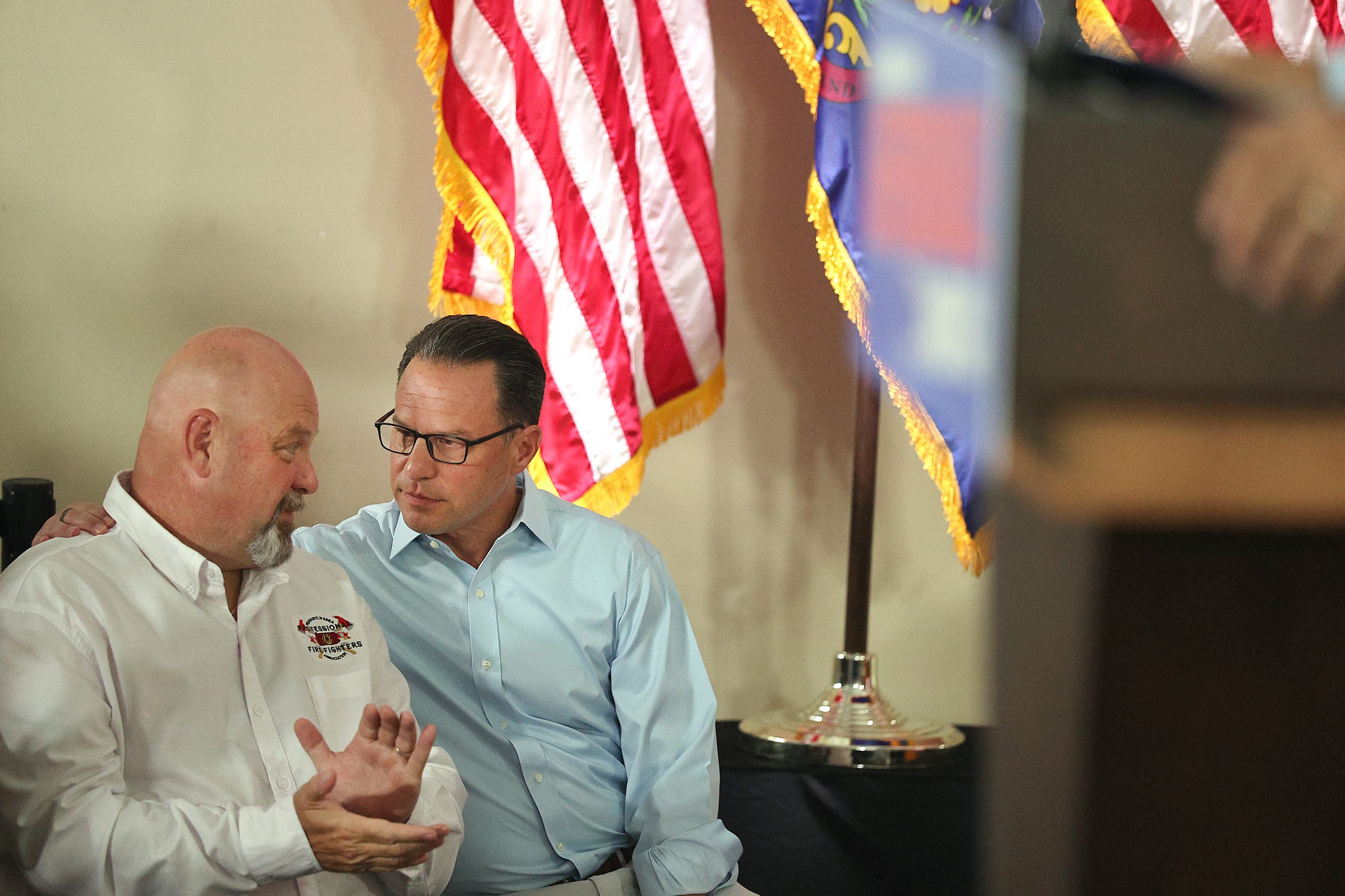
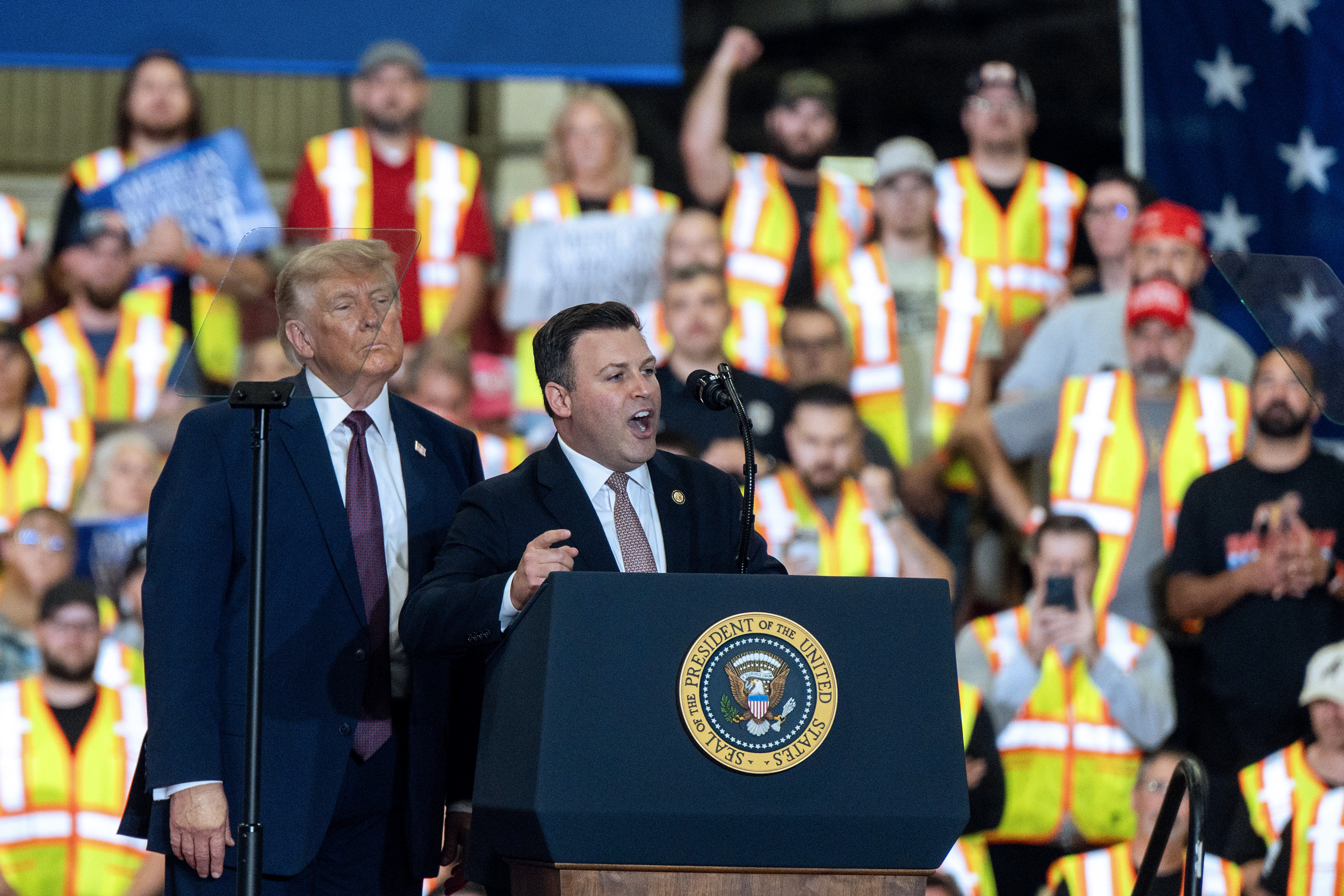
U.S. Rep. Rob Bresnahan — a Luzerne County Republican fighting to hold on to a Northeastern Pennsylvania swing seat — in a debate on Thursday criticized President Donald Trump’s deal to purchase Russian oil and said the war in Iran “absolutely needs to end.”
Meanwhile, his Democratic challenger, Scranton Mayor Paige Cognetti, backed voter ID and the GOP efforts to eliminate taxes on tips and overtime.
The emphasis on breaking party lines was the most prevalent theme in what was the only scheduled debate in the 8th Congressional District before Election Day.
Both candidates repeatedly stressed their independence — while also taking a few shots at each other and largely backing their party platforms — in a region where voters have been known to swing in different directions.
Trump won the district in 2024 by 8.5 percentage points, the most of any of four consequential swing districts this year. More than anywhere else in the state, the president saw some of his largest gains in the region between 2020 and that last campaign, helping Bresnahan narrowly beat a five-term Democratic lawmaker.
But a recent Inquirer/New York Times/Siena University poll found Trump’s approval rating sunk to 43% in the district and Cognetti was leading Bresnahan, 51% to 46%, less than two weeks before Tuesday’s election.
Voters said they trusted Cognetti more than Bresnahan on every issue included in the poll — cost of living, foreign wars, data centers and AI, and corruption — except for immigration, which Bresnahan led by 1 percentage point.
In the debate, Cognetti pointedly criticized her party on immigration, saying President Joe Biden, whose Scranton roots Cognetti has celebrated, “failed at the border” and that she was glad it was now secure under Trump.
Comprehensive immigration reform is needed, with clear pathways to citizenship for immigrants who are contributing to their communities and the country, she said. And while she did not comment specifically on ICE’s controversial tactics, Cognetti underscored a need for “not alienating people” and making them “feel less safe.”
Bresnahan, for his part, took strides to break from Trump on two key areas of foreign policy.
After Cognetti criticized him for repeatedly voting against war powers resolutions that would have reined in the president’s ability to attack Iran, he said he agreed that “this has gone on far too long.”
“I feel the mission has been accomplished and the war absolutely needs to end,” he said before adding a caveat. “My concern would be ripping out the rug from underneath our service members that are serving overseas. We’ve seen what happens during disastrous withdrawals. Like in Afghanistan, where you had people hanging onto airplane wheels. There needs to be a pragmatic, concentrated approach to figure out how to withdraw from Iran.”
On Trump’s deal to buy diesel from Russia to lower gas prices, which has evoked condemnation on both sides of the aisle, Bresnahan said he was part of a bipartisan group looking for a “legislative solution to push back against the administration to stop what’s happening and empower Vladimir Putin.”
Bresnahan later stressed in his closing statement that “there’s been plenty of examples of where we’ve pushed back on the administration.”
He said he supported Building Resilient Infrastructure and Communities, a program that provides funds for local emergency mitigation projects, and Job Corps, a training initiative, both of which the administration tried to cut. And he emphasized his push alongside a few other Republicans at the end of 2025 to extend the Affordable Care Act tax credits before GOP leaders let them expire and ultimately raise premiums for millions of people.
“I did every single thing I could to break with my party, to force a vote on the floor through a discharge petition,” Bresnahan said.
Cognetti, for her part, said she supported efforts to require people to have identification to vote. The SAVE Act, however, “goes too far” in adding burdensome requirements that would make it significantly harder for people to vote, particularly women who’ve changed their names after they get married and who would be unable to use their birth certificates to prove their identification, she said.
She also said she supported eliminating taxes on tips and overtime — which Bresnahan has highlighted as a primary accomplishment of the Republican-led Congress — and her desire to cut “waste, fraud and abuse,” a common refrain from Republicans.
But Cognetti said she did not support the “cruel cuts” to Medicaid that paid for the rest of the One Big Beautiful Bill, which she repeatedly criticized her opponent for supporting — as well as for reportedly selling stocks in companies that manage Medicaid enrollees before doing so.
“Congressman Bresnahan voting for that bill was atrocious,” she said. “Just a few days before he did that, he signed onto a letter saying he’d never cut those benefits. He wasn’t truthful. He hurt us, and he got a tax break in the process.”
Bresnahan didn’t respond to the claim that he sold $130,000 in Medicaid provider stocks, and Cognetti did not otherwise specifically mention his stock trading while in office — a message that has dominated her entire campaign. She spoke more generally about corruption, and with a bipartisan twist.
“I’ll take on that corruption wherever I see it, Democrats and Republicans,” she said, adding that “we need to ban congressional stock trading for real.”
Bresnahan’s sharpest attacks came when he took aim at her over what he said were rising rates of violent crime in Scranton during her tenure, which began in 2020 after she originally ran as an independent. Cognetti said his statistics were cherry-picked, and WVIA, the Luzerne County station that hosted the debate, has reported that crime declined during her tenure.
The debate was, overall, more cordial than the contentious debate in another swing district earlier this month, when U.S. Rep. Scott Perry (R., York) and Democratic challenger Janelle Stelson went head to head and made numerous personal attacks.
There were ultimately no debates in the two other nationally watched Pennsylvania races. Democrat Bob Brookspulled out of a scheduled debate last week with U.S. Rep. Ryan Mackenzie (R., Lehigh) in the Lehigh Valley-based 7th Congressional District as the Republican targeted him with multiple attacks and declined to take down an ad that Brooks said was “false and defamatory.”
And in Bucks County’s 1st Congressional District U.S. Rep. Brian Fitzpatrick and Democrat Bob Harvie could not agree on terms for a debate, despite trading dueling challenges.
Republican U.S. Rep. Brian Fitzpatrick filed a lawsuit Thursday in an effort to disqualify Bucks County Commissioner Diane Ellis-Marseglia from serving on the county election board ahead of a tight contest against a fellow Democratic commissioner, Bob Harvie.
Fitzpatrick’s suit, filed in Bucks County Court, alleges that Ellis-Marseglia has shown a “disdain for election law” and should be removed for “conflicts of interest.”
Ellis-Marseglia is close friends with Harvie, Fitzpatrick’s Democratic challenger, and has attended events for his campaign.
The lawsuit urges the court to remove Ellis-Marseglia from the board and appoint a substitute for the forthcoming election, alleging that the Democrat serving on the committee violates Fitzpatrick’s due process rights after she has publicly supported Harvie and portrayed an “animus” toward the Republican.
“When a public official charged with overseeing or influencing the conduct of elections publicly expresses disdain for controlling election law for blatantly partisan purposes, and publicly expresses extreme partisan bias against candidates from opposing political parties, she has a clear conflict of interest,” Geoffrey R. Johnson, an attorney for Fitzpatrick, wrote in the complaint.
Harvie, a former chair of the elections board, recused himself from the panel after launching his campaign for Congress.
The suit was filed after Johnson sent a letter to Ellis-Marseglia on Tuesday asking her to recuse herself.
Bucks County Solicitor Dan Grieser responded on Wednesday, informing Johnson that Ellis-Marseglia has a First Amendment right to express her political views and would not be stepping away from the board.She was first sworn in as county commissioner in 2008 and has served on the election board for 15 general elections.
Election code requires members to recuse themselves only when they are on the ballot — not for political conduct, Grieser wrote, adding that Ellis-Marseglia has always certified the elections of Republican candidates she personally opposed, including all of Fitzpatrick’s wins, Republican row office sweeps, and President Donald Trump’s narrow 2024 win in the county.
“Commissioner Marseglia has vocally supported Democratic candidates, as is her First Amendment right, but that has never stopped her from certifying the results of elections where Republicans have won,” Grieser wrote.
Fitzpatrick’s suit also highlights a 2024 controversy surrounding ballots in the recount of the U.S. Senate race, during which Democratic-led boards, including in Philadelphia, Bucks, Montgomery, and Centre Counties, defied a Pennsylvania Supreme Court ruling and counted undated ballots.
Around that time, Ellis-Marseglia said: “I think we all know that precedent by a court doesn’t matter anymore in this country.”
“People violate laws any time they want,” she added.“So, for me, if I violate this law, it’s because I want a court to pay attention. There’s nothing more important than counting votes.”
A few days later she apologized for her comments and said the bipartisan backlash was a “misinterpretation of inartfully worded statement on my part, but taken completely out of context.” She also expressed appreciation for the state Supreme Court reaffirming itsruling and providing clarity on the situation.
Fitzpatrick himself has been publicly supported by a county commissioner before — Rob Loughery, a Republican, in 2018.
Johnson said in the suit that Loughery’s support is not comparable to Ellis-Marseglia’s actions, such as holding a “Fire Fitz” sign or allegedly removing copies of the Bucks County Heraldthat feature a Fitzpatrick ad from the county administration building.
“Commissioner Marseglia’s recent conduct can only be characterized as ultra-level political activism which evinces an extreme partisan bias,” Johnson wrote.
Thursday’s suit is the latest development in what has been a contentious andincreasingly litigiouscampaign cycle in the Bucks County-based 1st Congressional District, one of four swing districts in Pennsylvania that could determine party control of the U.S. House.
“It is deeply unfortunate that Brian Fitzpatrick is now following in the footsteps of Donald Trump by trying to sow doubt in the administration of an election because he is afraid of losing,” Harvie said in a statement. “After a decade in Washington, Fitzpatrick has changed and this is just another example.”
Harvie filed his own lawsuit in August against a pro-Fitzpatrick PAC, alleging defamation over attack ads in the bitter race.
A spokesperson for Fitzpatrick’s campaign did not immediately respond to a request for comment, and his attorney did not provide further comment on the legal filing.
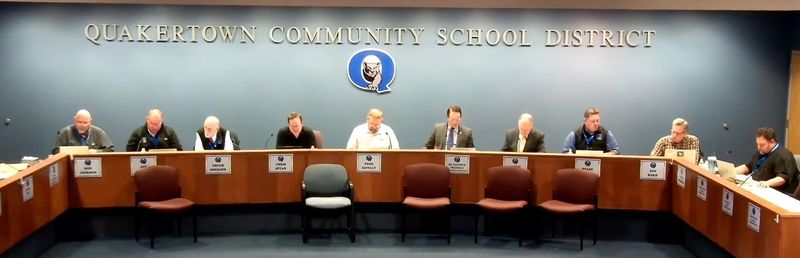
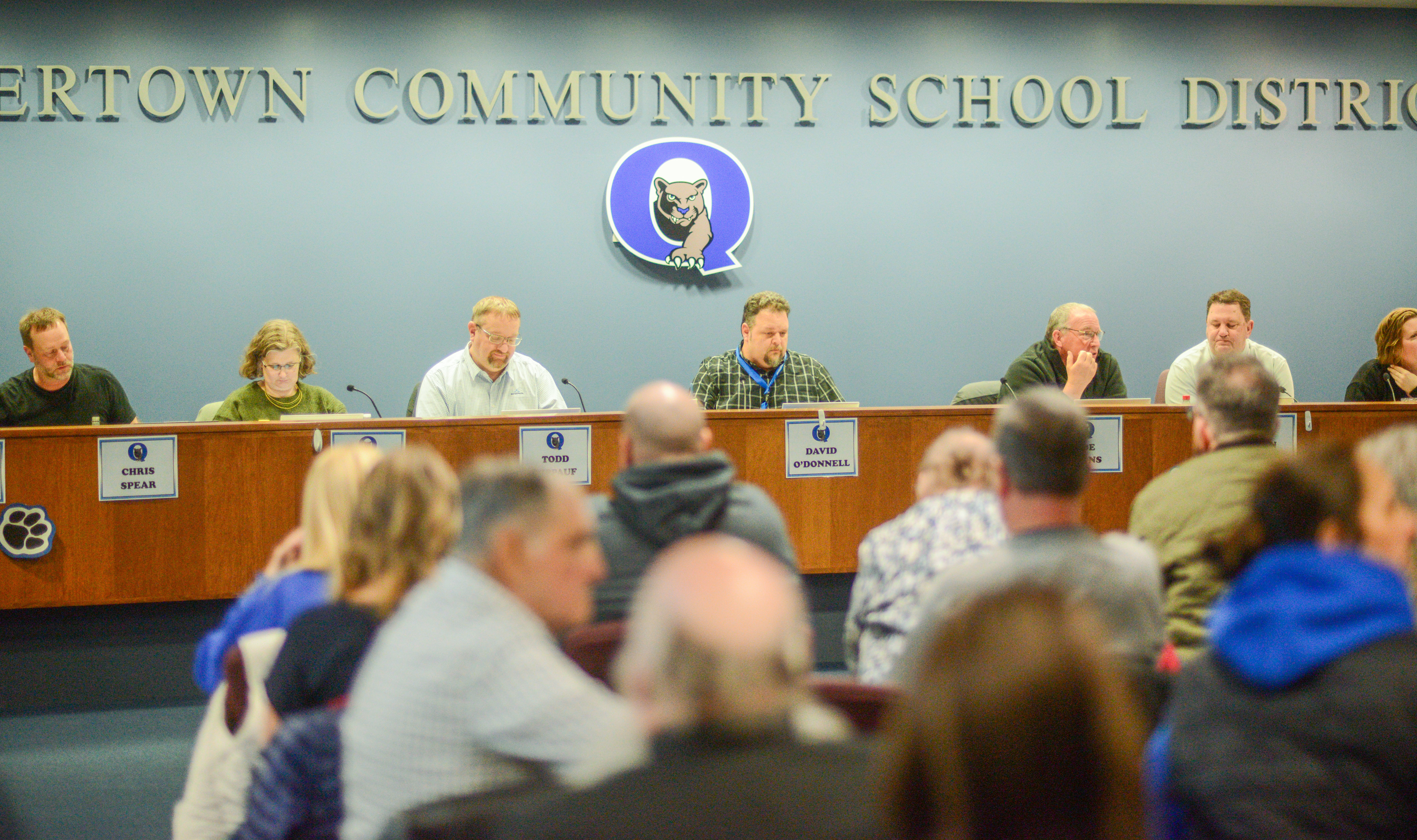
Quakertown Community School District Superintendent Matthew Friedman is on leave effective immediately, a district spokesperson said Friday.
The spokesperson, Melissa Hartney, said the district’s school board could not comment further.
“Because this is a personnel matter, the board is limited in the amount of information it can share at this time,” Hartney said in a statement.
Friedman did not return a request for comment.
Friedman took over the 4,600-student district in Upper Bucks County in 2023, after serving as superintendent of the Ocean City School District in New Jersey.
The Quakertown school board in November granted him a $10,000 raise, bringing his salary to $233,000, and extended his contract until June 30, 2028.
Assistant Superintendent Lisa Hoffman is taking over day-to-day operations of the district, Hartney said.
“The board is confident that district operations, instructional programs, and student services will continue without interruption,” Hartney said, adding that it “remains committed to transparency, accountability, and maintaining the trust of our students, staff, families, and community.”
Editor’s Note: Following the publication of this article, Quakertown Community School District Solicitor Jeffery P. Garton said in writing that Friedman was never placed on “administrative leave” and that his departure was amicable.
Addressing the board before the vote, Ryan Wieand, the president of Quakertown’s teachers union, said that selecting the next superintendent “is not simply about filling a position at this point. It’s about restoring trust.”
Wieand said the superintendent’s job “demands presence, visibility, and leadership that requires showing up, and not just for social media photo ops.”
The district “can’t be led effectively by someone who is absent more often than not,” Wieand said. “Our next superintendent needs to be 100% invested in Quakertown every single day,” and not view the job as “a stepping stone to another destination.”
He called Hoffman the best candidate for the job, praising her loyalty to the district and “true accountability.”
Friedman could not immediately be reached for comment Wednesday.
Editor’s Note: Following the publication of this article, Quakertown Community School District Solicitor Jeffery P. Garton said in writing that Friedman was never placed on “administrative leave” and that his departure was amicable.
Every available indicator suggests Democrats have the American people on their side in the coming election. As for Republicans, they have Elon Musk.
The world’s richest man has spent at least $445 million for Republicans in the midterms, which is approaching the annual budget of Bucks County. After spending $290 million to return Donald Trump to the presidency, Musk has upped his investment by more than half in an effort to mitigate the president’s political reckoning for high prices, an unpopular war, rampant corruption, and more. These are obscene figures, reaching a clip of more than $3 million a day in recent months. And yet, with a personal wealth thousands of times greater than his peak political generosity — thanks in no small part to government contracts, subsidies, and tax breaks — the Tesla and SpaceX mogul could continue such spending indefinitely.
This is a culmination of the pernicious combination of the country’s increasingly extreme concentration of wealth and a half-century of U.S. Supreme Court rulings unleashing those riches on our politics. These twin troubles perpetuate each other: The superrich spend more and more to elect a government that, in turn, does more and more to make them richer. And the cycle repeats.
Musk has now spent more on American politics than almost anyone, including George Soros, an eternal bogeyman of the right; his fellow billionaires Michael Bloomberg and Tom Steyer squandered more but did so on their own abortive presidential campaigns. That makes Musk single-handedly responsible for the GOP’s entire outside spending advantage in this campaign. And apart from Republicans’ structural upper hand in the Senate and success in gerrymandering House districts, that is the only advantage they have.
So what does Elon want in return? For one thing, more government money and less government regulation. Musk’s companies have enjoyed at least $38 billion in government contracts and other direct public subsidies over the last 20 years, according to a Washington Post analysis. He also stands to reap enormous benefits from the Trump administration’s laissez-faire approach to artificial intelligence despite dire warnings about its dangers.
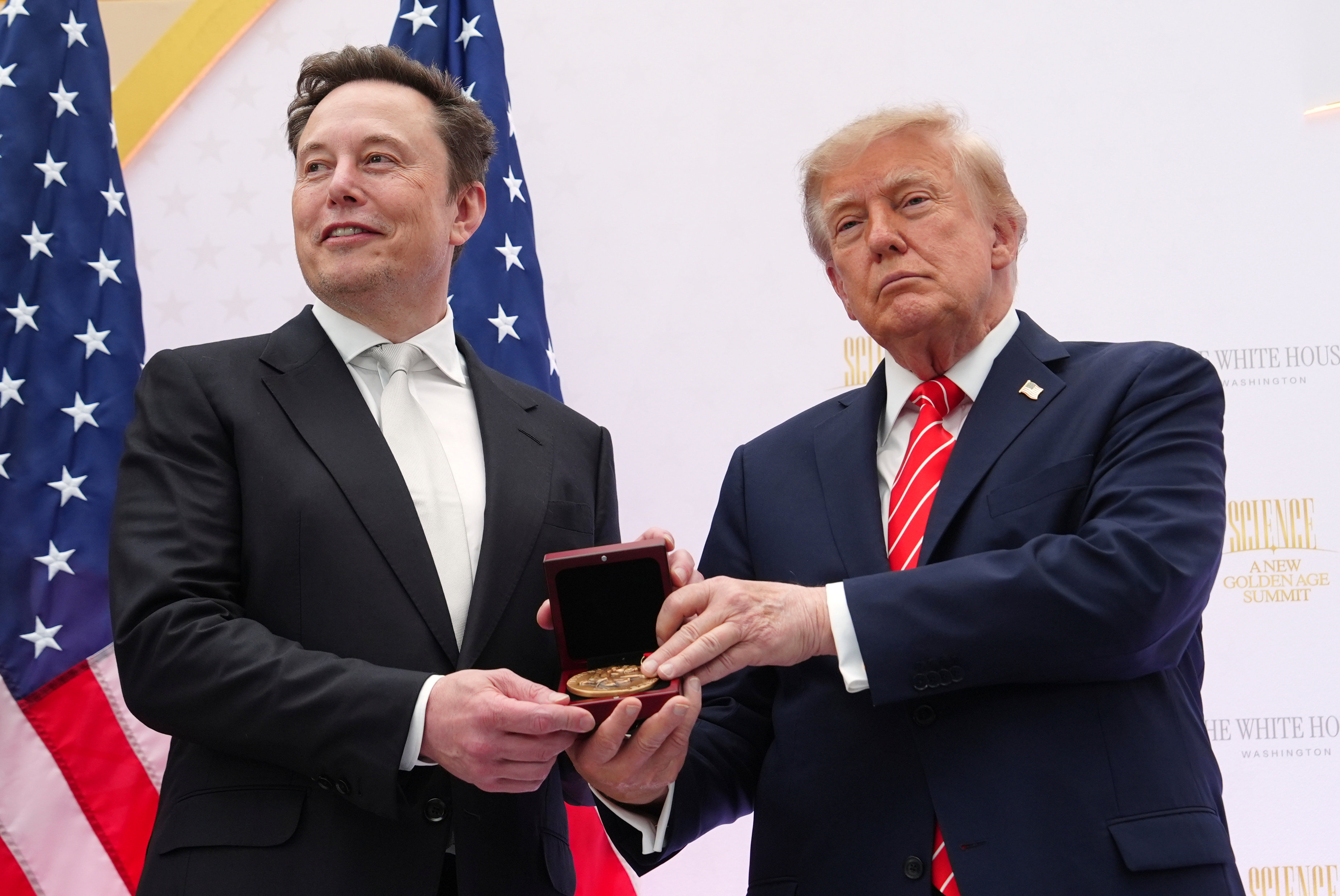
President Donald Trump presents the National Medal of Science to Elon Musk during an event at the U.S. Institute of Peace, Oct. 8, in Washington.Julia Demaree Nikhinson
But Musk has ideological interests of a sort, too, chief among them a virulent bigotry toward racial minorities, immigrants, and trans people. His compulsive posts on his social media platform reveal a preoccupation with white supremacist notions, which he translated into deadly federal policy by eliminating foreign aid during his disastrous stint as Trump’s so-called government efficiency czar. That any man can wield such influence over a major political party is troubling; that this man can is downright frightening.
The Supreme Court began to ordain this state of affairs with its 1976 ruling in Buckley v. Valeo, which equated individual political spending with constitutionally protected speech. The justices dramatically exacerbated the problem with their 2010 ruling in Citizens United v. FEC, which freed corporate and union spending and led to unlimited contributions through super PACs and more opaque groups. The avenues for wealthy people and interests to influence government have only proliferated under today’s conservative-controlled court, which is more likely than any to strike down every attempt to restrain the flow of money into politics.
Despite this cycle’s resulting avalanche of spending in Republicans’ favor, however, the ruling party’s prospects appear to have continued to deteriorate. It’s not clear that all of Musk’s money has clinched the case for any candidate, but it is a powerful argument for reforming our highest court and restoring a measure of financial and ethical sanity to our politics.
David Thornburgh is chair of Ballot PA Action, which advocates for opening Pennsylvania’s primary elections to independent voters.
Some of the most consequential elections in Pennsylvania this November will take place in Southeastern Pennsylvania and the Lehigh Valley. And yet, the voters who could help decide them are the same voters Pennsylvania continues to exclude from its primary elections: independent voters.
In Bucks County, Republican State Sen. Frank Farry faces Democrat Eileen Hartnett Albillar. In Berks and Montgomery Counties, Democrat Chris Thomas and Green Party candidate Mike Schonewolf are challenging Republican State Sen. Tracy Pennycuick. And in the Lehigh Valley and upper Bucks County, Republican State Sen. Jarrett Coleman faces Democrat Mark Pinsley.
These closely watched races will likely determine control of the Pennsylvania Senate, where Republicans hold a narrow 27-23 majority. The 30,000 or so independent voters in each Senate district will play a decisive role in the outcome.
Without an incentive to reach out for their votes in the primary election, candidates often pay little attention to independent voters until the general election season heats up a few weeks before. At that point, these voters feel a little like the high school kid who, on Friday night, gets asked to the senior prom happening the next night. The invitation seems rushed and insincere. That’s bad politics.
A rare opportunity
But now Pennsylvania has an unprecedented opportunity to change this.
It was a breakthrough more than three decades in the making.
For at least 30 years, lawmakers have debated giving independent voters a voice in primaries. While the Senate passed such legislation in 2019 by a vote of 42-8, with support from the current Senate president pro tempore and majority leader, every effort in the House had fallen short.
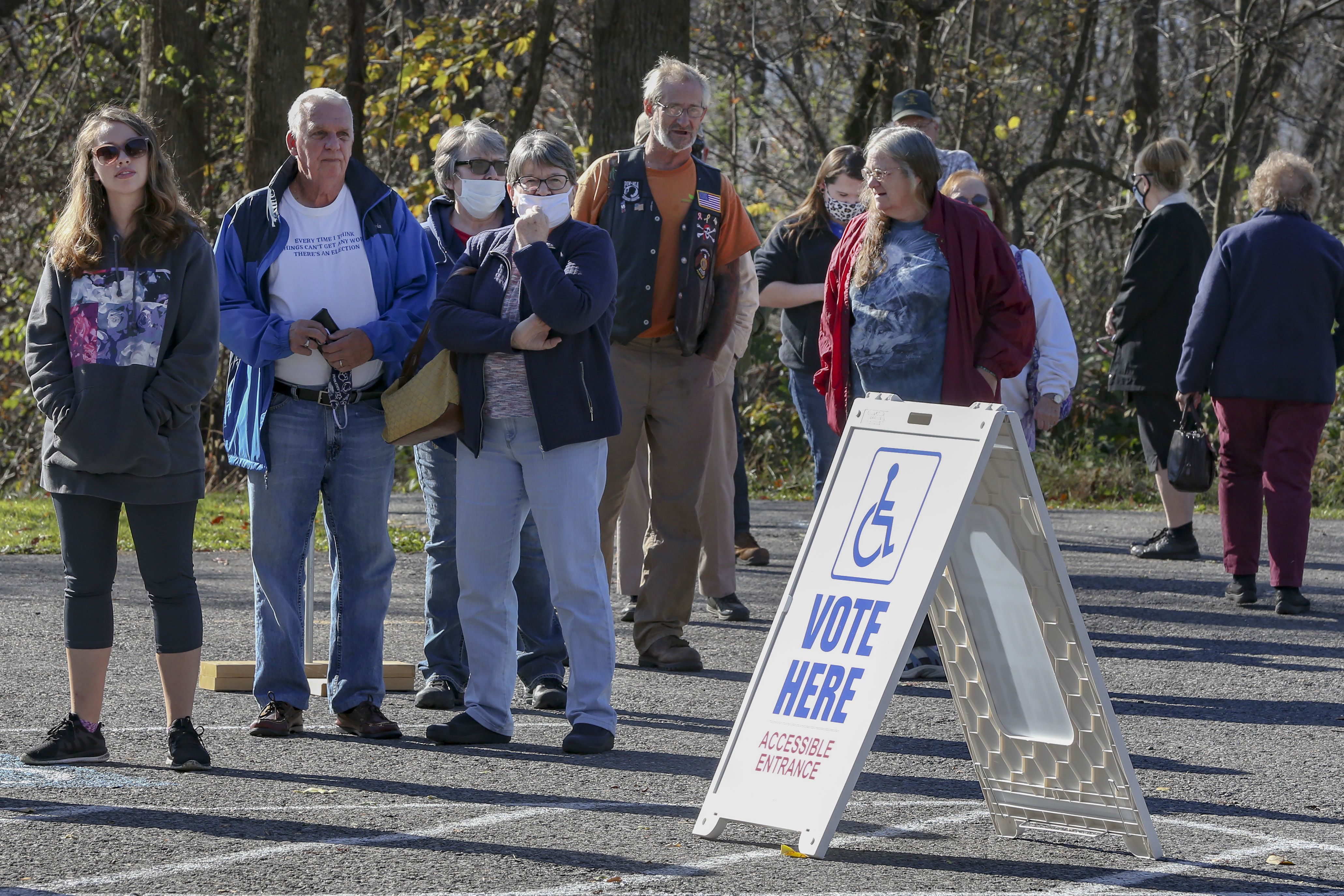
Voters wait outside a Fulton County, Pa., polling place on Election Day 2022. Third-party and independent voters have long been denied the right to vote in Pennsylvania primary elections.Steven M. Falk / MCT
According to the National Conference of State Legislatures, Pennsylvania is one of only eight states that does not allow independent voters to participate in partisan primary elections.
Pennsylvania independents are not sitting on the sidelines by choice. They vote in general elections, pay taxes, serve in our military, own businesses, volunteer in their communities, and send their children to public schools.
But when primary election day arrives, Pennsylvania tells them they cannot help choose Democratic or Republican nominees unless they join one of those parties.
And that matters beyond the competitive Senate districts drawing attention this fall.
In more than nine in 10 Pennsylvania legislative districts, where one party holds a significant registration advantage, the primary can effectively determine who represents that community. For independent voters, exclusion from the primary can mean exclusion from the election that matters most.
With the passage of House Bill 280, the question moves to the Senate. While a Senate bill could technically advance before the end of the current legislative session in December, the clock appears to be running out, as legislators are preoccupied by their own races and perhaps frozen in place awaiting the outcome of the Nov. 3 election.
Up to senators
But in the eastern part of the state, Senate leadership in support of opening primaries is particularly strong and diverse, and could move sharply to advance such legislation early in the new year. In the Lehigh Valley, State Sens. Lisa Boscola — a tireless and persistent champion — and Nick Miller, along with Southeastern Pennsylvania State Sens. Steven Santarsiero, Carolyn Comitta, Timothy Kearney, Amanda Cappelletti, Tracy Pennycuick, Judith Schwank, Joe Picozzi, and Maria Collett, have cosponsored Senate legislation.
Their support demonstrates that opening Pennsylvania’s primaries is not a partisan issue, but one of fairness, representation, and strengthening our democracy.
The coalition supporting open primaries consists of independent voters, veterans, young Pennsylvanians, business and civic leaders, and elected officials from both parties.
This November, voters will decide who represents their communities and potentially which party controls the Senate. Independent voters are critical to those races, but they are due a voice not just in deciding who gets the job in November, but in determining who gets their name on the ballot in the first place.
Pennsylvania lawmakers have an opportunity to finally make that a reality.
On a chilly Saturday morning, laborers fueled by coffee, Philly Pretzel Factory, and breakfast pizza mingled around the parking lot of a Northeast Philadelphia union hall in support of an unlikely allyin bordering Bucks County.
U.S. Rep. Brian Fitzpatrick, the five-term Republican in a nationally watched race in the Philadelphia suburbs, stood atop a Teamsters-branded riser, Wawa coffee cup in tow, and told supporters that he would always have their backs.
“I just want to thank you for being salt of the earth, beer and blue jeans, organic human beings, because they’re not just the supporters we want; they’re the friends we want. That’s the family we want, and the loyalty runs strong and deep,” said Fitzpatrick, who has collected an unusual swell of labor support for a Republican in what is shaping up to be one of the most consequential congressional races in the country.
Democrat Bob Harvienarrowly leads Fitzpatrick in the 1st Congressional District race, a new Inquirer/New York Times/Siena University poll found.
Meanwhile, Gov. Josh Shapiro is up by double digits in each district and President Donald Trump is deeply underwater.
Democrats have the momentum, but each district has also seen twists that have arguably made their races more competitive in the final weeks ahead of the midterms.
Upward of $121 million in ads. Investments from Trump’s and Elon Musk’s political organizations. Accusations of criminal wrongdoing and subterfuge. Tension-filled or canceled debates.
Fitzpatrick, the last Republican representing a congressional district in the Philadelphia suburbs, is making a markedly more public campaign push than in recent elections, while Harvie, a Bucks County commissioner, hopes to ride a wave of momentum behind Democrats in the state and nationally.
In the Lehigh Valley-based 7th and Harrisburg-based 10th Congressional Districts, Republicans are bombarding their opponents with attacks. And up north in the Scranton-based 8th District, a Democratic campaign relentlessly focused on corruption hopes to flip the most Trump-friendly of the four regions.
So far, it appears that Trump has no plans to come to Pennsylvania, but if he came to the 1st District, Fitzpatrick said, he would not stand beside him.
“If the president or vice president were to come in, I would not rally,” Fitzpatrick said Saturday outside the union hall.
Democratic momentum grows in Bucks race against tough incumbent
Twenty minutes away from where Fitzpatrick rallied with labor union members, Harvie made one of his final pitches to voters by hosting a town hall Saturday afternoon in his Lower Bucks stomping grounds in the absence of a debate.
At Ben Franklin Middle School in Levittown, the Democrat fielded questions from voters on all sorts of topics — affordability, data centers, standing up to the Trump administration, election security, gun violence, and education — for roughly an hour and a half as he laid out the stakes of the midterms.
“We are at a point where we don’t even believe in each other, let alone our government or the future. And for a country built by dreamers, built on dreams, that is a serious threat to who we are and where we’re going to go,” Harvie said.
“That’s why this election is so critical.”
But it is also clear that a few voters who are supportive of Harvie want to see more from the Democrat’s campaign in the homestretch as he challenges an incumbent with decades of family name recognition and a massive war chest.
One resident said that she appreciated what Harvie was saying during the town hall but that it was “the most I’ve ever heard from you during your whole campaign. … I’ve been left wondering, like, is Bob a fighter?”
Another voter asked Harvie why he is not matching Fitzpatrick’s fivelawn banners on Second Street Pike.
Dr. Bonnie Eldredge, resident of Langhorne, asks Democrat Bob Harvie a question during a town hall at Ben Franklin Middle School in Levittown, P.a. on Saturday, Oct. 24, 2026. Allie Ippolito / For The Inquirer
Harvie assured these voters that he is confident about where he stands in the race and will be a “fighter” for his hometown district. He said lawn signs and banners do not always correlate to outcomes.
“I have fought and won every time. I didn’t get into this race to lose,” Harvie said.
In the coming days, Harvie is set to get in front of voters at a slew of events, including a Saturday rally in Doylestown with Shapiro, by far the most popular candidate on Tuesday’s ballot, as the governor makes his third visit to the county just this month.
Meanwhile, Fitzpatrick is trying to lean into the moderate brand he has curated in his nearly 10 years in office, running ads that say he is “ranked #1most independent in the nation”and tap into his labor support.
“Brian Fitzpatrick stood with us when it was hard. It’s easy to stand with you when everybody’s there, but it’s hard when your whole caucus is calling you and say, ‘We need you to vote this way,’” said Ryan Boyer, president of the Philadelphia Building and Construction Trades Council at the labor rally.
“Fitzpatrick talks good, saying he’s independent. But his votes mostly aren’t,” said Bruce Roggio, 70, a registered Democrat from Southampton who has voted for Fitzpatrick several times in the past but now plans to vote for Harvie.
U.S. Rep. Brian Fitzpatrick (R-Pa.) speaks with Marissa Christie (right), president and CEO United Way of Bucks County, at the group’s new headquarters in Levittown in September. William Thomas Cain / For The Inquirer
The incumbent has also received or benefited from millions of dollars from political action committees associated with Republican leadership, recent campaign finance reports show.
Fitzpatrick has not garnered an endorsement from Trump, though the president’s MAGA Inc. super PAC has spent at least $100,000 on his behalf.
Mudslinging in the Lehigh Valley and Harrisburg
The final stretches of two other contested races have been defined by an onslaught of attack ads and legal threats.
In the tied Harrisburg-area race between U.S. Rep. Scott Perry (R., York) and Democrat Janelle Stelson, the Republican doubled down Tuesday on a controversial ad claiming Stelson had exposed herself to a neighbor’s grandchild.
Stelson’s campaign has denounced the claim as false and said it is considering legal action as Perry continues to air the ad and declines to provide proof of the incident.
Perry, in a statement Tuesday, said the ad “shows a clear pattern of Stelson’s poor judgment, character and behavior that voters have every right to know.” Stelson campaign manager Alma Baker said Tuesday that “after 14 years of Scott Perry working against them, central Pennsylvania is ready to send him packing.”
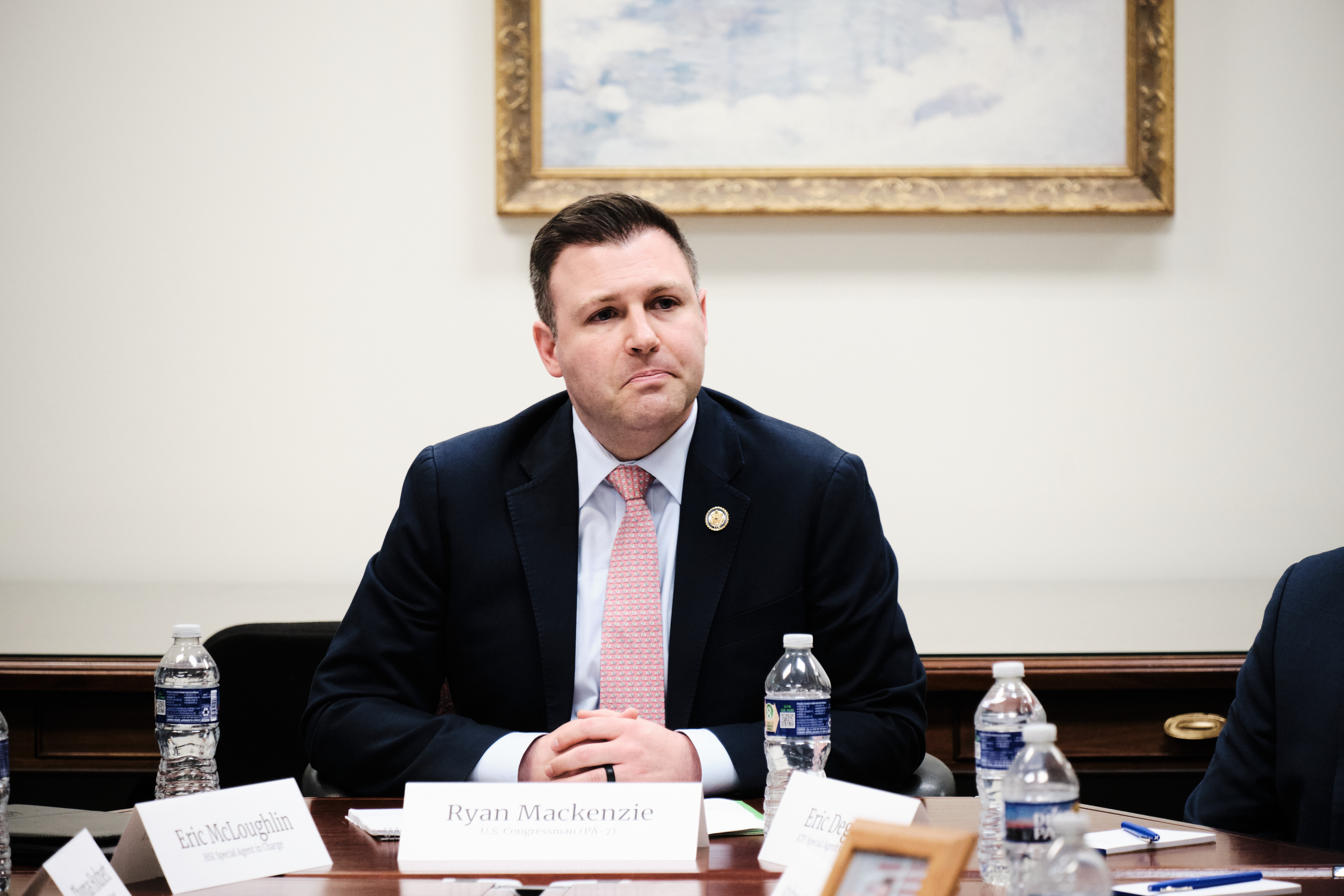
In the Lehigh Valley-based district, Bob Brooks — a union leader and retired firefighter — has led in polls and fundraising for months as he challenges freshman Republican U.S. Rep. Ryan Mackenzie. But he is also now defending himself against a barrage of negative ads as both candidates prioritize attending community events and other on-the-ground organizing efforts.
“Gov. Shapiro said to me, ‘Wade through the smoke. Concentrate on the fire,’” Brooks said of his recent approach, adding that his supporters “love the fire puns.”
The race has been marked by unusual twists, including accusations by Brooks that Mackenzie and his allies tried to manipulate who appeared on the ballot. Attack ads, a legal threat, and the cancellation of the only planned debate have marked a turbulent final few weeks.
“I’m numb to it,” Brooks said in an interview at a union hall in Bethlehem on Thursday after addressing volunteers and supporters who were about to fan out on a door-knocking mission. “My biggest problem is that people actually believe this nonsense. We’ve done our part to show ‘good Bob.’ And they’re so desperate, they don’t have votes to run on, so all they can try and show is ‘bad Bob.’ And ‘bad Bob’ doesn’t really exist.”
Congressional candidate Bob Brooks (left) and Pennsylvania Gov. Josh Shapiro (right) talk during a rally at the United Steelworkers Union Hall in Bethlehem, Pa. on Sunday, July 26, 2026.David Maialetti / Staff Photographer
Mackenzie has increasingly targeted Brooks’ professional and personal history. The pair have traded cease-and-desist letters and put each other “on notice” for further legal action because of ads each of them has aired in recent weeks.
Mackenzie claimed Brooks filed his cease-and-desist to give himself cover to pull out of the debate. The Republican had been challenging Brooks to debate him for months — a move usually reserved for political challengers who need to gain some ground in the polls, not for incumbents.
“While Bob Brooks pulls out of debates, Congressman Mackenzie is meeting voters where they are — knocking doors, walking in parades, attending community events, and rallying volunteers,” said Mackenzie spokesperson Arnaud Armstrong, who said the lawmaker was not available for an interview.
Brooks, in the interview, said he was prepared and eager to debate but did not want Mackenzie to have a stage to “continue to pour his venom.”
President Donald Trump brings 7th District U.S. Rep. Ryan Mackenzie (right) to the stage as he travels to the Lehigh Valley to visit Mack Trucks in Macungie Tuesday, June 23, 2026.Tom Gralish / Staff Photographer
Justin Simmons, a Lehigh County Republican who served alongside Mackenzie in the state House and briefly ran against him in a 2017 congressional race, called the incumbent a “ruthless” campaigner. Though he voted for Mackenzie in 2024 — when the Republican beat a three-term Democratic incumbent by 1 percentage point — Simmons said he is voting for Brooks this year.
“I’m a lifelong Republican. … I just don’t really like the campaign Ryan’s running against Bob,” said Simmons, whose former district is now represented by Mackenzie’s mother, State Rep. Milou Mackenzie. “Just knowing Ryan — I served with him for 10 years or so in the House — this is kind of like what he does.”
With Mackenzie doubling down on the attacks in the second-most expensive congressional race in Pennsylvania, with $31.8 million in ad spending, part of the race might come down to whether those ads break through.
“I’ve heard some things about [Brooks’] family and stuff, so that was kind of off-putting to me,” said Gunnar Zeiner, a 21-year-old student at East Stroudsburg University who said he plans on splitting his ticket for Mackenzie and Shapiro. He said he had seen Mackenzie’s negative ads and also believed he was “a little bit more bipartisan” than others in Washington.
An anti-corruption campaign in Scranton that feels like it’s ‘never going to end’
Before the Iran war and the spike in gas prices, the escalation of tariffs, and the expiration of healthcare tax credits for millions of Americans, Trump’s campaign to assuage voters’ economic anxieties and keep his grasp on Congress started with a December rally at a Mount Pocono casino.
“What a job you’re doing,” he said as singled out U.S. Rep. Rob Bresnahan, a Republican who narrowly beat a six-term Democrat in 2024 to represent the region. “Young. Handsome. Central casting. Great job. Thank you very much, Rob.”
Nearly a year later, Trump has not returned for a major campaign rally there or anywhere in Pennsylvania, even in the heat of the campaigns this fall. And Bresnahan, polls show, is behind.
The 8th Congressional District voted for Trump by 8.5 percentage points two years ago — the most of any of Pennsylvania’s four swing districts. But the president’s approval rating in the district has sunk to 43%, and Bresnahan is trailing Scranton Mayor Paige Cognetti by 5 percentage points, according to The Inquirer/New York Times/Siena poll.
The race has been defined, including in the homestretch, by themes of corruption and who has a claim to having local roots.
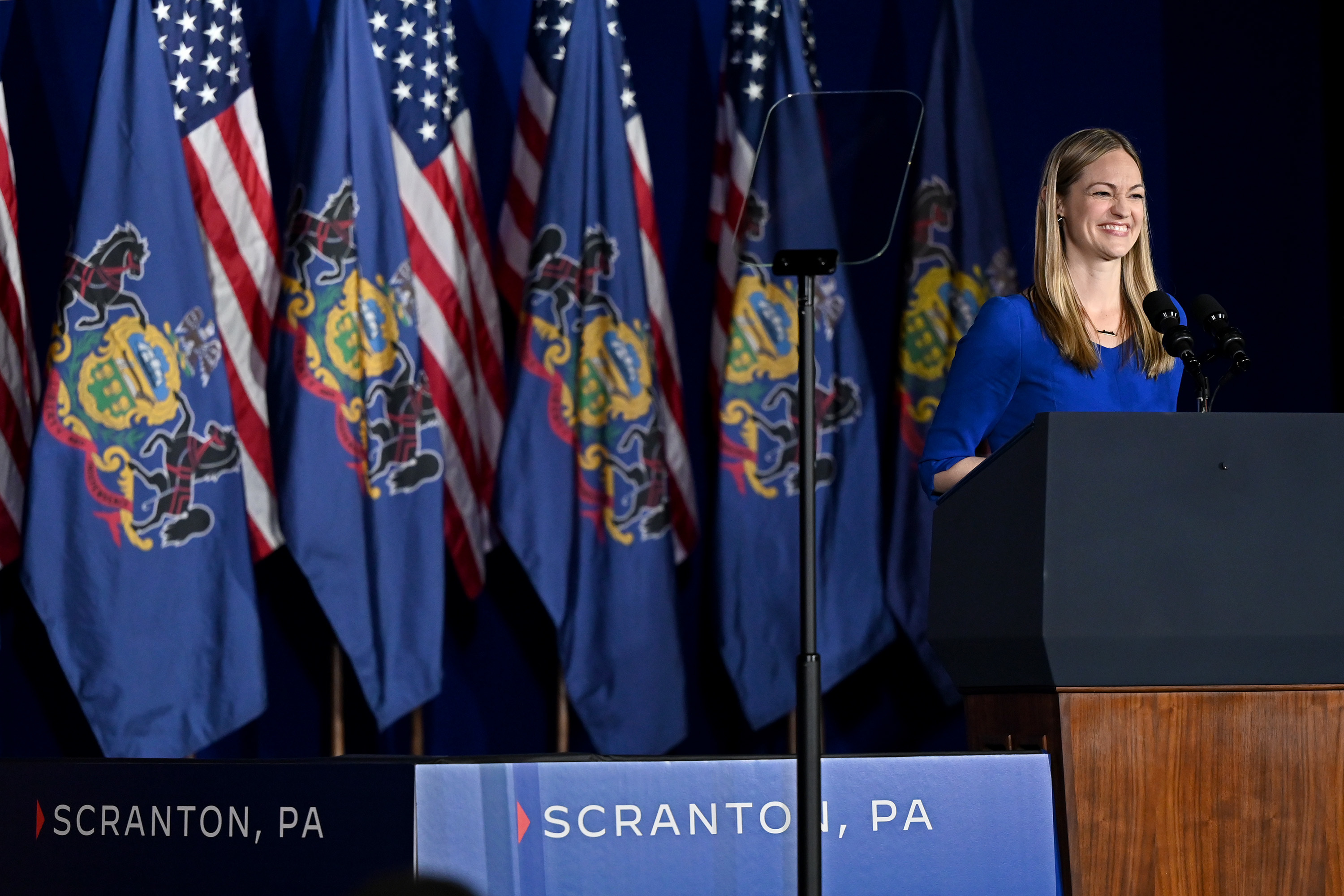
Onstage at the Scranton Cultural Center at the Masonic Temple, Scranton Mayor Paige Gebhardt Cognetti welcomes attendees before the arrival of then-President Joe Biden in 2024.Tom Gralish / Staff Photographer
Cognetti — one of the most prolific fundraisers of any candidate for Congress in Pennsylvania this election cycle — and her allies have unleashed a relentless messaging blitz around Bresnahan’s stock trading while in office.
She has targeted Bresnahan for quickly becoming one of the highest-volume stock traders in the Capitol.
Bresnahan, a former CEO of his family’s electrical contracting company, reported more than 600 trades totaling more than $7 million in his first seven months in office. Some of the trades involved investments in areas regulated by lawmakers, and they came as members of both parties increasingly raised alarm about concerns of insider trading.
Bresnahan has said he does not personally decide the trades in his portfolio, which have halted almost entirely since the public criticism last year and Cognetti’s multiple ads that blast the message. The latest poll showed voters trusted her more than Bresnahan to handle corruption issues.
“I feel like this campaign is never going to end. I feel like this is just our lives now,” Cognetti said at a candidate forum on Friday hosted by the local chambers of commerce, adding that the audience soon would not “have to see my face on your screen and your television screen every single day.”
At the forum — which came before the only scheduled debate, set for Thursday — Cognetti also criticized Bresnahan for voting consistently to allow Trump to continue attacking Iran and to implement tariffs, and for supporting the president’s signature legislation that cut future funding for Medicaid to pay for tax cuts.
U.S. Rep. Rob Bresnahan addresses the annual Pennsylvania Leadership Conference in Camp Hill, Pa., Friday April 4, 2025. Kalim A. Bhatti / For The Inquirer
Bresnahan did not target Cognetti once at the forum. He highlighted his efforts to bring federal funding into the district, prop up local healthcare systems, and leverage his relationships with Trump administration officials.
“Everything we do is with Northeastern Pennsylvania’s best interest in mind, and I look forward to being here again in two years,” Bresnahan said.
Dan Naylor, chair of the Republican Party of Lackawanna County, said he has known Bresnahan’s family for decades and believes the lawmaker “has a tremendous future because he’s intelligent and he’s not afraid to articulate the things that he needs to.”
He also thinks the criticisms of his stocks have been blown out of proportion.
“It’s not that he’s actually sitting behind his desk every day looking at, ‘What stocks do I have?’ And, ‘Do I know anything about it?’ Or, ‘Can I trade today?’” Naylor said. “He’s not that person. I think people understand that.”
Bresnahan has collected support from organized labor and urged his party to do more to support unions. Cognetti, who originally ran for mayor as an independent, has an ad that claims she “stood up to Democrats in Harrisburg and Washington” to advocate for more funding for police.
“I love it, honestly,” Megan Kocher, chair of the Luzerne County Democratic Party, said of Cognetti’s independent messaging, which she said reflects a needed culture change in the party. “Paige’s willingness to challenge corruption wherever she sees it is a breath of fresh air.”
Staff writers Michelle Baruchman, Alfred Lubrano, and Anna Orso contributed to this article.
For the second time in less than two weeks, a candidate in the Lehigh Valley’s highly competitive race for Congress has called on their opponent to take down a television ad they consider false and defamatory.
And for the second time, the other one has refused.
U.S. Rep. Ryan Mackenzie (R., Lehigh), in a letter sent by his lawyer Tuesday, said a new ad from Democratic challenger Bob Brooks that claims he opposed a bill to strengthen mental health coverage for first responders when he was a state lawmaker is “defamatory and provably false.”
The candidates have traded attacks for weeks in what’s become one of the most expensive and volatile of Pennsylvania’s four nationally watched U.S. House races this fall. Earlier this month, Brooks called on Mackenzie to pull down an ad that called him a “criminal” and then canceled their only scheduled debate when the Republican declined to pull the ad.
The latest ad from Brooks — a firefighter union leader who a recent poll showed was leading Mackenzie by 5 percentage points — involves a 2024 state law that made it easier for firefighters, police officers, and other first responders to get workers’ compensation coverage for post-traumatic stress injury. It passed after several years of failed attempts, and Brooks was among those leading the lobbying effort because of his union role.
The ad features State Rep. Jennifer O’Mara, a Delaware County Democrat who sponsored a version of the bill after speaking publicly about her father, a former Philadelphia firefighter who died by suicide while struggling with post-traumatic stress.
“There was a bill to get our first responders real mental health coverage,” O’Mara said in the ad. “Ryan Mackenzie fought us the whole time.”
The message echoed a frequent criticism from Brooks. He has repeatedly claimed Mackenzie was “one of the biggest opponents” during his lobbying efforts, but has also not provided further clarification. On at least one occasion, he said Mackenzie specifically voted against the legislation — a claim that notably doesn’t appear in the ad.
Mackenzie’s lawyer and campaign team wrote that the ad displays a “reckless disregard for the truth” because the Republican voted for the bill and believed it to be a “crucial issue.”
“[H]e voted in favor of this legislation every time it came before him, on three separate recorded votes, and never once voted against it,” wrote Mackenzie’s lawyer, Britain R. Henry, of Goldstein Law Partners.
The Republican’s campaign manager, Andres Weller, said in an additional statement that Brooks’ “casual willingness to lie to voters is once again on full display in the closing days of this campaign.”
Brooks’ campaign responded quickly to reject the letter and elevate Brooks’ supporters who were involved with the legislative effort in Harrisburg who believed Mackenzie to be a roadblock.
Jeremy Warmkessel, the president of the International Association of Fire Fighters Local 302 in Allentown, said he met with Mackenzie to discuss the bill around 2019 or 2020. The measure was the union’s top legislative priority and Mackenzie did not help to bring up the bill for a vote — either in that session or in the following sessions when it was referred to a Republican-controlled committee he belonged to, Warmkessel said.
State Rep. Tarik Khan, a Philadelphia Democrat, also criticized Mackenzie for not working as vice chair of the committee to force a vote.
“When you’re in a position of leadership, you have that responsibility,” Khan said.
Mackenzie’s letter specifically combated that argument — noting that another Republican lawmaker was the committee chair at the time and it was not Mackenzie’s decision to schedule legislation for a vote. It also points to the lawmaker’s former statements in which he promotes strengthening healthcare for first responders.
The letter said it was placing Brooks’ campaign “on notice” and that further publication of the ad would “constitute actual malice,” a requirement for defamation claims. Such letters are not uncommon in heated campaigns and are often ignored, though some are followed by lawsuits.
In July, Democrat Bob Harvie — who is challenging Republican U.S. Rep. Brian Fitzpatrick in the Bucks County-based 1st Congressional District — sent a cease-and-desist and later filed a defamation suit against a political action committee making claims that he said were false. The ads continued.
“The ad will not be coming down,” Brooks spokesperson Benny Stanislawski said Tuesday. “Ryan Mackenzie stonewalled efforts to pass PTSI benefits for firefighters and first responders while he was serving in Harrisburg, and only changed his tune once he decided he wanted to run for Congress.”
This article was updated to correct the years when the first responders bill was before Mackenzie’s committee.
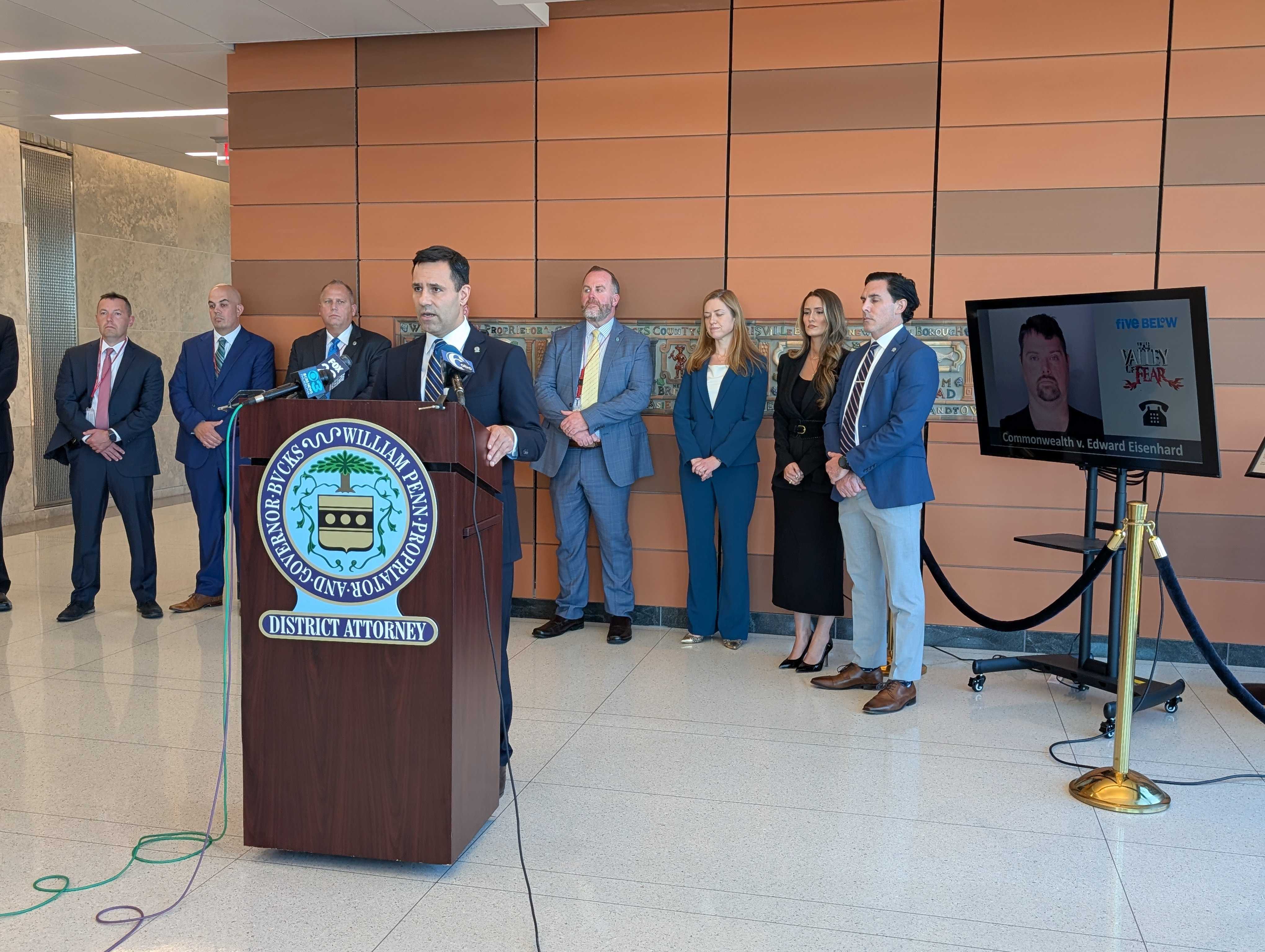
Days before he sexually assaulted a junior employee at a Five Below store this fall, Edward Eisenhard committed another sex crime at an outdoor Halloween-themed attraction, Bucks County prosecutors said Tuesday.
Eisenhard, who worked as a supervisor at Valley of Fear, a Lower Southampton Township destination where scare-seeking customers take hayrides and tour a haunted house, choked a junior employee there and touched her inappropriately while he was on break, prosecutors said.
And revelations about Eisenhard’s behavior led investigators to yet another alleged crime. Early this month, as well as in late 2025, prosecutors said, he assaulted a 12-year-old girl.
Eisenhard, 37, of Hellertown, Pa., is now charged with crimes including strangulation, aggravated indecent assault without consent, simple assault, and related offenses in the two incidents that came to light after he was arrested Oct. 1 in connection with the assault at the Five Below in Hilltown Township. He remains in custody and has not posted bail.
“Halloween has always been my favorite holiday because we send our little ones out into the world dressed as Dracula and Frankenstein’s monster to get candy from our neighbors,” District Attorney Joe Khan said Tuesday when announcing new charges against Eisenhard.
“Unfortunately,” he continued, “there are real monsters in this world.”
Khan called Eisenhard a “highly dangerous recidivous sex offender.” Prosecutors learned of his behavior when he was arrested for allegedly making lewd comments, restraining, and sexually assaulting a 19-year-old woman whom he supervised in the stockroom of the discount store.
Prosecutors then learned of the Sept. 25 incident at Valley of Fear, during which he is accused of assaulting a 38-year-old woman whom he also supervised, prosecutors said.
Eisenhard had worked as a supervisor for the Halloween-themed destination for the last 10 seasons. Prosecutors learned of the crimes after he was fired from the business after being “credibly accused” of misconduct by another employee, Khan said.
Then, early in October, Eisenhard allegedly assaulted a minor in Springfield Township, prosecutors said.
He had access to the girl through her family, prosecutors said, committing “horrific acts of digital penetration and molestation and assault” in her bedroom while she slept.
Eisenhard previously abused the victim in December 2025, they added.
He remains in custody in Bucks County on charges stemming from the Five Below incident and was unable to post 10% of his $200,000 bail, court records show.
In light of the additional crimes, prosecutors said, they will ask a judge to revoke his ability to post bail.
And given the emergence of those allegations, prosecutors believe Eisenhard may have abused or assaulted additional victims.
They are urging the public to come forward with any information that could assist a future investigation.
“Please contact the Bucks County District Attorney’s Office,” Khan said. “If you are a victim, our office is a safe place where you will be heard.”
Philly sports die-hards like to consider ourselves “four-for-four” fans, meaning, for better or worse, we’re all in for the city’s quartet of major pro teams: the Eagles, Phillies, Sixers, and Flyers (although, as you can imagine, I find the Union disrespect more than a little irritating). This week, democracy lovers are aiming to go four-for-four, after the ouster of Serbia’s longtime autocrat and the shock defeat of the right wing in Brazil, with looming accountability for Israel’s Benjamin Netanyahu and Donald Trump here at home. Break out the brooms!
Trump’s preelection moves are dangerous but probably won’t work*
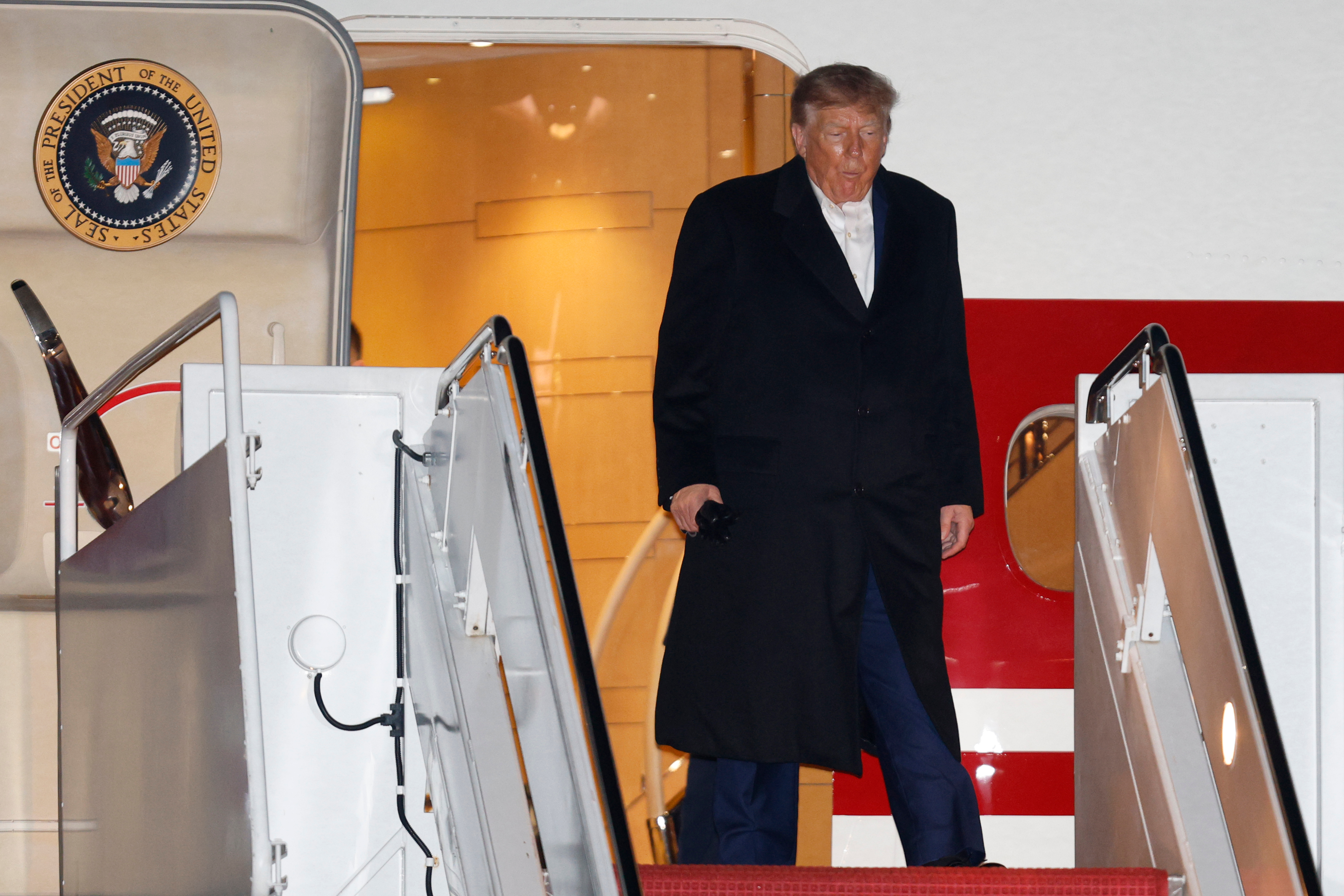
President Donald Trump walks down the stairs of Air Force One upon arriving at Joint Base Andrews, Md., Oct. 25, after a campaign rally in Port Huron, Mich.Luis M. Alvarez
A news crew for a Palm Beach, Fla., TV station got something of a scoop this weekend when it spotted and filmed something new at the region’s international airport: a Humvee-mounted Avenger short-range air defense system.
Military officials from the air defense command NORAD and the U.S. Northern Command confirmed to WPTV and later to the Washington Times that the unit is part of a new defense system — to protect ground troops and “critical assets” (no, that’s not a Nicki Minaj joke) — around Donald Trump’s Florida retreat, Mar-a-Lago.
It felt like just the latest sign that Trump is not expecting the coming weeks or months to go smoothly — either for him or for the nation he so shakily leads.
It was just nine days ago in this space that we were talking about a) how Trump cares about literally nothing else but his own power and wealth, b) he looks increasingly terrified at the risk that Democratic control of Congress poses to those two things, and c) an increasingly imperial presidency has accumulated considerable yet mostly still untapped powers that could be used to cancel an election result.
Now, with the 2026 midterm election just one week away, the 47th president and MAGA team are already starting to show their cards in what they hope will be a winning hand in an effort that could make Trump’s attempts to thwart his 2020 defeat look like a bland NFL preseason game.
In Minnesota, Trump’s badly compromised U.S. Department of Justice has launched what is, ultimately, a quest to reduce the number of Democratic House members by one, by proving the rather ridiculous assertion that the father of Rep. Ilhan Omar lied on a document when she came to America in the 1990s, creating a case for stripping her citizenship and then deporting the Somali-born legislator.
In Alaska, the same unjust Justice Department — reportedly on Trump’s direct order — has launched a never-seen-before preemptive strike by filing a challenge in a U.S. Senate election that has not yet happened, claiming that a loss by incumbent GOP Sen. Dan Sullivan would be invalid since another Alaskan, also named Dan Sullivan, qualified for the ballot.
The Trump regime moves, which are almost all being challenged in court and have been panned by legal experts, are revealing strategies — narrow for now, but likely to become broader in the coming days — that could be used to undo what polling suggests will be major Democratic gains.
Expect to see more arguments that certain Democratic victors are ineligible to serve, or that something was more broadly amiss in the election, whether the hyperinflated claim is about local issues, like the name question in Alaska, or the regime’s unsupported insistence that noncitizens are voting in large numbers.
The arrival over the last week of these desperate measures is a sign that the first wave of election interference — redrawing district maps in the Deep South and elsewhere to eliminate Democratic seats, or toothless executive orders to impose new voting requirements or ban mail ballots — is not working in the face of an anticipated blue tsunami.
The moves are inarguably a brand of White House election meddling that is more aggressive than what preceded the Jan. 6, 2021, insurrection and are thus some of the gravest threats to democracy in the nation’s 250-year history.
And yet, the maneuvers only hint at what’s to come. Would the effort to disqualify Omar and, somehow, a few other Democratic winners spark a more sweeping ploy under GOP House Speaker Mike Johnson to not certify all newly elected Democrats? Would the persistent, albeit false, claims of tens of thousands of noncitizen voters serve as a pretext for either sending in troops before Election Day next week, or seizing ballot boxes after the votes are cast?
Frankly, we’ve reached a stage of the fall election season when the question of how Trump will respond to a likely bad result is a much more compelling story than talking about the actual campaign. Just flip on your TV, and you’ll see it again and again. Voters, including a lot of folks who voted for Trump when he won a plurality victory in 2024, are mad about high gas prices and tired of the president’s shtick. The political mystery is less whether the Democrats win next Tuesday, but rather by how much.
The real question for November then becomes: How much of a dictator is Trump — both in ambition and in his ability to pull it off?
All one needs to do is look to the recent past — remember, the Trump campaign lost 61 of 62 court challenges to the 2020 election, and the one win was a minor procedural matter — to imagine that proposed moves like deporting Omar or overturning a Democratic win in Alaska will fail again in the legal system, even in rulings by Trump-appointed judges.
That means the only way Trump can block a Democratic House, and probably Senate, that will investigate the billion-dollar corruption of the president, his family, and his cronies is an all-out coup — tanks in the streets, martial law, etc.
When the president orders a raid on the home of a political opponent like Omar, or when he files lawsuits that are likely to again be laughed out of the courtroom, America’s wannabe strongman is not displaying strength. These are acts of weakness and desperation, and they are bound to fail.
Trump could not have chosen a worse moment to search for a balcony. The fundamentals of what the political scientists call competitive authoritarianism — right-wing populists staging pretend elections — are failing because their misrule has imploded so badly that they can no longer win even those rigged contests.
In Serbia, Aleksandar Vučić — the Eastern European nation’s strongman ruler since 2012 — thought he’d consolidated his control, only to lose a critical election this weekend at the hands of a movement led by student protesters. In Brazil, leftist president Luiz Inácio Lula da Silva stunned many observers by winning his runoff election against his right-wing rival Flávio Bolsonaro, who’d received more votes in the first round.
Both election victories were widely cheered on American social media by voters looking anywhere on the globe for hope just days before a make-or-break U.S. election — for signs that the masses of good people can still beat back the money and the tech moguls and the xenophobia and the hate.
Nov. 3 cannot come fast enough. Trump’s coup may be underway, but it’s already fizzling. And a few missile launchers aren’t going to save him.
Yo, do this!
Regular readers know that I’ve been on a crusade this year against the federal program known as 287(g) that sees local beat cops partnering with U.S. Immigration and Customs Enforcement (ICE) to terrorize immigrant communities. I knew it wouldn’t be long before some of the news media’s bigger fish caught on. This weekend, two ProPublica journalists teamed with the New York Times to publish a truly remarkable long-form article about the tiny border town of Ingram, Texas, where one police officer cruising the main drag in a black Dodge Charger has arrested about 200 mostly Mexican immigrants, which is more than 10% of the town’s population. This piece will be a road map for future historians who want to learn how America lost its moral compass.
Another thing that probably won’t shock newsletter readers is that October has been a month for bingeing on sports — the World Series, the Union’s playoff run, the start of the LeBron James-led Sixers, and the end, apparently, of the Nick Sirianni-led Eagles. But the demand for boomer-nostalgia documentaries is also peaking, so I’m creating a watch list. On top is a celebration of the 1970s’ SCTV, which was often funnier and more creative than SNL; SCTV: The Greatest Show You’ve Never Heard Oflaunches Friday on Netflix. I’m also hoping to catch a second documentary on Netflix: Save the Children: A Concert for the Ages, which is the film of a 1972 concert organized by the late Jesse Jackson that stars the Jackson 5 (heh, no relation), Marvin Gaye, Roberta Flack, Isaac Hayes, The Temptations, Bill Withers, and Curtis Mayfield. Wow.
Ask me anything
Question: Are the polls going to break our hearts again? — Joanne T. (@tessajop.bsky.social) via Bluesky
Answer: The answer, my friend, depends on how easily your heart is broken, because even the biggest wave year is never a 100% clean sweep for the dominant party. I’ve watched many midterm elections in my lifetime, and since Richard Nixon’s 1974 resignation I’ve never seen a scenario more favorable for the Democrats. I think the pundits guessing the party might gain 15 seats next Tuesday are wildly underestimating. But such elevated hopes always lead to a few disappointments. Some Democrats in deeply red states (perhaps Scott Colom in the Mississippi Senate race) will fall short of their big-eyed ambition. I see potential agita in Maine, where every voter seems to have met, and many inexplicably like, Republican Sen. Susan Collins despite her corruption and her betrayal of her supposed pro-choice position. But my fingers remain crossed for a good night for democracy.
What you’re saying about …
One thing I’ve learned while doing the newsletter — yet still manage to forget once a year or so — is that normal people look at elections differently than political journalists: Either you hate punditry, or you want the semiprofessionals to do it for you. So last week’s question about whether readers are watching any particular races for an upset was a total dud. Regular contributor Daniel Hoffman did respond to say that “it’s useless to speculate on upset races and states when we’ll find out in two weeks.” So there!
📮 This week’s question: This is a variation of a question I’ve asked here before, but it’s more salient than ever as Democrats appear to rise in the polls. What should be the absolute top, No. 1 priority for the party if it regains control of Congress in January? An issue, a particular bill, an investigation, or something else? Please email me your answer and put the exact phrase “top Dem priority” in the subject line.
Backstory on Trump, Epstein, and a media fail
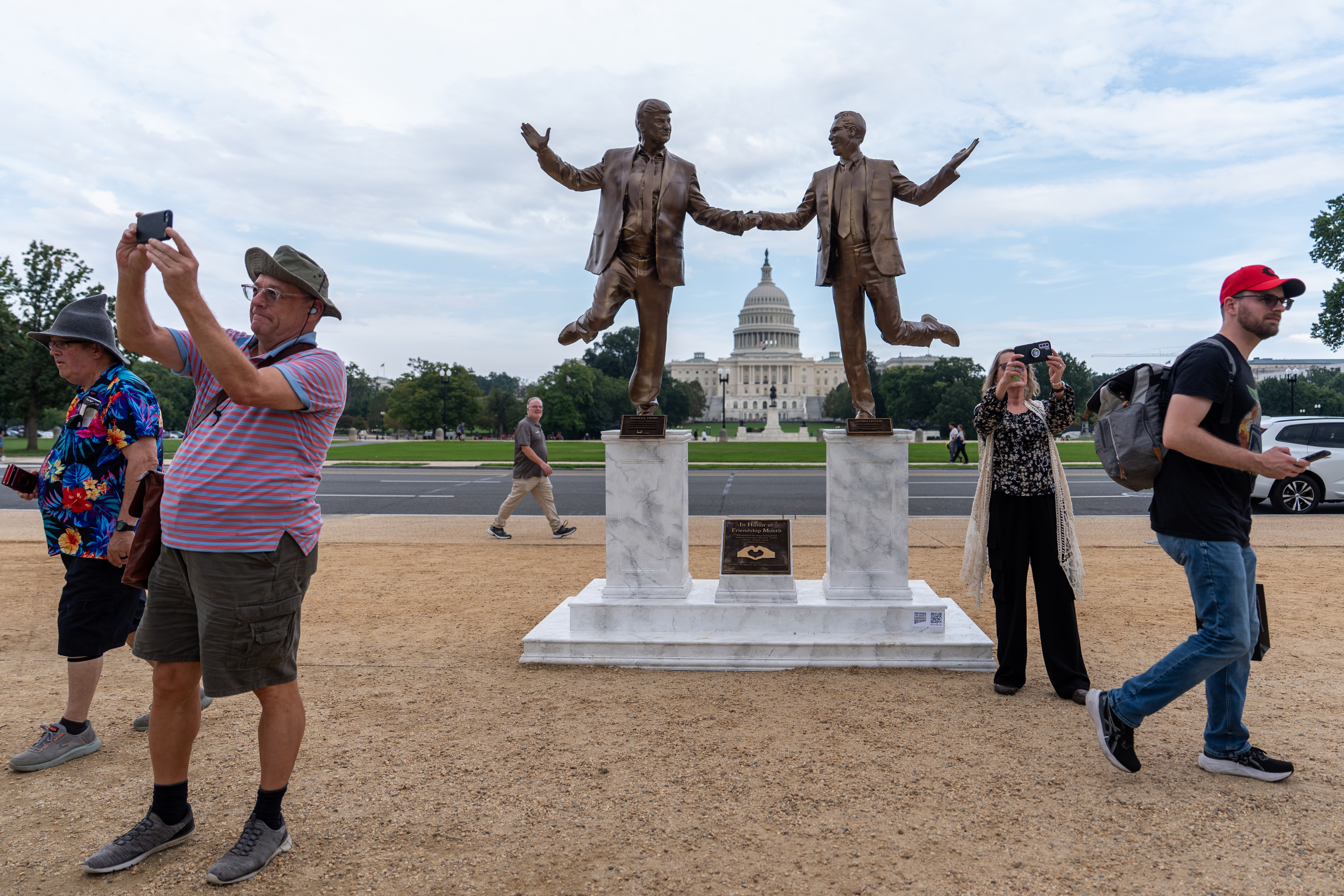
Visitors take photos backdropped by a bronze-painted sculpture depicting President Donald Trump and disgraced financier Jeffrey Epstein, on the National Mall near the U.S. Capitol in Washington in September 2025.Julia Demaree Nikhinson
OK, I had a busy afternoon with a lot of distractions on Monday, including working on this newsletter, but I was flabbergasted when I finally looked at my phone and saw that the current president of the United States of America had been accused in a congressional report of violently raping a woman — and that I hadn’t heard anything about it for six hours. That’s probably because as I write this early Tuesday morning, most of the A-list mainstream news outlets — such as the New York Times, MS NOW, and CNN — have elected not to delve into the dramatic new details in a report by minority party Democrats on the House Judiciary Committee on the problematic relationship between Donald Trump and his late financier and convicted sex offender friend, Jeffrey Epstein.
The report felt newsworthy to me, but especially the new details offered by Beatrice Keul, a model and former Miss Switzerland who says Trump raped her in the Plaza Hotel in 1993. It says something about Trump and his sordid trail of sexual assault and misconduct allegations lodged by more than two dozen women, including a jury finding Trump liable for sexual abuse in the case of E. Jean Carroll, that Keul’s name had surfaced previously but was somewhat lost in the sea of accusations. The news here is that Keul has spoken with investigators for the House Democrats and provided much greater detail to her story about what happened when she met Trump 33 years ago.
The new report says Keul told the investigators she met Trump at a press luncheon for the American Dream Pageant that had partnered with the then-Manhattan real estate mogul. The Swiss woman said Trump promised he would help her obtain a U.S. visa and gain admission to New York University at the event, where she also met Epstein, who told her he had organized “many parties with Don.”
The report alleges that Trump later invited the young woman to a hotel suite at the Plaza, which he owned, and there he “grabbed Keul from behind and forcibly raped her,” causing “bleeding and bruising on multiple parts of her body.” Trump, it says, repeated his promise to help her with a visa and with NYU — but only if she told no one about the assault. It said Keul stayed in the beauty pageant only because officials were holding onto her passport.
The House Democrats on the panel, led by the high-profile Rep. Jamie Raskin of Maryland, released the report exploring Trump’s ties to Epstein just eight days before the midterm election. They called for a special prosecutor to investigate allegations involving the president and Epstein, including what is in the millions of pages of the so-called Epstein Files, which have been released — but not entirely — under the law passed in 2025. The report was arguably a sneak preview of the aggressive oversight Democrats promise if they regain control of the House and possibly the Senate as well in January.
The White House sought to portray the document as purely a political maneuver. “This ‘report’ is nothing more than a desperate attempt by crazed Democrats to distract Americans from the surging Republican momentum driven by President Trump’s historic achievements,” White House spokesperson Lauren Bis said Monday.
But the timing — and the response, or lack of a response, to the report — is not only notable because of the election. In recent weeks, the stunning reports about a 2024 fraternity gang rape at Cornell University and the initial tepid response from school administrators rekindled the anger about sexual abuse and patriarchal control that also boiled over with the #MeToo movement in 2017, right after Trump became president the first time. A lot of that rage can be traced to the fact that American voters have cast aside the multiple allegations against Trump — not once, but twice. A jury believed Carroll, who testified that Trump raped her in a department store changing room in the mid-1990s — an incident strikingly similar to Keul’s account of what happened to her.
A Google News search for “Keul” early Tuesday morning showed the rape allegation was covered by a handful of outlets such as Time magazine, HuffPost, the New Republic, People magazine, and the Miami Herald, the paper thatexposed the Epstein scandal during Trump’s first term. But a six-paragraph story in the Times included zero specifics about Keul or other specific alleged victims, which seemed also the case with other major TV or traditional news outlets.
Maybe editors agreed with the Trump White House that this was too close to the election, or felt Keul’s name was already out there, although judging from the social media reaction, her alleged rape was news to just about everyone who did see it yesterday. This only fuels the outrage by many women (and some men) that America’s political culture, like the bigwigs at Cornell, still is not taking rape seriously. In this case, poor news judgment about a White House rape scandal is also part of the scandal.
What I wrote on this date in 2019
Masses of people out in the streets, furious about the high cost of living. It’s happening right now in cities like Paris and Barcelona, and on this date seven years ago, it was happening in Santiago, Chile, where the trigger was an increase in subway fares. I linked those protests to what seemed like surging progressivism in the 2020 Democratic presidential primaries. I wrote that “you don’t need to fly a helicopter over the streets of Santiago to see that there’s a lot more of us than there are of them.” Well, yes and no. Chileans did elect a left-wing president, only to replace him with a right-wing rival earlier this year — the political circle of life these days.
Only one column this week because my children insisted on being born during election season. In that piece, I looked at an outrage that’s currently under construction in Pennsylvania — a giant gas-fired power plant in Homer City, Pa., for a complex of 36 data centers to power AI for Amazon Web Services that would become the state’s largest pollution source — and the warped politics that’s driving it. Donald Trump praised it. Gov. Josh Shapiro’s administration provided “concierge” permitting. Many neighbors hate it. But Trump’s son-in-law Jared Kushner and his Arab oil backers have made a sizable investment in this monstrosity.
Did I mention there’s an election coming up? There’s been a lot of controversy in recent years over how the media covers politics in America — especially the debate over whether there is too much “horse race” coverage and not enough substance. The Inquirer is giving our readers all of the things. Yes, we did publish polling in Pennsylvania’s four most-contested U.S. House races this fall, which had highly encouraging news for the Democrats fighting for GOP-held seats in Bucks County, and in and around Allentown, Scranton, and Harrisburg. But we’ve also published a highly comprehensive voters guide that gives you the candidates and issues in every race. Meanwhile, my colleagues on The Inquirer Editorial Board have been working overtime to crank out endorsements for governor and those make-or-break House races in the Lehigh Valley and over in South Jersey. A strong news organization is essential for democracy to flourish on Election Day. You become a part of that when you subscribe to The Inquirer.
By submitting your written, visual, and/or audio contributions, you agree to The Inquirer’s Terms of Use, including the grant of rights in Section 10.