Blog

  • Romo on leave from CBS Sports after arrest on suspicion of operating vehicle under the influence

    Romo on leave from CBS Sports after arrest on suspicion of operating vehicle under the influence

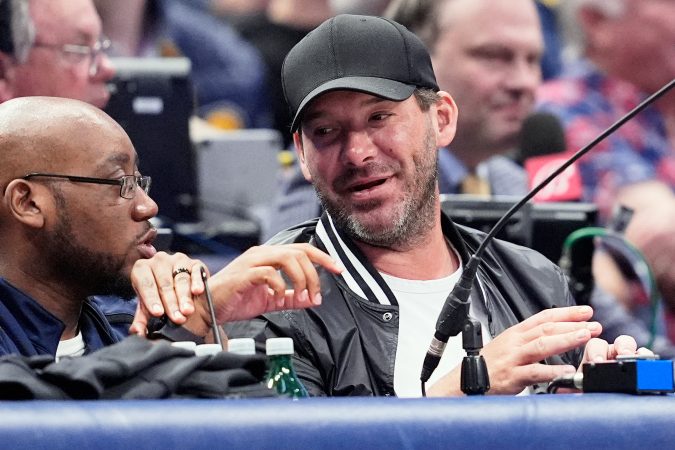
    Tony Romo has been placed on leave from his role as the lead analyst on CBS’s NFL coverage following his arrest last week on suspicion of operating a vehicle while under the influence.

    CBS Sports announced Friday that the former Dallas Cowboys quarterback was on leave “until further notice.” JJ Watt will join Jim Nantz and Tracy Wolfson as CBS Sports’ lead NFL team during Romo’s absence.

    Romo, 46, was arrested July 23 after he was stopped while driving south on Interstate 43 in Wisconsin. According to the Milwaukee County Sheriff’s Office report, Romo performed poorly on field sobriety tests before getting taken into custody, booked, and released.

    He has a court date set for Sept. 21.

    CBS Sports’ announcement comes after citations released by the Milwaukee County Sheriff’s Office indicated an open bottle of an alcoholic beverage was found in the passenger’s side of Romo’s black Jeep during an inventory before it was towed.

    According to the citations, police stopped Romo after he was seen passing cars in a gore area, which separates interstate traffic from cars entering from an on-ramp. Police said Romo questioned what a gore area was during the stop.

    Body camera footage released earlier this week showed Romo telling deputies he had been coming from a golf course and was on his way “to visit grandma and grandpa” when he was stopped. A deputy told Romo he suspected him of being impaired because he had “red glassy eyes” and an “odor of an intoxicating alcoholic beverage.”

    Romo went to high school about 35 miles from Milwaukee in Burlington, Wis.

    He has been the lead game analyst for CBS’s NFL coverage since 2017 after making four Pro Bowl appearances during an NFL career that ran from 2004-16 and was spent entirely with Dallas.

    Romo remains the Cowboys’ franchise leader in career touchdown passes with 248. He held the franchise record for career passing yards (34,183) until Dak Prescott overtook him last season.

    Watt joined CBS in 2023. He was an analyst on The NFL Today for two seasons before teaming with Ian Eagle on the network’s No. 2 crew beginning last season.

    Romo wasn’t expected to have his first game until the opening Sunday of the regular season on Sept. 13. CBS will air a preseason game between the Cincinnati Bengals and Philadelphia Eagles on Aug. 28.

    CBS likely will reveal its game assignments and announcer pairings for the first three weeks of the regular season in the next couple of weeks.

  • Phillies recall Andrew Painter before Friday’s game vs. Orioles

    BALTIMORE — Andrew Painter was going to pitch Friday night, one way or another.

    The Phillies decided it was best if he pitched for them.

    And so, six weeks after Painter got demoted to triple A with a 7.06 ERA, the Phillies recalled him to start the series opener against the Orioles and sent righty Brian Keller to Lehigh Valley.

    “Just listening to the pitching people, they felt good about where he was at, confident,” interim manager Don Mattingly said. “And from there, we thought it really gives us the best chance to win a game tonight.”

    With the trade deadline looming at 6 p.m. Monday, the Phillies are still looking to fill multiple needs, according to league sources. Among them: a back-end starter. The Phillies are 5-21 from the fifth-starter spot that originally was occupied by Painter, including 11 losses in a row.

    The Phillies have fanned out their scouts in recent weeks to get looks at various pitchers, including the pending free agents Clay Holmes (Mets), Kevin Gausman (Blue Jays), and Robbie Ray (Giants). One rival evaluator theorized that the Phillies could reduce the prospect return by paying down the remainder of a contract. Gausman and Ray, for instance, are owed roughly $8 million through the end of the season.

    It’s notable, too, that the Tigers and Mets scratched righties Casey Mize and Freddy Peralta, respectively, from scheduled starts Friday night. Both are pending free agents with a profile that would interest the Phillies.

    Painter, untouchable in previous trade talks, began the season in the majors but got demoted in mid-June with a 7.06 ERA in 14 games (12 starts). His bread-and-butter fastball was particularly ineffective, with opponents hitting .404 and slugging .660 against it.

    Andrew Painter got demoted in mid-June with a 7.06 ERA in 14 games (12 starts).Yong Kim / Staff Photographer

    “Most of it is delivery-oriented,” president of baseball operations Dave Dombrowski said at the time. “That’s what it comes down to. Because when he’s done some things with his delivery, which is going more directly to the plate rather than spinning off, he’s had more life. And you see it at times.”

    Painter has a 4.56 ERA in five triple-A starts, though he has allowed two or fewer runs in four starts and completed the sixth inning twice. Last week, he allowed a total of three runs on 12 hits in 11 innings over two starts, including one run in six innings Sunday. The Phillies were particularly encouraged that he walked only one batter, none Sunday.

    “The biggest thing for us has been his command’s been good, confidence has been good,” Mattingly said. “The guys down there felt like that’s the best they’ve seen throw the ball, so it felt like it was time.”

    Painter’s status beyond Friday will presumably hinge on the Phillies’ ability to trade for a veteran starter who could slot in behind Cristopher Sánchez, Zack Wheeler, and Jesús Luzardo and alongside Aaron Nola.

    But Mattingly said the Phillies weren’t viewing Painter’s return as temporary.

    “There’s no talk of like, he pitches today and he’s out tomorrow and we bring a bullpen guy in and we have an extra arm,” Mattingly said. “There wasn’t a whole lot of talk about the future. It was like, ‘This is the best guy for us to win a game today.’”

  • A discarded SpaceX rocket is on a high-speed collision course with the moon

    A discarded SpaceX rocket is on a high-speed collision course with the moon

    CAPE CANAVERAL, Fla. — A drifting SpaceX rocket is on a collision course with the moon after launching a pair of lunar landers more than a year ago.

    The rocket’s upper stage will unintentionally slam into the moon on Wednesday, carving out a crater and sending up a plume of dust and rubble that scientists — and skygazers — are eager to observe.

    Space tracking expert Bill Gray predicts an impact of 5,400 mph — seven times the speed of sound — near Einstein Crater on the moon’s sunlit western limb. With the action unfolding in the wee hours, the eastern portions of the U.S. and Canada, and much of South America, should have the best views.

    While scientists are not too concerned about this particular piece of space junk, it highlights the growing threat as more and more items cram into orbit.

    “Things are getting crowded up there,” said Gray, who plans to view the aftermath from New Brunswick, Canada.

    It was never SpaceX’s intent to hit the moon. But space experts said the crash could have been avoided if the upper stage had been nudged into orbit around the sun.

    It will be the second dead rocket known to crash into the moon accidentally. A Chinese rocket segment dug out a pair of craters on the lunar far side in 2022.

    Lucky for astronomers, the upcoming smashup will occur on the moon’s near side, packing the equivalent energy of three tons of TNT.

    The impact flash, lasting less than a second, will probably be too dim to see, according to experts. But the stream of ejected material could stretch for several miles into space and remain visible to telescopes for tens of minutes.

    “The gravity on the moon is low and there is no wind to blow the dust away,” said Los Alamos National Laboratory’s Benjamin Fernando, who’s encouraging observations by professionals and amateurs alike.

    “Part of the reason for our interest in this event is to figure out how much of a hazard debris impacts pose to future astronauts,” he added in an email.

    Fernando anticipates an impact crater nearly 90 feet across and 16 feet deep, too small to see from Earth but visible to spacecraft.

    NASA’s Lunar Reconnaissance Orbiter and South Korea’s Danuri lunar orbiter will gather before-and-after shots of the crash scene. Danuri will stray within a mile or two of the SpaceX rocket just two minutes before impact, according to Fernando and his team.

    The abandoned rocket segment — measuring some 40 feet and weighing around 10,000 pounds — hoisted two private lunar landers on Jan. 15, 2025.

    One of them — Firefly Aerospace’s Blue Ghost — became the first private spacecraft to pull off a fully successful lunar touchdown. The other, Japan-based ispace’s lander, wrecked.

    With meteoroids and other natural objects offering little if any warning before walloping the moon, scientists said there’s much to learn by observing well-tracked strikes by human-made objects like the one coming up. NASA hurled rocket sections and lunar modules into the moon during the Apollo era for seismic measurements. Decades later, in 2009, NASA intentionally crashed its LCROSS spacecraft and upper stage in search of ice near the lunar south pole.

    With the moon as the new travel hot spot, scientists said it’s crucial to improve debris monitoring and traffic control before packs of robots and astronauts arrive.

    The United States and China are racing to land astronauts on the moon in the next few years. Elon Musk’s SpaceX and Jeff Bezos’ Blue Origin are vying to provide the lander for NASA’s yet-to-be-named moonwalkers of Artemis IV, who will succeed the 12 Apollo astronauts who strolled the lunar surface.

    “This impact will not be a problem,” retired astrophysicist Jonathan McDowell said in an email. “But in a future where there are long-term bases on the moon, similar impacts would be an issue and we need not to leave rocket stages in chaotic orbits of this kind.”

  • Seattle mayor defends ousting police chief after festival shooting

    Seattle mayor defends ousting police chief after festival shooting

    SEATTLE — Seattle Mayor Katie Wilson on Friday defended her decision to oust the city’s police chief as the “right decision at the right time,” but she declined to explain why.

    The leadership change came as police continue searching for people involved in a fatal, gang-related shootout at a food festival near the Space Needle last weekend. A 15-year-old was arrested at the scene and has been charged with assault, but charging documents say the gun he was seen firing wasn’t involved in the deaths of two bystanders.

    Wilson and then-Police Chief Shon Barnes faced criticism for being slow to release key information about the shootout on Sunday, including whether suspects remained at large.

    Barnes, who was the city’s second Black police chief, has been credited with boosting the recruitment of officers and helping reduce crime downtown. A number of Black community organizations, a major business group, and several City Council members issued statements criticizing Wilson’s decision to replace him Thursday.

    At a news conference Friday with Andre Sayles, a Seattle deputy chief the mayor named as interim chief, Wilson credited Barnes for his service and said that as mayor she had a clearer window into the operations at the Seattle Police Department than her critics.

    The lack of communication about a mass shooting at a major public event in Seattle was not the only reason she asked Barnes to resign, she said.

    “There were multiple factors,” Wilson said. “The events of Sunday played into it.”

    Sayles told the news conference the department would boost police staffing at public festivals for the remainder of the summer. He also said he believed investigators are close to finding and arresting additional suspects in the shootout.

    The gunfire erupted in the waning hours of the Bite of Seattle, an annual three-day festival that draws hundreds of food and retail vendors and performers. Three people, including a suspect, were killed, and four people were wounded. One of the people injured was a 2-year-old boy.

  • Dominican Republic’s zoo offers home for confiscated animals as seizures of exotic species soar

    Dominican Republic’s zoo offers home for confiscated animals as seizures of exotic species soar

    SANTO DOMINGO, Dominican Republic — The only zoo in the Dominican Republic is providing a safe haven for confiscated illegal and smuggled animals as a government crackdown aimed at protecting exotic species gathers pace.

    Tucked inside a green oasis in the middle of the capital, Santo Domingo, are crocodiles, flamingos, and even tigers that officials have confiscated from people accused of illegally keeping them. The numbers are growing and threaten to overload the country’s lone zoo.

    “It’s a burden,” said Alfonso Ferreira, deputy director of the city’s National Zoological Park. “People have a predisposition to owning wild animals.”

    Dominican authorities seized 188 animals last year, compared with 30 in 2023, as the government tries to tackle the illegal ownership of certain species. It has also launched educational campaigns to raise awareness about their plight.

    So far this year, officials have confiscated more than 8,900 species, although a majority of those were crickets and young fish to feed animals including seahorses.

    Commonly, flamingos are the most rescued animals, said Nelson García Marcano, head of the Caribbean nation’s Department of Wildlife Regulation and Control.

    Flamingos, which are protected, are often illegally taken from their natural habitat and sold to hotels, which use them as garden ornaments, he said. It’s a trend that individual homeowners have started to follow.

    “People like to copy what they find attractive and beautiful,” said Garcia Marcano, who decried the practice, noting people sometimes amputate a bird’s wings. “It’s a migratory animal,” he said. “It’s an animal that should be free.”

    Nursing animals back to health

    On a recent hot morning, the Associated Press visited a flock of rescued flamingos that sought shade in a private section inside the zoo.

    They had recently been confiscated by authorities, and it showed. Their typically bright coral feathers were white, as if they had been bleached. Ferreira explained that their captors usually feed them white bread instead of the algae and tiny crustaceans their bodies require.

    To reduce the number of flamingos featured at hotels across the Dominican Republic, García Marcano said they have suggested that staff embrace species including the purple gallinule, a cranelike bird with iridescent feathers.

    At the zoo, the rescued flamingos receive carrots and bird feed and are rehabilitated for several months before some are released back into their natural habitat.

    Nearby, several crocodiles sat without blinking in individual cages filled with greenish water. They, too, had been snatched from their natural habitat and kept as pets.

    Encompassing 309 acres, the zoo is big enough that a small train ferries visitors to exhibits, but resources are stretched. Territorial animals such as crocodiles must be isolated, which requires more cages and, in turn, more funding.

    Veterinarians run multiple tests on the rescued animals to determine their health. Many will require a strict diet because their owners would often have fed them the wrong food, weakening an animal’s immune system and causing physical deterioration.

    “Before, we only received parakeets and parrots,” said veterinarian Tatiana Carreño Pinto. “Now we have a much wider range of species arriving at the park.”

    ‘It’s like cat and mouse’

    The zoo also is preparing to take in exotic animals confiscated in neighboring Puerto Rico as part of a deal reached last year, including caimans that have been seized from suspected drug traffickers.

    Puerto Rico, a U.S. territory, is struggling with an overload of exotic species, with nearly 100 animals seized over the July 4 weekend alone. They included 80 boa constrictors, eight native boas, four reticulated pythons, three caimans, and four troupials — Venezuela’s state bird.

    An official with the Rangers Corps of Puerto Rico’s Department of Natural and Environmental Resources did not respond to multiple requests for comment.

    In the Dominican Republic, officials continue to try to save species that once roamed free.

    A project was launched last year to save an endemic parrot, which is under threat and commonly kept as a pet. The government has erected large billboards warning against trade in the parrots. García Marcano said officials are receiving a growing number of calls about this practice as people spot them along roads while traveling.

    The zoo, once again, steps in to help feed and rehabilitate the seized parrots.

    “Operations have been carried out, arrests have been made,” García Marcano said. “It’s like cat and mouse. You have to maintain constant vigilance.”

  • ‘Iran War Participation Trophy’ mocking Trump arrives in New York

    ‘Iran War Participation Trophy’ mocking Trump arrives in New York

    NEW YORK — First D.C., then Manhattan.

    The satirical art group responsible for about a dozen public pieces mocking President Donald Trump in the nation’s capital over the past 20 months has now landed in New York.

    The anonymous artists who call themselves the Secret Handshake left their mark in Lower Manhattan on Wednesday morning, placing a 10-foot-tall trophy, spray-painted gold and emblazoned with a #1 on its side, in Foley Square.

    A large plaque below the “Iran War Participation Trophy” reads: “We hereby award President Donald J. Trump this participation trophy for his enthusiastic involvement in the Iran War. While some concern themselves with military strategy, diplomacy, or measurable outcomes, President Trump demonstrated the courage to participate regardless of the final score.”

    The war in Iran, which began Feb. 28, has resulted in the deaths of 18 U.S. service members and wounded more than 600.

    Walking to catch the subway, Maren Stange, 79, stopped and chuckled as she bent to read the rest of the trophy inscription: “President Trump joins the ranks of children everywhere who received recognition for simply showing up.”

    Stange, who said she had never heard of the Secret Handshake, wasn’t sure the statue would change anything. “It’s funny and it’s smart,” she said. “But what’s it going to do?”

    The installation, which was first displayed in Washington this month, invites anyone to contribute their own participation trophies to the project.

    Arranged around the plinth were more than three dozen mock trophies and awards. One seemed to mock Trump’s electoral history: “Lost Arizona,” read a baby blue Honorable Mention ribbon, dangling from the neck of a tennis trophy.

    A trophy of a martial arts figure, leg raised in a kick, bore the printed message “Most Swollen Cankles” attached to its white base. One small gold chess award was labeled “Smallest Hands Award.”

    “It’s just kind of trolling Donald Trump,” said DJ Hairston, 37, an attorney headed to the nearby criminal court. “It’s definitely funny. Because that’s what this is — this is a participation war. It’s all stupid. It’s all a farce. And this is what Donald Trump wants. He wants a big gold trophy in the middle of Manhattan.”

    Michael Chrzynowski, 46, and his mother, Candace Goudey, 69, stopped to examine the trophy and the trophy spawn.

    “It’s cathartic. They’re mocking him,” Goudey said. “And then you turn around and read, ‘The true administration of justice is the firmest pillar of good government,’” a message engraved in stone across the street, above the entranceway of the New York County Supreme Court building.

    It felt, she said, like that sense of justice was lacking from the Trump administration.

    “These untalented ‘artists’ should stick to their ugly ‘art’ and refrain from weighing in on foreign policy — which they clearly know nothing about, given the fact that the United States Military achieved all of its objectives during Operation Epic Fury,” White House spokesperson Anna Kelly said in an email when the trophy first appeared in Washington on July 13.

    The Secret Handshake, whose members have declined in phone interviews with the Washington Post to provide any identifying information, has previously placed installations at locations across D.C.

    Earlier works by the group include a statue of Trump and Jeffrey Epstein holding hands, a mock tribute to Trump from the world’s authoritarian leaders, and a reproduction of the desk of former House Speaker Nancy Pelosi (D., Calif.) with a pile of fake excrement on it that ridiculed the Jan. 6, 2021, rioters who sought to overturn the 2020 election.

    Many of the previous installations were at prominent spots on the National Mall, including directly in view of the Capitol’s west side. Those received a National Park Service permit for temporary display.

    In Foley Square, some lawyers with briefcases, heading to one of the courthouses nearby, did a double take when they spotted the trophy, then kept walking.

    “That’s a first,” said a New York court officer, who declined to give his name. “Who put that there? The Secret Handshake? I’ve never heard of them.” He shook his head and began walking to work. “Listen, he’s no worse than any other president, I tell you that much.”

    A man in a red T-shirt bearing the message “Peace of Mind” squinted at the trophy, read the plaque, raised his hands and flipped the bird — two of them — which he said was directed at the president.

    Welcome to New York.

  • Colorado residents are ratting out neighbors over water use during drought

    Colorado residents are ratting out neighbors over water use during drought

    In Denver these days, it’s the brown lawns vs. the green.

    As Colorado dries up in a historic drought, scofflaws violating water restrictions have sparked tension throughout the state’s largest metropolitan area, turning residential streets into checkerboards of virtue and vice. The emerald green lawns of cheaters now abut the crispy brown grass of the rule-followers — defiance that’s visible for all to see.

    With record hot temperatures following a winter of little snow, the city’s utility had asked that residents cut usage levels by 20% this summer, and mandated that customers only water their lawns twice a week.

    Denverites have so far failed to meet the moment — with only about a 5% reduction by mid-July. And there’s little relief in the forecast, with the furnacelike heat dome that descended on the central United States expected to last through the week.

    More than 4,000 people have reported their neighbors for cheating on the restrictions this summer, the utility said, leading to one story in the Denver Post with thousands of comments, most along the lines of “Snitches get stitches.”

    “Our yard would look so much better if everyone else’s grass was also dead,” said Keifer Hunniford, a tech executive who lives in a quiet neighborhood of mid-century homes on the east side of the city.

    Hunniford, 58, has spent the summer averting his eyes from the big burnt patch in the middle of his yard — it’s too depressing. Meanwhile, his neighbors’ sprinklers whirl on and off many days.

    At a briefing for the state’s drought task force, Russ Schumacher last week outlined the grim circumstances, and said that the time period from October through June was the hottest and fourth driest on record.

    More than 90% of the state remains in a drought condition, according to Schumacher, the state climatologist and director of the Colorado Climate Center. Reservoirs are drying up and the Colorado River, which supplies water to states throughout the Southwest, is at an all-time low at some measuring locations, he said.

    The precipitation numbers “continued to go further and further into a deficit,” Schumacher said.

    Todd Hartman, a spokesperson for Denver Water, said the utility is “quite a way off from our goal” of a 20% reduction in water use. By this point in the season, he said, they had hoped for customers to have used 12,400 acre-feet less of water than normal. Instead, they’ve used 2,900 acre-feet less, which he described as only a “slight improvement.”

    The utility has contacted 3,400 customers to “educate” them on watering restrictions after the more than 4,000 complaints on the new tip line. The first offense results in a warning, the second a $250 fine, and the third a $500 fine, with fines escalating to $1,000 for repeated violations.

    So far, they’ve issued three formal citations that could result in fines.

    Hartman said while they’ve seen “strong conservation efforts” from schools, parks, and multifamily housing units, single-family homeowners remain the worst offenders. The utility hopes to avoid cutting watering restrictions further to just one day a week, which would have a “devastating impact” on landscapes.

    On social media, residents have complained about golf courses that still seem to have pristine greens, and have blamed rapid residential growth and new data centers for straining the water supply. Homeowners associations around the area have added to the confusion by dinging residents for having unsightly lawns, even as the drought has worsened, Schumacher said.

    In Superior, a town about 20 miles from Denver that does not have water restrictions, James Shima, 57, an electrical engineer, said he received a warning email and then a certified letter from his homeowners association in June when he held off on watering due to the statewide drought declaration.

    He was given 30 days to address the problem or face escalation of the violation process, he said.

    “I am now forced to water my lawn two times a day, seven days a week, for two hours during the peak of summer,” he said. His most recent water bill was $300, Shima said.

    Rachel Stanton, the president of the Rock Creek homeowners association, responded in an email that the HOA had “moderated expectations for lawn maintenance in light of conservation concerns” beginning in May.

    “No one is expected to have a lush green lawn right now, but they are expected to do enough maintenance to keep their lawns alive,” Stanton said. She dismissed Shima’s concerns as “a nonstory in which the ‘HOA as villain’ trope does not apply.”

    When Hunniford and his family moved into the neighborhood 12 years ago, it was easy to keep the grass surrounding his two-story mid-century home looking good. Now, it’s almost impossible.

    “Over time we’ve got sick of the stupidity on putting water on this green stuff we don’t really use, and we’ve let ours die,” he said.

    The grass has withered away to bare dirt in some spots. He considered spray painting the remaining brown spears green with turf paint, but his wife said no.

    From his house, Hunniford can look down his street and see some lawns that are dead, some lawns that are green, some that have been replanted with drought-sensitive plants, and his neighbor Pam’s new bright green synthetic turf across the street.

    The brown lawn folks believe the green lawn folks are cheating.

    “There are the known offenders,” Hunniford said. “One of them was watering this morning, and it’s an off day.”

    The brown lawn vs. green lawn debate is one more example of how divided American society has become, he said, and the drought has only added to his malaise and sense of the country in decline. He and his wife, a personal coach, are considering retiring in Mexico.

    Across the street, Pamela Keith, 61, a retired Department of Veterans Affairs counselor, has ripped up her sod and installed $13,000 in synthetic turf, a project that she embraced as a way to preserve the legacy of her mother, Eleanor, who died in 2006 and was an avid gardener.

    Her roses and tulips are long gone, and Keith didn’t even plant any annuals this year as the drought worsened. But she’s managed to save the vegetable garden, including tomatoes, peppers, watermelon, and her mother’s collard greens that still come back every year.

    “We’ve got to keep up with the neighborhood name: Park Forest,” she said, adding that she does worry about her neighbors’ automatic sprinklers frequently running.

    On the days they are allowed to water, she and her husband, Sean, try to beat the other outside “because it’s so enjoyable.”

    But Keith is harboring a secret. For weeks now, she’s been watering her back lawn over the restriction limit, hoping to keep a little grass alive until July 25, when she threw a celebration in honor of her husband, who recently returned after two years on the road as a travel nurse. There was R&B music, and barbecue, and a big-screen TV playing summer movies. She called it “An Evening Under the Stars.”

    She’ll cut back, she said, now that the party’s over.
  • N.J. Democratic delegation asks President Trump to reverse FEMA aid rejection for deadly February snowstorm

    N.J. Democratic delegation asks President Trump to reverse FEMA aid rejection for deadly February snowstorm

    Every Democrat in the New Jersey congressional delegation signed a letter to President Donald Trump asking him to reverse his rejection of disaster aid for a deadly blizzard earlier this year.

    The lawmakers sent the letter, which was first obtained by The Inquirer, to the White House on Friday in support of Gov. Mikie Sherrill’s appeal of the president’s rejection. Their plea comes after Trump denied an $84 million request to the Federal Emergency Management Agency (FEMA) for relief for a late February blizzard earlier this month.

    “Severe blizzard conditions led to widespread damage—overwhelming State and local capacity,” the lawmakers wrote. “Tragically, this fatal event resulted in 12 confirmed weather-related fatalities across nine counties, the most out of any impacted state.”

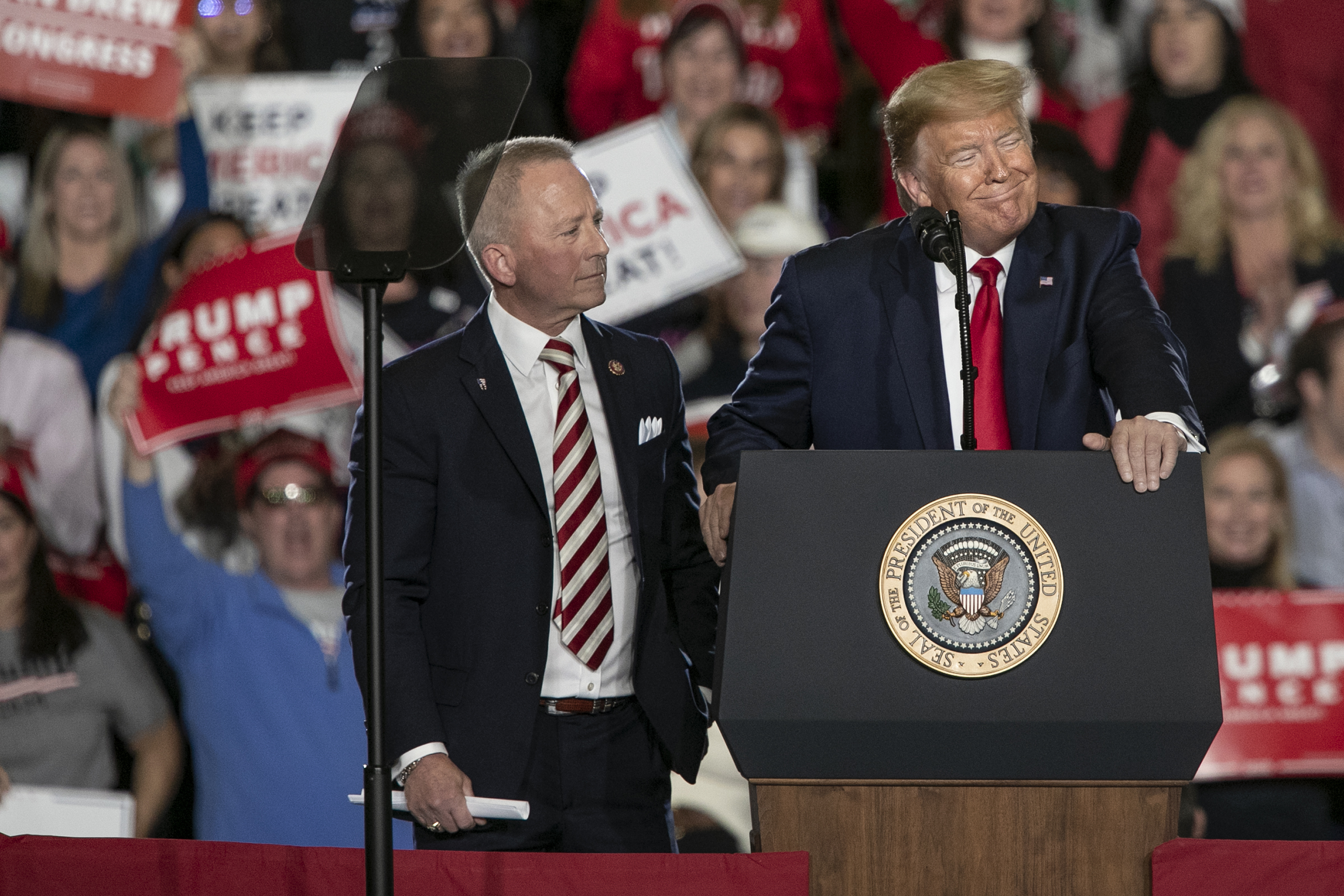
    The letter was led by U.S. Sens. Cory Booker and Andy Kim, both Democrats. All members of the New Jersey delegation were invited to join, Booker’s office said, but all three of the state’s Republican members opted out. Even U.S. Rep. Jeff Van Drew, a South Jersey Republican, sat out of the effort despite initially backing the request in April.

    Van Drew joined Booker, Kim, and six Democratic House members in an April letter of support for the request in which they said the public assistance and hazard mitigation funds “are crucial to the recovery of the communities” impacted by the storm.

    President Donald Trump smiles while Rep. Jeff Van Drew (R-NJ) stands next to him at a Keep America Great campaign rally in Wildwood, NJ on Tuesday, Jan. 28, 2020.HEATHER KHALIFA / Staff Photographer

    The request sought money for every county in Van Drew’s district for costs related to the snowstorm, including damage from moderate coastal flooding in Atlantic County and his home county of Cape May. Van Drew, a Trump ally and former Democrat, faces a challenge from Cape May Mayor Zack Mullock for his reelection in November.

    Van Drew did not respond to a request for comment.

    In the Friday letter, the Democratic lawmakers’ tone was direct but they did not reference accusations that Trump’s decision was politically motivated. Those concerns come amid a revelation that the Trump administration has been rejecting Democratic states at a particularly high rate. A Wednesday Politico report found Trump recently overrode regional FEMA assessments when he rejected aid for four Democratic states.

    The request included assistance for the vast majority of the state’s counties – including all of South Jersey – as well as hazard mitigation funding statewide, according to the Friday letter. Preliminary damage assessments across those 19 counties documented “extensive emergency work” such as snow and debris removal and “damage to critical infrastructure and public facilities.”

    The New Jersey Office of Emergency Management estimates that disaster costs will exceed $100 million, which is more than five times more than the state’s threshold of about $18 million to qualify for federal disaster assistance.

    Covered Bridge Road in Cherry Hill is Monday Feb. 23, 2026 after a power line was knocked down by the Sunday night snorwstorm.Tom Gralish / Staff Photographer

    “The extent of the damage, the operational burden throughout the State, and the cumulative impacts of recent and related extreme weather all provide overwhelming evidence that New Jersey’s request must be granted,” they wrote. “While we commend the actions of the State and local governments to respond thus far, full recovery will require your approval of federal resources.”

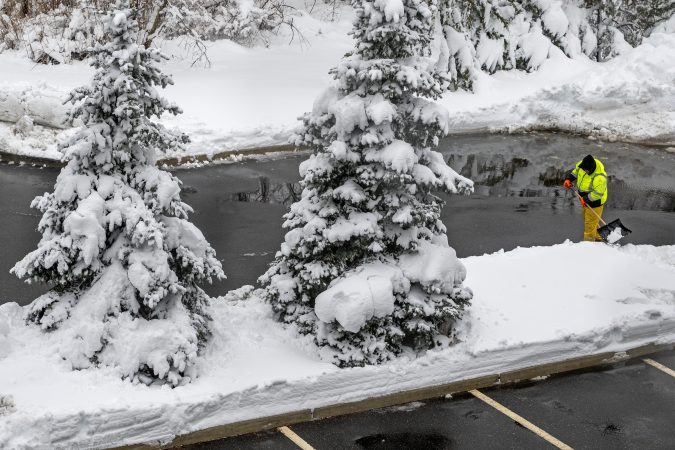
    The lawmakers cite National Oceanic Atmospheric Administration data that found approximately 24 inches of snow fell in less than 24 hours across central and eastern parts of the state, and eight of the state’s 21 counties recorded record or near-record snowfalls.

    Power outages during the storm impacted more than 127,000 customers in the state and there were 544 motor vehicle accidents and 1,518 motor vehicle-related assists, according to the letter.

    They also argued that Trump should consider that the state already had a “strained capacity to respond” because of another severe snow and ice storm weeks earlier, as well as six open federal disaster declarations — in reference to prior disasters for which the state is still working on recovery projects.

    “We look forward to working with you to ensure all Americans receive protection and support from the federal government in the aftermath of a serious disaster,” they wrote.

    On Thursday, Sherrill spokesperson Sean Higgins noted in a statement that the costs of the February snowstorm “didn’t care about political boundaries” and that the governor will fight for funding “regardless of political party,” in a nod to the accusations Trump is putting his thumb on the scale based on partisan favoritism.

    White House spokesperson Abigail Jackson said in a statement Thursday, before receiving the letter, that the president “provides a more thorough review of disaster declaration requests than any Administration has before him” and that he responds to FEMA requests “with great care and consideration, ensuring American tax dollars are used appropriately and efficiently by the states to supplement—not substitute, their obligation to respond to and recover from disasters.”

    She also said the Trump administration is committed “to empowering and working with State and local governments to invest in their own resilience before disaster strikes, making response less urgent and recovery less prolonged.” The Trump administration previously tried to cut disaster prevention funding because it was too “focused on ‘climate change” before a group of states including New Jersey sued.

    Kim, the ranking Democrat on the committee that oversees FEMA, said in an interview Thursday that he is concerned that politics were involved in the latest rejection but couldn’t say for sure.

  • Bayada Home Health Care’s new CEO Bryony Winn wants to provide higher levels of care at home

    Bayada Home Health Care’s new CEO Bryony Winn wants to provide higher levels of care at home

    Bryony Winn became the CEO of Pennsauken-based Bayada Home Health Care in March after a career at two big Blue Cross health insurers and at the consulting firm McKinsey & Co.

    Those experiences, she says, prepared her to take the reins at one of the nation’s largest home health companies at a time when Bayada is wants to increase the intensity of its home care offerings — and get insurers to pay for it.

    “Hospitals are full,” and patients want to be at home, said Winn in an interview this month at Bayada’s headquarters in Pennsauken.

    The company, whose founder Mark Baiada converted it to a nonprofit in 2019, operates in 22 states and five additional countries, employs 44,000 people, and had $2.2 billion in revenue last year.

    Winn, Bayada’s first non-family CEO, grew up in Zimbabwe and went to college in South Africa. “Being around so many challenges and so much opportunity every day in the developing world, I always had a sense that I wanted to do things that made lives healthier,” she said.

    When she came to the United States in 2009 to work as a consultant in Chicago, it struck her how specialized and disconnected healthcare is here. “In the developing world, there’s not enough trained people, so it’s a much more connected system around patients and humans,” she said.

    The Inquirer spoke with Winn about the importance of taking care of people at home as the nation’s healthcare providers come under increasing financial strain. Questions and answers have been lightly edited for length and clarity.

    How did your jobs at McKinsey and at Blue Cross of North Carolina and Elevance Health prepare you to lead one of the nation’s largest home healthcare companies?

    I learned a lot about the U.S. healthcare system and became more and more convinced that this lack of connection was driving unsustainable cost, and I still think it’s driving unsustainable cost. Pre-COVID, I used to say affordability is the greatest healthcare crisis of our time. Then COVID really was for a while, and I think we’re back to that now. The quality of care here is amazing if you have a really rare form of cancer. I’d prefer for it to be treated in some of the amazing institutions here than anywhere else in the world. But if you are just a typical person, and especially an aging person here with two or three chronic conditions, you are pushed from pillar to post across a system who doesn’t ever see you as a human being.

    (function(){function e(){window.addEventListener(`message`,function(e){if(e.data[`datawrapper-height`]!==void 0){var t=document.querySelectorAll(`iframe`);for(var n in e.data[`datawrapper-height`])for(var r=0,i;i=t[r];r++)if(i.contentWindow===e.source){var a=e.data[`datawrapper-height`][n]+`px`;i.style.height=a}}})}e()})();

    What do you think you can accomplish at Bayada, which was founded more than 50 years ago, to address that connectivity issue?

    What I can bring to it is really understanding the place of home health in the entire healthcare ecosystem. This is the place where clients and patients want to be; they want to be in their homes. And so the question I’m asking is not what are the kinds of conditions that should be addressed at home, but rather flip that on its head and say, what are the kinds of capabilities you need in the home to be able to address things for clients who want to be there?

    What’s happening now that makes it so important to solve this problem?

    For two decades in healthcare, we’ve been talking about people aging into Medicare. Ten thousand people a day aging into Medicare. Now 10,000 people a day are 20 years older. They’re aging into 85 every day. Because it’s not a change in insurance, it doesn’t generate the same conversation. But it’s a huge change in health status. We now have all of these seniors with two or three chronic conditions, and with a decent chunk of life expectancy still. The delivery system really needs to shift in how we care for these folks.

    What has to change?

    One thing that’s needed is a collection of multiple services in the home. Very rarely do you need just skilled nursing. You need skilled nursing and a home health aide and potentially wound care. That requires care management, a much more connected ecosystem, versus what is today much more a siloed set of services. The second thing is we just need more intense care at home. We have done this quite successfully, and we’re doing it even more now around NICU babies [in partnership with Children’s Hospital of Philadelphia and insurers Highmark and Independence Blue Cross].

    Bryony Winn, who became Bayada’s CEO in March, said her background in health insurance will help the nonprofit expand by finding ways to get paid for new services.Bayada Home Health Care
    Do you see Bayada playing a broader role in health systems’ hospital at home programs?

    I do. We can serve higher-intensity patients at home with more complex care needs, and we do a lot of this today. We’re just not really paid for it, or it’s not the service that we’re meant to provide. So it’s really, how can we more sustainably do this high-intensity work at home? That’s a shift for us. Our clients want it. Wound care at home is hard. It’s one of the biggest reasons for readmission back into the hospital after post-acute discharge. How we can build really strong clinically evidence-based wound care capabilities is one of the big pieces that we’re looking at in this elderly population.

    Providing more intensive care has higher costs. How do you convince insurers to pay more, especially given the prevalence of Medicare and Medicaid in home health?

    There is not a ton of wiggle room, but this is where my background helps. I’ve worked on the payer side for a long time. They truly care about affordability and quality as well, and so it’s really working together to say how does what we need for our caregivers, clinicians, and ultimately clients map with what you can afford, and how do we build this together? I’m not sure home health has ever had those conversations as intently as we need to have them now. It’s a very fragmented industry. Hospitals have been having these more strategic conversations with health insurers for decades.

    Editor’s note: The caption with the main photograph has been updated to correct the name of the person Winn is speaking with. It’s Lillian Floyd, a nurse with Bayada’s Camden County Visits unit.

  • HBO series ‘Task’ to film in Wissahickon Valley Park in August

    HBO series ‘Task’ to film in Wissahickon Valley Park in August

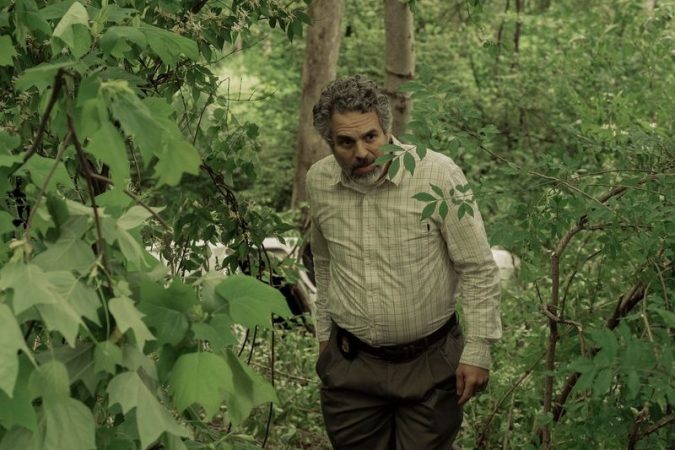
    If you’re taking a run through Wissahickon Valley Park next week and spot those signature Mark Ruffalo curls and determined glint in his eye through the tree leaves, worry not! The HBO series Task is filming its second season in the Northwest Philly park Monday through Friday.

    On Monday, the Bells Mill West Lot will be closed to the public for filming and will reopen the next day. Visitors can park instead in the Bells Mill East Lot.

    On Tuesday and Wednesday, the trail entrance at Manatawna Avenue will not be accessible. Houston Meadow can be accessed through the Houston Playground entrance on the Yellow Trail.

    The film crew is slated to park vehicles and equipment on some parts of Forbidden Drive. The trail will remain open, but hikers and runners may see stop signs warning them of “equipment ahead” or to go “slow ahead.”

    In July, the crew was spotted filming in Manayunk.

    The Delaware County-set series Task by Mare of Easttown creator and Berwyn resident Brad Ingelsby centers on FBI agent Tom Brandis, portrayed by Ruffalo. In the second season, Brandis is leading a new task force and confronting his rival Philadelphia DEA agent Eddie Barnes, played by Mahershala Ali, the Oscar winner who starred in Moonlight, Green Book, and the third season of the HBO crime show True Detective.

    The show’s first season also made its way around the city and suburbs. It featured scenes at the Rita’s Italian Ice & Frozen Custard in Collingdale, the Willowbrook Shopping Center in Boothwyn, and Marsh Creek State Park in Downingtown.