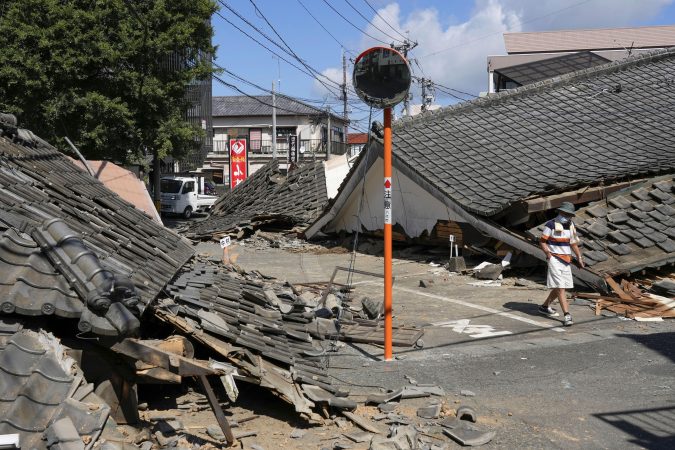
YATSUSHIRO, Japan — Thousands of survivors of a powerful earthquake in southwestern Japan spent Friday in crowded shelters or sleeping in cars as they faced shortages of water and fuel and punishing summer temperatures that stoked fears of heat-related illness.
The death toll rose to 34, the Kumamoto prefectural government said, as rescuers raced to find those still missing after the quake triggered a mall explosion, toppled a factory chimney, and flattened homes.
Japanese Prime Minister Sanae Takaichi stressed that authorities must secure water supplies by doing “whatever it takes” and called for close coordination with the military and other relevant agencies. The earthquake left thousands of homes without power, but electricity was fully restored by Friday evening. The local power company also said there were no immediate reports of remaining outages.
The magnitude 7.1 earthquake hit Japan’s southern main island of Kyushu on Tuesday. As search operations entered a fourth day, it wasn’t known how many people remained missing.
More than 1,500 buildings were damaged, including 179 that were destroyed, according to preliminary assessments by Kumamoto officials.
Officials said one more death and its connection to the quake is under investigation. At least 96 people were injured, including six seriously.
Debris collected at severely damaged century-old inn
In Yatsushiro City, another hard-hit area in southern Kumamoto, Kinparo, a 116-year old Japanese inn was severely damaged, with its roofed main entrance collapsed to the ground, white walls cracked, and rooftiles fallen.
On Friday, three days after the quake, workers were removing parts of the gate, which is part of the registered historic property that needs to be restored.
Started in 1910, the three-story ryokan with traditional architecture and hot baths have attracted many fans from the region and across Japan.
“The damage is tremendous and it would require significant repairs, and I can’t even think if or how I can do that,” inn owner Keisuke Matsumoto said. “But it’s a valuable family inn that has been handed down for generations since my great-great grandfather built it, so I do hope to preserve it.”
Inside, his mother, Misao Matsumoto, said she was not injured in the quake but “I’m mentally discouraged. It’s very painful to see parts of what I’ve lived with and enjoyed for decades crumble to that state.” But she said experts of historic buildings will come in to discuss the reconstruction, so “I have to hang in there.”
Across the street from the Kinparo inn, a fish cake shop owner unable to resume his business due to the water cutoff was giving away tube-shaped fish cakes while they are still edible.
Signs for the “chikuwa” fish cake hang from the ceiling. “I just wanted to cheer up this neighborhood,” said shop owner Shinichiro Katayama. He says he cannot clean or check whether his fish cake machine is intact until the water supply resumes. “I don’t even know if the machine still works. When water supply is back that would be my first step toward a recovery.”
Thousands are without water as heat soars
Kumamoto authorities said nearly 80,000 homes remained without water. More than 9,000 people were staying in shelters, where power sources were being added to provide air-conditioning.
Fuel has also become scarce as power outages disabled gas stations and quake damage disrupted deliveries from other regions. Many have resorted to sleeping in their cars for privacy, but with the fuel shortage, they struggle to keep the air-conditioning running in sweltering temperatures.
Japan’s weather agency and the Ministry of the Environment issued an extreme heat alert for Kumamoto city Friday as temperatures peaked at 97 F.
Hirokazu Sato, who lost his home in the earthquake, said he and his wife and three children would remain in their car until they can move into temporary housing.
“I don’t know how soon I’d be able to move in,” said Sato. “We need to have the air-conditioning on throughout the day and night, which uses up gas.”
Kumamoto is also a major industrial hub, and there are concerns that the quake could possibly disrupt semiconductor and auto-parts supply chains for months to come.
Taiwan Semiconductor Manufacturing Company, a global chip giant that operates a lab in Kumamoto, said all personnel were safe and operations were gradually resuming after postquake inspections found the structure was sound, although detailed inspections and impact assessments were still underway.
Searches continue, with number of missing unknown
Japanese officials had described Friday afternoon as a crucial point for rescue efforts as some experts say survival chances decline after the first three days.
With search dogs, rescuers continued looking for survivors across the Kumamoto area, including at the collapsed Aeon Mall in the town of Kashima, one of the hardest-hit sites. The complex was bustling with thousands of people when the quake happened.
The company said about 3,000 shoppers were evacuated to a parking lot before an explosion happened in another part of the mall, where some staff remained working. The mall’s second floor collapsed, trapping people. Seven of the 11 found were confirmed dead, but officials did not say if anyone else is missing.
A search operation had ended at a Nippon Paper Industries factory in the Yatsushiro city where a chimney collapsed in the quake, officials said. Of the 11 people dug out there, nine were confirmed dead.
Smaller-scale searches continued Friday at the sites of collapsed houses in badly hit towns in southern Kumamoto. Authorities haven’t supplied a firm figure for how many people are missing.
The Department of Homeland Security alerted employers this week that it had officially ended humanitarian protections for 350,000 Haitian immigrants, triggering mass layoffs that threaten to disrupt summer travel and destabilize an array of essential institutions and industries up and down the East Coast and across the Midwest.
Nursing homes terminated hundreds of workers, including nursing assistants, dietary aides and housekeepers, industry and union leaders said. At airports including those in Fort Lauderdale, Florida, and Boston, contractors terminated scores of Haitian workers, including janitors, cabin cleaners and wheelchair attendants, according to union leaders at Service Employees International Union 32BJ.
At Florida schools, landscapers, bus drivers and other staff were fired. And in New York City, dozens of security guards were terminated only to be rehired because of confusion around their eligibility to continue working, union officials said.
The tumult comes about a month after the U.S. Supreme Court granted the Trump administration permission to cancel the humanitarian program, known as temporary protected status (TPS), potentially stripping permission to live and work in the United States from as many as 1.3 million immigrants from Haiti, Syria and a dozen other countries.
The high court said the program for Haitians, one of the largest groups affected, could end on Monday. But attorneys for Haitian TPS holders said the protections should remain in effect until a lower court that had blocked the Trump administration from ending the program formally recognizes the Supreme Court decision.
In response to a question about the status of TPS for Haitians, a DHS spokesperson said in a statement that “activist lower court judges are openly defying the Supreme Court on this, but the end result will be the same. Haitians with TPS cannot and will not be able to stay.”
Earlier this week, DHS informed employers that it considered the “Haiti TPS designation … terminated, effective” immediately, and businesses have been laying workers off ever since.
The DHS spokesperson added that “Temporary Protected Status is exactly that -temporary.” “For too long, TPS has been allowed to function as a de facto amnesty program despite Congress never intending it to be permanent,” the spokesperson said.
Geoffrey Pipoly, who represented the Haitians at the Supreme Court, accused the administration of sowing confusion instead of winding down TPS provisions in an orderly way.
“What we’ve seen from [the administration’s] behavior in the past month … is that they are trying to create conditions that are just not worth it for employers to keep people employed,” Pipoly said.
Food service, retail, warehousing, health care and long-term elder care are expected to be pummeled in some cities where many Haitian TPS holders have lived legally for more than a decade. The Obama administration first granted TPS to Haitians in 2010, after a major earthquake destabilized the country, killing hundreds of thousands of people.
“We do think the Supreme Court decision is going to decimate industries that people really count on because they’re largely serviced by immigrants. That’s true of airports,” said Roxana Rivera, assistant to the president at SEIU 32BJ, which represents cleaners, security guards and airport personnel on the East Coast. “It’s going to be much more difficult to fill these essential jobs.”
As the firings rippled through cities such as Miami and New York and smaller cities such as Columbus, Ohio and Allentown, Pennsylvania, newly unemployed Haitians frantically lined up care for their children, downsized into single-room rentals and sheltered in place, fearing a new wave of immigration enforcement focused on their community, advocates said.
On Monday evening, Haitian workers at Fort Lauderdale-Hollywood Airport burst into tears as they were asked to turn in their badges. Marlene, 47, a single mother who has worked as an airport janitor for 12 years, said she has been sick to her stomach.
“I am panicking. I can’t eat. I can’t sleep,” said Marlene, who spoke on the condition that she be identified by first name only. “My kid is wondering if he goes to school, will I be there when he comes home?”
The Broward County Aviation Department, which operates the airport, did not respond to questions about the status of impacted employees. But the department said 132 Haitian TPS holders worked there as of Monday, and that contractors who employ them have “‘uninterrupted service’ clauses to ensure continuity of operations.”
Helene O’Brien, the Florida director of SEIU 32BJ, said the union has lost at least 140 other workers, mostly janitors, due to previous Trump immigration policies.
Some TPS holders from Haiti are seeking new protections, including under asylum law, while others are holding out hope for litigation or legislation that could change the fate of the program — though experts say that is unlikely.
White House Homeland Security Adviser Stephen Miller has said that Haitians who lose status should be deported: “It’d be crazy for us to say that Haitians couldn’t live in Haiti. It’s their country,” he told reporters last month.
Opponents of the terminations say Haiti is not safe and warn that the expulsion of 200,000 working Haitian TPS holders from the labor force will lead to declines in economic activity and tax revenue in local economies.
Ohio Gov. Mike DeWine (R) told CBS News this week that Haitians helped revive the city of Springfield, where Trump falsely accused Haitian immigrants of eating cats and dogs during the 2024 presidential campaign. DeWine called the decision to end TPS a “mistake.”
“These are people who have helped Springfield really come back,” DeWine said. “The Haitians … came there because there were jobs that were not being filled by other people.”
In the days leading up to the cancellation, powerful business groups pushed the administration to delay implementation of the Supreme Court ruling and establish a pathway for workers to regain legal status. The National Restaurant Association and the Florida Health Care Association were among several trade groups that sent letters to DHS Secretary Markwayne Mullin warning of looming operational disruptions.
“Many affected employees are long-serving, legally authorized workers who are central to restaurant operations,” the National Restaurant Association said in a letter to Mullin. “Their departure could remove a substantial share of the local hospitality workforce overnight.”
This month, Sen. Ed Markey (D-Massachusetts) introduced legislation to restore TPS for Haitians, warning the nation would otherwise face “a health care disaster.”
Some nursing homes have cut ties with scores of employees in recent days, while others have downsized. One facility in Staten Island, New York, raised its sign-on bonus from $2,000 to $6,000 to attract workers, while others shut down building wings and took beds offline. Still others explored recruiting replacement workers from high schools, said Katie Sloan, president of LeadingAge, an association of nonprofit aging service providers.
“To lose that many employees in one fell swoop is incredibly disruptive,” Sloan said. “And it’s destructive to the residents who have been close to these caregivers for years.”
Augustine, 30, is among those who stand to lose protective status. She and her mother fled Port-au-Prince after the 2010 earthquake destroyed their home.
Now Augustine — who spoke on the condition that she be identified only by first name — is a caregiver at Cabrini of Westchester, a 304-bed nursing home overlooking the Hudson River in Dobbs Ferry, New York. Most mornings, she is the first person to greet nine residents, waking them, bathing them, brushing their teeth and helping some eat breakfast and use the bathroom. Most of their families don’t visit regularly, she said; one calls her “my daughter.”
When she contemplates leaving her job, Augustine — whose shifts were canceled this week in anticipation of her work permit expiring — worries about these residents. But she said she would rather leave on her own terms than have immigration agents knocking on her door, so she and her mother have decided to begin packing as soon as the loss of her work permit is clear.
Asked if she had any parting words, Augustine said: “Thank you, America.”
In Florida, where nearly half of Haitian TPS holders reside, the Palm Beach County School District laid off nearly 20 Haitian workers, including bus drivers, janitors and cafeteria workers, school district and union officials said. “All School District employees must be legally authorized to work in the United States,” Steven King, a Palm Beach County School District spokesperson, said in a statement.
Afifa Khaliq, president of the SEIU Florida Public Services Union, which represents those workers, said she has been having conversations “that you would never want to have with a parent,” telling them to “make a plan so that your children can at least stay in safe environments while you may have to go back to Haiti.”
One 58-year-old Haitian woman with TPS in West Palm Beach, who spoke on the condition of anonymity because she fears being targeted by ICE, was fired from two full-time jobs this week. A single mother, she worked as both as a certified nursing assistant in a senior living facility and at a separate job in medical records, to pay for her two kids’ college tuition.
“I can’t plan ahead for this news. We live paycheck-to-paycheck,” said the woman, who has been in the United States since the 2010 earthquake.
“There is nowhere to go in Haiti,” she said, adding: “There are gangs living in my house in Port-au-Prince.”
SAN FRANCISCO — Anthropic, maker of the Claude chatbot, said Thursday that artificial intelligence systems it was testing hacked into three outside companies undetected earlier this year.
The disclosure comes just over a week after ChatGPT maker OpenAI said that an AI system it was testing found a way to break out of a test environment and hacked into another tech firm.
The Anthropic incidents are likely to add fuel to debates over whether advanced AI models could cause widespread security problems that have roiled the tech industry and prompted interventions by the White House to contain the potential risks.
Anthropic said in a blog post Thursday that OpenAI’s disclosure last week prompted it to review records from its own testing of AI models. The company discovered that on three occasions AI models challenged to break into software created solely to test their skills ended up going out onto the internet and breaking into real companies.
Neither Anthropic nor the targeted companies had discovered the breaches until this week, the company said. An Anthropic spokesperson declined to identify the companies hacked by its AI software.
In the blog post, Anthropic said the hacks came about because a third-party company named Irregular hired to help test its models provided them with access to the internet due to a “misunderstanding.” Anthropic notified Irregular and the companies hacked on Monday, the company’s blog post said.
“We appreciate Anthropic’s collaboration and transparency and look forward to continuing to work together to advance security,” a spokesperson for Irregular said. Both companies said they are continuing to investigate the incidents.
OpenAI said last week that an AI “agent” in testing had, instead of working on a cybersecurity problem, used a previously unknown vulnerability in the company’s test environment to gain full access to the internet. Over a five-day period it broke into multiple outside computers to break into AI software company Hugging Face, apparently in search of answers to the test.
The OpenAI and Anthropic incidents came to light after weeks of debate in the tech industry and Trump administration about how government should respond to the ability of the latest AI models to find computer security flaws.
Anthropic announced an AI model in April called Mythos it said was too powerful to widely release securely, and OpenAI has also developed models with strong cybersecurity skills that could be used for defense or attack.
In June, President Donald Trump signed an executive order aimed at giving the U.S. government an advance look at powerful AI models that could pose security risks. Work is underway to define how it will be implemented.
President Donald Trump recently accused Democrats of being “godless Communists,” building on his previous denunciation of his opponents as the “enemy from within.” These “Communists” were allegedly plotting to destroy Mount Rushmore once they seized control of the government. Such assertions reflect Trump’s willingness to peddle disinformation and rumors designed to paint the opposition as politically unacceptable.
But while Trump spreads disinformation to an unprecedented degree, he is far from the first president to do so. Ambitious politicians’ intent on proving their populist bona fides have circulated unfounded conspiracy theories since the birth of the American republic — including many of Trump’s presidential predecessors. Their experiences reveal that while Trump’s rumor mongering has unique elements, especially his focus on eroding practices essential to a functioning republic, similar tactics have long been highly effective.
Five of Trump’s predecessors stand out as serial conspiracy mongers: Thomas Jefferson, Andrew Jackson, Andrew Johnson, Woodrow Wilson and Franklin Roosevelt. These presidents represented many points on the ideological spectrum but shared one thing in common: their conspiracy mongering was rooted in their perception that the opposition was disloyal. All five men were also willing to peddle such claims because they believed they were saving America from a major threat.
Thanks to his prominent role in the founding, Jefferson felt a certain ownership of the American experiment. That shaped the ruthless way in which he dealt with those who stood in his way. He claimed, for example, that Federalist leader Alexander Hamilton, “bewitched and perverted by the British example,” had betrayed the “Spirit of 1776.” Hamilton, Jefferson held, was not only a “monarchist” but an advocate for a monarchy “bottomed on corruption.”
At the time, tradition prohibited public figures from directly attacking one another. Instead, Jefferson employed newspaper surrogates to circulate damaging and often unfounded information. These surrogates claimed that Hamilton’s goal was to destroy the republic and replace it with “an unlimited hereditary” government. Jefferson’s willingness to do anything to ruin his opponents became clear when one of his surrogates exposed Hamilton’s involvement in an extramarital affair.
Unlike Jefferson, Andrew “Old Hickory” Jackson’s dark view of his opponents and his willingness to engage in conspiratorial thinking stemmed from his defeat in the 1824 presidential election. Jackson charged that a “deep state” had stolen the presidency because he believed he received the most popular votes and, then, after no candidate received a majority in the Electoral College, the House of Representatives had handed the election to John Quincy Adams. Jackson claimed that the selection stemmed from a “corrupt bargain” between Adams and Speaker of the House Henry Clay, in which Adams promised Clay the position of Secretary of State.
Losing in this fashion to Adams, the Harvard educated son of a former president, convinced “Old Hickory” that the system was stacked against self-made frontiersman like himself who were looked down upon by East Coast elitists. Jackson’s contest with, as the Jacksonian press called him, “John the Second” was “a struggle between the honest yeomanry of the country, and an aristocracy” intent on “perpetuat[ing] in certain families” all government positions. One Jacksonian paper told its readers that Adams and his supporters were creating a system that was “fast tending to monarchy.”
Taking a page from Jefferson, Jackson’s surrogates claimed that Adams was somehow un-American. They based this charge on the amount of time the president had spent working as a young man at his father’s side in Europe and serving overseas as an American diplomat. Much was also made of Adams’ private purchase of a billiard table —— a purported sign of decadence and creeping European sensibilities. One Jacksonian editorial claimed that Adams admired “monarchy and aristocracy” and had learned his “contempt of republics and democracy” from his father and from his elitist education at home and abroad.
By 1828, having been falsely accused of election theft and doing the bidding of East Cost elites, Adams lost decisively to Jackson.
Forty years later, Jackson’s fellow Tennessean Andrew Johnson blamed “traitorous” Radical Republicans for undermining the Constitution and conspiring to oppress the white South by establishing “Negro supremacy.” In Johnson’s mind, they were traitors on par with, if not worse than, Confederate President Jefferson Davis.
Made By History sponsors. FOR USE ON MADE BY HISTORY STORIES ONLY.Inquirer Staff
In Cleveland, Ohio, on Sept. 4, 1866, Johnson asserted that Republican leaders Thaddeus Stevens and Wendell Phillips should be executed. Johnson’s overtly racist rhetoric emboldened various white supremacist organizations, including the Ku Klux Klan, leading to a reign of terror throughout the South.
As with Jackson and Johnson, racial considerations were central to President Woodrow Wilson’s conspiratorially inclined approach to interpreting the nation’s past and present. In that sense, the nation’s first and only PhD president shared some surprising similarities with earlier presidents who lacked his extensive formal education and could rightly be accused of being provincial nativists. The president who vowed to “make the world safe for democracy” presided over an administration that was openly contemptuous of the civil rights and civil liberties of his fellow citizens.
Wilson saw plots by “hyphenated” Americans designed to undermine the government and claimed that opponents of American entry into World War I — especially immigrants — were on the German kaiser’s payroll. In his 1915 State of the Union message, Wilson claimed that “there are citizens of the United States, I blush to admit, born under other flags but welcomed under our generous naturalization laws to the full freedom and opportunity of America, who have poured the poison of disloyalty into the very arteries of our national life.”
Echoing Wilson, two decades later, Franklin Roosevelt accused American isolationists of disloyalty and argued they were placing themselves at the disposal of the German government in the lead-up to the Second World War. Roosevelt’s public and private statements about American businessmen, journalists and the Supreme Court, often involved circulating rumors and innuendo. His critics were “selfish men, jealous men, fearful men,” “big chiselers,” who were also “rumor-mongers” and “poison peddlers.” These “privileged princes … thirsting for power” were in some cases potential” would be dictators,” intent on creating a “new despotism.”
Roosevelt believed that groups opposed to his initiatives lacked virtue and patriotism and were undermining self-government. This was particularly true of his Republican opponents, who by the time of his 3rd reelection campaign in 1944, the president saw as emulating Hitler and Mussolini.
Each of these presidents used the “bully pulpit” to persistently question the patriotism of their opponents or to ascribe criminal motives to them. These presidents aimed to persuade the public that their opponents were un-American, if not outright traitors. That was possible, in part, because the five presidents saw no distinction between themselves and the state. What was good for them was good for America.
These tactics proved to be highly successful for each of these presidents, except for Johnson: Jefferson, Jackson and Wilson all won reelection to a second term, while Roosevelt went on to be elected a record four times.
Trump has much in common tactically with this group of presidents, as he too indulges in fear mongering, trafficking in rumor and innuendo and smearing the opposition. However, he lacks the accomplishments of many of them: Jefferson, for example, was the poet laureate of the American founding, while Roosevelt arguably saved American capitalism during the Great Depression and deftly guided the U.S. crusade against fascism during World War II. Some also have doubts about Trump’s commitment to the public good as he seems to profit from his office, adds his name to public places and focuses on things like a new White House ballroom.
Yet, it would be a mistake to latch onto these differences and to miss the lesson from these conspiracy mongering presidents from the past. Their success in using many of the same tactics Trump is deploying in 2026 serves as a stark warning for his opponents. History shows that rumor mongering works and one should never underestimate the threat presented by a president whose unbridled rhetoric is used to destroy those who dare to dissent.
Made by History takes readers beyond the headlines with articles written and edited by professional historians. Opinions expressed do not necessarily reflect the views of The Inquirer.
Every year, people ask: “Should we still care about the spotted lanternfly?”
It’s been nearly a decade since it showed up in Pennsylvania and threatened the balance of the ecosystem. Back then, things got so spooky that people started calling 911 (and were respectfully asked to stop doing so).
Thankfully, their wrath was not as bad as we feared. Lanternfly numbers have declined, but efforts to control them continue. They still pose threats to vulnerable plants, especially grapevines.
Active from July through December, adult lanternflies remain a pest to be dealt with. Recent seasons have been more or less mild, but lately I’ve noticed more and more of the inch-long plant-hoppers crawling around Philly. I even caught a crafty one hitching a ride on the hood of my car.
We’re told to kill them on sight, but… I truly hate having to stomp on them, and it’s not just because they are experts at effortlessly escaping certain death. There’s something special about them. Heck, they even make for extraordinary tattoo subjects. They can’t help that they wreak chaos.
At any rate, it’s important to know how to identify, prevent, and treat spotted lanternfly damage. Use our guide here.
Storm warnings have been outdoing the actual storms in the Philly area. The Inquirer’s resident weather expert Tony Wood explains why thunderstorm forecasting remains one of the most elusive pursuits in meteorology.
What are you doing out there? This is your spot to shine, dear reader. I’m looking for new stories and moments to feature. Send your story in an email (pictures, if you have them, are welcome). You may see it in an upcoming edition of this newsletter.
🎤 Let me pass the mic to business reporter Joseph DiStefano.
Pennsylvania mushroom growers welcomed this month’s U.S. Department of Commerce preliminary finding that Canadian farms are selling mushrooms to U.S. grocery stores at unfairly low prices.
The ruling against “dumping” threatens to make mushrooms more expensive to import, easing competitive pressure onfamily-owned U.S. growers in an industryalso under pressure from a shortage of harvesters amid the U.S. immigration crackdown.
“This ruling supports the long-term health of our industry” in Pennsylvania, said CJ Ciarrochi, CEO and fourth-generation owner of Modern Mushroom Farms in Toughkenamon, Chester County, part of the Fresh Mushrooms Fair Trade Coalition supporting the case against the Canadians.
But one of the largest area growers called the decision a protectionist move that would enable aging U.S. farms to avoid upgrades and leave consumers with fewer choices. — Joseph DiStefano
An expanding crisis for soccer’s governing body reached into Infantino’s longtime inner circle when his pick to represent FIFA on the White House Task Force for the World Cup walked away calling the Joshua Kushner-backed $20 billion commercial subsidiary plan “a bad deal for football.”
Carlos Cordeiro is a former Goldman Sachs banker and officially Infantino’s Senior Adviser yet revealed he was not involved in the secretive investment plan that has rocked the sport since media reports revealed it Tuesday.
“I cannot stand by while FIFA considers selling a stake in the World Cup,” Cordeiro said in a statement formally resigning, just hours after FIFA insisted in a statement: “Nobody is selling football.”
Cordeiro’s exit — and call for other senior staff to speak out — intensified scrutiny on Infantino one day after European soccer body UEFA threatened to boycott all FIFA games and events until the plan is dropped. North America’s CONCACAF also rejected Infantino’s offer of one-off $20 million payments to each member federation by a mid-September deadline.
Cordeiro often joined Infantino on working visits to meet U.S. President Donald Trump at the White House in recent years, and took part in meetings of the administration’s World Cup task force led by Andrew Guiliani.
“Let me be clear. I had no involvement in this proposal, and I oppose it unequivocally,” said Cordeiro, the former U.S. Soccer Federation president.
Asia joins Europe and North America
On another seismic day in soccer politics, Asia’s soccer body that has been a key ally in Infantino’s 11-year presidency opposed the investor plan and said FIFA must urgently review its management style
The Asian Football Confederation said it “stands in solidarity” with UEFA and CONCACAF, the first two continental bodies to oppose Infantino whose combined 90 FIFA member countries near a majority of the 211 global total.
“Football should never have been placed in such a position,” said the Asian soccer body, which counts 46 of FIFA’s 211 members
Infantino has proposed spinning off FIFA’s commercial businesses — including World Cups and Club World Cups for men and women — into a $20 billion subsidiary with 20% owned by private investors.
The “anchor investor,” described by FIFA, is a New York-based investment firm created by Joshua Kushner, the younger brother of Trump’s son-in-law Jared Kushner.
“(T)he proposed (FIFA Forward Enterprise) cannot realistically achieve the necessary broad consensus and unity required to move forward” and must be reconsidered, the AFC said.
The statement did not name Infantino yet criticized FIFA for problems beyond the content of the private equity plan plus failing to consult about the secretive proposal.
“Rather, it has exposed fundamental weaknesses in FIFA’s consultation and decision-making processes that must now be addressed,” said the AFC, whose longtime president Sheikh Salman bin Ibrahim Al Khalifa narrowly lost the FIFA presidential election to Infantino in 2016.
“Accordingly, the AFC calls upon FIFA to undertake an urgent review of its governance and decision-making framework,” said the organization based in Kuala Lumpur, Malaysia.
Infantino’s job at risk?
Infantino had seemed — 11 days ago after the World Cup final in East Rutherford, New Jersey — to have a clear path to being reelected unopposed for a fourth and final term in office through 2031.
FIFA had briefed during the tournament that Infantino had letters of support from about 200 members, despite a furor over letting United States forward Folarin Balogun play against Belgium even though he received a red card in his previous game. Trump acknowledged asking Infantino to review Balogun’s mandatory one-game ban.
FIFA has set a Nov. 18 deadline for potential candidates to declare in a presidential vote of the 211 members scheduled next March in Rabat, Morocco.
FIFA blames the media
The Asian statement came hours after FIFA blamed the media and doubled down on pursuing the project which now seems to have a majority of the 211 in opposition.
“Our planned consultation process was disrupted by incorrect media reports,” FIFA said in a statement early Friday. “We will proceed with this consultation process to ensure that each (member) has the ability to express its vote based on facts.”
The next FIFA event that would be targeted by the threatened European boycott is within weeks — the Women’s Under-20 World Cup hosted by Poland from Sept. 5. The four British federations comprise FIFA’s only bidder to host the 2035 Women’s World Cup. That decision is due Nov. 23.
The New Jersey e-bike law that went into full effect earlier this month has a new update.
And after President Donald Trump denied the state’s request for federal disaster aid, South Jersey Democrat Andy Kim has concerns about the possible politics behind the decision.
Plus, several Camden County towns could owe more than a half a million dollars as part of a settlement in a class-action lawsuit, and more news of the day.
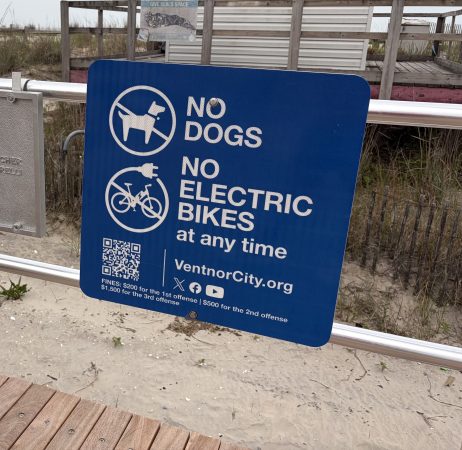
New Jersey’s new e-bike law was passed in January and went into full enforcement on July 19.
The state’s Motor Vehicle Commission has already made a policy change that impacts non-Jersey residents.
Here’s what you need to know before you’re ready to ride:
🚲 Everyone — including people from outside of the state — needs to register their e-bike. Out-of-state riders will need to make an appointment at the MVC and fill out a registration form.
🚲 Properly registered e-bikes will get a sticker from the MVC to display.
🚲 The law requires all riders to wear helmets and prohibits riders under the age of 15.
Back in February, New Jersey was hit with a record-breaking blizzard that resulted in thousands of power outages, school closures, and transit disruptions.
The Federal Emergency Management Agency, via President Trump, earlier this month rejected the state’s request for $84 million in disaster aid after the agency and the National Oceanic and Atmospheric Administration already determined that Jersey met the required levels to receive the help.
Sen. Kim said he’s worried the rejection may be partisan, but can’t say for certain. The White House has been consistent in saying Trump’s rejections for other disaster aid requests from states have not been politically motivated.
Five Camden County municipalities agreed to a settlement in a class-action lawsuit over vacant property fees. If approved in court, Barrington, Bellmawr, Runnemede, Voorhees, and Gloucester Township would collectively owe more than $500,000.
An Atlantic City lifeguard has been charged with trying to lure an underage girl who turned out to be an undercover detective, the Camden County Prosecutors Office said Thursday. The man from Egg Harbor Townshipwas arrested in Cherry Hill.
A woman was arrested and charged after fatally shooting her boyfriend in Winslow Township while in a parked vehicle, according to local authorities. The investigation is ongoing.
Gloucester County officials are reminding residents to ensure their pets are up to date on rabies vaccinations and to avoid wildlife after a report of a rabid raccoon biting a Glassboro resident last weekend.
Thieves recently targeted two trading card shops, one in Washington Township and another in Gloucester Township, and stole thousands of dollars worth of Pokémon cards, 6abc reports. Earlier this month, a man was charged for allegedly stealing a Pokémon card worth $24,000 using fake cryptocurrency in Marlton.
Olympic figure skater Isabeau Levito, who grew up in Mount Holly and now lives in Mount Laurel, teased her upcoming programs for the 2026-27 season, including a Pirates of the Caribbeantheme for her free skate.
🦘 Remembering: That time when Rex, a three-year-old wallaby, went missing for about a day from Lots of Love farm in Williamstown and then was found safe at a Walmart.
Two weeks ago, a reader asked Amy about the dress code and she responded that most people fall into the “throw stuff in a suitcase” camp. Well, we posed the question to the Shore Line text group. Below are a few recent submissions:
“‘Down the Shore everything’s alright.’ Sure it’s OK to wear beach attire (not sandy though, and do brush ur hair 😉)”
“I don’t care how much money you have. Make an effort, for the sake of the restaurant staff and other guests, to put on clean shorts and a polo for men and a cute cover up/sundress for women. If you can’t do that, then there’s always takeout.”
“Some people, when they come to the beach, lose or abandon their sense of propriety. Decent, casual attire respects the restaurant and other diners.”
There’s still time to weigh in. Is there a baseline for what’s acceptable? Or does anything go when you’re on vacation? Email Rosenberg your thoughts at downtheshore@inquirer.com.
📸 Photo of the week
Philadelphia Eagles quarterback Jalen Hurts posed for a photo with Gisele Maldonado, of Princeton, N.J., during the first day of Training Camp at the Jefferson Health Training Complex on Wednesday.Monica Herndon / Staff Photographer
TGIF. Enjoy your weekend and I’ll see you on Monday. ☀️
By submitting your written, visual, and/or audio contributions, you agree to The Inquirer’s Terms of Use, including the grant of rights in Section 10.
Federal health officials last month abruptly cut funding for a teen pregnancy prevention program in Philadelphia — despite approving the program’s curriculum last year, its leaders said.
AccessMatters, the reproductive health nonprofit that ran the program for more than 1,200 students in charter schools across the city, had a five-year grant, about $1 million per year, to teach students about pregnancy prevention.
But, in a June letter, federal officials terminated funding two years early, saying the program was “normalizing adolescent sexual activity,” said Ayana Bradshaw, AccessMatters’ president and CEO.
AccessMatters was one of dozens of organizations around the country that had received funding under a federal teen pregnancy prevention grant program. Nearly all have now been informed that they are losing their funding, Bradshaw said.
Representatives of the U.S. Department of Health and Human Services did not respond to a request for comment.
Staff at AccessMatters are still figuring out their next steps in the wake of the funding cuts.
Federal officials took issue with a portion of the program’s curriculum about using condoms, said India Blunt, AccessMatters’ director of training and capacity building.
But, she said, that curriculum had already undergone a rigorous approval process from the Trump administration.
In April 2025, HHS officials had asked AccessMatters to review its curriculum and programming and edit it to align with the new administration’s priorities. The curriculum was approved, AccessMatters staff said, only to have the funding pulled just over a year later.
“[The cuts were] shocking largely because we were using approved curriculum,” Blunt said. “We made adaptations to the curriculum to be in alignment. We were following the procedures, protocol, and program expectations to a T.”
Blunt said the program provides students with medically accurate information about HIV and other sexually transmitted infections, good hygiene practices, and puberty. Program staff also discuss healthy relationships, communication, and consent with students.
The curriculum is aimed at delaying teenagers from having sex, and includes tactics for how to refuse a partner, Blunt said.
But in Philadelphia, which has a teen pregnancy rate twice that of the state average, it is crucial to provide teenagers with accurate sex education, AccessMatters staff said, including discussion of all options to prevent pregnancy.
Surveys conducted at 32 Philadelphia public high schools in 2025 showed that just under a third of surveyed students reported that they had had sex. About 40% reported using a condom during their last sexual intercourse. Fewer than one in five reported that they had been tested for sexually transmitted infections.
“I don’t know how you talk about pregnancy prevention and not talk about condoms. You need to understand what the actions are — there are many, from abstinence to how to use a condom,” Bradshaw said.
“These are not programs meant to promote sexual activity, but programs that are meant for youth to understand what actions are available for them to prevent pregnancy.”
The administration is now soliciting new grant proposals for teen pregnancy programming that must emphasize abstinence as the only way to prevent pregnancy, stressing “the importance of marriage and procreation” and “[instructing] young people how to safeguard their fertility,” the New York Times reported earlier this month.
Several programs that lost funding have filed lawsuits to block the cuts.
The abrupt funding cuts have put jobs at AccessMatters at stake, officials there say.
“It has a disastrous impact on AccessMatters program staff, as well as community partners,” Bradshaw said. “Of course, most of all, it’s a devastating loss for adolescents in Philly.”
President Donald Trump’s administration has targeted funding at AccessMatters in the past. The nonprofit oversees Title X funding in the Philadelphia region, helping people without sufficient health insurance to access contraceptives, sexually transmitted infection testing, cancer screenings, and vaccinations.
The administration froze funds for four months last year for AccessMatters and hundreds of other organizations while it investigated compliance with the administration’s directives on immigration and diversity, equity, and inclusion.
Trump has argued that DEI programs discriminate against white people, and his administration has targeted federal grants that support research on health equity and threatened universities with funding cuts based on their DEI policies.
AccessMatters’ Title X funding was eventually restored late last summer, without the nonprofit having to change its policies. But the clinics it funded were hit hard by the freeze, in some cases laying off staff, shouldering extra costs, and helping patients find affordable medication elsewhere.
“We’re still assessing the overall impact to the organization,” Bradshaw said of the June funding cuts. “There was no notice, no time to even plan for this.”
Heads up, homeowners: taxes are going up in Philadelphia. Before you feel it in your wallet, check to make sure you aren’t missing out on thousands in savings.
P.S. Yesterday, we accidentally shared a broken link to a story about 6abc meteorologist Cecily Tynan, who recently announced her retirement. We’ll be publishing a Q&A with Tynan on Saturday and will include that in the newsletter then.
One homeowner told The Inquirer the city could do more to inform people and build trust.
To help, we built a tool using city property data to help you discover which programs are available to you. The survey will tell you what you can apply for, and how much you would save.
For the first time, Philadelphia parents will be able to track their kids’ school buses for at least 200 routes in the city.
The school district recently awarded a contract to a company called Zum for a high-tech fleet equipped with technology that updates yellow bus locations via an app.
🚍 Still mostly analog: Most city school buses don’t have GPS and are still driven using turn-by-turn directions.
🚍 Technology plus comfort: The vendor promises families the ability to be informed on who is driving their child’s bus, and get notifications on students’ departures and arrivals. All Zum buses are also air conditioned. Currently, AC is guaranteed only on buses transporting students with disabilities.
🚍 Beyond Philly: Zum runs routes in 18 states and 6,500 districts nationwide.
Prosecutors and a Montgomery County grand jury faulted the Cheltenham School District for failing to protect players during two violent 2025 locker-room assaults.
This week, we’re resurfacing an explainer from Michelle Myers on the mysterious character responsible for the voice you hear when a train is delayed or when it’s time to board.
His name is Alvin Elliott, a veteran SEPTA employee who at first volunteered his voice long before it became a cornerstone of the transit system, and of Philadelphians’ lives.
“Even when he’s announcing trains are being delayed, there is something comforting about the way he speaks,” an Inquirer reader said. Here’s the full story.
A rising senior at La Salle University built an app to help him and other athletes on his team excel in their sport, using a collection of stats and artificial intelligence. What sport is the app specialized for?
Cheers to Ken Goldman, who solved Thursday’s anagram: The Odyssey. A Penn professor’s work was used as reference for the film. It didn’t impress her, though.
Photo of the day
Sam Okyere, 12, is with his sister Kayla Okyere, at the petting zoo during his Make-A-Wish donation drive and block party at Families Forward Philadelphia homeless shelter.Tyger Williams / Staff Photographer
👋🏽 As always, thank you for waking up with The Inquirer. Make of the most of July’s final hours, and have a great weekend.
By submitting your written, visual, and/or audio contributions, you agree to The Inquirer’s Terms of Use, including the grant of rights in Section 10.
Think you know your news? There’s only one way to find out. Welcome back to our weekly News Quiz — a quick way to see if your reading habits are sinking in and to put your local news knowledge to the test.
Question 1 of 10
Which top official resigned from Mayor Cherelle L. Parker’s administration this week?
CorrectIncorrect. XX% of other readers got this question right.
Philadelphia Managing Director Adam K. Thiel, a top appointee who supervises many of the government’s day-to-day operations, is resigning, the mayor announced Tuesday.
Question 2 of 10
A University of Pennsylvania professor has sold over a million copies of her highly praised translation of this story:
CorrectIncorrect. XX% of other readers got this question right.
Professor Emily Wilson of West Philly thought she’d sell 1,000 copies of her Odyssey translation. She has sold more than a million, thanks to Christopher Nolan. Her translation was cited by Nolan as a reference for his blockbuster film version.
story continues after advertisement
Question 3 of 10
Philly band Snacktime performed at the Newport Folk Festival last week. While there, they also made a guest cameo, performing as the horn section for this popular singer:
CorrectIncorrect. XX% of other readers got this question right.
The band — wearing their trademark black faux Sixers jerseys — joined Lauryn Hill as the Fugees singer’s horn section, on “Doo Wop (That Thing),” from her 1998 classic album, The Miseducation of Lauryn Hill, which was released on Conshohocken’s Ruffhouse Records.
Question 4 of 10
Philly’s Academy of Natural Sciences was the first public venue with a complete dinosaur skeleton on view. What kind of dinosaur is the 15-foot-tall skeleton of?
CorrectIncorrect. XX% of other readers got this question right.
In 1868, the Academy made paleontology history when Benjamin Waterhouse unveiled a complete dinosaur skeleton of Hadrosaurus foulkii built from bones of the plant-eating dinosaur excavated in Haddonfield 10 years before.
Question 5 of 10
A new art gallery at the vintage shop At My House features pieces all falling into this theme:
CorrectIncorrect. XX% of other readers got this question right.
All of the art on display at “Mini Mini” is about 1.5 inches by 1.5 inches — no larger than a postage stamp. On the wall are displays of tiny clothing items, makeshift houses and rooms, and some original drawings. The artwork is for sale, with items ranging from $60 to $300.
Subscribe to The Philadelphia Inquirer
Our reporting is directly supported by reader subscriptions. If you want more journalism like this story, please subscribe today.
Rising pop singer Audrey Hobert recently told a crowd at one of her shows that if she could haunt any place in the world, she’d select this Philly bar:
CorrectIncorrect. XX% of other readers got this question right.
“Such a great question,” responded Hobert, in a lime green zip-up and gym shorts. “I would probably haunt this bar in Philly which [inspired] my song ‘Silver Jubilee.’ … It’s the best bar I’ve ever been to.” A blog post on Hobert’s website detailing the backstory of “Silver Jubilee” explains it was inspired by a Halloween weekend in 2024 she spent at Drinker’s Pub.
Question 7 of 10
New details have been released about the Star Wars: The Experience exhibit, which is touring North America and launching at Philadelphia’s Franklin Institute next year. The experience will include a range of interactive displays and original artifacts used in the films. Which character’s original lightsaber has been confirmed as part of the exhibit?
CorrectIncorrect. XX% of other readers got this question right.
A variety of rare artifacts used in the films — like Darth Vader’s costume and Darth Maul’s lightsaber — will be on display, along with various robots and aliens from the universe, like R2-D2 and Grogu.
Question 8 of 10
Oroshi, a budget-friendly omakase, has opened on Broad Street. The restaurant still uses plenty of high-end ingredients and cuts. But it’s also playful at times, food writer Kiki Aranita noted. What unexpected ingredient was torched on top of a piece of salmon when she dined there?
CorrectIncorrect. XX% of other readers got this question right.
A nigiri on Oroshi’s opening menu that they’ve since phased out consisted of premium Bakkafrost salmon from Scotland, topped with mayonnaise and a tiny square of Kraft American cheese that was torched multiple times.
Question 9 of 10
LeBron James’ move to the Sixers sparked major jersey sales. According to Fanatics, the move marks the highest-selling jersey of a player joining a new team (across all sports). What player held that record until now?
CorrectIncorrect. XX% of other readers got this question right.
After James shocked the sports world, choosing the Sixers over Cleveland and Miami, the future Hall of Famer’s jersey has been the highest-selling of a player joining a new team across all sports — surpassing Shohei Ohtani’s move to the Los Angeles Dodgers in 2023, according to Fanatics.
Question 10 of 10
A rising senior at La Salle University built an app to help him and other athletes on his team excel in their sport, using a collection of stats and artificial intelligence. What sport is the app specialized for?
CorrectIncorrect. XX% of other readers got this question right.
Will Tran, a rising senior rower and computer science major, created RowIQ, which provides an in-depth look at how rowers can improve with “data that’s never been seen before.”
Your Results
You have skipped .
You scored XX out of 10.
The average reader scored XX out of 10
Seems like you’ve been skimming more than reading there, buddy. There’s always next week.
You’ve read some articles (or made some educated guesses) but we wouldn’t come to you first for our local news recaps. Better luck next week!
Do you work here? You’re a local news stan with the latest updates on Philly happenings. Your friends definitely ask you for summaries on what’s going on and it shows.