Category: Washington Post

  • Willpower alone doesn’t work. Here’s what does, according to an expert.

    Willpower alone doesn’t work. Here’s what does, according to an expert.

    Swimmer Michael Phelps is famous for his work ethic, his incredible drive to succeed, and his unusual genetic makeup. He’s won more Olympic medals than any other athlete, most of them gold.

    But if you widen the aperture, you see his coach, Bob Bowman, giving him the confidence to succeed. You see his mother, Debbie Phelps, finding swimming as an outlet for her son’s endless energy. And it didn’t hurt that Phelps happened to grow up 10 minutes from one of the best training centers in the country, the North Baltimore Aquatic Club.

    “I spent the first half of my career studying individual effort and its importance to success,” said psychologist Angela Duckworth. “And I think that is important, but it’s not everything.”

    Duckworth, a professor at the University of Pennsylvania, is best known for her book on “grit” — which she defines as passion and perseverance toward long-term goals. She pointed to Phelps as an example of grit because of his extreme dedication to his sport. But he — and everyone else who finds success — had to be in the right situation with the right people for that effort to pay off.

    In her new book, Situated: Find the People and Places That Bring Out Your Best, Duckworth explains the research on what it takes to reach our goals, and why we shouldn’t try to muscle through challenges with willpower alone. Here’s what she said to do instead.

    Change your situation

    It may not be possible to change everything about your circumstances, but Duckworth said we often don’t realize how much is within our control.

    For example, in a new survey from Pew, more than half of American adults say they spend too much time on their phones. The number is even higher for younger adults. Many respondents have tried to cut back with little success.

    Duckworth said many people make New Year’s resolutions to spend less time on their phone, but continue to charge their phones next to their bed (as nearly 8 in 10 Americans do, according to a survey from YouGov in 2025). If your plan is to essentially use willpower to look at your phone less, it probably won’t work.

    “What my research shows is that it’s far more effective and also far less exhausting to change the situation,” Duckworth said.

    So if you want to spend less time on your phone, charge it in another room. If you want to exercise in the morning, put your workout clothes next to your bed. If you want to eat less of a certain type of food, don’t keep it easily within reach.

    “Essentially, use physical distance to create psychological distance,” Duckworth said. “Don’t rely on mental force of will.”

    In Duckworth’s research, young adults who were encouraged to change their situation were more successful at reaching a goal than those who only used self-discipline — and they experienced less temptation in the process.

    Phone a friend

    Looking at some of world’s most successful people, from Phelps to Taylor Swift, she said everyone needs help from peers, mentors, and friends to stay motivated and accountable.

    In her book, Duckworth examines the success of a start-up incubator that was behind companies like Dropbox, Airbnb, and Reddit. Unlike some other venture capital firms, it funded companies in groups so the founders had support and guidance.

    “We really need a feeling like we’re doing things in a group,” Duckworth said.

    People are more likely to reach goals when they work together, she said, explaining that people enjoy being asked for help more than we might think.

    Her daughters live near each other and have started going to the gym together.

    “You kind of have to show up for the other person,” Duckworth said. “But also it makes it more fun.”

    Get expert guidance

    Duckworth said the need for outside support also applies to problems, even though it can be harder to ask for help. She and her husband hit a rocky period in their marriage, she said, and it wasn’t until they “called in the cavalry” that things got better, with the support of family, friends, and therapy.

    “It was humbling for me to admit that I couldn’t work it out,” Duckworth said. “We overcame this strong sense that asking for help was like an admission of failure.”

    That experience didn’t just change her marriage. It also changed the way both she and her husband approached their work.

    Duckworth decided she wouldn’t do research alone anymore; she instead works with other scientists as collaborators. And her husband, the president of his real estate company, put together an advisory board of trusted mentors to help him make better decisions.

    “Find ways to make your situation your ally. And don’t be ashamed of it,” Duckworth said. “I think that to me is the perspective shift that has personally made a difference.”

  • Ding! Ding! Ding! The long, strange fight over your car’s seat-belt chime.

    Ding! Ding! Ding! The long, strange fight over your car’s seat-belt chime.

    David Kidd is an expert in something that some people hate and others tend to just tolerate: seat-belt warning systems — the “ding ding ding” chimes and flashing dashboard lights that serve as reminders to buckle up.

    He’s spent years testing different systems in cars and trucks as part of his work at the Insurance Institute for Highway Safety. So he knows very well that the incessant chimes can be annoying.

    They’re “an irritant,” he admits. But he prefers a different term.

    “We use the word ‘motivating,’” Kidd said.

    The lowly seat belt is still considered the best way to avoid serious injury or death in a crash. Forget air bags, anti-lock braking systems, or any other new-fangled safety technology. Unbelted occupants are roughly twice as likely to be killed in a car crash.

    Buckling up works.

    So does nagging. Kidd’s research found that belt warnings came in a variety of tones and volumes, but if they are “heard and persistent,” people respond.

    The seat-belt chime is such a recognizable refrain that when pop star Olivia Rodrigo needed an iconic car sound to open her hit song “Drivers License” a few years ago, she reportedly used a recording of the seat-belt beep in her mom’s car.

    The “buckle up” reminders were set to become even more widespread this month, when new federal safety regulations were supposed to require more persistent chimes not just for the driver’s seat but for the front passenger seat, as well. But automakers objected, saying they couldn’t be ready in time. Regulators backed down. So the new rules have been delayed for another two years — 2028 at the earliest — when some rear-seat warnings would be required, too.

    The National Highway Traffic Safety Administration said in a statement that it found the automakers’ worries “have merit.”

    Others were not convinced.

    “It was a bit of mystery to us why this has taken so long already. And now it’s going to take even longer,” said Peter Kurdock, general counsel for Advocates for Highway and Auto Safety, which began pushing for the new rules in 2007.

    “It’s disappointing,” he said.

    The technology is not cutting-edge. Europe has required seat-belt alarms in new vehicles since 2021. Some automakers, such as Volvo and Subaru, already have voluntarily installed them in vehicles sold in the U.S.

    But the fight over the warning chimes feeds into Americans’ long-running love-hate relationship with seat belts.

    Seat belts are still seen by some as a question of choice and freedom.

    State laws and education campaigns have helped soften some of those attitudes. Today, 49 states require adults in the front to buckle up. The lone holdout is New Hampshire, which lives up to its license plate motto of “Live Free or Die.” Just 34 states plus D.C. require adults to wear seat belts in rear seats. (Children are covered by different restraining-device requirements.)

    Still, researchers know some people remain militant in their opposition. They’re the ones buying $6 devices and printing 3D tools to fool the alarm. They sit on top of buckled seat-belt straps. They watch online videos claiming to reveal the hidden tricks to deactivate the warning chimes.

    “Those that don’t like seat belts are really hardcore against buckling up,” Kurdock said.

    These holdouts are why U.S. seat-belt usage rates have largely flatlined in the last decade, according to NHTSA observational studies. The unbuckled make up a minority of all vehicle occupants, but they die at a much higher rate in crashes: Roughly half of all vehicle fatalities involve unbuckled occupants.

    At one point, federal officials tried a much tougher tactic than just chimes.

    In 1974, the federal government required many cars to have ignition interlock devices that prevented a car from even starting until the front occupants were buckled up. Motorists hated it. It blew up in NHTSA’s face.

    “That got a lot of blowback that reached Congress,” Kidd said.

    The idea was quickly pulled, and Congress banned NHTSA from requiring interlocks. Lawmakers then went further and limited seat-belt warning chimes to a fleeting eight seconds.

    Some advocates say this is why NHTSA has seemed reluctant ever since to even tinker with seat-belt warnings.

    In 2007, Public Citizen and Advocates for Highway and Auto Safety petitioned NHTSA to change the belt-reminder rules and add them for rear seats.

    Little happened for years.

    In 2012, Congress passed a bill that abolished the eight-second chime limit and required federal officials to create new warning rules for seating positions besides the driver’s seat. It was a start, but a very slow one.

    “The chime is very important,” said Shaun Kildare, research director for the Advocates for Highway and Auto Safety.

    While NHTSA worked on a plan, the lack of government action created an opening for the Insurance Institute for Highway Safety, which rates vehicles on a series of safety metrics. It began rating cars and trucks on the quality of their seat-belt reminders with the 2021 model year.

    IIHS wants seat-belt chimes to last at least 90 seconds and be easy to hear, among other criteria. The chimes should annoy drivers enough to get them to buckle up — but not so much that they complain.

    “It was: Get them to wear a seat belt, but at the same time not email their congressperson to demand a change,” Kidd said.

    Compliance has been voluntary, but some automakers have jumped at the chance to make a good showing. IIHS saw rapid adoption, even without federal regulations, Kidd said.

    At first, less than 20% of vehicles scored IIHS’s top “good” ranking for seat-belt reminders. Five years later, 71% of vehicles qualified.

    “You’ve had a complete change in the seat belt reminders in the new vehicles,” he said.

    In 2025 — 13 years after Congress asked for a plan — NHTSA finally unveiled its blueprint for overhauling the nation’s seat-belt warning system.

    The new rules will require a chime lasting at least 30 seconds for either an unbuckled driver or front passenger when the vehicle starts up, and if they are still unbuckled when the vehicle reaches slightly faster than 6 mph, a second chime will play endlessly until the seat belt is secured.

    That’s the rule that was supposed to hit new vehicles on Sept. 1. A rule requiring a 30-second chime if someone unbuckled a seat belt in the rear seats was set to start in September 2027.

    But in April, NHTSA acquiesced to arguments from the Alliance for Automotive Innovation, an industry trade group, that the changes “require significant hardware and software changes” and would need more testing.

    Now, regulations for both front- and rear-seat warnings are being pushed back to September 2028.

    Despite the delay, automakers still “support efforts to increase seat belt use and for decades have voluntarily and proactively installed seat belt reminder systems across the vehicle fleet,” Audrey LaForest, communications director for the Alliance, said in a statement last week.

    Kurdock, whose group first petitioned for this change nearly 20 years ago, was in disbelief.

    “This is not a new technology. Seat-belt reminders have been in cars for a very long time,” he said.

    Kidd said he was frustrated with what he saw as an unnecessary delay. He has estimated that nearly 1,600 lives could be saved annually if all vehicles had more noticeable and persistent seat-belt warnings leading to more people buckling up.

    “The disappointing piece is we’ve known what to do for a long time,” he said, “but we just haven’t done it.”

  • Supreme Court is asked to settle Missouri dispute causing electoral chaos

    Supreme Court is asked to settle Missouri dispute causing electoral chaos

    A group seeking to block Missouri from using a new congressional map that favors Republicans in November’s midterm elections has asked the Supreme Court to intervene.

    The appeal is the latest twist in an extraordinary legal fight that has plunged the state into electoral confusion just as it was supposed to finalize ballots and shortly before it begins distributing mail-in versions to voters.

    People Not Politicians, an anti-gerrymandering group, asked the Supreme Court to review the case late Wednesday afternoon, just minutes after its appeal was rejected by a federal appeals court.

    In a brief ruling, a three-judge panel of the U.S. Court of Appeals for the 8th Circuit said they did not have jurisdiction, or the plaintiffs had not met the legal bar, to obtain an injunction against Missouri’s use of the new map.

    The legal uncertainty has left voters and election administrators unsure about what Missouri map will be in play less than two months before voters head to the polls on Nov. 3.

    Roy Temple, a longtime Democratic strategist in Missouri and former head of the state Democratic Party, said voters “can’t possibly understand who they’re going to be voting for.”

    “There is a great deal of chaos,” Temple said. “The sad part is that it’s almost entirely inflicted by people whose responsibility was to ensure the orderly conduct of elections.”

    The appeals court ruling came after a furious night of legal developments Tuesday, as Supreme Court Justice Brett M. Kavanaugh and a federal judge in Missouri issued conflicting rulings less than a half-hour apart about whether the state could use the new map.

    Republicans currently hold six of Missouri’s eight congressional seats, and the new map, adopted by the GOP-controlled state legislature, is designed to give the party a good shot at picking up an additional seat.

    Kavanaugh denied an appeal by Missouri Secretary of State Denny Hoskins to overturn a Missouri Supreme Court ruling last week blocking the new map, without giving his reasoning. The state high court had ordered Missouri to use a 2022 map that gives Democrats a better chance of keeping two seats.

    But soon after Kavanaugh denied the appeal, a federal judge, Stephen Clark, a Trump appointee in the St. Louis area, ordered Hoskins in a separate case to use the new, more GOP-friendly electoral map.

    Hoskins and the state’s Republican leadership quickly announced that they would abide by that ruling. But the anti-gerrymandering group, People Not Politicians, appealed Clark’s temporary restraining order to the U.S. Court of Appeals for the 8th Circuit.

    “If the TRO remains in effect, elections officials will effectively be in contempt of either the Missouri Supreme Court or the federal district court if they implement either HB 1 or the 2022 map, leaving ballots and voters in flux,” attorneys for People not Politicians wrote in the group’s filing.

    HB1 refers to the law that created the new map. It was adopted by the legislature last year at the behest of President Donald Trump, who has urged GOP-controlled states to draw maps more favorable to Republicans to help the party retain control of Congress in a difficult election year.

    The result has been a nationwide redistricting war in which at least 20 states have redrawn — or are in the process of redrawing — legislative maps to favor one party or the other.

    The Missouri Supreme Court also threatened to hold Hoskins, the state’s top election official, in contempt late Tuesday. The state’s high court ordered Hoskins to explain why he approved the new congressional map favoring the GOP despite its order blocking it. It was set hold a hearing on the issue on Thursday.

    People Not Politicians collected more than 300,000 signatures to force a statewide referendum on the new Missouri map in November’s election.

    Hoskins rejected the petitions, saying the state constitution did not permit referendums on congressional redistricting. People Not Politicians sued.

    A federal judge upheld Hoskins’s move, and the state held its August primaries for November’s contests using the GOP-friendly map. Afterward, the state Supreme Court issued its ruling blocking the use of the new map.

    Missouri Attorney General Catherine Hanaway, a Republican, said in a statement that this would leave state officials in an impossible position: holding a general election using different maps than were used in the primaries.

    “We maintain that changing the congressional map in between the primary and general elections is simply not feasible and profoundly unjust to Missouri voters,” Hanaway said.

    State Sen. Rick Brattin, the GOP nominee in the district redrawn to favor Republicans, said in a social media post that he was disappointed in the U.S. Supreme Court ruling. He is taking on Democratic Rep. Emanuel Cleaver.

    Brattin praised the temporary restraining order from the lower court that preserves the maps used in the primaries, saying it would ensure that “voters will not be disenfranchised by being forced to vote in a different district for November.”

    “The stakes are high for our nation in the upcoming election,” Brattin posted on X, “and I look forward to continuing to campaign across the 5th District, where I know many voters feel like it’s time to send eleven-term incumbent Emanuel Cleaver home.”

    Former U.S. senator Claire McCaskill, a Democrat, called Hoskins “lawless” and said he had intentionally waited to act until “he thought it was too late for anybody to do anything about it.”

    It was extraordinary that the conservative state Supreme Court ruled against him, McCaskill said, noting that five of its seven members were appointed by Republicans.

    “So it was really a very strong signal that they had gone too far, but according to the new Republican Party, the law is a mere nuisance that can be avoided if there is political gain to be made,” McCaskill said.

    Boone County court clerk Brianna L. Lennon said that she has been left “in a holding pattern” while the various courts and officials decide the shape of this fall’s elections.

    “I am hoping that they move quickly,” Lennon said, adding that her county and its 125,000 voters are “heavily impacted by which map we’re going to use.”

    About 40% of Boone County voters are directly affected, she said, both because the congressional district numbers change depending on which map is in effect and because the boundary shifts across the entire county.

    Because the situation has been fluid for much of the year, Boone County has preset its election systems with both maps, Lennon said. That process involves manually linking each street address to a particular precinct based on each of the competing maps, she said, so that every voter has double precinct assignments until the situation is resolved.

    “So the question is not, ‘Oh my gosh, what do we do?’ It’s just, ‘Tell us which map to use,’” she said.

    But the clock is ticking. Missouri uses paper ballots, and court clerks have been in regular contact with printing vendors to ensure there’s time to get them prepared. Ballots have to go to military and overseas voters by Sept. 18, Lennon said, and early absentee voting begins Sept. 22.

    In Boone County, the practice is to test voting equipment three to four weeks before Election Day, which means officials will need paper ballots by then. Election Day — Nov. 3 — is now seven weeks away.

    “So it will be a crunch, I think, to get the ballots printed,” Lennon said. “But it’s still doable at this time.”

  • Trump administration proposes changes to census that could exclude millions

    Trump administration proposes changes to census that could exclude millions

    Millions of residents could be excluded from the U.S. census, congressional representation could be reshaped, and federal funds could be reallocated across states under changes proposed by the Trump administration.

    In the proposal posted to the federal register Wednesday, the Census Bureau suggested adding a citizenship question to the decennial questionnaire, which President Donald Trump has wanted since his first term.

    The proposal argues that the census count should exclude any undocumented immigrants and noncitizens without permanent residency because they are “not true inhabitants, members of the body politic, or persons with a ‘usual residence’ in the United States due to their lack of a sufficient tie and allegiance to the United States.”

    Under the newly proposed rules, refugees and asylum seekers would be excluded from the population count.

    Trump administration officials also want to prohibit the Census Bureau from asking certain demographic questions, including about race, ethnicity or sexual orientation, claiming the survey “should be colorblind and should not be distorted in any way by questions about immaterial personal characteristics.”

    The census has collected data on race and ethnicity since 1790.

    Trump has for years pushed to alter how the American population is tallied every decade, including unsuccessful efforts to add a citizenship question to the 2020 Census. The Supreme Court ultimately froze that plan, saying Trump officials had provided a “contrived” reason for wanting such information.

    Trump later said the citizenship question was needed to affect the redistricting process, an argument the Justice Department did not use in its legal defense. Census results every 10 years determine how the House’s 435 seats are allocated among states.

    “Number one, you need it for Congress — you need it for Congress for districting,” Trump said in 2019. “You need it for appropriations — where are the funds going? How many people are there? Are they citizens? Are they not citizens? You need it for many reasons.”

    Last August, Trump announced he was directing the Department of Commerce to again overhaul the census, amid a nationwide redistricting battle.

    “People who are in our Country illegally WILL NOT BE COUNTED IN THE CENSUS,” he wrote on Truth Social then.

    The Trump administration’s latest proposal will almost certainly face legal challenges. The 14th Amendment of the U.S. Constitution mandates that representatives in Congress be apportioned to states based on “the whole number of persons in each state,” without specifying citizenship or immigration status.

    Currently, the U.S. census counts native-born U.S. citizens, naturalized U.S. citizens, non-citizen U.S. nationals, lawful permanent residents and temporary migrants, such as foreign students, refugees, asylum seekers and undocumented immigrants.

    New York Attorney General Letitia James, who led a lawsuit against Trump’s efforts to change the 2020 Census, said Wednesday the state is again exploring legal options to fight back against the administration’s proposed changes to the 2030 Census.

    “The Constitution is clear. Every person living in the United States, regardless of immigration status, must be counted in the census,” she wrote on X.

    Civil rights and public health groups have also warned against the removal of questions about race and ethnicity from the census, saying doing so would hamper officials’ ability to address health disparities, starting with how to appropriately allocate federal funding.

    “If you change what the census counts, then you change where the money can help most,” Vi D. Le and Melanie Klein of the Federation of American Scientists wrote last week.

    “Removing race and ethnicity data does not make health disparities go away,” they wrote. “It merely makes them harder to find, harder to measure, and harder to fix.”

  • The largely hidden force helping drive America’s craze for weight-loss drugs

    The largely hidden force helping drive America’s craze for weight-loss drugs

    Carlos Campos spends most of his days as a family physician, seeing patients for all manner of conditions, especially obesity and diabetes. But he has built a steady side gig beyond his practice in south-central Texas.

    Over the past seven years, drug manufacturers have paid Campos nearly $1 million to spread the gospel of weight-loss and diabetes drugs known as GLP-1s to colleagues in his home state and beyond.

    “I’m a lot like an evangelical preacher man,” Campos said. “They hire me to sell the science.”

    Whether speaking in a private dining room at a fancy steakhouse or over bags of Chick-fil-A in a primary care office, Campos is part of a vast effort by drug companies to build sales of their revolutionary weight-loss drugs by targeting the prescribers who act as the gatekeepers to the American healthcare system, according to an analysis of public federal government data by The Washington Post and interviews with six physicians involved in the marketing program.

    The analysis shows that Eli Lilly and Novo Nordisk, the largest manufacturers of the weight-loss drugs, have made at least one payment to more than a quarter of a million individual doctors and other prescribers including nurse practitioners since 2018, the first full year that Ozempic, Novo Nordisk’s blockbuster medicine, was on the market. No other class of prescription drugs was promoted as heavily over this period.

    In total, companies spent more than $270 million on these promotional efforts, according to the data, which is reported to the federal government by the manufacturers. The spending — which the federal government says encompasses both direct payments and in-kind payments for food and beverages — was spread among 140,000 individual prescribers in 2025 alone, the most of any year in the Post analysis.

    The GLP-1 craze stoked by TV advertising and word-of-mouth for the novel class of drugs — including Wegovy and Zepbound — has generated abundant patient demand. But the lesser-known spending on doctors, which is legal and disclosed publicly, represents promotional efforts — largely hidden from consumers — of the drugs’ success that some medical experts say pose a conflict of interest.

    Physicians paid by the drug companies say they are helping colleagues overcome hesitancy and even skepticism among practitioners who may not be familiar with how the drugs work or still view obesity as a matter of patient willpower. In interviews, they said payments don’t influence their views of the drugs, opinions they said have been shaped by phenomenal results in their own patients. They described how in meetings with other doctors, they observe government limits on what claims can be made while sharing unbiased, evidence-based data about benefits and side effects.

    But some doctors warn that these sessions, and the money that physicians receive as direct payments on the side, carry a number of risks — both to patients and to the health system at large.

    The costly drugs, which most users have to take for life to maintain their results, are relatively new, with underappreciated side effects in some patients, the critics say.

    “The patient comes in saying, ‘I want it,’ and if they don’t give it to them, they will find another doctor who will,” said Robert Lustig, a doctor and professor emeritus at the University of California at San Francisco who advocates for reducing sugar and processed foods in the American diet.

    “The problem is getting worse,” he said, “and now people have taken their eye off the ball: ‘Oh, I can just take a drug, a shot, and eat whatever the hell I want.’ It’s just a Band-Aid.”

    Spending to purchase the drugs by consumers and health insurance companies has exploded. Total sales (excluding rebates and discounts) in 2025 eclipsed all other drugs, with Eli Lilly’s Mounjaro and Zepbound leading the way at $63 billion, and Novo Nordisk’s Ozempic and Wegovy close behind at $59 billion.

    Private health plans are cracking under the burden, and some are beginning to cancel coverage. Federal costs are poised to shoot into the billions now that Medicare, as of July, is covering the drugs for weight loss.

    Nearly 1 in 5 U.S. adults has reported having taken one of the drugs for diabetes or weight loss, according to a survey by KFF, the independent healthcare policy organization.

    The drug companies defended their promotional practices as appropriate and important for health.

    “This responsible interaction and collaboration between industry and the medical community benefits patients by advancing care and science,” Novo Nordisk spokeswoman Liz Skrbkova said. “In all our engagements with the medical community, we follow the highest ethical standards as well as all legal and regulatory requirements.”

    Eli Lilly said its programs are grounded in science.

    “These interactions, from medical education to clinical consultation, help ensure healthcare professionals have accurate, current information to make informed treatment decisions,” the company said. “All such engagement is conducted under Lilly’s rigorous compliance standards and disclosed transparently.”

    Lectures over steak dinners

    The drugs, initially rolled out years ago for diabetes, are seeing their fastest prescription growth outside of diabetes clinics. Providers at internal medicine and cardiology practices are writing prescriptions at the highest rate, according to IQVIA, a pharmaceutical data and consulting firm, which called GLP-1s the “Swiss Army knife” of healthcare.

    In addition to diabetes and weight loss, the drugs are now also approved for reducing cardiovascular risk and sleep apnea, and many other indications are being researched.

    The Post tracked how Eli Lilly and Novo Nordisk are using the traditional pharmaceutical marketing playbook to boost sales behind the scenes. They are making payments to doctors who serve on the boards of the prominent diabetes and obesity medical societies; those boards shape how medicine is practiced. They are dispatching hundreds of doctors — whom they pay tens of thousands of dollars a year each — to help discuss the drugs at medical conferences and in private meetings with doctors in every corner of the country.

    A “key opinion leader,” as industry insiders calls these paid ambassadors, Campos said he visits with doctors and physician assistants in their offices over takeout or at local restaurants, often traveling to other states. He is typically accompanied by a sales representative, whose job is to market the drug while Campos explains how it works, he said. His payments placed him among the most handsomely compensated physician GLP-1 promoters in the country, according to the Post review.

    A review of invitations to doctors to attend promotional dinners shows the broad geographical reach of these efforts. Physician promoters such as Campos extolled the benefits of the drugs over plates of pasta in Lancaster; in the “unmatched grandeur” of a Pittsburgh waterfront steak-and-seafood house; and over Mexican-inspired fare at a brewpub in Missoula, Mont. The gatherings often occurred in the private dining rooms of upscale chains such as Ruth’s Chris and Capital Grille.

    The Post review drew from mandatory federal reports by drug companies, data that is posted online for public examination by the Centers for Medicare and Medicaid Services. In addition to doctors, the data includes spending on nurse practitioners and physician assistants, who also prescribe drugs.

    The Food and Drug Administration’s instructions for use of the drugs say they are supposed to be taken in tandem with a reduced-calorie diet and increased physical activity. Marketing materials for Eli Lilly’s Zepbound aimed at doctors and obtained by The Post show those elements are mentioned as part of the prescribing regimen, but they are not emphasized as key pillars of treatment, even though a joint advisory from major medical groups in 2025 said doctors should make those elements a priority.

    The marketing materials display side effects, including nausea and constipation, which cause large numbers of patients to stop taking them. But what is not discussed is a major subject of concern in the medical community: the metabolic dangers of “weight-cycling,” when the fat returns if patients stop taking the drugs (a common occurrence) and the risk of cardiovascular events increases. Eli Lilly said that its promotional materials carefully adhere to the FDA-approved label and that it views obesity as a chronic disease that may need continuous treatment, otherwise the weight can return.

    The drugs also are being prescribed to people with eating disorders, as well as the elderly, who are at risk of falls and fractures if they lose too much bone and muscle mass — a serious concern with the rapid weight loss driven by GLP-1s.

    The drugs carry “black box” warnings from the Food and Drug Administration that they can cause cancer in rats and state that they could cause thyroid cancer in humans. Those warnings are prominently displayed in marketing materials.

    Campos said he believes in the revolutionary nature of the drugs, which are remarkably effective at reducing weight and simultaneously bringing down blood pressure, lowering cholesterol, and reducing inflammation. From his home practice in New Braunfels, Texas, near San Antonio, Campos travels to states such as Ohio, Kentucky, and Tennessee to meet with groups of doctors, he said.

    Many of his colleagues did not learn how to treat obesity in medical school, Campos said. When he asks for a show of hands, he said, about a third of doctors in a room indicate they do not believe obesity is a disease, even though the American Medical Association recognized it as one in 2013.

    “You need to know this,” he said he tells other doctors, “to develop a tremendous empathy for this patient that needs your help. Now we have tools in our toolbox that we can use to help them.”

    Expounding on a clinical trial finding that semaglutide, the key ingredient in Novo Nordisk’s Wegovy and Ozempic, can reduce heart attacks, Campos said, “cardiologists should be writing [prescriptions for] this with both hands.”

    Drug companies have marketed medicines directly to doctors for decades. It is even recognized by the Food and Drug Administration as an important source of information for prescribers. FDA rules require that promotional claims stay within the boundaries of scientific evidence contained in a drug’s label. But the dangers of the practice emerged during the opioid crisis that began in the 1990s, when Purdue Pharma, the manufacturer of OxyContin, and other companies were found to have heavily marketed addictive opioids while minimizing risks.

    Doctors say the trips to the Caribbean and free booze of the past are no longer common, but free steak dinners and in-office lunches continue to be a staple of the trade. Nowadays, if doctors at the dinners want an alcoholic beverage, they have to purchase their own, participants said.

    “When a drug company is financing it, they present it in the best possible light,” said Bruce Rowe, a Wisconsin physician who recalled attending an event about Wegovy led by a colleague at Mr. B’s steakhouse outside Milwaukee. “Any time you go to one of these presentations, you have to have a little bit of skepticism.”

    He said the clinical trial data in the event’s slide deck was encouraging, but what really won him over were results in patients, who lost weight and had better glucose control. About 25% of his patients are now taking one of the drugs, he said. “It’s a really important tool in our tool kit right now.”

    Medication for life

    Paying physicians has raised questions of conflict of interest. Decades of research has shown that financial relationships between physicians and pharmaceutical companies are associated with higher prescribing rates of the sponsoring company’s drugs. Even relatively modest financial relationships can potentially create unconscious bias, making industry payments to influential doctors a persistent ethical issue in medicine, according to researchers who have examined the question.

    In interviews about GLP-1s, some physicians paid by Eli Lilly and Novo Nordisk said a part of their effort has been helping other physicians overcome hesitancy. Many providers are wary of prescribing a costly new drug that a patient probably will need to take for many years, if not for life, to keep their weight under control.

    Doctors also ask how and when they can wean patients off the drugs.

    “The first question is always, ‘When do you stop the medication?’” said Ethan Lazarus, an obesity medicine doctor who practices outside of Denver and has been paid about $585,000 to promote the drugs.

    He said he tries to reset their expectations: “We should go into this with our eyes wide-open, that these are long-term treatments.”

    He added, “If they want to have a successful practice, they need to understand how to use these drugs.”

    Responding to critics of paid arrangements for key opinion leaders, Lazarus cited American Medical Association ethical guidance that he said “permits legitimate consulting and educational programs, provided the physician offers genuine, objective scientific services.”

    Interviewed by phone recently from his car, Long Island obesity medicine doctor Michael Kaplan said he was on his way to meet with four doctors over lunch to promote Foundayo, Eli Lilly’s oral GLP-1. He said he would meet an Eli Lilly sales representative for a pregame huddle 10 minutes before the meeting.

    Kaplan disputes that drugs such as Wegovy and Foundayo are overprescribed. On the contrary, he said just 11% of people with a body mass index (BMI) over 40 are being treated with a GLP-1.

    “The market is gigantic,” he said.

    Obesity doctors say their field has long been neglected by the medical establishment. Now, Kaplan said, promotional efforts by Eli Lilly and Novo Nordisk are helping educate physicians on how to treat obesity. Weight-loss clinics once operated on the fringes of healthcare, but that began to change after the American Medical Association recognized obesity as a disease in 2013.

    “The medical establishment hasn’t stepped up. The pharmaceutical industry has been the only ones trying to make sure the providers have knowledge,” said Kaplan, who was paid about $648,000 between 2018 and 2025 by GLP-1 manufacturers.

    Critics of these practices say the paid physician ambassadors may not be giving a full, objective picture of the drugs and their side effects.

    “They are generally chosen for their charisma and their willingness to say what the drug company wants them to say,” said Steven Brown, a family physician in Phoenix who has urged doctors to refuse drug company largess, including meals and free samples, which he said distort physician decision-making.

    “The drugs sell themselves,” he said of the GLP-1s. “The reason for all this marketing is the competition between the companies to sell more of theirs compared to the others.”

    Doctors interviewed by The Post acknowledged competition between Eli Lilly and Novo Nordisk may be boosting the number of meetings, but said competition also is driving innovation and bringing down prices, which is improving clinical outcomes. They disputed the contention they are parroting corporate talking points.

    “‘Pay-to-play’ prescribing or accepting compensation just to say what a company wants is unequivocally unethical,” Lazarus said, again citing AMA guidelines.

    Many of the 50 doctors who have received the most money from the drug companies are also among the country’s most influential voices on obesity and diabetes.

    They include leaders of the nation’s most prominent medical societies in endocrinology and obesity, who write or help shape clinical guidance. Physicians who lecture in continuing medical education programs, and a few who have helped shape the conversation around GLP-1 drugs though their public platforms on YouTube and podcasts, also are part of the marketing push.

    Medical practice remains deeply local and hierarchical. Physicians look to respected colleagues to help interpret new evidence, establish standards of care, and signal which treatments are worth adopting — whether a patient’s best option is a new drug, an older generic medication, a lifestyle intervention, or watchful waiting.

    John E. Anderson, a former president of medicine and science for the American Diabetes Association who held substantial leadership roles in the organization for more than two decades, received nearly $1 million from 2018 through 2025, the fifth-highest-paid doctor, according to The Post’s analysis.

    He was the lead author of an ADA journal article in 2022 about optimizing the use of GLP-1 drugs in Type 2 diabetes and moderated an ADA educational series about the drug class that same year.

    The 2022 GLP-1 article states that Anderson served “as an adviser, consultant, and/or speaker” for Eli Lilly and Novo Nordisk, among several other drug or device companies. The educational materials were funded by a grant from Novo Nordisk, which was disclosed. The ADA said in a statement that Anderson did not serve as a subject matter expert or peer reviewer for the organization’s guidelines on care for diabetes or obesity for 2017 to 2026.

    Anderson, an internist and diabetes specialist at the Frist Clinic in Nashville, a medical group affiliated with TriStar Centennial Medical Center, declined to comment. TriStar did not respond to questions and declined a request to interview Anderson, but said in a statement that many of its physicians “may share their knowledge through educational, advisory, or consulting work with pharmaceutical and medical device companies” in compliance with federal laws and regulations, as well as the company’s processes.

    The Obesity Medicine Association’s past president and chief science officer, its president-elect, and three trustees all received payments ranging from $14,000 to $95,000 during the time period studied, with some receiving multiple payments over that time.

    The OMA declined to comment on specific individuals but said in a statement that it requires all those involved in continuing education to disclose their financial ties and that they are reviewed by a separate committee.

    “Industry funding never gives a company control over topics, faculty, content, or evaluation. We believe this process is effective, and we continue to strengthen it as the standards and the evidence evolve,” the group said.

    Aaron Kesselheim, a professor of medicine at Harvard University who studies relationships between doctors and drug companies, said influencing a relatively small network of highly respected clinicians can have ripple effects throughout the medical community, making these relationships a powerful part of the industry’s marketing strategy.

    “While there’s nothing wrong with professionals talking among each other, and sharing business practices and approaches to prescription drugs, this system can be fudged to market drugs,” Kesselheim said. “There’s the question of how much of their recommendations are driven by review of science and how much by industry’s marketing.”

    Many medical societies have adopted conflict-of-interest policies intended to insulate clinical recommendations from financial influence. But Meredith Rosenthal, a professor of health economics and policy at the Harvard T.H. Chan School of Public Health, said research suggests those policies are unevenly enforced.

    “So when you see a recommendation, you want to believe they are based on best evidence and not financial conflict, but you really don’t know,” she said.

    A unique U.S. model

    The United States is unusual in allowing pharmaceutical companies to make direct payments to physicians for activities such as speaking, consulting, and advisory work. In many other countries, the dissemination of information about new treatments is more often coordinated through independent professional bodies, academic institutions, or organizations funded by governments or nonprofit groups.

    Efforts to move the United States toward a similar model have repeatedly failed.

    Doctors who participate in the system said they saw no ethical dilemma. Robert Busch, who treats diabetes patients at Albany Med Health System in New York, topped the list of doctors receiving payments related to GLP-1 drugs from 2018 to 2025, with $1.2 million. He also conducts research, which allows him to speak to doctors about clinical trials that he helped lead.

    “I’m educating my peers. I feel very good about that,” he said, “and I hope that leads them to benefit their patients, as I do my own.”

    A review of the content of promotional material for Zepbound, Eli Lilly’s blockbuster weight-loss drug, shows how the promotional and educational missions are intertwined. A slide deck presented to doctors by paid peers and obtained by The Post is largely dedicated to clinical trial results, interspersed with more colorful depictions of actors posing as patients.

    “When patients like Andrea and Alan are ready to take the next step, how do you get them off to a good start?” says one of the slides, showing the actors alongside a fine-print disclaimer that mentions the potential for thyroid cancer associated with Zepbound.

    The doctors interviewed by The Post declined to discuss or share specific slide decks, citing confidentiality agreements with the drug companies. In general, they said the materials strictly observe FDA rules, and reflect prescribing information and clinical studies cited in the product label.

    The Post asked a leading researcher and critic of drug company promotional activities, Georgetown professor Adriane Fugh-Berman, to review the slide deck.

    What the 75-slide presentation leaves out is telling, Fugh-Berman said. It does not substantially discuss the weight people often regain when they stop taking the drug, and does not include any information about how common it is for people to stop in the real world, outside of clinical trials, she said. Adherence rates to GLP-1 drugs for weight loss in the United States have been shown to be 60% or less.

    “Of course the company would like it to be taken indefinitely, but no evidence supports either efficacy or safety for long-term use,” she said.

    The presentation is an example of how Eli Lilly is using its promotional savvy to directly influence the medical community’s views, Fugh-Berman added.

    “They have controlled the discourse on weight and health so that people equate thinness with health, and that is just wrong,” she said. “You can be fat and healthy. You can be thin and unhealthy.”

    Eli Lilly did not respond directly to Fugh-Berman’s critique. It said Zepbound has been shown to be safe and effective in clinical trials, including one that tracked 13,000 patients over four years. Its promotional slide deck, on Page 61, contains information about weight regain among subjects in a clinical trial who were switched to a lower dose as well as a placebo.

    Specialists said more study of the drugs is needed. David Ludwig, a Harvard University professor and endocrinologist at Boston Children’s Hospital whose work focuses on improving people’s diet, said he has struggled to scrape together money for a clinical trial to test, in combination with GLP-1 use, whether a low-sugar, low-carbohydrate diet can reduce obesity and cardiometabolic outcomes.

    He said he has asked the major manufacturers of GLP-1s for funding, with no success. Eli Lilly and Novo Nordisk did not confirm or discuss the request but said they review all grant requests.

    “If your only tool is a hammer,” Ludwig said, “then you are going to want to make an argument to keep hammers available for lifelong use.”

    Methodology

    The Washington Post analyzed data from the Centers for Medicare and Medicaid Services’ Open Payments program for 2018 through 2025, the most recent year available. The analysis covers general payments — the category that includes payments pharmaceutical companies make to doctors and other licensed prescribers for meals, travel, speaking fees, consulting and similar services.

    To identify classes of drugs and the conditions they treated, The Post matched each drug’s national drug code to a standardized identifier called an RxCUI. This was used to link a medication’s brand name in the Open Payments data to its generic ingredient (for instance, Ozempic to semaglutide). The Post then matched each RxCUI to a drug class as defined by the World Health Organization’s Anatomical Therapeutic Chemical (ATC) Classification System — such as GLP-1s, blood thinners and antipsychotics. Where no ATC classification was available, other federal drug-classification sources were used to fill gaps. Nearly 450 drug groups were identified in the CMS Open Payments data. The drugs included in the GLP-1 group were: Bydureon, Byetta, Mounjaro, Ozempic, Rybelsus, Saxenda, Soliqua, Trulicity and Zepbound.

    – — –

    Graphics:

  • Anthropic worker quits over AI firms ‘gambling with our lives’

    Anthropic worker quits over AI firms ‘gambling with our lives’

    An artificial intelligence researcher has resigned from Anthropic and called on other staffers to rethink their work, citing his concern that the company and its top competitor, OpenAI, are acting irresponsibly in their all-out pursuit of a technology that poses existential risks to humanity.

    Jacob Coxon, who said he had worked at both Anthropic and OpenAI over the past three years, warned in a social media post late Tuesday that the two companies were pressing ahead with “self-improving” AI models that could become too powerful for humans to control.

    “They are racing straight to self-improving superintelligence and gambling with our lives,” Coxon wrote in a series of messages on X. “Do not underestimate the power of this technology. These will soon be superhuman systems that can hack anything, revolutionize any field overnight, and acquire real power and resources.”

    Coxon said that the teams “building AI earnestly believe that it could kill us all by the end of the decade.” In response, Evan Hubinger, a current Anthropic employee, said he and others at the company do worry about this scenario. “I personally think it is >10% within the next decade,” he wrote on X.

    The former Anthropic researcher’s missive marked the latest in a series of increasingly dire warnings from within the industry that AI is evolving so quickly that it poses a growing threat to national security and the global economy. It came a day after the top scientist at OpenAI, Jakub Pachocki, cautioned that the world is unprepared for a rapid rise in AI and said he expected developers to voluntarily slow their work in response.

    Representatives for Anthropic and OpenAI did not immediately respond to a request for comment.

    In July, more than 1,100 staffers across top AI firms, including Anthropic and OpenAI, signed a petition that calls on the U.S. government to support a mechanism that would help “deliberately pace” AI development to prevent the technology from advancing too fast. Some policymakers have since echoed their concerns. Sen. Bernie Sanders, a Vermont independent who aligns with Democrats, recently proposed legislation that would bar so-called “super-intelligent” AI models, whose powers exceed human capabilities.

    In announcing his departure, Coxon urged other AI researchers to think twice about what they are doing in light of the potential consequences of creating a technology that could slip beyond their control, suggesting they consider taking “this moment to call for different conditions.”

    The heightened rhetoric about AI risks follows revelations that a handful of models from OpenAI had coordinated efforts to escape a secure testing space and attack the research platform Hugging Face Inc. — all without being detected by their developers. Anthropic and Meta Platforms Inc. have also had recent episodes where their AI systems broke out of their test environments to gain internet access without developers’ permission.

    Coxon’s departure from Anthropic over safety concerns is all the more striking because the company has made responsible AI development a core part of its identity. CEO Dario Amodei has stood apart from the rest of the industry with his calls for mandatory government vetting of cutting-edge systems before they’re released.

    The surge in safety concerns surrounding AI coincides with a growing backlash against the technology in the U.S., fueled in part by objections to the strain on local resources imposed by new data centers needed to support the technology. Concerns that AI is driving up electricity bills and potentially taking away jobs has made it a central issue in the November midterm elections.

    In a Bloomberg Television interview last week, OpenAI CEO Sam Altman attributed some of that unease to the industry’s failures in communicating to the public all the benefits that AI will eventually bring. “The industry has done a terrible job of this on the whole,” Altman said.

    Others in Silicon Valley remain enthusiastic about advances in AI capabilities. In response to OpenAI’s new Astra model, Nvidia Corp. CEO Jensen Huang hailed its introduction with a post to his new social media account saying “AGI has arrived,” a reference to artificial general intelligence that is more capable than humans.

    Trump administration officials have pushed back on any moves to rein in AI development and last week they won unanimous support from Group of 20 member nations for a set of guidelines that call for a lighter touch in regulating AI and other emerging technologies. President Donald Trump has turned aside questions about AI safety, instead stressing during remarks on Friday the importance of leading China in the technology.

    “Whoever wins with AI wins, and it’s really right now, it’s really between China and us,” he told reporters in the Oval Office.

    Maggie Eastland and Shona Ghosh contributed to this article.

  • Trump gave $45,000 cash gifts to Natalie Harp, two other close aides

    Trump gave $45,000 cash gifts to Natalie Harp, two other close aides

    President Donald Trump gave $45,000 cash gifts to his executive assistant Natalie Harp and two of his other young, loyal White House employees, according to financial disclosures released by the administration.

    On their disclosure forms, which were released publicly late last week, the three women described the payments as “Cash Gift for Holidays.” The gifts amount to about one-third of the $150,000 salaries they each earn from their White House positions, according to an annual report to Congress.

    Richard Painter, the former chief White House ethics lawyer for President George W. Bush and a critic of Trump, said the payments appear to violate a federal statute that prohibits the supplementation of federal employees’ salaries from outside sources.

    “He’s clearly trying to make it easier for them financially to work in government service at the White House,” Painter said. “You can’t do that.”

    A White House spokesperson denied that the payments violated any rules.

    “The President has a longstanding practice of giving Christmas gifts to people in his orbit, including at times employees and aides, both in government and in his time in the private sector,” White House spokesperson Davis Ingle said. “The gifts at issue here have nothing to do with any of these individuals’ official government duties, and therefore are entirely permissible under relevant legal and ethical standards.”

    The three recipients of Trump’s gifts did not immediately respond to requests for comment.

    Harp, a 35-year-old aide who rarely leaves Trump’s side, is known within the White House as the “human printer” because she carries a portable device to provide Trump with his preferred hard copies of news articles and social media posts.

    She has come under increased scrutiny since the Washington Post reported last month that she was one of a handful of close staffers who accompanied Trump on a catering truck that transported him under concealment as he secretly swapped planes to depart Turkey in response to a potential Iranian assassination threat.

    Days after the Post report, Sen. Jon Ossoff (D., Ga.) said at a campaign rally that Trump would rather “travel with Natalie on their apparently defenseless flying palace” — a reference to the airplane given to Trump by the Qatari royal family — as he accused the president of neglecting his duties. The remark sparked backlash from the White House and conservative media figures that intensified the spotlight on Harp.

    Trump also gave $45,000 to Margo Martin, a 31-year-old communications adviser who often gets closer to the president than his Secret Service detail to film his daily activities for social media, and Chamberlain Harris, a 26-year-old White House aide who serves as Trump’s executive assistant. Trump in February appointed Harris to the U.S. Commission of Fine Arts, which has oversight of his White House ballroom and other Washington-area construction projects.

    Trump aide Margo Martin listens as the former president speaks to staff and reporters during a 2023 flight.Jabin Botsford

    Walt Nauta, the director of Oval Office operations, reported a $20,000 gift from the president. Nauta, who earns $175,000, also accompanied Trump on the catering truck in Turkey. He served as a valet in the first Trump White House and was a key witness and co-defendant in the Justice Department’s probe of Trump’s handling of classified documents at Mar-a-Lago. A judge dismissed the charges in 2024, ruling that special counsel Jack Smith, who had brought the case, was improperly appointed.

    There are no other public instances of U.S. presidents giving staff employed by the White House large cash payments. Government ethics experts said they were not aware of any other payments of this scale from a superior to a subordinate government worker.

    Traditionally, government ethics officials worry about situations in which a company that previously employed a federal official tries to provide additional money to make it easier for them to serve in government, Painter said.

    When employers give a holiday gift to a person who works in their house, that is considered part of their income, he added.

    “It’s not like tipping the doorman on Fifth Avenue,” he said. “These are U.S. government employees. If you want a job where you get tips, you shouldn’t be working for the U.S. government.”

    Under the law, both the person who pays the supplemental income and the person who receives it are liable. The Trump Justice Department might decline to enforce the law, but the statute of limitations is five years. Trump’s term ends in a little over two years.

    Federal employees are also subject to restrictions on what gifts they can give or receive to ensure government decisions remain impartial.

    Don Fox, the former acting director of the Office of Government Ethics (OGE) in the Obama administration, said it was not clear from the available facts that the payments violate the prohibition on supplementation. He said that would be the case if Trump made the gifts after one of the employees said they were leaving for the private sector because they couldn’t live on what they were making, and he gave them a supplement to level the disparity in salaries.

    There are rules that restrict employees from giving gifts to their superiors over concerns they could be abused to curry favor. But a large payment to a subordinate is “not a circumstance that OGE ever really envisioned,” Fox said. “This just doesn’t happen.”

    He said the most expensive gift he remembered receiving as a federal employee from a superior was a fruit basket around the holidays.

    Even in the absence of any violation, however, Fox said he still found the payments “troublesome” because they could leave the aides indebted to Trump.

    “I would feel somewhere between really uncomfortable and then beholden to the person who gave me such a large gift,” he said.

    Harp, Martin, Harris, and Nauta all have ties to Trump dating from his first term, and they were all among a small inner circle of aides who worked for Trump in Florida in between his presidencies. Harp, Martin, and Harris have limited work experience that isn’t tied to Trump.

    Harp gained national attention in 2019 for a LinkedIn post in which she credited a law Trump signed in 2018 expanding access to experimental treatments with saving her life following a Stage 2 bone cancer diagnosis. Medical experts have cast doubt on those claims. Harp spoke about the experience at the 2020 Republican National Convention. As an anchor with One America News, she frequently promoted Trump’s false claims that he won the 2020 election. She began working for Trump in 2022 after leaving the network.

    Martin began working for the Trump White House as a press assistant in 2019 and continued to work as a press secretary for Trump after the inauguration of President Joe Biden. Harris began her career at the White House and was known as the “receptionist of the United States” during Trump’s first term.

    Nauta is a Guam native who enlisted in the Navy in 2001. By 2021, he was promoted to the rank of senior chief culinary specialist, according to military records. Nauta was working in the White House at that time, and Trump promoted him to be his valet, according to court records. Valets are often known as “body men,” following politicians closely so that they can provide them with everything from snacks to schedules.

    They each reported that they had no income or employment assets from a spouse in their disclosures.

  • Honoring 9/11 heroes, Trump repeats disputed account of his role in recovery

    Honoring 9/11 heroes, Trump repeats disputed account of his role in recovery

    At an event where he awarded the Medal of Freedom posthumously to a man who died saving multiple people on Sept. 11, 2001, President Donald Trump returned to a disputed account of his own role in ground zero recovery efforts.

    Trump gave the nation’s highest civilian honor on Tuesday to the family of Welles Crowther, a 24-year-old equities trader and volunteer firefighter who saved an estimated 18 people before dying in the World Trade Center’s South Tower. Crowther has become known as “the man in the red bandanna” because of the cloth he tied around his nose and mouth to protect against heavy smoke while helping people out of the burning building.

    “The man in the red bandanna has become more famous than me,” Trump said during the speech on the Ellipse, where a steel beam recovered from the World Trade Center was on display. “I don’t like it.”

    Before recounting Crowther’s heroic acts, Trump claimed that he took “a big group of people” working on his building to ground zero to help in the aftermath of the attacks, re-upping widely disputed claims that he played a role in the response. Trump did not specify how soon after the attacks they went to ground zero. Richard Alles, a retired New York City Fire Department battalion chief, told PolitiFact in 2019 that he had “no knowledge” of Trump being at the site and said that there would be a record if Trump had sent a crew of 100 workers.

    There are videos of Trump in a suit in the neighborhood near ground zero days after the attacks, but not at the site of the disaster.

    Trump War Room, an X account for Trump’s political operation, posted a video recorded on Sept. 13, 2001, that showed Trump claiming that “has about 100 men working down here” and “was just down at Ground Zero.” The White House did not respond when asked for records that corroborate Trump had workers involved in the recovery.

    Trump on Tuesday also claimed that two firefighters carried him away when it appeared the U.S. Steel Building, now known as One Liberty Plaza, could also collapse. The president did not specify when, exactly, this incident occurred, and the White House did not respond to a request for the date.

    “We thought it was coming down on top of us,” Trump said. “And two firemen, big strong guys. … They grabbed me under the arms.”

    Trump told a version of the story about being evacuated by firefighters on the campaign trail in 2016. At the time, he said that it was a couple of days after the other buildings collapsed and said that the building was “not so far from us,” suggesting he was not inside the building.

    Trump’s exaggerations and fabrications related to the terrorist attacks have generated controversy for years. In 2015, he falsely claimed during a rally that “thousands and thousands of people were cheering as that building was coming down.” He claimed the celebrations occurred in Jersey City, which he said has “large Arab populations.” He doubled down on the claim even when told police said such celebrations never occurred. In 2016, Trump claimed that he “helped a little bit” with clearing the rubble after the attacks, which has not been corroborated by first responders or media coverage.

    Tuesday’s event was organized by the Tunnel to Towers Foundation, which assists the families of Sept. 11 first responders and has transported the steel beam from the World Trade Center to landmarks around the country, including the Space Center in Houston, Mount Rushmore in South Dakota, and MLB games.

    First responders and the families of those who died responding to the attacks entered the event Tuesday on a blue carpet flanked by red, white, and blue flowers and portraits of the firefighters, police officers, and medical professionals who died responding to the attacks. Several cabinet officials attended, including Commerce Secretary Howard Lutnick. On Sept. 11, Lutnick was the chairperson of Cantor Fitzgerald, which lost 658 of its employees in the attacks, including his younger brother, Gary. Lutnick was taking his son to his first day of kindergarten when the terrorists struck.

    Trump is expected to commemorate the 25th anniversary of the 9/11 attacks on Friday at the Pentagon before flying to Ireland for a tournament at Trump International Golf Links Ireland. All of the living former U.S. presidents are expected to attend a memorial at ground zero in New York, which the White House has said Vice President JD Vance will attend. Trump did not respond when reporters asked why he could not go to both the Pentagon and ground zero.

    In Washington on Tuesday, Trump presented the Medal of Freedom to Crowther’s mother, Alison Crowther, and his sister, Paige Crowther Charbonneau. Alison Crowther said she sees how young people continue to be inspired by her son as she travels to schools to speak about his legacy.

    “Twenty-five years after September 11th, his life continues to remind us of something very simple,” she said. “In moments when others need us, each of us has the power to keep courage, compassion, and service. That’s the real meaning of the red bandanna: To be courageous, to find the good, and to be the good.”

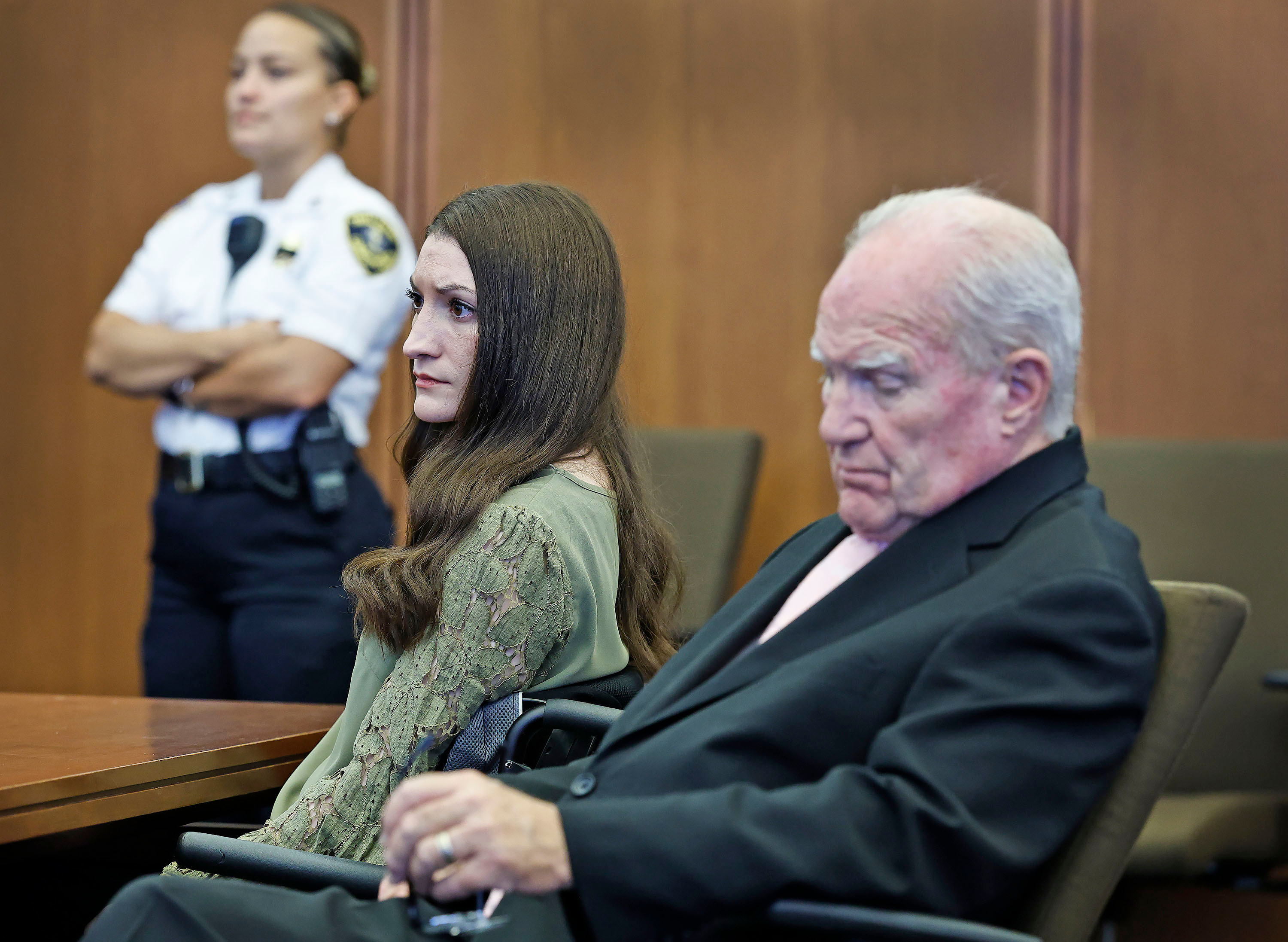
  • Lindsay Clancy’s attorney makes public plea for Trump pardon

    Lindsay Clancy’s attorney makes public plea for Trump pardon

    An attorney for Lindsay Clancy, the 36-year-old Massachusetts mother who admitted to killing her three children, said he hopes President Donald Trump would consider a pardon for his client after the high-profile murder case ended in a mistrial last week.

    “Mr. President, I would hope that you would consider this young lady, the type of person she is, what she’s been through, and consider a pardon,” Kevin Reddington said Tuesday on Good Morning America.

    The president cannot pardon state-level crimes, and Clancy’s case is being tried in state, not federal, court.

    Governors can grant clemency for state crimes; under pressure from Trump, Colorado Gov. Jared Polis (D) in May reduced the state prison sentence of former county clerk and election conspiracy theorist Tina Peters, who was convicted for a scheme to copy her county’s election computer system.

    Asked about the trial and pardon request, the White House referred the Washington Post to Trump’s comments on Friday in which he described the case as a “horrible tragedy.”

    “It’s a terrible situation. Look, she did a horrible, horrible, thing. Can’t be worse,” he said. “But you’ll find out what the price to pay is. There’ll be a price. It’s going to be mental institution or jail or something.”

    Reddington also said he hoped he would “be able to work something out that would be acceptable to both sides,” after a mistrial was declared on Friday. Prosecutors have not said whether they will seek another trial.

    Clancy’s case captured the public’s attention and became a cultural touch point, putting postpartum mental health issues in the spotlight. She had said she killed her three children by strangling them at home in 2023, and the jury was asked to decide whether she should be held legally responsible for her actions. Reddington had argued that she was suffering from postpartum psychosis at the time, which prosecutors disputed.

    The jury was dismissed after failing to reach a unanimous decision after deliberations hit nearly 40 hours following a trial that stretched more than six weeks.

  • Veterans and Democrats intensify fight against Trump’s planned arch

    Veterans and Democrats intensify fight against Trump’s planned arch

    Veterans and Democrats are escalating efforts to prevent construction on President Donald Trump’s planned arch as the anticipated start of site work approaches, arguing the project is illegal and would diminish the experience of visiting nearby Arlington National Cemetery.

    VoteVets, a political organization aligned with Democratic veterans, on Tuesday launched a new messaging campaign to mobilize more veterans against the planned 250-foot-tall arch.

    In a 2½-minute video, which was first shared with the Washington Post, speakers call attention to the Trump administration’s stated plan to spend 20 hours per day building the arch over several years, which they note could conflict with military burials. The arch also would feature an observation deck for tourists to gaze at the city — and look out at the cemetery.

    “We don’t need tourists overlooking funerals. I’m just appalled,” Karen Meredith, a Gold Star mother whose son is buried at Arlington, said in the video.

    Home of the Brave, a political advocacy group whose leaders and advisers include prominent Trump critics such as commentator Bill Kristol and former Biden administration official Susan Rice, is also supporting the campaign. In an interview, people involved in the effort said they would start with social media posts this week and could expand to paid promotion.

    Meanwhile, Rep. Chellie Pingree (D., Maine) on Tuesday urged House Speaker Mike Johnson (R., La.) to sue and halt construction before it begins. Johnson and other Republican leaders have shown no interest to date in blocking Trump’s construction projects.

    “Congress has neither appropriated funding nor granted authority for this project under the Commemorative Works Act. The Administration is building it anyway, betting this body will do nothing to stop it,” wrote Pingree, the top Democrat on a House subcommittee that oversees funding for the Interior department. “I am asking you to take all necessary steps to file suit immediately, while there is still ground left to save.”

    Trump officials, emboldened by a Supreme Court ruling last week that allowed construction of the president’s ballroom to proceed, signaled Thursday that site work on the arch would begin this month.

    The court’s decision, which found preservationists seeking to stop Trump’s planned ballroom likely lacked standing, has become part of the administration’s construction strategy. Justice Department lawyers cited the ballroom ruling in asking a federal judge to dismiss a legal challenge brought by three military veterans and a historic preservationist, who are seeking to halt the triumphal arch.

    The high court’s ruling also sent advocacy groups scrambling to reconsider how to oppose the president’s construction projects. Some say they are reassessing whether they need to have other individuals or organizations join their challenges.

    Several legal experts pushed back on the Trump administration’s efforts to invoke the Supreme Court’s ballroom ruling to dismiss the arch and other projects.

    “The Justice Department would like to turn the ballroom decision into a universal immunity card for presidential construction projects,” said Greg Werkheiser, a co-founder of Cultural Heritage Partners, a law firm that has advised preservation organizations. “But the Supreme Court decided one standing question involving one plaintiff, one project, one factual record.”

    Trump has spoken for nearly a year about his plans to build a triumphal arch that will honor the nation’s 250th anniversary, vowing that it will be the largest triumphal arch in the world — about 86 feet taller than France’s famed Arc de Triomphe. The administration plans to erect it on federal parkland in Memorial Circle, a traffic roundabout near Arlington National Cemetery and just inside the city’s boundaries.

    Interior Secretary Doug Burgum said last week that construction would soon begin.

    “We are pleased to announce that after a very long wait (over 125 years!), we are preparing to start, over the next two-week period, the excavation work necessary for the Great Triumphal Arch and Military Observation Deck,” Burgum wrote on X.

    While Burgum’s announcement catalyzed a wave of new legal filings, Trump officials have argued that it is too soon for a federal judge to decide whether the project can be halted because Trump and other officials’ statements are not binding and the project has not been formally approved. The National Capital Planning Commission, a federal review panel that reviews the administration’s construction projects, has issued preliminary approval for the arch but has yet to award final approval.

    Trump officials also said last week that the work they plan to do soon at the arch site is for informational purposes.

    “This activity is not construction, or demolition in preparation for construction, of an arch,” Justice Department lawyers wrote in a court filing Friday.

    U.S. District Judge Tanya S. Chutkan ordered that the administration provide her with 48 hours’ notice “before engaging in any activity on Memorial Circle” other than on-site information gathering.

    Preservationists have stressed that an arch does not belong in the solemn corridor between the Lincoln Memorial and Arlington National Cemetery.

    Charles Birnbaum, the founder of the Cultural Landscape Foundation, a Washington-based advocacy organization, invoked 1916 comments by Frederick Law Olmsted Jr., a landscape architect who helped design Washington.

    Olmsted said that “to build a monumental feature such as an arch would be a ‘slap in the face’ to the Lincoln Memorial,” Birnbaum said in the VoteVets video.

    Paul Eaton, a retired major general and VoteVets adviser, told the Post that he has heard from Republican veterans who are also opposed to a new structure towering over the cemetery. He called for veterans to submit comments to their lawmakers and to the National Capital Planning Commission.

    “There’s nothing partisan about what we’re doing right now. It has everything to do with how the United States honors its dead,” said Eaton, whose father’s remains are interred at the cemetery. “That’s why we are so focused on this particular vanity project on the part of Mr. Trump.”