Luxury homes in the Philadelphia area sold faster this spring than the overall market’s already fast pace, even as the minimum price to be considered a luxury sale hit a record high.
Strong demand for luxury homes is outpacing supply in the Philadelphia metropolitan area, which is helping boost prices.
The multiple listing service Bright MLS defines luxury homes as those sold for prices in the top 5% of the market. In the Philadelphia area this spring, that meant homes that sold for at least $1.15 million. Thatprice is 7.5% higher than at the same time last year, according to Bright MLS.
(function(){function e(){window.addEventListener(`message`,function(e){if(e.data[`datawrapper-height`]!==void 0){var t=document.querySelectorAll(`iframe`);for(var n in e.data[`datawrapper-height`])for(var r=0,i;i=t[r];r++)if(i.contentWindow===e.source){var a=e.data[`datawrapper-height`][n]+`px`;i.style.height=a}}})}e()})();
An ‘accelerating’ luxury market
In the Philadelphia region, the luxury market is “accelerating,” with homes selling quickly, said Lisa Sturtevant, chief economist at Bright MLS. In the second quarter of the year, half of the luxury homes for sale in the region sold in six days or less, compared to 11 days or less for homes overall.
Across the Mid-Atlantic, one-third of luxury homes sold this spring were paid for with cash. The Philadelphia area had a higher share of all-cash luxury sales — 42%. In comparison, 24% of all spring home sales in the Philadelphia region were cash sales.
Sturtevant predicts that the luxury market will continue to be more active than the rest of the market for the second half of 2026.
Main Line community and Shore town are among top luxury zip codes
Two local zip codes ranked in the 10 areas in the Mid-Atlantic with the highest shares of luxury home sales this spring, according to Bright MLS.
In the Wayne area’s 19087 zip code, 37 of 88 home sales classified as luxury sales — roughly two in five sales.
Down the Shore in Long Beach Island’s 08008 zip code, 34 of 36 home sales were luxury sales.
Demand for luxury
Luxury home buyers are less deterred by elevated mortgage interest rates and rising prices than entry-level and mid-market buyers. And gains in the stock market have helped boost luxury buyers’ purchasing power and demand for homes.
The number of new pending luxury sales rose in the second quarter of the year in the Philadelphia region. They were up roughly 9% from the same time last year to a total of 1,056.
More luxury homeowners in the Philadelphia area listed their homes for sale in the second quarter of the year than during the same time last year. The number of new luxury listings — 1,647 — increased by about 4%.
But the Philadelphia region doesn’t have enough luxury homes for sale to meet the demand from buyers. The number of active luxury listings — 1,102 — was down almost 5% at the end of the second quarter compared to the same time last year.
The number of closed luxury sales this spring — 889 — was relatively flat from the same time last year. Sales ticked up 0.5%.
The number of sales would be higher if more luxury homes were on the market, Sturtevant said.
“Unlike the entry-level and mid-market homeowners, luxury homeowners are not as likely to need to move in response to changing family or financial circumstances,” she said in a statement. “And right now, luxury homeowners, by and large, are not exercising their discretion to sell.”
A stalled market for starter homes
While luxury homes sold quickly and at a premium this spring, at the other end of the housing market, starter homes lingered.
In June, the number of starter homes for sale in the Philadelphia area was up 14% from the same time last year, according to an analysis by Zillow. And sellers cut prices in a quarter of these listings that month.
The number of starter homes sold in May was down almost 7% from the year before.
Zillow considers starter homes to be those in the 5th to 35th percentile of home values.
Buyers of these homes have more choices than last year, since supply is up, said Kara Ng, senior economist at Zillow. But these buyers are also facing “financial pressures” that make saving for a down payment and taking advantage of opportunities more difficult.
A boom in state policies legalizing backyard housing construction is allowing some families to build multigenerational compounds for grandparents, parents, and grandchildren to all live together on the same property.
Twenty-four states have passed laws meant to enable construction of “accessory dwelling units,” or ADUs: separate housing units attached to or located nearby existing homes. The ADUs might be converted basements, over-the-garage apartments or, frequently, small homes built in backyards. In the past two years alone, 11 states have passed laws allowing ADUs at any single-family home, according to New York University’s Furman Center, plus many more state and local laws are meant to reduce barriers to ADU construction.
Pennsylvania lawmakers are currently considering legislation that would allow homeowners to create ADUs in places that are zoned for single-family houses without having to get special permission. The bill passed the state House in June and is now before a state Senate committee.
While many ADUs are used as rental housing, it’s nearly as common to use ADUs for multigenerational living — often elderly parents moving into their own small home on their adult children’s property, or adult children living in their parents’ yard or above a parents’ garage instead of moving away.
California has led the charge on legalizing ADUs, passing a string of laws over the past decade. Several surveys in the state consistently show that about 3 in 10 ADU owners have a family member living in the unit, while about 4 in 10 rent them to strangers.
As soon as Massachusetts moved to prevent cities from restricting ADUs in 2024, Joel and Oreon Mode — who live on the outskirts of Boston — pitched the idea of building one to their son Carter and his wife, Zoe. What if the Modes built a 900-square-foot house in their backyard and moved into the new home, then sold the big house where Carter had grown up to Carter and Zoe at a steep discount?
The Modes would have a single-story place as they got older, instead of their current home where they have to go upstairs to their bedroom. Their 33-year-old son, who had just had a baby, would get to move out of his nearby apartment into a single-family home at a price he could afford. And the Modes would have more time with their granddaughter.
“Our home … would have gone on the market for about $1 million, which is stupid. It’s just idiotic,” Joel, 67, a special-education teacher, said in an interview. “Selfishly, we’ve got this lovely little granddaughter who we’re gaga over, and we’re very close with Carter and Zoe, and we didn’t like the idea that they would be two hours away,” where they would need to go far from Boston to find a home they could afford.
Carter and Zoe eagerly agreed. The family all share a property now in Sudbury, Mass. Oreon, 67, recently retired from her job as a project manager and has time to care for her granddaughter, which means Carter and Zoe don’t pay for daycare either. “I’ve had my friends go: ‘Aren’t you going to get on each other’s nerves?’” Oreon said. “Yeah, probably, but that’s family. That’s what family does.”
Christopher Lee, the lead designer at the company that built the Modes’ new backyard home, said his firm’s homes cost between $200,000 and $600,000 to build, with most running about $300,000 for a two-bedroom house.
“When we started, it was almost all aging parents moving into people’s backyards,” he said. Lately, he’s started seeing more instances where the younger generation is living in the ADU, often people who were priced out of buying a house when prices surged during the pandemic.
“We’re starting to see people using ADUs as starter homes,” Lee said. “We’ve done a handful now where it’s adult children moving into their parents’ backyard and they’re building a house for them and maybe a spouse and firstborn child. … There’s been some level of acceptance that high prices are here to stay. People are moving on.”
Dohyung Kim, an urban planning professor at Cal Poly Pomona, pointed out that ADUs have been marketed as multigenerational housing long before the recent boom in policies aimed at using these small homes to ease the nationwide housing crunch. After all, the additions have long been called “granny flats” or “mother-in-law suites,” implying relatives moving in. (The homebuilder Lennar, which declined to comment for this piece, calls theirs “next gen,” in a nod toward adult children living at their parents’ homes.)
Zoning rules that only permit one house on a lot made it illegal to build ADUs in much of America for decades, Kim said, and still exist. Often, he said, the towns that passed those rules object to the idea of the ADUs being used as rental housing as opposed to for family members.
“Many people build ADUs and use it as a granny flat. But at the same time, many people built ADUs and rented it out,” Kim said. “The tenants used to be more likely to be low-income people of color. Historically, many cities did not want to see that happen.”
Lindsey Fitzgerald, a sales representative for Coca-Cola, moved into an ADU on her mother’s property in Billerica, Mass., with her boyfriend and child. “When I got pregnant, my mom told us that she would be our childcare while we worked. This made all the sense to build this ADU,” she said. “It’s the cheapest way to build or buy a house right now. The market is so crazy that this is what made sense for our family.”
Fitzgerald said that she can look right through her window into her mom’s house; her toddler son delights in going between the two homes. “As my mom gets older, then I’m also here for her to help her,” she added.
Fitzgerald’s mother, Linda Dahl, was already used to having something of a family compound: Dahl’s sister lives in the other half of her split-level home, and her adult son lives with her in the main house.
Dahl said, with a laugh, that her son wants her to put another ADU in her yard so that he can live there instead. “I probably could.”
Contractor David Giacomin, who works in Maryland, said that nine times out of 10, when he builds ADUs the owner is planning for family to live in them — usually elderly parents, or sometimes adult children. Giacomin used to own a Maryland yoga studio, but he started casting about at age 50 for a new business idea when it shut down during the pandemic.
His business has boomed thanks to a state law requiring all localities to permit ADUs by this fall, including in Rockville and Gaithersburg, cities that formerly banned most ADUs. But other requirements, like mandates to install fire-suppression sprinklers, make it much more costly to build them than he thinks it has to be — and most homeowners struggle to get a mortgage to build one.
“If you put a pencil to it, you’d have to charge so much to get your money back in a reasonable time, that it just doesn’t make sense to have it as a rental,” Giacomin said. He thinks that’s why he’s mostly building for families.
One of his clients, Anne Lao, plans to move into one on her daughter’s property in Silver Spring, Md., next month. Lao and her husband moved from California to live just 10 minutes away from their daughter, but since the death of Lao’s husband, Lao’s daughter encouraged her to be even closer. Lao, 70, wasn’t thrilled at the idea of living in an addition, but she agreed to live in a unit at the end of the driveway, where a detached garage used to be.
“When I’m getting older, and if I need help, it’s just very convenient to be right next to them,” Lao said. “It just gives you a little bit more privacy and independence. They have their privacy also.”
She looks forward to seeing her 9- and 10-year-old grandchildren nonstop. “I’m sure I’m going to have visitors every day.”
The rise in ADUs has opened some people up to the idea who might not have considered intergenerational living before, said Wayne State University urban planning professor Kami Pothukuchi.
“For immigrant groups that have a tradition of living in intergenerational households, where older parents will live with their adult married daughters or sons and their families, that has been common and is still common and really has nothing to do with ADUs,” Pothukuchi said. “But where ADUs are legal — that is certainly something that you’re seeing a lot more, within American families that don’t have this as their immediate tradition of living intergenerationally.”
It’s hard to quantify just how common these family compounds are, she said, because so many ADUs, such as basements and garages, are converted into separate living spaces without permits. “If it’s unpermitted, it’s not counted.”
Because some ADUs are counted as part of the main house and some are counted as their own household in the U.S. Census, it’s hard to parse out a trend in multigenerational households in federal data.
David Garcia, who works on housing policy at Berkeley’s Terner Center for Housing Innovation, said he hopes future research will provide greater clarity.
“Part of the challenge with ADUs is we want them to do a lot of things,“ he said. ”We want them to stabilize families. We want them to create more housing stock. But it’s hard for us to know exactly how much of those goals ADUs are fulfilling without better data.”
Inquirer staff writer Michaelle Bond contributed to this article.
The companyhas long styled itself as a socially conscious real estate developer, rebuilding long-vacant buildings into thriving mixed-use properties in a neighborhood challenged by poverty and addiction.
Now 14 years after the company’s formation, it is seeking to sell its cornerstone developments in the neighborhood.
That includes its Harrowgate flagship, the 116-unit building at 3400 J St. known as J-centrel, which is home to the renowned Vietnamese bakery and cafe Càphê Roasters.
Kensington Corridor Trust, a nonprofit that Shift helped found, plans to purchase that property for $18 million, although it needs to raise $1.5 million more by the end of August to close on the deal.
The organization is a neighborhood trust with the mission of acquiring properties on Kensington Avenue and placing them under community control — via a nonprofit board — to preserve affordability. Currently, most of the trust’s properties are storefronts and much smaller than J-centrel.
“We’re excited to hand the responsibility of creating a healthy, safe neighborhood to the next group to continue the work that we’ve been doing,” said Brian Murray, CEO of Shift Capital. “It’s an exciting moment of transition to the next generation of people … who want to see Kensington be what it could be.”
Murray says the properties Shift wants to sell represent 30% of their properties in the city.
They are in talks with potential buyers for the old industrial building at 3775 Kensington Ave., and the artist studios, office space, and light manufacturing at 3525 I St. (MaKen Studios North) and 3401 I St. (MaKen Studios South).
Murray emphasizes that Shift will retain a presence in Kensington. Their offices will remain in J-centrel, and they are still working on the Càphê Roasters expansion across the street at 3419-23 Kensington Ave.
He says a sale of this kind has always been part of the plan. The investors who backed these developments in Kensington are nearing the end of their time with the fund, and Shift is not currently planning to recapitalize with new partners.
“Our world is limited to capital that needs to be returned,” he said. “They can be as mission-driven as they would like, but that still is a limitation of the role that we can play in revitalizing and preserving neighborhoods.”
That’s why Murray wants to sell to Kensington Corridor Trust, which Shift helped found in 2019 (although it exited the organization’s board in 2021).
Kensington Corridor Trust owns 32 properties along the avenue, although none is close to the size of J-centrel. In preparation for the purchase, the trust has hired more staff, including a new property manager and a full-time maintenance person who used to be with Shift.
“Shift Capital’s J-centrel property will be our single largest acquisition to date in terms of square footage, units, and cost,” said Adriana Abizadeh-Barbour, executive director of Kensington Corridor Trust.
Abizadeh-Barbour said the trust raised a half-million dollars in early August, and she is confident it can get the $1.5 million needed before the end of the month.
The funds raised so far include $1 million from individual donations, $1 million from the City of Philadelphia, $3 million from foundations, $3 million from investment funds, and $10 million from Community Development Financial Institution, which specifically invests in low-income areas.
“We have a strong base of supporters who believe in community control and neighborhood power, and we’re excited to bring this under community ownership,” Abizadeh-Barbour said.
The trust plans to make the apartments more affordable as higher income tenants move out of the building, with the goal of targeting the units to those at 60% of area median income, or roughly $50,000 for a one-person household.
As forShift, the company has other big plans in Philadelphia. Earlier this year it announced a partnership with Temple University over a long delayed development proposal near Amtrak’s North Philadelphia station, near Broad Street and Indiana Avenue.
And although lenders backed away from the firm’s redevelopment of the historic Beury building at 3701 N. Broad St. in 2024 amid an increasingly difficult development environment, Murray says they “are still actively working on” the property.
“The Kensington Corridor Trust [sale] is an exciting mission exit that we’ve been working on almost from the beginning of our work,” Murray said. “This was always a prescripted game plan to create an entity that was community controlled that could be a steward of assets in the neighborhood long term.”
Philadelphia’s fiscal watchdog said this week that a recent city review identifying thousands of property owners cashing in on tax relief programs they are ineligible for may have only scratched the surface of the problem.
In a report released Wednesday, City Controller Christy Brady said investigators in her office had identified about 58,000 properties that are receiving the city’s popular homestead exemption tax break and may not be eligible.
That is far more than the 22,000 properties that Mayor Cherelle L. Parker’s administration reviewed in a two-year probe that officials said last week led to more than 13,000 property owners being kicked off tax relief programs in which they were fraudulently enrolled. The Philadelphia Department of Revenue said those owners will be charged back taxes totaling about $30 million in additional property tax revenue for the city and the cash-strapped Philadelphia School District.
But Brady’s report suggests the city could recover millions more in owed tax revenue. Her report says the city should review an additional 36,000 properties, an investigation that could double the money the city is owed annually to $60 million.
“Over a five-year budget, that’s a remarkable $300 million for our schools and vital city services,” Brady said in a news release.
Christian Crespo, a spokesperson for the revenue department, said in a statement that the agency’s tax benefit review unit conducts continuous compliance reviews to identify potentially ineligible properties.
Crespo cautioned that the controller identified thousands of properties with “potential risk factors,” which do not alone establish that a homeowner does not qualify for a tax exemption.
He said more than 8,000 exemptions in the administration’s initial review were deemed legitimate, meaning “a homeowner can have an indicator of potential fraud and still be eligible.”
“Revenue appreciates the Controller’s continued focus on program integrity and welcomes the opportunity to review the findings presented in the report,” he said.
The city’s homestead exemption is by far the most popular tax break offered. The free program allows for property owners who live in their homes to deduct the first $100,000 from their property’s assessed value, saving homeowners up to $1,400 a year.
About 250,000 property owners receive the exemption, for which residents must enroll to take part. Investigators in the city controller’s office found that more than one in five participants may not be eligible, including some with mailing addresses differing from the address of the property receiving the tax break.
The review identified properties with other red flags, including more than 8,000 property owners receiving the exemption whose mailing addresses are listed as outside Philadelphia.
Some were even more brazen: For example, 67 properties legally deemed vacant were receiving the exemption, totaling nearly $100,000 in annual lost revenue, Brady’s office said. In another case, one business owner received an exemption on 15 different residential properties.
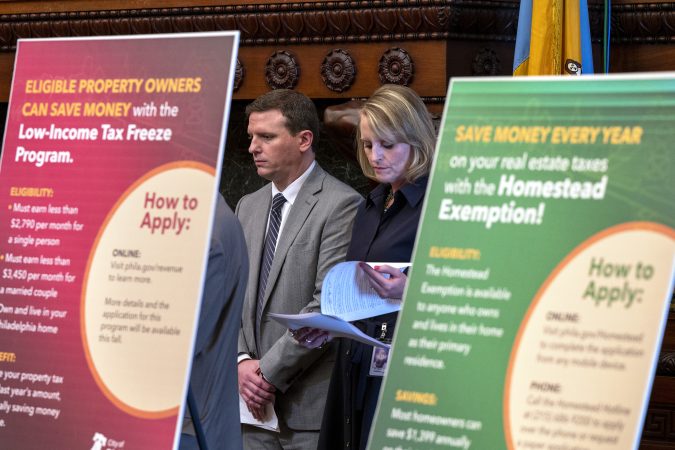
James Aros, Jr. (left), Chief Assessment Officer at the Office of Property Assessment, and Revenue Commissioner Kathleen McColgan (right) attend a Mayor Cherelle L. Parker press conference at City Hall on Monday Aug. 5, 2024, as her office prepares to release the first citywide real estate reassessment in two years.Tom Gralish / Staff Photographer
Parker administration officials have said that recovering lost revenue is a priority, especially given the school district’s financial position. The public school system is facing a $300 million structural deficit and the school board recently voted to close 17 schools.
The district is the only one in Pennsylvania that cannot legally increase taxes to generate revenue. Property tax revenue in the city is split, with 56% going to the school district and the remainder into the city’s accounts.
The current property tax rate is 1.3998% of assessed value.
Homeowners who were removed from the homestead exemption program as part of the city’s review were mailed two notices and provided an opportunity to produce evidence of their eligibility. They may still appeal the decision.
West Oak Lane tenants who sued one of Philadelphia’s biggest landlords over unsafe conditions will get rent forgiveness and refunds if their class-action settlement is approved.
According to the settlement, which was preliminarily approved in Philadelphia’s Common Pleas Court this week, Philadelphia-based Odin Properties and affiliated companies have agreed to forgive an estimated total of $67,000 in unpaid rent and associated late fees, and to refunda total of $75,000 for roughly 70 tenants of the Bentley Manor apartment building.
Philadelphia law prohibits landlords from collecting rent if they have a serious violation from the city’s Department of Licenses and Inspections that has been outstanding for at least30 days from when they received notice.
In November 2024, the department declared the 71-unit Bentley Manor apartment building in West Oak Lane unsafe, saying property conditions presented an “immediate danger or hazard to health, safety, and welfare.” The agency cited loose and missing bricks on exterior walls and a leaning parapet.
Tenants are entitled to rent relief and refunds for the time period of Dec. 14, 2024, through April 28, 2025, according to the settlement.
The agreementprovides for the largest known per-tenant award in a class-action lawsuit under Philadelphia’s rental license and certificate law, according to the Philadelphia-based nonprofit Public Interest Law Center and the Philadelphia-based Hausfeld law firm, which sued on behalf of Bentley Manor tenants in March 2025.
“A settlement was possible because Odin took real steps — on its own — to comply with Philadelphia law,” Madison Gray, staff attorney at the Public Interest Law Center, said in a statement. “All landlords should follow suit.”
Odin Properties’ affiliate companies own and manage roughly 2,000 housing units in Philadelphia.
Soon after Bentley Manor tenants sued in March 2025, Odin Properties made necessary safety repairs at the building. Fernrock Apartments 2 LP, an affiliate of Odin Properties that owned Bentley Manor during the time period covered by the settlement, sold the apartment building for more than $6.2 million in December, according to city records.
“Our residents are incredibly important to us and have been since our founding,” Philip Balderston, CEO of Odin Properties, said in a statement. “All of our properties are free and clear of City of Philadelphia violations and current on licensure, and we look forward to being positive catalysts for our communities long into the future.”
Dawn Colbourne, one of three named plaintiffs in the class-action lawsuit against Odin Properties, moved into Bentley Manor in 2023.
“We all deserve a safe place to live, no matter who we are,” Colbourne said in a statement. “This agreement is a step forward in making sure that happens, and I’m glad that we’re taking this step together.”
The settlement agreement still needs final court approval. Between now and a court hearing scheduled for Oct. 26, the roughly 70 people who are eligible for rent relief — including two former tenants — will be notified about the preliminary settlement and given the opportunity to object to the agreement or ask to be excluded from it.
Will Hanna, an associate at Hausfeld, said in a statement that the law firm is “proud of the settlement reached in this case and believe this will provide meaningful results for Philadelphians.”
More than a dozen Philadelphia-area contractors have sued apartment developer Post Brothers, alleging the company failed to fully pay for all the work they did.
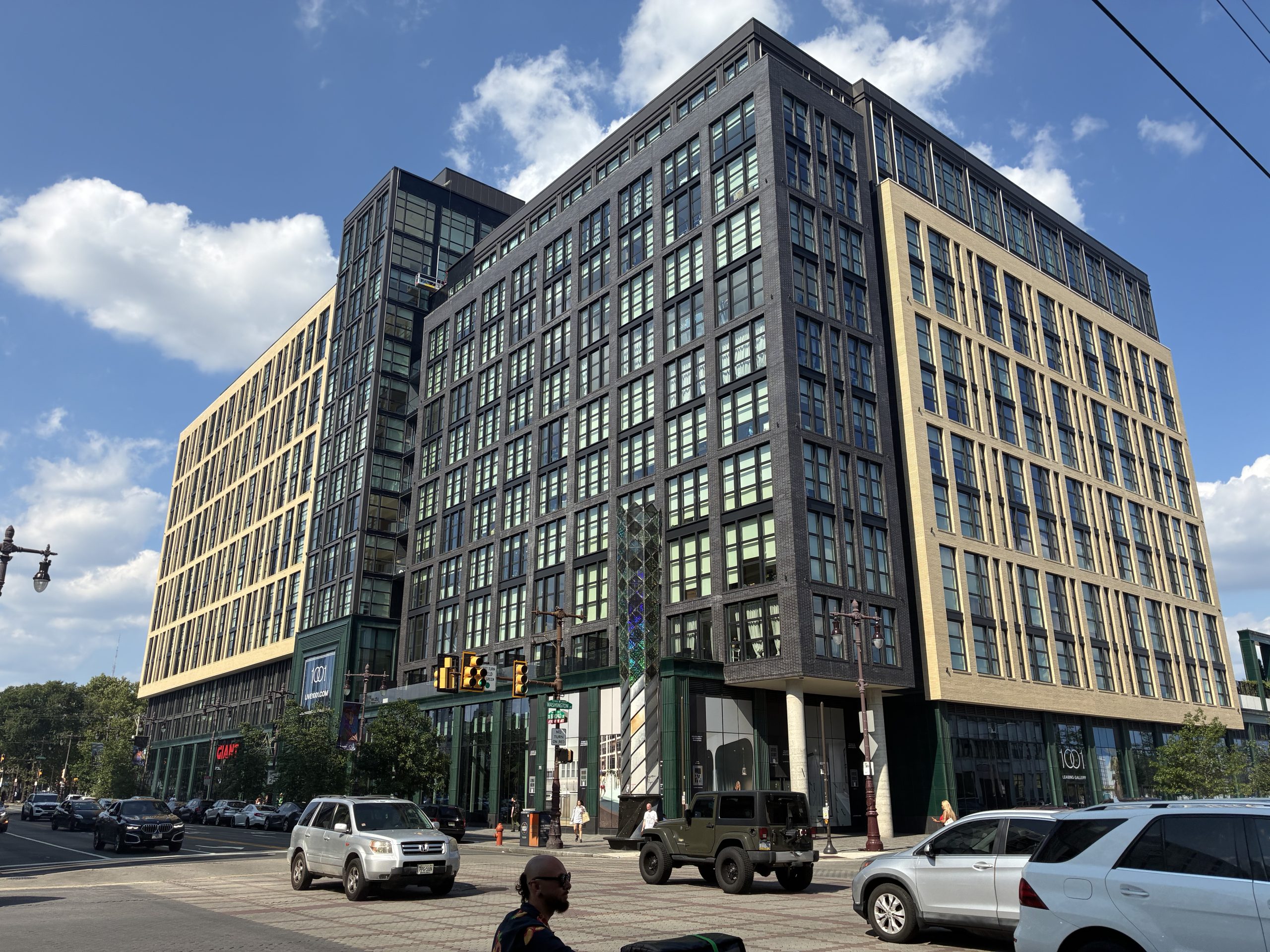
In state and federal courts, the building and professional-services contractors, most of them affiliated with the city’s carpentersunion, allege Post Brothers owes more than $9million for work at the 630-unit One Thousand One apartment complex at Broad Street and Washington Avenue in South Philadelphia.
“The Post Brothers want to take a Donald Trump business model where they don’t want to pay their contractors,” said James Hocker, assistant executive secretary-treasurer of the Eastern Atlantic States Regional Council of Carpenters.
One of the contractors, Healy Long & Jevin, a concrete construction company based in Wilmington, allegesthe Post Brothers mismanaged the project at Broad and Washington and should pay an additional $14 million.
Post Brothers alleges it’s Healy that should pay them a larger sum — for poor performance. Healy’s lawyers did not respond to a request for comment.
Doylestown-based Apollo Contractors and other smaller contractors filed the next-largest claim, for $5.8 million.
According to Apollo’s complaint, the developer “doesn’t have adequate funds because the owners” used company funds “for their own personal benefit and expenses.” Healy has made similar claims.
Post Brothers in court papers called the union contractors’ lawsuits “without merit.” The development company argues that the conflict is about who should bear the costs of inflation.
“Subcontractors who agreed to a price in 2022 experienced 30% inflation probably throughout the course of the project,” which is wrapping up this year, said Michael Pestronk, CEO of the Post Brothers, who runs the company with his brother Matthew.
But “the way that contracts work, our financing works, we pay lump sums for agreed scopes of work,” Pestronk said. “It’s up to the subcontractors to fix their costs and allow for that.”
He also says the fraud allegations are baseless and just an example of contractors “throwing [stuff] at the wall” to see what sticks.
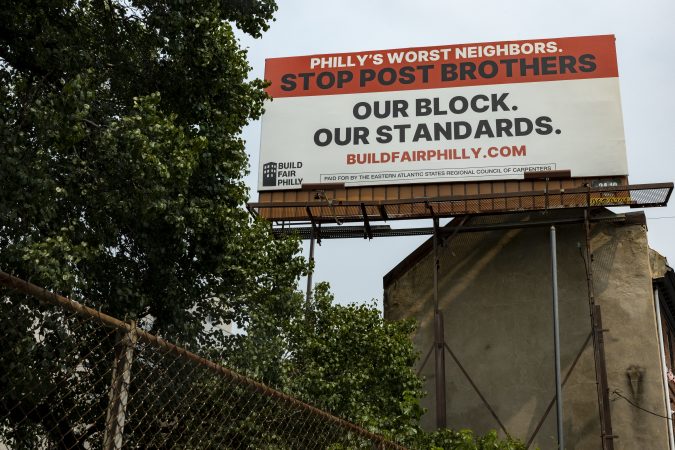
The carpenters have launched a pressure campaign against Post Brothers, including nine billboards denouncing the company along Philadelphia’s highways.They say contractors at the Broad and Washington site had to pay union members and contribute to health and pension funds, despite not being fully remunerated.
“That’s why they’re fighting hard to get what is owed to them because they have a lot of money on the street, and it’s jeopardizing their business,” Hocker said. “But they made their employees whole.”
Post Brothers has made a counterclaim against Healy, accusing the concrete contractor of “false billing” and other violations. A judge rejected a motion from union-aligned Healyto dismiss the developer’s counterclaim.
Pestronk says the legal saga is a manifestation of high interest rates and inflation in the construction market. Multifamily residential construction outside the city’s wealthiest neighborhoods has slowed dramatically. Office construction has ceased, and industrial sites do not require as many building trades.
“Subcontractors and general contractors are feeling much more hungry today than two years ago,” Pestronk said. “Their pipelines are totally dry.”
The Post Brothers development at Broad Street and Washington Avenue, which is at the heart of the conflict with the carpenters union.Jake Blumgart
What’s in dispute
One of the largest dollar-value claims againstPost Brothers is a joint demand for $5.8 million from a group of businesses, led byApollo Contractors, a carpentry, drywall, and finishing firm, and Fluid Works, a plumbing contractor, based at the same Doylestown address.
Apollo and Fluid are owned by members of the Sharpan family, who are also partners with the Pestronks in another business, Mega Supply in Bensalem. The Sharpans are separately suing the Pestronks over money they say the Pestronks owe Mega Supply.
The Apollo-Fluid Works complaint, filed in Philadelphia Common Pleas Court last August, was the first to include fraud allegations.
Apollo says that the Pestronks paid Apollo to improve “their respective private residences” even as they owed millions to the contractors for work in Philadelphia, according to Apollo’s complaint. Attached to the suit are invoices for more than $200,000 worth of carpentry, painting, tile and drywall work that Post Brothers paid Apollo to perform at Michael Pestronk’s Eagle Farm in Villanova in 2021 and 2022.
The groundbreaking for the Broad and Washington project was in December 2021.
The Apollocomplaint alleges that Post Brothers knew they didn’t have enough money to pay for the work but didn’t tell the contractors until the work was done.
Early in July, Healy amended its federal complaint, pending before Judge Michael Baylson, to add similar claims. The Post Brothers denies those allegations and says the contractors have not offered detailed support for the allegations.
“They are preposterous,” Pestronk said.
Healy also demanded Post pay an additional $14 million for “mismanagement” at the Broad and Washington site that made the work difficult to complete and unprofitable. Post filed a counterclaim blaming Healy for “defective performance” that cost the developer $17 million. Each has asked the judge to dismiss the other’s allegations beyond the original complaint.
Other lawsuits asked sums well under $1 million. Some have been in settlement talks; others are slated for trial.
Post Brothers’ history with unions
In addition to the nine billboards condemning the Post Brothers, the carpenters union hasan electronic messaging truck attacking the company rolling around the city.
The carpenters union’s electronic messaging truck outside City Hall, denouncing the Post Brothers.Eastern Atlantic States Regional Council of Carpenters
The clash is the latest conflict between building trades unions and the company, which has always used an “open shop” mix of union-and-unorganized workers on their job sites.
In 2012, the Pestronks sought to redevelop a former textile mill at 12th and Wood Streetsinto a 164-unit apartment complex called the Goldtex building, using an open shop model.
The Philadelphia Building Trades Council, an umbrella group that covers many of the construction unions,fought for 100% union representation on the site.
Union workers blocked access to the site — sometimes bringing construction to a standstill — and the Philadelphia sheriff’s office had to enforce a court order that protests stay backfrom the building. Violent tactics by protesters were caught on video.
Relationships between the Post Brothers and the building trades have never been that contentious since, althoughthey’ve never been tension-free either. The company still uses a mix of organized and nonunion labor.
“We worked very hard to develop a relationship with Post Brothers over the last 10 to 15 years,” said Hocker of the Eastern Atlantic States Regional Council of Carpenters. “There was some bad blood [but] … we were able to secure some work on some of the Post Brothers’ work, specifically around concrete.”
According to both the carpenters and the Post Brothers, the project at Broad and Washington employed greater numbers of union workers than some of their other major projects recently, such as Piazza Alta in Northern Liberties.
“We were trying to play nice with the unions, and we made a commitment to hire these contractors at frankly greater expense than we otherwise would have incurred to try to foster relationships,” Michael Pestronk said. “And it turned out not to have gone well.”
Besides the billboards and messaging truck, there have been periodic pickets at Broad and Washington, but according to Pestronk, nothing remotely comparable to the protests over the Goldtex building years ago.
The carpenters are not a part of the Philadelphia Building Trades Council or the Philadelphia AFL-CIO. Other unions have not joined the campaign against Post Brothers, although the carpenters say they have invited them to partake.
The union also has released a larger campaign,Build Fair Philly, meant to highlight what they consider unscrupulous development in the city. The billboards critical of Post Brothers bear the larger effort’s emblem. They also are trying to build alliances with neighborhood groups.
“Post’s practices ultimately affect the whole market, and we welcome anyone who wants to be part of holding developers accountable,” Hocker said.
Pestronk shrugs off the conflict. He notes that the Post Brothers continue to build in Philadelphia and says the current conflict does not compare to his company’s earlier struggles with the trades.
“When that was going on, that was something I spent a lot of time thinking about and figuring out what to do every day,” Pestronk said. “This is less than 1% of that. These are just some [nonsense] lawsuits that just go on in the normal course of business.”
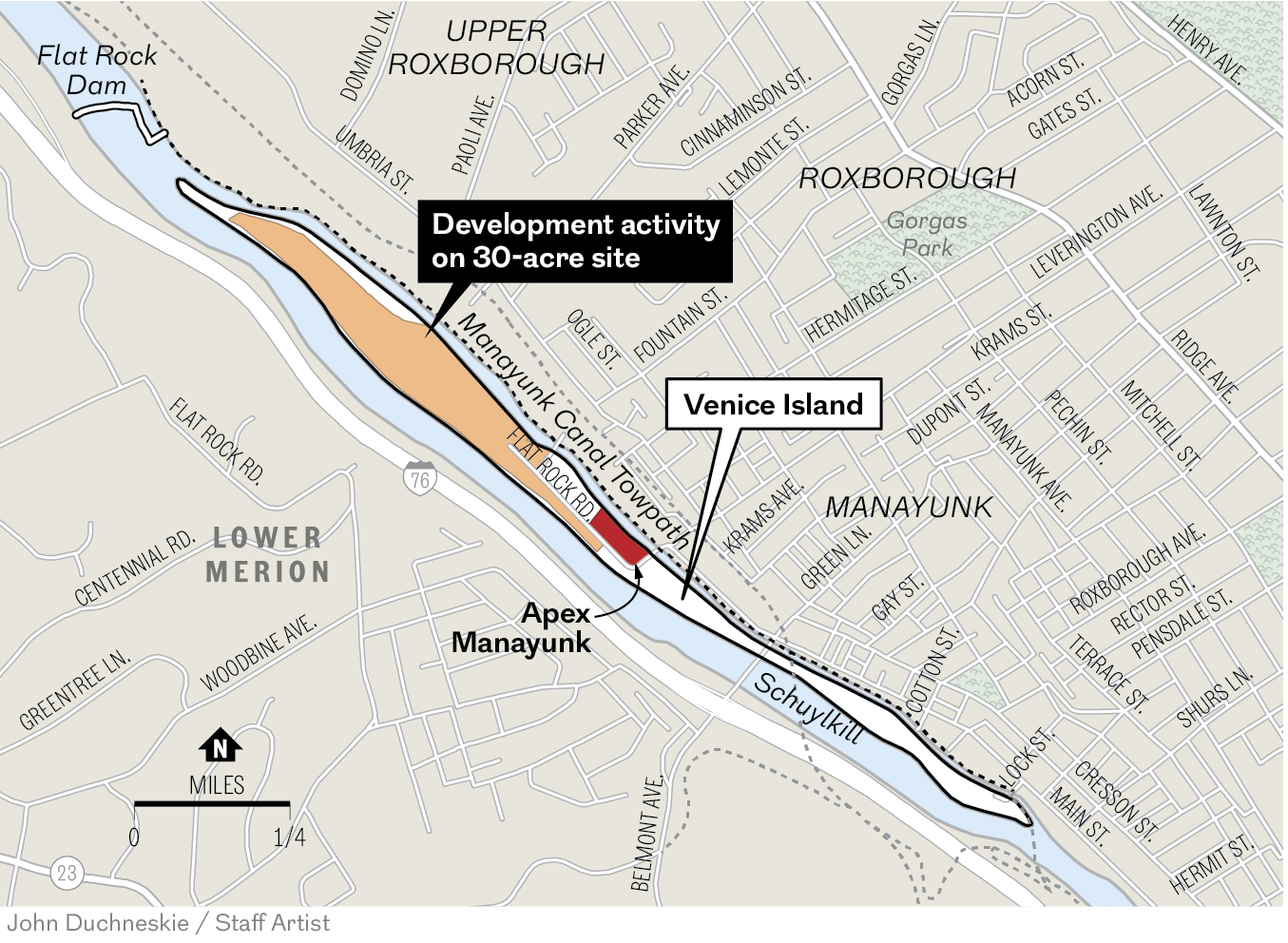
A developer is planning to build 807 housing units on 30 acres of Manayunk’s Venice Island, bringing an end toyears of questions by residents about what would become of the land.
Manayunk Renaissance LLC told members of local neighborhood groups about the plan during an informal meeting Wednesday. Councilmember Curtis Jones Jr., who represents Manayunk, also attended.
The company confirmed the plans to The Inquirer on Thursday.
“Venice Island is one of the most unique areas in Philadelphia, with water views on both sides, proximity to trails and outdoor space, and easy access to both SEPTA and I-76, all within walking distance of one of Philadelphia’s great neighborhoods — Manayunk,” Hercules W. Grigos, an attorney for the company, said in a statement.
The meeting with community leaders was meant to solicitfeedback on the project, which is on the former PaperWorks mill site. Neighborhood input would then be used to “refine the proposal,” Grigos said.
Manayunk Renaissance LLC said in a statement that it plans to build multiple types of housing at what it calls The Flat Rock at Venice Island. The proposal includes 159 townhouses, 126 duplexes (with 252 units), and 396 apartments.
John Hunter, an architect and zoning chair of the Manayunk Neighborhood Council, who attended the briefing, has long argued at community meetings against more waterfront housing because he’s concerned about flooding and overdevelopment.
“It’s unfortunate. It follows a trend,” Hunter said of the plan. “It’s more suburbanization of Manayunk, more residential. There’s no commercial there; it’s not balanced.”
The company noted that it would be the fifth residential project on Venice Island, although it would still require a zoning change.
Flat Rockwould also be its largest development, by far.
Apex Manayunk has about 128 units, the Locks has 60 townhouses, and the Isle has roughly 160 apartments. A 181-unit project is also planned by Rock Urban Development, a scaled down version of an earlier proposal.
Where would the new housing be built?
The 30-acre site at 5000 Flat Rock Rd. lies on the northwestern side of the island. Manayunk Renaissance LLC purchased the property in 2021 for $23 million, according to city records. The property takes up about 45% of the island’s land mass.
Some area residents had been hoping for either open space or less dense development with commercial uses mixed in.
The developer plans 500 parking spaces for the 800 proposed residential units, according to Hunter. That would fall short of the typical one-to-one standard in Manayunk, he noted.
Manayunk Renaissance LLC did not respond to a question about the parking.
It was not immediately clear who is backing Manayunk Renaissance LLC. The company shares an address with A.P. Construction, a South Jersey-based construction company, with an office at the Navy Yard.
A.P. Construction boasts a portfolio of big projects in the region, including work on bridges, stadiums, and the Manayunk Bridge Connector Trail and Park.
Hunter said the developer told residents at Wednesday’s meeting that Philadelphia-based Varenhorst would be the architect. The company also designed the Locks, an earlier residential project on the island.
Map of planned development on a 30-acre site on Venice Island in Manayunk.John Duchneskie
Flooding concerns
Hunter said residents are particularly concerned about flooding. Hurricane Ida in 2021 hit Manayunk hard and inundated some of the buildings on the island.
Hunter and others fear more building will leave Venice Island residents trapped in another big storm, while contributing to even more flooding as runoff flows into the river and canal.
The 5000 Flat Rock Rd. property lies just below the Flat Rock Dam.
Venice Island, one of the lowest-lying areas of the city, is a narrow wedge of land, just shy of 70 acres and roughly 1.7 miles long between the Schuylkill River and Manayunk Canal.
In September 2021, as Manayunk experienced flooding from Hurricane Ida, people take in the view from Rector Street of the fast running water at the canal that runs along Main Street and feeds into Schuylkill River.ALEJANDRO A. ALVAREZ / Staff Photographer
In a statement — also shared with neighbors — Manayunk Renaissance LLC said it had hauled in 400,000 cubic yards of soil to raise the site between 9 and 11 feet, bringing it at least 18 inches above flood elevation.
The company said it had approvals from FEMA, the Pennsylvania Department of Environmental Protection, and the Philadelphia Water Department for the new grading and height.
Manayunk Renaissance also said it razed a dilapidated 512,000-square-foot mill building and is working to clean up lead and asbestos.
Manayunk Renaissance said in its statement that it is finalizing an agreement with SEPTA to create an emergency exit fromthe island via Umbria Street, where the Ivy Ridge railway station is. The company said it would pay all construction costs.
Hunter said he and others were told during the meeting that the route includes building a bridge over the canal that leads to an on-grade crossing at the railway equipped with three gates. That new road would be reserved for emergencies.
Zoning is an issue
The property is zoned for industrial uses, so the developer would either need City Council to change the land use rules legislatively or seek relief from the Zoning Board of Adjustment.
“After five-plus years of work and planning, Manayunk Renaissance is ready to present its vision to the community and seek city approval to change the zoning,” the company statement said.
Community support would be a boon for the developer in either case. Having the backing of neighborhood groups is often a positive factor at the zoning board and could sway Councilmember Jones if they go the legislative route.
The company argues that the existing zoning allows warehouses, data centers, and other projects that “would be inconsistent with the community’s direction.”
Thousands of homeowners in Philadelphia are not enrolled in city programs like the homestead exemption and the Longtime Owner Occupants Program (LOOP) established to help ease the burden of rising real estate taxes.
“I surround myself with good people, but not everyone is aware of these [tax relief] programs,” said Edgar Ponce, 26, who recently purchased his home in Kensington, one of the neighborhoods where property assessments rose the most.
story continues after advertisement
The Philadelphia Office of Property Assessment conducts reassessments of property values every other year. From 2025 to 2027, properties citywide rose 3%, with certain neighborhoods seeing increases upward of 15%.
Four areas in Philly that saw the largest percentage increases in median assessments were Kensington,Mantua, Grays Ferry, andKingsessing. Each neighborhood borders more gentrified neighborhoods, likeFishtown,University City, andPoint Breeze. While tax revenue helps fund city services like the school district, parks, and the police department, shelling out a few hundred dollars more each year can be costly for some families. Several city-run relief programs, however, can help eligible homeowners save hundreds or thousands of dollars.
“Every time I apply to some type of program, there is always a catch,” said Ponce, who has yet to apply for the homestead exemption. The city could do more to inform people and build trust, he said.
While Philadelphia does conduct outreach, including canvassing, mailers, texts, TV and radio ads, and community events, those efforts do not reach everyone. If you, like Ponce, both own and reside in your home in Philadelphia and want to know what tax relief programs are available to you, The Inquirer is here to help.
We created a tool based on city property data to figure out what tax relief programs Philadelphia homeowners are eligible for. Complete the survey below to see what assistance you can apply for and how much you would save on your real estate taxes.
story continues after advertisement
What is your home address?
Philadelphia primary residential addresses only
Have you lived there for more than 10 years?
Do you live in this property as your primary residence?
Do you meet any of these descriptions?
1. You are aged 65 years or older
2. You are living with a spouse who is aged 65 years or older
3. You are aged 50 years or older, and a widow of someone who reached the age of 65 before passing away
What’s your annual salary? Or if married, what's your combined annual salary?
If anyone else lives in the house, what’s their combined annual salaries?
What is your family size?
Nope! It appears you’re maximizing your savings.
Yes! You may be missing out.
Maybe! You might be able to save more.
To apply for any program, you’ll need your OPA account number. Your number for location is parcel_number.
It appears you’re enrolled in the homestead exemption already, according to July 2026 data, and would not be eligible for other programs this year. In 2027, the homestead exemption will save you: homestead_savings. You should not have to reapply to get the savings unless your property deed was transferred or a co-owner was added.
It appears you are not eligible for any tax relief program right now. However, you may want to check on the Philadelphia Property Search website to see if your property is eligible for any other exemption.
It appears you’re enrolled in the homestead exemption already, according to July 2026 data. In 2027, homestead will save you: homestead_savings. You don’t have to reapply unless changes were made to the deed. Besides the homestead exemption, you may have other choices.
Here’s what you are eligible for:
Homestead
You could save
homestead_savings
It appears you are eligible for the homestead exemption. The program reduces the taxable portion of your property assessment. Starting in 2025, the property’s assessed value is reduced by $100,000.
You may be eligible for the Longtime Owner Occupants Program (LOOP), if you are not already enrolled, because your home’s assessment went up significantly — either 50% from 2026, 75% from 2022, or both. LOOP locks in your property tax at the lower of the two property values.
Keep in mind you cannot enroll in both LOOP and the homestead exemption. If you would like to switch from LOOP to homestead, you’ll need to request your removal at the same time you apply. If you plan to stay in your home for many years, you may consider LOOP over the homestead exemption to prevent future tax hikes, even if you’re required to pay more in the short term.
You might be eligible for this program if you fit the requirements:
Senior Citizen Real Estate Tax Freeze
You could save
???
You may be eligible for the Senior Citizen Real Estate Tax Freeze if you are not already enrolled. The program locks in your property taxes at this year’s amount, preventing future tax hikes, even if your property value or the tax rate increases.
If you met the age, income, and residency requirements at any point between 2018 and 2024, your application gets backdated to the earliest year you first qualified.
Keep in mind, you can be enrolled in both the Senior Citizen Real Estate Tax Freeze and the homestead exemption. Eligible applicant(s) must have a total income of:
It appears you may be eligible for the Low-Income Real Estate Tax Freeze if you are not already enrolled. Under this program, the amount of property tax you pay each year will not increase, even if your property assessment or the tax rate changes.
Keep in mind, you can be enrolled in both the Low-Income Real Estate Tax Freeze and the homestead exemption. Eligible applicant(s) must have a total income of:
In September, the city released a new combined application for its real estate tax assistance programs, where homeowners can fill out one form to see what programs they are eligible for, and submit the applications online directly through the Philadelphia Tax Center, said Kaelyn Anderson with the Philadelphia Department of Revenue.
Despite these efforts, the outreach hasn’t reached everyone, including Ponce of Kensington. “Truthfully I have never received anything in the mail about these programs,” he said.
Methodology
The Inquirer acquired property assessment data for single-family homes in 2022 through 2027 from the City of Philadelphia Office of Property Assessment. The data include the assessed value of properties each year and homestead exemption enrollment in 2027.
The eligibility for the homestead exemption, the senior citizen tax freeze, and the low-Income tax freeze is based on information provided by homeowners in our survey.
To estimate potential savings for homestead, we subtracted the $100,000 exemption from each property’s 2027 assessed value (or the full assessed value if it was below $100,000), then compared the resulting tax bill with what homeowners would pay with no exemption at all. The difference is the amount the homestead exemption program would save homeowners if enrolled.
We used the assessed home value each year to calculate the percentage change in the last year and the last five years to determine eligibility for the LOOP program. The thresholds are 50% from last year or 75% from 2022. Depending on which threshold a property met, its taxable value was capped at either 1.5 times the previous year’s assessed value or 1.75 times the lowest assessed value over the preceding five years.
LOOP savings were calculated by comparing the tax bill under that capped value with the ordinary taxes that the homeowner would have to pay in 2027 if not part of the program. The difference is the amount the LOOP program could save homeowners if they were enrolled.
The Inquirer’s methodology for calculating tax program savings has been reviewed by the city.
Staff Contributors
Design: Yaelle Tang, Jasen Lo and Lizzie Mulvey
Development: Yaelle Tang, Jasen Lo and Levi Jiang
Data: Lizzie Mulvey and Yaelle Tang
Reporting: Lizzie Mulvey and Yaelle Tang
Editing: Stephen Stirling and Sam Morris
Illustration: Thomas Pullin
QA: Lyn Tran, Sandy Vo and Sarah Pham
Social Editing: Esra Erol
Copy Editing: Addam Schwartz
Subscribe to The Philadelphia Inquirer
Our reporting is directly supported by reader subscriptions. If you want more journalism like this story, please subscribe today
More than 13,000 Philadelphia homeowners were receiving assistance on their property taxes from the city despite not being eligible, according to city officials who conducted a review of thousands of properties to identify people fraudulently receiving tax breaks.
Those homeowners — most of whom received the popular homestead exemption that can save owners an average of $1,400 a year — have been kicked off the programs, officials said Wednesday. And they will be charged back taxes, in some cases dating back multiple years, resulting in $33.5 million in additional revenue for the city and the Philadelphia School District.
That is welcome news for the cash-strapped public school system, which is facing a $300 million structural deficit and is the only district in Pennsylvania that cannot legally raise taxes on its own.
Instead, the district receives 56% of property tax revenue, with the remainder going into the city’s coffers. The current property tax rate is 1.3998% of assessed value, which has not changed for nearly a decade.
Philadelphia School Superintendent Tony Watlington joins Mayor Cherelle L. Parker and her finance team at City Hall on Monday Aug. 5, 2024, as they prepare to release the first citywide real estate reassessment in two years. Behind them, from left are: Finance Director Rob Dubow; James Aros, Jr., Chief Assessment Officer at the Office of Property Assessment; and Revenue Commissioner Kathleen McColgan.Tom Gralish / Staff Photographer
Philadelphia has a variety of property tax relief programs that are intended to help homeowners weather changes in valuations and avoid displacement. The most popular is the homestead exemption, which exempts the first $100,000 in home value from property taxes. Only homeowners who live in their house as their primary residence are eligible.
That means that, in some cases, homeowners are eligible to receive the exemption while they live in their homes, but no longer qualify if they move and rent out their space.
In 2024, Mayor Cherelle L. Parker’s administration launched a review to identify properties that might no longer meet the eligibility requirements. According to a news release, the Philadelphia Revenue Department reviewed about 22,000 tax accounts, or less than 10% of all the households enrolled in the homestead exemption.
Christian Crespo, a spokesperson for the department, said officials used a variety of data indicators to identify those properties that were up for review. For example, he said, some property owners were claiming homestead benefits at multiple properties.
As a result of the investigation, 13,355 homeowners were removed from a property tax assistance program. There are several other tax breaks for homeowners that are targeted toward low-income people and seniors, but most of those removed were improperly receiving the homestead exemption.
Homeowners were sent two notices and given 60 days to prove their eligibility before they were kicked off an assistance program. They may still appeal the decision.
“We want eligible homeowners to get the relief they deserve,” Revenue Commissioner Kathleen McColgan said in a statement. “These compliance projects help ensure that program participation is accurate, fair, and accessible to residents who truly qualify.”
A West Philadelphia renter has filed a class-action lawsuit against his property manager and a national company that sells property management software, alleging that his landlord used price-setting algorithms that Philadelphia has banned.
Since early 2025, Philadelphia has prohibited rental home providers from coordinating to set prices and using software that facilitates the practice. Officials argued that price coordination, especially among large corporate landlords, can lead to artificially inflated rents.
This month, renter Yiyao Liu sued Willow Bridge Property Co., which manages his apartment building and is one of the country’s largest residential property managers, and RealPage, an industry leader in software for landlords. Liu alleges that Willow Bridge used RealPageservices to getrent recommendations based on information from competing landlords that is not available to the public, in violation of a Philadelphia ordinance.
The lawsuit, filed in Philadelphia’s Court of Common Pleas, is the first known case brought under the city’s ban, according to the office of City Councilmember Nicolas O’Rourke, who introduced legislation in 2024.
At the time, O’Rourke said his bill was a preemptive move based on corporate landlords’ use nationwide of software to coordinate rental prices. City Council unanimously passed the legislation in October 2024, and the ordinance went into effect in February 2025.
Liu, who lives in the Vue32 apartment building, asks in his lawsuit to represent as a class other tenants of Philadelphia rental units managed by Willow Bridge.
A representative from RealPage said Monday that the company does not comment on active litigation, and Willow Bridge’s general counsel did not immediately respond to a request for comment.
Last month, Washington, D.C.’s Office of the Attorney General announced that it had reached settlements with two landlords it accused of conspiring to inflate rents using RealPage software. The landlords agreed to pay a total of $1.4 million. These were the latest settlements to come from the district’s 2023 lawsuit against RealPage and 14 of the district’s largest residential landlords.
The association said algorithm-based technologies improve operational efficiency, which “directly benefit[s] residents and rental communities.” And it argued that algorithmic software “encourages pricing competition within the marketplace through greater transparency.”