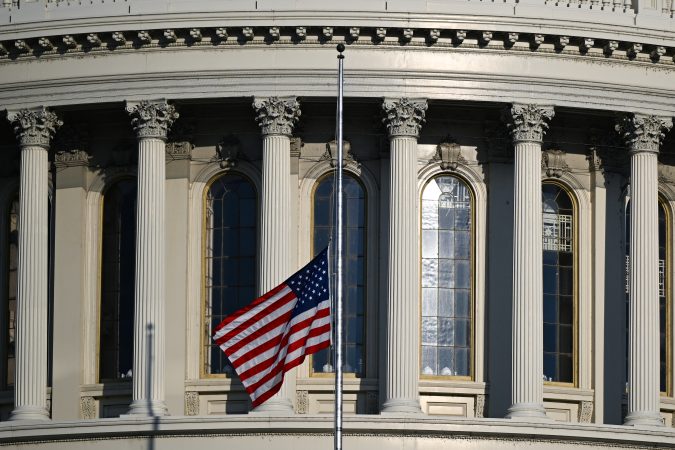
WASHINGTON — The House on Tuesday voted overwhelmingly to make daylight saving time permanent, but the measure to spare Americans the semiannual clock-changing that shortens winter days faces an uncertain path to enactment.
The measure, fittingly named the “Sunshine Protection Act,” passed on a 308-117 vote. Its fate is murky in the Senate, where one GOP leader said it was unclear whether it could move ahead and at least one Republican appears inclined to try to block it.
President Donald Trump has championed the effort to save an extra hour of daylight before nightfall and make the time zone permanent, describing the ritual of moving clocks forward in the spring and back in the fall a “ridiculous, twice yearly production.”
“We are going with the far more popular alternative, Saving Daylight, which gives you a longer, brighter Day,” Trump wrote in a social media post in May. “And who can be against that.”
A sizable bloc of Florida Republicans in Congress is leading the charge on legislation that would do just that, mandating daylight saving time nationwide for the entire year. Rep. Vern Buchanan of the Tampa Bay area is backing the bill, and Rep. Anna Paulina Luna, another Tampa Bay-area Republican, cosponsored it.
House leaders agreed to allow a vote on the measure this week as a sweetener for Luna in their efforts to persuade her to lift a legislative blockade she had maintained as she sought to force Senate action on a voting restriction bill Trump has championed.
Congress first passed the Standard Time Act in 1918 and established federal oversight of time zones. Then came the Uniform Time Act of 1966, which said states can observe daylight saving time from late spring to early fall. The country’s clock-changing practices were last altered in 2005, with the enactment of bipartisan legislation that extended daylight saving time for several weeks.
Most states comply, though there are exceptions: Hawaii and most of Arizona abide by standard time year round, as do Puerto Rico, Guam, American Samoa, the U.S. Virgin Islands and the Northern Mariana Islands. Nineteen states have moved to make daylight saving time permanent, though those laws have not taken effect because federal law does not currently allow people to live in daylight saving time year-round.
Not everyone agrees with the proposed change. Reps. Mary Gay Scanlon, D-Pa., and Pat Harrigan, R-N.C., backed an alternative bill earlier this month that would mandate standard time — which Americans observe between November and March — be used all year.
“Morning light is an environmental cue to set our body’s internal clocks and promote alertness.” Scanlon said. “And dim evening light tells our bodies it’s time to sleep.”
Though many Americans find they are groggy and tired after changing their clocks, sleep experts warn that permanent daylight saving time would hurt, not help, sleep health. The Coalition for Permanent Standard Time, an advocacy group, argues that the winter time zone aligns closely with the body’s circadian rhythm, which is its internal clock.
Should the bill pass, state lawmakers could opt out of permanent daylight saving time in favor of year-round standard time if they enacted such legislation.
Buchanan has said the measure would give Americans all of the health and recreational benefits that an extra hour of sunshine bring, including more time outside and less seasonal depression. Florida’s legislature passed similar legislation in 2018, making it the first state to do so.
“The twice-yearly clock change is a relic of the past that no longer reflects the way Americans live, work and conduct business in the 21st century,” said Rep. Gus Bilirakis, R-Fla.
It isn’t the first time Congress has grappled with turning back the clocks. The United States tried in 1974 to ditch the clock-switching, but went back to flipping the clocks twice a year following widespread discontent. In 2022, the Senate unanimously passed then-Sen. Marco Rubio’s bill to make daylight saving time permanent, but that bill died in the House.
Sen. John Barrasso of Wyoming, the No. 2 Republican, noted Tuesday that the House had “hit the snooze alarm” back then on the Senate measure.
“We’ll see what happens when it gets here,” he told reporters at the Capitol, referring to the current House bill.
He would not say whether he backed the measure. “Depends where you’re living in the country and the impact that it would be in your own home state,” Barrasso said. “So, it’s not as simple as what one state might like.”
Sen. Tom Cotton, R-Ark., said in a floor speech last year that he regretted not objecting to Rubio’s bill.
“By moving the clock back an hour in winter,” he said, “permanent daylight saving time would push winter sunrises to an absurdly late hour, depriving Americans of morning sunshine that’s essential for our safety and well-being.”
In 2025, Pennsylvania updated its license plate design to feature the Liberty Bell, a prescient move for this year’s Semiquincentennial, where the Liberty Bell continues to play a central role—not as a relic of revolutionary history, but as a surface on which Americans have inscribed their ideals, disappointments, demands, and dreams.
The Liberty Bell’s provenance is unique: by 1751, the Pennsylvania State House needed a bell to summon lawmakers to session, gather citizens for announcements and town meetings, and signal special commemorations and events by ringing through the air. Tolling bells could also serve as warnings of fire or other dangers. To be a fully functioning statehouse, a bell was ordered from the famous Whitechapel Bell Foundry in London, which finally closed shop in 2017, after 450 years of business. The bell famously sailed into Philadelphia in one piece, only to crack significantly upon its first ring.
In response, artisans John Pass and John Stow melted down the original bell and recast a new one. This bell remained intact for almost 100 years, until sometime in the early 1840s, when it cracked again. This time, instead of melting the bell down, foundry workers tried to repair the crack by widening it to prevent further spread. Instead, a second crack appeared, and the bell was silenced forever.
One would think a bell without a ring was a literal death knell. Instead, and rather miraculously, the bell took on another life, and another, and another after that in historical memory.
In 1755, Benjamin Franklin mentioned the bell in correspondence with Catharine Ray, writing, “Adieu. The Bell rings, and I must go among the Grave ones and talk Politicks.” Like many others, he did not consider the bell’s association with liberty during the Revolution, perhaps because Philadelphia was under British control for nearly nine months and, for most of the war, he was across the Atlantic, working for freedom in another way.
As far as we know, the bell was not rung when the Declaration of Independence was read. But throughout the long 19th century that followed the Revolution, political activists of all stripes rallied around the words inscribed on the bell: “Proclaim Liberty Throughout All the Land Unto All the Inhabitants Thereof” (Leviticus 25:10).
The Biblical phrase, perhaps commemorating William Penn’s 1701 Charter of Privileges, which granted broad religious freedom and representative government to (some) of the people of Pennsylvania, was adopted, for example, as a symbol of freedom to end slavery. The bell was given the name “Liberty” in the sense of liberation—striving for self-rule in the most basic and humane sense by promoting abolition.
In other words, it was not the Revolution that gave the bell its lasting significance, but the Americans who, thereafter, kept the pursuit of freedom ringing in our ears. Women seeking suffrage. Civil Rights campaigners invoking its biblical call for equality. Cities pursuing community, memory, and history. Its transformation continues today, 250 years beyond the revolution.
Given this history, we understand why the Liberty Bell is visible again during the Semiquincentennial—on our license plates, in commemorative materials and public celebrations, and even as a giant inflatable balloon at the No King’s Rally on the steps of the Pennsylvania State Capitol Building in Harrisburg on March 28. Despite the blustery, cold day filled with flags and a large, grounded eagle puppet, the Liberty Bell remained firmly in place at the top of the steps, where people below gave speeches and rallied for freedom. Of course, nylon ropes secured the inflatable to the ground, but the massive yoke’s symbolic presence, attached to the bell, felt strong and unrelenting.
Ana Thorne, of Center City, 37, is next to the bell they made during the Bells Across PA event in celebration of America’s 250th Birthday in Philadelphia earlier this year.Tyger Williams / Staff Photographer
The Liberty Bell also appears in the Commonwealth’s Semiquincentennial public art initiatives. In Bells Across PA, fiberglass bells decorated by communities across the state appear in each of Pennsylvania’s 67 counties. This kind of collective work, common in community-made public art, remains popular because the project’s scale is manageable and the local scenes painted on the bells carry meaning for those who decorate them. In this case, it is not monumental art by trained artists, but rather youth and adults who hope to create something everyone can recognize and enjoy.
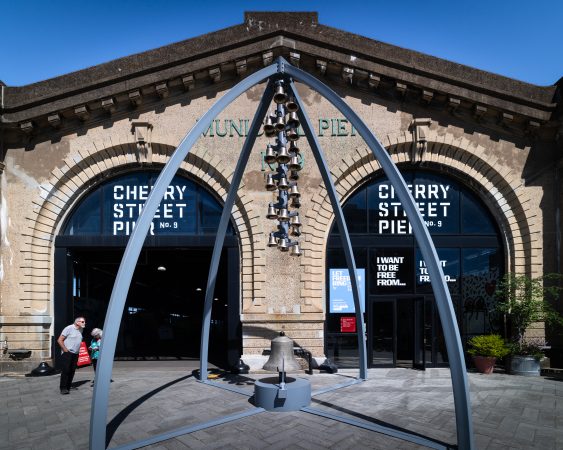
Philadelphia’s most compelling contribution to this conversation may be the public artwork Let Freedom Ring by artist Paul Ramírez Jonas. Originally commissioned by Monument Lab in August 2023 for the National Mall in Washington, D.C., the reinstallation of Let Freedom Ring by the Association for Public Art is on view at the Cherry Street Pier through Sept. 27. The monumental bell tower plays “America (My Country, ‘Tis of Thee)” but intentionally omits the final note. Visitors must ring a Liberty Bell-inspired bell to complete the song. The work poses a deceptively simple question: for whom does freedom ring? The answer is left unfinished and requires public participation.
Made By History sponsors. FOR USE ON MADE BY HISTORY STORIES ONLY.Inquirer Staff
Public art succeeds where monuments sometimes fail by fostering participation rather than passive observation. Rather than presenting history as settled and complete, it invites people to join a conversation across time. The Liberty Bell has always functioned this way. Its inscription is not a statement but a challenge. Its crack is a visual reminder that we must work to close the distance between us.
Today, that challenge and the distance feel especially urgent. The words “Proclaim Liberty Throughout All the Land Unto All the Inhabitants thereof” prompt Americans to consider who is included in that promise and who remains excluded. Each generation has answered differently and struggled to reconcile the nation’s aspirations with its realities.
The stories of the Liberty Bell’s creation, its cracking, its inscription, and its use as a symbol across generations remind us that public art and history can commemorate, criticize, and build community. They can also transform a historical artifact into a forum where each generation redefines liberty. In this Semiquincentennial year, everyone pursuing happiness can make the Liberty Bell their own.
Editor’s note: This story has been updated to clarify that Let Freedom Ring was reinstalled by the Association for Public Art during the semiquincentennial.
The “Road to 250” series is an initiative of Historians for 2026, a group of early American academics, public historians, archivists, and educators devoted to shaping an accurate, inclusive, and just public memory of the American Founding for the 250th anniversary.
Made by History takes readers beyond the headlines with articles written and edited by professional historians. Opinions expressed do not necessarily reflect the views of The Inquirer.
Burlington County was left behind when a new free shuttle bus for South Jersey launched in June. That is going to change in September.
The South Jersey Transportation Authority (SJTA) announced June 1 that a free shuttle bus program called South Jersey Connects was launching that day with routes in all seven southern counties: Atlantic, Camden, Cape May, Cumberland, Gloucester, Salem — and Burlington.
But as the other routes launched, the promised Burlington County route never began. On the authority’s website, it is still marked as “coming soon.”
That is because until recently, the transportation authority was not actually authorized to operate in Burlington County. The county considered operating its own route for the program but ultimately agreed to have the authority run it instead.
But that required legislation.
South Jersey lawmakers had proposed bringing Burlington County into the authority back in the 2022-23 legislative session, but it was not until the South Jersey Connects program was about to launch this year that legislators had the wherewithal to actually hit the gas pedal in Trenton.
“We worked in partnership with our county commissioner, then the administration of Burlington County, and just realized we just couldn’t pull that off,” Sen. Troy Singleton, a Burlington County Democrat, said in an interview. “And speaking with the administration, they were like, look, we feel more comfortable running this through the SJTA, and we already had this legislative vehicle, so that’s when it took on a greater sense of urgency.”
The bill to bring Burlington County into the SJTA passed the Assembly in mid-May and was approved by the Senate just a few days before the June 1 announcement. But Gov. Mikie Sherrill did not sign it into law until the night of the budget deadline — a month after the program had been announced.
“The timing just didn’t work out,” Singleton said.
The Burlington route is expected to start in September, said Dominic D’Amico, director of transportation services at the SJTA, but a start date has not been announced.
The new shuttle’s path has been finalized but has not been shared publicly. D’Amico said in an interview that, like the other routes that launched June 1, it will connect with NJ Transit’s existing infrastructure and the region’s “eds and meds.”
Burlington County Commissioner Felicia Hopson said the new shuttle will enhance the NJ Transit River Line and help residents access jobs, appointments, stores, and schools.
“Stretching 820 square-miles, Burlington County is New Jersey’s largest county, making transportation essential but also challenging for residents without motor-vehicles,” she said in a statement.
The idea of South Jersey Connects emerged from the Chamber of Commerce Southern New Jersey’s advocacy after former Gov. Phil Murphy implemented the 2.5% Corporate Transit Fee on businesses to fund NJ Transit in 2024.
The project was granted $5 million for an 18-24 month pilot, and the future beyond that is uncertain. The South Jersey chamber unsuccessfully requested more money for the effort in this year’s budget, and proponents of the project are hoping to show that it is worth the investment during next year’s budget negotiations.
The summer launch so far has been a little slow, which is to be expected, according to D’Amico.
The authority has seen about 600 one-way trips in the first month of the program, he said, a number he expects to go up as people learn about the routes and as school starts in the fall. He wants to see the service hit at least 5,000 one-way trips each month.
“It takes some time to spread the word, for the marketing campaign to reach the social media platforms, getting brochures delivered to each facility — all those types of things factor into what is a normal slow start,” he said.
“It could be worse, it could be better,” he said.
Why wasn’t Burlington County part of the SJTA before?
Sherrill said in a statement that Burlington County deserves to be part of the authority as “a vital part of the region.”
The reason Burlington County has not been included in SJTA is not because anyone was denying the county is part of South Jersey. Rather, the agency was set up to replace an entity that oversaw the Atlantic City Expressway, which does not go into Burlington, said David Zappariello, the authority’s director of communications.
Along with adding Burlington County to the authority’s coverage zone, the new law allows Sherrill to appoint another member to its board. Members of the board represent the region as a whole, not their home county, Zappariello said, and there is already a Burlington County resident sitting on the board.
Assembly member Alex Sauickie, an Ocean County Republican who also represents part of Burlington County, voted against the bipartisan legislation because it did not also add Ocean County to the authority.
“I just don’t like it when you’re picking winners and losers for political reasons,” he said.
Assembly member Andrea Katz, a Burlington County Democrat, said none of the South Jersey Connects routes will touch her district, where she has concerns about transit deserts. But she is hopeful about public transit expanding in the region and the county getting a seat at the transit table.
“Burlington County now being included means that we’re going to get to have that voice,” she said. “We’re going to get to not be the one stuck in the middle there. We’re going to start to get our own access to public transportation.”
WASHINGTON — Senate Democrats blocked a $1 trillion annual defense bill Tuesday, refusing to advance the bipartisan package that would substantially increase Pentagon spending, including a pay raise for the troops, in protest of President Donald Trump’s war against Iran.
Senate Democratic Leader Chuck Schumer announced his opposition and other key Democrats said they could not support the annual bill, known as the National Defense Authorization Act, as the war drags into a fifth month with no clear endgame in sight. The tally was 50-46, failing largely along party lines to reach the threshold needed.
“The NDAA cannot become a permission slip for that recklessness that we see occurring in Iran,” Schumer, of New York, said ahead of voting.
“Donald Trump does not get to drag the American people deeper into a war he cannot explain and does not know how to end — and then demand that Congress look the other way.”
The Senate vote comes a day after the White House formally notified Congress that it had resumed bombing strikes against Iran, effectively undoing the fragile ceasefire in the U.S.-Israel led conflict that has resulted in economic disruptions, including volatile gas prices, ahead of the midterm elections.
Congress has tried repeatedly to slap guardrails on the administration, voting more than 10 times on various war powers resolutions that would halt hostilities. But those efforts have not succeeded, and most Republicans in the House and Senate majorities back Trump.
Senate Majority Leader John Thune called the defense package a good bill and implored his colleagues to provide the resources to ensure the U.S. is kept safe.
“We have an obligation here in Congress to ensure that they have everything they need for whatever the mission may be,” he said.
After the bill failed to advance, Thune switched his vote in a procedural move that will allow the leader to bring it back up for consideration again later.
For decades, Congress had made sure to approve the annual defense bill each year, setting the policy and direction for the department and authorizing the funds that would later be allocated to carry out its investments in systems, supplies, and missions.
This year, the 66th annual NDAA is running into a double whammy of opposition. Lawmakers are fuming over Trump’s military action against Iran and resisting the White House request to substantially increase Pentagon spending to $1.5 trillion, up from about $900 billion last year.
The sizable boost of funds aligns with the White House’s 2027 budget request as the Trump administration seeks a generational investment to modernize the Defense Department, which it refers to as the Department of War under Secretary Pete Hegseth.
Hegseth was scheduled to meet later Tuesday evening with House Republicans as Congress considers providing additional money through a separate budget reconciliation bill the party can pass on its own, overpowering the opposition from Democrats.
The White House has requested $350 billion from Congress under the budget reconciliation process, but House GOP leaders have indicated it is likely to be a much smaller amount, more in line with $87 billion the White House requested last month as supplemental funding for Iran.
But Republican deficit hawks are skeptical of the big budget numbers, despite support for the war within their ranks.
The extra defense funding comes on top of the additional $150 billion Republicans already provided the Pentagon last year under Trump’s big tax breaks bill that some say has not been spent or fully accounted for.
At the same time, senators want to impose restraints on Hegseth if he fails to comply with their demands for more information about department procedures and accounts.
Democrats, however, are pushing for further limits in line with a war powers resolution that would force the cessation of military actions.
Sen. Tammy Duckworth (D.,Ill.), a veteran who flew helicopter combat missions in Iraq, said she would oppose the bill unless it included her amendment to end the war.
“Simply throwing more money at an out-of-control military operation is not strategy. It’s a recipe for a forever war.”
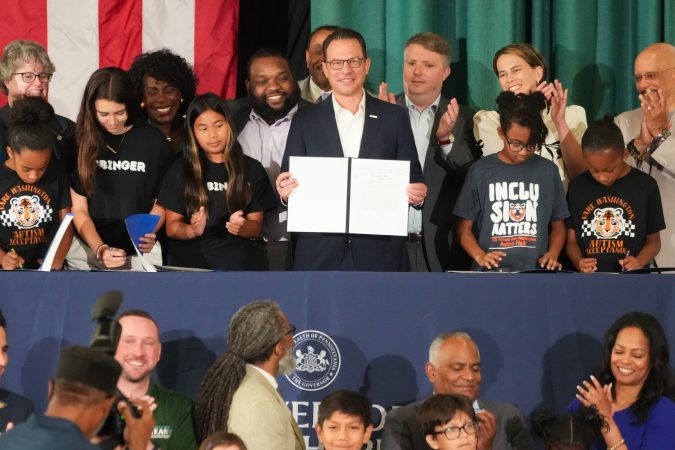
Gov. Josh Shapiro on Tuesday visited Vare-Washington Elementary School in South Philadelphia to tout the $678 million in new education funding included in the state budget deal finalized over the weekend.
The new education funding — including $565 million in “adequacy funding” to aid poorer districts — represented one of the most significant victories the first-term Democratic governor took home from the $50.8 billion state budget deal, which did not address lingering issues such as taxing so-called skill games and long-term funding for SEPTA and other public transit agencies.
The Philadelphia School District will receive $137 million in adequacy funding and $20 million in other new funding. The district will also be able to compete for a share of $125 million set aside for school facilities projects.
Philadelphia’s cash-strapped district, which entered this year with a $300 million structural budget deficit, still faces deep challenges. The school board this year approved a facilities plan to close 17 school buildings and renovate 169 more.
“We’re driving this money out to the schools that need it most — school districts like Philadelphia, Norristown, Pottstown, and Allentown, and others in our region,” Shapiro said. “They were getting shortchanged, and now they’re getting the lion’s share of this new funding.”
While it broke little new ground, this year’s state budget deal helped avoid another prolonged impasse involving Shapiro, the Democratic House, and the Republican Senate. Last year, lawmakers failed to reach a compromise until 135 days after the July 1 budget deadline, leaving school districts and local governments across the state in limbo for months.
“I‘m one of the only governors in the country with a divided legislature, one of the only legislatures that has to negotiate with people on the other side who really have a very different view, who don’t think the way we do about investing in public education,” said Shapiro, who was joined by Mayor Cherelle L. Parker and numerous Philadelphia Democratic lawmakers. “We have all been clear that we would not get up from the table in Harrisburg until we fully funded public education, and we’ve done that.”
Students applaud speakers at Vare-Washington Elementary School during an assembly highlighting the education investments included in the 2026-27 state budget in Philadelphia, Pa. on July 14, 2026.Jessica Griffin / Staff Photographer
The formula calculated that a majority of Pennsylvania schools were underfunded, by a total of $4.5 billion. For the last three years, the state has given those schools an extra $565 million a year, filling about one-third of the gap. The state plans to fullyaddress the shortfall by 2032.
Advocates for underfunded districts, like Philadelphia’s, have credited the state for sticking with the plan, but have also said the money is flowing too slowly for struggling districts. Meanwhile, Republican lawmakers have challenged the increased funding for poorer districts, saying others are getting shortchanged by the new system.
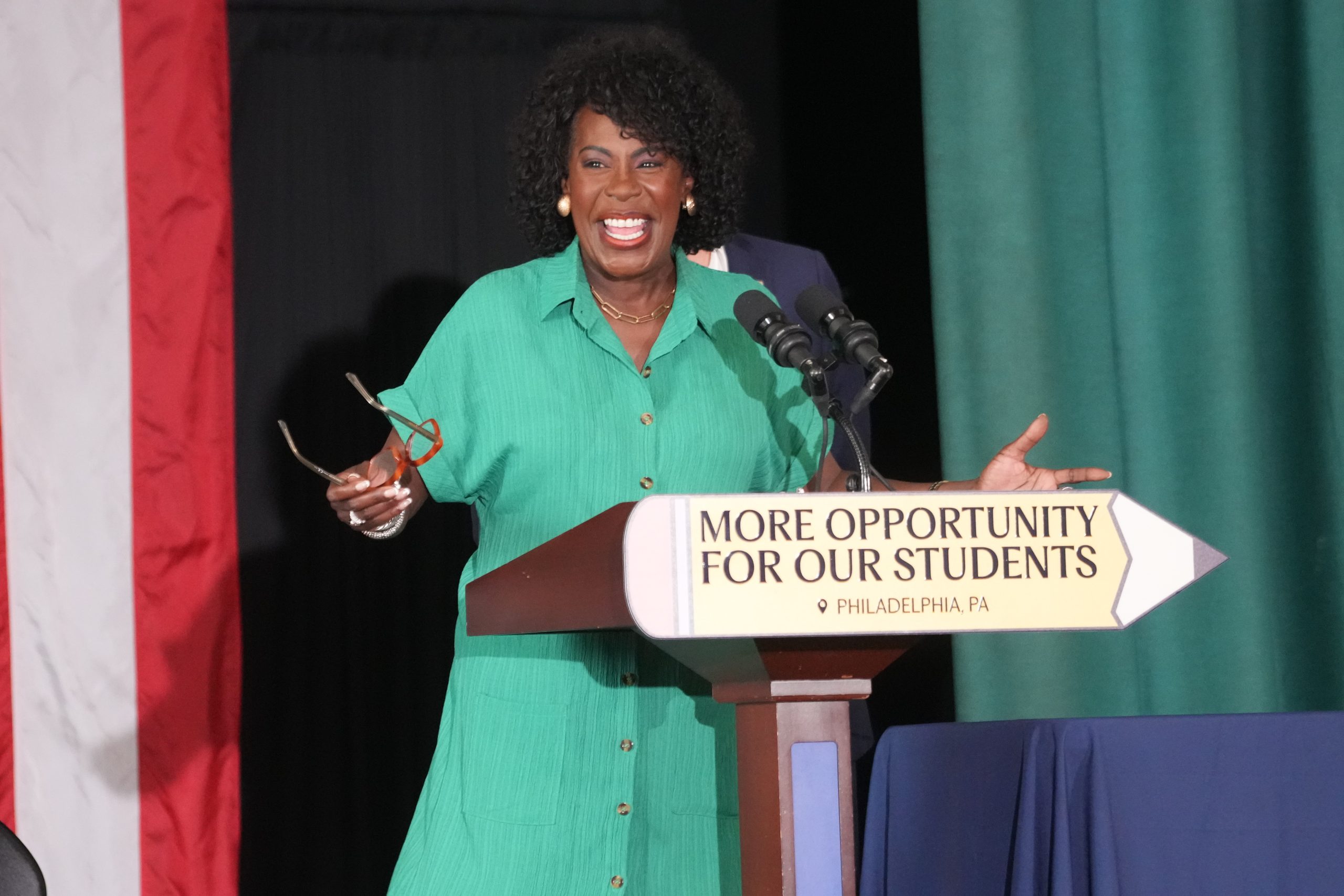
Mayor Cherelle L. Parker speaks at Vare-Washington Elementary School to highlight the historic education investments included in the 2026-27 state budget, in Philadelphia, Pa. on July 14, 2026.Jessica Griffin / Staff Photographer
Philadelphia’s school district, the only one in the state prohibited from raising its own revenue, relies on city and state lawmakers for its funding.
“We have limited revenue-generating capacity in the city of Philadelphia,” Parker said Tuesday. “I wish I could tell you, as mayor, that we had all of the money that we needed to address problems, but that is not the case. Our city can’t be successful without a strong partnership from Harrisburg.”
Parker thanked Shapiro and the city’s delegation to Harrisburg for “keeping your word” and delivering more education funding to Philadelphia from the state.
During her remarks, Parker led the students assembled at the event in several call-and-response chants, including, “Excellence matters — at Vare-Washington!”
“I want to hear you say, ‘Thank you — Gov. Shapiro!’” Parker said in another chant. “‘Thank you — Harrisburg legislators!’”
A top Senate Democrat has requested an investigation into whether Health Secretary Robert F. Kennedy Jr. broke a federal law intended to prevent political appointees from interfering in elections, citing Washington Post reporting.
Sen. Ron Wyden (D., Ore.), the top Democrat on the Senate Finance Committee, filed a complaint Monday with the Office of Special Counsel, a quasi-judicial independent agency that administers the Hatch Act and other civil service rules.
The Hatch Act bars federal employees from engaging in political activity in the course of their work. Several Trump appointees in the first administration were found to have broken the law.
President Donald Trump has previously derided the Hatch Act and declined to enforce the special counsel’s recommendations.
In his complaint and accompanying letter to Jamieson Greer, the acting head of the special counsel’s office, Wyden cited examples of Kennedy encouraging a pair of third-party candidates in Iowa to drop out of contested House races so Republicans could keep control of Congress.
The Post obtained audio of Kennedy’s call with one of the candidates, Rick Stewart, in which the health secretary suggested he would serve as a liaison with the White House and could help Stewart if he left the race. A second candidate has said he received a similar call from Kennedy.
Wyden, whose committee helps oversee some of the agencies led by Kennedy, said that the cabinet secretary’s offers to the candidates were “brazenly corrupt” and violated the Hatch Act and other laws.
“The quid pro quo offer of federal employment or other personal gain that Kennedy extended to Stewart on the June 11 phone call is conduct expressly prohibited by the Hatch Act,” Wyden wrote in his letter to Greer, which was shared with the Post.
The White House and the Department of Health and Human Services, which Kennedy leads, did not respond Monday to questions about Kennedy’s conversations with the candidates and whether he faced any internal repercussions once the calls came to light.
Trump mocked the Hatch Act in his first term, including after the Office of Special Counsel in 2019 recommended that Kellyanne Conway, a top Trump adviser, be removed from her post for violating the law. Conway had criticized Democratic presidential candidates while she was being interviewed by media outlets in her official capacity and tweeted about the candidates from her official account, the office concluded.
Trump ignored the office’s recommendation and kept Conway in her post.
The Hatch Act, which has been law since 1939, does not apply to the president — a fact that Trump has acknowledged in the past, including when he decided to accept the Republican nomination for president in 2020 by giving a speech at the White House.
“There is no Hatch Act because it doesn’t pertain to the president,” Trump said in August 2020.
President Donald Trump is planning a primetime address Thursday that will use findings from reexamined government files to argue that the country’s election infrastructure has vulnerabilities, according to two people briefed on the plan.
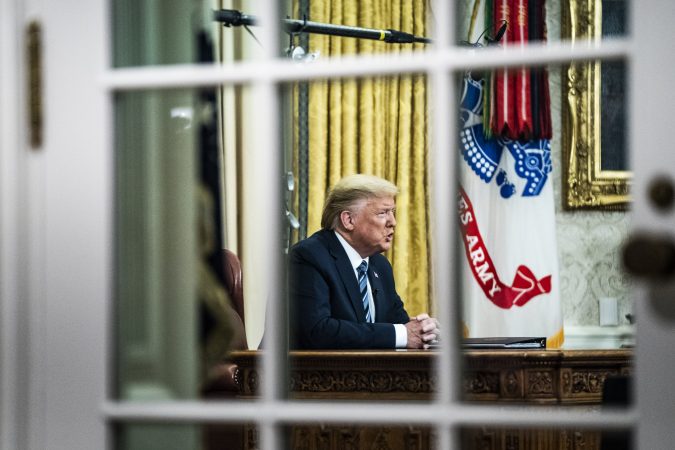
Trump told reporters in the Oval Office on Tuesday that the speech would concern voting machines but declined to elaborate. “It will concern that subject, and we’ll have a couple of other things to say, also,” he said. “But I’d rather save it. But it’s really big news.”
The president could use the address to press his long-standing allegations of foreign interference in the 2020 election, the results of which he has never accepted. The speech, in part, will highlight claims that China accessed U.S. voter data, said the people, who spoke on the condition of anonymity to discuss a plan that has not been made public. Trump is also expected to discuss findings related to Venezuela, they said.
It was not clear Tuesday whether the major broadcast networks would provide airtime for the speech. As of late morning Tuesday, the White House had not made a request for air time.
The plans are fluid and could change. “Anonymous sources are speculating about what President Trump will say during his speech on Thursday evening,” White House press secretary Karoline Leavitt said. “The truth is, nobody knows yet what President Trump will ultimately say, which is why everyone should tune in.”
The plan came after a confidential White House briefing on Monday to review findings from the Trump administration’s broad reexamination of old FBI records, including from the 2020 election, one of the people said. Trump then announced the speech on social media, without specifying the subject.
In recent weeks, FBI Director Kash Patel has dispatched hundreds of agents to help the bureau’s Atlanta field office review 700 files by July 17, according to an internal FBI obtained by the Washington Post. Trump has long argued that he unfairly lost the 2020 presidential election in Fulton County, Ga., which includes Atlanta, and, despite a lack of evidence, the FBI field office has been investigating those claims.
Trump is making the primetime announcement at the urging of advisers including Bill Pulte, the acting director of national intelligence, and John Solomon, a former conservative journalist who temporarily joined the White House to help review government records for release. Solomon has long questioned investigations surrounding Trump and has pushed for the release of FBI investigatory files related to alleged election interference.
Since Trump returned to office, multiple federal agencies have pursued allegations of tampering with the 2020 vote that had previously been investigated and rejected.
U.S. intelligence agencies concluded in March 2021 that there was no foreign interference that altered votes or manipulated machines in the presidential election. The agencies said Russian and Iranian spies did try to influence Americans. They also said China considered but did not go through with efforts to try to affect the outcome of the election, a finding that was the subject of internal dispute at the time.
In Trump’s second term, the Office of the Director of National Intelligence, under Tulsi Gabbard until last month, has taken steps including examining voting machines used in Puerto Rico looking for cybersecurity vulnerabilities.
In September, the contract firm Mojave Research completed a report for the national intelligence director’s office based on forensic analysis of digital voting software obtained from Puerto Rico. The report concluded that software vulnerabilities made the machines highly vulnerable to hacking, according to two people familiar with the report, who spoke on the condition of anonymity to discuss findings that have not been made public. The Mojave analysts found no evidence that exploitation took place, they said.
The report’s release had been delayed by the White House, the people said, but it could come this week.
In January, the FBI and Justice Department seized 2020 ballots that were preserved by a court order in Fulton County. Investigators also obtained records including ballot images from the Republican-led Arizona Senate’s review of the 2020 results in that state’s largest county. And the FBI in recent months interviewed current and former election officials about the 2020 election in Milwaukee.
Trump lost all three of those swing states in 2020. Recounts and court reviews have upheld those results, even as Trump has spent years falsely claiming the election was rigged.
The Arizona and Georgia investigations came at the instigation of Kurt Olsen, a lawyer who worked on Trump’s efforts to overturn the 2020 results at the time and advised him in the White House in 2025.
Trump has taken a series of actions in recent months aimed at influencing how elections are carried out. Most have been blocked in court or otherwise stymied.
Last week, Trump disbanded a bipartisan commission that helps states and localities administer elections. He also recently signed executive orders designed to limit mail ballots and to require states to verify voters’ citizenship with federal data. Those orders have been halted in court. Judges noted the Constitution gives the power to run elections to the states and Congress, not the president.
The Justice Department has sued to get copies of state voter rolls but so far has lost those cases. And the administration’s efforts to allow states to check voter eligibility in a massive federal database has been severely hampered in a separate case.
Trump has demanded that Congress pass a law to require proof of citizenship and ID to vote in this year’s midterms, but Senate Republicans say they lack enough votes. To escalate the pressure, Trump refused to sign a bipartisan bill aimed at making housing more affordable, allowing the legislation to become law without his signature.
Election officials and voting rights advocates have been bracing for months for the administration to release information that purports to cast doubt on how elections are conducted.
“Few things can be more predictable than this coming,” said Lawrence Norden, vice president of elections and government at the Brennan Center for Justice at New York University, a voting rights organization that has sued the administration over some of its election policies.
Any electronic system has vulnerabilities, but states are vigilant about making sure their outcomes are correct using “layered defenses,” Norden said. States conduct audits and recounts to ensure accuracy, and 98% of votes in the midterm elections will be on paper ballots that can be reviewed, he said.
“Unless you have that context of the security that’s already in place, I think some of the kind of things that they’re throwing against the wall can be very confusing to the public,” he said.
Some Trump White House officials in 2020 believed China favored Joe Biden in that year’s election and doubted the intelligence assessment that the country would not seek to interfere and had no preference, according to a former official who spoke on the condition of anonymity because of the matter’s sensitivity.
That view was shared by then-Director of National Intelligence John Ratcliffe, who is currently serving as CIA director.
Ratcliffe “disagreed with the established analytic line on China, insisting ‘we are missing China’s influence in the US and that Chinese actions ARE intended to affect the election.,’” according to a January 2021 report to Congress from an analytic ombudsman for the intelligence community.
Pennsylvania Secretary of State Al Schmidt stressed that the state was not in violation of any voting regulations in a response letter to a Department of Justice inquiry that threatened criminal charges over suspicions of noncitizen voting.
The letter, sent Monday, pushed back against the Trump administration’s insistence that allowing federal assistance in inspecting voter rolls was the best way to avoid criminal prosecution for “aiding and abetting the violation” of federal voting laws.
The Trump administration’sletter, sent July 7, was addressed to voting officials in all 50 states and requested a reply within the week. Schmidt’s reply made it clear that Pennsylvania would not hand over voter rolls to the federal government and reiterated that voting regulations were followed meticulously.
“I take seriously the obligations under both federal and Pennsylvania law to ensure that only eligible voters have access to the ballot box and to see to it that Pennsylvania’s voter rolls are appropriately maintained and updated,” wrote Schmidt, an appointee of Democratic Gov. Josh Shapiro.
“That means working with the election officials of our 67 counties who are statutorily responsible for voter list maintenance,” Schmidt said. “Be assured that these dedicated local officials, as well as our employees who serve at the Department of State, work tirelessly to ensure that Pennsylvania’s voter rolls are accurately maintained.”
Pennsylvania officials have warned since last year that turning over the voter rolls to the federal government without redactions could put sensitive information at risk.
The DOJ letter comes after President Donald Trump’s long history of spreading voter fraud conspiracy theories and falsely claiming that he won the 2020 election.
“I have seen the most fantastical things on social media, making completely ridiculous allegations that have no basis in fact at all,” Schmidt told CNN in 2020.
In his capacity as Philadelphia city commissioner, Schmidt in 2017 identified a glitch in the Pennsylvania Department of Transportation’s system that had allowed 168 noncitizens to register to vote.
But noncitizen voting does not happen at a rate that would change presidential election results, Schmidt emphasized in a recent interview with VoteBeat.
“One thing that became very clear through that research and all evidence suggests that noncitizens voting in elections in the United States occurs very rarely,” Schmidt said. “It doesn’t mean that it’s not important. Like I said before, every vote is precious, and we want to make sure that we do everything we can to safeguard and strengthen election integrity. But there’s no evidence to suggest that it happens in any widespread way whatsoever.”
While Schmidt’s letter did not grant the Trump administration access to voter rolls, it did link to the state’s most recent voter registration report, which outlines the outcomes of officials’ efforts to keep the rolls accurate.
According to the report, 338,000 voter registrations were canceled in 2025, most of them because the voter died or moved. In around 120 cases, a registration was recalled because an official found the person was ineligible to vote.
“We [Pennsylvania Department of State] have worked closely with the Department of Justice on matters that have led to criminal charges as recently as this year,” Schmidt wrote in reply to the DOJ. “The Department consistently cooperates with our state and federal partners in their investigations to help ensure that only eligible voters are registered and able to cast ballots in our Commonwealth.”
Philadelphia City Council is already looking to 2027. And with all 17 seats on the ballot next spring, the elections are shaping up to be a pivotal test of whether the city’s established politicians can withstand a rising tide of frustration with the party among Democratic voters.
All of the incumbents have said they intend to run for reelection, and several are likely to face serious challenges from new candidates focused on grassroots organizing and progressive groups — hoping to seize the opportunity presented by a nationwide leftward shift amid President Donald Trump’s second term.
Three districts have emerged as key battlegrounds.
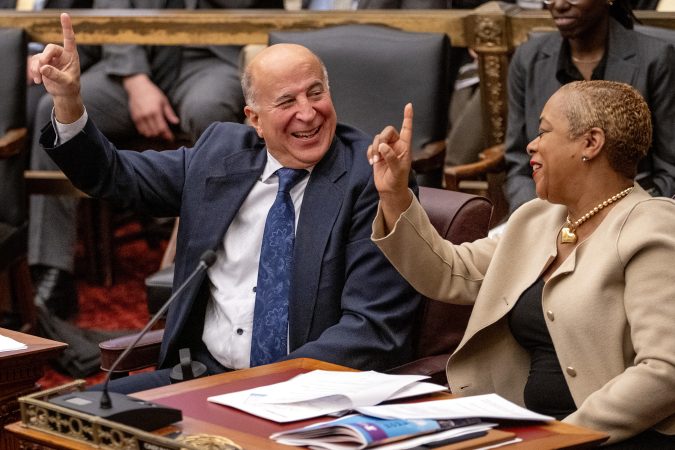
And the city’s progressive organizations, emboldened by a series of wins locally and nationally, are targeting two other districts: the 1st, which stretches from South Philadelphia to Fishtown and is represented by Councilmember Mark Squilla, and the 8th, which includes parts of North and Northwest Philadelphia and is represented by Councilmember Cindy Bass.
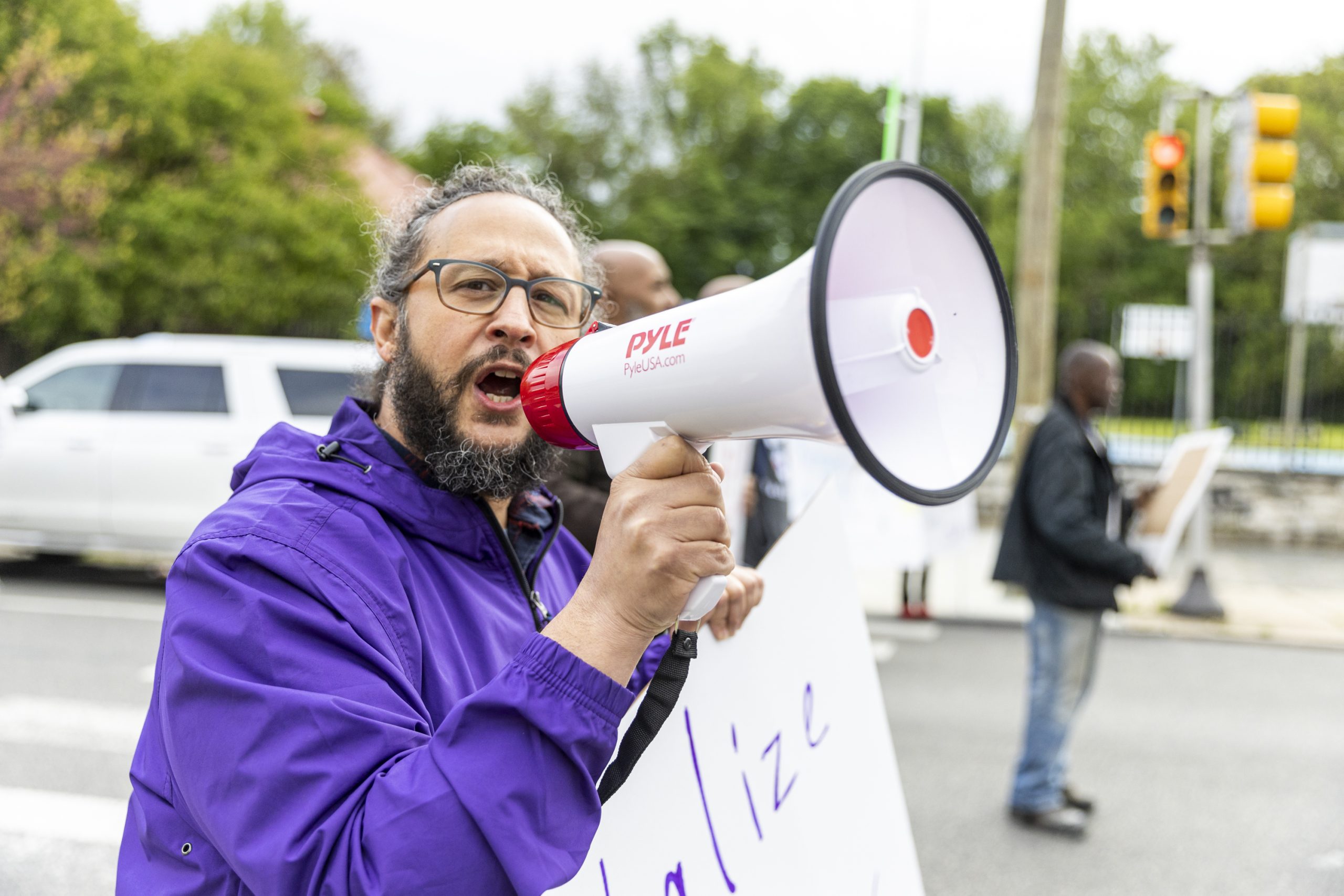
“We’re definitely feeling confident,” said Robert Saleem Holbrook, executive director of the progressive advocacy group Straight Ahead. “Anyone who is going to be running under a progressive banner or a progressive movement is going to have to be running against the establishment, not toward it.”
A competitive race also appears to be taking shape for the seven Council seats that represent the city at-large.
Five of those seats are all but certain to be won by Democrats, making the May 2027 primary the key election in deep-blue Philadelphia.
The other two at-large seats — set aside for Council members outside the majority party under the city’s Home Rule Charter — will be decided in the November 2027 general election. Currently, the two minority party seats are held by Councilmembers Kendra Brooks and Nicolas O’Rourke of the left-leaning Working Families Party.
Jane Golden, founder and executive director of Mural Arts Philadelphia, takes the stage during the dedication of the Super Bowl LIX mural at Spike’s Trophies on June 17, 2025 in Philadelphia.Monica Herndon / Staff Photographer
Golden, 73, said last week that she is not currently running for Council, but acknowledged she has thought about it for years.
“It’s always something that is tempting to me, because I just love the city so much,” she said. “I feel honored that people even think of me.”
Progressives eye Bass’ North Philly seat
Philadelphia’s progressive activists this year see two key opportunities to expand the loosely organized left-leaning bloc on Council, which currently consists of four members. Winning additional seats could also grow their influence by enticing more moderate members to vote alongside them if they believe primary voters are moving left.
Leftists have notched high-profile wins in Democratic primaries across the country this year, including in Philadelphia, where democratic socialist State Rep. Chris Rabb (D., Philadelphia) bested more moderate candidates for a seat in Congress representing about half of the city. The district is one of the most Democratic in the nation.
Anderson-Oberman, 55, the executive director of the progressive group Reclaim Philadelphia, said last week that he is “leaning” toward taking another swing.
“We’re in a moment in this country and this city where people have had enough,” he said. “People are looking for new answers. … Cindy represents the old way of doing things.”
Union organizer Seth Anderson-Oberman, running for 8th District City Council, joins in a small rally with community and Happy Hollow Advisory Board members along Wayne Avenue at Happy Hollow Playground in Philadelphia on April 2, 2023.Tyger Williams / Staff Photographer
Another Council run by Anderson-Oberman may test how far progressive momentum can go in Philadelphia. He was a member of the Communist Party USA in his 20s, and has said he is proud of that experience.
Bass, 58, said she is ready for the race no matter who her opponent is.
In June, she survived a contentious fight for another four-year term as Democratic leader of Mount Airy’s 22nd Ward. She was criticized for her handling of the process, and the party ordered a redo of the election.
She and her progressive opponent, Octavius Price, tied, then struck a power-sharing agreement. Through it all, Bass said, longtime residents stuck by her — and she is confident voters will do the same next year.
“My voters are people who are based in this community, committed to this community, intend to stay in the communities that they are in,” she said.
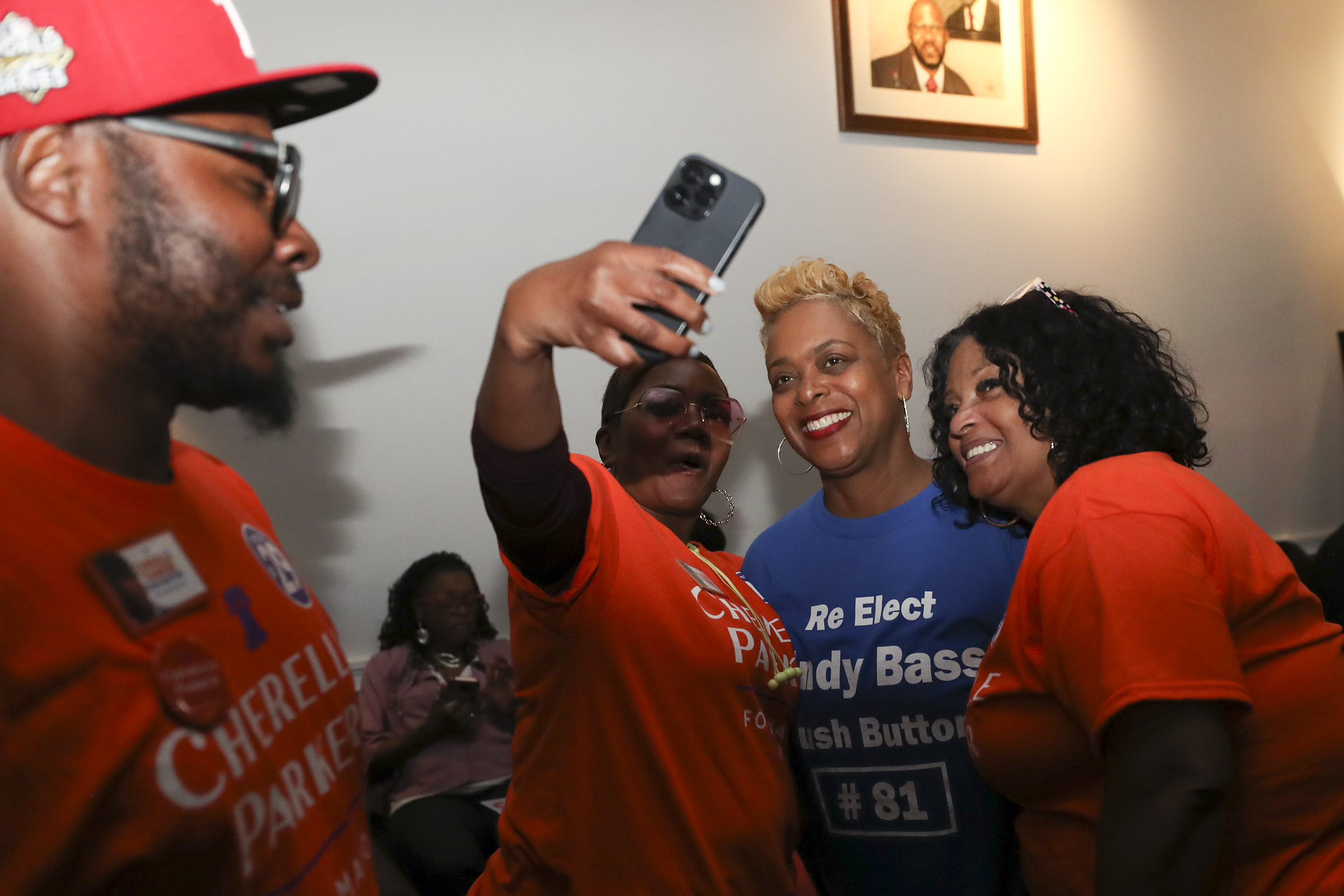
City Councilmember Cindy Bass (center) attends the watch party for Democratic candidate for mayor Cherelle L. Parker at Laborers 332 in Philadelphia on May 16, 2023.Heather Khalifa / Staff Photographer
Jeff Jones, a community leader and social justice advocate from Germantown, has also said he intends to run in the 8th District.
“I want to bring that new vision and a new voice to the 8th District, where residents and children and families can know that their voice matters, their concerns will be heard, and their challenges will be met,” said Jones, 61, a first-time political candidate.
Squilla could see a lefty challenger
Leftists are also eying Squilla’s seat, which represents the area along the Delaware River from Pennsport to Kensington. Since Squilla took office in 2012, the district has transformed from a bastion of working-class white voters to one of the most progressive swaths of the city.
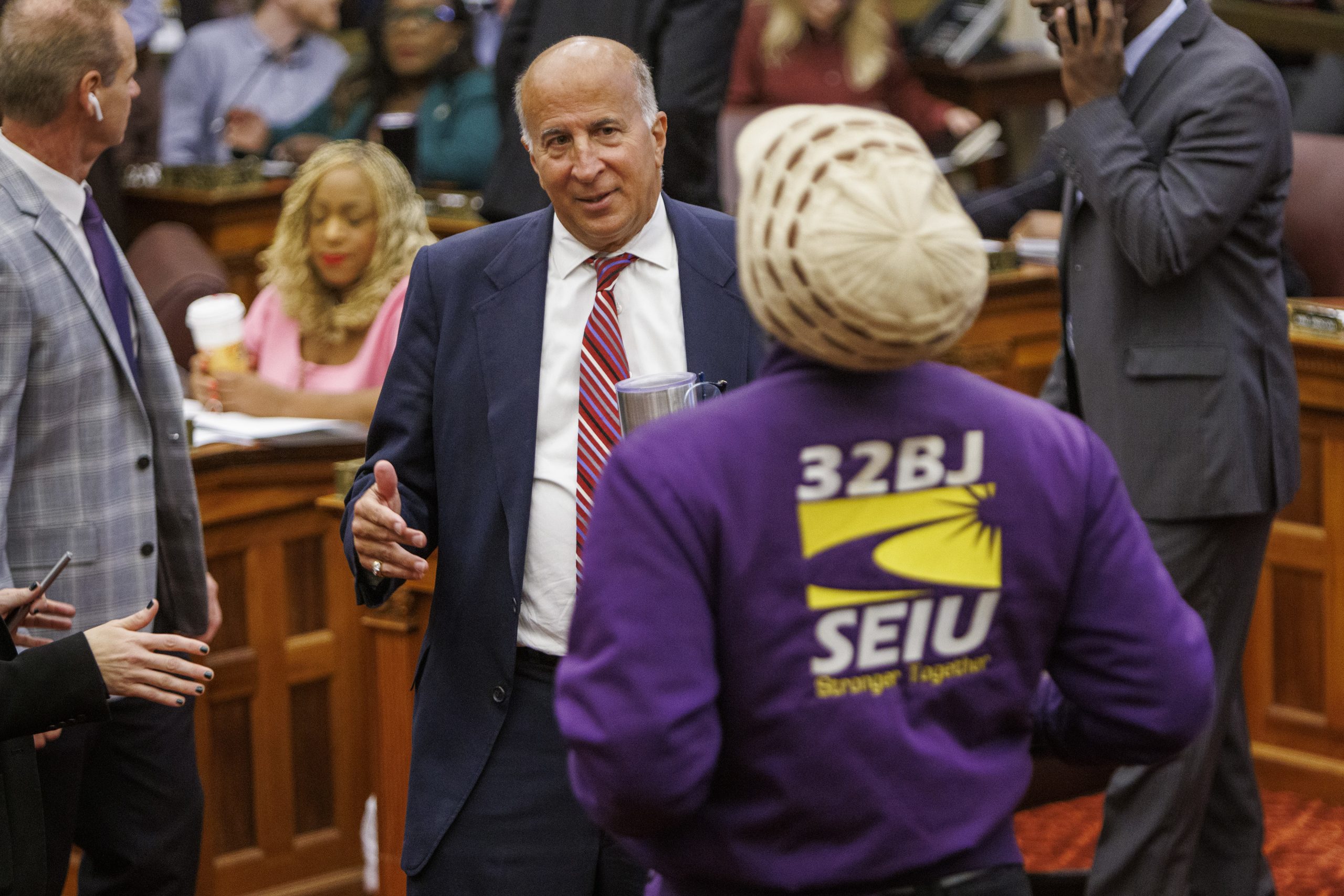
Squilla, 63, who has strong labor ties and is one of the most pro-development district Council members, said being a centrist has likely put a target on his back in the 2027 election.
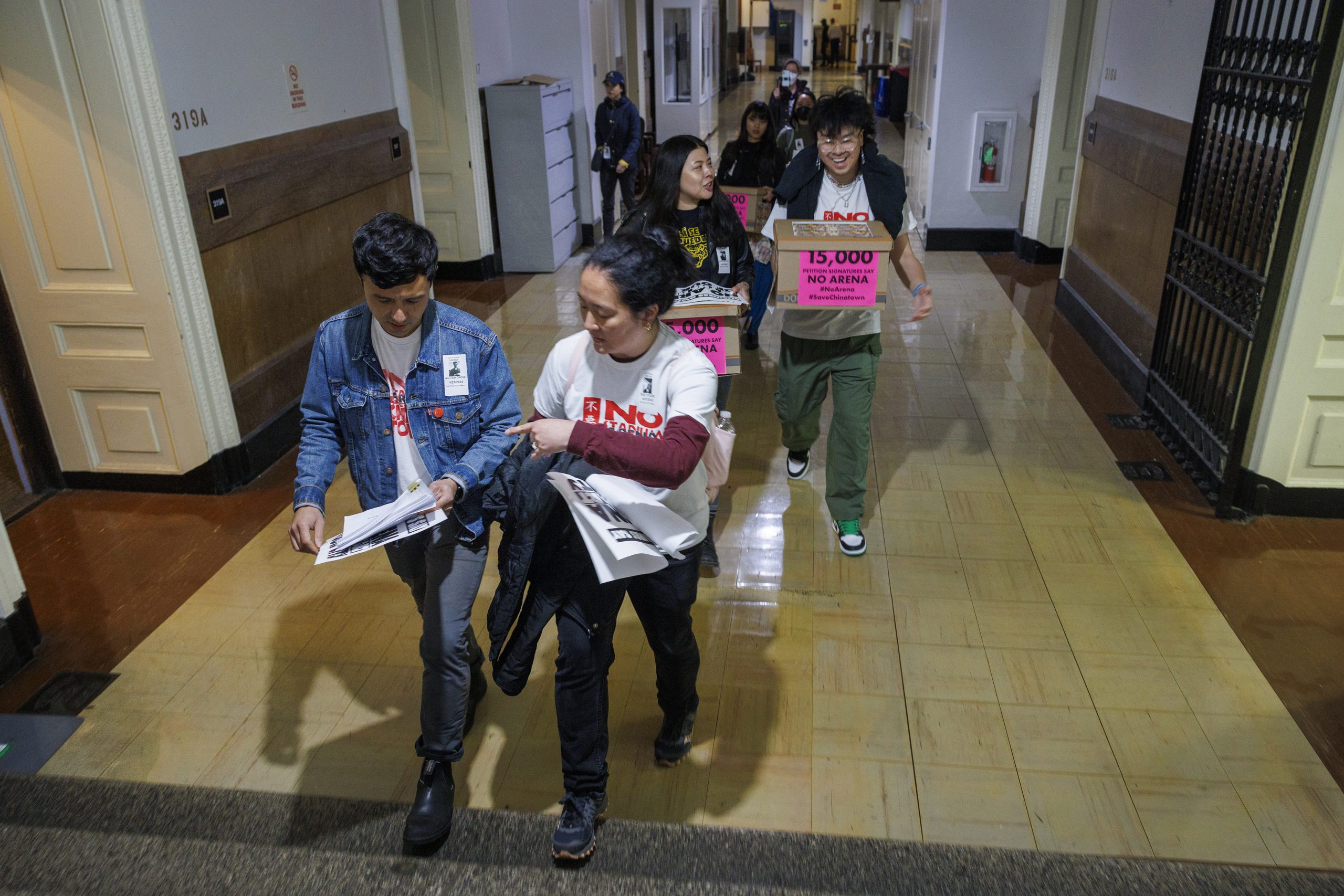
Another contributing factor may be Squilla’s support for controversial legislation in 2024 to approve the 76ers’ since-abandoned plan to build a new arena in Center City. The project, which would have been in Squilla’s 1st District, was opposed by advocates for Chinatown, which the arena would havebordered.
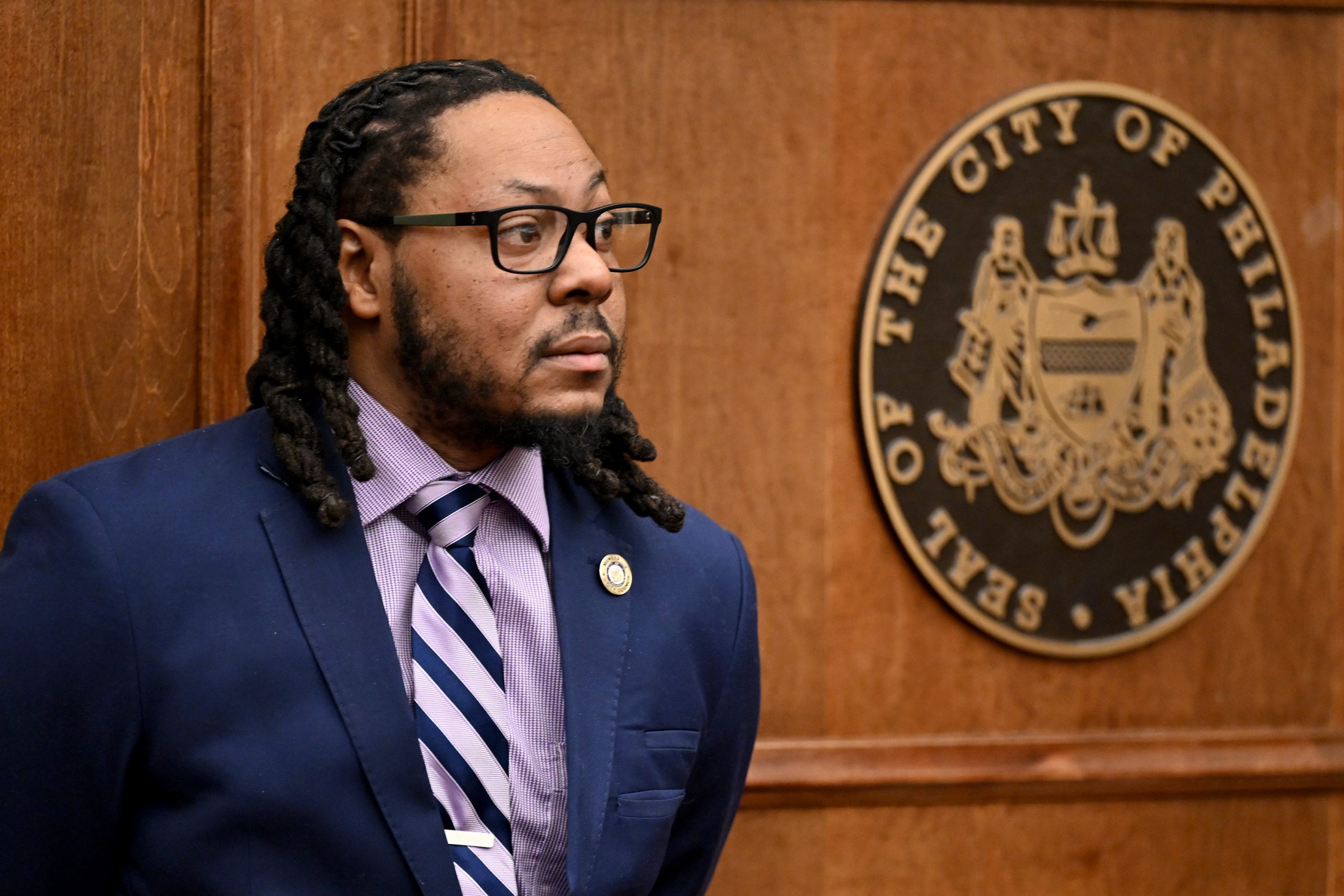
Councilmember Mark Squilla arrives in Council chambers on Nov. 12, 2024, before the start of a public hearing on a proposed Sixers arena.Alejandro A. Alvarez / Staff Photographer
Despite the fierce objections, Council approved the project with Mayor Cherelle L. Parker’s support in December 2024. Weeks later, the basketball team announced it was abandoning its Center City plan and would instead build its next arena in South Philly.
Squilla said he is prepared to defend his actions, noting that he worked to ensure any arena deal would benefit his district and that many of those promises are moving forward despite the 76ers withdrawing their proposal.
“The goal as an elected official, and also as a leader, is not always to make the popular decision,” he said. “The goal is to have a process to make the decision that would be best for the people around it.”
One prominent opponent of the Center City arena plan was Will Gross, the owner of Ox Coffee in Queen Village and a progressive who is the Democratic leader of the 2nd Ward. He is seen by political insiders and progressive organizations as the most likely candidate to take on Squilla.
Gross declined to comment.
In this 2023 file photo, Will Gross and Kay Yoon, of the No Arena in Chinatown group, deliver petitions to Councilmember Mark Squilla. Alejandro A. Alvarez / Staff Photographer
A progressive challenger may also emerge in the North Philly and Kensington-based 7th District, which is represented by Councilmember Quetcy Lozada.
Some insiders have speculated that Celin may run again. He declined to comment.
Lozada, 55, said she “can’t focus” on potential challengers.
“If I spend my time listening to the buzz about who is running,” she said, “we won’t get any work done.”
A battle takes shape in the 5th District
In the 5th District, a seat that represents parts of North Philadelphia and Center City, a handful of Democratic challengers are lining up to take on Young, 40, who is seen as one of Council’s most vulnerable members.
That is in part because of the unusual way in which he was elected in 2023. He ended up being the only Democrat on the ballot after several others, including party officials’ preferred candidates, were removed amid legal challenges.
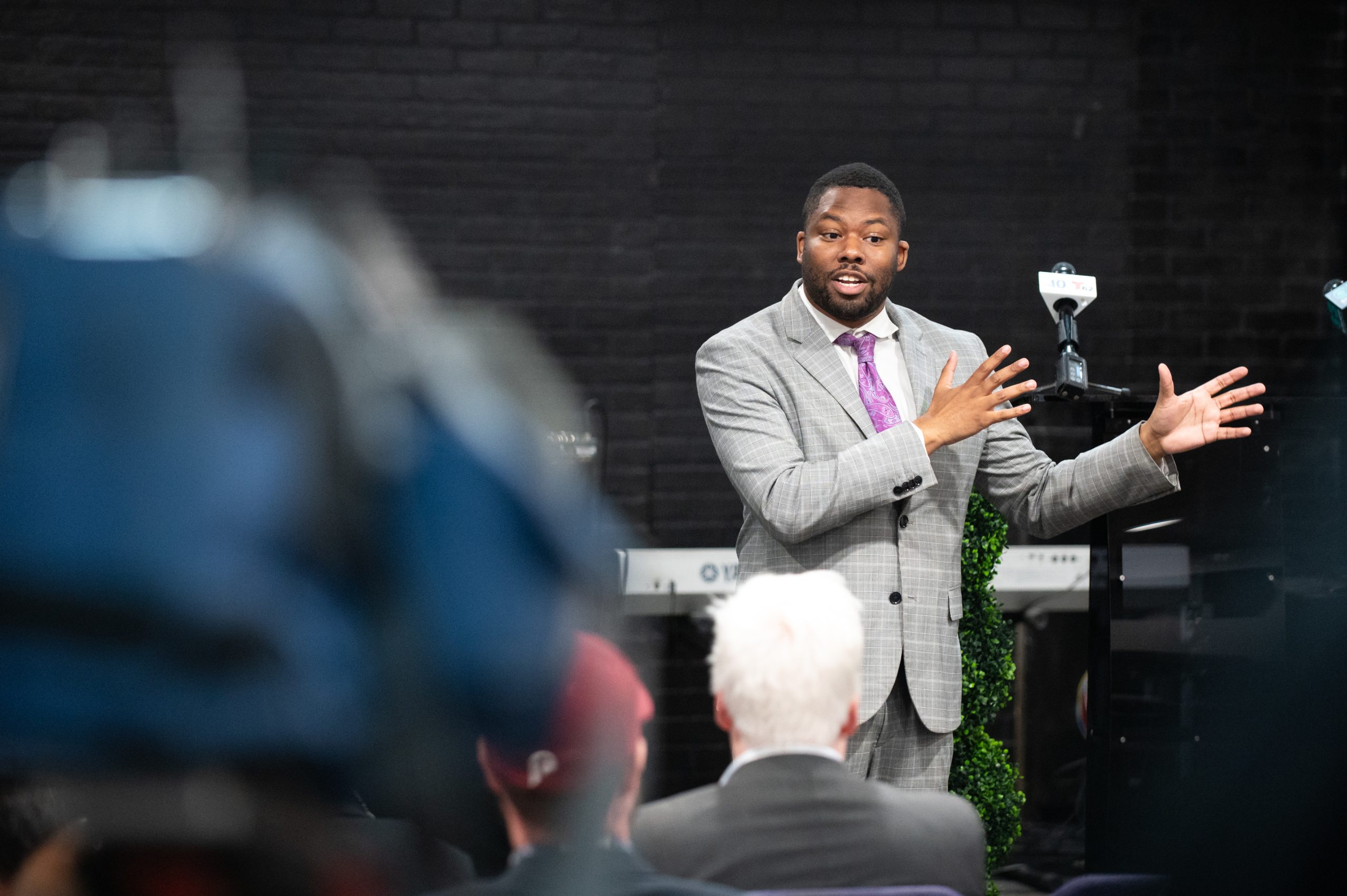
Councilmember Jeffery Young Jr. in chambers as City Council meets Dec. 11, 2025.Tom Gralish / Staff Photographer
One of those candidates was Curtis Wilkerson, who was chief of staff to former City Council President Darrell L. Clarke. Two sources, who spoke on condition of anonymity because they were not authorized to discuss the campaign dynamics, said Wilkerson is considering running for the seat again next year.He did not respond to a request for comment.
Also likely to run is Jalon Alexander, an attorney who unsuccessfully ran for an at-large seat on Council in 2023. Alexander, 33, formed an exploratory committee last year and is expected to formally declare his candidacy later this summer.
Two others are also considering running.
Dustin Dove, a lawyer and the president of the Fairmount Civic Association, said neighbors and community leaders have encouraged him to get in the Council race, and he is “taking the possibility of running seriously.”
“I think our city government should work for everyone by keeping our neighborhoods safe and streets walkable, making housing affordable, and ensuring fairness and access in public services,” Dove, 38, said last week.
Jalon Alexander, an attorney and community advocate, speaks to attendees at a meeting about potential SEPTA budget cuts hosted at Garden of Prayer Church in Strawberry Mansion on June 9, 2025.Erin Blewett / For The Inquirer
And Max Tuttleman, 37, a philanthropist who unsuccessfully ran for an at-large seat in 2023, said he “cares deeply about the 5th District and would never close the door to serving Philadelphia.”
He added that “Center City and the neighborhoods around it should be growing faster than they are.”
Young said in an interview last weekthat he intends to run for reelection, but that challengers are not his focus.
“I‘m focused on serving my constituency, serving my community,” he said. “The work that we’ve been doing will hopefully earn the support of the residents of the 5th District.”
A smaller, but competitive, at-large field
Over the last several election cycles, dozens of candidates lined up to run for at-large seats during a time of immense turnover in Council.
But with seven incumbents all looking toward reelection in 2027, there may be fewer challengers who line up to take them on. So far, only Golden and a handful of others have emerged as possible contenders.
David Alexander Jenkins, a cultural strategist known for delivering impassioned speeches during Council’s public comment section, said he is considering a run, encouraged by fellow community members.
“When the community that is around you constantly pushes you to intercede on their behalf, then it’s because they have trusted you to do what it is that you do best,” Jenkins, 39, said. “I think it would be incredibly unwise to ignore that.”
And Jude Husein, 28, a Palestinian-born community activist who was raised in North Philly, has already launched her campaign. If her bid is successful, Husein, a former staffer for State Sen. Art Haywood, would be the first member of Gen Z on Council.
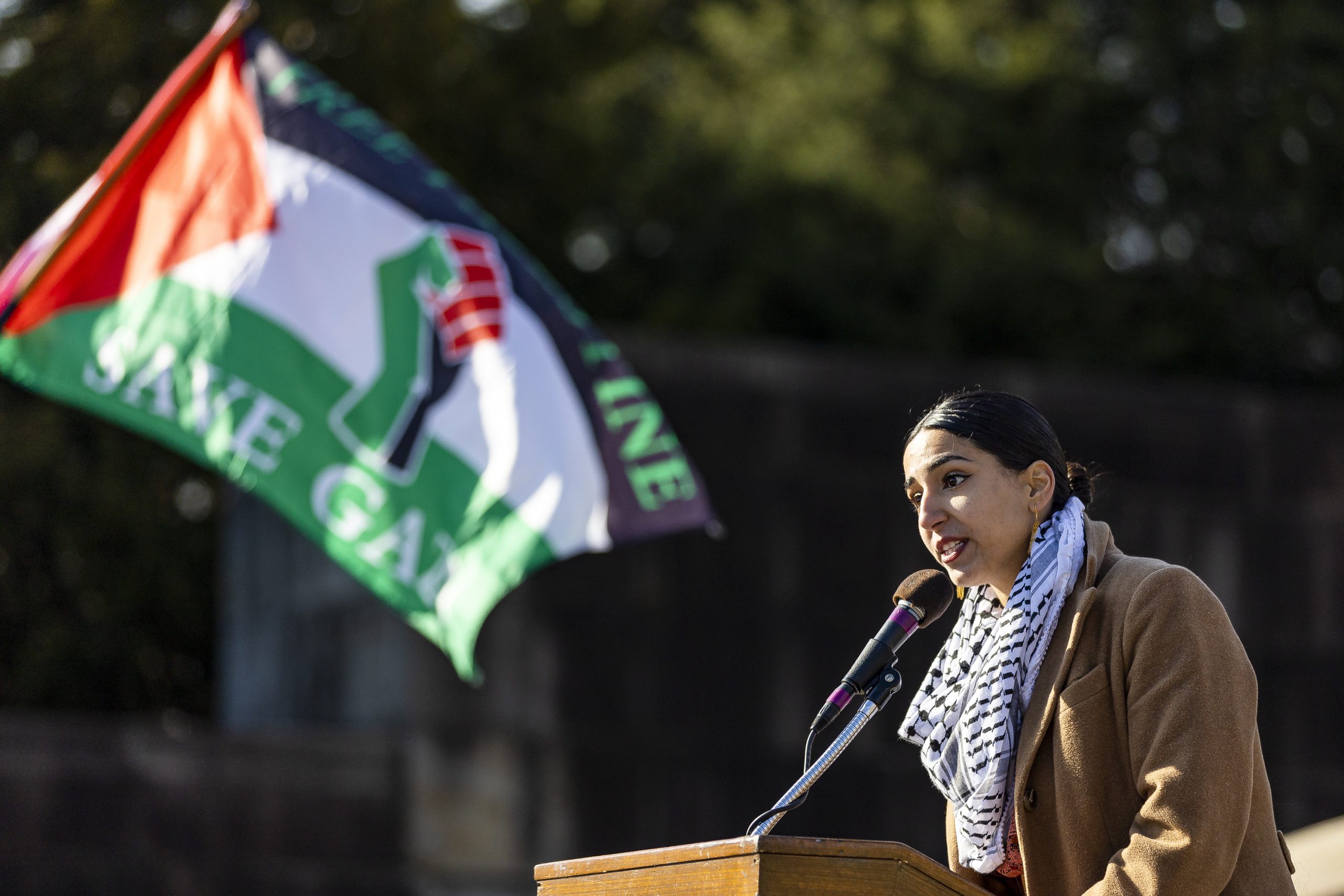
In this 2023 file photo, Jude Husein, of North Philadelphia, speaks at a rally for a Day of Solidarity event at the Art Museum steps.Tyger Williams / Staff Photographer
Leaders of progressive organizations said they are closely watching her candidacy. However, Husein is not exactly running as a leftist. She said that her policy positions are varied and that she will seek endorsements from any institution that is “values-aligned.”
“I’m running because I think government should work for the people who pay for it, and should make neighborhoods affordable and safer,” she said.
Also in the running for Council at-large seats are Billy McCann, 46, a former teacher who lives in Port Richmond, and Isaiah T. Martin, 26, who lives in West Philly and leads a community development nonprofit. The pair, who both said they are progressive, have established something of a slate with Jones, who is challenging Bass in the 8th District.
They said they would prioritize public education, affordability, housing assistance, and government accountability, and they argued that establishment Democrats are failing to connect with voters.
“A new day is coming,” said Martin, another member of Gen Z who would make history on Council if elected. “It’s time we get people who are going to do the actual work and not just sit here and talk about it.”
WASHINGTON — Still shaken from the sudden death of Sen. Lindsey Graham of South Carolina, Senate Republicans returned to Washington on Monday and were immediately forced to confront the policy and political complications caused by his absence.
Coupled with the extended leave of Sen. Mitch McConnell, R-Ky., who was hospitalized last month and has not said when he will return to the Senate, Graham’s death Saturday has created further difficulties for an election-year legislative agenda that already faced significant hurdles.
The loss of Graham and the absence of McConnell have temporarily whittled down an already slim Republican majority and are threatening to stall spending bills, a major budget measure the party had hoped to use to push through hundreds of billions of dollars of military spending, and at least one crucial nomination.
It also left uncertain the fate of a new package of sanctions against Russia that Graham had negotiated in the days leading up to his death, which now lacks its most influential Republican champion in the Senate.
In the coming days, Senate Republicans had hoped to quickly confirm President Donald Trump’s pick as attorney general, Todd Blanche, whose confirmation hearings are set for Wednesday and Thursday. They are also eager to pass annual spending bills before a Sept. 30 deadline to fund the government. And with the midterms looming, many Republicans are hoping to find a way to push through sweeping policy initiatives in an arcane budget process known as reconciliation that allows them to skirt a Democratic filibuster.
All of those are up in the air with the loss of Graham. He sat on the Appropriations and Judiciary committees, where Republicans could now find themselves short of a majority to approve legislation or nominations, and was the chair of the Budget Committee, which would drive the reconciliation process.
Sen. John Thune, R-S.D., the majority leader, who was a longtime friend of Graham’s dating to their early years together in the House, had already been skeptical that he and his fellow Republicans could push through a politically charged, one-party budget bill so close to the November election.
“Obviously there are a lot of considerations that we have to work through: how big it is, what the offsets are, what our limitations are,” Thune said. “To get that done and get the requisite number of votes in both the House and Senate will be a heavy lift.”
Thune and other senators were visibly affected by the death, and Graham’s Senate desk was draped in black velvet and held a vase of white roses.
With senior roles on the panels overseeing the Justice Department, spending and budget policy, Graham was seen as an important Republican voice in all three efforts. And as Republicans try to take advantage of their governing trifecta before the elections, Graham was viewed as a crucial link between the Senate and the White House.
Many of Graham’s colleagues acknowledged that he would have been particularly valuable helping Senate Republicans navigate an increasingly tense relationship with Trump, who has grown frustrated by their refusal to bow wholeheartedly to his agenda.
“His voice is going to be really, really missed in terms of the relationship that Senate Republicans have with the president and his team,” Thune said in a CNN interview Monday. “Because he was so good and so effective at talking to the president, and it was so respected by the president.”
That connection would have been central to any attempt to push through a third reconciliation bill.
Trump last week urged congressional Republicans to turn to the procedure — which allows bills that affect government revenues to pass the Senate on a simple-majority vote — to provide $350 billion to the Pentagon and to impose long-sought restrictions on elections.
As chair of the Senate Budget Committee, Graham would have overseen that process, steering any measure through complex rules that govern what provisions can be included. Before his death, he signaled a willingness to try to meet Trump’s demand, even as many Republican senators, including Thune, have been skeptical that they could muster the necessary support to pass such a measure given disputes about how to pay for new spending with compensating cuts elsewhere.
Though Thune has not yet named a successor, Sen. Ron Johnson, R-Wis., is widely viewed as the next in line to lead the budget panel. But Johnson is among the staunchest fiscal conservatives in Congress, and his approach to spending cuts may rankle vulnerable lawmakers who do not want to slash government programs.
Asked about the path forward Monday, Johnson brushed off questions. “Look, I just walked by Lindsey’s desk,” he said. “It’s kind of one step at a time.”
Thune’s most immediate challenge may come with Blanche’s nomination. While some Republicans have voiced concerns about Blanche’s role in establishing a Justice Department fund for people claiming to be victims of unfair prosecution, Graham, a senior member of the Senate Judiciary Committee, was seen as a reliable supporter who would have helped Blanche advance.
But after Graham’s death, Republicans on the committee hold only an 11-10 edge on, meaning objections from any one Republican senator on the committee could stymie Blanche’s nomination. Two of them, Sens. Thom Tillis of North Carolina and John Cornyn of Texas, have raised questions about Blanche. Cornyn reiterated his concerns Monday after a federal judge in Miami assailed a settlement that Blanche brokered between Trump and the IRS that protected the president and his family from tax audits.
“It certainly is another area that I plan to ask about, and I’m certainly not making any commitments until after the hearing,” Cornyn said.
Advancing legislation to fund the government out of the Senate Appropriations Committee was already going to be difficult with McConnell’s absence, and the committee has already been at a partisan impasse.
But Graham’s death could make it nearly impossible to move any spending bills without major bipartisan support. Republicans will now need all their senators on the panel to be present and voting to overcome unanimous Democratic opposition.
Sen. John Kennedy, R-La., said the two primary actions Congress must take are to fund the government and keep it open after Sept. 30, probably through a stopgap bill, and provide money for the conflict in Iran. He predicted that progress would be difficult.
“I’m not terribly optimistic about the next four weeks,” Kennedy said.