A former Bucks County man who voted twice for President Donald Trump in the 2020 election was sentenced Wednesday to six months of house arrest and three years of probation.
Matthew Laiss was found guilty by a jury earlier this year of casting two ballots in the 2020 election: first by mail in Pennsylvania, where he had once lived in Ottsville, and then again in person in Florida, where he was living at the time.
Laiss, 32, said in court Wednesday that his actions were “stupid” and a mistake. And his lawyer said that Laiss never meant for both votes to actually count — that he had wrongfully assumed election officials would identify he had voted twice and only count one of his ballots.
“In hindsight, it wasn’t good judgment,” Laiss said.
Prosecutors, however, said they did not believe that, in part because they said Laiss misled FBI agents about his actions when he was confronted years later. And Assistant U.S. Attorney Mark Dubnoff said Laiss had shown a “striking” lack of remorse for what he did, repeatedly saying it was the result of his age or mental health at the time, as opposed to realizing he had committed a crime.
“Mr. Laiss has not accepted ownership of what he did,” Dubnoff said.
U.S. District Judge Joseph F. Leeson Jr. said Laiss’ crimes were serious and had affected “all citizens of this country.”
But he declined to send Laiss to prison, noting that Laiss had already lost his job as an insurance salesman as a result of the case, and that he would have the felony conviction on his record for the rest of his life.
The U.S. Attorney’s Office charged Laiss last year with crimes including voter fraud and voting more than once in a federal election.
Prosecutors said records showed that Laiss had filled out and returned a mail-in Pennsylvania ballot in October 2020. And less than a week later, they said, he went to a polling place in Florida and voted again.
Laiss later said in court documents that he voted twice for Trump. And as his case progressed toward trial, he sought to claim that his actions were covered by pardons Trump extended to people who tried to help him overturn the results of the 2020 election, which Joe Biden won.
Prosecutors announced Laiss’ case alongside the indictment of a Philadelphia woman, Miya Pack, who was separately charged with voting twice in the 2020 election. She pleaded guilty last month and is awaiting sentencing.
Still, attorneys said cases involving people casting multiple ballots were relatively rare in eastern Pennsylvania. Laiss’ lawyer said the only other comparable case in the region that unfolded in recent years was that of Philip C. Pulley, a Philadelphia landlord who voted in the city, Montgomery County, and Florida in 2020 and 2022. He was also sentenced to probation.
Trump has nonetheless made frequently questionable or false statements about the prevalence of voter fraud, particularly in instances where his opponents or Democrats have won. Election officials and experts generally agree that voter fraud has not historically occurred at widespread rates or in ways that could lead to incorrect outcomes.
Sandra Shachar has been posting news articles on the walls of the President’s House Site almost every day since January.
She was outraged that President Donald Trump’s administration had dismantled the exhibit telling the story of the nine people George Washington enslaved in his executive mansion at Sixth and Market Streets, and sharing information with visitors was her way to push back.
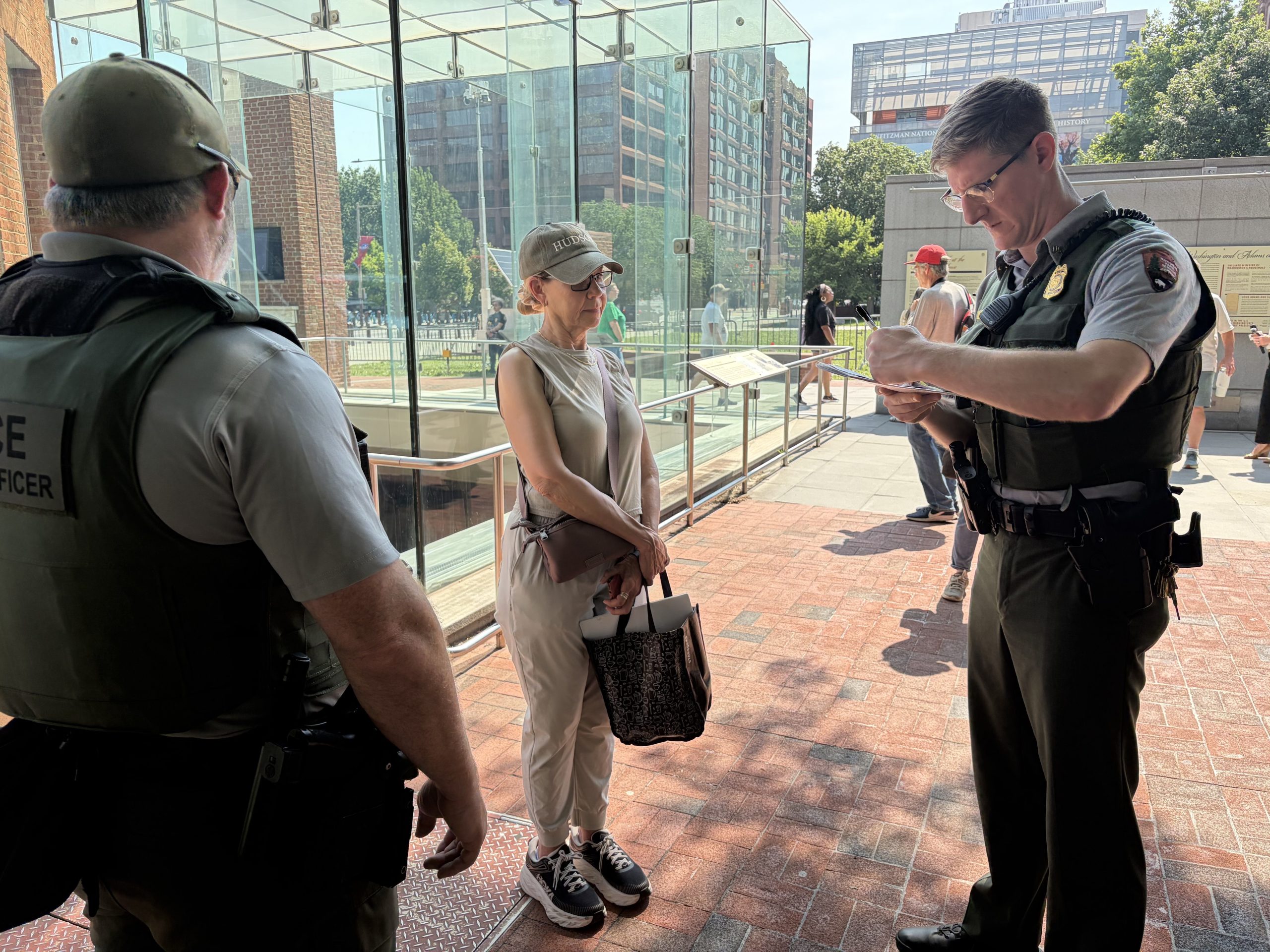
But Shachar, 72, continued with her routine. This time, two park rangers stopped her.
“When I went to tape my sign up, they came and said, ‘You can’t do that. Please stop,’” the psychologist from Center City said.
Sandra Shachar, 72, cited for vandalism at the President’s House site on July 15, 2026 for attempting to post news articles on the walls.Abraham Gutman
The rangers issued Shachar a citation for vandalism, which carried a $305 fine, and warned her that next time she could be arrested.
The news came as a gut punch.
“It was something I could do,” Shachar said. “And now for doing something, I’m issued a citation that says I have created vandalism on federal property.”
The vandalism citation marks an escalation in the National Park Service’s response to protest at the President’s House, and comes as activists promise to keep the fight over the site’s history alive.
“I don’t care whether you’re a Republican or Democrat, liberal or conservative … this is some scary [expletive],” Coard said. “Despite being very afraid, we got to keep fighting.”
Fascist leaders throughout history have attempted to rewrite the past as part of their campaign to control the future, the attorney said. And that is the level of threat the Trump administration’s changes to the President’s House represent, Coard said.
The new panels have been criticized for minimizing the brutality of slavery, whitewashing George Washington’s culpability, and shifting the focus away from the nine people who were kept in bondage at the nation’s first executive mansion.
It is outrageous that visitors will see panels that, for example, discuss Washington’s “discomfort” with slavery and suggest the lives of those enslaved in Philadelphia were not too bad, Coard said.
“The fact that the federal government would ignore the hell of slavery for the victim but highlight the president’s ‘discomfort,’” Coard said. “What kind of nonsense is that?”
Avenging the Ancestors Coalition’s goal continues to be the full restoration of the site with the original panels that had been developed through partnership with the city and input from the community. The group is exploring new legal strategies, Coard said.
The city is also not done fighting, Mayor Cherelle L. Parker said in a statement.
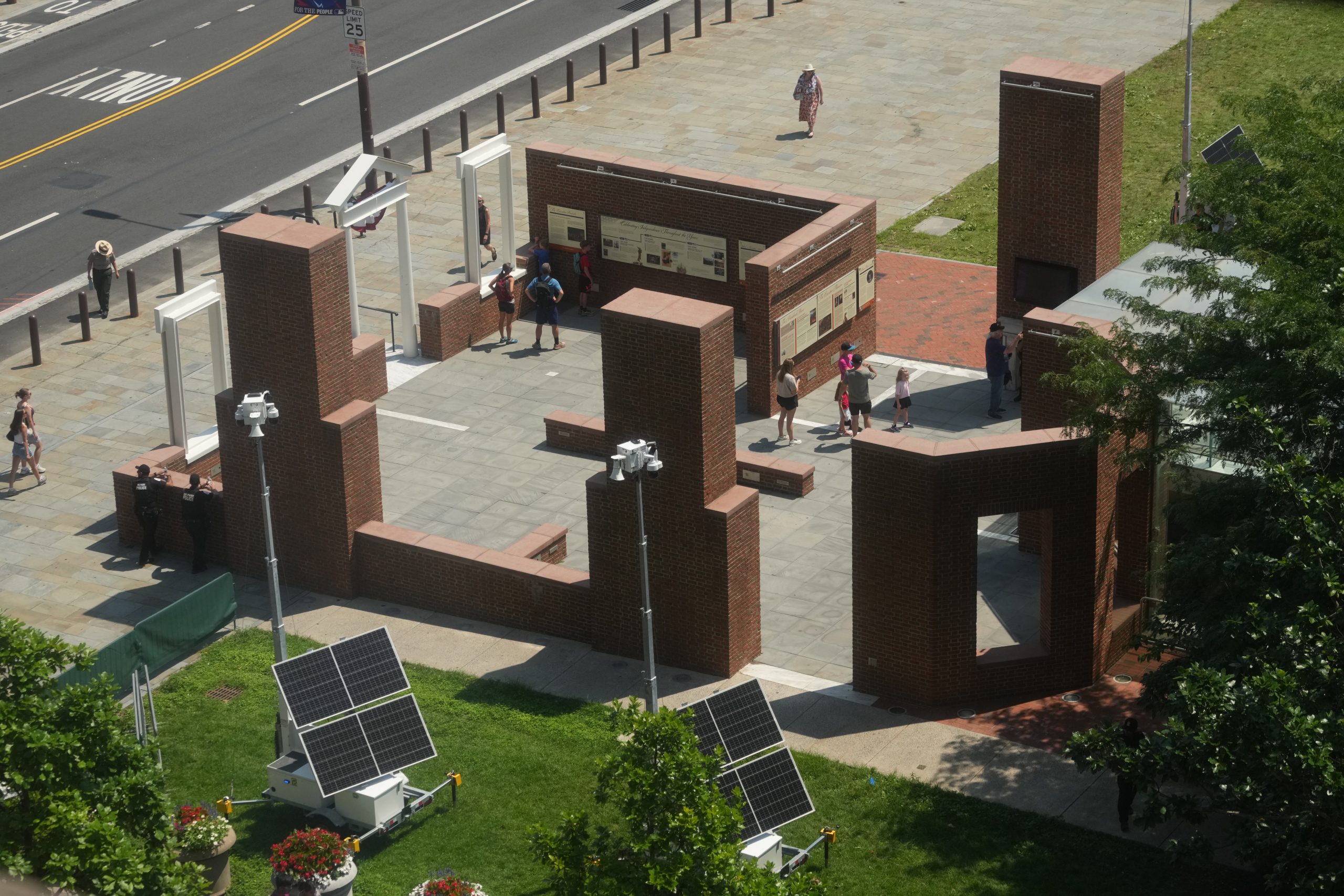
Security cameras that have been placed at the President’s House site, where new panels have been installed, in Philadelphia, July 15, 2026. Historians and advocates have criticized the new panels for minimizing Washington’s role as an enslaver.Jessica Griffin / Staff Photographer
The case raises “serious legal issues” that go beyond the President’s House, Parker said.
“I will continue fighting on behalf of everyone who supports the core belief: All of our history must be told,” the mayor’s statement said.
It will be up to the Third Circuit to decide whether to grant a second hearing to an issue that three judges had agreed on unanimously.
The efforts to educate visitors about the President’s House continue as well.
Old City Remembers, a grassroots effort, will continue to register volunteers to read aloud the text of the removed signs. And the Black Journey: African-American Walking Tour of Philadelphia will continue to offer tours that tell the story of those enslaved at the site.
Brian Wells, 65, has been putting up protest posters on the President’s House walls since the day after the January removal. On Tuesday, Wells said, national park police stopped him from taping papers and threatened him with arrest.
He thought the heightened security was because of an MLB All-Star event held Tuesday on Independence Mall, but now that the panels have been replaced, he isn’t so sure.
“I will continue with Old City Remembers folks to volunteer to read aloud the text from the former panels,” Wells said Wednesday. “Other actions? I don’t know at this point.”
WASHINGTON — Defense Secretary Pete Hegseth announced Wednesday that he is rolling out a new screening program for “testosterone deficiency” among troops, calling it necessary to allow them to operate at their “absolute best.”
The screenings will be conducted annually as part of service members’ required medical screenings for those 30 and older, he said. Troops under 30 can volunteer to be tested. In a video on social media, Hegseth said receiving testosterone replacement therapy would be voluntary.
In the video, Hegseth simply refers to troops, though it appears he is talking about only testing men in uniform for hormone irregularities.
The move comes as other Trump administration officials have begun to advocate for men to have easier access to testosterone replacement therapies, but the messaging from Hegseth and others blends known science on the hormone with broader, and less substantiated, claims.
When asked about what conditions Hegseth was looking to address with the new policy, the Pentagon referred to Hegseth’s remarks in the video that mentioned keeping troops “strong, resilient, and capable” and that the rigors of the modern battlefield demand “maximum psychological and mental readiness.”
Over the past several years, special operations troops — and specifically Navy SEALs — have come under scrutiny for their use of testosterone and similar substances to enhance performance.
The death of a SEAL recruit during training in 2022 led to a discovery of substances in his possession, including testosterone, and revealed far more rampant drug use among the elite program than was previously acknowledged.
A year after the recruit’s death, the Navy said it would begin a drug-testing program to screen for “any hormonal substance, chemically or pharmacologically related to testosterone, that promotes muscle growth.”
Hegseth said his new initiative is “not about artificial enhancement.”
The Pentagon did not respond to questions about what research or academic studies underpinned the move. It also didn’t say if female troops would be able to be evaluated for estrogen-based therapy as they entered perimenopause.
Testosterone levels in men decline naturally with age and have long been linked to issues like erectile dysfunction, low libido, mood changes, and weight gain. But experts have debated for years how to diagnose those problems and whether they should be treated by replacing the hormone.
Hegseth’s announcement comes as Health Secretary Robert F. Kennedy Jr. and other Trump administration officials are moving to make it easier for doctors to prescribe testosterone. Last month, the Food and Drug Administration proposed easing prescribing limits on testosterone gels, pills, patches, and injections.
The current FDA label specifies that the medications are only for men with hypogonadism, a medical condition that causes drastically low testosterone.
But many influencers and proponents of Kennedy’s “Make America Healthy Again” movement tout testosterone as a way to look younger, build muscle, and stay mentally sharp — although those uses aren’t accepted by most medical experts.
Still, recent studies have bolstered the case for testosterone’s benefits, for certain conditions, while allaying worries about its safety — particularly concerns about heart safety.
Last year, the FDA removed a boxed warning about possible risks of heart attack and stroke from the drugs.
Separately, a series of studies by the National Institutes of Health in older men found that taking testosterone improved erectile dysfunction, libido, and other sexual measures and had a small effect on mood. But there was little or no improvement in other measures like fatigue, memory or overall well-being.
Other studies have shown potential improvements in muscle-building, strength and bone density.
However, current medical guidelines generally recommend against blanket testing of testosterone levels. Typically, doctors are advised to discuss testosterone therapy with men who have troubling symptoms and documented low levels of the hormone on two separate blood tests.
Testing for testosterone is challenging because levels of the hormone fluctuate throughout the day. Accurate testosterone readings are typically measured in the morning after fasting.
Rep. Chrissy Houlahan, a Pennsylvania Democrat and Air Force veteran, said the “announcement proves that Secretary Hegseth takes direction from the far corners of the manosphere.”
The congresswoman on the House Armed Services Committee said she hoped testosterone testing “will be available for both men and women and that servicewomen will be afforded access to the same resources to enable them too to be the most elite warriors” on Earth.
He has made other changes related to the medical treatment of troops.
In April, he announced the repeal of the military’s long-standing flu vaccine mandate, citing “medical autonomy” and religious freedom. In June, a flu outbreak at the U.S. Air Force’s boot camp sickened at least nearly 300 people.
WASHINGTON — President Donald Trump wants Immigration and Customs Enforcement officers to keep pulling over vehicles, signaling his opposition Wednesday to plans announced just a day earlier to suspend most traffic stops following another string of fatal shootings.
It’s not clear whether ICE will quickly reverse course and resume most stops, which have been a key tool in Trump’s immigration crackdown.
Ending those stops, Trump wrote, would be “playing right into the criminal’s hands.”
“We CANNOT give up one of ICE’s most important and effective Crime Fighting tools, THE TRAFFIC STOP!” Trump wrote Wednesday on his social media site.
Hours after Trump made his views known, Homeland Security Secretary Markwayne Mullin issued his own statement saying people illegally in the country would be “arrested and deported wherever they are.” But Mullin didn’t directly say whether ICE officers will be allowed to carry out traffic stops.
Before that, two motorists were shot and killed by ICE officers — one in Texas last week and another in Maine on Monday.
After the Maine killing, Trump administration officials told ICE officers to suspend most vehicle stops, people familiar with the decision said Tuesday.
Since the immigration crackdown began, federal officers confronting drivers have opened fire several times, saying the drivers’ vehicles had posed a danger. Policing experts have long said that shooting into moving cars presents a danger of its own and should almost always be avoided.
There have been at least 10 deaths involving encounters with immigration agents since Trump launched his deportation campaign. At least four of them involved people in vehicles, a trend so troubling that Republican U.S. Sen. Susan Collins of Maine urged Department of Homeland Security leaders “to cease all non-urgent vehicle stops.”
Two shootings in a week, she said Wednesday, “raise very serious questions” and warrant a halt in that approach for the time being.
ICE has been under pressure to beef up arrest and deportation numbers. It says people being sought are increasingly staying in their homes, and it often blames immigration advocates who advise immigrants to stay in homes unless ICE produces a warrant signed by an independent judge.
ICE officers say that means they’re forced to find other ways to make arrests.
DHS says the man killed in Maine came to the U.S. illegally
More protests are planned after hundreds gathered Tuesday to remember Johan Sebastián Durán Guerrero, the 25-year-old Colombian national who was shot in his car Monday.
Karolina Rojas, his partner and the mother of their young daughter, shared a photo on Instagram of the three hugging and smiling.
“I love you, my darling, my life. I love you. I have no words for this pain. You were my everything. Please watch over me. Help me find the strength to carry on. Stay with me always. Don’t leave me alone. I’m begging you, my love,” she wrote.
Durán Guerrero illegally entered the U.S. on Sept. 1, 2023, through the southern border, DHS said Wednesday. Advocacy groups said that when he was killed, he was authorized to work in the U.S.
Sen. Angus King (Ind., Maine) said the Homeland Security secretary told him on Monday that ICE officers were in Biddeford to serve an arrest warrant but that it wasn’t for the person who was shot.
When ICE tried to stop a vehicle driven by someone who came from a home under surveillance, the “vehicle attempted to flee the scene and, fearing for public safety, an officer discharged his weapon,” the department said.
It its statement Wednesday, DHS said Guerrero was released into the U.S. after crossing the border.
The department didn’t answer questions about the agent who shot him.
Photos showed bullet holes in Durán Guerrero’s car windshield, but the officers involved didn’t have body cameras, leaving many questions.
Maine shooting puts a spotlight on ICE
Outgoing Colombian President Gustavo Petro called the shooting of Durán Guerrero a targeted killing “at the hands of the U.S. government.”
In Wednesday’s social media post, Trump told ICE to be “judicious, fair and smart, and go back and do your very important job.”
Border czar Tom Homan told reporters that the investigation needs to play out and that officers will be held accountable if they are found to have acted inappropriately or illegally.
Maine’s Democratic governor, Janet Mills, said ICE should be scrapped as a federal agency if it can’t be fixed.
Mills, who has criticized ICE before, said Wednesday that the agency needs changes “before more families are robbed of a loved one.”
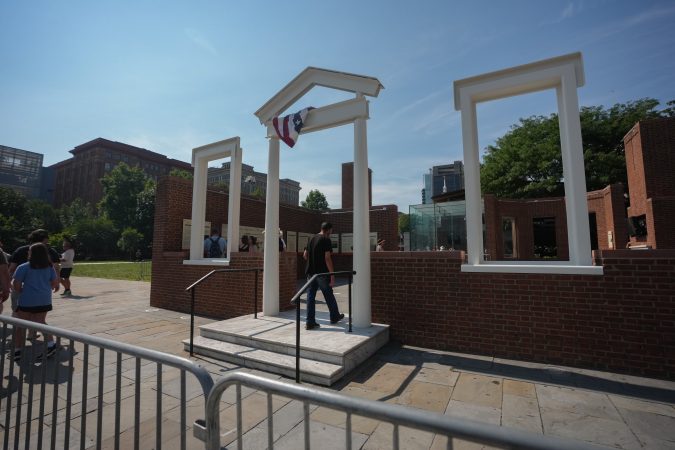
President Donald Trump’s administration has installed its own version of history at the President’s House Site, swapping panels on the brutality of slaveryat the site for displays that experts say sanitize George Washington’s role as an enslaver.
The replacement caps a monthslong legal battle over the site on Independence Mall that was the first direct skirmish between Mayor Cherelle L. Parker and the Trump administration.
The change happened overnight Tuesday into Wednesday, hours after the city hosted MLB All-Star Game events near the site, allowing the government to switch out the displays and shut down the television screens without public scrutiny.
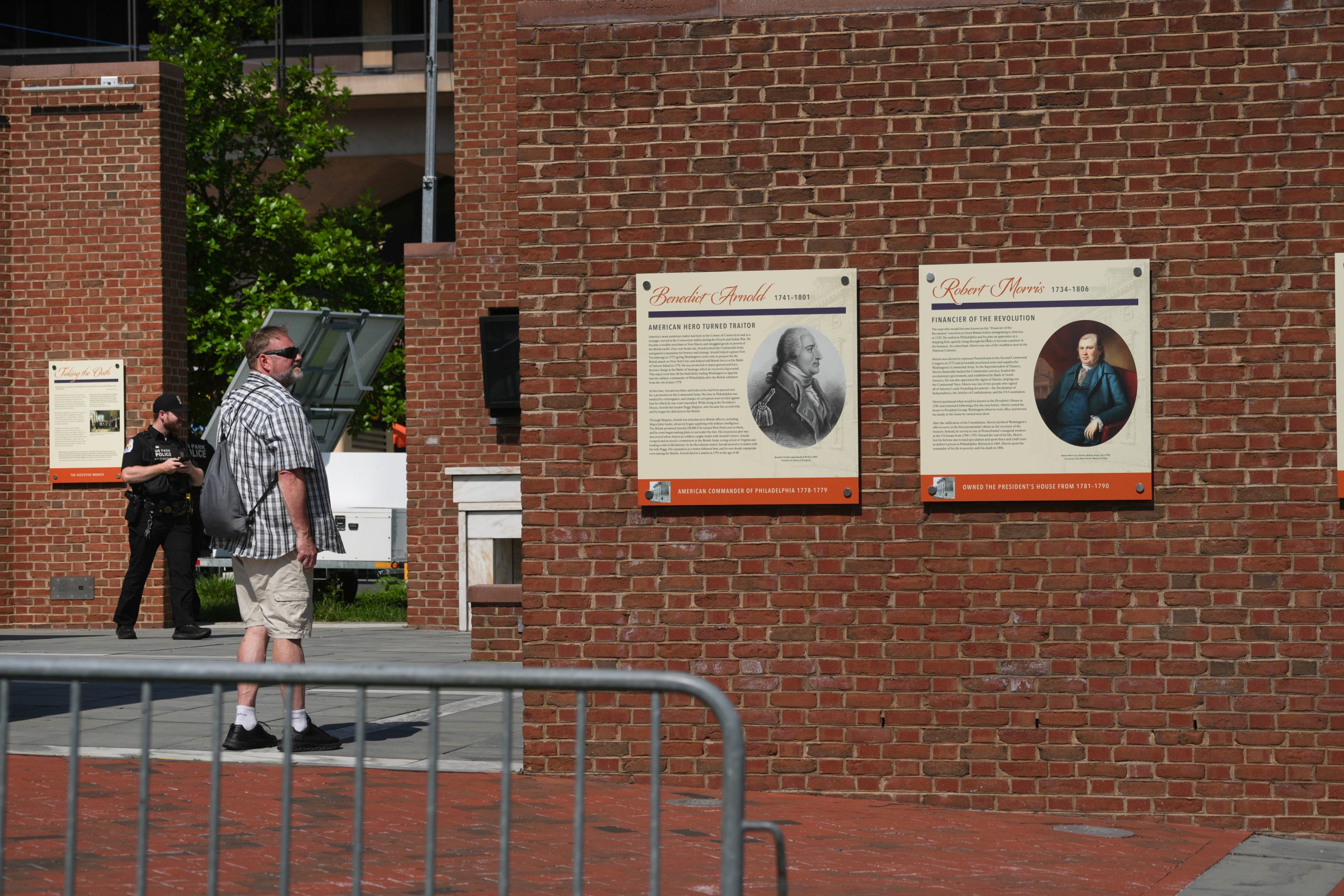
Roughly a week prior to the changes, park employees installed security cameras near the site, which one worker explained as being for the All-Star Game festivities. The cameras were still present Wednesday.
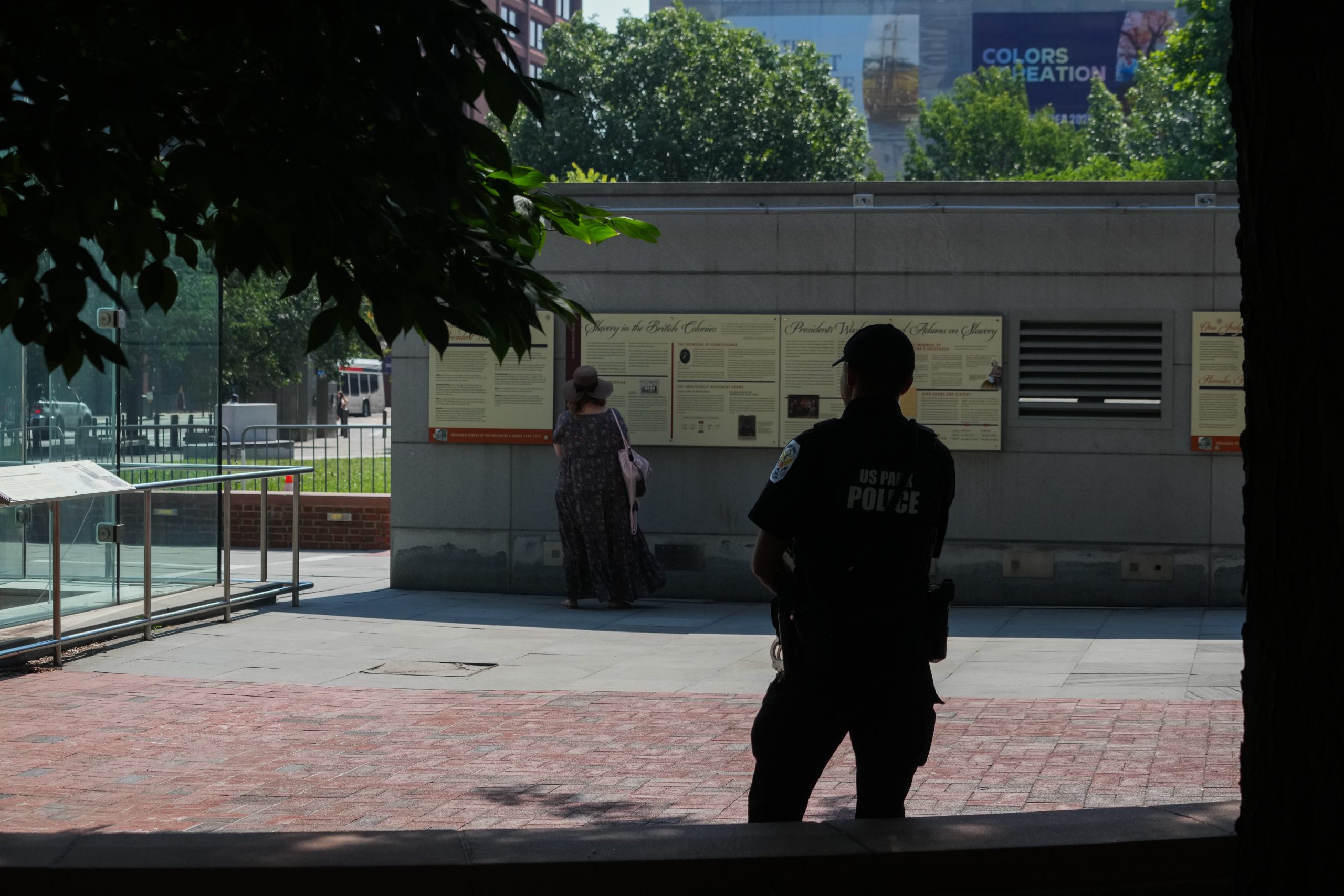
A U.S. parks police officer and a visitor at the President’s House Site, where new panels have been installed, in Philadelphia, July 15, 2026. Historians and advocates have criticized the panels for minimizing Washington’s role as an enslaver.Jessica Griffin / Staff Photographer
In a statement, Parker said the city intended to seek a rehearing on “serious legal issues” presented in the Third Circuit’s decision and slammed the federal government for installing the panels ”under the cover of darkness.”
“It was allowed to do this by the decision of the federal court, but that it did so at night shows it understands this action is shameful, that it violates community trust,” Parker said.
The site now features the 11 panels were proposed by the Trump administration in April, in addition to more than a dozen smaller panels that detail governmental processes, the lives of various historical figures, and a panel dedicated to the escape of Ona Judge and Hercules, two people enslaved by Washington who fled to freedom.
Though the panels do mention slavery and the people Washington enslaved, the new exhibits mostly offer a broad timeline of U.S. history that significantly strays from the original intent of the President’s House asoutlined in the park’s foundation document in 2017: “It would explore the historic context of the site in the context of its ties to slavery and the lives of the enslaved who lived at the site.”
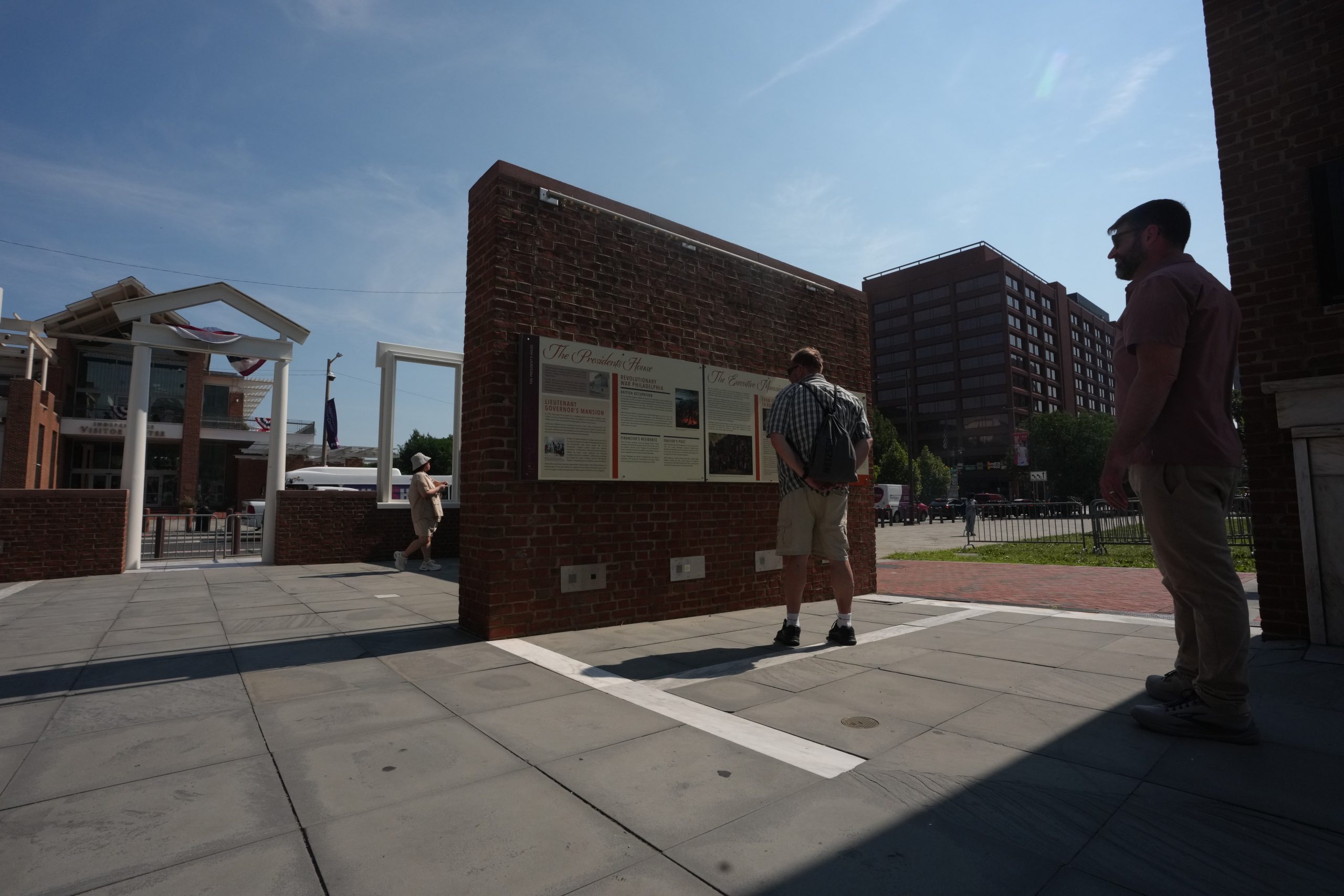
Visitors to the President’s House Site, where new panels have been installed, in Philadelphia, July 15, 2026. Historians and advocates have criticized the panels for minimizing Washington’s role as an enslaver.Jessica Griffin / Staff Photographer
The new panels also soften Washington’s role as an enslaver.
For instance, one display says: “Caught between his private doubts about slavery and his public responsibilities as president, George Washington navigated a nation deeply divided over slavery.”
“Privately, George Washington often expressed discomfort with the institution and a desire to see it abolished,” the panel continued. “Yet as a Virginia plantation owner, his wealth and livelihood were deeply tied to it.”
Later in that panel, the Trump administration writes: “Slaves living in the President’s House experienced a greater modicum of autonomy than elsewhere in the South such as to explore the city and sometimes even attend the theater, with Washington buying the tickets.”
Another panel, titled “Enslaved People at the President’s House,” discusses the lives of each of the nine individuals enslaved by Washington, but reframes Washington’s role.
“President Washington knew and trusted his enslaved house staff enough to buy them tickets for the circus and theater and to let them venture out into the city’s markets on their own,” the panel says.
A spokesperson for the Interior Department said in a statement that the “new panels are full of historical context and highlight the momentous events that took place in the President’s House and other sites at Independence National Historical Park.”
The statement said that the panels “acknowledge the evils of slavery, including its injustice and hypocrisies,” and properly tells the story of the nine individuals enslaved by Washington and the “full story” of U.S. history.
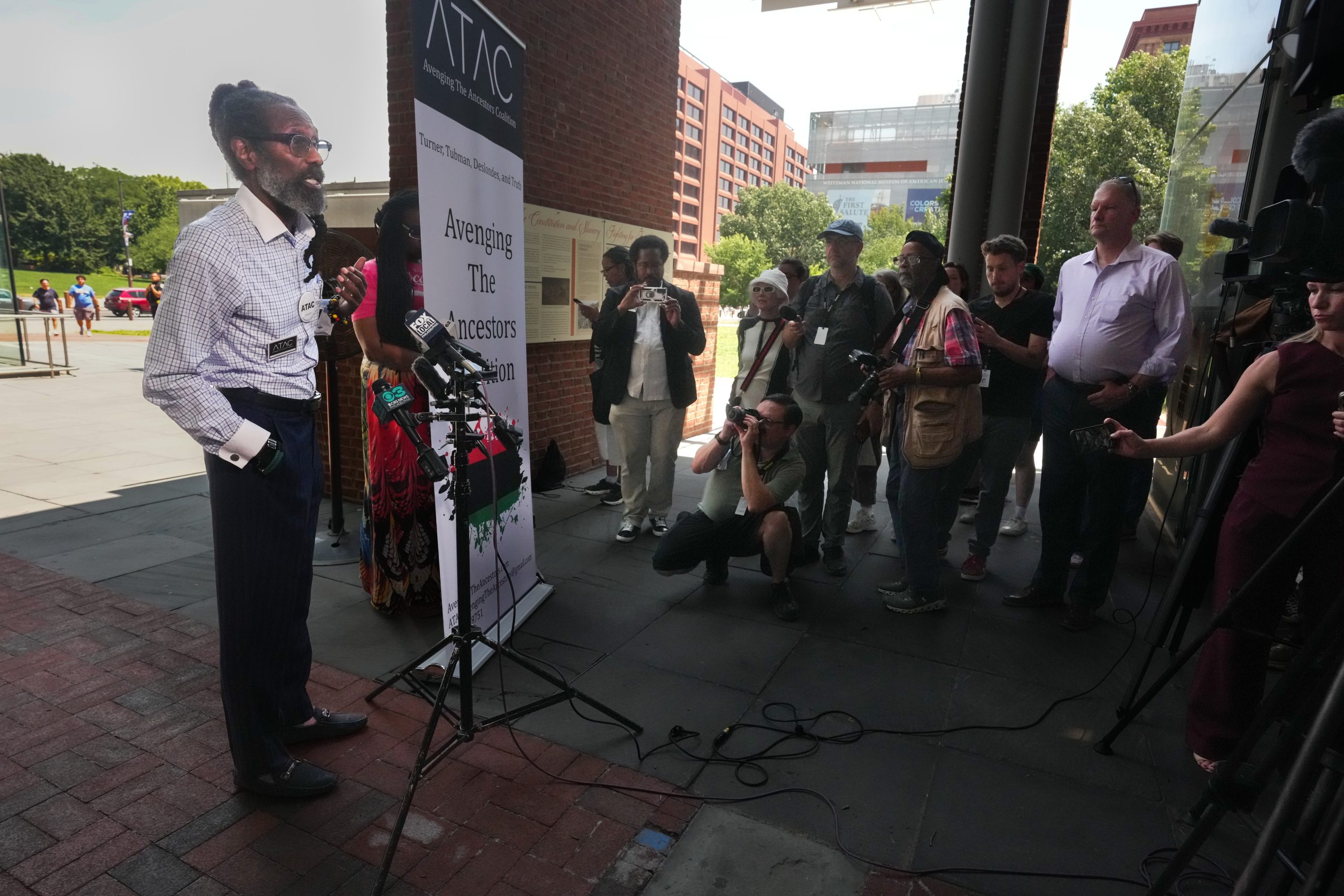
Michael Coard, leader of Avenging the Ancestors Coalition, a group that has fought to protect the President’s House, said stakeholders were “not surprised — we saw it coming” and were reviewing all possible legal avenues and advocacy options.
Shortly after noon, Coard and other activists spoke defiantly at the site.
He called the new panels “a complete whitewashing of American history” and said the few references to existence of slavery are a reminder that “the best lie is one that has a little bit of truth.”
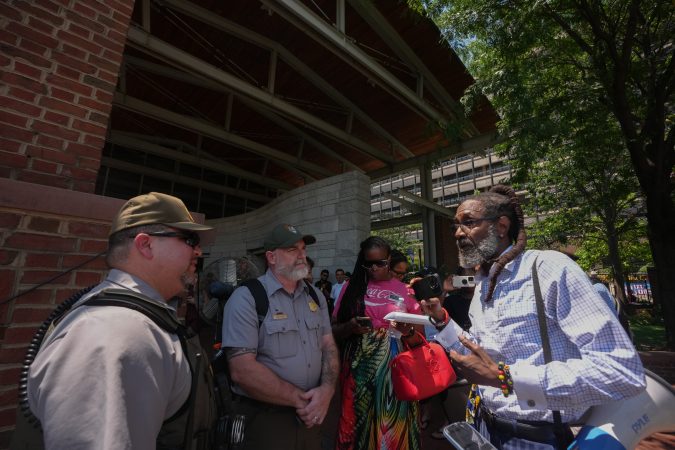
Lawyer Michael Coard holds a press conference at the President’s House Site, where new panels have been installed, in Philadelphia, July 15, 2026. Historians and advocates have criticized the panels for minimizing Washington’s role as an enslaver.Jessica Griffin / Staff Photographer
The drastic alterations are a culmination of about a year of turmoil since the Trump administration began scrutinizing the site as part of the president’s executive order to review or remove displays at national parks that “inappropriately disparage Americans past or living.”
Removals also happened at national parks around the country.
Sheri Utain, 77, has been coming to the President’s House site since January to read aloud the content of the missing panels. When she arrived Wednesday, she was shocked to learn the exhibit had been replaced overnight.
“How sneaky is that?” Utain said. “What kind of government is that?”
Others also continued with their routines, but the response from National Park Service rangers was harsher.
Sandra Shachar has been posting news articles on the President’s House walls almost every day since January to provide visitors updates on the court battles over the slavery exhibit.
Sandra Shachar, 72, cited for vandalism at the President’s House Site on July 15, 2026 for attempting to post news articles on the walls.Abraham Gutman
But Wednesday, the local psychologist was cited for vandalism and ordered to pay a $305 fine.
“It was something I could do … it feels better than doing nothing,” Shachar said, holding back tears. “Part of free speech and our First Amendment rights is to put up signs. It’s not defacing. It’s not vandalizing.”
An Interior Department spokesperson said “any vandalism, tampering, destroying, or defacing of cultural or archaeological resources is a federal crime.”
The installation of the new exhibit marks the end of a phase in the city’s legal battle against Trump’s administration.
The city sued in January when the slavery exhibit was abruptly dismantled, asking a federal judge to issue an injunction ordering the panels be restored. Judge Cynthia M. Rufe issued a blistering opinion on Presidents’ Day ordering the restoration, comparing the Trump administration’s action to the Ministry of Truth from George Orwell’s 1984 novel.
No changes followed on the ground immediately after the ruling because of litigation in federal court in Boston that challenged the legality of display removals in national parks and historic sites nationwide, leading a district judge to order the Trump administration to restore all removed items.
Visitors to the President’s House Site, where new panels have been installed, in Philadelphia, July 15, 2026. Historians and advocates have criticized the panels for minimizing Washington’s role as an enslaver.Jessica Griffin / Staff Photographer
In the aftermath of the 250th anniversary celebrations, Parker said, examining the paradoxes of liberty and slavery that existed during the founding of the United States is key.
“This paradox reveals core questions we still live and struggle with today — how do we share power for the betterment of all people? That is a hard question, and one that President’s House forced us all to consider,” Parker said.
As activists and the city vow to continue the legal fight, the efforts to educate visitors about the history of the President’s House will also continue.
The U.S. Mint will soon begin producing a new $1 gold-hued coin with President Donald Trump’s face on it to commemorate America’s 250th birthday, Treasury Secretary Scott Bessent announced this week.
The coin’s face features Trump alongside the phrase “In God We Trust.” It is encircled with the phrases “Liberty” and “1776-2026.” The flip side of the coin shows an eagle holding arrows in one talon and olive branches in the other.
Since the start of his second term, Trump and his allies have pushed to reissue federally created currency and documents to feature the president’s name and likeness. Examples include a commemorative passport with Trump’s image inside its pages and the addition of his signature on newly printed $100 bills. There are also proposals to feature the president’s image on 24-karat gold coins and commemorative $250 bills.
Bessent said in a post on X that the coin “celebrates the strength of American values, and the promise of a nation dedicated to preserving freedom for all.”
A Treasury Department spokesperson said the coin “is in production and minted in Philadelphia, and it will be available in the fall.” They also said that there is no gold in the coin but that it has a gold-like finish.
As America commemorates 250 years of independence, the @usmint will begin striking this new $1 gold coin to honor the enduring legacy of liberty and a lasting symbol of patriotism. Featuring President Trump, it celebrates the strength of American values, and the promise of a… pic.twitter.com/PEMrsGqOEA
— Treasury Secretary Scott Bessent (@SecScottBessent) July 15, 2026
Earlier drafts proposals of the $1 coin showed Trump standing with a clenched right fist in front of an American flag and the words “Fight Fight Fight” — a reference to the 2024 assassination attempt at his campaign rally in Pennsylvania.
When plans for the $1 coin were revealed last year, concerns emerged over whether the proposal to include a living president’s image on U.S. currency could violate the law.
Under a law passed in 2020, the Treasury Department can mint $1 coins during 2026 to mark the 250th anniversary “with designs emblematic of the U.S. semiquincentennial.” However, according to U.S. code, “[o]nly the portrait of a deceased individual may appear on United States currency and securities” — a law that sprang from a Colonial-era tradition against putting current presidents on American coins themselves from the British monarchy.
In addition, the 2020 law states that “[n]o head and shoulders portrait or bust of any person, living or dead, and no portrait of a living person may be included in the design on the reverse of any coin” produced for the Semiquincentennial, which could be violated by having Trump’s image on both sides of the coin.
Bessent argued that the $1 coin design was legal, telling Fox News this week that although he is otherwise barred from featuring a living person’s image on U.S. currency, “during the 150th, there was a Calvin Coolidge coin, so we can put living presidents’ images on a coin.”
The design for the coin also was not what the Commission of Fine Arts, which is composed entirely of Trump appointees, recommended when members met in January. The obverse design recommended by the commission featured Trump’s face in profile, while the final design shows the president with his eyes forward. The treasury secretary has the final say on the design.
Megan Sullivan, the acting chief of the U.S. Mint’s office of design management, said during the January commission meeting that “the legal research has been done both at the Mint and up into Treasury, and they have determined that [the proposed coin featuring Trump’s image] does not violate any laws.”
Sullivan described the coins as being “a little bit larger than a quarter” and being composed of “manganese brass” and displaying as “golden in color.”
The $1 coins are distinct from the 24-karat coins created by the Treasury Department that typically sell for thousands of dollars. Senate Democrats, in June, urged the Trump administration to halt production of that solid gold coin, citing concerns that some of the U.S. Mint’s gold could have links to foreign cartels.
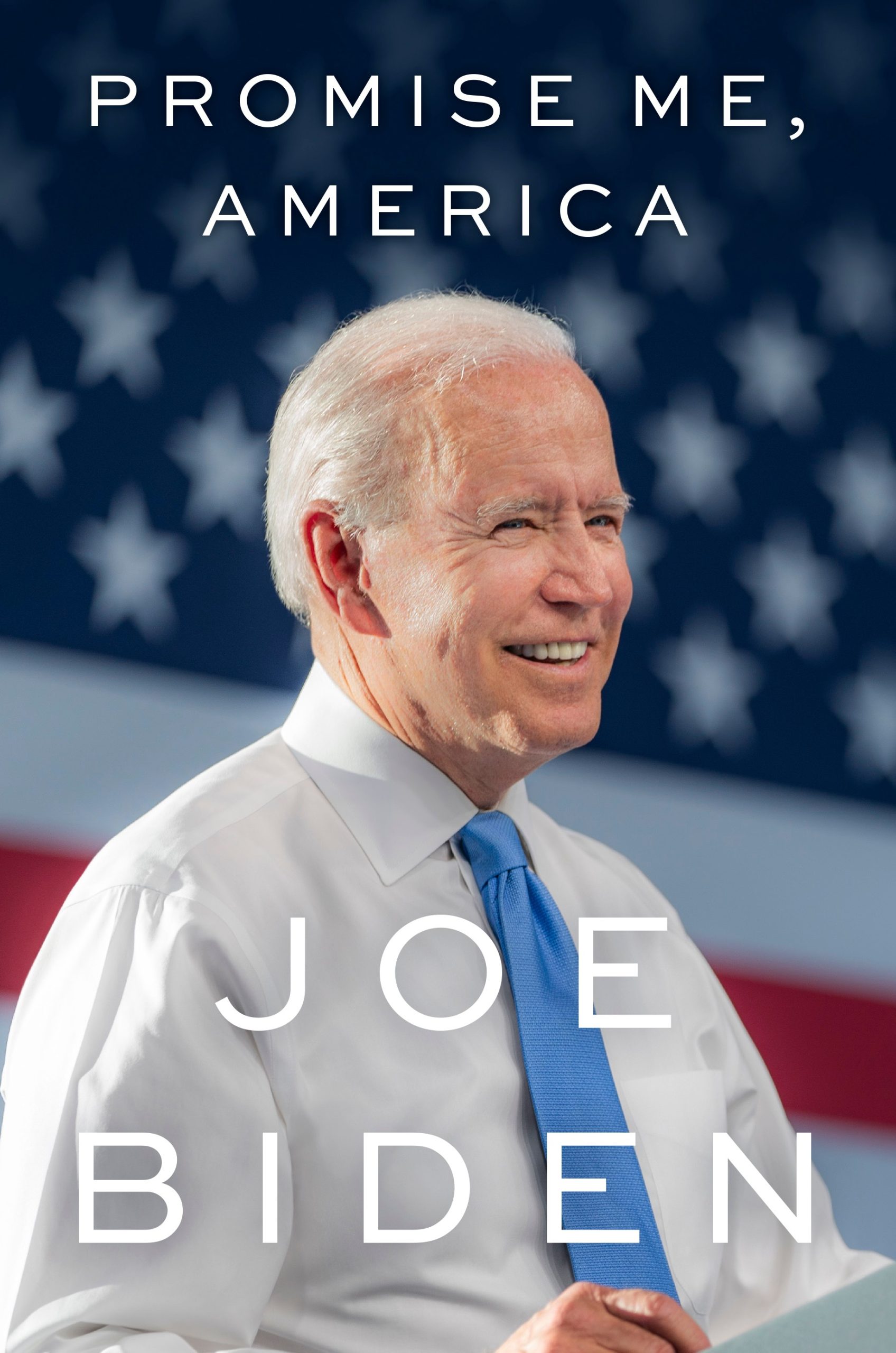
NEW YORK — Former President Joe Biden will publish a memoir, Promise Me, America, which he says will touch upon everything from the economy to his decision to drop his bid for reelection.
The memoir is scheduled to come out Nov. 17, publisher Little, Brown and Company told the Associated Press. The timing of the book — two weeks after midterm elections in which Democrats seek to regain control of Congress — could raise concerns within Biden’s party by putting him back into the spotlight.
Democrats remain divided on Biden’s legacy, with many blaming his ill-fated determination to seek a second term for Republican President Donald Trump’s return to the White House. Leaders hope to keep the fall campaign focused on Trump and his record, and any leaks or promotional efforts before votes are cast could draw frustration.
“Promise Me, America is about the challenges we faced as a nation. It’s about the decisions I made and why I made them,” Biden said in a video statement accompanying Wednesday’s announcement. “It’s about why I chose to run for reelection and why I chose to step aside.”
This book cover image released by Little, Brown and Co. shows “Promise Me, America” by Joe Biden.Uncredited
Reports of Biden’s book have circulated for more than a year, and the former president himself has referred to it during public remarks, appearing to suggest it would be released before November’s election.
Biden, who will turn 84 three days after the publication of Promise Me, America, has long presented himself as an upholder of standards and traditions; presidential memoirs are one of them. With a handful of exceptions, modern presidents since Harry Truman in the 1950s have published books about their White House years. Like virtually all of his predecessors, Biden did not work on the book alone but was helped by a “small editorial team,” according to the publisher. Little, Brown declined to release financial details for Promise Me, America, although presidents have usually reached deals worth at least seven figures.
The book’s title echoes a 2017 memoir by Biden, Promise Me, Dad, which centered on the death of his son, Beau Biden.
Vowing as a candidate to “restore the soul” of his country, Biden was sworn into office in the midst of the COVID-19 pandemic and in the aftermath of the Jan. 6, 2021, attack on the U.S. Capitol by Trump supporters seeking to stop his certification as president. Biden’s term was defined by a wide range of conflicts and achievements, from his handling of wars in Ukraine and the Middle East to the passage of ambitious infrastructure and economic aid bills. But many readers will likely want to know more about his health while president, including the disastrous debate in June 2024 against Trump that led to his giving up his reelection bid. Then-Vice President Kamala Harris, who ran instead, lost decisively to Trump.
Former first lady Jill Biden wrote in her own book that her husband seemed so weak and disoriented during the debate that she feared he was having a stroke. In View from the East Wing, published in June, she noted that the White House had initially said he was suffering from a cold.
“The biggest lesson for us, I think, was that if you don’t explain something well enough then the question won’t go away,” she wrote. “There was never a satisfying enough explanation offered for Joe’s debate performance, and a lot of people never got over it.”
Biden was the oldest man to serve as president and his health was a source of speculation for much of his term; Biden and his White House advisers have faced intense criticism from Democrats and Republicans for allegedly concealing the extent of his problems. A notable book release from 2025, Jake Tapper’s and Alex Thompson’s Original Sin, was subtitled “President Biden’s Decline, Its Cover-Up, and His Disastrous Choice to Run Again.”
That year, Biden announced he had been diagnosed with prostate cancer.
Biden’s previous books also include Promises to Keep, a campaign work published to boost his run for president in 2008, when Barack Obama was the eventual nominee and Biden his running mate. Promise Me, America comes out during a year when nonfiction sales have declined and few political books have caught on, although recent bestsellers have included Vice President JD Vance’s Communion and an inside account of Trump’s second term, by New York Times reporters Maggie Haberman and Jonathan Swan, Regime Change.
A Little, Brown spokesperson said that Biden plans to tour on behalf of the book and give interviews. In his video announcement, Biden said that many people had been asking him how he was doing.
“I’ve been spending a lot of time with my family. I’m dealing with a cancer diagnosis, been getting treatment, and it’s going really well,” he said. “I want to thank all those who have offered their prayers and support and well-wishes. It’s meant the world to me and to Jill.”
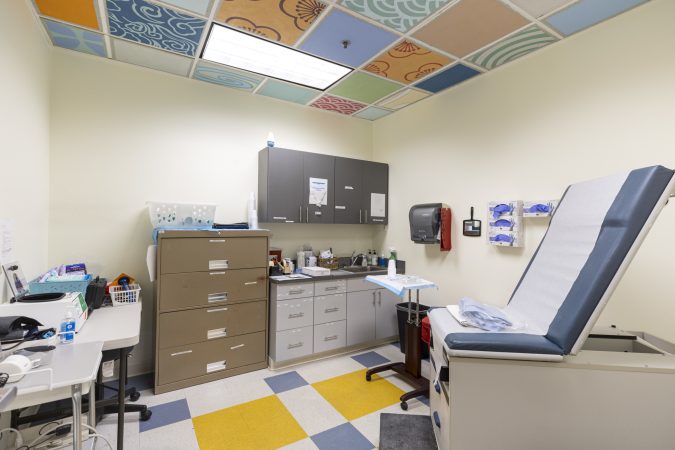
The city government will assume control of the Philadelphia Sexual Assault Response Center, the only program in the city that offers free sexual assault exams, after years of uncertainty over how the center would be managed and financed.
Mayor Cherelle L. Parker’s administration announced Wednesday that the Philadelphia Department of Public Health will take over PSARC, a nonprofit program that is currently operated by Drexel University and serves about 300 patients a year.
The center is staffed 24-7 by nurses trained to conduct sexual assault exams that are performed to collect DNA and other evidence, sometimes known as “rape kits.” The center is located at 300 E. Hunting Park Ave., in the same building as the Philadelphia Police Special Victims Unit; patients are not required to report sexual assault to police, however.
PSARC was founded in 2011 and contracts with hospitals that do not have staff specially trained in handling sexual assault response. It was previously managed by Hahnemann University Hospital, the historic Center City facility that shuttered in 2019 after filing for bankruptcy.
Since then, Drexel’s College of Nursing and Health Professions has managed the center.
But PSARC has struggled to survive amid years of funding challenges. Prior to last year, it did not receive dedicated funding from the city — it was funded entirely by Drexel, and the state reimbursed the center $1,000 for each patient treated there.
Drexel officials told members of Parker’s administration last year that the university could not continue managing the program, according to two sources involved in the conversations who spoke on the condition of anonymity because they were not authorized to discuss the matter. Last fall, Drexel was in the midst of cutting staff and benefits university-wide amid a massive operating deficit and low enrollment.
The Parker administration explored transitioning the program to the control of another crisis center, the sources said.
But other nonprofits were facing their own funding-related disruptions last year. For example, in October, Philadelphia’s only rape crisis center, the Philadelphia Center Against Sexual Violence, paused some of its services and laid off staff amid the monthslong state budget impasse.
Ultimately, Drexel continued operating PSARC, with the city allocating $250,000 in emergency funding last year to support the program.
This year’s city budget, which took effect on July 1, includes $300,000 in funding for PSARC. That money was allocated to the health department.
In a statement, Crystal Yates-Gale, the city’s deputy managing director for health and human services, thanked Drexel “for supporting PSARC since its founding and for making this transition seamless so there is no pause in operations.”
Emily Roper, the dean of Drexel’s College of Nursing and Health Professions, said in a statement that the transition “has been thoughtfully planned in close collaboration with the City of Philadelphia to ensure continuity of services for survivors.”
“For more than a decade, PSARC has provided compassionate, expert care to survivors of sexual assault,” she said, “and we are deeply grateful to the dedicated clinicians and staff whose unwavering commitment has made that possible.”
Members of Philadelphia City Council say they are concerned that the city’s recently released property reassessments will mean tax hikes for thousands of residents, and they are demanding to know more about the methodology used to determine property values.
Councilmember Mike Driscoll, a Democrat who represents the Lower Northeast, authored aletter sent Monday to Chief Assessment Officer James Aros Jr. and other top officials in Mayor Cherelle L. Parker’s administration, expressing concerns on behalf of a half dozen Council members.
He wrote that his office has received “numerous” calls from constituents whose homes will see sharp increases in valuation, the measure that is used to calculate property tax bills.
“Many residents are struggling to grasp how their assessments were calculated. Others are worried about what these increases will mean for their property tax bills,” Driscoll wrote. “At a time when families are already facing higher costs for housing, utilities, groceries, and other daily expenses, these concerns need clear answers.”
He outlined six questions for the Philadelphia Office of Property Assessment related to its process and methodology, and set an Aug. 15 deadline for the administration to reply, saying “property owners deserve answers now as they review their assessments and consider whether to file an appeal.”
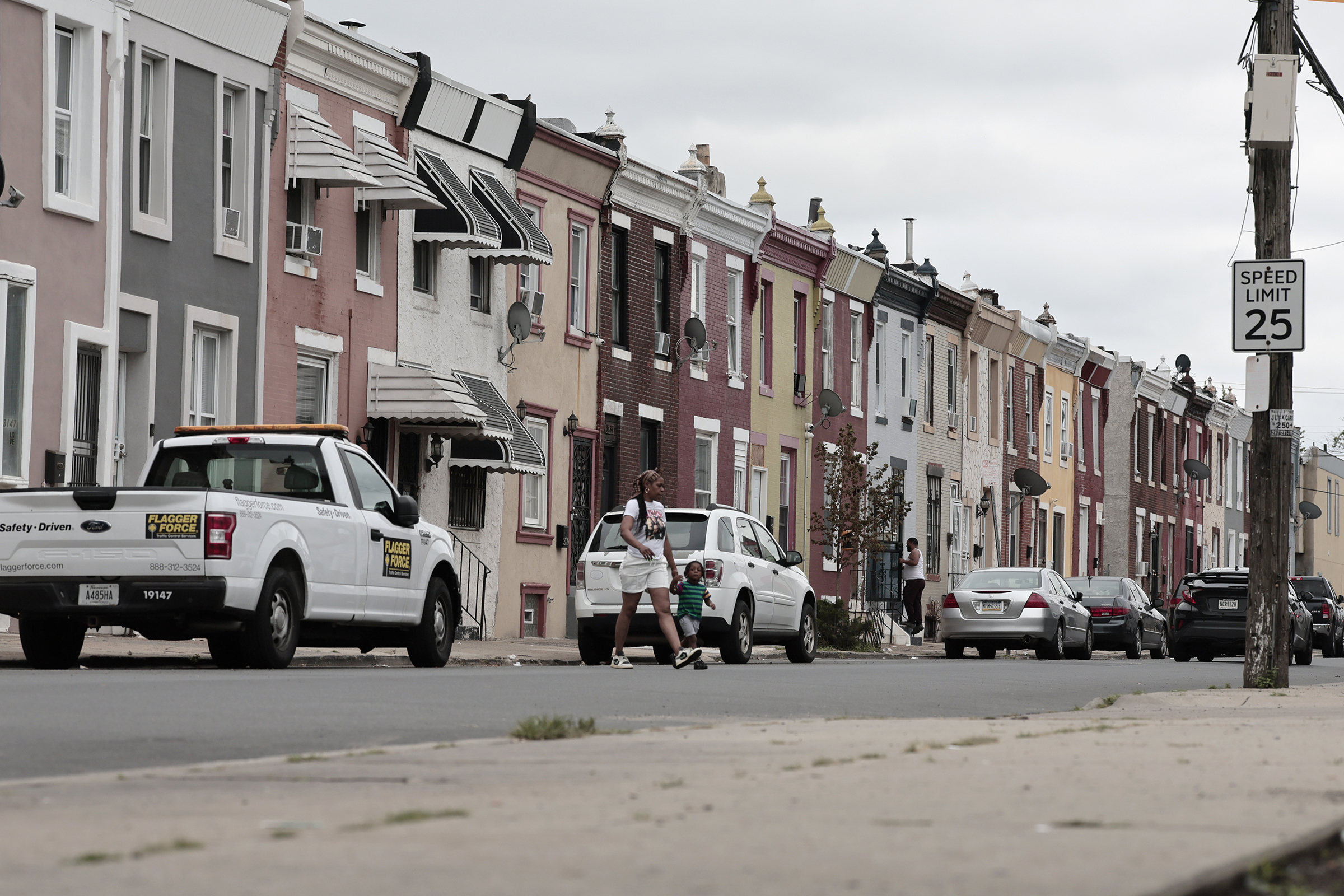
The 3100 block of C Street in Philadelphia on Tuesday, July 7, 2026. Property values sharply increased on this Kensington block.Elizabeth Robertson / Staff Photographer
The letter — which was signed by six Council members who are cosponsors of previously introduced legislation to probe the city’s property assessment process — is one of the first formal steps that lawmakers have taken to challenge the citywide revaluation since last month, when property owners received notices of their new assessments.
Citywide, there was a 3% median change in valuations from the 2025 tax year, the last time there was a mass reassessment, according to an Inquirer analysis of assessments of single-family homes.
But some neighborhoods saw much steeper increases. The biggest jump was in Kensington, where median values increased 15.3%. Driscoll represents part of the neighborhood, which has been long beleaguered by the open-air drug market there and where the city has made a concerted effort to improve the quality of life.
There was also a 15% median increase in property assessments in Mantua and a 12% rise in Kingsessing, both of which are in West Philadelphia and border University City.
Parker administration officials have said that the city offers a variety of property tax relief programs, including the popular homestead exemption, which erases the first $100,000 in valuation from being taxed for owners who live in their home as their primary residence. Property owners must sign up for the free program.
But for years, dating back long before Parker took office in 2024, Council members have criticized the city’s property reassessment process, saying its methodology is opaque and its results have a disproportionate impact on low-income homeowners.
Multiple reviews are already underway.
In addition to a yet-to-be-scheduled Council hearing, the city controller is conducting a performance audit of the property assessment office and the city’s appeal process, according to Driscoll’s letter. Controller Christy Brady’s office has sought feedback from residents and left flyers in neighborhoods where property values are rising.
The Parker administration convened a task force in 2024 to develop recommendations for how the city can improve its appraisal practices.
And the city is in the process of hiring an outside consultant to examine the fairness of its reassessments. According to city records, that analyst will be expected to draft a report by the end of this year.
Data reporters Yaelle Tang and Lizzie Mulvey contributed to this article.
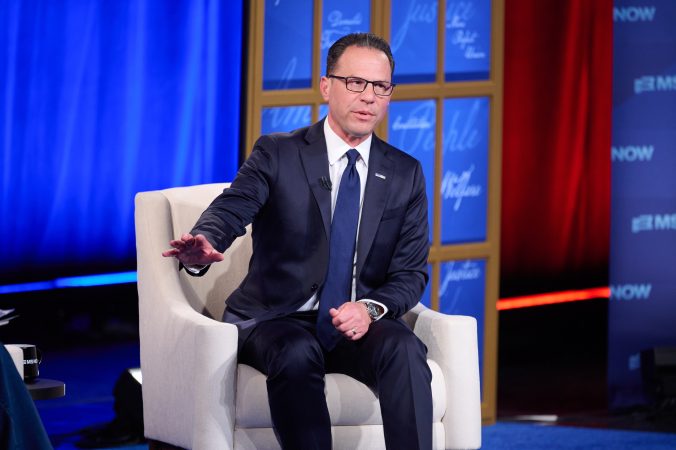
Gov. Josh Shapiro’s teeming campaign war chest continues to grow.
The first-term Democrat raised a whopping $12 million toward his reelection bid for Pennsylvania governor between April and June, his campaign said Wednesday — bringing his total fundraising to $50 million since January 2025.
But the news of the governor’s eye-popping fundraising figures — topping the $10 million he raised between January and March — came the same week that federal elected officials and candidates are required to submit their financial reports.
Shapiro is widely speculated to be considering a 2028 presidential run, though he has demurred when asked about any presidential ambitions. Several members of Congress, including U.S. Sens. Cory Booker of New Jersey, Mark Kelly of Arizona, and Chris Murphy of Connecticut, and U.S. Reps. Ro Khanna of California and Alexandria Ocasio-Cortez of New York — all of whom were due to file their latest fundraising totals by Wednesday night — are also seen as prospective candidates for the Democratic presidential primary.
A spokesperson for Shapiro declined to comment on the timing of his fundraising announcement.
If Shapiro decides to run for higher office, the money he has raised would not follow him. State campaigns are not permitted to transfer money to a presidential run. But his connections could provide a vast network of donors if he pursues the White House.
Shapiro, who has boasted high popularity ratings in Pennsylvania throughout his term, has also consistently polled well ahead of his Republican gubernatorial opponent, State Treasurer Stacy Garrity.
Garrity’s campaign did not provide its latest fundraising numbers. Full reports for both Garrity and Shapiro, including who gave the money and how much was spent, will be available in September. In the 2022 Pennsylvania governor’s race, Shapiro spent a historic $73 million to beat Republican State Sen. Doug Mastriano.
During the last reporting cycle, Shapiro outraised Garrity 10-1 as she struggled to compete with Shapiro’s large donations from across the country. Her campaign has previously emphasized that most of her contributions came from individual Pennsylvanians.
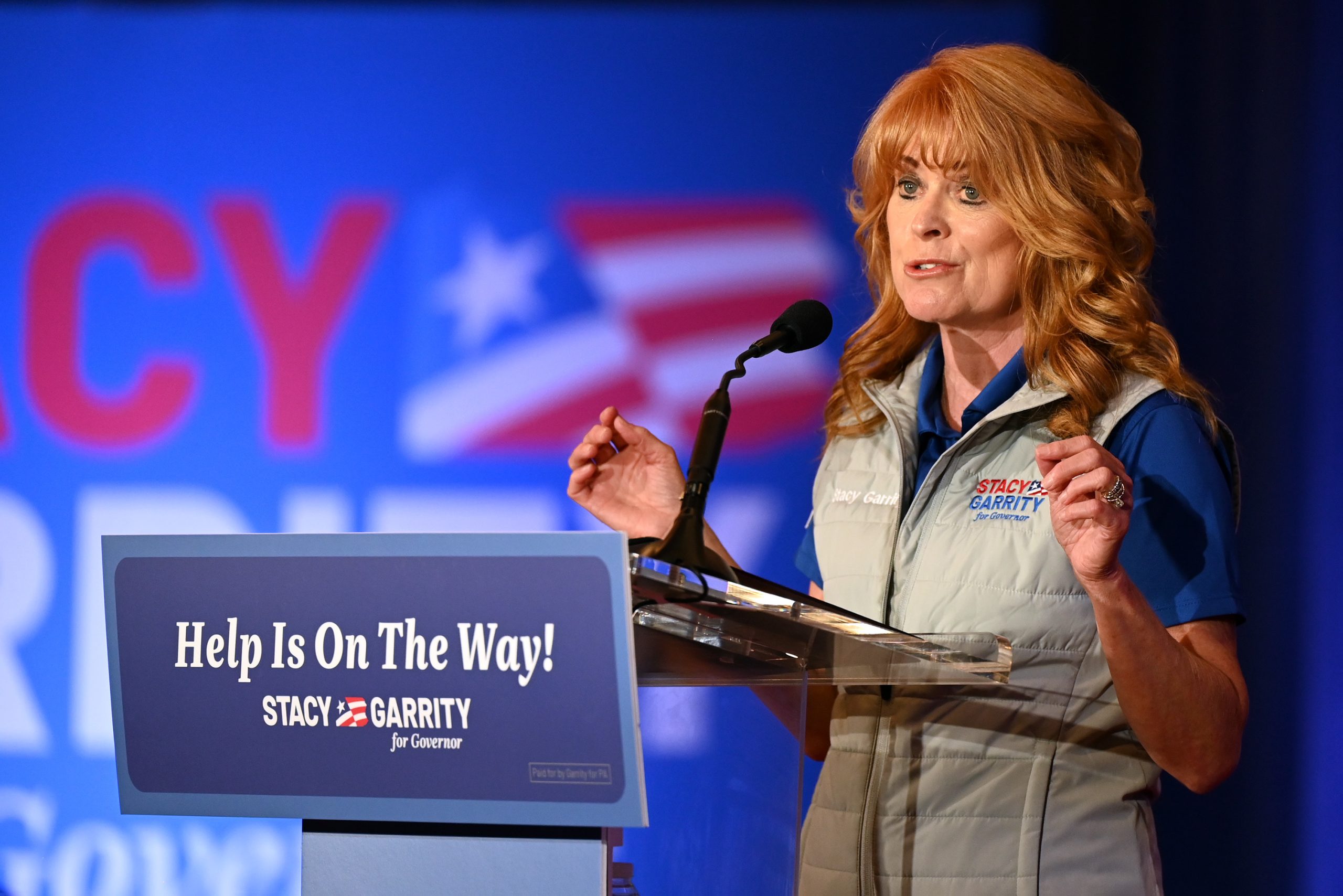
State Treasurer and Republican candidate for governor Stacy Garrity holds a rally in Bucks County Sept. 25, 2025 at the Newtown Sports & Events Center.Tom Gralish / Staff Photographer
On Tuesday, Garrity stopped in Philadelphia for an event with Florida Gov. Ron DeSantis at the Union League about issues related to affordability, according to an event flyer. Media were denied entry into the private event.
The governor has repeatedly said his focus is on the November election in Pennsylvania, where he is vying not only for reelection but also to rally enthusiasm down-ballot in efforts to flip control of the state Senate and elect Democrats to four nationally watched congressional seats in attempts to flip the U.S. House.