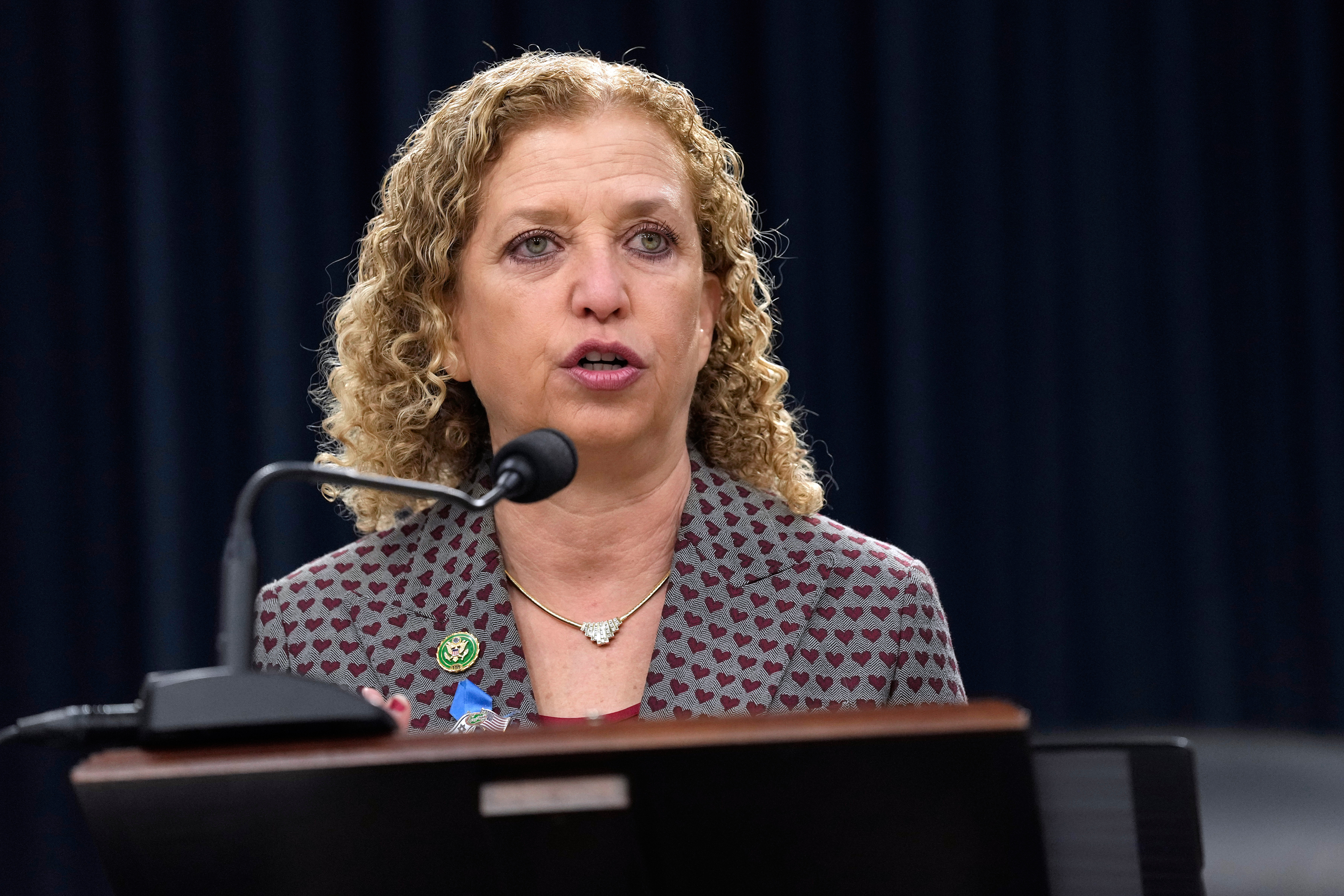
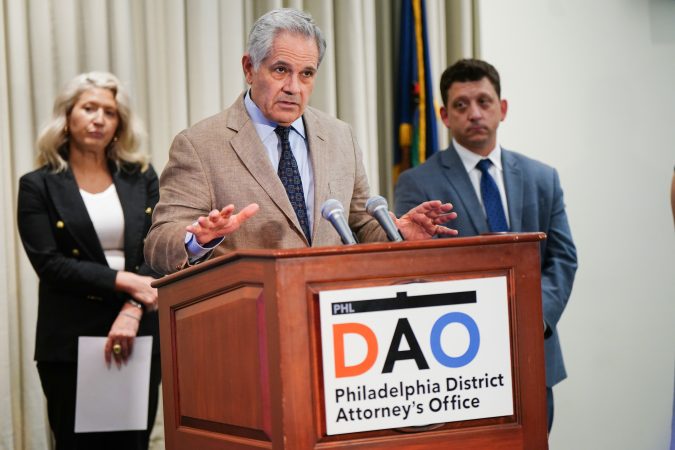
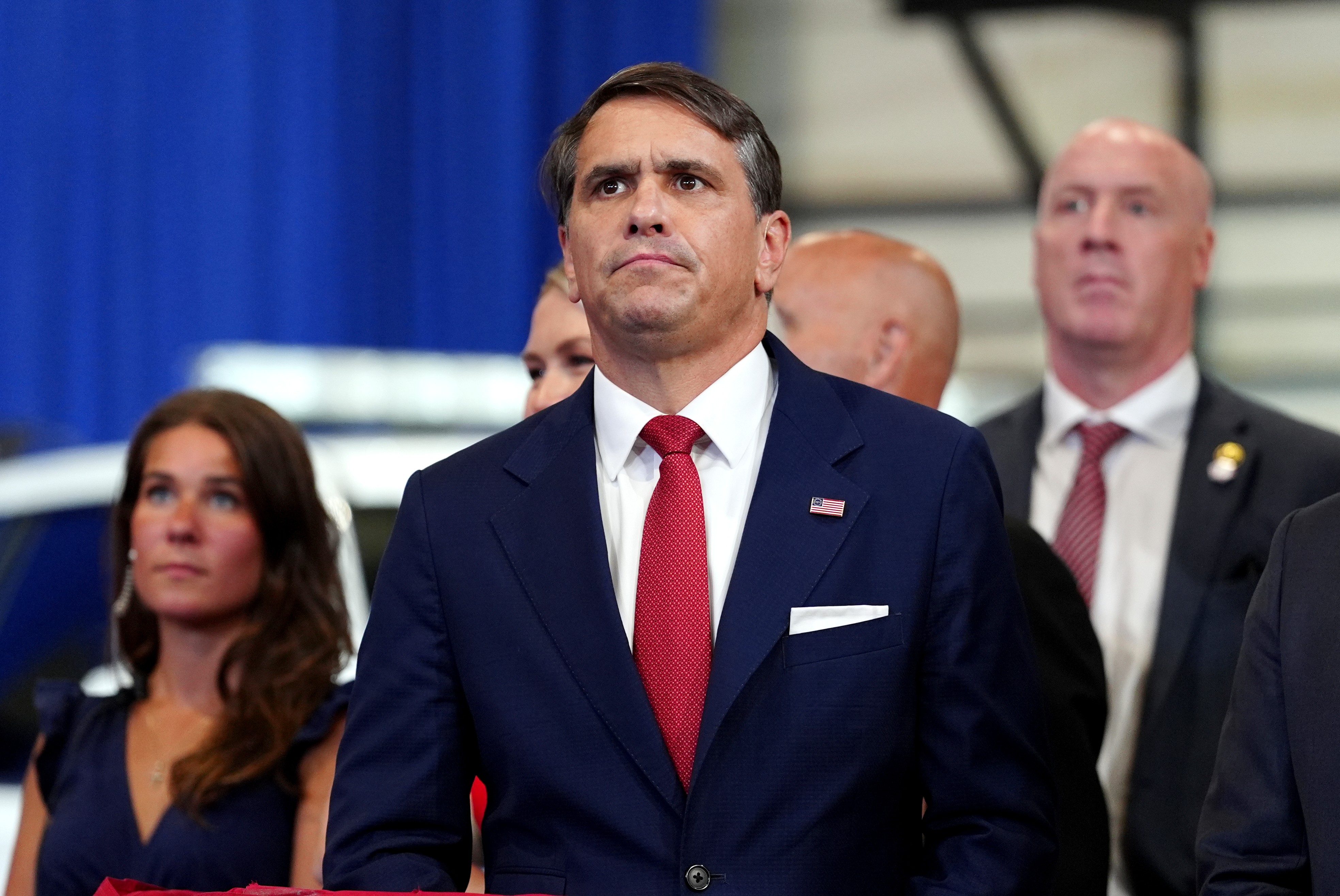
Pennsylvania’s top election official contended in a letter to a cabinet secretary this week that the Trump administration’s own staff does not have “high confidence” in its claims of thousands of noncitizens on the state’s voter rolls.
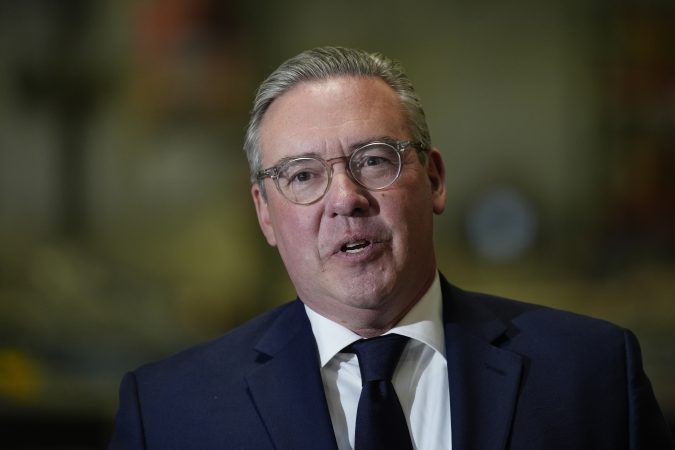
In a letter to DHS Secretary Markwayne Mullin, Secretary of State Al Schmidt said the Department of Homeland Security has still not fulfilled a promise to provide a written copy of its methodology “with a list of specific data sources” for its calculation that there are more than 14,500 noncitizens on the state’s voter rolls — a claim Schmidt and other Pennsylvania officials dispute.
“We await this information,” Schmidt said in the letter, citing a virtual Aug. 13 meeting with DHS staff.
Schmidt, a Republican appointed by Democratic Gov. Josh Shapiro, told Mullin that during that meeting “DHS representatives explained that they did not have high confidence that the 14,576 individuals… were, in fact, non-citizens who had improperly registered to vote in Pennsylvania.”
The correspondence, shared with The Philadelphia Inquirer, comes amid increased scrutiny of election workers ahead of the consequential midterm elections just over two months away and as President Donald Trump has been pushing for an overhaul of the way Americans vote.
In an email response Thursday after the initial publication of this story, a spokesperson for DHS confirmed the meeting with Schmidt and said the agency “will continue working with Pennsylvania to address additional questions and correct their misunderstanding of the information provided during the meeting.”
Pennsylvania was one of four Democratic-led states — along with California, Nevada and New Jersey — that DHS claimed had a collective total of 250,000 noncitizens on their voter rolls ina July document posted at the same time Trump delivered a prime-time address on election security that waded into conspiracy theories.
The White House and DHS have provided little explanation for how they have arrived at these numbers, and election experts have said the large numbers may likely be pulling from other government data sources and include hits to names from systems that were never meant to identify noncitizen voters.
Schmidt said in the letter that he looks forward to understanding “how you attempted to match registered voters in Pennsylvania with information in DHS’s data sources and how you determined which matches were associated with greater or lesser degrees of confidence.”
Mullin said in a news conference the day after Trump’s address that leaders in any states who resist working with the department to screen for noncitizen voters would be “held accountable by fines, by penalties, and even depending on how far it goes, prison time.”
Mullin claimed on X, following Sherrill’s announcement, that more than 35,000 noncitizens could be registered in New Jersey.
Sherrill’s office has since provided updates to its estimates, sharing Aug. 19 that approximately 5,100 individuals, who were only registered from the error, were removed from voter system and about another 1,450 will undergo additional review. Roughly 340 individuals, her office said, who were registered because of the error cast a ballot at least once.
Sherrill won the 2025 governor’s race, and New Jersey went for Vice President Kamala Harris in 2024. Neither contest’s outcome would have been changed by those 340 votes.
But New Jersey’s disclosure has helped put additional pressure on the other three states targeted by DHS as November approaches. Shapiro, who is seeking a second term as governor this November, and Schmidt have continued to reject Trump’s push for a greater federal role in elections.
In closing his letter, Schmidt said he wants DHS’ additional information to conduct further review and appealed to the high stakes of the potential premature removal of eligible voters.
“The right to vote is sacred, and the cancellation of any voter registration record must be based on reliable data sources and done in accordance with Pennsylvania and federal law,” he wrote.
WASHINGTON — A federal judge Thursday once again temporarily prohibited the U.S. Postal Service from implementing a plan to restrict mail-in voting, put in place after a directive from President Donald Trump.
U.S. District Judge Indira Talwani had cleared the way for the Postal Service to move forward just the day before, but Thursday, she issued a new order concluding that the agency’s plan, released late last week, appeared to overstep its legal mandate and could lead to chaos by changing rules fewer than 70 days before an election.
She wrote that a group of Democratic-led states that had sued “face irreparable harm where they are required to comply with a likely unconstitutional regulation for which compliance is practically impossible as to the 2026 midterm elections, now little more than two months away.”
“Most plaintiff states have already ordered their mail ballots, and some are required by state law to send them to eligible voters as early as next week,” she added.
She wrote that while the Supreme Court had “admonished” her Monday that the Postal Service had not finalized any changes when the groups sued initially, making court action premature, the stakes had changed since then because of the step the agency took late last week to formalized its plan.
Her ruling marked the third court decision on the issue in less than a week, a whipsaw of action that threatened to confuse voters. But each delay has reduced the administration’s chances of clearing the legal hurdles to execute its logistically complicated mail-in ballot plan before the November election. She blocked the rule from taking effect for 14 days, and she had previously scheduled a hearing to discuss the legality of the rule on Sept. 3.
In her order, Talwani explained that the prospect of the new rule suddenly taking effect carried “significant risk of their members’ disenfranchisement” for voting rights organizations, which had also sued, along with the states.
She ticked through a list of requirements that state election officials would be required to meet to ensure delivery of ballots, including receiving the agency’s approval for new envelope designs and submitting voters’ information into an online portal run by the Postal Service.
“Where a state or local election official does not obtain envelope and return envelope design approval, or does not upload voter information, or does not include unique intelligent mail bar codes on ballot envelopes, the U.S.P.S. will not mail ballots to voters,” she concluded.
In March, Trump issued an executive order that required the Department of Homeland Security to create and circulate state-by-state citizenship lists to state officials. It further urged states to provide the U.S. Postal Service with their own lists of voters eligible to cast ballots by mail.
Multiple lawsuits were filed challenging the order, arguing that Congress and the states set rules for elections, not the executive branch. The challengers also argued that no federal law gives the Postal Service the power to make those kinds of election-related rules.
On Monday, the Supreme Court ruled that one suit, brought by a group of Democratic-led states, was premature because the administration had not started implementing its plans.
But late Friday, just before the court ruled, the Postal Service formally published a new plan to comply with the executive order. Under that plan, the service would not deliver mail ballots in states that do not share voter data with the agency and would only deliver ballots that meet certain criteria.
Lawyers for the Trump administration and the groups challenging the rule continue to clash over a straightforward issue: Whether or not the Postal Service’s plan would mean the agency would be taking on a new role verifying voters and potentially rejecting ballots in the midterm election in November.
In a filing Thursday, the Postal Service denied that its proposal left room for the service to second-guess states on which voters were eligible to cast a ballot.
“U.S.P.S. will not scrutinize those decisions or alter that information in any way — instead leaving it entirely up to the states to accurately and lawfully identify its residents who are eligible to vote by mail,” the filing said. “The Postal Service will not determine voter eligibility, ballot content, mailing or receipt deadlines, or ballot-counting procedures.”
Instead, it described the changes as minor logistical improvements and streamlining, such as requiring voters to submit their addresses ahead of time to improve processing. It said the changes were designed “as a matter of the Postal Service’s own judgment.” Lawyers for the service argued it is authorized to adopt mail rules under statutes adopted by Congress.
The challengers argue that the Postal Service rule is an unconstitutional violation of the separation of powers, allowing the executive branch to intrude into elections. They say that no federal law permits such action by the agency, and they assert that the Trump administration’s actions are likely to sow confusion among voters and to lead to disenfranchisement.
The agency has repeatedly said that it would not attempt to impose the new requirements, unless it was explicitly allowed to by the courts.
A series of lawsuits in Massachusetts and the District of Columbia by different groups have challenged Trump’s effort to discredit and erect obstacles to mail-in voting. The lawsuits have challenged both Trump’s executive order and the Postal Service rule, focusing on their implementation this year and beyond.
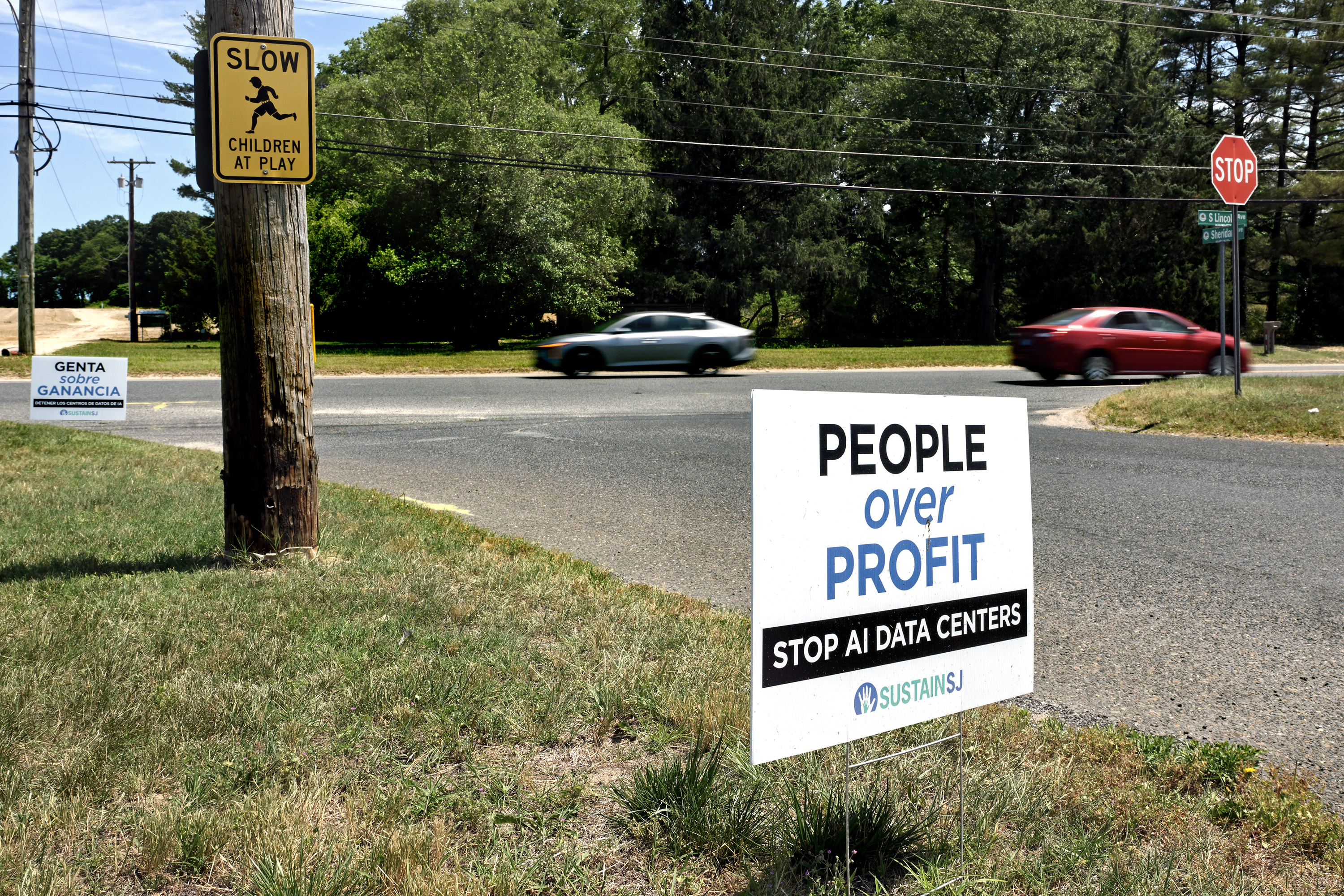
When hundreds of Upper Merion residents came to a township planning meeting in the spring of 2026 to oppose construction of five proposed data centers in King of Prussia, they discovered that, according to the developer, they had little recourse. The plans were code compliant, Brian J. O’Neill of MLP Ventures claimed. They required no rezoning, no variances — and no vote from township officials.
Yet, the residents didn’t just roll over. Instead, they set about organizing. A petition against the proposal garnered roughly 18,000 signatures — a majority of the township’s population. After an intense three-month campaign against the plans, the township Board of Supervisors rejected them in August. O’Neill vowed to appeal, and accused the board of violating state and local planning codes (which they denied), so the fight may not be over.
The board’s action reflected how fierce blowback across the country has politicians across the ideological spectrum rushing to limit data center construction. Both Texas Republican Gov. Greg Abbott and Pennsylvania Democratic Gov. Josh Shapiro recently placed limits on data center construction.
As the campaign against data centers proceeds, opponents can learn from the experiences of towns caught up in the high-tech manufacturing boom of the mid-20th century. That history shows what happens when residents disagree with politicians on these initiatives. And, while not every locality will succeed in stopping a data center, what residents build in these campaigns can outlast the fight itself.
In the 1950s and 1960s, city councils throughout the San Francisco Bay Area eagerly courted technology industries to build campuses in their cities. Officials in these places saw high-tech as the future of American industrialization. They hoped that these new facilities would become an economic boon for their cities and sought to capture new tax dollars from businesses and new residents. Some places, like San José, went so far as to give land to companies like IBM without following the usual avenues for development.
Cities weren’t the only ones that saw high-tech industry as the economy of the future. Stanford University, under the guidance of administrators who had worked in scientific research during World War II, saw high-tech research and development as an engine for economic growth for the university. They developed new programs around electrical engineering and electronics research, created industry-university worker programs that allowed employees to enroll in Stanford classes and encouraged students to found their own companies.
In 1954, Stanford used a piece of its vast landholdings to create the Stanford Industrial Park (later, Stanford Research Park), which attracted the likes of Fairchild Semiconductor and Kodak, alongside companies founded by one-time Stanford students such as Varian Associates and Hewlett-Packard. Business developers at the university were right: within a decade, the new office park was generating millions of dollars of new revenue for the university.
In 1960, the university and City of Palo Alto announced that the Ampex Corporation planned to build an office campus in the research park outside Los Altos Hills. The city council had already approved rezoning the land for light industry, and the plan appeared poised to proceed.
Neighboring residents, however, were not so keen on the university’s plans. Stanford neglected to consider the impact of the development on the local communities. Residents expressed concern about increased traffic and smog, as well as the potential environmental degradation of the pastoral foothills. They were also irritated by Stanford’s seemingly smug attitude toward community relations.
Through community and alumni networks, residents formed the Citizens Committee on Regional Planning (CCRP) to organize resistance to the Ampex plans. Within a month, CCRP organized community meetings, editorials and letter writing campaigns so forceful that Stanford University President Wallace Sterling referred to the event as the “Battle of the Hills.” One resident expressed dismay to Sterling, noting that “we now have smog, congestion, and acres of asphalt where we once had fresh air and freedom of movement in a beautiful countryside — one of the finest climates on earth!”
Hundreds of letters in opposition to the planned construction poured into the Sterling’s office: within four months of announcing the plan, nearly 400 such letters had reached the university president. Meanwhile, residents flooded the letters-to-the-editor section of the Palo Alto Times with opposition to the plan.
Made By History sponsors. FOR USE ON MADE BY HISTORY STORIES ONLY.Inquirer Staff
In response, the university’s business manager, Alf Brandin, took to the pages of the newspaper to cast the university as a reluctant developer, writing that Stanford was “doing everything we possibly can to produce income” to support the university’s mission. Stanford also pushed back against criticism by reminding residents of the role the university had played in preserving open spaces — in the form of its campus lands — and in encouraging economic development that benefited the community.
When the letter and editorial campaigns failed to budge Stanford, residents turned to their next tool: the referendum. In June, five months after Stanford announced its plans, organizers began circulating petitions throughout Palo Alto calling on the city council to rescind its decision to rezone the land for industry and allow residents to vote on the issue. Four days before the rezoning ordinance became official, organizers filed a petition with the city clerk with 2,000 signatures, double the amount required to force a vote.
Placed on the ballot that November, the Stanford lands were now in the hands of residents. A “yes” vote would keep the city council’s rezoning in place and allow Ampex to proceed with construction, while a no vote would kill the development.
The debate continued to play out in the pages of the Palo Alto Times. The newspaper’s editorial board came out in favor of Stanford’s plans, arguing that residents’ concerns over the loss of a foothill overlooked the way in which Stanford’s landholdings “constituted a free park” for Palo Alto and its surrounding communities.
This sort of argument proved persuasive. In November, the referendum to stop the construction lost in a close vote. Stanford’s grassroots campaigning had helped to convince voters to bless the construction plans.
Yet, this win proved to be a pyrrhic victory. The yearlong political campaign had spooked Ampex, which decided to build its new facilities elsewhere.
Ultimately, the neighbors won in another way as well: their campaign against the Ampex development had created a durable organizing network. Those involved in the fight continued organizing against high-tech development plans, forming new conservation and environmental groups and galvanizing networks that successfully shaped future decisions and plans.
Within five years, new waves of conservation-minded city council candidates displaced their more developer-friendly predecessors. High-tech developers now had to contend with the concerns of communities.
The successors and offshoots of the high-tech entrepreneurs and companies who propelled the rise of high-tech industry in California in the 1950s and 1960s are now building data centers. Residents in Pennsylvania, California, Texas, Virginia, Nevada, Nebraska, Ohio and elsewhere have come out in heavy opposition to their plans, concerned over their footprint, water use, electricity needs and taxes. They see these downsides as outweighing the economic benefits and new jobs that boosters promise the data centers will bring to communities — O’Neill released an economic impact study claiming that building the King of Prussia data centers would have created 10,000 construction jobs and more than $55 million per year in local tax revenue.
States and counties across the United States have passed moratoriums on data center construction while congressional and gubernatorial candidates find themselves taking a stand on the issue as well. Congress is also getting involved. Among the most forceful proposed efforts is California Rep. Ro Khanna’s Data Center Bill of Rights, which seeks to establish zoning restrictions, require independent environmental and economic impact statements for any project, and protect residents from higher utility bills.
The history of the fight over high-tech industry in the 1950s and 1960s suggests that those crusading against data centers may not win the short-term fight. Residents and local governments might find the economic arguments of data center backers persuasive just as pro-development arguments won over the voters in Palo Alto decades ago. Yet, even when they fail in the short term, these campaigns might spook companies and can seed organizing networks that will shape local development for years to come.
Made by History takes readers beyond the headlines with articles written and edited by professional historians. Opinions expressed do not necessarily reflect the views of The Inquirer.
The 29-year-old Conshohocken resident recently got laid off from a local, financially struggling real estate company and is now trying to find work in a grueling job market for young workers where many of her applications are getting intercepted by AI bots, instead of a person.
That is a higher percentage than any in other age group in the poll, which found 58% of all Pennsylvania likely voters disapprove of the president.
Though 80% of young voters said they are satisfied with their own life, they overwhelmingly gave Trump low marks on his handling of the economy and other major issues in the United States.
Young people are overwhelmed by rising costs in what they see as an unstable economic and volatile international landscape with ramifications that they will one day have to shoulder.
“It feels like things are going downhill in a way that we don’t know how to recover, and our generation is going to be responsible for picking up the pieces environmentally,” said Harrington, a Democrat. “Also, politically, there are many things that have been done that are going to be hard to take back or that we have to figure out how to undo in the future.”
The poll, which surveyed likely voters in Pennsylvania between Aug. 17 and 21, underscores how deeply unpopular Trump is among the generation that came of age during his foray into politics and could foreshadow where the state’s politics are headed beyond November’s high-stakes midterm races.
“Young people are feeling as though they simply don’t have the same level of opportunity as do older people,” said Don Levy, director of the Siena Research Institute.“They are dissatisfied,” he added, and contending with housing expenses, the prices of goods and services, and how much it costs to get married.
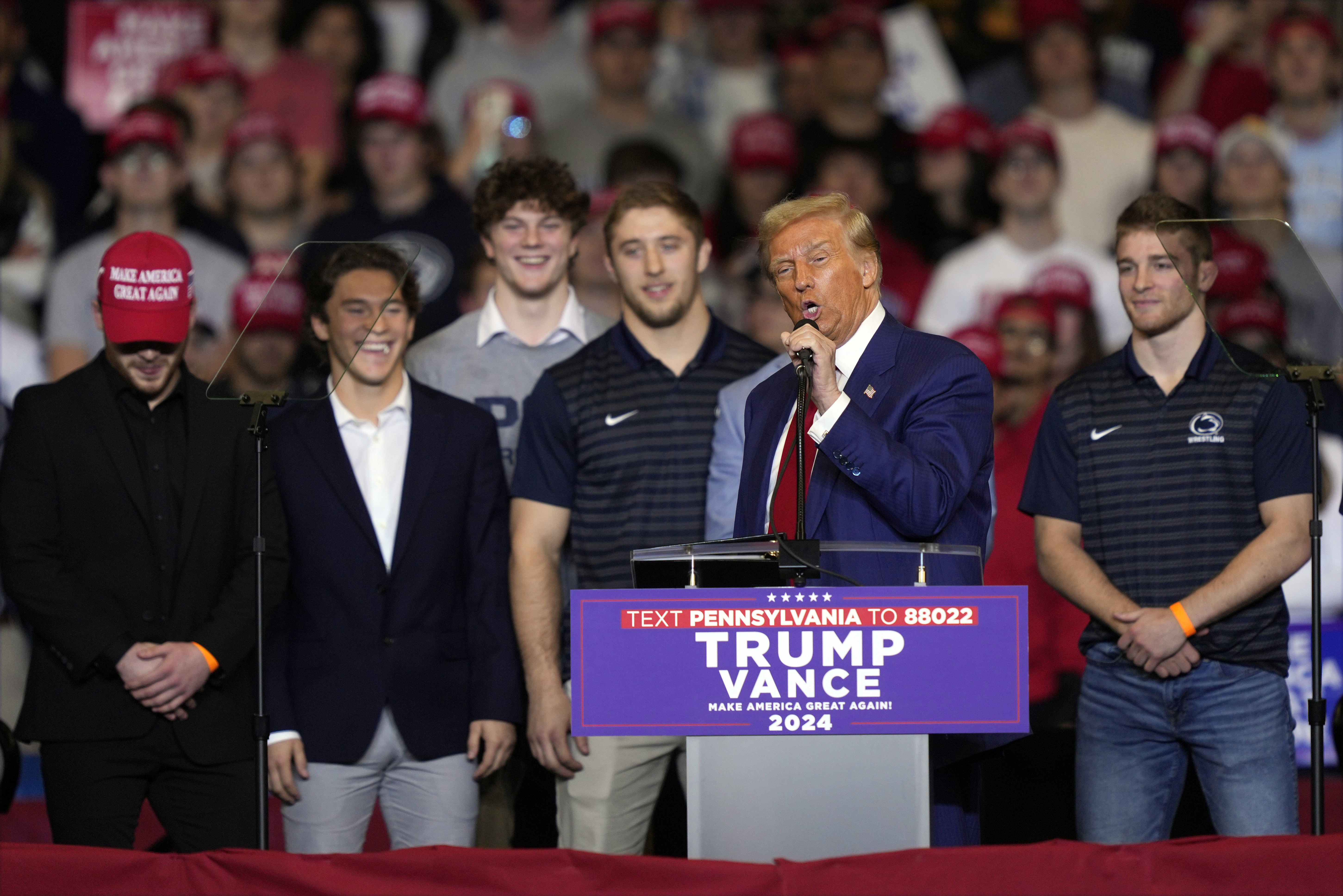
President Donald Trump speaks as members of the Penn State wrestling team listen at a campaign rally at the Bryce Jordan Center in State College in October of 2024. Trump went onto win the state. Matt Rourke
‘The cost of continuing to exist’
Sophie Showers, 19, wants kids, a stable job as a psychologist, and to one day be married.
But now that vision is getting hazier as costs rise, including at the grocery store and at the gas pump, which she needs for her 45-minute commute to school — what the Mechanicsburg resident and first-time voterrefers to as “the cost of continuing to exist.”
Trump, according to the poll, is most underwater with young voters on the cost of living: Only 9% approve and 90% disapprove of his handling of the issue.
That disapproval includes a quarter of voters under 30 who cast ballots for Trump in 2024, including a young voter from the Philadelphia area who asked not to be identified due to his role in his local Republican Party.
He supported Trump in 2024, but he has become disappointed with what he says is Trump’s ignorance of the country’s biggest problems, namely inflation.
“He wants to lower taxes. He wants to cut regulation. I agree with all those things,” he said. “But actually making major changes to people’s pricing, I don’t think he’s taking it that seriously.”
On the economy, 19% of young people approve of Trump’s handling and 81% disapprove, according to the poll.
“The current state of our country is that young people feel as though they have less opportunity economically than their parents or grandparents,” Levy said. “That’s a clear statement on dissatisfaction with the economy.”
(function(){function e(){window.addEventListener(`message`,function(e){if(e.data[`datawrapper-height`]!==void 0){var t=document.querySelectorAll(`iframe`);for(var n in e.data[`datawrapper-height`])for(var r=0,i;i=t[r];r++)if(i.contentWindow===e.source){var a=e.data[`datawrapper-height`][n]+`px`;i.style.height=a}}})}e()})();
“If the cost of living keeps increasing, whether it be due to gas prices … or tariffs increasing the costs of groceries, I don’t want to be in a world where I have to worry about those kinds of things for the family that I want to have or will have, and I personally don’t really see things getting better,” said Showers, an independent voter.
Miles Balfour, a graduate student pursuing a degree in human interaction at Carnegie Mellon University, is feeling similarly pessimistic.
“When it comes to the financial and economic goals that I have for myself — wanting to own a home, wanting to be able to help provide financially for my family — I don’t know, honestly. I wish there was a better sense of confidence or assurance that these things are much more likely to actually happen,” Balfour, 25, said.
According to a survey earlier this year from CIRCLE, a Tufts University program that studies youth civic engagement, many young people ages 18 to 29 are barely making ends meet, and nearly 60% said they struggle to meet their basic financialneeds.
“Young people’s personal situations are also really coloring their view of politics and of what’s happening in the country,” said Alberto Medina, CIRCLE’s communications manager.
Ben Hummer, 28, of Pittsburgh, said though he is new to his career in recruiting, raises have slowed down while expenses like rent have gone up. His auto insurance for his Hyundai skyrocketed to roughly $3,000 a year, and his favorite sneakers — for a race he will be running later this year — have jumped from $120 to about $170.
“My ability to afford my lifestyle comfortably has become more challenged,” Hummer, a Democrat, said.
Young voters grapple with international conflicts
Beyond struggles at home, young voters are also wrestling with questions about the U.S. role in overseas conflicts.
After the deadly Oct. 7, 2023, terror attack against Israel by Hamas, the country launched a military campaign against the insurgent group in Gaza. And with the death toll of Palestinians climbing to more than 70,000 over the last three years, the debate over U.S. support for Israel has become a defining issue for many young people in Pennsylvania and elsewhere.
As encampments and protests in support of Palestinians roiled university campuses ahead of the 2024 election, the issue hung over former President Joe Biden’s reelection campaign before his withdrawal and may have contributed to Vice President Kamala Harris’ loss.
Trump repeatedly vowed during his 2024 campaign to end the war. But fighting has continued, and now only 16% of likely young voters in Pennsylvania approve of Trump’s handling of the conflict, the poll found.
Hummer, the 28-year-old from Pittsburgh, disapproves of the president’s approach and said the U.S. “needs to balance its approach” in the Middle East.
(function(){function e(){window.addEventListener(`message`,function(e){if(e.data[`datawrapper-height`]!==void 0){var t=document.querySelectorAll(`iframe`);for(var n in e.data[`datawrapper-height`])for(var r=0,i;i=t[r];r++)if(i.contentWindow===e.source){var a=e.data[`datawrapper-height`][n]+`px`;i.style.height=a}}})}e()})();
“It doesn’t necessarily have to be pro-Palestinian by any means, but the United States has allies in the region outside of Israel that are being negatively impacted by the conflict, and we often just throw them under the bus,” Hummer said.
Many young people have coupled their anger about the economy with Trump’s decision to join Israel in striking Iranian nuclear facilities and military sites. The Iranian regime retaliated by blocking a key water channel where oil tankers flow, spiking the price of gas throughout the spring.
Among 18- to 29-year-old Pennsylvania voters, only 17% approve of Trump’s handling of the war in Iran, while 82% disapprove (it is also his least popular issue among all likely voters in the state). The war — which the president originally promised would go on for only a few weeks — has now lasted for six months.
“I’m concerned about the United States’ ability to extract itself from the war in Iran without taking some kind of loss — whether it’s loss of influence, loss of life, or loss of financial resources,” and the prospect gets worse the longer the U.S. remains involved, Hummer said.
Young voters are also more critical of Pennsylvania leaders’ positions on Israel than are respondents overall.
Nearly half, 47%, of respondents said Pennsylvania’s third Jewish governor, Josh Shapiro, has been just “about right on support of Israel,” with 14% saying he has been too supportive, despite his vocal opposition to the country’s leader, Prime Minister Benjamin Netanyahu. But among young voters, 40% said he was too supportive.
And more than half, 51%, of young voters said Pennsylvania U.S. Sen. John Fetterman, a frequent defender of Israel who has said he would leave the Democratic Party if anti-Israel sentiment grew too strong, is too supportive of Israel — compared with 30% overall.
‘Willing and ready to vote in 2026’
Young voters are now figuring out what to do next.
Darlene Jimenez, 19, of Philadelphia, said she is grappling with what she can feasibly do as a young person who cares deeply about many issues, including immigration (on which Trump has a 25% approval rating among young voters) and climate change.
“There’s so many times where I find myself thinking like, ‘What am I to do?’” said Jimenez, a Democrat and college student. “Like, I’m 19 and I have so many opinions, and it’s like, what am I supposed to do to actually make a change?”
Medina, communications manager for CIRCLE, said that while there is a sense of hopelessness among young people, “many of them are paying attention, and they say that they’re willing and ready to vote in 2026.”
“Often, precisely because they don’t like the way things are going, and they would like things to change, and they see themselves as having a role in bringing about that change,” Medina said the organization has found in its research.
In Pennsylvania, the youth vote has the potential to make a “decisive impact” on the four key competitive congressional district races this fall — in Bucks County, the Lehigh Valley, the Scranton area, and the Harrisburg region — according to CIRCLE’s 2026 Youth Electoral Significance Index.
(function(){function e(){window.addEventListener(`message`,function(e){if(e.data[`datawrapper-height`]!==void 0){var t=document.querySelectorAll(`iframe`);for(var n in e.data[`datawrapper-height`])for(var r=0,i;i=t[r];r++)if(i.contentWindow===e.source){var a=e.data[`datawrapper-height`][n]+`px`;i.style.height=a}}})}e()})();
But at the same time, young people are still trying to find their political home and historicallyhave been less likely to vote than other age groups, including in 2024, when there was a 54% turnout rate among Pennsylvanians ages 18 to 24 compared with 70% for the overall electorate, according to census data.
Others are a little more sure of where they stand. For instance, young women are the demographic most disapproving of Trump among likely voters in the Inquirer/New York Times/Siena poll. Fourteen percent of young women approve of his job performance, and 83% disapprove.
(function(){function e(){window.addEventListener(`message`,function(e){if(e.data[`datawrapper-height`]!==void 0){var t=document.querySelectorAll(`iframe`);for(var n in e.data[`datawrapper-height`])for(var r=0,i;i=t[r];r++)if(i.contentWindow===e.source){var a=e.data[`datawrapper-height`][n]+`px`;i.style.height=a}}})}e()})();
While a gender gap still exists among young voters, young men — who helped catapult Trump to the White House in 2024 — now disapprove of the president by a nearly 2-1 ratio: 33% approve of his job performance, compared with 64% who disapprove.
Will, a Democrat from Bucks County who works in academia, crossed the aisle to vote for Trump in 2024 because he — “a loyal Joe Biden guy” — vehemently disagreed with how Harris was nominated without a primary after Biden’s withdrawal and also believes Democrats have focused too much on identity politics.
The 27-year-old, who asked to be identified only by his first name because of concerns about workplace retaliation, has mixed feelings about Trump’s handling of the issues and called the Iran war “ridiculous.” But he does not fully regret his vote, citing Trump’s handling of Israel as one reason.
“My impression is that the Democrats have been moving further left to kind of compensate for the fact that MAGA and the tea party moved the Republicans further right, so it kind of leaves people in the middle stranded. … I would prefer the Democrats kind of bring things back to the center,” said Will, who supports Shapiro for governor and would back him for president in 2028.
And Luke Averill, 19, a registered Republican from Delaware County who voted for Harris in 2024, said he thinks he can make the most impact on the direction of the country by voting for moderate candidates in Pennsylvania’s GOP primaries, but he does not see himself as a “diehard for one party in particular.”
But for many young voters, the elected officials they are gravitating toward are indicative of what is most important to them.
Several young respondents to the poll said they findNew York City Mayor Zohran Mamdani’s style of politics and focus on affordability to be refreshing.
“He’s the inspiration for myself and many people in my generation and all around the country,” Balfour, the 25-year-old at Carnegie Mellon, said. Mamdani brings “a sense of hope and optimism” and the ability to see government “make our lives much more meaningful.”
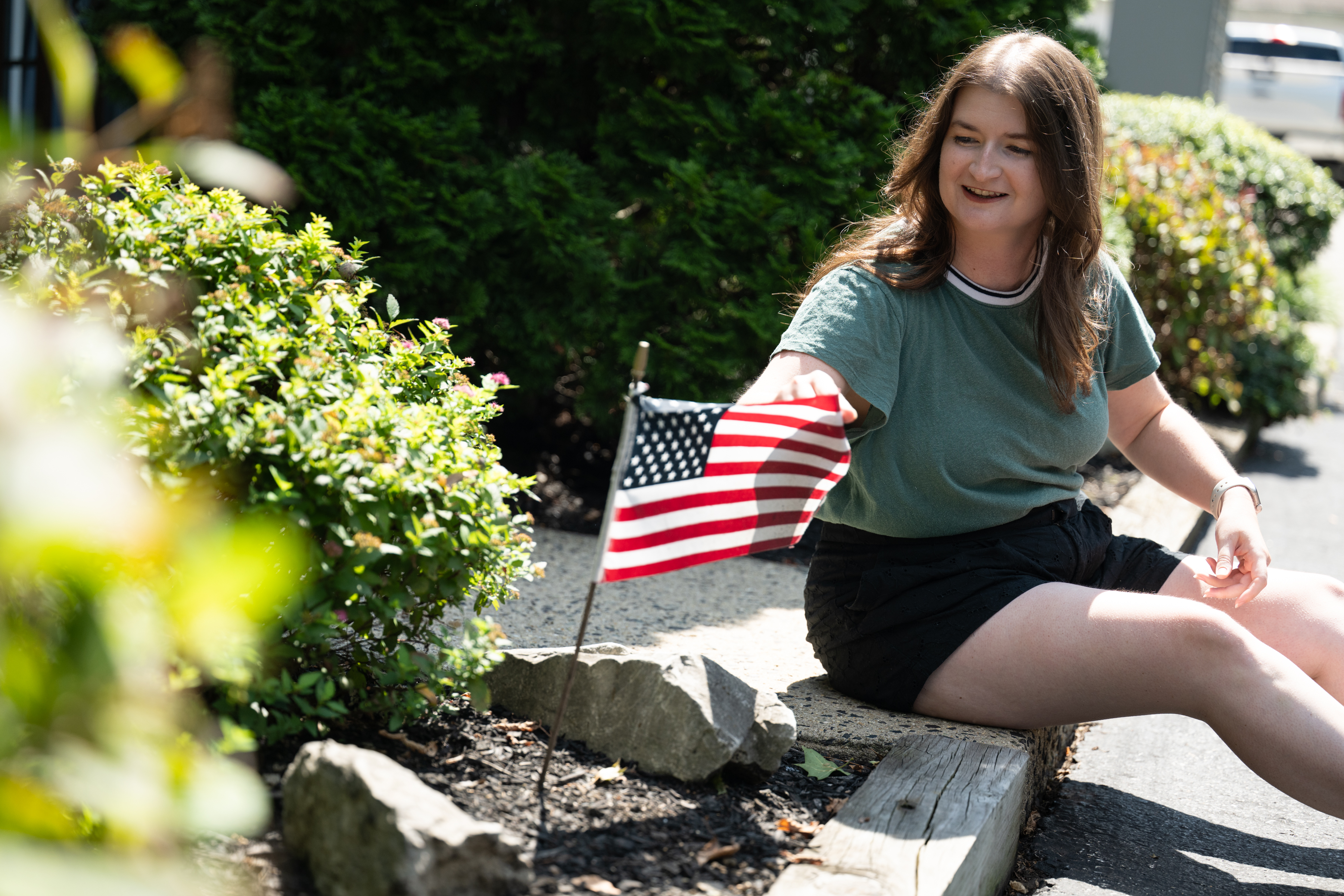
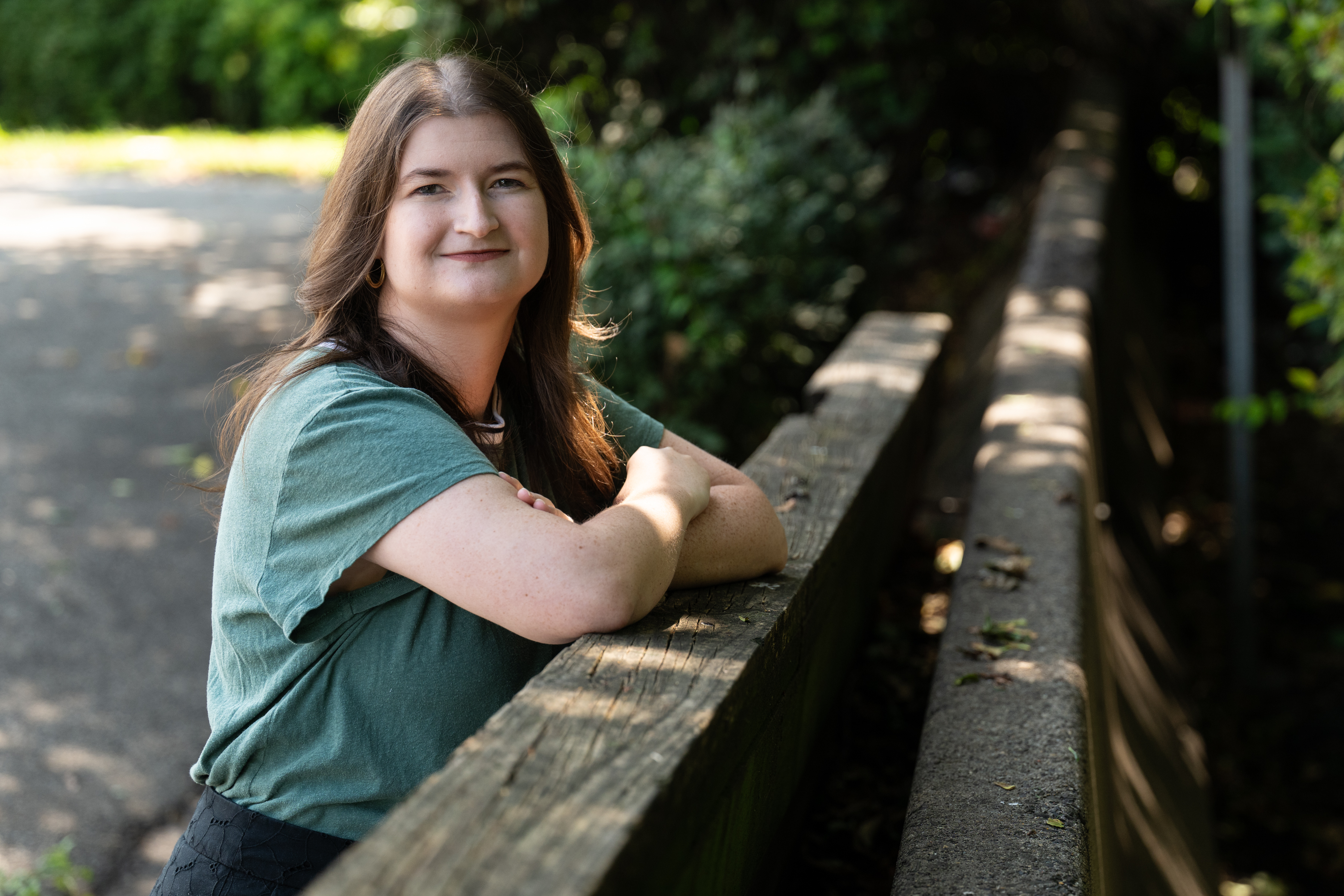
Kelly Harrington, 29, poses for a portrait near her home in Conshohocken, Pa., on Monday, Aug. 24, 2026.Erin Blewett / For The Inquirer
And as for Harrington, the 29-year-old from Conshohocken, she said though she feels “frustrated and sad about the state of the world,” she believes it is important to take those emotions to the ballot box.
“Politics is in every aspect of life,” Harrington said. “It affects you directly in almost every way, and if you get involved, you can make real change.”
Sen. Cory Booker said the United States needs a “food revolution,”blaming sugary and processed food for contributing to the nation’s health woes during a South Jersey visit Thursday.
“What’s stupid is that we’re sitting here talking about the cost of healthcare and how to pay for it, but not why we need so much healthcare in the first place,” Booker said during an almost hour-long speech to the Chamber of Commerce Southern New Jersey at the Westin Mount Laurel.
The speech was one of four stops Booker made in South Jersey Thursday. The Newark Democrat also packed sandwiches at the Cathedral Kitchen community kitchen in Camden,one of the nonprofits shouldering a greater demand amid rising grocery costs and cuts to the Supplemental Nutrition Assistance Program enacted by President Donald Trump. Booker said he would try to steer federal resources to the group, and that he hopes at least one chamber of Congress will flip so Democrats can push to restore money for Medicaid and Affordable Care Act subsidies.
Butduring his speech to the chamber, Booker signaled support for one piece of Trump’s health agenda by criticizing the use of SNAP for soda. Booker, a vegan, aligns with some of Health and Human Services Secretary Robert F. Kennedy Jr.’s policies on nutrition though he vehemently opposes Kennedy’s push to scale back recommended vaccines for children.
“Sugar water companies literally, annually, make billions of dollars from SNAP payments,” Booker said after joking about Coke and Pepsi not being members of the chamber. “You all know what SNAP stands for: Supplemental Nutritional Assistance Program. Yet we allow SNAP payments to be used for that, but make it really hard for them to be used for the kind of food we want people to have abundant access [to].”
The U.S. Department of Agriculture gave the green light to nearly two dozen states — mostly Republican — to restrict people from using food stamps for sugary drinks, the New York Times reported, though just eight were actually implemented as others are in the process or have been blocked by a court ruling.
New Jersey and Pennsylvania are not among those states.
Sen. Cory Booker speaks to members of the Chamber of Commerce Southern New Jersey at the Mt. Laurel Westin.Aliya Schneider / Staff
Booker said the country should support small farmers more, and decried that the vast majority of agricultural subsidies go to “massive commodity crops” such as corn and soybeans that are used for ultra-processed foods instead of “specialty crops” like fruits and vegetables.
The ballroom podium was unnecessary for Booker, who paced on stage and juggled a microphone between whatever hand he wasn’t reaching, pointing, or otherwise speaking with.
“Think about this: A kid in Camden goes into a bodega and gets a Twinkie product cheaper than an apple because we subsidize everything in the Twinkie product and nothing in the apple,” he said.
“Or hear this: You go to a fast food restaurant and you get a $1 meal, and if you want to get a bucket of salad, it costs you $15. How can we be a system that sustains such high levels of illness?”
He told a story about meeting with a LasVegas-based business owner whose healthcare costs decreased after replacing deep fried food options for his staff with healthier choices, and shared an anecdote about a woman whose health improved after an urban farm was established in Newark, where Booker was mayor.
In an interview after his speech, Booker said he’s pushing for the restoration of programs that connect crops from small farms with people in need of food.
“New Jersey farmers are suffering with tighter and tighter margins,” he said.
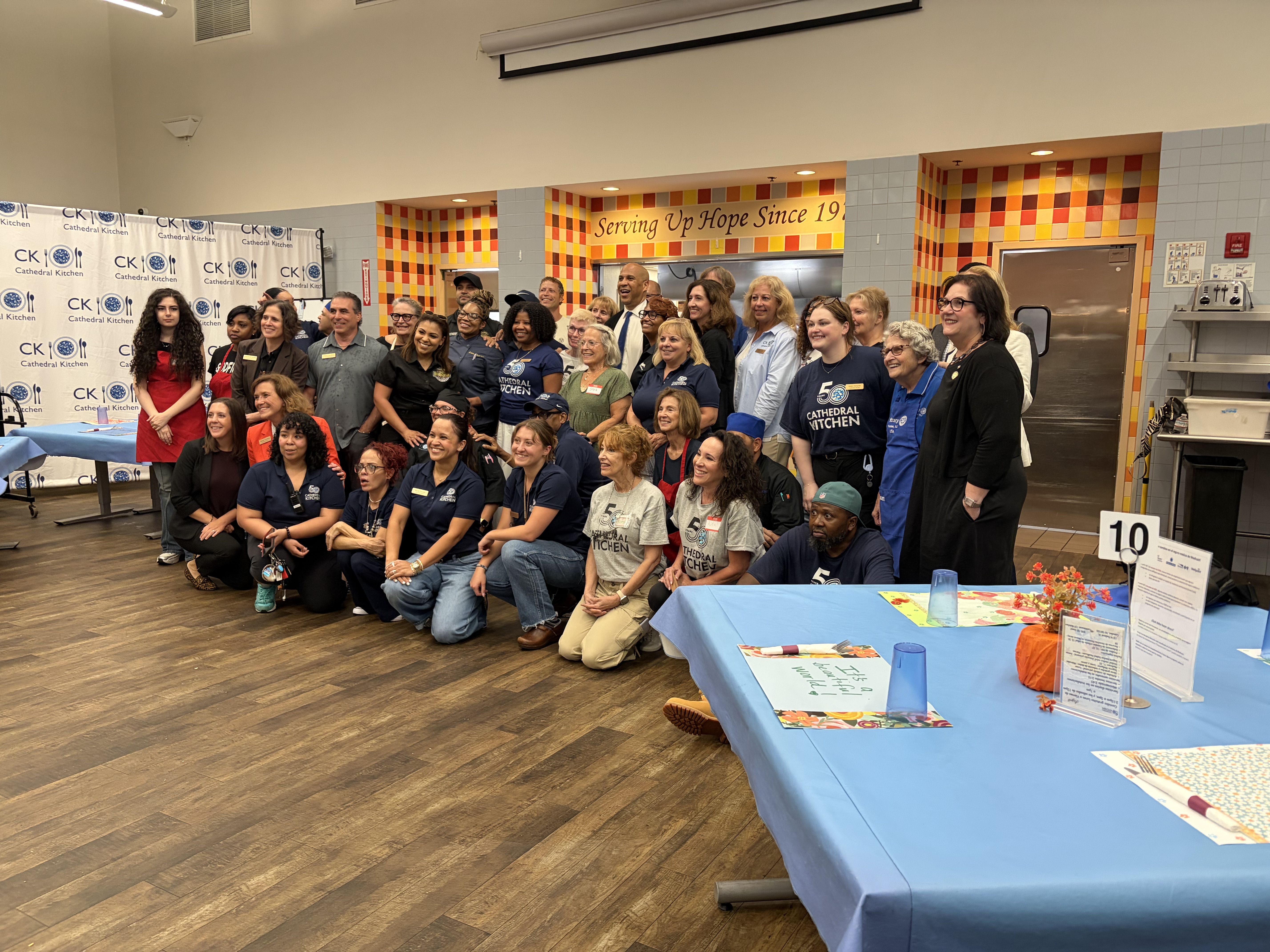
Sen. Cory Booker smiles for a photo with volunteers and staff at Cathedral Kitchen in Camden.Aliya Schneider / Staff
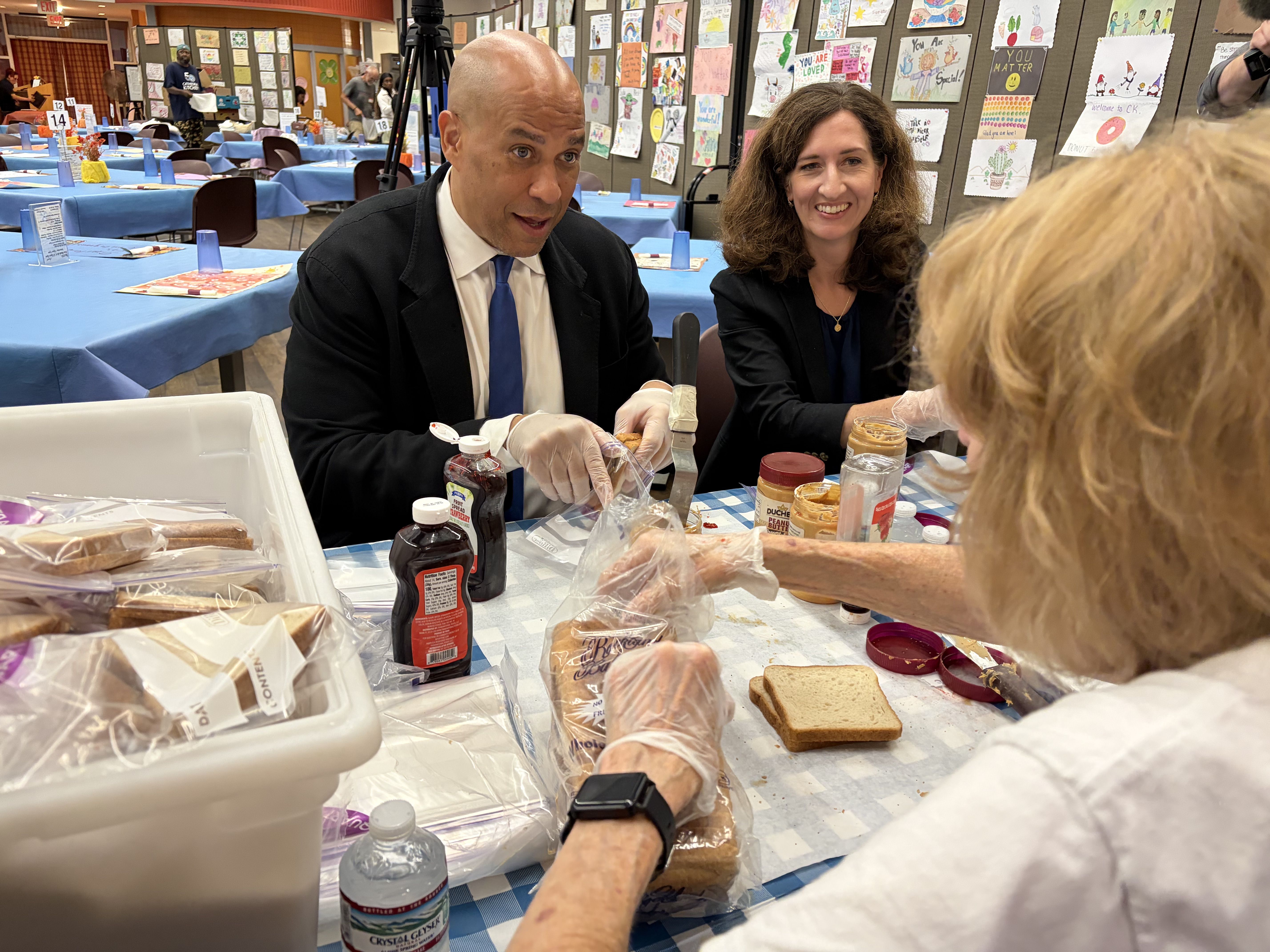
Booker got tips on making a good peanut butter and jelly sandwich and placed ham and cheese on bread alongside volunteers at Cathedral Kitchen. He said nearby workers cracking eggs were “doing some egg-celent work” and that at first he didn’t know “what the shell” they were doing. In line with his dad jokes, he chatted about how he wants to have kids soon with his wife Alexis Lewis, whom he married last year.
Carrie Kitchen-Santiago, the president and CEO of the Camden-based organization, said 2022 set a record for demand for meals, groceries, and hygiene products, and it’s grown each year since. She said the organization mostly relies on donations and revenue from a catering program but expects the need to increase when benefits cuts are implemented later this year.
She said roughly 2% of the organization’s budget is from government funds but that it does not have any federal funding.
Kitchen-Santiago said providing nutritious meals is a balancing act.
“You want to make sure people are healthy, but also give them something they’ll eat and be culturally appropriate,” she said. “Like, we’re not going to be able to give a stuffed acorn squash. Nobody’s going to eat that. On the other hand, we might be able to do a stew that has vegetables and meat in it.”
The speech and visit to the kitchen were part of a larger swing through South Jersey by Booker while the Senate is on recess.Booker also presented a $2 million check to Inspira Medical Center in Mullica Hill to expand technologies and telehealth services — a congressional allocation from Fiscal Year 26 — and visited Salem Community College’s Glass Education Center.
His schedule on Friday includes presenting $1 million to AtlantiCare Health System and a visit to Atlantic City’s Orange Loop, a neighborhood that was designated an Opportunity Zone under a law he co-authored. He was also slated to visit the Cape May–Lewes Ferry Terminal in North Cape May and a Cumberland County farm.
WASHINGTON — The State Department on Wednesday designated three groups based in Europe, including two that advocate Palestinian rights, as transnational terrorist organizations.
The move is part of the Trump administration’s fight against what it calls a “resurgence of far-left political terrorism” worldwide, a focus that many security experts say is disproportionate.
In a statement, the department said that it would impose sanctions on Palestine Action, which is based in Britain and organizes acts of support for Palestinians and opposition to Israeli policies; Masar Badil, another pro-Palestinian group with branches in Western Europe and Canada; and Autistici/Inventati, known as A/I Collective, which is based in Italy and offers free digital tools to leftist activists around the world.
Even as many Western leaders and analysts raise alarms about the growing strength of far right-wing movements with violent tendencies, the Trump administration has mainly targeted what it calls an even more dangerous alternative on the left. In July, Secretary of State Marco Rubio hosted an international summit on the subject, which the State Department billed as a response to “a deliberate, ideologically motivated strategy to destabilize free societies by violently targeting our political and economic systems” on the part of far-left groups.
That threat has long been “a blind spot in the international community’s counterterrorism focus,” the department said in a statement at the time.
Many conservatives have been galvanized by the issue by recent events such as pro-Palestinian demonstrations seen by critics as sympathetic to Hamas and hostile to Israel, anti-Trump protests in U.S. cities that have sometimes turned violent and the assassination of the pro-Trump activist Charlie Kirk in September 2025.
But experts say that talk of a broad, coordinated left-wing menace exaggerates the threat to America.
Liberal groups such as the American Civil Liberties Union also warn that it could have a chilling effect on legitimate speech and give a pretext for intimidating or even prosecuting critics of the Trump administration.
The State Department accused the newly designated groups of having terrorist ties, though its announcement focused on A/I Collective, which it said tailors digital services to help left-wing radical groups organize, communicate and plan violent attacks. That help includes sharing “target information” and tactical guidance to “many of the most active and violent antifa groups in the United States,” according to the department.
The A/I Collective’s website says that it offers a secure platform for activists to communicate anonymously, free from government surveillance. It defines its core principles as “anti-fascism, anti-racism, anti-sexism, anti-militarism.”
Founded in 2020, Palestine Action opposes Britain’s support for what it calls Israel’s “genocidal policies” toward the Palestinians. The group organized several pro-Palestinian protests in London before the British government banned it last year when five of its members were charged with breaking into a Royal Air Force base and spraying red paint on two aircraft.
The United Nations High Commissioner for Human Rights said the ban raised “serious concerns that counterterrorism laws are being applied to conduct that is not terrorist in nature and risks hindering the legitimate exercise of fundamental freedoms across the U.K.”
Masar Badil is a pro-Palestinian group that has published statements that “glorify violence” against Israel and has hosted webinars featuring members of Hamas and the Houthis, according to the Anti-Defamation League. The State Department said its action was based on the group’s close ties to Samidoun, a pro-Palestinian group that has been banned in Germany and declared a terrorist group by Israel and Canada.
The U.S. terrorist designations mean that any U.S. controlled assets of the groups, and two specifically named Masar Badil leaders, will be frozen and anyone transacting with them — including by providing money or services — can be subject to civil or criminal action.
The State Department said in a fact sheet on political terrorism last month that “far-left terrorist plots and attacks have sharply increased in the United States and Europe” since 2016, and that such terrorism “now accounts for more attacks and plots in the United States than any other ideological category.”
Last year, the Trump administration declared the amorphous left-wing group antifa as a terrorist organization, offering little evidence of its threat.
A September 2025 analysis by the Center for Strategic and International Studies, a nonpartisan research center, found that left-wing terrorist attacks and plots have risen in recent years and that left-wing attacks were on track to outnumber ones from the far right for the first time in 30 years.
But left-wing violence has “risen from very low levels and remains much lower than historical levels of violence carried out by right-wing and jihadist attackers,” the report found.
It added that the global leftist movement is disorganized and that its attacks “are remarkably less lethal overall than jihadist or right-wing attacks.”
WASHINGTON — Sen. Chris Van Hollen, D-Md., on Thursday plans to introduce a resolution that would order the Trump administration to provide Congress with a detailed accounting of Israel’s human rights practices in the West Bank, laying the groundwork to force a vote on the matter in coming weeks.
The measure, the latest bid by Democrats in Congress to challenge the policies and actions of Israel’s government, invokes a provision of the Foreign Assistance Act that allows lawmakers to request information from the State Department about the human rights record of any country receiving U.S. security assistance.
Cosigned by 10 Senate Democrats, the resolution is privileged, meaning that Van Hollen could force a vote on it even if Republican leaders refuse, as expected, to bring it to the floor. That could lead to yet another vote in Congress showcasing Democrats’ divide over Israel as a growing contingent in the party turns against the Jewish state.
“We’ve seen ongoing human rights violations on the West Bank, but we’re going from bad to abysmal,” Van Hollen said in an interview.
The resolution focuses on at least nine U.S. citizens who have been killed in the West Bank since January 2022, including Shireen Abu Akleh, a Palestinian American journalist killed in 2022, and Aysenur Ezgi Eygi, who was fatally shot by an Israeli soldier in 2024. It argues that Israeli authorities have failed to punish those responsible and that U.S. agencies have failed to conduct their own independent investigations or provide substantive information about existing ones.
“If the United States Senate shines a spotlight on this, we will save lives,” Van Hollen said. “We will save the lives of American citizens. We will also save the lives of Palestinian civilians.”
Concern about violence in the West Bank has steadily grown among Democrats in Congress. Last year, Sen. Cory Booker, D-N.J., introduced the West Bank Violence Prevention Act, which Van Hollen cosponsored, to impose visa and financial sanctions on people who commit or facilitate violence against civilians there. The bill attracted broad Democratic support but did not advance out of the Republican-led Foreign Relations Committee and was never brought up for a vote.
J Street, the liberal pro-Israel advocacy group that backed that legislation, has argued that sanctions are needed to disrupt networks supporting extremist settlers and Palestinian militant groups and preserve the possibility of a two-state solution. The group has cited estimates that settler violence rose 30% during the first months of 2025 compared with the same period a year earlier.
The issue has also prompted unusually sharp criticism from Israeli officials. Yechiel Leiter, Israel’s ambassador to the United States and a longtime settler, said earlier this year that extremist settler violence was a “stain” on Israel and was costing the country support in Washington. He said the Israeli government was taking this seriously.
The issue has gained renewed focus this month following a new spate of violence in the West Bank with extremist settlers trapping two Palestinian families in their homes in the Israeli-occupied territories. One of the homes is owned by Louai Abu Ridi, an American citizen, prompting condemnation from U.S. officials including Mike Huckabee, the U.S. ambassador to Israel, who called the actions of the settlers “thuggish” and said the Israeli military and local police had acted at his urging to “remove the Israeli terrorists doing this.”
“Actions by those who carried out this horrific act of terror meant to intimidate and harass this family are disgusting,” Huckabee said in a social media post this month.
Shortly after, Leiter echoed the remarks, saying in his own post that “you cannot settle the land through destabilizing and disruptive behavior, as my esteemed colleague Mike Huckabee brilliantly put it when he spoke of ‘unsettling behavior.’”
Extremist settlers have carried out at least 1,380 attacks in 250 communities in 2026, according to U.N. data from late July. Those settlers have faced a near-total lack of consequences.
Van Hollen’s resolution would draw in the legislative branch to confront the issue directly.
It would give the secretary of state 30 days to provide congressional committees with an unclassified report detailing what U.S. officials know about the killings, the status of investigations and the identities of potential suspects and Israeli security units involved.
The administration would also have to determine whether credible information implicates any Israeli security units in such violence.
The resolution also demands information about Palestinian children held under Israeli military law, including allegations of torture and other mistreatment.
Van Hollen said the American deaths raised a broader question about Washington’s willingness to enforce its human rights laws against a close ally.
“If we can’t get accountability for them,” he said, “how are we actually implementing our human rights laws with respect to the government of Israel as it relates to the West Bank?”
“This has been building for a long time,” he added. “Enough is enough.”
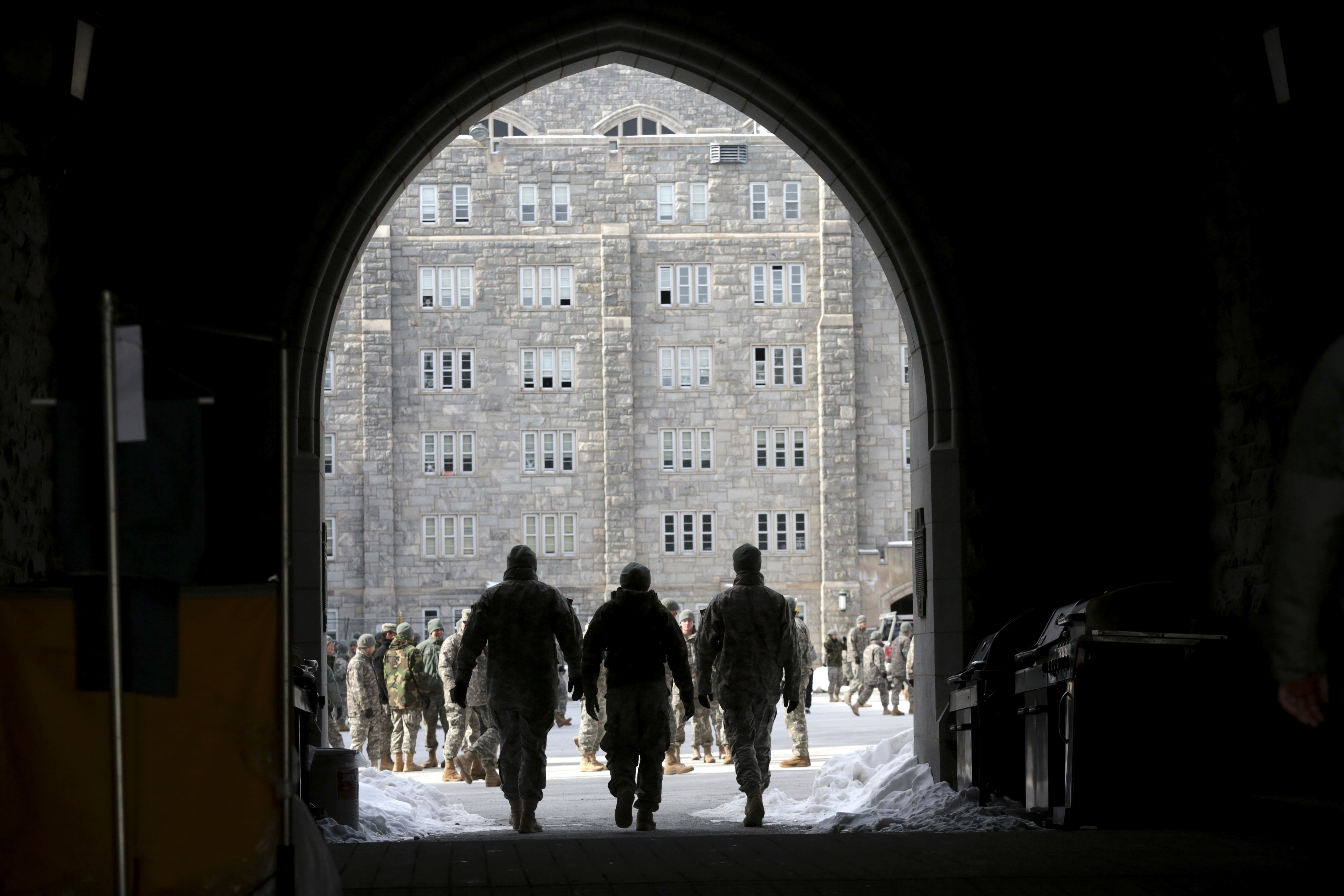
After 17 years of teaching science at West Point, Adam Kalkstein says he was suddenly ordered last year to cut from his curriculum information about the human causes of climate change, according to a new lawsuit filed against the U.S. Military Academy.
The change was immoral and potentially illegal, Kalkstein says he told Brig. Gen. Shane R. Reeves, who at the time was dean of West Point. Instead of upholding Army values, Kalkstein said he felt like a liar and a fraud.
Reeves stormed out of the room when Kalkstein declined a suggestion that he resign, according to the lawsuit. Six months later, the tenured professor was told his contract would not be renewed.
Filed in the Southern District of New York, the lawsuit accuses West Point of breaking the law by violating Kalkstein’s First Amendment rights by forbidding him from teaching about human-driven climate change, an order that required him “to omit a massive, fundamental, essential component of the course and to defy science,” according to the suit. Spokespeople for the Pentagon, West Point, and White House did not return requests for comment.
Michael Sussman, the lawyer for Kalkstein, said his client is a conservative Republican who believes the military needs to be taught the true causes of climate change when it comes to national security. In a letter to Defense Secretary Pete Hegseth, Kalkstein said understanding the causes of global warming was important not for social justice reasons but for things like competing with the Russians in the Arctic and knowing why sea ice was melting.
“He is loyal to the cadets and the academy,” Sussman said about the professor. “And to his perspective, edicts that he can’t say what’s true in a classroom is beyond his tolerance and totally counterproductive.”
Kalkstein’s lawsuit is the latest example of the Trump administration’s attempt to force conservative cultural changes on the education system. President Donald Trump has made frequent public statements dismissing scientific consensus on global warming, and his administration has categorized federal and international climate change programs as “woke, weaponized and wasteful spending” along with diversity, equity and inclusion initiatives and transgender policies.
The administration has repeatedly targeted the military for cultural change. Last year the administration banned hundreds of library books at the U.S. Naval Academy that did not align with Trump’s political agenda. Many of the books have since been returned, according to a Defense Department spokesperson.
In May, Judge Cathy Seibel of U.S. District Court in White Plains, New York, ruled in favor of another West Point professor, Tim Bakken, the longest-serving law professor in the military academy’s history, who had sued over the school’s new restriction on expressing his opinions to students in the classroom on subjects he teaches.
The latest lawsuit comes against the backdrop of a push by Hegseth to remake the service academies by dramatically scaling back the number of civilian professors and revising their curricula. A draft memo circulating inside the Pentagon this summer argued that the academies had been infected by “civilian academic norms” that were diluting the “focus on lethality.” The memo’s existence was first reported by CBS News.
The memo argued that tenure had led the academies to elevate the “research priorities of the tenured academics” over the needs of the military. The memo also called for “a comprehensive review” that would examine the “operational relevance” of all course offerings at the academies.
Hegseth in his 2024 book, The War on Warriors, bashed the academies as “Marxist-adjacent” institutions and blamed civilian professors for the shift.
“Civilian professors were welcomed on campus for reasons of ‘diversity’ as well as expediency. And with them came the predictable, radical left-wing educational philosophies,” Hegseth wrote.
Critics of Hegseth’s view have maintained that the civilian professors have improved and broadened the quality of instruction at the academies at a time when winning wars requires agile thinkers.
A clash over Black representation in a recent South Florida congressional primary brought national attention to an increasingly urgent debate within the Democratic Party, as it searches for ways to counter the off-cycle nationwide redistricting campaign that President Donald Trump launched last year.
Republicans have added more than a dozen conservative-leaning House districts across the country, giving them an outside shot at holding on to their threadbare majority in November — and leaving Democrats, who have limited options to offset those gains, desperate to catch up.
Searching for places to create new blue seats, Democrats are considering breaking up urban districts drawn to elect Black members in liberal states such as Illinois, New York and Maryland, then moving some of those voters to Whiter, more conservative suburban districts. Some within the party vehemently oppose this idea because they fear it could further reduce the number of Black Americans in Congress, which is already set to take a hit from Republican redistricting.
In Florida, Black politicians criticized Democratic Rep. Debbie Wasserman Schultz, who is White, for decamping from a more competitive seat to a safely Democratic but heavily Black district nearby after state Republicans redrew congressional lines this year to benefit the GOP.
Whether the seat — one of only about three dozen nationwide with a Black majority or plurality — should continue to have a Black representative, as it did for decades, became a major point of contention in the competitive primary, which Wasserman Schultz ultimately won.
Democrats are now facing a conundrum as they chart a path forward: When control of the House is on the line, how much can they afford to prioritize diversity in their ranks?
It’s a political headache for a party that prides itself on being powered by Black voters. About three-quarters of Black people lean Democratic, according to the Pew Research Center, nearly double the rate of White people. All but a handful of the five dozen Black members of Congress are Democrats.
“If we’re going to be in this together, then let’s truly be in this together. Let’s not do the pick and choose,” said Florida Rep. Felicia Robinson (D), chair of the state’s Legislative Black Caucus, who once called Wasserman Schultz’s decision to move districts “a slap in the face” to the Black community.
While she agreed that Democrats should prioritize maximizing House seats, Robinson said that, if the party silences Black voters in the process, “you make it kind of easy or more appealing for people” to become independents or Republicans instead.
House Minority Leader Hakeem Jeffries (D-New York), who declined an interview request, and his allies argue that Democrats may need to sacrifice some predominantly Black districts in order preserve Black political power on the whole.
They contend that winning back Congress is more important than protecting individual seats, because congressional control would allow Democrats to stop Republicans from further dismantling civil rights protections, including the extreme gerrymandering that has decimated Black representation across the South.
Chris Taylor, a spokesperson for the Congressional Black Caucus, acknowledged that redistricting could shift some of their members’ seats. But the interests of the Black community, he said, are not served if Republicans subservient to Trump remain in control of Congress.
“The shared goal of the caucus is to ensure that we’re able to fight for the American people,” Taylor said.
The matter is especially sensitive in the wake of an April Supreme Court decision that cleared the way for Republican states such as Tennessee, Louisiana and Alabama to eliminate Black-majority districts once protected by law. Without those seats, membership of the Congressional Black Caucus, which reached a historic peak this session, is poised to decrease next year. Some Democrats worry their party’s redistricting efforts could accelerate that decline.
“There could be backlash to the Democratic Party if they started trying to dilute Black voting power,” said Christian Grose, a professor of political science at the University of Southern California and director of its Democracy and Fair Elections Lab, who published a book on race and representation in Congress. “They are core members of the party.”
A new intraparty debate is stirring
One early effort to expand the number of safe Democratic seats already snagged over concerns about diversity.
In Illinois, the push for another Democratic-leaning district — perhaps by shifting voters from a safe, historically Black seat on Chicago’s South Side to a Republican-leaning district in the outer suburbs — faded last fall partly because of opposition from Black state lawmakers, who objected to a new map that might diminish Black representation.
“How much more juice can you get out of that squeeze? I mean, there’s nothing left here,” said Rep. Jonathan Jackson (D-Illinois), who has held the South Side seat for two terms and opposes redrawing it. “The people don’t have an interest in that. The answer is no.”
Jackson said it’s important to preserve the distinct character and legacy of districts like his, which has had Black representation for nearly a century. Democrats should instead consider other strategies to flip Republican seats, he said, including reengaging with rural Americans and holding year-round voter registration drives to boost turnout.
“Let’s go play the rest of the map,” Jackson said. “This represents urban America.”
But Democrats are also under tremendous pressure from their increasingly restive liberal base to match Republican gains. While the GOP has already drawn itself more favorable lines in 16 districts since last year, Democrats have only picked up an advantage in six more.
In May, after the Supreme Court ruling that kicked off renewed Republican redistricting, a Politico poll found 45 percent of Democratic voters favored maximizing new seats over preserving majority-minority districts, compared to 32 percent who said it was more important to protect the voting power of Blacks and other minorities.
Jeffries and other Democratic leaders have waved off concerns about what redistricting will do to Black representation by noting that dozens of Black members, including Reps. Lauren Underwood of Illinois and Janelle Bynum of Oregon, were elected from districts with small Black populations, some of which are majority White. Unpacking predominantly Black seats, they say, does not necessarily mean wiping out Black members.
Political scientists like Grose agree that Democrats could reduce the number of Black voters in some districts while maintaining their decisive role in elections, because the Democratic primary electorate is more Black than the general voting population.
The proportion of Black voters needed to elect their preferred candidate to a House district in northern states is significantly lower than in the South, where voting trends are more racially polarized, said Andra Gillespie, a political science professor who directs the James Weldon Johnson Institute for the Study of Race and Difference at Emory University. That could allow Democrats to unpack heavily Black seats without losing their incumbents.
“You can put a multiracial Democratic coalition together,” Gillespie said.
Debate about Black districts isn’t going away
Whatever the outcome of Democrats’ redistricting campaign, the consequences for Black voters could be significant.
Grose, the USC professor, said that while race does not appear to be a significant factor in congressional voting records, it does make a difference for constituent services. His research found that Black Democrats tend to allocate more resources, including federal funding, to Black communities than White Democrats in similar districts. He attributed that to “electoral coalitions” — Black members are more dependent on Black voters to win and consequently prioritize them more.
“What you end up doing as a member of Congress is you support your base,” he said.
More serious conflicts over representation likely loom after the 2030 Census. Populous and diverse Democratic states, such as California and New York, are projected to lose seats through reapportionment, potentially forcing them to combine majority-White and majority-minority districts and pitting incumbents against each other.
“What does that mean when you’ve got to figure out who loses a congressional seat?” Gillespie said. “That’s where I expect to see the fight happen.”
But this trade-off may ultimately matter more to politicians, whose careers are on the line, than the voters they represent.
Despite the furor in South Florida, Wasserman Schultz won her primary handily. Meanwhile, Black voters in Memphis returned Rep. Steve Cohen (D-Tennessee), who is White, to Congress for two decades.
Cohen, who is retiring this year after Republican state legislators cracked apart his majority-Black district, called it a “splendid example of people voting based on your work ethic, what you produce and the content of your character” rather than race. He said he earned the trust of his Black constituents with a long track record of supporting issues that mattered to them.
When Willie Herenton, the first Black mayor of Memphis, launched a primary challenge to Cohen in 2010, arguing that at least one member of Tennessee’s congressional delegation should be Black, Cohen still beat him by nearly 60 percentage points.
“Maybe the Black politicians want it, because it’s going to give them more clout,” Cohen said. “The proof is in the voters and they elected me over and over again.”
Philadelphia District Attorney Larry Krasner drew a rebuke Wednesday from Attorney General Todd Blanche after he said President Donald Trump’s White House ballroom, which is currently under construction, should be blown up and pieces of debris sold as paperweights.
Krasner, a progressive Democrat who has centered much of his political identity on opposing Trump, made the initial comments Tuesday during an event at the President’s House Site, George Washington’s Philadelphia home. The Trump administration this year removed educational panels about slavery from the site and replaced them with an exhibit that experts say sanitizes history.
According to NBC Philadelphia, the district attorney said during his remarks at the annual Slavery Commiseration ceremony on Tuesday that “there is a beautiful time coming [when] the memorial will be here.”
“Let me tell you what will not be here: There will not be a ballroom,” Krasner said, referring to the ballroom and military bunker that Trump wants to replace the demolished East Wing of the White House. “What is going to be happening is that, in about 10 or 15 years … I’m gonna have a paperweight sitting on my desk. You know what that paperweight’s going to be? It’s gonna be a piece of the ballroom after we all blow it up.”
Krasner paused, then added: “In an official ceremony, just so we’re clear. In an official ceremony, we’re gonna blow it up, and we’re gonna give the taxpayers their money back by selling all the pieces as paperweights.”
The remarks by the Philadelphia district attorney, a third-term prosecutor who has recently flirted with running for higher office, were the latest in a long line of provocative comments he has made about Trump and other GOP officials. Earlier this year, the White House press secretary and Republican members of Congress ripped Krasner after he called federal immigration enforcement agents “wannabe Nazis” and said Trump’s administration is orchestrating a “fascist takeover” of the country.
And last month, Krasner rallied with protesters in Washington and slammed House Republicans after they subpoenaed documents from his office related to the city’s immigration policies.
Video of Krasner speaking at the event in Independence National Historical Park rocketed around social media this week, drawing condemnation from prominent supporters of the president, some of whom said his comments were inciting violence.
The White House’s “rapid response” account wrote Tuesday on X that Krasner’s comments were “sick” and that “Democrats are the party of violence.”
Attorney General Todd Blanche listens as President Donald Trump speaks at the David Mack Center for Training and Intelligence, Friday, Aug. 14, 2026, in Garden City, N.Y. (AP Photo/Julia Demaree Nikhinson)Julia Demaree Nikhinson
On Wednesday, Blanche, who was confirmed earlier this month, appeared on Fox News’ America’s Newsroom to discuss a range of issues. Host Dana Perino asked him about Krasner’s comments and the timeline for the controversial ballroom, which had been briefly on hold amid litigation contending the Trump administration needs congressional authorization for the project. The Supreme Court this week allowed construction to proceed while justices consider the case.
“The ballroom is being built,” Blanche said. “And it’s disgusting that a district attorney in Philadelphia, who, by the way, has a city with its own problems, is so focused on what the president is doing in the White House.”
In an interview Wednesday, Krasner said he stands by his initial comments about the ballroom “100%” because “when you demolish a building, you do it with explosives and/or wrecking balls.”
Krasner added that he sees Blanche’s opposition to his rhetoric at the Slavery Commiseration event as part of the Trump administration’s broader project of stripping historical sites like the President’s House of references to slavery.
“I support the permanent existence of this historically important memorial in Philadelphia. I know that may be disturbing to white supremacists, but too bad,” Krasner said. “Philly is going to stand up for its history, and Philly understands that being an elected official is not about making everybody your friend. It’s about having the right enemies.”