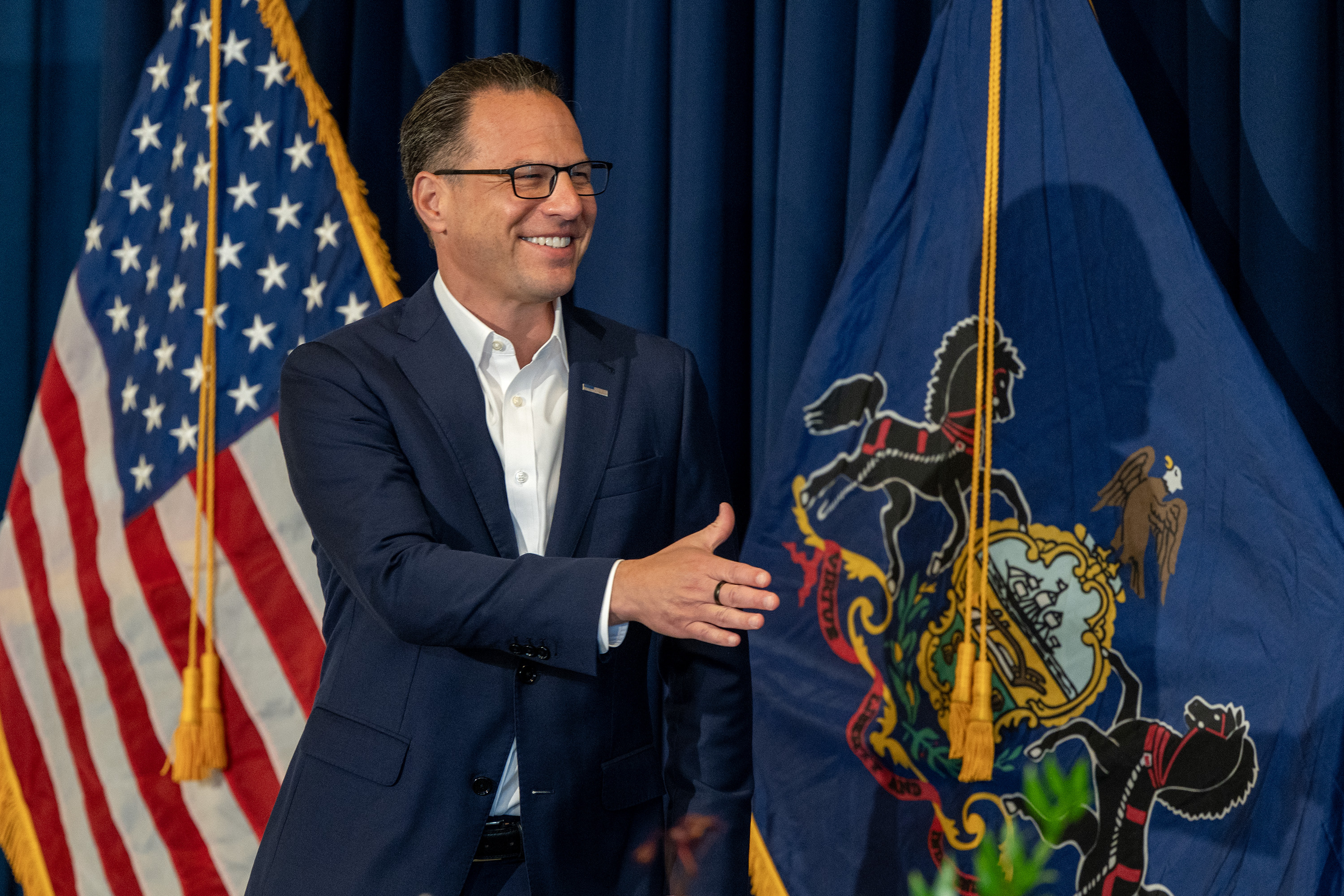
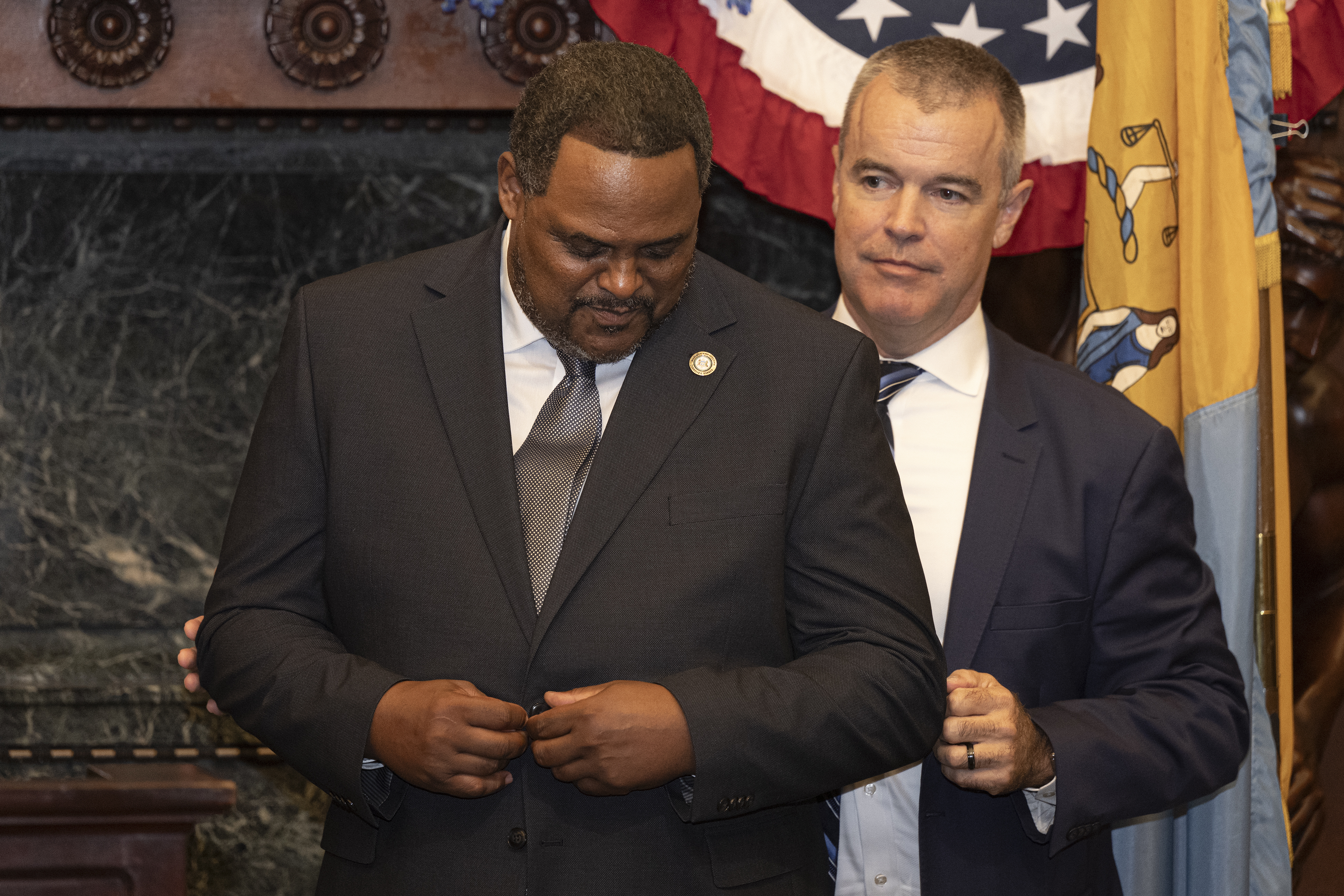
Philadelphia’s police union on Tuesday endorsed Gov. Josh Shapiro’s reelection bid, announcing its continued support for the first-term Democratic governor while touting his commitment to law enforcement.
“Every day, he has shown a commendable ability to work with local law enforcement and deliver the resources and support we need to protect and serve our friends, families, and neighbors,” said Roosevelt L. Poplar, president of the Fraternal Order of the Police Lodge 5, which represents over 14,000 active and retired Philadelphia police officers and sheriff’s deputies.
In a statement, Shapiro said he was “honored” by the endorsement.
“I’m going to keep fighting for the brave law enforcement officers who work to keep Philadelphia safe every single day,” he said. “I believe all Pennsylvanians deserve to be safe and feel safe in their communities — and we have focused every day on funding law enforcement and supporting the men and women that protect and serve our Commonwealth.”
It marks the second time the police union has embraced Shapiro for governor after endorsing him in 2022 over Republican candidate Doug Mastriano, who the then-president of the union said couldn’t be trusted to protect their collective bargaining rights. Shapiro, a former state attorney general, was a reliable government official who the union said was “there to help us with whatever we need to do.”
This election cycle, Shapiro holds a commanding lead over his Republican opponent, Treasurer Stacy Garrity, according to a recent poll from The Philadelphia Inquirer, the New York Times, and Siena University. The union has previously supported President Donald Trump, but Shapiro attracted its backing over Garrity, who Trump has endorsed in the Pennsylvania governor’s race.
Shapiro has also received support from other organized labor unions, including the Pennsylvania AFL-CIO and the Pennsylvania Professional Fire Fighters Association. On Monday, he received the backing of the Pennsylvania State Troopers Association.
Shapiro has maintained a comfortable relationship with law enforcement, and his campaign noted that he has signed multiple state budgets funding 2,000 additional officers across Pennsylvania and allocated more than $1 billion in community-based violence prevention grants.
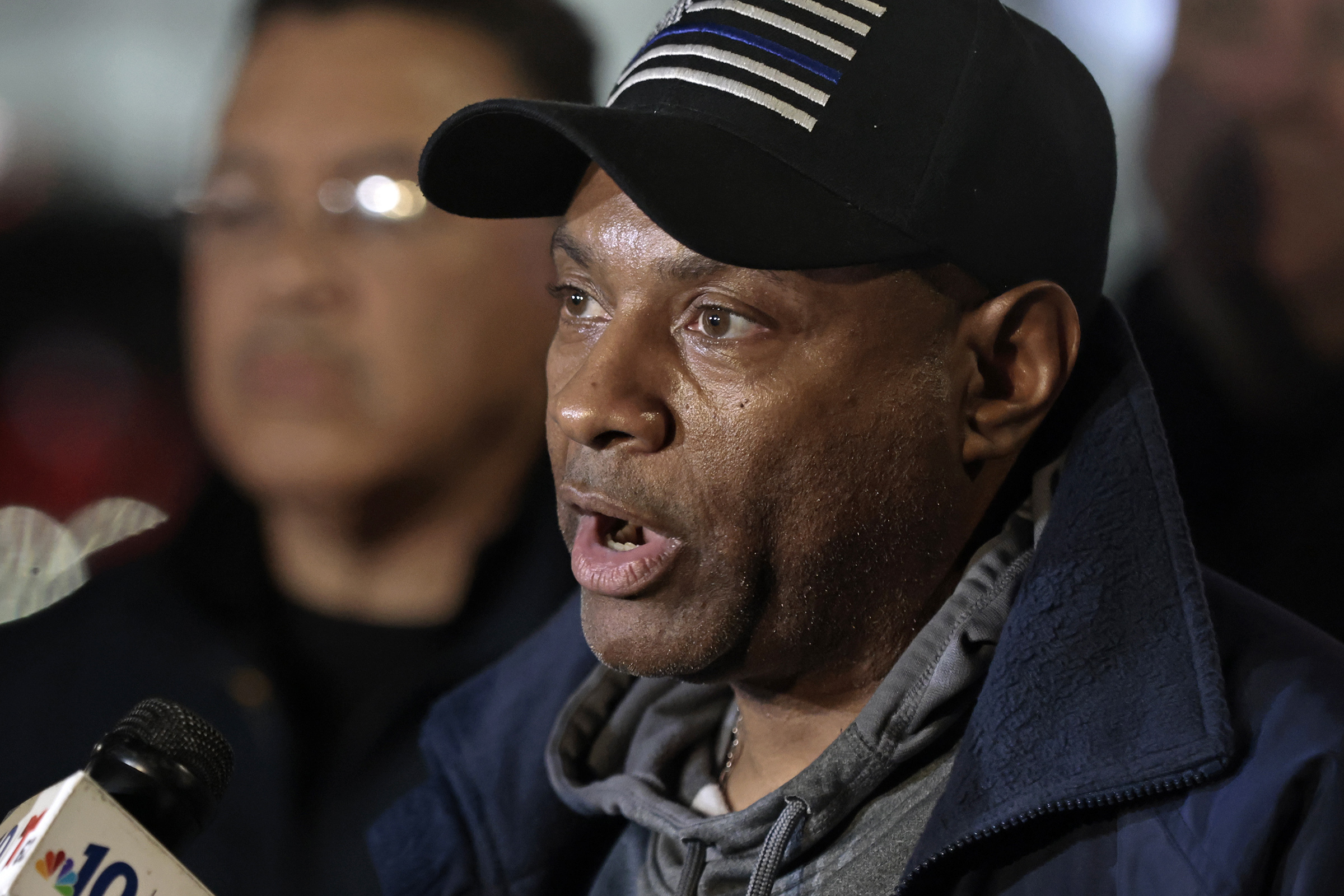
Roosevelt Poplar, president of Fraternal Order of Police Lodge 5, on Jan. 26, 2024.Elizabeth Robertson / Staff Photographer
In his statement, Poplar also commended Shapiro for providing funding for police department needs.
“The Governor has delivered on his promise to invest in public safety, he has shown up with us in times of tragedy, and he has proven his commitment to keeping our officers and the communities we serve safe,” he said.
The police union’s endorsement of Shapiro is notable for an organization that just a few years ago was seen by some Philadelphia Democrats as politically toxic.
In the aftermath of the 2020 Minneapolis police killing of George Floyd, protests by racial justice activists swelled in Philadelphia and across the country with many of the movement’s participants calling to “defund” or abolish the police. They pressed local lawmakers to redirect police funding to social services, and Philadelphia City Council in June 2020 canceled a planned increase to the Philadelphia police budget.
Amid the calls for reform, the FOP was a major point of contention, as was its bombastic former leader, John McNesby. Activists — and many of their allies in elected office — said the union was too resistant to change and protected bad cops.
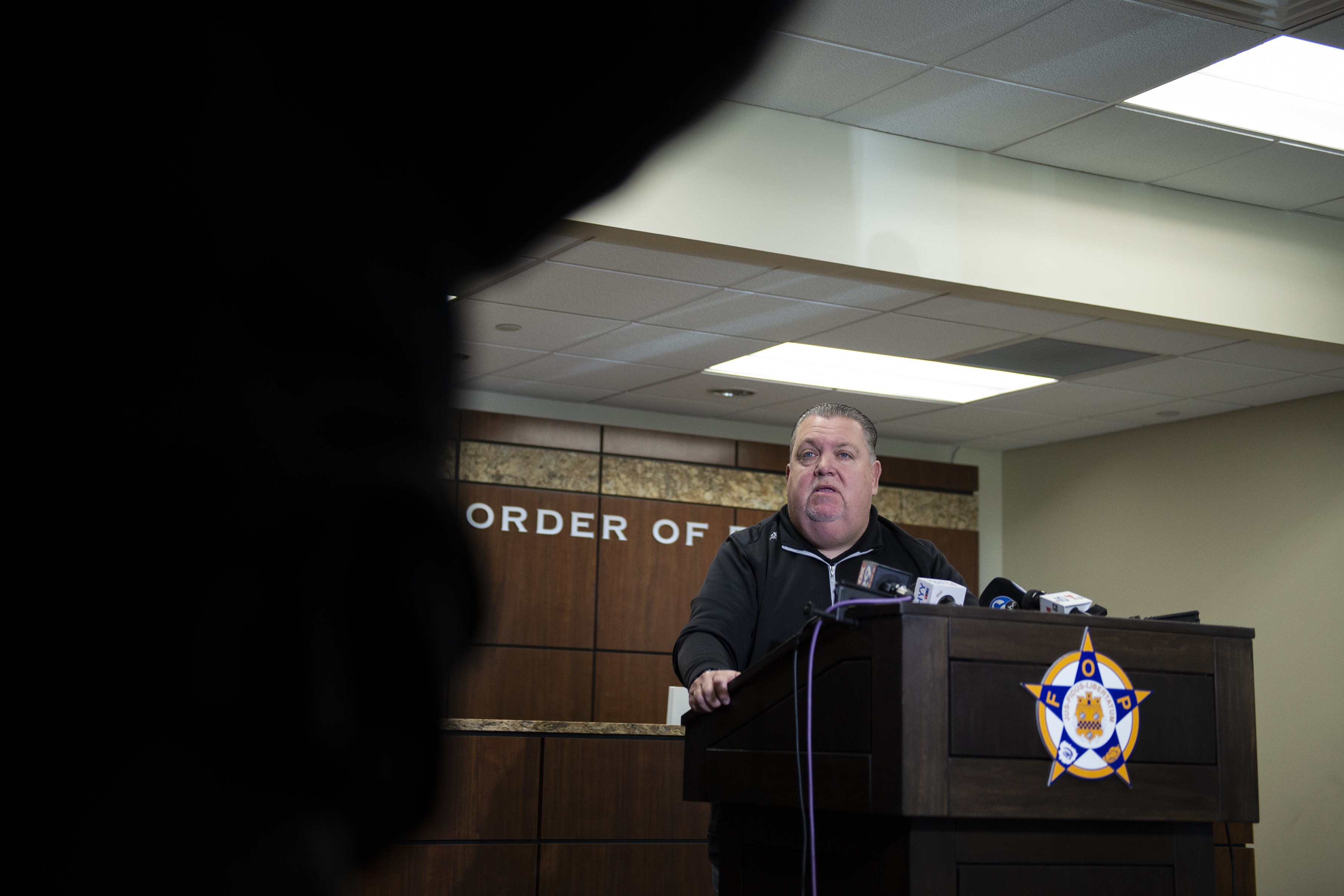
Former FOP president John McNesby holds a news conference on Oct. 19, 2022.Joe Lamberti
At the time, Shapiro was running for reelection as the state attorney general, and his campaign presented him as a “progressive reformer” who had established a unit in his office to review criminal convictions that may have been unfairly applied and a council to support people leaving prison with housing and employment opportunities. The FOP endorsed Shapiro’s 2016 and backed his 2020 campaign for attorney general.
Unlike some Philadelphia Democrats, Shapiro — who has rumored ambitions for a presidential run in 2028 — did not embrace the “defund” movement. He argued during a 2020 trip to Philadelphia that addressing structural inequities in the department and having strong law enforcement, especially in communities with high levels of poverty, were not mutually exclusive endeavors.
“We reject that poverty or institutionalized indifference and marginalization should mean that some people don’t get to have a safe community to live in,” he said. “We won’t give up on the belief [of] law enforcement showing up in a community to make people feel safer.”
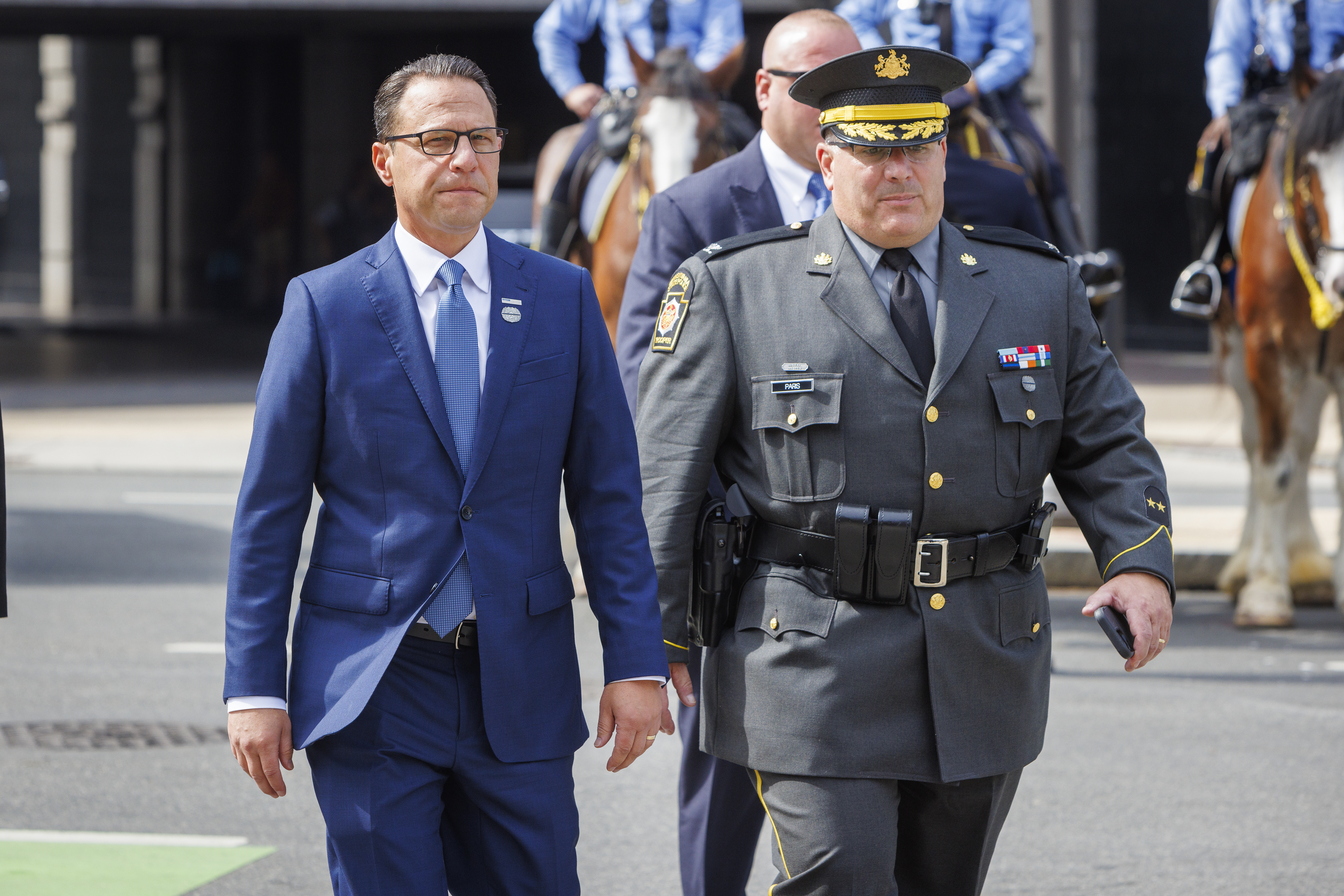
Gov. Josh Shapiro with Pennsylvania State Police Col. Christopher L. Paris. They were attending the funeral for Philadelphia police officer Jaime Roman at the Cathedral Basilica of SS. Peter and Paul on Sept. 19, 2024.Alejandro A. Alvarez / Staff Photographer
In the years following 2020, public support for police in Philadelphia appeared to grow. The city saw a historic spike in gun violence, and Republicans nationally portrayed Democrats as soft-on-crime. When a half-dozen Democrats were fighting for the mayoral nomination in 2023, polling showed that most voters saw public safety as the No. 1 issue driving the race. None of the candidates embraced “defund,” and most of them supported proposals to provide additional resources to the police department as it sought to solve shootings.
In the end, the tough-on-crime mayoral candidate — then-City Councilmember Cherelle L. Parker — won decisively.
An anonymous federal official warned in a disclosure to Congress that a rushed and insufficiently tested U.S. Postal Service system could prevent large numbers of Americans from receiving mail ballots this fall if courts approve President Donald Trump’s plans for the midterm elections.
The disclosure, made public Tuesday morning by Sen. Richard Blumenthal (D-Connecticut), says the Postal Service has adopted an internal “zero-percent failure policy” under which an entire batch of ballots would be rejected if a single barcode sampled by a postal employee could not be scanned or matched with information submitted through a new online portal. A batch could contain tens of thousands of ballots, according to the disclosure.
“The Postal Service has designed a system to disenfranchise millions of Americans,” Blumenthal said in a call with reporters.
Postal officials and the White House did not immediately provide comment.
In public statements, the Postal Service has previously said information submitted through the portal will be updated immediately. It has said postal employees will not determine voter eligibility or check names and addresses for accuracy. The rule does not disclose the sampling formula or zero-failure policy described in the whistleblower disclosure.
The fight over the Postal Service’s plans is rooted in an executive order from Trump that seeks to overhaul mail voting. A judge has blocked those plans for now, but the administration is seeking to reinstate them ahead of this fall’s midterm elections.
If the administration gets its way, state and local election officials would have to upload lists of voters to an online portal the Postal Service is designing. Postal employees would refuse to deliver to anyone who is not on those lists.
The unnamed official alleged that the portal was assembled under constantly changing requirements and with as few as four working days available for customer testing before a planned launch.
If the Postal Service’s plans go into effect, election officials will confront new challenges when they mail ballots in large batches. Postal workers plan to scan barcodes on a sample of envelopes to ensure the voters appear on the state’s list, according to the whistleblower. If they find even one mismatch, they will refuse to accept the entire batch, the whistleblower said. That means a single mismatch in a batch of 10,000 ballots would prevent the 9,999 other ballots from being mailed until discrepancies were resolved.
“As designed, the process is entirely unforgiving,” the disclosure said. “It could delay ballots by the thousands in repeated verification cycles — and thus prevent states from mailing enormous numbers of ballots.”
State and local officials often mail ballots in large batches to manage them as effectively as possible. Some states send ballots to all registered voters, and they must place millions of ballots in the mail in a short period.
Many election officials have expressed alarm about the Postal Service’s overall plans under Trump’s executive order because they don’t believe they have been adequately thought through for a fast-approaching election.
Among the issues they worry about are potential mismatches for mundane reasons. States constantly update their voter rolls, and the lists they send to the Postal Service could be out of date within minutes as new voters register and existing ones update their registrations because they’ve moved.
The Postal Service has said states can update their voter lists, but election officials have expressed concerns that the new online portal won’t be able to handle a steady stream of updates.
The whistleblower disclosure could add to those concerns and bolster legal challenges to the executive order and postal rules.
The disclosure, dated Sunday, was submitted to Blumenthal by Whistleblower Aid on behalf of an anonymous federal official it represents.
The organization described the unnamed whistleblower as a “federal official with direct knowledge of potentially catastrophic problems in the development” of the Postal Service’s plans and said the official feared reprisal by administration officials if identified.
Blumenthal sent the disclosure late Monday to Postmaster General David Steiner and asked him to provide documents about the Postal Service’s plans.
Blumenthal is the ranking Democrat on the Permanent Subcommittee on Investigations for the Senate Committee on Homeland Security and Governmental Affairs.
States and voting rights groups sued over the executive order soon after Trump signed it in March. The Supreme Court last week allowed work on the executive order to proceed for the moment, but days later a lower court blocked it.
The administration is seeking to get it reinstated but faces timing challenges. Officials in North Carolina are preparing to start mailing ballots on Friday under a state law requiring them to send them to those who ask for them starting 60 days before an election. Other states are set to start mailing their ballots in the following days and weeks.
The whistleblower said the Postal Service stopped working on the portal around June 25 after a federal judge blocked implementation of Trump’s directive, then resumed work around July 29 while that order remained in effect.
The disclosure said work continued after the judge issued a new order on Thursday barring the Postal Service for 14 days from taking further preparatory steps that would apply to all states for the November election. In a brief ruling Monday, the judge said the Postal Service could work on the portal for states that want to voluntarily use it.
Postal officials planned to launch the portal on Tuesday, according to the whistleblower. One of the whistleblower’s attorneys, David Kligerman, said work on the portal had continued in recent days but didn’t know whether the Postal Service was sticking with its plan to make it available on Tuesday.
Donald Trump Jr.’s venture capital firm, 1789 Capital, is leading a new funding round in Polymarket that values the prediction market at $21 billion, a spokesperson for 1789 Capital said Monday.
Polymarket plans to raise $1 billion, including around $300 million from 1789 Capital, the spokesperson, Alexa Henning, said. The investment firm previously invested about $200 million in the prediction market, which is currently valued at about $15 billion.
Prediction markets such as Polymarket and Kalshi have exploded in popularity over the past year. The platforms allow users to place wagers on the outcome of a wide variety of events, such as what the president will say in a speech or who will get married on “Love Is Blind.”
The Trump family has built up a financial stake in the industry since last year. Donald Trump Jr. joined Kalshi as an adviser last year and received shares in the company worth more than $300,000. He also began advising Polymarket and invested in it via 1789 Capital.
At the same time, his father, President Donald Trump, has taken steps to boost the industry. Michael S. Selig, whom the president appointed to lead the Commodity Futures Trading Commission, which oversees prediction markets, has spoken enthusiastically about the companies and sued states that tried to regulate them. The president declared on Truth Social that prediction markets would “thrive” under his leadership and said Selig was “respected by all.”
Bloomberg earlier reported that 1789 Capital was leading Polymarket’s funding round.
Many of the companies that 1789 Capital has invested in have large government contracts, while others, like Polymarket, have benefited directly from new Trump policies or rollbacks of existing laws, The New York Times has reported. The investment firm also bought shares in some of the most coveted private companies before many went public, including SpaceX, Anduril, Cerebras and Reflection AI.
Two years ago, 1789 Capital managed a few hundred million dollars. It now oversees more than $3 billion.
Donald Trump Jr. told the Times this year that he invested as a private citizen and held “no policy position and no role within the administration whatsoever.”
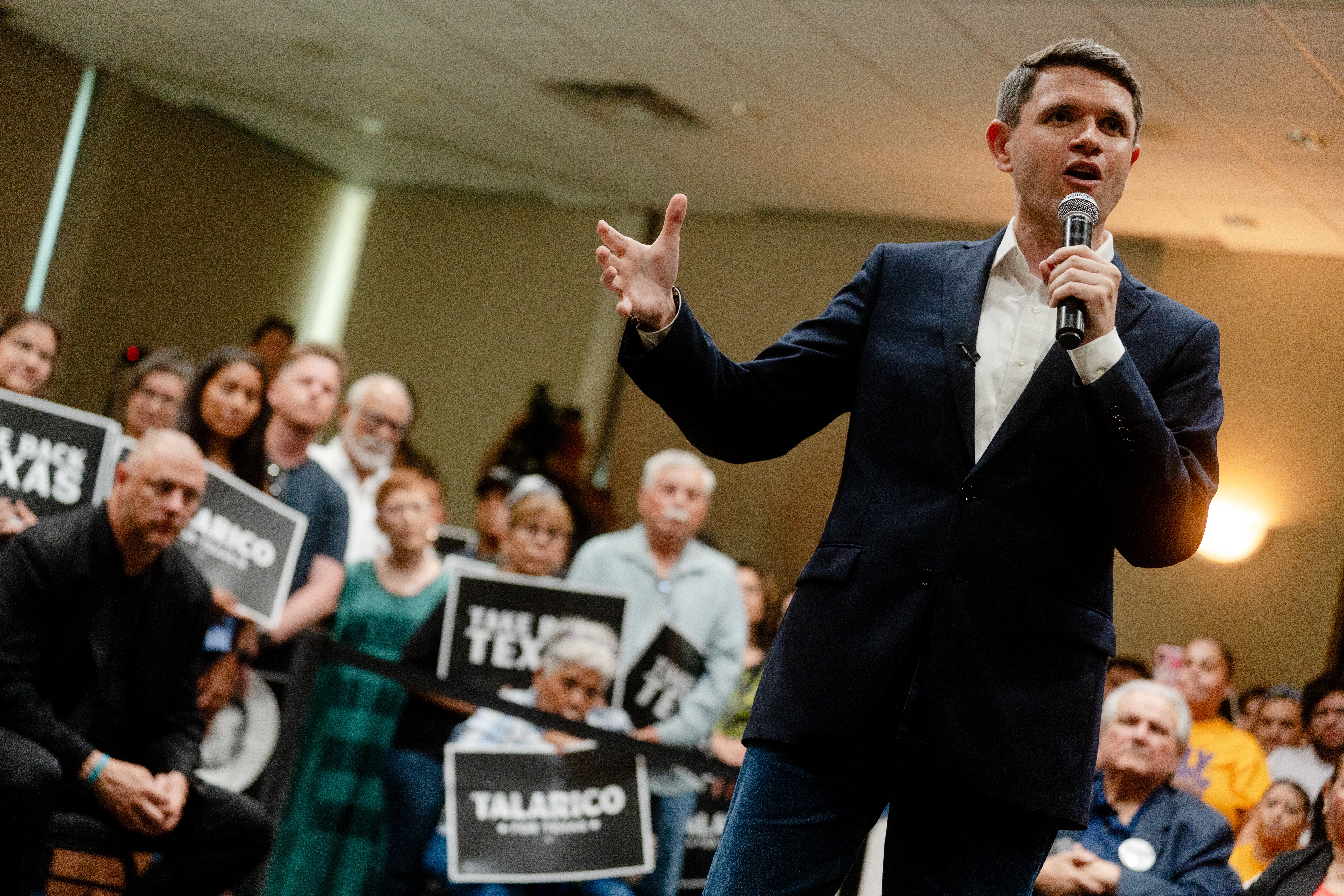
A group of Democratic candidates has drawn attention this election cycle because of their deep religiosity. Two prominent candidates for the U.S. Senate, for example, James Talarico of Texas — a Presbyterian with a recent seminary degree — and Adam Hamilton of Kansas, senior pastor of a United Methodist megachurch, frequently discuss their faith and cite the Bible on the campaign trail.
But those candidates are not winning the support of many white evangelicals.
A recent Fox News poll showed that only 21% of white evangelical voters in Texas support Talarico, even in a race against a scandal-ridden opponent who had an extramarital affair.
Policy differences over abortion and LBGTQ+ rights — two issues that have long been central concerns for white evangelical conservatives — at least partly account for this. Talarico and Hamilton both support abortion rights, and they’re running against Republicans who do not.
But a more fundamental issue also makes it hard for Christian Democrats such as Talarico and Hamilton to make inroads with conservative white evangelical Christians. The Religious Left champions cultural pluralism, while a Christian national identity drives the Religious Right — and there’s an unbridgeable gap between the two. This divide has helped to shape American politics for more than a half century.
It helps explain why more than 80% of white evangelical voters cast their ballots for President Donald Trump in each of his three presidential races. It’s also the reason why, in 1980, a majority of white evangelical voters supported Ronald Reagan, who had been divorced and was a less frequent churchgoer, over President Jimmy Carter, a Southern Baptist deacon and Sunday school teacher.
In each case, white evangelicals considered a candidate’s faith and personal behavior to be far less important than their top priority: finding someone who championed their understanding of the place of Christianity and Christian-based sexual morals in the nation.
This wasn’t always the case. In the mid-1970s, leading American evangelical magazines such as Christianity Today called for the election of morally exemplary, born-again Christian candidates on the grounds that only Christian politicians could rescue the nation from moral decline. When Carter ran for president in 1976, many evangelicals decided he fit the bill, and backed the Democrat.
But some evangelicals quickly regretted this choice. Both Carter and more conservative evangelicals believed that the United States was morally adrift. Yet, their understanding of the sources of that national moral decline differed.
For Carter, whose moral consciousness was shaped in part by his interactions with civil rights activists, racism and the destruction of the environment were moral evils. That meant that the solution to America’s moral problems would focus on greater equality, as well as a more responsible use of the environment. The United States faced a “moral and spiritual crisis,” he said — but that crisis could best be addressed by a reduction in “self-indulgence and consumption,” not through a public affirmation of America’s Christian identity.
Moreover, as a moderately liberal Baptist — a tradition that had historically championed religious liberty — Carter was a religious pluralist who eschewed public endorsements of Christianity and embedding his personal religious beliefs in public law.
He opposed the White House church services that President Richard Nixon had created. He publicly endorsed the Supreme Court rulings that curtailed classroom prayer in public schools, because he said that “as a Baptist,” he believed that “the Government ought to stay out of the prayer business.” And although he personally opposed abortion, he refused to support a constitutional amendment to overturn the Supreme Court’s Roe v. Wade decision — which conveyed a right to have an abortion — because he thought that in a pluralistic society, it was improper for the federal government to impose one religious group’s view of abortion on others.
Conservative evangelicals, however, recoiled from these views. To them, the sexual revolution of the 1960s and 1970s was a much greater evil than racial injustice or environmental destruction. It threatened the fundamental building block of society: the family. And the source of the sexual revolution, they thought, was a national rejection of God, which was manifest not only in religious pluralism but also in the Supreme Court decisions on school prayer and abortion.
Made By History sponsors. FOR USE ON MADE BY HISTORY STORIES ONLY.Inquirer Staff
In the late 1970s, this concern prompted the formation of the Christian Right. At its heart, this movement was a campaign to restore an imagined lost world of the 1950s — an era that had combined more conservative sexual standards with national legislation to make “In God We Trust” the national motto. Conservative evangelicals thought those values had been lost amid the anti-war protests and cultural changes of the 1960s and 1970s.
Some evangelical leaders argued that the answer was mobilizing and electing a president who shared their hunger to return to the world of the 1950s. “The hope of reversing the trends of decay in our republic now lies with the Christian public in America,” Moral Majority founder (and Baptist megachurch pastor and televangelist) Jerry Falwell declared in 1980. “Our Founding Fathers separated church and state in function, but never intended to establish a government void of God … We cannot be silent about the sins that are destroying this nation … We must turn America around or prepare for inevitable destruction.”
White evangelical Christians had voted for Republican presidential candidates before — including in 1972, when they overwhelmingly supported Nixon’s reelection. But Falwell’s Moral Majority and other allied groups, such as Christian Voice and the Religious Roundtable, broke new ground in channeling evangelicals’ generally conservative instincts into a much more tightly focused campaign to restore Christian values through public law. That campaign put them at odds with religious pluralists like Carter.
These new groups backed Reagan, and other candidates like him, who they believed would oppose further secularization of the nation’s laws and culture and prevent any further sexual liberalization. The Religious Right also opposed candidates who were strong cultural pluralists, since they thought that secularization and a pluralistic understanding of the nation’s religious identity had undermined the country’s moral foundation.
Sometimes that meant backing less personally devout, morally compromised candidates, since the most vocal advocates of a public affirmation of Christianity’s place in public life were sometimes infrequent churchgoers whose sexual lives were far from monogamous. To these evangelical activists and voters, politicians’ policy choices mattered far more than their personal behavior. As Christian Voice executive director Richard Zone put it when endorsing Reagan, he “was not the best Christian who ever walked the face of the earth.” But to Zone, “we really didn’t have a choice.”
When the group issued a “Moral Report Card” in 1980 that rated every member of Congress on the morality of their votes, pious churchgoers such as Sen. Paul Simon (D-Ill.) and Rep. Robert Drinan (D-Mass.), the only Catholic priest serving in Congress, received moral ratings of zero, while Rep. Richard Kelly (R-Fla.), who was sentenced to prison a few months later for accepting bribes in the Abscam scandal, received a rating of 100. Even the devout evangelical Baptist Sen. Mark Hatfield (R-Ore.), a liberal Republican who opposed abortion but warned against “mix[ing] piety with patriotism,” found himself at odds with the Christian Right.
And little has changed in terms of this picture over the last 46 years. Once again, in 2026, in Kansas, Texas and elsewhere, evangelical voters have a choice similar to the one that evangelicals confronted in 1980: vote for the most religiously devout Christian candidate on the ballot or vote for a candidate who shares their vision of the nation.
If history is any indication, most of them will choose the latter. Fundamentally, white evangelical voters understand that progressive Christian candidates are usually cultural pluralists whose faith is shaped by values of equality. They don’t see secularization and the sexual revolution as the threats that most white evangelicals do. Instead, progressive Christians are often more concerned about what they see as the threat to the rights of religious and sexual minorities posed by Christian nationalism.
This history suggests that if progressive Christians like Talarico and Hamilton win their House and Senate races in November, it will be by overcoming white evangelical opposition, not because they hit upon a formula to win over the most conservative churchgoers.
Daniel K. Williams is an associate professor of history at Ashland University and the author of God’s Own Party: The Making of the Christian Right.
Made by History takes readers beyond the headlines with articles written and edited by professional historians. Opinions expressed do not necessarily reflect the views of The Inquirer.
Eleven years ago, Carlton Williams was, to some, a symbol of government dysfunction.
He was leading the troubled Philadelphia Department of Licenses and Inspections, an agency engulfed in controversy over safety lapses and staffing issues following the deadly 2013 Market Street building collapse. The city controller called on Williams to resign, and Jim Kenney, then a candidate for mayor, promised that he’d get rid of him.
And yet Williams remained.
In July, he was named Philadelphia’s managing director, one of the most powerful positions in city government, second only to the mayor. He is assuming responsibility for L&I again, plus dozens of other agencies and thousands of employees who carry out the day-to-day operations that make the city run.
It is perhaps an improbable outcome for a longtime city employee who absorbed a level of scrutiny that could have easily ended his career.
But Williams proved durable, cycling through leadership positions across several departments while establishing himself as a City Hall insider. He has politically powerful allies and a reputation among City Council members as someone who will quickly act on their needs. That goes a long way with 17 politicians who value responsiveness and omnipresence, traits that they did not see in Williams’ predecessor, Adam K. Thiel.
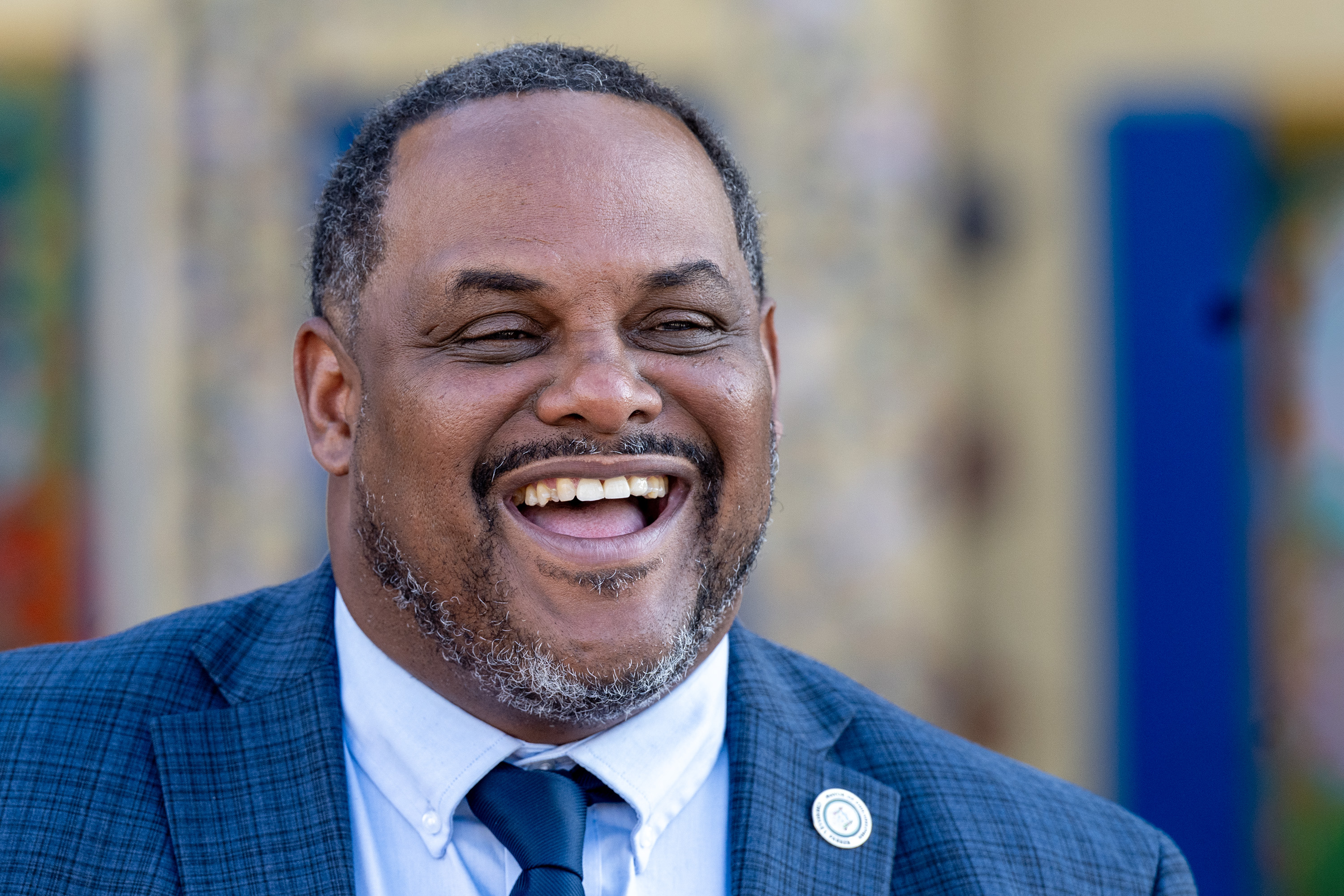
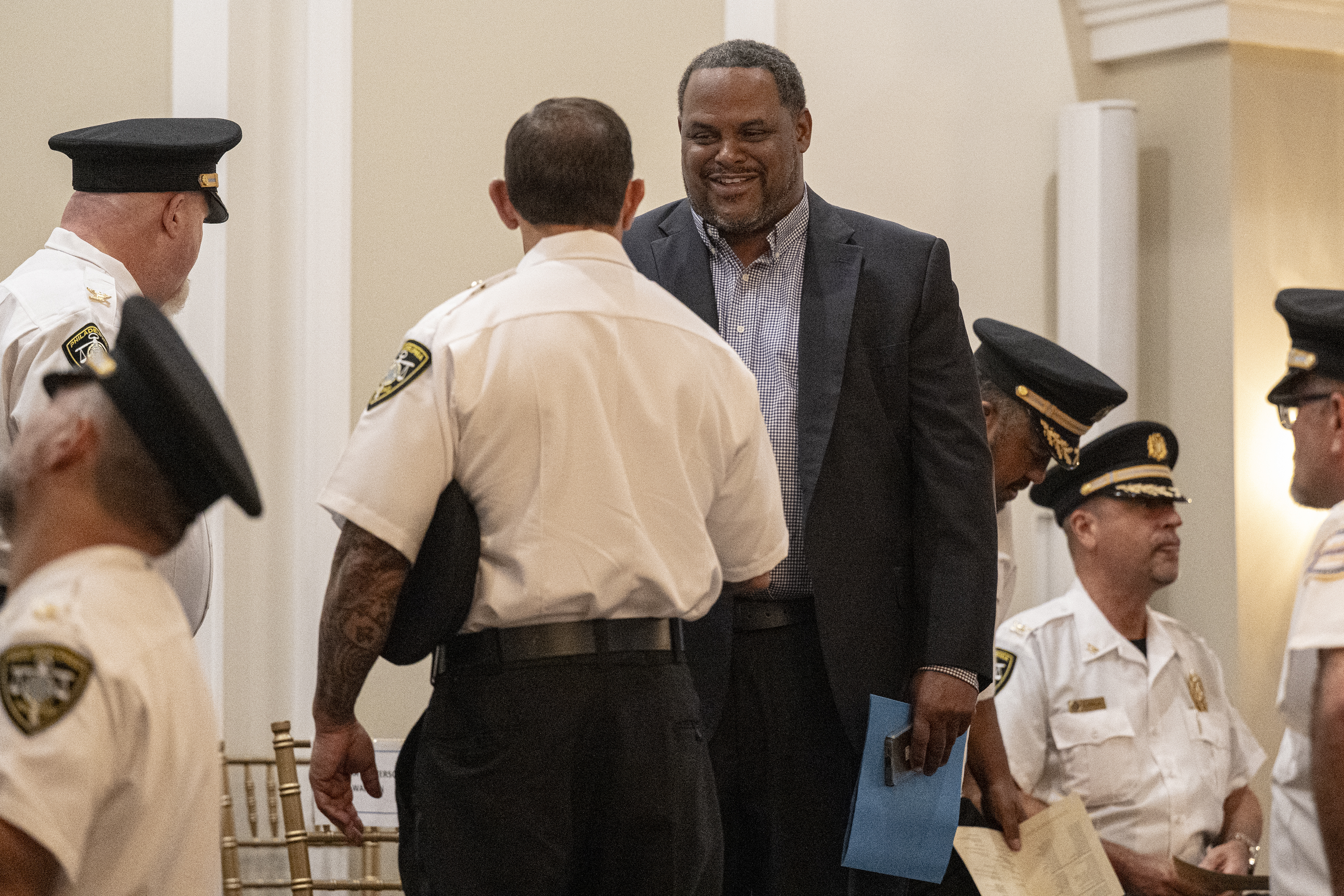
Newly appointed Managing Director Carlton Williams interacts with city officials during a correctional officer graduation ceremony at FOP Lodge 5 in Philadelphia on Friday.Jose F. Moreno / Staff Photographer
Perhaps most importantly for Williams’ ascent: he is all-in on Mayor Cherelle L. Parker.
The ties between Parker, 53, and Williams, 57, stretch back to their childhoods in Northwest Philly — he played football for the Oak Lane Wildcats, and she was a cheerleader. The team remains a part of both of their identities: Williams has led the Oak Lane Youth Association for 20 years, and the mayor often says proudly that she is a “Wildcat for life.”
Later in life, both found allies in the storied Northwest Coalition, a powerful political family. Williams said that he has known for 20 years that Parker would one day sit atop City Hall. And he most recently led Parker’s Office of Clean and Green Initiatives, overseeing the implementation of some of her key campaign promises.
“I’m bringing the ‘One Philly’ brand to the managing director’s office,” Williams said in an interview, echoing the mayor’s oft-used slogan. “Not to say it wasn’t being done under my predecessor. But I want to make sure it’s completely aligned with the mayor’s goals, because I believe in that vision.”
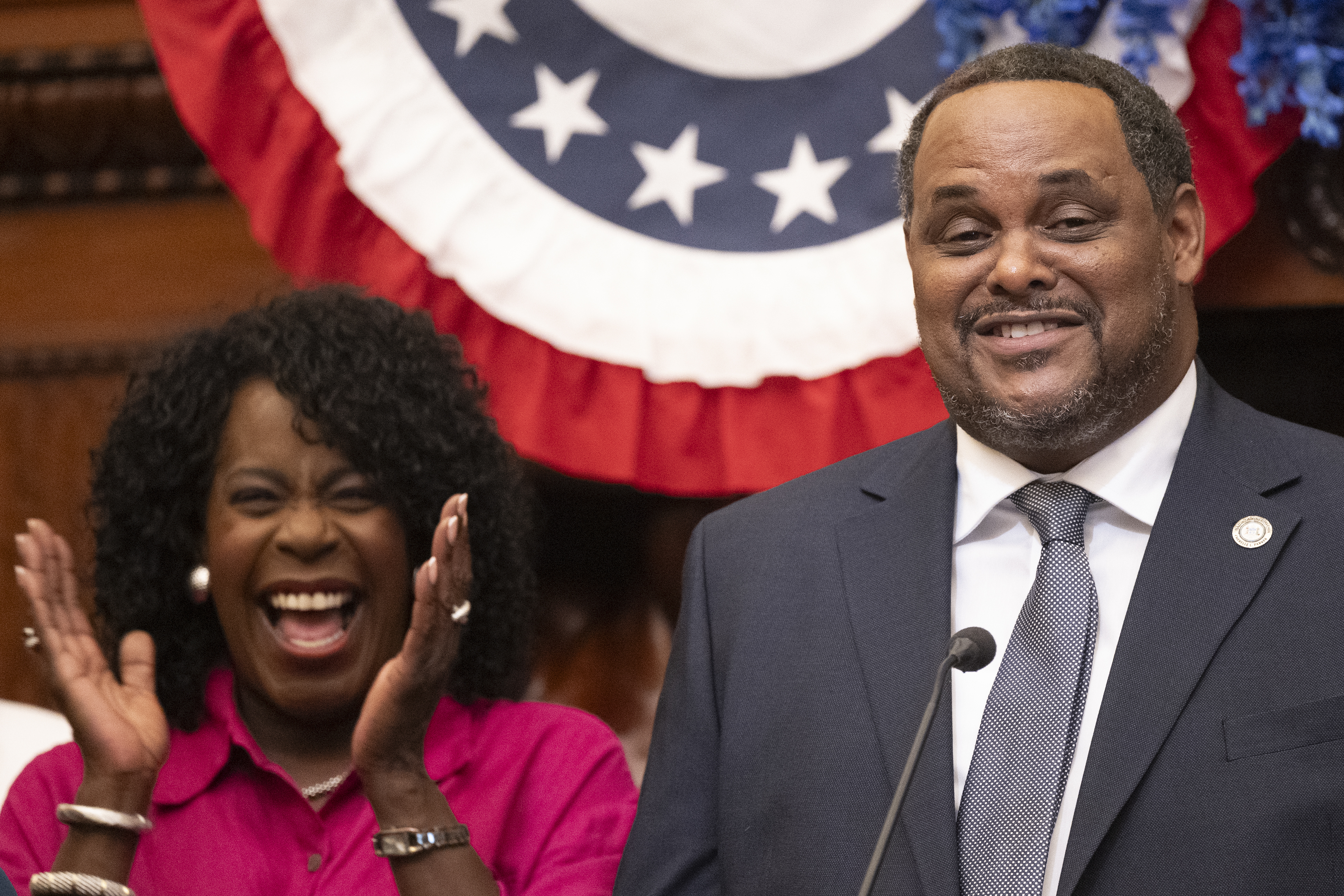
New Philadelphia Managing Director Carlton Williams speaks at the podium after being announced by Philadelphia Mayor Cherelle L. Parker during a July 28 news conference at City Hall.Jose F. Moreno / Staff Photographer
His appointment as managing director marks a new stage for the Parker administration that has seen significant turnover at its highest levels. And it is indicative of what Parker values in her inner circle: vast institutional knowledge and loyalty.
For the mayor, trust in Williams’ ability to operate within the bureaucracy and advance her priorities may outweigh his mixed record of management.
“Whenever we had a crisis of any kind in this city, he has been on my speed dial,” Parker said when she announced Williams’ appointment last month. “No matter who’s been leading, I’ve always called him for his counsel.”
Overseeing ‘a very broken’ L&I
Parker’s bet on Williams would have seemed almost unimaginable a decade ago.
A year after Williams was appointed to lead L&I, an excavator demolishing a wall on Market Street in Center City toppled the building onto an adjacent Salvation Army store, killing six people and injuring a dozen more. The inspector responsible for the demolition project died by suicide a week later.
Calls for reform abounded and questions swirled about whether the city’s agencies were responsible. There were multiple investigations launched and commissions convened to probe the disaster, and within days, Council members were pressing Williams to institute reforms that would bolster safety on private construction sites.
In response, Williams sought to hire more inspectors, increase their training, raise demolition standards, and create new specialized units within L&I.
Today, he says the collapse on Market Street was “one of the saddest moments” of his time in government.
“You have to lead through some tough challenges when you’re a leader,” he said. “You don’t get to pick and choose when you lead.”
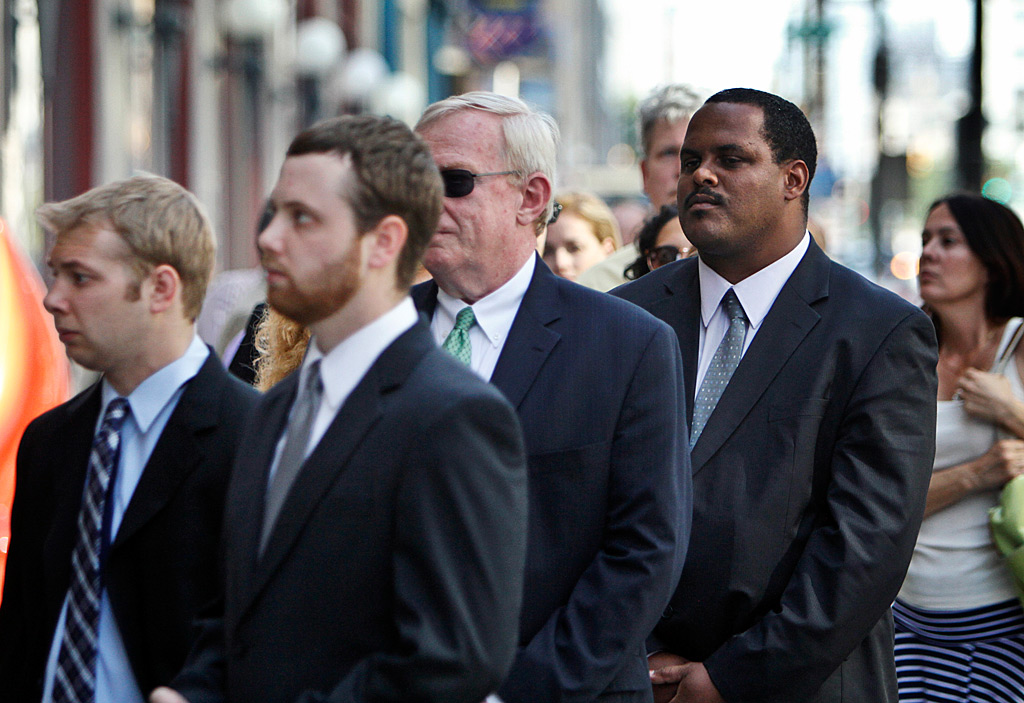
In this June 2013 file photo, then-Philadelphia Commissioner of the Department of Licenses and Inspections Carlton Williams (second from right) waits in line to attend a memorial service for Anne Bryan, who was among the victims of the Market Street building collapse.JOSEPH KACZMAREK / Associated Press
By fall 2015, then-City Controller Alan Butkovitz was calling on Williams to be fired. He said at the time that L&I had long been troubled, but that his office’s audit of the agency found that Williams had not made enough improvements.
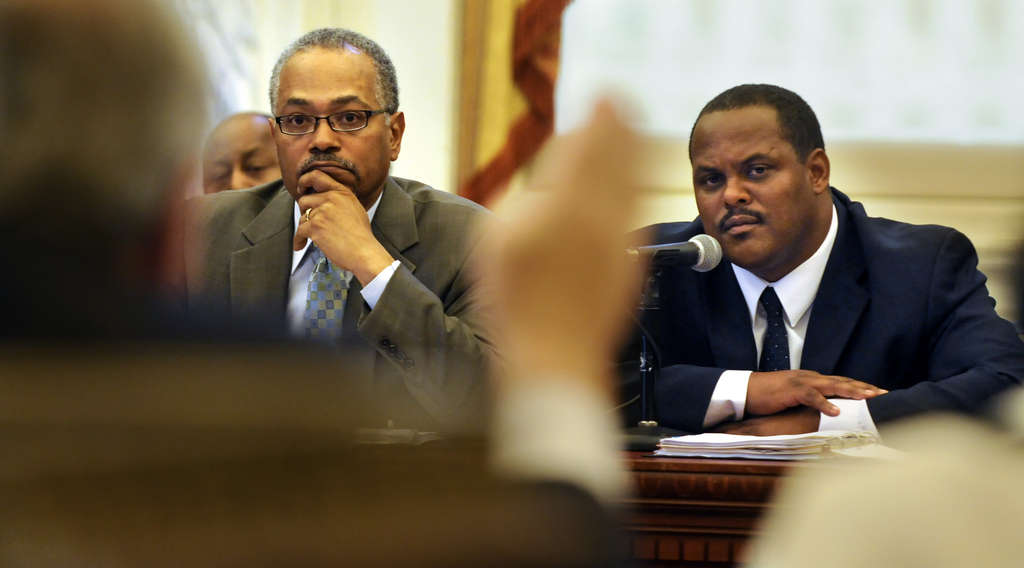
In this 2013 photo, then-Deputy Mayor Everett Gillison (left) and then-Commissioner of Licenses and Inspections Carlton Williams listen to members of City Council during a hearing.TOM GRALISH / Staff Photographer
Butkovitz now says that he blames former Mayor Michael Nutter instead, and that Williams was “caught between the mayor and me.” He said Williams had promised to provide the controller’s office with documents to assist in an audit, and then did not.
“I took it out on Carlton Williams at the time,” Butkovitz said.“His inclination was to cooperate with me, but at the time, it looked to me like duplicity. And I don’t think it was. I think he was overridden by higher authority.”
Nutter did not respond to a request for comment.
Estelle Richman, a former Philadelphia managing director who has held a variety of roles in local, state and federal government, said L&I is “one of the most difficult city departments.” She noted that past agency leaders have been pushed out, fired, indicted, and jailed.
“We can go back and say ‘maybe [Williams] should have done this or that,’ but the reality is it was a very broken department,” she said. “I think he did more to try to get it restabilized and back on track than any other commissioner at that time could have done.”
‘You have to be accessible’
Before taking the helm at L&I, Williams was a career bureaucrat.
Born in North Philly and raised in West Oak Lane, Williams started with the city at age 19, working in Fairmount Park as one of the first-ever members of the Philadelphia Ranger Corps. The program paid for part of his tuition to attend Temple University and marked his foray into public service.
Jeffrey Montague, who led the Philadelphia Ranger Corp. and has been a mentor to Williams for decades, said that at a young age, Williams showed potential.
“He didn’t try to fit in. He always stood out on his own independence,” Montague said. “He wasn’t trying to fit into a crowd.”
After working as a ranger, Williams spent three years running a Harrisburg youth program for AmeriCorps — the first and last time Williams lived outside the city.
He returned to Philadelphia to work for the Parks and Recreation Department, rising to become a deputy commissioner in both the recreation and streets departments.
Then came the four-year stint leading L&I, and when Kenney took office in 2016, he moved Williams back to his old job as a deputy in the streets and sanitation department.
But it didn’t last. Five months after Kenney took office, the streets commissioner was arrested for assault. Williams ascended to the role, and suddenly, the person who Kenney said he wouldn’t retain to lead L&I was in charge of one of Philadelphia’s most visible departments, overseeing transportation and sanitation operations citywide.
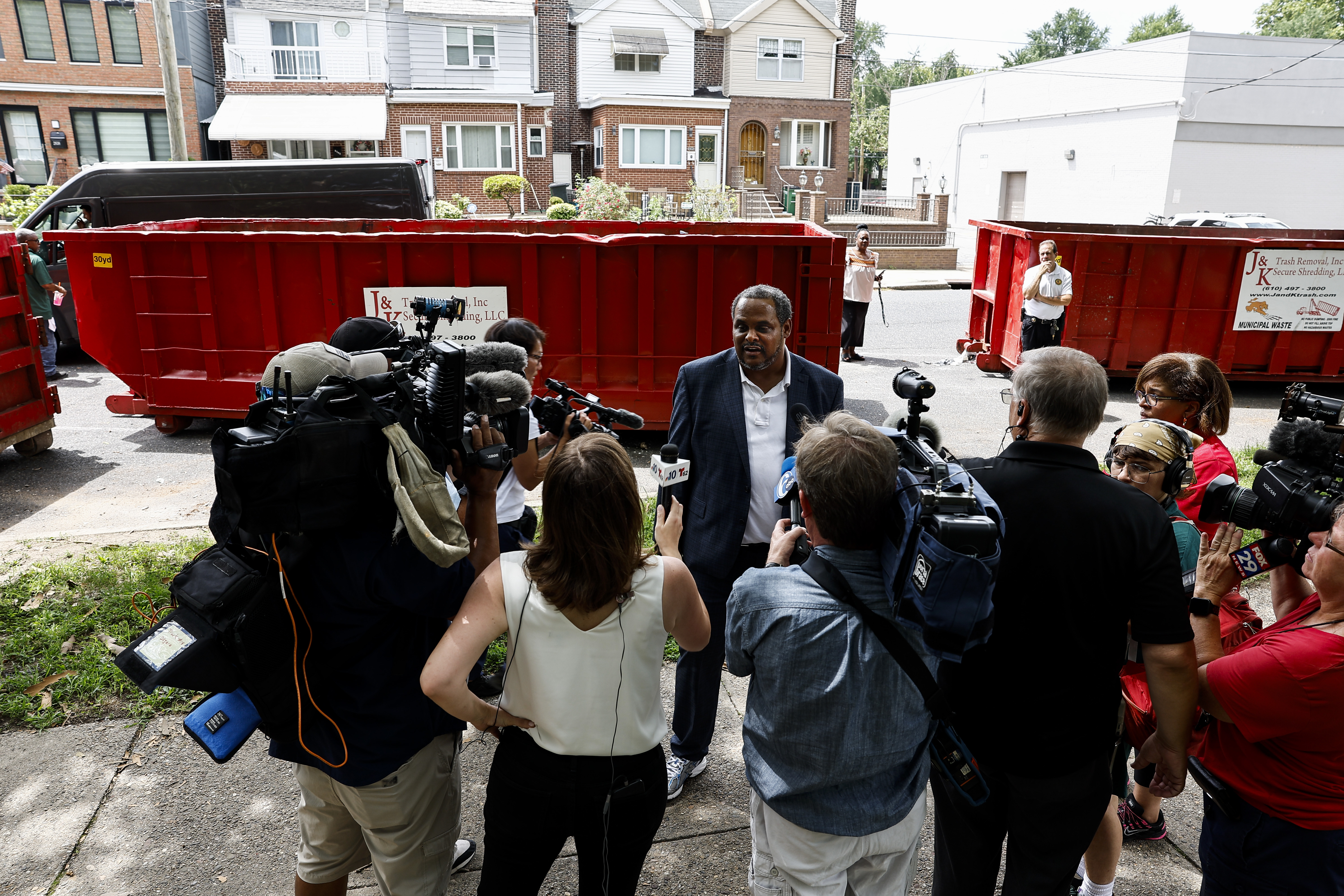
Carlton Williams, then the director of the Office of Clean and Green Initiatives, speaks during a news conference at Bigler and South 15th Streets on July 7, 2025.Monica Herndon / Staff Photographer
It was there where Williams solidified himself as a City Hall fixture. He said that as an administration staffer,he has “one primary that I listen to” — the mayor — but he has always tried to be attentive to Council.
That may be a key difference between Williams and Thiel, his predecessor. Thiel was the former fire commissioner and a nationally recognized expert in emergency management who was seen as a skilled behind-the-scenes operator.
But Council members said thatThiel did not foster close relationships with members of the city’s legislative body who are often conduits between residents and the mayor’s administration.
In addition, Thiel was often absent during major events in the city and he was frequently on leave — he joined the Army Reserve eight months into his tenure, and held several jobs outside city government, including as a consultant and professor.
That was a departure from prior administrations, when the managing director was often the public face of city operations.
On several occasions during the Parker administration, it was Williams who was in the spotlight. As director of the Office of Clean and Green Initiatives, he played a key coordinating role during the eight-day municipal worker strike that halted city services — most visibly, trash pickup.
And he oversaw the city’s response to a severe winter storm earlier this year that left much of the city encased in ice, despite weather emergencies typically falling under the managing director’s purview.
New Philadelphia Managing Director Carlton Williams (left) stands near the former director, Adam Thiel, before an introduction by Philadelphia Mayor Cherelle L. Parker during a July 28 news conference at City Hall.Jose F. Moreno / Staff Photographer
City Councilmember Anthony Phillips, whose district includes Northwest Philadelphia, said that prior to Thiel’s resignation, members of Council were “gravely concerned” about his frequent leave.Some members said that, in Thiel’s absence, Williams was their primary contact among Parker’s top staff.
“You can’t get certain things done and you can’t expect an efficient and effective city when you’re not present,” Phillips said. “Carlton is going to be the complete opposite of that.”
Williams said that his role as managing director is his only job aside from volunteering.
“It’s a full-time, 24-hour, seven-day-a-week job,” he said. “You have to be accessible.”
Williams’ coziness with elected officials has also drawn criticism.
A former city employee who previously worked for Williams said his relationships with Council amount to a “favor machine.” The staffer spoke on the condition of anonymity in order to preserve relationships.
“There is this cycle of Council getting calls from constituents, like ‘there’s a pothole,’ and then they get it fixed, and that’s the main work,” the former staffer said. “It’s not actually setting up systems that are solving the problems. It’s reacting to them.”
But Williams said some of his proudest achievements have resulted in systemic change: he led the installation of some of the first spraygrounds in the city, overhauled the recycling program, had BigBelly trash cans placed throughout Philadelphia, and started the annual Philly Spring Cleanup.
“He is probably one of the most well-prepared managing directors that the city has had,” Richman said. “He knows not only how operations work within the city departments, he knows the political structure of the city. And I believe a managing director has to know both.”
John Dougherty, the former leader of the politically powerful Local 98 of the International Brotherhood of Electrical Workers, and his ally, ex-Councilmember Bobby Henon, were on trial for bribery and other corruption charges. Prosecutors accused Henon of taking official actions as a Council member at Dougherty’s behest in exchange for a salaried, no-show job with the union.
One of the schemes prosecutors presented during the trial focused on efforts by union officials in 2015 to halt the installation of an MRI machine at the Children’s Hospital of Philadelphia, a project that was being completed with nonunion labor. Williams, at the time, was at the helm of L&I.
Department of Streets Commissioner Carlton Williams exits federal court on Oct. 12, 2021, after testifying in the John Dougherty and Bobby Henon bribery trial.Thomas Hengge / Staff Photographer
During the 2021 trial, Williams was called to testify. He told the jury that Henon called him in August 2015 to report that an unlicensed contractor was working at CHOP, and that he dispatched an inspector to investigate.
The inspector, Williams testified, issued a stop-work order on the construction of the MRI machine. But he insisted that he did not direct the inspector to do so, and told the jury that responding to complaints from Council members was a routine part of his job.
Ultimately, L&I reversed the stop-work order, and the MRI machine was built.
Prosecutors said Dougherty paid Henon to be his “man on the inside” in City Hall and used the episode at CHOP to establish evidence of a corrupt agreement between the two.
“You heard what happened,” Assistant U.S. Attorney Frank Costello told the jury during closing arguments. “Henon contacted Carlton Williams, Carlton Williams sent inspectors out and they issued orders — they issued orders to shut the job down.”
But defense attorneys said one public official asking another to take action doesn’t constitute a crime.
“Carlton Williams was the recipient of information just passed on to him about the MRI and the unlicensed contractor,” said defense attorney Brian McMonagle. “That ain’t a crime.”
During the 2023 mayoral campaign, when a half-dozen Democrats could have plausibly won the party’s nomination, Williams nearly left the city.
He said he got a job as the public works director in San Francisco, but before he accepted, Parker won the primary election. Williams decided to stay.
“I wanted to work for Cherelle Parker,” he said. “I believed in her vision.”
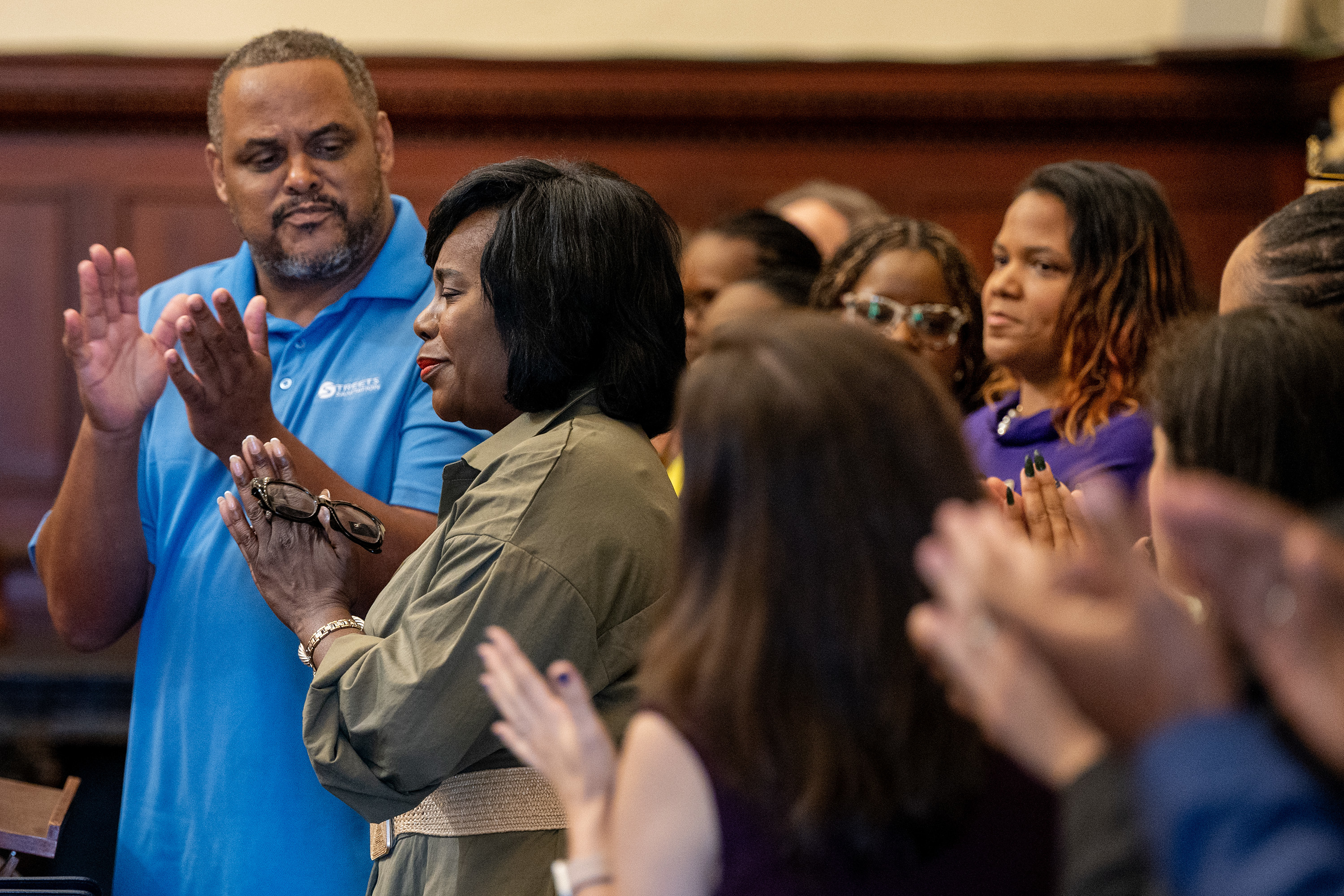
Mayor Cherelle L. Parker is applauded by members of her administration at City Hall on July 9, 2025, hours after reaching a tentative contract agreement with District Council 33 leaders overnight, ending the workers’ strike. At left is Carlton Williams, director of the Office of Clean and Green Initiatives. Chief Deputy Mayor Sinceré Harris is behind the mayor at right.Tom Gralish / Staff Photographer
Parker took office in 2024 and created a new role: director of the Office of Clean and Green Initiatives. Williams would carry out her campaign promise to rid the city of its “Filthadelphia” moniker by implementing twice-weekly trash collection, an expansion of illegal dumping enforcement, and a biannual citywide program to clean every block.
As managing director, Williams’ portfolio will grow substantially. He will be responsible for the city’s response to public health and homelessness, as well as overseeing large agencies like the fire department and the prisons.
He will also coordinate the city’s strategies in Kensington, the beleaguered neighborhood and the site of an open-air drug market that the Parker administration has spent more than two years working to shut down. Williams said there is inherent pressure that comes with being responsible for addressing such long-entrenched issues.
“But I work best under pressure, and so I take that as a badge of honor,” he said.
Williams said he intends to prioritize communication with residents because they “understand that everything can’t get fixed at one time.”
“But at least we can say what needs to be done, when it’s going to [be] fixed, what’s the timeline,” he said. “I manage through the eyes of everyday citizens. I want what they want.”
William F. Dunbar Sr., a Philadelphia lobbyist who was an important unpaid adviser to Mayor Cherelle L. Parker’s 2023 campaign, on Monday pleaded guilty to federal criminal charges related to a tax fraud scheme that lasted six years.
Dunbar’s lawyer, Brian McMonagle, said Dunbar “accepts full responsibility for his conduct.” The charges were filed in July but were under seal until Monday morning. Dunbar entered his plea on Monday afternoon before District Court Judge Kelley B. Hodge.
Dunbar, 42, was charged with four counts including tax evasion and filing a false tax return. He was charged by information, a process used when a defendant intends to plead guilty.
“Today’s plea reflects his commitment to resolving this matter with honesty, accountability, and respect for the judicial process,” McMonagle said. “He has taken decisive steps to satisfy his outstanding tax obligations and has implemented appropriate financial controls and professional oversight to help ensure this does not recur.”
McMonagle added that Dunbar “has dedicated his professional and personal life to serving his community through public service, civic leadership, and charitable engagement.”
A spokesperson for the U.S. Attorney’s Office declined to comment on the case Monday.
The charges carry a maximum sentence of 16 years in prison, plus supervised release and fines. A sentencing hearing was scheduled for Jan. 11, and Dunbar was released on bail pending sentencing.
Dunbar pleaded guilty to filing fraudulent income tax returns for himself and his wife from 2020 through 2025. Prosecutors say Dunbar inflated his charitable giving and business expenses while dramatically undervaluing his taxable income, a scheme that likely would have lowered the couple’s tax bill.
For example, they said, in the 2024 tax year, Dunbar claimed $1.45 million in total business expenses while indicating he had no taxable income. Dunbaralso reported that he owed $46,000 in total taxes for that year, a sum that can include other taxes outside the income tax, but prosecutors said the amount he actually owed was “materially greater” than what he reported on his tax form.
Prosecutors did not specify how much money Dunbar owed the government in taxes, but said in court papers that it was between $350,000 and $750,000.
Assistant U.S. Attorney Louis D. Lappen told Hodge that, due to the fraudulent returns, Dunbar for tax year 2023 received a refund of about $30,000 while his spouse received a refund of about $36,000. Lappen said the couple claimed similar refund sums each year from 2020 through 2025, and that they should have paid additional taxes when they filed their returns instead of receiving refunds.
“Had the taxes been filed accurately and appropriately and without fraud, [Dunbar and his spouse] would have owed,” Lappen said.
Although prosecutors accused Dunbar of inflating expenses associated with his political consulting firm, Dunbar Public Affairs & Associates, there are no accusations in his charging documents that connect his conduct with Parker or others affiliated with her campaign.
Dunbar was a key member of Parker’s “kitchen cabinet” of informal advisers during her 2023 run, in which she bested a crowded field to win the Democratic primary and become the city’s first female mayor. Dunbar also has had ties to other high-profile Democratic politicians, including Gov. Josh Shapiro, U.S. Sen. Cory Booker of New Jersey, and members of Philadelphia City Council.
The Inquirer reported earlier this month that federal investigators last summer issued subpoenas for documents and financial records related to Dunbar, according to three sources with direct knowledge of the probe.
One of the sources said the investigation appeared to be a “fairly broad” review of Dunbar.
Parker’s campaign has dramatically increased its spending on legal services since early 2025, around the time the sources said subpoenas were issued, according to campaign finance reports.
The campaign paid its law firm, Dilworth Paxson, about $108,000 since the start of 2025, The Inquirer reported. By comparison, it paid the firm less than $15,000 during the 2023 election year and about $19,000 in 2024.
Parker last week declined to comment on the subpoenas related to Dunbar or on her campaign’s increased legal spending.
Spokespeople for the mayor’s office and for Parker’s campaign declined to comment on the charges against Dunbar on Monday.
Dunbar was never paid for his role in the campaign during the 2023 mayoral election.
In 2024, Parker’s first year in office, Dunbar took over management of the campaign. The campaign paid Dunbar’s firm a series of rent payments totaling $22,850 between March 2024 and November 2024.
Parker let Dunbar go from her campaign in the summer of 2024 in a move that Dunbar said at the time was the mayor’s decision. The campaign is now managed by Aren Platt, who was one of the architects of Parker’s 2023 run and served as chief deputy mayor in her administration before resigning in October 2024.
Dunbar appears to still be active in politics despite no longer being on Parker’s team. Two weeks ago, he posted on social media a series of behind-the-scenes photos from a filming session at a West Philadelphia barbershop for a Shapiro campaign advertisement, writing: “Where politics meets the people.”
Manuel Bonder, a spokesperson for Shapiro’s reelection campaign, said in a statement that Dunbar has “no formal or informal role with the Shapiro for Pennsylvania campaign.”
Dunbar’s lobbying clients include Comcast, the Chamber of Commerce for Greater Philadelphia, and Jackmont Hospitality, an airport concessions company, according to his lobbying registration with the city.
Dunbar previously lobbied for the Philadelphia School District, but a district spokesperson said earlier this month that he stopped working for the district in June.
Staff writers Abraham Gutman and Ryan W. Briggs contributed to this article.
WASHINGTON — House lawmakers returned to Washington on Monday with a short to-do list after five weeks back in their home districts. The first order of business is most likely a vote on a stopgap spending bill designed to keep the federal government fully funded through early December, removing the possibility of a shutdown before the midterm elections.
With election season getting underway, votes are also expected on measures designed to amplify the GOP’s messaging strategy going into November, most notably a resolution condemning socialism. Republicans are trying to tie the Democratic Party in general to the democratic socialist candidates who have succeeded this year in running for office.
“The first thing is we’ve got to make sure this government gets funded and we don’t have another Democratic shutdown,” Speaker Mike Johnson told reporters as he prepared to open the chamber for business. The funding vote will most likely take place today.
One significant item that did not make its way onto the House schedule this week is a Senate-passed bill that imposes sanctions on key segments of the Russian economy and allows President Donald Trump to impose steep tariffs on goods imported from countries that buy the vast majority of Russian oil and gas. The effort led by the late Sen. Lindsey Graham aims to deprive Russian President Vladimir Putin of revenue used to finance the war against Ukraine.
The bill passed 86-11 in the Senate. House passage would send the bill to Trump’s desk for his signature. However, some key House Democrats oppose the bill. Democratic leader Hakeem Jeffries said the legislation risks providing Trump and his administration with new sanction and tariff authorities that “we believe they will abuse.”
“I have serious concerns with the legislation,” he told reporters.
The return to Washington also brings a renewed focus on improper behavior by lawmakers as the House will have its first chance to act on a recommendation from the House Ethics Committee to censure Rep. Chuck Edwards (R., N.C.) for engaging in persistent unprofessional and inappropriate conduct toward two young female aides in his congressional office.
Edwards implores colleagues to reject censure vote
Edwards has disputed the committee’s conclusion that he failed to adhere to the spirit of the rules prohibiting sexual harassment and unwanted advances toward House staffers. He points to the committee’s conclusion that found no evidence he “engaged in sexual activity or explicitly propositioned any individual under his employ.”
Edwards said he was not asking lawmakers to approve of every gift, compliment, or social interaction, but to distinguish between conduct that someone might find unconventional and conduct that actually establishes sexual harassment.
“Individual acts that were not themselves prohibited were gathered together, assigned the most damaging possible interpretation, and then used collectively to support a conclusion far more serious than the underlying evidence,” Edwards wrote in a letter to colleagues first reported by NOTUS.
The committee said Edwards provided the two staffers with lavish and recurrent gifts, made comments regarding their dress and appearance, invited them to intimate dinners and vacations, sent notes regarding his effusive affection, and invited them to other activities as a way to spend time together.
A vote to censure registers the House’s deep disapproval of a lawmaker’s conduct that does not meet the threshold for expulsion. Edwards dropped his reelection plans after the committee’s report came out.
Lawmakers are working to avoid another shutdown
The short-term funding bill underwent some significant changes in the Senate, which made it more palatable for Democrats. It delays a proposed rule from the Office of Management and Budget that would give political appointees more power over the distribution of federal grants. It also includes language to ensure the administration can’t transfer funds to the Border Patrol.
But a provision that delays for one month a federal ban on intoxicating hemp THC products has prompted criticism from many GOP lawmakers. As a result, GOP leaders will likely place the bill on a fast-track process that avoids a separate procedural vote, bypassing any Republican efforts to block or stall the legislation. Suspension bills require a two-thirds vote to pass, meaning a significant number from both parties need to support the measure for it to pass and advance to Trump’s desk.
Lawmakers are anxious to avoid the possibility of a shutdown as voters weigh their options going into November. The funding bill passed by a 90-6 vote in the Senate, showing that lawmakers from both political parties want to avoid a repeat of the two historic shutdowns that occurred this past year.
U.S. Sen. John Fetterman said Monday he agreed with President Donald Trump’s call to “Let Data Reign” after the president made a lengthy post criticizing the widespread backlash to data centers.
“There’s nothing more damaging to a Democrat than agreeing with Trump AND data centers — but what’s right is right,” said Fetterman, who has repeatedly angered members of his own party by backing Trump’s agenda.
“We must win the war for AI supremacy over China. They foment the ‘anti’ argument through misinformation,” Fetterman said on X.
The issue has increasingly taken center stage ahead of the midterm election, including in Pennsylvania. Fetterman, who does not face reelection until 2028, blamed China for fueling the public outcry against data center development in the U.S. as the two nations compete in the AI industry.
Fetterman has remained supportive of development even as voter sentiment has turned sharply against the industry. Six in 10 likely Pennsylvania voters said they opposed the construction of data centers to support artificial intelligence in a poll released last week by The Inquirer, New York Times, and Siena University.
Trump made similar arguments on his Truth Social platform earlier in the day, saying that China “could not be happier” with the political movement against data centers.
“The only reason that communities throughout the U.S.A. should not want Data Centers is if they want to end up being backwards and poor. If they want to be successful and rich, with far lower taxes and jobs all over the place, let Data Reign,” Trump said.
That Fetterman backed the president on data centers may not have come as a surprise to voters who’ve been following the senator’s moves.
Two-thirds of Pennsylvania Democrats who are likely to vote this year believe Fetterman supports Trump too frequently, according to last week’s poll.
Overall, 69% of Democratic voters have an unfavorable opinion of him, which could be trouble if he seeks reelection as a Democrat in 2028.
And Democrats were also the voters most likely to oppose data centers — with 77% opposing their construction in the Pennsylvania poll.
Fetterman’s post in support of data centers comes as the state’s other top Democrat, Gov. Josh Shapiro, has been backing away from his previous support.
Shapiro issued an executive order two weeks ago enacting a host of restrictions for new projects. And the governor has traded attack ads with his Republican opponent Stacy Garrity over who has been more supportive of the industry.
Fetterman, on the other hand, said in a post last week that China would benefit from an overreaction by U.S. politicians.
“I reject the political pandering and hyperbole over data centers or AI doomsdaying,” he said.
The Pentagon has secretly installed several conservative military veterans with large online followings in government roles, declining to disclose their assignments as they amplify Defense Secretary Pete Hegseth’s viewpoints and attack those who scrutinize the Trump administration, according to people familiar with the matter and corroborating material.
At least some of the influencers have been assigned to civilian roles that could lead to changes in policy, the people familiar with the matter said. Like others, they spoke on the condition of anonymity because of the sensitivity of the issue.
Neither the Pentagon nor those involved have disclosed the government roles despite the Trump administration’s claims that they are running the most transparent Defense Department ever.
Those involved include Rob Maness, a retired Air Force colonel, and Kurt Schlichter, a retired Army colonel, people familiar with the matter said. Pentagon records reviewed by the Washington Post show that both have active official government email addresses as of this past week and are assigned to the office of Anthony Tata, the undersecretary of defense for personnel and readiness. The email addresses include a “.civ” suffix, meaning they are labeled as civilian employees, rather than as military personnel or contractors.
Both served for decades in uniform and, since retiring, have turned from the military to conservative commentary. Maness has more than 135,000 followers on X, while Schlichter has nearly 620,000.
Another retired Army colonel and influencer, Thomas Anderson, was listed in Pentagon records earlier this year with a “.civ” email address and assigned to Tata’s office, according to people familiar with the matter and records reviewed by the Post. An attorney, he writes online under the pen name Cynical Publius and has more than 323,000 followers on X. He was no longer listed in Pentagon records late this past week, the people familiar with the issue said.
The assignments for all three have not previously been reported. Questions have been raised online about influencers’ connections with the Pentagon, including in an article last week by the Bulwark.
Pentagon spokesperson Joel Valdez declined to comment to the Post about whether any of the three are drawing a taxpayer-funded salary, what roles they have, or how long those jobs are expected to last. Tata did not respond to a request for comment.
Maness and Schlichter did not respond to emails or other messages requesting comment. Anderson declined to comment in a short phone call.
The individuals are assigned as either “special government employees” or “highly qualified experts,” people familiar with the issue said. Schlichter appears in a government database with an “HQE” designation after his name, according to material reviewed by the Post.
SGEs are limited by law to working no more than 130 days in any 365-day period. Those with HQE status can work full or part time, with or without compensation, according to government guidance on the issue released in 2023. It was not clear what financial agreements were reached with Maness, Schlichter, and Anderson, and when each of their assignments began.
Tata’s team has taken on a number of culture-war issues, including scrutinizing war colleges for “woke” ideology and reviewing how the Biden administration adopted COVID vaccine mandates for U.S. troops.
Hegseth, a former Fox News personality and Army National Guard officer, has attempted to reshape the public discourse about Pentagon affairs. Last year, he imposed new restrictions on Pentagon press corps members that forced dozens of journalists out of the building and later introduced a new, primarily right-wing press corps to replace them.
The increased attention on the Pentagon’s influence efforts comes after another conservative influencer, Jennica Pounds, accused a State Department official this month on social media of attempting to entrap her into publishing government secrets. Pounds, writing under the pen name DataRepublican, posted text messages online that showed the official approached Pounds with documents to publish and tout as a journalistic scoop.
Sarah Rogers, the undersecretary of state for public diplomacy, later disclosed on social media that she was the official who had reached out to Pounds. Rogers posted the documents herself, saying it was not a “trap,” and Pounds later said that she regretted “making a public spectacle” and “pulling people I respect into the swirl.” Rogers has been nominated by President Donald Trump to lead the U.S. Agency for Global Media, which oversees Voice of America and other government-funded media.
The dustup was followed by the Pentagon and Pounds disclosing that she works as a special government employee for the Defense Department. She posted on social media that she became an employee in July, after holding a credential as a journalist in Hegseth’s new Pentagon press corps until June. Pounds has said on social media that she applied for a Pentagon press pass and received it in April.
Pounds did not respond to a request for comment.
The disclosure has roiled social media, where some fellow influencers have defended Pounds’ work amid criticism that she should have disclosed she was working for the government.
Adam Kinzinger, a former Republican congressman and Air Force veteran, posted that it appears the Pentagon “is using your tax dollars to hire influencers on X to put out partisan talking points.”
“How many more people that are blue checkmarks on X that are putting out information on behalf of the federal government, and Donald Trump, and the Republican Party … are actually special government employees?” said Kinzinger.
Maness, Schlichter, and Anderson appeared on behalf of the Pentagon’s Senior Service College Task Force at the Army War College in Carlisle, Pa., in May, two people familiar with the visit said. The task force was organized in the spring with the goal of rooting out ideology deemed “toxic” or “woke,” Hegseth said in March.
The task force has completed its research and prepared a report that has not yet been released, one of the people familiar with the visit said.
After initial publication of this story, Anderson said on social media on Sunday night that he was asked to join the task force after he published an article in February recommending changes to the war colleges. Anderson said he was a special government employee through July 26 with work “exclusively limited” to the task force.
“At no time have I ever received any compensation of any kind from any government source of any kind for anything I write or have ever written on X or in any magazine or other source,” Anderson wrote.
While in Carlisle task force members met with students and professors over a number of days and asked questions about the performance of leaders like Hegseth and Gen. Dan Caine, chairman of the Joint Chiefs of Staff, one of the people familiar with the visit said. Some students were uncertain how candid they should be and whether there would be negative consequences if administration officials did not like the answers, this person said.
The other person familiar with the visit said the task force members had concerns about the syllabus for a class focused on how military officers communicate with Congress.
Maness retired from the Air Force in 2011 and has run unsuccessfully for a U.S. Senate seat in Louisiana. He is listed as the chairperson of GatorPAC, a political action committee that says on its website that it wants to “drain the swamp” in Washington and find more military veterans to run for office. The PAC’s website also includes videos of an online political commentary show starring Maness.
In an article published last month by the conservative Daily Caller, Maness argues that Hegseth’s team needs to root out “disloyal” career employees in the department and laments “careerists who treat the Pentagon as their permanent fiefdom.” That article cites his decades of military experience, but does not say whether he is a current Pentagon employee.
In an article published Wednesday on the website Campus Reform, Maness attacked a decision made by Army leaders to pull back efforts to toughen academic requirements for college students in Reserve Officers’ Training Corps programs. “Secretary Hegseth’s outrage is justified,” Maness wrote. The article likewise does not mention any government assignment.
Maness also had a letter to the editor published in the Post in July in which he defended Hegseth’s efforts to reduce the number of military officers who attend elite universities for fellowships. He describes himself there as a retired Air Force officer, but no government role is mentioned. A Post spokesperson said that Maness did not disclose any connection to the Pentagon before publication.
Schlichter is a columnist with the conservative site Townhall, writing and podcasting on politics, immigration, and military affairs. On Aug. 6, he published a column calling Trump a “hero for finally fighting back against Iran.”
“He could have waltzed into the midterms, dragging Republicans behind him toward success,” Schlichter wrote. “But he had the courage to do what was necessary to stop these bastards before they made it impossible to prevent them from getting a [nuclear] bomb.”
On social media, Schlichter posted a video earlier this month of Hegseth praising sailors aboard the USS Abraham Lincoln, an aircraft carrier that has faced morale problems during a long deployment.
“We are,lucky to have @PeteHegseth,” Schlichter wrote on X on Aug. 14. He describes himself on X as a retired Army colonel, lawyer, and columnist, but does not disclose current Pentagon employment.
On social media, Anderson has been a frequent critic of journalists, fellow veterans, and others opposing the Trump administration and has defended Hegseth’s efforts to overhaul military affairs. Writing for the Federalist in April, he assessed that there is “a cancer in America’s military ranks, and it must be expunged before it’s too late.”
This past week, he repeatedly defended Pounds on X for serving as a special government employee as he also declined to answer questions from several people about whether he was an SGE employee, too.
“The law does not view such people the same as civil servants, and they are legally allowed to continue whatever other private endeavors they were undertaking,” Anderson wrote. “In many cases, they are prohibited from revealing their status because of the sensitive nature of their work.”
Another military influencer, John Konrad, also defended Pounds while noting he had discussions with the administration this spring about becoming a special government employee at the Pentagon. Konrad, a former member of the U.S. Merchant Marine and founder of the maritime website gCaptain, said that the Pentagon sought him out for a role and he later felt “ghosted.”
The Pentagon also brought on Jerry Dunleavy, a journalist with the conservative Just the News, to assist Hegseth’s team with an ongoing review of the fall of Afghanistan. The Pentagon disclosed Dunleavy’s involvement in May.
Dunleavy previously worked as an investigator for the GOP-led House Foreign Affairs Committee during an earlier investigation of the collapse in Kabul and quit in protest, saying the committee had not gone far enough.
For vulnerable politicians, the safest place to be in a difficult midterm year is usually far from an unpopular president.
Donald Trump has other plans.
Next week, as primaries give way to a perilous general election campaign for vulnerable Republicans, Trump will headline two nights of a GOP political convention in Dallas. Over the next two months, his super PAC plans to run advertisements that feature his name and play up his political record. And although he will not appear on any ballot in the midterms, he has told voters they should behave as if he is. Even the party’s program for prized congressional recruits, previously known as “Young Guns,” has been renamed the “MAGA Majority.”
It is a risky strategy two months before Election Day. Vulnerable Republicans cannot afford to antagonize Trump because they need his help to turn out his base and tap into the $400 million war chest he controls. And he is not extending the leeway past presidents have for candidates to run their own races, even if that means keeping their distance.
Trump has told aides he wants ads paid for by his super PAC, MAGA Inc., to tout his second-term record, according to two people familiar with the conversations. Advisers already prepared some ads for the Texas Senate race and showed them to Trump, who provided detailed feedback, said the people, who spoke on the condition of anonymity because they were not authorized to discuss internal strategy.
Some donors, skeptical of the strategy, have become resistant to giving more money to Trump’s super PAC while it sits on hundreds of millions of dollars without sharing any plans about how it will use the money, said a Republican strategist involved in Senate races, speaking on the condition of anonymity to discuss unfinished plans.
The Trump-centric approach marks a reversal from 2022, when the super PAC ran ads in competitive Senate races that did not mention Trump — a sign that his own advisers accepted his liabilities. A MAGA Inc. spokesperson declined to comment, saying the PAC doesn’t reveal its plans through the media.
As his poll numbers have fallen to record lows, Trump has repeatedly insisted that his record deserves to win in November. He has argued that voters are overlooking his economic achievements and defended the Iran war and its economic costs as the price of preventing Tehran from obtaining a nuclear weapon.
At a Las Vegas rally in early August, Trump touted rising manufacturing investment, record stock market gains, and falling prices, despite a more complicated economic picture with rising inflation. “We had the greatest economy in the history of our country in my first term,” he said. “But this is blowing it away.”
“Trump doesn’t want people distancing themselves from him. He sees it as a personal insult,” said Tevi Troy, a presidential historian and former White House domestic policy adviser under President George W. Bush. “His greatest power is his ability to destroy a Republican who goes against him.”
Trump’s posture differs from that of his recent predecessors — and even from his own first-term approach. But Troy said Trump’s political calculation is rooted in a simpler reality: In an era of heavily gerrymandered districts, many races are increasingly decided by which side can turn out its own voters.
“What we’ve seen over the course of the past decade is, when Trump is on the ballot, you get better turnout if you’re a Republican,” Troy said.
Trump has not been able to deliver every candidate he supports to victory. His picks recently lost gubernatorial primaries in Iowa, Georgia, Wyoming, and Minnesota, as well as House races in Tennessee and Michigan. He snapped that losing streak Tuesday when Darline Graham, his choice to succeed her late brother, Sen. Lindsey Graham, won South Carolina’s GOP Senate runoff, and Mike Mazzei narrowly won a runoff to be the Republican nominee for Oklahoma governor.
General-election polling underscores the risk for vulnerable Republicans. Trump’s approval ratings remain historically low, and national polls show Republican House candidates running six points ahead of him among registered voters: 44% support the GOP for Congress, while 38% approve of Trump. Republican Senate candidates are also outperforming the president by about two points on average, though some of that gap reflects large numbers of undecided voters in several races.
That gives Republicans in the most competitive districts an incentive to calibrate their proximity to Trump — embracing him where he remains an asset while trying to keep their contests from becoming referendum on his presidency.
“The president’s going to look right in the camera and say, ‘I am on the ballot,’” House Speaker Mike Johnson (R., La.) said of the Dallas convention on Thursday at an event with vulnerable Rep. Monica De La Cruz of Texas. “Because even though his name isn’t, right, his administration, his legacy, the America-first agenda is.”
The Dallas convention forces Republicans to decide between angering swing voters by appearing with Trump or angering Trump by staying away. None of the Republicans in competitive Senate races responded to questions from the Washington Post on whether they will attend.
“It’s going to be a Trumpapalooza you’re not going to want to miss!” RNC Chairperson Joe Gruters said in a social media video.
Aides to one Republican who has announced his plans to skip Dallas, Rep. Tom Barrett of Michigan, rejected the suggestion that he is distancing himself from Trump. They noted that Barrett has appeared with the president several times, including at a General Motors proving ground in Milford last month.
“Attending a convention two months before an election in a top target seat was never a consideration,” Barrett spokesperson Jason Roe said. “It has nothing to do with the optics and everything to do with where the voters are.”
Roe said voters already understand the basic political alignment between Barrett and Trump. “I think it’s pretty baked in with voters that Republican members of Congress support the Republican president, and vice versa,” he said, adding that Barrett is “running on his record of accomplishment for the 7th District.”
Natalie Baldassarre, a spokesperson for the Republican National Committee, said Republicans cannot escape being associated with Trump’s policies and that Democrats will make the link regardless.
“The Democrats are going to brand our candidates with the president no matter what, so it’s not beneficial for Republicans to run against his agenda and bleed from both sides of the political spectrum,” she said. “The president has cut taxes, lowered drug costs, secured our border — Republicans should be touting that in battleground races across the country.”
Rep. Jamie Raskin (D., Md.) has argued that Democrats should make Trump’s record inseparable from the Republicans running alongside him, portraying GOP candidates as enablers of what he calls the administration’s “illegal war” and “disastrous economic policies.” In a recent fundraising appeal, Raskin said Democrats could build a “Blue Wave” by tying Trump and “MAGA Republicans” together and making the election a judgment on their shared record.
So far Republicans have tiptoed around putting space between themselves and Trump. The campaign website for Ralph Alvarado, running with Trump’s endorsement for a Kentucky congressional seat in a district Trump won by 15 points, removed references to Trump from its website, replacing “America First Fighter” with “Independent Leadership.”
The political calculus varies by race, said Republican strategist Alex Conant. Some House Republicans, particularly those representing suburban swing districts, may be better able to court independent voters with distance from the president. But many of the Senate contests likely to determine control of the chamber are unfolding in Republican-leaning states, where Trump remains a potentially powerful turnout engine.
“So distancing yourself from Trump isn’t going to help you win a Republican state like Texas or Ohio,” Conant said.
Trump also may have little use for Republicans who seek to separate themselves from his actions. He has long prized loyalty, and said he expects his administration to face extreme pressure from Democrats if they retake either chamber.
“I think he views a disloyal Republican as just as useless as a Democrat,” Conant said. “And if he’s looking at what the next two years hold, it’s probably going to be impeachment fights and a lot of other big fights. He’s probably not looking to have anybody there who’s not loyal.”
In a polarized, heavily gerrymandered country, Trump is betting that turning out voters already inclined toward Republicans matters more than persuading those in the middle — and that he can summon voters who might otherwise stay home when his name is absent from the ballot, Troy said.
That distinguishes him from recent presidents who, when their popularity sagged, generally gave endangered members of their own party room to run away from them.
In 2006, Bush largely confined his late campaigning to places where Republicans believed he could still help, while vulnerable GOP candidates advertised their independence from him and avoided appearances with him. Eight years later, Barack Obama watched endangered Democrats criticize his policies, skip his visits, and keep him out of some of the states where they faced the toughest races.
President Joe Biden made that accommodation almost a running joke. During the 2022 midterms, as some vulnerable Democrats kept their distance from an unpopular White House, Biden frequently told candidates: “I’ll come campaign for you or against you — whichever will help the most.”