As a lifelong Democrat, I’m often exhausted by my party’s hand-wringing when it comes to the question of ethics.
I certainly believe moral clarity is important. We should all seek to embrace a firm set of values. However, when it comes to politics, morality is often a mirage, and Democrats spend far too much time pretending it’s not.
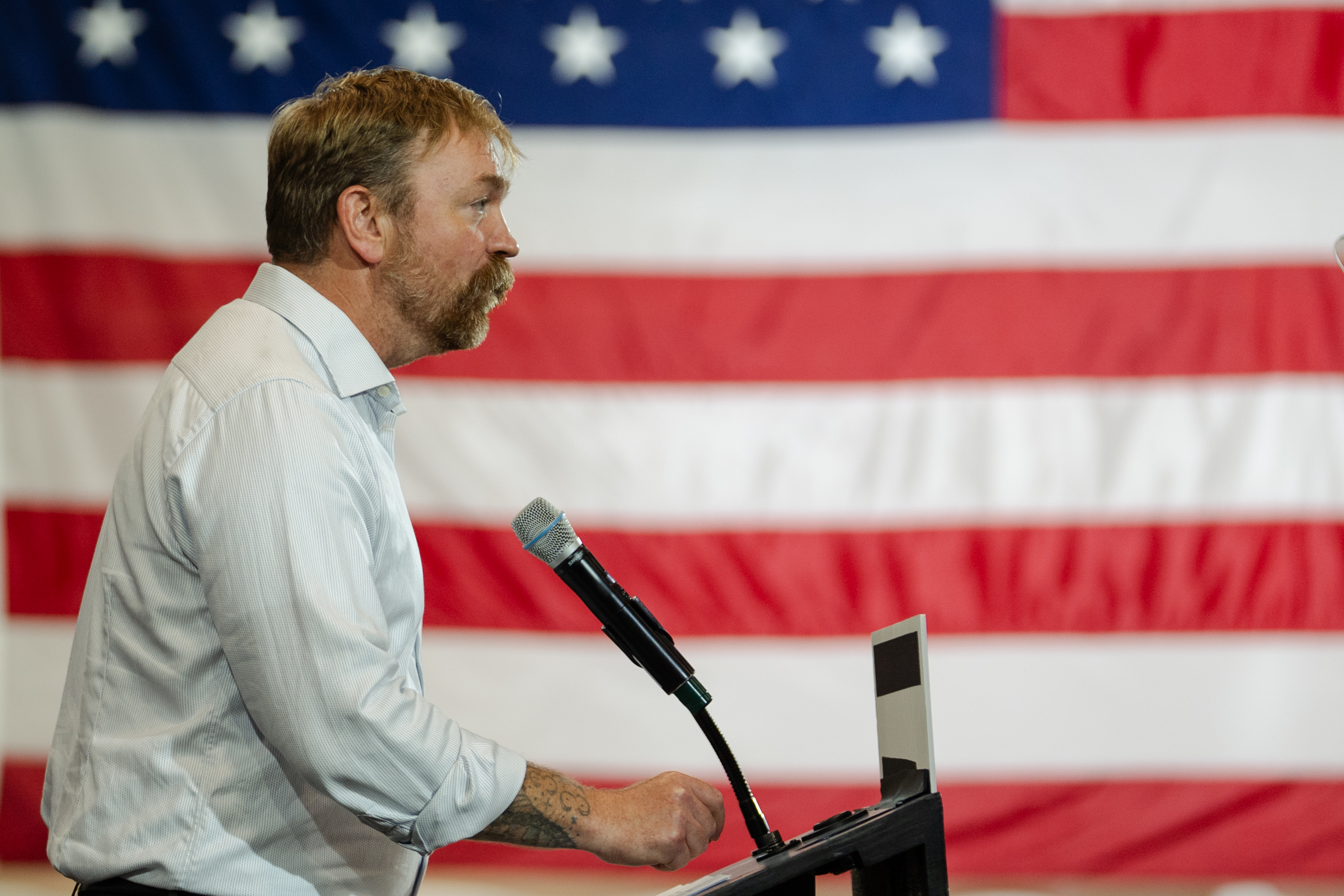
Perhaps that’s why I was encouraged by Graham Platner’s win in the Maine Democratic Senate primary. Platner presented himself as a rugged everyman who happened to be a progressive. However, a series of disclosures exposed Platner’s dark side.
As a Black man in Trump’s America, I can’t afford to wait for the perfect candidate. Nor can I expect politicians to live on a higher moral plane. My people are being targeted by an administration that seems hell-bent on returning us to the age of Jim Crow, and at a time like this, we cannot waste a second playing holier than thou.
We are literally watching a president with 34 criminal convictions treat the U.S. Constitution as a suggestion, so we don’t need choirboys. We need U.S. senators and representatives who will stand up to Donald Trump.
For that reason, Platner’s background is less important to me than his ability to fight against racist policies. Could he turn out to be a John Fetterman — pretending to support Democrats while voting with Trump on important issues? Yes, he could, but while Platner might target Black people, Republicans are already doing so.
In my view, MAGA was never solely about stopping undocumented immigrants from entering the country, because, contrary to right-wing conspiracy theories, undocumented people cannot vote.
African Americans, however, are among the Democratic Party’s most loyal demographics. We have the power to sway national elections, and we tend to use that power against Trump.
Some pundits say the shift means Trump is making inroads with Black voters. I believe the opposite is true. Democrats are losing us.
When Black people come face-to-face with bread-and-butter issues like food insecurity and unaffordable healthcare, we don’t want to hear about studies by Ivy League scholars. We don’t want a doctoral thesis on poverty. We want solutions, and Democrats spend far too much time explaining problems rather than solving them.
Even worse, my party is frequently consumed with constructing ethical obstacle courses that few candidates can navigate. Maybe that was cute back in the day, when you could lose the election and still count on guardrails to restrain the other side. Those guardrails are gone now, and while my party’s white elites can afford to theorize about the link between government and racism, I can’t.
Racism is not a theory for Black people. It is a daily reality, and it plays out through systems that flourish when conservatives take power.
Therefore, we must not bind ourselves by seeking perfect candidates. Instead, we must seek to free ourselves by uniting and fighting to win.
Just across from Boathouse Row, at the intersection of Kelly and Sedgley Drives, there is a statue of President Abraham Lincoln. At the base of the statue is a famous quote from his second presidential inauguration speech: “With malice toward none with charity for all … Let us finish the work we are in.”
On the opposite side: “I do order and declare that all persons held as slaves within the states in rebellion are and henceforth shall be free.”
As the center of America’s stage during this Semiquincentennial year, and a center of the world stage during this month of FIFA World Cup matches, we Philadelphians call on our national government to live up to our democratic principles and apply fair treatment to immigrants and descendants of immigrants, just as Lincoln called for bold actions on behalf of those who were once enslaved.
Ina Asher, Merion Station
Blame game
Opinions critical of Philly schools’ “success” when 33% of students are proficient in reading, and 25% in math, are misguided. When I was codirector of the Laboratory for Student Success at Temple University, I was actually surprised to find that years of research in student success shows that school-related factors like teacher quality, curriculum, leadership, climate, and resources account for as much as 40% of student achievement. Factors beyond the schools have a much greater impact on individual student success. These include family income, stability, parent education, access to healthcare, neighborhood safety, exposure to stress, and trauma. What we are witnessing is simply a result of living in a country with the greatest economic inequality of any developed nation on the planet. The answers are there — but those in power seem to prefer to blame the victims.
John Kovach,Wallingford
Catholicism is growing
Recently, I read about what sociologists call homophily: the tendency to develop friendships with those from similar backgrounds, identities, or socioeconomic classes. For young professionals in the city like myself, we’re often pulled into circles with peers from similar places of work or study.
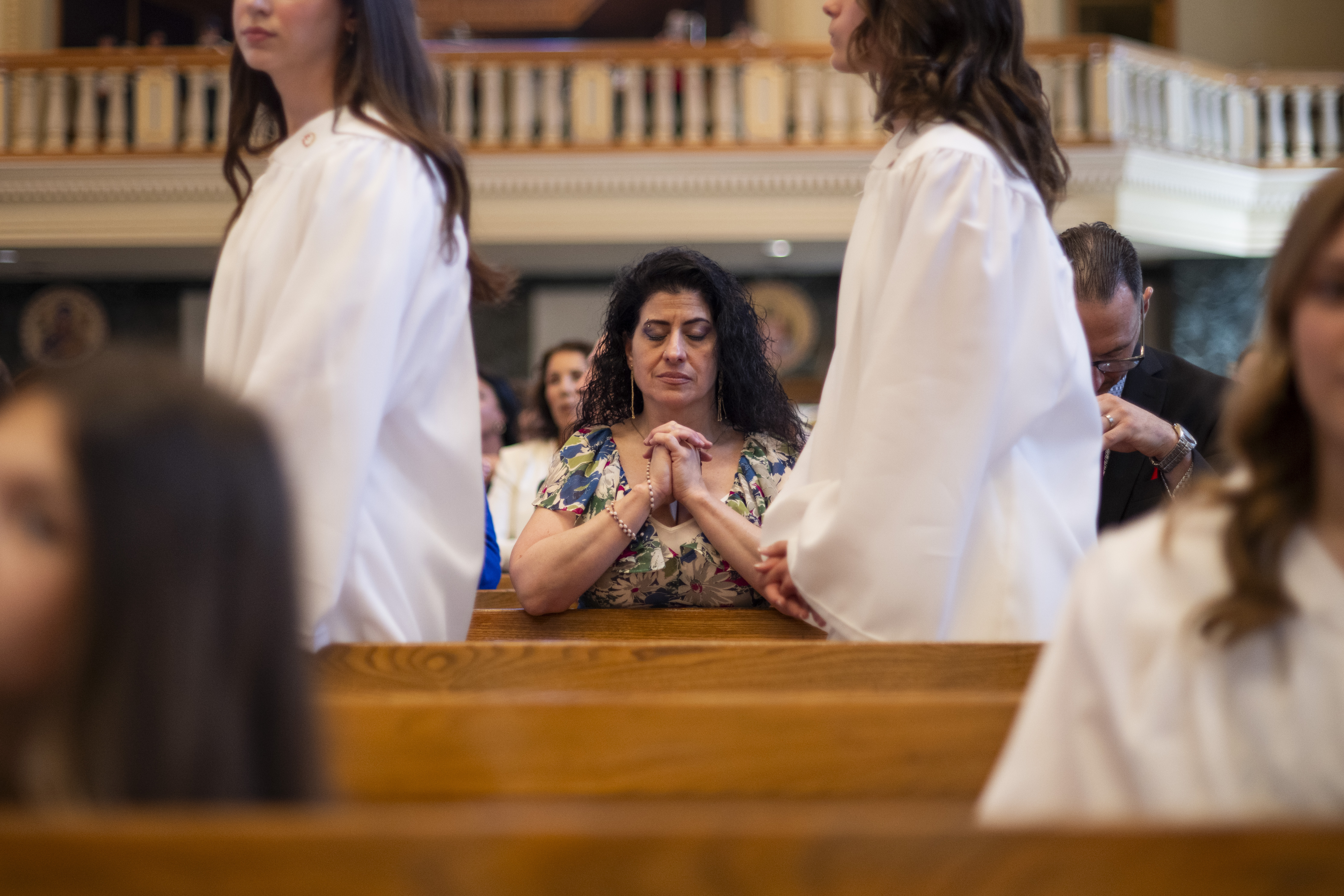
Perhaps one reason people are returning to the pews is that it shakes up these circles, bringing us hand-in-hand with those from places we’re unfamiliar with — and maybe there’s something exciting about that. Where else besides church might you find an older North Philly couple breaking bread with young Thomas Jefferson University students coming from a Center City high-rise?
A recent article in The Inquirer raised the question of why people are turning to Catholicism. We may never know all of the reasons why, but I hope it comes with a community built across diversity.
Maxwell Marshall, Philadelphia
Join the conversation: Send letters to letters@inquirer.com. Limit length to 150 words and include home address and day and evening phone number. Letters run in The Inquirer six days a week on the editorial pages and online.
The images coming out of Belfast — the city in Northern Ireland made famous by decades of ethnic violence that came to be known simply as “the Troubles” — were horrific enough. The sight of cars and homes ablaze and hordes of masked, young men roaming the city streets brought back painful memories for old-timers.
“I lost my teenage years to the Troubles,” a shell-shocked 71-year-old, Paul Sharkey, told the New York Times, after watching a flaming van crash near his home on the outskirts of Belfast. “I thought moving out here I had got away from them — from the bombs and bullets, all the rest of it …”
Remarkably, no one seems to have been killed in a couple of nights of riots that targeted Belfast’s Black and brown immigrant communities after a Sudanese migrant was charged with a stabbing — captured on video — that left a white man in a coma. But terror was felt across Northern Ireland’s largest city, as volunteers raced to rescue families from burning homes, immigrant addresses were posted online, and workers were afraid to go to work after a nurse was attacked.
And yet, there was something about this anti-immigrant pogrom in Belfast that was just as appalling as the pictures of burning streets and fleeing children. Their biggest cheerleader was not some street thug in a balaclava, but the richest person in the history of Planet Earth, urging the rioters on from some posh hideaway on the other side of the Atlantic.
Tuesday morning, as news of the stabbing attack spread across the United Kingdom, Elon Musk took to X — the influential social media site that was called Twitter when he bought it in 2022 for $44 billion — to amplify a post by U.K. far-right extremist leader Tommy Robinson. It called for white people “to hit the streets” that night and protest what Robinson called “yet another invader attack on our people.”
Musk’s tweet was hardly a one-off. In a flurry of X posts attacking immigration, he told his 240 million followers that British Prime Minister Keir Starmer “hates white people,” while sharing an image of the Black suspect that simply said, “Millions must go.” When his diatribes started provoking a backlash, he wrote, “Murderous migrants beheading innocent people in their hometown is what’s making people angry, not ‘social media’!”
Unfortunately for the star-crossed Musk, investors’ shock and revulsion over the entrepreneur’s vile posts caused …
OK, if you follow the news, you know that the unfinished sentence above was a little bit of cynical misdirection. Wall Street, from the biggest investment banks to starstruck small-time day traders, could not wait to throw their cash at SpaceX and its founder. They acted as if Musk the anti-immigrant hatemonger and Musk the tech visionary were two different human beings, even as they also ignored the fantastical malarkey of SpaceX’s dream to build data centers in outer space.
By the end of a tumultuous week, the tulip-mania demand for SpaceX stock — with the market valuing the money-losing company at a gobsmacking $2.1 trillion — made the already world’s richest person wealthier in a way that defies comprehension. The man who wanted to burn everything down on Tuesday became the planet’s first trillionaire on Friday.
Even as the globe — excepting that island of basketball joy in Gotham City — watches a decadent Donald Trump turn 80 by tarnishing the White House with a tacky ad-draped display of barbaric blood sport that would have embarrassed Caligula’s Rome, Elon Musk is truly the ultimate story of our modern empire’s decline and fall.
The problem is which Musk story to tell. Each narrative is more shocking than the next.
The saga I’ve started to recount here, about a man whose wealth is now greater than the yearly gross domestic product of all but the 21 richest nations, who uses that power to urge poor white people to firebomb and assault their Black and brown neighbors, isn’t even the worst thing Musk has done. Not by a long shot.
The prequel to Belfast came just over a year ago, when Musk — after spending some $288 million, an all-time U.S. election record yet the equivalent of sofa-cushion change for a future trillionaire, to put a dictatorship-minded Trump back in the White House — was handed an all-access pass to our federal government for what was dubbed the Department of Government Efficiency, or DOGE.
Musk and his young DOGE dudes took a chain saw — as Musk boasted by brandishing a real one — to any program that advanced world peace or the plight of its most underprivileged. In particular, the utter destruction of the U.S. Agency for International Development (USAID), which Musk bragged about tossing into a proverbial wood chipper, has been blamed by a number of experts for an unthinkable hundreds of thousands of deaths across Africa, Asia, and elsewhere from disease or hunger, with children as most of the victims.
And yet, there’s another Musk storyline on top of the obvious question of, why are so many people betting their money on literally the world’s greatest purveyor of hate speech, and the alleged architect of a born-in-the-USA genocide? That question is, why are we collectively throwing all this money at Musk at all?
The 1990s Wharton School graduate started with some good ideas — an early stake in PayPal that gave him the funds to launch SpaceX and take over early EV leader Tesla. But his revenue stream is increasingly from the crony capitalism of government contracts, not the free market — as Chinese EV makers have been cleaning Tesla’s clock. And it’s almost lazy, yet true, to describe SpaceX’s business model as pie-in-the-sky science fiction.
The openly racist tycoon isn’t even a good businessman, and yet he has failed upward to $1.1 trillion. I think there’s one question about Musk that towers over all the others.
What are we even doing here?
It’s easy to look at Musk as an amalgamation of the many, many things that are wrong with the world right now. He is a poster child for the policies that have enabled an Epstein class of billionaires with more dollars than we have the ability to count, even as thousands starve and his fellow Americans can’t pay the rent. He has so many scandals that some of them — his data center polluting a predominantly Black neighborhood in Memphis, or the DOGE cuts that could have slowed the spread of Ebola, or stopped the arrival of the screwworm striking Texas cattle — couldn’t even fit into this longer-than-typical column.
Musk’s destructive abuse of his massive X platform has given him the power to manipulate the struggling massesinto attacking each other — instead of the small circle of people hoarding the world’s wealth, led by Musk himself. When buying Twitter wasn’t enough for his obscene ambitions, he decided to buy the White House.
When I wrote about Musk for the very first time two years ago, I reached for the obvious cliché and called him a Bond movie villain, but that was far too generous. He has devolved into one of the most problematic entrepreneurs in human history; Henry Ford behind the wheel of a Cybertruck.
It’s past time to look inside ourselves and ask one more question: Now that Musk has shown us who he really is, why do we continue to support him? Why do millions of investors pay so much for the magic beans of Tesla and now SpaceX to endorse the lead spreader of racist ideology — putting aside the fact that his stock bubble will burst any day now?
Why do so many leading politicians across the United States and the U.K. — liberals as well as conservatives — and supposedly socially conscious corporations, among others, still use X to convey information, when its owner uses it to promote views that really aren’t any different from David Duke or the Ku Klux Klan?
That’s also a question for myself. In November 2024, when Trump was reelected with Musk’s support, I moved about 98% of my social media posting over to Bluesky. But I didn’t close my X account, which still had 80,000 followers, because I wanted to keep posting my columns there so a few more folks might read them.
Today, I will make one last post on X — a link to this column, in the vain hope that the platform’sproprietor might see it, and that other folks will join me in quitting. Tonight, sometime before I sit down to watch Les Éléphants stomp Ecuador, I will delete my account for good.
You should, too.
We’ve all helped to create this monster, and we all can do our small part to slay the dragon. There are hopeful signs, led by the thousands who came out this weekend in Belfast and elsewhere in the U.K. to protest Musk-fueled hate. If we don’t act quickly and nonviolently to undo the massive policy failure of the world’s first trillionaire, the raging fires of Belfast are going to look like child’s play.
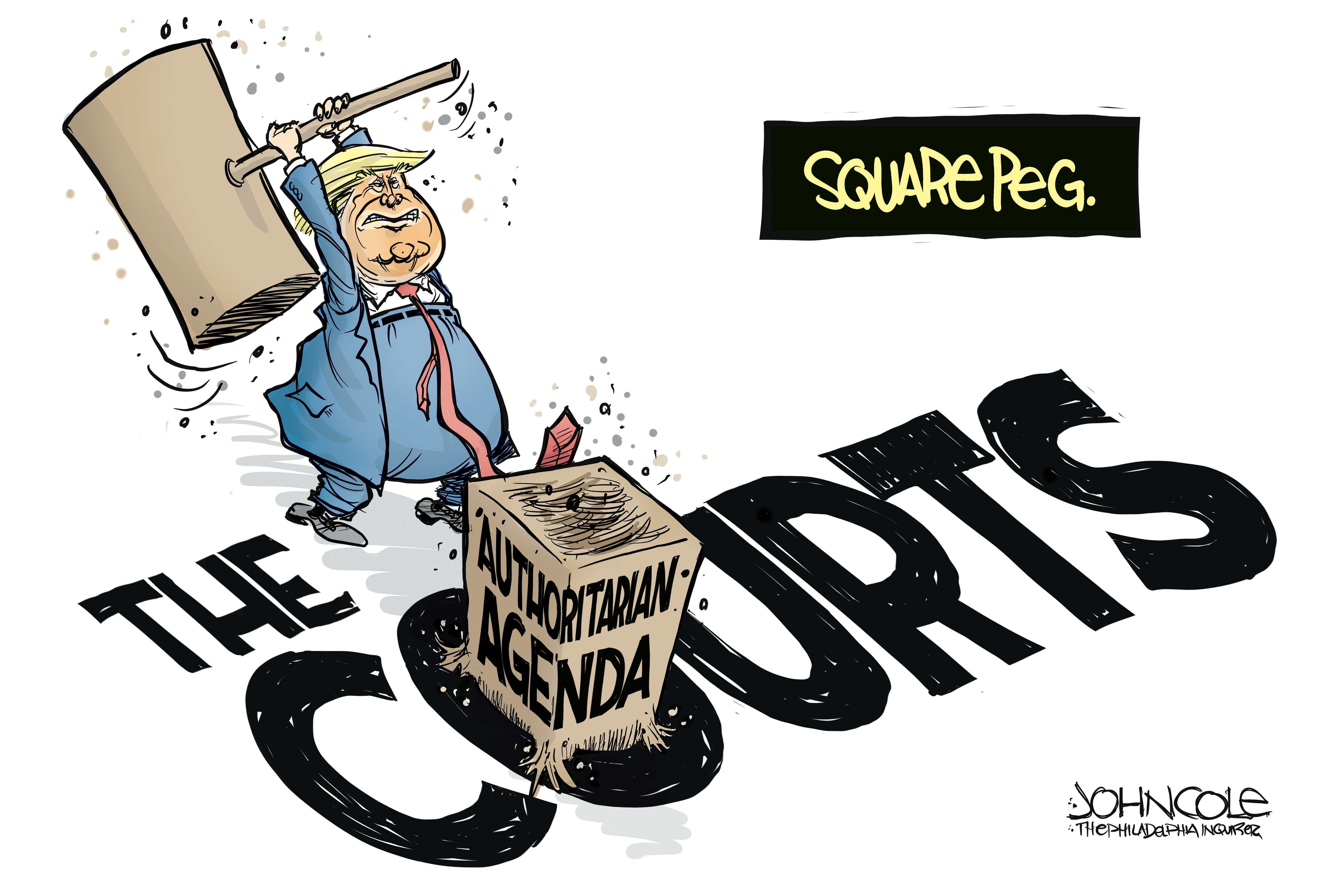
Donald Trump continues to inflict historic damage on the United States through his corruption, incompetence, and cruelty. But amid the daily chaos and nightly fury, Trump has suffered significant losses that should give citizens who support the Constitution and democracy a glimmer of hope.
He’s lost in Congress, the court of public opinion, and courtrooms across the country. Even the Iran war has turned into a no-win situation. Adding to the indignity, Trump was roundly booed in his hometown by Knicks fans when he made an appearance at an NBA Finals game at New York’s Madison Square Garden on Monday.
But here’s the thing about Trump: He’s never more dangerous than when he’s losing.
He continues to dismantle democracy even as the country prepares to celebrate 250 years since the adoption of the Declaration of Independence. And he still wields immense power over his MAGA base.
But fissures abound.
Just look at Congress. After largely serving as lapdogs, (some) Republicans who control the House and Senate have begun to push back.
The Senate shelved Trump’s brazen scheme to create a $1.8 billion fund to reward loyal lackeys prosecuted and convicted of crimes, including the Jan. 6, 2021, insurrection — but passed on reining in his tax audit chicanery.
Senate Republicans also dropped $1 billion in security funding for Trump’s ballroom — an obscene waste of tax dollars that keeps growing in price and size as many Americans struggle to make ends meet.
U.S. Rep. Brian Fitzpatrick (R., Pa.) was one of four GOP House members who joined with Democratic lawmakers to pass a war powers resolution.Eric Lee
In defiance of Trump’s refusal to help Ukraine, 18 House Republicans joined Democrats to pass a measure to provide more than $1 billion in aid and impose new sanctions on Russia. (Recall how Trump repeatedly said he would end that war within 24 hours after returning to office.)
U.S. Rep. Don Bacon (R., Neb.) called Trump’s continued deference to Russian leader Vladimir Putin a “moral blindness” that “communicates weakness.”
The sudden turn against Trump by some GOP lawmakers is likely driven more by the looming midterm elections than any allegiance to their constitutional oath.
Trump’s poll numbers are sinking. There are even cracks among white working-class voters without a college degree who now disapprove of the president’s handling of the economy. They could tolerate Trump’s lies, corruption, and incompetence, but not $5-a-gallon gasoline.
On Monday, a judge voided “in its entirety” Trump’s scheme to impose $100,000 fees on employers seeking visas for skilled foreign workers — one in a series of misguided moves by the administration to target immigrants, which hurts all Americans.
Earlier this year, the U.S. Supreme Court struck down Trump’s cockamamie plan to impose tariffs on countries in a way best described as willy-nilly. Beyond being fiscally stupid, the court found Trump’s signature economic policy was unconstitutional.
The Supreme Court will soon rule on Trump’s signature immigration policy to end birthright citizenship for babies born in the U.S. to undocumented immigrants or those on temporary visas.
Most legal experts believe Trump will lose this case because birthright citizenship is guaranteed under the 14th Amendment. Even Trump predicted the court would “probably rule against me.” As it should, since the law is not on his side.
A federal judge ruled that Trump’s name must come off the John F. Kennedy Center for the Performing Arts. The judge said the law is “crystal clear,” and that only Congress can change the name.
After beating four criminal indictments, Trump is still subject to the law.
In fact, the Trump administration has lost 70% of the more than 600 lawsuits it has faced over the past year or so. The record of futility underscores Trump’s overreach, since the federal government traditionally prevails in court.
The losses are real. And they matter. But democracy doesn’t survive on court rulings and poll numbers alone — it survives because people keep showing up.
Trump’s losing streak obscures the harder truth that he continues to trample the rule of law, attack countries, install lackeys, line his pockets, and upend the economy — moves that systematically weaken the U.S. at home and abroad.
It is, after all, a reminder that the arc of the moral universe can bend toward justice — even in these “dark, disturbing, and dangerous times.” The bending, though, is up to us: follow the Constitution, hold wrongdoers accountable, and vote.
In the spring of 1983, my wife graduated from Williams College. We weren’t married — yet — but I was already in love with her. So I was in the audience on a warm May morning to watch her receive her diploma.
That’s also where I first encountered Robert Coles.
Coles, who died June 4, was the commencement speaker. I’m embarrassed to admit that I didn’t know anything about Coles, perhaps the most influential psychiatrist in modern America. But as soon as he started talking, I was transfixed.
He spent his life listening to children and their parents, particularly during moments of trauma or crisis. And he urged the rest of us to listen, too.
When you listen closely, Coles discovered, every individual you meet becomes exactly that: an individual. They’re no longer a category or a caricature. They’re a human being, trying to make sense of the world. Just like you, and like me.
That’s why Time magazine, in a 1972 cover story about Coles, congratulated him for “breaking the American stereotypes.” Wherever Coles looked, he saw people distorting — and demeaning — each other. The only antidote for that was conversation, which would “depolarize a divided society” (Time predicted) by allowing us to recognize the humanity in everyone.
It’s easy to assume we have lost that spirit in America, which seems even more divided than it was a half-century ago. You can hear it in our heated political rhetoric, so full of anger and recrimination. She supports Democrats, so she’s a libtard. He votes Republican? Must be a fascist.
But Coles reminded us that we can move beyond the vituperation and name-calling. Show compassion and curiosity toward everyone, he insisted. And listen to them before you judge them.
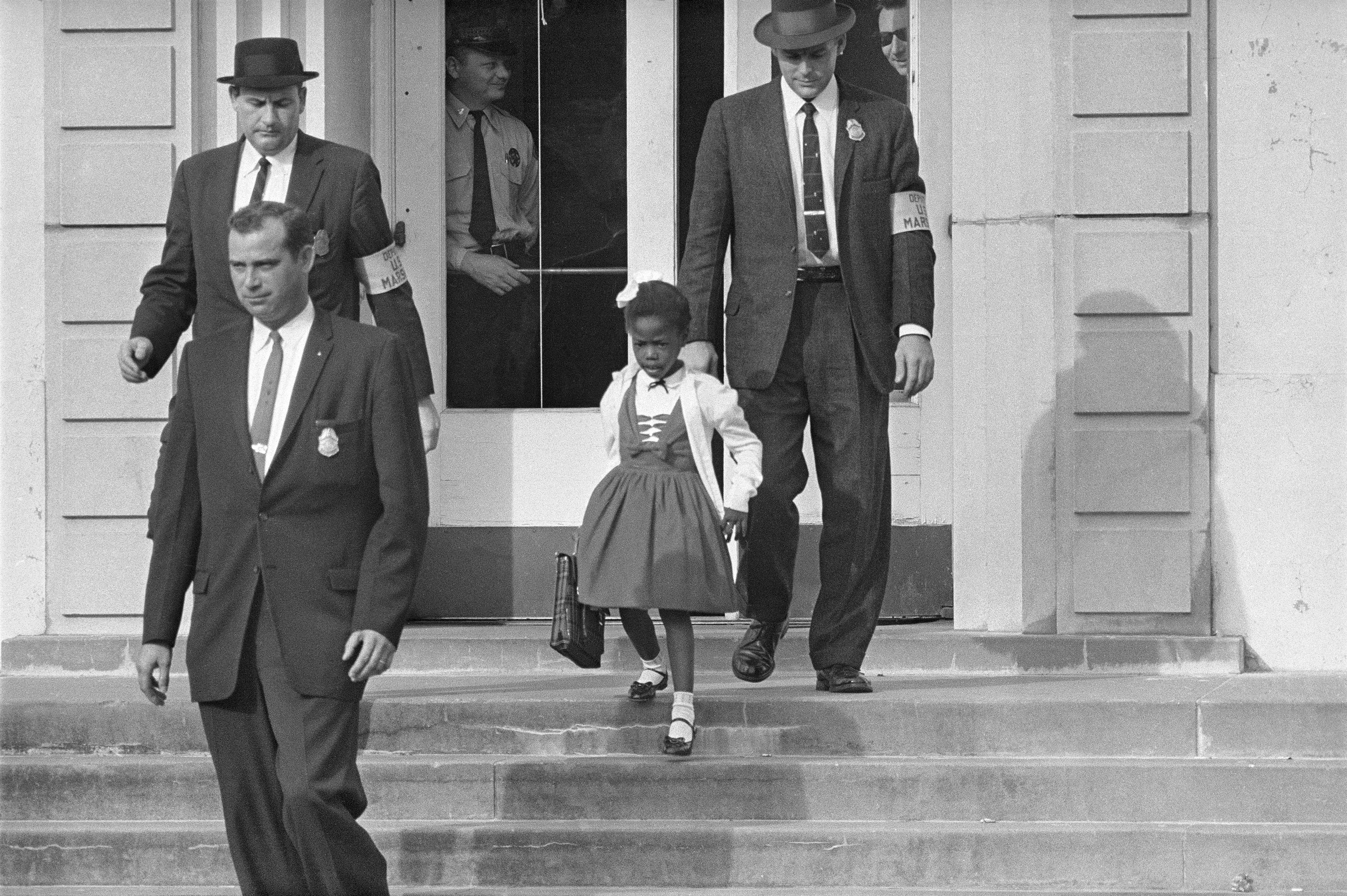
Coles was best known for his interviews with Black children like Ruby Bridges, the 6-year-old girl who faced a mob of white racists in 1960 while integrating an elementary school in New Orleans. But he also warned against imagining Black people as noble victims, or Southern whites — including opponents of integration — as ignorant bigots.
“Policemen are not pigs, white Southerners are not rednecks, and Blacks are not all suffering in exotic misery,” his Harvard colleague David Riesman told Time, summarizing Coles’ approach. “What he is saying is ‘People are more complicated, more varied, more interesting, have more resiliency and more survivability than you might think.’”
Coles’ conversations with poor and right-wing whites confused his liberal friends, who wondered why he would spend so much time with “awful, vulgar, reactionary people,” Coles noted. The reason was both simple and profound: He wanted to understand them.
“I don’t look upon them as good or bad,” Coles explained. “I look upon them as human beings, strong and sensible, weak and full of faults.” He readily acknowledged “the blindness, the distortions, the racism, the meanness” among them. But he refused to reduce them to that.
You could find the same negative qualities in any group, Coles insisted. And working people “bore the brunt of change in American society,” he added. Dismissing them as racist was itself an unjust act, committed by people who imagined themselves as agents of social justice.
In academia, meanwhile, these same tribunes of justice often wrote in impenetrable jargon that only their fellow professors could understand. Coles didn’t do that, either. He used ordinary language, just like the people he interviewed.
Federal marshals escort 6-year-old Ruby Bridges from William Frantz Elementary School in New Orleans, in November 1960.Uncredited
That spawned skepticism among some of Coles’ colleagues, who disparaged him as “unscientific” or — heaven forbid — a “popularizer.” But what’s the point of writing something that nobody — other than a small set of specialists — will ever read?
Coles made a difference in the world precisely because his work was accessible to so many people. At the Williams graduation, he told us Bridges had been moving her lips as she walked past the mob protesting her for desegregating an all-white school. Later, Coles asked her what she had been saying.
“I was talking for God and praying for the people in the street,” she replied. “I always pray the same thing. ‘Please, dear God, forgive them, because they don’t know what they’re doing.’”
Bridges’ courage and compassion inspired Norman Rockwell’s famous painting, The Problem We All Live With, which appeared on the cover of Look magazine in 1964. And it inspired Coles to spend his life talking to people about how they experienced the challenges and contradictions of their world. In over 50 books and hundreds of articles, he taught us that everyone — especially children — had something important to say.
We just have to listen to them. And, I hope, to Robert Coles.
Jonathan Zimmerman teaches history and education at the University of Pennsylvania. He is the author of “Whose America?: Culture Wars in the Public Schools.”
As President Donald Trump sinks deeper into an Iran quagmire, he looks like a loser for joining an ill-planned war of choice and failing at peace talks.
Even if a U.S.-Iran memorandum of understanding (or MOU) is signed soon, this will not be a “peace deal” but will merely kick negotiations on all the tough issues down the road. And the MOU will most likely leave the U. S. worse off than before the war.
Yet, on another front, the Ukraine war, where Trump is supposedly still working on a peace proposal, the president has new opportunities to advance a reasonable deal and be lauded as a winner.
Kyiv, through incredible bravery, fortitude, and technological brilliance, has finally turned the tide against Russian aggression via its innovative drone war. The conflict is far from over, but Russia has been stalled for months, gaining almost no ground, and is now losing more men than it can mobilize.
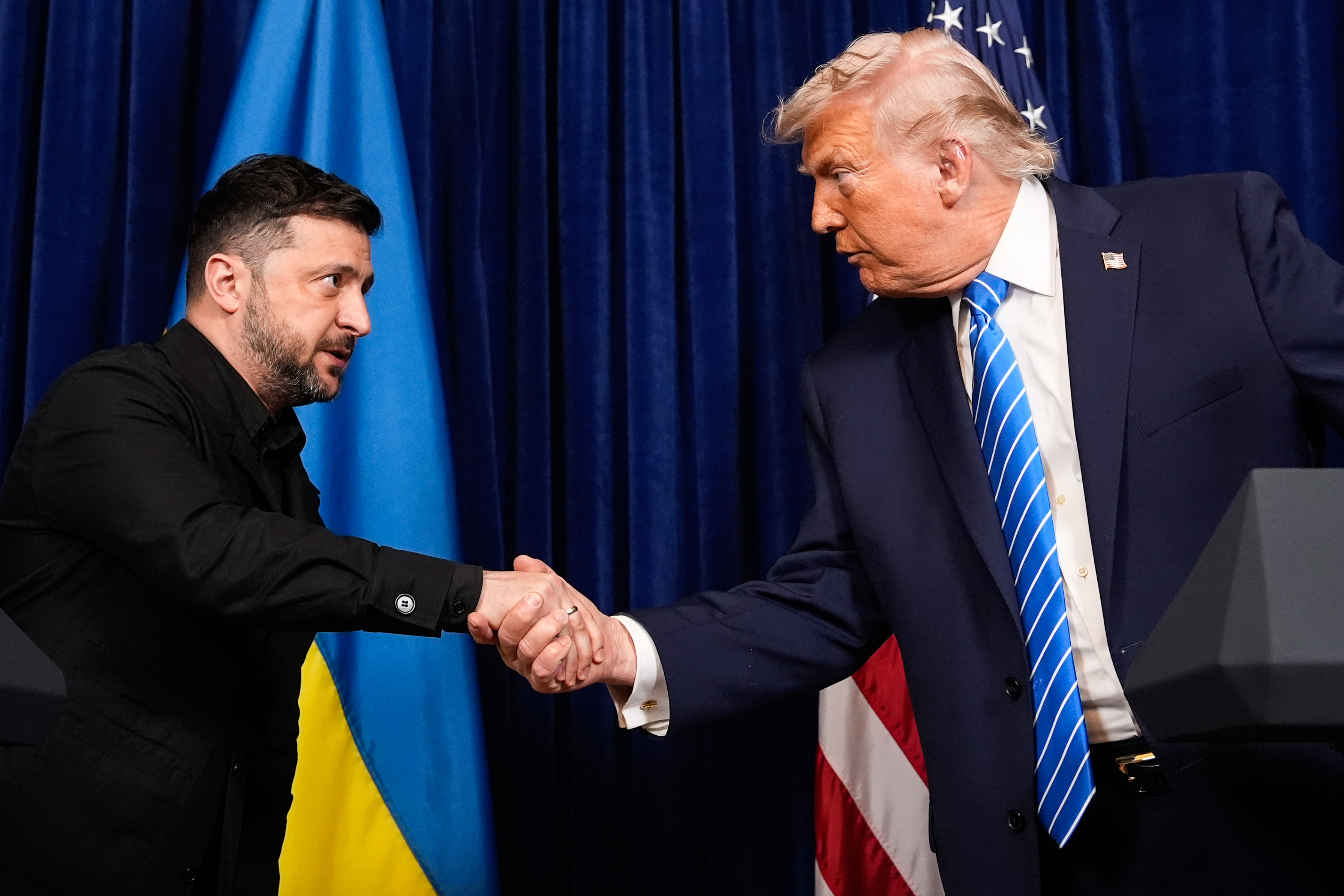
And President Volodymyr Zelensky has just proposed freezing the war along current lines while negotiating directly with Vladimir Putin in a third country, an offer the Russian leader immediately refused.
Yet, Trump continues to aid the loser, Putin, and to undermine the advances of the increasingly visible winner, Kyiv. He has cut off all military aid to Ukraine (even though Europe will pay for the weapons), including vital air defense systems Kyiv desperately needs to destroy the ballistic missiles Putin is raining down on civilians. POTUS is also resisting bipartisan efforts in Congress to restore limited Ukraine aid and add sanctions to Russia.
The House just passed the Ukraine Support Act in a bipartisan push that overcame Speaker Mike Johnson’s efforts to block it, but the White House has strong-armed pro-Ukraine Republicans in the Senate to sit on a similar measure. The GOP‘s cowardice has become a national embarrassment.
If Trump insists on going down in history as a foreign policy loser (or a Russian dupe), Senate Republicans must decide whether they want to share the shame.
It is pathetic to watch how the Kremlin has been making fun of Trump’s weakness. The president keeps claiming he doesn’t want to provoke Moscow by sending more weapons, yet his vacillation has made him a punching bag on RT, the Kremlin’s mouthpiece TV outlet.
“Vladimir, STOP!” Trump begged on Truth Social on April 27, after massive Russian drone and missile attacks on Kyiv and other cities. “Lets get the Peace Deal DONE!” He told reporters he thought Putin would listen. Haha!
“What Vladimir Putin doesn’t realize is that if it weren’t for me, lots of really bad things would have already happened to Russia, and I mean REALLY BAD. He’s playing with fire!” POTUS posted on May 27. RT posted sarcastically: “Trump’s message leaves little room for misinterpretation. Until he posts the opposite the next morning.”
A Kremlin spokesperson dismissed his remarks as “emotional overload.” Trump appears unaware of Kyiv’s extraordinary achievement in bringing the war home to Russia, hitting deep into the country with mid-range and long-range drones that take out military bases, oil depots, refineries, bridges, and rail lines.
When I spoke to Ukrainian military officers as they were displaying videos of sophisticated drone operations to business and political leaders at the Munich Security Forum in March, they told me their goal was to interrupt Russian supply lines and thus cripple military logistics inside Russia and inside Russian-occupied territories.
Another main point was to finally bring the cost of the war home to Russians, since Kremlin-controlled media and internet constantly portray Russia as winning.
Even under President Joe Biden, Ukrainians were frustrated that U.S. aid, notably medium- and long-range missiles, was conditional on their not being fired into Russia — lest it “escalate the fighting.” Under Trump, who has cut all aid, the Ukrainian military feels no such compunctions.
This approach is succeeding. Fuel shortages are spreading across Russia, and fuel supplies in Crimea have reportedly run dry last week, after Ukrainian drones took out two land bridges to the Russian-occupied peninsula.
Even more embarrassing to Putin, he was forced to curtail the huge annual May 8 and 9 World War II Victory Day military parade due to fear of Ukrainian long-range drone strikes.
Yet, Trump refuses to take advantage of Russia’s new weakness and to endorse Zelensky’s call for a freeze along current military lines. Instead, the president’s ill-equipped negotiators have swallowed Putin’s demand that Kyiv surrender critical cities, which Russia has been unable to take by force.
Even more idiotic, Trump has failed to take advantage of Zelensky’s year-old offer to share Ukraine’s brilliant drone technology and swap just-in-time, battle-tested drones and interceptors for U.S. weapons. This, at a time when the unacceptably slow pace of U.S. drone development has put America on the back foot in the Iran war, and forced our military to use $2 million missiles to down $50,000 Iranian Shahed UAVs (as unmanned aerial vehicles are called).
All of America’s Sunni Arab allies are begging Kyiv for help downing Iran’s drones, as U.S. private companies are rushing to test new drone innovations in Ukraine. Even some Pentagon officials are waking up to how much they need Ukraine’s help, yet Trump remains aloof — and still blames Ukraine, not Putin, for causing the war.
My only explanation for such stupidity is that POTUS has never gotten over his anger at Zelensky for rejecting the president’s famous 2019 demand in a phone call to dig up (nonexistent) “dirt” on Biden. That phone call was the basis for Trump’s first impeachment.
I’d add to the mix Trump’s envy of dictator Putin’s total control of everything in Russia and his past, frequent displays of bare-chested masculinity. (Perhaps the choice of a bizarre UFC mixed martial arts match for his birthday on the White House lawn Sunday is a way for POTUS to play catch-up.)
The result, however, is that America rejected the vital help of an important Ukrainian partner at a critical moment in the Iran war, while aiding a Russian adversary who is assisting Iran. And the U.S. president has squandered hundreds of scarce Patriot and THAAD long-range interceptor missiles in the Iran war, which, if Europe could have purchased them for Ukraine, could have saved that country’s urban infrastructure.
Instead, Trump refuses to put Ukraine in the queue for receiving new missiles when the woefully slow U.S. production lines are sped up. And he has just halted a scheduled deployment of Tomahawk missiles to Germany, supposedly from fear of upsetting Russia, even though Putin is now openly threatening Europe.
From June 15 to 17, the leaders of the G7 group of the world’s top industrial nations will meet in France, on the shores of Lake Geneva, and French President Emmanuel Macron has invited Zelensky to speak. The topic will be Ukraine, and Trump will have a chance to strongly endorse Zelensky’s proposal.
I don’t expect much from Trump, who has complained about Russia being kicked out of the former G8 after invading Ukraine. But who knows? Maybe POTUS will decide he doesn’t want to be a loser after all.
It is with great sadness that I read the article about a proposal to end Black history education in Cherry Hill. As a retired history teacher, principal, and superintendent of schools with fond memories of my experience in Cherry Hill, I cannot help but remember the days when we were all Americans, regardless of our racial or religious identity.
We took it for granted that Black history was an integral part of American history.
We taught slavery, Reconstruction, Jim Crow, and the Civil Rights Movement as part of, and integral to, American history. We never had sufficient resources to satisfy all the expectations our communities had of us.
If any of our racial (or religious) groups required further education, it came from the family, from the places of worship, or from some other community effort. It did not come from public education.
To teach separately breeds separation. To breed separation is to secure separation.
That was never our goal.
Bernard D. Shapiro,Voorhees
Power over people
I am shocked and angered to find out about Councilmember Cindy Bass’ conduct in Philly’s 22nd Ward elections. There have been reports of misinformation around the time of the meeting, the bumbling of the vote, and the flap around the sign-in sheet. The most upsetting part of this story is the quote, “That’s democracy.” It’s as if our elected officials are going to just hoard power in the face of practicing the will of the people. It’s especially harrowing to see this behavior from a vice chair of the Philadelphia Democratic Party.
Not only does the party need wholesale leadership change, but there has to be an overhaul of the entire system. Elected officials should not be able to serve as committeepeople or ward leaders. This is a clear conflict of interest. What do you do if you’re unhappy with your ward leader … and your ward leader is the mayor? Also, elected officials have full-time jobs they should be focusing on, not this volunteer role. One elected role should be enough. If we’re not practicing transparency and inclusion in a volunteer role at the street level of city politics, how is the rest of our democracy going to work?
Jayson Massey, Philadelphia
. . .
As a former ward leader, I find it disheartening to learn that Cindy Bass acted like a mini-monarch on Monday in denying a fair ward election. The 27th Ward in West Philly faced a similar despotic challenge back 56 years ago — the more things change, the more they stay the same. Our contested ward leader election on Monday was fairly settled by secret ballot. Welcome to 21st-century democracy.
Mary L. Goldman, Philadelphia
Join the conversation: Send letters to letters@inquirer.com. Limit length to 150 words and include home address and day and evening phone number. Letters run in The Inquirer six days a week on the editorial pages and online.
When organizers announced two years ago that Philly’s FIFA Fan Festival site for the World Cup would be at Lemon Hill, many Philadelphians responded with a collective: Huh?
Located between the Philadelphia Museum of Art and Girard Avenue, the grassy site in East Fairmount Park hasn’t hosted many big public gatherings, though it was the staging and undressing area for the Philly Naked Bike Ride in 2022.
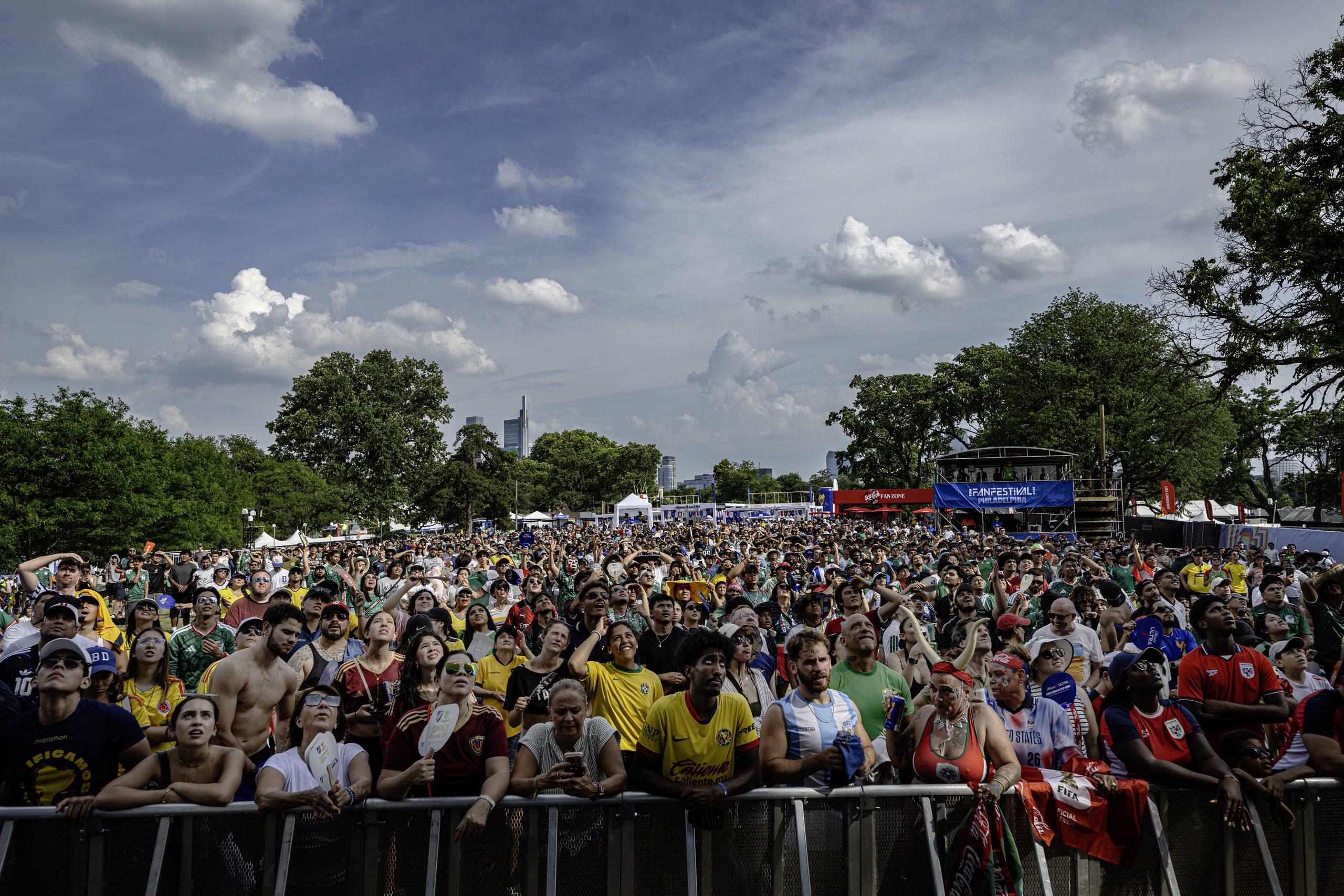
In my many years in Philly, I’d never covered an event at the site — and I’d never been to a FIFA Fan Fest either, which features live broadcasts of the games, entertainment, vendors, and soccer-related activities. So I went on Thursday, the opening day of the 39-day festival, to bring a minute-by-minute report of what I experienced to you.
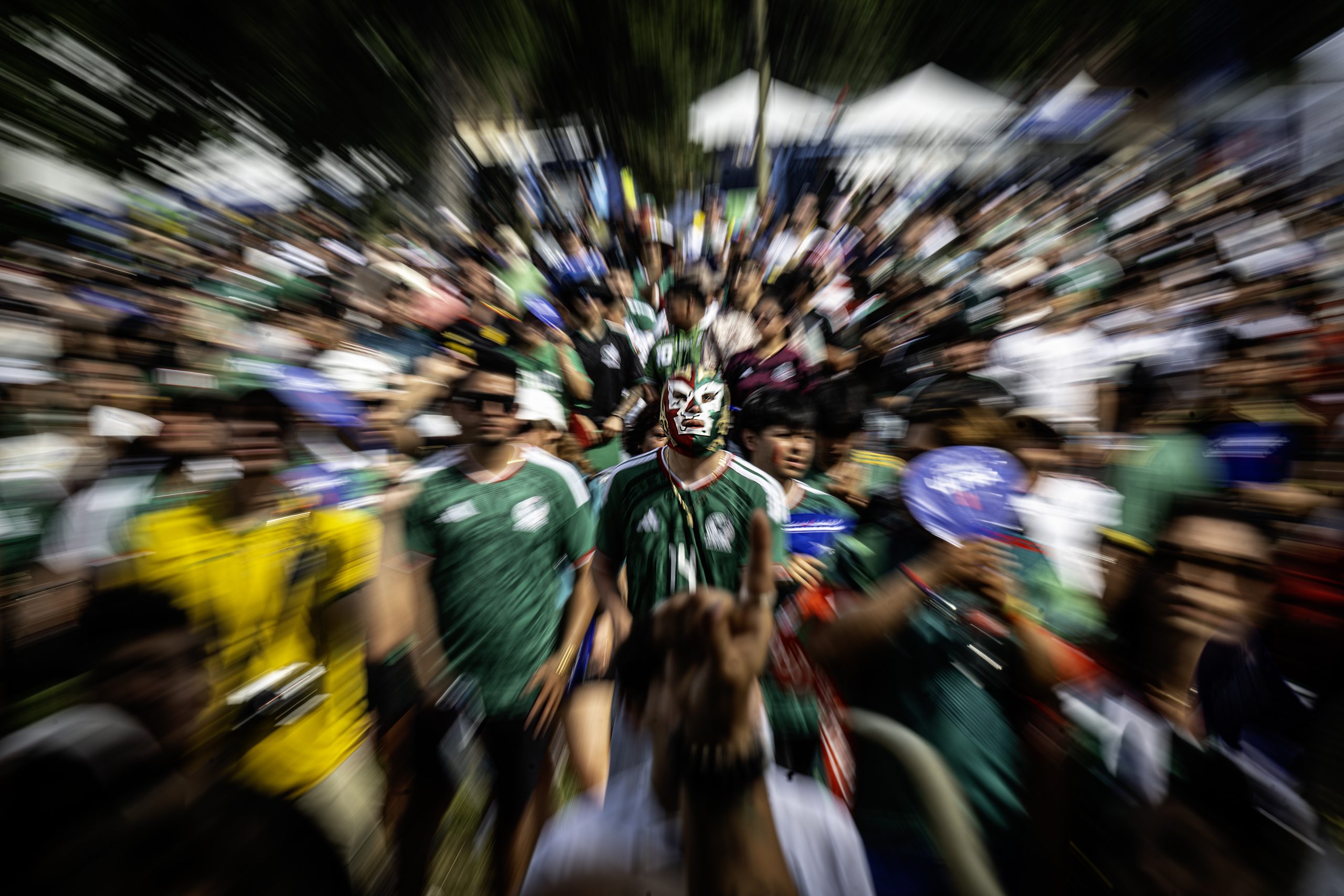
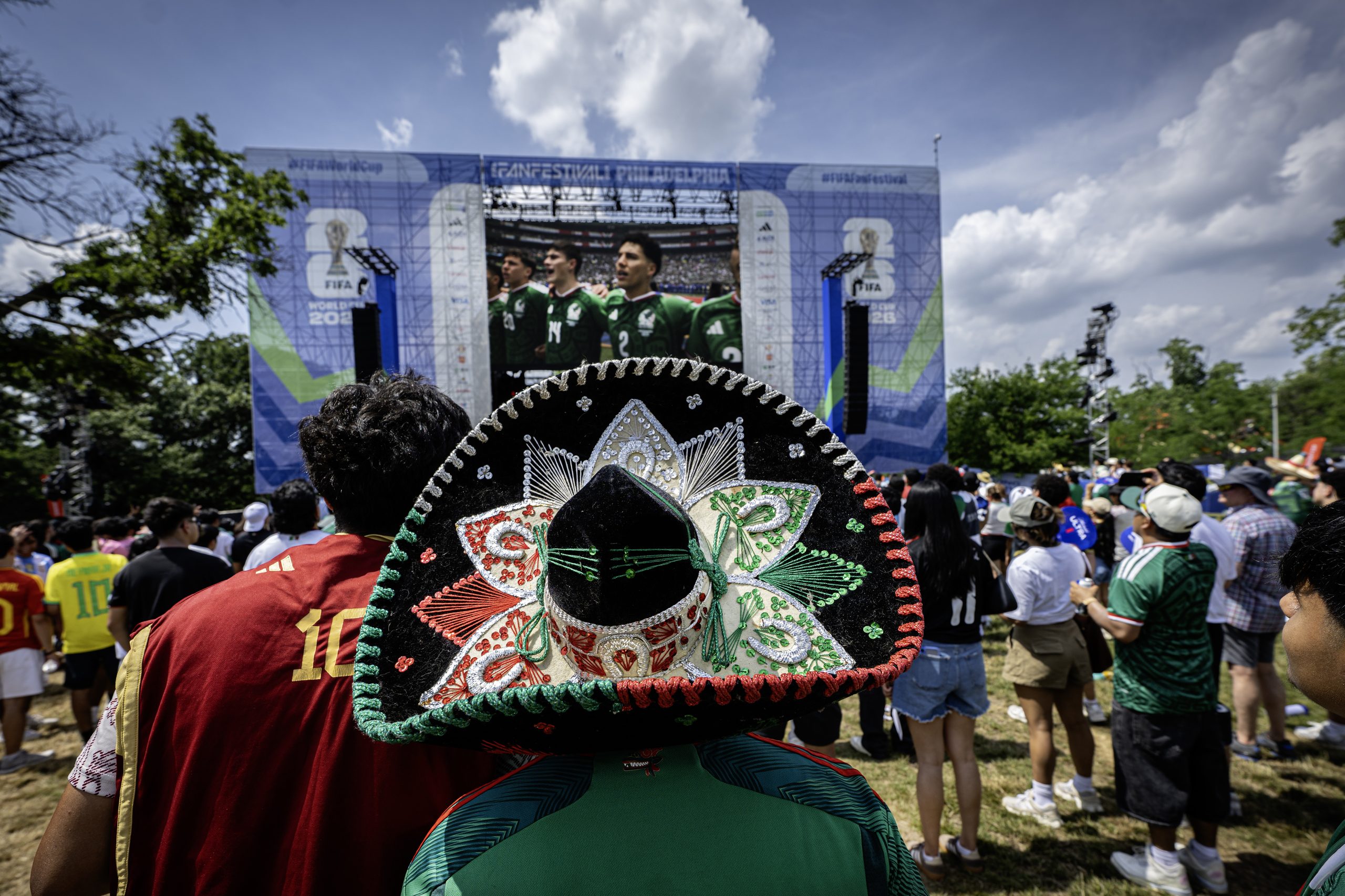
Using a zoom lens technique, Mexican fans watch the FIFA World Cup opening match between Mexico and South Africa on a giant screen during the opening day of the FIFA Fan Festival at Lemon Hill on Thursday.Jose F. Moreno / Staff Photographer
I knew the journey wouldn’t be easy. Not only were temps forecast to be in the mid-90s (with heat indexes over 100 and a heat health emergency in place), you can’t drive to the site, or get close with ride share apps. Roads around the venue are closed and street parking has been restricted to neighborhood residents.
To get to the event, the city is urging guests to take the Philly PHLASH bus, take SEPTA’s bus routes 32 or 48, use a bicycle, or walk. I chose the latter.
12:30 p.m.
I begin my journey at LOVE Park, where I see a group of five friends in their team Mexico jerseys — and a sixth in a white T-shirt and sombrero — getting their photo taken with the LOVE statute.
Alexis Arellano, 29, tells me they’ve come from Atlantic City to catch the Mexico v. South Africa game at the FIFA Fan Festival.
“It’s a once-in-a-lifetime opportunity. You’ve got to take advantage of everything they got going on. It’s in our backyard,” he said.
12:39 p.m.
I stop into the pop-up Philadelphia Visitor Center hospitality hub at the park. The space is tiny, but the air-conditioning feels like silk sheets on my sweaty skin. I strongly consider buying the $14 portable fan that sprays wooder at your face and ponder at a bucket hat that reads: “Freedom has a Philly accent.”
12:45 p.m.
I head over to the public bathroom trailer that’s temporarily been installed in LOVE Park in front of the circular building known as flying saucer.
“What a waste,” I think, as I look up at the very cool saucer, which remains closed and empty, despite a call-out last year from the city for ideas to reactivate the space in time for the World Cup and the Semiquincentennial.
The new, temporary public bathroom trailer set up in LOVE Park.Stephanie Farr / Staff
I step inside the bathroom trailer. Not only is it air-conditioned, it’s outdoor-wedding-quality nice. Next to the trailer is a sink of water fountains and water bottle-filling stations.
1:15 p.m.
After making my way down the Ben Franklin Parkway, I spot another, larger hospitality hub across from Eakins Oval. This one has several large boards in front of it you can stick your face into to get a photo with Gritty, Rocky, or Patti LaBelle.
When I step inside the hub, I almost weep tears of joy because it’s so cold. It has much of the same items as the other, but with more Rocky merchandise (“Yo, Adrienne! Buy my stuff!”).
The pop-up Philadelphia Visitor Center hospitality hub across from Eakins Oval.Stephanie Farr / Staff
Outside of the hub, I meet Valentine Emeré, 20, and his parents, who are on holiday from France and had no idea the World Cup was in town. They’re in Philly as part of an East Coast tour of the U.S.
“It’s a very good city, it’s a living city,” Emeré tells me when I ask his thoughts on Philly. “We really like how many things there are to do.”
1:41 p.m.
I arrive at the FIFA Fan Fest welcome center tent. Aside from the oppressive heat, the walk was easier than I expected. I pass the Philly Phestival Marketplace, a row of vendors selling everything from nail polish to onesies that read “baby jawn.”
1:48 p.m.
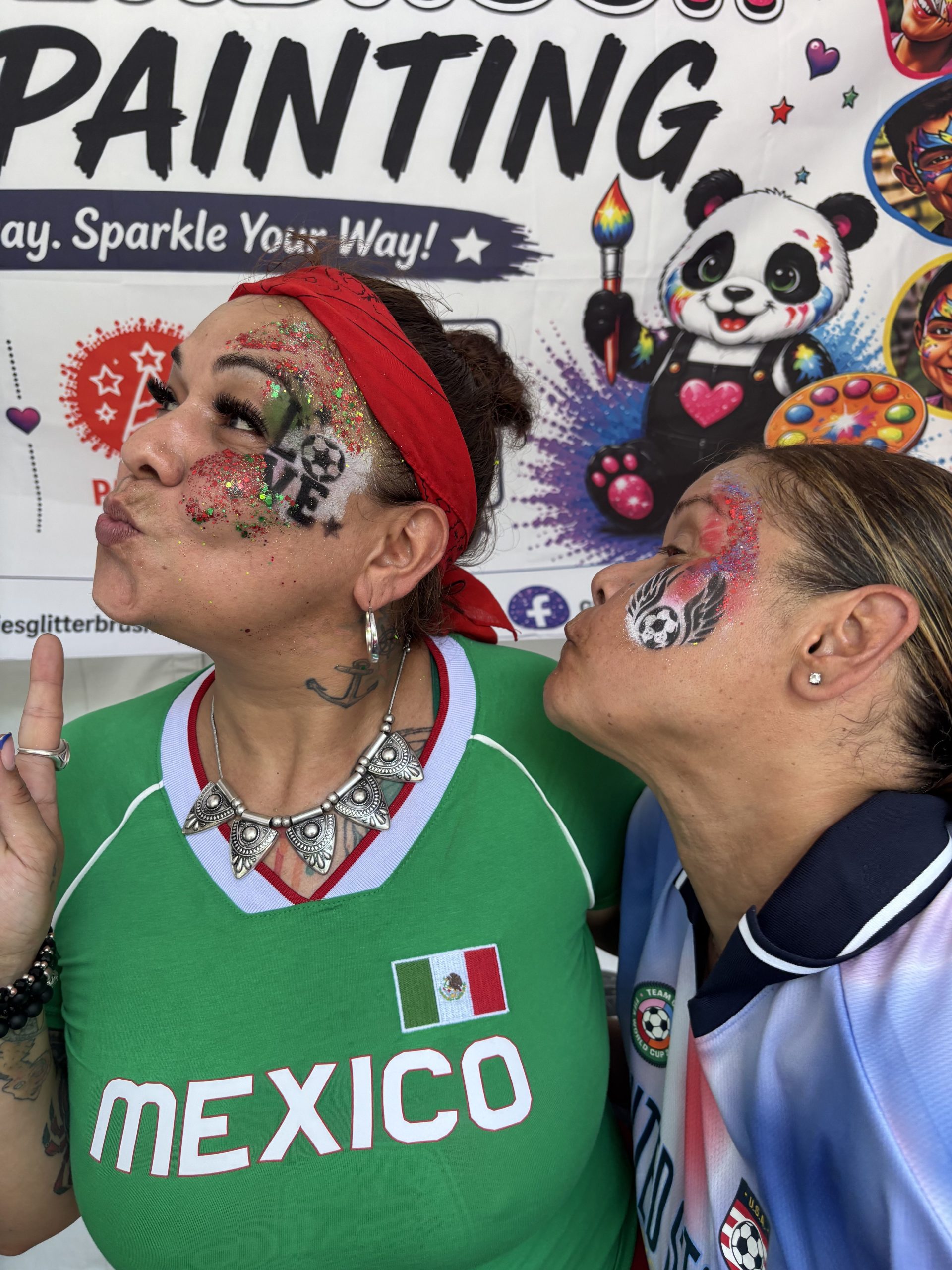
At the Glitterbrush Facepainting booth, I chat up Martiza Quendo of North Philly, who wore a team Mexico shirt, and Marissa DeMatteo of South Philly, who was repping team USA. They’d just had their faces painted and told me they came to Fan Fest because they love free merch and “participating in Philly.” Mostly they were there for the live Luis Fonsi concert after the Mexico vs. South Africa game.
Martiza Quendo of North Philly, at left in a team Mexico shirt, and Marissa DeMatteo of South Philly, at right in a team USA shirt, pose after getting their faces painted at the Philly Phestival Marketplace.Stephanie Farr / Staff
1:52 p.m.
As several hundred people wait in line for the gates to open, visitors pose for pictures in front of a large soccer ball surrounded by fresh flowers, a photo-op that looks straight out of the Philadelphia Flower show. An enterprising street vendor nearby tries, without success, to sell umbrella hats.
“You think business would be better in this heat,” he says.
2:10 p.m.
Philadelphia Mayor Cherelle L. Parker joins fans in a Mexican chant before entering the FIFA Fan Festival at Lemon Hill on opening day of the FIFA World Cup 2026 on Thursday, June 11, 2026, in Philadelphia. Fans gathered to watch Mexico face South Africa in the tournament’s opening match.Jose F. Moreno / Staff Photographer
Gates open to the festival, a little behind schedule, but folks get in calmly, quickly, and with little trouble. Some come in singing, others run in waving Mexican flags. My colleague, photographer Jose Moreno, later shows me pictures of Mayor Cherelle L. Parker walking in with the crowds.
2:18 p.m.
I stop by the Home Depot activation, billed as “Beckham’s Backyard,” which features the facade of a home with a 12-foot-skeleton in front of it. An employee tells me this mimics a backyard with Beckham’s flair.
“He’s not here though, right?” I ask.
“I wish. This would be a lot more popular if he was,” he said.
Inside, there is a giant Home Depot bucket with a TV screen inside showing games. The nearby Casamingos stand selling margaritas for $17 appears to be far more popular.
2:26 p.m.
I ask an employee manning the Bank of America activation why the line there is so long. He tells me they’re letting people make their own bracelets — with very cool Philly and World Cup charms — for free.
2:28 p.m.
At the Visit PA pavilion, the lines for the free prize wheel and claw machines — which dole out Visit PA-branded merch — were very long.
But nobody was at the “Soccer Jawn” video game, which pits two players head-to-head in a Pong-like game of soccer on a big screen. I yell to a young woman passing by to battle me and she accepts my challenge.
Biance Yetta, 16, of Easton, beats me 5-4. In my defense, she plays soccer on a traveling team and I’ve never played before in my life (though I’ve probably played way more Pong).
2:38 p.m.
A message plays on the 60-foot-wide main screen of the festival from astronauts aboard the International Space Station. I’m too far away to hear everything they say, but I can make out the words: “Sharing one planet, one game,” and that makes me smile.
2:40 p.m.
I walk into the massive FIFA Fan Fest store, which is so well air-conditioned I almost fall to my knees and thank the gods of consumerism.
I browse for a bit, but when I check the price of a FIFA cropped women’s sweatshirt — $104.99 — I walk right back out.
2:56 p.m.
The national anthem of South Africa begins and crowds gather around the big screen. Folks try to hide under what little shade is available, but most of us are forced to swelter in the sun.
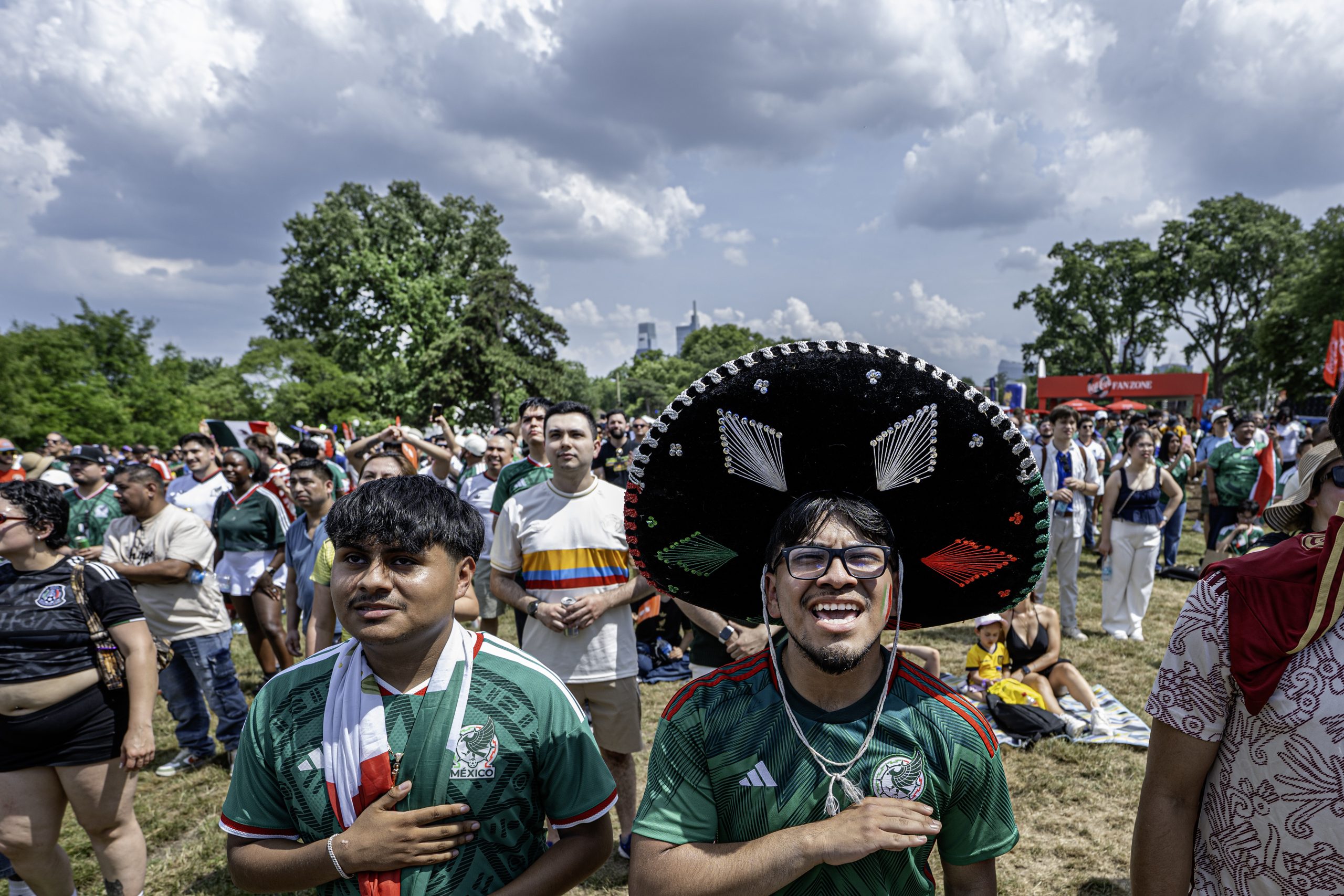
Shortly thereafter, the Mexico national anthem plays and many in the crowd — which now numbers in the thousands and is mostly team Mexico fans — sing along.
It feels electric being in the middle of them and watching the game begin, but I have more of the festival to explore.
Mexican fans sing the national anthem before the start of the FIFA World Cup opening match between Mexico and South Africa at the FIFA Fan Festival at Lemon Hill on Thursday.Jose F. Moreno / Staff Photographer
3:04 p.m.
I approach what looks like a nice little area called “The Orchard” and am immediately stopped by a security guard. I’m informed it’s a VIP-only area for sponsors (enjoy the perks, 12-foot Home Depot skeleton).
Next to it was another public viewing area with a smaller screen showing the game. This one had picnic tables under shade (huzzah!). Nearby was a food area with booths selling street corn, cheesesteaks, and churros — none of which sounded appetizing in 94-degree heat. I’d spotted a single water ice stand at another food vendor area across the way earlier, but the line was 42 people deep and there was one guy working the booth.
3:24 p.m.
I spot a woman in a Phamassador T-shirt, the Visitors Center program that’s recruited 10,000 volunteers to be ambassadors of Philly this summer.
Ruth Bangura, 19, tells me she’s a Philly transplant who’s “obsessed” with the city and wants to help others become obsessed, too. Despite the heat, she’s loving the “good energy” at Fan Fest and loves seeing people waving flags of all colors coming together.
“Everyone is different but at the same time, we’re all here for one game. This is the best thing that could ever happen to the United States right now,” she says. “This is the melting pot, this is what America is supposed to be instead of differentiating each other and dividing each other.”
Soccer fans gathered to watch the FIFA World Cup opening match between Mexico and South Africa during the opening day of the FIFA Fan Festival at Lemon Hill on Thursday.Jose F. Moreno / Staff Photographer
3:31 p.m.
As I walk by an American Heart Association tent filled with CPR dummies, staffer Jennifer Russ asks if I want to learn CPR. She teaches me chest-compression as music that’s 100-to-120 beats per minute plays in the background. Like “Staying Alive,” these are songs you should time chest compressions to.
Russ’ manager tells me they’re on site because CPR is a skill they want people from all over the world to learn.
“And, honestly, sports is one of the main places cardiac arrests happen,” she says. “So this is great because it’s just such a big footprint.”
3:46 p.m.
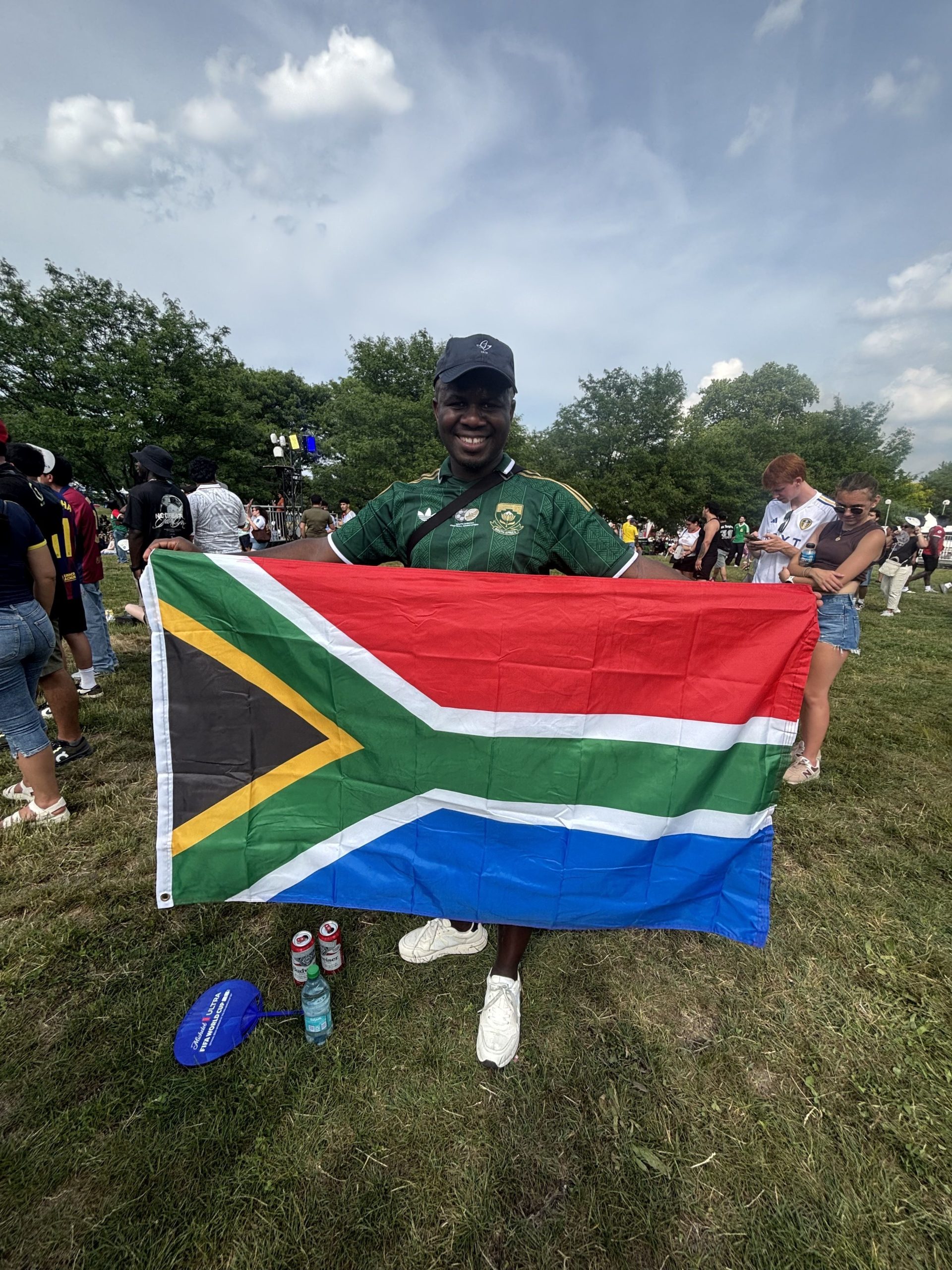
Back at the big screen showing the game, I introduce myself to Mla Mhlongo, 34, a native of South Africa now living in Claymont, Del., who came to support his national team. He tells me that when the World Cup was in South Africa in 2010, they showed all the games at outdoor parks, so Fan Fest feels like a small tase of home.
Mla Mhlongo, a South African native now living in Delaware, waves the South Africa flag in support of his home country at FIFA Fan Fest in Philadelphia.Stephanie Farr / Staff
“I’m enjoying the game with a lot of people; I’ve taken a lot of pictures with people from Mexico and people from around the world,” he says. “The World Cup is supposed to unite the world and it does that.”
4:06 p.m.
An Eagles chant breaks out in the crowd.
4:23 p.m.
I need to find shade. I head to one of the misting tents with fans, but the mist evaporates before it even reaches me.
4:38 p.m.
Once I cool down a little, I realize how hungry I am. I consider a jerk chicken wrap, until I realize it’s $24. I settle on a hot dog and soda for $14. I try to pay with cash and am told everything is card-only.
4:42 p.m.
As I sit to eat in the shade near the smaller screen, I realize that hardly a single person is on their phone. They’re tuned into the game or each other and I think about how nice — and rare — that is.
4:52 p.m.
I try my hand at the Philadelphia Union’s activations, which test your soccer shooting and passing skills by having you kick balls at a series of blinking lights. They’re fun — and one of the few activations that doesn’t require you to scan a QR code. I fail miserably at both games, at one point kicking the ball into the crowd outside the tent.
5:05 p.m.
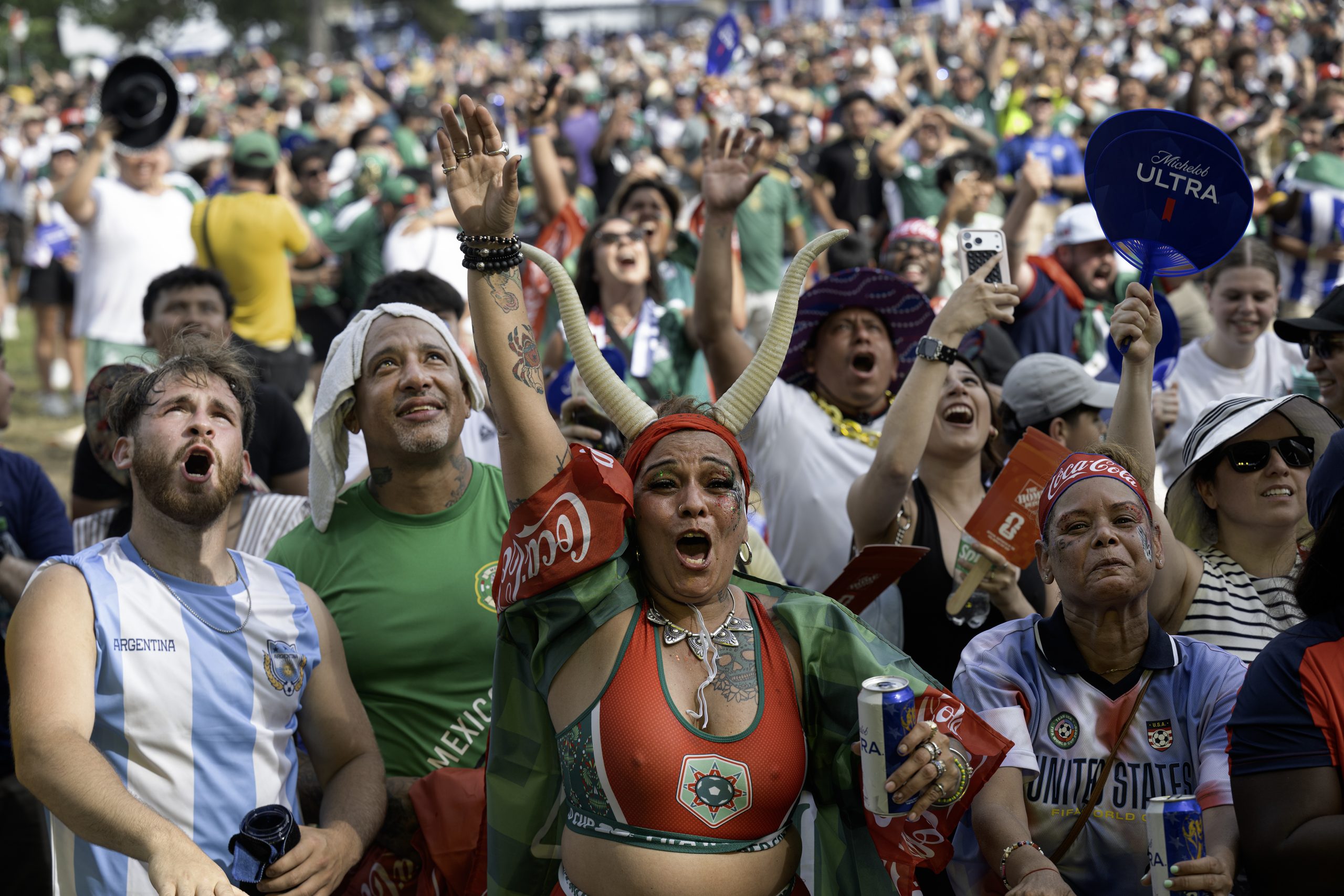
Mexican fans celebrate after Mexico scores against South Africa while watching the FIFA World Cup opening match on a giant screen during the opening day of the FIFA Fan Festival at Lemon Hill on Thursday.Jose F. Moreno / Staff Photographer
The match on the big screen ends and fans of Mexico cheer their team’s win. People make their way to the stage under the screen for the Luis Fonsi concert. I spot the two facepainted Philly ladies I talked to earlier right up against the stage barrier.
5:17 p.m.
Singer Luis Fonsi performs during the opening day of the FIFA Fan Festival at Lemon Hill on Thursday.Jose F. Moreno / Staff Photographer
Fonsi takes the stage. A woman with a man in a Mexican wrestling mask, both of whom are wearing Mexican flags as capes, dance in front of me. I see a mom and daughter singing together in Spanish and a man dancing through the crowd, his arms raised. Everyone is happy and smiling.
5:30 p.m.
I leave early to beat the crowds and walk back. On my way out, I see a man at a picnic bench reading Booked by Kwame Alexander. He tells me the American Federation of Teachers is giving books away for free at the Philly Phestival Marketplace. I stop by the booth and talk with Leslie Koelsch, deputy director of communications for the federation.
“We launched the Summer Reading Cup and we’re giving away thousands and thousands of soccer-themed books this summer to get kids excited about reading,” she tells me.
5:42 p.m.
Just outside the fest, I see a sign for the “LOVE Park shuttle” and a row of four school buses. A driver tells me they’re giving free rides back to LOVE Park after the fest. It’s a wonderful service, but the buses don’t have air-conditioning and the first one isn’t anywhere near full yet, so I decide to continue on foot.
5:55 p.m.
Walking along the Parkway, I think about all the events I’ve covered there — the good and the bad, the celebrations and the protests — and I look at all the nationality flags waving in the warm breeze.
Soccer fans gather to watch Mexico play South Africa on a giant screen during the opening day of the FIFA Fan Festival at Lemon Hill on Thursday.Jose F. Moreno / Staff Photographer
I’ve had conversations with many people over the last few months who find it very hard — if not impossible — to consider celebrating anything amid the current climate of our country. But when you attend one of these events in Philly that brings people from all over the world together, you get something you don’t get when you sit at home and watch all the horrors of the news.
You realize how much people want to connect with one another, and how easily we still do, when we choose to.
Soccer fans gather to watch Mexico play South Africa on a giant screen during the opening day of the FIFA Fan Festival at Lemon Hill on Thursday.Jose F. Moreno / Staff Photographer
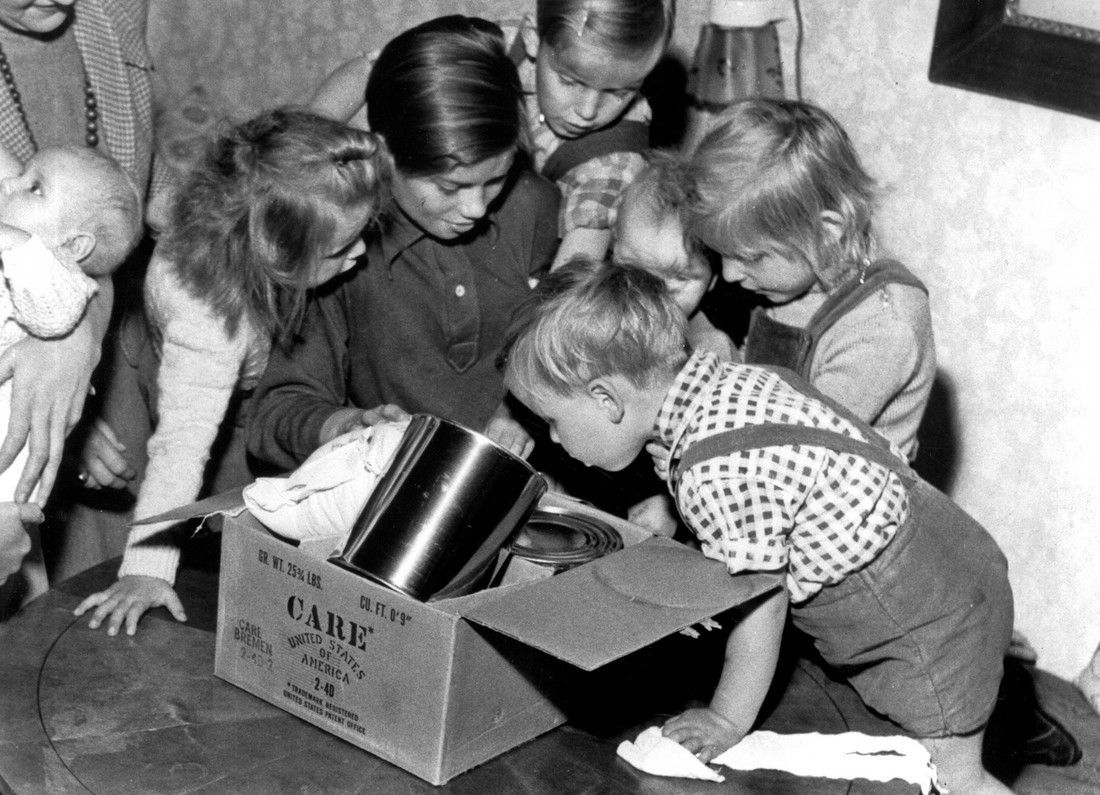
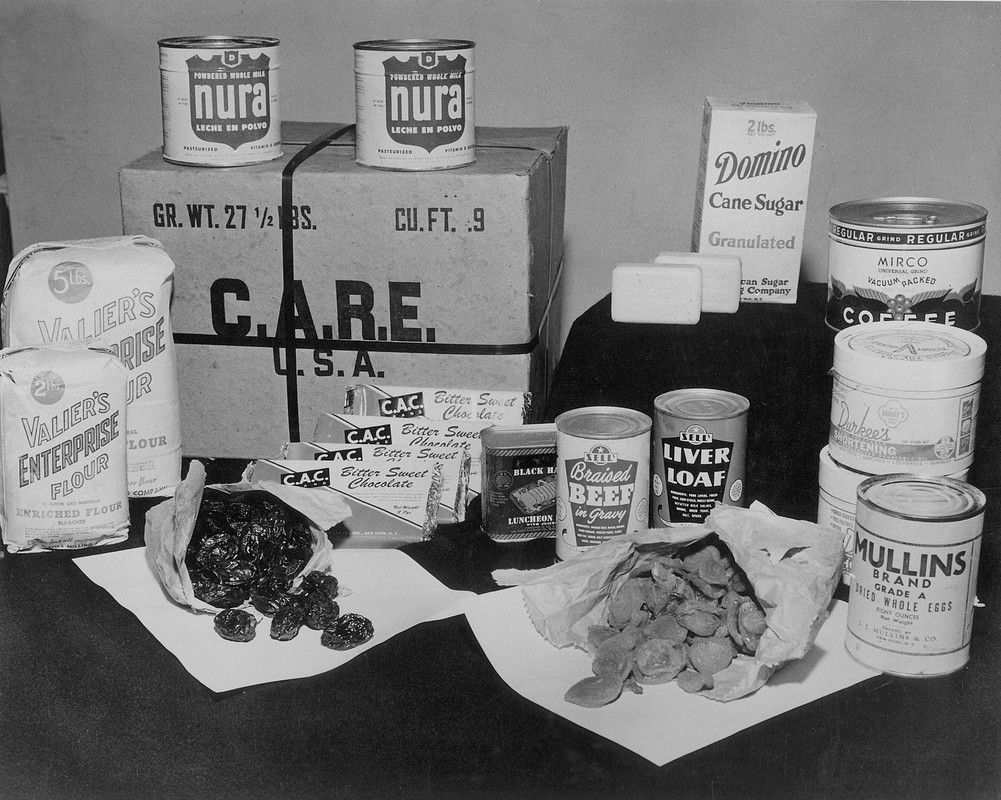
Eighty years ago, in a city whose very name means brotherlylove, someone packed a box. It held simple things like canned meat, dried milk, a little sugar, and was sent across an ocean to a stranger in a war-torn land who had next to nothing.
That first CARE Package, shipped from Philadelphia in 1946, was not a political act or a diplomatic gesture. It was something older and simpler: an act of humanity, of one human being reaching out to help another.
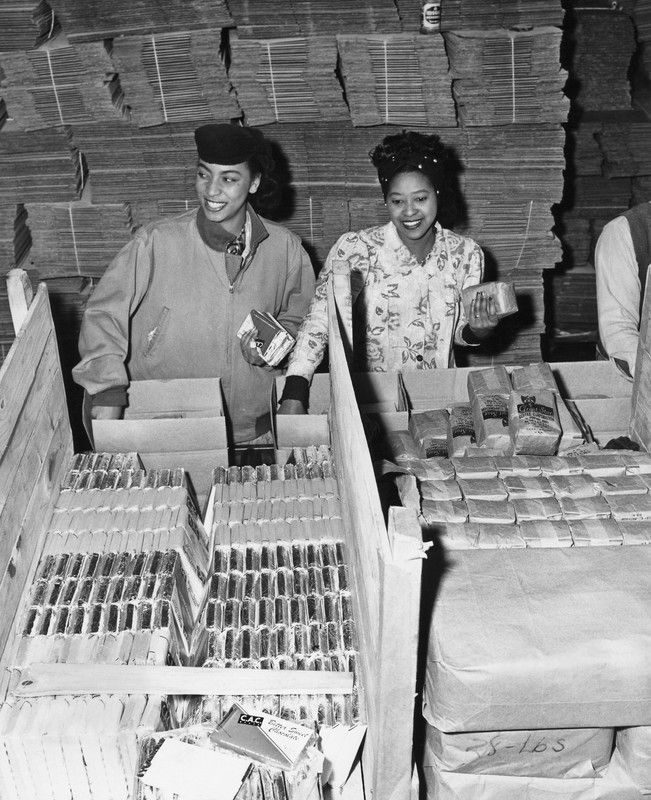
Two women put items into CARE Package boxes at the main packing facility in Philadelphia in 1946.CARE
Eighty years later, as the world again strains under the weight of conflict, displacement, and division, that first humble box from Philadelphia speaks to us from the past and asks us a question I believe America, as it turns 250, would do well to answer: Who are we willing to help?
The story of CARE is like the story of America, rooted not in governments or grand institutions, but in citizens. In 1945, a few visionaries spearheaded the coming together of 22 American organizations, including labor unions, religious groups, and civic associations, with a straightforward conviction: that the people of a recovering Europe needed help, and that ordinary Americans could provide it.
The first packages shipped the following year contained U.S. Army surplus rations.
In 1947, a typical CARE Package box contained five pounds of milk powder, seven pounds of cheese, five pounds of rice and five pounds of beans.CARE
They were practical, even humble. But what they carried beyond calories was something no logistics manifest could capture: the message that someone, somewhere, was looking out for you, and had not looked away.
Philadelphia was the perfect place for this altruistic effort to begin.
William Penn founded this city on the radical idea that a community built on mutual respect and goodwill was not just a noble dream, but a practical one. Penn’s “Holy Experiment” was always about more than religious tolerance. It was a wager that people of different backgrounds, beliefs, and origins could build something together; that the ties binding a community need not be sameness, but shared commitment to one another’s dignity.
The Quakers who shaped this city’s early character understood mutual aid not as charity, but as covenant. To care for a stranger was not exceptional. It was the baseline of a decent society.
That spirit did not stay contained within Philadelphia’s borders, and it was never meant to.
Today, CARE works in more than 100 countries, reaching close to 60 million people a year, the vast majority of them women and girls. The crises we respond to have changed in scale and complexity since 1946: protracted conflicts, climate-driven displacement, food systems pushed to the breaking point.
But the fundamental logic of that first box has not changed at all. Resources and stability are not distributed equally across the world. Where they are lacking, people suffer unnecessarily. And where communities near or far extend a hand, lives change.
What has changed is the urgency. At this moment, humanitarian funding has been dramatically cut in the United States and is under serious pressure globally, even as conflicts and disasters increase, and the need continues to grow.
The architecture of international generosity Americans helped build in the postwar era — the one that began, in its way, with a box of rations shipped from this city — is being tested as it has rarely been tested before.
The contents of a CARE Package box in 1956.CARE
The question Penn posed by naming this place for “philos adelphos” is no longer abstract. It is operational.
Philadelphians know something about the work of building community against the odds. This is a city that has long had to hold its founding ideals up against the harder facts of inequality, poverty, and injustice. A city that has chosen, again and again, to keep reaching.
Our neighborhoods are full of mutual aid networks, food pantries, parishes, synagogues, mosques, and community organizations doing quietly what that first CARE shipment did 80 years ago: refusing to let distance — whether of geography or circumstance — become indifference.
That local impulse and the global one are not separate. They are the same instinct, operating at different scales.
When a Philadelphian volunteers at a community kitchen, they are practicing the same covenant Penn described and CARE embodies. When CARE delivers emergency food in Sudan or flood relief in Bangladesh or North Carolina, it is acting on the same principle that moved those 22 organizations in 1945 to pool their resources for strangers they would never meet.
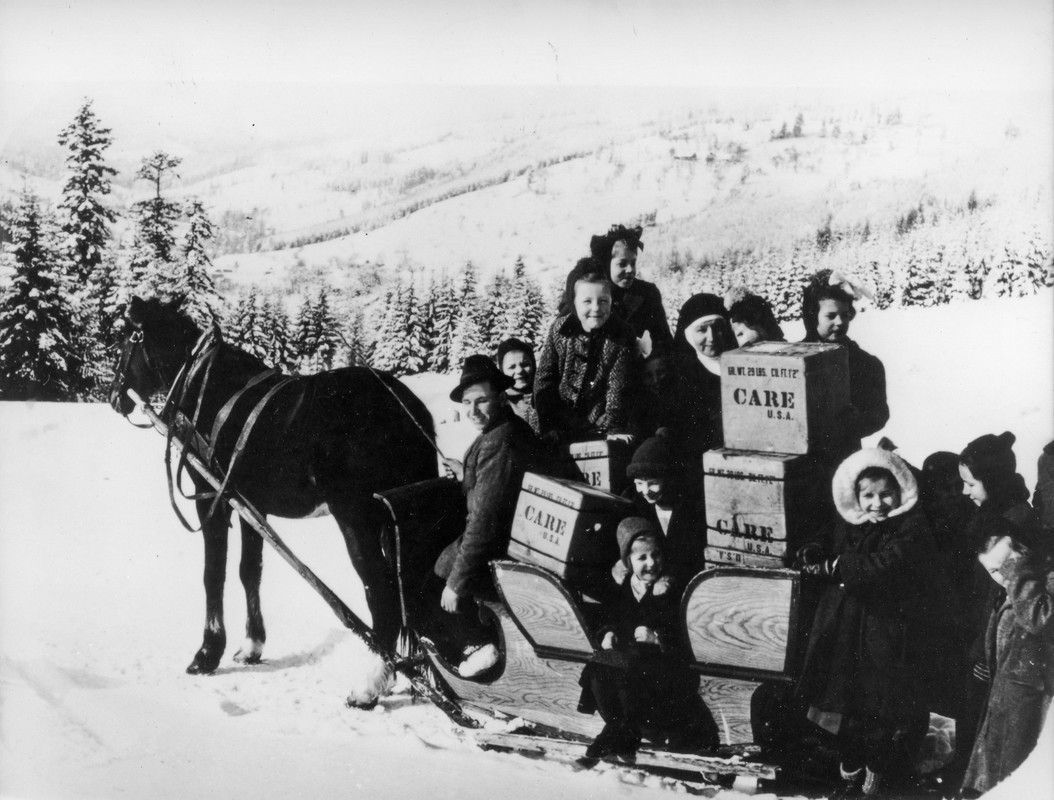
Polish citizens carry their CARE PACKAGE boxes home in a sleigh in 1948.CARE
The circle of who counts as a neighbor has simply grown wider.
This anniversary is worth marking, not for nostalgia’s sake, but because anniversaries are invitations to recommit.
Eighty years on, the CARE Package has become a metaphor so common we barely notice it anymore. We send “care packages” to college students, to kids at sleepaway camp, to friends going through hard times, to soldiers deployed abroad. The phrase has traveled so far from its origins that most people don’t know it began with a specific act, in a specific city, in a specific moment of postwar reckoning with what humanity owed itself.
I think it’s worth knowing. Because embedded in that origin story is a reminder that generosity is not a personality trait belonging to unusually kind individuals. It is a collective capacity: something communities build, sustain, and, when necessary, rebuild.
Philadelphia built it once. CARE has carried it forward for eight decades. The need, today, is as real as it has ever been. So we return to the question that first box poses: Who are we willing to help?
The answer, I believe, is easy: those in need, those we can. I think William Penn would agree.
Michelle Nunn is the president and CEO of CARE USA.