Category: Opinion

  • Larry Krasner’s exoneration push faces a reckoning

    Larry Krasner’s exoneration push faces a reckoning

    No one should have to spend even a single day behind bars for a crime they did not commit. But in his zeal to right legal wrongs, District Attorney Larry Krasner lost the plot.

    Since first getting elected in November 2017, Krasner, a former defense and civil rights attorney, has pushed for scores of exonerations for people convicted mainly of murder. But, it turns out, most are not exonerations in which the convict’s innocence is proven through incontrovertible evidence, such as DNA.

    Instead, the DA’s office often sides with defense attorneys who claim some sort of procedural error, such as withheld evidence or inadequate defense counsel. In most of these cases, there isn’t a court hearing in which the new findings get presented, and witnesses testify under oath. Instead, the prosecutors offer what is known as a concession, which often results in dropping the charges and letting the person go free.

    But state and federal courts are starting to challenge Krasner’s tactics.

    In June, the state Supreme Court rebuked the DA’s handling of a case in which it was seeking to vacate a 2004 murder conviction of Laver Brown, who was convicted of second-degree murder and robbery following the shooting death of Michael Richardson, a Rite Aid worker at a North Philadelphia store.

    In July, former Assistant District Attorney Jaclyn Mason testified in federal court that Krasner’s office did not investigate the appeal of another convicted murderer and instead relied on the claims of his defense attorneys — and then encouraged her to lie about the lack of independent verification. Instead of going along with the scheme, Mason said, she quit.

    That hearing before U.S. District Judge Paul S. Diamond was continued to Aug. 27, where more damning testimony may come.

    The state Supreme Court has already seen enough. The court ordered the state attorney general to be allowed to review future cases in which Krasner’s office is seeking to overturn a conviction.

    “What we have seen in this case and too many others is the opposite of justice,” Justice Kevin Dougherty wrote in the scathing 109-page opinion.

    The high court found Krasner’s office misled the courts and submitted false statements when asking a lower-court judge to vacate Brown’s life sentence.
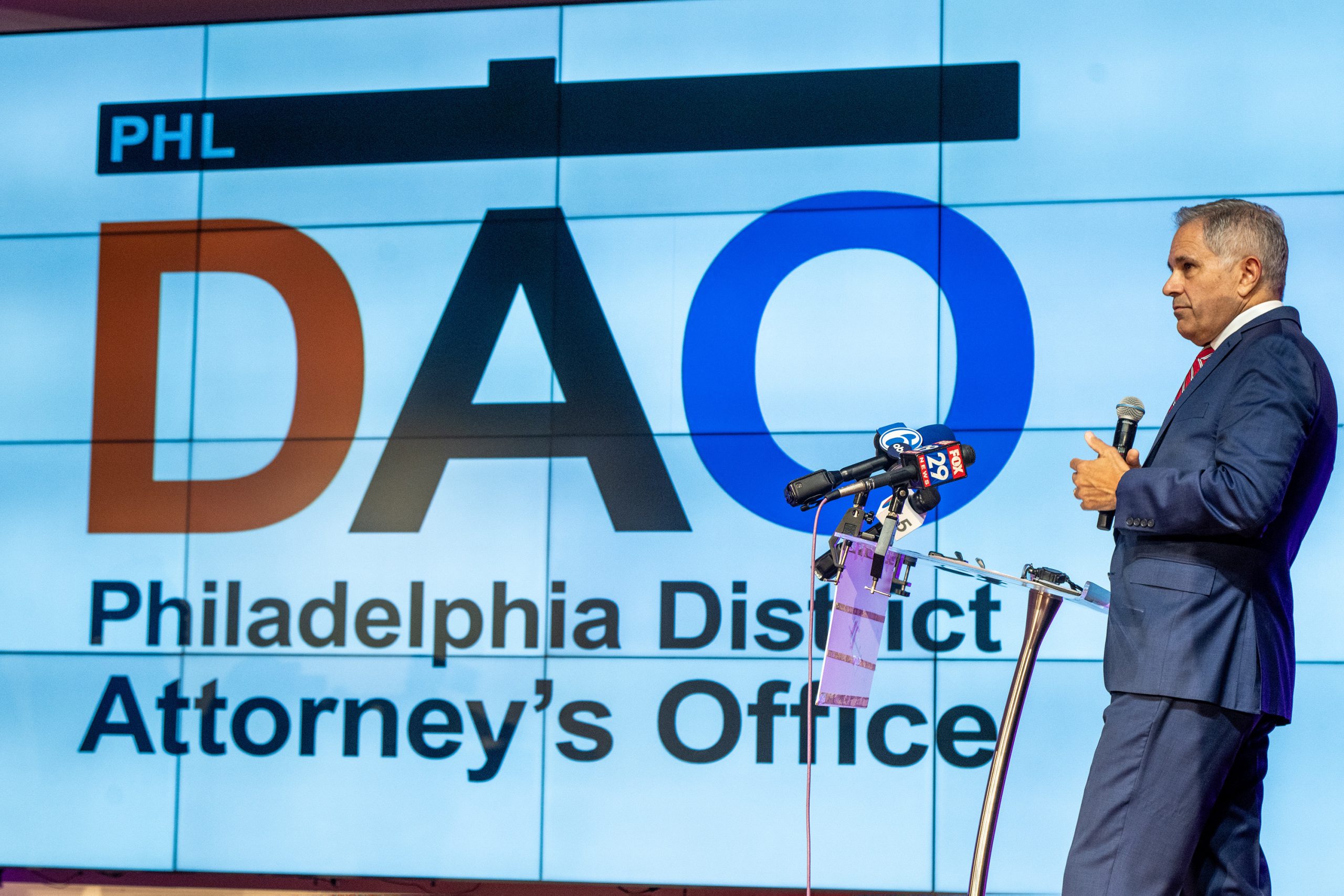
    In June, the state Supreme Court ordered Pennsylvania’s attorney general to be allowed to review future cases in which Krasner’s office is seeking to overturn a conviction.Tom Gralish / Staff Photographer

    After his conviction, Brown’s attorneys said some earlier witness statements were not provided to his trial lawyer, which violated his right to a fair trial. Krasner’s office agreed and argued that the case file revealed a “pattern of prosecutorial misconduct” and requested Brown receive a new trial.

    But lawyers for the families of Richardson and a second man Brown was convicted of killing in a separate incident asked the state Supreme Court to intervene.

    Lawyers for the victims’ families argued that Krasner had a conflict of interest because two of his former law partners had been involved in Brown’s case.

    The high court ordered a hearing that shed a harsh light on the conduct of Krasner’s prosecutors.

    “We find the [district attorney’s office] … violated its duty of candor to the [Post Conviction Relief Act] court, withheld material evidence from the court, opposed efforts by [the victims’ families] to gain access to this evidence, submitted a false stipulation of fact, misstated facts in its pleadings, failed to conduct a reasonable investigation, and opposed a required evidentiary hearing,” Dougherty wrote.

    Whoa. What the heck is going on?

    The Supreme Court also found the prosecutors filed a joint document with Brown’s attorneys that “was false in multiple respects.”

    The court rejected claims by the DA’s office that it conducted a thorough review of the record in the case. Instead, the court said prosecutors “cut corners” and failed to interview a single witness or any of the original investigators involved in the case.

    The DA’s handling of Brown’s case is troubling enough. But it turns out this was not a one-off blunder. The Supreme Court found the case fit a disturbing pattern.

    “There have been numerous instances of untrustworthy concessions, lack of candor, misrepresentations of fact, lack of adequate investigation, and avoidance of hearings,” the opinion said.

    The Supreme Court went on to highlight problems with the DA’s handling of 10 additional cases, and said there may be many more.

    One case involved efforts by Krasner’s office to overturn the death sentence of Robert Wharton, who was convicted in the 1984 strangulation and drowning deaths of a couple in their East Mount Airy home, leaving their then-7-month-old child alone. She survived.

    The case eventually ended up before a three-judge panel of the U.S. Court of Appeals for the Third Circuit. In a unanimous decision, the panel found that Krasner’s office misled the court and “slant[ed] the facts” surrounding Wharton’s case before a lower federal court in 2019 in an attempt to vacate the death penalty and instead let Wharton remain in prison for life.

    Again, with the lack of candor.

    U.S. District Judge Mitchell S. Goldberg denied the request and imposed penalties that required Krasner to write a letter of apology to the family of Wharton’s victims, which the appellate panel found were both “mild and fitting.”

    “Courts rely on lawyers’ honesty; lawyers may not mislead them,” Circuit Judge Stefanos Bibas wrote in the panel’s March 2024 opinion. “But the Philadelphia District Attorney’s Office did just that.”

    Back to the state Supreme Court.

    After highlighting problems with the Brown case and 10 others, the court wrote, “These cases, and the present one, likely represent only a fraction of the [district attorney’s] problematic concessions since January of 2018.”

    The court said many of the DA’s concessions did not include hearings in which sworn testimony from both sides is presented, which the court wrote “is generally the best means to expose problems and ensure a reliable and just outcome.”

    For his part, Krasner was unrepentant. He issued a video statement following the Supreme Court opinion that leaned on his electoral victories to claim the ruling “undermines the value of a vote in Philadelphia as compared to every other county.”
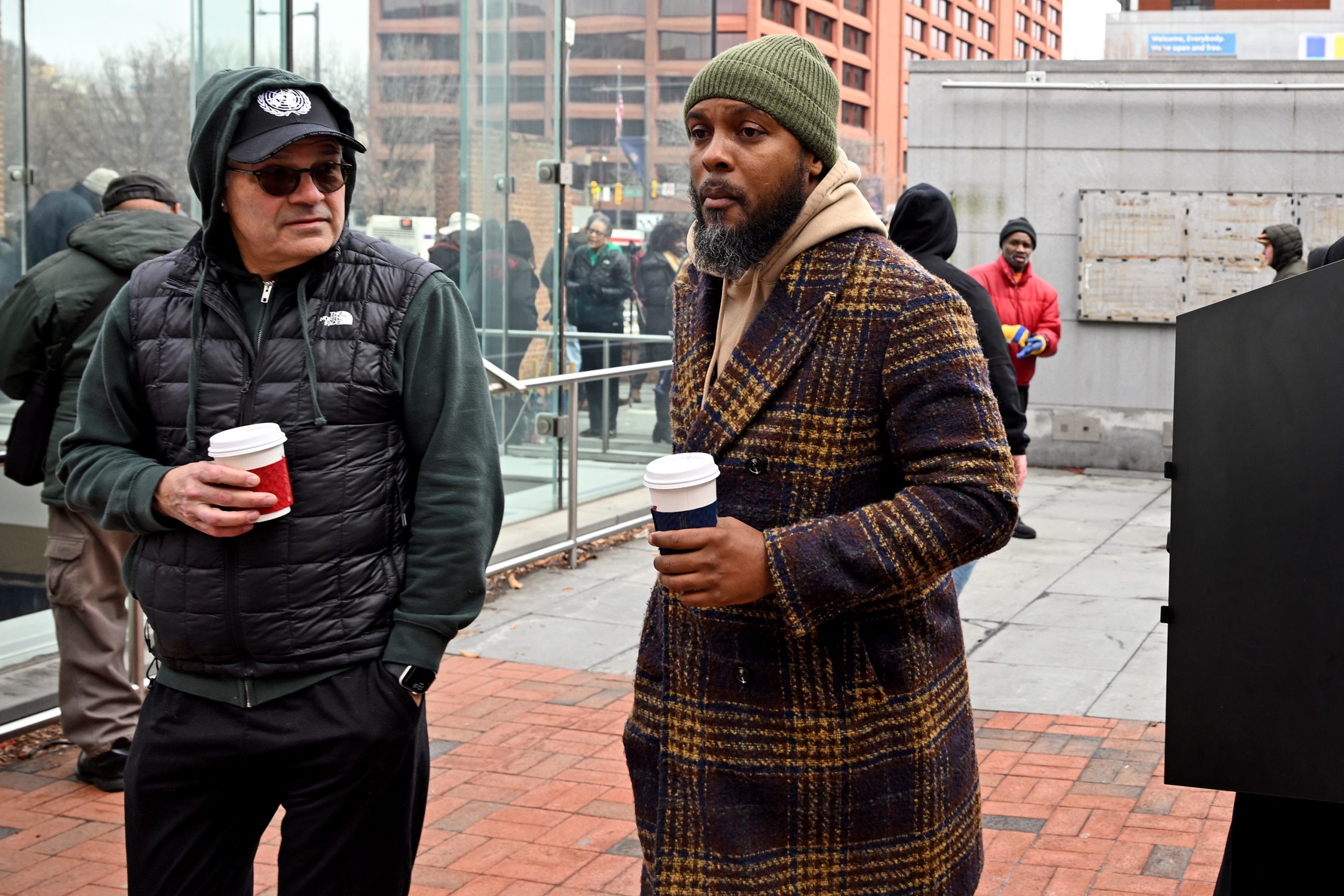
    District Attorney Larry Krasner (left) and G. Lamar Stewart, head of the community engagement and government affairs division, at Independence National Historical Park in February.Tom Gralish / Staff Photographer

    Krasner added that social justice efforts like his often face a familiar pattern of resistance: “First they ignore you — we’re past it. Then they laugh at you — we’re past that. Then they fight you — and we have been fighting for 8½ years.”

    The district attorney’s website trumpets 59 “exonerations” by the Conviction Integrity Unit created by Krasner. But the National Registry of Exonerations said the total number of exonerations by the DA’s office during Krasner’s tenure is 75 — an extraordinary number given that reversing a conviction faces a high bar and often takes years.

    Nearly all of those set free have been Black men, underscoring how the legal system is often stacked against people of color. At the same time, no new charges have been brought in those cases, leaving killers and other wrongdoers walking the streets.

    There is no denying systemic racism exists across our legal system, including in Philadelphia. I witnessed abuses and failures of cops, prosecutors, lousy defense attorneys, eyewitness misidentifications, and forced confessions up close as a reporter covering the courts years ago for the Wall Street Journal.

    I wrote a story about a Latino man who was convicted of murder in the Bronx, N.Y., despite having a solid alibi: On the night of the murder, he was in prison in the Dominican Republic.

    That’s all to say wrongful convictions happen, and sending someone to prison for a crime they didn’t commit — or worse, putting them to death — is the most heinous abuse of the legal system imaginable.

    That’s why I welcomed Krasner’s efforts to review cases in which misconduct or errors may have occurred.

    But the sloppy work by Krasner’s office has undermined his theory of the case. Sadly, those who have been truly wrongfully convicted will be the ones to suffer because judges will no longer trust the DA’s office.

    When judges in state and federal courts and former prosecutors in Krasner’s own office are citing similar patterns of corner-cutting and lying, there is a serious problem.

    Krasner built his career on demanding accountability from the system. He owes Philadelphians no less from his own office.
  • Krasner misses a chance to send a message against violence on SEPTA | Shackamaxon

    Welcome to Shackamaxon, a weekly politics column focused on what’s happening at City Hall and in Harrisburg. It is named for the place where the Lenape chiefs would meet to conduct the people’s business, which is now known as Penn Treaty Park.

    This week’s edition questions a plea deal, looks at Center City’s efforts to bring back daytime foot traffic, and examines the legacy of the Philadelphia wage tax.

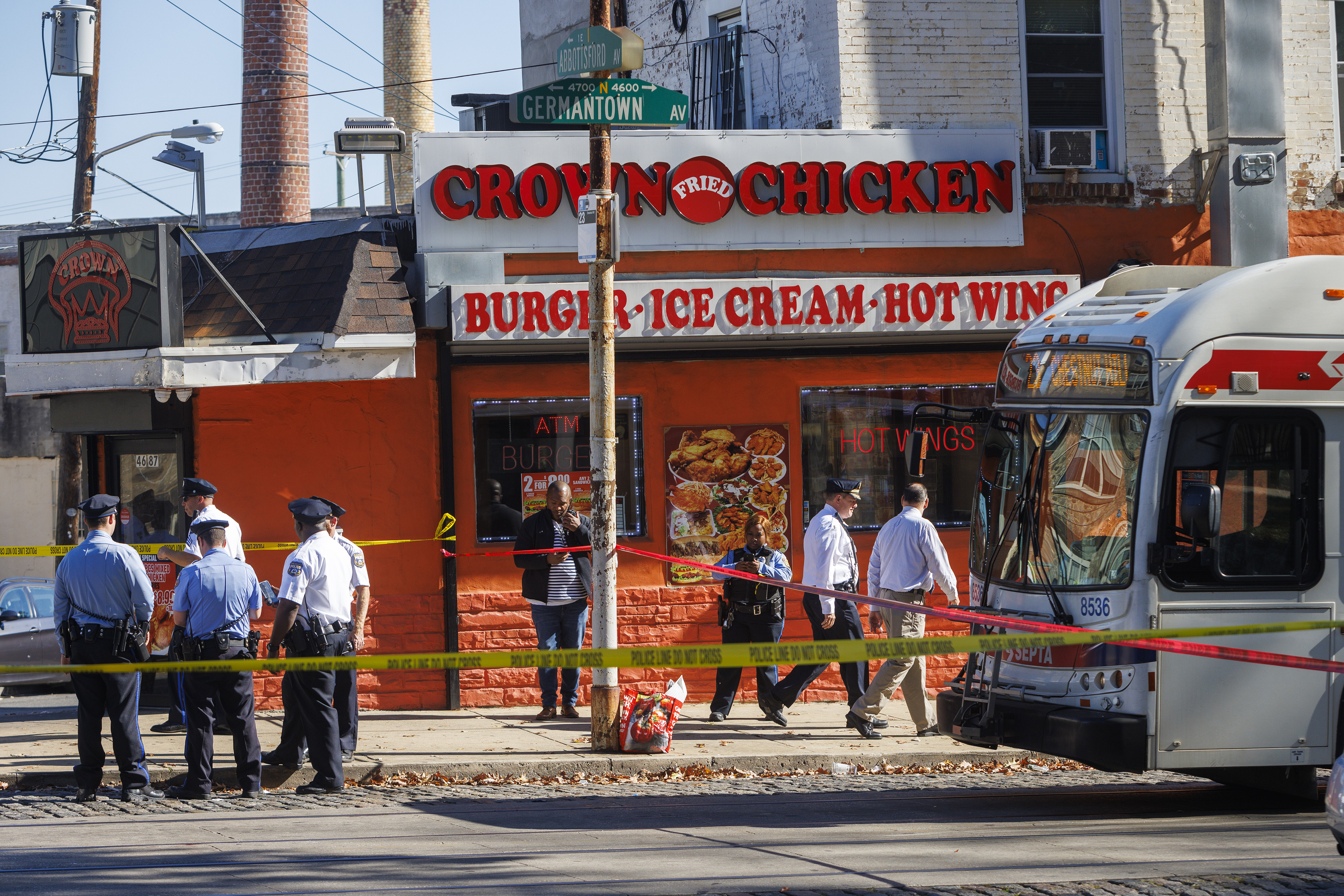
    SEPTA Transit and Philadelphia Police at the scene of the fatal shooting of SEPTA bus driver Bernard Gribbin in Germantown in October 2023.Alejandro A. Alvarez / Staff Photographer

    Deterrence desired

    On Oct. 26, 2023, Bernard Gribbin became the first city transit operator to die by gunfire while on the job. Family members called him “the best of the best,” and described the 48-year-old Army veteran as a man who loved Philadelphia, who proudly took out-of-town relatives on tours of the city when they came to visit, and who served the public by working as a bus operator — a demanding, underpaid, and utterly essential job.

    Gribbin’s murder sent shock waves through the city’s transit agency. His colleagues were left angry and afraid.

    Around that time, reporting from Mensah Dean at the Trace identified a spate of attacks against public employees. During the next contract negotiations, the Transport Workers Union demanded SEPTA install bulletproof glass to protect drivers. Operators report that management, which has long emphasized de-escalation, became even more strict about the kinds of interactions bus drivers and train conductors are permitted to have with unruly passengers. For many, this undermined their sense of stewardship of their vehicles.

    The death of Gribbin seemed like a case in which prosecutors could send a message that violence against SEPTA workers will be met with serious consequences. Instead, District Attorney Larry Krasner opted to accept a plea bargain.

    Gribbin’s killer, Zhontay Capers, was able to secure a conviction for third-degree murder this week, rather than first, which was her original charge. Pennsylvania law defines first-degree murder as a willful, deliberate, and premeditated killing. Given Capers shot six times and that surveillance video showed her with a firearm shortly before the shooting, there would seem to be a strong case.

    Of course, there could be complications I don’t know about. Perhaps another passenger was armed, a witness recanted, or Capers stood a good chance of being declared incompetent to stand trial. Prosecutors often accept plea deals in cases in which going to court presents too much risk.

    Yet, Krasner’s office refused to comment on any of these possibilities when asked. Instead, they called it an example of individual justice. Capers now faces up to 40 years in prison, rather than a life sentence. Unlike Gribbin, she may one day again enjoy the unfettered company of friends and family.

    Of course, individual justice is important. And if the circumstances of a particular case merit a third-degree charge, then so be it. But Krasner has not provided any additional information or shed any light on his office’s decision-making.

    Every killing is a tragedy that deserves justice, but Gribbin’s death had a magnified impact. Capers’ actions also caused public servants to be fearful of coming into work, and resulted in millions of dollars’ worth of unplanned spending in installing the protective glass.

    The public deserves a fuller account of why the plea deal happened.

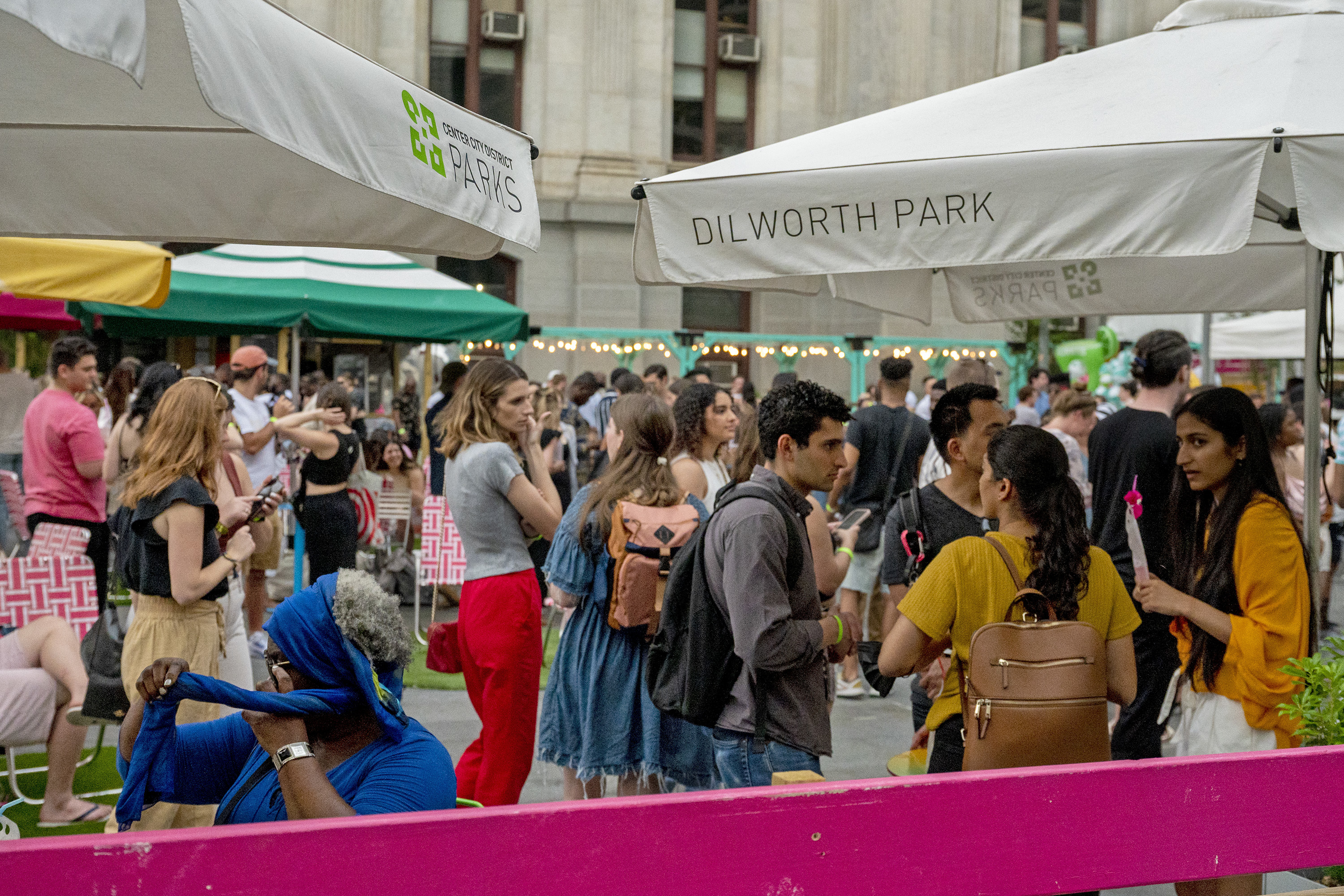
    Happy Hour at the Air Grille Garden at Dilworth Park in 202, part of the midweek Center City District Sips after-work events.TOM GRALISH / Staff Photographer

    Eventful days

    Like most big city downtowns, Center City is a major employment hub. More than 300,000 people work there, representing around 42% of jobs in Philadelphia.

    According to Clint Randall, the vice president for economic development at the Center City District, the amount of downtown office space has remained relatively stable for decades. That’s despite the rise of residential conversions and remote and hybrid work arrangements. Still, people are coming to the office less often, and momentum on bringing workers downtown on a more regular basis has stalled.

    Thankfully, Randall and his colleagues have a plan to ensure the city’s commercial core remains as essential as it can be by leveraging its status as a regional host, with events seen as both a short- and long-term way to make Center City more vibrant.

    Randall cited Center City Sips as a way to bring more people into town on Wednesday evenings during the summer. Philadelphia Open Streets, the FIFA World Cup, festivities around the MLB All-Star Game, and other smaller events have proved a major boon. They’ve brought out not just those who live and work in Center City, but also people from around the region and the world who may not otherwise have had a reason to come.

    I asked Randall about the potential for event fatigue among locals. With Center City adding thousands of new residents each year, would this create pressure to draw down on hosting? Randall said that vibrancy is what brings many people to live downtown in the first place. As inconvenient as it can be to live next to major festivals, it is also a major amenity.

    My own experience bears this out. I may not have made it to the Eagles’ Super Bowl parades if they hadn’t marched down Broad Street, not far from my South Philly home. Our friends and family also enjoyed the convenience of having a place to sit down and use a nonportable restroom.

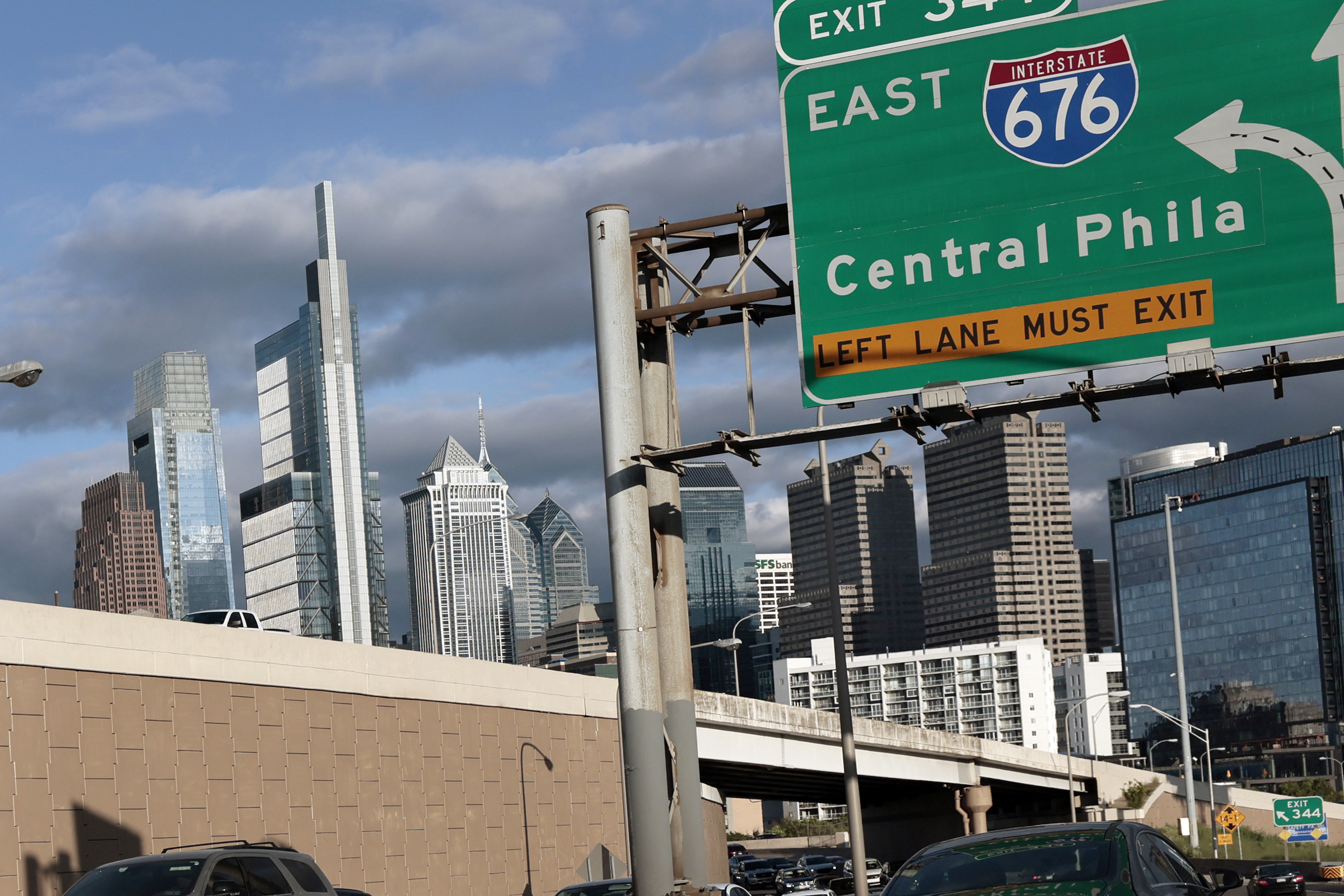
    A view of the Center City skyline as seen from the Schuylkill Expressway, where it intersects with the Vine Street Expessway, in May.Elizabeth Robertson / Staff Photographer

    Tax switch

    When Philadelphia became the first American city to institute a wage tax all the way back in 1940, the idea seemed like a no-brainer. After all, where else were people supposed to work? Suburban rail stations were packed to the brim with commuters, the Interstate Highway System did not yet exist, and anyone who wanted access to skilled workers had little choice but to open offices in Center City.

    Today, however, the region looks different.

    While Center City remains a major regional hub, Philadelphia has lost tens of thousands of jobs to suburban office parks. Most Delaware Valley residents drive themselves to work, and hundreds of thousands of people have moved to the suburbs. This has left us with an important policy question: How much of this shift is simply due to national cultural trends, and how much of it was caused by public policy?

    A new study from René Livas and Matthew Jacob at Harvard University, working with the Progress and Poverty Institute, attempts to answer this question. They say there is a clear link.

    As the wage tax rate rose between 1940 and 1976, jobs fled to the suburbs. Since City Hall began decreasing the tax in 1995, jobs have started to flow back into Philadelphia. In fact, the city recently overtook Montgomery County as the top host for office jobs in the region.

    The researchers’ proposal for replacing the wage tax is based around switching to a land value tax, an idea that is popular among economists. Separate tax rates for land and property are already legal in Pennsylvania, and the city already splits the two in its own property assessments.

    The idea, however, may be politically fraught. Homeowners already resent the chaos of the city’s regular assessments. Additionally, determining how much of a property’s value is inherent to its location may be easier said than done. While an 80/20 split between structural and land value is often cited as standard, levying the two individually would require significantly more research from the city’s Office of Property Assessment.

    In an email, Livas suggested phasing in the switch, which would help avoid big increases. He also said that the city’s existing programs, like the homestead exemption and Longtime Owner Occupants Program, should help alleviate the burden on homeowners.

    The data suggests the city could add around 26,000 jobs if this reform is pursued.

  • Letters to the Editor | Aug. 7, 2026

    Letters to the Editor | Aug. 7, 2026

    Clean rivers

    A recent Inquirer article reported that Camden County is tackling a sewage problem in the Cooper River, with a real plan to make it swimmable.

    Does the Philadelphia Water Department have a plan for the Delaware River?

    I read in a recent PennEnvironment Research and Policy Center report that 12.7 billion gallons of untreated sewage and stormwater are dumped into the Delaware River every year. I’m glad I’m not a duck or a fish. I am, however, a Philadelphia resident who would enjoy recreating in our local waterways.

    The report also states that half of this sewage discharges from just 10 of 164 untreated outflow pipes. A relatively modest infrastructure investment could dramatically improve water quality for everyone who wants to paddle, swim, or fish here — not to mention the wildlife.

    I ask the Philadelphia Water Department to follow Camden’s lead and commit to a real plan to make the Delaware, the Schuylkill, and the streams that feed them clean and safe, even swimmable.

    Peter Furcht, Philadelphia

    . . .

    Sewage flowing into the Delaware River does not appeal to me, but untreated water has been flooding into our beloved waterways more and more due to the increased heavy rainstorms this summer. While Camden County has made commitments to cleaning up the Cooper River, Philadelphia is far behind. Our city has a combined sewage overflow system in which 60% of water pipes are used for both stormwater and sewage. When there are intense storms, both rain and waste flow into the river.

    According to a PennEnvironment report, this happened 65 times in 2025, with nearly 13 billion gallons of sewage overflow. This included 126 million gallons in Pennypack Creek alone, which flows near my house. Sewage contains viruses, parasites, and bacteria that carry the risk of illness to both people and animals who explore there.

    The Philadelphia Water Department must keep local rivers and creeks clean by improving infrastructure to deal with sewage overflow. In Camden County, there will be a voter referendum this fall concerning funding for a plan to fix this problem. Philadelphia can also find a solution. The Water Department should follow Camden County and implement a plan that makes our rivers safe for drinking and swimming.

    Judith Kotler, Philadelphia

    . . .

    Dozens of times throughout the summer, I receive alarming flash flood alert text messages informing me that very heavy rain is about to pummel my area and to seek shelter. I then worry about all the water flooding into the streets as it tries to flow into the storm drains, eventually overwhelming the sewage system, and polluting our rivers.

    What Philadelphians may not know is that the Philadelphia Water Department has a combined sewer system, which means that when heavy rains overwhelm the system, raw sewage mixes with stormwater and then flows untreated into a nearby river or stream. Sewage in our rivers puts people at risk of getting sick, harms our wildlife, and opposes the goal of the Clean Water Act. Research shows that contact with contaminated waterways less than 24 hours after a combined sewer overflow increased the risk of acute gastrointestinal illness by 39%-75%, compared with recreational activity more than 24 hours after an overflow.

    Philadelphia’s aging infrastructure wasn’t built for today’s population or the increasingly intense storms driven by climate change. The PWD needs to accelerate investments in green and gray infrastructure to rein in combined sewage overflows and protect public health, wildlife, and our waterways.

    One of my favorite summer activities is going kayaking, and this year I kayaked on the Delaware for the first time. I hope I will be able to enjoy recreating on the rivers that cradle Philadelphia for years to come.

    Emily Levine, Philadelphia

    Protect and serve

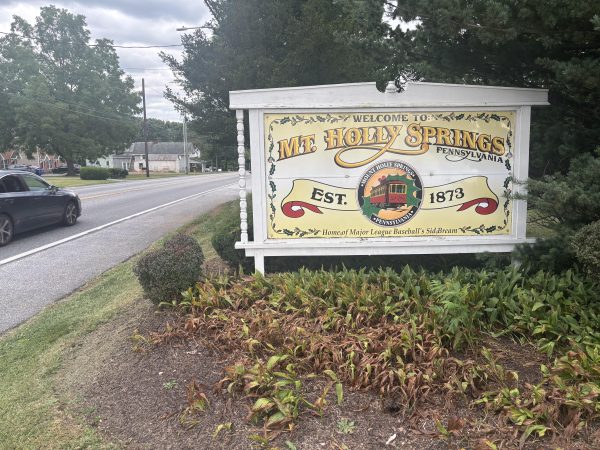
    Thank you for your multifaceted coverage of our immigration crisis. Will Bunch’s coverage of the immigration “speed trap” in Mount Holly Springs, Pa., evoked memories of the two opportunities I have had to work in cities with community policing. Officers took seriously their pledge to protect and serve, working to build community, encouraging all residents to call if they needed help, and to come forward if they had witnessed a crime. It was a win-win situation for police and the community they served. That is a different kind of police force than one willing to help capture Wu Shaoping and others like him, a force willing to fracture families for an extra allowance with little connection to road safety. For U.S. Immigration and Customs Enforcement, working with local police, delaying renewal requests of Deferred Action for Childhood Arrival (DACA) recipients and other immigrants in the process of improving their status makes more sense these days than continuing the work done in Minneapolis.

    ICE is helped by a partisan Congress and a U.S. Supreme Court willing to send Haitian families back to a country where the U.S. government has warned Americans not to travel, with “violence having left thousands dead and displaced more than 1.4 million people.”

    Clearly we have moved way beyond the “worst of the worst.” It is now the work of the electorate to protect and serve both our neighbors and our democracy.

    Thank you for keeping us informed.

    Sister Veronica Roche, Westmont

    Voter suppression

    Sen. Dave McCormick, Pennsylvania’s junior U.S. senator, has predictably taken exception to The Inquirer’s analysis of the SAVE America Act, which is currently before Congress. In a recent letter to the editor, he goes so far as to urge Inquirer readers to consider other sources of information for “a more thoughtful and honest appraisal of what the bill does.” According to the nonpartisan Brennan Center for Justice (presumably a reliable information source), if the SAVE Act were passed, it would block millions of eligible American citizens from voting. Viewed in a broader context, the SAVE Act is of a piece with other voter suppression measures being actively promoted by President Donald Trump and his allies. Such measures include wide-ranging congressional redistricting efforts, which are tantamount to state-sponsored, racist gerrymandering. More recently, Trump issued an executive order dictating new, restrictive standards for determining vote-by-mail eligibility, despite the lack of any lawful authority to do so. Any voter bringing common sense to bear on this issue (as McCormick recommends) must surely recognize that these tactics are more about improving the prospects of Republican candidates in future elections than about enhancing election integrity. In fact, earlier this month Trump gave away the game with the telling observation that, in the event the SAVE Act is passed, “we will not lose an election for 100 years.” In short, today’s GOP is fixated on maintaining majorities in both houses of Congress, by hook or by crook.

    Patrick J. Hagan, Ardmore

    Turn files into trials

    Remember how the Jeffrey Epstein files got released and nothing happened? Because they were in the wrong hands. On July 15, a bipartisan group of congressional representatives introduced HR 9694, the Epstein Files Transparency Act II, which allows state attorneys general and district attorneys access to the entire Epstein file. I and other activists have been advocating for this amendment since February because it addresses the two biggest roadblocks to “turning the files into trials”: 1) the fact that the U.S. Department of Justice has said (and demonstrated) it’s not going to prosecute — so turning the file over to a different set of prosecutors is the only way prosecutions are going to happen, and 2) the fact that a large body of highly probative evidence — the videotapes Epstein allegedly made of sex acts, which is evidence of crimes actually being committed, with perps recognizable with facial recognition software and timestamps that can establish the exact age of the victim — simply can’t be released to the public because of the graphic nature of that evidence. Giving the files to state AGs is the only way we’re going to get justice for the survivors, and establish that we, as a society, will never, ever, ever allow these crimes to go unpunished. If we really care about protecting children, we’ll pass this law.

    Linda Falcão, Baltimore

    Join the conversation: Send letters to letters@inquirer.com. Limit length to 150 words and include home address and day and evening phone number. Letters run in The Inquirer six days a week on the editorial pages and online.

  • In the American prairie, a stealth plan to end the GOP Senate majority

    In the American prairie, a stealth plan to end the GOP Senate majority

    South Dakota is a prairie state that voted more than 63% for Donald Trump in 2024, so it’s not the first place you’d look to find a wave of discontent over GOP rule. But deep under the state’s expansive corn and soybean fields grow the invasive roots of political rage.

    There’s the trade war that’s dried up demand for farmers’ crops while driving up the costs of essential items like fertilizer. Disdain for Trump has slashed the flow of Canadian tourists who once flocked to Mount Rushmore. There’s the same high gas and supermarket prices as in the other 49 states. And farmers who had liked the president’s border policies are now scared of losing workers to immigration raids.

    Doug Sombke, president of the South Dakota Farmers Union, recently told the Canadian magazine Maclean’s that some Dakotans now “see we got sold a bill of goods … They were told grocery prices were going to come down. Trump keeps leading them on, saying, ‘There’s gonna be some pain.’ I don’t think anybody was ready for this much pain, this soon.”

    In this brutal climate, one South Dakotan who probably should be bracing for pain is the mostly pro-Trump GOP Sen. Mike Rounds, a former governor seeking reelection to the Senate in November. And on Tuesday, Democrats hoping to oust Rounds from Capitol Hill got the big news that a lot of them were hoping for.

    The only Democratic candidate dropped out of the race.

    Huh?

    That’s right. In what may be the most counterintuitive political strategy in U.S. political history, liberal anti-Trump activists in politically red states west of the Mississippi have been pleading for obscure, long-shot Democratic candidates to abandon their races — so that spunky independent candidates can challenge the GOP one-on-one instead.

    When ex-state trooper and longtime Democratic activist Julian Beaudion told South Dakotans that, feeling pressure, he’s quitting the race, it cleared the path for independent Brian Bengs to consolidate the anti-incumbent vote in November. Polls suggest that the retired U.S. Air Force lawyer and college professor who was briefly a Democrat is already within striking distance of an upset.

    And he’s not alone. Democrats are also not running a Senate candidate in Nebraska — where a well-funded and well-known independent, labor leader Dan Osborn, is running again — or in Idaho, where Todd Achilles, a one-time Democratic lawmaker who left the party, is on the ballot. In Montana, an independent Senate hopeful is also hoping that a Democrat will drop out, but unsuccessfully so far.

    Casual political observers probably know that Democrats (and two allied independents) — currently in the Senate minority by a 47-53 count — are hoping Trump’s unpopularity will help their candidates run the table in five to six key contested states from Maine to Texas. But much less attention has been paid to this stealth backup plan — the notion that a few prairie populists can end the GOP majority.

    What’s truly remarkable about this scheme is that a growing number of Democratic strategists are making a tacit, not to mention uncomfortable, acknowledgment: In the American heartland, their party’s brand is in the toilet.

    That’s why a number of political activists believe the only way in these blood-red states to make the most out of rising voter anger against Republicans over high gas prices and Trump’s badly botched war with Iran is to offer voters an alternative without a “D” next to their name.

    Steve Hildebrand, a Sioux Falls-based political consultant who was a high-ranking official in Barack Obama’s 2008 campaign, is one of the Democrats who thinks that — despite voter unrest against the GOP — an independent has the best chance in South Dakota.

    “I think our party has gravitated too far away from fighting for hard-working Americans — you know, blue-collar workers, union workers,” Hildebrand told me this week. “You know, we’ve been fairly pathetic about a unified party message, and frankly, we’ve been pathetic about beating back on Donald Trump.”

    Still, most of the political agenda of the western independents is larded with a modern brand of prairie populism that feels like a first cousin to the left-wing progressivism of Democrats — like Michigan’s Abdul El-Sayed — who’ve been scoring 2026 victories in blue states. They are strongly against billionaire influence in politics while advocating for healthcare reform and progressive ideas about making life more affordable.

    “Getting money out of politics to the maximum extent possible would be the single biggest accomplishment I think of my career and of Congress,” Bengs told Independent Voter News. “And I’d also like to get healthcare affordable, so people don’t have to worry about, ‘Don’t call the ambulance, because I can’t afford that.’”

    So why not run as a Democrat, when so many of his proposals overlap? Bengs did join the Democratic Party to challenge South Dakota’s other GOP senator, Majority Leader John Thune, in 2022, and after losing by 27 percentage points, he said he’ll never do that again.

    He said at county fairs and parades he met voters who liked his ideas, but told him, “I’ll never vote for a Democrat.” “Sometimes there was an expletive in there. The takeaway was that the letter was more important than what I was saying.”

    “Democrats are simply not competitive in at least 20 states, maybe more.” Larry Sabato, the University of Virginia political scientist and veteran analyst, told me. He said independent races can be a way to win in these red states, but the candidate needs to break with the Democrats on some issues and show themselves as a true outsider.

    Sabato said Republican dominance of prairie and mountain states can end up with “voters getting fed up with the ruling party, and desiring a switch so badly that they’ll hold their nose and defect. I suppose it is easier to vote for an independent.”

    Except that clearing the political field to create the desired one-on-one race between a Republican and such an independent upstart is proving to be not so easy.

    Experts like Sabato say the strongest independent Senate candidate might be Montana’s Seth Bodnar, a former University of Montana president and Army veteran. But the Democrat who’s on the ballot in Big Sky Country, Alani Bankhead, told Politico last week that she would abandon the race only “if a lightning bolt from God struck me” — an unlikely event even in this summer of wild weather. Polls suggest the Republican, Kurt Alme, would easily win a three-way race against both Bodnar and Bankhead.

    The process in South Dakota was just as messy. The Democrat, Beaudion, also had been insistent he would not withdraw before Tuesday’s deadline, when he alleged that he and his family faced “intimidating threats to drop out of the race,” and gave no indication he would support Bengs’ campaign.

    The best chance for knocking off a GOP incumbent remains Nebraska. Osborn, who rose to prominence as the union leader of a high-profile strike against the food giant Kellogg’s, got nearly 47% of the vote against Sen. Deb Fischer in 2024 when Trump was on the ballot. In 2026, he’s poised to capitalize on the president’s fading approval as he challenges another incumbent, Sen. Pete Ricketts.

    “If you believe that billionaires, like Elon Musk, George Soros, or Pete Ricketts, should not be allowed to buy anything they want, including private islands for sex trafficking, and our elections, and our votes, then send them a message in cash and vote for me,” Osborn told a recent town hall. The most current poll, conducted in May by Tavern Associates, showed Osborn winning by 5 percentage points.

    Still, it’s an uphill climb for many of these prairie independents. Incumbents like Rounds, Ricketts, and Idaho’s 83-year-old Sen. James Risch enter their races with an unshakeable base of MAGA Trump supporters, and they’ll have millions of dollars for ad campaigns that will surely portray their opponents as liberal Democratic wolves in sheep’s clothing.

    There are also a ton of questions about what will happen if any of them win in November. Would they join the two current independents, Vermont Sen. Bernie Sanders and Maine Sen. Angus King, in caucusing with the Democrats? (Osborn has explicitly said he will not.) Whom would they support for majority leader, with a likely challenge to the current top Democrat Chuck Schumer? Would they vote mostly with Democrats, or take contrary, libertarian stands on issues like gun control, in line with voters back home?

    The biggest question for Democrats, however, might be the long-term one: How will yanking so many candidates in 2026 help the professed goal of rebuilding a Democratic Party that some day will be viable in all 50 states? That will have to wait until the political derecho of disgust with both parties blows past.

    “There’s just a lot of different stripes out there right now, and I don’t think that’s a bad thing,” Hildebrand said. “I think the Democratic Party and the Republican Party both have terrible brands. I think you know that it’s their own fault. It’s not the fault of voters.”

  • Film attendance has been diminishing, but not at BlackStar. It’s bigger than ever.

    Film attendance has been diminishing, but not at BlackStar. It’s bigger than ever.

    Across Hollywood, industry leaders are cheering the “return” of summer moviegoing.

    Last month, Variety published a cover story titled “The Box Office Bounces Back,” which celebrates attendance levels not seen since before the COVID-19 pandemic, and a projected $10 billion in domestic profits this year. Carried both by blockbusters like The Odyssey and lower-budget hits like Obsession, the article claims that “everyone had it wrong” about the cinematic appetite of Gen Z and the future of the art form. Actor/director Seth Rogen finds a “sense of optimism” among studio heads that mirrors “how it felt 15 years ago.”

    Yet, buried at the end of the effusive piece is the familiar admission that “industry watchers” also know that ”there aren’t enough films geared to women or Black or Hispanic ticket buyers.”

    Nehad Khader, the BlackStar Film Festival director, at the 2020 festival at the Mann Center for the Arts in Philadelphia.Daniel Jackson

    Which begs the question: To where — or to what — exactly do they want us to return?

    Experts in the article and elsewhere credit the apparent shift in cinematic habits to a generation raised on YouTube and Letterboxd that is now antsy to get off their phones, for the apparent shift in cinematic habits. But it remains unlikely that the most influential voices behind internet culture — namely Black creators — will be the ones to benefit from these observations.

    Maori Karmael Holmes, the founder of the BlackStar Film Festival and current chief executive and artistic officer of BlackStar Projects, at the BlackStar Film Festival at the International House in Philadelphia in 2015.Daniel Jackson

    Despite the fact that people of color bought the majority of opening weekend tickets for five of the Top 10 films released in theaters last year (including Ryan Coogler’s Sinners), and specifically represent “the majority of the audience share” for the most profitable genres of film (horror and animation), most of the mainstream excitement around the rising fortunes at the box office has focused on white directors like Backrooms’ Kane Parsons.

    At the BlackStar Film Festival, we’ve felt the disconnect between the cinematic doomsayers of the past few years and the reality on the ground at our festival, which also started 15 years ago and has substantially grown since the onset of the pandemic.

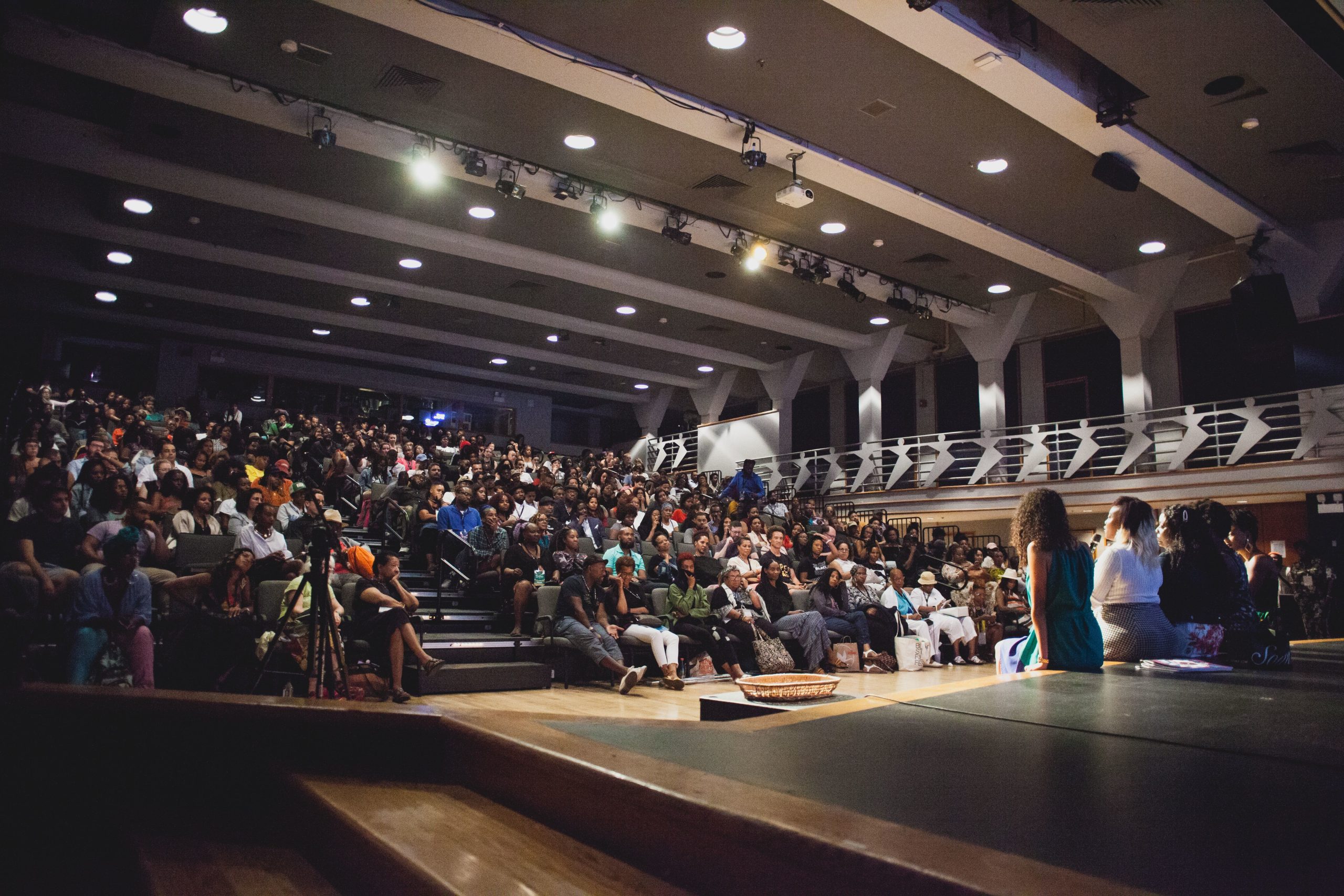
    The audience at the 2024 BlackStar Film Festival at the Kimmel Center’s Perelman Theater in Philadelphia.Daniel Jackson

    In 2024, while the same publications were fearing disaster based on still-dipping box office receipts, we were experiencing record attendance in Philadelphia at a festival where masking was still required. This included a sold-out screening of Shatara Michelle Ford’s Dreams in Nightmares on opening night that brought over 500 people into the Kimmel Center to watch the world premiere of a feature film rooted in Black queer culture.

    Director, producer, and writer Shatara Michelle Ford (left) and actor and singer Denée Benton at the 2024 BlackStar Film Festival at the Kimmel Center in Philadelphia.Daniel Jackson

    It was an unforgettable moment of intergenerational joy and community safety that felt very much like the future of moviegoing to us.

    We’ve never doubted the desire for the kind of space that BlackStar provides, but we have felt, like many sister organizations in the field, the impact of a film industry with limited imagination that’s still reliant on very narrow measures of “success.”

    In 2014, Nehad Khader (left) and Jacob Winterstein at the BlackStar Film Festival at the International House in Philadelphia. Khader first became involved with BlackStar as a volunteer, but later took on programming and senior roles within the organization, and now serves as the festival director.Jati Lindsay

    Funding for our nonprofit, BlackStar Projects, started to dwindle in 2024, not based on our numbers — which were, again, on the rise — but based on a lack of corporate interest in Black independent cinema after an initial influx of support during the racial reckoning that followed the killing of George Floyd in 2020.

    As much as things change in Hollywood, they seem to stay the same — or at least attempt to return to the median.

    Former MOVE members and independent filmmakers Mike Davis Sr. and Debbie Davis at the 2021 BlackStar Film Festival at the Annenberg Center for the Performing Arts in Philadelphia.Daniel Jackson

    Which is why box office results have always been an imperfect indicator of film trends or what audiences crave. Especially if you’re interested in building a sustainable, care-based ecosystem for filmmaking which challenges rather than sustains the status quo.

    A more interesting question than which movies make the most money, particularly given the state of the world, is which movies are contributing to real change? Which filmmakers can speak to and for the people working to free us from white supremacist capitalism?

    As we celebrate the 15th edition of the BlackStar Film Festival this week, we have ample evidence that what Black, brown, and Indigenous communities want is a space that actually brings us together around such movies; not just to watch, but to talk, critique, celebrate, learn, laugh, and cry.

    The 2025 audience at the BlackStar Film Festival at the Kimmel Center Perelman Theater in Philadelphia.Daniel Jackson

    In 2025 we started using the tagline “Cinema for Liberation,” but from the beginning BlackStar has been committed to building environments where films are seen as tools for broader social change. And we’ve watched our audience expand even as we’ve stuck to our values and insisted on centering care amid the most challenging moments.

    Maybe flying under the radar is how we have managed to sustain this for so long, but nevertheless, if the film industry is truly looking for a model on how to build and retain an audience long term, they could try looking here.

    The BlackStar Film Festival producing committee (from left to right), Louis Manon, Lauren Jane Holland, Maori Karmael Holmes, Nuala Cabral, Nehad Khader, and Lendl Tellington at Pipeline Philly in 2015.Gralin Hughes

    We pride ourselves on our curation, facilitated by some of the world’s greatest programmers, but there’s no doubt that the context in which our films play is just as important. Too many of those in charge of arts institutions have devalued the importance of safety, in the physical and emotional sense, referencing the losses of the pandemic without thinking of the mass loss of life.

    The pandemic wasn’t a business problem to solve, but rather a health crisis to adapt to, compounded by racist, misogynistic, and oppressive state policies that made — and continue to make — it frightening to gather in large groups. What our model proves, though, is that leaning into your politics rather than shying away from them is a pathway to keeping your audience coming back, summer after summer.

    From left to right, BlackStar Film Festival director Nehad Khader; MacArthur Prize winner, filmmaker and Scribe Center founder Louis Massiah; Venezuelan film director and editor Monica Henriquez; Emmy Award-winning composer and drummer Jerome Jennings; and Eleanor Traylor, scholar and chair of the department of English at Howard University, during a panel presentation on the work of Toni Cade Bambara, at the 2025 BlackStar Film Festival at the Kimmel Center Perelman Theater in Philadelphia.Daniel Jackson

    This looks like a goal of making every screening as accessible as possible, giving a documentary about the formidable late cultural worker and author Toni Cade Bambara the spotlight moment at the 2025 festival — knowing her ideas would speak to the moment — or by leaning into our values and showing up in solidarity with our people in Haiti, Palestine, Sudan, and beyond, in these moments of human-made catastrophe and genocide.

    It also means, since 2012, paying filmmakers and thinkers in a way that feels respectful, knowing that many of them are not making back the money they’ve spent to produce their work.

    It’s not only BlackStar that makes this radical space possible, but the vibrant organizing and artistic history in Philadelphia. As outlined in Robin D.G. Kelley’s Freedom Dreams, there has been a legacy of Black internationalism in our liberation movements — specifically so in Philadelphia.

    The crowd at the BlackStar Film Festival at the International House in Philadelphia, 2019.Daniel Jackson

    By Black internationalism, we mean a global, transnational framework in which Black Americans connect our struggles to those of worldwide anti-colonial liberation movements. For example, this fall we’re proud to launch the “People’s Cinema Club” at the Village of Industry and Art, a weekly film series in collaboration with some of the city’s diverse independent cinema organizers, including cinéSpeak, the Philadelphia Asian American Film Foundation, and the Philadelphia Latino Arts and Film Festival.

    At BlackStar, we’re not interested in returning to a Hollywood system that was built to exclude and demean us, but we are invested in learning from our elders and ancestors who have been using moving images to expand our vision since the advent of the art form.

    What we find in that archive is a long history of independent screenings, festivals, and organizing around cinema as a tool to dream bigger and organize together, across racial and class lines. We see the filmmakers of color we platform not just as artists, but as the architects of the better world in which we want to live.

    The 2026 BlackStar Film Festival takes place from Aug. 6 to 9, at venues across the city. For a full schedule of events, click here.

    Maori Karmael Holmes is the founder of the BlackStar Film Festival and chief executive and artistic officer of BlackStar Projects. Nehad Khader is the BlackStar Film Festival director.

  • Before the Phillies could sell you a beer, fans were throwing them at the umpires

    Before the Phillies could sell you a beer, fans were throwing them at the umpires

    The Phillies tell me they sell more than 40 brands of beer, priced from $6.99 for a 12-ounce can of nonalcoholic beer to $17.69 for a 24-ounce premium can. Beer is everywhere at Citizens Bank Park, including at a humongous walk-through cooler on the main level.

    I recently strolled into that cooler and found a lager — at $38.48 for two 19-ounce cans — that paired nicely with chicken fingers and the Fightin’ Phils. OK, so 64 ounces of the exact same beer costs $11.99 at Acme, but you can’t watch the Phils live from Acme, can you?

    “Sometimes, things become clichés because they’re true: A cool beer on a warm summer day at the ballpark is among the great joys of fandom,” says the avuncular Glen Macnow, the former Inquirer reporter (and colleague) and sports talk-show host whose What’s Brewing PA beer show appears on the NBC Sports Philadelphia networks.

    Macnow — who is, full disclosure, also the part-owner of Conshohocken Brewing Co., which vends two of its brands at the ballpark — adds: “I’ve spent many an afternoon (or evening) with a beer in one hand, a hot dog in the other, juggling both so I can fill out the scorecard balanced on my knees.

    “Those are simple and eternal pleasures. Baseball isn’t designed for trendy cocktails in a can; it’s designed for the tradition of leisurely enjoying a cold brew over several innings as you try to convince the guy in the next seat that the manager (whoever he is) is the dumbest one in Phillies history.”

    OK, but just in case you don’t care for a brewski, the Phillies also sell about a dozen different trendy cocktails in cans, with prices running from $14.55 to $23.99. These are no bargains, either, but consider the alternative: The Phillies used to not sell booze at all.

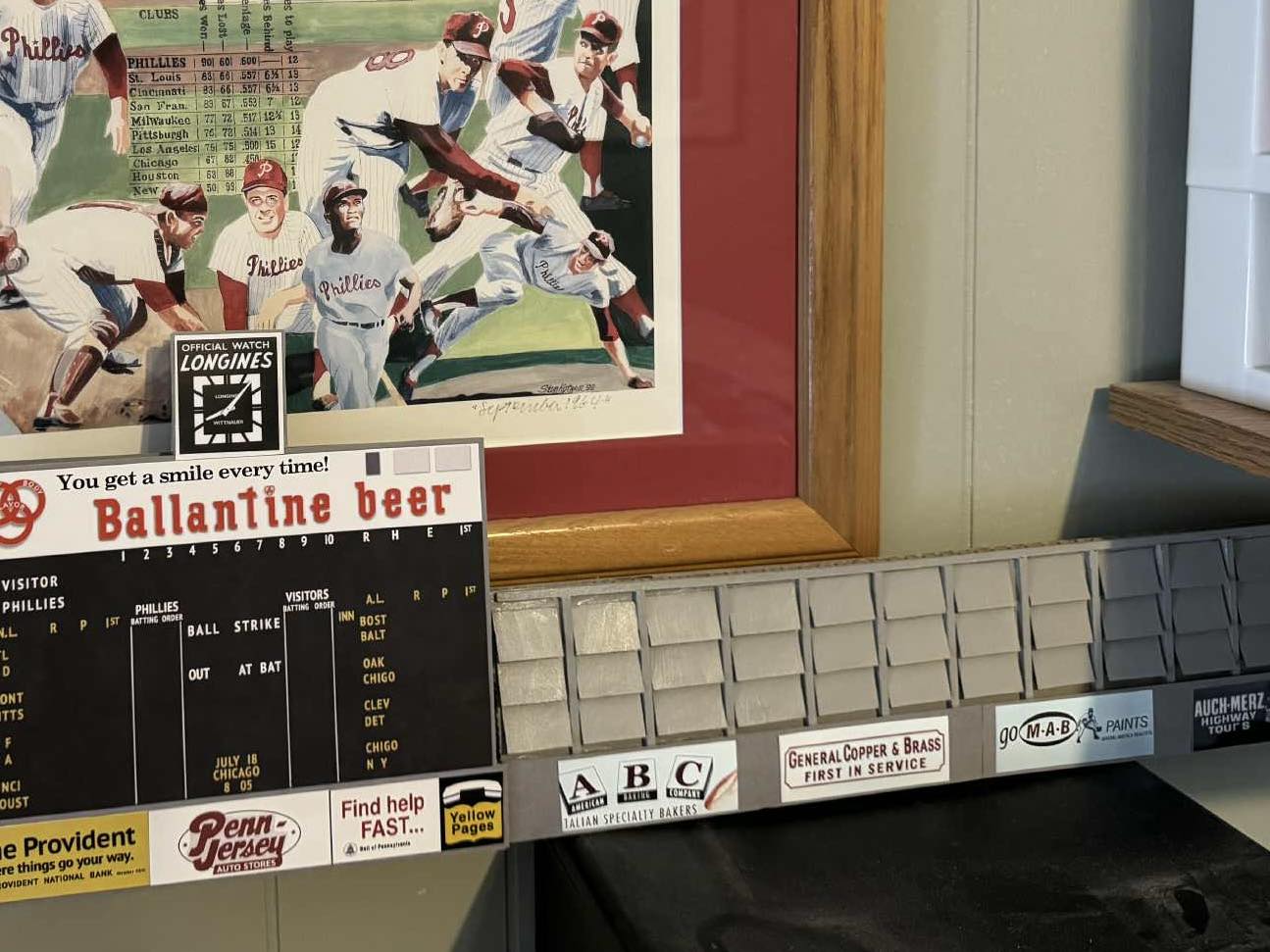
    Baby boomers like me vividly remember the towering, then-state-of-the-art right field scoreboard at Connie Mack Stadium, topped by a gigantic advertisement for Ballantine Beer (and its three-ring logo, for Purity, Body, and Flavor).

    A handmade model of the iconic Ballantine Beer scoreboard at Connie Mack Stadium by Phillies fan Bernie Valente.Courtesy of Bernie Valente

    Well, that scoreboard was erected in 1956, five years before beer was sold there.

    The Phillies first legally sold beer inside Connie Mack Stadium, their musty old park in North Philadelphia, on Aug. 7, 1961, when they put seven local brands of bottled beer on sale for 35 cents, first poured into a paper cup by eight vendors working the aisles.

    The paper cup was a vital part of the transaction, because, prior to legal sales, Phillies fans used to sneak in cans of beer, often sold in “cold packs” at nearby bars like Charlie Quinn’s Deep Right Field Cafe at 20th and Lehigh.

    Beer cans were heavier in those days, so they tended to become missiles when the umpires missed a call, or if the Phillies stank, which was quite often.

    The low point probably came on June 12, 1959, when a twi-night doubleheader against San Francisco was halted after five innings because of rain. The Phillies were no-hit — but even worse, fans were denied rain checks to both games because the first game was official.

    As Frank Fitzpatrick, the now-retired Inquirer reporter who attended the game as a 9-year-old, recalled in the paper in 2016: “Suddenly, one empty can fluttered toward the field. A second followed quickly. Soon, it was a dangerous deluge. So many were tossed that cans obscured the tarp, from the mound to the batter’s box.”

    That was not good news for Robert R.M. Carpenter, the Phillies owner, who dearly wanted a new ballpark for his team. Plans had been drafted for a 45,000-seat, $8 million stadium in the Torresdale section of Philadelphia, with an adjoining theme park, yacht basin, and bird refuge park adjacent to I-95. Beer sales would bring in some cash for that amazing project.

    On June 20, 1961, the Pennsylvania Senate passed a previously approved bill by the state House that would permit the sale of beer every day but Sunday at sporting events at stadiums in the state that seated more than 25,000. (The Pittsburgh Pirates also happened to be looking for a new ballpark.)

    But they faced stout foes. After voting against the bill earlier in 1961 that would have enabled the Phillies to sell beer, a Democratic state assemblyman from Philadelphia, Charles Heavey, predicted that the sale of beer would actually “contaminate” youngsters.

    So … first the beer had to be poured into a paper cup before drinking, preventing another beer can pileup on the field like the one in 1959. And there would be more than one starting pitcher: Schmidt’s, Esslinger, Old Dutch, Horlacher, Neuwiler and, yep, Ballantine were all included in the original sudsy rotation.

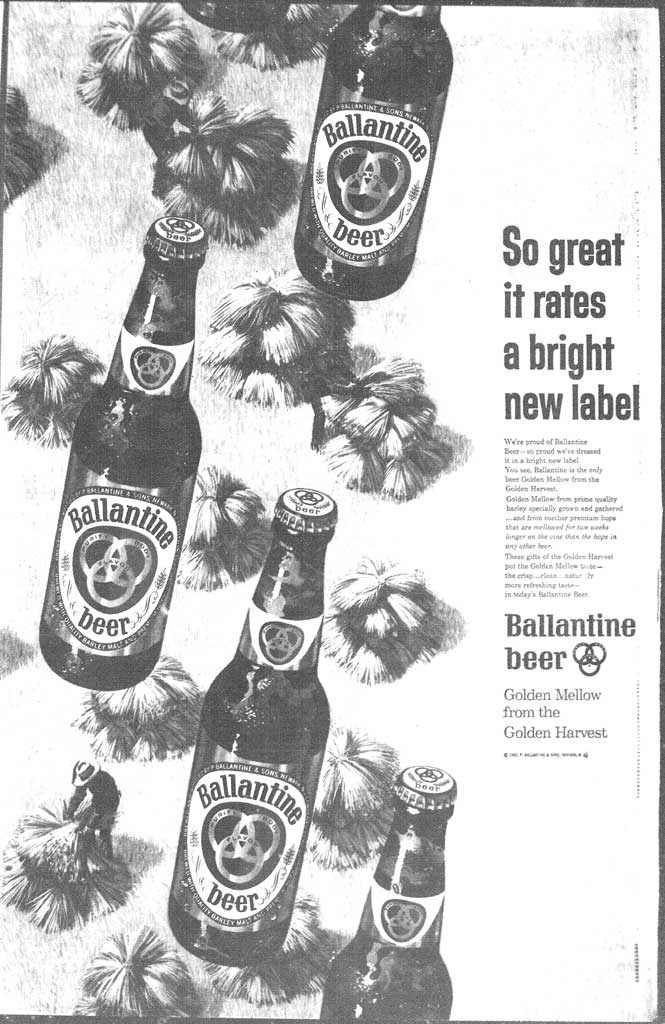
    A 1962 newspaper advertisement for Ballantine beer.

    Larry Merchant provided statistics in his Daily News column the next day: A total of 3,739 beers were served to 5,586 who attended that Aug. 7 game, a 3-1 Pittsburgh victory on a Monday, which was also the Phillies’ 10th straight loss. No bottles or cans were thrown on the field, he reported, but fans did pop the cups and try to throw those onto the field — often in vain.

    “For serious drinkers, it was about a four-beer game, just two and a half hours long,” Merchant joked. “For serious Phillies fans, it was a six-beer job. They look better that way.”

    Merchant made note of signs at the entrances that read, “Bringing in of canned beer or bottled beverages will be a cause for ejection from the park.” Nonetheless, he reported, seven would-be beer smugglers were caught at the gate, their brews returned when they left the park.

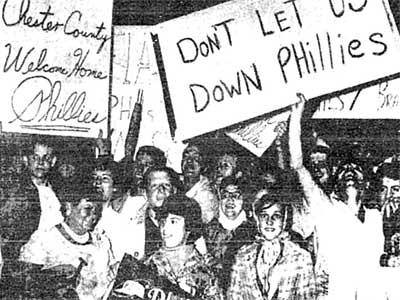
    Those 1961 Phillies were so lousy that their losing streak grew to 23 games, still a modern record. After the Phillies beat Milwaukee, 7-4, on Aug. 20 in the second game of a doubleheader, their flight home was welcomed by 500 fans at 1 a.m. the next day at the airport.

    About 500 Phillies fans welcomed the team home at the airport like conquering heroes after the club broke a 23-game losing streak in August 1961.

    “They are selling rocks at $1.50 a pail,” Phillies pitcher Frank Sullivan, looking out of the plane, joked to his teammates.

    He then wisecracked: “Leave the plane at five-minute intervals. That way, they can’t get us all with one burst.”

    In truth, the beer ploy sales did not seem to provide much of a boost to the 1961 Phillies, who lost 107 games and finished last in the National League in home attendance in 1961, averaging only about 7,600 per home game. But a door, or many brewskis, had been cracked.

    Beer would not be sold at Sunday home Phillies games until 1972, after the Phillies moved to Veterans Stadium, following the amendment of the ancient Pennsylvania Blue Laws, intended to curtail activities on Sundays (including Phillies and A’s home games until 1934).

    “My parents didn’t drink, so I always associated the public consumption of alcohol as something dark and troubling,” Fitzpatrick told me recently. “That feeling was confirmed in spades at that 1959 game.

    “By 1966, the summer I worked at the ballpark, I felt differently. I was a soda vendor, and beer suddenly was a precious commodity. Now I envied the beer sellers, because they made the most money and had the least amount of walking. Occasionally, rowdy fans would harass young vendors like me, hurling popcorn containers or wadded-up cups at us, [but] it definitely was comforting to know you wouldn’t have to dodge metal cans. On the other hand, in ’66 the smell of spilled beer now permeated the place. I don’t remember that same aroma when fans brought their own.”

    Carpenter never did get his Torresdale stadium. After a one-year delay because of construction, however, the Vet opened in 1971 in South Philadelphia. A few fans grumbled about paying 75 cents for a 12-ounce beer served there by a vendor, perhaps because those same items were 40 cents and 60 cents, respectively, at Yankee and Shea Stadiums in New York.

    Gene Mauch managed the Phillies during their historic 107-loss season in 1961. That team dropped 23 straight contests.

    The pricing was actually meant to be sort of a deterrent. Bud Vye, the Connie Mack stadium manager, told The Inquirer, “At these prices, they’ve got to bring a bankroll just to get bombed out.”

    But beer stuck around. A 1998 Daily News exposé into how Ogden Entertainment, then the vendor at the Vet, was caught skimming a half million dollars in annual beer sales led to a price reduction. Local brands, kicked to the side by the national brews, were sold again when the Phillies moved to Citizens Bank Park in 2004. (Large premium drafts then sold for $6.)

    Cups were eventually discontinued, and most beer at the ballpark is sold in much lighter cans (which, it should be noted, are opened by the cashier, lest someone try to hurl a full can on the field). Dozens of different brands of beer can be spotted at any Phillies game.

    “A big part of this is marketing,” Macnow tells me. “Beer at the ballpark is no longer poured into paper cups, so there’s a long-term benefit to seeing people walking around the park holding cans of your beer. Labeling becomes important. Naming beers becomes important.”

    And so is the vessel itself. The Phillies continue to sell “beverage bats,” large hollow plastic souvenir baseball bats that can be filled with any beverage. Those are not cheap, either. Phillies fans may be held captive by the prices, but beer and baseball are inseparable.

    Dave Caldwell lives in Manayunk and covered sports for The Inquirer from 1986 to 1995.

  • Letters to the Editor | Aug. 6, 2026

    Letters to the Editor | Aug. 6, 2026

    Balanced facts

    Congratulations to Luis F. Carrasco for writing the most sensible column on immigration I have ever read. Both the left and the right promote those facts that favor their point of view. This is true not just on immigration, but on virtually all issues that divide our country.

    How can we agree on anything if we do not share the same facts?

    However, I do take exception to one point. Carrasco says he does not begrudge the U.S. Department of Homeland Security for regularly trumpeting that U.S. Immigration and Customs Enforcement has detained “the worst of the worst.” But who are these people?

    If ICE were succeeding, the names of these arrested “worst of the worst” would be front-page news every single day. Their mug shots, alleged crimes, names, and photos would be as familiar to us as news of LeBron James’ move to Philadelphia.

    Instead, we hear ICE describe grandmothers like me, who attend peaceful No Kings rallies, as “domestic terrorists.” So how can we begin to take ICE’s claims seriously?

    Both sides lose when we cherry-pick our facts. Thank you, Mr. Carrasco, for reminding us that balance matters.

    Rosemary McDonough, Narberth

    Women disenfranchised

    As we read about the SAVE America Act being attached to budget legislation, and members of the administration constantly demanding its passage, I am beyond perplexed that I don’t see, read, or hear more women discussing the difficulties ahead if this. Like eight out of 10 women, I took my husband’s last name, and my birth certificate obviously does not reflect that name change. But if the SAVE Act is passed by the Senate, I will not be able to vote until I can show proof of my citizenship and name change by paying for and presenting new documents. It is simply outrageous that half the country’s voters can be disenfranchised in order to “remedy” a vanishingly rare event, an event that is caught through our current state review systems. Why are we meekly standing by while our rights — which we’ve only enjoyed since 1920 — are being threatened? Women, do you want to be turned away from voting because you didn’t get reregistered with new paperwork, but men get to breeze right through?

    Liese Sadler, Philadelphia

    Join the conversation: Send letters to letters@inquirer.com. Limit length to 150 words and include home address and day and evening phone number. Letters run in The Inquirer six days a week on the editorial pages and online.

  • The solution to AI’s effects on school? School.

    The solution to AI’s effects on school? School.

    You’ve heard about it. Students don’t do school because artificial intelligence does it for them. AI summarizes readings, answers questions, generates essays, and adds citations. Agents log into learning management systems and complete coursework. Bots now “write” at human — rather than algorithmic — speed to evade metadata detectors.

    Students have achieved wicked technoefficiency, saving time and engagement while generating correct answers and polished products.

    Responses? Some teachers pore over (often inaccurate) AI detector results and police students instead of interacting with them. Some assign less homework and reading and instead have students read and write in class so they can watch them. Or they convert essays to blue books — remember those? — shifting writing from an inquiry and exploration process into a content dump.

    Dutiful students suffer the surveillance, do the work, and requirements are checked off. “School” happens. Everyone’s disheartened.

    But that’s not how it has to be.

    We’re longtime Drexel writing teachers who last term taught a new course, “Writing For and About AI.” In the class, we worked with students to take on AI — machine learning — and its impact on writing and their intellectual lives.

    We worked with students as they wrote for the machine. It’s their reality: Writing into AI apps already is part of their professional, personal, and civic lives.

    We also helped them write about the machine, about AI’s consequences for writing, learning, creativity, work, and the environment.

    We aren’t futurists. We couldn’t tell students what their lives will be in five years. But we did all read challenging texts and resources about how transformers parse and mathematicize writing to generate language back at us, how AI may affect our voices and exposure to other voices, differences between writing and generating text, data centers, the future of work, and search technology.

    Our students read critiques of AI, but the course wasn’t anti-technology. They also read pro-AI perspectives, and heard from those who see ways to harness AI for school and work.

    What we found, as we often do working with our smart, curious undergrads, was not what we — or you — might think.

    Our students didn’t want to do less work, or turn over learning to machines. We’re at Drexel, known for its co-op, and so many students had used AI in business and corporate settings. They’re not naive. They took critical, nuanced stances about AI, its generated content, and the effects of integrating it into their lives.

    Students weren’t anti-AI, but they were stressed about AI paranoia, being talked at about AI, and how the “Are students using AI?” focus has damaged their classrooms.

    They expressed frustration, worry, and anger about how some students rip through schoolwork with AI. But they were also frustrated about some schoolwork, wondering why they’re not asked more often to do authentic, meaningful assignments. They want to take on problems and questions that matter, thinking deeply and connecting with classmates and teachers.

    When overwhelmed with work that feels meaningless, the whole endeavor can become a series of obstacles to the college degree finish line. We don’t — nor did they — justify cheating, but given all that, might they at least be tempted to outsource work to AI?

    More broadly, they voiced doubt and often opposition to how AI colonizes their writing, thinking, and working lives. They recognized tension between using AI to automate/eliminate tasks and a desire to preserve meaningful work.

    These talented writing students were annoyed that apps would do the powerful writing and thinking they do. As they sharpened prompting skills and experimented with AI — two of our course objectives — they saw how AI does information and language well, but writing, not so much.

    Given space to experiment, explore, and learn, our students developed sturdy questions and insights:

    • How can smart prompting reduce AI’s environmental effects?
    • When using AI in class, what are boundaries for authentic work?
    • What makes writing assignments meaningful — and why aren’t there more?
    • Who trains large language models (LLMs)?

    Things meaningful to our students matter to us. School is not just learning answers. This class reinforced how important — and enjoyable — it is to work with students asking and developing complex questions.

    We didn’t start with answers: The process of thinking, creating, and refining questions is what it was about. In fact, our students might argue that in school — especially with tools that automate so much work — this is exactly what humans should be doing.

    Dan Driscoll and Scott Warnock are writing faculty in Drexel University’s department of English and philosophy.

  • Cheltenham High’s hazing case exposes a loophole in Pennsylvania law. Harrisburg should close it. | Editorial

    Cheltenham High’s hazing case exposes a loophole in Pennsylvania law. Harrisburg should close it. | Editorial

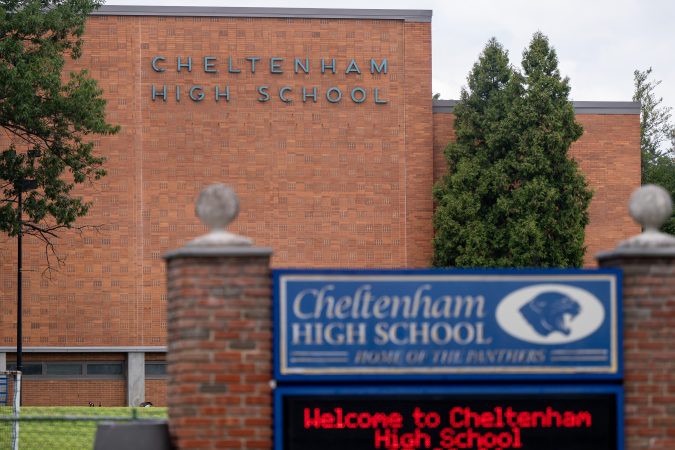
    As they prepared a list of charges in connection with a pair of hazing incidents involving Cheltenham High School’s football team, the members of a Montgomery County grand jury closely scrutinized the figures and institutions that often place vulnerable young people in positions where they can be victimized in the first place.

    There were the players themselves — as many as 19 of them took part in one of the assaults — who, on two separate occasions last summer, the grand jury found, beat a 15-year-old teammate and attempted to insert a broomstick into his anus.

    There were the coaches, whom the jurors said allowed a hazing culture to flourish, discouraged the victim from reporting his injuries, and engaged in a cover-up that was remarkable both for its clumsy execution and brazen audacity.

    Finally, there were school administrators, who, despite conducting three separate inquiries, were so inept that they were still unclear about how many times the student was attacked, and took no steps to exclude the head football coach (who would eventually be charged with leading the cover-up) from taking part in their investigations.

    “This level of incompetence didn’t just fail one child,” the jury wrote. “It put every young man on the football team at risk.”

    Notably, though, the jury found, the victim may not have been helped by another factor: the law itself.

    In Pennsylvania and practically every other state, the so-called mandatory reporting guidelines — rules that require teachers, coaches, school administrators, and others who work with youths to inform the authorities of suspected harm — do not include hazing in their definition of what constitutes child abuse.

    As horrifically illustrated by the case in Cheltenham — and so many other high-profile hazing incidents involving adolescents — this must change.

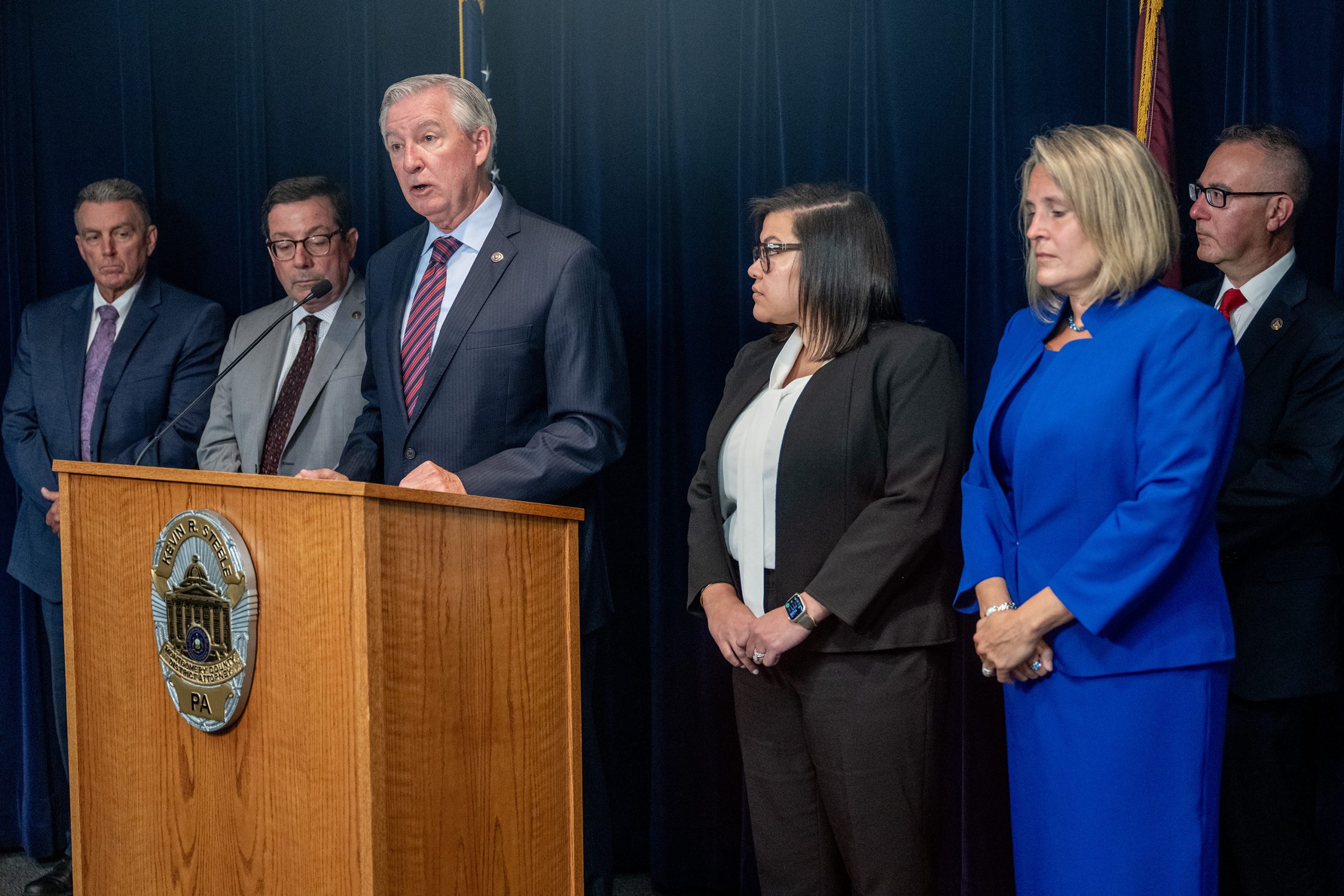
    Montgomery County District Attorney Kevin Steele addresses reporters at a July 29 news conference to announce multiple charges in connection with a pair of hazing incidents at Cheltenham High School.Tom Gralish / Staff Photographer

    As the grand jury noted, allegations of child abuse generally must be reported when the accused are adults or “certain juveniles” — such as caregivers, family members, and those living in the same household — or when the accusation involves crimes such as rape, sexual assault, or indecent exposure.

    “Hazing should be considered a form of reportable child abuse to protect children,” the grand jury wrote. “If hazing was a reportable offense, the Cheltenham High School administration would not have had the opportunity to mishandle the juvenile victim’s disclosure and the ensuing investigation as poorly as they did.”

    The failures at Cheltenham High School come less than a decade after legislators in Harrisburg enacted a sweeping overhaul of the commonwealth’s anti-hazing laws. That change was largely prompted by the alcohol-related fraternity hazing death of Timothy J. Piazza, a 19-year-old sophomore at Penn State, in 2017.

    The measure, known as the Timothy J. Piazza Antihazing Law, was signed by Gov. Tom Wolf in 2018. It increased the range of penalties for hazing and required both secondary schools and higher education institutions to adopt anti-hazing policies and publicly report violations. (Lawmakers in Trenton — Piazza was a native of Hunterdon County, N.J. — authored their own version of the legislation in the Garden State; it took effect in 2021.)

    Despite the adoption of new laws, the cycle of hazing persists.

    Set against the painful legacy of Piazza’s death in University Park, hazing continues to be a problem at Penn State. In May, administrators suspended a chapter of the Lambda Chi Alpha fraternity; it is the ninth Greek organization currently serving a suspension for hazing violations on the university’s flagship campus.

    Earlier this month, prosecutors filed felony hazing charges against a strength coach at Bucknell University in connection with the death of a player in 2024. And in April, former Eagles player DeSean Jackson, now the head football coach at Delaware State University, was sued by a player after a hazing incident.

    While some of the most high-profile hazing cases involve colleges and universities, researchers say that the seeds of mistreatment are often planted in high school — or earlier. (A 17-year-old Cheltenham student, who witnessed last summer’s locker room attacks, told the Montgomery County grand jurors that he had seen that kind of child-on-child violence on other teams “multiple times”; he’s been playing since he was 5.)

    According to one study, 47% of college students said they experienced hazing before they ever set foot on a college campus. “There’s a bit of a normalization that happens when they’re already experiencing — and perhaps expecting — that type of behavior, if they’ve already gone through that in high school,” Meredith Stewart, of the advocacy group Stop Hazing, said in an interview with members of this board.

    To end the grim experience and bleak expectations of adolescents being harmed in sports teams, youth clubs, and other organizations, lawmakers should craft legislation to reclassify hazing as a form of reportable child abuse.

    Unless Harrisburg takes action to close this perilous gap in the state’s anti-hazing protections, the cycle of violence will keep churning — and more of Pennsylvania’s young people will continue to be placed at risk.

  • In Nolan’s ‘Odyssey,’ food and feasting are vehicles for disgust. What a shame.

    In Nolan’s ‘Odyssey,’ food and feasting are vehicles for disgust. What a shame.

    It is immensely exciting to me that right now, everyone is talking about The Odyssey. It’s also a little weird.

    I studied classics in graduate school and before I became a chef and then food writer, I taught Ancient Greek language and Greek and Roman epic poetry both in their original languages and in translation. I traced how Odysseus became Ulysses and how his story was retold through the ages, particularly in other forms of epic poetry. In my everyday life and at The Inquirer, nobody in the last decade has asked me about epic poetry, except for college students wanting help with their homework.

    But I’ll tell you how I felt about Nolan’s version of the poem.

    I felt hungry.

    In Christopher Nolan’s blockbuster movie, Odysseus’ men slurp up what look like tapeworms as the witch Circe, played by Samantha Morton, forcibly manipulates their faces, pulling their mouths into the form of pig snouts. She molds their faces and bodies like clay until the men are transformed into pigs, the animals that best represent their brutish, stupid behavior.

    It’s brilliant, stomach-churning, and wild, an extraordinarily visceral adaptation of the original Homeric text. It’s one of the rare scenes in Nolan’s adaptation of The Odyssey where one sees actual food, despite the food being wholly unappetizing.

    This image released by Universal Pictures shows Matt Damon as Odysseus in a scene from “The Odyssey.” (Melinda Sue Gordon/Universal Pictures via AP)Melinda Sue Gordon

    Reading The Odyssey, though, makes me crave cheese and cakes that have been drizzled with honey, wine to wash down roasted meats like lechon or porchetta, sharing in the heady scent with friends, dining companions, and the gods, for whom the savor (or the aroma) is an offering.

    Watching Nolan’s movie also makes me long for those things, but due to their general absence. None of the food portrayed is conducive to conjuring up the pleasurable excess that is the very drumbeat of the Homeric text.

    In Nolan’s Odyssey, food and feasting are vehicles for disgust.

    The film is undoubtedly a cinematic masterpiece. It is the latest iteration — and I would even venture, translation — of Homer’s Odyssey.

    Back in eighth- or ninth-century BC, the bard, poet, or perhaps multiple bards, created what would be the longest-running superhero franchises of all time, matched only by the authors of the Old Testament. (And the two texts have a lot in common in how they were assembled, with language cobbled together from different eras).

    This image released by Universal Pictures shows, (from left) Mia Goth as Melantho and Anne Hathaway as Penelope, in a scene from “The Odyssey.” (Melinda Sue Gordon/Universal Pictures via AP)Melinda Sue Gordon

    In both translation theory and storytelling, we can accept variances. In superhero movies and movie franchises, we welcome them.

    We can accept different actors playing the same roles. We eagerly anticipate actors’ interpretations of classic characters — just think of how we hunger for news of who will play the next James Bond or Batman.

    Translation theory generally dictates translations need to be updated every generation or so, to match the language of the times. The French philosopher Jacques Derrida saw translation as a never-ending process. It is a task that is necessary and impossible at the same time, he wrote in “Des tours de Babel” in 1985, as language has no fixed, stable meaning.

    This image released by Universal Pictures shows a scene from “The Odyssey.” (Melinda Sue Gordon/Universal Pictures via AP)Melinda Sue Gordon

    Did I expect Nolan’s Odyssey to hew to the text? I did not. But what I did long for was emotion and catharsis (Aristotle’s theory of which was developed four centuries after The Odyssey was composed), and food. I also hoped for a narrator, or bard tying the story together, conveying it to us, an audience at a feast.

    The lack of a narrator shows how much we have changed in nearly 3,000 years. Nolan’s Odyssey is episodic; he doesn’t tell us a story, he shows us one. We no longer gather at dinner and listen to stories performed. We gather for The Odyssey at movie theaters, silent. We gather at our phones. Our community is in the ether.

    Perhaps in the age of TikTok and ever-shortening attention spans, Nolan’s episodic, somewhat disjointed retold narrative is perfect. It is our generation’s translation. The one we deserve.

    Just as sex has been expunged from Nolan’s Odyssey, so have the food and Homer’s lengthy descriptions of feasting. Food is central to the original text. In the movie, I recall a suitor gnawing on one drumstick. There is no free-flowing wine, just drunkenness — effects of the invisible wine.

    I dare you to pick up Emily Wilson’s translation of The Odyssey (which helped inspire Nolan) and not smell the smoke of roasting pigs; not want to lick your fingers of dribbles of floral, fragrant honey; not ache for a creamy, salty cheese like ricotta salata, which was probably what is hanging in the Cyclops’ cave. These aren’t a translator’s embellishments. They are threaded throughout the original Greek, so much so that you may feel rather beaten over the head with how often people are feasting in The Odyssey.

    This image released by Universal Pictures shows Matt Damon as Odysseus, left, and Zendaya as Athen, in a scene from “The Odyssey.” (Melinda Sue Gordon/Universal Pictures via AP)Melinda Sue Gordon

    In Homer, wine is everywhere; the sea itself is like wine. In Nolan, we never see it.

    The code of xenia, a guest-host relationship (often translated as “hospitality”), which Nolan calls “Zeus’ law” in the movie, dictates that you host guests, offer them food, and feast with them. Xenia was the backbone of society and decency in Homeric Greece.

    Watching The Odyssey made me hungry, and given that it’s three hours long, it’ll probably make you hungry, too. Despite AMC Dine-In’s rather vast menu, its high sodium warnings gave me pause. I could not feast in the presence of watching The Odyssey (something its original listeners surely would have done), and could not bring myself to eat the chicken wings. So after you skip the AMC wings, go forth and dine like a Homeric hero.

    Compensate for the lack of feasting in Nolan’s Odyssey.

    This image released by Universal Pictures shows a scene from “The Odyssey.” (Melinda Sue Gordon/Universal Pictures via AP)Melinda Sue Gordon

    Go to Perla and grasp your lechon like Odysseus did when he landed on Ithaca’s shores and went to the cottage of Eumaeus, the swineherd, before he continued on home. Seek after North by Texas, the roving barbecue pop-up, just as Odysseus’ men held out until they could no longer and barbecued one of Apollo’s herd. Order a porchetta from Esposito’s or Porco’s Porchetteria and have all your friends over. Look for Le Virtù’s whole roasted goat, inhale the remnants of smoke, dig in with your hands. Grab yourself a cheesecake, imagine it to be Circe’s “kukion,” drizzle it with honey, and wash it down with wine.

    When I go to restaurants as part of my job, I always, at the end of each meal, ask my dining companions two questions that cut straight to the point: Would you come back? And would you recommend it to others?

    The answers to these are generally the same, both yes or both no. To hold Nolan’s Odyssey to the same parameters as a meal, I would not watch it again, but I would recommend it to others.

    Just please, go get a nice dinner afterward.