Stanley M. Schwarz, 95, of Philadelphia, community-minded trial lawyer and founder of what is now the Schwarz & Schwarz law firm, former Philadelphia assistant district attorney, Army veteran, mentor, and golfer, died Friday, July 17, of heart failure at his home in Society Hill.
Public-spirited throughout his life and adept at litigation regarding workplace accidents, medical negligence, reckless driving, careless manufacturers, and other personal injury issues, Mr. Schwarz founded what is now Schwarz & Schwarz PC in 1967. He represented all kinds of clients in all kinds of cases and appeared before the Pennsylvania Supreme, Superior, and Commonwealth Courts more than 20 times.
He was featured in the Daily News in 1968 when, at no charge to his client, he won $150 from the city for a Philadelphia hairdresser whose car was mistakenly towed. “I was disturbed by her experience” with city officials, he told the Daily News.
“To many,” his family said in a tribute, “he was more than an attorney. He was a source of guidance and hope.”
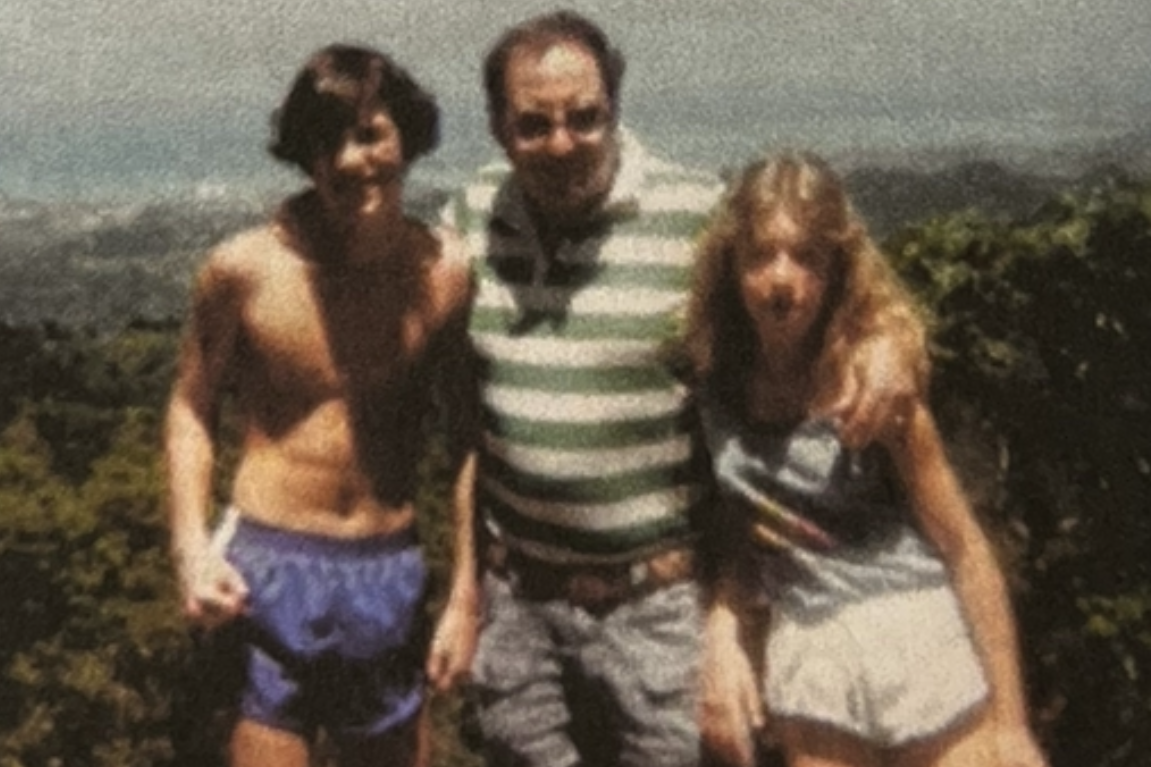
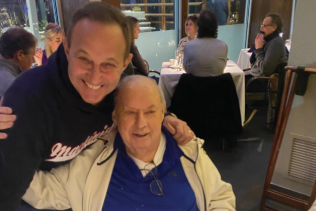
Mr. Schwarz doted on his children.Courtesy of the family
Mr. Schwarz lived for decades in Society Hill Towers at Second and Locust Streets near the Delaware River and represented its owners association in 1997 as it contested high-rise development along the nearby waterfront. “They’re trying to take away this little Garden of Eden,” he told the Daily News.
He joined the district attorney’s office in 1960, worked as an assistant district attorney in the major trials unit, and handled hundreds of cases involving murder, assault, robbery, burglary, arson, and other crimes. In one notable case in 1966, he noticed that the photo of a man in the Daily News looked like the at-large suspect in a recent robbery. Detectives tracked the man down and made an arrest.
He also served as a temporary judge and arbitrator for local, state, and federal courts. He belonged to several legal associations, won awards for his legal and community service, and was an honorary member of the Knights of Columbus.
He joined the Army after high school, rose to first lieutenant, and served as an intelligence cryptographer during the Korean War. He was admitted to the Temple University School of Law after just a year in college, became editor-in-chief of its law review, and graduated in 1958.
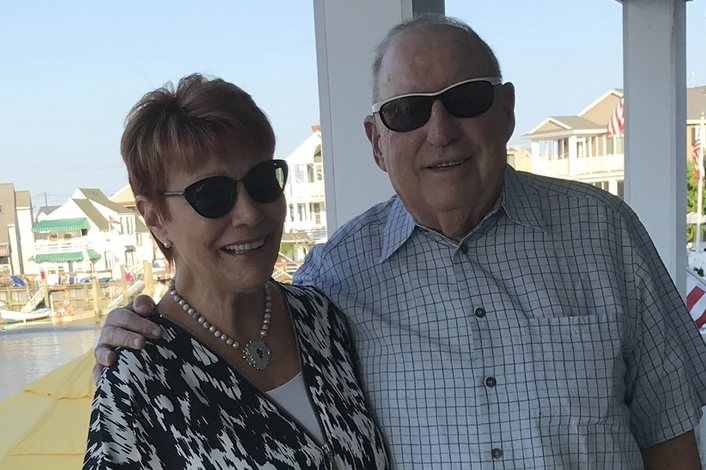
Mr. Schwarz and his wife, Kathy, married in 1991.Courtesy of the family
He served two years as a law clerk in the Philadelphia Court of Common Pleas and then as assistant to three district attorneys over six years. “He mentored generations of young lawyers and quietly helped countless people through difficult times,” his family said.
Born in Philadelphia during the Great Depression, Mr. Schwarz and his family moved often when he was a boy. He lived in New York when he was young and worked part-time as a stock boy and janitor when he was 10 to help pay the bills.
He attended two dozen schools before moving to Philadelphia in middle school and graduated from Germantown High School in 1948. His family praised “the work ethic and compassion that guided him throughout his life.”
They said: “Stan’s life was shaped by perseverance, resilience, and a deep commitment to helping others.”
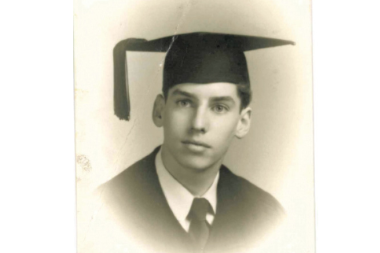
Mr. Schwarz graduated from Germantown High School in 1948.Courtesy of the family
Stanley Morris Schwarz was born Jan. 22, 1931. He worked as a mail clerk and accountant after high school and joined the Army when he was 20.
He married Lee Rosen in 1955, and they had a son, Daniel, and a daughter, Stacy. After a divorce, he married Kathy Campbell in 1991, and they danced and traveled the world together for years. He was especially good at the jitterbug.
Mr. Schwarz played golf and socialized for more than 50 years at the Bensalem Township Country Club. He was a longtime member of the Society Hill Club. He took his family to boat shows and on memorable vacations to Ocean City, Puerto Rico, the Pocono Mountains, Disney World, and elsewhere.
He self-published a breezy memoir called The Roller Coaster Life of Flappy in 2022 when he was 91, and said: “As a father, it gave me the greatest pleasure in playing with the kids, whether in our backyard, in the community pool, or in the nearby parks.”
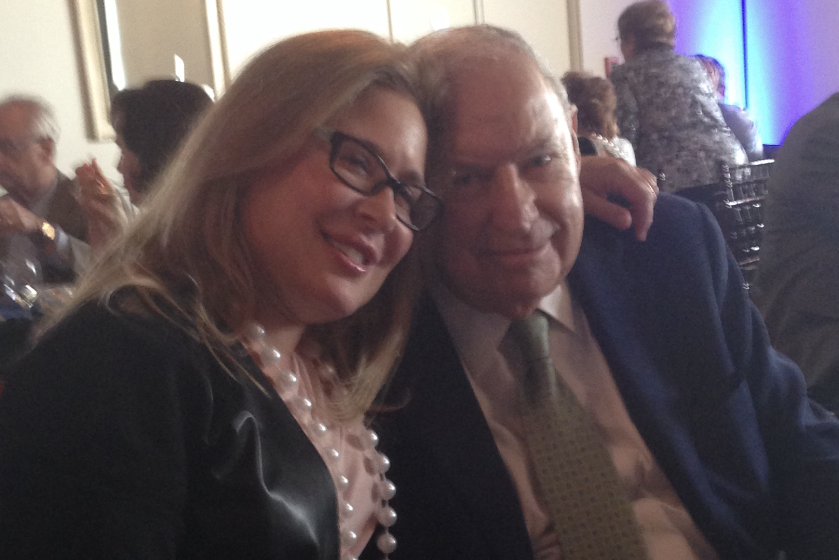
Mr. Schwarz enjoyed time with his family.Courtesy of the family
Mr. Schwarz was fun and funny, his daughter said. He taught himself to play piano and saxophone, and they performed duets.
He was an engaging storyteller. He made personal scrapbooks for his children. Friends called him “amazing” and “incredible” on Instagram.
His family said: “He made people feel valued and left them better than he found them.” His daughter said: “He was down to earth and playful. He was great with kids. He loved everybody’s children, and the children loved him.”
In addition to his wife and children, Mr. Schwarz is survived by four grandchildren, a sister, and other relatives. A sister and a brother died earlier.
Services were held earlier.
Donations in his name may be made to Congregation Beth El, 8000 Main St., Voorhees, N.J. 08043.
Mr. Schwarz was close with his daughter, Stacy, above, and his son, Daniel, below. Courtesy of the family
Philadelphia real estate developers see the writing on the wall.
As progressives have toppled centrist Democrats in nationally watched races, some local development interests are wary that the same trend could reshape Philadelphia City Council this spring, when every member is up for reelection. They see a growing progressive faction as a threat to business.
Enter the incumbent protection plan.
Nearly a dozen local developers are already pouring hundreds of thousands of dollars into Philly For Growth, a group that in the past two Council election cycles spent millions on advertising campaigns to back business-friendly Democrats, according to a source familiar with the planning.
Philly For Growth is an independent expenditure group, also known as a super PAC. It can raise and spend unlimited amounts of money to influence an election, but there are rules barring super PACs from most forms of coordination with the candidates they support.
In 2023, the group was the biggest special interest group involved in that year’s Council races, and it provided a substantial boost to its chosen candidates by outspending individual campaigns.
Ahead of the May primary election, Philly For Growth plans to spend $1.5 million to support pro-business Democrats, most of whom are sitting Council members, according to the source, who spoke on the condition of anonymity because they were not authorized to discuss the plans. The group will not fund negative advertising about Council’s four incumbent progressives, the source added.
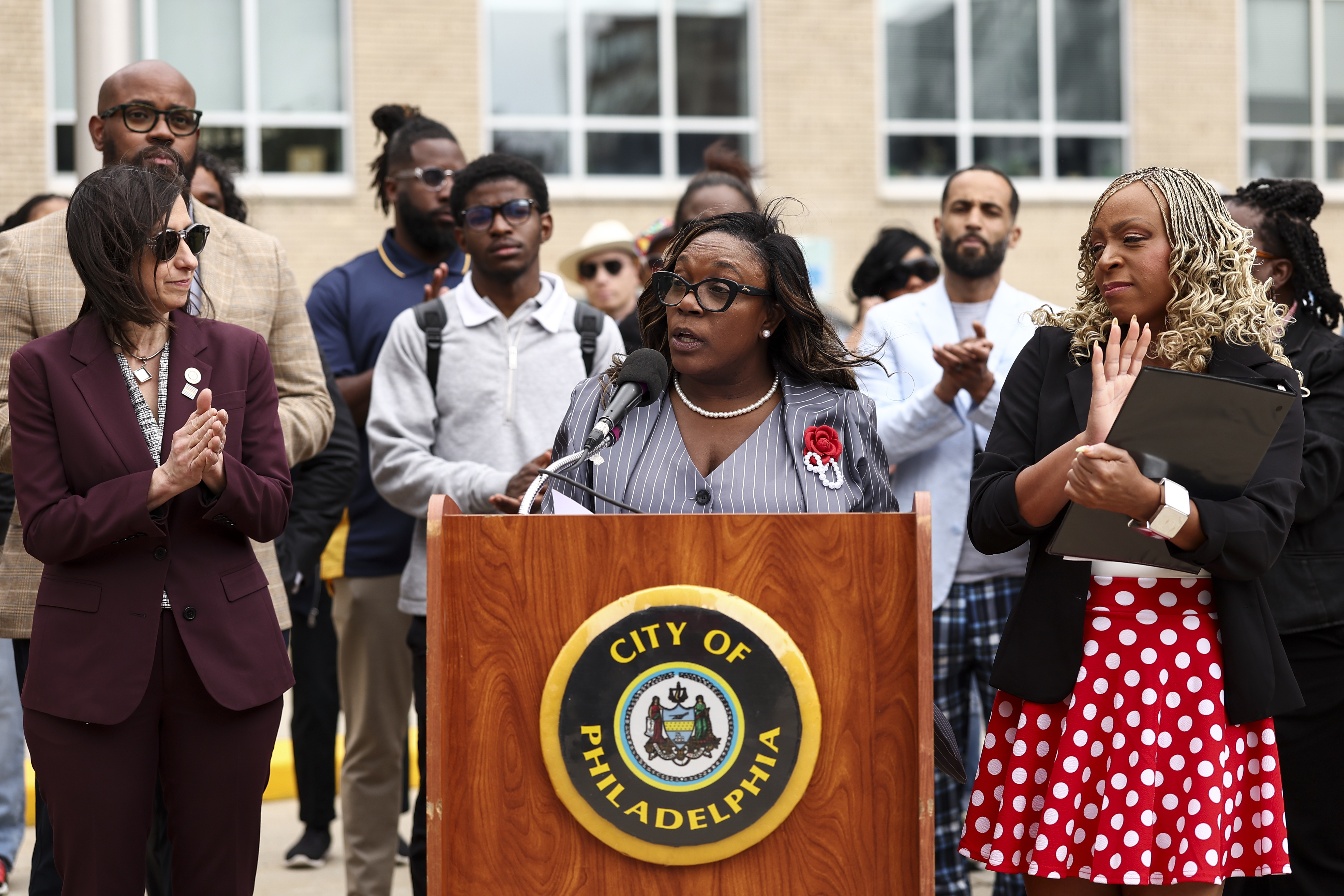
Councilmember Kendra Brooks, of the progressive Working Families Party, speaks during a rally outside of the School District of Philadelphia headquarters in May. At left is Councilmember Rue Landau and at right is Councilmember Jamie Gauthier. All three are members of Council’s progressive faction.Monica Herndon / Staff Photographer
The idea is to keep progressives from growing their power on Council instead of spending money to knock off the leftists who are already there. There are currently four reliably progressive votes out of the total 17 on Council, but some members may be more likely to vote with that faction as Democratic voters nationally revolt against incumbents.
That’s a different strategy than in 2023, when Philly For Growth backed a slate of five candidates — two incumbents and three challengers. Both incumbents won, but all three challengers lost.
Philly For Growth has previously been affiliated with the Building Industry Association of Philadelphia, an advocacy group for development interests. Mo Rushdy, the BIA’s former president who leads the organization’s political activity, declined to comment.
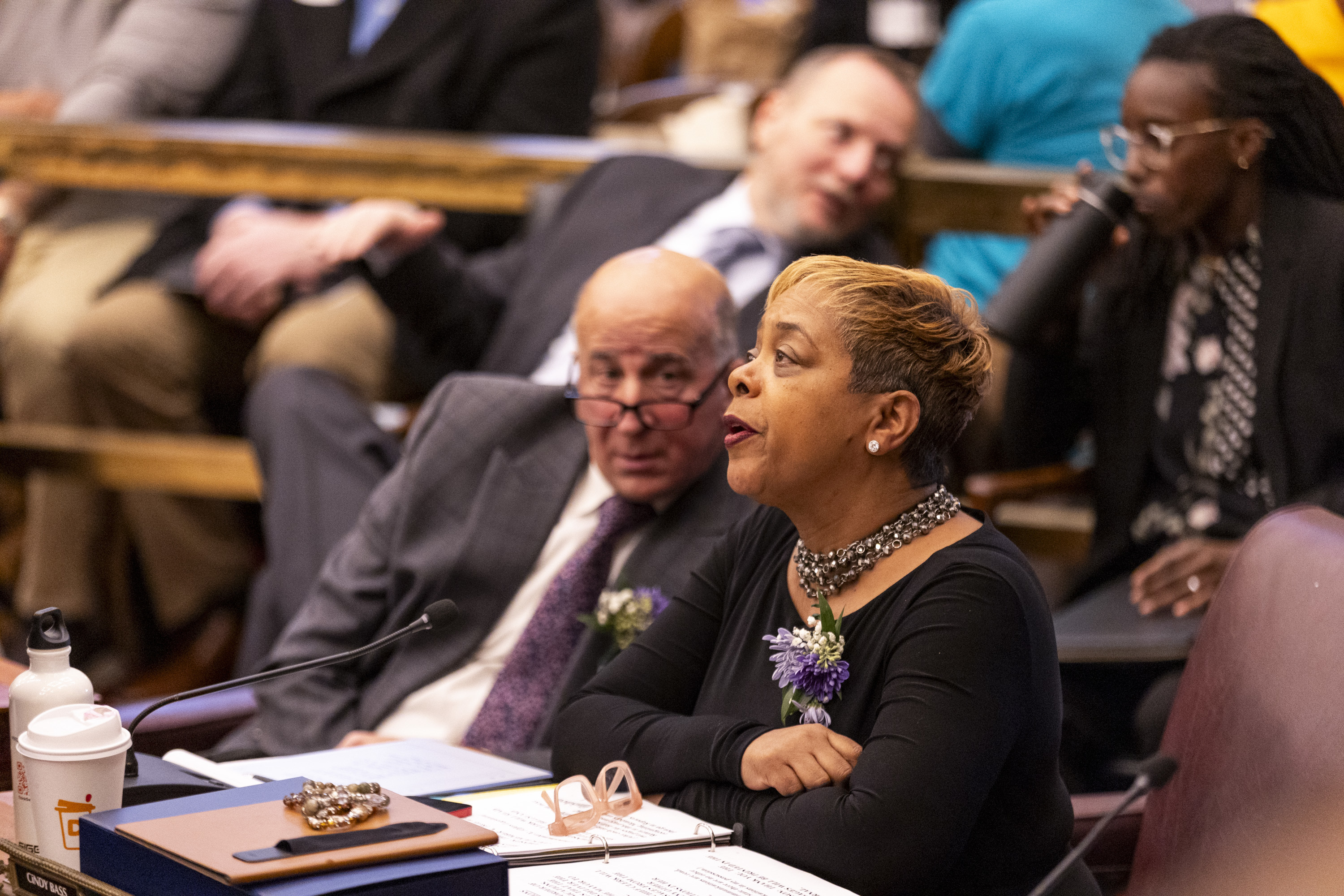
The source said that Philly For Growth will fund advertising to support Council members Mark Squilla, whose 1st District includes parts of South Philly, Center City, and Fishtown; Cindy Bass, whose 8th District is based in North and Northwest Philadelphia; and Quetcy Lozada, whose 7th District includes much of North Philadelphia and Kensington.
All three are seen as more centrist members and have said they intend to run for reelection. No challenger has officially launched a campaign against any of them, but candidates who are aligned with the city’s left-leaning political organizations are expected to emerge as the primary — still eight months away — draws nearer.
The super PAC is making one exception when it comes to supporting incumbent district Council members, the source said. In the 5th District, currently represented by Councilmember Jeffrey Young Jr., the group will support a to-be-decided challenger.
Councilmember Jeffery Young Jr. speaks to other members of Council during a 2025 session.Tom Gralish / Staff Photographer
At least five people have said they are interested in running for the North Philly-based 5th District seat, and Young has drawn opposition from development interests for pushing proposals that would slow or halt some projects in his district.
Young said in a statement that building “sensible, affordable housing” is one of his top priorities and that he has supported city programs like Turn the Key, which provides mortgage support to first-time homebuyers.
“People are free to back those who share their values. These are my values,” Young said. “I am leaving it to the residents of the 5th to determine whose values best reflect them.”
The super PAC will also fund advertising backing four incumbent members who represent the city at-large: Isaiah Thomas, Katherine Gilmore Richardson, Jim Harrity, and Nina Ahmad. That group doesn’t include progressive at-large Councilmember Rue Landau, but Philly For Growth doesn’t plan to oppose her, the source said.
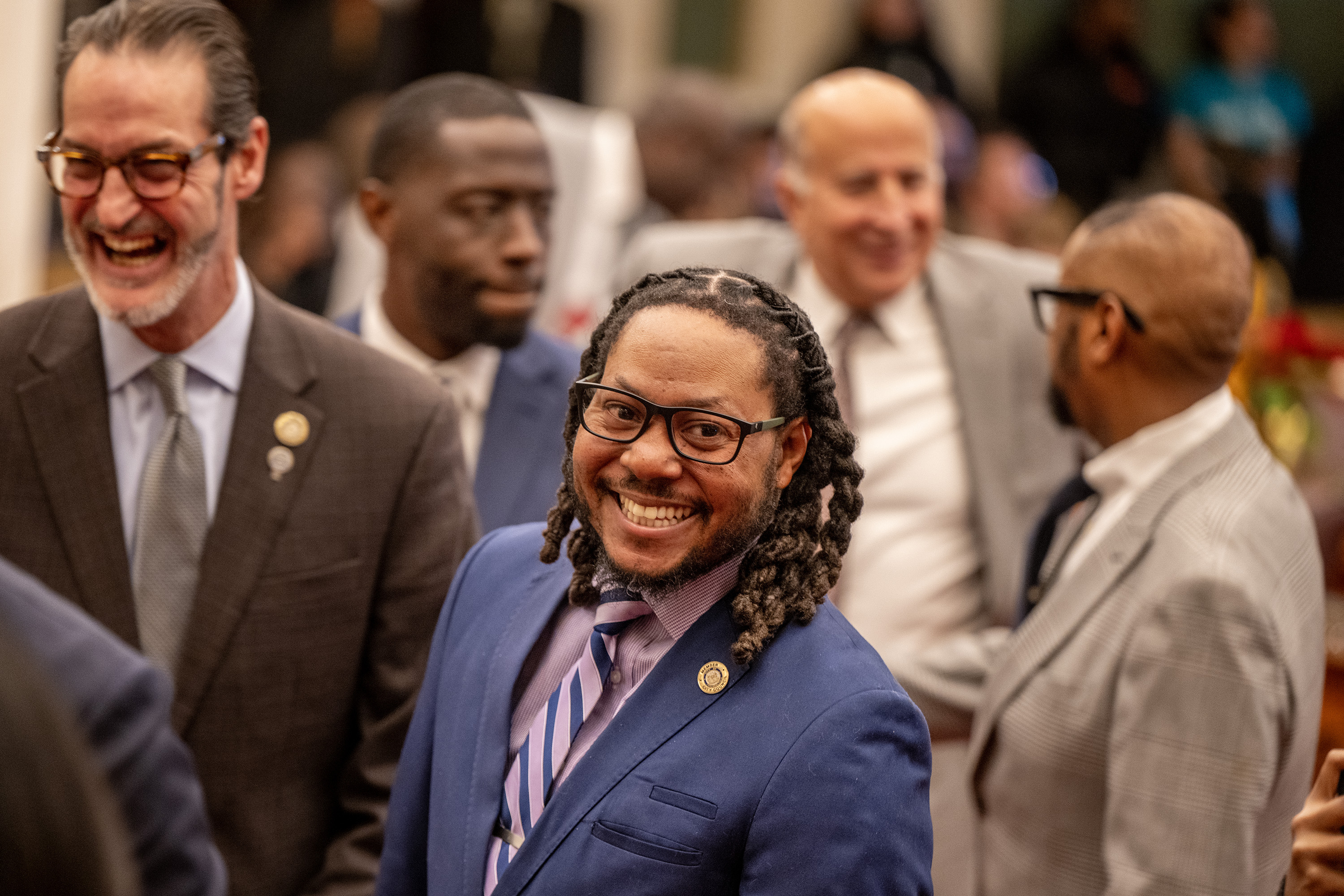
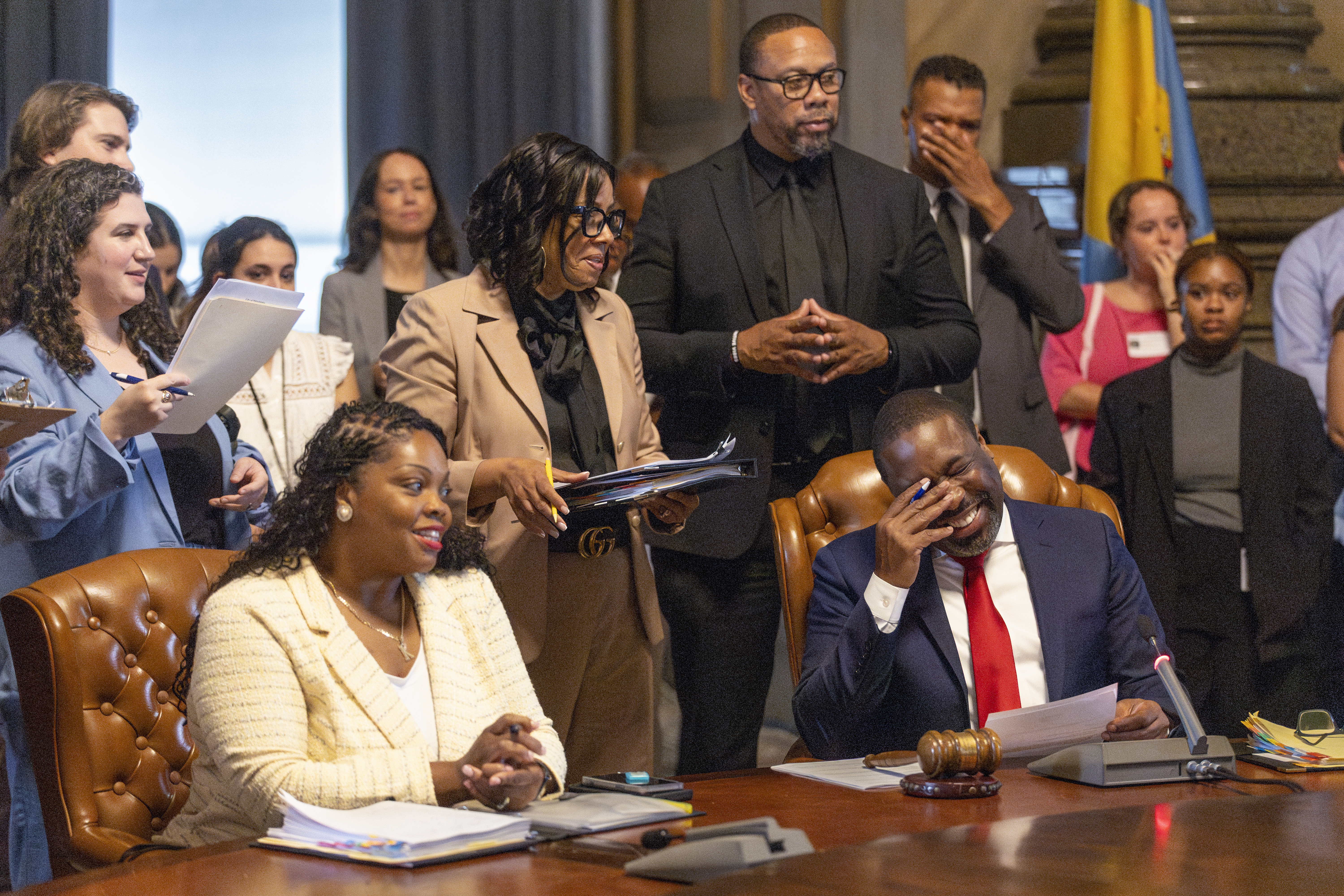
Council President Kenyatta Johnson laughs inside the caucus inside City Hall on June 11.Aidan T. Gallo / Staff Photographer
A spokesperson for Landau’s campaign arm said in a statement that the Council member “stands by her accomplishments for working people, small businesses and vulnerable communities in Philadelphia and looks forward to voters having the opportunity to make up their own minds next year.”
It’s unclear just how competitive the at-large race will be, and candidates have until the spring to decide — nomination paperwork is typically due in March. Seven of Council’s members represent the entire city at-large, and two of those seats are effectively reserved for members of minority parties under the city’s Home Rule Charter.
That has traditionally meant that five seats are held by Democrats, given the party’s massive voter registration advantage in the city. In recent years, Republicans and the progressive Working Families Party have battled for the remaining two seats during the fall general election, and the WFP currently holds both.
Mayor Cherelle L. Parker, who is also up for reelection, and Council President Kenyatta Johnson, who insiders do not expect will see a serious challenger, will likely be on Philly For Growth’s slate, too, the source said.
Sandy McNeal came to the Academy of Natural Sciences of Drexel University on a mission that belied the beauty of a September morning that was as splendid as it gets in Philadelphia: She was aiming to prevent a “funeral.”
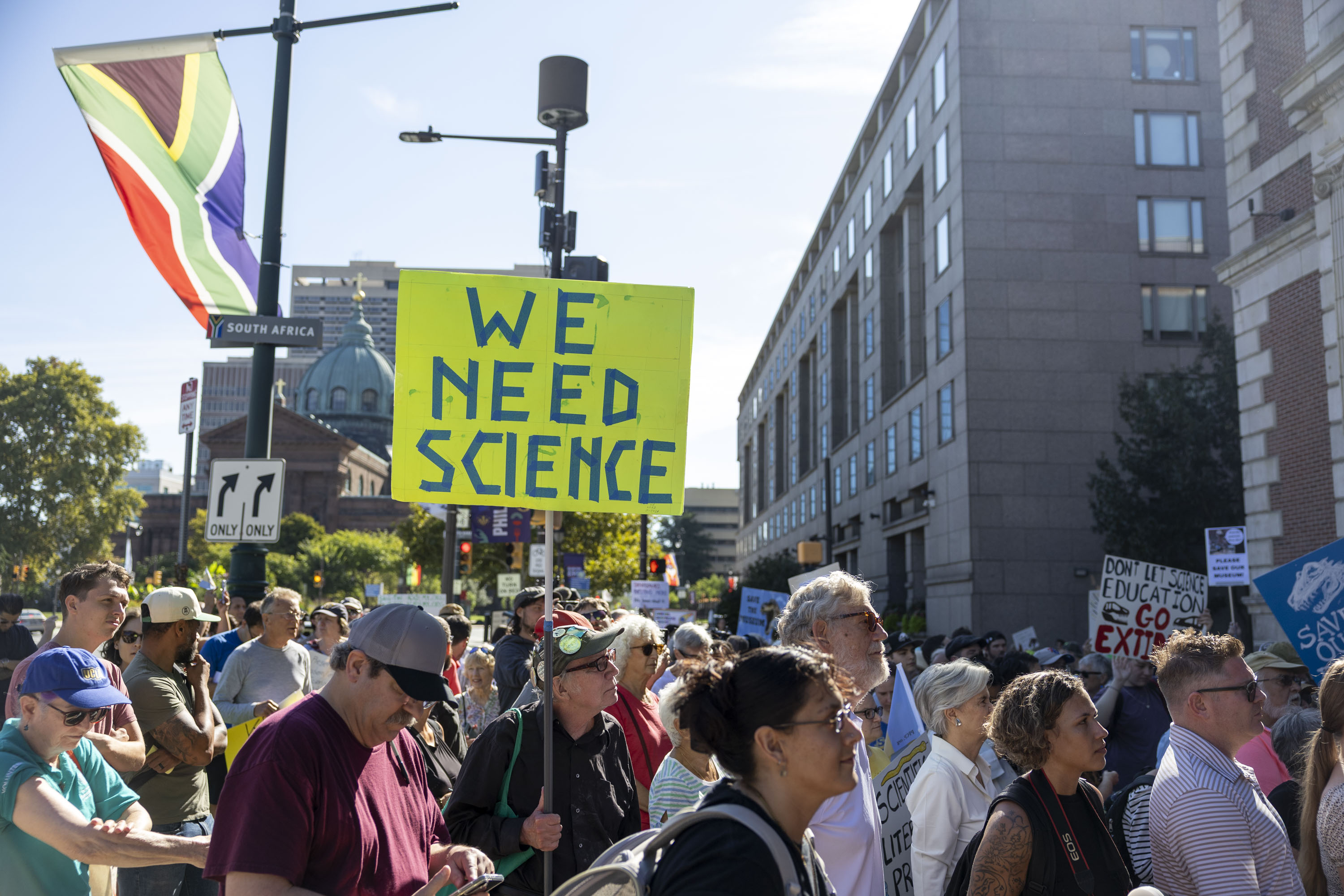
McNeal, 69, and several hundred other protesters, chanting “Hey Drex! Save T-Rex,” gathered at the landmark building on Logan Square to demand that Drexel, the academy board, the state — somebody — find a way to prevent the closure of the museum, scheduled for Sept. 30.
They came armed with signs reading “Save Our Saurs” and “Drexel Destroys Dinos?”
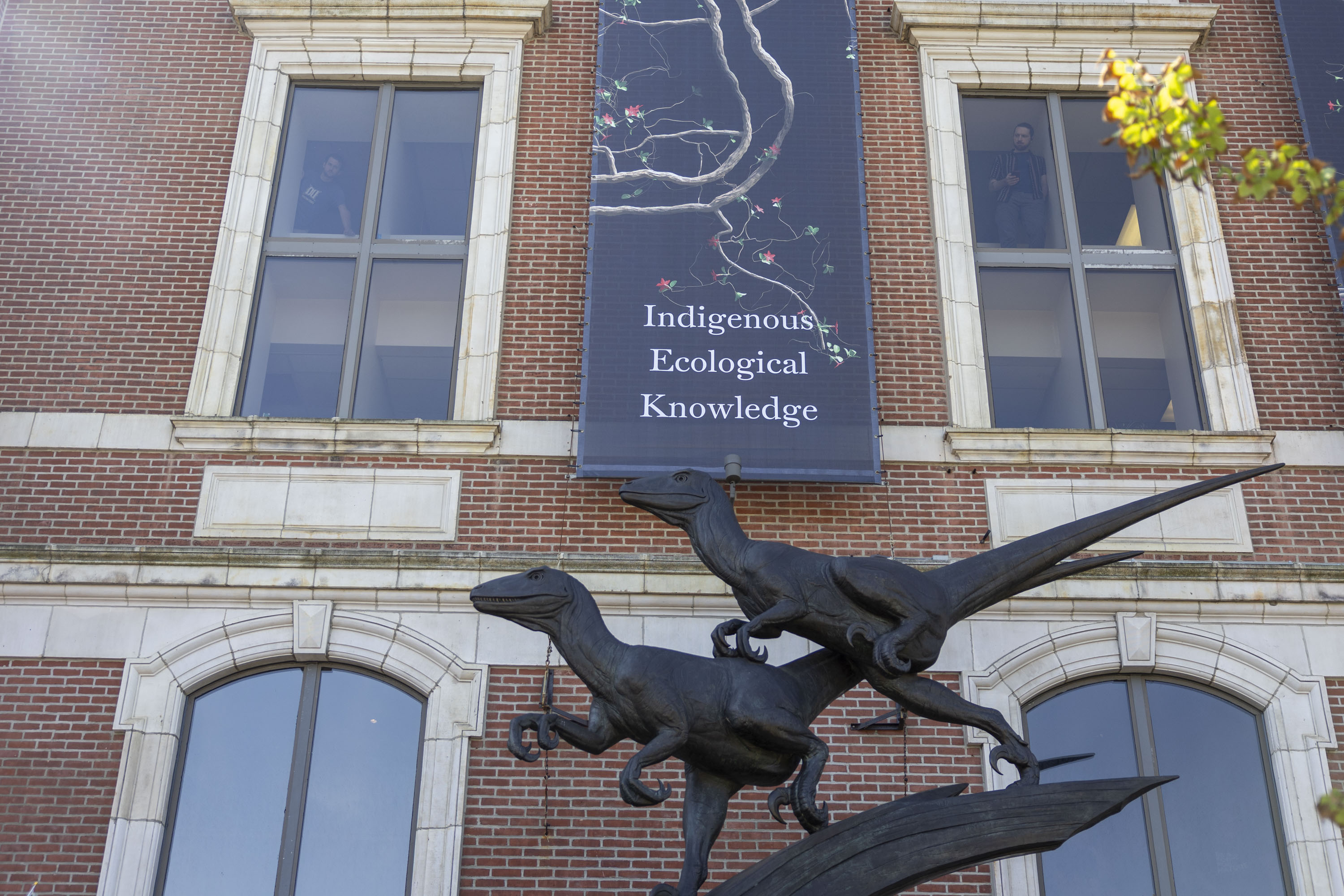
Staff look down as people come out to rally, speak out, and support the Academy of Natural Sciences of Drexel University on Tuesday, Sept. 8, 2026, in Philadelphia, Pa.Tyger Williams / Staff Photographer
Protest organizer Sarah McAnulty told the decidedly intergenerational crowd, made up of children and a whole lot of former children, that the academy, whose roots date to January 1812 — when Charles Darwin had not yet turned 3 — “brought an understanding of the vast array of Earth’s life to Philadelphia.”
The museum “must remain open to the public,” she declared.
“Philadelphia should be ashamed,” said McNeal, who lives in Delaware County and whose daughter is a marine biologist. For her, the museum’s closing would be akin to a “funeral.”
As for the city government’s possible role, Councilmember Nina Ahmad said she and her colleagues were as surprised as everyone else by the announced closing.
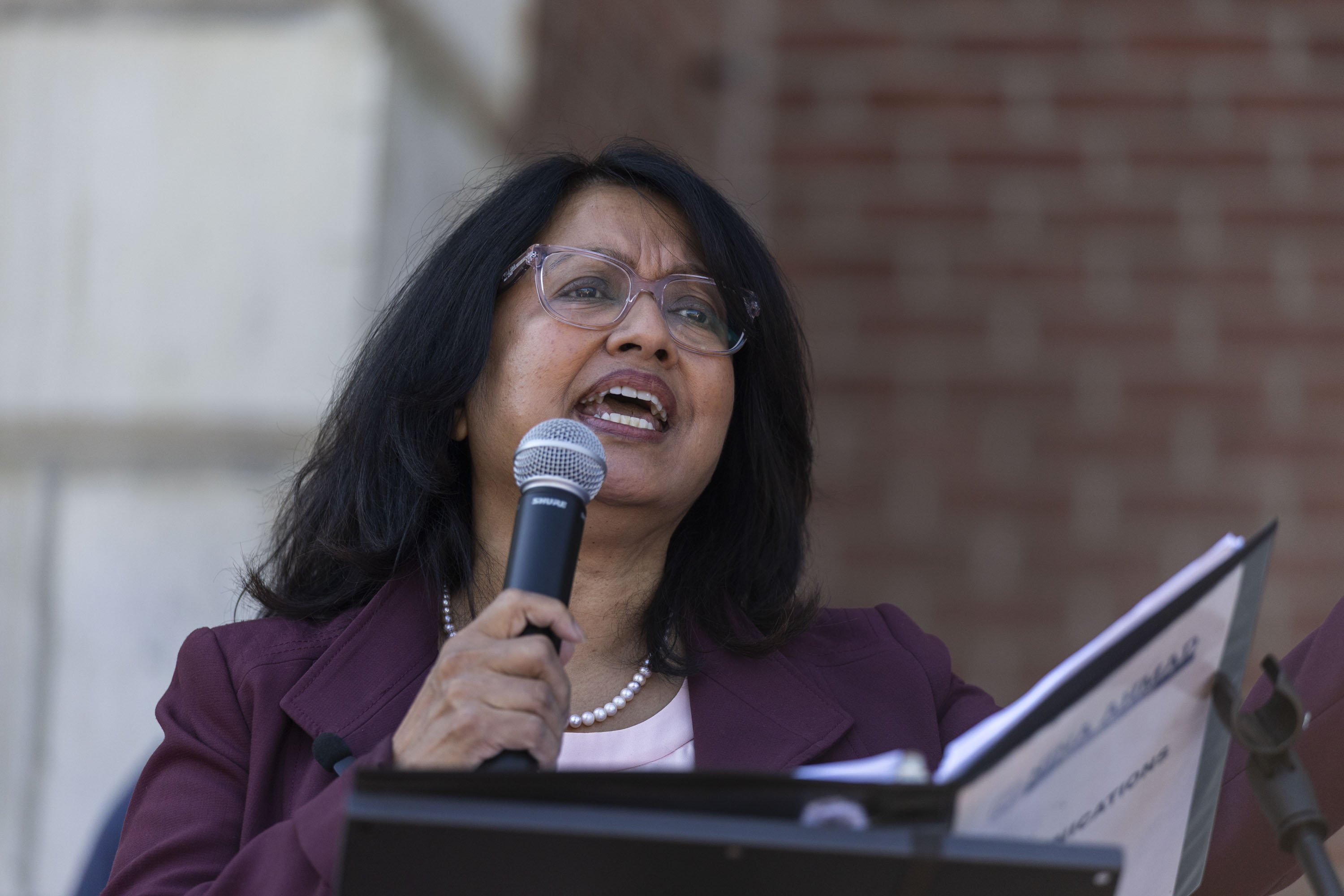
City Council member Nina Ahmad, speaks in front of folks rallying outside the Academy of Natural Sciences of Drexel University on Tuesday, Sept. 8, 2026, in Philadelphia, Pa.Tyger Williams / Staff Photographer
“Why haven’t we heard about it? Why haven’t they come to us? We are the legislative body,” she told the crowd. Drexel and museum officials have said a dramatic drop in visitors since the COVID-19 pandemic and Drexel’s budget issues drove the closure decision.
They have said that the collections would be maintained and the academy’s research would continue at a different location, but that the public museum, housed in a commodious building that opened in 1876 during the city’s centennial celebration, would be closed and eventually sold.
The phrase “Academy of Natural Sciences” first appeared in the March 1812 minutes of a group of Philadelphia naturalists who had begun meeting two months earlier at the home of druggist John Speakman at Second and Market Streets, according to a 1909 history. It was a year more well-known for wars and the likes of Napoleon and Andrew Jackson, but founder Speakman found like-minded citizens in the Quaker City.
The academy, whose participants included William Bartram, son of legendary botanist John Bartram, would grow into one of the nation’s most significant research centers, and the museum would become a popular public attraction, known for its dinosaur exhibits and dioramas, a vehicle for awing adults and piquing the interest of children in natural history.
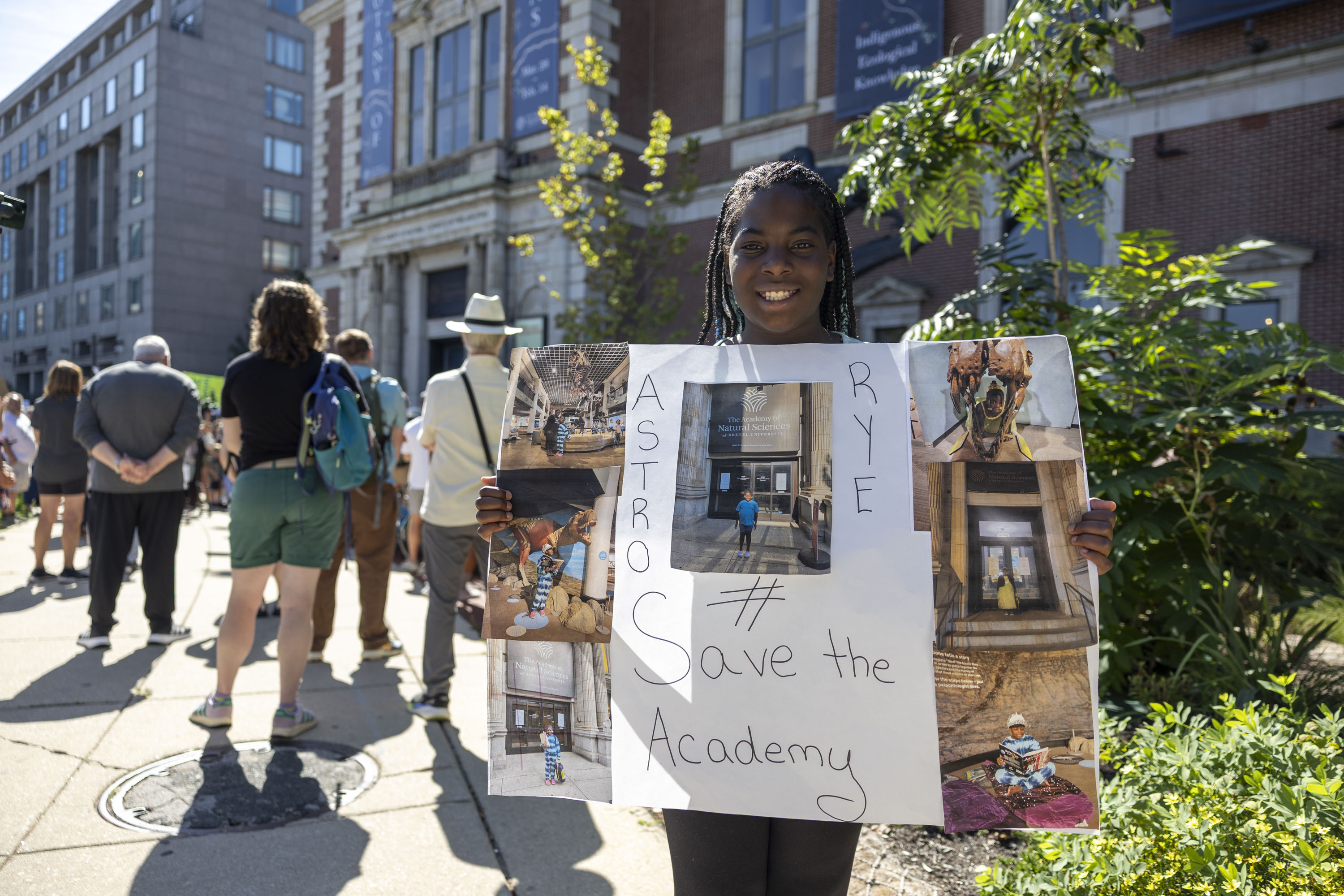
Ryan Sumner-lee, 10, poses for a photo holding a sign she made of her experiences here at the Academy of Natural Sciences of Drexel University on Tuesday, Sept. 8, 2026, in Philadelphia, Pa.Tyger Williams / Staff Photographer
Having bunked a few hours of school, 10-year-old Ryan Sumner-lee was among those who made it to the protest Tuesday.
“It’s the place that taught me I want to be a rock scientist, a paleontologist,” the fifth grader said. Aware of the closing plans, she begged her mother to take her to the demonstration.
“She wanted to come,” said her mother, Tammy Sumner. “I am just the driver. She gives me hope” for future generations.
Ross Bradley, 36, who brought his 6-year-old and 2-year-old to the protest, said he could not imagine a situation in which kids would not get to learn about science in their own city.
“I have a lot of anxiety about the climate and raising young kids in an uncertain future,” Bradley said. “Having this place, where they can get invested about the future, it’s vital for them to not just feel hopeless about the planet.”
Braxton Huminski, 3, is wearing a costume to show his support for the Academy of Natural Sciences of Drexel University on Tuesday, Sept. 8, 2026, in Philadelphia, Pa.Tyger Williams / Staff Photographer
Daryl Stoner, 67, a retired physician from Chestnut Hill, said she brought her children to the museum once a week when they were in elementary school. The closure means an “invaluable resource” will soon be lost.
“If we’re trying to get our kids active and off their phones, what’s better than bringing them down, walking them through the halls, and showing them things that have been there for eons.
“We can’t afford to lose it for future generations,” Stoner said. “It’s horrendous that our city would lose this.”
A new home for the 76ers and Flyers is scheduled to open in 2030, and now we have our first glimpse of what the new arena might look like.
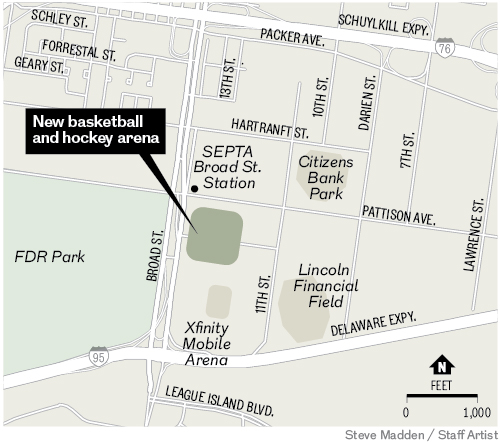
The teams released the first renderings of the privately funded arena Tuesday that will be built at the former site of the Spectrum, next to where Xfinity Mobile Arena sits.
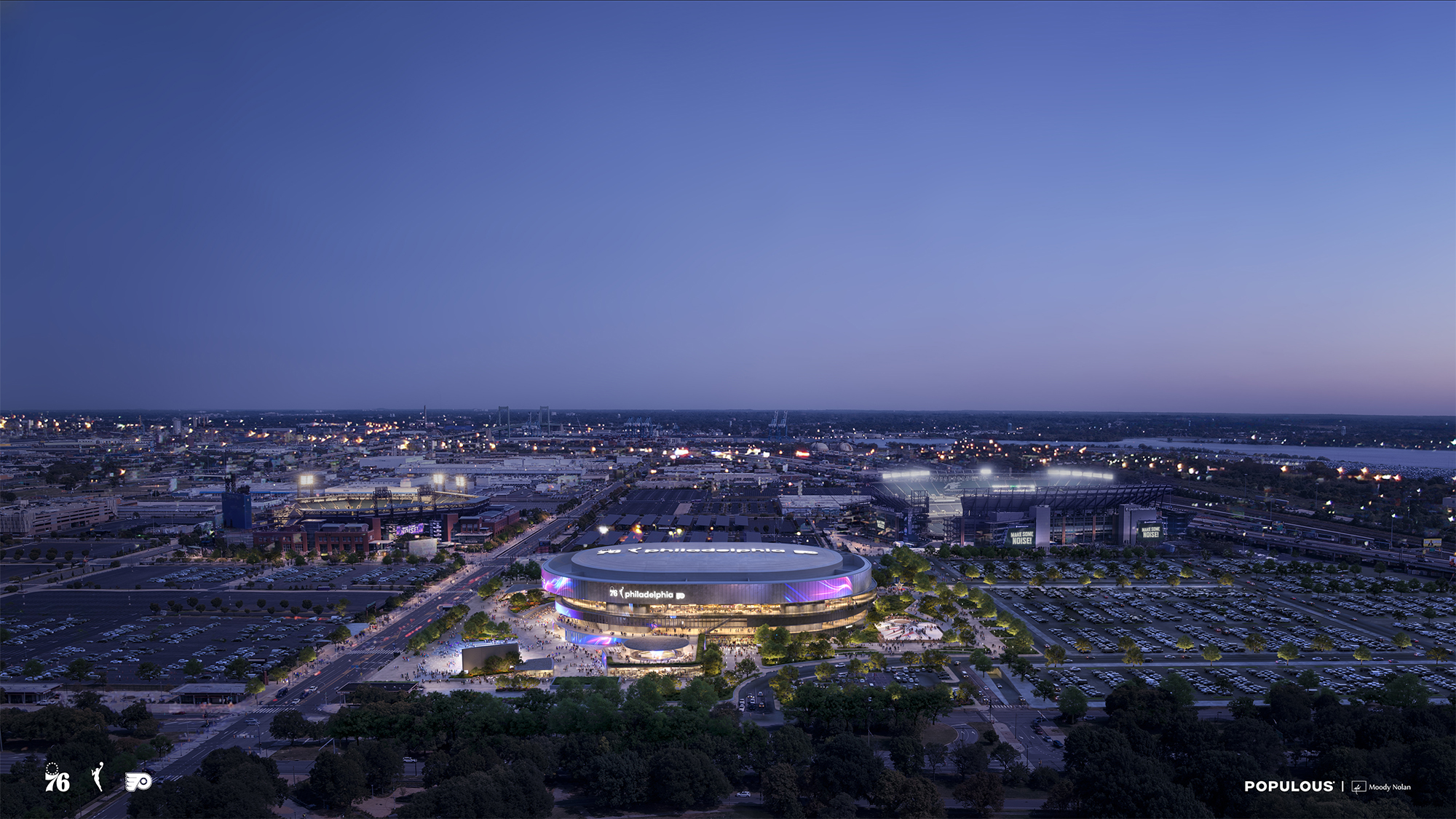
The new design features inspiration from the Spectrum, the former home of both teams from 1967 to 1996. The renderings show the facade will be composed of three stacked and cantilevered “bands,” a nod to the Spectrum’s exterior.
The Spectrum was home of the Sixers and Flyers until 1996. It was demolished in 2010.
“To build our future where Ed Snider and the Spectrum made history makes this project truly special,” Comcast chairman Brian Roberts said in a statement.
A plaza outside the arena will feature over a half-acre of outdoor space. The renderings show an expansive footprint that includes food and beverage pavilions, along with a giant screen outside the stadium.
“The first-look renderings reflect fan feedback and stakeholder input on the arena experience, public spaces and amenities,” the teams said in a statement. “Fan surveys, focus groups, community engagement, and public review will continue throughout the design and approval process.”
Stateside Live!, previously known as Xfinity! Live, sits near the new stadium site on 11th Street and just underwent a $15 million expansion. It is expected to remain open.
The location of the yet-to-be-named new arena. Steve Madden
In addition to the Sixers and Flyers, the arena will also be home to the yet-to-be named WNBA team slated to begin playing in Philly in 2030.
The stadium will be co-owned by Comcast and Harris Blitzer Sports & Entertainment, which owns the Sixers. Comcast owns the naming rights of the new arena but hasn’t announced a name. It’s unclear how much the new arena will cost, but it will be the largest fully privately funded project in the city’s history, according to a Comcast spokesperson.
“Philly fans deserve the best arena in the world, and we are excited to partner with Comcast to deliver just that,” 76ers managing partner Josh Harris said in a statement.
The new arena is scheduled to open in 2030. Courtesy of the Philadelphia 76ers and FlyersHow the new arena might look for Flyers fans arriving for a game. Courtesy of the Philadelphia 76ers and Flyers
The Sixers’ original plan was to build a new $1.3 billion stadium on Market Street in Center City, a contentious idea backed by Mayor Cherelle L. Parker that secured legislative approval in 2024.
Weeks later, the project was canceled after the Sixers struck a deal with Comcast to build a new arena in South Philly.
The new arena still needs regulatory and legislative approval before the start of construction, which is scheduled to begin in the first half of 2027.
Parker’s office did not respond to a request for comment, but the city shared the renderings on social media along with the comment, “Get excited Philly fans!”
Ryan Boyer, the head of the Philadelphia Building and Construction Trades Council praised the project’s job creations. “Beyond the construction jobs themselves, this is the kind of investment that opens doors for new contractors, suppliers, and small businesses throughout the city of Philadelphia.”
That announcement came before the Sixers abandoned their Center City stadium idea and decided to remain in South Philly. For now, the focus is on the new arena.
“We see [this location] as a unique opportunity to connect the retail affiliated with the arena, to the retail that we have in Stateside Live! and the expansion of that effort,” Comcast Spectacor chairman and CEO Dan Hilferty told The Inquirer in April.
Beyond the new retail, restaurant, and outdoor activation space included in the new arena’s plan, there is an opportunity for the four teams (five once the WNBA comes to town) to work together to further develop the sports complex, according to Phillies CEO and managing partner John Middleton.
“Having four major professional sports teams together in one destination creates an energy and sense of community that is unmatched anywhere in the country,” Middleton said, adding the new arena “represents an exciting next chapter for South Philadelphia and creates important opportunities” to realize the potential of the sports comlex space.
The arena is expected to feature an outdoor plaza with food pavillions. Courtesy of the Philadelphia 76ers and FlyersThe new arena will sit in the South Philly sports complex at the former site of The Spectrum. Courtesy of the Philadelphia 76ers and FlyersA renderings also show a giant screen outside the arena. Courtesy of the Philadelphia 76ers and Flyers
Over the summer, Comcast and Harris Blitzer Sports & Entertainment upgraded and donated storefronts for use as pop-up retail stores and other temporary activations to take advantage of the city’s busy calendar.
Last month, the companies extended the leases of four pop-up retail stores along Market Street, and both continue to work with the mayor’s Market East Advisory Committee on a master plan for the corridor, according to a Comcast spokesperson.
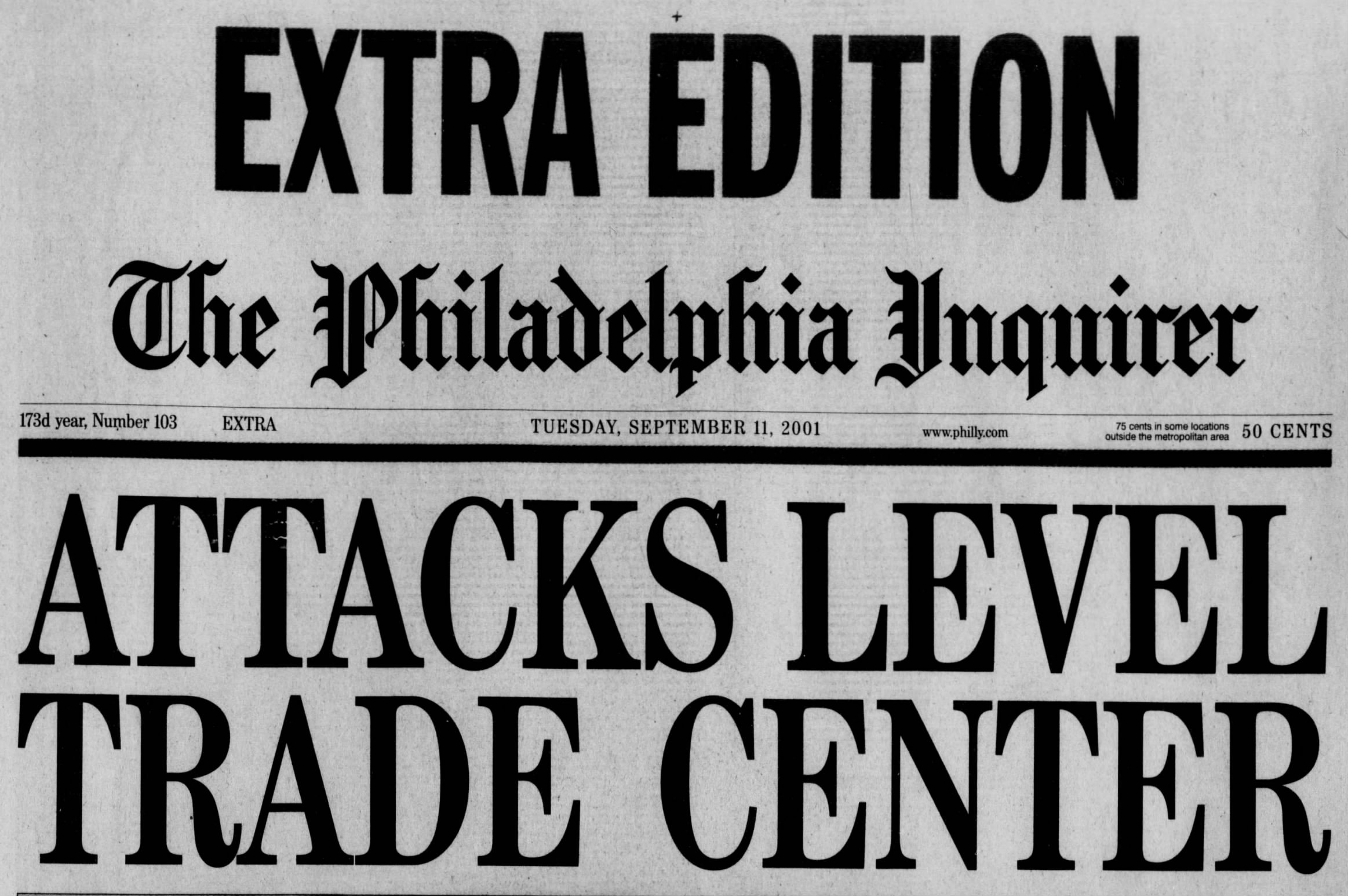
As the sun set on Philadelphia on Sept. 11, 2001, the city, like the nation, was in shock. Its citizens raged and wept, confronted with unprecedented acts of violence in New York City; Washington, D.C.; and Shanksville, Pa.
It wouldn’t be known for quite some time, but the attacks that rocked the East Coast that day took about 3,000 lives. Among them were dozens of people with local connections, including several crew members on the doomed flights.
But in the immediate aftermath of the 9/11 attacks, Philadelphia was focused on survival, and worried that the birthplace of the nation could be the next target. We evacuated, took refuge in religion, worried for the future, gave our blood and time to help, and focused our anger and confusion on our neighbors.
Now, 25 years later, the impacts of 9/11 continue to reverberate. And though society continued on, in the first few days after the tragedy, it seemed as if it could not.
Here is how The Inquirer and Daily News covered it:
Article from Sep 12, 2001 The Philadelphia Inquirer (Philadelphia, Pennsylvania) <!— –>
Panic in Center City
In the wake of the attacks, panic set in on Philadelphia. Fears the city could be the next target spread quickly, prompting the closure of city government offices, federal buildings, businesses, schools, and historic landmarks by noon.
“We are taking every reasonable precaution to ensure the safety of our citizens,” Mayor John F. Street said at a late morning news conference.
Thousands of people began a frantic commute home, gridlocking Center City’s streets and sidewalks. An estimated 50,000 SEPTA Regional Rail passengers were likewise stuck, with several lines suspended. Like all airports nationwide, Philadelphia International Airport was shut down.
By midafternoon, Center City was essentially a ghost town. Subway lines were all but deserted. Streets were eerily still and empty of cars. Philadelphia’s high-rises largely sat devoid of workers. And as the day wore on, the trauma continued to set in.
“I feel more shocked today,” said Southampton resident Paul Brown, 81, who survived the attacks on Pearl Harbor 60 years before. “I’m despondent, bewildered, and confused.”
Article from Sep 12, 2001 Philadelphia Daily News (Philadelphia, Pennsylvania) <!— –>
Blood and flags
Almost immediately, horror and sadness turned to anger. Though the enemy was not yet clear or confirmed, there were loud calls for retribution — including from the Daily News.
In its Sept. 12 issue, under a cover that read “Blood for Blood,” in an editorial headlined “Now, It’s Our Turn,” the People Paper wrote: “Revenge. Hold on to that thought. Go to bed thinking it. Wake up chanting it. Because nothing less than revenge is called for today.”
Others were more charitable, donating blood to help victims who may have survived. Thousands of people, in fact, streamed into blood donation centers to such a degree that the facilities were overwhelmed. Officials asked that anyone thinking of donating to wait to ease the crush.
“I feel pretty helpless, and I just wanted to do something,” said Andy Hartlove, 45, of Exton. “Giving blood seemed to be the only thing I could do.”
Then, there were the flags. So many people bought them to show their support that stores — specialty shops to big box stores alike — sold out completely, and manufacturers began running overtime shifts to make more.
“Nothing’s going to make anybody feel all that better, but it makes everyone united,” said Jim Whitehead, 22, who worked at National Flag & Banner.
Article from Sep 17, 2001 Philadelphia Daily News (Philadelphia, Pennsylvania) <!— –>
A turn to God
Faced with such monumental violence, many Philadelphians turned to the only being who they felt could provide answers: God.
Though schools, businesses, and government buildings shut down, many sanctuaries and religious institutions remained open. The city even organized an interfaith prayer service held at Dilworth Plaza on Sept. 13, which thousands attended.
Many religious leaders reported swellings of their congregations not seen since the bombing of Pearl Harbor. Religion, it seemed, was poised to regain a more prominent place in American lives.
“People realize when all is said and done that faith in God is the only thing that somebody else cannot take away from them,” said Msgr. John T. Conway, Archdiocese of Philadelphia vicar.
Many religious leaders took the opportunity to encourage reconciliation instead of revenge. Imam Shamsud-Din Ali, formerly of the Philadelphia Masjid, even encouraged worshipers to pray for the attacks’ perpetrators, noting that in order to perpetrate such a violent act, they must have been badly injured and were in need of God’s mercy.
The Jewish holiday of Rosh Hashanah arrived as the first religious holiday after the attacks. Paul Bender, the leader of Congregation Ner Tamid in Cherry Hill, sounded a shofar — a ram’s horn blown to sound the start of the Jewish New Year — at a ceremony, likening it to the sounds of wailing of those who lost loved ones. The “sudden, nightmarish anarchy” of the tragedy, he prayed, would soon give way to peace among all people.
Article from Sep 14, 2001 The Philadelphia Inquirer (Philadelphia, Pennsylvania) <!— –>
Faith and race targeted
Philadelphia’s Muslim and Arab American communities were on high alert, and immediately condemned the violence. Federal, state, and local leaders urged the public to not blame those groups, but violence and threats against them were prominent.
A week after 9/11, officials said, at least 20 bias crimes were reported against Jews and Arabs in New Jersey, and an “untold” number in Pennsylvania. Many people who weren’t Arab or Muslim were also targeted, their attackers believing them to be somehow associated with the tragedy.
“Apparently, all you need to be right now is brown,” said Emily Hornaday, spokesperson for the New Jersey Division of Criminal Justice.
Among the most prominent crimes in the area was an incident in which two off-duty Philadelphia police officers pulled a gun on a Lower Merion Township 7-Eleven store clerk at about 3 a.m. the night after the attacks. The clerk, who was from Pakistan, was unharmed, and one of the officers was charged with reckless endangerment and other offenses.
Taxicab drivers were pulled from their cars and threatened. Islamic religious centers boarded up their windows. A Palestinian flag was pulled down from the wall of Lincoln High School in Northeast Philadelphia, resulting in two arrests. A SEPTA bus passenger threatened a Moroccan man, and begged police to let him “kill the Pakistani.”
“Are we going after the perpetrators,” asked Amin Elarbi, president of the Al-Aqsa Islamic Society, “or are we targeting an entire faith and race?”
Article from Sep 17, 2001 Philadelphia Daily News (Philadelphia, Pennsylvania) <!— –>
Vanishing normalcy
Even in the early days of the aftermath, it was clear life was about to change. By midweek, city schools reopened, the local government began operating again, and, though curtailed and under new rules, flights began coming and going from PHL. Normalcy, however, was nowhere to be found.
Large public activities for the weekend after the attacks, such as a Mexican Independence Day festival at Penn’s Landing and a festival celebrating Philly’s connections with Italy known as the Splendor of Florence, were canceled.
Experts, meanwhile, predicted a swift, lasting change to daily life in the U.S. As Philadelphia Police Commissioner John Timoney put it, we needed to “reexamine how we go about our business.”
Among those changes, said Geoffrey Herrara, a Temple professor of political science who specialized in post-Cold War security, were an ever-greater electronic surveillance apparatus that would surely be stepped up. Cameras, he said, would be linked with biometrics, and tracking of our movements was to be expected in the future. Some of our privacy, he said, “may disappear.”
City leaders, however, focused on strategies to get tourists and workers back in town, and back in the high-rises they had quickly come to fear. Occupancy rates at area hotels fell to an abysmal 60%, and the sense that big-city life would be on the decline was palpable. Ultimately, though, we had to keep going, they said.
“I think we need to communicate to the hearts and minds of Philadelphians that we need to get on with life,” said George Burrell, the mayor’s secretary of external affairs. “The things that attracted you here are still here.”
Enforcement cameras on Broad Street in Philadelphia caught about 800,000 motorists speeding in the first six months they were operating.
But the Philadelphia Parking Authority had to throw out 23,195 tickets and refund $1.25 million in fines — all because of a missing street sign at one spot.
A speed camera covering the southbound lanes in the 6500 block of North Broad Street operated for several months earlier this year without a required sign telling motorists that it was operating, PPA said last week in its annual speed-camera report.
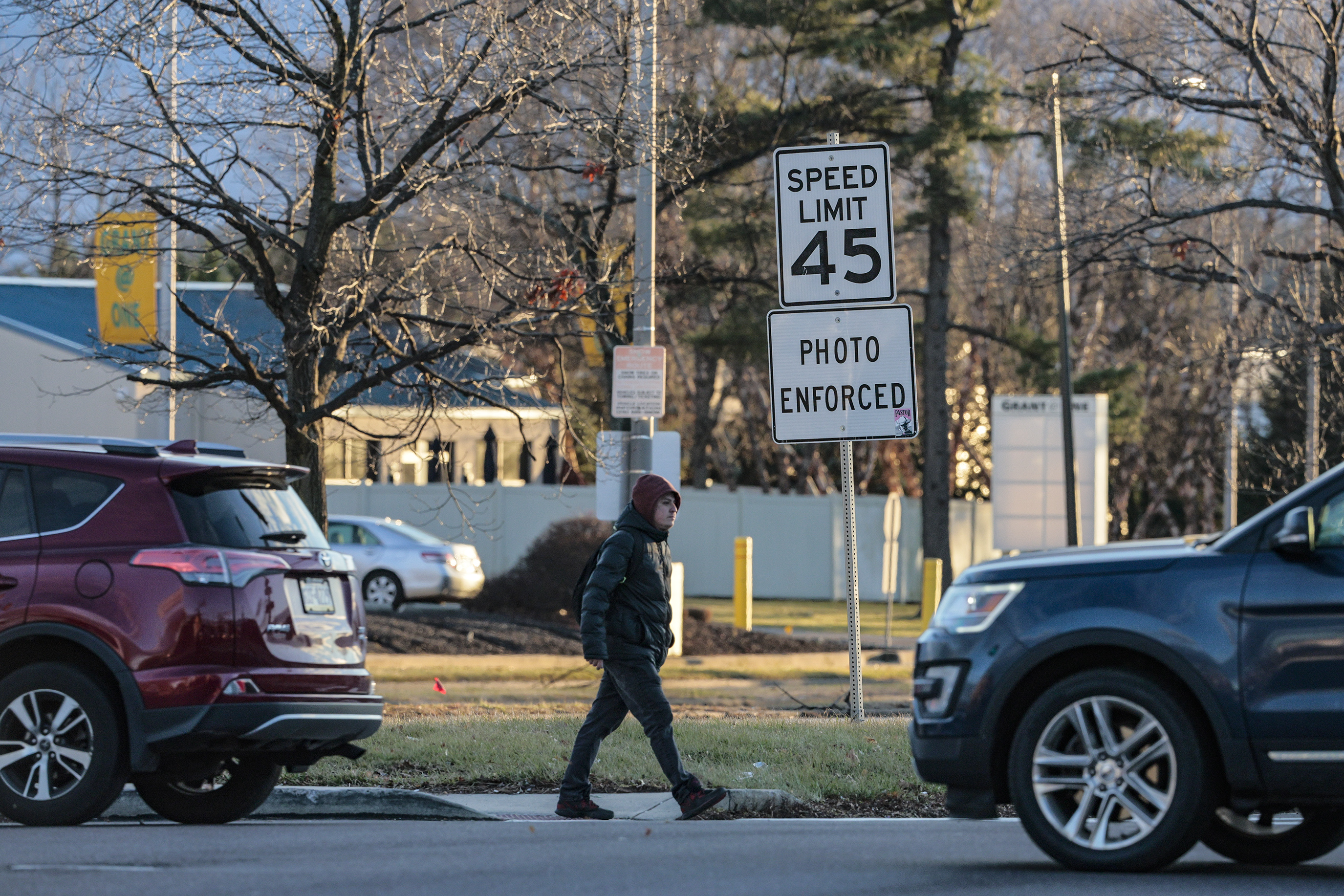
A construction crew dug up the sidewalk on the block, knocking down the curbside sign that says the speed limit is 25 mph and is “photo enforced,” said Corinne O’Connor, deputy executive director of the parking authority.
“We did the right thing,” O’Connor said. The violation notices were canceled because, she said, motorists did not have proper notice of the speed limit and the presence of enforcement cameras atBroad Street and 65th Avenue. State law requires those signs at camera locations.
Broad Street, also designated State Route 611, has 31 speed cameras at 15 locations spread out between Philadelphia’s northern and southern city limits. They began operating last September.
Drivers who travel more than 11 mph over the posted speed limit will eventually be ticketed, with fines starting at $100 and rising to $150 for those driving more than 30 mph over the limit.
A PPA staff member doing a regular check reported the signs near 65th Street missing in mid-January, but it took weeks to correct. Officials did not realize the cameras hadn’t been turned off, and did so on April 22, PPA said. The signs were replaced April 29.
O’Connor said the delay was due in part to ongoing construction and red tape required to get utility clearance to install a new pole with signs.
While the signs were missing, the cameras at that location clocked 23,195 speeding vehicles and issued violation notices.
Before the cameras were turned off, the PPA had processed $1.25 million in payments for 12,214 of the tickets. The money is being refunded, PPA said.
PPA spokesperson Marty O’Rourke said the drivers cited “were still speeding,” but the violations were annulled because the notification requirement of the law was not met. The tickets could have been canceled if a recipient appealed based on the missing signs.
O’Rourke said it was a “proactive decision” to cancel them.
Speeding has dropped 95% on the roadway, based on the declining number of violations issued since the first month cameras were operating there, PPA said.
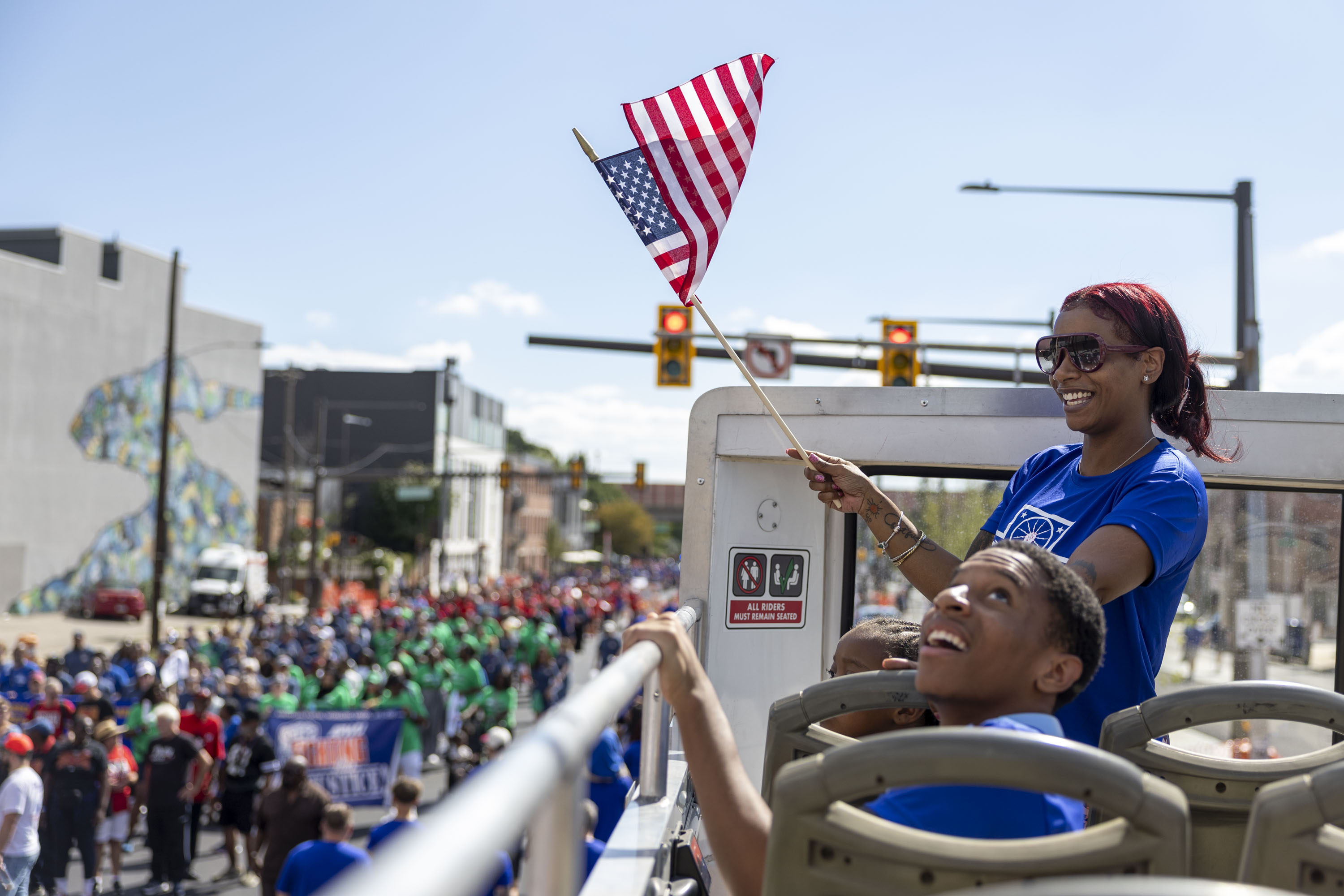
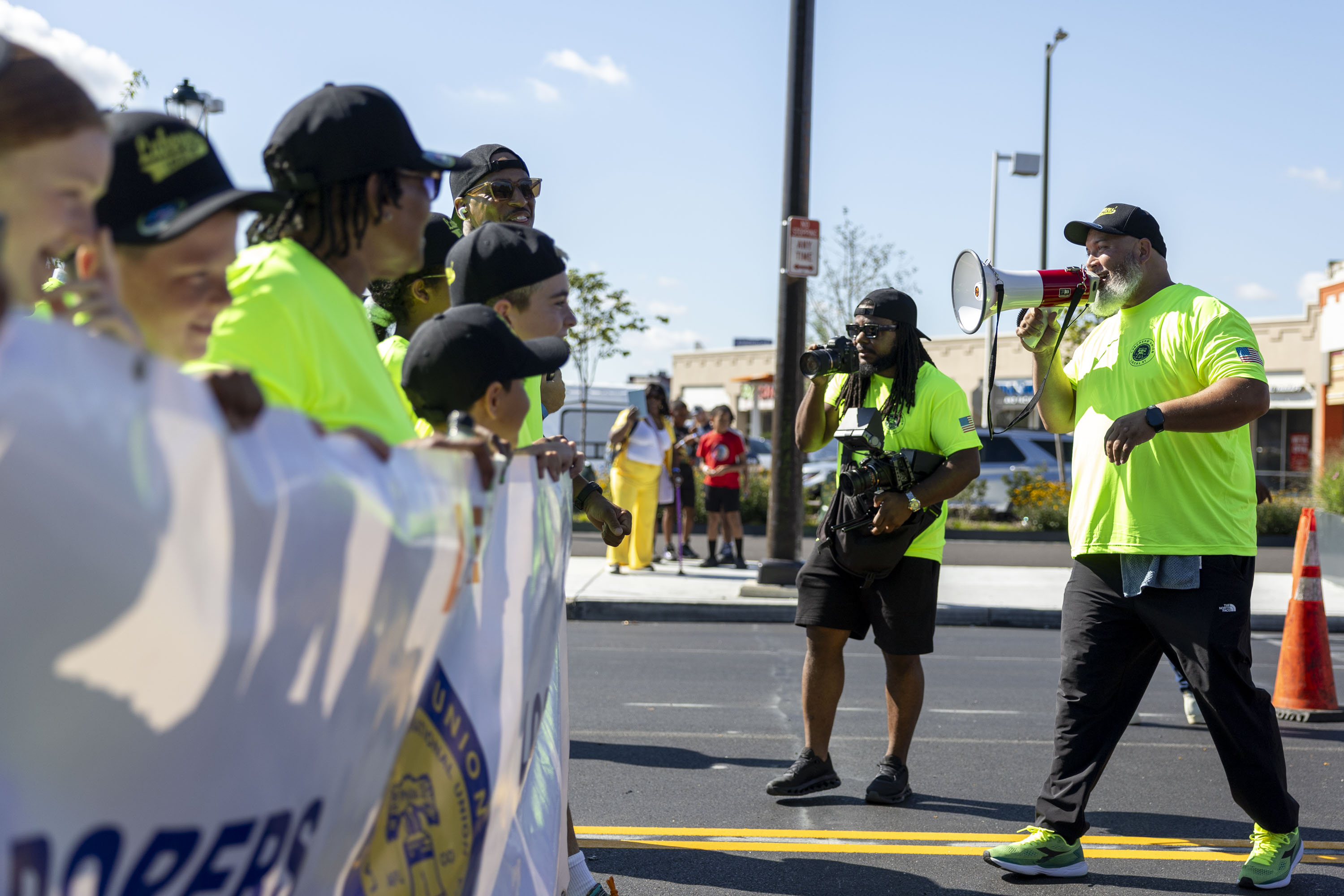
For more than an hour, waves of union members and their families marched and chanted along a half-mile stretch of Washington Avenue late Monday morning, their steps amplified by the percussive thunder of drum line groups.
Some could have easily opted to spend their Labor Day — balmy as it was, with blue skies and occasional tufts of cotton candy clouds — on a beach or at a barbecue, mused Wendell Young IV, president of United Food and Commercial Workers Local 1776, as he trekked past houses and storefronts in a blue T-shirt that bore the words “Solidarity is a vibe.”
But Young said he thought anger over some of President Donald Trump’s policies — such as a controversial attempt to end collective bargaining rights for more than a million federal workers — had compelled many union members to instead take to the streets for the 39th Annual Tri-State Labor Day Parade.
“He’s more interested in putting his name on buildings and arcs,” Young said, “than protecting the rights of workers.”
Economic anxiety was a recurring theme throughout the parade, as it is across much of the U.S. Federal Reserve data in January showed that wealth inequality in the country had reached its highest level since 1989.
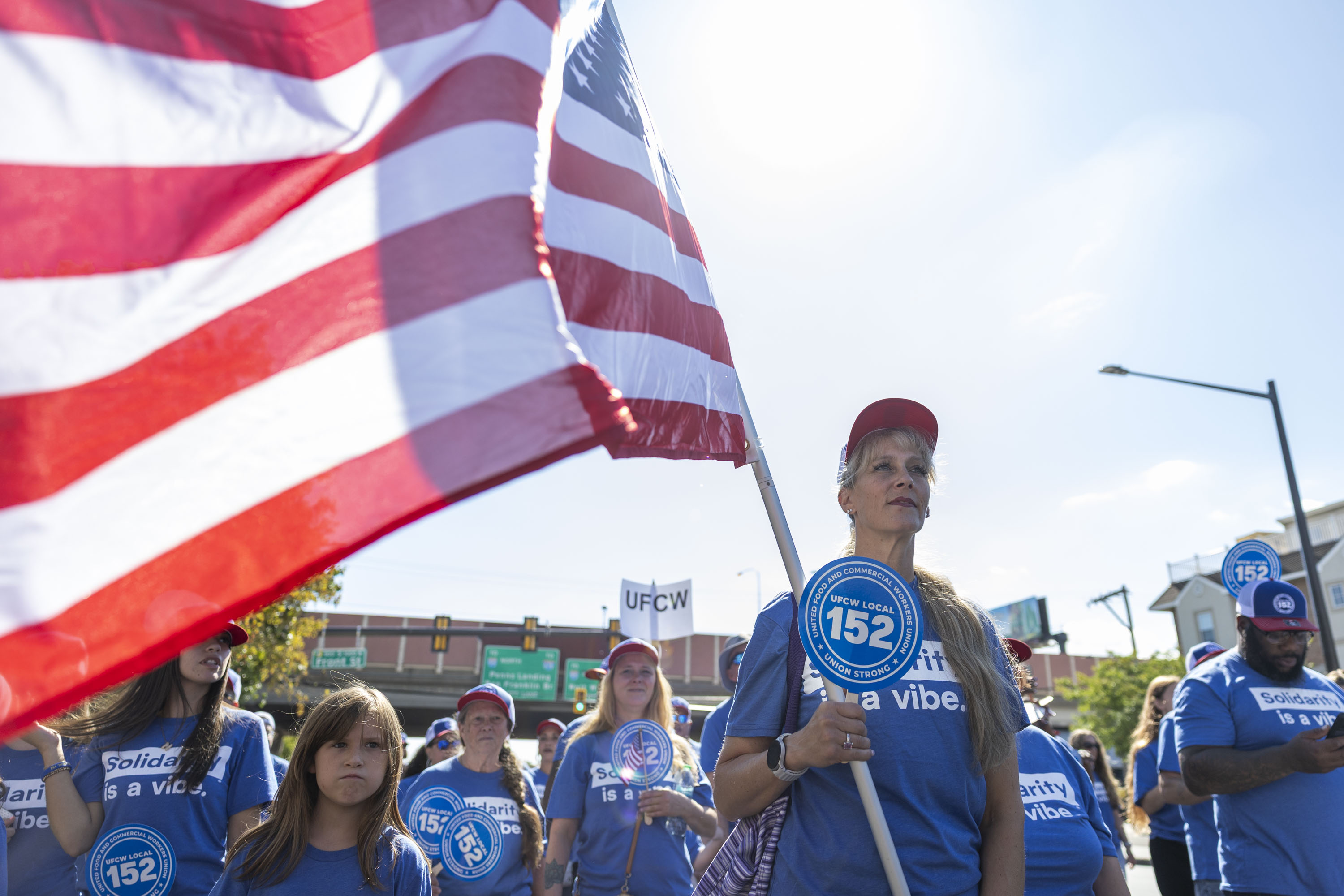
Lois Crudele, of Brooklawn, with Local 152 of the United Food and Commercial Workers International Union, is holding up the American flag while walking with fellow union members during Monday’s parade.Tyger Williams / Staff Photographer
“Workers in general are very concerned about cost increases across the board,” said Danny Bauder, president of the Philadelphia Council AFL-CIO. “Inflation keeps increasing [prices], and the job market is tight.”
Nina Coffey, secretary and treasurer for SEIU Local 668, which represents 20,000 social service union employees in Pennsylvania, said members most often express concern about the “rising costs of healthcare, being able to put food on the table, as well as unregulated artificial intelligence that we’re facing.”
Yet uncertainty did not overshadow what was an otherwise joyous day.
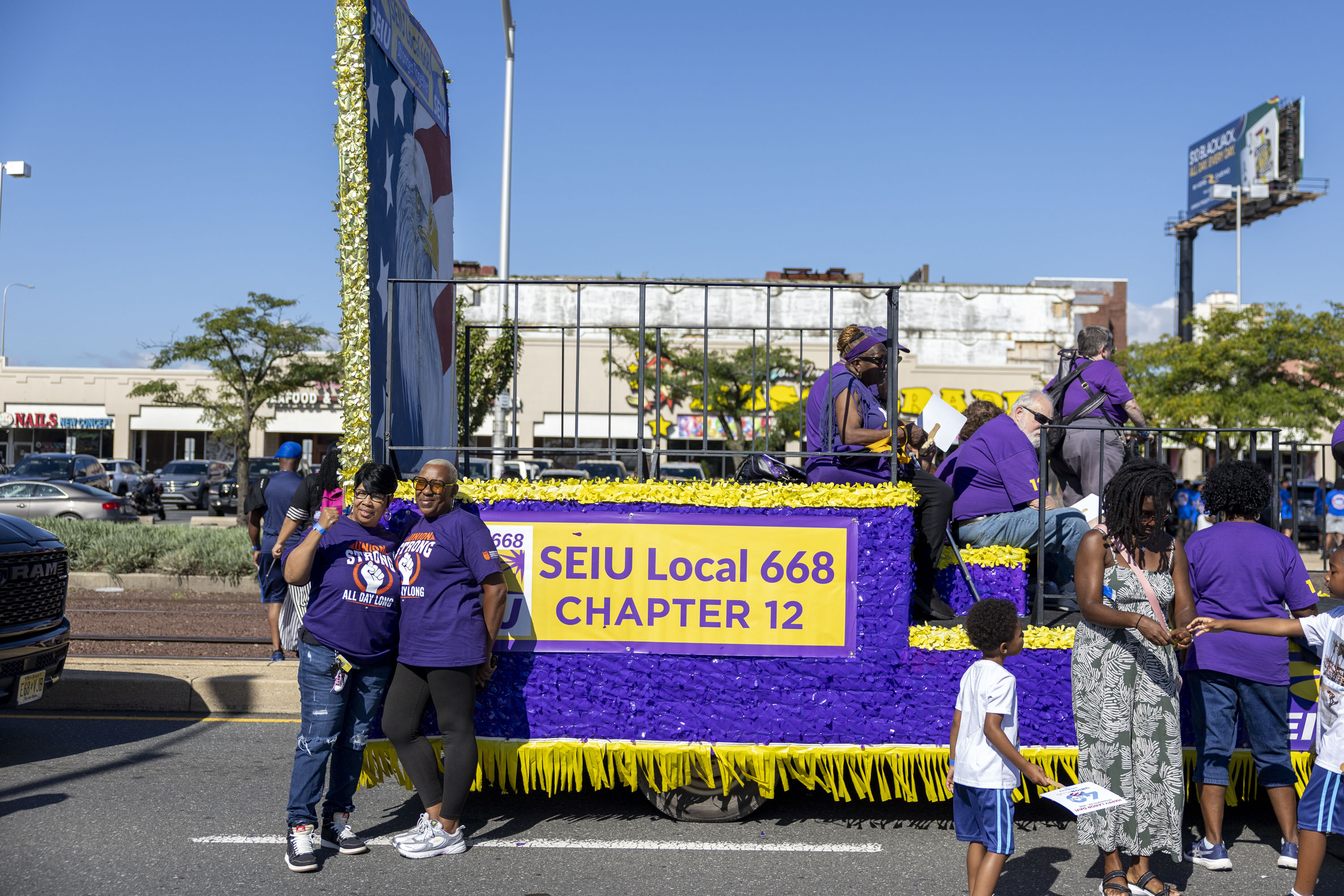
Behind Coffey, on Washington Avenue near Fifth Street, SEIU members on a purple and gold float tossed candy to giddy children on a sidewalk, where handfuls of smiling onlookers waved and recorded with their phones.
Bauder praised what he called “the beauty of union solidarity” — the communal lift that members experience when another union achieves a victory. He cited, as an example, the 1,500 unionized Peco workers who won raises and full retirement medical coverage after briefly going on strike in July, and hotel union workers who also secured wage increases after going on strike in June.
During a rally before the parade, outside the Sheet Metal Workers’ Local 19 Training Center on Columbus Boulevard, city and state officials preached from a platform about organized labor’s enduring presence.
“Philadelphia is a union town forever,” said city managing director Carlton Williams, who added that union workers have cleaned more than 150,000 city blocks under Mayor Cherelle L. Parker’s administration.
Charlene Little (left) and Tanita Williams (right), of West Philadelphia, with SEIU Local 668, with their parade float.Tyger Williams / Staff Photographer
Parker appeared briefly during the pre-parade gathering, then left abruptly.
“The mayor was here and wasn’t feeling well. She will be fine,” Parker’s spokesperson, Joe Grace, wrote in a text message. “She is sorry to miss an important event for organized labor that she never, ever misses.”
Parker later returned, and then attended two additional Labor Day events.
Pennsylvania Lt. Gov. Austin Davis, who also addressed the assembled union members, noted that his father is a union bus driver in Pittsburgh.
“I know what a good union job can do for a family. I’ve seen it,” Davis said. “And I think we’re going to continue to fight to protect that way of life here in Pennsylvania.”
A recent Gallup poll found that unions have a 71% approval rating, a figure that was surpassed only in the 1950s and in 1936.
The same poll showed that 47% of Americans want unions to have more influence than they currently do.
Billy Williams, of Northeast Philadelphia, with Local 57 of the Laborers’ International Union of North America, is leading chants for his fellow union members.Tyger Williams / Staff Photographer
Perception of unions improved during the COVID-19 pandemic — when nurses, bus drivers, and grocery workers were deemed essential — and has remained high ever since, Paul Clark, a professor of labor and employment relations at Pennsylvania State University, wrote in an email.
As many Americans’ standard of living has fallen, and income inequality has grown more extreme, labor unions have appeared to many as the “only institution that could help working people win a bigger share of the wealth they were creating and that they deserved,” Clark said.
Six years ago, the Pennsylvania attorney general sued a group of tow-truck operators for allegedly towing cars unlawfully — and then using intimidation tactics, including the threat of a pit-bull attack, to pressure car owners to pay excessive fees.
Now, the office’s Bureau of Consumer Protection says the companies violated the terms of a 2022 consent order settling that lawsuit, and has asked a Philadelphia judge to find them in contempt.
The contempt petition, filed Sept. 2 in Common Pleas Court in Philadelphia, seeks about $220,000 in penalties and restitution from the companies, Siani’s Towing and Recovery, Angelina’s Towing and Recovery, and Aubry’s Towing, which all operate out of the same address in North Philadelphia.
“The terms of this settlement were very clear, yet these companies continue to improperly tow consumers’ vehicles, and charge exorbitant fees,” Attorney General Dave Sunday said in a statement. “Predatory towing is a scourge that causes tremendous anguish and financial burden for the vehicles’ owners, and will not be tolerated.”
A person who answered the phone at the company hung up when contacted by a reporter.
According to the contempt petition, the Bureau of Consumer Protection has received 38 complaints about the towing companies’ conduct since the 2022 settlement.
Among them: The companies had persisted in towing peoples’ cars from spots not marked with proper signage, charging fees higher than what’s allowed by law, and harassing car owners who complained that their cars had been damaged while they were towed.
Some of the drivers were residents of apartment buildings, parking in the building lot with permission, when their cars were towed from their homes, according to the filing.
Nearly a decade ago, when U.S. District Judge Paul S. Diamond was asked to determine the fate of a prosecutor who admitted breaking the law, he did not hold back.
Just moments after then-Philadelphia District Attorney Seth Williams pleaded guilty in a public corruption case, Diamond had Williams handcuffed and hauled off to jail to await sentencing.
Then, a few months later, Diamond imposed the maximum prison term allowed by law — five years. And he upbraided Williams as a “criminal” who surrounded himself with “parasites” and “fed his face at the trough” of public money.
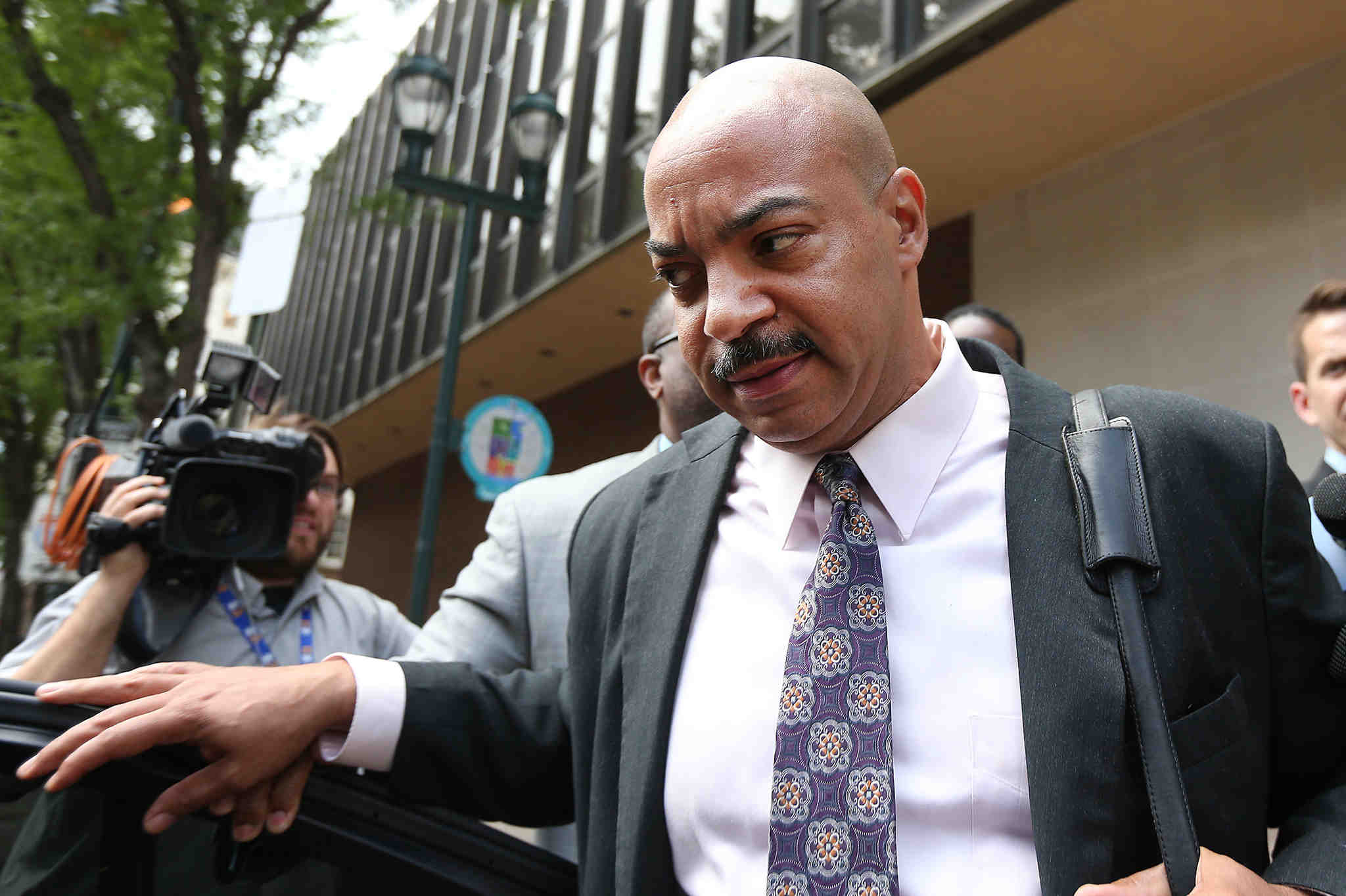
Then-District Attorney Seth Williams leaves the federal courthouse in 2017.DAVID MAIALETTI / Staff Photographer
Now, Diamond is overseeing a new case with a new set of accusations against a different district attorney.
The allegations against top prosecutor Larry Krasner have come as part of a dispute with staffers over how to handle a case, and Diamond has already made clear that he views the assertions as serious — suggesting in a hearing last month that he believed some could amount to federal crimes.
“If what they say is true, potential wrongdoing abounds,” Diamond said, listing off offenses including perjury, conspiracy, and obstruction of justice.
To some area legal observers, the pointed remarks were reflective of Diamond’s reputation as a stern, no-nonsense jurist — particularly when it comes to assessing the conduct of fellow lawyers.
Then-Assistant District Attorney Paul George (back left) was disbarred in federal court in 2025.JESSICA GRIFFIN / Staff Photographer
In 2017, while the case against Williams was still pending, he ordered it to proceed to trial just months after the indictment was unsealed — a highly unusual timetable for a federal case, but one the judge said was necessary because of its “obvious and possibly calamitous effect on the city’s criminal justice system as well as the city itself.”
And even in a comparably trivial legal dispute in 2014, Diamond was unabashedly critical of a lawyer who sued over the rights to a song by the R&B artist Usher, writing: “It is difficult to convey the poisonous atmosphere created by [the lawyer’s] continual belligerence.” The lawyer was ultimately suspended from practicing in the region’s federal courts for three months.
Samuel Stretton, a veteran defense lawyer who often handles legal ethics cases, said Diamond “has high standards. And if someone violates, in his mind, those high standards, he takes a very tough position on them and voices that opinion quickly.”
Still, Stretton said he thinks Diamond’s principled views are sometimes expressed in overly harsh ways.
“He has a strong belief in ethics, and lawyers having those especially, and he feels he must enforce them,” Stretton said. “But sometimes his manner of enforcing them is overstated, and he’s abrupt and a little bit of a bully.”
The question now facing Krasner is what actions Diamond might take in the post-conviction case pending in his courtroom — and whether any could lead to consequences for the city’s DA.
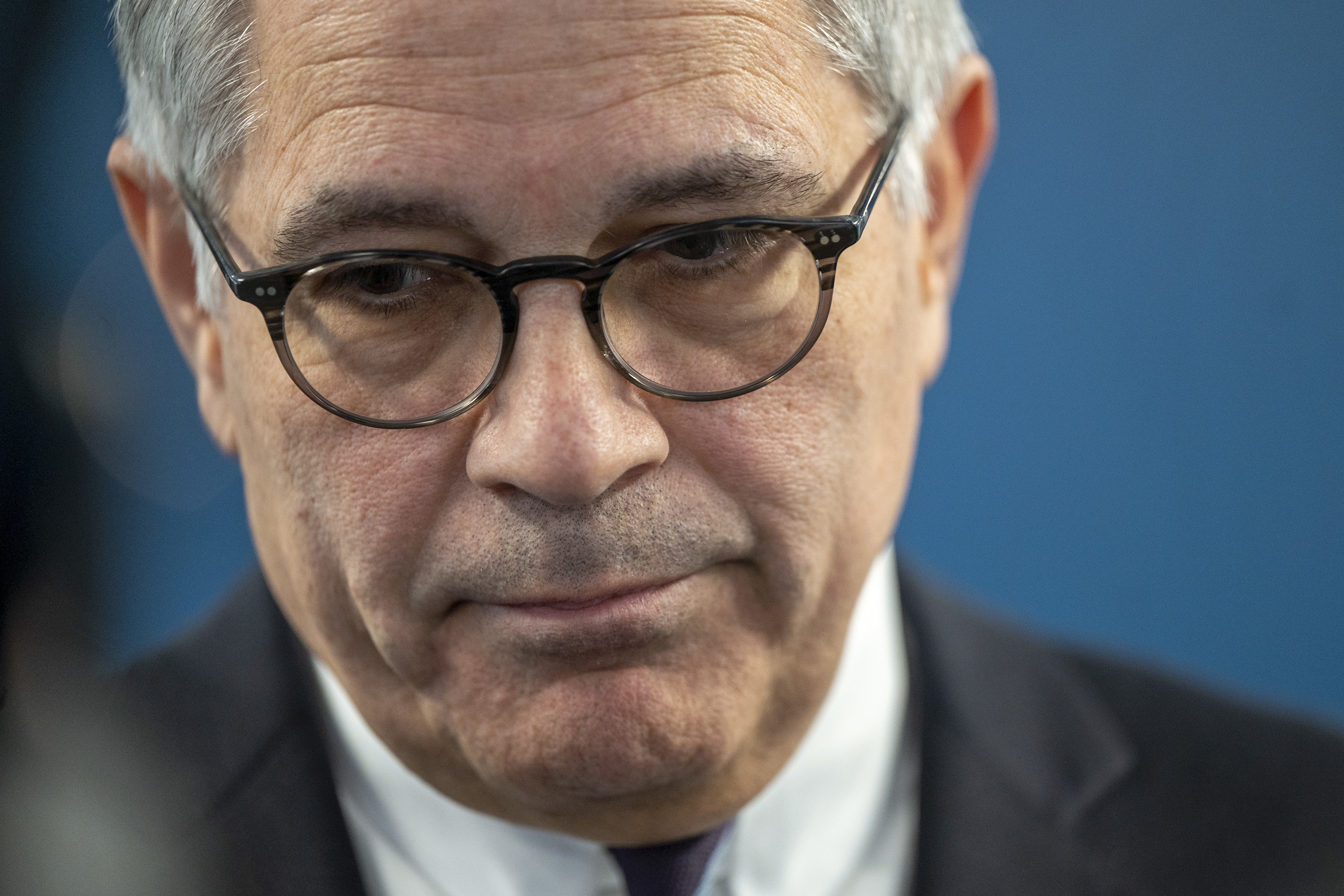
District Attorney Larry Krasner in a file photo from 2023.Allie Ippolito / Staff Photographer
Who is Paul Diamond?
Diamond, 73, was appointed to the region’s federal bench in 2004 by then-President George W. Bush. He was unanimously confirmed by the U.S. Senate.
Before his judicial nomination, he spent nearly two decades in private practice. He began his career as an assistant district attorney in Philadelphia in the late 1970s, and graduated from the University of Pennsylvania law school and Columbia University.
While he worked in private practice, Diamond focused on civil litigation, white-collar criminal cases, and disciplinary matters, according to an online biography. And his clients were sometimes unique.
In 1994, he represented a South Philadelphia candy making company that pleaded guilty to safety violations after an unguarded taffy-pulling machine killed one of its workers.
A few years later, he represented Lower Merion Township when the Barnes Foundation sued and accused township officials of using racism and discrimination to try to hurt the foundation. The suit was dismissed, and a defiant Diamond was later quoted in The Inquirer saying he planned to bill the Barnes around $1 million to cover the township’s legal fees.
“This is a claim that should never have been filed; it’s outrageous that it was ever filed, and now the Barnes is going to see the mother of all fee petitions,’’ he said.
A consistently exacting judge
Like all federal court judges, Diamond oversees a mix of criminal and civil cases. And even though not all receive significant public scrutiny, Diamond is viewed by some as a consistently exacting judge.
In 2012, for example, he ordered a 60-year-old grandmother jailed for using her dead mother’s Social Security checks to support her grandchildren.
“Did it ever occur to you to go out and get a job?” Diamond asked the woman. “Did it ever occur to you that the way to help your grandchildren is not to commit a series of endless federal frauds?”
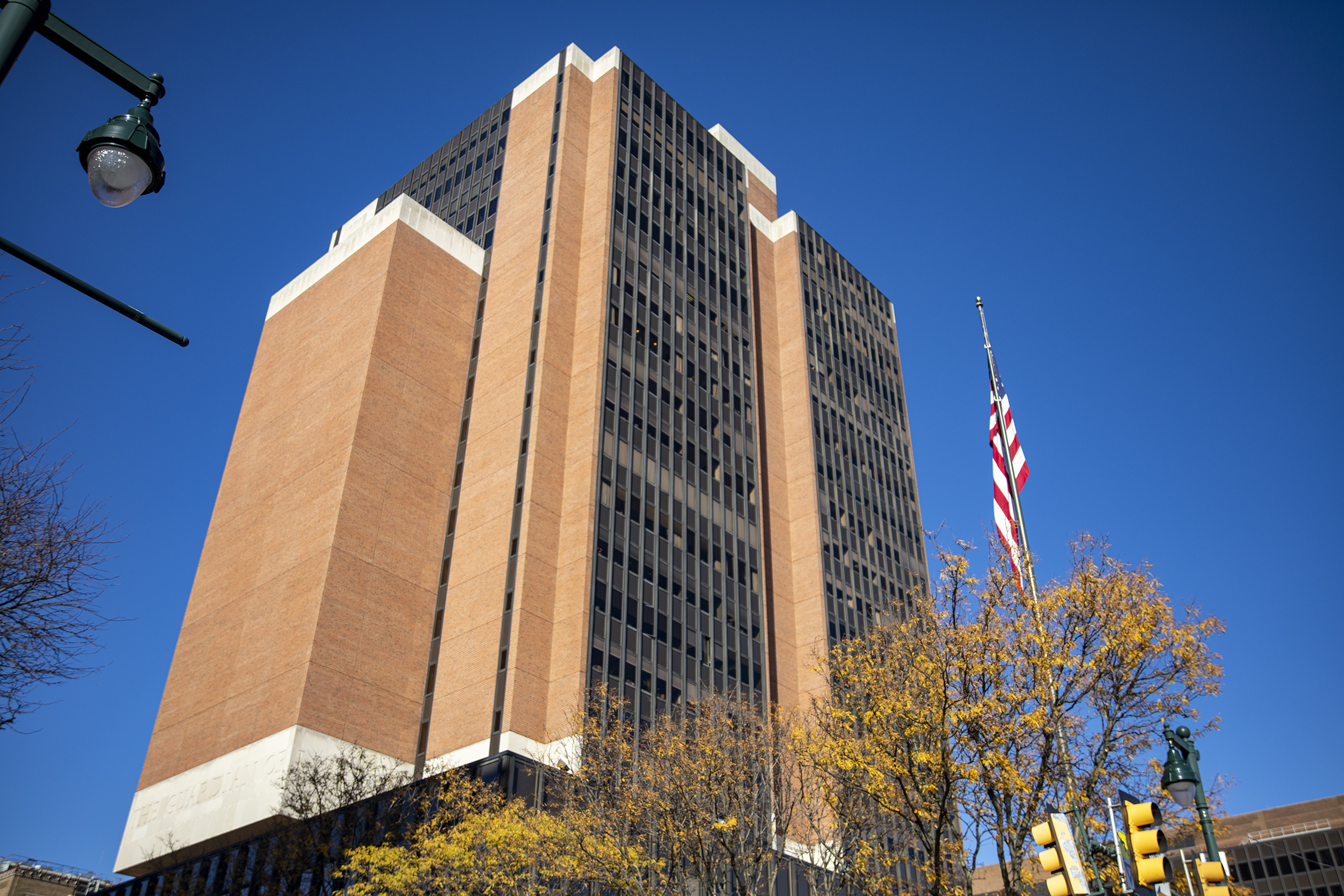
The federal courthouse in Philadelphia.TYGER WILLIAMS / Staff Photographer
Last year, he was subtly critical of the Trump administration in court documents, writing that it was using competing interpretations of the law to try to justify its policy to detain nearly all undocumented immigrants.
It is “difficult to credit the Government’s squarely contradictory position here,” Diamond wrote.
The Krasner matter that ended up in his courtroom arrived as a routine post-conviction case: Dennis Johnson, who was found guilty of second-degree murder in state court in 2009, filed a petition in federal court seeking to have his conviction overturned.
The petition was filed more than 10 years ago, but it wasn’t until 2022 that the origins of the current controversy would begin to take shape.
A frenzy within the DA’s office
That year, after the district attorney’s office had spent years opposing Johnson’s bid for relief, prosecutors changed course.
Then-Assistant District Attorney Jaclyn Mason filed a brief agreeing with Johnson’s lawyers that his trial counsel had been ineffective. And she said her office had discovered problems or inconsistencies with testimony from key witnesses, leading her to recommend that the conviction be overturned.
The case was first sent to a federal magistrate to review, and Judge Lynne A. Sitarski — relying on Mason’s brief — agreed with her position.
But Sitarski’s recommendation was not binding — the final call would fall to Diamond. And this spring, Diamond signaled he was not inclined to accept the assertions in Mason’s brief. He scheduled an evidentiary hearing to hear testimony that could corroborate — or undercut — the office’s conclusion.
That triggered a frenzied sequence of events inside the DA’s office, prosecutors have since testified.
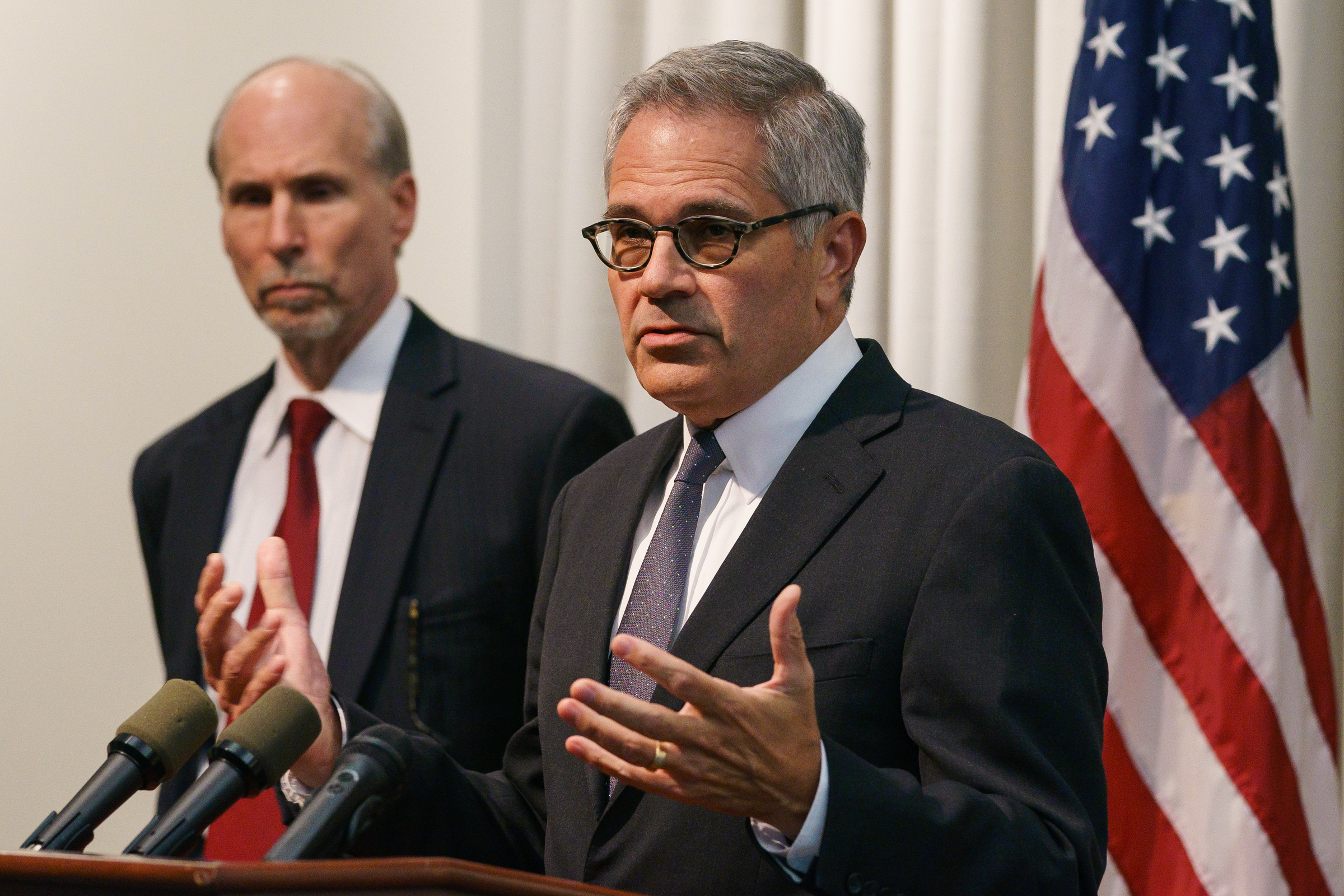
District Attorney Larry Krasner speaks at a news conference while flanked by two prosecutors who have since testified about actions he took in a controversial post-conviction case: David Napiorski (left) and Peter Andrews.Tom Gralish / Staff Photographer
To prepare for the hearing, Mason’s supervisors in the law division reviewed her brief and found a series of what they called “material misstatements.” They decided they needed to try to withdraw Mason’s filing and apologize to Diamond for the mistakes. And they asked that Mason sign on to the new filing with them.
But Mason declined and resigned. She’s since said she only filed her brief at the urging of her then-boss, Matthew Stiegler, who she said had done nothing to review the case himself but instead was “colluding” with Johnson’s defense attorneys to secure his release from prison.
Mason said she didn’t want to become a scapegoat for Stiegler or the office. And she accused her colleagues of attempting to force her to lie to protect the institution.
Her former supervisors have denied that, saying that once they noticed the errors in her brief, they were ethically obligated to correct the record in front of Diamond.
But as they strategized their approach, they said, they encountered consistent resistance from an unusual source: Krasner.
In their telling, Krasner was ardently opposed to asking the state attorney general’s office to take over the case — something the supervisors generally agreed was appropriate because of the drama surrounding the matter within their office.
Assistant District Attorney David Napiorski, head of the office’s law division.Alejandro A. Alvarez / Staff Photographer
And according to the supervisors — Katherine Ernst, Steven Wildberger, David Napiorski, and Peter Andrews — Krasner made a series of notable statements during their discussions, including that he wanted to handle the case in a way that would “protect the office,” that those who didn’t follow his orders would face “consequences,” and that he wanted to keep the matter from the attorney general’s office because he viewed its staffers as “Nazis.”
Several potential paths forward
All of those assertions were aired in Diamond’s courtroom in recent weeks, after the judge decided the evidentiary hearing in Johnson’s case would, for now, focus on the conduct of the prosecutors involved, rather than the merits of his petition. The judge said he’ll evaluate that aspect of the case later.
The attorney conduct portion of the hearing concluded last month, leaving Diamond with several choices about what to do with their startling testimony, legal observers said.
The most immediate issue is whether he’ll allow the DA’s office to continue handling Johnson’s case. Given the dysfunction prosecutors testified to, he could ask the attorney general’s office to take over instead.
But Krasner — who was not called to testify and who has said he can’t comment on the case while it’s pending — will likely have the opportunity to propose his own solution in court documents. In earlier filings, he said he engaged an outside lawyer to handle the matter on the office’s behalf — which, in his view, would insulate the case from the issues roiling his office, and preclude the need to involve state prosecutors.
Beyond that question, however, the testimony about conduct by the DA’s office could, in theory, lead to other consequences.
District Attorney Larry Kranser was not called to testify in front of U.S. District Judge Paul S. Diamond in the post-conviction case that Diamond is overseeing.Heather Khalifa / Staff Photographer
Stretton, the defense lawyer and ethics expert, said Diamond could refer the matter to the federal court’s disciplinary committee. There, a panel of judges could seek to determine if any of the prosecutors involved — including Krasner — behaved in a way that might warrant disciplinary action, such as a suspension or disbarment from practicing in federal court.
That process, which is largely confidential, would also likely be lengthy: In an earlier federal case that led to sanctions for two supervisors in Krasner’s office, a federal judge said he was seeking to initiate the disciplinary process in 2022, and punishments were not decided for another three years.
After that, Stretton said, if discipline is imposed in federal court, the matter would likely be forwarded to the state’s disciplinary board, which would make its own determination of possible penalties. That could also be an extended process.
And in what would likely be the most serious scenario, Stretton said, Diamond could refer the matter to federal or state prosecutors — or prosecutors could decide to pursue it themselves — to determine if crimes were committed. That, too, would almost certainly not be resolved quickly.
Stretton said any of those processes — and any potential outcomes — could also be further delayed or complicated because of inevitable disputes or competing interpretations over what lawyers did. In his view, for example, ethical rules generally allow a supervisor such as Krasner to pursue a legal strategy opposed by his subordinates as long as he had a “reasonable” argument for doing so.
And the testimony that unfolded before Diamond has already demonstrated that different lawyers had different recollections of what occurred: Mason accused her bosses of encouraging her to participate in a cover-up, but the supervisors said that wasn’t true.
The supervisors, meanwhile, accused Krasner of trying to get them to violate their ethical obligations, a contention he has similarly denied.
For now, the case remains on hold as Diamond weighs how to move forward. He has asked lawyers in the case to file additional briefings by Tuesday about how they believe the case should proceed.
Beyond that, Diamond has not indicated how quickly he might rule on the matter.
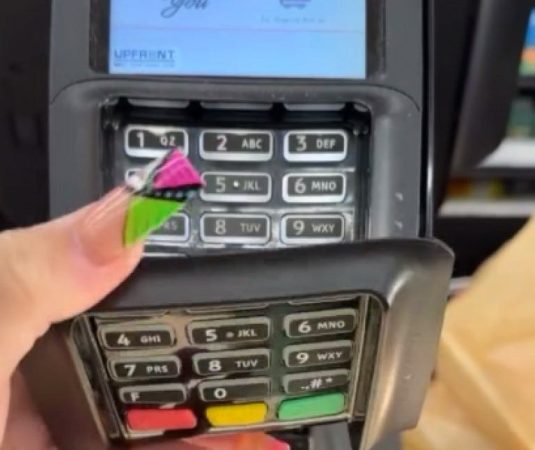
By the time state and local law enforcement in Northumberland County, Pa.,connected a device stealing people’s food assistance benefits from a 7-Eleven to Patricia Bogdan and George Lazar, the pair had already fled to New Jersey.
Authorities allege Bogdan and Lazar placed the contraption on a point-of-sale terminal in February, which went undiscovered for days. Bogdan and Lazar then allegedly retrieved the stolen electronic benefit transfer card data in a process known as skimming and spent people’s benefits at BJ’s and Sam’s Club locations in Pennsylvania and New Jersey.
Authorities would later learn Bogdan had multiple aliases and fake passports, while Lazar had a warrant out for an attempted murder charge in Belgium.
“It illustrates how quickly they’re moving, the type of individuals that are involved in this, and just their ability to get in and out, that makes these really complex cases,” said State Inspector General Michelle Henry, whose office investigates EBT thefts in Pennsylvania.
With the help of authorities in New Jersey and North Carolina, Henry’s office was able to find Bogdan and Lazar in March and later bring them back to Pennsylvania, where the cases are ongoing. A small win in what victim advocates argue has risen to a nationwide crisis because the federal government has failed to invest in more secure card technology. The magnetic strips on the cards are too easy to exploit.
Still, a seismic disruption to these scam operations is slated to come to Pennsylvania before Jan. 1, 2028.
The latest state budget appropriated $7 million in funds that would pay for chip-enabled EBT cards, giving the outdated magnetic stripe technology, which the federal government required states to use until 2024, a sorely needed upgrade.
The chip cards are not invulnerable to scammers but exploiting them requires more sophisticated technology, according to the Secret Service. Early adopters of the chip technology, such as California and Alabama, have reported significant drops in thefts already.
To the victims of this sort of fraud, scarred by the memories of an unexpected zero balance while trying to pay for groceries, the change is long overdue. There are countless stories of families learning about how the scam works and having to scrape meals together with the aid of food pantries.Benefits were reimbursed between October 2022 and December 2024, but that ended when Congress did not extend funding.
For now, law enforcement in Pennsylvania continues to confiscate skimming devices and prosecute perpetrators, even when it can feel like a high-stakes game of whack-a-mole, while preparing for the next iteration of scammers.
An ever-evolving scheme that knows no borders
Much of the skimming scam — from recruiting to reselling the goods purchased with EBT data— happens online through the dark web and social media platforms such as Facebook and Instagram.
Transnational criminals, more recently from Eastern European countries, will send already assembled skimmers to partners stateside or provide instructions on how they can piece together the devices themselves. The local partners stick the contraptions onto a point-of-sale machine, steal data, and use the stolen benefits to purchase high-ticket items such as baby formula, which is then offloaded by word of mouth or on social media networks like Facebook and Instagram.
Michael Ross, special agent in charge of the Philadelphia field office for the United States Secret Service, said the advent of Bluetooth technology has made it much harder to catch people in the act since they can digitally collect the stolen data, instead of taking back the physical machine where police might be waiting for them.
Combating these crimes requires a multipronged approach, from the use of digital forensics to old-school public awareness efforts.
“We will send out a small group, not necessarily a formal task force, with state and local law enforcement representatives, and we will go to businesses,” Ross said. “We will go in, we’ll educate, we’ll show what some of these devices look like, things that can be done to make sure that the EBT fraud is mitigated.”
Various states have responded in a similar fashion, educating businesses and placing the onus of protecting food assistance benefits on recipients, who are encouraged to download apps on their phones that allow them to lock their cards until they’re ready to pay for groceries.
Still, Pennsylvania has aimed to be more aggressive in its fight against skimming.
The Office of State Inspector General piloted “Skimmer Response Teams” last year. Since its inception, the six- to eight-person group that works with the broader office on cases, seized more than 55 of these devices before scammers could come back and drain more than $20.5 million in benefits from more than 40,000 accounts.
Despite these strides in prevention, the state reported more than 5,100 skimming incidents that accounted for more than $2.5 million in stolen food assistance benefits in the first five months of the year.
It’s one of the reasons the task force pilot is now permanent and is expected to stay even as the EBT cards switch to chips.
“In my experience as a longtime prosecutor, anything that makes it more difficult to complete the crime is a deterrent,” said Henry. “If it’s super easy, you’re going to have more of it.”
And Pennsylvania wants to make stealing people’s food assistance benefits as difficult as possible.







 –>
–>  –>
–>  –>
–>  –>
–>  –>
–>