Tom Corcoran, 82, of Philadelphia, retired president of the Delaware River Waterfront Corp., founding president and former chief executive officer of the old Cooper’s Ferry Development Association in Camden, former business administrator for the city of Camden, onetime Peace Corps program director in West Africa, mentor, and poetry enthusiast, died Sunday, Aug. 30, of complications from dementia at his home in Center City.
Born in Chicago and a graduate of Loyola University Chicago, Mr. Corcoran earned a master’s degree in public administration at the University of Pennsylvania’s Wharton School in 1975 and never strayed far from the Delaware River after that. He spent 25 years, from 1984 to 2009, as president and CEO of the Cooper’s Ferry Development Association on the Camden waterfront, and eight years, from 2009 to 2017, as president of the Delaware River Waterfront Corp. in Philadelphia.
He championed what he called “the two cities, one waterfront strategy” and was especially adept, former colleagues said, at political maneuvering and marshaling funds and projects. Former colleagues on both sides of the Delaware called him “a tireless public servant,” “a visionary urban planner,” and an “economic development strategist with short-term practicality and long-term vision.”
In Camden, Mr. Corcoran added more than $550 million of investments to the waterfront area and oversaw the development of what is now the Freedom Mortgage Pavilion, the Adventure Aquarium, Wiggins Waterfront Park, the Riverlink Ferry, several office buildings, and other projects. Another New Jersey developer called him a “cult figure” among state lawmakers.
Mr. Corcoran talks at City Hall in 2011 about creating a string of parks along the Delaware River.Akira Suwa / Staff Photographer
He said education as well as development was key to building a strong local economy and told The Inquirer in 2006: “Until Camden has a good-quality education system, we’re not going to be able to attract families with school-age children back to the city.”
Dana L. Redd, former Camden mayor and current president and CEO of Camden Community Partnership, said on Facebook that Mr. Corcoran often slept on a cot in his Camden office and left daily handwritten messages that his project managers called “love notes.” Redd said: “He challenged a generation of urban leaders to think bigger, believe in Camden, and dream about what the city could become.”
In Philadelphia, he initiated the Race Street and Washington Avenue pier parks, the Spruce Street Harbor Park, a miles-long bike and walking trail, and the I-95 overpass park to reconnect Center City with its waterfront. “The more we look at the concept of one waterfront, two states, the more opportunities we’re going to find,” he said when he left Camden for Philadelphia in 2009.
When he retired in 2017, he said: “Instead of swinging for the fences, we decided we would hit singles and doubles and bunts and sacrifices, steal bases, and do whatever we could. Eventually, we thought, we’d always get back to the center.”
Mr. Corcoran (left) shakes hands with then-Mayor Michael Nutter in 2009 after joining the Delaware River Waterfront Corp. Alejandro A. Alvarez / Staff Photographer
Longtime colleague and friend Bill Hankowsky said: “It is truly unique that a single individual could have the vast impact across two facing waterfronts in the center of one of the country’s major urban metros.”
Earlier, Mr. Corcoran served nine years, from 1975 to 1984, in Camden city government, rising from administrative aide to business administrator. In 2001, he earned a Good Neighbor Award from the Camden County chapter of the American Red Cross for his “integral role in the revitalization of the city.”
In the 1960s, Mr. Corcoran joined the Peace Corps after college and spent seven years in Africa building dams and wells with local farmers. He spoke French and the local African language, and rose to program director.
“What an exemplary life he led,” a former Peace Corps colleague said in a tribute, “without fanfare or drama and always with service to others.”
Mr. Corcoran (right) led visitors on a tour of the Washington Avenue pier park in 2014.Viviana Pernot / Staff Photographer
Off the waterfront, Mr. Corcoran was enthralled by poetry and his Irish heritage. He liked to recite lines from Ulysses and other poems, and sing songs from the old country.
“He was a true Renaissance man who had a remarkable vision for communities and people,” a former colleague said. Former colleague John Grady said: ”Tom was a giant, unassuming, persistent force for the local community.”
Thomas Patrick Corcoran was born May 13, 1944. He earned a bachelor’s degree in political science at Loyola in Chicago and rode camels to work in Africa during his time in the Peace Corps.
He met Robin Lowey at a dinner society event, and they married in 2003, and lived in Camden and Philadelphia. They enjoyed traveling and dining together, and hashing over world affairs.
Mr. Corcoran and his wife, Robin Lowey, married in 2003. Courtesy of friends
In 2009, he said he often peered through a telescope at the Philadelphia waterfront from his home in Camden and wondered how he would develop Penn’s Landing. “He’s the one who brought together the business leaders and was able to steer through difficult political waters,” then-Camden County freeholder Jeffrey Nash said in 2009.
His wife said: “He was a kind and generous gentleman. He was a good, nice person.”
In addition to his wife, Mr. Corcoran is survived by three sisters, a brother, and other relatives.
Services were held Thursday.
Donations in his name may be made to the Caplan Caring Difference Fund at the Penn Memory Center, Office of the Treasurer, Box 71332, Philadelphia, Pa. 19176.
Mr. Corcoran spent seven years in the Peace Corps after college. Courtesy of friends
With the relocation, set to start in two to three years, the discount retailer says it will invest a total of $370 million in the city. The company plans to keep warehouses in Burlington County, including on the site of its current headquarters, where it has been based for more than half a century.
Here’s what else to know about the big numbers related to Burlington’s move to 3151 Market St.
What does it cost to move to Schuylkill Yards?
$370 million: What Burlington plans to spend on the move
$240 million: How much Burlington is paying for the 441,000-square-foot building, according to a Thursday SEC filing by Brandywine Realty Trust. That’s about $544 per square foot.
$130 million: How much Burlington plans to spend on “design and development of the space, creating an HQ built for collaboration and the modern needs of Burlington’s corporate workforce,” a spokesperson said.
$223 million: What Brandywine had spent on 3151 Market, as of June 30, according to its latest earnings report.
(function() { var l = function() { new pym.Parent( ‘burlington-move__graphic’, ‘https://media.inquirer.com/storage/inquirer/ai2html/burlington-move/index.html’); }; if(typeof(pym) === ‘undefined’) { var h = document.getElementsByTagName(‘head’)[0], s = document.createElement(‘script’); s.type = ‘text/javascript’; s.src = ‘https://pym.nprapps.org/pym.v1.min.js’; s.onload = l; h.appendChild(s); } else { l(); } })();
$168 million: How much Brandywine estimates it will get from the sale. The company said in an SEC filing that it has a $57.3 million mortgage on the building that will be repaid at closing, which is set for later this month.
96%: The vacancy rate at 3151 Market, which was completed in 2024.
Burlington Stores’ future new home at 3151 Market St., in Philadelphia. Jessica Griffin / Staff Photographer
What government incentives are going to Burlington?
$30 million: How much Burlington is set to receive in grants from Pennsylvania.
$8 million: What the City of Philadelphia plans to invest in Burlington’s move, including a $7 million forgivable loan and $1 million for a year of free SEPTA passes for employees.
How much of Burlington’s workforce is coming to Philly?
1,500: Number of Burlington employees the company plans to move from New Jersey to Philadelphia, starting in late 2028 or early 2029
500: Number of hires Burlington plans at its new headquarters in the next five years
0: Number of layoffs Burlington has planned as a result of the headquarters relocation
Inquirer reporter Joseph N. DiStefano contributed to this article.
A man serving life in prison for a 2010 first-degree murder conviction will be released from prison after pleading no contest to lesser crimes for his role in a fatal North Philadelphia shooting.
Rasheem Hall, 42, was granted the right to a new trial in April after a judge agreed with his defense attorney that prosecutors had withheld evidence that could have aided Hall’s ongoing effort to appeal his conviction.
They said prosecutors’ main witness had been an unreliable jailhouse informant who had recanted statements he’d made about Hall’s involvement in the 2007 shooting that left 34-year-old Ronald Kennel dead.
Rather than retry the case, however, prosecutors agreed to conditions Friday that allowed Hall to plead no contest to aggravated assault and a firearms violation. During the hearing, Common Pleas Court Judge Diana L. Anhalt approved a sentence of nine to 18 years in prison in exchange for Hall’s plea.
Because he had already served that time in custody, he could be released as early as Friday afternoon, she said.
Hall’s family members reacted to the news with a mixture of smiles and tears.
“I’m just happy for Rasheem, I’m just happy for his family,” Hall’s defense attorney, Robert Gamburg, said after the hearing.
The development comes as District Attorney Larry Krasner’s office faces scrutiny of its handling of post-conviction cases. Last week, a federal judge said actions city prosecutors took in another case could amount to perjury, conspiracy, or obstruction of justice.
Friday’s hearing ended a yearslong campaign by Hall to appeal his conviction.
That effort centered on issues with Deric Williams, an informant who was recorded on a jailhouse phone line telling his mother he had wrongfully implicated Hall in the crime and that he had tried, unsuccessfully, to recant his statements to detectives.
Earlier this year, Gamburg told a judge prosecutors had failed to hand over that recording of Williams to Hall in 2013 during his appeal, though prosecutors contended that jurors had heard similar remarks from Williams at Hall’s 2010 trial.
Judge Rose Marie DeFino-Nastasi sided with Hall, saying that in addition to the phone recording, emails between prosecutors with details of their relationship with Williams should have been turned over to his defense team.
On Friday, Assistant District Attorney Trey Flynn told Anhault that while prosecutors accepted Hall’s plea, they stood by their earlier assertions about the case.
He said prosecutors would have told jurors that Hall and another man, David Satchell, only fired guns during the May 20, 2007, incident after being shot at by another person first.
Hall’s gunfire struck a bystander, Charlene MacDonald, in the leg, Flynn said.
“It was individuals firing at Hall who actually struck Ronald Kennel, who was standing behind them,” Flynn said.
Still, prosecutors would have argued that Hall was responsible for Kennel’s death via transferred intent, Flynn said. The legal theory holds a defendant responsible for injury or death based on their intent to harm, regardless of who was actually affected.
Flynn said he had spoken with Kennel’s brother “at length” about prosecutors’ decision to accept Hall’s plea. And he said District Attorney Larry Krasner agreed with the decision as well.
Outside the courtroom, Hall’s family members were moved to tears by his imminent release and return home for the first time since his early 20s.
“It’s been almost 19 years,” said Hall’s father, Ronald. “He’s got a daughter, he’s got nieces, nephews. People that passed away. It’s a lot of time lost, time you can’t get back.”
Ronald Hall said his son only learned of the opportunity to plea to lesser charges last week, and that the gravity of the news is still fresh.
Samuel C. Stretton, the high-profile Chester County lawyer, said he’s been hearing from women about Lindsay Clancy, the Massachusetts mother facing murder charges for killing her three young children.
“You know, Sam, she’s innocent,” he recalled one woman telling him at a supermarket.
Stretton knows the Clancy case has struck a nerve. He knows because he defended a woman in a similar case 37 years ago.
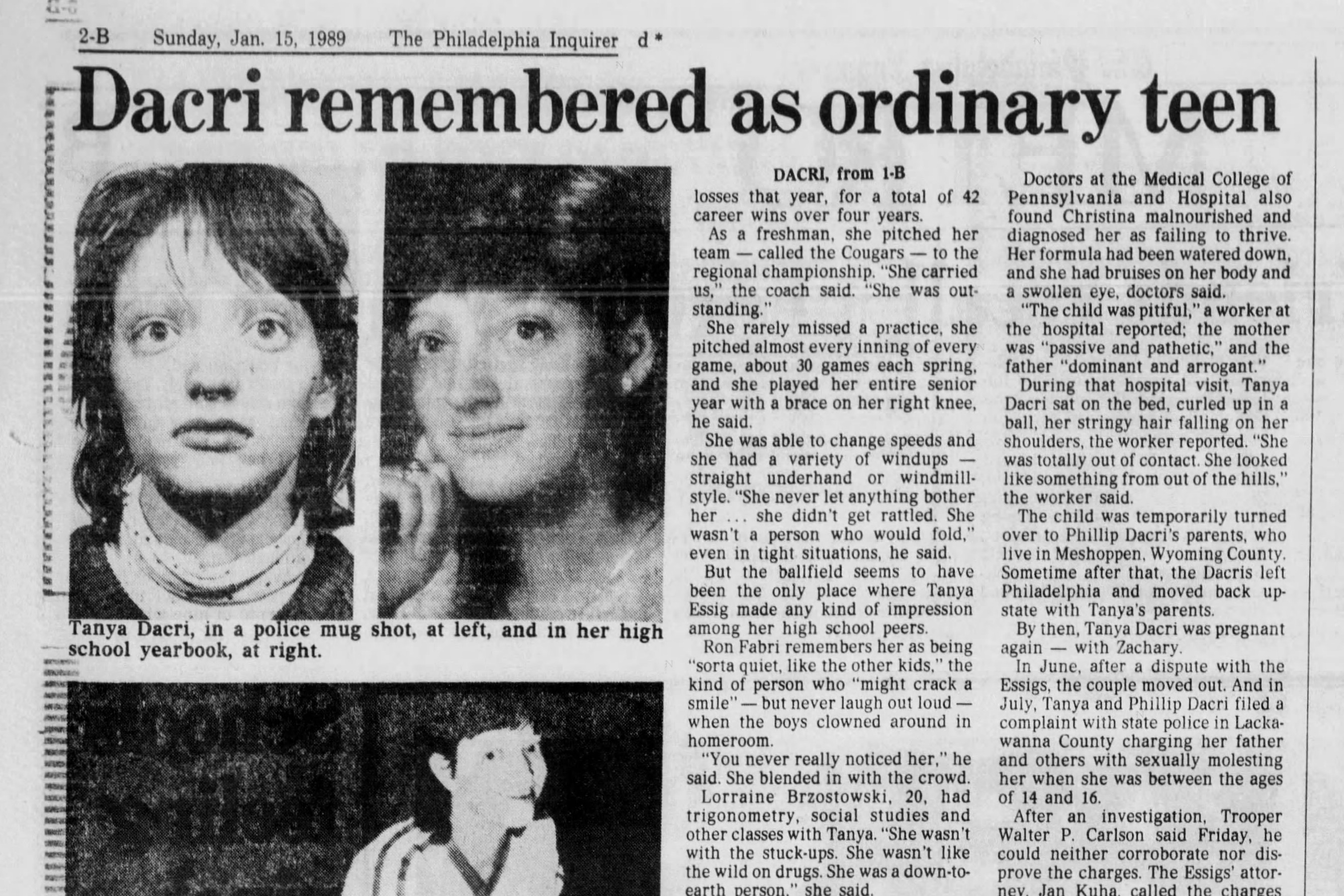
He represented Tanya Dacri, a Northeast Philadelphia woman who pleaded guilty in 1989 to drowning her infant son Zacharry and dismembering his body.
She was sentenced to life in prison.
“I don’t think there’s any question now, in hindsight, that she suffered from [the] postpartum diagnosis. Problem was, it wasn’t understood back then, like it is now,” Stretton said in a phone interview Tuesday night.
Lindsay Clancy sits at the defense table as Kevin Reddington asks the jury to find her not guilty during her murder trial at Plymouth Superior Court in Plymouth, Mass., on Aug. 27. Greg Derr
The jury in the Clancy case began deliberating last week. Unable to reach a verdict, Judge William Sullivan declared a mistrial Friday afternoon. A status hearing to decide where the case goes from here was scheduled for Sept. 29.
Clancy, a former labor and delivery nurse, admits she strangled her children, but her legal defense is that postpartum psychosis led to her actions. Clancy, 36, has pleaded not guilty by reason of lack of criminal responsibility. Prosecutors say she knew what she was doing.
In Pennsylvania, Dacri, now 58, is serving her sentence at the State Correctional Institution at Muncy, the state prison for women.
Stretton believes “it’s the right time” for Dacri to seek a pardon or commutation. That would require a unanimous decision from the state Board of Pardons, and then the approval of the governor.
“She and I have been talking about it for about 10 years, but I told her to wait a little longer. I thought that would enhance her chances, and now I think it’s the right time,” Stretton said.
The last time Stretton communicated with Dacri was by letter several years ago. Stretton said he would move forward with a clemency application “if she still wants to do it.”
Dacri has been behind bars since she was arrested in 1989.
In 1989, Tanya Dacri pleaded guilty to drowning her 2-month-old son Zacharry in a Northeast Philadelphia apartment and dismembering his body.Philadelphia Inquirer
“She’s done well in prison. She’s adjusted. She’s attended all the programs. She’s sorry. She’s regretful,” Stretton said.
Dacri “has been adequately punished, and therefore we’re asking them to allow a sentence to be commuted or a pardon be granted, so she can get out and have some of her life left,” Stretton said.
“Postpartum psychosis” as a legal defense was unusual but not unknown before Dacri’s case, according to a paper published in the spring 1991 Dickinson Law Review.
Wide-ranging sentences
While Dacri was sentenced to life in prison, mothers with similar Pennsylvania cases were given wildly different sentences.
For example, the paper’s author, Amy L. Nelson, cited the case of Sharon Weisensale, who was found guilty but mentally ill in Bucks County of third-degree murder for the 1984 drowning death of her 2-month-old daughter.
“She was given a five-year suspended prison sentence and was required to undergo psychiatric treatment,” Nelson wrote.
In another case, Sharon Comitz, of Osceola Mills, Pa., pleaded guilty but mentally ill to third-degree drowning in the 1985 death of her month-old son, Nelson wrote.
According to testimony, Comitz was treated for severe postpartum depression at the time of the murder, Nelson said. Comitz received a prison sentence of eight to 20 years.
In another Pennsylvania case, Chanda Smith was convicted of third-degree murder in the drowning death of her three-week-old daughter, Nelson said. Smith was sentence to five to 10 years in prison.
“Experts testified that Smith, like Weisensale and Comitz, murdered her child while suffering from severe postpartum psychosis,” Nelson wrote.
A false story falls apart
On the morning of Jan. 12, 1989, the Dacri story hit the front page of The Inquirer under the headline, “Police: Mother drowned baby.”
Tanya Dacri, who was 20 years old at the time, initially told police that Zacharry had been taken by purse-snatching Black men — a detail that drew accusations of racism from some media commentators.
However, investigators were immediately suspicious. Dacri’s fake story quickly fell apart that same day and she told police she killed her son because he was always crying, The Inquirer reported.
She told police she dismembered his body and put the pieces in weighted plastic bags. She and her husband, Phillip Dacri, then disposed of the bags in the Neshaminy Creek in Bucks County and a creek in Carbon County.
Phillip Dacri pleaded guilty to helping his wife dispose of the remains and served 10 months in prison.
In court, During court proceedings, a psychologist for the defense and a psychiatrist for the prosecution agreed Dacri had a mental disorder that might have deteriorated to psychosis on the day she killed her infant son, The Inquirer reported.
But they disagreed on whether Dacri specifically intended to kill her Zacharry.
“I am convinced beyond a reasonable doubt that, when you placed your son in that bathtub and when you turned on the water and put the plug in the tub, that it was your intention to kill him,” Common Pleas Court Judge Michael Stiles told Dacri during her sentencing.
In what Joey Termini of Termini Brothers Bakery is calling the “most South Philadelphia thing ever,” a Route 47 bus drove through wet concrete after two people reportedly hopped off to move street barricades so the bus could pass Thursday.
The sinking bus, which tilted on a slight edge as it got stuck on South Eighth Street outside Termini Bros., drove through the concrete only two minutes after city crews poured it into the road.
In surveillance footage provided by Termini, the bus, aptly adorned with Top Dog Law advertisements, slows to a halt in front of two A-frame street closure signs on Eighth Street. Two passengers are then seen hopping off the bus, casually moving the signs out of the way and directing the bus driver like air traffic controllers around the patch of concrete in the middle of the road. As the bus gets stuck and tilts to the side, smacking the pavement in the process, hardly any of the passengers on the bus can be seen visibly reacting.
“In South Philly, people are like, “I’ll find a way,” Termini said. “At the time I was a little frustrated because we waited months to get that pothole fixed, but you know looking back at it now, it really is funny. I’m just glad nobody was hurt.”
The brothers Termini have been coordinating with the city to get the pothole-turned-sinkhole resolved since it formed 14 months ago, Termini said. He knew it was getting bad when the sinkhole started swallowing traffic cones placed inside it — a time-honored Philadelphian quick fix.
Their prayers were answered Thursday when city crews came in the afternoon to repair the street. But right after the concrete was poured and the street blocked off at 7:21 p.m., a 47 bus found its way into the concrete pit at 7:23 p.m., according to Termini’s surveillance footage.
The bus was towed within about 45 minutes, SEPTA spokesperson Andrew Busch said. According toan inspection, the only damage to the bus was from cement on one tire, so it will not be out of service for an extended period of time, Busch said.
The city posted notices about the scheduled maintenancealong the street in the days preceding the repair and no-parking signs were posted. “This wasn’t something that they just decided to do on a whim,” Termini said.
SEPTA had a detour in place for this block along Route 47 on Thursday, which is standard operating procedure during planned road maintenance, Busch said. All internal notices of the detour were made, including to operators working on the 47.
“We have an internal review underway to determine exactly why this occurred,” Busch said. “We will also see what we can learn from it and possibly improve on moving forward.”
Termini feels for the driver, who wasn’t the first to have trouble on Eighth Street, as he saw at least three other buses making difficult turns to move around detours — something he felt could have been coordinated better by the city and SEPTA.
“I know the driver was probably really stressed out,” Termini said. “But the guy getting off the bus to move the barriers and then run back on the bus, even after the bus got stuck in concrete, I was like, ‘This is Philly.’”
And to make the ending sweeter, when city crews came out Friday morning to repair the bus-botched repair job, Termini handed out cannolis to those working on the road.
“There’s enough craziness going on in the world out there,” Termini said. “Sometimes, we just have to laugh.”
Alec Bohm and his parents have settled a multimillion-dollar financial mismanagement lawsuit, nearly six months after the Phillies’ infielder accused the elder Bohms of enriching themselves off his baseball earnings.
The terms of the settlement are confidential, said Gary DeVito, a Zarwin Baum attorney representing Bohm.
The 30-year-old one-time All-Star accused his parents of using several limited liability companies to funnel money from his personal financial accounts, which they then “converted to their own use,” the suit said.
The young Bohm asked a Philadelphia Common Pleas Judge to order his parents to pay him at least a $3 million judgment.
Justin Kadoura, a Holland & Knight attorney for Daniel and Lisa Bohm, confirmed the case was settled and declined to comment further.
Bohm’s parents had overseen his finances since 2019, using a series of LLCs to hold the money and assets he earned as a professional baseball player, the suit says.
The Phillies player alleged his parents told him they needed to take a 10% interest in those LLCs on paper in order to act as authorized representatives of his interests, but he would retain all the assets and funds they contained.
Daniel and Lisa Bohm went on to gain access to their son’s personal financial accounts, the lawsuit says. They would limit the amount of money in Alec Bohm’s personal accounts, and transfer the rest to ones held by LLCs, according to the suit.
While the money was intended for “traditional investment purposes,” such as stock trading, to secure the player’s passive income, the suit says, Bohm’s parents “converted to their own use” an undetermined amount, and used money from the Alec Bohm Foundation — which they also established — to “pay their own personal expenses.”
When Alec Bohm asked his parents in January to provide him with information about his holdings, the suit says, they opted to “engage counsel,” who then gave minimal information.
Bohm’s parents later allegedly indicated they would bill the Phillie for “all the time they spent to administer Alec’s affairs” at a rate of $50 per hour.
In the suit, the 2018 third-overall MLB draft pick asked the court to order his parents to return any money they used for their own purposes, as well as pay “make Alec whole.”
Daniel and Lisa Bohm said in court records their son was aware of the corporate entities that held his assets and the entities were created based on advice ofAlec Bohm’sattorney and financial adviser.
The baseball player’s “apparent lack of knowledge” over his finances “emanates solely from his own lack of attention and interest,” the parents’ said in a court filing.
“He had been perfectly happy to have Mom and Dad do all of the work, while he focused on baseball and enjoyed an otherwise carefree life,” the filing said.
The settlement was announced Thursday night, hours after a scheduled hearing in the Philadelphia Court of Common Pleas that did not take place.
In a May hearing, attorneys clashed over a request for an injunction that would have halted arbitration proceeding in Florida and freeze $528,618 that his parents transferred into their attorney’s trust account.
The majority of the hearing surrounded minute legal details about jurisdiction and the type of fraud that Bohm alleged his parents committed.
Throughout the summer, the parties sparred in court filings over when Alec Bohm would sit for a deposition. The parents’ attorneys sought a court order compelling their son to be deposed. They called the delays in scheduling “gamesmanship designed to avoid the truth.”
Attorneys for both sides declined to say whether Bohm was deposed.
Think you know your news? There’s only one way to find out. Welcome back to our weekly News Quiz — a quick way to see if your reading habits are sinking in and to put your local news knowledge to the test.
Question 1 of 10
Gov. Josh Shapiro announced this week that a local company plans to spend $1.2 billion to expand its manufacturing operations at a facility in Pennsylvania:
CorrectIncorrect. XX% of other readers got this question right.
Chobani, the yogurt company, plans to expand its operations at a manufacturing facility in Pennsylvania, which it is buying from Keurig Dr Pepper for $125 million. The company, which bought Philly-founded La Colombe in 2023 for $900 million, plans to convert the 1.5-million-square-foot site into a dairy plant, and expects to add 900 workers over the next five years in the Lehigh Valley.
Question 2 of 10
This eatery has been recently forced to stop its dinner service entirely following a failed health inspection:
CorrectIncorrect. XX% of other readers got this question right.
South Philly butcher shop Heavy Metal Sausage Co. indefinitely paused its after-hours Italian dinners last week following a failed health inspection that ordered the shop to remove all indoor seating. Co-owners Patrick Alfiero and Melissa Pellegrino say the resulting loss of revenue could close the business. An inspector with Philadelphia’s Department of Public Health ordered the shop to remove its eight seats and cease all food prep in the basement on Aug. 21.
story continues after advertisement
Question 3 of 10
What band or artist is releasing a 2016 recording of its performance in Philadelphia on vinyl?
CorrectIncorrect. XX% of other readers got this question right.
Pearl Jam is releasing Ten Live, a three-sided vinyl LP that captures live versions of the 13 songs from the band’s 1991 debut album, which includes songs that have long been centerpieces of the band’s repertoire, such as “Even Flow,” “Alive,” and “Jeremy.” The live album recorded April 29, 2016, in the building that is now known as Xfinity Mobile Arena comes out Nov. 27, or Record Store Day Black Friday.
Question 4 of 10
An established local business is opening a tasting room dedicated to this delicacy in Kensington:
CorrectIncorrect. XX% of other readers got this question right.
Fishtown Pickles is expanding, opening a larger production facility in Kensington, complete with a 500-square-foot pickle tasting room, where customers can sample varieties, buy pickles by the pound or jar, shop for pickle-themed merchandise, and eventually take classes and production tours. They are aiming for a summer 2027 opening. A pickle tasting room? Think brewery, only with cucumbers. The owners say customers will be able to sample the goods while watching production, calling the concept a “brinery.”
story continues after advertisement
Question 5 of 10
Before he played Anthony Bourdain in the coming-of-age biopic Tony, Dominic Sessa’s first brush with fame was working in Ocean City, N.J., washing dishes and making:
CorrectIncorrect. XX% of other readers got this question right.
Born in Cherry Hill, Sessa grew up in Egg Harbor Township and Ocean City, where he spent four summers working in the kitchen at Cathy’s 14th Street Bakery, which serves thousands of doughnuts a week. When Sessa started as a dishwasher there in 2016, he was 13. By the time he worked his last shift in 2019, he had worked his way up to a full-fledged baker, responsible for opening the shop and preparing batches of Cathy’s famous powdered and cream-filled doughnuts from scratch.
Question 6 of 10
When Gloria Steinem, who died this week at age 92, visited Philadelphia in 1982, she made plenty of stops, including the King of Prussia Mall at the furniture department of this store:
CorrectIncorrect. XX% of other readers got this question right.
As Steinem spoke, an entourage pored over her frenetic schedule, which had her popping up in places as disparate as the Women Organized Against Rape offices in Center City and the furniture department in Bloomingdale’s King of Prussia emporium.
Question 7 of 10
A man has been charged with attempted burglary of which famous Philadelphia athlete’s Chester County home?
CorrectIncorrect. XX% of other readers got this question right.
Jabir Parker, 24, is accused of attempting to burglarize Saquon Barkley's home in July. Parker allegedly stole nearly $800,000 in jewelry from two other homes.
Question 8 of 10
After 205 years, this famed magazine, which was founded in Philadelphia, will stop printing:
CorrectIncorrect. XX% of other readers got this question right.
The Saturday Evening Post, the famed magazine that printed its first issues on Ben Franklin’s Old City printing press and whose Norman Rockwell covers defined the optics of quintessential 20th-century Americana, will print its last issue early next year. The magazine catapulted Rockwell to fame. It was published from the Curtis Building at Sixth and Walnut Streets, from 1910 until 1969, was one of the standouts of 19th-century Philadelphia publisher Cyrus Curtis’ portfolio.
Question 9 of 10
A very stormy night put this performer’s Philadelphia tour stop in jeopardy, with several lengthy delays. But ultimately, they came on for a late but dazzling concert:
CorrectIncorrect. XX% of other readers got this question right.
By the time Bruno Mars got around to singing “It Will Rain” at Lincoln Financial Field on Tuesday, the thunderstorm had already passed. That was following a two-hour delay that cut opener Raye’s opening act down to one song.
Question 10 of 10
At Mr. Edison’s, customers can order a _____ covered in caviar for $88.
CorrectIncorrect. XX% of other readers got this question right.
The “blackout” crab au gratin stuffed baked potato, which comes covered in caviar at Mr. Edison draws a lot of curiosity. But food writer Kiki Aranita says it’s not worth the hype. Still, she notes, it’s one of several baked potatoes available across Philly right now.
Your Results
You have skipped .
You scored XX out of 10.
The average reader scored XX out of 10
Seems like you’ve been skimming more than reading there, buddy. There’s always next week.
You’ve read some articles (or made some educated guesses) but we wouldn’t come to you first for our local news recaps. Better luck next week!
Do you work here? You’re a local news stan with the latest updates on Philly happenings. Your friends definitely ask you for summaries on what’s going on and it shows.
Convicted former Philadelphia labor leader John Dougherty will have his six-year prison term cut short after President Donald Trump agreed to sign a commutation ending the rest of Dougherty’s sentence, according to Dougherty’s lawyer.
George Bochetto said in an interview Thursday night he’s hopeful that Dougherty, the former city power broker known as Johnny Doc, could be freed from a federal penitentiary in Lewisburg as soon as Friday.
Bochetto called Trump’s decision “a magnificent gesture of compassion.” He said Trump had signed the commutation Thursday afternoon.
Records on the Office of Pardon Attorney’s website did not yet reflect a commutation approval as of Thursday night. And the White House press office did not immediately respond to a request for comment.
Trump had denied Dougherty’s bid for a commutation earlier this year, according to that agency’s website. It was not immediately clear why circumstances changed this week.
For months, Dougherty had been petitioning U.S. District Judge Jeffrey L. Schmehl to be released on house arrest to provide care for his gravely ill wife. But Schmehl had repeatedly denied those efforts, saying in part that Dougherty had failed to demonstrate he was the only person who could serve as an adequate caretaker.
Prosecutors had opposed Dougherty’s request for similar reasons, and said the two years he spent behind bars of his six-year sentence was not enough time to merit release. A spokesperson for the U.S. Attorney’s Office did not immediately respond to a request for comment Thursday night.
A commutation will keep Dougherty’s conviction intact, but allow him to return home to his wife, Cecilia, who Bochetto said was in “a desperate situation.” Bochetto said the act of clemency would also relieve Dougherty of having to pay about $1.6 million in restitution, and that Dougherty would not be subject to any monitoring or house arrest, saying Dougherty, upon release, would be “a free man.”
Presidents have broad authority to issue pardons and commutations in federal cases, and Trump has shown a willingness to grant them to political allies during his second term in office. But Bochetto said Trump, a Republican, was being particularly gracious in this instance by commuting the sentence of Dougherty, a longtime Democratic stalwart.
“Our criminal justice system needs to have some compassion,” Bochetto said. “There’s absolutely no reason to keep John Dougherty housed in a country club environment facility in Lewisburg when his wife so desperately needs him.”
Bochetto said he’d been in regular communication with White House staff members in seeking to free Dougherty, and that his arguments focused on the same issues he used in the bid to receive compassionate release from Schmehl: That Dougherty’s wife, who has long suffered from a debilitating brain injury, has seen her condition worsen significantly since her husband was imprisoned, and that he is the only person equipped to provide the care she needs.
Dougherty’s prosecution was one of the more significant local criminal cases in recent memory. For years, Dougherty had served as the head of his politically powerful union, Local 98 of the International Brotherhood of Electrical Workers. And from that perch, he was a certified political kingmaker — an organized labor leader with connections in City Hall and Harrisburg, and a man with the ability to raise funds or impart influence on a variety of issues across the state.
Earlier this year, while testifying before Schmehl, Dougherty revealed just how far away he was in prison from his life as a political power player: He told the judge that nearly all of his time now revolved around his wife, including sending her dozens of letters, using all of his allotted monthly phone minutes to call her, and singing her lullabies over the phone.
Ryan Boyer, who replaced Dougherty as chair of the Philadelphia Building and Construction Trades Council, said he was happy for Dougherty.
“I don’t think that John should have been arrested for what he did,” Boyer said in an interview Thursday night. “It’s correcting an injustice, and he’ll be welcomed home by a lot of people in the Philadelphia building trades, as well as Philadelphia in general.”
Boyer said he expects Dougherty will be prohibited under the terms of his release from jumping back into labor and politics right away.
“With him having a commutation, I think there will be some prohibitions with him getting back involved with labor,” Boyer said.
But, he added, he doesn’t expect Dougherty to stay away forever.
“John has a sharp mind,” Boyer said. “If I know John the way I know John, he’s not going to sit on his hands.”
City Councilmember Jimmy Harrity said in an interview Thursday night he was happy Dougherty would be able to return home to take care of his wife.
“I’m just happy that he’s going to be able to take care of Celia. I’m just happy for his family,” Harrity said. “I never want to see anybody go to jail, but the bottom line is everybody must pay their dues back. He got in trouble, he went to jail, he did some time.”
As for whether Dougherty’s release would have an influence on Philly politics going forward, Harrity declined to say.
“Oh, I don’t even want to speculate on that,” he said. “I have no idea.”
While some labor leaders cheered the news of Dougherty’s release, one was notably less enthusiastic: Mark Lynch Jr., who succeeded Dougherty as business manager of the International Brotherhood of Electrical Workers Local 98.
“We don’t spend our time focused on that,” Lynch said in a statement Thursday night, referring to Dougherty’s commutation. “Our focus is on the future of IBEW Local 98 and delivering results for our members.”
While Lynch often appears at news conferences and Local 98 is still politically influential, he has taken a more under-the-radar approach than his predecessor.
“Today, our members are working at essentially full employment,” Lynch said in his statement. “We have secured better health, dental and vision benefits while lowering costs to our members. We have negotiated some of the strongest wage increases in the country.”
Another change: Lynch has lowered the amount that electricians pay into the union’s political committee. Dougherty, on the other hand, was able to build Local 98 into a political powerhouse in no small part by convincing his members to increase their contributions.
“We are proud of the direction of the organization, and we intend to keep moving forward,” Lynch said.
The lawyer for a Guinean man who has lived legally in the United States for nearly 20 years asked a federal judge to free him from ICE detention on Thursday, even as government attorneys described plans to proceed with his deportation.
Mamadou Fadel Cherif, 56, was arrested by immigration officers as he left his West Oak Lane home for work on July 13 and remains in custody at the Moshannon Valley Processing Center in Central Pennsylvania.
“There’s a human being underlying these proceedings,” attorney Conor Deane told U.S. District Judge Juan Sanchez, as the lawyers debated complicated immigration regulations and law. “An exceptional human being. … He’s the epitome of who you would want to live in this country.”
Fadel Cherif works in dining services at La Salle College High School, the private Catholic boys school in Montgomery County, and also drives for Uber. He’s the main support for his wife, who has legal permanent residency, and for their four American-born sons, one of whom is a Marines reservist.
Deane sought Fadel Cherif’s immediate release, saying he has been illegally detained and denied due process under the law.
Nearly two decades ago, Fadel Cherif was granted what’s called Withholding of Removal, which allows him to live and work in the United States, and bars his deportation to his West Africa homeland, where the U.S. government agrees he could be harmed or killed over his political beliefs.
That status does not shield him from being sent to a third country, however, if ICE can find a nation willing to accept him. Those kinds of third-country deportations are difficult for the agency to achieve, but the Trump administration has pushed to accomplish them.
The Migration Policy Institute estimates that during its first year back in office, the Trump administration carried out about 15,000 removals to third countries, a fraction of the total 396,000 deportations.
Deportations of those who have Withholding of Removal are even more rare, according to the Amica Center for Immigrant Rights in Washington. The center says it is pointless to detain those people while attempting to deport them. If ICE were to release a foreign national and later identify an appropriate third nation, it could simply detain them again.
In court Thursday, the judge noted that authorities plan to deport Fadel Cherif to Ghana — sparking courtroom debate over the West African land’s assurances to the U.S. government that he would be safe there.
Deane said those assertions are not sufficient to deport someone. He described Ghana’s diplomatic assurances as “very boilerplate,” and not barring that nation from sending his client to another country or even back to Guinea.
Assistant U.S. Attorney Landon Jones told the judge he did not have additional information regarding Ghana’s assurances, but the U.S. State Department has deemed them credible.
Abdoulaye Cherif near his West Oak Lane home in July 2026. His father, Mamadou Fadel Cherif, was arrested by ICE and has been detained while the agency tries to deport him.Yong Kim / Staff Photographer
Fadel Cherif’s wife and two of his sons, who were in court for the proceedings, declined to comment.
Advocacy groups and immigration lawyers say the Trump administration is increasingly arresting and detaining migrants who have been granted withholding, keeping them in custody while it pursues removal to a third country.
One challenge to deportation is even those nations that willingly accept their own citizens can be disinclined to accept other foreign nationals.
Ricky Palladino, another lawyer for Fadel Cherif, said earlier that there’s no reason for ICE to detain him. He has no criminal record, but does have work authorization, a Social Security number, and a driver’s license.
Fadel Cheriff is nearing the end of his eighth week in detention.
In Guinea, a nation of 12 million people that’s roughly twice the size of Pennsylvania, Fadel Cherif was jailed by the government after protesting the results of his country’s 1998 presidential election, which was marred by irregularities. He later fled in fear of being rearrested, using a document that showed a different Guinean identity to enter the United States in New York in November 2003.
Fadel Cherif was denied asylum — which carries a path to citizenship — when he could not prove that he had filed within a year of entering the United States.
To receive Withholding of Removal, applicants must prove they were persecuted in the past or that their lives would be threatened in the future, that the government harmed or will harm them — or failed to control others who might do so. They also must show that moving to a different part of their home country would not provide safety.
When Withholding of Removal is granted, the immigration judge also enters a deportation order, then tells the government it cannot deport the person to their homeland. In that way the removal is “withheld.”
People with that status cannot leave the United States without triggering deportation, have no path to citizenship, and cannot petition to bring family members to this country.
Fadel Cherif’s lawyers filed what’s called a habeas petition, which asks a judge to order the government to prove it has the lawful authority to detain the person. The term “habeas corpus” translates from Latin as “you have the body,” and such filings are considered crucial constitutional safeguards against wrongful imprisonment.
Habeas petitions, once rare, have dominated the docket at Philadelphia federal court since the Trump administration initiated a policy of mandatory detention last year. That provoked an avalanche of lawsuits by immigrants who challenged their incarceration, demanding their freedom or at least a bond hearing in Immigration Court.
Judge Sanchez gave no indication of when he would issue a ruling.
The revised outlook “reflects SEPTA’s better-than-expected financial performance” in fiscal 2026 that leaves it with enough liquidity to pay the bills while continuing to try to solve a structural budget gap, Moody’s said in an Aug. 28 statement.
“Our hope is that this external validation supports the message we want to send to our stakeholders in Harrisburg that SEPTA is a sound investment and that we are good stewards of taxpayer dollars,” assistant treasurer Michael Kendall said in an interview.
SEPTA managers pivoted to an increased focus on controlling costs, finding new revenue from advertising, parking, and real estate, and service improvements, Kendall said.
The transit agency says it has found about $30 million in annual savings, as well as increased income from advertising, parking, and real estate. Ridership remained steady and spiked during the summer’s World Cup games, celebrations of America’s 250th birthday, and the Major League Baseball All-Star Game.
Overall, SEPTA says its structural budget deficit dropped from $213 million a year to $192 million.
The credit rating for authority bonds remains good, as they are backed by reliable federal and state income streams, not passenger revenue, which can fluctuate.
SEPTA has a $501 million bond for asset improvement and a $42 million bond in the Public Transportation Assistance Fund. Moody’s gave both one of its highest ratings, Aa3. Moody’s also affirmed the A3 ratings on the authority’s $138 million in bonds issued against federal capital grants it has been awarded.
Still, Moody’s warned, “over the long-term, SEPTA’s sizable structural budget gap will be difficult to resolve without further financial support from the commonwealth or significant adjustments to operations.”