A 25-year-old man was fatally shot early Friday evening in the parking lot of a shopping center in the Nicetown section of Philadelphia, police said.
Around 5:20 p.m., police were called to the shopping center on the 2800 block of Fox Street and transported the victim to Temple University Hospital, where he was pronounced dead at 5:48 p.m., police said.
A Pennsylvania state constable who was working at the shopping center as a security guard told police he saw an altercation at a parked SUV and went to investigate, said Philadelphia Police Inspector D.F. Pace.
The state constable found the man shot inside the SUV and attempted to provide aid before police arrived, Pace said.
A new motion filed Friday in the controversial case that has roiled Philadelphia District Attorney Larry Krasner’s office argued that a federal judge should not overturn a man’s murder conviction.
The filing from the District Attorney’s Office — which would have to be accepted by U.S. District Judge Paul S. Diamond — was the latest development in a legal fight that has focused primarily on the conduct of lawyers in the case.
Jean Peters-Baker and Thomas Gaeta wrote in their motion that Dennis Johnson, who was found guilty of second-degree murder in 2009 and sentenced to life in prison without parole, should not be provided relief on his multiple appellate claims. The prosecutors also argued that Johnson had not yet exhausted his remedies in state court.
Peters-Baker, a longtime prosecutor from Missouri who previously led the prosecutor’s office in the county that includes Kansas City, was hired by Krasner’s office to handle the case as an outside attorney. Gaeta is Krasner’s civil litigation supervisor.
On Tuesday, the Pennsylvania Attorney General’s Office said in court documents that Krasner should be barred from continuing to oversee the post-conviction case in federal court — and that his office should be kicked off the case as well.
Prosecutors for Pennsylvania Attorney General Dave Sunday argued that drama about the Johnson case has consumed the District Attorney’s Office, and that Krasner has “placed his personal interest in protecting the office above the Commonwealth’s interest.”
Krasner’s office said that the DA had acted in legally appropriate ways, and that his office should be allowed to continue overseeing the case.
Krasner’s own staffers have accused him of questionable conduct in the case, including by saying he told them to “protect the office” and that they could face “consequences” if they didn’t.
In a Tuesday filing, Gaeta wrote that Krasner had taken pains to ensure the case was handled “with competence and integrity.”
Diamond has sought to learn more about how various attorneys connected to the case have behaved while the matter has moved through federal court.
The case began as a routine appeal, but in recent months has led to a series of explosive accusations about the inner workings of the District Attorney’s Office.
Several prosecutors said they advised Krasner to refer the case to the Attorney General’s Office, and Krasner allegedly responded angrily or suggested tactics they thought were legally inappropriate.
The tactics allegedly included keeping the case in-house, potentially seeking to assign blame to a line prosecutor while protecting her supervisor, and taking steps to “protect the office” in court.
At one point, Diamond suggested he viewed the allegations as potentially criminal, saying if they were true, they could amount to perjury, conspiracy, or obstruction of justice.
The judge did not specify who he believed might be at fault.
A 21-year-old man was ordered to spend decades in prison for killing two teens in 2022 and 2023 — including firing dozens of bullets outside Roxborough High School in a shooting that left a 14-year-old dead and four other teens seriously wounded.
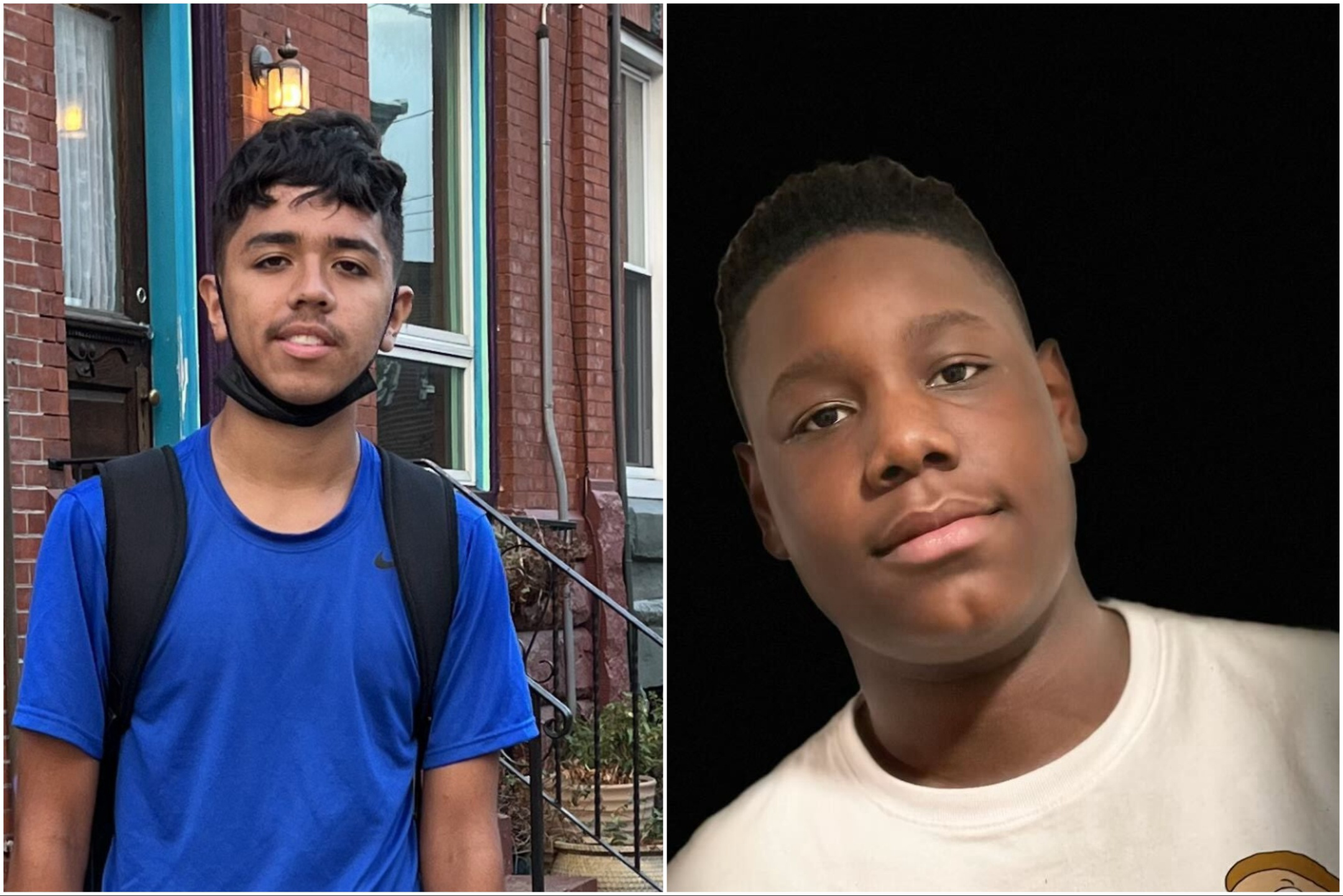
Following an emotional sentencing hearing Friday, Common Pleas Court Judge J. Scott O’Keefe ordered Zaakir McClendon to serve 40 to 80 years in prison for his part in the shootings that killed Nicolas Elizalde and Nafis Betrand-Hill seven months apart.
McClendon’s streak of violence began when he was 17. First, on Sept. 27, 2022, he and five others drove to Roxborough High School looking to shoot a teen who McClendon believed had hurt a young woman he was close to, said Assistant District Attorney Ashley Toczylowski.
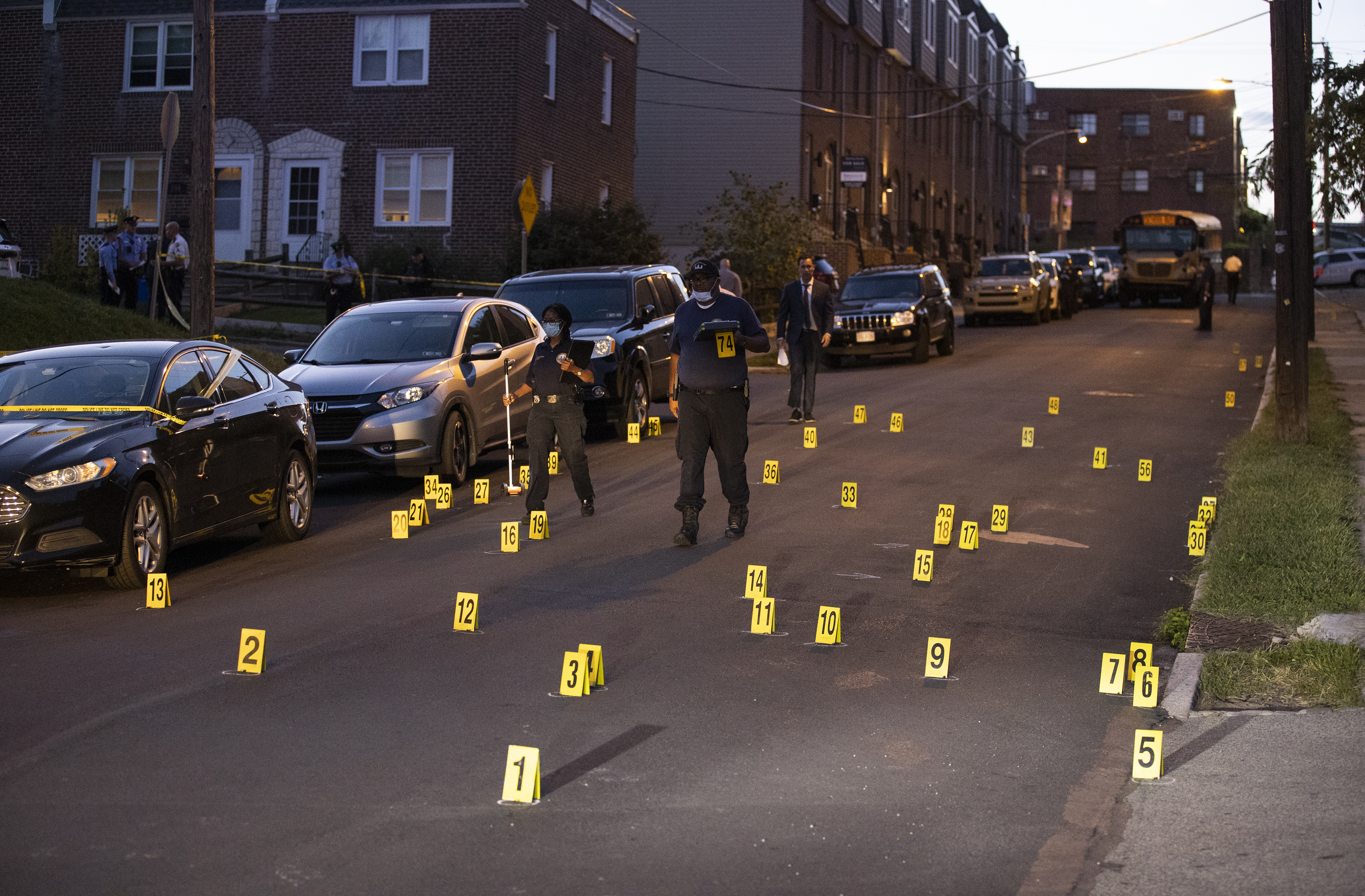
They parked their dark green Ford Explorer outside the school’s football field, and as dozens of kids walked toward the locker room, McClendon and four others fired more than 60 shots in all directions toward the players.
More than 60 shots were fired outside Roxborough High School on Sept. 27, 2022.Charles Fox / Staff Photographer
Five teens were shot. Nicolas Elizalde, a junior varsity player, was struck once in the chest by a stray bullet. His mother, Meredith, ran to his side in the aftermath, and held him as he died.
“This was a planned, coordinated mass shooting at a high school football game,” Toczylowski said. “And [McClendon] was the reason why this happened.”
In the months after the shooting, homicide detectives identified five of the six people involved, ranging in age from 15 to 21. But McClendon remained free and unknown to police for years.
In that time, he killed again.
On the night of April 13, 2023, McClendon and at least two others drove to 23rd Street and West Montgomery Avenue in North Philadelphia, where they shot Nafis Betrand-Hill, 16, multiple times near his home.
McClendon was finally charged with both killings last year, after DNA evidence linked him to each crime scene: on a fired cartridge casing recovered at Roxborough and on a blue sweatshirt worn by one of the gunman who killed Betrand-Hill.
He pleaded guilty to both murders in April.
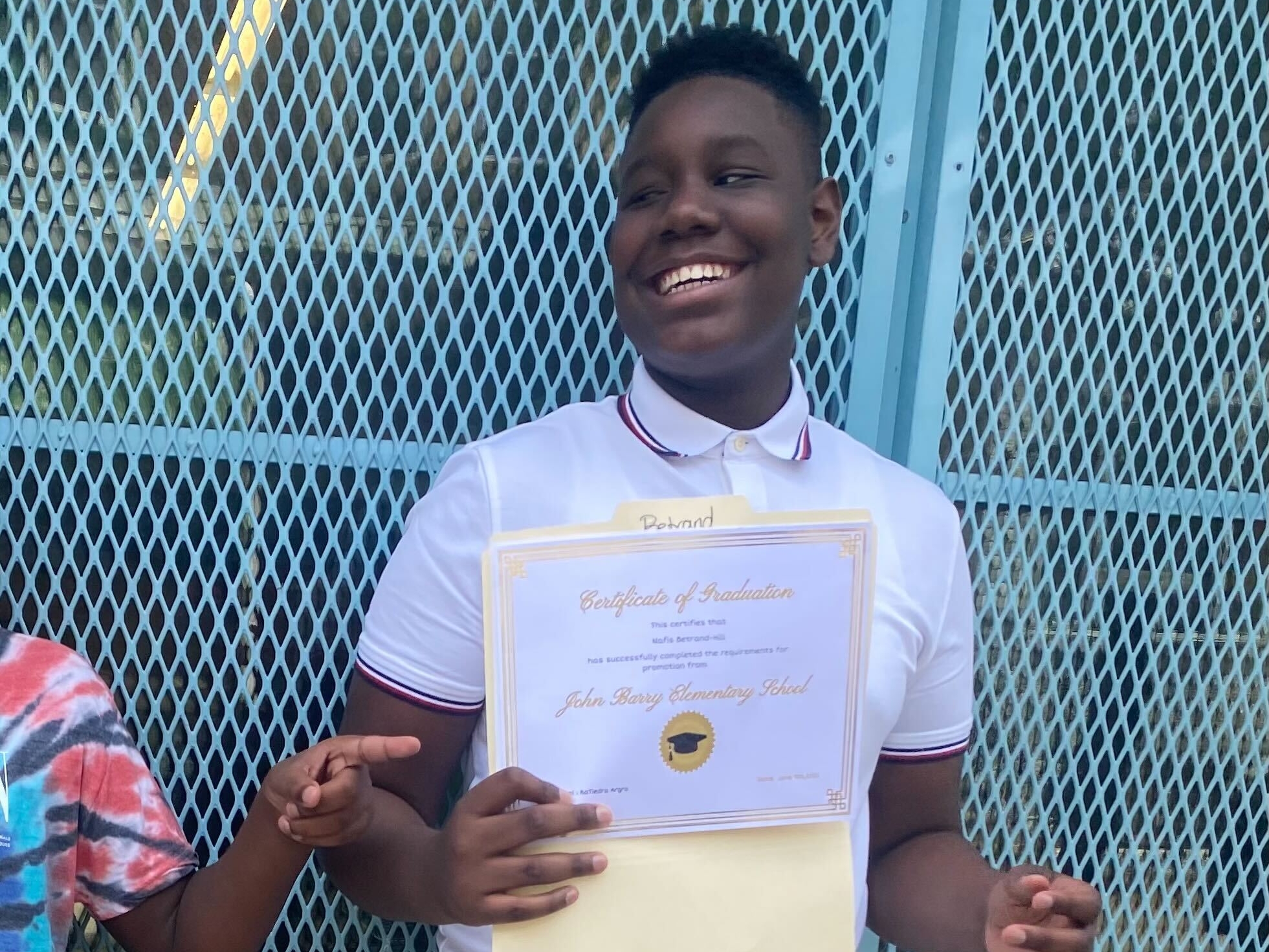
Ashante Betrand on Friday remembered her stepson, Nafis, as full of life and joy, “a child who deserved to grow up surrounded by love.“ A sophomore at Sayre High School, he was the oldest of four brothers and three sisters. They called him ”Fisso” or “Bo.”
Nafis Betrand-Hill, 16, was shot and killed in North Philadelphia in April 2023.Courtesy of Ashante Betrand
Her family, she said, will never stop grieving the “many ordinary but precious moments of adulthood” that he will never experience. They still don’t understand why he was targeted, she said.
“His life was worth more than a name, a reputation, a street,” she said, adding: “We will never stop loving him, we will never stop missing him and his light.”
Nicolas Elizalde’s aunt and grandmother spoke next. They wanted McClendon to know about the gentle person he killed — how Nick loved rescuing animals, watching Marvel movies, playing with Legos, and swimming in the pool. He was a freshman at Walter B. Saul High, and should have been finally heading off to college this fall.
“Did you know that, Mr. McClendon? Do you care?” Nick’s grandmother Marge LaRue asked.
“I don’t know you, and I don’t want to,” she said. “But you brought evil to my family, and it’s ugly and it’s lonely here. We are joyless. We are empty.”
Then, Meredith Elizalde stood up, ordering McClendon to look at her. It was the least he could do, she said, after ruining her life.
McClendon, his small frame hunched in a wooden chair, looked toward her briefly, before turning away again as she spoke.
When two other teens involved with the crime pleaded guilty last year, Elizalde was firm, but compassionate. She had met and spoken with each of them before their sentencings, and asked a judge to allow each of them to spend a piece of their lives free in Nick’s honor.
But McClendon, she said Friday, mocked her family and her son’s life by running free for years after the shooting — and killing again. She said she would not ask for any leniency.
“Did you watch my pleas on TV?” she asked. “I hope to leave this courtroom and never think of you again.”
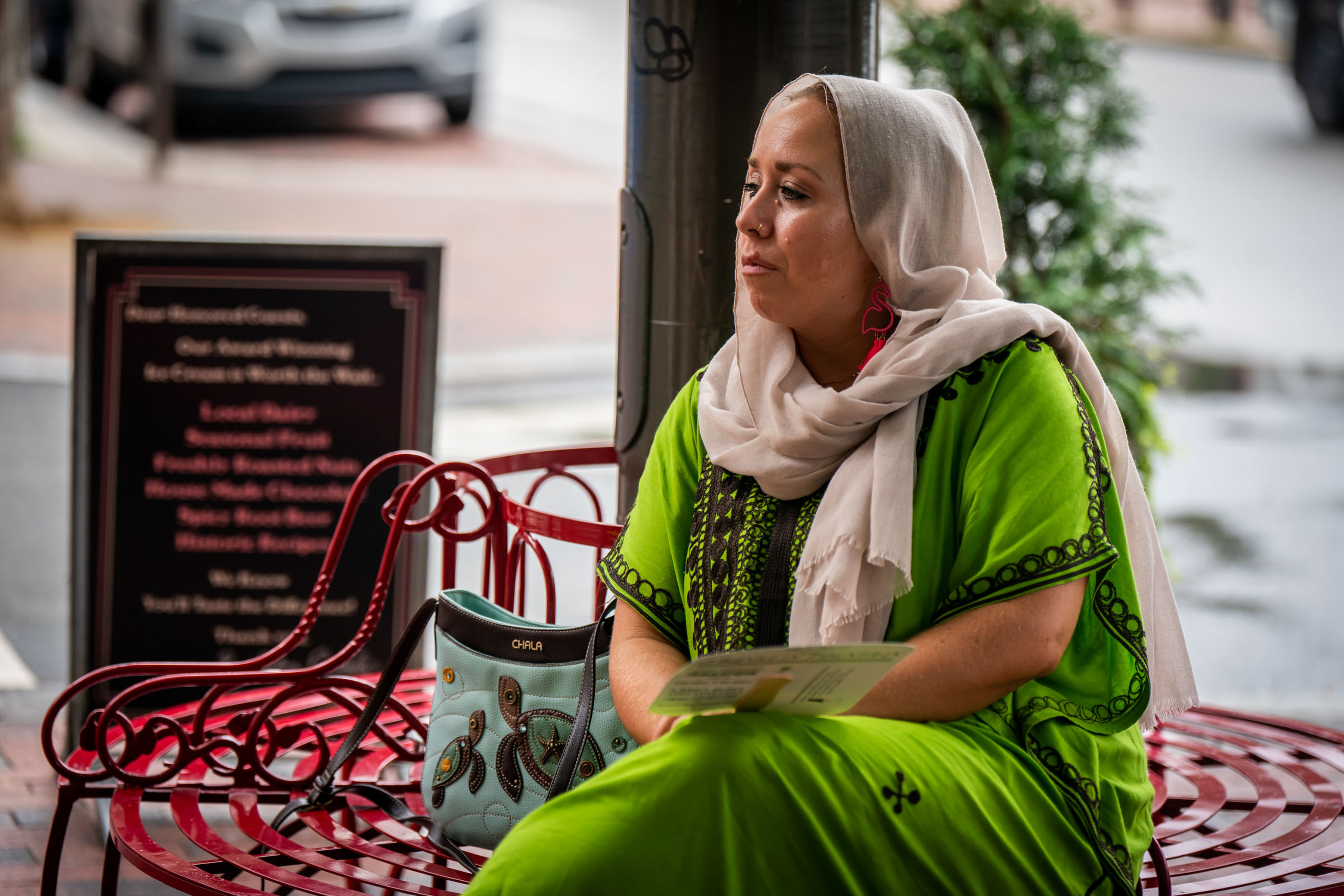
Meredith Elizalde at Franklin Fountain, where she and her son Nicolas used to go prior to his death, in Philadelphia, July 24, 2024.Jessica Griffin / Staff Photographer
Finally, McClendon spoke. His actions, he said, were cowardly.
“I was still young, your children were still young,” he said, beginning to cry. “I’m sorry. I’m mad it happened the way it did. I’m mad I even made that decision.”
“I cannot look you in the eyes because I gotta live with what I did,” he said. “I am a menace to the community. … but I will try to be better.”
His mother’s sobs filled the courtroom as he spoke. Moments earlier, she told the judge she’d raised her son in a loving home. He was a funny, curious child who grew up attending Catholic schools and playing sports. It didn’t make sense.
At the judge’s sentence, she collapsed into herself.
After the court hearing, Meredith Elizalde asked the public to remember her son and what he loved — nature, museums, learning — and to invest less in punishment for violence and more in the people, places, and institutions that can prevent it.
“On Sept. 27, the fourth anniversary of Nick’s murder, the Academy of Natural Sciences — one of Nick’s favorite places and where he celebrated his ninth birthday — is closing its doors to the public.”
“Think about what these places represent, where children encounter science and nature … and discover the world is bigger than them and there is a place for them in it,” she said. “We cannot punish our way into a healthy society. Prevention is investment, art, nature, community.”
Accountability for her son’s death belongs to all Philadelphians, she said, and that means protecting the children who are still here.
Elizalde and her family will return to the courthouse in February, when the three remaining defendants charged with her son’s death are expected to face trial.
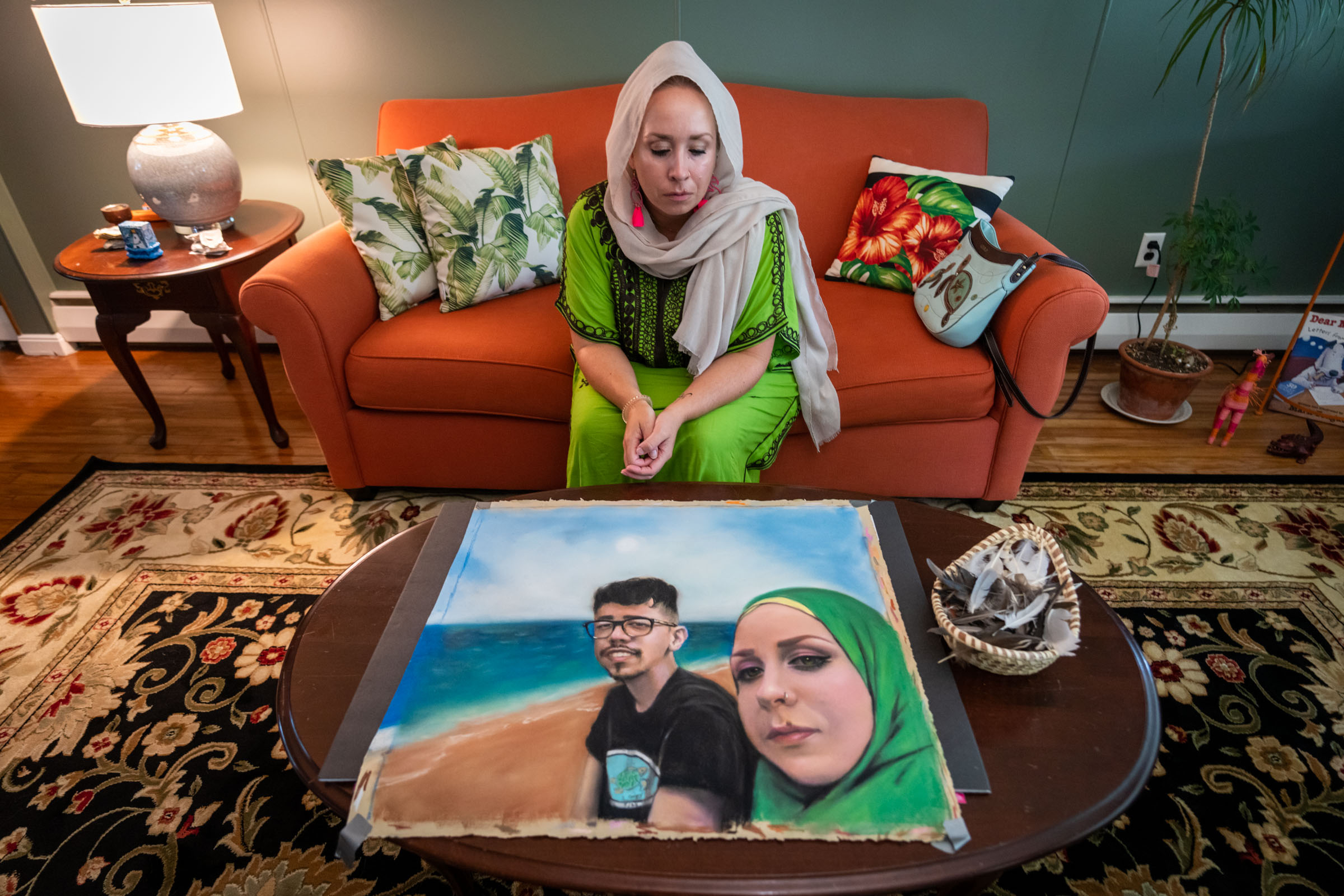
Meredith Elizalde with a painting of her and her son Nicolas, by Laurie Cooper. Jessica Griffin / Staff Photographer
Correction: This story has been updated to correct the spelling of the prosecutor’s name.
Rachel Blau DuPlessis, 84, of Philadelphia, experimental poet and essayist, literary scholar and critic, Temple University professor of English and creative writing emerita, mentor, artist, and world traveler, died Wednesday, Sept. 2, of respiratory failure at Penn Presbyterian Medical Center.
Professor DuPlessis was an eclectic experimental poet who grew up in New York, lived in Swarthmore and Philadelphia for more than 50 years, and taught a variety of writing and women’s studies classes at Temple from 1974 to her retirement in 2011. She wrote hundreds of poems — she called many of them “drafts” — about feminism, modernism, connectivity, imagery, and consciousness.
She was an expert on cultural poetics and told The Inquirer in 2002 that her poems generally reflect her “awe at the universe, grief at the barbarity of modernism, and sense of how it was to be in the world.” She enjoyed poetic wordplay, reviewers said, and tinkered freely with conventional syntax, sound, tone, and form.
“Reading her is an adventure,” reviewer Robert Long said in The Inquirer in 1997, “and poets this adventurous must be cherished.”
Her poems were published in more than 30 books and in several languages, and also appeared in The Inquirer, other newspapers, magazines, journals, and anthologies. In tributes, fellow poets praised her “unique combination of erudition and exuberance” and her “generosity, brilliance, expansive thinking, and attention to so many possibilities of writing and art.”
“From what I can tell, DuPlessis doesn’t write poems so much as build them,” reviewer Andrew Ervin said in The Inquirer in 2005. “The manner in which she does that is what makes the Temple professor one of the most exciting and inventive writers of our time.”
She told the Oxonian Review in 2015 that “being a poet is not only writing poems. It is an address to the whole apparatus of and the traditions of poetic practice.”
A book publisher said: “She brought such intelligence, generosity, and curiosity to everything she did.” Penn professor Al Filreis told Professor DuPlessis’husband, Robert: “It’s hard to imagine the Philly poetry world without Rachel in it.”
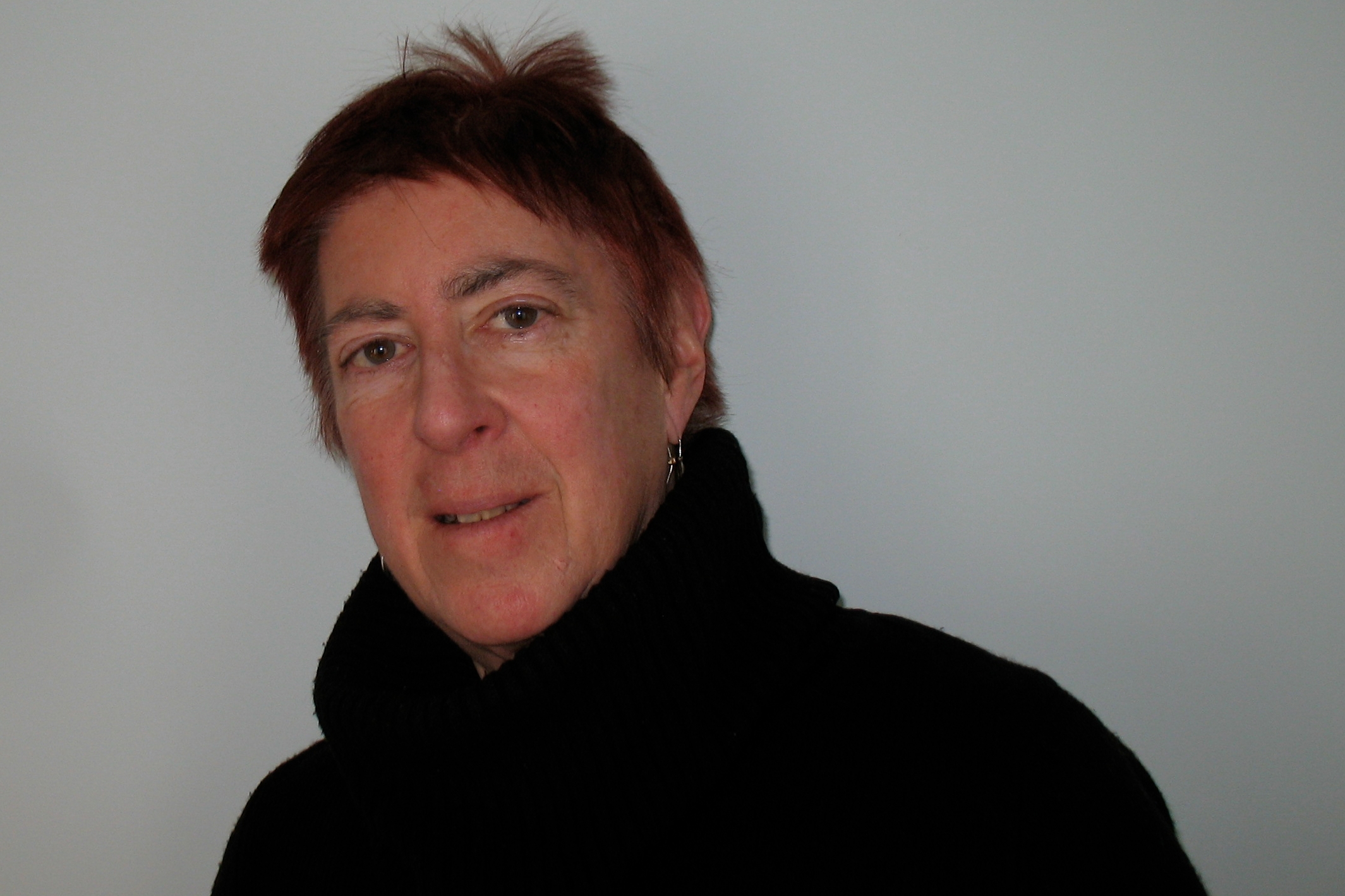
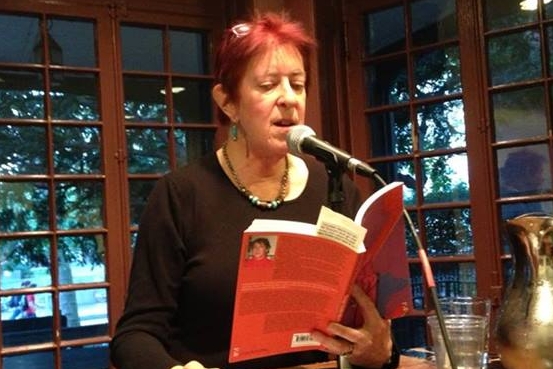
Professor DuPlessis read her poems to people around the world. Courtesy of the family
At Temple, Professor DuPlessis helped establish women’s studies classes and the school’s graduate program in creative writing. She mentored students and other professors, and the English department’s DuPlessis Lecture in Poetry and Poetics is named in her honor.
“She loved being a mentor to people, to encourage them,” her husband said. “She loved being a poet and an academic. She prepared incredibly for her classes and was connected and attentive to her students.”
Earlier, she taught briefly at what is now the College of New Jersey and Rutgers and Columbia Universities. She spent several of her research and study leaves from Temple working with students and colleagues at universities in the Netherlands, France, Belgium, and elsewhere.
She was named a resident poet and distinguished visitor in Italy and New Zealand. She and her husband, a professor emeritus at Swarthmore College, visited every continent except Antarctica, and she spoke French and Italian as well as English.
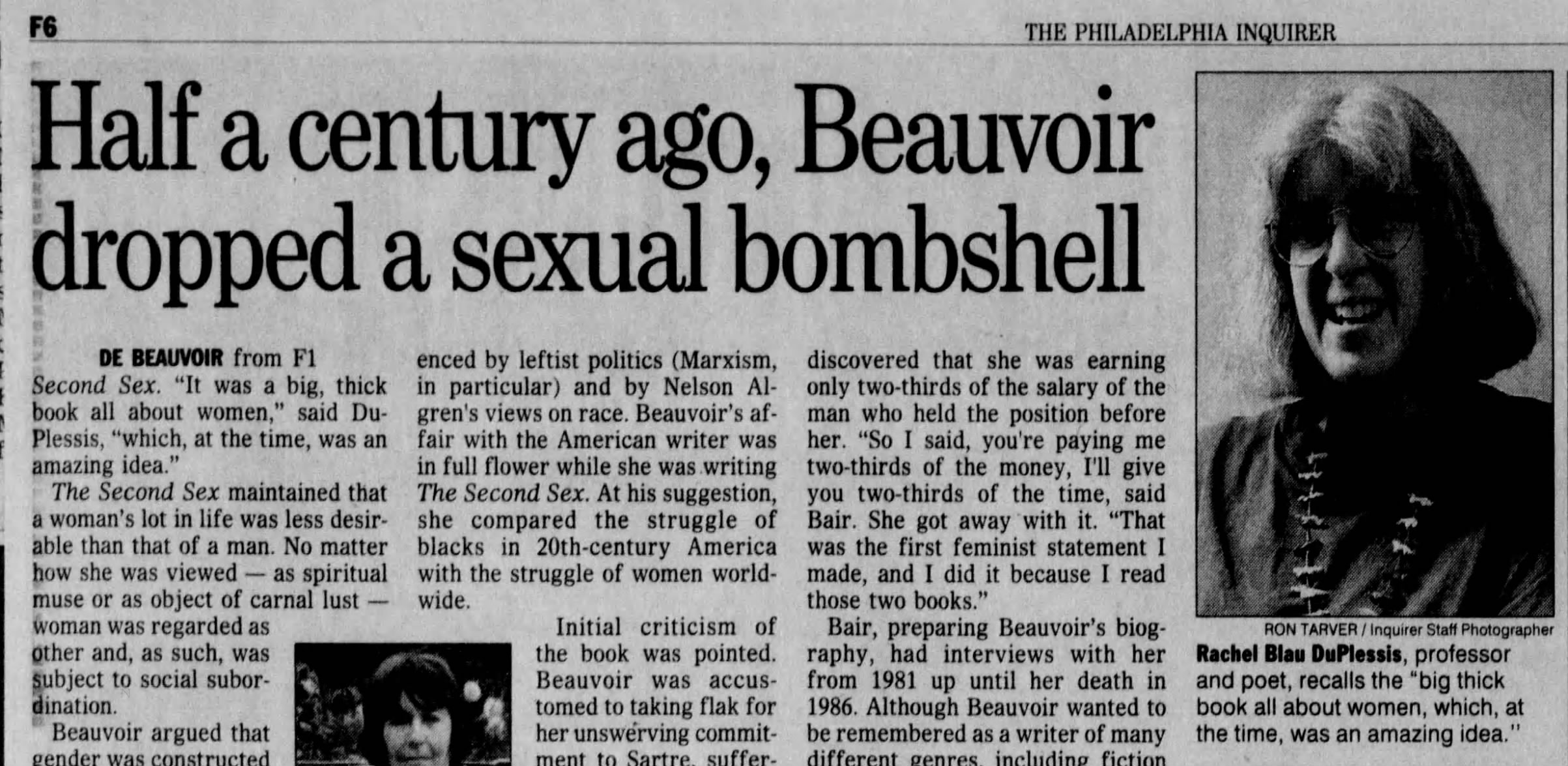
This article featured Professor DuPlessis and appeared in The Inquirer in 1999.Newspapers.com
She earned fellowships from the Pew Center, the Pennsylvania Council on the Arts, the National Humanities Center in North Carolina, and other groups. “She was constantly creating things,” her husband said. “She never stopped.”
Professor DuPlessis also wrote and edited books and articles about writing and poetry, and she reviewed books for The Inquirer and other publications. She read her poems in public, was interviewed often, and earned achievement awards from Temple, the University of California in San Diego, the old Fund for Poetry, and other admirers.
She created a comprehensive website, rachelblauduplessis.com, and made collage art that she augmented with poems. Thomas Devaney, a Philadelphia writer, called her “an important figure of American experimental poetry.”
She told the Oxonian Review: “Poetry is an ethical practice as well as an aesthetic one. Just even thinking about what this means and how it is instantiated is a useful task.”
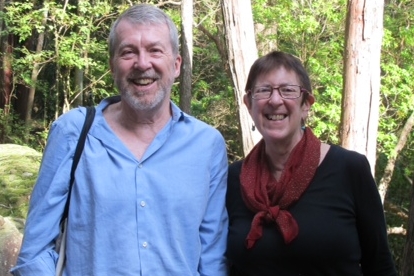
Professor DuPlessis enjoyed time with her husband, Robert, and daughter, Kore.Courtesy of the family
Rachel Maia Blau was born Dec. 14, 1941, in Brooklyn. She grew up in Queens and the Bronx, and earned a bachelor’s degree in English at Barnard College in New York in 1963 and a master’s degree and doctorate in English and comparative literature at Columbia in 1970.
Her father was a professor, her mother a librarian. She met fellow Fulbright scholar Robert DuPlessis on a boat to France in 1966, and they married in 1968 and had a daughter, Kore.
Professor DuPlessis enjoyed yoga, museums, art history, and long walks with her husband. They went to see and hear the orchestra, the opera, the ballet, and the theater.
She doted on her daughter and grandchildren. “She always read me stories and sang me songs at night before bed,” her daughter said. “I would hold on to her leg because I didn’t want her to leave.”
Professor DuPlessis started writing poems when she was 12, she said in an interview. “She was determined, hardworking, witty, and a lot of fun,” her husband said. “She was definitely intense.”
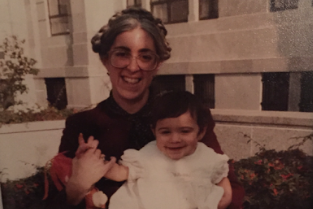
Professor DuPlessis said she started writing poems when she was 12.Courtesy of the family
In addition to her husband and daughter, Professor DuPlessis is survived by two grandchildren and other relatives. A sister died earlier.
A memorial service is to be held from 1:30 to 3:30 p.m. Saturday, Oct. 17, at Temple University’s Charles Library, 1900 N. 13th St., First Floor, Philadelphia, Pa. 19122.
Donations in her name may be made to Planned Parenthood, Online Services, Box 96771, Washington, D.C. 20090; Philabundance, 3616 S. Galloway St., Philadelphia, Pa. 19148; and the American Civil Liberties Union, 125 Broad St., 18th Floor, New York, N.Y. 10004.
The woman who police believe was killed by pornographer Raymond Horsch on camera has been identified by family members and law enforcement sources as Nicole Amanda Fusaro, who has been missing since July 2018.
Fusaro was 27 when she was last seen in Kensington, and after she disappeared, her mother, Diane, combed the streets of the Philadelphia neighborhood looking for her only child. Diane died in January 2020 without answers, and Fusaro’s father, Thomas, had died in 2009. That left Fusaro’s friends and her cousin, Jonathan Halloran-Koren, to continue searching and hoping that one day she might turn up.
Last month, investigators recovered a video on one of numerous hard drives recovered from Horsch’s decrepit Olney home while in search of clues for other missing persons linked to the property. Law enforcement sources said they believe the video shows Horsch strangling Fusaro to death.
Nicole Fusaro was reported missing in 2018 when she was 27. Police believe she was killed by Raymond “R.C.” Horsch in his Chew Avenue home.Courtesy of Jonathan Hallo
Police met with a member of Fusaro’s extended family several weeks ago to alert them of the discovery. Those relatives asked police not to publicly release her name. The relatives declined to speak with a reporter this week.
Halloran-Koren, in an interview, said those relatives told him Thursday that police had visited their home in recent weeks with the news of his cousin’s death.
He said he wants her name to be known so that she is not forgotten.
“Hopefully more attention will be made to missing persons so this doesn’t happen again,” he said, adding that he is still seeking additional information from law enforcement.
The police department is legally required to release the names of homicide victims, as they consistently do in a typical case. But because Fusaro’s body has not been found, the Office of the Medical Examiner has not ruled her death a homicide, creating a legal gray area.
Police also have no suspect to charge: Horsch died last year, at the age of 82, of a lung condition.
Sgt. Eric Gripp, a spokesperson for the police department, said the investigation into the Horsch home at 417 Chew Ave. remains extensive and ongoing. He said officials expect to provide an update to the public next week.
“As part of that investigation, detectives have spoken with numerous family members, witnesses, and other individuals, and continue to review evidence gathered during the investigative process,” he said in a statement. “Because this is an active investigation, we are not confirming the identities of any individuals who may be connected to specific evidence or discussing information that has been shared privately with families.”
Fresses’ and Amarando’s bodies have also not been recovered, and the medical examiner has similarly not ruled a cause or manner of death. Their families gave the department permission to release their names.
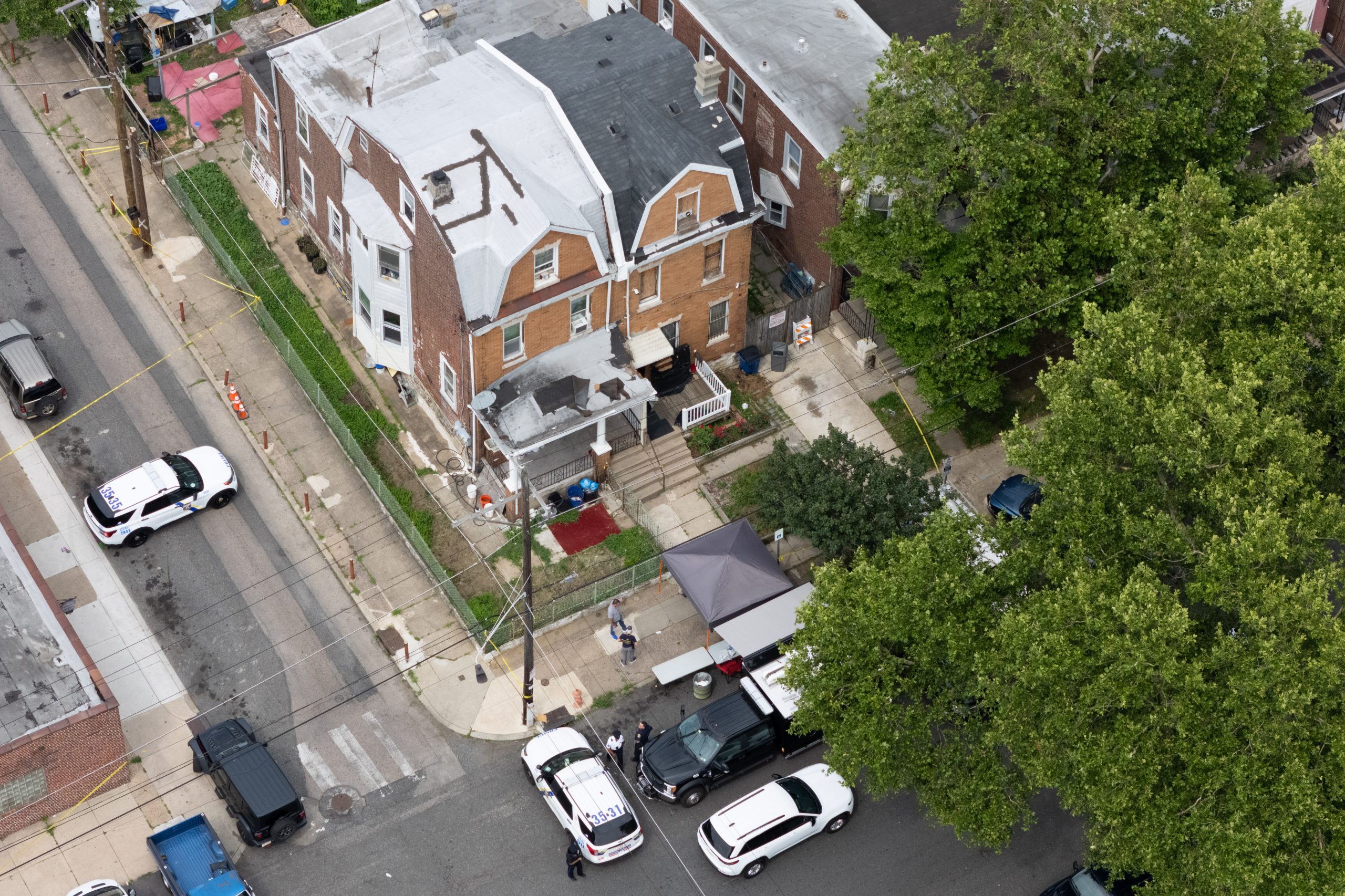
Investigators searched the home of Eugene Albert Horsch on West Chew Avenue (grey roof) in the Onley section of Philadelphia in June 2026.Gabriel Coffey / Staff
Fusaro is the fifth dead or missing woman to be tied to the home on Chew Avenue where Horsch lived with his son, Eugene, for decades. Raymond Horsch lured women in addiction with drugs and cash to star in his violent pornographic videos and photos.
Halloren-Koren said he had come to terms with the reality that his cousin likely died several years ago after so much time had passed without a sighting.
“I came to grips with that,” he said, of her death. “How it happened is something that is going to take me a little while.”
Fusaro, who was raised in Northeast Philadelphia, attended George Washington High School, according to her Facebook page. She had dark brown hair and striking, light eyes, and was known as an outgoing young woman who enjoyed being around friends and family.
Halloren-Koren said she was light-hearted and loved animals. As kids, he said, she enjoyed watching Vampire Diaries and listening to all types of music, from Green Day to the Notorious B.I.G.
After Halloren-Koren moved overseas for work in 2003, he said he only saw her at sporadic family reunions. His family, he said, was splintered and scattered across the region, and Fusaro’s parents both struggled with addiction. His cousin started using drugs in her late teens, he said, and she fell deeper into addiction in her 20s before drifting into the streets of Kensington.
When Halloran-Koren sought to reconnect with family in 2020, he learned his cousin was missing and tried to help his aunt’s friends find her, he said. He spoke to women across Kensington who knew her and heard various theories, including that she was last seen getting into a car near Kensington and Allegheny Avenues.
He asked the women, he said, whether there were any strange men in the neighborhood, and they scoffed — this was Kensington, and there were men like that everywhere.
But there were a few he said they mentioned: a guy who drove a van without a license plate, and a “creepy” man with the last name Horsch who picked up women on the Avenue.
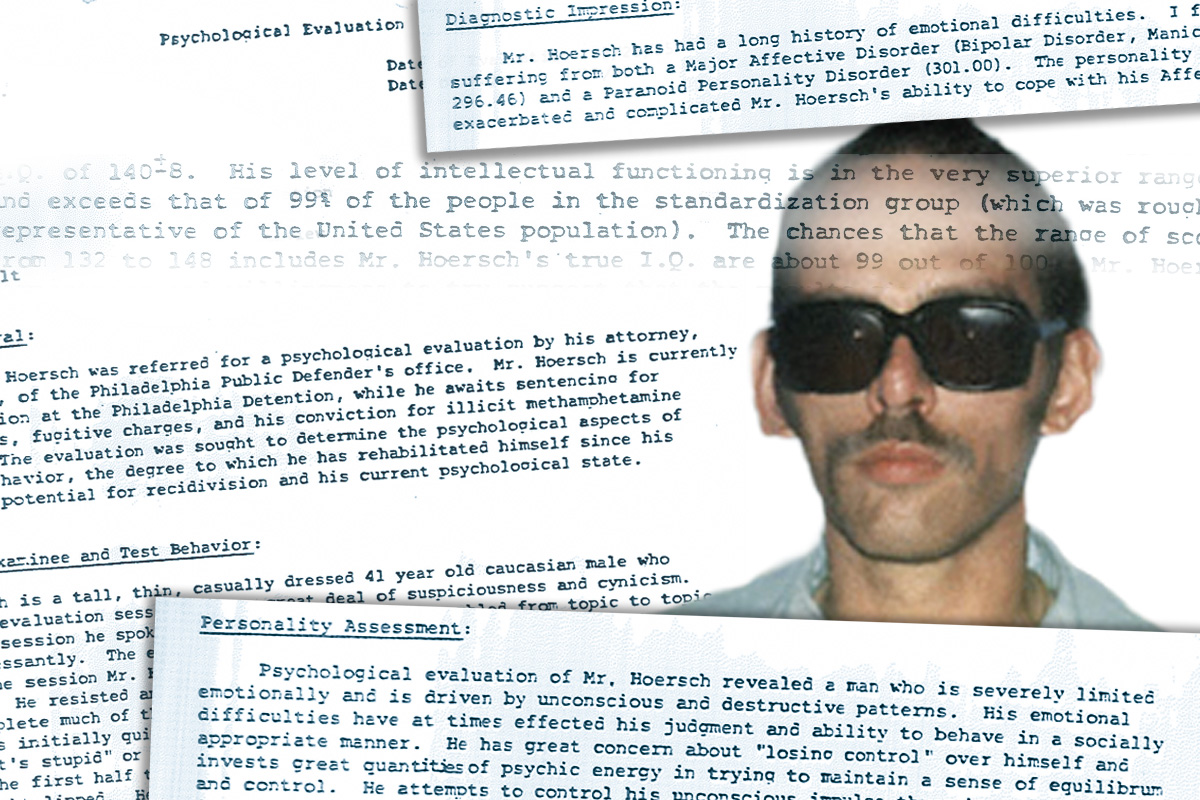
Raymond Horsch underwent a psychological examination in 1985 with results showing an above-average intelligence, deep-rooted emotional problems, and a diagnosis of a paranoid personality disorder.John Duchneskie / Staff Illustration / Photo obtained by The Inquirer
Horsch was known to trawl the streets of Kensington in search of sex workers, photographing some from the shadows. He’d offer to pay them in drugs and cash to be featured in his films or photos, often using drugs and in fantasies of being beaten, strangled, or killed.
He had a lengthy criminal record for manufacturing drugs and other non-violent crimes. And while his ex-wife, Amy McHale, was last seen at his home in 2016 before she went missing, he was never charged with any crimes connected to her disappearance before he died last year.
The investigation into his connection to the missing women began June 19, after his 44-year-old son, Eugene, was arrested near Independence Mall.
A federal park ranger found a fake ID in the car in the name of Blair Tonzelli, another woman who was reported missing in 2023, and was last seen at Horsch’s home. Police then interviewed women who said Eugene Horsch had bragged about knowing how to use chemicals to melt bodies in his basement.
Eugene Horsch has only been charged with illegal drug and weapons violations and has not been linked to any of the disappearances. He is currently in a federal detention center awaiting trial.
After arresting Eugene Horsch, local and federal law enforcement searched the Horsch home, at 417 W. Chew Ave., even excavating the yard for clues to the disappearance of Tonzelli and McHale. They found drugs, guns, a 55-gallon drum and vats of liquid, as well as a mysterious letter referencing putting drug-addicted women out of their misery.
Police also recovered dozens of hard drives that they said contained hundreds of thousands of images and videos — including some that showed several women presumably dead at the home. Investigators continue to pore over those materials to determine how far Horsch’s crimes extended and who was involved.
The atmosphere may be ready to engage in some regressive behavior, with August-like downpours in the weekend outlooks.
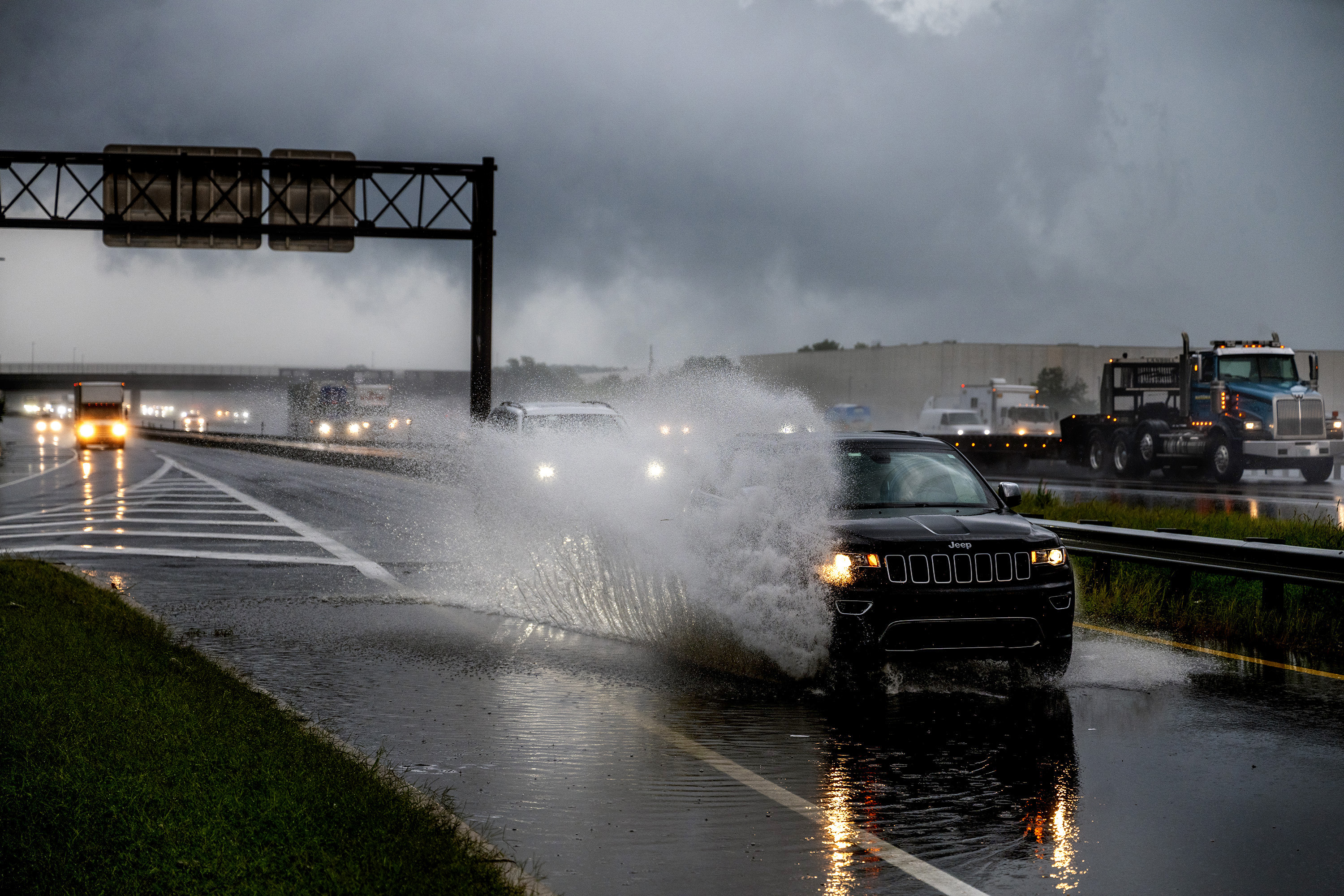
The National Weather Service has posted a flash-flood watch in effect from 11:59 p.m. Saturday through noon Sunday for the entire region, except for Chester County, with heavy showers possible.
“We have plenty of moisture coming up from the south,” said Frank Pereira, meteorologist with the federal Weather Prediction Center, in College Park, Md.
The center has the I-95 urban corridor from central Virginia through Philadelphia with an enhanced probability of “excessive rainfall.”
Widespread heavy rain amounts aren’t likely, said Pereira, but hefty totals could occur in a short period of time.
The weather service office in Mount Holly said rainfall rates of two inches an hour would be possible.
Fortunately, after a week’s respite from the episodic rains that so characterized July and August, setting off record numbers of flood warnings, the weather service notes that levels are low in the region’s major waterways.
“The bigger concern with this event will be flash flooding,” the weather service said, the familiar likes of flooding along roads and near the smaller streams.
While the downpours may evoke August, these would be a shade different in that they wouldn’t be driven by daytime heating, said Paul Fitzsimmons, meteorologist in the Mount Holly office. The sun is getting weaker, the days shorter.
Setting off the rains would be an approaching cold front from the west and a warm front migrating northward.
The rains could get an extra kick from very warm decks of clouds about two miles above the surface, said Pereira.
“You have this very deep saturated warm layer,” he said. “This increases the efficiency of the rainfall,” along with producing larger raindrops.
In any event, Saturday should be dry during the day, as should most of Sunday afternoon. On the plus side, drought conditions continue to recede.
Is the drought officially, absolutely over in the Philly region?
After 16 consecutive months of below-normal precipitation in Philadelphia heading into July, the totals at Philadelphia International Airport are above normal for the year.
In the latest interagency U.S. Drought Monitor update posted Thursday, most of the region was categorized as absolutely drought-free, a big change from just last week.
All of Philly was drought-free. Last week, the entire city was designated as “abnormally dry” — the least-serious tier on the monitor’s scale.
In Chester County, which had been under a state drought “warning” last month, 90% of the county was considered to be in the clear, an increase of 37% from the previous week.
An off-duty Philadelphia police officer was beaten by multiple people and robbed of his gun late Thursday, police said.
The gun — the officer’s service weapon — had not been recovered as of Friday, they said.
The officer, whose name was not released by police, was taken to Temple University Hospital with cuts to his head and scrapes on his legs and feet. Police did not disclose his condition, but said the officer was stable Friday afternoon.
Officer Tanya Little, a police spokesperson, said police were called to help the officer at about 11:45 p.m. Thursday on the 700 block of North 10th Street, between Brown Street and Fairmont Avenue in the West Poplar section of North Philadelphia, after the officer said he had been attacked by three people who stole his firearm.
Little said that investigators took two people into custody for questioning, but charging information was not available.
It would be hard to imagine a vacant lot of abandoned cars, tires, and trash lasting long in Center City before it got taken care of. But a group of Southwest Philly residents say that’s exactly what’s happening in their neighborhood.
Their relatively new group, the PA Solidarity Project, cataloged roughly 50 instances of blight over the spring, including abandoned cars and houses, illegal dumping, and potholes, and reported them to the city in early June. Longstanding blight is a common concern in the neighborhood, they said. But the city has only taken action on about half of those reported problems since then, the group said.
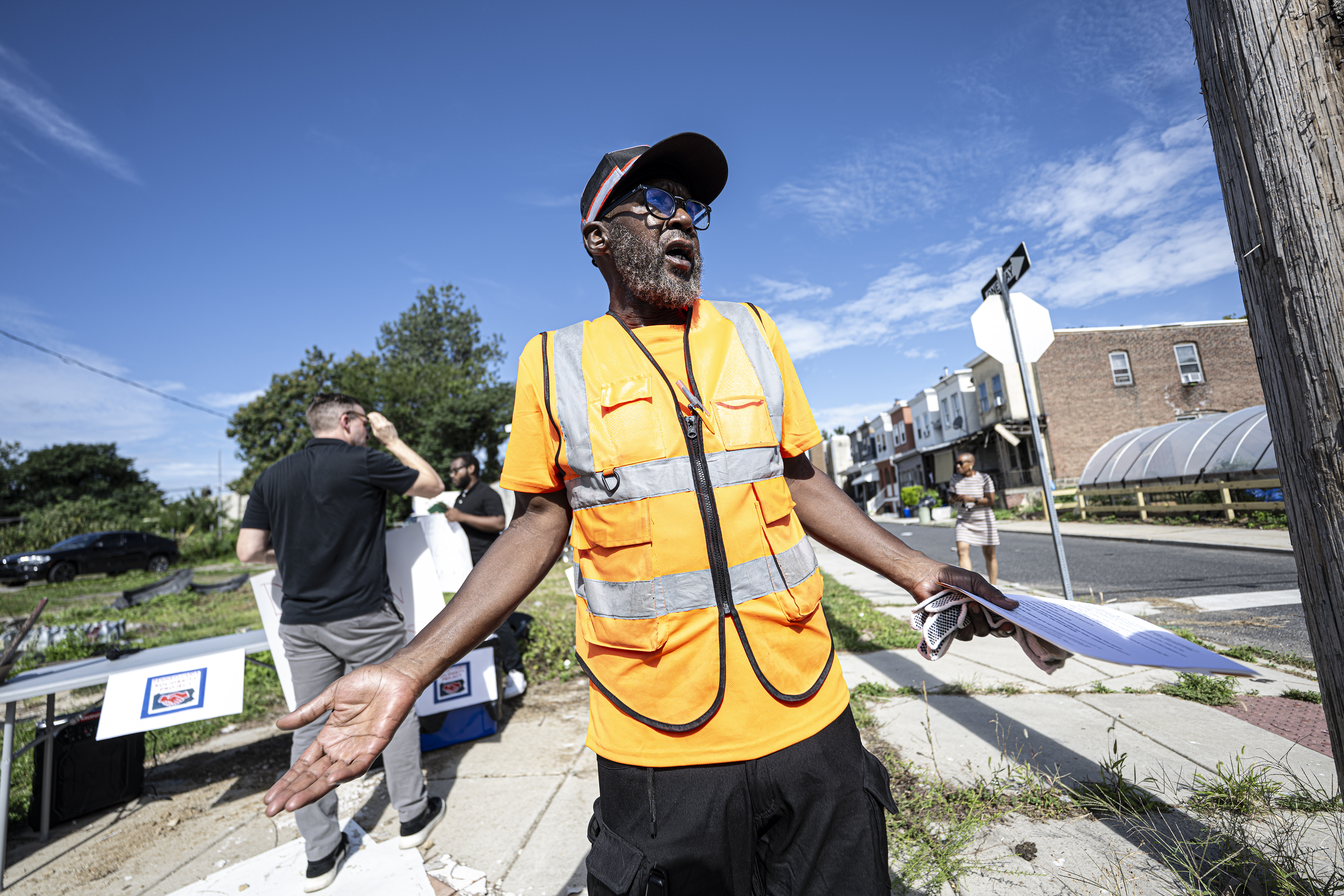
“In other zip codes, this wouldn’t be allowed,” said Andrew Coates, 67, a block captain and Southwest Philly resident for over 30 years. He referenced a recent story by the Philadelphia Citizen, which found higher-income zip codes tend to get their 311 requests addressed more than 50% quicker than lower-income areas like Southwest Philly.
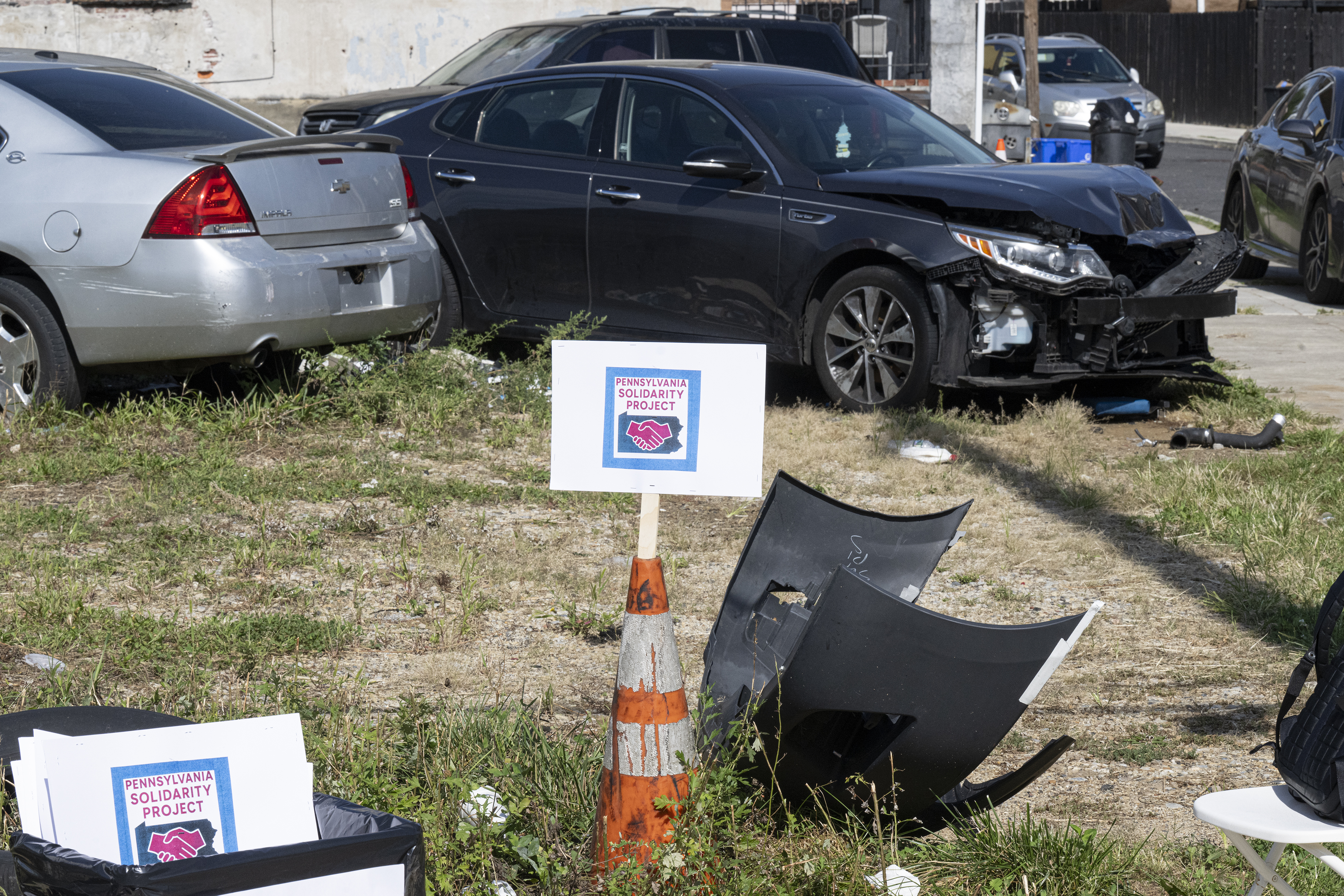
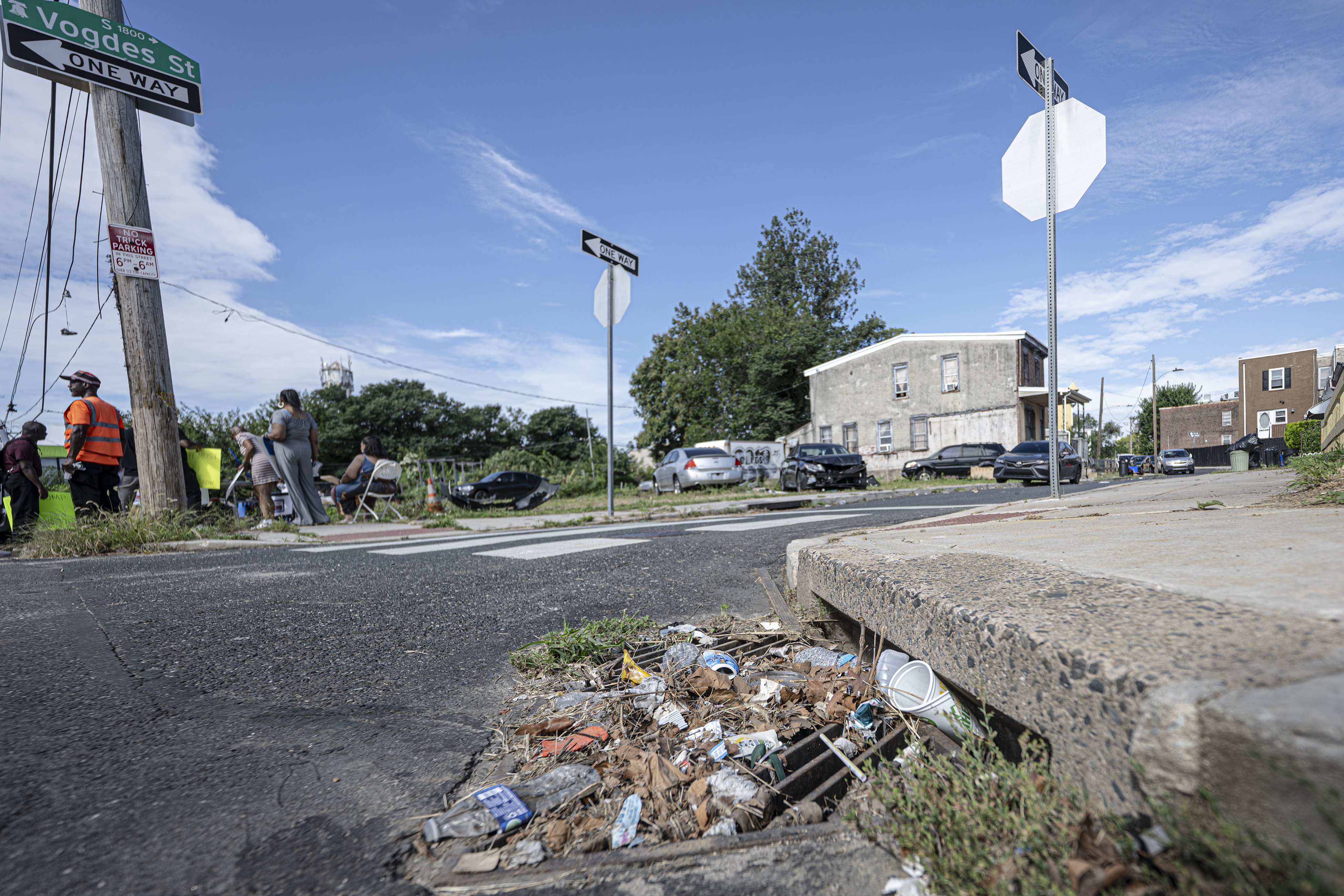
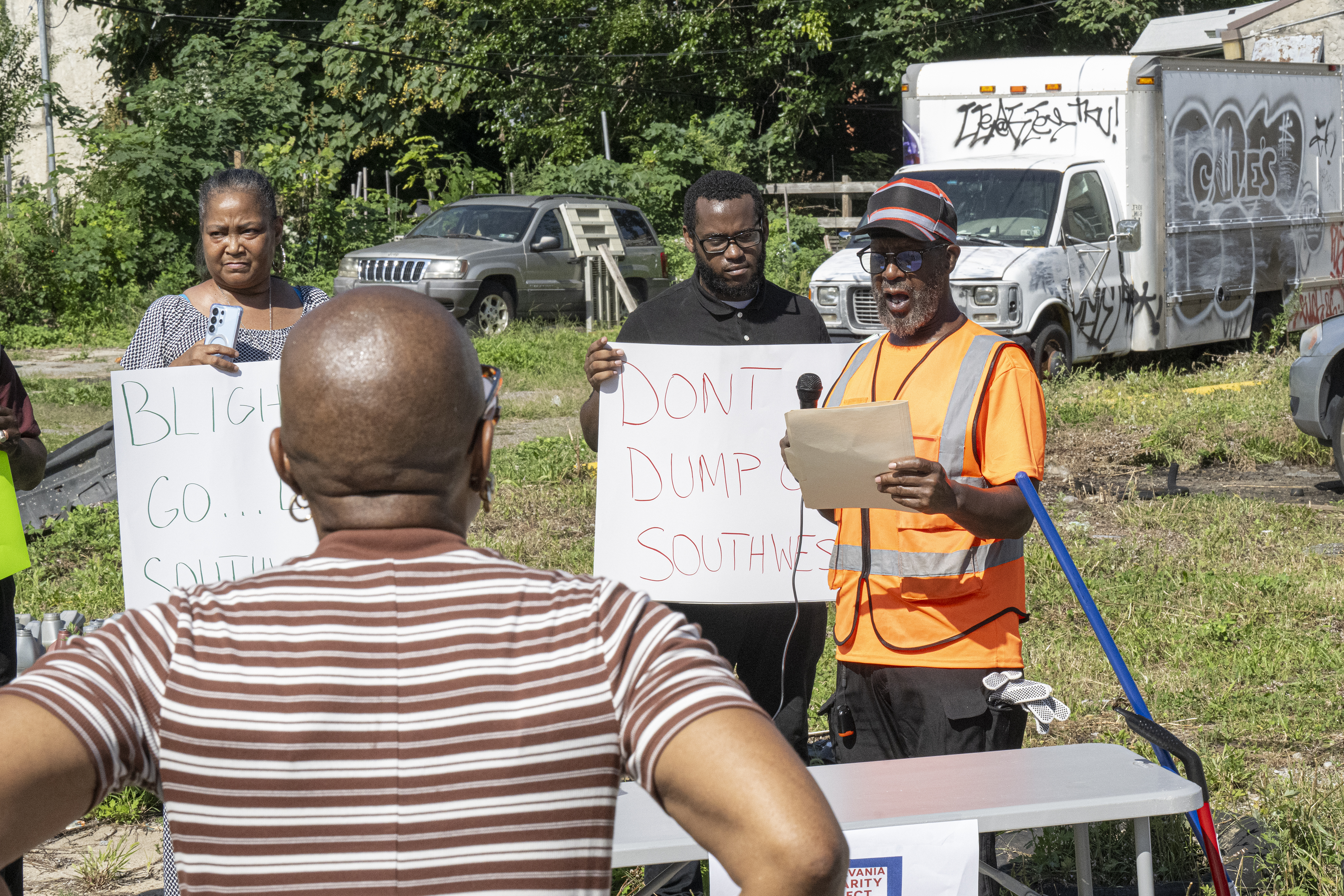
Coates stood in front of the intersection of Paschall Avenue and South Vogdes Street on Thursday, where a vacant lot held several abandoned and busted cars, oil jugs, overgrown weeds, and other trash. He said the constant signs of blight weigh on everybody, and younger generations see them as an expected part of life in Southwest Philly.
Abandoned cars are shown in a vacant lot Thursday, Sept. 10, 2026, in Southwest Philadelphia. Residents have been trying to get the city to address longstanding blight in their neighborhood, including abandoned cars and illegal dumping.Jose F. Moreno / Staff Photographer
“If you’ve grown up and this is all you’ve seen, you think it’s normal,” he said. The PA Solidarity Project aims to break that perception, and said it needs the city’s help.
“We’re resolute about this. …We want the transformation,” he said.
‘A lack of respect’
The PA Solidarity Project formed last fall, and began its work by surveying Southwest Philly residents to identify common issues they could act upon together. Blight was a common response, with residents highlighting how the neglect impacted their quality of life. Several auto shops tend to be the source of the abandoned cars and illegal dumping, residents said.
“I’m talking about what our children have to see walking down the street. …They send a message that somehow this neighborhood doesn’t much matter,” said Morgana Jackson, 60, another member.
“Southwest Philadelphia matters,” she said.
But residents individually had mixed results submitting requests to 311, and decided the group, which has a small core of about six residents but has gotten about a hundred involved with various activities, needed to act collectively, the organization said.
“When residents report a problem and nothing happens …I believe that shows a lack of respect,” said Towanda Robinson, 56, a PA Solidarity Project member.
Trash piles up near a vacant lot Thursday, Sept. 10, 2026, in Southwest Philadelphia. Residents have been trying to get the city to address longstanding blight in their neighborhood, including abandoned cars and illegal dumping.Jose F. Moreno / Staff Photographer
The residents conducted a sweep of the neighborhood to note the most troublesome areas and examples, and presented their catalog of about 50 blight items to representatives from the city’s Neighborhood Community Action Centers program in early June. The initiative is designed to serve as hyper-local city halls in each City Council district, where residents can file complaints, receive benefits, or resolve problems with a city agency.
Group members said they believed the city was receptive to their concerns, and were encouraged by the city’s promise at a late-June community meeting to put together an action plan for Southwest Philly.
But since then, only about half of their cataloged requests have been addressed, and smaller but noticeable signs of neglect remain. While the residents said they appreciated the work the city has done so far, it hasn’t been enough.
They said they are particularly frustrated since Mayor Cherelle L. Parker has spoken openly about tackling cleanliness and quality of life issues, but the push doesn’t feel like it has reached their corner of the city yet.
City spokesperson Keisha McCarty said the Neighborhood Community Action Centers program has received reports of 16,578 issues citywide from constituents from October 2024 through August 2026, and it has resolved 94% of them. In the district that includes Southwest Philly, 92% of issues have been resolved, McCarty said.
One explanation for the delays addressing the PA Solidarity Project’s full catalog is that a handful of the issues require coordination with the school district and with Verizon to address a wire box, according to McCarty.
Still, “it’s disheartening,” when blight persists, Coates said.
A Southwest Philadelphia resident and block captain, Andrew Coates, speaks about the need to clean city streets and efforts to get the city to address longstanding blight in the neighborhood, including abandoned cars and illegal dumping, during a news conference near their homes Thursday, Sept. 10, 2026, in Southwest Philadelphia.Jose F. Moreno / Staff Photographer
On Thursday, the PA Solidarity Project held a small event in front of the Paschall and Vogdes lot to call attention to the longstanding blight, and called the city to act. The residents who spoke were adamant that they and their neighbors care about the area, and are willing to do their part to fix the problems — Coates and other residents take it upon themselves to do street cleanups in the neighborhood from time to time.
“People do care about this and people want it addressed. But people are limited about what they can do. … They can’t do what the city does,” Coates said.
Jackson said she and the others point out the better care other neighborhoods receive, not to argue those blocks deserve less but instead to argue every zip code deserves equal attention.
“Because we love it, we refuse to accept the idea that blight is something we have to live with,” Jackson said.
Rocky Balboa started his new era at the top of the Art Museum steps Friday.
City crews officially began the installation of the 8-foot-6-inch Rocky statue, which is slated to be completed over the next two weeks and cost roughly $150,000 to install, according to Creative Philadelphia, the city arts office behind the proposal. The statue should be fully installed by the end of September.
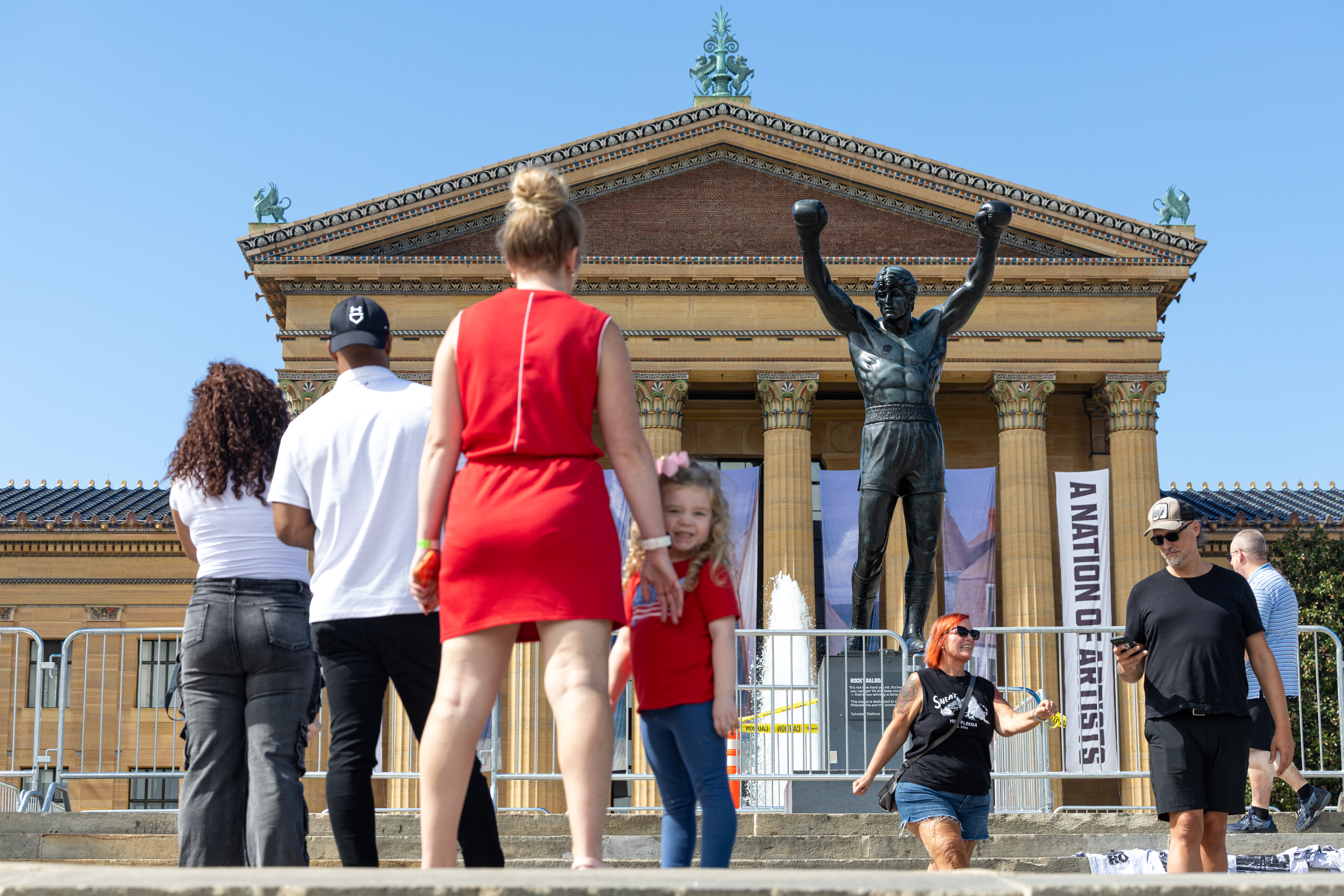
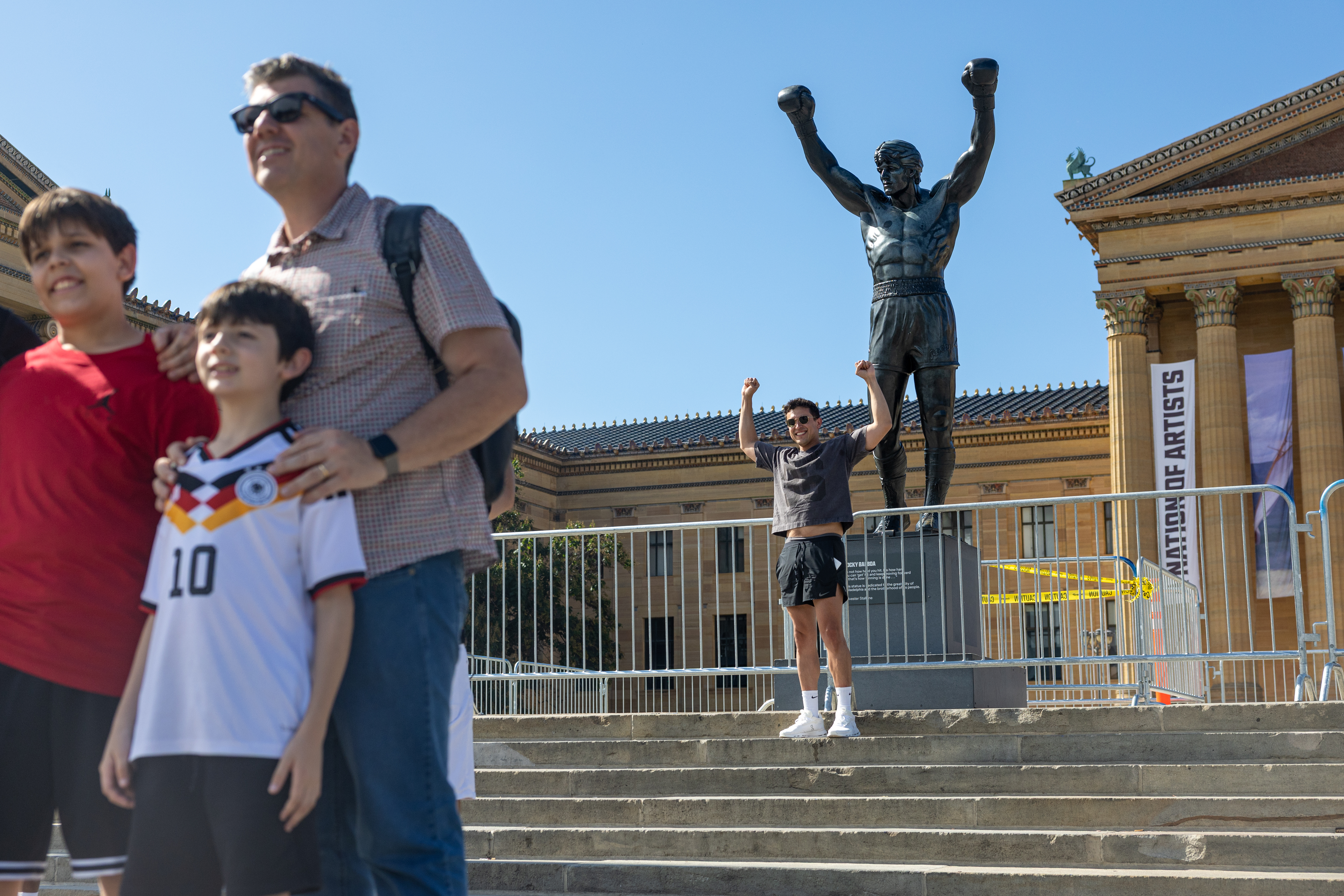
Access to the fictional Philly boxer will be closed off to the public for the duration of the work. However, the bronze Italian Stallion will still be visible from behind barricades — tourists just won’t be able to touch him.
Visitors take photos in front of the Rocky statue while a fence surrounds the statue before its installation begins in Philadelphia on Friday. Access to the statue at the top of the Philadelphia Museum of Art steps will be temporarily closed for the duration of the work. Rocky will remain visible throughout construction, but will be secured behind barricades limiting access.Aidan T. Gallo / Staff Photographer
The statue, commissioned by Sylvester Stallone for Rocky III, in which it also appeared, depicts the famous moment in the first Rocky where Stallone thrusts his fists in the air as he takes in the city skyline after a rigorous training montage. An estimated four million tourists visit the statue each year to reenact the moment that inspired fans globally.
Since 2006, the statue has sat at the bottom of the Art Museum steps. Before that, Rocky moved between the museum and the South Philly stadium complex at least six different times since the statue was originally revealed in 1981.
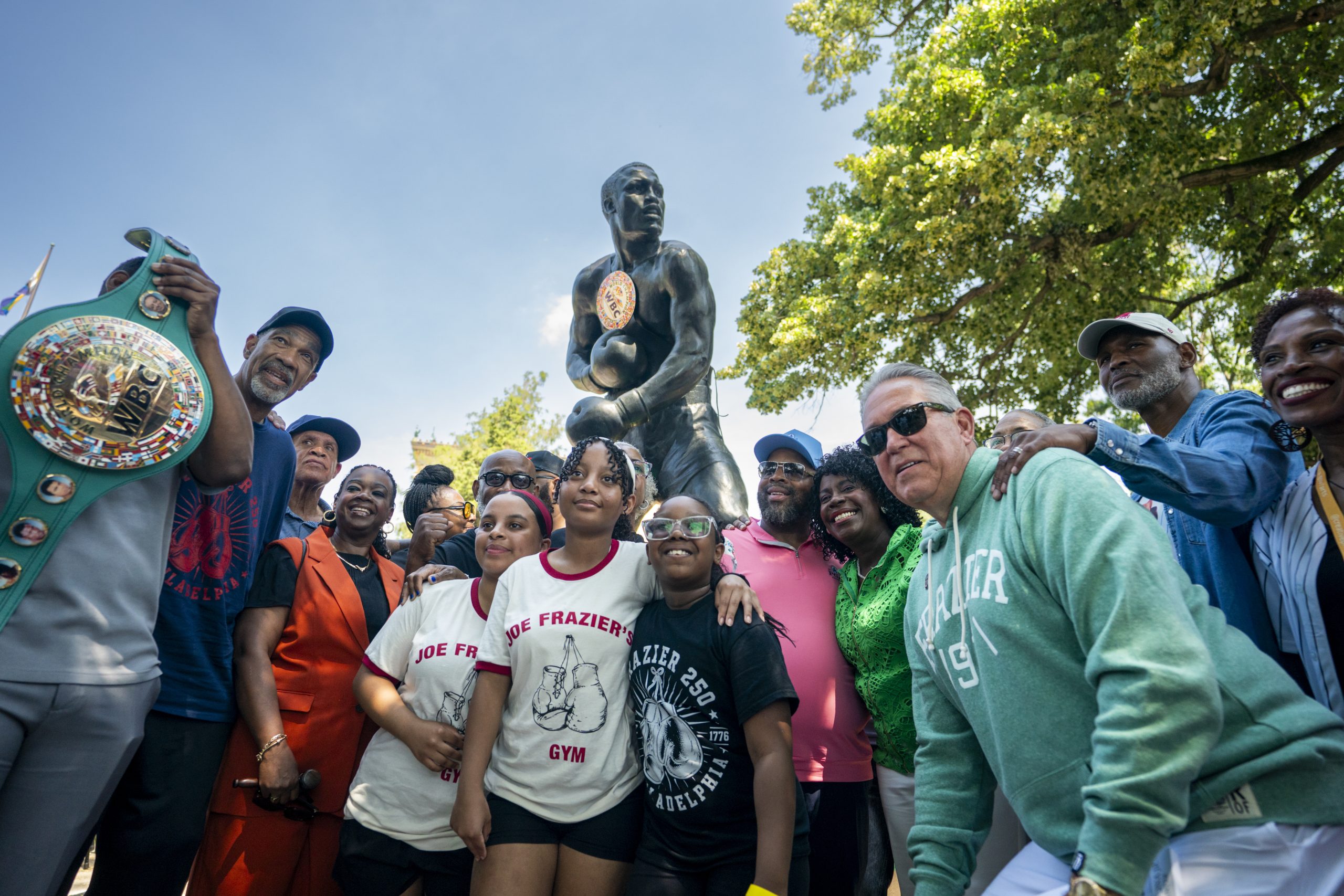
The original statue will be placed on a pedestal around 14 feet back from the edge of the top step, next to where Rocky shoe prints are embedded into the walkway. At the bottom of the steps, where the bronze Balboa had been since 2006, now sits a statue of real-life Philly boxing legend “Smokin’” Joe Frazier.
Mayor Cherelle L. Parker, Frazier family members, boxers, and other dignitaries unveil the new home for its statue of heavyweight boxing champion Joe Frazier on June 29. The statue is installed at the base of the steps of the Philadelphia Museum of Art where a statue of fictional boxer Rocky Balboa once stood.Jessica Kourkounis / For The Inquirer
Placing Rocky at the top of the steps is contentious, though. In an Inquirer survey last fall, 46% of respondents said there shouldn’t be a Rocky statue at the top of the steps, but rather it shouldstay at the bottom where it had been for more than a decade. One out of five respondents said the city shouldn’t have a Rocky statue at all. Even when the statue was revealed more than 40 years ago, some local officials called it “unnecessarily strident.”
Still, that doesn’t stop the millions of people who visit the Art Museum steps just for a glimpse of the bronze boxer. Soon, they’ll be doing it again at the same spot as the movie scene.
Staff writer Nick Vadala contributed to this article.
For the seven months he lived on Manayunk’s streets before he was shot and killed, Joshua Daywalt’s mother said she tried to persuade him to come back to the life waiting for him.
Jennifer Daywalt, of Phoenixville, ticked off the list: She regularly brought him bottled water, chips, and other easy-to-carry snacks at the encampment he frequented. She brought reassurance, too, reminding him that his family — three sisters, one brother, and two children — loved him and wanted him back home.
Authorities recovered Daywalt’s body from the frigid waters of the Schuylkill near Kelly Drive and Midvale Avenue on Feb. 7, 2025. A day later, a city medical examiner determined he had been shot at least once in the head, just behind his right ear, turning what had been a death investigation into a homicide.
And on Thursday, a Philadelphia judge found Roger Gosson guilty of killing Daywalt, 35, delivering the outcome his mother said she had been advocating for since the day she learned her son was gone.
“I need people to know that not everyone who is homeless is unloved,” Jennifer Daywalt said. “I never stopped trying. I never stopped begging. I never stopped fighting for him.”
Gosson, 63, was convicted of third-degree murder and related crimes in Daywalt’s shooting death, following the two-day bench trial in Philadelphia Common Pleas Court.
Gosson — a homeless man living in an intricate, multilevel setup inside a hole in the Green Lane Bridge — became detectives’ lead suspect in part because of body-worn camera footage from a patrol officer who encountered him a month before the killing. In the video, Gosson complained that “somebody [has] got to do something about” Daywalt, whom he accused of stealing from other homeless people in the area.
Later, inside Gosson’s living space, police recovered the gun they say was used to kill Daywalt .
Gosson’s fingerprints and DNA, however, were not found on the handgun. And without cellphones to track his movements or street cameras to capture the shooting, prosecutors’ case against Gosson was, as Assistant District Attorney Ashley Toczylowski acknowledged during her closing argument on Thursday, anything but typical.
“But,” she said, “that doesn’t mean we don’t know what happened.”
Judge Charles Ehrlich spent less than 10 minutes deliberating before returning a guilty verdict Thursday afternoon. Even so, a case built largely from the testimony of other homeless men created obstacles for prosecutors and, at one point, threatened to unravel before it ever reached trial.
The witnesses had told police in the weeks after Daywalt’s body was found that Gosson confessed to the killing in a series of conversations and, in one case, a note written on a napkin that was never recovered. But on Thursday, one of those witnesses disputed his previous account, blaming a drug-induced haze for his loose lips and claiming he couldn’t recall his videotaped interview with police.
And last month, Gosson’s trial was postponed for the fifth time after prosecutors said police had been unable to locate that same witness. The delay prompted Gosson’s defense attorney, Gina Amarillo, to ask the judge to dismiss the case, arguing that prosecutors had already taken more than the 365 days allowed by law to bring Gosson to trial.
Ehrlich denied her motion. And to ensure the trial could begin on Thursday with the key witness, prosecutors held him in jail on a material witness warrant ahead of the court date.
At the delayed August trial date, Detective Craig Coulter testified that he’d tried to find the homeless witness for three weeks without success, calling him “a constant moving target.”
“It’s like trying to find a squirrel in the woods,” he said. “That’s what all the witnesses in this case have been like.”
Amarillo argued on Thursday that prosecutors had relied on speculation to accuse Gosson of a killing for which no hard evidence had been found implicating him. Changing unreliable witness testimony, she said, was “not enough to say Mr. Gosson did this beyond a reasonable doubt.”
“My client was hoping for a different verdict based on the evidence presented,” Amarillo said in a phone interview Thursday night. She added that they will likely appeal the judge’s verdict.
Outside the courtroom, Jennifer Daywalt remembered her son as a “brilliant artist” who’d first picked up pencils to draw at 4, she said. He gravitated toward portraits in pencil and charcoal, often of his favorite hard-rock bands, she said.
Before he began living on the streets of Manayunk, Daywalt left four psychiatric hospitalizations intended to stabilize him after he stopped taking medication for his diagnosed paranoid schizophrenia and multiple personality disorder, Jennifer Daywalt said. His illnesses, she guessed, may have caused him to steal. “It made him feel as if he couldn’t conform to society,” she said.
Jennifer Daywalt said she has appealed to lawmakers to change the state’s laws on hospital commitments, and will continue to fight for mandatory holding periods and follow-ups that she believes could have saved her son.
For now, she said: “It felt good that the judge saw what the rest of us saw. It felt like Joshua’s voice was heard.”