A Havertown man was charged Tuesday with terroristic threats, ethnic intimidation, and related crimes after prosecutors said he left racist, threatening voicemails for the Delaware County sheriff.
Sean Keenan, 40, made 15 calls earlier this month to the sheriff’s office in a 24-hour period, according to the affidavit of probable cause for his arrest. Keenan left two voicemails, during which he used a racial slur to refer to Sheriff Siddiq Kamara, who is Black, threatened to hunt him down, and called for “death to Islam.” Kamara is a Muslim whose family came to Delaware County from their native Liberia.
Keenan was released on $100,000 unsecured bond. There was no indication he had hired an attorney. Keenan did not return a request for comment.
In announcing the charges, Delaware County District Attorney Tanner Rouse said Keenan’s words were “vile, disgusting, and completely unacceptable.”
“There is a time when language crosses the line into criminal behavior, and that is exactly what we have here,” Rouse said. “Threats of violence, most especially racially motivated violence, have no place in Delaware County, regardless of who the intended victim may be.”
Kamara, in a statement last week, said that he welcomes criticism as a public official, but that threats of violence cross the line.
Investigators said they used phone records to trace the numbers that made the call to two phones registered to Keenan, according to the affidavit. One of those numbers called 911 in February to report a car crash, and a recording of the caller’s voice matched Keenan’s.
After serving a search warrant on Keenan’s personal and work-issued cell phones, detectives found evidence that he had left the voicemails on July 18 and July 19, the affidavit said. In an interview with police, Keenan admitted to leaving the voicemails, the document said.
He is scheduled to appear before a district judge for a preliminary hearing on Aug. 7.
Insurers are asking for double-digit increases to health plans sold on Pennsylvania’s Affordable Care Act marketplace, Pennie, in 2027.
Insurers have requested an average increase of 17% for plans sold to individuals and families through Pennie. They are asking to raise the premium price of plans sold to small businesses by an average of 11.5%, according to rate requests released last week by the Pennsylvania Insurance Department.
The proposed rates are not final. A public comment period is open through Aug. 22, and insurance administrators expect to release final rates this fall.
Pennsylvania Insurance Commissioner Michael Humphreys said in a statement that the rates were “higher than we’d hoped.”
New Jersey has not released 2027 rate requests for its ACA marketplace, Get Covered NJ.
In their rate proposals, Pennsylvania insurers said they needed to charge more to account for the rising cost of medical services and prescription drugs, and a shift in who is buying health insurance and how sick they are. Insurers are required by law to spend 80% of the money they collect through premiums on healthcare for members.
“Addressing rising healthcare costs requires a shared commitment across the healthcare system, and we will continue working with providers and other partners to help keep quality care within reach for the people we serve,” Independence Blue Cross, which has proposed a 14% average premium increase, said in a statement.
The proposed increases for 2027 come on top of massive price hikes in ACA marketplaces this year, when a critical financial incentive program was eliminated. The cost of a Pennie health plan more than doubled for many in 2026 and 177,000 people have dropped coverage as a result.
Advocates worry that another price increase will cause even more people to drop coverage, which could further raise costs.
“If these proposed rates take effect, even more Pennsylvanians are likely to be priced out of coverage,” Antoinette Kraus, executive director of the Pennsylvania Health Access Network, which helps people enroll in coverage, said in a statement.
Rising costs and premium prices
A major factor that affects the cost of insurance is who the plan will cover — how healthy or sick they are, and how much the plan will need to spend on their care.
Healthy young adults who have few healthcare expenses typically help balance the higher cost of insuring older adults who may have multiple chronic conditions.
But young adults — many buying insurance on their own for the first time — can be highly sensitive to cost. They have been among those dropping out of ACA plans at the greatest rates after Congress failed to renew a financial incentive program that ensured no one paid more than 8.5% of their income on insurance.
About a third of adults who dropped out of Pennie health plans so far this year were under age 34, according to state data.
“They’re the ones looking at the cost and saying, ‘Well I’m pretty healthy right now, I’m going to take the gamble,’” said Devon Trolley, Pennie’s executive director.
People with ongoing medical needs are more likely to stick with their plan, despite cost increases.
Pennie’s 2027 enrollment period will run Nov. 1 through Jan. 15.
Lawmakers have not shown signs of bringing back the enhanced tax credits, which were introduced in 2021 and had been renewed annually since.
Income-based tax credits that are part of the ACA are still available. People remain eligible for these tax credits if they earn up to 400% of the federal poverty level — about $62,600 a year for an individual or $128,600 for a family of four.
With over a half-foot of rain measured already, what has been Philadelphia’s wettest month since March 2024 is very likely to become significantly wetter.
The National Weather Service has posted a flash flood watch effective from 8 a.m. Tuesday until 2 p.m. Wednesday for rain totals up to 3 inches, with downpours of 1 to 2 inches an hour possible.
The national Storm Prediction Center on Tuesday morning listed a 15% chance of severe storms, those with wind gusts approaching 60 mph, for the entire region, with an outside shot of tornadoes. The Weather Prediction Center has a 40% chance of flooding downpours.
Some appetizers — localized downpours — popped up Monday afternoon, prompting flood warnings for Philly and neighboring sections of Montgomery County, and parts of Gloucester and Atlantic Counties in New Jersey.
Floodwaters swamped downtown Hammonton, Atlantic County, with “numerous” cars stranded on the roads, the weather service reported. The Pennypack Creek in Northeast Philly crested above “minor” flood stage.
Moth-ball-size hail pelted Chestnut Hill, and hail twice that size was sighted in Williamstown, Gloucester County, and in the vicinity of Washington Crossing State Park on the Jersey side of the Delaware River.
Storm coverage on Tuesday is expected to be far more extensive, and potentially more disruptive, with a “few tornadoes” possible, the weather service warned.
Storm activity is likely to linger into Wednesday, said Mike Lee, meteorologist in the weather service’s Mount Holly office, with more showers in the forecasts for Thursday.
What time the storms will arrive in Philly
Late July still is very much the lottery-ball season for damaging downpours, and that again likely will be very much in evidence this week. Rainfall totals in the last 30 days have ranged from 137% of normal in Gloucester County to 79% of normal in Montgomery County, according to the Middle Atlantic River Forecast Center.
Thunderstorms are possible as early as midmorning, but expect “repeated rounds” during the afternoon, said Matt Benz, senior meteorologist with AccuWeather Inc.
The highest probability for severe storms, those with wind gusts near 60 mph, would be in South Jersey and Delaware, although they could nose into Philly, said the weather service’s Lee.
The storms could continue well into the night, and additional rains are expected Wednesday afternoon.
The rain totals again are likely to vary widely; however, a general 1 to 2 inches is expected across the region.
Whatever happened to the drought?
It hasn’t gone anywhere — yet.
All of New Jersey and Chester County remain under state-declared drought warnings. In the latest interagency U.S. Drought Monitor update, conditions in the entire region remain from “abnormally dry” to severe drought.
All that may change by week’s end.
Through Sunday, officially 6.37 inches of rain habr been measured at Philadelphia International Airport this month. That is the highest monthly precipitation total since March 2024.
July’s rains have ended a run of 16 straight months of below-normal precipitation in Philly.
Said Benz: “It’s an old saying that all droughts end on a flood. That’s kind of what we’re seeing right now.”
The debate over a proposed 2 million-square-foot AI data center in Plymouth Township near Conshohocken has become acrimonious, with local officials and the developer trading accusations of mistreatment.
Plymouth Township Council Chair Lynne Viscio said Monday that the project’s developer, Brian O’Neill, had “bullied” and “intimidated” township officials in an attempt to gain approval to build the facility on the site of the shuttered Cleveland-Cliffs steel mill.
O’Neill’s recent efforts have included a legal challenge to the township’s zoning ordinance. Viscio said it was filed after O’Neill “rejected” the township’s concerns and its proposed data-center “safeguards.”
“This is a blatant attempt by the applicant to demand approval by throwing a tantrum,” Viscio said in a statement, which she delivered during a live streamed appearance by council members, later posted to the township’s website. “The township is not interested in entertaining such theatrics.”
Reached by phone, O’Neill called the accusations “a bold-faced lie” that were part of a “misinformation campaign” against his planned data center. He said he had been “negotiating in good faith” with township attorneys for months and had agreed to “the majority” of the township’s conditions.
“We are sympathetic to the fact that they are under tremendous political scrutiny from people outside the township, as well as residents inside the township, and that makes giving a landowner their property rights … challenging,” said O’Neill, a longtime developer in Conshohocken and on the Main Line.
“However, I am a landowner, and I do have rights,” he added, “and it is their job to be impartial and fair in their analysis and response.”
The closed Cleveland-Cliffs steel mill is seen last month outside Conshohocken.Monica Herndon / Staff Photographer
Hyperscale data centers, such as the one O’Neill is proposing, house the energy-hungry technology that powers ChatGPT and other artificial intelligence tools.
The Plymouth Township site is less than a mile from downtown Conshohocken, near the Proving Grounds sports complex, Tee’s Golf Center, and dozens of homes in the township’s Connaughtown section.
The closed Cleveland-Cliffs steel mill where Brian O’Neill wants to build a data center is shown in June.Monica Herndon / Staff Photographer
O’Neill has not said who would operate the center but has indicated it would be a tenant related to the life sciences.
An initial zoning hearing board meeting on the resurrected Plymouth Township project was held last month. As of Monday, a more substantive hearing was scheduled for Aug. 6 and was set to include the presentation of evidence and testimony.
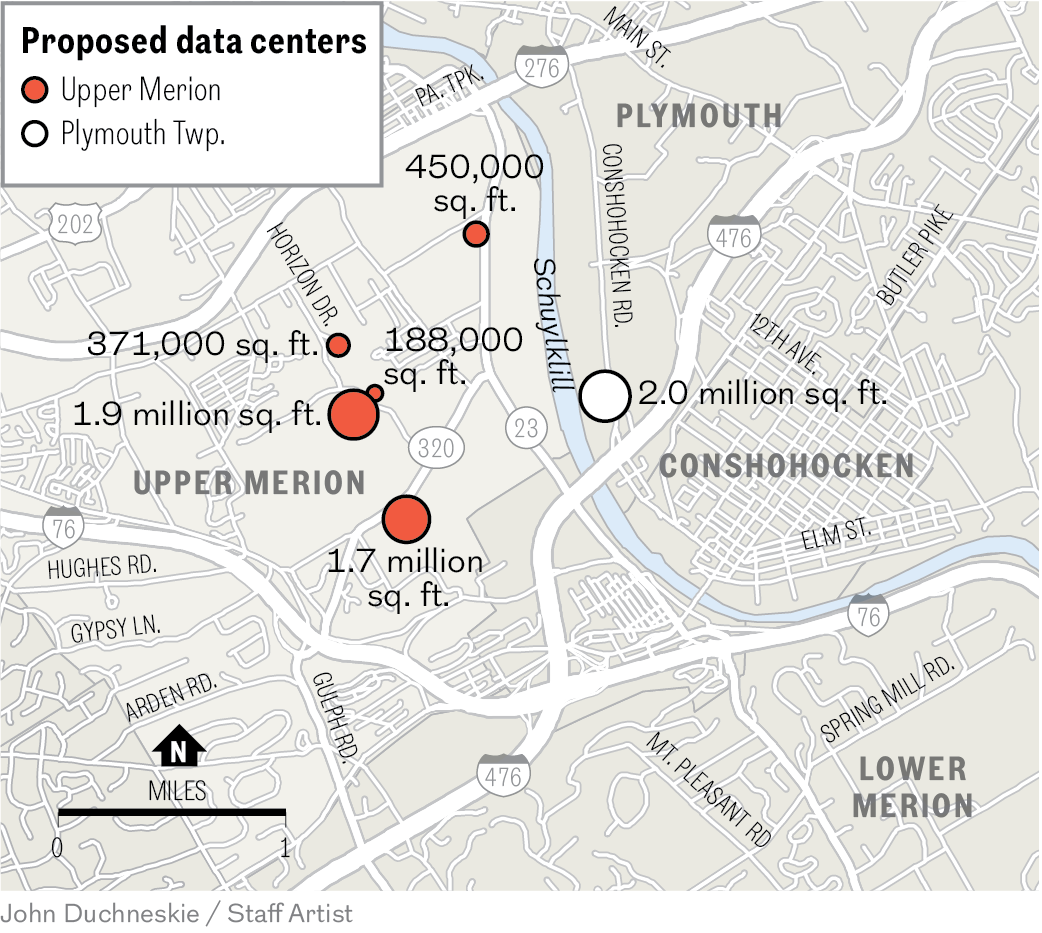
The Plymouth Township project is one of six data centers that O’Neill is proposing in the area. Across the river in Upper Merion Township, where O’Neill’s MLP Ventures already has offices and labs, the developer has proposed a 4.6 million-square-foot data center campus spanning five properties.
The proposed data centers in Upper Merion and Plymouth TownshipsJohn Duchneskie
After a tense Upper Merion Township Planning Commission meeting last week, officials there voted not to recommend approval of three of O’Neill’s five plans. A hearing on the other two Upper Merion plans is set for Aug. 12.
After the planning commission reviews all the applications, the Upper Merion Township Board of Supervisors will ultimately decide whether to approve the projects.
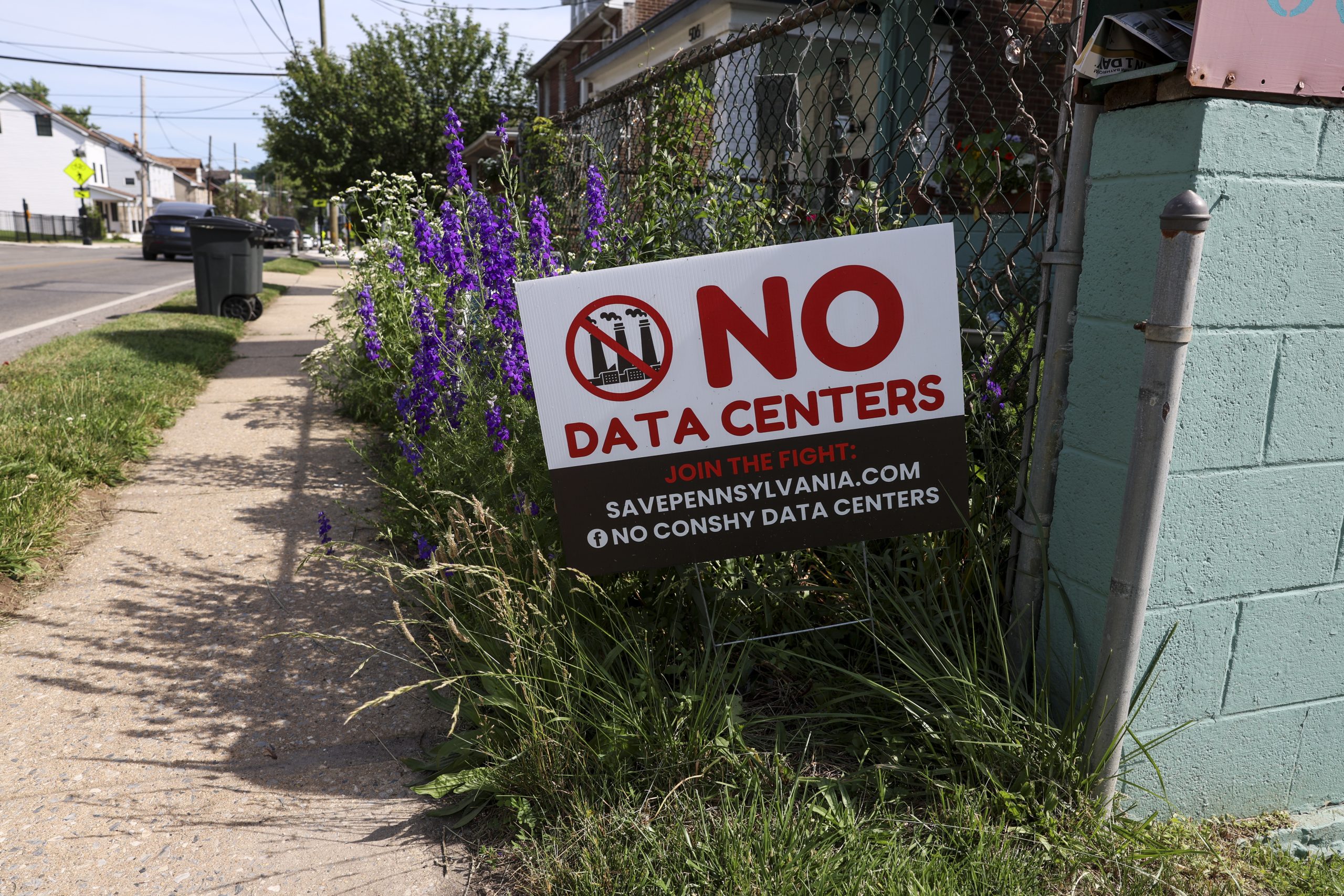
In both Upper Merion and Plymouth Townships, some residents have rallied against the plans, packing township meetings, signing online petitions, putting anti-data-center signs on their lawns, and organizing on social media. They have cited concerns about light, noise, and air pollution; water usage; and electricity costs.
A yard sign protests the proposed Plymouth Township data center.Monica Herndon / Staff Photographer
On Monday, O’Neill reiterated that his Plymouth Township data center would make little noise, emit no light pollution, and operate on a closed-loop system that does not require outside water. He said it would generate its own power, not taxing the grid, and generate “billions of dollars in employment and economic development.”
“I am shocked that [the township council] can in good conscience not promote my plan, let alone publicly oppose it,” given office vacancies in the area, O’Neill said. In the past, “our developments have helped to create the vibrant community that Conshohocken and Plymouth are today.”
Viscio, the Plymouth Township Council chair, said that local officials wanted to ensure that O’Neill’s proposed data center improved residents’ quality of life — and that O’Neill’s efforts could prevent them from doing so.
“We will not allow ourselves to be bullied or intimidated by any developer,” Viscio said. “We will not dismiss legitimate concerns raised by our residents.”
She said the council would continue to oppose O’Neill’s application and his challenge to the zoning ordinance.
On Monday afternoon, O’Neill called back a reporter with an additional message for Plymouth Township officials: “We’re always willing to make a deal if they want to sit down and talk.”
Thanks for reading the third edition of this newsletter. It’s been incredibly helpful to hear your thoughts so far. Please keep sharing your insights with us via this survey so we can shape this resource to be the most helpful it can be!
A Cheltenham mother has spokenexclusively to The Inquirer about the alleged assaults her son experienced last year in theCheltenham High School footballlocker room. In one instance, nearly 20 students watched as the boy’s teammates attempted to sexually assault him, his lawyers said.
No students have been disciplined even after the school district determined that an assault had taken place and been recorded on video by witnesses, while the affected teenager “can’t escape” continued harassment throughout the local community, his mother said.
The school’s previous and upcoming football seasons were both canceled amid the ongoing investigation by the Montgomery County District Attorney’s Office.
Meanwhile, the teen’s family is still awaiting accountability.
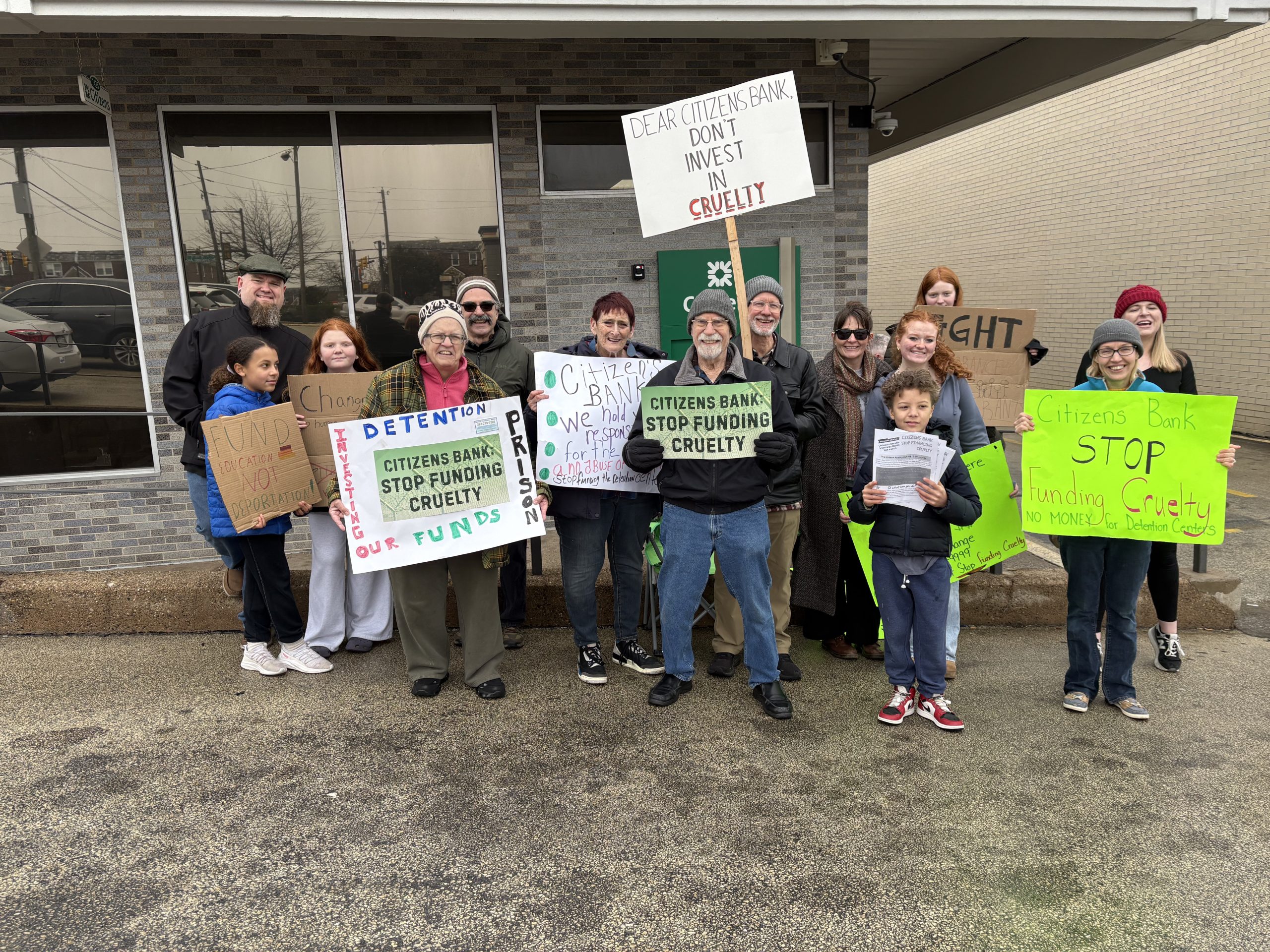
Cheltenham Township is closing its last two accounts with Citizens Bank over the bank’s financing of companies that run detention facilities, despite the bank’s announcement it would no longer do so.
The accounts hold about $9 million cumulatively, which township officials are planning to divert to Santander Bank. The move comes after months of lobbying by local residents.
Friends of Fox Chase Farm, a volunteer group that supports the 112-acre expanse that straddles Abington Township and Philadelphia, has disbanded after more than 30 years.
Ramah Day Camp, a Jewish summer program in Cheltenham, will also shutter soon, ending its 30-year run.
Abington, Jenkintown, and Cheltenham are among the Montgomery County locales that will be scrutinized by law enforcement in the coming weeks in an effort to combat aggressive drivers.
A 27-year-old Nigerian man who laundered money as part of a “sextortion” plot that led a 20-year-old Abington native to kill himself has been sentenced to five years in federal prison.
Jenkintown man Seok Joon Lee, 54, has been charged with impersonating a federal officer after allegedly pretending to be an FBI agent at a Philadelphia grocery store, where he carried a loaded gun and attempted to conduct a security check of the supermarket.
The community is mourning the deaths of esteemed clothing designer and professor of fashion Emil DeJohn, 88, who was a congregant of St. Luke the Evangelist Church in Glenside, and Ida Schmertz, 91, a former Jenkintonian who became a pioneering women’s activist, presidential appointee, and the first female senior vice president at American Express. They each died in recent weeks.
Inquirer contributor Paul Jablow takes a good look at a three-story, six-bedroom Queen Anne Victorian home up for sale in the Wyncote Historic District.
🏫 Schools briefing
Meet Brea D’Angelo, the former Sixers reporter who is now leading Jenkintown School District as its new superintendent.
Also in the Cheltenham School District, a new vice principal starts at Wyncote Elementary on Aug. 1. Plus, Glenside Elementary has named an interim principal and Cheltenham Elementary has named a new principal, both pending school board approval.
Construction is underway on Abington High School’s forthcoming Ash Carter Courtyard, a tribute to the late 1972 alumnus who served as U.S. Secretary of Defense from 2015 to 2017, the Main Line Times reports.
🍽️ On our plate
We’re in prime farmers market season, and Jenkintown has a robust one: Think handmade stuffed cookies, local fruits and veggies, and individually wrapped pound cakes, The Inquirer’s Hira Qureshi reports.
👻 Summerween Character Event: Enjoy spooky-themed drink specials, check out your favorite scary characters in their summer garb, and get a reading from a medium (if you dare). ⏰ Saturday, Aug. 1, 11 a.m.-1 p.m. 💵 Pay as you go 📍 Pot Heads Coffee House, Jenkintown
🕺 The Concert: A Tribute to ABBA: The touring production from Sweden, featuring original band members from the iconic pop group, will perform renditions of ABBA’s ‘70s and ‘80s hits to Montgomery County. ⏰ Tuesday, Aug. 4, 8 p.m. 💵 $52.53-$75.74 📍 Keswick Theatre, Glenside
Built in 1935 in Jenkintown Manor, this charming four-bed, three-bath home features original hardwood floors, a bay window in the dining area, and a wood-burning fireplace. There is a front porch as well as a back patio.
By submitting your written, visual, and/or audio contributions, you agree to The Inquirer’s Terms of Use, including the grant of rights in Section 10.
This suburban content is produced with support from the Leslie Miller and Richard Worley Foundation and The Lenfest Institute for Journalism. Editorial content is created independently of the project donors. Gifts to support The Inquirer’s high-impact journalism can be made at inquirer.com/donate. A list of Lenfest Institute donors can be found at lenfestinstitute.org/supporters.
The phone rang at lunchtime, the way it did every day. Carisia Magobet answered within seconds.
An automated voice spoke first: This call is from a Pennsylvania state correctional institution.
Then his.
“May the peace, mercy, and blessings of Allah be with you, my love,” Matthew Garcia said in Arabic.
They had only 15 minutes, and for once, Magobet did not spend the first of them on small talk. There was no good way to tell him what she knew: State lawmakers had gone home the night before without taking the vote that the couple had hoped would bring him home.
Garcia was 18 in 1998 when he and four friends set out to rob a Hunting Park bar. He said he was the lookout and did not have a gun.
One of the teens pointed a sawed-off shotgun at a bartender and demanded cash. A retired Philadelphia police officer, Frank King, was inside the bar and grabbed for the gun. Another teen shot him with a pistol. King died on the floor.
By that time, Garcia said, he had already run.
It didn’t matter.
All five were convicted of second-degree murder — a killing committed during a felony, no matter who pulled the trigger — and sentenced to the only punishment Pennsylvania law allowed: life without the possibility of parole.
Magobet, who had known Garcia since they were kids in Hunting Park, was in the courtroom on June 21, 2000, the day he was sentenced. For decades, they did not see each other again.
Then, about two years ago, she found Garcia’s Facebook account, where he shared his writing and his work inside State Correctional Institution-Chester, the prison he called home. She reached out.
Garcia told her about a case before the Pennsylvania Supreme Court that could mean freedom for people serving life sentences in cases like his.
Derek Lee, a Pittsburgh man sentenced to life in prison for his role in a fatal robbery in which a coconspirator fired the fatal shot, had challenged the mandatory punishment as unconstitutional, saying it failed to account for individual culpability.
In March — six months after Magobet and Garcia wed in a prison visiting room — the high court struck down mandatory life sentences for second-degree murder.
It gave lawmakers until July 24 to write new sentencing guidelines for future cases and determine how, or whether, the ruling would apply to the roughly 1,100 Pennsylvanians already serving that sentence.
The stalemate places in limbo everything Magobet, 40, and Garcia, 45, have spent the last two years assembling in anticipation of a freedom both yearn for but neither can control.
Building together
She loved him first.
Magobet was 13 when Garcia’s sister got married and they were both in the wedding party. He was supposed to walk her down the aisle. But at the last minute, the pairs were swapped, and she walked with his brother instead. Magobet decided, quietly, that she was owed that walk one day.
She never told him. Not before his arrest, not for years after he went to prison. She found his social media accounts and saw what his life had become in prison.
He had earned college credits, started programs for young people, and launched a podcast to share his story.
In a prison foster-cat program, Garcia adopted a calico, named her Lil Mama, and fed her until the name stopped fitting. “It’s not Lil Mama now,” he said in a recent interview. “It’s Fat Mama.”
Prison reform advocate Carisia Magobet shows photos of her husband, Matthew Garcia, who is serving a life sentence for second-degree murder, at her home in Northeast Philadelphia.Sarah Silbiger / For The Inquirer
The orange-and-black foster fail appeared often in Instagram photos. In one, a full-bearded Garcia wrote: “Me and Lil Mama, patiently waiting on our moment.”
By then, Magobet had four children, a house, a dental office she managed by day, and a commercial cleaning business she ran at night. Yet she found herself thinking often about Garcia. Seeing him there — older, broader, smiling beside a chubby cat — made him less a memory and more real. She emailed him.
Not long after, she took over his social media accounts.
Together, they began building a growing audience for Garcia’s work, a network of supporters, and, eventually, a life that felt shared despite the prison walls that separated them.
She posted his poetry. She built a website explaining the Lee case and a guide to contacting lawmakers about sentencing reform. He wrote children’s books, including one about Lil Mama that Magobet’s 21-year-old daughter, a digital arts student, illustrated.
A chance for ‘FREEDOM’
Garcia proposed on Aug. 1, three months after they reconnected. But it didn’t feel fast to Magobet. She had been carrying that moment since the wedding party.
They wed on Aug. 23. She is still waiting on prison paperwork to make it legal. But to them, Magobet said, it’s official.
Matthew Garcia and Lil Mama.Courtesy of Carisia Magobet.
He calls at least four times each day — when his cell door opens at 7 a.m., at lunch, after his work shift at the prison’s reentry program, at night. Each call lasts 15 minutes, the maximum allowed under prison policy, plus six video calls and four in-person visits a month.
On a video call last month, the couple discussed Magobet’s plan to join other families, formerly incarcerated people, and advocates in Harrisburg to support legislation in response to the high court’s decision that would allow people like Garcia to seek parole after serving at least 25 years. Not guaranteed release, but a chance to make their case.
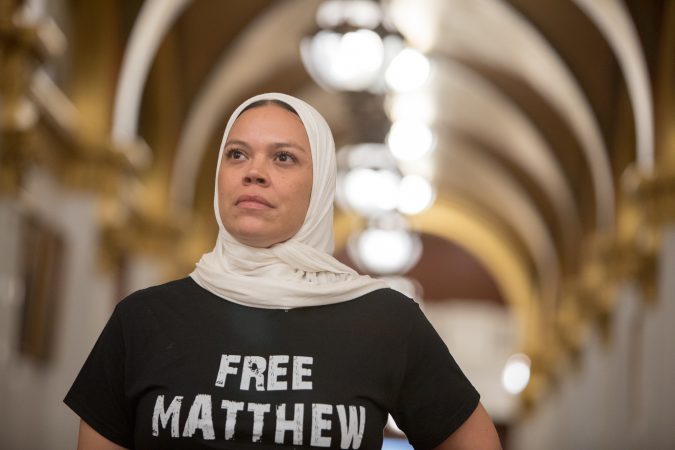
She told him about a poster she had printed to bring, with a photo of him holding Lil Mama and “FREEDOM” written in all capital letters. She had ordered a custom T-shirt, too, but it had not arrived yet.
“Will it come in time for Monday” for the trip to the Capitol? Garcia asked.
The call cut out before she could answer.
‘Do your job and legislate’
Carisia Magobet participates in a rally at the state Capitol in Harrisburg.Kalim A. Bhatti / For The Inquirer
Magobet wore the T-shirt to Harrisburg two days later.
Beneath the Capitol rotunda, Magobet met Saleem Holbrook, the executive director of the Abolitionist Law Center, which represented Lee before the Supreme Court. He told Magobet he knew Garcia from their years in prison together.
“If there’s a person who’s earned being able to come home,” he said, “it’s Matt.”
In State Rep. Nikki Rivera’s office, Magobet read a speech from her phone. Her voice broke only once, when she told Rivera (D., Lancaster) that Garcia was her husband.
In the lobby of House Majority Leader Matt Bradford’s office, Magobet joined several others in a chant — “the time is getting late, do your job and legislate!” — that prompted the Montgomery County Democrat’s chief of staff to take Magobet and another person back to her office. The staffer had listened, Magobet said, promised nothing, and blamed the other side.
But Lil Mama made her laugh.
“The cat gets everyone,” Magobet said afterward. “We gotta get Lil Mama T-shirts for next time.”
Holding onto hope
Five weeks later, there was no next time to plan for.
Magobet learned that lawmakers adjourned July 12 without voting on the Democratic-sponsored measure she had supported, or the stricter Republican proposal.
She told Garcia on a phone call, and before the 15 minutes were up, he told her he couldn’t keep talking. It was the first time he had ever done that, she said.
A new measure, introduced by Democrats in an emergency session last week, did not earn a vote in the Senate.
The Supreme Court’s 120-day stay on new sentencings in second-degree murder cases expired on Friday, and judges can again hand out life sentences to people convicted of second-degree murder, but only in limited circumstances. But without a new law, there are no mandatory minimums or clear guidelines.
In the meantime, the next chapter will likely unfold in the courts for the more than 1,000 people already serving mandatory life sentences.
Bret Grote, an attorney with the Abolitionist Law Center who represented Lee in the Supreme Court case, said the high court has been asked in a separate case to determine whether the ruling applies retroactively.
He called the situation “a constitutional crisis.” But even under the most optimistic timeline, he said, a resolution could take years.
In the meantime, attorneys expect a wave of challenges from incarcerated people seeking relief. More than half of those serving the sentences are from Philadelphia.
Garcia said he will meet with his attorney to determine his next steps.
Prison reform advocate Carisia Magobet poses for a portrait at her home in Northeast Philadelphia.Sarah Silbiger / For The Inquirer
Magobet said she is holding on to hope — for the smaller things.
Walks together.
Coffee he brewed waiting for her in the morning.
Afternoons at a pool. (Garcia has not been in water deeper than a shower in nearly three decades.)
For months they talked about those plans as though they were approaching.
The day after President Donald Trump delivered a prime-time speech contending, among other claims, that 250,000 noncitizens were registered to vote in just four states, Pennsylvania Gov. Josh Shapiro derided it as“a whole bunch of conspiracy theories that are just simply not connected to reality.”
A week later,when New Jersey revealed that 6,600 noncitizens were improperly registered to vote in the state and nearly 400 cast a ballot due to a glitch, Shapiro’s message was nearly identical — that Trump ispushing “baseless conspiracy theories” as he seeks more power over state-run elections.
Pennsylvania and New Jersey were both on the list of Democratic-led states that Trump claimed had thousands of noncitizens on their voter rolls. The methodology of how the Trump administration arrived at that figure remained unclear, but his administration has sought to leverage the New Jersey disclosure as evidence of a larger problem.
But Shapiro and other national Democrats have not shifted their messaging on the issue ahead of the high-stakes midterm elections.They are refusing to cede to the GOP any suggestion that New Jersey’s voter rolls are evidence of widespread voter fraud and arewarning that the changes Republicans seek would make it tougher for many Americans to vote.
“Withholding this funding will make our communities less safe and would be dangerous under any circumstance, but doing this in an attempt to undermine states’ authority over elections is reckless and unconstitutional,” Shapiro said.
Kentucky Gov. Andy Beshear, another potential 2028 candidate, also joined the suit. (Both Shapiro and Beshear lead states with Republican attorneys general.)
The day after Trump’s speech, Shapiro challenged the administration to present “real evidence” of noncitizen voting, which Pennsylvania election officials say is extremely rare.
In addition to Pennsylvania and New Jersey, the White House also targeted Nevada and California for additional scrutiny over their voter rolls, according to a document posted to the White House website last week shortly after Trump’s speech.
California Gov. Gavin Newsom, one of Trump’s most vocal critics in the Democrats’ potential 2028 field, said the president’s speech was fueled by debunked lies.
“It was unhinged. Unfounded allegations of election fraud — it’s madness. But he’s setting it up. He’s setting you all up. You know what he’s doing. He’s doing it in plain sight. He’s socializing all of this to normalize all of this,” Newsom said last week, during a newsconference that took place the same day as New Jersey’s announcement.
Trump has repeatedly promoted conspiracy theories about California elections in recent weeks — including in two Pennsylvania speeches — despite no evidence that fraud occurred.
For U.S. Sen. Cory Booker (D., N.J.), pushing back against Trump presents a tougher challenge.
Booker, also a likely 2028 aspirant, must balance the governing changes he sees as needed in New Jersey with the larger politics of the moment. He said the failure of the software was “not acceptable” but rejected Trump’s efforts to portray the entire election system as faulty.
“There are those who will choose to weaponize this issue to undermine confidence in our elections,” Booker said in a statement. “We cannot allow that.”
ButRepublicans have pointed toNew Jersey as proof that a sweeping overhaul is neededfor November’s results to be trusted.
Trump’s allies are pushing the SAVE America Act, which would require voters to provide proof of citizenship when registering to vote and to show photo ID at the polls. The effort has stalled in Congress amid concern, even among Republicans, that the bill’s restrictions on mail voting could make it harder to cast a ballot and that many citizens could wrongly be blocked from voting if they do not have access to required paperwork.
Vice President JD Vance, widely viewed as a 2028 Republican candidate and a potential political heir to Trump, seized on New Jersey’s revelations as a renewed opportunity for the legislation’s relevance.
“If only there was a way to stop this type of ‘software error’ that allowed non citizens to vote in our elections,” he wrote in a post on X that targeted Booker and Sen. Andy Kim (D., N.J.), both of whom are unlikely to support the Republican-led bill.
But theregistration glitch happened despite these individuals answering “no” when asked on a keypad whether they were U.S. citizens. They were added to the system “through no fault of their own,” New Jersey Gov. Mikie Sherrill said last week, so it is not clear that showing additional documentation would have prevented the error.
Sherrill ordered her chief counsel to investigate the issue, which occurred under her predecessor, former Democratic Gov.PhilMurphy, and promised to hold those responsible for the error accountable.
Talking about this issue can pose an obstacle for both parties now that New Jersey’s glitch has been identified, said Sam Chen, a Pennsylvania strategist who has worked for former Gov. Tom Corbett and other Republicans.
Republicans have overplayed their hand and are not seen as an authoritative voice on voter fraud, but Democrats have spent the same amount of time dismissing all of Republicans’ concerns, including some that are legitimate, Chen said.
“When you’ve got an entire party saying, ‘No, this is never happening,’ and now you see what you see in New Jersey, it is going to leave a serious credibility issue for them,” Chen said.
Democrats, like Shapiro, could build more credibility if they acknowledged the positive parts of the SAVE Act, he contended.
“Grab what’s good, vehemently oppose what’s bad, and states can blaze their own path,” he said.
But J.J. Balaban, a Philly-based Democratic ad maker, said it does not make sense for Democrats to go along with the SAVE Act because the charges are being made in bad faith.
While many Democrats would support efforts to make election systems more secure, Balaban said, that is not what the Trump administration is trying to do — and New Jersey does not change that.
“Voter fraud was shockingly rare a month ago. It remains shockingly rare today,” he said.
Spotlight PA is an independent, nonpartisan, and nonprofit newsroom producing investigative and public-service journalism that holds power to account and drives positive change in Pennsylvania. Sign up for our free newsletters.
HARRISBURG — After years of asking for more funding, Pennsylvania’s rape crisis centers saw their funding nearly doubled in this year’s state budget, a lifeline that the resource-starved organizations say will allow them to restore staff and services.
The $12 million increase brings total annual funding for the state’s 47 rape crisis centers to just over $24 million, and comes after they were left flat-funded for six of the past 10 budget cycles.
Administrators at and advocates for these centers say they had to convince Gov. Josh Shapiro and his administration that the situation was dire.
“I listened,” Shapiro said at a Monday news conference. “These people are true public servants, the work they do every day,” he said. “They deserve more, and they got it.”
The lack of new state funding, along with federal cuts, the budget impasse of 2025, and ongoing inflation, has troubled crisis centers in recent years, leaving the majority financially strained to the point of cutting staff and services, administrators and advocates told Spotlight PA.
They said the influx of dollars will help reinstate cut programs and workers, but cautioned there’s still a long way to go to mend years of underfunding.
“Sexual assault centers have been ringing this bell with our legislators for the past two to three years, trying to explain that we are really coming into the precipice of a real risk for crisis services declining or crumbling in many different parts of our state and of our counties,” said Ali Perrotto, chief executive of the Sexual Assault Resource and Counseling Center serving Lebanon and Schuylkill Counties.
The commonwealth’s 47 rape crisis centers provide services to around 26,000 survivors of sexual violence annually, according to the state Department of Human Services. These services include 24/7 hotlines and crisis counseling; prevention education; housing; and training on sexual assault-related issues.
State funding for these centers is distributed through a formula that takes into account population density, number of victims served, and hours of direct service provided. Centers also receive federal dollars, as well as grants and donations. Funding streams vary drastically by center: While some larger ones have relatively diverse finances, others are highly dependent on the state to operate.
In 2025, lawmakers approved a 2% funding bump amounting to around $250,000 more for all crisis centers. Advocates said this was not enough to meet the needs of organizations already in deep financial straits due to the four-month impasse that preceded the budget deal.
Rape crisis centers are among the nonprofits and other entities whose state payments get frozen when there is no budget. Perrotto said the situation forced SARCC to cut its prevention services and put off a capital purchase that would have provided housing for survivors in Lebanon County. The decision came after the center had to decide between investing in property or paying its staff, she said.
Other centers, she added, had to dip into reserve funds or use lines of credit to keep paying wages. When the budget finally passed last year, the number of workers had dwindled to the point where centers were unable to restore everything. And organizations that did take out loans or use lines of credit still have to pay interest, which can only be financed through fundraised dollars, not grants.
The impasse wasn’t the only difficulty. Rape crisis centers receive funding from the federal Victims of Crime Act fund. Money in the fund comes from fines paid by people who are federally convicted and goes to a range of services for crime victims. However, administrative changes at the federal level have lowered the fund’s balance.A state guide published this spring said money is now “critically low,” a dip that has caused a 45% decrease in victim services funding since 2022.
At the same time, the number of survivors seeking services at rape crisis centers increased, Perrotto said.
That uptick stems from lawmakers expanding the responsibility of local law enforcement, who now must directly refer victims to service agencies. This has increased the number of people coming through the doors of crisis centers.
“We had more influx into the systems, even though we had fewer staff to meet the need and less funding to provide the services locally,” Perrotto said.
There was often little rape crisis centers could do to tighten their belts further.
Perrotto said that over the past five years, SARCC has cut 50% of its staff. Those who remained working provided constant access to services, including a 24-hour support line along with counseling, legal, and medical support.
“The longer an impasse goes, the more of a tax there is on survivors and on the centers who are providing services to them,” Perrotto said.
The fight for more funding
When Shapiro first made his budget pitch in February, it didn’t address these issues; he proposed keeping funding flat once again.
This caused an uproar from rape crisis centers. Advocates and administrators at centers across the commonwealth signed on to a letter asking for a $12.5 million bump.
“Every year, flat funding has been equal to a budget cut, forcing centers to stretch already-thin resources even further as inflation and demand rise,” the letter said.
It wasn’t until Shapiro listened to advocates and heard their testimonies that he realized the magnitude of the issue, he said during a Monday news conference at the YWCA in Carlisle.
Joyce Lukima, director of the Pennsylvania Coalition to Advance Respect, which distributes state funding and advocates for rape crisis centers, said center leaders from across the state also met with lawmakers in May to discuss the need for funding.
She said this year is the first time she believes advocates’ concerns were actually listened to.
“After so many years of talking about this, I feel that we were heard and heard in a way that caused someone who was in a position to be able to take action to help move our cause forward,” she said.
Perrotto was part of that effort. She compiled data about crisis centers’ needs across the commonwealth and presented it to Val Arkoosh, head of the state Department of Human Services.
Detailed information on centers’ services and various funding streams was necessary to clearly illustrate to legislators the magnitude of the problem, said Arkoosh at the Monday event. Perrotto said the data she gathered showed the “buying power cut” of rape crisis centers — a loss in ability to pay for bills, staff, and services while still helping the same number of people.
While the money alone is a step in the right direction, Lukima said there’s going to be a lot of necessary rebuilding to right the wrongs of previous years’ funding difficulties.
She added there’s also a need to ensure that funding keeps pace with inflation to prevent centers from reaching their limits before getting more state resources.
Perrotto echoed that point. “There’s going to be a build-up period, so we have to build back and restore what was lost or what was kind of crumbling in the current system, and we’re doing that with less staff,” Perrotto said.
Along with rehiring furloughed workers, she said the new money will also go toward properly paying people who worked through underfunding. In 2022, her most recent analysis, Perrotto said the average wage for prevention educators and advocates working at sexual assault programs was $16 to $18 an hour.
Increasing wages will ensure survivors are taken care of by workers who aren’t stretched too thin, or who need to work multiple jobs to make ends meet. Centers will also put funding toward restoring programs to ensure the caseload is not as heavy, she said.
Lukima said she also predicts centers’ money will be allocated toward reinstating sexual abuse prevention programs that were cut in favor of maintaining services seen as more critical.
At the end of the day, she said, rape crisis centers are essential for survivors of sexual violence, and lawmakers should treat them that way.
“There isn’t a necessity for people to get to a breaking point before they get that increased allocation,” Lukima said, “recognizing how critical and important services are to the community, to the state, and making sure that that increase comes — just like it does for many other professions, just like it does for our legislatures — without having to have a multiyear struggle.”
BEFORE YOU GO… If you learned something from this article, pay it forward and contribute to Spotlight PA at spotlightpa.org/donate. Spotlight PA is funded by foundations and readers like you who are committed to accountability journalism that gets results.
An off-duty Philadelphia police officer who authorities say shot and killed his uncle in Northampton County during the weekend contended he did so in self-defense, according to court documents.
Cummings told troopers he had fired at Moncrieffe because he feared the man was reaching for his concealed firearm during a domestic confrontation, according to an affidavit of probable cause in his arrest.
Investigators say Cummings shot Moncrieffe six times in the head with a 9mm handgun during the confrontation at a residence on Old Gate Road.
Cummings is a two-year veteran of the force. He has an entry-level rank and serves on the Kensington detail, where he is paid a salary of $79,259, public records show.
Cpl. Jasmine Reilly, a police spokesperson, said Monday that the department’s internal affairs bureau has opened an inquiry into Cummings. She referred further questions to state police, who are overseeing the criminal investigation.
A spokesperson for the Pennsylvania State Police barracks in Bethlehem did not immediately respond to a request for comment.
The conflict began Friday around 1:30 p.m., when Cummings confronted his uncle at the home after a young family member told the off-duty officer that Moncrieffe had verbally threatened him, according to court documents.
After Cummings entered the residence, other family members saw the two men begin to struggle, with Moncrieffe shoving Cummings as he tried to stand up, the documents said.
The young family member — a juvenile whom police did not identify — then approached Moncrieffe and punched him multiple times in the face, the documents said. He later told investigators that the escalation led Moncrieffe to “square up with him.”
That’s when Cummings drew his weapon and fired at Moncrieffe, striking him in the head, the documents said. Moncrieffe slumped to the floor, and Cummings shot him again in the head before fleeing the property.
Cummings was arrested that afternoon after leading troopers on a chase through the Lehigh Valley community, at points traveling more than 100 mph through residential areas as he evaded law enforcement in an orange 2023 Kia Forte, according to the documents.
The pursuit ended back at Moncrieffe’s home, where Cummings surrendered his firearm and was taken into custody without further resistance, authorities said.
He is being held in the Northampton County jail without bail and is set to appear before District Judge Jordan A. Knisley on Aug. 8.
Staff writer Ryan Briggs contributed to this article.
Kelly Donia was seated in her Malvern Hunt home when she spotted dust plumes rising from construction vehicles combing the site of a planned data center complex in East Whiteland Township.
She immediately drove to the site, across Swedesford Road from her development, to watch that day in June, anxious about the safety of building a 1.5 million-square-foot data center directly on top of a Superfund site in Chester County.
“No one seems to be concerned, but I mean, we live right here, we work right here, there are children — there’s a daycare,” Donia said. “I don’t understand. I don’t understand our officials, and I don’t understand the developer, and I don’t understand the general contractor.”
Donia is not alone in her fears. She and many of her neighbors, who had packed into East Whiteland meetings about the project for months, have continued to raise concerns about the safety of the building on the former 79-acre Cyprus Foote Mineral Co. property, which was contaminated over decades by a range of chemicals such as lithium, arsenic, and hexavalent chromium.
Not long after Donia saw those plumes, the township issued a stop-work order until it gathers more information on the environmental impact of construction.
While the developer says the site is safe, and the township has approved the plans, some residents believe that documents filed with the township and U.S. Environmental Protection Agency show that the site is still contaminated from its years as an industrial site, and they worry about what impact the construction will have on their community.
Here is what The Inquirer knows about the Foote Superfund site.
Location of the two-building data center project in East Whiteland, Chester County.John Duchneskie
Green Fig LLC first proposed a data center in 2018 and secured early zoning board approvals. The plans were greenlit by the township’s supervisors in 2024, drawing little pushback from the community.
Residents have been more engaged since the plan came back before the township earlier this year, first with ambitions to scale it up, then with a proposal to shrink it to appease outraged residents.
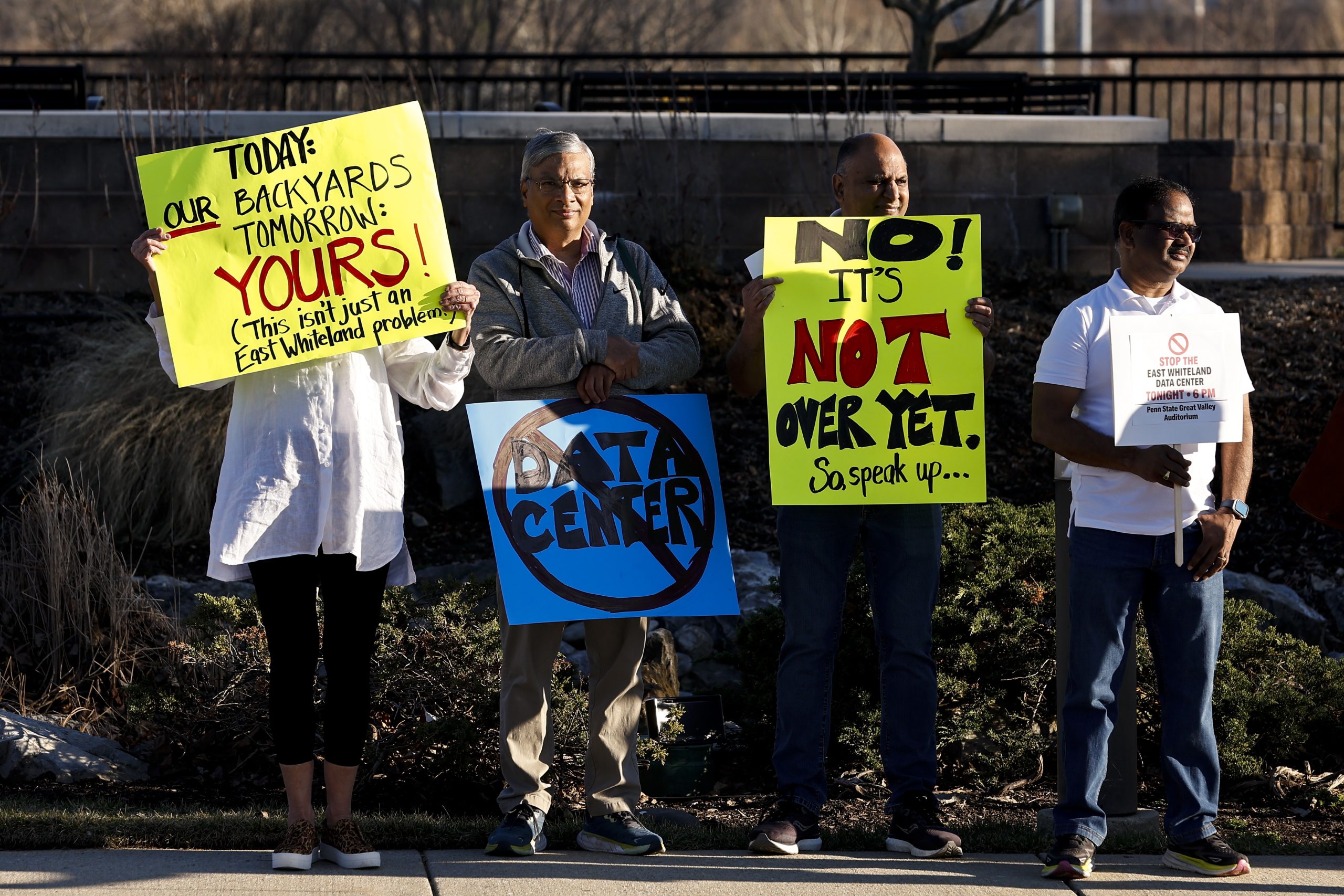
People protest the expanded data center before the East Whiteland Planning Commission meeting held at Penn State Great Valley on Monday, March 9, 2026 in Malvern.Monica Herndon / Staff Photographer
What are residents concerned about?
Residents fear that construction work on the site will kick up pollution in the air and release contaminants into the drinking water. They worry that there has not been ongoing testing of the soil on the site, especially knowing that contamination exists below.
How did the site become polluted?
Pollution at the Foote Mineral Co. likely started as soon as 1941 when the company began crushing ores and minerals.
Foote closed in 1991 with two quarries, a pit where solvents were burned, a lined wastewater basin, and more than 50 buildings and processing areas. Three unlined lagoons were backfilled.
At the time, public and private wells within four miles of the site had supplied drinking water to approximately 42,300 people. Several private wells near the site were found to be contaminated and were closed. A public water-supply well one mile away was also shuttered.
Cleanup, led by the EPA, has included capping contaminated quarries, stabilizing waste areas, and maintaining a long-term monitoring program for an evolving groundwater plume. Pollutants included lithium, boron, and low-level radiation.
An open land site is shown in East and West Whiteland Townships in Chester County on Thursday, January 5, 2023, where Green Fig LLC has proposed its data center project.Jose F. Moreno / Staff Photographer
What is a Superfund site, and how did it become one?
A Superfund site is a contaminated location in the United States designated by the federal government as a severe health or environmental hazard. Foote was added to the federal Superfund list in 1992.
In a 2023 letter to East Whiteland Township officials, a contractor hired on behalf of the developers incorrectly said that the site had been removed from the U.S. Environmental Protection Agency’s National Priorities List, an inventory of the nation’s most serious hazardous waste sites.
As of Friday, Foote Mineral Co. remained on the list posted on the EPA’s website. The EPA says because of the ongoing pollution, there is no proposal to remove the Foote site from the National Priorities List, nor any timeline for remediation to be complete.
What does the EPA recommend?
It’s complicated.
A 2024 EPA report, the most recent environmental evaluation of the site, found concentrations of certain pollutants have decreased over time, but an excessive amount of volatile organic compounds, or VOCs, remained. VOCs are gases that contain a variety of chemicals that may adversely affect human health. VOCs tend to be much more concentrated when contained indoors.
The EPA recommended updated land-use restrictions and further data collection to ensure the site remains safe during future redevelopment.
On its website, the EPA wrote that the “hazardous substances, pollutants or contaminants remain at the site above levels that allow for unlimited use and unrestricted exposure.”
Days before the 2024 findings were released, an EPA engineer filed a report known as a “Superfund Checklist for Retracting the Sitewide Ready for Anticipated Use Measure (SWRAU)” that said the site “no longer meets” standards for human exposure.
The EPA said in an emailed statement that SWRAU forms are only for guidance.
SWRAU “designations are not required for redevelopment,” the statement said. “So long as all land and groundwater use restrictions continue to be met and redevelopment does not interfere with EPA’s cleanup or future investigations, sites can be reused and redeveloped.”
“Based on a careful review of construction plans by EPA subject matter experts, the agency does not anticipate the development to impact the remedy at the Foote Mineral Co. Superfund site,” Mike Bastasch, an EPA spokesperson, said in June. The EPA “remains engaged and will continue monitoring redevelopment progress to ensure the remedy remains intact,” he said.
What do experts say?
If a site is properly cleaned up, there are “potential ways that a data center could be a better use, environmentally, of the land,” said Noah Kittner, associate professor in the Department of Environmental Sciences and Engineering at the University of North Carolina Gillings School of Global Public Health.
But that is contingent onhow it uses water, what kind of systems are in place, what types of energy and electricity are being used, and whether diesel generators are being used in the construction, development, and operation of the site, he said.
The documentation from the EPA showing remaining contamination “certainly raises some red flags” about redeveloping the site, he added. And whether the project does more harm than good is “highly dependent on plans for construction.”
“You could have a poorly executed project, and it causes a lot more problems for the community,” Kittner said. “Or you could have a really well-designed remediation project that builds in sustainability principles and other factors that could really transform that area from what was once highly polluting to something that is environmentally positive.”
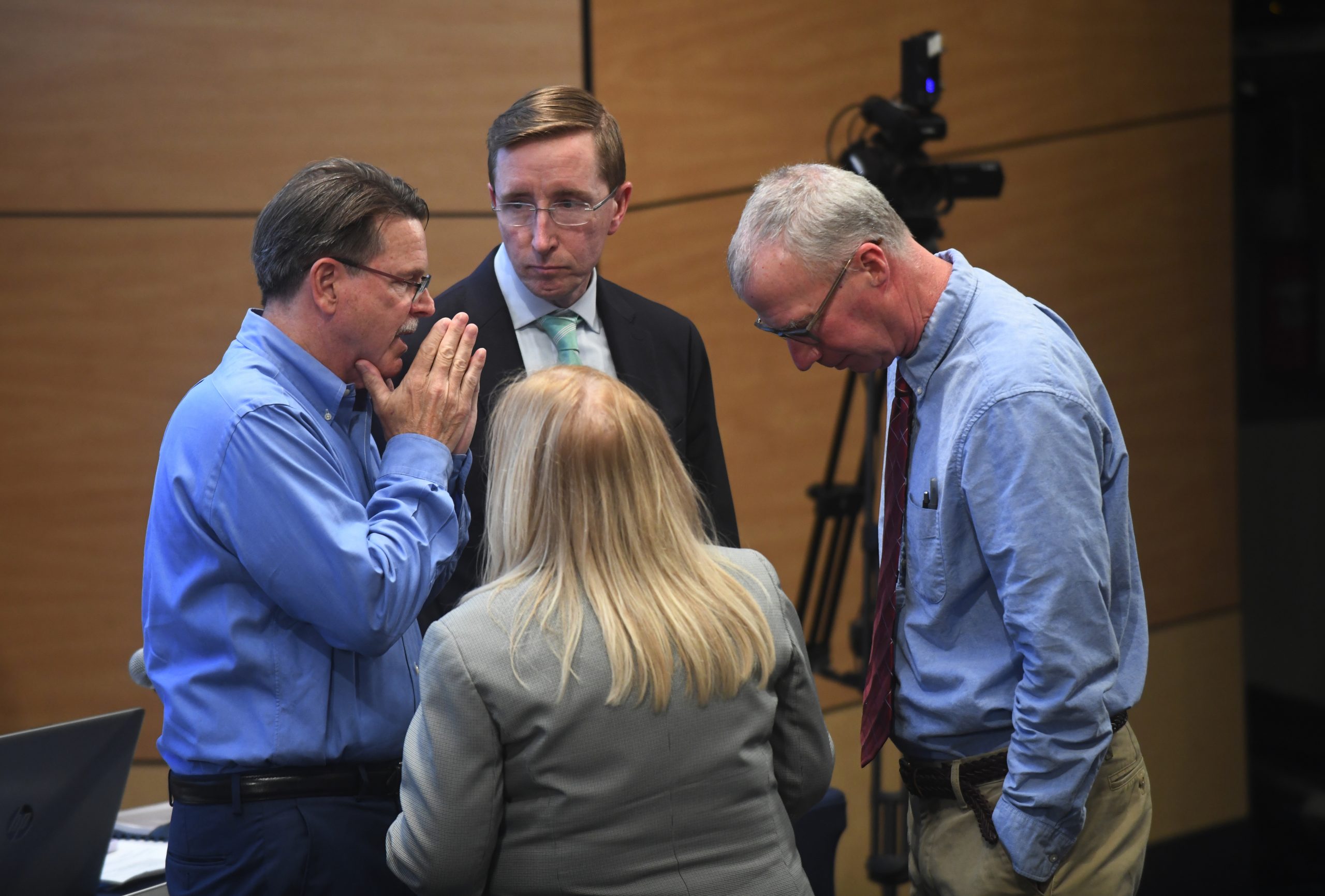
Scott Lambert, chair of the East Whiteland board of supervisors, left, confers with township officials about the data center proposal on April 14, 2026.Bob Williams / For The Inquirer
Who decides?
The EPA said in a statement to The Inquirer that it does not “recommend, propose, or approve specific Superfund redevelopment plans.” The agency reviews proposed uses and checks if there are “any potential conflicts with the selected remedy (including cleanup standards) or any issues that could reduce protection of human health and the environment,” the statement said.
The EPA’s goal is that most Superfund sites will be cleaned enough for commercial or industrial use. However, in some cases, the EPA can impose near permanent, severe restrictions on potential uses. Most Superfund sites undergo evaluations every five years to make those determinations until a site is removed from the National Priorities List.
Beyond that, it falls to the township to make final decisions on what the project will ultimately look like, and whether it could be built. Municipal leaders have said previously that, due to state law, they feel their hands are tied to allow for uses such as data centers.
What’s next?
The project remains in limbo: The developers have returned to the township seeking to amend their plans and alter the final design for the project. Supervisors tabled their decision at their last meeting on July 8, saying they needed more information about proposed changes.
Residents remain concerned about long-term construction at the site.
This suburban content is produced with support from the Leslie Miller and Richard Worley Foundation and The Lenfest Institute for Journalism. Editorial content is created independently of the project donors. Gifts to support The Inquirer’s high-impact journalism can be made at inquirer.com/donate. A list of Lenfest Institute donors can be found at lenfestinstitute.org/supporters.