Category: Pennsylvania News

  • Costs for a Tredyffrin park have ballooned to $1.7M, angering residents. Officials say it’s an investment.

    Costs for a Tredyffrin park have ballooned to $1.7M, angering residents. Officials say it’s an investment.

    Elected officials in Tredyffrin Township are moving ahead on turning an eyesore property into a park featuring tennis and pickleball, fulfilling a campaign promise of the chairperson’s. But some residents are worried the costs have soared too high.

    What started as a project this year rehabbing the dilapidated Chase Road Park for roughly $725,000 in its first year, with more funding to come in later years, instead grew to $1.7 million this fiscal year. All said and done, it is likely to exceed $2 million, officials have said.

    The jump in cost came with sticker shock for some residents, who have worried the township is sinking too much money into the park, and is doing so without sufficient public involvement.

    “In my opinion, they should go back to the drawing board, because this whole thing is a way greater cost and scope than had ever been contemplated,” said Mike Heaberg, a resident who previously served as a board member.

    Township officials argue it’s an investment for community amenities that flush reserves can cover.

    “[The] $1.7 million to get a full five-acre park with all the courts and bathrooms and a big barn, … it’s not a bad deal if you think objectively about what we’re doing there,” said board chairperson David Miller.

    The land

    Located in Chesterbrook, Chase Road Park had a former life as a private swim club, with tennis courts and a popular parking lot basketball hoop that drew a crowd after hours. Almost a decade ago, its owner sold the park to a developer, who wanted to reimagine the five-acre parcel into housing. That wasn’t a popular plan, however, and the township rejected the request to change the zoning.

    For years, the property languished, deteriorating with time. In 2025, the board bought the land for $625,000 through eminent domain.

    Miller said the community was “overwhelmingly supportive” of the decision; he recalls meetings about the prospect being standing room only, with a majority in favor of the board’s decision.

    The township’s eminent domain is still in the courts, where it could play out for years. The final price tag could be higher than that initial down payment, depending on a judge’s ruling.

    The plan

    Early into acquiring the property, the township discussed turning it into a long-requested racquet sports center, for which it was already outfitted. The park’s future surfaced at a series of Parks and Recreation board meetings in 2025 and 2026, and some tweaks were made along the way.

    Under the current project plan, the park will offer four tennis courts, six pickleball courts, a bathroom building, and a storage barn. There will be a pavilion and a grassy area for community use.

    Further down the line — and currently tabled while the board mulls it over — will be a basketball court, most likely a half court. The board is also considering adding a path and bridge to connect this park with nearby Wilson Park. Those would come with additional costs.
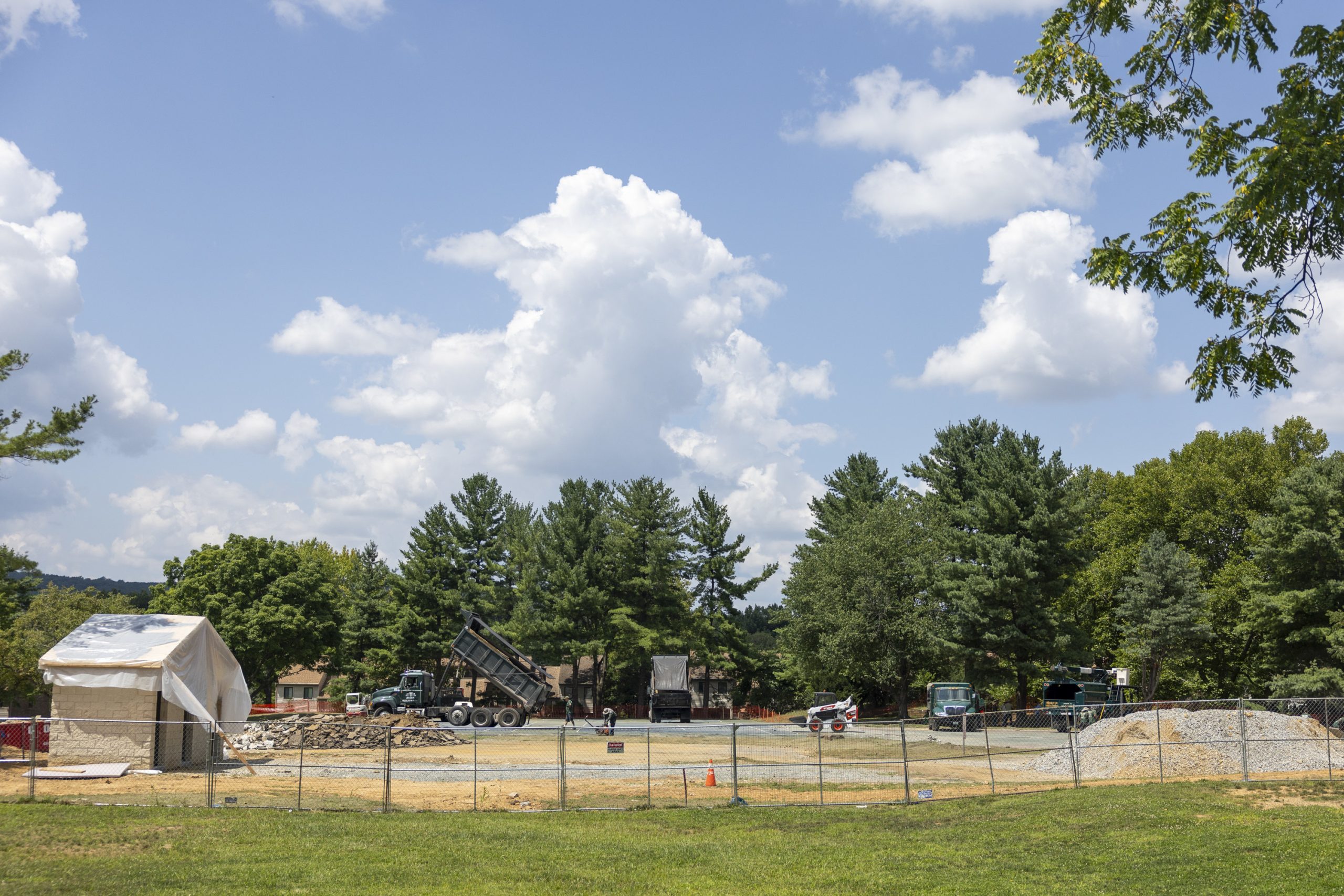
    Construction site at Chase Road Park in Tredyffrin Township. The park has been sitting vacant and deteriorating for roughly a decade in Chesterbrook, Pa., on Friday, July 31, 2026.Tyger Williams / Staff Photographer

    The cost

    Budget-watching residents say they first saw upgrades to the park show up as a line item of around $400,000 for 2026, with further spending to come in subsequent years for an initial $1.3 million total estimate. But by the final round of the 2026 budget, that line item had increased to $725,000, with more spending to come.

    Township staff found that it was more cost effective to do a bulk of the work in one year, Miller said, so they decided to speed up the process, hence that initial jump.

    Then, at their May meeting, the board added a late agenda item to green light spending about $1.7 million to fix up the park — including the courts, fencing, the parking lot, constructing the barn and restroom facilities, a pavilion, and other “miscellaneous” work.

    In total, the township estimates it will spend at least $2.3 million on the park, including the initial $625,000 to take it by eminent domain, and the upgrades.

    That increase boiled down to a variety of reasons, Miller said. The condition of the courts was “not what we expected,” and they needed to be completely redone. The township decided to install a better fence, with sound-dampening material to snuff out the bouncing of pickleballs, which needed to be installed deeper into the ground than the previous posts. The bathroom building was “vandalized pretty heavily,” so they decided to knock it down and start over. Plus, “prices are higher” for materials like asphalt, he said.

    “There’s a bunch of things like that that get it to creep,” he said.

    Miller said the park will be paid for out of the regular operating budget; whatever doesn’t come out of normal tax revenue will come out of the general fund, which sits at about $18 million, he said.

    The concerns

    Heaberg, the former supervisor, told the board his “jaw was hanging open” when saw them approve the budget change for more than $1.7 million with no discussion.

    “It blows my mind, really,” he said.

    Speaking to the board in July, resident Carol Clarke didn’t “know how you can, in a meeting, go past the budget by more than a million dollars.”

    “I think you owe it to the taxpayers to acknowledge what you’re doing, and maybe the taxpayers might have said, ‘Whoa, is this an appropriate use of our funds? Could we be doing something else?’” she told them. “I support the park, but maybe it would have been an idea of, ‘Well, let’s get the funding in place, etc., and then we can add on to the park.’ … There’s good things that are being done, but is that a wise use of our funds?”

    Plus, the township’s use of the COSTARS, a program that allows local governments to purchase supplies and services through state-managed contracts, seemed problematic to resident Ray Clarke, who argued the project should have been competitively bid, citing the township’s charter.

    “All projects must be competitively bid, with exception of a few things into which this does not fall,” he told the board, noting that “all the sudden” a list was given by the same contractor who worked on nearby Wilson Farm Park, which was renovated in 2025 and 2026.

    “Which may well be the lowest cost — who knows, we have no idea,” he said.

    Miller disputed that reading, saying the township was within its rights to use the COSTARS program rather than request bids.

    The pushback from residents has led to some charged moments in recent months.

    Board member Carlotta Johnston-Pugh said she understood “the public is having a hissy fit because they don’t feel like they were involved. I understand that.”

    “Because yes, if a million dollars or a $1.2 or $2 million is coming out of a general fund or a piggy bank, yes, everybody in this township should have a say in it. What do you want us to do? Do you want us to stop the project completely, go back to the drawing board?” she said. “… I’m getting a headache. I’m actually getting a headache.”
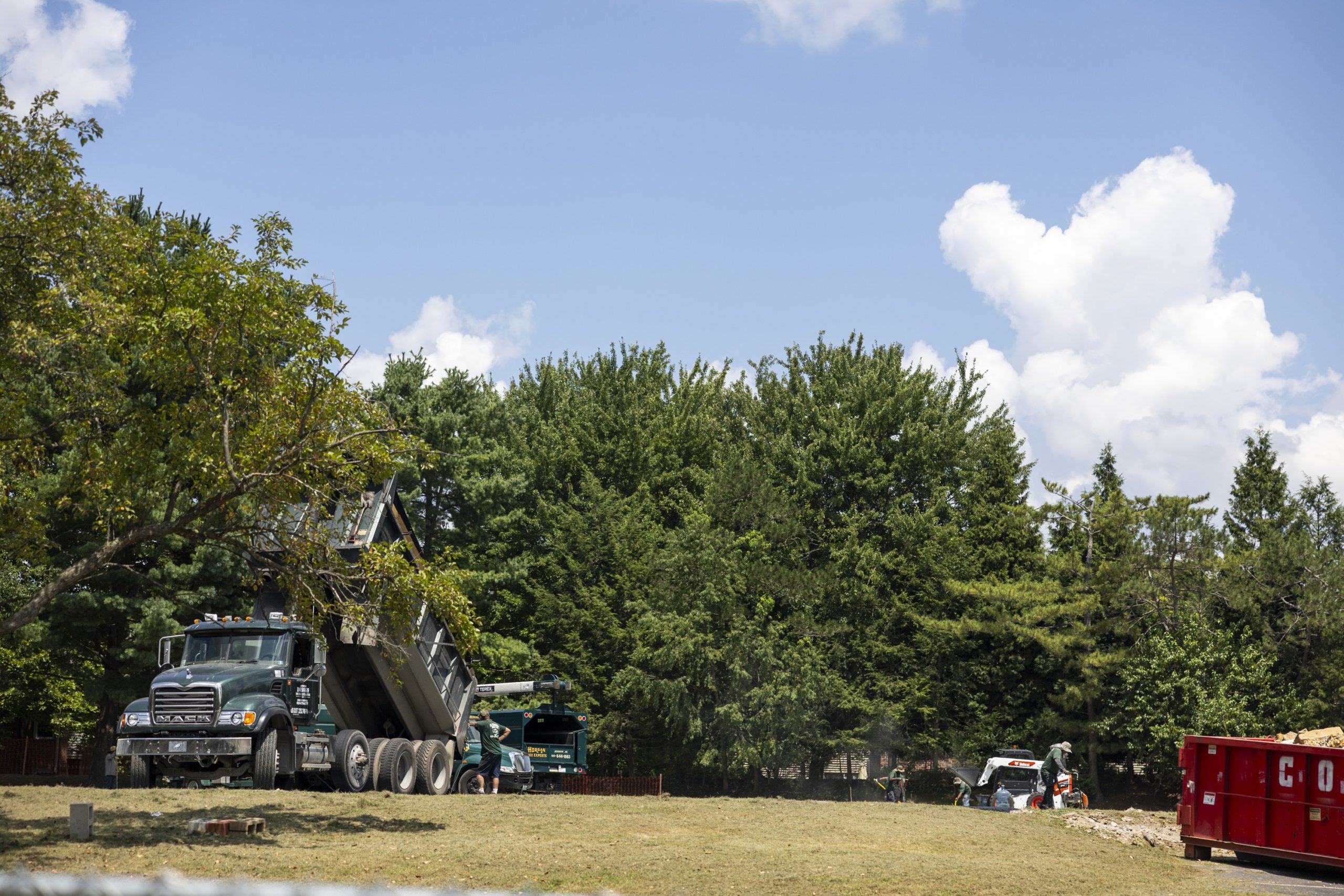
    The park on Chase Road in Tredyffrin Township will offer tennis and pickleball courts, plus a bathroom building, pavilion and grassy recreation space. Construction is underway in Chesterbrook, Pa., on Friday, July 31, 2026.Tyger Williams / Staff Photographer

    The flip side

    The project isn’t without its supporters, however, arguing the board had been clear about the timeline and the scope.

    “We went through 10 years of a derelict property in our neighborhood and we are grateful” the work isn’t being phased in, like previous plans discussed, said Joanna Fisher, of the Chesterbrook Civic Association.

    Tim Connor, who lives near the park, said the alternative was dozens of townhouses, which would have been a negative for the community.

    “Yes, it’s an investment right now, but long-term, those 50 townhouses would have had so many kids in the schools. It was a long-term loser. I think [this is a] better alternative,” he said.

    And for Miller, the park has been a personal goal: He campaigned on it. The township is working with Miller, separately, for naming rights of the park which he’d purchase for $625,000 — the initial cost to purchase the land. (It would not be named for Miller himself, he said.)

    Miller abstained from an initial vote in June OK’ing the township to draw up an agreement with the solicitor for naming rights. Miller said if someone else wanted to donate, he’d drop his bid, but he had the “capacity and willingness, and it’s important to me.”

    “When I ran this time, I said I was going to get this park built. I got over 8,000 votes,” he said later. “It seemed like something I should do since I told people I’d get it done.”

    This suburban content is produced with support from the Leslie Miller and Richard Worley Foundation and The Lenfest Institute for Journalism. Editorial content is created independently of the project donors. Gifts to support The Inquirer’s high-impact journalism can be made at inquirer.com/donate. A list of Lenfest Institute donors can be found at lenfestinstitute.org/supporters.

  • Police were searching for a man who fired a gun inside a Walmart in Delaware County

    Police are searching for a man who fired a gun inside a Walmart store in Delaware County, wounding an employee.

    Around 7:30 p.m. Friday, police responded to a report of shots fired inside the Walmart at 50 N. MacDade Blvd. in Glenolden. Officers found a woman suffering from a “non-life-threatening” wound to the calf, police said Friday night in a video NBC10 Philadelphia posted to social media.

    The woman, a Walmart employee, was taken to the hospital and is “expected to be just fine,” police said.

    A disagreement between two customers led up to the shooting, police said.

    Police said they recovered the gun that was fired.

    Police initially searched a nearby ShopRite supermarket where some witnesses said the shooter ran to, but police did not find the gunman, who was described as wearing an orange sweatshirt and black pants.

    Police said they believed the man was shooting at someone and they were checking with area hospitals in case a victim arrived for treatment.

    A Walmart spokesperson said the safety of associates and customers is a top priority.

    “We’re grateful to first responders for their swift response and are working closely with law enforcement as they continue their investigation,” the spokesperson said.

    Police said there was no immediate threat to the public.

  • Barbara Gillette Price, prolific painter, fine arts teacher, and former president of Moore College of Art and Design, has died at 87

    Barbara Gillette Price, prolific painter, fine arts teacher, and former president of Moore College of Art and Design, has died at 87

    Barbara Gillette Price, 87, formerly of Philadelphia, celebrated painter and designer, former president of Moore College of Art and Design, former dean of Cranbrook Academy of Art in Michigan, former vice president for academic affairs at the Maryland Institute College of Art in Baltimore, fine arts teacher, mentor, and role model, died Friday, April 24, of age-associated decline at a hospital in Granada, Spain.

    A lifelong artist and longtime educator, Ms. Gillette Price liked to skip her high school classes in the 1950s and wander around the galleries at the Philadelphia Museum of Art. In sixth grade, she told The Inquirer in 1994, her artistic talent drew attention from the teacher when her drawing of a female form was all too accurate.

    She took Saturday classes at Temple University’s Tyler School of Art and the Fleisher Art Memorial when she was young, and earned a scholarship to the old Philadelphia Museum School of Art. She married artist Melville Price in 1957, moved to Tuscaloosa, Ala., in 1958, and earned bachelor’s and master’s degrees in fine arts at the University of Alabama.

    She joined Cranbrook Academy of Art in 1978, the Maryland Institute College of Art in 1982, and Moore in 1994. At each stop, she renovated nearby old buildings into studios and galleries, expanded curriculum, and invigorated students with international and innovative programs.

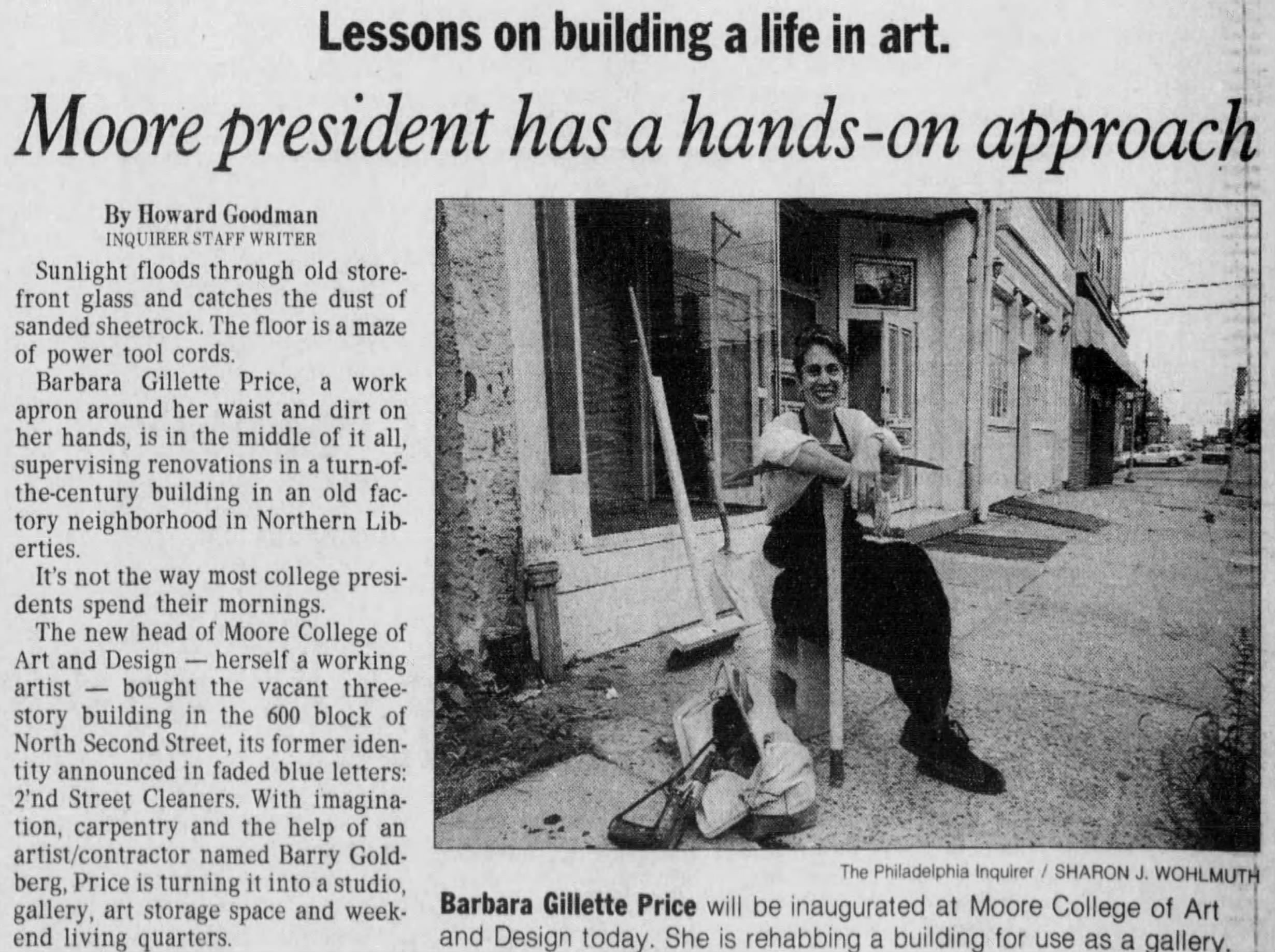
    At Moore, she increased enrollment, established a career center, and personally refurbished her three-story studio on North Second Street into a gallery where students exhibited their work and handled logistics and publicity. She also forged working relationships with the Philadelphia School District and other art institutions, supervised an advertising campaign for female artists, and served as a role model for working artists in academia.

    “That’s why I think my presence at Moore is a good thing,” she told The Inquirer in 1994.

    In 1998, Rochelle Levy, then chair of Moore’s board of trustees, said: “Barbara has really been our ambassador out there. She has set an incredible role model for the students as a woman artist.”

    Ms. Gillette Price left Moore in 1998, moved to Spain in 2000, taught art to primary school students, and continued to create and show her work. “Her commitment to arts education helped shape generations of creative thinkers,” former colleagues at Moore said in a tribute. “Her legacy lives on through the institutions she helped strengthen, the students she inspired, and the vibrant body of artistic work she leaves behind.”

    Ms. Gillette Price was featured in The Inquirer when she joined Moore in 1994.Newspapers.com

    As an artist, Ms. Gillette Price was a colorist and inspired by what she called her “labyrinth of imagination.” She expressed herself often in themes and collages, and was adept at abstract and figurative works on canvas, paper, wood, silk, and other textiles.

    One critic said her work “is of an inherent elegance that emerges from excellent craftsmanship and an intelligent narrative.”

    She showed in dozens of solo and group exhibitions in Spain, Philadelphia, Maryland, Michigan, Washington, and elsewhere, and liked to work in the gallery as well as her studio. She painted about nature, light, woman’s perspectives, isolation and fear during the COVID-19 pandemic, and other topics.

    “I seek to make the ordinary extraordinary,” she said on her website, barbaragilletteprice.com. “I am inspired by images I accumulate as I travel and view the world about me. This takes the form of remembered landscapes, figurative compositions, and subtle political statements.”

    She was active in the Civil Rights Movement in Alabama in the 1960s, worked with the Woman’s Caucus for Art in Washington in the 1970s, and taught ceramics, painting, and drawing at the old Corcoran School of Art and Design in Washington and elsewhere. She belonged to the College Art Association and was on boards at the National Association of Schools of Art and Design, the Philadelphia Art Commission, and other organizations.

    She earned grants for her painting and wrote essays and white papers about art. In one paper, she said: “The arts are the humanizing element in the education of the citizens of the 21st century.”

    Barbara Amelia Gillette was born June 26, 1938, in Philadelphia. She and her family spent many summers in Atlantic City, and she graduated from Philadelphia High School for Girls.

    She took piano lessons, attended Saturday concerts at the Philadelphia Orchestra for years, and hung out with high school boyfriend Edward Cutler and others at jazz clubs and the Gilded Cage coffee shop.

    Melville Price died in 1970, and she reconnected with Edward Cutler. They married, had a daughter, Michelle, and lived in Washington. They divorced later, and he died earlier.

    “I consider my mother’s greatest achievement to be the way she showed up as a parent,” her daughter said. “Her artistic legacy can be found in her paintings, drawings, textiles, and exhibitions. Her personal legacy lives on in the people she inspired, mentored, encouraged, and welcomed into her life.”

    Ms. Gillette Price created in the galleries as well as her studio.Barbara Gillette Price

    In addition to her daughter, Ms. Gillette Price is survived by a son-in-law, Eric Maroldo, and other relatives. A sister died earlier.

    Services were held earlier.

    Donations in her name may be made to Alhama Street Animal Protection in Granada, Spain.

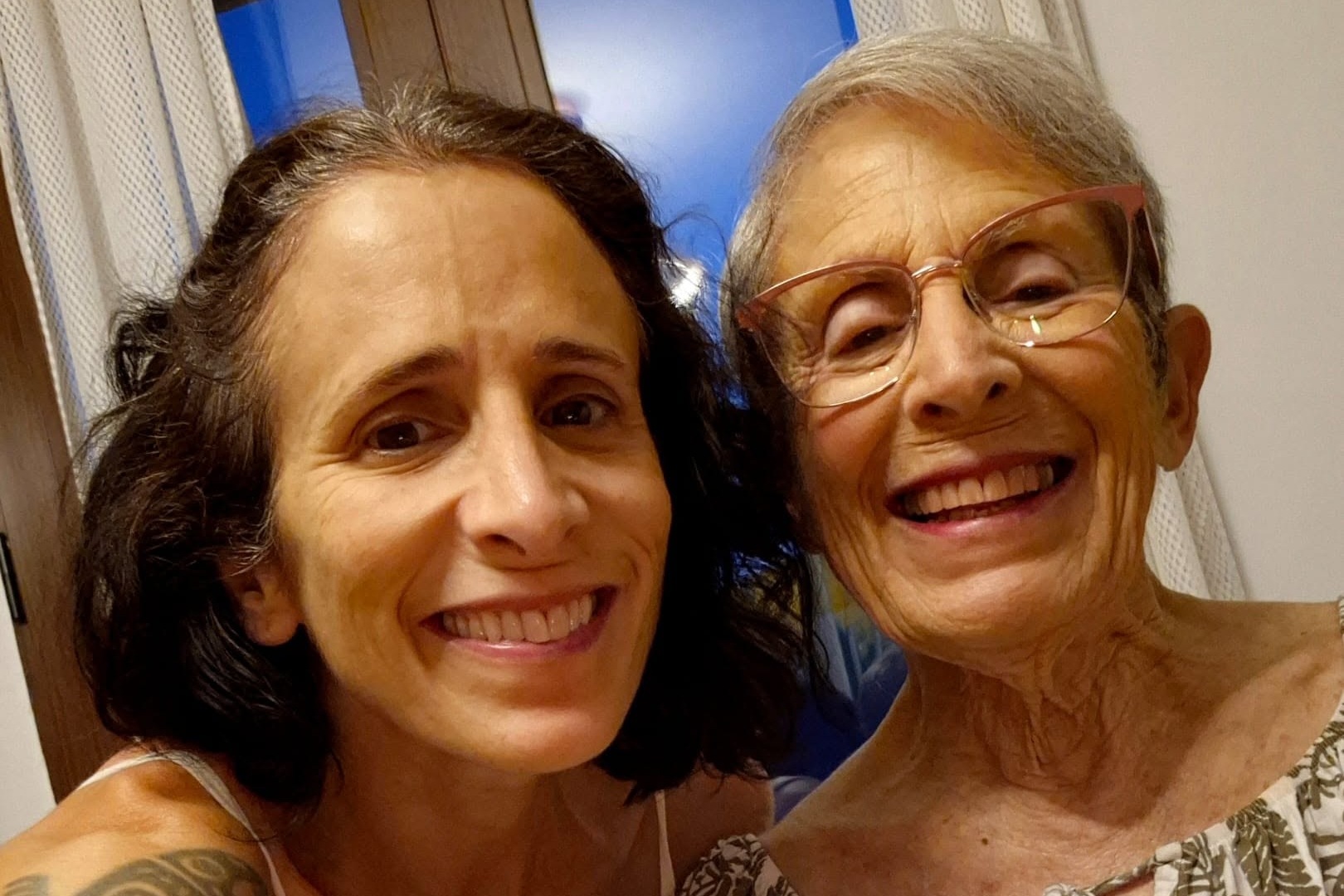
    Ms. Gillette Price (right) and her daughter, Michelle, were close. Courtesy of the family
  • A suspect was arrested in the fatal hit-and-run of a Temple University student on Kelly Drive

    A suspect was arrested in the fatal hit-and-run of a Temple University student on Kelly Drive

    A 48-year-old man suspected of being the hit-and-run driver who killed 20-year-old Temple University student Bryce Wolfe on Kelly Drive in June was arrested Thursday, the U.S. Marshals Service said.

    Derek Reid was taken into custody on the 7200 block of Briar Road in the city’s West Oak Lane section, authorities confirmed.

    The U.S. Marshals Service said Reid also was being sought by the Philadelphia Police Department’s Special Victims Unit on charges of rape and related offenses involving an underage boy in 2021.

    Wolfe, who had just completed his sophomore year at Temple University, was riding his red 2004 Triumph motorcycle on Kelly Drive the night of June 24 when he was struck by a white SUV making an illegal turn onto Reservoir Drive, near the Strawberry Mansion Bridge, Philadelphia police said.

    His body became lodged under the SUV and he was dragged for more than a mile, police said. He died at the hospital the next day.

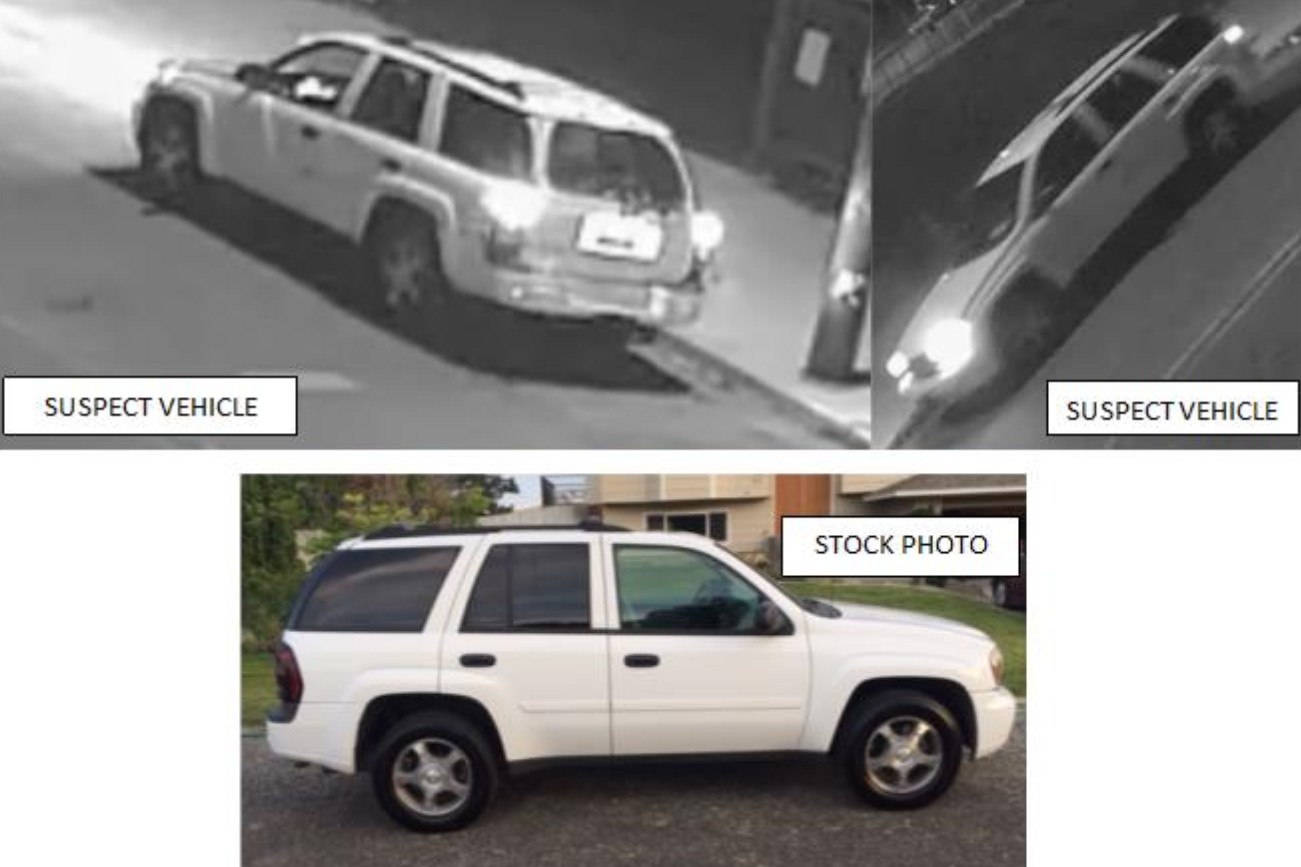
    Police later released surveillance images of the SUV suspected in Wolfe’s death. Investigators believe the SUV was a 2001-08 Chevrolet Trailblazer, possibly with damage on the driver’s side, with possible red paint transfer, a broken rear windshield, and a discolored passenger-side front wheel.

    The suspected vehicle was located earlier this month, police said.

    Police on July 7, 2026, released images of the suspected SUV, believed to be a white 2001-08 Chevrolet Trailblazer, that fatally struck 20-year-old Bryce Wolfe, a Temple University student, on June 24.Philadelphia Police Department

    Lori Wolfe, Bryce’s mother, said the Philadelphia police called earlier on Thursday to let her family know that the suspected driver was in custody.

    “We were happy they made an arrest,” she said. “I felt there would be an arrest because the accident investigation department of Philadelphia worked very hard to bring justice to Bryce.”

    She added: “Although none of this gives our son back to us, the person responsible should be charged with murder. He drug our son for a mile and left him to die in the street.”

    Philadelphia District Attorney Larry Krasner on Friday announced that Reid was charged with homicide by vehicle, accident involving death, involuntary murder, and recklessly endangering another person.

    Krasner confirmed that Reid was facing charges for a violent sexual assault against a minor, including rape, statutory sexual assault involving a victim between 8 and 11 years old, and related offenses.

    After Reid was apprehended by the U.S. Marshals Service, he allegedly admitted to being the driver of the SUV that fatally struck Bryce Wolfe, Krasner said.

    Reid was being held on $750,000 bail for the fatal hit-and-run, and $750,000 for the 2021 rape, Krasner said.

    “The devastation Defendant Derek Reid inflicted on these two families is horrific. No one deserves to have their son taken away in such a careless way. We will pursue these charges to the fullest extent of the law,” Krasner said in a statement.

    “This office also has zero tolerance for predators who brutalize the vulnerable, to include our children and young people. We are standing with these families during their journey of healing and we will do everything we can to seek and secure justice,” Krasner said.

    Bryce Wolfe, of Conyngham, a borough in Luzerne County, was an actuarial science major in the Fox School of Business and had just completed his sophomore year.

    A GoFundMe was established to help Bryce’s family.

    In an obituary written by his parents, Bryce was described as having lived his life “with a fearless spirit of adventure and a genuine love for the outdoors.”

    He “found joy in seeking new challenges and embraced every opportunity to experience the world to its fullest. Whether carving down snow-covered slopes while skiing, exploring miles of trails on his bicycle, or riding motorcycles through rugged dirt tracks and open roads, he felt most alive when he was in motion,” Lori Wolfe and Clarence Wolfe III wrote.

    Bryce had started a summer internship and acquired the Triumph to ride while he stayed in Philadelphia, his mother said in a recent interview.

    Said Lori Wolfe, “It was the first motorcycle he bought and insured all by himself.”

  • A Delco judge is weighing the fate of a firefighter accused of making racist threats

    A Delco judge is weighing the fate of a firefighter accused of making racist threats

    The fate of an assistant Delaware County fire chief accused of hurling racist threats at a woman during a tense confrontation in 2024 is now in the hands of a judge.

    John Romano, 48, was charged with ethnic intimidation, terroristic threats, and related crimes after a woman, who is Black, told police he called her the N-word, along with another racial epithet, while she was stopped in traffic because Romano’s forklift was blocking traffic on Hook Road in Darby Township in November 2024.

    Romano, of Secane, served as the assistant fire chief at the Sharon Hill Fire Company, an all-volunteer station, but was suspended by borough officials after his arrest, pending the outcome of his trial.

    During Romano’s one-day bench trial Wednesday before Judge Margaret J. Amoroso, the woman testified that a line of cars, whose drivers started honking out of frustration, had lined up behind hers. The road was blocked, she said, because Romano was using the forklift to load Christmas trees at J&P Fencing, a business he co-founded.

    After the car in front of hers squeezed through a small gap near the forklift, the woman said, Romano got out of the forklift, “rushed” to the passenger-side window of her car and demanded to know why she was honking at him.

    From the outset, she said, Romano was “on full-blast rage.”

    He called her the N-word, as well as another slur, she said, and took a picture of her license plate, telling her he would “take care” of her at her home. When she said she was calling the police, Romano told her to do so, saying he knew the county sheriff.

    “I really couldn’t believe this was happening in the year that we were in,” she said.

    Body-camera footage played in court showed Romano initially admitted to the responding Darby Township officers that he called the woman the N-word, but, minutes later, walked back the statement.

    He also told the officers that the woman is “a wild animal, and I’m tired of dealing with them,” the footage showed.

    That comment, said Assistant District Attorney Shuaiyb Newton, demonstrated Romano’s mindset and proved his guilt.

    “It’s clear beyond all doubt that a threat was made from a man to a woman that he would find her and take care of her, a man who was upset, a man who was screaming, and a man who hates her,” Newton said. “And it’s clear the hatred he had for this stranger was based on nothing more than what she looked like.”

    Romano’s attorney, Chris Boggs, disputed that. He said the confrontation was “more akin to a road-rage incident,” and was not a case of ethnic intimidation.

    Romano, upset at the car horns honking, would have said “awful things to anyone in that circumstance,” he said. Because the driver was Black, Boggs said, he used the racial epithet.

    But Boggs said Romano did not threaten violence.

    “If this was something more than transitionary anger, something that happens in the moment … he’s going to be using specific threats of violence,” the lawyer said.

    Amoroso is expected to deliver her verdict in the case on Aug. 31.

  • Montco parts supplier for SEPTA conspired to rig bids, federal prosecutors say

    Montco parts supplier for SEPTA conspired to rig bids, federal prosecutors say

    Federal prosecutors have charged a Montgomery County rail parts supplier and its owner with participating for eight years in a bid-rigging conspiracy involving SEPTA contracts.

    Hatfield-based Qual-Tran Products Co. LLC and owner Cathleen Shive colluded with competitors and others, including a former SEPTA employee, to manipulate the transit agency’s competitive bidding process, according to a charging document filed July 23 in the U.S. District Court for Eastern Pennsylvania.

    Invoices show SEPTA did $20.3 million worth of business with Qual-Tran from 2007 to 2025, authority spokesperson Andrew Busch said. The transit agency says it bought a variety of train and railway parts from the company, many of them for Regional Rail.

    A person answering the phone at Qual-Tran’s listed telephone number declined to comment. Lawyer Fortunato Perri is representing the company according to court records and declined to comment Friday.

    “SEPTA’s Office of Inspector General has been working closely with the Department of Justice on this matter and will continue to do so as the investigation moves forward,” Busch said.

    Qual-Tran distributes after-market parts to transit systems and freight railroads across the country.

    The company specializes in overhead catenary wires, which transfer power to passenger trains, as well as other equipment such as current sensors and third-rail contacts, according to its website and coverage in trade publications.

    SEPTA won’t have a complete picture of how much money was involved in the alleged scheme until the government reveals more details as the case progresses, Busch said.

    Qual-Tran was able to reverse-engineer replacement parts no longer made for older rail cars in SEPTA fleets, he said.

    The U.S. Attorney’s Office for Eastern Pennsylvania declined to comment on the case beyond court records.

    Qual-Tran and Shive, prosecutors allege, conspired with five people and two corporations, none identified by name in court records. They created the appearance of competition for SEPTA work while deciding among them which company would win some contracts, the charging document says.

    The alleged scheme ran from 2016 to 2024, according to the charges. Shive, the documents say, joined Qual-Tran in 2011 and became the president and owner of the company in 2024.

    They face antitrust charges of unlawful restraint of trade in interstate commerce.

    Prosecutors described five transactions.

    In one September 2023 instance, the government said, Shive asked a senior resource controller with SEPTA to arrange for a second corporation to deliberately submit a higher bid of $3,310 each for “30 manhole frames and lids.” Qual-Tran won the contract by quoting a lower price.

    SEPTA confirmed that the senior resource controller mentioned in the charging documents is no longer employed by the agency.

  • Neysa Adams, pioneering civic and community leader, scientist, and teacher, has died at 104

    Neysa Adams, pioneering civic and community leader, scientist, and teacher, has died at 104

    Neysa Adams, 104, of Philadelphia, 1971 chair of the local United Fund women’s committee, former president of the Rebecca Gratz Club, onetime vice president of the women’s council for the Federation of Jewish Agencies, former associate trustee at the University of Pennsylvania, scientist, high school teacher, investment adviser, and philanthropist, died Friday, June 26, of heart disease at the Hearth at Drexel.

    Born and reared in Philadelphia, Mrs. Adams graduated from Olney High School and lived over the years in East Oak Lane, Germantown, and Elkins Park. She earned a degree in biochemistry with honors at Penn, did scientific research for a time, and taught English and history for two years at Philadelphia High School for Girls.

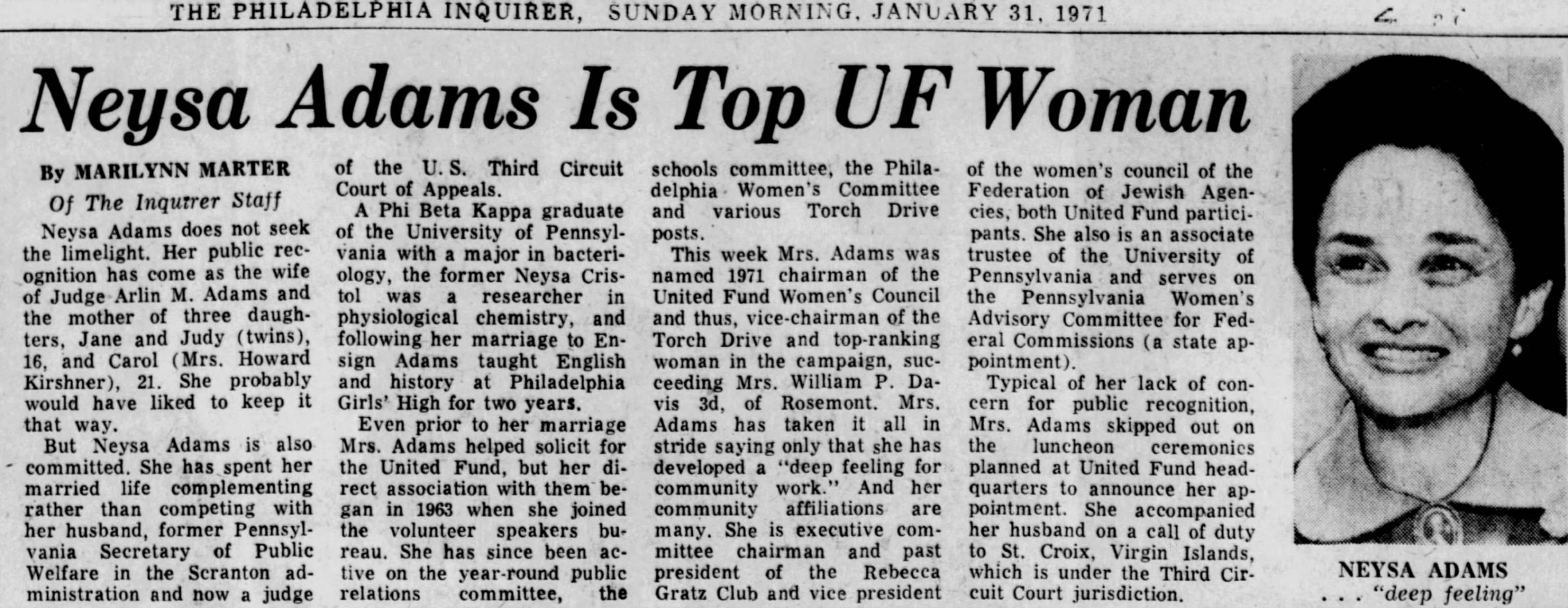
    Smart, friendly, and energetic, she joined the Philadelphia United Fund volunteer speakers bureau in 1963, became active with the fund’s public relations committee, schools committee, and women’s committee, and organized many community fundraising campaigns. In 1971, she told The Inquirer she had a “deep feeling for community work.”

    Mrs. Adams also served on the board at what is now Penn’s School of Social Policy and Practice and was active with the Emergency Aid of Pennsylvania Foundation, the National Conference on Social Welfare, and state and federal women’s advisory commissions. In 2003, then-Gov. Ed Rendell recognized her as a Distinguished Daughter of Pennsylvania for her “outstanding service and contributions to the Commonwealth of Pennsylvania.”

    As a philanthropist, Mrs. Adams and her husband, Arlin, were cochairs of Penn’s Harrison Society for fundraising recognition, and they established, among other endowments, the Arlin and Neysa Adams Lectureship and the Neysa and Arlin Adams Prize for excellence in prelaw studies at Temple University. Her husband died in 2015, and she donated his papers to the archives at Penn Carey Law School in 2017 and later funded its Arlin M. Adams Lecture in Law, Religion, and the First Amendment.

    “Everything good in my life came from him,” Mrs. Adams said in a 2024 online profile by the Hearth at Drexel.

    She also established Neysa Adams’ Library Fund at Reform Congregation Keneseth Israel in Elkins Park. Friends called Mrs. Adams “wonderful,” “outstanding,” and “one of life’s brightest lights” in tributes.

    One friend said: “Neysa was one of the kind.”

    This story about Mrs. Adams appeared in The Inquirer in 1971.Newspapers.com

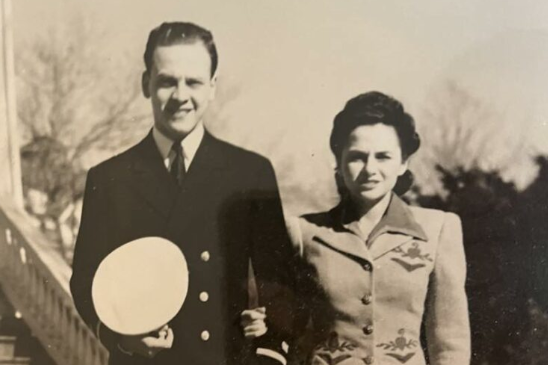
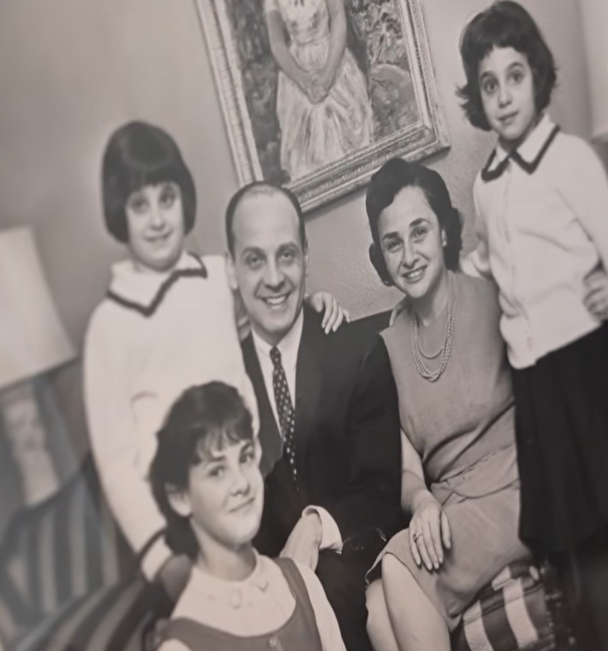
    Neysa Norma Cristol was born Aug. 7, 1921. She met Arlin Adams in high school, and they married in 1942 while he was on leave from the Navy. They had daughters Carol, Judy, and Jane. Her daughter Jane died in 2017.

    Mrs. Adams and her husband, a state secretary of public welfare and longtime federal judge, traveled the world, mostly through his work, and she met a queen, a pope, several U.S. presidents, and other international notables. “Her resilience, intellectual curiosity, and dedication to serving others stand as a testament to a life well lived,” friends at the Hearth at Drexel said in 2024.

    She was active at Keneseth Israel, enjoyed cooking, and was an avid reader. She also worked as an investment adviser.

    She was featured on 6abc TV last August on her 104th birthday and said: “Get those things that make you happy. Enjoy them while you can.”

    Mrs.Adams and husband, Arlin, married in 1942 while he was on leave from the Navy.Courtesy of the family

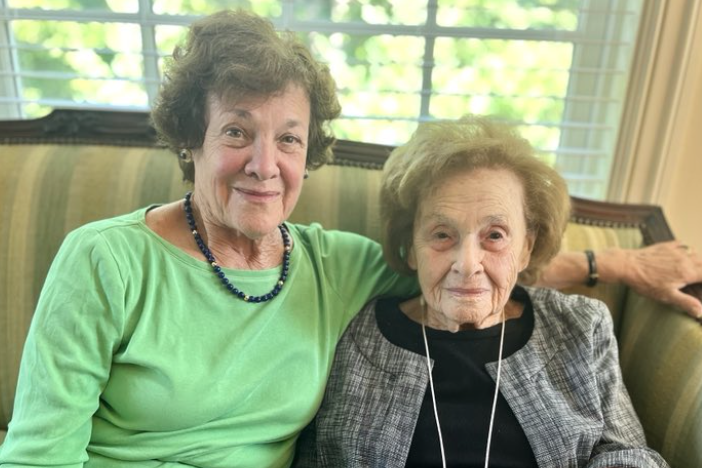
    Her daughter Carol said: “She was outgoing and had lots of friends. It seemed like she knew everyone in Philadelphia.”

    In addition to her daughters, Mrs. Adams is survived by four grandchildren, one great-grandson, and other relatives. A sister and a brother died earlier.

    A celebration of her life is to be at 11 a.m. Friday, Aug. 7, at Reform Congregation Keneseth Israel, 8339 Old York Rd., Elkins Park, Pa. 19027.

    Donations in her name may be made to the University of Pennsylvania, Box 71332, Philadelphia, Pa. 19176; and Susquehanna University, 514 University Ave., Selinsgrove, Pa. 17870.

    Mrs. Adams (second from right) doted on her husband and three daughters. Courtesy of the family
    “It seemed like she knew everyone in Philadelphia,” said Mrs. Adams’ daughter Carol (left). Courtesy of the family
  • East Whiteland officials allow work to resume on data center planned for Superfund site

    East Whiteland officials allow work to resume on data center planned for Superfund site

    Work has resumed on a 1.5 million-square-foot data center in East Whiteland after developers were told to stop early construction this month while the township reviewed its soil and health safety plans.

    Township officials issued a permit that includes “many conditions related to soil monitoring and reporting, dust control, and protection of the remedy for the Superfund site,” they said in a statement Wednesday.

    Development began again on Wednesday, said Lou Colagreco, an attorney representing the developers, Green Fig LLC and Sentinel Data Centers.

    Earlier this month, township officials told the developer to stop work “until greater clarity is provided with respect to the ongoing review” of the soil and health and safety plans. The stoppage came amid increased scrutiny from residents, who have fears about the impact of the data center being built upon the former Cyprus Foote Mineral Co., which contaminated the land with chemicals such as lithium, arsenic, and hexavalent chromium.

    On Wednesday, the township said in a statement posted online that it had issued a permit regarding erosion and sedimentation control.

    “The Township and its inspectors will also be maintaining a regular presence at the site to oversee implementation of the permit conditions,” the township’s statement said.

    The permit allows for “earth-moving activities.” The developers will still need to secure construction permits for things like pouring concrete for footings, or foundations. But they can move dirt and dig via these permits, East Whiteland Township Manager Steve Brown said.

    But there’s still an open question of the scope of the project. After months of seeking to change the proposal earlier this year — an effort that sparked renewed and resounding community opposition — the developers had said they would move ahead with previously approved plans which would be composed of two buildings roughly 772,000 square feet each and use 3 million gallons of water daily to cool it.

    The developers came back before the township this month, intending to change the design again, saying the revised proposal would use less water. It could also possibly scale down the overall footprint of the data center, from 1.5 million square feet to a total of 536,000 square feet.

    The township’s three elected officials ultimately tabled the matter at their July 8 meeting, saying they needed more information. The board’s next scheduled meeting is Aug. 19.

    “The only issue before the Supervisors is whether the data center will use air chilled coolers to conserve water or whether water chilled units will be utilized,” Colagreco said in an email. “In either event, Sentinel is proceeding with development.”

    This suburban content is produced with support from the Leslie Miller and Richard Worley Foundation and The Lenfest Institute for Journalism. Editorial content is created independently of the project donors. Gifts to support The Inquirer’s high-impact journalism can be made at inquirer.com/donate. A list of Lenfest Institute donors can be found at lenfestinstitute.org/supporters.

  • Former Sharon Hill police officer sentenced to state prison for raping, sexually assaulting three children

    Former Sharon Hill police officer sentenced to state prison for raping, sexually assaulting three children

    A former Sharon Hill Police officer was sentenced to nine-to-20 years in state prison after admitting he raped and sexually assaulted three children, one as young as 9.

    Tyler Humphreys, 24, pleaded guilty in March to rape, corruption of minors, involuntary deviant sexual intercourse, and related crimes in connection with the assaults, which took place between 2014 and 2022.

    The sentence was handed down by Chester County Court Judge Annalisa Sondergaard during a lengthy hearing Wednesday evening. As a condition of his sentence, Humphreys, of Malvern, is barred from contacting any of the victims or their families.

    His attorney, Elliot Marc Cohen, did not immediately return a request for comment Thursday.

    During the hearing, the mother of one of the victims described how Humphreys betrayed the trust afforded him as a public servant and had torn their family apart.

    Humphreys was hired as a Sharon Hill police officer in September 2023, three months before he was arrested.

    The borough fired Humphreys shortly after the charges were filed by prosecutors in Chester County. During his brief stint with the department, Humphreys worked as a school resource officer, but Sharon Hill officials have said there were no allegations that he had committed any crimes during his tenure with the department.

    Investigators said they received a report in November 2023 about the rape, which occurred the previous December at a home in Charlestown Township, according to the affidavit of probable cause for Humphreys’ arrest.

    The victim, then 15, told police Humphreys served her alcohol until she was drunk, then carried her to a bedroom and raped her as she was “in and out of consciousness, the affidavit said. Humphreys was 20 at the time.

    Another victim later told police about a second incident that also occurred in December 2022.

    The woman, then 19, told police she woke up next to Humphreys in bed, and felt sharp pain in her genitals, according to the affidavit. Earlier, she said, Humphreys had urged her to take over-the-counter medication in a dosage that far exceeded what was recommended. When she confronted him about the pain she felt, he denied any wrongdoing, the affidavit said.

    She also told investigators that Humphreys sexually assaulted her, groped her and exposed himself a number of times between 2014 and 2018, starting when she was 11 and he was 12, according to the affidavit.

    Humphreys was also charged with — and admitted to — the sexual assault of a 9-year-old boy that took place when Humphreys was 12.

  • Johnny Doc will remain in prison after a judge again denied his request to be released on house arrest

    Johnny Doc will remain in prison after a judge again denied his request to be released on house arrest

    Convicted former Philadelphia labor leader John Dougherty will remain in prison after a federal judge again denied Dougherty’s request to be released on house arrest to provide care for his gravely ill wife.

    U.S. District Judge Jeffrey L. Schmehl wrote in a memorandum filed Thursday that Dougherty and his lawyers had failed to demonstrate that he was the only person who could provide adequate care for his wife, Cecelia, who for years has suffered from a debilitating brain injury.

    In addition, Schmehl wrote, Dougherty did not sufficiently specify when a trust fund established to support his wife’s care would run out of money. Those factors, coupled with the “minimal amount of time” Dougherty has served in his six-year sentence, Schmehl wrote, “do not weigh sufficiently in favor of relief.”

    The decision was a blow to Dougherty, 66, who for months has been contending in court documents and in testimony before Schmehl that his wife’s condition has significantly worsened while he has been imprisoned, and that if he is not released to care for her, she will likely die.

    Dougherty’s attorney, George Bochetto, said in an interview Thursday that he was “deeply, gravely disappointed” by the ruling, and that he disagreed they had not shown the acute nature of the emergency that should qualify Dougherty for release.

    “I thought the evidentiary hearing we had in front of Judge Schmehl was extraordinary, and it left no doubt in anybody’s mind” about the merits of Dougherty’s petition, Bochetto said.

    The ruling followed another rejection in Dougherty’s ongoing bid for freedom. Earlier this month, President Donald Trump denied Dougherty’s request for a commutation, a legal avenue that could have cut Dougherty’s prison term short.

    Schmehl, in his memorandum, did say that Dougherty could file a renewed motion in the future, “should the facts materially change.”

    Bochetto said he would not wait that long. He was already working on his notice of appeal to the U.S. Court of Appeals for the Third Circuit, he said, and he intended to ask the court to consider the case on an emergency basis.

    “This is why God invented appellate courts,” Bochetto said.

    Dougherty was sentenced in 2024 to six years in prison after being convicted in separate bribery and embezzlement trials that centered on actions he took while serving as the head of his politically powerful union, Local 98 of the International Brotherhood of Electrical Workers.

    But last year, Dougherty — known colloquially as Johnny Doc — filed emergency motions asking Schmehl to allow him to serve the remainder of his prison term on house arrest so he could be his wife’s primary caregiver.

    In his first request, filed in the summer, Dougherty said that the trust fund established to pay for her care was about to run out of money, and that his daughters and other relatives were unable to provide the kind of around-the-clock assistance she needed.

    Then, in December, he filed another motion, saying the situation had become more dire after the death of his father-in-law, who had been serving as the primary caregiver in his absence.

    Prosecutors opposed Dougherty’s requests, saying that although they were sympathetic to his wife’s plight, they did not believe he had served enough of his sentence to merit release.

    And in January, Schmehl denied Dougherty’s request, writing that he, too, recognized the significant health challenges, but that they did “not outweigh, at this point in time, the need for punishment that has been adjudged.”

    Bochetto appealed that ruling. And in May, Schmehl held an evidentiary hearing to learn more.

    At the hearing, Dougherty took the stand for more than an hour, and occasionally choked back tears as he described his wife’s myriad complications and detailed the efforts he had made in prison to help her, including by sending her dozens of letters and using all of his allotted monthly phone minutes to call her.

    But prosecutors argued that Dougherty and his relatives had not sufficiently looked into alternative care arrangements that might be covered by Medicaid or other insurance. And they said that while many families across the country could benefit from having an incarcerated defendant released to help care for their relatives, Dougherty had not shown that he was the only person who could do so for his wife.

    Schmehl, in his order, said that Dougherty’s wife is being cared for by private nurses and her two daughters, and that “neither party suggests that her current care is inadequate.” Beyond that, the judge said, Dougherty did not sufficiently specify when her trust fund would run out of money and did not adequately explain what would happen once it did.

    The ruling will leave Dougherty, for now, to serve out the remainder of his term, which he is serving at a federal prison in Lewisburg, Pa. His projected release date is in June 2029, according to the Bureau of Prisons website.