It wouldn’t be a bad idea to maintain a certain wardrobe flexibility for the next several days.
After a retro run of summerlike heat on Wednesday, it is likely that frost will be covering some of the pumpkins and other surfaces in the region during the weekend, away from the Philly urban-heat island.
And big changes are in the winds, with a chance of severe thunderstorms Friday and gusts to 40 mph Friday into Saturday, the National Weather Service says.
On Wednesday, it was warm winds from the south that boosted temperatures toward 80 degrees. That would be normal for June; however, they didn’t come close to challenging the record for an Oct. 14 in Philly, which is 88 degrees, set in 1975.
Clouds and light showers “put a damper” on that potential, said Alex Staarmann, a meteorologist in the weather service’s Mount Holly office.
But the atmosphere is about to demonstrate its mercurial side, so typical of seasonal transition periods when the colder air masses from the north encounter the remnants of summer.
The forecast for the Philly region through the weekend
With a frontal passage, the sun is forecast to rule Thursday with highs in the upper 60s, just about normal for mid-October.
In advance of another front, Friday’s temperatures may approach 80 degrees, with showers and gusts as strong winds aloft could mix to the surface, the weather service is warning. The winds are forecast to continue through the day Saturday.
The cooldown will be significant. On Saturday, temperatures may get no higher than the mid-50s, and come early Sunday morning they may fall into the upper 30s in the city and mid-30s in the surrounding counties.
That is “likely” to generate the first frost of the season in some areas, said Staarmann — even if temperatures remain several degrees above freezing.
The difference between a ‘frost’ and a ‘freeze’
The ideal recipe for frost would be clear skies and light winds that allow the sun’s heat to escape efficiently into space, and a dash of moisture in the air.
Cold air sinks, and surfaces exposed to the sky “are radiating heat away from the Earth so that they are much cooler than the air five or six feet above it,” where the air temperatures are measured, said Staarmann.
The surfaces “can be 30 degrees while the air temperature is 35 or 36,” he added.
It is even possible to get a “light frost” with temperatures at 37 or even 38 degrees, he said.
For a freeze, the air temperature, not just the stuff below the thermometer, has to reach 32 degrees.
On average, that does not happen at Philadelphia International Airport until early November.
An extended family getaway at a popular Poconos water park took a dark turn Monday when a woman allegedly stabbed her husband and toddler to death in a guest room.
According to an affidavit of probable cause, Metallica Rose Harrison of Towanda, Bradford County, called 911 from the Great Wolf Lodge in Monroe County around 3:13 p.m. Monday, claiming she “needed help dying and couldn’t find the vein in her neck.”
When police arrived at the resort in Scotrun, Harrison was bleeding and told officers she “wanted to be with her husband and son,” the affidavit stated.
Inside, police found her husband, Charles Harrison, dead from multiple stab wounds to the chest. Her son, identified only as T.H. in the affidavit, was also dead. The boy had been stabbed once in the chest.
“Every day, I work so hard to be the best person, the best mother, the best wife,” Harrison allegedly told police. “It wasn’t supposed to end like this. I was supposed to have my happy family. That’s what I envisioned since I was a child.”
Inside the room at the lodge, police found a large “butcher” knife and a smaller one, authorities said. Police also discovered a ”container” of blood, along with several “bottles” of medication “throughout the room.”
Harrison, 27, was taken into custody and charged with two counts of homicide. According to Pennlive.com, Harrison was being hospitalized in police custody.
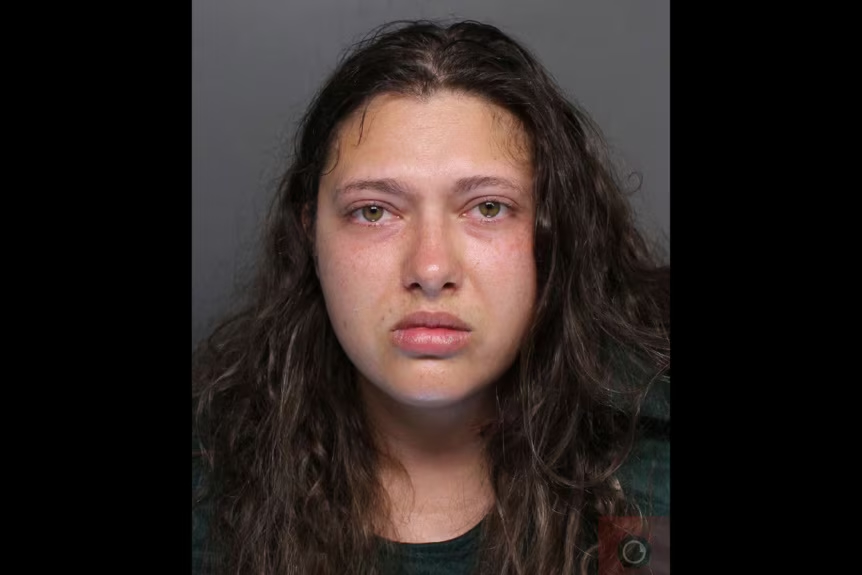
Metallica Rose allegedly killed her husband and child inside a guest room at the Great Wolf Lodge in the Poconos.Courtesy of Harrison Pocono Township Police Dept
During a news conference Tuesday, Monroe County District Attorney Michael Mancuso described the incident as a “violent domestic tragedy” and said figuring out Harrison’s motives was “one of the most perplexing questions.”
The Harrisons, according to the affidavit, checked into the Great Wolf Lodge on Sept. 21 and extended their reservation to Oct. 13. Surveillance footage from the resort shows the entire family entering their room just before 7 p.m. Sunday. The surveillance also shows Metallica and Charles Harrison leaving the room, together, just before 11 p.m. that night — without their son — and going to the arcade, before returning about 40 minutes later.
According to the New York Post, the Harrisons shared plenty of happy times on social media, including visits to indoor water parks.
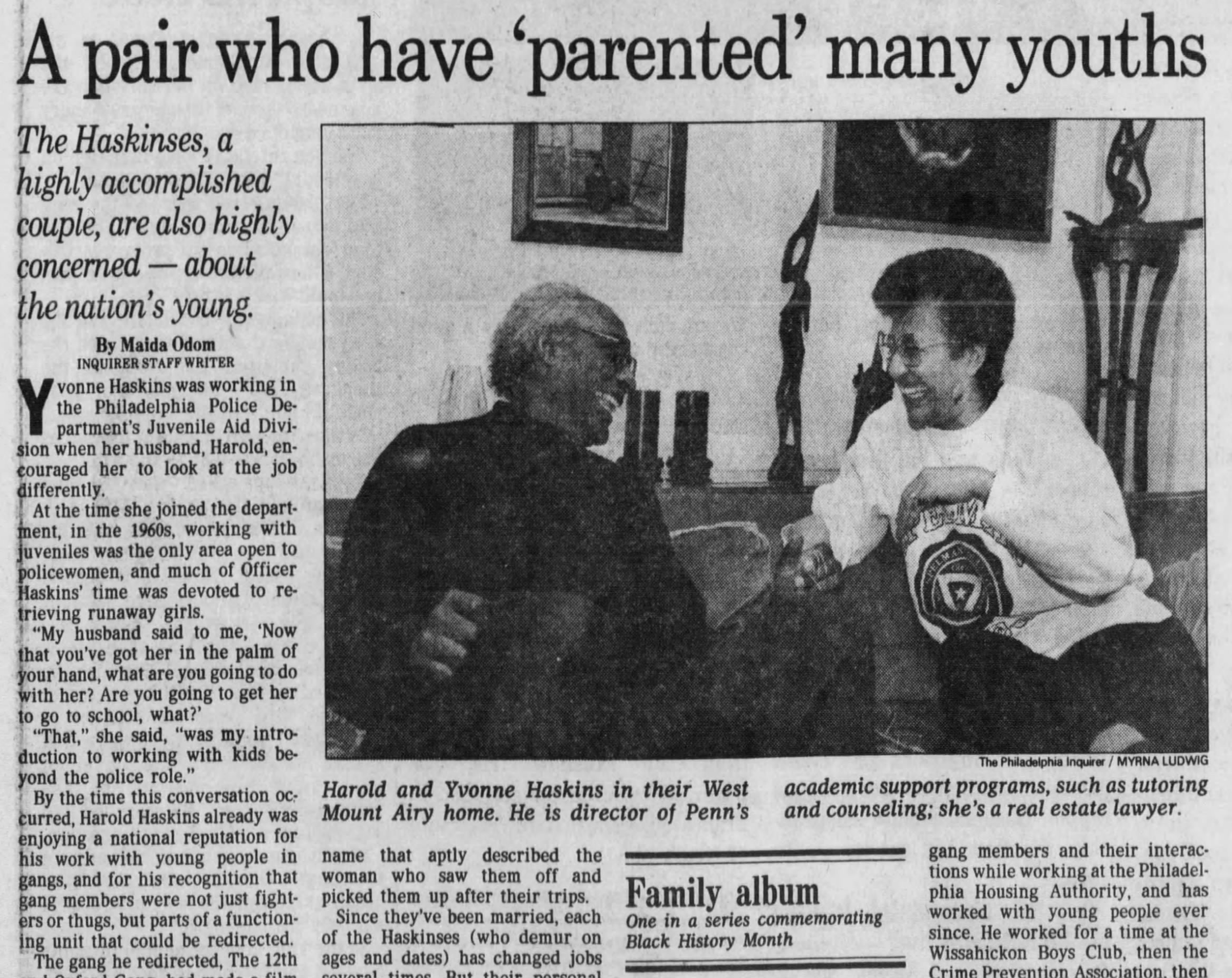
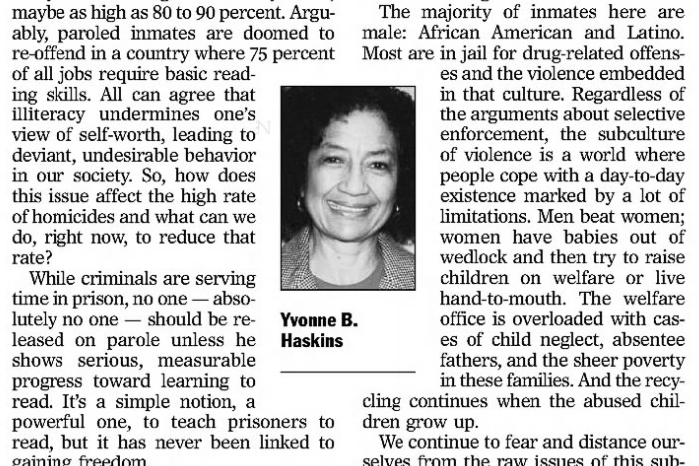
Yvonne B. Haskins, 88, of Philadelphia, longtime real estate attorney, the first female regional director for what is now the Pennsylvania Commission on Crime and Delinquency, the first female district director of the Pennsylvania Board of Probation and Parole, the first female head of security at the University of Pennsylvania, and one of the first female Philadelphia police officers, died Tuesday, Sept. 29, of metastatic breast cancer at her home in Germantown.
Mrs. Haskins was also the interim city attorney for Camden, a former manager of the old police community relations department of the Philadelphia Commission on Human Relations, and a tireless local community development and historic preservation activist.
Born in Atlanta and reared in several small Georgia towns, Mrs. Haskins came to Philadelphia with her two sons in 1962. She worked briefly as a secretary and, on impulse, tested to be a Philadelphia police officer. To her surprise, she said later, she passed the examand joined the police department in 1965.
That job, she told department colleagues years later, kicked off her climb to nearly a dozen local leadership roles in law enforcement, government, education, and community development. She was especially focused on serving young people at every stop.
“Young people need what we all need,” she told The Inquirer in 1992. “We all have to have hope, and we all have to have self-esteem.”
Mrs. Haskins enjoyed tending neighborhood parks and working outside with others. Courtesy of the family
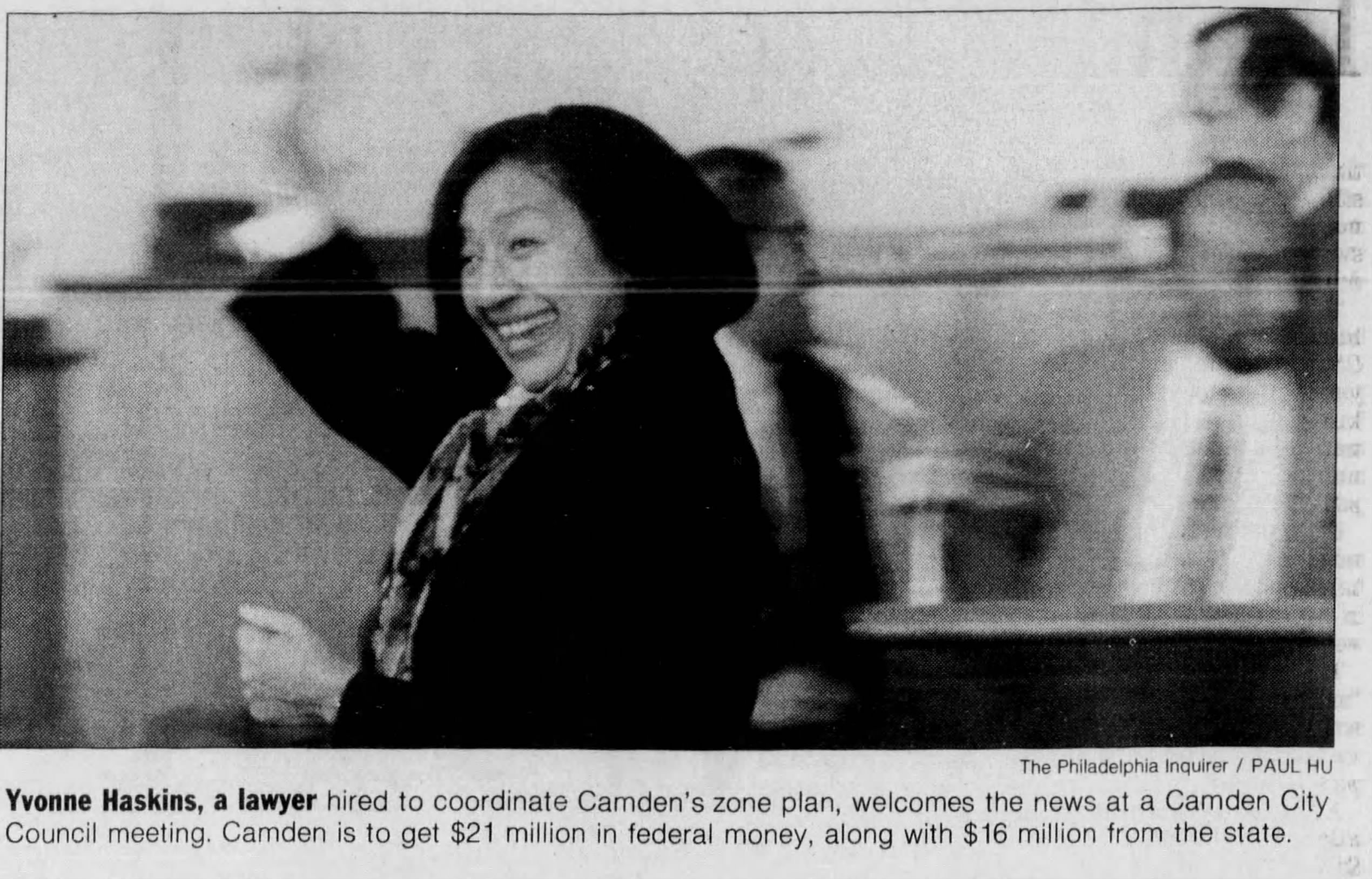
Mrs. Haskins earned a law degree at Temple University night school in 1986, specialized in real estate law and community revitalization, and opened Haskins Law Firm with offices in Philadelphia and Camden. She became an outspoken expert on zoning, financial, and political issues, and was appointed by then-Camden Mayor Arnold Webster to serve as interim city attorney for 90 days in 1996.
She had already spent much of 1994 writing most of Camden’s proposal for a multimillion-dollar community zoning federal grant. A fellow Camden community activist told The Inquirer in 1994: “She knows how to lay out a plan, get back to you, follow the rules, and play the game the way it’s supposed to be played.”
While working for the police from 1965 to ’69, Mrs. Haskins earned a bachelor’s degree with honors and awards in social welfare at Temple in 1968. She was assigned to juvenile aid, human relations, and criminal justice planning for the police, and, as a liaison to the Philadelphia Commission on Human Relations, helped organize the city’s first police-community workshops.
“I’m assigned to a police and community program,” she told The Inquirer in 1968. “The community to understand the police, the police to understand the community. Understanding. That’s really the whole thing, isn’t it?”
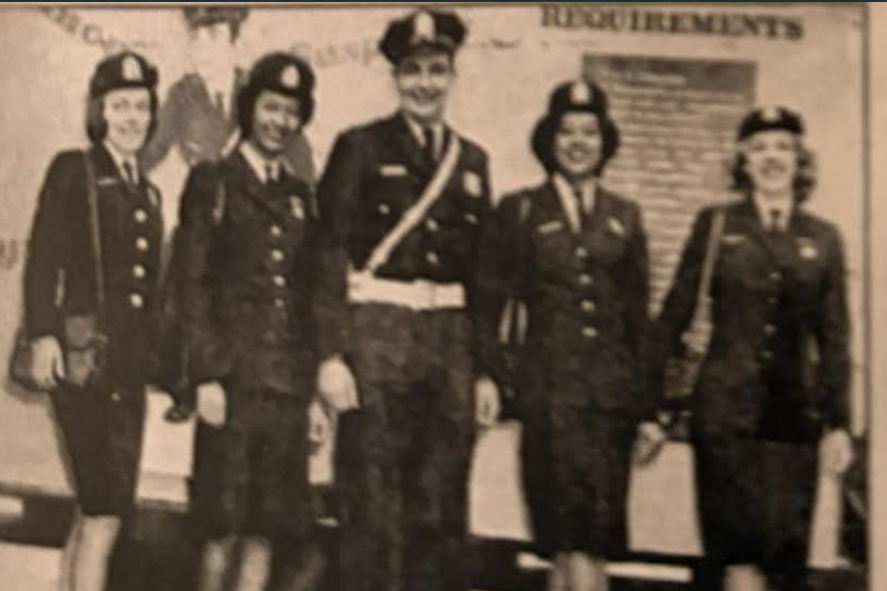
Mrs. Haskins (second from left) appeared in a Philadelphia Police Department recruiting promotion in 1968.Philadelphia Police Department
She joined the human relations commission full-time in 1969 and left for the Pennsylvania Commission on Crime and Delinquency in 1973. There, she oversaw a project budget of $100 million, funded the nascent local chapter of Women Organized Against Rape, and established a juvenile law project.
As Philadelphia’s district director for the Pennsylvania Board of Probation and Parole from 1977 to ’87, she directed a $4 million budget and a staff of 175. She was also a community program planner for the Philadelphia School District, the first female head of security at Penn in 1973, and a senior business development officer for the Fannie Mae mortgage organization.
“Our house was a hub of community activity,” said her daughter, Kristin Haskins Simms. Neighborhood colleagues recently renamed Trolley Car Park on Germantown Avenue after her and placed a plaque with her nickname, “Good Trouble,” on a nearby bench.
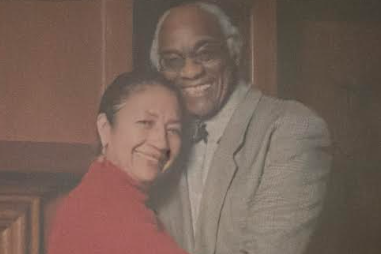
Mrs. Haskins met her husband, Harold, through a mutual friend, and they married in 1969. Courtesy of the family
She graduated as valedictorian of her high school at 15 and took premed classes and made the dean’s list for two years at Spelman College in Atlanta. She left Spelman after her sophomore year and married Walter Booker, and they had sons Russell and Randall.
Mrs. Haskins was featured in The Inquirer in 1992 (above) and 1994 (below).Newspapers.com
They moved to Washington and, after a divorce, she moved to Philadelphia, where her parents lived.
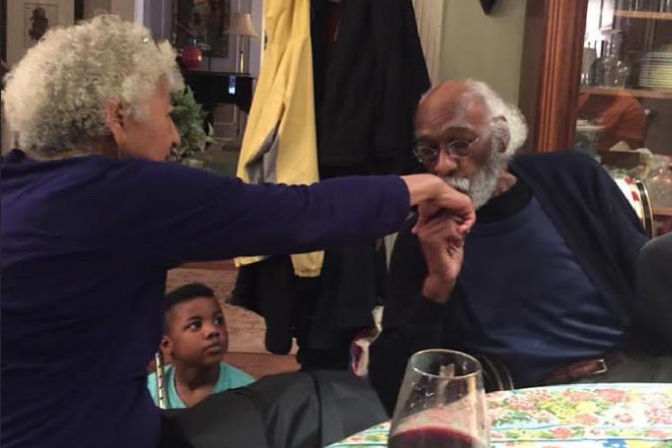
She met Harold Haskins, also a social activist, through a mutual friend, and they married in 1969. They had a daughter, Kristin, and lived in West Mount Airy. Her husband died in 2020, and she moved to Germantown.
Family and friends called Mrs. Haskins “Peachy” because of her Georgia roots. She played piano and enjoyed gardening and impressionist art.
She lived for years with myeloma cancer and walked in many cancer research fundraisers. She never really retired and wrote about her 2024 breast cancer diagnosis on Facebook. “As much as I want to stay engaged and busy, I may not be able to do much,” she said. “Your understanding and keeping me in the loop of things will be much appreciated.”
Mrs. Haskins graduated as valedictorian of her high school at 15.Courtesy of the family
Her daughter said: “She didn’t believe in retirement. She wanted to do the work, stay engaged, fight for justice.”
In addition to her daughter, Mrs. Haskins is survived by a grandson, a great-grandson, a brother, and other relatives. Her former husband and sons died earlier.
Services are to be at 11 a.m. Saturday, Nov. 7, at First United Methodist Church of Germantown, 6001 Germantown Ave., Philadelphia, Pa. 19144.
“Our teams are taking steps to assess and mitigate the issue,” executives said Tuesday in a statement. “This resulted in us taking precautionary measures, including taking some systems offline to help protect them.”
“We recognize that these actions have caused disruption for customers, associates and partners, but protecting our infrastructure in the best interest of our customers, associates and partners is a top priority.”
The Amsterdam-based parent company first reported the incident Monday in a brief statement. On Tuesday, the company posted a lengthier update, in which it said it was “in the process of starting a controlled relaunch of certain systems.”
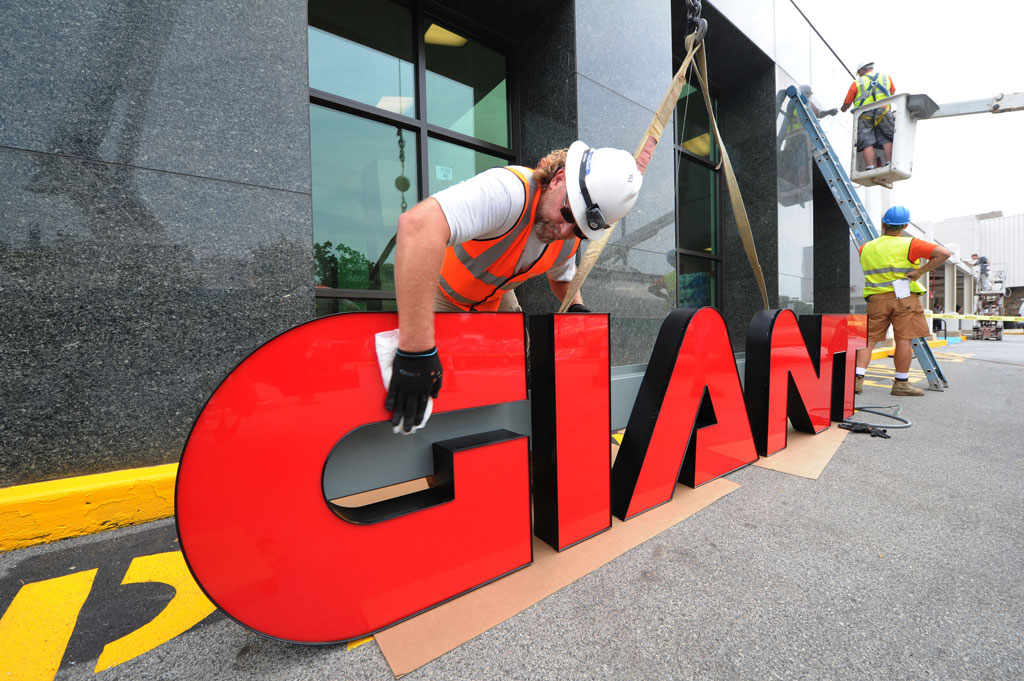
Giant’s website remained down midday Wednesday.
Ahold Delhaize also owns Food Lion, which has stores in central Pennsylvania and Delaware; Stop & Shop, which has outposts in North Jersey; Giant Food, a separate company with locations in Maryland and Delaware; and Hannaford, which operates in New York and New England. Those grocers’ websites and apps were also offline as of midday Wednesday.
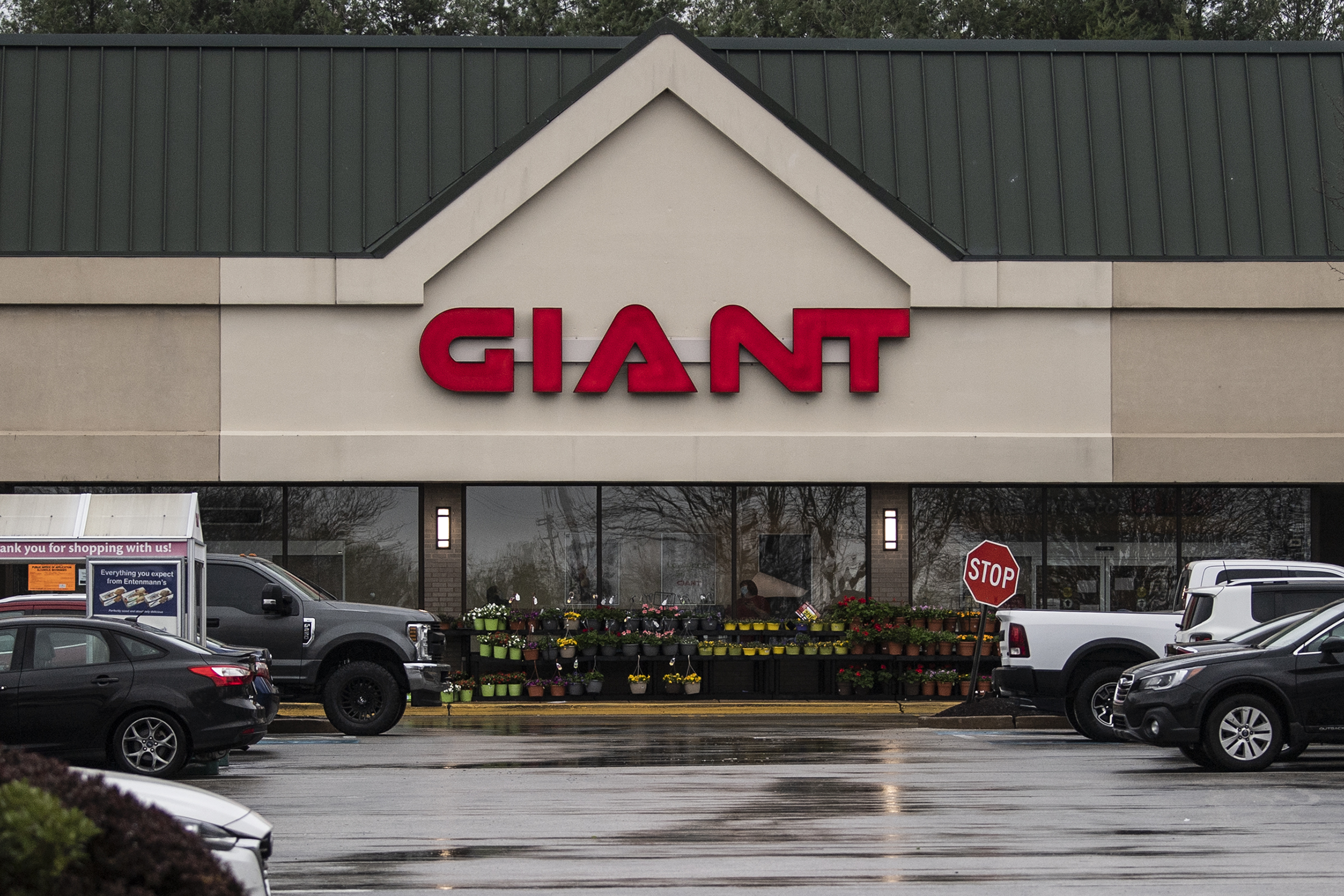
The Giant company began as a butcher shop in Carlisle, Cumberland County, more than 100 years ago. The business has grown to include grocery stores, pharmacies, and gas stations, with 168 locations across Pennsylvania, more than 70 of which are in the Philadelphia region.
Giant for years focused on locations in the Philly suburbs, such as this St. David’s store that was preparing to open in a former Genuardi’s in 2012. It has since opened 10 stores in the city.
Here are answers to some other questions you may have:
Was my personal information compromised in Giant’s cyberattack?
As of Tuesday, Ahold Delhaize said it does not believe so.
“Although our investigation is still ongoing, we have no evidence at this moment that customer, associate and partner data was taken in this cybersecurity incident,” the parent company said.
What happened exactly?
Ahold Delhaize declined to share details of the incident so as not to “compromise security measures or interfere with our response efforts.” Executives said they were working with internal teams and external cybersecurity experts, as well as authorities and other stakeholders “as necessary.”
Can I still shop in-person at Giant?
Yes. Giant stores, pharmacies, and gas stations remain open and are operating under normal business hours.
When will the Giant website and app be back online?
It is unclear. “Our teams are working with urgency to investigate the incident and restore affected systems safely,” Ahold Delhaize said.
What will happen to the Giant grocery order I placed before the site shutdown?
You may not get your food, but you should get your money back. Giant executives say any unfulfilled orders placed through Giantfoodstores.com or the GIANT app will be refunded.
Is there any way I can still get Giant groceries delivered?
Yes. The company says delivery orders can still be placed through Instacart, DoorDash, and Uber Eats.
What about my Giant digital coupons?
Shoppers can ask Giant employees about digital coupons at checkout or the customer-service counter, spokesperson Ashley Flower said.
If the app is still down on Friday, she said Giant plans to automatically activate every digital coupon on customers’ loyalty cards.
Prices are rising on everything, everywhere these days.
SEPTA, however, has cut the parking fee at its garages in half.
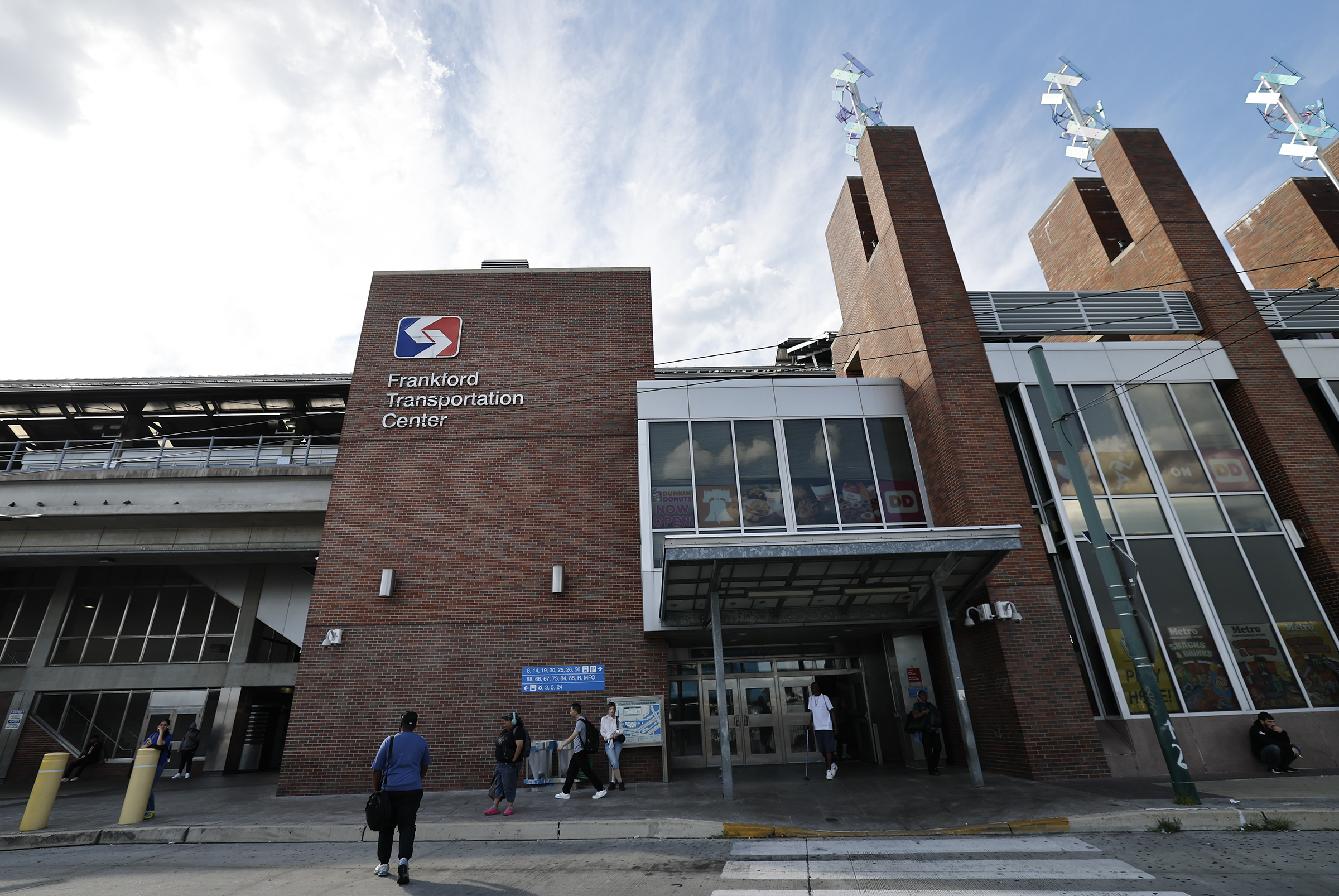
Until Dec. 31, it will cost only $2 a day to use the Frankford, Lansdale, and Norristown garages, instead of $4.
Fewer commuters are parking in the garages, which are about 5% to 10% full on weekdays, SEPTA spokesperson Andrew Busch said. The transit agency hopes the price break will entice riders.
“We want to see if there’s a demand we’re not serving,” Busch said. “Maybe we just landed on the wrong price point.”
In early 2020, SEPTA stopped charging for parking at Regional Rail stations and transportation centers as people adjusted to pandemic shutdowns and changed commuting patterns.
The transit agency began phasing in paid parking again in 2024 and doubled daily fees — to $2 to park in Regional Rail surface lots and $4 for garages.
SEPTA was tightening its belt during a period of fiscal crisis and looking for ways to generate new income. Officials believed that the price was still relatively low and would help the bottom line.
In fiscal 2019, the agency raised $3.5 million from parking fees, Busch said. For the 2026 fiscal year that ended June 30, SEPTA parking lots and garages took in $5.3 million, he said. That was the first full year after all parking was paid.
Most of Regional Rail’s parking capacity is in surface lots, which are often full or nearly so.
SEPTA says it has noticed more people using street parking around the 989-space Frankford garage instead.
“We’ve heard from some people that they feel unsafe, particularly at the Frankford Transportation Center,” Busch said. SEPTA has added lighting and 30 blind-spot mirrors in the garage, he said.
In June, Lansdale police increased patrols around SEPTA’s parking garage after reports of fighting and underage drinking among teens and young adults using it as a gathering spot.
It is not clear whether customer concerns about the situation contributed to a drop in parking there.
A Haverford College professor accused of cyberstalking and making antisemitic threats to a colleague will be held in custody until his trial, a federal judge ruled Tuesday.
Guangtian Ha, an assistant professor of religion, was arrested last week following an FBI investigation. Prosecutors saidhe used several anonymous accounts on X to send hateful, antisemitic messages to his colleague off and on from October 2025 until May. Prosecutors allege Ha’s posts also exposed his colleague’s home address, infant child’s name, and pictures of the home’s exterior.
Assistant U.S. Attorney Anthony Carissimi said Tuesday that Ha had demonstrated a “persistent obsession” with terrorizing the victims, and that his online activity could not be effectively monitored if he were released before trial.
The spouse and children of the colleague, who has not been named publicly, fled their home, which is in the same neighborhood as Ha’s. Ha sent more than 50 messages across the various accounts, at times threatening the colleague specifically and at other times threatening Jewish people more broadly, invoking Adolf Hitler, the Holocaust, and the Oct. 7 attacks, according to court documents.
Ha pleaded not guilty to the charges Tuesday.
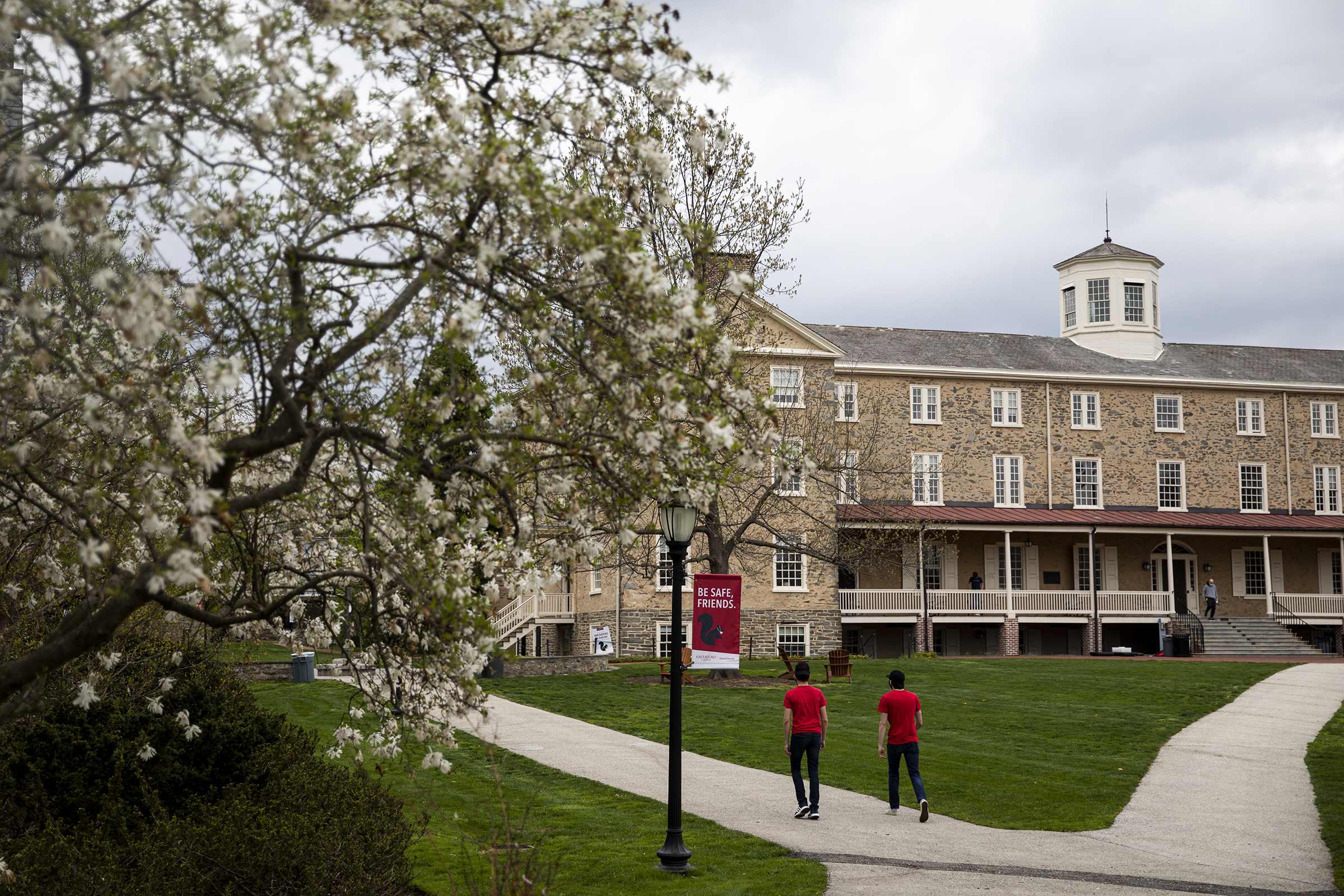
Haverford College campus in 2021.TYGER WILLIAMS / Staff Photographer
Despite the allegations, roughly a dozen Haverford professors across departments, friends, and Ha’s family came to show their support for Ha at the hearing. They said the hateful messages did not represent the man they knew. Ha has no prior criminal record, his attorney Susan Lin said, and has a wife and young child. He came to the United States in 2007.
“Nobody here is going to defend the content of these posts,” Lin said in court, before identifying Ha’s supporters and inviting two to testify to Ha’s character, arguing he should not be in custody while awaiting trial.
“I’ve always known [Ha] as someone who is very justice-oriented” and who cared for students and marginalized people, testified Ahmet Tekelioglu, the executive director of CAIR-Philadelphia, a civil rights advocacy group focused on Islamic civil liberties and fighting hate speech.
“He’s a great human being. I’ve learned a lot from him,” David Harrington Watt, a professor of Quaker studies at Haverford, told the court. Watt, a Christian, teaches courses on antisemitism. He said it was “painful” to read details about the messages Ha allegedly sent, calling them “tragic” and “inexplicable.”
“Everyone that I know is shocked that this came out. … It does feel extremely out of character,” Lillie Olliver, 24, a 2025 Bryn Mawr College graduate, said before the hearing. Olliver wrote a thesis in Haverford’s religion department but didn’t take any of Ha’s courses.
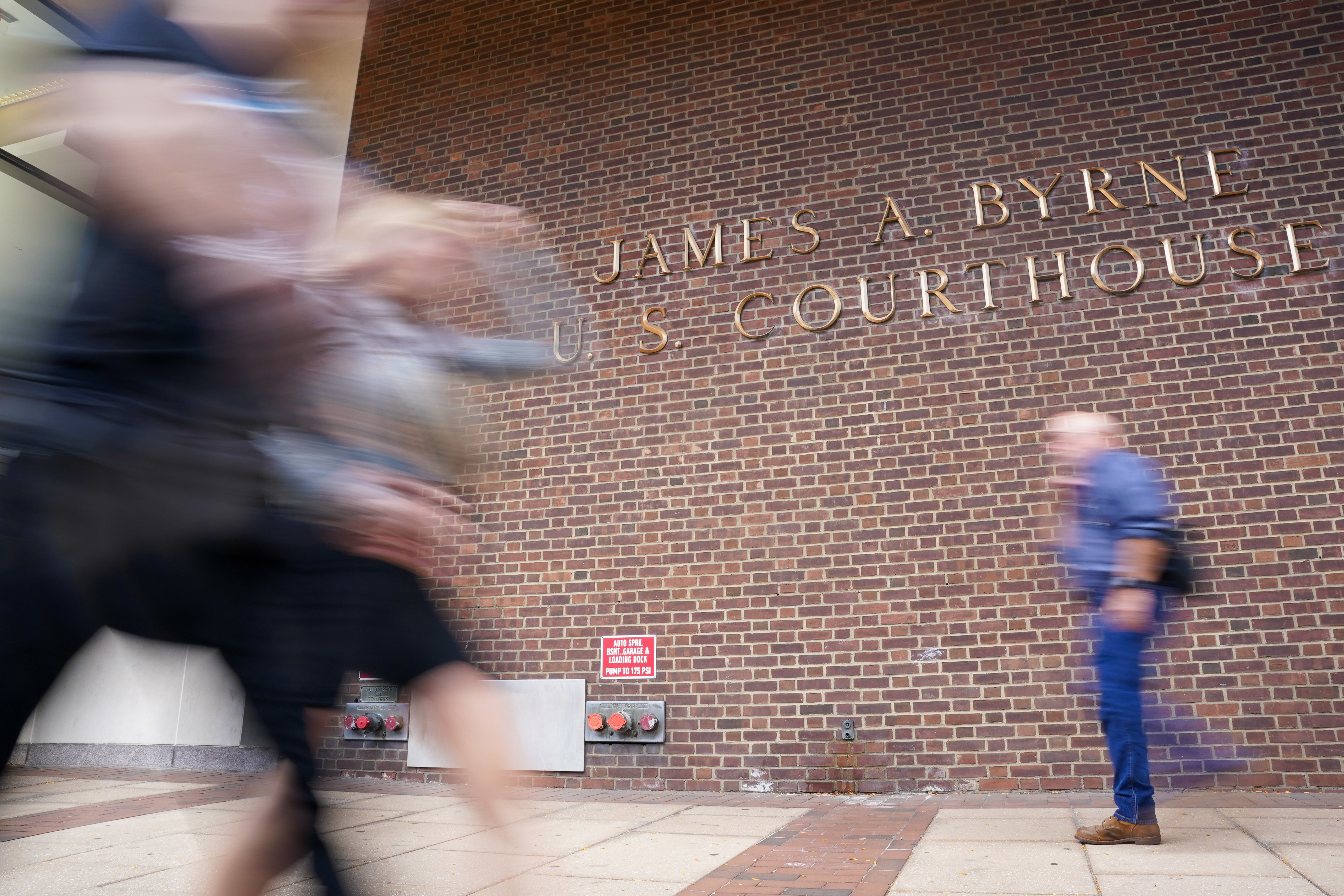
Magistrate Judge Pamela A. Carlos explained her decision to detain Ha was based on her “very serious concern” that the X posts had threatened not only Ha’s colleague and family, but also Jewish people generally. She also expressed worry about Ha being a flight risk, given that he holds a Chinese passport and has traveled abroad.
It is unclear when Ha’s next court date will be. If convicted, the maximum sentence would be five years in prison.
Correction: Lillie Olliver’s relationship with Guangtian Ha was mischaracterized. She wrote a thesis in his department but did not take any of his classes.
As operating costs rise, 10 municipalities are weighing an agreement in which they would jointly fund a new fire company that would serve roughly 100 square miles in southern Chester County.
It could be one of the largest agreements in the region if all 10 — Avondale, Franklin, London Britain, Londonderry, London Grove, New London, New Garden, Penn, West Grove, and West Marlborough — come together to fund the Southern Chester County Fire Rescue, a merger between Avondale and West Grove fire companies, which are set to join forces come Jan. 1.
Spreading the costs would mean more resources for the company and the municipalities that fund it, according to officials.
County officials warned of possible measles exposures at three area pharmacies on Oct. 4, one in Kennett Square and two in West Grove. The current measles outbreak, centered in Lancaster County and spilling into Chester County, resulted in Oxford Area High closing on Friday after a case was confirmed in the community. Classes resumed Monday after district officials said they worked to ensure a “safe return.” As cases continue to climb, The Inquirer has put together a guide about measles. You can also see area school vaccination data here.
There are several No Kings events planned for this Saturday as part of the nationwide movement. Local events will take place at the Chester County Government Services Center in West Chester, the Henrietta Hankin Branch Library in Chester Springs, the Kennett Library in Kennett Square, and at Oxford Memorial Park.
SEPTA’s new Regional Rail schedule goes into effect Sunday. The only change to the Paoli/Thorndale line is the 5300 train, which currently departs at 4:29 a.m. It will operate as the 9500 train and depart about 20 minutes later.
Several municipalities will be contemplating data center ordinances tonight. Honey Brook Township will weigh a zoning ordinance amendment at its meeting at 7 p.m. East Marlborough Township’s board of supervisors could consider adopting an ordinance at tonight’s meeting regarding where future data centers could be allowed. And West Whiteland Township is also slated to discuss a data center zoning ordinance amendment at its meeting at 6:30 p.m.
As communities take action regarding data centers, one proposal in North Coventry Township has been scrapped prior to even coming before the zoning hearing board. PGOB Coventry Holdings, LLC and PennMark Management Company, Inc. last week withdrew their application to redevelop a portion of the Coventry Mall into a nearly 86,000-square-foot data center.
West Brandywine Township will continue the conditional use hearing for Imaging Associates, LLC’s and Toll Mid-Atlantic LP Company, Inc.’s proposal to build an age-restricted community with 163 single-family homes and 74 twins on a roughly 119-acre at 500 Hibernia Rd. in Coatesville. The Monday meeting has been moved to North Brandywine Middle School’s auditorium.
After a six year effort, Hoffman’s Mill dam has been removed from the section of the Brandywine Creek straddling Chester and Delaware Counties in Chadds Ford. The removal of the dam, which dated back to the late 1800s, is aimed at reducing flooding in the area, restoring the habitat, and improving safety.
The West Chester outpost of iThrive Coworking will mark its opening at 10 N. High St. in West Chester with a ribbon cutting tomorrow from 4 to 6 p.m.
🏫 Schools briefing
There are a couple of homecoming events this weekend: Downingtown East’s dance is Saturday and Tredyffrin/Easttown’s festivities take place Friday and Saturday.
Downingtown Area School District is hosting community open houses on Oct. 20 from 6 to 8 p.m. to show off updates at Beaver Creek and West Bradford Elementary Schools.
West Goshen Township’s supervisors are slated to consider a proposed renovation and expansion to West Chester Area School District’s Peirce Middle School at its meeting Monday.
🍽️ On our plate
Wawa is testing out sushi in select locations.Beatrice Forman
Top Dog Cocktails has opened Green Room at the Flash, a collaboration with its Kennett Square neighbor and music venue Kennett Flash. The new space serves the brand’s drinks and has a vinyl listening lounge.
Spring City Hotel Restaurant will open its doors on Sunday, with a grand opening slated for 3 p.m. Located at 88 N. Main St., the restaurant will be open Thursdays through Mondays.
Fast-casual concept Goodness Bowls is hosting a grand opening for its Paoli location on Saturday from 9 a.m. to noon. The celebration for the 5 Paoli Plaza location includes a free “Avalon Bowl” for the first 50 customers who sign up for the rewards program.
🎳 Things to do
🌃 Third Thursdays in KSQ: Tomorrow is the last event for the season, when pedestrians and shoppers take over State Street. ⏰ Thursday, Oct. 15, 5:30-9 p.m. 💵 Pay as you go 📍 State Street, Kennett Square
🏡 Fall Festival of Homes: This self-guided tour will give you a glimpse inside six homes and their gardens, all benefiting Bryn Mawr Hospital. ⏰ Friday, Oct. 16, 10 a.m.-4 p.m. 💵 $85 📍 Villanova to West Chester
⭐ Astronomy Night: Learn the basics of astronomy at this guided event. ⏰ Saturday, Oct. 17, 7-10 p.m. 💵 Free 📍 Warwick County Park, Pottstown
🍀 Clover Market: Browse a selection of vendors, listen to live music, and grab a bite to eat at a food truck during the fall edition of the roving market. ⏰ Sunday, Oct. 18, 10 a.m.-4 p.m. 💵 Pay as you go 📍 600 S. Broad St., Kennett Square
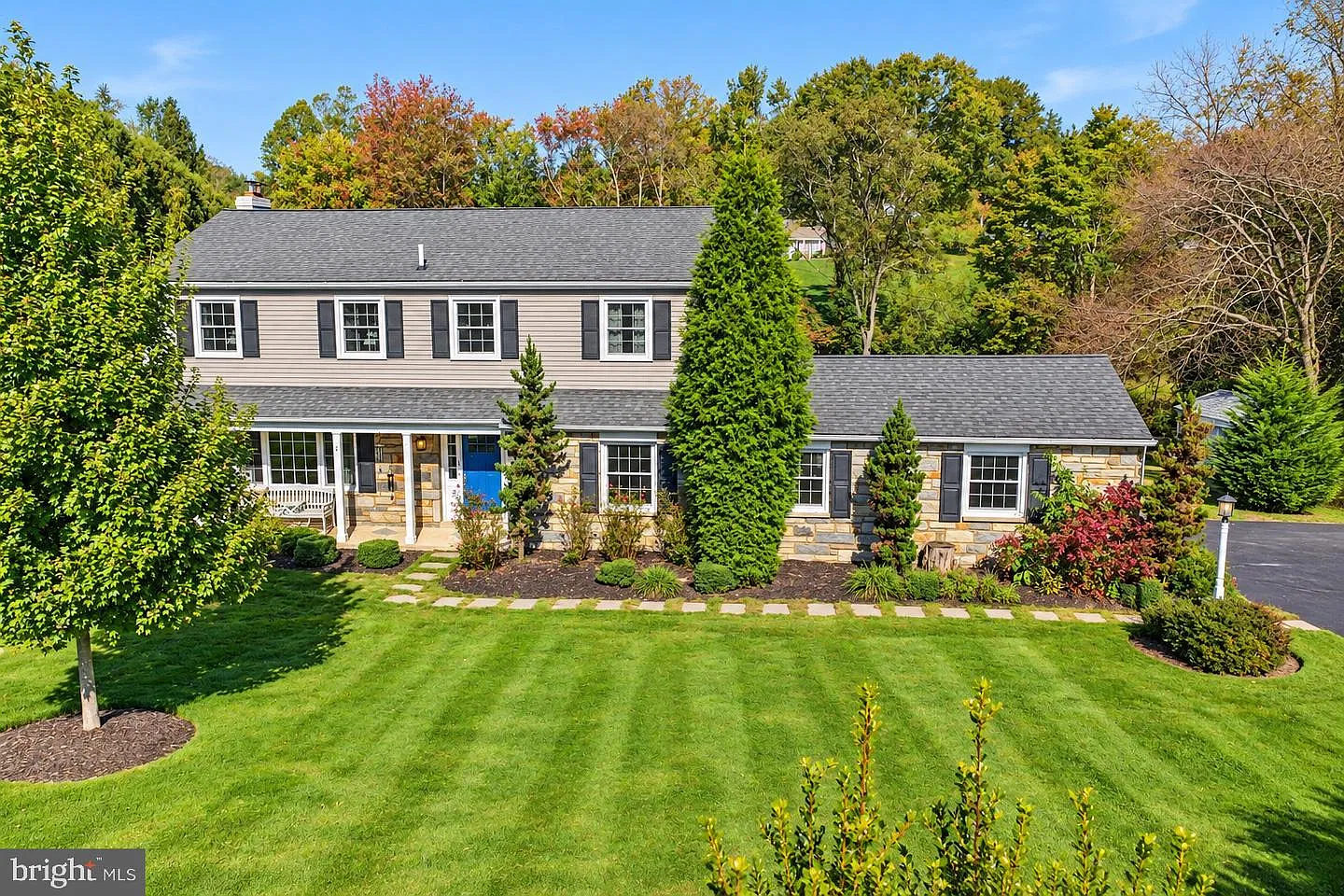
Situated on an acre lot adjacent to Crebilly Farm, this four-bedroom Colonial has plenty of privacy. The home has undergone a number of updates, including to major household systems as well as to its living spaces. The renovated kitchen has granite countertops and an island. The primary suite’s bathroom has also been updated and features a double vanity and a walk-in shower. Outside, there’s a covered front porch, a deck, and a patio with a firepit that opens onto a fenced yard.
By submitting your written, visual, and/or audio contributions, you agree to The Inquirer’s Terms of Use, including the grant of rights in Section 10.
This suburban content is produced with support from the Leslie Miller and Richard Worley Foundation and The Lenfest Institute for Journalism. Editorial content is created independently of the project donors. Gifts to support The Inquirer’s high-impact journalism can be made at inquirer.com/donate. A list of Lenfest Institute donors can be found at lenfestinstitute.org/supporters.
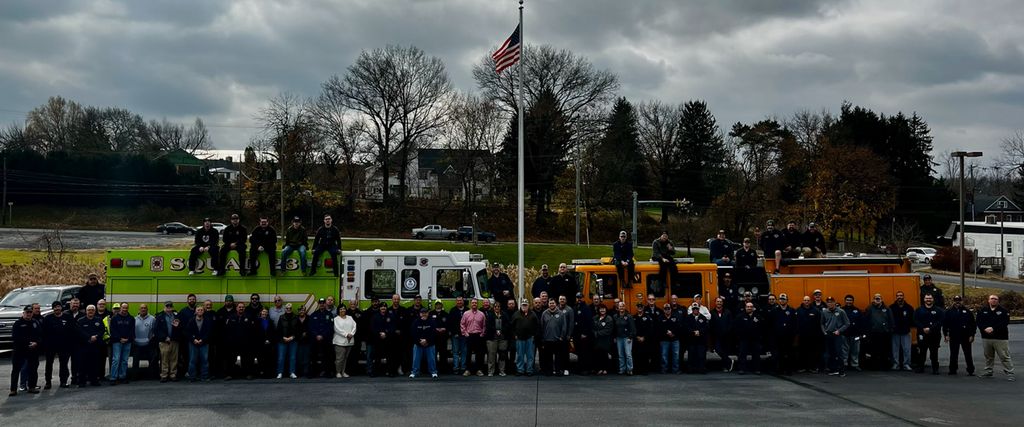
As two southern Chester County fire companies approach consolidation, a group of municipalities spanning roughly 100 square miles are poised to jointly fund them, in what could be one of the largest agreements in the region.
The Avondale and West Grove fire companies are expected to become one service, the joint Southern Chester County Fire Rescue, beginning Jan. 1. Alongside this new era for the firefighters could be an inaugural agreement among 10 municipalities to fund the fire company, which is a third-party nonprofit that functions like a contractor.
The goal is a fair system, where all municipalities kick in — as determined by a funding formula — rather than a few shouldering most of the cost while all benefit from the coverage. However, the road ahead is still rocky, as the municipalities try to craft an agreement to coincide with the consolidation.
“Each municipality funds the fire company and the ambulances in different levels,” said Ken Battin, township manager for London Grove. “And one of the big things with the 10 municipalities that are going to be served by the new organization is making sure that everybody has a fair and equitable stake in the game.”
A consolidated fire company, and an initial intermunicipal agreement, will mean more resources and stabilized budgets for both the company and the municipalities that fund it,fire and local officials from several communities said.
“I think it is necessary. I really do. I think it’s necessary just to better provide the community with the service,” said Guy Swift, president of the Avondale Fire Company, who will serve as vice president in the new organization. “It’s going to happen more and more, I think, across the commonwealth and other places.”
An increasing number of consolidated companies
The two fire companies began looking at a merger in 2024. They were facing similar issues: a declining number of volunteers, fishing from the same pond for career firefighters, and high costs to operate.
Many town leaders have begun to consider and implement these agreements as public safety costs continue to rise — for many, taking up roughly half of each year’s budget — but revenues fail to keep pace.
With those challenges in mind, Swift and Neil Vaughn, the president of West Grove’s fire company, who will serve at the helm of the conjoined effort, started talking about bringing their organizations together. They hired a consultant and, last November, asked their members to vote on a joinder.
It passed, with more than 70% of each company’s members green-lighting the consolidation, they said.
In January, pending final approvals and regardless of what the municipalities iron out for a funding mechanism, the two will become one organization, for a total of 30 full-time and 98 part-time firefighters; with four existing fire stations, in Avondale, West Grove, New London, and London Britain Township; and about 30 pieces of equipment between them. There was already some overlap; some career firefighters for one company also volunteer for the other, and vice versa. Those firefighters have a choice ahead of them, between volunteer or career status, but otherwise, the plan is to retain all the positions across companies, the leaders said.
Vaughn and Swift believe they will have the largest territory — 100 square miles, 10 municipalities, around 45,000 residents — to cover in the county.
“There’s a lot of eyes upon us as far as even from the state level, federal level,” Swift said. “There’s a lot of people, they’re seeing how this plays out. … We want it to be as positive as it could be.”
Still, for residents, from the outside, “Come Jan. 1, it’s going to look almost the same way that we operate now,” Vaughn said.
But big changes could be coming to how municipalities fund it. For years, the two fire companies have relayed their budgets to the municipalities — Avondale, Franklin, London Britain, Londonderry, London Grove, New London, New Garden, Penn, West Grove, and West Marlborough — and asked for funds. With very few ways to raise funds without levying taxes, some municipalities have not met that contribution request but still received coverage.
Under a proposed new system, which would be an interim agreement for two years, a formula would weigh property values, population size, and call volume and calculate how each municipality should feed into the fire company’s overall budget. What could be a 30% part of one municipality’s budget could be 3% of another’s.
Though the merger will cut out some redundancies in purchasing equipment and sharing resources, leaders at the fire companies and officials do not think consolidation will necessarily be cheaper for everyone.
In fact, costs will go up at first as some meet the full requests for the first time, said Christopher Himes, New Garden Township manager. But the fire officials believe increases will be less dramatic in the future — and will be a bit more predictable moving forward.
It is ultimately worth the cost, Himes said.
“What you are paying for is time,” he said. “It’s an insurance policy for your community and … anytime you decommit or deprioritize funding for your local fire and EMS service, you are committing to adding time to the response. And I think most people would believe that’s not the direction you want to go.”
The intermunicipal agreement started by looking at the future, and realizing that as volunteer numbers dwindle and there is more need for paid career staff, costs were going to continue to rise, said Steve Zurl, chairman of London Grove’s board of supervisors.
“But rather than get to that point and say, ‘Guys, we’ve got a disaster. There’s no way we can afford to run this operation. We’re going broke,’ we figure we get something in place now and be able to handle what the needs are in the future,” he said.
This suburban content is produced with support from the Leslie Miller and Richard Worley Foundation and The Lenfest Institute for Journalism. Editorial content is created independently of the project donors. Gifts to support The Inquirer’s high-impact journalism can be made at inquirer.com/donate. A list of Lenfest Institute donors can be found at lenfestinstitute.org/supporters.
HARRISBURG — Contentious, compromising, and gridlocked.
Those are just a few ways to describe Pennsylvania’s split legislature during the last four years, as Democrats narrowly control the state House and hold the governorship, while Republicans lead the state Senate. In other words, they have not agreed on a lot.
Gov. Josh Shapiro and legislative leaders have clashed to the point ofbitter monthslong budget impasses or, in some cases, left several critical issues — including second-degree murder sentencing rules and skill games regulation — unaddressed.
Before that, Republicans for years controlled both chambers, with a Democrat in the governor’s mansion.
But as the political tides turn, Democrats are hoping next month for a blue wave in the Pennsylvania Capitol. With President Donald Trump’s 37% approval rating in Pennsylvania and Shapiro, a popular incumbent governor, at the top of the ticket, Democrats are entering the Nov. 3 midterm election with a lot in their favor — and for the first time in decades imagining what Harrisburg would be like with a trifecta of power.
Democrats’ long list of priorities that have been stalled by the GOP-controlled Senate — from a minimum wage increase to new mass transit funding to codifying abortion and LGBTQ+ rights — could be a reality if they flip at least two Republican seats.
Democrats have not controlled the state House, Senate, and governorship since 1993. Currently, the state Senate has 27 Republican members and 23 Democrats.
The last trifecta in Harrisburg belonged to Republicans, who won full control in 2010 in a significant red wave in the first midterm following former President Barack Obama’s election. The GOP held onto the trifecta for four years before former Gov. Tom Wolf, a Democrat, won the governorship and would frequently veto legislation he did not like, leading to a nine-month budget impasse and long legislative standoffs.
If Democrats gain two state Senate seats in November, tying the chamber, Democratic Lt. Gov. Austin Davis would hold special powers — similar to the vice president in the U.S. Senate — that would help tip control to the party.
“We’re working extremely hard,” said State Sen. Vince Hughes (D., Philadelphia), who leads the state Senate’s campaign arm. “I’m not going to make any predictions about winning or losing. I know that we’re competitive everywhere where we’re running.”
(function(){function e(){window.addEventListener(`message`,function(e){if(e.data[`datawrapper-height`]!==void 0){var t=document.querySelectorAll(`iframe`);for(var n in e.data[`datawrapper-height`])for(var r=0,i;i=t[r];r++)if(i.contentWindow===e.source){var a=e.data[`datawrapper-height`][n]+`px`;i.style.height=a}}})}e()})();
Big spending in the Philly suburbs for Senate control
Half of the state Senate and all 203 House members are up for reelection this year. House Democrats feel confident they will expand their two-seat majority in the chamber, while Senate Republicans argue they need to keep control of the chamber as the last line of defense against “radical left policy decisions.”
Democrats are targeting four Senate seats they want to flip, while Republicans are bullish they will flip a seat in Lancaster County that they lost to Democrats in a 2025 special election by a few hundred votes.
And both parties’ campaign arms are spending big for control of the seats.
According to media tracker AdImpact, Senate Republican campaigns have spent a total of $15.4 million so far on TV and streaming ads across five competitive races: Bucks County’s 6th District, Montgomery County’s 24th District, Lancaster County’s 36th District, Monroe County’s 40th District, and Lehigh County’s 16th District.
Senate Democratic candidates have spent $12.3 million so far on TV and streaming ads across the same five districts, according to AdImpact.
State Sen. Tracy Pennycuick speaks to press about taking action against a major social media companies including Snapchat, over its failures to protect children against compulsive use on Tuesday, Aug. 25, 2026, in Philadelphia.Tyger Williams / Staff Photographer
State Sen. Frank Farry (R., Bucks) represents the 6th Senatorial District, a swing district in Lower Bucks County, and became an early target for Democrats. The race has already attracted $6.9 million in ad buys so far: $3.6 million by Farry’s campaign and $3.3 million by his Democratic challenger, Eileen Hartnett Albillar, according to AdImpact.
State Sen. Tracy Pennycuick (R., Montgomery), elected in 2022, is one of few Republicans still representing the otherwise solid-blue Montgomery County. Her campaign has spent or reserved nearly $4 million on TV and streaming ads so far. Her challenger, Democrat Chris Thomas, has spent $3 million.
Gov. Josh Shapiro appears with Democratic Pa. Senate candidate Chris Thomas (left) at a rally in Towamencin, Montgomery County before supporters head out to canvas Sunday, Sept. 29, 2026. Tom Gralish / Staff Photographer
The exact amount of money spent so far in these races will not be available until campaign finance filings are due later this month, and will include how much was spent on other voter outreach, like direct mail.
When asked this summer about the prospect of a Democratic trifecta, Senate Majority Leader Joe Pittman (R., Indiana) rebuffed it.
“I’m more focused on what it would be like with a Republican trifecta,” Pittman said in an interview in July, noting the narrow Democratic control in the House. “At the end of the day, a day in politics is a lifetime.”
Meanwhile in the state Senate, the same set of maps benefited Republicans, and were likely to cement GOP control for another decade, according to an analysis conducted for The Inquirer by the nonpartisan Princeton Gerrymandering Project at the time.
Four years later, enter Trump’s declining job approval rating in Pennsylvania, high gas prices, a governor’s race with a double-digit Democratic lead, and GOP control in Washington — and Pennsylvania Democrats see a rare opportunity.
To flip the state Senate, Democrats have two potential paths: Theywould need to capture at least two GOP-held seats in swing districts and maintain control of a seat in a Lancaster County district that Trump won in 2024 by 15 percentage points. Or, if they cannot hold onto the Lancaster seat, they would need to flip a total of three seats to take control of the chamber.
Hughes, who is on track to lead the powerful Senate Appropriations Committee if Democrats prove successful in November, said he is not yet picking out the new drapes or a new front-row parking spot at the Capitol. Rather, he said, he is hardly letting himself imagine what it would be like to helm the committee that reviews every bill and decides how state dollars are spent, and where he has served as the minority chairman since 2010.
“We’ll accomplish a lot of things that the people of Pennsylvania need us to get accomplished, and we’ll do it in a way that I think the people of Pennsylvania will be proud,” Hughes added.
State Sen. Vincent Hughes in Philadelphia on July 21, 2026.Tom Gralish / Staff Photographer
Senate Republicans’ campaign arm said in a statement that the Senate GOP has “a record of reducing costs, stopping burdensome taxes, and putting Pennsylvanians’ safety first.”
Their argument for why Republicans should maintain control of the state Senate is simple: They are the ones looking out for taxpayers. And they see themselves as the ones protecting Pennsylvania from the problems facing Democratic-led states like California and New York, criticizing Pennsylvania’s Democratic candidates for fundraising off the elite blue-state class.
“We know what’s on the line,” said Michael Straw, the communications director for the Senate Republican Campaign Committee. “We can’t afford their tax increases that crush working families and soft-on-crime policies that put our safety at risk.”
What a Democratic trifecta would do
In Shapiro’s early years as Pennsylvania governor, he spoke proudly about his abilities to bring Democrats and Republicans together in the state’s split legislature.
But after two messy budget impasses and several issues getting kicked down the road, the potential 2028 presidential candidate became impatient. At the start of this year at the Pennsylvania Democrats’ endorsement convention, he proclaimed a new goal: Give me a Democratic trifecta.
At the time, today’s political climate was unpredictable. The war in Iran had not begun, and gas prices were not skyrocketing, among other factors viewed as driving voters to the polls.
Gov. Josh Shapiro meets with patrons out in the back patio of Sam’s Morning Glory Diner in South Philadelphia on Friday, Sept. 25, 2026. Shapiro is canvassing to get Pennsylvania Democrats elected up and down the ballot in November, including to flip control of the state Senate. Aidan T. Gallo / Staff Photographer
But he had his plan set: A Democratic trifecta would allow the party to swiftly increase the minimum wage, codify abortion and LGBTQ+ rights, and advance an affordable housing plan.
It is a refrain he has repeated over the last 10 months as he has campaigned for Democratic state and congressional candidates down the ballot.
“The first bill that will reach my desk with a trifecta will be to raise our minimum wage to $15 an hour,” Shapiro said at a campaign event last month in Philadelphia alongside Michigan Gov. Gretchen Whitmer.
Pennsylvania’s minimum wage is set at the federal hourly minimum of $7.25 and has remained stagnant since 2009. Raising the state’s minimum wage to $15 an hour has been a priority for Harrisburg Democrats for years, but they have been unable to broker a deal with the GOP Senate. (Senate GOP leaders say they are not opposed to a more measured minimum wage increase, but have not passed legislation to do so.)
Majority Leader Joe Pittman (R., Indiana) during a ceremonial meeting of the Pennsylvania Senate at the National Constitution Center May 5, 2026.Tom Gralish / Staff Photographer
For Pittman, the GOP leader, he said he saw a path forward for a deal this past budget season on mass transit funding and a minimum wage increase. House Democrats refused, he said at the time.
“It’s become very transparent to me that all they want is a political talking point,” he added. “Both issues could be addressed in a meaningful way if they were serious about negotiating.”
Shapiro, who was joined at the event last month by State Sen. Nikil Saval (D., Philadelphia), placed the blame for Pennsylvania’s stalled minimum wage squarely on Senate Republicans.
“Our minimum wage has been stuck at $7.25 for the last 16 years. Why is that? Because the Republicans in the Senate that Nikil serves with — guess what — they block it every single time,” he said.
Hughes noted that the last time Democrats had a trifecta in Harrisburg, they approved Pennsylvania’s Children’s Health Insurance Program, a national model for state insurance for low-income children to get healthcare coverage.
“That’s the kind of groundbreaking work that we can and will get done,” Hughes added.
Staff writer Michelle Baruchman contributed to this article.
James Doran sat inside a Frankford Avenue restaurant, carefully watching a group of men for about an hour. A crime was unfolding in front of his eyes.
It was the early 1940s, and the Philadelphia police officer was investigating a crime magnet: pinball machines.
Doran saw one man win 10 free rounds, press a button under the machine to get a cash prize instead, and claim 50 cents from the restaurant’s counter. Police confiscated the establishment’s six pinball machines as part of a statewide crackdown against unregulated gambling.
Nearly a century later, Pennsylvania is again targeting so-called skill game devices. But instead of pinball machines that require pulling levers, the devices are electronic and the players push a button.
While pinball machines are viewed today as retro arcade games, in the mid-20th century they were a main focus for Philadelphia’s vice squad.
Pinball can be played “as a pure matter of amusement,” the state Superior Court wrote in 1942, but the machines of that era were spiced up with “electrical contrivances and gadgets” that turned them into “gambling devices.”
The battle over pinball as a form of gambling culminated in a 1959Pennsylvania Supreme Court ruling that remains an important precedent for courts that need to determine if a device is “intrinsically connected with gambling.” The opinion was cited by justices over the summer in the skill games ruling.
Not your mall arcade’s pinball machine
Pinball became a gambling alternative to outlawed slot machines in the 1930s, and concerns over crime followed.
The machines of the time were different from those later featured in arcades. Most importantly, they did not have the flipper buttons that allow the player some control over the ball’s trajectory.
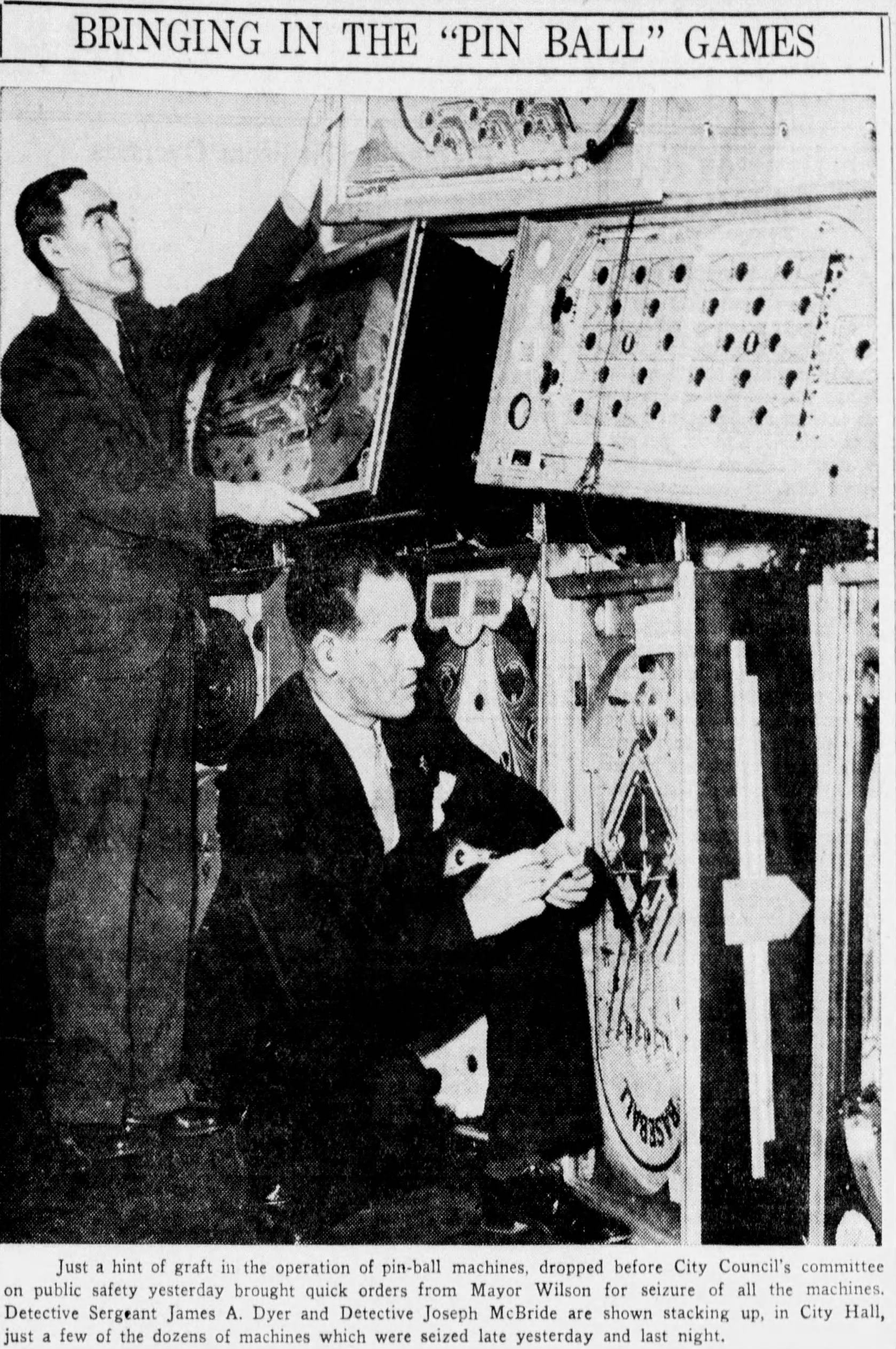
Pinball machines in Philadelphia City Hall, 1936.The Philadelphia Inquirer
Players would pay for a ball and could win free plays depending on the score, which they had no control over. The player could also press a button under the machine to cancel the free plays and receive 50 cents instead.
That made pinball ostensibly a slot machine, law enforcement and officials throughout the country argued at the time.
“This condition will lead to gang wars, gang fights, and killings,” Philadelphia Police Capt. John Murphy said in 1940. “The only sure preventive method is to drive out pinball machines completely.”
Officials were also concerned about the impact of the machines on youth. At a 1942 Pennsylvania Liquor Control Board hearing, students from Lower Merion testified that they had gambled on a pinball machine and bought beer at a local restaurant.
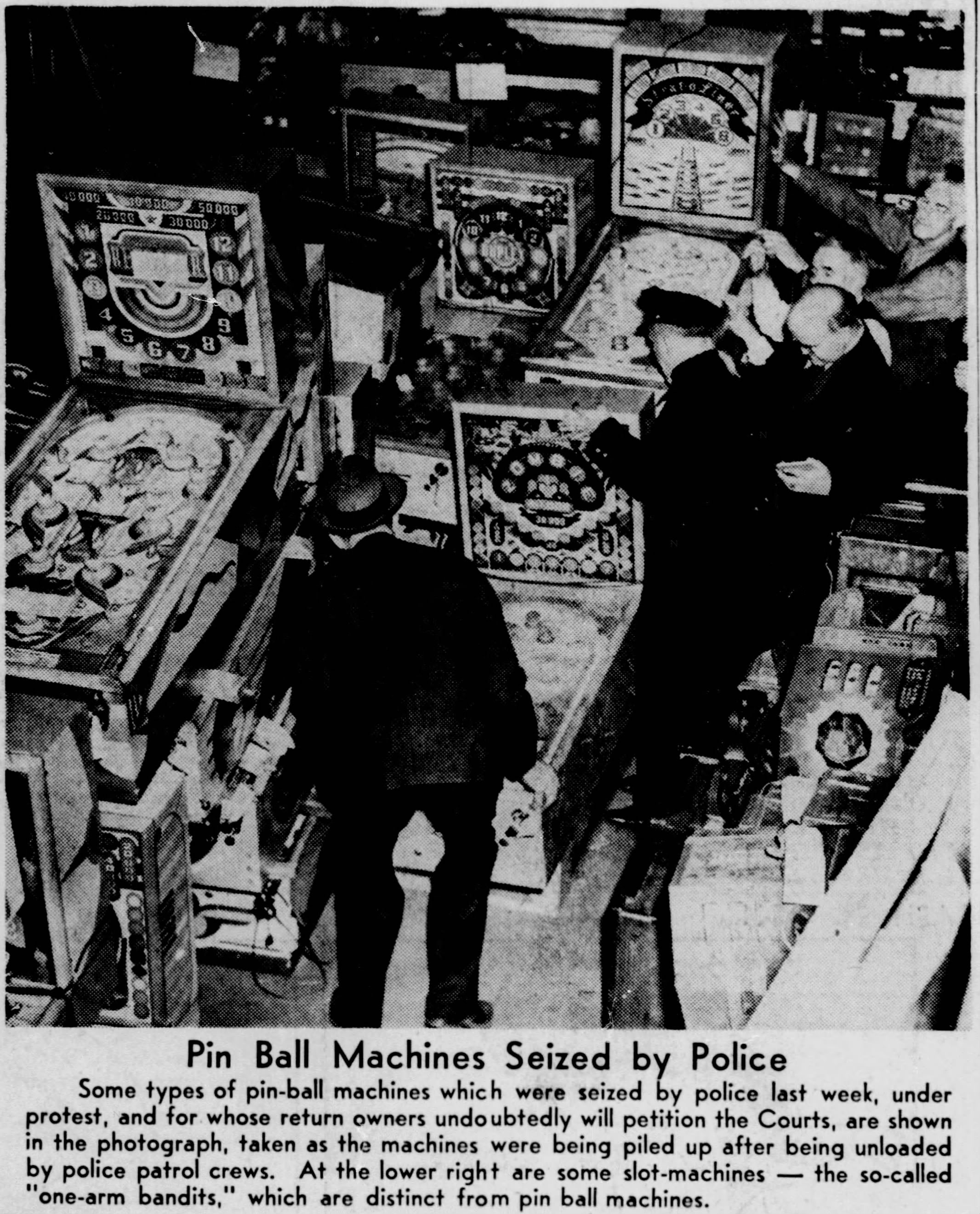
Police throughout the Philadelphia region seized machines during the late 1930s and 1940s, and courts had to grapple with the legality of the devices in cases that made their way up to the Pennsylvania Supreme Court.
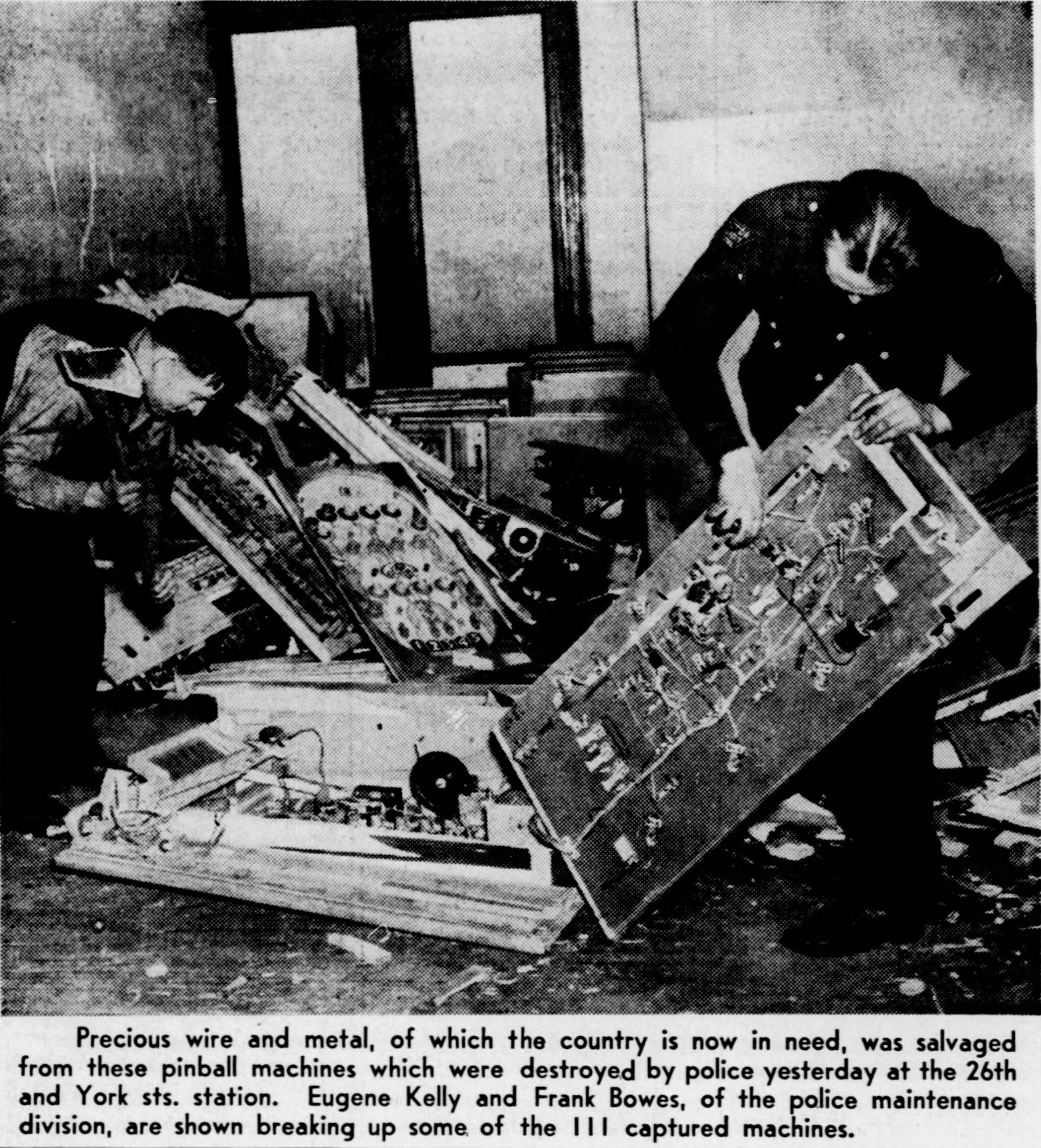
And throughout World War II, Philadelphia extracted metals from seized pinball machines to aid in the war effort.
But the war on pinball outlasted World War II and spilled into the 1950s.
A 1942 image of Philadelphia police maintenance staff removing metals and wires from pinball machines.The Philadelphia Inquirer
‘Clearly … gambling devices’
The early court battles over pinball machines centered on free plays and whether police needed direct evidence of gambling on a specific machine before seizing and destroying it.
In a 1957 raid in Fayette County, Pennsylvania State Police seized 41 bingo-style pinball machines from various establishments. Unlike flipper machines, which were already popular, in these devices a player shot balls into holes on a bingo-card-like board.
State police did not have direct evidence of gambling for more than half of the machines, and establishments challenged their seizure.
The Pennsylvania Supreme Court adopted a previous Superior Court ruling that the machines “clearly are gambling devices” and “were set up to be used for that purpose.”
The ruling did not affect single-coin devices, but banned those in which a player could insert multiple coins to improve the odds.
A pinball wiz ends the war
The tone on pinball machines began changing in the 1970s. Seizures continued, as did violent crime that police connected to disputes over the devices.
Headlines about crime and gambling were replaced with stories about pinball wizards. The machines found their homes in arcades.
The fever eventually broke — often attributed to a 1976 demonstration in New York City Council by GQ journalist and pinball enthusiast Roger Sharpe, which led to overturning the city’s 35-year-old ban. He demonstrated that he could launch a pinball into a specific location, thus affirming that it was a game of skill.
In the years that followed, pinball exploded in popularity. But the goal of the game changed, and it was no longer winning money on a bet.
“Pinball is, after all is said and done, an ego trip,” Philadelphia Daily News columnist Gene Castellano wrote in 1977. “You play to win, to have a small success, to beat the game.”