Category: News

  • Reading Terminal Market’s efforts to prevent food waste get the attention of the EPA

    Reading Terminal Market’s efforts to prevent food waste get the attention of the EPA

    The Reading Terminal Market is often bustling with voices, crowded aisles, and populated hallways. But on Monday, the real motion was behind the scenes, among the trash cans and scraps.

    After two years of diverting as much food waste from landfills as possible, the market has managed to keep 1,045,931 pounds of organic waste from the trash fields.

    A pilot program began in April 2024, through a partnership with the composting service Mother Compost, and 10 of the market’s sellers. Now, as part of the celebrations for the nation’s 250th, the Environmental Protection Agency’s Feed it Onward program is highlighting initiatives that ensure food resources are redistributed instead of wasted.

    EPA officials toured the market’s facilities on Monday, getting a behind-the-scenes look at how the composting and other recycling and reuse programs work.

    “We are not just one organization championing for change, but more than 80 small, family-owned businesses under one roof who have the potential to make a difference,” said Annie Allman, Reading Terminal Market CEO and general manager.

    Kamal’s Middle Eastern Specialties is one of them. Its owner Adham Albarouki, has been in the market for 45 years and sees in the composting program a way for his juice bar to give back.

    “We produce about 15 to 30 pounds of waste per day. Being part of something a little bit bigger here we can contribute a lot more,” Albarouki said. “It’s something to give back to mother nature.”

    The process is easy, Albarouki said. He or his workers run the vegetables and fruits through juicers. The juice goes to the customers, while the peels, fiber, and leftover organics are taken to a merchants-only area.

    Behind closed doors, 20 Mother Compost green trash cans are lined up, waiting to be fed scraps.
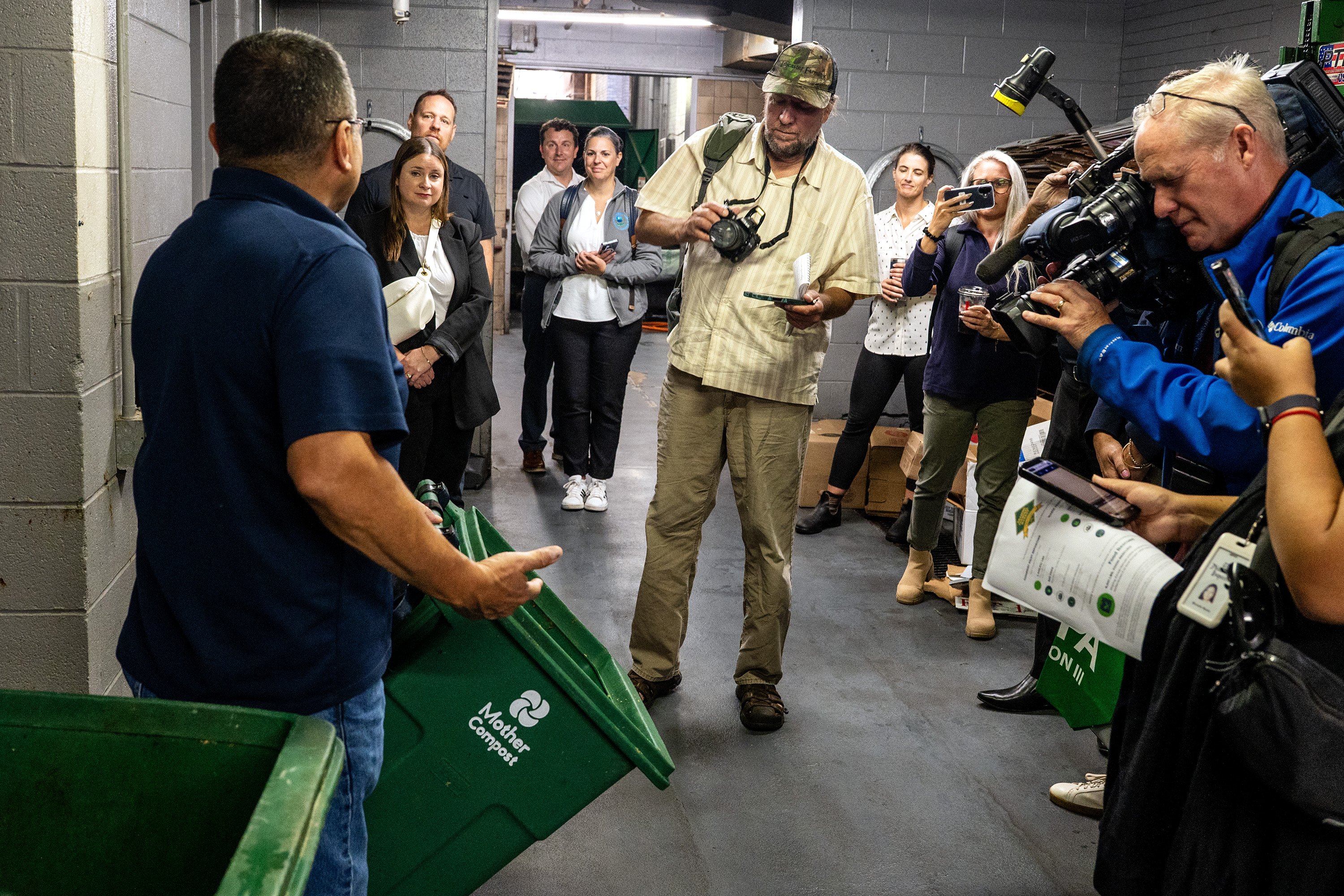
    Miguel Servellon (left), assistant general manager at Reading Terminal Market, gives merchants, EPA officers, and news media a behind-the-scenes tour of the market’s food waste diversion operations and sustainability programs on Monday. The green bins are from Mother Compost, a local, woman-owned pickup service, that composts organic materials to keep food scraps out of landfills and return their nutrients to local soils.Tom Gralish / Staff Photographer

    Miguel Servellon, the market’s assistant general manager, runs a tight machine to ensure the compost doesn’t get contaminated.

    On Monday morning the cement room smelled like orange peels, as one trash can had already been loaded with the citrusy scraps ahead of an early pick up, Servellon said.

    Fruit and vegetable peels, meat, eggs, cheese, milk, coffee grinds, and even fish all go inside the green containers.

    “The smell is not so inviting; occasionally it can be a challenge,” Servellon said.

    The organic waste is layered on top of each other.

    Mother Compost takes as much as 1,300 pounds of composting per pickup, which happen three times a week, Servellon said. The waste then goes to be repurposed at Linvilla Orchards, in Delaware County.

    But organic waste is not the only thing being recycled.

    At the other end of the room, two big gray containers sat full of vegetable oil waiting to be picked up by LifeCycle Renewables.

    Since 2022, the market has gathered 100,209 gallons of oil from sellers to be used as heating fuel in commercial buildings, Allman said.

    And since 2023, the nonprofit Sharing Excess has been working with the market’s sellers to redistribute surplus food.

    Earlier this year, Sharing Excess got its own fridge inside the market where sellers can deposit their donations to be redistributed in places with food insecurity.

    “We come by five days a week, and our driver weights them and tracks who donated each so we can give them their proper tax credit,” said Braden Walper, Sharing Excess retail rescue manager.

    The food goes to stock food pantries and provides as much as 100 meals a day for people experiencing food insecurity, Walper said.

    These Reading Terminal Market programs are crucial to inspire businesses across the region to reuse and recycle their food, said EPA Mid-Atlantic regional administrator Amy Van Blarcom-Lackey.

    “More than one million pounds diverted from landfills is an impressive milestone, but what really stands out to me is how the merchants made these practices part of their everyday operations,” Van Blarcom-Lackey said. “It’s important to continue because it’s good for the community and better for the environment.”


  • Trump says he likes Flock license-plate cameras amid growing backlash

    Trump says he likes Flock license-plate cameras amid growing backlash

    President Donald Trump expressed his support for a fast-growing surveillance tool opposed by many Americans, saying he likes Flock cameras “because of law enforcement.”

    “I sort of like them because of that, because of law enforcement, but some people don’t,” Trump told reporters aboard Air Force One on Sunday in his first public comments endorsing the technology. “They think it’s an infringement. I like them.”

    Trump has previously sidestepped questions about his stance on the artificial intelligence-powered license-plate readers that have provoked broad privacy and surveillance concerns. Asked about them in the Oval Office last month, he said: “It’s being studied right now. We’ll have an answer … as to our views on it over the next couple of weeks.”

    Trump’s new comments on Flock came shortly after he rejected calls from top AI leaders to limit the pace of development of artificial intelligence models. “We’re leading China in AI, we’re the most sophisticated country in the world, and frankly I want to keep it that way,” he said on the sidelines of the Irish Open golf tournament. “Whoever wins AI, wins.”

    Atlanta-based Flock has a network of more than 120,000 cameras across the U.S. The cameras record 20 billion license plate scans every month, the company says, which have helped officers investigate 1 million crimes a year.

    The surveillance systems had broad support as recently as last year, but an August survey by YouGov of approximately 20,000 U.S. adults found that 46% said they oppose the technology being used in their communities, compared with 38% support.

    The same month, an investigation by the Washington Post found dozens of law enforcement officers have been charged with or accused of misusing the plate-reading technology. Soon after, Flock announced changes to its platform to prevent the camera network from being abused by police officers, including a requirement for every search to be labeled with a criminal case number.

    But the technology has increasingly become a topic of political debate ahead of the midterm elections, with candidates from both parties outlining their opposition to them.

    “Do you ever feel like you are in a cage, kind of stuck, being watched?” U.S. Senate candidate Abdul El-Sayed asked in a video posted last month. “Well, that is because you are,” the Michigan Democrat continued, before criticizing what he called the “mass proliferation of” Flock cameras across the country.

    Rep. Keith Self, a Republican running for reelection in Texas, mentioned the cameras in a social media post, saying: “Big Brother has NO place in the Lone Star State.”

    Florida Gov. Ron DeSantis (R) last month said the cameras are “out of control.”

    “I don’t want to have this become a surveillance state,” he added.

  • Pa., N.J., and other states reach settlement that limits Trump changes to AmeriCorps

    Pa., N.J., and other states reach settlement that limits Trump changes to AmeriCorps

    Pennsylvania Gov. Josh Shapiro and 24 other state leaders have reached a settlement in a federal lawsuit that keeps President Donald Trump’s administration from making significant changes to AmeriCorps without prior warning and justification.

    The settlement announced last week stipulates that AmeriCorps must provide at least 30 days’ notice before making changes to its services, and protects funding for the organization through fiscal year 2026. The settlement comes more than a year after Shapiro and other governors and state attorneys general challenged a 2025 move to discontinue about $400 million worth of AmeriCorps programs and wipe out a vast majority of the organization’s staff.

    Created in 1993, AmeriCorps is a federal community service program that oversees thousands of volunteers, and acts as a domestic version of the Peace Corps. It provides services that include natural-disaster relief with the Red Cross, building homes with Habitat for Humanity, and providing instructors in underserved schools.

    The lawsuit’s outcome, Shapiro said in a statement, protects “critical funding the Commonwealth relies on to help communities respond to natural disasters, support seniors and veterans, keep our trails clean, and teach children to read.”

    Previously, a federal court ordered the Trump administration to reinstate the terminated AmeriCorps programs, and the Office of Budget Management agreed to release about $184 million in funds to programs around the country, said New Jersey State Attorney General Jennifer Davenport in statement. Davenport, who is part of the coalition of lawmakers in the lawsuit, said AmeriCorps members work “as critical volunteers in our communities.”

    “While this disruption never should have happened in the first place, I am pleased that by uniting together, states were able to not only stop these unannounced and drastic cuts to these important programs, but also to take steps to prevent this from happening again,” Davenport said.

    The lawsuit was filed in April 2025, after the Department of Government Efficiency recalled hundreds of members of the organization’s National Civilian Community Corps and placed a majority of its federal employees on administrative leave. DOGE also ordered AmeriCorps to terminate grants to more than 1,000 community service programs nationwide, including several in Pennsylvania.

    Now, under the settlement, AmeriCorps has said that it “does not anticipate mass terminating grants on a scale comparable to what happened in Spring 2025,” or conducting mass layoffs during fiscal year 2026. If those actions, among others, were to take place, it must provide the coalition of state lawmakers who brought the lawsuit with at least 30 days’ notice, and explain its legal authority to make the changes.

    Additionally, the settlement pauses litigation in the lawsuit through February, after which point the case will be dismissed so long as the terms of the agreement are upheld, Shapiro’s office said in a statement.

    In Pennsylvania, PennSERVE is the designated state service commission for AmeriCorps, and it distributes about $16 million in federal money annually to more than two dozen programs, Shapiro’s office said. There were 655 active AmeriCorps volunteers serving in 41 counties across the state at time the grant terminations were announced.

    “The federal government made a commitment with the Commonwealth of Pennsylvania to support these programs,” Shapiro said. “It’s my job as Governor to protect the interest of Pennsylvania taxpayers — and this settlement agreement ensures that these programs are protected for another year.”

  • Trump Jr. wedding celebrations were sponsored by powerful Russian businessperson

    Trump Jr. wedding celebrations were sponsored by powerful Russian businessperson

    Some of the festivities for Donald Trump Jr.’s intimate wedding celebration on two private Bahamian islands in May were paid for by a wealthy Russian who does business with the state.

    Umar Kremlev is the president of the International Boxing Association, a Switzerland-based sports league financed by Russian state energy giant Gazprom. He recently accompanied Russian President Vladimir Putin on a delegation to China, and he is under Ukrainian sanctions that describe him as a “close friend of the head of Putin’s security service.”

    Kremlev hosted two nights of celebrations after Trump Jr.’s wedding ceremony, the bride, Bettina Trump, said on Instagram on Monday.

    “It was an extraordinarily generous wedding gift from a friend, and something for which we were and remain incredibly grateful,” she wrote alongside photos from the festivities showing the couple and other Trump family members.

    Kremlev’s contribution was first disclosed by the investigative news website ProPublica, which reported that it cost hundreds of thousands of dollars and included event planning, a fireworks show, and rental of one of the private islands where guest slept. The payments came from a Dubai entity affiliated with the boxing agency, the website reported, citing records reviewed and interviews with three people.

    Bettina Trump denied any sinister or political motive. “Generosity doesn’t automatically come with an agenda,” she wrote on Instagram. “Sometimes a wedding gift is simply a wedding gift.”

    President Donald Trump did not attend the wedding. “It’s going to be just a small little private affair,” he told reporters at the time. “This is not good timing for me. I have a thing called Iran and other things.”

    In response to questions, the White House referred to Bettina Trump’s Instagram post.

    Kremlev did not immediately respond to a request for comment through the boxing association. He met Trump Jr. several years ago and speaks limited English, according to ProPublica.

    Kremlev has a criminal record under a previous name, the Washington Post reported in 2024. As head of the Russian Boxing Federation, Kremlev awarded Putin a diamond boxing glove, and Putin gave Kremlev a prestigious state honor known as the Order of Merit to the Fatherland. In April, Putin awarded Kremlev another honor, the Order of Friendship.

  • Pope Leo will present Villanova University’s first-ever sustainability medal to a cardinal who founded an AIDS network

    Pope Leo will present Villanova University’s first-ever sustainability medal to a cardinal who founded an AIDS network

    A Czechoslovakian-born cardinal who is based at the Vatican will receive Villanova University’s inaugural sustainability medal for his work “at the intersection of human dignity, social justice, care for vulnerable communities and care for creation,” the university announced Monday.

    Pope Leo XIV, a Villanova alumnus, will present the medal named for him to Cardinal Michael Czerny on Oct. 13 at the university’s international sustainability conference in Italy.

    Villanova established the award earlier this year to honor someone whose work shows “exceptional commitment to ecological responsibility, social justice, care for the most vulnerable and responsible stewardship of economic and human resources.”

    The award is in part inspired by Pope Leo’s call to serve the poor and marginalized, said the Rev. Peter M. Donohue, Villanova’s president, who announced the winner at a news conference in Rome. Taking care of the environment and the poor are inextricably linked, Villanova said.

    “The Medal reflects a deeply held belief at Villanova: care for our common home and care for one another are inseparable,” Donohue said in a statement. “Cardinal Czerny’s work has shown us that care for creation cannot be separated from care for people.”

    The medal features Pope Leo on one side and Villanova University’s name on the other and is meant to highlight the pope’s commitment to sustainability, the school said. The winner can come from any field or discipline and is selected by a committee of members of the university’s Sustainability Leadership Council.

    The medal carries a $25,000 award to be used toward continued work in sustainability, the university said.

    Born in 1946 in the former Czechoslovakia, Czerny, 80, moved to Montreal with his family as a small child. His mother was Jewish and the family had converted to Catholicism, but several members of his family had died at the hands of Nazis, according to the National Catholic Reporter, which featured an article on Czerny in 2022.

    “My mother’s family — both parents and two brothers — were also Catholic but shared the Jewish origins that the enemy abhorred,” Czerny said in a homily, quoted by the National Catholic Reporter. “My maternal grandmother Anna, my grandfather Hans and my uncles Georg and Carl Robert, were all interned in Terezín, where Hans died… My grandmother and uncles were transported to Auschwitz. From here my uncles were sent to labor camps and eventually murdered there.”

    His mother and father were forced to work as farm laborers because of her Jewish ancestry and his unwillingness to divorce her.

    Czerny became a Jesuit priest in 1973 and got a doctorate in human sciences, social thought and theology from the University of Chicago in 1978. He was named a cardinal by Pope Francis in 2019.

    Over the last five decades, his work was focused on helping vulnerable people worldwide, the university said. In 1979, Czerny founded and led a center for faith and social justice in Toronto. He volunteered to be based in El Salvador during the country’s civil war, and from 2002 to 2010, he worked in Africa and founded the African Jesuit AIDS Network in Kenya.

    “That organization he led brought in a lot of hope,” said the Rev. John Abubakar, Villanova’s chief sustainability officer, who is from Nigeria. “It made a massive, massive influence or difference in the lives of people.”

    From 2022 until Sept. 1, Czerny headed the Vatican’s Dicastery for Promoting Integral Human Development as Prefect, a role in which he led the Church’s work on justice, migration, health and care for creation. Pope Francis in 2022 sent him to Slovakia to greet refugees fleeing Ukraine following the Russian invasion.

    Czerny said he was grateful for the medal and the honor it brings.

    “What’s most important I think is the commitment the university is making to include sustainability in how it is forming the future leaders of our church and in this case the United States,” he said in a video on the Vatican news site.

  • As Supreme Court weighs Trump mail ballot plan, another judge blocks it

    As Supreme Court weighs Trump mail ballot plan, another judge blocks it

    WASHINGTON — As the Supreme Court weighs the legality of a Trump administration plan to change mail-in balloting, a second lower court judge ruled overnight Sunday that the plan is likely illegal and should be blocked before the November election.

    The ruling by Judge Carl J. Nichols, a Trump appointee, delivered another blow to President Donald Trump’s effort to add new conditions that could make it harder to vote by mail and easier for the federal government to scrutinize state voter rolls while searching for evidence of fraud.

    The Supreme Court is considering a similar ruling by a different federal judge based in Massachusetts. Judge Indira Talwani, an Obama appointee, has repeatedly found that the plan is likely unconstitutional and could not be implemented so close to the election without disenfranchising voters.

    Nichols, of U.S. District Court in Washington, wrote that the Trump administration had not identified any “evidence that there will be significant fraud in the upcoming elections” if he halted the rule. On the other hand, he wrote, there was an “increased risk that a significant number of otherwise appropriate absentee or mail-in ballots will ultimately not be counted in the upcoming elections” if the rule took effect.

    “The public has a strong interest in ensuring that doesn’t happen,” he wrote.

    Nichols’ ruling came in a lawsuit brought by a coalition of Democratic-aligned groups, including the Democratic Senatorial Campaign Committee, as well as a number of civil rights organizations. The Massachusetts suit was brought by a coalition of Democratic state attorneys general and voting rights groups.

    Nichols ruled in May that he could not stop the Postal Service from drafting the rule or preemptively declare it would necessarily be illegal before it was finalized. The Supreme Court similarly ruled last month that it was premature for the courts to intervene to stop Trump’s plan.

    But Nichols said he would review the issue after the Postal Service finalized the regulation, which it did in August. His finding that the proposal now should be blocked could offer a preview for how the justices view the issue.

    In a court filing Monday, the Trump administration formally alerted the Supreme Court about Nichols’ ruling.

    Lawyers for the Trump administration told the justices that if they allowed the Postal Service plan, it would mean Nichols would be required to immediately lift his block and clear the way for the ballot screening rules.

    The new rule stemmed from an executive order Trump signed in March, directing the Postal Service to preregister voters casting their ballots by mail, and to decline to deliver ballots from anyone whose information was not submitted by their state election officers.

    Talwani, who considered the separate legal challenge in Massachusetts, had found that the rule likely violated the constitutional authority given to states to run their own elections. But Nichols focused on another issue: the absence of any federal statute by which Congress gave the Postal Service the power to screen voters.

    “As the government concedes, the Postal Service could issue (and enforce) the rule only if Congress gave it the authority to do so, but here no statute grants the Postal Service the power to issue key parts of the rule,” he wrote.

    He focused on an online portal the Postal Service has said it is building that would let states upload the names and addresses of voters they deemed eligible to vote by mail. The relevant laws do not authorize the agency “to create a data collection system for mail-in and absentee voters,” he wrote.

    Despite the lawsuits, a number of Republican-led states have indicated in court that they would voluntarily adopt the new procedure and were taking steps to comply if the courts ultimately allowed it.

    Voting rights groups had argued that it would be nearly impossible to ensure the lists were up to date or counted people who had moved or recently registered in a new state. They warned that the new rules would very likely lead to improperly rejected ballots.

    State election officials have warned the plan could cause chaos. In some states, mail ballots have already been distributed to voters.

    Nichols appeared to agree, writing that the rule appeared certain to cause “delays and mistakes” at several stages. That could include the building of the portal, which has not yet opened, and the Postal Service’s new role screening outbound ballots and “confirming that each absentee and mail-in voter matches information in the portal,” he wrote.

    “Plaintiffs have demonstrated that there is an increased risk that a significant number of absentee or mail-in ballots will ultimately not be counted,” he wrote, noting that the Postal Service was likely to handle “more than 50 million pieces of federal ballot mail” this election season.

    This article originally appeared in the New York Times.

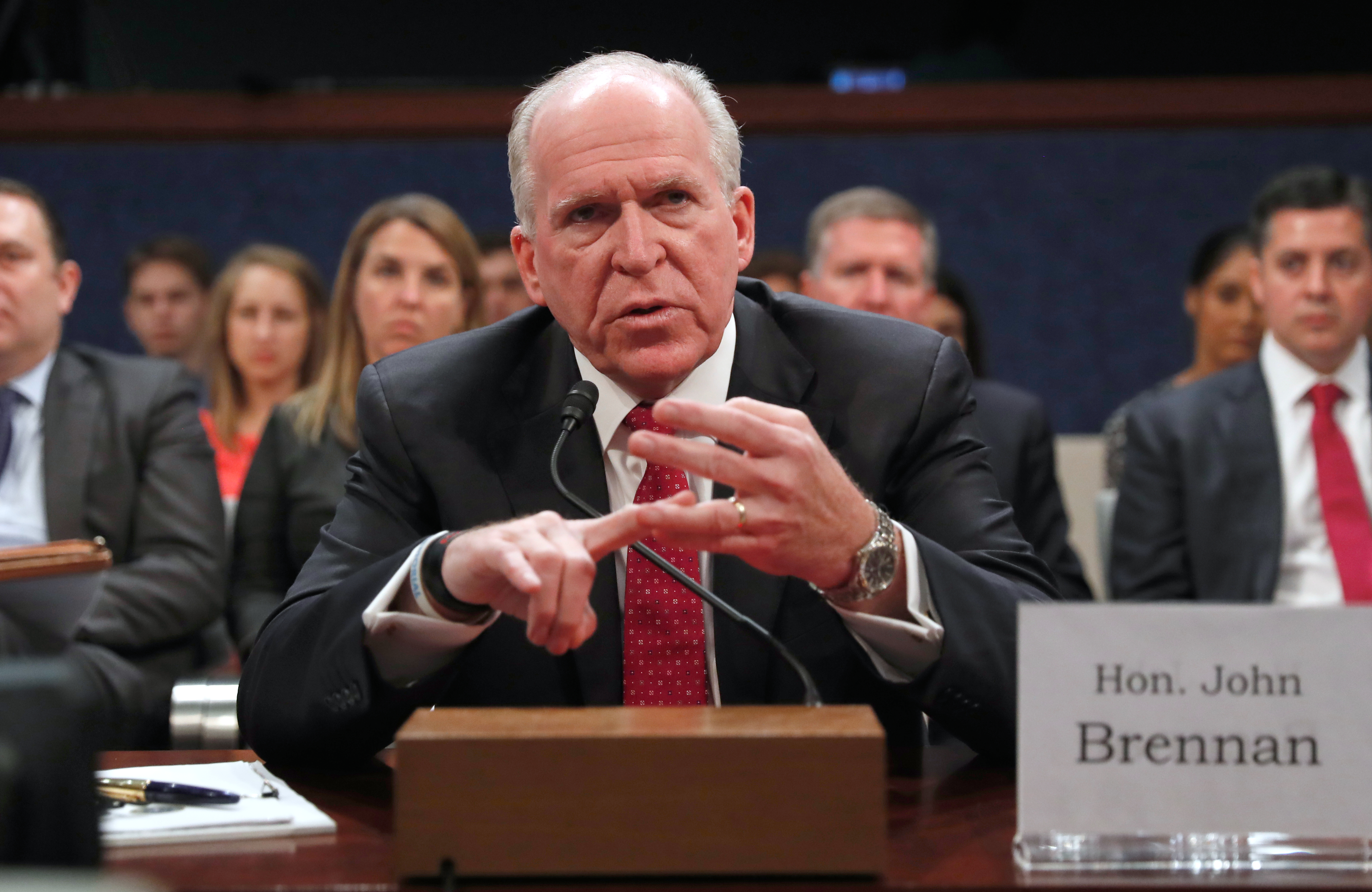
  • Ex-CIA Director John Brennan issued subpoena in Trump “grand conspiracy” investigation, lawyer says

    Ex-CIA Director John Brennan issued subpoena in Trump “grand conspiracy” investigation, lawyer says

    WASHINGTON — Former CIA Director John Brennan has been subpoenaed to testify next month before a Florida grand jury as part of a Justice Department investigation into whether former law enforcement and intelligence officials conspired against President Donald Trump, one of his lawyers said Monday.

    Ken Wainstein, an attorney for Brennan, disclosed in a court filing that prosecutors last Thursday presented him with a subpoena for Brennan to appear Oct. 15 before a grand jury in Fort Pierce, Fla.

    He said he was told that the subpoena relates to a “far-reaching” criminal probe examining a loosely defined theory that the government officials who have investigated Trump over the last decade, including over Russia election interference in 2016 and his more recent retention of classified documents at his Mar-a-Lago estate, conspired to deprive Trump of his civil rights. The subpoena to Brennan is among a flurry that have been issued in recent weeks.

    Wainstein said he was informed by a prosecutor that Brennan remains a target in a Washington-based investigation into whether he lied to Congress in 2023, a claim the former CIA director and his attorneys have consistently denied. Subpoenas demanding testimony before a grand jury in that false statements probe were issued in spring, then abruptly withdrawn in favor of voluntary interviews.

    The subpoena was delivered on the same day that Joe diGenova, the prosecutor who had been leading what is casually known as the “grand conspiracy” investigation, abruptly resigned amid what a person familiar with the matter has described as displeasure from the Justice Department and White House over the pace and management of the probe.

    The Justice Department has not publicly announced a replacement for diGenova. The member of the investigative team with whom Wainstein spoke was Kurt Olsen, a lawyer who unsuccessfully pushed the Justice Department in 2020 to back Trump’s false claims that the 2020 election had been stolen from him.

    The subpoena was disclosed hours ahead of a court hearing in Washington in a lawsuit brought by Brennan. The former CIA director is seeking a court order that would require the preservation of all records from the investigations targeting him, saying such documents would be essential for him to challenge any potential indictment on vindictive prosecution grounds.

  • Philly Parks and Rec leader approved the unpermitted work at an FDR Park field

    Philly Parks and Rec leader approved the unpermitted work at an FDR Park field

    Parks and Recreation Commissioner Susan Slawson said she approved renovations to FDR Park’s Ashburn Field without required state permitting because she wanted renovations to be complete by the MLB All-Star Game.

    The missing permit was designed to address erosion control and stormwater release at the site.

    “We were mindful of the waterways and natural areas within FDR Park,” Slawson said of the decision. “All erosion and sediment controls were in place during construction, and safety was never an issue.”

    Slawson told WHYY last week that approving projects without proper permits is not how the department “typically” handles projects, but she allowed the work to proceed “to accommodate the MLB All-Star Game.”

    Typically, state law supersedes city approvals.

    The city’s parks department actively manages “the natural areas within FDR [Park] to protect water quality and support healthy natural systems while balancing the park’s important role in active recreation,” Slawson said.

    Missing permits

    In the lead up to the MLB All-Star Game, which took place in July at Citizens Bank Park, the MLB and the city partnered to renovate the 28-year-old Ashburn Field.

    A ribbon-cutting ceremony was held July 10, just days ahead of the All-Star Game, to show off Ashburn’s new synthetic turf field and an updated drainage system to reduce flooding.

    However, as first reported by The Inquirer last month, the Phillies and the city did not receive a required permit from the state’s Department of Environmental Protection. The permit was designed to address erosion control and stormwater release at the site.

    The Phillies applied for the permit May 13, according to the Department of Environmental Protection’s website. Nearly two weeks later, the department sent the Phillies a letter denying the permit, citing 32 issues the team would need to address before receiving the permit to continue renovations. That letter noted that final plan drawings had not been submitted, other drawings failed to include the project’s boundary, and not all water discharge areas were noted.

    A local engineering firm hired by the Phillies responded in June to the May letter.

    On July 7, the Department of Environmental Protection sent another letter to the Phillies noting technical deficiencies. It sent another letter July 24, about two weeks after the ribbon cutting, noting an outstanding deficiency and advising the Phillies to resubmit information in coordination with the Philadelphia Water Department.

    What’s next

    Bonnie Clark, a spokesperson for the Phillies, said the team met with the Water Department last week and was continuing to remedy issues to obtain the permit.

    The permit is still pending on the Department of Environmental Protection website. DEP spokesperson Robyn Briggs declined to comment on possible enforcement actions or penalties as internal deliberations continue.

  • Putin warns Europe of war if peacekeeping troops are deployed to Ukraine

    Putin warns Europe of war if peacekeeping troops are deployed to Ukraine

    Offering a grim assessment of Russia’s relations with the West, President Vladimir Putin pointedly warned European governments not to deploy any troops, including peacekeeping forces, to Ukraine, saying it would mean “war.”

    “They speak of contemplating the dispatch of troops to the territory of Ukraine,” Putin said, following his participation Friday at a summit of leaders of the BRICS bloc of nations in New Delhi. “This would mean war with Russia.”

    Putin lashed out at what he called systemic errors committed by the “West’s globalist circles,” insisting that Russia posed no danger to European countries, which he said “seek to frighten their populations with a mythical Russian threat.”

    He also insisted that the West was to blame for the war in Ukraine by seeking to expand NATO. “They directly supported separatism in the Caucasus and sought to break up Russia; this is a matter of fact. Furthermore, today’s crisis in Ukraine was likewise instigated by them.”

    As if to put an exclamation point on Putin’s remarks, a Russian drone strike hit passenger rail infrastructure in western Ukraine as many Western diplomats, officials, and experts, including former CIA Director David Petraeus, former British Prime Minister Boris Johnson, and former Swedish Prime Minister Carl Bildt were leaving the country after attending the annual Yalta European Strategy conference in Kyiv.

    Passengers on at least one train were evacuated, but no deaths or injuries were reported from the strike.

    German Defense Minister Boris ​Pistorius called the drone strike a calculated escalation to fuel fear in Europe.

    “It is ​all the more important that we ⁠remain levelheaded, that we do not ​allow ourselves to be provoked, but ​that at the same time we leave no doubt that we are capable of defending ​ourselves,” Pistorius told reporters. “What Vladimir Putin is doing is dangerous. He knows that, and that is ​why he ​is doing ⁠it.”

    The rail line attack further alarmed European officials who have been warning that Russia could attack near Ukraine’s border crossings with NATO countries or could intensify sabotage operations inside Europe to discourage Western leaders from further aiding Ukraine.

    “These coming weeks and months will be a time of very intensified actions on the Russian side, and unfortunately we cannot rule out that this escalation will also affect our territory,” Polish Prime Minister Donald Tusk said Sunday following a government security briefing.

    The Trump administration in recent days has renewed its efforts to jump-start peace negotiations between Russia and Ukraine, including with trips by presidential envoys Steve Witkoff and Jared Kushner to Moscow and Ukraine.

    Following those talks, Kushner said that Washington had already drafted most of the peace agreement but that it was being held up by Ukraine’s reluctance to make territorial concessions to Russia, which now occupies about one-fifth of Ukraine’s sovereign territory.

    Putin has demanded that Ukraine surrender all of its eastern Donbas region, and Russia has claimed, illegally, to have annexed four Ukrainian regions, even though militarily it does not control all of that land.

    “President Putin laid out his position regarding what he wants to achieve,” Kushner said at the YES conference. “If Ukraine wanted to retreat to that line, we would have already prepared and agreed on the remaining terms of the deal. Currently, Ukraine does not want to do this.”

    Ukraine has repeatedly said that ceding land that Russia failed to capture militarily is a nonstarter, arguing that withdrawing from fortified cities in Donbas would only expose the country to future attacks.

    Kushner and Witkoff said they were pushing for trilateral negotiations. And Ukrainian President Volodymyr Zelensky said he is willing to meet Putin at the Group of 20 summit scheduled for mid-December at Trump’s resort in Doral, Fla.

    The Kremlin immediately ruled out such a meeting, calling it “impossible” and saying that Putin would only meet Zelensky in Moscow. Kyiv repeatedly has dismissed the offer of a meeting in Moscow as the Kremlin playing games.

    Putin’s spokesperson Dmitry Peskov said that the talks on Ukraine probably would resume in October, after Russia holds a key parliamentary election this weekend.

    The potential deployment of a European peacekeeping force has been discussed as one potential way to provide Ukraine with “security guarantees.” But any such step would first require the signing of a durable truce between Kyiv and Moscow.

    Britain and France previously had agreed to deploy forces in Ukraine if the country reaches a peace deal with Russia, with then-Prime Minister Keir Starmer and President Emmanuel Macron signing a “declaration of intent.”

    But as negotiations stalled, with Washington focused on its own war in Iran, the proposals to send European troops to Ukraine have also gone quiet.

    Europe, because of its increasing role in Ukraine’s capability to launch strikes against Russian territory, is becoming “Moscow’s central strategic problem, overshadowing the United States, Ukraine, and, to some extent, even NATO,” Tatiana Stanovaya, a senior fellow at the Carnegie Russia Eurasia Center, wrote on X.

    “This will shape the nature of negotiations with and about Ukraine, as well as the outcome of any settlement, far more than it did a year ago,” Stanovaya added. “It is likely to dominate European geopolitics for decades.”

  • Three Wallingford-Swarthmore schools locked down Monday during a police search outside

    Three Wallingford-Swarthmore schools locked down Monday during a police search outside

    Students at Strath Haven High School and Middle School and Wallingford Elementary School sheltered in place Monday morning as police searched the area for a suspect who had fled during a traffic stop.

    The incident began when a Nether Providence Township police officer stopped an Acura at 9:07 a.m. Monday on South Providence Road, police said in a statement. The driver fled in the car, which police determined was stolen, and the officer lost sight of it.

    Then at 9:41 a.m., a resident contacted the police to report a car abandoned in a backyard on Hickory Lane, near the high school, police said. Officers determined the car was the same one that had been driven by the suspect, and police began searching the area.

    Police said they worked with school officials to place the three Wallingford-Swarthmore schools, which enroll about 2,600 students, “in a ‘Teach in Place’ status while officers searched the surrounding area.”

    Wallingford-Swarthmore Superintendent Russell Johnston said the lockdown “kept the kids safe inside the buildings” during the police search. Classes continued during that time, he said.

    “What we did was out of an abundance of caution,” Johnston said. He said school officials believed police had guns drawn during the search.

    Police reviewed video surveillance that showed the suspect “fleeing toward the rear of Strath Haven High School” before being picked up by another car. The schools returned to their normal status after it was clear the suspect had left the area, police said.

    Nether Providence Township police are still investigating the incident, and are asking anyone with information to call the department’s detective division at 610-892-2875.